 filings.tools
Cover and table of contents
46K characters. Original on sec.gov · Markdown
Cover and table of contents
UNITED STATES
SECURITIES AND EXCHANGE COMMISSION
Washington, D.C. 20549
FORM 10-K
| ☒ | ANNUAL REPORT PURSUANT TO SECTION 13 OR 15(d) OF THE SECURITIES EXCHANGE ACT OF 1934 |
For the fiscal year ended December 31, 2023
or
| ☐ | TRANSITION REPORT PURSUANT TO SECTION 13 OR 15(d) OF THE SECURITIES EXCHANGE ACT OF 1934 |
For the transition period from to
Commission File Number 001-03492
HALLIBURTON COMPANY
(Exact name of registrant as specified in its charter)
| Delaware | 75-2677995 | ||||
| (State or other jurisdiction of incorporation or organization) | (I.R.S. Employer Identification No.) |
| 3000 North Sam Houston Parkway East, | Houston, | Texas | 77032 | ||||||||
| (Address of principal executive offices) | (Zip Code) |
(281) 871-2699
(Registrant's telephone number, including area code)
| Securities registered pursuant to Section 12(b) of the Act: | ||||||||
| Title of each class | Trading Symbol | Name of each exchange on which registered | ||||||
| Common Stock, par value $2.50 per share | HAL | New York Stock Exchange | ||||||
| Securities registered pursuant to Section 12(g) of the Act: None |
Indicate by check mark if the registrant is a well-known seasoned issuer, as defined in Rule 405 of the Securities Act.
☒ Yes ☐ No
Indicate by check mark if the registrant is not required to file reports pursuant to Section 13 or Section 15(d) of the Act.
☐ Yes ☒ No
Indicate by check mark whether the registrant (1) has filed all reports required to be filed by Section 13 or 15(d) of the Securities Exchange Act of 1934 during the preceding 12 months (or for such shorter period that the registrant was required to file such reports), and (2) has been subject to such filing requirements for the past 90 days.
☒ Yes ☐ No
Indicate by check mark whether the registrant has submitted electronically every Interactive Data File required to be submitted pursuant to Rule 405 of Regulation S-T (§ 232.405 of this chapter) during the preceding 12 months (or for such shorter period that the registrant was required to submit such files).
☒ Yes ☐ No
Indicate by check mark whether the registrant is a large accelerated filer, an accelerated filer, a non-accelerated filer, a smaller reporting company, or an emerging growth company. See the definitions of “large accelerated filer,” “accelerated filer,” “smaller reporting company,” and “emerging growth company” in Rule 12b-2 of the Exchange Act.
| Large Accelerated Filer | ☒ | Accelerated Filer | ☐ | |||||||||||
| Non-accelerated Filer | ☐ | Smaller Reporting Company | ☐ | |||||||||||
| Emerging Growth Company | ☐ |
Indicate by check mark whether the registrant has filed a report on and attestation to its management's assessment of the effectiveness of its internal control over financial reporting under Section 404(b) of the Sarbanes-Oxley Act (15 U.S.C. 7262(b)) by the registered public accounting firm that prepared or issued its audit report. ☒
If securities are registered pursuant to Section 12(b) of the Act, indicate by check mark whether the financial statements of the registrant included in the filing reflect the correction of an error to previously issued financial statements. ☐
Indicate by check mark whether any of those error corrections are restatements that required a recovery analysis of incentive-based compensation received by any of the registrant's executive officers during the relevant recovery period pursuant to §240.10D-1(b). ☐
Indicate by check mark whether the registrant is a shell company (as defined in Rule 12b-2 of the Exchange Act). ☐ Yes ☒ No
The aggregate market value of Halliburton Company Common Stock held by non-affiliates on June 30, 2023, determined using the per share closing price on the New York Stock Exchange Composite tape of $32.99 on that date, was approximately $22.5 billion.
As of January 30, 2024, there were 890,101,601 shares of Halliburton Company Common Stock, $2.50 par value per share, outstanding.
Portions of the Halliburton Company Proxy Statement for our 2024 Annual Meeting of Shareholders (File No. 001-03492) are incorporated by reference into Part III of this report.
HALLIBURTON COMPANY
Index to Form 10-K
For the Year Ended December 31, 2023
i
| Table of Contents | Item 1 | Business |
PART I
Item 1. Business.
Description of business and strategy
Halliburton Company is one of the world's largest providers of products and services to the energy industry. Its predecessor was established in 1919 and incorporated under the laws of the State of Delaware in 1924. Inspired by the past and leading into the future, what started with a single product from a single location is now a global enterprise. Our value proposition is to collaborate and engineer solutions to maximize asset value for our customers. We strive to achieve strong cash flows and returns for our shareholders by delivering technology and services that improve efficiency, increase recovery, and maximize production for our customers. Halliburton has fostered a culture of unparalleled service to the world's major, national, and independent oil and natural gas producers. With approximately 48,000 employees, representing over 130 nationalities in more than 70 countries, we help our customers maximize asset value throughout the lifecycle of the reservoir - from locating hydrocarbons and managing geological data, to drilling and formation evaluation, well construction and completion, and optimizing production throughout the life of the asset.
2023 Highlights
- Financial: Our total revenue increased 13% in 2023 as compared to 2022. Our International revenue increased 17% and our North America revenue increased 9% in 2023 compared to 2022, with improved margins driven by increased activity and pricing gains. Overall, our Completion and Production and Drilling and Evaluation operating segments finished the year with 21% and 17% operating margins, respectively. We generated strong cash flows from operations and repurchased $300 million of debt.
- Digital: Our accelerated deployment and integration of digital and automation technologies created technical differentiation in the market and contributed to our higher margins and increased internal efficiencies.
- Capital efficiency: We advanced technologies and made strategic choices that kept our capital expenditures to 6% of revenue, which is in the range of our 5-6% of revenue target.
- Shareholder returns: We returned $1.4 billion of capital to shareholders through buybacks and dividends, which is consistent with our capital returns framework.
- Sustainability and energy mix transition:
-
Named to the Dow Jones Sustainability North America Index (DJSI), the third consecutive year. DJSI assesses the sustainability performance of companies using a transparent, rules-based process based on the annual S&P Global Corporate Sustainability Assessment;
-
Added eleven new participating companies to Halliburton Labs, our clean energy accelerator; and
-
Provided services in carbon capture and storage.
2024 Focus
- International: Allocate our capital to the highest return opportunities and increase our international growth in both onshore and offshore markets.
- North America: Maximize value by, among other things, utilizing our premium low-emissions Zeus electric fracturing systems, as well as automated and intelligent fracturing technologies, to drive higher margins through better pricing and increased efficiency.
- Digital: Continue to drive differentiation and efficiencies through the deployment and integration of digital and automation technologies, both internally and for our customers.
- Capital efficiency: Maintain our capital expenditures at approximately 6% of revenue while focusing on technological advancements and process changes that reduce our manufacturing and maintenance costs and improve how we move equipment and respond to market opportunities.
- Shareholder returns: Return over 50% of annual free cash flow to shareholders through dividends and share repurchases.
- Sustainability and energy mix transition: Continue to:
-
Leverage the participants in Halliburton Labs to gain insight into developing value chains in the energy mix transition;
-
Develop and deploy solutions to help lower the carbon intensity of our customers' businesses;
-
Develop technologies and solutions to lower our emissions; and
-
Continue to participate in carbon capture, utilization, and storage, hydrogen, and geothermal projects globally.
For further discussion on our business strategies, see “Item 7. Management’s Discussion and Analysis of Financial Condition and Results of Operations – Business Environment and Results of Operations-Business Outlook.”
HAL 2023 FORM 10-K | 1
| Table of Contents | Item 1 | Business |
Operating segments
We operate under two divisions, which form the basis for the two operating segments we report, the Completion and Production segment and the Drilling and Evaluation segment.
Completion and Production delivers cementing, stimulation, specialty chemicals, intervention, pressure control, artificial lift, and completion products and services. The segment consists of the following product service lines:
- Artificial Lift: provides services to maximize reservoir and wellbore recovery by applying lifting technology, intelligent field management solutions, and related services throughout the life of the well, including electrical submersible pumps.
- Cementing: involves bonding the well and well casing while isolating fluid zones and maximizing wellbore stability. Our cementing product service line also provides casing equipment.
- Completion Tools: provides downhole solutions and services to our customers to complete their wells, including well completion products and services, intelligent well completions, liner hanger systems, sand control systems, multilateral systems, and service tools.
- Multi-Chem: provides customized specialty chemicals and services for completion, production, midstream, and downstream to optimize flow assurance and integrity.
- Pipeline & Process Services: provides a complete range of pre-commissioning, commissioning, maintenance, and decommissioning services to the onshore and offshore pipeline and process plant construction commissioning and maintenance industries.
- Production Enhancement: includes stimulation services and sand control services. Stimulation services optimize reservoir production through a variety of pressure pumping services and chemical processes, commonly known as hydraulic fracturing and acidizing. Sand control services include fluids and chemicals for the prevention of sand production of unconsolidated reservoirs.
- Production Solutions: provides customized well intervention solutions to increase well performance, which includes coiled tubing, hydraulic workover units, downhole tools, pumping services, and nitrogen services.
Drilling and Evaluation provides field and reservoir modeling, drilling, fluids, evaluation and precise wellbore placement solutions that enable customers to model, measure, drill, and optimize their well construction activities. The segment consists of the following product service lines:
- Baroid: provides drilling fluid systems, performance additives, completion fluids, solids control, specialized testing equipment, and waste management services for drilling wells, completion, and workover operations.
- Drill Bits and Services: provides roller cone bits, fixed cutter bits, hole enlargement and related downhole tools and services used in drilling wells. In addition, coring equipment and services are provided to extract formation cores for rock properties evaluation.
- Halliburton Project Management: provides integrated solutions by leveraging the full line of our well construction, well completion, and well intervention services to solve customer challenges throughout the entire well lifecycle, including project management and integrated asset management.
- Landmark Software and Services: provides cloud based digital services and artificial intelligence solutions on an open architecture for subsurface insights, integrated well construction, and reservoir and production management.
- Sperry Drilling: provides drilling systems and services that offer directional control for precise wellbore placement while providing important measurements about the characteristics of the drill string and geological formations while drilling wells. These services include directional and horizontal drilling, measurement-while-drilling, logging-while-drilling, surface data logging, and rig site information systems.
- Testing and Subsea: provides acquisition and analysis of dynamic reservoir information and reservoir optimization solutions through a broad portfolio of well testing tools, data acquisition services, fluid sampling, surface well testing, subsea safety systems, and underbalanced applications.
- Wireline and Perforating: provides open-hole logging services that supply information on formation evaluation and reservoir fluid analysis, including formation lithology, rock properties, and reservoir fluid properties. Also offered are cased-hole and slickline services, including perforating, pipe recovery services, through-casing formation evaluation and reservoir monitoring, casing and cement integrity measurements, and well intervention services.
HAL 2023 FORM 10-K | 2
| Table of Contents | Item 1 | Business |
The following charts depict our revenue split between our two operating segments for the years ended December 31, 2023 and 2022.
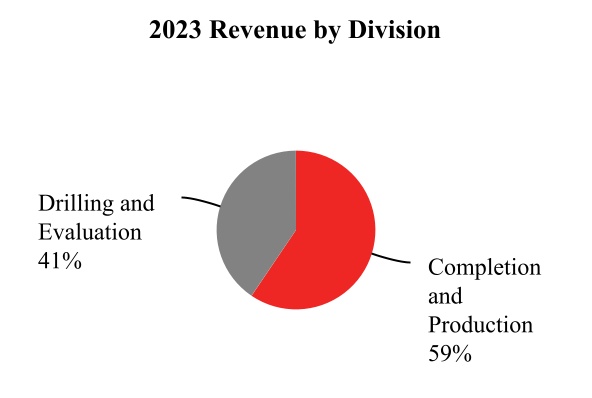
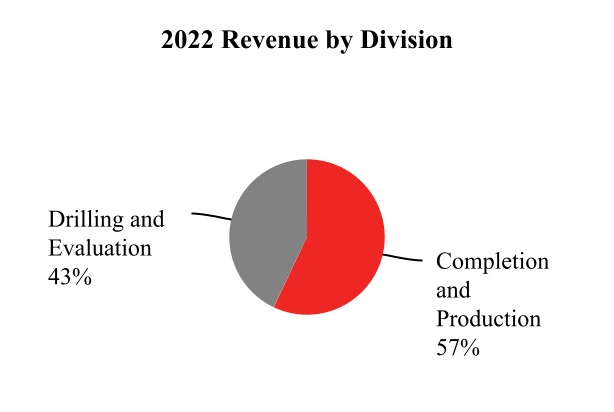
See Note 3 to the consolidated financial statements for further financial information related to each of our business segments.
Markets and competition
We are one of the world’s largest diversified energy services companies. Our services and products are sold in highly competitive markets throughout the world. Competitive factors impacting sales of our services and products include: price; service delivery; health, safety, and environmental standards and practices; service quality; global talent retention; understanding the geological characteristics of the reservoir; product quality; warranty; and technical proficiency.
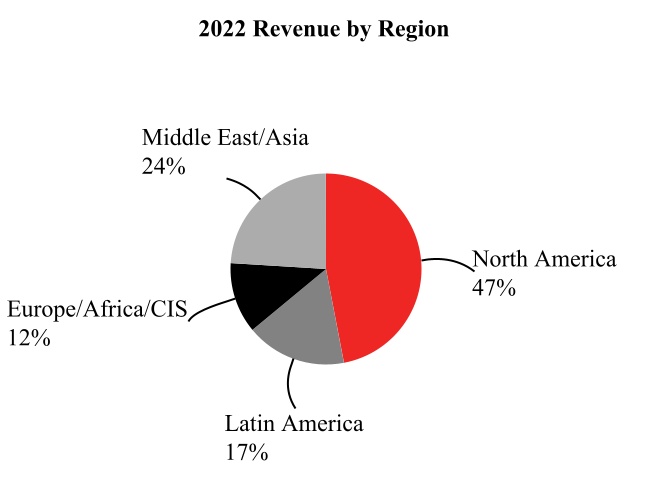
We conduct business worldwide in more than 70 countries. The business operations of our divisions are organized around four primary geographic regions: North America, Latin America, Europe/Africa/CIS, and Middle East/Asia. In 2023, 2022, and 2021, based on the location of services provided and products sold, 44%, 45%, and 40%, respectively, of our consolidated revenue was from the United States. No other country accounted for more than 10% of our consolidated revenue during these periods. See "Item 7. Management’s Discussion and Analysis of Financial Condition and Results of Operations" for additional information about our geographic operations. Because the markets for our services and products are vast and cross numerous geographic lines, it is not practicable to provide a meaningful estimate of the total number of our competitors. The industries we serve are highly competitive, and we have many substantial competitors. Most of our services and products are marketed through our service and sales organizations.
The following charts depict our revenue split between our four primary geographic regions for the years ended December 31, 2023 and 2022.

HAL 2023 FORM 10-K | 3
| Table of Contents | Item 1 | Business |
Our operations in some countries and regions may be adversely affected by unsettled political conditions, acts of terrorism, civil unrest, force majeure, war or other armed conflict, health or similar issues, sanctions, expropriation or other governmental actions, inflation, changes in foreign currency exchange rates, foreign currency exchange restrictions and highly inflationary currencies, as well as other geopolitical factors. We believe the geographic diversification of our business activities reduces the risk that an interruption of operations in any one country, other than the United States, would be materially adverse to our business, consolidated results of operations, or consolidated financial condition.
Information regarding our exposure to foreign currency fluctuations, risk concentration, and financial instruments used to minimize risk is included in “Item 7. Management’s Discussion and Analysis of Financial Condition and Results of Operations – Financial Instrument Market Risk” and in Note 16 to the consolidated financial statements.
Customers
Our revenue during the past three years was derived from the sale of services and products to the energy industry. No single customer represented more than 10% of our consolidated revenue in any period presented.
Raw materials
Raw materials essential to our business are normally readily available. However, market conditions can trigger constraints in the supply of certain raw materials, such as proppants (primarily sand), chemicals, metals, and gels. We are always striving to ensure the availability of resources and manage raw material costs. Our procurement department uses our relationships and buying power to enhance our access to key materials at competitive prices.
Patents
We own a large number of patents and have pending a substantial number of patent applications covering various products and processes. We are also licensed to utilize technology covered by patents owned by others, and we license others to utilize technology covered by our patents. We do not consider any particular patent to be material to our business operations.
Seasonality
Weather and natural phenomena can temporarily affect the performance of our services, but the widespread geographical locations of our operations mitigate those effects. Examples of how weather can impact our business include:
- the severity and duration of the winter in North America can have a significant impact on drilling activity and on natural gas storage levels;
- the timing and duration of the spring thaw in Canada directly affects activity levels due to road restrictions;
- typhoons and hurricanes can disrupt coastal and offshore operations; and
- severe weather during the winter normally results in reduced activity levels in the North Sea.
Additionally, customer spending patterns for completion tools typically result in higher activity in the fourth quarter of the year. We recognize revenue on customer software contract sales predominantly in the first and fourth quarters of the year.
Our workforce
Our workforce is our top asset in enabling us to accomplish innovative, high-quality work for our customers and to address the world’s energy challenges. To attract and retain talent, we promote a safe and inclusive work environment along with competitive benefits. As of December 31, 2023, we employed approximately 48,000 people worldwide representing over 130 nationalities and operated in more than 70 countries, with approximately 18% of our employees subject to collective bargaining agreements. Based upon the geographic diversification of our employees, we do not believe any risk of loss from employee strikes or other collective actions are material to the conduct of our operations taken as a whole.
With our large employee base and global breadth, our workforce is diverse. Halliburton invests in local workforce development with the aim of a positive impact on communities where we work. In 2023, 91% of our workforce and 85% of management, who were full-time employees, and not classified as expatriates or commuters, were local to the countries where they work.
Recruiting and Turnover
Given the size and geographic scope of our workforce, we have a robust global recruiting organization, which includes personnel focused on recruiting and retention, online job postings, and recruiting programs at academic institutions for internships and entry-level roles.
HAL 2023 FORM 10-K | 4
| Table of Contents | Item 1 | Business |
In 2023, we hired about 8,700 new employees and were able to rehire more than 2,000 former employees despite a tight labor market. We have found that hiring former employees allows us to add needed personnel who are able to apply their prior experience at the Company to quickly re-acclimate and add value to their teams.
Leadership
The ongoing identification and development of leadership talent ensures business continuity and strengthens our competitive advantage, both of which are critical for our short-term and long-term success. In 2023, we saw a 14% increase in female candidates on leadership succession charts compared to 2022. One of our most significant investments in developing future leaders is our executive education programs. In 2023, approximately 24% of the participants in these programs were female and 53 different nationalities were represented.
As part of our commitment to employee engagement, we solicit feedback from employees on their workplace challenges, and empower them to share their perspectives and ideas to improve the overall employee experience, including performance, development, and work-life balance. Notably, according to a survey we conducted in 2023, 96% of responding employees feel the work they do everyday matters. This is especially meaningful since 84% of our employees responded to the survey.
Benefits and well-being
We provide our employees around the world with benefits that address the diverse needs of our workforce and their families. We evaluate our benefits package to identify opportunities for improvement and to remain competitive. In 2023, we enhanced healthcare benefits and expenditure planning for United States employees with refreshed medical plans, enhancements to our surrogacy offerings, legal plans, pharmacy advocacy programs, and a global business travel accident program. In 2023, we continued to expand our Employee Assistance Program (EAP) and now all Halliburton employees and their families around the globe have access to EAP and mental health support services in their local markets.
Safety
Safety is a Halliburton core value. Our long-term safety programs and processes are tried, tested, and well-established, including our Journey to ZERO initiative, to maintain our strong performance and improve proactive identification and management of safety risks. In 2023, we focused on risk management and leadership visits. As a result of our focus on safety, for the years ended December 31, 2023 and December 31, 2022, our total recordable incident rates were 0.25 and 0.29 (incidents per 200,000 hours worked), non-productive times were 0.24% and 0.27% (percentage of total operating hours), lost-time incident rates were 0.07 and 0.08 (incidents per 200,000 hours worked), and preventable recordable vehicle incident rates were 0.10 for both (incidents per million miles traveled), respectively.
Government regulation
We are subject to numerous environmental, legal, and regulatory requirements related to our operations worldwide. For further information related to environmental matters and regulation, see Note 11 to the consolidated financial statements and “Item 1(a). Risk Factors.”
Hydraulic fracturing
Hydraulic fracturing is a process that creates fractures extending from the well bore into the rock formation to enable natural gas or oil to move more easily from the rock pores to a production conduit. A significant portion of our Completion and Production segment provides hydraulic fracturing services to customers developing shale natural gas and shale oil. From time to time, questions arise about the scope of our operations in the shale natural gas and shale oil sectors, and the extent to which these operations may affect human health and the environment.
At the direction of our customer, we design and generally implement a hydraulic fracturing operation to stimulate the well’s production after the well has been drilled, cased, and cemented. Our customer is generally responsible for providing the base fluid (usually water) used in the hydraulic fracturing of a well. We frequently supply the proppant (primarily sand) and at least a portion of the additives used in the overall fracturing fluid mixture. In addition, we mix the additives and proppant with the base fluid and pump the mixture down the wellbore to create the desired fractures in the target formation. The customer is responsible for disposing or recycling for further use any materials that are subsequently produced or pumped out of the well, including flowback fluids and produced water.
As part of the process of constructing the well, the customer will take a number of steps designed to protect aquifers. In particular, the casing and cementing of the well are designed to provide 'zonal isolation' so that the fluids pumped down the wellbore and the oil and natural gas and other materials that are subsequently pumped out of the well will not come into contact with shallow aquifers or other shallow formations through which those materials could potentially migrate to freshwater aquifers or the surface.
HAL 2023 FORM 10-K | 5
| Table of Contents | Item 1 | Business |
The potential environmental impacts of hydraulic fracturing have been studied by numerous government entities and others. In 2004, the United States Environmental Protection Agency (EPA) conducted an extensive study of hydraulic fracturing practices, focusing on coalbed methane wells, and their potential effect on underground sources of drinking water. The EPA’s study concluded that hydraulic fracturing of coalbed methane wells poses little or no threat to underground sources of drinking water. In December 2016, the EPA released a final report, “Hydraulic Fracturing for Oil and Gas: Impacts from the Hydraulic Fracturing Water Cycle on Drinking Water Resources in the United States” representing the culmination of a six-year study requested by Congress. While the EPA report noted a potential for some impact to drinking water sources caused by hydraulic fracturing, the agency confirmed the overall incidence of impacts is low. Moreover, a number of the areas of potential impact identified in the report involve activities for which we are not generally responsible, such as potential impacts associated with withdrawals of surface water for use as a base fluid and management of wastewater.
We have proactively developed processes to provide our customers with the chemical constituents of our hydraulic fracturing fluids to enable our customers to comply with state laws as well as voluntary standards established by the Chemical Disclosure Registry, www.fracfocus.org. We have invested considerable resources in developing hydraulic fracturing technologies, in both the equipment and chemistry portions of our business, which offer our customers a variety of environment-friendly options related to the use of hydraulic fracturing fluid additives and other aspects of our hydraulic fracturing operations. We created a hydraulic fracturing fluid system comprised of materials sourced entirely from the food industry. We are committed to the continued development of innovative chemical and mechanical technologies that allow for more economical and environment-friendly development of the world’s oil and natural gas reserves, and that reduce noise while complying with Tier 4 lower emission legislation.
In evaluating any environmental risks that may be associated with our hydraulic fracturing services, it is helpful to understand the role that we play in the development of shale natural gas and shale oil. Our principal task generally is to manage the process of injecting fracturing fluids into the borehole to stimulate the well. Thus, based on the provisions in our contracts and applicable law, the primary environmental risks we face are potential pre-injection spills or releases of stored fracturing fluids and potential spills or releases of fuel or other fluids associated with pumps, blenders, conveyors, or other above-ground equipment used in the hydraulic fracturing process.
Although possible concerns have been raised about hydraulic fracturing, the circumstances described above have helped to mitigate those concerns. To date, we have not been obligated to compensate any indemnified party for any environmental liability arising directly from hydraulic fracturing, although there can be no assurance that such obligations or liabilities will not arise in the future. For further information on risks related to hydraulic fracturing, see “Item 1(a). Risk Factors.”
Working capital
We fund our business operations through a combination of available cash and equivalents, short-term investments, and cash flow generated from operations. In addition, our revolving credit facility is available for additional working capital needs.
Web site access - www.halliburton.com
Our annual reports on Form 10-K, quarterly reports on Form 10-Q, current reports on Form 8-K and amendments to those reports filed or furnished to the Securities and Exchange Commission (SEC) pursuant to Section 13(a) or 15(d) of the Securities Exchange Act of 1934 are available at www.halliburton.com soon thereafter. The SEC website www.sec.gov contains our reports, proxy and information statements and our other SEC filings. Our Code of Business Conduct, which applies to all our employees and Directors and serves as a code of ethics for our principal executive officer, principal financial officer, principal accounting officer, and other persons performing similar functions, can be found at www.halliburton.com. Any amendments to our Code of Business Conduct or any waivers from provisions of our Code of Business Conduct granted to the specified officers above are also disclosed on our web site within four business days after the date of any amendment or waiver pertaining to these officers. There have been no waivers from provisions of our Code of Business Conduct for the years 2023, 2022, or 2021. Except to the extent expressly stated otherwise, information contained on or accessible from our web site or any other web site is not incorporated by reference into this annual report on Form 10-K and should not be considered part of this report.
HAL 2023 FORM 10-K | 6
| Table of Contents | Item 1 | Business |
Executive Officers of the Registrant
The following table indicates the names and ages of the executive officers of Halliburton Company as of February 6, 2024, including all offices and positions held by each in the past five years:
| Name and Age | Offices Held and Term of Office | |||||||
| Van H. Beckwith (Age 58) | Executive Vice President, Secretary and Chief Legal Officer of Halliburton Company, since December 2020 | |||||||
| Senior Vice President and General Counsel, January 2020 to December 2020 | ||||||||
| Partner, Baker Botts L.L.P., January 1999 to December 2019 | ||||||||
| Eric J. Carre (Age 57) | Executive Vice President and Chief Financial Officer of Halliburton Company, since May 2022 | |||||||
| Executive Vice President, Global Business Lines of Halliburton Company, May 2016 to April 2022 | ||||||||
| Charles E. Geer, Jr. (Age 53) | Senior Vice President and Chief Accounting Officer of Halliburton Company, since December 2019 | |||||||
| Vice President and Corporate Controller of Halliburton Company, January 2015 to December 2019 | ||||||||
| Myrtle L. Jones (Age 64) | Senior Vice President, Tax of Halliburton Company, since March 2013 | |||||||
| Timothy M. McKeon (Age 51) | Senior Vice President and Treasurer of Halliburton Company, since January 2022 | |||||||
| Vice President and Treasurer of Halliburton Company, January 2014 to December 2021 | ||||||||
| Jeffrey A. Miller (Age 60) | Chairman of the Board, President and Chief Executive Officer of Halliburton Company, since January 2019 | |||||||
| Lawrence J. Pope (Age 55) | Executive Vice President of Administration and Chief Human Resources Officer of Halliburton Company, since January 2008 | |||||||
| Mark J. Richard (Age 62) | President, Western Hemisphere of Halliburton Company, since February 2019 | |||||||
| Senior Vice President, Northern U.S. Region of Halliburton Company, August 2018 to January 2019 | ||||||||
| Jill D. Sharp (Age 53) | Senior Vice President, Internal Assurance Services of Halliburton Company, since January 2022 | |||||||
| Vice President, Internal Assurance Services of Halliburton Company, September 2021 to December 2021 | ||||||||
| Vice President, Finance - Western Hemisphere of Halliburton Company, October 2016 to August 2021 | ||||||||
| Shannon Slocum (Age 51) | President, Eastern Hemisphere of Halliburton Company, since March 2023 | |||||||
| Senior Vice President, Global Business Development and Marketing of Halliburton Company, January 2020 to February 2023 | ||||||||
| Senior Vice President, Eurasia, Europe, and Sub-Saharan Africa Region of Halliburton Company, January 2018 to December 2019 |
There are no family relationships between the executive officers of the registrant or between any director and any executive officer of the registrant.
HAL 2023 FORM 10-K | 7
| Table of Contents | Item 1 | Business |
Directors of the Registrant
| Name | Title and company | |||||||
| Abdulaziz F. Al Khayyal | Former Director and Senior Vice President of Industrial Relations of Saudi Aramco | |||||||
| William E. Albrecht | President of Moncrief Energy, LLC | |||||||
| M. Katherine Banks | Former President of Texas A&M University | |||||||
| Alan M. Bennett | Former President and Chief Executive Officer of H&R Block, Inc. | |||||||
| Milton Carroll | Former Executive Chairman of the Board of CenterPoint Energy, Inc. | |||||||
| Earl M. Cummings | Managing Partner of MCM Houston Properties, LLC | |||||||
| Murry S. Gerber | Former Executive Chairman of the Board of EQT Corporation | |||||||
| Robert A. Malone | Executive Chairman, President and Chief Executive Officer of First Sonora Bancshares, Inc. and the First National Bank of Sonora | |||||||
| Jefferey A. Miller | Chairman of the Board, President and Chief Executive Officer of Halliburton Company | |||||||
| Bhavesh V. Patel | President of Standard Industries | |||||||
| Maurice S. Smith | President, Chief Executive Officer, and Vice Chair, Health Care Service Corporation | |||||||
| Janet L. Weiss | Former President of BP Alaska | |||||||
| Tobi M. Edwards Young | Senior Vice President, Legal, Regulatory, and Corporate Affairs of Cognizant Technology Solutions |
HAL 2023 FORM 10-K | 8
| Table of Contents | Item 1(a) | Risk Factors |
Next: Item 1. (a). Risk Factors.