 filings.tools
Item 1. Business
83K characters. Original on sec.gov · Markdown
Item 1. Business
Through its three lines of business, small commercial, middle & large commercial, and global specialty, Commercial Lines offers its products and services to businesses in the United States ("U.S.") and internationally. Commercial Lines generally consists of products written for small businesses and middle market companies as well as national and multi-national accounts, largely distributed through retail agents and brokers, wholesale agents and global and specialty insurance and reinsurance brokers. The majority of Commercial Lines written premium is generated by small commercial and middle market lines, which provide coverage options and customized pricing based on the policyholder’s individual risk characteristics. Small commercial and middle market lines within middle & large commercial are generally referred to as standard commercial lines.
Small commercial provides coverages for small businesses, which the Company generally considers to be businesses with an annual payroll under $20, revenues under $50 and property values less than $20 per location. Primary coverages provided include workers' compensation, property, general liability and commercial automobile. Within small commercial, both property and general liability coverages are offered under a single package policy, marketed under the Spectrum name. Small commercial also provides excess and surplus lines coverage to small businesses including umbrella, general liability, property and other coverages.
Middle & large commercial business provides insurance coverages to medium-sized and national accounts businesses, which are companies whose payroll, revenue and property values exceed the small business definition. In addition to offering standard commercial lines products, including workers' compensation, property, general liability and commercial automobile products, middle & large commercial includes program business which provides tailored programs, primarily to customers with common risk characteristics. On national accounts, a significant portion of the business is written through large deductible programs. Other programs written within middle & large commercial are retrospectively-rated where the ultimate premium collected from the insured is adjusted based on how incurred losses for the policy year develop over time, subject to a minimum and maximum premium. Also within middle & large commercial, the Company writes captive programs business, which provides tailored programs to those seeking a loss sensitive solution where premiums are adjustable based on loss experience. In addition, through business partners, middle & large commercial offers business insurance coverages to exporters and other U.S. companies with a physical presence overseas.
Lines of business written by small commercial and middle & large commercial are subject to rate regulation and written pricing increases or decreases that are partly in response to loss cost trends. Workers’ compensation rates are based on loss experience and are informed by data submitted through the National Council on Compensation Insurance ("NCCI"). Workers’ compensation rates have been under downward pressure for the industry due to favorable loss cost trends in recent years, including due to lower claim frequency that occurred during the pandemic.
Global specialty provides a variety of customized insurance products, including property, liability, marine, professional liability, and bond. The vast majority of the business written by
our Navigators Group insurance subsidiaries is reported in the global specialty business unit.
Marketing and Distribution
Commercial Lines provides insurance products and services through the Company’s regional offices, branches and sales and policyholder service centers throughout the United States and, to a lesser extent, overseas, principally in the United Kingdom. The products are marketed and distributed using independent retail agents and brokers, wholesale agents and global and specialty insurance and reinsurance brokers, with business also sold direct-to-consumer. In addition, the Company offers insurance products to customers of payroll service providers through its relationships with major national payroll companies in the United States and to members of affinity organizations. As the sole corporate member of Lloyd's Syndicate 1221 ("Lloyd's Syndicate"), the Company has the exclusive right to underwrite business up to an approved level of premium in the Lloyd’s of London ("Lloyds") market.
In the United States, independent agents, brokers and wholesalers are consolidating and this trend is expected to continue. This will likely result in a larger proportion of written premium being concentrated among fewer agents, brokers and wholesalers. These distribution partners are leveraging data and analytics for bargaining power.
Competition
Small Commercial
In small commercial, The Hartford competes against large national carriers, regional carriers and direct writers. Competitors include stock companies, mutual companies and other underwriting organizations. The small commercial market remains highly competitive and fragmented as carriers seek to differentiate themselves through product expansion, price, enhanced service and leading technology. Larger carriers such as The Hartford are continually advancing their pricing sophistication and ease of doing business with agents and customers through the use of technology, analytics and other capabilities that improve the process of evaluating a risk, quoting new business and servicing customers. The Company also continuously enhances digital capabilities as customers and distributors demand more access and convenience, and expands product and underwriting capabilities to accommodate both larger accounts and a broader risk appetite.
Existing competitors and new entrants, including start-up and non-traditional carriers, are actively looking to expand sales of business insurance products to small businesses through increasing their underwriting appetite, deepening their relationships with distribution partners, and through on-line and direct-to-consumer marketing. Carriers that can quote business in an automated way have a competitive advantage by shortening the time from quoting to issuance. Through its ICON quoting tool, The Hartford quotes over 75% of its Spectrum package business and workers’ compensation new business policies without human intervention.
Middle & Large Commercial
Middle & large commercial business is considered “higher touch” and involves highly specialized expertise, including individual underwriting and pricing decisions. Competition in this
|
| Table of Contents | Index to Business |
Part I - Item 1. Business
market includes stock companies, mutual companies, alternative risk sharing groups and other underwriting organizations. In addition, some larger brokers are now becoming competitors through acquisition of managing general agents or managing general underwriters.
The pricing of middle market and national accounts is prone to significant volatility over time due to changes in individual account characteristics and exposure, as well as legislative and macro-economic forces. National and regional carriers participate in the middle & large commercial insurance sector, resulting in a competitive environment where pricing and policy terms are critical to securing new business and retaining existing accounts. As a means to mitigate the cost of insurance, middle market and large commercial buyers may opt for loss-sensitive products in-lieu of guaranteed cost policies.
Within this competitive environment, The Hartford is continuing to invest in its underwriting systems and capabilities, including investing in speed to market solutions for the lower end of middle market, enhancing its digital experience, leverage its sales and underwriting talent and expand its use of data analytics and third party data to make risk selection and pricing decisions as the firm pursues responsible growth strategies to deliver target returns. In product development and related areas such as claims and risk engineering, the Company has expanded its capabilities in industry verticals, such as energy, construction, media arts & entertainment, technology and life sciences.
Global Specialty
Global specialty competes against multi-national insurance and reinsurance companies, including marine, property, excess casualty, professional liability, bond and assumed reinsurance in the U.S and London markets. Global specialty writes many surplus lines of business which are lines of business not written through standard products licensed or admitted in a state. In recent years, surplus lines have accounted for a significant portion of the total U.S. property and casualty commercial market, and The Hartford continues to grow its surplus book of business.
Customers served by the global specialty marketplace expect tailored policy language for their unique risks and, increasingly, are looking for a single insurance carrier to meet all their coverage needs. The Company has been successful in cross-selling global specialty product lines to customers of small commercial and of middle & large commercial and seeks to expand cross-sell opportunities in the future. The Hartford competes on the basis of its underwriting capabilities where it uses data and actuarial insights to enhance risk selection. The Company seeks to drive greater efficiency, shorten the quoting process and improve the customer’s experience through expanded use of digital capabilities.
Global specialty also writes business in the London market via its Lloyd’s syndicate platform. The Lloyd’s platform is comprised of over 50 syndicates and 350 brokers, who benefit from the ability to write risks in over 200 countries using Lloyd’s international licenses. The Lloyd’s platform has shifted from remediation to growth in recent years, as the market emerged from consecutive underwriting losses, returning to more profitable underwriting conditions in recent years. Lloyd’s is regulated by the Financial Conduct Authority ("FCA") and Prudential Regulatory Authority ("PRA") in the U.K. For further discussion, see Part II, Item 7, MD&A - Capital Resources and Liquidity.
|
| Table of Contents | Index to Business |
Part I - Item 1. Business
| |PERSONAL LINES |
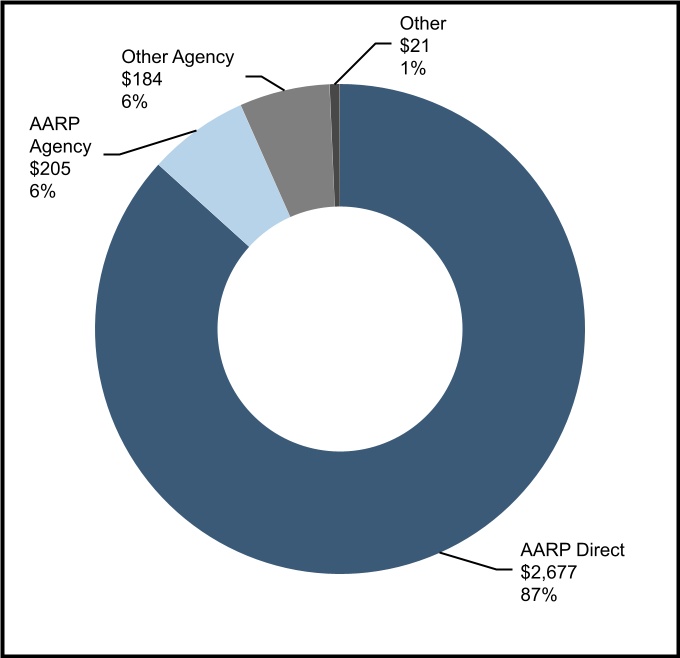
2023 Earned Premiums of $3,087 by Line of Business
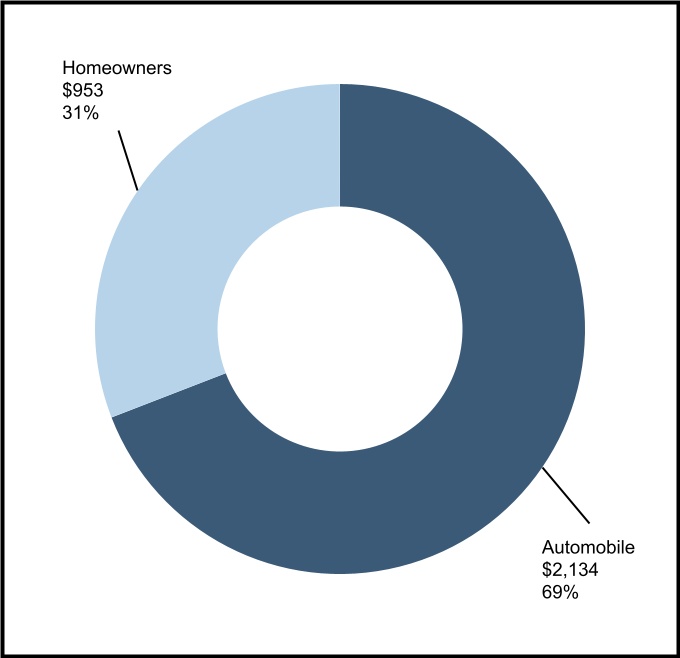
2023 Earned Premiums of $3,087 by Product
Principal Products and Services
| Automobile | Covers damage to an individual insured’s own vehicle due to collision or other perils and is referred to as automobile physical damage. In addition to first party automobile physical damage, automobile insurance covers liability for bodily injuries and property damage suffered by third parties and losses caused by uninsured or underinsured motorists. Also, under no-fault laws, policies written in some states provide first party personal injury protection. Some of the Company’s personal automobile insurance policies also offer personal umbrella liability coverage for an additional premium. | ||||
| Homeowners | Insures against losses to residences and contents from fire, wind and other perils. Homeowners insurance includes owned dwellings, rental properties and coverage for tenants. The policies may provide other coverages, including loss related to recreational vehicles or watercraft, identity theft and personal items such as jewelry. |
Personal Lines provides automobile, homeowners and personal umbrella coverages to individuals across the United States, mostly through a program designed exclusively for members of AARP (“AARP Program”). The Hartford's automobile and homeowners products provide coverage options and pricing tailored to a customer's individual risk. The Hartford has individual customer relationships with AARP Program policyholders and, as a group, they represent a significant portion of the total Personal Lines' business. Business sold to AARP members, either direct or through independent agents, amounted to earned premiums of $2.9 billion, $2.7 billion and $2.7 billion in 2023, 2022 and 2021, respectively. The AARP relationship provides The Company with a competitive advantage to capitalize on the continued growth of the over age 50 population.
The Company continues to roll out its new cloud-based product and platform, Prevail, on a state by state basis, and was in 39 states as of December 2023. Prevail is tailored to the mature
market and includes digital service capabilities that provide real time transaction support. Among other things, overall rate levels, price segmentation, rating factors and underwriting procedures are being updated through the introduction of Prevail. Personal Lines works with carrier partners to provide risk protection options for AARP members with needs beyond the company’s current product offering.
Marketing and Distribution
Personal Lines reaches diverse customers through multiple distribution channels, including direct-to-consumer and independent agents. The direct-to-consumer channel continues to represent a larger share of the automobile insurance market, accounting for more than one-third of industry premiums. In direct-to-consumer, Personal Lines markets its products through a mix of media, including direct mail, digital marketing, and television as well as digital and print advertising. Through the agency channel, Personal Lines provides products and services
|
| Table of Contents | Index to Business |
Part I - Item 1. Business
to customers through a network of independent agents in the standard personal lines market, primarily serving mature, preferred consumers. These independent agents are not employees of the Company.
Personal Lines has made significant investments in offering direct and agency-based customers the opportunity to interact with the company on-line, including via mobile devices. In addition, its technology platform for telephone sales centers enables sales representatives to provide an enhanced experience for direct-to-consumer customers, positioning the Company to offer unique capabilities to AARP’s member base.
Most of Personal Lines' sales are associated with its exclusive licensing arrangement with AARP, with the current agreement in place through December 31, 2032, to market automobile, homeowners and personal umbrella coverages to AARP's approximately 38 million members, primarily direct but also through independent agents. This relationship with AARP, which has been in place since 1984, provides Personal Lines with an important competitive advantage given the increase in the population of those over age 50 and the strength of the AARP brand.
Prior to May 2021, in most states, new business automobile and home policies were issued to AARP members with a lifetime continuation agreement endorsement, providing that the policies will be renewed as long as certain terms are met, such as timely payment of premium and maintaining a driver’s license in good standing. However, beginning in May 2021, Personal Lines no longer offers the lifetime continuation agreement to new home and automobile policies. The endorsement will remain on renewal policies with original effective dates prior to May 2021.
In addition to selling to AARP members, Personal Lines offers its automobile and homeowners products to non-AARP customers, primarily through the independent agent channel. Personal Lines leverages its agency channel to target AARP members and other customer segments, primarily targeting the over age 50 preferred mature market, that value the advice of an independent agent and recognize the differentiated experience the Company provides. In particular, the Company has taken action to distinguish its brand within the over age 50 preferred mature market and improve profitability in the independent agent channel, placing more emphasis on our highly partnered agents.
Competition
The personal lines automobile and homeowners insurance markets are highly competitive. However, in 2023, many personal lines insurance companies reduced marketing spend and implemented non-rate actions to reduce new business production while working to achieve adequate rate. Personal
lines insurance is written by insurance companies of varying sizes that compete principally on the basis of price, product, service, including claims handling, the insurer's ratings and brand recognition. Companies with strong ratings, recognized brands, direct sales capability and economies of scale will have a competitive advantage. Larger carriers have the advantage of economies of scale with the top ten personal lines insurers accounting for approximately 70% of market share.
The growth of direct-to-consumer sales, including by new entrants to the marketplace, continues to outpace sales in the agency distribution channel. Insurers that distribute products principally through agency channels compete by offering commissions and additional incentives to attract new business. To distinguish themselves in the marketplace, top tier insurers are offering on-line and self-service capabilities that make it easier for agents and consumers to do business with the insurer. A large majority of agents have been using “comparative rater” tools that allow the agent to compare premium quotes among several insurance companies. The use of comparative rater tools increases price competition. Insurers that are able to capitalize on their brand and reputation, differentiate their products and deliver strong customer service are more likely to be successful in this market.
The use of data mining and predictive modeling is used by more and more carriers to target the most profitable business, and carriers have further segmented their pricing plans to expand market share in what they believe to be the most profitable segments. The Company continues to invest in capabilities to better utilize data and analytics, and thereby, refine and manage underwriting and pricing. Many carriers, including The Hartford, continue to invest in telematics capabilities to enable better risk selection and pricing segmentation in response to changes in driving patterns. Currently in the states where the Prevail product has rolled out, The Hartford offers its telematics program, TrueLane, which uses a mobile app solution to offer discounts for good driving behavior based on such attributes as braking, speed, distracted driving, and acceleration.
Also, new automobile technology advancements, including lane departure warnings, backup cameras, automatic braking and active collision alerts, are being deployed rapidly and are expected to improve driver safety and reduce the likelihood of vehicle collisions. However, these features include expensive parts, contributing to increasing average claim severity.
In 2023, inflation continued to impact the industry. Supply chain pressures, advanced vehicle technology, body shop capacity, and a tight labor market have increased the cost of automobile repairs. In addition, a tight labor market and inflation on material prices increased the cost to repair homes.
| |P&C OTHER OPERATIONS |
Property & Casualty Other Operations includes certain property and casualty operations, managed by the Company, that have discontinued writing new business and includes substantially all of the Company's pre-1986 asbestos and environmental ("A&E") exposures. For a discussion of coverages provided under
policies written with exposure to A&E prior to 1986 reported within the P&C Other Operations segment (“Run-off A&E”), run-off assumed reinsurance and all other non-A&E exposures, see Part II, Item 7, MD&A - Critical Accounting Estimates, Property & Casualty Insurance Product Reserves, Net of Reinsurance.
|
| Table of Contents | Index to Business |
Part I - Item 1. Business
| |GROUP BENEFITS |
2023 Premiums and Other Considerations of $6,515

Principal Products and Services
| Group Life | Typically is term life insurance provided in the form of a yearly renewable policy. Other life coverages in this category include accidental loss of life and severe injury benefits and business travel accident insurance. | ||||
| Group Disability | Typically comprised of short-term disability, long-term disability, and paid family leave plans that pay a percentage of an employee’s salary for a period of time if they are ill or injured and cannot perform the duties of their job. Short-term and long-term disability policies have elimination periods that must be satisfied prior to benefit payments. The Company also earns fee income from leave management services for federal, state and employer family and medical leave and workplace accommodation programs, as well as the administration of employer self-funded disability plans. | ||||
| Other Products | Includes other group coverages such as retiree health insurance, critical illness, accident and hospital indemnity coverages. |
Group insurance typically covers an entire group of people under a single contract, most typically the employees of a single employer or members of an association.
Group Benefits provides group life, disability and other group coverages to members of employer groups, associations and affinity groups through direct insurance policies and provides reinsurance to other insurance companies. In addition to employer paid coverages, the segment offers voluntary product coverages which are offered through employee payroll deductions. Group Benefits also offers disability underwriting, administration, and claims processing to self-funded employer plans. In addition, the segment offers a single-company leave management solution, which integrates work absence data from the insurer’s short-term and long-term group disability and workers’ compensation insurance business with its leave management administration services.
Statutory paid family leave ("PFL") and paid family and medical leave ("PFML") programs are a source of growth as the Company offers fully insured coverage or administers self-insured coverage for some of these programs. As of 2023, thirteen states and the District of Columbia have enacted mandated PFL or PFML programs. Alabama, Arkansas, Florida,
New Hampshire, Tennessee, Texas, Vermont, and Virginia have also created opt-in paid leave programs, and additional states are considering adopting PFL or PFML programs.
Group Benefits generally offers term insurance policies, allowing for the adjustment of rates or policy terms at renewal in order to minimize the adverse effect of market trends, loss costs, changes in interest rates and other factors. Policies are typically sold with one, two or three-year rate guarantees depending upon the product and market segment.
Marketing and Distribution
The Group Benefits distribution network is managed through a regional sales office system to distribute its group insurance products and services through a variety of distribution outlets including brokers, consultants, third-party administrators and trade associations. Additionally, the segment has relationships with several private exchanges which offer its products to employer groups. Technology providers, including Human Resources platform vendors, are taking an increasingly prominent role in influencing customer decisions that also influence selection of the group benefits insurance provider.
|
| Table of Contents | Index to Business |
Part I - Item 1. Business
Competition
Group Benefits competes with numerous insurance companies and financial intermediaries marketing insurance products. The market for group benefits continues to grow as COVID-19 drove new demand for employee benefits among both employees and employers for addressing mental health, wellness, and caregiving costs.
In order to differentiate itself, Group Benefits uses its risk management expertise and economies of scale to derive a competitive advantage. Competitive factors include the extent of products offered, price, the quality of customer and claims handling services, digital capabilities, and the Company's relationship with third-party distributors and private exchanges. Active price competition continues in the marketplace, resulting in multi-year rate guarantees being offered to customers. Top tier insurers in the marketplace also offer on-line and self-service capabilities to third party distributors and consumers. The relatively large size and underwriting capacity of the Group Benefits business provides a competitive advantage over smaller competitors.
The Company's market presence has increased in recent years, benefiting from our industry leading digital technology and integrated absence management and claims platform.
Additionally, as employers continue to focus on reducing the cost of employee benefits, we expect more companies to offer voluntary products paid for by employees. Across the industry, the sale of voluntary product offerings, including supplemental health coverage, is growing at a faster rate than employer-provided benefits. Competitive factors affecting the sale of voluntary products include the breadth of products, product education, enrollment capabilities and overall customer service. The Company, as well its competitors, are investing in technology to offer digital capabilities, and to improve product offerings and service levels, particularly with voluntary products.
We offer our voluntary products including critical illness, accident and hospital indemnity coverage to employees through our Employee Choice Benefits programs. The Company's enhanced enrollment and marketing tools, such as My Tomorrow©, are providing additional opportunities to educate individual participants about supplementary benefits and deepen their knowledge about product selection.
In addition to providing group disability, leave management and life insurance, we offer integrated claim, leave and benefits administration with The Hartford's Ability Advantage platform.
| |HARTFORD FUNDS |
Hartford Funds Segment Assets Under Management ("AUM") of $131,025 as of December 31, 2023

Mutual Fund AUM of $115,417 as of December 31, 2023

|
| Table of Contents | Index to Business |
Part I - Item 1. Business
Principal Products and Services
| Mutual Funds | Includes approximately 60 actively managed mutual funds across a variety of asset classes including domestic and international equity, fixed income, and multi-strategy investments, principally subadvised by two unaffiliated institutional asset management firms. | ||||
| Exchange-traded funds | Exchange-traded funds ("ETF") include actively managed ETFs and multifactor ETFs. Actively-managed ETFs include fixed income, domestic equity and commodity products utilizing the same investment platform as our mutual funds. Multifactor ETFs are designed to track indices using passive investment techniques that strive to improve performance relative to traditional capitalization-weighted indices. | ||||
| Third-party life and annuity separate accounts under management | Relates to assets of the life and annuity business sold in May 2018 that are still managed by the Company's Hartford Funds segment. |
The Hartford Funds segment provides investment management, administration, product distribution and related services to investors through a diverse set of investment products in domestic markets. Hartford Funds' comprehensive range of products and services assist clients in achieving their desired investment objectives. AUM are separated into three distinct categories referred to as mutual funds, ETFs and third-party life and annuity separate accounts under management.
Marketing and Distribution
Our funds and ETFs are sold through national and regional broker-dealer organizations, independent financial advisers, defined contribution plans, financial consultants, bank trust groups and registered investment advisers. Our distribution team is organized to sell primarily in the United States.
Competition
The investment management industry is mature and highly competitive. Firms are differentiated by investment performance, range of products offered, brand recognition, financial strength, proprietary distribution channels, quality of service and level of fees charged relative to quality of investment products. The Hartford Funds segment competes with a large number of asset management firms and other financial institutions and differentiates itself through its global subadvisors, product breadth, competitive fees and strong distribution. The segment also competes directly with lower cost passive investment strategies, which continue taking share from active managers.
| |CORPORATE |
The Company includes in the Corporate category reserves for run-off structured settlement and terminal funding agreement liabilities, restructuring costs, capital raising activities (including equity financing, debt financing and related interest expense), transaction expenses incurred in connection with an acquisition, certain M&A costs, purchase accounting adjustments related to goodwill and other expenses not allocated to the reporting
segments. Corporate also includes investment management fees and expenses related to managing third-party assets. In addition, up until June 30, 2021, Corporate included a 9.7% ownership interest in Hopmeadow Holdings LP, the legal entity that acquired Talcott Resolution. For discussion of this sale, see Part II, Item 7, MD&A — The Hartford's Operations.
|
| Table of Contents | Index to Business |
Part I - Item 1. Business
RESERVES
Total Reserves as of December 31, 2023 [1]
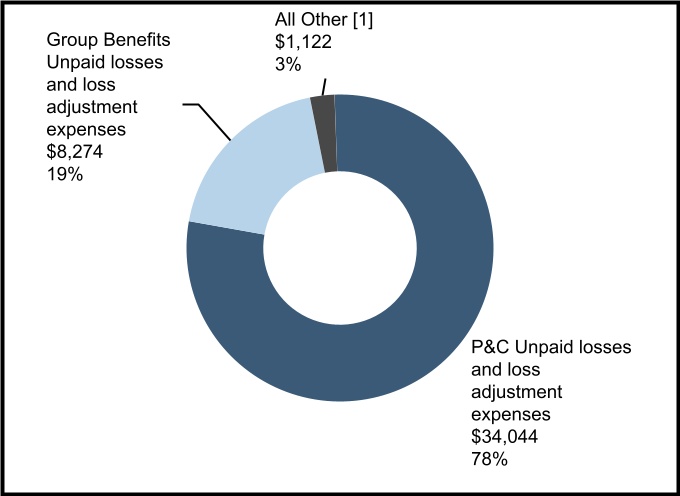
*[1]*Includes reserves for future policy benefits and other policyholder funds and benefits payable of $484 and $638, respectively, of which $312 and $408, respectively, relate to the Group Benefits segment with the remainder related to run-off structured settlement and terminal funding agreements within Corporate.
The reserve for unpaid losses and loss adjustment expenses ("LAE") includes a liability for unpaid losses, including those that have been incurred but not yet reported, as well as estimates of all expenses associated with processing and settling these insurance claims, including reserves related to both Property & Casualty and Group Benefits.
Total Property & Casualty Reserves as of December 31, 2023
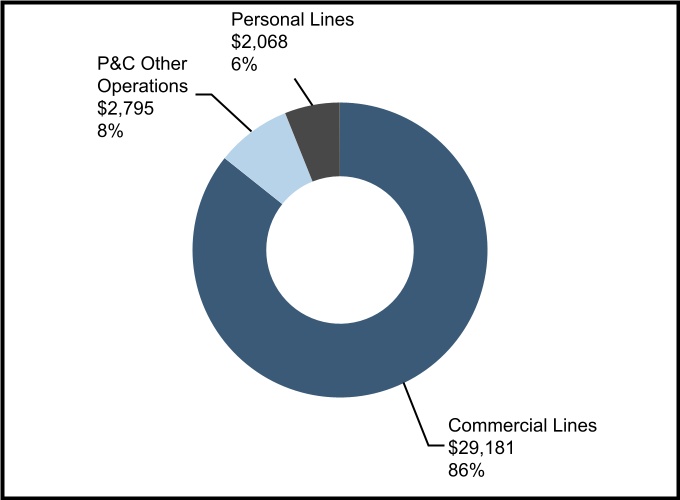
Further discussion of The Hartford’s property and casualty insurance product reserves, including run-off asbestos and environmental claims reserves within P&C Other Operations, may be found in Part II, Item 7, MD&A — Critical Accounting Estimates — Property and Casualty Insurance Product Reserves, Net of Reinsurance. Additional discussion may be found in Notes to Consolidated Financial Statements, including in the Company’s accounting policies for insurance product
reserves within Note 1 - Basis of Presentation and Significant Accounting Policies and in Note 11 - Reserve for Unpaid Losses and Loss Adjustment Expenses of Notes to Consolidated Financial Statements.
Total Group Benefits Reserves as of December 31, 2023 [1]
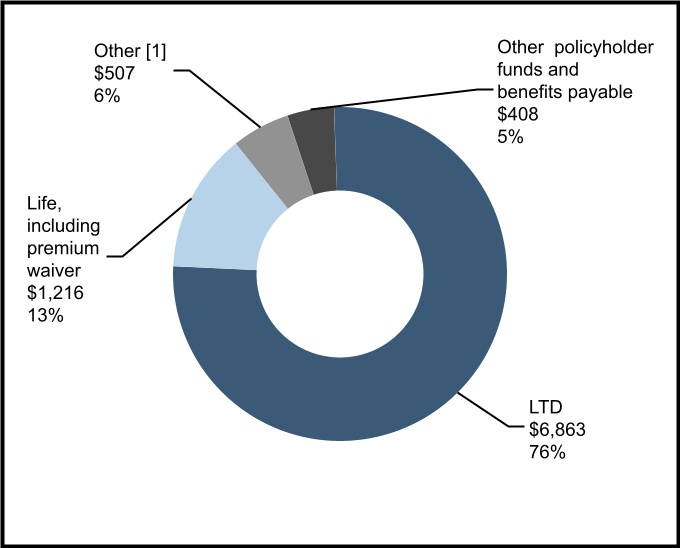
[1]Includes short duration contract reserves of $157 for short-term disability and $38 of supplemental health as well as reserves for future policy benefits that include $223 of paid up life reserves and policy reserves on life policies, $71 of reserves for conversions to individual life and $18 of other reserves.
Group Benefits reserves include unpaid loss and loss adjustments expenses for long-term disability ("LTD"), group life and other lines of business as well as reserves for other policyholder funds and reserves for future policy benefits. Other policyholder funds and benefits payable represent deposits from policyholders, including policyholders of short-duration insurance contracts, where the Company does not have insurance risk but is subject to investment risk. Reserves for future policy benefits represent life-contingent reserves for which the Company is subject to insurance, interest rate, and investment risk. On January 1, 2023, the Company adopted the Financial Accounting Standards Board's ("FASB") updated guidance on accounting for long duration insurance contracts, which was applied on a modified retrospective basis as of January 1, 2021. For additional information refer to Note 1 - Basis of Presentation and Significant Accounting Policies of Notes to Consolidated Financial Statements.
Discussion of The Hartford's Group Benefits long-term disability reserves may be found in Part II, Item 7, MD&A — Critical Accounting Estimates — Group Benefit LTD Reserves, Net of Reinsurance. Additional discussion may be found in Notes to Consolidated Financial Statements, including in the Company’s accounting policies for insurance product reserves within Note 1 - Basis of Presentation and Significant Accounting Policies and in Note 11 - Reserve for Unpaid Losses and Loss Adjustment Expenses of Notes to Consolidated Financial Statements.
|
| Table of Contents | Index to Business |
Part I - Item 1. Business
UNDERWRITING FOR P&C AND GROUP BENEFITS
The Company underwrites the risks it insures in order to manage exposure to loss through favorable risk selection and diversification. Risk modeling is used to manage, within specified limits, the aggregate exposure taken in each line of business and across the Company. For property and casualty business, aggregate exposure limits are set by geographic zone and peril. Products are priced according to the risk characteristics of the insured’s exposures. Rates charged for Personal Lines products are filed with the states in which we write business. Rates for most Commercial Lines products are also filed with the states but the premium charged may be modified based on the insured’s relative risk profile and workers’ compensation policies may be subject to modification based on prior loss experience. The Company also writes coverage in the excess and surplus lines market, primarily within global specialty, which is characterized by the absence of regulation related to rate and form and allows for more pricing and coverage flexibility to write certain classes of business. Pricing for Group Benefits products, including long-term disability and life insurance, is also based on an underwriting of the risks and a projection of estimated losses, including consideration of investment income.
Pricing adequacy depends on a number of factors, including the ability to obtain regulatory approval for rate changes, proper evaluation of underwriting risks, the ability to project future loss cost frequency and severity based on historical loss experience adjusted for known trends, the Company’s response to rate actions taken by competitors, its expense levels and expectations about regulatory and legal developments. The Company seeks to price its insurance policies such that insurance premiums and future net investment income earned on premiums received will cover underwriting expenses and the ultimate cost of paying claims reported on the policies and provide for a profit margin. For many of its insurance products, the Company is required to obtain approval for its premium rates from state insurance departments and the Lloyd's Syndicate's ability to write business is subject to Lloyd's approval for its premium capacity each year.
Geographic Distribution of Earned Premium
(% of total)
| Location | Commercial Lines | Personal Lines | Group Benefits | Total | ||||||||||
| California | 8 | % | 2 | % | 2 | % | 12 | % | ||||||
| New York | 5 | % | 1 | % | 3 | % | 9 | % | ||||||
| Texas | 5 | % | 1 | % | 2 | % | 8 | % | ||||||
| Florida | 3 | % | 1 | % | 2 | % | 6 | % | ||||||
| All other [1] | 34 | % | 10 | % | 21 | % | 65 | % | ||||||
| Total | 55 | % | 15 | % | 30 | % | 100 | % | ||||||
*[1]*No other single state or country accounted for 5% or more of the Company's consolidated earned premium in 2023.
CLAIMS ADMINISTRATION FOR P&C AND GROUP BENEFITS
Claims administration includes functions associated with the receipt of initial loss notices, claims adjudication and estimates, legal representation for insureds where appropriate, establishment of case reserves, payment of losses and notification to reinsurers. These activities are performed by approximately 6,700 claim employees including, among others, claim adjusters, appraisers, attorneys, doctors, nurses, behavioral health specialists, investigators and data analytics professionals as well as training, management, and support staff. The Company contracts with a select number of approved regional, national and international suppliers to enhance claim capabilities and business resiliency.
The Company's claims teams manage losses across all 50 states, Washington D.C. and 2 international locations. The teams are organized to meet the specific claim service needs for our various product offerings. Our corporate home office supports shared service claim functions including data and analytics, technology, and strategy.
As a leading provider of workers’ compensation and group benefits coverages, the Company leverages data analytics to return employees to active, productive lives as soon and safely as possible. Clinical experts focus on opioid usage, vocational rehabilitation, behavioral health and medical case management which we believe provides the Company with a competitive advantage for managing medical costs.
The Company maintains a dedicated catastrophe claims organization that is positioned to respond to large-scale catastrophic events across the country. For the most severe events, the team is supplemented with additional Company staff to respond to claimants promptly after an event.
The Company's claims organization has a nationwide staff of attorneys who represent insureds in key jurisdictions, including dedicated lawyers specializing in complex litigation.
Claim payments for benefits, losses and loss adjustment expenses are the largest expenditure for the Company.
REINSURANCE
For discussion of reinsurance, see Part II, Item 7, MD&A — Enterprise Risk Management and Note 8 - Reinsurance of Notes to Consolidated Financial Statements.
INVESTMENT OPERATIONS
Hartford Investment Management Company (“HIMCO”) is an SEC registered investment advisor and manages the Company's investment operations. HIMCO provides customized
|
| Table of Contents | Index to Business |
Part I - Item 1. Business
investment strategies for The Hartford's investment portfolio, as well as for The Hartford's pension plan and institutional clients.
As of December 31, 2023 and 2022, the fair value of HIMCO’s total assets under management was approximately $108.5 billion and $108.9 billion, respectively, including $50.3 billion and $53.7 billion, respectively, that were held in HIMCO managed third party accounts and $3.8 billion and $3.7 billion, respectively, that support the Company's pension and other postretirement benefit plans.
Management of The Hartford's Investment Portfolio
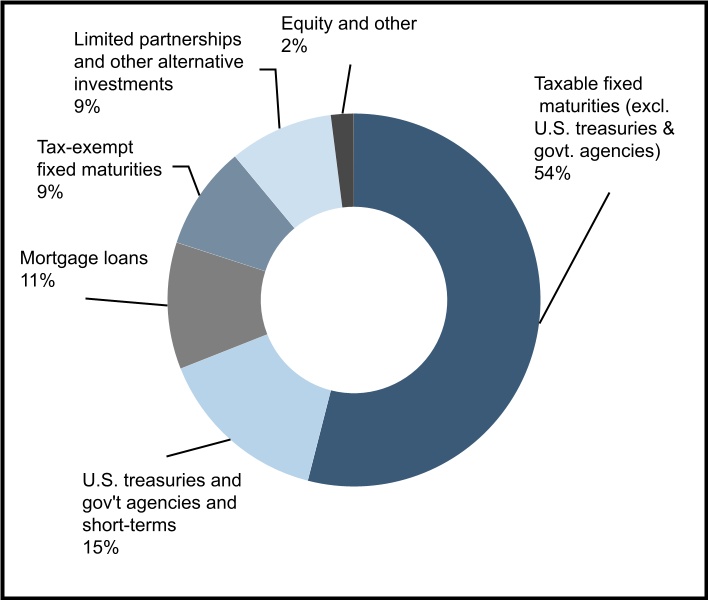
HIMCO manages the Company's investment portfolios to maximize economic value, ensure sufficient funding of the Company's liabilities, and achievement of enterprise financial objectives while remaining within acceptable risk tolerances. Portfolio objectives and guidelines are developed based upon the asset/liability profile, including timing and amount of claim payment obligations, investment return opportunity, and risk characteristics. The Company attempts to minimize adverse impacts to the portfolio and the Company’s results of operations from changes in economic conditions through asset diversification, asset allocation limits, asset/liability duration matching, and active portfolio management which may include the use of derivatives. Risk tolerances considered include, but are not limited to, asset sector exposure limits, credit issuer allocation limits, portfolio quality constraints including maximum exposure to below investment grade holdings, and interest rate duration limits. For further discussion of HIMCO’s portfolio management approach, see Part II, Item 7, MD&A — Enterprise Risk Management.
The Hartford's Investment Portfolio of $55.9 billion as of December 31, 2023
ENTERPRISE RISK MANAGEMENT
The Company has insurance, operational and financial risks. For discussion on how The Hartford manages these risks, see Part II, Item 7, MD&A - Enterprise Risk Management.
REGULATION
State and Foreign Insurance Laws
State insurance laws are intended to supervise and regulate insurers with the goal of protecting policyholders and ensuring the solvency of the insurers. As such, the insurance laws and regulations grant broad authority to state insurance departments (“Departments”) to oversee and regulate the business of insurance. The Departments monitor the financial stability of an insurer by requiring insurers to maintain certain solvency standards and minimum capital and surplus requirements; invested asset requirements; state deposits of securities; guaranty fund premiums; restrictions on the size of risks which may be insured under a single policy; and adequate reserves and other necessary provisions for unearned premiums, unpaid losses and loss adjustment expenses and other liabilities, both reported and unreported. In addition, the Departments perform periodic market and financial examinations of insurers and require insurers to file annual and other reports on the financial condition of the companies. Policyholder protection is also regulated by the Departments through licensing of insurers, sales employees, agents and brokers and others; approval of premium rates and policy forms; and claims administration requirements.
Many states also have laws regulating insurance holding company systems. These laws require insurance companies, which are formed and chartered in the state (“Domestic Insurers”), to register with the state department of insurance (referred to as their “domestic state or regulator”) and file information concerning the operations of companies within the holding company system that may materially affect the operations, management or financial condition of the insurers within the system. Insurance holding company regulations principally relate to (i) state insurance approval of the acquisition of Domestic Insurers, (ii) prior review or approval of certain transactions between the domestic insurer and its affiliates, and (iii) regulation of dividends made by the domestic insurer. All transactions within a holding company system affecting Domestic Insurers must be determined to be fair and equitable.
The extent of financial services regulation on business outside the United States varies significantly among the countries in which The Hartford operates. Foreign financial services providers in certain countries are faced with greater restrictions than domestic competitors domiciled in that particular jurisdiction. Our International operations include a Lloyd’s Syndicate which is required to meet the minimum market standards set by Lloyd’s, as well as UK PRA and UK FCA regulatory requirements. Consistent with the U.K.'s current interpretation of Solvency II, both Lloyd’s and the PRA focus on the adequacy of capital held and solvency of an insurer against the risk profile and management of the authorized insurer in setting capital requirements.
|
| Table of Contents | Index to Business |
Part I - Item 1. Business
Federal and State Securities and Financial Regulation Laws
The Company sells and distributes its mutual funds and ETFs through a broker dealer subsidiary, and is subject to regulation promulgated and enforced by the Financial Industry Regulatory Authority, the SEC and/or, in some instances, state securities administrators. Other subsidiaries operate as investment advisers registered with the SEC under the Investment Advisers’ Act of 1940, as amended, and are registered as investment advisers under certain state laws, as applicable. Because federal and state laws and regulations are primarily intended to protect investors in securities markets, they generally grant regulators broad rulemaking and enforcement authority. Some of these regulations include, among other things, regulations impacting sales methods, trading practices, suitability of investments, use and safekeeping of customers’ funds, corporate governance, capital, recordkeeping, and reporting requirements.
Failure to comply with federal and state laws and regulations may result in fines, the issuance of cease-and-desist orders or suspension, termination or limitation of the activities of our operations and/or our employees.
INTELLECTUAL PROPERTY
We rely on a combination of contractual rights and copyright, trademark, patent and trade secret laws to establish and protect our intellectual property.
We have a trademark portfolio that we consider important in the marketing of our products and services, including, among others, the trademarks of The Hartford name, the Stag Logo and the combination of these two trademarks. The duration of trademark registrations may be renewed indefinitely subject to country-specific use and registration requirements. We regard our trademarks as highly valuable assets in marketing our products and services and vigorously seek to protect them against infringement. In addition, we own a number of patents and patent applications relating to on-line quoting, insurance related processing, insurance telematics, proprietary interface platforms, and other matters. Patents are of varying duration depending on filing date, and will typically expire at the end of their natural term.
HUMAN CAPITAL RESOURCES
The Hartford has approximately 18,700 employees as of December 31, 2023.
Management, including the CEO and Chief Human Resources Officer ("CHRO"), establishes the hiring and compensation practices for our Company. The Board is periodically updated on key employee engagement measures (including employee survey results) and the demographics of the Company's workforce. The Board's Audit Committee receives an annual review of the Company's key employee relations measures. In
addition, the Board’s Compensation and Management Development Committee (“Compensation Committee”) is responsible for reviewing performance and approving compensation paid to senior executives, and, among other things, the oversight of succession and continuity planning for the CEO and other senior executives, setting the Company's executive compensation policy and administering the Company's Clawback Policy for senior executives. The Compensation Committee also receives updates on DEI initiatives and the results of the Company's annual pay equity analysis. Our Human Resources team, led by our CHRO, supports the Compensation Committee in the execution of its responsibilities. In addition to the day-to-day support and counseling they provide to our leaders, managers and employees, the Human Resources team also monitors key indicators to keep a pulse on trends across our employee population including strategic workforce planning, employee engagement, employee relations matters, career mobility, talent acquisition and development, and retention.
Talent Attraction, Retention and Development
The Hartford prioritizes sustaining a workforce that values all aspects of diversity and maintains an inclusive and equitable work environment where employees are respected, inspired to perform at their best, and are recognized for their contributions. We believe that the combination of a workforce and culture that actively embrace different experiences, perspectives and insights results in better decisions, outcomes and experiences for both our customers and employees. We persistently work to improve the employee experience in support of our continuing strategic objective to attract, retain and develop the best talent in the industry.
Our commitment to a robust talent pipeline starts at the top. The Board of Directors engages with the Compensation Committee annually to review senior executive level talent, consider key emerging executive talent and conduct succession planning. In addition, our leadership team conducts a comprehensive annual talent review process across our organization each year.
In 2023, we achieved top quartile employee engagement and performance enablement scores, as measured by independent third party surveys, through continued focus on leader effectiveness, collaboration, innovation and risk-taking, career growth, belonging and well-being.
To keep pace with the evolving expectations of employees and external candidates, we focus on a broad array of actions, including:
-
Providing career growth and development opportunities aligned to our strategies through our strategic workforce plans, executive, professional and front-line recruitment, training, development, internal mobility and job progression, and retention strategies; and
-
Holding leaders accountable for their progress against human capital goals that include development, engagement, retention and business line-specific DEI goals which are reviewed periodically by the CEO and executive leadership team.
|
| Table of Contents | Index to Business |
Part I - Item 1. Business
For entry-level roles in the organization, we recruit at colleges and universities, and offer a range of training and development programs, including:
-
The Hartford’s Leadership Development Program, which provides curriculum to enhance leadership skill sets for all participants – from first-time leaders through our executive ranks;
-
The Hartford Early Career Leadership Program, which offers programs in Actuarial, Finance, Underwriting, Claims & Operations and Technology through rotational development to gain a breadth of experiences;
-
The Hartford’s Apprenticeship Program, which prepares students for careers in insurance; and
-
Our HartCode Academy Developer Training Program, which provides employees with Information Technology ("IT") application development skills, providing a pipeline of diverse IT talent from across the Company.
Pay and Benefits
Compensation and Pay Equity
We offer competitive pay and benefits to our employees, with performance-based variable compensation making up a larger share of the total compensation paid to executives in the organization. Variable compensation for the majority of employees includes an annual bonus plan. Our executives also receive long-term incentive awards. Annual bonus payouts are informed by whether the Company achieves core earnings (as adjusted for compensation purposes) above or below a target level that is determined from the annual operating plan set at the beginning of each year and reviewed and approved by the Compensation Committee. Long-term incentive awards include restricted stock units, performance shares and, for the most senior executives, stock options. Additional information about The Hartford’s variable compensation programs is provided in the Company’s Proxy Statement.
We use an independent third party to conduct statistical pay equity analyses for the vast majority of our U.S. employees each year – a three-step process that includes analysis before, during and after the annual compensation planning cycle. This enables us to identify unexplained pay disparities, conduct additional research to determine reasons for these differences and take appropriate actions to address the disparities if necessary.
The Compensation Committee is updated annually on our pay equity processes and results.
The Hartford also engages in a number of additional practices to ensure pay fairness, including:
-
Centralized compensation function that helps maintain consistent programs and practices across the enterprise;
-
Enterprise-wide framework for evaluating and aligning roles and compensation levels based on job responsibilities, market competitiveness, strategic importance of the role, and other relevant factors;
-
Prohibition against asking external job applicants for current or historical compensation information;
-
A practice to disclose to applicants and employees the salary ranges for posted positions;
-
Individual compensation decisions that consider each employee’s experience, proficiency, and performance;
-
Training available for managers and Human Resources business partners on performance assessment and compensation planning; and
-
Multiple levels of review and approval required for all compensation decisions.
We are committed to our extensive, long-standing policies and practices to help ensure fair pay across the organization, while also staying attuned to external best practices and insights, and leveraging input from subject matter experts. We evaluate our performance every year, and as markets and talent pools shift over time we work to evolve our practices accordingly.
Employee Health and Wellness
The Hartford offers a comprehensive benefits package and wellness programs to help our employees live healthy lives and achieve their full potential. Our extensive benefits include:
-
Medical plan options;
-
Dental and vision coverage options;
-
401(k) plan with company non-elective and matching contributions;
-
Paid time off ("PTO") with at least 25 days of annual eligibility to start;
-
Paid holidays;
-
Flexible work schedules, including remote work arrangements;
-
Tuition reimbursement;
-
Family medical leave;
-
Parental leave;
-
Travel reimbursement to access medical services in other locations as needed;
-
Adoption support program;
-
Organ and bone marrow donation leave policy; and
-
Employee assistance program.
The Company also offers a medical advocacy program and well-being programs including nutrition counseling, weight management, fitness reimbursement and more.
Diversity, Equity and Inclusion
The Hartford is committed to being an insurance industry leader in advancing diversity. We do this by creating an equitable and inclusive work environment, which enables us to attract, retain and leverage top talent to meet our business goals, and by partnering with organizations across the industry to collaborate on initiatives and share best practices. We are committed to ethical conduct and a bias-free workplace for all employees as we build, enhance and sustain an inclusive and supportive culture.
|
| Table of Contents | Index to Business |
Part I - Item 1. Business
We are transparent about our DEI commitments and goals and take a whole-company approach to ensure we make meaningful progress toward them.
We enable our Unit leaders to model and foster a commitment to DEI and to make progress against those DEI goals, within established legal and other parameters. Each business and functional area, with oversight by the Human Resources function, creates and implements DEI plans with specific initiatives, consistent with equal employment opportunity principles. This enables the Company’s units to customize their DEI focus while still ensuring that all employment decisions are made based on merit and without regard to protected traits, like race and gender. Leaders meet with the CEO throughout the year to review progress against those goals and their results are considered as part of a broad annual performance assessment process.
We continue to invest in and accelerate a wide range of strategies to attract, retain and develop talent that is demographically underrepresented in the insurance industry, including initiatives to improve the representation of women and people of color. Examples include widening our recruiting pools for applicants, working to mitigate any bias that may exist in our talent systems and educating our leaders on how to lead inclusively.
We have nine Employee Resource Groups (“ERG’s”) that are voluntary participation groups led by employees, open to all and dedicated to fostering an inclusive workplace. These groups focus on the development and success of our employees through education, networking, mentorship and volunteer opportunities. As of December 31, 2023, over 59% of employees were members of at least one ERG. In 2023, we continued to offer Courageous Conversations, a process that allows employees to respectfully exchange perspectives, and we launched a comprehensive inclusive leadership training initiative for people managers.
The Company has demonstrated its commitment to advancing DEI outcomes for all through its active involvement in organizations such as the CEO Action for Racial Equity, the National African American Insurance Association and DisabilityIN and has been recognized for its commitment to inclusive workplaces by a number of organizations, including receiving the 2023 Catalyst Award, which is the premier recognition of organizational diversity, equity and inclusion initiatives that drive representation and inclusion for women.
As of December 31, 2023, women and people of color represent 61.4% and 32.3% of our workforce, respectively. The Board of Directors is updated annually on the Company’s DEI efforts.
For more information on the Company’s human capital including our commitments, goals, initiatives and progress, as well as our employee demographics, refer to The Hartford’s Sustainability Highlight Report available on the investor relations section of the Company’s website at: https://ir.thehartford.com. The Hartford’s 2023 Sustainability Report is expected to be published following the Company’s annual meeting in May 2024.
AVAILABLE INFORMATION
The Company’s internet address is www.thehartford.com. Our annual report on Form 10-K, quarterly reports on Form 10-Q, current reports on Form 8-K, and amendments to those reports are available, without charge, on the investor relations section of our website, https://ir.thehartford.com, as soon as reasonably practicable after they are electronically filed with, or furnished to, the SEC. Reports filed with the SEC may be viewed at www.sec.gov. References in this report to our website address are provided only as a convenience and do not constitute, and should not be viewed as, an incorporation by reference of the information contained on, or available through, the website. Therefore, such information should not be considered part of this report.
|
| Table of Contents |
Part I - Item 1A. Risk Factors
| Item 1A. |
RISK FACTORS
In deciding whether to invest in The Hartford, you should carefully consider the following risks, any of which could have a material adverse effect on our business, financial condition, results of operations or liquidity and could also impact the trading price of our securities. These risks are not exclusive, and additional risks to which we are subject include, but are not limited to, the factors mentioned under “Forward-Looking Statements” above and the risks of our businesses described elsewhere in this Annual Report on Form 10-K.
The following risk factors have been organized by category for ease of use, however many of the risks may have impacts in more than one category. The occurrence of certain of them may, in turn, cause the emergence or exacerbate the effect of others. Such a combination could materially increase the severity of the impact of these risks on our business, results of operations, financial condition or liquidity.
Risks Relating to Economic, Political and Global Market Conditions
Unfavorable economic, political and global market conditions may adversely impact our business and results of operations.
The Company’s investment portfolio, Hartford Funds business, and insurance businesses are sensitive to changes in economic, political and global capital market conditions, such as the effect of a weak economy, including labor supply shortages, and changes in credit spreads, equity prices, interest rates, inflation, foreign currency exchange rates, and shifts in demand and supply of U.S. dollars. Weak economic conditions, such as high unemployment, low labor force participation, lower family income, a weak real estate market, lower business investment and lower consumer spending may adversely affect the demand for insurance and financial products and lower the Company’s profitability in some cases. In addition, political instability, politically motivated violence or civil unrest, may increase the frequency and severity of insured losses. In addition, a deterioration in global economic conditions and/or geopolitical conditions, including due to military action, trade wars, tariffs or other actions with respect to international trade agreements or policies, has the potential to, among other things, reduce demand for our products, reduce exposures we insure, drive higher inflation that could increase the Company’s loss costs and result in increased incidence of claims, particularly for workers’ compensation and disability claims. If the conflict between Russia and Ukraine, and/or the conflict between Israel and Hamas, were to expand to other countries, the insurance losses and adverse economic impacts could be much more severe than what is currently foreseeable.
The Company’s investment portfolio includes limited partnerships and other alternative investments and equity securities for which changes in value are reported in earnings. These investments may be adversely impacted by economic volatility, including real estate market deterioration, which could impact our net investment returns and result in an adverse impact on operating results.
In an economic downturn, the Company could experience credit losses on various asset balances, including receivables and the principal amount of various invested assets, including fixed maturities and mortgage loans. In addition to credit losses on invested assets, The Company could experience declines in the value of available for sale debt securities if credit spreads were to widen significantly, which would reduce stockholders’ equity. In addition, disruption in equity markets could result in net realized or unrealized losses on our equity securities carried at fair value or reduce net investment income in future periods from our non-fixed income investment portfolio, including from limited partnerships and other alternative investments. The Company could also experience higher reinsurance costs and/or more limited availability of reinsurance coverage.
Below are several key factors impacted by changes in economic, political, and global market conditions and their potential effect on the Company’s business and results of operations:
-
Credit Spread Risk - Credit spread exposure is reflected in the market prices of fixed income instruments where lower rated securities generally trade at a higher credit spread. If issuer credit spreads increase or widen, the market value of our investment portfolio may decline. If the credit spread widening is significant and occurs over an extended period of time, the Company may recognize credit losses, resulting in decreased earnings. If credit spreads tighten significantly, the Company’s net investment income associated with new purchases of fixed maturities may be reduced. In addition, the value of credit derivatives under which the Company assumes exposure or purchases protection are impacted by changes in credit spreads, with losses occurring when credit spreads widen for assumed exposure or when credit spreads tighten if credit protection has been purchased.
-
Equity Markets Risk - A decline in equity markets may result in net realized losses on sales of equity securities, unrealized losses on equity securities held at fair value, reduce net investment income in future periods from our non-fixed income investment portfolio, including from limited partnerships and other alternative investments, or lower earnings from Hartford Funds where fee income is earned based upon the fair value of the assets under management. Equity markets are unpredictable. In the past few years, equity markets have been volatile, which could be indicative of a greater risk of a decline. For additional information on equity market sensitivity, see Part II, Item 7, MD&A - Enterprise Risk Management, Financial Risk- Equity Risk.
-
Interest Rate Risk - Increases in interest rates or persistently high interest rates could lead to recession or
|
| Table of Contents |
Part I - Item 1A. Risk Factors
economic stagnation, which could lower the demand for many of the Company's products and may result in realized or unrealized losses on existing fixed income assets in the investment portfolio. This could also impact property valuations and financing costs for mortgage loans and real estate joint ventures within limited partnerships and other alternative investments. Alternatively, a deterioration in global economic conditions could result in a lower interest rate environment, which would pressure our net investment income and could result in lower margins on certain products.
New and renewal business for our property and casualty and group benefits products is priced considering prevailing interest rates. As interest rates decline, in order to achieve the same economic return, we would have to increase product prices to offset the lower anticipated investment income earned on invested premiums. Conversely, as interest rates rise, pricing targets will tend to decrease to reflect higher anticipated investment income. Our ability to effectively react to such changes in interest rates may affect our competitiveness in the marketplace, and in turn, could reduce written premium and earnings.
In addition, due to the long-term nature of the liabilities within our Group Benefits operations, particularly for long-term disability, declines in interest rates over an extended period of time would result in our having to reinvest at lower yields. On the other hand, a rise in interest rates, in the absence of other countervailing changes, would reduce the market value of our investment portfolio. A decline in market value of invested assets due to an increase in interest rates could also limit our ability to realize tax benefits from recognized capital losses.
With the adoption of new U.S. GAAP accounting guidance for long-duration contracts ("LDTI"), effective January 1, 2023, our reserves for future policy benefits are sensitive to changing interest rate conditions. The LDTI guidance requires that we update reserves for future policy benefits for changes in discount rates quarterly which could cause volatility in our stockholders' equity.
For additional information on interest rate sensitivity, see Part II, Item 7, MD&A - Enterprise Risk Management, Financial Risk - Interest Rate Risk.
-
Inflation Risk** - Inflation is a risk to our property and casualty business because, in many cases, claims are paid out many years after a policy is written and premium is collected for the risk. A greater than expected increase in inflation may impact medical services, repair costs or other claim settlement expenses, which can result in higher claim costs than what was estimated at the time the policy was written. Inflation can also affect consumer spending and business investment which can reduce the demand for our products and services. In addition, sustained inflation may result in an increase in interest rates, which would result in a reduction in the fair value of our investment portfolio.
-
Changes in the Labor Market** - Evolving labor market conditions, including increased competition for talent, could make it difficult to hire and retain employees and could increase compensation and benefits expense. New technologies may lead to changes in skill sets needed from
the workforce, resulting in difficulty in attracting, developing and retaining employees. If insured businesses cannot hire enough qualified people to sell products and services to customers, economic activity may be depressed and lower insured exposure, hindering the Company's growth.
- Foreign Currency Exchange Rate** - Changes in foreign currency exchange rates may impact our non-U.S. dollar denominated investments and foreign subsidiaries. We hold cash and fixed maturity securities denominated in foreign currencies, including British Pounds and Canadian dollars, among others, and also have other assets and liabilities denominated in foreign currencies such as premiums receivable and loss reserves. While the Company predominately uses asset-liability matching, including the use of derivatives, to hedge certain of these exposures to fluctuations in foreign currency exchange rates, these actions do not eliminate the risk that changes in the exchange rates of foreign currencies to the U.S. dollar could result in financial loss to the Company, including realized or unrealized losses resulting from currency revaluation and increases to regulatory capital requirements for foreign subsidiaries that have net assets that are not denominated in their local currency. For additional information on foreign exchange risk, see Part II, Item 7, MD&A - Enterprise Risk Management, Financial Risk.
Concentration of our investment portfolio increases the potential for significant losses.
The concentration of our investment portfolios in any particular industry, collateral type, group of related industries or geographic region could have an adverse effect on our investment portfolios and consequently on our business, financial condition, results of operations, or liquidity. Events or developments that have a negative impact on any particular industry, collateral type, group of related industries or geographic region may have a greater adverse effect on our investment portfolio to the extent that the portfolio is concentrated rather than diversified.
Further, if issuers of securities or loans we hold are acquired, merge or otherwise consolidate with other issuers of securities or loans held by the Company, our investment portfolio’s credit concentration risk to issuers could increase for a period of time, until the Company is able to sell securities to get back in compliance with the established investment credit policies.
Changing climate and weather patterns may adversely affect our business, financial condition and results of operation.
Climate change presents risks to us as an insurer, investor and employer. Climate models indicate that rising temperatures will likely result in rising sea levels over the decades to come and may increase the frequency and intensity of natural catastrophes and severe weather events. Extreme weather events such as abnormally high temperatures may result in increased losses associated with our property, automobile, workers’ compensation and group benefits businesses. Changing climate patterns may also increase the duration, frequency and intensity of heat/cold waves, which may result in increased claims for property damage, business interruption and losses under workers’ compensation, group disability and group
|
| Table of Contents |
Part I - Item 1A. Risk Factors
life coverages. Precipitation patterns across the U.S. are projected to change, which if realized, may increase risks of flash floods, wildfires, and other severe weather events. If third parties assert that climate change-related risks and damages are caused by insured businesses, or arise from alleged mismanagement at insured businesses, we may experience increased claims under general liability and management liability policies. Additionally, there may be an impact on the demand, price and availability of automobile and homeowners insurance, and there is a risk of higher reinsurance costs or more limited availability of reinsurance coverage. Changes in climate conditions may also cause our underlying modeling data to not adequately reflect frequency and severity, limiting our ability to effectively evaluate and manage risks of catastrophes and severe weather events. Among other impacts, this could result in not charging enough premiums or not obtaining timely state approvals for rate increases to cover the risks we insure. We may also experience significant interruptions to the Company’s systems and operations that hinder our ability to sell and service business, manage claims and operate our business.
In addition, climate change-related risks, including risks associated with global energy transition, may adversely impact the value of the investments that we hold, resulting in potential realized or unrealized losses on our invested assets. Our decision to invest in certain securities, loans, or other investments may also be impacted by changes in climate patterns due to:
-
changes in supply/demand for traditional sources of energy (e.g., coal, oil, natural gas);
-
advances in low-carbon technology and renewable energy development;
-
effects of extreme weather events on the physical and operational exposure of industries and issuers; and
-
internal investment guidelines and policies related to the global energy transition.
The effects of climate change could also lead to increased credit risk of other counterparties we transact business with, including reinsurers. Climate change effects may also lead to decreases in real estate values in various locations and for a variety of reasons, reducing premium and demand for commercial property and homeowners insurance and adversely impacting the value of our real estate-related investments. Additionally, government policies or regulations to slow climate change, such as emission controls or technology mandates, may have an adverse impact on sectors such as utilities, transportation and manufacturing, affecting demand for our products and our investments in these sectors. Moreover, regulators may undertake actions to minimize the effects of climate change on consumers, which could affect coverage provided under insurance contracts and administrative process.
These emerging regulatory initiatives, or other climate-related policies we adopt, may result in non-renewal of business or reduced appetite for underwriting or investing in certain industry sectors.
Because there is significant variability associated with the impacts of climate change, we cannot predict how physical, legal, regulatory and social responses may impact our business.
For additional discussion about climate change related risks, see the Risk Factor, “We are vulnerable to losses from catastrophes, both natural and man-made.”
Insurance Industry and Product Related Risks
Unfavorable loss development may adversely affect our business, financial condition, results of operations or liquidity.
We establish property and casualty and group benefits loss reserves to cover our estimated liability for the payment of all unpaid losses and loss expenses incurred with respect to premiums earned on our policies. Loss reserves are estimates of what we expect the ultimate settlement and administration of claims will cost, less what has been paid to date. These estimates are based upon actuarial projections and on our assessment of currently available data, as well as estimates of claims severity and frequency, legal theories of liability and other factors. For risks due to evolving changes in social, economic and environmental conditions, see the Risk Factor, “Unexpected and unintended claim and coverage issues under our insurance contracts may adversely impact our financial performance.”
Loss reserve estimates are refined periodically as experience develops and claims are reported and settled, potentially resulting in increases to our reserves. Increases in reserves would be recognized as an expense during the periods in which these determinations are made, thereby adversely affecting our results of operations for those periods. In addition, since reserve estimates of aggregate loss costs for prior years are used in pricing our insurance products, inaccurate reserves can lead to our products not being priced adequately to cover actual losses and related loss expenses in order to generate a profit.
In property and casualty, we continue to receive A&E claims, the vast majority of which relate to policies written before 1986. Estimating the ultimate gross reserves needed for unpaid losses and related expenses for A&E claims is particularly difficult for insurers and reinsurers. The actuarial tools and other techniques used to estimate the ultimate cost of more traditional insurance exposures tend to be less precise when used to estimate reserves for some A&E exposures.
Moreover, the assumptions used to estimate gross reserves for A&E claims, such as claim frequency over time, average severity, and how various policy provisions will be interpreted, are subject to significant uncertainty. It is also not possible to predict changes in the legal and legislative environment and their effect on the future development of A&E claims. These factors, among others, make the variability of gross reserves estimates for these longer-tailed exposures significantly greater than for other more traditional exposures.
Effective December 31, 2016, the Company entered into an agreement with National Indemnity Company (“NICO”), a subsidiary of Berkshire Hathaway Inc. (“Berkshire”) whereby the Company is reinsured for subsequent adverse development on substantially all of its net A&E reserves up to an aggregate net limit of $1.5 billion. We remain directly liable to claimants and if the reinsurer does not fulfill its obligations under the agreement or if future adverse development exceeds the $1.5 billion
|
| Table of Contents |
Previous: Cover and table of contents · Next: Item 1A. Risk Factors