 filings.tools
Huntington Ingalls Industries (HII) 10-K risk factor changes: FY2022 vs FY2021
The 2022-12-31 10-K against the 2021-12-31 one, compared heading by heading and sentence by sentence.
Item 1A97 rewritten49 added49 removed223 unchanged
All filing items1,086 rewritten404 added458 removed2,119 unchanged
Summary
counted, not written
- Item 1A lists 33 risk factor headings: 4 new, 2 reworded and 27 unchanged since FY2021. 3 headings from FY2021 no longer appear.
- Sentence by sentence, 404 added, 458 removed, 1,086 rewritten and 2,119 unchanged across 17 items that differ.
New Item 1A headings (4)
- We depend on the recruitment and retention of qualified personnel, and our failure to attract, train and retain such personnel could seriously harm our business.
- We face risks related to health epidemics, pandemics, and similar outbreaks.
- Our business and financial performance may be adversely affected by threats to our physical security and other events outside our control.
- Our Restated Bylaws include an exclusive forum requirement for certain litigation that may be initiated by our stockholders, which could limit our stockholders’ ability to obtain a favorable judicial forum for such disputes with us or our directors, officers, or employees.
Removed Item 1A headings (3)
- Our earnings and profitability depend upon our ability to perform our contracts.
- Our future success depends, in part, on our ability to deliver our products and services at an affordable life cycle cost, requiring us to develop and maintain technologies, facilities, equipment, and a qualified workforce to meet the needs of current and future customers.
- We face risks related to health epidemics, pandemics, and similar outbreaks, and our business has been and will continue to be adversely affected by the COVID-19 pandemic.
Reworded Item 1A headings (2)
- Cost growth on flexibly priced contracts that does not result in higher contract
[removed: value][added: price] due from customers reduces our profit and exposes us to the potential loss of future business. - If we fail to manage acquisitions,
[removed: divestitures,]equity investments, and other[removed: transactions, including our acquisition of Alion,][added: transactions] successfully or if acquired[removed: entities][added: businesses] or equity investments fail to perform as expected, our financial results, business, and future prospects could be harmed.
A heading is new when no FY2021 heading matches it after ignoring case and punctuation, and reworded when it shares at least 60 percent of its words with one that went away. All current risk factor headings.
Sentences by item
23 items, with every count and a link to each item that changed
Underlined words on a shaded ground are new in FY2022; struck-through words were in FY2021. Sentences that are wholly new or wholly gone are labelled rather than marked.
Item 1A. Risk Factors
97 rewritten, 49 added, 49 removed, 223 unchanged
We also provide [removed: fleet sustainment services to the U.S. Navy,] [added: high-end] IT and [removed: mission-based] [added: mission based] solutions for [removed: the DoD and intelligence] [added: DoD, intelligence,] and federal civilian [removed: customers,] [added: customers; life-cycle sustainment services to the U.S. Navy fleet] and [added: other maritime customers; unmanned, autonomous systems; and] nuclear management and operations and environmental management services for the [removed: DoE] [added: DoE, DoD, state] and [removed: DoD.][added: local governments, and private sector companies.]
Substantially all of our revenues in [removed: 2021] [added: 2022] were derived from products and services sold to the U.S. Government, and we expect this to continue [removed: in] [added: for] the foreseeable future.
In addition, substantially all of our backlog as of December 31, [removed: 2021,] [added: 2022,] was [added: related to products and services deliverable to the] U.S. [removed: Government related.][added: Government.]
Our U.S. Government contracts are subject to various risks, including customer political and budgetary constraints and processes, changes in customer short-term and long-term strategic plans, the timing of contract awards, significant changes in contract scheduling, [added: recessionary impacts on government spending,] intense contract award and funding competition, [removed: difficulty] [added: challenges] forecasting costs and schedules for bids on developmental and sophisticated technical work, and contractor suspension or debarment in the event of certain legal or regulatory violations.
We are directly dependent upon Congressional funding of U.S. Navy, U.S. Coast Guard, and other [removed: government] [added: federal] agency programs.
Under the normal legislative process, Congress completes 12 annual [removed: appropriation] [added: appropriations] bills each fiscal year to fund the activities of [added: the] federal agencies.
When Congress is unable to pass [removed: these appropriation] [added: appropriations] bills before the beginning of a fiscal year, a continuing resolution can be enacted to provide stopgap funding for a specified period of time at a specified rate, often the prior year’s [removed: appropriation] [added: appropriations] level.
A federal government shutdown could, in turn, result in the delay or cancellation of [removed: key] [added: government] programs, or the delay of contract payments, which could have a negative effect on our cash flows and adversely affect our future results of operations.
[removed: For certain programs,] Congress [added: sometimes] appropriates funds on an annual fiscal year basis [removed: even though] [added: for programs for which] the [removed: program] performance period may extend over [removed: several] [added: multiple] years.
[removed: The impact of] Congressional actions to reduce the federal debt and resulting pressures on federal spending could adversely affect the total funding of individual contracts or funding for individual programs and delay purchasing or payment decisions by our customers.
It is likely that U.S. Government discretionary spending levels, including defense spending, will continue to be subject to significant [removed: pressure.]
As of December 31, [removed: 2021,] [added: 2022,] our total backlog was [removed: $48.5] [added: $47.1] billion, including [removed: $22.7] [added: $22.2] billion in funded backlog.
Our unfunded backlog, in particular, contains management’s estimate of [removed: amounts] [added: revenues] expected to be realized on unfunded contracts that may never be [removed: realized as revenues.][added: realized.]
Our industry has experienced, and we expect will continue to experience, significant changes to business practices resulting from greater focus on affordability, efficiencies, business systems, recovery of costs, and a reprioritization of defense [removed: funds to key areas for future defense spending.][added: funding.]
Changes in procurement practices favoring incentive-based fee arrangements, different award fee criteria, non-traditional contract provisions, and [added: cost mandates from the] government [removed: contract negotiation offers that mandate our costs] may affect our profitability and the predictability of our profit rates.
For example, the DoD is [removed: increasingly pursuing accelerated] [added: accelerating] development and acquisition of new technologies through rapid acquisition [removed: pathways] [added: alternatives] and procedures, including through other transaction authority agreements (“OTAs”).
In recent years, the DoD has increased the frequency [removed: of use] and size of OTAs, and we expect this trend to continue in the future.
[removed: The conditions for] OTA awards include, in certain instances, that a significant portion of the work under the OTA be performed by a non-traditional defense contractor or that a portion of the cost of the [removed: protoype] [added: prototype] project be funded by non-governmental sources.
If we cannot successfully adapt to the DoD’s accelerated acquisition processes or if the DoD significantly increases the use of OTAs with non-traditional defense contractors or increases cost sharing mandates, [removed: then] we may lose new strategic business opportunities in high-growth areas and our future performance and results of operations could be adversely affected.
As a [removed: result of certain of these initiatives,] [added: result,] we have experienced and may continue to experience a higher number of audits and/or lengthened periods of time required to close open audits.
A longer term [removed: reduction] [added: trend] in [removed: shipbuilding activity by the] [added: reduced] U.S. [removed: Navy,] [added: Navy shipbuilding activity,] evidenced by the reduction in fleet size from 566 ships in 1989 to [removed: 295] [added: 293] ships as of December 31, [removed: 2021,] [added: 2022,] has resulted in workforce reductions but limited infrastructure consolidation.
Moreover, reductions in U.S. defense spending that reduce the demand for the types of ships we build and services we provide increase our [removed: risk] exposure to market [removed: competition.][added: competition risk.]
If we are unable to continue to compete successfully against our current or future competitors, we may [removed: experience] [added: generate] lower revenues and [added: lose] market share, which [removed: could] [added: would] negatively impact our financial condition, results of operations, [removed: or] [added: and] cash [removed: flows.][added: flows and could impact our ability to compete for future defense contracts.]
Although we are the only company currently capable of refueling nuclear-powered aircraft carriers, two existing U.S. [removed: Government-owned] [added: Government] shipyards may be able to refuel nuclear-powered aircraft carriers if [added: they made] substantial investments in facilities, personnel, and [removed: training were made.][added: training.]
If a U.S. Government-owned shipyard became capable [added: of] and engaged in the refueling of nuclear-powered aircraft carriers, our financial position, results of operations, or cash flows could be adversely affected.
For new shipbuilding programs, we estimate, negotiate, and contract for construction of ships that are not completely designed, which subjects our risk assessments, revenue and cost estimates, and assumptions [removed: regarding schedule and technical issues] to the variability of the final ship design and [added: an] evolving scope of work.
Our judgment, estimation, and assumption processes [removed: are significant to] [added: significantly impact] our contract accounting, and materially different amounts can result if different assumptions are used or if actual events differ from our assumptions.
As of December 31, [removed: 2021,] [added: 2022,] we had $2.6 billion of debt under our senior notes, [removed: $625] [added: $225] million of [added: debt under our $650 million 3-year] term loan [removed: debt,] [added: (the “Term Loan”),] $105 million of revenue bonds, $1.5 billion of additional borrowing capacity under our revolving credit facility (the "Revolving Credit Facility"), and $1 billion of borrowing capacity under our commercial paper program.
[added: Our] Revolving Credit Facility also allows us to solicit lenders to provide incremental financing capacity in an aggregate amount not to exceed $1 billion, and the indentures governing our senior notes do not limit our incurrence of debt.
In the event of a default on any of our indebtedness, the lenders who hold such debt could accelerate amounts due, which could potentially trigger a default or acceleration of [removed: any of] our other [removed: debt.][added: indebtedness.]
Cost growth on flexibly priced contracts that does not result in higher contract [removed: value] [added: price] due from customers reduces our profit and exposes us to the potential loss of future business.
Cost growth can occur if expenses to complete a contract increase due to [added: inflation,] technical challenges, manufacturing difficulties, delays, workforce-related issues, or inaccurate initial contract cost estimates.
Reasons may include labor [removed: unavailability] [added: shortages] or reduced productivity, the nature and complexity of the work performed, the timeliness and availability of materials, [removed: major] subcontractor performance or product quality issues, performance delays, availability and timing of [removed: funding from the customer,] [added: customer funding,] and natural disasters.
Our U.S. Government [removed: business is currently performed under] [added: contracts include] firm fixed-price, fixed-price incentive, cost-type, and time and material contracts.
To the extent our actual costs vary from the estimates upon which the price was negotiated, [added: including due to greater than anticipated or a sustained period of higher inflation or unexpected delays,] we will generate more or less profit or could incur a loss.
Fixed-price incentive contracts provide for reimbursement of the contractor’s allowable [removed: costs incurred in performance of the contract,] [added: costs,] subject to a cost-share limit that impacts the profit on the contract.
Cost-type contracts provide for the payment of allowable costs [removed: incurred during performance of the contract] plus a fee up to a ceiling based on the amount that has been funded.
Approximately [removed: 55%] [added: 50%] of our revenues in [removed: 2021] [added: 2022] were generated under fixed-price incentive contracts, approximately [removed: 39%] [added: 44%] were generated under cost-type contracts, approximately 3% were generated under time and material contracts, and approximately 3% were generated under firm fixed-price contracts.
Under each type of contract, if we are unable to control costs, our operating results could be adversely affected, particularly if we are unable to negotiate an increase in contract [removed: value to] [added: price with] our customers.
Uncertainties in final contract price, specifications and terms, or loss of negotiating leverage associated with [removed: particularly long delays in] contract definitization may negatively affect our profitability.
Considerable uncertainty exists regarding how future budget and program decisions will develop and the challenges budget changes will present for the defense industry.
pressure.
Mission Technologies competes domestically and internationally against large A&D companies, primarily L3 Harris, Amentum, ManTech, Leidos, and, increasingly, small businesses serving the intelligence community.
To a lesser extent, our lines of business compete on certain contracts with major prime A&D contractors, including Lockheed Martin, General Dynamics, Northrop Grumman, Raytheon, and Boeing.
In anticipation of the cessation of LIBOR as a benchmark interest rate, our Revolving Credit Facility and Term Loan mandate the use of the Secured Overnight Financing Rate (“SOFR”) or, if unavailable, other alternative benchmarks upon termination of LIBOR.
Fixed price contracts increase the risk that we may not recover all of our costs or will generate less profit or a loss.
U.S. Government contracts can extend for years, and unforeseen events, such as technological difficulties, fluctuations in the price of raw materials, a significant increase in or sustained period of higher inflation, problems with our suppliers, labor market conditions, and cost overruns, can result in the contract price becoming less favorable or even unprofitable to us over time.
Higher interest rates resulting from inflationary pressures can also impact the fair value of these contracts.
Furthermore, if we do not meet contract deadlines or specifications, we may need to renegotiate contracts on less favorable terms, be forced to pay penalties or liquidated damages, or suffer major losses if the customer exercises its right to terminate.
In addition, some of our contracts have provisions relating to cost controls and audit rights, and, if we fail to meet the terms specified in those contracts, we may not realize their full benefits.
Cost overruns would adversely impact our results of operations, which are dependent on our ability to maximize our earnings from our contracts, and the potential risk would be greater if our contracts shifted toward a greater percentage of fixed-price contracts, particularly firm fixed-price contracts.
In addition, changes in contract financing policy for fixed-price contracts, such as changes in performance and progress payments policies, including a reversal or modification of the DoD’s March 2020 increase to the applicable progress payment rate from 80% to 90%, could significantly affect the timing of our cash flows.
Our bids for longer-term firm fixed-price contracts typically include assumptions for labor and other contract costs that historically have been sufficient to cover cost increases over the period of performance.
If, however, recent inflationary conditions continue over the long-term, our cost assumptions may not be sufficient to cover potential contract cost growth.
Such unauthorized, non-compliant or deficient materials or services can increase our contract costs and impact our ability to satisfy our contract obligations to our customers.
We depend on the recruitment and retention of qualified personnel, and our failure to attract, train and retain such personnel could seriously harm our business.
Due to the specialized nature of our business, our performance is dependent upon our ability to identify, attract and retain a workforce with the requisite skills in multiple areas, including: engineering, nuclear, trades and crafts, manufacturing, information technology, and cybersecurity.
Our operating performance is also dependent upon personnel who hold security clearances and receive substantial training to work on certain programs or tasks and can be difficult to replace on a timely basis if we experience unplanned attrition.
To the extent we lose experienced personnel, it is critical that we develop other employees, hire new qualified personnel, and successfully manage the short and long-term transfer of critical knowledge and skills.
Competition for talent is intense, and this may affect our ability to successfully attract or retain personnel with the requisite skills or clearances.
We increasingly compete with commercial technology companies outside of the shipbuilding and defense industry for qualified technical positions.
To the extent that these companies grow at a faster rate or face fewer cost and product pricing constraints, they may be able to offer more attractive compensation and other benefits to candidates, including in the recruitment of our existing employees.
In cases where the demand for skilled personnel exceeds supply, we could experience higher labor, recruiting, or training costs to attract and retain such employees.
We could experience difficulty performing our contracts and executing on new or growing programs if we have a shortage of skilled employees or we experience recruiting challenges.
We also must manage leadership development and succession planning throughout our business.
While we have processes in place for management transition and the transfer of knowledge and skills, the loss of key personnel, coupled with an inability to adequately train other personnel, hire new personnel, or transfer knowledge and skills, could significantly impact our ability to perform under our contracts and compete for new contracts.
Problems and delays with product development, technology implementation, manufacturing, or subcontractor components or services can impact our contract performance.
that require analysis and corrective action.
We could incur similar impacts in the future, in connection with
The COVID-19 health crisis also created challenges for our suppliers relative to their workforces, access to necessary components, materials, and other supplies at reasonable prices, and access to support services, such as shipping and transportation.
These challenges have impacted the ability of suppliers to provide agreed-upon goods and services in a timely, compliant, and cost-effective manner.
We may in the future incur additional costs and performance challenges, including as a result of higher prices, schedule delays, or the need to identify and develop alternative suppliers.
Such cyber security threats include security breaches (whether through cyber attack, cyber intrusion or insider threat) via the internet; malicious software, including ransomware; computer viruses; attachments to emails; persons inside our organization or with access to systems inside our organization; subcontractors or suppliers; or other significant disruptions of our information technology networks and related systems or those of our suppliers or subcontractors.
Even the most well-protected information, networks, systems, and facilities remain potentially vulnerable because attempted security breaches, particularly cyber attacks and cyber intrusions or disruptions, regularly occur and will continue to occur in the future, and because the techniques used in such attempts are constantly evolving and generally are not recognized until launched against a target.
Accordingly, we are not always able to anticipate these techniques or to implement adequate security barriers or other preventative measures.
Our business and financial performance may be adversely affected by threats to our physical security and other events outside our control.
We could encounter threats to our physical security, including our facilities and personnel, and threats from workplace violence, civil unrest, acts of sabotage or terrorism, and other local security issues, any of which could disrupt our business.
New laws, regulations, or procurement
Future environmental laws or regulations could also impact us.
leaked and required remediation in the past.
Long-term uncertainty exists with respect to overall levels of defense spending across the future years' defense plan.
For the year ended December 31, 2021, our aircraft carrier programs accounted for approximately 32% of our consolidated revenue.
Our
LIBOR has been the subject of national, international, and other regulatory guidance and proposals for reform.
In the U.S., the Alternative Reference Rate Committee has identified the Secured Overnight Financing Rate (“SOFR”) as its preferred alternative upon termination of LIBOR, although other alternatives, including Bloomberg’s Short-Term Bank Yield, are available.
The process of estimating contract costs requires significant judgment and expertise.
Our failure to perform to customer expectations and contract requirements may result in reduced fees or losses and affect our financial performance.
To the extent our mix of contract types changes in the future, our ability to recover our costs and realize profits on our contracts could be negatively affected.
Our earnings and profitability depend upon our ability to perform our contracts.
When agreeing to contract terms, we make assumptions and projections about future conditions and events, many of which extend over long periods.
Our assumptions and projections are based upon our assessments of the productivity and availability of labor, the complexity of the work to be performed, the cost and availability of materials, the impact of delayed performance, the timing of product deliveries, and other matters.
We may experience significant variances from our assumptions and projections, contract performance schedule delays, and variances in the timing of our product deliveries.
If our actual experience differs significantly from our assumptions or projections or we incur unanticipated contract costs, the profitability of the related contracts may be adversely affected.
Significant increases in inflation, particularly those related to wages and increases in the cost of raw materials, may increase our cost recovery risk.
In some circumstances, we rely on representations and certifications from our subcontractors and suppliers regarding their compliance.
Our inability to procure, or a significant delay in acquiring, necessary raw materials, components, or parts, the failure of our subcontractors or suppliers to comply with applicable laws and regulations, or noncompliant materials, components, or parts from our subcontractors and suppliers could have a material adverse effect on our financial position, results of operations, or cash flows.
Our future success depends, in part, on our ability to deliver our products and services at an affordable life cycle cost, requiring us to develop and maintain technologies, facilities, equipment, and a qualified workforce to meet the needs of current and future customers.
Shipbuilding is a long cycle business, and our success depends on quality, cost, and schedule performance on our contracts.
In turn, our performance depends upon our ability to develop and maintain the workforce, technologies, facilities, equipment, and financial capacity to deliver our products and services at an affordable life cycle cost.
If we fail to maintain our competitive position in these areas, we could lose future contracts to our competitors, which could have a material adverse effect on our financial position, results of operations, or cash flows.
Our operating results are heavily dependent upon our ability to attract and retain at competitive costs a sufficient number of engineers and other employees with the necessary skills and security clearances.
At the same time, future revenues and costs impact our ability to maintain a qualified workforce.
Development and maintenance of the necessary nuclear related and other specialized skills and the challenges of hiring and training a qualified workforce can be a limitation on our business.
Shortages of qualified personnel can increase our recruiting, training, and overall labor costs, and a failure to attract and retain qualified personnel can impact our contract performance and ability to compete for new contracts.
Problems and delays with product development, technology implementation, manufacturing, or subcontractor components or services as a result of issues with design, technology, licensing and intellectual property rights, labor, learning curve assumptions, or materials and parts could prevent us from satisfying contractual requirements.
Delays in receipt of necessary customer information can also cause inefficiencies in the construction process, increase costs, and put the delivery schedule at risk, which can adversely affect our profitability and future prospects.
Higher absentee rates attributable to COVID-19, including because of illness, quarantines, government actions, facility closures, or other restrictions resulting from COVID-19, have impacted and may continue to impact performance on our contracts and have increased and may continue to increase our costs.
COVID-19 has also caused disruption in our supply chain, caused delays in, and limited the ability of, the U.S. Government and other customers to perform, which have included delays in contract award decisions, and caused other unpredictable events.
Some or all of these impacts might continue into the future.
In September 2021, President Biden issued an executive order requiring certain employers with U.S. Government contracts to ensure that their U.S.-based employees, contractors, and subcontractors that work on or in support of U.S. Government contracts are fully vaccinated in accordance with the guidelines of the Safer Federal Workforce Task Force.
In November 2021, OSHA issued an Emergency Temporary Standard (“ETS”) requiring that all employers with 100 or more employees mandate vaccines for covered employees or, in the alternative, weekly testing and masks.
The U.S. federal contractor mandate was preliminarily enjoined by several U.S. federal district courts, the U.S. Supreme Court preliminarily stayed the OSHA ETS in January 2022, and OSHA subsequently withdrew the ETS.
COVID-19 has already impacted our business and results of operations, and the ultimate impact of COVID-19 on our operations and financial performance in future periods, including our ability to execute our programs on the expected schedule, remains uncertain and will depend on future COVID-19 related developments, including the duration of the pandemic, potential subsequent waves of COVID-19 infection or potential new variants, the effectiveness of COVID-19 vaccines and the impacts of implementation of vaccine mandates, and related government actions to prevent and manage disease spread, all of which continue to be uncertain and cannot be predicted.
As a result, we cannot predict the full impact of COVID-19, but it could materially affect our business, financial position, results of operations, and/or cash flows in the future.
We reached a tentative agreement with representatives of United Steelworkers (“USW”) Local 8888 (Newport News) members on a new labor agreement in November 2021, but the members of the bargaining unit declined to ratify the contract.
The Newport News and USW negotiation teams continued negotiations and reached a tentative agreement on another labor agreement in January 2022.
We expect the members of the bargaining unit to vote on the new agreement in the near future.
The USW Local 8888 members are continuing to work under the terms and conditions of the expired collective bargaining agreement, but the members may call for a strike, or we may declare a lock-out, upon 48 hours notice.
We cannot give any assurances that the tentative labor agreement will be ratified by the local bargaining unit or that a strike or lock-out will not occur.
In addition to cyber threats, operation of our facilities may be disrupted by civil unrest, acts of sabotage or terrorism, and other local security issues.
An excerpt. Shown here: 40 of 97 rewritten, 40 of 49 added and 40 of 49 removed. The counts are complete. For every sentence, read Item 1A. Risk Factors in the FY2022 filing and the FY2021 filing.
Item 7. MANAGEMENT'S DISCUSSION AND ANALYSIS OF FINANCIAL CONDITION AND RESULTS OF OPERATIONS
242 rewritten, 118 added, 136 removed, 395 unchanged
The following discussion should be read along with the audited consolidated financial statements included in Item 8 of this Annual Report on Form [removed: 10-K.][added: 10-K, as well as Part II, “Item 7.]
[removed: *COVID-19 Pandemic* -] The COVID-19 [removed: global] pandemic has [removed: had wide-ranging effects on the global health environment and disrupted the global and U.S. economies and financial markets, including impacts to] [added: impacted] our employees, customers, suppliers, and communities (collectively, “COVID-19 Events”).
While costs related to COVID-19 Events are allowable under U.S. Government contracts, our contract [added: financial] estimates reflect [added: profit] margin impact uncertainty, because such costs may not result in equitable adjustments, particularly on firm fixed-price and fixed-price incentive contracts, or may not be adequately covered by insurance.
[removed: Our reinsurers] [added: Reinsurers under our property insurance] have failed to acknowledge coverage for various losses related to COVID-19, and we filed a complaint in state court in Vermont seeking a judgment declaring that our business interruption and other losses associated with COVID-19 are covered by our property insurance program.
[removed: Although we continue to believe that our position is well-founded, no] [added: No] assurance can be provided regarding the ultimate resolution of this matter.
See Note 14: Investigations, Claims, and [removed: Litigation in Item 8.][added: Litigation.]
Considerable uncertainty exists regarding how future budget and program decisions will develop and what challenges budget changes will present for the defense [removed: industry.]
We believe continued budget pressures [removed: will] [added: could] have serious implications for defense discretionary spending, the defense industrial base, including HII, and the customers, employees, suppliers, subcontractors, investors, and communities that rely on companies in the defense industrial base.
[removed: While the United States continues to face security challenges from Russia, North Korea, and non-state extremism, other] [added: Additionally,] ‘non-traditional’ [removed: threats] [added: threats,] such as pandemic disease and climate change, are [removed: now] [added: included in the NDS as] part of the national security dialogue.
The Navy’s force structure goal of 355 ships, identified in the December 2016 Force Structure Assessment and codified in the fiscal year 2018 National Defense Authorization Act, has remained the fleet objective for [removed: five] [added: six] years.
The [removed: Defense Department] [added: DoD] and Navy not only face difficult tradeoffs between modernization priorities, but also tradeoffs about where to take risk across time.
Additionally, the U.S. Navy must compete with other budget priorities, including other defense activities, non-defense discretionary spending, supplemental spending for COVID-19 [removed: relief,] [added: relief] and [added: natural disasters,] entitlement [removed: programs] [added: programs, and other mandatory spending,] for a share of federal budget funding.
We generate most of our revenues from long-term U.S. Government contracts for [removed: design, production,] [added: the production of goods] and [removed: support activities.][added: services.]
We have reviewed our critical accounting policies and estimates with the audit committee of our [added: board of directors.]
In estimating contract costs, we utilize a profit-booking rate based upon performance expectations that [removed: takes into consideration] [added: incorporate] a number of assumptions and estimates regarding risks related to technical requirements, feasibility, schedule, and contract costs.
[removed: *Purchase Accounting and Goodwill* \-] We allocate the purchase price of acquired businesses to the underlying tangible and intangible assets acquired and liabilities assumed based upon their respective fair values, with the excess recorded as goodwill.
We recognize purchased intangible assets [removed: in connection with] [added: from] our business acquisitions at fair value on the acquisition date.
[removed: The most significant] purchased intangible assets [removed: recognized from our acquisitions] are generally related to customer contracts, including backlog and recompeted contracts.
Goodwill is tested for impairment on an annual basis at each of our reporting units by [removed: comparing] [added: assessing qualitative factors to determine whether it is more likely than not that] the fair value of [added: other intangible asset or] the [added: goodwill allocated to the] reporting unit [removed: to] [added: is less than] its carrying [removed: value.][added: amount.]
If the fair value [removed: of the reporting unit] is determined to be less than the carrying value, we record [removed: a] [added: an impairment] charge to [removed: operations.][added: the reporting unit.]
[removed: *Other Intangible Assets* -] We perform tests for impairment of amortizable intangible assets whenever events or [added: circumstances suggest that amortizable intangible assets may be impaired.]
We recognize the amount of a tax benefit that is [removed: greater] [added: more] than 50% likely to be realized upon ultimate settlement with the related tax authority.
[removed: If a tax position] does not meet the minimum statutory threshold to avoid payment of penalties, we recognize an expense for the amount of the penalty in the period the tax position is claimed or expected to be claimed in our tax return.
[added: The CAS requirements for] these costs and their calculation methodologies differ from FAS.
In funding our plans, we consider various factors, including the minimum funding requirements, [removed: maintaining] the funded status needed to avoid potential benefit restrictions and other adverse consequences, [removed: maintaining] minimum CAS funding requirements, and the current and anticipated funding levels of each plan.
We use only bonds that are denominated in U.S. Dollars, are rated Aa or better by nationally recognized statistical rating agencies, have a minimum outstanding issue of [removed: $100] [added: $50] million as of the measurement date, and are not callable, convertible, or index-linked.
While studies are helpful in understanding past and current trends and performance, the rate of return assumption is based more on long-term prospective [added: views to avoid short-term market influences.]
In [removed: 2021,] [added: 2022,] the actual return on assets was approximately [removed: 12.7%,] [added: (16.1)%,] which was [removed: more] [added: less] than the expected return assumption of 7.25%.
For the year ended December 31, [removed: 2021,] [added: 2022,] the weighted average discount rates for our pension and other postretirement benefit plans increased by [removed: 20] [added: 247] and [removed: 19] [added: 256] basis points, respectively.
[removed: These] [added: The] differences in asset returns [added: resulted in an actuarial loss of $1,943 million,] and [added: the differences in] discount rates resulted in [added: an] actuarial [removed: gains] [added: gain] of [removed: $412] [added: $2,605] million [removed: and $289 million, respectively,] for the year ended December 31, [removed: 2021.][added: 2022.]
| ($ in millions) | | | | | | Increase (Decrease) in [removed: 2022] [added: 2023] Expense | | | | | | Increase (Decrease) in December 31, [removed: 2021] [added: 2022] Obligations | | |
| 25 basis point decrease in discount rate | | | | | | $ | [removed: 29] [added: 16] | | | | | $ | [removed: 329] [added: 197] | |
| 25 basis point increase in discount rate | | | | | | [removed: (15)] [added: (6)] | | | | | | [removed: (310)] [added: (188)] | | |
| 25 basis point decrease in expected return on assets | | | | | | [removed: 21] [added: 17] | | | | | | | | |
| 25 basis point increase in expected return on assets | | | | | | [removed: (21)] [added: (17)] | | | | | | | | |
Assuming [removed: a 7.25%] [added: an 8.00%] expected return on assets assumption, a $50 million pension plan contribution is generally expected to favorably impact the current year expected return on assets by approximately $2 million, depending on the timing of the contribution.
[added: Investments in fixed-income] securities are generally valued based on market transactions for comparable securities and various relationships between securities that are generally recognized by institutional traders.
As disclosed in Note 17: Employee Pension and Other Postretirement Benefits in Item 8, net pre-tax unrecognized actuarial losses as of December 31, [removed: 2021] [added: 2022] and [removed: 2020] [added: 2021] were [removed: $1,194] [added: $678] million and [removed: $2,007] [added: $1,194] million, respectively.
The decrease in actuarial losses in [removed: 2021] [added: 2022] was primarily driven by [removed: asset returns exceeding expected returns by $412 million,] lower benefit obligations of [removed: $289] [added: $2,605] million resulting from higher discount [removed: rates,] [added: rates used to determine benefit obligations] and [removed: $107 million of] amortization of previously unrecognized actuarial [removed: losses.][added: losses of $32 million, partially offset by asset returns less than expected returns of $1,943 million.]
Net pre-tax unrecognized prior service costs (credits) as of December 31, [removed: 2021] [added: 2022] and [removed: 2020] [added: 2021] were [removed: $60] [added: $140] million and [removed: $85] [added: $60] million, respectively.
Management's Discussion and Analysis of Financial Condition and Results of Operations” of our Annual Report on Form 10-K for the year ended December 31, 2021.
We continue to see uncertainty in the economy, our industry, and our company, with challenges for customers and suppliers, labor shortages, supply chain challenges, and inflation, among other impacts.
The fiscal year 2023 budget cycle concluded with the enactment of the National Defense Authorization Act ("NDAA") for fiscal year 2023 on December 23, 2022 and the Consolidated Appropriations Act, 2023 on December 29, 2022.
The NDAA broadly supported our shipbuilding programs, including multiyear procurement authority for up to 15 DDG Flight III destroyers, a fleet requirement of no less than 31 operational amphibious warships (LPD/LHD/LHA), including a minimum of 10 amphibious assault ships (LHD/LHA), and bundle acquisition authority for LPD/LHA amphibious warship procurement.
Final defense appropriations were included in the Consolidated Appropriations Act and provided funding for three *Arleigh Burke* class (DDG 51) destroyers, two *Virginia* class (SSN 774) attack submarines and continued funding for LPD 32 (unnamed) and *Fallujah* (LHA 9).
Additionally, the appropriations measure provided advance procurement funding for LPD 33, LHA 10, and a third *Arleigh Burke* class (DDG 51) destroyer in fiscal year 2024.
The bill also provided funding for the *Columbia* class (SSBN 826) ballistic-missile submarine program, *Gerald R.
Ford* class (CVN 78) nuclear aircraft carrier programs, and the refueling and complex overhaul ("RCOH") of USS *John C.
Stennis* (CVN 74), as well as funding to support large surface combatant shipyard infrastructure and the submarine industrial base.
industry.
*Political and Economic Environment* – The global geopolitical and economic environment continues to be impacted by uncertainty, heightened tensions, and instability.
Geopolitical relationships have changed, and are continuing to change, and the U.S. and its allies face a global security environment that includes threats from state and non-state actors, including major global powers, as well as terrorist organizations, emerging nuclear tensions, diverse regional security concerns, and political instability.
These global threats persist across all domains, from undersea to space to cyber, and the global market for defense products, services, and solutions is driven by these complex and evolving security challenges.
Our current operating environment exists in the broader context of political and socioeconomic priorities and reflects, among other things, the continued impact of and uncertainty surrounding geopolitical tensions, financial market volatility, inflation, a challenging labor market, and the continued threat posed by COVID-19.
In February 2022, Russian forces invaded Ukraine, and the conflict is continuing.
In response, the United States and other countries imposed economic and trade sanctions, export controls, and other restrictions.
This conflict and the associated sanctions have disrupted the global economy, causing heightened cybersecurity risks, supply chain challenges, higher energy costs, and an exacerbation of existing inflationary pressures.
Additionally, and more broadly, tensions with China and changes in international trade policies, including higher tariffs on imported goods and materials, could impact the global market for defense products, services, and solutions.
In addition to price surges in energy, food, and aluminum, an increase in inflation has led to higher costs of various commodities and supplier products.
In an era of unanticipated cost increases, the inclusion of mitigation mechanisms, such as economic price adjustment clauses, in our contracts help mitigate certain risks attributable to price inflation.
Our bids for longer-term firm fixed-price contracts typically include assumptions for labor and other contract costs that historically have been sufficient to cover cost increases over the period of performance.
If, however, recent inflationary conditions continue over the long-term, our cost assumptions may not be sufficient to cover potential contract cost growth or may impact the availability of resources to execute the respective contracts.
Management is closely monitoring possible cost impacts with our customers.
The macro labor market continues to present significant challenges, and those challenges continue to impact our operations and our financial performance.
We are aggressively responding to the labor market challenges, including utilizing outside leased labor and overtime to mitigate the short-term deficit of employees and implementing aggressive hiring and retention programs.
Labor shortages are also impacting our supply chain, resulting in longer lead times for materials, parts, and other supplies, as well as inflationary pressure.
Our longer term ability to meet contract requirements, as well as our financial performance, are dependent on our ability to attract and retain a stable skilled workforce.
The Inflation Reduction Act of 2022 ("IRA") was signed into law during the third quarter of 2022 and included provisions for an alternative minimum tax and a one percent excise tax on share repurchases.
We anticipate being subject to the excise tax beginning in 2023 and continue to evaluate other provisions of the IRA for their impact on our business.
*COVID-19 Pandemic -* The COVID-19 pandemic has dramatically impacted the global economic environment, including labor shortages and supply chain challenges.
The COVID-19 crisis initially had a significant impact on the U.S. labor market, and the resulting challenges and uncertainty have exacerbated already existing workforce trends.
Talent attraction and retention and the ability to maintain a qualified workforce affects not only industry prime contractors but suppliers as well.
Challenges incurred by our suppliers relative to their workforces, access to necessary components, materials, and other supplies at reasonable prices, and access to support services, such as shipping and transportation, may impact the ability of suppliers to provide agreed-upon goods and services in a timely, compliant, and cost-effective manner.
We may in the future incur additional costs and performance challenges, including as a result of higher prices, schedule delays, or the need to identify and develop alternative suppliers.
The Vermont court dismissed our complaint, and we appealed the decision to the Vermont Supreme Court, which reversed and remanded the lower court’s decision in September 2022, allowing our claim to proceed.
President Biden released his first National Security Strategy (the "NSS") in October 2022.
The NSS, which continues the U.S. focus on China as the “pacing challenge” and Russia as an “acute” threat, calls for investments in emerging technologies and modernizing the U.S. military, with a special focus on allies in the Indo-Pacific region and Europe.
The Biden Administration also released in October 2022 the public version of its 2022 National Defense Strategy (the "NDS").
Under the NDS, the Indo-Pacific region remains at the heart of U.S. defense planning, and primary focus is placed on the need to sustain and strengthen U.S. deterrence against China.
The NDS also takes into account the challenges posed by Russia, including those connected with its invasion of Ukraine, along with threats posed by North Korea, Iran, and violent extremist organizations.
Our Business
Huntington Ingalls Industries, Inc. is America’s largest military shipbuilding company and a provider of professional services to partners in government and industry.
For more than a century, our Ingalls segment in Mississippi and Newport News segment in Virginia have built more ships in more ship classes than any other U.S. naval shipbuilder.
Our Technical Solutions segment provides a range of services to government and commercial customers.
Headquartered in Newport News, Virginia, HII employs approximately 44,000 people domestically and internationally.
We conduct most of our business with the U.S. Government, primarily the DoD.
As prime contractor, principal subcontractor, team member, or partner, we participate in many high-priority U.S. defense programs.
Ingalls includes our non-nuclear ship design, construction, repair, and maintenance businesses.
Newport News includes all of our nuclear ship design, construction, overhaul, refueling, and repair and maintenance businesses.
Our Technical Solutions segment provides a wide range of professional services, including DFS, nuclear and environmental services, and unmanned systems.
COVID-19 Events have also
impacted our operations, and the extent of future impacts are uncertain.
The most significant areas of impact have been the disruption of our employees’ ability to work effectively, disruption in our supply chain, disruption of the U.S. Government's and our other customers' abilities to perform their obligations, and impact on pension assets and other investment performance.
In September 2021, President Biden issued an executive order requiring certain employers with U.S. Government contracts to ensure that their U.S.-based employees, contractors, and subcontractors that work on or in support of U.S. Government contracts are fully vaccinated in accordance with the guidelines of the Safer Federal Workforce Task Force.
In November 2021, OSHA issued an Emergency Temporary Standard (“ETS”) requiring that all employers with 100 or more employees mandate vaccines for covered employees or, in the alternative, weekly testing and masks.
The U.S. federal contractor mandate was preliminarily enjoined by several U.S. federal district courts, the U.S. Supreme Court preliminarily stayed the OSHA ETS in January 2022, and OSHA subsequently withdrew the ETS.
While we are not currently subject to any vaccine mandate, it continues to be our policy to encourage each of our employees to be fully vaccinated against COVID-19.
To the extent we become subject to a vaccine mandate in the future, our implementation of the mandate could result in employee attrition, including attrition of critical skilled labor, and difficulty meeting future labor requirements.
See Risk Factors in Item 1A for a discussion of COVID-19-related risks.
We have aggressively managed our response to the uncertainties regarding COVID-19 Events, and we have incurred costs to respond to COVID-19 Events, including paid leave, quarantining employees, vaccinations, and recurring facility cleaning.
Our shipyards and other facilities have remained open and productive, but we continue to experience decreases in workforce attendance and challenges meeting our hiring requirements, which has impacted our operations due to delay and disruption from a shortage of critical skills and out-of-sequence work.
Under Section 3610 of the Coronavirus Aid, Relief, and Economic Security Act (the "CARES Act"), contractors may submit claims for employee paid time off caused by restrictions from COVID-19 Events in circumstances where the employee could not work remotely.
Such instances may include paid time off for employees to allow for plant decontamination, idle time due to social distancing restrictions, paid time off to take care of dependents impacted by government-ordered school or day care closures, paid time for employee vaccinations or responding to side effects from vaccination, and employee quarantines due to travel restrictions or coming into contact, being diagnosed, or taking care of someone diagnosed with COVID-19.
We have taken steps to preserve our rights to pursue such claims for HII and our subcontractors, and we submitted an initial Section 3610 Reimbursement Request to the DoD for Ingalls and Newport News Shipbuilding.
Section 3610 under the CARES Act was not extended past September 30, 2021.
We anticipate submitting supplemental requests for Section 3610 reimbursement for HII and our subcontractors into 2022.
Reimbursements of our requests are contingent upon contracting officers making funding available, and most DoD contracting officers are awaiting supplemental appropriations from Congress before approving such reimbursement requests.
We have no assurance that Congress will appropriate sufficient funds to cover the reimbursement of costs contemplated by the CARES Act.
The Vermont court dismissed our complaint in response to a motion of the reinsurers for judgment on the pleadings, and we have appealed the decision.
We have also focused on actively supporting our customers, suppliers, and communities.
We have been proactive in engaging with our U.S. Government customers regarding future contract adjustments.
While there has been no change in contract terms or substantial degradation in timely payments from customers, we have experienced delays in decisions on certain contract awards.
We are unable to predict how our customers will allocate resources in the future as they react to the evolving demands of the COVID-19 response.
We also accelerated payments to small business suppliers in an effort to minimize supply chain disruption.
We temporarily halted stock repurchases in the first quarter of 2020, but we resumed share repurchases during the first quarter of 2021.
We also deferred certain payroll taxes in 2020 pursuant to the CARES Act, which increased our cash from operations in 2020, but will reduce cash from operations in 2021 and 2022.
The National Defense Authorization Act for Fiscal Year 2022 was enacted in December 2021 and broadly supports our shipbuilding programs, including increased funding authority for *Arleigh Burke*\-class destroyers (DDG-51), LHA and LPD Flight II amphibious ships, and submarine supplier development assistance.
However, more than one quarter into the fiscal year, Congressional appropriations for the federal government have yet to be finalized.
Consequently, the U.S. Government is currently operating under a Continuing Resolution ("CR") that funds government operations through February 18, 2022.
It remains uncertain at this point whether fiscal year 2022 government operations will require additional short-term funding or annual appropriations measures will be finalized prior to the expiration of the CR.
An excerpt. Shown here: 40 of 242 rewritten, 40 of 118 added and 40 of 136 removed. The counts are complete. For every sentence, read Item 7. MANAGEMENT'S DISCUSSION AND ANALYSIS OF FINANCIAL CONDITION AND RESULTS OF OPERATIONS in the FY2022 filing and the FY2021 filing.
Item 7A. QUANTITATIVE AND QUALITATIVE DISCLOSURES ABOUT MARKET RISK
3 rewritten, 4 added, 2 removed, 1 unchanged
We are exposed to certain market risks, [removed: primarily related] [added: including those relating] to interest rates and [removed: foreign currency exchange rates.][added: inflation.]
As of December 31, [removed: 2021,] [added: 2022,] we had [removed: $625] [added: $225] million outstanding on the Term Loan and no indebtedness outstanding under our Revolving Credit Facility or our commercial paper program.
Based on the amounts outstanding under our Term Loan as of December 31, [removed: 2021,] [added: 2022,] an increase of 1% in interest rates would increase the interest expense on our debt by approximately [removed: $6] [added: $2] million on an annual basis.
*Inflation* - Macroeconomic factors have contributed, and we expect will continue to contribute, to increasing cost inflation for raw materials, components, and supplies.
We mitigate some cost inflation risk by negotiating long-term agreements with certain raw material suppliers and incorporating price escalation provisions in customer contracts to the extent possible.
We include assumptions of anticipated cost growth in the development of our cost of completion estimates, but if inflationary conditions continue over the long-term, our cost assumptions may not be sufficient to cover all cost escalation or may impact the availability of resources to execute the respective contracts.
Persistent cost inflation over the long-term may have an adverse impact on our financial position, results of operations, or cash flows.
*Foreign Currency* - We currently have, and in the future may enter into, foreign currency forward contracts to manage foreign currency exchange rate risk related to payments to suppliers denominated in foreign currencies.
As of December 31, 2021, the fair values of our outstanding foreign currency forward contracts were not significant.
Item 1. BUSINESS
80 rewritten, 40 added, 38 removed, 208 unchanged
For more than a century, our Ingalls Shipbuilding segment ("Ingalls") in Mississippi and Newport News Shipbuilding segment ("Newport News") in Virginia have built more ships in more ship classes than any other U.S. naval [added: shipbuilder, making us America's largest] shipbuilder.
Headquartered in Newport News, Virginia, we employ approximately [removed: 44,000] [added: 43,000] people domestically and internationally.
In [removed: 2020,] [added: 2022,] we were awarded a [removed: long-lead-time] [added: long-lead time] material [removed: and construction] contract for [removed: LHA 9] [added: LPD 32] (unnamed).
[removed: Murtha*] [added: We delivered USS *Fort Lauderdale*] (LPD [removed: 26)] [added: 28)] in [removed: 2016,] [added: 2022,] and we are currently constructing [removed: *Fort Lauderdale* (LPD 28),] *Richard M.
(LPD 29), [removed: and] *Harrisburg* (LPD [removed: 30).][added: 30), and *Pittsburgh* (LPD 31).]
In 2020, we were awarded a contract to [removed: construct *Pittsburgh* (LPD 31).]
We have delivered [removed: 33] [added: 34] *Arleigh Burke* class (DDG 51) destroyers to the U.S. Navy, including [removed: *Frank E.][added: *Lenah H.]
Petersen Jr.* (DDG 121) in 2021, [added: and] USS *Delbert D.
In 2013, we were awarded a multi-year contract totaling $3.3 billion for construction of five *Arleigh Burke* class (DDG 51) destroyers, of which [removed: three] [added: four] have been [removed: delivered.][added: delivered and *Jack H.]
Sutcliffe [removed: Higbee*] [added: Higbee] (DDG [removed: 123) and *Jack H.][added: 123)* in 2022, USS *Frank E.]
Lucas* (DDG [removed: 125).][added: 125) is being constructed.]
[removed: In 2020, we were awarded a contract to] construct an additional *Arleigh Burke* class (DDG 51) destroyer.
The U.S. Coast Guard's recapitalization program is [removed: designed to replace] [added: replacing] aging and operationally expansive ships and aircraft used to conduct missions in excess of 50 miles from the shoreline.
We delivered USCGC [removed: *Kimball* (NSC 7), USCGC *Midgett* (NSC 8), and USCGC] *Stone* (NSC 9) to the U.S. Coast Guard in [removed: 2018, 2019, and 2020, respectively.][added: 2020.]
Beginning in 2009, we received contract awards totaling [removed: $7.8] [added: $8.2] billion for construction preparation, detail design, and construction of the second *Gerald R.
We believe our position as the exclusive designer and builder of nuclear-powered aircraft carriers, our RCOH performance on the first seven *Nimitz* class (CVN 68) carriers, our highly trained workforce, the capital-intensive nature of RCOH work, and high barriers to entry due to its nuclear component [removed: strongly] position us [added: well] for RCOH contract awards on the remaining *Nimitz* class (CVN 68) carriers, as well as future RCOH work on *Gerald R.
Newport News has delivered [removed: 62] [added: 63] submarines to the U.S. Navy since 1960, comprised of [removed: 48] [added: 49] fast attack and 14 ballistic missile submarines.
Of the [removed: 52] [added: 50] nuclear-powered fast attack submarines currently in active service, 25 were delivered by Newport News.
The four submarines of the first [removed: block and] [added: block,] six submarines of the second [added: block, and eight submarines of the third] block of *Virginia* class (SSN 774) submarines have been delivered.
In 2014, the team was awarded a construction contract for the fourth block of ten *Virginia* class (SSN 774) [removed: submarines.][added: submarines, which requires production of two submarines per year.]
The first submarine of the Block IV contract was delivered in 2020, [added: two more submarines of the Block IV contract were delivered in 2022,] and the remaining boats are in the [removed: module outfitting, final assembly,] [added: manufacturing] and [removed: test] [added: outfitting] phases of construction.
In 2019, the team was awarded a construction contract for the fifth block of nine *Virginia* class (SSN 774) submarines, and, in 2021, an option for a 10th submarine was exercised, continuing the two submarines per year production [removed: rate that began on the third block.][added: rate.]
[removed: All ten boats] [added: Eight] of the Block V [removed: contract] [added: boats] are in [removed: the early] manufacturing and [added: outfitting stages and two of the Block V boats are in the] advance procurement phases.
Newport News is participating in [added: the] design and construction of the *Columbia* class (SSBN 826) [removed: submarine] [added: submarines] as a replacement for the current aging *Ohio* class nuclear ballistic missile submarines ("SSBN"), which were first introduced into service in 1981.
We were previously awarded contracts from Electric Boat to begin integrated product and process development and provide [removed: long–lead-time] [added: long-lead-time] material and advance construction for the *Columbia* class (SSBN 826) program.
The [removed: Technical Solutions] [added: Mission Technologies] segment includes [removed: businesses that are] [added: business groups] focused on [removed: life-cycle sustainment services to the U.S. Navy fleet and other maritime customers;] high-end information technology (“IT”) and [removed: mission-based] [added: mission based] solutions for DoD, intelligence, and federal civilian customers; [added: life-cycle sustainment services to the U.S. Navy fleet] and [added: other maritime customers; unmanned, autonomous systems; and] nuclear management and operations and environmental management services for the Department of Energy ("DoE"), DoD, state and local governments, and private sector [added: companies.]
[removed: DFS is] [added: Our mission based solutions businesses are] focused on solving national security challenges for the DoD, the intelligence community, and federal civilian agencies around the globe.
The group’s expertise includes [removed: maritime fleet sustainment;] intelligence, surveillance, and reconnaissance; cyber operations; secure enterprise information technology engineering and operations; advanced modeling, simulation, and training; and logistics management.
Serving customers in more than 30 countries, [added: our] unmanned systems [added: group] provides design, autonomy, manufacturing, testing, operations, and sustainment of unmanned systems, including unmanned underwater vehicles and unmanned surface vessels.
In [added: 2022,] 2021, [removed: 2020,] and [removed: 2019,] [added: 2020,] approximately [added: 82%,] 90%, [removed: 88%,] and [removed: 87%,] [added: 88%,] respectively, of our revenues were generated from the U.S. Navy.
We develop new technologies that are incorporated into the products we produce [added: and services we provide] for our customers.
The U.S. Government may use or authorize other parties to use the [removed: intellectual property we license to the government.]
The timing of our revenue recognition is based on [removed: several] [added: multiple] factors, including the timing of contract awards, the incurrence of contract costs, contract cost estimation, and unit deliveries.
As of December 31, [removed: 2021] [added: 2022] and [removed: 2020,] [added: 2021,] our total backlog was approximately [removed: $48.5] [added: $47.1] billion and [removed: $46.0] [added: $48.5] billion, respectively.
We expect approximately [removed: 19%] [added: 22%] of backlog at December 31, [removed: 2021,] [added: 2022,] to be converted into sales in [removed: 2022.][added: 2023.]
We [removed: have mitigated] [added: mitigate] some supply risk by negotiating long-term agreements with certain raw material [removed: suppliers.][added: suppliers, and we mitigate inflation risk related to raw material to an extent through price escalation provisions in certain customer contracts.]
These agencies evaluate our contract performance, cost structures, and compliance with applicable laws, regulations, and [removed: standards, as well as the adequacy of our business systems and processes relative to U.S. Government requirements.][added: standards.]
In the event of termination of a contract for convenience, a contractor is normally able to recover costs already incurred on the contract and profit on incurred costs up to the amount authorized under the contract, but not the profit that would have been earned had the contract been [removed: completed.]
Our contracts with the U.S. Government sometimes result in Requests for Equitable Adjustments ("REAs"), which represent requests for the U.S. Government to make appropriate adjustments to contract terms, including pricing, delivery schedule, technical requirements, or other affected terms, due to changes [removed: in] [added: to] the original contract requirements and resulting delays and disruption [removed: in contract performance] for which the U.S. Government is responsible.
We submit and negotiate REAs in the ordinary course of business, and large REAs are not uncommon [added: at the conclusion of both new construction and RCOH activities.]
Huntington Ingalls Industries, Inc. ("HII", the "Company", "we", "us", or "our") is a global, all-domain defense partner, building and delivering the world's most powerful, survivable naval ships and technologies that safeguard America’s seas, sky, land, space, and cyber.
Our Mission Technologies (formerly named Technical Solutions) segment delivers high-value engineering and technology solutions to enable multi-domain distributed operations in the government and commercial markets.
Our Mission Technologies segment provides a wide range of services and products, including command, control, computers, communications, cyber, intelligence, surveillance, and reconnaissance ("C5ISR") systems and operations; the application of artificial intelligence and machine learning to battlefield decisions; defensive and offensive cyberspace strategies and electronic warfare ("CEWS"); unmanned autonomous systems; live, virtual, and constructive training solutions ("LVC"); platform modernization; and critical nuclear operations.
In 2022, we were awarded the construction contract for *Fallujah* (LHA 9).
Black* (DDG 119) in 2020.
We are currently constructing *Ted Stevens* (DDG128), *Jeremiah Denton* (DDG 129), *George M.
Neal* (DDG 131), and *Sam Nunn* (DDG 133).
We delivered USS *Gerald R.
Ford* (CVN 78), the first aircraft carrier of the *Gerald R.
Ford* class to the U.S. Navy in 2017.
Mission Technologies
The Mission Technologies segment is comprised of four business groups as follows:
Mission Based Solutions
Our C5ISR solutions deliver actionable intelligence across the globe at hyper speed through mission systems and operations, accelerating decision-making and exploiting foreign threat vulnerabilities.
Our CEWS solutions provide full spectrum cyber, electronic warfare, and space capabilities that address today’s rapidly changing, multi-domain global security threats, and anticipated emerging threats.
Our LVC solutions designs and executes enterprise simulation and network technologies to prepare warfighters for virtually every conceivable environment they may face in the service to national defense and security.
Fleet Sustainment
Our fleet support services provide comprehensive life-cycle sustainment services to the U.S. Navy fleet and other DoD and commercial maritime customers.
We provide services including maintenance, modernization, and repair on all ship classes; naval architecture, marine engineering, and design; integrated logistics support; technical documentation development; warehousing, asset management, and material readiness; operational and maintenance training development and delivery; software design and development; IT infrastructure support and data delivery and management; and cyber security and information assurance.
We provide undersea vehicle and specialized craft development and prototyping services.
intellectual property we license to the government.
Any inability to procure the necessary raw materials, components, and other supplies for our products on a timely basis could negatively affect our results of operations, financial condition, or cash flow.
In addition, a significant prolonged increase in inflation could negatively impact the cost of raw materials, components, and other supplies.
U.S. Government agencies also evaluate the adequacy of our business systems and processes relative to U.S. Government requirements.
completed.
See Note 7: Revenue under Item 8 and "Risk Factors" in Item 1A for further information regarding our contracts.
See "Risk Factors" in Item 1A for further information regarding nuclear regulatory matters.
Uncertainties regarding the extent of required remediation, determination of legally responsible parties, and
See "Risk Factors" in Item 1A and Note 16: Commitments and Contingencies under Item 8 for further information regarding environmental matters.
Our Mission Technologies segment delivers technology based products and solutions to government and commercial markets.
Key competitive factors in these markets include technology capabilities, innovative cyber advances and artificial intelligence, the ability to develop and implement complex, integrated solutions; the ability to meet delivery schedules; and cost effectiveness.
Our success depends on investments in our people, technologies, and products to meet the evolving needs of our customers.
To remain competitive, we must be able to identify emerging technology trends and consistently provide superior service, while understanding customer priorities and maintaining customer relationships.
Our Mission Technologies segment competes domestically and internationally against large aerospace and defense ("A&D") companies, primarily L3 Harris, Amentum, ManTech, Leidos, and, increasingly, small businesses serving the intelligence community.
To a lesser extent, our lines of business compete on certain contracts with major prime A&D contractors, including Lockheed Martin, General Dynamics, Northrop Grumman, Raytheon, and Boeing.
In 2022, we hired over 7,500 new employees.
One of the key components of our approach to workforce
See "Risk Factors" in Item 1A for further information regarding our human capital resources.
- Our ability to attract, retain, and train a qualified workforce;
- Disruptions impacting global supply, including those attributable to the COVID-19 pandemic and those resulting from the ongoing conflict between Russia and Ukraine;
Huntington Ingalls Industries, Inc. ("HII", the "Company", "we", "us", or "our") is America’s largest military shipbuilding company and a provider of professional services to partners in government and industry.
Our Technical Solutions segment provides a range of services to government and commercial customers.
We also provide a wide range of professional services, including defense and federal solutions ("DFS"), nuclear and environmental services, and unmanned systems, through our Technical Solutions segment.
This shipyard offers a collection of manufacturing capabilities that includes a 660-ton gantry crane and a Land Based Test Facility.
We delivered USS *Portland* (LPD 27) in 2017 and USS *John P.
Black* (DDG 119) in 2020, and USS *Paul Ignatius* (DDG 117) in 2019.
We are currently constructing the remaining two ships: *Lenah H.
The shipyard has two miles of waterfront property and heavy industrial facilities, which include seven graving docks, a floating dry dock, two outfitting berths, five outfitting piers, module outfitting facilities, and various other workshops.
Our Newport News shipyard also has a 2,170-foot dry dock serviced by a 1,050-ton gantry crane capable of supporting two aircraft carriers at one time.
In December 2008, the U.S. Navy signed a contract for eight Block III *Virginia* class (SSN 774) submarines.
The contract required delivery of one *Virginia* class (SSN 774) submarine per year for the first two years, and increased production to two submarines per year for the remaining six Block III boats.
The first submarine under this contract was delivered in 2014, and the last submarine of Block III was delivered in 2019.
The fiscal year 2021 appropriations act included funding for the 10th submarine in Block V, and the fiscal year 2022 National Defense Authorization Act recommends continued procurement of two *Virginia* class (SSN 774) submarines per fiscal year.
The *Ohio* class SSBN includes 14 nuclear ballistic missile submarines and four nuclear cruise missile submarines ("SSGN").
Technical Solutions
companies.
This segment was established to unify multiple strategic acquisitions, including the acquisition of Alion Science and Technology in August 2021.
The Technical Solutions segment is comprised of three business units as follows:
Defense and Federal Solutions (“DFS”)
In addition, we have mitigated price risk related to raw material purchases through certain contractual arrangements with customers.
The U.S. Government has, in certain instances, withheld contract payments upon its assessment that deficiencies exist with one or more of our business systems.
Although this has not materially impacted the timing of our cash receipts in the past, any such action by the U.S. Government in the future could have a material impact on the timing of our cash receipts.
at the conclusion of both new construction and RCOH activities.
Our Technical Solutions segment delivers technology-based products and solutions to government and commercial services markets, in which we compete with a wide range of companies supporting the U.S. government and its allies worldwide.
approximately 50% of Newport News employees.
We reached a tentative agreement with representatives of United Steelworkers (“USW”) Local 8888 (Newport News) members on a new labor agreement in November 2021, but the members of the bargaining unit declined to ratify the contract.
The Newport News and USW negotiation teams continued negotiations and reached a tentative agreement on another labor agreement in January 2022.
We expect the members of the bargaining unit to vote on the new agreement in the near future.
The USW Local 8888 members are continuing to work under the terms and conditions of the expired collective bargaining agreement, but the members may call for a strike, or we may declare a lock-out, upon 48 hours notice.
We cannot give any assurances that the tentative labor agreement will be ratified by the local bargaining unit or that a strike or lock-out will not occur.
In 2021, we hired nearly 6,000 new employees.
In connection with the outbreak of COVID-19, the DoD designated Newport News and Ingalls as critical infrastructure industry.
Our production and support workforce therefore continued in-person work at our facilities to provide vital products and services to our government customers, while many of our employees in support and administrative functions effectively worked remotely from mid-March 2020 until our employees generally returned to our facilities in May 2021.
Prior to the COVID-19 pandemic, less than 400 of our employees regularly worked remotely, and at our peak, more than 11,300 employees were working remotely.
In response to the COVID-19 pandemic, we have implemented mitigation measures to protect our employees and customers and support appropriate health and safety protocols.
For example, we perform on-site COVID-19 testing, provide on-site vaccinations for employees, perform extensive cleaning and sanitation services for our shops, ships, and offices, re-engineered how some work was performed in order to support social distancing requirements, and implemented broad work-from-home initiatives for employees in our support and administrative functions.
That tone starts at the top and permeates through the culture of the company.
- Our ability to effectively integrate the operations of Alion into our business;
An excerpt. Shown here: 40 of 80 rewritten, all 40 added and all 38 removed. The counts are complete. For every sentence, read Item 1. BUSINESS in the FY2022 filing and the FY2021 filing.
Cover and table of contents
31 rewritten, 2 added, 2 removed, 67 unchanged
For the fiscal year ended December 31, [removed: 2021][added: 2022]
As of June 30, [removed: 2021,] [added: 2022,] the aggregate market value (based upon the closing price of the stock on the New York Stock Exchange) of the registrant's common stock held by non-affiliates was approximately [removed: $8,465] [added: $8,709] million.
As of February [removed: 4, 2022, 39,989,022] [added: 3, 2023, 39,855,814] shares of the registrant's common stock were outstanding.
Portions of the registrant's Proxy Statement to be filed with the Securities and Exchange Commission pursuant to Rule 14A for the registrant's [removed: 2022] [added: 2023] Annual Meeting of Stockholders are incorporated by reference in Part III of this Form 10-K.
| Item 1. | | | [removed: [BUSINESS](#i64930b4fd5fa47398157915eb22355bb_13)] [added: [BUSINESS](#i4a6250c4c1da4914ac59797047a11745_13)] | | | [removed: [1](#i64930b4fd5fa47398157915eb22355bb_13)] [added: [1](#i4a6250c4c1da4914ac59797047a11745_13)] | | |
| Item 1A. | | | [RISK [removed: FACTORS](#i64930b4fd5fa47398157915eb22355bb_73)] [added: FACTORS](#i4a6250c4c1da4914ac59797047a11745_67)] | | | [removed: [12](#i64930b4fd5fa47398157915eb22355bb_73)] [added: [12](#i4a6250c4c1da4914ac59797047a11745_67)] | | |
| Item 1B. | | | [UNRESOLVED STAFF [removed: COMMENTS](#i64930b4fd5fa47398157915eb22355bb_79)] [added: COMMENTS](#i4a6250c4c1da4914ac59797047a11745_73)] | | | [removed: [26](#i64930b4fd5fa47398157915eb22355bb_79)] [added: [26](#i4a6250c4c1da4914ac59797047a11745_73)] | | |
| Item 2. | | | [removed: [PROPERTIES](#i64930b4fd5fa47398157915eb22355bb_82)] [added: [PROPERTIES](#i4a6250c4c1da4914ac59797047a11745_76)] | | | [removed: [26](#i64930b4fd5fa47398157915eb22355bb_82)] [added: [26](#i4a6250c4c1da4914ac59797047a11745_76)] | | |
| Item 3. | | | [LEGAL [removed: PROCEEDINGS](#i64930b4fd5fa47398157915eb22355bb_85)] [added: PROCEEDINGS](#i4a6250c4c1da4914ac59797047a11745_79)] | | | [removed: [27](#i64930b4fd5fa47398157915eb22355bb_85)] [added: [27](#i4a6250c4c1da4914ac59797047a11745_79)] | | |
| Item 4. | | | [MINE SAFETY [removed: DISCLOSURES](#i64930b4fd5fa47398157915eb22355bb_88)] [added: DISCLOSURES](#i4a6250c4c1da4914ac59797047a11745_82)] | | | [removed: [27](#i64930b4fd5fa47398157915eb22355bb_88)] [added: [27](#i4a6250c4c1da4914ac59797047a11745_82)] | | |
| Item 5. | | | [MARKET FOR REGISTRANT'S COMMON EQUITY, RELATED STOCKHOLDER MATTERS AND ISSUER PURCHASES OF EQUITY [removed: SECURITIES](#i64930b4fd5fa47398157915eb22355bb_94)] [added: SECURITIES](#i4a6250c4c1da4914ac59797047a11745_88)] | | | [removed: [28](#i64930b4fd5fa47398157915eb22355bb_94)] [added: [28](#i4a6250c4c1da4914ac59797047a11745_88)] | | |
| Item 7. | | | [MANAGEMENT'S DISCUSSION AND ANALYSIS OF FINANCIAL CONDITION AND RESULTS OF [removed: OPERATIONS](#i64930b4fd5fa47398157915eb22355bb_100)] [added: OPERATIONS](#i4a6250c4c1da4914ac59797047a11745_97)] | | | [removed: [29](#i64930b4fd5fa47398157915eb22355bb_100)] [added: [29](#i4a6250c4c1da4914ac59797047a11745_97)] | | |
| Item 7A. | | | [QUANTITATIVE AND QUALITATIVE DISCLOSURES ABOUT MARKET [removed: RISK](#i64930b4fd5fa47398157915eb22355bb_139)] [added: RISK](#i4a6250c4c1da4914ac59797047a11745_136)] | | | [removed: [56](#i64930b4fd5fa47398157915eb22355bb_139)] [added: [54](#i4a6250c4c1da4914ac59797047a11745_136)] | | |
| Item 8. | | | [FINANCIAL STATEMENTS AND SUPPLEMENTARY [removed: DATA](#i64930b4fd5fa47398157915eb22355bb_142)] [added: DATA](#i4a6250c4c1da4914ac59797047a11745_139)] | | | [removed: [57](#i64930b4fd5fa47398157915eb22355bb_142)] [added: [55](#i4a6250c4c1da4914ac59797047a11745_139)] | | |
| | | | [REPORTS OF INDEPENDENT REGISTERED PUBLIC ACCOUNTING [removed: FIRM](#i64930b4fd5fa47398157915eb22355bb_145)] [added: FIRM](#i4a6250c4c1da4914ac59797047a11745_142)] | | | [removed: [57](#i64930b4fd5fa47398157915eb22355bb_145)] [added: [55](#i4a6250c4c1da4914ac59797047a11745_142)] | | |
| | | | [CONSOLIDATED STATEMENTS OF OPERATIONS AND COMPREHENSIVE [removed: INCOME](#i64930b4fd5fa47398157915eb22355bb_148)] [added: INCOME](#i4a6250c4c1da4914ac59797047a11745_145)] | | | [removed: [60](#i64930b4fd5fa47398157915eb22355bb_148)] [added: [59](#i4a6250c4c1da4914ac59797047a11745_145)] | | |
| | | | [CONSOLIDATED STATEMENTS OF FINANCIAL [removed: POSITION](#i64930b4fd5fa47398157915eb22355bb_151)] [added: POSITION](#i4a6250c4c1da4914ac59797047a11745_148)] | | | [removed: [61](#i64930b4fd5fa47398157915eb22355bb_151)] [added: [60](#i4a6250c4c1da4914ac59797047a11745_148)] | | |
| | | | [CONSOLIDATED STATEMENTS OF CASH [removed: FLOWS](#i64930b4fd5fa47398157915eb22355bb_157)] [added: FLOWS](#i4a6250c4c1da4914ac59797047a11745_154)] | | | [removed: [63](#i64930b4fd5fa47398157915eb22355bb_157)] [added: [62](#i4a6250c4c1da4914ac59797047a11745_154)] | | |
| | | | [CONSOLIDATED STATEMENTS OF CHANGES IN [removed: EQUITY](#i64930b4fd5fa47398157915eb22355bb_160)] [added: EQUITY](#i4a6250c4c1da4914ac59797047a11745_157)] | | | [removed: [64](#i64930b4fd5fa47398157915eb22355bb_160)] [added: [63](#i4a6250c4c1da4914ac59797047a11745_157)] | | |
| | | | [NOTES TO CONSOLIDATED FINANCIAL [removed: STATEMENTS](#i64930b4fd5fa47398157915eb22355bb_166)] [added: STATEMENTS](#i4a6250c4c1da4914ac59797047a11745_163)] | | | [removed: [65](#i64930b4fd5fa47398157915eb22355bb_166)] [added: [64](#i4a6250c4c1da4914ac59797047a11745_163)] | | |
| Item 9. | | | [CHANGES IN AND DISAGREEMENTS WITH ACCOUNTANTS ON ACCOUNTING AND FINANCIAL [removed: DISCLOSURE](#i64930b4fd5fa47398157915eb22355bb_268)] [added: DISCLOSURE](#i4a6250c4c1da4914ac59797047a11745_259)] | | | [removed: [105](#i64930b4fd5fa47398157915eb22355bb_268)] [added: [102](#i4a6250c4c1da4914ac59797047a11745_259)] | | |
| Item 9A. | | | [CONTROLS AND [removed: PROCEDURES](#i64930b4fd5fa47398157915eb22355bb_271)] [added: PROCEDURES](#i4a6250c4c1da4914ac59797047a11745_262)] | | | [removed: [105](#i64930b4fd5fa47398157915eb22355bb_271)] [added: [102](#i4a6250c4c1da4914ac59797047a11745_262)] | | |
| Item 9B. | | | [OTHER [removed: INFORMATION](#i64930b4fd5fa47398157915eb22355bb_277)] [added: INFORMATION](#i4a6250c4c1da4914ac59797047a11745_268)] | | | [removed: [105](#i64930b4fd5fa47398157915eb22355bb_277)] [added: [102](#i4a6250c4c1da4914ac59797047a11745_268)] | | |
| Item 9C. | | | [DISCLOSURE REGARDING FOREIGN JURISDICTIONS THAT PREVENT [removed: INSPECTIONS](#i64930b4fd5fa47398157915eb22355bb_1649267444573)] [added: INSPECTIONS](#i4a6250c4c1da4914ac59797047a11745_271)] | | | [removed: [105](#i64930b4fd5fa47398157915eb22355bb_1649267444573)] [added: [102](#i4a6250c4c1da4914ac59797047a11745_271)] | | |
| Item 10. | | | [DIRECTORS, EXECUTIVE OFFICERS, AND CORPORATE [removed: GOVERNANCE](#i64930b4fd5fa47398157915eb22355bb_283)] [added: GOVERNANCE](#i4a6250c4c1da4914ac59797047a11745_277)] | | | [removed: [106](#i64930b4fd5fa47398157915eb22355bb_283)] [added: [103](#i4a6250c4c1da4914ac59797047a11745_277)] | | |
| Item 11. | | | [EXECUTIVE [removed: COMPENSATION](#i64930b4fd5fa47398157915eb22355bb_286)] [added: COMPENSATION](#i4a6250c4c1da4914ac59797047a11745_280)] | | | [removed: [109](#i64930b4fd5fa47398157915eb22355bb_286)] [added: [106](#i4a6250c4c1da4914ac59797047a11745_280)] | | |
| Item 12. | | | [SECURITY OWNERSHIP OF CERTAIN BENEFICIAL OWNERS AND MANAGEMENT AND RELATED STOCKHOLDER [removed: MATTERS](#i64930b4fd5fa47398157915eb22355bb_289)] [added: MATTERS](#i4a6250c4c1da4914ac59797047a11745_283)] | | | [removed: [109](#i64930b4fd5fa47398157915eb22355bb_289)] [added: [106](#i4a6250c4c1da4914ac59797047a11745_283)] | | |
| Item 13. | | | [CERTAIN RELATIONSHIPS AND RELATED TRANSACTIONS, AND DIRECTOR [removed: INDEPENDENCE](#i64930b4fd5fa47398157915eb22355bb_292)] [added: INDEPENDENCE](#i4a6250c4c1da4914ac59797047a11745_286)] | | | [removed: [109](#i64930b4fd5fa47398157915eb22355bb_292)] [added: [107](#i4a6250c4c1da4914ac59797047a11745_286)] | | |
| Item 14. | | | [PRINCIPAL ACCOUNTANT FEES AND [removed: SERVICES](#i64930b4fd5fa47398157915eb22355bb_295)] [added: SERVICES](#i4a6250c4c1da4914ac59797047a11745_289)] | | | [removed: [110](#i64930b4fd5fa47398157915eb22355bb_295)] [added: [107](#i4a6250c4c1da4914ac59797047a11745_289)] | | |
| Item 15. | | | [EXHIBITS AND FINANCIAL STATEMENT [removed: SCHEDULES](#i64930b4fd5fa47398157915eb22355bb_301)] [added: SCHEDULES](#i4a6250c4c1da4914ac59797047a11745_295)] | | | [removed: [111](#i64930b4fd5fa47398157915eb22355bb_301)] [added: [108](#i4a6250c4c1da4914ac59797047a11745_295)] | | |
| Item 16. | | | [FORM 10-K [removed: SUMMARY](#i64930b4fd5fa47398157915eb22355bb_1649267444587)] [added: SUMMARY](#i4a6250c4c1da4914ac59797047a11745_298)] | | | [removed: [116](#i64930b4fd5fa47398157915eb22355bb_1649267444587)] [added: [113](#i4a6250c4c1da4914ac59797047a11745_298)] | | |
| Item 6. | | | [\[RESERVED\]](#i4a6250c4c1da4914ac59797047a11745_91) | | | [29](#i4a6250c4c1da4914ac59797047a11745_91) | | |
| [SIGNATURES](#i4a6250c4c1da4914ac59797047a11745_301) | | | | | | [114](#i4a6250c4c1da4914ac59797047a11745_301) | | |
| Item 6. | | | [SELECTED FINANCIAL DATA](#i64930b4fd5fa47398157915eb22355bb_97) | | | [29](#i64930b4fd5fa47398157915eb22355bb_97) | | |
| [SIGNATURES](#i64930b4fd5fa47398157915eb22355bb_304) | | | | | | [117](#i64930b4fd5fa47398157915eb22355bb_304) | | |
Item 2. PROPERTIES
5 rewritten, 6 added, 4 removed, 7 unchanged
Our principal properties are located in [removed: Huntsville, Alabama;] Pascagoula, Mississippi; Fairfax, Hampton, [added: McLean,] Newport News, Suffolk, and Virginia Beach, Virginia; and Washington, D.C.
We anticipate continued use of this facility for the remaining [removed: 45] [added: 44] years of the lease and beyond.
It also has a variety of other facilities, including an 18-acre all-weather steel fabrication shop, accessible by both rail and transporter, module outfitting facilities that enable us to assemble a ship's basic structural modules indoors and on land, machine shops totaling [added: 300,000 square feet, and an apprentice school, which provides a four-year accredited apprenticeship program to train shipbuilders.]
[removed: *Technical Solutions*] [added: *Mission Technologies*] \- The properties comprising our [removed: Technical Solutions] [added: Mission Technologies] operating segment are located throughout the United [removed: States.][added: States, United Kingdom, and Australia.]
We [added: maintain a robust capital sustainment and maintenance program and] believe our physical facilities and equipment are generally well maintained, in good operating condition, and satisfactory for our current needs.
This shipyard offers a collection of manufacturing capabilities, including a 660-ton gantry crane and a Land Based Test Facility.
Our Mission Technologies headquarters are located in Fairfax and McLean, Virginia, and Mission Technologies leases properties related to its operations in approximately 51 locations, consisting of both corporate support locations and contract performance locations.
Mission Technologies also has employees working at customer sites throughout the United States and in other countries.
As of December 31, 2022, Mission Based Solutions had major operations in Annapolis and Hanover, Maryland; Syracuse, New York; Beavercreek and Dayton, Ohio; and Alexandria, Virginia.
Fleet Sustainment had operations in Portsmouth, New Hampshire; Philadelphia, Pennsylvania; and Suffolk and Virginia Beach, Virginia.
Unmanned Solutions had operations in Pocasset, Massachusetts and Hampton, Virginia, and Nuclear and Environmental had operations in Los Alamos, New Mexico; Aiken, South Carolina; and Newport News, Virginia.
300,000 square feet, and an apprentice school, which provides a four-year accredited apprenticeship program to train shipbuilders.
Our properties located in Alexandria, Fairfax, McLean, Vienna, and Virginia Beach, Virginia; Huntsville, Alabama; Orlando, Florida; San Antonio, Texas; Aberdeen and Annapolis Junction, Maryland; Bremerton, Washington; Honolulu, Hawaii; Columbus, Ohio; and Syracuse, New York primarily provide DFS services.
Properties located in Pocasset, Massachusetts; Mayport and Panama City, Florida; and Hampton and Virginia Beach, Virginia primarily provide unmanned systems.
Properties located in Newport News, Virginia primarily provide nuclear and environmental services.
Item 4. MINE SAFETY DISCLOSURES
0 rewritten, 1 added, 1 removed, 1 unchanged
Not applicable.
None.
Item 5. MARKET FOR REGISTRANT'S COMMON EQUITY, RELATED STOCKHOLDER MATTERS AND ISSUER PURCHASES OF EQUITY SECURITIES
8 rewritten, 4 added, 7 removed, 13 unchanged
The approximate number of our common stockholders was [removed: 13,903] [added: 13,278] as of February [removed: 4, 2022.][added: 3, 2023.]
Our Annual Meeting of Stockholders is currently scheduled to be held on May [removed: 3, 2022.][added: 2, 2023, through a virtual format.]
The following graph compares the total return on a cumulative basis of $100 invested in our common stock on January 1, [removed: 2017,] [added: 2018,] to the Standard & Poor's ("S&P") 500 Index and the S&P Aerospace and Defense Select Index.
[removed: 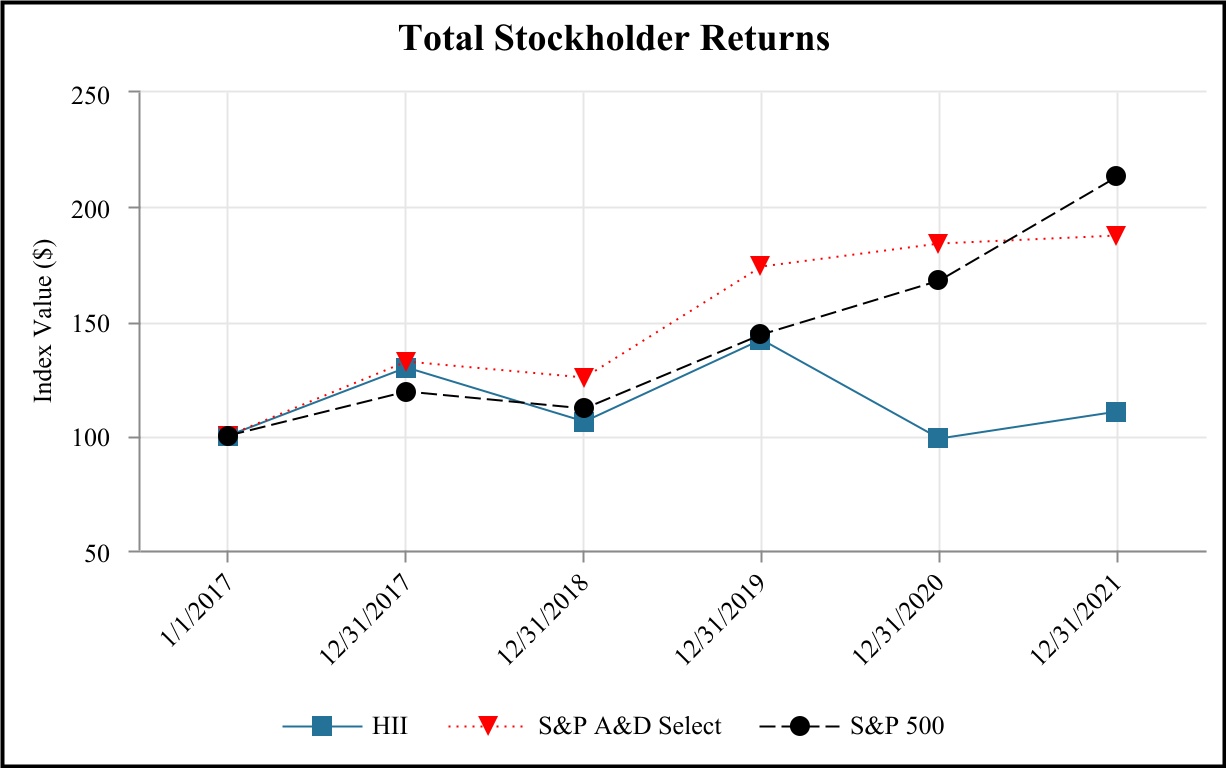][added: 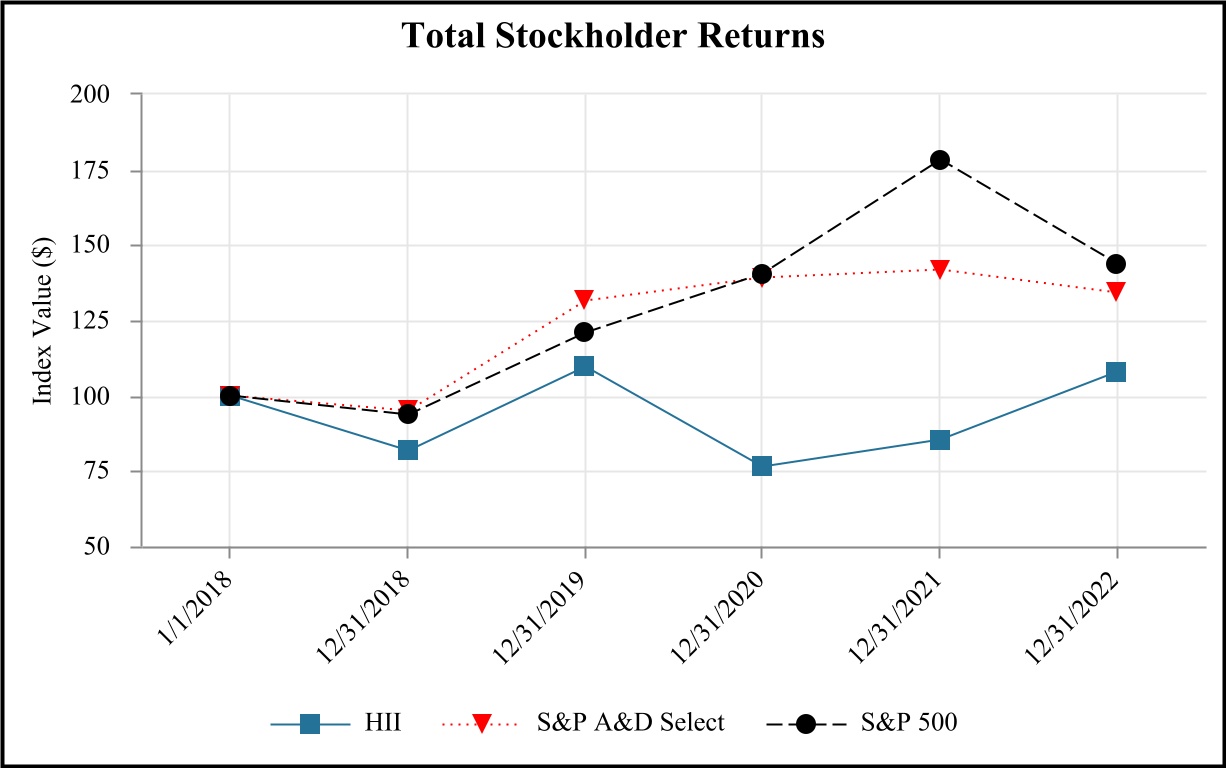]
[removed: (◦)The] [added: ◦The] cumulative total return assumes reinvestment of dividends.
[removed: (◦)The] [added: ◦The] S&P Aerospace & Defense Select Index is comprised of The Boeing Company, General Dynamics Corporation, Huntington Ingalls Industries, Inc., L3 Harris Technologies, Inc., Lockheed Martin Corporation, Northrop Grumman Corporation, Raytheon Technologies Corporation, Textron, Inc., and TransDigm Group Incorporated, among other companies.
The following table summarizes information relating to purchases made by or on behalf of the Company of shares of the Company's common stock during the quarter ended December 31, [removed: 2021.][added: 2022.]
1 From the stock repurchase program's inception through December 31, [removed: 2021,] [added: 2022,] we [added: have] purchased [removed: 13,395,300] [added: 13,639,861] shares at an average price of [removed: $161.18] [added: $162.13] per share for a total of $2.2 billion.
| October 1, 2022 to October 31, 2022 | | | | | | 7,631 | | | | | | $ | 230.49 | | | | | 7,631 | | | | | | $ | 997.8 | |
| November 1, 2022 to November 30, 2022 | | | | | | 24,320 | | | | | | 228.46 | | | | | | 24,320 | | | | | | 992.3 | | |
| December 1, 2022 to December 31, 2022 | | | | | | 15,760 | | | | | | 230.57 | | | | | | 15,760 | | | | | | 988.6 | | |
| Total | | | | | | 47,711 | | | | | | $ | 229.48 | | | | | 47,711 | | | | | | $ | 988.6 | |
The meeting will be held either through a virtual format or in person in Newport News, Virginia.
| October 1, 2021 to October 31, 2021 | | | | | | 22,551 | | | | | | $ | 205.84 | | | | | 22,551 | | | | | | $ | 1,050.8 | |
| November 1, 2021 to November 30, 2021 | | | | | | 22,253 | | | | | | 190.40 | | | | | | 22,253 | | | | | | 1,046.5 | | |
| December 1, 2021 to December 31, 2021 | | | | | | 30,200 | | | | | | 183.50 | | | | | | 30,200 | | | | | | 1,041.0 | | |
| Total | | | | | | 75,004 | | | | | | $ | 192.26 | | | | | 75,004 | | | | | | $ | 1,041.0 | |
*Securities Authorized for Issuance Under Equity Compensation Plans*
For information regarding securities authorized for issuance under our equity compensation plans, see Note 18: Stock Compensation Plans in Item 8 and Equity Compensation Plan Information in Item 12.
Item 8. FINANCIAL STATEMENTS AND SUPPLEMENTARY DATA
543 rewritten, 134 added, 193 removed, 912 unchanged
We have audited the accompanying consolidated statements of financial position of Huntington Ingalls Industries, Inc. and subsidiaries (the “Company”) as of December 31, [removed: 2021] [added: 2022] and [removed: 2020,] [added: 2021,] the related consolidated statements of operations and comprehensive income, changes in equity, and cash flows for each of the three years in the period ended December 31, [removed: 2021,] [added: 2022,] the related notes and the financial statement schedule listed in the Index at Item 15 (collectively referred to as the "financial statements").
In our opinion, the financial statements present fairly, in all material respects, the financial position of the Company as of December 31, [removed: 2021] [added: 2022] and [removed: 2020,] [added: 2021,] and the results of its operations and its cash flows for each of the three years in the period ended December 31, [removed: 2021,] [added: 2022,] in conformity with the accounting principles generally accepted in the United States of America.
We have also audited, in accordance with the standards of the Public Company Accounting Oversight Board (United States) (PCAOB), the Company's internal control over financial reporting as of December 31, [removed: 2021,] [added: 2022,] based on criteria established in *Internal Control — Integrated Framework (2013)* issued by the Committee of Sponsoring Organizations of the Treadway Commission and our report dated February [removed: 10, 2022,] [added: 9, 2023,] expressed an unqualified opinion on the Company's internal control over financial reporting.
[removed: Critical] [added: *Critical] Audit [removed: Matter][added: Matter Description*]
The critical audit [removed: matter] [added: matters] communicated below [removed: is a matter] [added: are matters] arising from the current-period audit of the financial statements that was communicated or required to be communicated to the audit committee and that (1) relates to accounts or disclosures that are material to the financial statements and (2) involved our especially challenging, subjective, or complex judgments.
The communication of critical audit matters does not alter in any way our opinion on the financial statements, taken as a whole, and we are not, by communicating the critical audit [removed: matter] [added: matters] below, providing a separate opinion on the critical audit [removed: matter] [added: matters] or on the accounts or disclosures to which it relates.
[removed: *Revenue] [added: Revenue] – Long Term [added: Shipbuilding] Contracts — Refer to Note 2 [added: and 7] to the financial [removed: statements*][added: statements]
The Company recognizes revenue on long-term [added: shipbuilding] contracts with U.S. Government customers over time as the [removed: work] [added: construction of the ship] progresses, [removed: either as products are produced or as services are rendered,] because transfer of control to the customer is continuous.
Ordinarily the Company’s contracts represent a single distinct performance obligation due to the highly interdependent and interrelated nature of the underlying [removed: goods, services, or both.][added: goods.]
The use of the cost-to-cost method to measure performance progress over time is supported by clauses in the related contracts that [added: allow the customer to unilaterally terminate the contract for convenience, pay the Company for costs incurred plus a reasonable profit, and take control of any work in process.]
[removed: The accounting for these contracts involves judgment, particularly as it relates to the process of] estimating total material costs, labor costs, and profit for the performance obligation.
For the year ended [added: of] December 31, [removed: 2021,] [added: 2022,] revenue [removed: was $9.5 billion, most of which was derived] from long-term [removed: contracts.][added: shipbuilding contracts was $8.4 billion as compared to total revenue of $10.7 billion.]
Given the judgments necessary to estimate total material costs, labor costs, and profit in order to recognize revenue for certain long-term [added: shipbuilding] contracts, auditing such estimates required extensive audit effort due to the complexity of [removed: long-term] [added: the] contracts and a high degree of auditor judgment, especially given the limited historical data for certain contracts, when performing audit procedures and evaluating the results of those procedures.
Our audit procedures related to management’s estimates of total material costs, labor costs, and profit in order to recognize revenue for certain long-term [added: shipbuilding] contracts included the following, among others:
- We tested the effectiveness of controls over long-term [added: shipbuilding] contract revenue, including management’s controls over the estimates of total material costs, labor costs, and profit for performance obligations.
- We obtained the population of active contracts during [removed: 2021] [added: 2022] and assessed the financial and performance risk of the contracts based on our knowledge gained through prior year audits of the Company, industry experience, and ongoing conversations with members of program management regarding the contract performance to identify contracts that we believe were riskier.
◦Read the relevant portions of contracts [added: including any recent contract modifications] to understand contract terms, including incentives, fee arrangement, scope of work, and [removed: other] [added: any] unusual contract terms.
◦Evaluated the estimates of total [removed: materials costs, labor costs,] [added: costs] and profit for the performance obligation by:
▪Evaluating management’s ability to achieve the [removed: estimates of total material costs, labor] [added: estimated] costs and profit by 1) performing inquiries with the business managers and corroborating the information gained from these inquiries with other parties who have detailed knowledge of the contract’s progress, issues being encountered, and overall production status, 2) considering management’s historical performance against estimates, 3) detail testing the appropriateness of the timing of changes in estimates, and 4) considering any contradictory information.
REPORT OF INDEPENDENT REGISTERED PUBLIC [removed: ACCOUNTING][added: ACCOUNTING FIRM]
We have audited the internal control over financial reporting of Huntington Ingalls Industries, Inc. and subsidiaries (the "Company") as of December 31, [removed: 2021,] [added: 2022,] based on criteria established in *Internal Control [removed: -] [added: —] Integrated Framework (2013)* issued by the Committee of Sponsoring Organizations of the Treadway Commission (COSO).
In our opinion, the Company maintained, in all material respects, effective internal control over financial reporting as of December 31, [removed: 2021,] [added: 2022,] based on criteria established in *Internal Control [removed: -] [added: —] Integrated Framework (2013)* issued by COSO.
We have also audited, in accordance with the standards of the Public Company Accounting Oversight Board (United States) (PCAOB), the consolidated financial statements as of and for the year ended December 31, [removed: 2021,] [added: 2022,] of the Company and our report dated February [removed: 10, 2022,] [added: 9, 2023,] expressed an unqualified opinion on those financial statements.
| (in millions, except per share amounts) | | | | | | [removed: 2021] [added: 2022] | | | | | | [removed: 2020] [added: 2021] | | | | | | [removed: 2019] [added: 2020] | | |
| Product sales | | | | | | $ | [removed: 7,000] [added: 7,283] | | | | | $ | [removed: 6,850] [added: 7,000] | | | | | $ | [removed: 6,265] [added: 6,850] | |
| Service revenues | | | | | | [removed: 2,524] [added: 3,393] | | | | | | [removed: 2,511] [added: 2,524] | | | | | | [removed: 2,634] [added: 2,511] | | |
| Sales and service revenues | | | | | | [removed: 9,524] [added: 10,676] | | | | | | [removed: 9,361] [added: 9,524] | | | | | | [removed: 8,899] [added: 9,361] | | |
| Cost of product sales | | | | | | [removed: 5,958] [added: 6,225] | | | | | | [removed: 5,621] [added: 5,958] | | | | | | [removed: 5,158] [added: 5,621] | | |
| Cost of service revenues | | | | | | [removed: 2,198] [added: 3,011] | | | | | | [removed: 2,070] [added: 2,198] | | | | | | [removed: 2,210] [added: 2,070] | | |
| Income from operating investments, net | | | | | | [removed: 41] [added: 48] | | | | | | [removed: 32] [added: 41] | | | | | | [removed: 22] [added: 32] | | |
| Other income and gains, net | | | | | | [removed: 2] [added: 1] | | | | | | [removed: 1] [added: 2] | | | | | | [removed: —] [added: 1] | | |
| General and administrative expenses | | | | | | [removed: 898] [added: 924] | | | | | | [removed: 904] [added: 898] | | | | | | [removed: 788] [added: 904] | | |
| Operating income | | | | | | [removed: 513] [added: 565] | | | | | | [removed: 799] [added: 513] | | | | | | [removed: 736] [added: 799] | | |
| Interest expense | | | | | | [removed: (89)] [added: (102)] | | | | | | [removed: (114)] [added: (89)] | | | | | | [removed: (70)] [added: (114)] | | |
| Non-operating retirement benefit | | | | | | [removed: 181] [added: 276] | | | | | | [removed: 119] [added: 181] | | | | | | [removed: 12] [added: 119] | | |
| Other, net | | | | | | [removed: 17] [added: (20)] | | | | | | [removed: 6] [added: 17] | | | | | | [removed: 5] [added: 6] | | |
| Earnings before income taxes | | | | | | [removed: 622] [added: 719] | | | | | | [removed: 810] [added: 622] | | | | | | [removed: 683] [added: 810] | | |
| Federal and foreign income taxes | | | | | | [removed: 78] [added: 140] | | | | | | [removed: 114] [added: 78] | | | | | | [removed: 134] [added: 114] | | |
| Net earnings | | | | | | $ | [removed: 544] [added: 579] | | | | | $ | [removed: 696] [added: 544] | | | | | $ | [removed: 549] [added: 696] | |
| Basic earnings per share | | | | | | $ | [removed: 13.50] [added: 14.44] | | | | | $ | [removed: 17.14] [added: 13.50] | | | | | $ | [removed: 13.26] [added: 17.14] | |
Critical Audit Matters
The accounting for these contracts involves judgment, particularly as it relates to the process of
▪Evaluate the necessity and appropriateness of any constraints applied against any variable consideration, including consideration provided within the contracts for facilities cost of capital.
Goodwill Valuation of the Mission Technologies reporting unit – Refer to Note 2 and 11 to the financial statements
The Company performed a quantitative impairment evaluation of the goodwill for the Mission Technologies reporting unit by comparing the estimated fair value of the reporting unit to its carrying value.
The Company’s testing approach utilizes a combination of discounted cash flow analysis and comparative market-based valuation methodologies to determine the fair value of the reporting unit for comparison to its corresponding book value.
Estimating the fair value of a reporting unit requires the exercise of significant judgment and assumptions including judgments about expected future cash flows, discount rates and expected long-term growth rates.
Changes in these assumptions could have a significant impact on the fair value of the reporting unit, the amount of any goodwill impairment charge, or both.
The goodwill balance was $2.6 billion as of December 31, 2022 of which $1.7 billion related to the Mission Technologies reporting unit.
The Company’s accounting policy is to test for impairment on November 30 of each year.
As a result of the quantitative assessment, the Company concluded that the fair value of the Mission Technologies reporting unit exceeded the carrying value by approximately 5%, which resulted in no impairment for the year ended December 31, 2022.
Given the significant judgments made by management to estimate the fair value of the Mission Technologies reporting unit and the difference between its fair value and carrying value, performing audit procedures to test the Company’s estimate of the fair value of the Mission Technologies reporting unit, which included evaluating estimates and assumptions related to forecasted revenues, forecasted earnings before income taxes, depreciation and amortization (“EBITDA”) margins, and the selection of the discount rate and terminal growth rate, required a high degree of auditor judgment and an increased extent of effort, including the need to involve our fair value specialists.
*How the Critical Audit Matter Was Addressed in the Audit*
Our audit procedures related to the selection of the forecasted revenues, forecasted EBITDA margins, and the selection of the discount rate and terminal growth rate for the Mission Technologies reporting unit included the following, among others:
- We tested the effectiveness of controls over management’s goodwill impairment evaluation, including those over the selection of the assumptions used in the fair value models.
- We evaluated management’s ability to accurately forecast future revenues and EBITDA margins by comparing actual results to management’s historical forecasts.
- We evaluated the reasonableness of management’s forecasts of revenue and EBITDA margins by comparing the forecasts to internal communications to management and the Board of Directors and comparing the forecasts to third-party economic and industry data.
- We performed sensitivity analyses to evaluate the risk of impairment if key assumptions are changed.
- We evaluated, with the assistance of our fair value specialists, the reasonableness of the (1) valuation methodology utilized by management, and (2) the selected terminal growth rate and discount rate by performing certain procedures, including:
◦Comparing the valuation methodologies used to generally accepted valuation practices.
◦Evaluating the appropriateness of the Company’s selection of companies in its industry peer group for comparability to the reporting unit.
◦Evaluating the appropriateness of source information used by management to select the terminal growth rate and discount rate used in their models.
◦Developing an independent estimate and compare it to that used by management to evaluate the appropriateness of the conclusion after recalculating the models.
- We evaluated the carrying value of the Mission Technologies reporting unit including the corporate allocations.
February 9, 2023
February 9, 2023
| | | | | | | 5,517 | | | | | | 5,256 | | |
| Current portion of long-term debt | | | | | | 399 | | | | | | — | | |
| Net earnings | | | | | | | | | | | | — | | | | | | — | | | | | | 579 | | | | | | — | | | | | | — | | | | | | 579 | | |
| Balance as of December 31, 2022 | | | | | | | | | | | | $ | 1 | | | | | $ | 2,022 | | | | | $ | 4,276 | | | | | $ | (2,211) | | | | | $ | (599) | | | | | $ | 3,489 | |
Huntington Ingalls Industries, Inc. ("HII" or the "Company") is a global, all-domain defense partner, building and delivering the world's most powerful, survivable naval ships and technologies that safeguard America's seas, sky, land, space, and cyber.
The Mission Technologies segment delivers high-value engineering and technology solutions to enable multi-domain distributed operations in the government and commercial services markets.
As used in the Notes to the Consolidated Financial Statements, the terms "HII", and "the Company" refer to HII and its subsidiaries.
When only a range of costs is established and no amount within
The Company tests for impairment by assessing qualitative factors to determine whether it is more likely than not that the fair value of other intangible assets or the goodwill allocated to the reporting unit is less than its carrying amount.
If the qualitative assessment indicates a possible impairment, the carrying value of the asset or reporting unit is compared with its fair value.
This standard did not impact the Company's financial results or disclosures.
The adoption did not have a material impact on the Company's financial results or disclosures.
The acquisition accounting was completed in the third quarter of 2022.
| Amortization of prior service cost1 | | | | | | 18 | | | | | | — | | | | | | 18 | | |
allow the customer to unilaterally terminate the contract for convenience, pay the Company for costs incurred plus a reasonable profit, and take control of any work in process.
February 10, 2022
As described in Management’s Report on Internal Control Over Financial Reporting, management excluded from its assessment the internal control over financial reporting at Alion, which was acquired on August 19, 2021, and whose financial statements constitute 5% of total assets, 5% of revenues, and 2% of net income of the consolidated financial statement amounts as of and for the year ended December 31, 2021.
Accordingly, our audit did not include the internal control over financial reporting at Alion.
| Goodwill impairment | | | | | | — | | | | | | — | | | | | | 29 | | |
| --- | --- | --- | --- | --- | --- | --- | --- | --- | --- | --- | --- | --- | --- | --- |
| Assets held for sale | | | | | | — | | | | | | 133 | | |
| | | | | | | 5,256 | | | | | | 5,002 | | |
| Long-term deferred tax assets | | | | | | — | | | | | | 133 | | |
| Liabilities held for sale | | | | | | — | | | | | | 68 | | |
| Balance as of December 31, 2018 | | | | | | | | | | | | $ | 1 | | | | | $ | 1,954 | | | | | $ | 2,609 | | | | | $ | (1,760) | | | | | $ | (1,288) | | | | | $ | 1,516 | |
Huntington Ingalls Industries, Inc. ("HII" or the "Company") is one of America’s largest military shipbuilding companies and a provider of professional services to partners in government and industry.
The Technical Solutions segment provides a range of services to the government and commercial customers.
HII conducts most of its business with the U.S. Government, primarily the Department of Defense ("DoD").
As prime contractor, principal subcontractor, team member, or partner, the Company participates in many high-priority U.S. defense programs.
Through its Ingalls segment, HII is a builder of amphibious assault and expeditionary warfare ships for the U.S. Navy, the sole builder of National Security Cutters for the U.S. Coast Guard, and one of only two companies that builds the Navy's current fleet of *Arleigh Burke* class (DDG 51) destroyers.
Through its Newport News segment, HII is the nation's sole designer, builder and refueler of nuclear-powered aircraft carriers, and one of only two companies currently designing and building nuclear-powered submarines for the U.S. Navy.
The Technical Solutions segment provides a wide range of professional services and products, including defense and federal solutions ("DFS"), nuclear and environmental services, and unmanned systems.
Additionally, the Company has incorporated realized and estimated future effects of the global outbreak of coronavirus disease 2019 (“COVID-19”), including, among other things, impacts from orders of civil authorities associated with COVID-19 and steps taken to mitigate the effects of COVID-19 (collectively, “COVID-19 Events”), with respect to contract costs and revenue recognition, effective income tax rates, and the fair values of the Company’s long-lived assets, financial instruments, intangible assets, and goodwill recorded at our reporting units.
For the year ended December 31, 2020, the Company recognized across all programs an aggregate unfavorable impact on operating margin of $61 million for delay and disruption from lower employee attendance, limited availability of critical skills, and out-of-sequence work directly attributable to COVID-19 Events.
While costs related to COVID-19 Events are allowable under U.S. Government contracts, the Company's estimates of the effects of COVID-19 Events reflect uncertainty regarding the Company's ability to recover the full costs related to COVID-19 Events under government relief actions such as the Coronavirus Aid, Relief, and Economic Security Act (the "CARES Act") and U.S. Department of Defense ("DoD") guidance.
For the year ended December 31, 2021, the Company did not have a material impact on its operating margin directly attributable to COVID-19 Events.
The Company utilizes the cost-to-cost method to
materials, the effect of any performance delays, the availability and timing of funding from the customer, and the recoverability of any claims included in the estimates to complete.
*Foreign Currency Translation* \- The Company's international subsidiaries that do not have the U.S. dollar as their functional currency translate assets and liabilities at current rates of exchange in effect at the balance sheet date.
Revenues and expenses from these international subsidiaries are translated using the monthly average exchange rates in effect for the periods in which the items occur.
The cumulative foreign currency translation gains and losses are included as a component of accumulated other comprehensive loss in stockholders’ equity.
Gains and losses from foreign currency transactions are included in other income (expense) in the consolidated statements of operations and comprehensive income.
Such amounts are not material.
The Company also has known conditional asset retirement obligations related to assets currently in use, including certain asbestos remediation and asset decommissioning activities to be performed in the future, that were not reasonably estimable as of December 31, 2021, due to insufficient information about the timing and method of settlement of the obligation.
Accordingly, the fair value of these obligations has not been recorded in the consolidated financial statements.
A liability for these obligations is recorded in the period in which sufficient information regarding timing and method of settlement becomes available to make a reasonable estimate of the liability's fair value.
In addition, there may be conditional environmental asset retirement obligations that the Company has not yet discovered.
*Assets and Liabilities Held for Sale -* Assets and liabilities held for sale represent land, buildings, and other assets and liabilities that have met the criteria of “held for sale” accounting at the lower of carrying value or fair value less costs to sell.
Fair value is based on the estimated proceeds from the sale of the assets utilizing recent purchase offers, market comparables, and reliable third-party data.
*Other Current Liabilities* - Other current liabilities were $423 million as of December 31, 2021, and $462 million as of December 31, 2020.
Payroll taxes payable, which is a component of other current liabilities, was $125 million as of December 31, 2020.
No other component of other current liabilities was more than 5% of total current liabilities.
*Restructuring -* Restructuring related accruals are reviewed and adjusted when circumstances require.
Accruals for restructuring activities include estimates primarily related to facility consolidations and closures, asset retirement obligations, long-lived asset write-downs, employment reductions, and contract termination costs.
An excerpt. Shown here: 40 of 543 rewritten, 40 of 134 added and 40 of 193 removed. The counts are complete. For every sentence, read Item 8. FINANCIAL STATEMENTS AND SUPPLEMENTARY DATA in the FY2022 filing and the FY2021 filing.
Item 9A. CONTROLS AND PROCEDURES
4 rewritten, 2 added, 4 removed, 8 unchanged
The Company's management, with the participation of the Company's Chief Executive Officer and Chief Financial Officer, has evaluated the effectiveness of the Company's disclosure controls and procedures (as defined in Rules 13a-15(e) and 15d-15(e) under the Securities Exchange Act of 1934, as amended (the "Exchange Act")) as of December 31, [removed: 2021.][added: 2022.]
Based on that evaluation, the Company's Chief Executive Officer (principal executive officer) and Chief Financial Officer (principal financial officer) concluded that, as of December 31, [removed: 2021,] [added: 2022,] the Company's disclosure controls and procedures were effective to ensure that information required to be disclosed in reports the Company files or submits under the Exchange Act is (i) recorded, processed, summarized and reported within the time periods specified in SEC rules and forms, and (ii) accumulated and communicated to management to allow their timely decisions regarding required disclosure.
Based on its assessment, management has concluded that the Company maintained effective internal control over financial reporting as of December 31, [removed: 2021,] [added: 2022,] based on criteria in *Internal Control – Integrated Framework* (*2013*), issued by the COSO.
The effectiveness of the Company’s internal control over financial reporting as of December 31, [removed: 2021,] [added: 2022,] has been audited by Deloitte & Touche LLP, an independent registered public accounting firm, as stated in their report, which is included in Item 8.
As of December 31, 2022, we completed the integration of Alion, which we acquired on August 19, 2021, into our controls over financial reporting.
Other than the foregoing, there have been no changes in our internal control over financial reporting that occurred in the period covered by this report that materially affected, or are reasonably likely to materially affect, our internal control over financial reporting.
On August 19, 2021, the Company completed the acquisition of Alion.
In accordance with the general guidance issued by the staff of the SEC, Alion is excluded from the scope of management’s report on internal control over financial reporting for the year ended December 31, 2021.
Alion's financial statement amounts constitute 5% of total assets, 5% of revenues, and 2% of net income of the consolidated financial statement amounts as of and for the year ended December 31, 2021.
The Company is integrating Alion’s processes into its financial reporting framework, which may result in additions or changes to its internal control over financial reporting (as defined in Rules 13a-15(e) and 15d-15(e) under the Exchange Act).
Item 10. DIRECTORS, EXECUTIVE OFFICERS, AND CORPORATE GOVERNANCE
27 rewritten, 28 added, 13 removed, 77 unchanged
Information regarding our directors will be incorporated herein by reference to the Proxy Statement for our [removed: 2022] [added: 2023] Annual Meeting of Stockholders, to be filed with the SEC within 120 days after the end of the Company's fiscal year.
The following table sets forth certain information [removed: as of February 4, 2022,] concerning our executive officers, including a five-year employment history.
| [removed: C. Michael Petters] [added: Christopher D. Kastner] | | | | | | [removed: 62] [added: 59] | | | | | | President and Chief Executive Officer | | |
| [removed: Christopher D. Kastner] [added: Bharat B. Amin] | | | | | | [removed: 58] [added: 68] | | | | | | Executive Vice President and Chief [removed: Operating] [added: Information] Officer | | |
| [removed: Bharat B. Amin] [added: Todd R. Borkey] | | | | | | [removed: 67] [added: 59] | | | | | | Executive Vice President and Chief [removed: Information] [added: Technology] Officer | | |
| Chad N. Boudreaux | | | | | | [removed: 48] [added: 49] | | | | | | Executive Vice President and Chief Legal Officer | | |
| Jennifer R. Boykin | | | | | | [removed: 57] [added: 58] | | | | | | Executive Vice President and President, Newport News Shipbuilding | | |
| [removed: William R. Ermatinger] [added: Edmond E. Hughes] | | | | | | [removed: 58] [added: 59] | | | | | | Executive Vice President and Chief Human Resources Officer | | |
| Edgar A. Green III | | | | | | [removed: 56] [added: 57] | | | | | | Executive Vice President and President, [removed: Technical Solutions] [added: Mission Technologies] | | |
| Brooke A. Hart | | | | | | [removed: 51] [added: 52] | | | | | | Executive Vice President, Communications | | |
| Stewart H. Holmes | | | | | | [removed: 60] [added: 61] | | | | | | Executive Vice President, Government and Customer Relations | | |
| Nicolas G. Schuck | | | | | | [removed: 48] [added: 49] | | | | | | Corporate Vice President, Controller and Chief Accounting Officer | | |
| Thomas E. Stiehle | | | | | | [removed: 56] [added: 57] | | | | | | Executive Vice President and Chief Financial Officer | | |
| Kara R. Wilkinson | | | | | | [removed: 47] [added: 48] | | | | | | Executive Vice President and President, Ingalls Shipbuilding | | |
| D. R. Wyatt | | | | | | [removed: 63] [added: 64] | | | | | | Corporate Vice President and Treasurer | | |
Kastner*, [removed: *Executive Vice President] [added: *President] and Chief [removed: Operating] [added: Executive] Officer* \- Mr. Kastner was elected [removed: Executive Vice] President and Chief [removed: Operating] [added: Executive] Officer effective [removed: February 12, 2021.][added: March 1, 2022.]
From March 2016 until [removed: he assumed his current position,] [added: February 2021,] he served as Executive Vice President and Chief Financial Officer.
[added: He holds a B.S in Mechanical] Engineering from Maharaja Sayajirao University, India, as well as a M.S. in Industrial Engineering and an Executive M.B.A. in International Business and Finance from Rutgers University.
[removed: Ermatinger,] [added: Hughes -] Executive Vice President and Chief Human Resources Officer* \- Mr. [removed: Ermatinger has been] [added: Hughes was appointed] Executive Vice President and Chief Human Resources Officer [removed: since March 2011.][added: effective April 1, 2022.]
Prior to [removed: that] [added: that,] and from [removed: 2008, Mr. Ermatinger was Sector] [added: March 2006, he served as the] Vice President of Human Resources and Administration for [removed: NGSB.][added: Ingalls Shipbuilding.]
Green III, Executive Vice President and President, [removed: Technical Solutions] [added: Mission Technologies] -* Mr. Green was appointed Executive Vice President and President, [removed: Technical Solutions] [added: Mission Technologies] in December 2016.
Prior to joining Textron in January 2015, Mr. Holmes served as the staff director/minority clerk for the Senate [added: Appropriations Subcommittee on Defense and, prior to that, worked as a staff member for the Senate Appropriations Committee and as an aide to Sen.]
[removed: He has extensive Treasury experience, including responsibility for corporate finance, cash management, risk management and all financings, capital structure, capital market] interface, rating agency relationships, cash and financial forecasting, working capital management, short-term investments, strategic transactions, pension asset management, and insurance and loss control.
Information as to the Audit Committee and the Audit Committee Financial Expert will be incorporated herein by reference to the Proxy Statement for our [removed: 2022] [added: 2023] Annual Meeting of Stockholders, to be filed within 120 days after the end of the Company’s fiscal year.
The Code of Ethics and Business Conduct can be found on our internet website at [removed: www.huntingtoningalls.com] [added: www.HII.com] under "Investor Relations—Company [removed: Information—Leadership and] [added: Corporate] Governance." A copy of the Code of Ethics and Business Conduct is available to any stockholder who requests it by writing to: Huntington Ingalls Industries, Inc., c/o Office of the Secretary, 4101 Washington Avenue, Newport News, VA 23607.
If we make any substantive amendments to the Code of Ethics and Business Conduct or grant any waivers, including any implicit waiver, from a provision of the Code of Ethics and Business Conduct, in each case as it relates to any provision of the Code of Ethics and Business Conduct specified in applicable SEC rules or stock exchange rules, to our principal executive officer, principal financial officer, principal [added: accounting officer or controller, or persons performing similar functions, we will disclose the nature of the amendment or waiver on our website.]
Other disclosures required by this Item will be incorporated herein by reference to the Proxy Statement for our [removed: 2022] [added: 2023] Annual Meeting of Stockholders, to be filed within 120 days after the end of the Company’s fiscal year.
| Eric D. Chewning | | | | | | 45 | | | | | | Executive Vice President, Strategy and Development | | |
| Paul C. Harris | | | | | | 58 | | | | | | Executive Vice President, Chief Sustainability and Compliance Officer | | |
From February 2021 until he was elected to his current position, he served as Executive Vice President and Chief Operating Officer.
*Todd A.
Borkey, Executive Vice President and Chief Technology Officer* – Mr. Borkey was elected Executive Vice President and Chief Technology Officer effective September 26, 2022.
Prior to that, and from October 2017, he served as Chief Technology Officer at Alion Science and Technology.
Before joining Alion, Mr. Borkey served as
CTO to Thales Defense and Security and DRS Defense Solutions, where he was responsible for the technical roadmap and program operations to a wide range of products, including RF communications, C5ISR solutions, remote sensors, radars, sonars, and cyber/electronic warfare products.
Earlier in his career, Mr. Borkey performed a range of engineering and management assignments within Northrop Grumman and AT&T Bell Labs.
He received a Master's Degree in engineering management from Stevens Institute of Technology and holds an undergraduate degree in Applied Mathematics from the University of Albuquerque.
*Eric D.
Chewning, Executive Vice President, Strategy and Development* - Mr. Chewning was elected Executive Vice President, Strategy and Development, effective January 30, 2023.
Before joining HII, Mr. Chewning co-led McKinsey & Company's Aerospace & Defense practice in the Americas beginning in April 2020.
From January 2019 to January 2020, he served as the Chief of Staff to the U.S. Secretary of Defense.
Prior to that and from October 2017, Mr. Chewning was the Deputy Assistant Secretary of Defense for Industrial Policy.
He is a former U.S. Army military intelligence officer and, prior to that, was an investment banker with Morgan Stanley & Co. Mr. Chewning received a B.A. and a M.A. in international relations from the University of Chicago and a M.B.A. from the Darden School of Business at the University of Virginia.
*Paul C.
Harris, Executive Vice President and Chief Sustainability and Compliance Officer* – Mr. Harris was appointed Executive Vice President and Chief Sustainability and Compliance Officer effective March 14, 2022.
Prior to that, and from September 2020, when he joined HII, Mr. Harris served as Corporate Vice President, Chief Compliance and Privacy Officer.
Before joining HII, he served as Senior Vice President at Hampton University, his alma mater, beginning in September 2016.
Before returning to Hampton, Mr. Harris held several positions of increasing authority and responsibility in corporate law departments, including Sodexo, Northrop Grumman, and Raytheon.
Prior to joining Raytheon, he served as Deputy Assistant Attorney General at the U.S. Department of Justice, where he later was elevated to Deputy Associate Attorney General.
Prior to his service at the Department of Justice, Mr. Harris served as a Member of the Virginia House of Delegates, from 1998 to 2001.
A U.S. Army veteran, he earned a Bachelor of Arts degree from Hampton University and a Juris Doctor degree from The George Washington University Law School.
*Edmond E.
Before joining Ingalls Shipbuilding, Mr. Hughes served in human resources roles of increasing responsibilities at General Motors and TRW Automotive.
He received a B.S. from Tougaloo College and an M.B.A. from Indiana University.
He has extensive Treasury experience, including responsibility for corporate finance, cash management, risk management and all financings, capital structure, capital market
*C.
Michael Petters, President and Chief Executive Officer* \- Mr. Petters has been our President and Chief Executive Officer since March 2011.
Prior to that and from 2008, Mr. Petters was President of Northrop Grumman Shipbuilding ("NGSB").
Before that and from 2004, he was President of Northrop Grumman Newport News.
Since joining Newport News Shipbuilding and Dry Dock Company in 1987, Mr. Petters' responsibilities have included oversight of the *Virginia*\-class submarine program, the nuclear-powered aircraft carrier programs, aircraft carrier refueling and overhaul, submarine fleet maintenance, commercial and naval ship repair, human resources, and business and technology development.
Mr. Petters holds a B.S. in Physics from the U.S. Naval Academy and an M.B.A. from the College of William and Mary.
He holds a B.S in Mechanical
*William R.
In that position, he was responsible for all NGSB human resources and administration activities.
Since joining a predecessor of Northrop Grumman in 1987, Mr. Ermatinger has held several human resources management positions with increasing responsibility, including Vice President of Human Resources and Administration of Northrop Grumman Newport News.
Mr. Ermatinger holds a B.A. in Political Science from the University of Maryland Baltimore County.
Appropriations Subcommittee on Defense and, prior to that, worked as a staff member for the Senate Appropriations Committee and as an aide to Sen.
accounting officer or controller, or persons performing similar functions, we will disclose the nature of the amendment or waiver on our website.
Item 11. EXECUTIVE COMPENSATION
1 rewritten, 0 added, 0 removed, 0 unchanged
Information concerning executive [removed: compensation,] [added: compensation (other than information related to pay-for-performance),] including information concerning compensation committee interlocks, insider participation, and the compensation committee report, will be incorporated herein by reference to the Proxy Statement for our [removed: 2022] [added: 2023] Annual Meeting of Stockholders, to be filed within 120 days after the end of the Company’s fiscal year.
Item 12. SECURITY OWNERSHIP OF CERTAIN BENEFICIAL OWNERS AND MANAGEMENT AND RELATED STOCKHOLDER MATTERS
5 rewritten, 2 added, 3 removed, 7 unchanged
Information as to security ownership of certain beneficial owners and management and related stockholder matters will be incorporated herein by reference to the Proxy Statement for our [removed: 2022] [added: 2023] Annual Meeting of Stockholders, to be filed within 120 days after the end of the Company’s fiscal year.
The following table provides information regarding the equity securities available for issuance under our equity compensation plans as of December 31, [removed: 2021:][added: 2022:]
| Equity compensation plans approved by security holders | | | | | | [removed: 485,182] [added: 506,398] | | | | | | $0.00 | | | | | | [removed: 3,591,091] [added: 1,264,841] | | |
(1) Includes grants made under the Huntington Ingalls Industries, Inc. [added: 2022 Long-Term Incentive Stock Plan (the "2022 Plan"), which was approved by our stockholders on May 3, 2022, Huntington Ingalls Industries, Inc.] 2012 Long-Term Incentive Stock Plan (the "2012 Plan"), which was approved by our stockholders on May 2, 2012, and the Huntington Ingalls Industries, Inc. 2011 Long-Term Incentive Stock Plan (the "2011 Plan"), which was approved by the sole stockholder of HII prior to its spin-off from Northrop Grumman Corporation.
(2) [removed: There are no] [added: No] awards [removed: made] [added: have been granted] under plans not approved by security holders.
| Total | | | | | | 506,398 | | | | | | $0.00 | | | | | | 1,264,841 | | |
These shares were comprised of 14,972 stock rights granted under the 2011 Plan, 53,929 stock rights, 23,304 restricted stock rights, and 406,515 restricted performance stock rights granted under the 2012 Plan, assuming target performance achievement, and 7,678 restricted performance stock rights granted under the 2022 Plan, assuming target performance achievement.
| Total | | | | | | 485,182 | | | | | | $0.00 | | | | | | 3,591,091 | | |
Of these shares, 14,972 were stock rights granted under the 2011 Plan.
In addition, this number includes 45,791 stock rights, 29,822 restricted stock rights, and 394,597 restricted performance stock rights granted under the 2012 Plan, assuming target performance achievement.
Item 13. CERTAIN RELATIONSHIPS AND RELATED TRANSACTIONS, AND DIRECTOR INDEPENDENCE
1 rewritten, 0 added, 0 removed, 0 unchanged
Information as to certain relationships and related transactions and director independence will be incorporated herein by reference to the Proxy Statement for our [removed: 2022] [added: 2023] Annual Meeting of Stockholders, to be filed within 120 days after the end of the Company’s fiscal year.
Item 14. PRINCIPAL ACCOUNTANT FEES AND SERVICES
1 rewritten, 0 added, 0 removed, 1 unchanged
Information as to principal accountant fees and services will be incorporated herein by reference to the Proxy Statement for our [removed: 2022] [added: 2023] Annual Meeting of Stockholders, to be filed within 120 days after the end of the Company’s fiscal year.
Item 15. EXHIBITS AND FINANCIAL STATEMENT SCHEDULES
23 rewritten, 10 added, 2 removed, 138 unchanged
| Year Ended December 31, [removed: 2019] [added: 2022] | | | | | | | | | | | | | | | | | | | | | | | | | | |
| Valuation allowance for deferred tax assets | | | | | | $ | [removed: 12] [added: 15] | | | | | $ | [removed: 3] [added: 7] | | | | | $ | — | | | | | $ | [removed: 15] [added: 22] | |
| Valuation allowance for deferred tax assets | | | | | | [removed: 15] [added: 22] | | | | | | [removed: 7] [added: —] | | | | | | — | | | | | | 22 | | |
| Valuation allowance for deferred tax assets | | | | | | $ | 22 | | | | | $ | [removed: —] [added: 2] | | | | | $ | [removed: —] [added: 4] | | | | | $ | [removed: 22] [added: 28] | |
| [removed: 2.2] [added: 4.8] | | | | | | [removed: [Stock Purchase Agreement] [added: [Indenture, dated as of August 16, 2021,] by and among [removed: Alion Holdings LLC, Alion Holding Corp. and] Huntington Ingalls Industries, [removed: Inc. dated July 4, 2021] [added: Inc., certain subsidiaries of Huntington Ingalls Industries, Inc., and U.S. Bank National Association, as trustee] (incorporated by reference to Exhibit [removed: 2.1] [added: 4.1] to the Company's Current Report on Form [removed: 8-K] [added: 8–K] filed on [removed: July 9, 2021)](https://www.sec.gov/Archives/edgar/data/0001501585/000119312521211927/d201679dex21.htm).] [added: August 16, 2021).](https://www.sec.gov/Archives/edgar/data/1501585/000119312521247744/d199506dex41.htm)] | | |
| 3.5 | | | | | | [Restated Bylaws of Huntington Ingalls Industries, Inc. (incorporated by reference to Exhibit 3.1 to the Company's Current Report on Form 8-K filed [removed: on March 30, 2021).](https://www.sec.gov/Archives/edgar/data/0001501585/000119312521100439/d168808dex31.htm)] [added: on](https://www.sec.gov/Archives/edgar/data/1501585/000119312522280169/d418198dex31.htm) [November 8, 2022](https://www.sec.gov/Archives/edgar/data/1501585/000119312522280169/d418198dex31.htm)[).](https://www.sec.gov/Archives/edgar/data/1501585/000119312522280169/d418198dex31.htm)] | | |
| 4.3 | | | | | | [Second Supplemental Indenture, dated as of June 30, 2020, to the Indenture, dated as of December 1, 2017, among Huntington Ingalls Industries, Inc., the guarantors party thereto, and Wells Fargo Bank, National Association, as trustee (incorporated by reference to Exhibit 4.3 to the Company's Annual Report on Form 10-K [removed: file](https://www.sec.gov/Archives/edgar/data/1501585/000150158521000008/hii-ex43202010xk.htm)[d](https://www.sec.gov/Archives/edgar/data/1501585/000150158521000008/hii-ex43202010xk.htm) [on] [added: filed on] February 11, 2021).](https://www.sec.gov/Archives/edgar/data/1501585/000150158521000008/hii-ex43202010xk.htm) | | |
| 4.4 | | | | | | [Third Supplemental Indenture, dated as of December 14, 2021, to the Indenture, dated as of December 1, 2017, among Huntington Ingalls Industries, Inc., the guarantors party thereto, and Wells Fargo Bank, National Association, as [removed: trustee.](https://www.sec.gov/Archives/edgar/data/1501585/000150158522000007/hii-ex44202110xk.htm)] [added: trustee (incorporated by reference to Exhibit 4.4 to the Company's Annual Report on Form 10-K filed on February 10, 2022).](https://www.sec.gov/Archives/edgar/data/1501585/000150158522000007/hii-ex44202110xk.htm)] | | |
| 4.7 | | | | | | [Second Supplemental Indenture, dated as of December 14, 2021, to the Indenture, dated as of March 30, 2020, among Huntington Ingalls Industries, Inc., the guarantors party thereto, and Wells Fargo Bank, National Association, as [removed: trustee.](https://www.sec.gov/Archives/edgar/data/1501585/000150158522000007/hii-ex47202110xk.htm)] [added: trustee (incorporated by reference to Exhibit 4.7 to the Company's Annual Report on Form 10-K filed on February 10, 2022).](https://www.sec.gov/Archives/edgar/data/1501585/000150158522000007/hii-ex47202110xk.htm)] | | |
| [removed: 4.8] [added: 4.9] | | | | | | [removed: [Indenture,] [added: [First Supplemental Indenture,] dated as of [added: December 14, 2021, to the Indenture, dated as of] August 16, 2021, by and [removed: among](https://www.sec.gov/Archives/edgar/data/1501585/000119312521247744/d199506dex41.htm) [](https://www.sec.gov/Archives/edgar/data/1501585/000119312521247744/d199506dex41.htm)[Huntington] [added: among Huntington] Ingalls Industries, [removed: Inc](https://www.sec.gov/Archives/edgar/data/1501585/000119312521247744/d199506dex41.htm)[.,](https://www.sec.gov/Archives/edgar/data/1501585/000119312521247744/d199506dex41.htm) [certain] [added: Inc., certain] subsidiaries of Huntington Ingalls Industries, [removed: Inc.](https://www.sec.gov/Archives/edgar/data/1501585/000119312521247744/d199506dex41.htm)[,](https://www.sec.gov/Archives/edgar/data/1501585/000119312521247744/d199506dex41.htm) [and] [added: Inc. and] U.S. Bank National Association, as trustee (incorporated by reference to Exhibit [removed: 4.1] [added: 4.9] to the Company's [removed: Current] [added: Annual] Report on Form [removed: 8–K] [added: 10-K] filed on [removed: August 16, 2021).](https://www.sec.gov/Archives/edgar/data/1501585/000119312521247744/d199506dex41.htm)] [added: February 10, 2022).](https://www.sec.gov/Archives/edgar/data/1501585/000150158522000007/hii-ex49202110xk.htm)] | | |
| [removed: 4.11] [added: 4.10] | | | | | | [Description of [removed: Securities](https://www.sec.gov/Archives/edgar/data/1501585/000150158522000007/hii-ex411202110xk.htm)] [added: Securities](https://www.sec.gov/Archives/edgar/data/1501585/000150158523000010/hii-ex410202210xk.htm)] | | |
| 10.1 | | | | | | [Amended and Restated Revolving Credit Agreement, dated as of August 2, 2021, among Huntington Ingalls Industries, Inc., the lenders party [removed: thereto](https://www.sec.gov/Archives/edgar/data/0001501585/000150158521000029/exhibit101amendedandrestat.htm)[,](https://www.sec.gov/Archives/edgar/data/0001501585/000150158521000029/exhibit101amendedandrestat.htm) [and] [added: thereto, and] JPMorgan Chase Bank, N.A., as Administrative Agent and an Issuing Bank (incorporated by reference to Exhibit 10.1 to the Company's Quarterly Report on Form 10-Q filed on August 5, [removed: 2021)](https://www.sec.gov/Archives/edgar/data/0001501585/000150158521000029/exhibit101amendedandrestat.htm)[.](https://www.sec.gov/Archives/edgar/data/0001501585/000150158521000029/exhibit101amendedandrestat.htm)] [added: 2021).](https://www.sec.gov/Archives/edgar/data/0001501585/000150158521000029/exhibit101amendedandrestat.htm)] | | |
| 10.2 | | | | | | [Credit Agreement, dated as of August 2, 2021, among Huntington Ingalls Industries, Inc., the lenders party [removed: thereto](https://www.sec.gov/Archives/edgar/data/1501585/000150158521000029/exhibit102creditagreement.htm)[,](https://www.sec.gov/Archives/edgar/data/1501585/000150158521000029/exhibit102creditagreement.htm) [and] [added: thereto, and] JPMorgan Chase Bank, N.A., as Administrative Agent](https://www.sec.gov/Archives/edgar/data/1501585/000150158521000029/exhibit102creditagreement.htm) [(incorporated by reference to Exhibit 10.2 to the Company's Quarterly Report on Form 10-Q filed on August 5, 2021).](https://www.sec.gov/Archives/edgar/data/1501585/000150158521000029/exhibit102creditagreement.htm) | | |
| [removed: 10.16*] [added: 10.16] | | | | | | [Huntington Ingalls Industries Supplemental Plan 2 (incorporated by reference to Exhibit 10.16 to the Company's Amendment No. 4 to Registration Statement on Form 10 filed on January 18, 2011) and Amendment to Appendix G to the plan.](http://www.sec.gov/Archives/edgar/data/1501585/000095012311003504/a57513a4exv10w16.htm) | | |
| [removed: 10.35*] [added: 10.41*] | | | | | | [Huntington Ingalls Industries, Inc. Amended and Restated Directors' Compensation [removed: Policy.](https://www.sec.gov/Archives/edgar/data/1501585/000150158522000007/hii-ex1035202110xk.htm)] [added: Policy.](https://www.sec.gov/Archives/edgar/data/1501585/000150158523000010/hii-ex1041202210xk.htm)] | | |
| [removed: 10.36*] [added: 10.42*] | | | | | | [Huntington Ingalls Industries, Inc. Directors Compensation Policy--Amended and Restated Board Deferred Compensation [removed: Policy (incorporated by reference to Exhibit 10.5 to the Company’s Current Report on Form 8-K filed on December 19, 2018).](http://www.sec.gov/Archives/edgar/data/1501585/000119312518352901/d660959dex105.htm)] [added: Policy.](https://www.sec.gov/Archives/edgar/data/1501585/000150158523000010/hii-ex1042202210xk.htm)] | | |
| 21.1 | | | | | | [List of subsidiaries of Huntington Ingalls Industries, [removed: Inc.](https://www.sec.gov/Archives/edgar/data/1501585/000150158522000007/hii-ex211202110xk.htm)] [added: Inc.](https://www.sec.gov/Archives/edgar/data/1501585/000150158523000010/hii-ex211202210xk.htm)] | | |
| 22 | | | | | | [List of subsidiary guarantors of registered securities of Huntington Ingalls Industries, [removed: Inc.](https://www.sec.gov/Archives/edgar/data/1501585/000150158522000007/hii-ex22202110xk.htm)] [added: Inc.](https://www.sec.gov/Archives/edgar/data/1501585/000150158523000010/hii-ex22202210xk.htm)] | | |
| 23.1 | | | | | | [Consent of Deloitte & Touche [removed: LLP.](https://www.sec.gov/Archives/edgar/data/1501585/000150158522000007/hii-ex231202110xk.htm)] [added: LLP.](https://www.sec.gov/Archives/edgar/data/1501585/000150158523000010/hii-ex231202210xk.htm)] | | |
| 31.1 | | | | | | [Certification of the Chief Executive Officer Pursuant to Exchange Act Rule 13a-14(a)/15d-14(a), as Adopted Pursuant to Section 302 of the Sarbanes-Oxley Act of [removed: 2002.](https://www.sec.gov/Archives/edgar/data/1501585/000150158522000007/hii-ex311202110xk.htm)] [added: 2002.](https://www.sec.gov/Archives/edgar/data/1501585/000150158523000010/hii-ex311202210xk.htm)] | | |
| 31.2 | | | | | | [Certification of the Chief Financial Officer Pursuant to Exchange Act Rule 13a-14(a)/15d-14(a), as Adopted Pursuant to Section 302 of the Sarbanes-Oxley Act of [removed: 2002.](https://www.sec.gov/Archives/edgar/data/1501585/000150158522000007/hii-ex312202110xk.htm)] [added: 2002.](https://www.sec.gov/Archives/edgar/data/1501585/000150158523000010/hii-ex312202210xk.htm)] | | |
| 32.1 | | | | | | [Certificate of the Chief Executive Officer Pursuant to 18 U.S.C. Section 1350, as Adopted Pursuant to Section 906 of the Sarbanes-Oxley Act of [removed: 2002.](https://www.sec.gov/Archives/edgar/data/1501585/000150158522000007/hii-ex321202110xk.htm)] [added: 2002.](https://www.sec.gov/Archives/edgar/data/1501585/000150158523000010/hii-ex321202210xk.htm)] | | |
| 32.2 | | | | | | [Certificate of the Chief Financial Officer Pursuant to 18 U.S.C. Section 1350, as Adopted Pursuant to Section 906 of the Sarbanes-Oxley Act of [removed: 2002.](https://www.sec.gov/Archives/edgar/data/1501585/000150158522000007/hii-ex322202110xk.htm)] [added: 2002.](https://www.sec.gov/Archives/edgar/data/1501585/000150158523000010/hii-ex322202210xk.htm)] | | |
| 10.35* | | | | | | [Huntington Ingalls Industries, Inc. 2022 Long-Term Incentive Stock Plan (incorporated herein by reference to Annex B to the Company's definitive proxy statement filed on March 21, 2022).](https://www.sec.gov/Archives/edgar/data/1501585/000119312522080314/d298364ddef14a.htm#toc298364_69) | | |
| 10.36* | | | | | | [Terms and Conditions Applicable to Restricted Performance Stock Rights Granted Under the 2022 Long-Term Incentive Stock Plan (incorporated herein by reference to Exhibit 10.2 to the Company’s Current Report on Form 8-K filed on August 4, 2022).](https://www.sec.gov/Archives/edgar/data/0001501585/000150158522000026/exhibit102termsandcondit.htm) | | |
| 10.37* | | | | | | [Terms and Conditions Applicable to Restricted Stock Rights (1-year vesting) Granted Under the 2022 Long-Term Incentive Stock Plan (incorporated herein by reference to Exhibit 10.3 to the Company’s Current Report on Form 8-K filed on August 4, 2022).](https://www.sec.gov/Archives/edgar/data/0001501585/000150158522000026/exhibit103termsandcondit.htm) | | |
| 10.38* | | | | | | [Terms and Conditions Applicable to Restricted Stock Rights (2-year vesting) Granted Under the 2022 Long-Term Incentive Stock Plan (incorporated herein by reference to Exhibit 10.4 to the Company’s Current Report on Form 8-K filed on August 4, 2022).](https://www.sec.gov/Archives/edgar/data/0001501585/000150158522000026/exhibit104termsandcondit.htm) | | |
| 10.39* | | | | | | [Terms and Conditions Applicable to Restricted Stock Rights (3-year vesting) Granted Under the 2022 Long-Term Incentive Stock Plan (incorporated herein by reference to Exhibit 10.5 to the Company’s Current Report on Form 8-K filed on August 4, 2022).](https://www.sec.gov/Archives/edgar/data/0001501585/000150158522000026/exhibit105termsandcondit.htm) | | |
| 10.40* | | | | | | [Terms and Conditions Applicable to Non-Employee Director Stock Grants Under the 2022 Long-Term Incentive Stock Plan (incorporated herein by reference to Exhibit 10.6 to the Company’s Current Report on Form 8-K filed on August 4, 2022).](https://www.sec.gov/Archives/edgar/data/0001501585/000150158522000026/exhibit106termsandcondit.htm) | | |
| | | | | | | | | |
| | | | | | | | | |
| | | | | | | | | |
| | | | | | | | | |
| 4.9 | | | | | | [First Supplemental Indenture, dated as of December 14, 2021, to the Indenture, dated as of August 16, 2021, by and among Huntington Ingalls Industries, Inc., certain subsidiaries of Huntington Ingalls Industries, Inc. and U.S. Bank National Association, as trustee](https://www.sec.gov/Archives/edgar/data/1501585/000150158522000007/hii-ex49202110xk.htm). | | |
| 4.10 | | | | | | [Registration Rights Agreement, dated as of August 16, 2021, by and among](https://www.sec.gov/Archives/edgar/data/1501585/000119312521247744/d199506dex44.htm) [Huntington Ingalls Industries, Inc.](https://www.sec.gov/Archives/edgar/data/1501585/000119312521247744/d199506dex44.htm)[, certain subsidiaries of Huntington Ingalls Industries, Inc.](https://www.sec.gov/Archives/edgar/data/1501585/000119312521247744/d199506dex44.htm)[,](https://www.sec.gov/Archives/edgar/data/1501585/000119312521247744/d199506dex44.htm) [and J.P. Morgan Securities LLC, BofA Securities, Inc., Mizuho Securities USA LLC, MUFG Securities Americas Inc., Scotia Capital (USA) Inc. and U.S. Bancorp Investments, Inc., as representatives of the initial purchasers (incorporated by reference to Exhibit 4.4 to the Company's Current Report on Form 8-K filed on August 16, 2021).](https://www.sec.gov/Archives/edgar/data/1501585/000119312521247744/d199506dex44.htm) | | |
Item 16. FORM 10-K SUMMARY
15 rewritten, 4 added, 4 removed, 55 unchanged
Pursuant to the requirements of Section 13 or 15(d) of the Securities Exchange Act of 1934, the registrant has duly caused this report to be signed on its behalf by the undersigned, thereunto duly authorized, on the [removed: 10th] [added: 9th] day of February, [removed: 2022.][added: 2023.]
| /s/ [removed: C. Michael Petters] [added: Christopher D. Kastner] | | | | | | President, Chief Executive Officer and Director | | | | | | | | |
| [removed: C. Michael Petters] [added: Christopher D. Kastner] | | | | | | (Principal Executive Officer) | | | | | | February [removed: 10, 2022] [added: 9, 2023] | | |
| | | | | | | (Principal Financial Officer) | | | | | | February [removed: 10, 2022] [added: 9, 2023] | | |
| | | | | | | (Principal Accounting Officer) | | | | | | February [removed: 10, 2022] [added: 9, 2023] | | |
| Kirkland H. Donald | | | | | | Chairman | | | | | | February [removed: 10, 2022] [added: 9, 2023] | | |
| Augustus L. Collins | | | | | | Director | | | | | | February [removed: 10, 2022] [added: 9, 2023] | | |
| Victoria D. Harker | | | | | | Director | | | | | | February [removed: 10, 2022] [added: 9, 2023] | | |
| Frank R. Jimenez | | | | | | Director | | | | | | February [removed: 10, 2022] [added: 9, 2023] | | |
| Anastasia D. Kelly | | | | | | Director | | | | | | February [removed: 10, 2022] [added: 9, 2023] | | |
| Tracy B. McKibben | | | | | | Director | | | | | | February [removed: 10, 2022] [added: 9, 2023] | | |
| Stephanie L. O'Sullivan | | | | | | Director | | | | | | February [removed: 10, 2022] [added: 9, 2023] | | |
| Thomas C. Schievelbein | | | | | | Director | | | | | | February [removed: 10, 2022] [added: 9, 2023] | | |
| John K. Welch | | | | | | Director | | | | | | February [removed: 10, 2022] [added: 9, 2023] | | |
| Stephen R. Wilson | | | | | | Director | | | | | | February [removed: 10, 2022] [added: 9, 2023] | | |
| /s/ Christopher D. Kastner | | | | | | | | | | | | | | |
| Christopher D. Kastner | | | | | | | | | | | | | | |
| /s/ Leo P. Denault | | | | | | | | | | | | | | |
| Leo P. Denault | | | | | | Director | | | | | | February 9, 2023 | | |
| /s/ C. Michael Petters | | | | | | | | | | | | | | |
| C. Michael Petters | | | | | | | | | | | | | | |
| /s/ Philip M. Bilden | | | | | | | | | | | | | | |
| Philip M. Bilden | | | | | | Director | | | | | | February 10, 2022 | | |