 filings.tools
Huntington Ingalls Industries 10-K 2023-12-31
Filed 2024-02-01. 24 sections, 524K characters. Original on sec.gov · Markdown · JSON
Cover and table of contents
UNITED STATES
SECURITIES AND EXCHANGE COMMISSION
Washington, D.C. 20549
FORM 10-K
| ☒ | ANNUAL REPORT PURSUANT TO SECTION 13 OR 15(d) OF THE SECURITIES EXCHANGE ACT OF 1934 |
For the fiscal year ended December 31, 2023
OR
| ☐ | TRANSITION REPORT PURSUANT TO SECTION 13 OR 15(d) OF THE SECURITIES EXCHANGE ACT OF 1934 |
Commission file number 001-34910
HUNTINGTON INGALLS INDUSTRIES, INC.
(Exact name of registrant as specified in its charter)
| Delaware | 90-0607005 | |||||||
| (State or other jurisdiction of incorporation or organization) | (I.R.S. Employer Identification No.) |
4101 Washington Avenue, Newport News, Virginia 23607
(Address of principal executive offices and zip code)
(757) 380-2000
(Registrant’s telephone number, including area code)
Securities registered pursuant to section 12(b) of the Act:
| Title of each class | Trading Symbol(s) | Name of each exchange on which registered | ||||||||||||
| Common Stock | HII | New York Stock Exchange |
Securities registered pursuant to section 12(g) of the Act:
None
Indicate by check mark if the registrant is a well-known seasoned issuer, as defined in Rule 405 of the Securities Act. Yes ☒ No ☐
Indicate by check mark if the registrant is not required to file reports pursuant to Section 13 or 15(d) of the Act. Yes ☐ No ☒
Indicate by check mark whether the registrant (1) has filed all reports required to be filed by Section 13 or 15(d) of the Securities Exchange Act of 1934 during the preceding 12 months (or for such shorter period that the registrant was required to file such reports), and (2) has been subject to such filing requirements for the past 90 days. Yes ☒ No ☐
Indicate by check mark whether the registrant has submitted electronically every Interactive Data File required to be submitted pursuant to Rule 405 of Regulation S-T (§ 232.405 of this chapter) during the preceding 12 months (or for such shorter period that the registrant was required to submit such files). Yes ☒ No ☐
Indicate by check mark whether the registrant is a large accelerated filer, an accelerated filer, a non-accelerated filer, a smaller reporting company, or an emerging growth company. See the definitions of "large accelerated filer," "accelerated filer," "smaller reporting company," and "emerging growth company" in Rule 12b-2 of the Exchange Act.
| Large Accelerated Filer | ☒ | Accelerated filer | ☐ | ||||||||||||||||||||
| Non-accelerated filer | ☐ | Smaller reporting company | ☐ | ||||||||||||||||||||
| Emerging growth company | ☐ |
If an emerging growth company, indicate by check mark if the registrant has elected not to use the extended transition period for complying with any new or revised financial accounting standards provided pursuant to Section 13(a) of the Exchange Act. ☐
Indicate by check mark whether the registrant has filed a report on and attestation to its management’s assessment of the effectiveness of its internal control over financial reporting under Section 404(b) of the Sarbanes-Oxley Act (15 U.S.C. 7262(b)) by the registered public accounting firm that prepared or issued its audit report. ☒
If securities are registered pursuant to Section 12(b) of the Act, indicate by check mark whether the financial statements of the registrant included in the filing reflect the correction of an error to previously issued financial statements. ☐
Indicate by check mark whether any of those error corrections are restatements that required a recovery analysis of incentive-based compensation received by any of the registrant’s executive officers during the relevant recovery period pursuant to § 240.10D-1(b). ☐
Indicate by check mark whether the registrant is a shell company (as defined in Rule 12b-2 of the Act). Yes ☐ No ☒
As of June 30, 2023, the aggregate market value (based upon the closing price of the stock on the New York Stock Exchange) of the registrant's common stock held by non-affiliates was approximately $9,075 million.
As of January 26, 2024, 39,590,687 shares of the registrant's common stock were outstanding.
DOCUMENTS INCORPORATED BY REFERENCE
Portions of the registrant's Proxy Statement to be filed with the Securities and Exchange Commission pursuant to Rule 14A for the registrant's 2024 Annual Meeting of Stockholders are incorporated by reference in Part III of this Form 10-K.
TABLE OF CONTENTS
i
PART I
Item 1. BUSINESS
History and Organization
Huntington Ingalls Industries, Inc. ("HII", the "Company", "we", "us", or "our") is a global, all-domain defense partner, building and delivering the world's most powerful, survivable naval ships and technologies that safeguard America’s seas, sky, land, space, and cyber. For more than a century, our Ingalls Shipbuilding segment ("Ingalls") in Mississippi and Newport News Shipbuilding segment ("Newport News") in Virginia have built more ships in more ship classes than any other U.S. naval shipbuilder, making us America's largest shipbuilder. Our Mission Technologies segment develops integrated technology solutions and products that enable today's connected, all domain force. Headquartered in Newport News, Virginia, we employ over 44,000 people domestically and internationally.
We conduct most of our business with the U.S. Government, primarily the Department of Defense ("DoD"). As prime contractor, principal subcontractor, team member, or partner, we participate in many high-priority U.S. defense programs. Ingalls includes our non-nuclear ship design, construction, repair, and maintenance businesses. Newport News includes all of our nuclear ship design, construction, overhaul, refueling, and repair and maintenance businesses. Our Mission Technologies segment provides a wide range of services and products, including command, control, computers, communications, cyber, intelligence, surveillance, and reconnaissance ("C5ISR") systems and operations; the application of Artificial Intelligence and machine learning to battlefield decisions; defense and offensive cyberspace strategies and electronic warfare; unmanned autonomous systems; live, virtual, and constructive training solutions; fleet sustainment; and critical nuclear operations.
Ingalls
Through our Ingalls segment, we design and construct non-nuclear ships for the U.S. Navy and U.S. Coast Guard, including amphibious assault ships, expeditionary warfare ships, surface combatants, and national security cutters ("NSC"). We are the sole builder of amphibious assault ships and one of two builders of surface combatants for the U.S. Navy. We are the sole builder of large multi-mission NSCs for the U.S. Coast Guard. Our Ingalls segment is located in Pascagoula, Mississippi on 800 acres along the Pascagoula River.
Amphibious Assault Ships
We construct amphibious assault ships and expeditionary warfare ships for the U.S. Navy, which include U.S. Navy large deck amphibious assault ships ("LHA") and amphibious transport dock ships ("LPD"), respectively. The LHA is a key component of the Department of the Navy's requirement for Expeditionary Strike Groups/Amphibious Readiness Groups, and design, construction, and modernization of LHAs are core to our Ingalls operations. In 2007, we were awarded the construction contract for USS America (LHA 6), the first in a class of enhanced amphibious assault ships designed from the keel up to be an aviation optimized Marine assault platform. We are currently constructing Bougainville (LHA 8) and Fallujah (LHA 9). In 2023, we were awarded a long-lead-time material contract for LHA 10 (unnamed).
The LPD program is a long-running production program of expeditionary warfare ships in which we have generated efficiencies through ship-over-ship learning. We delivered USS Fort Lauderdale (LPD 28) in 2022, and we are currently constructing Richard M. McCool Jr. (LPD 29), Harrisburg (LPD 30), and Pittsburgh (LPD 31). In 2023, we were awarded a contract to construct Philadelphia (LPD 32).
Surface Combatants
We are a design agent for, and one of only two companies that constructs, Arleigh Burke class (DDG 51) guided missile destroyers, a class of surface combatant. We have delivered 35 Arleigh Burke class (DDG 51) destroyers to the U.S. Navy, including USS Jack H. Lucas (DDG 125) in 2023, USS Lenah H. Sutcliffe Higbee (DDG 123) in 2022, and USS Frank E. Petersen Jr. (DDG 121) in 2021. In 2018, we were awarded a multi-year contract for construction of six Arleigh Burke class (DDG 51) destroyers and, in 2020,a contract to construct an additional Arleigh Burke class (DDG 51) destroyer. In 2023, we were awarded a multi-year contract for construction of six more Arleigh Burke class (DDG 51) destroyers, as well as the first option ship, for a total of seven ships. We are currently
constructing Ted Stevens (DDG128), Jeremiah Denton (DDG 129), George M. Neal (DDG 131), Sam Nunn (DDG 133), and Thad Cochran (DDG 135).
National Security Cutters
The U.S. Coast Guard's recapitalization program is replacing aging and operationally expansive ships and aircraft used to conduct missions in excess of 50 miles from the shoreline. The flagship of this program is the Legend class NSC, a multi-mission platform we designed and continue to build. In 2018, we were awarded long-lead-time material and construction contracts for Calhoun (NSC 10), which was delivered to the U.S. Coast Guard in 2023, and Friedman (NSC 11), which is currently under construction.
Newport News
The core business of our Newport News segment is designing and constructing nuclear-powered aircraft carriers and submarines, and the refueling and overhaul and the inactivation of nuclear-powered aircraft carriers. Our Newport News shipyard is located on approximately 550 acres near the mouth of the James River, which adjoins the Chesapeake Bay.
Design, Construction, Refueling and Complex Overhaul, and Inactivation of Aircraft Carriers
Engineering, design, and construction of U.S. Navy nuclear aircraft carriers ("CVN") are core to Newport News operations. Aircraft carriers are the largest ships in the U.S. Navy's fleet, with a displacement of over 90,000 tons. Newport News has designed and built more than 31 aircraft carriers for the U.S. Navy since 1933, including all ten Nimitz class (CVN 68) aircraft carriers currently in active service, as well as the first ship of the next generation Gerald R. Ford class (CVN 78) aircraft carriers.
We delivered USS Gerald R. Ford (CVN 78), the first aircraft carrier of the Gerald R. Ford class to the U.S. Navy in 2017. Beginning in 2009, we received contract awards totaling $8.7 billion for construction preparation, detail design, and construction of the second Gerald R. Ford class (CVN 78) aircraft carrier, John F. Kennedy (CVN 79). In addition, we have received contract awards valued at $15.3 billion for detail design and construction of the Gerald R. Ford class (CVN 78) aircraft carriers Enterprise (CVN 80) and Doris Miller (CVN 81).
We continue to be the exclusive prime contractor for nuclear aircraft carrier refueling and complex overhaul ("RCOH"). Each RCOH takes nearly four years to complete, with the work accounting for approximately 35% of all maintenance and modernization during an aircraft carrier's 50 year service life. RCOH services include propulsion work (refueling of reactors; propulsion plant modernization; and propulsion plant repairs), restoration of service life (dry docking, tank, and void maintenance; hull, shafting, propellers, and rudders; launch and recovery system; piping repairs; and component refurbishment), and modernization (electrical systems; aviation support systems; warfare; interoperability; and environmental compliance). We provide ongoing maintenance services for the U.S. Navy aircraft carrier fleet through both RCOH and fleet support services worldwide.
USS George Washington (CVN 73) was redelivered to the U.S. Navy in 2023 after completion of its RCOH, and we are currently performing the RCOH of USS John C. Stennis (CVN 74). We believe our current position as the exclusive designer and builder of nuclear-powered aircraft carriers, our RCOH performance on the first seven Nimitz class (CVN 68) carriers, our highly trained workforce, the capital-intensive nature of RCOH work, and high barriers to entry due to required nuclear expertise position us well for RCOH contract awards on the remaining Nimitz class (CVN 68) carriers, as well as future RCOH work on Gerald R. Ford class (CVN 78) aircraft carriers.
Aircraft carriers have a lifespan of approximately 50 years, and we believe the ten Nimitz class (CVN 68) carriers we delivered that are currently in active service, as well as Gerald R. Ford class (CVN 78) aircraft carriers, present significant opportunities for inactivation contracts as they reach the end of their lifespans. We believe we are well positioned to be the U.S. Navy's shipyard of choice for these contract awards.
Design and Construction of Nuclear-Powered Submarines
We are one of only two companies in the United States currently capable of designing and building nuclear-powered submarines for the U.S. Navy. Newport News has delivered 63 submarines to the U.S. Navy since 1960, comprised of 49 fast attack and 14 ballistic missile submarines. Of the 49 nuclear-powered fast attack submarines currently in
active service, 23 were delivered by Newport News. Our nuclear submarine program, located at our Newport News shipyard, includes construction, engineering, design, research, and integrated planning.
Virginia Class (SSN 774) Submarines
We have a teaming agreement with Electric Boat Corporation ("Electric Boat"), a division of General Dynamics Corporation ("General Dynamics"), to build Virginia class (SSN 774) fast attack nuclear submarines. Under the teaming arrangement, we build the stern, habitability and machinery spaces, torpedo room, sail, and bow, while Electric Boat builds the engine room, control room, and pressure hull structure. Work on the reactor plant and the final assembly, test, outfit, and delivery of the submarines to the U.S. Navy alternates between Electric Boat and us.
The four submarines of the first block, six submarines of the second block, and eight submarines of the third block of Virginia class (SSN 774) submarines have been delivered. In 2014, the team was awarded a construction contract for the fourth block of ten Virginia class (SSN 774) submarines, which contemplated production of two submarines per year. The first submarine of the Block IV contract was delivered in 2020, and three more submarines have been delivered through 2023. The remaining six boats of the Block IV contract are in the final assembly and test phases of construction.
In 2019, the team was awarded a construction contract for the fifth block of nine Virginia class (SSN 774) submarines, and, in 2021, an option for a 10th submarine was exercised, continuing the two submarines per year production rate. Ten of the Block V boats are in manufacturing and outfitting stages of construction.
In 2023, the team was awarded a contract modification for advance procurement for long lead-time material in support of two additional Block V boats, bringing the total Block V boats to 12. In addition, the team received a contract award for advance procurement of long-lead-time material in support of the first two Block VI boats.
Columbia Class (SSBN 826) Submarines
Newport News is participating in the design and construction of the Columbia class (SSBN 826) submarines as a replacement for the current aging Ohio class nuclear ballistic missile submarines ("SSBN"), which were first introduced into service in 1981. The Columbia class (SSBN 826) program currently anticipates 12 new ballistic missile submarines. We perform design work as a subcontractor to Electric Boat, and we have entered into a teaming agreement with Electric Boat to build modules for the entire Columbia class (SSBN 826) submarine program that leverages our Virginia class (SSN 774) experience. Contract award for the first two Columbia class submarines (SSBN 826 and SSBN 827) and construction start of the first Columbia class (SSBN 826) submarine occurred in late 2020. In 2023, we were awarded a contract modification for long-lead-time material and advance construction in support of five additional Columbia class (SSBN 826) boats, also referred to as Build II of the class.
Naval Nuclear Support Services
Newport News provides additional services to and in support of the U.S. Navy, ranging from services supporting the Navy's carrier and submarine fleets to maintenance services at U.S. Navy training facilities. Fleet support services include design, construction, maintenance, and disposal activities for in-service U.S. Navy nuclear ships worldwide through mobile and in-house capabilities. We also provide maintenance services on nuclear reactor prototypes, such as those at the Kenneth A. Kesselring Site, a research and development facility in New York that supports the U.S. Navy.
Mission Technologies
Our Mission Technologies segment develops integrated solutions that enable today’s connected, all-domain force. Our capabilities include C5ISR systems and operations; the application of Artificial Intelligence ("AI") and machine learning to battlefield decisions; defensive and offensive cyberspace strategies and electronic warfare ("CEW&S"); live, virtual, constructive solutions ("LVC"); unmanned, autonomous systems; fleet sustainment; and critical nuclear operations. Our domain expertise and advanced technologies support our mission partners across the globe.
C5ISR
C5ISR designs, develops, integrates, and manages the sensors, systems and other assets necessary to support integrated ISR operations and accelerated decision-making. These business activities provide data fusion and mission management capabilities for the DoD, the combatant commands, and the intelligence community.
CEW&S
CEW&S works within our nation’s intelligence and cyber operations communities to defend U.S. interests in cyberspace and anticipate emerging threats. Our capabilities in cybersecurity, network architecture, reverse engineering, software, and hardware development uniquely enable our ability to support sensitive missions for the U.S. military and federal agency partners. We also develop, test, and integrate leading-edge AI and machine learning algorithms to optimize and accelerate the nation’s mission-critical systems and platforms.
LVC
LVC training connects live environments with virtual platforms and simulated (constructive) threats to prepare trainees through integrated, real world scenarios before they are in harm’s way. LVC is a modern and distributed approach to U.S. military training.
Fleet Sustainment
Fleet sustainment provides comprehensive life-cycle sustainment to the U.S. Navy fleet and other DoD and commercial maritime customers. Services include maintenance, modernization, and repair on all ship classes; naval architecture, marine engineering, and design; integrated logistics support; technical documentation development; warehousing, asset management, and material readiness; operational and maintenance training development and delivery; software design and development; IT infrastructure support and data delivery and management; and cyber security and information assurance. We also provide undersea vehicle and specialized craft development and prototyping services.
Unmanned Systems
Unmanned Systems develops advanced unmanned systems for defense, marine research, and commercial applications. Serving customers in more than 30 countries, we provide design, autonomy, manufacturing, testing, operations, and sustainment of unmanned systems, including unmanned underwater vehicles and unmanned surface vessels.
Nuclear and Environmental Services
Nuclear and Environmental Services support the Department of Energy’s ("DoE") national security mission through the management and operation of DoE sites, as well as the safe cleanup of legacy waste across the country. Through participation in joint ventures, including Newport News Nuclear BWXT Los Alamos, LLC ("N3B"), Mission Support and Test Services, LLC ("MSTS"), and Savannah River Nuclear Solutions, LLC ("SRNS"), we meet customers’ toughest nuclear and environmental challenges.
Customers
Our revenues are primarily derived from the U.S. Government, including the U.S. Navy, the U.S. Coast Guard, the DoD, the DoE, and other federal agencies. In 2023, 2022, and 2021, approximately 81%, 82%, and 90%, respectively, of our revenues were generated from the U.S. Navy.
Intellectual Property
We develop new technologies that are incorporated into the products and services we provide to our customers. We also develop new manufacturing processes and systems-integration technologies and processes that we use to produce our products and to provide services to our customers. In addition to owning intellectual property, we license intellectual property rights to and from other parties. The U.S. Government generally receives non-exclusive licenses to certain intellectual property we develop in the performance of U.S. Government contracts and unlimited license rights in technical data developed under our U.S. Government contracts when such data is developed
entirely at government expense. The U.S. Government may use or authorize other parties to use the intellectual property we license to the government. While our intellectual property rights are important to our operations, we do not believe that any existing patent, license, or other intellectual property right is of such importance that its loss or termination would have a material impact on our business.
Seasonality
No material portion of our business is seasonal. The timing of our revenue recognition is based on multiple factors, including the timing of contract awards, the incurrence of contract costs, contract cost estimation, and unit deliveries. See Note 2: Summary of Significant Accounting Policies in Item 8.
Backlog
As of December 31, 2023 and 2022, our total backlog was approximately $48.1 billion and $47.1 billion, respectively. We expect approximately 22% of backlog at December 31, 2023, to be converted into sales in 2024.
Raw Materials
We rely on third parties to provide raw materials. The most significant material we use is steel. Other materials we use in large quantities include paint, aluminum, pipe, electrical cables, electronic components, fittings, custom machine items, and sensors. All of these materials are currently available in adequate supply. In connection with our U.S. Government contracts, we are required to procure certain materials and component parts from supply sources approved by the U.S. Government. For long-term contracts, we generally solicit price quotations for many of our material requirements from multiple suppliers to ensure competitive pricing. While we have not generally been dependent upon any one supply source, we currently have only one supplier for certain component parts as a result of consolidation in the defense industry. We believe these single source suppliers, as well as our overall supplier base, are adequate to meet our foreseeable needs. Any inability to procure the necessary raw materials, components, and other supplies for our products on a timely basis could negatively affect our results of operations, financial condition, or cash flow. In addition, a significant prolonged increase in inflation could negatively impact the cost of raw materials, components, and other supplies. We mitigate some supply risk by negotiating long-term agreements with certain raw material suppliers, and we mitigate inflation risk related to raw material to an extent through price escalation provisions in certain customer contracts.
Regulatory Matters
We operate in heavily regulated markets and must comply with a variety of laws and regulations, including those relating to the award, administration, and performance of U.S. Government contracts, as well as legal and regulatory requirements relating to cyber security, environmental protection, and our nuclear operations. Government contracting requirements increase our contract performance costs and compliance costs and risks. See Risk Factors in Item 1A.
Government Contracting
We are overseen and audited by the U.S. Government and its agencies, including the U.S. Navy's Supervisor of Shipbuilding, the Defense Contract Audit Agency ("DCAA"), and the Defense Contract Management Agency ("DCMA"). These agencies evaluate our contract performance, cost structures, and compliance with applicable laws, regulations, and standards. If an audit uncovers improper or illegal activities, we may be subject to administrative, civil, or criminal proceedings, which could result in fines, penalties, repayments, or compensatory, treble, or other damages. Certain U.S. Government findings against a contractor can also lead to suspension or debarment from future U.S. Government contracts or the loss of export privileges.
U.S. Government agencies also evaluate the adequacy of our business systems and processes relative to U.S. Government requirements. Our business systems subject to audit or review include our accounting systems, purchasing systems, government property management systems, estimating systems, earned value management systems, and material management accounting systems. The U.S. Government has the ability to decrease or withhold contract payments if it determines significant deficiencies exist in one or more of our business systems.
The U.S. Government generally has the ability to terminate contracts, in whole or in part, with little or no prior notice, for convenience or for default based upon performance. In the event of termination of a contract for convenience, a
contractor is normally able to recover costs already incurred on the contract and profit on incurred costs up to the amount authorized under the contract, but not the profit that would have been earned had the contract been completed. Such a termination could also result in the cancellation of future work on the related program. A termination resulting from our default could expose us to various liabilities, including excess re-procurement costs, and could have a material effect on our ability to compete for future contracts.
Our contracts with the U.S. Government sometimes result in Requests for Equitable Adjustments ("REAs"), which represent requests for the U.S. Government to make appropriate adjustments to contract terms, including pricing, delivery schedule, technical requirements, or other affected terms, due to changes to the original contract requirements and resulting delays and disruption for which the U.S. Government is responsible. We submit and negotiate REAs in the ordinary course of business, and large REAs are not uncommon at the conclusion of both new construction and RCOH activities. REAs can result in claims under the Contract Disputes Act of 1978 in cases in which we cannot reach agreement with the U.S. Government.
U.S. Government regulations determine contractor costs that are allowable and therefore recoverable from the government, and certain costs are not allowable and therefore not recoverable. The U.S. Government also regulates the methods by which allowable costs, including overhead, are allocated to government contracts. Costs we incur that are not allowable under the Federal Acquisition Regulation (the “FAR”) or U.S. Cost Accounting Standards (“CAS”) or that are otherwise determined to be unallowable or improperly allocated to a specific contract are not recoverable or must be refunded if already reimbursed.
Our business, including contracts with U.S. Government agencies and subcontracts with other prime contractors, is subject to a variety of laws and regulations, including the FAR, the Defense Federal Acquisition Regulation Supplement ("DFARS"), the Truth in Negotiations Act, the Procurement Integrity Act, the False Claims Act, CAS, the International Traffic in Arms Regulations promulgated under the Arms Export Control Act, the Close the Contractor Fraud Loophole Act, and the Foreign Corrupt Practices Act. A noncompliance determination by a government agency may result in reductions in contract values, contract modifications or terminations, penalties, fines, repayments, compensatory, treble, or other damages, or suspension or debarment. We are also subject to evolving cyber security and data privacy and protection laws and regulations, which increase our costs and compliance risks and may affect our competitiveness, cause reputational harm, and expose us to damage claims, substantial fines, and other penalties. See Note 7: Revenue under Item 8 and "Risk Factors" in Item 1A for further information regarding our contracts.
Nuclear
Our nuclear operations are subject to various safety related requirements imposed by the U.S. Navy, the DoE, and the U.S. Nuclear Regulatory Commission. In the event of noncompliance, these agencies may increase regulatory oversight, impose fines, or shut down our operations, depending on their assessment of the severity of the noncompliance. In addition, new or revised security and safety requirements imposed by the U.S. Navy, the DoE, and the Nuclear Regulatory Commission could necessitate substantial capital and other expenditures.
Subject to certain requirements and limitations, our contracts with the U.S. Navy and the DoE generally provide for indemnity by the U.S. Government for losses resulting from our nuclear operations. For our commercial nuclear operations, we rely primarily on insurance carried by nuclear facility operators for risk mitigation, and we maintain limited insurance coverage for losses in excess of the coverage of facility operators. See "Risk Factors" in Item 1A for further information regarding nuclear regulatory matters.
Environmental
Our operations are subject to federal, state, and local laws and regulations relating to the protection of the environment. Substantial fines, penalties, and criminal sanctions may be imposed for noncompliance, and certain environmental laws impose joint and several "strict liability" for remediation of spills and releases of oil and hazardous substances. Such laws and regulations impose liability upon a party for environmental cleanup and remediation costs and damage without regard to negligence or fault on the part of such party and could expose us to liability for the conduct of or conditions caused by third parties.
We accrue estimated costs to perform environmental remediation when we determine it is probable we will incur expenses in the future, in amounts we can reasonably estimate, to address environmental conditions at currently or formerly owned or leased operating facilities, or at sites where we are named a Potentially Responsible Party
("PRP") by the U.S. Environmental Protection Agency ("EPA") or similarly designated by another environmental agency. Uncertainties regarding the extent of required remediation, determination of legally responsible parties, and the status of laws and regulations and their interpretations make future environmental remediation costs difficult to estimate and can cause our estimated remediation costs to change.
We believe we are in material compliance with environmental laws and regulations, and historical environmental compliance costs have not been material to our business. We could be affected by new environmental laws or regulations, including any laws and regulations enacted in response to concerns over climate change, other aspects of the environment, or natural resources. We have made investments we believe are necessary to comply with environmental legal requirements, but we expect to incur future capital and operating costs to comply with current and future environmental laws and regulations. We do not currently believe such costs will have a material effect on our financial position, results of operations, or cash flows. See "Risk Factors" in Item 1A and Note 16: Commitments and Contingencies under Item 8 for further information regarding environmental matters.
Competitive Environment
In our business of designing, building, overhauling, and repairing military ships, we primarily compete with General Dynamics and, in the case of certain non-nuclear shipbuilding programs, smaller shipyards. The smaller shipyards sometimes team with large defense contractors. Intense competition related to programs, resources, funding, and long operating cycles are key characteristics of both our shipbuilding business and the shipbuilding defense industry in general. It is common industry practice to share work on major programs among a number of companies. A company competing to be a prime contractor may, upon ultimate award of the contract to another party, become a subcontractor for the prime contracting party. It is not uncommon to compete for a contract award with a peer company and simultaneously serve as a supplier to or a customer of such competitor on other contracts. The nature of major defense programs, conducted under binding long-term contracts, enable companies that perform well to benefit from a level of program continuity not common in many industries.
We believe we are well-positioned in our shipbuilding markets. Because we are the only company currently capable of building, refueling, and inactivating the U.S. Navy's nuclear-powered aircraft carriers, we believe we are positioned well to be awarded future contracts to perform such activities. Even so, the government periodically revisits whether refueling of nuclear-powered aircraft carriers should be performed in private or public facilities. If a U.S. Government shipyard were to become capable and engaged in the refueling of nuclear-powered aircraft carriers, our market position would likely be significantly and adversely affected.
While we have competed with another large defense contractor to build large deck amphibious ships, we are currently the only builder of large deck amphibious assault ships and expeditionary warfare ships for the U.S. Navy, including LHAs and LPDs. We are also the sole builder of NSCs for the U.S. Coast Guard. We are one of only two companies currently capable of designing and building nuclear-powered submarines for the U.S. Navy, and we are party to long-term teaming agreements with the other company for the production of both Virginia class (SSN 774) fast attack nuclear submarines and Columbia class (SSBN 826) ballistic missile submarines. We are one of only two companies that builds the U.S. Navy's current fleet of Arleigh Burke class (DDG 51) destroyers and are positioned well to be awarded future contracts for surface combatant ships as well.
Key competitive factors in the Mission Technologies segment include technology capabilities; innovative cyber advances and artificial intelligence; the ability to develop and implement complex, integrated solutions; the ability to meet delivery schedules; and cost effectiveness. Our success depends on investments in our people, technologies, and products to meet the evolving needs of our customers. To remain competitive, we must be able to identify emerging technology trends and consistently provide superior service, while understanding customer priorities and maintaining customer relationships.
Our Mission Technologies segment competes domestically and internationally against large aerospace and defense ("A&D") companies, primarily L3 Harris, Amentum, ManTech, Leidos, and, increasingly, small businesses serving the intelligence community. To a lesser extent, our lines of business compete on certain contracts with major prime A&D contractors, including Lockheed Martin, General Dynamics, Northrop Grumman, Raytheon, and Boeing.
Our success depends upon our ability to develop, market, produce, and deliver our products and services at costs consistent with our customers' expectations, as well as our ability to provide the workforce, technologies, facilities, equipment, and financial capacity needed to deliver those products and services with maximum efficiency.
Human Capital Resources
We recognize that our employees are our most important resources and serve as the foundation for our ability to achieve financial and strategic objectives. Our employees are critical to driving operational execution, meeting customer expectations, delivering strong financial performance, advancing innovation, and maintaining a strong quality and compliance program. Our leaders believe each employee contributes to our success.
We have over 44,000 employees. We are the largest industrial employer in Virginia and the largest private employer in Mississippi. We employ individuals specializing in 19 crafts and trades, with approximately 7,000 engineers and designers and approximately 3,700 employees with advanced degrees. Our workforce contains many third-, fourth-, and fifth-generation employees, and approximately 1,600 employees with more than 40 years of continuous service. Employees in our shipbuilding segments with more than 40 years of continuous service achieve the honor of “Master Shipbuilder.” As of December 31, 2023, we had 1,322 Master Shipbuilders at Newport News and 227 at Ingalls. We also employ more than 6,700 veterans across the enterprise.
In addition, over 1,400 apprentices are enrolled in more than 27 crafts and advanced programs at our two shipbuilding segments. From nuclear pipe welders to senior executives, we employ approximately 4,100 apprentice school alumni at Newport News and Ingalls.
Approximately 45% of our employees are covered by a total of nine collective bargaining agreements and one site stabilization agreement. Newport News has three collective bargaining agreements covering represented employees, which expire in April 2024, February 2027, and December 2027. Newport News craft workers employed at the Kesselring Site near Saratoga Springs, New York are represented under an indefinite DoE site agreement. Ingalls has five collective bargaining agreements covering represented employees, all of which expire in March 2026. Approximately 15 Mission Technologies employees in Klamath Falls, Oregon are covered by a collective bargaining agreement that expires in June 2025.
We have not experienced a work stoppage in more than 24 years at Newport News and more than 16 years at Ingalls. We are committed to working effectively with our existing unions and believe our relationship with our represented employees is satisfactory.
The success and growth of our business depends in large part on our ability to attract, retain, and develop a skilled and diverse workforce of talented and high-performing employees at all levels of our organization. To succeed in the markets in which we compete for labor, we have developed key workforce development, recruitment, and retention strategies and objectives that we focus on as part of the overall management of our business. These strategies and objectives form the pillars of our human capital management framework and are advanced through the following programs, policies, and initiatives:
Competitive Pay and Benefits - Our compensation programs are designed to ensure we have the ability to attract, retain, and motivate employees to achieve our objectives.
-
We provide employee base wages and salaries that are competitive and consistent with employee positions, skill levels, experience, knowledge, and geographic location.
-
We utilize nationally recognized surveys and outside compensation and benefits consulting firms to independently evaluate the effectiveness of our employee and executive compensation and benefit programs and to provide benchmarking against our peers within the industry.
-
The structure of our executive compensation programs balances incentive earnings for both short-term and long-term performance, and we align our executive long-term equity compensation metrics with long-term shareholder interests.
-
Employees are eligible for health insurance, paid and unpaid leaves, 401(k) plans, and life and disability/accident insurance coverage. We also offer a variety of benefits that allow employees to select the options that meet their needs, including: annual leave/paid time off; paid holidays, flexible work arrangements/schedules; telemedicine; parental leave; transgender medical coverage; and a wellness program that includes physical, mental, and financial wellness components. We also fund the operation of Family Health Centers near our two shipyards, which provide a full range of medical, lab, pharmacy, dental, physical therapy, and vision services.
Recruitment, Training, and Workforce Development - Our three segments hire thousands of employees each year. In 2023, we hired approximately 9,500 new employees. To help us meet this large demand for talent, we have
created, developed, and maintain multiple talent pipelines. One of the key components of our approach to workforce development is to “grow our own.” We operate two apprentice schools, one at Ingalls and one at Newport News. The Newport News Apprentice School was founded in 1919, and the Ingalls Apprentice School was founded in 1952.
The two apprentice schools combined have graduated over 14,400 graduates since their inceptions. The schools are nationally renowned and are critical to training both our craft/trades and technical workforce, as well as developing the future leaders of our company. The Ingalls Apprentice School has partnered with the Mississippi Gulf Coast Community College to permit their apprentices to earn credits toward an associate’s degree. The Newport News Apprentice School has partnered with two community colleges, as well as Old Dominion University, to enable apprentices to earn a bachelor’s degree in Mechanical Engineering, Electrical Engineering, or Modeling & Simulation.
In addition to operating our own apprentice schools, we maintain effective partnerships with colleges and universities, military bases for transitioning veterans, and regional community colleges to enable us to recruit and hire engineering, IT, and other technical talent. Working closely with state and local government leaders, we have successfully facilitated local, regional, and state-wide workforce development and education initiatives that include pre-K programs, high school trades programs/talent development labs, pre-hire trades/technical community college programs, interns/co-ops with colleges and universities, adult trades programs, veterans and military spouses training programs, and unemployed/underemployed training programs.
We view our workforce development process critical to our success and have developed a robust and effective succession planning process that ensures continuity in our leadership ranks. Since our founding in 2011, we have followed our succession plans 82% of the time when replacing a vacancy in an existing vice president position, and we have filled 82% of newly created vice president positions with internal hires. See "Risk Factors" in Item 1A for further information regarding our human capital resources.
Environmental, Health & Safety (“EH&S”) - The health, safety, and well-being of our employees, together with protection of the environment in the communities in which we operate, is one of our core values and rooted in our culture across the enterprise. We prioritize, manage, and carefully track safety performance and integrate sound environmental, safety, and health practices to make a meaningful difference in every facet of our operations, particularly at our shipbuilding segments and at DoE sites on which Mission Technologies segment employees work.
Safety goals are included in operational metrics under the Newport News and Ingalls compensation programs. We also use a wide variety of training courses, pre-job “Take Five” crew talks, medical surveillance programs, and employee involvement to focus our workforce on EH&S. At Newport News and Ingalls, a key component of our EH&S program is the utilization of health and safety teams, which are comprised of production and maintenance employees and front-line managers whose goal is to educate, engage, and empower our workforce toward a culture that strives to reduce injury, illness, and environmental impacts. We employ programs focused on identifying, reporting, and abating near misses and other programs that aim to recognize, evaluate, and control hazards.
We track multiple metrics related to occupational injuries as one of several methods to monitor our safety performance. One of the key metrics is Total Case Rate (“TCR”), which is the number of Occupational Safety and Health Administration ("OSHA") recordable injuries per 100 equivalent employees. The TCR for Newport News was 5.15 in 2023, 5.58 in 2022, and 5.64 in 2021, and the TCR at Ingalls was 6.31 in 2023, 5.67 in 2022, and 6.26 in 2021. Newport News also tracks Days Away, Restricted or Transferred (“DART”), which is the number of OSHA recordable cases in which the employee is unable to work, cannot work due to a restriction, or can work with a restriction as a result of an injury per 100 equivalent employees. DART at Newport News was 4.10 in 2023, 4.86 in 2022, and 4.45 in 2021. Before 2023, Ingalls tracked two other safety metrics: Lost Time Case Rate (“LTCR”), which is the number of employees that lost work time per 100 employees, and Lost Work Day Rate (“LWDR”), which is the number of lost workdays per 100 full-time employees. The LTCR and LWDR at Ingalls were 2.55 and 73.06 respectively, in 2022, and 2.75 and 76.32, respectively, in 2021. In 2023 Ingalls began to track DART, in lieu of LTCR and LWDR. DART at Ingalls was 3.34 in 2023.
Advancing and Celebrating Diversity and Inclusion (“D&I”) - We believe we gain a key competitive advantage by building a workforce community that values contributions and perspectives from a variety of backgrounds, skills, and experiences regardless of race, ethnicity, color, religion, sex, disability, nationality, or other differentiation, and our leaders leverage the differences within their teams. We also believe D&I is vital to our ability to grow and innovate in
an ever-changing, fast-paced environment. Our diverse and inclusive workplace encourages different perspectives and ideas, which we believe enables better business decisions. The following are highlights of our D&I program:
-
Employee Resource Groups (“ERGs”) are a key component of our corporate culture and an important part of our diversity and inclusion strategy. We currently sponsor 23 ERGs, which represent 10 distinct affinity groups, including those that support African Americans, Asian and Pacific Islanders, Hispanics, Women and Women in Engineering, LGBTQ+ employees, veterans, multiple generations, newly hired employees, and wellness. Our ERGs are employee-led and open to all employees.
-
We have established D&I Councils, which provide strategic direction, guidance, and advocacy for our D&I initiatives and advancements. These councils are led by senior executives and include high-performing employees and leaders from across our enterprise.
-
We have a long history of participation in a number of annual national diversity conferences, including Black Engineer of the Year Awards (BEYA), Society of Hispanic Engineers and Professionals (SHPE), Society of Asian Scientists and Engineers (SASE), and Women of Color STEM Conference. These events provide recruitment, recognition, and development opportunities for our diverse workforce.
Available Information
We maintain a website at the following address: www.hii.com. References to our websites in this report are provided as a matter of convenience and do not constitute, and should not be viewed as, incorporation by reference of the information contained on, or available through, the website. Accordingly, such information should not be considered part of this report. We make available on or through our website certain reports and amendments to those reports that we file with or furnish to the Securities and Exchange Commission ("SEC") in accordance with the Securities Exchange Act of 1934, as amended (the "Exchange Act"). These include our Annual Reports on Form 10–K, our Quarterly Reports on Form 10–Q, and our Current Reports on Form 8-K. We make this information available on our website free of charge as soon as reasonably practicable after we electronically file the information with, or furnish it to, the SEC.
In addition, we routinely post on the "Investors" page of our website (www.ir.hii.com) news releases, announcements, and other statements about our business and results of operations, some of which may contain information that may be deemed material to investors. Therefore, we encourage investors to monitor the "Investors" page of our website and review the information we post on that page.
The SEC also maintains a website at www.sec.gov that contains reports, proxy statements, and other information about SEC registrants, including us.
Cautionary Statement Regarding Forward-Looking Statements
Statements in this Annual Report on Form 10-K and in our other filings with the SEC, as well as other statements we may make from time to time, other than statements of historical fact, constitute "forward-looking statements" within the meaning of the Private Securities Litigation Reform Act of 1995. In some cases, you can identify forward-looking statements by words such as "may," "will," "should," "expects," "intends," "plans," "anticipates," "believes," "estimates," "predicts," "potential," "continue," and similar words or phrases or the negative of these words or phrases. These statements relate to future events or our future financial performance and involve known and unknown risks, uncertainties, and other factors that may cause our actual results, levels of activity, performance, or achievements to be materially different from any future results, levels of activity, performance, or achievements expressed or implied by these forward-looking statements. Although we believe the expectations reflected in the forward-looking statements are reasonable when made, we cannot guarantee future results, levels of activity, performance, or achievements. There are a number of important factors that could cause our actual results to differ materially from the results anticipated by our forward-looking statements, which include, but are not limited to:
-
changes in government and customer priorities and requirements (including government budgetary constraints, shifts in defense spending, and changes in customer short-range and long-range plans);
-
our ability to estimate our future contract costs, including cost increases due to inflation, and perform our contracts effectively;
-
changes in procurement processes and government regulations and our ability to comply with such requirements;
-
our ability to deliver our products and services at an affordable life cycle cost and compete within our markets;
-
natural and environmental disasters and political instability;
-
our ability to execute our strategic plan, including with respect to share repurchases, dividends, capital expenditures, and strategic acquisitions;
-
adverse economic conditions in the United States and globally;
-
health epidemics, pandemics and similar outbreaks;
-
our ability to attract, retain, and train a qualified workforce;
-
disruptions impacting global supply, including those resulting from the ongoing conflict between Russia and Ukraine and in the Middle East;
-
changes in key estimates and assumptions regarding our pension and retiree health care costs;
-
security threats, including cyber security threats, and related disruptions; and
-
other risk factors discussed herein and in our other filings with the SEC.
There may be other risks and uncertainties that we are unable to predict at this time or that we currently do not expect to have a material adverse effect on our business, and we undertake no obligation to update or revise any forward-looking statements. You should not place undue reliance on any forward-looking statements that we may make.
Item 1A. Risk Factors
Our consolidated financial position, results of operations and cash flows are subject to various risks, many of which are not exclusively within our control, that may cause actual performance to differ materially from historical or projected future performance. We encourage you to consider carefully the risk factors described below when evaluating the information contained in this report as the outcome of one or more of these risks could have a material adverse effect on our financial position, results of operations and/or cash flows.
Industry and Economic Risk Factors
We depend on the U.S. Government for substantially all of our business, and risks that arise from conducting business with the U.S. Government could have a material adverse effect on our financial position, results of operations, or cash flows.
A substantial majority of our business consists of the design, construction, repair, and maintenance of nuclear-powered ships and non-nuclear ships for the U.S. Navy and coastal defense surface ships for the U.S. Coast Guard, as well as the refueling and overhaul and inactivation of nuclear-powered ships for the U.S. Navy. We also provide integrated solutions that enable today's connected, all-domain force, including C5ISR systems and operations; the application of Artificial Intelligence and machine learning to battlefield decisions; defense and offensive cyberspace strategies and electronic warfare; unmanned autonomous systems; live, virtual, and constructive training solutions; fleet sustainment; and critical nuclear operations. Substantially all of our revenues in 2023 were derived from products and services sold to the U.S. Government, and we expect this to continue for the foreseeable future. In addition, substantially all of our backlog as of December 31, 2023, was related to products and services deliverable to the U.S. Government. Our U.S. Government contracts are subject to various risks, including customer political and budgetary constraints and processes, changes in customer short-term and long-term strategic plans, the timing of contract awards, significant changes in contract scheduling, recessionary impacts on government spending, intense contract award and funding competition, challenges forecasting costs and schedules for bids on developmental and sophisticated technical work, and contractor suspension or debarment in the event of certain legal or regulatory violations. Any of these factors could materially affect our business with the U.S. Government, which in turn would have a material adverse effect on our financial position, results of operations, or cash flows.
Significant delays or reductions in appropriations for our programs, changes in customer priorities, and potential contract terminations could have a material adverse effect on our financial position, results of operations, or cash flows.
We are directly dependent upon Congressional funding of U.S. Navy, U.S. Coast Guard, and other federal agency programs. Under the normal legislative process, Congress completes 12 annual appropriations bills each fiscal year to fund the activities of the federal agencies. When Congress is unable to pass appropriations bills before the beginning of a fiscal year, a continuing resolution can be enacted to provide stopgap funding for a specified period of time at a specified rate, often the prior year’s appropriations level. When the U.S. Government operates under a continuing resolution, limitations can be placed on production increases, multi-year procurements, and new program starts, which may result in delays or cancellation of new contract awards. When the U.S. Government fails to enact annual appropriations or a continuing resolution, a full or partial federal government shutdown may occur. A federal government shutdown could, in turn, result in the delay or cancellation of government programs, or the delay of contract payments, which could have a negative effect on our cash flows and adversely affect our future results of operations.
Congress sometimes appropriates funds on an annual fiscal year basis for programs for which the performance period may extend over multiple years. Such programs are funded initially on a partial basis, and additional funds are committed only as Congress makes further appropriations. If we incur costs in excess of existing funding on a contract, we may not recover those costs unless and until additional funds are appropriated. We cannot predict the extent to which total funding or funding for individual programs will be included, increased, or reduced as part of the annual budget process or through continuing resolutions or individual supplemental appropriations.
For additional information relating to the U.S. defense budget, see the Business Environment section under Management’s Discussion and Analysis of Financial Condition and Results of Operations in Item 7.
Current U.S. Government spending levels for defense-related or other programs may not be sustained, and future spending and program authorizations may not increase or may decrease or shift to programs in areas in which we do not provide products or services or are less likely to be awarded contracts. Such changes in spending authorizations and budgetary priorities may occur as a result of uncertainty surrounding the federal budget, increasing political pressure and legislation, shifts in spending priorities from defense-related or other programs as a result of competing demands for federal funds, the number and intensity of military conflicts or other factors. For example, the military conflicts between Russia and Ukraine and Israel and Hamas have resulted in increased security assistance to Ukraine and Israel, respectively. Changes in defense budgetary priorities as a result of such conflicts or otherwise could have an adverse impact on our results.
Demand for our products and services can also be affected by shifts in customer priorities resulting from changes in military strategy and planning. In response to the need for less expensive alternatives and the increasing proliferation of advanced weapons, future strategy reassessments by the DoD may result in decreased demand for our shipbuilding programs, including our aircraft carrier programs. We cannot predict the impact of changes to customer priorities on existing, follow-on, replacement, or future programs. A shift of priorities to programs in which we do not participate and related reductions in funding for or the termination of programs in which we do participate could have a material adverse effect on our financial position, results of operations, or cash flows.
As of December 31, 2023, our total backlog was $48.1 billion, including $26.0 billion in funded backlog. The U.S. Government generally has the ability to terminate contracts, in whole or in part, with little or no prior notice, for convenience or for default based upon performance. In the event of termination of a contract for the U.S. Government's convenience, a contractor is normally able to recover costs already incurred on the contract and profit on incurred costs up to the amount authorized under the contract, but not the profit that would have been earned had the contract been completed. Our unfunded backlog contains management’s estimate of revenues expected to be realized on unfunded contracts that may never be realized. Any termination could also result in the cancellation of future work on the related program. A termination resulting from our default can expose us to various liabilities, including excess re-procurement costs, and could negatively affect our ability to compete for future contracts. Any contract termination could have a material adverse effect on our financial condition, results of operations, or cash flows.
**Changes to Department of Defense business practices could have a material effect on DoD's procurement process and adversely impact our current programs and potential ne
Showing the first 8K of 75K characters. Open the full section
Item 1B. UNRESOLVED STAFF COMMENTS
There were no unresolved staff comments.
Item 1C. CYBERSECURITY
Our cybersecurity program (the “Cybersecurity Program”) includes processes to identify, assess, and manage material risks from cybersecurity threats. The Cybersecurity Program processes utilize a risk-based approach and include written cybersecurity and information technology policies and procedures, including a cybersecurity incident response plan.
The Cybersecurity Program is informed, in part, by the guidelines of the National Institute of Standards and Technology Cybersecurity Framework to define material risks and establish controls designed to protect, detect, respond to, and recover from cybersecurity incidents. Controls are embedded within our processes and technology, and system activities are measured and monitored by our cybersecurity and information security subject matter specialists and applicable security operations centers at our different business units. We utilize an enterprise-wide “defense-in-depth” risk management strategy to effectively integrate people, processes, and technology.
When appropriate, we use external subject matter specialists to provide incident response services and to conduct independent assessments of internal response readiness. We conduct tabletop scenario planning, covering a range of potential cybersecurity threats, as part of our internal response readiness assessment. We also maintain a supply chain cybersecurity compliance and risk mitigation program to assess material cybersecurity risk from third parties.
Governance
In 2019, our board of directors established a standing Cybersecurity Committee, which is tasked with oversight of the Cybersecurity Program, including: (i) strategy and governance; (ii) operations; and (iii) risk management and regulatory compliance.
The Cybersecurity Committee responsibilities include:
-
reviewing our enterprise cybersecurity strategy and framework, including our assessment of cybersecurity threats and risk, data security programs, and our management and mitigation of cybersecurity and information technology risks and potential breach incidents;
-
reviewing any significant cybersecurity incident that has occurred, reports to or from regulators with respect thereto, and steps that have been taken to mitigate against reoccurrence;
-
evaluating the effectiveness of our cyber risk management and data security programs measured against our cybersecurity threat landscape;
-
assessing the effectiveness of our data breach incident response plan;
-
reviewing and assessing our information technology disaster recovery capabilities; and
-
reviewing our assessment of cybersecurity threats and risk associated with our supply chain and actions we are taking to address such threats and risks.
The Cybersecurity Committee receives reports and updates at committee meetings from our Chief Information Officer (“CIO”), Chief Information Security Officer (“CISO”), and other executives and cybersecurity specialists. Following each committee meeting, the chair of the Cybersecurity Committee briefs the full board of directors on matters covered at the prior Cybersecurity Committee meeting. The board also receives periodic briefings on emerging trends in order to enhance its literacy on cybersecurity issues. At least annually, the Cybersecurity Committee receives updates about the results of the Cybersecurity Program reviews.
The Cybersecurity Committee participates with management periodically in “tabletop” exercises to evaluate our data breach incident response plan.
Management’s Role and Expertise in Assessing and Managing Cybersecurity
Our Cybersecurity and Information Technology organization is led by our CIO, who is responsible for cybersecurity risk management, with oversight by the Cybersecurity Committee of the board of directors. Our CIO has more than 25 years of experience in the IT industry. Since 2008, he has held senior-level and CIO positions for several companies, each of which included responsibilities or influence for cybersecurity implementation delivery and oversight.
Our CISO executes the Cybersecurity Program with the support of the Cybersecurity Management Team, which has extensive cybersecurity expertise to protect and defend our networks, physical systems, infrastructure, and data from cybersecurity risks. Our CISO has 30 years of experience in cybersecurity, IT networking and electronic security, and holds a degree in Information Systems (Cybersecurity concentration). He has specific experience in the following cybersecurity areas: global IT security policy & governance; information risk management; cybersecurity strategic planning and integration; enterprise infrastructure cybersecurity engineering; incident response and remediation; global supply chain cyber risk management; cybersecurity awareness training; M&A cyber risk management; Cloud security; identity management; disaster recovery; and cybersecurity damage assessment.
Our cybersecurity incident response framework is governed by a corporate Cybersecurity Incident Response Plan (the “IRP”), which sets out our approach for categorizing, responding to, and mitigating cybersecurity incidents. The IRP provides definitions of key terms, stakeholder roles and responsibilities, and a response governance and escalation process.
We have an incident response team comprised of our CISO, executive leaders, management, and internal and external legal counsel, whose primary responsibilities include:
-
evaluating and validating the impact of an incident;
-
approving certain incident response countermeasures and remediation actions;
-
escalating incidents and response countermeasures for approval; and
-
acting in an advisory capacity in support of cybersecurity incident remediation, as appropriate.
We also have an executive cybersecurity and information technology steering committee comprised of our Chief Executive Officer, CIO, and other members of our executive leadership team, whose primary responsibilities include:
-
approving containment and remediation procedures for escalated cyber incidents;
-
activating, when appropriate, a crisis management team response; and
-
approving certain incident response measures.
We maintain a Crisis Management Plan that addresses our preparation for, management, recovery from, and ultimate resumption of business after a crisis, including emergency response, continued recovery, and business resumption activities such as information systems recovery, when a cybersecurity incident may potentially have a significant impact on our business strategy, results of operations, or financial condition.
As of the date of this report, we are not aware of any cybersecurity threats that have materially affected or are reasonably likely to materially affect us, including our business strategy, results of operations, or financial condition. However, as discussed under "Item 1A. Risk Factors," specifically the risks titled "We could be negatively impacted by security threats, including cyber security threats, and related disruptions" and "Our earnings and profitability depend, in part, upon subcontractor performance and raw material and component availability and pricing," the sophistication of cyber threats continues to increase, and the preventative actions we take to reduce the risk of cyber incidents and protect our systems and information may be insufficient. Accordingly, no matter how well our controls are designed or implemented, we will not be able to anticipate all security breaches, and we may not be able to implement effective preventive measures against such security breaches in a timely manner.
Item 2. PROPERTIES
Our principal properties are located in Pascagoula, Mississippi; Fairfax, McLean, and Newport News, Virginia; and Washington, D.C.
Ingalls - The primary properties comprising our Ingalls operating segment are located in Pascagoula, Mississippi.
Our Pascagoula shipyard facilities are located on approximately 800 acres on the banks of the Pascagoula River where it flows into the Mississippi Sound. This shipyard offers a collection of manufacturing capabilities, including a 660-ton gantry crane and a Land Based Test Facility. We lease the west bank of our Pascagoula shipyard from the State of Mississippi pursuant to a 99-year lease, consisting of a 40-year base term plus six optional terms. We anticipate continued use of this facility for the remaining 43 years of the lease and beyond.
Newport News - The primary properties comprising our Newport News operating segment are located in Newport News, Virginia.
Our Newport News facilities are located on approximately 550 acres we own near the mouth of the James River, which adjoins the Chesapeake Bay, the premier deep-water harbor on the east coast of the United States. Our Newport News shipyard is one of the largest in the United States and includes seven graving docks, a floating dry dock, two outfitting berths, five outfitting piers, and various other shops. It also has a variety of other facilities, including an 18-acre all-weather steel fabrication shop, accessible by both rail and transporter, module outfitting facilities that enable us to assemble a ship's basic structural modules indoors and on land, machine shops totaling 300,000 square feet, and an apprentice school, which provides a four-year accredited apprenticeship program to train shipbuilders.
Mission Technologies - The properties comprising our Mission Technologies operating segment are located throughout the United States, United Kingdom, and Australia. Our Mission Technologies headquarters are located in Fairfax and McLean, Virginia. Mission Technologies leases and owns properties related to its operations in approximately 52 cities, consisting of both corporate support locations and contract performance locations. Mission Technologies also has employees working at customer sites throughout the United States and in other countries.
As of December 31, 2023, C5ISR, CEW&S, and LVC had major operations in Annapolis and Hanover, Maryland; Syracuse, New York; Beavercreek and Dayton, Ohio; and Alexandria, Virginia. Fleet sustainment had operations in Portsmouth, New Hampshire; Philadelphia, Pennsylvania; and Suffolk and Virginia Beach, Virginia. Unmanned Systems had operations in Pocasset, Massachusetts and Hampton, Virginia, and Nuclear and Environmental Services had operations in Los Alamos, New Mexico; Aiken, South Carolina; and Newport News, Virginia.
We maintain a robust capital sustainment and maintenance program and believe our physical facilities and equipment are generally well maintained, in good operating condition, and satisfactory for our current needs. We have undertaken substantial capital expenditure programs at our Ingalls and Newport News segments intended to increase our competitiveness and enable us to meet future obligations under our growing shipbuilding program backlog.
Item 3. LEGAL PROCEEDINGS
For information regarding legal proceedings, see Note 14: Investigations, Claims, and Litigation in Item 8. Consistent with the requirements of Securities and Exchange Commission Regulation S-K, Item 103, our threshold for disclosing any environmental legal proceeding involving a governmental authority is potential monetary sanctions that our management believes will exceed $1 million.
Item 4. MINE SAFETY DISCLOSURES
Not applicable.
PART II
Item 5. MARKET FOR REGISTRANT'S COMMON EQUITY, RELATED STOCKHOLDER MATTERS AND ISSUER PURCHASES OF EQUITY SECURITIES
Market Information
Our common stock is listed on the New York Stock Exchange under the symbol "HII".
Stockholders
The approximate number of our common stockholders was 12,644 as of January 26, 2024.
Annual Meeting of Stockholders
Our Annual Meeting of Stockholders is currently scheduled to be held on May 1, 2024.
Dividend
For the years ended December 31, 2023 and 2022, we declared dividends on common stock totaling $5.02 and $4.78 per share, respectively. While we intend to continue paying dividends, the declaration of cash dividends is at the discretion of our board of directors, considered in the context of the current conditions, including our earnings, other operating results, capital requirements, and applicable laws.
Stock Performance Graph
The following graph compares the total return on a cumulative basis of $100 invested in our common stock on January 1, 2019, to the Standard & Poor's ("S&P") 500 Index and the S&P Aerospace and Defense Select Index.
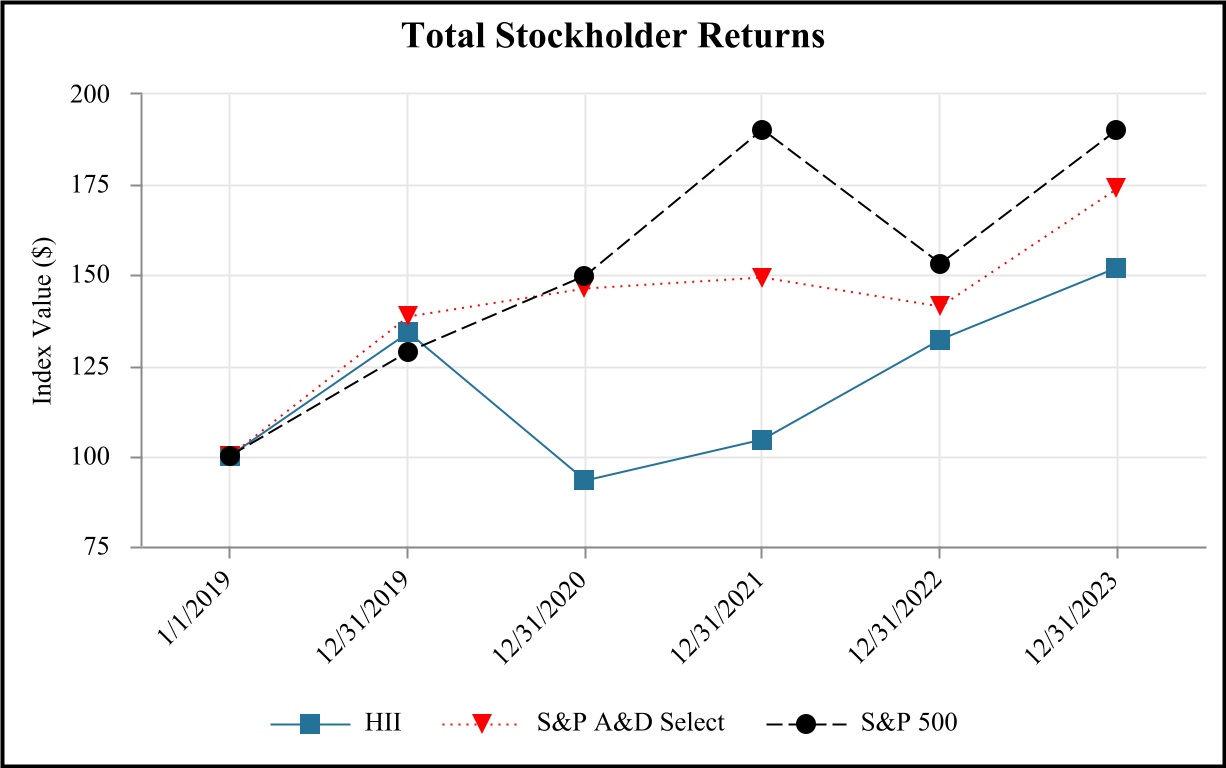
◦The cumulative total return assumes reinvestment of dividends.
◦The S&P Aerospace & Defense Select Index is comprised of The Boeing Company, General Dynamics Corporation, Huntington Ingalls Industries, Inc., L3 Harris Technologies, Inc., Lockheed Martin Corporation, Northrop Grumman Corporation, RTX Corporation, Textron, Inc., and TransDigm Group Incorporated, among other companies.
Purchases of Equity Securities by the Issuer and Affiliated Purchasers
Repurchases under our stock repurchase program are made from time to time at management's discretion in accordance with applicable federal securities laws. All repurchases of HII common stock have been recorded as treasury stock. The following table summarizes information relating to purchases made by or on behalf of the Company of shares of the Company's common stock during the quarter ended December 31, 2023.
| Period | Total Number of Shares Purchased | Average Price Paid per Share | Total Number of Shares Purchased as Part of Publicly Announced Program | **Approximate Dollar Value of Shares that May Yet Be Purchased Under the Program (in millions)**1,2 | ||||||||||||||||||||||
| October 1, 2023 to October 31, 2023 | 65,076 | $ | 214.52 | 65,076 | $ | 937.4 | ||||||||||||||||||||
| November 1, 2023 to November 30, 2023 | 48,276 | 231.48 | 48,276 | 926.2 | ||||||||||||||||||||||
| December 1, 2023 to December 31, 2023 | 48,100 | 241.27 | 48,100 | 914.6 | ||||||||||||||||||||||
| Total | 161,452 | $ | 227.56 | 161,452 | $ | 914.6 |
1 From the stock repurchase program's inception through December 31, 2023, we have purchased 13,976,868
shares at an average price of $163.51 per share for a total of $2.3 billion.
2 In November 2012, we announced the establishment of our stock repurchase program. In January 2024, our board
of directors authorized an increase in the stock repurchase program to $3.8 billion and an extension of the term to
December 31, 2028.
Item 6. [RESERVED]
Item 7. MANAGEMENT'S DISCUSSION AND ANALYSIS OF FINANCIAL CONDITION AND RESULTS OF OPERATIONS
OVERVIEW
The following discussion should be read along with the audited consolidated financial statements included in Item 8 of this Annual Report on Form 10-K, as well as Part II, “Item 7. Management's Discussion and Analysis of Financial Condition and Results of Operations” of our Annual Report on Form 10-K for the year ended December 31, 2022.
Business Environment
We continue to see uncertainty, both domestically and globally, with challenges for customers and suppliers, labor shortages, supply chain challenges, and inflation, among other impacts.
Defense Spending Environment – Congressional consideration of the $886 billion fiscal year 2024 President’s Budget Request for defense spending began following its submission to Congress on March 9, 2023. Additionally, after the statutory debt limit of $31.4 trillion was reached in January, the President signed into law the Fiscal Responsibility Act of 2023 (the “FRA”) on June 3, 2023, which suspended the federal debt limit through January 1, 2025 and established new discretionary funding limits for defense and non-defense accounts. The FRA capped national defense spending at $886 billion for fiscal year 2024 (consistent with the President’s budget request level) and $895 billion for fiscal year 2025. In accordance with the FRA, since Congress did not pass full-year appropriations for all discretionary spending by the end of calendar year 2023, fiscal year 2024 discretionary spending is subject to sequestration after April 30, 2024. Any additional emergency supplemental funding legislation during fiscal years 2024 and 2025 is not subject to the budget caps.
The House and Senate reached a compromise agreement on the National Defense Authorization Act ("NDAA") for fiscal year 2024 in December 2023. Overall, the fiscal year 2024 NDAA authorizes $886 billion for national defense programs, consistent with the spending caps directed in the FRA. The compromise legislation supports our shipbuilding priorities with a total authorization of $32.9 billion for shipbuilding programs, including the authorization of an LPD 33 Flight II amphibious ship along with incremental funding authority, two Virginia class (SSN 774) submarines, one Columbia class (SSBN 826) ballistic missile submarine, and two Arleigh Burke class (DDG 51)
destroyers. Additionally, the fiscal year 2024 NDAA authorizes multiyear procurement authority for the Block VI Virginia class (SSN 774) submarine contract and includes authorities to help implement the Australia-United Kingdom-United States security partnership, including the authority to transfer Virginia class submarines to Australia effective in fiscal year 2025.
Both House and Senate appropriations bills have been passed out of committee, and the House defense appropriations bill has been approved by the full House. The House defense appropriations measure broadly supports the President’s budget request for shipbuilding, including funding for two Virginia class (SSN 774) submarines, one Columbia class (SSBN 826) ballistic missile submarine and two Arleigh Burke class (DDG 51) destroyers. The Senate Appropriations Committee included $500 million in advance procurement for LPD 33 (unnamed) and advance procurement for a third Arleigh Burke class (DDG 51) destroyer in fiscal year 2025, as well as full funding for two Arleigh Burke class (DDG 51) destroyers, two Virginia class (SSN 774) submarines, and one Columbia class (SSBN 826) submarine in fiscal year 2024.
Although a new fiscal year began on October 1, 2023, annual appropriations to fund the federal government for fiscal year 2024 have not been enacted. To provide Congress additional time to reach agreements on funding levels for federal agencies, a Continuing Resolution ("CR") extending funding through November 17, 2023, at fiscal year 2023 levels was enacted on September 30, 2023. Congress passed a second CR in November 2023 that extended agencies covered by four of the appropriations bills until January 19, 2024, and the balance of agencies, including the DoD, until February 2, 2024. An additional CR passed by Congress in January 2024 further extended government funding deadlines under the previous CR’s division of appropriations bills until March 1, 2024, and March 8, 2024.
While the DoD is normally prohibited from starting new programs or increasing funding on existing programs under a CR, the current CR includes an exception that will allow the DoD to deviate from typical restrictions and obligate funding to begin construction of the second Columbia class nuclear submarine (SSBN 827). We cannot predict the outcome of the fiscal year 2024 budget process or whether additional short-term funding will be required in the event annual appropriations measures are not finalized by the expiration date of the current CR.
Global Geopolitical Environment – Our current operating environment exists in the broader context of political and socioeconomic priorities and continues to be impacted by uncertainty, heightened geopolitical tensions, and instability. Geopolitical relationships continue to change, and the U.S. and its allies face a global security environment that includes threats from state and non-state actors, including major global powers, as well as terrorist organizations, emerging nuclear tensions, diverse regional security concerns, and political instability.
In February 2022, Russian forces invaded Ukraine, and the conflict is continuing. In response, the U.S. and other countries imposed economic and trade sanctions, export controls, and other restrictions on Russia. This conflict and the associated sanctions have impacted the global economy, causing heightened cybersecurity risks and an exacerbation of supply chain challenges, higher energy costs, and inflationary pressures. Additionally, and more broadly, tensions with China and changes in international trade policies, including higher tariffs on imported goods and materials, could impact the global market for defense products, services, and solutions. Meanwhile, the duration and impact of the evolving conflict surrounding Israel and Gaza is unknown but is likely to have global economic and political ramifications.
The escalating strategic competition with China and the implications of Russia’s invasion of Ukraine and the Israeli-Gaza conflict have led Asian, Oceania, and European countries, in particular, to pay renewed attention to their military budget. Global military expenditures surpassed $2 trillion for the first time in 2021, and the recent conflicts in both Ukraine and Israel could lead to more demand.
Economic Environment – Conflict or the threat thereof has led to an increase in economic and trade sanctions and export controls. Economic tensions with other nations and changes in international trade policies, including higher tariffs on imported goods and materials and renegotiation of free trade agreements, have impacted the global market for defense products, services, and solutions. Global supply chain and labor markets continue to experience high levels of disruption, causing significant materials and parts shortages, including raw material, microelectronics and commodity shortages, as well as delivery delays, labor shortages, and price increases.
Domestically, the political ramifications of national debt levels coupled with the uncertainty of economic indices including inflation, gross domestic product growth, and the pace of recovery from the coronavirus pandemic could increase pressure on discretionary spending. While monthly inflation rates have steadily declined since peaking at
9.1% in June of 2022, rising military personnel and operations and maintenance costs continue to pressure the Pentagon’s investment portfolio buying power. If above-average inflationary conditions continue over the long-term, additional resources may be required to address contract and labor cost growth.
The labor market continues t
Showing the first 8K of 101K characters. Open the full section
Item 7A. QUANTITATIVE AND QUALITATIVE DISCLOSURES ABOUT MARKET RISK
We are exposed to certain market risks, including those relating to interest rates and inflation.
Interest Rates - Our floating rate financial instruments subject to interest rate risk include a Term Loan, a $1.5 billion Revolving Credit Facility, and a $1 billion commercial paper program. As of December 31, 2023, we had $145 million outstanding on the Term Loan and no indebtedness outstanding under our Revolving Credit Facility or our commercial paper program. Based on the amounts outstanding under our Term Loan as of December 31, 2023, an
increase of 1% in interest rates would increase the interest expense on our debt by approximately $1 million on an annual basis. In January 2024, we paid the remaining $145 million balance of the Term Loan.
Inflation - Macroeconomic factors have contributed, and we expect will continue to contribute, to increasing cost inflation for raw materials, components, and supplies. We mitigate some cost inflation risk by negotiating long-term agreements with certain raw material suppliers and incorporating price escalation provisions in customer contracts to the extent possible. We include assumptions of anticipated cost growth in the development of our cost of completion estimates, but if inflationary conditions continue over the long-term, our cost assumptions may not be sufficient to cover all cost escalation or may impact the availability of resources to execute the respective contracts. Persistent cost inflation over the long-term may have an adverse impact on our financial position, results of operations, or cash flows.
Item 8. FINANCIAL STATEMENTS AND SUPPLEMENTARY DATA
REPORT OF INDEPENDENT REGISTERED PUBLIC ACCOUNTING FIRM
To the Shareholders and the Board of Directors of
Huntington Ingalls Industries, Inc.
Newport News, Virginia
Opinion on the Financial Statements
We have audited the accompanying consolidated statements of financial position of Huntington Ingalls Industries, Inc. and subsidiaries (the “Company”) as of December 31, 2023 and 2022, the related consolidated statements of operations and comprehensive income, changes in equity, and cash flows for each of the three years in the period ended December 31, 2023, the related notes and the financial statement schedule listed in the Index at Item 15 (collectively referred to as the "financial statements"). In our opinion, the financial statements present fairly, in all material respects, the financial position of the Company as of December 31, 2023, and 2022, and the results of its operations and its cash flows for each of the three years in the period ended December 31, 2023, in conformity with the accounting principles generally accepted in the United States of America.
We have also audited, in accordance with the standards of the Public Company Accounting Oversight Board (United States) (PCAOB), the Company's internal control over financial reporting as of December 31, 2023, based on criteria established in Internal Control — Integrated Framework (2013) issued by the Committee of Sponsoring Organizations of the Treadway Commission and our report dated February 1, 2024, expressed an unqualified opinion on the Company's internal control over financial reporting.
Basis for Opinion
These financial statements are the responsibility of the Company's management. Our responsibility is to express an opinion on the Company's financial statements based on our audits. We are a public accounting firm registered with the PCAOB and are required to be independent with respect to the Company in accordance with the U.S. federal securities laws and the applicable rules and regulations of the Securities and Exchange Commission and the PCAOB.
We conducted our audits in accordance with the standards of the PCAOB. Those standards require that we plan and perform the audit to obtain reasonable assurance about whether the financial statements are free of material misstatement, whether due to error or fraud. Our audits included performing procedures to assess the risks of material misstatement of the financial statements, whether due to error or fraud, and performing procedures that respond to those risks. Such procedures included examining, on a test basis, evidence regarding the amounts and disclosures in the financial statements. Our audits also included evaluating the accounting principles used and significant estimates made by management, as well as evaluating the overall presentation of the financial statements. We believe that our audits provide a reasonable basis for our opinion.
Critical Audit Matters
The critical audit matters communicated below are matters arising from the current-period audit of the financial statements that was communicated or required to be communicated to the audit committee and that (1) relates to accounts or disclosures that are material to the financial statements and (2) involved our especially challenging, subjective, or complex judgments. The communication of critical audit matters does not alter in any way our opinion on the financial statements, taken as a whole, and we are not, by communicating the critical audit matters below, providing a separate opinion on the critical audit matters or on the accounts or disclosures to which it relates.
Revenue – Shipbuilding Contracts — Refer to Note 2 and 7 to the financial statements
Critical Audit Matter Description
The Company recognizes revenue on shipbuilding contracts with U.S. Government customers over time as the construction of the ship progresses, because transfer of control to the customer is continuous. Ordinarily the Company’s contracts represent a single distinct performance obligation due to the highly interdependent and interrelated nature of the underlying goods. The use of the cost-to-cost method to measure performance progress over time is supported by clauses in the related contracts that allow the customer to unilaterally terminate the contract for convenience, pay the Company for costs incurred plus a reasonable profit, and take control of any work in process. The accounting for these contracts involves judgment, particularly as it relates to the process of
estimating total material costs, labor costs, and profit for the performance obligation. Cost of sales is recognized as incurred, and revenues are determined by adding a proportionate amount of the estimated profit to the amount reported as cost of sales.
Given the judgments necessary to estimate total material costs, labor costs, and profit in order to recognize revenue for certain shipbuilding contracts, auditing such estimates required extensive audit effort due to the complexity of the contracts and a high degree of auditor judgment, especially for contracts where there is limited historical data.
How the Critical Audit Matter Was Addressed in the Audit
-
Our audit procedures related to management’s estimates of total material costs, labor costs, and profit in order to recognize revenue for certain shipbuilding contracts included the following, among others:
-
We tested the effectiveness of controls over shipbuilding contract revenue, including management’s controls over the estimates of total material costs, labor costs, and profit for performance obligations.
-
We developed independent estimates of revenue based on historical profit margins and current year recorded costs. We compared those estimates to revenue recognized by the Company.
-
We obtained the population of contracts during 2023 and assessed the financial and performance risk of the contracts based on our knowledge gained through prior year audits of the Company, industry experience, and ongoing conversations with members of program management regarding the contract performance to identify contracts that we believe were riskier. For contracts selected, we performed tailored audit procedures to address the specific characteristics of audit interest identified. Procedures performed, among others, may have included:
◦Read the relevant portions of contracts including any recent contract modifications to understand contract terms, including incentives, fee arrangement, scope of work, and other unusual contract terms.
◦Evaluated the estimates of total costs and profit for the performance obligation by performing some combination of the following:
▪Performed inquiries with the business managers and corroborated the information gained from these inquiries with other parties who have detailed knowledge of the contract’s progress, issues being encountered, and overall production status.
▪Evaluated management’s material and labor estimates against historical performance, underlying performance metrics, and metrics of similar performance obligations.
▪Tested the appropriateness of the timing and accuracy of changes in estimates, including inspection of underlying source documentation, and consideration of any contradictory information.
▪Evaluated the necessity and appropriateness of any constraints applied against any variable consideration.
Goodwill - Mission Technologies reporting unit – Refer to Note 2 and 11 to the financial statements
Critical Audit Matter Description
The Company performed a quantitative impairment evaluation of the goodwill for the Mission Technologies reporting unit by comparing the estimated fair value of the reporting unit to its carrying value. The Company’s testing approach utilizes a combination of discounted cash flow analysis and comparative market-based valuation methodologies to determine the fair value of the reporting unit for comparison to its corresponding book value. Estim
Showing the first 8K of 209K characters. Open the full section
Item 9. CHANGES IN AND DISAGREEMENTS WITH ACCOUNTANTS ON ACCOUNTING AND FINANCIAL DISCLOSURE
None.
Item 9A. CONTROLS AND PROCEDURES
Disclosure Controls and Procedures
The Company's management, with the participation of the Company's Chief Executive Officer and Chief Financial Officer, has evaluated the effectiveness of the Company's disclosure controls and procedures (as defined in Rules 13a-15(e) and 15d-15(e) under the Securities Exchange Act of 1934, as amended (the "Exchange Act")) as of December 31, 2023. Based on that evaluation, the Company's Chief Executive Officer (principal executive officer) and Chief Financial Officer (principal financial officer) concluded that, as of December 31, 2023, the Company's disclosure controls and procedures were effective to ensure that information required to be disclosed in reports the Company files or submits under the Exchange Act is (i) recorded, processed, summarized and reported within the time periods specified in SEC rules and forms, and (ii) accumulated and communicated to management to allow their timely decisions regarding required disclosure.
Changes in Internal Control over Financial Reporting
There have been no changes in our internal control over financial reporting that occurred during the three months ended December 31, 2023, that materially affected, or are reasonably likely to materially affect, our internal control over financial reporting.
MANAGEMENT’S REPORT ON INTERNAL CONTROL OVER FINANCIAL REPORTING
Management is responsible for establishing and maintaining adequate internal control over financial reporting for the Company. In order to evaluate the effectiveness of internal control over financial reporting, as required by Section 404 of the Sarbanes-Oxley Act, management, with the participation of Company's Chief Executive Officer (principal executive officer) and Chief Financial Officer (principal financial officer), has conducted an assessment, including testing, using the criteria in Internal Control – Integrated Framework (2013), issued by the Committee of Sponsoring Organizations of the Treadway Commission ("COSO"). The Company’s system of internal control over financial reporting is designed to provide reasonable assurance regarding the reliability of financial reporting and the preparation of financial statements for external purposes in accordance with accounting principles generally accepted in the United States of America. Because of its inherent limitations, internal control over financial reporting may not prevent or detect misstatements. Also, projections of any evaluation of effectiveness to future periods are subject to the risk that controls may become inadequate because of changes in conditions, or that the degree of compliance with the policies or procedures may deteriorate.
Based on its assessment, management has concluded that the Company maintained effective internal control over financial reporting as of December 31, 2023, based on criteria in Internal Control – Integrated Framework (2013), issued by the COSO. The effectiveness of the Company’s internal control over financial reporting as of December 31, 2023, has been audited by Deloitte & Touche LLP, an independent registered public accounting firm, as stated in their report, which is included in Item 8.
Item 9B. OTHER INFORMATION
Adoption or Termination of Trading Arrangements
A significant portion of the compensation of our directors and officers is in the form of equity awards, and, from time to time, directors and officers engage in open-market transactions with respect to the securities they acquire pursuant to such equity awards or other securities we have issued, including for diversification or other personal reasons.
Transactions in our securities by directors and officers are required to be made in accordance with our insider trading policy, which requires that the transactions comply with applicable U.S. federal securities laws that prohibit trading while in possession of material nonpublic information. Rule 10b5-1 under the Exchange Act provides an affirmative defense that enables directors and officers to prearrange transactions in our securities in a manner that avoids concerns about initiating transactions while in possession of material nonpublic information.
The following table describes the contracts, instructions or written plans for the purchase or sale of securities adopted by our directors or officers (as defined in Rule 16a-1(f) under the Exchange Act) during the three months ended December 31, 2023, that are intended to satisfy the affirmative defense conditions of Rule 10b5-1(c). No other Rule 10b5-1 trading arrangements or “non-Rule 10b5–1 trading arrangements” (as defined by S-K Item 408(c)) were entered into or terminated by our directors or officers during such period:
| Name and Title | Date of Adoption | Duration of Trading Arrangement****1 | Aggregate Number of Securities to be Sold****2 | Type | ||||||||||||||||||||||
| Edgar A. Green III | November 15, 2023 | March 15, 2024 | 7,895 | Common Stock | ||||||||||||||||||||||
| Executive Vice President and President, Mission Technologies |
1 The plan duration extends to the date listed in this column or such earlier date upon the completion of all trades
under the plan (or the expiration of the orders relating to such trades without execution) or the occurrence of such other termination events as specified in the plan.
2 The aggregate number of shares to be sold will depend, in part, on the Company’s performance in 2021, 2022 and
To promote the alignment of management and stockholder interests, our directors and officers are subject to stock ownership guidelines, which are described on pages 63 and 64 of our definitive Proxy Statement for our 2023 Annual Meeting of Stockholders filed with the Securities and Exchange Commission on March 20, 2023. As of the date of this report on Form 10-K, the execution of the Rule 10b5-1 trading arrangement described above will not cause such person to fall out of compliance with the stock ownership guidelines applicable to him.
Item 9C. DISCLOSURE REGARDING FOREIGN JURISDICTIONS THAT PREVENT INSPECTIONS
Not applicable.
PART III
Item 10. DIRECTORS, EXECUTIVE OFFICERS, AND CORPORATE GOVERNANCE
Directors
Information regarding our directors will be incorporated herein by reference to the Proxy Statement for our 2024 Annual Meeting of Stockholders, to be filed with the SEC within 120 days after the end of the Company's fiscal year.
Information about our Executive Officers
The following table sets forth certain information concerning our executive officers, including a five-year employment history.
| Name | Age | Position(s) | ||||||||||||
| Christopher D. Kastner | 60 | President and Chief Executive Officer | ||||||||||||
| Todd R. Borkey | 60 | Executive Vice President and Chief Technology Officer | ||||||||||||
| Chad N. Boudreaux | 50 | Executive Vice President and Chief Legal Officer | ||||||||||||
| Jennifer R. Boykin | 59 | Executive Vice President and President, Newport News Shipbuilding | ||||||||||||
| Eric D. Chewning | 46 | Executive Vice President, Strategy and Development | ||||||||||||
| Edgar A. Green III | 58 | Executive Vice President and President, Mission Technologies | ||||||||||||
| Paul C. Harris | 59 | Executive Vice President, Chief Sustainability and Compliance Officer | ||||||||||||
| Brooke A. Hart | 53 | Executive Vice President, Communications | ||||||||||||
| Stewart H. Holmes | 62 | Executive Vice President, Government and Customer Relations | ||||||||||||
| Edmond E. Hughes | 60 | Executive Vice President and Chief Human Resources Officer | ||||||||||||
| Nicolas G. Schuck | 50 | Corporate Vice President, Controller and Chief Accounting Officer | ||||||||||||
| Christopher W. Soong | 51 | Executive Vice President and Chief Information Officer | ||||||||||||
| Thomas E. Stiehle | 58 | Executive Vice President and Chief Financial Officer | ||||||||||||
| Kara R. Wilkinson | 49 | Executive Vice President and President, Ingalls Shipbuilding | ||||||||||||
| D. R. Wyatt | 65 | Corporate Vice President and Treasurer |
Christopher D. Kastner, President and Chief Executive Officer - Mr. Kastner was elected President and Chief Executive Officer effective March 1, 2022. From February 2021 until he was elected to his current position, he served as Executive Vice President and Chief Operating Officer. From March 2016 until February 2021, he served as Executive Vice President and Chief Financial Officer. From August 2012 until March 2016, Mr. Kastner served as Corporate Vice President and General Manager, Corporate Development. Prior to that and from March 2011, he served as Vice President and Chief Financial Officer of our Ingalls Shipbuilding segment. Before that and from 2008, Mr. Kastner served as Vice President, Business Management and Chief Financial Officer of NGSB, Gulf Coast, and served as Vice President, Contracts and Risk Management of Northrop Grumman Ship Systems from 2006 to 2008. Prior to that, he held several positions at other Northrop Grumman businesses, including Corporate Director of Strategic Transactions. Mr. Kastner holds a B.A. in Political Science from the University of California at Santa Barbara and an M.B.A from Pepperdine University.
Todd A. Borkey, Executive Vice President and Chief Technology Officer – Mr. Borkey was elected Executive Vice President and Chief Technology Officer effective September 26, 2022. Prior to that, and from October 2017, he served as Chief Technology Officer at Alion Science and Technology. Before joining Alion, Mr. Borkey served as CTO to Thales Defense and Security and DRS Defense Solutions, where he was responsible for the technical roadmap and program operations to a wide range of products, including RF communications, C5ISR solutions, remote sensors, radars, sonars, and cyber/electronic warfare products. Earlier in his career, Mr. Borkey performed a range of engineering and management assignments within Northrop Grumman and AT&T Bell Labs. He received a Master's Degree in engineering management from Stevens Institute of Technology and holds an undergraduate degree in Applied Mathematics from the University of Albuquerque.
Chad N. Boudreaux, Executive Vice President and Chief Legal Officer - Mr. Boudreaux was appointed Executive Vice President and Chief Legal Officer effective April 1, 2020. In this position, he has overall leadership
responsibility for our law department and outside counsel. Prior to that appointment, Mr. Boudreaux managed HII’s litigation docket and oversaw our compliance program as the company’s first chief compliance officer. He joined HII in 2011 as Corporate Vice President for Litigation, Investigations and Compliance. Before joining us, Mr. Boudreaux practiced law at Baker Botts LLP, where he established the law firm’s Global Security and Corporate Risk Counseling practice group. Prior to that, he held various high-ranking positions in the U.S. government, including deputy chief of staff of the U.S. Department of Homeland Security and leadership positions at the U.S. Department of Justice. Mr. Boudreaux earned a B.A. from Baylor University and a J.D. from the University of Memphis School of Law.
Jennifer R. Boykin, Executive Vice President and President, Newport News Shipbuilding - Ms. Boykin was elected Executive Vice President and President, Newport News Shipbuilding effective July 2017. From 2012 until she assumed her current position, Ms. Boykin was Vice President, Engineering and Design for Newport News Shipbuilding. Since joining Newport News Shipbuilding in the Nuclear Division in 1987, Ms. Boykin has had a variety of responsibilities, including serving as Vice President of Quality and Process Excellence, Director of Facilities and Waterfront Support, and program manager for the Nuclear Engineering Division. Ms. Boykin also served as a construction superintendent for the aircraft carrier program during construction of USS John C. Stennis and USS Harry S. Truman. Ms. Boykin holds a B.S. in Marine Engineering from the U.S. Merchant Marine Academy and a Master's Degree in Engineering Management from The George Washington University.
Eric D. Chewning, Executive Vice President, Strategy and Development - Mr. Chewning was elected Executive Vice President, Strategy and Development, effective January 30, 2023. Before joining HII, Mr. Chewning co-led McKinsey & Company's Aerospace & Defense practice in the Americas beginning in April 2020. From January 2019 to January 2020, he served as the Chief of Staff to the U.S. Secretary of Defense. Prior to that and from October 2017, Mr. Chewning was the Deputy Assistant Secretary of Defense for Industrial Policy. He is a former U.S. Army military intelligence officer and, prior to that, was an investment banker with Morgan Stanley & Co. Mr. Chewning received a B.A. and a M.A. in international relations from the University of Chicago and a M.B.A. from the Darden School of Business at the University of Virginia.
Edgar A. Green III, Executive Vice President and President, Mission Technologies - Mr. Green was appointed Executive Vice President and President, Mission Technologies in December 2016. Prior to that and from January 2015, he served as Corporate Vice President, Corporate Development. From January 2013 to January 2015, Mr. Green served as Vice President, Component Manufacturing, for Newport News Shipbuilding, and, from March 2011 to January 2013, he served as Corporate Vice President, Investor Relations, of HII. Prior to joining HII in 2011, Mr. Green served as Vice President of Investor Relations at Celanese Corp. Before that he was a Managing Director and research analyst at Wells Fargo Securities, where he covered the defense and aerospace industry, and a manufacturing plant engineer at Eaton Corp.’s Truck Components Division. Mr. Green also served as a U.S. Navy nuclear submarine officer on board USS Tecumseh (SSBN-628). He holds a B.S. in Systems Engineering from the U.S. Naval Academy and an M.B.A. from Duke University.
Paul C. Harris, Executive Vice President and Chief Sustainability and Compliance Officer – Mr. Harris was appointed Executive Vice President and Chief Sustainability and Compliance Officer effective March 14, 2022. Prior to that, and from September 2020, when he joined HII, Mr. Harris served as Corporate Vice President, Chief Compliance and Privacy Officer. Before joining HII, he served as Senior Vice President at Hampton University, his alma mater, beginning in September 2016. Before returning to Hampton, Mr. Harris held several positions of increasing authority and responsibility in corporate law departments, including Sodexo, Northrop Grumman, and Raytheon. Prior to joining Raytheon, he served as Deputy Assistant Attorney General at the U.S. Department of Justice, where he later was elevated to Deputy Associate Attorney General. Prior to his service at the Department of Justice, Mr. Harris served as a Member of the Virginia House of Delegates, from 1998 to 2001. A U.S. Army veteran, he earned a Bachelor of Arts degree from Hampton University and a Juris Doctor degree from The George Washington University Law School.
Brooke A. Hart, Executive Vice President, Communications – Ms. Hart was appointed Executive Vice President, Communications effective September 27, 2021, upon joining HII. From August 2015 until she joined HII, she served as Vice President of Communications and Brand at Sierra Nevada Corporation, a defense contractor, where she oversaw the company's internal and external communications efforts in promoting and protecting the corporate brand. Prior to that, Ms. Hart was Venture Partner and Vice President at Disruption Corporation and Crystal Tech Fund, and prior to that served as Senior Communications Officer at The Pew Charitable Trusts. She spent 16 years as an on-air television reporter, including serving as national correspondent for NBC News from June 1999 to June 2010. Ms. Hart received a B.A. from Stanford University and a M.A. from Georgetown University.
Stewart H. Holmes, Executive Vice President, Government and Customer Relations – Mr. Holmes was appointed Executive Vice President, Government and Customer Relations effective September 27, 2021, upon joining HII. From April 2017 until he joined HII, he served as Senior Vice President of Washington Operations for Textron Inc., where he was responsible for leading Textron’s government affairs activities and engaging with the legislative and executive branches, federal agencies, and industry associations**.** From January 2015 until March 2017, he served as Vice President of Washington Operations for Textron, where he was primarily responsible for leading lobbying efforts. Prior to joining Textron in January 2015, Mr. Holmes served as the staff director/minority clerk for the Senate Appropriations Subcommittee on Defense and, prior to that, worked as a staff member for the Senate Appropriations Committee and as an aide to Sen. Thad Cochran of Mississippi. Mr. Holmes served in the U.S. Marine Corps for more than two decades and is a graduate of The Citadel and the Naval Postgraduate School.
Edmond E. Hughes - Executive Vice President and Chief Human Resources Officer - Mr. Hughes was appointed Executive Vice President and Chief Human Resources Officer effective April 1, 2022. Prior to that, and from March 2006, he served as the Vice President of Human Resources and Administration for Ingalls Shipbuilding. Before joining Ingalls Shipbuilding, Mr. Hughes served in human resources roles of increasing responsibilities at General Motors and TRW Automotive. He received a B.S. from Tougaloo College and an M.B.A. from Indiana University.
Nicolas G. Schuck, Corporate Vice President, Controller and Chief Accounting Officer - Mr. Schuck was appointed Corporate Vice President, Controller and Chief Accounting Officer effective August 2015. Prior to that, he was Assistant Controller at our Newport News Shipbuilding division. Prior to that and since joining us in January 2012, he served as Corporate Assistant Controller. From December 2009 until December 2011, Mr. Schuck served as Director, Finance at ManTech International Corporation. Prior to that, he worked for PricewaterhouseCoopers and Arthur Andersen. Mr. Schuck attended the National Institute of Economics and Accounting in Paris. He holds a Bachelor's Degree and a Master's Degree in Accounting and Finance and is a certified public accountant.
Christopher W. Soong, Executive Vice President and Chief Information Officer – Mr. Soong was elected Executive Vice President and Chief Information Officer in April 2023. Prior to that and from August 2021, he served as Chief Information Officer for HII’s Mission Technologies business segment. From October 2018 to August 2021, Mr. Soong served as Senior Vice President and Chief Information Officer at Alion Science and Technology. He has also served in executive-level positions at Booz Allen Hamilton and Sprint. Mr. Soong holds a bachelor’s degree in civil engineering from Virginia Tech. He holds a Leadership Certificate from the University of Maryland and participated in the CIO Institute at the MIT Sloan School of Management.
Thomas E. Stiehle, Executive Vice President and Chief Financial Officer - Mr. Stiehle was elected Executive Vice President and Chief Financial Officer effective February 12, 2021. From October 2012 until he assumed his current position, he served as Vice President and Chief Financial Officer of our Ingalls Shipbuilding segment. Prior to that, Mr. Stiehle served as Vice President, Contracts and Pricing, for Ingalls Shipbuilding. Prior to joining HII in 2011, he worked for Northrop Grumman, Aerospace Sector, for 24 years. Mr. Stiehle holds a B.S. in Mechanical Engineering from Hofstra University and an M.B.A. from Adelphi University and Master’s Degree in Acquisition and Contract Management from Florida Institute of Technology.
Kara R. Wilkinson, Executive Vice President and President, Ingalls Shipbuilding - Ms. Wilkinson was elected Executive Vice President and President, Ingalls Shipbuilding effective April 1, 2021. From May 2016 until she assumed her current position, she served as Vice President of Program Management at Ingalls Shipbuilding. Prior to that, Ms. Wilkinson held various positions in Business Development and Engineering at Ingalls Shipbuilding and began her career at Ingalls Shipbuilding in 1996 as a naval architect. She holds a B.S. in Naval Architecture and Marine Engineering from the University of Michigan and an M.B.A. from Temple University.
D. R. Wyatt, Corporate Vice President and Treasurer - Mr. Wyatt has been Corporate Vice President and Treasurer since March 2011. Prior to that, he was Director of Business Management at NGSB where he was responsible for aircraft carriers, carrier fleet support, and energy business. Prior to his appointment as Director of Business Management, Mr. Wyatt served as Treasurer of Newport News Shipbuilding Inc., Assistant Treasurer and Manager of Finance, and has held various positions in the financial area, including cost estimating, cost control, accounting, financial analysis, and government accounting. He has extensive Treasury experience, including responsibility for corporate finance, cash management, risk management and all financings, capital structure, capital market interface, rating agency relationships, cash and financial forecasting, working capital management, short-term investments, strategic transactions, pension asset management, and insurance and loss control. Mr. Wyatt holds a B.S. in Economics from Hampden-Sydney College and an M.B.A. from Old Dominion University.
Audit Committee Financial Expert
Information as to the Audit Committee and the Audit Committee Financial Expert will be incorporated herein by reference to the Proxy Statement for our 2024 Annual Meeting of Stockholders, to be filed within 120 days after the end of the Company’s fiscal year.
Code of Ethics
We have adopted a Code of Ethics and Business Conduct for all of our employees, including the principal executive officer, principal financial officer, and principal accounting officer. The Code of Ethics and Business Conduct can be found on our internet website at www.HII.com under "Investors—Company—Corporate Governance." A copy of the Code of Ethics and Business Conduct is available to any stockholder who requests it by writing to: Huntington Ingalls Industries, Inc., c/o Office of the Secretary, 4101 Washington Avenue, Newport News, VA 23607. If we make any substantive amendments to the Code of Ethics and Business Conduct or grant any waivers, including any implicit waiver, from a provision of the Code of Ethics and Business Conduct, in each case as it relates to any provision of the Code of Ethics and Business Conduct specified in applicable SEC rules or stock exchange rules, to our principal executive officer, principal financial officer, principal accounting officer or controller, or persons performing similar functions, we will disclose the nature of the amendment or waiver on our website.
Our website and information contained on our website or incorporated into our website are not intended to be incorporated into this report on Form 10-K or other filings with the SEC.
Other Disclosures
Other disclosures required by this Item will be incorporated herein by reference to the Proxy Statement for our 2024 Annual Meeting of Stockholders, to be filed within 120 days after the end of the Company’s fiscal year.
Item 11. EXECUTIVE COMPENSATION
Information concerning executive compensation (other than information related to pay-for-performance), including information concerning compensation committee interlocks, insider participation, and the compensation committee report, will be incorporated herein by reference to the Proxy Statement for our 2024 Annual Meeting of Stockholders, to be filed within 120 days after the end of the Company’s fiscal year.
Item 12. SECURITY OWNERSHIP OF CERTAIN BENEFICIAL OWNERS AND MANAGEMENT AND RELATED STOCKHOLDER MATTERS
Information as to security ownership of certain beneficial owners and management and related stockholder matters will be incorporated herein by reference to the Proxy Statement for our 2024 Annual Meeting of Stockholders, to be filed within 120 days after the end of the Company’s fiscal year.
Equity Compensation Plan Information
The following table provides information regarding the equity securities available for issuance under our equity compensation plans as of December 31, 2023:
| Equity Compensation Plan Information | ||||||||||||||||||||
| Plan category | Number of Securities to be Issued Upon Exercise of Outstanding Options, Warrants and Rights**(1)** | Weighted-Average Exercise Price of Outstanding Options, Warrants and Rights | Number of Securities Remaining Available for Future Issuance Under Equity Compensation Plans (Excluding Securities Reflected in Column (a)) | |||||||||||||||||
| (a) | (b) | (c) | ||||||||||||||||||
| Equity compensation plans approved by security holders | 534,704 | $0.00 | 1,164,896 | |||||||||||||||||
| Equity compensation plans not approved by security holders(2) | — | — | — | |||||||||||||||||
| Total | 534,704 | $0.00 | 1,164,896 |
(1) Includes grants made under the Huntington Ingalls Industries, Inc. 2022 Long-Term Incentive Stock Plan (the "2022 Plan"), which was approved by our stockholders on May 3, 2022, Huntington Ingalls Industries, Inc. 2012 Long-Term Incentive Stock Plan (the "2012 Plan"), which was approved by our stockholders on May 2, 2012, and the Huntington Ingalls Industries, Inc. 2011 Long-Term Incentive Stock Plan (the "2011 Plan"), which was approved by the sole stockholder of HII prior to its spin-off from Northrop Grumman Corporation. These shares were comprised of 14,972 stock rights granted under the 2011 Plan, 50,548 stock rights, 4,113 restricted stock rights, and 291,628 restricted performance stock rights granted under the 2012 Plan, and 7,333 stock rights, 9,521 restricted stock rights, and 156,589 restricted performance stock rights granted under the 2022 Plan, assuming target performance achievement.
(2) No awards have been granted under plans not approved by security holders.
Item 13. CERTAIN RELATIONSHIPS AND RELATED TRANSACTIONS, AND DIRECTOR INDEPENDENCE
Information as to certain relationships and related transactions and director independence will be incorporated herein by reference to the Proxy Statement for our 2024 Annual Meeting of Stockholders, to be filed within 120 days after the end of the Company’s fiscal year.
Item 14. PRINCIPAL ACCOUNTANT FEES AND SERVICES
Information as to principal accountant fees and services will be incorporated herein by reference to the Proxy Statement for our 2024 Annual Meeting of Stockholders, to be filed within 120 days after the end of the Company’s fiscal year.
PART IV
Item 15. EXHIBITS AND FINANCIAL STATEMENT SCHEDULES
(a) 1. Report of Independent Registered Public Accounting Firm (PCAOB ID No. 34)
Financial Statements
Consolidated Statements of Operations and Comprehensive Income
Consolidated Statements of Financial Position
Consolidated Statements of Cash Flows
Consolidated Statements of Changes in Equity
Notes to Consolidated Financial Statements
- Financial Statement Schedules
Schedule II - Valuation and Qualifying Accounts
All other schedules have been omitted because they are not applicable, not required, or the information has been otherwise supplied in the financial statements or notes to the financial statements.
| SCHEDULE II - VALUATION AND QUALIFYING ACCOUNTS | ||||||||||||||||||||||||||
| Balance at Beginning of Period | (Benefits)/Charges to Income | Other | Balance at End of Period | |||||||||||||||||||||||
| Year Ended December 31, 2021 | ||||||||||||||||||||||||||
| Valuation allowance for deferred tax assets | $ | 22 | $ | — | $ | — | $ | 22 | ||||||||||||||||||
| Year Ended December 31, 2022 | ||||||||||||||||||||||||||
| Valuation allowance for deferred tax assets | 22 | 2 | 4 | 28 | ||||||||||||||||||||||
| Year Ended December 31, 2023 | ||||||||||||||||||||||||||
| Valuation allowance for deferred tax assets | $ | 28 | $ | 1 | $ | — | $ | 29 |
- Exhibits
| 32.1 | Certificate of the Chief Executive Officer Pursuant to 18 U.S.C. Section 1350, as Adopted Pursuant to Section 906 of the Sarbanes-Oxley Act of 2002. | |||||||
| 32.2 | Certificate of the Chief Financial Officer Pursuant to 18 U.S.C. Section 1350, as Adopted Pursuant to Section 906 of the Sarbanes-Oxley Act of 2002. | |||||||
| 97* | Huntington Ingalls Industries, Inc. Compensation Recovery Policy. | |||||||
| 101 | The following financial information for the company, formatted in XBRL (Extensible Business Reporting Language): (i) the Consolidated Statements of Operations and Comprehensive Income (Loss), (ii) the Consolidated Statements of Financial Position, (iii) the Consolidated Statements of Cash Flows, (iv) the Consolidated Statements of Changes in Equity, and (v) the Notes to Consolidated Financial Statements. | |||||||
| 104 | The cover page from the Company's Annual Report on form 10-K, formatted in Inline XBRL and contained in Exhibit 101. |
*Indicates management contract or compensatory plan or arrangement.
Item 16. FORM 10-K SUMMARY
None.
SIGNATURES
Pursuant to the requirements of Section 13 or 15(d) of the Securities Exchange Act of 1934, the registrant has duly caused this report to be signed on its behalf by the undersigned, thereunto duly authorized, on the 1st day of February, 2024.
| Huntington Ingalls Industries, Inc. | ||||||||||||||
| /s/ Christopher D. Kastner | ||||||||||||||
| Christopher D. Kastner | ||||||||||||||
| President and Chief Executive Officer |
| Pursuant to the requirements of the Securities Exchange Act of 1934, this report has been signed by the following persons on behalf of the registrant and in the capacities and on the dates indicated: | ||||||||||||||
| Signature | Title | Date | ||||||||||||
| /s/ Christopher D. Kastner | President, Chief Executive Officer and Director | |||||||||||||
| Christopher D. Kastner | (Principal Executive Officer) | February 1, 2024 | ||||||||||||
| /s/ Thomas E. Stiehle | Executive Vice President and | |||||||||||||
| Thomas E. Stiehle | Chief Financial Officer | |||||||||||||
| (Principal Financial Officer) | February 1, 2024 | |||||||||||||
| /s/ Nicolas Schuck | Corporate Vice President, Controller | |||||||||||||
| Nicolas Schuck | and Chief Accounting Officer | |||||||||||||
| (Principal Accounting Officer) | February 1, 2024 | |||||||||||||
| /s/ Kirkland H. Donald | ||||||||||||||
| Kirkland H. Donald | Chairman | February 1, 2024 | ||||||||||||
| /s/ Augustus L. Collins | ||||||||||||||
| Augustus L. Collins | Director | February 1, 2024 | ||||||||||||
| /s/ Leo P. Denault | ||||||||||||||
| Leo P. Denault | Director | February 1, 2024 | ||||||||||||
| /s/ Craig S. Faller | ||||||||||||||
| Craig S. Faller | Director | February 1, 2024 | ||||||||||||
| /s/ Victoria D. Harker | ||||||||||||||
| Victoria D. Harker | Director | February 1, 2024 | ||||||||||||
| /s/ Frank R. Jimenez | ||||||||||||||
| Frank R. Jimenez | Director | February 1, 2024 | ||||||||||||
| /s/ Anastasia D. Kelly | ||||||||||||||
| Anastasia D. Kelly | Director | February 1, 2024 | ||||||||||||
| /s/ Tracy B. McKibben | ||||||||||||||
| Tracy B. McKibben | Director | February 1, 2024 | ||||||||||||
| /s/ Stephanie L. O'Sullivan | ||||||||||||||
| Stephanie L. O'Sullivan | Director | February 1, 2024 | ||||||||||||
| /s/ Thomas C. Schievelbein | ||||||||||||||
| Thomas C. Schievelbein | Director | February 1, 2024 | ||||||||||||
| /s/ John K. Welch | ||||||||||||||
| John K. Welch | Director | February 1, 2024 |