 filings.tools
Robinhood Markets 10-K 2022-12-31
Filed 2023-02-27. 23 sections, 624K characters. Original on sec.gov · Markdown · JSON
Cover and table of contents
UNITED STATES
SECURITIES AND EXCHANGE COMMISSION
Washington, D.C. 20549
______________________
FORM 10-K
______________________
(Mark One)
| ☒ | ANNUAL REPORT PURSUANT TO SECTION 13 OR 15(d) OF THE SECURITIES EXCHANGE ACT OF 1934 |
For the fiscal year ended December 31, 2022
OR
| ☐ | TRANSITION REPORT PURSUANT TO SECTION 13 OR 15(d) OF THE SECURITIES EXCHANGE ACT OF 1934 |
For the transition period from ________ to ________
Commission File Number**: 001-40691**
______________________
Robinhood Markets, Inc.
(Exact name of registrant as specified in its charter)
______________________
| Delaware | 46-4364776 | |||||||
| (State or other jurisdiction of incorporation or organization) | (IRS Employer Identification No.) |
85 Willow Rd
Menlo Park, CA 94025
(Address of principal executive offices, including zip code)
(844) 428-5411
(Registrant’s telephone number, including area code)
Securities registered pursuant to Section 12(b) of the Act:
| Title of each class | Trading Symbol | Name of each exchange on which registered | ||||||
| Class A Common Stock - $0.0001 par value per share | HOOD | The Nasdaq Stock Market |
Securities registered pursuant to section 12(g) of the Act: None
Indicate by check mark if the registrant is a well-known seasoned issuer, as defined in Rule 405 of the Securities Act. Yes o No ☒
Indicate by check mark if the registrant is not required to file reports pursuant to Section 13 or Section 15(d) of the Act. Yes o No ☒
Indicate by check mark whether the registrant (1) has filed all reports required to be filed by Section 13 or 15(d) of the Securities Exchange Act of 1934 during the preceding 12 months (or for such shorter period that the registrant was required to file such reports), and (2) has been subject to such filing requirements for the past 90 days. Yes ☒ No o
Indicate by check mark whether the registrant has submitted electronically every Interactive Data File required to be submitted pursuant to Rule 405 of Regulation S-T (§232.405 of this chapter) during the preceding 12 months (or for such shorter period that the registrant was required to submit such files). Yes ý No o
Indicate by check mark whether the registrant is a large accelerated filer, an accelerated filer, a non-accelerated filer, a smaller reporting company, or an emerging growth company. See definitions of “large accelerated filer,” “accelerated filer,” “smaller reporting company,” and “emerging growth company” in Rule 12b-2 of the Exchange Act.
Large accelerated filer ý Accelerated filer o Non-accelerated filer ☐ Smaller reporting company ☐ Emerging growth company ☐
If an emerging growth company, indicate by check mark if the registrant has elected not to use the extended transition period for complying with any new or revised financial accounting standards provided pursuant to Section 13(a) of the Exchange Act. o
Indicate by check mark whether the registrant has filed a report on and attestation to its management’s assessment of the effectiveness of its internal control over financial reporting under Section 404(b) of the Sarbanes-Oxley Act (15 U.S.C. 7262(b)) by the registered public accounting firm that prepared or issued its audit report. ý
Indicate by check mark whether the registrant is a shell company (as defined in Rule 12b-2 of the Exchange Act). Yes o No ☒
The aggregate market value of the voting and non-voting common stock held by non-affiliates of the registrant as of June 30, 2022, the last business day of the registrant’s most recently completed second fiscal quarter, was approximately $5.7 billion (based on the closing price of the registrant’s Class A common stock on the Nasdaq Global Select Market on that date). Shares of common stock owned by executive officers and directors have been excluded in that such persons may be deemed to be affiliates. This calculation does not reflect a determination that certain persons are affiliates of the registrant for any other purpose.
As of February 21, 2023, the numbers of shares of the issuer’s Class A and Class B common stock outstanding were 768,368,480 and 127,677,469.
DOCUMENTS INCORPORATED BY REFERENCE
The information required by Part III of this Report, to the extent not set forth herein, is incorporated herein by reference from the registrant’s definitive proxy statement relating to the Annual Meeting of Stockholders to be held in 2023, which definitive proxy statement shall be filed with the Securities and Exchange Commission within 120 days after the end of the fiscal year to which this Report relates.
TABLE OF CONTENTS
CAUTIONARY NOTE REGARDING FORWARD‑LOOKING STATEMENTS
This Annual Report on Form 10-K (this “Annual Report”) of Robinhood Markets, Inc (together with its subsidiaries, “we”, “Robinhood”, or the “Company”) contains forward-looking statements (as such phrase is used in the federal securities laws), which involve substantial risks and uncertainties. Forward-looking statements generally relate to future events or our future financial or operating performance. In some cases, you can identify forward-looking statements because they contain words such as “believe,” “may,” “will,” “should,” “expect,” “plan,” “anticipate,” “could,” “intend,” “target,” “project,” “contemplate,” “estimate,” “predict,” “potential”, or “continue” or the negative of these words or other similar terms or expressions that concern our expectations, strategy, plans or intentions. This Annual Report includes, among others, forward-looking statements regarding:
-
our expectations regarding legal and regulatory proceedings and investigations;
-
our plan to attract new customers to accelerate our growth by continuing to introduce new products and features and by continuing to invest in broad-scale brand marketing and the Robinhood Referral Program (defined below), and our expectation that our efforts will drive higher brand awareness and increase customer adoption of our platform;
-
our intent to continue investing in our platform capabilities and regulatory and compliance functions; our expectation that as our customer base and platform functionalities expand, areas of investment priority will likely include product innovation, educational content, and technology and infrastructure improvements; and our belief that these investments will contribute to our long-term growth;
-
our belief that as our customers grow their wealth, they will continue to expand their relationship with our platform, providing an increased opportunity to meet their growing financial needs;
-
our belief that there is a significant opportunity for Robinhood to grow internationally; our intent to pursue a disciplined approach to international expansion; our plan to consider factors such as population size and demographics, legal and regulatory environments, and general investing attitudes in potential new markets when pursuing such expansion; and our aggressive goal to offer brokerage services in the U.K. by the end of 2023;
-
our expectations about continued growth through acquisitions; and
-
our expectations about the sufficiency of our available cash, available borrowings, and cash from operations to meet our current liquidity needs for the next 12 months and our long-term liquidity needs.
Our forward-looking statements are subject to a number of known and unknown risks, uncertainties, assumptions, and other factors that may cause our actual future results, performance, or achievements to differ materially from any future results expressed or implied in this Annual Report. Reported results should not be considered an indication of future performance. Factors that contribute to the uncertain nature of our forward-looking statements include, among others:
-
our limited operating experience at our current scale;
-
the difficulty of managing our business effectively, including the size of our workforce, and the risk of continued declining or negative growth;
-
the fluctuations in our financial results and key metrics from quarter to quarter;
-
our reliance on transaction-based revenue, including payment for order flow (“PFOF”), and the risk of new regulation or bans on PFOF and similar practices;
-
our exposure to fluctuations in interest rates and rapidly changing interest rate environments;
-
the difficulty of raising additional capital (to provide liquidity needs and support business growth and objectives) on reasonable terms, if at all;
-
the need to maintain capital levels required by regulators and self-regulatory organizations (“SROs”);
-
the risk that we might mishandle the cash, securities, and cryptocurrencies we hold on behalf of customers, and our exposure to liability for processing, operational, or technical errors in clearing functions;
-
the impact of negative publicity on our brand and reputation;
-
the risk that changes in business, economic, or political conditions that impact the global financial markets, or a systemic market event, might harm our business;
-
our dependence on key employees and a skilled workforce;
-
the difficulty of complying with an extensive, complex, and changing regulatory environment and the need to adjust our business model in response to new or modified laws and regulations;
-
the possibility of adverse developments in pending litigation and regulatory investigations;
-
the effects of competition;
-
our need to innovate and invest in new products and services in order to attract and retain customers and deepen their engagement with us in order to maintain growth;
-
our reliance on third parties to perform some key functions and the risk that processing, operational or technological failures could impair the availability or stability of our platform;
-
the risk of cybersecurity incidents, theft, data breaches, and other online attacks;
-
the difficulty of processing customer data in compliance with privacy laws;
-
our need as a regulated financial services company to develop and maintain effective compliance and risk management infrastructures;
-
the volatility of cryptocurrency prices and trading volumes;
-
the risk that our platform could be exploited to facilitate illegal payments; and
-
the risk that substantial future sales of Class A common shares in the public market, or the perception that they may occur, could cause the price of our stock to fall.
Because some of these risks and uncertainties cannot be predicted or quantified and some are beyond our control, you should not rely on our forward-looking statements as predictions of future events. More information about potential risks and uncertainties that could affect our business and financial results is included in the section of this Annual Report titled “Risk Factors” and our other filings with the U.S. Securities and Exchange Commission (“SEC”), which are available on the SEC’s web site at www.sec.gov. Moreover, we operate in a very competitive and rapidly changing environment; new risks and uncertainties may emerge from time to time and it is not possible for us to predict all risks nor identify all uncertainties. The events and circumstances reflected in our forward-looking statements might not be
achieved and actual results could differ materially from those projected in the forward-looking statements. Except as otherwise noted, all forward-looking statements are made as of the date we file this Annual Report, and are based on information and estimates available to us at this time. Although we believe that the expectations reflected in our forward-looking statements are reasonable, we cannot guarantee future results, performance, or achievements. Except as required by law, Robinhood assumes no obligation to update any of the statements in this Annual Report whether as a result of any new information, future events, changed circumstances, or otherwise. You should read this Annual Report with the understanding that our actual future results, performance, events, and circumstances might be materially different from what we expect.
PART I
Item 1. BUSINESS
Company Overview
Robinhood was founded in 2013 on the belief that everyone should be welcome to participate in our financial system. We are creating a modern financial services platform for everyone, regardless of their wealth, income, or background.
Our mission is to democratize finance for all. We use technology to provide access to the financial system in a way that is simple and convenient for our customers. We believe investing should be familiar and welcoming, with a simple design and an intuitive interface, so that customers are empowered to achieve their goals. We started with a revolutionary, bold brand and design in the Robinhood app which makes investing approachable for millions. We pioneered commission-free stock trading with no account minimums, which the rest of the industry emulated, and we continue to build relationships with our customers by introducing new products that further expand access to the financial system. Through these efforts, we believe we have made investing culturally relevant and understandable, and that our platform is enabling our customers to become long-term investors and take greater control of their finances.
At Robinhood, our values are in service of our customers. The following values describe the company that we aspire to become.
-
Safety First. Robinhood is a safety-first company. The reliability of our platform takes precedence over all else, so that we can be there for our customers when they need us the most. We relentlessly protect our customers’ security and privacy, and we only share with our counterparties what they need to fulfill our customers’ financial needs, nothing more. We build safeguards and provide education so that our customers are in the best position to succeed. We have high-quality timely customer support, and when things aren’t right, we fix them. We work closely with regulators and lawmakers to protect our customers and the broader financial system. We speak simply, plainly, and truthfully, even if it’s not what others want to hear. We hold ourselves and our colleagues to the highest ethical standards.
-
Participation Is Power. At Robinhood, the rich don’t get a better deal. We founded Robinhood in the wake of the financial crisis because we identified a gap - the more you had, the better deal you got. We aim to give everyone access to the financial system, regardless of their background or bank account balance. That’s why we have no account minimums and a product that was designed from the ground up for small accounts. We would rather serve many small customers over a few large ones. We reflect the world around us, and we elevate and embrace all voices so everyone feels at home at Robinhood.
-
Radical Customer Focus. We exist to make our customers happy. From the early days of Robinhood, we have prioritized getting direct customer feedback on what we were building. Talking to our customers forms the kernel of the product development process we have today. We listen with empathy, ask questions, and critically evaluate our work by how valuable our customers find it. We never stop asking how we can make our product better, and we never settle for ‘good enough’. We listen to our colleagues, and we start from a place of believing they are capable and well-intentioned. We delight our customers and take pride in our work.
-
First-Principles Thinking. We make bold bets and challenge the status quo. Our foundation is in art, science, and pure mathematics, and we have a deep appreciation for the scientific process. We develop hypotheses and design experiments to test them. We reduce complex problems to their constituent bits. We debate vigorously and change our minds when confronted with the right
evidence. We bravely do what’s right, even when it hasn’t been done before. We treat our company like a product and aim to get better, every single day.
Our Products
We understand that millions of our customers have used Robinhood to enter the financial markets for the first time, and we take our responsibility to them seriously. We are passionate about operating Robinhood in a way that aligns with customer interests, applicable regulations, and with our own mission to democratize finance for all. We plan to create an ecosystem of financial products and services that will enable people across the world to become investors. We believe the products on our roadmap will go a long way toward making that a reality.
We believe our products can transform the relationship people have with the financial system. We began by offering our customers the ability to buy and sell equities on a mobile-first platform and have since continued to expand our offerings to add products and features for our customers. Each capability we have added has been the result of a continuous focus on our customers’ needs and feedback, which has guided our product development decisions throughout our history.
The core tenet of the Robinhood offering—expanding access to our financial system through products that empower people to learn, participate, and grow—underpins each of our offerings. We remain focused on building the best products and ultimately aim to serve all of our customers’ financial needs.
Brokerage
- Investing. Our platform allows our customers to invest commission-free in U.S.-listed stocks and exchange traded funds (“ETFs”), as well as related options and American Depository Receipts. We believe we have designed an elegant, intuitive investing interface that provides our customers with trading functionality and market information such as historical prices, valuation multiples, recent news, analyst ratings, and more. We also launched advanced charts, which gives customers customizable, quick, simple and in-depth analysis right in the app.
We review eligibility for our customers who wish to trade options, including disclosure of investment experience and knowledge, investment objectives and financial information. Subject to approval from Robinhood, customers can access basic options strategies (Level 2), which permits buying calls and puts and selling covered calls and puts, or more advanced options strategies (Level 3), which permits fixed-risk spreads (such as credit spreads and iron condors) and other advanced trading strategies, depending on their individually disclosed preparedness. We conduct regular reviews of our customers’ eligibility and take action to revoke access to trading options as appropriate, to ensure our customers are accessing the level of options strategies that are appropriate for them based on information such as their trading experience, investment objectives and financial situation.
-
Fractional Trading. Fractional trading allows customers to invest in fractions of a share of stock, rather than requiring them to buy and sell whole shares. This service enables customers to build a diversified portfolio regardless of their budget and removes a barrier to investing in higher-priced stocks, thereby providing access to a much greater selection of equities with as little as $1.
-
Recurring Investments. Our recurring investment feature enables our customers to automatically buy shares of equities and certain ETFs on a set schedule, allowing them to build positions over time and establish regular investing habits, even with small contributions. Our customers can also elect to automatically reinvest dividend income back into the underlying respective shares.
-
Access to Investing on Margin. Subject to approval upon meeting eligibility criteria set by Robinhood, users can invest on margin. This allows eligible customers to borrow a limited amount of funds from Robinhood at a floating interest rate, depending on account size and holdings, to
use as additional investing capital. Robinhood decides whether to extend margin to each customer who applies for access based on information regarding customer activity, portfolio equity or net worth criteria, investment objectives, and investing experience reported by the customer.
-
Stock Lending. A customer can earn passive income on their stock portfolio once they give Robinhood permission to lend out any fully paid stocks in their portfolio. Robinhood does the work of finding interested borrowers and customers get paid a share of the interest revenue earned when their shares have been loaned to borrowers.
-
Cash Sweep. Our cash sweep program (“Cash Sweep”) provides additional value to our brokerage customers by allowing them to earn interest on uninvested brokerage cash swept to our partner banks. The interest compounds daily and is then paid out by the partner banks monthly, with customers able to track how much they’ve earned directly within the app. Cash deposited at these banks is eligible for Federal Deposit Insurance Corporation (“FDIC”) insurance.
-
IPO Access and Directed Share Program. Our IPO Access feature enables our customers, with no account minimums, to buy shares in participating initial public offerings (“IPOs”) at the IPO price, before trading begins on public exchanges. We also offer our Directed Share Program service that gives an issuing company the chance to set aside a certain amount of shares, at the IPO price, for a specific group of people, such as employees, valued customers, vendors, or others who have a relationship with the issuer.
-
Instant Withdrawals. Our instant withdrawals feature enables eligible customers to withdraw money from their Robinhood accounts and instantly deposit it to their bank accounts or debit cards (typically around 10 minutes but sometimes longer depending on customers’ banks) with a fee. Instant withdrawals are also available to users of the Robinhood Cash Card and Spending Account.
Robinhood Crypto
We offer commission-free cryptocurrency trading using the same intuitive, mobile interface as our broader Brokerage platform. We have expanded our coverage to include every U.S. state and the District of Columbia, except for Hawaii and Nevada. We support trading in a select number of different cryptocurrencies and support real-time market data for significantly more cryptocurrencies. We offer crypto recurring investments, allowing customers to automatically buy crypto, commission-free, on a schedule of their choice. This feature allows customers to build positions in their favorite cryptocurrencies over time. As an agent, we route all cryptocurrency transactions initiated by customers to third-party market makers. We never act as a counterparty to our users buy or sell transactions. We also offer cryptocurrency transfers (“Crypto Transfers”), allowing customers to transfer cryptocurrency into and out of their Robinhood Crypto accounts without commission, with the exception of New York where our regulatory application for Crypto Transfers is still pending.
We hold all settled cryptocurrencies in custody on behalf of customers in two types of wallets: (i) hot wallets, which are managed online, and (ii) cold wallets, which are managed entirely offline and require physical access controls. We do not utilize third-party custodians for settled cryptocurrencies, but we do utilize technology from a third-party provider to manage some of our cryptocurrency, custody, transfer, and settlement operations. In general, the overwhelming majority of cryptocurrency coins on our platform are held in cold storage, though some coins are held in hot wallets to support day-to-day operations. We
do not hold cryptocurrency for our own account and, therefore, do not commingle cryptocurrencies with those of our users.
Robinhood Cash Card and Spending Account
Our Cash Card and Spending Account allows customers to spend with a prepaid spending card (“Robinhood Cash Card”) issued by a partner bank. We offer a variety features, there are no monthly fees, no subscription fees, no in-network ATM fees, no overdraft fees, no transfer fees, and no account minimum fees. Funds held in Robinhood Cash Card and spending account are eligible for FDIC insurance.
-
Round-up Rewards. Customers can round up their Robinhood Cash Card transactions to the next dollar, and set aside the spare change to invest in their choice of stock, ETF, or cryptocurrencies. We then offer weekly bonuses to customers who opt in to round-up rewards based on their weekly round-up amount.
-
Recurring Investments and Paycheck Early Access. Once direct deposits are set up, customers can automatically invest part of every paycheck in their choice of stocks and cryptocurrencies. They are also able to access and spend their paycheck up to two days early through the product.
-
Robinhood Cash Card Offers. Customers can also earn cash back automatically when they make purchases from participating merchants using their Robinhood Cash Card. Building on our mission to democratize finance for all by putting money back into customers' pockets, this simple, efficient cash back rewards program requires no individual offer activation.
Other Products
-
Robinhood Gold. Our monthly subscription service grants subscribers access to a number of premium features. After an initial 30-day free trial, subscribers pay a flat monthly rate. Our premium features offered to Gold subscribers include:
-
Higher Interest on Cash Sweep. Subscribers can earn a higher interest rate on the cash swept to participating banks compared to users who do not subscribe to Gold.
-
Bigger Instant Deposits. Subscribers can immediately access $5,000 to $50,000 of their deposit, depending on their brokerage account balance and status, instantly so they can invest that portion of their deposit right away.
-
Access to Investing on Margin at More Competitive Interest Rate. Subject to approval upon meeting eligibility criteria set by Robinhood, subscribers can invest on margin at a lower rate compared to users who do not subscribe to Gold. No interest is charged on the first $1,000 in margin borrowed by each Robinhood Gold subscriber.
-
Professional Research. Subscribers have unlimited access to in-depth stock research reports provided by Morningstar.
-
Nasdaq Level II Market Data. Subscribers have the ability to see greater depth of orders for any given stock or option. The ability to see multiple buy and sell requests helps subscribers understand the availability or desire for a stock at a certain price.
*•*Robinhood Wallet. A self-custody, web3 wallet that allows customers to deposit and withdraw cryptocurrencies to and from our platform with no network fees. The Robinhood Wallet gives
customers full control over their cryptocurrencies, which means they hold and maintain the private key to their assets.
- Robinhood Retirement. We offer two types of retirement accounts, a traditional individual retirement account (“IRA”) and a Roth IRA, and customers can earn a 1% match by Robinhood of customers’ eligible contributions to their retirement account, subject to a five-year holding period. Contributions are subject to the annual IRA contribution limit set by the Internal Revenue Service (“IRS”), excluding Robinhood’s 1% match. We offer customer IRA instant deposits up to $1,000, which allows customers to immediately start investing. Customers can also get a custom recommended portfolio, build their own, or both, all commission-free.
Education
We believe that offering educational resources is critical to advancing our mission. The more financial education people receive, the better equipped, and thus more empowered they will be to make personal investment decisions that meet their long-term goals. We’ve been expanding financial educational resources on the Robinhood Learn website for anyone to access as well as in-app education for our customers.
We offer a variety of ways for our customers to grow their financial knowledge:
-
Robinhood Learn. Robinhood Learn is an online collection of beginners’ guides, feature tutorials, and an extensive financial dictionary available to anyone. It is designed to provide people with a breadth of financial education and is regularly updated to ensure we provide timely and relevant information for anyone to learn and grow.
-
In-App Education. Our first in-app education resources cover investing fundamentals including why people invest, a stock market overview, and tips on how to define investing goals. This allows customers to understand the basics of investing before their first trade. We plan to continue to release additional Learn modules to provide customers access to information that can help build financial confidence.
-
Newsfeeds. Our newsfeeds give customers access to free, premium news from sites such as Barron’s, Reuters and Dow Jones.
-
Robinhood Snacks. Robinhood Snacks is an accessible digest of business news stories written for a new generation of investors. Its bite-sized news stories bring new investors the latest market-moving news without all of the complicated financial jargon. Building on the success of Robinhood Snacks, we announced the formation of Sherwood Media, LLC, a new subsidiary that will be home for news and information about the markets, economics, business, technology, and the culture of money.
-
Crypto Learn and Earn. Exclusive in-app educational module available to all Robinhood Crypto customers via Robinhood Learn to teach customers the basics about cryptocurrency. Customers who complete the free courses will be eligible to receive rewards, which will be paid out in cryptocurrency.
Our Technology
The Robinhood mobile app is the core front-end pathway through which our customers engage with us. Our self-clearing platform, order routing system, data platform, and other back-end infrastructure deliver the capabilities that allow our customers to focus on investing, saving and spending, while also enabling us to rapidly develop products that our customers love to use.
Some of our most critical technologies include:
-
Core Infrastructure and Data Platform. Our core infrastructure and data platform are all built on Amazon Web Services, and our platform enables application developers to define their microservices in a simple, standardized manner while also providing built-in scalability and resiliency.
-
Self-Clearing System. Our self-clearing services allow us to clear and settle trades across stocks, ETFs, and options without relying on a third-party clearing firm, an approach that provides increased internal visibility over clearing and settlement.
-
Order Routing System. We built a proprietary order routing system that uses statistical models to evaluate past orders and execution quality data, and automatically routes customer orders to the market makers that have historically given customers the best prices. This competition-based system creates an incentive for market makers to provide better prices for our customers, in order to receive more orders in the future. We are committed to seeking a quality execution on every order, and our routing protocols are designed with this in mind.
-
Machine Learning Platform. Our machine learning models are highly advanced and contribute to multiple capabilities across our business. For example, we use machine learning as part of our fraud detection systems and customer support workflows, and even to improve the customer experience in our newsfeed by expanding the number of sources we can pull from, parsing and categorizing these articles, and delivering highly relevant and varied news to our customers for companies, stocks, or cryptocurrencies.
-
Experiments Infrastructure. To enable our rapid product cycle, we’ve built a proprietary experiments infrastructure that enables us to test product changes through the build process and validate research hypotheses. The iterative, customer-centric product development approach that is so core to our success is enabled by this robust internal technology.
Our Customers
We are empowering a new generation of financial consumers. Robinhood was built to make the financial system more friendly, approachable, and understandable to newcomers and experts alike. We have reached customers across the United States from a wide variety of social and economic backgrounds and many of our customers funding accounts on our platform told us that Robinhood was their first brokerage account. We take pride in the fact that we are expanding the market by welcoming new investors into the financial system and helping the next generation of investors build sound long-term investing, saving, and spending habits.
Customer feedback is at the heart of product development at Robinhood. As such, we regularly communicate with our customers—not just to provide support, but also to learn more about their experiences and insights, and to respond to their feedback about our products. This keeps us connected with customers and enables us to understand their expectations and the problems and opportunities they face financially. During the fourth quarter of 2021, we launched 24/7 live phone support for all logged-in users, giving customers the ability to get phone support at any time and on any topic. We are also the first major crypto platform to provide 24/7 phone support. When we first launched 24/7 live phone support, we saw a significant increase in interest and activity on our platform, leading to slower customer support response times during high volume periods. In response, we went directly to our customers to understand how we could best offer customer support that worked for them. From that research, we streamlined the in-app phone support request process, introduced in-app chat support, and now service the majority of support requests via in-app chat support on a 24/7 basis. We also extended the trading hours with trading now available from 7 a.m. to 8 p.m. eastern time. This is the first step toward offering 24/7 trading and was one of the top-requested features of Robinhood advanced customers.
Our Growth Strategies
We aim to serve our customers with existing product offerings, grow with our customers over time as they build their wealth, and create new and innovative products that are relevant to new and existing customers.
Continue Adding New Customers to Our Platform
We are simplifying how people interact with financial products, allowing new customers from all walks of life and generations to participate in the financial system.
We have achieved our growth with relatively little investment in traditional sales and marketing efforts, although we have done substantial in-market testing to determine how to most efficiently utilize paid channels. We plan to increase our brand marketing in the future and anticipate that our marketing efforts will drive higher brand awareness that can further accelerate our growth. Our brand has faced challenges in recent years, including as a result of, among other things, the Early 2021 Trading Restrictions, the November 2021 Data Security Incident, the Q4 2022 Processing Error, and uncertainty related to the status of the Emergent Shares (each as defined below). We have taken these concerns seriously and have prioritized developing responsive solutions, such as by maintaining a strong balance sheet and cash position to cushion ourselves against the potential for future increased collateral requirements and related market stress, amplifying our data security measures and enhancing data security training for employees, making necessary improvements to our corporate actions processing procedures, and pursuing the opportunity to purchase most or all of the Emergent Shares. We are determined to keep evolving to better serve our customer base.
Growing with Our Customers
Many of our customers are just beginning their financial journeys. As our customers grow their wealth, we believe they will continue to expand their relationship with our platform, providing an increased opportunity to meet their growing financial needs. We believe that these needs may come in a number of forms, from helping new investors grow into long-term investors to providing other financial services such as saving, spending, or facilitating payments. The younger generation is poised to see its wealth expand in the coming years and participation in the markets will provide a critical opportunity as younger customers grow their assets and build financial security for themselves and their families. We are committed to deepening strong relationships with our loyal customer base and earning our customers’ trust when they choose our platform on their financial journeys.
In 2022, we launched several new features and products focused on delivering the top feature requests and addressing pain points from more advanced customers, who trade more actively and use more sophisticated products like options. These features and products included extended trading hours, advanced charts, Fully-Paid Securities Lending, and improved options offering, including introducing options in cash accounts. We plan to continue to innovate for our advanced customers to drive an even better experience.
Expanding Internationally
We believe there is a significant opportunity for Robinhood to grow internationally. The Robinhood Wallet is our first offering to customers internationally and is empowering customers around the world to custody their own crypto. Additionally, we plan to be more aggressive in our international approach and intend to offer brokerage services in the U.K. by the end of the year. Over time, we intend to pursue a disciplined approach to international expansion and we will consider factors such as population size and demographics, legal and regulatory environments, and general investing attitudes in potential new markets prior to pursuing such expansion. Our plans to pursue international expansion are uncertain and dependent on a variety of external factors, including, among other things, our obtaining required regulatory approvals, authorizations, licenses and consents, our obtaining and protecting intellectual property rights abroad, and the identification of and successful entry into new business partnerships with
third-party service providers that would be necessary to provide our products and services in the relevant local market.
Growth Through Acquisition
We have made a number of acquisitions to add specialized employees and complementary companies, products, or technologies that add synergies to our business. For instance, in August 2021, we acquired A Say Inc. and its subsidiaries ("Say Technologies"). Say Technologies built an innovative communication platform that makes it easier for investors to exercise their ownership rights. We expect to continue to consider and evaluate acquisitions as part of our overall growth strategy.
Competition
We believe that we are changing the consumption patterns for financial products and services and growing the market, but will continue to face competition from other firms including large legacy financial institutions, large technology companies, and smaller, new financial technology entrants.
We believe that the key competitive factors in our market include:
-
product features, quality and functionality;
-
operating efficiency;
-
engineering talent;
-
brand recognition;
-
security and trust;
-
cloud-based architecture;
-
regulatory licenses; and
-
vertical integration.
We seek to differentiate ourselves from competitors primarily through our vertically integrated, mobile-first platform and focus on accessibility, customer experience, and trust. We believe that our ability to innovate quickly further differentiates our platform from our competition. We believe we compete favorably across all key competitive factors and that we have developed a business model that is difficult to replicate.
Our Competitive Advantages
We believe we have a number of competitive advantages that position us well to serve an increasing portion of the population and the broader financial services ecosystem.
Creative Product Design
We believe archaic, cumbersome digital platforms reinforce legacy barriers to participation in the financial system. We put design at the center of our product with the goal of building long-term relationships with customers. We involve our talented product designers early and often throughout our product development process to create intuitive and elegant experiences that efficiently address our customers’ needs. Our customer-centric approach has made our platform easy to use, informative, and familiar in look and feel for a generation of mobile-first customers. For example, we seamlessly integrate information into our platform through Robinhood Learn and our newsfeed, which offers free news from trusted sources including Barron’s, Reuters, and Dow Jones. In addition, we continue to work to deliver an intuitive product experience including
developing and implementing designs to celebrate investing milestones of our customers in a responsible way. Our products are designed mobile-first, allowing us to offer attractive investing, spending, and saving experiences as more people shift their daily financial services activities to the palm of their hands.
Category-Defining Brand
We believe Robinhood today is a symbol of retail investing and finance in America. By taking a fresh, people-centric approach and creating a delightful, engaging customer experience, we believe we have built a trusted, category-defining brand that has made investing socially relevant for the next generation.
The relationship we have built with our customers has led many to want to talk about Robinhood and share their experience with their friends and family. From Robinhood’s inception, a vast majority of our growth has come directly from customers joining our platform organically or through the Robinhood Referral Program. The excitement around Robinhood demonstrates how our innovative approach to financial products has built deep, loyal customer relationships and positioned us well to continue attracting new people to our platform, and sharing new product experiences with our customers.
Financial Services at Internet Scale
Our people-centric approach has driven customer enthusiasm and engagement, resulting in rapid adoption of our products. We designed our platform to provide our customers with relevant, accessible information when they need it most. Being an investor involves following a regular cycle of events—news releases, earnings announcements, transaction executions—that creates a regular cadence of content and information. We use our platform, from push notifications to widgets, to provide seamless customized updates to our customers. This engenders trust, creates enduring long-term relationships, and has resonated with our customers.
Vertically Integrated Platform
We design our own products and services and deliver them through a single, app-based platform supported by proprietary technology that has been cloud-based from the start. We are a licensed introducing broker-dealer, a licensed clearing broker-dealer, and a licensed money-transmitter. Our digitally-native technology stack also gives us control over our product development from end-to-end, enabling faster development times, better customer experiences, stronger unit economics, greater flexibility, and a robust and dynamic risk management framework. Our vertically integrated platform has enabled us to rapidly introduce new products and services such as cryptocurrency trading, dividend reinvestment, fractional shares, recurring investments, IPO Access, instant withdrawals, Robinhood Cash Card, Robinhood Gold, and Robinhood Retirement, while also supporting our ability to quickly scale.
Seasonality
Our business can be subject to seasonal fluctuations due to such factors as retail interest in investing, overall number of market participants and trading volumes, varying numbers of trading days from quarter-to-quarter, declines in trading activity around holidays, and proxy and investor communications activity during proxy season. Seasonal trends may be superseded by market or macroeconomic events, which can have a significant impact on equity and cryptocurrency valuations and trading activity.
Human Capital
Our Employees and Culture
Robinhood employees are at the heart of our company mission. As of December 31, 2022, we had approximately 2,300 full-time employees. We seek to foster a high performance culture that is open and honest. During our weekly “all-hands” meetings, every employee has the opportunity to ask a question of our senior leadership. To ensure we provide a rich experience for our employees, we conduct ongoing
employee surveys to build on the competencies that are important for our future success. Our employee surveys are an important part of our culture and the results are an important part of how we make decisions about life at Robinhood. These regular check-ins with employees provide critical input for company decisions on how to best improve productivity, inclusion, and retention. Inclusivity is core to our culture and we seek to create an environment where all viewpoints, including opposing ones, are welcome. We provide resources, opportunities, and support for career and personal growth, as well as ongoing company initiatives to maintain strong employee engagement.
Talent Acquisition and Development
A critical foundation of our mission is building an inclusive environment that attracts and retains exceptional talent from diverse backgrounds and experiences. We prioritize hiring great leaders with deep functional expertise, we set high standards for performance and we commit to their professional and technical development so we can grow together as we transform the future of finance. We continue to invest in recruiting and fostering diverse talent and supporting all of our employees.
We work to attract the best talent from a range of sources in order to meet the current and future demands of our business. We have relationships with universities, professional associations, and industry groups to proactively engage and attract talent from underrepresented groups. We work with trusted third-party partners to help us mitigate potential bias in our hiring process—from the language used in our job descriptions to how technical screening interviews are conducted.
The professional growth of our people is essential to the growth of our business and we aim to empower all Robinhood employees to reach their full potential. We support job-specific capabilities and training to help develop behavioral and leadership capabilities for all employees. All full-time employees are offered funds that can be used for education to support skill-building both in current and for future roles, as well as access to resources and training to build their capabilities and professional coaching. We also offer a variety of formal and informal development and skills-building opportunities to our managers. For example, we launched a leadership development experience for all managers to support them in their growth and development as leaders at Robinhood.
Inclusion, Equity, and Belonging (“IEB”)
Prioritizing an inclusive and equitable culture that attracts, motivates, and retains diverse talent within our workplace is critical to delivering on our mission. As our customer base is incredibly diverse, we are building a company that can anticipate and meet their needs. We strive to do this in four distinct ways: ensuring our workplace culture is accessible and respectful, broadening the diversity of our workforce at all levels, effectively serving non-traditional investors, and increasing financial literacy among underserved communities. We value each of our employees and their unique contributions as we build our company together.
We have an IEB team dedicated to delivering on Robinhood’s commitment to create an inclusive environment. In addition to offering more ways for our employees to self-identify different aspects of their identity, we also rolled out inclusive hiring training and managing unconscious bias foundations, implemented a diverse slate approach to hiring with select teams, and increased our community outreach efforts around financial inclusion for underrepresented communities.
As of December 31, 2022, 60% of our employees are members of at least one of our Robinhood Employee Resource Groups (“ERGs”) which are voluntary, identity or experience-based groups led by members and allies who join together to support the creation of an inclusive workplace. Each ERG is sponsored by members of our leadership team. We utilize ERGs to create a welcoming environment for new employees by designating Robinhood Ambassadors, leaders within our ERGs who are available to candidates and new employees who want to learn more about working at Robinhood. Robinhood ERGs include: Asianhood, Black Excellence (BEX), Divergent (for Neurodiversity), Latinhood, Parenthood, Rainbowhood, Sisterhood, Veterans at Robinhood, and Women in Tech.
In addition to providing a supportive, safe space for employees, a number of Robinhood ERGs support specific business objectives that include recruiting, employee engagement, marketing, and more. For example, our ERGs participate in various hiring events, including hosting panels on what it’s like to work at Robinhood and how to think about career development.
Employee Incentives and Benefits
We offer competitive compensation for employees and benefits for themselves and their families. To help foster our high performance culture, all employees are eligible for variable incentive pay (bonus and/or equity) and all of our compensation programs are directly linked to either a) individual or b) individual and company performance. Our flexible benefits are designed to attract the best talent and to ensure Robinhood employees are supported. Where applicable, eligibility also extends to domestic partners and their children; our approach aims to support the diverse needs of our employees. Some notable benefits that our employees value include lifetime fertility benefits, a flexible lifestyle wallet that can be used for wellness, education or any number of other benefits, generous paid family leave, retirement savings with employer match, and employer-paid health benefits.
Intellectual Property
Our success and ability to compete are significantly dependent on our core technology and intellectual property. We rely on trademarks, patents, copyrights, trade secrets, know-how and expertise, registered domain names, license agreements, intellectual property assignment agreements, confidentiality procedures and non-disclosure agreements to establish and protect our intellectual property and proprietary rights. We seek to protect our intellectual property and proprietary rights, including our proprietary technology, software, know-how and brand, by relying on a combination of federal, state, and common law rights in the United States and other countries, as well as on contractual measures. However, these laws, agreements, and procedures provide only limited protection. It is our practice to enter into confidentiality, non-disclosure, and invention assignment agreements with our employees, consultants, contractors and other third parties, and into confidentiality and non-disclosure agreements with other third parties, in order to limit access to, and disclosure and use of, our confidential information, trade secrets, know-how, and proprietary technology.
Though we rely in part upon these legal and contractual protections, we believe that factors such as the skills and ingenuity of our employees and the functionality and frequent enhancements to our solutions are larger contributors to our success in the marketplace. Any of our intellectual property rights might be successfully challenged, opposed, diluted, misappropriated, or circumvented by others or invalidated, narrowed in scope or held unenforceable through administrative process or litigation in the United States or in non-U.S. jurisdictions. Furthermore, legal standards relating to the validity, enforceability, and scope of protection of intellectual property rights are uncertain and any changes in, or unexpected interpretations of, intellectual property laws may compromise our ability to enforce our trade secrets and intellectual property rights. Our efforts to enforce our intellectual property rights might also be met with defenses, counterclaims, and counter-suits attacking the validity and enforceability of our intellectual property rights.
We have an ongoing trademark, copyright and service mark registration program pursuant to which we register our brand names and solution names, taglines, designs, and logos in the United States and certain other jurisdictions to the extent we determine appropriate and cost-effective. We are the registered owners of a variety of U.S. and international trademarks and domain names that include the primary brand “Robinhood,” including variations thereof, as well as brands for other Robinhood products and services, such as our Snacks newsletter and media content. We also have common law rights in certain unregistered trademarks and copyrights that were established over years of use. Additionally, we have an ongoing patent registration program pursuant to which we register and acquire certain design and utility patents in the United States and certain other jurisdictions to the extent we determine appropriate and cost-effective. We are the authorized user of a variety of social media handles, pages, and profiles that
reflect our primary brand. In addition, we have a suite of defensively registered domains. We believe that the protection of our trademark rights is an important factor in product recognition, protecting our brand, and maintaining goodwill. Litigation or proceedings before the U.S. Patent and Trademark Office or other governmental authorities and administrative bodies in the United States and abroad may be necessary in the future to enforce our trademark rights and to determine the validity and scope of the trademark rights of others.
Despite our efforts to obtain, maintain, protect, defend, and enforce our intellectual property rights, we cannot be certain that the steps we have taken will be sufficient or effective to prevent the unauthorized access, use, copying, or the reverse engineering of our technology and other proprietary information, including by third parties who might use our technology or other proprietary information to develop services that compete with ours, and our intellectual property rights might not be respected in the future or might be invalidated, circumvented, or challenged. See “Risk Factors—Risks Related to Our Intellectual Property” for a more comprehensive description of risks related to our intellectual property and proprietary rights.
Regulation
U.S. and non-U.S. laws and regulations apply to many key aspects of our current business operations and future business plans. Failure to comply with these requirements may result in, among other things, revocation of required licenses or registrations, loss of approved status, private litigation, administrative enforcement actions, sanctions, civil and criminal liability, and constraints on our ability to continue to operate. For additional information relating to regulation and regulatory actions, see “Risk Factors—Risks Related to Regulation and Litigation,” “Risk Factors—Risks Related to Cybersecurity and Data Privacy,” and “Risk Factors—Risks Related to Cryptocurrency Products and Services.”
Broker-Dealer Regulation
As broker-dealers, our subsidiaries Robinhood Securities, LLC (“RHS”) and Robinhood Financial LLC (“RHF”) are subject to extensive regulation by federal, state and SROs, and are subject to laws and regulations covering all aspects of the securities industry. Federal, state and SROs, including the SEC and Financial Industry Regulatory Authority (“FINRA”), can and have in the past among other things investigate, censure or fine us, issue cease-and-desist orders or otherwise restrict our operations, require changes to our business practices, products or services, limit our acquisition activities or suspend or expel a broker-dealer or any of its officers or employees. Similarly, state attorneys general and other state regulators, including state securities and financial services regulators, can bring and have in the past brought legal actions on behalf of the citizens of their states to assure compliance with state laws. In addition, criminal authorities such as state attorneys general or the U.S. Department of Justice (the “DOJ”) may institute civil or criminal proceedings against us for violating applicable laws, rules, or regulations.
The SEC and FINRA have stringent rules and regulations with respect to the maintenance of specific levels of net capital by regulated entities. Generally, a broker-dealer’s capital is its net worth plus qualified subordinated debt less deductions for certain types of asset. Rule 15c3-1 (the "Net Capital Rule") under the Securities Exchange Act of 1934, as amended (the "Exchange Act") specifies that at least a minimum part of a broker-dealer’s assets be maintained in a relatively liquid form. If the Net Capital Rule is changed or expanded, or if there is an unusually large charge against our broker-dealer’s net capital, our operations could be limited. A large charge or operating loss against our net capital could adversely impact our ability to maintain or expand current business, which could have a material adverse impact on our business and financial condition. If one of our regulated entities fails to maintain its required net capital, it may be subject to suspension or revocation of its registration by regulatory authorities and suspension or expulsion by these regulators could lead to the entity’s liquidation.
Money-Transmitter Regulation
As money transmitters, our subsidiaries Robinhood Crypto, LLC (“RHC”) and Robinhood Money, LLC (“RHY”) are subject to regulation, primarily at the state level. We are also subject to regulation by the Consumer Financial Protection Bureau (the “CFPB”). We have obtained or are in the process of obtaining licenses to operate as a money transmitter (or as another type of regulated financial services institution, as applicable) in the United States and in the states where this is required. As a licensed money transmitter, we are subject to obligations and restrictions with respect to the investment of customer funds, reporting requirements, bonding requirements, and inspection by state regulatory agencies concerning those aspects of our business considered money transmission. Evaluation of our compliance efforts, as well as the questions of whether and to what extent our products and services are considered money transmission, are matters of regulatory interpretation and could change over time. There are substantial costs and potential product and operational changes involved in maintaining and renewing these licenses, certifications, and approvals, and we could be subject to fines, other enforcement actions, and litigation if we are found to violate any of these requirements. There can be no assurance that we will be able to (or decide to) continue to apply for or obtain any such licenses, renewals, certifications, and approvals in any jurisdictions. In certain markets, we might rely on local banks or other partners to process payments and conduct foreign currency exchange transactions in local currency, and local regulators might use their authority over such local partners to prohibit, restrict, or limit us from doing business. The need to obtain or maintain these licenses, certifications, or other regulatory approvals could impose substantial additional costs, delay or preclude planned transactions, product launches or improvements, require significant and costly operational changes, impose restrictions, limitations, or additional requirements on our business, products, and services, or prevent us from providing our products or services in a given market.
Anti-Money Laundering and Counter-Terrorist Financing
We are subject to anti-money laundering ("AML") laws and counter-terrorist financing laws and regulations in the United States and the United Kingdom. Under the Uniting and Strengthening America by Providing Appropriate Tools Required to Intercept and Obstruct Terrorism Act of 2001 (the “USA Patriot Act”), broker-dealers and money transmitters are required to “know your customer” and to monitor their customers’ transactions for suspicious transactions. In the United Kingdom, the Financial Services and Markets Act 2000 is the primary regulation for all financial services in the UK. This law enacts the Financial Conduct Authority as the main AML regulator and provides guidelines for its duties.
As required by the USA Patriot Act and other rules, we have established comprehensive AML, customer identification and transaction surveillance of customers designed to prevent our financial services from being used to facilitate money laundering, terrorist financing, and other illicit activity. Our program is also designed to prevent our products and services from being used to facilitate business in countries, or with persons or entities, included on designated government sanctions lists, including lists promulgated by the U.S. Department of the Treasury’s Office of Foreign Assets Controls (“OFAC”), Specially Designated Nationals and Blocked Persons lists, and equivalent foreign lists. Additionally, we have designed and implemented restrictions to prevent certain types of high-risk activity, including account opening fraud, and systems to identify potentially manipulative patterns of trading or higher risk patterns of money movements, and report such activities and transactions, where appropriate. Our AML compliance program includes policies, procedures, reporting protocols, and internal controls, including the designation of AML compliance officers, and is designed to address these legal and regulatory requirements and to assist in managing risk associated with money laundering and terrorist financing. Anti-money laundering regulations are constantly evolving. We continuously monitor our compliance with AML rules and regulations and industry standards and implement policies, procedures and internal controls in light of current legal requirements.
Cryptocurrency Regulation
As noted above, in the U.S., states primarily regulate RHC as a money transmitter. RHC also is registered with the Financial Crimes Enforcement Network. The laws and regulations applicable to cryptocurrency are evolving and subject to interpretation and change. Therefore, our current and future cryptocurrency services may be or become subject to additional licensing and regulatory requirements by other state and federal authorities. Failure to comply with these requirements may result in, among other things, revocation of required licenses or registrations, loss of approved status, private litigation, administrative enforcement actions, sanctions, civil and criminal liability, and constraints on our ability to continue to operate.
Data Privacy and Security
We are also subject to laws and regulations regarding data privacy and security; in the U.S., federal law, such as the Gramm-Leach-Bliley Act of 1999 and its implementing regulations, restricts certain collection, processing, storage, use and disclosure of personal data, requires notice to individuals of privacy practices and provides individuals with some rights to prevent the use and disclosure of nonpublic or otherwise legally protected information. These rules also impose requirements for the safeguarding and proper destruction of personal data through the issuance of data security standards or guidelines. The U.S. government, including Congress, the Federal Trade Commission and the Department of Commerce, has also announced that it is reviewing the need for greater regulation for the collection, use, and other processing of information concerning consumer behavior on the internet, including regulation aimed at restricting some targeted advertising practices, and numerous states, including but not limited to California through the California Consumer Privacy Act and California Privacy Rights Act of 2020, have enacted or are in the process of enacting state-level data privacy laws and regulations governing the collection, use, and other processing of state residents’ personal data. The New York State Department of Financial Services (“NYDFS”) also issued Cybersecurity Requirements for Financial Services Companies, which took effect in 2017, and which require banks, insurance companies, and other financial services institutions regulated by the NYDFS including RHC, to establish and maintain a cybersecurity program designed to protect consumers and ensure the safety and soundness of New York State’s financial services industry. Failure to comply with these requirements may result result in, among other things, revocation of required licenses or registrations, loss of approved status, private litigation, administrative enforcement actions, sanctions, civil and criminal liability, and constraints on our ability to continue to operate.
Communications Regulation
We send texts, emails, and other communications in a variety of contexts, such as when providing digital receipts and marketing. Communications laws and regulations, including those promulgated by the Federal Communications Commission, apply to certain aspects of this activity in the United States and elsewhere.
Available Information
On our investor relations website, investors.robinhood.com, we post the following filings after they are electronically filed with or furnished to the SEC: Annual Reports on Form 10-K, Quarterly Reports on Form 10-Q, Current Reports on Form 8-K, Beneficial Ownership Reports on Forms 3, 4, and 5, and amendments to those reports filed or furnished pursuant to Sections 13(a), 15(d), or 16 of the Exchange Act. All such filings are available, free of charge, on our website as soon as reasonably practicable after we file such material electronically with, or furnish it to, the SEC. The SEC also maintains a website that contains our SEC filings. The address of the site is www.sec.gov.
We webcast our earnings calls and certain events we participate in or host with members of the investment community on our investor relations website. Additionally, we provide notifications of news or announcements regarding our financial performance, including SEC filings, investor events, press and
earnings releases, and blogs as part of our investor relations website. We use the "Overview" tab of our Investor Relations website (accessible at investors.robinhood.com/overview) and its blog, Under the Hood (accessible at blog.robinhood.com), as means of disclosing information to the public in a broad, non-exclusionary manner for purposes of the SEC’s Regulation Fair Disclosure (“Reg. FD”). Investors should routinely monitor those web pages, in addition to our press releases, SEC filings, and public conference calls and webcasts, as information posted on them could be deemed to be material information. The contents of our websites are not intended to be incorporated by reference into this Annual Report or in any other report or document we file with the SEC, and any references to our websites are intended to be inactive textual references only.
Item 1A. RISK FACTORS
A description of the risks and uncertainties associated with our business is set forth below. You should carefully consider the risks and uncertainties described below, as well as the other information included in this Annual Report, including our consolidated financial statements and the related notes and “Management’s Discussion and Analysis of Financial Condition and Results of Operations.” Our business, financial condition, results of operations, and prospects could be materially and adversely affected by any of these risks or uncertainties. In that case, the trading price of our Class A common stock could decline, and you could lose all or part of your investment. The risks and uncertainties described below are not the only ones we face. Additional risks and uncertainties that we are unaware of or that we currently see as immaterial might also adversely affect our business. Some statements in this Annual Report, including statements in the following risk factors, constitute forward-looking statements. Please refer to “Cautionary Note Regarding Forward-Looking Statements.”
Summary of Risk Factors
Our business is subject to a number of risks and uncertainties including those described at length in the Risk Factors section below. We consider the following to be our most material risks:
-
We might not grow in line with historical rates.
-
We have limited operating experience at our current scale, which subjects us to a number of uncertainties, risks, and difficulties that could adversely affect our business.
-
Our results of operations and other operating metrics fluctuate from quarter to quarter, which makes these metrics difficult to predict.
-
We have incurred operating losses in the past and might not be profitable in the future.
-
Factors that affect transaction-based revenue — such as reduced spreads in securities pricing, reduced levels of trading activity generally, changes in our business relationships with market makers, and any new regulation of, or any bans on, PFOF and similar practices — might result in reduced profitability, increased compliance costs, and negative publicity.
-
We are directly and indirectly exposed to fluctuations in interest rates, and rapidly changing interest rate environments could reduce our net interest revenues and otherwise result in reduced profitability.
-
As registered broker-dealers, we are subject to “best execution” requirements under SEC guidelines and FINRA rules. We could be penalized if we fail to comply with these requirements and these requirements might be modified in the future in a way that could harm our business.
-
We might need additional capital to provide liquidity and support business growth and objectives, and this capital might not be available to us on reasonable terms, if at all, might result in stockholder dilution, or might be delayed or prohibited by applicable regulations.
-
Unfavorable media coverage and other events that harm our brand and reputation could adversely affect our revenue and the size, engagement, and loyalty of our customer base.
-
Our business has been and might continue to be harmed by changes in business, economic, or political conditions that impact global financial markets, or by a systemic market event.
-
Our future success depends on the continuing efforts of our key employees and our ability to attract and retain senior management and other highly skilled personnel.
-
Our business is subject to extensive, complex and changing laws and regulations, and related regulatory proceedings and investigations. Changes in these laws and regulations, or our failure to comply with these laws and regulations, could harm our business.
-
We have been subject to regulatory investigations, actions, and settlements and we expect to continue to be subject to such proceedings in the future, which could cause us to incur substantial costs or require us to change our business practices in a materially adverse manner.
-
We are involved in numerous litigation matters that are expensive and time consuming, and, if resolved adversely, could expose us to significant liability and reputational harm.
-
We operate in highly competitive markets, and many of our competitors have greater resources than we do and may have products and services that are more appealing than ours to our current or potential customers.
-
If we fail to retain existing customers or attract new customers, or if our customers decrease their use of our products and services, our revenue will decline.
-
If we fail to provide and monetize new and innovative products and services that are adopted by customers, our business may become less competitive and our revenue might decline.
-
Our products and services rely on software and systems that are highly technical and have been, and may in the future be, subject to interruption, instability, and other potential flaws due to software errors, design defects, and other processing, operational, and technological failures, whether internal or external.
-
We rely on third parties to perform some key functions, and their failure to perform those functions could adversely affect our business, financial condition and results of operations.
-
Our business could be materially and adversely affected by a cybersecurity breach or other attack involving our computer systems or data or those of our customers or third-party service providers.
-
If we do not maintain the net capital levels required by regulators, our broker-dealer business may be restricted and we may be fined or subject to other disciplinary or corrective actions.
-
Our compliance and risk management policies and procedures as a regulated financial services company might not be fully effective in identifying or mitigating compliance and risk exposure in all market environments or against all types of risk.
-
The prices of most cryptocurrencies are extremely volatile. Fluctuations in the price of various cryptocurrencies might cause uncertainty in the market and could negatively impact trading volumes of cryptocurrencies, which would adversely affect the success of our business, financial condition and results of operations.
-
Our support for Crypto Transfers, Robinhood Wallet, spending accounts, and debit card services increases the risk that our platform could be exploited to facilitate illegal payments, potentially resulting in enforcement actions, fines, and civil liability.
-
Substantial future issuances or sales of shares of our Class A common stock in the public market could result in significant dilution to our stockholders and such issuances or sales, or the perception that they may occur, could cause the trading price of our Class A common stock to fall.
-
The multi-class structure of our common stock has the effect of concentrating voting power with our founders, which limits your ability to influence the outcome of matters submitted to our stockholders for approval. In addition, the Founders’ Voting Agreement (defined below) and any future issuances of our Class C common stock could prolong the duration of our founders’ voting control.
Risks Related to Our Business
We might not grow in line with historical rates.
We have grown rapidly over the last few years. In particular, from March 2020 through June 2021, we experienced a significant increase in revenue, Monthly Active Users (“MAU”), Assets Under Custody (“AUC”), and Net Cumulative Funded Accounts. For example, for fiscal years 2019, 2020, and 2021, our revenue was $278 million, $958 million and $1,815 million, respectively, representing annual growth of 245% in 2020 and 89% in 2021. Similarly, at year-end 2019, 2020, and 2021 we had Net Cumulative Funded Accounts of 5.1 million, 12.5 million, and 22.7 million, respectively, representing annual growth of 143% in 2020 and 82% in 2021.
However, the circumstances that accelerated the growth of our business over the last few years, including an extended period of general
Showing the first 8K of 223K characters. Open the full section
Item 1B. UNRESOLVED STAFF COMMENTS
None.
Item 2. PROPERTIES
We lease facilities under operating leases with various expiration dates through 2033. These facilities are located throughout the United States and other countries around the world, including United Kingdom, Netherlands, and India. Our leased locations include our corporate headquarters located in Menlo Park, California and offices in Denver, Colorado, Lake Mary, Florida, New York, New York, and Washington, D.C.
We believe our facilities are suitable for their present and intended purposes and are operating at a level consistent with the requirements of the industry in which we operate. We also believe that our leases are at competitive or market rates and do not anticipate any difficulty in leasing suitable additional space upon expiration of our current lease terms.
Item 3. LEGAL PROCEEDINGS
See Note 17 - Commitments & Contingencies, to our consolidated financial statements in this Annual Report.
Item 4. MINE SAFETY DISCLOSURES
Not applicable.
PART II
Item 5. MARKET FOR REGISTRANT’S COMMON EQUITY, RELATED STOCKHOLDER MATTERS AND ISSUER PURCHASES OF EQUITY SECURITIES
Market Information for Common Stock
Our Class A common stock has been listed on the Nasdaq Global Select Market under the symbol "HOOD" since July 29, 2021. Prior to that time, there was no public market for our stock.
Our Class B and Class C common stock are not listed on any stock exchange nor traded on any public market.
Holders of Record
As of February 21, 2023, there were 81 stockholders of record of our Class A common stock. Because many of our shares of Class A common stock are held by brokers and other institutions on behalf of stockholders, we are unable to estimate the total number of stockholders represented by these record holders. As of February 21, 2023, there were seven stockholders of record of our Class B common stock and zero stockholders of record of our Class C common stock.
Dividend Policy
We have never declared or paid cash dividends on our capital stock. We intend to retain all available funds and future earnings, if any, to fund the development and expansion of our business, and we do not anticipate declaring or paying any cash dividends in the foreseeable future. Any future determination regarding the declaration and payment of dividends, if any, will be at the discretion of our board of directors and will depend on then-existing conditions, including our financial condition, results of operations, contractual restrictions, capital requirements, business prospects, and other factors our board of directors may deem relevant. In addition, the terms of our current credit facilities contain restrictions on our ability to pay cash dividends.
Sales of Unregistered Securities
From January 1, 2022 through December 31, 2022 we did not sell any shares of Class A common stock (or other equity securities of Robinhood Markets, Inc.) that were not registered under the Securities Act.
Use of IPO Proceeds
As previously disclosed, our total net proceeds from the sale of Class A common stock by us in the IPO were approximately $2.05 billion after deducting the underwriting discounts and commissions. The offer and sale of the shares in the IPO were registered under the Securities Act pursuant to a registration statement on Form S-1 (File No. 333-257602), which was declared effective by the SEC on July 28, 2021. We used a portion of the net proceeds we received in the IPO to repay borrowings made under our revolving lines of credit (which borrowing were utilized to fund tax withholdings due prior to the IPO closing as a result of RSU settlements in connection with the pricing of our IPO). We used the remaining IPO proceeds for working capital, capital expenditures, and general corporate purposes. No proceeds currently remain from the IPO.
Stock Performance Graph
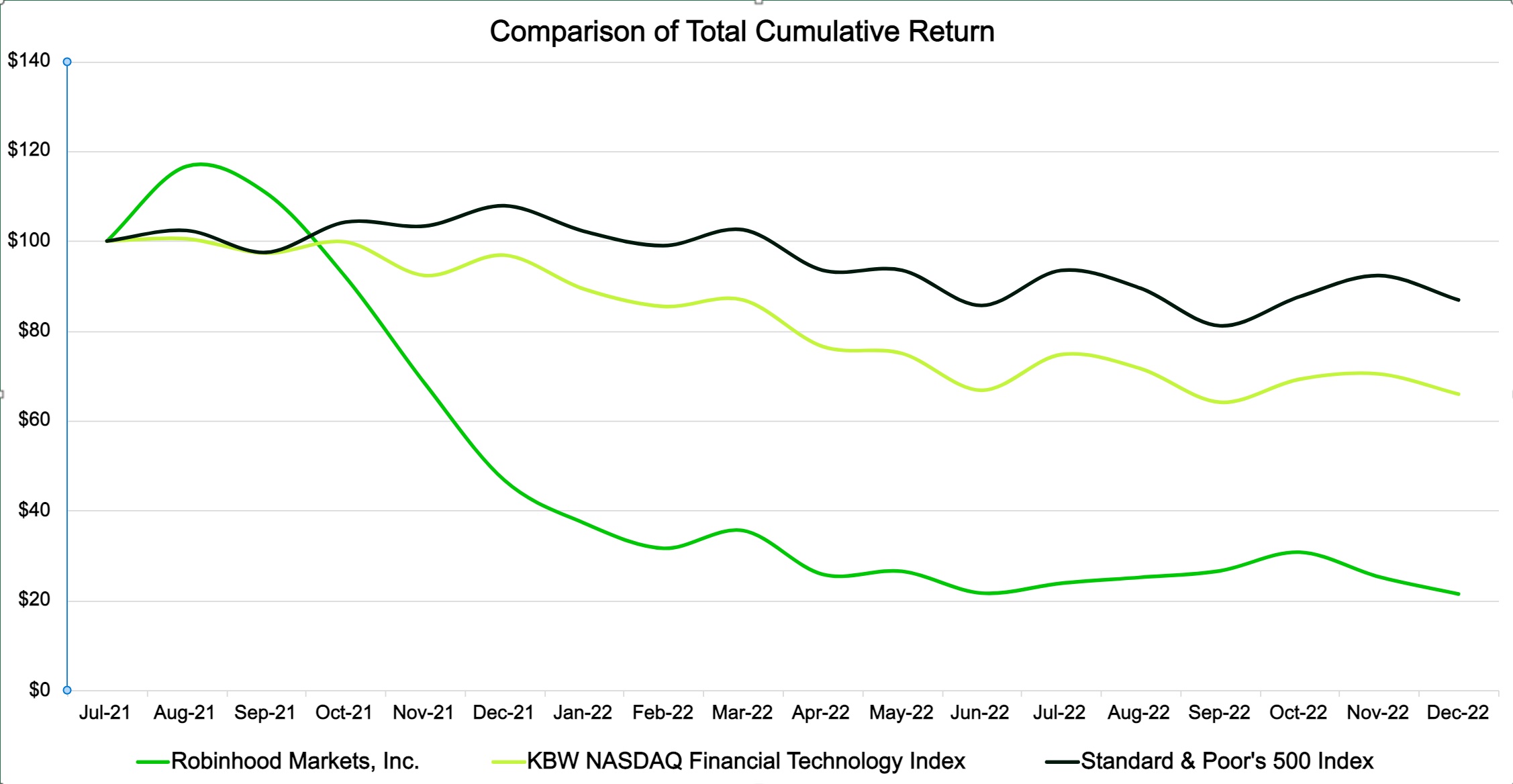
This performance graph shall not be deemed “soliciting material” or to be “filed” with the SEC, for purposes of Section 18 of the Exchange Act, or otherwise subject to the liabilities under that Section, and shall not be deemed to be incorporated by reference into any of our filings under the Securities Act.
The graph above compares the cumulative total stockholder return on our Class A common stock with the cumulative total return of the KBW NASDAQ Financial Technology Index and the Standard & Poor’s 500 Index. The graph assumes (i) that $100 was invested at the market close on July 29, 2021, the date that our Class A common stock commenced trading on the Nasdaq Global Select Market, in each of our Class A common stock, the KBW NASDAQ Financial Technology Index, and the Standard & Poor’s 500 Index and (ii) reinvestment of gross dividends. The graph uses the closing market price on July 29, 2021 of $34.82 per share as the initial value of our Class A common stock. The stock price performance shown in the graph represents past performance and should not be considered an indication of future stock price performance.
Item 6. [REMOVED AND RESERVED]
Item 7. MANAGEMENT’S DISCUSSION AND ANALYSIS OF FINANCIAL CONDITION AND RESULTS OF OPERATIONS
This section presents management’s perspective on our financial condition and results of operations, including performance metrics that management uses to assess company performance. The following discussion and analysis is intended to highlight and supplement data and information presented elsewhere in this Annual Report, and should be read in conjunction with our consolidated financial statements and notes elsewhere in this Annual Report. It is also intended to provide you with information that will assist you in understanding our consolidated financial statements, the changes in key items in those consolidated financial statements from year to year, and the primary factors that accounted for those changes. To the extent that this discussion describes prior performance, the descriptions relate only to the periods listed, which might not be indicative of our future financial outcomes. In addition to historical information, this discussion contains forward-looking statements that involve risks, uncertainties and assumptions that could cause results to differ materially from management’s expectations. Factors that could cause such differences are discussed in the sections titled “Cautionary Note Regarding Forward-Looking Statements” and “Risk Factors.”
We refer to our “users” and our “customers” interchangeably throughout this Annual Report to refer to individuals who hold accounts on our platform.
Glossary Terms
-
Automated Customer Account Transfer Service (ACATS)**: A system that automates and standardizes procedures for the transfer of assets in a customer account from one brokerage firm and/or bank to another.
-
Churned Account:** An account is considered “Churned” if it was ever a New Funded Account whose account balance (measured as the fair value of assets in the account less any amount due from the user and excluding certain Company-initiated Credits) drops to or below zero for at least 45 consecutive calendar days. Negative balances typically result from Fraudulent Deposit Transactions (as defined below) and unauthorized debit card use, and less often, from margin loans.
-
Company-initiated Credits:** Company-initiated Credits are amounts that are deposited into a Robinhood Account by the Company with no action taken by the user. Examples of Company-initiated Credits excluded for purposes of identifying Churned Accounts and Resurrected Accounts are price correction credits, related interest adjustments, and fee adjustments.
*•*Daily Average Revenue Trades (DARTs): We define DARTs for any asset class as the total number of revenue generating trades for such asset class executed during a given period divided by the number of trading days for such asset class in that period.
-
Fraudulent Deposit Transactions: Occur when users initiate deposits into their accounts, make trades on our platform using a short-term extension of credit from us, and then repatriate or reverse the deposits, resulting in a loss to us of the credited amount.
-
Margin Book:** We define Margin Book as our period-end aggregate outstanding margin loan balances receivable (i.e., the period-end total amount we are owed by customers on loans made
for the purchase of securities, supported by a pledge of assets in their margin-enabled brokerage accounts).
-
New Funded Account: We define a New Funded Account as a Robinhood Account into which the user makes an initial deposit, money transfer or asset transfer, of any amount during the relevant period.
-
Notional Trading Volume: We define Notional Trading Volume for any specified asset class as the aggregate dollar value (purchase price or sale price as applicable) of trades executed in that asset class over a specified period of time.
-
Resurrected Account: An account is considered “Resurrected” in a stated period if it was a Churned Account as of the end of the immediately preceding period and its balance (excluding certain Company-initiated Credits) rises above zero.
-
Robinhood Account**: We define a Robinhood Account as a unique log-in that provides the account user access to any and all of the Robinhood products offered on our platform.
Key Performance Metrics
-
Net Cumulative Funded Accounts (NCFA)**: We define Net Cumulative Funded Accounts as New Funded Accounts less Churned Accounts plus Resurrected Accounts.
-
Monthly Active Users (MAU)**: We define MAUs as the number of unique Robinhood Accounts who meet one of the following criteria at any point during a specified calendar month: a) executes a debit card transaction, b) transitions between two different screens on a mobile device while logged into their Robinhood Account or c) loads a page in a web browser while logged into their Robinhood Account. A user need not satisfy these conditions on a recurring monthly basis or have a funded account to be included in MAU. MAU figures in this Annual Report reflect MAU for the last month of the relevant period presented. We utilize MAU to measure how many customers interact with our products and services during a given month. MAU does not measure the frequency or duration of the interaction, but we consider it a useful indicator for engagement. Additionally, MAUs are positively correlated with, but are not indicative of, the performance of revenue and other key performance indicators.
-
Asset Under Custody (AUC)**: We define AUC as the sum of the fair value of all equities, options, cryptocurrency and cash held by users in their accounts, net of receivables from users, as of a stated date or period end on a trade date basis. Net Deposits and net market gains (losses) drive the change in AUC in any given period.
-
Net Deposits:** We define Net Deposits as all cash deposits and asset transfers received from customers, net of reversals, customer cash withdrawals, and other assets transferred out of our platform (assets transferred in or out include debit card transactions, ACATS transfers, and custodial crypto wallet transfers) for a stated period.
-
Average Revenues Per User (ARPU)**: We define ARPU as total revenue for a given period divided by the average of Net Cumulative Funded Accounts on the last day of that period and the last day of the immediately preceding period.
Overview
With respect to the year ended December 31, 2022, as compared to the year ended December 31, 2021:
-
we generated total net revenues of $1.36 billion compared to $1.82 billion, for a year-over-year decrease of 25%;
-
we incurred a net loss of $1.03 billion, or -$1.17 per share, compared to net loss of $3.69 billion, or -$7.49 per share; net loss in 2021 included expense of $2.05 billion associated with the change in fair value of convertible notes and warrant liability issued in February 2021;
-
operating expenses were $2.37 billion compared to $3.46 billion, for a year-over-year decrease of 31%;
◦share-based compensation (“SBC”) expense totaled $654 million compared to $1.57 billion, for a year-over-year decrease of 58%. SBC expense for the year ended December 31, 2021, was primarily related to the cumulative one-time expense recognized upon our IPO. SBC expense for the year ended December 31, 2022 included $77 million net reversals of previously recognized expense in connection with both the April 2022 Restructuring and August 2022 Restructuring;
-
our Adjusted EBITDA (non-GAAP) was negative $94 million compared to positive $33 million;
-
we had NCFA of 23.0 million compared to 22.7 million, for a year-over-year increase of 1%;
-
we had MAU of 11.4 million in December 2022 compared to 17.3 million in December 2021, for a year-over-year decrease of 34%;
-
we had AUC of $62.2 billion compared to $98.0 billion, for a year-over-year decrease of 37%;
-
Net Deposits were $18.4 billion compared to $27.1 billion, for a year-over-year decrease of 32%, which translates to a growth rate of 19% relative to AUC for the year ended December 31, 2021;
-
we had ARPU of $60 compared to $103, for a year-over-year decr
Showing the first 8K of 91K characters. Open the full section
Item 7A. QUANTITATIVE AND QUALITATIVE DISCLOSURES ABOUT MARKET RISK
Market risk generally represents the risk of loss that may result from the potential change in the value of a financial instrument as a result of fluctuations in interest rates and market prices. Information relating to quantitative and qualitative disclosures about these market risks is described below.
Interest Rate Risk
Our exposure to changes in interest rates primarily relates to interest earned on our cash and cash equivalents, cash and cash equivalents segregated under federal and other regulations, deposits with clearing organizations, restricted cash, investments in debt securities and margin loans. We use a net interest sensitivity analysis to evaluate the effect that changes in interest rates might have on total net revenues. The results of the analysis based on our financial position as of December 31, 2022 indicate that a hypothetical 100 basis point increase or decrease in interest rates would have had a positively correlated impact of approximately 10% on total net revenues.
We also have exposure to change in interest rates related to our variable-rate credit facilities, which are described in Note 12 - Financing Activities and Off-Balance Sheet Risk, to our consolidated financial statements in this Annual Report. However, as there were no outstanding borrowings under our credit facilities as of December 31, 2022 and 2021, we had limited financial exposure associated with changes in interest rates as of such dates.
Our measurement of interest rate risk involves assumptions that are inherently uncertain and, as a result, our analysis might not precisely estimate the actual impact of changes in interest rates on net interest revenues. Actual results may differ from simulated results due to balance growth or decline and the timing, magnitude, and frequency of interest rate changes, as well as changes in market conditions and management strategies, including changes in asset and liability mix.
Market-Related Credit Risk
We are indirectly exposed to equity securities risk in connection with securities collateralizing margin receivables, as well as risk related to our securities lending activities. We manage risk on margin and securities-based lending by requiring customers to maintain collateral in compliance with internal and, as applicable, regulatory guidelines. We monitor required margin levels daily and require our customers to deposit additional collateral, or to reduce positions, when necessary. We continuously monitor customer accounts to detect excessive concentration, large orders or positions, and other activities that indicate increased risk to us. We manage risks associated with our securities lending activities by requiring credit approvals for counterparties, by monitoring the market value of securities loaned and collateral values for securities borrowed on a daily basis, by requiring additional cash as collateral for securities loaned or
return of collateral for securities borrowed when necessary, and by participating in a risk-sharing program offered through the OCC.
Item 8. FINANCIAL STATEMENTS AND SUPPLEMENTARY DATA
INDEX TO THE CONSOLIDATED FINANCIAL STATEMENTS
Report of Independent Registered Public Accounting Firm
To the Stockholders and the Board of Directors of Robinhood Markets, Inc.
Opinion on Internal Control Over Financial Reporting
We have audited Robinhood Markets, Inc.’s internal control over financial reporting as of December 31, 2022, based on criteria established in Internal Control – Integrated Framework issued by the Committee of Sponsoring Organizations of the Treadway Commission (2013 framework) (the COSO criteria). In our opinion, the Company maintained, in all material respects, effective internal control over financial reporting as of December 31, 2022, based on the COSO criteria.
We also have audited, in accordance with the standards of the Public Company Accounting Oversight Board (United States) (PCAOB), the consolidated balance sheets as of December 31, 2022 and 2021, the related consolidated statements of operations, comprehensive income (loss), cash flows, and mezzanine equity and stockholders’ (deficit) equity for each of the three years in the period ended December 31, 2022, and the related notes and our report dated February 27, 2023 expressed an unqualified opinion thereon.
Basis for Opinion
The Company’s management is responsible for maintaining effective internal control over financial reporting and for its assessment of the effectiveness of internal control over financial reporting included in the accompanying report of management on internal control of financial reporting. Our responsibility is to express an opinion on the Company’s internal control over financial reporting based on our audit. We are a public accounting firm registered with the PCAOB and are required to be independent with respect to the Company in accordance with the U.S. federal securities laws and the applicable rules and regulations of the Securities and Exchange Commission and the PCAOB.
We conducted our audit in accordance with the standards of the PCAOB. Those standards require that we plan and perform the audit to obtain reasonable assurance about whether effective internal control over financial reporting was maintained in all material respects.
Our audit included obtaining an understanding of internal control over financial reporting, assessing the risk that a material weakness exists, testing and evaluating the design and operating effectiveness of internal control based on the assessed risk, and performing such other procedures as we considered necessary in the circumstances. We believe that our audit provides a reasonable basis for our opinion.
Definition and Limitations of Internal Control Over Financial Reporting
A company’s internal control over financial reporting is a process designed to provide reasonable assurance regarding the reliability of financial reporting and the preparation of financial statements for external purposes in accordance with generally accepted accounting principles. A company’s internal control over financial reporting includes those policies and procedures that (1) pertain to the maintenance of records that, in reasonable detail, accurately and fairly reflect the transactions and dispositions of the assets of the company; (2) provide reasonable assurance that transactions are recorded as necessary to permit preparation of financial statements in accordance with generally accepted accounting principles, and that receipts and expenditures of the company are being made only in accordance with authorizations of management and directors of the company; and (3) provide reasonable assurance regarding prevention or timely detection of unauthorized acquisition, use, or disposition of the company’
Showing the first 8K of 200K characters. Open the full section
Item 9. CHANGES IN AND DISAGREEMENTS WITH ACCOUNTANTS ON ACCOUNTING AND FINANCIAL DISCLOSURES
None.
Item 9A. CONTROLS AND PROCEDURES
Evaluation of Disclosure Controls and Procedures
Our management, with the participation of our Chief Executive Officer and Chief Financial Officer, has evaluated the effectiveness of our disclosure controls and procedures (as defined in Rules 13a-15(e) and 15d-15(e) under the Exchange Act) as of December 31, 2022. Based on such evaluation, our Chief Executive Officer and Chief Financial Officer concluded that, as of December 31, 2022, our disclosure controls and procedures were effective to provide reasonable assurance that information we are required to disclose in reports that we file or submit under the Exchange Act is recorded, processed, summarized, and reported within the time periods specified in the Commission’s rules and forms, and that such information is accumulated and communicated to our management, including our Chief Executive Officer and Chief Financial Officer, as appropriate, to allow timely decisions regarding required disclosure.
Management's Report on Internal Control over Financial Reporting
Our management is responsible for establishing and maintaining adequate internal control over financial reporting (as defined in Rules 13a-15(f) and 15d-15(f) under the Exchange Act). Internal control over financial reporting is a process designed to provide reasonable assurance regarding the reliability of financial reporting and the preparation of financial statements for external purposes in accordance with accounting principles generally accepted in the U.S. Our management, under the oversight of our board of directors, evaluated the effectiveness of our internal control over financial reporting as of December 31, 2022 based on the framework in Internal Control-Integrated Framework (2013), issued by the Committee of Sponsoring Organizations of the Treadway Commission. Based on this evaluation, our management concluded that our internal control over financial reporting was effective as of December 31, 2022.
Our independent registered public accounting firm, Ernst & Young LLP, who audited the Consolidated Financial Statements included in this Annual Report on Form 10-K, issued an audit report on the Company's internal control over financial reporting. That Report of Independent Registered Public Accounting Firm is included in Item 8 of this Annual Report on Form 10-K.
Changes in Internal Control Over Financial Reporting
There has been no change in our internal control over financial reporting (as defined in Rule 13a-15(f) and 15d-15(f) under the Exchange Act) during the quarter ended December 31, 2022 that has materially affected, or is reasonably likely to materially affect, our internal control over financial reporting.
Inherent Limitations on Effectiveness of Controls
Our management, including our Chief Executive Officer and Chief Financial Officer, believes that our disclosure controls and procedures and internal control over financial reporting are designed to provide reasonable assurance of achieving their objectives and are effective at the reasonable assurance level. However, management does not expect that our disclosure controls and procedures or our internal control over financial reporting will prevent or detect all errors and all fraud. A control system, no matter how well conceived and operated, can provide only reasonable, not absolute, assurance that the objectives of the control system are met. Because of the inherent limitations in all control systems, no evaluation of controls can provide absolute assurance that all control issues and instances of fraud, if any, within the company have been detected. The design of any system of controls also is based in part upon certain assumptions about the likelihood of future events, and there can be no assurance that any design will succeed in achieving its stated goals under all potential future conditions. Over time, controls may become inadequate because of changes in conditions, or the degree of compliance with the policies or procedures may deteriorate. Because of the inherent limitations in a cost-effective control system, misstatements due to error or fraud might occur without being detected.
Item 9B. OTHER INFORMATION
Not applicable.
Item 9C. DISCLOSURE REGARDING FOREIGN JURISDICTIONS THAT PREVENT INSPECTIONS
Not applicable.
PART III
Item 10. DIRECTORS, EXECUTIVE OFFICERS AND CORPORATE GOVERNANCE
The information required by this item is incorporated by reference to our Proxy Statement for the 2023 Annual Meeting of Stockholders to be filed with the SEC within 120 days of the fiscal year ended December 31, 2022.
Item 11. EXECUTIVE COMPENSATION
The information required by this item is incorporated by reference to our Proxy Statement for the 2023 Annual Meeting of Stockholders to be filed with the SEC within 120 days of the fiscal year ended December 31, 2022.
Item 12. SECURITY OWNERSHIP OF CERTAIN BENEFICIAL OWNERS AND MANAGEMENT AND RELATED STOCKHOLDER MATTERS
The information required by this item is incorporated by reference to our Proxy Statement for the 2023 Annual Meeting of Stockholders to be filed with the SEC within 120 days of the fiscal year ended December 31, 2022.
Item 13. CERTAIN RELATIONSHIPS AND RELATED TRANSACTIONS, AND DIRECTOR INDEPENDENCE
The information required by this item is incorporated by reference to our Proxy Statement for the 2023 Annual Meeting of Stockholders to be filed with the SEC within 120 days of the fiscal year ended December 31, 2022.
Item 14. PRINCIPAL ACCOUNTING FEES AND SERVICES
The information required by this item is incorporated by reference to our Proxy Statement for the 2023 Annual Meeting of Stockholders to be filed with the SEC within 120 days of the fiscal year ended December 31, 2022.
PART IV
Item 15. EXHIBITS AND FINANCIAL STATEMENT SCHEDULES
(a) The following documents are filed as part of this Annual Report:
1.The following consolidated financial statements of Robinhood Markets Inc. and subsidiaries are filed as part of this Annual Report under Part II, Item 8:
-
Reports of Independent Registered Public Accounting Firm on Consolidated Financial Statements
-
Consolidated Balance Sheets as of December 31, 2022 and 2021
-
Consolidated Statements of Income for the Years Ended December 31, 2022, 2021 and 2020
-
Consolidated Statements of Comprehensive Income for the Years Ended December 31, 2022, 2021, and 2020
-
Consolidated Statements of Cash Flows for the Years Ended December 31, 2022, 2021 and 2020
-
Consolidated Statements of Changes in Stockholders’ Equity for the Years Ended December 31, 2022, 2021 and 2020
-
Notes to Consolidated Financial Statements
- Financial Statement Schedules:
All schedules are omitted because of the absence of conditions under which they are required or because information called for is shown in the consolidated financial statements and notes thereto in Part II, Item 8 of this Annual Report.
- Exhibits:
The information required by this Item is set forth in the Exhibit Index that precedes the signature page of this Annual Report.
Item 16. FORM 10-K SUMMARY
None.
EXHIBIT INDEX
The documents listed below are filed (or furnished, as noted) as exhibits to this Annual Report on Form 10-K:
| 101.SCH | iXBRL Taxonomy Extension Schema Document | X | ||||||||||||||||||||||||||||||
| 101.CAL | iXBRL Taxonomy Extension Calculation Linkbase Document | X | ||||||||||||||||||||||||||||||
| 101.DEF | iXBRL Taxonomy Extension Definition Linkbase Document | X | ||||||||||||||||||||||||||||||
| 101.LAB | iXBRL Taxonomy Extension Label Linkbase Document. | X | ||||||||||||||||||||||||||||||
| 101.PRE | iXBRL Taxonomy Extension Presentation Linkbase Document. | X | ||||||||||||||||||||||||||||||
| 104 | Cover Page Interactive Data File (contained in Exhibit 101) | X |
- File number is 001-40691 except that the S-1 (and S-1/A) file number is 333-257602 and the S-8 file number is 333-258250.
+ Indicates a management contract or compensatory plan.
† Certain schedules and exhibits have been omitted pursuant to Rule 601(a)(5) of Regulation S-K under the Securities Act. A copy of any omitted schedule or exhibit will be furnished to the SEC upon request.
‡ The certifications attached as Exhibits 32.1 and 32.2 that accompany this Annual Report on Form 10-K are deemed furnished and not filed with the Securities and Exchange Commission and are not to be incorporated by reference into any filing of Robinhood Markets, Inc. under the Securities Act or the Exchange Act, whether made before or after the date of this Annual Report on Form 10-K, irrespective of any general incorporation language contained in such filing.
SIGNATURES
Pursuant to the requirements of the Securities Exchange Act of 1934, the Registrant has duly signed this report to be signed on its behalf by the undersigned, thereunto duly authorized, in Menlo Park, California, on February 27, 2023.
| Robinhood Markets, Inc. | |||||
| By: | /s/ Vladimir Tenev | ||||
| Name: | Vladimir Tenev | ||||
| Title: | Co-Founder, Chief Executive Officer and President | ||||
| By: | /s/ Jason Warnick | ||||
| Name: | Jason Warnick | ||||
| Title: | Chief Financial Officer (Principal Financial Officer and Principal Accounting Officer) |
POWER OF ATTORNEY
KNOW ALL PERSONS BY THESE PRESENTS, that each person whose signature appears below constitutes and appoints Vladimir Tenev and Jason Warnick, jointly and severally, his or her attorney-in-fact, with the power of substitution, for him or her in any and all capacities, to sign any amendments to this Annual Report on Form 10-K and to file the same, with exhibits thereto and other documents in connection therewith, with the Securities and Exchange Commission, hereby ratifying and confirming all that each of said attorneys-in-fact, or his substitute or substitutes, may do or cause to be done by virtue hereof.
Pursuant to the requirements of the Securities Exchange Act of 1934, this Annual Report on Form 10-K has been signed below by the following persons on behalf of the Registrant and in the capacities and on the dates indicated.
| Signature | Title | Date | |||||||||||||||
| By: | /s/ Vladimir Tenev | Co-Founder, Chief Executive Officer and President and Director | February 27, 2023 | ||||||||||||||
| Vladimir Tenev | |||||||||||||||||
| By: | /s/ Jason Warnick | Chief Financial Officer | February 27, 2023 | ||||||||||||||
| Jason Warnick | (Principal Financial Officer and Principal Accounting Officer) | ||||||||||||||||
| By: | /s/ Baiju Bhatt | Director | February 27, 2023 | ||||||||||||||
| Baiju Bhatt | |||||||||||||||||
| By: | /s/ Paula Loop | Director | February 27, 2023 | ||||||||||||||
| Paula Loop | |||||||||||||||||
| By: | /s/ Jonathan Rubinstein | Director | February 27, 2023 | ||||||||||||||
| Jonathan Rubinstein | |||||||||||||||||
| By: | /s/ Meyer Malka | Director | February 27, 2023 | ||||||||||||||
| Meyer Malka | |||||||||||||||||
| By: | /s/ Robert Zoellick | Director | February 27, 2023 | ||||||||||||||
| Robert Zoellick | |||||||||||||||||
| By: | /s/ Dara Treseder | Director | February 27, 2023 | ||||||||||||||
| Dara Treseder | |||||||||||||||||
| By: | /s/ Frances Frei | Director | February 27, 2023 | ||||||||||||||
| Frances Frei |