 filings.tools
Hewlett Packard Enterprise 10-K 2021-10-31
Filed 2021-12-10. 22 sections, 696K characters. Original on sec.gov · Markdown · JSON
Cover and table of contents
UNITED STATES
SECURITIES AND EXCHANGE COMMISSION
Washington, D.C. 20549
FORM 10-K
| (Mark One) | ||||||||
| ☒ | ANNUAL REPORT PURSUANT TO SECTION 13 OR 15(d) OF THE SECURITIES EXCHANGE ACT OF 1934 |
For the fiscal year ended October 31, 2021
Or
| ☐ | TRANSITION REPORT PURSUANT TO SECTION 13 OR 15(d) OF THE SECURITIES EXCHANGE ACT OF 1934 |
For the transition period from to
Commission file number 001-37483
HEWLETT PACKARD ENTERPRISE COMPANY
(Exact name of registrant as specified in its charter)
| Delaware | 47-3298624 | |||||||
| (State or other jurisdiction of incorporation or organization) | (I.R.S. employer identification no.) |
| 11445 Compaq Center West Drive, | Houston, | Texas | 77070 | |||||||||||
| (Address of principal executive offices) | (Zip code) |
Registrant's telephone number, including area code: (650) 687-5817
Securities registered pursuant to Section 12(b) of the Act:
| Title of each class | Trading Symbol(s) | Name of each exchange on which registered | ||||||
| Common stock, par value $0.01 per share | HPE | New York Stock Exchange |
Securities registered pursuant to Section 12(g) of the Act:
None
Indicate by check mark if the registrant is a well-known seasoned issuer as defined in Rule 405 of the Securities Act. Yes x No ¨
Indicate by check mark if the registrant is not required to file reports pursuant to Section 13 or Section 15(d) of the Act. Yes ¨ No x
Indicate by check mark whether the registrant (1) has filed all reports required to be filed by Section 13 or 15(d) of the Securities Exchange Act of 1934 during the preceding 12 months (or for such shorter period that the registrant was required to file such reports), and (2) has been subject to such filing requirements for the past 90 days. Yes x No ¨
Indicate by check mark whether the registrant has submitted electronically every Interactive Data File required to be submitted pursuant to Rule 405 of Regulation S-T (§ 232.405 of this chapter) during the preceding 12 months (or for such shorter period that the registrant was required to submit such files). Yes x No ¨
Indicate by check mark whether the registrant is a large accelerated filer, an accelerated filer, a non-accelerated filer, a smaller reporting company, or an emerging growth company. See the definitions of "large accelerated filer," "accelerated filer", "smaller reporting company" and "emerging growth company" in Rule 12b-2 of the Exchange Act:
| Large accelerated filer | ☒ | Accelerated filer | ☐ | Non-accelerated filer | ☐ | Smaller reporting company | ☐ | |||||||||||||||||||||||||
| Emerging growth company | ☐ |
If an emerging growth company, indicate by check mark if the registrant has elected not to use the extended transition period for complying with any new or revised financial accounting standards provided pursuant to Section 13(a) of the Exchange Act. ¨
Indicate by check mark whether the registrant has filed a report on and attestation to its management's assessment of the effectiveness of its internal control over financial reporting under Section 404(b) of the Sarbanes-Oxley Act (15 U.S.C. 7262(b)) by the registered public accounting firm that prepared or issued its audit report. x
Indicate by check mark whether the registrant is a shell company (as defined in Rule 12b-2 of the Act). Yes ☐ No x
The aggregate market value of the registrant's common stock held by non-affiliates was $20,839,669,847 based on the last sale price of common stock on April 30, 2021.
The number of shares of Hewlett Packard Enterprise Company common stock outstanding as of December 7, 2021 was 1,293,439,907 shares.
| DOCUMENTS INCORPORATED BY REFERENCE | ||||||||
| DOCUMENT DESCRIPTION | 10-K PART | |||||||
| Portions of the Registrant's proxy statement related to its 2022 Annual Meeting of Stockholders to be filed pursuant to Regulation 14A within 120 days after Registrant's fiscal year end of October 31, 2021 are incorporated by reference into Part III of this Report. | III |
.
Hewlett Packard Enterprise Company
Form 10-K
For the Fiscal Year ended October 31, 2021
Table of Contents
Forward-Looking Statements
This Annual Report on Form 10-K, including "Management's Discussion and Analysis of Financial Condition and Results of Operations" in Item 7, contains forward-looking statements within the meaning of the safe harbor provisions of the Private Securities Litigation Reform Act of 1995. Such statements involve risks, uncertainties, and assumptions. If the risks or uncertainties ever materialize or the assumptions prove incorrect, the results of Hewlett Packard Enterprise Company and its consolidated subsidiaries ("Hewlett Packard Enterprise") may differ materially from those expressed or implied by such forward-looking statements and assumptions. The words "believe", "expect", "anticipate", "optimistic", "intend", "aim", "will", "should," and similar expressions are intended to identify such forward-looking statements. All statements other than statements of historical fact are statements that could be deemed forward-looking statements, including but not limited to the scope and duration of the novel coronavirus pandemic ("COVID-19") and its impact on our business, operations, liquidity and capital resources, employees, customers, partners, supply chain, financial results, and the world economy; any projections of revenue, margins, expenses, investments, effective tax rates, interest rates, the impact of tax law changes and related guidance and regulations, net earnings, net earnings per share, cash flows, liquidity and capital resources, inventory, goodwill, impairment charges, hedges and derivatives and related offsets, order backlog, benefit plan funding, deferred tax assets, share repurchases, currency exchange rates, repayments of debts including our asset-backed debt securities, or other financial items; any projections of the amount, execution, timing and results of any transformation or impact of cost savings; restructuring plans, including estimates and assumptions related to the anticipated benefits, cost savings, or charges of implementing transformation and restructuring plans; any statements of the plans, strategies, and objectives of management for future operations, as well as the execution of corporate transactions or contemplated acquisitions, research and development expenditures, and any resulting benefit, cost savings, charges, or revenue or profitability improvements; any statements concerning the expected development, performance, market share or competitive performance relating to products or services; any statements regarding current or future macroeconomic trends or events and the impact of those trends and events on Hewlett Packard Enterprise and its financial performance; any statements regarding pending investigations, claims or disputes; any statements of expectation or belief; and any statements of assumptions underlying any of the foregoing. Risks, uncertainties, and assumptions include the need to address the many challenges facing Hewlett Packard Enterprise's businesses; the competitive pressures faced by Hewlett Packard Enterprise's businesses; risks associated with executing Hewlett Packard Enterprise's strategy; the impact of macroeconomic and geopolitical trends and events; the need to manage third-party suppliers, the distribution of Hewlett Packard Enterprise's products, and the delivery of Hewlett Packard Enterprise's services effectively; the protection of Hewlett Packard Enterprise's intellectual property assets, including intellectual property licensed from third parties and intellectual property shared with its former parent; risks associated with Hewlett Packard Enterprise's international operations (including pandemics and public health problems, such as the outbreak of COVID-19); the development and transition of new products and services and the enhancement of existing products and services to meet customer needs and respond to emerging technological trends; the execution and performance of contracts by Hewlett Packard Enterprise and its suppliers, customers, clients, and partners, including any impact thereon resulting from events such as the COVID-19 pandemic; the hiring and retention of key employees; the execution, integration, and other risks associated with business combination and investment transactions; the impact of changes to environmental, global trade, and other governmental regulations; changes in our product, lease, intellectual property or real estate portfolio; the payment or non-payment of a dividend for any period; the efficacy of using non-GAAP, rather than GAAP, financial measures in business projections and planning; the judgments required in connection with determining revenue recognition; impact of company policies, and related compliance; utility of segment realignments; allowances for recovery of receivables and warranty obligations; provisions for, and resolution of, pending investigations, claims and disputes; and other risks that are described herein, including but not limited to the items discussed in "Risk Factors" in Item 1A of Part I of this report and that are otherwise described or updated from time to time in Hewlett Packard Enterprise's reports filed with the Securities and Exchange Commission. Hewlett Packard Enterprise assumes no obligation and does not intend to update these forward-looking statements, except as required by applicable law.
PART I
Item 1. Business
We are a global technology leader focused on developing intelligent solutions that allow customers to capture, analyze and act upon data seamlessly from edge to cloud. We enable customers to accelerate business outcomes by driving new business models, creating new customer and employee experiences, and increasing operational efficiency today and into the future. Our customers range from small-and-medium-sized businesses ("SMBs") to large global enterprises and governmental entities. Our legacy dates back to a partnership founded in 1939 by William R. Hewlett and David Packard, and we strive every day to uphold and enhance that legacy through our dedication to providing innovative technological solutions to our customers.
On November 1, 2015, HP Inc. ("former Parent"), formerly known as Hewlett-Packard Company ("HP Co.") spun-off Hewlett Packard Enterprise Company ("we", "us", "our", "Hewlett Packard Enterprise", "HPE", or "the Company") pursuant to a separation agreement (the "Separation and Distribution Agreement") (collectively the "Separation"). Since the Separation, we have operated as an independent, publicly-traded company.
On April 1, 2017, the Company completed the separation and merger of our Enterprise Services business with DXC Technology Company ("DXC", "the Everett Transaction" or "Everett").
On September 1, 2017, the Company completed the separation and merger of our Software business segment with Micro Focus International plc ("Micro Focus", "the Seattle Transaction" or "Seattle" ).
COVID-19 Pandemic Update
While great progress has been made in the fight against the novel coronavirus pandemic ("COVID-19" or "pandemic"), it remains a global challenge. In fiscal 2021, due to an unprecedented demand for electronic devices and related industry-wide supply constraints, the global economy encountered a challenging supply chain environment. The pandemic continues to have an impact on our financial performance and we are currently unable to predict the extent to which it may adversely impact our future business operations, financial performance and results of operations. For a further discussion of the risks, uncertainties and actions taken in response to COVID-19, see risks identified in the section entitled "Risk Factors" in Part I, Item 1A.
In 2021, COVID-19 vaccines were broadly distributed and administered, and beginning October 4, 2021, we adopted a policy to require proof of vaccination from HPE personnel, contingent workers, and guests in order to return to our sites, where permitted by local laws and regulations and on the timeline determined appropriate for the geography (as of end of fiscal 2021, the policy was operationalized only in the U.S.). On October 20, 2021, we updated our vaccination policy to require vaccination as a condition of employment for all HPE personnel covered by President Biden's executive order, effective January 18, 2022. We recognize that there are existing legal challenges to the executive order, and we will ensure that the timing and scope of the implementation of our vaccination requirement is consistent with the legal status of the executive order. We are committed to help support costs for the vaccine through HPE health benefits or other programs, to the extent not covered by government programs, medical plans or other sources.
Our Strategy
The pace of technology disruption continues to increase, and the pandemic has accelerated several megatrends. First, data at the edge is increasing exponentially, driven by the proliferation of devices. Secure connectivity is essential to enable the digital experiences we now rely on – and power new, engaging digital experiences in the future. Second, enterprises need a cloud experience everywhere to manage data and workloads wherever they live across a distributed enterprise. Third, data growth is creating countless new opportunities. Enterprises need ways to generate insights from this data to build new business models. Across these trends is the shift in how enterprises are consuming their technology. Increasingly, customers want to digitally transform while preserving capital and eliminating operating expense by paying only for the IT they use.
Data insights are critical to deliver business outcomes, but extracting value from data is challenging. Data is growing and evolving rapidly. Its characteristics are shifting, as it becomes more unstructured, more time-sensitive and more distributed. Frequently, data is siloed and spread across different multi-gen IT systems, often trapped in critical legacy architecture. Many organizations cannot adequately extract insights from their data at the edge or face cloud migration challenges because of their legacy applications. Customers need a data-first modernization approach across edge to data center to cloud.
We declared our vision to be the edge-to-cloud company. Our HPE GreenLake platform accelerates multi-generation IT transformation through a unified cloud services experience that enables customers to access, control and maximize the value of all their workloads and data. Our solutions across connectivity, cloud and data – which are increasingly being delivered as-a-service through HPE GreenLake – are complemented by HPE Pointnext services that provide unique transformation capabilities, as well as HPE Financial Services, which helps customers unlock financial capacity.
Human Capital Resources
At HPE we are united by our purpose, which is to advance the way people live and work. We believe technology’s greatest promise lies in its potential for positive change. This is the guidepost for each decision we make at HPE. We believe it not only helps guide our contribution to society, but also makes good business sense. Our company has always been an engine of innovation, and our approximately 60,400 employees as of October 31, 2021, are proud of the ways our technology enables our customers to achieve meaningful outcomes like curing disease, modernizing farming to cure world-hunger and democratizing transportation through autonomous vehicles.
Our Culture**:** We recognize the critical importance of talent and culture to the success of HPE and our ability to fulfill our purpose. We are passionate about the values that drive our success, which is why we believe in investing in our employees and in the communities where we live and work. HPE has intensified its focus on embedding these values into a vibrant culture that creates a superior team member experience and a highly engaged workforce, driving improvements across our communications, our reward programs, and our work environment. Through such efforts, we are fostering a collaborative, inclusive and inspiring experience for all our team members. Our most recent global engagement survey shows how these intentional efforts are making a difference, with our overall Employee Engagement Index increasing year-over-year and measuring 84%. More than 85% of team members would recommend HPE as a great place to work, and 89% say they are proud to work for HPE.
Building a Vibrant Culture: We have identified four key cultural beliefs that guide how we lead on a daily basis: belief in accelerating what’s next, in bold moves, in the “power of yes we can”, and in being a force for good. We embed these beliefs in a deep-rooted DNA that puts customers first, enabling us to partner, innovate and act with integrity. Our empowered and engaging culture is making HPE a destination for talent while driving innovation and excellence for our customers.
Diversity, Equity and Inclusion: We are committed to being unconditionally inclusive to capture the ideas and perspectives that fuel innovation and enable our workforce, customers, and communities to succeed in the digital age. This is because, by harnessing the potential of our technologies and our team members, we can be a force for good. Annual goals are set to
Showing the first 8K of 67K characters. Open the full section
Item 1A. Risk Factors.
You should carefully consider the following risks and other information in this Form 10-K in evaluating Hewlett Packard Enterprise and its common stock. Any of the following risks could materially and adversely affect our results of operations or financial condition. The following risk factors should be read in conjunction with Part II, Item 7, "Management's Discussion and Analysis of Financial Condition and Results of Operation" and the Consolidated Financial Statements and related notes in Part II, Item 8, "Financial Statements and Supplementary Data" of this Form 10-K.
Business and Operational Risks
We are unable to predict the extent to which the ongoing global COVID-19 pandemic may adversely impact our business operations, financial performance and results of operations.
The COVID-19 pandemic and efforts to control its spread have significantly curtailed the movement of people, goods and services worldwide, including in most or all of the regions in which we sell our products and services and conduct our business operations. The pandemic has resulted in a global slowdown of economic activity, including travel restrictions, prohibitions of non-essential activities in some cases, disruption and shutdown of businesses and greater uncertainty in global financial markets. Our operations have been affected by a range of external factors related to the COVID-19 pandemic that are not within our control, including the various restrictions imposed by cities, counties, states and countries on our employees, customers, partners and suppliers designed to limit the spread of COVID-19. Although the immediate impacts of the COVID-19 pandemic have been assessed, the long-term magnitude and duration of the disruption and resulting decline in business activity is still highly uncertain and cannot currently be predicted.
In response to the COVID-19 pandemic and to ensure the safety of our employees, we have implemented a global work-from-home policy until further notice that applies to a significant majority of our employees, with the exception of those performing essential activities. Most recently, we have announced a vaccination requirement for covered U.S. employees as required by Executive Order 14042 for federal contractors. We recognize that there are existing legal challenges to Executive Order 14042, and we will ensure that the timing and scope of the implementation of our vaccination requirement is consistent with the legal status of Executive Order 14042. Our employees may elect to return to the office in jurisdictions where both local requirements and our own health and safety standards have been met. As such instances occur, employees have returned to the office in a phased process and remain subject to safety regimens anchored around vaccination or testing requirements, as we determine is appropriate based on local conditions. Moreover, certain industry and customer events that we sponsor or at which we present have been canceled, postponed or moved to virtual-only experiences, and we may deem it advisable to similarly alter, postpone or cancel entirely additional events in the future. We are also seeing an increase in customer requirements for HPE employees to be vaccinated and/or tested for COVID-19 before being able to enter customer sites, which could potentially present an operational challenge. Also, work-from-home and other modified business practices introduce additional operational risks, including cybersecurity risks, which may result in inefficiencies or delays, and have affected the way we conduct our product development, sales, customer support and other activities. Unanticipated disruptions in services provided through our localized physical infrastructure caused by the COVID-19 pandemic can curtail the functioning of critical components of our IT systems, and adversely affect our ability to fulfill orders, provide services, respond to customer requests and maintain our worldwide business operations. Our implementation of employee vaccination requirements may result in attrition, including attrition of critically skilled labor, and difficulty securing future labor needs, which could have a material adverse effect on our business, financial condition, and results of operations.
The pandemic has adversely affected, and could continue to adversely affect, our business, by negatively impacting the demand for our products and services; restricting our operations and sales, marketing and distribution efforts; disrupting the supply chains of hardware products; and disrupting our research and development capabilities, engineering, design and manufacturing processes and other important business activities. There have been, and will continue to be, delays of hardware product shipments from our vendors and out of our manufacturing operations worldwide as a result of capacity issues. We also expect product shipment delays as a result of shortages and capacity issues that continue to impact logistics operations.
We expect the COVID-19 pandemic could continue to have a negative impact on our sales and our results of operations, the size and duration of which we are currently unable to predict. While such changes were factored into the forecast used to assess assets for reserves and impairment, including goodwill, any changes to the profitability for the next fiscal year could impact the realizability of assets. Additionally, concerns over the economic impact of the COVID-19 pandemic have caused extreme volatility in financial and other capital markets which has and may continue to adversely impact our stock price, our ability to access capital markets and our ability to fund liquidity needs.
To the extent the COVID-19 pandemic adversely affects our business, results of operations, financial condition, and stock price, it may also have the effect of heightening many of the other risks described in this Part I, Item 1A of this Form 10-K.
Business disruptions could seriously harm our future revenue and financial condition and increase our costs and expenses.
Our worldwide operations and supply chain could be disrupted by natural or human-induced disasters including, but not limited to, earthquakes; tsunamis; floods; hurricanes, cyclones or typhoons; fires; other extreme weather conditions; power or water shortages; telecommunications failures; materials scarcity and price volatility; terrorist acts, civil unrest, conflicts or wars; and medical epidemics or pandemics. We are predominantly self-insured to mitigate the impact of most catastrophic events. Although it is impossible to completely predict the occurrences or consequences of any such events, forecasting disruptive events and building additional resiliency into our operations accordingly will become an increasing business imperative. The occurrence of business disruptions could result in significant losses, seriously harm our revenue, profitability and financial condition, adversely affect our competitive position, increase our costs and expenses, decrease in demand for our products, make it difficult or impossible to provide services or deliver products to our customers or to receive components from our suppliers, create delays and inefficiencies in our supply chain, result in the need to impose employee travel restrictions and require substantial expenditures and recovery time in order to fully resume operations.
Climate change serves as a risk multiplier increasing both the frequency and severity of natural disasters that may affect our worldwide business operations. Our corporate headquarters is located in Houston, Texas, which suffers from floods, hurricanes, and other extreme weather, and a portion of our research and development activities are located in California, which suffers from drought conditions and catastrophic wildfires, each affecting the health and safety of our employees. In California, to mitig
Showing the first 8K of 80K characters. Open the full section
Item 1B. Unresolved Staff Comments.
None.
Item 2. Properties.
As of October 31, 2021, we owned or leased approximately 15 million square feet of space worldwide. A summary of the Company's operationally utilized space is provided below.
| As of October 31, 2021 | |||||||||||||||||
| Owned | Leased | Total | |||||||||||||||
| (Square feet in millions) | |||||||||||||||||
| Administration and support | 3 | 6 | 9 | ||||||||||||||
| (Percentage) | 33 | % | 67 | % | 100 | % | |||||||||||
| Core data centers, manufacturing plants, research and development facilities, and warehouse operations | 1 | 1 | 2 | ||||||||||||||
| (Percentage) | 50 | % | 50 | % | 100 | % | |||||||||||
| Total | 4 | 7 | 11 | ||||||||||||||
| (Percentage) | 36 | % | 64 | % | 100 | % |
We believe that our existing properties are in good condition and are suitable for the conduct of our business. Substantially all of our properties are utilized in whole or in part by our Compute, HPC & AI, Storage, and Intelligent Edge segments.
In connection with the transformation programs, we continue to anticipate changes in our real estate portfolio over the next two years. These changes may include reductions in overall space.
Principal Executive Offices
Our principal executive offices, including our global headquarters, are located at 11445 Compaq Center West Drive, Houston, Texas, 77070, United States of America.
Product Development, Services and Manufacturing
The locations of our major product development, services, manufacturing, and Hewlett Packard Labs facilities are as follows:
| Americas Puerto Rico—Aguadilla United States—Alpharetta, Andover, Chippewa Falls, Colorado Springs, Fort Collins, Houston, Milpitas, Roseville, San Jose, Santa Clara, Sunnyvale | Europe, Middle East, Africa United Kingdom—Erskine | |||||||
| Asia Pacific China—Beijing India—Bangalore Japan—Tokyo *Singapore—*Singapore *Taiwan—*Taipei |
Item 3. Legal Proceedings.
Information with respect to this item may be found in Note 17, "Litigation and Contingencies", to the Consolidated Financial Statements in Item 8 of Part II, which is incorporated herein by reference.
PART II
Item 4. Mine Safety Disclosures.
Not applicable.
Item 5. Market for Registrant's Common Equity, Related Stockholder Matters and Issuer Purchases of Equity Securities.
Market Information
The common stock of Hewlett Packard Enterprise is listed on the New York Stock Exchange ("NYSE") with the ticker symbol "HPE".
Holders
According to the records of our transfer agent, there were 51,818 stockholders of record of Hewlett Packard Enterprise common stock as of November 30, 2021.
Dividends
During fiscal 2021, we paid a quarterly dividend of $0.12 per share to our shareholders. On November 30, 2021 we declared a quarterly dividend of $0.12 per share, payable on January 7, 2022, to stockholders of record as of the close of business on December 10, 2021.
The payment of any dividends in the future, and the timing and amount thereof, is within the discretion of our Board of Directors. Our Board of Directors' decisions regarding the payment of dividends will depend on many factors, such as our financial condition, earnings, capital requirements, debt service obligations, restrictive covenants in our debt, industry practice, legal requirements, regulatory constraints, and other factors that our Board of Directors deems relevant. Our ability to pay dividends will depend on our ongoing ability to generate cash from operations and on our access to the capital markets. We cannot guarantee that we will continue to pay a dividend in any future period.
Issuer Purchases of Equity Securities
| Fourth Quarter of Fiscal 2021 | Total Number of Shares Purchased and Settled | Average Price Paid per Share | Total Number of Shares Purchased as Part of Publicly Announced Plans or Programs | Approximate Dollar Value of Shares that May Yet Be Purchased under the Plans or Programs | ||||||||||||||||||||||
| In thousands, except per share amounts | ||||||||||||||||||||||||||
| Month 1 (August 2021) | — | $ | — | — | $ | 2,110,281 | ||||||||||||||||||||
| Month 2 (September 2021) | 6,638 | $ | 13.92 | 6,638 | $ | 2,017,871 | ||||||||||||||||||||
| Month 3 (October 2021) | 8,094 | $ | 14.96 | 8,094 | $ | 1,896,829 | ||||||||||||||||||||
| Total | 14,732 | $ | 14.49 | 14,732 |
On October 13, 2015, the Company's Board of Directors approved a share repurchase program with a $3.0 billion authorization, which was refreshed with additional share repurchase authorizations of $3.0 billion, $5.0 billion and $2.5 billion on May 24, 2016, October 16, 2017 and February 21, 2018, respectively. This program, which does not have a specific expiration date, authorizes repurchases in the open market or in private transactions. The Company may choose to repurchase shares when sufficient liquidity exists and the shares are trading at a discount relative to estimated intrinsic value.
On April 6, 2020, the Company announced that it suspended purchases under its share repurchase program in response to the global economic uncertainty that resulted from the worldwide spread of the novel coronavirus. On September 2, 2021, the Company announced that it reinstated the share repurchase program.
During the fiscal year ended October 31, 2021, the Company repurchased and settled 14.7 million shares of the Company's common stock. The Company had unsettled open market repurchases of 0.8 million shares as of October 31, 2021. Shares repurchased during fiscal 2021 were recorded as a $225 million reduction to stockholders' equity. As of October 31, 2021, the Company had a remaining authorization of $1.9 billion for future share repurchases.
Stock Performance Graph and Cumulative Total Return
The graph below shows the cumulative total stockholder return, the S&P 500 Index and the S&P Information Technology Index. This graph covers the period from October 31, 2016 through October 31, 2021. This graph assumes the investment of $100 in the stock or the index on October 31, 2016 (and the reinvestment of dividends thereafter). On April 1, 2017, we
completed the separation and merger of our Enterprise Services business with DXC. HPE stockholders received 0.085904 shares of common stock in the new company for every one share of HPE common stock held at the close of business on the record date. On September 1, 2017, we completed the separation and merger of our Software business segment with Micro Focus. HPE stockholders received 0.13732611 American Depository Shares ("Micro Focus ADSs") in the new company, each of which represents one ordinary share of Micro Focus, for every one share of HPE common stock held at the close of business on the record date. The effect of the Everett and Seattle Transactions are reflected in the cumulative total return as reinvested dividends. The comparisons in the graph below are based on historical data and are not indicative of, or intended to forecast, future performance of our common stock.
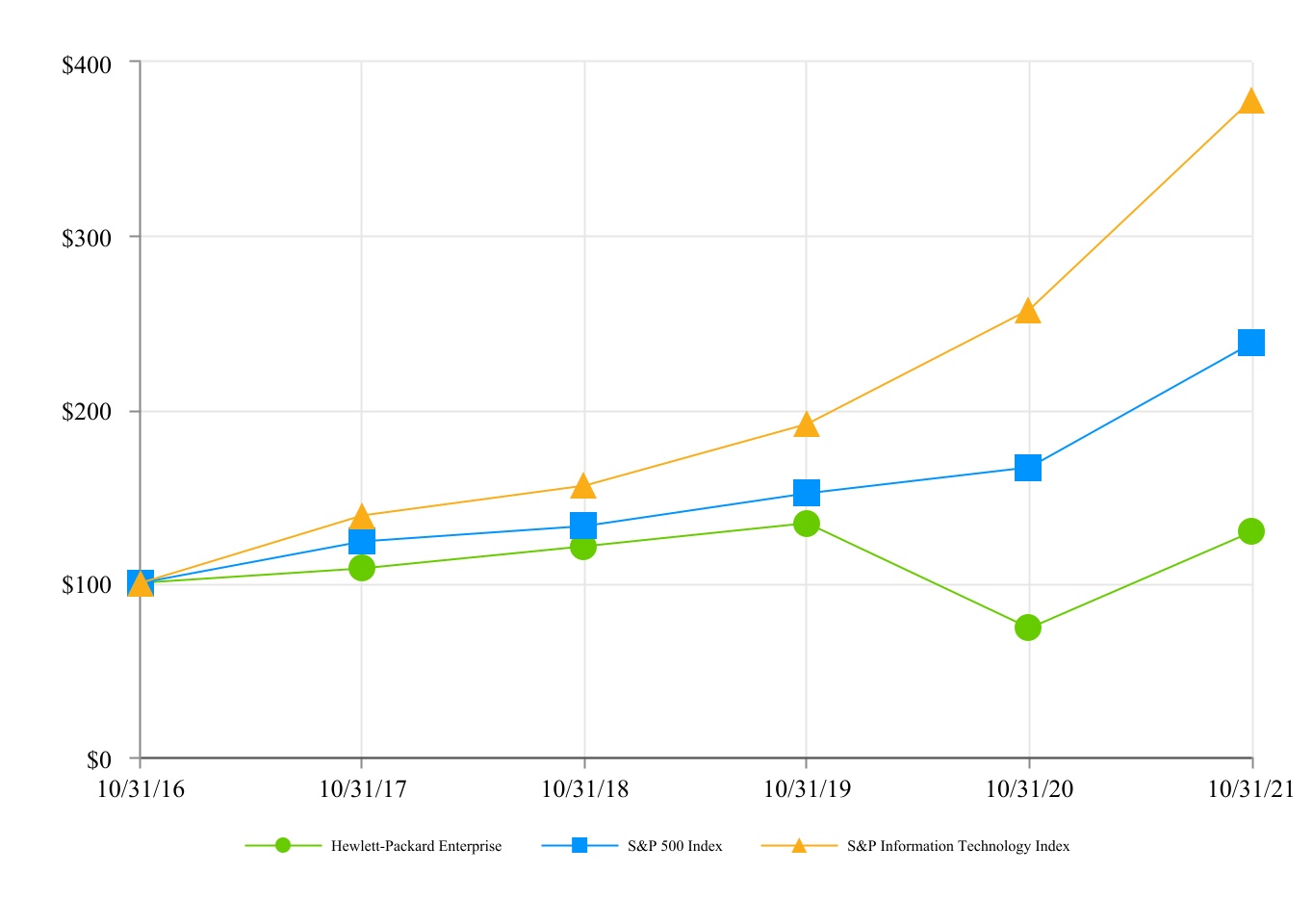
| 10/2016 | 10/2017 | 10/2018 | 10/2019 | 10/2020 | 10/2021 | ||||||||||||||||||||||||||||||
| Hewlett Packard Enterprise | $ | 100.00 | $ | 108.15 | $ | 121.25 | $ | 134.47 | $ | 73.79 | $ | 129.44 | |||||||||||||||||||||||
| S&P 500 Index | $ | 100.00 | $ | 123.62 | $ | 132.69 | $ | 151.69 | $ | 166.40 | $ | 237.77 | |||||||||||||||||||||||
| S&P Information Technology Index | $ | 100.00 | $ | 138.96 | $ | 156.05 | $ | 191.30 | $ | 257.25 | $ | 377.96 |
Item 6. [Reserved]
Item 7. Management's Discussion and Analysis of Financial Condition and Results of Operations.
For purposes of this Management's Discussion and Analysis of Financial Condition and Results of Operations ("MD&A") section, we use the terms "Hewlett Packard Enterprise", "HPE", "the Company", "we", "us", and "our" to refer to Hewlett Packard Enterprise Company. References in the MD&A section to "former Parent" refer to HP Inc.
This section of this Form 10-K generally discusses fiscal 2021 and fiscal 2020 items and year-to-year comparisons between fiscal 2021 and fiscal 2020. Discussions of fiscal 2019 items and year-to-year comparisons between fiscal 2020 and fiscal 2019 that are not included in this Form 10-K can be found in "Part II, Item 7, Management's Discussion and Analysis of Financial Condition and Results of Operations" of the Company's Annual Report on Form 10-K for the fiscal year ended October 31, 2020, as filed with the SEC on December 10, 2020, which is available on the SEC's website at www.sec.gov.
We intend the discussion of our financial condition and results of operations that follows to provide information that will assist the reader in understanding our Consolidated Financial Statements, the changes in certain key items in those financial statements from year to year, and the primary factors that accounted for those changes, as well as how certain accounting principles, policies and estimates affect our Consolidated Financial Statements. This discussion should be read in conjunction with our Consolidated Financial Statements and the related notes that appear in Part II, Item 8 of this document.
This MD&A is organized as follows:
*•*Trends and Uncertainties. A discussion of material events and uncertainties known to management such as COVID-19, our response to the challenges and trends, and our pivot to as-a-service strategy.
*•*Executive Overview. A discussion of our business and summary analysis of financial and other highlights, including non-GAAP financial measures, affecting the Company in order to provide context to the remainder of the MD&A.
*•*Critical Accounting Policies and Estimates. A discussion of accounting policies and estimates that we believe are important to understanding the assumptions and judgments incorporated in our reported financial results.
-
Results of Operations. A discussion of the results of operations at the consolidated level is followed by a discussion of the results of operations at the segment level.
-
Liquidity and Capital Resources. An analysis of changes in our cash flows and a discussion of our financial condition and liquidity.
-
Contractual Cash and Other Obligations. An overview of contractual obligations, retirement and post-retirement benefit plan funding, restructuring plans, uncertain tax positions and off-balance sheet arrangements.
-
GAAP to Non-GAAP Reconciliation. Each non-GAAP measure has been reconciled to the most directly comparable GAAP measure therein. This section also includes a discussion on the usefulness of non-GAAP financial measures, and material limitations associated with the use of non-GAAP financial measures.
TRENDS AND UNCERTAINTIES
COVID-19
While great progress has been made in the fight against COVID-19, it remains a global challenge and continues to have an impact on our operations. For a further discussion of the pandemic and the risks, uncertainties and actions taken in response to it, see the discussion in the section titled "COVID-19 Pandemic Update", "Manufacturing and Materials" and "Backlog" in Part I, Item 1, and risks identified in the section entitled " Risk Factors" in Part I, Item 1A.
The Company also believes that the pandemic has forced fundamental changes in businesses and communities that are aligned with the Company's edge-to-cloud platform delivered as-a-service strategy. Navigating through the pandemic and planning for a post-COVID world have increased customers' needs for as-a-service offerings, secure connectivity, remote work capabilities and analytics to unlock insights from data. Our solutions are aligned to these needs, and we see opportunity to help our customers drive digital transformations as they continue to adapt to operate in a new world.
HEWLETT PACKARD ENTERPRISE COMPANY AND SUBSIDIARIES
Management's Discussion and Analysis of
Financial Condition and Results of Operations (Continued)
Other Trends and Uncertainties
We are in the process of addressing many challenges facing our business. One set of challenges include dynamic and accelerating market trends, such as the market shift of workloads to cloud-related IT infrastructure business models, emergence of software-defined architectures and converged infrastructure functionality and growth in IT consumption models. Certain of our legacy hardware server and storage businesses face challenges as customers migrate to cloud-based offerings and reduce their purchases of hardware products. Therefore, the demand environment for traditional server and storage products is challenging and lower traditional compute and storage unit volume is impacting support attach opportunities within the associated services organization.
Another set of challenges relates to changes in the competitive landscape. Our major competitors are expanding their product and service offerings with integrated products and solutions, our business-specific competitors are exerting increased competitive pressure in targeted areas and are entering new markets, our emerging competitors are introducing new technologies and business models, and our alliance partners in some businesses are increasingly becoming our competitors.
A third set of challenges relates to business model changes and our go-to-market execution. We intend to provide our customers with a choice between traditional consumption models or subscription-based, pay-per-use and as-a-service offerings across our entire portfolio of HPE products and services.
Additionally, the global pandemic has accelerated several trends relevant to the Company. First, the exponential increase of data at the edge driven by the proliferation of devices. Second is the need for a cloud experience everywhere to manage the growth of data at the edge. Third, data growth is creating new opportunities with the need to quickly extract value from the captured data. Enterprises have embraced multi-cloud strategies, as they recognize the need for different cloud environments for different types of data and workloads. Increasingly, customers want to digitally transform, while preserving capital and eliminating operating expense, by paying only for the IT they use.
In response to the aforementioned challenges and trends, we are accelerating growth in our areas of strategic focus, which include the Intelligent Edge and High Performance Computing and Artificial Intelligence ("HPC & AI") businesses while at the same time, we are strengthening our core Compute and Storage businesses, doubling down in key areas of growth, and accelerating our as-a-service pivot to become the edge-to-cloud platform-as-a-service choice for our customers and partners.
At the same time our transformation programs have improved our cost structure, channel execution and alignment of our sales coverage with our strategic goals. We continue to pursue new product innovations that build on our existing capabilities in areas such as cloud and data center computing, software-defined networking, converged storage, high-performance compute, and wireless networking, which will keep us aligned with market demand, industry trends and the needs of our customers and partners. In addition, we continue to improve our operations, with a particular focus on enhancing our end-to-end processes and efficiencies.
Examples of accelerating and strengthening growth in our segments include the following:
- Intelligent Edge - we are seeing continued traction from our investment at the edge including rich software ca
Showing the first 8K of 129K characters. Open the full section
Item 7A. Quantitative and Qualitative Disclosures About Market Risk.
In the normal course of business, we are exposed to foreign currency exchange rate and interest rate risks that could impact our financial position and results of operations. Our risk management strategy with respect to these market risks may include the use of derivative financial instruments. We use derivative contracts only to manage existing underlying exposures. Accordingly, we do not use derivative contracts for speculative purposes. Our risks, risk management strategy and a sensitivity analysis estimating the effects of changes in fair value for each of these exposures is outlined below.
Actual gains and losses in the future may differ materially from the sensitivity analyses based on changes in the timing and amount of foreign currency exchange rate and interest rate movements and our actual exposures and derivatives in place at the time of the change, as well as the effectiveness of the derivative to hedge the related exposure.
Foreign currency exchange rate risk
We are exposed to foreign currency exchange rate risk inherent in our sales commitments, anticipated sales, anticipated purchases, and assets and liabilities denominated in currencies other than the U.S. dollar. We transact business in approximately 50 currencies worldwide, of which the most significant foreign currencies to our operations for fiscal 2021 were the euro, Japanese yen, British pound, and Chinese yuan (renminbi). For most currencies, we are a net receiver of the foreign currency and therefore benefit from a weaker U.S. dollar and are adversely affected by a stronger U.S. dollar relative to the foreign currency. Even where we are a net receiver of the foreign currency, a weaker U.S. dollar may adversely affect certain expense figures, if taken alone.
We use a combination of forward contracts and, from time to time, options designated as cash flow hedges to protect against the foreign currency exchange rate risks inherent in our forecasted net revenue and, to a lesser extent, cost of sales, operating expenses, and intercompany loans denominated in currencies other than the U.S. dollar. In addition, when debt is denominated in a foreign currency, we may use swaps to exchange the foreign currency principal and interest obligations for U.S. dollar-denominated amounts to manage the exposure to changes in foreign currency exchange rates. We also use other derivatives not designated as hedging instruments, consisting primarily of forward contracts, to hedge foreign currency balance sheet exposures. Alternatively, we may choose not to hedge the risk associated with our foreign currency exposures, primarily if such exposure acts as a natural hedge for offsetting amounts denominated in the same currency or if the currency is too difficult or too expensive to hedge.
We have performed sensitivity analyses as of October 31, 2021 and 2020, using a modeling technique that measures the change in the fair values arising from a hypothetical 10% adverse movement in the levels of foreign currency exchange rates relative to the U.S. dollar, with all other variables held constant. The analyses cover all of our foreign currency derivative contracts offset by underlying exposures. The foreign currency exchange rates we used in performing the sensitivity analysis were based on market rates in effect at October 31, 2021 and 2020. The sensitivity analyses indicated that a hypothetical 10% adverse movement in foreign currency exchange rates would result in a foreign exchange fair value loss of $35 million and $29 million at October 31, 2021 and 2020, respectively.
Interest rate risk
We also are exposed to interest rate risk related to debt we have issued, our investment portfolio and financing receivables. We issue long-term debt in either U.S. dollars or foreign currencies based on market conditions at the time of financing.
We often use interest rate and/or currency swaps to modify the market risk exposures in connection with the debt to achieve U.S. dollar based floating or fixed interest expense. The swap transactions generally involve the exchange of fixed for floating interest payments. However, in circumstances where we believe additional fixed-rate debt would be beneficial, we may choose to terminate a previously executed swap, or swap certain floating interest payments to fixed.
In order to hedge the fair value of certain fixed-rate investments, we may enter into interest rate swaps that convert fixed interest returns into variable interest returns. We may use cash flow hedges to hedge the variability of interest income received on certain variable-rate investments, by entering into interest rate swaps that convert variable rate interest returns into fixed-rate interest returns.
We have performed sensitivity analyses as of October 31, 2021 and 2020, using a modeling technique that measures the change in the fair values arising from a hypothetical 10% adverse movement in the levels of interest rates across the entire yield curve, with all other variables held constant. The analyses cover our debt, investments, financing receivables, and interest rate swaps. The analyses use actual or approximate maturities for the debt, investments, financing receivables, and interest rate swaps. The discount rates used were based on the market interest rates in effect at October 31, 2021 and 2020. The sensitivity analyses indicated that a hypothetical 10% adverse movement in interest rates would result in a loss in the fair values of our
debt, investments and financing receivables, net of interest rate swaps, of $58 million and $47 million at October 31, 2021 and 2020, respectively.
Item 8. Financial Statements and Supplementary Data.
Table of Contents
Report of Independent Registered Public Accounting Firm
To the Board of Directors and Stockholders of Hewlett Packard Enterprise Company
Opinion on the Financial Statements
We have audited the accompanying consolidated balance sheets of Hewlett Packard Enterprise Company and subsidiaries (the Company) as of October 31, 2021 and 2020, the related consolidated statements of earnings, comprehensive income, stockholders' equity and cash flows for each of the three years in the period ended October 31, 2021, and the related notes (collectively referred to as the “consolidated financial statements”). In our opinion, the consolidated financial statements present fairly, in all material respects, the financial position of the Company at October 31, 2021 and 2020, and the results of its operations and its cash flows for each of the three years in the period ended October 31, 2021, in conformity with U.S. generally accepted accounting principles.
We also have audited, in accordance with the standards of the Public Company Accounting Oversight Board (United States) (PCAOB), the Company's internal control over financial reporting as of October 31, 2021, based on criteria established in Internal Control-Integrated Framework issued by the Committee of Sponsoring Organizations of the Treadway Commission (2013 framework) and our report dated December 10, 2021, expressed an unqualified opinion thereon.
Basis for Opinion
These financial statements are the responsibility of the Company's management. Our responsibility is to express an opinion on the Company’s financial statements based on our audits. We are a public accounting firm registered with the PCAOB and are required to be independent with respect to the Company in accordance with the U.S. federal securities laws and the applicable rules and regulations of the Securities and Exchange Commission and the PCAOB.
We conducted our audits in accordance with the standards of the PCAOB. Those standards require that we plan and perform the audit to obtain reasonable assurance about whether the financial statements are free of material misstatement, whether due to error or fraud. Our audits included performing procedures to assess the risks of material misstatement of the financial statements, whether due to error or fraud, and performing procedures that respond to those risks. Such procedures included examining, on a test basis, evidence regarding the amounts and disclosures in the financial statements. Our audits also included evaluating the accounting principles used and significant estimates made by management, as well as evaluating the overall presentation of the financial statements. We believe that our audits provide a reasonable basis for our opinion.
Critical Audit Matters
The critical audit matters communicated below are matters arising from the current period audit of the financial statements that were communicated or required to be communicated to the audit committee and that: (1) relate to accounts or disclosures that are material to the financial statements and (2) involved our especially challenging, subjective or complex judgments. The communication of critical audit matters does not alter in any way our opinion on the consolidated financial statements, taken as a whole, and we are not, by communicating the critical audit matters below, providing a separate opinion on the critical audit matters or on the accounts or disclosures to which they relate.
| Valuation of goodwill | ||||||||
| Description of the matter | At October 31, 2021, the Company’s goodwill was $18.3 billion. As discussed in Note 11 to the consolidated financial statements, goodwill is tested for impairment at least annually a |
Showing the first 8K of 338K characters. Open the full section
Item 9. Changes in and Disagreements with Accountants on Accounting and Financial Disclosure.
None.
Item 9A. Controls and Procedures.
Evaluation of Disclosure Controls and Procedures
Under the supervision and with the participation of our management, including our principal executive officer and principal financial officer, we conducted an evaluation of the effectiveness of the design and operation of our disclosure controls and procedures, as defined in Rules 13a-15(e) and 15d-15(e) under the Exchange Act as of the end of the period covered by this report (the "Evaluation Date"). Based on this evaluation, our principal executive officer and principal financial officer concluded as of the Evaluation Date that our disclosure controls and procedures were effective such that the information relating to the Company, including our consolidated subsidiaries, required to be disclosed in our SEC reports (i) is recorded, processed, summarized and reported within the time periods specified in SEC rules and forms, and (ii) is accumulated and communicated to the Company's management, including our principal executive officer and principal financial officer, as appropriate to allow timely decisions regarding required disclosure.
Management's Report on Internal Control Over Financial Reporting
See Management's Report of Internal Control Over Financial Reporting and the Report of Independent Registered Public Accounting Firm on our internal control over financial reporting in Item 8, which are incorporated herein by reference.
Changes in Internal Control Over Financial Reporting
Under the supervision and with the participation of our management, including our principal executive officer and principal financial officer, we conducted an evaluation of any changes in our internal control over financial reporting (as such term is defined in Rules 13a-15(f) and 15d-15(f) under the Exchange Act) that occurred during our most recently completed fiscal quarter. Based on that evaluation, our principal executive officer and principal financial officer concluded that there has not been any change in our internal control over financial reporting during that quarter that has materially affected, or is reasonably likely to materially affect, our internal control over financial reporting. We have not experienced any material impact to our internal controls over financial reporting even though our global workforce continues to primarily work-from-home due to COVID-19. We are continually monitoring and assessing the COVID-19 situation and its impact on our internal controls.
Item 9B. Other Information.
Effective December 8, 2021, HPE and Keerti Melkote, former President of HPE's Intelligent Edge business unit, entered into a retirement agreement (the “Agreement”) that amended Mr. Melkote’s outstanding restricted stock unit (“RSU”) award agreements to provide that the underlying RSU awards shall be eligible to continue vesting on their current vesting schedule after Mr. Melkote’s December 31, 2021 retirement, subject to (i) all existing performance vesting criteria for performance-adjusted RSUs, (ii) Mr. Melkote’s entry into a standard release of claims and (iii) Mr. Melkote’s ongoing adherence to standard non-competition and non-solicitation covenants for the duration of the RSU awards’ vesting schedule. The foregoing description of the Agreement is qualified entirely by the Agreement itself, which is attached hereto as Exhibit 10.32 and incorporated by reference herein.
The following disclosure is being made under Section 13(r) of the Exchange Act:
On March 2, 2021, the U.S. Secretary of State designated the Russian Federal Security Service (“FSB”) as a party subject to the provisions of U.S. Executive Order No. 13382 issued in 2005 (“Executive Order 13382”). On the same day, the U.S. Department of the Treasury’s Office of Foreign Assets Control updated General License 1B (“General License 1B”) which generally authorizes U.S. companies to engage in certain licensing, permitting, certification, notification and related transactions with the FSB as may be required for the importation, distribution or use of information technology products in the Russian Federation. Our local subsidiary is required to engage on a regular basis with the FSB as a licensing authority and file documents in order to conduct business within the Russian Federation. There are no gross revenues or net profits directly associated with any such dealings by us with the FSB and all such dealings are explicitly authorized by General License 1B. We plan to continue these activities as required to continue to conduct business in the Russian Federation to the extent permitted by applicable law.
On April 15, 2021, the U.S. Government issued an executive order on Blocking Property with Respect to Specified Harmful Foreign Activities of the Government of the Russian Federation (“Executive Order 14024”), implementing additional U.S. sanctions against the Russian government and against Russian actors that threaten U.S. interests, including certain technology companies that support the Russian Intelligence Service. The U.S. Secretary of the Treasury designated Pozitiv
Teknolodzhiz, AO (“Positive Technologies”) under Executive Order 14024 and Executive Order 13382. Prior to its designation, HPE’s local Russian subsidiary, occasionally through distributors and resellers, had sold equipment to and entered into service contracts with Positive Technologies. HPE’s local subsidiary had also entered into an original equipment manufacturing agreement with Positive Technologies and approved it as a reseller. Following the sanctions designation, our local subsidiary immediately initiated procedures to terminate its relationship with Positive Technologies. HPE does not plan to engage in any further transactions with this entity, except wind down activities that are authorized by OFAC going forward. In fiscal 2021, the total cash received, excluding sales tax, from our business with Positive Technologies since its designation was $33,412, of which $1,755 has been recognized as revenue and the remaining $31,657 has been recorded as deferred revenue. There are no identifiable net profits associated with HPE’s relationship with Positive Technologies for this reporting period.
For a summary of our revenue recognition policies, see "Revenue Recognition" described in Note 1, "Overview and Summary of Significant Accounting Policies" to the Consolidated Financial Statements in Item 8 of Part II, which is incorporated herein by reference.
PART III
Item 10. Directors, Executive Officers and Corporate Governance.
The names of the executive officers of Hewlett Packard Enterprise and their ages, titles and biographies as of the date hereof are incorporated by reference from Part I, Item 1, above.
The following information is included in Hewlett Packard Enterprise's Proxy Statement related to its 2022 Annual Meeting of Stockholders to be filed within 120 days after Hewlett Packard Enterprise's fiscal year end of October 31, 2021 (the "Proxy Statement") and is incorporated herein by reference:
-
Information regarding directors of Hewlett Packard Enterprise including those who are standing for reelection and any persons nominated to become directors of Hewlett Packard Enterprise is set forth under "Our Board—Board Leadership Structure" and/or "Proposals to be Voted On—Proposal No. 1—Election of Directors."
-
Information regarding Hewlett Packard Enterprise's Audit Committee and designated "audit committee financial experts" is set forth under "Our Board—Committees of the Board—Audit Committee."
-
Information on Hewlett Packard Enterprise's code of business conduct and ethics for directors, officers and employees, also known as the "Standards of Business Conduct," and on Hewlett Packard Enterprise's Corporate Governance Guidelines is set forth under "Governance—Governance Documents."
Item 11. Executive Compensation.
The following information is included in the Proxy Statement and is incorporated herein by reference:
-
Information regarding Hewlett Packard Enterprise's compensation of its named executive officers is set forth under "Executive Compensation."
-
Information regarding Hewlett Packard Enterprise's compensation of its directors is set forth under "Our Board—Director Compensation and Stock Ownership Guidelines."
-
The report of Hewlett Packard Enterprise's HR and Compensation Committee is set forth under "Executive Compensation—HRC Committee Report on Executive Compensation."
Item 12. Security Ownership of Certain Beneficial Owners and Management and Related Stockholder Matters.
The following information is included in the Proxy Statement and is incorporated herein by reference:
-
Information regarding security ownership of certain beneficial owners, directors and executive officers is set forth under "Governance—Stock Ownership Information—Common Stock Ownership of Certain Beneficial Owners and Management."
-
Information regarding Hewlett Packard Enterprise's equity compensation plans, including both stockholder approved plans and non-stockholder approved plans, is set forth in the section entitled "Equity Compensation Plan Information."
Item 13. Certain Relationships and Related Transactions, and Director Independence.
The following information is included in the Proxy Statement and is incorporated herein by reference:
-
Information regarding transactions with related persons is set forth under "Governance—Related Persons Transactions Policies and Procedures."
-
Information regarding director independence is set forth under "Governance—Director Independence."
Item 14. Principal Accounting Fees and Services.
Information regarding principal accounting fees and services is set forth under "Audit-Related Matters—Principal Accounting Fees and Services" in the Proxy Statement, which information is incorporated herein by reference.
PART IV
Item 15. Exhibits, Financial Statement Schedules.
(a)The following documents are filed as part of this report:
- All Financial Statements:
The following financial statements are filed as part of this report under Item 8—"Financial Statements and Supplementary Data."
- Financial Statement Schedules:
All schedules are omitted as the required information is not applicable or the information is presented in the Consolidated Financial Statements and notes thereto in Item 8 above.
- Exhibits:
A list of exhibits filed or furnished with this Annual Report on Form 10-K (or incorporated by reference to exhibits previously filed or furnished by Hewlett Packard Enterprise) is provided in the accompanying Exhibit Index. Hewlett Packard Enterprise will furnish copies of exhibits for a reasonable fee (covering the expense of furnishing copies) upon request. Stockholders may request exhibits copies by contacting:
Hewlett Packard Enterprise Company
Attn: Investor Relations
11445 Compaq Center West Drive
Houston, Texas 77070
HEWLETT PACKARD ENTERPRISE COMPANY AND SUBSIDIARIES
EXHIBIT INDEX
HEWLETT PACKARD ENTERPRISE COMPANY AND SUBSIDIARIES
HEWLETT PACKARD ENTERPRISE COMPANY AND SUBSIDIARIES
HEWLETT PACKARD ENTERPRISE COMPANY AND SUBSIDIARIES
HEWLETT PACKARD ENTERPRISE COMPANY AND SUBSIDIARIES
- Indicates management contract or compensation plan, contract or arrangement
‡ Filed herewith
† Furnished herewith
The registrant agrees to furnish to the Commission supplementally upon request a copy of any instrument with respect to long-term debt not filed herewith as to which the total amount of securities authorized thereunder does not exceed 10% of the total assets of the registrant and its subsidiaries on a consolidated basis.
Item 16. Form 10-K Summary
None.
SIGNATURES
Pursuant to the requirements of Section 13 or 15(d) of the Securities Exchange Act of 1934, the registrant has duly caused this report to be signed on its behalf by the undersigned, thereunto duly authorized.
| Date: | December 10, 2021 | HEWLETT PACKARD ENTERPRISE COMPANY | ||||||||||||
| By: | /s/ Tarek A. Robbiati | |||||||||||||
| Tarek A. Robbiati Executive Vice President and Chief Financial Officer |
POWER OF ATTORNEY
KNOW ALL PERSONS BY THESE PRESENTS, that each person whose signature appears below constitutes and appoints Tarek A. Robbiati, John F. Schultz and Rishi Varma, or any of them, his or her attorneys-in-fact, for such person in any and all capacities, to sign any amendments to this report and to file the same, with exhibits thereto, and other documents in connection therewith, with the Securities and Exchange Commission, hereby ratifying and confirming all that either of said attorneys-in-fact, or substitute or substitutes, may do or cause to be done by virtue hereof.
Pursuant to the requirements of the Securities Exchange Act of 1934, this report has been signed below by the following persons on behalf of the registrant and in the capacities and on the dates indicated
| Signature | Title(s) | Date | ||||||||||||
| /s/ Antonio F. Neri | President, Chief Executive Officer and Director (Principal Executive Officer) | December 10, 2021 | ||||||||||||
| Antonio F. Neri | ||||||||||||||
| /s/ Tarek A. Robbiati | Executive Vice President and Chief Financial Officer (Principal Financial Officer) | December 10, 2021 | ||||||||||||
| Tarek A. Robbiati | ||||||||||||||
| /s/ Jeff T. Ricci | Senior Vice President and Controller (Principal Accounting Officer) | December 10, 2021 | ||||||||||||
| Jeff T. Ricci | ||||||||||||||
| /s/ Patricia F. Russo | Chairman | December 10, 2021 | ||||||||||||
| Patricia F. Russo | ||||||||||||||
| /s/ Daniel L. Ammann | Director | December 10, 2021 | ||||||||||||
| Daniel L. Ammann | ||||||||||||||
| /s/ Pamela L. Carter | Director | December 10, 2021 | ||||||||||||
| Pamela L. Carter | ||||||||||||||
| /s/ Jean M. Hobby | Director | December 10, 2021 | ||||||||||||
| Jean M. Hobby | ||||||||||||||
| /s/ George R. Kurtz | Director | December 10, 2021 | ||||||||||||
| George R. Kurtz | ||||||||||||||
| /s/ Raymond J. Lane | Director | December 10, 2021 | ||||||||||||
| Raymond J. Lane | ||||||||||||||
| /s/ Ann M. Livermore | Director | December 10, 2021 | ||||||||||||
| Ann M. Livermore |
| /s/ Charles H. Noski | Director | December 10, 2021 | ||||||||||||
| Charles H. Noski | ||||||||||||||
| /s/ Raymond E. Ozzie | Director | December 10, 2021 | ||||||||||||
| Raymond E. Ozzie | ||||||||||||||
| /s/ Gary M. Reiner | Director | December 10, 2021 | ||||||||||||
| Gary M. Reiner | ||||||||||||||
| /s/ Mary Agnes Wilderotter | Director | December 10, 2021 | ||||||||||||
| Mary Agnes Wilderotter |