 filings.tools
HP 10-K 2020-10-31
Filed 2020-12-10. 22 sections, 626K characters. Original on sec.gov · Markdown · JSON
Cover and table of contents
UNITED STATES
SECURITIES AND EXCHANGE COMMISSION
Washington, D.C. 20549
FORM 10-K
| (Mark One) | ||||||||
| ☒ | ANNUAL REPORT PURSUANT TO SECTION 13 OR 15(d) OF THE SECURITIES EXCHANGE ACT OF 1934 | |||||||
| For the fiscal year ended | ||||||||
| October 31, 2020 | ||||||||
| Or | ||||||||
| ☐ | TRANSITION REPORT PURSUANT TO SECTION 13 OR 15(d) OF THE SECURITIES EXCHANGE ACT OF 1934 | |||||||
| For the transition period from to | ||||||||
| Commission file number | ||||||||
| 1-4423 |
HP INC.
(Exact name of registrant as specified in its charter)
| Delaware | 94-1081436 | ||||||||||
| (State or other jurisdiction of incorporation or organization) | (I.R.S. employer identification no.) | ||||||||||
| 1501 Page Mill Road | 94304 | ||||||||||
| Palo Alto, California | (Zip code) | ||||||||||
| (Address of principal executive offices) |
(650) 857-1501
(Registrant’s telephone number, including area code)
Securities registered pursuant to Section 12(b) of the Securities Exchange Act of 1934:
| Title of each class | Trading Symbol(s) | Name of each exchange on which registered | ||||||
| Common stock, par value $0.01 per share | HPQ | New York Stock Exchange |
Securities registered pursuant to Section 12(g) of the Act:
None
Indicate by check mark if the registrant is a well-known seasoned issuer as defined in Rule 405 of the Securities Act. Yes ☐ No ☒
Indicate by check mark if the registrant is not required to file reports pursuant to Section 13 or Section 15(d) of the Act. Yes ☐ No ☒
Indicate by check mark whether the registrant (1) has filed all reports required to be filed by Section 13 or 15(d) of the Securities Exchange Act of 1934 (the “Exchange Act”) during the preceding 12 months (or for such shorter period that the registrant was required to file such reports), and (2) has been subject to such filing requirements for the past 90 days. Yes ☒ No ☐
Indicate by check mark whether the registrant has submitted electronically every Interactive Data File required to be submitted pursuant to Rule 405 of Regulation S-T (232.405 of this chapter) during the preceding 12 months (or for such shorter period that the registrant was required to submit such files). Yes ☒ No ☐
Indicate by check mark whether the registrant is a large accelerated filer, an accelerated filer, a non-accelerated filer, a smaller reporting company, or an emerging growth company. See the definitions of “large accelerated filer,” “accelerated filer,” “smaller reporting company” and “emerging growth company” in Rule 12b-2 of the Exchange Act
| Large accelerated filer | ☒ | Accelerated filer | ☐ | Non-accelerated filer | ☐ | Smaller reporting company | ☐ | Emerging growth company | ☐ |
If an emerging growth company, indicate by check mark if the registrant has elected not to use the extended transition period for complying with any new or revised financial accounting standards provided pursuant to Section 13(a) of the Exchange Act. ☐
Indicate by check mark whether the registrant has filed a report on and attestation to its management’s assessment of the effectiveness of its internal control over financial reporting under Section 404(b) of the Sarbanes-Oxley Act (15 U.S.C. 7262(b)) by the registered public accounting firm that prepared or issued its audit report. ☒
Indicate by check mark whether the registrant is a shell company (as defined in Rule 12b-2 of the Exchange Act). Yes ☐ No ☒
The aggregate market value of the registrant’s common stock held by non-affiliates was $22,154,410,824 based on the last sale price of common stock on April 30, 2020.
The number of shares of HP Inc. common stock outstanding as of November 30, 2020 was 1,289,636,312 shares.
| DOCUMENTS INCORPORATED BY REFERENCE | ||||||||
| DOCUMENT DESCRIPTION | 10-K PART | |||||||
| Portions of the Registrant’s definitive proxy statement related to its 2021 Annual Meeting of Stockholders to be filed pursuant to Regulation 14A within 120 days after Registrant’s fiscal year end of October 31, 2020 are incorporated by reference into Part III of this Report. | III |
HP INC. AND SUBSIDIARIES
Form 10-K
For the Fiscal Year ended October 31, 2020
Table of Contents
In this report on Form 10-K, for all periods presented, “we”, “us”, “our”, the “company”, the “Company”, “HP” and “HP Inc.” refer to HP Inc. (formerly Hewlett-Packard Company) and its consolidated subsidiaries.
Forward-Looking Statements
This Annual Report on Form 10-K, including “Business” in Item 1 and “Management’s Discussion and Analysis of Financial Condition and Results of Operations” in Item 7, contains forward-looking statements based on current expectations and assumptions that involve risks and uncertainties. If the risks or uncertainties ever materialize or the assumptions prove incorrect, the results of HP Inc. and its consolidated subsidiaries (“HP”) may differ materially from those expressed or implied by such forward-looking statements and assumptions. All statements other than statements of historical fact are statements that could be deemed forward-looking statements, including, but not limited to, any statements regarding the potential impact of the COVID-19 pandemic and the actions by governments, businesses and individuals in response to the situation; projections of net revenue, margins, expenses, effective tax rates, net earnings, net earnings per share, cash flows, benefit plan funding, deferred taxes, share repurchases, foreign currency exchange rates or other financial items; any projections of the amount, timing or impact of cost savings or restructuring and other charges, planned structural cost reductions and productivity initiatives; any statements of the plans, strategies and objectives of management for future operations, including, but not limited to, our business model and transformation, our sustainability goals, our go-to-market strategy the execution of restructuring plans and any resulting cost savings, net revenue or profitability improvements or other financial impacts; any statements concerning the expected development, performance, market share or competitive performance relating to products or services; any statements regarding current or future macroeconomic trends or events and the impact of those trends and events on HP and its financial performance; any statements regarding pending investigations, claims or disputes; any statements of expectation or belief, including with respect to the timing and expected benefits of acquisitions and other business combination and investment transactions; and any statements of assumptions underlying any of the foregoing. Forward-looking statements can also generally be identified by words such as “future,” “anticipates,” “believes,” “estimates,” “expects,” “intends,” “plans,” “predicts,” “projects,” “will,” “would,” “could,” “can,” “may,” and similar terms. Risks, uncertainties and assumptions include factors relating to the effects of the COVID-19 pandemic and the actions by governments, businesses and individuals in response to the situation, the effects of which may give rise to or amplify the risks associated with many of these factors listed here; HP’s ability to execute on its strategic plan, including the previously announced initiatives, business model changes and transformation; execution of planned structural cost reductions and productivity initiatives; HP’s ability to complete any contemplated share repurchases, other capital return programs or other strategic transactions; the need to address the many challenges facing HP’s businesses; the competitive pressures faced by HP’s businesses; risks associated with executing HP’s strategy and business model changes and transformation; successfully innovating, developing and executing HP’s go-to-market strategy, including online, omnichannel and contractual sales, in an evolving distribution and reseller landscape; the development and transition of new products and services and the enhancement of existing products and services to meet customer needs and respond to emerging technological trends; successfully competing and maintaining the value proposition of HP’s products, including supplies; the need to manage third-party suppliers, manage HP’s global, multi-tier distribution network, limit potential misuse of pricing programs by HP’s channel partners, adapt to new or changing marketplaces and effectively deliver HP’s services; challenges to HP’s ability to accurately forecast inventories, demand and pricing, which may be due to HP’s multi-tiered channel, sales of HP’s products to unauthorized resellers or unauthorized resale of HP’s products; integration and other risks associated with business combination and investment transactions; the results of the restructuring plans, including estimates and assumptions related to the cost (including any possible disruption of HP’s business) and the anticipated benefits of the restructuring plans; the protection of HP’s intellectual property assets, including intellectual property licensed from third parties; the hiring and retention of key employees; the impact of macroeconomic and geopolitical trends and events; risks associated with HP’s international operations; the execution and performance of contracts by HP and its suppliers, customers, clients and partners; disruptions in operations from system security risks, data protection breaches, cyberattacks, extreme weather conditions, medical epidemics or pandemics such as the COVID-19 pandemic, and other natural or manmade disasters or catastrophic events; the impact of changes in tax laws; potential impacts, liabilities and costs from pending or potential investigations, claims and disputes; and other risks that are described herein, including but not limited to the items discussed in “Risk Factors” in Item 1A of Part I of this report and that are otherwise described or updated from time to time in HP’s other filings with the Securities and Exchange Commission (the “SEC”). The forward-looking statements in this report are made as of the date of this filing and HP assumes no obligation and does not intend to update these forward-looking statements.
PART I
Item 1. Business.
Business Overview
We are a leading global provider of personal computing and other access devices, imaging and printing products, and related technologies, solutions and services. We sell to individual consumers, small- and medium-sized businesses (“SMBs”) and large enterprises, including customers in the government, health and education sectors.
As part of the separation of Hewlett Packard Enterprise Company (“Hewlett Packard Enterprise”), Hewlett-Packard Company’s former enterprise technology infrastructure, software, services and financing businesses (the “Separation”) on November 1, 2015, HP and Hewlett Packard Enterprise entered into a separation and distribution agreement, an employee matters agreement and various other agreements which remain enforceable that provide a framework for the continuing relationships between the parties.
HP Products and Services; Segment Information
We have three reportable segments: Personal Systems, Printing and Corporate Investments. The Personal Systems segment offers commercial and consumer desktop and notebook personal computers (“PCs”), workstations, thin clients, commercial mobility devices, retail point-of-sale (“POS”) systems, displays and other related accessories, software, support and services. The Printing segment provides consumer and commercial printer hardware, supplies, services and solutions, as well as scanning devices. Corporate Investments includes HP Labs and certain business incubation and investment projects.
Personal Systems
Personal Systems offers commercial and consumer desktop and notebook PCs, workstations, thin clients, commercial mobility devices, retail POS systems, displays and other related accessories, software, support and services. We group commercial notebooks, commercial desktops, commercial services, commercial mobility devices, commercial detachables and convertibles, workstations, retail POS systems and thin clients into commercial PCs and consumer notebooks, consumer desktops, consumer services and consumer detachables into consumer PCs when describing performance in these markets. Both commercial and consumer PCs maintain a multi-operating system, multi-architecture strategies using Microsoft Windows, Google Chrome, Android operating systems and use predominantly processors from Intel Corporation (“Intel”) and Advanced Micro Devices, Inc. (“AMD”).
Commercial PCs are optimized for use by enterprise, public sector which includes education, and SMB customers, with a focus on robust designs, security, serviceability, connectivity, reliability and manageability in networked and cloud-based environments. Commercial PCs include the HP ProBook and HP EliteBook lines of notebooks, convertibles, and detachables, the HP Pro and HP Elite lines of business desktops and all-in-ones, retail POS systems, HP Thin Clients, HP Pro Tablet PCs and the HP notebook, desktop and Chromebook systems. Commercial PCs also include workstations that are designed and optimized for high-performance and demanding application environments including Z desktop workstations, Z all-in-ones and Z mobile workstations. Additionally, we offer a range of services and solutions to enterprise, public sector and SMB customers to help them manage the lifecycle of their PC and mobility installed base.
Consumer PCs are optimized for consumer usage, focusing on gaming, learning and working remotely, consuming multi-media for entertainment, managing personal life activities, staying connected, sharing information, getting things done for work including creating content, staying informed and secure. These systems include HP Spectre, HP Envy, HP Pavilion, HP Chromebook, HP Stream, Omen by HP lines of notebooks and hybrids and HP Envy, HP Pavilion desktops and all-in-one lines, and Omen by HP desktops.
Personal Systems groups its global business capabilities into the following business units when reporting business performance:
-
Notebooks consists of consumer notebooks, commercial notebooks, mobile workstations and commercial mobility devices;
-
Desktops includes consumer desktops, commercial desktops, thin clients, and retail POS systems;
-
Workstations consists of desktop workstations and accessories; and
-
Other consists of consumer and commercial services as well as other Personal Systems capabilities.
Printing
Printing provides consumer and commercial printer hardware, supplies, services and solutions. Printing is also focused on Graphics and 3D imaging solutions in the commercial and industrial markets. HP goes to market through its extensive channel network and directly with HP sales. Our global business capabilities within Printing are described below:
Office Printing Solutions delivers HP’s office printers, supplies, services, and solutions to SMBs and large enterprises. It also includes Original Equipment Manufacturer (“OEM”) hardware and solutions, and some Samsung-branded supplies.
Home Printing Solutions delivers innovative printing products, supplies, services and solutions for the home, home business and micro business customers utilizing both HP’s Ink and Laser technologies. It also includes some Samsung-branded supplies.
Graphics Solutions delivers large-format, commercial and industrial solutions and supplies to print service providers and packaging converters through a wide portfolio of printers and presses (HP DesignJet, HP Latex, HP Indigo and HP PageWide Web Presses).
3D Printing and Digital Manufacturing offers a portfolio of additive manufacturing solutions and supplies to help customers succeed in their additive and digital manufacturing journey. HP offers complete solutions in collaboration with an ecosystem of partners.
Printing groups its global business capabilities into the following business units when reporting business performance:
-
Commercial Hardware consists of office printing solutions, graphics solutions and 3D printing and digital manufacturing, excluding supplies;
-
Consumer Hardware consists of home printing solutions, excluding supplies; and
*•*Supplies comprises a set of highly innovative consumable products, ranging from ink and laser cartridges to media, graphics supplies and 3D printing and digital manufacturing supplies, for recurring use in consumer and commercial hardware.
Corporate Investments
Corporate Investments includes HP Labs and certain business incubation and investment projects.
Sales, Marketing and Distribution
We manage our business and report our financial results based on the business segments described above. Our customers are organized by consumer and commercial groups, and purchases of HP products, solutions and services may be fulfilled directly by HP or indirectly through a variety of partners, utilizing their own physical or internet stores or an omnichannel combination of the two, including:
-
retailers that sell our products to the public focusing on consumers and small- and medium-sized businesses;
-
resellers that sell our products and services, frequently with their own value-added products or services, to targeted customer groups;
-
distribution partners that supply our products and solutions to resellers; and
-
system integrators and other business intermediaries that provide various levels of services, including systems integration work and as-a-service solutions, and typically partner with us on client solutions that require our products and services.
The mix of our business conducted by direct sales or channel sales differs by business and geographic market. We believe that customer buying patterns and different geographic market conditions require us to tailor our sales, marketing and distribution efforts to the geographic market and sub-geographic specificities for each of our businesses. We are focused on driving the depth and breadth of our market coverage while identifying efficiencies and productivity gains in both our direct and indirect routes to market. Our businesses collaborate to accomplish strategic and process alignment where appropriate. For example, we typically assign an account manager to manage relationships across our business with large enterprise customers. The account manager is supported by a team of specialists with product and services expertise and drives both direct and indirect sales to their assigned customers. For other customers and for consumers, we typically manage both direct online sales as well as channel relationships with retailers mainly targeting consumers and small businesses and commercial resellers mainly targeting SMBs and mid-market accounts.
Manufacturing and Materials
We utilize a significant number of outsourced manufacturers (“OMs”) around the world to manufacture HP-designed products. The use of OMs is intended to generate cost efficiencies and reduce time to market for HP-designed products. We use multiple OMs to maintain flexibility in our supply chain and manufacturing processes. In some circumstances, third-party suppliers produce products that we purchase and resell under the HP brand. Additionally, we manufacture finished products from components and sub-assemblies that we acquire from a wide range of vendors.
We utilize two primary methods of fulfilling demand for products: building products to order and configuring products to order. We build products to order to maximize manufacturing and logistics efficiencies by producing high volumes of basic product configurations. Alternatively, configuring products to order enables units to match a customer’s hardware and software customization requirements. Our inventory management and distribution practices in both building products to order and configuring products to order seek to minimize inventory holding periods by taking delivery of the inventory and manufacturing shortly before the sale or distribution of products to our customers.
We purchase materials, supplies and product sub-assemblies from a substantial number of vendors. For most of our products, we have existing alternate sources of supply or alternate sources of supply are readily available. However, we have relied on sole sources for some laser printer engines, LaserJet supplies, certain customized parts and parts for products with short life cycles (although some of these sources have operations in multiple locations, mitigating the effect of a disruption). For instance, we source the majority of our A4 and a portion of A3 portfolio laser printer engines and laser toner cartridges
from Canon. Any decision by either party not to renew our agreement with Canon or to limit or reduce the scope of the agreement could adversely affect our net revenue from LaserJet products; however, we have a long-standing business relationship with Canon and anticipate renewal of this agreement.
We are dependent upon Intel and AMD as suppliers of x86 processors and Microsoft for various software products. We believe that disruptions with these suppliers would have industry-wide ramifications, and therefore would not disproportionately disadvantage us relative to our competitors. See “Risk Factors—We depend on third-party suppliers, and our financial results could suffer if we fail to manage our suppliers effectively” in Item 1A, which is incorporated herein by reference.
Like other participants in the information technology (“IT”) industry, we ordinarily acquire materials and components through a combination of blanket and scheduled purchase orders to support our demand requirements for periods averaging 90 to 120 days. From time to time, we may experience significant price volatility or supply constraints for certain components that are not available from multiple sources. We also may acquire component inventory in anticipation of supply constraints or enter into longer-term pricing commitments with vendors to improve the priority, price and availability of supplies. See “Risk Factors—We depend on third-party suppliers, and our financial results could suffer if we fail to manage our suppliers effectively” in Item 1A, which is incorporated herein by reference.
Sustainability also plays an important role in the manufacturing and sourcing of materials and components for our products. We strive to make our products in an ethical and sustainable manner. We have committed to building an efficient, resilient and sustainable supplier network, and we collaborate with our suppliers to improve their labor practices and working conditions, and to reduce the environmental impact of their operations. These actions, together with our broader sustainability program, help us in our effort to meet customer sustainability requirements and comply with regulations, for example, regarding supplier labor practices and conflict minerals disclosures. For more information on our sustainability goals, programs, and performance, we refer you to our annual sustainability report, available on our website (which is not incorporated by reference herein).
International
Our products and services are available worldwide. We believe this geographic diversity allows us to meet both consumer and enterprise customers’ demand on a worldwide basis and draws on business and technical expertise from a worldwide workforce. This provides stability to our operations, provides revenue streams that may offset geographic economic trends and offers us an opportunity to access new markets for maturing products. In addition, we believe that future growth is dependent in part on our ability to develop products and sales models that target developing countries. In this regard, we believe that our broad geographic presence as well as our focus on diversity and inclusion, gives us a solid base on which to build future growth.
Research and Development
Innovation across products, services, business models and processes is a key element of our culture. Our development efforts are focused on designing and developing products, services and solutions that anticipate customers’ changing needs and desires, and emerging technological trends. Our efforts also are focused on identifying the areas where we believe we can make a unique contribution and the areas where partnering with other leading technology companies will leverage our cost structure and maximize our customers’ experiences.
HP Labs, together with the various research and development groups within our business segments, is responsible for our research and development efforts. HP Labs is part of our Corporate Investments segment.
We anticipate that we will continue to have significant research and development expenditures in the future to support the design and development of innovative, high-quality products and services to maintain and enhance our competitive position.
For a discussion of risks attendant to our research and development activities, see “Risk Factors—If we cannot successfully execute our strategy and continue to develop, manufacture and market innovative products and services, our business and financial performance may suffer” in Item 1A, which is incorporated herein by reference.
Patents
Our general policy has been to seek patent protection for those inventions likely to be incorporated into our products and services or where obtaining such proprietary rights will improve our competitive position. At October 31, 2020, our worldwide patent portfolio included over 28,000 patents.
Patents generally have a term of twenty years from the date they are filed. As our patent portfolio has been built over time, the remaining terms of the individual patents across our patent portfolio vary. We believe that our patents and patent applications are important for maintaining the competitive differentiation of our products and services, enhancing our freedom of action to sell our products and services in markets in which we choose to participate, and maximizing our return on research and development investments. No single patent is essential to HP as a whole or to any of HP’s business segments.
In addition to developing our patent portfolio, we license intellectual property (“IP”) from third parties as we deem appropriate. We have also granted and continue to grant to others licenses, and other rights, under our patents when we consider these arrangements to be in our interest. These license arrangements include a number of cross-licenses with third parties.
For a discussion of risks attendant to IP rights, see “Risk Factors—Our financial performance may suffer if we cannot continue to develop, license or enforce the intellectual property rights on which our businesses depend”, “Risk Factors—Our products and services depend in part on IP and technology licensed from third parties” and “Risk Factors—Third-party claims of IP infringement are commonplace in our industry and may limit or disrupt our ability to sell our products and services” in Item 1A, which is incorporated herein by reference.
Seasonality
General economic conditions have an impact on our business and financial results. From time to time, the markets in which we sell our products and services experience weak economic conditions that may negatively affect sales. We experience some seasonal trends in the sale of our products and services. For example, European sales are often weaker in the summer months and consumer sales are often stronger in the fourth calendar quarter. Demand during the spring and early summer months also may be adversely impacted by market anticipation of seasonal trends. See “Risk Factors—Our uneven sales cycle makes planning and inventory management difficult and future financial results less predictable,” in Item 1A, which is incorporated herein by reference.
Competition
We encounter strong competition in all areas of our business activity. We compete on the basis of technology, innovation, performance, price, quality, reliability, brand, reputation, distribution, range of products and services, ease of use of our products, account relationships, customer training, service and support, security, availability of application software and internet infrastructure offerings, and our sustainability performance.
The markets for each of our key business segments are characterized by strong competition among major corporations with long-established positions and a large number of new and rapidly growing firms. Most product life cycles are short, and to remain competitive we must develop new products and services, periodically enhance our existing products and services and compete effectively on the basis of the factors listed above. In addition, we compete with many of our current and potential partners, including OEMs that design, manufacture and often market their products under their own brand names. Our successful management of these competitive partner relationships will be critical to our future success. Moreover, we anticipate that we will have to continue to adjust prices on many of our products and services to stay competitive.
We have a broad technology portfolio spanning personal computing and other access devices, imaging and printing-related products and services. We are the leader or among the leaders in each of our key business segments.
The competitive environment in which each key segment operates is described below:
Personal Systems. The markets in which Personal Systems operates are highly competitive and are characterized by price competition and introduction of new products and solutions. Our primary competitors are Lenovo Group Limited, Dell Inc., Huawei Technologies Co., Ltd., Acer Inc., ASUSTeK Computer Inc., Apple Inc., Toshiba Corporation, Microsoft Corporation, and Samsung Electronics Co., Ltd. In particular geographies, we also experience competition from local companies and from generically-branded or “white box” manufacturers. Our competitive advantages include our broad product portfolio, our innovation and research and development capabilities including security features, our innovative design work, our brand and procurement leverage, our ability to cross-sell our portfolio of offerings, our extensive service and support offerings and the accessibility of our products through a broad-based distribution strategy from retail and commercial channels to direct sales.
Printing**.** The markets for printer hardware and associated supplies are highly competitive. Printing’s key customer segments each face competitive market pressures in pricing and the introduction of new products. Our primary competitors include Canon Inc., Lexmark International, Inc., Xerox Corporation Ltd., Seiko Epson Corporation, The Ricoh Company Ltd. and Brother Industries, Ltd. In addition, independent suppliers offer non-original supplies (including imitation, refill and remanufactured alternatives), which are often available for lower prices but which can also offer lower print quality and reliability compared to HP original inkjet and toner supplies. These and other competing products are often sold alongside our products through online or omnichannel resellers or distributors, or such resellers and distributors may highlight the availability of lower cost non-original supplies. Our competitive advantages include our comprehensive high-quality solutions for the home, office and publishing environments, our innovation and research and development capabilities including security features, sustainability, our brand, and the accessibility of our products through a broad-based distribution strategy from retail and commercial channels to direct sales.
For a discussion of risks attendant to these competitive factors, see “Risk Factors—We operate in an intensely competitive industry and competitive pressures could harm our business and financial performance,” in Item 1A, which is incorporated herein by reference.
Sustainability
At HP, we believe in the power of technology to enable people and communities to change the world for the better. Sustainable impact is fundamental to our reinvention journey, fueling our innovation and growth, strengthening our business for the long term and enabling us to develop and deliver the best solutions to our customers.
Our approach covers a broad range of sustainability issues across three pillars: Planet, People and Community. We prioritize issues based on their relative importance to our culture, business success and sustainable development.
Planet. We aim to grow our business, not our footprint, and support our customers to do the same by transforming our entire business to drive a more efficient, circular, and low-carbon economy and by enabling our customers to invent the future through our most sustainable portfolio of products and services.
People. We champion dignity, respect and empowerment for all people with whom we work, and strive to respect human rights and embed diversity and inclusion in everything we do. We are committed to doing our part to enable all people who help bring our products to market to thrive at work, at home and in their communities.
Community. Through our technology, time and resources, we work to catalyze positive change in communities where we live, work and do business. As a result, we aim to unlock educational and economic opportunity through the power of technology and improve the vitality and resilience of our local communities.
Goals. Our current long-term sustainability goals are:
Planet
-
Use 30% post-consumer recycled content plastic (“RCP”) across our personal systems and print portfolio by 2025 (which refers to RCP as a percentage of total plastic used in all HP personal systems, printer hardware, and print cartridges shipped during the reporting year);
-
Eliminate 75% of single-use plastic packaging by 2025, compared to 2018. (Calculated as the percentage of primary plastic packaging (by weight) reduced per unit shipped).
-
Use 100% renewable electricity in our global operations by 2035, with an interim goal of 60% by 2025;
-
Consistent with a science-based reduction target in line with 1.5℃, reduce Scope 1 and Scope 2 greenhouse gas (“GHG”) emissions in our global operations by 60% by 2025, compared to 2015;
-
Reduce the GHG emissions intensity of HP’s product portfolio use (which refers to per unit GHG emissions during anticipated product lifetime use weighted by contribution of personal systems and printing products to overall revenue arising from the use of more than 99% of HP product units shipped each year) by 30% by 2025, compared to 2015;
-
Reduce first-tier production supplier and product transportation-related GHG emissions intensity (which refers to the portion of first-tier production and product transportation suppliers’ reported GHG emissions attributable to HP divided by HP’s annual net revenue) by 10% by 2025, compared to 2015;
-
Help suppliers cut 2 million tonnes of carbon dioxide equivalent (CO2e) emissions between 2010 and 2025;
-
Recycle 1.2 million tonnes of hardware and supplies by 2025, since the beginning of 2016; and
-
Reduce potable water consumption across global operations by 35% by 2025, compared to 2015 with a focus on high risk sites;
People
-
Double our number of Black and African American executives by 2025.
-
Develop skills and improve well-being of 500,000 factory workers by 2025, since the beginning of 2015;
-
Double factory participation in our supply chain sustainability programs by 2025, compared to 2015; and
-
Maintain greater than 99% completion rate of annual Integrity@HP training among active HP employees and the Board of Directors.
Community
-
Enable better learning outcomes for 100 million people by 2025, since the beginning of 2015;
-
Enroll 1 million HP LIFE (Learning Initiative for Entrepreneurs) users between 2016 and 2025;
-
Contribute $100 million in HP Foundation and employee community giving cumulatively by 2025 since the beginning of 2016; and
-
Contribute 1.5 million employee volunteering hours cumulatively by 2025, since the beginning of 2016.
For more information on our sustainability goals, programs, and performance, we refer you to our annual Sustainable Impact Report, available on our website (which is not incorporated by reference herein).
Environment
Our operations are subject to regulation under various federal, state, local and foreign laws concerning the environment, including laws addressing the discharge of pollutants into the air and water, the management and disposal of hazardous substances and wastes, and the cleanup of contaminated sites. We could incur substantial costs, including cleanup costs, fines and civil or criminal sanctions, and third-party damage or personal injury claims, if we were to violate or become liable under environmental laws.
Many of our products are subject to various federal, state, local and foreign laws governing chemical substances in products and their safe use, including laws regulating the manufacture and distribution of chemical substances and laws restricting the presence of certain substances in electronics products. Most of our products also are subject to requirements applicable to their energy consumption. In addition, we face increasing complexity in our product design and procurement operations as we adjust to new and future requirements relating to the chemical and materials composition of our products, and their safe use.
We proactively evaluate and at times replace materials in our products and supply chain, taking into account, among other things, published lists of substances of concern, new and upcoming legal requirements, customer preferences and scientific analysis that indicates a potential impact to human health or the environment.
We are also subject to legislation in an increasing number of jurisdictions that makes producers of electrical goods, including computers and printers, financially responsible for specified collection, recycling, treatment and disposal of past and future covered products (sometimes referred to as “product take-back legislation”). We are also subject to standards set by public and private entities related to sustainability issues such as energy consumption, reusing or recycling. We intend for our products to be easily reused and recycled, and we provide many of our customers with reuse and recycling programs.
In the event our products become non-compliant with these laws or standards, our products could be restricted from entering certain jurisdictions or from being procured by certain governments or private companies, and we could face other sanctions, including fines.
Our operations, supply chain and our products are expected to become increasingly subject to federal, state, local and foreign laws, regulations and international treaties relating to climate change, such as carbon pricing or product energy efficiency requirements. As these and other new laws, regulations, treaties and similar initiatives and programs are adopted and implemented throughout the world, we will be required to comply or potentially face market access limitations or other sanctions, including fines. We strive to continually improve the energy and carbon efficiency of our operations, supply chain and product portfolio and deliver more cost-effective and less greenhouse gas-intensive technology solutions to our customers. We believe that technology will be fundamental to finding solutions to achieve compliance with and manage those requirements, and we are collaborating with industry, business groups and governments to find and promote ways that HP technology can be used to address climate change and to facilitate compliance with related laws, regulations and treaties.
We are committed to complying with all environmental laws applicable to our operations, products and services and to reducing our environmental impact across all aspects of our business. This commitment is reflected and outlined in our sustainability policy, our comprehensive environmental, health and safety policy, strict environmental management of our operations and worldwide environmental programs and services.
A liability for environmental remediation and other environmental costs is accrued when we consider it probable that a liability has been incurred and the amount of loss can be reasonably estimated. Environmental costs and accruals are presently not material to our operations, cash flows or financial position. Although there is no assurance that existing or future environmental laws applicable to our operations or products will not have a material adverse effect on our operations, cash flows or financial condition, we do not currently anticipate material capital expenditures for environmental control facilities.
For a discussion of risks attendant to these environmental factors, see “Risk Factors—Our business is subject to various federal, state, local and foreign laws and regulations that could result in costs or other sanctions that adversely affect our business and results of operations” in Item 1A, which is incorporated herein by reference. In addition, for a discussion of our environmental contingencies see Note 14, “Litigation and Contingencies” to the Consolidated Financial Statements in Item 8, which is also incorporated herein by reference.
Human Capital
HP’s approximately 53,000 employees worldwide power our innovation, contributing unique perspectives and a growth mindset to create breakthrough technologies and transformative solutions. We are committed to fostering a diverse and inclusive workplace that attracts and retains exceptional talent. Through ongoing employee development, comprehensive compensation and benefits, and a focus on health, safety and employee wellbeing, we strive to help our employees in all aspects of their lives so they can do their best work, every single day.
Diversity, Equity and Inclusion
Innovation at HP comes from the diverse perspectives, knowledge, and experiences of our employees. We strive to create an inclusive workplace where people can bring their authentic selves to work.
Our commitment to diversity and inclusion starts at the top with a highly skilled and diverse board. We are among the top technology companies for women in executive positions. Women represent 29.6% of HP’s full-time executive positions and 32.3% of full-time director-level employees. We are committed to increasing representation of women at HP overall, but particularly in leadership and technical roles globally.
This focus also extends to underrepresented minorities in the United States. HP is committed to doubling the number of Black and African American executives by 2025.
Women represent 36.9% of HP’s worldwide employees and racial and ethnic minorities represent 28.9% of HP’s U.S. employees as of October 31, 2020. In 2020, 62.0% of our U.S. hires were from underrepresented groups, including women, U.S. Ethnicities, veterans and people with disabilities.
To ensure leadership maintains a strong focus on diversity and inclusion, each executive leader has individual performance goals under the Management by Objectives (“MBOs”) program tied to diversity and inclusion. The board also has ongoing oversight of diversity and inclusion programs.
For additional information regarding our diversity and inclusion programs, please see the section titled “Our Approach to Human Capital Management” in HP’s 2021 Proxy Statement.
Pay Equity
We believe people should be paid for what they do and how they do it, regardless of their gender, race, or other personal characteristics. To deliver on that commitment, we benchmark and set pay ranges based on market data and consider factors such as an employee’s role and experience, the location of their job, and their performance. We also regularly review our compensation practices, both in terms of our overall workforce and individual employees, to ensure our pay is fair and equitable.
For the past five years and with the support of independent third-party experts in this field, HP has reviewed the compensation of employees to ensure consistent pay practices by conducting a pay equity analysis annually comparing employees in the same role within a country/location.
HP expanded its annual pay equity assessment in 2020 - evaluating eight countries with our largest employee populations, representing 65% of our global workforce. The independent analysis found no systemic issues and any outliers were addressed as part of the normal off-cycle compensation review process.
Employee Engagement
We regularly collect feedback to better understand and improve the employee experience and identify opportunities to continually strengthen our culture. In 2020, 96% of employees participated in our annual employee survey. Last year we achieved highest level of employee engagement (top quartile). Employees’ highest rated areas were the following: diversity and inclusion (95%) and ethics and integrity (95%).
Training and Development
Human capital development underpins our efforts to execute our strategy and continue to develop, manufacture and market innovative products and services. We continually invest in our employees’ career growth and provide employees with a wide range of development opportunities, including face-to-face, virtual, social and self-directed learning, mentoring, coaching, and external development. In 2020, 98% of employees participated in learning and development activities.
Health, Safety and Wellness
The physical health, financial wellbeing, life balance and mental health of our employees is vital to HP’s success.
Our environmental, health, and safety leadership team uses our global injury and illness reporting system to assess trends regionally and worldwide as a part of quarterly reviews. Our manufacturing facilities continue to represent our most significant health and safety risks, due to higher potential exposure to chemicals and machinery related hazards. Managing and reducing risks at these facilities remains a focus, and injury rates continue to be low.
We also sponsor a global wellness program designed to enhance physical, financial, and mental wellbeing for all our employees around the world. Throughout the year, we encourage healthy behaviors through regular communications, educational sessions, voluntary progress tracking, wellness challenges, and other incentives.
Since the onset of the COVID-19 pandemic, we have taken an integrated approach to helping our employees manage their work and personal responsibilities, with a strong focus on employee wellbeing, health and safety. Refer to "Our COVID-19 Response" included in Item 7, "Management’s Discussion and Analysis of Financial Condition and Results of Operations" for information on actions taken by HP to support its employees during the COVID-19 pandemic.
Information about our Executive Officers
The following are our current executive officers:
Claire Bramley; age 43; Global Controller
Ms. Bramley has served as Global Controller since December 2018. Previously, Ms. Bramley served as the Regional Head of Finance for Europe-Middle East-Africa from June 2015 to December 2018 and Vice President of Worldwide Financial Planning and Analysis from May 2013 to June 2015.
Alex Cho; age 48; President, Personal Systems
Mr. Cho has served as President, Personal Systems since June 2018. From 2014 to 2018, Mr. Cho served as Global Head and General Manager of Commercial Personal Systems. Prior to that role, Mr. Cho served as the Vice President and General Manager of the LaserJet Supplies team from 2010 to 2014.
Tracy S. Keogh; age 59; Chief Human Resources Officer
Ms. Keogh has served as Chief Human Resources Officer since November 2015. Previously, Ms. Keogh served as Executive Vice President, Human Resources of Hewlett-Packard Company from April 2011 to November 2015. Prior to joining Hewlett-Packard Company, Ms. Keogh served as Senior Vice President of Human Resources at Hewitt Associates, a provider of human resources consulting services, from May 2007 until March 2011.
Enrique Lores; age 55; President and Chief Executive Officer
Mr. Lores has served as President and Chief Executive Officer since November 2019. Throughout his 30-year tenure with the company, Mr. Lores held leadership positions across the organization, most recently serving as President, Printing, Solutions and Services from November 2015 to November 2019, and prior to that role, leading the Separation Management Office for HP Inc. Previously, Mr. Lores was the Senior Vice President and General Manager for Business Personal Systems. Before his Business Personal Systems role, Mr. Lores was Senior Vice President of Customer Support and Services.
Marie Myers; age 52; Acting Chief Financial Officer and Chief Transformation Officer
Ms. Myers has served as Acting Chief Financial Officer since October 2020 and as Chief Transformation Officer since June 2020. Previously she served as Chief Digital Officer from March 2020 to June 2020. Prior to rejoining HP, she was the Chief Financial Officer of UiPath, a robotic process automation company, from December 2018 to December 2019. Prior to UiPath, Ms. Myers served as Global Controller from December 2015 to December 2018 and finance lead during the separation of Hewlett-Packard Company into HP and Hewlett Packard Enterprise Company from October 2014 to August 2015, in addition to other finance-related roles at Hewlett-Packard Company.
Kim Rivera; age 52; President, Strategy and Business Management and Chief Legal Officer
Ms. Rivera has served as President, Strategy and Business Management and Chief Legal Officer since January 2019. Previously, she served as Chief Legal Officer and General Counsel from November 2015 to January 2019. Prior to joining us, she served as the Chief Legal Officer and Corporate Secretary at DaVita Health Care Partners where she was employed from 2010 to 2015. From 2006 to 2009, she served as Vice President and Associate General Counsel at The Clorox Company. Prior to that, Ms. Rivera served as Vice President Law and Chief Litigation Counsel to Rockwell Automation as well as General Counsel for its Automation Controls and Information Group.
Christoph Schell; age 49; Chief Commercial Officer
Mr. Schell has served as Chief Commercial Officer since November 2019. From November 2018 to October 2019, he served as the President of 3D Printing & Digital Manufacturing. Before that, he served as President of the Americas region from November 2015 to November 2018 and managed the Americas region for the HP Print and Personal Systems business from August 2014 to November 2015. Prior to rejoining HP in August 2014, Mr. Schell served as Executive Vice President of the Lighting business in Growth Markets at Philips. Prior to Philips, Mr. Schell held various roles at HP and Procter & Gamble.
Tuan Tran; age 53; President of Imaging, Printing and Solutions
Mr. Tran served as President of Imaging, Printing and Solutions since November 2019. Previously, he served as Global Head & General Manager of the Office Printing Solutions business from 2016 to November 2019, and Global Head & General Manager of the LaserJet and Enterprise Solutions business from 2014 to 2016.
Available Information
Our Annual Report on Form 10-K, Quarterly Reports on Form 10-Q, Current Reports on Form 8-K and amendments to reports filed or furnished pursuant to Sections 13(a) and 15(d) of the Securities Exchange Act of 1934, as amended, are available free of charge on our website at http://investor.hp.com, as soon as reasonably practicable after HP electronically files such reports with, or furnishes those reports to, the Securities and Exchange Commission. HP’s Corporate Governance Guidelines, Board of Directors’ committee charters (including the charters of the Audit Committee, Finance, Investment and Technology Committee, HR and Compensation Committee, and Nominating, Governance and Social Responsibility Committee) and code of ethics entitled “Integrity at HP” (none of which are incorporated by reference herein) are also available at that same location on our website. If the Board grants any waivers from Integrity at HP to any of our directors or executive officers, or if we amend Integrity at HP, we will, if required, disclose these matters via updates to our website at http://investor.hp.com on a timely basis. We encourage investors to visit our website from time to time, as information is updated and new information is posted. The content of our website is not incorporated by reference into this Annual Report on Form 10-K or in any other report or document we file with the SEC, and any references to our website are intended to be inactive textual references only.
Stockholders may request free copies of these documents from:
HP Inc.
Attention: Investor Relations
1501 Page Mill Road,
Palo Alto, CA 94304
http://investor.hp.com/resources/information-request/default.aspx
Additional Information
Microsoft® and Windows® are either registered trademarks or trademarks of Microsoft Corporation in the United States and/or other countries. Intel® is a trademark of Intel Corporation or its subsidiaries in the United States and/or other countries. AMD is a trademark of Advanced Micro Devices, Inc. Google™ and Google Chrome™ are trademarks of Google LLC. All other trademarks are the property of their respective owners.
Item 1A. Risk Factors.
The following discussion of risk factors contains forward-looking statements. These risk factors may be important for understanding any statement in this Form 10-K or elsewhere. The following information should be read in conjunction with Part II, Item 7, “Management’s Discussion and Analysis of Financial Condition and Results of Operations” and the Consolidated Financial Statements and related notes in Part II, Item 8, “Financial Statements and Supplementary Data” of this Form 10-K.
Because of the following factors, as well as other variables affecting our results of operations, past financial performance may not be a reliable indicator of future performance, and historical trends should not be used to anticipate results or trends in future periods.
STRATEGIC AND OPERATIONAL RISKS
Our business, results of operations and financial condition have been, and could continue to be, adversely affected by the COVID-19 pandemic.
The COVID-19 pandemic and the actions taken by governments, businesses and individuals in response to the pandemic have resulted in, and are expected to continue to result in, a substantial curtailment of business activities (including the decrease in demand for a broad variety of goods and services), weakened economic conditions, supply chain disruptions, significant economic uncertainty and volatility in the financial markets, both in the United States and abroad.
The COVID-19 pandemic is adversely impacting, and is expected to continue to adversely impact, our operations and financial performance. COVID-19 related restrictions impacted the demand for certain products and services as a result of temporary closures of offices and businesses and as people moved to spending more time at home, which negatively impacted sales for commercial products in both Personal Systems and Print. For as long as remote working and learning practices remain prevalent, whether due to restrictions implemented by governmental authorities or businesses allowing employees to continue to work remotely, we expect decreased sales of products for in-office consumption in some markets and channels. While this decrease in demand has been partially offset by increased sales of certain products for in-home consumption, we are unable to predict for how long or to what extent this increase will continue. Moreover, our channel partners have experienced, and may continue to experience, disruptions in their operations due to restrictions implemented in response to COVID-19, which has caused, and may continue to cause, reduced, or cancelled orders and/or collection risks. This has further adversely impacted our results of operations and we expect it to continue to have a negative impact on our results of operations.
Additionally, we have experienced temporary factory closures and other supply chain disruptions as a result of COVID-19, and we may continue to experience such disruptions. For example, our manufacturing sites, including in China and Southeast Asia, as well as those of our suppliers and outsourcing partners, were adversely impacted by COVID-19 as a result of quarantines, facility closures, and travel and logistics restrictions. As of the end of fiscal year 2020, our factories have returned to largely normalized levels. These disruptions in Asia resulted in temporary supply shortages that affected sales worldwide for both Personal Systems and Print, as well as incremental costs. We may experience further disruptions in the future, and any prolonged disruptions to our manufacturing operations, supply chain and/or distribution channels could have a material adverse effect on our business, results of operations and financial condition.
We continue to have significant sources of cash and liquidity and access to committed credit lines, but a prolonged period of generating lower cash from operations could adversely affect our financial condition.
We are also facing increased operational challenges as we take measures to support and protect employee health and safety, including limiting employee travel, closing facilities and offices, and implementing work-from-home policies for employees. In particular, our remote work arrangements, coupled with stay-at-home orders and quarantines, pose challenges for our employees and our IT systems and extended periods of remote work arrangements could strain our business continuity plans, introduce operational risk, including cybersecurity and IT systems management risks, and impair our ability to manage our business.
The effects of COVID-19 may also limit the resources afforded to or delay the implementation of our strategic initiatives and make it more difficult to develop, manufacture and market innovative products and services. If our strategic initiatives are delayed or otherwise modified, such initiatives may not achieve some or all of the expected benefits, which could have a material adverse effect on our competitive position, business, financial condition, results of operations and cash flows.
The ultimate impact of COVID-19 on our operations and financial performance depends on many factors that are not within our control, including: governmental, business and individuals’ actions that have been and continue to be taken in response to the pandemic; general economic uncertainty in global markets and financial market volatility; global economic conditions and levels of economic growth; and the pace of recovery when the COVID-19 pandemic subsides.
Further, COVID-19, and the volatile regional and global economic conditions stemming from the pandemic, could precipitate or aggravate the other risk factors that we identify in this report, any of which could materially adversely impact our business. We also face an increased risk of litigation and governmental and regulatory scrutiny as a result of the effects of
COVID-19 on economic and market conditions. Further, COVID-19 may also affect our business and financial results in ways that are not presently known to us or that we do not currently consider as significant risks to our operations.
If we are unsuccessful at addressing our business challenges, our business and results of operations may be adversely affected and our ability to invest in and grow our business could be limited.
Our business faces many challenges we must address. One set of challenges relates to dynamic and accelerating market trends, which may include declines in the markets in which we operate. For example, a competitive pricing environment and weakened market in certain geographies with associated customer pricing sensitivity has presented market challenges in Printing. A second set of challenges relates to changes in the competitive landscape. Our primary competitors are exerting increased competitive pressure in targeted areas and are entering new markets; our emerging competitors are introducing new technologies and business models; and our alliance partners in some businesses are increasingly becoming our competitors in others. A third set of challenges relates to business model changes and our go-to-market execution. For example, we may fail to develop innovative products and services, maintain the manufacturing quality of our products, manage our global, multi-tier distribution network, limit potential misuse of pricing programs by our channel partners, exclude imitation print supplies from our printers with technological protection measures, adapt to new or changing marketplaces or successfully market new products and services, any of which could adversely affect our business and financial condition. In addition, we currently face, and may face in the future, an unpredictable macroeconomic environment, which may exacerbate these challenges. If we do not succeed in our efforts to mitigate these challenges, or if these efforts ar
Showing the first 8K of 95K characters. Open the full section
Item 1B. Unresolved Staff Comments.
None.
Item 2. Properties.
As of October 31, 2020, we owned or leased approximately 19.0 million square feet of space worldwide, a summary of which is provided below.
| Fiscal year ended October 31, 2020 | |||||||||||||||||
| Owned | Leased | Total | |||||||||||||||
| (square feet in millions) | |||||||||||||||||
| Administration and support | 2.0 | 6.4 | 8.4 | ||||||||||||||
| (Percentage) | 24 | % | 76 | % | 100 | % | |||||||||||
| Core data centers, manufacturing plants, research and development facilities and warehouse operations | 2.6 | 6.7 | 9.3 | ||||||||||||||
| (Percentage) | 28 | % | 72 | % | 100 | % | |||||||||||
| Total(1) | 4.6 | 13.1 | 17.7 | ||||||||||||||
| (Percentage) | 26 | % | 74 | % | 100 | % |
(1)Excludes 1.3 million square feet of vacated space, of which 0.8 million square feet is leased to third parties.
We believe that our existing properties are in good condition and are suitable for the conduct of our business. Each of our segments Personal Systems, Printing and Corporate Investments uses each of the properties at least in part, and we retain the flexibility to use each of the properties in whole or in part for each of the segments.
Principal Executive Offices
Our principal executive offices, including our global headquarters, which we lease, are located at 1501 Page Mill Road, Palo Alto, California, United States.
Headquarters of Geographic Operations
The locations of our geographic headquarters are as follows:
| Americas | Europe, Middle East, Africa | Asia Pacific | ||||||||||||
| Palo Alto, United States | Geneva, Switzerland | Singapore |
Product Development and Manufacturing
The locations of our major product development, manufacturing, data centers and HP Labs facilities are as follows:
| Americas United States—Corvallis, San Diego, Boise, Vancouver, Spring, Fort Collins, Aguadilla, Puerto Rico | Europe, Middle East, Africa *Israel—*Kiryat-Gat, Rehovot, Netanya *Spain—*Barcelona | |||||||
| Asia Pacific *China—*Weihai, Chongqing, Shanghai India—Pantnagar, Bangalore *Malaysia—*Penang *Singapore—*Singapore *South Korea—*Suwon *Taiwan—*Taipei | Technology office (HP Labs) *United Kingdom—*Bristol *United States—*Palo Alto |
Item 3. Legal Proceedings.
Information with respect to this item may be found in Note 14, “Litigation and Contingencies” to the Consolidated Financial Statements in Item 8, which is incorporated herein by reference.
Item 4. Mine Safety Disclosures.
Item 5. Market for Registrant’s Common Equity, Related Stockholder Matters and Issuer Purchases of Equity Securities.
Our common stock is traded on the New York Stock Exchange under the symbol HPQ.
For information about dividends, see Item 6, “Selected Financial Data” and Note 12, “Stockholders’ Deficit” to the Consolidated Financial Statements in Item 8.
As of November 30, 2020, there were approximately 56,084 stockholders of record.
Recent Sales of Unregistered Securities
There were no unregistered sales of equity securities in fiscal year 2020.
Issuer Purchases of Equity Securities
| Total Number of Shares Purchased | Average Price Paid per Share | Total Number of Shares Purchased as Part of Publicly Announced Plans or Programs | Approximate Dollar Value of Shares that May Yet Be Purchased under the Plans or Programs | |||||||||||||||||
| In thousands, except per share amounts | ||||||||||||||||||||
| Period | ||||||||||||||||||||
| August 2020 | 18,993 | $ | 18.18 | 18,993 | $ | 13,673,430 | ||||||||||||||
| September 2020 | 24,274 | $ | 19.08 | 24,274 | $ | 13,210,200 | ||||||||||||||
| October 2020 | 27,767 | $ | 19.11 | 27,767 | $ | 12,679,450 | ||||||||||||||
| Total | 71,034 | 71,034 |
The Company’s share repurchase program, which does not have a specific expiration date, authorizes repurchases in the open market or in private transactions. On February 22, 2020, HP’s Board of Directors increased HP’s remaining share repurchase authorization to $15.0 billion in total. HP intends to repurchase shares opportunistically as part of a robust share repurchase program. HP expects to continue share repurchases at an elevated level of at least $1.0 billion per quarter in the coming quarters, unless higher return opportunities emerge. All share repurchases settled in the fourth quarter of fiscal year 2020 were open market transactions. As of October 31, 2020, HP had approximately $12.7 billion remaining under the share repurchase authorizations.
Stock Performance Graph and Cumulative Total Return
The graph below shows the cumulative total stockholder return assuming the investment of $100 at the market close on October 31, 2015 (and the reinvestment of dividends thereafter) in each of HP common stock, the S&P 500 Index, and the S&P Information Technology Index. The comparisons in the graph below are based on historical data and are not indicative of, or intended to forecast, future performance of our common stock.
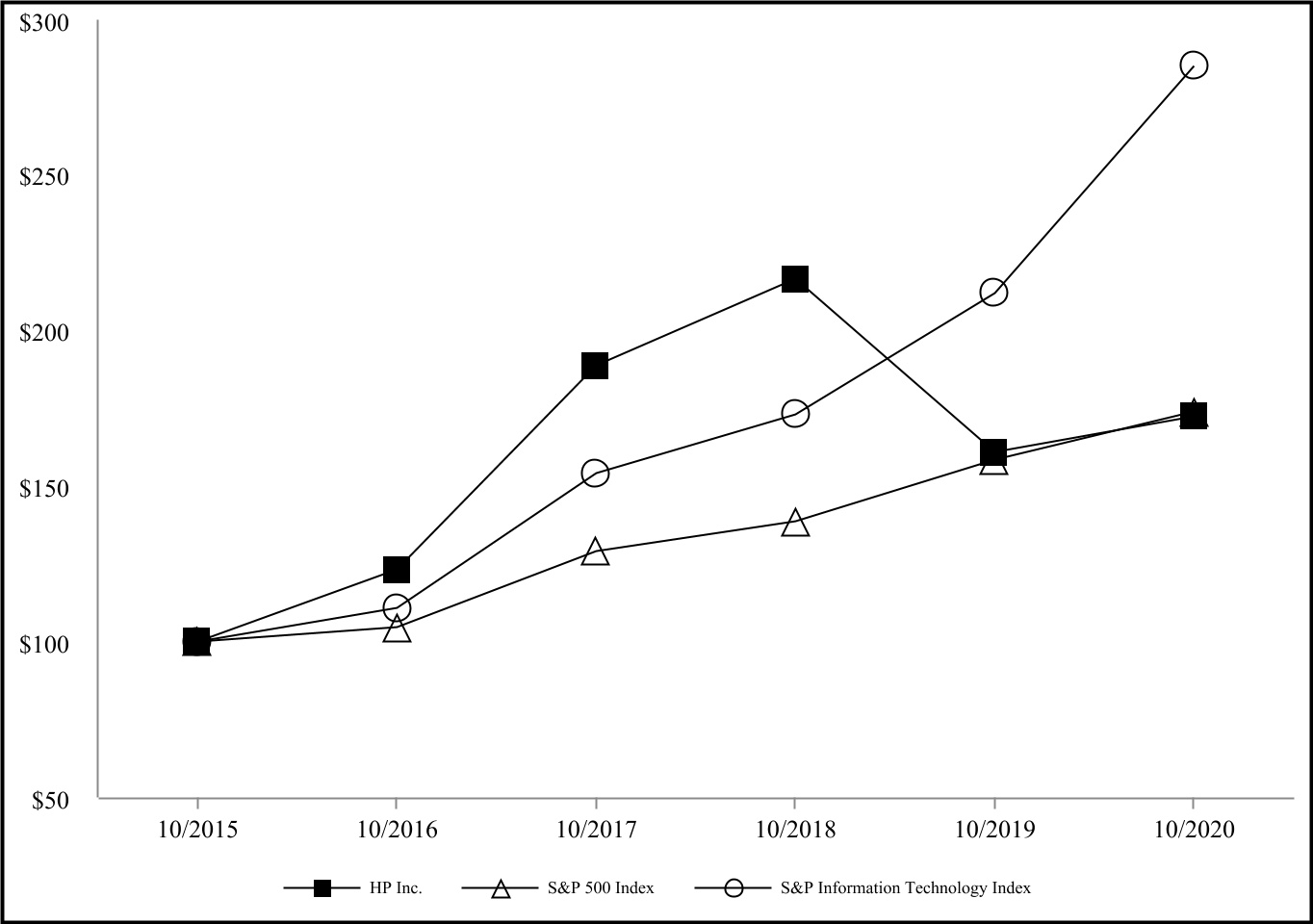
| 10/15 | 10/16 | 10/17 | 10/18 | 10/19 | 10/20 | |||||||||||||||||||||||||||||||||
| HP Inc.(1) | $ | 100.00 | $ | 123.10 | $ | 188.69 | $ | 216.50 | $ | 160.83 | $ | 172.49 | ||||||||||||||||||||||||||
| S&P 500 Index | $ | 100.00 | $ | 104.50 | $ | 129.19 | $ | 138.66 | $ | 158.52 | $ | 173.89 | ||||||||||||||||||||||||||
| S&P Information Technology Index | $ | 100.00 | $ | 110.83 | $ | 154.00 | $ | 172.95 | $ | 212.01 | $ | 285.12 |
(1) Historical stock prices of HP Inc. prior to the Separation, which occurred on November 1, 2015, have been adjusted to reflect the impact of the Separation. The adjustment was established using the conversion ratio based on the market value of stock on the Separation close at October 31, 2015.
Item 6. Selected Financial Data.
The information set forth below is not necessarily indicative of results of future continuing operations and should be read in conjunction with Item 7, “Management’s Discussion and Analysis of Financial Condition and Results of Operations” and the Consolidated Financial Statements and notes thereto included in Item 8, “Financial Statements and Supplementary Data” of this Annual Report on Form 10-K, which are incorporated herein by reference, in order to understand further the factors that may affect the comparability of the financial data presented below.
HP INC. AND SUBSIDIARIES
Selected Financial Data
| For the fiscal years ended October 31 | |||||||||||||||||||||||||||||
| 2020 | 2019 | 2018 | 2017 | 2016 | |||||||||||||||||||||||||
| In millions, except per share amounts | |||||||||||||||||||||||||||||
| Net revenue | $ | 56,639 | $ | 58,756 | $ | 58,472 | $ | 52,056 | $ | 48,238 | |||||||||||||||||||
| Earnings from continuing operations | $ | 3,462 | $ | 3,877 | $ | 3,831 | $ | 3,368 | $ | 3,549 | |||||||||||||||||||
| Net loss from discontinued operations net of taxes | $ | — | $ | — | $ | — | $ | — | $ | (170) | |||||||||||||||||||
| Net earnings | $ | 2,844 | $ | 3,152 | $ | 5,327 | $ | 2,526 | $ | 2,496 | |||||||||||||||||||
| Net earnings per share: | |||||||||||||||||||||||||||||
| Basic | |||||||||||||||||||||||||||||
| Continuing operations | $ | 2.01 | $ | 2.08 | $ | 3.30 | $ | 1.50 | $ | 1.54 | |||||||||||||||||||
| Discontinued operations | $ | — | $ | — | $ | — | $ | — | $ | (0.10) | |||||||||||||||||||
| Total basic net earnings per share | $ | 2.01 | $ | 2.08 | $ | 3.30 | $ | 1.50 | $ | 1.44 | |||||||||||||||||||
| Diluted | |||||||||||||||||||||||||||||
| Continuing operations | $ | 2.00 | $ | 2.07 | $ | 3.26 | $ | 1.48 | $ | 1.53 | |||||||||||||||||||
| Discontinued operations | — | — | — | $ | — | $ | (0.10) | ||||||||||||||||||||||
| Total diluted net earnings per share | $ | 2.00 | $ | 2.07 | $ | 3.26 | $ | 1.48 | $ | 1.43 | |||||||||||||||||||
| Cash dividends declared per share | $ | 0.70 | $ | 0.64 | $ | 0.56 | $ | 0.53 | $ | 0.50 | |||||||||||||||||||
| At year-end: | |||||||||||||||||||||||||||||
| Total assets | $ | 34,681 | $ | 33,467 | $ | 34,622 | $ | 32,913 | $ | 28,987 | |||||||||||||||||||
| Long-term debt(1) | $ | 5,543 | $ | 4,780 | $ | 4,524 | $ | 6,747 | $ | 6,735 |
(1) The increase in Long-term debt in fiscal year 2020 was due to issuance of unsecured senior debt of $3.0 billion in aggregate principal amount partially offset by payment of $1.6 billion for the repurchase and redemption of existing notes. The decrease in Long-term debt in fiscal year 2018 was due to the payment for the repurchase of approximately $1.85 billion in aggregate principal amount of U.S. Dollar Global Notes.
HP INC. AND SUBSIDIARIES
Management’s Discussion and Analysis of
Financial Condition and Results of Operations
Item 7. Management’s Discussion and Analysis of Financial Condition and Results of Operations.
This Management’s Discussion and Analysis of Financial Condition and Results of Operations (“MD&A”) is organized as follows:
-
Overview. A discussion of our business and other highlights affecting the company to provide context for the remainder of this MD&A.
-
Critical Accounting Policies and Estimates. A discussion of accounting policies and estimates that we believe are important to understanding the assumptions and judgments incorporated in our reported financial results.
-
Results of Operations. An analysis of our financial results comparing fiscal year 2020 to fiscal year 2019 and fiscal year 2019 to fiscal year 2018. A discussion of the results of operations is followed by a more detailed discussion of the results of operations by segment.
-
Liquidity and Capital Resources. An analysis of changes in our cash flows and a discussion of our liquidity and financial condition.
-
Contractual and Other Obligations. An overview of contractual obligations, retirement and post-retirement benefit plan contributions, cost-saving plans, uncertain tax positions and off-balance sheet arrangements.
The discussion of financial condition and results of our operations that follows provides information that will assist the reader in understanding our Consolidated Financial Statements, the changes in certain key items in those financial statements from year to year, and the primary factors that accounted for those changes, as well as how certain accounting principles, policies and estimates affect our Consolidated Financial Statements. This discussion should be read in conjunction with our Consolidated Financial Statements and the related notes that appear elsewhere in this document.
HP INC. AND SUBSIDIARIES
Management’s Discussion and Analysis of
Financial Condition and Results of Operations (Continued)
OVERVIEW
We are a leading global provider of personal computing and other access devices, imaging and printing products, and related technologies, solutions, and services. We sell to individual consumers, SMBs and large enterprises, including customers in the government, health, and education sectors. We have three reportable segments: Personal Systems, Printing and Corporate Investments. The Personal Systems segment offers commercial and consumer desktop and notebook PCs, workstations, thin clients, commercial mobility devices, retail POS systems, displays and other related accessories, software, support, and services. The Printing segment provides consumer and commercial printer hardware, supplies, solutions and services, as well as scanning devices. Corporate Investments include HP Labs and certain business incubation and investment projects.
-
In Personal Systems, our strategic focus is on profitable growth through innovation and market segmentation. This focus is with respect to enhanced innovation in multi-operating systems, multi-architecture, geography, customer segments and other key attributes. Additionally, we are investing in endpoint services and solutions. We are focused on services, including Device as a Service, as the market begins to shift to contractual solutions. We are driving innovation to enable productivity and collaboration as near-term demand continues for work from home and distance learning as the PC has become an essential tool to create, consume and collaborate. We believe that we are well positioned due to our competitive product lineup.
-
In Printing, our strategic focus is on contractual solutions to serve consumers, SMBs and large enterprises through our Instant Ink Services and Managed Print Services (“MPS”) offerings, providing digital printing solutions for graphics segments and applications including commercial publishing, labels, packaging and textiles; as well as expanding our footprint in the 3D printing across digital manufacturing and strategic applications.
We continue to experience challenges that are representative of trends and uncertainties that may affect our business and results of operations. One set of challenges relates to dynamic market trends, such as forecasted declining home printing markets. A second set of challenges relates to changes in the competitive landscape. Our primary competitors are exerting competitive pressure in targeted areas and are entering new markets, our emerging competitors are introducing new technologies and business models, and our alliance partners in some businesses are increasingly becoming our competitors in others. A third set of challenges relates to business model changes and our go-to-market execution in an evolving distribution and reseller landscape, with increasing online and omnichannel presence. Additional challenges we face at the segment level are set forth below.
-
In Personal Systems, we face challenges with industry component availability and a competitive pricing environment.
-
In Printing, a competitive pricing environment, including from non-original supplies (which includes imitation, refill or remanufactured alternatives), and a weakened market in certain geographies with associated pricing sensitivity of our customers present challenges. We also obtain many Printing components from single sources due to technology, availability, price, quality or other considerations. For instance, we source the majority of our A4 and a portion of our A3 portfolio of laser printer engines and laser toner cartridges from Canon. Any decision by either party to not renew our agreement with Canon or to limit or reduce the scope of the agreement could adversely affect our net revenue from LaserJet products; however, we have a long-standing business relationship with Canon and anticipate renewal of this agreement.
Our business and financial performance also depend significantly on worldwide economic conditions. Accordingly, we face global macroeconomic challenges, particularly in light of the effects of the COVID-19 pandemic as discussed below, tariff-driven headwinds, uncertainty in the markets, volatility in exchange rates and evolving dynamics in the global trade environment. The full impact of these and other global macroeconomic challenges on our business cannot be known at this time.
To address these challenges, we continue to pursue innovation with a view towards developing new products and services aligned with generating market demand and meeting the needs of our customers and partners. In addition, we continue to work on improving our operations and adapting our business models, with a particular focus on enhancing our end-to-end processes, analytics and efficiencies. We also continue to work on optimizing our sales coverage models, aligning our sales incentives with our strategic goals, improving channel execution and inventory management, strengthening our capabilities in our areas of strategic focus, strengthening our pricing discipline, and developing and capitalizing on market opportunities.
Specifically, in October 2019, we announced cost-reduction and operational efficiency initiatives intended to simplify the way we work, move closer to our customers and facilitate specific investment in our business. These were further updated in February 2020. These efforts included transforming our operating model to integrate our sales force into a single commercial organization and reducing structural costs across the Company through our restructuring plan approved in September 2019 (the “Fiscal 2020 Plan”). We expect to invest some of the savings from these efforts across our businesses, including investing to
HP INC. AND SUBSIDIARIES
Management’s Discussion and Analysis of
Financial Condition and Results of Operations
build our digital capabilities. Over time, we expect these investments will make us more efficient
Showing the first 8K of 89K characters. Open the full section
Item 7A. Quantitative and Qualitative Disclosures About Market Risk.
In the normal course of business, we are exposed to foreign currency exchange rate and interest rate risks that could impact our financial position and results of operations. Our risk management strategy with respect to these market risks may include the use of derivative instruments. We use derivative contracts only to manage existing underlying exposures. Accordingly, we do not use derivative contracts for speculative purposes. Our risks, risk management strategy and a sensitivity analysis estimating the effects of changes in fair value for each of these exposures are outlined below.
Actual gains and losses in the future may differ materially from the sensitivity analyses based on changes in the timing and amount of foreign currency exchange rate and interest rate movements and our actual exposures and derivatives in place at the time of the change, as well as the effectiveness of the derivative to hedge the related exposure.
Foreign currency exchange rate risk
We are exposed to foreign currency exchange rate risk inherent in our sales commitments, anticipated sales, anticipated purchases and assets and liabilities denominated in currencies other than the U.S. dollar. We transact business in over 40 currencies worldwide, of which the most significant foreign currencies to our operations for fiscal year 2020 were the euro, Chinese yuan renminbi, the Japanese yen and the British pound. For most currencies, we are a net receiver of the foreign currency and therefore benefit from a weaker U.S. dollar and are adversely affected by a stronger U.S. dollar relative to the foreign currency. Even where we are a net receiver of the foreign currency, a weaker U.S. dollar may adversely affect certain expense figures, if taken alone.
We use a combination of forward contracts and at times, options designated as cash flow hedges to protect against the foreign currency exchange rate risks inherent in our forecasted net revenue and, to a lesser extent in cost of sales. In addition, when debt is denominated in a foreign currency, we may use swaps to exchange the foreign currency principal and interest obligations for U.S. dollar-denominated amounts to manage the exposure to changes in foreign currency exchange rates. We also use other derivatives not designated as hedging instruments consisting primarily of forward contracts to hedge foreign currency balance sheet exposures. Alternatively, we may choose not to hedge the risk associated with our foreign currency exposures, primarily if such exposure acts as a natural hedge for offsetting amounts denominated in the same currency or if the currency is too difficult or too expensive to hedge.
We have performed sensitivity analyses for continuing operations as of October 31, 2020 and 2019, using a modeling technique that measures the change in the fair values arising from a hypothetical 10% adverse movement in the levels of foreign currency exchange rates relative to the U.S. dollar, with all other variables held constant. The analyses cover all of our foreign currency derivative contracts offset by underlying exposures. The foreign currency exchange rates we used in performing the sensitivity analysis were based on market rates in effect at October 31, 2020 and 2019. The sensitivity analyses indicated that a hypothetical 10% adverse movement in foreign currency exchange rates would result in a foreign exchange fair value loss of $77 million and $81 million at October 31, 2020 and October 31, 2019, respectively.
Interest rate risk
We also are exposed to interest rate risk related to debt we have issued and our investment portfolio.
We issue long-term debt in either U.S. dollars or foreign currencies based on market conditions at the time of financing. We may use interest rate and/or currency swaps to modify the market risk exposures in connection with the debt to achieve floating interest expense. The swap transactions generally involve the exchange of fixed for floating interest payments. However, we may choose not to swap fixed for floating interest payments or may terminate a previously executed swap if we believe a larger proportion of fixed-rate debt would be beneficial.
In order to hedge the fair value of certain fixed-rate investments, we may enter into interest rate swaps that convert fixed interest returns into variable interest returns. We may use cash flow hedges to hedge the variability in interest income received on certain variable-rate investments. We may also enter into interest rate swaps that convert variable rate interest returns into fixed-rate interest returns.
We have performed sensitivity analyses as of October 31, 2020 and 2019, using a modeling technique that measures the change in the fair values arising from a hypothetical 10% adverse movement in the levels of interest rates across the entire yield curve, with all other variables held constant. The analyses cover our debt, investments and interest rate swaps. The analyses use actual or approximate maturities for the debt, investments and interest rate swaps. The discount rates used were based on the market interest rates in effect at October 31, 2020 and 2019. The sensitivity analyses indicated that a hypothetical 10% adverse movement in interest rates would have resulted in a loss in the fair values of our debt and investments, net of interest rate swaps, of $36 million at October 31, 2020 and $49 million at October 31, 2019.
Item 8. Financial Statements and Supplementary Data.
Table of Contents
Report of Independent Registered Public Accounting Firm
To the Stockholders and the Board of Directors of HP Inc.
Opinion on the Financial Statements
We have audited the accompanying consolidated balance sheets of HP Inc. and subsidiaries (the Company) as of October 31, 2020 and 2019, the related consolidated statements of earnings, comprehensive income, stockholders' deficit and cash flows for each of the three years in the period ended October 31, 2020, and the related notes (collectively referred to as the “consolidated financial statements”). In our opinion, the consolidated financial statements present fairly, in all material respects, the financial position of the Company at October 31, 2020 and 2019, and the results of its operations and its cash flows for each of the three years in the period ended October 31, 2020, in conformity with U.S. generally accepted accounting principles.
We also have audited, in accordance with the standards of the Public Company Accounting Oversight Board (United States) (PCAOB), the Company’s internal control over financial reporting as of October 31, 2020, based on criteria established in Internal Control-Integrated Framework issued by the Committee of Sponsoring Organizations of the Treadway Commission (2013 framework) and our report dated December 10, 2020 expressed an unqualified opinion thereon.
Adoption of New Accounting Standard
As discussed in Note 1 to the consolidated financial statements, the Company changed its method for recognizing revenue in 2019 due to the adoption of Accounting Standards Update (ASU) No. 2014-09, Revenue from Contracts with Customers (Topic 606), and the amendments effective November 1, 2018 and its method of accounting for leases in 2020 due to the adoption of Accounting Standards Update (ASU) No. 2016-02, Leases (Topic 842) effective November 1, 2019.
Basis for Opinion
These financial statements are the responsibility of the Company's management. Our responsibility is to express an opinion on the Company’s financial statements based on our audits. We are a public accounting firm registered with the PCAOB and are required to be independent with respect to the Company in accordance with the U.S. federal securities laws and the applicable rules and regulations of the Securities and Exchange Commission and the PCAOB.
We conducted our audits in accordance with the standards of the PCAOB. Those standards require that we plan and perform the audit to obtain reasonable assurance about whether the financial statements are free of material misstatement, whether due to error or fraud. Our audits included performing procedures to assess the risks of material misstatement of the financial statements, whether due to error or fraud, and performing procedures that respond to those risks. Such procedures included examining, on a test basis, evidence regarding the amounts and disclosures in the financial statements. Our audits also included evaluating the accounting principles used and significant estimates made by management, as well as evaluating the overall presentation of the financial statements. We believe that our audits provide a reasonable basis for our opinion.
Critical Audit Matters
The critical audit matters communicated below are matters arising from the current period audit of the financial statements that were communicated or required to be communicated to the audit committee and that: (1) relate to accounts or disclosures that are material to the financial statements and (2) involved our especially challenging, subjective or complex judgments. The communication of critical audit matters does not alter in any way our opinion on the consolidated financial statements, taken as a whole, and we are not, by communicating the critical audit matters below, providing separate opinio
Showing the first 8K of 306K characters. Open the full section
Item 9. Changes in and Disagreements with Accountants on Accounting and Financial Disclosure.
None.
Item 9A. Controls and Procedures.
Under the supervision and with the participation of our management, including our principal executive officer and principal financial officer, we conducted an evaluation of the effectiveness of the design and operation of our disclosure controls and procedures, as defined in Rules 13a-15(e) and 15d-15(e) under the Exchange Act as of the end of the period covered by this report (the “Evaluation Date”). Based on this evaluation, our principal executive officer and principal financial officer concluded as of the Evaluation Date that our disclosure controls and procedures were effective such that the information required to be disclosed by us in our SEC reports (i) is recorded, processed, summarized and reported within the time periods specified in SEC rules and forms, and (ii) is accumulated and communicated to HP’s management, including our principal executive officer and principal financial officer, as appropriate to allow timely decisions regarding required disclosure.
Under the supervision and with the participation of our management, including our principal executive officer and principal financial officer, we conducted an evaluation of any changes in our internal control over financial reporting (as such term is defined in Rules 13a-15(f) and 15d-15(f) under the Exchange Act) that occurred during our most recently completed fiscal quarter. Based on that evaluation, our principal executive officer and principal financial officer concluded that there has not been any change in our internal control over financial reporting during the fourth quarter of fiscal year 2020 that has materially affected, or is reasonably likely to materially affect, our internal control over financial reporting.
We do not believe there has been any material impact to our internal controls over financial reporting notwithstanding that most of our employees are working remotely due to the COVID-19 pandemic. We continue to monitor and assess the COVID-19 situation on our internal controls to address any potential impact on their design and operating effectiveness.
See Management’s Report on Internal Control over Financial Reporting and the Report of Independent Registered Public Accounting Firm on our internal control over financial reporting in Item 8, which are incorporated herein by reference.
Item 9B. Other Information.
Item 10. Directors, Executive Officers and Corporate Governance.
The names of the executive officers of HP and their ages, titles and biographies as of the date hereof are incorporated by reference from Part I, Item 1, above.
The following information is included in HP’s Proxy Statement related to its 2020 Annual Meeting of Stockholders to be filed within 120 days after HP’s fiscal year end of October 31, 2020 (the “Proxy Statement”) and is incorporated herein by reference:
-
Information regarding directors of HP who are standing for reelection and any persons nominated to become directors of HP is set forth under “Corporate Governance and Board of Directors—Management Proposal No. 1 Election of Directors.”
-
Information regarding HP’s Audit Committee and designated “audit committee financial experts” is set forth under “Corporate Governance and Board of Directors—Management Proposal No. 1 Election of Directors—How We Are Organized—Audit Committee.”
-
Information on HP’s code of business conduct and ethics for directors, officers and employees, also known as “Integrity at HP”, is set forth under “Corporate Governance and Board of Directors—Management Proposal No. 1 Election of Directors—How We Govern and Are Governed—Code of Conduct” and information on HP’s Corporate Governance Guidelines is set forth under “—How We Are Selected—Director Nominees and Director Nominees’ Experience and Qualifications” and “—How We Govern and Are Governed—Director Independence.”
Item 11. Executive Compensation.
The following information is included in the Proxy Statement and is incorporated herein by reference:
-
Information regarding HP’s compensation of its named executive officers is set forth under “Executive Compensation.”
-
Information regarding HP’s compensation of its directors is set forth under “Corporate Governance and Board of Directors—Management Proposal No. 1 Election of Directors—How We Are Compensated—Director Compensation and Stock Ownership Guidelines.”
-
The report of HP’s HR and Compensation Committee is set forth under “Executive Compensation—Management Proposal No. 3 Advisory Vote to Approve Executive Compensation—HR and Compensation Committee Report on Executive Compensation.”
Item 12. Security Ownership of Certain Beneficial Owners and Management and Related Stockholder Matters.
The following information is included in the Proxy Statement and is incorporated herein by reference:
-
Information regarding security ownership of certain beneficial owners, directors and executive officers is set forth under “Ownership of Our Stock—Common Stock Ownership of Certain Beneficial Owners and Management.”
-
Information regarding HP’s equity compensation plans, including both stockholder approved plans and non-stockholder approved plans, is set forth in the section entitled “Executive Compensation—Management Proposal No. 3 Advisory Vote to Approve Executive Compensation—Equity Compensation Plan Information.”
Item 13. Certain Relationships and Related Transactions, and Director Independence.
The following information is included in the Proxy Statement and is incorporated herein by reference:
-
Information regarding transactions with related persons is set forth under “Corporate Governance and Board of Directors—Management Proposal No. 1 Election of Directors—Related-Person Transactions Policies and Procedures—Fiscal 2020 Related-Person Transactions.”
-
Information regarding director independence is set forth under “Corporate Governance and Board of Directors—Management Proposal No. 1 Election of Directors—How We Govern and Are Governed—Director Independence.”
Item 14. Principal Accounting Fees and Services.
Information regarding principal accounting fees and services is set forth under “Audit Matters—Management Proposal No. 2 Ratification of Independent Registered Public Accounting Firm—Principal Accounting Fees and Services” in the Proxy Statement, which information is incorporated herein by reference.
PART IV
Item 15. Exhibits and Financial Statement Schedules.
(a)The following documents are filed as part of this report:
1.All Financial Statements:
The following financial statements are filed as part of this report under Item 8—“Financial Statements and Supplementary Data.”
2.Financial Statement Schedules:
All schedules are omitted as the required information is not applicable or the information is presented in the Consolidated Financial Statements and notes thereto in Item 8 above.
3.Exhibits:
| Exhibit Number | Incorporated by Reference | |||||||||||||||||||||||||||||||
| Exhibit Description | Form | File No. | Exhibit(s) | Filing Date | ||||||||||||||||||||||||||||
| 2(a) | Separation and Distribution Agreement, dated as of October 31, 2015, by and among Hewlett-Packard Company, Hewlett Packard Enterprise Company and the Other Parties Thereto.** | 8-K | 001-04423 | 2.1 | November 5, 2015 | |||||||||||||||||||||||||||
| 2(b) | Transition Services Agreement, dated as of November 1, 2015, by and between Hewlett-Packard Company and Hewlett Packard Enterprise Company.** | 8-K | 001-04423 | 2.2 | November 5, 2015 | |||||||||||||||||||||||||||
| 2(d) | Employee Matters Agreement, dated as of October 31, 2015, by and between Hewlett-Packard Company and Hewlett Packard Enterprise Company.** | 8-K | 001-04423 | 2.4 | November 5, 2015 | |||||||||||||||||||||||||||
| 3(a) | Registrant’s Certificate of Incorporation. | 10-Q | 001-04423 | 3(a) | June 12, 1998 | |||||||||||||||||||||||||||
| 3(b) | Registrant’s Amendment to the Certificate of Incorporation. | 10-Q | 001-04423 | 3(b) | March 16, 2001 |
| 3(c) | Registrant’s Certificate of Amendment to the Certificate of Incorporation. | 8-K | 001-04423 | 3.2 | October 22, 2015 | |||||||||||||||||||||||||||
| 3(d) | Registrant’s Certificate of Amendment to the Certificate of Incorporation. | 8-K | 001-04423 | 3.1 | April 7, 2016 | |||||||||||||||||||||||||||
| 3(e) | Registrant’s Amended and Restated Bylaws. | 8-K | 001-04423 | 3.1 | February 13, 2019 | |||||||||||||||||||||||||||
| 3(f) | Certificate of Designations of Series A Junior Participating Preferred Stock of HP Inc. | 8-K | 001-04423 | 3.1 | February 20, 2020 | |||||||||||||||||||||||||||
| 4(a) | Form of Senior Indenture | S-3 | 333-215116 | 4.1 | December 15, 2016 | |||||||||||||||||||||||||||
| 4(b) | Form of Subordinated Indenture. | S-3 | 333-21516 | 4.2 | December 15, 2016 | |||||||||||||||||||||||||||
| 4(c) | Form of Registrant’s 3.750% Global Note due December 1, 2020 and form of related Officers’ Certificate. | 8-K | 001-04423 | 4.2 and 4.3 | December 2, 2010 | |||||||||||||||||||||||||||
| 4(d) | Form of Registrant’s 4.300% Global Note due June 1, 2021 and form of related Officers’ Certificate. | 8-K | 001-04423 | 4.5 and 4.6 | June 1, 2011 | |||||||||||||||||||||||||||
| 4(e) | Form of Registrant’s 4.375% Global Note due September 15, 2021 and 6.000% Global Note due September 15, 2041 and form of related Officers’ Certificate. | 8-K | 001-04423 | 4.4, 4.5 and 4.6 | September 19, 2011 | |||||||||||||||||||||||||||
| 4(f) | Form of Registrant’s 4.650% Global Note due December 9, 2021 and related Officers’ Certificate. | 8-K | 001-04423 | 4.3 and 4.4 | December 12, 2011 | |||||||||||||||||||||||||||
| 4(g) | Form of Registrant’s 4.050% Global Note due September 15, 2022 and related Officers’ Certificate. | 8-K | 001-04423 | 4.2 and 4.3 | March 12, 2012 | |||||||||||||||||||||||||||
| 4(h) | Specimen certificate for the Registrant’s common stock. | 8-A/A | 001-04423 | 4.1 | June 23, 2006 | |||||||||||||||||||||||||||
| 4(i) | First Supplemental Indenture, dated as of March 26, 2018, to the Indenture, dated as of June 1, 2000, by and between the Registrant and The Bank of New York Mellon Trust Company, N.A. | 10-Q | 001-04423 | 4(j) | June 5, 2018 | |||||||||||||||||||||||||||
| 4(j) | Description of HP Inc.’s securities. | 10-K | 001-04423 | 4(j) | December 12, 2019 | |||||||||||||||||||||||||||
| 4(k) | Rights Agreement, dated as of February 20, 2020, between HP Inc. and Equiniti Trust Company, as rights agent, which includes the form of Right Certificate as Exhibit B and the Summary of Rights to Purchase Preferred Shares as Exhibit C. | 8-K | 001-04423 | 4.1 | February 20, 2020 | |||||||||||||||||||||||||||
| 4(l) | First Amendment to Rights Agreement, dated as of June 25, 2020, between HP Inc. and Equiniti Trust Company, as rights agent. | 8-K | 001-04423 | 4.1 | June 26, 2020 | |||||||||||||||||||||||||||
| 4(m) | Indenture, dated as of June 17, 2020, between HP Inc. and The Bank of New York Mellon Trust Company, N.A., as trustee. | 8-K | 001-04423 | 4.1 | June 17, 2020 | |||||||||||||||||||||||||||
| 4(n) | Form of 2.200% notes due 2025 and related Officers’ Certificate. | 8-K | 001-04423 | 4.2 and 4.5 | June 17, 2020 | |||||||||||||||||||||||||||
| 4(o) | Form of 3.000% notes due 2027 and related Officers’ Certificate. | 8-K | 001-04423 | 4.3 and 4.5 | June 17, 2020 | |||||||||||||||||||||||||||
| 4(p) | Form of 3.400% notes due 2030 and related Officers’ Certificate. | 8-K | 001-04423 | 4.4 and 4.5 | June 17, 2020 | |||||||||||||||||||||||||||
| Exhibit Number | Incorporated by Reference | |||||||||||||||||||||||||||||||
| 24 | Power of Attorney (included on the signature page). | |||||||||||||||||||||||||||||||
| 31.1 | Certification of Chief Executive Officer pursuant to Rule 13a-14(a) and Rule 15d-14(a) of the Securities Exchange Act of 1934, as amended.† | |||||||||||||||||||||||||||||||
| 31.2 | Certification of Chief Financial Officer pursuant to Rule 13a-14(a) and Rule 15d-14(a) of the Securities Exchange Act of 1934, as amended.† | |||||||||||||||||||||||||||||||
| 32 | Certification of Chief Executive Officer and Chief Financial Officer pursuant to 18 U.S.C. 1350, as adopted pursuant to Section 906 of the Sarbanes-Oxley Act of 2002.†† | |||||||||||||||||||||||||||||||
| 101.INS | XBRL Instance Document - the instance document does not appear in the Interactive Data File because its XBRL tags are embedded within the Inline XBRL document.† | |||||||||||||||||||||||||||||||
| 101.SCH | Inline XBRL Taxonomy Extension Schema Document.† | |||||||||||||||||||||||||||||||
| 101.CAL | Inline XBRL Taxonomy Extension Calculation Linkbase Document.† | |||||||||||||||||||||||||||||||
| 101.DEF | Inline XBRL Taxonomy Extension Definition Linkbase Document.† | |||||||||||||||||||||||||||||||
| 101.LAB | Inline XBRL Taxonomy Extension Label Linkbase Document.† | |||||||||||||||||||||||||||||||
| 101.PRE | Inline XBRL Taxonomy Extension Presentation Linkbase Document.† | |||||||||||||||||||||||||||||||
| 104 | The cover page from the Company’s Annual Report on Form 10-K for the fiscal year ended October 31, 2020, formatted in Inline XBRL (included within the Exhibit 101 attachments).† |
- Indicates management contract or compensatory plan, contract or arrangement.
** Certain schedules and exhibits to this agreement have been omitted pursuant to Item 601(a)(5) of Registration S-K. A copy of any omitted schedule and/or exhibit will be furnished supplementally to the SEC upon request.
† Filed herewith.
†† Furnished herewith.
The registrant agrees to furnish to the Commission supplementally upon request a copy of (1) any instrument with respect to long-term debt not filed herewith as to which the total amount of securities authorized thereunder does not exceed 10% of the total assets of the registrant and its subsidiaries on a consolidated basis and (2) any omitted schedules to any material agreements set forth above.
Item 16. Form 10-K Summary
None.
SIGNATURES
Pursuant to the requirements of Section 13 or 15(d) of the Securities Exchange Act of 1934, the registrant has duly caused this report to be signed on its behalf by the undersigned, thereunto duly authorized.
| Date: December 10, 2020 | HP INC. | |||||||
| By: | /s/ MARIE MYERS | |||||||
| Marie Myers Acting Chief Financial Officer |
POWER OF ATTORNEY
KNOW ALL PERSONS BY THESE PRESENTS, that each person whose signature appears below constitutes and appoints Marie Myers, Kim Rivera and Ruairidh Ross, or any of them, his or her attorneys-in-fact, for such person in any and all capacities, to sign any amendments to this report and to file the same, with exhibits thereto, and other documents in connection therewith, with the Securities and Exchange Commission, hereby ratifying and confirming all that either of said attorneys-in-fact, or substitute or substitutes, may do or cause to be done by virtue hereof.
Pursuant to the requirements of the Securities Exchange Act of 1934, this report has been signed below by the following persons on behalf of the registrant and in the capacities and on the dates indicated.
| Signature | Title(s) | Date | ||||||||||||
| /s/ ENRIQUE LORES | President and Chief Executive Officer and Director (Principal Executive Officer) | December 10, 2020 | ||||||||||||
| Enrique Lores | ||||||||||||||
| /s/ MARIE MYERS | Acting Chief Financial Officer (Principal Financial Officer) | December 10, 2020 | ||||||||||||
| Marie Myers | ||||||||||||||
| /s/ CLAIRE BRAMLEY | Global Controller (Principal Accounting Officer) | December 10, 2020 | ||||||||||||
| Claire Bramley | ||||||||||||||
| /s/ AIDA ALVAREZ | Director | December 10, 2020 | ||||||||||||
| Aida Alvarez | ||||||||||||||
| /s/ SHUMEET BANERJI | Director | December 10, 2020 | ||||||||||||
| Shumeet Banerji | ||||||||||||||
| /s/ ROBERT R. BENNETT | Director | December 10, 2020 | ||||||||||||
| Robert R. Bennett | ||||||||||||||
| /s/ CHARLES V. BERGH | Director | December 10, 2020 | ||||||||||||
| Charles V. Bergh | ||||||||||||||
| /s/ STACY BROWN-PHILPOT | Director | December 10, 2020 | ||||||||||||
| Stacy Brown-Philpot | ||||||||||||||
| /s/ STEPHANIE BURNS | Director | December 10, 2020 | ||||||||||||
| Stephanie Burns | ||||||||||||||
| /s/ MARY ANNE CITRINO | Director | December 10, 2020 | ||||||||||||
| Mary Anne Citrino | ||||||||||||||
| /s/ RICHARD L. CLEMMER | Director | December 10, 2020 | ||||||||||||
| Richard L. Clemmer | ||||||||||||||
| /s/ YOKY MATSUOKA | Director | December 10, 2020 | ||||||||||||
| Yoky Matsuoka | ||||||||||||||
| /s/ STACEY MOBLEY | Director | December 10, 2020 | ||||||||||||
| Stacey Mobley | ||||||||||||||
| /s/ SUBRA SURESH | Director | December 10, 2020 | ||||||||||||
| Subra Suresh | ||||||||||||||