 filings.tools
Hormel Foods 10-K 2019-10-27
Filed 2019-12-06. 22 sections, 352K characters. Original on sec.gov · Markdown · JSON
Cover and table of contents
UNITED STATES
SECURITIES AND EXCHANGE COMMISSION
Washington, D.C. 20549
FORM 10-K
| ☒ | ANNUAL REPORT PURSUANT TO SECTION 13 OR 15(d) OF THE SECURITIES EXCHANGE ACT OF 1934 |
For the fiscal year ended October 27, 2019
or
| ☐ | TRANSITION REPORT PURSUANT TO SECTION 13 OR 15(d) OF THE SECURITIES EXCHANGE ACT OF 1934 |
For the transition period from ____________________ to _________________________
Commission File Number: 1-2402
HORMEL FOODS CORPORATION
(Exact name of registrant as specified in its charter)
| Delaware | 41-0319970 | |
| (State or other jurisdiction of incorporation or organization) | (I.R.S. Employer Identification No.) |
| 1 Hormel Place | Austin | Minnesota | 55912-3680 |
| (Address of principal executive offices) | (Zip Code) |
Registrant’s telephone number, including area code (507) 437-5611
Securities registered pursuant to Section 12(b) of the Act:
| Title of each class | Trading Symbol | Name of each exchange on which registered | ||||
| Common Stock | $0.01465 | par value | HRL | New York Stock Exchange |
Securities registered pursuant to Section 12(g) of the Act: None
Indicate by check mark if the registrant is a well-known seasoned issuer, as defined in Rule 405 of the Securities Act. Yes ☒ No ☐
Indicate by check mark if the registrant is not required to file reports pursuant to Section 13 or Section 15(d) of the Act. Yes ☐
No ☒
Indicate by check mark whether the registrant (1) has filed all reports required to be filed by Section 13 or 15(d) of the Securities Exchange Act of 1934 during the preceding 12 months, and (2) has been subject to such filing requirements for the past 90 days. Yes ☒ No ☐
Indicate by check mark whether the registrant has submitted electronically every Interactive Data File required to be submitted pursuant to Rule 405 of Regulations S-T during the preceding 12 months (or for such shorter period that the registrant was required to submit such files). Yes ☒ No ☐
Indicate by check mark whether the registrant is a large accelerated filer, an accelerated filer, a non-accelerated filer, smaller reporting company, or an emerging growth company. See the definitions of “large accelerated filer,” “accelerated filer”, “smaller reporting company”, and “emerging growth company” in Rule 12b-2 of the Exchange Act.
| Large accelerated filer | ☒ | Accelerated filer | ☐ |
| Non-accelerated filer | ☐ | Smaller reporting company | ☐ |
| Emerging growth company | ☐ |
If an emerging growth company, indicate by check mark if the registrant has elected not to use the extended transition period for complying with any new or revised financial accounting standards provided pursuant to Section 13(a) of the Exchange Act. ☐
Indicate by check mark whether the registrant is a shell company (as defined in Rule 12b-2 of the Act). Yes ☐ No ☒
The aggregate market value of the voting and non-voting common stock held by non-affiliates of the registrant as of April 28, 2019, was $11,072,534,818 based on the closing price of $39.94 on the last business day of the registrant’s most recently completed second fiscal quarter.
As of November 29, 2019, the number of shares outstanding of each of the registrant’s classes of common stock was as follows:
Common Stock, $0.01465 – Par Value 534,736,743 shares
Common Stock Non-Voting, $0.01 Par Value – 0 shares
DOCUMENTS INCORPORATED BY REFERENCE
Portions of the Proxy Statement for the Annual Meeting of Stockholders to be held January 28, 2020, are incorporated by reference into Part III, Items 10-14. The Proxy Statement will be filed with the Securities and Exchange Commission within 120 days after the end of the fiscal year to which this report relates.
HORMEL FOODS CORPORATION
TABLE OF CONTENTS
PART I
Item 1. BUSINESS
General Development of Business
Hormel Foods Corporation, a Delaware corporation (the Company), was founded by George A. Hormel in 1891 in Austin, Minnesota, as Geo. A. Hormel & Company. The Company started as a processor of meat and food products and continues in this line of business. The Company’s name was changed to Hormel Foods Corporation on January 31, 1995. The Company is primarily engaged in the production of a variety of meat and food products and the marketing of those products throughout the United States and internationally. Although pork and turkey remain the major raw materials for its products, the Company has emphasized for several years the manufacturing and distribution of branded, value-added consumer items rather than the commodity fresh meat business. The Company has continually expanded its product portfolio through organic growth and acquisitions.
Internationally, the Company markets its products through Hormel Foods International Corporation (HFIC), a wholly owned subsidiary. HFIC has a global presence in the international marketplace through joint ventures and placement of personnel in strategic foreign locations such as Australia, Brazil, Canada, China, Japan, and the Philippines. HFIC has a minority position in a food company in the Philippines (The Purefoods-Hormel Company, Inc., 40% holding).
On April 15, 2019, the Company completed the sale of CytoSport, Inc. (CytoSport), which includes the Muscle Milk*®* and Evolve*®* brands, to PepsiCo, Inc., and received final proceeds of $479.8 million. The divestiture resulted in a pretax gain of $16.5 million recognized in Selling, General and Administrative expense and a tax benefit of $17.0 million recognized within the Provision for Income Taxes on the Consolidated Statements of Operations.
On December 3, 2018, the Company completed the sale of its Fremont, Nebraska, processing facility to Wholestone Farms, LLC, for a final purchase price of $30.6 million.
On November 27, 2017, the Company acquired Columbus Manufacturing, Inc. (Columbus), an authentic premium deli meat and salami company, from Chicago-based Arbor Investments, for a final purchase price of $857.4 million. The transaction was funded with cash on hand along with borrowing $375.0 million under a term loan facility and $375.0 million under a revolving credit facility. Columbus specializes in authentic premium deli meat and salami and allows the Company to enhance its scale in the deli by broadening its portfolio of products, customers, and consumers.
On August 22, 2017, the Company acquired Cidade do Sol (Ceratti) for a final purchase price of $103.3 million. The transaction was funded by the Company with cash on hand. The acquisition of the Ceratti® brand allows the Company to establish a full in-country presence in the fast-growing Brazilian market with a premium brand.
On August 16, 2017, the Company acquired Fontanini Italian Meats and Sausages (Fontanini), a branded foodservice business, from Capitol Wholesale Meats, Inc. for a final purchase price of $425.7 million. The transaction was funded by the Company with cash on hand and by utilizing short-term financing. Fontanini specializes in authentic Italian meats and sausages, as well as a variety of other premium meat products including pizza toppings and meatballs and allows the Company to expand its foodservice business.
On January 3, 2017, the Company completed the sale of Clougherty Packing, LLC, parent company of Farmer John and Saag’s Specialty Meats, along with PFFJ, LLC, farm operations in California, Arizona, and Wyoming. The closing price was $145.0 million in cash.
On May 26, 2016, the Company acquired Justin’s, LLC (Justin’s) of Boulder, Colorado, for a purchase price of $280.9 million. The purchase price was funded by the Company with cash on hand and by utilizing short-term financing. This acquisition allowed the Company to enhance its presence in the specialty natural and organic nut butter category.
On May 9, 2016, the Company completed the sale of Diamond Crystal Brands resulting in proceeds of $110.1 million, net of selling costs.
On July 13, 2015, the Company acquired Applegate Farms, LLC (Applegate) of Bridgewater, New Jersey, for a final purchase price of $774.1 million in cash. The purchase price was funded by the Company with cash on hand and by utilizing short-term financing. This acquisition allows the Company to expand the breadth of its protein offerings to provide consumers more choice in this fast growing category.
The Company had no other significant change in the type of products produced or services rendered, or in the markets or methods of distribution, since the beginning of the 2019 fiscal year. The Company has not been involved in any bankruptcy, receivership, or similar proceedings during its history.
Segments
The Company develops, processes, and distributes a wide array of food products in a variety of markets. The Company reports results in the following four segments: Grocery Products, Refrigerated Foods, Jennie-O Turkey Store, and International & Other. At the beginning of fiscal 2019, the Hormel Deli Solutions division combined all deli businesses, including the Jennie-O Turkey Store deli division, into one division within the Refrigerated Foods segment. In addition, the ingredients business was realigned from the Grocery Products segment to the Refrigerated Foods segment. Segment results for fiscal years prior to 2019 have been adjusted to reflect these changes. Net sales to unaffiliated customers, operating profit, total assets, and the presentation of certain other financial information by segment, are reported in Note P - Segment Reporting of the Notes to Consolidated Financial Statements and in the Management's Discussion and Analysis of Financial Condition and Results of Operations.
Description of Business
Products and Distribution
The Company’s products primarily consist of meat and other food products sold across multiple distribution channels such as U.S. Retail, U.S. Foodservice, U.S. Deli, and International. Total revenues contributed by classes of similar products and sales channels for the last three fiscal years are reported in Note P - Segment Reporting of the Notes to Consolidated Financial Statements.
Domestically, the Company sells its products in all 50 states. The Company’s products are sold through its sales personnel, operating in assigned territories or as dedicated teams serving major customers, coordinated from sales offices located in most of the larger U.S. cities. The Company also utilizes independent brokers and distributors. Distribution of products to customers is primarily by common carrier.
Through HFIC, the Company markets its products in various locations throughout the world. Some of the larger markets include Australia, Brazil, Canada, China, England, Japan, Mexico, Micronesia, the Philippines, Singapore, and South Korea. The distribution of export sales to customers is by common carrier, while the China and Brazil operations own and operate their own delivery systems. The Company, through HFIC, has licensed companies to manufacture various products internationally on a royalty basis, with the primary licensees being Danish Crown UK Ltd. and CJ CheilJedang Corporation.
As of October 27, 2019, the Company had approximately 970 direct sales representatives engaged in selling its products globally.
Raw Materials
The Company has, for the past several years, been concentrating on branded products for consumers with year-round demand to minimize the seasonal variation experienced with commodity-type products. Pork continues to be the primary raw material for Company products. The Company’s expanding line of branded products has reduced, but not eliminated, the sensitivity of Company results to raw material supply and price fluctuations.
The majority of the hogs harvested for the Company are purchased under supply contracts from producers located principally in Minnesota and Iowa. The cost of hogs and the utilization of the Company’s facilities are affected by both the level and the methods of pork production in the United States. The Company uses supply contracts to ensure a stable supply of raw materials. The Company’s contracts are based on market-based formulas and/or markets of certain swine production inputs, to better balance input costs with customer pricing, and all contract costs are fully reflected in the Company’s reported financial statements. In fiscal 2019, the Company purchased 93 percent of its hogs under supply contracts.
In fiscal 2019, Jennie-O Turkey Store raised turkeys representing approximately 79 percent of the volume needed to meet its raw material requirements for branded turkey products and whole birds. Turkeys not sourced within the Company are contracted with independent turkey growers. Jennie-O Turkey Store’s turkey-raising farms are located throughout Minnesota and Wisconsin.
Production costs in raising hogs and turkeys are subject primarily to fluctuations in grain prices and fuel costs. To manage this risk, the Company hedges a portion of its anticipated purchases of grain using futures contracts.
The Company purchases other commodity based raw materials such as beef, pork, and chicken for use across all segments. Raw materials are obtained from various suppliers and manufacturers. The Company has long standing relationships with its sources of raw materials and expects to have an adequate supply for its present needs.
Additionally, the cost and supply of avocados, peanuts, and whey are impacted by the changing market forces of supply and demand, which can impact the cost of the Company’s products. The Company uses long-term supply contracts and forward buying in an attempt to manage these risks.
Manufacturing
The Company manufactures its products through various harvest and processing facilities along with custom manufacturers.
Environmental Matters
In addition to creating economic value, the Company is committed to building social value. The Company recently launched its corporate responsibility platform, Our Food Journey**TM. This journey consists of producing food responsibly for customers and consumers around the world by focusing on investing in people and partners, improving communities around the world, and creating products to improve the lives of others. The capital expenditures associated with these commitments are not material with respect to the Company’s capital expenditures, earnings, or competitive position.
Patents and Trademarks
There are numerous patents and trademarks important to the Company’s business. The Company holds 34 U.S. issued and 9 foreign patents. Most of the trademarks the Company uses are registered in the U.S. and other countries. Some of the more significant owned or licensed trademarks used by the Company or its affiliates are:
HORMEL, ALWAYS TENDER, APPLEGATE, AUSTIN BLUES, BACON 1, BLACK LABEL, BREAD READY, BURKE, CAFÉ H, CERATTI, CHI-CHI’S, COLUMBUS, COMPLEATS, CURE 81, DAN’S PRIZE, DI LUSSO, DINTY MOORE, DON MIGUEL, DOÑA MARIA, EMBASA, FAST ‘N EASY, FIRE BRAISED, FONTANINI, HERDEZ, HORMEL GATHERINGS, HORMEL VITAL CUISINE, HOUSE OF TSANG, JENNIE-O, JUSTIN’S, LA VICTORIA, LAYOUT, LLOYD’S, MARY KITCHEN, NATURAL CHOICE, OLD SMOKEHOUSE, OVEN READY, PILLOW PACK, ROSA GRANDE, SKIPPY, SPAM, SPECIAL RECIPE, THICK & EASY, VALLEY FRESH, and WHOLLY.
The Company’s patents expire after a term that is typically 20 years from the date of filing, with earlier expiration possible based on the Company’s decision to pay required maintenance fees. As long as the Company continues to use its trademarks, they are renewed indefinitely.
Customers and Backlog Orders
During fiscal 2019, sales to Walmart Inc. (Walmart) represented approximately 13.5 percent of the Company’s revenues (measured as gross sales less returns and allowances), compared to 13.6 percent in fiscal 2018. Walmart is a customer for all four segments of the Company. The five largest customers in each segment make up approximately the following percentage of segment sales: 45 percent of Grocery Products, 35 percent of Refrigerated Foods, 52 percent of Jennie-O Turkey Store, and 16 percent of International & Other. The loss of one or more of the top customers in any of these segments could have a material adverse effect on the results of such segment. Backlog orders are not significant due to the perishable nature of a large portion of the products. Orders are accepted and shipped on a current basis.
Competition
The production and sale of meat and food products in the United States and internationally is highly competitive. The Company competes with manufacturers of pork and turkey products, as well as national and regional producers of other meat and protein sources, such as beef, chicken, fish, peanut butter, and whey. The Company believes its largest domestic competitors for its Refrigerated Foods segment in 2019 were Tyson Foods, Inc. and Smithfield Foods, Inc.; for its Grocery Products segment, Conagra Brands, Inc., General Mills, Inc., Campbell Soup Co., J. M. Smucker Co., and Treehouse Foods Inc.; and for Jennie-O Turkey Store, Cargill, Inc. and Butterball, LLC.
All segments compete on the basis of price, product quality and attributes, brand identification, breadth of product line, and customer service. Through aggressive marketing and strong quality assurance programs, the Company’s strategy is to provide higher quality products that possess strong brand recognition, which then supports higher value perceptions from customers.
Employees
As of October 27, 2019, the Company had approximately 18,800 active domestic and foreign employees.
Available Information
The Company makes available its annual report on Form 10-K, quarterly reports on Form 10-Q, current reports on Form 8-K, and amendments to those reports filed or furnished pursuant to Section 13(a) or 15(d) of the Securities Exchange Act of 1934 on its website at www.hormelfoods.com. These reports are accessible under the caption, “Investors – Filings & Reports – SEC Filings” on the Company’s website and are available as soon as reasonably practicable after such material is electronically filed with or furnished to the Securities and Exchange Commission (SEC). These filings are also available on the SEC's website at www.sec.gov. The documents are available in print, free of charge, to any stockholder who requests them.
Information About Executive Officers
| CURRENT OFFICE AND PREVIOUS | ||||||
| NAME | AGE | FIVE YEARS EXPERIENCE | DATES | |||
| James P. Snee | 52 | Chairman of the Board, President and Chief Executive Officer | 11/20/17 to Present | |||
| President and Chief Executive Officer | 10/31/16 to 11/19/17 | |||||
| President and Chief Operating Officer | 10/26/15 to 10/30/16 | |||||
| Group Vice President/President Hormel Foods International Corporation | 10/29/12 to 10/25/15 | |||||
| James N. Sheehan | 64 | Executive Vice President and Chief Financial Officer | 01/29/19 to Present | |||
| Senior Vice President and Chief Financial Officer | 10/31/16 to 01/28/19 | |||||
| Vice President and Chief Accounting Officer | 05/30/16 to 10/30/16 | |||||
| Vice President and Controller | 05/01/00 to 05/29/16 | |||||
| Deanna T. Brady | 54 | Executive Vice President (Refrigerated Foods) | 10/28/19 to Present | |||
| Group Vice President/President Consumer Product Sales | 10/26/15 to 10/27/19 | |||||
| Group Vice President (Foodservice) | 10/28/13 to 10/25/15 | |||||
| Thomas R. Day | 61 | Executive Vice President (Refrigerated Foods) | 2/12/18 to Present | |||
| (retires 01/26/20) | ||||||
| Group Vice President (Refrigerated Foods) | 10/28/13 to 2/11/18 | |||||
| Glenn R. Leitch | 59 | Executive Vice President (Supply Chain) | 12/04/17 to Present | |||
| Group Vice President/President Jennie-O Turkey Store, Inc. | 10/31/11 to 12/03/17 | |||||
| PJ Connor | 50 | Group Vice President/President Consumer Product Sales | 10/28/19 to Present | |||
| Vice President (Senior Vice President Consumer Product Sales) | 10/31/11 to 10/27/19 | |||||
| Luis G. Marconi | 53 | Group Vice President (Grocery Products) | 10/31/16 to Present | |||
| Vice President (Grocery Products Marketing) | 03/05/12 to 10/30/16 | |||||
| James M. Splinter | 57 | Group Vice President (Corporate Strategy) | 10/31/16 to Present | |||
| Group Vice President (Grocery Products) | 11/01/10 to 10/30/16 | |||||
| Larry L. Vorpahl | 56 | Group Vice President/President Hormel Foods International Corporation | 10/26/15 to Present | |||
| Group Vice President/President Consumer Products Sales | 10/31/05 to 10/25/15 | |||||
| Mark A. Coffey | 57 | Senior Vice President (Supply Chain and Manufacturing) | 03/28/17 to Present | |||
| Vice President (Supply Chain) | 02/06/17 to 03/27/17 | |||||
| Vice President (Affiliated Businesses) | 10/31/11 to 02/05/17 | |||||
| Janet L. Hogan | 55 | Senior Vice President (Human Resources) | 03/28/17 to Present | |||
| Vice President (Human Resources) | 01/18/17 to 03/27/17 | |||||
| Senior Vice President (Human Resources), ProQuest LLC | 02/02/16 to 01/17/17 | |||||
| Executive Vice President, Chief Human Resources Officer, Oshkosh Corporation | 05/02/14 to 02/01/16 | |||||
| Steven J. Lykken | 49 | Senior Vice President/President Jennie-O Turkey Store, Inc. | 12/04/17 to Present | |||
| President Applegate Farms, LLC | 04/11/16 to 12/03/17 | |||||
| Chief Operating Officer Applegate Farms, LLC | 08/17/15 to 04/10/16 | |||||
| Senior Vice President Jennie-O Turkey Store, Inc. (Commodity/ Supply Chain) | 06/06/11 to 08/16/15 | |||||
| Lori J. Marco | 52 | Senior Vice President (External Affairs) and General Counsel | 03/30/15 to Present | |||
| Vice President (External Affairs) and General Counsel | 01/24/11 to 03/29/15 | |||||
| Kevin L. Myers, Ph.D. | 54 | Senior Vice President (Research and Development and Quality Control) | 03/30/15 to Present | |||
| Vice President (Research and Development) | 10/28/13 to 03/29/15 | |||||
| Jana L. Haynes | 47 | Vice President and Controller | 05/30/16 to Present | |||
| Director of Investor Relations | 10/28/13 to 05/29/16 | |||||
| Gary L. Jamison | 54 | Vice President and Treasurer | 5/30/16 to Present | |||
| Vice President and Chief Financial Officer Jennie-O Turkey Store, Inc. | 12/31/12 to 05/29/16 |
No family relationship exists among the executive officers.
Executive officers are designated annually by the Board of Directors at the first meeting following the Annual Meeting of Stockholders. Vacancies may be filled and additional officers elected at any time. The May 2018 bylaw amendments delegated the authority to appoint and remove Vice Presidents (other than Executive Vice Presidents, Group Vice Presidents, and Senior Vice Presidents) to the Company’s Chief Executive Officer.
Item 1A. RISK FACTORS
The Company’s operations are subject to the general risks of the food industry. The food products manufacturing industry is subject to the risks posed by:
| ▪ | food spoilage; |
| ▪ | food contamination caused by disease-producing organisms or pathogens, such as Listeria monocytogenes, Salmonella, and pathogenic E coli.; |
| ▪ | food allergens; |
| ▪ | nutritional and health-related concerns; |
| ▪ | federal, state, and local food processing controls; |
| ▪ | consumer product liability claims; |
| ▪ | product tampering; and |
| ▪ | the possible unavailability and/or expense of liability insurance. |
The pathogens that may cause food contamination are found generally in livestock and in the environment and thus may be present in our products. These pathogens can also be introduced to our products as a result of improper handling or cooking by customers or consumers. We do not have control over handling procedures once our products have been shipped for distribution. If one or more of these risks were to materialize, the Company’s brand and business reputation could be negatively impacted. In addition, revenues could decrease, costs of doing business could increase, and the Company’s operating results could be adversely affected.
Deterioration of economic conditions could harm the Company’s business. The Company's business may be adversely affected by changes in national or global economic conditions, including inflation, interest rates, availability of capital, energy availability and costs (including fuel surcharges), and the effects of governmental initiatives to manage economic conditions. Decreases in consumer spending rates and shifts in consumer product preferences could also negatively impact the Company.
Volatility in financial markets and the deterioration of national and global economic conditions could impact the Company’s operations as follows:
| ▪ | The financial stability of our customers and suppliers may be compromised, which could result in additional bad debts for the Company or non-performance by suppliers; and |
| ▪ | The value of our investments in debt and equity securities may decline, including most significantly the Company’s trading securities held as part of a rabbi trust to fund supplemental executive retirement plans and deferred income plans, and the Company’s assets held in pension plans. |
The Company utilizes hedging programs to manage its exposure to various commodity market risks, which qualify for hedge accounting for financial reporting purposes. Volatile fluctuations in market conditions could cause these instruments to become ineffective, which could require any gains or losses associated with these instruments to be reported in the Company’s earnings each period. These instruments may limit the Company’s ability to benefit from market gains if commodity prices become more favorable than those secured under the Company’s hedging programs.
Additionally, if a highly pathogenic human disease outbreak developed in the United States, it may negatively impact the national economy, demand for Company products, and/or the Company’s workforce availability, and the Company’s financial results could suffer. The Company has developed contingency plans to address infectious disease scenarios and the potential impact on its operations, and will continue to update these plans as necessary. There can be no assurance given, however, these plans will be effective in eliminating the negative effects of any such diseases on the Company’s operating results.
Outbreaks of disease among livestock and poultry flocks could harm the Company’s revenues and operating margins.
The Company is subject to risks associated with the outbreak of disease in pork and beef livestock, and poultry flocks, including African swine fever (ASF), Bovine Spongiform Encephalopathy (BSE), pneumo-virus, Porcine Circovirus 2 (PCV2), Porcine Reproduction & Respiratory Syndrome (PRRS), Foot-and-Mouth Disease (FMD), Porcine Epidemic Diarrhea Virus (PEDv), and Highly Pathogenic Avian Influenza (HPAI). The outbreak of such diseases could adversely affect the Company’s supply of raw materials, increase the cost of production, reduce utilization of the Company’s harvest facilities, and reduce operating margins. Additionally, the outbreak of disease may hinder the Company’s ability to market and sell products both domestically and internationally.
Most recently, the outbreak of ASF in China has eliminated over 30 percent of that country's hog herd compared to last year, according to the Ministry of Agriculture and Rural Affairs of the People's Republic of China. The disease has also spread to additional countries in Asia and Europe. If an outbreak of ASF were to occur in the United States, the Company's supply of hogs and pork could be materially impacted.
The Company has developed business continuity plans for various disease scenarios and will continue to update these plans as necessary. There can be no assurance given, however, that these plans will be effective in eliminating the negative effects of any such diseases on the Company’s operating results.
Fluctuations in commodity prices and availability of pork, poultry, beef, feed grains, avocados, peanuts, energy, and whey could harm the Company’s earnings. The Company’s results of operations and financial condition are largely dependent upon the cost and supply of pork, poultry, beef, feed grains, avocados, peanuts, and whey as well as energy costs and the selling prices for many of our products, which are determined by constantly changing market forces of supply and demand.
The live hog industry has evolved to large, vertically-integrated operations using long-term supply agreements. This has resulted in fewer hogs being available on the cash spot market. Consequently, the Company uses long-term supply contracts based on market-based formulas or the cost of production to ensure a stable supply of raw materials while minimizing extreme fluctuations in costs over the long-term. This may result, in the short-term, in higher live hog costs compared to the cash spot market depending on the relationship of the cash spot market to contract prices. Market-based pricing on certain product lines, and lead time required to implement pricing adjustments, may prevent all or part of these cost increases from being recovered, and these higher costs could adversely affect our short-term financial results.
Jennie-O Turkey Store raises turkeys and contracts with turkey growers to meet its raw material requirements for whole birds and processed turkey products. Results in these operations are affected by the cost and supply of feed grains, which fluctuate due to climate conditions, production forecasts, and supply and demand conditions at local, regional, national, and worldwide markets. The Company attempts to manage some of its short-term exposure to fluctuations in feed prices by forward buying, using futures contracts, and pursuing pricing advances. However, these strategies may not be adequate to overcome sustained increases in market prices due to alternate uses for feed grains or other changes in these market conditions.
The supplies of natural and organic proteins may impact the Company’s ability to ensure a continuing supply of these products. To mitigate this risk, the Company partners with multiple long-term suppliers.
International trade barriers and other restrictions could result in decreased foreign demand and increased domestic supply of proteins, thereby potentially lowering prices. The Company occasionally utilizes in-country production to limit this exposure.
Market demand for the Company’s products may fluctuate. The Company faces competition from producers of alternative meats and protein sources, including pork, beef, turkey, chicken, fish, nut butters, whey, and plant-based proteins. The factors on which the Company competes include:
| ▪ | price; |
| ▪ | product quality and attributes; |
| ▪ | brand identification; |
| ▪ | breadth of product line; and |
| ▪ | customer service. |
Demand for the Company’s products is also affected by competitors’ promotional spending, the effectiveness of the Company’s advertising and marketing programs, and consumer perceptions. Failure to identify and react to changes in food trends such as sustainability of product sources and animal welfare could lead to, among other things, reduced demand for the Company’s brands and products. The Company may be unable to compete successfully on any or all of these factors in the future.
The Company’s operations are subject to the general risks associated with acquisitions and divestitures. The Company has made several acquisitions and divestitures in recent years that align with the Company’s strategic initiative of delivering long-term value to shareholders. The Company regularly reviews strategic opportunities to grow through acquisitions and to divest non-strategic assets. Potential risks associated with these transactions include the the inability to consummate a transaction on favorable terms, the diversion of management's attention from other business concerns, the potential loss of key employees and customers of current or acquired companies, the inability to integrate or divest operations successfully, the possible assumption of unknown liabilities, potential disputes with buyers or sellers, potential impairment charges if purchase assumptions are not achieved, and the inherent risks in entering markets or lines of business in which the Company has limited or no prior experience. Any or all of these risks could impact the Company’s financial results and business reputation. In addition, acquisitions outside the United States may present unique challenges and increase the Company's exposure to the risks associated with foreign operations.
The Company is subject to disruption of operations at co-packers or other suppliers. Disruption of operations at co‑packers or other suppliers may impact the Company’s product or raw material supply, which could have an adverse effect on the Company’s financial results. Additionally, actions taken to mitigate the impact of any potential disruption, including increasing inventory in anticipation of a potential production or supply interruption, may adversely affect the Company’s financial results.
The Company’s operations are subject to the general risks of litigation. The Company is involved on an ongoing basis in litigation arising in the ordinary course of business. Trends in litigation may include class actions involving employees, consumers, competitors, suppliers, shareholders, or injured persons, and claims relating to product liability, contract disputes, intellectual property, advertising, labeling, wage and hour laws, employment practices, or environmental matters. Litigation trends and the outcome of litigation cannot be predicted with certainty and adverse litigation trends and outcomes could negatively affect the Company’s financial results.
The Company is subject to the loss of a material contract. The Company is a party to several supply, distribution, contract packaging, and other material contracts. The loss of a material contract could adversely affect the Company’s financial results.
Government regulation, present and future, exposes the Company to potential sanctions and compliance costs that could adversely affect the Company’s business. The Company’s operations are subject to extensive regulation by the U.S. Department of Homeland Security, the U.S. Department of Agriculture, the U.S. Food and Drug Administration, federal and state taxing authorities, and other federal, state, and local authorities who oversee workforce immigration laws, tax regulations, animal welfare, food safety standards, and the processing, packaging, storage, distribution, advertising, and labeling of the Company’s products. The Company’s manufacturing facilities and products are subject to continuous inspection by federal, state, and local authorities. Claims or enforcement proceedings could be brought against the Company in the future. The availability of government inspectors due to a government furlough could also cause disruption to the Company’s manufacturing facilities. Additionally, the Company is subject to new or modified laws, regulations, and accounting standards. The Company’s failure or inability to comply with such requirements could subject the Company to civil remedies, including fines, injunctions, recalls, or seizures, as well as potential criminal sanctions.
The Company is subject to stringent environmental regulation and potentially subject to environmental litigation, proceedings, and investigations. The Company’s past and present business operations and ownership and operation of real property are subject to stringent federal, state, and local environmental laws and regulations pertaining to the discharge of materials into the environment and the handling and disposition of wastes (including solid and hazardous wastes) or otherwise relating to protection of the environment. Compliance with these laws and regulations, as well as any modifications, is material to the Company’s business. Some of the Company’s facilities have been in operation for many years and, over time, the Company and other prior operators of these facilities may have generated and disposed of wastes that now may be considered hazardous. Future discovery of contamination of property underlying or in the vicinity of the Company’s present or former properties or manufacturing facilities and/or waste disposal sites could require the Company to incur additional expenses related to additional investigation, assessment or other requirements. The occurrence of any of these events, the implementation of new laws and regulations, or stricter interpretation of existing laws or regulations could adversely affect the Company’s financial results.
The Company’s foreign operations pose additional risks to the Company’s business. The Company operates its business and markets its products internationally. The Company’s foreign operations are subject to the risks described above, as well as risks related to fluctuations in currency values, foreign currency exchange controls, compliance with foreign laws, compliance with applicable U.S. laws, including the Foreign Corrupt Practices Act, and other economic or political uncertainties. International sales are subject to risks related to general economic conditions, imposition of tariffs, quotas, trade barriers and other restrictions, enforcement of remedies in foreign jurisdictions and compliance with applicable foreign laws, and other economic and political uncertainties. All of these risks could result in increased costs or decreased revenues, which could adversely affect the Company’s financial results.
The Company may be adversely impacted if the Company is unable to protect information technology systems against, or effectively respond to, cyber-attacks or security breaches. Information technology systems are an important part of the Company’s business operations. Attempted cyber-attack and other cyber incidents are occurring more frequently and are being made by groups and individuals with a wide range of motives and expertise.
In addition, the Company is in the middle of a transformation project (Project Orion) to achieve better analytics, customer service, and process efficiencies through the use of Oracle Cloud Solutions. This project is expected to improve the efficiency and effectiveness of certain financial and business transaction processes and the underlying systems environment. Implementation is expected to occur in phases over the next several years, beginning in fiscal 2020. Such an implementation is a major undertaking from a financial, management, and personnel perspective. The implementation of the enterprise resource planning system may prove to be more difficult, costly, or time consuming than expected, and there can be no assurance that this system will be beneficial to the extent anticipated.
In an attempt to mitigate these risks, the Company has implemented and continues to evaluate security initiatives and business continuity plans.
Deterioration of labor relations or increases in labor costs could harm the Company’s Business. As of October 27, 2019, the Company had approximately 18,800 employees worldwide, of which approximately 3,310 were represented by labor unions, principally the United Food and Commercial Workers Union. A significant increase in labor costs or a deterioration of labor relations at any of the Company’s facilities or contracted hog processing facilities resulting in work slowdowns or stoppages could harm the Company’s financial results. The union contract at one of the Company's facilities will expire during fiscal 2020, covering less than 200 employees. Negotiations are expected to begin in December 2019.
Item 1B. UNRESOLVED STAFF COMMENTS
None.
Item 2. PROPERTIES
The Company's global headquarters are located in Austin, Minnesota. The Company has various processing plants, warehouses, and operational facilities, mainly in the states of Iowa, Minnesota, Illinois, and Wisconsin. The Company maintains a national sales force through strategic placement of sales offices throughout the United States. Properties are also maintained internationally to support global processing and sales. The majority of Company property is owned. Leased property is used as needed for Company production and sales. Property leases range in duration from one to twelve years.
| Area* (Square feet) | Refrigerated Foods | Grocery Products | Jennie-O Turkey Store | International & Other | Corporate | Total | ||||||||||||
| Processing Plants | 4,528,000 | 1,648,000 | 1,987,000 | 1,243,000 | 9,406,000 | |||||||||||||
| Warehouse/Distribution Centers | 497,000 | 832,000 | 140,000 | 79,000 | 1,548,000 | |||||||||||||
| Live Production | 815,000 | 313,000 | 1,128,000 | |||||||||||||||
| Administrative/Sales/Research | 65,000 | 6,000 | 66,000 | 34,000 | 559,000 | 730,000 | ||||||||||||
| Total | 5,905,000 | 2,486,000 | 2,506,000 | 1,356,000 | 559,000 | 12,812,000 |
*Many of the Company’s properties are utilized by more than one segment. These facilities are reflected in the principal segment for presentation purposes. Additionally, turkey growout facilities are excluded.
The Company believes its operating facilities are well maintained and suitable for current production volumes. The Company regularly engages in construction and other capital improvement projects with a focus on value-added capacity projects and automation.
Item 3. LEGAL PROCEEDINGS
The Company is a party to various legal proceedings related to the ongoing operation of its business, including claims both by and against the Company. At any time, such proceedings typically involve claims related to product liability, intellectual property, contract disputes, wage and hour laws, employment practices, or other actions brought by employees, consumers, competitors, or suppliers. Resolution of any currently known matters, either individually or in the aggregate, is not expected to have a material effect on the Company’s financial condition, results of operations, or liquidity.
Item 4. MINE SAFETY DISCLOSURES
Not applicable.
PART II
Item 5. MARKET FOR REGISTRANT’S COMMON EQUITY, RELATED STOCKHOLDER MATTERS AND ISSUER PURCHASES OF EQUITY SECURITIES
Market information
Hormel Foods Corporation’s common stock is traded on the New York Stock Exchange under the symbol HRL. The CUSIP number is 440452100.
Holders
There are approximately 12,600 record stockholders and 136,000 stockholders whose shares are held in street name by brokerage firms and financial institutions.
There were no issuer purchases of equity securities in the fourth quarter of fiscal 2019. The maximum number of shares that may yet be purchased under the plans or programs as of October 27, 2019 is 4,758,235. On January 29, 2013, the Company's Board of Directors authorized the repurchase of 10,000,000 shares of its common stock with no expiration date. On January 26, 2016, the Board of Directors approved a two-for-one split of the Company’s common stock to be effective January 27, 2016. As part of the stock split resolution, the number of shares remaining to be repurchased was adjusted proportionately.
Dividends
The Company has paid dividends for 365 consecutive quarters. The annual dividend rate for fiscal 2020 was increased 11 percent percent to $0.93 per share, representing the 54th consecutive annual dividend increase. The Company is dedicated to returning excess cash flow to shareholders through dividend payments.
Shareholder return performance graph
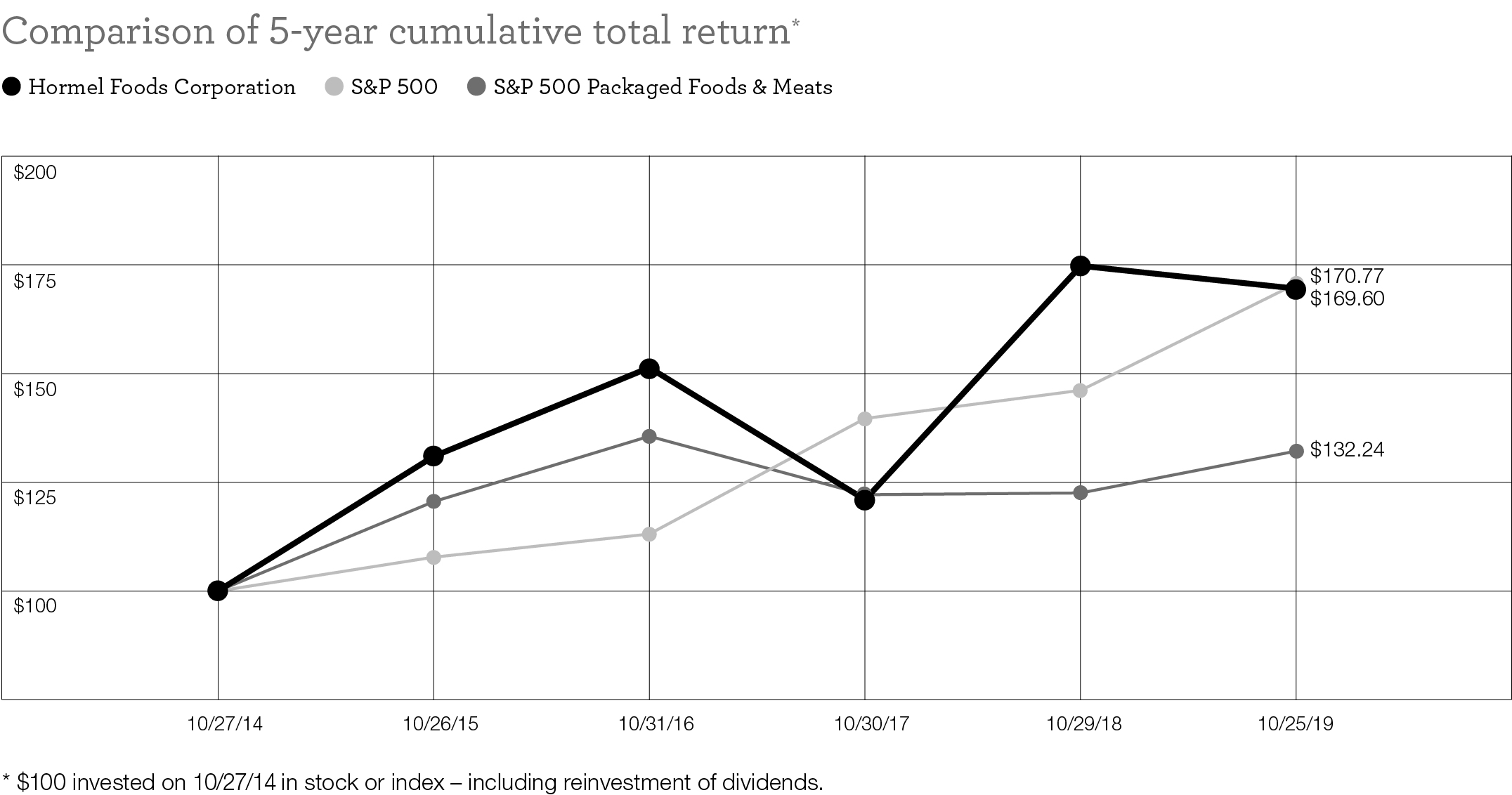
The following graph shows a comparison of cumulative total shareholder return, calculated on a dividend-reinvested basis, for the Company, the S&P 500 Index, and the S&P 500 Packaged Foods & Meats Index for the five years ended October 27, 2019. The graph assumes $100 was invested in each, as of the market close on October 27, 2014. Note that historic stock price performance is not necessarily indicative of future stock price performance.
Item 6. SELECTED FINANCIAL DATA
The information set forth below for the five years ended October 27, 2019, is not necessarily indicative of results of future operations. To fully understand factors that may affect the comparability of the information presented below, this information should be read in conjunction with Part I-Item 1 Business, Part II-Item 7 Management’s Discussion and Analysis of Financial Condition and Results of Operations, and the consolidated financial statements and related notes thereto included in Part II-Item 8 Financial Statements and Supplementary Data of this Form 10-K.
| (in thousands, except per share amounts) | 2019 | 2018 | 2017 | 2016* | 2015** | |||||||||||||||
| Operations | ||||||||||||||||||||
| Net Sales | $ | 9,497,317 | $ | 9,545,700 | $ | 9,167,519 | $ | 9,523,224 | $ | 9,263,863 | ||||||||||
| Net Earnings Attributable to Hormel Foods Corporation | 978,806 | 1,012,140 | 846,735 | 890,052 | 686,088 | |||||||||||||||
| % of net sales | 10.31 | % | 10.60 | % | 9.24 | % | 9.35 | % | 7.41 | % | ||||||||||
| EBIT(1) | 1,195,923 | 1,179,519 | 1,276,374 | 1,312,918 | 1,055,612 | |||||||||||||||
| % of net sales | 12.59 | % | 12.36 | % | 13.92 | % | 13.79 | % | 11.39 | % | ||||||||||
| EBITDA(2) | 1,361,132 | 1,341,377 | 1,407,351 | 1,444,886 | 1,189,046 | |||||||||||||||
| % of net sales | 14.33 | % | 14.05 | % | 15.35 | % | 15.17 | % | 12.84 | % | ||||||||||
| Return on Invested Capital(3) | 15.63 | % | 16.24 | % | 16.30 | % | 18.89 | % | 15.47 | % | ||||||||||
| Financial Position | ||||||||||||||||||||
| Total Assets | $ | 8,109,004 | $ | 8,142,292 | $ | 6,975,908 | $ | 6,370,067 | $ | 6,139,831 | ||||||||||
| Long-term Obligations, including capital leases | 269,713 | 624,840 | 250,000 | 250,000 | 250,000 | |||||||||||||||
| Hormel Foods Corporation Shareholders’ Investment | 5,921,458 | 5,600,811 | 4,935,907 | 4,448,006 | 3,998,198 | |||||||||||||||
| Cash Flows | ||||||||||||||||||||
| Capital Expenditures | 293,838 | 389,607 | 221,286 | 255,524 | 144,063 | |||||||||||||||
| Acquisitions of Businesses | — | 857,668 | 520,463 | 280,889 | 770,587 | |||||||||||||||
| Proceeds from Sale of Business | 479,806 | — | 135,944 | 110,149 | — | |||||||||||||||
| Share Repurchase | 174,246 | 46,898 | 94,487 | 87,885 | 24,928 | |||||||||||||||
| Dividends Paid | 437,053 | 388,107 | 346,010 | 296,493 | 250,834 | |||||||||||||||
| Common Stock | ||||||||||||||||||||
| Weighted-Average Shares Outstanding – Basic | 534,578 | 530,742 | 528,363 | 529,290 | 528,143 | |||||||||||||||
| Weighted-Average Shares Outstanding – Diluted | 545,232 | 543,869 | 539,116 | 542,473 | 541,002 | |||||||||||||||
| Earnings Per Share – Basic | $ | 1.83 | $ | 1.91 | $ | 1.60 | $ | 1.68 | $ | 1.30 | ||||||||||
| Earnings Per Share – Diluted | 1.80 | 1.86 | 1.57 | 1.64 | 1.27 | |||||||||||||||
| Dividends Declared per Share | 0.84 | 0.75 | 0.68 | 0.58 | 0.50 | |||||||||||||||
| Hormel Foods Corporation Shareholders’ Investment per Share | 11.08 | 10.49 | 9.34 | 8.42 | 7.57 |
The Company provides EBIT, EBITDA, and Return on Invested Capital because these measures are useful to management and investors as indicators of operating strength relative to prior years and are commonly used to benchmark the Company’s performance. These measures are calculated as follows:
| (in thousands) | 2019 | 2018 | 2017 | 2016* | 2015** | |||||||||||||||
| (1) EBIT: | ||||||||||||||||||||
| Net Earnings Attributable to Hormel Foods Corporation | $ | 978,806 | $ | 1,012,140 | $ | 846,735 | $ | 890,052 | $ | 686,088 | ||||||||||
| Plus: Income Tax Expense | 230,567 | 168,702 | 431,542 | 426,698 | 369,879 | |||||||||||||||
| Plus: Interest Expense | 18,070 | 26,494 | 12,683 | 12,871 | 13,111 | |||||||||||||||
| Less: Interest and Investment Income*** | 31,520 | 27,817 | 14,586 | 16,703 | 13,466 | |||||||||||||||
| EBIT | $ | 1,195,923 | $ | 1,179,519 | $ | 1,276,374 | $ | 1,312,918 | $ | 1,055,612 | ||||||||||
| (2) EBITDA: | ||||||||||||||||||||
| EBIT per (1) above | 1,195,923 | 1,179,519 | 1,276,374 | 1,312,918 | 1,055,612 | |||||||||||||||
| Plus: Depreciation and Amortization | 165,209 | 161,858 | 130,977 | 131,968 | 133,434 | |||||||||||||||
| EBITDA | $ | 1,361,132 | $ | 1,341,377 | $ | 1,407,351 | $ | 1,444,886 | $ | 1,189,046 | ||||||||||
| (3) Return on Invested Capital: | ||||||||||||||||||||
| EBIT per (1) above | 1,195,923 | 1,179,519 | 1,276,374 | 1,312,918 | 1,055,612 | |||||||||||||||
| X (1 – Effective Tax Rate****) | 80.93 | % | 85.71 | % | 66.24 | % | 67.59 | % | 64.97 | % | ||||||||||
| After-tax EBIT | $ | 967,860 | $ | 1,010,966 | $ | 845,470 | $ | 887,401 | $ | 685,831 | ||||||||||
| Divided by: | ||||||||||||||||||||
| Total Debt, including capital leases | 269,713 | 624,840 | 250,000 | 250,000 | 435,000 | |||||||||||||||
| Hormel Foods Corporation Shareholders’ Investment | 5,921,458 | 5,600,811 | 4,935,907 | 4,448,006 | 3,998,198 | |||||||||||||||
| Total Debt and Shareholders’ Investment | $ | 6,191,171 | $ | 6,225,651 | $ | 5,185,907 | $ | 4,698,006 | $ | 4,433,198 | ||||||||||
| Return on Invested Capital | 15.63 | % | 16.24 | % | 16.30 | % | 18.89 | % | 15.47 | % |
- Fiscal 2016 included 53 weeks.
** Shares and per share figures have been restated to reflect the two-for-one stock split distributed on February 9, 2016.
*** Adjusted due to the adoption of Accounting Standards Update (ASU) 2017-07, Compensation - Retirement Benefits: Improving the Presentation of Net Periodic Pension Cost and Net Periodic Postretirement Benefit Cost (Topic 715). See Note A - Summary of Significant Accounting Policies.
**** Excluding earnings attributable to noncontrolling interests.
Item 7. MANAGEMENT’S DISCUSSION AND ANALYSIS OF FINANCIAL CONDITION
AND RESULTS OF OPERATIONS
Executive Overview
Fiscal 2019: Sales for the year were $9.5 billion, a 1 percent decline from last year. Sales decreased primarily due to the divestiture of CytoSport. Organic net sales1 were up 1 percent. (1See explanation of non-GAAP financial measures in the Consolidated Results section). Pretax earnings increased 2 percent to $1,209.7 million. Profit growth from the value-added businesses in Refrigerated Foods and lower selling, general and administrative expenses more than offset a significant decline in commodity profits and lower equity in earnings of affiliates. A higher effective tax rate drove net earnings attributable to the Company lower by 3 percent to $978.8 million, compared to net earnings of $1,012.1 million last year. The effective tax rate in fiscal 2019 increased primarily due to the impact of the Tax Cuts and Jobs Act (Tax Act) recognized in fiscal 2018. Diluted earnings per share for fiscal 2019 were $1.80, a 3 percent decrease compared to $1.86 per share last year.
Refrigerated Foods segment results exceeded last year due to growth from the value-added businesses, including strong results from foodservice products such as Hormel*®* Firebraised**TM meats and pizza toppings. Retail sales of Hormel*®* Black Label*®* convenience bacon and Columbus*®* deli items also contributed to overall growth, helping to offset a significant decline in commodity profits. The Jennie-O Turkey Store segment was negatively impacted by lost retail distribution due to two voluntary product recalls in the first quarter of fiscal 2019 and low commodity prices resulting from continued industry oversupply. Grocery Products segment financial performance was down due to lower Skippy® peanut butter pricing and a reduction in MegaMex Foods, LLC (MegaMex) equity in earnings compared to fiscal 2018. International & Other segment results declined primarily by the impact of tariffs and global trade uncertainty affecting fresh pork exports.
Our Company continued to reinvest into the business through capital expenditures while returning cash back to shareholders in the form of dividends and share repurchases. Capital expenditures were $293.8 million in fiscal 2019. Notable projects included the preliminary phases of the Burke pizza toppings plant expansion, a new dry sausage facility in Nebraska, Project Orion, and many other items to support growth of branded products. The annual dividend for 2020 will be $0.93 per share and marks the 54th consecutive year of dividend increases, representing an increase of 11 percent after a 12 percent increase in fiscal 2019. We repurchased 4.3 million shares of common stock in fiscal 2019, spending $174.2 million.
In December, the Company completed the sale of its Fremont, Nebraska, processing facility to Wholestone Farms, LLC, for $30.6 million. Additionally, in April, the Company completed the sale of its CytoSport business to PepsiCo, Inc., for $479.8 million.
Fiscal 2020 Outlook: We expect to grow sales and pretax profits in fiscal 2020. Our branded, value-added businesses within Refrigerated Foods continue to be well-positioned for growth in the foodservice, retail, and deli channels. Positive momentum in brands such as Hormel*®* Bacon 1TM,** Hormel*®* Natural Choice*®, Applegate®, Columbus®* and Hormel*®* Fire Braised**TM should help mitigate the risk of higher input prices and volatility due to African swine fever. Operational improvements, continued industry recovery, and regained lean ground turkey distribution at Jennie-O Turkey Store are expected to return the segment to growth. The International & Other segment plans to grow sales and earnings while managing through challenges due to African swine fever and global trade uncertainty. We expect contributions from branded items such as the SPAM® family of products, Wholly® guacamole dips, Herdez® salsas and sauces, and Skippy® peanut butter to help offset the impact of the CytoSport sale to the Grocery Products segment in fiscal 2019. Additionally, we expect continued cost reductions from our supply chain organization and will begin implementation of Project Orion during fiscal 2020.
We plan to support our numerous iconic brands with continued advertising in fiscal 2020. Strong cash flow, along with a solid balance sheet, will enable us to continue to return cash to shareholders while investing capital into our value-added businesses. We will open a new $150 million expansion at our Burke facility in the third quarter of fiscal 2020, which will provide much needed capacity to grow our pizza toppings business in foodservice.
Results of Operations
OVERVIEW
The Company is a processor of branded and unbranded food products for retail, foodservice, deli, and commercial customers. At the beginning of fiscal 2019, the Hormel Deli Solutions division combined all deli businesses, including the Jennie-O Turkey Store deli division, into one division within the Refrigerated Foods segment. In addition, the ingredients business was realigned from the Grocery Products segment to the Refrigerated Foods segment. Periods presented herein have been recast to reflect this change. Periods presented have also been adjusted due to the adoption of Accounting Standards Update (ASU) 2017-07, Compensation - Retirement Benefits: Improving the Presentation of Net Periodic Pension Cost and Net Periodic Postretirement Benefit Cost (Topic 715). See Note A - Summary of Significant Accounting Policies for more information.
The Company operates in the following four reportable segments:
| Segment | Business Conducted |
| Grocery Products | This segment consists primarily of the processing, marketing, and sale of shelf-stable food products sold predominantly in the retail market, along with the sale of nutritional and private label shelf-stable products to retail, foodservice, and industrial customers. This segment also includes the results from the Company’s MegaMex Foods, LLC (MegaMex) joint venture. |
| Refrigerated Foods | This segment consists primarily of the processing, marketing, and sale of branded and unbranded pork, beef, chicken, and turkey products for retail, foodservice, deli, and commercial customers. |
| Jennie-O Turkey Store | This segment consists primarily of the processing, marketing, and sale of branded and unbranded turkey products for retail, foodservice, and commercial customers. |
| International & Other | This segment includes Hormel Foods International, which manufactures, markets, and sells Company products internationally. This segment also includes the results from the Company’s international joint ventures and royalty arrangements. |
The Company’s fiscal year consisted of 52 weeks in fiscal years 2019, 2018, and 2017.
FISCAL YEARS 2019 AND 2018
CONSOLIDATED RESULTS
Net Earnings and Diluted Earnings Per Share
| Fourth Quarter Ended | Year Ended | |||||||||||||||||||||
| (in thousands, except per share amounts) | October 27, 2019 | October 28, 2018 | % Change | October 27, 2019 | October 28, 2018 | % Change | ||||||||||||||||
| Net Earnings | $ | 255,503 | $ | 261,406 | (2.3 | ) | $ | 978,806 | $ | 1,012,140 | (3.3 | ) | ||||||||||
| Diluted Earnings Per Share | 0.47 | 0.48 | (2.1 | ) | 1.80 | 1.86 | (3.2 | ) |
Volume and Net Sales
| | | | | | | | | | | | | | | | | | | | | | | | | --- | --- | --- | --- | --- | ---
Showing the first 8K of 92K characters. Open the full section
Item 7A. QUANTITATIVE AND QUALITATIVE DISCLOSURES ABOUT MARKET RISK
Hog Markets: The Company’s earnings are affected by fluctuations in the live hog market. To minimize the impact on earnings and ensure a steady supply of quality hogs, the Company has entered into contracts with producers for the purchase of hogs at formula-based prices over periods of up to 10 years. Hogs purchased under contract accounted for 93 percent and 96 percent of the total hogs purchased by the Company during fiscal 2019 and 2018, respectively. The majority of these contracts use market-based formulas based on hog futures, hog primal values, or industry reported hog markets. Other contracts use a formula based on the cost of production, which can fluctuate independently from hog markets. The Company’s value-added branded portfolio helps mitigate changes in hog and pork market prices. Therefore, a hypothetical 10 percent change in the cash hog market would have had an immaterial effect on the Company’s results of operations.
The Company utilizes a hedge program to reduce exposure and offset the fluctuations in the Company’s future direct hog purchases. This program utilizes lean hog futures which are accounted for under cash flow hedge accounting. The fair value of the Company’s open futures contracts in this program as of October 27, 2019, was $5.8 million, before tax, compared to $0.7 million, before tax, as of October 28, 2018. The Company measures its market risk exposure on its lean hog futures contracts using a sensitivity analysis, which considers a hypothetical 10 percent change in the market prices for lean hogs. A 10 percent decrease in the market price for lean hogs would have negatively impacted the fair value of the Company’s October 27, 2019, open lean hog contracts by $19.5 million, which in turn would lower the Company’s future cost on purchased hogs by a similar amount.
Turkey Production Costs: The Company raises or contracts for live turkeys to meet the majority of its raw material supply requirements. Production costs in raising turkeys are subject primarily to fluctuations in feed prices and, to a lesser extent, fuel costs. Under normal, long-term market conditions, changes in the cost to produce turkeys are offset by proportional changes in the turkey market.
The Company utilizes a hedge program to reduce exposure and offset the fluctuation in the Company’s future direct grain purchases. This program utilizes corn futures for Jennie-O Turkey Store, and these contracts are accounted for under cash flow hedge accounting. The fair value of the Company’s open futures contracts as of October 27, 2019, was $(2.2) million, before tax, compared to $(1.3) million, before tax, as of October 28, 2018. The Company measures its market risk exposure on its grain futures contracts using a sensitivity analysis, which considers a hypothetical 10 percent change in the market prices for grain. A 10 percent decrease in the market price for grain would have negatively impacted the fair value of the Company’s October 27, 2019, open grain contracts by $9.5 million, which in turn would lower the Company’s future cost on purchased grain by a similar amount.
Other Input Costs: The costs of raw materials, packaging materials, freight, fuel, and energy may cause the Company's results to fluctuate significantly. To manage input cost volatility, the Company pursues cost saving measures, forward pricing, derivatives, and pricing actions when necessary.
Investments: The Company has corporate-owned life insurance policies classified as trading securities as part of a rabbi trust to fund certain supplemental executive retirement plans and deferred income plans. As of October 27, 2019, the balance of these securities totaled $157.5 million compared to $137.3 million as of October 28, 2018. A majority of these securities represent fixed income funds. The Company is subject to market risk due to fluctuations in the value of the remaining investments as unrealized gains and losses associated with these securities are included in the Company’s net earnings on a mark-to-market basis. A 10 percent decline in the value of the investments not held in fixed income funds would have a negative impact to the Company’s pretax earnings of approximately $7.0 million, while a 10 percent increase in value would have a positive impact of the same amount.
International Assets: The fair values of certain Company assets are subject to fluctuations in foreign currencies. The Company’s net asset position in foreign currencies as of October 27, 2019, was $543.8 million, compared to $687.7 million as of October 28, 2018, with most of the exposure existing in Chinese yuan and Brazilian real. Changes in currency exchange rates impact the fair values of the Company assets either currently through the Consolidated Statements of Operations within Interest and Investment Income or through the Consolidated Statements of Financial Position within Accumulated Other Comprehensive Loss.
The Company measures its foreign currency exchange risk by using a 10 percent sensitivity analysis on the Company’s primary foreign net asset position, the Chinese yuan and the Brazilian real, as of October 27, 2019. A 10 percent strengthening in the value of the yuan relative to the U.S. dollar would result in other comprehensive income of approximately $33.7 million pretax. A 10 percent weakening in the value of the yuan relative to the U.S. dollar would result in other comprehensive loss of approximately $27.6 million pretax. A 10 percent strengthening in the value of the real relative to the U.S. dollar would result in other comprehensive income of approximately $13.0 million pretax. A 10 percent weakening in the value of the real relative to the U.S. dollar would result in other comprehensive loss of approximately $10.7 million pretax.
Item 8. FINANCIAL STATEMENTS AND SUPPLEMENTARY DATA
Report of Management
Management’s Responsibility for Financial Statements
The accompanying financial statements were prepared by the management of Hormel Foods Corporation which is responsible for their integrity and objectivity. These statements have been prepared in accordance with U.S. generally accepted accounting principles appropriate in the circumstances and, as such, include amounts that are based on our best estimates and judgments.
Hormel Foods Corporation has developed a system of internal controls designed to assure that the records reflect the transactions of the Company and that the established policies and procedures are adhered to. This system is augmented by well-communicated written policies and procedures, a strong program of internal audit, and well-qualified personnel.
These financial statements have been audited by Ernst & Young LLP, an independent registered public accounting firm, and their report is included herein. The audit was conducted in accordance with the standards of the Public Company Accounting Oversight Board (United States) and includes a review of the Company’s accounting and financial controls and tests of transactions.
The Audit Committee of the Board of Directors, composed solely of outside directors, meets periodically with the independent auditors, management, and the internal auditors to assure that each is carrying out its responsibilities. Both Ernst & Young LLP and our internal auditors have full and free access to the Audit Committee, with or without the presence of management, to discuss the results of their audit work and their opinions on the adequacy of internal controls and the quality of financial reporting.
Management’s Report on Internal Control Over Financial Reporting
Management of Hormel Foods Corporation is responsible for establishing and maintaining adequate internal control over financial reporting for the Company, as such term is defined in Exchange Act Rule 13a–15(f). The Company’s internal control system is designed to provide reasonable assurance regarding the reliability of financial reporting and the preparation of financial statements for external purposes in accordance with generally accepted accounting standards. Under the supervision, and with the participation of management, including the Chief Executive Officer and Chief Financial Officer, we conducted an evaluation of the effectiveness of our internal control over financial reporting based on the framework in Internal Control - Integrated Framework issued by the Committee of Sponsoring Organizations of the Treadway Commission (2013 framework).
Based on our evaluation under the framework in Internal Control - Integrated Framework, we concluded that our internal control over financial reporting was effective as of October 27, 2019. Our internal control over financial reporting as of October 27, 2019, has been audited by Ernst & Young LLP, an independent registered public accounting firm, as stated in their report which is included herein.
| /s/ James P. Snee | /s/ James N. Sheehan |
| Chairman of the Board, | Executive Vice President |
| President and Chief Executive Officer | and Chief Financial Officer |
Report of Independent Registered Public Accounting Firm
To the Shareholders and the Board of Directors of Hormel Foods Corporation
Opinion on Internal Control Over Financial Reporting
We have audited Hormel Foods Corporation’s internal control over financial reporting as of October 27, 2019, based on criteria established in Internal Control-Integrated Framework issued by the Committee of Sponsoring Organizations of the Treadway Commission (2013 framework) (the COSO criteria). In our opinion, Hormel Foods Corporation (the Company) maintained, in all material respects, effective internal control over financial reporting as of October 27, 2019, based on the COSO criteria.
We also have audited, in accordance with the standards of the Public Company Accounting Oversight Board (United States) (PCAOB), the accompanying consolidated statements of financial position of Hormel Foods Corporation (the Company) as of October 27, 2019 and October 28, 2018, the related consolidated statements of operations, comprehensive income, changes in shareholders’ investment, and cash flows for each of the three years in the period ended October 27, 2019 and the related notes and financial statement schedule listed in the index at Item 15 and our report dated December 6, 2019 expressed an unqualified opinion thereon.
Basis for Opinion
The Company’s management is responsible for maintaining effective internal control over financial reporting and for its assessment of the effectiveness of internal control over financial reporting included in the accompanying Management’s Report on Internal Control over Financial Reporting. Our responsibility is to express an opinion on the Company’s internal control over financial reporting based on our audit. We are a public accounting firm registered with the PCAOB and are required to be independent with respect to the Company in accordance with the U.S. federal securities laws and the applicable rules and regulations of the Securities and Exchange Commission and the PCAOB.
We conducted our audit in accordance with the standards of the PCAOB. Those standards require that we plan and perform the audit to obtain reasonable assurance about whether effective internal control over financial reporting was maintained in all material respects.
Our audit included obtaining an understanding of internal control over financial reporting, assessing the risk that a material weakness exists, testing and evaluating the design and operating effectiveness of internal control based on the assessed risk, and performing such other procedures as we considered necessary in the circumstances. We believe that our audit provides a reasonable basis for our opinion.
Definition and Limitations of Internal Control Over Financial Reporting
A company’s internal control over financial reporting is a process designed to provide reasonable assurance regarding the reliability of financial reporting and the preparation of financial statements for external purposes in accordance with generally accepted accounting principles. A company’s internal control over financial reporting includes those policies and procedures that (1) pertain to the maintenance of records that, in reasonable detail, accurately and fairly reflect the transactions and dispositions of the assets of the company; (2) provide reasonable assurance that transactions are recorded as necessary to permit preparation of financial statements in accordance with generally accepted accounting principles, and that receipts and expenditures of the company are being made only in accordance with authorizations of management and directors of the company; and (3) provide reasonable assurance regarding prevention or timely detection of unauthorized acquisition, use, or disposition of the company’s assets that could have a material effect on the financial statements.
Because of its inherent limitations, internal control over financial reporting may not prevent or detect misstatements. Also, projections of any evaluation of effectiveness to future periods are subject to the risk that controls may become inadequate because of changes in conditions, or that the degree of compliance with the policies or procedures may deteriorate.
/s/ Ernst & Young LLP
Minneapolis, Minnesota
December 6, 2019
Report of Independent Registered Public Accounting Firm
To the Shareholders and the Board of Directors of Hormel Foods Corporation
Opinion on the Financial Statements
We have audited the accompanying consolidated statements of financial position of Hormel Foods Corporation (the Company) as of October 27, 2019 and October 28, 2018, the related consolidated statements of operations, comprehensive income, chang
Showing the first 8K of 173K characters. Open the full section
Item 9. CHANGES IN AND DISAGREEMENTS WITH ACCOUNTANTS ON ACCOUNTING AND FINANCIAL DISCLOSURE
None.
Item 9A. CONTROLS AND PROCEDURES
Disclosure Controls and Procedures
As of the end of the period covered by this report (the Evaluation Date), the Company carried out an evaluation, under the supervision and with the participation of management, including the Chief Executive Officer and the Chief Financial Officer, of the effectiveness of the design and operation of our disclosure controls and procedures (as defined in Rule 13a-15(e) of the Securities Exchange Act of 1934, as amended (the Exchange Act)). In designing and evaluating the disclosure controls and procedures, management recognized any controls and procedures, no matter how well designed and operated, can provide only reasonable assurance of achieving the desired control objectives. Based on that evaluation, our Chief Executive Officer and Chief Financial Officer concluded, as of the Evaluation Date, our disclosure controls and procedures were effective to provide reasonable assurance the information we are required to disclose in reports we file or submit under the Exchange Act is recorded, processed, summarized, and reported within the time periods specified in Securities and Exchange Commission rules and forms, and such information is accumulated and communicated to our management, including our Chief Executive Officer and Chief Financial Officer, as appropriate, to allow timely decisions regarding required disclosure.
Internal Control over Financial Reporting
During the fourth quarter of fiscal year 2019, there has been no change in the Company’s internal control over financial reporting (as defined in Rule 13a-15(f) under the Exchange Act) that has materially affected, or is reasonably likely to materially affect, the Company’s internal control over financial reporting.
Item 9B. OTHER INFORMATION
None.
PART III
Item 10. DIRECTORS, EXECUTIVE OFFICERS AND CORPORATE GOVERNANCE
Information under “Item 1 – Election of Directors”, “Board Independence”, and information under “Board of Director and Committee Meetings” in the definitive proxy statement for the Annual Meeting of Stockholders to be held January 28, 2020, is incorporated herein by reference.
Information concerning Executive Officers is set forth in Part I, Item 1(f) of this Annual Report on Form 10-K, pursuant to Instruction to Item 401 of Regulation S-K.
Information under “Delinquent Section 16(a) Reports,” in the definitive proxy statement for the Annual Meeting of Stockholders to be held January 28, 2020, is incorporated herein by reference.
The Company has adopted a Code of Ethical Business Conduct in compliance with applicable rules of the Securities and Exchange Commission that applies to its principal executive officer, its principal financial officer, and its principal accounting officer or controller, or persons performing similar functions. A copy of the Code of Ethical Business Conduct is available on the Company’s website at www.hormelfoods.com, free of charge, under the caption, “Investors – Governance – Governance Documents.” The Company intends to satisfy any disclosure requirement under Item 5.05 of Form 8-K regarding an amendment to, or waiver from, a provision of this Code of Ethical Business Conduct by posting such information on the Company’s website at the address and location specified above.
Item 11. EXECUTIVE COMPENSATION
Information commencing with “Executive Compensation” through "CEO Pay Ratio Disclosure”, and information under “Compensation of Directors” in the definitive proxy statement for the Annual Meeting of Stockholders to be held January 28, 2020, is incorporated herein by reference.
Item 12. SECURITY OWNERSHIP OF CERTAIN BENEFICIAL OWNERS AND MANAGEMENT AND RELATED STOCKHOLDER MATTERS
Information regarding the Company's equity compensation plans as of October 27, 2019, is shown below:
| Plan Category | Number of Securities to be Issued Upon Exercise of Outstanding Options, Warrants and Rights | Weighted-Average Exercise Price of Outstanding Options, Warrants and Rights | Number of Securities Remaining Available for Future Issuance under Equity Compensation Plans (Excluding Securities Reflected in Column (a)****) | |||
| (a) | (b) | (c) | ||||
| Equity compensation plans approved by security holders | 25,993,836 | $26.49 | 14,945,886 | |||
| Equity compensation plans not approved by security holders | — | — | - | |||
| Total | 25,993,836 | $26.49 | 14,945,886 |
Information under “Security Ownership of Certain Beneficial Owners” and “Security Ownership of Management” in the definitive proxy statement for the Annual Meeting of Stockholders to be held January 28, 2020, is incorporated herein by reference.
Item 13. CERTAIN RELATIONSHIPS AND RELATED TRANSACTIONS, AND DIRECTOR INDEPENDENCE
Information under “Related Party Transactions” and “Board Independence” in the definitive proxy statement for the Annual Meeting of Stockholders to be held January 28, 2020, is incorporated herein by reference.
Item 14. PRINCIPAL ACCOUNTING FEES AND SERVICES
Information under “Independent Registered Public Accounting Firm Fees” and “Audit Committee Preapproval Policies and Procedures” in the definitive proxy statement for the Annual Meeting of Stockholders to be held January 28, 2020, is incorporated herein by reference.
PART IV
Item 15. EXHIBITS, FINANCIAL STATEMENT SCHEDULES
The following consolidated financial statements of Hormel Foods Corporation for the fiscal year ended October 27, 2019, are filed as part of this report:
Consolidated Statements of Financial Position–October 27, 2019, and October 28, 2018.
Consolidated Statements of Operations–Fiscal Years Ended October 27, 2019, October 28, 2018, and October 29, 2017.
Consolidated Statements of Comprehensive Income–Fiscal Years Ended October 27, 2019, October 28, 2018, and October 29, 2017.
Consolidated Statements of Changes in Shareholders’ Investment–Fiscal Years Ended October 27, 2019, October 28, 2018, and October 29, 2017.
Consolidated Statements of Cash Flows–Fiscal Years Ended October 27, 2019, October 28, 2018, and October 29, 2017.
Notes to Consolidated Financial Statements
Report of Management
Report of Independent Registered Public Accounting Firm
FINANCIAL STATEMENT SCHEDULES
The following consolidated financial statement schedule of Hormel Foods Corporation required is submitted herewith:
Schedule II – Valuation and Qualifying Accounts and Reserves–Fiscal Years Ended October 27, 2019, October 28, 2018, and October 29, 2017.
FINANCIAL STATEMENTS AND SCHEDULES OMITTED
All other financial statements and schedules for which provision is made in the applicable accounting regulations of the Securities and Exchange Commission are not required under the related instructions or are inapplicable, and therefore have been omitted.
SCHEDULE II – VALUATION AND QUALIFYING ACCOUNTS AND RESERVES
HORMEL FOODS CORPORATION
(In Thousands)
| Additions/(Benefits) | ||||||||||||||||||||||
| Classification | Balance at Beginning of Period | Charged to Cost and Expenses | Charged to Other Accounts Describe | Deductions- Describe | Balance at End of Period | |||||||||||||||||
| Valuation reserve deduction from assets account: | ||||||||||||||||||||||
| Fiscal year ended October 27, 2019 Allowance for doubtful accounts receivable | $ | 121 | (1) | |||||||||||||||||||
| $ | 4,051 | $ | (382 | ) | (515 | ) | (2) | $ | 4,063 | |||||||||||||
| Fiscal year ended October 28, 2018 Allowance for doubtful accounts receivable | $ | (262 | ) | (3) | $ | 65 | (1) | |||||||||||||||
| $ | 4,246 | $ | 79 | 10 | (4) | (43 | ) | (2) | $ | 4,051 | ||||||||||||
| Fiscal year ended October 29, 2017 Allowance for doubtful accounts receivable | $ | 677 | (1) | |||||||||||||||||||
| $ | 4,045 | $ | 561 | $ | 261 | (5) | (56 | ) | (2) | $ | 4,246 |
(1) Uncollectible accounts written off.
(2) Recoveries on accounts previously written off.
(3) Consolidation of the Fontanini and Columbus reserves.
(4) Increase in the reserve due to the inclusion of Columbus accounts receivable.
(5) Increase in the reserve due to the inclusion of Fontanini accounts receivable.
| LIST OF EXHIBITS | ||||
| HORMEL FOODS CORPORATION |
| NUMBER | DESCRIPTION OF DOCUMENT | |
| 10.15(2)(3) | Hormel Foods Corporation Restricted Stock Unit Agreement Under the 2018 Incentive Compensation Plan. | |
| 21.1(2) | Subsidiaries of the Registrant. | |
| 23.1(2) | Consent of Independent Registered Public Accounting Firm. | |
| 24.1(2) | Power of Attorney. | |
| 31.1(2) | Certification Required Under Section 302 of the Sarbanes-Oxley Act of 2002. | |
| 31.2(2) | Certification Required Under Section 302 of the Sarbanes-Oxley Act of 2002. | |
| 32.1(2) | Certification Pursuant to 18 U.S.C. Section 1350 as Adopted Pursuant to Section 906 of the Sarbanes-Oxley Act of 2002. | |
| 99.3(1) | U.S. $700,000,000 Amended and Restated Credit Agreement, dated as of June 24, 2015, between the Company, Wells Fargo Bank, National Association, as Administrative Agent, and the lenders identified on the signature pages thereof. (Incorporated by reference to Exhibit 99 to Hormel’s Current Report on Form 8-K dated June 24, 2015, File No. 001-02402.) | |
| 101(2) | The following financial statements from the Company's Annual Report on Form 10-K for the fiscal year ended October 27, 2019, formatted in Inline XBRL: (i) Consolidated Statements of Financial Position, (ii) Consolidated Statements of Operations, (iii) Consolidated Statements of Comprehensive Income, (iv) Consolidated Statements of Changes in Shareholders’ Investment, (v) Consolidated Statements of Cash Flows, and (vi) Notes to Consolidated Financial Statements, tagged as blocks of text and including detailed tags. | |
| 104(2) | The cover page from the Company's Annual Report on Form 10-K for the fiscal year ended October 27, 2019, formatted in Inline XBRL (included as Exhibit 101). | |
| (1) | Document has previously been filed with the Securities and Exchange Commission and is incorporated herein by reference. | |
| (2) | These exhibits transmitted via EDGAR. | |
| (3) | Management contract or compensatory plan or arrangement. |
Item 16. FORM 10-K SUMMARY
Not applicable.
SIGNATURES
Pursuant to the requirements of Section 13 or 15(d) of the Securities Exchange Act of 1934, the registrant has duly caused this report to be signed on its behalf by the undersigned, thereunto duly authorized.
| HORMEL FOODS CORPORATION | ||||
| By: | /s/ JAMES P. SNEE | December 6, 2019 | ||
| JAMES P. SNEE, Chairman of the Board, | Date | |||
| President and Chief Executive Officer |
Pursuant to the requirements of the Securities Exchange Act of 1934, this report has been signed below by the following persons on behalf of the registrant and in the capacities and on the dates indicated.
| Name | Date | Title | ||
| /s/ JAMES P. SNEE | 12/6/2019 | Chairman of the Board, President and Chief Executive | ||
| JAMES P. SNEE | Officer | |||
| (Principal Executive Officer) | ||||
| /s/ JAMES N. SHEEHAN | 12/6/2019 | Executive Vice President and Chief Financial Officer | ||
| JAMES N. SHEEHAN | (Principal Financial Officer) | |||
| /s/ JANA L. HAYNES | 12/6/2019 | Vice President and Controller | ||
| JANA L. HAYNES | (Principal Accounting Officer) | |||
| /s/ PRAMA BHATT* | 12/6/2019 | Director | ||
| PRAMA BHATT | ||||
| 12/6/2019 | Director | |||
| GARY C. BHOJWANI | ||||
| /s/ TERRELL K. CREWS* | 12/6/2019 | Director | ||
| TERRELL K. CREWS | ||||
| /s/ GLENN S. FORBES* | 12/6/2019 | Director | ||
| GLENN S. FORBES | ||||
| /s/ STEPHEN M. LACY* | 12/6/2019 | Director | ||
| STEPHEN M. LACY | ||||
| /s/ ELSA A. MURANO* | 12/6/2019 | Director | ||
| ELSA A. MURANO | ||||
| /s/ ROBERT C. NAKASONE* | 12/6/2019 | Director | ||
| ROBERT C. NAKASONE | ||||
| /s/ SUSAN K. NESTEGARD* | 12/6/2019 | Director | ||
| SUSAN K. NESTEGARD | ||||
| /s/ WILLIAM A. NEWLANDS* | 12/6/2019 | Director | ||
| WILLIAM A. NEWLANDS | ||||
| /s/ DAKOTA A. PIPPINS* | 12/6/2019 | Director | ||
| DAKOTA A. PIPPINS | ||||
| /s/ CHRISTOPHER J. POLICINSKI* | 12/6/2019 | Director | ||
| CHRISTOPHER J. POLICINSKI | ||||
| /s/ JOSE L. PRADO* | 12/6/2019 | Director | ||
| JOSE L. PRADO | ||||
| /s/ SALLY J. SMITH* | 12/6/2019 | Director | ||
| SALLY J. SMITH | ||||
| /s/ STEVEN A. WHITE* | 12/6/2019 | Director | ||
| STEVEN A. WHITE | ||||
| *By: /s/ JANA L. HAYNES | 12/6/2019 | |||
| JANA L. HAYNES | ||||
| as Attorney-In-Fact |