 filings.tools
Henry Schein 10-K 2019-12-28
Filed 2020-02-20. 21 sections, 589K characters. Original on sec.gov · Markdown · JSON
Cover and table of contents
UNITED STATES
SECURITIES AND EXCHANGE COMMISSION
Washington, D.C. 20549
FORM 10-K
(Mark One)
☒ ANNUAL REPORT PURSUANT TO SECTION 13 OR 15(d) OF THE SECURITIES EXCHANGE ACT OF 1934
For the fiscal year ended December 28, 2019
☐ TRANSITION REPORT PURSUANT TO SECTION 13 OR 15(d) OF THE SECURITIES EXCHANGE ACT OF 1934
For the transition period from ____________ to ____________
Commission file number 0-27078
HENRY SCHEIN, INC.
(Exact name of registrant as specified in its charter)
| Delaware | 11-3136595 |
|---|---|
| (State or other jurisdiction of | (I.R.S. Employer Identification No.) |
| incorporation or organization) |
135 Duryea Road
Melville, New York
(Address of principal executive offices)
11747
(Zip Code)
**(**631) 843-5500
(Registrant’s telephone number, including area code)
Securities registered pursuant to Section 12(b) of the Act:
| Title of each class | Trading Symbol(s) | Name of each exchange on which registered |
|---|---|---|
| Common Stock, par value $.01 per share | HSIC | The Nasdaq Global Select Market |
Securities registered pursuant to Section 12(g) of the Act: None
Indicate by check mark if the registrant is a well-known seasoned issuer, as defined in Rule 405 of the Securities Act.
YES: ☒ NO: ☐
Indicate by check mark if the registrant is not required to file reports pursuant to Section 13 or Section 15(d) of the Act.
YES: ☐ NO: ☒
Indicate by check mark whether the registrant (1) has filed all reports required to be filed by Section 13 or 15(d) of the Securities Exchange Act of 1934 during the preceding 12 months (or for such shorter period that the registrant was required to file such reports), and (2) has been subject to such filing requirements for the past 90 days.
YES: ☒ NO: ☐
Indicate by check mark whether the registrant has submitted electronically every Interactive Data File required to be submitted pursuant to Rule 405 of Regulation S-T during the preceding 12 months (or for such shorter period that the registrant was required to submit such files).
YES: ☒ NO: ☐
Indicate by check mark whether the registrant is a large accelerated filer, an accelerated filer, a non-accelerated filer, a smaller reporting company, or an emerging growth company. See the definitions of “large accelerated filer,” “accelerated filer,” “smaller reporting company,” and “emerging growth company” in Rule 12b-2 of the Exchange Act.
Large accelerated filer: ☒ Accelerated filer: ☐ Non-accelerated filer: ☐ Smaller reporting company: ☐ Emerging growth company: ☐
If an emerging growth company, indicate by check mark if the registrant has elected not to use the extended transition period for complying with any new or revised financial accounting standards provided pursuant to Section 13(a) of the Exchange Act. ☐
Indicate by check mark whether the registrant is a shell company (as defined in Rule 12b-2 of the Exchange Act).
YES: ☐ NO: ☒
The aggregate market value of the registrant’s voting stock held by non-affiliates of the registrant, computed by reference to the closing sales price as quoted on the Nasdaq Global Select Market on June 29, 2019, was approximately $10,236,712,000.
As of February 14, 2020, there were 143,390,505 shares of registrant’s Common Stock, par value $.01 per share, outstanding.
Documents Incorporated by Reference:
Portions of the Registrant’s definitive proxy statement to be filed pursuant to Regulation 14A not later than 120 days after the end of the fiscal year (December 28, 2019) are incorporated by reference in Part III hereof.
PART I
Item 1. Business
General
We believe we are the world’s largest provider of health care products and services primarily to office-based dental and medical practitioners. We serve more than 1 million customers worldwide including dental practitioners and laboratories and physician practices, as well as government, institutional health care clinics and other alternate care clinics. We believe that we have a strong brand identity due to our more than 87 years of experience distributing health care products.
We are headquartered in Melville, New York, employ more than 19,000 people (of which approximately 9,400 are based outside the United States) and have operations or affiliates in 31 countries, including the United States, Australia, Austria, Belgium, Brazil, Canada, Chile, China, the Czech Republic, France, Germany, Hong Kong SAR, Ireland, Israel, Italy, Japan, Liechtenstein, Luxembourg, Malaysia, the Netherlands, New Zealand, Poland, Portugal, Singapore, South Africa, Spain, Sweden, Switzerland, Thailand, United Arab Emirates and the United Kingdom.
We offer a comprehensive selection of products and services and value-added solutions for operating efficient practices and delivering high quality care. We operate through a centralized and automated distribution network with a selection of more than 120,000 branded products and Henry Schein private brand products in stock, as well as more than 180,000 additional products available as special order items. We also offer our customers exclusive, innovative technology solutions, including practice management software and e-commerce solutions, as well as a broad range of financial services.
We have established over 3.5 million square feet of space in 29 strategically located distribution centers around the world to enable us to better serve our customers and increase our operating efficiency. This infrastructure, together with broad product and service offerings at competitive prices, and a strong commitment to customer service, enables us to be a single source of supply for our customers’ needs. Our infrastructure also allows us to provide convenient ordering and rapid, accurate and complete order fulfillment.
We conduct our business through two reportable segments: (i) health care distribution and (ii) technology and value-added services. These segments offer different products and services to the same customer base.
The health care distribution reportable segment aggregates our global dental and medical operating segments. This segment distributes consumable products, small equipment, laboratory products, large equipment, equipment repair services, branded and generic pharmaceuticals, vaccines, surgical products, diagnostic tests, infection-control products and vitamins. Our global dental group serves office-based dental practitioners, dental laboratories, schools and other institutions. Our global medical group serves office-based medical practitioners, ambulatory surgery centers, other alternate-care settings and other institutions.
Our global technology and value-added services group provides software, technology and other value-added services to health care practitioners. Our technology group offerings include practice management software systems for dental and medical practitioners. Our value-added practice solutions include financial services on a non-recourse basis, e-services, practice technology, network and hardware services, as well as continuing education services for practitioners.
Spin-Off of Henry Schein Animal Health Business
On February 7, 2019 (the “Distribution Date”), we completed the separation (the “Separation”) and subsequent merger (“Merger”) of our animal health business (the “Henry Schein Animal Health Business”) with Direct Vet Marketing, Inc. (d/b/a Vets First Choice, “Vets First Choice”). This was accomplished by a series of transactions among us, Vets First Choice, Covetrus, Inc. (f/k/a HS Spinco, Inc. “Covetrus”), a wholly owned subsidiary of ours prior to the Distribution Date, and HS Merger Sub, Inc., a wholly owned subsidiary of Covetrus (“Merger
Sub”). In connection with the Separation, we contributed, assigned and transferred to Covetrus certain applicable assets, liabilities and capital stock or other ownership interests relating to the Henry Schein Animal Health Business. On the Distribution Date, we received a tax-free distribution of $1,120 million from Covetrus pursuant to certain debt financing incurred by Covetrus. On the Distribution Date and prior to the Animal Health Spin-off, Covetrus issued shares of Covetrus common stock to certain institutional accredited investors (the “Share Sale Investors”) for $361.1 million (the “Share Sale”). The proceeds of the Share Sale were paid to Covetrus and distributed to us. Subsequent to the Share Sale, we distributed, on a pro rata basis, all of the shares of the common stock of Covetrus held by us to our stockholders of record as of the close of business on January 17, 2019 (the “Animal Health Spin-off”). After the Share Sale and Animal Health Spin-off, Merger Sub consummated the Merger whereby it merged with and into Vets First Choice, with Vets First Choice surviving the Merger as a wholly owned subsidiary of Covetrus. Immediately following the consummation of the Merger, on a fully diluted basis, (i) approximately 63% of the shares of Covetrus common stock were (a) owned by our stockholders and the Share Sale Investors, and (b) held by certain employees of the Henry Schein Animal Health Business (in the form of certain equity awards), and (ii) approximately 37% of the shares of Covetrus common stock were (a) owned by stockholders of Vets First Choice immediately prior to the Merger, and (b) held by certain employees of Vets First Choice (in the form of certain equity awards). After the Separation and the Merger, we no longer beneficially owned any shares of Covetrus common stock and, following the Distribution Date, will not consolidate the financial results of Covetrus for the purpose of our financial reporting. Following the Separation and the Merger, Covetrus was an independent, publicly traded company on the Nasdaq Global Select Market.
In connection with the completion of the Animal Health Spin-off, we entered into a transition services agreement with Covetrus under which we have agreed to provide certain transition services for up to twenty-four months in areas such as information technology, finance and accounting, human resources, supply chain, and real estate and facility services.
As a result of the Separation, the financial position and results of operations of the Henry Schein Animal Health Business are presented as discontinued operations and have been excluded from continuing operations and segment results for all periods presented.
Industry
The health care products distribution industry, as it relates to office-based health care practitioners, is fragmented and diverse. The industry ranges from sole practitioners working out of relatively small offices to group practices or service organizations ranging in size from a few practitioners to a large number of practitioners who have combined or otherwise associated their practices.
Due in part to the inability of office-based health care practitioners to store and manage large quantities of supplies in their offices, the distribution of health care supplies and small equipment to office-based health care practitioners has been characterized by frequent, small quantity orders, and a need for rapid, reliable and substantially complete order fulfillment. The purchasing decisions within an office-based health care practice are typically made by the practitioner or an administrative assistant. Supplies and small equipment are generally purchased from more than one distributor, with one generally serving as the primary supplier.
The health care products distribution industry continues to experience growth due to the aging population, increased health
Showing the first 8K of 75K characters. Open the full section
Item 1A. Risk Factors
The risks described below could have a material adverse effect on our business, reputation, financial condition and/or the trading price of our common stock. Although it is not possible to predict or identify all such risks and uncertainties, they may include, but are not limited to, the factors discussed below. Our business operations could also be affected by additional factors that are not presently known to us or that we currently consider not to be material to our operations. You should not consider this list to be a complete statement of all risks and uncertainties. The order in which these factors appear should not be construed to indicate their relative importance or priority.
The health care products distribution industry is highly competitive and consolidating, and we may not be able to compete successfully.
We compete with numerous companies, including several major manufacturers and distributors. Some of our competitors have greater financial and other resources than we do, which could allow them to compete more successfully. Most of our products are available from several sources and our customers tend to have relationships with several distributors. Competitors could obtain exclusive rights to market particular products, which we would then be unable to market. Manufacturers also could increase their efforts to sell directly to end-users and thereby eliminate or reduce our role and the roles of other distributors. Industry consolidation among health care product distributors, price competition, the unavailability of products, whether due to our inability to gain access to products or to interruptions in supply from manufacturers, or the emergence of new competitors, also could increase competition. There has also been increasing consolidation among manufacturers of health care products which could have a material adverse effect on our margins and product availability. Additionally, in this competitive market, some of our contracts contain minimum purchase commitments. We could be subject to charges and financial losses in the event we fail to satisfy minimum purchase commitments. In the future, we may be unable to compete successfully and competitive pressures may reduce our revenues and profitability.
We may experience competition from third-party online commerce sites.
Traditional health care supply and distribution relationships are being challenged by electronic online commerce solutions. The continued advancement of online commerce by third parties will require us to cost-effectively adapt to changing technologies, to enhance existing services and to differentiate our business (including with additional value-added services) to address changing demands of consumers and our customers on a timely basis. The emergence of such potential competition and our inability to anticipate and effectively respond to changes on a timely basis could have a material adverse effect on our business.
Because substantially all of the products that we distribute are not manufactured by us, we are dependent upon third parties for the manufacture and supply of substantially all of our products.
We obtain substantially all of our products from third parties. Generally, we do not have long-term contracts with our suppliers committing them to supply products to us. Therefore, suppliers may not provide the products we need in the quantities we request. While there is generally more than one source of supply for most of the categories of products we sell, some key suppliers, in the aggregate, supply a significant portion of the products we sell. Additionally, because we generally do not control the actual production of the products we sell, we may be subject to delays caused by interruption in production based on conditions outside of our control, including the failure to comply with applicable government requirements. The failure of manufacturers of products regulated by the FDA or other governmental agencies to meet these requirements could result in product recall, cessation of sales or other market disruptions. In the event that any of our third-party suppliers were to become unable or unwilling to continue to provide the products in our required volumes, we would need to identify and obtain acceptable replacement sources on a timely basis. There is no guarantee that we would be able to obtain such alternative sources of supply on a timely basis, if at all. An extended interruption in the supply of our products, especially any high sales volume product, could have a material adverse effect on our results of operations, which most likely would adversely affect the value of our common stock.
Our revenues and profitability depend on our relationships with capable sales personnel as well as customers, suppliers and manufacturers of the products that we distribute.
Our future revenues and profitability depend on our ability to maintain satisfactory relationships with qualified sales personnel as well as customers, suppliers and manufacturers. If we fail to maintain our existing relationships with such persons or fail to acquire relationships with such key persons in the future, our business may be materially adversely affected.
Our future success is substantially dependent upon our senior management.
Our future success is substantially dependent upon the efforts and abilities of members of our existing senior management, particularly Stanley M. Bergman, Chairman and Chief Executive Officer. The loss of the services of Mr. Bergman could have a material adverse effect on our business. We have an employment agreement with Mr. Bergman. We do not currently have “key man” life insurance policies on any of our employees. Competition for senior management is intense and we may not be successful in attracting and retaining key personnel.
We experience fluctuations in quarterly earnings. As a result, we may fail to meet or exceed the expectations of securities analysts and investors, which could cause our stock price to decline.
Our business is subject to seasonal and other quarterly fluctuations. Revenues and profitability generally have been higher in the third and fourth quarters due to the timing of sales of seasonal products (including influenza vaccine, equipment and software products), purchasing patterns of office-based health care practitioners and year-end promotions. Revenues and profitability generally have been lower in the first quarter, primarily due to increased sales in the prior two quarters. We expect our historical seasonality of sales to continue in the foreseeable future. Quarterly results may also be materially adversely affected by a variety of other factors, including:
-
timing and amount of sales and marketing expenditures;
-
timing of pricing changes offered by our suppliers;
-
timing of the introduction of new products and services by our suppliers;
-
timing of the release of upgrades and enhancements to our technology-related products and services;
-
changes in or availability of supplier contracts or rebate programs;
-
supplier rebates based upon attaining certain growth goals;
-
changes in the way suppliers introduce or deliver products to market;
-
costs of developing new applications and services;
-
our ability to correctly identify customer needs and preferences and predict future needs and preferences;
-
uncertainties regarding potential significant breaches of data security or disruptions of our information technology systems;
-
unexpected regulatory actions, or government regulation generally;
-
exclusivity requirements with certain suppliers, which may prohibit us from distributing competitive products manufactured by other suppliers;
-
loss of sales representatives;
-
costs related to acquisitions and/or integrations of technologies or businesses;
-
costs associated with our self-insured medical and dental insurance programs;
-
general market and economic conditions, as well as t
Showing the first 8K of 72K characters. Open the full section
Item 1B. Unresolved Staff Comments
We have no unresolved comments from the staff of the SEC that were issued 180 days or more preceding the end of our 2019 fiscal year.
Item 2. Properties
We own or lease the following properties with more than 100,000 square feet:
| Own or | Approximate | Lease Expiration | ||||||
|---|---|---|---|---|---|---|---|---|
| Property | Location | Lease | Square Footage | Date | ||||
| Corporate Headquarters | Melville, NY | Lease | 185,000 | June 2020 | ||||
| Corporate Headquarters | Melville, NY | Own | 105,000 | N/A | ||||
| Office and Distribution Center | Fiumana-Predappio, Italy | Own | 183,000 | N/A | ||||
| Office and Distribution Center | Tours, France | Own | 166,000 | N/A | ||||
| Office and Distribution Center | Gillingham, United Kingdom | Lease/Own | 165,000 | June 2033 | ||||
| Office and Distribution Center | Eastern Creek, New South Wales, Australia | Lease | 161,000 | July 2030 | ||||
| Office and Distribution Center | Niagara on the Lake, Canada | Lease | 128,000 | September 2021 | ||||
| Office and Distribution Center | Bastian, VA | Own | 108,000 | N/A | ||||
| Office and Distribution Center | West Allis, WI | Lease | 106,000 | October 2027 | ||||
| Office and Distribution Center | Geer, SC | Lease | 102,000 | December 2028 | ||||
| Distribution Center | Denver, PA | Lease | 624,000 | December 2021 | ||||
| Distribution Center | Indianapolis, IN | Lease | 380,000 | March 2022 | ||||
| Distribution Center | Sparks, NV | Lease | 370,000 | December 2021 | ||||
| Distribution Center | Indianapolis, IN | Own | 287,000 | N/A | ||||
| Distribution Center | Grapevine, TX | Lease | 242,000 | July 2023 | ||||
| Distribution Center | Gallin, Germany | Own | 215,000 | N/A | ||||
| Distribution Center | Jacksonville, FL | Lease | 212,000 | February 2026 | ||||
| Distribution Center | Heppenheim, Germany | Lease | 194,000 | March 2030 |
The properties listed in the table above are our principal properties primarily used by our health care distribution segment. In addition, we lease numerous other distribution, office, showroom, manufacturing and sales space in locations including the United States, Australia, Austria, Belgium, Brazil, Canada, Chile, China, the Czech Republic, France, Germany, Hong Kong SAR, Ireland, Israel, Italy, Japan, Liechtenstein, Luxembourg, Malaysia, the Netherlands, New Zealand, Poland, Portugal, Singapore, South Africa, Spain, Sweden, Switzerland, Thailand, United Arab Emirates and the United Kingdom.
We believe that our properties are in good condition, are well maintained and are suitable and adequate to carry on our business. We have additional operating capacity at certain distribution center facilities.
Item 3. Legal Proceedings
On August 31, 2012, Archer and White Sales, Inc. (“Archer”) filed a complaint against Henry Schein, Inc. as well as Danaher Corporation and its subsidiaries Instrumentarium Dental, Inc., Dental Equipment, LLC, Kavo Dental Technologies, LLC and Dental Imaging Technologies Corporation (collectively, the “Danaher Defendants”) in the U.S. District Court for the Eastern District of Texas, Civil Action No. 2:12-CV-00572-JRG, styled as an antitrust action under Section 1 of the Sherman Act, and the Texas Free Enterprise Antitrust Act. Archer alleges a conspiracy between Henry Schein, an unnamed company and the Danaher Defendants to terminate or limit Archer’s distribution rights. On August 1, 2017, Archer filed an amended complaint, adding Patterson Companies, Inc. (“Patterson”) and Benco Dental Supply Co. (“Benco”) as defendants, and alleging that Henry Schein, Patterson, Benco and Burkhart Dental Supply conspired to fix prices and refused to compete with each other for sales of dental equipment to dental professionals and agreed to enlist their common suppliers, the Danaher Defendants, to join a price-fixing conspiracy and boycott by reducing the distribution territory of, and eventually terminating, their price-cutting competing distributor Archer. Archer seeks damages in an amount to be proved at trial, to be trebled with interest and costs, including attorneys’ fees, jointly and severally, as well as injunctive relief. On October 30, 2017, Archer filed a second amended complaint, to add additional allegations that it believes support its claims. The named parties and causes of action are the same as the August 1, 2017 amended complaint.
On October 1, 2012, we filed a motion for an order: (i) compelling Archer to arbitrate its claims against us; (2) staying all proceedings pending arbitration; and (3) joining the Danaher Defendants’ motion to arbitrate and stay. On May 28, 2013, the Magistrate Judge granted the motions to arbitrate and stayed proceedings pending arbitration. On June 10, 2013, Archer moved for reconsideration before the District Court judge. On December 7, 2016, the District Court Judge granted Archer’s motion for reconsideration and lifted the stay. Defendants appealed the District Court’s order. On December 21, 2017, the U.S. Court of Appeals for the Fifth Circuit affirmed the District Court’s order denying the motions to compel arbitration. On June 25, 2018, the Supreme Court of the United States granted defendants’ petition for writ of certiorari. On October 29, 2018, the Supreme Court heard oral arguments. On January 8, 2019, the Supreme Court issued its published decision vacating the judgment of the Fifth Circuit and remanding the case to the Fifth Circuit for further proceedings consistent with the Supreme Court’s opinion. On April 2, 2019, the District Court stayed the proceeding in the trial court pending resolution by the Fifth Circuit. The Fifth Circuit heard oral argument on May 1, 2019 on whether the case should be arbitrated. The Fifth Circuit issued its opinion on August 14, 2019 affirming the District Court’s order denying defendants’ motions to compel arbitration. Defendants filed a petition for rehearing en banc before the Fifth Circuit. The Fifth Circuit denied that petition. On October 1, 2019, the District Court set the case for trial on February 3, 2020, which was subsequently moved to January 29, 2020. On January 24, 2020 the Supreme Court granted our motion to stay the District Court proceedings, pending the disposition of our petition for writ of certiorari, which was filed on January 31, 2020. We intend to defend ourselves vigorously against this action.
On August 17, 2017, IQ Dental Supply, Inc. (“IQ Dental”) filed a complaint in the U.S. District Court for the Eastern District of New York, entitled IQ Dental Supply, Inc. v. Henry Schein, Inc., Patterson Companies, Inc. and Benco Dental Supply Company, Case No. 2:17-cv-4834. Plaintiff alleged that it is a distributor of dental supplies and equipment, and sells dental products through an online dental distribution platform operated by SourceOne Dental (“SourceOne”). SourceOne had previously brought an antitrust lawsuit against Henry Schein, Patterson and Benco, which Henry Schein settled in the second quarter of 2017 and which is described in our prior filings with the SEC.
IQ Dental alleged, among other things, that defendants conspired to suppress competition from IQ Dental and SourceOne for the marketing, distribution and sale of dental supplies and equipment in the United States, and that defendants unlawfully agreed with one another to boycott dentists, manufacturers and state dental associations that deal with, or considered dealing with, plaintiff and SourceOne. Plaintiff claimed that this alleged conduct constitutes unreasonable restraint of trade in violation of Section 1 of the Sherman Act, New York’s Donnelly Act and the New Jersey Antitrust Act, and also made pendant state law claims for tortious interference with prospective business relations, civil conspiracy and aiding and abetting. Plaintiff sought injunctive relief, compensatory, treble and punitive damages, jointly and severally, and reasonable costs and expenses, including attorneys’ fees and expert fees. On December 21, 2017, the District Court granted the defendants’ motion to dismiss. On January 19,
2018, IQ Dental appealed the District Court’s order. On May 10, 2019, the U.S. Court of Appeals for the Second Circuit affirmed in part and reversed in part the District Court’s dismissal of the complaint, holding that IQ Dental lacks antitrust standing to challenge the alleged boycott of SourceOne and state dental associations, but that it has standing to challenge injury related to the alleged direct boycott of its business. On June 29, 2019, the Second Circuit denied IQ Dental’s petition for rehearing or rehearing en banc. On January 8, 2020, Henry Schein and IQ Dental entered into a settlement agreement, pursuant to which Henry Schein paid an amount which is not material. Henry Schein was dismissed from the case on January 16, 2020.
On February 12, 2018, the United States Federal Trade Commission (“FTC”) filed a complaint against Benco Dental Supply Co., Henry Schein, Inc. and Patterson Companies, Inc. The FTC alleged, among other things, that defendants violated U.S. antitrust laws by conspiring, and entering into an agreement, to refuse to provide discounts to or otherwise serve buying groups representing dental practitioners. The FTC alleged that defendants conspired in violation of Section 5 of the FTC Act. The complaint sought equitable relief only and does not seek monetary damages. We denied the allegation that we conspired to refuse to provide discounts to or otherwise serve dental buying groups. A hearing before an administrative law judge began on October 16, 2018 and the hearing record was closed on February 21, 2019. On October 7, 2019, the administrative law judge issued his Initial Decision, finding in relevant part that the “evidence fails to prove a conspiracy involving Schein,” and dismissing the complaint as to Henry Schein. The Initial Decision became the decision of the FTC on November 7, 2019 and is not subject to further appeal.
On March 7, 2018, Joseph Salkowitz, individually and on behalf of all others similarly situated, filed a putative class action complaint for violation of the federal securities laws against Henry Schein, Inc., Stanley M. Bergman and Steven Paladino in the U.S. District Court for the Eastern District of New York, Case No. 1:18-cv-01428. The complaint sought to certify a class consisting of all persons and entities who, subject to certain exclusions, purchased Henry Schein securities from March 7, 2013 through February 12, 2018 (the “Class Period”). The complaint alleged, among other things, that the defendants had made materially false and misleading statements about Henry Schein’s business, operations and prospects during the Class Period, including matters relating to the issues in the In re Dental Supplies Antitrust Litigation which Henry Schein settled and which the court dismissed in June 2019, as described in our prior filings with the SEC, and the FTC action described above, thereby causing the plaintiff and members of the purported class to pay artificially inflated prices for Henry Schein securities. The complaint sought unspecified monetary damages and a jury trial. Pursuant to the provisions of the Private Securities Litigation Reform Act of 1995 (the “PSLRA”), the court appointed lead plaintiff and lead counsel on June 22, 2018 and recaptioned the putative class action as In re Henry Schein, Inc. Securities Litigation, under the same case number. Lead plaintiff filed a consolidated class action complaint on September 14, 2018. The consolidated class action complaint asserts similar claims against the same defendants (plus Timothy Sullivan) on behalf of the same putative class of purchasers during the Class Period. It alleges that Henry Schein’s stock price was inflated during that period because Henry Schein had misleadingly portrayed its dental-distribution business “as successfully producing excellent profits while operating in a highly competitive environment” even though, “in reality, [Henry Schein] had engaged for years in collusive and anticompetitive practices in order to maintain Schein’s margins, profits, and market share.” The complaint alleges that the stock price started to fall from August 8, 2017, when the company announced below-expected financial performance that allegedly “revealed that Schein’s poor results were a product of abandoning prior attempts to inflate sales volume and margins through anticompetitive collusion,” through February 13, 2018, after the FTC filed a complaint against Benco, Henry Schein and Patterson alleging that they violated U.S. antitrust laws. The complaint alleges violations of Section 10(b) of the Exchange Act and Rule 10b-5 and Section 20(a) of the Exchange Act. On September 27, 2019, the court issued a decision partially granting and partially denying defendants’ motion to dismiss the securities action. The court dismissed all claims against Messrs. Bergman and Paladino as well as the Section 10(b) claim against Henry Schein to the extent that that claim relied on the Company’s financial results and margins to allege a material misstatement or omission. The court also dismissed the Section 10(b) claim against Henry Schein to the extent that it relied on the Company’s August 8, 2017 disclosure to allege loss causation. The court otherwise denied the motion as to Henry Schein and Mr. Sullivan. Henry Schein and Mr. Sullivan moved for partial reconsideration of the court’s decision. Pursuant to all parties’ request, the court temporarily took the motion off the calendar after it was fully briefed. The parties have agreed to a resolution of this matter, subject to various conditions, including the drafting and execution of a definitive settlement agreement and court approval. The
contemplated settlement, if finally approved, would have no earnings impact to the Company as all payments would be covered by insurance. Henry Schein had previously received a request under 8 Del. C. § 220 to inspect corporate books and records relating to the issues raised in the securities class action and the antitrust matters discussed above.
On May 3, 2018, a purported class action complaint, Marion Diagnostic Center, LLC, et al. v. Becton, Dickinson, and Co., et al., Case No. 3:18-cv-010509, was filed in the U.S. District Court for the Southern District of Illinois against Becton, Dickinson, and Co. (“Becton”); Premier, Inc. (“Premier”), Vizient, Inc. (“Vizient”), Cardinal Health, Inc. (“Cardinal”), Owens & Minor Inc. (“O&M”), Henry Schein, Inc., and Unnamed Becton Distributor Co-Conspirators. The complaint alleges that the defendants entered into a vertical conspiracy to force health care providers into long-term exclusionary contracts that restrain trade in the nationwide markets for conventional and safety syringes and safety IV catheters and inflate the prices of certain Becton products to above-competitive levels. The named plaintiffs seek to represent three separate classes consisting of all health care providers that purchased (i) Becton’s conventional syringes, (ii) Becton’s safety syringes, or (iii) Becton’s safety catheters directly from Becton, Premier, Vizient, Cardinal, O&M or Henry Schein on or after May 3, 2014. The complaint asserts a single count under Section 1 of the Sherman Act, and seeks equitable relief, treble damages, reasonable attorneys’ fees and costs and expenses, and pre-judgment and post-judgment interest. On June 15, 2018, an amended complaint was filed asserting the same allegations against the same parties and adding McKesson Medical-Surgical, Inc. as a defendant. On November 30, 2018, the District Court granted defendants’ motion to dismiss and entered a final judgment, dismissing plaintiffs’ complaint with prejudice. On December 27, 2018, plaintiffs appealed the District Court’s decision to the Seventh Circuit Court of Appeals. The parties argued the appeal on September 27, 2019 and are currently awaiting the Seventh Circuit’s ruling.
On May 29, 2018, an amended complaint was filed in the MultiDistrict Litigation (“MDL”) proceeding In Re National Prescription Opiate Litigation (MDL No. 2804; Case No. 17-md-2804) in an action entitled The County of Summit, Ohio et al. v. Purdue Pharma, L.P., et al., Civil Action No. 1:18-op-45090-DAP (“County of Summit Action”), in the U.S. District Court for the Northern District of Ohio, adding Henry Schein, Inc., Henry Schein Medical Systems, Inc. and others as defendants. Summit County alleges that manufacturers of prescription opioid drugs engaged in a false advertising campaign to expand the market for such drugs and their own market share and that the entities in the supply chain (including Henry Schein, Inc. and Henry Schein Medical Systems, Inc.) reaped financial rewards by refusing or otherwise failing to monitor appropriately and restrict the improper distribution of those drugs. On October 29, 2019, the Company was dismissed with prejudice from this lawsuit. Henry Schein, working with Summit County, donated $1 million to a foundation dedicated to making grants to programs within Summit County focused on (i) educating the community on alternative pain management treatment techniques and/or avoiding addiction; (ii) supporting research into alternative pain management techniques and protocols; (iii) enabling professionals to obtain the necessary certification for a Medication Assisted Treatment (MAT) Waiver; and (iv) advancing programs and services to Summit County to deliver results and solutions to the opiate and addiction crises. Henry Schein paid $250,000 of Summit County’s expenses.
In addition to the County of Summit Action, Henry Schein and/or one or more of its affiliated companies have currently been named as a defendant in multiple lawsuits (currently less than one-hundred and twenty-five (125)), which allege claims similar to those alleged in the County of Summit Action. At this time, the only case set for trial is the action filed by Tuscon Medical Center, which is currently scheduled for a 30-day trial beginning on March 16, 2021. These actions consist of some that have been consolidated within the MDL and are currently abated for discovery purposes, and others which remain pending in state courts and are proceeding independently and outside of the MDL. Of Henry Schein’s 2018 revenue of $9.4 billion from continuing operations, sales of opioids represented less than one-tenth of 1 percent. Opioids represent a negligible part of our business. We intend to defend ourselves vigorously against these actions.
On January 29, 2019, a purported class action complaint was filed by R. Lawrence Hatchett, M.D. against Henry Schein, Inc., Patterson Co., Inc., Benco Dental Supply Co., and unnamed co-conspirators in the U.S. District Court for the Southern District of Illinois. The complaint alleges that members of the proposed class suffered antitrust injury due to an unlawful boycott, price-fixing or otherwise anticompetitive conspiracy among Henry Schein, Patterson and Benco. The complaint alleges that the alleged conspiracy overcharged Illinois dental practices,
orthodontic practices and dental laboratories on their purchase of dental supplies, which in turn passed on some or all of such overcharges to members of the class. Subject to certain exclusions, the complaint defines the class as “all persons residing in Illinois purchasing and/or reimbursing for dental care provided by independent Illinois dental practices purchasing dental supplies from the defendants, or purchasing from buying groups purchasing these supplies from the defendants, on or after January 29, 2015.” The complaint alleges violations of the Illinois Antitrust Act, 740 Ill. Comp. Stat. §§ 10/3(2), 10/7(2), and seeks a permanent injunction, actual damages to be determined at trial, trebled, reasonable attorneys’ fees and costs, and pre- and post-judgment interest. On February 13, 2020, the court granted our motion to dismiss for lack of standing, and dismissed the action with prejudice.
On September 30, 2019, City of Hollywood Police Officers Retirement System, individually and on behalf of all others similarly situated, filed a putative class action complaint for violation of the federal securities laws against Henry Schein, Inc., Covetrus, Inc., and Benjamin Shaw and Christine Komola (Covetrus’s then Chief Executive Officer and Chief Financial Officer, respectively) in the U.S. District Court for the Eastern District of New York, Case No. 2:19-cv-05530-FB-RLM. The complaint seeks to certify a class consisting of all persons and entities who, subject to certain exclusions, purchased or otherwise acquired Covetrus common stock from February 8, 2019 through August 12, 2019. The case relates to the Animal Health Spin-off and Merger of the Henry Schein Animal Health Business with Vets First Choice in February 2019. The complaint alleges violations of Sections 10(b) and 20(a) of the Exchange Act and SEC Rule 10b-5 and asserts that defendants’ statements in the offering documents and after the transaction were materially false and misleading because they purportedly overstated Covetrus’s capabilities as to inventory management and supply-chain services, understated the costs of integrating the Henry Schein Animal Health Business and Vets First Choice, understated Covetrus’s separation costs from Henry Schein, and understated the impact on earnings from online competition and alternative distribution channels and from the loss of an allegedly large customer in North America just before the Separation and Merger. The complaint seeks unspecified monetary damages and a jury trial. Pursuant to the provisions of the PSLRA, the court appointed lead plaintiff and lead counsel on December 23, 2019. We intend to defend ourselves vigorously against this action.
On November 15, 2019, Frank Finazzo filed a putative shareholder derivative action on behalf of Henry Schein, Inc. against various present and former directors and officers of Henry Schein in the U.S. District Court for the Eastern District of New York, Case No. 1:19-cv-6485-LDH-JO. The named defendants in the action are Stanley M. Bergman, Steven Paladino, Timothy J. Sullivan, Barry J. Alperin, Lawrence S. Bacow, Gerald A. Benjamin, James P. Breslawski, Paul Brons, Shira Goodman, Joseph L. Herring, Donald J. Kabat, Kurt Kuehn, Philip A. Laskawy, Anne H. Margulies, Karyn Mashima, Norman S. Matthews, Mark E. Mlotek, Carol Raphael, E. Dianne Rekow, Bradley T. Sheares, and Louis W. Sullivan, with Henry Schein named as a nominal defendant. The Complaint asserts claims under the federal securities laws and state law relating to the allegations in the antitrust actions, the In re Henry Schein, Inc. Securities Litigation, and the City of Hollywood securities class action described above. The complaint seeks declaratory, injunctive, and monetary relief on behalf of Henry Schein. On January 6, 2020, counsel who filed the Finazzo case filed another, virtually identical putative shareholder derivative action on behalf of Henry Schein against the same defendants, asserting the same claims and seeking the same relief. That case, captioned Mark Sloan v. Stanley M. Bergman, et al., is also pending in the U.S. District Court for the Eastern District of New York, Case No. 1:20-cv-0076. On January 24, 2020, the court consolidated the Finazzo and Sloan cases under the new caption In re Henry Schein, Inc. Derivative Litigation, No. 1:19-cv-06485-LDH-JO, and appointed the counsel in these cases as co-lead counsel for the consolidated action. The parties have agreed to a resolution of this matter subject to various conditions, including the drafting and execution of a definitive settlement agreement and court approval. The contemplated settlement, if finally approved, would involve the adoption of certain procedures but would not involve the payment of any money except a fee to the plaintiffs’ attorneys that is immaterial.
From time to time, we may become a party to other legal proceedings, including, without limitation, product liability claims, employment matters, commercial disputes, governmental inquiries and investigations (which may in some cases involve our entering into settlement arrangements or consent decrees), and other matters arising out of the ordinary course of our business. While the results of any legal proceeding cannot be predicted with certainty, in our opinion none of these other pending matters are currently anticipated to have a material adverse effect on our consolidated financial position, liquidity or results of operations.
As of December 28, 2019, we had accrued our best estimate of potential losses relating to claims that were probable to result in liability and for which we were able to reasonably estimate a loss. This accrued amount, as well as related expenses, was not material to our financial position, results of operations or cash flows. Our method for determining estimated losses considers currently available facts, presently enacted laws and regulations and other factors, including probable recoveries from third parties.
Item 4. Mine Safety Disclosures
Not applicable.
PART II
Item 5. Market for Registrant’s Common Equity, Related Stockholder Matters and Issuer Purchases of Equity Securities
Our common stock is traded on the Nasdaq Global Select Market tier of the Nasdaq Stock Market, or Nasdaq, under the symbol HSIC.
On February 14, 2020, there were approximately 269 holders of record of our common stock and the last reported sales price was $72.13.
Purchases of Equity Securities by the Issuer
Our share repurchase program, announced on March 3, 2003, originally allowed us to repurchase up to two million shares pre-stock splits (eight million shares post-stock splits) of our common stock, which represented approximately 2.3% of the shares outstanding at the commencement of the program. As summarized in the table below, subsequent additional increases totaling $3.7 billion, authorized by our Board of Directors, to the repurchase program provide for a total of $3.8 billion of shares of our common stock to be repurchased under this program.
| Date of | Amount of Additional | ||||
|---|---|---|---|---|---|
| Authorization | Repurchases Authorized | ||||
| June 21, 2004 | $ | 100,000,000 | |||
| October 31, 2005 | 100,000,000 | ||||
| March 28, 2007 | 100,000,000 | ||||
| November 16, 2010 | 100,000,000 | ||||
| August 18, 2011 | 200,000,000 | ||||
| April 18, 2012 | 200,000,000 | ||||
| November 12, 2012 | 300,000,000 | ||||
| December 9, 2013 | 300,000,000 | ||||
| December 4, 2014 | 300,000,000 | ||||
| November 30, 2015 | 400,000,000 | ||||
| October 18, 2016 | 400,000,000 | ||||
| September 15, 2017 | 400,000,000 | ||||
| December 12, 2018 | 400,000,000 | ||||
| October 30, 2019 | 400,000,000 |
As of December 28, 2019, we had repurchased approximately $3.5 billion of common stock (74,363,289 shares) under these initiatives, with $275.0 million available for future common stock share repurchases.
The following table summarizes repurchases of our common stock under our stock repurchase program during the fiscal quarter ended December 28, 2019:
| Total Number | Maximum Number | |||||||||
|---|---|---|---|---|---|---|---|---|---|---|
| Total | of Shares | of Shares | ||||||||
| Number | Average | Purchased as Part | that May Yet | |||||||
| of Shares | Price Paid | of Our Publicly | Be Purchased Under | |||||||
| Fiscal Month | Purchased (1) | Per Share | Announced Program | Our Program (2) | ||||||
| 9/29/19 through 11/02/19 | - | $ | - | 7,503,954 | ||||||
| 11/03/19 through 11/30/19 | 795,000 | 69.40 | 795,000 | 6,093,247 | ||||||
| 12/01/19 through 12/28/19 | 2,101,656 | 68.91 | 2,101,656 | 4,130,374 | ||||||
| 2,896,656 | 2,896,656 | |||||||||
| (1) | All repurchases were executed in the open market under our existing publicly announced authorized program. This table excludes shares withheld from employees to satisfy minimum tax withholding requirements for equity-based transactions. | |||||||||
| (2) | The maximum number of shares that may yet be purchased under this program is determined at the end of each month based on the | |||||||||
| closing price of our common stock at that time. |
Dividend Policy
We have not declared any cash or stock dividends on our common stock during fiscal years 2019 or 2018. We currently do not anticipate declaring any cash or stock dividends on our common stock in the foreseeable future. We intend to retain earnings to finance the expansion of our business and for general corporate purposes, including our share repurchase program. Any declaration of dividends will be at the discretion of our Board of Directors and will depend upon the earnings, financial condition, capital requirements, level of indebtedness, contractual restrictions with respect to payment of dividends and other factors.
Stock Performance Graph
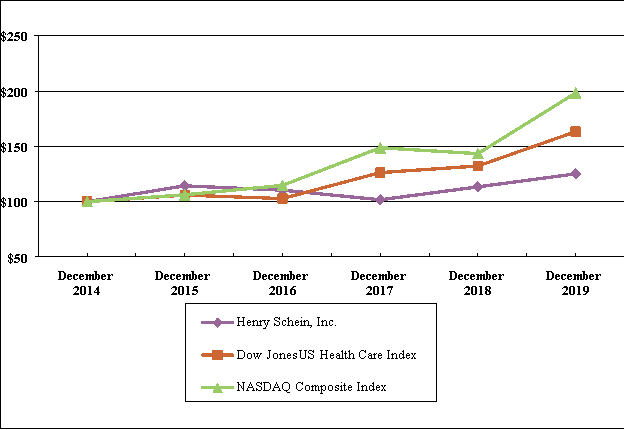
The graph below compares the cumulative total stockholder return on $100 invested, assuming the reinvestment of all dividends, on December 27, 2014, the last trading day before the beginning of our 2015 fiscal year, through the end of our 2019 fiscal year with the cumulative total return on $100 invested for the same period in the Dow Jones U.S. Health Care Index and the Nasdaq Stock Market Composite Index.
COMPARISON OF 5-YEAR CUMULATIVE TOTAL RETURN
| ASSUMES $100 INVESTED ON DECEMBER 27, 2014 | ||||||||||||||||||
|---|---|---|---|---|---|---|---|---|---|---|---|---|---|---|---|---|---|---|
| ASSUMES DIVIDENDS REINVESTED | ||||||||||||||||||
| December 27, | December 26, | December 31, | December 30, | December 29, | December 28, | |||||||||||||
| 2014 | 2015 | 2016 | 2017 | 2018 | 2019 | |||||||||||||
| Henry Schein, Inc. | $ | 100.00 | $ | 114.34 | $ | 110.43 | $ | 101.73 | $ | 113.43 | $ | 125.14 | ||||||
| Dow Jones U.S. Health | ||||||||||||||||||
| Care Index | 100.00 | 105.95 | 102.82 | 126.30 | 132.27 | 163.32 | ||||||||||||
| NASDAQ Stock Market | ||||||||||||||||||
| Composite Index | 100.00 | 106.25 | 114.75 | 148.76 | 143.41 | 198.30 |
Item 6. Selected Financial Data
The following selected financial data, with respect to our financial position and results of operations for each of the five fiscal years in the period ended December 28, 2019, set forth below, has been derived from, should be read in conjunction with and is qualified in its entirety by reference to, our consolidated financial statements and notes thereto. The selected financial data presented below should also be read in conjunction with ITEM 7, “Management’s Discussion and Analysis of Financial Condition and Results of Operations” and ITEM 8, “Financial Statements and Supplementary Data.”
| Years ended | ||||||||||||||
|---|---|---|---|---|---|---|---|---|---|---|---|---|---|---|
| December 28, | December 29, | December 30, | December 31, | December 26, | ||||||||||
| 2019 | 2018 | 2017 | 2016 | 2015 | ||||||||||
| (in thousands, except per share data) | ||||||||||||||
| Income Statement Data: | ||||||||||||||
| Net sales | $ | 9,985,803 | $ | 9,417,603 | $ | 8,883,438 | $ | 8,218,885 | $ | 7,650,755 | ||||
| Gross profit | 3,090,886 | 2,910,747 | 2,746,662 | 2,605,907 | 2,476,068 | |||||||||
| Selling, general and administrative expenses | 2,357,920 | 2,217,273 | 2,071,576 | 1,975,445 | 1,869,351 | |||||||||
| Litigation settlements | - | 38,488 | 5,325 | - | - | |||||||||
| Restructuring costs (1) | 14,705 | 54,367 | - | 38,621 | 26,587 | |||||||||
| Operating income | 718,261 | 600,619 | 669,761 | 591,841 | 580,130 | |||||||||
| Other expense, net | (37,954) | (63,783) | (39,967) | (18,705) | (17,904) | |||||||||
| Income from continuing operations before taxes, equity | ||||||||||||||
| in earnings of affiliates and noncontrolling interests | 680,307 | 536,836 | 629,794 | 573,136 | 562,226 | |||||||||
| Income taxes (2) | (159,515) | (107,432) | (308,975) | (169,311) | (170,113) | |||||||||
| Equity in earnings of affiliates | 17,900 | 21,037 | 15,293 | 17,110 | 13,300 | |||||||||
| Net gain (loss) on sale of equity investments (3) | 186,769 | - | (17,636) | - | - | |||||||||
| Net income from continuing operations | 725,461 | 450,441 | 318,476 | 420,935 | 405,413 | |||||||||
| Income (loss) from discontinued operations | (6,323) | 111,685 | 140,817 | 135,460 | 118,014 | |||||||||
| Net income | 719,138 | 562,126 | 459,293 | 556,395 | 523,427 | |||||||||
| Less: Net income attributable to noncontrolling interests | (24,770) | (19,724) | (25,304) | (19,651) | (19,705) | |||||||||
| Less: Net (income) loss attributable to noncontrolling | ||||||||||||||
| interests from discontinued operations | 366 | (6,521) | (27,690) | (29,966) | (24,664) | |||||||||
| Net income attributable to Henry Schein, Inc. | $ | 694,734 | $ | 535,881 | $ | 406,299 | $ | 506,778 | $ | 479,058 | ||||
| Amounts attributable to Henry Schein, Inc.: | ||||||||||||||
| Continuing operations | 700,691 | 430,717 | 293,172 | 401,284 | 385,708 | |||||||||
| Discontinued operations | (5,957) | 105,164 | 113,127 | 105,494 | 93,350 | |||||||||
| Net income attributable to Henry Schein, Inc. | $ | 694,734 | $ | 535,881 | $ | 406,299 | $ | 506,778 | $ | 479,058 | ||||
| Earnings (loss) per share attributable to | ||||||||||||||
| Henry Schein, Inc.: | ||||||||||||||
| From continuing operations: | ||||||||||||||
| Basic | $ | 4.74 | $ | 2.82 | $ | 1.87 | $ | 2.48 | $ | 2.33 | ||||
| Diluted | 4.69 | 2.80 | 1.85 | 2.45 | 2.29 | |||||||||
| From discontinued operations: | ||||||||||||||
| Basic | $ | (0.04) | $ | 0.69 | $ | 0.72 | $ | 0.65 | $ | 0.56 | ||||
| Diluted | (0.04) | 0.68 | 0.72 | 0.64 | 0.55 | |||||||||
| Earnings per share attributable to Henry Schein, Inc.: | ||||||||||||||
| Basic | $ | 4.70 | $ | 3.51 | $ | 2.59 | $ | 3.14 | $ | 2.89 | ||||
| Diluted | 4.65 | 3.49 | 2.57 | 3.10 | 2.85 | |||||||||
| Weighted-average common shares outstanding: | ||||||||||||||
| Basic | 147,817 | 152,656 | 156,787 | 161,641 | 165,687 | |||||||||
| Diluted | 149,257 | 153,707 | 158,208 | 163,723 | 168,250 |
| Years ended | |||||||||||||||
|---|---|---|---|---|---|---|---|---|---|---|---|---|---|---|---|
| December 28, | December 29, | December 30, | December 31, | December 26, | |||||||||||
| 2019 | 2018 | 2017 | 2016 | 2015 | |||||||||||
| (in thousands) | |||||||||||||||
| Net Sales by Market Data: | |||||||||||||||
| Health care distribution (4): | |||||||||||||||
| Dental | $ | 6,415,865 | $ | 6,347,998 | $ | 6,047,811 | $ | 5,554,296 | $ | 5,275,405 | |||||
| Medical | 2,973,586 | 2,661,166 | 2,497,994 | 2,337,661 | 2,072,915 | ||||||||||
| Total health care distribution | 9,389,451 | 9,009,164 | 8,545,805 | 7,891,957 | 7,348,320 | ||||||||||
| Technology and value-added services (5) | 515,085 | 408,439 | 337,633 | 326,928 | 302,435 | ||||||||||
| Total excluding Corporate TSA revenues | 9,904,536 | 9,417,603 | 8,883,438 | 8,218,885 | 7,650,755 | ||||||||||
| Corporate TSA revenues (6) | 81,267 | - | - | - | - | ||||||||||
| Total | $ | 9,985,803 | $ | 9,417,603 | $ | 8,883,438 | $ | 8,218,885 | $ | 7,650,755 | |||||
| As of | |||||||||||||||
| December 28, | December 29, | December 30, | December 31, | December 26, | |||||||||||
| 2019 | 2018 | 2017 | 2016 | 2015 | |||||||||||
| (in thousands) | |||||||||||||||
| Balance Sheet Data: | |||||||||||||||
| Total assets | $ | 7,151,101 | $ | 8,500,527 | $ | 7,863,995 | $ | 6,811,763 | $ | 6,580,775 | |||||
| Long-term debt | 622,908 | 980,344 | 884,227 | 689,626 | 439,830 | ||||||||||
| Redeemable noncontrolling interests | 287,258 | 219,724 | 465,584 | 285,567 | 266,435 | ||||||||||
| Stockholders' equity | 3,630,137 | 3,541,788 | 2,824,410 | 2,800,804 | 2,886,814 | ||||||||||
| (1) | Restructuring costs for the year ended December 28, 2019 consist primarily of severance costs, including severance pay and benefits of $13.8 million and facility closing costs of $0.9 million. Restructuring costs for the year ended December 29, 2018 consist primarily of severance costs, including severance pay and benefits of $50.2 million, facility closing costs of $3.2 million and other costs of $1.0 million. Restructuring costs for the year ended December 31, 2016 consist primarily of severance costs, including severance pay and benefits of $33.8 million, facility closing costs of $3.2 million and other costs of $1.6 million. Restructuring costs for the year ended December 26, 2015 consist primarily of severance costs, including severance pay and benefits of $20.3 million, facility closing costs of $4.9 million and other costs of $1.4 million. See “Management’s Discussion and Analysis of Financial Condition and Results of Operations – Plans of Restructuring” herein and the consolidated financial statements and related notes contained in ITEM 8. |
|---|---|
| (2) | In 2018 we recorded (a) a $10.0 million net credit to income tax representing a change in our estimate of the transition tax on deemed repatriated foreign earnings, (b) a one-time income tax charge of $3.9 million to income tax as a result of a reorganization of legal entities related to Henry Schein One, (c) an income tax credit of $13.9 million ($10.6 million attributable to Henry Schein, Inc.) resulting from a legal entity reorganization outside of the United States and (d) a one-time income tax charge of $3.1 million as a result of the reorganization of legal entities completed in preparation for the Animal Health Spin-off. In 2017 we recorded a one-time income tax charge of $140 million related to the transition tax on deemed repatriated foreign earnings and a one-time income tax charge of $3.0 million for the revaluation of deferred taxes associated with U.S. tax reform legislation. In 2015, we recorded a $6.3 million income tax benefit related to a favorable response to a tax petition, which allowed us to conclude that it is was more likely than not that certain unrecognized tax benefits, which had been previously reserved, would be realized. |
| (3) | During the fourth quarter of 2019, we sold an equity investment in Hu-Friedy Mfg. Co., LLC, a manufacturer of dental instruments and infection prevention solutions. Our investment was non-controlling, we were not involved in running the business and had no representation on the board of directors. During the fourth quarter of 2019, we also sold certain other equity investments. During 2017 we sold our equity ownership in E4D Technologies resulting in a loss of approximately $17.6 million. There was no tax benefit recognized related to this loss. |
| (4) | Consists of consumable products, small equipment, laboratory products, large equipment, equipment repair services, branded and generic pharmaceuticals, vaccines, surgical products, diagnostic tests, infection-control products and vitamins. |
| (5) | Consists of practice management software and other value-added products, which are distributed primarily to health care providers, and financial services on a non-recourse basis, e-services, continuing education services for practitioners, consulting and other services. |
| (6) | Corporate TSA revenues represents sales of certain products to Covetrus under the transition services agreement entered into in connection with the Animal Health Spin-off, which we expect to continue through August 2020. |
Item 7. Management’s Discussion and Analysis of Financial Condition and Results of Operations
Cautionary Note Regarding Forward-Looking Statements
In accordance with the “Safe Harbor” provisions of the Private Securities Litigation Reform Act of 1995, we provide the following cautionary remarks regarding important factors that, among others, could cause future results to differ materially from the forward-looking statements, expectations and assumptions expressed or implied herein. All forward-looking statements made by us are subject to risks and uncertainties and are not guarantees of future performance. These forward-looking statements involve known and unknown risks, uncertainties and other factors that may cause our actual results, performance and achievements or industry results to be materially different from any future results, performance or achievements expressed or implied by such forward-looking statements. These statements are generally identified by the use of such terms as “may,” “could,” “expect,” “intend,” “believe,” “plan,” “estimate,” “forecast,” “project,” “anticipate,” “to be,” “to make” or other comparable terms. Factors that could cause or contribute to such differences include, but are not limited to, those discussed in this Annual Report on Form 10-K, and in particular the risks discussed under the caption “Risk Factors” in Item 1A of this report and those discussed in other documents we file with the Securities and Exchange Commission (SEC).
Risk factors and uncertainties that could cause actual results to differ materially from current and historical results include, but are not limited to: effects of a highly competitive and consolidating market; increased competition by third party commerce sites; our dependence on third parties for the manufacture and supply of our products; our dependence upon sales personnel, customers, suppliers and manufacturers; our dependence on our senior management; fluctuations in quarterly earnings; risks from expansion of customer purchasing power and multi-tiered costing structures; increases in shipping costs for our products or other service issues with our third-party shippers; general global macro-economic conditions; risks associated with currency fluctuations; risks associated with political and economic uncertainty; disruptions in financial markets; volatility of the market price of our common stock; changes in the health care industry; implementation of health care laws; failure to comply with regulatory requirements and data privacy laws; risks associated with our global operations; risks associated with the Coronavirus; risks associated with the United Kingdom’s withdrawal from the European Union; transitional challenges associated with acquisitions, dispositions and joint ventures, including the failure to achieve anticipated synergies/benefits; financial and tax risks associated with acquisitions, dispositions and joint ventures; litigation risks; new or unanticipated litigation developments and the status of litigation matters; the dependence on our continued product development, technical support and successful marketing in the technology segment; our dependence on third parties for certain technologically advanced components; risks from disruption to our information systems; cyberattacks or other privacy or data security breaches; certain provisions in our governing documents that may discourage third-party acquisitions of us; and changes in tax legislation. The order in which these factors appear should not be construed to indicate their relative importance or priority.
We caution that these factors may not be exhaustive and that many of these factors are beyond our ability to control or predict. Accordingly, any forward-looking statements contained herein should not be relied upon as a prediction of actual results. We undertake no duty and have no obligation to update forward-looking statements.
Where You Can Find Important Information
We may disclose important information through one or more of the following channels: SEC filings, public conference calls and webcasts, press releases, the investor relations page of our website (www.henryschein.com) and the social media channels identified on the Newsroom page of our website.
Recent Developments
During the fourth quarter of 2019, we sold an equity investment in Hu-Friedy Mfg. Co., LLC, a manufacturer of dental instruments and infection prevention solutions. Our investment was non-controlling, we were not involved in running the business and had no representation on the board of directors. During the fourth quarter of 2019, we also sold certain other equity investments. In aggregate, the sales of these investments resulted in a pre-tax gain of approximately $250.2 million and an after-tax gain of approximately $186.8 million.
On February 7, 2019 (the “Distribution Date”), we completed the separation (the “Separation”) and subsequent merger of our animal health business (the “Henry Schein Animal Health Business”) with Direct Vet Marketing, Inc. (d/b/a Vets First Choice, “Vets First Choice”) (the “Merger”). This was accomplished by a series of transactions among us, Vets First Choice, Covetrus, Inc. (f/k/a HS Spinco, Inc. “Covetrus”), a wholly owned subsidiary of ours prior to the Distribution Date, and HS Merger Sub, Inc., a wholly owned subsidiary of Covetrus (“Merger Sub”). In connection with the Separation, we contributed, assigned and transferred to Covetrus certain applicable assets, liabilities and capital stock or other ownership interests relating to the Henry Schein Animal Health Business. On the Distribution Date, we received a tax-free distribution of $1,120 million from Covetrus pursuant to certain debt financing incurred by Covetrus. On the Distribution Date and prior to the Animal Health Spin-off, Covetrus issued shares of Covetrus common stock to certain institutional accredited investors (the “Share Sale Investors”) for $361.1 million (the “Share Sale”). The proceeds of the Share Sale were paid to Covetrus and distributed to us. Subsequent to the Share Sale, we distributed, on a pro rata basis, all of the shares of the common stock of Covetrus held by us to our stockholders of record as of the close of business on January 17, 2019 (the “Animal Health Spin-off”). After the Share Sale and Animal Health Spin-off, Merger Sub consummated the Merger whereby it merged with and into Vets First Choice, with Vets First Choice surviving the Merger as a wholly owned subsidiary of Covetrus. Immediately following the consummation of the Merger, on a fully diluted basis, (i) approximately 63% of the shares of Covetrus common stock were (a) owned by our stockholders and the Share Sale Investors, and (b) held by certain employees of the Henry Schein Animal Health Business (in the form of certain equity awards), and (ii) approximately 37% of the shares of Covetrus common stock were (a) owned by stockholders of Vets First Choice immediately prior to the Merger, and (b) held by certain employees of Vets First Choice (in the form of certain equity awards). After the Separation and the Merger, we no longer beneficially owned any shares of Covetrus common stock and, following the Distribution Date, will not consolidate the financial results of Covetrus for the purpose of our financial reporting. Following the Separation and the Merger, Covetrus was an independent, publicly traded company on the Nasdaq Global Select Market.
Executive-Level Overview
We believe we are the world’s largest provider of health care products and services primarily to office-based dental and medical practitioners. We serve more than 1 million customers worldwide including dental practitioners and laboratories and physician practices, as well as government, institutional health care clinics and other alternate care clinics. We believe that we have a strong brand identity due to our more than 87 years of experience distributing health care products.
We are headquartered in Melville, New York, employ more than 19,000 people (of
Showing the first 8K of 126K characters. Open the full section
Item 7A. Quantitative and Qualitative Disclosures About Market Risk
We are exposed to market risks as well as changes in foreign currency exchange rates as measured against the U.S. dollar and each other, and changes to the credit markets. We attempt to minimize these risks by primarily using foreign currency forward contracts and by maintaining counter-party credit limits. These hedging activities provide only limited protection against currency exchange and credit risks. Factors that could influence the effectiveness of our hedging programs include currency markets and availability of hedging instruments and liquidity of the credit markets. All foreign currency forward contracts that we enter into are components of hedging programs and are entered into for the sole purpose of hedging an existing or anticipated currency exposure. We do not enter into such contracts for speculative purposes and we manage our credit risks by diversifying our investments, maintaining a strong balance sheet and having multiple sources of capital.
Foreign Currency Agreements
The value of certain foreign currencies as compared to the U.S. dollar and the value of certain underlying functional currencies of the Company, including its foreign subsidiaries, may affect our financial results. Fluctuations in exchange rates may positively or negatively affect our revenues, gross margins, operating expenses and retained earnings, all of which are expressed in U.S. dollars. Where we deem it prudent, we engage in hedging programs using primarily foreign currency forward contracts aimed at limiting the impact of foreign currency exchange rate fluctuations on earnings. We purchase short-term (i.e., generally 18 months or less) foreign currency forward contracts to protect against currency exchange risks associated with intercompany loans due from our international subsidiaries and the payment of merchandise purchases to foreign suppliers. We do not hedge the translation of foreign currency profits into U.S. dollars, as we regard this as an accounting exposure, not an economic exposure. A hypothetical 5% change in the average value of the U.S. dollar in 2019 compared to foreign currencies would have changed our 2019 reported Net income attributable to Henry Schein, Inc. by approximately $6.0 million.
As of December 28, 2019, we had forward foreign currency exchange agreements, which expire through November 16, 2023, which include a mark-to-market loss of $3.9 million as determined by quoted market prices. Included in the forward foreign currency exchange agreements, Henry Schein, Inc. had EUR/USD forward contracts notionally totaling an amount of €200 million, with a reported fair value of these contracts as a net liability of $0.3 million. A 5% increase in the value of the Euro to the USD from December 28, 2019, with all other variables held constant, would have had an unfavorable effect on the fair value of these forward contracts by decreasing the value of these instruments by $12.0 million. As of December 28, 2019, Henry Schein, Inc. had Euro to Brazilian Real (BRL) cross currency swap contracts notionally totaling an amount of €83.6 million, with a reported fair value of these contracts as a net liability of $1.4 million. A 5% increase in the value of the Euro to the BRL from December 28, 2019, with all other variables held constant, would have had a favorable effect on the fair value of these swap contracts by increasing the value of these instruments by $4.6 million.
Short-Term Investments
We limit our credit risk with respect to our cash equivalents, short-term investments and derivative instruments, by monitoring the credit worthiness of the financial institutions who are the counter-parties to such financial instruments. As a risk management policy, we limit the amount of credit exposure by diversifying and utilizing numerous investment grade counter-parties.
Variable Interest Rate Debt
As of December 28, 2019, we had variable interest rate exposure for certain of our revolving credit facilities and our U.S. trade accounts receivable securitization.
Our revolving credit facility which we entered into on April 18, 2017 and expires on April 18, 2022, has an interest rate that is based on the U.S. Dollar LIBOR plus a spread based on our leverage ratio at the end of each financial reporting quarter. As of December 28, 2019, there was $0.0 million outstanding under this revolving credit
facility. During the year ended December 28, 2019, the average outstanding balance under this revolving credit facility was approximately $147.5 million. Based upon our average outstanding balance for this revolving credit facility, for each hypothetical increase of 25 basis points, our interest expense thereunder would have increased by $0.4 million.
Our U.S trade accounts receivable securitization, which we entered into on April 17, 2013 and which expires on April 29, 2022, has an interest rate that is based upon the asset-backed commercial paper rate. As of December 28, 2019, the commercial paper rate was 1.90% plus 0.75%, for a combined rate of 2.65%. At December 28, 2019 the outstanding balance was $100.0 million under this securitization facility. During the year ended December 28, 2019, the average outstanding balance under this securitization facility was approximately $274.8 million. Based upon our average outstanding balance for this securitization facility, for each hypothetical increase of 25 basis points, our interest expense thereunder would have increased by $0.7 million.
Showing the first 8K of 214K characters. Open the full section
Item 9. Changes in and Disagreements With Accountants on Accounting and Financial Disclosure
None.
Item 9A. Controls and Procedures
Evaluation of Disclosure Controls and Procedures
Under the supervision and with the participation of management, including our principal executive officer and principal financial officer, we evaluated the effectiveness of the design and operation of our disclosure controls and procedures as of the end of the period covered by this annual report as such term is defined in Rules 13a-15(e) and 15d-15(e) promulgated under the Securities Exchange Act of 1934, as amended (the “Exchange Act”). Based on this evaluation, our management, including our principal executive officer and principal financial officer, concluded that our disclosure controls and procedures were effective as of December 28, 2019 to ensure that all material information required to be disclosed by us in reports that we file or submit under the Exchange Act is accumulated and communicated to them as appropriate to allow timely decisions regarding required disclosure and that all such information is recorded, processed, summarized and reported within the time periods specified in the SEC’s rules and forms.
Changes in Internal Control over Financial Reporting
The combination of acquisitions, continued acquisition integrations and systems implementations undertaken during the quarter and carried over from prior quarters, when considered in the aggregate, represents a material change in our internal control over financial reporting.
During the quarter ended December 28, 2019, post-acquisition integration related activities continued for our global dental and North American technology and medical businesses acquired during prior quarters, representing aggregate annual revenues of approximately $539 million. These acquisitions, the majority of which utilize separate information and financial accounting systems, have been included in our consolidated financial statements since their respective dates of acquisition.
Also, during the quarter ended December 28, 2019, post-implementation system improvement activities continued for a new equipment system implemented during prior quarters for our U.S. dental business representing approximate aggregate annual revenues of $912 million, as well as an upgrade of an existing ERP system at a dental business in North America having approximate aggregate annual revenues of $58 million.
All continued acquisitions integrations and systems implementations involved necessary and appropriate change-management controls that are considered in our annual assessment of the design and operating effectiveness of our internal control over financial reporting.
Management’s Report on Internal Control over Financial Reporting
Our management is responsible for establishing and maintaining adequate internal control over financial reporting, as such term is defined in Exchange Act Rule 13a-15(f). Our internal control system is designed to provide reasonable assurance to our management and Board of Directors regarding the preparation and fair presentation of published financial statements. Under the supervision and with the participation of our management, including our principal executive officer and principal financial officer, we conducted an evaluation of the effectiveness of our internal control over financial reporting based on the framework in Internal Control-Integrated Framework (2013), updated and reissued by the Committee of Sponsoring Organizations, or the COSO Framework. Based on our evaluation under the COSO Framework, our management concluded that our internal control over financial reporting was effective at a reasonable assurance level as of December 28, 2019.
The effectiveness of our internal control over financial reporting as of December 28, 2019 has been independently audited by BDO USA, LLP, an independent registered public accounting firm, and their attestation is included herein.
Limitations of the Effectiveness of Internal Control
A control system, no matter how well conceived and operated, can provide only reasonable, not absolute, assurance that the objectives of the internal control system are met. Because of the inherent limitations of any internal control system, no evaluation of controls can provide absolute assurance that all control issues, if any, within a company have been detected.
REPORT OF INDEPENDENT REGISTERED PUBLIC ACCOUNTING FIRM
Stockholders and Board of Directors
Henry Schein, Inc.
Melville, NY
Opinion on Internal Control over Financial Reporting
We have audited Henry Schein, Inc.’s (the “Company’s”) internal control over financial reporting as of December 28, 2019, based on criteria established in Internal Control – Integrated Framework (2013) issued by the Committee of Sponsoring Organizations of the Treadway Commission (the “COSO criteria”). In our opinion, the Company maintained, in all material respects, effective internal control over financial reporting as of December 28, 2019, based on the COSO criteria*.*
We also have audited, in accordance with the standards of the Public Company Accounting Oversight Board (United States) (“PCAOB”), the consolidated balance sheets of the Company as of December 28, 2019 and December 29, 2018, the related consolidated statements of income, comprehensive income, changes in stockholders’ equity, and cash flows for each of the three years in the period ended December 28, 2019, and the related notes and schedule and our report dated February 20, 2020 expressed an unqualified opinion thereon.
Basis for Opinion
The Company’s management is responsible for maintaining effective internal control over financial reporting and for its assessment of the effectiveness of internal control over financial reporting, included in the accompanying “Item 9A, Management’s Report on Internal Control over Financial Reporting”. Our responsibility is to express an opinion on the Company’s internal control over financial reporting based on our audit. We are a public accounting firm registered with the PCAOB and are required to be independent with respect to the Company in accordance with U.S. federal securities laws and the applicable rules and regulations of the Securities and Exchange Commission and the PCAOB.
We conducted our audit of internal control over financial reporting in accordance with the standards of the PCAOB. Those standards require that we plan and perform the audit to obtain reasonable assurance about whether effective internal control over financial reporting was maintained in all material respects. Our audit included obtaining an understanding of internal control over financial reporting, assessing the risk that a material weakness exists, and testing and evaluating the design and operating effectiveness of internal control based on the assessed risk. Our audit also included performing such other procedures as we considered necessary in the circumstances. We believe that our audit provides a reasonable basis for our opinion.
Definition and Limitations of Internal Control over Financial Reporting
A company’s internal control over financial reporting is a process designed to provide reasonable assurance regarding the reliability of financial reporting and the preparation of financial statements for external purposes in accordance with generally accepted accounting principles. A company’s internal control over financial reporting includes those policies and procedures that (1) pertain to the maintenance of records that, in reasonable detail, accurately and fairly reflect the transactions and dispositions of the assets of the company; (2) provide reasonable assurance that transactions are recorded as necessary to permit preparation of financial statements in accordance with generally accepted accounting principles, and that receipts and expenditures of the company are being made only in accordance with authorizations of management and directors of the company; and (3) provide reasonable assurance regarding prevention or timely detection of unauthorized acquisition, use, or disposition of the company’s assets that could have a material effect on the financial statements.
Because of its inherent limitations, internal control over financial reporting may not prevent or detect misstatements. Also, projections of any evaluation of effectiveness to future periods are subject to the risk that
controls may become inadequate because of changes in conditions, or that the degree of compliance with the policies or procedures may deteriorate.
/s/ BDO USA, LLP
New York, NY
February 20, 2020
Item 9B. Other Information
Not applicable.
PART III
Item 10. Directors, Executive Officers and Corporate Governance
Information required by this item regarding our directors and executive officers and our corporate governance is hereby incorporated by reference to the Section entitled “Election of Directors,” with respect to directors, and the first paragraph of the Section entitled “Corporate Governance - Board of Directors Meetings and Committees - Audit Committee,” with respect to corporate governance, in each case in our definitive 2020 Proxy Statement to be filed pursuant to Regulation 14A and to the Section entitled “Information about our Executive Officers” in Part I of this report, with respect to executive officers.
There have been no changes to the procedures by which stockholders may recommend nominees to our Board of Directors since our last disclosure of such procedures, which appeared in our definitive 2019 Proxy Statement filed pursuant to Regulation 14A on April 9, 2019.
Information required by this item concerning compliance with Section 16(a) of the Securities Exchange Act of 1934 is hereby incorporated by reference to the Section entitled “Delinquent Section 16(a) Reports” in our definitive 2020 Proxy Statement to be filed pursuant to Regulation 14A, to the extent responsive disclosure is required.
We have adopted a Code of Ethics that applies to our Chief Executive Officer, Chief Financial Officer, Chief Accounting Officer and Controller. We make available free of charge through our Internet website, www.henryschein.com, under the “About Henry Schein--Corporate Governance” caption, our Code of Ethics. We intend to disclose on our Web site any amendment to, or waiver of, a provision of the Code of Ethics.
Item 11. Executive Compensation
The information required by this item is hereby incorporated by reference to the Sections entitled “Compensation Discussion and Analysis,” “Compensation Committee Report” (which information shall be deemed furnished in this Annual Report on Form 10-K), “Executive and Director Compensation” and “Compensation Committee Interlocks and Insider Participation” in our definitive 2020 Proxy Statement to be filed pursuant to Regulation 14A.
Item 12. Security Ownership of Certain Beneficial Owners and Management and Related Stockholder Matters
We maintain several stock incentive plans for the benefit of certain officers, directors and employees. All active plans have been approved by our stockholders. Descriptions of these plans appear in the notes to our consolidated financial statements. The following table summarizes information relating to these plans as of December 28, 2019:
| Weighted- Average | Number of Common | ||||||
| Exercise Price of | Shares Available for | ||||||
| Plan Category | Outstanding Options | Future Issuances | |||||
| Plans Approved by Stockholders | $ | - | 6,407,767 | ||||
| Plans Not Approved by Stockholders | - | - | |||||
| Total | $ | - | 6,407,767 |
The other information required by this item is hereby incorporated by reference to the Section entitled “Security Ownership of Certain Beneficial Owners and Management” in our definitive 2020 Proxy Statement to be filed pursuant to Regulation 14A.
Item 13. Certain Relationships and Related Transactions, and Director Independence
The information required by this item is hereby incorporated by reference to the Section entitled “Certain Relationships and Related Transactions” and “Corporate Governance – Board of Directors Meetings and Committees – Independent Directors” in our definitive 2020 Proxy Statement to be filed pursuant to Regulation 14A.
Item 14. Principal Accounting Fees and Services
The information required by this item is hereby incorporated by reference to the Section entitled “Independent Registered Public Accounting Firm Fees and Pre-Approval Policies and Procedures” in our definitive 2020 Proxy Statement to be filed pursuant to Regulation 14A.
PART IV
Item 15. Exhibits, Financial Statement Schedules
(a) List of Documents Filed as a Part of This Report:
| 1. | Financial Statements: |
|---|---|
| Our Consolidated Financial Statements filed as a part of this report are listed on the index on | |
| Page 84. | |
| 2. | Financial Statement Schedules: |
| Schedule II – Valuation of Qualifying Accounts | |
| No other schedules are required. | |
| 3. | Index to Exhibits: |
| See exhibits listed under Item 15(b) below. | |
(b) Exhibits
2.1 Contribution and Distribution Agreement, dated as of April 20, 2018, by and among us, HS Spinco, Inc., Direct Vet Marketing, Inc. and Shareholder Representative Services LLC. (Incorporated by reference to Exhibit 2.1 to our Current Report on Form 8-K filed on April 23, 2018 (film no. 18767875).)*
2.2 Agreement and Plan of Merger, dated as of April 20, 2018, by and among us, HS Spinco, Inc, HS Merger Sub, Inc., Direct Vet Marketing, Inc. and Shareholder Representative Services LLC. (Incorporated by reference to Exhibit 2.2 to our Current Report on Form 8-K filed on April 23, 2018 (film no. 18767875).)*
2.3 Letter Agreement, Amendment No. 1 to Contribution and Distribution Agreement and Amendment No. 1 to Agreement and Plan of Merger, dated as of September 14, 2018, by and among us, HS Spinco, Inc., HS Merger Sub, Inc., Direct Vet Marketing, Inc. and Shareholder Representative Services LLC.( Incorporated by reference to Exhibit 2.3 to our Annual Report on Form 10-K for the fiscal year ended December 29, 2018 filed on February 20, 2019.)
2.4 Letter Agreement and Amendment No. 2 to Contribution and Distribution Agreement, dated as of November 30, 2018, by and among us, HS Spinco, Inc., Direct Vet Marketing, Inc. and Shareholder Representative Services LLC. (Incorporated by reference to Exhibit 2.4 to our Annual Report on Form 10-K for the fiscal year ended December 29, 2018 filed on February 20, 2019.)
2.5 Letter Agreement and Amendment No. 3 to Contribution and Distribution Agreement and Amendment No. 2 to Agreement and Plan of Merger, dated as of December 25, 2018, by and among us, HS Spinco, Inc., HS Merger Sub, Inc., Direct Vet Marketing, Inc. and Shareholder Representative Services LLC.(Incorporated by reference to Exhibit 2.5 to our Annual Report on Form 10-K for the fiscal year ended December 29, 2018 filed on February 20, 2019.)
2.6 Letter Agreement and Amendment No. 4 to Contribution and Distribution Agreement, dated as of January 15, 2019, by and among us, HS Spinco, Inc., Direct Vet Marketing, Inc. and Shareholder Representative Services LLC.(Incorporated by reference to Exhibit 2.6 to our Annual Report on Form 10-K for the fiscal year ended December 29, 2018 filed on February 20, 2019.)
3.1 Second Amended and Restated Certificate of Incorporation of Henry Schein, Inc. (Incorporated by reference to Exhibit 3.1 to our Current Report on Form 8-K filed on June 1, 2018.)
3.2 Second Amended and Restated By-Laws of Henry Schein, Inc. (Incorporated by reference to Exhibit 3.2 to our Current Report on Form 8-K filed on June 1, 2018.)
4.1 Second Amended and Restated Multicurrency Master Note Purchase Agreement dated as of June 29, 2018, by and among us, Metropolitan Life Insurance Company, MetLife Investment Advisors Company, LLC and each MetLife affiliate which becomes party thereto. (Incorporated by reference to Exhibit 4.3 to our Current Report on Form 8-K filed on July 2, 2018.)
4.2 Second Amended and Restated Master Note Facility dated as of June 29, 2018, by and among us, NYL Investors LLC and each New York Life affiliate which becomes party thereto. (Incorporated by reference to Exhibit 4.2 to our Current Report on Form 8-K filed on July 2, 2018.)
4.3 Second Amended and Restated Multicurrency Private Shelf Agreement dated as of June 29, 2018, by and among us, PGIM, Inc. and each Prudential affiliate which becomes party thereto. (Incorporated by reference to Exhibit 4.1 to our Current Report on Form 8-K filed on July 2, 2018.)
4.4 Description of Securities.+
10.2 Form of 2015 Restricted Stock Agreement for time-based restricted stock awards pursuant to the Henry Schein, Inc. 2013 Stock Incentive Plan (as amended and restated effective as of May 14, 2013). (Incorporated by reference to Exhibit 10.1 to our Quarterly Report on Form 10-Q for the fiscal quarter ended March 28, 2015 filed on May 4, 2015.)**
10.3 Form of 2015 Restricted Stock Unit Agreement for time-based restricted stock awards pursuant to the Henry Schein, Inc. 2013 Stock Incentive Plan (as amended and restated effective as of May 14, 2013). (Incorporated by reference to Exhibit 10.3 to our Quarterly Report on Form 10-Q for the fiscal quarter ended March 28, 2015 filed on May 4, 2015.)**
10.4 Form of 2016 Restricted Stock Agreement for time-based restricted stock awards pursuant to the Henry Schein, Inc. 2013 Stock Incentive Plan (as amended and restated effective as of May 14, 2013). (Incorporated by reference to Exhibit 10.1 to our Quarterly Report on Form 10-Q for the fiscal quarter ended March 26, 2016 filed on May 3, 2016.)**
10.5 Form of 2016 Restricted Stock Agreement for performance-based restricted stock awards pursuant to the Henry Schein, Inc. 2013 Stock Incentive Plan (as amended and restated effective as of May 14, 2013). (Incorporated by reference to Exhibit 10.2 to our Quarterly Report on Form 10-Q for the fiscal quarter ended March 26, 2016 filed on May 3, 2016.)**
10.6 Form of 2016 Restricted Stock Unit Agreement for time-based restricted stock awards pursuant to the Henry Schein, Inc. 2013 Stock Incentive Plan (as amended and restated effective as of May 14, 2013). (Incorporated by reference to Exhibit 10.3 to our Quarterly Report on Form 10-Q for the fiscal quarter ended March 26, 2016 filed on May 3, 2016.)**
10.7 Form of 2016 Restricted Stock Unit Agreement for performance-based restricted stock awards pursuant to the Henry Schein, Inc. 2013 Stock Incentive Plan (as amended and restated effective as of May 14, 2013). (Incorporated by reference to Exhibit 10.4 to our Quarterly Report on Form 10-Q for the fiscal quarter ended March 26, 2016 filed on May 3, 2016.)**
10.8 Form of 2017 Restricted Stock Agreement for performance-based restricted stock awards pursuant to the Henry Schein, Inc. 2013 Stock Incentive Plan (as amended and restated effective as of May 14, 2013). (Incorporated by reference to Exhibit 10.1 to our Quarterly Report on Form 10-Q for the fiscal quarter ended April 1, 2017 filed on May 9, 2017.)**
10.9 Form of 2017 Restricted Stock Unit Agreement for time-based restricted stock awards pursuant to the Henry Schein, Inc. 2013 Stock Incentive Plan (as amended and restated effective as of May 14, 2013). (Incorporated by reference to Exhibit 10.2 to our Quarterly Report on Form 10-Q for the fiscal quarter ended April 1, 2017 filed on May 9, 2017.)**
10.10 Form of 2017 Restricted Stock Unit Agreement for performance-based restricted stock awards pursuant to the Henry Schein, Inc. 2013 Stock Incentive Plan (as amended and restated effective as of May 14, 2013). (Incorporated by reference to Exhibit 10.3 to our Quarterly Report on Form 10-Q for the fiscal quarter ended April 1, 2017 filed on May 9, 2017.)**
10.11 Form of 2018 Restricted Stock Unit Agreement for time-based restricted stock unit awards pursuant to the Henry Schein, Inc. 2013 Stock Incentive Plan (as amended and restated effective as of May 14, 2013). (Incorporated by reference to Exhibit 10.4 to our Quarterly Report on Form 10-Q for the fiscal quarter ended March 31, 2018 filed on May 8, 2018.)**
10.12 Form of 2018 Restricted Stock Unit Agreement for performance-based restricted stock unit awards pursuant to the Henry Schein, Inc. 2013 Stock Incentive Plan (as amended and restated effective as of May 14, 2013). (Incorporated by reference to Exhibit 10.5 to our Quarterly Report on Form 10-Q for the fiscal quarter ended March 31, 2018 filed on May 8, 2018.)**
10.13 Form of 2019 Restricted Stock Unit Agreement for time-based restricted stock unit awards pursuant to the Henry Schein, Inc. 2013 Stock Incentive Plan (as amended and restated effective as of May 14, 2013). (Incorporated by reference to Exhibit 10.1 to our Quarterly Report on Form 10-Q for the fiscal quarter ended March 30, 2019 filed on May 7, 2019.)**
10.14 Form of 2019 Restricted Stock Unit Agreement for performance-based restricted stock unit awards pursuant to the Henry Schein, Inc. 2013 Stock Incentive Plan (as amended and restated effective as of May 14, 2013). (Incorporated by reference to Exhibit 10.2 to our Quarterly Report on Form 10-Q for the fiscal quarter ended March 30, 2019 filed on May 7, 2019.)**
10.15 Henry Schein, Inc. 2015 Non-Employee Director Stock Incentive Plan. (Incorporated by reference to Exhibit 10.1 to our Quarterly Report on Form 10-Q for the fiscal quarter ended June 27, 2015 filed on July 29, 2015.)**
10.16 Form of 2018 Restricted Stock Unit Agreement for time-based restricted stock unit awards pursuant to the Henry Schein, Inc. 2015 Non-Employee Director Stock Incentive Plan (as amended and restated effective as of June 22, 2015). (Incorporated by reference to Exhibit 10.6 to our Quarterly Report on Form 10-Q for the fiscal quarter ended March 31, 2018 filed on May 8, 2018.)**
10.17 Henry Schein, Inc. Supplemental Executive Retirement Plan, amended and restated effective as of January 1, 2014. (Incorporated by reference to Exhibit 10.1 to our Quarterly Report on Form 10-Q for the fiscal quarter ended September 28, 2013 filed on November 5, 2013.)**
10.18 Amendment Number One to the Henry Schein, Inc. Supplemental Executive Retirement Plan, amended and restated effective as of January 1, 2014.**+
10.19 2001 Henry Schein, Inc. Section 162(m) Cash Bonus Plan effective as of June 6, 2001. (Incorporated by reference to Appendix B to our definitive 2001 Proxy Statement on Schedule 14A filed on April 30, 2001.)**
10.20 Amendment Number One to the 2001 Henry Schein, Inc. Section 162(m) Cash Bonus Plan, effective as of May 24, 2005. (Incorporated by reference to Exhibit B to our definitive 2005 Proxy Statement on Schedule 14A, filed on April 22, 2005.)**
10.21 Amendment Number Two to the Henry Schein, Inc. Section 162(m) Cash Bonus Plan, effective as of January 1, 2007. (Incorporated by reference to Exhibit 10.8 to our Annual Report on Form 10-K for the fiscal year ended December 27, 2008 filed on February 24, 2009.)**
10.22 Amendment Number Three to the Henry Schein, Inc. Section 162(m) Cash Bonus Plan effective as of December 31, 2009. (Incorporated by reference to Exhibit 10.2 to our Quarterly Report on Form 10-Q for the fiscal quarter ended June 27, 2009 filed on August 4, 2009.)**
10.23 Amendment Number Four to the Henry Schein, Inc. Section 162(m) Cash Bonus Plan, effective as of May 14, 2013. (Incorporated by reference to Exhibit 10.1 to our Current Report on Form 8-K filed on May 16, 2013.)**
10.24 Amendment Number Five to the Henry Schein, Inc. Section 162(m) Cash Bonus Plan, dated May 31, 2017. (Incorporated by reference to Exhibit 10.1 to our Current Report on Form 8-K filed on June 1, 2017.)**
10.25 Henry Schein, Inc. 2004 Employee Stock Purchase Plan, effective as of May 25, 2004. (Incorporated by reference to Exhibit D to our definitive 2004 Proxy Statement on Schedule 14A, filed on April 27, 2004.)**
10.26 Henry Schein, Inc. Non-Employee Director Deferred Compensation Plan, amended and restated effective as of January 1, 2005. (Incorporated by reference to Exhibit 10.11 to our Annual Report on Form 10-K for the fiscal year ended December 27, 2008 filed on February 24, 2009.)**
10.27 Henry Schein, Inc. Deferred Compensation Plan. (Incorporated by reference to Exhibit 10.23 to our Annual Report on Form 10-K for the fiscal year ended December 25, 2010 filed on February 22, 2011.)**
10.28 Amendment to the Henry Schein, Inc. Deferred Compensation Plan. (Incorporated by reference to Exhibit 10.26 to our Annual Report on Form 10-K for the fiscal year ended December 31, 2011 filed on February 15, 2012.)**
10.29 Amendment Number Two to the Henry Schein, Inc. Deferred Compensation Plan. (Incorporated by reference to Exhibit 10.20 to our Annual Report on Form 10-K for the fiscal year ended December 28, 2013 filed on February 11, 2014.)**
10.30 Amendment Number Three to the Henry Schein, Inc. Deferred Compensation Plan. (Incorporated by reference to Exhibit 10.21 to our Annual Report on Form 10-K for the fiscal year ended December 28, 2013 filed on February 11, 2014.)**
10.31 Amendment Number Four to the Henry Schein, Inc. Deferred Compensation Plan. (Incorporated by reference to Exhibit 10.46 to our Annual Report on Form 10-K for the fiscal year ended December 31, 2016 filed on February 21, 2017.)**
10.32 Amendment Number Five to the Henry Schein, Inc. Deferred Compensation Plan.**+
10.33 Henry Schein Management Team Performance Incentive Plan and Plan Summary, effective as of January 1, 2014. (Incorporated by reference to Exhibit 10.7 to our Quarterly Report on Form 10-Q for the fiscal quarter ended March 29, 2014 filed on May 6, 2014.)**
10.34 Amended and Restated Employment Agreement dated as of December 31, 2016, by and between us and Stanley M. Bergman. (Incorporated by reference to Exhibit 10.1 to our Current Report on Form 8-K filed on April 7, 2016.)**
10.35 Form of Performance-Based RSU Award Agreement for Stanley M. Bergman pursuant to the Henry Schein, Inc. 2013 Stock Incentive Plan (as amended and restated as of May 14, 2013). (Incorporated by reference to Exhibit 10.2 to our Current Report on Form 8-K filed on April 7, 2016.)**
10.36 Form of Time-Based RSU Award Agreement for Stanley M. Bergman pursuant to the Henry Schein, Inc. 2013 Stock Incentive Plan (as amended and restated as of May 14, 2013). (Incorporated by reference to Exhibit 10.3 to our Current Report on Form 8-K filed on April 7, 2016.)**
10.37 Amended and Restated Employment Agreement dated as of August 8, 2019, by and between Henry Schein, Inc. and Stanley M. Bergman. (Incorporated by reference to Exhibit 10.1 to our Current Report on Form 8-K filed on August 9, 2019.)**
10.38 Form of Performance-Based RSU Award Agreement for Stanley M. Bergman Pursuant to the Henry Schein, Inc. 2013 Stock Incentive Plan (as Amended and Restated as of May 14, 2013). (Incorporated by reference to Exhibit 10.2 to our Current Report on Form 8-K filed on August 9, 2019.)**
10.39 Form of Time-Based RSU Award Agreement for Stanley M. Bergman Pursuant to the Henry Schein, Inc. 2013 Stock Incentive Plan (as Amended and Restated as of May 14, 2013). (Incorporated by reference to Exhibit 10.3 to our Current Report on Form 8-K filed on August 9, 2019.)**
10.40 Form of Amended and Restated Change in Control Agreement dated December 12, 2008 between us and certain executive officers who are a party thereto (Gerald Benjamin, James Breslawski, Michael S. Ettinger, Mark Mlotek and Steven Paladino, respectively). (Incorporated by reference to Exhibit 10.15 to our Annual Report on Form 10-K for the fiscal year ended December 27, 2008 filed on February 24, 2009.)**
10.41 Form of Amendment to Amended and Restated Change in Control Agreement effective January 1, 2012 between us and certain executive officers who are a party thereto (Gerald Benjamin, James Breslawski, Michael S. Ettinger, Mark Mlotek and Steven Paladino, respectively). (Incorporated by reference to Exhibit 10.1 to our Current Report on Form 8-K filed on January 20, 2012.)**
10.42 Form of Change in Control Agreement between us and certain executive officers who are a party thereto (Walter Siegel). (Incorporated by reference to Exhibit 10.3 to our Quarterly Report on Form 10-Q for the fiscal quarter ended March 30, 2019 filed on May 7, 2019.)**
10.43 Credit Agreement, dated as of April 18, 2017, among the Company, the several lenders parties thereto, JPMorgan Chase Bank, N.A., as administrative agent, joint lead arranger and joint bookrunner, U.S. Bank National Association, as syndication agent, joint lead arranger and joint bookrunner, together with the exhibits and schedules thereto. (Incorporated by reference to Exhibit 10.1 to our Current Report on Form 8-K filed on April 19, 2017.)
10.44 First Amendment, dated as of June 29, 2018, among us, the several lenders parties thereto, and JPMorgan Chase Bank, N.A., as administrative agent, lead arranger and lead bookrunner. (Incorporated by reference to Exhibit 10.1 to our Current Report on Form 8-K filed on July 2, 2018.)
10.45 Promissory Note in favor of JPMorgan Chase Bank, N.A. dated as of May 21, 2018. (Incorporated by reference to Exhibit 10.1 to our Current Report on Form 8-K filed on May 21, 2018.)
10.46 Receivables Purchase Agreement, dated as of April 17, 2013, by and among us, as servicer, HSFR, Inc., as seller, The Bank of Tokyo-Mitsubishi UFJ, Ltd., as agent and the various purchaser groups from time to time party thereto. (Incorporated by reference to Exhibit 10.1 to our Current Report on Form 8-K filed on April 19, 2013.)
10.47 Amendment No. 1 dated as of September 22, 2014 to the Receivables Purchase Agreement, dated as of April 17, 2013, by and among us, as servicer, HSFR, Inc., as seller, The Bank of Tokyo-Mitsubishi UFJ, LTD., New York Branch, as agent and the various purchaser groups from time to time party thereto, as amended. (Incorporated by reference to Exhibit 10.2 to our Current Report on Form 8-K filed on September 26, 2014.)
10.48 Amendment No. 2 dated as of April 17, 2015 to Receivables Purchase Agreement, dated as of April 17, 2013, by and among us, as performance guarantor, HSFR, Inc., as seller, The Bank of Tokyo-Mitsubishi UFJ, Ltd., New York Branch, as agent and the various purchaser groups party thereto. (Incorporated by reference to Exhibit 10.1 to our Quarterly Report on Form 10-Q for the fiscal quarter ended June 25, 2016 filed on August 4, 2016.)
10.49 Amendment No. 3 dated as of June 1, 2016 to Receivables Purchase Agreement, dated as of April 17, 2013, by and among us, as performance guarantor, HSFR, Inc., as seller, The Bank of Tokyo-Mitsubishi UFJ, Ltd., New York Branch, as agent and the various purchaser groups party thereto. (Incorporated by reference to Exhibit 10.2 to our Quarterly Report on Form 10-Q for the fiscal quarter ended June 25, 2016 filed on August 4, 2016.)
10.50 Amendment No. 4 dated as of July 6, 2017 to Receivables Purchase Agreement, dated as of April 17, 2013, by and among us, as performance guarantor, HSFR, Inc., as seller, The Bank of Tokyo-Mitsubishi UFJ, Ltd., New York Branch, as agent and the various purchaser groups party thereto. (Incorporated by reference to Exhibit 10.1 to our Quarterly Report on Form 10-Q for the fiscal quarter ended September 30, 2017 filed on November 6, 2017.)
10.51 Amendment No. 5 dated as of May 13, 2019 to Receivables Purchase Agreement, dated as of April 17, 2013, by and among us, as performance guarantor, HSFR, Inc., as seller, The Bank of Tokyo-Mitsubishi UFJ, Ltd., New York Branch, as agent and the various purchaser groups party thereto. (Incorporated by reference to Exhibit 10.1 to our Quarterly Report on Form 10-Q for the fiscal quarter ended June 29, 2019 filed on August 6, 2019.)
10.52 Receivables Sale Agreement, dated as of April 17, 2013, by and among us, certain of our wholly-owned subsidiaries and HSFR, Inc., as buyer. (Incorporated by reference to Exhibit 10.2 to our Current Report on Form 8-K filed on April 19, 2013.)
10.53 Omnibus Amendment No. 1, dated July 22, 2013, to Receivables Purchase Agreement dated as of April 17, 2013, by and among us, as servicer, HSFR, Inc., as seller, The Bank of Tokyo-Mitsubishi UFJ, Ltd., as agent, and the various purchaser groups from time to time party thereto and Receivables Sales Agreement, dated as of April 17, 2013, by and among us, certain of our wholly-owned subsidiaries and HSFR, Inc., as buyer. (Incorporated by reference to Exhibit 10.5 to our Quarterly Report on Form 10-Q for the fiscal quarter ended June 29, 2013 filed on August 6, 2013.)
10.54 Omnibus Amendment No. 2, dated April 21, 2014, to Receivables Purchase Agreement dated as of April 17, 2013, as amended, by and among us, as servicer, HSFR, Inc., as seller, The Bank of Tokyo-Mitsubishi UFJ, Ltd., as agent, and the various purchaser groups from time to time party thereto and Receivables Sales Agreement, dated as of April 17, 2013, by and among us, certain of our wholly-owned subsidiaries and HSFR, Inc., as buyer. (Incorporated by reference to Exhibit 10.8 to our Quarterly Report on Form 10-Q for the fiscal quarter ended March 29, 2014 filed on May 6, 2014.)
10.55 Form of Indemnification Agreement between us and certain directors and executive officers who are a party thereto (Barry J. Alperin, Ph.D., Paul Brons, Shira Goodman, Joseph L. Herring, Kurt P. Kuehn, Philip A. Laskawy, Anne H. Margulies, Carol Raphael, E. Dianne Rekow, DDS, Ph.D., Bradley T. Sheares, Ph.D., Gerald A. Benjamin, Stanley M. Bergman, James P. Breslawski, Michael S. Ettinger, Mark E. Mlotek, Steven Paladino, and Walter Siegel, respectively). (Incorporated by reference to Exhibit 10.1 to our Quarterly Report on Form 10-Q for the fiscal quarter ended September 26, 2015 filed on November 4, 2015.)**
21.1 List of our Subsidiaries.+
23.1 Consent of BDO USA, LLP.+
31.1 Certification of our Chief Executive Officer pursuant to Section 302 of the Sarbanes-Oxley Act of 2002.+
31.2 Certification of our Chief Financial Officer pursuant to Section 302 of the Sarbanes-Oxley Act of 2002.+
32.1 Certification of our Chief Executive Officer and Chief Financial Officer pursuant to Section 906 of the Sarbanes-Oxley Act of 2002.+
| 101.INS | Inline XBRL Instance Document - the instance document does not appear in the Interactive Data File because its XBRL tags are embedded within the Inline XBRL document.+ |
|---|---|
| 101.SCH | Inline XBRL Taxonomy Extension Schema Document+ |
| 101.CAL | Inline XBRL Taxonomy Extension Calculation Linkbase Document+ |
| 101.DEF | Inline XBRL Taxonomy Extension Definition Linkbase Document+ |
| 101.LAB | Inline XBRL Taxonomy Extension Label Linkbase Document+ |
| 101.PRE | Inline XBRL Taxonomy Extension Presentation Linkbase Document+ |
| 104 | The cover page of Henry Schein, Inc.’s Annual Report on Form 10-K for the year ended December 28, 2019, formatted in Inline XBRL (included within Exhibit 101 attachments).+ |
+ Filed or furnished herewith.
- Schedules and exhibits have been omitted pursuant to Item 601(b)(2) of Regulation S-K. The Company hereby agrees to furnish supplementally a copy of any of the omitted schedules and exhibits upon request by the U.S. Securities and Exchange Commission.
** Indicates management contract or compensatory plan or agreement.
Item 16. Form 10-K Summary
None.
SIGNATURES
Pursuant to the requirements of Section 13 or 15(d) of the Securities Exchange Act of 1934, the Registrant has duly caused this report to be signed on its behalf by the undersigned, thereunto duly authorized.
| Henry Schein, Inc. | |
|---|---|
| By: /s/ STANLEY M. BERGMAN | |
| Stanley M. Bergman | |
| Chairman and Chief Executive Officer | |
| February 20, 2020 |
Pursuant to the requirements of the Securities Exchange Act of 1934, this report has been signed below by the following persons on behalf of the Registrant and in the capacities and on the dates indicated.
| Signature | Capacity | Date | ||
|---|---|---|---|---|
| /s/ STANLEY M. BERGMAN | Chairman, Chief Executive Officer | February 20, 2020 | ||
| Stanley M. Bergman | and Director (principal executive officer) | |||
| /s/ STEVEN PALADINO | Executive Vice President, Chief Financial | February 20, 2020 | ||
| Steven Paladino | Officer and Director (principal financial and | |||
| accounting officer) | ||||
| /s/ JAMES P. BRESLAWSKI | Vice Chairman, Director | February 20, 2020 | ||
| James P. Breslawski | ||||
| /s/ GERALD A. BENJAMIN | Director | February 20, 2020 | ||
| Gerald A. Benjamin | ||||
| /s/ MARK E. MLOTEK | Director | February 20, 2020 | ||
| Mark E. Mlotek | ||||
| /s/ BARRY J. ALPERIN | Director | February 20, 2020 | ||
| Barry J. Alperin | ||||
| /s/ PAUL BRONS | Director | February 20, 2020 | ||
| Paul Brons | ||||
| /s/ SHIRA GOODMAN | Director | February 20, 2020 | ||
| Shira Goodman | ||||
| /s/ JOSEPH L. HERRING | Director | February 20, 2020 | ||
| Joseph L. Herring | ||||
| /s/ KURT P. KUEHN | Director | February 20, 2020 | ||
| Kurt P. Kuehn | ||||
| /s/ PHILIP A. LASKAWY | Director | February 20, 2020 | ||
| Philip A. Laskawy | ||||
| /s/ ANNE H. MARGULIES | Director | February 20, 2020 | ||
| Anne H. Margulies | ||||
| /s/ CAROL RAPHAEL | Director | February 20, 2020 | ||
| Carol Raphael | ||||
| /s/ E. DIANNE REKOW | Director | February 20, 2020 | ||
| E. Dianne Rekow, DDS, Ph.D. | ||||
| /s/ BRADLEY T. SHEARES, PH. D. | Director | February 20, 2020 | ||
| Bradley T. Sheares, Ph. D. |
Schedule II
Valuation and Qualifying Accounts
(in thousands)
| Additions (Reductions) | |||||||||||||||||
|---|---|---|---|---|---|---|---|---|---|---|---|---|---|---|---|---|---|
| Charged | |||||||||||||||||
| Balance at | Charged to | (credited) to | Balance at | ||||||||||||||
| beginning of | statement of | other | end of | ||||||||||||||
| Description | period | income (1) | accounts (2) | Deductions (3) | period | ||||||||||||
| Year ended December 28, 2019: | |||||||||||||||||
| Allowance for doubtful accounts | |||||||||||||||||
| and other | $ | 53,121 | $ | 12,612 | $ | 134 | $ | (5,865) | $ | 60,002 | |||||||
| Year ended December 29, 2018: | |||||||||||||||||
| Allowance for doubtful accounts | |||||||||||||||||
| and other | $ | 46,261 | $ | 14,384 | $ | (1,158) | $ | (6,366) | $ | 53,121 | |||||||
| Year ended December 30, 2017: | |||||||||||||||||
| Allowance for doubtful accounts | |||||||||||||||||
| and other | $ | 33,150 | $ | 7,915 | $ | 11,341 | $ | (6,145) | $ | 46,261 | |||||||
| (1) | Represents amounts charged to bad debt expense. | ||||||||||||||||
| (2) | Amounts charged (credited) to other accounts primarily relate to provision for late fees and the impact of foreign currency exchange rates. | ||||||||||||||||
| (3) | Deductions primarily consist of fully reserved accounts receivable that have been written off. |