 filings.tools
Hubbell 10-K 2019-12-31
Filed 2020-02-14. 21 sections, 404K characters. Original on sec.gov · Markdown · JSON
Cover and table of contents
UNITED STATES
SECURITIES AND EXCHANGE COMMISSION
Washington, DC 20549
FORM 10-K
☑ ANNUAL REPORT PURSUANT TO SECTION 13 OR 15(d) OF THE SECURITIES EXCHANGE ACT OF 1934
FOR THE FISCAL YEAR ENDED DECEMBER 31, 2019
☐ TRANSITION REPORT PURSUANT TO SECTION 13 OR 15(d) OF THE SECURITIES EXCHANGE ACT OF 1934
Commission File Number 1-2958

HUBBELL INC****ORPORATED
(Exact name of registrant as specified in its charter)
| Connecticut | 06-0397030 | |
| (State or other jurisdiction of incorporation or organization) | (I.R.S. Employer Identification No.) | |
| 40 Waterview Drive | ||
| Shelton | CT | 06484 |
| (Address of principal executive offices) | (Zip Code) | |
| (475) | 882-4000 | |
| (Registrant's telephone number, including area code) |
| SECURITIES REGISTERED PURSUANT TO SECTION 12(b) OF THE ACT: | ||
| Title of each Class | Trading Symbol(s) | Name of Exchange on which Registered |
| Common Stock — par value $0.01 per share | HUBB | New York Stock Exchange |
| SECURITIES REGISTERED PURSUANT TO SECTION 12(g) OF THE ACT: | ||
| NONE |
| Indicate by check mark | ||||||||
| • | if the registrant is a well-known seasoned issuer, as defined in Rule 405 of the Securities Act. | Yes | ☑ | No | ☐ | |||
| • | if the registrant is not required to file reports pursuant to Section 13 or 15(d) of the Securities Exchange Act of 1934. | Yes | ☐ | No | ☑ | |||
| • | if the registrant (1) has filed all reports required to be filed by Section 13 or 15(d) of the Securities Exchange Act of 1934 during the preceding 12 months (or for such shorter period that the registrant was required to file such report), and (2) has been subject to such filing requirements for the past 90 days. | Yes | ☑ | No | ☐ | |||
| • | whether the registrant has submitted electronically and posted on its corporate Web site, if any, every Interactive Data File required to be submitted and posted pursuant to Rule 405 of Regulation S-T (§232.405 of this chapter) during the preceding 12 months (or for such shorter period that the registrant was required to submit and post such files). | Yes | ☑ | No | ☐ | |||
| • | whether the registrant is a large accelerated filer, an accelerated filer, a non-accelerated filer, a smaller reporting company or an emerging growth company. See the definitions of “large accelerated filer,” “accelerated filer”, “smaller reporting company” and "emerging growth company" in Rule 12b-2 of the Exchange Act. (Check one): | |||||||
| Large accelerated filer | ☑ | Accelerated filer ☐ | Non-accelerated filer ☐ (Do not check if a smaller reporting company) | Smaller reporting company | ☐ | |||
| Emerging growth company | ☐ | If an emerging growth company, indicate by check mark if the registrant has elected not to use the extended transition period for complying with any new or revised financial accounting standard provided pursuant to Section 13(a) of the Exchange Act. ☐ | ||||||
| • whether the registrant is a shell company (as defined in Rule 12b-2 of the Exchange Act). | Yes | ☐ | No | ☑ |
The approximate aggregate market value of the voting stock held by non-affiliates of the registrant as of June 30, 2019 was $7,036,079,255*. The number of shares outstanding of Hubbell Common Stock as of February 12, 2020 is 54,434,310.
DOCUMENTS INCORPORATED BY REFERENCE
Portions of the definitive proxy statement for the annual meeting of shareholders scheduled to be held on May 5, 2020, to be filed with the Securities and Exchange Commission (the “SEC”), are incorporated by reference in answer to Part III of this Form 10-K.
*Calculated by excluding all shares held by Executive Officers and Directors of registrant without conceding that all such persons or entities are “affiliates” of registrant for purpose of the Federal Securities Laws.
| 2 | HUBBELL INCORPORATED - Form 10-K |
| PART I |
Item 1. Business
Hubbell Incorporated (herein referred to as “Hubbell”, the “Company”, the “registrant”, “we”, “our” or “us”, which references shall include its divisions and subsidiaries as the context may require) was founded as a proprietorship in 1888, and was incorporated in Connecticut in 1905. Hubbell is primarily engaged in the design, manufacture and sale of quality electrical and electronic products for a broad range of non-residential and residential construction, industrial and utility applications. Products are either sourced complete, manufactured or assembled by subsidiaries in the United States, Canada, Puerto Rico, Mexico, the People’s Republic of China (“China”), the United Kingdom (“UK”), Brazil, Australia, Spain and Ireland. Hubbell also participates in joint ventures in Taiwan, Hong Kong and the Philippines, and maintains offices in Singapore, Italy, China, India, Mexico, South Korea, Chile, and countries in the Middle East.
The Company’s reporting segments consist of the Electrical and the Power segments, as described below. See also Item 7. Management’s Discussion and Analysis – “Executive Overview of the Business”, and “Results of Operations” as well as Note 20 — Industry Segments and Geographic Area Information in the Notes to Consolidated Financial Statements.
The Company’s annual report on Form 10-K, quarterly reports on Form 10-Q, current reports on Form 8-K, and all amendments to those reports are made available free of charge through the Investor Relations section of the Company’s website at http://www.hubbell.com as soon as practicable after such material is electronically filed with, or furnished to, the SEC. The information contained on the Company’s website or connected to our website is not incorporated by reference into this Annual Report on Form 10-K and should not be considered part of this report.
Electrical Segment
The Electrical segment (57% of consolidated revenues in 2019, 59% in 2018 and 69% in 2017) comprises businesses that sell stock and custom products including standard and special application wiring device products, rough-in electrical products, connector and grounding products, lighting fixtures and controls, components and assemblies for the natural gas distribution market, as well as other electrical equipment.
Electrical segment products are typically used in and around industrial, commercial and institutional facilities by electrical contractors, maintenance personnel, electricians, utilities, and telecommunications companies. In addition, certain of our businesses design and manufacture industrial controls and communication systems used in the non-residential and industrial markets. Many of these products are designed such that they can also be used in harsh and hazardous locations where a potential for fire and explosion exists due to the presence of flammable gasses and vapors. Harsh and hazardous products are primarily used in the oil and gas (onshore and offshore) and mining industries. We also offer a variety of lighting fixtures, wiring devices and electrical products that have residential and utility applications, including residential products with Internet-of-Things ("IoT") enabled technologies.
These products are primarily sold through electrical and industrial distributors, home centers, retail and hardware outlets, lighting showrooms and residential product oriented internet sites. Special application products are primarily sold through wholesale distributors to contractors, industrial customers and original equipment manufacturers (“OEMs”).
Hubbell maintains a sales and marketing organization to assist potential users with the application of certain products to their specific requirements, as well as to assist architects, engineers, industrial designers, OEMs and electrical contractors in the design of electrical systems to meet the specific requirements of industrial, non-residential and residential users. Hubbell is also represented by independent manufacturers’ sales agents for many of its product offerings.
| HUBBELL INCORPORATED - Form 10-K | 3 |
The Electrical segment, manufactures and sells thousands of wiring and electrical products, lighting fixtures and controls for indoor and outdoor applications as well as specialty lighting and communications products. The segment also includes businesses that manufacture main-to-meter gas distribution products. The products within the segment have applications in the non-residential, residential, industrial, and energy-related (oil and gas) markets. Fast growing trends within the industry are the adoption of light emitting diode (“LED”) technology as the light source, as well as products with embedded IoT technologies. The Company has a broad array of LED-luminaire products within its portfolio and the majority of new product development efforts are oriented towards expanding those offerings. Within the Electrical segment, products include items such as:
| Commercial and Industrial | |||||
| • | Wiring devices & accessories | • | Junction boxes, plugs & receptacles | • | Cable reels |
| • | Switches & dimmers | • | Steel & plastic enclosures | • | Datacom connectivity & enclosures |
| • | Ground fault devices | • | Pin & sleeve devices | • | Electrical motor controls |
| Lighting | |||||
| • | Canopy lights | • | Parking lot/parking garage fixtures | • | Decorative landscape fixtures |
| • | Emergency lighting/exit signs | • | Bollards | • | Fluorescent fixtures |
| • | Floodlights & poles | • | Bath/vanity fixtures & fans | • | Ceiling fans |
| • | LED components | • | Chandeliers & sconces | • | Site & area lighting |
| • | Recessed, surface mounted & track fixtures | • | Athletic & recreational field fixtures | • | Occupancy, dimming & daylight harvesting sensors |
| Construction and Energy | |||||
| • | Mechanical connectors | • | Gas connectors and assemblies | • | Specialty communications equipment |
| • | Mechanical grounding devices | • | Installation tooling | • | Mining communication & controls |
| • | Compression connectors | • | Specialty lighting | • | Cable glands & fittings |
| • | Safety equipment |
These products are sold under various brands and/or trademarks, including:
| Commercial and Industrial | |||||||||
| • | Hubbell® | • | Bell® | • | Raco® | • | Gleason Reel® | • | ACME Electric® |
| • | Kellems® | • | TayMac® | • | Hipotronics® | • | Powerohm™ | • | EC&M Design® |
| • | Bryant® | • | Wiegmann® | • | iDevices® | ||||
| Lighting | |||||||||
| • | Kim Lighting® | • | Beacon Products™ | • | Spaulding Lighting™ | • | Kurt Versen® | • | Litecontrol™ |
| • | Sportsliter Solutions™ | • | Columbia Lighting® | • | Alera Lighting® | • | Prescolite® | • | Dual-Lite® |
| • | Security Lighting™ | • | Progress Lighting Design® | • | Hubbell® Outdoor Lighting™ | • | Architectural Area Lighting™ | ||
| Construction and Energy | |||||||||
| • | Burndy® | • | Killark® | • | GAI-Tronics® | • | Gas Breaker® | • | R.W. Lyall™ |
| • | CMC® | • | Hawke™ | • | Chalmit™ | • | Vantage Technology® | • | Continental® |
| • | Austdac™ | • | AEC™ |
| 4 | HUBBELL INCORPORATED - Form 10-K |
Power Segment
The Power segment (43% of consolidated revenues in 2019, 41% in 2018 and 31% in 2017) consists of operations that design, manufacture and sell transmission and distribution components primarily for the electrical utilities industry. The water utility, telecommunications utility, civil construction and transportation industries are also served. Products are sold directly to utilities, and through distributors, as well as to contractors and construction and engineering firms. The 2018 acquisition of Meter Readings Holding Group, LLC ("Aclara Technologies" or "Aclara") expanded the Power portfolio to include endpoint metering devices and sensors, advanced metering infrastructure communications, and software and installation services sold to electrical, water, and gas utilities. While Hubbell believes its sales in this area are not materially dependent upon any customer or group of customers, a substantial decrease in purchases by electrical utilities would affect this segment.
Hubbell's Power segment manufactures and sells a wide variety of electrical distribution, transmission, substation and telecommunications products. These products and services include items such as:
| • | Arresters | • | Bushings | • | Grounding & bonding equipment |
| • | Cutouts & fuse links | • | Insulators | • | Programmable reclosers |
| • | Pole line hardware | • | Cable terminations & accessories | • | Sectionalizers |
| • | Helical anchors & foundations | • | Formed wire products | • | Lineman tools, hoses & gloves |
| • | Overhead, pad mounted & capacitor switches | • | Splices, taps & connectors | • | Polymer concrete & fiberglass enclosures and equipment pads |
| • | Advanced metering infrastructure | • | Meters and edge devices | • | Meter installation services |
| • | Utility asset protection equipment |
These products are sold under the following brands and/or trademarks:
| • | Aclara® | • | Chance® | • | Anderson® | • | PenCell® |
| • | Fargo® | • | Hubbell® | • | Polycast® | • | Opti-loop Design® |
| • | Quazite® | • | Quadri*sil® | • | Trinetics® | • | Reuel™ |
| • | Electro Composites™ | • | USCO™ | • | CDR™ | • | RFL Design® |
| • | Hot Box® | • | PCORE® | • | Delmar™ | • | Turner Electric® |
| • | EMC™ | • | Longbow™ | • | Ohio Brass® | • | Meramec® |
| • | Reliaguard® | • | Greenjacket® |
Information Applicable to All General Categories
International Operations
The Company has several operations located outside of the United States. These operations manufacture, assemble and/or procure and market Hubbell products and services for both the Electrical and Power segments.
See Note 20 — Industry Segments and Geographic Area Information in the Notes to Consolidated Financial Statements and Item 1A. Risk Factors relating to manufacturing in and sourcing from foreign countries.
Customers
The Company did not have any customers whose annual consolidated purchases exceeded 10 percent of our total net sales in 2019, 2018 and 2017.
Raw Materials
Raw materials used in the manufacture of Hubbell products primarily include steel, aluminum, brass, copper, bronze, zinc, nickel, plastics, phenolics, elastomers and petrochemicals. Hubbell also purchases certain electrical and electronic components, including solenoids, lighting ballasts, printed circuit boards, integrated circuit chips and cord sets, from a number of suppliers. Hubbell is not materially dependent upon any one supplier for raw materials used in the manufacture of its products and equipment and, at the present time, raw materials and components essential to its operation are in adequate supply. However, some of these principal raw materials are sourced from a limited number of suppliers. See also Item 7A. Quantitative and Qualitative Disclosures about Market Risk.
| HUBBELL INCORPORATED - Form 10-K | 5 |
Patents
Hubbell has approximately 2,400 active United States and foreign patents covering a portion of its products, which expire at various times. While Hubbell deems these patents to be of value, it does not consider its business to be dependent upon patent protection. Hubbell also licenses products under patents owned by others, as necessary, and grants licenses under certain of its patents.
Working Capital
Inventory, accounts receivable and accounts payable levels, payment terms and, where applicable, return policies are in accordance with the general practices of the electrical products industry and standard business procedures. See also Item 7. Management’s Discussion and Analysis of Financial Condition and Results of Operations.
Backlog
Substantially all of the backlog existing at December 31, 2019 in the Electrical segment is expected to be shipped to customers in 2020. In the Power segment, the backlog existing at December 31, 2019 includes backlog expected to be shipped during 2020, along with $395 million of backlog of contracts that span multiple years, primarily related to long-term contracts of the Aclara business to deliver and install meters and grid monitoring sensor technology. The backlog of orders believed to be firm at December 31, 2019 was approximately $1,037.0 million compared to $1,250.8 at December 31, 2018. Although this backlog is important, the majority of Hubbell’s revenues result from sales of inventoried products or products that have short periods of manufacture.
Competition
Hubbell experiences substantial competition in all categories of its business, but does not compete with the same companies in all of its product categories. The number and size of competitors vary considerably depending on the product line. Hubbell cannot specify with precision the number of competitors in each product category or their relative market position. However, some of its competitors are larger companies with substantial financial and other resources. Hubbell considers product performance, reliability, quality and technological innovation as important factors relevant to all areas of its business, and considers its reputation as a manufacturer of quality products to be an important factor in its business. In addition, product price, service levels and other factors can affect Hubbell’s ability to compete.
Environment
The Company is subject to various federal, state and local government requirements relating to the protection of employee health and safety and the environment. The Company believes that, as a general matter, its policies, practices and procedures are properly designed to prevent unreasonable risk of environmental damage and personal injury to its employees and its customers’ employees and that the handling, manufacture, use and disposal of hazardous or toxic substances are in accordance with environmental laws and regulations.
Like other companies engaged in similar businesses, the Company has incurred or acquired through business combinations, remedial response and voluntary cleanup costs for site contamination, and is a party to product liability and other lawsuits and claims associated with environmental matters, including past production of product containing toxic substances. Additional lawsuits, claims and costs involving environmental matters are likely to continue to arise in the future. However, considering past experience and reserves, the Company does not anticipate that these matters will have a material adverse affect on earnings, capital expenditures, financial condition or competitive position. See also Item 1A. Risk Factors and Note 15 — Commitments and Contingencies in the Notes to Consolidated Financial Statements.
Employees
As of December 31, 2019, Hubbell had approximately 18,800 salaried and hourly employees of which approximately 10,300 of these employees, or 53%, are located in the United States. Approximately 2,500 of these U.S. employees are represented by 12 labor unions. Hubbell considers its labor relations to be satisfactory.
| 6 | HUBBELL INCORPORATED - Form 10-K |
Information about our Executive Officers
| Name (1) | Age | Present Position | Business Experience | |
| David G. Nord | 62 | Chairman of the Board and Chief Executive Officer | Present position since June 6, 2019; previously, Chairman of the Board, President and Chief Executive Officer May 2014 to June 6, 2019; President and Chief Executive Officer January 2013 to May 2014; President and Chief Operating Officer from June 2012 to January 2013, and Senior Vice President and Chief Financial Officer from September 2005 to June 2012. Previously, various positions, including Vice President, Controller, of United Technologies and its subsidiaries, 2000-2005. | |
| William R. Sperry | 57 | Executive Vice President, Chief Financial Officer and Treasurer | Present position since June 6, 2019; previously, Senior Vice President and Chief Financial Officer June 6, 2012 to June 6, 2019; Vice President, Corporate Strategy and Development August 15, 2008 to June 6, 2012; previously, Managing Director, Lehman Brothers August 2006 to April 2008, various positions, including Managing Director, of J.P. Morgan and its predecessor institutions, 1994-2006. | |
| Gerben W. Bakker | 55 | President and Chief Operating Officer | Present position since June 6, 2019; previously, Group President, Power Systems February 1, 2014 to June 6, 2019; previously, Division Vice President, Hubbell Power Systems, Inc. (“HPS”) August 2009 - February 1, 2014; President, HPS Brazil June 2005 - July 2009; Vice President, Sourcing, HPS March 2004 - May 2005. | |
| Joseph A. Capozzoli | 45 | Vice President, Controller | Present position since April 22, 2013; previously, Assistant Corporate Controller of Stanley Black & Decker, Inc. (“Stanley”) April 2011 to April 2013; Global Operations Controller at Stanley 2010-2011; Director of Cost Accounting at Stanley, 2006-2010. | |
| Allan J. Connolly | 52 | Group President, Power Systems | Present position since July 1, 2019; previously, President, Aclara February 2018 to June 28, 2019; President and Chief Executive Officer of Aclara May 2014 to February 2018; Chief Operating Officer of Culligan International July 2012 to January 2014; Executive Vice President of Operations, Engineering and N.A. Industrial of Culligan International November 2006 to July 2012; Vice President of Research, Development & Engineering of Culligan International April 2006 to November 2006; General Manager Technology, GE Power & Water March 2003 to April 2006. | |
| James M. Farrell | 52 | Acting Group President, Lighting | Present position since October 2019; previously, Vice President of Finance, Hubbell Lighting, Inc. June 2015 to October 2019; Vice President, Strategic Planning and Investor Relations April 2012 to May 2015; Director of Financial Planning & Analysis June 2004 to May 2008. | |
| Katherine A. Lane | 42 | Vice President, General Counsel and Secretary | Present position since June 6, 2019; previously Vice President, Acting General Counsel and Secretary March 2019 to June 6, 2019; Vice President, Associate General Counsel June 2017 to March 2019; Vice President, Legal, Hubbell Commercial & Industrial September 2015 to June 2017; Senior Counsel, Hubbell Electrical Systems May 2014 to September 2015; Corporate General Attorney August 2010 to May 2014. Previously, various positions in private practice in law firms based in Massachusetts and Connecticut. | |
| Stephen M. Mais | 55 | Senior Vice President, Human Resources | Present position since May 3, 2016; previously Vice President, Human Resources, August 2005 - May 2016; Director, Staffing and Capability, Pepsi Bottling Group (“Pepsi”) 2001-2005; Director, Human Resources Southeastern U.S., Pepsi 1997-2001. | |
| Rodd R. Ruland | 62 | Group President, Construction and Energy | Present position since June 1, 2015; previously, President, BURNDY LLC, Hubbell Canada (HCLP) & Hubbell de Mexico (HdM) 2012-2015; President, BURNDY LLC 2009-2012; Corporate Vice President & General Manager, Electrical Power Interconnect Division, FCI (BURNDY) 2003-2009, Director, Business Development 2001-2003; various positions in Sales & Marketing, Business Development, and General Management and TycoElectronics/AMP Incorporated 1979-2000. | |
| Darrin S. Wegman | 52 | Group President, Commercial and Industrial | Present position since June 1, 2015; previously, Vice President, General Manager, Wiring Device and Industrial Electrical business, 2013-2015; Vice President, Controller, Hubbell Incorporated, 2008-2013; Vice President and Controller, Hubbell Industrial Technology, 2002-2008; Controller, GAI-Tronics Corporation, 2000-2002. |
| (1) | As of February 14, 2020, there are no family relationships among any of the above-named executive officers and any of our directors. For information related to our Board of Directors, refer to Item 10. Directors, Executive Officers and Corporate Governance. |
| HUBBELL INCORPORATED - Form 10-K | 7 |
Item 1A. Risk Factors
Our business, operating results, financial condition, and cash flows may be affected by a number of factors including, but not limited to those set forth below. Any one of these factors could cause our actual results to vary materially from recent results or future anticipated results. See also Item 7. Management’s Discussion and Analysis — “Executive Overview of the Business” and “Results of Operations”.
Global economic uncertainty could adversely affect us.
During periods of prolonged slow growth, or a downturn in conditions in the worldwide or domestic economies, we could experience reduced orders, payment delays, supply chain disruptions or other factors caused by economic challenges faced by our customers, prospective customers and suppliers. Depending upon their severity and duration, these conditions could have an adverse impact on our results of operations, financial condition and cash flows.
We operate in markets that are subject to competitive pressures that could affect selling prices or demand for our products.
We compete on the basis of product performance, quality, service and/or price. Competitors' behavior related to these areas could potentially have significant impacts on our financial results. Our competitive strategy is to design and manufacture high quality products at the lowest possible cost. Our strategy is to also increase selling prices to offset rising costs of raw materials and components. Competitive pricing pressures may not allow us to offset some or all of our increased costs through pricing actions. Alternatively, if raw material and component costs decline, the Company may not be able to maintain current pricing levels. Competition could also affect future selling prices or demand for our products which could have an adverse impact on our results of operations, financial condition and cash flows.
Our inability to effectively develop and introduce new products could adversely affect our ability to compete.
New product introductions and enhancement of existing products and services are key to the Company’s competitive strategy. The success of new product introductions is dependent on a number of factors, including, but not limited to, timely and successful development of new products, including software development, market acceptance of these products and the Company’s ability to manage the risks associated with these introductions. These risks include development and production capabilities, management of inventory levels to support anticipated demand, the risk that new products may have quality defects in the early stages of introduction, and obsolescence risk of existing products. The Company cannot predict with certainty the ultimate impact new product introductions could have on our results of operations, financial condition or cash flows.
We may not be able to successfully implement initiatives, including our restructuring activities that improve productivity and streamline operations to control or reduce costs.
Achieving our long-term profitability goals depends significantly on our ability to control or reduce our operating costs. Because many of our costs are affected by factors completely, or substantially outside our control, we generally must seek to control or reduce costs through productivity initiatives. If we are not able to identify and implement initiatives that control or reduce costs and increase operating efficiency, or if the cost savings initiatives we have implemented to date do not generate expected cost savings, our financial results could be adversely affected. Our efforts to control or reduce costs may include restructuring activities involving workforce reductions, facility consolidations and other cost reduction initiatives. If we do not successfully manage our current restructuring activities, or any other restructuring activities that we may undertake in the future, expected efficiencies and benefits may be delayed or not realized, and our operations and business could be disrupted.
We engage in acquisitions and strategic investments and may encounter difficulty in obtaining appropriate acquisitions and in integrating these businesses.
Part of the Company’s growth strategy involves acquisitions. We have pursued and will continue to seek acquisitions and other strategic investments to complement and expand our existing businesses. The rate and extent to which acquisitions become available may affect our growth rate. The success of these transactions will depend on our ability to integrate these businesses into our operations and realize the planned synergies. We may encounter difficulties in integrating acquisitions into our operations and in managing strategic investments and foreign acquisitions and joint ventures may also present additional risk related to the integration of operations across different cultures and languages. Failure to effectively complete or manage acquisitions may adversely affect our existing businesses as well as our results of operations, financial condition and cash flows.
We may fail to realize all of the anticipated benefits of the Aclara acquisition or those benefits may take longer to realize than expected.
The full benefits of the Aclara acquisition, including the anticipated sales or growth opportunities, may not be realized as expected or may not be achieved within the anticipated time frame, or at all. Failure to achieve the anticipated benefits of the Aclara acquisition could adversely affect our results of operations or cash flows and decrease or delay the expected accretive effect of the Aclara acquisition.
| 8 | HUBBELL INCORPORATED - Form 10-K |
We have outstanding indebtedness; our indebtedness has increased as a result of the Aclara acquisition, and will further increase if we incur additional indebtedness in the future and do not retire existing indebtedness.
We have outstanding indebtedness and other financial obligations and significant unused borrowing capacity. The amount of cash required to service our indebtedness following completion of the Aclara acquisition, and thus the demands on our cash resources, is greater than the amount of cash required to service our indebtedness prior to the Aclara acquisition. Our increased indebtedness level and related debt service obligations could have negative consequences, including (i) requiring us to dedicate significant cash flow from operations to the payment of principal and interest on our indebtedness, which would reduce the funds we have available for other purposes, (ii) reducing our flexibility in planning for or reacting to changes in our business and market conditions and (iii) exposing us to interest rate risk since a portion of our debt obligations are at variable rates.
We may incur significantly more indebtedness in the future. If we add new indebtedness and do not retire existing indebtedness, the risks described above could increase.
We manufacture and source products and materials from various countries throughout the world. A disruption in the availability, price or quality of these products or materials could adversely affect our operating results.
Our business is subject to risks associated with global manufacturing and sourcing. We use a variety of raw materials in the production of our products including steel, aluminum, brass, copper, bronze, zinc, nickel, plastics, phenolics, elastomers and petrochemicals. We also purchase certain electrical and electronic components, including solenoids, lighting ballasts, printed circuit boards, integrated circuit chips and cord sets from a number of suppliers. Significant shortages in the availability of these materials or significant price increases could increase our operating costs and adversely impact the competitive positions of our products, which could adversely impact our results of operations. See also Risk Factor, “Significant developments from the recent and potential changes in U.S. trade policies could have a material adverse effect on us.”
We rely on materials, components and finished goods that are sourced from or manufactured in foreign countries including Mexico, China, and other international countries. Political instability in any country where we do business could have an adverse impact on our results of operations.
We rely on our suppliers to produce high quality materials, components and finished goods according to our specifications, including timely delivery. Although we have quality control procedures in place, there is a risk that products may not meet our specifications which could adversely affect our ability to ship quality products to our customers on a timely basis and, could adversely affect our results of operations.
We are subject to risks surrounding our information technology systems failures, network disruptions, breaches in data security and compliance with data privacy laws or regulations.
We are highly dependent on various software and information technology systems to record and process operational, human resources and financial transactions. The proper functioning of Hubbell’s information technology systems is critical to the successful operation of our business. Although our information technology systems are protected with robust backup and security systems, these systems are still susceptible to cyber threats, malware, phishing attacks, break-ins and similar events, breaches of physical security or tampering and manipulation of these systems by employees or unauthorized third parties. Information security risks also exist with respect to the use of portable electronic devices, such as smartphones and laptops, which are particularly vulnerable to loss and theft. Hubbell may also be subject to disruptions of any of our systems and our vendor's systems arising from events that are wholly or partially beyond our control, such as natural disasters, acts of terrorism, cyber-attacks, computer viruses, and electrical/telecommunications outages or failures. All of these risks are also applicable where Hubbell relies on outside vendors to provide services, which may operate in an on-line, or “cloud,” environment. A failure of our information technology systems could adversely affect our ability to process orders, maintain proper levels of inventory, collect accounts receivable and pay expenses; all of which could have an adverse effect on our results of operations, financial condition and cash flows. In addition, security breaches could result in unauthorized disclosure of confidential information that may result in financial or reputational damage to the Company, as well as expose the Company to litigation and regulatory enforcement actions.
Hubbell also provides customers with solutions that include software components that allow for the control and/or the communication of data from those solutions to Hubbell or customer systems. In addition to the risks noted above, there are other risks associated with these solutions. For example, control and/or data from these solutions may be integral to a customer's operations. A failure of our technology to operate as designed or as a result of cyber threats could impact those operations, including by loss or destruction of data. Likewise, a customer’s failure to properly configure its own network are outside of the Company’s control and could result in a failure in functionality or security of our technology.
Hubbell is also subject to an increasing number of evolving data privacy and security laws and regulations that impose requirements on the Company and our technology prior to certain use or transfer, storing, processing, disclosure, and protection of data and prior to sale or use of certain technologies. Failure to comply with such laws and regulations could result in the imposition of fines, penalties and other costs. For example, the European Union’s implementation of the General Data Protection Regulation in 2018, the European Union’s pending ePrivacy Regulation, and California’s implementation of its Consumer Privacy Act of 2018 and Connected Device Privacy Act of 2018 all could disrupt our ability to sell products and solutions or use and transfer data because such activities may not be in compliance with applicable law in certain jurisdictions.
| HUBBELL INCORPORATED - Form 10-K | 9 |
We have continued to work on improving our utilization of our enterprise resource planning system, expanding standardization of business processes and performing implementations at our remaining businesses. We expect to incur additional costs related to future implementations, process reengineering efforts as well as enhancements and upgrades to the system. These system modifications and implementations could result in operating inefficiencies which could adversely impact our operating results and/or our ability to perform necessary business transactions.
System failures, ineffective system implementation or disruptions, failure to comply with data privacy and security laws or regulations, IT system risk arising from the Company's acquisition activity or the compromise of security with respect to internal or external systems or portable electronic devices could damage the Company’s systems or infrastructure, subject us to liability claims, or regulatory fines, penalties, or intervention, harm our reputation, interrupt our operations, disrupt customer operations, and adversely affect the Company’s internal control over financial reporting, business, financial condition, results of operations, or cash flows.
Future tax law changes could increase our prospective tax expense. In addition, tax payments may ultimately differ from amounts currently recorded by the Company.
We are subject to income taxes as well as non-income based taxes, in both the United States and numerous foreign jurisdictions. The determination of the Company's worldwide provision for income taxes and other tax liabilities requires judgment and is based on diverse legislative and regulatory structures that exist in the various jurisdictions where the company operates. Although management believes its estimates are reasonable, the ultimate tax outcome may differ from the amounts recorded in its financial statements and may adversely affect the Company's financial results for the period when such determination is made. We are subject to ongoing tax audits in various jurisdictions. Tax authorities may disagree with certain positions we have taken and assess additional taxes. We regularly assess the likely outcomes of these audits in order to determine the appropriateness of our tax provisions. However, there can be no assurance that we will accurately predict the outcomes of these audits, and the future outcomes of these audits could adversely affect our results of operations, financial condition and cash flows.
Tax legislation may materially adversely affect our financial condition, results of operations and cash flows.
On December 22, 2017 Public Law 115-97 “An Act to Provide Reconciliation Pursuant to Titles II and V of the Concurrent Resolution on the Budget for Fiscal Year 2018” was enacted. This law is commonly referred to as the Tax Cuts and Job Act of 2017 ("TCJA"). The TCJA significantly changed the U.S. Internal Revenue Code, including taxation of U.S. corporations, by, among other things, reducing the U.S. federal corporate income tax rate, limiting the availability of previously claimed deductions, taxing certain activities and transactions not previously subject to U.S. tax and imposing a mandatory deemed repatriation tax on certain undistributed earnings and profits of U.S.-owned foreign corporations. Throughout 2018 and 2019, the U.S. Treasury and the Internal Revenue Service (“IRS”) issued numerous and complex proposed and final regulations, and related guidance on various aspects of the TCJA. However, many of the provisions of TCJA remain unclear and subject to interpretation. The legislation also remains subject to potential amendments and technical corrections, any of which could lessen or increase certain impacts of the legislation. Further, state taxing authorities continue to evaluate the impact of TCJA and enact legislation and issue guidance on the state impacts of TCJA. See Note 13 — Income Taxes in the Notes to Consolidated Financial Statements for additional information.
Notwithstanding the reduction in the corporate income tax rate, the overall impact of the legislation remains uncertain and our business and financial condition could be adversely affected.
In addition, foreign jurisdictions may also enact tax legislation that could alter the manner in which corporations are subject to tax in their jurisdictions that could significantly affect our ongoing operations. Aspects of U.S. tax reform could also lead foreign jurisdictions to respond by enacting additional tax legislation that is unfavorable to us.
Significant developments from the recent and potential changes in U.S. trade policies could have a material adverse effect on us.
The U.S. government has announced and, in some cases, implemented a new approach to trade policy, including renegotiating, or potentially terminating, certain existing bilateral or multi-lateral trade agreements, such as the North American Free Trade Agreement ("NAFTA") or its anticipated successor agreement, the U.S.-Mexico-Canada Agreement, which is still subject to formal ratification by the United States and Canada, and proposed trade agreements, like the Trans-Pacific Partnership ("TPP"), from which the United States has formally withdrawn, as well as implementing the imposition of additional tariffs on certain foreign goods, including finished products and raw materials such as steel and aluminum. Changes in the U.S. trade policy, U.S. social, political, regulatory and economic conditions or in laws and policies governing foreign trade, manufacturing, development and investment in the territories and countries where we currently manufacture and sell products, and any resulting negative sentiments towards the United States as a result of such changes, could have an adverse effect on our business.
| 10 | HUBBELL INCORPORATED - Form 10-K |
We rely on materials, components and finished goods, such as steel and aluminum, that are sourced from or manufactured in foreign countries, including China and Mexico. Import tariffs and potential import tariffs have resulted or may result in increased prices for these imported goods and materials and, in some cases, may result or have resulted in price increases for domestically sourced goods and materials. Changes in U.S. trade policy have resulted and could result in additional reactions from U.S. trading partners, including adopting responsive trade policies making it more difficult or costly for us to export our products or import goods and materials from those countries. These measures could also result in increased costs for goods imported into the U.S. or may cause us to adjust our worldwide supply chain. Either of these could require us to increase prices to our customers which may reduce demand, or, if we are unable to increase prices, result in lowering our margin on products sold.
Various countries, and regions, including, without limitation, China, Mexico, Canada and Europe, have announced plans or intentions to impose or have imposed tariffs on a wide range of U.S. products in retaliation for new U.S. tariffs. These actions could, in turn, result in additional tariffs being adopted by the U.S. These conditions and future actions could have a significant adverse affect on world trade and the world economy. To the extent that trade tariffs and other restrictions imposed by the United States increase the price of, or limit the amount of, raw materials and finished goods imported into the United States, the costs of our raw materials may be adversely affected and the demand from our customers for products and services may be diminished, which could adversely affect our revenues and profitability.
We cannot predict future trade policy or the terms of any renegotiated trade agreements and their impacts on our business. The adoption and expansion of trade restrictions, the occurrence of a trade war, or other governmental action related to tariffs or trade agreements or policies has the potential to adversely impact demand for our products, our costs, our customers, our suppliers, and the U.S. economy, which in turn could adversely impact our business, financial condition and results of operations.
Our success depends on attracting and retaining qualified personnel.
Our ability to sustain and grow our business requires us to hire, retain and develop a highly skilled and diverse management team and workforce. Failure to ensure that we have the depth and breadth of personnel with the necessary skill set and experience, or the loss of key employees, could impede our ability to deliver our growth objectives and execute our strategy.
The uncertainty surrounding the implementation and effect of Brexit and related negative developments in the European Union could adversely affect our business, financial condition and results of operations.
In 2016, the United Kingdom voted to leave the European Union (“EU”) (commonly referred to as “Brexit”). As a result of the referendum, a complex and uncertain process of negotiation has taken place which to date has not resulted in a definitive agreement to establish the future terms of the UK’s relationship with the EU or other countries. Notwithstanding, the UK exited the EU on January 31, 2020 under a transitional arrangement scheduled to remain in place until the end of 2020. The transitional arrangement is intended primarily to maintain the status quo with respect to UK-EU trade and adherence to EU rules while a definitive exit agreement is negotiated. We conduct business in both the UK and EU and shipments from our UK subsidiaries represented 3% of our total net sales in both 2019 and 2018. The long-term nature of the UK’s relationship with the EU is unclear and there is considerable uncertainty when, or if, any withdrawal agreement or long-term relationship strategy, including trade deals, will be agreed to and implemented by the UK and the EU. Brexit could adversely affect European or worldwide political, regulatory, economic or market conditions and could contribute to instability in political institutions and regulatory agencies. Brexit could also have the effect of disrupting the free movement of goods, services, and people between the UK, the EU and elsewhere. There can be no assurance that any or all of these events, or others that we cannot anticipate at this time, will not have a material adverse effect on our business, financial condition and results of operations.
Deterioration in the credit quality of our customers could have a material adverse effect on our operating results and financial condition.
We have an extensive customer base of distributors, wholesalers, electric utilities, OEMs, electrical contractors, telecommunications companies and retail and hardware outlets. We are not dependent on a single customer, however, our top ten customers account for approximately 41% of our net sales. Deterioration in the credit quality of several major customers could adversely affect our results of operations, financial condition and cash flows.
Inability to access capital markets or failure to maintain our credit ratings may adversely affect our business.
Our ability to invest in our business and make strategic acquisitions may require access to the capital markets. If general economic and capital market conditions deteriorate significantly, it could impact our ability to access capital. Failure to maintain our credit ratings could also impact our ability to access credit markets and could increase our cost of borrowing. While we have not encountered significant financing difficulties recently, the capital and credit markets could deteriorate. Market conditions could make it more difficult for us to access capital to finance our investments and acquisitions. This could adversely affect our results of operations, financial condition and cash flows.
| HUBBELL INCORPORATED - Form 10-K | 11 |
If the underlying investments of our defined benefit plans do not perform as expected, we may have to make additional contributions to these plans.
We sponsor certain pension and other postretirement defined benefit plans. The performance of the financial markets and interest rates impact these plan expenses and funding obligations. Significant changes in market interest rates, investment losses on plan assets and reductions in discount rates may increase our funding obligations and could adversely impact our results of operations, cash flows, and financial condition. Furthermore, there can be no assurance that the value of the defined benefit plan assets will be sufficient to meet future funding requirements.
Volatility in currency exchange rates may adversely affect our financial condition, results of operations and cash flows.
Our international operations accounted for approximately 9% of our net sales in 2019. We are exposed to the effects (both positive and negative) that fluctuating exchange rates have on translating the financial statements of our international operations, most of which are denominated in local currencies, into the U.S. dollar. Fluctuations in exchange rates may affect product demand and reported profits in our international operations. In addition, currency fluctuations may affect the prices we pay suppliers for materials used in our products. As a result, fluctuating exchange rates may adversely impact our results of operations and cash flows.
Our reputation and our ability to conduct business may be impaired by improper conduct by any of our employees, agents or business partners.
We cannot provide absolute assurance that our internal controls and compliance systems will always protect us from acts committed by our employees, agents or business partners that would violate U.S. and/or non-U.S. laws, including the laws governing payments to government officials, bribery, fraud, anti-kickback and false claims rules, competition, export and import compliance, money laundering and data privacy. In particular, the U.S. Foreign Corrupt Practices Act, the U.K. Bribery Act, and similar anti-bribery laws in other jurisdictions generally prohibit companies and their intermediaries from making improper payments to government officials for the purpose of obtaining or retaining business, and we operate in parts of the world that have experienced governmental corruption to some degree. Despite meaningful measures that we undertake to facilitate lawful conduct, which include training and internal control policies, these measures may not always prevent reckless or criminal acts by our employees or agents. Any such improper actions could damage our reputation and subject us to civil or criminal investigation in the United States and in other jurisdictions, could lead to substantial civil and criminal, monetary and non-monetary penalties and could cause us to incur significant legal and investigative fees.
We could incur significant and/or unexpected costs in our efforts to successfully avoid, manage, defend and litigate intellectual property matters.
The Company relies on certain patents, trademarks, copyrights, trade secrets and other intellectual property of which the Company cannot be certain that others have not and will not infringe upon. Although management believes that the loss or expiration of any single intellectual property right would not have a material impact on its operating results, intellectual property litigation could be costly and time consuming and the Company could incur significant legal expenses pursuing these claims against others.
From time to time, we receive notices from third parties alleging intellectual property infringement. Any dispute or litigation involving intellectual property could be costly and time-consuming due to the complexity and the uncertainty of intellectual property litigation. Our intellectual property portfolio may not be useful in asserting a counterclaim, or negotiating a license, in response to a claim of infringement or misappropriation. In addition, as a result of such claims, the Company may lose its rights to utilize critical technology or may be required to pay substantial damages or license fees with respect to the infringed rights or be required to redesign our products at a substantial cost, any of which could negatively impact our operating results. Even if we successfully defend against claims of infringement, we may incur significant costs that could adversely affect our results of operations, financial condition and cash flow. See Item 3 “Legal Proceedings” for a discussion of our legal proceedings.
We may be required to recognize impairment charges for our goodwill and other intangible assets.
As of December 31, 2019, the net carrying value of our goodwill and other intangible assets totaled approximately $2.6 billion. As required by generally accepted accounting principles, we periodically assess these assets to determine if they are impaired. Impairment of intangible assets may be triggered by developments both within and outside the Company’s control. Deteriorating economic conditions, technological changes, disruptions to our business, inability to effectively integrate acquired businesses, unexpected significant changes or planned changes in use of the assets, intensified competition, divestitures, market capitalization declines and other factors may impair our goodwill and other intangible assets. Any charges relating to such impairments could adversely affect our results of operations in the periods an impairment is recognized.
| 12 | HUBBELL INCORPORATED - Form 10-K |
Our business and results of operations may be materially adversely effected by compliance with import and export laws.
We must comply with various laws and regulations relating to the import and export of products, services and technology from the U.S. and other countries having jurisdiction over our operations, which may affect our transactions with certain customers, business partners and other persons. In certain circumstances, export control and economic sanctions regulations may prohibit the export of certain products, services and technologies and in other circumstances, we may be required to obtain an export license before exporting a controlled item. The length of time required by the licensing processes can vary, potentially delaying the shipment of products or performance of services and the recognition of the corresponding revenue. In addition, failure to comply with any of these regulations could result in civil and criminal, monetary and non-monetary penalties, disruptions to our business, limitations on our ability to import and export products and services and damage to our reputation. Moreover, any changes in export control or sanctions regulations may further restrict the export of our products or services, and the possibility of such changes requires constant monitoring to ensure we remain compliant. Any restrictions on the export of our products or product lines could have a material adverse effect on our competitive position, results of operations, cash flows or financial condition.
We are subject to litigation and environmental regulations that may adversely impact our operating results.
We are a party to a number of legal proceedings and claims, including those involving product liability, intellectual property and environmental matters, which could be significant. It is not possible to predict with certainty the outcome of every claim and lawsuit. In the future, we could incur judgments or enter into settlements of lawsuits and claims that could have a materially adverse effect on our results of operations, cash flows, and financial condition. In addition, while we maintain insurance coverage with respect to certain claims, such insurance may not provide adequate coverage against such claims. We establish reserves based on our assessment of contingencies, including contingencies related to legal claims asserted against us. Subsequent developments in legal proceedings may affect our assessment and estimates of the loss contingency recorded as a reserve and require us to make additional payments, which could have a materially adverse effect on our results of operations, financial condition and cash flow.
We are also subject to various laws and regulations relating to environmental protection and the discharge of materials into the environment, and we could incur substantial costs as a result of the noncompliance with or liability for clean up or other costs or damages under environmental laws. In addition, we could be affected by future laws or regulations, including those imposed in response to climate change concerns. Compliance with any future laws and regulations could result in a materially adverse effect on our business and financial results. See Item 3 “Legal Proceedings” for a discussion of our legal proceedings.
Regulations related to conflict-free minerals may cause us to incur additional expenses and may create challenges with our customers.
The Dodd-Frank Wall Street Reform and Consumer Protection Act contains provisions to improve transparency and accountability regarding the use of “conflict” minerals mined from the Democratic Republic of Congo and adjoining countries (“DRC”). The SEC has established annual disclosure and reporting requirements for those companies who use “conflict” minerals sourced from the DRC in their products. These new requirements could limit the pool of suppliers who can provide conflict-free minerals and as a result, we cannot ensure that we will be able to obtain these conflict-free minerals at competitive prices. Compliance with these new requirements may also increase our costs. In addition, we may face challenges with our customers if we are unable to sufficiently verify the origins of the minerals used in our products.
We face the potential harms of natural disasters, terrorism, acts of war, international conflicts or other disruptions to our operations.
Natural disasters, the economic uncertainty resulting from the spread of global epidemics, acts or threats of war or terrorism, international conflicts, and the actions taken by the United States and other governments in response to such events could cause damage to or disrupt our business operations, our suppliers or our customers, and could create political or economic instability, any of which could have an adverse effect on our business. Although it is not possible to predict such events or their consequences, these events could decrease demand for our products, make it difficult or impossible for us to deliver products, or disrupt our supply chain.
Uncertainty about the future of the London Interbank Offer Rate ("LIBOR") may adversely affect our business and financial results.
Our 2018 Credit Facility and Term Loan Agreement use LIBOR as a reference rate, such that the interest due pursuant to such loans may be calculated using LIBOR plus an applicable margin (determined by reference to a ratings based grid) or the alternate base rate. In July 2017, the UK’s Financial Conduct Authority, which regulates LIBOR, announced its intent to phase out LIBOR by the end of 2021. It is not possible to predict the effect of this announcement, including whether LIBOR will continue in place, and if so what changes will be made to it, what alternative reference rates may replace LIBOR in use going forward, and how LIBOR will be determined for purposes of loans, securities and derivative instruments currently referencing it if it ceases to exist. If the method for calculation of LIBOR changes, if LIBOR is no longer available or if lenders have increased costs due to changes in LIBOR, we may suffer from potential increases in interest rates on our floating rate debt. Further, we may need to renegotiate our 2018 Credit Facility or Term Loan Agreement to replace LIBOR with the new standard that is established. These uncertainties or their resolution also could negatively impact our funding costs, loan and other asset values, asset-liability management strategies, and other aspects of our business and financial results.
| HUBBELL INCORPORATED - Form 10-K | 13 |
Item 1B. Unresolved Staff Comments
None.
Item 2. Properties
As of December 31, 2019, Hubbell’s global headquarters are located in leased office space in Shelton, Connecticut. Other principal administrative offices are in Columbia, South Carolina, Greenville, South Carolina and Manchester, New Hampshire. Hubbell's manufacturing and warehousing facilities, classified by reporting segment, are located in the following countries. The Company believes its manufacturing and warehousing facilities are adequate to carry on its business activities.
| Number of Facilities | Total Approximate Floor Area in Square Feet | ||||||||
| Segment | Location | Warehouses | Manufacturing | Owned | Leased | ||||
| Electrical segment | United States | 8 | 20 | 2,378,000 | 1,873,000 | ||||
| Australia | — | 1 | — | 24,000 | |||||
| Canada | 1 | 2 | 179,000 | 3,000 | |||||
| Mexico | 1 | 4 | 829,000 | 174,000 | |||||
| China | — | 1 | — | 350,000 | |||||
| Puerto Rico | — | 1 | 162,000 | — | |||||
| Singapore | 1 | — | — | 12,000 | |||||
| United Kingdom | 2 | 3 | 134,000 | 58,000 | |||||
| Power segment (1) | United States | 4 | 12 | 3,205,000 | 203,000 | ||||
| Brazil | — | 1 | 188,000 | — | |||||
| Canada | — | 2 | 84,000 | — | |||||
| Mexico | 1 | 1 | 167,000 | 181,000 | |||||
| China | — | 2 | — | 199,000 | |||||
| Philippines | — | 1 | — | 19,000 | |||||
| Spain | — | 1 | — | 11,000 | |||||
| TOTAL | 18 | 52 | 7,326,000 | 3,107,000 |
(1) The Power segment shares an owned manufacturing building in Mexico with the Electrical segment. The building is included in the Electrical segment facility count.
| 14 | HUBBELL INCORPORATED - Form 10-K |
Item 3. Legal Proceedings
The Company is subject to various legal proceedings arising in the normal course of its business. These proceedings include claims for damages arising out of use of the Company’s products, intellectual property, workers’ compensation and environmental matters. The Company is self-insured up to specified limits for certain types of claims, including product liability and workers’ compensation, and is fully self-insured for certain other types of claims, including environmental and intellectual property matters. The Company recognizes a liability for any contingency that in management’s judgment is probable of occurrence and can be reasonably estimated. We continually reassess the likelihood of adverse judgments and outcomes in these matters, as well as estimated ranges of possible losses based upon an analysis of each matter which includes consideration of outside legal counsel and, if applicable, other experts. Based on our experience, current information and applicable law, we do not believe that these proceedings and claims will have a material adverse effect on our business, financial condition and results of operations. Information required by this item is incorporated herein by reference to the section captioned “Notes to Consolidated Financial Statements, Note 15 — Commitments and Contingencies” of this Form 10-K.
Item 4. Mine Safety Disclosures
Not applicable.
| HUBBELL INCORPORATED - Form 10-K | 15 |
| PART II |
Item 5. Market for the Registrant’s Common Equity, Related Stockholder Matters and Issuer Purchases of Equity Securities
The information required by Item 5 with respect to securities authorized for issuance under equity compensation plans is incorporated herein by reference to Part III, Item 12 of this Form 10-K.
The Company's Common Stock trades on the New York Stock Exchange under the symbol, "HUBB".
The number of common shareholders of record on December 31, 2019 was 1,578.
Our dividends are declared at the discretion of our Board of Directors. In October 2019, the Company’s Board of Directors approved an increase in the common stock dividend rate from $0.84 to $0.91 per share per quarter. The increased quarterly dividend payment commenced with the December 16, 2019 payment made to the shareholders of record on November 29, 2019.
Purchases of Equity Securities
On October 20, 2017, the Board of Directors approved a stock repurchase program (the “October 2017 program”) that authorized the repurchase of up to $400 million of Common Stock and expires on October 20, 2020. The Company repurchased $35.0 million and $40.0 million of shares of Common Stock, in 2019 and 2018, respectively. As a result, our remaining share repurchase authorization under the October 2017 program is $325.0 million. Subject to numerous factors, including market conditions and alternative uses of cash, we may conduct discretionary repurchases through open market or privately negotiated transactions, which may include repurchases under plans complying with Rules 10b5-1 and 10b-18 under the Securities Exchange Act of 1934, as amended.
There were no share repurchases during the quarter ended December 31, 2019.
| 16 | HUBBELL INCORPORATED - Form 10-K |
Corporate Performance Graph
The following graph compares the total return to shareholders on the Company’s common stock during the five years ended December 31, 2019, with a cumulative total return on the (i) Standard & Poor’s MidCap 400 (“S&P MidCap 400”) and (ii) the Dow Jones U.S. Electrical Components & Equipment Index (“DJUSEC”). The Company is a member of the S&P MidCap 400. As of December 31, 2019, the DJUSEC reflects a group of fourteen company stocks in the electrical components and equipment market segment, and serves as the Company’s peer group for purposes of this graph. The comparison assumes $100 was invested on December 31, 2014 in the Company’s Common Stock and in each of the foregoing indices and assumes reinvestment of dividends.
COMPARISON OF 5 YEAR CUMULATIVE TOTAL RETURN*
Among Hubbell Incorporated, the S&P Midcap 400 Index, and the Dow Jones US Electrical Components & Equipment Index
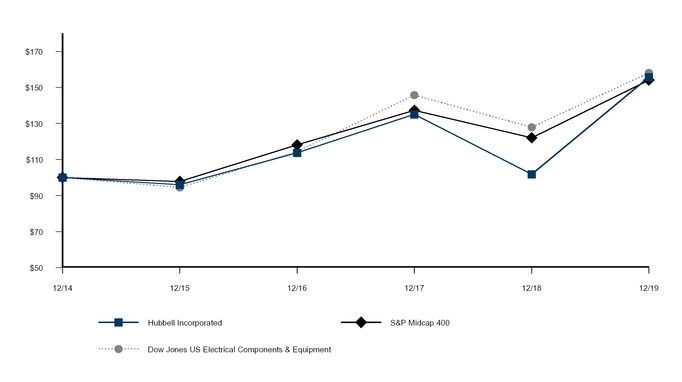
In 2015, the Company completed the reclassification of its dual class of common stock into a single class of Common Stock. The Hubbell Incorporated line above uses the weighted average of Hubbell Class A and Class B shares for the annual period ending December 2014.
| *Assumes $100 invested on 12/31/14 in stock or index, including reinvestment of dividends. Data points are the last day of each fiscal year ending December 31. Copyright© 2020 Standard & Poor's, a division of S&P Global. All rights reserved. Copyright© 2020 S&P Dow Jones Indices LLC, a division of S&P Global. All rights reserved. |
| HUBBELL INCORPORATED - Form 10-K | 17 |
Item 6. Selected Financial Data
The following summary should be read in conjunction with the consolidated financial statements and notes contained herein (dollars and shares in millions, except per share amounts).
| OPERATIONS, years ended December 31, | 2019 | 2018 | 2017 | 2016 | 2015 | ||||||||||
| Net sales | $ | 4,591.0 | $ | 4,481.7 | $ | 3,668.8 | $ | 3,505.2 | $ | 3,390.4 | |||||
| Gross profit | $ | 1,352.7 | $ | 1,300.4 | $ | 1,155.1 | $ | 1,105.1 | $ | 1,091.6 | |||||
| Operating income (4) | $ | 596.6 | $ | 556.9 | $ | 518.8 | $ | 489.8 | $ | 474.1 | |||||
| Adjusted operating income (1) | $ | 668.7 | $ | 642.3 | $ | 560.4 | $ | 522.1 | $ | 502.3 | |||||
| Operating income as a % of sales | 13.0 | % | 12.4 | % | 14.1 | % | 14.0 | % | 14.0 | % | |||||
| Adjusted operating income as a % of sales (1) | 14.6 | % | 14.3 | % | 15.3 | % | 14.9 | % | 14.8 | % | |||||
| Net income attributable to Hubbell (2) | $ | 400.9 | $ | 360.2 | $ | 243.1 | $ | 293.0 | $ | 277.3 | |||||
| Adjusted net income attributable to Hubbell (1) | $ | 445.7 | $ | 428.0 | $ | 333.9 | $ | 315.4 | $ | 313.7 | |||||
| Net income attributable to Hubbell as a % of net sales | 8.7 | % | 8.0 | % | 6.6 | % | 8.4 | % | 8.2 | % | |||||
| Adjusted net income attributable to Hubbell as a % of net sales (1) | 9.7 | % | 9.5 | % | 9.1 | % | 9.0 | % | 9.3 | % | |||||
| Net income attributable to Hubbell as a % of Hubbell shareholders’ average equity | 21.5 | % | 21.1 | % | 15.1 | % | 17.6 | % | 15.1 | % | |||||
| Earnings per share — diluted | $ | 7.31 | $ | 6.54 | $ | 4.39 | $ | 5.24 | $ | 4.77 | |||||
| Adjusted earnings per share — diluted (1) | $ | 8.12 | $ | 7.77 | $ | 6.03 | $ | 5.64 | $ | 5.39 | |||||
| Cash dividends declared per common share | $ | 3.43 | $ | 3.15 | $ | 2.87 | $ | 2.59 | $ | 2.31 | |||||
| Average number of common shares outstanding — diluted | 54.7 | 54.9 | 55.1 | 55.7 | 58.0 | ||||||||||
| Cost of acquisitions, net of cash acquired | $ | 70.8 | $ | 1,118.0 | $ | 184.1 | $ | 173.4 | $ | 163.4 | |||||
| FINANCIAL POSITION, AT YEAR-END | |||||||||||||||
| Working capital (3) | $ | 729.3 | $ | 804.4 | $ | 898.0 | $ | 961.7 | $ | 784.7 | |||||
| Total assets | $ | 4,903.0 | $ | 4,872.1 | $ | 3,720.6 | $ | 3,525.0 | $ | 3,208.7 | |||||
| Total debt | $ | 1,571.4 | $ | 1,793.2 | $ | 1,055.2 | $ | 993.7 | $ | 644.1 | |||||
| Total Hubbell shareholders’ equity | $ | 1,947.1 | $ | 1,780.6 | $ | 1,634.2 | $ | 1,592.8 | $ | 1,740.6 | |||||
| NUMBER OF EMPLOYEES, AT YEAR-END | 18,800 | 19,700 | 17,700 | 17,400 | 16,200 |
(1) The selected non-GAAP measures of adjusted operating income, adjusted operating income as a percent of sales (adjusted operating margin), adjusted net income attributable to Hubbell, adjusted net income attributable to Hubbell as a percent of net sales, and adjusted earnings per share-diluted should be read in conjunction with Item 7, "Management's Discussion and Analysis of Financial Condition and Results of Operations".
(2) Net income in 2017 includes approximately $57 million, or $1.02 per share, impact associated with the TCJA.
(3) Defined as current assets less current liabilities.
(4) Historical amounts have been adjusted to reflect the retrospective effects from the January 1, 2018 adoption of Accounting Standards Update (ASU) No. 2017-07, Compensation Retirement Benefits (Topic): Improving the Presentation of Net Periodic Pension Cost and Net Periodic Postretirement Benefit Cost.
| 18 | HUBBELL INCORPORATED - Form 10-K |
Item 7. Management’s Discussion and Analysis of Financial Condition and Results of Operations
Executive Overview of the Business
The Company is primarily engaged in the design, manufacture and sale of quality electrical and electronic products for a broad range of non-residential and residential construction, industrial and utility applications. Products are either sourced complete, manufactured or assembled by subsidiaries in the United States, Canada, Puerto Rico, China, Mexico, the UK, Brazil, Australia, Spain and Ireland. The Company also participates in joint ventures in Taiwan, Hong Kong and the Philippines, and maintains offices in Singapore, Italy, China, India, Mexico, South Korea, Chile, and countries in the Middle East. The Company employed approximately 18,800 individuals worldwide as of December 31, 2019.
The Company’s reporting segments consist of the Electrical segment and the Power segment. Results for 2019, 2018 and 2017 by segment are included under “Segment Results” within this Management’s Discussion and Analysis.
The Company's long-term strategy is to serve its customers with reliable and innovative electrical and related infrastructure solutions with desired brands, high-quality service, delivered through a competitive cost structure; to complement organic revenue growth with acquisitions that enhance its product offerings; and to allocate capital effectively to create shareholder value.
Our strategy to complement organic revenue growth with acquisitions focuses on acquiring assets that extend our capabilities, expand our product offerings, and present opportunities to compete in core, adjacent or complementary markets. Our acquisition strategy also provides the opportunity to advance our revenue growth objectives during periods of weakness or inconsistency in our end-markets.
Our strategy to deliver products through a competitive cost structure has resulted in ongoing restructuring and related activities. Our restructuring and related efforts include the consolidation of manufacturing and distribution facilities, and workforce actions, as well as streamlining and consolidating our back-office functions. The primary objectives of our restructuring and related activities are to optimize our manufacturing footprint, cost structure, and effectiveness and efficiency of our workforce.
Productivity improvement also continues to be a key area of focus for the Company and efforts to drive productivity complement our restructuring and related activities to minimize the impact of rising material costs and other cost inflation. Material costs are approximately sixty percent of our cost of goods sold therefore volatility in this area can significantly affect profitability. Our goal is to have pricing and productivity programs that offset material and other inflationary cost increases as well as pay for investments in key growth areas.
Productivity programs affect virtually all functional areas within the Company by reducing or eliminating waste and improving processes. We continue to expand our efforts surrounding global product and component sourcing and supplier cost reduction programs. Value engineering efforts, product transfers and the use of lean process improvement techniques are expected to continue to increase manufacturing efficiency. In addition, we continue to build upon the benefits of our enterprise resource planning system across all functions.
Acquisition of Aclara
On February 2, 2018 the Company acquired Aclara for approximately $1.1 billion. Aclara is a leading global provider of smart infrastructure solutions for electric, gas, and water utilities, with advanced metering solutions and grid monitoring sensor technology, as well as leading software enabled installation services. The acquisition extends the Power segment's capabilities into smart automation technologies, accelerates ongoing innovation efforts to address utility customer demand for data and integrated solutions, and expands the segment's reach to a broader set of utility customers.
For additional information about the Aclara acquisition, refer to Note 3 — Business Acquisitions and Dispositions in the Notes to the Consolidated Financial Statements.
| HUBBELL INCORPORATED - Form 10-K | 19 |
Results of Operations
Our operations are classified into two reportable segments: Electrical and Power. For a complete description of the Company’s segments, see Part I, Item 1 of this Annual Report on Form 10-K. Within these segments, Hubbell serves customers in five primary end markets: non-residential construction, residential construction, industrial, energy-related markets (also referred to as oil and gas markets) and utility markets (also referred to as the electrical transmission and distribution (T&D) market). In order of magnitude of net sales, the Company's served markets are electrical T&D, non-residential construction, industrial, oil and gas, and residential construction.
In 2019 we achieved two percent organic net sales growth on mixed end market trends. Our utility facing markets drove strong growth within our Power segment, resulting in organic net sales increasing by approximately 5.5% as compared to the prior year. End market performance within the Electrical segment was mixed, however, as non-residential and residential markets experienced modest growth, gas distribution markets remained solid, while industrial and oil markets were soft, resulting in a modest decline in organic net sales as compared to the prior year.
Operating margins expanded in both the Electrical and Power segments in 2019, driven by effective cost management and price realization. That expansion included the impact of increased investments in restructuring and related activities in 2019 and the effect of Section 301 tariffs on certain of our businesses (the "Tariffs" referred to in the following discussion of results of operations). In 2019, net income attributable to Hubbell grew by 11 percent compared to the prior year and diluted earnings per share grew by 12 percent. Adjusted net income(1) grew by four percent in 2019 compared to the prior year and adjusted diluted earnings per share(1) grew by five percent in 2019, reflecting our strong operating income performance.
Free cash flow was strong in 2019 at $497.7 million as compared to $420.9 million in the prior year(2). In 2019 we paid $186.6 million in shareholder dividends, an increase of eight percent as compared to the prior year, while also reducing our long term debt by $225.0 million and allocating approximately $71 million of capital to acquisitions.
(1) Adjusted net income and adjusted diluted earnings per share are non-GAAP financial measures. See "Adjusted Operating Measures" below for a reconciliation to the comparable GAAP financial measures.
(2) Free cash flow is a non-GAAP financial measure. See "Adjusted Operating Measures" and "Financial Condition, Liquidity and Capital Resources - Cash Flow" below for a reconciliation to the comparable GAAP financial measure.
SUMMARY OF CONSOLIDATED RESULTS (IN MILLIONS, EXCEPT PER SHARE DATA)
| For the Year Ending December 31, | |||||||||||||||
| 2019 | % of Net sales | 2018 | % of Net sales | 2017 | % of Net sales | ||||||||||
| Net sales | $ | 4,591.0 | $ | 4,481.7 | $ | 3,668.8 | |||||||||
| Cost of goods sold | 3,238.3 | 70.5 | % | 3,181.3 | 71.0 | % | 2,513.7 | 68.5 | % | ||||||
| Gross profit | 1,352.7 | 29.5 | % | 1,300.4 | 29.0 | % | 1,155.1 | 31.5 | % | ||||||
| Selling & administrative expenses | 756.1 | 16.5 | % | 743.5 | 16.6 | % | 636.3 | 17.3 | % | ||||||
| Operating income | 596.6 | 13.0 | % | 556.9 | 12.4 | % | 518.8 | 14.1 | % | ||||||
| Net income |
Showing the first 8K of 89K characters. Open the full section
Item 7A. Quantitative and Qualitative Disclosures about Market Risk
In the operation of our business, we have various exposures to areas of risk related to factors within and outside the control of management. Significant areas of risk and our strategies to manage the exposure are discussed below.
In 2019, we manufactured and/or assembled products in the United States, Canada, Puerto Rico, Mexico, China, UK, Brazil, Spain and Australia and sold products in those markets as well as through offices in Singapore, Italy, China, Mexico, and South Korea and countries in the Middle East. In 2019, Hubbell also participated in joint ventures in Taiwan, Hong Kong and the Philippines. Shipments to third party customers from non-U.S. subsidiaries as a percentage of the Company’s total net sales were 9% in 2019, 10% in 2018 and 11% in 2017, with the UK and Canadian operations each representing approximately 29% of 2019 total international net sales. As such, our operating results could be affected by changes in foreign currency exchange rates or weak economic conditions in the foreign markets in which we sell our products. To manage this exposure, we closely monitor the working capital requirements of our international units and may enter into forward foreign exchange contracts. Further discussion of forward exchange contracts can be found in Note 14 — Financial Instruments and Fair Value Measurement in the Notes to Consolidated Financial Statements.
Product purchases representing approximately 19% of our net sales are sourced from unaffiliated suppliers located outside the United States, primarily in China and other Asian countries, Europe and Brazil. Foreign sourcing of products may result in unexpected fluctuations in product cost or increased risk of business interruption due to lack of product or component availability due to any one of the following:
| • | Political or economic uncertainty in the source country |
| • | Fluctuations in the rate of exchange between the U.S. dollar and the currencies of the source countries |
| • | Changes in U.S. laws and policies governing foreign trade |
| • | Increased logistical complexity including supply chain interruption or delay, port of departure or entry disruption and overall time to market |
| • | Loss of proprietary information |
| • | Product quality issues outside the control of the Company |
| HUBBELL INCORPORATED - Form 10-K | 35 |
We have developed plans that address many of these risks. Such actions include careful selection of products to be outsourced and the suppliers selected; ensuring multiple sources of supply; limiting concentrations of activity by port, broker, freight forwarder, etc.; processes related to quality control; and maintaining control over operations, technologies and manufacturing deemed to provide competitive advantage. Many of our businesses have a dependency on certain basic raw materials needed to produce their products including steel, aluminum, brass, copper, bronze, zinc, nickel, plastics, phenols, elastomers and petrochemicals as well as purchased electrical and electronic components. Our financial results could be affected by the availability and changes in prices of these materials and components.
Certain of these materials are sourced from a limited number of suppliers. These materials are also key source materials for many other companies in our industry and within the universe of industrial manufacturers in general. As such, in periods of rising demand for these materials, we may experience both increased costs and/or limited supply. These conditions can potentially result in our inability to acquire these key materials on a timely basis to produce our products and satisfy our incoming sales orders. Similarly, the cost of these materials can rise suddenly and result in materially higher costs of producing our products. We believe we have adequate primary and secondary sources of supply for each of our key materials and that, in periods of rising prices, we expect to recover a majority of the increased cost in the form of higher selling prices. However, recoveries typically lag the effect of cost increases due to the nature of our markets.
Our financial results are subject to interest rate fluctuations to the extent there is a difference between the amount of our interest-earning assets and the amount of interest-bearing liabilities. The principal objectives of our investment management activities are to preserve capital while earning net investment income that is commensurate with acceptable levels of interest rate, default and liquidity risk taking into account our funding needs. As part of our investment management strategy, we may use derivative financial products such as interest rate hedges and interest rate swaps.
From time to time or when required, we issue commercial paper, which exposes us to changes in interest rates. Our cash position includes amounts denominated in foreign currencies. We manage our worldwide cash requirements by considering available funds held by our subsidiaries and the cost effectiveness with which these funds can be accessed.
Our long-term debt portfolio is comprised of fixed-rate senior notes and a term loan with an interest rate based on either adjusted LIBOR plus an applicable margin (determined by a ratings based grid) or the alternate base rate. As of December 31, 2019, the long-term debt outstanding related to the fixed-rate senior notes and term loan was $1,450.0 million and $106.3 million, respectively. The senior notes are not exposed to interest rate risk as the bonds are at a fixed-rate until maturity.
We continually evaluate risk retention and insurance levels for product liability, property damage and other potential exposures to risk. We devote significant effort to maintaining and improving safety and internal control programs, which are intended to reduce our exposure to certain risks. We determine the level of insurance coverage and the likelihood of a loss and believe that the current levels of risk retention are consistent with those of comparable companies in the industries in which we operate. There can be no assurance that we will not incur losses beyond the limits of our insurance. However, our liquidity, financial position and profitability are not expected to be materially affected by the levels of risk retention that we accept.
The following table presents cost and weighted average interest rate information related to financial instruments that are sensitive to changes in interest rates, by maturity at December 31, 2019 (dollars in millions):
| 2020 | 2021 | 2022 | 2023 | 2024 | Thereafter | Total | Fair Value 12/31/19 | |||||||||||||||||
| ASSETS | ||||||||||||||||||||||||
| Available-for-sale investments | $ | 14.2 | $ | 5.7 | $ | 5.9 | $ | 5.0 | $ | 6.6 | $ | 12.6 | $ | 50.0 | $ | 50.7 | ||||||||
| Avg. interest rate | 4.77 | % | 4.84 | % | 4.72 | % | 4.72 | % | 4.59 | % | 4.46 | % | ||||||||||||
| LIABILITIES | ||||||||||||||||||||||||
| Senior Notes | $ | — | $ | — | $ | 300.0 | $ | — | $ | — | $ | 1,150.0 | $ | 1,450.0 | $ | 1,486.6 | ||||||||
| Avg. interest rate | — | — | 3.63 | % | — | — | 3.36 | % | ||||||||||||||||
| Term Loan | $ | 34.4 | $ | 46.9 | $ | 25.0 | $ | — | $ | — | $ | — | $ | 106.3 | $ | 105.6 | ||||||||
| Avg. interest rate | 2.75 | % | 2.75 | % | 2.75 | % | — | — | — |
We use derivative financial instruments only if they are matched with a specific asset, liability, or proposed future transaction. We do not speculate or use leverage when trading a financial derivative product.
| 36 | HUBBELL INCORPORATED - Form 10-K |
Item 8. Financial Statements and Supplementary Data
All other schedules are omitted because they are not applicable or the required information is shown in the consolidated financial statements or notes thereto.
| HUBBELL INCORPORATED - Form 10-K | 37 |
Reports of Management
Report on Management’s Responsibility for Financial Statements
Our management is responsible for the preparation, integrity and fair presentation of our published financial statements. The financial statements have been prepared in accordance with accounting principles generally accepted in the United States of America and include amounts based on informed judgments made by management.
We believe it is critical to provide investors and other users of our financial statements with information that is relevant, objective, understandable and timely, so that they can make informed decisions. As a result, we have established and maintain systems and practices and internal control processes designed to provide reasonable, but not absolute, assurance that transactions are properly executed and recorded and that our policies and procedures are carried out appropriately. Management strives to recruit, train and retain high quality people to ensure that controls are designed, implemented and maintained in a high-quality, reliable manner.
Our independent registered public accounting firm audited our financial statements and the effectiveness of our internal control over financial reporting in accordance with standards established by the Public Company Accounting Oversight Board (United States). Their report appears on the next page within this Annual Report on Form 10-K.
Our Board of Directors normally meets at least nine times per year to provide oversight, to review corporate strategies and operations, and to assess management’s conduct of the business. The Board of Directors also schedules additional meetings on an as needed basis. The Audit Committee of our Board of Directors is composed of at least three individuals all of whom must be “independent” under current New York Stock Exchange listing standards and regulations adopted by the SEC under the federal securities laws. The Audit Committee meets regularly with our internal auditors and independent registered public accounting firm, as well as, management to review, among other matters, accounting, auditing, internal controls and financial reporting issues and practices. Both the internal auditors and independent registered public accounting firm have full, unlimited access to the Audit Committee.
Management’s Annual Report on Internal Control over Financial Reporting
Management is responsible for establishing and maintaining adequate systems of internal control over financial reporting as defined by Rules 13a-15(f) and 15d-15(f) under the Securities Exchange Act of 1934, as amended. Our internal control over financial reporting is designed to provide reasonable assurance regarding the reliability of financial reporting and the preparation of financial statements for external reporting purposes in accordance with generally accepted accounting principles in the United States of America. Because of its inherent limitations, internal control over financial reporting may not prevent or detect misstatements. Management has assessed the effectiveness of our internal control over financial reporting as of December 31, 2019.
In making this assessment, management used the criteria set forth in Internal Control-Integrated Framework (2013 framework) issued by the Committee of Sponsoring Organizations of the Treadway Commission ("COSO"). Based on this assessment, management concluded that our internal control over financial reporting was effective at a reasonable assurance level as of December 31, 2019.
The effectiveness of our internal control over financial reporting as of December 31, 2019 has been audited by PricewaterhouseCoopers LLP, our independent registered public accounting firm as stated in their report which is included below within this Annual Report on Form 10-K.
| /s/ DAVID G. NORD | /s/ WILLIAM R. SPERRY | |
| David G. Nord | William R. Sperry | |
| Chairman of the Board and Chief Executive Officer | Executive Vice President, Chief Financial Officer and Treasurer |
| 38 | HUBBELL INCORPORATED - Form 10-K |
Report of Independent Registered Public Accounting Firm
To the Board of Directors and Shareholders of Hubbell Incorporated
Opinions on the Financial Statements and Internal Control over Financial Reporting
We have audited the accompanying consolidated balance sheet of Hubbell Incorporated and its subsidiaries (the "Company") as of December 31, 2019 and 2018, and the related consolidated statements of income, comprehensive income, changes in equity and cash flows for each of the three years in the period ended December 31, 2019, including the related notes and schedule of valuation and qualifying accounts and reserves for each of the three years ended December 31, 2019 appearing under Item 15 (collectively referred to as the “consolidated financial statements”). We also have audited the Company's internal control over financial reporting as of December 31, 2019, based on criteria established in Internal Control - Integrated Framework (2013) issued by the Committee of Sponsoring Organizations of the Treadway Commission (COSO).
In our opinion, the consolidated financial statements referred to above present fairly, in all material respects, the financial position of the Company as of December 31, 2019 and 2018, and the results of its operations and its cash flows for each of the three years in the period ended December 31, 2019 in conformity with accounting principles generally accepted in the United States of America. Also in our opinion, the Company maintained, in all material respects, effective internal control over financial reporting as of December 31, 2019, based on criteria established in Internal Control - Integrated Framework (2013) issued by the COSO.
Basis for Opinions
The Company's management is responsible for these consolidated financial statements, for maintaining effective internal control over financial reporting, and for its assessment of the effectiveness of internal control over financial reporting, included in the accompanying Management’s Annual Report on Internal Control over Financial Reporting. Our responsibility is to express opinions on the Company’s consolidated financial statements and on the Company's internal control over financial reporting based on our audits. We are a publi
Showing the first 8K of 199K characters. Open the full section
Item 9. Changes in and Disagreements with Accountants on Accounting and Financial Disclosure
Not applicable.
Item 9A. Controls and Procedures
The Company maintains disclosure controls and procedures that are designed to ensure that information required to be disclosed in Exchange Act reports is recorded, processed, summarized and reported within the time periods specified in the SEC’s rules and forms, and that such information is accumulated and communicated to management, including the Chief Executive Officer and Chief Financial Officer, as appropriate, to allow timely decisions regarding required disclosure. Management necessarily applied its judgment in assessing the costs and benefits of such controls and procedures which, by their nature, can provide only reasonable assurance that the controls and procedures will meet their objectives.
The Company carried out an evaluation, under the supervision and with the participation of management, including the Chief Executive Officer and Chief Financial Officer, of the effectiveness of the design and operation of the Company’s disclosure controls and procedures as defined in Exchange Act Rules 13a-15(e) and 15d-15(e), as of the end of the period covered by this report on Form 10-K. Based upon that evaluation, each of the Chief Executive Officer and Chief Financial Officer concluded that the Company’s disclosure controls and procedures are effective at a reasonable assurance level. Management’s annual report on internal control over financial reporting and the independent registered public accounting firm’s audit report on the effectiveness of our internal control over financial reporting as of December 31, 2019 are included in Item 8 of this Annual Report on Form 10-K.
There has been no change in the Company’s internal control over financial reporting that occurred during the fiscal year ended December 31, 2019 that have materially affected, or are reasonably likely to materially affect, the Company’s internal control over financial reporting.
Item 9B. Other Information
Not applicable.
| HUBBELL INCORPORATED - Form 10-K | 87 |
| PART III |
Item 10. Directors, Executive Officers and Corporate Governance(1)
Item 11. Executive Compensation(2)
Item 12. Security Ownership of Certain Beneficial Owners and Management and Related Stockholder Matters
Equity Compensation Plan Information
The following table provides information as of December 31, 2019 with respect to the Company’s common stock that may be issued under the Company’s equity compensation plans (in thousands, except per share amounts):
| A | B | C | ||||||||
| Plan Category | Number of Securities to be Issued upon Exercise of Outstanding Options,Warrants and Rights | Weighted Average Exercise Price of Outstanding Options, Warrants and Rights | Number of Securities Remaining Available for Future Issuance Under Equity Compensation Plans (Excluding Securities Reflected in Column A) | |||||||
| Equity Compensation Plans Approved by Shareholders(a) | 1,833 | (c)(e) | $ | 110.66 | (f) | 2,333 | (c) | |||
| Equity Compensation Plans Not Requiring Shareholder Approval(b) | 72 | (c)(d) | — | 152 | (c) | |||||
| TOTAL | 1,905 | $ | 110.66 | 2,485 |
| (a) | The Company’s (1) Stock Option Plan for Key Employees and (2) 2005 Incentive Award Plan as amended and restated. |
| (b) | The Company’s Deferred Compensation Plan for Directors as amended and restated. |
| (c) | Hubbell Common Stock. |
| (d) | Represents amount of shares currently deferred under this plan. These shares are not included in the total weighted average exercise price included in column B. |
| (e) | Includes 210,000 performance share awards assuming a maximum payout target. The Company does not anticipate that the maximum payout target will be achieved for all of these awards. |
| (f) | Weighted average exercise price excludes performance share awards included in column A. |
The remaining information required by this item is incorporated by reference to the subheading “Voting Rights and Security Ownership of Certain Beneficial Owners and Management” of the definitive proxy statement for the Company’s annual meeting of shareholders scheduled to be held on May 5, 2020.
| (1) | Certain of the information required by this item regarding executive officers is included under the subheading “Executive Officers of the Registrant” at the end of Part I of this Form 10-K and the remaining required information is incorporated by reference from our definitive proxy statement to be filed in connection with the Company’s annual meeting of shareholders scheduled to be held on May 5, 2020*.* |
| (2) | The information required by this item is incorporated by reference from our definitive proxy statement to be filed in connection with the Company’s annual meeting of shareholders scheduled to be held on May 5, 2020*.* |
| 88 | HUBBELL INCORPORATED - Form 10-K |
Item 13. Certain Relationships and Related Transactions and Director Independence(3)
Item 14. Principal Accountant Fees and Services(4)
| (3) | The information required by this item is incorporated by reference from our definitive proxy statement to be filed in connection with the Company’s annual meeting of shareholders scheduled to be held on May 5, 2020*.* |
| (4) | The information required by this item is incorporated by reference from our definitive proxy statement to be filed in connection with the Company’s annual meeting of shareholders scheduled to be held on May 5, 2020*.* |
| HUBBELL INCORPORATED - Form 10-K | 89 |
| PART IV |
Item 15. Exhibits and Financial Statement Schedule
1. Financial Statements and Schedule
Financial statements and schedule listed in the Index to Financial Statements and Schedule are filed as part of this Annual Report on Form 10-K.
2. Exhibits
| 90 | HUBBELL INCORPORATED - Form 10-K |
| HUBBELL INCORPORATED - Form 10-K | 91 |
| 92 | HUBBELL INCORPORATED - Form 10-K |
| Incorporated by Reference | ||||||
| Number | Description | Form | File No. | Exhibit | Filing Date | Filed/ Furnished Herewith |
| 31.2 | Certification of Chief Financial Officer pursuant to Exchange Act Rule 13a-14(a)/15d-14(a), as adopted pursuant to Section 302 of the Sarbanes-Oxley Act of 2002 | * | ||||
| 32.1 | Certification of Chief Executive Officer Pursuant to 18 U.S.C. Section 1350, as adopted pursuant to Section 906 of the Sarbanes-Oxley Act of 2002 | ** | ||||
| 32.2 | Certification of Chief Financial Officer Pursuant to 18 U.S.C Section 1350, as adopted pursuant to Section 906 of the Sarbanes-Oxley Act of 2002 | ** | ||||
| 101.INS | Inline XBRL Instance Document - The instance document does not appear in the interactive data file because its XBRL tags are embedded within the inline XBRL document | |||||
| 101.SCH | Inline XBRL Taxonomy Extension Schema Document | * | ||||
| 101.CAL | Inline XBRL Taxonomy Extension Calculation Linkbase Document | * | ||||
| 101.DEF | Inline XBRL Taxonomy Extension Definition Linkbase Document | * | ||||
| 101.LAB | Inline XBRL Taxonomy Extension Label Linkbase Document | * | ||||
| 101.PRE | Inline XBRL Taxonomy Extension Presentation Linkbase Document | * | ||||
| 104 | The cover page of this Annual Report on Form 10-K for the year end Dcember 31, 2019, formatted in Inline XBRL (included within the Exhibit 101 attachments) | * |
| † | A management contract or compensatory plan or arrangement required to be filed as an exhibit pursuant to Item 15(a)(3) of Form 10-K. |
| †† | Schedules and exhibits have been omitted pursuant to Item 601(b)(2) of Regulation S-K. The Company agrees to furnish supplemental copies of such omitted schedules and exhibits to the Securities and Exchange Commission upon request. |
| *** | Filed herewith. |
| **** | Furnished herewith. |
| HUBBELL INCORPORATED - Form 10-K | 93 |
Signatures
Pursuant to the requirements of Section 13 or 15(d) of the Securities Exchange Act of 1934, the registrant has duly caused this report to be signed on its behalf by the undersigned, thereunto duly authorized.
| HUBBELL INCORPORATED | ||||
| By | /s/ JOSEPH A. CAPOZZOLI | By | /s/ WILLIAM R. SPERRY | |
| Joseph A. Capozzoli | William R. Sperry | |||
| Vice President, Controller | Executive Vice President, Chief Financial | |||
| Officer and Treasurer | ||||
| Date: | February 14, 2020 |
Pursuant to the requirements of the Securities Exchange Act of 1934, this report has been signed below by the following persons on behalf of the registrant and in the capacities and on the dates indicated.(1)
| Title | Date | ||
| By | /s/ D. G. NORD D. G. Nord | Chairman of the Board and Chief Executive Officer | 2/14/2020 |
| By | /s/ W. R. SPERRY W. R. Sperry | Executive Vice President, Chief Financial Officer and Treasurer | 2/14/2020 |
| By | /s/ J. A. CAPOZZOLI J. A. Capozzoli | Vice President, Controller (Principal Accounting Officer) | 2/14/2020 |
| By | /s/ C. M. CARDOSO C. M. Cardoso | Director | 2/14/2020 |
| By | /s/ A. J. GUZZI A. J. Guzzi | Director | 2/14/2020 |
| By | /s/ N. J. KEATING N. J. Keating | Director | 2/14/2020 |
| By | /s/ B. C. LIND B. C. Lind | Director | 2/14/2020 |
| By | /s/ J. F. MALLOY J. F. Malloy | Director | 2/14/2020 |
| By | /s/ J. F. MARKS J. F. Marks | Director | 2/14/2020 |
| By | /s/ J. G. RUSSELL J. G. Russell | Director | 2/14/2020 |
| By | /s/ S. R. SHAWLEY S. R. Shawley | Director | 2/14/2020 |
| (1) | As of February 14, 2020*.* |
| 94 | HUBBELL INCORPORATED - Form 10-K |
Valuation and Qualifying Accounts and Reserves for the Years Ended December 31, 2017**,** 2018 and 2019
Reserves deducted in the balance sheet from the assets to which they apply (in millions):
| Balance at Beginning of Year | Additions / (Reversals) Charged to Costs and Expenses | Deductions | Acquisitions | Balance at End of Year | ||||||||||||||||
| Allowances for doubtful accounts receivable: | ||||||||||||||||||||
| Year 2017 | $ | 4.7 | $ | 1.5 | $ | (3.5 | ) | $ | 1.9 | $ | 4.6 | |||||||||
| Year 2018 | $ | 4.6 | $ | — | $ | (1.4 | ) | $ | 1.6 | $ | 4.8 | |||||||||
| Year 2019 | $ | 4.8 | $ | 3.4 | $ | (0.5 | ) | $ | — | $ | 7.7 | |||||||||
| Allowance for credit memos, returns and cash discounts: | ||||||||||||||||||||
| Year 2017 | $ | 45.9 | $ | 260.8 | $ | (256.3 | ) | $ | 0.1 | $ | 50.5 | |||||||||
| Year 2018 | $ | 50.5 | $ | 278.0 | $ | (293.5 | ) | $ | 0.1 | $ | 35.1 | |||||||||
| Year 2019 | $ | 35.1 | $ | 299.1 | $ | (298.2 | ) | $ | — | $ | 36.0 | |||||||||
| Valuation allowance on deferred tax assets: | ||||||||||||||||||||
| Year 2017 | $ | 22.6 | $ | (3.2 | ) | $ | — | $ | — | $ | 19.4 | |||||||||
| Year 2018 | $ | 19.4 | $ | 0.7 | $ | — | $ | 1.7 | $ | 21.8 | ||||||||||
| Year 2019 | $ | 21.8 | $ | 7.2 | $ | — | $ | — | $ | 29.0 |
| HUBBELL INCORPORATED - Form 10-K | 95 |