 filings.tools
Howmet Aerospace 10-K 2017-12-31
Filed 2018-02-26. 21 sections, 576K characters. Original on sec.gov · Markdown · JSON
Cover and table of contents
10-K 1 form10k.htm 10-K
UNITED STATES
SECURITIES AND EXCHANGE COMMISSION
WASHINGTON, D.C. 20549
FORM 10-K
[ x ] ANNUAL REPORT PURSUANT TO SECTION 13 OR 15(d) OF
THE SECURITIES EXCHANGE ACT OF 1934
For The Fiscal Year Ended December 31, 2017
OR
[ ] TRANSITION REPORT PURSUANT TO SECTION 13 OR 15(d)
OF THE SECURITIES EXCHANGE ACT OF 1934
Commission File Number 1-3610
ARCONIC INC.
(Exact name of registrant as specified in its charter)
| Delaware | 25-0317820 | |
| (State of incorporation) | (I.R.S. Employer Identification No.) |
390 Park Avenue, New York, New York 10022-4608
(Address of principal executive offices) (Zip code)
Registrant’s telephone numbers:
Investor Relations------------— (212) 836-2758
Office of the Secretary-------—(212) 836-2732
Securities registered pursuant to Section 12(b) of the Act:
| Title of each class | Name of each exchange on which registered | |
| Common Stock, par value $1.00 per share | New York Stock Exchange | |
| $3.75 Cumulative Preferred Stock, par value $100.00 per share | NYSE American |
Securities registered pursuant to Section 12(g) of the Act: None
Indicate by check mark if the registrant is a well-known seasoned issuer, as defined in Rule 405 of the Securities Act. Yes ✓ No .
Indicate by check mark if the registrant is not required to file reports pursuant to Section 13 or Section 15(d) of the Exchange Act. Yes No ✓ .
Indicate by check mark whether the registrant (1) has filed all reports required to be filed by Section 13 or 15(d) of the Securities Exchange Act of 1934 during the preceding 12 months, and (2) has been subject to such filing requirements for the past 90 days. Yes ✓ No .
Indicate by check mark whether the registrant has submitted electronically and posted on its corporate Website, if any, every Interactive Data File required to be submitted and posted pursuant to Rule 405 of Regulation S-T (§232.405 of this chapter) during the preceding 12 months (or for such shorter period that the registrant was required to submit and post such files). Yes ✓ No .
Indicate by check mark if disclosure of delinquent filers pursuant to Item 405 of Regulation S-K is not contained herein, and will not be contained, to the best of registrant’s knowledge, in definitive proxy or information statements incorporated by reference in Part III of this Form 10-K or any amendment to this Form 10-K. []
Indicate by check mark whether the registrant is a large accelerated filer, an accelerated filer, a non-accelerated filer, or a smaller reporting company. See the definitions of “large accelerated filer,” “accelerated filer,” “smaller reporting company,” and “emerging growth company” in Rule 12b-2 of the Exchange Act.
Large accelerated filer [✓] Accelerated filer [] Non-accelerated filer [] (Do not check if a smaller reporting company)
Smaller reporting company [] Emerging growth company []
If an emerging growth company, indicate by check mark if the registrant has elected not to use the extended transition period for complying with any new or revised financial accounting standards provided pursuant to Section 13(a) of the Exchange Act. [ ]
Indicate by check mark whether the registrant is a shell company (as defined in Rule 12b-2 of the Exchange
Act). Yes No ✓.
The aggregate market value of the outstanding common stock, other than shares held by persons who may be deemed affiliates of the registrant, as of the last business day of the registrant’s most recently completed second fiscal quarter was approximately $10 billion. As of February 16, 2018, there were 482,772,252 shares of common stock, par value $1.00 per share, of the registrant outstanding.
Documents incorporated by reference.
Part III of this Form 10-K incorporates by reference certain information from the registrant’s definitive Proxy Statement for its 2018 Annual Meeting of Shareholders to be filed pursuant to Regulation 14A (Proxy Statement).
TABLE OF CONTENTS
Note on Incorporation by Reference
In this Form 10-K, selected items of information and data are incorporated by reference to portions of the Proxy Statement. Unless otherwise provided herein, any reference in this report to disclosures in the Proxy Statement shall constitute incorporation by reference of only that specific disclosure into this Form 10-K.
PART I
Item 1. Business.
General
Arconic Inc. is a Delaware corporation with its principal office in New York, New York and the successor to Arconic Pennsylvania (as defined below) which was formed in 1888 and formerly known as Alcoa Inc. In this report, unless the context otherwise requires, “Arconic” or the “Company” means Arconic Inc., a Delaware corporation, and all subsidiaries consolidated for the purposes of its financial statements.
The Company’s Internet address is http://www.arconic.com. Arconic makes available free of charge on or through its website its annual report on Form 10-K, quarterly reports on Form 10-Q, current reports on Form 8-K, and amendments to those reports filed or furnished pursuant to Section 13(a) or 15(d) of the Securities Exchange Act of 1934 as soon as reasonably practicable after the Company electronically files such material with, or furnishes it to, the Securities and Exchange Commission (SEC). The information on the Company’s Internet site is not a part of, or incorporated by reference in, this annual report on Form 10-K. The SEC maintains an Internet site that contains these reports at http://www.sec.gov.
Forward-Looking Statements
This report contains (and oral communications made by Arconic may contain) statements that relate to future events and expectations and, as such, constitute forward-looking statements within the meaning of the Private Securities Litigation Reform Act of 1995. Forward-looking statements include those containing such words as “anticipates,” “believes,” “could,” “estimates,” “expects,” “forecasts,” “goal,” “guidance,” “intends,” “may,” “outlook,” “plans,” “projects,” “seeks,” “sees,” “should,” “targets,” “will,” “would,” or other words of similar meaning. All statements that reflect Arconic’s expectations, assumptions or projections about the future, other than statements of historical fact, are forward-looking statements, including, without limitation, forecasts relating to the growth of the aerospace, automotive, commercial transportation and other end markets; statements and guidance regarding future financial results or operating performance; statements about Arconic’s strategies, outlook, business and financial prospects; and statements regarding potential share gains. Forward-looking statements are not guarantees of future performance and are subject to risks, uncertainties, and changes in circumstances that are difficult to predict. Although Arconic believes that the expectations reflected in any forward-looking statements are based on reasonable assumptions, it can give no assurance that these expectations will be attained and it is possible that actual results may differ materially from those indicated by these forward-looking statements due to a variety of risks and uncertainties.
For a discussion of some of the specific factors that may cause Arconic’s actual results to differ materially from those projected in any forward-looking statements, see the following sections of this report: Part I, Item 1A. (Risk Factors), Part II, Item 7. (Management’s Discussion and Analysis of Financial Condition and Results of Operations), including the disclosures under Segment Information and Critical Accounting Policies and Estimates, and Note K and the Derivatives Section of Note U to the Consolidated Financial Statements in Part II, Item 8. (Financial Statements and Supplementary Data). Market projections are subject to the risks discussed in this report and other risks in the market. Arconic disclaims any intention or obligation to update publicly any forward-looking statements, whether in response to new information, future events or otherwise, except as required by applicable law.
Overview
Arconic is a global leader in lightweight metals engineering and manufacturing. Arconic’s innovative, multi-material products, which include aluminum, titanium, and nickel, are used worldwide in aerospace, automotive, commercial transportation, packaging, building and construction, oil and gas, defense, consumer electronics, and industrial applications.
Arconic is a global company operating in 18 countries. Based upon the country where the point of sale occurred, the United States and Europe generated 63% and 26%, respectively, of Arconic’s sales in 2017. In addition, Arconic has operating activities in Brazil, Canada, China, Japan, and Russia, among others. Governmental policies, laws and regulations, and other economic factors, including inflation and fluctuations in foreign currency exchange rates and interest rates, affect the results of operations in these countries.
Arconic’s operations consist of three worldwide reportable segments: Engineered Products and Solutions, Global Rolled Products and Transportation and Construction Solutions.
Background
Arconic Inc. Reincorporation
On December 31, 2017 (the “Effective Date”), Arconic Inc., a Pennsylvania corporation (“Arconic Pennsylvania” or, prior to the Reincorporation (as defined below), the “Company”), effected the change of the Company’s jurisdiction of incorporation from Pennsylvania to Delaware (the “Reincorporation”) by merging (the “Reincorporation Merger”) with a direct wholly owned Delaware subsidiary, Arconic (in this section, “Arconic Delaware” or, following the Reincorporation, the “Company”), pursuant to an Agreement and Plan of Merger (the “Reincorporation Merger Agreement”), dated as of October 12, 2017, by and between Arconic Pennsylvania and Arconic Delaware. Arconic Pennsylvania shareholders approved the Reincorporation Merger to effect the Reincorporation at a Special Meeting of Shareholders held on November 30, 2017. As a result of the Reincorporation, (i) Arconic Pennsylvania has ceased to exist, (ii) Arconic Delaware automatically inherited the reporting obligations of Arconic Pennsylvania under the Securities Exchange Act of 1934, as amended (the “Exchange Act”), and (iii) Arconic Delaware is deemed to be the successor issuer to Arconic Pennsylvania.
The common stock, par value $1.00 per share, of Arconic Pennsylvania (the “Arconic Pennsylvania Common Stock”) was listed for trading on the New York Stock Exchange and traded under the symbol “ARNC.” As of the Effective Date, this symbol, without interruption, represents shares of common stock, par value $1.00 per share, of Arconic Delaware (the “Arconic Delaware Common Stock”). There was no change in the Exchange Act File Number assigned by the SEC as a result of the Reincorporation.
As of the Effective Date, the rights of the Company’s stockholders began to be governed by the General Corporation Law of the State of Delaware, the Certificate of Incorporation of Arconic Delaware (the “Delaware Certificate”) and the Bylaws of Arconic Delaware (the “Delaware Bylaws”).
Other than the change in corporate domicile, the Reincorporation did not result in any change in the business, physical location, management, financial condition or number of authorized shares of the Company, nor did it result in any change in location of its current employees, including management. On the Effective Date, (i) the directors and officers of Arconic Pennsylvania prior to the Reincorporation continued as the directors and officers of Arconic Delaware after the Reincorporation, (ii) each outstanding share of Arconic Pennsylvania Common Stock was automatically converted into one share of Arconic Delaware Common Stock, (iii) each outstanding share of Serial Preferred Stock, par value $100 per share, of Arconic Pennsylvania (the “Arconic Pennsylvania Preferred Stock”) was automatically converted into one share of Serial Preferred Stock, par value $100 per share, of Arconic Delaware (the “Arconic Delaware Preferred Stock”) and (iv) all of Arconic Pennsylvania’s employee benefit and compensation plans immediately prior to the Reincorporation were continued by Arconic Delaware, and each outstanding equity award and notional share unit relating to shares of Arconic Pennsylvania Common Stock was converted into an equity award or notional share unit, as applicable, relating to an equivalent number of shares of Arconic Delaware Common Stock on the same terms and subject to the same conditions. Beginning at the effective time of the Reincorporation, each certificate representing Arconic Pennsylvania Common Stock or Arconic Pennsylvania Preferred Stock was deemed for all corporate purposes to evidence ownership of Arconic Delaware Common Stock or Arconic Delaware Preferred Stock, as applicable. The Company’s stockholders may, but are not required to, exchange their stock certificates as a result of the Reincorporation.
The foregoing descriptions of the Arconic Delaware Common Stock, the Arconic Delaware Preferred Stock, the Delaware Certificate and the Delaware Bylaws are qualified in their entirety by the full text of the Delaware Certificate and the Delaware Bylaws, which are filed as Exhibits 3(a) and 3(b), respectively, to this report.
Alcoa Corporation Separation Transaction
On November 1, 2016, Alcoa Inc. completed the separation of its business into two independent, publicly traded companies (the “Separation”) – Alcoa Corporation and Arconic Inc. (the new name for Alcoa Inc.). Following the Separation, Alcoa Corporation holds the Alumina and Primary Metals segments, the rolling mill at the Warrick, Indiana operations and the 25.1% stake in the Ma’aden Rolling Company in Saudi Arabia previously held by the Company. The Company retained the Global Rolled Products (other than the rolling mill at the Warrick, Indiana operations and the 25.1% ownership stake in the Ma’aden Rolling Company), Engineered Products and Solutions and Transportation and Construction Solutions segments.
The Separation was effected by a pro rata distribution of 80.1% of the outstanding shares of Alcoa Corporation common stock to the Company’s shareholders (the “Distribution”). The Company’s shareholders of record as of the close of business on October 20, 2016 (the “Record Date”) received one share of Alcoa Corporation common stock for every three shares of the Company’s common stock held as of the Record Date. The Company did not issue fractional shares of Alcoa Corporation common stock in the Distribution. Instead, each shareholder otherwise entitled to receive a fractional share of Alcoa Corporation common stock received cash in lieu of fractional shares.
The Company distributed 146,159,428 shares of common stock of Alcoa Corporation in the Distribution and retained 36,311,767 shares, or approximately 19.9%, of the common stock of Alcoa Corporation immediately following the Distribution. As a result of the Distribution, Alcoa Corporation became an independent public company trading under the symbol “AA” on the New York Stock Exchange, and the Company trades under the symbol “ARNC” on the New York Stock Exchange.
During 2017, the Company disposed of its retained interest in Alcoa Corporation. In February 2017, the Company sold 23,353,000 shares of Alcoa Corporation stock at $38.03 per share, which resulted in cash proceeds of $888 million and a gain of $351 million. In April and May 2017, the Company acquired a portion of its outstanding notes held by two investment banks (the “Investment Banks”) in exchange for cash and the Company’s remaining 12,958,767 shares (valued at $35.91 per share) in Alcoa Corporation stock (the “Debt-for-Equity Exchange”) and recorded a gain of $167 million. The gains of $351 million and $167 million associated with the disposition of the Alcoa Corporation shares were recorded in Other Income, Net in the accompanying Statement of Consolidated Operations in Part II, Item 8 (Financial Statements and Supplementary Data).
On October 31, 2016, in connection with the Separation and the Distribution, Arconic entered into several agreements with Alcoa Corporation or its subsidiaries that govern the relationship of the parties following the Distribution, including the following: Separation and Distribution Agreement, Transition Services Agreement, Tax Matters Agreement, Employee Matters Agreement, certain Patent, Know-How, Trade Secret License and Trademark License Agreements, Toll Processing and Services Agreement, Master Agreement for the Supply of Primary Aluminum, Massena Lease and Operations Agreement, Fusina Lease and Operations Agreement, and Stockholder and Registration Rights Agreement.
Description of the Business
Information describing Arconic’s businesses can be found on the indicated pages of this report:
| Item | Page(s) |
| Discussion of Recent Business Developments: | |
| Management’s Discussion and Analysis of Financial Condition and Results of Operations: | |
| Overview—Results of Operations (Earnings Summary) | 34 |
| Notes to Consolidated Financial Statements: | |
| Note C. Separation Transaction and Discontinued Operations | 74 |
| Note D. Restructuring and Other Charges | 76 |
| Note E. Goodwill and Other Intangible Assets | 78 |
| Note F. Acquisitions and Divestitures | 79 |
| Note K. Contingencies and Commitments | 84 |
| Note Q. Income Taxes | 96 |
| Segment Information: | |
| Business Descriptions, Principal Products, Principal Markets, Methods of Distribution, Seasonality and Dependence Upon Customers: | |
| Engineered Products and Solutions | 40 |
| Global Rolled Products | 41 |
| Transportation and Construction Solutions | 42 |
| Financial Information about Segments and Financial Information about Geographic Areas: | |
| Note N. Segment and Geographic Area Information | 88 |
Major Product Revenues
Products that contributed 10% or more to consolidated revenues for the years ended December 31, 2017, 2016 and 2015, were:
| For the Years Ended December 31, | ||||||
| 2017 | 2016 | 2015 | ||||
| Flat-rolled aluminum | 39 | % | 39 | % | 42 | % |
| Fastening systems and rings | 16 | % | 17 | % | 18 | % |
| Investment castings | 15 | % | 15 | % | 15 | % |
| Other extruded and forged products | 12 | % | 12 | % | 11 | % |
See Note N to the Consolidated Financial Statements in Part II, Item 8. (Financial Statements and Supplementary Data) for operating results of the Company’s reportable segments. Arconic has no customers that account for more than 10% of its consolidated revenues. However, certain of the Company’s businesses are dependent upon a few significant customers. The loss of any such significant customer could have a material adverse effect on such businesses.
Engineered Products and Solutions
Arconic’s Engineered Products and Solutions segment (“EP&S”) develops and manufactures high performance products mainly for the aerospace (commercial and defense), commercial transportation, and power generation end markets. Such products include fastening systems (titanium, steel, and nickel superalloys); seamless rolled rings (mostly nickel superalloys); investment castings (nickel superalloys, titanium, and aluminum), including airfoils and structural components; forged airframe and jet engine components (nickel superalloys, titanium, aluminum), including bulkheads, disks and shafts; extruded airframe components (aluminum); and various other forged and extruded metallic components for the oil and gas, industrial products, automotive, and land and sea defense end markets.
Throughout 2017, EP&S was comprised of four business units: Arconic Power and Propulsion; Arconic Fastening Systems and Rings; Arconic Forgings and Extrusions; and Arconic Titanium and Engineered Products.
Arconic Power and Propulsion (APP). APP produced investment cast airfoils for aero engine and industrial gas turbines and structural aero engine and airframe components. APP also provided additive manufacturing technologies, superalloy and titanium ingots, machining, performance coatings, and hot isostatic pressing for high performance parts.
Arconic Fastening Systems and Rings (AFSR). AFSR produced aerospace fastening systems and seamless rolled rings, as well as commercial transportation fasteners. The business’s high-tech, multi-material fastening systems are found nose to tail on aircraft and aero engines. The business’s products are also critical components of industrial gas turbines, automobiles, commercial transportation vehicles, and construction and industrial equipment.
Arconic Forgings and Extrusions (AFE). AFE produced defense airframe forgings and extrusions, such as forged bulkheads, wing and landing gear components, closed-die aero engine forgings, such as disks, and lightweight drive shafts for commercial transportation industries.
Arconic Titanium and Engineered Products (ATEP). ATEP produced titanium aero ingots and mill products, and provided multi-material airframe subassemblies and solutions related to advanced technologies and materials, such as 3D printing and titanium aluminides.
In January 2018, EP&S announced a change in the organizational structure of the segment, from four business units to three business units, with a focus on aligning its internal structure to core markets and customers and reducing costs. The three new business units are Arconic Engines; Arconic Fastening Systems; and Arconic Engineered Structures.
Arconic Engines (AE). AE will produce investment cast airfoils, seamless rolled rings and closed-die (including isothermal) forged turbine disks for aero engine and industrial gas turbines, as well as other structural aero engine components. AE also will provide additive manufacturing technologies, superalloy ingots, open-die forging, machining, performance coatings, and hot isostatic pressing for high performance parts.
Arconic Fastening Systems (AFS). AFS will produce aerospace fastening systems, as well as commercial transportation fasteners. The business’s high-tech, multi-material fastening systems are found nose to tail on aircraft and aero engines. The
business’s products are also critical components of industrial gas turbines, automobiles, commercial transportation vehicles, and construction and industrial equipment.
Arconic Engineered Structures (AES). AES will produce titanium and aluminum ingots and mill products for aerospace and defense applications and is vertically integrated to produce structural investment castings, forgings and extrusions, for airframe, wing, aero-engine, and landing gear components, as well as lightweight drive shafts for the commercial transportation industries. AES will also provide multi-material airframe subassemblies and solutions related to advanced technologies and materials, such as 3D printing and titanium aluminides.
For additional discussion of the EP&S's business, see “Results of Operations—Segment Information” in Part II, Item 7. (Management’s Discussion and Analysis of Financial Condition and Results of Operations) and Note N to the Consolidated Financial Statements—Segment and Geographic Area Information in Part II, Item 8. (Financial Statements and Supplementary Data).
In November 2017, Arconic announced a multi-year cooperative research agreement with Airbus to advance metal 3D printing for aircraft manufacturing. Together, the companies will develop customized processes and parameters to produce and qualify large, structural 3D printed components, such as pylon spars and rib structures, up to approximately 1 meter (3 feet) in length. The arrangement combines Arconic’s expertise in metal additive manufacturing and metallurgy with Airbus’s design and qualification capabilities. In September 2017, the Company announced that Airbus and Arconic achieved a 3D printing first - the installation of a 3D printed titanium bracket on a series production Airbus commercial aircraft, the A350 XWB. Arconic is 3D printing these parts using laser power bed technologies at its additive manufacturing facility in Austin, Texas.
This 3D printed titanium bracket is part of an ongoing arrangement between the Company and Airbus. In 2016, Arconic announced three agreements with Airbus to produce titanium and nickel 3D printed parts for commercial aircraft, including the A320 platform and A350 XWB. These agreements draw on Arconic’s cutting-edge 3D printing technology capabilities, including laser powder bed and electron beam processes.
Engineered Products and Solutions Principal Facilities1
| Country | Facility | Products | ||
| Australia | Oakleigh | Fasteners | ||
| Canada | Georgetown, Ontario2 | Aerospace Castings | ||
| Laval, Québec | Aerospace Castings and Machining | |||
| China | Suzhou2 | Fasteners and Rings | ||
| France | Dives-sur-Mer | Aerospace and Industrial Gas Turbine Castings | ||
| Evron | Aerospace and Specialty Castings | |||
| Gennevilliers | Aerospace and Industrial Gas Turbine Castings | |||
| Montbrison | Fasteners | |||
| St. Cosme-en-Vairais2 | Fasteners | |||
| Toulouse | Fasteners | |||
| Us-par-Vigny | Fasteners | |||
| Germany | Bestwig | Aerospace Castings | ||
| Erwitte | Aerospace Castings | |||
| Hannover2 | Extrusions | |||
| Hildesheim-Bavenstedt2 | Fasteners | |||
| Kelkheim2 | Fasteners | |||
| Hungary | Eger | Forgings | ||
| Nemesvámos | Fasteners | |||
| Székesfehérvár | Aerospace and Industrial Gas Turbine Castings and Forgings | |||
| Japan | Nomi | Aerospace and Industrial Gas Turbine Castings | ||
| Mexico | Ciudad Acuña2 | Aerospace Castings/Fasteners and Rings | ||
| Morocco | Casablanca2 | Fasteners | ||
| South Korea | Kyoungnam | Extrusions | ||
| United Kingdom | Darley Dale | Forgings | ||
| Ecclesfield | Ingot Castings | |||
| Exeter2 | Aerospace and Industrial Gas Turbine Castings and Alloy | |||
| Glossop | Ingot Castings | |||
| Ickles | Ingot Castings | |||
| Leicester2 | Fasteners | |||
| Low Moor | Extrusions | |||
| Meadowhall | Forgings | |||
| Provincial Park | Forgings | |||
| Redditch2 | Fasteners | |||
| River Don | Forgings | |||
| Telford | Fasteners | |||
| Welwyn Garden City | Aerospace Formed Parts |
| Country | Facility | Products | ||
| United States | Chandler, AZ | Extrusions | ||
| Tucson, AZ2 | Fasteners | |||
| Carson, CA2 | Fasteners | |||
| City of Industry, CA2 | Fasteners | |||
| Fontana, CA | Rings | |||
| Fullerton, CA2 | Fasteners | |||
| Newbury Park, CA | Fasteners | |||
| Rancho Cucamonga, CA | Rings | |||
| Sylmar, CA | Fasteners | |||
| Torrance, CA | Fasteners | |||
| Branford, CT | Aerospace Coatings | |||
| Winsted, CT | Aerospace Machining | |||
| Savannah, GA | Forgings | |||
| Lafayette, IN | Extrusions | |||
| La Porte, IN | Aerospace and Industrial Gas Turbine Castings | |||
| Burlington, MA2 | Powdered Metal Parts | |||
| Baltimore, MD2 | Extrusions | |||
| Whitehall, MI | Aerospace and Industrial Gas Turbine Castings and Coatings, Titanium Alloy and Specialty Products | |||
| Sullivan, MO | Titanium Mill Products | |||
| Washington, MO | Aerospace Formed Parts | |||
| Big Lake, MN | Aerospace Machining | |||
| New Brighton, MN | Aerospace Machining | |||
| Dover, NJ | Aerospace and Industrial Gas Turbine Castings and Alloy | |||
| Verdi, NV | Rings | |||
| Kingston, NY2 | Fasteners | |||
| Massena, NY | Extrusions | |||
| Rochester, NY | Rings | |||
| Canton, OH2 | Ferro-Titanium Alloys and Titanium Mill Products | |||
| Cleveland, OH | Investment Casting Equipment, Aerospace Components, Castings, Forgings and Oil & Gas Drilling Products | |||
| Niles, OH | Titanium Mill Products | |||
| Morristown, TN2 | Aerospace and Industrial Gas Turbine Ceramic Products | |||
| Austin, TX2 | Additively Manufactured Parts | |||
| Houston, TX2 | Extrusions | |||
| Spring, TX | Deep Water Drilling Machining | |||
| Waco, TX2 | Fasteners | |||
| Wichita Falls, TX | Aerospace and Industrial Gas Turbine Castings | |||
| Hampton, VA2 | Aerospace and Industrial Gas Turbine Castings | |||
| Martinsville, VA | Titanium Mill Products |
| 1 | Principal facilities are listed, and do not include 13 locations that serve as sales and administrative offices, distribution centers or warehouses. |
| 2 | Leased property or partially leased property. |
Global Rolled Products
Arconic’s Global Rolled Products segment (“GRP”) produces a range of aluminum sheet and plate products for the following markets:
Aerospace and Automotive - GRP provides a wide range of products, including many highly-differentiated sheet and plate products, for the worldwide aerospace and regional automotive markets.
Brazing, Commercial Transportation and Industrial - GRP provides specialty aluminum sheet and plate products for automotive, commercial transportation and industrial applications including proprietary heat exchanger products like multilayer brazing sheet.
Packaging - GRP serves the packaging market in Russia, Asia and Latin America through regional facilities.
In July 2017, GRP announced a new organization, streamlining and consolidating its businesses into a single group organization structure.
For additional discussion of the Global Rolled Products segment’s business, see “Results of Operations—Segment Information” in Part II, Item 7. (Management’s Discussion and Analysis of Financial Condition and Results of Operations) and Note N to the Consolidated Financial Statements—Segment and Geographic Area Information in Part II, Item 8. (Financial Statements and Supplementary Data).
In November 2017, the Company announced plans to install a new horizontal heat treat furnace at its Davenport, Iowa facility. This new furnace will enable Arconic to heat treat longer and thicker plate than ever before, including material for its new state of the art "very thick plate stretcher."
This stretcher, the world’s largest, improves the performance of thick aluminum and aluminum-lithium plate in aerospace and industrial applications, and enables the Company to produce the largest high-strength monolithic wing ribs in the industry. In April 2017, the Company announced the completion of the installation of the stretcher.
Also in April 2017, the Company announced the divestiture of its Fusina, Italy rolling mill to Slim Aluminum. The transaction was part of GRP’s drive to improve portfolio mix.
Global Rolled Products Principal Facilities
| Country | Location | Products | ||
| Brazil | Itapissuma | Specialty Foil | ||
| China | Kunshan | Sheet and Plate | ||
| Qinhuangdao1 | Sheet and Plate | |||
| Hungary | Székesfehérvár | Sheet and Plate/Slabs and Billets | ||
| Russia | Samara | Sheet and Plate/Extrusions and Forgings | ||
| United Kingdom | Birmingham | Plate | ||
| United States | Davenport, IA | Sheet and Plate | ||
| Danville, IL2 | Sheet and Plate | |||
| Hutchinson, KS2 | Sheet and Plate | |||
| Lancaster, PA | Sheet and Plate | |||
| Alcoa, TN | Sheet | |||
| Texarkana, TX3 | Slabs | |||
| San Antonio, TX4 | Micromill™ |
| 1 | Leased property or partially leased property. |
| 2 | Properties are satellite locations of the Davenport, Iowa facility. |
| 3 | The Texarkana rolling mill facility had been idle since September 2009 due to a continued weak outlook in common alloy markets. In January 2016, the Company restarted its Texarkana cast house to meet demand for aluminum slab for the automotive industry. The aluminum slab that is cast at Texarkana is turned into aluminum sheets at Arconic’s expanded automotive facility in Davenport, Iowa and its rolling mill in Lancaster, Pennsylvania. |
| 4 | Micromill™ production facility produces sheet for automotive and industrial applications using Arconic innovative production process. |
Transportation and Construction Solutions
Arconic’s Transportation and Construction Solutions segment ("TCS") produces products that are used mostly in the commercial transportation and nonresidential building and construction end markets. Such products include integrated aluminum structural systems, architectural extrusions, forged aluminum commercial vehicle wheels, and aluminum products for the industrial products end market.
The Transportation and Construction Solutions segment is comprised of three business units: Arconic Wheel and Transportation Products; Building and Construction Systems; and Latin America Extrusions.
Arconic Wheel and Transportation Products (AWTP). AWTP provides forged aluminum wheels and related products for heavy-duty trucks and the commercial transportation markets.
Building and Construction Systems (BCS). BCS provides building and construction architectural framing products and aluminum curtain wall and front entry systems.
Latin America Extrusions (LAE). LAE serves both the building and construction and the industrial markets in Latin America, with products including aluminum architectural systems for doors, windows and curtain walls, and a wide range of extruded solutions for the automotive, defense and other industrial industries. In December 2017, Arconic announced an agreement to divest its LAE business. Customary regulatory and antitrust reviews are complete, and the ownership of LAE will be transferred to a subsidiary of Hydro Extruded Solutions AS. The deal is expected to close in the first half of 2018.
For additional discussion of the Transportation and Construction Solutions segment’s business, see “Results of Operations—Segment Information” in Part II, Item 7. (Management’s Discussion and Analysis of Financial Condition and Results of Operations) and Note N to the Consolidated Financial Statements—Segment and Geographic Area Information in Part II, Item 8. (Financial Statements and Supplementary Data).
Transportation and Construction Solutions Principal Facilities1
| Country | Facility | Products | ||
| Brazil | Itapissuma2 | Forgings | ||
| Tubarão3 | Extrusions | |||
| Utinga3 | Extrusions | |||
| Canada | Lethbridge, Alberta | Architectural Products | ||
| China | Suzhou2 | Forgings | ||
| France | Merxheim2 | Architectural Products | ||
| Hungary | Székesfehérvár | Forgings | ||
| Japan | Jôetsu City2 | Forgings | ||
| Mexico | Monterrey | Forgings | ||
| United Kingdom | Runcorn | Architectural Products | ||
| United States | Springdale, AR | Architectural Products | ||
| Visalia, CA | Architectural Products | |||
| Eastman, GA | Architectural Products | |||
| Barberton, OH | Forgings | |||
| Cleveland, OH | Forgings | |||
| Bloomsburg, PA | Architectural Products | |||
| Cranberry, PA | Architectural Products |
| 1 | Principal facilities are listed, and do not include 9 locations that serve as sales and administrative offices, distribution centers or warehouses. In addition to the facilities listed above, TCS has 21 service centers. These centers perform light manufacturing, such as assembly and fabrication of certain products. |
| 2 | Leased property or partially leased property. |
| 3 | Location is part of the planned divestiture of LAE, the sale of which is expected to be completed in the first half of 2018. |
Sources and Availability of Raw Materials
The major raw materials purchased in 2017 for each of the Company’s reportable segments are listed below.
| Engineered Products and Solutions | Global Rolled Products | |
| Alloying materials | Alloying materials | |
| Electricity | Aluminum scrap | |
| Natural gas | Coatings | |
| Nickel alloys | Electricity | |
| Primary aluminum (ingot, billet, P1020, high purity) | Lube oil | |
| Resin | Natural gas | |
| Stainless steel | Packaging materials | |
| Steel | Primary aluminum (ingot, slab, billet, P1020, high purity) | |
| Titanium alloys | Steam | |
| Titanium sponge | ||
| Transportation and Construction Solutions | ||
| Aluminum coil | ||
| Aluminum scrap | ||
| Electricity | ||
| Natural gas | ||
| Paint/Coating | ||
| Polyethylene | ||
| Primary aluminum | ||
| Resin |
Generally, other materials are purchased from third-party suppliers under competitively priced supply contracts or bidding arrangements. The Company believes that the raw materials necessary to its business are and will continue to be available.
Patents, Trade Secrets and Trademarks
The Company believes that its domestic and international patent, trade secret and trademark assets provide it with a significant competitive advantage. The Company’s rights under its patents, as well as the products made and sold under them, are important to the Company as a whole and, to varying degrees, important to each business segment. The patents owned by Arconic generally concern particular products or manufacturing equipment or techniques. Arconic’s business as a whole is not, however, materially dependent on any single patent, trade secret or trademark. As a result of product development and technological advancement, the Company continues to pursue patent protection in jurisdictions throughout the world. As of the end of 2017, the Company’s worldwide patent portfolio consists of approximately 1,669 granted patents and 807 pending patent applications.
The Company also has a significant number of trade secrets, mostly regarding manufacturing processes and material compositions that give many of its businesses important advantages in their markets. The Company continues to strive to improve those processes and generate new material compositions that provide additional benefits.
With respect to domestic and international registered trademarks, the Company has many that have significant recognition within the markets that are served. Examples include the name “Arconic” and the Arconic symbol for aluminum, nickel, and titanium products, Howmet® metal castings, Huck® fasteners, Kawneer® building panels and Dura-Bright® wheels with easy-
clean surface treatments. A significant trademark filing campaign for the name “Arconic” was completed in 2016, in support of the corporate launch of Arconic Inc. As of the end of 2017, the Company’s worldwide trademark portfolio consists of approximately 1,793 registered trademarks and 625 pending trademark applications. The Company’s rights under its trademarks are important to the Company as a whole and, to varying degrees, important to each business segment.
Competitive Conditions
Engineered Products and Solutions (EP&S)
EP&S’s business units - AFS (Arconic Fastening Systems), AE (Arconic Engines) and AES (Arconic Engineered Structures) -are subject to substantial and intense competition in the markets they serve. Although Arconic believes its advanced technology, manufacturing processes and experience provide advantages to Arconic’s customers, such as high quality and superior mechanical properties that meet the Company’s customers’ most stringent requirements, many of the products Arconic makes can be produced by competitors using similar types of manufacturing processes as well as alternative forms of manufacturing. Despite intense competition, Arconic continues as a market leader in most of its principal markets. Several factors, including Arconic’s legacy of technical innovation, state-of-the-art capabilities, engaged employees and long-standing customer relationships, enable the Company to maintain its competitive position.
Principal competitors in the EP&S segment include Berkshire Hathaway Inc., through its acquisition of Precision Castparts Corporation and subsidiaries, for titanium and titanium-based alloys, precision forgings, seamless rolled rings, investment castings and aerospace fasteners; VSMPO (Russia) for titanium and titanium-based alloys and precision forgings; the High-Performance Materials & Components segment of Allegheny Technologies, Inc. (ATI) for titanium and titanium-based alloys, precision forgings, and investment castings; Lisi Aerospace (France) for aerospace fasteners; and Aubert & Duval (part of Eramet Group in France) for precision forgings.
Other competitors include:
-
Kaiser Aluminum - for extruded products
-
Universal Alloy Corp., part of Montana Tech Components - for extruded products
-
Doncasters Group Ltd. (UK) - for investment castings
-
Consolidated Precision Products Corp., part of Warburg Pincus - for investment castings
-
Weber Metals, part of Otto Fuchs - for precision forgings
-
Forgital - for seamless rings
Several of Arconic’s largest customers have captive superalloy furnaces for producing airfoil investment castings for their own use. Many other companies around the world also produce superalloy investment castings, and some of these companies currently compete with Arconic in the aerospace and other markets, while others are capable of competing with the Company should they choose to do so.
International competition in the investment casting, fastener, ring and forging markets may also increase in the future as a result of strategic alliances among engine original equipment manufacturers (OEMs), aero-structure prime contractors, and overseas companies, especially in developing markets, particularly where “offset” or “local content” requirements create purchase obligations with respect to products manufactured in or directed to a particular country.
Global Rolled Products (GRP)
GRP is one of the leaders in many of the aluminum flat rolled products markets in which it participates, including aerospace, automotive, brazing sheet, commercial transportation, industrial markets and packaging. However, much like other Arconic businesses, GRP is subject to substantial and intense competition in all of its markets.
While GRP participates in markets where Arconic believes the Company has a significant competitive advantage due to customer intimacy, advanced manufacturing capability, unique technology and/or differentiated products, in certain cases, the Company’s competitors are capable of making products similar to Arconic’s. The Company continuously works to maintain and enhance its competitive advantage through innovation: new alloys such as Arconic’s new aerospace alloys, new products such as the Company’s 5-layer brazing products and break-through processes such as Arconic Micromill® technology.
Some of GRP’s markets are worldwide and some are more regionally focused. Participation in these segments by GRP’s competitors varies. For example, Novelis is the largest flat rolled products producer competing in automotive, but it does not participate in the aerospace market. On the other hand, Constellium participates in all major market segments including aerospace, brazing, industrial, commercial transportation and packaging. Granges participates only in the brazing sheet market. Other GRP competitors include Aleris, AMAG, Kaiser, Kobe, Nanshan, and UACJ.
Additionally, there are a number of new competitors emerging, particularly in China and other developing economies. For example, in the brazing business, the number of viable competitors has doubled over a five-year period. Arconic expects that this competitive pressure will continue and increase in the future as customers seek to globalize their supply bases in order to reduce costs. The Company continually monitors and plans for these new emerging players.
Summary of Major Competitors for GRP:
| • | Constellium (The Netherlands) |
| • | Novelis |
| • | Kaiser Aluminum |
| • | UACJ (Japan) |
| • | Aleris |
| • | Hydro (Norway) |
| • | Nanshan (China) |
| • | Granges (Sweden) |
| • | Kobe (Japan) |
Transportation and Construction Solutions (TCS)
In the forged aluminum wheels business, AWTP competes in commercial transportation, under the product brand name Alcoa® Wheels, for the major regions that it serves (Americas, Europe, Japan, China, and Australia). AWTP competes against steel wheels, as well as aluminum. Its larger competitors are Accuride Corporation, Nippon Steel & Sumitomo Metal Corporation, Zhejiang Dicastal Hongxin Technology Co. Ltd, Wheels India Limited and Speedline (member of the Ronal Group). In recent years, AWTP has seen an increase in the number of aluminum wheel suppliers (both forged and cast aluminum wheels) from China, Taiwan, India and South Korea attempting to penetrate the commercial transportation market.
BCS is a manufacturer of aluminum architectural systems and products in North America and with a growing presence in Europe and the Middle East. In North America, BCS primarily competes in the nonresidential building segment. In Europe and the Middle East, it competes in both the residential and the nonresidential building segments. BCS competes with regional and local players in the architectural systems and more global companies in the products markets. BCS’s competitive advantage is the cornerstone to its strong brand, innovative products, customer intimacy and technical services. Over the past decade, the regional competitors, primarily in North America, have narrowed the product portfolio and technical services advantages. However, BCS has maintained its competitive advantage through innovative products like highly energy-efficient high-thermal products and differentiated services. BCS sales are derived mainly from the retail, office, education and healthcare building segments.
BCS is organized into two business segments: architectural systems and architectural products. The primary product categories in architectural systems are storefront, framing and entrances (SEF), curtain walls, and windows. In the SEF and curtain wall businesses, BCS competes with competitors like Apogee, YKK, Oldcastle, Schüco, Hydro/SAPA and Reynaers in their aluminum framing systems business. The architectural products business is more global and is primarily served by subsidiaries of larger companies like Alpolic (Mitsubishi Corporation), Alucobond (Schweiter Technologies) and Novelis (Aditya Birla Group). The primary product categories are aluminum composite material and coil coated sheet. The competitive landscape in the architectural systems market has been relatively stable since the mid-2000s, with the major competitors in North America and Europe still operating in their markets, despite some industry consolidation in North America during the late 2000s.
As noted above, in December 2017, Arconic announced the divestiture of its LAE business which is expected to close in the first half of 2018. LAE has participated in two distinct segments: building and construction and industrial. In the building and construction market, LAE develops and markets aluminum architectural systems for both commercial and residential buildings. In the industrial business market, LAE manufactures and sells soft alloy extruded profiles and solutions, mainly for the automotive, consumer goods, machinery and equipment segments. Overall, LAE has held a strong presence in Brazil, where competition is very fragmented, composed mainly of small local extruders and a few multinationals such as CBA (Votorantim Group) and SAPA.
Summary of Major Competitors:
AWTP:
| • | Accuride Corporation |
| • | Nippon Steel & Sumitomo Metal Corporation (Japan) |
| • | Zhejiang Dicastal Hongxin Technology Co. Ltd (China) |
| • | Wheels India Limited (India) |
| • | Speedline (member of the Ronal Group in Switzerland) |
BCS:
| • | Apogee, Oldcastle and YKK |
| • | Alpolic, Alucobond and Alucoil |
| • | Schüco (Germany), Hydro/SAPA (Norway), Reynaers (Belgium) and Corialis (Belgium) |
| • | Alucobond, Alucoil, Euramax and Novelis |
LAE:
| • | Belmetal (Brazil) |
| • | CBA (Brazil) |
| • | SAPA (Norway) |
| • | Aluk (Brazil) |
Research and Development
Arconic, at its light metals research center, engages in research and development (R&D) programs that include process and product development, and basic and applied research. R&D expenditures were $111 million, $132 million and $169 million in 2017, 2016 and 2015, respectively.
Throughout 2017, the Company continued working on new developments in all business segments and leveraging new technologies. The Company has continued investing in additive manufacturing, with a focus on producing metal powder materials tailored for a range of additive process technologies, and furthering its development of advanced 3D printing design and manufacturing techniques-such as Arconic’s Ampliforge™ process-to improve production speeds, reduce costs, and achieve material properties not possible through other additive flowpaths. The Company’s new powder production facility was completed at the Arconic Technology Center in 2016. This facility will continue its focus on material development in aluminum, nickel and titanium alloys.
The Company is also producing and qualifying additively manufactured aerospace components via laser powder bed printing technology. It also is developing more formable titanium plate based wrought products for customers.
The Arconic Micromill® technology located in San Antonio continues to transition to commercial production, as the Company has invested in further developing Micromill™ technology, including installation of a pilot line at the Arconic Technology Center.
The Company continues to develop differentiated pretreatment technology, continuing to improve on its patented A951 technology, joining methods/fasteners (like RSR™) and highly formable and high strength automotive sheet products for automotive original equipment manufacturer applications in both cosmetic hang on parts and structural body-in-white applications.
The Company continued its differentiation in the commercial transportation market with Dura-Bright® EVO, UltraOne™ and European UltraOne™ wheel products.
The Company also continues to develop and deploy proprietary processing technologies in the manufacture of aerospace components, as well as a continued commitment and commercialization of a portfolio of proprietary aerospace fasteners. One such example is Ergo-Tech® blind fasteners which enable automated assembly operations.
Environmental Matters
Information relating to environmental matters is included in Note K to the Consolidated Financial Statements under the caption “Environmental Matters” on page 84. Approved capital expenditures for new or expanded facilities for environmental control are $19 million for 2018 and estimated expenditures for such purposes are $2 million for 2019.
Employees
Total worldwide employment at the end of 2017 was approximately 41,500 employees in 25 countries. About 20,900 of these employees are represented by labor unions. The Company believes that relations with its employees and any applicable union representatives generally are good.
In the United States, approximately 7,600 employees are represented by various labor unions. The largest collective bargaining agreement is the master collective bargaining agreement between Arconic and the United Steelworkers (USW). The USW master agreement covers approximately 3,300 employees at four U.S. locations; the current labor agreement expires on May 15, 2019. There are 17 other collective bargaining agreements in the United States with varying expiration dates.
On a regional basis, collective bargaining agreements with varying expiration dates cover approximately 9,300 employees in Europe and Russia, 10,000 employees in North America, 600 employees in South America, and 1,000 employees in Asia.
Executive Officers of the Registrant
The names, ages, positions and areas of responsibility of the executive officers of the Company as of February 23, 2018 are listed below.
Charles P. “Chip” Blankenship, 51, Chief Executive Officer. Mr. Blankenship was elected Chief Executive Officer of Arconic and a member of the Arconic Board of Directors effective January 15, 2018. Mr. Blankenship was Senior Vice President of Haier Group, and President and Chief Executive Officer of its GE Appliances business from June 2016 to June 2017. GE Appliances was a division of General Electric Company until June 2016, when it was acquired by Qingdao Haier Co., Ltd., and Mr. Blankenship served as its President and Chief Executive Officer from December 2011 until June 2016. Prior to GE Appliances, Mr. Blankenship served as Vice President and General Manager of the Commercial Engines Operation for GE Aviation from July 2008 until December 2011. From April 2006 to July 2008, Mr. Blankenship was the General Manager of Aero Energy, a division of GE Energy.
Ken Giacobbe, 52, Executive Vice President and Chief Financial Officer. Mr. Giacobbe was elected Executive Vice President and Chief Financial Officer of Arconic effective November 1, 2016. Mr. Giacobbe joined Arconic in 2004 as Vice President of Finance for Global Extruded Products, part of Alcoa Forgings and Extrusions. He then served as Vice President of Finance for the Company’s Building and Construction Systems business from 2008 until 2011. In 2011, he assumed the role of Group Controller for the Engineered Products and Solutions segment. From January 2013 until October 2016, Mr. Giacobbe served as Chief Financial Officer of the Engineered Products and Solutions segment. Before joining Arconic, Mr. Giacobbe held senior finance roles at Avaya and Lucent Technologies.
Mark J. Krakowiak, 57, Executive Vice President, Strategy and Development. Mr. Krakowiak was elected to his current position effective January 29, 2018. Prior to joining Arconic, Mr. Krakowiak had a 33-year career at General Electric Company, where he held a range of financial and strategy roles, including positions in financial planning, business development and M&A, treasury and commercial. Most recently, Mr. Krakowiak was Chief Financial Officer of GE Appliances, a Haier Company, from June 2016 to January 2017. Previously, Mr. Krakowiak served as Vice President and Chief Financial Officer of General Electric’s Appliances and Lighting business from September 2011 to June 2016. From July 2009 to September 2011, Mr. Krakowiak was Chief Risk Officer of GE’s global enterprise risk function, and from January 2003 to July 2009, he was Vice President of GE’s Industrial Treasury and Insurance Operations.
Timothy D. Myers, 52, Executive Vice President and Group President, Global Rolled Products and Transportation and Construction Solutions. Mr. Myers was appointed Executive Vice President and Group President, Global Rolled Products and Transportation and Construction Solutions in October 2017. Prior to being appointed to his current role, he was Executive Vice President and Group President, Transportation and Construction Solutions from May 2016 to October 2017. Prior to that assignment, he was President of Alcoa Wheel and Transportation Products, from June 2009 to May 2016. Mr. Myers was Vice President and General Manager, Commercial Vehicle Wheels for the Alcoa Wheel Products business from January 2006 to June 2009. Mr. Myers joined Arconic in 1991 as an automotive applications engineer in the Commercial Rolled Products Division, and held a series of engineering, marketing, sales and management positions with the Company since that time.
Paul Myron, 51, Vice President and Controller. Mr. Myron was elected Vice President and Controller of Arconic effective November 1, 2016. Mr. Myron joined Arconic as a systems analyst in Pittsburgh and in 1992 relocated to the Company’s Davenport, Iowa facility as a product accountant. He served in numerous financial management positions from 1995 until 2000 when he was named Commercial Manager and Controller for the Atlantic division of the Alcoa World Alumina and Chemicals business. In 2002, Mr. Myron was appointed Vice President of Finance, Alcoa Primary Metals and later became Vice President of Finance, Alcoa World Alumina and Chemicals. In 2005 Mr. Myron was named Director of Financial Planning and Analysis, accountable for Arconic’s financial planning, analysis, and reporting worldwide. In February 2012, he became Director of Finance Initiatives for the Engineered Products and Solutions segment, overseeing specific financial initiatives and projects within the group. From July 2012 until his most recent appointment, Mr. Myron served as Vice President, Finance and Business Excellence for the Arconic Power and Propulsion business.
Vas Nair, 52, Executive Vice President, Human Resources. Ms. Nair was appointed Executive Vice President, Human Resources in November 2015. Prior to being appointed to her current role, Ms. Nair was Arconic’s Chief Talent and Diversity Officer, with global responsibility for diversity and inclusion from February 2015 to October 2015. Prior to joining Arconic, Ms. Nair was VP of Global Learning and Talent Development at Estee Lauder from November 2010 to January 2015. Ms. Nair was Vice President and Chief Learning Officer at Schering-Plough from November 2003 to October 2009.
Katherine H. Ramundo, 50, Executive Vice President, Chief Legal Officer and Secretary. Ms. Ramundo was elected to her current position effective November 1, 2016. Prior to joining Arconic, from January 2013 through August 2015, she was Executive Vice President, General Counsel and Secretary of ANN INC., the parent company of ANN TAYLOR and LOFT brands, based in New York. Prior to ANN INC., she served as Vice President, Deputy General Counsel and Assistant Secretary at Colgate-Palmolive, where she held various legal roles from November 1997 to January 2013. She began her career as a litigator in New York, practicing at major law firms, including Cravath, Swaine & Moore and Sidley & Austin.
Eric V. Roegner, 48, Executive Vice President and Group President, Engineered Products and Solutions, and President, Arconic Defense. Mr. Roegner was elected Executive Vice President and Group President, Engineered Products and Solutions effective October 2017, and President, Arconic Defense effective June 2012. Previously, Mr. Roegner served as Executive Vice President and Group President, Global Rolled Products from May 2017 until October 2017; Chief Operating Officer of Arconic Investment Castings, Titanium and Engineered Products from July 2015 until May 2017; and Chief Operating Officer of Alcoa Investment Castings, Forgings and Extrusions from January 2013 until July 2015. Mr. Roegner joined the Company in 2006 as Chief Operating Officer of Arconic’s Global Engineered Products business.
The Company’s executive officers are elected or appointed to serve until the next annual meeting of the Board of Directors (held in conjunction with the annual meeting of shareholders) except in the case of earlier death, retirement, resignation or removal.
Item 1A. Risk Factors.
Arconic’s business, financial condition and results of operations may be impacted by a number of factors. In addition to the factors discussed elsewhere in this report, the following risks and uncertainties could materially harm its business, financial condition or results of operations, including causing Arconic’s actual results to differ materially from those projected in any forward-looking statements. The following list of significant risk factors is not all-inclusive or necessarily in order of importance. Additional risks and uncertainties not presently known to Arconic or that Arconic currently deems immaterial also may materially adversely affect the Company in future periods.
The markets for Arconic’s products are highly cyclical and are influenced by a number of factors, including global economic conditions.
Arconic is subject to cyclical fluctuations in global economic conditions and lightweight metals end-use markets. Arconic sells many products to industries that are cyclical, such as the aerospace, automotive, and commercial transportation and construction industries, and the demand for its products is sensitive to, and quickly impacted by, demand for the finished goods manufactured by its customers in these industries, which may change as a result of changes in regional or worldwide economies, currency exchange rates, energy prices or other factors beyond its control.
In particular, Arconic derives a significant portion of its revenue from products sold to the aerospace industry, which can be highly cyclical and reflective of changes in the general economy. The commercial aerospace industry is historically driven by the demand from commercial airlines for new aircraft. The U.S. and international commercial aviation industries may face challenges arising from competitive pressures and fuel costs. Demand for commercial aircraft is influenced by airline industry profitability, trends in airline passenger traffic, the state of U.S., regional and world economies, the ability of aircraft purchasers to obtain required financing and numerous other factors including the effects of terrorism, health and safety concerns, environmental constraints imposed upon aircraft operators, the retirement of older aircraft, and
technological improvements to new engines. The military aerospace cycle is highly dependent on U.S. and foreign government funding; however, it is also driven by the effects of terrorism, a changing global political environment, U.S. foreign policy, the retirement of older aircraft, and technological improvements to new engines.
Further, the demand for Arconic’s automotive and ground transportation products is driven by the number of vehicles produced by automotive manufacturers and Arconic content per vehicle. The automotive industry is sensitive to general economic conditions, including credit markets and interest rates, and consumer spending and preferences regarding vehicle ownership and usage, vehicle size, configuration and features. Automotive sales and production can also be affected by other factors including the age of the vehicle fleet and related scrappage rates, labor relations issues, fuel prices, regulatory requirements, government initiatives, trade agreements and levels of competition.
While Arconic believes that the long-term prospects for its products are positive, the Company is unable to predict the future course of industry variables, the strength of the U.S., regional or global economies, or the effects of government intervention. Negative economic conditions, such as a major economic downturn, a prolonged recovery period, or disruptions in the financial markets, could have a material adverse effect on Arconic’s business, financial condition or results of operations.
Arconic faces significant competition, which may have an adverse effect on profitability.
As discussed in Part I, Item 1. (Business-Competitive Conditions) of this report, the markets for Arconic’s products are highly competitive. Arconic’s competitors include a variety of both U.S. and non-U.S. companies in all major markets. New product offerings or new technologies in the marketplace may compete with or replace Arconic products. The willingness of customers to accept substitutes for the products sold by Arconic, the ability of large customers to exert leverage in the marketplace to affect the pricing for Arconic’s products, and technological advancements or other developments by or affecting Arconic’s competitors or customers could adversely affect Arconic’s business, financial condition or results of operations.
Arconic may be unable to develop innovative new products or implement technology initiatives successfully.
Arconic’s competitive position and future performance depends, in part, on the Company’s ability to:
| • | identify and evolve with emerging technological and broader industry trends in Arconic’s target end-markets; |
| • | identify and successfully execute on a strategy to remain an essential and sustainable element of its customer’s supply chain; |
| • | fund, develop, manufacture and bring innovative new products and services to market quickly and cost-effectively; |
| • | monitor disruptive technologies and understand customers’ and competitors’ abilities to deploy those disruptive technologies; and |
| • | achieve sufficient return on investment for new products based on capital expenditures and research and development spending. |
Arconic is working on new developments for a number of strategic projects in all business segments, including additive manufacturing, alloy development, engineered finishes and product design, high speed continuous casting and rolling technology, and other advanced manufacturing technologies. For more information on Arconic’s research and development programs, see “Research and Development” in Part I, Item 1. (Business) of this report.
While Arconic intends to continue committing substantial financial resources and effort to the development of innovative new products and services, it may not be able to successfully differentiate its products or services from those of its competitors or match the level of research and development spending of its competitors, including those developing technology to displace Arconic’s current products. In addition, Arconic may not be able to adapt to evolving markets and technologies or achieve and maintain technological advantages. There can be no assurance that any of Arconic’s new products or services, development programs or technologies will be commercially feasible or beneficial to Arconic.
Arconic could be adversely affected by changes in the business or financial condition or the loss of a significant customer or customers.
A significant downturn or deterioration in the business or financial condition or loss of a key customer or customers supplied by Arconic could affect Arconic’s financial results in a particular period. Arconic’s customers may experience delays in the launch of new products, labor strikes, diminished liquidity or credit unavailability, weak demand for their products, or other
difficulties in their businesses. Arconic’s customers may also change their business strategies or modify their business relationships with Arconic, including to reduce the amount of Arconic’s products they purchase or to switch to alternative suppliers. If Arconic is unsuccessful in replacing business lost from such customers, profitability may be adversely affected.
Arconic could encounter manufacturing difficulties or other issues that impact product performance, quality or safety, which could affect Arconic’s reputation, business and financial statements.
The manufacture of many of Arconic’s products is a highly exacting and complex process. Problems may arise during manufacturing for a variety of reasons, including equipment malfuncti
Showing the first 8K of 67K characters. Open the full section
Item 2. Properties.
Arconic’s principal office is located at 390 Park Avenue, New York, New York 10022-4608. Arconic’s corporate center is located at 201 Isabella Street, Pittsburgh, Pennsylvania 15212-5858. The Arconic Technology Center for research and development is located at 100 Technical Drive, New Kensington, Pennsylvania 15069-0001.
Arconic leases some of its facilities; however, it is the opinion of management that the leases do not materially affect the continued use of the properties or the properties’ values.
Arconic believes that its facilities are suitable and adequate for its operations. Although no title examination of properties owned by Arconic has been made for the purpose of this report, the Company knows of no material defects in title to any such properties. See Notes A and H to the financial statements for information on properties, plants and equipment.
Arconic has active plants and holdings under the following segments and in the following geographic areas:
ENGINEERED PRODUCTS AND SOLUTIONS
See the table and related text in the Engineered Products and Solutions Facilities section on page 6 of this report.
GLOBAL ROLLED PRODUCTS
See the table and related text in the Global Rolled Products Facilities section on page 8 of this report.
TRANSPORTATION AND CONSTRUCTION SOLUTIONS
See the table and related text in the Transportation and Construction Solutions section on page 9 of this report.
Item 3. Legal Proceedings.
In the ordinary course of its business, Arconic is involved in a number of lawsuits and claims, both actual and potential.
Environmental Matters
Arconic is involved in proceedings under the Comprehensive Environmental Response, Compensation and Liability Act, also known as Superfund (CERCLA) or analogous state provisions regarding the usage, disposal, storage or treatment of hazardous substances at a number of sites in the U.S. The Company has committed to participate, or is engaged in negotiations with federal or state authorities relative to its alleged liability for participation, in clean-up efforts at several such sites. The most significant of these matters, the remediation of the Grasse River in Massena, NY, is discussed in the Environmental Matters section of Note K to the Consolidated Financial Statements under the caption “Environmental Matters” on page 84.
As previously reported, on June 21, 2017, the UK Environment Agency (the “Agency”) confirmed that it will prosecute Firth Rixson Metals Limited in Chesterfield (UK) Magistrates Court in relation to an environmental incident that took place on April 22, 2015 at the Company’s Glossop UK site. It is alleged that an acid scrubber unit at the site caused a leak into the local river resulting in environmental damage, including the death of approximately 200 fish. Arconic was not successful in persuading the Agency to drop the prosecution in lieu of an enforcement undertaking (a civil remedy) despite the fact that cyanide, a compound not used on the site, had been identified in the samples of water taken at the time. A hearing before the Court was held on September 13, 2017 at which Firth Rixson pled guilty to the underlying offense of allowing a release to occur to the nearby stream. A follow-up hearing was held on December 6, 2017 at which the Court accepted Firth Rixson’s guilty plea. The Court categorized the Company’s level of culpability as negligent and the level of harm to the environment as level 2 (on a scale of 1 to 4 with 1 being the most serious). The Court fined Firth Rixson £80,000 (converted to approximately $108,355) plus costs of approximately £19,000 (converted to $25,734). The Company paid the fine and costs and accordingly, this matter is now closed and no further reports will be made.
Reynobond PE
As previously reported, on June 13, 2017, the Grenfell Tower in London, UK caught fire resulting in fatalities, injuries and damage. A French subsidiary of Arconic, Arconic Architectural Products SAS (AAP SAS), supplied a product, Reynobond PE, to its customer, a cladding system fabricator, which used the product as one component of the overall cladding system on Grenfell Tower. The fabricator supplied its portion of the cladding system to the façade installer, who then completed and installed the system under the direction of the general contractor. Neither Arconic nor AAP SAS was involved in the design or installation of the system used at the Grenfell Tower, nor did it have a role in any other aspect of the building’s refurbishment or original design. Regulatory investigations into the overall Grenfell Tower matter are being conducted, including a criminal investigation by the London Metro Police, a Public Inquiry by the British government and a consumer protection inquiry by a French public authority. AAP SAS has sought and received core participant status in the Public Inquiry. The Company will no longer sell the PE product for architectural use on buildings.
Sullivan v. Arconic Inc. et al. A purported class action complaint was filed on July 18, 2017 in the United States District Court for the Southern District of New York against Arconic Inc., as well as two former Arconic executives and several current and former Arconic directors, and banks that acted as underwriters for Arconic’s September 18, 2014 preferred stock offering. The complaint alleges that statements in the registration statement for Arconic’s September 18, 2014 preferred stock offering were false and misleading in light of the subsequent Grenfell Tower fire. The complaint also alleges that Arconic’s failure to disclose at the time of the offering that it was obtaining significant profits through sales that exposed it to substantial liability violated the federal securities laws. The plaintiffs seek, among other things, unspecified compensatory and rescissory damages and an award of attorney and expert fees and expenses. On August 25, 2017, this case was dismissed by the plaintiff without prejudice and re-filed on September 15, 2017 in the United States District Court for the Western District of Pennsylvania. On February 7, 2018, on motion from certain putative class members, the court consolidated Sullivan and Howard v. Arconic Inc. et al., another case pending in the Western District of Pennsylvania (described below), and appointed lead plaintiffs in the consolidated case.
Howard v. Arconic Inc. et al. A purported class action complaint was filed on August 11, 2017 in the United States District Court for Western District of Pennsylvania against Arconic Inc., and Klaus Kleinfeld. The complaint alleges that Arconic and Mr. Kleinfeld made various false and misleading statements, and omitted to disclose material information, about the Company’s business and financial prospects and, specifically, the risks of the Reynobond PE product. The complaint alleges that the statements in Arconic’s Form 10-K for the fiscal years ended December 31, 2012, 2013, 2014, 2015 and 2016, its 2012, 2013, 2014, 2015 and 2016 Annual Reports, and its 2016 Annual Highlights Report about management’s recognition of its responsibility to conduct the Company’s affairs according to the highest standards of personal and corporate conduct and within the laws of the host countries in which it operates, and its failure to disclose that Arconic knowingly supplied highly flammable Reynobond PE cladding panels for use in construction that significantly increased the risk of property damage, injury and death, were false and misleading in violation of the federal securities laws and artificially inflated the prices of Arconic’s
securities. The plaintiffs seek, among other things, unspecified compensatory damages and an award of attorney and expert fees and expenses. On February 7, 2018, on motion from certain putative class members, the court consolidated Howard and Sullivan v. Arconic Inc. et al., another case pending in the Western District of Pennsylvania (described above), and appointed lead plaintiffs in the consolidated case.
While the Company believes that these cases are without merit and intends to challenge them vigorously, there can be no assurances regarding the ultimate resolution of these matters. Given the preliminary nature of these matters and the uncertainty of litigation, the Company cannot reasonably estimate at this time the likelihood of an unfavorable outcome or the possible loss or range of losses in the event of an unfavorable outcome. The Board of Directors has also received letters, purportedly sent on behalf of shareholders, reciting allegations similar to those made in the federal court lawsuits and demanding that the Board authorize the Company to initiate litigation against members of management, the Board and others. The Board of Directors has appointed a Special Litigation Committee of the Board to review these shareholder demand letters and consider the appropriate course of action. In addition, lawsuits are pending in state court in New York and federal court in Pennsylvania, initiated, respectively, by another purported shareholder and by the Company, concerning the shareholder’s claimed right, which the Company contests, to inspect the Company’s books and records related to the Grenfell Tower fire and Reynobond PE.
Other Matters
As previously reported, Arconic Inc. and its subsidiaries and former subsidiaries are defendants in lawsuits filed on behalf of persons alleging injury as a result of occupational or other exposure to asbestos. Arconic, its subsidiaries and former subsidiaries have numerous insurance policies over many years that provide coverage for asbestos related claims. Arconic has significant insurance coverage and believes that Arconic’s reserves are adequate for its known asbestos exposure related liabilities. The costs of defense and settlement have not been and are not expected to be material to the results of operations, cash flows, and financial position of the Company.
Tax
Pursuant to the Tax Matters Agreement, dated as of October 31, 2016, entered into between the Company and Alcoa Corporation in connection with the Separation, the Company shares responsibility with Alcoa Corporation for, and Alcoa Corporation has agreed to partially indemnify the Company with respect to, the following matter.
As previously reported, in September 2010, following a corporate income tax audit covering the 2003 through 2005 tax years, an assessment was received as a result of Spain’s tax authorities disallowing certain interest deductions claimed by a Spanish consolidated tax group owned by the Company. An appeal of this assessment in Spain’s Central Tax Administrative Court by the Company was denied in October 2013. In December 2013, the Company filed an appeal of the assessment in Spain’s National Court.
On January 16, 2017, Spain’s National Court issued a decision in favor of the Company related to the assessment received in September 2010. The Spanish Tax Administration did not file an appeal within the applicable period. Based on this decision and recent confirming correspondence from the Spanish Tax Administration, the matter is now closed. The Company will not be responsible for any assessment related to the 2003 through 2005 tax years.
Additionally, following a corporate income tax audit of the same Spanish tax group for the 2006 through 2009 tax years, Spain’s tax authorities issued an assessment in July 2013, similarly disallowing certain interest deductions. In August 2013, the Company filed an appeal of this second assessment in Spain’s Central Tax Administrative Court, which was denied in January 2015. The Company filed an appeal of this second assessment in Spain’s National Court in March 2015. Spain’s National Court has not yet rendered a decision related to the assessment received in July 2013. The assessment for the 2006 through 2009 tax years is $155 million (€130 million), including interest.
The Company believes it has meritorious arguments to support its tax position and intends to vigorously litigate the assessments through Spain’s court system. However, in the event the Company is unsuccessful, a portion of the assessments may be offset with existing net operating losses available to the Spanish consolidated tax group, which would be shared between the Company and Alcoa Corporation as provided for in the Tax Matters Agreement. Additionally, while the tax years 2010 through 2013 are closed to audit, it is possible that the Company may receive similar assessments for tax years subsequent to 2013. At this time, the Company is unable to reasonably predict an ultimate outcome for this matter.
Matters Previously Reported – Alcoa Corporation
We have included the matters discussed below in which the Company remains party to proceedings relating to Alcoa Corporation in accordance with SEC regulations. The Separation and Distribution Agreement, dated October 31, 2016, entered into between the Company and Alcoa Corporation in connection with the Separation, provides for cross-indemnities between
the Company and Alcoa Corporation for claims subject to indemnification. The Company does not expect any of such matters to result in a net claim against it.
St. Croix Proceedings
Abednego and Abraham cases. As previously reported, on January 14, 2010, Arconic was served with a multi-plaintiff action complaint involving several thousand individual persons claiming to be residents of St. Croix who are alleged to have suffered personal injury or property damage from Hurricane Georges or winds blowing material from the St. Croix Alumina, L.L.C. (“SCA”) facility on the island of St. Croix (U.S. Virgin Islands) since the time of the hurricane. This complaint, Abednego, et al. v. Alcoa, et al. was filed in the Superior Court of the Virgin Islands, St. Croix Division. Following an unsuccessful attempt by Arconic and SCA to remove the case to federal court, the case has been lodged in the Superior Court. The complaint names as defendants the same entities that were sued in a February 1999 action arising out of the impact of Hurricane Georges on the island and added as a defendant the current owner of the alumina facility property.
Also as previously reported, on March 1, 2012, Arconic was served with a separate multi-plaintiff action complaint involving approximately 200 individual persons alleging claims essentially identical to those set forth in the Abednego v. Alcoa complaint. This complaint, Abraham, et al. v. Alcoa, et al., was filed on behalf of plaintiffs previously dismissed in the federal court proceeding involving the original litigation over Hurricane Georges impacts. The matter was originally filed in the Superior Court of the Virgin Islands, St. Croix Division, on March 30, 2011.
Arconic and other defendants in the Abraham and Abednego cases filed or renewed motions to dismiss each case in March 2012 and August 2012 following service of the Abraham complaint on Arconic and remand of the Abednego complaint to Superior Court, respectively. By order dated August 10, 2015, the Superior Court dismissed plaintiffs’ complaints without prejudice to re-file the complaints individually, rather than as a multi-plaintiff filing. The order also preserves the defendants’ grounds for dismissal if new, individual complaints are filed. On July 7, 2017, the Court issued an order and associated memoranda on plaintiff’s multiple motions for extension of time to file the individual Complaints. Following the court’s July 7, 2017 order, a total of 429 complaints were filed and accepted by the court by the deadline of July 30, 2017 (and consolidated into the Red Dust Claims docket (Master Case No.: SX-15-CV-620)). These complaints include claims of about 1,260 individual plaintiffs. As a result of the devastation caused by two hurricanes, court operations were suspended until very recently. On December 11, 2017, the court issued a new scheduling order and further set a scheduling conference for January 18, 2018. At that conference, the court set the next status conference for late July 2018.
Other Contingencies
In addition to the matters discussed above, various other lawsuits, claims, and proceedings have been or may be instituted or asserted against Arconic, including those pertaining to environmental, product liability, safety and health, employment and tax matters. While the amounts claimed in these other matters may be substantial, the ultimate liability cannot currently be determined because of the considerable uncertainties that exist. Therefore, it is possible that the Company’s liquidity or results of operations in a particular period could be materially affected by one or more of these other matters. However, based on facts currently available, management believes that the disposition of these other matters that are pending or asserted will not have a material adverse effect, individually or in the aggregate, on the results of operations, financial position, or cash flows of the Company.
Item 4. Mine Safety Disclosures.
Not applicable.
PART II
Item 5. Market for Registrant’s Common Equity, Related Stockholder Matters and Issuer Purchases of Equity Securities.
The Company’s common stock is listed on the New York Stock Exchange. Prior to the Separation of Alcoa Corporation from the Company, the Company’s common stock traded under the symbol “AA.” In connection with the separation, on November 1, 2016, the Company changed its stock symbol and its common stock began trading under the symbol “ARNC.”
On October 5, 2016, the Company’s common shareholders approved a 1-for-3 reverse stock split of the Company’s outstanding and authorized shares of common stock (the “Reverse Stock Split”). As a result of the Reverse Stock Split, every three shares of issued and outstanding common stock were combined into one issued and outstanding share of common stock, without any change in the par value per share. The Reverse Stock Split reduced the number of shares of common stock outstanding from approximately 1.3 billion shares to approximately 0.4 billion shares, and proportionately decreased the number of authorized shares of common stock from 1.8 billion to 0.6 billion shares. The Company’s common stock began trading on a Reverse Stock Split-adjusted basis on October 6, 2016.
On November 1, 2016, the Company completed the Separation of its business into two independent, publicly traded companies: the Company and Alcoa Corporation. The Separation was effected by means of a pro rata distribution by the Company of 80.1% of the outstanding shares of Alcoa Corporation common stock to the Company’s shareholders. The Company’s shareholders of record as of the close of business on October 20, 2016 (the “Record Date”) received one share of Alcoa Corporation common stock for every three shares of the Company’s common stock held as of the Record Date. The Company retained 19.9% of the outstanding common stock of Alcoa Corporation immediately following the Separation. See disposition of retained shares in Note C to the Consolidated Financial Statements in Part II Item 8 of this Form 10-K.
The following table sets forth, for the periods indicated, the high and low sales prices and quarterly dividend amounts per share of the Company’s common stock as reported on the New York Stock Exchange, adjusted to take into account the Reverse Stock Split effected on October 6, 2016. The prices listed below for those dates prior to November 1, 2016 reflect stock trading prices of Alcoa Inc. prior to the Separation of Alcoa Corporation from the Company on November 1, 2016, and therefore are not comparable to the Company’s post-Separation prices.
| 2017 | 2016 | |||||||||||||||||
| Quarter | High | Low | Dividend | High | Low | Dividend | ||||||||||||
| First | $ | 30.69 | $ | 18.64 | $ | 0.06 | $ | 30.66 | $ | 18.42 | $ | 0.09 | ||||||
| Second | 28.65 | 21.76 | 0.06 | 34.50 | 26.34 | 0.09 | ||||||||||||
| Third | 26.84 | 22.67 | 0.06 | 32.91 | 27.09 | 0.09 | ||||||||||||
| Fourth (Separation occurred on November 1, 2016) | 27.85 | 22.74 | 0.06 | 32.10 | 16.75 | 0.09 | ||||||||||||
| Year | $ | 30.69 | $ | 18.64 | $ | 0.24 | $ | 34.50 | $ | 16.75 | $ | 0.36 |
The number of holders of record of common stock was approximately 12,271 as of February 16, 2018.
Stock Performance Graph
The following graph compares the most recent five-year performance of the Company’s common stock with (1) the Standard & Poor’s 500® Index and (2) the Standard & Poor’s 500® Materials Index, a group of 25 companies categorized by Standard & Poor’s as active in the “materials” market sector. The graph assumes, in each case, an initial investment of $100 on December 31, 2012, and the reinvestment of dividends. Historical prices prior to the separation of Alcoa Corporation from the Company on November 1, 2016, have been adjusted to reflect the value of the Separation transaction. The graph, table and related information shall not be deemed to be “filed” with the SEC, nor shall such information be incorporated by reference into future filings under the Securities Act of 1933 or Securities Exchange Act of 1934, each as amended, except to the extent that the Company specifically incorporates it by reference into such filing.
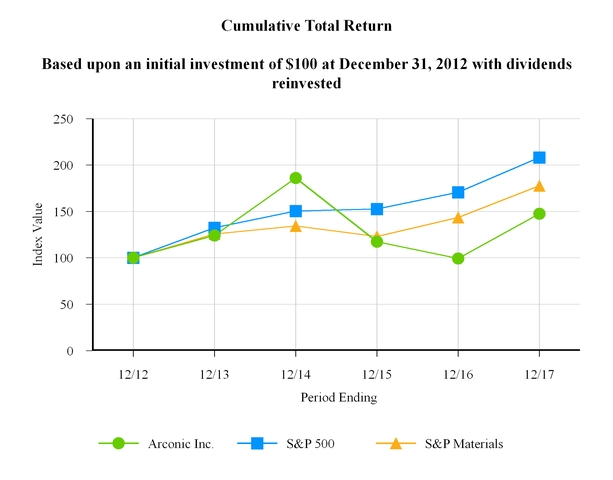
Copyright© 2018 Standard & Poor's, a division of S&P Global. All rights reserved.
| As of December 31, | 2012 | 2013 | 2014 | 2015 | 2016 | 2017 | ||||||||||||
| Arconic Inc. | $ | 100 | $ | 124.15 | $ | 186.02 | $ | 117.48 | $ | 99.40 | $ | 147.47 | ||||||
| S&P 500® Index | 100 | 132.39 | 150.51 | 152.59 | 170.84 | 208.14 | ||||||||||||
| S&P 500® Materials Index | 100 | 125.60 | 134.28 | 123.03 | 143.56 | 177.79 |
Item 6. Selected Financial Data.
The separation of Alcoa Inc. into two standalone, publicly-traded companies, Arconic Inc. (the new name for Alcoa Inc.) and Alcoa Corporation, became effective on November 1, 2016 (the “Separation Transaction”). The financial results of Alcoa Corporation for all periods prior to the Separation Transaction have been retrospectively reflected in the Statement of Consolidated Operations as discontinued operations and, as such, have been excluded from continuing operations and segment results for 2016 and all prior periods presented prior to the Separation Transaction. The cash flows related to Alcoa Corporation have not been segregated and are included in the Statement of Consolidated Cash Flows for 2016 and all prior periods presented.
(dollars in millions, except per-share amounts)
| For the year ended December 31, | 2017 | 2016 | 2015 | 2014 | 2013 | ||||||||||
| Sales | $ | 12,960 | $ | 12,394 | $ | 12,413 | $ | 12,542 | $ | 11,997 | |||||
| Amounts attributable to Arconic: | |||||||||||||||
| Loss from continuing operations(1) | $ | (74 | ) | $ | (1,062 | ) | $ | (157 | ) | $ | (61 | ) | $ | (63 | ) |
| Income (loss) from discontinued operations(2) | — | 121 | (165 | ) | 329 | (2,222 | ) | ||||||||
| Net (loss) income | $ | (74 | ) | $ | (941 | ) | $ | (322 | ) | $ | 268 | $ | (2,285 | ) | |
| (Loss) earnings per share attributable to Arconic common shareholders:(3) | |||||||||||||||
| Basic: | |||||||||||||||
| Loss from continuing operations | $ | (0.28 | ) | $ | (2.58 | ) | $ | (0.54 | ) | $ | (0.21 | ) | $ | (0.18 | ) |
| Income (loss) from discontinued operations | — | 0.27 | (0.39 | ) | 0.85 | (6.23 | ) | ||||||||
| Net (loss) income | $ | (0.28 | ) | $ | (2.31 | ) | $ | (0.93 | ) | $ | 0.64 | $ | (6.41 | ) | |
| Diluted: | |||||||||||||||
| Loss from continuing operations | $ | (0.28 | ) | $ | (2.58 | ) | $ | (0.54 | ) | $ | (0.21 | ) | $ | (0.18 | ) |
| Income (loss) from discontinued operations | — | 0.27 | (0.39 | ) | 0.84 | (6.23 | ) | ||||||||
| Net (loss) income | $ | (0.28 | ) | $ | (2.31 | ) | $ | (0.93 | ) | $ | 0.63 | $ | (6.41 | ) | |
| Cash dividends declared per common share(3) | $ | 0.24 | $ | 0.36 | $ | 0.36 | $ | 0.36 | $ | 0.36 | |||||
| Total assets | 18,718 | 20,038 | 36,477 | 37,298 | 35,623 | ||||||||||
| Total debt | 6,844 | 8,084 | 8,827 | 8,445 | 7,826 | ||||||||||
| Cash provided from operations(4) | 701 | 870 | 1,582 | 1,674 | 1,578 | ||||||||||
| Capital expenditures: | |||||||||||||||
| Capital expenditures—continuing operations | 596 | 827 | 789 | 775 | 626 | ||||||||||
| Capital expenditures—discontinued operations | — | 298 | 391 | 444 | 567 | ||||||||||
| Total capital expenditures | $ | 596 | $ | 1,125 | $ | 1,180 | $ | 1,219 | $ | 1,193 |
| (1) | Calculated from the accompanying Statement of Consolidated Operations as Loss from continuing operations after income taxes less Net income from continuing operations attributable to noncontrolling interests. |
| (2) | Calculated from the accompanying Statement of Consolidated Operations as Income (loss) from discontinued operations after income taxes less Net income from discontinued operations attributable to noncontrolling interests. |
| (3) | Per share data for all periods presented has been retroactively restated to reflect the 1-for-3 reverse stock split which became effective on October 6, 2016 (see Note O to the Consolidated Financial Statements in Part II Item 8 of this Form 10-K). |
| (4) | Cash provided from operations has not been restated for discontinued operations presentation for 2016 and all prior periods presented (see Basis of Presentation section of Note A to the Consolidated Financial Statements in Part II Item 8 of this Form 10-K). |
The data presented in the Selected Financial Data table should be read in conjunction with the information provided in Management’s Discussion and Analysis of Financial Condition and Results of Operations in Part II Item 7 and the Consolidated Financial Statements and Notes in Part II Item 8 of this Form 10-K.
Item 7. Management’s Discussion and Analysis of Financial Condition and Results of Operations.
(dollars in millions, except per-share amounts and aluminum prices; shipments in thousands of metric tons [kmt])
Overview
Our Business
Arconic (“Arconic” or the “Company”) is a global leader in lightweight metals engineering and manufacturing. Arconic’s innovative, multi-material products, which include aluminum, titanium, and nickel, are used worldwide in aerospace, automotive, commercial transportation, packaging, building and construction, oil and gas, defense, consumer electronics, and industrial applications.
Arconic is a global company operating in 18 countries. Based upon the country where the point of sale occurred, the United States and Europe generated 63% and 26%, respectively, of Arconic’s sales in 2017. In addition, Arconic has operating activities in Brazil, Canada, China, Japan, and Russia, among others. Governmental policies, laws and regulations, and other economic factors, including inflation and fluctuations in foreign currency exchange rates and interest rates, affect the results of operations in these countries.
Management Review of 2017 and Outlook for the Future
In 2017, Arconic’s revenues increased 5% over 2016 as a result of higher volumes across all segments including strong volume growth in our aerospace, automotive, and commercial transportation markets, and higher aluminum pricing primarily impacting the Global Rolled Products segment, partially offset by the planned ramp down and Toll Processing and Services Agreement (the “Toll Processing Agreement”) relating to the Company’s North America packaging business in Tennessee, and unfavorable product pricing and mix. In the segments, Adjusted EBITDA increased over 2016 as a result of the aforementioned higher volumes and continued focus on net cost savings that more than offset negative factors including product pricing pressures, ramp up costs associated with new aerospace engine parts, aerospace customer inventory destocking and reduced build rates, and higher aluminum prices.
Loss from continuing operations after income taxes was $74 in 2017 compared to $1,062 in 2016. There were several significant items that impacted the fourth quarter of 2017. The Company recorded a charge of $719 ($719 pre-tax) associated with the impairment of goodwill in the forgings and extrusions business and a charge of $41 ($41 pre-tax) for the impairment of assets in the Latin America extrusions business in conjunction with an agreement to sell the business. Also in the fourth quarter of 2017, the Company recorded income of $97 ($106 pre-tax) associated with the reversal of liabilities for a contingent earn-out and a separation-related guarantee. The Company was also impacted by the Tax Cuts and Jobs Act enacted on December 22, 2017 (“the 2017 Act”), and recorded a provisional charge of $272 associated with the revaluation of U.S. net deferred tax assets due to a decrease in the U.S. corporate tax rate from 35% to 21%, as well as a one-time transition tax on the non-previously taxed earnings and profits of certain U.S.-owned foreign corporations as of December 31, 2017. The impact of the 2017 Act provisions will be updated over the course of 2018, in accordance with guidance issued by the Securities and Exchange Commission which has provided a one-year measurement period to finalize the accounting impacts of the new legislation, and as additional guidance is issued and the new law is further analyzed.
Additionally during 2017, the Company disposed of its retained interest in Alcoa Corporation common stock and recorded gains of $405 ($518 pre-tax), and the Company redeemed debt of $1,250, recording charges of $49 ($76 pre-tax) primarily for the premium paid for the early redemption of the debt. See discussion that follows under Results of Operations below for further information on 2017 results.
Management continued its focus on liquidity and cash flows as well as improving its operating performance through cost reductions, streamlined organizational structures, margin enhancement, and profitable revenue generation. Management has also intensified its focus on capital efficiency. This focus and the related results enabled Arconic to end 2017 with a solid financial position.
The following financial information reflects certain key measures of Arconic’s 2017 results:
| • | Sales of $12,960 and Net loss of $74, or 0.28 per diluted share; |
| • | Consolidated adjusted EBITDA of $1,761, an increase of 17% from 20161; |
| • | Cash from operations of $701; |
| • | Capital expenditures of $596; |
| • | Cash on hand at the end of the year of $2,150; and |
| • | Total debt of $6,844, a decrease in total debt of $1,240 from 2016. |
(1) For the reconciliation of Net loss attributable to Arconic to Consolidated adjusted EBITDA and related information, see page 45.
In 2018, management projects that sales will be up 3% to 6% based on volume and share gains, as well as higher aluminum prices. In aerospace, it is anticipated that the favorable impact of share gains on new platforms and engines will be somewhat offset by lower pricing and the mix of wide-body and narrow-body aircraft produced. Management also expects strong growth in automotive sheet and commercial transportation markets, particularly due to North American and European heavy-duty truck production increases, while the industrial gas turbine market will continue declining throughout 2018.
Looking ahead over the next year, management will continue to focus on improving operating performance through cost reductions, margin enhancement, and profitable revenue generation. As part of this effort, the Company made the decision to freeze its U.S. defined benefit pension plans for all U.S.-based salaried and non-bargained hourly employees effective April 1, 2018, and the Company intends to relocate its global headquarters by the end of 2018 out of New York City to a more cost-effective location. Management has initiated a review of the Company’s strategy and portfolio. Additionally, each of the segments are projected to achieve net cost savings in 2018. As a result, adjusted earnings per share is anticipated to increase and free cash flow is also expected to improve in 2018 through increased focus on driving operational improvements and working capital efficiency.
To further enhance the Company’s financial position and return capital to shareholders, Arconic’s Board of Directors authorized a share repurchase program of up to $500 of its outstanding common stock and a $500 early debt reduction. Under the share repurchase program, the Company may repurchase shares from time to time, in amounts, at prices, and at such times as the Company deems appropriate. Repurchases will be subject to market conditions, legal requirements and other considerations. The Company is not obligated to repurchase any specific number of shares or to do so at any particular time, and the share repurchase program may be suspended, modified or terminated at any time without prior notice. For the early debt reduction, Arconic intends to redeem in March 2018 all of its outstanding 5.72% Notes due in 2019.
Beginning in the first quarter of 2018, the Company's primary measure of segment performance will change from Adjusted EBITDA to Operating income, which more closely aligns segment performance with Operating income as presented in the Statement of Consolidated Operations. As part of this change, LIFO and metal price lag will be included in the Operating income of the segments.
In conjunction with the implementation of the new accounting guidance on changes to the classification of certain cash receipts and cash payments within the statement of cash flows (effective January 1, 2018 and to be applied retrospectively), specifically as it relates to the requirement to reclassify cash received from net sales of beneficial interest in
Showing the first 8K of 120K characters. Open the full section
Item 7A. Quantitative and Qualitative Disclosures About Market Risk.
Not material.
Item 8. Financial Statements and Supplementary Data.
Management’s Reports to Arconic Shareholders
Management’s Report on Financial Statements and Practices
The accompanying Consolidated Financial Statements of Arconic Inc. and its subsidiaries (the “Company”) were prepared by management, which is responsible for their integrity and objectivity. The statements were prepared in accordance with accounting principles generally accepted in the United States of America and include amounts that are based on management’s best judgments and estimates. The other financial information included in the annual report is consistent with that in the financial statements.
Management also recognizes its responsibility for conducting the Company’s affairs according to the highest standards of personal and corporate conduct. This responsibility is characterized and reflected in key policy statements issued from time to time regarding, among other things, conduct of its business activities within the laws of the host countries in which the Company operates and potentially conflicting outside business interests of its employees. The Company maintains a systematic program to assess compliance with these policies.
Management’s Report on Internal Control over Financial Reporting
Management is responsible for establishing and maintaining adequate internal control over financial reporting for the Company. In order to evaluate the effectiveness of internal control over financial reporting, as required by Section 404 of the Sarbanes-Oxley Act, management has conducted an assessment, including testing, using the criteria in Internal Control—Integrated Framework (2013), issued by the Committee of Sponsoring Organizations of the Treadway Commission (COSO). The Company’s system of internal control over financial reporting is designed to provide reasonable assurance regarding the reliability of financial reporting and the preparation of financial statements for external purposes in accordance with generally accepted accounting principles. The Company’s internal control over financial reporting includes those policies and procedures that (i) pertain to the maintenance of records that, in reasonable detail, accurately and fairly reflect the transactions and dispositions of the assets of the Company; (ii) provide reasonable assurance that transactions are recorded as necessary to permit preparation of financial statements in accordance with accounting principles generally accepted in the United States of America, and that receipts and expenditures of the Company are being made only in accordance with authorizations of management and directors of the Company; and (iii) provide reasonable assurance regarding prevention or timely detection of unauthorized acquisition, use, or disposition of the Company’s assets that could have a material effect on the financial statements.
Because of its inherent limitations, internal control over financial reporting may not prevent or detect misstatements. Also, projections of any evaluation of effectiveness to future periods are subject to the risk that controls may become inadequate because of changes in conditions, or that the degree of compliance with the policies or procedures may deteriorate.
Based on the assessment, management has concluded that the Company maintained effective internal control over financial reporting as of December 31, 2017, based on criteria in Internal Control—Integrated Framework (2013) issued by the COSO.
The effectiveness of the Company’s internal control over financial reporting as of December 31, 2017 has been audited by PricewaterhouseCoopers LLP, an independent registered public accounting firm, as stated in their report, which is included herein.
| /s/ Charles P. Blankenship |
| Charles P. Blankenship Chief Executive Officer |
| /s/ Ken Giacobbe |
| Ken Giacobbe Executive Vice President and Chief Financial Officer |
Report of Independent Registered Public Accounting Firm
To the Shareholders and Board of Directors of Arconic Inc.
Opinions on the Financial Statements and Internal Control over Financial Reporting
We have audited the accompanying consolidated balance sheets of Arconic Inc. and its subsidiaries as of December 31, 2017 and December 31, 2016, and the related consolidated statements of operations, comprehensive (loss) income, changes in equity, and cash flows for each of the three years in the period ended December 31, 2017, including the related notes (collectively referred to as the “consolidated financial statements”). We also have audited the Company's internal control over financial reporting as of December 31, 2017, based on criteria established in Internal Control - Integrated Framework (2013) issued by the Committee of Sponsoring Organizations of the Treadway Commission (COSO).
In our opinion, the consolidated financial statements referred to above present fairly, in all material respects, the financial position of the Company as of December 31, 2017 and December 31, 2016, and the results of their operations and their cash flows for each of the three years in the period ended December 31, 2017 in conformity with accounting principles generally accepted in the United States of America. Also in our opinion, the Company maintained, in all material respects, effective internal control over financial reporting as of December 31, 2017, based on criteria established in Internal Control - Integrated Framework (2013) issued by the COSO.
Basis for Opinions
The Company's management is responsible for these consolidated financial statements, for maintaining effective internal control over financial reporting, and for its assessment of the effectiveness of internal control over financial reporting, included in the accompanying Management’s Report on Internal Control over Financial Reporting. Our responsibility is to express opinions on the Company’s consolidated financial statements and on the Company's internal control over financial reporting based on our audits. We are a public accounting firm registered with the Public Company Accounting Oversight Board (United States) ("PCAOB") and are required to be independent with respect to the Company in accordance with the U.S. federal securities laws and the applicable rules and regulations of the Securities and Exchange Commission and the PCAOB.
We conducted our audits in accordance with the standards of the PCAOB. Those standards require that we plan and perform the audits to obtain reasonable assurance about whether the consolidated financial statements are free of material misstatement, whether due to error or fraud, and whether effective internal control over financial reporting was maintained in all material respects.
Our audits of the consolidated financial statements included performing procedures to assess the risks of material misstatement of the consolidated financial statements, whether due to error or fraud, and performing procedures that respond to those risks. Such procedures included examining, on a test basis, evidence regarding the amounts and disclosures in the consolidated financial statements. Our audits also included evaluating the accounting principles used and significant estimates made by management, as well as evaluating the overall presentation of the consolidated financial statements. Our audit of internal control over financial reporting included obtaining an understanding of internal control over financial reporting, assessing the risk that a material weakness exists, and testing and evaluating the design and operating effectiveness of internal control based on the assessed risk. Our audits also included performing such other procedures as we considered necessary in the circumstances. We believe that our audits provide a reasonable basis for our opinions.
Definition and Limitations of Internal Control over Financial Reporting
A company’s internal control over financial reporting is a process designed to provide reasonable assurance reg
Showing the first 8K of 245K characters. Open the full section
Item 9. Changes in and Disagreements With Accountants on Accounting and Financial Disclosure.
None.
Item 9A. Controls and Procedures.
(a) Evaluation of Disclosure Controls and Procedures
Arconic’s Chief Executive Officer and Chief Financial Officer have evaluated the Company’s disclosure controls and procedures, as defined in Rules 13a-15(e) and 15d-15(e) of the Securities Exchange Act of 1934, as of the end of the period covered by this report, and they have concluded that these controls and procedures are effective.
(b) Management’s Annual Report on Internal Control over Financial Reporting
Management’s Report on Internal Control over Financial Reporting is included in Part II, Item 8 of this Form 10-K beginning on page 57.
(c) Attestation Report of the Registered Public Accounting Firm
The effectiveness of Arconic’s internal control over financial reporting as of December 31, 2017 has been audited by PricewaterhouseCoopers LLP, an independent registered public accounting firm, as stated in their report, which is included in Part II, Item 8 of this Form 10-K on pages 58-59.
(d) Changes in Internal Control over Financial Reporting
There have been no changes in internal control over financial reporting during the fourth quarter of 2017, that have materially affected, or are reasonably likely to materially affect, the Company’s internal control over financial reporting.
Item 9B. Other Information.
None.
PART III
Item 10. Directors, Executive Officers and Corporate Governance.
The information required by Item 401 of Regulation S-K regarding directors is contained under the caption “Item 1 Election of Directors” of the Proxy Statement and is incorporated by reference. The information required by Item 401 of Regulation S-K regarding executive officers is set forth in Part I, Item 1 of this report under “Executive Officers of the Registrant”.
The information required by Item 405 of Regulation S-K is contained under the caption “Section 16(a) Beneficial Ownership Reporting Compliance” of the Proxy Statement and is incorporated by reference.
The Company’s Code of Ethics for the CEO, CFO and Other Financial Professionals is publicly available on the Company’s Internet website at http://www.arconic.com under the section “Investors—Corporate Governance.” The remaining information required by Item 406 of Regulation S-K is contained under the captions “Corporate Governance” and “Corporate Governance—Business Conduct Policies and Code of Ethics” of the Proxy Statement and is incorporated by reference.
The information required by Items 407(c)(3), (d)(4) and (d)(5) of Regulation S-K is included under the captions “Item 1 Election of Directors—Nominating Board Candidates—Procedures and Director Qualifications” and “Corporate Governance—Committees of the Board—Audit Committee” of the Proxy Statement and is incorporated by reference.
Item 11. Executive Compensation.
The information required by Item 402 of Regulation S-K is contained under the captions “Director Compensation”, “Executive Compensation” and “Corporate Governance—Recovery of Incentive Compensation” of the Proxy Statement. Such information is incorporated by reference.
The information required by Items 407(e)(4) and (e)(5) of Regulation S-K is contained under the captions “Corporate Governance—Compensation Committee Interlocks and Insider Participation” and “Item 3 Advisory Approval of Executive Compensation—Compensation Committee Report” of the Proxy Statement. Such information (other than the Compensation Committee Report, which shall not be deemed to be “filed”) is incorporated by reference.
Item 12. Security Ownership of Certain Beneficial Owners and Management and Related Stockholder Matters.
The information required by Item 201(d) of Regulation S-K relating to securities authorized for issuance under equity compensation plans is contained under the caption “Equity Compensation Plan Information” of the Proxy Statement and is incorporated by reference.
The information required by Item 403 of Regulation S-K is contained under the captions “Arconic Stock Ownership— Stock Ownership of Certain Beneficial Owners” and “— Stock Ownership of Directors and Executive Officers” of the Proxy Statement and is incorporated by reference.
Item 13. Certain Relationships and Related Transactions, and Director Independence.
The information required by Item 404 of Regulation S-K is contained under the captions “Executive Compensation” (excluding the information under the caption “Compensation Committee Report”) and “Corporate Governance— Related Person Transactions” of the Proxy Statement and is incorporated by reference.
The information required by Item 407(a) of Regulation S-K regarding director independence is contained under the captions “Item 1 Election of Directors” and “Corporate Governance” of the Proxy Statement and is incorporated by reference.
Item 14. Principal Accounting Fees and Services.
The information required by Item 9(e) of Schedule 14A is contained under the captions “Item 2 Ratification of Appointment of Independent Registered Public Accounting Firm—Report of the Audit Committee” and “— Audit and Non-Audit Fees” of the Proxy Statement and in Attachment A (Pre-Approval Policies and Procedures for Audit and Non-Audit Services) thereto and is incorporated by reference.
PART IV
Item 15. Exhibits, Financial Statement Schedules.
(a) The consolidated financial statements and exhibits listed below are filed as part of this report.
(1) The Company’s consolidated financial statements, the notes thereto and the report of the Independent Registered Public Accounting Firm are on pages 59 through 114 of this report.
(2) Financial statement schedules have been omitted because they are not applicable, not required, or the required information is included in the consolidated financial statements or notes thereto.
(3) Exhibits.
| Exhibit Number | Description* | |
| 2(a). | Share Purchase Agreement, dated as of June 25, 2014, by and among Alcoa Inc., Alcoa IH Limited, FR Acquisition Corporation (US), Inc., FR Acquisitions Corporation (Europe) Limited, FR Acquisition Finance Subco (Luxembourg), S.à.r.l. and Oak Hill Capital Partners III, L.P. and Oak Hill Capital Management Partners III, L.P., collectively in their capacity as the Seller Representative, incorporated by reference to exhibit 2.1 to the Company’s Current Report on Form 8-K (Commission file number 1-3610) dated June 27, 2014. | |
| 2(b). | Separation and Distribution Agreement, dated as of October 31, 2016, by and between Arconic Inc. and Alcoa Corporation, incorporated by reference to exhibit 2.1 to the Company’s Current Report on Form 8-K (Commission file number 1-3610) dated November 4, 2016. | |
| 2(c). | Transition Services Agreement, dated as of October 31, 2016, by and between Arconic Inc. and Alcoa Corporation, incorporated by reference to exhibit 2.2 to the Company’s Current Report on Form 8-K (Commission file number 1-3610) dated November 4, 2016. | |
| 2(d). | Tax Matters Agreement, dated as of October 31, 2016, by and between Arconic Inc. and Alcoa Corporation, incorporated by reference to exhibit 2.3 to the Company’s Current Report on Form 8-K (Commission file number 1-3610) dated November 4, 2016. | |
| 2(e). | Employee Matters Agreement, dated as of October 31, 2016, by and between Arconic Inc. and Alcoa Corporation, incorporated by reference to exhibit 2.4 to the Company’s Current Report on Form 8-K (Commission file number 1-3610) dated November 4, 2016. | |
| 2(e)(1). | Amendment No. 1, dated December 13, 2016, to Employee Matters Agreement, dated as of October 31, 2016, by and between Arconic Inc. and Alcoa Corporation, incorporated by reference to exhibit 2(e)(1) to the Company’s Annual Report on Form 10-K (Commission file number 1-3610) for the year ended December 31, 2016. | |
| 2(f). | Alcoa Corporation to Arconic Inc. Patent, Know-How, and Trade Secret License Agreement, dated as of October 31, 2016, by and between Alcoa USA Corp. and Arconic Inc., incorporated by reference to exhibit 2.5 to the Company’s Current Report on Form 8-K (Commission file number 1-3610) dated November 4, 2016. | |
| 2(g). | Arconic Inc. to Alcoa Corporation Patent, Know-How, and Trade Secret License Agreement, dated as of October 31, 2016, by and between Arconic Inc. and Alcoa USA Corp., incorporated by reference to exhibit 2.6 to the Company’s Current Report on Form 8-K (Commission file number 1-3610) dated November 4, 2016. | |
| 2(h). | Alcoa Corporation to Arconic Inc. Trademark License Agreement, dated as of October 31, 2016, by and between Alcoa USA Corp. and Arconic Inc., incorporated by reference to exhibit 2.7 to the Company’s Current Report on Form 8-K (Commission file number 1-3610) dated November 4, 2016. | |
| 2(h)(1) | Amended and Restated Alcoa Corporation to Arconic Inc. Trademark License Agreement, dated as of June 25, 2017, by and between Alcoa USA Corp. and Arconic Inc., incorporated by reference to exhibit 2 to the Company’s Quarterly Report on Form 10-Q (Commission file number 1-3610) for the quarter ended June 30, 2017. | |
| 2(i). | Toll Processing and Services Agreement, dated as of October 31, 2016, by and between Arconic Inc. and Alcoa Warrick LLC, incorporated by reference to exhibit 2.8 to the Company’s Current Report on Form 8-K (Commission file number 1-3610) dated November 4, 2016. | |
| 2(j). | Master Agreement for the Supply of Primary Aluminum, dated as of October 31, 2016, by and between Alcoa Corporation and its affiliates and Arconic Inc., incorporated by reference to exhibit 2.9 to the Company’s Current Report on Form 8-K (Commission file number 1-3610) dated November 4, 2016. | |
| 2(k). | Massena Lease and Operations Agreement, dated as of October 31, 2016, by and between Arconic Inc. and Alcoa Corporation, incorporated by reference to exhibit 2.10 to the Company’s Current Report on Form 8-K (Commission file number 1-3610) dated November 4, 2016. | |
| 2(l). | Agreement and Plan of Merger, dated October 12, 2017, by and between Arconic Inc., a Pennsylvania corporation, and Arconic Inc., a Delaware corporation, incorporated by reference to exhibit 2.1 to the Company’s Current Report on Form 8-K (Commission file number 1-3610) dated January 4, 2018. | |
| 3(a). | Certificate of Incorporation of Arconic Inc., a Delaware corporation, incorporated by reference to exhibit 3.1 to the Company’s Current Report on Form 8-K (Commission file number 1-3610) dated January 4, 2018. | |
| 3(b). | Bylaws of Arconic Inc., a Delaware corporation, incorporated by reference to exhibit 3.2 to the Company’s Current Report on Form 8-K (Commission file number 1-3610) dated January 4, 2018. | |
| 4(a). | Form of Certificate for Shares of Common Stock of Arconic Inc., a Delaware corporation, incorporated by reference to exhibit 4.1 to the Company’s Current Report on Form 8-K (Commission file number 1-3610) dated January 4, 2018. | |
| 4(b). | Bylaws. See exhibit 3(b) above. | |
| 4(c). | Form of Indenture, dated as of September 30, 1993, between Alcoa Inc. and The Bank of New York Trust Company, N.A., as successor to J. P. Morgan Trust Company, National Association (formerly Chase Manhattan Trust Company, National Association), as successor Trustee to PNC Bank, National Association, as Trustee (undated form of Indenture incorporated by reference to exhibit 4(a) to Registration Statement No. 33-49997 on Form S-3). | |
| 4(c)(1). | First Supplemental Indenture, dated as of January 25, 2007, between Alcoa Inc. and The Bank of New York Trust Company, N.A., as successor to J.P. Morgan Trust Company, National Association (formerly Chase Manhattan Trust Company, National Association), as successor Trustee to PNC Bank, National Association, as Trustee, incorporated by reference to exhibit 99.4 to the Company’s Current Report on Form 8-K (Commission file number 1-3610) dated January 25, 2007. | |
| 4(c)(2). | Second Supplemental Indenture, dated as of July 15, 2008, between Alcoa Inc. and The Bank of New York Mellon Trust Company, N.A., as successor in interest to J. P. Morgan Trust Company, National Association (formerly Chase Manhattan Trust Company, National Association, as successor to PNC Bank, National Association), as Trustee, incorporated by reference to exhibit 4(c) to the Company’s Current Report on Form 8-K (Commission file number 1-3610) dated July 15, 2008. | |
| 4(c)(3). | Fourth Supplemental Indenture, dated as of December 31, 2017, between Arconic Inc., a Pennsylvania corporation, Arconic Inc., a Delaware corporation, and The Bank of New York Mellon Trust Company, N.A., as trustee, incorporated by reference to exhibit 4.3 to the Company’s Current Report on Form 8-K (Commission file number 1-3610) dated January 4, 2018. | |
| 4(d). | Form of 6.75% Bonds Due 2028. | |
| 4(e). | Form of 5.90% Notes Due 2027, incorporated by reference to exhibit 4(e) to the Company’s Annual Report on Form 10-K (Commission file number 1-3610) for the year ended December 31, 2008. | |
| 4(f). | Form of 5.95% Notes Due 2037, incorporated by reference to exhibit 4(f) to the Company’s Annual Report on Form 10-K (Commission file number 1-3610) for the year ended December 31, 2008. | |
| 4(g). | Form of 5.72% Notes Due 2019, incorporated by reference to exhibit 4.1 to the Company’s Current Report on Form 8-K (Commission file number 1-3610) dated February 21, 2007. | |
| 4(h). | Form of 5.87% Notes Due 2022, incorporated by reference to exhibit 4.2 to the Company’s Current Report on Form 8-K (Commission file number 1-3610) dated February 21, 2007. | |
| 4(i). | Form of 6.150% Notes Due 2020, incorporated by reference to exhibit 4 to the Company’s Current Report on Form 8-K (Commission file number 1-3610) dated August 3, 2010. | |
| 4(j). | Form of 5.40% Notes Due 2021, incorporated by reference to exhibit 4 to the Company’s Current Report on Form 8-K (Commission file number 1-3610) dated April 21, 2011. | |
| 4(k). | Form of 5.125% Notes Due 2024, incorporated by reference to exhibit 4.5 to the Company’s Current Report on Form 8-K (Commission file number 1-3610) dated September 22, 2014. | |
| 4(l). | Indenture, dated as of December 14, 2010, between RTI International Metals, Inc. and The Bank of New York Trust Company, N.A., as Trustee, incorporated by reference to exhibit 4(m) to the Company’s Annual Report on Form 10-K (Commission file number 1-3610) for the year ended December 31, 2015. | |
| 4(l)(1). | Third Supplemental Indenture, dated as of April 17, 2013, between RTI International Metals, Inc. and The Bank of New York Trust Company, N.A., as Trustee, incorporated by reference to exhibit 4(n) to the Company’s Annual Report on Form 10-K (Commission file number 1-3610) for the year ended December 31, 2015. | |
| 4(l)(2). | Fourth Supplemental Indenture, dated as of July 23, 2015, between RTI International Metals, Inc. and The Bank of New York Trust Company, N.A., as Trustee, incorporated by reference to exhibit 4.1 on Form 8-K (Commission file number 1-3610) dated July 23, 2015. | |
| 4(l)(3). | Fifth Supplemental Indenture, dated as of November 30, 2017, between RTI International Metals, Inc. and The Bank of New York Trust Company, N.A., as Trustee, incorporated by reference to exhibit 4.1 to the Company’s Current Report on Form 8-K (Commission file number 1-3610) dated December 4, 2017. | |
| 4(l)(4). | Sixth Supplemental Indenture, dated as of December 31, 2017, between Arconic Inc., a Pennsylvania corporation, Arconic Inc., a Delaware corporation, and The Bank of New York Mellon Trust Company, N.A., as Trustee, incorporated by reference to exhibit 4.2 to the Company’s Current Report on Form 8-K (Commission file number 1-3610) dated January 4, 2018. | |
| 4(l)(5). | Form of 1.625% Convertible Senior Notes Due 2019. See exhibit 4(l)(1) above. | |
| 4(m). | Arconic Bargaining Retirement Savings Plan (formerly known as the Alcoa Retirement Savings Plan for Bargaining Employees), as Amended and Restated effective January 1, 2015, incorporated by reference to exhibit 4(p) to the Company’s Annual Report on Form 10-K (Commission file number 1-3610) for the year ended December 31, 2015. | |
| 4(n). | Arconic Hourly Non-Bargaining Retirement Savings Plan (formerly known as the Alcoa Retirement Savings Plan for Hourly Non-Bargaining Employees), as Amended and Restated effective January 1, 2015, incorporated by reference to exhibit 4(q) to the Company’s Annual Report on Form 10-K (Commission file number 1-3610) for the year ended December 31, 2015. | |
| 4(o). | Arconic Fastener Systems and Rings Retirement Savings Plan (formerly known as the Alcoa Retirement Savings Plan for Fastener Systems Employees), as Amended and Restated effective January 1, 2015, incorporated by reference to exhibit 4(r) to the Company’s Annual Report on Form 10-K (Commission file number 1-3610) for the year ended December 31, 2015. | |
| 4(p). | Arconic Salaried Retirement Savings Plan (formerly known as the Alcoa Retirement Savings Plan for Salaried Employees), as Amended and Restated effective January 1, 2015, incorporated by reference to exhibit 4(s) to the Company’s Annual Report on Form 10-K (Commission file number 1-3610) for the year ended December 31, 2015. | |
| 4(q). | Arconic Retirement Savings Plan for ATEP Bargaining Employees, effective January 1, 2017, incorporated by reference to exhibit 4 to Post-Effective Amendment, dated December 30, 2016, to Registration Statement No. 333-32516 on Form S-8. | |
| 10(a). | Earnout Agreement, dated as of June 25, 2014, by and among Alcoa Inc., FR Acquisition Finance Subco (Luxembourg), S.à.r.l. and Oak Hill Capital Partners III, L.P. and Oak Hill Capital Management Partners III, L.P., collectively in their capacity as the Seller Representative, incorporated by reference to exhibit 10.1 to the Company’s Current Report on Form 8-K (Commission file number 1-3610) dated June 27, 2014. | |
| 10(b). | Five-Year Revolving Credit Agreement, dated as of July 25, 2014, among Alcoa Inc., the Lenders and Issuers named therein, Citibank, N.A., as Administrative Agent for the Lenders and Issuers, and JPMorgan Chase Bank, N.A., as Syndication Agent, incorporated by reference to exhibit 10.2 to the Company’s Current Report on Form 8-K (Commission file number 1-3610) dated July 31, 2014. | |
| 10(b)(1). | Extension Request and Amendment Letter, dated as of June 5, 2015, among Alcoa Inc., each lender and issuer party thereto, and Citibank, N.A., as Administrative Agent, effective July 7, 2015, incorporated by reference to exhibit 10.1 to the Company’s Current Report on Form 8-K (Commission file number 1-3610) dated July 13, 2015. | |
| 10(b)(2). | Amendment No. 1, dated September 16, 2016, to the Five-Year Revolving Credit Agreement dated as of July 25, 2014, among Arconic Inc., the lenders and issuers named therein, Citibank, N.A., as administrative agent, and JPMorgan Chase Bank, N.A. as syndication agent, incorporated by reference to Exhibit 10.1 to the Company’s Current Report on Form 8-K (Commission file number 1-3610) dated September 19, 2016. | |
| 10(b)(3). | Assumption Agreement, dated as of December 31, 2017, by Arconic Inc., a Delaware corporation, in favor of and for the benefit of the Lenders and Citibank, N.A., as administrative agent, incorporated by reference to exhibit 4.4 to the Company’s Current Report on Form 8-K (Commission file number 1-3610) dated January 4, 2018. | |
| 10(c). | Plea Agreement dated January 8, 2014, between the United States of America and Alcoa World Alumina LLC, incorporated by reference to exhibit 10(l) to the Company’s Annual Report on Form 10-K (Commission file number 1-3610) for the year ended December 31, 2013. | |
| 10(d). | Offer of Settlement of Alcoa Inc. before the Securities and Exchange Commission dated December 27, 2013, incorporated by reference to exhibit 10(m) to the Company’s Annual Report on Form 10-K (Commission file number 1-3610) for the year ended December 31, 2013. | |
| 10(e). | Securities and Exchange Commission Order dated January 9, 2014, incorporated by reference to exhibit 10(n) to the Company’s Annual Report on Form 10-K (Commission file number 1-3610) for the year ended December 31, 2013. | |
| 10(f). | Agreement, dated February 1, 2016, by and between Elliott Associates, L.P., Elliott International, L.P., Elliott International Capital Advisors Inc. and Alcoa Inc., incorporated by reference to exhibit 10.1 to the Company’s Current Report on Form 8-K (Commission file number 1-3610) dated February 1, 2016. | |
| 10(g). | Settlement Agreement, dated as of May 22, 2017, by and among Elliott Associates, L.P., Elliott International, L.P., Elliott International Capital Advisors Inc. and Arconic Inc., incorporated by reference to exhibit 10.1 to the Company’s Current Report on Form 8-K (Commission file number 1-3610) dated May 22, 2017 (reporting an event on May 21, 2017). | |
| 10(h). | Letter Agreement, by and among Arconic Inc. and Elliott Associates, L.P., Elliott International, L.P. and Elliott International Capital Advisors Inc., dated as of December 19, 2017, incorporated by reference to exhibit 10.1 to the Company’s Current Report on Form 8-K (Commission file number 1-3610) dated December 19, 2017. | |
| 10(i). | Registration Rights Agreement, by and among Arconic Inc. and Elliott Associates, L.P., Elliott International, L.P. and Elliott International Capital Advisors Inc., dated as of December 19, 2017, incorporated by reference to exhibit 10.2 to the Company’s Current Report on Form 8-K (Commission file number 1-3610) dated December 19, 2017. | |
| 10(i)(1). | Amendment to Registration Rights Agreement, by and among Arconic Inc. and Elliott Associates, L.P., Elliott International, L.P. and Elliott International Capital Advisors Inc., dated as of February 2, 2018, incorporated by reference to exhibit 10.1 to the Company’s Current Report on Form 8-K (Commission file number 1-3610) dated February 6, 2018. | |
| 10(j). | Alcoa Internal Revenue Code Section 162(m) Compliant Annual Cash Incentive Compensation Plan, as Amended and Restated, incorporated by reference to Exhibit 10(b) to the Company’s Current Report on Form 8-K (Commission file number 1-3610) dated May 11, 2016. | |
| 10(k). | 2004 Summary Description of the Alcoa Incentive Compensation Plan, incorporated by reference to exhibit 10(g) to the Company’s Quarterly Report on Form 10-Q (Commission file number 1-3610) for the quarter ended September 30, 2004. | |
| 10(k)(1). | Incentive Compensation Plan of Alcoa Inc., as revised and restated effective November 8, 2007, incorporated by reference to exhibit 10(k)(1) to the Company’s Annual Report on Form 10-K (Commission file number 1-3610) for the year ended December 31, 2007. | |
| 10(k)(2). | Amendment to Incentive Compensation Plan of Alcoa Inc., effective December 18, 2009, incorporated by reference to exhibit 10(n)(2) to the Company’s Annual Report on Form 10-K (Commission file number 1-3610) for the year ended December 31, 2009. | |
| 10(l). | Arconic Employees’ Excess Benefits Plan C (formerly referred to as the Alcoa Inc. Employees’ Excess Benefits Plan, Plan C), as amended and restated effective August 1, 2016, incorporated by reference to exhibit 10(j) to the Company’s Annual Report on Form 10-K (Commission file number 1-3610) for the year ended December 31, 2016. | |
| 10(l)(1). | First Amendment to Arconic Employees’ Excess Benefits Plan C (as amended and restated effective August 1, 2016), effective January 1, 2018. | |
| 10(l)(2). | Second Amendment to Arconic Employees’ Excess Benefits Plan C (as amended and restated effective August 1, 2016), effective January 1, 2018. | |
| 10(l)(3) | Third Amendment to Arconic Employees’ Excess Benefits Plan C (as amended and restated effective August 1, 2016), incorporated by reference to exhibit 10.1 to the Company’s Current Report on Form 8-K (Commission file number 1-3610) dated January 8, 2018. | |
| 10(m). | Deferred Fee Plan for Directors, as amended effective July 9, 1999, incorporated by reference to exhibit 10(g)(1) to the Company’s Quarterly Report on Form 10-Q (Commission file number 1-3610) for the quarter ended June 30, 1999. | |
| 10(n). | Amended and Restated Deferred Fee Plan for Directors, effective November 1, 2016, incorporated by reference to exhibit 10(c) to the Company’s Quarterly Report on Form 10-Q (Commission file number 1-3610) for the quarter ended September 30, 2016. | |
| 10(o). | Non-Employee Director Compensation Policy, effective November 1, 2016, incorporated by reference to exhibit 10(d) to the Company’s Quarterly Report on Form 10-Q (Commission file number 1-3610) for the quarter ended September 30, 2016. | |
| 10(p). | Non-Employee Director Compensation Policy, effective December 5, 2017. | |
| 10(q). | Fee Continuation Plan for Non-Employee Directors, incorporated by reference to exhibit 10(k) to the Company’s Annual Report on Form 10-K (Commission file number 1-3610) for the year ended December 31, 1989. | |
| 10(q)(1). | Amendment to Fee Continuation Plan for Non-Employee Directors, effective November 10, 1995, incorporated by reference to exhibit 10(i)(1) to the Company’s Annual Report on Form 10-K (Commission file number 1-3610) for the year ended December 31, 1995. | |
| 10(q)(2). | Second Amendment to the Fee Continuation Plan for Non-Employee Directors, effective September 15, 2006, incorporated by reference to exhibit 10.2 to the Company’s Current Report on Form 8-K (Commission file number 1-3610) dated September 20, 2006. | |
| 10(r). | Arconic Deferred Compensation Plan, as amended and restated effective August 1, 2016, incorporated by reference to exhibit 10(p) to the Company’s Annual Report on Form 10-K (Commission file number 1-3610) for the year ended December 31, 2016. | |
| 10(r)(1). | First Amendment to the Arconic Deferred Compensation Plan (as amended and restated effective August 1, 2016), effective January 1, 2018. | |
| 10(s). | Summary of the Executive Split Dollar Life Insurance Plan, dated November 1990, incorporated by reference to exhibit 10(m) to the Company’s Annual Report on Form 10-K (Commission file number 1-3610) for the year ended December 31, 1990. | |
| 10(t). | Amended and Restated Dividend Equivalent Compensation Plan, effective January 1, 1997, incorporated by reference to exhibit 10(h) to the Company’s Quarterly Report on Form 10-Q (Commission file number 1-3610) for the quarter ended September 30, 2004. | |
| 10(u). | Form of Indemnity Agreement between the Company and individual directors or officers, incorporated by reference to exhibit 10(j) to the Company’s Annual Report on Form 10-K (Commission file number 1-3610) for the year ended December 31, 1987.) | |
| 10(v). | Form of Indemnification Agreement between the Company and individual directors or officers, incorporated by reference to exhibit 10.1 to the Company’s Current Report on Form 8-K (Commission file number 1-3610) dated January 25, 2018. | |
| 10(w). | Amended and Restated 2009 Alcoa Stock Incentive Plan, dated February 15, 2011, incorporated by reference to exhibit 10(z)(1) to the Company’s Annual Report on Form 10-K (Commission file number 1-3610) for the year ended December 31, 2010. | |
| 10(x). | Arconic Supplemental Pension Plan for Senior Executives (formerly referred to as the Alcoa Supplemental Pension Plan for Senior Executives), as amended and restated effective August 1, 2016, incorporated by reference to exhibit 10(v) to the Company’s Annual Report on Form 10-K (Commission file number 1-3610) for the year ended December 31, 2016. | |
| 10(x)(1). | First Amendment to Arconic Supplemental Pension Plan for Senior Executives (as amended and restated effective August 1, 2016), effective January 1, 2018. | |
| 10(x)(2). | Second Amendment to Arconic Supplemental Pension Plan for Senior Executives (as amended and restated effective August 1, 2016), effective January 1, 2018. | |
| 10(y). | Deferred Fee Estate Enhancement Plan for Directors, effective July 10, 1998, incorporated by reference to exhibit 10(r) to the Company’s Annual Report on Form 10-K (Commission file number 1- 3610) for the year ended December 31, 1998. | |
| 10(z). | Arconic Inc. Change in Control Severance Plan, as amended and restated effective February 1, 2018, incorporated by reference to Exhibit 10.3 to the Company’s Current Report on Form 8-K (Commission file number 1-3610) dated February 6, 2018. | |
| 10(aa). | Letter Agreement, dated August 14, 2007, between Alcoa Inc. and Klaus Kleinfeld, incorporated by reference to exhibit 10(b) to the Company’s Quarterly Report on Form 10-Q (Commission file number 1-3610) for the quarter ended September 30, 2007. | |
| 10(bb). | Executive Severance Agreement, as amended and restated effective December 8, 2008, between Alcoa Inc. and Klaus Kleinfeld, incorporated by reference to exhibit 10(gg) to the Company’s Annual Report on Form 10-K (Commission file number 1-3610) for the year ended December 31, 2008. | |
| 10(bb)(1). | Letter Agreement between Arconic Inc. and Klaus Kleinfeld, dated February 27, 2017, incorporated by reference to exhibit 10(y)(1) to the Company’s Annual Report on Form 10-K (Commission file number 1-3610) for the year ended December 31, 2016. | |
| 10(cc). | Separation Agreement between Arconic Inc. and Klaus Kleinfeld, dated July 31, 2017, incorporated by reference to exhibit 10(c) to the Company’s Quarterly Report on Form 10-Q (Commission file number 1-3610) for the quarter ended June 30, 2017. | |
| 10(dd). | Form of Executive Severance Agreement between the Company and new officers entered into after July 22, 2010, incorporated by reference to exhibit 10(a) to the Company’s Quarterly Report on Form 10-Q (Commission file number 1-3610) for the quarter ended September 30, 2010. | |
| 10(ee). | Arconic Inc. Executive Severance Plan, as effective February 27, 2017, incorporated by reference to exhibit 10(aa) to the Company’s Annual Report on Form 10-K (Commission file number 1-3610) for the year ended December 31, 2016. | |
| 10(ff) | Letter Agreement, by and between Alcoa Inc. and Katherine H. Ramundo, dated as of July 28, 2016. | |
| 10(gg) | Letter Agreement between Arconic Inc. and David P. Hess, dated May 17, 2017, incorporated by reference to exhibit 10.1 to the Company’s Current Report on Form 8-K (Commission file number 1-3610) dated May 22, 2017 (reporting an event on May 17, 2017). | |
| 10(hh) | Letter Agreement, by and between Arconic Inc. and Charles P. Blankenship, dated as of October 19, 2017, incorporated by reference to exhibit 10.1 to the Company’s Current Report on Form 8-K (Commission file number 1-3610) dated October 23, 2017 | |
| 10(ii) | Letter Agreement, by and between Arconic Inc. and Mark J. Krakowiak, dated as of January 20, 2018. | |
| 10(jj). | Arconic Global Pension Plan, as amended and restated effective August 1, 2016, incorporated by reference to exhibit 10(bb) to the Company’s Annual Report on Form 10-K (Commission file number 1-3610) for the year ended December 31, 2016. | |
| 10(kk). | Global Expatriate Employee Policy (pre-January 1, 2003), incorporated by reference to exhibit 10(uu) to the Company’s Annual Report on Form 10-K (Commission file number 1-3610) for the year ended December 31, 2005. | |
| 10(ll). | Summary Description of Equity Choice Program for Performance Equity Award Participants, dated November 2005, incorporated by reference to exhibit 10.6 to the Company’s Current Report on Form 8-K (Commission file number 1-3610) dated November 16, 2005. | |
| 10(mm). | 2013 Arconic Stock Incentive Plan, as Amended and Restated, incorporated by reference to exhibit 10(a) to the Company’s Current Report on Form 8-K (Commission file number 1-3610) dated May 11, 2016. | |
| 10(mm)(1). | Terms and Conditions (Australian Addendum) to the 2013 Arconic Stock Incentive Plan, effective May 3, 2013, incorporated by reference to exhibit 10(d) to the Company’s Current Report on Form 8-K (Commission file number 1-3610) dated May 8, 2013. | |
| 10(mm)(2). | First Amendment to the 2013 Arconic Stock Incentive Plan, as amended and restated, incorporated by reference to exhibit 10.4 to the Company’s Current Report on Form 8-K (Commission file number 1-3610) dated February 6, 2018. | |
| 10(nn). | RTI International Metals, Inc. 2004 Stock Plan, incorporated by reference to exhibit 4(b) to the Company’s Current Report on Form 8-K (Commission file number 1-3610) dated July 23, 2015. | |
| 10(oo). | RTI International Metals, Inc. 2014 Stock and Incentive Plan, incorporated by reference to exhibit 4(a) to the Company’s Current Report on Form 8-K (Commission file number 1-3610) dated July 23, 2015. | |
| 10(oo)(1). | First Amendment to the RTI International Metals, Inc. 2014 Stock and Incentive Plan, as amended and assumed by Arconic Inc., dated January 19, 2018. | |
| 10(pp). | Form of Award Agreement for Stock Options, effective May 8, 2009, incorporated by reference to exhibit 10.2 to the Company’s Current Report on Form 8-K (Commission file number 1-3610) dated May 13, 2009. | |
| 10(qq). | Form of Award Agreement for Stock Options, effective January 1, 2010, incorporated by reference to exhibit 10(ddd) to the Company’s Annual Report on Form 10-K (Commission file number 1-3610) for the year ended December 31, 2009. | |
| 10(rr). | Terms and Conditions for Stock Options, effective January 1, 2011, incorporated by reference to exhibit 10(c) to the Company’s Quarterly Report on Form 10-Q (Commission file number 1-3610) for the quarter ended June 30, 2011. | |
| 10(ss). | Terms and Conditions for Stock Option Awards, effective May 3, 2013, incorporated by reference to exhibit 10(b) to the Company’s Current Report on Form 8-K (Commission file number 1-3610) dated May 8, 2013. | |
| 10(tt). | Terms and Conditions for Stock Option Awards under the 2013 Arconic Stock Incentive Plan, effective July 22, 2016, incorporated by reference to Exhibit 10(d) to the Company’s Quarterly Report on Form 10-Q (Commission file number 1-3610) for the quarter ended June 30, 2016. | |
| 10(uu). | Global Stock Option Award Agreement, effective January 19, 2018. | |
| 10(vv). | Stock Option Award Agreement - Chief Executive Officer (Charles P. Blankenship) Initial Equity Award, effective January 19, 2018. |
| 10(ww). | Terms and Conditions for Restricted Share Units, effective January 1, 2011, incorporated by reference to exhibit 10(b) to the Company’s Quarterly Report on Form 10-Q (Commission file number 1-3610) for the quarter ended June 30, 2011. | |
| 10(xx). | Terms and Conditions for Restricted Share Units, effective May 3, 2013, incorporated by reference to exhibit 10(c) to the Company’s Current Report on Form 8-K (Commission file number 1- 3610) dated May 8, 2013. | |
| 10(yy). | Terms and Conditions for Restricted Share Units under the 2013 Arconic Stock Incentive Plan, effective July 22, 2016, incorporated by reference to Exhibit 10(c) to the Company’s Quarterly Report on Form 10-Q (Commission file number 1-3610) for the quarter ended June 30, 2016. | |
| 10(zz). | Terms and Conditions for Restricted Share Units for Annual Director Awards under the 2013 Arconic Stock Incentive Plan, effective November 30, 2016, incorporated by reference to exhibit 10(vv) to the Company’s Annual Report on Form 10-K (Commission file number 1-3610) for the year ended December 31, 2016. | |
| 10(aaa). | Terms and Conditions for Deferred Fee Restricted Share Units for Director Awards under the 2013 Arconic Stock Incentive Plan, effective November 30, 2016, incorporated by reference to exhibit 10(ww) to the Company’s Annual Report on Form 10-K (Commission file number 1-3610) for the year ended December 31, 2016. | |
| 10(bbb). | Terms and Conditions for Restricted Share Units issued on or after January 13, 2017, under the 2013 Arconic Stock Incentive Plan, effective January 13, 2017, incorporated by reference to exhibit 10(xx) to the Company’s Annual Report on Form 10-K (Commission file number 1-3610) for the year ended December 31, 2016. | |
| 10(ccc). | Terms and Conditions for Restricted Share Units - Interim CEO (David P. Hess) Award, effective October 23, 2017. | |
| 10(ddd). | Terms and Conditions for Restricted Share Units - Non-Executive Chairman (John C. Plant) Director Award, effective October 23, 2017. | |
| 10(eee). | Global Restricted Share Unit Award Agreement, effective January 19, 2018. | |
| 10(fff). | Terms and Conditions for Restricted Share Units issued on or after January 19, 2018, under the 2013 Arconic Stock Incentive Plan, effective January 19, 2018. | |
| 10(ggg). | Restricted Share Unit Award Agreement - Chief Executive Officer (Charles P. Blankenship) Initial Equity Award, effective January 19, 2018. | |
| 10(hhh). | Restricted Share Unit Award Agreement - Sign-On Award - Mark J. Krakowiak (2018 Grant), effective February 15, 2018. | |
| 10(iii). | Terms and Conditions for Special Retention Awards under the 2013 Arconic Stock Incentive Plan, effective January 1, 2015, incorporated by reference to exhibit 10(a) to the Company’s Quarterly Report on Form 10-Q (Commission file number 1-3610) for the quarter ended June 30, 2015. | |
| 10(jjj). | Terms and Conditions for Special Retention Awards under the 2013 Arconic Stock Incentive Plan, effective July 22, 2016, incorporated by reference to exhibit 10(e) to the Company’s Quarterly Report on Form 10-Q (Commission file number 1-3610) for the quarter ended June 30, 2016. | |
| 10(kkk). | Global Special Retention Award Agreement, effective January 19, 2018. | |
| 12. | Computation of Ratio of Earnings to Fixed Charges. | |
| 21. | Subsidiaries of the Registrant. | |
| 23. | Consent of Independent Registered Public Accounting Firm. | |
| 24. | Power of Attorney for certain directors. | |
| 31. | Certifications pursuant to Section 302 of the Sarbanes-Oxley Act of 2002. | |
| 32. | Certification pursuant to Section 906 of the Sarbanes-Oxley Act of 2002. | |
| 101. INS | XBRL Instance Document. | |
| 101. SCH | XBRL Taxonomy Extension Schema Document. | |
| 101. CAL | XBRL Taxonomy Extension Calculation Linkbase Document. | |
| 101. DEF | XBRL Taxonomy Extension Definition Linkbase Document. | |
| 101. LAB | XBRL Taxonomy Extension Label Linkbase Document. | |
| 101. PRE | XBRL Taxonomy Extension Presentation Linkbase Document. |
- Exhibit Nos. 10(j) through 10(kkk) are management contracts or compensatory plans required to be filed as Exhibits to this Form 10-K.
Amendments and modifications to other Exhibits previously filed have been omitted when in the opinion of the registrant such Exhibits as amended or modified are no longer material or, in certain instances, are no longer required to be filed as Exhibits.
No other instruments defining the rights of holders of long-term debt of the registrant or its subsidiaries have been filed as Exhibits because no such instruments met the threshold materiality requirements under Regulation S-K. The registrant agrees, however, to furnish a copy of any such instruments to the Commission upon request.
Item 16. Form 10-K Summary.
None.
SIGNATURES
Pursuant to the requirements of Section 13 or 15(d) of the Securities Exchange Act of 1934, the registrant has duly caused this report to be signed on its behalf by the undersigned, thereunto duly authorized.
| ARCONIC INC. | ||
| February 23, 2018 | By | /s/ Paul Myron |
| Paul Myron | ||
| Vice President and Controller (Also signing as Principal Accounting Officer) |
Pursuant to the requirements of the Securities Exchange Act of 1934, this report has been signed below by the following persons on behalf of the registrant and in the capacities and on the dates indicated.
| Signature | Title | Date |
| /s/ Charles P. Blankenship | Chief Executive Officer | February 23, 2018 |
| Charles P. Blankenship | (Principal Executive Officer and Director) | |
| /s/ Ken Giacobbe | February 23, 2018 | |
| Ken Giacobbe | Executive Vice President and Chief Financial Officer (Principal Financial Officer) |
James F. Albaugh, Christopher L. Ayers, Arthur D. Collins, Jr., Elmer L. Doty, Rajiv L. Gupta, David P. Hess, Sean O. Mahoney, David J. Miller, E. Stanley O’Neal, John C. Plant, Patricia F. Russo and Ulrich R. Schmidt, each as a Director, on February 23, 2018, by Paul Myron, their Attorney-in-Fact.*
| *By | /s/ Paul Myron | |
| Paul Myron | ||
| Attorney-in-Fact |