 filings.tools
Howmet Aerospace 10-K 2021-12-31
Filed 2022-02-14. 23 sections, 496K characters. Original on sec.gov · Markdown · JSON
Cover and table of contents
UNITED STATES
SECURITIES AND EXCHANGE COMMISSION
WASHINGTON, D.C. 20549
FORM 10-K
☒ ANNUAL REPORT PURSUANT TO SECTION 13 OR 15(d) OF
THE SECURITIES EXCHANGE ACT OF 1934
For The Fiscal Year Ended December 31, 2021
OR
☐ TRANSITION REPORT PURSUANT TO SECTION 13 OR 15(d)
OF THE SECURITIES EXCHANGE ACT OF 1934
Commission File Number 1-3610
HOWMET AEROSPACE INC.
(Exact name of registrant as specified in its charter)
| Delaware | 25-0317820 | |||||||
| (State of incorporation) | (I.R.S. Employer Identification No.) |
201 Isabella Street, Suite 200, Pittsburgh, Pennsylvania 15212-5872
(Address of principal executive offices) (Zip code)
Investor Relations----------------(412) 553-1950
Office of the Secretary-----------(412) 553-1940
(Registrant’s telephone numbers, including area code)
Securities registered pursuant to Section 12(b) of the Act:
| Title of each class | Trading Symbol | Name of each exchange on which registered | ||||||
| Common Stock, par value $1.00 per share | HWM | New York Stock Exchange | ||||||
| $3.75 Cumulative Preferred Stock, par value $100.00 per share | HWM PR | NYSE American |
Securities registered pursuant to Section 12(g) of the Act: None
Indicate by check mark if the registrant is a well-known seasoned issuer, as defined in Rule 405 of the Securities Act. Yes ✓ No .
Indicate by check mark if the registrant is not required to file reports pursuant to Section 13 or Section 15(d) of the Exchange Act.
Yes No ✓ .
Indicate by check mark whether the registrant (1) has filed all reports required to be filed by Section 13 or 15(d) of the Securities Exchange Act of 1934 during the preceding 12 months, and (2) has been subject to such filing requirements for the past 90 days. Yes ✓ No .
Indicate by check mark whether the registrant has submitted electronically every Interactive Data File required to be submitted pursuant to Rule 405 of Regulation S-T (§232.405 of this chapter) during the preceding 12 months (or for such shorter period that the registrant was required to submit such files). Yes ✓ No .
Indicate by check mark whether the registrant is a large accelerated filer, an accelerated filer, a non-accelerated filer, or a smaller reporting company. See the definitions of “large accelerated filer,” “accelerated filer,” “smaller reporting company,” and “emerging growth company” in Rule 12b-2 of the Exchange Act.
Large accelerated filer ☑ Accelerated filer ☐ Non-accelerated filer ☐
Smaller reporting company ☐ Emerging growth company ☐
If an emerging growth company, indicate by check mark if the registrant has elected not to use the extended transition period for complying with any new or revised financial accounting standards provided pursuant to Section 13(a) of the Exchange Act. ☐
Indicate by check mark whether the registrant has filed a report on and attestation to its management’s assessment of the effectiveness of its internal control over financial reporting under Section 404(b) of the Sarbanes-Oxley Act (15 U.S.C. 7262(b)) by the registered public accounting firm that prepared or issued its audit report. ✓
Indicate by check mark whether the registrant is a shell company (as defined in Rule 12b-2 of the Exchange Act). Yes ☐ No ✓.
The aggregate market value of the outstanding common stock, other than shares held by persons who may be deemed affiliates of the registrant, as of the last business day of the registrant’s most recently completed second fiscal quarter was approximately $15 billion. As of February 10, 2022, there were 418,904,876 shares of common stock, par value $1.00 per share, of the registrant outstanding.
Documents incorporated by reference.
Part III of this Form 10-K incorporates by reference certain information from the registrant’s definitive Proxy Statement for its 2022 Annual Meeting of Shareholders to be filed pursuant to Regulation 14A (Proxy Statement).
Explanatory Note
On April 1, 2020, Arconic Inc. completed the separation of its business into two independent, publicly-traded companies: Howmet Aerospace Inc. (the new name for Arconic Inc.) and Arconic Corporation. The financial results of Arconic Corporation for all periods prior to April 1, 2020 have been retrospectively reflected in the Statement of Consolidated Operations as discontinued operations and, as such, have been excluded from continuing operations and segment results for all periods prior to April 1, 2020. The cash flows, comprehensive income, and equity related to Arconic Corporation have not been segregated and are included in the Statement of Consolidated Cash Flows, Statement of Consolidated Comprehensive Income, and Statement of Changes in Consolidated Equity, respectively, for all periods prior to April 1, 2020.
TABLE OF CONTENTS
Note on Incorporation by Reference
In this Form 10-K, selected items of information and data are incorporated by reference to portions of Howmet Aerospace Inc.’s definitive proxy statement for its 2022 Annual Meeting of Shareholders (the “Proxy Statement”), which we expect to file with the Securities and Exchange Commission within 120 days after Howmet Aerospace Inc.’s fiscal year ended December 31, 2021. Unless otherwise provided herein, any reference in this report to disclosures in the Proxy Statement shall constitute incorporation by reference of only that specific disclosure into this Form 10-K.
PART I
Item 1. Business.
General
Howmet Aerospace Inc. (formerly known as Arconic Inc.) is a Delaware corporation with its principal office in Pittsburgh, Pennsylvania and the successor to Arconic Inc., a Pennsylvania corporation formed in 1888 and formerly known as Alcoa Inc. In this report, unless the context otherwise requires, “Howmet”, the “Company”, “we”, “us” and “our” refer to Howmet Aerospace Inc., a Delaware corporation, and its consolidated subsidiaries.
The Company’s Internet address is http://www.howmet.com. Howmet makes available free of charge on or through its website its annual report on Form 10-K, quarterly reports on Form 10-Q, current reports on Form 8-K, and amendments to those reports filed or furnished pursuant to Section 13(a) or 15(d) of the Securities Exchange Act of 1934, as well as proxy statements, as soon as reasonably practicable after the Company electronically files such material with, or furnishes it to, the Securities and Exchange Commission (“SEC”). The Company's website is included in this annual report on Form 10-K as an inactive textual reference only. The information on, or accessible through, the Company’s website is not a part of, or incorporated by reference in, this annual report on Form 10-K. The SEC maintains an Internet site that contains these reports at http://www.sec.gov.
Background
The Arconic Inc. Separation Transaction. Howmet Aerospace Inc. is the new name for Arconic Inc., following Arconic Inc.’s separation of its businesses on April 1, 2020 (the “Arconic Inc. Separation Transaction”) into two independent, publicly traded companies: Howmet Aerospace Inc. and Arconic Corporation. Following this separation, Howmet retained the Engine Products, Fastening Systems, Engineered Structures, and Forged Wheels businesses; and its prior Rolled Products, Aluminum Extrusions, and Building and Construction Systems businesses were spun-off to Arconic Corporation. In connection with the Arconic Inc. Separation Transaction, Howmet and Arconic Corporation entered into several agreements that govern the relationship of the parties following the separation, including the following: Separation and Distribution Agreement, Tax Matters Agreement, Employee Matters Agreement, certain Patent, Know-How and Trade Secret License Agreements, certain Trademark License Agreements, Raw Material Supply Agreements, Second Supplemental Tax and Project Certificate and Agreement, and Lease and Property Management Agreement.
The 2017 Reincorporation in Delaware. On December 31, 2017, Arconic Inc., then a Pennsylvania corporation, changed its jurisdiction of incorporation from Pennsylvania to Delaware.
The Alcoa Inc. Separation Transaction. On November 1, 2016, Alcoa Inc. completed the separation of its business (the “Alcoa Inc. Separation Transaction”) into two independent, publicly traded companies: Arconic Inc. (the new name for Alcoa Inc., which, through the transactions described above, later became Howmet Aerospace Inc.) and Alcoa Corporation. Following this separation, the Company retained the Engineered Products and Solutions, Global Rolled Products, and Transportation and Construction Solutions businesses; and its previous Alumina and Primary Metals businesses, rolling mill operations in Warrick, Indiana and 25.1% interest in the Ma’aden Rolling Company were spun-off to Alcoa Corporation. In connection with the Alcoa Inc. Separation Transaction, the two companies entered into several agreements that govern their post-separation relationship, including the following: Separation and Distribution Agreement, Tax Matters Agreement, Employee Matters Agreement, and certain Patent, Know-How, Trade Secret License and Trademark License Agreements.
Forward-Looking Statements
This report contains (and oral communications made by Howmet may contain) statements that relate to future events and expectations and, as such, constitute forward-looking statements within the meaning of the Private Securities Litigation Reform Act of 1995. Forward-looking statements include those containing such words as “anticipates,” “believes,” “could,” “estimates,” “expects,” “forecasts,” “goal,” “guidance,” “intends,” “may,” “outlook,” “plans,” “projects,” “seeks,” “sees,” “should,” “targets,” “will,” “would,” or other words of similar meaning. All statements that reflect Howmet’s expectations, assumptions or projections about the future, other than statements of historical fact, are forward-looking statements, including, without limitation, statements, forecasts and outlook relating to the condition of end markets; future financial results, operating performance, or estimated or expected future capital expenditures; future strategic actions; and Howmet's strategies, outlook, and business and financial prospects. These statements reflect beliefs and assumptions that are based on Howmet’s perception of historical trends, current conditions and expected future developments, as well as other factors Howmet believes are appropriate in the circumstances. Although Howmet believes that the expectations reflected in any forward-looking statements are based on reasonable assumptions, it can give no assurance that these expectations will be attained and it is possible that actual results may differ materially from those indicated by these forward-looking statements due to a variety of risks, uncertainties, and changes in circumstances that are difficult to predict. For a discussion of some of the specific factors that may cause Howmet’s actual results to differ materially from those projected in any forward-looking statements, see the following sections of this report: Part I, Item 1A (Risk Factors), Part II, Item 7 (Management’s Discussion and Analysis of Financial Condition and Results of Operations), including the disclosures under Segment Information and Critical Accounting Policies
and Estimates, and Note V to the Consolidated Financial Statements in Part II, Item 8. Market projections are subject to the risks discussed in this report and other risks in the market. Howmet disclaims any intention or obligation to update publicly any forward-looking statements, whether in response to new information, future events or otherwise, except as required by applicable law.
Overview
Howmet is a leading global provider of advanced engineered solutions for the aerospace and transportation industries. The Company’s primary businesses focus on jet engine components, aerospace fastening systems, and airframe structural components necessary for mission-critical performance and efficiency in aerospace and defense applications, as well as forged wheels for commercial transportation. Howmet’s technological capabilities support the innovation and growth of next-generation aerospace programs. Its differentiated technologies enable lighter, more fuel-efficient aircraft and commercial trucks to operate with a lower carbon footprint and support more sustainable air and ground transportation.
Howmet is a global company operating in 20 countries. Based upon the country where the point of shipment occurred, the United States and Europe generated 68% and 22%, respectively, of Howmet’s sales in 2021. In addition, Howmet has operating activities in numerous countries and regions outside the United States and Europe, including Canada, Mexico, China and Japan.
Description of the Business
The Company produces products that are used primarily in the aerospace (commercial and defense), commercial transportation, and industrial and other markets. Howmet seeks to provide its customers with innovative solutions through offering differentiated products such as airfoils with advanced cooling and coatings for extreme temperature applications; specially-designed fasteners for lightweight composite airframe construction, reduced assembly costs, and lightning strike protection; and lightweight aluminum commercial wheels. Its products and solutions include investment castings for jet engines and industrial gas turbines (nickel superalloys, titanium, and aluminum), including airfoils and structural parts; seamless rolled rings for jet engines (mostly nickel superalloys); fastening systems for aerospace, industrial and commercial transportation applications (titanium, steel, and nickel superalloys); forged jet engine components (e.g., jet engine disks); machined and forged aircraft parts (titanium and aluminum); and forged aluminum commercial vehicle wheels, all of which are sold directly to customers and/or through distributors.
Aerospace (Commercial and Defense) Market. Howmet’s largest market is aerospace, which represented approximately 60% of the Company’s revenue in 2021. The Company produces a range of high performance multi-materials, highly engineered products, and vertically integrated machined solutions for aero engines and airframe structures, ranging from investment castings, advanced coatings, seamless rings, forgings, titanium extrusions, and titanium mill products, to fasteners that hold aircraft together. Wingtip to wingtip, nose to tail, Howmet can produce more than 90% of all structural and rotating aero engine components. Modernization of the commercial and defense platforms is driven by an array of challenging performance requirements. With its precision engineering, materials science expertise and advanced manufacturing processes, Howmet aims to help its customers achieve greater fuel economies, reduced emissions, passenger comfort, and maintenance efficiencies.
Commercial Transportation Market. The commercial transportation market represented approximately 23% of the Company’s revenue in 2021. The Company invented the forged aluminum truck wheel in 1948, and continues to advance technology to deliver breakthrough solutions that make trucks and buses lighter, more fuel efficient and sharper-looking. Howmet’s forged aluminum wheels are a leading choice for commercial trucks and mass transportation vehicles because they can reduce weight and save fuel. The strength of the Company’s rivets, bolts and fasteners offers another light-weighting solution that delivers performance.
Industrial and Other Markets. Industrial and other markets include industrial gas turbines, oil and gas, and other industrials, which represented approximately 17% of the Company’s revenue in 2021.
Howmet has four reportable segments, which are organized by product on a worldwide basis: Engine Products, Fastening Systems, Engineered Structures and Forged Wheels.
Engine Products
Engine Products utilizes advanced designs and techniques to support next-generation engine programs and produces components primarily for aircraft engines and industrial gas turbines, including airfoils and seamless rolled rings. Engine Products produces rotating parts as well as structural parts. Engine Products principally serves the commercial and defense aerospace markets as well as the industrial gas turbine market.
Fastening Systems
Fastening Systems produces aerospace and industrial fasteners, latches, bearings, fluid fittings and installation tools. In addition to highly engineered aerospace fasteners with a broad range of fastening systems, the segment also supplies the commercial transportation, renewable, and material handling industries. The business’s high-tech, multi-material fastening systems are
found nose to tail on commercial and military aircraft, as well as on jet engines, industrial gas turbines, automobiles, commercial transportation vehicles, wind turbines, solar power systems, and construction and industrial equipment.
Engineered Structures
Engineered Structures produces titanium ingots and mill products for aerospace and defense applications and is vertically integrated to produce titanium forgings, extrusions, forming and machining services for airframe, wing, aero-engine, and landing gear components. Engineered Structures also produces aluminum forgings, nickel forgings, and aluminum machined components and assemblies for aerospace and defense applications. The principal markets served by Engineered Structures are commercial aerospace, defense aerospace, and land and sea defense.
Forged Wheels
Forged Wheels manufactures forged aluminum wheels for trucks, buses, and trailers and related products for the global commercial transportation market. The Company’s portfolio of wheels is sold under the product brand name Alcoa® Wheels and are five times stronger and 47% lighter than steel wheels. The Ultra ONE® Wheel with MagnaForce® alloy is the lightest portfolio of wheels on the market. The Company’s proprietary Dura-Bright® surface treatment is unmatched in appearance and corrosion protection.
For additional discussion of each segment's business, see “Results of Operations—Segment Information” in Part II, Item 7 (Management’s Discussion and Analysis of Financial Condition and Results of Operations) and Note D to the Consolidated Financial Statements in Part II, Item 8.
Sales by Market and Significant Customer Revenue
Sales by market for the years ended December 31, 2021, 2020, and 2019, were:
| For the Year Ended December 31, | |||||||||||||||||
| 2021 | 2020 | 2019 | |||||||||||||||
| Aerospace - Commercial | 41 | % | 50 | % | 59 | % | |||||||||||
| Aerospace - Defense | 19 | % | 19 | % | 13 | % | |||||||||||
| Commercial Transportation | 23 | % | 16 | % | 17 | % | |||||||||||
| Industrial and Other | 17 | % | 15 | % | 11 | % |
In 2021, General Electric Company, Raytheon Technologies Corporation, and The Boeing Company represented approximately 13%, 9%, and 5%, respectively, of the Company’s third-party sales. The loss of any such significant customer could have a material adverse effect on such businesses. See Part I, Item 1A (Risk Factors).
The Company's Principal Facilities**(1)**
| Country | Facility Location | Segment | Products | |||||||||||||||||
| Australia | Oakleigh | Fastening Systems | Fasteners | |||||||||||||||||
| Canada | Georgetown, Ontario(2) | Engine Products | Aerospace Castings | |||||||||||||||||
| Laval, Québec | Engine Products; Engineered Structures | Aerospace Castings and Machining | ||||||||||||||||||
| China | Suzhou(2) | Engine Products; Fastening Systems; Forged Wheels | Fasteners, Rings and Wheels Machining | |||||||||||||||||
| France | Dives-sur-Mer | Engine Products | Aerospace and Industrial Gas Turbine Castings | |||||||||||||||||
| Evron | Engine Products | Aerospace and Specialty Castings | ||||||||||||||||||
| Gennevilliers | Engine Products | Aerospace and Industrial Gas Turbine Castings | ||||||||||||||||||
| St. Cosme-en-Vairais(2) | Fastening Systems | Fasteners | ||||||||||||||||||
| Toulouse | Fastening Systems | Fasteners | ||||||||||||||||||
| Us-par-Vigny | Fastening Systems | Fasteners | ||||||||||||||||||
| Germany | Bestwig | Engine Products | Aerospace Castings | |||||||||||||||||
| Erwitte | Engine Products | Machining of Aerospace Castings | ||||||||||||||||||
| Hildesheim-Bavenstedt(2) | Fastening Systems | Fasteners | ||||||||||||||||||
| Kelkheim(2) | Fastening Systems | Fasteners | ||||||||||||||||||
| Hungary | Nemesvámos | Fastening Systems | Fasteners | |||||||||||||||||
| Székesfehérvár | Engine Products; Forged Wheels | Aerospace and Industrial Gas Turbine Castings and Forgings | ||||||||||||||||||
| Japan | JÔetsu City(2) | Forged Wheels | Wheels Machining | |||||||||||||||||
| Nomi | Engine Products | Aerospace and Industrial Gas Turbine Castings | ||||||||||||||||||
| Mexico | Ciudad Acuña(2) | Engine Products; Fastening Systems | Aerospace Castings/Rings and Fasteners | |||||||||||||||||
| Monterrey | Forged Wheels | Forgings | ||||||||||||||||||
| Morocco | Casablanca(2) | Fastening Systems | Fasteners | |||||||||||||||||
| United Kingdom | Ecclesfield | Engine Products | Metal, Billets | |||||||||||||||||
| Exeter(2) | Engine Products | Aerospace and Industrial Gas Turbine Castings and Alloy | ||||||||||||||||||
| Glossop | Engine Products | Metal, Billets | ||||||||||||||||||
| Ickles | Engine Products | Metal, Billets | ||||||||||||||||||
| Leicester(2) | Fastening Systems | Fasteners | ||||||||||||||||||
| Low Moor | Engineered Structures | Extrusions | ||||||||||||||||||
| Redditch(2) | Fastening Systems | Fasteners | ||||||||||||||||||
| Telford | Fastening Systems | Fasteners | ||||||||||||||||||
| Welwyn Garden City | Engineered Structures | Aerospace Formed Parts |
| Country | Facility Location | Segment | Products | |||||||||||||||||
| United States | Tucson, AZ(2) | Fastening Systems | Fasteners | |||||||||||||||||
| Carson, CA(2) | Fastening Systems | Fasteners | ||||||||||||||||||
| City of Industry, CA(2) | Fastening Systems | Fasteners | ||||||||||||||||||
| Fontana, CA | Engine Products | Rings | ||||||||||||||||||
| Fullerton, CA(2) | Fastening Systems | Fasteners | ||||||||||||||||||
| Rancho Cucamonga, CA | Engine Products | Rings | ||||||||||||||||||
| Torrance, CA | Fastening Systems | Fasteners | ||||||||||||||||||
| Branford, CT | Engine Products | Aerospace Coatings | ||||||||||||||||||
| Winsted, CT | Engine Products | Aerospace Machining | ||||||||||||||||||
| Savannah, GA | Engineered Structures | Forgings, Disks | ||||||||||||||||||
| La Porte, IN | Engine Products | Aerospace and Industrial Gas Turbine Castings | ||||||||||||||||||
| Whitehall, MI | Engine Products | Aerospace and Industrial Gas Turbine Castings and Coatings, Titanium Alloy and Specialty Products | ||||||||||||||||||
| Washington, MO | Engineered Structures | Aerospace Formed Parts, Titanium Mill Products | ||||||||||||||||||
| Big Lake, MN | Engineered Structures | Aerospace Machining | ||||||||||||||||||
| New Brighton, MN | Engineered Structures | Aerospace Machining | ||||||||||||||||||
| Dover, NJ | Engine Products | Aerospace and Industrial Gas Turbine Castings and Alloy | ||||||||||||||||||
| Kingston, NY(2) | Fastening Systems | Fasteners | ||||||||||||||||||
| Rochester, NY | Engine Products | Rings | ||||||||||||||||||
| Barberton, OH | Forged Wheels | Wheels Machining | ||||||||||||||||||
| Canton, OH(2) | Engineered Structures | Ferro-Titanium Alloys and Titanium Mill Products | ||||||||||||||||||
| Cleveland, OH | Engine Products; Engineered Structures; Forged Wheels | Forgings, Investment Casting Equipment, and Aerospace Components | ||||||||||||||||||
| Niles, OH | Engineered Structures | Titanium Mill Products | ||||||||||||||||||
| Morristown, TN(2) | Engine Products | Aerospace and Industrial Gas Turbine Ceramic Products | ||||||||||||||||||
| Houston, TX(2) | Engineered Structures | Extrusions | ||||||||||||||||||
| Waco, TX(2) | Fastening Systems | Fasteners | ||||||||||||||||||
| Wichita Falls, TX | Engine Products | Aerospace and Industrial Gas Turbine Castings | ||||||||||||||||||
| Hampton, VA(2) | Engine Products | Aerospace and Industrial Gas Turbine Castings | ||||||||||||||||||
| Martinsville, VA | Engineered Structures | Titanium Mill Products |
(1)Principal facilities are listed by location, with certain locations having more than one facility. The list in the above table does not include 19 locations that serve as sales and administrative offices, distribution centers or warehouses.
(2)Leased property or partially leased property.
Sources and Availability of Raw Materials
Important raw materials purchased in 2021 for each of the Company’s reportable segments are listed below.
| Engine Products | Fastening Systems | Engineered Structures | Forged Wheels | ||||||||
| Ceramics | Aluminum Alloys | Energy | Energy | ||||||||
| Cobalt | Energy | Nickel Alloys | Primary and Scrap Aluminum | ||||||||
| Energy | Nickel Alloys and Stainless Steels | Primary Aluminum | |||||||||
| Nickel | Steels | Titanium Scrap | |||||||||
| Platinum | Titanium Alloys | Titanium Sponge | |||||||||
| Titanium | Vanadium Alloys |
Generally, raw materials are purchased from third-party suppliers under competitively priced supply contracts or bidding arrangements. The Company believes that the raw materials necessary to its business are and will continue to be available.
Patents, Trade Secrets and Trademarks
The Company believes that its domestic and international patent, trade secret and trademark assets provide it with a significant competitive advantage. The Company’s rights under its patents, as well as the products made and sold under them, are important to the Company as a whole and, to varying degrees, important to each business segment. The patents owned by Howmet generally concern particular products, manufacturing equipment or techniques. Howmet’s business as a whole is not, however, materially dependent on any single patent, trade secret or trademark. As a result of product development and technological advancement, the Company continues to pursue patent protection in jurisdictions throughout the world. As of the end of 2021, the Company’s worldwide patent portfolio consists of approximately 943 granted patents and 184 pending patent applications.
The Company also has a significant number of trade secrets, mostly regarding manufacturing processes and material compositions that give many of its businesses important advantages in their markets. The Company continues to strive to improve those processes and generate new material compositions that provide additional benefits. With respect to domestic and international registered trademarks, the Company has many that have significant recognition within the markets that are served. Examples include the name Howmet® metal castings, Huck® fasteners, and Dura-Bright® wheels with easy-clean surface treatments. A significant trademark filing campaign for the names “Howmet” and “Howmet Aerospace” along with its “H” logo was initiated in 2019, in support of the corporate launch of Howmet Aerospace Inc. As of the end of 2021, the Company’s worldwide trademark portfolio consists of approximately 1,562 registered trademarks and 131 pending trademark applications. The Company’s rights under its trademarks are important to the Company as a whole and, to varying degrees, important to each business segment.
Competitive Conditions
The Company’s segments - Engine Products, Fastening Systems, Engineered Structures, and Forged Wheels - are subject to substantial and intense competition in the markets they serve. Although Howmet believes its advanced technology, manufacturing processes and experience provide advantages to Howmet’s customers, such as high quality and superior mechanical properties that meet the Company’s customers’ most stringent requirements, many of the products Howmet makes can be produced by competitors using similar types of manufacturing processes as well as alternative forms of manufacturing. Despite intense competition, Howmet continues as a market leader in most of its principal markets. We believe that factors such as Howmet’s technological expertise, state-of-the-art capabilities, capacity, quality, engaged employees and long-standing customer relationships enable the Company to maintain its competitive position.
Principal competitors include Berkshire Hathaway Inc., through its 2016 acquisition of Precision Castparts Corporation and subsidiaries, for titanium and titanium-based alloys, precision forgings, seamless rolled rings, investment castings, including airfoils, and aerospace fasteners; VSMPO (Russia) for titanium and titanium-based alloys and precision forgings; the High-Performance Materials & Components segment of Allegheny Technologies, Inc. for titanium and titanium-based alloys and precision forgings; Lisi Aerospace (France) for aerospace fasteners; and Aubert & Duval (part of Eramet Group in France) for precision forgings. Other competitors include Doncasters Group Ltd. (UK) and Consolidated Precision Products Corp. (owned by Warburg Pincus and Berkshire Partners) for investment castings; Weber Metals (part of Otto Fuchs) for precision forgings; and Forgital and Frisa (Mexico) for seamless rings.
Forged Wheels competes against aluminum and steel wheel suppliers in the commercial transportation industry under the product brand name Alcoa® Wheels for the major regions that it serves (Americas, Europe, Japan, China, and Australia). Its larger aluminum wheel competitors are Accuride Corporation, Speedline (member of the Ronal Group), Nippon Steel Corporation, Dicastal, Alux, and Wheels India Limited. In recent years, Forged Wheels has seen an increase in the number of aluminum wheel suppliers (both forged and cast aluminum wheels) from China, Taiwan, India and South Korea attempting to penetrate the global commercial transportation market.
Several of Howmet’s largest customers have captive superalloy furnaces for producing airfoil investment castings for their own use. Many other companies around the world also produce superalloy investment castings, and some of these companies currently compete with Howmet in the aerospace and other markets, while others are capable of competing with the Company should they choose to do so.
International competition in the investment castings**,** fasteners, rings and forgings markets may also increase in the future as a result of strategic alliances among engine original equipment manufacturers (“OEMs”), aero-structure prime contractors, and overseas companies, especially in developing markets, particularly where “offset” or “local content” requirements create purchase obligations with respect to products manufactured in or directed to a particular country.
Government Regulations and Environmental Matters
Our operations and activities are global and are subject to various federal, state, local, and foreign laws, rules and regulations, including those relating to the environment. In 2021, compliance with these laws, rules and regulations did not have a material effect on our capital expenditures, results of operations or competitive position. Additionally, we do not currently anticipate material capital expenditures for environmental control facilities in 2022. For a discussion of the risks associated with certain applicable laws and regulations, see “Risk Factors.” Information relating to environmental matters is included in Note V to the Consolidated Financial Statements in Part II, Item 8 under the caption “Environmental Matters.”
Human Capital
To recruit, attract, develop and retain world-class talent, the Company has created a culture that embraces diversity, drives inclusion, and empowers and engages our employees. Our Code of Conduct describes how we lead with integrity and work with one another while supporting our stakeholders. The Company provides competitive wages, benefits and terms of employment.
The Company enables our employees to own their development and create rewarding careers that draw on their aptitudes and support their ambitions. Using a human capital management platform, employees can build a professional profile to share their career aspirations and learn new skills. This platform allows us to align employee goals and growth with the Company’s future business needs so that we can pinpoint potential successor candidates and build their readiness for their future roles. Our talent review process is an ongoing priority and is sponsored and led by our CEO.
We are committed to attracting, developing, and retaining a diverse and inclusive workforce, while providing equal opportunities for all. We have started to use a data-driven approach to track how our employees are progressing through our organization. We seek to identify high performers and support their development into potential future leaders, with a particular focus on providing equitable opportunities to individuals who are members of underrepresented groups. Our Employee Resource Groups continue to be fundamental to building our culture of inclusion. Focusing on Gender, LGBTQ+, African Heritage, Hispanic, Veteran, European and Next Generation, these networks provide colleagues with valuable support and advice, create development opportunities, and provide leadership with feedback that raises awareness of issues and challenges. The Company also provides diversity awareness training and resources regarding implicit bias.
Howmet’s strong health and safety culture empowers our employees and contractors to take personal responsibility for their actions and the safety of their coworkers. This culture is supported by internal policies, standards, rules and procedures that clearly articulate our stringent requirements for working safely in all of our worldwide facilities. The Company embeds annual health and safety goals and objectives into its operating plans to progress against our ultimate goal of zero incidents. We prioritize our risk management processes toward the prevention of fatality and serious injury. For the health and safety of our employees, the Company continues to proactively manage impacts from COVID-19 and maintain protocols around self-assessment of symptoms, hygiene, masks, social distancing and robust implementation of tracing and quarantine protocols.
Employees
Total worldwide employment at the end of 2021 was approximately 19,900 employees in 24 countries.
There are eight collective bargaining agreements in the United States with varying expiration dates. In the United States, the largest collective bargaining agreement is the agreement between Howmet and the United Autoworkers (“UAW”) at our Whitehall, Michigan location. The Whitehall UAW agreement covers approximately 1,300 employees; the current agreement expires on March 31, 2023. In addition to the employees covered by the Whitehall UAW agreement, approximately 1,700 other employees in the United States are also represented by labor unions. On a regional basis, collective bargaining agreements with varying expiration dates cover employees in Europe, North America, South America, and Asia. The Company believes that relations with its employees and any applicable union representatives generally are good.
Executive Officers of the Registrant
The names, ages, positions and areas of responsibility of the executive officers of the Company as of February 14, 2022 are listed below. The Company’s executive officers are elected or appointed to serve until the next annual meeting of the Board of Directors (held in conjunction with the annual meeting of shareholders), except in the case of earlier death, retirement, resignation or removal.
Michael N. Chanatry, 61, Vice President and Chief Commercial Officer. Mr. Chanatry was elected Vice President and Chief Commercial Officer of Howmet effective May 16, 2018. Prior to joining Howmet, from 2015 to April 2018, he was Vice President of Supply Chain for General Electric’s Power Division. Mr. Chanatry served as General Manager of Supply Chain for General Electric Appliances from 2013 to 2015; and General Electric Aviation Systems from 2009 to 2013. Prior to his leadership roles at General Electric Power, General Electric Appliances and General Electric Aviation Systems, Mr. Chanatry held numerous positions within the General Electric Aviation & Aerospace divisions, as well as Lockheed Martin from 1983 to 2009.
Ken Giacobbe, 56, Executive Vice President and Chief Financial Officer. Mr. Giacobbe was elected Executive Vice President and Chief Financial Officer of Howmet effective November 1, 2016. Mr. Giacobbe joined Howmet in 2004 as Vice President of Finance for Global Extruded Products, part of Alcoa Forgings and Extrusions. He then served as Vice President of Finance for the Company’s Building and Construction Systems business from 2008 until 2011. In 2011, he assumed the role of Group Controller for the Engineered Products and Solutions segment. From January 2013 until October 2016, Mr. Giacobbe served as Chief Financial Officer of the Engineered Products and Solutions segment. Before joining Howmet, Mr. Giacobbe held senior finance roles at Avaya and Lucent Technologies.
Lola F. Lin, 47, Executive Vice President, Chief Legal Officer and Secretary. Ms. Lin was elected Executive Vice President, Chief Legal Officer and Secretary of Howmet effective June 28, 2021. Prior to joining Howmet, she served as Senior Vice President and General Counsel of Airgas, Inc. from 2016 to May 2021. Prior to her time at Airgas, Ms. Lin held various legal roles at Air Liquide USA LLC from 2007 to 2016, including as Vice President and Deputy General Counsel. Prior to her roles at Airgas Inc. and Air Liquide, Ms. Lin held roles at Dell Inc., Sutherland Asbill & Brennan LLP and Locke Liddell & Sapp LLP.
Neil E. Marchuk, 64, Executive Vice President and Chief Human Resources Officer. Mr. Marchuk was elected Executive Vice President and Chief Human Resources Officer of Howmet effective March 1, 2019. Prior to joining Howmet, from January 2016 to February 2019, he was Executive Vice President and Chief Human Resources Officer at Adient, an automotive manufacturer. From July 2006 to May 2015, Mr. Marchuk was Executive Vice President of Human Resource at TRW Automotive, and served as TRW’s Vice President, Human Resources from September 2004 to July 2006. Prior to joining TRW, from December 2001 to August 2004, Mr. Marchuk was Director, Corporate Human Resources for E.I. Du Pont De Nemours and Company (“E.I. Du Pont”). From September 1999 to November 2001, Mr. Marchuk was Director, Global HR Delivery for E.I. Du Pont. From February 1999 to August 1999, Mr. Marchuk served E.I. Du Pont as its Global HR Director, Global Services Division.
John C. Plant, 68, Executive Chairman and Chief Executive Officer. Mr. Plant was appointed Howmet’s Chief Executive Officer effective October 14, 2021, and was Co-Chief Executive Officer from April 2020 to October 2021. From February 2019 to April 2020, he was the Chief Executive Officer of Arconic Inc., as the Company was then known prior to its separation. He has served as chairman of Howmet's Board of Directors since October 2017 and as a member of the Board since February 2016. Mr. Plant previously served as Chairman of the Board, President and Chief Executive Officer of TRW Automotive from 2011 to 2015, and as its President and Chief Executive Officer from 2003 to 2011. TRW Automotive was acquired by ZF Friedrichshafen AG in May 2015. Mr. Plant was a co-member of the Chief Executive Office of TRW Inc. from 2001 to 2003 and an Executive Vice President of TRW from the company's 1999 acquisition of Lucas Varity to 2003. Prior to TRW, Mr. Plant was President of Lucas Varity Automotive and managing director of the Electrical and Electronics division from 1991 through 1997.
Barbara L. Shultz, 48, Vice President and Controller. Ms. Shultz was elected Vice President and Controller of Howmet effective May 25, 2021. Ms. Shultz joined Howmet in 2005 and served in numerous financial accounting positions until 2012 when she was appointed Director of Finance for the Company’s Alcoa Wheel and Transportation Products business. She then served as Director of Compliance for the Company’s Engineered Structures business from July 2015 to February 2019, Director of Compliance from February 2019 to June 2020, and Assistant Controller from June 2020 to May 2021. Prior to joining Howmet, Ms. Shultz held several roles at PricewaterhouseCoopers LLP from 1995 to 2005.
Item 1A. Risk Factors.
Howmet’s business, financial condition, and results of operations may be impacted by a number of factors. In addition to the factors discussed elsewhere in this report, the following risks and uncertainties could materially harm the Company’s business, results of operations, financial condition and/or cash flows, including causing its actual results to differ materially from those projected in any forward-looking statements. The following list of risk factors is not all-inclusive or necessarily in order of importance. Additional risks and uncertainties not presently known to Howmet or that Howmet currently deems immaterial may also adversely affect the Company materially in future periods.
Risks Related to Our Business and Operations
Our business, results of operations, financial condition and/or cash flows have been and could continue to be adversely impacted materially by the continued effects of the COVID-19 pandemic.
The COVID-19 pandemic affecting the global community has had and may continue to have a material adverse effect on our business, results of operations, financial condition and/or cash flows, and the nature and extent of the impact over time remain highly uncertain. The impact over time will depend on future developments that are beyond our control, including the duration of the pandemic, the continued severity of the virus, resurgences and emergence of variants of the virus, the efficacy and availability or uptake of vaccines and related drugs, and the actions that may be taken in response to COVID-19, such as vaccine mandates, manufacturing restrictions, labor policies, and travel limitations. The longer the pandemic’s duration, the greater the potential impact on our business and the more heightened the risk of a continuing material adverse effect on our company, business strategies and initiatives.
-
Business and operations risks: We continue to monitor COVID-19 guidance and requirements, to determine whether we will need to modify our business practices or take actions as may be required by government authorities or that we determine are in the best interests of our stakeholders, including our continuing focus on the safety and protection of our workforce. If there are restrictions on or disruptions to our business practices, we may be unable to perform fully on our contracts and our operational costs may increase. The COVID-19 pandemic has resulted in increased operational challenges, which have included, and may in the future include, manufacturing site shutdowns and workplace disruptions. We may also face challenges in restoring our production levels if and when COVID-19 abates if we are unable to reinstate our workforce at the levels needed or if our suppliers experience disruptions that impact their ability to provide goods or services to us. As a result of COVID-19 and its negative impact on the aerospace and commercial transportation markets, the possibility exists that a corresponding sustained impact to our operations, financial results and market capitalization may require material impairments of our assets, including, but not limited to, goodwill and other intangible assets, long-lived assets, and right-of-use assets.
-
Customer risks: We have limited visibility into future demand due to the disruptions resulting from COVID-19. The significant decrease in air travel, resulting from the COVID-19 pandemic and the measures that governments and private organizations worldwide have implemented in an attempt to contain its spread, has adversely affected, and may continue to adversely affect, airlines and aircraft manufacturers and their respective demand for our and our customers’ products and services. Aircraft manufacturers have reduced, and may continue to reduce, production rates due to fewer expected aircraft deliveries and, as a result, demand for products in the OEM market has significantly decreased. Several of our aerospace customers previously suspended operations at certain production sites, reduced operations and production rates, and/or took cost-cutting actions, including, but not limited to, General Electric Company, Raytheon Technologies Corporation and The Boeing Company, which represented approximately 13%, 9%, and 5%, respectively, of our third-party sales in 2021. Due to reduced air traffic and flight cycles, spares and aftermarket demand has declined and could remain low until air travel levels return. The decrease in domestic and international air travel due to the pandemic has adversely affected demand for narrow-body and wide-body aircraft, respectively. While domestic air travel has increased during the second half of 2021, international travel has not yet begun to recover and the commercial wide-body aircraft market may take longer to recover. In addition, several of our commercial transportation customers have encountered, and may continue to encounter, challenges in their ability to increase production rates to meet demand due to supply chain constraints stemming from the pandemic. Due to the foregoing factors and other cost-cutting measures by our customers, we are experiencing, and expect to continue experiencing, lower demand and volume for our products. In addition, the ongoing COVID-19 pandemic may negatively impact customer contract negotiations, including the ability to negotiate acceptable terms in contract renewal negotiations and our ability to obtain new customers. Ultimately, the demand for our products is driven by the demand for transportation and travel within and between various countries.
-
Market, liquidity and credit risks: Financial market dynamics and volatility due to COVID-19 could pose heightened risks to our liquidity, including those discussed below in “—Risks Related to Liquidity and Capital Resources.” If the COVID-19 pandemic continues for a prolonged period, it could adversely affect our financial condition, including with respect to satisfying both required and voluntary pension funding requirements, could result in potential increases in
net debt or reductions in EBITDA, and could otherwise negatively affect our ability to achieve our strategic objectives. If the foregoing or other factors negatively impact our ability to comply with the financial covenant in our Five-Year Revolving Credit Agreement (the “Credit Agreement”), our ability to draw under the Credit Agreement would be adversely affected. Conditions in the financial and credit markets may also limit the availability of funding or increase the cost of funding or our ability to refinance certain portions of our indebtedness.
The COVID-19 pandemic may also exacerbate other risks disclosed herein, including, but not limited to, risks related to global economic conditions, competition, loss of customers, costs of supplies, supply chain disruptions, manufacturing difficulties and disruptions, investment returns, our credit profile, our credit ratings, and interest rates. We expect that the longer the period of disruption from COVID-19 continues, the more material the adverse impact will be on our business operations, financial performance, results of operations and/or cash flows.
The markets for Howmet’s products are cyclical and are influenced by a number of factors, including global economic conditions.
Howmet is subject to cyclical fluctuations in global economic conditions and lightweight metals end-use markets. Howmet sells many products to industries that are cyclical, such as the aerospace and commercial transportation industries, and the demand for our products is sensitive to, and quickly impacted by, demand for the finished goods manufactured by our customers in these industries, which may change as a result of changes in regional or worldwide economies, currency exchange rates, energy prices or other factors beyond our control. In particular, Howmet derives a significant portion of our revenue from products sold to the aerospace industry, which is cyclical and reflective of changes in the general economy. The commercial aerospace industry is historically driven by the demand from commercial airlines for new aircraft and spare parts. The U.S. and international commercial aviation industries may face challenges arising from competitive pressures and fuel costs. Demand for commercial aircraft and spare parts is influenced by airline industry profitability, trends in airline passenger traffic, the state of U.S., regional and world economies, the ability of aircraft purchasers to obtain required financing and numerous other factors. The defense aerospace cycle is highly dependent on U.S. and foreign government funding; however, it is also driven by the effects of terrorism, a changing global geopolitical environment, U.S. foreign policy, the retirement of older military aircraft, and technological improvements to new engines and airframes. Further, the demand for Howmet’s commercial transportation products is driven by the number of vehicles produced by commercial transportation manufacturers. Commercial transportation sales and production are affected by many factors, including the age of the vehicle fleet, labor relations issues, fuel prices, regulatory requirements, government initiatives, trade agreements, and levels of competition. Howmet is unable to predict the future course of industry variables, the strength of the U.S., regional or global economies, or the effects of government actions. Negative economic conditions, such as a major economic downturn, a prolonged recovery period, or disruptions in the financial markets, could have a material adverse effect on Howmet’s business, financial condition or results of operations.
A material disruption of, or manufacturing difficulties at, Howmet’s manufacturing operations could adversely affect Howmet’s business.
If Howmet’s operations, particularly one of its key manufacturing facilities, were to be disrupted, including because of significant equipment failures, natural disasters, power outages, fires, explosions, terrorism, theft, sabotage, adverse weather conditions, public health crises, labor disputes, labor shortages or other reasons, Howmet may be unable to effectively meet its obligations to, or demand from, its customers. In addition, the manufacture of many of Howmet’s products is a complex process. Manufacturing problems arising from equipment failure or malfunction, inadvertent failure to follow regulatory or customer specifications and procedures, including those related to quality or safety, and problems with raw materials could have an adverse impact on the Company’s ability to fulfill orders or meet product quality or performance requirements, which may result in negative publicity and damage to our reputation, adversely impacting product demand and customer relationships. Interruptions in production capability could increase Howmet’s costs and reduce its sales, including causing the Company to incur costs for premium freight, make substantial capital expenditures, or purchase alternative material at higher costs to fulfill customer orders. Additionally, a delivery delay by us due to production interruptions could subject us to liability from customer claims that such delay resulted in losses to the customer. Furthermore, product manufacturing or performance issues could result in recalls, customer penalties, contract cancellation and product liability exposure in addition to a material adverse effect on our business, financial condition or results of operations. Because of approval, license and qualification requirements applicable to manufacturers and/or their suppliers, sources of alternatives to mitigate manufacturing disruptions may not be readily available to Howmet or its customers.
Howmet is dependent on a limited number of suppliers for materials and services essential to our operations, including raw materials, and supply chain disruptions could have a material adverse effect on our business.
Howmet has supply arrangements with suppliers for various materials and services, including raw materials. We maintain annual or long-term contracts for a majority of our supply requirements, and for the remainder we depend on spot purchases. There can be no assurance that we will be able to renew, or obtain replacements for, any of our long-term contracts when they expire on terms that are as favorable as our existing agreements, or at all. Supply constraints could impact our production or
force us to purchase materials and other supplies from alternative sources, which may not be available in sufficient quantities or on terms that are favorable to us. Howmet could also have exposure if a key supplier is unable to deliver sufficient quantities of a necessary material on a timely basis. The availability and costs of certain raw materials necessary for the production of Howmet’s products may be influenced by private or government entities, including as a result of changes in geopolitical conditions or regulatory requirements, labor relations between the producers and their work forces, and unstable governments in exporting nations. Any of the foregoing supply chain disruptions or those due to capacity constraints, trade barriers, labor shortages, business continuity, quality, cyberattacks, transportation, delivery or logistics challenges, weather, natural disaster, or pandemic events could adversely affect Howmet’s business, results of operations or financial condition.
Howmet’s business could be adversely affected by increases in raw material, manufacturing and operating costs due to inflation and other market forces or governmental constraints.
Howmet may be adversely affected by raw material, freight, energy, labor and other manufacturing and operating cost increases. The costs of certain raw materials (including, but not limited to, nickel, titanium, aluminum, cobalt, and rhenium) necessary for the manufacture of Howmet’s products and other manufacturing and operating costs may be influenced by inflation, market forces of supply and demand, shortages, export limits, sanctions, new or increased import duties, and countervailing or anti-dumping duties. While we generally attempt to pass along higher raw material costs to our customers through contractual agreements in the form of price increases, there can be a delay between an increase in our raw material costs and our ability to increase the prices of our products. Additionally, we may not be able to increase the prices of our products due to competitive pricing pressure and other factors. If the Company is unable to offset significant cost increases through customer price increases, productivity improvements, cost reduction or other programs, Howmet’s business, operating results or financial condition could be materially adversely affected.
Howmet’s business depends, in part, on its ability to successfully meet increased program demand, production targets and commitments.
Howmet is currently under contract to supply components for a number of new and existing commercial, general aviation, military aircraft and aircraft engine programs. Many of these contracts contemplate production increases over the next several years. If Howmet fails to meet production targets and commitments, or encounters difficulty or unexpected costs in meeting such levels, it could have a material adverse effect on the Company’s business, operating results or financial condition. Similarly, to the extent demand for our products increases rapidly and significantly in future periods, whether as a result of general market conditions, the end of the COVID-19 pandemic or otherwise, we may not be able to ramp up production quickly enough to meet the demand. We may also face difficulties in competing for and recruiting qualified employees. These difficulties could result in significant delivery delays that could damage Howmet’s reputation and adversely affect our business, financial condition, results of operations or competitive position.
Failure to attract and retain a skilled global workforce or to provide adequate succession planning for key personnel could adversely affect Howmet’s operations and competitiveness.
Howmet’s global operations require skilled personnel with relevant industry and technical experience. Shortages in certain skills, in areas such as engineering, manufacturing and technology, and other labor market inadequacies have created more competition for talent. A sustained labor shortage, lack of skilled labor, increased turnover, labor inflation, or increase in general labor costs, whether caused by COVID-19 or as a result of general macroeconomic factors, could lead to higher labor, recruiting or training costs to attract and retain personnel. In addition, the Company’s headcount reductions to align our operations with reduced demand due to COVID-19 could make it difficult to refill the eliminated positions as business recovers. If the Company fails to attract, develop and retain a global workforce with the skills and in the locations we need to operate and grow our business, our operations could be adversely impacted. Furthermore, the continuity of key personnel and the preservation of institutional knowledge are vital to the success of the Company’s growth and business strategy. The loss of key members of management could significantly harm Howmet’s business, and any unplanned turnover or failure to develop adequate succession plans for key positions could deplete the Company’s institutional knowledge base, result in loss of technical or other expertise, delay or impede the execution of the Company’s business plans and erode Howmet’s competitiveness.
Howmet could be adversely affected by the loss of key customers or significant changes in the business or financial condition of its customers.
Howmet has long-term contracts with a significant number of its customers, some of which are subject to renewal, renegotiation or re-pricing at periodic intervals or upon changes in competitive supply conditions. Howmet’s failure to successfully renew, renegotiate or favorably re-price such agreements, or a material deterioration in or termination of these customer relationships, could result in a reduction or loss in customer purchase volume or revenue. Additionally, a significant downturn or deterioration in the business or financial condition or loss of a key customer supplied by Howmet could adversely affect Howmet’s financial results. Howmet’s customers may experience delays in the launch of new products, labor strikes, diminished liquidity or credit unavailability, weak demand for their products, or other difficulties in their businesses. For example, our sales could continue to
be negatively affected by the residual impacts of the Boeing 737 MAX grounding in 2019, as well as Boeing’s pause in deliveries of its 787 aircraft since May 2021 that has resulted in Boeing’s significantly reduced 787 production rates. Howmet’s customers may also change their business strategies or modify their business relationships with Howmet, including to reduce the amount of Howmet’s products they purchase, to switch to alternative suppliers, or to enter into the markets themselves to compete with Howmet. If Howmet’s customers reduce, terminate or delay purchases from Howmet due to the foregoing factors or otherwise and Howmet is unsuccessful in enforcing its contract rights or replacing such business in whole or in part or replaces it with less profitable business, our financial condition and results of operations may be adversely affected.
Howmet’s products are used in a variety of military applications, including military aircraft. Although many of the military programs in which Howmet participates extend several years, changes in military strategy, policy and priorities, or reductions in defense spending, may affect current and future funding of these programs and could reduce the demand for Howmet’s products, which could adversely affect Howmet’s business, financial condition or results of operations.
Information technology system failures, cyberattacks and security breaches may threaten the integrity of Howmet’s intellectual property and other sensitive information, disrupt its business operations, and result in reputational harm and other negative consequences having a material adverse effect on its financial condition and results of operations.
Howmet’s information technology systems could be subject to damage or interruption from power outages; computer network and telecommunications failures; computer viruses; catastrophic events, such as fires, floods, earthquakes, tornadoes, hurricanes, acts of war or terrorism; and usage errors by employees. If Howmet’s information technology systems are damaged or cease to function properly, the Company may have to make a significant investment to fix or replace them, and Howmet may suffer loss of critical data and interruptions or delays in its operations. Any material disruption in the Company’s information technology systems, or delays or difficulties in implementing or integrating new systems or enhancing current systems, could have an adverse effect on Howmet’s business, financial condition or results of operations.
Increased global cybersecurity vulnerabilities, threats and more sophisticated and targeted cyberattacks pose a risk to the security of our and our customers’, suppliers’ and third-party service providers’ products, systems and networks, and the confidentiality, availability and integrity of our data. The Company believes that it faces threats of cyberattacks due to the industries it serves, the locations of its operations, and its technological innovations. The Company has experienced cybersecurity attacks in the past, including breaches of its information technology systems in which information was taken, and may experience them in the future, potentially with more frequency or sophistication. Although past attacks have not resulted in known losses of any critical data or had a material impact on Howmet’s financial condition or results of operations, the scope and impact of any future incident cannot be predicted. While the Company continually works to safeguard its systems and mitigate potential risks, there is no assurance that such actions will be sufficient to prevent cyberattacks or security breaches that manipulate or improperly use the Company’s systems or networks, compromise confidential or otherwise protected information, destroy or corrupt data, block access to its systems, or otherwise disrupt its operations. The occurrence of such events could negatively impact Howmet’s reputation and its competitive position and could result in litigation with third parties, regulatory action, loss of business, potential liability and increased remediation costs, any of which could have a material adverse effect on its financial condition and results of operations.
Howmet faces significant competition, which may have an adverse effect on profitability.
As discussed in “Competitive Conditions” in Part I, Item 1 (Business) of this report, the markets for Howmet’s products are highly competitive. Howmet’s competitors include a variety of both U.S. and non-U.S. companies in our product markets, which could include existing customers. New entrants in our markets, new product offerings, new and/or emerging technologies in the marketplace, or new facilities may compete with or replace Howmet products. The willingness of customers to accept alternate solutions for the products sold by Howmet, the ability of large customers to exert leverage in the marketplace to affect the pricing for Howmet’s products, and technological advancements or other developments by or affecting Howmet’s competitors or customers could adversely affect Howmet’s business, financial condition or results of operations.
In addition, Howmet may face increased competition due to industry consolidation. As companies attempt to strengthen or maintain their market positions, companies could be acquired or merged. Companies that are strategic partners in some areas of Howmet’s business may acquire or form alliances with Howmet’s competitors, thereby reducing their business with Howmet. Industry consolidation may result in stronger competitors who are better able to obtain favorable terms from suppliers or who are better able to compete as sole-source vendors for customers. Consolidation within Howmet’s customer base may result in customers who are better able to command increased leverage in negotiating prices and other terms of sale, which could adversely affect Howmet’s profitability. Consolidation within Howmet’s customer base may also lead to reduced demand for Howmet’s products if a combined entity replaces Howmet’s products with those of Howmet’s competitors with which it has prior relationships. The result of these developments could have a material adverse effect on Howmet’s business, operating results and financial condition.
Howmet’s competitive position and future performance depends, in part, on the Company’s ability to develop and innovate products, deploy technology initiatives and implement advanced manufacturing technologies. While Howmet intends to continue to develop innovative new products and services, it may not be able to successfully differentiate its products or services from those of its competitors or achieve and maintain technological advantages.
Risks Related to Liquidity and Capital Resources
A decline in Howmet’s financial performance or outlook could negatively impact its credit profile, its access to capital markets and its borrowing costs.
A decline in the Company’s financial performance or outlook due to internal or external factors, such as macroeconomic conditions, a deterioration in the Company’s financial metrics or a contraction in the Company’s liquidity, could adversely affect the Company’s credit ratings and its access to the capital or credit markets on terms and conditions that the Company finds acceptable. A downgrade of Howmet’s credit ratings could result in negative consequences, including limiting its ability to obtain future financing on favorable terms, if at all, increasing borrowing costs and credit facility fees, triggering collateral postings, and adversely affecting the market price of Howmet securities. For information on our credit ratings, see "Liquidity and Capital Resources" in Part II, Item 7 (Management’s Discussion and Analysis of Financial Condition and Results of Operations). Limitations on Howmet’s ability to access global capital markets, a reduction in Howmet’s liquidity or an increase in borrowing costs could materially and adversely affect Howmet’s ability to maintain or grow its business, which in turn may adversely affect its financial condition, liquidity and results of operations.
Howmet’s business and growth prospects may be negatively impacted by limits in its capital expenditures.
Howmet may require substantial capital to invest in growth opportunities and to maintain and prolong the life and capacity of its existing facilities. Insufficient cash generation may negatively impact Howmet’s ability to fund its planned sustaining and return-seeking capital projects, which could adversely affect the long-term value of the Company’s business and its competitiveness.
An adverse decline in the liability discount rate, lower-than-expected investment return on pension assets and other factors could adversely affect Howmet’s results of operations or amount of pension funding contributions in future periods.
Howmet’s results of operations may be negatively affected by the amount of expense Howmet records for its pension and other postretirement benefit plans, by reductions in the fair value of plan assets and by other factors. Howmet calculates income or expense for its plans using actuarial valuations in accordance with accounting principles generally accepted in the United States of America ("GAAP"). These valuations reflect assumptions about financial market and other economic conditions, which may change based on changes in key economic indicators. The most significant year-end assumptions used by Howmet to estimate pension or other postretirement benefit income or expense for the following year are the discount rate applied to plan liabilities and the expected long-term rate of return on plan assets. In addition, Howmet is required to make an annual measurement of plan assets and liabilities, which may result in a significant charge to shareholders’ equity. For a discussion regarding how Howmet’s financial statements can be affected by pension and other postretirement benefits accounting policies, see “Critical Accounting Policies and Estimates—Pension and Other Postretirement Benefits” in Part II, Item 7 (Management’s Discussion and Analysis of Financial Condition and Results of Operations) and Note H to the Consolidated Financial Statements in Part II, Item 8.
Adverse capital market conditions could result in reductions in the fair value of plan assets and increase the Company’s liabilities related to such plans. Additionally, unpredictable future declines in the discount rate or lower-than-expected investment returns on plan assets could lead to a decline in the plans’ funded status and result in higher than expected pension contributions. The foregoing factors may adversely affect the Company’s financial condition, liquidity and results of operations.
Dividends and share repurchases fall within the discretion of our Board of Directors, depend on a number of factors, and are subject to limits under the Company’s Credit Agreement.
Share repurchases and the declaration of dividends fall within the discretion of Howmet’s Board of Directors, and the Board’s decision regarding such matters depends on many factors, including Howmet’s financial condition, earnings, capital requirements, debt service obligations, covenants associated with certain of the Company’s debt obligations, industry practice, legal requirements, regulatory constraints and other factors that the Board deems relevant. In addition, under the Credit Agreement, during the year ending December 31, 2022 (unless the Company ends this period earlier in accordance with the agreement or otherwise), common stock dividends and share repurchases are permitted only if no borrowings are outstanding under the Credit Agreement and are limited to an aggregate amount of $500 million. The Company previously suspended dividends in April 2020 to preserve cash and provide flexibility in light of the impact of the COVID-19 pandemic but resumed dividend payments in the third quarter of 2021. There can be no assurance that the Company will declare dividends or repurchase stock in the future in any particular amounts, or at all.
Risks Related to Legal and Regulatory Matters
Product liability, product safety, personal injury, property damage, and recall claims and investigations may materially affect Howmet’s financial condition and damage its reputation.
The manufacture and sale of our products expose Howmet to potential product liability, personal injury, property damage and related claims. In the event that a Howmet product fails to perform as expected, regardless of fault, or is used in an unexpected manner, and such failure or use results in, or is alleged to result in, bodily injury and/or property damage or other losses, Howmet may be subject to product liability lawsuits and other claims, or may participate in a recall or other corrective action involving such product. In addition, if a Howmet product is perceived to be defective or unsafe, Howmet’s sales could decrease, its reputation could be adversely impacted and Howmet could be exposed to government investigations or regulatory enforcement actions. An adverse outcome in one or more of these proceedings or investigations could also have a material adverse effect on Howmet’s business, financial condition or profitability; result in substantial monetary damages and/or non-monetary penalties; result in loss of customers; and require changes to our products or business operations.
Our business may be adversely affected if we fail to comply with government contracting regulations.
We derive a portion of our revenue from sales to U.S. and foreign governments and their respective agencies. Such contracts are subject to various procurement laws and regulations and contract provisions relating to their formation, administration and performance. New laws and regulations or changes to existing ones (including, but not limited to, those related to subcontracting, cybersecurity and specialty metals) can increase our risks and/or costs. Failure to comply with these laws, regulations or provisions in our government contracts could result in the imposition of various civil and criminal penalties, termination of contracts, forfeiture of profits, suspension of payments, increased pricing pressure or suspension from future government contracting. If our government contracts are terminated, if we are suspended from government work, or if our ability to compete for new contracts is adversely affected, our financial condition and results of operation could be adversely affected.
Howmet’s global operations expose Howmet to risks that could adversely affect its business, financial condition, results of operations, cash flows or the market price of its securities.
Howmet has operations or activities in numerous countries and regions outside the United States, including Europe, Canada, Mexico, China, and Japan. As a result, Howmet’s global operations are affected by economic, political, legal (such as laws regulating international trade), and other conditions in the United States and foreign countries in which Howmet does business, including (i) economic and commercial instability risks, including changes in local government laws, regulations and policies, such as those related to tariffs, sanctions and trade barriers, taxation, exchange controls, employment regulations and repatriation of assets or earnings; (ii) geopolitical risks such as political instability, civil unrest, expropriation, nationalization of properties by a government, imposition of sanctions, and renegotiation or nullification of existing agreements; (iii) war, terrorist activities, kidnapping of personnel or other dangerous conditions; (iv) compliance with applicable U.S. and foreign laws, including antitrust and competition regulations, the Foreign Corrupt Practices Act and other anti-bribery and corruption laws, and laws concerning trade, including the International Traffic in Arms Regulations, the Export Administration Regulations, and the sanctions, regulations and embargoes administered by the U.S. Department of Treasury’s Office of Foreign Assets Control; (v) aggressive, selective or lax enforcement of laws and regulations by foreign governmental authorities; (vi) exposure to fluctuations in foreign currency exchange rates and interest rates, as well as inflation, economic factors, and currency controls in the countries in which it operates; and (vii) imposition of currency controls. Howmet faces risks arising from the imposition of cash repatriation restrictions and exchange controls in certain countries in which it operates, including China. Cash repatriation restrictions and exchange controls may limit the Company’s ability to convert foreign currencies into U.S. dollars or to remit dividends and other payments by Howmet’s foreign subsidiaries or businesses located in or conducted within a country imposing restrictions or controls. Should the Company need to fund its operations using cash from countries where there are restrictions or controls in place, it may be unable to do so on a timely basis and/or without incurring substantial costs. Although the effect of any of the foregoing factors is difficult to predict, any one or more of them could adversely affect Howmet’s business, financial condition, or results of operations.
Howmet may face challenges to its intellectual property rights which could adversely affect the Company’s reputation, business and competitive position.
Howmet owns important intellectual property, including patents, trademarks, copyrights and trade secrets. The Company’s intellectual property plays an important role in maintaining Howmet’s competitive position in a number of the markets that the Company serves. Howmet’s competitors may develop technologies that are similar or superior to Howmet’s proprietary technologies or design around the patents Howmet owns or licenses. Despite its controls and safeguards, Howmet’s technology may be misappropriated by its employees, its competitors or other third parties. The pursuit of remedies for any misappropriation of Howmet intellectual property is expensive and the ultimate remedies may be deemed insufficient. Further, in jurisdictions where the enforcement of intellectual property rights is less robust, the risk of misappropriation of Howmet intellectual property increases, despite efforts the Company undertakes to protect it. Developments or assertions by or against
Howmet relating to intellectual property rights, and any inability to protect or enforce Howmet’s rights sufficiently, could adversely affect Howmet’s business and competitive position.
Howmet may be exposed to significant legal proceedings, investigations or changes in U.S. federal, state or foreign law, regulation or policy.
Howmet is also subject to a variety of global legal and regulatory compliance risks in connection with its business and products. These risks include, among other things, potential claims or compliance issues, including those relating to securities laws, intellectual property rights, insurance, commercial matters, antitrust and competition, human rights, third-party relationships, supply chain operations and the manufacture and sale of products. Howmet could be subject to fines, penalties, damages or suspension, or debarment from government contracts. A future adverse ruling or settlement or unfavorable changes in laws, regulations or policies, or other contingencies that the Company cannot predict with certainty, could have a material adverse effect on the Company’s financial condition, results of operations or cash flows in a particular period, and could require substantial attention from management and result in significant legal expenses. For additional information regarding the legal proceedings involving the Company, see Note V to the Consolidated Financial Statements in Part II, Item 8.
Unanticipated changes in Howmet’s tax provisions or exposure to additional tax liabilities could affect Howmet’s future profitability.
Howmet is subject to income taxes in both the United States and various non-U.S. jurisdictions. Its domestic and international tax liabilities are dependent upon the distribution of income among these different jurisdictions. Changes in applicable domestic or foreign tax laws and regulations, or their interpretation and application, including the possibility of retroactive effect, could affect the Company’s tax expense and profitability. Howmet’s tax expense includes estimates of additional tax that may be incurred for tax exposures and reflects various estimates and assumptions. The assumptions include assessments of future earnings of the Company that could impact the valuation of its deferred tax assets. The Company’s future results of operations could be adversely affected by changes in the effective tax rate as a result of a change in the mix of earnings in countries with differing statutory tax rates, changes in the overall profitability of the Company, changes in tax legislation and rates, changes in generally accepted accounting principles, changes in the valuation of deferred tax assets and liabilities, the results of tax audits and examinations of previously filed tax returns or related litigation and continuing assessments of its tax exposures.
Howmet is subject to privacy and data security/protection laws in the jurisdictions in which it operates and may be exposed to substantial costs and liabilities associated with such laws and regulations.
The regulatory environment surrounding information security and privacy is increasingly demanding, with frequent imposition of new and changing requirements. For example, the European Union’s General Data Protection Regulation (“GDPR”), which became effective in May 2018 and was recently updated, imposed significant new requirements on how companies process and transfer personal data, as well as significant fines for non-compliance. Compliance with changes in privacy and information security laws and standards may result in significant expense due to increased investment in technology and the development of new operational processes, which could have a material adverse effect on Howmet’s financial condition and results of operations. In addition, the payment of potentially significant fines or penalties in the event of a breach of the GDPR or other privacy and information security laws, as well as the negative publicity associated with such a breach, could damage the Company’s reputation.
Labor disputes and other employee relations issues could adversely affect Howmet’s business, financial condition or results of operations.
A significant portion of Howmet’s employees are represented by labor unions in a number of countries under various collective bargaining agreements with varying durations and expiration dates. For more information, see “Employees” in Part I, Item 1 (Business) of this report. Howmet may not be able to renegotiate satisfactorily collective bargaining agreements in the United States and other countries when they expire. In addition, existing collective bargaining agreements may not prevent a strike or work stoppage at Howmet’s facilities in the future. Howmet may also be subject to general country strikes or work stoppages unrelated to its business or collective bargaining agreements. Any such work stoppages (or potential work stoppages) could have a material adverse effect on Howmet’s business, financial condition or results of operations.
Failure to comply with domestic or international employment and related laws could result in penalties or costs that could have a material adverse effect on Howmet’s business results.
Howmet is subject to a variety of domestic and foreign employment laws, such as the Fair Labor Standards Act (which governs such matters as minimum wages, overtime and recordkeeping), state and local wage laws, the Employee Retirement Income Security Act (“ERISA”), and regulations related to safety, discrimination, organizing, whistle-blowing, classification of employees, privacy, citizenship requirements, and healthcare insurance mandates. Class action lawsuits can result from alleged violations of state employment laws. Allegations that Howmet has violated such laws or regulations could damage the Company’s reputation and lead to fines from or settlements with federal, state or foreign regulatory authorities or damages
payable to former employees, which could have a material adverse impact on Howmet’s business, results of operation and financial condition.
Howmet is exposed to environmental, health and safety risks and is subject to a broad range of health, safety and environmental laws and regulations which may result in substantial costs and liabilities.
Howmet’s operations worldwide are subject to numerous complex and increasingly stringent health, safety and environmental laws and regulations. The costs of complying with such laws and regulations, as well as participation in assessments and cleanups of sites, and internal voluntary programs, have been, and in the future could be, significant. Environmental matters for which Howmet may be liable may arise in the future at its present sites, at sites owned or operated by its predecessors or affiliates, at sites that it may acquire in the future, or at third-party sites used by Howmet, its predecessors or affiliates for material and waste handling and disposal. Compliance with health, safety and environmental laws and regulations, including remediation obligations, may impact Howmet’s results of operations or liquidity in a particular period.
In addition, the industrial activities conducted at Howmet’s facilities present a significant risk of injury or death to our employees or third parties that may be on site. Our operations are subject to regulation by various federal, state and local agencies in the United States and regulation by foreign government entities abroad responsible for employee health and safety, including the Occupational Safety and Health Administration. Material liabilities relating to injury, death or other workers’ compensation claims could have a material adverse effect on our results of operations and financial condition or result in negative publicity and/or significant reputational harm.
Howmet may be affected by global climate change or by legal and regulatory responses to such change.
Increased concern over climate change has led to new and proposed legislative and regulatory initiatives, such as cap-and-trade systems, additional limits on emissions of greenhouse gases, and Corporate Average Fuel Economy (“CAFE”) standards in the United States. New or revised laws and regulations in this area could directly and indirectly affect Howmet and its customers and suppliers, including by increasing the costs of production or impacting demand for certain products, which could result in an adverse effect on our financial condition, results of operations and cash flows. Additionally, Howmet utilizes natural gas, electricity and other fuels to operate its facilities. Significant increased energy costs, including as a result of new laws, such as carbon pricing or product energy efficiency requirements, could be passed along to the Company and its customers and suppliers. Compliance with any new or more stringent laws or regulations, or stricter interpretations of existing laws, could require additional expenditures by the Company or its customers or suppliers.
Physical risks associated with climate change may result in an increase of the exposure to, and impact of, events with damage due to flooding, extreme winds and extreme precipitation for Howmet locations, suppliers or customers. Prolonged periods of drought may result in wildfires, which may have an adverse effect on production capacity of Howmet sites, suppliers and customers. These types of incidents could have a material adverse effect on our results of operations and financial condition.
With respect to the various transaction agreements that the Company entered into with Arconic Corporation and with Alcoa Corporation in connection with its separation transactions, if the counterparties fail to meet their obligations under such agreements or if we are required to pay under certain indemnification obligations, our business, results of operations and financial condition may be materially adversely affected.
In connection with the Arconic Inc. Separation Transaction and the Alcoa Inc. Separation Transaction, we entered into various agreements with Arconic Corporation and Alcoa Corporation, respectively, including separation and distribution agreements, tax matters agreements, employee matters agreements, intellectual property license agreements, and metal supply agreements. We rely on Arconic Corporation and Alcoa Corporation to satisfy their performance and payment obligations under these agreements. If either Arconic Corporation or Alcoa Corporation is unable or unwilling to satisfy its obligations under its applicable agreements, we could incur operational difficulties and/or material losses.
Pursuant to the Separation and Distribution Agreement, dated as of October 31, 2016, and certain other agreements between us and Alcoa Corporation, Alcoa Corporation agreed to indemnify us for certain liabilities, and we agreed to indemnify Alcoa Corporation for certain liabilities. Pursuant to the Separation and Distribution Agreement, dated as of March 31, 2020, and certain other agreements between us and Arconic Corporation, Arconic Corporation agreed to indemnify us for certain liabilities, and we agreed to indemnify Arconic Corporation for certain liabilities. Indemnities that we may be required to provide Alcoa Corporation and Arconic Corporation are not subject to any cap, may be significant and could negatively impact our business. Third parties could also seek to hold us responsible for any of the liabilities that Alcoa Corporation or Arconic Corporation, as applicable, agreed to retain. Any amounts we are required to pay pursuant to these indemnification obligations and other liabilities could require us to divert cash that would otherwise have been used in furtherance of the Company’s operations. Further, Alcoa Corporation or Arconic Corporation, as applicable, may not be able to fully satisfy its indemnification obligations. Moreover, even if we ultimately succeed in recovering from Alcoa Corporation or Arconic Corporation, as applicable, any amounts for which we are held liable, we may be temporarily required to bear such losses. Each of these risks could negatively affect our business, results of operations and financial condition.
The Arconic Inc. Separation Transaction could result in substantial tax liability.
It was a condition to the distribution of all outstanding shares of Arconic Corporation common stock to the Company’s stockholders (the “Distribution of Arconic”), which effected the Arconic Inc. Separation Transaction, that we receive an opinion of our outside counsel, satisfactory to our Board of Directors, regarding the qualification of the distribution, together with certain related transactions, as a “reorganization” within the meaning of Sections 355 and 368(a)(1)(D) of the Internal Revenue Code of 1986, as amended (the “Code”). This condition was satisfied prior to the Distribution of Arconic. However, the opinion of counsel was based upon and relied on, among other things, various facts and assumptions, as well as certain representations, statements and undertakings by us and Arconic Corporation, including those relating to the past and future conduct by us and Arconic Corporation. If any of these facts, assumptions, representations, statements or undertakings is, or becomes, inaccurate or incomplete, or if we or Arconic Corporation breach any of our representations or covenants contained in the separation agreement and certain other agreements and documents or in any documents relating to the opinion of counsel, the opinion of counsel may be invalid and the conclusions reached therein could be jeopardized.
Notwithstanding our receipt of the opinion of counsel, the Internal Revenue Service (the “IRS”) could determine that the Distribution of Arconic and/or certain related transactions should be treated as taxable transactions for U.S. federal income tax purposes if it determines that any of the representations, assumptions or undertakings upon which the opinion of counsel was based are false or have been violated. In addition, the opinion of counsel represents the judgment of such counsel and is not binding on the IRS or any court, and the IRS or a court may disagree with the conclusions in the opinion of counsel. Accordingly, notwithstanding receipt of the opinion of counsel, there can be no assurance that: (i) the IRS will not assert that the Distribution of Arconic and/or certain related transactions do not qualify for tax-free treatment for U.S. federal income tax purposes; or (ii) a court would not sustain such a challenge. In the event the IRS were to prevail with such challenge, we, our stockholders and Arconic Corporation, could be subject to significant U.S. federal income tax liability.
If the Distribution of Arconic fails to qualify as a transaction that is generally tax-free for U.S. federal income tax purposes under Sections 355 and 368(a)(1)(D) of the Code, in general, for U.S. federal income tax purposes, we would recognize taxable gain as if we had sold the Arconic Corporation common stock in a taxable sale for its fair market value, and our stockholders who received such Arconic Corporation shares in the Distribution of Arconic would be subject to tax as if they had received a taxable distribution equal to the fair market value of such shares.
Under current U.S. federal income tax law, even if the Distribution of Arconic, together with certain related transactions, otherwise qualifies for tax-free treatment under Sections 355 and 368(a)(1)(D) of the Code, the Distribution of Arconic may nevertheless be rendered taxable to us as a result of certain post-distribution transactions, including certain acquisitions of shares or assets of ours or Arconic Corporation. Under the tax matters agreement entered into between us and Arconic Corporation in connection with the Arconic Inc. Separation Transaction, Arconic Corporation may be required to indemnify us for any taxes resulting from the Arconic Inc. Separation Transaction (and any related costs and other damages) to the extent such amounts resulted from (i) an acquisition of all or a portion of the equity securities or assets of Arconic Corporation, whether by merger or otherwise (and regardless of whether we participated in or otherwise facilitated the acquisition), (ii) other actions or failures to act by Arconic Corporation, or (iii) any of Arconic Corporation’s representations, covenants or undertakings contained in the separation agreement and certain other agreements and documents or in any documents relating to the opinion of counsel being incorrect or violated. However, the indemnity from Arconic Corporation may not be sufficient to protect us against the full amount of such additional taxes or related liabilities, and Arconic Corporation may not be able to fully satisfy its indemnification obligations. Moreover, even if we ultimately succeed in recovering from Arconic Corporation any amounts for which we are held liable, we may be temporarily required to bear such losses. In addition, we and our subsidiaries may incur certain tax costs in connection with the Arconic Inc. Separation Transaction, including non-U.S. tax costs resulting from transactions (including the internal reorganization) in non-U.S. jurisdictions, which may be material. Each of these risks could negatively affect our business, results of operations and financial condition.
General Risks
Anti-takeover provisions could prevent or delay a change in control of Howmet, including a takeover attempt by a third party and limit the power of Howmet’s shareholders.
Howmet’s Certificate of Incorporation and Bylaws contain, and Delaware law contains, provisions that are intended to deter coercive takeover practices and inadequate takeover bids by making such practices or bids unacceptably expensive to the bidder and to encourage prospective acquirers to negotiate with Howmet’s Board of Directors rather than to attempt a hostile takeover. For example, Howmet is subject to Section 203 of the Delaware General Corporation Law, which imposes certain restrictions on mergers and other business combinations between the Company and any holder of 15% or more of the Company’s outstanding common stock, which could make it more difficult for another party to acquire Howmet. Additionally, the Company’s Certificate of Incorporation authorizes Howmet’s Board of Directors to issue preferred stock or adopt other anti-takeover measures without stockholder approval. These provisions may apply even if an offer may be considered beneficial by some stockholders and could delay or prevent an acquisition that Howmet’s Board of Directors determines is not in the best interests of Howmet’s shareholders. These provisions may also limit the price that investors might be willing to pay in the future for shares of Howmet common stock or prevent or discourage attempts to remove and replace incumbent directors.
Item 1B. Unresolved Staff Comments.
None.
Item 2. Properties.
Howmet’s principal office and corporate center is located at 201 Isabella Street, Suite 200, Pittsburgh, Pennsylvania 15212-5872.
Howmet leases some of its facilities; however, it is the opinion of management that the leases do not materially affect the continued use of the properties or the properties’ values.
Howmet believes that its facilities are suitable and adequate for its operations. Although no title examination of properties owned by Howmet has been made for the purpose of this report, the Company knows of no material defects in title to any such properties. See Note A and Note O to the Consolidated Financial Statements in Part II, Item 8 of this Form 10-K.
Howmet has active plants and holdings in various geographic areas. See the table regarding the Company's principal facilities in Part I, Item 1. (Business).
Item 3. Legal Proceedings.
In the ordinary course of its business, Howmet is involved in a number of lawsuits and claims, both actual and potential. For a discussion of legal proceedings, see Note V to the Consolidated Financial Statements in Part II, Item 8 of this Form 10-K.
Item 4. Mine Safety Disclosures.
Not applicable.
PART II
Item 5. Market for Registrant’s Common Equity, Related Stockholder Matters and Issuer Purchases of Equity Securities.
The Company’s common stock is listed on the New York Stock Exchange under the symbol “HWM.” Prior to the Arconic Inc. Separation Transaction on April 1, 2020, the Company was known as Arconic Inc. and was listed under the stock symbol “ARNC.”
The number of holders of record of common stock was 10,278 as of February 11, 2022.
Stock Performance Graph
The following graph compares the most recent five-year performance of the Company’s common stock with (1) the Standard & Poor’s (S&P) 500® Index, (2) the S&P 500® Industrials Index, a group of 73 companies categorized by Standard & Poor’s as active in the “industrials” market sector, and (3) the S&P Aerospace & Defense Index, which comprises General Dynamics Corporation, Howmet Aerospace Inc., Huntington Ingalls Industries, L3Harris Technologies, Inc., Lockheed Martin Corporation, Northrop Grumman Corporation, Raytheon Technologies Corporation, Textron Inc., The Boeing Company, and Transdigm Group Inc.
The graph assumes, in each case, an initial investment of $100 on December 31, 2016, and the reinvestment of dividends. The historical prices of the Company presented in the graph and table have been adjusted to reflect the impact of the April 2020 Arconic Inc. Separation Transaction. Because the starting point of the graph is December 31, 2016, the effect of the November 2016 Alcoa Inc. Separation Transaction is already reflected in the Company’s stock price on December 31, 2016. The graph, table and related information shall not be deemed to be “filed” with the SEC, nor shall such information be incorporated by reference into future filings under the Securities Act of 1933 or Securities Exchange Act of 1934, each as amended, except to the extent that the Company specifically incorporates it by reference into such filing.
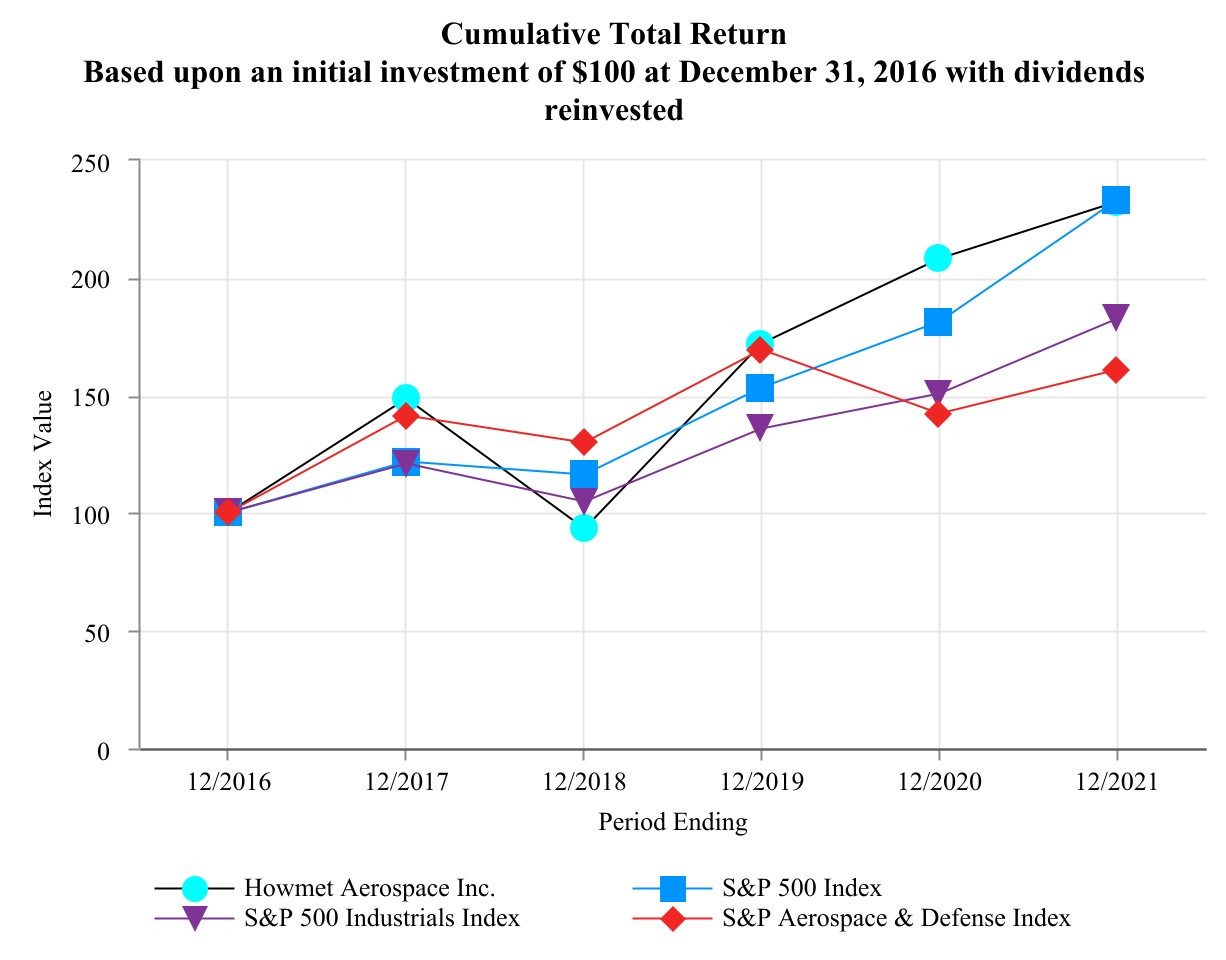
| As of December 31, | 2016 | 2017 | 2018 | 2019 | 2020 | 2021 | |||||||||||||||||||||||||||||||||||
| Howmet Aerospace Inc. | $ | 100.00 | $ | 148.79 | $ | 93.41 | $ | 171.78 | $ | 208.04 | $ | 232.32 | |||||||||||||||||||||||||||||
| S&P 500® Index | 100.00 | 121.83 | 116.49 | 153.17 | 181.35 | 233.41 | |||||||||||||||||||||||||||||||||||
| S&P 500® Industrials Index | 100.00 | 121.03 | 104.95 | 135.77 | 150.79 | 182.63 | |||||||||||||||||||||||||||||||||||
| S&P Aerospace & Defense Index | 100.00 | 141.38 | 129.97 | 169.39 | 142.18 | 160.98 |
Issuer Purchases of Equity Securities
The following table presents information with respect to the Company’s open-market repurchases of its common stock during the quarter ended December 31, 2021:
| (in millions except share and per-share amounts) | ||||||||||||||||||||||||||
| Period | Total Number of Shares Purchased | Average Price Paid Per Share**(1)** | Total Number of Shares Purchased as Part of Publicly Announced Repurchase Plans or Programs | Approximate Dollar Value of Shares that May Yet Be Purchased Under the Plans or Programs**(1)(2)** | ||||||||||||||||||||||
| October 1 - October 31, 2021 | 879,307 | $ | 30.71 | 879,307 | $ | 1,525 | ||||||||||||||||||||
| November 1 - November 30, 2021 | 2,336,733 | $ | 30.79 | 2,336,733 | $ | 1,453 | ||||||||||||||||||||
| December 1 - December 31, 2021 | 3,546,041 | $ | 29.91 | 3,546,041 | $ | 1,347 | ||||||||||||||||||||
| Total for quarter ended December 31, 2021 | 6,762,081 | $ | 30.32 | 6,762,081 |
(1)Excludes commissions cost.
(2)On August 18, 2021, the Company announced that its Board of Directors authorized a share repurchase program of up to $1,500 million of the Company's outstanding common stock. The Board had previously authorized, in May 2019, a share repurchase program of up to $500 million, of which approximately $52 million Board authorization remained available as of September 31, 2021. After giving effect to the share repurchases made through the fourth quarter of 2021, approximately $1,347 million Board authorization remained available as of January 1, 2022. Under the Company’s share repurchase programs (the “Share Repurchase Programs”), the Company may repurchase shares by means of trading plans established from time to time in accordance with Rule 10b5-1 under the Securities Exchange Act of 1934, as amended, block trades, private transactions, open market repurchases and/or accelerated share repurchase agreements or other derivative transactions. There is no stated expiration for the Share Repurchase Programs. Under its Share Repurchase Programs, the Company may repurchase shares from time to time, in amounts, at prices, and at such times as the Company deems appropriate, subject to market conditions, legal requirements and other considerations, including limits under the Company’s Five-Year Revolving Credit Agreement (see Note R to the Consolidated Financial Statements in Part II, Item 8 of this Form 10-K for reference). The Company is not obligated to repurchase any specific number of shares or to do so at any particular time, and the Share Repurchase Programs may be suspended, modified or terminated at any time without prior notice.
Item 6. Selected Financial Data.
Reserved.
Item 7. Management’s Discussion and Analysis of Financial Condition and Results of Operations.
(dollars in millions, except share and per-share amounts)
The following Management’s Discussion and Analysis of Financial Condition and Results of Operations (“MD&A”) is intended to help the reader understand our results of operations and financial condition. The MD&A is provided as a supplement to, and should be read in conjunction with, our consolidated financial statements and notes thereto included in Part II, Item 8 (Financial Statements and Supplementary Data) of this Form 10-K.
Overview
Our Business
Howmet is a global leader in lightweight metals engineering and manufacturing. Howmet’s innovative, multi-material products, which include nickel, titanium, aluminum, and cobalt, are used worldwide in the aerospace (commercial and defense), commercial transportation, and industrial and other markets.
Howmet is a global company operating in 20 countries. Based upon the country where the point of shipment occurred, the United States and Europe generated 68% and 22%, respectively, of Howmet’s sales in 2021. In addition, Howmet has operating activities in numerous countries and regions outside the United States and Europe, including Canada, Mexico, China and Japan. Governmental policies, laws and regulations, and other economic factors, including inflation and fluctuations in foreign currency exchange rates and interest rates, affect the results of operations in countries with such activities.
Management Review of 2021 and Outlook
In 2021, Sales decreased 5% over 2020 primarily as a result of lower sales volumes in the commercial aerospace market driven by the impact of COVID-19 and Boeing 787 production declines, and lower sales volumes in the defense aerospace market, partially offset by growth in the commercial transportation and industrial gas turbine markets as well as favorable product pricing of $97. Price increases are in excess of material and inflationary pass through to our customers.
Segment operating profit increased 6% from 2020 due to favorable sales volumes in the commercial transportation and industrial gas turbine markets, cost reductions, and favorable product pricing, partially offset by lower sales volumes in the commercial aerospace market driven by the impact of COVID-19 and Boeing 787 production declines and lower sales volumes in the defense aerospace market.
Effective October 14, 2021, John C. Plant assumed the position of sole Chief Executive Officer and continued in his role as Executive Chairman of the Board of Directors. Tolga Oal, the Company’s prior Co-Chief Executive Officer, departed the Company and also stepped down from the Board, each effective as of October 14, 2021. The Company has aligned its operations consistent with how the Chief Executive Officer assesses operating performance and allocates capital, which remain unchanged since the Arconic Inc. Separation Transaction (see Note C to the Consolidated Financial Statements in Part II, Item 8 of this Form 10-K).
Management continued its focus on liquidity and cash flows as well as improving its operating performance through cost reductions, streamlined organizational structures, margin enhancement, and profitable revenue generation. Management has also continued its intensified focus on capital efficiency. Management’s focus and the related results enabled Howmet to end 2021 with a solid financial position.
The following financial information reflects certain key highlights of Howmet’s 2021 results:
-
Sales of $4,972, a decrease of 5% from 2020, with significant reductions in sales in commercial aerospace driven by COVID-19 and Boeing 787 production declines;
-
Net income from continuing operations of $258, or $0.59 per diluted share;
-
Income from continuing operations before income taxes of $324, an increase of $153, or 89%, from 2020;
-
Total segment operating profit of $939, an increase of $49, or 6%, from 2020(1);
-
Cash provided from operations of $449; cash used for financing activities of $1,444; and cash provided from investing activities of $107;
-
Purchased approximately 13 million shares of Common Stock under the Share Repurchase Programs for approximately $430;
-
Cash on hand and restricted cash at the end of the year of $722;
-
Total debt of $4,232, a decrease of $843 from 2020, reflecting redemptions or repurchases, as applicable, of $361, $476, $600, and $100 of the 5.400% Notes due 2021 (the “5.400% Notes”), the 5.870% Notes due 2022 (the “5.870% Notes”), the 6.875% Notes due 2025 (the “6.875% Notes”), and the 5.125% Notes due 2024 (the “5.125% Notes”), respectively, during 2021, partially offset by issuance of $700 of the 3.000% Notes due 2029 during 2021; and
-
The Company’s common stock had a closing price of $31.38 per share at December 31, 2021, an increase of $18.63 per share, or 141%, since the Arconic Inc. Separation Transaction on April 1, 2020, compared to an increase of 93% and 51% for the S&P 500® Index and S&P Aerospace & Defense Index, respectively, over the same period.
(1) See below in Results of Operations for the reconciliation of Total segment operating profit to Income from continuing operations before income taxes.
In 2022, management projects sales to increase as we expect robust growth in most of the Company’s key markets, and the Company’s strong position in those markets is expected to continue. The Company expects higher metal costs to also contribute to increased sales in 2022. Earnings per share is expected to grow as management continues to focus on operational performance. Cash provided from operations is expected to increase for the full year in 2022 compared with 2021, resulting from a continued focus on operating performance and on capital efficiency. Capital expenditures are expected to be less than depreciation and amortization.
Results of Operations
Earnings Summary
Sales. Sales for 2021 were $4,972 compared with $5,259 in 2020, a decrease of $287, or 5%. The decrease was primarily due to lower sales volumes in the commercial aerospace market driven by the impact of COVID-19 and Boeing 787 production declines and lower sales volumes in the defense aerospace market, partially offset by growth in the commercial transportation and industrial gas turbine markets as well as favorable product pricing of $97. Price increases are in excess of material and inflationary pass through to our customers.
Sales for 2020 were $5,259 compared with $7,098 in 2019, a decrease of $1,839, or 26%. The decrease was primarily a result of lower sales volumes in the commercial aerospace and commercial transportation markets driven by the impacts of COVID-19 and Boeing 737 MAX (“737 MAX”) and Boeing 787 production declines along with a decrease in sales of $116 due to the divestiture of the forgings business in the U.K. in December 2019, all partially offset by growth in the defense aerospace and industrial gas turbine markets and favorable product pricing.
Cost of goods sold (“COGS”). COGS as a percentage of Sales was 72.3% in 2021 compared with 73.7% in 2020. The decrease was primarily due to structural cost reductions and favorable product pricing. In 2019, the Company sustained a fire at a Fastening Systems plant in France (“France Plant Fire”). Additionally, a fire occurred at a Forged Wheels plant in Barberton, Ohio in mid-February 2020 (“Barberton Plant Fire”). The Company submitted insurance claims related to these plant fires and received partial settlements of $32 in 2021 compared to $39 in 2020, which were in excess of the insurance deductible. In 2021, the Company recorded charges of $28 related to plant fires compared to $41 in 2020. The downtime in 2021 and 2020 reduced production levels and affected productivity at the plants. The Company anticipates additional charges related to these plant fires of app
Showing the first 8K of 80K characters. Open the full section
Item 7A. Quantitative and Qualitative Disclosures About Market Risk.
Not material.
Item 8. Financial Statements and Supplementary Data.
Management’s Reports to Howmet Shareholders
Management’s Report on Financial Statements and Practices
The accompanying Consolidated Financial Statements of Howmet Aerospace Inc. and its subsidiaries (the “Company”) were prepared by management, which is responsible for their integrity and objectivity. The statements were prepared in accordance with accounting principles generally accepted in the United States of America and include amounts that are based on management’s best judgments and estimates. The other financial information included in the annual report is consistent with that in the financial statements.
Management also recognizes its responsibility for conducting the Company’s affairs according to the highest standards of personal and corporate conduct. This responsibility is characterized and reflected in key policy statements issued from time to time regarding, among other things, conduct of its business activities within the laws of the host countries in which the Company operates and potentially conflicting outside business interests of its employees. The Company maintains a systematic program to assess compliance with these policies.
Management’s Report on Internal Control over Financial Reporting
Management is responsible for establishing and maintaining adequate internal control over financial reporting for the Company. In order to evaluate the effectiveness of internal control over financial reporting, as required by Section 404 of the Sarbanes-Oxley Act, management has conducted an assessment, including testing, using the criteria in Internal Control—Integrated Framework (2013), issued by the Committee of Sponsoring Organizations of the Treadway Commission (“COSO”). The Company’s system of internal control over financial reporting is designed to provide reasonable assurance regarding the reliability of financial reporting and the preparation of financial statements for external purposes in accordance with generally accepted accounting principles. The Company’s internal control over financial reporting includes those policies and procedures that (i) pertain to the maintenance of records that, in reasonable detail, accurately and fairly reflect the transactions and dispositions of the assets of the Company; (ii) provide reasonable assurance that transactions are recorded as necessary to permit preparation of financial statements in accordance with accounting principles generally accepted in the United States of America, and that receipts and expenditures of the Company are being made only in accordance with authorizations of management and directors of the Company; and (iii) provide reasonable assurance regarding prevention or timely detection of unauthorized acquisition, use, or disposition of the Company’s assets that could have a material effect on the financial statements.
Because of its inherent limitations, internal control over financial reporting may not prevent or detect misstatements. Also, projections of any evaluation of effectiveness to future periods are subject to the risk that controls may become inadequate because of changes in conditions, or that the degree of compliance with the policies or procedures may deteriorate.
Based on the assessment, management has concluded that the Company maintained effective internal control over financial reporting as of December 31, 2021, based on criteria in Internal Control—Integrated Framework (2013) issued by the COSO.
The effectiveness of the Company’s internal control over financial reporting as of December 31, 2021 has been audited by PricewaterhouseCoopers LLP, an independent registered public accounting firm, as stated in their report, which is included herein.
| /s/ John C. Plant | ||
| John C. Plant Executive Chairman and Chief Executive Officer |
| /s/ Ken Giacobbe | ||
| Ken Giacobbe Executive Vice President and Chief Financial Officer |
Report of Independent Registered Public Accounting Firm
To the Board of Directors and Shareholders of Howmet Aerospace Inc.
Opinions on the Financial Statements and Internal Control over Financial Reporting
We have audited the accompanying consolidated balance sheets of Howmet Aerospace Inc. and its subsidiaries (the “Company”) as of December 31, 2021 and 2020, and the related consolidated statements of operations, of comprehensive income, of changes in equity and of cash flows for each of the three years in the period ended December 31, 2021, including the related notes (collectively referred to as the “consolidated financial statements”). We also have audited the Company's internal control over financial reporting as of December 31, 2021, based on criteria established in Internal Control - Integrated Framework (2013) issued by the Committee of Sponsoring Organizations of the Treadway Commission (COSO).
In our opinion, the consolidated financial statements referred to above present fairly, in all material respects, the financial position of the Company as of December 31, 2021 and 2020, and the results of its operations and its cash flows for each of the three years in the period ended December 31, 2021 in conformity with accounting principles generally accepted in the United States of America. Also in our opinion, the Company maintained, in all material respects, effective internal control over financial reporting as of December 31, 2021, based on criteria established in Internal Control - Integrated Framework (2013) issued by the COSO.
Change in Accounting Principle
As discussed in Note B to the consolidated financial statements, the Company changed the manner in which it accounts for leases in 2019.
Basis for Opinions
The Company's management is responsible for these consolidated financial statements, for maintaining effective internal control over financial reporting, and for its assessment of the effectiveness of internal control over financial reporting, included in the accompanying Management’s Report on Internal Control over Financial Reporting. Our responsibility is to express opinions on the Company’s consolidated financial statements and on the Company's internal control over financial reporting based on our audits. We are a public accounting firm registered with the Public Company Accounting Oversight Board (United States) (PCAOB) and are required to be independent with respect to the Company in accordance with
Showing the first 8K of 249K characters. Open the full section
Item 9. Changes in and Disagreements With Accountants on Accounting and Financial Disclosure.
None.
Item 9A. Controls and Procedures.
(a) Evaluation of Disclosure Controls and Procedures
Howmet’s Chief Executive Officer and Chief Financial Officer have evaluated the Company’s disclosure controls and procedures, as defined in Rules 13a-15(e) and 15d-15(e) of the Securities Exchange Act of 1934, as of the end of the period covered by this report, and they have concluded that these controls and procedures are effective.
(b) Management’s Annual Report on Internal Control over Financial Reporting
Management’s Report on Internal Control over Financial Reporting is included in Part II, Item 8 of this Form 10-K beginning on page 38.
(c) Attestation Report of the Registered Public Accounting Firm
The effectiveness of Howmet’s internal control over financial reporting as of December 31, 2021 has been audited by PricewaterhouseCoopers LLP, an independent registered public accounting firm, as stated in their report, which is included in Part II, Item 8 of this Form 10-K on page 39.
(d) Changes in Internal Control over Financial Reporting
There have been no changes in internal control over financial reporting during the fourth quarter of 2021, that have materially affected, or are reasonably likely to materially affect, the Company’s internal control over financial reporting.
Item 9B. Other Information.
None.
Item 9C. Disclosure Regarding Foreign Jurisdictions that Prevent Inspection.
Not applicable.
PART III
Item 10. Directors, Executive Officers and Corporate Governance.
The information required by Item 401 of Regulation S-K regarding directors is contained under the caption “Item 1 Election of Directors” of the Proxy Statement and is incorporated by reference. The information required by Item 401 of Regulation S-K regarding executive officers is set forth in Part I, Item 1 of this report under “Executive Officers of the Registrant.”
The information required by Item 405 of Regulation S-K is contained under the caption “Section 16(a) Beneficial Ownership Reporting Compliance” of the Proxy Statement and is incorporated by reference.
The Company’s Code of Ethics for the CEO, CFO and Other Financial Professionals is publicly available on the Company’s Internet website at www.howmet.com under the section “Investors—Corporate Governance—Governance and Policies.” The remaining information required by Item 406 of Regulation S-K is contained under the captions “Corporate Governance” and “Corporate Governance—Business Conduct Policies and Code of Ethics” of the Proxy Statement and is incorporated by reference.
The information required by Items 407(c)(3), (d)(4) and (d)(5) of Regulation S-K is included under the captions “Item 1 Election of Directors—Nominating Board Candidates—Procedures and Director Qualifications” and “Corporate Governance—Committees of the Board—Audit Committee” of the Proxy Statement and is incorporated by reference.
Item 11. Executive Compensation.
The information required by Item 402 of Regulation S-K is contained under the captions “Director Compensation”, “Executive Compensation” and “Corporate Governance—Recovery of Incentive Compensation” of the Proxy Statement. Such information is incorporated by reference.
The information required by Items 407(e)(4) and (e)(5) of Regulation S-K is contained under the captions “Corporate Governance—Compensation Committee Interlocks and Insider Participation” and “Item 3 Advisory Approval of Executive Compensation—Compensation Committee Report” of the Proxy Statement. Such information (other than the Compensation Committee Report, which shall not be deemed to be “filed”) is incorporated by reference.
Item 12. Security Ownership of Certain Beneficial Owners and Management and Related Stockholder Matters.
The following table gives information about Howmet’s common stock that could be issued under the Company’s equity compensation plans as of December 31, 2021.
Equity Compensation Plan Information
| Plan Category | Number of securities to be issued upon exercise of outstanding options, warrants and rights | Weighted-average exercise price of outstanding options, warrants and rights | Number of securities remaining available for future issuance under equity compensation plans (excluding securities reflected in column (a)) | ||||||||
| (a) | (b) | (c) | |||||||||
| Equity compensation plans approved by security holders(1) | 9,636,103(1) | $ | 23.64 | 24,113,585(2) | |||||||
| Equity compensation plans not approved by security holders | — | — | — | ||||||||
| Total | 9,636,103 | $ | 23.64 | 24,113,585(2) |
(1) Includes the 2013 Howmet Aerospace Stock Incentive Plan, as Amended and Restated (approved by shareholders in May 2019, May 2018, May 2016 and May 2013) (the “2013 Plan”) and 2009 Alcoa Stock Incentive Plan (approved by shareholders in May 2009). Also includes 877 stock options resulting from the merger conversion of RTI Metals employee equity. Table amounts are comprised of the following:
-
1,754,902 stock options
-
4,825,997 restricted share units
-
3,055,204 performance share awards (226,672 granted in 2021 at target)
(2) The 2013 Plan authorizes, in addition to stock options, other types of stock-based awards in the form of stock appreciation rights, restricted shares, restricted share units, performance awards and other awards. The shares that remain available for issuance under the 2013 Plan may be issued in connection with any one of these awards. Up to 66,666,667 shares may be issued under the plan. Any award other than an option or a stock appreciation right shall count as 2.33 shares. Options and stock appreciation rights shall be counted as one share for each option or stock appreciation right. In addition, the 2013 Plan provides the following are available to grant under the 2013 Plan: (i) shares that are issued under the 2013 Plan, which are subsequently forfeited, cancelled or expire in accordance with the terms of the award and (ii) shares that had previously been issued under prior plans that are outstanding as of the date of the 2013 Plan which are subsequently forfeited, cancelled or expire in accordance with the terms of the award.
The information required by Item 403 of Regulation S-K is contained under the captions “Howmet Aerospace Stock Ownership—Stock Ownership of Certain Beneficial Owners” and “Howmet Aerospace Stock Ownership—Stock Ownership of Directors and Executive Officers” of the Proxy Statement and is incorporated by reference.
Item 13. Certain Relationships and Related Transactions, and Director Independence.
The information required by Item 404 of Regulation S-K is contained under the captions “Executive Compensation” (excluding the information under the caption “Compensation Committee Report”) and “Corporate Governance— Related Person Transactions” of the Proxy Statement and is incorporated by reference.
The information required by Item 407(a) of Regulation S-K regarding director independence is contained under the captions “Item 1 Election of Directors” and “Corporate Governance” of the Proxy Statement and is incorporated by reference.
Item 14. Principal Accounting Fees and Services.
The information required by Item 9(e) of Schedule 14A is contained under the captions “Item 2 Ratification of Appointment of Independent Registered Public Accounting Firm—Report of the Audit Committee” and “Item 2 Ratification of Appointment of Independent Registered Public Accounting Firm— Audit and Non-Audit Fees” of the Proxy Statement and in its Attachment A (Pre-Approval Policies and Procedures for Audit and Non-Audit Services) thereto and is incorporated by reference.
PART IV
Item 15. Exhibits, Financial Statement Schedules.
(a) The consolidated financial statements and exhibits listed below are filed as part of this report.
(1) The Company’s consolidated financial statements, the notes thereto and the report of the Independent Registered Public Accounting Firm are on pages 39 through 88 of this report.
(2) Financial statement schedules have been omitted because they are not applicable, not required, or the required information is included in the consolidated financial statements or notes thereto.
(3) Exhibits.
| Exhibit Number | Description* | |||||||
| 2(a) | Separation and Distribution Agreement, dated as of October 31, 2016, by and between Arconic Inc. and Alcoa Corporation, incorporated by reference to Exhibit 2.1 to the Company’s Current Report on Form 8-K dated November 4, 2016. | |||||||
| 2(b) | Tax Matters Agreement, dated as of October 31, 2016, by and between Arconic Inc. and Alcoa Corporation, incorporated by reference to Exhibit 2.3 to the Company’s Current Report on Form 8-K dated November 4, 2016. | |||||||
| 2(c) | Employee Matters Agreement, dated as of October 31, 2016, by and between Arconic Inc. and Alcoa Corporation, incorporated by reference to Exhibit 2.4 to the Company’s Current Report on Form 8-K dated November 4, 2016. | |||||||
| 2(c)(1) | Amendment No. 1, dated December 13, 2016, to Employee Matters Agreement, dated as of October 31, 2016, by and between Arconic Inc. and Alcoa Corporation, incorporated by reference to Exhibit 2(e)(1) to the Company’s Annual Report on Form 10-K for the year ended December 31, 2016. | |||||||
| 2(d) | Alcoa Corporation to Arconic Inc. Patent, Know-How, and Trade Secret License Agreement, dated as of October 31, 2016, by and between Alcoa USA Corp. and Arconic Inc., incorporated by reference to Exhibit 2.5 to the Company’s Current Report on Form 8-K dated November 4, 2016. | |||||||
| 2(d)(1) | First Amendment, effective as of November 1, 2016, to the Patent, Know-How and Trade Secret License Agreement by and between Alcoa USA Corp. and Arconic Inc. | |||||||
| 2(d)(2) | Second Amendment, effective as of November 1, 2016, to the Patent, Know-How and Trade Secret License Agreement by and between Alcoa USA Corp. and Arconic Inc. | |||||||
| 2(e) | Arconic Inc. to Alcoa Corporation Patent, Know-How, and Trade Secret License Agreement, dated as of October 31, 2016, by and between Arconic Inc. and Alcoa USA Corp., incorporated by reference to Exhibit 2.6 to the Company’s Current Report on Form 8-K dated November 4, 2016. | |||||||
| 2(f) | Amended and Restated Alcoa Corporation to Arconic Inc. Trademark License Agreement, dated as of June 25, 2017, by and between Alcoa USA Corp. and Arconic Inc., incorporated by reference to Exhibit 2 to the Company’s Quarterly Report on Form 10-Q for the quarter ended June 30, 2017. | |||||||
| 2(g) | [Reserved] | |||||||
| 2(h) | Massena Lease and Operations Agreement, dated as of October 31, 2016, by and between Arconic Inc. and Alcoa Corporation, incorporated by reference to Exhibit 2.10 to the Company’s Current Report on Form 8-K dated November 4, 2016. | |||||||
| 2(i) | Agreement and Plan of Merger, dated October 12, 2017, by and between Arconic Inc., a Pennsylvania corporation, and Arconic Inc., a Delaware corporation, incorporated by reference to Exhibit 2.1 to the Company’s Current Report on Form 8-K dated January 4, 2018. | |||||||
| 2(j) | Separation and Distribution Agreement, dated as of March 31, 2020, by and between Arconic Inc. and Arconic Rolled Products Corporation, incorporated by reference to Exhibit 2.1 to the Company's Current Report on Form 8-K filed on April 6, 2020. | |||||||
| 2(k) | Tax Matters Agreement, dated as of March 31, 2020, by and between Arconic Inc. and Arconic Rolled Products Corporation, incorporated by reference to Exhibit 2.2 to the Company's Current Report on Form 8-K filed on April 6, 2020. | |||||||
| 2(l) | Employee Matters Agreement, dated as of March 31, 2020, by and between Arconic Inc. and Arconic Rolled Products Corporation, incorporated by reference to Exhibit 2.3 to the Company's Current Report on Form 8-K filed on April 6, 2020. | |||||||
| 2(l)(1) | First Amendment to Employee Matters Agreement, dated as of April 10, 2020, by and between Howmet Aerospace Inc. and Arconic Corporation, incorporated by reference to Exhibit 2.1 to the Company's Current Report on Form 8-K filed on April 13, 2020. | |||||||
| 2(m) | Patent, Know-How, and Trade Secret License Agreement, dated as of March 31, 2020, by and between Arconic Inc. and Arconic Rolled Products Corporation, incorporated by reference to Exhibit 2.4 to the Company's Current Report on Form 8-K filed on April 6, 2020. | |||||||
| 2(m)(1) | Amendment No. 1, effective as of August 25, 2020, to Patent, Know-How, and Trade Secret License Agreement, dated as of March 31, 2020, by and between Arconic Inc. and Arconic Rolled Products Corporation. | |||||||
| 2(n) | Patent, Know-How, and Trade Secret License Agreement, dated as of March 31, 2020, by and between Arconic Rolled Products Corporation and Arconic Inc., incorporated by reference to Exhibit 2.5 to the Company's Current Report on Form 8-K filed on April 6, 2020. | |||||||
| 2(o) | Trademark License Agreement, dated as of March 31, 2020, by and between Arconic Rolled Products Corporation and Arconic Inc., incorporated by reference to Exhibit 2.6 to the Company's Current Report on Form 8-K filed on April 6, 2020. | |||||||
| 2(p) | Trademark License Agreement, dated as of March 31, 2020, by and between Arconic Inc. and Arconic Rolled Products Corporation, incorporated by reference to Exhibit 2.7 to the Company's Current Report on Form 8-K filed on April 6, 2020. | |||||||
| 2(q) | Master Agreement for Product Supply, dated as of March 31, 2020, by and between Arconic Massena LLC, Arconic Lafayette LLC, Arconic Davenport LLC and Arconic Inc., incorporated by reference to Exhibit 2.8 to the Company's Current Report on Form 8-K filed on April 6, 2020. | |||||||
| 2(r) | Second Supplemental Tax and Project Certificate and Agreement, dated as of March 31, 2020, by and among Arconic Inc., Arconic Davenport LLC and Arconic Rolled Products Corporation, incorporated by reference to Exhibit 2.9 to the Company's Current Report on Form 8-K filed on April 6, 2020. | |||||||
| 2(s) | Lease and Property Management Agreement, dated as of March 31, 2020, by and between Arconic Inc. and Arconic Massena LLC, incorporated by reference to Exhibit 2.10 to the Company's Current Report on Form 8-K filed on April 6, 2020. | |||||||
| 2(t) | Metal Supply & Tolling Agreement by and between Arconic-Köfém Mill Products Hungary Kft and Arconic-Köfém Kft, dated January 1, 2020, incorporated by reference to Exhibit 2(t) to the Company's Annual Report on Form 10-K for the year ended December 31, 2020. | |||||||
| 3(a) | Certificate of Incorporation of Howmet Aerospace Inc., a Delaware corporation, incorporated by reference to Exhibit 3(a) to the Company's Annual Report on Form 10-K for the year ended December 31, 2020. | |||||||
| 3(b) | Bylaws of Howmet Aerospace Inc., a Delaware corporation, incorporated by reference to Exhibit 3(b) to the Company's Annual Report on Form 10-K for the year ended December 31, 2020. | |||||||
| 4(a) | Form of Certificate for Shares of Common Stock of Arconic Inc., a Delaware corporation, incorporated by reference to Exhibit 4.1 to the Company’s Current Report on Form 8-K dated January 4, 2018. | |||||||
| 4(b) | Bylaws. See exhibit 3(b) above. | |||||||
| 4(c) | Form of Indenture, dated as of September 30, 1993, between Alcoa Inc. and The Bank of New York Trust Company, N.A., as successor to J. P. Morgan Trust Company, National Association (formerly Chase Manhattan Trust Company, National Association), as successor Trustee to PNC Bank, National Association, as Trustee (undated form of Indenture incorporated by reference to Exhibit 4(a) to Registration Statement No. 33-49997 on Form S-3). | |||||||
| 4(c)(1) | First Supplemental Indenture, dated as of January 25, 2007, between Alcoa Inc. and The Bank of New York Trust Company, N.A., as successor to J.P. Morgan Trust Company, National Association (formerly Chase Manhattan Trust Company, National Association), as successor Trustee to PNC Bank, National Association, as Trustee, incorporated by reference to Exhibit 99.4 to the Company’s Current Report on Form 8-K dated January 25, 2007. | |||||||
| 4(c)(2) | Second Supplemental Indenture, dated as of July 15, 2008, between Alcoa Inc. and The Bank of New York Mellon Trust Company, N.A., as successor in interest to J. P. Morgan Trust Company, National Association (formerly Chase Manhattan Trust Company, National Association, as successor to PNC Bank, National Association), as Trustee, incorporated by reference to Exhibit 4(c) to the Company’s Current Report on Form 8-K dated July 15, 2008. | |||||||
| 4(c)(3) | Fourth Supplemental Indenture, dated as of December 31, 2017, between Arconic Inc., a Pennsylvania corporation, Arconic Inc., a Delaware corporation, and The Bank of New York Mellon Trust Company, N.A., as trustee, incorporated by reference to Exhibit 4.3 to the Company’s Current Report on Form 8-K dated January 4, 2018. | |||||||
| 4(c)(4) | Fifth Supplemental Indenture, dated as of April 16, 2020, between Howmet Aerospace Inc., a Delaware corporation, and The Bank of New York Mellon Trust Company, N.A., as trustee, incorporated by reference to Exhibit 4(e) to the Company’s Registration Statement on Form S-3 (Registration Statement No. 333-237705) dated April 16, 2020. | |||||||
| 4(d) | Form of 6.75% Bonds Due 2028, incorporated by reference to Exhibit 4(d) to the Company’s Annual Report on Form 10-K for the year ended December 31, 2017. | |||||||
| 4(e) | Form of 5.90% Notes Due 2027, incorporated by reference to Exhibit 4(e) to the Company’s Annual Report on Form 10-K for the year ended December 31, 2008. | |||||||
| 4(f) | Form of 5.95% Notes Due 2037, incorporated by reference to Exhibit 4(f) to the Company’s Annual Report on Form 10-K for the year ended December 31, 2008. | |||||||
| 4(g) | Form of 5.125% Notes Due 2024, incorporated by reference to Exhibit 4.5 to the Company’s Current Report on Form 8-K dated September 22, 2014. | |||||||
| 4(h) | Form of 6.875% Notes due 2025, incorporated by reference to Exhibit 4.6 to the Company’s Current Report on Form 8-K dated April 24, 2020. | |||||||
| 4(i) | Form of 3.000% Notes due 2029, incorporated by reference to Exhibit 4.6 to the Company’s Current Report on Form 8-K dated September 1, 2021. | |||||||
| 4(j) | Description of Arconic Inc.'s Securities Registered Pursuant to Section 12 of the Securities Exchange Act of 1934, incorporated by reference to Exhibit 4(p) to the Company’s Annual Report on Form 10-K for the year ended December 31, 2019. | |||||||
| 10(a) | Amended and Restated Five-Year Revolving Credit Agreement, dated as of September 28, 2021, among Howmet Aerospace Inc., the lenders and issuers named therein, Citibank, N.A., as administrative agent, and JPMorgan Chase Bank, N.A., as syndication agent, incorporated by reference to Exhibit 10.1 to the Company’s Current Report on Form 8-K dated September 28, 2021. | |||||||
| 10(b) | Agreement, dated February 1, 2016, by and between Elliott Associates, L.P., Elliott International, L.P., Elliott International Capital Advisors Inc. and Alcoa Inc., incorporated by reference to Exhibit 10.1 to the Company’s Current Report on Form 8-K dated February 1, 2016. | |||||||
| 10(c) | Settlement Agreement, dated as of May 22, 2017, by and among Elliott Associates, L.P., Elliott International, L.P., Elliott International Capital Advisors Inc. and Arconic Inc., incorporated by reference to Exhibit 10.1 to the Company’s Current Report on Form 8-K dated May 22, 2017 (reporting an event on May 21, 2017). | |||||||
| 10(d) | Letter Agreement, by and among Arconic Inc. and Elliott Associates, L.P., Elliott International, L.P. and Elliott International Capital Advisors Inc., dated as of December 19, 2017, incorporated by reference to Exhibit 10.1 to the Company’s Current Report on Form 8-K dated December 19, 2017. | |||||||
| 10(e) | Registration Rights Agreement, by and among Arconic Inc. and Elliott Associates, L.P., Elliott International, L.P. and Elliott International Capital Advisors Inc., dated as of December 19, 2017, incorporated by reference to Exhibit 10.2 to the Company’s Current Report on Form 8-K dated December 19, 2017. | |||||||
| 10(e)(1) | Amendment to Registration Rights Agreement, by and among Arconic Inc. and Elliott Associates, L.P., Elliott International, L.P. and Elliott International Capital Advisors Inc., dated as of February 2, 2018, incorporated by reference to Exhibit 10.1 to the Company’s Current Report on Form 8-K dated February 6, 2018. | |||||||
| 10(f) | Howmet Aerospace Inc. 2020 Annual Cash Incentive Plan (formerly known as the Arconic Inc. 2020 Annual Cash Incentive Plan), incorporated by reference to Exhibit 10.1 to the Company’s Current Report on Form 8-K dated December 10, 2019. | |||||||
| 10(g) | Howmet Aerospace Hourly Retirement Savings Plan, as Amended and Restated, effective January 1, 2021. | |||||||
| 10(g)(1) | First Amendment, effective January 1, 2022, to the Howmet Aerospace Hourly Retirement Savings Plan, as Amended and Restated. | |||||||
| 10(g)(2) | Howmet Aerospace Salaried Retirement Savings Plan, as Amended and Restated effective January 1, 2021. | |||||||
| 10(g)(3) | Howmet Aerospace Niles Bargaining Retirement Savings Plan, as Amended and Restated, effective January 1, 2021. | |||||||
| 10(h) | Howmet Aerospace Excess Benefits Plan C (formerly known as the Arconic Employees’ Excess Benefits Plan C), as amended and restated effective August 1, 2016, incorporated by reference to Exhibit 10(j) to the Company’s Annual Report on Form 10-K for the year ended December 31, 2016. | |||||||
| 10(h)(1) | First Amendment to Howmet Aerospace Excess Benefits Plan C (formerly known as the Arconic Employees’ Excess Benefits Plan C), effective January 1, 2018, incorporated by reference to Exhibit 10(l)(1) to the Company’s Annual Report on Form 10-K for the year ended December 31, 2017. | |||||||
| 10(h)(2) | Second Amendment to Howmet Aerospace Excess Benefits Plan C (formerly known as the Arconic Employees’ Excess Benefits Plan C), effective January 1, 2018, incorporated by reference to Exhibit 10(l)(2) to the Company’s Annual Report on Form 10-K for the year ended December 31, 2017. | |||||||
| 10(h)(3) | Third Amendment to Howmet Aerospace Excess Benefits Plan C (formerly known as the Arconic Employees’ Excess Benefits Plan C), effective March 31, 2018. incorporated by reference to Exhibit 10.1 to the Company’s Current Report on Form 8-K dated January 8, 2018. | |||||||
| 10(i) | Deferred Fee Plan for Directors, as amended effective July 9, 1999, incorporated by reference to Exhibit 10(g)(1) to the Company’s Quarterly Report on Form 10-Q for the quarter ended June 30, 1999. | |||||||
| 10(j) | Amended and Restated Deferred Fee Plan for Directors, effective April 1, 2020, incorporated by reference to Exhibit 10.4 to the Company’s Quarterly Report on Form 10-Q for the quarter ended March 31, 2020. | |||||||
| 10(k) | Non-Employee Director Compensation Policy, effective April 1, 2020, incorporated by reference to Exhibit 10.3 to the Company’s Quarterly Report on Form 10-Q for the quarter ended March 31, 2020. | |||||||
| 10(l) | Fee Continuation Plan for Non-Employee Directors, incorporated by reference to Exhibit 10(k) to the Company’s Annual Report on Form 10-K for the year ended December 31, 1989. | |||||||
| 10(l)(1) | Amendment to Fee Continuation Plan for Non-Employee Directors, effective November 10, 1995, incorporated by reference to Exhibit 10(i)(1) to the Company’s Annual Report on Form 10-K for the year ended December 31, 1995. | |||||||
| 10(l)(2) | Second Amendment to the Fee Continuation Plan for Non-Employee Directors, effective September 15, 2006, incorporated by reference to Exhibit 10.2 to the Company’s Current Report on Form 8-K dated September 20, 2006. | |||||||
| 10(m) | Howmet Aerospace Deferred Compensation Plan (formerly known as the Arconic Deferred Compensation Plan), as amended and restated effective August 1, 2016, incorporated by reference to Exhibit 10(p) to the Company’s Annual Report on Form 10-K for the year ended December 31, 2016. | |||||||
| 10(m)(1) | First Amendment to the Howmet Aerospace Deferred Compensation Plan (formerly known as the Arconic Deferred Compensation Plan), effective January 1, 2018, incorporated by reference to Exhibit 10(r)(1) to the Company’s Annual Report on Form 10-K for the year ended December 31, 2017. | |||||||
| 10(n) | Summary of the Executive Split Dollar Life Insurance Plan, dated November 1990, incorporated by reference to Exhibit 10(m) to the Company’s Annual Report on Form 10-K for the year ended December 31, 1990. | |||||||
| 10(o) | Amended and Restated Dividend Equivalent Compensation Plan, effective January 1, 1997, incorporated by reference to Exhibit 10(h) to the Company’s Quarterly Report on Form 10-Q for the quarter ended September 30, 2004. | |||||||
| 10(p) | Form of Indemnity Agreement between the Company and individual directors or officers, incorporated by reference to Exhibit 10(j) to the Company’s Annual Report on Form 10-K for the year ended December 31, 1987. | |||||||
| 10(q) | Form of Indemnification Agreement between the Company and individual directors or officers, incorporated by reference to Exhibit 10.1 to the Company’s Current Report on Form 8-K dated January 25, 2018. | |||||||
| 10(r) | Amended and Restated 2009 Alcoa Stock Incentive Plan, dated February 15, 2011, incorporated by reference to Exhibit 10(z)(1) to the Company’s Annual Report on Form 10-K for the year ended December 31, 2010. | |||||||
| 10(s) | Howmet Aerospace Supplemental Pension Plan for Senior Executives (formerly known as the Arconic Supplemental Pension Plan for Senior Executives), as amended and restated effective August 1, 2016, incorporated by reference to Exhibit 10(v) to the Company’s Annual Report on Form 10-K for the year ended December 31, 2016. | |||||||
| 10(s)(1) | First Amendment to Howmet Aerospace Supplemental Pension Plan for Senior Executives (formerly known as the Arconic Supplemental Pension Plan for Senior Executives), effective January 1, 2018, incorporated by reference to Exhibit 10(x)(1) to the Company’s Annual Report on Form 10-K for the year ended December 31, 2017. | |||||||
| 10(s)(2) | Second Amendment to Howmet Aerospace Supplemental Pension Plan for Senior Executives (formerly known as the Arconic Supplemental Pension Plan for Senior Executives), effective January 1, 2018, incorporated by reference to Exhibit 10(x)(2) to the Company’s Annual Report on Form 10-K for the year ended December 31, 2017. | |||||||
| 10(t) | Deferred Fee Estate Enhancement Plan for Directors, effective July 10, 1998, incorporated by reference to Exhibit 10(r) to the Company’s Annual Report on Form 10-K for the year ended December 31, 1998. | |||||||
| 10(u) | Howmet Aerospace Inc. Change in Control Severance Plan, as Amended and Restated, effective September 17, 2021, incorporated by reference to Exhibit 10.2 to the Company's Current Report on Form 8-K filed on September 23, 2021. | |||||||
| 10(v) | Howmet Aerospace Inc. Executive Severance Plan, as Amended and Restated, effective September 17, 2021, incorporated by reference to Exhibit 10.1 to the Company's Current Report on Form 8-K filed on September 23, 2021. | |||||||
| 10(w) | Letter Agreement, by and between Arconic Inc. and Michael N. Chanatry, dated as of March 20, 2018. | |||||||
| 10(x) | Letter Agreement, from Arconic Inc. to Ken Giacobbe, dated as of February 14, 2019, incorporated by reference to Exhibit 10(hh) to the Company’s Annual Report on Form 10-K for the year ended December 31, 2018. | |||||||
| 10(y) | Letter Agreement, by and between Arconic Inc. and John C. Plant, dated as of February 6, 2019, incorporated by reference to Exhibit 10(a) to the Company’s Quarterly Report on Form 10-Q for the quarter ended March 31, 2019. | |||||||
| 10(z) | Letter Agreement, by and between Arconic Inc. and John C. Plant, dated as of August 1, 2019, incorporated by reference to Exhibit 10.1 to the Company's Current Report on Form 8-K dated August 2, 2019. | |||||||
| 10(aa) | Letter Agreement, by and between Arconic Inc. and John C. Plant, dated as of February 24, 2020, incorporated by reference to Exhibit 10.1 to the Company's Current Report on Form 8-K dated February 25, 2020. | |||||||
| 10(bb) | Letter Agreement between Howmet Aerospace Inc. and John C. Plant, dated as of June 9, 2020, incorporated by reference to Exhibit 10.1 to the Company's Current Report on Form 8-K filed on June 12, 2020. | |||||||
| 10(cc) | Letter Agreement, by and between Howmet Aerospace Inc. and John C. Plant, dated as of October 14, 2021, incorporated by reference to Exhibit 10.1 to the Company’s Current Report on Form 8-K filed on October 14, 2021. | |||||||
| 10(dd) | Letter Agreement, by and between Arconic Inc. and Neil E. Marchuk, dated as of February 13, 2019, incorporated by reference to Exhibit 10(c) to the Company’s Quarterly Report on Form 10-Q for the quarter ended March 31, 2019. | |||||||
| 10(ee) | Letter Agreement between Arconic Inc. and Tolga Oal, dated as of February 24, 2020, incorporated by reference to Exhibit 10.2 to the Company’s Current Report on Form 8-K dated February 25, 2020. | |||||||
| 10(ff) | Howmet Aerospace Global Pension Plan (formerly known as the Arconic Global Pension Plan), as amended and restated effective August 1, 2016, incorporated by reference to Exhibit 10(bb) to the Company’s Annual Report on Form 10-K for the year ended December 31, 2016. | |||||||
| 10(gg) | Howmet Aerospace Inc. Legal Fee Reimbursement Plan (formerly known as the Arconic Inc. Legal Fee Reimbursement Plan), effective as of April 30, 2018, incorporated by reference to Exhibit 10(b) to the Company’s Quarterly Report on Form 10-Q for the quarter ended March 31, 2018. | |||||||
| 10(hh) | 2013 Howmet Aerospace Stock Incentive Plan, as Amended and Restated, effective September 30, 2020, incorporated by reference to Exhibit 10.1 to the Company's Quarterly Report on Form 10-Q for the quarter ended September 30, 2020. | |||||||
| 10(ii) | Terms and Conditions for Stock Options, effective January 1, 2011, incorporated by reference to Exhibit 10(c) to the Company’s Quarterly Report on Form 10-Q for the quarter ended June 30, 2011. | |||||||
| 10(jj) | Terms and Conditions for Stock Option Awards, effective May 3, 2013, incorporated by reference to Exhibit 10(b) to the Company’s Current Report on Form 8-K dated May 8, 2013. | |||||||
| 10(kk) | Terms and Conditions for Stock Option Awards under the 2013 Howmet Aerospace Stock Incentive Plan, effective July 22, 2016, incorporated by reference to Exhibit 10(d) to the Company’s Quarterly Report on Form 10-Q for the quarter ended June 30, 2016. | |||||||
| 10(ll) | Global Stock Option Award Agreement, effective January 19, 2018, incorporated by reference to Exhibit 10(uu) to the Company’s Annual Report on Form 10-K for the year ended December 31, 2017. | |||||||
| 10(mm) | Form of Stock Option Award Agreement, incorporated by reference to Exhibit 10(f) to the Company’s Quarterly Report on Form 10-Q for the quarter ended June 30, 2018. | |||||||
| 10(nn) | Terms and Conditions for Restricted Share Units for Annual Director Awards under the 2013 Howmet Aerospace Stock Incentive Plan, effective November 30, 2016, incorporated by reference to Exhibit 10(vv) to the Company’s Annual Report on Form 10-K for the year ended December 31, 2016. | |||||||
| 10(oo) | Terms and Conditions for Restricted Share Units for Annual Director Awards under the 2013 Howmet Aerospace Stock Incentive Plan, as Amended and Restated, effective December 5, 2017, incorporated by reference to Exhibit 10(a) to the Company’s Quarterly Report on Form 10-Q for the quarter ended March 31, 2018. | |||||||
| 10(pp) | Terms and Conditions for Deferred Fee Restricted Share Units for Director Awards under the 2013 Howmet Aerospace Stock Incentive Plan, effective November 30, 2016, incorporated by reference to Exhibit 10(ww) to the Company’s Annual Report on Form 10-K for the year ended December 31, 2016. | |||||||
| 10(qq) | Global Restricted Share Unit Award Agreement, effective January 19, 2018, incorporated by reference to Exhibit 10(eee) to the Company’s Annual Report on Form 10-K for the year ended December 31, 2017. | |||||||
| 10(rr) | Terms and Conditions for Restricted Share Units issued on or after January 19, 2018, under the 2013 Howmet Aerospace Stock Incentive Plan, effective January 19, 2018, incorporated by reference to Exhibit 10(fff) to the Company’s Annual Report on Form 10-K for the year ended December 31, 2017. | |||||||
| 10(ss) | Form of Restricted Share Unit Award Agreement, incorporated by reference to Exhibit 10(g) to the Company’s Quarterly Report on Form 10-Q for the quarter ended June 30, 2018. | |||||||
| 10(tt) | Restricted Share Unit Award Agreement - Executive Vice President, Human Resources (Neil E. Marchuk) Annual Equity Award, effective March 15, 2019, incorporated by reference to Exhibit 10(f) to the Company’s Quarterly Report on Form 10-Q for the quarter ended March 31, 2019. | |||||||
| 10(uu) | Restricted Share Unit Award Agreement - Executive Vice President, Human Resources (Neil E. Marchuk) Sign-on Equity Award, effective March 15, 2019, incorporated by reference to Exhibit 10(g) to the Company’s Quarterly Report on Form 10-Q for the quarter ended March 31, 2019. | |||||||
| 10(vv) | Global Restricted Share Unit Award Agreement, effective September 30, 2020, incorporated by reference to Exhibit 10.4 to the Company's Quarterly Report on Form 10-Q for the quarter ended September 30, 2020. | |||||||
| 10(ww) | Global Stock Option Award Agreement, effective September 30, 2020, incorporated by reference to Exhibit 10.5 to the Company's Quarterly Report on Form 10-Q for the quarter ended September 30, 2020. | |||||||
| 10(xx) | Global Special Retention Award Agreement, effective September 30, 2020, incorporated by reference to Exhibit 10.6 to the Company's Quarterly Report on Form 10-Q for the quarter ended September 30, 2020. | |||||||
| 10(yy) | Terms and Conditions for Restricted Share Units, effective September 30, 2020, incorporated by reference to Exhibit 10.7 to the Company's Quarterly Report on Form 10-Q for the quarter ended September 30, 2020. | |||||||
| 10(zz) | Form of Confidentiality, Non-Competition, and Non-Solicitation Agreement, incorporated by reference to Exhibit 10.4 to the Company’s Quarterly Report on Form 10-Q (Commission file number 1-3610) for the quarter ended June 30, 2021. | |||||||
| 10(aaa) | Letter Agreement, by and between Howmet Aerospace Inc. and Lola Lin, dated as of May 5, 2021, incorporated by reference to Exhibit 10.1 to the Company’s Quarterly Report on Form 10-Q (Commission file number 1-3610) for the quarter ended June 30, 2021. | |||||||
| 10(bbb) | Restricted Share Unit Award Agreement - Annual Equity Award for Lola Lin, effective July 15, 2021 incorporated by reference to Exhibit 10.2 to the Company’s Quarterly Report on Form 10-Q (Commission file number 1-3610) for the quarter ended June 30, 2021. | |||||||
| 10(ccc) | Restricted Share Unit Award Agreement - Sign-On Equity Award for Lola Lin, effective July 15, 2021 incorporated by reference to Exhibit 10.3 to the Company’s Quarterly Report on Form 10-Q (Commission file number 1-3610) for the quarter ended June 30, 2021 | |||||||
| 21 | Subsidiaries of the Registrant. | |||||||
| 23 | Consent of Independent Registered Public Accounting Firm. | |||||||
| 24 | Power of Attorney. | |||||||
| 31 | Certifications pursuant to Section 302 of the Sarbanes-Oxley Act of 2002. | |||||||
| 32 | Certification pursuant to Section 906 of the Sarbanes-Oxley Act of 2002. | |||||||
| 101. INS | Inline XBRL Instance Document. | |||||||
| 101. SCH | Inline XBRL Taxonomy Extension Schema Document. | |||||||
| 101. CAL | Inline XBRL Taxonomy Extension Calculation Linkbase Document. | |||||||
| 101. DEF | Inline XBRL Taxonomy Extension Definition Linkbase Document. | |||||||
| 101. LAB | Inline XBRL Taxonomy Extension Label Linkbase Document. |
| 101. PRE | Inline XBRL Taxonomy Extension Presentation Linkbase Document. | |||||||
| 104 | The cover page of this Annual Report on Form 10-K for the year ended December 31, 2021 (formatted in Inline XBRL and contained in Exhibit 101). |
- Exhibit Nos. 10(f) through 10(ccc) are management contracts or compensatory plans required to be filed as Exhibits to this Form 10-K.
Amendments and modifications to other Exhibits previously filed have been omitted when in the opinion of the registrant such Exhibits as amended or modified are no longer material or, in certain instances, are no longer required to be filed as Exhibits.
Certain instruments defining the rights of holders of long-term debt securities of the Registrant and its subsidiaries are omitted pursuant to Item 601(b)(4)(iii) of Regulation S-K. The Registrant hereby undertakes to furnish to the SEC, upon request, copies of any such instruments.
Item 16. Form 10-K Summary.
None.
SIGNATURES
Pursuant to the requirements of Section 13 or 15(d) of the Securities Exchange Act of 1934, the registrant has duly caused this report to be signed on its behalf by the undersigned, thereunto duly authorized.
| HOWMET AEROSPACE INC. | ||||||||
| February 14, 2022 | By | /s/ Barbara L. Shultz | ||||||
| Barbara L. Shultz | ||||||||
| Vice President and Controller (Also signing as Principal Accounting Officer) |
Pursuant to the requirements of the Securities Exchange Act of 1934, this report has been signed below by the following persons on behalf of the registrant and in the capacities and on the dates indicated.
| Signature | Title | Date | ||||||
| /s/ John C. Plant | February 14, 2022 | |||||||
| John C. Plant | Executive Chairman and Chief Executive Officer (Principal Executive Officer and Director) | |||||||
| /s/ Ken Giacobbe | February 14, 2022 | |||||||
| Ken Giacobbe | Executive Vice President and Chief Financial Officer (Principal Financial Officer) |
James F. Albaugh, Amy E. Alving, Sharon R. Barner, Joseph S. Cantie, Robert F. Leduc, David J. Miller, Jody G. Miller, Nicole W. Piasecki and Ulrich R. Schmidt, each as a Director, on February 14, 2022, by Barbara L. Shultz, their Attorney-in-Fact.*
| *By | /s/ Barbara L. Shultz | |||||||
| Barbara L. Shultz | ||||||||
| Attorney-in-Fact |