 filings.tools
Item 1. BUSINESS
72K characters. Original on sec.gov · Markdown
Item 1. BUSINESS
Overview
Interactive Brokers Group, Inc. (“IBG, Inc.” or the “Company”) is an automated global electronic broker. We custody and service accounts for hedge and mutual funds, exchange traded funds (“ETFs”), registered investment advisors, proprietary trading groups, introducing brokers and individual investors. We specialize in routing orders while striving to achieve best executions and processing trades in stocks, options, futures, foreign exchange instruments (“forex”), bonds, mutual funds and ETFs on more than 135 electronic exchanges and market centers around the world. In the United States of America (“U.S.”), we conduct our business primarily from our headquarters in Greenwich, Connecticut, and from Chicago, Illinois. Abroad, we conduct our business through offices located in Canada, the United Kingdom, Ireland, Luxembourg, Switzerland, Hungary, India, China (Hong Kong and Shanghai), Japan, Singapore, and Australia. As of December 31, 2020, we had 2,033 employees worldwide.
IBG, Inc. is a holding company whose primary asset is the ownership of approximately 21.8% of the membership interests of IBG LLC, the current holding company for our businesses. IBG, Inc. is the sole managing member of IBG LLC.
When we use the terms “we,” “us,” and “our,” we mean IBG, Inc. and its subsidiaries (including IBG LLC). Unless otherwise indicated, the terms “common stock” and “IBKR shares” refer to the Class A common stock of IBG, Inc.
We are a successor to the market making business founded by our Chairman, Mr. Thomas Peterffy, on the floor of the American Stock Exchange in 1977. Since our inception, we have focused on developing proprietary software to automate broker-dealer functions. During that time, we have been a pioneer in developing and applying technology as a financial intermediary to increase liquidity and transparency in the capital markets in which we operate. The proliferation of electronic exchanges since the early 1990s has provided us with the opportunity to integrate our software with an increasing number of exchanges and market centers to create one automatically functioning, computerized platform that requires minimal human intervention. Over four decades of developing our automated trading platforms and our automation of many middle and back office functions have allowed us to become one of the lowest cost providers of broker-dealer services and significantly increase the volume of trades we handle.
Our internet address is www.interactivebrokers.com and the investor relations section of our website is located at www.interactivebrokers.com/ir. We make available free of charge, on or through the investor relations section of our website, this Annual Report on Form 10-K, Quarterly Reports on Form 10-Q, Current Reports on Form 8-K and amendments to those reports filed or furnished pursuant to Section 13(a) or 15(d) of the Securities Exchange Act of 1934, as well as proxy statements, registration statements, prospectus supplements, and Section 16 filings for our directors and officers, as soon as reasonably practicable after we electronically file such material with, or furnish it to, the U.S. Securities and Exchange Commission (“SEC”). The SEC maintains an internet site, www.sec.gov, that contains annual, quarterly and current reports, proxy and information statements and other information that issuers file electronically with the SEC. Our electronic SEC filings are made available to the public on the SEC’s internet site. In addition, posted on our website are our Bylaws, our Amended and Restated Certificate of Incorporation, charters for the Audit Committee, Compensation Committee and Nominating and Corporate Governance Committee of our board of directors, our Accounting Matters Complaint Policy, our Whistle Blower Hotline, our Corporate Governance Guidelines and our Code of Business Conduct and Ethics governing our directors, officers and employees. Within the time periods required by SEC and the Nasdaq Stock Market LLC’s Global Select Market (“Nasdaq”), we will post on our website any amendment to the Code of Business Conduct and Ethics and any waiver applicable to any executive officer, director or senior financial officer. In addition, our website includes information concerning purchases and sales of our equity securities by our executive officers and directors, as well as disclosure relating to certain non-GAAP financial measures, if any, (as defined in Regulation G) promulgated under the Securities Act of 1933, as amended (the “Securities Act”) and the Securities Exchange Act of 1934, as amended (the “Exchange Act”) that we may make public orally, telephonically, by webcast, by broadcast or by similar means from time to time.
Our Investor Relations Department can be contacted at Interactive Brokers Group, Inc., Two Pickwick Plaza, Greenwich, Connecticut 06830, Attn: Investor Relations, e-mail: investor-relations@interactivebrokers.com.
Our Organizational Structure and Overview of Recapitalization Transactions
The graphic below illustrates our current ownership structure and reflects current ownership percentages. The graphic below does not display the subsidiaries of IBG LLC.
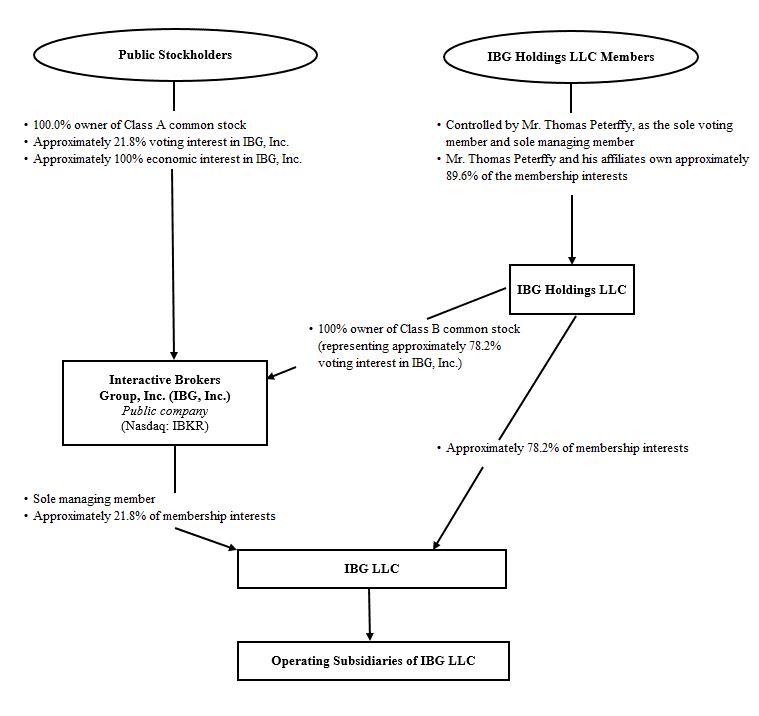
Our primary assets are our ownership of approximately 21.8% of the membership interests of IBG LLC, the current holding company for our businesses, and our controlling interest and related contractual rights as the sole managing member of IBG LLC. The remaining approximately 78.2% of IBG LLC membership interests are held by IBG Holdings LLC (“Holdings”), a holding company that is owned directly and indirectly by our founder and Chairman, Mr. Thomas Peterffy and his affiliates, management and other employees of IBG LLC, and certain other members. The IBG LLC membership interests held by Holdings will be subject to purchase by us over time in connection with offerings by us of shares of our common stock.
The table below presents the amount of IBG LLC membership interests held by IBG, Inc. and Holdings as of December 31, 2020.
| IBG, Inc. | Holdings | Total | ||||
| Ownership % | 21.8% | 78.2% | 100.0% | |||
| Membership interests | 90,780,444 | 325,960,034 | 416,740,478 |
Purchases of IBG LLC membership interests, held by Holdings, by the Company are governed by the exchange agreement among us, IBG LLC, Holdings and the historical members of IBG LLC, (the “Exchange Agreement”), a copy of which was filed as an exhibit to our Quarterly Report on Form 10-Q for the quarter ended September 30, 2009 and filed with the SEC on November 9, 2009. The Exchange Agreement, as amended June 6, 2012, provides that the Company may facilitate the redemption by Holdings of interests held by its members through the issuance of shares of common stock through a public offering in exchange for the interests in IBG LLC being redeemed by Holdings. Periodically since June 2011, with the consent of Holdings and the Company (on its own behalf and acting as the sole managing member of IBG LLC), IBG LLC has agreed to redeem certain membership interests from Holdings through the sale of common stock and to distribute the proceeds of such sale to the beneficial owners of such membership interests. From 2011 through 2020, the Company issued 28,127,765 shares of common stock (with a fair value of $1,115 million) to Holdings in exchange for an equivalent number of shares of member interests in IBG LLC.
Nature of Operations
As an electronic broker, we execute, clear and settle trades globally for both institutional and individual customers. Capitalizing on our proprietary technology, our systems provide our customers with the capability to monitor multiple markets around the world simultaneously and to execute trades electronically in these markets at a low cost in multiple products and currencies from a single trading account. We offer our customers access to all classes of tradable, primarily exchange-listed products, including stocks, options, futures, forex, bonds, mutual funds and ETFs traded on more than 135 electronic exchanges and market centers in 33 countries and in 25 currencies seamlessly around the world. The emerging complexity of multiple market centers has provided us with the opportunity to build and continually adapt our order routing software to secure excellent trade execution prices.
Since the launching of our electronic brokerage business in 1993, we have grown to over 1.07 million institutional and individual brokerage customers. We provide our customers with what we believe to be one of the most effective and efficient electronic brokerage platforms in the industry.
We are able to provide our customers with high-speed trade execution at low commission rates, in large part because of our proprietary technology. As a result of our advanced electronic brokerage platform, we attract sophisticated and active investors.
No single customer represented more than 1% of our commissions in 2020.
Our key product offerings include:
IBKR Pro**SM is the traditional IBKR service designed for sophisticated investors. IBKR ProSM offers the lowest cost access to stocks, options, futures, forex, bonds, mutual funds and ETFs on over 135 electronic exchanges and market centers in 33 countries.
IBKR Lite**SM provides unlimited commission-free trades on U.S. exchange-listed stocks and ETFs as well as low cost access to global markets without required account minimums or inactivity fees to participating U.S. customers. IBKR LiteSM was designed to meet the needs of investors who are seeking a simple, commission-free way to trade U.S. exchange-listed stocks and ETFs and do not wish to consider our efforts to obtain greater price improvement through our IB SmartRoutingSM system.
IBKR Integrated Investment Account - From a single point of entry in one IBKR Integrated Investment Account our customers are able to transact in 25 currencies, across multiple classes of tradable, primarily exchange-listed products traded on more than 135 electronic exchanges and market centers in 33 countries around the world seamlessly. Our offering features a suite of cash management services, including:
Interactive Brokers Debit Mastercard**® - Interactive Brokers Debit Mastercard® allows customers to spend and borrow directly against their account at lower interest rates than credit cards, personal loans and home equity lines of credit, with no monthly minimum payments and no late fees. Customers can use their card to make purchases and ATM withdrawals anywhere Debit Mastercard®1 is accepted around the world.
Bill Pay – Our Bill Pay program allows customers to make electronic or check payments to almost any company or individual in the U.S. The service can be configured for one-time or recurring payments and permits customers to schedule future payments.
Direct Deposit and Mobile Check Deposit – Our Direct Deposit program allows customers to automatically deposit paychecks, pension distributions and other recurring payments to their (non-retirement) brokerage account with us. In addition, U.S. customers can use our Mobile Check Deposit to directly deposit checks drawn on a U.S. bank.
1 Debit Mastercard is a trademark registered to Mastercard International Incorporated Corporation, Delaware, 2000 Purchase Street, Purchase, New York 10577-2405.
Insured Bank Deposit Sweep Program - Our Insured Bank Deposit Sweep Program provides eligible customers with up to $2,500,000 of Federal Deposit Insurance Corporation (“FDIC”) insurance on their eligible cash balances in addition to the existing $250,000 Securities Investor Protection Corporation (“SIPC”) coverage for total coverage of $2,750,000. Customers continue earning the same competitive interest rates currently applied to cash held in their brokerage accounts with us. We sweep each participating customer’s eligible cash balances daily to one or more banks, up to $246,500 per bank, allowing for the accrual of interest and keeping within the FDIC protected threshold. Cash balances above $2,750,000 remain subject to safeguarding under the SEC's Customer Protection Rule 15c3-3.
Investors’ Marketplace**SM - The Investors’ MarketplaceSM is an expansion of our Money Manager Marketplace and our Hedge Fund Capital Introduction program. This program is the first electronic meeting place that brings together individual investors, financial advisors, money managers, fund managers, research analysts, technology providers, business developers and administrators, allowing them to interact to form connections and conduct business.
Mutual Fund Marketplace – The Mutual Fund Marketplace offers our customers access to more than 37,000 no-load mutual funds worldwide, including over 8,300 no-transaction-fee funds from more than 380 fund families*.*
Bonds Marketplace – The Bonds Marketplace allows customers to search for the best yields from a vast universe of bonds from issuers in the Americas, Europe and Asia. We provide direct market access at a low cost to a wide array of corporate, government and municipal securities. Our customers obtain competitive bids and offers with low, transparent commissions and no hidden mark-ups.
Fractional Trading – Fractional Trading allows customers to buy and sell using either a specified cash amount or fractional shares, which are stock units that amount to less than one full share. This functionality allows customers to purchase as little as $1.00 of almost any U.S. stock, experiment with trading and investing without committing substantial sums of money, and learn about building and rebalancing diversified portfolios.
For all customers, our platform offers:
Low Costs - We provide our customers with among the industry’s lowest overall transaction costs in two ways. First, we offer among the lowest execution, commission and financing costs in the industry. Second, our IBKR ProSM customers benefit from our advanced routing of orders designed to achieve the best available trade price.
IB SmartRouting**SM – IB SmartRoutingSM retains control of the customer’s order, continuously searches for the best available price and, unlike most other routers, dynamically routes and re-routes all or parts of a customer’s order to achieve optimal execution and among the lowest execution and commission costs in the industry. To highlight the quality of our price executions, we publish on our website independent measurements performed by a third-party provider of transaction analysis to illustrate our net price improvement for commissionable trades versus the industry. We also offer Transaction Cost Analysis reporting to allow customers to track execution performance using multiple criteria. Our IBKR ProSM customers benefit from our advanced order routing technology for all trades, while our IBKR LiteSM customers benefit from this technology for their trades in products not eligible for IBKR LiteSM.
Automated Risk Controls - Throughout the trading day, we calculate margin requirements for each of our customers on a real-time basis across all product classes and across all currencies. Our customers are alerted to approaching margin violations and if a customer’s equity falls below what is required to support that customer’s margin, we attempt to automatically liquidate positions on a real-time basis to bring the customer’s account into margin compliance. This is done to protect us, as well as the customer, from excessive losses.
Flexible and Customizable System - Our platform is designed to provide an efficient customer experience, beginning with a highly automated account opening process and ending with a fast trade execution and reporting. Our sophisticated interface provides interactive real-time views of account balances, positions, profits or losses, buying power and “what-if” scenarios to enable our customers to more easily make informed investment decisions and trade effectively. Our system is configured to remember the user’s preferences and is specifically designed for multi-screen systems. When away from their main workstations, customers are able to access their accounts through our IBKR Mobile platforms for a seamless experience.
Securities Financing Services - We offer a suite of automated Stock Borrow and Lending tools, including our depth of availability, transparent rates, global reach and dedicated service representatives. Our Stock Yield Enhancement Program allows our customers to lend their fully-paid stock shares to us in exchange for cash collateral. In turn, we lend these stocks in exchange for collateral and earn stock lending fees. We pay our customers a rebate on the cash collateral generally equal to 50% of the income we earn from lending the shares. This allows customers holding fully-paid long stock positions to enhance their returns.
Trade Desk - We offer broker-assisted trading through our block trade desk, which is ideal when customers are away from their computer, and through our corporate bond desk, for times when large customer orders need access to more liquidity than is currently available electronically.
IBKR Campus – IBKR Campus helps customers learn about the markets, products and tools available through our platforms. IBKR Campus offers self-directed courses at the Traders’ Academy, live and recorded webinars, our Traders’ Insight market commentary blog, the IBKR Quant Blog, and our Student Trading Lab, which lets educators bring real-world trading experiences to their classroom.
Promotional offerings include:
IBKR Refer A Friend Program – Under the Refer A Friend program, we allow existing customers to refer friends and family to IBKR. The referring customer can earn a flat fee payment of $200 while the new customer can receive up to $1,000 in IBKR stock. The specific program details and eligibility requirements are described on our website.
Analytical offerings on our platform include:
IB Risk Navigator**SM – We offer free to all customers our real-time market risk management platform that unifies exposure across multiple asset classes around the globe. The system is capable of identifying overexposure to risk by starting at the portfolio level and drilling down into successively greater detail within multiple report views. Report data is updated every ten seconds or upon changes to portfolio composition. Predefined reports allow the summarization of a portfolio from different risk perspectives, providing views of Exposure, Value at Risk (“VaR”), Delta, Gamma, Vega and Theta, profit and loss and position quantity measures. The system also offers the customer the ability to modify positions through “what-if” scenarios that show hypothetical changes to the risk profile.
PortfolioAnalyst – Our PortfolioAnalyst reporting tool is designed to allow customers to evaluate the performance of their portfolio by creating and saving reports based on a set of measurement criteria and optionally comparing their data to selected industry benchmarks. PortfolioAnalyst also allows customers to link their investment, checking, savings, annuity, incentive plans and credit card accounts to understand their consolidated financial state and plan for the future.
Mutual Fund/ETF Parser – The Parser categorizes the individual component stocks within mutual funds and ETFs, giving an accurate, granular picture of the overall exposure to asset classes, industry sectors and companies.
Portfolio Builder – Portfolio Builder allows our customers to set up an investment strategy based on research and rankings from top buy-side providers and fundamental data; use filters to define the universe of equities that will comprise their strategy and back-test their strategy using up to three years of historical performance; work in hypothetical mode to adjust the strategy until the historical performance meets their standards; and, with the click of a button, let the system create the orders to invest in a strategy and track its performance in their portfolio.
Environmental, social and governance (“ESG”) Tools
ESG Scores – ESG scores from Refinitiv give customers a new set of tools for making investment decisions based on more than just financial factors. Companies are scored along several dimensions, such as reducing emissions and supporting human rights, and customers can easily see how companies rank both overall and on each dimension.
Impact Dashboard – The Impact Dashboard allows customers to evaluate and invest in companies that align with their values. Customers can select the values they care about from a list ranging from clean air to consumer safety and racial equality, and measure how both individual securities and their overall portfolio measure up against their criteria.
Interactive Analytics**SM and IB Option Analytics**SM – We offer our customers state-of-the-art tools, which include a customizable trading platform, advanced analytic tools and over 100 sophisticated order types and algorithms. We also provide a real-time option analytics window which displays values that reflect the rate of change of an option’s price with respect to a unit change in each of a number of risk dimensions.
Probability Lab**® (Patent Pending) – The Probability Lab® provides customers with an intuitive, visual method to analyze market participants’ future stock price forecasts based on current option prices. This tool compares a customer’s stock price forecast versus that of the market and scans the entire option universe for the highest Sharpe ratio multi-leg option strategies that take advantage of the customer’s forecast.
Goal Tracker - Interactive Advisors' Goal Tracker projects the hypothetical performance of a portfolio and monitors how likely it is the portfolio might achieve the goal. Customers can adjust inputs, such as monthly contribution amount, goal target date, or the cost or outflow associated with the goal, to estimate the likelihood of achieving a goal.
We cater to various customer groups with specific service needs.
For advisors, we offer:
Greenwich Compliance – Greenwich Advisor Compliance Services (“Greenwich Compliance") offers direct expert registration and start-up compliance services, as well as answers to basic day-to-day compliance questions for experienced investors and traders looking to start their own investment advisor firms. Greenwich Compliance professionals have regulatory and industry experience, and can help investment advisors trading on our brokerage platform meet their registration and compliance needs.
Model Portfolios – Model Portfolios offer advisors an efficient and time-saving approach to investing customer assets. They allow advisors to create groupings of financial instruments based on specific investment themes, and then invest customer funds into these models.
IBKR Allocation Order Tool – The IBKR Allocation Order Tool streamlines the creation, execution and allocation of group orders. The tool provides advisors with a single screen to enter trade allocations quickly across many customer accounts, advisors or strategies; allocate total quantity or cash quantity for user-specified values proportionally or equally; and modify orders or allocations on the fly.
ESG Impact Profile - The ESG Impact Profile helps advisors understand customer preferences for socially responsible and impact investing. Advisors’ customers can select personal investment criteria from thirteen impact values and principles and exclude investments based on ten categories.
IBKR Client Risk Profile – IBKR Client Risk Profile is designed to help advisors determine the most suitable investments for their customers, based on each customer’s risk tolerance. This information is collected through a custom-designed questionnaire. Advisors can view the scores through the Advisor Portal and create custom pre-trade allocation groups and profiles in TWS to place orders and allocate trades for customers with similar risk profiles.
For introducing brokers and advisors, we offer:
White Branding – Our large financial advisor and broker-dealer customers may “white brand” our trading interface, account management and reports with their firm’s identity. Broker-dealer customers can also select from among our modular functionalities, such as order routing, trade reporting or clearing, on specific products or exchanges where they may not have up-to-date technology, in order to offer to their customers a complete global range of services and products.
For customers looking for online advisory services, we offer:
Interactive Advisors – Interactive Advisors recruits registered financial advisors, vets them, analyzes their investment track records, and groups them by their risk profile. Investors who are interested in having their individual accounts robo-traded are grouped by their risk and return preferences. Investors can assign their accounts to be traded by one or more advisors. Interactive Advisors also offers our customers Smart Beta Portfolios which combine the benefits of actively managed fund stock selection techniques with passive ETFs low cost automation to provide broad market exposure and potentially higher returns, as well as Socially Responsible Investing.
Technology
Our proprietary technology is the key to our success. We believe that integrating our system with electronic exchanges and market centers worldwide results in transparency, liquidity and efficiencies of scale. Together with the IB SmartRoutingSM system and our low execution costs, this approach reduces overall transaction costs to our IBKR ProSM customers and, in turn, increases our transaction volume and profits (customers who elect to use our IBKR LiteSM offering do not take advantage of our IB SmartRoutingSM technology). Over the past four decades, we have developed an integrated trading system and communications network and have positioned our company as an efficient conduit for the global flow of risk capital across asset and product classes on electronic exchanges around the world, permitting us to have one of the lowest cost structures in the industry. We believe that developing, maintaining and continuing to enhance our proprietary technology provides us and our customers with the competitive advantage of being able to adapt quickly to the changing environment of our industry and to take advantage of opportunities presented by new exchanges, products, pricing mechanisms or regulatory changes before our competitors.
Our proprietary technology infrastructure enables us to provide our customers with the ability to execute trades at among the lowest execution costs in the industry for comparable services. Customer trades are both automatically captured and reported in real time in our system. Our customers trade on more than 135 electronic exchanges and market centers in 33 countries around the world. These exchanges and market centers are all partially or fully electronic, meaning that a customer can buy or sell a product traded on that exchange via an electronic link from his or her computer or mobile device through our system to the exchange. We offer our products and services through a global communications network that is designed to provide secure, reliable and timely access to the most current market information. We provide our customers with a variety of means to connect to our brokerage systems, including cross connects, dedicated point-to-point data lines, extranets, virtual private networks and the Internet.
Specifically, our customers receive worldwide electronic access through our Trader Workstation (our real-time Java-based trading platform), our proprietary Application Programming Interface (“API”), our IBKR Mobile app, our browser-based IB WebTraderSM, our customer-portal-based Quick Trade or industry standard Financial Information Exchange (“FIX”) connectivity. Customers who want a professional quality trading application with a sophisticated user interface utilize our Trader Workstation, which can be accessed through a desktop or variety of mobile devices. Customers interested in developing programmatic trading in Python, Java, C++, .NET (C#), ActiveX and Excel technologies utilize our API. Large institutions with FIX infrastructure prefer to use our FIX solution for seamless integration of their existing order gathering and reporting applications.
While many brokerages, including some online brokerages, rely on manual procedures to execute many day-to-day functions, we employ proprietary technology to automate, or otherwise facilitate, many of the following functions:
account opening process;
order routing and best execution;
seamless trading across all types of securities, futures and currencies around the world from one account;
order types and analytical tools offered to customers;
securities lending and short stock availability;
delivery of customer information, such as confirmations, customizable real-time account statements and audit trails;
compliance;
customer service; and
risk management through automated real-time credit management of all new orders and margin monitoring.
Research and Development
One of our core strengths is our expertise in the rapid development and deployment of automated technology for the financial markets. Our core software technology is developed internally, and we do not generally rely on outside vendors for software development or maintenance. To achieve optimal performance from our systems and in response to changing market conditions, we are continuously rewriting and upgrading our software. Use of the best available technology not only improves our performance but also helps us attract and retain talented developers. Our software development costs are relatively low because the employees who oversee the development of the software are often the same employees who design the application, evaluate its performance, and participate along with our quality assurance professionals in our robust quality assurance testing procedures. The involvement of our developers in each of these processes enables us to add features and further refine our software rapidly.
Our internally-developed, fully integrated trading and risk management systems are unique and transact across all product classes. These systems have the flexibility to assimilate new exchanges and new product classes without compromising transaction speed or fault tolerance. Fault tolerance, or the ability to maintain system performance despite exchange malfunctions or hardware failures, is crucial to ensuring best executions for our customers. Our systems are designed to detect exchange malfunctions and quickly take corrective actions by re-routing pending orders when possible.
Our company is technology-focused, and our management team is hands-on and technology-savvy. Most members of the management team participate in algorithm design and supervise the creation of detailed specifications for new applications. The development queue is prioritized and highly disciplined. Progress on programming initiatives is generally tracked on a bi-weekly basis by the steering and other committees consisting of senior executives. This enables us to prioritize key initiatives and achieve rapid results. All new
business involves a software development project. We generally do not engage in any business that we cannot automate and incorporate into our platform prior to entering into the business.
The rapid software development and deployment cycle is achieved by our ability to leverage a highly integrated, object-oriented development environment. The software code is modular, with each object providing a specific function and being reusable in multiple applications. New software releases are tracked and tested with proprietary automated testing tools. We are not hindered by disparate and often limiting legacy systems assembled through acquisitions. Virtually all of our software has been developed and maintained with a unified purpose.
For over four decades, we have built and continuously refined our automated and integrated, real-time systems for world-wide trading, risk management, clearing and cash management, among others. We have also assembled a proprietary connectivity network between us and exchanges and market centers around the world. Efficiency and speed in performing prescribed functions are always crucial requirements for our systems. As a result, our systems are able to assimilate market data, disseminate market prices to customers and update risk management information in real time, across tradable products in all available product classes.
Risk Management Activities
The core of our risk management philosophy is the utilization of our fully integrated computer systems to perform critical risk-management activities on a real-time basis. Our integrated risk management seeks to ensure that each customer’s positions are continuously credit checked and brought into compliance if equity falls short of margin requirements, curtailing bad debt losses.
We calculate margin requirements for each of our customers on a real-time basis across all product classes (stocks, options, futures, forex, bonds, mutual funds, ETFs, and other financial instruments) and across all currencies. Recognizing that our customers are experienced investors, we expect our customers to manage their positions proactively and we provide tools to facilitate our customers’ position management. However, if a customer’s equity falls below what is required to support that customer’s margin, we will automatically liquidate positions on a real-time basis to bring the customer’s account into margin compliance. We do this to protect us, as well as the customer, from excessive losses. These systems further contribute to our low-cost structure. The entire credit management process is automated.
As a safeguard, all liquidations are displayed on custom built liquidation monitoring screens that are part of the toolset our risk management professionals use to minimize market exposure and our technical staff uses to monitor performance of our systems at all times the markets around the world are open. In the event our systems absorb erroneous market data from exchanges, which prompts liquidations, our risk specialists have the capability to halt liquidations that meet specific criteria. The liquidation halt function is highly restricted.
Our customer interface includes color coding on the account screen and pop-up warning messages to notify customers that they are approaching their margin limits. This feature allows customers to take action, such as entering margin reducing trades, to avoid having us liquidate their positions. These tools and real-time margining aid our customers in understanding their trading risk at any moment of the day and help us maintain low commissions.
We actively manage our global currency exposure on a continuous basis by maintaining our equity in a basket of currencies we call the GLOBAL. We define the GLOBAL as consisting of fractions of a U.S. dollar, Euro, Japanese yen, British pound, Swiss franc, Chinese renminbi, Indian rupee, Canadian dollar, Australian dollar and Hong Kong dollar. The currencies comprising the GLOBAL and their relative proportions can change over time. Additional information regarding our currency diversification strategy is set forth in “Quantitative and Qualitative Disclosures about Market Risk” in Part II, Item 7A of this Annual Report on Form 10-K.
With respect to our remaining market making activities, we employ certain hedging and risk management techniques to protect us from a severe market dislocation. Our risk management policies are developed and implemented by our steering committee, which is chaired by our Chief Executive Officer and comprised of senior executives of our various operating subsidiaries. The strategy of our remaining market making activities is to calculate quotes a few seconds ahead of the market and execute small trades at a tiny but favorable differential as a result. This strategy is made possible by our proprietary pricing model, which evaluates and monitors the risks inherent in our portfolio, assimilates market data and reevaluates the outstanding quotes in our portfolio many times per second. Our model automatically rebalances our positions throughout each trading day to manage risk exposures on our options and futures positions and the underlying securities, and will price the increased risk that a position would add to the overall portfolio into the bid and offer prices we post. Under risk management policies implemented and monitored primarily through our computer systems, reports to management, including risk profiles, profit and loss analysis and trading performance, are prepared on a real-time basis as well as daily and periodical bases. Although our remaining market making activities are completely automated, the trading process and our risk are monitored by a team of individuals who, in real-time, observe various risk parameters of our consolidated positions. Our assets and liabilities are marked-to-market daily for financial reporting purposes and re-valued continuously throughout the trading day for risk management and asset/liability management purposes.
Operational Controls
We have automated the full cycle of controls surrounding our businesses. Key automated controls include the following:
Our technical operations team continuously monitors our network and the proper functioning of each of our nodes (exchanges and market centers, internet service providers (“ISPs”), leased customer lines and our own data centers) around the world.
Our real-time credit manager software provides pre and post-execution controls by:
testing every customer order to ensure that the customer’s account holds enough equity to support the execution of the order, rejecting the order if equity is insufficient or directing the order to an execution destination without delay if equity is sufficient; and
continuously updating a customer account’s equity and margin requirements and, if the account’s equity falls below its minimum margin requirements, automatically issuing liquidating orders in a smart sequence designed to minimize the impact on the account’s equity.
Our clearing system captures trades in real-time and performs automated reconciliation of trades and positions, corporate action processing, customer account transfer, options exercise, securities lending and inventory management, allowing us to effectively manage operational risk.
Our accounting system operates with automated data feeds from clearing and banking systems, allowing us to produce financial statements for all parts of our business every day by mid-day on the day following trade date.
Software developed to interface with the accounting and market making systems performs daily profit and loss reconciliations, which provide tight financial controls over our remaining market making activities.
Our market making system continuously evaluates securities and futures products in which we provide bid and offer quotes and changes our bids and offers in such a way as to maintain an overall hedge and a low-risk profile. The speed of communicating with exchanges and market centers is maximized through continuous software and network engineering maintenance, thereby allowing us to achieve real-time controls over market exposure.
Transaction Processing
Our transaction processing is automated over the full life cycle of a trade. Our fully automated IB SmartRoutingSM system searches for the best possible combination of prices available at the time a customer order is placed and immediately seeks to execute that order electronically or send it where the order has the highest possibility of execution at the best price. Our market making software generates and disseminates to the exchanges and market centers, in which we still operate, continuous bid and offer quotes on tradable, exchange-listed products.
At the moment a trade is executed, our systems capture and deliver this information back to the source, either to the customer via the brokerage system or the market making system, in most cases within a fraction of a second. Simultaneously, the trade record is written into our clearing system, where it flows through a chain of control accounts that allow us to reconcile trades, positions and money until the final settlement occurs. Our integrated software tracks other important activities, such as dividends, corporate actions, options exercises, securities lending, margining, risk management and funds receipt and disbursement.
IB SmartRouting****SM
IB SmartRoutingSM searches for the best destination price in view of the displayed prices, sizes and accumulated statistical information about the behavior of market centers at the time an order is placed, and IB SmartRoutingSM immediately seeks to execute that order electronically. Unlike other smart routers, IB SmartRoutingSM never relinquishes control of the order, and constantly searches for the best price. It continuously evaluates fast-changing market conditions and dynamically re-routes all or parts of the order seeking to achieve optimal execution. For example, for U.S. options, IB SmartRoutingSM can represent each leg of a spread order independently, if needed, and in that event enters each leg at the best possible venue. IB SmartRouting AutorecoverySM re-routes a customer’s U.S. options order in the case of an exchange malfunction, and we absorb the risk of double executions. In addition, IB SmartRoutingSM checks each new order to see if it could be executed against any of its pending orders. As the system gains more users, this feature becomes more important for customers in a world of multiple exchanges, market centers and penny priced orders because it increases the possibility of best executions for our customers ahead of customers of other brokers. As a result of this feature, our customers have a greater chance of executing limit orders and can do so sooner than those who use other routers.
Clearing and Margining
Our activities in the U.S. are entirely self-cleared. We are a clearing member of OCC (formerly known as the Options Clearing Corporation), the Chicago Mercantile Exchange Clearing House, The Depository Trust & Clearing Corporation and ICE Clear U.S. In addition, we are fully or partially self-cleared in Canada, the United Kingdom, Switzerland, France, Germany, Belgium, Austria, the Netherlands, Norway, Sweden, Denmark, Finland, India, Hong Kong, Japan, and Australia.
Customers
We currently service over 1.07 million cleared customer accounts and have customers residing in over 200 countries and territories around the world. Our target customer is one who requires the latest in trading technology and worldwide access, and who expects low overall transaction costs. Our customers are mainly comprised of individuals, trading desk professionals, electronic retail brokers, hedge funds, mutual funds, financial advisors, proprietary trading firms, and introducing brokers and banks that require global access.
Our customers primarily fall into two groups based on services provided: cleared customers which are the majority of our customers, and non-cleared customers, the latter also known as trade execution customers.
Cleared Customers: We provide trade execution and clearing services to our cleared customers who are generally attracted to our low commissions, low financing rates, high interest paid (when available) and best price execution (or, under our IBKR LiteSM offering, commission-free trades). Our cleared customers include institutional and individual traders and investors, hedge funds, financial advisors and introducing brokers.
Trade Execution Customers: We offer trade execution for customers who choose to clear with another prime broker or a custodian bank; these customers take advantage of our low commissions for trade execution as well as our best price execution. Our non-cleared customers include online brokers and the customer trading units of commercial banks. These customers are attracted by our IB SmartRoutingSM technology as well as our direct access to stock, options, futures, forex, bond, mutual fund and ETFs markets worldwide.
Human Capital
As of December 31, 2020, we had 2,033 full-time employees worldwide. Our goal is to attract, develop and retain key employees to achieve our strategic objectives. We offer a comprehensive benefits program, including stock incentives, to all of our employees and design our compensation programs to attract, retain and motivate employees. We believe that our relations with our employees are good. Our employees are not covered by any collective bargaining agreements.
We take pride in our technology-focused company culture and embrace it as one of our fundamental strengths. We continually improve our technology and we minimize corporate hierarchy to facilitate efficient communication among employees. We have assembled what we believe is a highly talented team and we expect to continue to provide significant rewards for our employees who provide substantial value to us and the world’s financial markets.
Competition
The market for electronic brokerage services is rapidly evolving and highly competitive. We believe that we fit neither within the definition of a traditional retail broker nor that of a traditional prime broker nor that of an investment advisor custodian. Our primary competitors, both in the U.S. and abroad, include the prime brokerage and electronic brokerage arms of major commercial and investment banks and brokers, and large online retail brokers, whose offerings target professional and other active traders. Since our inception, we have been driven to transforming the electronic brokerage business through innovation, with software development, product improvement, expansion of products and geographies, and management focus dedicated to this mission. In contrast, the electronic brokerage activities of many of our competitors are relatively insignificant within the totality of their firms’ businesses.
Regulation
Our securities and derivatives businesses are extensively regulated by U.S. federal and state regulators, foreign regulatory agencies, numerous exchanges and self-regulatory organizations of which our subsidiaries are members. In the current era of heightened regulation of financial institutions, we expect to incur increasing compliance costs, along with the industry as a whole. Our approach has been to build many of our regulatory and compliance functions into our integrated order routing, custodial, customer onboarding, transaction processing, and market making systems.
Overview
As registered U.S. broker-dealers, Interactive Brokers LLC (“IB LLC”), Timber Hill LLC and Interactive Brokers Corp. are subject to the rules and regulations of the Exchange Act, and as members of various exchanges, we are also subject to such exchanges’ rules and requirements. Additionally, IB LLC is subject to the Commodity Exchange Act and rules promulgated by the Commodity Futures Trading Commission (“CFTC”) and the various commodity exchanges of which it is a member. We are also subject to the requirements of various self-regulatory organizations such as the Financial Industry Regulatory Authority (“FINRA”) and the National Futures Association (“NFA”). Our foreign subsidiaries are similarly regulated under the laws and institutional frameworks of the countries in which they operate.
U.S. broker-dealers and futures commission merchants are subject to laws, rules and regulations that cover all aspects of the securities and derivatives business, including:
sales methods;
“know your customer” requirements;
trade practices;
use and safekeeping of customers’ funds and securities;
capital structure;
risk management;
record-keeping;
financing of customers’ purchases; and
conduct of directors, officers and employees.
In addition, the businesses that we may conduct are limited by our arrangements with and our oversight by regulators. Participation in new business lines, including trading of new products or participation on new exchanges or in new countries often requires governmental and/or exchange approvals, which may take significant time and resources. As a result, we may be prevented from entering new businesses that may be profitable in a timely manner, or at all.
As certain of our subsidiaries are members of FINRA, we are subject to certain regulations regarding changes in control of our ownership. FINRA Rule 1017 generally provides that FINRA approval must be obtained in connection with any transaction resulting in a change in control of a member firm. FINRA defines control as ownership of 25% or more of the firm’s equity by a single entity or person and would include a change in control of a parent company. As a result of these regulations, our future efforts to sell shares or raise additional capital may be delayed or prohibited by FINRA.
Net Capital Rule
The SEC, FINRA, CFTC and various other regulatory agencies within the U.S. have stringent rules and regulations with respect to the maintenance of specific levels of net capital by regulated entities. Generally, a broker-dealer’s capital is its net worth plus qualified subordinated debt less deductions for certain types of assets. The Net Capital Rule requires that at least a minimum part of a broker-dealer’s assets be maintained in a relatively liquid form.
If these net capital rules are changed or expanded, or if there is an unusually large charge against our net capital, our operations that require the intensive use of capital would be limited. A large operating loss or charge against our net capital could adversely affect our ability to expand or even maintain these current levels of business, which could have a material adverse effect on our business and financial condition.
The U.S. regulators impose rules that require notification when net capital falls below certain predefined criteria. These rules also dictate the ratio of debt-to-equity in the regulatory capital composition of a broker-dealer, and constrain the ability of a broker-dealer to expand its business under certain circumstances. If a firm fails to maintain the required net capital, it may be subject to suspension or revocation of registration by the applicable regulatory agency, and suspension or expulsion by these regulators could ultimately lead to the firm’s liquidation. Additionally, the Net Capital Rule and certain FINRA rules impose requirements that may have the effect of prohibiting a broker-dealer from distributing or withdrawing capital and requiring prior notice to U.S. regulators and approval from FINRA for certain capital withdrawals.
Our foreign subsidiaries are similarly regulated with regard to capital requirements in support of their brokerage activities.
As of December 31, 2020, aggregate excess regulatory capital for all of the operating subsidiaries was $6.8 billion.
IB LLC is subject to the Uniform Net Capital Rule (Rule 15c3-1) under the Exchange Act and to the CFTC’s minimum financial requirements (Regulation 1.17) under the Commodities Exchange Act. Additionally, Interactive Brokers Canada Inc. (“IBC”) is subject to the Investment Industry Regulatory Organization of Canada (“IIROC”) risk adjusted capital requirement; Interactive Brokers (U.K.) Limited (“IBUK”) is subject to the U.K. Financial Conduct Authority (“FCA”) financial resources requirement; Interactive Brokers Ireland Limited (“IBIE”) is subject to the Central Bank of Ireland (“CBI”) financial resources requirement; Interactive Brokers Luxembourg SARL (“IBLUX”) is subject to the Luxembourg Commission de Surveillance du Secteur Financier (“CSSF”) financial resources requirement; IBKR Financial Services AG (“IBKRFS”) is subject to the Swiss Financial Market Supervisory Authority (“FINMA”) eligible equity requirement; Interactive Brokers Central Europe Zrt. (“IBCE”) is subject to the Hungarian National Bank (“MNB”) financial resource requirement; Interactive Brokers (India) Private Limited (“IBI”) is subject to the National Stock Exchange of India net capital requirements; Interactive Brokers Hong Kong Limited (“IBHK”) is subject to the Hong Kong Securities and Futures Commission (“SFC”) financial resource requirement; Interactive Brokers Securities Japan, Inc. (“IBSJ”) is subject to the Japanese Financial Services Agency (“FSA”) capital requirements; Interactive Brokers Singapore Pte. Ltd. (“IBSG”) is subject to the Monetary Authority of Singapore (“MAS”) capital requirements; and Interactive Brokers Australia Pty Limited (“IBA”) is subject to the Australian Securities Exchange (“ASX”) liquid capital requirement.
The table below summarizes capital, capital requirements and excess regulatory capital as of December 31, 2020.
| Net Capital/ | |||||||||
| Eligible Equity | Requirement | Excess | |||||||
| (in millions) | |||||||||
| IB LLC | $ | 5,122 | $ | 674 | $ | 4,448 | |||
| IBKRFS | 640 | 22 | 618 | ||||||
| IBHK | 632 | 243 | 389 | ||||||
| Other regulated operating subsidiaries | 1,453 | 123 | 1,330 | ||||||
| $ | 7,847 | $ | 1,062 | $ | 6,785 |
As of December 31, 2020, all of the operating subsidiaries were in compliance with their respective regulatory capital requirements. For additional information regarding our net capital requirements see Note 16 – “Regulatory Requirements” to the audited consolidated financial statements in Part II, Item 8 of this Annual Report on Form 10-K.
Protection of Customer Assets
To conduct customer activities, IB LLC is obligated under rules mandated by its primary regulators, the SEC and the CFTC, to segregate cash or qualified securities belonging to customers. In accordance with the Securities Exchange Act of 1934, IB LLC is required to maintain separate bank accounts for the exclusive benefit of customers. In accordance with the Commodity Exchange Act, IB LLC is required to segregate all monies, securities and property received from commodities customers in specially designated accounts. IBC, IBUK, IBIE, IBLUX, IBCE, IBI, IBHK, IBSJ, IBSG and IBA are subject to similar requirements within their respective jurisdictions.
To further enhance the protection of our customers’ assets, since 2011 IB LLC has been performing daily (i.e., instead of the required weekly) customer reserve computations along with daily adjustments of the money set aside in safekeeping for our customers.
Supervision and Compliance
Our Compliance Department supports and seeks to ensure proper operations of our business in accordance with applicable regulatory requirements. The philosophy of the Compliance Department, and the Company as a whole, is to build automated systems to try to minimize manual steps in the compliance process and then to augment these systems with experienced staff members who apply their judgment where needed. We have built automated systems to handle wide-ranging compliance issues such as trade and audit trail reporting, financial operations reporting, enforcement of short sale rules, enforcement of margin rules and pattern day trading restrictions, review of employee correspondence, archival of required records, execution quality and order routing reports, approval and documentation of new customer accounts, surveillance of customer trading for market manipulation or abuse or violations of exchange rules, and anti-money laundering and anti-fraud surveillance. Our automated operations and automated compliance systems provide substantial efficiencies to our Compliance Department. As part of this continuing effort, we have implemented a new case management and surveillance system, and increased our Compliance staffing over the past several years to meet the growing regulatory burdens faced by all industry participants.
Our electronic brokerage subsidiaries have Chief Compliance Officers who report to the Chief Executive Officer or business head for their subsidiary, and to the Global Chief Regulatory Officer (or regional Compliance Head). In the U.S., the Chief Compliance Officer and certain other senior staff members are FINRA and NFA registered principals with supervisory responsibility over the compliance aspects of our businesses. Similar roles are undertaken by staff in certain non-U.S. locations as well. Staff members in the Compliance Department and in other departments are also registered with FINRA, NFA or other regulatory organizations.
Patriot Act and Increased Anti*-*Money Laundering (“AML”) and “Know Your Customer” Obligations
Registered broker-dealers traditionally have been subject to a variety of rules that require that they “know their customers” and monitor their customers’ transactions for suspicious activities. Under the Uniting and Strengthening America by Providing Appropriate Tools Required to Intercept and Obstruct Terrorism Act of 2001 (the “USA Patriot Act”), broker-dealers are subject to even more stringent requirements. Likewise, the SEC, CFTC, foreign regulators, and the various exchanges and self-regulatory organizations, of which our operating subsidiaries are members, have passed numerous AML and customer due diligence rules. Significant criminal and civil penalties can be imposed for violations of the USA Patriot Act, and significant fines and regulatory penalties can also be imposed for violations of other governmental and self-regulatory organization AML rules.
As required by the USA Patriot Act and other rules, we have established comprehensive anti-money laundering and customer identification procedures, designated AML Compliance Officers for each electronic brokerage subsidiary, trained our employees and conducted independent audits of our programs. Our anti-money laundering screening is conducted using a mix of automated and manual reviews and has been structured to comply with regulations in various jurisdictions. We collect required information through our new account opening process and screen accounts against databases for the purposes of identity verification and for review of potential negative information and appearance on government lists, including the Office of Foreign Assets and Control, Specially Designated Nationals and Blocked Persons lists and several other global or non-U.S. sanction lists. Additionally, we have designed and implemented restrictions to prevent certain types of high-risk activity, including potentially manipulative patterns of trading or higher risk patterns of money movement. We generate and review a sophisticated suite of surveillance reports and queues to identify potential money laundering, market manipulation or abuse, fraud and other suspicious activities.
Dodd*-*Frank Reform Act
The Dodd-Frank Wall Street Reform and Consumer Protection Act imposes strict reporting and disclosure requirements on the financial services industry. We maintain a robust system for evidence of our supervisory review of controls over financial reporting and management monitors accounting and regulatory rulemaking developments for their potential effect on our financial statements and internal controls over financial reporting.
Business Continuity Planning
Federal regulators and industry self-regulatory organizations have passed a series of rules in the past several years requiring regulated firms to maintain business continuity plans that describe what actions firms would take in the event of a disaster (such as a fire, natural disaster or terrorist incident) that might significantly disrupt operations. We have developed business continuity plans that describe steps that we and our employees would take in the event of various scenarios. We have built backup capabilities for key operations performed at our regional offices in North America, Europe and Asia that would be utilized in the event of a significant outage at our main data center or primary office locations. In addition, we have strengthened our technical infrastructure and have built redundancy of systems so that certain operations can be handled from multiple offices or remotely. In light of the COVID-19 pandemic, we have substantially enhanced this infrastructure and our remote access capabilities so that most employees, including all with critical job functions, can work remotely. We continually evaluate opportunities to further our business continuity planning efforts.
Foreign Regulation
Our international subsidiaries are subject to extensive regulation in the various jurisdictions where they have operations. The most significant of our international subsidiaries are: IBC, registered to do business in Canada as an investment dealer; IBUK, registered to do business in the U.K. as a broker; IBIE, registered in Ireland as an investment firm; IBLUX, registered to do business in Luxembourg as an investment firm; IBKRFS, registered to do business in Switzerland as a securities dealer; IBCE, registered in Hungary as an investment firm; IBI, registered to do business in India as a stock broker; IBHK, registered to do business in Hong Kong as a securities dealer; IBSJ, registered in Japan as a financial instruments firm; IBSG, registered in Singapore as a capital markets firm; and IBA, registered to do business in Australia as a securities dealer and futures broker. See the “Net Capital” section above in this Item 1, for regulatory requirements related to our foreign subsidiaries.
Executive Officers and Directors of Interactive Brokers Group, Inc.
The table below presents the names, ages and positions of our current directors and executive officers as of December 31, 2020.
| Name | Age | Position | |
| Thomas Peterffy | 76 | Chairman of the Board of Directors | |
| Earl H. Nemser | 74 | Vice Chairman and Director | |
| Milan Galik | 54 | Chief Executive Officer, President and Director | |
| Paul J. Brody | 60 | Chief Financial Officer, Treasurer, Secretary and Director | |
| Thomas A. Frank | 65 | Executive Vice President and Chief Information Officer | |
| Lawrence E. Harris | 64 | Director | |
| Gary Katz | 60 | Director | |
| John M. Damgard | 81 | Director | |
| Philip Uhde | 35 | Director | |
| Nicole Yuen | 58 | Director | |
| William Peterffy | 31 | Director |
Thomas Peterffy - Mr. Peterffy has been at the forefront of applying computer technology to automate trading and brokerage functions since he emigrated from Hungary to the United States in 1965. In 1977, after purchasing a seat on the American Stock Exchange and trading as an individual marker maker in equity options, Mr. Peterffy was among the first to apply a computerized mathematical model to continuously value equity option prices. By 1986, Mr. Peterffy developed and employed a fully integrated, automated market making system for stocks, options and futures. As this pioneering system extended around the globe, online brokerage functions were added and, in 1993, Interactive Brokers was formed.
Milan Galik - Mr. Galik joined us in 1990 as a software developer and has served as the Chief Executive Officer of the Company since October 2019. Mr. Galik has also served as President of the Company and IBG LLC since October 2014. Mr. Galik served as Senior Vice President, Software Development of IBG LLC from October 2003 to October 2014. In addition, Mr. Galik has served as Vice President of Timber Hill LLC since April 1998 and serves as a member of the board of directors of the Boston Options Exchange. Mr. Galik received a Master of Science degree in electrical engineering from the Technical University of Budapest in 1990.
Earl H. Nemser - Mr. Nemser has been our Vice Chairman since November 2006. Mr. Nemser has been the Vice Chairman of the Company since 1988 and also serves as a director and/or officer for various subsidiaries of IBG LLC. Mr. Nemser serves as an Independent Advisor to the law firm Dechert LLP. Mr. Nemser served as Special Counsel to Dechert LLP from January 2005 to October 2018. Prior to such time Mr. Nemser served as Partner at the law firms of Swidler Berlin Shereff Friedman, LLP from 1995 to December 2004 and Cadwalader, Wickersham & Taft LLP prior to 1995. Mr. Nemser received a Bachelor of Arts degree in economics from New York University in 1967 and a Juris Doctor, magna cum laude, from Boston University School of Law in 1970.
Paul J. Brody - Mr. Brody has been our Chief Financial Officer, Treasurer and Secretary since November 2006. Mr. Brody joined the Company in 1987 and has served as Chief Financial Officer of IBG LLC since December 2003. Mr. Brody serves as a director and/or officer for various subsidiaries of IBG LLC. From 2005 to 2012, Mr. Brody served as a director, and for a portion of the time as member Vice Chairman, of The Options Clearing Corporation, of which Interactive Brokers LLC and Timber Hill LLC are members. Mr. Brody also served as a director of Quadriserv Inc., an electronic securities lending platform provider, from 2009 to 2015. Mr. Brody received a Bachelor of Arts degree in economics from Cornell University in 1982.
Thomas A. Frank - Dr. Frank joined us in 1985 and has served since July 1999 as Executive Vice President and Chief Information Officer of Interactive Brokers LLC. In addition, Dr. Frank has served as Vice President of Timber Hill LLC since December 1990. Dr. Frank has served as a director of The Options Clearing Corporation, since 2015. Dr. Frank received a Ph.D. in physics from the Massachusetts Institute of Technology in 1985.
Lawrence E. Harris - Dr. Harris has been a director since July 2007. Dr. Harris is a professor of Finance and Business Economics at the University of Southern California, where he holds the Fred V. Keenan Chair in Finance at the Marshall School of Business. Dr. Harris also serves as trustee of the Clipper Fund, director of the Selected Funds, and as the research coordinator of the Institute for Quantitative Research in Finance. Dr. Harris formerly served as Chief Economist of the U.S. Securities and Exchange Commission. Dr. Harris earned his Ph.D. in Economics from the University of Chicago, and is a CFA charterholder. Dr. Harris is an expert in the economics of securities market microstructure and the uses of transactions data in financial research. Dr. Harris has written extensively about trading rules, transaction costs, index markets, and market regulation. Dr. Harris is also the author of the widely respected textbook Trading and Exchanges: Market Microstructure for Practitioners.
Gary Katz – Mr. Katz has been a director since January 2017. Mr. Katz was the President and Chief Executive Officer of the International Securities Exchange (“ISE”) and a co-founder of ISE. Mr. Katz was one of the principal developers of the unique options market structure – an auction market on an electronic platform – used by all three options exchanges; ISE, ISE Gemini and ISE Mercury and was named as inventor or co-inventor on six patents that the ISE received or applied for relating to its proprietary trading system and technology. Mr. Katz served on the Executive Board of Eurex and on the Board of Directors of The Options Clearing Corporation and chaired the Board’s newly formed technology committee. Mr. Katz also served on the Board of Directors of Direct Edge. Mr. Katz graduated from New York University with a master’s degree in Statistics with Distinction and a bachelor’s degree from Queens College. Mr. Katz is currently chairman of the board of Farmer's Pantry LLC, a start-up in the consumer goods industry and also serves on the board of STRS, LLC, a start-up in the financial industry meeting the unique needs of credit card issuers and merchants.
John M. Damgard - Mr. Damgard has been a director since December 2018. Mr. Damgard served as President of the Futures Industry Association (“FIA”) from 1982 to 2013 and was a founder, past president and a member of the board of the Institute for Financial Markets. Prior to joining FIA in 1982, Mr. Damgard directed the Washington office of ACLI International, a leading commodity merchant firm active in cash and futures markets worldwide. Mr. Damgard served as Deputy Assistant and Acting Assistant Secretary of Agriculture and was responsible for the major marketing and regulatory functions at the U.S. Department of Agriculture (“USDA”). While at the USDA, Mr. Damgard led the Administration’s efforts during the creation of the Commodity Futures Trading Commission, a new independent regulatory agency. Mr. Damgard studied at the University of Virginia for two years and received a B.A. from Knox College in 1964 with a major in Political Science and a minor in Economics.
Philip Uhde - Mr. Uhde, is a private investor. In 2012 Mr. Uhde founded, and from 2012 through 2020 he managed, Echinus Partners, an approximately $1.5 billion investment partnership making concentrated, long-term investments in the public markets. Mr. Uhde has led many investments in financial services companies, including Moody’s, S&P Global, Fimalac (Fitch), Visa, Mercadolibre, Guidewire and IBG, Inc. Prior to founding Echinus Partners, Mr. Uhde was a member of the investment team at SPO Partners, an investment partnership founded in 1969. Before that Mr. Uhde was an analyst at Sloane Robinson, an emerging markets hedge fund. Mr. Uhde received a BA in Economics and East Asian Studies from Yale University in 2008. During the course of his ownership of IBKR, Mr. Uhde has made in-depth studies into various aspects of the Company’s business with numerous recommendations to management.
William Peterffy - Mr. William Peterffy is the Chair of the Investment Committee of the Peterffy Foundation where he oversees its investment portfolio. Mr. William Peterffy joined IBG LLC in 2019 to lead its Environmental, Social and Governance (ESG) efforts. Mr. William Peterffy joined the Company’s Board of Directors as an observer in 2019. Mr. William Peterffy is also a member of the Board of Trustees of the Collective Heritage Institute (commonly known as Bioneers) and focuses his efforts on sustainability issues. Prior to joining IBG LLC, Mr. William Peterffy worked as an investment analyst within the hedge fund industry. As a result of these professional and other experiences, Mr. William Peterffy possesses particular knowledge and experience in ESG issues and provides diversity of viewpoint to the Board by virtue of his experience that strengthens the Board’s collective knowledge, capabilities and experience. Mr. William Peterffy is the son of our Chairman, Mr. Thomas Peterffy.
Nicole Yuen - Ms. Yuen is a seasoned investment banker with more than 20 years of experience. Ms. Yuen most recently served as Managing Director, Head of Equities – North Asia and Vice Chairman – Greater China for Credit Suisse. During Ms. Yuen’s 6-year tenure, she led the build-out of Credit Suisse’s brokerage business in mainland China and oversaw the bank’s equities business in North Asia. Ms. Yuen is a non-executive director of Aberdeen New Dawn Investment Trust PLC.
Previous: Cover and table of contents · Next: Item 1A. RISK FACTORS