 filings.tools
Cover and table of contents
93K characters. Original on sec.gov · Markdown
Cover and table of contents
UNITED STATES SECURITIES AND EXCHANGE COMMISSION
Washington, D.C. 20549
FORM 10-K
| (Mark One) | |||||
| ☑ | ANNUAL REPORT PURSUANT TO SECTION 13 OR 15(d) OF THE SECURITIES EXCHANGE ACT OF 1934 |
For the fiscal year ended December 31, 2020
| Or | |||||
| ☐ | TRANSITION REPORT PURSUANT TO SECTION 13 OR 15(d) OF THE SECURITIES EXCHANGE ACT OF 1934 | ||||
| For the transition period from to |
Commission File Number 001-36198
INTERCONTINENTAL EXCHANGE, INC.
(Exact name of registrant as specified in its charter)
| Delaware | 46-2286804 | ||||
| (State or other jurisdiction of incorporation or organization) | (IRS Employer Identification Number) |
5660 New Northside Drive, 30328
Atlanta, Georgia (Zip Code)
| (Address of principal executive offices) |
(770) 857-4700
Registrant’s telephone number, including area code
Securities registered pursuant to Section 12(b) of the Act:
| Title of Each Class | Trading Symbol(s) | Name of Each Exchange on Which Registered | ||||||
| Common Stock, $0.01 par value per share | ICE | New York Stock Exchange |
Securities registered pursuant to Section 12(g) of the Act:
None
Indicate by check mark if the registrant is a well-known seasoned issuer, as defined in Rule 405 of the Securities Act. Yes ☑ No ☐
Indicate by check mark if the registrant is not required to file reports pursuant to Section 13 or Section 15(d) of the Act. Yes ☐ No ☑
Indicate by check mark whether the registrant: (1) has filed all reports required to be filed by Section 13 or 15(d) of the Securities Exchange Act of 1934 during the preceding 12 months (or for such shorter period that the registrant was required to file such reports); and (2) has been subject to such filing requirements for the past 90 days. Yes ☑ No ☐
Indicate by check mark whether the registrant has submitted electronically every Interactive Data File required to be submitted pursuant to Rule 405 of Regulation S-T (§232.405 of this chapter) during the preceding 12 months (or for such shorter period that the registrant was required to submit such files). Yes ☑ No ☐
Indicate by check mark whether the registrant is a large accelerated filer, an accelerated filer, a non-accelerated filer, a smaller reporting company, or an emerging growth company. See the definitions of “large accelerated filer,” “accelerated filer,” “smaller reporting company” and "emerging growth company" in Rule 12b-2 of the Exchange Act. Yes ☑ No ☐
| Large accelerated filer | ☑ | Accelerated filer | ☐ | |||||||||||
| Non-accelerated filer | ☐ | Smaller reporting company | ☐ | |||||||||||
| Emerging growth company | ☐ |
If an emerging growth company, indicate by check mark if the registrant has elected not to use the extended transition period for complying with any new or revised financial accounting standards provided pursuant to Section 13(a) of the Exchange Act. ☐
Indicate by check mark whether the registrant has filed a report on and attestation to its management’s assessment of the effectiveness of its internal control over financial reporting under Section 404(b) of the Sarbanes-Oxley Act (15 U.S.C. 7262(b)) by the registered public accounting firm that prepared or issued its audit report. ☑
Indicate by check mark whether the registrant is a shell company (as defined in Rule 12b-2 of the Act). Yes ☐ No ☑
The aggregate market value of the registrant’s voting and non-voting common equity held by non-affiliates computed by reference to the price at which the common equity was last sold as of the last business day of the registrant’s most recently completed second fiscal quarter was $49,332,813,869.
As of February 1, 2021, the number of shares of the registrant’s Common Stock outstanding was 561,706,616 shares.
DOCUMENTS INCORPORATED BY REFERENCE
Certain information contained in the registrant’s Proxy Statement for the 2021 Annual Meeting of Stockholders is incorporated herein by reference in Part III of this Annual Report on Form 10-K. The Proxy Statement will be filed with the Securities and Exchange Commission within 120 days after the end of the registrant’s fiscal year to which this report relates.
Intercontinental Exchange, Inc.
ANNUAL REPORT ON FORM 10-K
For the Fiscal Year Ended December 31, 2020
TABLE OF CONTENTS
PART I
In this Annual Report on Form 10-K, or Annual Report, and unless otherwise indicated, the terms “Intercontinental Exchange,” “ICE,” “we,” “us,” “our,” “our company,” and “our business” refer to Intercontinental Exchange, Inc., together with its consolidated subsidiaries. References to “ICE products” mean products listed on one or more of our markets. All references to “options” or “options contracts” in the context of our futures products refer to options on futures contracts. Solely for convenience, references in this Annual Report to any trademarks, service marks and trade names owned by ICE are listed without the ®, ™ and © symbols, but we will assert, to the fullest extent under applicable law, our rights to these trademarks, service marks and trade names.
We also include references to third-party trademarks, trade names and service marks in this Annual Report. Except as otherwise expressly noted, our use or display of any such trademarks, trade names or service marks is not an endorsement or sponsorship and does not indicate any relationship between us and the parties that own such marks and names.
The following discussion should be read in conjunction with our consolidated financial statements and related notes included elsewhere in this Annual Report. Due to rounding, figures in tables may not sum exactly.
Forward-Looking Statements
This Annual Report, including the sections entitled “Business,” “Legal Proceedings,” “Risk Factors” and “Management’s Discussion and Analysis of Financial Condition and Results of Operations,” contains “forward-looking statements” as defined in the Private Securities Litigation Reform Act of 1995. Any statements contained herein that are not statements of historical fact may be forward-looking statements.
These forward-looking statements relate to future events or our future financial performance and are based on our present beliefs and assumptions, as well as the information currently available to us. They involve known and unknown risks, uncertainties and other factors that may cause our results, levels of activity, performance, cash flows, financial position or achievements to differ materially from those expressed or implied by these statements.
Forward-looking statements may be introduced by or contain terminology such as “may,” “will,” “should,” “could,” “would,” “targets,” “goal,” “expect,” “intend,” “plan,” “anticipate,” “believe,” “estimate,” “predict,” “potential,” “continue,” or the antonyms of these terms or other comparable terminology. Although we believe that the expectations reflected in the forward-looking statements are reasonable, we cannot guarantee future results, levels of activity, performance, cash flows, financial position or achievements. Accordingly, we caution you not to place undue reliance on any forward-looking statements we may make.
Factors that may affect our performance and the accuracy of any forward-looking statements include, but are not limited to, those listed below:
-
conditions in global financial markets and domestic and international economic and social conditions, political uncertainty and discord;
-
the impacts of the COVID-19 pandemic on our business, results of operations and financial condition as well as the broader business environment;
-
the impact of the introduction of or any changes in laws, regulations, rules or government policies with respect to financial markets, climate change, increased regulatory scrutiny or enforcement actions and our ability to comply with these requirements;
-
volatility in commodity prices, equity prices and price volatility of financial benchmarks and instruments such as interest rates, credit spreads, equity indices, foreign exchange rates, and mortgage origination and refinancing trends;
-
the business environment in which we operate and trends in our industry, including trading volumes, prevalence of clearing, demand for data services, mortgage lending activity, fees, changing regulations, competition and consolidation;
-
our ability to minimize the risks associated with operating clearing houses in multiple jurisdictions;
-
our exchanges’ and clearing houses' compliance with their respective regulatory and oversight responsibilities;
-
the resilience of our electronic platforms and soundness of our business continuity and disaster recovery plans;
-
our ability to execute our growth strategy, identify and effectively pursue, implement and integrate acquisitions and strategic alliances and realize the synergies and benefits of such transactions within the expected time frame;
-
the performance and reliability of our trading, clearing and mortgage technologies and those of third-party service providers;
-
our ability to keep pace with technological developments and client preferences;
-
our ability to ensure that the technology we utilize is not vulnerable to cyberattacks, hacking and other cybersecurity risks or other disruptive events or to minimize the impact of any such events;
-
our ability to keep information and data relating to the customers of the users of the software and services provided by our ICE Mortgage Technology business confidential;
-
our ability to identify trends and adjust our business to benefit from such trends, including trends in the United States, or U.S., mortgage industry such as interest rates, new home purchases, refinancing activity, and home builder and buyer sentiment, among others;
-
our ability to evolve our benchmarks and indices in a manner that maintains or enhances their reliability and relevance;
-
the accuracy of our cost and other financial estimates and our belief that cash flows from operations will be sufficient to service our debt and to fund our operational and capital expenditure needs;
-
our ability to incur additional debt and pay off our existing debt in a timely manner;
-
our ability to maintain existing market participants and data and mortgage technology customers, and to attract new ones;
-
our ability to offer additional products and services, leverage our risk management capabilities and enhance our technology in a timely and cost-effective fashion;
-
our ability to attract and retain key talent;
-
our ability to protect our intellectual property rights and to operate our business without violating the intellectual property rights of others;
-
potential adverse results of threatened or pending litigation and regulatory actions and proceedings;
-
our ability to realize the expected benefits of our acquisition of Ellie Mae, Inc., or Ellie Mae, and our majority interest in Bakkt Holdings, LLC, or together with its subsidiaries, Bakkt, which could result in additional unanticipated costs and risks; and
-
our ability to detect illegal activity such as fraud, money laundering, tax evasion and ransomware scams through digital currency transactions that are easily exploited.
These risks and other factors include, among others, those set forth in Item 1(A) under the caption “Risk Factors” and elsewhere in this Annual Report, as well as in other filings we make with the Securities and Exchange Commission, or SEC. Due to the uncertain nature of these factors, management cannot assess the impact of each factor on the business or the extent to which any factor, or combination of factors, may cause actual results to differ materially from those contained in any forward-looking statements.
Any forward-looking statement speaks only as of the date on which such statement is made, and we undertake no obligation to update any of these statements to reflect events or circumstances occurring after the date of this Annual Report. New factors may emerge and it is not possible to predict all factors that may affect our business and prospects.
ITEM 1. BUSINESS
Introduction
We are a provider of marketplace infrastructure, data services and technology solutions to a broad range of customers including financial institutions, corporations and government entities. These products, which span major asset classes including futures, equities, fixed income and U.S. residential mortgages, provide our customers with access to mission critical workflow tools that are designed to increase asset class transparency and workflow efficiency. While we report our results in three reportable business segments, we operate as one business, leveraging the collective expertise, particularly in data services and technology, that exists across our platforms to inform and enhance our operations.
-
In our Exchanges segment, we operate regulated marketplaces for the listing, trading and clearing of a broad array of derivatives contracts and financial securities.
-
In our Fixed Income and Data Services segment, we provide fixed income pricing, reference data, indices and execution services as well as global credit default swaps, or CDS, clearing and multi-asset class data delivery solutions.
-
In our Mortgage Technology segment, we provide an end-to-end technology platform that offers customers comprehensive, digital workflow tools that aim to address the inefficiencies that exist in the U.S. residential mortgage market.

Our History
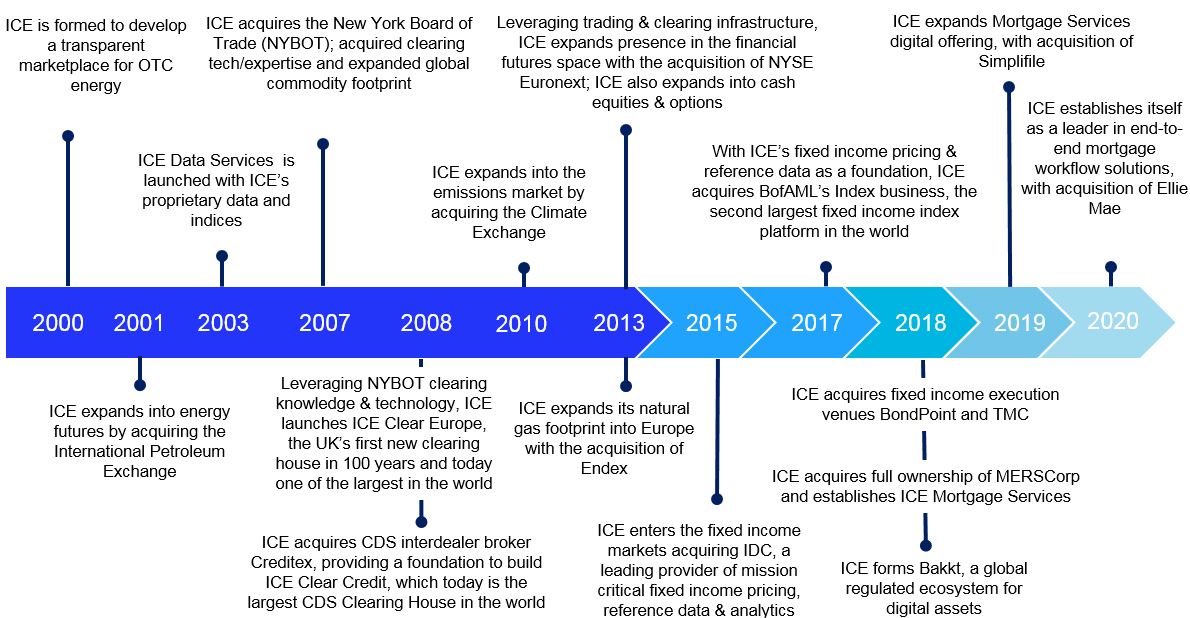
In 2000, ICE was founded with the idea of transforming energy markets by creating a network that removed barriers and provided greater transparency, efficiency and access. By staying close to our customers, we have expanded into new asset classes and services, while retaining a core mission of reducing friction in markets, bringing efficiency to our customers’ workflows and, ultimately, connecting our customers to opportunity.
Today, we are a Fortune 500 company, providing our customers with an array of marketplace infrastructure, data services and technology solutions that span a diverse set of asset classes.
Our Business Segments
Our business is conducted through three reportable business segments:
-
Exchanges;
-
Fixed Income and Data Services; and
-
Mortgage Technology.
The majority of our identifiable assets are located in the U.S. and the United Kingdom, or U.K. For a summary of our revenues, net assets and net property and equipment by geographic region, see Note 18 to our consolidated financial statements included in this Annual Report.
Exchanges Segment
We operate regulated marketplaces for the listing, trading and clearing of a broad array of derivatives contracts and financial securities, such as commodities, interest rates, foreign exchange and equities as well as corporate and exchange-traded funds, or ETFs. We operate multiple trading venues, including 12 regulated exchanges and six clearing houses, which are strategically positioned in major market centers around the world, including the U.S., U.K., European Union, or EU, Canada and Singapore.
Our ICE Exchanges segment includes the New York Stock Exchange and other registered securities exchanges, or collectively, the NYSE, our global futures network, trading and listings revenue, and various data and connectivity services that are directly related to those exchange platforms. Revenues reflect a mix of both diversified transaction revenues and recurring data and listings revenues. Our Exchanges segment generated revenues, less transaction-based expenses of $3.6 billion and accounted for 60% of our consolidated revenues, less transaction-based expenses in 2020. Our Exchanges business can experience moderate seasonal fluctuations, although such seasonal impacts have been somewhat muted in periods of high volume trading. Key asset classes include:
-
Energy Futures and Options:** We offer a range of futures and options products that are designed to enable our customers to manage their risk across global energy markets. Our flagship Brent crude oil contract serves as the cornerstone of a global oil network that today includes over 600 related crude and refined oil products including locational and refined spreads. In addition, as natural gas and Liquefied Natural Gas, or LNG, continue to globalize, we offer the broadest footprint of regional and global natural gas benchmarks, which span North America, Europe and Asia. Our leading environmental and power markets round out our diverse global energy network. For nearly two decades, our environmental markets have provided customers that are increasingly subject to carbon cap and trade programs and renewable fuel standards the risk management tools to meet those obligations and to manage risk related to climate change.
-
Agricultural & Metals Futures and Options: We offer futures and options on the leading global soft commodity markets including coffee, cocoa, cotton and sugar. Our benchmark contracts offer the most globally relevant price markers for these agricultural markets and provide our customers with the tools to manage price and counterparty risk and facilitate price discovery.
-
Financial Futures and Options:** We offer a diverse suite of equity futures and options contracts based on our own indices as well as those created by MSCI® and FTSE®. These contracts range from established global benchmarks, such as the MSCI® Emerging Market Index, to newer products, such as MSCI®’s suite of Environmental, Social and Governance, or ESG, indices and the NYSE FAANG+ Index. Our global interest rate complex spans geographies, currencies and tenors, providing participants around the world with effective tools to manage risk in a capital efficient manner. Key products include: Short Sterling, Euribor, Gilts, Sterling Overnight Index Average, or SONIA, and Secured Overnight Financing Rates, or SOFR, among others.
-
Cash Equities and Equity Options:** We offer securities trading services through our five registered securities exchanges, including the NYSE. Our securities exchanges are leading providers of transparent, efficient, and high quality markets for the securities issued by large and small companies, ETFs and equity options. These markets serve issuers, investors and other market participants across five cash equity and two options markets.
-
Listings:** As the global leader in listings, the NYSE has been the venue of choice for innovators, visionaries and leaders for over 225 years. At the heart of the NYSE offering is our unique hybrid market model that combines leading technology with an accountable market maker to provide human judgment, an unmatched community of the world’s greatest companies and premium brand visibility. With over 70% of S&P 500 companies listed on the NYSE as of December 31, 2020, we are the leading listing venue across a range of sectors from technology and healthcare, to financials and energy. In addition to corporate listings, the NYSE is the global leader in ETF listings with 75%, or roughly $4 trillion, of ETF assets under management, or AUM, as of December 31, 2020. Revenues from listing fees are largely recurring in nature.
-
Data and Connectivity Services:** Our exchanges' trade execution services create trading data. Our exchange data services include, among other offerings, proprietary real-time and historical pricing data, as well as order book and transaction information related to our global futures markets and the NYSE exchanges. In addition, we receive a share of revenue from the sale of consolidated U.S. equity market data by the National Market System Plans, or NMS Plans.
Separately, we also provide connectivity services directly related to our futures, cash equity and options exchanges and clearing houses. Revenues from data and connectivity services fees are largely recurring in nature.
- OTC and Other:** Our over-the-counter, or OTC, markets include bilateral energy markets that offer electronic trading of contracts based on physically-settled natural gas, power and refined oil contracts. Our other revenues primarily include interest income on certain clearing margin deposits related to our futures business, as well as revenue related to our digital asset initiative, Bakkt.
We operate six clearing houses, each of which acts as a central counterparty, or CCP, that, for its clearing members, becomes the buyer to every seller and the seller to every buyer. Through this CCP function, our clearing houses provide financial security for each transaction, for the duration of the position, by limiting counterparty credit risk. Our clearing houses are responsible for providing clearing services to each of our futures exchanges and certain of our clearing houses clear contracts traded outside of our execution venues.
Mechanisms have been created, called guaranty funds, to provide partial protection in the event of a clearing member default. With the exception of ICE NGX Canada Inc., or ICE NGX, each of the ICE Clearing Houses requires that each clearing member make deposits into a guaranty fund maintained by the relevant ICE Clearing House. In addition, we have contributed $408 million of our own cash to the guaranty funds included in the table below, and such amounts are at risk and could be used in the event of a clearing member default. In September 2019, we also added a layer of insurance to our clearing member default protection. The default insurance has a three-year term that commenced on September 17, 2019, for the following clearing houses in the following amounts: ICE Clear Credit - $50 million; ICE Clear Europe - $75 million; and, ICE Clear US - $25 million. In addition, and included in the table below, ICE NGX maintains a guaranty fund of $100 million funded by a letter of credit issued by a major Canadian bank. If an ICE NGX clearing member defaults and its collateral is insufficient, the shortfall should be covered by a draw down on the letter of credit following which ICE NGX would file a claim under the default insurance. Under the default insurance policy, ICE NGX is responsible for the first $15 million and then can recover additional losses up to $100 million.
Our contributions to each clearing house as of December 31, 2020 are listed below and our clearing houses are referred to herein collectively as “the ICE Clearing Houses”:
| Clearing House | Products Cleared | Location | Exchange where Executed | Reporting Segment | ICE's Guaranty Fund Contribution | ||||||||||||
| ICE Clear Europe | Energy, agricultural, interest rates and equity index futures and options contracts and OTC European CDS instruments | U.K. | ICE Futures Europe, ICE Futures U.S., ICE Endex, and third-party venues | Exchanges | $312 million | ||||||||||||
| ICE Clear U.S. | Agricultural, metals and foreign exchange, or FX, index futures and options contracts, equity futures contracts and digital assets futures contracts | U.S. | ICE Futures U.S. | Exchanges | $128 million1 | ||||||||||||
| ICE Clear Credit2 | OTC North American, European, Asian-Pacific and Emerging Market CDS instruments | U.S. | Creditex and third-party venues | Fixed Income and Data Services | $100 million | ||||||||||||
| ICE Clear Netherlands | Derivatives on equities and equity indices traded on regulated markets | The Netherlands | ICE Endex | Exchanges | $2 million | ||||||||||||
| ICE Clear Singapore | Energy, metals and financial futures products and digital assets futures contracts | Singapore | ICE Futures Singapore | Exchanges | $1 million | ||||||||||||
| ICE NGX | Physical North American natural gas, electricity and oil futures | Canada | ICE NGX | Exchanges | $115 million |
1 Of our total contribution to ICE Clear U.S. above, $35 million is solely applicable to any losses associated with a default in digital asset contracts.
2 Although ICE Clear Credit is included in the Fixed Income and Data Services reporting segment, it is included in the table as a part of our suite of global clearing houses.
Fixed Income and Data Services Segment
Our Fixed Income and Data Services segment includes our fixed income data and analytics offerings, fixed income execution, or ICE Bonds, CDS clearing and other multi-asset class data and network services. Our leading fixed income pricing and reference data offerings serve as the foundation for a broader fixed income network that provides our customers solutions that span the full workflow including pre- and post-trade analytics, a range of execution protocols and indices. In addition, our multi-asset class connectivity, feeds and desktop solutions, which comprise our Other Data and Network Services business leverage a common sales force, which can enhance cross-selling opportunities across the Fixed Income and Data Services segment. The Fixed Income and Data Services segment generated revenues of $1.8 billion in 2020 and accounted for 30% of our consolidated revenues, less transaction-based expenses.
-
Fixed Income Data and Analytics:** We are a leading provider of evaluated end-of-day and real-time pricing services on roughly three million fixed income securities spanning approximately 151 countries and 73 currencies including sovereign, corporate and municipal bonds, mortgage and asset-backed securities as well as leveraged loans. Our reference data offering complements our evaluated pricing by providing our clients a broad range of descriptive information, covering millions of financial instruments that, when coupled with our pricing services, act as the foundation for our leading fixed income index complex, ICE Data Indices, LLC, or ICE Data Indices. We also offer a range of fixed income analytics and other workflow solutions including: best execution services, liquidity indicators, fixed income portfolio analytics and our ETF Hub. Our fixed income customers rely on our data, indices and analytics to inform pre-trade decision making, support post-trade regulatory and compliance needs and improve operational efficiency. In addition, our newer offerings in this area include a variety of ESG data and analytics offerings. Fixed Income Data and Analytics revenues are largely recurring in nature.
-
Fixed Income Execution:** Alongside our leading Fixed Income Data and Analytics offerings, ICE Bonds is focused on providing tools to improve efficiency in customers' workflows across fixed income markets. ICE Bonds provides customers with electronic markets that support multiple fixed income trading protocols including: click-to-trade, request for quotation, or RFQ, and auctions, including portfolio auctions/trading.
-
CDS Clearing:** As of December 30, 2020, we provide clearing services to over 90% of the global CDS market, as measured by CDS gross notional cleared. ICE Clear Credit currently supports Single Names CDS on over 520 reference entities and 160 Index CDS instruments. Revenues also include interest income on certain clearing margin deposits related to our CDS clearing business.
-
Other Data and Network Services: Revenues include those related to the ICE Global Network and our consolidated feeds business, as well as desktops and other multi-asset class analytics. The ICE Global Network offers highly secure, low latency connectivity solutions to reach over 150 trading venues and over 750 data sources. Our consolidated feeds business provides data from a broad array of trading venues and news feeds through a common application programming interface, or API. Our Desktops and Tools support commodity and energy traders, risk managers, financial advisors, wealth managers and retail traders, and includes a robust instant messaging, or IM, system that protects the privacy of over 100,000 users, while also enabling greater collaboration. Other Data and Network Service revenues are largely recurring in nature.
Mortgage Technology Segment
Over the last four years, ICE has constructed an end-to-end network aimed at identifying and solving the inefficiencies that exist in the U.S. residential mortgage market. From application through closing and the secondary market, our network is intended to connect the key stakeholders across the mortgage origination workflow and provide our customers with data services and technology that deliver greater transparency and enable significant customer efficiency gains. Our Mortgage Technology segment generated revenues of $595 million in 2020 and accounted for 10% of our consolidated revenues, less transaction-based expenses.
-
Origination Technology:** Revenues include those related to our Encompass offering, our proprietary and comprehensive mortgage origination platform, which served nearly 45% of all closed residential mortgage loans in the U.S. in 2019, based on the most recent Home Mortgage Disclosure Act data. Our origination technology acts as a system of record for mortgage transactions, automating the gathering, reviewing, and verifying of mortgage-related information and enabling automated enforcement of rules and business practices designed to ensure that each completed loan transaction is of the highest quality and adheres to secondary market standards. Revenue from Origination Technology is based on recurring Software as a Service, or SaaS, subscription fees, with an additive “Success-Based Pricing” fee as lenders exceed the number of loans closed that is included with their monthly base subscription.
-
Network and Closing Solutions: Our network is a leading marketplace that provides customers connectivity to the mortgage supply chain and facilitates the secure exchange of information between our customers and a broad ecosystem of our own proprietary offerings and third-party service providers, in addition to lenders and investors that are critical to consummating the millions of loan transactions that occur on our origination network each year. Key services include: credit, title, appraisal, flood, compliance, mortgage insurance and fraud detection, among others. In addition, our Encompass Investor Connect offering allows loan originators to electronically submit loan files to investors, providing investors with electronic access to the large number of mortgage originators that rely on our origination technology helping to reduce frictions between buyers and sellers of mortgage loans. Our closing network uniquely connects key participants, such as lenders, title and settlement agents and individual county recorders together, in order to digitize the traditionally manual and paper-based closing and recording process. Our closing solutions also include digital services related to the Mortgage Electronic Registration Systems, Inc., or MERS, eRegistry, which are intended to help to drive process efficiencies for lenders, investors and servicers, while enabling a better consumer experience for borrowers, as we seek to build more of a straight-forward closing experience. Revenues from Network and Closing Solutions are based largely on the number of applications and closed loans that utilize the various services.
-
Data and Analytics:** Revenues include those related to ICE Mortgage Technology’s Automation, Intelligence, Quality, or AIQ offering, which applies machine learning and artificial intelligence, or AI, to the entire loan origination process, offering customers greater efficiency by streamlining data collection and validation through our automated document recognition and data extraction capabilities. AIQ also enables a series of AI-driven origination tasks and real-time risk analysis that are intended to further improve customer workflow efficiency. AIQ aims to help investors make loan purchases faster, by reducing operational costs and lowering buy-back risk through the application of AI to the purchase review process. AIQ revenues can be both recurring and transaction-based in nature. In addition, ICE Mortgage Technology’s data offerings include real-time industry and peer benchmarking tools, which provide originators a granular view into the real-time trends of nearly half the U.S. residential mortgage market. We also provide a Data as a Service, or DaaS, offering through private data clouds for lenders to access their own data and origination information. Revenues related to our data products are largely subscription based and recurring in nature.
-
Registrations and Other: Our MERS database is the industry’s leading system of record for recording and tracking changes in mortgage servicing rights and beneficial ownership interests of loans secured by U.S. residential real estate. We also offer certain professional services and ancillary products. These revenues are transaction-based.
Product and Services Development
We leverage our customer relationships, global distribution, technology infrastructure and software development capabilities to diversify our products and services. We are continually developing, evaluating and testing new products to better serve our client base. The majority of our product development relates to evaluating new contracts, new data sets or new analytic offerings. New contracts often must be reviewed and approved by relevant regulators. We expect to continue to invest in improving our ICE Global Network and software services to meet the needs of our customers and improve their trading and connectivity experience by reducing latency, improving security and providing the most relevant information and data.
While we primarily develop our products and services internally, we also periodically evaluate and enter into strategic partnerships and licensing arrangements to develop new products and services. We intend to continue to invest to expand our exchanges, fixed income and data services, and mortgage technology offerings to serve the evolving needs of our global customer base.
Technology
Technology is a key component of our business strategy and competitive position and we regard effective execution of our technology initiatives as crucial to our sustainable business operations, market competitiveness, compliance and risk management and overall success. Our technology solutions support our customers' workflows: trading and clearing technology, multi-asset class analytics, risk assessment tools, robust data offerings, mortgage technology, instant messaging capabilities and flexible connectivity and delivery solutions. Where feasible, we design and build our own systems and write our own software programs since we believe that having control over our technology allows us to be more responsive to our customers’ needs, better support the dynamic nature of our business, provide the highest quality technology and deliver relevant, timely and actionable data to the markets and customers we serve.
- ICE and NYSE Trading Platforms and Technology: The ICE trading platform supports trading in our cleared futures and options markets as well as our bilateral OTC markets. We also offer voice brokers a facility for submitting block trades for products that are eligible for clearing. Speed, reliability, resilience, capacity and security are critical performance criteria for electronic trading platforms. Connectivity to our trading platform for our markets is available through our web-based front-end applications, as well as multiple independent software vendors, or ISVs, and APIs.
The NYSE electronic trading platform features an open system architecture that allows users to access our system via one of the many front-end trading applications developed by ISVs. For equity options, we offer a hybrid model of electronic and open outcry trading through NYSE American Options and NYSE Arca Options. We developed an integrated trading platform and matching engine known as NYSE Pillar and have migrated all of our cash equity securities markets to this platform. We also expect to migrate our equity options markets to this platform, which have historically operated on distinct platforms. This integrated platform is expected to improve performance and reduce the complexity of operating multiple trading systems.
-
Clearing Technology:** A broad range of trade management and clearing services are offered through the integrated technology infrastructure that serves our clearing houses. The ICE clearing systems encompass a number of integrated systems, including post-trade position management, risk management, settlement and treasury and reporting functions. A core component of our derivatives clearing houses is the risk management of clearing firm members. Our extensive technology and rules-based risk systems provide analytical tools that allow us to determine margin, evaluate credit risk and monitor the trading activities and overall risk of clearing members.
-
ICE Data Services Technology:** ICE Data Services technology uses integrated platforms to capture, store and process information, perform analytics and maintain connectivity solutions using a single configurable data capture mechanism and flexible delivery capability. Together, the platforms are intended to enable real-time processing and delivery of information, accelerate new product development and improve production reliability. Our data and analytics are delivered via real-time messaging, files, web services and other on-demand facilities and state-of-the-art front-ends. In addition, the technology underpinning our ICE Global Network supports scalable bandwidth and a wide variety of connectivity options including fiber, wireless, colocation and hosting.
-
ICE Mortgage Technology**: The ICE Mortgage Technology platform enables lenders to originate, process, fund and deliver residential mortgages using various applications, APIs, data products and other services offered. The platform
is developed using industry-leading software technologies and third-party services, including hosting with a combination of public cloud and private data centers. The platform is integrated with multiple services necessary for loan origination, such as credit reporting and other services that lenders leverage through our network, which is offered through the platform. The platform includes industry leading information security infrastructure to protect the confidentiality and integrity of our customer data.
Operations
We operate regionally diverse primary and backup data centers and maintain comprehensive business continuity and disaster recovery plans and facilities. These are designed to enable nearly continuous availability of our markets and other services in the event of a business disruption or disaster. We maintain incident and crisis management plans that address responses to disruptive events at any of our locations worldwide.
Cybersecurity
Our business activities rely extensively on technology and software, including the systems used by our business partners, regulators and customers. In addition, our activities involve the use and retention of confidential data and information. These activities make us susceptible to cyberattacks. We employ the following activities, processes and strategies to evaluate, manage and address these risks.
-
Strategy: We maintain a Cybersecurity Strategy, or CSS, which emphasizes consideration of the nature of our business, ongoing intelligence collection regarding cybersecurity threats, and initiatives to specifically address prominent areas of cybersecurity risk. The CSS outlines the key priorities for our cybersecurity program and the methods by which our Information Security department seeks to accomplish those goals. The CSS is ratified by the Risk Committee of our Board of Directors and when applicable, also by the corporate governance committees of our regulated subsidiaries.
-
Risk Management:** Thematic threats such as sabotage, fraud, and theft of assets or customer data are used to frame our risk management activities. Asset theft often involves organized crime or financially motivated nations staging sophisticated, well-planned campaigns to steal significant cash, cryptocurrency, or equivalent assets. Our thematic threats, along with others, are evaluated by our Board of Directors as well as our Risk Committee, Chief Risk Officer and Chief Information Security Officers, or CISOs. The CSS provides the framework we use for assessing risk, prioritizing testing, identifying remedial actions and validating improvements. The CSS also provides for the deployment of external and internal teams of ethical hackers that operate alongside our traditional vulnerability detection processes.
-
Information Sharing:** We recognize the importance of collaboration and information sharing among private sector firms in the financial services sector, across sectors, and with global public-sector agencies, when appropriate. Our cybersecurity leaders hold positions within the Financial Services Information Sharing and Analysis Center, or FS-ISAC, and the cross-sector Analysis and Resiliency Center, or ARC, in the U.S., the Financial Sector Cyber Collaboration Centre, or FSCCC, in the U.K., and similar organizations across the Europe, Middle East and Africa, or EMEA, and Asia Pacific, or APAC, regions.
-
Governance and Leadership:** Our Information Security department is led by our CISOs, who provide comprehensive reports to a dedicated internal governance committee at least quarterly outlining threat assessment, control performance, and ongoing enhancements. Additionally, cybersecurity matters are reported to and discussed with a cross-subsidiary leadership committee, the Risk Committee of our Board of Directors, and when applicable, subsidiary boards. Our CISOs and other senior security leaders conduct periodic cybersecurity education sessions with our employees and directors. These sessions cover general cybersecurity topics as well as specific details regarding our cybersecurity program.
-
Third-Party Review:** Our Information Security department utilizes extensive penetration testing, vulnerability scanning, ethical hacking and maturity assessment services from global leaders in these practices. The results of these reviews alongside frequent regulatory and customer examinations are assessed, with any resulting mitigation activity assigned and tracked to remediation.
-
Controls**: Our identification of risks and selection of cyber-related controls is performed in the context of the critical financial infrastructure we maintain and operate. Our ongoing threat assessments are intended to identify changes in external events and in our activities, infrastructure and processes that could necessitate reprioritization of risks and controls. The nature of our business activities mandates an emphasis on sabotage and asset theft as primary threats in addition to contemporary themes of data theft. Our focus on these threats leads to an emphasis on network
security, social engineering controls, behavioral detection of insider threat, and deliberate and rehearsed recovery strategies.
Intellectual Property
We rely on a wide range of intellectual property, both owned and licensed, in connection with the operation of our various businesses. We own the rights to a large number of trademarks, service marks, domain names and trade names in the U.S., Europe and in other parts of the world. We have registered many of our trademarks in the U.S. and in certain other countries. We hold the rights to a number of patents and have made a number of patent applications in the U.S. and other countries. We also own the copyright to a variety of material. Those copyrights, some of which are registered, include software code, printed and online publications, websites, advertisements, educational material, graphic presentations and other literature, both textual and electronic. We attempt to protect our intellectual property rights by relying on trademarks, patents, copyrights, database rights, trade secrets, restrictions on disclosure and other methods.
FTSE® and the FTSE indexes are trademarks and service marks of the London Stock Exchange plc and Financial Times Limited and are used under license. MSCI® and the MSCI indexes are trademarks and service marks of MSCI Inc. or its affiliates and are used under license.
Human Capital Resources
As of December 31, 2020, we had a total of 8,890 employees with 1,587 in New York, 1,268 in Georgia, 1,122 in California, 331 in Massachusetts and 296 in Illinois, as well as 1,628 in India, 794 in the U.K., 474 in continental Europe and a total of 1,390 employees across our other offices around the world. Of our total employee base, less than 1% is subject to collective bargaining agreements, and such relations are considered to be good.
Our culture is driven by a common set of values that provide the foundation for everything we do and we use employee surveys to ensure that we are holding true to these values.
We strive to provide comprehensive packages of competitive compensation and benefits in each market in which we operate, which we believe is important to ensure our employees’ health, well-being and financial security. We review the competitiveness of our compensation and benefits frequently. As an equal opportunity employer, all qualified applicants receive consideration without regard to race, color, religion, gender, sexual orientation, gender identity, national origin or ancestry, age, disability or veteran status, or other protected status.
We are committed to diversity on our Board of Directors and in our employee population. We believe that our employee population should reflect the broader communities within which we operate. We hold ourselves accountable via quarterly and annual data reporting to senior management, data reporting to our Board of Directors, and transparency in reporting data to our stakeholders via our annual Corporate Responsibility Report.
Employee development is an important element of our human capital management program. Career development and training opportunities are available throughout our ranks, including both structured course work across a variety of topics and situations, and self-directed learning from a wide array of available resources. Through employee assistance plans, in most of our locations we provide free and discounted counseling services for dealing with traumatic life events, mental health issues and stress, as well as general wellness programs.
We monitor voluntary attrition rates carefully, and over the past three years, our attrition rates have remained lower than the benchmarks in the finance and technology sectors. We review this data frequently and strive to transparently report this information to our stakeholders via our Corporate Responsibility Report.
Financial education is the cornerstone of our corporate giving efforts, which include support for organizations such as Junior Achievement in the U.S. and Young Money in the U.K. We also underwrite a digital financial education curriculum that is delivered at no cost to grade school and high school students in Chicago, Boston, New York and Atlanta. We make additional charitable contributions throughout the communities where we have offices and our employees are encouraged to do the same, including through an annual match to employees for charities of their choice. We raised the annual match to $3,500 per employee in 2020 to encourage and reward our employees' charitable contributions during a difficult year due to COVID-19.
Corporate Citizenship
We strive to create long-term value for our stockholders and meet sustainability goals for all of our stakeholders. That includes maintaining high ethical and business standards, giving back in the communities where we live and work and
using our unique resources to bring together a network of the world's leading companies to learn from each other and exchange ideas on a broad range of issues, including those related to environmental, social and governance matters.
Much of our approach is driven by the core values that make up our culture. During 2020, we surveyed our employees to assess how we, as a company, were living up to our core values, and are taking actions based on the results of the survey to further our embodiment of our core values.
For additional information, please refer to the Corporate Citizenship section of our website at www.theice.com/esg.
Our Competitive Strengths
We believe we compete on the basis of a number of factors, including:
-
depth and liquidity of markets;
-
price transparency;
-
reliability and speed of trade execution and processing;
-
technological capabilities and innovation;
-
breadth of products and services;
-
proprietary nature of many of our data services offerings;
-
broad distribution and end-to-end design of our mortgage technology offering;
-
rate and quality of new product development;
-
quality and stability of services;
-
distribution and ease of connectivity;
-
mid- and back-office service offerings, including differentiated and value-added services;
-
transaction costs; and
-
reputation.
We believe that we compete favorably with respect to these factors, and that our deep, liquid markets, technology offerings, breadth of product offerings, new product development, customer relationships and efficient, secure settlement, clearing and other support services distinguish us from our competitors. We believe that to maintain our competitive position, we must continue to develop new and innovative products and services, enhance our technology infrastructure, maintain liquidity and offer competitive pricing.
We believe our key strengths include our:
- Diverse Product Offerings:** In our Exchanges segment, many of our futures contracts serve as global benchmarks for managing risk relating to exposure to price movements in the underlying products, including financial, energy and agricultural commodities. For example, we are a leading provider of global energy risk management products, ranging from global crude and refined oil products, to an array of global natural gas benchmarks and environmental markets. In our Fixed Income and Data services segment, we offer customer solutions that span their workflows including pre-trade analytics, an array of execution protocols, and post-trade services all designed to improve asset class transparency and bring efficiency to customers' workflows. In our Mortgage Technology segment, we provide customers with a comprehensive loan origination platform and network of third-party service providers, which we believe are critical to the underwriting, processing and closing of U.S. residential mortgage loans.
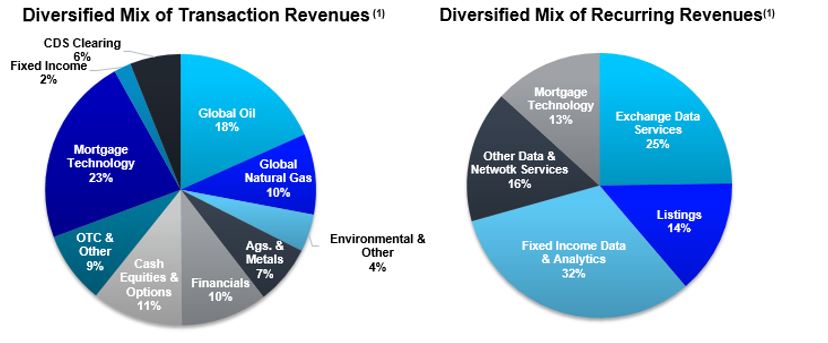
(1) Revenue mix based on 2020 revenues and are pro-forma for Ellie Mae. Ellie Mae pro forma revenues for 2020 were $608 million for the period prior to our acquisition of Ellie Mae.
-
Risk Management Expertise:** We offer a range of central clearing and related risk management services to promote the liquidity and security of our markets in jurisdictions around the world and to meet local regulatory and operational needs in key financial market centers. The credit and performance assurance provided by our clearing houses to clearing members is designed to substantially reduce counterparty risk and is a critical component of our exchanges’ identities as reliable and secure marketplaces for global transactions. Our clearing houses are designed to protect the financial integrity of our markets by maintaining strong governance and rules, managing collateral, facilitating payments and collections, enhancing capital efficiency and limiting counterparty credit risk. In our Mortgage Technology segment, our origination technology network acts as a system of record for mortgage transactions, automating the gathering, reviewing, and verifying of mortgage-related information, that in addition to other benefits, is intended to enable automated enforcement of rules and business practices that are designed to adhere to secondary market standards.
-
Data Services:** In our Exchanges segment, we offer proprietary real-time and historical pricing data, as well as order book and transaction information related to our global futures markets and the NYSE. We also provide connectivity services directly related to those exchange platforms and clearing houses. In our Fixed Income and Data Services segment, we are a leading provider of evaluated end-of-day and real-time pricing services on roughly three million fixed income securities spanning approximately 151 countries and 73 currencies including sovereign, corporate and municipal bonds, mortgage and asset-backed securities, as well as leveraged loans. Our reference data offering complements our evaluated pricing by providing our clients with a broad range of descriptive information, covering millions of financial instruments that, when coupled with our pricing services, act as the foundation for our leading fixed income index complex. Across all three of our segments and our various networks, our data services aim to address the rising demand for independent, real-time information, which is being driven by regulation, market fragmentation and competition, increasing technology and data demands, as well as passive investing and indexation. We also believe our data services are uniquely relevant to our clients’ business operations and provide tools and services that enable greater workflow efficiency and, regardless of market conditions are relied upon to serve the need for continuous information and analysis.
-
Broad Distribution: We operate multiple trading venues, including 12 regulated exchanges, as well as six clearing houses, which are strategically-positioned in major market centers around the world, including the U.S., U.K., EU, Canada and Singapore. Our ICE Global Network provides connectivity to over 150 trading venues and data from over 750 data sources, including ICE-operated markets and data services. Through our fixed income execution, data and analytics offerings, we serve over 5,000 customers across global fixed income markets. At ICE Mortgage Technology, we have at least one product relationship with nearly every key industry participant from loan originators to settlement agents and local jurisdictions within the U.S., which represent over 85% of the U.S. population.
-
World Class Technology: Our proprietary systems are built using state-of-the-art technology and are designed to support our customers' workflows across the networks we operate. We employ a significant number of employees in
technology-related activities, including product management, system architecture, software development, network engineering, server maintenance and continuity, cybersecurity, system and data performance, systems analysis, quality assurance, database administration and customer technical support. Speed, reliability, resilience, capacity and security are critical performance criteria for our electronic networks. Connectivity to all of our platforms is available through our web-based front-end application, as well as multiple ISVs and APIs.
Competitors
The markets in which we operate are highly competitive. We face competition in all aspects of our business from a number of different enterprises, both domestic and international, including traditional exchanges, electronic trading platforms, investment banks, data vendors, voice brokers and other technology providers.
Exchanges Segment
-
We face competition from other exchanges, electronic trading systems, third-party clearing houses, technology firms, market data vendors and trading facilities in the U.S. and globally. Some of the exchanges are consortiums formed by banks and exchanges.
-
We face significant competition with respect to equities trading, and this competition is expected to remain intense. Our current and prospective competitors include regulated markets, dark pools and other alternative trading systems, or ATSs, market makers and other execution venues. We also face competition from large investment banks, brokers and customers that may assume the role of principal and act as counterparty to orders originating from retail customers, or match their respective order flows through bilateral trading arrangements, including through internalization of order flow. NYSE Arca and NYSE American Options face considerable competition in the equity options markets; their principal U.S. competitors are Nasdaq, Inc., or Nasdaq, and Cboe Global Markets, Inc., or Cboe.
-
Our principal competitor for corporate listings in the U.S. is Nasdaq. For ETF listings, we compete with Nasdaq and Cboe. We also face competition for foreign issuer listings from a number of stock exchanges outside the U.S. As other liquidity venues and new entrants seek exchange status, we may face more competition for listings.
Fixed Income and Data Services Segment
-
Our fixed income trading venues, or ICE Bonds, compete with other electronic trading venues. Our platforms also compete for volume traded bilaterally or trading activity that is not done through an electronic venue.
-
Our data services offerings face intense competition in all aspects of the business. We broadly compete with purchased third-party information and services from large global suppliers of financial market data. Our Fixed Income Data and Analytics services compete with information obtained from informal industry relationships and sources, such as broker quotes, as well as other index and portfolio analytics providers. Our ICE Global Network business competes with other extranet providers.
Mortgage Technology Segment
- In our ICE Mortgage Technology business, we compete with other digital mortgage solution providers, such as Black Knight, Inc.'s origination technologies and proprietary systems that lenders have put in place. We also compete for mortgage activity that does not utilize digital solutions.
Our Growth Strategy
We seek to advance our leadership position by focusing our efforts on the following key strategies for growth:
-
innovate and expand our data services offerings and the networks we serve to address the rising demand for transparency and efficiency;
-
further develop our technology and risk management infrastructure while also increasing our distribution; and
-
strengthen our competitive position through select acquisitions and strategic relationships.
The record consolidated revenues, less transaction-based expenses, we achieved in 2020 reflect our focus on the implementation and execution of our long-term growth strategy.
Innovate and Expand Our Data Services Offerings and the Networks We Serve to Address the Rising Demand for Transparency and Efficiency
Our growth strategy has been to expand the networks we serve by, in part, adding new data, connectivity and other workflow tools. By bringing together a wide range of data and analytics as well as an array of delivery mechanisms, we offer customers a comprehensive and flexible solution to address the need for more transparency, efficiency and information across their respective workflows. Our growth has been driven by many factors, such as increased automation, regulation and demand for independent, secure, real-time information.
We will continue to look for strategic opportunities to grow our networks and expect to also continue to pursue opportunities in asset classes we do not currently serve.
Further Develop Our Technology and Risk Management Infrastructure While Also Increasing Our Distribution
We develop and maintain our own infrastructure, electronic trading platforms, clearing systems, mortgage platforms and data and analytics platforms, which are designed to ensure scalability and the delivery of technology that meets our expanding customer base’s demands for price transparency, reliability, risk management and transaction efficiency. We intend to continue to increase ease of access and connectivity with our existing and prospective customers. We expect to continue rolling out NYSE Pillar, our new integrated equities trading platform and matching engine, to our equity options markets to improve performance and reduce the complexity of operating multiple trading systems. We also expect to continue to invest in mortgage technology to streamline and automate more workflows and build new capabilities. We operate systems that support trading, clearing, mortgage originations, data and analytics across five data centers. Finally, we operate our ICE Global Network, which provides connectivity to over 150 trading venues and data from over 750 sources, including ICE-operated markets and data services.
Our derivatives customer base has grown and diversified as a result of several drivers, including the addition of new markets and products, the move toward increased risk management and counterparty credit management, mark-to-market and margining services as well as regulatory requirements. We continue to add new participants to our platforms, which bring additional demand for new products and services. Our markets support price transparency and risk management, particularly in times of volatility and for products where there is less liquidity. In addition, the use of hedging, trading and risk management programs by commercial enterprises continues to rise based on the availability of technology to deliver more products, as well as the security and the capital efficiencies offered by clearing. We develop new products, but have also increased our capabilities through licenses and acquisitions of companies and intellectual property. Further, by acquiring, building and maintaining our own geographically diverse clearing operations, we are able to respond to market demand for central clearing and related risk management services across diverse geographic and regulatory jurisdictions. As new markets evolve, we intend to leverage our domain knowledge to meet additional demand for cleared products and related risk management solutions.
As requirements for regulatory compliance and capital efficiencies grow, the use of clearing and data, particularly from independent data and benchmark providers also continues to grow. We intend to continue to expand our customer base by leveraging our existing relationships and our global sales and marketing team to promote participation in our markets, and by expanding our range of products and services.
Strengthen Competitive Position Through Select Acquisitions and Strategic Relationships
We were an early consolidator in global markets and we intend to continue to explore and pursue acquisitions and other strategic opportunities to strengthen our competitive position globally, broaden our product offerings and services and support the growth of our company while enhancing stockholder value as measured by return on invested capital, earnings accretion and cash flow growth. We may enter into business combinations, make acquisitions or enter into strategic partnerships, joint ventures or other alliances, any of which may be material. In addition to growing our business, we may enter into these transactions for a variety of additional reasons, including leveraging our existing strengths to enter new markets or related asset classes, expanding our products and services, diversifying our business, addressing underserved markets, advancing our technology and anticipating or responding to regulatory or other potential changes in our industry or other industries. For example, in September 2020, we acquired Ellie Mae to expand our ICE Mortgage Technology portfolio. Through its digital lending platform, Ellie Mae provides technology services to participants in the mortgage supply chain, including its over 3,000 customers and thousands of partners and investors who provide market liquidity on its open network.
Information About Our Executive Officers
Information relating to our executive officers is included under “Information About Our Executive Officers” in Part III, Item 10, “Directors, Executive Officers and Corporate Governance” of this Annual Report.
Regulation
Our activities and the markets in which we operate are subject to regulations that impact us as well as our customers, and, in turn, meaningfully influence our activities, the manner in which we operate and our strategy. We are primarily subject to the jurisdiction of regulatory agencies in the U.S., U.K., EU, Canada, Singapore and Abu Dhabi. Failure to satisfy regulatory requirements can or may give rise to sanctions by the applicable regulator. See the discussion below and Item 1(A) "-Risk Factors" in this Annual Report for additional descriptions of regulatory and legislative risks and uncertainties.
Regulation of our Derivatives Business
Our regulated derivatives markets and clearing houses are based primarily in the U.S., U.K., EU, Canada, Singapore and Abu Dhabi.
-
Our U.S. futures exchange, ICE Futures U.S., is subject to extensive regulation by the Commodity Futures Trading Commission, or CFTC, under the Commodity Exchange Act, or CEA. The CEA generally requires that futures trading in the U.S. be conducted on a commodity exchange registered as a Designated Contract Market, or DCM. As a registered DCM, ICE Futures U.S. is a self-regulatory organization, or SRO, that has implemented rules and procedures to comply with the core principles applicable to it under the CEA.
-
In the U.K., ICE Futures Europe is a Recognized Investment Exchange, or RIE, in accordance with the Financial Services and Markets Act 2000. Like U.S. regulated derivatives markets, RIEs are SROs with surveillance and compliance responsibilities.
-
In the EU, ICE Endex is a regulated market in the Netherlands and its derivative markets are licensed under the Dutch Financial Services Act and supervised by the Dutch National Bank, or DNB, and the Netherlands Authority for the Financial Markets, or AFM.
-
In Singapore, ICE Futures Singapore is an approved exchange supervised by the Monetary Authority of Singapore, or MAS.
-
In Abu Dhabi, ICE Futures Abu Dhabi is an RIE and regulated by the Financial Services Regulatory Authority, or FSRA.
-
In Canada, ICE NGX is recognized as an exchange and clearing house by the Alberta Securities Commission and is also registered by the CFTC as a Foreign Board of Trade and as a Derivatives Clearing Organization, or DCO.
-
ICE Clear Credit and ICE Clear U.S. are regulated by the CFTC as DCOs. DCOs are subject to extensive regulation by the CFTC under the CEA. The Financial Stability Oversight Council, or FSOC, has designated ICE Clear Credit as a systemically important financial market utility under Title VIII of the Dodd-Frank Wall Street Reform and Consumer Protection Act, or Dodd-Frank Act. As such, ICE Clear Credit has access to the Federal Reserve System and holds deposits of $30.3 billion of its U.S. dollar cash in its cash accounts at the Federal Reserve as of December 31, 2020.
-
ICE Clear Europe, which is primarily regulated in the U.K. by the Bank of England, or BOE, as a Recognized Clearing House, is also subject to regulation by the CFTC as a DCO and by the European Securities and Markets Authority, or ESMA. Both ICE Clear Credit and ICE Clear Europe are also regulated by the SEC as clearing agencies because they clear security-based swaps.
-
In the EU, ICE Clear Netherlands is an authorized CCP and is regulated by the DNB and AFM.
-
In Singapore, ICE Clear Singapore is an approved clearing house supervised by the MAS.
Regulation of our Securities Business
- In our cash equities and options markets, NYSE, NYSE Arca, NYSE American, NYSE National and NYSE Chicago are national securities exchanges and, as such, are SROs and subject to oversight by the SEC. Accordingly, our U.S. securities exchanges are regulated by the SEC and, in turn, are the regulators of their
members. As national securities exchanges, NYSE, NYSE Arca, NYSE American, NYSE National and NYSE Chicago must comply with, and enforce compliance by their members with, the Securities Exchange Act of 1934, or the Exchange Act.
-
Our U.S.-based execution-oriented fixed income markets are operated by our SEC-registered broker-dealers, ICE Bonds Securities Corporation, or ICE Bonds, which operates three SEC registered ATSs, ICE BondPoint, ICE Credit Trade, and ICE TMC. ICE Bonds is subject to oversight by the SEC and is a member of the Financial Industry Regulatory Authority, or FINRA, and the Municipal Securities Rulemaking Board, or MSRB. FINRA and MSRB are SROs that regulate broker-dealers in the U.S. ICE Securities Execution & Clearing, LLC, a full clearing member of the National Securities Clearing Corporation, the Fixed Income Clearing Corporation and The Depository Trust Corporation, provides correspondent clearing for ICE Bonds and is subject to oversight by the SEC, FINRA and the MSRB.
-
Our U.K.-based execution-oriented fixed income market is operated by Creditex Brokerage, L.L.P., which is an operator of a multilateral trading facility, or MTF, and ICE Markets Limited, which acts as the matched principal counterparty to transactions arranged on the MTF operated by Creditex Brokerage. Both Creditex Brokerage and ICE Markets Limited are regulated by the U.K.’s Financial Conduct Authority, or FCA. Additionally, in connection with its bond offerings, Creditex Brokerage is authorized to provide automated trading services in Hong Kong and is subject to oversight by the Hong Kong Securities and Futures Commission and holds an Australian Market License and is subject to oversight by the Australian Securities and Investment Commission.
Regulation of our Data Business
We have a U.S. subsidiary that is registered with the SEC under the Investment Advisers Act of 1940, or the Investment Advisers Act, for its evaluated pricing services. The Investment Advisers Act imposes numerous regulatory obligations on registered investment advisers, including those relating to the management and distribution of products and services, record-keeping, compliance oversight, operational and marketing requirements, disclosure obligations and prohibitions on fraudulent activities. Investment advisers also are subject to certain state securities laws and regulations. ICE Data Services (Australia) Pty. Ltd. provides financial services in Australia and is licensed by the Australian Securities and Investment Commission, or ASIC. ICE Data Desktop Solutions (Europe) Limited provides certain financial services throughout Europe and is regulated by the FCA. ICE Data Indices applies the International Organization of Securities Commissions, or IOSCO, Principles for Financial Benchmarks to its indices. ICE Data Indices has been recognized as a third-country benchmark administrator by the FCA under the U.K. Benchmarks Regulation, or U.K. BMR. ICE Benchmark Administration Limited, or IBA, is authorized and regulated by the FCA for the regulated activity of administering a benchmark, and is authorized as a benchmark administrator under the U.K. BMR. On December 31, 2020, IBA was authorized as a benchmark administrator under the EU Benchmarks Regulation, or EU BMR. See “Regulatory Changes” below for more information.
Regulation of our Mortgage Business
We have a mortgage technology business, Ellie Mae, that is subject to examination by the Federal Financial Institutions Examination Council, or the FFIEC, and its member agencies because it is a third-party service provider to financial institutions directly regulated by the FFIEC and its member agencies, including, among others, the Consumer Financial Protection Bureau, or CFPB.
Regulatory Changes
Domestic and foreign policy makers continue to review their legal frameworks governing financial markets, and periodically change the laws and regulations that apply to our business and to our customers’ businesses. Our key areas of focus on these evolving efforts are:
-
Brexit implications.** On January 1, 2021, the U.K. completed its withdrawal from the EU, commonly referred to as Brexit. As a result, as of January 1, 2021, EU law no longer applies in and to the U.K. In connection with the completion of the U.K.'s withdrawal, the U.K. and EU finalized a trade and cooperation agreement, which was provisionally applied as of January 1, 2021. The trade and cooperation agreement does not cover financial services. Instead, the U.K. and EU issued a joint declaration on financial services regulatory cooperation. According to the joint declaration, the U.K. and EU should agree on a Memorandum of Understanding establishing the framework for regulatory cooperation on financial services.
-
Requirement that European and U.K. exchanges and CCPs offer non-discriminatory access.** The non-discriminatory access provisions of the U.K.'s Markets in Financial Instruments Directive II, or U.K. MiFID II, and the EU Markets in Financial Instruments Directive II, or EU MiFID II, would require both our U.K. and European
exchanges and CCPs to offer access to third parties on commercially reasonable terms. In addition, both the U.K. MiFID II and the EU MiFID II could require our U.K. and European exchanges and CCPs to allow participants to trade and/or clear at other venues, which may encourage competing venues to offer lookalikes of our products. On July 3, 2020, the application of these non-discriminatory access requirements for EU exchange-traded derivatives under EU MiFID II was postponed until July 3, 2021. This postponement did not form part of EU law retained by the U.K. at the end of the Brexit transition period. U.K. Treasury is currently reviewing the suitability of these requirements for U.K. markets.
-
Continued access by EU market participants to U.K. CCPs and exchanges**. The European Commission, or EC, adopted an 18-month temporary equivalence decision for U.K. CCPs, which began to apply as of January 1, 2021. ICE Clear Europe has been recognized by ESMA as a third-country CCP in accordance with the European Markets Infrastructure Regulation, or EMIR. Separately, ICE Futures Europe and ICE Endex will continue to be able to permit access by EU and U.K. persons to transact on their platforms. The absence of an equivalence decision by the EU for U.K. trading venues, however, may result in increased costs for certain EU market participants, which could impact trading on ICE Futures Europe. The impact to our business and the potential for regulatory changes remain uncertain at this time. We are monitoring the impact to our business and are evaluating avenues to facilitate continued access for EU and U.K. customers to ICE Futures Europe and ICE Endex.
-
Regulatory structure applicable to non-EU clearing houses.** On January 1, 2020, EMIR 2.2 became effective, which revises the EU's current regulatory and supervisory structure for EU and non-EU clearing houses. ESMA has recognized ICE Clear Europe as a third-country CCP under EMIR and determined that it is a Tier 2 CCP on the basis that it is systemically important to the financial stability of the EU or one or more of its Member States. However, ESMA's continuing implementation of these delegated regulations could still impact one or more of our other non-EU clearing houses.
-
Basel III capital charges.** The implementation of capital charges in Basel III could have a negative impact on certain of our clearing members. In particular, the Supplemental Leverage Ratio applicable to certain financial institutions may impose capital requirements on certain of our clearing house members and their customers that may raise the costs and thus discourage financial institutions from client clearing. In June 2019, the Basel Committee on Banking Supervision revised its treatment of the leverage ratio capital requirement for derivatives that a bank centrally clears on behalf of its clients. The revised treatment will permit both cash and non-cash forms of initial margin and variation margin received from a client to offset the replacement cost and potential future exposure for client cleared derivatives only. The revision will apply to the version of the leverage ratio standard that will serve as the Pillar 1 minimum capital requirement as of January 1, 2022. In November 2019, the Federal Reserve Board, the Federal Deposit Insurance Corporation, or FDIC, and the Office of the Comptroller of the Currency finalized rule changes to the derivative exposure calculations and leverage ratio requirements. The final rule also revised the treatment of the leverage ratio capital requirement for derivatives that a bank centrally clears on behalf of its clients to permit both cash and non-cash forms of initial margin and variation margin received from a client to offset the replacement cost and potential future exposure for client cleared derivatives only. The compliance date for the revised regulation is January 1, 2022, however early adoption was permitted beginning April 1, 2020.
-
Capital requirements for investment firms acting as market makers.** EU and U.K. policy makers are developing a framework for prudential requirements for EU and U.K. investment firms. The proposed rules risk imposing disproportionate capital requirements on EU and U.K. investment firms acting as market makers. EU and U.K. investment firms may be discouraged from acting as market makers on certain markets operated by ICE Futures Europe and ICE Endex due to the increased capital requirements.
-
Financial transaction and similar taxes.** A number of EU Member States have considered a financial transaction tax, but many details remain to be discussed and agreed, including how to assess the tax at a Member State level. Implementation of a financial transaction tax could result in a reduction in volumes and liquidity, which would have a negative impact on our EU operations.
In the U.S., financial transaction taxes and other similar changes to tax laws are being considered in several states and a federal financial transaction tax on stocks, bonds and derivatives has been introduced in the U.S. House of Representatives. As in the EU, these types of taxes in the U.S. could result in reduced volumes and liquidity on our exchanges that trade instruments to which the tax applies.
- Benchmarks Regulation.** In June 2016, the EU BMR entered into force and the majority of provisions applied from January 2018. Under the EU BMR, benchmarks provided by a third-country (i.e. non-EU) benchmark administrator may be used by EU-supervised entities provided that the EC has adopted an equivalence decision or the administrator has been recognized or endorsed and the benchmarks are listed on the register established by ESMA. The EU BMR also provides for a transition period until December 31, 2021, allowing index providers to continue to provide critical benchmarks and for supervised entities to continue to utilize benchmarks provided by third-country
administrators. There are proposals to further extend the transition period for the use of benchmarks provided by third-country administrators until at least December 31, 2023, subject to final approval by the European Parliament.
From April 27, 2018 to December 31, 2020, IBA was authorized as a benchmark administrator under the EU BMR. As of January 1, 2021, IBA is authorized as a benchmark administrator under the U.K. BMR and benchmarks provided by IBA may continue to be used by supervised entities in the EU under the EU BMR transitional provisions. From May 24, 2019 to December 31, 2020, ICE Data Indices was recognized by the FCA as a third-country benchmark administrator under the EU BMR. As of January 1, 2021, ICE Data Indices is recognized as a third-country benchmark administrator under the U.K. BMR and benchmarks provided by ICE Data Indices may continue to be used by supervised entities in the EU under the EU BMR transitional provisions.
In October 2020, the U.K. Government introduced the Financial Services Bill, which includes proposed amendments to the U.K. BMR to provide the FCA with authority to manage and direct any wind-down period prior to a cessation of the London Interbank Offered Rate, or LIBOR, including powers to direct a methodology change for a critical benchmark and extend its publication on a basis that is no longer representative of its original underlying market or economic reality. Legislation increasing the powers of regulators to change the methodology or underlying market represented by a benchmark, or extend the publication of a benchmark, including LIBOR, could result in increased risks to administrators, such as IBA, and users of such benchmarks. In November 2020, the European Parliament and Council reached an agreement on amending the EU BMR to provide the EC the power to designate a replacement benchmark that covers all references to a widely used reference rate that is phased out, including LIBOR, when necessary, to avoid disruption of the financial markets in the EU.
- Market Data Requirements.** Our U.K. and EU derivatives exchanges could be impacted by changes to requirements related to the dissemination of market data. In its December 2019 report to the EC, ESMA recommended against, among other things, outright regulation of market data prices, however ESMA suggested that users could gain transparency into how market data prices are set with the help of new supervisory guidance and targeted changes to the MiFID II/Markets in Financial Instruments Regulation, or MiFIR, text. The EC is considering ESMA’s report and is considering further legislative action in this area. Additionally, the FCA launched the "Accessing and using wholesale data Call for Input,” which will explore the changing use and value of data in wholesale financial markets.
As required by a May 2020 SEC Order, in August 2020, the exchanges and FINRA submitted to the SEC a proposed new, single NMS Plan to replace the three existing NMS Plans that govern the dissemination of real-time, consolidated equity market data for exchange-listed cash equity securities. This proposed new single NMS Plan would not replace the current NMS Plans until it is approved by the SEC and a transition period concludes. Approval of the new NMS Plan by the SEC may affect NYSE's revenues from the sale of consolidated market data since all the market data fees for consolidated market data would be required to be re-filed with the SEC and would not be effective until approved. Separately, in June 2020, NYSE, Nasdaq and Cboe filed petitions for review with the U.S. Court of Appeals for the District of Columbia of the SEC order requiring the exchanges and FINRA to file this new NMS Plan.
In December 2020, the SEC finalized a rule that would significantly change the content of consolidated data and the manner in which it is collected, consolidated and disseminated. There is a lengthy phase in of these rules of more than two years. The final rule replaces the current exclusive processor for collecting, consolidating, and disseminating cash equity market data with competing, multiple processors. NYSE currently operates the exclusive processor for securities listed on the NYSE exchanges and Cboe and will no longer receive revenue for this activity once the final rule is fully implemented. In addition, the final rule adds new depth of book and auction content to the information that is consolidated. It is uncertain the fees that exchanges will be permitted to charge competing consolidators and others for market data that is included within the new definition of consolidated market data and there could be an impact on NYSE’s revenues from the sale of market data.
-
Regulation of Services Offered by Non-Exchange Affiliates**:** In an October 2020 order approving certain wireless services filed by the NYSE exchanges, the SEC expressed an expanded interpretation of what constitutes an “exchange,” or a “facility” of an exchange, under the U.S. securities laws. To the extent that services offered by non-exchange affiliates of the NYSE exchanges are considered by the SEC to be subject to regulations applicable to registered securities exchanges, such services and the fees for such services would have to be filed with the SEC, which could impact the types of services we may offer and the revenues we receive from such services. We have filed a petition for review of this order with the U.S. Circuit Court of Appeals for the District of Columbia.
-
U.S. Listing and Trading Prohibitions on Certain Foreign Companies: On December 18, 2020, the Holding Foreign Companies Accountable Act became U.S. law. For each company required to file periodic reports with the SEC, this Act requires the SEC to identify any company that retains a registered public accounting firm that is located in a foreign jurisdiction and that the Public Company Accounting Oversight Board, or PCAOB, is unable to inspect or investigate because of a position taken in such foreign jurisdiction. If the SEC determines that the PCAOB has been
unable to inspect or investigate such accounting firm for three consecutive years, it is required to prohibit such company from trading its securities on a U.S. securities exchange or in any “over-the-counter” market. As a consequence, the NYSE exchanges may be required to suspend trading in certain of their listed companies.
In addition, on November 12, 2020, the former President of the United States issued an Executive Order that prohibits, subject to certain exceptions, transactions by U.S. persons in the securities of certain Chinese companies identified as having ties to the People's Liberation Army, and in securities that are derivatives of, or any securities that are designated to provide investment exposure to, such Chinese companies. To comply with the Executive Order and guidance from the U.S. Department of the Treasury, the NYSE suspended trading in three of its listed companies and commenced delisting proceedings. In the future, there may be other listed companies that the NYSE will be required to take similar action to comply with the Executive Order.
See the discussion below and Item 1(A) “- Risk Factors” in this Annual Report for additional description of regulatory and legislative risks and uncertainties.
Available Information
Our principal executive offices are located at 5660 New Northside Drive, 3rd Floor, Atlanta, Georgia 30328. Our main telephone number is 1-770-857-4700, and our website is www.theice.com.
We are required to file reports and other information with the SEC. A copy of this Annual Report on Form 10-K, as well as any future Quarterly Reports on Form 10-Q, Current Reports on Form 8-K and any amendments to such reports are available free of charge, on our website as soon as reasonably practicable after we file such reports with, or furnish such reports to, the SEC. A copy of these filings is also available at the SEC’s website (www.sec.gov). The reference to our website address and to the SEC’s website address do not constitute incorporation by reference of the information contained on the website and should not be considered part of this report. From time to time, we may use our website and/or social media, including Twitter, as distribution channels of material information. The website to access our Twitter account is https://twitter.com/ICE_Markets.
In addition, we have posted on our website the charters for our (i) Audit Committee, (ii) Compensation Committee, (iii) Nominating and Corporate Governance Committee and (iv) Risk Committee, as well as our Global Code of Business Conduct, which includes information regarding our whistleblower hotline information, Board of Directors Governance Guidelines and Board Communication Policy. We will provide a copy of these documents without charge to stockholders upon request.
Next: Item 1. (A). RISK FACTORS