 filings.tools
Intuit 2022 10-K Annual Report
INTU · CIK 896878 · Form 10-K · Fiscal year ended July 31, 2022 · Filed September 2, 2022
23 sections, 536K characters. Original on sec.gov · ·
Risk FactorsBusinessMD&AFinancial StatementsWhat changed vs 2021
Cover and table of contents
UNITED STATES SECURITIES AND EXCHANGE COMMISSION
Washington, D.C. 20549
______________________________________
FORM 10-K
| ☑ | Annual Report pursuant to Section 13 or 15(d) of the Securities Exchange Act of 1934 |
For the fiscal year ended July 31, 2022
OR
| ☐ | Transition report pursuant to Section 13 or 15(d) of the Securities Exchange Act of 1934 |
For the transition period from to
Commission File Number 0-21180

INTUIT INC.
(Exact name of registrant as specified in its charter)
| Delaware | 77-0034661 | |||||||
| (State or other jurisdiction of incorporation or organization) | (IRS Employer Identification No.) |
2700 Coast Avenue, Mountain View, CA 94043
(Address of principal executive offices, including zip code)
(650) 944-6000
(Registrant’s telephone number, including area code)
Securities registered pursuant to Section 12(b) of the Act:
| Title of each class | Trading Symbol | Name of each exchange on which registered | ||||||||||||
| Common Stock, $0.01 par value | INTU | Nasdaq Global Select Market |
Securities registered pursuant to Section 12(g) of the Act: None.
Indicate by check mark if the registrant is a well-known seasoned issuer, as defined in Rule 405 of the Securities Act. Yes ☑ No ☐
Indicate by check mark if the registrant is not required to file reports pursuant to Section 13 or 15(d) of the Act. Yes ☐ No ☑
Indicate by check mark whether the registrant (1) has filed all reports required to be filed by Section 13 or 15(d) of the Securities Exchange Act of 1934 during the preceding 12 months (or for such shorter period that the registrant was required to file such reports); and (2) has been subject to such filing requirements for the past 90 days. Yes ☑ No ☐
Indicate by check mark whether the registrant has submitted electronically every Interactive Data File required to be submitted pursuant to Rule 405 of Regulation S-T (§ 232.405 of this chapter) during the preceding 12 months (or for such shorter period that the registrant was required to submit such files). Yes ☑ No ☐
Indicate by check mark whether the registrant is a large accelerated filer, an accelerated filer, a non-accelerated filer, a smaller reporting company, or an emerging growth company. See definition of “large accelerated filer,” “accelerated filer,” “smaller reporting company,” and “emerging growth company” in Rule 12b-2 of the Exchange Act. (Check one)
| Large accelerated filer | ☑ | Accelerated filer | ☐ | Non-accelerated filer | ☐ | Smaller reporting company | ☐ | Emerging growth company | ☐ |
If an emerging growth company, indicate by check mark if the registrant has elected not to use the extended transition period for complying with any new or revised financial accounting standards provided pursuant to Section 13(a) of the Exchange Act. ☐
Indicate by check mark whether the registrant has filed a report on and attestation to its management’s assessment of the effectiveness of its internal control over financial reporting under Section 404(b) of the Sarbanes-Oxley Act (15 U.S.C. 7262(b)) by the registered public accounting firm that prepared or issued its audit report. ☑
Indicate by check mark whether the registrant is a shell company (as defined in Rule 12b-2 of the Exchange Act). Yes ☐ No ☑
The aggregate market value of Intuit Inc. outstanding common stock held by non-affiliates of Intuit as of January 31, 2022, the last business day of our most recently completed second fiscal quarter, based on the closing price of $555.23 reported by the Nasdaq Global Select Market on that date, was $152.8 billion.
There were 281,869,879 shares of Intuit voting common stock outstanding as of August 26, 2022.
DOCUMENTS INCORPORATED BY REFERENCE
Portions of the registrant’s definitive proxy statement for its Annual Meeting of Stockholders to be held on January 19, 2023 are incorporated by reference in Part III of this Annual Report on Form 10-K.
INTUIT INC.
FISCAL 2022 FORM 10-K
INDEX
Intuit, QuickBooks, TurboTax, Mint, Credit Karma and Mailchimp among others, are registered trademarks and/or registered service marks of Intuit Inc., or one of its subsidiaries, in the United States and other countries. Other parties’ marks are the property of their respective owners.
| Intuit Fiscal 2022 Form 10-K | 2 | ||||||||||
Forward-Looking Statements
This Annual Report on Form 10-K contains forward-looking statements that involve risks and uncertainties. Please also see the section entitled “Risk Factors” in Item 1A of Part I of this Annual Report for important information to consider when evaluating these statements. All statements in this report, other than statements that are purely historical, are forward-looking statements. Words such as “expect,” “anticipate,” “intend,” “plan,” “believe,” “forecast,” “estimate,” “seek,” and similar expressions also identify forward-looking statements. In this report, forward-looking statements include, without limitation, the following:
-
our expectations and beliefs regarding future conduct and growth of the business;
-
statements regarding the impact of the COVID-19 pandemic and macroeconomic conditions on our business;
-
our beliefs and expectations regarding seasonality, competition and other trends that affect our business;
-
our expectation that we will continue to invest significant resources in our product development, marketing and sales capabilities;
-
our expectation that we will continue to invest significant management attention and resources in our information technology infrastructure and in our privacy and security capabilities;
-
our expectation that we will work with the broader industry and government to protect our customers from fraud;
-
our expectation that we will generate significant cash from operations;
-
our expectation that total service and other revenue as a percentage of our total revenue will continue to grow;
-
our expectations regarding the development of future products, services, business models and technology platforms and our research and development efforts;
-
our assumptions underlying our critical accounting policies and estimates, including our judgments and estimates regarding revenue recognition; the fair value of goodwill; and expected future amortization of acquired intangible assets;
-
our intention not to sell our investments and our belief that it is more likely than not that we will not be required to sell them before recovery at par;
-
our belief that the investments we hold are not other-than-temporarily impaired;
-
our belief that we take prudent measures to mitigate investment related risks;
-
our belief that our exposure to currency exchange fluctuation risk will not be significant in the future;
-
our assessments and estimates that determine our effective tax rate;
-
our belief that our income tax valuation allowance is sufficient;
-
our belief that it is not reasonably possible that there will be a significant increase or decrease in our unrecognized tax benefits over the next 12 months;
-
our belief that our cash and cash equivalents, investments and cash generated from operations will be sufficient to meet our seasonal working capital needs, capital expenditure requirements, contractual obligations, debt service requirements and other liquidity requirements associated with our operations for at least the next 12 months;
-
our expectation that we will return excess cash generated by operations to our stockholders through repurchases of our common stock and the payment of cash dividends, after taking into account our operating and strategic cash needs;
-
our judgments and assumptions relating to our loan portfolio;
-
our belief that the credit facilities will be available to us should we choose to borrow under them;
-
our expectations regarding acquisitions and their impact on business and strategic priorities; and
-
our assessments and beliefs regarding the future developments and outcomes of pending legal proceedings and inquiries by regulatory authorities, the liability, if any, that Intuit may incur as a result of those proceedings and inquiries, and the impact of any potential losses or expenses associated with such proceedings or inquiries on our financial statements.
We caution investors that forward-looking statements are only predictions based on our current expectations about future events and are not guarantees of future performance. We encourage you to read carefully all information provided in this report and in our other filings with the Securities and Exchange Commission before deciding to invest in our stock or to maintain or change your investment. These forward-looking statements are based on information as of the filing date of this Annual Report and, except as required by law, we undertake no obligation to revise or update any forward-looking statement for any reason.
| Intuit Fiscal 2022 Form 10-K | 3 | ||||||||||
PART I
Item 1. BUSINESS
| BACKGROUND |
Overview and Mission
Intuit helps consumers and small businesses prosper by delivering financial management, compliance, and marketing products and services. We also provide specialized tax products to accounting professionals, who are key partners that help us serve small business customers.
Our mission is to power prosperity around the world. Across our platform, we use the power of technology to deliver three core benefits to our customers: helping put more money in their pockets, saving them time by eliminating work so they can focus on what matters to them, and ensuring that they have complete confidence in every financial decision they make.
All of our customers have a common set of needs. Our global technology platform, which includes TurboTax, Credit Karma, QuickBooks, and Mailchimp, is designed to help consumers and small businesses manage their finances, get and retain customers, save money, pay off debt and do their taxes with ease and confidence so they receive the maximum refund they deserve. For those customers who have made the bold decision to become entrepreneurs and go into business for themselves, we are focused on helping them find and keep customers, get paid faster, pay their employees, manage and get access to capital, and ensure their books are done right. We serve more than 100 million customers and generated revenue of $12.7 billion in our fiscal year which ended July 31, 2022.
The rise of artificial intelligence (AI) is fundamentally reshaping our world — and Intuit is taking advantage of this technological revolution to find new ways to improve the customer experience and deliver on our mission. We are focused on capitalizing on this opportunity to improve prosperity globally and inspire our workforce, while investing in our company’s reputation and durable growth in the future.
Intuit Inc. was incorporated in California in March 1984. We reincorporated in Delaware and completed our initial public offering in March 1993. Our principal executive offices are located at 2700 Coast Avenue, Mountain View, California, 94043, and our main telephone number is 650-944-6000. When we refer to “we,” “our” or “Intuit” in this Annual Report on Form 10-K, we mean the current Delaware corporation (Intuit Inc.) and its California predecessor, as well as all of our consolidated subsidiaries.
Our Business Portfolio
We organize our businesses into four reportable segments:
| Small Business & Self-Employed**:** This segment serves small businesses and the self-employed around the world, and the accounting professionals who assist and advise them. Our QuickBooks offerings include financial and business management online services and desktop software, payroll solutions, time tracking, merchant payment processing solutions, and financing for small businesses. Our Mailchimp offerings include e-commerce, marketing automation, and customer relationship management. Consumer**:** This segment serves consumers and includes do-it-yourself and assisted TurboTax income tax preparation products and services sold in the U.S. and Canada. Our Mint offering is a personal finance offering which helps customers track their finances and daily financial behaviors. Credit Karma**:** This segment serves consumers with a personal finance platform that provides personalized recommendations of credit card, home, auto and personal loan, and insurance products; online savings and checking accounts through an FDIC member bank partner; and access to their credit scores and reports, credit and identity monitoring, credit report dispute, and data-driven resources. ProConnect**:** This segment serves professional accountants in the U.S. and Canada, who are essential to both small business success and tax preparation and filing. Our professional tax offerings include Lacerte, ProSeries, and ProConnect Tax Online in the U.S., and ProFile and ProTax Online in Canada. |
Our Business and Growth Strategy
At Intuit, our strategy starts with customer obsession. We listen to and observe our customers, understand their challenges, and then use advanced technology, including AI, to develop innovative solutions to help consumers and small businesses prosper. Our strategy for delivering on our bold goals is to be an AI-driven expert platform where we and others can solve our customers’ most important problems. We plan to accelerate the development of the platform by applying AI in three key areas:
| Intuit Fiscal 2022 Form 10-K | 4 | ||||||||||
-
An Open Platform: None of us can do it alone, including Intuit. The best way to deliver for customers is by creating an open, collaborative platform. It’s the power of partnerships that accelerates the world’s success. Our open technology platform integrates with partners so, together, we can deliver value and benefits that matter the most to our customers.
-
Application of AI: AI helps our customers work smarter because we can automate, predict and personalize their experience. Using AI technologies, we are: leveraging machine learning to build decision engines and algorithms that learn from rich datasets to transform user experiences; applying knowledge engineering and turning compliance rules into code; and using natural language processing to revolutionize how customers interact with products and services.
-
Incorporating Experts: One of the biggest problems our customers face is lack of confidence. Even with current advances in technology that deliver personalized tools and insights, many customers want to connect with a real person to help give them the confidence they are making the right decision. By bringing experts onto our platform we can solve this massive problem for customers. The power of our virtual expert platform allows us to scale the intelligence of our products, elevating experts to advisors and delivering big benefits for customers.
As we build our AI-driven expert platform, we prioritize our resources on five strategic priorities across the company. These priorities focus on solving the problems that matter most to customers and include:
-
Revolutionizing speed to benefit****:** When customers use our products and services, we use the power of data-driven customer insights to deliver value instantly and aim to make interactions with our offerings frictionless, without the need for customers to manually enter data. We are accelerating the application of AI and investing in decentralized technologies such as blockchain and cryptocurrency, with a goal to revolutionize the customer experience and help customers put more money in their pockets faster. This priority is foundational across our business, and execution against it positions us to succeed with our other four strategic priorities.
-
Connecting people to experts****:** The largest problem our customers face is lack of confidence to file their own taxes or to manage their books. To build their confidence, we connect our customers to experts. We offer customers access to experts to help them make important decisions – and experts, such as accountants, gain access to new customers so they can grow their businesses. We are also expanding how we think about virtual experiences by exploring metaverse technologies and broadening the segments we serve beyond tax and accounting, to play a more meaningful role in our customers’ lives.
-
Unlocking smart money decisions****:** Crippling high-cost debt and lack of savings are at unprecedented levels across the US. To address these challenges, we are c
Showing the first 8K of 67K characters. Open the full section
Item 1A. RISK FACTORS
Our businesses routinely encounter and address risks, many of which could cause our future results to be materially different than we presently anticipate. Below, we describe significant factors, events and uncertainties that make an investment in our securities risky, categorized solely for ease of reference as strategic, operational, legal and compliance, and financial risks. The following events and consequences could have a material adverse effect on our business, growth, prospects, financial condition, results of operations, cash flows, liquidity, reputation and credit rating, and the trading price of our common stock could decline. These risks are not the only ones we face. We could also be affected by other events, factors or uncertainties that are presently unknown to us or that we do not currently consider to present significant risks to our business. These risks may be amplified by the effects of global developments, conditions or events like inflationary pressures, the Russia-Ukraine war and the COVID-19 pandemic, which have caused significant global economic instability and uncertainty.
The COVID-19 pandemic has caused significant economic instability and uncertainty and the extent to which it will impact our business, results of operations and financial condition is uncertain and difficult to predict.
The COVID-19 pandemic has caused economic instability and uncertainty globally and, in fiscal 2020, had a temporary negative impact on our business. The severity and duration of the pandemic’s impact on our business and financial performance will depend on many factors beyond our control, including the emergence and virulence of new variants of the COVID-19 virus, the related responses of governments and businesses, and the availability, effectiveness and adoption of vaccines and treatments. Potential and current negative impacts of the pandemic include, but are not limited to, the following:
-
There are new and more frequent attempts by malicious third parties seeking to take advantage of our employees while working remotely to fraudulently gain access to our systems, which could cause us to expend significant resources to remediate and could damage our reputation.
-
The complexity of resuming operations in our offices under a hybrid workplace model may adversely impact the productivity, health and well-being of our workforce and exacerbate security and execution risks that could cause us to lose the confidence of our customers and government agencies and harm our revenues and earnings.
-
Potential disruption of services on which we rely to deliver our services to our customers, such as our third-party customer success partners and financial institutions, could prevent us or our service providers from delivering critical services to our customers or accepting and fulfilling customer orders, any of which could materially and adversely affect our business or reputation.
-
Failure to realize some or all of the anticipated benefits of our mergers and acquisitions activities for reasons related to the pandemic may cause us to experience losses that result in significant harm to our operating results or financial condition.
-
There could be increased volatility in our stock price related to the pandemic, which could result in the loss of some or all of the value of an investment in Intuit.
These and other potential negative impacts relating to the COVID-19 pandemic are described further in the risk factors that follow.
STRATEGIC RISKS
We face intense competitive pressures that may harm our operating results.
We face intense competition in all of our businesses, and we expect competition to remain intense in the future. Our competitors and potential competitors range from large and established entities to emerging start-ups. Our competitors may introduce superior products and services, reduce prices, have greater technical, marketing and other resources, have greater name recognition, have larger installed bases of customers, have well-established relationships with our current and potential customers, advertise aggressively or beat us to market with new products and services. In addition, we face competition from existing companies, with large established consumer user-bases and broad-based platforms, who may change or expand the focus of their business strategies and marketing to target our customers, including small businesses, tax and personal financial management customers.
We also face competition from companies with a variety of business models, including increased competition from providers of free offerings, particularly in our tax, accounting, payments and personal finance platform businesses. In order to compete, we have also introduced free offerings in several categories, but we may not be able to attract customers as effectively as competitors with different business models. In addition, other providers of free offerings may provide features that we do not offer and customers who have formerly paid for our products and services may elect to use our competitors’ free offerings instead. These competitive factors may diminish our revenue and profitability, and harm our ability to acquire and retain customers.
Our consumer tax business also faces significant potential competition from the public sector, where we face the risk of federal and state taxing authorities proposing revenue raising strategies that involve developing and providing government tax
| Intuit Fiscal 2022 Form 10-K | 16 | ||||||||||
software or other government return preparation systems at public expense. These or similar programs may be introduced or expanded in the future, which may change the voluntary compliance tax system in ways that could cause us to lose customers and revenue. The IRS Free File Program is currently the sole means by which the IRS offers tax software directly to taxpayers and its continuation depends on a number of factors, including continued broad public awareness of and access to the free program and continued private industry donations, as well as continued government support. The Free File Program operates under an agreement that is scheduled to expire in October 2023. If the Free File Program were to be terminated or the IRS were to enter the software development and return preparation space, the federal government could become a publicly funded direct competitor of the U.S. tax services industry and of Intuit. Government funded services that curtail or eliminate the role of taxpayers in preparing their own taxes could potentially have material and adverse revenue implications on us.
Future revenue growth depends upon our ability to adapt to technological change as well as global trends in the way customers access software offerings and successfully introduce new and enhanced products, services and business models.
We operate in industries that are characterized by rapidly changing technology, evolving industry standards and frequent new product introductions. To meet the changing needs of our customers and partners and attract and retain top technical talent, we must continue to innovate, develop new products and features, and enhance our ability to solve customer problems with emerging technologies, such as artificial intelligence and blockchain. We have and will continue to devote significant resources to continue to develop our skills, tools and capabilities to capitalize on existing and emerging technologies.
Our consumer and professional tax businesses depend significantly on revenue from customers who return each year to use our updated tax preparation
Showing the first 8K of 86K characters. Open the full section
Item 1B. UNRESOLVED STAFF COMMENTS
None.
Item 2. PROPERTIES
Our principal locations, their purposes, and the expiration dates for the leases on facilities at those locations as of July 31, 2022, are shown in the table below. We have renewal options on many of our leases.
| Location | Purpose | Approximate Square Feet | Principal Lease Expiration Dates | |||||||||||||||||
| Mountain View, California | Corporate headquarters and principal offices for Small Business & Self-Employed segment | 487,000 | 2024 - 2026 | |||||||||||||||||
| Mountain View, California | Corporate headquarters and principal offices for Small Business & Self-Employed segment | 185,000 | Owned | |||||||||||||||||
| Bangalore, India | Principal offices for Intuit India | 478,000 | 2022 - 2025 | |||||||||||||||||
| San Diego, California | Principal offices for Consumer segment | 466,000 | Owned | |||||||||||||||||
| Oakland, California | Principal offices for Credit Karma segment | 167,000 | 2031 | |||||||||||||||||
| Plano, Texas | Principal offices for ProConnect segment | 166,000 | 2026 |
We also lease or own facilities in a number of domestic locations and lease facilities internationally in Canada, the United Kingdom, Australia, Israel, and several other locations. We believe our facilities are suitable and adequate for our current and near-term needs, and that we will be able to locate additional facilities as needed. See Note 10 to the consolidated financial statements in Item 8 of this Annual Report for more information about our lease commitments.
Item 3. LEGAL PROCEEDINGS
See Note 14 to the consolidated financial statements in Item 8 of this Annual Report for a description of legal proceedings.
Item 4. MINE SAFETY DISCLOSURES
Item 5. MARKET FOR REGISTRANT’S COMMON EQUITY, RELATED STOCKHOLDER MATTERS AND ISSUER PURCHASES OF EQUITY SECURITIES
Market Information for Common Stock
Intuit’s common stock is quoted on the Nasdaq Global Select Market under the symbol “INTU.”
Stockholders
As of August 26, 2022, we had approximately 640 record holders and approximately 1,292,000 beneficial holders of our common stock.
Dividends
We declared cash dividends that totaled $2.72 per share of outstanding common stock or $781 million during fiscal 2022 and $2.36 per share of outstanding common stock or $651 million during fiscal 2021. In August 2022, our Board of Directors declared a quarterly cash dividend of $0.78 per share of outstanding common stock payable on October 18, 2022 to stockholders of record at the close of business on October 10, 2022. We currently expect to continue to pay comparable cash dividends on a quarterly basis in the future; however, future declarations of dividends and the establishment of future record dates and payment dates are subject to the final determination of our Board of Directors.
Recent Sales of Unregistered Securities
None.
Purchases of Equity Securities by the Issuer and Affiliated Purchasers
Stock repurchase activity during the three months ended July 31, 2022 was as follows:
| Period | Total Number of Shares Purchased | Average Price Paid per Share | Total Number of Shares Purchased as Part of Publicly Announced Plans | Approximate Dollar Value of Shares That May Yet Be Purchased Under the Plans | ||||||||||||||||||||||
| May 1, 2022 through May 31, 2022 | 767,157 | $382.20 | 767,157 | $1,728,290,486 | ||||||||||||||||||||||
| June 1, 2022 through June 30, 2022 | 292,225 | $390.10 | 292,225 | $1,614,292,658 | ||||||||||||||||||||||
| July 1, 2022 through July 31, 2022 | 248,506 | $407.52 | 248,506 | $1,513,022,373 | ||||||||||||||||||||||
| Total | 1,307,888 | $388.78 | 1,307,888 |
Note: On August 20, 2021, our Board approved an increased authorization under our existing stock repurchase program to purchase up to an additional $2 billion of our common stock. All of the shares repurchased during the three months ended July 31, 2022 were purchased under this plan. At July 31, 2022, authorization from our Board of Directors to expend up to $1.5 billion remained available under that plan. On August 19, 2022, our Board approved an increase in the authorization under the existing stock repurchase program under which we are authorized to repurchase up to an additional $2 billion of our common stock.
| Intuit Fiscal 2022 Form 10-K | 30 | ||||||||||
Company Stock Price Performance
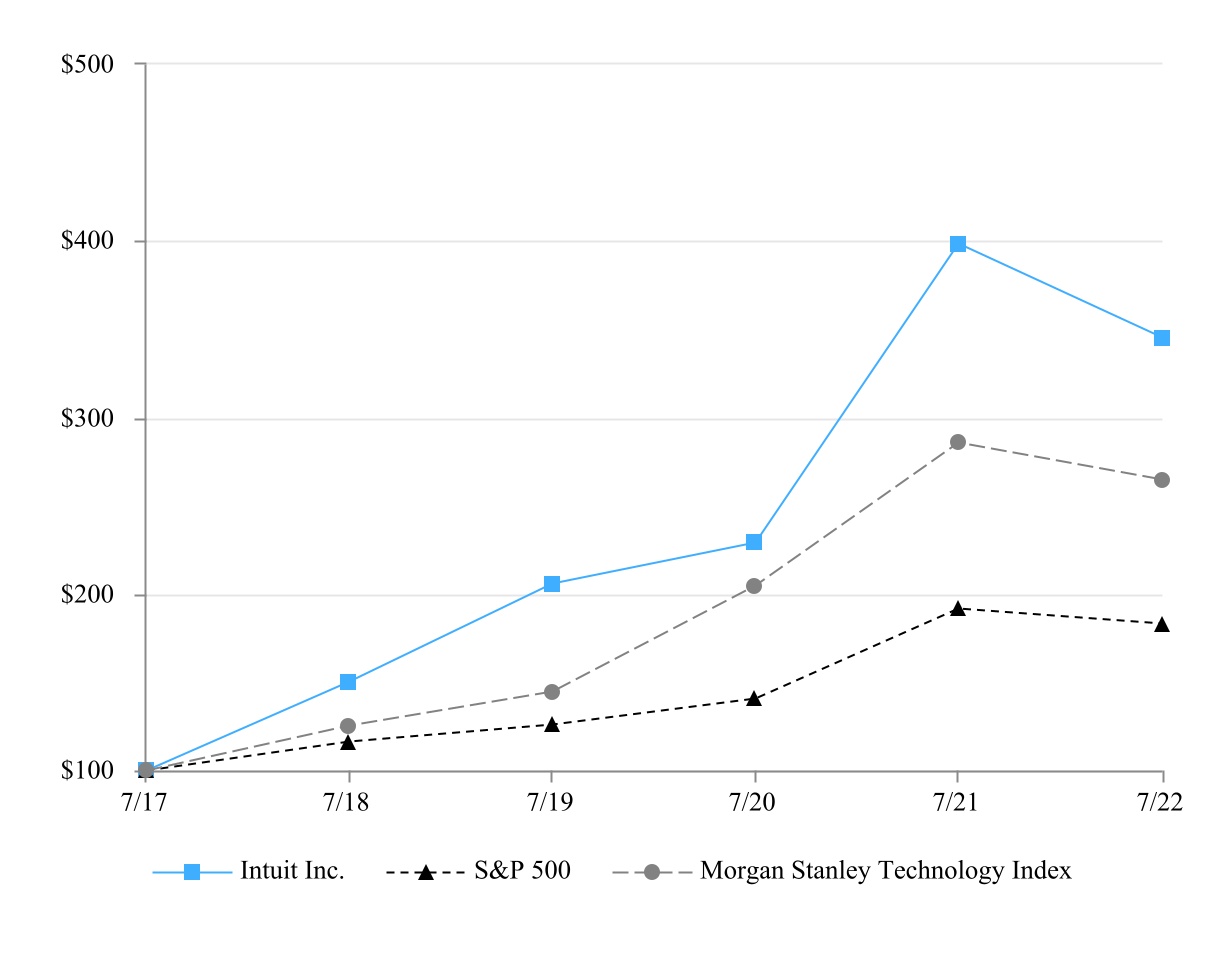
The graph below compares the cumulative total stockholder return on Intuit common stock for the last five full fiscal years with the cumulative total returns on the S&P 500 Index and the Morgan Stanley Technology Index for the same period. The graph assumes that $100 was invested in Intuit common stock and in each of the other indices on July 31, 2017, and that all dividends were reinvested. The comparisons in the graph below are based on historical data – with Intuit common stock prices based on the closing price on the dates indicated – and are not intended to forecast the possible future performance of Intuit’s common stock.
COMPARISON OF 5 YEAR CUMULATIVE TOTAL RETURN
Among Intuit Inc., the S&P 500 Index,
and Morgan Stanley Technology Index
Copyright© 2022 Standard and Poor’s, a division of S&P Global. All rights reserved.
| July 31, 2017 | July 31, 2018 | July 31, 2019 | July 31, 2020 | July 31, 2021 | July 31, 2022 | ||||||||||||||||||||||||||||||
| Intuit Inc. | $ | 100.00 | $ | 150.23 | $ | 205.62 | $ | 228.93 | $ | 398.37 | $ | 344.80 | |||||||||||||||||||||||
| S&P 500 | $ | 100.00 | $ | 116.24 | $ | 125.52 | $ | 140.53 | $ | 191.75 | $ | 182.85 | |||||||||||||||||||||||
| Morgan Stanley Technology Index | $ | 100.00 | $ | 125.17 | $ | 144.31 | $ | 204.78 | $ | 285.30 | $ | 264.57 |
Item 6. [RESERVED]
Item 7. MANAGEMENT’S DISCUSSION AND ANALYSIS OF FINANCIAL CONDITION AND RESULTS OF OPERATIONS
Management’s Discussion and Analysis of Financial Condition and Results of Operations (MD&A) is intended to provide readers of our consolidated financial statements with the perspectives of management. This should allow the readers of this report to obtain a comprehensive understanding of our businesses, strategies, current trends, and future prospects. Our MD&A includes the following sections:
| • Executive Overview: High level discussion of our operating results and some of the trends that affect our business. • Critical Accounting Policies and Estimates: Policies and estimates that we believe are important to understanding the assumptions and judgments underlying our financial statements. • Results of Operations: A more detailed discussion of our revenue and expenses. • Liquidity and Capital Resources: Discussion of key aspects of our consolidated statements of cash flows, changes in our consolidated balance sheets, and our financial commitments. |
You should note that this MD&A contains forward-looking statements that involve risks and uncertainties. Please see the section entitled “Forward-Looking Statements” immediately preceding Part I for important information to consider when evaluating such statements.
You should read this MD&A in conjunction with the consolidated financial statements and related notes in Item 8 of this Annual Report.
Due to the ongoing COVID-19, pandemic we continue to conduct business with modifications to employee work locations. Nearly all of our sites are now fully open. We are transitioning to a hybrid model where our workforce will spend a portion of their time working in our offices and a portion of their time working from home. We continue to evaluate and refine our return to workplace strategy.
The Russia-Ukraine war and related sanctions imposed as a result of this conflict have increased global economic and political uncertainty. Intuit does not have offices or material business in Russia or Ukraine.
While we have not experienced significant disruptions to our operations from the COVID-19 pandemic or the Russia-Ukraine war, we are unable to predict the full impact that these events will have on our operations and future financial performance, including demand for our offerings, impact to our customers and partners, actions that may be taken by governmental authorities, impact to the overall macroeconomic environment, and other factors identified in “Risk Factors” in Item 1A of Part I of this Annual Report.
In April 2020, Intuit was approved as a non-bank Small Business Administration lender for the Paycheck Protection Program (PPP). The PPP was authorized under the Coronavirus Aid, Relief, and Economic Security Act (CARES Act) to provide small businesses loans to pay payroll and group health costs, salaries and commissions, mortgage and rent payments, utilities, and interest on other debt which is designed to provide assistance to small businesses during the COVID-19 pandemic.
On December 3, 2020, we acquired Credit Karma in a business combination, which operates as a separate reportable segment. We have included their results of operations in our consolidated results of operations from the date of acquisition. Segment operating income for Credit Karma includes all direct expenses related to selling and marketing, product development, and general and administrative, which is different from our other reportable segments where we do not fully allocate corporate expenses. Therefore, Credit Karma segment operating income is not comparable to the segment operating income of our other reportable segments. See Note 7 to the consolidated financial statements in Item 8 of this Annual Report for more information.
On November 1, 2021, we acquired all of the outstanding equity of The Rocket Science Group LLC (Mailchimp). Mailchimp is part of our Small Business & Self-Employed segment. We have included the results of Mailchimp in our consolidated results of operations from the date of acquisition. See Note 7 to the consolidated financial statements in Item 8 of this Annual Report for more information.
On August 1, 2022, to better align our personal finance strategy, our Mint offering moved from our Consumer segment to our Credit Karma segment. We have included the results of Mint in the Consumer segment in the segment results below. Revenue and operating results for Mint are not significant and the previously reported segment results have not been reclassified. Effective August 1, 2022, the operating results for Mint will be included in the Credit Karma segment.
On August 1, 2022, we renamed our ProConnect segment as the ProTax segment. This segment continues to serve professional accountants.
| Intuit Fiscal 2018 Form 10-K | 32 | ||||||||||
| EXECUTIVE OVERVIEW |
This overview provides a high level discussion of our operating results and some of the trends that affect our business. We believe that an understanding of these trends is important in order to understand our financial results for fiscal 2022 as well as our future prospects. This summary is not intended to be exhaustive, nor is it a substitute for the detailed discussion and analysis provided elsewhere in this Annual Report on Form 10-K.
| Industry Trends and Seasonality |
Industry Trends
Artificial intelligence (AI) is transforming multiple industries, including financial technology. Disruptive start-ups, emerging ecosystems and mega-platforms are harnessing new technology to create personalized experiences, deliver data-driven insights and increase speed of service. These shifts are creating a more dynamic and highly competitive environment where customer expectations are shifting around the world as more services become digitized and the array of choices continues to increase.
Seasonality
Our Consumer and ProConnect offerings have a significant and distinct seasonal pattern as sales and revenue from our income tax preparation products and services are typically concentrated in the period from November through April. This seasonal pattern typically results in higher net revenues during our second and third quarters ending January 31 and April 30, respectively.
In fiscal 2022, the IRS began accepting returns on January 24, 2022, and the tax filing deadline was April 18, 2022. However, in fiscal 2021, the IRS began accepting returns on February 12, 2021, and the tax filing deadline was May 17, 2021. In fiscal 2020, the IRS began accepting returns on January 27, 2020, and the tax filing deadline was July 15, 2020. As a result of the extensions of the tax filing deadlines in 2021 and 2020, a significant amount of our fiscal 2021 and 2020 Consumer segment and ProConnect segment revenues were recognized in the fourth quarter as compared to the third quarter of fiscal 2022.
We expect the seasonality of our Consumer and ProConnect businesses to continue to have a significant impact on our quarterly financial results in the future.
| Key Challenges and Risks |
Our growth strategy depends upon our ability to initiate and embrace disruptive technology trends, to enter new markets, and to drive broad adoption of the products and services we develop and market. Our future growth also increasingly depends on the strength of our third-party business relationships and our ability to continue to develop, maintain, and strengthen new and existing relationships. To remain competitive and continue to grow, we are investing s
Showing the first 8K of 87K characters. Open the full section
Item 7A. QUANTITATIVE AND QUALITATIVE DISCLOSURES ABOUT MARKET RISK
Investment Portfolio and Interest Rate Risk
We actively monitor market conditions and developments specific to the securities in which we invest. We believe that we take a conservative approach to investing our funds in that we invest only in highly-rated securities and diversify our portfolio of investments. While we believe we take prudent measures to mitigate investment-related risks, such risks cannot be fully eliminated because of market circumstances that are outside our control.
Our investments consist of instruments that meet quality standards that are consistent with our investment policy. This policy specifies that, except for direct obligations of the United States government, securities issued by agencies of the United States government, and money market funds, we diversify our investments by limiting our holdings with any individual issuer. We do not hold derivative financial instruments or European sovereign debt in our portfolio of investments. See Note 2 and Note 3 to the consolidated financial statements in Item 8 of this Annual Report for a summary of the amortized cost and fair value of our investments by type of issue.
Our cash equivalents and investments are subject to market risk due to changes in interest rates. Interest rate movements affect the interest income we earn on cash equivalents and investments and the value of those investments. At July 31, 2022, our cash equivalents and investments totaled $2.5 billion and had a weighted average pre-tax yield of 1.976%. Total interest income for fiscal 2022 was $15 million. If the Federal Reserve Target Rate had increased by 25 basis points from the level of July 31, 2022, the value of our investments at that date would have decreased by approximately $2 million. If the Federal Reserve Target Rate had increased by 100 basis points from the level of July 31, 2022, the value of our investments at that date would have decreased by approximately $8 million.
We are also exposed to the impact of changes in interest rates as they affect our $5.7 billion unsecured credit facility, which includes a $1 billion unsecured revolving credit facility and a $4.7 billion unsecured term loan, and our $500 million secured revolving credit facility. Advances under the unsecured revolving credit facility accrue interest at rates that are equal to the alternate base rate plus a margin that ranges from 0.0% to 0.1% or the Secured Overnight Finance Rate (SOFR) plus a margin that ranges from 0.69% to 1.1%. The unsecured term loan accrues interest at rates that are equal to the alternate base rate plus a margin that ranges from 0.0% to 0.125% or SOFR plus a margin that ranges from 0.625% to 1.125%. Actual margins under the unsecured credit facility are based on our senior debt credit ratings. Advances under the secured revolving credit facility accrue interest at a rate of adjusted simple SOFR plus 1.5%. Consequently, our interest expense fluctuates with changes in the general level of these interest rates. At July 31, 2022, no amounts were outstanding under the unsecured revolving credit facility, $4.7 billion was outstanding under the unsecured term loan, and $230 million was outstanding under the secured revolving credit facility. See Note 8 to the consolidated financial statements in Item 8 of this Annual Report for more information.
In June 2020, we issued $2 billion of senior unsecured notes (together, the Notes) which was comprised of the following: $500 million of 0.650% notes due in July 2023, $500 million of 0.950% notes due in July 2025, $500 million of 1.350% notes due in July 2027, and $500 million of 1.650% notes due in July 2030. We carry these Notes at face value less unamortized discount and unamortized debt issuance costs on our consolidated balance sheet. Since these Notes bear interest at fixed rates, we have no financial statement risk associated with changes in interest rates. However, the fair value of these Notes fluctuates when interest rates change. See Note 2 and Note 8 to the consolidated financial statements in Item 8 of this Annual Report for more information.
Impact of Foreign Currency Rate Changes
The functional currencies of our international operating subsidiaries are generally the local currencies. We translate the assets and liabilities of our foreign subsidiaries at the exchange rates in effect on the balance sheet date. We translate revenue, costs and expenses at the average rates of exchange in effect during the period. We include translation gains and losses in the stockholders’ equity section of our consolidated balance sheets. We include net gains and losses resulting from foreign exchange transactions in interest and other income in our consolidated statements of operations.
Since we translate foreign currencies (primarily Canadian dollars, Indian rupees, and British pounds) into U.S. dollars for financial reporting purposes, currency fluctuations can have an impact on our financial results. The historical impact of currency fluctuations on our financial results has generally been immaterial. We believe that our exposure to currency exchange fluctuation risk is not significant because our global subsidiaries invoice customers and satisfy their financial obligations almost exclusively in their local currencies. We believe the impact of currency fluctuations will continue to not be significant in the foreseeable future due to the reasons cited above. As of July 31, 2022, we did not engage in foreign currency hedging activities.
| Intuit Fiscal 2022 Form 10-K | 50 | ||||||||||
Item 8. FINANCIAL STATEMENTS AND SUPPLEMENTARY DATA
1.INDEX TO CONSOLIDATED FINANCIAL STATEMENTS
The following financial statements are filed as part of this report:
2.INDEX TO FINANCIAL STATEMENT SCHEDULES
The following financial statement schedule is filed as part of this report and should be read in conjunction with the Consolidated Financial Statements:
| Schedule | Page | ||||||||||
| II | Valuation and Qualifying Accounts | 94 |
| All other schedules not listed above have been omitted because they are inapplicable or are not required. |
| Intuit Fiscal 2022 Form 10-K | 51 | ||||||||||
REPORT OF INDEPENDENT REGISTERED PUBLIC ACCOUNTING FIRM
To the Stockholders and the Board of Directors of Intuit Inc.
Opinion on the Financial Statements
We have audited the accompanying consolidated balance sheets of Intuit Inc. (the Company) as of July 31, 2022 and 2021, and the related consolidated statements of operations, comprehensive income, stockholders' equity and cash flows for each of the three years in the period ended July 31, 2022, and the related notes and the financial statement schedule listed in the Index at Item 15(a) (collectively referred to as the “consolidated financial statements”). In our opinion, the consolidated financial statements present fairly, in all material respects, the financial position of the Company at July 31, 2022 and 2021, and the results of its operations and its cash flows for each of the three years in the period ended July 31, 2022, in conformity with U.S. generally accepted accounting principles.
We also have audited, in accordance with the standards of the Public Company Accounting Oversight Board (United States) (PCAOB), the Company’s internal control over financial reporting as of July 31, 2022, based on criteria established in Internal Control-Integrated Framework issued by the Committee of Sponsoring Organizations of the Treadway Commission (2013 framework), and our report dated September 2, 2022 expressed an unqualified opinion thereon.
Basis for Opinion
These financial statements are the responsibility of the Company's management. Our responsibility is to express an opinion on the Company’s financial statements based on our audits. We are a public accounting firm registered with the PCAOB and are required to be independent with respect to the Company in accordance with the U.S. federal securities laws and the applicable rules and regulations of the Securities and Exchange Commission and the PCAOB.
We conducted our audits in accordance with the standards of the PCAOB. Those standards require that we plan and perform the audit to obtain reasonable assurance about whether the financial statements are free of material misstatement, whether due to error or fraud. Our audits included performing procedures to assess the risks of material misstatement of the financial statements, whether due to error or fraud, and performing procedures that respond to those risks. Such procedures included examining, on a test basis, evidence regarding the amounts and disclosures in the financial statements. Our audits also included evaluating the accounting principles used and significant estimates made by management, as well as evaluating the overall presentation of the financial statements. We believe that our audits provide a reasonable basis for our opinion.
Critical Audit Matters
The critical audit matters communicated below are matters arising from the current period audit of the financial statements that were communicated or required to be communicated to the audit committee and that: (1) relate to accounts or disclosures that are material to the financial statements and (2) involved our especially challenging, subjective or complex judgments. The communication of critical audit matters does not alter in any way our opinion on the consolidated financial statements, taken as a whole, and we are not, by communicating the critical audit matters below, providing separate opinions on the critical audit matters or on the accounts or disclosures to which they relate.
| Determination of Distinct Performance Obligations in Revenue Contracts | ||||||||
| Description of the Matter | As described in Note 1 to the consolidated financial statements, the Company enters into contracts with customers that often include promises to transfer multiple products and services. The Company has generally concluded that software licenses and services are separate performance obligations and revenues from software licenses and services are recognized as those products and services are provided. Given the nature of the Company’s product and service offerings, there is complexity in determining whether software licenses and services are considered performance obligations that should be accounted for separately or together. Auditing the Company’s determination of distinct performance obligations related to its various product and service offerings involved complex auditor judgment. In particular, significant judgment was required when assessing whether the promised products and services are separate performance obligations or inputs to a combined performance obligation due to the evaluation of the interdependency or interrelation of the promised products and services within each contract. |
| Intuit Fiscal 2022 Form 10-K | 52 | ||||||||||
Showing the first 8K of 219K characters. Open the full section
Item 9. CHANGES IN AND DISAGREEMENTS WITH ACCOUNTANTS ON ACCOUNTING AND FINANCIAL DISCLOSURE
None.
Item 9A. CONTROLS AND PROCEDURES
Evaluation of Disclosure Controls and Procedures
Based upon an evaluation of the effectiveness of disclosure controls and procedures, Intuit’s Chief Executive Officer (CEO) and Chief Financial Officer (CFO) have concluded that as of the end of the period covered by this Annual Report on Form 10-K our disclosure controls and procedures as defined under Exchange Act Rules 13a-15(e) and 15d-15(e) were effective to provide reasonable assurance that information required to be disclosed in our Exchange Act reports is recorded, processed, summarized, and reported within the time periods specified by the Securities and Exchange Commission and is accumulated and communicated to management, including the CEO and CFO, as appropriate to allow timely decisions regarding required disclosure.
Management’s Report on Internal Control over Financial Reporting
Our management is responsible for establishing and maintaining adequate internal control over financial reporting, as such term is defined in Exchange Act Rules 13a-15(f) and 15d-15(f). Under the supervision and with the participation of our management, including our Chief Executive Officer and Chief Financial Officer, we conducted an evaluation of the effectiveness of our internal control over financial reporting as of July 31, 2022 based on the guidelines established in Internal Control – Integrated Framework issued by the Committee of Sponsoring Organizations of the Treadway Commission (COSO).
In accordance with guidance issued by the Securities and Exchange Commission, companies are permitted to exclude acquisitions from their final assessment of internal control over financial reporting for the first fiscal year in which the acquisition occurred. Our management’s evaluation of internal control over financial reporting excluded the internal control activities of Mailchimp, which we acquired on November 1, 2021, as discussed in Note 7, “Business Combinations” of the Notes to the Consolidated Financial Statements. We have included the financial results of this acquisition in the consolidated financial statements from the date of acquisition. Total revenue subject to Mailchimp’s internal control over financial reporting represented six percent of our consolidated total revenues for the fiscal year ended July 31, 2022. Total assets and net assets subject to Mailchimp’s internal control over financial reporting represent less than one percent of both our consolidated total assets and net assets as of July 31, 2022.
Based on the results of our evaluation, our management has concluded that our internal control over financial reporting was effective as of July 31, 2022 to provide reasonable assurance regarding the reliability of financial reporting and the preparation of financial statements for external reporting purposes in accordance with generally accepted accounting principles. We reviewed the results of management’s assessment with the Audit and Risk Committee of Intuit’s Board of Directors.
Ernst & Young LLP, an independent registered public accounting firm, has audited the effectiveness of our internal control over financial reporting as of July 31, 2022. Their report is included in Item 8 of this Annual Report on Form 10-K.
Changes in Internal Control over Financial Reporting
Except as noted above, there was no change in our internal control over financial reporting during the period ended July 31, 2022 that has materially affected, or is reasonably likely to materially affect, our internal control over financial reporting.
Inherent Limitations on Effectiveness of Controls
Our management, including our Chief Executive Officer and Chief Financial Officer, believes that our disclosure controls and procedures and internal control over financial reporting are designed to provide reasonable assurance of achieving their objectives and that they are effective at the reasonable assurance level. However, no matter how well conceived and executed, a control system can provide only reasonable and not absolute assurance that the objectives of the control system are met. The design of any control system must reflect the fact that there are resource constraints and the benefits of controls must be considered relative to their costs. There are also limitations that are inherent in any control system. These limitations include the realities that breakdowns can occur because of errors in judgment or mistakes, and that controls can be circumvented by individual persons, by collusion of two or more people, or by management override of the controls. Because of these inherent limitations in a cost effective control system, misstatements due to error or fraud may occur and not be detected.
Item 9B. OTHER INFORMATION
Item 9C. DISCLOSURE REGARDING FOREIGN JURISDICTIONS THAT PREVENT INSPECTIONS
Item 10. DIRECTORS, EXECUTIVE OFFICERS AND CORPORATE GOVERNANCE
We maintain a Code of Conduct and Ethics that applies to all employees, including all officers. We also maintain a Board of Directors Code of Ethics that applies to all members of our Board of Directors. Our Code of Conduct and Ethics and Board of Directors Code of Ethics incorporate guidelines designed to deter wrongdoing and to promote honest and ethical conduct and compliance with applicable laws and regulations. Our Code of Conduct and Ethics and Board of Directors Code of Ethics are published on our Investor Relations website at https://investors.intuit.com/corporate-governance/conduct-and-guidelines/default.aspx. We disclose amendments to certain provisions of our Code of Conduct and Ethics and Board of Directors Code of Ethics, or waivers of such provisions granted to executive officers and directors, on this website.
The other information required by this Item 10 regarding directors is incorporated by reference from the information contained in our Proxy Statement to be filed with the U.S. Securities and Exchange Commission in connection with the solicitation of proxies for our 2023 Annual Meeting of Stockholders (the “2023 Proxy Statement”) under the sections entitled “Proposal No. 1 - Election of Directors – Our Board Nominees,” “Corporate Governance,” and “Delinquent Section 16(a) Reports.” Certain information required by this Item 10 regarding executive officers is set forth in Item 1 of Part I of this report under the heading “Information about our Executive Officers.”
Item 11. EXECUTIVE COMPENSATION
The information required by this Item 11 is incorporated by reference from the information contained in our 2023 Proxy Statement under the sections entitled “Compensation and Organizational Development Committee Report,” “Compensation Discussion and Analysis,” “Director Compensation,” “Equity Compensation Plan Information,” and “Executive Compensation Tables.”
Item 12. SECURITY OWNERSHIP OF CERTAIN BENEFICIAL OWNERS AND MANAGEMENT AND RELATED STOCKHOLDER MATTERS
The information required by this Item 12 is incorporated by reference from the information contained in our 2023 Proxy Statement under the sections entitled “Stock Ownership Information” and “Executive Compensation Tables.”
Item 13. CERTAIN RELATIONSHIPS AND RELATED TRANSACTIONS, AND DIRECTOR INDEPENDENCE
The information required by this Item 13 is incorporated by reference from the information contained in our 2023 Proxy Statement under the sections entitled “Corporate Governance – Director Independence” and “Transactions with Related Persons.”
Item 14. PRINCIPAL ACCOUNTANT FEES AND SERVICE
The information required by this Item 14 is incorporated by reference from the information contained in our 2023 Proxy Statement under the section entitled “Proposal No. 3 – Ratification of Selection of Independent Registered Public Accounting Firm.”
| Intuit Fiscal 2022 Form 10-K | 97 | ||||||||||
PART IV
Item 15. EXHIBITS AND FINANCIAL STATEMENT SCHEDULES
(a)The following documents are filed as part of this report:
1.Financial Statements – See Index to Consolidated Financial Statements in Part II, Item 8.
2.Financial Statement Schedules – See Index to Consolidated Financial Statements in Part II, Item 8.
3.Exhibits
| Intuit Fiscal 2022 Form 10-K | 98 | ||||||||||
| Intuit Fiscal 2022 Form 10-K | 99 | ||||||||||
| Intuit Fiscal 2022 Form 10-K | 100 | ||||||||||
| Intuit Fiscal 2022 Form 10-K | 101 | ||||||||||
| + | Indicates a management contract or compensatory plan or arrangement. | |||||||
| # | We have requested confidential treatment for certain portions of this document pursuant to an application for confidential treatment sent to the Securities and Exchange Commission (SEC). We omitted such portions from this filing and filed them separately with the SEC. | |||||||
| * | This certification is not deemed “filed” for purposes of Section 18 of the Securities Exchange Act of 1934, or otherwise subject to the liability of that section. Such certification will not be deemed to be incorporated by reference into any filing under the Securities Act of 1933 or the Securities Exchange Act of 1934, except to the extent that Intuit specifically incorporates it by reference. |
Item 16. FORM 10-K SUMMARY
None.
| Intuit Fiscal 2022 Form 10-K | 102 | ||||||||||
| SIGNATURES |
Pursuant to the requirements of Section 13 or 15(d) of the Securities Exchange Act of 1934, the Registrant has duly caused this Form 10-K to be signed on its behalf by the undersigned, thereunto duly authorized.
| INTUIT INC. | |||||||||||||||||
| Dated: | September 2, 2022 | By: | /s/ MICHELLE M. CLATTERBUCK | ||||||||||||||
| Michelle M. Clatterbuck | |||||||||||||||||
| Executive Vice President and Chief Financial Officer (Principal Financial Officer) |
| Intuit Fiscal 2022 Form 10-K | 103 | ||||||||||
| POWER OF ATTORNEY |
By signing this Annual Report on Form 10-K below, I hereby appoint each of Sasan K. Goodarzi and Michelle M. Clatterbuck as my attorney-in-fact to sign all amendments to this Form 10-K on my behalf, and to file this Form 10-K (including all exhibits and other documents related to the Form 10-K) with the Securities and Exchange Commission. I authorize each of my attorneys-in-fact to (1) appoint a substitute attorney-in-fact for himself and (2) perform any actions that he believes are necessary or appropriate to carry out the intention and purpose of this Power of Attorney. I ratify and confirm all lawful actions taken directly or indirectly by my attorneys-in-fact and by any properly appointed substitute attorneys-in-fact.
Pursuant to the requirements of the Securities Exchange Act of 1934, this report has been signed by the following persons on behalf of the Registrant and in the capacities and on the dates indicated.
| Name | Title | Date | ||||||||||||
| Principal Executive Officer: | ||||||||||||||
| /s/ SASAN K. GOODARZI | President, Chief Executive Officer and Director | September 2, 2022 | ||||||||||||
| Sasan K. Goodarzi | ||||||||||||||
| Principal Financial Officer: | ||||||||||||||
| /s/ MICHELLE M. CLATTERBUCK | Executive Vice President and Chief Financial Officer | September 2, 2022 | ||||||||||||
| Michelle M. Clatterbuck | ||||||||||||||
| Principal Accounting Officer: | ||||||||||||||
| /s/ LAUREN D. HOTZ | Senior Vice President and Chief Accounting Officer | September 2, 2022 | ||||||||||||
| Lauren D. Hotz | ||||||||||||||
| Additional Directors: | ||||||||||||||
| /s/ EVE BURTON | Director | September 2, 2022 | ||||||||||||
| Eve Burton | ||||||||||||||
| /s/ SCOTT D. COOK | Director | September 2, 2022 | ||||||||||||
| Scott D. Cook | ||||||||||||||
| /s/ RICHARD DALZELL | Director | September 2, 2022 | ||||||||||||
| Richard Dalzell | ||||||||||||||
| /s/ TEKEDRA MAWAKANA | Director | September 2, 2022 | ||||||||||||
| Tekedra Mawakana | ||||||||||||||
| /s/ DEBORAH LIU | Director | September 2, 2022 | ||||||||||||
| Deborah Liu | ||||||||||||||
| /s/ SUZANNE NORA JOHNSON | Chair of the Board of Directors | September 2, 2022 | ||||||||||||
| Suzanne Nora Johnson | ||||||||||||||
| /s/ DENNIS D. POWELL | Director | September 2, 2022 | ||||||||||||
| Dennis D. Powell | ||||||||||||||
| /s/ BRAD D. SMITH | Director | September 2, 2022 | ||||||||||||
| Brad D. Smith | ||||||||||||||
| /s/ THOMAS SZKUTAK | Director | September 2, 2022 | ||||||||||||
| Thomas Szkutak | ||||||||||||||
| /s/ RAUL VAZQUEZ | Director | September 2, 2022 | ||||||||||||
| Raul Vazquez | ||||||||||||||
| /s/ JEFF WEINER | Director | September 2, 2022 | ||||||||||||
| Jeff Weiner |
| Intuit Fiscal 2022 Form 10-K | 104 | ||||||||||