 filings.tools
Item 2. MANAGEMENT’S DISCUSSION AND ANALYSIS OF FINANCIAL CONDITION AND RESULTS OF OPERATIONS
80K characters. Original on sec.gov ·
Item 2. MANAGEMENT’S DISCUSSION AND ANALYSIS OF FINANCIAL CONDITION AND RESULTS OF OPERATIONS
Management’s Discussion and Analysis of Financial Condition and Results of Operations (MD&A) is intended to provide readers of our condensed consolidated financial statements with the perspectives of management. This should allow the readers of this report to obtain a comprehensive understanding of our businesses, strategies, current trends, and future prospects. Our MD&A includes the following sections:
| • Executive Overview: High level discussion of our operating results and some of the trends that affect our business. • Critical Accounting Policies and Estimates: Significant changes since our most recent Annual Report on Form 10-K that we believe are important to understanding the assumptions and judgments underlying our financial statements. • Results of Operations: A more detailed discussion of our revenue and expenses. • Liquidity and Capital Resources: Discussion of key aspects of our condensed consolidated statements of cash flows, changes in our condensed consolidated balance sheets, and our financial commitments. |
You should note that this MD&A contains forward-looking statements that involve risks and uncertainties. Please see the section entitled “Forward-Looking Statements” immediately preceding Part I for important information to consider when evaluating such statements.
You should read this MD&A in conjunction with the financial statements and related notes in Part I, Item 1 of this Quarterly Report and our Annual Report on Form 10-K for the fiscal year ended July 31, 2021.
The Russia-Ukraine war and related sanctions imposed as a result of this conflict have increased global economic and political uncertainty. Intuit does not have offices or material business in Russia or Ukraine.
Due to the ongoing COVID-19 pandemic we continue to conduct business with modifications to employee work locations and employee travel, among other modifications. Most of our sites are now fully open, with certain exceptions for locations where health data criteria have not yet been met. We are transitioning to a hybrid model where our workforce will spend a portion of their time working in our offices and a portion of their time working from home. We continue to evaluate and refine our return to workplace strategy.
While we have not experienced significant disruptions to our operations from the Russia-Ukraine war or the COVID-19 pandemic, we are unable to predict the full impact these events will have on our operations and future financial performance, including demand for our offerings, impact to our customers and partners, actions that may be taken by governmental authorities, impact to the overall macroeconomic environment, and other factors identified in “Risk Factors” in Item 1A of Part II of this Quarterly Report.
On December 3, 2020 we acquired Credit Karma, Inc. (Credit Karma) in a business combination, which operates as a separate reportable segment. We have included the results of operations of Credit Karma in our condensed consolidated results of operations from the date of acquisition. Segment operating income for Credit Karma includes all direct expenses related to selling and marketing, product development, and general and administrative, which is different from our other reportable segments where we do not fully allocate corporate expenses. Therefore, Credit Karma segment operating income is not comparable to the segment operating income of our other reportable segments.
On November 1, 2021 we acquired all of the outstanding equity of The Rocket Science Group LLC (Mailchimp) for total consideration of $12.0 billion which included $5.7 billion in cash and 10.1 million shares of Intuit common stock with a value of approximately $6.3 billion. Mailchimp is part of our Small Business & Self-Employed segment. See Note 5 to the financial statements in Part I, Item 1 of this Quarterly Report for more information.
| EXECUTIVE OVERVIEW |
This overview provides a high-level discussion of our operating results and some of the trends that affect our business. We believe that an understanding of these trends is important in order to understand our financial results as well as our future prospects. This summary is not intended to be exhaustive, nor is it a substitute for the detailed discussion and analysis provided elsewhere in this Quarterly Report on Form 10-Q.
| About Intuit |
Intuit helps consumers, small businesses, and the self-employed prosper by delivering financial management and compliance products and services. We also provide specialized tax products to accounting professionals, who are key partners that help us serve small business customers. We organize our businesses into four reportable segments – Small Business & Self-Employed, Consumer, Credit Karma, and ProConnect.
| Intuit Q3 Fiscal 2022 Form 10-Q | 30 |

| Small Business & Self-Employed**:** This segment serves small businesses and the self-employed around the world, and the accounting professionals who assist and advise them. Our offerings include QuickBooks financial and business management online services and desktop software, payroll solutions, merchant payment processing solutions, and financing for small businesses. Our Mailchimp offerings include e-commerce, marketing automation, and customer relationship management. Consumer**:** This segment serves consumers and includes do-it-yourself and assisted TurboTax income tax preparation products and services sold in the U.S. and Canada. Our Mint offering is a personal finance offering which helps customers track their finances and daily financial behavior. Credit Karma**:** This segment serves consumers with a personal finance platform that provides personalized recommendations of credit card, home, auto and personal loans, and insurance products; online savings and checking accounts through our partner, MVB Bank, Inc., member FDIC; and access to their credit scores and reports, credit and identity monitoring, credit report dispute, and data-driven resources. ProConnect**:** This segment serves professional accountants in the U.S. and Canada, who are essential to both small business success and tax preparation and filing. Our professional tax offerings include Lacerte, ProSeries, and ProConnect Tax Online in the U.S., and ProFile and ProTax Online in Canada. |
| Our Growth Strategy |
At Intuit, our strategy starts with customer obsession. We listen to and observe our customers, understand their challenges, and then use advanced technology, including artificial intelligence (AI), to develop innovative solutions designed to solve their most important financial problems. For more than three decades, we have reinvented and disrupted ourselves in order to ensure our customers are armed with the technology they need to grow and prosper.
Our strategy for delivering on our bold goals is to become an AI-driven expert platform where we and others can solve our customers' most important problems. We plan to accelerate the development of the platform by applying AI in the three key areas:
-
An Open Platform: None of us can do it alone, including Intuit. The best way to deliver for customers is by creating an open, collaborative platform. It’s the power of partnerships that accelerates the world’s success. Our open technology platform integrates with partners so together we can deliver value and benefits that matter the most to our customers.
-
Application of AI: AI helps our customers work smarter because we can automate, predict and personalize their experience. Using AI technologies, we are: leveraging machine learning to build decision engines and algorithms that learn from rich datasets to transform user experiences; applying knowledge engineering and turning compliance rules into code; and using natural language processing to revolutionize how customers interact with products and services.
-
Incorporating Experts: One of the biggest problems our customers face is confidence. Even with current advances in technology that deliver personalized tools and insights, many people want to connect with a real person to help give them the confidence they are making the right decision. By bringing experts onto our platform we can solve this massive problem for customers. The power of our virtual expert platform allows us to scale the intelligence of our products, elevating experts to advisors and delivering big benefits for customers.
| Intuit Q3 Fiscal 2022 Form 10-Q | 31 |
As we build our AI-driven expert platform, we are prioritizing our resources on five strategic priorities across the company. These priorities focus on solving the problems that matter most to customers and include:
-
Revolutionizing speed to benefit****:** When customers use our products and services, we aim to deliver value instantly by making the interactions with our offerings frictionless, without the need for customers to manually enter data. We are accelerating the application of AI with a goal to revolutionize the customer experience. This priority is foundational across our business, and execution against it positions us to succeed with our other four strategic priorities.
-
Connecting people to experts****:** The largest problem our customers face is lack of confidence to file their own taxes or to manage their books. To build their confidence, we are connecting our customers to experts. We offer customers access to experts to help them make important decisions – and experts, such as accountants, gain access to new customers so they can grow their businesses.
-
Unlocking smart money decisions****:** Crippling high-cost debt and lack of savings are at unprecedented levels across the U.S. To address these challenges, we are creating a personal financial assistant that helps consumers find the right financial products, put more money in their pockets and access financial expertise and advice. Credit Karma accelerates our ability to achieve this vision, by combining two trusted brands, customer reach, data and platform capabilities to deliver breakthrough benefits that will power prosperity for customers around the world.
-
Be the center of small business growth****:** We are focused on helping customers grow their businesses by offering a broad, seamless set of tools that are designed to help them get and retain customers, get paid faster, manage and get access to capital, pay employees with confidence, and use third-party apps to help run their businesses. At the same time, we want to position ourselves to better serve product-based businesses to benefit customers who sell products through multiple channels.
-
Disrupt the small business mid-market****:** We aim to disrupt the mid-market with QuickBooks Online Advanced, our online offering designed to address the needs of small business customers with 10 to 100 employees. This offering enables us to increase retention of these larger customers, and attract new mid-market customers who are over-served by available offerings.
We expect our acquisition of Mailchimp will help accelerate two of our strategic priorities to become the center of small business growth and to disrupt the small business mid-market.
| Industry Trends and Seasonality |
Industry Trends
AI is transforming multiple industries, including financial technology. Disruptive start-ups, emerging ecosystems and mega-platforms are harnessing new technology to create personalized experiences, deliver data-driven insights and increase speed of service. These shifts are creating a more dynamic and highly competitive environment where customer expectations are shifting around the world as more services become digitized and the array of choices continues to increase.
Seasonality
Our Consumer and ProConnect offerings have a significant and distinct seasonal pattern as sales and revenue from our income tax preparation products and services are heavily concentrated in the period from November through April. Typically, returns are accepted by the IRS starting in January and the tax filing deadline is in April. This seasonal pattern results in higher net revenues during our second and third quarters ending January 31 and April 30, respectively.
In fiscal 2022 the IRS began accepting returns on January 24, 2022 and the tax filing deadline was April 18, 2022. However, in fiscal 2021 the IRS began accepting returns on February 12, 2021 and the tax filing deadline was extended to May 17, 2021. As a result of the extension in the tax filing deadline in 2021, a significant amount of our fiscal 2021 Consumer segment and ProConnect segment revenues was recognized in the fourth quarter as compared to the third quarter in fiscal 2022.
We expect the seasonality of our Consumer and ProConnect businesses to continue to have a significant impact on our quarterly financial results in the future.
| Key Challenges and Risks |
Our growth strategy depends upon our ability to initiate and embrace disruptive technology trends, to enter new markets, and to drive broad adoption of the products and services we develop and market. Our future growth also increasingly depends on the strength of our third-party business relationships and our ability to continue to develop, maintain and strengthen new and existing relationships. To remain competitive and continue to grow, we are investing significant resources in our product development, marketing, and sales capabilities, and we expect to continue to do so in the future.
As we offer more online services, the ongoing operation and availability of our platforms and systems and those of our external service providers is becoming increasingly important. Because we help customers manage their financial lives, we face risks associated with the hosting, collection, use, and retention of personal customer information and data. We are investing
| Intuit Q3 Fiscal 2022 Form 10-Q | 32 |
significant management attention and resources in our information technology infrastructure and in our privacy and security capabilities, and we expect to continue to do so in the future.
For our consumer and professional tax offerings, we have implemented additional security measures and are continuing to work with state and federal governments to implement industry-wide security and anti-fraud measures, including sharing information regarding suspicious filings. We received ISO 27001 certification for a portion of our systems and we continue to invest in security measures and to work with the broader industry and government to protect our customers against this type of fraud. Additionally, Credit Karma’s security measures are regularly reviewed and updated.
For a complete discussion of the most significant risks and uncertainties affecting our business, please see “Forward-Looking Statements” immediately preceding Part I and “Risk Factors” in Item 1A of Part II of this Quarterly Report.
| Overview of Financial Results |
The most important financial indicators that we use to assess our business are revenue growth for the company as a whole and for each reportable segment; operating income growth for the company as a whole; earnings per share; and cash flow from operations. We also track certain non-financial drivers of revenue growth and, when material, identify them in the applicable discussions of segment results below. Service offerings are a significant part of our business. Our total service and other revenue was $7.9 billion or 82% of our total revenue in fiscal 2021 and we expect our total service and other revenue to continue to grow in the future.
Key highlights for the first nine months of fiscal 2022 include the following:
| Revenue of | Consumer revenue of | Small Business & Self-Employed revenue of | ||||||||||||
| $10.3 B | $3.8 B | $4.7 B | ||||||||||||
| up 46% from the same period of fiscal 2021 | up 39% from same period of fiscal 2021 | up 37% from the same period of fiscal 2021 | ||||||||||||
| Operating income of | Net income of | Diluted net income per share of | ||||||||||||
| $2.6 B | $2.1 B | $7.48 | ||||||||||||
| up 26% from the same period of fiscal 2021 | up 26% from the same period of fiscal 2021 | up 21% from the same period of fiscal 2021 |
| CRITICAL ACCOUNTING POLICIES AND ESTIMATES |
In preparing our financial statements, we make estimates, assumptions and judgments that can have a significant impact on our net revenue, operating income or loss, and net income or loss, as well as on the value of certain assets and liabilities on our condensed consolidated balance sheets. We believe that the estimates, assumptions and judgments involved in the accounting policies described in Management’s Discussion and Analysis of Financial Condition and Results of Operations in Part II, Item 7 of our Annual Report on Form 10-K for the fiscal year ended July 31, 2021 have the greatest potential impact on our financial statements, so we consider them to be our critical accounting policies and estimates. We believe that there were no significant changes in those critical accounting policies and estimates during the first nine months of fiscal 2022. Senior management has reviewed the development and selection of our critical accounting policies and estimates and their disclosure in this Quarterly Report on Form 10-Q with the Audit and Risk Committee of our Board of Directors.
| Intuit Q3 Fiscal 2022 Form 10-Q | 33 |
| RESULTS OF OPERATIONS |
| Financial Overview | |||||||||||||||||||||||||||||||||||||||||||||||
| (Dollars in millions, except per share amounts) | Q3 FY22 | Q3 FY21 | $ Change | % Change | YTD Q3 FY22 | YTD Q3 FY21 | $ Change | % Change | |||||||||||||||||||||||||||||||||||||||
| Total net revenue | $ | 5,632 | $ | 4,173 | $ | 1,459 | 35 | % | $ | 10,312 | $ | 7,072 | $ | 3,240 | 46 | % | |||||||||||||||||||||||||||||||
| Operating income | 2,395 | 1,914 | 481 | 25 | % | 2,646 | 2,098 | 548 | 26 | % | |||||||||||||||||||||||||||||||||||||
| Net income | 1,794 | 1,464 | 330 | 23 | % | 2,122 | 1,682 | 440 | 26 | % | |||||||||||||||||||||||||||||||||||||
| Diluted net income per share | $ | 6.28 | $ | 5.30 | $ | 0.98 | 18 | % | $ | 7.48 | $ | 6.20 | $ | 1.28 | 21 | % |
Current Fiscal Quarter
Total net revenue for the third quarter of fiscal 2022 increased $1.5 billion or 35% compared with the same quarter of fiscal 2021. Revenue for our Consumer and ProConnect segments increased compared to the same period in fiscal 2021 as a result of the extended IRS tax filing deadline in fiscal 2021 discussed above. This shifted a certain amount of revenue from our third quarter to our fourth quarter during fiscal 2021, compared to fiscal 2022, when the tax filing deadline in the U.S. was not extended. Consumer segment revenue also increased due to a shift in mix to our higher priced offerings including TurboTax Live and our Premier offering. Our Small Business & Self-Employed segment revenue increased during the quarter primarily due to growth in our Online Ecosystem revenue, which included $257 million of revenue from Mailchimp. Revenue for our Credit Karma segment increased $152 million in the third quarter of fiscal 2022 compared to the same period of fiscal 2021 primarily due to growth in our personal loan and credit card verticals. See “Segment Results” later in this Item 2 for more information about the results for all of our reportable segments.
Operating income for the third quarter of fiscal 2022 increased $481 million or 25% compared with the same quarter of fiscal 2021 due to the increase in revenue described above, which was partially offset by an increase in expenses for marketing, staffing, share-based compensation, and amortization of other acquired intangible assets. We also incurred a $141 million one-time charge related to the company’s settlement with the 50 state attorneys general and the District of Columbia, entered into on May 4, 2022. See "Cost of Revenue" and “Operating Expenses” later in this Item 2 for more information.
Net income for the third quarter of fiscal 2022 increased $330 million or 23% compared with the same period of fiscal 2021. The increase in net income was due to the increase in operating income described above, partially offset by an increase in tax expense and an increase in interest expense due to borrowing $4.7 billion on a term loan in fiscal 2022. Diluted net income per share increased 18% to $6.28 for the third quarter of fiscal 2022, due to the increase in net income partially offset by an increase in the weighted average shares outstanding as a result of the shares issued as part of the acquisition of Mailchimp in fiscal 2022.
Fiscal Year to Date
Total net revenue for the first nine months of fiscal 2022 increased $3.2 billion or 46% compared with the same period of fiscal 2021. Our Small Business & Self-Employed segment revenue increased during the period due to growth in our Online Ecosystem revenue, which included $497 million of revenue from Mailchimp. Revenue for our Consumer and ProConnect segments increased compared to the same period in fiscal 2021 as a result of the extended IRS tax filing deadline in fiscal 2021 discussed above. This shifted a certain amount of revenue from our third quarter to our fourth quarter during fiscal 2021, compared to fiscal 2022, when the tax filing deadline in the U.S. was not extended. Consumer segment revenue also increased due to a shift in mix to our higher priced offerings including TurboTax Live and our Premier offering. Revenue for our Credit Karma segment increased $870 million in the first nine months of fiscal 2022 compared to the same period of fiscal 2021. Our fiscal 2021 results of operations included Credit Karma from the date of acquisition, which was December 3, 2020 and our fiscal 2022 results of operations include Credit Karma for the full reporting period. Additionally, Credit Karma revenue increased year over year primarily due to growth in our credit card and personal loan verticals. See “Segment Results” later in this Item 2 for more information about the results for all of our reportable segments.
Operating income for the first nine months of fiscal 2022 increased $548 million or 26% compared with the same period of fiscal 2021 primarily due to the increase in revenue described above, partially offset by an increase in expenses for staffing, marketing, share-based compensation, and amortization of other acquired intangible assets. We also incurred a $141 million one-time charge related to the company’s settlement with the 50 state attorneys general and the District of Columbia, entered into on May 4, 2022. See "Cost of Revenue" and “Operating Expenses” later in this Item 2 for more information.
Net income for the first nine months of fiscal 2022 increased $440 million or 26% compared with the same period of fiscal 2021. The increase in net income was due to the increase in operating income described above partially offset by an increase in tax expense and an increase in interest expense due to borrowing $4.7 billion on a term loan in fiscal 2022. Diluted net income per share increased 21% to $7.48 for the first nine months of fiscal 2022, due to the increase in net income partially offset by an increase in the weighted average shares outstanding as a result of the shares issued as part of the acquisition of Mailchimp in fiscal 2022.
| Intuit Q3 Fiscal 2022 Form 10-Q | 34 |
| Segment Results |
The information below is organized in accordance with our four reportable segments. See “Executive Overview – About Intuit” earlier in this Item 2 and Note 12 to the financial statements in Part I, Item 1 of this Quarterly Report for more information. All of our segments operate and sell to customers primarily in the United States. Total international net revenue was approximately 6% and 7% for the three and nine months ended April 30, 2022, respectively and less than 5% for the three and nine months ended April 30, 2021.
On December 3, 2020 we acquired Credit Karma in a business combination which operates as a separate reportable segment. We have included the results of operations of Credit Karma in our condensed consolidated results of operations from the date of acquisition.
On November 1, 2021 we acquired Mailchimp in a business combination. Mailchimp is part of our Small Business & Self-Employed segment. We have included the results of operations of Mailchimp in our condensed consolidated results of operations from the date of acquisition.
Segment operating income or loss is segment net revenue less segment cost of revenue and operating expenses. See “Executive Overview – Industry Trends and Seasonality” earlier in this Item 2 for a description of the seasonality of our business. For our Small Business & Self-Employed, Consumer, and ProConnect reportable segments, we include expenses such as corporate selling and marketing, product development, general and administrative, and non-employment related legal and litigation settlement costs, which are not allocated to specific segments, in unallocated corporate items as part of other corporate expenses. For Credit Karma, segment expenses include all direct expenses related to selling and marketing, product development, and general and administrative. Unallocated corporate items for all segments include share-based compensation, amortization of acquired technology, amortization of other acquired intangible assets, goodwill and intangible asset impairment charges, and professional fees and transaction charges related to business combinations. These unallocated corporate items for all segments totaled $3.2 billion in the first nine months of fiscal 2022 and $2.0 billion in the first nine months of fiscal 2021. Unallocated corporate items increased in the fiscal 2022 period due to increased corporate product development, selling and marketing, and general and administrative expenses in support of the growth of our businesses, higher share-based compensation expenses, higher amortization of acquired technology, and higher amortization of other acquired intangible assets. See Note 12 to the financial statements in Part I, Item 1 of this Quarterly Report for reconciliations of total segment operating income or loss to consolidated operating income or loss for each fiscal period presented.
| Intuit Q3 Fiscal 2022 Form 10-Q | 35 |
| Small Business & Self-Employed |
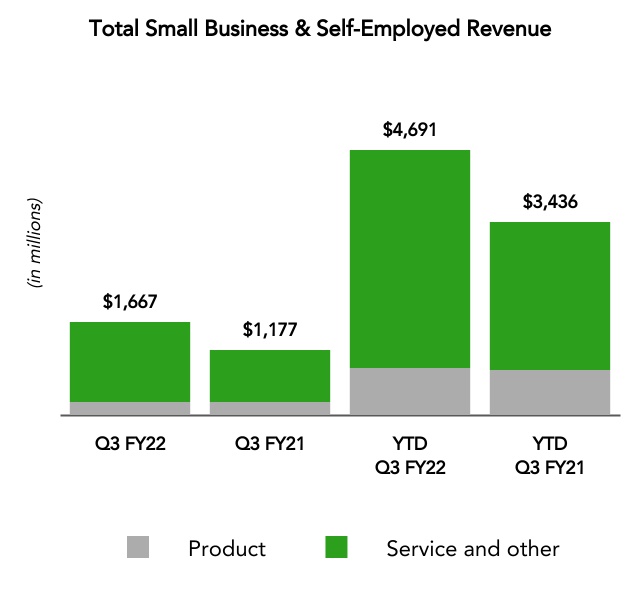
Small Business & Self-Employed segment includes both Online Ecosystem and Desktop Ecosystem revenue.
Our Online Ecosystem includes revenue from QuickBooks Online, QuickBooks Live, QuickBooks Online Advanced and QuickBooks Self-Employed financial and business management offerings; small business payroll services, including QuickBooks Online Payroll, Intuit Online Payroll, Intuit Full Service Payroll; merchant payment processing services for small businesses who use online offerings; Mailchimp’s e-commerce, marketing automation, and customer relationship management offerings; QuickBooks Commerce, QuickBooks Cash, and financing for small businesses.
Our Desktop Ecosystem includes revenue from our QuickBooks Desktop packaged software products (Desktop Pro, Desktop for Mac, Desktop Premier, and QuickBooks Point of Sale); QuickBooks Desktop software subscriptions (QuickBooks Desktop Pro Plus, QuickBooks Desktop Premier Plus, and QuickBooks Enterprise, and ProAdvisor Program memberships for the accounting professionals who serve small businesses); desktop payroll products (QuickBooks Basic Payroll, QuickBooks Assisted Payroll and QuickBooks Enhanced Payroll); merchant payment processing services for small businesses who use desktop offerings; financial supplies; and financing for small businesses.
Segment product revenue is primarily derived from revenue related to delivery of software licenses and the related updates, including version protection, for our QuickBooks Desktop subscriptions and desktop payroll offerings which are part of our Desktop Ecosystem. Segment service and other revenue is primarily derived from our Online Ecosystem revenue and revenue from the services and support that are provided as part of our QuickBooks Desktop subscription and desktop payroll offerings as well as merchant payment processing services.
| (Dollars in millions) | Q3 FY22 | Q3 FY21 | % Change | YTD Q3 FY22 | YTD Q3 FY21 | % Change | |||||||||||||||||||||||||||||
| Product revenue | $ | 247 | $ | 250 | (1) | % | $ | 858 | $ | 825 | 4 | % | |||||||||||||||||||||||
| Service and other revenue | 1,420 | 927 | 53 | % | 3,833 | 2,611 | 47 | % | |||||||||||||||||||||||||||
| Total segment revenue | $ | 1,667 | $ | 1,177 | 42 | % | $ | 4,691 | $ | 3,436 | 37 | % | |||||||||||||||||||||||
| % of total revenue | 30 | % | 28 | % | 45 | % | 49 | % | |||||||||||||||||||||||||||
| Segment operating income | $ | 836 | $ | 620 | 35 | % | $ | 2,530 | $ | 1,979 | 28 | % | |||||||||||||||||||||||
| % of related revenue | 50 | % | 53 | % | 54 | % | 58 | % |
| Intuit Q3 Fiscal 2022 Form 10-Q | 36 |
Revenue classified by significant product and service offerings was as follows:
| (Dollars in millions) | Q3 FY22 | Q3 FY21 | % Change | YTD Q3 FY22 | YTD Q3 FY21 | % Change | |||||||||||||||||||||||||||||
| Net revenue: | |||||||||||||||||||||||||||||||||||
| QuickBooks Online Accounting | $ | 578 | $ | 437 | 32 | % | $ | 1,644 | $ | 1,233 | 33 | % | |||||||||||||||||||||||
| Online Services | 614 | 278 | 121 | % | 1,514 | 747 | 103 | % | |||||||||||||||||||||||||||
| Total Online Ecosystem | 1,192 | 715 | 67 | % | 3,158 | 1,980 | 59 | % | |||||||||||||||||||||||||||
| QuickBooks Desktop Accounting | 201 | 193 | 4 | % | 637 | 594 | 7 | % | |||||||||||||||||||||||||||
| Desktop Services and Supplies | 274 | 269 | 2 | % | 896 | 862 | 4 | % | |||||||||||||||||||||||||||
| Total Desktop Ecosystem | 475 | 462 | 3 | % | 1,533 | 1,456 | 5 | % | |||||||||||||||||||||||||||
| Total Small Business & Self-Employed | $ | 1,667 | $ | 1,177 | 42 | % | $ | 4,691 | $ | 3,436 | 37 | % |
Revenue for our Small Business & Self-Employed segment increased $490 million or 42% in the third quarter of fiscal 2022 and $1.3 billion or 37% in the first nine months of fiscal 2022 compared with the same periods of fiscal 2021. The increase in both periods was primarily due to growth in Online Ecosystem revenue, which included $257 million of revenue from Mailchimp for the third quarter of fiscal 2022 and $497 million in the first nine months of fiscal 2022.
Online Ecosystem Revenue
Online Ecosystem revenue increased 67% in the third quarter of fiscal 2022 and 59% in the first nine months of fiscal 2022 compared with the same periods of fiscal 2021. QuickBooks Online Accounting revenue increased 32% in the third quarter of fiscal 2022 and 33% in the first nine months of fiscal 2022 primarily due to higher effective prices, an increase in customers, and a shift in mix to our higher priced offerings. Online Services revenue increased 121% in the third quarter of fiscal 2022 and 103% in the first nine months of fiscal 2022 primarily due to the addition of revenue from the Mailchimp offerings and an increase in revenue from our payroll and payments offerings. Online payroll revenue increased due to an increase in customers and a shift in mix to our full service offering. Online payments revenue increased due to an increase in charge volume per customer and an increase in customers.
Desktop Ecosystem Revenue
Desktop Ecosystem revenue increased 3% in the third quarter and 5% in the first nine months of fiscal 2022 compared with the same periods of fiscal 2021 due to growth in our QuickBooks Enterprise subscription offering which was partially offset by a decrease in Desktop unit sales. In the first quarter of fiscal 2022 we discontinued our QuickBooks Desktop packaged software products and now sell predominantly on a subscription basis. Additionally, during the three and nine months ended April 30, 2022 there was an increase in revenue from our Desktop Payroll and Desktop Payments offerings.
Small Business & Self-Employed segment operating income increased 35% in the third quarter of fiscal 2022 and 28% in the first nine months of fiscal 2022 compared with the same periods of fiscal 2021, primarily due to the increases in revenue described above, which was partially offset by higher expenses for staffing, marketing, and outside services.
| Intuit Q3 Fiscal 2022 Form 10-Q | 37 |
| Consumer |
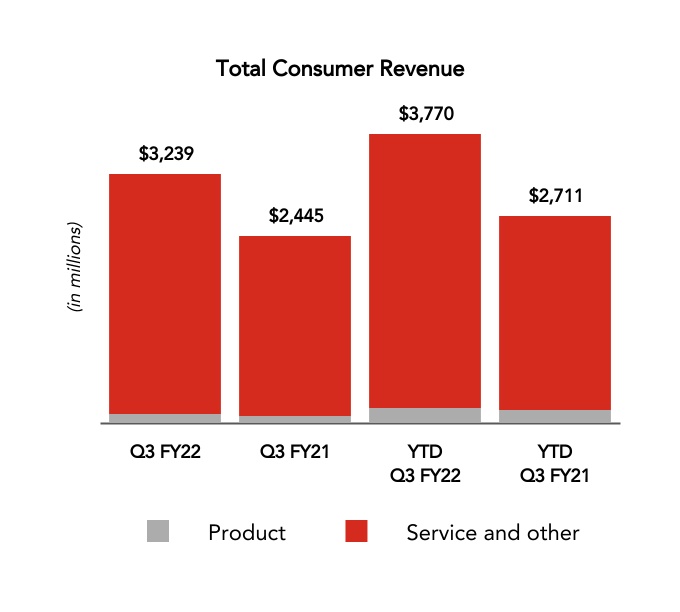
Consumer segment product revenue is derived primarily from TurboTax desktop tax return preparation software and related form updates.
Consumer segment service and other revenue is derived primarily from TurboTax Online and TurboTax Live offerings, electronic tax filing services and connected services, and also from our Mint offering.
| (Dollars in millions) | Q3 FY22 | Q3 FY21 | % Change | YTD Q3 FY22 | YTD Q3 FY21 | % Change | |||||||||||||||||||||||||||||
| Product revenue | $ | 131 | $ | 110 | 19 | % | $ | 203 | $ | 183 | 11 | % | |||||||||||||||||||||||
| Service and other revenue | 3,108 | 2,335 | 33 | % | 3,567 | 2,528 | 41 | % | |||||||||||||||||||||||||||
| Total segment revenue | $ | 3,239 | $ | 2,445 | 32 | % | $ | 3,770 | $ | 2,711 | 39 | % | |||||||||||||||||||||||
| % of total revenue | 57 | % | 58 | % | 37 | % | 38 | % | |||||||||||||||||||||||||||
| Segment operating income | $ | 2,447 | $ | 1,773 | 38 | % | $ | 2,489 | $ | 1,622 | 53 | % | |||||||||||||||||||||||
| % of related revenue | 76 | % | 73 | % | 66 | % | 60 | % |
Revenue for our Consumer segment increased $1.1 billion or 39% in the first nine months of fiscal 2022 compared with the same period of fiscal 2021 primarily due to the earlier tax filing deadline in fiscal 2022, as well as a shift in mix to our higher priced product offerings including TurboTax Live and our Premier offering. The tax filing deadline in fiscal 2022 was April 18, 2022, as opposed to May 17, 2021 in the prior year.
Segment operating income increased $867 million or 53% in the first nine months of fiscal 2022 compared with the same period of fiscal 2021 primarily due to the increase in revenue described above, which was partially offset by higher expenses for marketing and staffing.
| Intuit Q3 Fiscal 2022 Form 10-Q | 38 |
| Credit Karma |
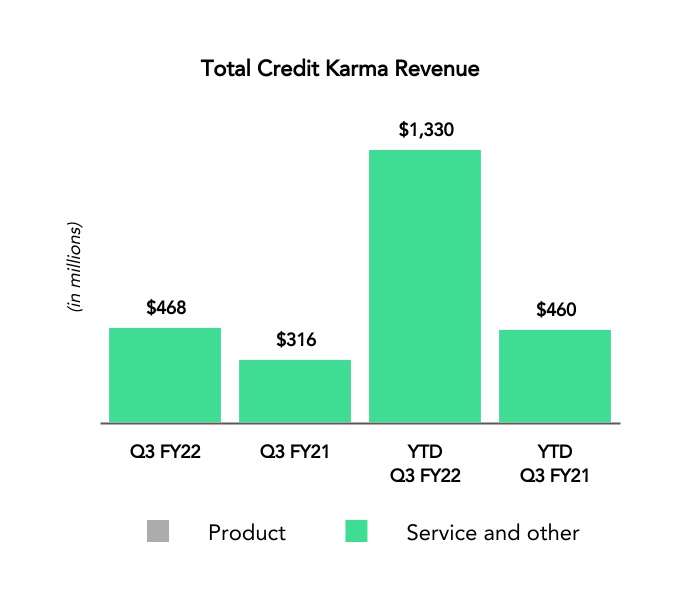
Credit Karma revenue is derived from cost-per-action transactions, which include the delivery of qualified links that result in completed actions such as credit card issuances and personal loan funding; and cost-per-click and cost-per-lead transactions, which include user clicks on advertisements or advertisements that allow for the generation of leads, and primarily relate to mortgage and insurance businesses.
| (Dollars in millions) | Q3 FY22 | Q3 FY21 | % Change | YTD Q3 FY22 | YTD Q3 FY21 | % Change | |||||||||||||||||||||||||||||
| Product revenue | $ | — | $ | — | N/A | $ | — | $ | — | N/A | |||||||||||||||||||||||||
| Service and other revenue | 468 | 316 | 48 | % | 1,330 | 460 | 189 | % | |||||||||||||||||||||||||||
| Total segment revenue | $ | 468 | $ | 316 | 48 | % | $ | 1,330 | $ | 460 | 189 | % | |||||||||||||||||||||||
| % of total revenue | 8 | % | 8 | % | 13 | % | 6 | % | |||||||||||||||||||||||||||
| Segment operating income | $ | 104 | $ | 117 | (11) | % | $ | 414 | $ | 155 | 167 | % | |||||||||||||||||||||||
| % of related revenue | 22 | % | 37 | % | 31 | % | 34 | % |
We acquired Credit Karma on December 3, 2020. Our results of operations include the operations of Credit Karma beginning on the date of acquisition.
Revenue increased $152 million in the third quarter of fiscal 2022 and $870 million in the first nine months of fiscal 2022 compared to the same periods of fiscal 2021. Our fiscal 2021 results of operations include Credit Karma from the date of acquisition, which was December 3, 2020 and our fiscal 2022 results of operations include Credit Karma for the full reporting period. Additionally, Credit Karma revenue increased year over year primarily due to growth in our credit card and personal loan verticals.
Credit Karma segment operating income decreased $13 million in the third quarter of fiscal 2022 compared to the same period of fiscal 2021 primarily due to higher expenses for marketing and staffing, partially offset by the increase in revenue described above. Credit Karma segment operating income increased $259 million in the first nine months of fiscal 2022 compared with the same period of fiscal 2021, primarily due to the increase in revenue described above, which was partially offset by higher expenses for marketing and staffing.
| Intuit Q3 Fiscal 2022 Form 10-Q | 39 |
| ProConnect |
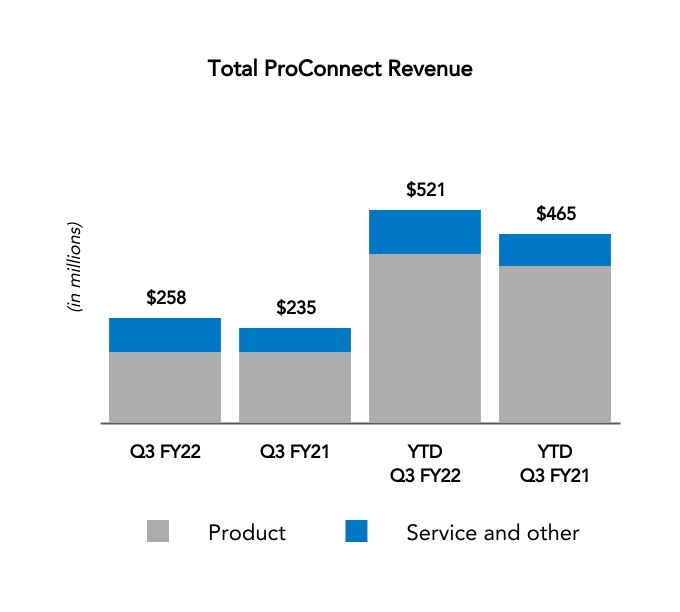
ProConnect segment product revenue is derived primarily from Lacerte, ProSeries, and ProFile desktop tax preparation software products and related form updates.
ProConnect segment service and other revenue is derived primarily from ProConnect Tax Online tax products, electronic tax filing service, connected services and, bank products.
| (Dollars in millions) | Q3 FY22 | Q3 FY21 | % Change | YTD Q3 FY22 | YTD Q3 FY21 | % Change | |||||||||||||||||||||||||||||
| Product revenue | $ | 176 | $ | 173 | 2 | % | $ | 415 | $ | 387 | 7 | % | |||||||||||||||||||||||
| Service and other revenue | 82 | 62 | 32 | % | 106 | 78 | 36 | % | |||||||||||||||||||||||||||
| Total segment revenue | $ | 258 | $ | 235 | 10 | % | $ | 521 | $ | 465 | 12 | % | |||||||||||||||||||||||
| % of total revenue | 5 | % | 6 | % | 5 | % | 7 | % | |||||||||||||||||||||||||||
| Segment operating income | $ | 213 | $ | 196 | 9 | % | $ | 397 | $ | 358 | 11 | % | |||||||||||||||||||||||
| % of related revenue | 83 | % | 83 | % | 76 | % | 77 | % |
Revenue for our ProConnect segment revenue increased $56 million or 12% in the first nine months of fiscal 2022 compared with the same period of fiscal 2021 primarily due to the earlier tax filing deadline in fiscal 2022, as well as a higher average revenue per customer and customer growth. The tax filing deadline in fiscal 2022 was April 18, 2022, as opposed to May 17, 2021 in the prior year.
Segment operating income increased $39 million or 11% in the first nine months of fiscal 2022 compared with the same period of fiscal 2021 primarily due to the increase in revenue described above, which was partially offset by higher expenses for staffing.
| Intuit Q3 Fiscal 2022 Form 10-Q | 40 |
| Cost of Revenue | |||||||||||||||||||||||||||||||||||||||||||||||
| (Dollars in millions) | Q3 FY22 | % of Related Revenue | Q3 FY21 | % of Related Revenue | YTD Q3 FY22 | % of Related Revenue | YTD Q3 FY21 | % of Related Revenue | |||||||||||||||||||||||||||||||||||||||
| Cost of product revenue | $ | 18 | 3 | % | $ | 16 | 3 | % | $ | 53 | 4 | % | $ | 53 | 4 | % | |||||||||||||||||||||||||||||||
| Cost of service and other revenue | 764 | 15 | % | 565 | 16 | % | 1,654 | 19 | % | 1,130 | 20 | % | |||||||||||||||||||||||||||||||||||
| Amortization of acquired technology | 42 | n/a | 14 | n/a | 99 | n/a | 35 | n/a | |||||||||||||||||||||||||||||||||||||||
| Total cost of revenue | $ | 824 | 15 | % | $ | 595 | 14 | % | $ | 1,806 | 18 | % | $ | 1,218 | 17 | % |
Our cost of revenue has three components: (1) cost of product revenue, which includes the direct costs of manufacturing and shipping or electronically downloading our desktop software products; (2) cost of service and other revenue, which includes the direct costs associated with our online and service offerings, such as costs for data processing and storage capabilities from cloud providers, customer support costs, costs for the tax and bookkeeping experts that support our TurboTax Live and QuickBooks Live offerings, and costs related to credit score providers; and (3) amortization of acquired technology which represents the cost of amortizing developed technologies that we have obtained through acquisitions over their useful lives.
Cost of product revenue as a percentage of product revenue was relatively consistent in the third quarter and first nine months of fiscal 2022 compared with the same periods of fiscal 2021. We expense costs of product revenue as they are incurred for delivered software and we do not defer any of these costs when product revenue is deferred.
Cost of service and other revenue as a percentage of service and other revenue was relatively consistent in both the third quarter and first nine months of fiscal 2022 compared with the same periods of fiscal 2021.
| Operating Expenses | |||||||||||||||||||||||||||||||||||||||||||||||
| (Dollars in millions) | Q3 FY22 | % of Total Net Revenue | Q3 FY21 | % of Total Net Revenue | YTD Q3 FY22 | % of Total Net Revenue | YTD Q3 FY21 | % of Total Net Revenue | |||||||||||||||||||||||||||||||||||||||
| Selling and marketing | $ | 1,227 | 22 | % | $ | 857 | 21 | % | $ | 2,719 | 26 | % | $ | 1,799 | 25 | % | |||||||||||||||||||||||||||||||
| Research and development | 600 | 11 | % | 464 | 11 | % | 1,720 | 17 | % | 1,157 | 16 | % | |||||||||||||||||||||||||||||||||||
| General and administrative | 465 | 8 | % | 289 | 7 | % | 1,126 | 11 | % | 708 | 10 | % | |||||||||||||||||||||||||||||||||||
| Amortization of other acquired intangible assets | 121 | 2 | % | 54 | 1 | % | 295 | 3 | % | 92 | 1 | % | |||||||||||||||||||||||||||||||||||
| Total operating expenses | $ | 2,413 | 43 | % | $ | 1,664 | 40 | % | $ | 5,860 | 57 | % | $ | 3,756 | 53 | % |
Current Fiscal Quarter
Total operating expenses as a percentage of total net revenue increased in the third quarter of fiscal 2022 compared to the same period of fiscal 2021. Total net revenue for the third quarter of fiscal 2022 increased $1.5 billion or 35% due to the increases in revenue described above, while total operating expenses for the quarter increased $749 million or 45%. Total operating expenses increased $250 million for marketing, $104 million for share-based compensation, $96 million for staffing due to higher headcount, and $67 million for amortization of other acquired intangible assets, which was primarily related to Credit Karma and Mailchimp. We also incurred a $141 million one-time charge related to the company’s settlement with the 50 state attorneys general and the District of Columbia, entered into on May 4, 2022.
Fiscal Year to Date
Total operating expenses as a percentage of total net revenue increased in the first nine months of fiscal 2022 compared to the same period of fiscal 2021. Total net revenue for the first nine months of fiscal 2022 increased $3.2 billion or 46% due to the increases in revenue described above, while total operating expenses for the period increased $2.1 billion or 56%. Total operating expenses increased $545 million for marketing, $528 million for staffing due to higher headcount, $395 million for share-based compensation, and $203 million for amortization of other acquired intangible assets, which was primarily related to Credit Karma and Mailchimp. We also incurred a $141 million one-time charge related to the company’s settlement with the 50 state attorneys general and the District of Columbia, entered into on May 4, 2022.
| Non-Operating Income and Expenses |
Interest Expense
Interest expense of $49 million for the first nine months of fiscal 2022 consisted primarily of interest on our senior unsecured notes, unsecured term loan, and secured revolving credit facility. Interest expense of $22 million for the first nine months of fiscal 2021 consisted primarily of interest on our senior unsecured notes, unsecured term loan, unsecured revolving credit facility, and secured revolving credit facility.
| Intuit Q3 Fiscal 2022 Form 10-Q | 41 |
Interest and Other Income (Loss), Net
| (In millions) | Q3 FY22 | Q3 FY21 | YTD Q3 FY22 | YTD Q3 FY21 | |||||||||||||||||||
| Interest income (1) | $ | 2 | $ | 3 | $ | 7 | $ | 8 | |||||||||||||||
| Net gain on executive deferred compensation plan assets (2) | (11) | 10 | (11) | 24 | |||||||||||||||||||
| Other (3) | 8 | 1 | 48 | 45 | |||||||||||||||||||
| Total interest and other income (loss), net | $ | (1) | $ | 14 | $ | 44 | $ | 77 |
(1) Interest income in the third quarter and the first nine months of fiscal 2022 decreased compared to the same periods of fiscal 2021 primarily due to lower average invested balances.
(2) In accordance with authoritative guidance, we record gains and losses associated with executive deferred compensation plan assets in interest and other income and gains and losses associated with the related liabilities in operating expenses. The total amounts recorded in operating expenses for each period are approximately equal to the total amounts recorded in interest and other income in those periods.
(3) In the three months ended April 30, 2022 we recorded $8 million of gains on other long-term investments. In the nine months ended April 30, 2022 we recorded $47 million of net gains on other long-term investments. In the three months ended April 30, 2021 we recorded no gains on other long-term investments. In the nine months ended April 30, 2021 we recorded $17 million of net gains on other long-term investments. Additionally, in the nine months ended April 30, 2021 we recorded a $30 million gain from the sale of a note receivable that was previously written off.
Income Taxes
We compute our provision for or benefit from income taxes by applying the estimated annual effective tax rate to income or loss from recurring operations and adding the effects of any discrete income tax items specific to the period.
For the three and nine months ended April 30, 2022, we recognized excess tax benefits on share-based compensation of $26 million and $135 million, respectively, in our provision for income taxes. For the three and nine months ended April 30, 2021, we recognized excess tax benefits on share-based compensation of $13 million and $77 million, respectively, in our provision for income taxes.
Our effective tax rates for the three and nine months ended April 30, 2022 were approximately 24% and 20%, respectively. Excluding discrete tax items primarily related to share-based compensation tax benefits mentioned above, our effective tax rate for both periods was approximately 26%. The difference from the federal statutory rate of 21% was primarily due to state income taxes and non-deductible share-based compensation, which were partially offset by the tax benefit we received from the federal research and experimentation credit.
Our effective tax rates for the three and nine months ended April 30, 2021 were approximately 24% and 22%, respectively. Excluding discrete tax items primarily related to share-based compensation tax benefits mentioned above, our effective tax rate for both periods was approximately 25%. The difference from the federal statutory rate of 21% was primarily due to state income taxes, non-deductible share-based compensation and non-deductible transaction costs related to the Credit Karma acquisition, which were partially offset by the tax benefit we received from the federal research and experimentation credit.
In the current global tax policy environment, the U.S. and other domestic and foreign governments continue to consider, and in some cases enact, changes in corporate tax laws. As changes occur, we account for finalized legislation in the period of enactment.
| LIQUIDITY AND CAPITAL RESOURCES |
| Overview |
At April 30, 2022, our cash, cash equivalents and investments totaled $3.9 billion, an increase of $34 million from July 31, 2021 due to the factors discussed under “Statements of Cash Flows” below. Our primary sources of liquidity have been cash from operations, which entails the collection of accounts receivable for products and services, the issuance of senior unsecured notes, and borrowings under our credit facilities. Our primary uses of cash have been for research and development programs, selling and marketing activities, capital projects, acquisitions of businesses, debt service costs and debt repayment, repurchases of our common stock under our stock repurchase programs, and the payment of cash dividends. As discussed in “Executive Overview – Industry Trends and Seasonality” earlier in this Item 2, our business is subject to significant seasonality. The balance of our cash, cash equivalents, and investments generally fluctuates with that seasonal pattern. We believe the seasonality of our business is likely to continue in the future.
| Intuit Q3 Fiscal 2022 Form 10-Q | 42 |
The following table summarizes selected measures of our liquidity and capital resources at the dates indicated:
| (Dollars in millions) | April 30, 2022 | July 31, 2021 | $ Change | % Change | |||||||||||||||||||
| Cash, cash equivalents, and investments | $ | 3,904 | $ | 3,870 | $ | 34 | 1 | % | |||||||||||||||
| Long-term investments | 98 | 43 | 55 | 128 | % | ||||||||||||||||||
| Long-term debt | 6,853 | 2,034 | 4,819 | 237 | % | ||||||||||||||||||
| Working capital | 2,267 | 2,502 | (235) | (9) | % | ||||||||||||||||||
| Ratio of current assets to current liabilities | 1.6 : 1 | 1.9 : 1 |
We have historically generated significant cash from operations and we expect to continue to do so in the future. Our cash, cash equivalents, and investments totaled $3.9 billion at April 30, 2022. None of those funds were restricted and approximately 91% of those funds were located in the U.S.
Based on past performance and current expectations, we believe that our cash and cash equivalents, investments, and cash generated from operations will be sufficient to meet anticipated seasonal working capital needs, capital expenditure requirements, contractual obligations, commitments, debt service requirements, and other liquidity requirements associated with our operations for at least the next 12 months.
We expect to return excess cash generated by operations to our stockholders through repurchases of our common stock and payment of cash dividends, after taking into account our operating and strategic cash needs.
Our secured revolving credit facility is available to fund a portion of our loans to qualified small businesses. At April 30, 2022, $170 million was outstanding under the secured revolving credit facility.
On November 1, 2021 we acquired all of the outstanding equity of Mailchimp for total consideration of $12.0 billion which included $5.7 billion in cash and 10.1 million shares of Intuit common stock with a value of approximately $6.3 billion. See Note 5 to the financial statements in Part I, Item 1 of this Quarterly Report for more information.
On November 1, 2021 we terminated our amended and restated credit agreement dated May 2, 2019 and entered into a credit agreement with certain institutional lenders with an aggregate principal amount of $5.7 billion, which includes a $1 billion unsecured revolving credit facility that matures on November 1, 2026 and a $4.7 billion unsecured term loan that matures on November 1, 2024. On November 1, 2021 we borrowed the full $4.7 billion under the unsecured term loan to fund a portion of the cash consideration for the acquisition of Mailchimp. See Note 7 to the financial statements in Part I, Item 1 of this Quarterly Report for more information.
We evaluate, on an ongoing basis, the merits of acquiring technology or businesses, or establishing strategic relationships with and investing in other companies. Our strong liquidity profile enables us to quickly respond to these types of opportunities.
| Statements of Cash Flows |
The following table summarizes selected items from our condensed consolidated statements of cash flows for the first nine months of fiscal 2022 and fiscal 2021. See the financial statements in Part I, Item 1 of this Quarterly Report for complete condensed consolidated statements of cash flows for those periods.
| Nine Months Ended | |||||||||||||||||
| (Dollars in millions) | April 30, 2022 | April 30, 2021 | $ Change | ||||||||||||||
| Net cash provided by (used in): | |||||||||||||||||
| Operating activities | $ | 3,550 | $ | 2,708 | $ | 842 | |||||||||||
| Investing activities | (5,110) | (3,528) | (1,582) | ||||||||||||||
| Financing activities | 2,629 | (2,579) | 5,208 | ||||||||||||||
| Effect of exchange rates on cash, cash equivalents, restricted cash, and restricted cash equivalents | (18) | 14 | (32) | ||||||||||||||
| Net increase (decrease) in cash, cash equivalents, restricted cash, and restricted cash equivalents | $ | 1,051 | $ | (3,385) | $ | 4,436 |
| Intuit Q3 Fiscal 2022 Form 10-Q | 43 |
| Our primary sources and uses of cash were as follows: | ||||||||
| Nine Months Ended | ||||||||
| April 30, 2022 | April 30, 2021 | |||||||
| Sources of cash: • Proceeds from unsecured term loan and secured line of credit • Operations • Net sales and maturities of corporate and customer fund investments • Issuance of common stock under employee stock plans Uses of cash: • Acquisitions of businesses • Repurchases of shares of our common stock • Payment of cash dividends and dividend rights • Payment of accrued bonuses for fiscal 2021 • Capital expenditures • Net originations of term loans to small businesses | Sources of cash: • Operations • Issuance of common stock under employee stock plans Uses of cash: • Acquisitions of businesses • Repayment of debt • Repurchases of shares of our common stock • Payment of cash dividends and dividend rights • Payment of accrued bonuses for fiscal 2020 • Capital expenditures • Net originations of term loans to small businesses |
| Stock Repurchase Programs, Treasury Shares, and Dividends on Common Stock |
As described in Note 10 to the financial statements in Part I, Item 1 of this Quarterly Report, during the first nine months of fiscal 2022 we repurchased 2.4 million shares of our common stock under repurchase programs that our Board of Directors has authorized. At April 30, 2022, we had authorization from our Board of Directors to expend up to an additional $2.0 billion for stock repurchases. We currently expect to continue repurchasing our common stock on a quarterly basis; however, future stock repurchases under the current program are at the discretion of management, and authorization of future stock repurchase programs is subject to the final determination of our Board of Directors.
We have continued to pay quarterly cash dividends on shares of our outstanding common stock. During the nine months ended April 30, 2022 we declared quarterly cash dividends that totaled $2.04 per share of outstanding common stock for a total of $586 million. In May 2022 our Board of Directors declared a quarterly cash dividend of $0.68 per share of outstanding common stock payable on July 18, 2022 to stockholders of record at the close of business on July 11, 2022. We currently expect to continue paying comparable cash dividends on a quarterly basis. However, future declarations of dividends and the establishment of future record dates and payment dates are subject to the final determination of our Board of Directors.
| Business Combinations |
On November 1, 2021 we acquired all of the outstanding equity of Mailchimp for total consideration of $12.0 billion which included $5.7 billion in cash and 10.1 million shares of Intuit common stock with a value of approximately $6.3 billion. The fair value of the stock consideration is based on the October 29, 2021 closing price of Intuit common stock of $625.99.
Pursuant to the equity purchase agreement we also issued approximately 583,000 restricted stock units (RSUs) in substitution of outstanding equity incentive awards. These RSUs have a grant date fair value of $355 million and will be expensed over three years. Additionally, we issued approximately 325,000 RSUs with a total grant date fair value of $211 million to Mailchimp employees, of which $151 million will be expensed over four years and $60 million will be expensed over six months.
Mailchimp is part of our Small Business & Self-Employed segment. We have included the financial results of Mailchimp in the condensed consolidated financial statements from the date of acquisition.
| Commitments for Senior Unsecured Notes |
In June 2020, we issued $2 billion of senior unsecured notes comprised of the following:
-
$500 million of 0.650% notes due July 2023;
-
$500 million of 0.950% notes due July 2025;
-
$500 million of 1.350% notes due July 2027; and
-
$500 million of 1.650% notes due July 2030 (together, the Notes).
Interest is payable semiannually on January 15 and July 15 of each year. At April 30, 2022, our maximum commitment for interest payments under the Notes was $129 million through the maturity dates.
The Notes are senior unsecured obligations of Intuit and rank equally with all existing and future unsecured and unsubordinated indebtedness of Intuit and are redeemable by us at any time, subject to a make-whole premium. Upon the occurrence of change of control transactions that are accompanied by certain downgrades in the credit ratings of the Notes,
| Intuit Q3 Fiscal 2022 Form 10-Q | 44 |
we will be required to repurchase the Notes at a repurchase price equal to 101% of the aggregate outstanding principal plus any accrued and unpaid interest to but not including the date of repurchase. The indenture governing the Notes requires us to comply with certain covenants. For example, the Notes limit our ability to create certain liens and enter into sale and leaseback transactions. As of April 30, 2022 we were compliant with all covenants governing the Notes. See Note 7 to the financial statements in Part I, Item 1 of this Quarterly Report for more information.
| Credit Facilities |
Unsecured Revolving Credit Facility and Term Loan
On November 1, 2021 we terminated our amended and restated credit agreement dated May 2, 2019 and entered into a credit agreement with certain institutional lenders with an aggregate principal amount of $5.7 billion, which includes a $1 billion unsecured revolving credit facility that matures on November 1, 2026 and a $4.7 billion unsecured term loan that matures on November 1, 2024.
Under the agreement we entered into November 1, 2021 we may, subject to certain customary conditions including lender approval, on one or more occasions increase commitments under the unsecured revolving credit facility in an amount not to exceed $250 million in the aggregate and may extend the maturity date up to two times. Advances under the unsecured revolving credit facility accrue interest at rates that are equal to, at our election, either (i) the alternate base rate plus a margin that ranges from 0.0% to 0.1%, or (ii) the Secured Overnight Finance Rate (SOFR) plus a margin that ranges from 0.69% to 1.1%. Actual margins under either election will be based on our senior debt credit ratings. At April 30, 2022 no amounts were outstanding under the unsecured revolving credit facility. We monitor counterparty risk associated with the institutional lenders that are providing the credit facility.
On November 1, 2021 we borrowed the full $4.7 billion under the unsecured term loan to fund a portion of the cash consideration for the acquisition of Mailchimp. Under this agreement we may, subject to certain customer conditions, on one or more occasions increase commitments under the term loan in an amount not to exceed $400 million in the aggregate. The term loan accrues interest at rates that are equal to, at our election, either (i) the alternate base rate plus a margin that ranges from 0.0%to 0.125% or SOFR plus a margin that range from 0.625% to 1.125%. Actual margins under either election are based on our senior debt credit ratings. At April 30, 2022, $4.7 billion was outstanding under the term loan.
The credit agreement includes customary affirmative and negative covenants, including financial covenants that require us to maintain a ratio of total gross debt to annual earnings before interest, taxes, depreciation and amortization (EBITDA) of not greater than 3.25 to 1.00 and a ratio of annual EBITDA to annual interest expense of not less than 3.00 to 1.00 as of the last day of each fiscal quarter. As of April 30, 2022 we were compliant with all required covenants.
Secured Revolving Credit Facility
On February 19, 2019 a subsidiary of Intuit entered into a $300 million secured revolving credit facility with a lender to fund a portion of our loans to qualified small businesses. The revolving credit facility is secured by cash and receivables of the subsidiary and is non-recourse to Intuit Inc. We have entered into several amendments to the secured revolving credit facility, most recently on February 18, 2022, primarily to extend the commitment term and maturity date, and update the benchmark interest rate. Under the amended agreement, $150 million of the facility is committed and $150 million is uncommitted. Advances accrue interest at adjusted daily simple SOFR plus 1.5%. Unused portions of the committed credit facility accrue interest at a rate ranging from 0.25% to 0.75%, depending on the total unused committed balance. The commitment term is through July 17, 2023 and the final maturity date is January 17, 2024. The agreement includes certain affirmative and negative covenants, including financial covenants that require the subsidiary to maintain specified financial ratios. As of April 30, 2022 we were compliant with all required covenants. At April 30, 2022, $170 million was outstanding under this facility and the weighted-average interest rate was 1.88%, which includes the interest on the unused committed portion. The outstanding balance is secured by cash and receivables of the subsidiary totaling $478 million.
| Cash Held by Foreign Subsidiaries |
Our cash, cash equivalents, and investments totaled $3.9 billion at April 30, 2022. Approximately 9% of those funds were held by our foreign subsidiaries and subject to repatriation tax considerations. These foreign funds were located primarily in the United Kingdom, Canada, and India. As a result of the 2017 Tax Cuts and Jobs Act, we do not expect to pay incremental U.S. taxes on repatriation. We have recorded income tax expense for Canada and India withholding taxes on earnings that are not permanently reinvested. In the event that funds from foreign operations are repatriated to the United States, we would pay withholding taxes at that time.
| Intuit Q3 Fiscal 2022 Form 10-Q | 45 |
Off-Balance Sheet Arrangements
At April 30, 2022, we did not have any significant off-balance sheet arrangements, as defined in Item 303(a)(4)(ii) of Regulation S-K.
Contractual Obligations
Except for those disclosed below, during the nine months ended April 30, 2022 there have been no material changes outside the ordinary course of business to our contractual obligations presented in our Annual Report on Form 10-K for the fiscal year then ended July 31, 2021.
| Unconditional Purchase Obligations |
In September 2021 we signed an agreement that includes non-cancellable commitments of $555 million through July 31, 2044 for an exclusive naming rights partnership with the Los Angeles Clippers for the Intuit Dome, a new sports facility. The commitment is $1.5 million per year for the first three years and $27.5 million per year for the remainder of the agreement. Additionally, In November 2021 we amended an existing cloud services agreement for an additional five years. Under the amended agreement, we have an annual minimum commitment of $150 million per year and a total minimum purchase commitment of $1.2 billion over the five year contract term.
| Unsecured Revolving Credit Facility |
On November 1, 2021 we terminated our amended and restated credit agreement dated May 2, 2019 and entered into a credit agreement with certain institutional lenders with an aggregate principal amount of $5.7 billion, which includes a $1 billion unsecured revolving credit facility that matures on November 1, 2026 and a $4.7 billion unsecured term loan that matures on November 1, 2024.
On November 1, 2021 we borrowed the full $4.7 billion under the unsecured term loan to fund a portion of the cash consideration for the acquisition of Mailchimp. See Note 7 to the financial statements in Part I, Item 1 of this Quarterly Report for more information, including the schedule of future principal payments for long-term debt as of April 30, 2022.
Recent Accounting Pronouncements
For a description of recent accounting pronouncements, if any, and the potential impact of these pronouncements on our condensed consolidated financial statements, see Note 1 to the financial statements in Part I, Item 1 of this Quarterly Report.
| Intuit Q3 Fiscal 2022 Form 10-Q | 46 |
Previous: Item 1. FINANCIAL STATEMENTS · Next: Item 3. QUANTITATIVE AND QUALITATIVE DISCLOSURES ABOUT MARKET RISK