 filings.tools
Intuit 10-Q 2024-10-31
INTU · CIK 896878 · Form 10-Q · Period ended October 31, 2024 · Filed November 21, 2024
Revenue rose 10.2% to $3.28 billion. Operating margin was 8.3%, against 10.3% a year earlier. Net income was $197 million.
7 sections, 318K characters. Original on sec.gov · ·
| Measure | Quarter ended Oct 31, 2024 | Quarter ended Oct 31, 2023 | Change |
|---|---|---|---|
| Revenue | $3.28B | $2.98B | +10.2% |
| Operating income | $271M | $307M | -11.7% |
| Net income | $197M | $241M | -18.3% |
| Diluted EPS | $0.70 | $0.85 | -17.6% |
| Free cash flow* | $329M | -$181M | n/a |
| Cash and equivalents | $2.87B | n/a | n/a |
| Operating margin* | 8.3% | 10.3% | -2.1 pts |
From the XBRL facts tagged to this filing; both columns are as reported in this filing. * Computed by filings.tools: free cash flow is operating cash flow less capital spending; operating margin is operating income over revenue.
Cover and table of contents
UNITED STATES SECURITIES AND EXCHANGE COMMISSION
Washington, D.C. 20549
________________________________________
FORM 10-Q
| ☑ | Quarterly report pursuant to Section 13 or 15(d) of the Securities Exchange Act of 1934 |
For the quarterly period ended October 31, 2024
OR
| ☐ | Transition report pursuant to Section 13 or 15(d) of the Securities Exchange Act of 1934 | |||||||
| For the transition period from ____________ to ____________ . |
Commission File Number 0-21180

INTUIT INC.
(Exact name of registrant as specified in its charter)
| Delaware | 77-0034661 | |||||||
| (State or other jurisdiction of incorporation or organization) | (IRS Employer Identification No.) |
2700 Coast Avenue, Mountain View, CA 94043
(Address of principal executive offices, including zip code)
(650) 944-6000
(Registrant’s telephone number, including area code)
Securities registered pursuant to Section 12(b) of the Act:
| Title of each class | Trading Symbol | Name of each exchange on which registered | |||||||||||||||
| Common Stock, $0.01 par value | INTU | Nasdaq Global Select Market |
Indicate by check mark whether the registrant: (1) has filed all reports required to be filed by Section 13 or 15(d) of the Securities Exchange Act of 1934 during the preceding 12 months (or for such shorter period that the registrant was required to file such reports), and (2) has been subject to such filing requirements for the past 90 days. Yes ☑ No ☐
Indicate by check mark whether the registrant has submitted electronically every Interactive Data File required to be submitted pursuant to Rule 405 of Regulation S-T (§ 232.405 of this chapter) during the preceding 12 months (or for such shorter period that the registrant was required to submit such files). Yes ☑ No ☐
Indicate by check mark whether the registrant is a large accelerated filer, an accelerated filer, a non-accelerated filer, a smaller reporting company, or an emerging growth company. See the definitions of “large accelerated filer,” “accelerated filer,” “smaller reporting company,” and “emerging growth company” in Rule 12b-2 of the Exchange Act.
| Large accelerated filer | ☑ | Accelerated filer | ☐ | Non-accelerated filer | ☐ | Smaller reporting company | ☐ | Emerging growth company | ☐ |
If an emerging growth company, indicate by check mark if the registrant has elected not to use the extended transition period for complying with any new or revised financial accounting standards provided pursuant to Section 13(a) of the Exchange Act. ☐
Indicate by check mark whether the registrant is a shell company (as defined in Rule 12b-2 of the Exchange Act). Yes ☐ No ☑
Indicate the number of shares outstanding of each of the issuer’s classes of common stock, as of the latest practicable date. The number of shares (in thousands) of Common Stock, $0.01 par value, outstanding as of November 14, 2024 was 280,035.
| INTUIT INC. FORM 10-Q INDEX |
Intuit, QuickBooks, TurboTax, Credit Karma, and Mailchimp, among others, are registered trademarks and/or registered service marks of Intuit Inc., or one of its subsidiaries, in the United States and other countries. Other parties’ marks are the property of their respective owners.
| Intuit Q1 Fiscal 2025 Form 10-Q | 2 |
Forward-Looking Statements
This Quarterly Report on Form 10-Q contains forward-looking statements that involve risks and uncertainties. Please also see the section entitled "Risk Factors" in Item 1A of Part II of this Quarterly Report for important information to consider when evaluating these statements. All statements in this report, other than statements that are purely historical, are forward-looking statements. Words such as "will," “expect,” “anticipate,” “intend,” “plan,” “believe,” “forecast,” “estimate,” “seek,” and similar expressions also identify forward-looking statements. In this report, forward-looking statements include, without limitation, the following:
-
our expectations and beliefs regarding future conduct and growth of the business;
-
statements regarding the impact of macroeconomic conditions on our business;
-
our beliefs and expectations regarding seasonality, competition, and other trends that affect our business;
-
our expectation that we will continue to invest significant resources in our product development, marketing and sales capabilities, including products and services incorporating artificial intelligence;
-
our expectation that we will continue to invest significant management attention and resources in our information technology infrastructure and in our privacy and security capabilities;
-
our expectation that we will work with the broader industry and government to protect our customers from fraud;
-
our expectation that we will generate significant cash from operations;
-
our expectation that total service revenue as a percentage of our total revenue to grow over the long term;
-
our expectations regarding the development of future products, services, business models and technology platforms and our research and development efforts;
-
our assumptions underlying our critical accounting policies and estimates, including our judgments and estimates regarding revenue recognition; the fair value of goodwill; and expected future amortization of acquired intangible assets;
-
our intention not to sell our investments and our belief that it is more likely than not that we will not be required to sell them before recovery at par;
-
our belief that the investments we hold are not other-than-temporarily impaired;
-
our belief that we take prudent measures to mitigate investment-related risks;
-
our belief that our exposure to currency exchange fluctuation risk will not be significant in the future;
-
our assessments and estimates that determine our effective tax rate;
-
our belief that our income tax valuation allowance is sufficient;
-
our belief that it is not reasonably possible that there will be a significant increase or decrease in our unrecognized tax benefits over the next 12 months;
-
our belief that our cash and cash equivalents, investments and cash generated from operations will be sufficient to meet our seasonal working capital needs, capital expenditure requirements, contractual obligations, commitments, debt service requirements and other liquidity requirements associated with our operations for at least the next 12 months;
-
our expectation that we will return excess cash generated by operations to our stockholders through repurchases of our common stock and the payment of cash dividends, after taking into account our operating and strategic cash needs;
-
our judgments and assumptions relating to our loan portfolio;
-
our belief that the credit facilities will be available to us should we choose to borrow under them;
-
our expectations regarding acquisitions and their impact on business and strategic priorities;
-
our expectations regarding the timing and costs associated with our plan of reorganization; and
-
our assessments and beliefs regarding the future developments and outcomes of pending legal proceedings and inquiries by regulatory authorities, the liability, if any, that Intuit may incur as a result of those proceedings and inquiries, and the impact of any potential losses or expenses associated with such proceedings or inquiries on our financial statements.
We caution investors that forward-looking statements are only predictions based on our current expectations about future events and are not guarantees of future performance. Actual outcomes and results may differ materially from what is expressed or forecast in these forward-looking statements. Risks, uncertainties and other factors that might cause such differences, some of which could be material, include but are not limited to those discussed in the section entitled “Risk Factors” in Item 1A of Part II of this Quarterly Report. We encourage you to read carefully all information provided in this report and in our other filings with the Securities and Exchange Commission before deciding to invest in our stock or to maintain or change your investment. These forward-looking statements are based on information as of the filing date of this Quarterly Report and, except as required by law, we undertake no obligation to revise or update any forward-looking statement for any reason.
| Intuit Q1 Fiscal 2025 Form 10-Q | 3 |
| PART I - FINANCIAL INFORMATION |
Item 1. FINANCIAL STATEMENTS
| INTUIT INC. CONDENSED CONSOLIDATED STATEMENTS OF OPERATIONS (Unaudited) | |||||||||||||||||||||||
| Three Months Ended | |||||||||||||||||||||||
| (In millions, except per share amounts) | October 31, 2024 | October 31, 2023 | |||||||||||||||||||||
| Net revenue: | |||||||||||||||||||||||
| Service | $ | 2,889 | $ | 2,450 | |||||||||||||||||||
| Product and other | 394 | 528 | |||||||||||||||||||||
| Total net revenue | 3,283 | 2,978 | |||||||||||||||||||||
| Costs and expenses: | |||||||||||||||||||||||
| Cost of revenue: | |||||||||||||||||||||||
| Cost of service revenue | 772 | 707 | |||||||||||||||||||||
| Cost of product and other revenue | 14 | 15 | |||||||||||||||||||||
| Amortization of acquired technology | 37 | 38 | |||||||||||||||||||||
| Selling and marketing | 962 | 769 | |||||||||||||||||||||
| Research and development | 704 | 680 | |||||||||||||||||||||
| General and administrative | 394 | 342 | |||||||||||||||||||||
| Amortization of other acquired intangible assets | 120 | 120 | |||||||||||||||||||||
| Restructuring | 9 | — | |||||||||||||||||||||
| Total costs and expenses | 3,012 | 2,671 | |||||||||||||||||||||
| Operating income | 271 | 307 | |||||||||||||||||||||
| Interest expense | (60) | (65) | |||||||||||||||||||||
| Interest and other income, net | 2 | 22 | |||||||||||||||||||||
| Income before income taxes | 213 | 264 | |||||||||||||||||||||
| Income tax provision | 16 | 23 | |||||||||||||||||||||
| Net income | $ | 197 | $ | 241 | |||||||||||||||||||
| Basic net income per share | $ | 0.70 | $ | 0.86 | |||||||||||||||||||
| Shares used in basic per share calculations | 280 | 280 | |||||||||||||||||||||
| Diluted net income per share | $ | 0.70 | $ | 0.85 | |||||||||||||||||||
| Shares used in diluted per share calculations | 283 | 283 | |||||||||||||||||||||
See accompanying notes.
| Intuit Q1 Fiscal 2025 Form 10-Q | 4 |
| INTUIT INC. CONDENSED CONSOLIDATED STATEMENTS OF COMPREHENSIVE INCOME (Unaudited) | |||||||||||||||||||||||
| Three Months Ended | |||||||||||||||||||||||
| (In millions) | October 31, 2024 | October 31, 2023 | |||||||||||||||||||||
| Net income | $ | 197 | $ | 241 | |||||||||||||||||||
| Other comprehensive income (loss), net of income taxes: | |||||||||||||||||||||||
| Unrealized gain on available-for-sale debt securities | — | 1 | |||||||||||||||||||||
| Foreign currency translation loss | — | (24) | |||||||||||||||||||||
| Total other comprehensive loss, net | — | (23) | |||||||||||||||||||||
| Comprehensive income | $ | 197 | $ | 218 |
See accompanying notes.
| Intuit Q1 Fiscal 2025 Form 10-Q | 5 |
| INTUIT INC. CONDENSED CONSOLIDATED BALANCE SHEETS (Unaudited) | |||||||||||||||||||||||
| (In millions) | October 31, 2024 | July 31, 2024 | |||||||||||||||||||||
| ASSETS | |||||||||||||||||||||||
| Current assets: | |||||||||||||||||||||||
| Cash and cash equivalents | $ | 2,872 | $ | 3,609 | |||||||||||||||||||
| Investments | 486 | 465 | |||||||||||||||||||||
| Accounts receivable, net | 426 | 457 | |||||||||||||||||||||
| Notes receivable held for investment, net | 892 | 779 | |||||||||||||||||||||
| Notes receivable held for sale | 10 | 3 | |||||||||||||||||||||
| Income taxes receivable | 27 | 78 | |||||||||||||||||||||
| Prepaid expenses and other current assets | 407 | 366 | |||||||||||||||||||||
| Current assets before funds receivable and amounts held for customers | 5,120 | 5,757 | |||||||||||||||||||||
| Funds receivable and amounts held for customers | 5,606 | 3,921 | |||||||||||||||||||||
| Total current assets | 10,726 |
Showing the first 8K of 127K characters. Open the full section
Item 2. MANAGEMENT’S DISCUSSION AND ANALYSIS OF FINANCIAL CONDITION AND RESULTS OF OPERATIONS
Management’s Discussion and Analysis of Financial Condition and Results of Operations (MD&A) is intended to provide readers of our condensed consolidated financial statements with the perspectives of management. This should allow the readers of this report to obtain a comprehensive understanding of our businesses, strategies, current trends, and future prospects. Our MD&A includes the following sections:
| • Executive Overview: High-level discussion of our operating results and some of the trends that affect our business. • Critical Accounting Policies and Estimates: Significant changes since our most recent Annual Report on Form 10-K that we believe are important to understanding the assumptions and judgments underlying our financial statements. • Results of Operations: A more detailed discussion of our revenue and expenses. • Liquidity and Capital Resources: Discussion of key aspects of our condensed consolidated statements of cash flows, changes in our condensed consolidated balance sheets, and our financial commitments. |
You should note that this MD&A contains forward-looking statements that involve risks and uncertainties. Please see the section entitled “Forward-Looking Statements” immediately preceding Part I of this Quarterly Report for important information to consider when evaluating such statements.
You should read this MD&A in conjunction with the financial statements and related notes in Part I, Item 1 of this Quarterly Report and our Annual Report on Form 10-K for the fiscal year ended July 31, 2024.
In the Results of Operations section of this MD&A, where we describe two or more factors that contributed to changes in revenue and operating income, we have, where possible, quantified the impact of those factors. Where a change is the result of multiple factors that are interrelated and cannot be separately quantified, we have identified the interrelated factors without quantifying them.
In July 2024, our management approved, committed to, and initiated a plan of reorganization (the Plan) focused on reallocating resources to our key growth areas. The Plan includes the exit of employees and the closing of real estate sites in certain markets in service to growing technology teams and capabilities in strategic locations. The actions associated with the Plan were substantially complete in the first quarter of fiscal 2025. Total restructuring costs associated with the Plan are estimated to be approximately $237 million. During the three months ended October 31, 2024, we recorded a $9 million charge in connection with the Plan. This charge is primarily related to severance, employee benefits, and site closure costs and is recorded to restructuring in our condensed consolidated statements of operations. See Note 13, "Restructuring," for more information. See Note 12, "Segment Information," for more information.
On August 1, 2024, we renamed our Small Business & Self-Employed segment as the Global Business Solutions segment. This new name better aligns with the global reach of the Mailchimp and QuickBooks platform, our focus on serving both small and mid-market businesses, and our vision to become the end-to-end platform that customers use to grow and run their business.
On August 1, 2024, we reorganized certain technology and customer success functions in our Global Business Solutions, Consumer, and ProTax segments that support and benefit our overall platform and are managed at that level rather than at the segment level. As a result of these reorganizations, costs associated with these functions are no longer included in segment operating income and are now included in other corporate expenses. For the three months ended October 31, 2023, we reclassified expenses totaling $332 million from Global Business Solutions, $65 million from Consumer, and $8 million from ProTax to other corporate expenses to conform to the current presentation. See Note 12, "Segment Information," for more information.
| EXECUTIVE OVERVIEW |
This overview provides a high-level discussion of our operating results and some of the trends that affect our business. We believe that an understanding of these trends is important in order to understand our financial results, as well as our future prospects. This summary is not intended to be exhaustive, nor is it a substitute for the detailed discussion and analysis provided elsewhere in this Quarterly Report on Form 10-Q.
| About Intuit |
Intuit helps consumers and small and mid-market businesses prosper by delivering financial management, compliance, and marketing products and services. We also provide specialized tax products to accounting professionals. We organize our businesses into four reportable segments – Global Business Solutions, Consumer, Credit Karma, and ProTax.
| Intuit Q1 Fiscal 2025 Form 10-Q | 29 |
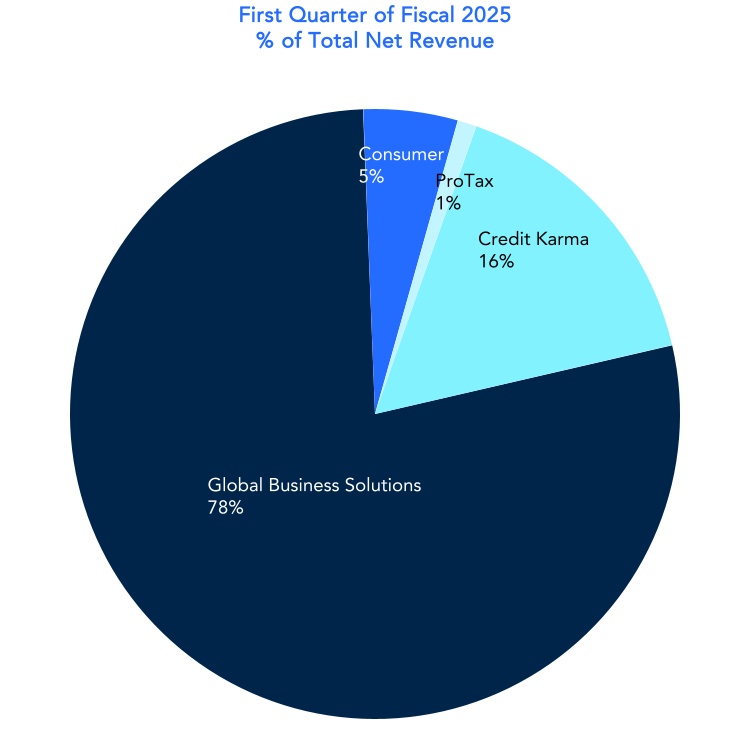
| Global Business Solutions**:** This segment serves small and mid-market businesses around the world, and the accounting professionals who assist and advise them. Our QuickBooks offerings include financial and business management online services and desktop software, payroll solutions, time tracking, merchant payment processing and bill pay solutions, checking accounts through an FDIC member bank partner, and financing for small and mid-market businesses. Our Mailchimp offerings include marketing automation and customer relationship management. Consumer**:** This segment serves consumers and includes do-it-yourself and assisted TurboTax income tax preparation products and services sold in the U.S. and Canada. Credit Karma**:** This segment serves consumers with a personal finance platform that provides personalized recommendations of credit card, home, auto, and personal loan, and insurance products; online savings and checking accounts through an FDIC member bank partner; and access to their credit scores and reports, credit and identity monitoring, credit report dispute, credit building tools, and tools to help understand net worth and make financial progress. ProTax**:** This segment serves professional accountants in the U.S. and Canada, who are essential to both small business success and tax preparation and filing. Our professional tax offerings include Lacerte, ProSeries, and ProConnect Tax Online in the U.S., and ProFile and ProTax Online in Canada. |
| Our Business and Growth Strategy |
The era of artificial intelligence (AI) is one of the most significant technological shifts in decades, igniting global innovations at an incredible pace. Intuit made an early bet on AI, declaring its AI-driven expert platform strategy in 2019 to deliver on its mission of powering prosperity for consumers and small and mid-market businesses. Our strategy, combined with our five Big Bets that focus on the largest customer problems and growth opportunities, positions us for durable growth in the future. Our scale of data, our investment in AI capabilities such as knowledge engineering, machine learning, and generative AI (GenAI), and our network of AI-powered virtual experts give us significant advantage as we deliver reimagined customer experiences.
With the introduction of GenAI, we are transforming how we strive to serve our customers by delivering “done for you” experiences, where we do the hard work for them, and connecting them with AI-powered human expertise to fuel their success. We use powerful and relevant contextual data sets spanning small business, consumer finance, and tax
Showing the first 8K of 75K characters. Open the full section
Item 4. CONTROLS AND PROCEDURES
Evaluation of Disclosure Controls and Procedures
Based upon an evaluation of the effectiveness of disclosure controls and procedures, Intuit’s Chief Executive Officer (CEO) and Chief Financial Officer (CFO) have concluded that as of the end of the period covered by this Quarterly Report on Form 10-Q, our disclosure controls and procedures as defined under Exchange Act Rules 13a-15(e) and 15d-15(e) were effective to provide reasonable assurance that information required to be disclosed in our Exchange Act reports is recorded, processed, summarized, and reported within the time periods specified by the Securities and Exchange Commission and is accumulated and communicated to management, including the CEO and CFO, as appropriate to allow timely decisions regarding required disclosure.
Changes in Internal Control over Financial Reporting
There were no changes in our internal control over financial reporting that occurred during our last fiscal quarter that have materially affected, or are reasonably likely to materially affect, our internal control over financial reporting.
Inherent Limitations on Effectiveness of Controls
Our management, including our CEO and CFO, believes that our disclosure controls and procedures and internal control over financial reporting are designed to provide reasonable assurance of achieving their objectives and that they are effective at the reasonable assurance level. However, no matter how well conceived and executed, a control system can provide only reasonable and not absolute assurance that the objectives of the control system are met. The design of any control system must reflect the fact that there are resource constraints and the benefits of controls must be considered relative to their costs. There are also limitations that are inherent in any control system. These limitations include the realities that breakdowns can occur because of errors in judgment or mistakes, and that controls can be circumvented by individual persons, by collusion of two or more people, or by management override of the controls. Because of these inherent limitations in a cost-effective control system, misstatements due to error or fraud may occur and not be detected.
| Intuit Q1 Fiscal 2025 Form 10-Q | 45 |
| PART II - OTHER INFORMATION |
| Item 1. LEGAL PROCEEDINGS |
See Note 11 to the condensed consolidated financial statements in Part I, Item 1 of this Quarterly Report on Form 10-Q for a description of legal proceedings.
Item 1A. RISK FACTORS
Our businesses routinely encounter and address risks, many of which could cause our future results to be materially different than we presently anticipate. Below, we describe significant factors, events and uncertainties that make an investment in our securities risky, categorized solely for ease of reference as strategic, operational, legal and compliance, and financial risks. The following events and consequences could have a material adverse effect on our business, growth, prospects, financial condition, results of operations, cash flows, liquidity, reputation and credit rating, and the trading price of our common stock could decline. We could also be affected by other events, factors or uncertainties that are presently unknown to us or that we do not currently consider to present significant risks to our business. These risks may be amplified by the effects of global developments and conditions or events, including macroeconomic and geopolitical conditions, which have caused significant global economic instability and uncertainty.
STRATEGIC RISKS
We face intense competitive pressures that may harm our operating results.
We face intense competition in all of our businesses, and we expect competition to continue to intensify in the future. Our competitors and potential competitors range from large and established entities to emerging start-ups. Our competitors may introduce superior products and services, successfully use and deploy new technologies such as artificial intelligence (AI) that may reduce customer demand for our products or services, reduce prices, have greater technical, marketing and other resources, have greater name recognition, have larger installed bases of customers, have well-established relationships with our current and potential customers, advertise aggressively or beat us to market with new products and services. In addition, we face competition from existing companies with large established consumer user bases and broad-based platforms, who may change or expand the focus of their business strategies and marketing to target our customers, including small businesses, tax and personal financial management customers.
We also face competition from companies with a variety of business models and monetization strategies, including increased competition from providers of free and low cost offerings, particularly in our tax, accounting, payments and consumer finance platform businesses. We have also introduced free offerings in several categories, but we may not be able to attract and retain customers as effectively as our competitors with different business models. In addition, other providers of free offerings may provide features that we do not offer and customers who have formerly paid for our products and services may elect to use our competitors’ free offerings instead. These competitive factors may diminish our revenue and profitability, and harm our ability to acquire and retain customers.
Our consumer tax business also faces significant, increasing competition from the public sector, where we face the risk of federal and state taxing authorities implementing revenue-raising strategies that involve developing and providing government tax software or other government return preparation systems at public expense. These or similar programs have been and may continue to be introduced or expanded in the future, which may change the voluntary compliance tax system in ways that could cause us to lose customers and revenue. For example, the IRS has stated that it will make a free direct filing system, which it piloted in 2024, a permanent option in 2025 and will explore ways to expand eligibility for the program, including partnering with more states. Additionally, the legacy IRS Free File Program enables the IRS to offer free commercial tax software directly to qualifying taxpayers, and taxpayer adoption of this program could expand with increased awareness of and government support for the program.
Through these or other programs, federal and state governments are or could become publicly funded direct competitors of the U.S. tax services industry and of Intuit. Government funded services that curtail or eliminate the role of taxpayers in preparing their own taxes could potentially have material and adverse revenue implications on us.
Future revenue growth depends upon our ability to adapt to technological change and successfully extend our platform, introduce new and enhanced products, features, services, and business models.
We operate in industries that are characterized by rapidly changing technology, evolving industry standards and frequent new product introductions. To meet the evolving needs and expectations of our customers and partners and attract and retain top technical talent, we must continue to innovate, develop and extend our platform, introduce new products and features, and
| Intuit Q1 Fiscal 2025 Form 10-Q | 46 |
enhance our ability to solve customer problems with emerging technologies, such as artificial intelligence. If we are not able to do this successfully, we may face a competitive disadvantage. We have and will continue to devote significant resources to continue to develop our skills, tools and capabilities to capitalize on existing and emerging technologies, including artificial intelligence. There can be no assurance that we or our customers will realize the expected benefits from these investments. Legislation or regulatory changes in these areas may mandate changes in our products that make them less attractive to users and hinder our ability to leverage emerging technologies and build out our platform capabilities.
Our consumer and professional tax businesses depend significantly on revenue from customers who return each year to use our updated tax preparation and filing software and services, including customers who use our free consumer tax products and whose tax scenarios evolve in subsequent years to require paid services. Encouraging customers to continue using our products in successive years can become more challenging unless new product releases provide features and functionality that have meaningful incremental value. As we continue to introduce and expand our new business models our customers may not perceive value in the additional benefits and services we offer and may choose not to pay for those additional benefits or we may be unsuccessful in increasing customer adoption of these offerings or our risk profile may change, resulting in loss of revenue.
When customers consent to the use of their data across our platform, we work to provide additional benefits to them through our existing offerings and the creation of new products and services. The growth of our business depends, in part, on our ability to successfully provide customers value in this way. If we are unable to clearly demonstrate the value of these new or upgraded products or services, our ability to build new data-driven products and services may be limited and our revenues may be harmed.
In some cases, we may expend a significant amount of resources and management attention on offerings that do not ultimately succeed in their markets. We have encountered difficulty in launching new products and services in the past. If we misjudge customer needs in the future, our new products and services may not succeed and our revenues and earnings may be harmed. We have also invested, and in the future, expect to invest in new business models, technologies, geographies, strategies and initiatives. Such endeavors may involve significant risks and uncertainties, including a rapidly changing regulatory environment, distraction of management from current operations, expenses associated with the initiatives, inadequate return on inve
Showing the first 8K of 91K characters. Open the full section
Item 5. OTHER INFORMATION
During the three months ended October 31, 2024, none of our directors or officers (as defined in Rule 16a-1(f) of the Exchange Act) adopted or terminated a “Rule 10b5-1 trading arrangement” or “non-Rule 10b5-1 trading arrangement” (as defined in Item 408 of Regulation S-K), except the following trading arrangements that are each intended to satisfy the affirmative defense of Rule 10b5-1(c). On September 5, 2024, Mark Notarainni, Executive Vice President and General Manager, Consumer Group, adopted a plan for the sale of up to 43,399 shares of the Company's common stock, subject to certain conditions, from December 5, 2024 through October 10, 2025. On September 6, 2024, Kerry J. McLean, Executive Vice President, General Counsel and Corporate Secretary, adopted a plan for the sale of up to 33,841 shares of the Company's common stock, subject to certain conditions, from December 6, 2024 through October 10, 2025. On September 27, 2024, Laura A. Fennell, Executive Vice President and Chief People & Places Officer, adopted a plan for the sale of up to 70,261 shares of the Company's common stock, subject to certain conditions, from December 27, 2024 through October 10, 2025. On September 30, 2024, Sasan K. Goodarzi, President, Chief Executive Officer and Director, adopted a plan for the sale of up to 176,562 shares of the Company's common stock, subject to certain conditions, from December 30, 2024 through October 10, 2025.
Item 6. EXHIBITS
See the Exhibit Index immediately following the signature page of this Quarterly Report on Form 10-Q.
| Intuit Q1 Fiscal 2025 Form 10-Q | 60 |
| SIGNATURES |
Pursuant to the requirements of the Securities Exchange Act of 1934, the Registrant has duly caused this report to be signed on its behalf by the undersigned, thereunto duly authorized.
| INTUIT INC. (Registrant) | |||||||||||||||||
| Date: | November 21, 2024 | By: | /s/ SANDEEP S. AUJLA | ||||||||||||||
| Sandeep S. Aujla | |||||||||||||||||
| Executive Vice President and Chief Financial Officer (Authorized Officer and Principal Financial Officer) |
| Intuit Q1 Fiscal 2025 Form 10-Q | 61 |
| EXHIBIT INDEX |
| Exhibit Number | Exhibit Description | Filed Herewith | Incorporated by Reference | |||||||||||||||||
| 10.01+ | Intuit Inc. Amended Non-Employee Director Compensation Program, effective January 23, 2025 | 8-K filed 11/4/2024 | ||||||||||||||||||
| 31.01 | Certification of Chief Executive Officer | X | ||||||||||||||||||
| 31.02 | Certification of Chief Financial Officer | X | ||||||||||||||||||
| 32.01* | Section 1350 Certification (Chief Executive Officer) | X | ||||||||||||||||||
| 32.02* | Section 1350 Certification (Chief Financial Officer) | X | ||||||||||||||||||
| 101.INS | XBRL Instance Document - the instance document does not appear in the Interactive Data File because its XBRL tags are embedded within the Inline XBRL document | X | ||||||||||||||||||
| 101.SCH | XBRL Taxonomy Extension Schema | X | ||||||||||||||||||
| 101.CAL | XBRL Taxonomy Extension Calculation Linkbase | X | ||||||||||||||||||
| 101.LAB | XBRL Taxonomy Extension Label Linkbase | X | ||||||||||||||||||
| 101.PRE | XBRL Taxonomy Extension Presentation Linkbase | X | ||||||||||||||||||
| 101.DEF | XBRL Taxonomy Extension Definition Linkbase | X | ||||||||||||||||||
| 104 | Cover Page Interactive Data File (formatted as Inline XBRL and contained in Exhibit 101) | X |
| + | Indicates a management contract or compensatory plan or arrangement. | ||||
| * | This exhibit is intended to be furnished and shall not be deemed “filed” for purposes of the Securities Exchange Act of 1934, as amended. |
| Intuit Q1 Fiscal 2025 Form 10-Q | 62 |