 filings.tools
Invitation Homes 10-K 2019-12-31
Filed 2020-02-19. 22 sections, 581K characters. Original on sec.gov · Markdown · JSON
Cover and table of contents
| UNITED STATES SECURITIES AND EXCHANGE COMMISSION Washington, D.C. 20549 | ||||||||||||||||||||||
| FORM | 10-K | |||||||||||||||||||||
| ☑ | ANNUAL REPORT PURSUANT TO SECTION 13 OR 15(d) OF THE SECURITIES EXCHANGE ACT OF 1934 | |||||||||||||||||||||
| For the fiscal year ended | December 31, 2019 | |||||||||||||||||||||
| OR | ||||||||||||||||||||||
| ☐ | TRANSITION REPORT PURSUANT TO SECTION 13 OR 15(d) OF THE SECURITIES EXCHANGE ACT OF 1934 | |||||||||||||||||||||
| For the transition period from | to | |||||||||||||||||||||
| Commission File Number | 001-38004 | |||||||||||||||||||||
| Invitation Homes Inc. | ||||||||||||||||||||||
| (Exact name of registrant as specified in its charter) | ||||||||||||||||||||||
| Maryland | 90-0939055 | |||||||||||||||||||||
| (State or other jurisdiction of incorporation or organization) | (I.R.S. Employer Identification No.) | |||||||||||||||||||||
| 1717 Main Street, | Suite 2000 | 75201 | ||||||||||||||||||||
| Dallas, | Texas | |||||||||||||||||||||
| (Address of principal executive offices) | (Zip Code) | |||||||||||||||||||||
| (972) | 421-3600 | |||||||||||||||||||||
| (Registrant’s telephone number, including area code) | ||||||||||||||||||||||
| Securities registered pursuant to Section 12(b) of the Act: | ||||||||||||||||||||||
| Title of each class | Trading Symbol(s) | Name of each exchange on which registered | ||||||||||||||||||||
| Common stock, $0.01 par value | INVH | New York Stock Exchange | ||||||||||||||||||||
| Securities registered pursuant to Section 12(g) of the Act: None | ||||||||||||||||||||||
| Indicate by check mark if the registrant is a well-known seasoned issuer, as defined in Rule 405 of the Securities Act. | Yes | ☑ | No | ☐ | ||||||||||||||||||
| Indicate by check mark if the registrant is not required to file reports pursuant to Section 13 or 15(d) of the Act. | Yes | ☐ | No | ☑ | ||||||||||||||||||
| Indicate by check mark whether the registrant: (1) has filed all reports required to be filed by Section 13 or 15(d) of the Securities Exchange Act of 1934 during the preceding 12 months (or for such shorter period that the registrant was required to file such reports), and (2) has been subject to such filing requirements for the past 90 days. | ||||||||||||||||||||||
| Yes | ☑ | No | ☐ | |||||||||||||||||||
| Indicate by check mark whether the registrant has submitted electronically every Interactive Data File required to be submitted pursuant to Rule 405 of Regulation S-T (§232.405 of this chapter) during the preceding 12 months (or for such shorter period that the registrant was required to submit such files). | ||||||||||||||||||||||
| Yes | ☑ | No | ☐ | |||||||||||||||||||
| Indicate by check mark whether the registrant is a large accelerated filer, an accelerated filer, a non-accelerated filer, a smaller reporting company, or an emerging growth company. See the definitions of “large accelerated filer,” “accelerated filer,” “smaller reporting company,” and “emerging growth company” in Rule 12b-2 of the Exchange Act. | ||||||||||||||||||||||
| Large Accelerated Filer | ☑ | Accelerated Filer | ☐ | |||||||||||||||||||
| Non-Accelerated Filer | ☐ | Smaller Reporting Company | ☐ | |||||||||||||||||||
| Emerging Growth Company | ☐ | |||||||||||||||||||||
| If an emerging growth company, indicate by check mark if the registrant has elected not to use the extended transition period for complying with any new or revised financial accounting standards provided pursuant to Section 13(a) of the Exchange Act. ☐ | ||||||||||||||||||||||
| Indicate by check mark whether the registrant is a shell company (as defined in Rule 12b-2 of the Exchange Act). | Yes | ☐ | No | ☑ |
As of June 28, 2019, the aggregate market value of the registrant’s common stock held by non-affiliates of the registrant was approximately $11.3 billion (based upon the closing sale price of the common stock on that date on the New York Stock Exchange).
As of February 14, 2020, there were 541,882,811 shares of common stock, par value $0.01 per share, outstanding.
| DOCUMENTS INCORPORATED BY REFERENCE | ||||||||||||||
| Items 10, 11, 12, 13, and 14 of Part III incorporate information by reference from the registrant’s definitive proxy statement relating to its 2020 annual meeting of stockholders (the “2020 Proxy Statement”) to be filed with the Securities and Exchange Commission within 120 days after the close of the registrant’s fiscal year to which this report relates. | ||||||||||||||
INVITATION HOMES INC.
| Page | |||
| PART I | |||
| Item | 1. | Business | 6 |
| Item | 1A. | Risk Factors | 15 |
| Item | 1B. | Unresolved Staff Comments | 44 |
| Item | 2. | Properties | 44 |
| Item | 3. | Legal Proceedings | 45 |
| Item | 4. | Mine Safety Disclosures | 45 |
| PART II | |||
| Item | 5. | Market for Registrant’s Common Equity, Related Stockholder Matters, and Issuer Purchases of Equity Securities | 46 |
| Item | 6. | Selected Financial Data | 46 |
| Item | 7. | Management’s Discussion and Analysis of Financial Condition and Results of Operations | 48 |
| Item | 7A. | Quantitative and Qualitative Disclosures About Market Risk | 76 |
| Item | 8. | Financial Statements and Supplementary Data | 77 |
| Item | 9. | Changes in and Disagreements with Accountants on Accounting and Financial Disclosure | 77 |
| Item | 9A. | Controls and Procedures | 77 |
| Item | 9B. | Other Information | 80 |
| PART III | |||
| Item | 10. | Directors, Executive Officers, and Corporate Governance | 81 |
| Item | 11. | Executive Compensation | 81 |
| Item | 12. | Security Ownership of Certain Beneficial Owners and Management and Related Stockholder Matters | 81 |
| Item | 13. | Certain Relationships and Related Transactions, and Director Independence | 81 |
| Item | 14. | Principal Accountant Fees and Services | 81 |
| PART IV | |||
| Item | 15. | Exhibits and Financial Statement Schedules | 82 |
| Item | 16. | Form 10-K Summary | 90 |
| Exhibit Index | |||
| Signatures |
FORWARD-LOOKING STATEMENTS
This Annual Report on Form 10-K contains forward-looking statements within the meaning of Section 27A of the Securities Act of 1933, as amended, and Section 21E of the Securities Exchange Act of 1934, as amended (the “Exchange Act”), which include, but are not limited to, statements related to our expectations regarding the performance of our business, our financial results, our liquidity and capital resources, and other non-historical statements. In some cases, you can identify these forward-looking statements by the use of words such as “outlook,” “believes,” “expects,” “potential,” “continues,” “may,” “will,” “should,” “could,” “seeks,” “projects,” “predicts,” “intends,” “plans,” “estimates,” “anticipates,” or the negative version of these words or other comparable words. Such forward-looking statements are subject to various risks and uncertainties, including, among others, risks inherent to the single-family rental industry and our business model, macroeconomic factors beyond our control, competition in identifying and acquiring properties, competition in the leasing market for quality residents, increasing property taxes, homeowners’ association (“HOA”) and insurance costs, our dependence on third parties for key services, risks related to the evaluation of properties, poor resident selection and defaults and non-renewals by our residents, performance of our information technology systems, and risks related to our indebtedness. Accordingly, there are or will be important factors that could cause actual outcomes or results to differ materially from those indicated in these statements. We believe these factors include but are not limited to, those described under Part I. Item 1A. “Risk Factors” as such factors may be updated from time to time in our periodic filings with the Securities and Exchange Commission (the “SEC”), which are accessible on the SEC’s website at http://www.sec.gov. These factors should not be construed as exhaustive and should be read in conjunction with the other cautionary statements that are included in this Annual Report on Form 10-K and in our other periodic filings. The forward-looking statements speak only as of the date of this Annual Report on Form 10-K, and we expressly disclaim any obligation or undertaking to publicly update or review any forward-looking statement, whether as a result of new information, future developments or otherwise, except to the extent otherwise required by law.
DEFINED TERMS
On November 16, 2017 (the “Merger Date”), Invitation Homes Inc. (“INVH”), Invitation Homes Operating Partnership LP (“INVH LP”), IH Merger Sub, LLC, a Delaware limited liability company and direct wholly owned subsidiary of INVH, Starwood Waypoint Homes (“SWH”), and Starwood Waypoint Homes Partnership, L.P., a Delaware limited partnership and a subsidiary of SWH (“SWH Partnership”), effectuated a series of transactions which resulted in SWH and SWH Partnership being merged into INVH and INVH LP, respectively, with INVH and INVH LP being the surviving entities (the “Mergers”). “Legacy SWH” and “SWH,” as the context requires, refer to the business practices and operations of SWH prior to the Mergers, including the homes owned by SWH. “Legacy IH” refers to the business practices and operations of INVH prior to the Mergers, including the homes owned by INVH. THR Property Management L.P., a wholly owned subsidiary of INVH LP (the “Manager”), provides all management and other administrative services with respect to the properties we own.
Unless the context suggests otherwise, references in this Annual Report on Form 10-K to “Invitation Homes,” the “Company,” “we,” “our,” and “us” refer (1) prior to the consummation of the reorganization transactions described in Part I. Item 1. “Business” (the “Pre-IPO Transactions”), to the six holding entities that owned our business prior to our initial public offering (the “IH Holding Entities”) and their consolidated subsidiaries, including INVH LP, (2) after the consummation of the Pre-IPO Transactions, to INVH and its consolidated subsidiaries (including INVH LP and the IH Holding Entities), and (3) after the consummation of the Mergers, to INVH and its consolidated subsidiaries including those acquired in the Mergers.
In this Annual Report on Form 10-K:
| • | “average monthly rent” represents average monthly rental income per home for occupied properties in an identified population of homes over the measurement period and reflects the impact of non-service rent concessions and contractual rent increases amortized over the life of the related lease. We believe average monthly rent reflects pricing trends that significantly impact rental revenues over time, making average monthly rent useful to management and external stakeholders as a means of evaluating changes in rental revenues across periods; |
| • | “average occupancy” for an identified population of homes represents (i) the total number of days that the homes in such population were occupied during the measurement period, divided by (ii) the total number of days that the homes in such population were owned during the measurement period. We believe average occupancy significantly impacts rental revenues in a given period, making comparisons of average occupancy across different periods helpful to management and external stakeholders in evaluating changes in rental revenues across periods; |
| • | “Carolinas” includes Charlotte, NC, Greensboro, NC, Raleigh, NC, and Fort Mill, SC; |
| • | “days to re-resident” for an individual home represents the number of days between (i) the date the prior resident moves out of a home, and (ii) the date the next resident is granted access to the same home, which is deemed to be the earlier of the next resident’s contractual lease start date and the next resident’s move-in date. Days to re-resident impacts our average occupancy and thus our rental revenues, making comparisons of days to re-resident helpful to management and external stakeholders in evaluating changes in rental revenues across periods; |
| • | “in-fill” refers to markets, MSAs, submarkets, neighborhoods or other geographic areas that are typified by significant population densities and low availability of land suitable for development into competitive properties, resulting in limited opportunities for new construction; |
| • | “Metropolitan Statistical Area” or “MSA” is defined by the United States Office of Management and Budget as a region associated with at least one urbanized area that has a population of at least 50,000 and comprises the central county or counties containing the core, plus adjacent outlying counties having a high degree of social and economic integration with the central county or counties as measured through commuting; |
| • | “net effective rental rate growth” for any home represents the percentage difference between the monthly rent from an expiring lease and the monthly rent from the next lease and, in each case, reflects the impact of non-service rent concessions and contractual rent increases amortized over the life of the related lease. Leases are either renewal leases, where our current resident chooses to stay for a subsequent lease term, or a new lease, where our previous resident moves |
out and a new resident signs a lease to occupy the same home. Net effective rental rate growth drives changes in our average monthly rent, making net effective rental rate growth useful to management and external stakeholders as a means of evaluating changes in rental revenues across periods;
| • | “Northern California” includes Sacramento-Arden-Arcade-Roseville, CA, San Francisco-Oakland-Hayward, CA, Stockton-Lodi, CA, Vallejo-Fairfield, CA, and Yuba City, CA; |
| • | “PSF” means per square foot. When comparing homes or cohorts of homes, we believe PSF calculations help management and external stakeholders normalize metrics for differences in property size, enabling more meaningful comparisons based on characteristics other than property size; |
| • | “Same Store” or “Same Store portfolio” includes, for a given reporting period, homes that have been stabilized and seasoned (whether under Invitation Homes ownership or Legacy SWH ownership), excluding homes that have been sold, homes that have been identified for sale to an owner occupant and have become vacant, homes that have been deemed inoperable or significantly impaired by casualty loss events or force majeure, homes acquired in portfolio transactions that are deemed not to have undergone renovations of sufficiently similar quality and characteristics as the existing Invitation Homes Same Store portfolio, and homes in markets that we have announced an intent to exit where we no longer operate a significant number of homes for the primary purpose of income generation. Homes are considered stabilized if they have (i) completed an initial renovation and (ii) entered into at least one post-initial renovation lease. An acquired portfolio that is both leased and deemed to be of sufficiently similar quality and characteristics as the existing Invitation Homes Same Store portfolio may be considered stabilized at the time of acquisition. Homes are considered to be seasoned once they have been stabilized for at least 15 months prior to January 1st of the year in which the Same Store portfolio was established. We believe information about the portion of our portfolio that has been fully operational for the entirety of a given reporting period and its prior year comparison period provides management and external stakeholders with meaningful information about the performance of our comparable homes across periods and about trends in our organic business; |
| • | “Southeast United States” includes our Atlanta and Carolinas markets; |
| • | “South Florida” includes Miami-Fort Lauderdale-West Palm Beach, FL, and Port St. Lucie, FL; |
| • | “Southern California” includes Los Angeles-Long Beach-Anaheim, CA, Oxnard-Thousand Oaks-Ventura, CA, Riverside-San Bernardino-Ontario, CA, and San Diego-Carlsbad, CA; |
| • | “total homes” or “total portfolio” refers to the total number of homes we own, whether or not stabilized, and excludes any properties previously acquired in purchases that have been subsequently rescinded or vacated. Unless the context otherwise requires, all measures in this Annual Report on Form 10-K are presented on a total portfolio basis; |
| • | “turnover rate” represents the number of instances that homes in an identified population become unoccupied in a given period, divided by the number of homes in such population. To the extent the measurement period shown is less than 12 months, the turnover rate may be reflected on an annualized basis. We believe turnover rate impacts average occupancy and thus our rental revenues, making comparisons of turnover rate helpful to management and external stakeholders in evaluating changes in rental revenues across periods. In addition, turnover can impact our cost to maintain homes, making changes in turnover rate useful to management and external stakeholders in evaluating changes in our property operating and maintenance expenses across periods; and |
| • | “Western United States” includes our Southern California, Northern California, Seattle, Phoenix, Las Vegas, and Denver markets. |
PART I
Item 1. BUSINESS
Overview
Invitation Homes is a leading owner and operator of single-family homes for lease, offering residents high-quality homes in sought-after neighborhoods across America. With approximately 80,000 homes for lease in 16 markets across the country as of December 31, 2019, Invitation Homes is meeting changing lifestyle demands by providing residents access to updated homes with features they value, such as close proximity to jobs and access to good schools. Our mission statement, “Together with you, we make a house a home,” reflects our commitment to high-touch service that continuously enhances residents’ living experiences and provides homes where individuals and families can thrive.
We operate in markets with strong demand drivers, high barriers to entry, and high rent growth potential, primarily in the Western United States, Florida, and the Southeast United States. Through disciplined market and asset selection, as well as through the Mergers, we designed our portfolio to capture the operating benefits of local density as well as economies of scale that we believe cannot be readily replicated. Since our founding in 2012, we have built a proven, vertically integrated operating platform that enables us to effectively and efficiently acquire, renovate, lease, maintain, and manage our homes.
We invest in markets that we expect will exhibit lower new supply, stronger job and household formation growth, and superior net operating income (“NOI”) growth relative to the broader United States housing and rental market. Within our 16 markets, we target attractive neighborhoods in in-fill locations with multiple demand drivers, such as proximity to major employment centers, desirable schools, and transportation corridors. Our homes average approximately 1,870 square feet with three bedrooms and two bathrooms, appealing to a resident base that we believe is less transitory than the typical multifamily resident. We invest in the upfront renovation of homes in our portfolio in order to address capital needs, reduce ongoing maintenance costs, and drive resident demand. As a result, our portfolio benefits from high occupancy and low turnover rates, and we are well-positioned to drive strong rent growth, attractive margins, and predictable cash flows.
Our Platform
Our vertically integrated, scalable platform allows greater influence over the experience of our residents while enabling us to better control operating costs and continuously share best practices across functional areas of the business. Our differentiated platform is built upon:
| • | Resident-centric focus. Our high-touch business model enables us to continuously solicit and integrate resident feedback into our operations and tailor our approach to address their preferences, providing a superior living experience and fostering customer loyalty. We believe this, in turn, drives rent growth, occupancy, and low turnover rates and will enable us to develop significant brand equity in the longer term. |
| • | Local presence and expertise. In-market managers oversee the operations of local leasing management, property management, and maintenance teams, enabling us to provide outstanding resident service, leverage local expertise in managing rental, occupancy, and turnover rates, and improve cost and oversight over renovations and ongoing maintenance. As a result of our concentrated footprint within our markets, our regional managers and in-market teams are able to realize local-operator advantages, while still benefiting from significant economies of scale. |
| • | Scalable, centralized infrastructure. We support local market operations with national strategy, infrastructure, and standards to drive efficiency, consistency, and cost savings. We utilize our extensive scale to ensure the consistent quality of our resident experience and maximize cost efficiencies and purchasing power. On a national level we are also able to standardize resident leases, employ a consistent approach to resident screening and leasing operations, and utilize dynamic, rules-based pricing tools informed by local market conditions. |
Our approach to investment and asset management similarly combines local presence and expertise with national oversight. Our investment and asset management teams are located in-market and apply their local market knowledge within the framework of a proprietary and consistent underwriting methodology, with support from national leadership based in our corporate headquarters focused on investment and asset management strategy. Through the integration of investment and asset management and property management functions, our platform enables our teams to incorporate real-time information regarding leasing activity, property operations, maintenance, and capital spending into asset selection. We believe the
advantages of our integrated acquisition platform and local market expertise have driven the quality of our existing portfolio of 79,505 homes as of December 31, 2019. We believe that employing experienced, in-house acquisitions teams at the local level gives us a competitive advantage in selectively acquiring homes that will maximize risk-adjusted total return.
Our Business Activities
Since our founding in 2012, we have built a proven, vertically integrated operating platform that allows us to effectively and efficiently acquire, renovate, lease, maintain, and manage our homes. Our differentiated approach, which combines a resident-centric focus, local market presence and expertise, and national strategy, infrastructure, and standards, informs all areas of our operations.
Property Operations
Property operations encompasses the in-house local market management and execution of marketing, leasing, resident relations, and maintenance functions. We have developed and employ a highly scalable, vertically integrated, and resident-centric property management service platform, referred to as “ProCare.” All of our property management functions have been internally managed since our founding in 2012, and we have implemented an extensive property management infrastructure, including an online resident portal, Smart Home technology, a technology suite to manage work orders and personnel, dedicated in-market personnel, and local offices in each of our markets. All of our local market personnel are supported by our centralized national infrastructure, which allows us to deploy best practices and standardization where appropriate. The combination of our local market presence and national infrastructure enables us to exercise greater control over our property management service platform, allowing us to enhance the experience of our residents, better manage operating costs, and share best practices across various functional areas of our business.
We have organized our in-house property management personnel and operating structure whereby Vice Presidents of Operations in each of our markets are responsible for the operations of local leasing management, property management, and maintenance teams. We believe our operating model differentiates our approach to local market operations and enables us to provide superior, high-touch resident service, maximize the effectiveness of our in-market personnel in managing rental, occupancy, and turnover rates and improve our cost management and oversight over both upfront renovations and ongoing maintenance.
Marketing and Leasing
Our in-house personnel are responsible for establishing rental rates, marketing and leasing properties, and collecting and processing rent. We establish rental rates based on a dynamic, rules-based pricing tool that is informed by local market conditions, including a competitive analysis of market rents for institutional single-family rental properties, growth in single-family and multifamily market rents since a specific home’s last lease commenced, the size, fit and finish, and location of the home, the number of applications received and/or showings a property has experienced since becoming available, and the number of days a home has been available on the market, as well as qualitative factors, such as neighborhood characteristics, community amenities, and proximity to employment centers, desirable schools, transportation corridors, and local services.
We typically begin pre-marketing properties 30 to 60 days in advance of their becoming vacant to maintain high occupancy rates and reduce vacancy losses. We advertise available properties through multiple channels, including our proprietary website, internet listing services (such as Zillow, Trulia, HotPads, and Realtor.com), MLS, yard signs, search engine marketing, social and other digital media, and local brokers. We own internal brokerages to serve each state in which we operate and primarily utilize in-market leasing agents who work with us to lease our homes. In some markets, we also utilize a network of local real estate agents to show homes to prospective residents and offer those agents limited co-broker fees.
Prospective residents may submit an application through the application portal on our website or in person. In order to maintain brand consistency and better track compliance with leasing requirements, we utilize standardized online applications, national lease agreements, move-in and move-out documents, resident communications, and other ancillary documents. We evaluate prospective residents in a standardized manner through the use of a third party resident screening partner. Our resident screening process includes obtaining appropriate identification, a thorough evaluation of credit history and household income, a review of the applicant’s rental history, and a background check for criminal activity. Although we require a minimum income to rent ratio, many additional factors are also taken into consideration during the resident evaluation process, including eviction history, criminal history, and rental and other payment history.
Our disciplined investment strategy and local, in-market approach have given us scale and density of homes in desirable neighborhoods, enabling us to execute demographic and geo-targeted digital advertising. We believe this increases our likelihood of capturing and retaining qualified residents whose lifestyle and purchasing power enhance our opportunity to develop and market other programs and services.
Digital Marketing Initiatives and Branding
We encourage meaningful community interaction across our digital platforms by continuously refreshing the content of our website, blog, and social media accounts with articles, home maintenance advice, contests, and incentives designed to enrich the lives of our residents and protect our homes. For example, we alert our residents to prepare for storms, incentivize them to pay their rent online, offer “Lease Friendly” “Make It Home” design tips, and hold an annual Resident Appreciation Day.
Resident Relations and Property Maintenance
Our in-house personnel in each of our markets are also responsible for property repairs and maintenance and resident relations. In coordination with a third party vendor, we offer a 24/7 emergency telephone line to handle after hours maintenance issues on an expedited basis as needed, and our residents can also contact us through our online resident portal, our call centers, or our local property management offices. As part of our ongoing property management process, we seek to conduct routine repairs and maintenance in a timely manner, as appropriate, by appointment at the resident’s convenience. We seek to utilize quality materials to minimize the recurrence of maintenance requests and maximize long-term rental income and cash flows from our portfolio.
We typically utilize our in-house maintenance personnel in each of our markets to provide ordinary course, “handyman” services, and outsource more complex or extensive repairs, such as roofing, heating, ventilation, and air conditioning (“HVAC”) systems, plumbing, and electrical work to vetted, pre-approved third party vendor partners. We strive to maximize the number of maintenance calls that are addressed by our in-house maintenance technicians. In cases where we outsource more complex or extensive repairs, our in-house maintenance personnel provide oversight to ensure quality control and cost effectiveness. In addition, our in-house maintenance personnel conduct periodic visits to our properties to help foster positive, long-term relationships with our residents, track and report maintenance needs effectively, conduct preventative maintenance, and ensure compliance with lease terms, local laws, and HOA rules and regulations.
ProCare service, our property management service platform, utilizes a number of policies and programs designed to improve the efficiency of our property maintenance practices and maximize resident satisfaction with our service model. When a new resident moves into one of our homes, our in-house personnel conduct a resident orientation, during which we revisit the terms of the lease, outline what aspects of the home’s upkeep are the resident’s responsibility, walk through all of the home’s major systems in order to familiarize the resident with their safe and proper operation, and inform the resident that we will be conducting a post move-in maintenance visit. Following the move-in orientation, each resident is encouraged to keep a record of any non-emergency service items noted after moving into the home. At the time of the post move-in maintenance visit approximately 45 days after move-in, our in-house property maintenance personnel will address any non-emergency service needs the resident has noted. We believe this process has a number of benefits. First, by conducting an in-person move-in orientation, we are able to ensure that residents understand their obligations under the terms of their lease, as well as how to safely and properly operate the home’s systems, reducing both the likelihood of misaligned expectations and unnecessary wear and tear on the property. Second, by scheduling a post move-in maintenance visit, we are able to address multiple service requests in a single visit, improving the resident experience by avoiding the inconvenience of multiple service appointments and improving the efficiency and productivity of our in-house property maintenance personnel. Finally, the post move-in maintenance visit allows us to more quickly identify residents who may not be adhering to the terms of their lease or may be subjecting the home to undue wear and tear and/or damages as a result of their treatment of the property.
Following the regularly scheduled post move-in maintenance visit described above, our in-house property maintenance personnel in each of our markets also conduct mid-lease preventive maintenance visits. During preventive maintenance visits, our in-house property maintenance personnel inspect the home’s systems, paying particular attention to potential safety hazards as well as potential causes of damage that could result in us incurring significant maintenance costs if left unaddressed. Examples of areas of focus for preventive maintenance visits include smoke and carbon monoxide detectors, air filters, hot water heaters, toilet valves, under-sink plumbing, and garbage disposals, among others.
We also conduct pre move-out visits 15 to 30 days prior to scheduled resident move-outs. These visits allow us to notify residents of any repairs they may need to undertake prior to moving out of the property, such as carpet cleaning or landscaping maintenance, in order to avoid forfeiture of part or all of their security deposit. In addition, these visits allow our in-house property maintenance personnel to begin preparing a scope of work and budget for the turnover work we undertake between residents to prepare our homes to be re-leased to a new resident. These visits also increase our ability to pre-market our homes.
Regardless of the purpose or timing of the visit, our in-house property maintenance personnel are required to conduct a general property condition assessment (“GPCA”) every time they visit one of our homes. The GPCA requires our in-house property maintenance personnel to assess and document interior and exterior condition, whether the resident is adhering to the terms of their lease, as well as any potential safety hazards or potential causes of damage that could result in us incurring significant maintenance costs if left unaddressed. If a deficiency is identified by our in-house property maintenance personnel we endeavor to take prompt action to correct it.
Investment and Asset Management
Acquisition Strategy
We have a disciplined acquisition platform that is capable of deploying capital across multiple acquisition channels and markets simultaneously. Our markets were generally selected through a robust process utilizing an analysis of housing and rental market supply and demand fundamentals, macroeconomic and demographic trends, and risk-adjusted total return potential. Specifically, the process we use to select and, on an ongoing basis, evaluate our markets ranks these markets based on relative weightings of factors that include, but are not limited to, forecast population and employment growth, household formation, historical and forecast deliveries of new residential housing supply, discounts to replacement cost for single-family residential housing, size of the addressable market, volume of new and existing home sales, potential yields implied by the relationship between market rental rates and the price of single-family residential housing, forecast home price appreciation, and forecast rental rate growth.
We have amassed significant scale within our 16 markets. In these markets, our acquisition strategy has been, and will continue to be, focused on buying, renovating, and operating high quality single-family homes for lease that we believe will appeal to and attract a high quality resident base, that will experience robust long-term demand, and that will benefit from capital appreciation. In evaluating acquisitions, we analyze numerous factors, including neighborhood desirability, proximity to employment centers, schools, and transportation corridors, community amenities, construction type, and required ongoing capital needs, among others.
We target submarkets and neighborhoods in undersupplied high-growth markets and leverage our in-house acquisition and operations teams’ local market expertise to acquire homes in in-fill locations that we believe will experience above average rental rate growth and home price appreciation. Our in-house acquisition teams are comprised of dedicated professionals located in our markets and at our corporate headquarters who provide strategic direction and broad oversight. Our acquisition teams have significant local market experience and expertise in single-family investments and sales, which enables us to target specific submarkets, neighborhoods, individual streets, and homes that meet our selection and underwriting criteria. To date, we have underwritten more than one million individual homes which gives us a substantial proprietary database on which we can draw as we evaluate future acquisition opportunities in our markets. The number of homes underwritten represents the total number of acquisition opportunities that we have considered and of which we have conducted preliminary analysis, including acquisition opportunities that were ultimately not pursued or completed. As a result of our selective and disciplined investment approach, we have analyzed and considered a far greater number of potential acquisitions than the number of homes we have actually acquired. As a result of our large existing portfolio and volume of acquisitions to date, we believe we have a high degree of visibility into rental rates and fixed and controllable operating expenses, which allows us to more accurately underwrite expected net yields of homes prior to acquisition. We also collaborate with local market real estate brokers and others, and leverage these relationships to source off-market acquisition opportunities. Within our markets, our approach allows us to screen broadly and rapidly to identify potential acquisitions in highly targeted submarkets at the neighborhood and street levels. Our in-house team of acquisition professionals coordinates with our in-house renovation, maintenance, and property management teams to ensure that feedback from historical acquisitions is shared across functions so that our ongoing investment activities are informed by, and benefit from, insight from prior experience.
Property Renovations
We have an in-house team of dedicated personnel located in our markets who oversee our upfront property renovation process and the ongoing maintenance of our homes, with support from centralized construction experts and infrastructure. This team works in collaboration with our in-house investment and property management teams to maximize the total return of our upfront investment and minimize ongoing maintenance costs. To this end, our professionals evaluate: the structural needs and major systems of a property (e.g., examining roofs, HVAC systems, and siding); other maintenance-reducing improvements and repairs (e.g., installing durable hard-surface flooring, removing carpet from high-traffic areas, and testing plumbing and pipes both in the home and out to the street); and the level of fit and finish required to maintain consistency with our brand standards and maximize rental demand (e.g., selecting cabinet and countertop finishes and appliances designed to improve resident demand).
In general, before a home is acquired or when an acquired home first becomes vacant, our in-house teams begin the renovation process by preparing a detailed renovation budget and scope of work based on an assessment of each property’s major systems and structural features. These include HVAC, roofs, pools, and plumbing and electrical systems. In addition, we also evaluate other features of our homes’ fit and finish, including appliances, landscaping, decks and/or patios, and fixtures. During our initial assessment, we also determine the potential for, and potential return on, any value-additive upgrades that may reduce future operating costs or enhance rental demand and, by extension, our ability to realize more attractive rental, occupancy, or turnover rates.
Through local oversight by in-house personnel of the entire process of renovating our homes, we are able to drive cost efficiencies. Each property’s detailed budget and scope of work prepared by our in-house team of renovation professionals is reviewed and vetted by our in-house asset management and operations teams, and in the case of work we contract directly, presented for bid to one or more of our pre-approved vendor partners in each of our markets. In the case of work for which we rely upon general contractors, we set prices based on the scope of work involved. By establishing and enforcing best practices and quality consistency, and through a constant process of evaluating and grading our vendor partners, we believe that we are able to reduce the costs of both materials and labor. For example, we have negotiated discounts and extended warranties for products that we regularly use during the renovation process, including appliances, HVAC systems and components, carpet and flooring, and paint, among others. We are also able to reduce general contractor fees by working directly with vendors. We believe this approach results in both a larger proportion of our upfront renovation expenditures going toward actual investment in our homes as well as lower overall expenditures than if we were to outsource all elements of vendor selection and oversight to third party general contractors.
Portfolio Optimization
We maintain a sophisticated process to identify and efficiently dispose of homes that no longer fit our investment objectives. We believe we have a proven ability to optimize sales prices while reducing both time to sale and selling costs by utilizing multiple distribution channels, including bulk portfolio sales, our “Resident First Look” program (which facilitates home sales to our current residents), direct-to-market sales, and MLS. We believe the significant local density of our portfolio, which averages approximately 5,000 homes per market as of December 31, 2019, allows us to selectively sell properties without sacrificing the operating efficiency of our concentrated scale.
Environmental, Social, and Governance Initiatives
At Invitation Homes, we believe that integrating environmental, social, and governance initiatives into our strategic business objectives is critical to our long-term success. Through our integrated and ongoing approach to sustainability and corporate responsibility, we seek to drive positive change and create value for our stakeholders.
Corporate social responsibility is vitally important to who we are as a company. Our Corporate Social Responsibility Policy is posted on our website and applies to all activities undertaken by or on behalf of Invitation Homes anywhere we operate. This policy encompasses areas of community and associate engagement, human rights, corporate governance and ethics, and environmental initiatives that reflect existing and emerging standards of corporate social responsibility.
Our mission, vision, and values define our daily actions in delivering on our pledge to be a responsible corporate citizen. Our mission statement “Together with you, we make a house a home” reflects our commitment to a resident-centric business philosophy. The way we carry out that mission on a daily basis is reflected in our company’s core values: Unshakable Integrity; Genuine Care; Continuous Excellence; and Standout Citizenship. Our vision is to be the premier choice in home leasing by continuously enhancing our residents’ living experiences and communities.
Every day, we strive to benefit our residents, our associates, our communities, and our shareholders by deeply embedding our values, ethics, and integrity into all that we do.
Residents
By offering quality homes in attractive neighborhoods, we believe we give residents the choice to lease a home in a community that may not have otherwise been attainable. We strive to provide our residents with a worry-free leasing lifestyle through service that includes welcoming them with an in-person home orientation at move-in, making their lives easier with our Smart Home technology offering, and providing 24/7 maintenance combined with our best-in-class ProCare property management platform.
Associates
Our associates are our most precious resource. From our focus on health and safety to our support for a diverse and inclusive culture, we treat each other fairly and act with honesty, integrity, and respect. We believe passionately that diverse and inclusive companies make for more innovative, engaged, and happy teams. Our organization makes it a priority to celebrate diversity and cultivate a culture of inclusion.
Everyone who works at or with Invitation Homes should feel confident about our high ethical standards, our honesty, and our integrity. Our daily decisions are driven by our Code of Business Conduct and Ethics, which is posted on our website and demonstrates our commitment to our stakeholders to be a responsible corporate citizen and a good business partner. This code helps guide us as we collaborate to accomplish our goals together, while holding ourselves individually responsible for our work and accountable for our actions. Our Vendor Code of Conduct is an extension of our values to our vendors and serves to highlight our commitment to ethical business practices and regulatory compliance.
Communities
We recognize that the vitality of our business is directly linked to the vitality of the communities in which we operate. As of December 31, 2019, we and our predecessors have invested approximately $2.3 billion in the upfront renovation of homes in our portfolio. We invested approximately $38,000 per home for upfront renovations completed during the year ended December 31, 2019. Further, we maintain our homes to high standards through timely maintenance services as well as through our proprietary ProCare service. ProCare is an innovative maintenance program designed to provide regular opportunities for us to inspect our assets, proactively address issues, and ensure each home continues to meet our standards. We believe that these investments benefit our communities by creating jobs, enhancing neighborhood appearance and liveability, and improving the overall quality of life for our residents and their neighbors. In addition, we believe such investments improve our relationships with local communities and HOAs and enhance our brand recognition and loyalty.
Our commitment to community includes efforts that make us more innovative and sustainable. Protecting the environment is critically important to us, and our sustainability initiatives help limit the carbon footprints and overall environmental impact of our homes. Those initiatives include: Smart Home technology that enables maintenance technicians and residents to control thermostats remotely and reduce energy consumption; routing and optimization technology designed to improve scheduling efficiencies for our maintenance technicians, which may also result in a reduced vehicle emissions footprint; standards of performance that require the use of energy-efficient lighting and appliances; and supply chain management that focuses on our vendors’ sustainability practices and procedures. We believe that we can respond to local and global environmental challenges by combining our strengths in sustainability, innovation, and partnership.
We also encourage our associates to be good neighbors in their local communities by partnering with local organizations to provide support to those in need. In addition, each year Invitation Homes associates receive 20 hours of paid time off to volunteer in their communities and help their local neighbors. Together, associates in our 16 markets used this time in 2019 to deliver food to veterans and elderly citizens, contribute and package food and school supplies, collect and deliver toys, clean
beaches, and provide other needed support in their communities. We also offer an annual “There’s No Place Like Home” scholarship contest, awarding scholarships for higher learning to residents, associates, and community members.
Shareholders
We take very seriously the responsibility that individuals and organizations have chosen to invest in our company, and we strive every day to ensure that our actions result in value for these investors. In addition, we are committed to sound corporate governance practices and adherence to the highest ethical standards. We have structured our corporate governance in a manner we believe closely aligns our interests with those of our shareholders.
Pre-IPO Transactions and Mergers
On January 31, 2017, certain Pre-IPO Transactions were effected that resulted in INVH LP holding, directly or indirectly, all of the assets, liabilities, and results of operations of the Manager and the full portfolio of homes held by the IH Holding Entities. As a result of the Pre-IPO Transactions, INVH LP became a consolidated subsidiary of INVH. A wholly owned subsidiary of INVH, Invitation Homes OP GP LLC, serves as INVH LP’s sole general partner.
The Pre-IPO Transactions have been accounted for as a reorganization of entities under common control utilizing historical cost basis in our 2017 financial statements. Consolidated financial statements during this period include the combined accounts of INVH LP and the IH Holding Entities and their wholly owned subsidiaries. The Pre-IPO Transactions also included amendments to the Invitation Homes Inc. charter which provide for the issuance of up to 9,000,000,000 shares of common stock.
On February 6, 2017, Invitation Homes Inc. changed its jurisdiction of incorporation to Maryland and completed an initial public offering of 88,550,000 shares of common stock at a price to the public of $20.00 per share (the “IPO”). An additional 221,826,634 shares of common stock were issued to the pre-IPO equity owners, including directors, officers, and employees, as part of the Pre-IPO Transactions.
On November 16, 2017 , we completed the Mergers with SWH. The Mergers were accounted for as a business combination in accordance with ASC Topic 805, Business Combinations, and INVH was designated as the accounting acquirer. In connection therewith, SWH stockholders received an aggregate of 207,448,958 shares of our common stock in exchange for all outstanding SWH common shares.
As of December 31, 2019, INVH owns a 99.4% partnership interest in INVH LP and has the full, exclusive, and complete responsibility for and discretion over the day to day management and control of INVH LP.
Risk Management
We face various forms of risk in our business ranging from broad economic, housing market, and interest rate risks, to more specific factors, such as credit risk related to our residents, re-leasing of properties, and competition for properties. We believe that the systems and processes developed by our board of directors and our experienced executive team allow us to monitor, manage, and ultimately mitigate these risks. For example, we seek to maximize revenue collections through our robust, standardized resident screening process (which includes credit checks, evaluations of household income, and criminal background checks), as well as by utilizing Automated Clearing House, which includes an auto-pay feature, to facilitate the collection of a majority of our rental payments. In addition, we track resident delinquency on a daily basis and assess any late fees promptly in accordance with the terms of our lease (typically between the third and fifth calendar day of the month).
Insurance
We maintain property, casualty, and corporate-level insurance coverage related to our business, including general liability, business auto, umbrella, commercial crime, directors’ and officers’ liability, fiduciary liability, cyber liability, employment practices liability, and workers’ compensation insurance. We believe the policy specifications and insured limits under our insurance program are appropriate and adequate for our business and properties given the relative risk of loss, the cost of the coverage and industry practice. However, our insurance coverage is subject to deductibles and coverage exclusions, and we are self-insured up to the amount of such deductibles and exclusions. See Part I. Item 1A. “Risk Factors — Risks Related to Our Business and Industry — We may suffer losses that are not covered by insurance.”
Systems and Technology
Effective systems and technology are essential components of our business. We have made significant investments in our lease management, construction management, property and corporate accounting, and asset management systems. These systems have been designed to be scalable to accommodate continued growth in our portfolio of single-family homes for lease. Our website is fully integrated into our resident accounting and leasing system. From our website, which is accessible from mobile devices, prospective residents can browse homes available for lease, request additional information, and apply to lease a specific home. Through online resident portals and native mobile applications, existing residents can set up automatic payments and request maintenance service. Our system is designed to handle the accounting requirements of residential property accounting, including accounting for security deposits and paying property-level expenses. The system also interfaces with our third party resident screening vendor partner to expedite evaluations of prospective residents’ rental applications. We have worked with a search engine optimization firm to ensure we place high in search engine results and will continue to monitor our placement on search engines. In addition, sponsored key words are generally purchased in selected markets as needed.
Competition
We face competition from different sources in each of our two primary activities: acquiring properties and leasing our properties. We believe our competitors in acquiring properties for investment purposes are individual investors, small private investment partnerships looking for one-off acquisitions of investment properties that can either be leased or restored and sold, and larger investors, including private equity funds and other real estate investment trusts (“REITs”), that are seeking to capitalize on the same market opportunity that we have identified. Our primary competitors in acquiring portfolios include large and small private equity investors, public and private REITs, and other sizable private institutional investors. These same competitors may also compete with us for residents. Competition may increase the prices for properties that we would like to purchase, reduce the amount of rent we may charge for our properties, reduce the occupancy of our portfolio, and adversely impact our ability to achieve attractive total returns. However, we believe that our acquisition platform, our extensive in-market property operations infrastructure, and local expertise in our markets provide us with competitive advantages.
Seasonality
Our business and related operating results have been, and we believe that they will continue to be, impacted by seasonal factors throughout the year. In particular, we have experienced higher levels of resident move-outs during the summer months, which impacts both our rental revenues and related turnover costs. Further, our property operating costs are seasonally impacted in certain markets by increases in expenses such as HVAC repairs and landscaping expenses during the summer season.
Regulation
General
Our business operations and properties are subject to various covenants, laws, ordinances, and rules. We believe that we are in material compliance with such covenants, laws, ordinances, and rules, and we also require that our residents agree to comply with such covenants, laws, ordinances, and rules in their leases with us.
Fair Housing Act
The Fair Housing Act (“FHA”) and its state law counterparts, and the regulations promulgated by the United States Department of Housing and Urban Development and various state agencies, prohibit discrimination in housing on the basis of race or color, national origin, religion, sex, familial status (including children under the age of 18 living with parents or legal custodians, pregnant women, and people in the process of adopting a child or securing custody of children under the age of 18), disability or, in some states, financial capability. We train our associates on a regular basis regarding such laws and regulations and we believe that our properties are in compliance with the FHA and other such regulations.
Municipal Regulations and Homeowners’ Associations
Our properties are subject to various municipal regulations and orders, and county and city ordinances, including without limitation, use, operation and maintenance of our properties. Certain of our properties are subject to the rules of the various HOAs where such properties are located. HOA rules and regulations are commonly referred to as “covenants, conditions and restrictions,” or CC&Rs, and typically consist of various restrictions or guidelines regarding use and maintenance of the property, including, among others, noise restrictions or guidelines as to how many cars may be parked on the property.
Broker Licensure
We own internal brokerages to serve each state in which we operate, and primarily utilize in-market leasing agents who work with us to lease our homes. Our internal brokerages are subject to numerous federal, state, and local laws and regulations that govern the licensure of real estate brokers and affiliate brokers and set forth standards for, and prohibitions on, the conduct of real estate brokers. Such standards and prohibitions include, among others, those relating to fiduciary and agency duties, administration of trust funds, collection of commissions, and advertising and consumer disclosures, as well as compliance with federal, state, and local laws and programs for providing housing to low-income families. Under applicable state law, we generally have a duty to supervise and are responsible for the conduct of our internal brokerages.
Environmental Matters
As a current or prior owner of real estate, we are subject to various federal, state, and local environmental laws, regulations, and ordinances, and we could be liable to third parties as a result of environmental contamination or noncompliance at our properties, even if we no longer own such properties. We are not aware of any environmental matters that would have a material adverse effect on our financial position. See Part I. Item 1A. “Risk Factors — Risks Related to Our Business and Industry — Contingent or unknown liabilities could adversely affect our financial condition, cash flows, and operating results.”
Laws and Regulations Regarding Privacy and Data Protection
We are subject to a variety of laws and regulations that involve matters such as privacy, data protection, content, consumer protection, and other matters. For example, the California Consumer Privacy Act and the Nevada Privacy Law, which took effect in January 2020, establish certain transparency rules and create new data privacy rights for users, including more ability to control how their data is shared with third parties. See Part I. Item 1A. “Risk Factors — Risks Related to Our Business and Industry — Our business is subject to laws and regulations regarding privacy, data protection, consumer protection, and other matters.” Many of these laws and regulations are subject to change and uncertain interpretation, and could result in claims, changes to our business practices, monetary penalties, or otherwise harm our business.”
Segment Reporting
Operating segments are defined as components of an enterprise for which discrete financial information is available that is evaluated regularly by the chief operating decision maker (“CODM”) in deciding how to allocate resources and in assessing performance. Our CODM is the Chief Executive Officer.
Under the provision of ASC 280, Segment Reporting, we have determined that we have one reportable segment related to acquiring, renovating, leasing, and operating single-family homes as rental properties. The CODM evaluates operating performance and allocates resources on a total portfolio basis. The CODM utilizes NOI as the primary measure to evaluate performance of the total portfolio. The aggregation of individual homes constitutes the total portfolio. Decisions regarding acquisitions and dispositions of homes are made at the individual home level with a focus on growing accretively in high-growth locations where we have greater scale and density.
Employees
As of December 31, 2019, we had 1,140 dedicated full-time personnel, which we supplement with temporary and contract resources. None of our personnel are covered by a collective bargaining agreement.
REIT Qualification
We have elected to qualify as a REIT for United States federal income tax purposes. So long as we qualify as a REIT, we generally will not be subject to United States federal income tax on net taxable income that we distribute annually to our stockholders. In order to qualify as a REIT for United States federal income tax purposes, we must continually satisfy tests concerning, among other things, the real estate qualification of sources of our income, the composition and values of our assets, the amounts we distribute to our stockholders, and the diversity of ownership of our stock. In order to comply with REIT requirements, we may need to forego otherwise attractive opportunities and limit our expansion opportunities and the manner in which we conduct our operations.
History
Invitation Homes Inc., a Maryland corporation, was incorporated in Delaware on October 4, 2016, and changed its jurisdiction of incorporation to Maryland on February 6, 2017. Through certain of the IH Holding Entities, we commenced operations in 2012. Our principal executive offices are located at 1717 Main Street, Suite 2000, Dallas, Texas 75201 and our telephone number is (972) 421-3600.
Website and Availability of SEC filings
We file annual, quarterly, and current reports, proxy statements, and other information with the SEC. Our SEC filings are available to the public over the Internet at the SEC’s website at http://www.sec.gov.
We maintain an internet site at IR.InvitationHomes.com, where we make our SEC filings available as soon as reasonably practicable after they are filed with or furnished to the SEC. Our website and the information contained on or through that site are not incorporated into this Annual Report on Form 10-K. We use our website IR.InvitationHomes.com as a channel of distribution of material company information. For example, financial and other material information regarding our company is routinely posted on and accessible at IR.InvitationHomes.com. Accordingly, investors should monitor the website, in addition to following our press releases, SEC filings, and public conference calls and webcasts. In addition, you may automatically receive email alerts and other information about Invitation Homes when you enroll your email address by visiting the Email Notification section at IR.InvitationHomes.com under the Investor Resources tab. The contents of our website and social media channels are not, however, a part of this Annual Report on Form 10-K and are not incorporated by reference herein.
Item 1A. RISK FACTORS
The risk factors noted in this section and other factors noted throughout this Annual Report on Form 10-K, describe certain risks and uncertainties that could cause our actual results to differ materially from those contained in any forward-looking statement and should be considered carefully in evaluating our company and our business.
Risks Related to Our Business and Industry
Our operating results are subject to general economic conditions and risks associated with our real estate assets.
Our operating results are subject to risks generally incident to the ownership and rental of residential real estate, many of which are beyond our control, including, without limitation:
| • | changes in national, regional, or local economic, demographic, or real estate market conditions; |
| • | changes in job markets and employment levels on a national, regional, and local basis; |
| • | declines in the value of residential real estate; |
| • | overall conditions in the housing market, including: |
| • | macroeconomic shifts in demand for rental homes; |
| • | inability to lease or re-lease homes to residents on a timely basis, on attractive terms or at all; |
| • | failure of residents to pay rent when due or otherwise perform their lease obligations; |
| • | unanticipated repairs, capital expenditures, weather related damages, or other costs; |
| • | uninsured damages; and |
| • | increases in property taxes, HOA fees, and insurance costs; |
| • | level of competition for suitable rental homes; |
| • | terms and conditions of purchase contracts; |
| • | costs and time period required to convert acquisitions to rental homes; |
| • | changes in interest rates and availability of financing that may render the acquisition of any homes difficult or unattractive; |
-
the liquidity of real estate investments, generally;
-
the short-term nature of most residential leases and the costs and potential delays in re-leasing;
| • | changes in laws, including those that increase operating expenses or limit our ability to increase rental rates. See “— Tenant relief laws, including laws regulating evictions, rent control laws, and other regulations that limit our ability to increase rental rates may negatively impact our rental income and profitability”; |
| • | the impact of potential reforms relating to government-sponsored enterprises involved in the home finance and mortgage markets; |
| • | rules, regulations and/or policy initiatives by government and private actors, including HOAs, to discourage or deter the purchase of single-family properties by entities owned or controlled by institutional investors; |
| • | disputes and potential negative publicity in connection with eviction proceedings; |
| • | construction of new supply; |
| • | costs resulting from the clean-up of, and liability to third parties for damages resulting from, environmental problems, such as indoor mold; |
| • | fraud by borrowers, originators, and/or sellers of mortgage loans; |
| • | undetected deficiencies and/or inaccuracies in underlying mortgage loan documentation and calculations; |
| • | casualty or condemnation losses; |
| • | the geographic mix of our properties; |
| • | the cost, quality, and condition of the properties we are able to acquire; and |
| • | our ability to provide adequate management, maintenance, and insurance. |
Any one or more of these factors could adversely affect our business, financial condition, and results of operations.
We are employing a business model with a limited track record, which may make our business difficult to evaluate.
Until recently, the single-family rental business consisted primarily of private and individual investors in local markets and was managed individually or by small, non-institutional owners and property managers. Our business strategy involves purchasing, renovating, maintaining, and managing a large number of residential properties and leasing them to qualified residents. Entry into this market by large, well-capitalized investors is a relatively recent trend, so few peer companies exist and none have yet established long-term track records that might assist us in predicting whether our business model and investment strategy can be implemented and sustained over an extended period of time. It may be difficult for you to evaluate our potential future performance without the benefit of established long-term track records from companies implementing a similar business model. We may encounter unanticipated problems as we continue to refine our business model, which may adversely affect our results of operations and ability to make distributions to our stockholders and cause our stock price to decline significantly.
We have a limited operating history and may not be able to operate our business successfully or generate sufficient cash flows to make or sustain distributions to our stockholders.
We have a limited operating history. As a result, an investment in our common stock may entail more risk than an investment in the common stock of a real estate company with a substantial operating history. If we are unable to operate our business successfully, we would not be able to generate sufficient cash flow to make or sustain distributions to our stockholders, and you could lose all or a portion of the value of your ownership in our common stock. Our ability to successfully operate our business and implement our operating policies and investment strategy depends on many factors, including:
| • | our ability to effectively manage renovation, maintenance, marketing, and other operating costs for our properties; |
| • | economic conditions in our markets, including changes in employment and household earnings and expenses, as well as the condition of the financial and real estate markets and the economy, in general; |
| • | our ability to maintain high occupancy rates and target rent levels; |
| • | the availability of, and our ability to identify, attractive acquisition opportunities consistent with our investment strategy; |
| • | our ability to compete with other investors entering the single-family rental industry; |
| • | costs that are beyond our control, including title litigation, litigation with residents or tenant organizations, legal compliance, property taxes, HOA fees, and insurance; |
| • | judicial and regulatory developments affecting landlord-tenant relations that may affect or delay our ability to dispossess or evict occupants or increase rental rates; |
| • | reversal of population, employment, or homeownership trends in our markets; and |
| • | interest rate levels and volatility, which may affect the accessibility of short-term and long-term financing on desirable terms. |
In addition, we face significant competition in acquiring attractive properties on advantageous terms, and the value of the properties that we acquire may decline substantially after we purchase them.
We may not be able to effectively manage our growth, and any failure to do so may have an adverse effect on our business and operating results.
Since commencing operations in 2012, we have grown rapidly, assembling a portfolio of approxim
Showing the first 8K of 143K characters. Open the full section
Item 1B. UNRESOLVED STAFF COMMENTS
None.
Item 2. PROPERTIES
Our headquarters are located in Dallas, Texas at 1717 Main Street.
The information required by this Item is included in a separate section in this Annual Report on Form 10-K. See Part II. Item 7. “Management’s Discussion and Analysis of Financial Condition and Results of Operations — Our Portfolio,” which is incorporated herein by reference.
Item 3. LEGAL PROCEEDINGS
The Company currently is not subject to any material litigation nor, to management’s knowledge, is any material litigation currently threatened against the Company other than routine litigation and administrative proceedings arising in the ordinary course of business.
Item 4. MINE SAFETY DISCLOSURES
Not applicable.
PART II
Item 5. MARKET FOR REGISTRANT’S COMMON EQUITY, RELATED STOCKHOLDER MATTERS, AND ISSUER PURCHASES OF EQUITY SECURITIES
Market Information
Our common stock is listed on the NYSE under the symbol “INVH.”
Holders
As of February 14, 2020, there were 67 holders of record of 541,882,811 shares of common stock outstanding. This does not include the number of stockholders who hold shares of our common stock through banks, brokers, and other financial institutions.
Dividends
We have elected to qualify as a REIT for United States federal income tax purposes. The Code generally requires that a REIT annually distribute at least 90% of its REIT taxable income, determined without regard to the deduction for dividends paid and excluding any net capital gain, and imposes tax on any REIT taxable income retained by a REIT, including capital gains. To satisfy the requirements to qualify as a REIT and to avoid paying tax on our income, we intend to make quarterly distributions of all, or substantially all, of our REIT taxable income (excluding net capital gains) to our stockholders.
For income tax purposes, dividends paid to holders of common stock primarily consist of ordinary income, capital gains, qualified dividends, unrecaptured Section 1250 gains, and return of capital, or a combination thereof. For the years ended December 31, 2019 and 2018, dividends per share held for the entire year were estimated to be taxable as follows:
| 2019 | 2018 | |||||||||||||
| Amount**(1)** | Percentage | Amount**(1)** | Percentage | |||||||||||
| Ordinary income | $ | 0.23 | 45.4 | % | $ | 0.32 | 74.0 | % | ||||||
| Capital gains | 0.22 | 42.7 | % | 0.08 | 17.4 | % | ||||||||
| Qualified dividends | 0.01 | 0.5 | % | 0.01 | 2.0 | % | ||||||||
| Unrecaptured Section 1250 gain | 0.06 | 11.4 | % | 0.03 | 6.6 | % | ||||||||
| Return of capital | — | — | % | — | — | % | ||||||||
| Total | $ | 0.52 | 100.0 | % | $ | 0.44 | 100.0 | % |
| (1) | Amounts are displayed in actual dollars per share. |
Stock Performance Graph
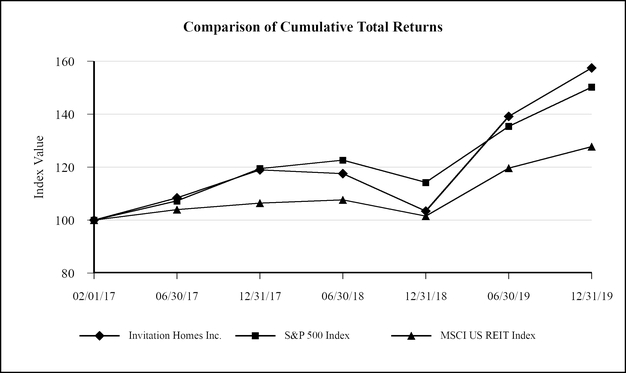
The following graph shows the total stockholder return of an investment of $100 cash on February 1, 2017 (the date our common stock began trading on the NYSE) for (1) our common stock, (2) the S&P 500 Total Return Index, and (3) the MSCI US REIT (RMS) Total Return Index. All values assume reinvestment of the full amount of all dividends. Stockholder returns over the indicated period are based on historical data and are not necessarily indicative of future stockholder returns.
| Cumulative Total Returns as of | ||||||||||||||||||||||||||||
| February 1, 2017 | June 30, 2017 | December 31, 2017 | June 30, 2018 | December 31, 2018 | June 30, 2019 | December 31, 2019 | ||||||||||||||||||||||
| Invitation Homes Inc. | $ | 100.00 | $ | 108.45 | $ | 119.02 | $ | 117.61 | $ | 103.43 | $ | 139.19 | $ | 157.50 | ||||||||||||||
| S&P 500 Index | 100.00 | 107.25 | 119.50 | 122.67 | 114.26 | 135.44 | 150.24 | |||||||||||||||||||||
| MSCI US REIT Index | 100.00 | 103.99 | 106.43 | 107.70 | 101.56 | 119.61 | 127.80 |
Repurchases of Equity Securities
We made no repurchases of our common stock during the three months ended December 31, 2019.
Item 6. SELECTED FINANCIAL DATA
The selected data set forth below under the captions “Selected Statement of Operations Data” and “Summary Balance Sheet Data” for or as of each of the years in the five year period ended December 31, 2019 are derived from our audited consolidated financial statements. Our consolidated balance sheets as of December 31, 2019 and 2018 and consolidated statements of operations for each of the years in the three year period ended December 31, 2019 are included in Part IV. Item 15. “Exhibits and Financial Statement Schedules.”
On November 16, 2017, we added 34,670 homes to our portfolio and issued 207,448,958 shares of common stock in connection with the Mergers. As a result, the Mergers have contributed to growth in results of operations and increases in total assets and total liabilities and equity. The selected consolidated financial data should be read in conjunction with Part II. Item 7. “Management’s Discussion and Analysis of Financial Condition and Results of Operations” and our historical consolidated financial statements, including the related notes, included in this Annual Report on Form 10-K.
| ($ in thousands, except per share data**)** | For the Years Ended December 31, | |||||||||||||||||||
| Selected Statement of Operations Data: | 2019 | 2018 | 2017 | 2016 | 2015 | |||||||||||||||
| Rental revenues and other property income | $ | 1,764,685 | $ | 1,722,962 | $ | 1,054,456 | $ | 922,587 | $ | 836,049 | ||||||||||
| Total expenses | 1,725,510 | 1,784,615 | 1,193,219 | 1,017,858 | 995,408 | |||||||||||||||
| Other, net | 11,600 | 6,958 | (959 | ) | (1,558 | ) | (3,121 | ) | ||||||||||||
| Gain on sale of property, net of tax | 96,336 | 49,682 | 33,896 | 18,590 | 2,272 | |||||||||||||||
| Net income (loss) | 147,111 | (5,013 | ) | (105,826 | ) | (78,239 | ) | (160,208 | ) | |||||||||||
| Net (income) loss attributable to non-controlling interests | (1,648 | ) | 86 | 489 | — | — | ||||||||||||||
| Net income (loss) attributable to common stockholders | $ | 145,463 | $ | (4,927 | ) | $ | (105,337 | ) | $ | (78,239 | ) | $ | (160,208 | ) | ||||||
| For the Year Ended December 31, 2019 | For the Year Ended December 31, 2018 | February 1, 2017 through December 31, 2017**(1)** | ||||||||||||||||||
| Net income (loss) available to common stockholders — basic and diluted | $ | 145,068 | $ | (5,744 | ) | $ | (89,073 | ) | ||||||||||||
| Weighted average common shares outstanding — basic | 531,235,962 | 520,376,929 | 339,423,442 | |||||||||||||||||
| Weighted average common shares outstanding — diluted | 532,499,787 | 520,376,929 | 339,423,442 | |||||||||||||||||
| Net income (loss) per common share — basic | $ | 0.27 | $ | (0.01 | ) | $ | (0.26 | ) | ||||||||||||
| Net income (loss) per common share — diluted | $ | 0.27 | $ | (0.01 | ) | $ | (0.26 | ) | ||||||||||||
| Dividends declared per common share | $ | 0.52 | $ | 0.44 | $ | 0.22 |
| (1) | Prior to the IPO, our business was conducted through the IH Holding Entities, which did not have a common capital structure upon which to compute historical earnings per share. Accordingly, earnings per shares has not been presented for historical periods prior to the IPO. |
| ($ in thousands) | As of December 31, | |||||||||||||||||||
| Summary Balance Sheet Data: | 2019 | 2018 | 2017 | 2016 | 2015 | |||||||||||||||
| Investments in single-family residential properties, net | $ | 16,243,192 | $ | 16,686,060 | $ | 17,312,264 | $ | 9,002,515 | $ | 9,052,701 | ||||||||||
| Cash and cash equivalents | 92,258 | 144,940 | 179,878 | 198,119 | 274,818 | |||||||||||||||
| Other assets, net | 1,057,460 | 1,232,428 | 1,191,496 | 531,717 | 469,459 | |||||||||||||||
| Total assets | $ | 17,392,910 | $ | 18,063,428 | $ | 18,683,638 | $ | 9,732,351 | $ | 9,796,978 | ||||||||||
| Total debt | $ | 8,467,485 | $ | 9,249,815 | $ | 9,651,662 | $ | 7,570,279 | $ | 7,725,957 | ||||||||||
| Other liabilities | 659,347 | 444,427 | 382,101 | 204,649 | 183,990 | |||||||||||||||
| Total liabilities | 9,126,832 | 9,694,242 | 10,033,763 | 7,774,928 | 7,909,947 | |||||||||||||||
| Total equity | 8,266,078 | 8,369,186 | 8,649,875 | 1,957,423 | 1,887,031 | |||||||||||||||
| Total liabilities and equity | $ | 17,392,910 | $ | 18,063,428 | $ | 18,683,638 | $ | 9,732,351 | $ | 9,796,978 |
Item 7. MANAGEMENT’S DISCUSSION AND ANALYSIS OF FINANCIAL CONDITION AND RESULTS OF OPERATIONS
The following discussion and analysis of our financial condition and results of operations should be read together with Part I. Item 6. “Selected Financial Data,” Part I. Item 1. “Business,” and the consolidated financial statements, including the notes thereto, that are included elsewhere in this Annual Report on Form 10-K*. This discussion and analysis contains forward-looking statements based upon our current expectations that involve risks and uncertainties. Our actual results may differ materially from those anticipated in these forward-looking statements as a result of various factors, including those set forth under Part I. Item 1A. “Risk Factors,” “Forward-Looking Statements,” or in other parts of this report*
For similar operating and financial data and discussion of our year ended December 31, 2018 results compared to our year ended December 31, 2017 results, refer to Part II. Item 7. “Management’s Discussion and Analysis of Financial Condition and Results of Operations” of our Annual Report on Form 10-K which was filed with the SEC on February 28, 2019 (the “2018 10-K”). The sections entitled “Result of Operations — Year Ended December 31, 2018 Compared to Year Ended December 31, 2017” and “Cash Flows — Year Ended December 31, 2018 Compared to Year Ended December 31, 2017” in Part II. Item 7. “Management’s Discussion and Analysis of Financial Condition and Result of Operations” of our 2018 10-K are incorporated herein by reference.
Capitalized terms used without definition have the meaning provided elsewhere in this Annual Report on Form 10-K*.*
Overview
Invitation Homes is a leading owner and operator of single-family homes for lease, offering residents high-quality homes in sought-after neighborhoods across America. With approximately 80,000 homes for lease in 16 markets across the country as of December 31, 2019, Invitation Homes is meeting changing lifestyle demands by providing residents access to updated homes with features they value, such as close proximity to jobs and access to good schools. Our mission statement, “Together with you, we make a house a home,” reflects our commitment to high-touch service that continuously enhances residents’ living experiences and provides homes where individuals and families can thrive.
We operate in markets with strong demand drivers, high barriers to entry, and high rent growth potential, primarily in the Western United States, Florida, and the Southeast United States. Through disciplined market and asset selection, as well as through the Mergers, we designed our portfolio to capture the operating benefits of local density as well as economies of scale that we believe cannot be readily replicated. Since our founding in 2012, we have built a proven, vertically integrated operating platform that enables us to effectively and efficiently acquire, renovate, lease, maintain, and manage our homes.
We invest in markets that we expect will exhibit lower new supply, stronger job and household formation growth, and superior NOI growth relative to the broader United States housing and rental market. Within our 16 markets, we target attractive neighborhoods in in-fill locations with multiple demand drivers, such as proximity to major employment centers, desirable schools, and transportation corridors. Our homes average approximately 1,870 square feet with three bedrooms and two bathrooms, appealing to a resident base that we believe is less transitory than the typical multifamily resident. We invest in the upfront renovation of homes in our portfolio in order to address capital needs, reduce ongoing maintenance costs, and drive resident demand. As a result, our portfolio benefits from high occupancy and low turnover rates, and we are well-positioned to drive strong rent growth, attractive margins, and predictable cash flows.
Our Portfolio
The following table provides summary information regarding our total and Same Store portfolios as of and for the year ended December 31, 2019 as noted below:
| Market | Number of Homes**(1)** | Average Occupancy**(2)** | Average Monthly Rent**(3)** | Average Monthly Rent PSF**(3)** | % of Revenue**(4)** | ||||||
| Western United States: | |||||||||||
| Southern California | 8,071 | 95.0% | $2,411 | $1.42 | 13.4 | % | |||||
| Northern California | 4,390 | 95.1% | 2,087 | 1.35 | 6.6 | % | |||||
| Seattle | 3,531 | 93.4% | 2,198 | 1.15 | 5.3 | % | |||||
| Phoenix | 7,741 | 94.8% | 1,362 | 0.84 | 7.4 | % | |||||
| Las Vegas | 2,998 | 94.7% | 1,608 | 0.81 | 3.3 | % | |||||
| Denver | 2,314 | 90.7% | 1,989 | 1.11 | 3.1 | % | |||||
| Western United States Subtotal | 29,045 | 94.4% | 1,945 | 1.13 | 39.1 | % | |||||
| Florida: | |||||||||||
| South Florida | 8,567 | 93.7% | 2,186 | 1.18 | 12.9 | % | |||||
| Tampa | 8,121 | 94.6% | 1,668 | 0.90 | 9.5 | % | |||||
| Orlando | 6,082 | 93.8% | 1,654 | 0.89 | 6.8 | % | |||||
| Jacksonville | 1,865 | 95.2% | 1,672 | 0.84 | 2.2 | % | |||||
| Florida Subtotal | 24,635 | 94.1% | 1,847 | 0.99 | 31.4 | % | |||||
| Southeast United States: | |||||||||||
| Atlanta | 12,494 | 94.7% | 1,504 | 0.73 | 12.8 | % | |||||
| Carolinas | 4,702 | 94.7% | 1,583 | 0.73 | 5.1 | % | |||||
| Southeast United States Subtotal | 17,196 | 94.7% | 1,526 | 0.73 | 17.9 | % | |||||
| Texas: | |||||||||||
| Houston | 2,229 | 92.7% | 1,556 | 0.80 | 2.4 | % | |||||
| Dallas | 2,323 | 91.7% | 1,786 | 0.84 | 2.7 | % | |||||
| Texas Subtotal | 4,552 | 92.2% | 1,668 | 0.82 | 5.1 | % | |||||
| Midwest United States: | |||||||||||
| Chicago | 2,848 | 91.1% | 1,983 | 1.21 | 4.0 | % | |||||
| Minneapolis | 1,142 | 95.9% | 1,885 | 0.96 | 1.5 | % | |||||
| Midwest United States Subtotal | 3,990 | 92.4% | 1,955 | 1.13 | 5.5 | % | |||||
| Announced Market-in-Exit: | |||||||||||
| Nashville(5) | 87 | 95.2% | 1,835 | 0.86 | 1.0 | % | |||||
| Total / Average | 79,505 | 94.2% | $1,809 | $0.97 | 100.0 | % | |||||
| Same Store Total / Average | 70,799 | 96.3% | $1,812 | $0.97 | 90.1 | % |
| (1) | As of December 31, 2019. |
| (2) | Represents average occupancy for the year ended December 31, 2019. |
| (3) | Represents average monthly rent for the year ended December 31, 2019. |
| (4) | Represents the percentage of rental revenues and other property income generated in each market for the year ended December 31, 2019. |
| (5) | In December 2019, we announced a plan to fully exit the Nashville market and sold 708 homes in Nashville in a bulk transaction. We are pursuing the sale of the remaining 87 homes in the market. |
Factors That Affect Our Results of Operations and Financial Condition
Our results of operations and financial condition are affected by numerous factors, many of which are beyond our control. See Part I. Item 1A. “Risk Factors” for more information regarding factors that could materially adversely affect our results of operations and financial condition. Key factors that impact our results of operations and financial condition include market
Showing the first 8K of 114K characters. Open the full section
Item 7A. QUANTITATIVE AND QUALITATIVE DISCLOSURES ABOUT MARKET RISK
Our future income, cash flows, and fair values relevant to financial instruments are dependent upon prevalent market interest rates. Market risk refers to the risk of loss from adverse changes in interest rates, seasonality, market prices, commodity prices, and inflation. The primary market risks to which we are exposed are interest rate risk and seasonality. We may in the future use derivative financial instruments to manage, or hedge, interest rate risks related to any borrowings we may have. We may enter into such contracts only with major financial institutions based on their credit ratings and other factors.
Interest Rate Risk
A primary market risk to which we believe we are exposed is interest rate risk, which may result from many factors, including government monetary and tax policies, domestic and international economic and political considerations, and other factors that are beyond our control. We may incur additional variable rate debt in the future, including additional amounts that we may borrow under the Credit Facility. In addition, decreases in interest rates may lead to additional competition for the acquisition of single-family homes, which may lead to future acquisitions being more costly and resulting in lower yields on single-family homes targeted for acquisition. Significant increases in interest rates may also have an adverse impact on our earnings if we are unable to increase rents on expired leases or acquire single-family homes with rental rates high enough to offset the increase in interest rates on our borrowings.
As of December 31, 2019, our outstanding variable-rate debt was comprised of borrowings on our mortgage loans of $5,270.9 million and Term Loan Facility of $1,500.0 million, for a combined total of $6,770.9 million. We effectively converted 96.3% of these borrowings to a fixed rate through interest rate swap agreements. Additionally, all borrowings bear interest at LIBOR plus the applicable spread. Assuming no change in the outstanding balance of our existing debt, the projected effect of a 100 bps increase or decrease in LIBOR on our annual interest expense would be an estimated increase or decrease of $2.5 million. This estimate considers the impact of our interest rate swap agreements, interest rate cap agreements, and any LIBOR floors or minimum interest rates stated in the agreements of the respective borrowings.
This analysis does not consider the effects of the reduced level of overall economic activity that could exist in such an environment. Further, in the event of a change of such magnitude, we may consider taking actions to further mitigate our exposure to the change. However, because of the uncertainty of the specific actions that would be taken and their possible effects, the sensitivity analysis assumes no changes in our capital structure.
Seasonality
Our business and related operating results have been, and we believe that they will continue to be, impacted by seasonal factors throughout the year. In particular, we have experienced higher levels of resident move-outs during the summer months, which impacts both our rental revenues and related turnover costs. Further, our property operating costs are seasonally impacted in certain markets by increases in expenses such as HVAC repairs, costs to re-resident, and landscaping expenses during the summer season.
Item 8. FINANCIAL STATEMENTS AND SUPPLEMENTARY DATA
The information required by this Item is included as a separate section in this Annual Report on Form 10-K. See Part IV. Item 15. “Exhibits and Financial Statement Schedules,” which is incorporated herein by reference.
Item 9. CHANGES IN AND DISAGREEMENTS WITH ACCOUNTANTS ON ACCOUNTING AND FINANCIAL DISCLOSURE
None.
Item 9A. CONTROLS AND PROCEDURES
Disclosure Controls and Procedures
We maintain a set of disclosure controls and procedures (as defined in Rules 13a-15(e) and 15d-15(e) under the Exchange Act) designed to ensure that information required to be disclosed in reports we file or submit under the Exchange Act, is recorded, processed, summarized and reported within the time periods specified in SEC rules and forms and that such information is accumulated and communicated to our management, including our Chief Executive Officer and Chief Financial Officer, as appropriate, to allow timely decisions regarding required disclosures. The design of any disclosure controls and procedures is based in part upon certain assumptions about the likelihood of future events, and there can be no assurance that any design will succeed in achieving its goals under all potential future conditions. Any controls and procedures, no matter how well designed and operated, can provide only reasonable, not absolute, assurance of achieving the desired control objectives. Our management, with the participation of our Chief Executive Officer and Chief Financial Officer, has evaluated the effectiveness of the design and operation of our disclosure controls and procedures as of December 31, 2019. Based upon that evaluation, our Chief Executive Officer and Chief Financial Officer concluded that, as of December 31, 2019, the design and operation of our disclosure controls and procedures were effective to accomplish their objectives at the reasonable assurance level.
Changes in Internal Control
There has been no change in our internal control over financial reporting during our most recent fiscal quarter that has materially affected, or is reasonably likely to materially affect, our internal control over financial reporting.
Management's Annual Report on Internal Control over Financial Reporting
Our management is responsible for establishing and maintaining adequate internal control over financial reporting (as defined in Rules 13a-15(f) and 15d-15(f) under the Exchange Act). Our internal control over financial reporting is designed to provide reasonable assurance regarding the reliability of our financial reporting and the preparation of our consolidated financial statements for external purposes in accordance with United States generally accepted accounting principles. Our internal control over financial reporting includes those policies and procedures that (1) pertain to maintenance of records that, in reasonable detail, accurately and fairly reflect the transactions and dispositions of the Company; (2) provide reasonable assurance that transaction are recorded as necessary to permit preparation of consolidated financial statements in accordance with United States generally accepted accounting principles and that receipts and expenditures of the Company are being made only in accordance with authorizations of the Company’s management and directors; and (3) provide reasonable assurance regarding prevention or timely detection of unauthorized acquisition, use or disposition of assets of the Company that could have a material effect on the consolidated financial statements. Because of its inherent limitations, internal control over financial reporting may not prevent or detect misstatements. Also, projections of any evaluation of effectiveness to future periods are subject to the risk that controls may become inadequate because of changes in conditions, or that the degree of compliance with the policies and procedures may deteriorate.
Our management with the participation of our Chief Executive Officer and Chief Financial Officer conducted an evaluation of the effectiveness of our internal control over financial reporting as of December 31, 2019. This evaluation was based on the framework established in Internal Control — Integrated Framework (2013) issued by the Committee of Sponsoring Organizations of the Treadway Commission. Based on our assessment under the framework in Internal Control — Integrated Framework (2013), our management concluded that our internal control over financial reporting was effective as of December 31, 2019 to accomplish their objectives at the reasonable assurance level.
Deloitte & Touche LLP, the independent registered public accounting firm that has audited the consolidated financial statements included in this Annual Report on Form 10-K, has issued an attestation report on the Company’s internal control over financial reporting as of December 31, 2019. The report is included herein.
REPORT OF INDEPENDENT REGISTERED PUBLIC ACCOUNTING FIRM
To the stockholders and the Board of Directors of Invitation Homes Inc.
Opinion on Internal Control over Financial Reporting
We have audited the internal control over financial reporting of Invitation Homes Inc. and subsidiaries (the “Company”) as of December 31, 2019, based on criteria established in Internal Control—Integrated Framework (2013) issued by the Committee of Sponsoring Organizations of the Treadway Commission (COSO). In our opinion, the Company maintained, in all material respects, effective internal control over financial reporting as of December 31, 2019, based on criteria established in Internal Control—Integrated Framework (2013) issued by COSO.
We have also audited, in accordance with the standards of the Public Company Accounting Oversight Board (United States) (PCAOB), the financial statements as of and for the year ended December 31, 2019 of the Company and our report dated February 19, 2020 expressed an unqualified opinion on those financial statements.
Basis for Opinion
The Company’s management is responsible for maintaining effective internal control over financial reporting and for its assessment of the effectiveness of internal control over financial reporting, included in the accompanying Management’s Annual Report on Internal Control over Financial Reporting. Our responsibility is to express an opinion on the Company’s internal control over financial reporting based on our audit. We are a public accounting firm registered with the PCAOB and are required to be independent with respect to the Company in accordance with the U.S. federal securities laws and the applicable rules and regulations of the Securities and Exchange Commission and the PCAOB.
We conducted our audit in accordance with the standards of the PCAOB. Those standards require that we plan and perform the audit to obtain reasonable assurance about whether effective internal control over financial reporting was maintained in all material respects. Our audit included obtaining an understanding of internal control over financial reporting, assessing the risk that a material weakness exists, testing and evaluating the design and operating effectiveness of internal control based on the assessed risk, and performing such other procedures as we considered necessary in the circumstances. We believe that our audit provides a reasonable basis for our opinion.
Definition and Limitations of Internal Control over Financial Reporting
A company’s internal control over financial reporting is a process designed to provide reasonable assurance regarding the reliability of financial reporting and the preparation of financial statements for external purposes in accordance with generally accepted accounting principles. A company’s internal control over financial reporting includes those policies and procedures that (1) pertain to the maintenance of records that, in reasonable detail, accurately and fairly reflect the transactions and dispositions of the assets of the company; (2) provide reasonable assurance that transactions are recorded as necessary to permit preparation of financial statements in accordance with generally accepted accounting principles, and that receipts and expenditures of the company are being made only in accordance with authorizations of management and directors of the company; and (3) provide reasonable assurance regarding prevention or timely detection of unauthorized acquisition, use, or disposition of the company’s assets that could have a material effect on the financial statements.
Because of its inherent limitations, internal control over financial reporting may not prevent or detect misstatements. Also, projections of any evaluation of effectiveness to future periods are subject to the risk that controls may become inadequate because of changes in conditions, or that the degree of compliance with the policies or procedures may deteriorate.
/s/ Deloitte & Touche LLP
Dallas, Texas
February 19, 2020
Item 9B. OTHER INFORMATION
None.
PART III
Item 10. DIRECTORS, EXECUTIVE OFFICERS, AND CORPORATE GOVERNANCE
The information required by this Item is incorporated by reference from the Company’s 2020 Proxy Statement to be filed with the SEC within 120 days of the fiscal year ended December 31, 2019.
Item 11. EXECUTIVE COMPENSATION
The information required by this Item is incorporated by reference from the Company’s 2020 Proxy Statement to be filed with the SEC within 120 days of the fiscal year ended December 31, 2019.
Item 12. SECURITY OWNERSHIP OF CERTAIN BENEFICIAL OWNERS AND MANAGEMENT AND RELATED STOCKHOLDER MATTERS
The information required by this Item is incorporated from reference to the Company’s 2020 Proxy Statement to be filed with the SEC within 120 days of the fiscal year ended December 31, 2019.
Item 13. CERTAIN RELATIONSHIPS AND RELATED TRANSACTIONS, AND DIRECTOR INDEPENDENCE
The information required by this Item is incorporated by reference from the Company’s 2020 Proxy Statement to be filed with the SEC within 120 days of the fiscal year ended December 31, 2019.
Item 14. PRINCIPAL ACCOUNTANT FEES AND SERVICES
The information required by this Item is incorporated by reference from the Company’s 2020 Proxy Statement to be filed with the SEC within 120 days of the fiscal year ended December 31, 2019.
PART IV
Item 15. Exhibits and Financial Statement Schedules.
The following documents are filed as part of this report:
| (a) Financial Statements | |
| Invitation Homes Inc. Consolidated Financial Statements as of December 31, 2019 and 2018 and for the three years in the period ended December 31, 2019 | |
| Report of Deloitte & Touche LLP, Independent Registered Public Accounting Firm | F-1 |
| Consolidated Balance Sheets | F-4 |
| Consolidated Statements of Operations | F-5 |
| Consolidated Statements of Other Comprehensive Loss | F-6 |
| Consolidated Statements of Equity | F-7 |
| Consolidated Statements of Cash Flows | F-8 |
| Notes to Consolidated Financial Statements | F-10 |
| (b) Financial Statement Schedule | |
| Invitation Homes Inc. as of December 31, 2019 and for the three years in the period ended December 31, 2019 | |
| Schedule III Real Estate and Accumulated Depreciation | F-45 |
| (c) Exhibits |
EXHIBIT INDEX
† This document has been identified as a management contract or compensatory plan or arrangement.
Certain agreements and other documents filed as exhibits to this Annual Report on Form 10-K contain representations and warranties that the parties thereto made to each other. These representations and warranties have been made solely for the benefit of the other parties to such agreements and may have been qualified by certain information that has been disclosed to the other parties to such agreements and other documents and that may not be reflected in such agreements and other documents. In addition, these representations and warranties may be intended as a way of allocating risks among parties if the statements contained therein prove to be incorrect, rather than as actual statements of fact. Accordingly, there can be no reliance on any such representations and warranties as characterizations of the actual state of facts. Moreover, information concerning the subject matter of any such representations and warranties may have changed since the date of such agreements and other documents.
Item 16. FORM 10-K SUMMARY
None.
SIGNATURES
Pursuant to the requirements of Section 13 or 15(d) of the Securities Exchange Act of 1934, the Registrant has duly caused this report to be signed on its behalf by the undersigned, thereunto duly authorized, in Dallas, Texas, on the 19th day of February 2020.
| Invitation Homes Inc. | |
| By: | /s/ Dallas B. Tanner |
| Name: Dallas B. Tanner | |
| Title: President and Chief Executive Officer |
Pursuant to the requirements of the Securities Act of 1934, this report has been signed by the following persons in the capacities indicated on the 19th day of February 2020.
| Signature | Title | |
| /s/ Dallas B. Tanner | President, Chief Executive Officer, and Director | |
| Dallas B. Tanner | (Principal Executive Officer) | |
| /s/ Ernest M. Freedman | Executive Vice President and Chief Financial Officer | |
| Ernest M. Freedman | (Principal Financial Officer) | |
| /s/ Kimberly K. Norrell | Senior Vice President and Chief Accounting Officer | |
| Kimberly K. Norrell | (Principal Accounting Officer) | |
| /s/ Bryce Blair | Chairman and Director | |
| Bryce Blair | ||
| /s/ Jana C. Barbe | Director | |
| Jana C. Barbe | ||
| /s/ Richard D. Bronson | Director | |
| Richard D. Bronson | ||
| /s/ Kenneth A. Caplan | Director | |
| Kenneth A. Caplan | ||
| /s/ Michael D. Fascitelli | Director | |
| Michael D. Fascitelli |
| Signature | Title | |
| /s/ Robert G. Harper | Director | |
| Robert G. Harper | ||
| /s/ Jeffrey E. Kelter | Director | |
| Jeffrey E. Kelter | ||
| /s/ John B. Rhea | Director | |
| John B. Rhea | ||
| /s/ Janice L. Sears | Director | |
| Janice L. Sears | ||
| /s/ William J. Stein | Director | |
| William J. Stein | ||
| /s/ Barry S. Sternlicht | Director | |
| Barry S. Sternlicht |
REPORT OF INDEPENDENT REGISTERED PUBLIC ACCOUNTING FIRM
To the stockholders and the Board of Directors of Invitation Homes Inc.
Opinion on the Financial Statements
We have audited the accompanying consolidated balance sheets of Invitation Homes Inc. and subsidiaries (the “Company”) as of December 31, 2019 and 2018, the related consolidated statements of operations, other comprehensive income (loss), equity, and cash flows, for each of the three years in the period ended December 31, 2019, and the related notes and the schedule listed in the Index at Item 15 (collectively referred to as the “financial statements”). In our opinion, the financial statements present fairly, in all material respects, the financial position of the Company as of December 31, 2019 and 2018, and the results of its operations and its cash flows for each of the three years in the period ended December 31, 2019, in conformity with accounting principles generally accepted in the United States of America.
We have also audited, in accordance with the standards of the Public Company Accounting Oversight Board (United States) (PCAOB), the Company’s internal control over financial reporting as of December 31, 2019, based on criteria established in Internal Control—Integrated Framework (2013) issued by the Committee of Sponsoring Organizations of the Treadway Commission and our report dated February 19, 2020, expressed an unqualified opinion on the Company’s internal control over financial reporting.
Basis for Opinion
These financial statements are the responsibility of the Company’s management. Our responsibility is to express an opinion on the Company’s financial statements based on our audits. We are a public accounting firm registered with the PCAOB and are required to be independent with respect to the Company in accordance with the U.S. federal securities laws and the applicable rules and regulations of the Securities and Exchange Commission and the PCAOB.
We conducted our audits in accordance with the standards of the PCAOB. Those standards require that we plan and perform the audit to obtain reasonable assurance about whether the financial statements are free of material misstatement, whether due to error or fraud. Our audits included performing procedures to assess the risks of material misstatement of the financial statements, whether due to error or fraud, and performing procedures that respond to those risks. Such procedures included examining, on a test basis, evidence regarding the amounts and disclosures in the financial statements. Our audits also included evaluating the accounting principles used and significant estimates made by management, as well as evaluating the overall presentation of the financial statements. We believe that our audits provide a reasonable basis for our opinion.
Critical Audit Matters
The critical audit matters communicated below are matters arising from the current-period audit of the financial statements that were communicated or required to be communicated to the audit committee and that (1) relate to accounts or disclosures that are material to the financial statements and (2) involved our especially challenging, subjective, or complex judgments. The communication of critical audit matters does not alter in any way our opinion on the financial statements, taken as a whole, and we are not, by communicating the critical audit matters below, providing separate opinions on the critical audit matters or on the accounts or disclosures to which they relate.
F-1
Investments in Single-Family Residential Properties**—**Refer to Notes 2 and 3 to the financial statements
Critical Audit Matter Description
The Company owned approximately 80,000 individual single-family residential properties with a net book value of $16.2 billion as of December 31, 2019. The Company capitalizes costs to acquire, stabilize, and prepare single-family residential properties to be leased. The determination of which costs to capitalize, the useful life of the respective capitalized cost, and the classification of assets as held for sale and held for use requires significant management judgment. Furthermore, the Company evaluates investments in single-family residential properties to determine whether there have been any changes in circumstances that may indicate that the carrying value of individual properties may not be recoverable.
Given management’s (1) inputs and assumptions used to determine purchase price allocation based upon the relative fair values of asset components, (2) determination of which costs improve or extend the life of a property, (3) evaluation of single-family residential properties for impairment which requires significant judgment and assessment of factors that are, at times, subject to significant uncertainty, and (4) application of held for sale classification criteria, performing audit procedures to evaluate the accounting for investments in single-family residential properties was challenging and required an increased extent of audit effort.
How the Critical Audit Matter Was Addressed in the Audit
Our audit procedures related to whether the investments in single-family residential properties were accounted for appropriately included the following, among others:
| • | We tested the effectiveness of relevant controls over investments in single-family residential properties. |
| • | We selected a sample of properties acquired during the year and evaluated the accuracy of the amounts recorded and appropriate transfer of title. |
| • | We evaluated the appropriateness of management’s allocation of the initial purchase price for newly acquired properties by developing independent estimates for the purchase price allocation for each residential market |
Showing the first 8K of 202K characters. Open the full section