 filings.tools
Invitation Homes 10-K 2021-12-31
Filed 2022-02-22. 23 sections, 634K characters. Original on sec.gov · Markdown · JSON
Cover and table of contents
| UNITED STATES SECURITIES AND EXCHANGE COMMISSION Washington, D.C. 20549 | ||||||||||||||||||||||||||||||||||||||||||||||||||||||||||||||||||||||||||
| FORM | 10-K | |||||||||||||||||||||||||||||||||||||||||||||||||||||||||||||||||||||||||
| ☑ | ANNUAL REPORT PURSUANT TO SECTION 13 OR 15(d) OF THE SECURITIES EXCHANGE ACT OF 1934 | |||||||||||||||||||||||||||||||||||||||||||||||||||||||||||||||||||||||||
| For the fiscal year ended | December 31, 2021 | |||||||||||||||||||||||||||||||||||||||||||||||||||||||||||||||||||||||||
| OR | ||||||||||||||||||||||||||||||||||||||||||||||||||||||||||||||||||||||||||
| ☐ | TRANSITION REPORT PURSUANT TO SECTION 13 OR 15(d) OF THE SECURITIES EXCHANGE ACT OF 1934 | |||||||||||||||||||||||||||||||||||||||||||||||||||||||||||||||||||||||||
| For the transition period from | to | |||||||||||||||||||||||||||||||||||||||||||||||||||||||||||||||||||||||||
| Commission File Number | 001-38004 | |||||||||||||||||||||||||||||||||||||||||||||||||||||||||||||||||||||||||
| Invitation Homes Inc. | ||||||||||||||||||||||||||||||||||||||||||||||||||||||||||||||||||||||||||
| (Exact name of registrant as specified in its charter) | ||||||||||||||||||||||||||||||||||||||||||||||||||||||||||||||||||||||||||
| Maryland | 90-0939055 | |||||||||||||||||||||||||||||||||||||||||||||||||||||||||||||||||||||||||
| (State or other jurisdiction of incorporation or organization) | (I.R.S. Employer Identification No.) | |||||||||||||||||||||||||||||||||||||||||||||||||||||||||||||||||||||||||
| 1717 Main Street, | Suite 2000 | 75201 | ||||||||||||||||||||||||||||||||||||||||||||||||||||||||||||||||||||||||
| Dallas, | Texas | |||||||||||||||||||||||||||||||||||||||||||||||||||||||||||||||||||||||||
| (Address of principal executive offices) | (Zip Code) | |||||||||||||||||||||||||||||||||||||||||||||||||||||||||||||||||||||||||
| (972) | 421-3600 | |||||||||||||||||||||||||||||||||||||||||||||||||||||||||||||||||||||||||
| (Registrant’s telephone number, including area code) | ||||||||||||||||||||||||||||||||||||||||||||||||||||||||||||||||||||||||||
| Securities registered pursuant to Section 12(b) of the Act: | ||||||||||||||||||||||||||||||||||||||||||||||||||||||||||||||||||||||||||
| Title of each class | Trading Symbol(s) | Name of each exchange on which registered | ||||||||||||||||||||||||||||||||||||||||||||||||||||||||||||||||||||||||
| Common stock, $0.01 par value | INVH | New York Stock Exchange | ||||||||||||||||||||||||||||||||||||||||||||||||||||||||||||||||||||||||
| Securities registered pursuant to Section 12(g) of the Act: None | ||||||||||||||||||||||||||||||||||||||||||||||||||||||||||||||||||||||||||
| Indicate by check mark if the registrant is a well-known seasoned issuer, as defined in Rule 405 of the Securities Act. | Yes | ☑ | No | ☐ | ||||||||||||||||||||||||||||||||||||||||||||||||||||||||||||||||||||||
| Indicate by check mark if the registrant is not required to file reports pursuant to Section 13 or 15(d) of the Act. | Yes | ☐ | No | ☑ | ||||||||||||||||||||||||||||||||||||||||||||||||||||||||||||||||||||||
| Indicate by check mark whether the registrant: (1) has filed all reports required to be filed by Section 13 or 15(d) of the Securities Exchange Act of 1934 during the preceding 12 months (or for such shorter period that the registrant was required to file such reports), and (2) has been subject to such filing requirements for the past 90 days. | ||||||||||||||||||||||||||||||||||||||||||||||||||||||||||||||||||||||||||
| Yes | ☑ | No | ☐ | |||||||||||||||||||||||||||||||||||||||||||||||||||||||||||||||||||||||
| Indicate by check mark whether the registrant has submitted electronically every Interactive Data File required to be submitted pursuant to Rule 405 of Regulation S-T (§232.405 of this chapter) during the preceding 12 months (or for such shorter period that the registrant was required to submit such files). | ||||||||||||||||||||||||||||||||||||||||||||||||||||||||||||||||||||||||||
| Yes | ☑ | No | ☐ | |||||||||||||||||||||||||||||||||||||||||||||||||||||||||||||||||||||||
| Indicate by check mark whether the registrant is a large accelerated filer, an accelerated filer, a non-accelerated filer, a smaller reporting company, or an emerging growth company. See the definitions of “large accelerated filer,” “accelerated filer,” “smaller reporting company,” and “emerging growth company” in Rule 12b-2 of the Exchange Act. | ||||||||||||||||||||||||||||||||||||||||||||||||||||||||||||||||||||||||||
| Large Accelerated Filer | ☑ | Accelerated Filer | ☐ | |||||||||||||||||||||||||||||||||||||||||||||||||||||||||||||||||||||||
| Non-Accelerated Filer | ☐ | Smaller Reporting Company | ☐ | |||||||||||||||||||||||||||||||||||||||||||||||||||||||||||||||||||||||
| Emerging Growth Company | ☐ | |||||||||||||||||||||||||||||||||||||||||||||||||||||||||||||||||||||||||
| If an emerging growth company, indicate by check mark if the registrant has elected not to use the extended transition period for complying with any new or revised financial accounting standards provided pursuant to Section 13(a) of the Exchange Act. ☐ | ||||||||||||||||||||||||||||||||||||||||||||||||||||||||||||||||||||||||||
| Indicate by check mark whether the registrant has filed a report on and attestation to its management’s assessment of the effectiveness of its internal control over financial reporting under Section 404(b) of the Sarbanes-Oxley Act (15 U.S.C. 7262(b)) by the registered public accounting firm that prepared or issued its audit report. | ☑ | |||||||||||||||||||||||||||||||||||||||||||||||||||||||||||||||||||||||||
| Indicate by check mark whether the registrant is a shell company (as defined in Rule 12b-2 of the Exchange Act). | Yes | ☐ | No | ☑ |
As of June 30, 2021, the aggregate market value of the registrant’s common stock held by non-affiliates of the registrant was approximately $21.1 billion (based upon the closing sale price of the common stock on that date on the New York Stock Exchange).
As of February 18, 2022, there were 607,652,169 shares of common stock, par value $0.01 per share, outstanding.
| DOCUMENTS INCORPORATED BY REFERENCE | ||||||||||||||||||||||||||||||||||||||||||||
| Items 10, 11, 12, 13, and 14 of Part III incorporate information by reference from the registrant’s definitive proxy statement relating to its 2022 annual meeting of stockholders (the “2022 Proxy Statement”) to be filed with the Securities and Exchange Commission within 120 days after the close of the registrant’s fiscal year to which this report relates. | ||||||||||||||||||||||||||||||||||||||||||||
INVITATION HOMES INC.
| Page | |||||||||||
| PART I | |||||||||||
| Item | 1. | Business | 8 | ||||||||
| Item | 1A. | Risk Factors | 22 | ||||||||
| Item | 1B. | Unresolved Staff Comments | 51 | ||||||||
| Item | 2. | Properties | 51 | ||||||||
| Item | 3. | Legal Proceedings | 51 | ||||||||
| Item | 4. | Mine Safety Disclosures | 52 | ||||||||
| PART II | |||||||||||
| Item | 5. | Market for Registrant’s Common Equity, Related Stockholder Matters, and Issuer Purchases of Equity Securities | 53 | ||||||||
| Item | 6. | Reserved | 54 | ||||||||
| Item | 7. | Management’s Discussion and Analysis of Financial Condition and Results of Operations | 55 | ||||||||
| Item | 7A. | Quantitative and Qualitative Disclosures About Market Risk | 78 | ||||||||
| Item | 8. | Financial Statements and Supplementary Data | 79 | ||||||||
| Item | 9. | Changes in and Disagreements with Accountants on Accounting and Financial Disclosure | 79 | ||||||||
| Item | 9A. | Controls and Procedures | 79 | ||||||||
| Item | 9B. | Other Information | 82 | ||||||||
| Item | 9C. | Disclosure Regarding Foreign Jurisdictions that Prevent Inspection | 82 | ||||||||
| PART III | |||||||||||
| Item | 10. | Directors, Executive Officers, and Corporate Governance | 83 | ||||||||
| Item | 11. | Executive Compensation | 83 | ||||||||
| Item | 12. | Security Ownership of Certain Beneficial Owners and Management and Related Stockholder Matters | 83 | ||||||||
| Item | 13. | Certain Relationships and Related Transactions, and Director Independence | 83 | ||||||||
| Item | 14. | Principal Accountant Fees and Services | 83 | ||||||||
| PART IV | |||||||||||
| Item | 15. | Exhibits and Financial Statement Schedules | 84 | ||||||||
| Item | 16. | Form 10-K Summary | 90 | ||||||||
| Exhibit Index | |||||||||||
| Signatures |
FORWARD-LOOKING STATEMENTS
This Annual Report on Form 10-K contains forward-looking statements within the meaning of Section 27A of the Securities Act of 1933, as amended, and Section 21E of the Securities Exchange Act of 1934, as amended (the “Exchange Act”), which include, but are not limited to, statements related to our expectations regarding the performance of our business, our financial results, our liquidity and capital resources, and other non-historical statements. In some cases, you can identify these forward-looking statements by the use of words such as “outlook,” “believes,” “expects,” “potential,” “continues,” “may,” “will,” “should,” “could,” “seeks,” “projects,” “predicts,” “intends,” “plans,” “estimates,” “anticipates,” or the negative version of these words or other comparable words. Such forward-looking statements are subject to various risks and uncertainties as summarized below in “Summary Risk Factors.” These risks and uncertainties include among others, risks inherent to the single-family rental industry and our business model, macroeconomic factors beyond our control, competition in identifying and acquiring properties, competition in the leasing market for quality residents, increasing property taxes, homeowners’ association (“HOA”) fees, and insurance costs, our dependence on third parties for key services, risks related to the evaluation of properties, poor resident selection and defaults and non-renewals by our residents, performance of our information technology systems, risks related to our indebtedness, and risks related to the potential negative impact of the ongoing COVID-19 pandemic on our financial condition, results of operations, cash flows, business, associates, and residents. Accordingly, there are or will be important factors that could cause actual outcomes or results to differ materially from those indicated in these statements. Moreover, many of these factors have been heightened as a result of the ongoing and numerous adverse impacts of the COVID-19 pandemic. We believe these factors include but are not limited to, those described under Part I. Item 1A. “Risk Factors” of this Annual Report on Form 10-K, as such factors may be updated from time to time in our other periodic filings with the Securities and Exchange Commission (the “SEC”), which are accessible on the SEC’s website at https://www.sec.gov. These factors should not be construed as exhaustive and should be read in conjunction with the other cautionary statements that are included in this Annual Report on Form 10-K, and in our other periodic filings. The forward-looking statements speak only as of the date of this Annual Report on Form 10-K, and we expressly disclaim any obligation or undertaking to publicly update or review any forward-looking statement, whether as a result of new information, future developments or otherwise, except to the extent otherwise required by law.
Summary Risk Factors
Our ability to successfully operate our business is subject to numerous risks, including those that are generally associated with operating in the real estate industry. Some of the more significant challenges and risks are summarized below. This summary contains only a select portion of the risks set forth in Part I. Item 1A. “Risk Factors” and throughout this Annual Report on Form 10-K.
-
Our operating results are subject to risks related to general economic conditions and risks associated with our real estate assets;
-
The ongoing COVID-19 pandemic and other future epidemics and public health crises could have an adverse effect on our results of operations and financial condition;
-
We are employing a business model with a limited track record, which may make our business difficult to evaluate, and we have a limited operating history;
-
A significant portion of our costs and expenses are fixed, including increasing property taxes, HOA fees, and insurance costs, and we may not be able to adapt our costs structure to offset declines in our revenue;
-
Timing and costs of renovating our properties and the cost of maintaining rental properties may negatively affect our financial results;
-
Concentration of our investments in certain markets and in the single-family properties sector of the real estate industry exposes us to seasonal fluctuations in rental demand and downturns in our markets or in the single-family properties sector;
-
We face significant competition in the leasing market for quality residents, which may limit our ability to lease our single-family homes on favorable terms;
-
We face risks associated with acquisitions and dispositions of properties which could lead to material losses on our investments in our properties and adversely impact anticipated yields, including risks related to:
-
competition in identifying and acquiring our properties;
-
possible title defects;
-
acquisitions of new homes from third party homebuilders;
-
bulk portfolio acquisitions and dispositions;
-
acquisitions through an auction process;
-
evaluation of properties based on potentially inaccurate assumptions; and
-
acquisitions of properties consistent with our investment strategy regardless of favorability of rental and housing markets;
-
Our dependence upon third parties for key services may have an adverse effect on our operating results or reputation if the third parties fail to perform;
-
Supply chain disruptions, labor shortages, or labor inflation could have a material adverse impact on our business, financial condition, or operating results;
-
We are highly dependent on information systems and systems failures, security breaches, and other disruptions could significantly disrupt our business and expose us to liability;
-
Compliance with governmental laws, regulations, and covenants that are applicable to our properties, including tenant relief laws, restrictions on evictions and collections, rent control laws, affordability covenants, permit, license, and zoning requirements, may negatively impact our rental income and profitability;
-
Legal and regulatory proceedings, claims, inquiries and investigations, exacerbated by increased political and regulatory scrutiny of our industry, and negative publicity by tenant and consumer rights organizations could directly limit and constrain our operations and may result in significant litigation expenses and reputational harm;
-
A significant number of our residential properties are part of HOAs and we and our residents are subject to the rules of such HOAs, which are subject to change, and violations of such rules may subject us to additional fees and penalties and litigation with such HOAs, which would be costly;
-
Our reliance on information supplied by prospective residents, which may be inaccurate, may lead to poor leasing decisions, and our portfolio may contain more risk than we believe;
-
If a significant number of our residents fail to meet their lease obligations or fail to renew their leases, our reputation, financial performance, and ability to make distributions to our stockholders may be adversely affected;
-
Allegations of leasing fraud may result in fines, settlements, litigation expenses, and reputational damage;
-
Relatively short lease terms expose us to the risk that we may have to re-lease our properties frequently, which we may be unable to do on attractive terms, on a timely basis, or at all;
-
Fluctuations of rent rates in our markets could adversely affect our financial condition, operating results, and ability to make distributions to our stockholders;
-
Declining real estate valuations and impairment charges could adversely affect our financial condition and operating results;
-
Our participation in joint venture investments may limit our ability to invest in certain markets, and we may be adversely affected by our lack of sole decision-making authority, our reliance on joint venture partners’ financial condition, our exposure to liabilities in connection with property management and other services we provide to our joint venture partners, and disputes between us and our joint venture partners;
-
We may suffer losses that are not covered by insurance;
-
We are subject to risks related to environmental, social, and governance issues, including risks from natural disasters, environmentally hazardous conditions, impact of climate change, related regulatory and investor responses to climate change, and the transition to a lower-carbon economy;
-
We may have difficulty selling our real estate investments, and our ability to distribute all or a portion of the net proceeds from any such sale to our stockholders may be limited;
-
We may be unable to obtain financing through the debt and equity markets, or a downgrade in our credit ratings could adversely affect our financing options; both of which would have a material adverse effect on our growth strategy and our financial condition and operating results;
-
We utilize a significant amount of indebtedness in the operation of our business, and our cash flows and operating results could be adversely affected by required payments of debt or related interest and other risks of our debt financing;
-
Provisions of Maryland law and certain provisions in our charter may limit the ability of a third party to acquire control of us, even if such change in control would be in the best interests of our stockholders or would result in receipt of a premium to the price of our common stock; and
-
If we do not maintain our qualification as a real estate investment trust (“REIT”), we will be subject to tax as a regular domestic corporation and could face a substantial tax liability, and maintaining our REIT status may hinder our ability to operate solely on the basis of maximizing profits.
This summary is qualified in its entirety by the more complete statement of risks and uncertainties in Part I. Item 1A. “Risk Factors.” You should carefully read the entire statement together with all of the other information in this Annual Report on Form 10-K when considering the risks and uncertainties in evaluating our company and our business.
DEFINED TERMS
Invitation Homes Inc. (“INVH”), a REIT, conducts its operations through Invitation Homes Operating Partnership LP (“INVH LP”). THR Property Management L.P., a wholly owned subsidiary of INVH LP (the “Manager”), provides all management and other administrative services with respect to the properties we own. On November 16, 2017, INVH and certain of its affiliates entered into a series of transactions with Starwood Waypoint Homes (“SWH”) and certain SWH affiliates which resulted in SWH and its operating partnership being merged into INVH and INVH LP, respectively, with INVH and INVH LP being the surviving entities (the “Mergers”).
Unless the context suggests otherwise, references in this Annual Report on Form 10-K to “Invitation Homes,” the “Company,” “we,” “our,” and “us” refer to INVH and its consolidated subsidiaries.
In this Annual Report on Form 10-K:
-
“average monthly rent” represents average monthly rental income per home for occupied properties in an identified population of homes over the measurement period and reflects the impact of non-service rent concessions and contractual rent increases amortized over the life of the related lease. We believe average monthly rent reflects pricing trends that significantly impact rental revenues over time, making average monthly rent useful to management and external stakeholders as a means of evaluating changes in rental revenues across periods;
-
“average occupancy” for an identified population of homes represents (i) the total number of days that the homes in such population were occupied during the measurement period, divided by (ii) the total number of days that the homes in such population were owned during the measurement period. We believe average occupancy significantly impacts rental revenues in a given period, making comparisons of average occupancy across different periods helpful to management and external stakeholders in evaluating changes in rental revenues across periods;
-
“Carolinas” includes Charlotte-Concord-Gastonia, NC-SC, Greensboro-High Point, NC, Raleigh-Cary, NC, Durham-Chapel Hill, NC, and Winston-Salem, SC;
-
“days to re-resident” for an individual home represents the number of days between (i) the date the prior resident moves out of a home, and (ii) the date the next resident is granted access to the same home, which is deemed to be the earlier of the next resident’s contractual lease start date and the next resident’s move-in date. Days to re-resident impacts our average occupancy and thus our rental revenues, making comparisons of days to re-resident helpful to management and external stakeholders in evaluating changes in rental revenues across periods;
-
“in-fill” refers to markets, MSAs, submarkets, neighborhoods or other geographic areas that are typified by significant population densities and low availability of land suitable for development into competitive properties, resulting in limited opportunities for new construction;
-
“Metropolitan Statistical Area” or “MSA” is defined by the United States Office of Management and Budget as a region associated with at least one urbanized area that has a population of at least 50,000 and comprises the central county or counties containing the core, plus adjacent outlying counties having a high degree of social and economic integration with the central county or counties as measured through commuting;
-
“net effective rental rate growth” for any home represents the percentage difference between the monthly rent from an expiring lease and the monthly rent from the next lease and, in each case, reflects the impact of non-service rent concessions and contractual rent increases amortized over the life of the related lease. Leases are either renewal leases, where our current resident chooses to stay for a subsequent lease term, or a new lease, where our previous resident moves out and a new resident signs a lease to occupy the same home. Net effective rental rate growth drives changes in our average monthly rent, making net effective rental rate growth useful to management and external stakeholders as a means of evaluating changes in rental revenues across periods;
-
“Northern California” includes Sacramento-Roseville-Folsom, CA, San Francisco-Oakland-Berkeley, CA, Stockton, CA, Vallejo, CA, and Yuba City, CA;
-
“PSF” means per square foot. When comparing homes or cohorts of homes, we believe PSF calculations help management and external stakeholders normalize metrics for differences in property size, enabling more meaningful comparisons based on characteristics other than property size;
-
“Same Store” or “Same Store portfolio” includes, for a given reporting period, wholly owned homes that have been stabilized and seasoned, excluding homes that have been sold, homes that have been identified for sale to an owner occupant and have become vacant, homes that have been deemed inoperable or significantly impaired by casualty loss events or force majeure, homes acquired in portfolio transactions that are deemed not to have undergone renovations of sufficiently similar quality and characteristics as the existing Invitation Homes Same Store portfolio, and homes in markets that we have announced an intent to exit where we no longer operate a significant number of homes for the primary purpose of income generation. Homes are considered stabilized if they have (i) completed an initial renovation and (ii) entered into at least one post-initial renovation lease. An acquired portfolio that is both leased and deemed to be of sufficiently similar quality and characteristics as the existing Invitation Homes Same Store portfolio may be considered stabilized at the time of acquisition. Homes are considered to be seasoned once they have been stabilized for at least 15 months prior to January 1st of the year in which the Same Store portfolio was established. We believe information about the portion of our portfolio that has been fully operational for the entirety of a given reporting period and its prior year comparison period provides management and external stakeholders with meaningful information about the performance of our comparable homes across periods and about trends in our organic business;
-
“Southeast United States” includes our Atlanta and Carolinas markets;
-
“South Florida” includes Miami-Fort Lauderdale-Pompano Beach, FL, and Port St. Lucie, FL;
-
“Southern California” includes Los Angeles-Long Beach-Anaheim, CA, Oxnard-Thousand Oaks-Ventura, CA, Riverside-San Bernardino-Ontario, CA, and San Diego-Chula Vista-Carlsbad, CA;
-
“total homes” or “total portfolio” refers to the total number of homes we own, whether or not stabilized, and excludes any properties previously acquired in purchases that have been subsequently rescinded or vacated. Unless otherwise indicated, total homes or total portfolio refers to the wholly owned homes and excludes homes owned in joint ventures. Additionally, unless the context otherwise requires, all measures in this Annual Report on Form 10-K are presented on a total portfolio basis;
-
“turnover rate” represents the number of instances that homes in an identified population become unoccupied in a given period, divided by the number of homes in such population. To the extent the measurement period shown is less than 12 months, the turnover rate may be reflected on an annualized basis. We believe turnover rate impacts average occupancy and thus our rental revenues, making comparisons of turnover rate helpful to management and external stakeholders in evaluating changes in rental revenues across periods. In addition, turnover can impact our cost to maintain homes, making changes in turnover rate useful to management and external stakeholders in evaluating changes in our property operating and maintenance expenses across periods; and
-
“Western United States” includes our Southern California, Northern California, Seattle, Phoenix, Las Vegas, and Denver markets.
PART I
Item 1. BUSINESS
Overview
Invitation Homes is a leading owner and operator of single-family homes for lease, offering residents high-quality homes in sought-after neighborhoods across America. With over 80,000 homes for lease in 16 markets across the country as of December 31, 2021, we are meeting the needs of a growing share of Americans who prefer the ease of leasing over the burden of owning a home. We provide our residents access to updated homes with features they value, as well as close proximity to jobs and access to good schools. The continued demand for our product proves that the choice and flexibility we offer is attractive to many prospective residents.
We operate in markets with strong demand drivers, high barriers to entry, and high rent growth potential, primarily in the Western United States, Florida, and the Southeast United States. Through disciplined market and asset selection, as well as through strategic mergers and acquisitions, we designed our portfolio to capture the operating benefits of local density as well as economies of scale that we believe cannot be readily replicated. Since our founding in 2012, we have built a proven, vertically integrated operating platform that enables us to effectively and efficiently acquire, renovate, lease, maintain, and manage our homes.
Our homes average approximately 1,870 square feet with three bedrooms and two bathrooms, appealing to a resident base that we believe is less transitory than a typical multifamily resident. We invest in the upfront renovation of homes in our portfolio in order to address capital needs, reduce ongoing maintenance costs, and drive resident demand.
At Invitation Homes, we are committed to creating a better way to live and to being a force for positive change, while at the same time advancing efforts that make our company more innovative and our processes more sustainable. Environmental, social, and governance (“ESG”) initiatives are an important part of our strategic business objectives and are critical to our long-term success.
Our mission statement, “Together with you, we make a house a home,” reflects our commitment to high-touch customer service that continuously enhances residents’ living experiences and provides homes where individuals and families can thrive. Each aspect of our operations — whether in our corporate headquarters or field offices located in our 16 markets — is driven by a resident-centric model. Our associates take our values seriously and work hard every day to honor the trust our residents have placed in us to provide safe and secure homes for them and their loved ones. In turn, we focus on ensuring our associates are fairly compensated and that we provide a diverse, equitable, and inclusive culture where they are appreciated for who they are and what they bring to the business. We also place a strong emphasis on the impact we have in our communities and to the environment in general, and we continue to develop programs that will demonstrate that commitment. In addition, we ensure that we operate under strong, well-defined governance practices and adhere to the highest ethical standards at all times.
During 2021, we continued to adapt our priorities and evolve our strategies to navigate the challenges of the ongoing COVID-19 pandemic. Since the beginning of the pandemic, we have implemented a host of measures to ensure continuity of our business operations and services while protecting our associates and residents, including modifying the workplace and adopting new business practices to align with health protocols and adapting to changing operational realities. While our business has not been materially affected by the COVID-19 pandemic, we continue to monitor the situation to ensure we fully understand and define any potential impact.
History
Through certain of the six holding entities that owned our business prior to our initial public offering (the “IH Holding Entities”), we commenced operations in 2012. On January 31, 2017, we effected certain reorganization transactions that resulted in INVH LP holding, directly or indirectly, all of the assets, liabilities, and results of operations of the Manager and the full portfolio of homes owned by the IH Holding Entities. As a result of the reorganization transactions, INVH LP became a consolidated subsidiary of INVH. A wholly owned subsidiary of INVH, Invitation Homes OP GP LLC (the “General Partner”), serves as INVH LP’s sole general partner.
Invitation Homes Inc., a Maryland corporation, was incorporated in Delaware on October 4, 2016. On February 6, 2017, Invitation Homes Inc. changed its jurisdiction of incorporation to Maryland and completed an initial public offering of its shares of common stock (the “IPO”).
On November 16, 2017, we completed the Mergers with SWH, whereby we acquired all outstanding SWH common shares.
As of December 31, 2021, INVH owns a 99.6% partnership interest in INVH LP and has the full, exclusive, and complete responsibility for and discretion over the day-to-day management and control of INVH LP.
Our principal executive offices are located at 1717 Main Street, Suite 2000, Dallas, Texas 75201, and our telephone number is (972) 421-3600.
Our Platform
Our vertically integrated, scalable platform allows greater influence over the experience of our residents while enabling us to better control operating costs and continuously share best practices across functional areas of the business. Our differentiated platform is built upon:
-
Resident-centric focus. Our high-touch business model enables us to continuously solicit and integrate resident feedback into our operations and tailor our approach to address their preferences, providing a superior living experience and fostering customer loyalty. We believe this, in turn, drives rent growth, occupancy, and low turnover rates and will enable us to develop significant brand equity in the longer term.
-
Local presence and expertise. In-market managers oversee the operations of local leasing, property management, and maintenance teams, enabling us to provide outstanding resident service, leverage local expertise in managing rental, occupancy, and turnover rates, and improve cost and oversight of renovations and ongoing maintenance of our homes. As a result of our concentrated footprint within our markets, our regional managers and in-market teams are able to realize local-operator advantages, while still benefiting from significant economies of scale.
-
Scalable, centralized infrastructure. We support local market operations with national strategy, infrastructure, and standards to drive efficiency, consistency, and cost savings. We utilize our extensive scale to ensure the consistent quality of our resident experience and maximize cost efficiencies and purchasing power. On a national level we are also able to standardize resident leases, employ a consistent approach to resident screening and leasing operations, and utilize dynamic, rules-based pricing tools informed by local market conditions.
Our approach to investment and asset management similarly combines local presence and expertise with national oversight. Our investment and asset management teams are located in-market and apply their local market knowledge within the framework of a proprietary and consistent underwriting methodology, with support from national leadership based in our corporate headquarters focused on investment and asset management strategy. Through the integration of investment and asset management and property management functions, our platform enables our teams to incorporate real-time information regarding leasing activity, property operations, maintenance, and capital spending into asset selection. We believe the advantages of our integrated acquisition platform and local market expertise have driven the quality of our existing total portfolio of 82,381 homes as of December 31, 2021. We similarly believe that employing experie
Showing the first 8K of 68K characters. Open the full section
Item 1A. RISK FACTORS
The risk factors noted in this section and other factors noted throughout this Annual Report on Form 10-K, describe certain risks and uncertainties that could cause our actual results to differ materially from those contained in any forward-looking statement and should be considered carefully in evaluating our company and our business. Additional risks not presently known to us or that we currently deem immaterial may also impair our business operations. Moreover, many risk factors set forth in this Annual Report on Form 10-K have been heightened as a result of the impact of the COVID-19 pandemic.
Risks Related to Our Business and Industry
Our operating results are subject to general economic conditions and risks associated with our real estate assets.
Our operating results are subject to risks generally incident to the ownership and rental of residential real estate, in many cases heightened as a result of the impact of the COVID-19 pandemic (see “— Our business, results of operations, financial condition, and cash flows may be adversely affected by pandemics and outbreaks of infectious disease, particularly the ongoing COVID-19 pandemic”), many of which are beyond our control, including, without limitation:
-
adverse macroeconomic conditions, including inflation, rising interest rates, slower growth, or recession;
-
changes in national, regional, or local economic, demographic, or real estate market conditions;
-
changes in job markets and employment levels on a national, regional, and local basis;
-
declines in the value of residential real estate;
-
overall conditions in the housing market, including:
-
macroeconomic shifts in demand for rental homes;
-
inability to lease or re-lease homes to residents on a timely basis, on attractive terms or at all;
-
failure of residents to pay rent when due or otherwise perform their lease obligations;
-
unanticipated repairs, capital expenditures, weather related damages, or other costs;
-
uninsured damages; and
-
increases in property taxes, HOA fees, and insurance costs;
-
level of competition for suitable rental homes;
-
terms and conditions of purchase contracts;
-
costs and time period required to convert acquisitions to rental homes;
-
changes in the terms or availability of financing that may render the acquisition of any homes difficult or unattractive;
-
the liquidity of real estate investments, generally;
-
the short-term nature of most residential leases and the costs and potential delays in re-leasing;
-
changes in laws, including those that increase operating expenses or limit our ability to increase rental rates. See “— Tenant relief laws, including laws regulating evictions, rent control laws, and other regulations that limit our ability to increase rental rates may negatively impact our rental income and profitability”;
-
the impact of potential reforms relating to government-sponsored enterprises involved in the home finance and mortgage markets;
-
rules, regulations and/or policy initiatives by government and private actors, including HOAs, to discourage or restrict the purchase or operation of single-family properties by entities owned or controlled by institutional investors;
-
the potential effects of climate change, related regulatory policies and/or investor responses and expectations, and the transition to a lower-carbon economy;
-
disputes and potential negative publicity in connection with eviction proceedings;
-
construction of new supply;
-
costs resulting from the clean-up of, and liability to third parties for damages resulting from, environmental problems, such as indoor mold;
-
fraud by borrowers, originators, and/or sellers of mortgage loans;
-
undetected deficiencies and/or inaccuracies in underlying mortgage loan documentation and calculations;
-
casualty or condemnation losses;
-
the geographic mix of our properties;
-
the cost, quality, and condition of the properties we are able to acquire; and
-
our ability to provide adequate management, maintenance, and insurance.
Any one or more of these factors could adversely affect our business, financial condition, and results of operations.
Our business, results of operations, financial condition, and cash flows may be adversely affected by pandemics and outbreaks of infectious disease, particularly the ongoing COVID-19 pandemic.
A significant outbreak of infectious disease or a pandemic may result in a widespread health crisis, which has been the case for the currently ongoing COVID-19 pandemic, and may lead to an economic downturn that could negatively affect our business, results of operations, and financial condition. To the extent our current or prospective residents experience unemployment, deteriorating financial conditions, and declines in household income, they may be unwilling or unable to pay rent in full on a timely basis or renew or enter into new leases for our homes, and our revenues and operating results could be negatively affected.
The ongoing COVID-19 outbreak in the United States has led entities directed by, or notionally affiliated with, the federal government as well as certain states, counties, and cities, including those in which we own properties and where our principal places of business are located, to impose ongoing measures in response to the COVID-19 pandemic, including temporary eviction moratoriums if certain criteria are met by residents, deferral of missed rent payments without incurring late fees, and restrictions on rent increases. Jurisdictions and other local and national authorities may expand or extend measures imposing restrictions on our ability to enforce residents’ contractual rental obligations and limiting our ability to collect and increase rents. While such measures are likely to enable residents to stay in their homes despite an inability to pay because of financial or other hardship stemming from the pandemic, they restrict our ability to collect rent or enforce remedies for failure to pay rent and are likely to result in loss of rental income and other property income. We continue to work with residents experiencing financial hardship to find solutions that keep them in their homes. This includes continuing to provide residents with information about rental assistance programs for which they may be eligible, application instructions, necessary documentation, and owner requirements. We cannot predict if states, municipalities, local, and/or national authorities will renew, extend, or expand existing restrictions, if additional states or municipalities will implement similar restrictions, or when restrictions currently in place will expire. We also cannot predict if the federal government, states, or local authorities will continue to offer rental assistance programs to residents and landlords or if such programs will be available to our residents (and if they are available, whether residents will take advantage of them).
Our residents’ inability or refusal to meet their lease obligations has reduced and may continue to reduce our cash flows, and the resulting impact on rental and other property income could impact our ability to make all required debt service payments and to continue paying dividends to our stockholders at expected levels or at all.
Additionally, prolonged impact of the COVID-19 pandemic and related containment measures may also continue to interfere with the ability of our suppliers and other business partners to carry out their assigned tasks or supply materials, products, services, or funding (in the case of our revolving credit facility) at ordinary levels of performance relative to the conduct of our business. The pandemic has also exacerbated many of the other risks discussed in this “Risk Factors” section.
A general decline in business activity and demand for real estate transactions resulting from the COVID-19 pandemic, or a future pandemic, could adversely affect (1) our ability to acquire or
Showing the first 8K of 145K characters. Open the full section
Item 1B. UNRESOLVED STAFF COMMENTS
None.
Item 2. PROPERTIES
Our headquarters are located in Dallas, Texas at 1717 Main Street.
The information required by this Item is included in a separate section in this Annual Report on Form 10-K. See Part II. Item 7. “Management’s Discussion and Analysis of Financial Condition and Results of Operations — Our Portfolio,” which is incorporated herein by reference.
Item 3. LEGAL PROCEEDINGS
We are not subject to any material litigation nor, to management’s knowledge, is any material litigation currently threatened against us other than routine litigation and administrative proceedings arising in the ordinary course of business.
Item 4. MINE SAFETY DISCLOSURES
Not applicable.
PART II
Item 5. MARKET FOR REGISTRANT’S COMMON EQUITY, RELATED STOCKHOLDER MATTERS, AND ISSUER PURCHASES OF EQUITY SECURITIES
Market Information
Our common stock is listed on the New York Stock Exchange (“NYSE”) under the symbol “INVH.”
Holders
As of February 18, 2022, there were 49 holders of record of 607,652,169 shares of common stock outstanding. This does not include the number of stockholders who hold shares of our common stock through banks, brokers, and other financial institutions.
Dividends
We have elected to qualify as a REIT for United States federal income tax purposes. The Code generally requires that a REIT annually distribute at least 90% of its REIT taxable income, determined without regard to the deduction for dividends paid and excluding any net capital gain, and imposes tax on any REIT taxable income retained by a REIT, including capital gains. To satisfy the requirements to qualify as a REIT and to avoid paying tax on our income, we intend to make quarterly distributions of all, or substantially all, of our REIT taxable income (excluding net capital gains) to our stockholders.
For income tax purposes, dividends paid to holders of common stock primarily consist of ordinary income, capital gains, qualified dividends, unrecaptured Section 1250 gains, and return of capital, or a combination thereof. For the years ended December 31, 2021 and 2020, dividends per share held for the entire year were estimated to be taxable as follows:
| 2021 | 2020 | |||||||||||||||||||||||||
| Amount**(1)** | Percentage | Amount**(1)** | Percentage | |||||||||||||||||||||||
| Ordinary income(2)(3) | $ | 0.51 | 74.5 | % | $ | 0.43 | 71.8 | % | ||||||||||||||||||
| Capital gains(4)(5) | 0.15 | 21.8 | % | 0.12 | 20.7 | % | ||||||||||||||||||||
| Qualified dividends | — | — | % | 0.01 | 0.9 | % | ||||||||||||||||||||
| Unrecaptured Section 1250 gain(4)(5) | 0.02 | 3.7 | % | 0.04 | 6.6 | % | ||||||||||||||||||||
| Return of capital | — | — | % | — | — | % | ||||||||||||||||||||
| Total | $ | 0.68 | 100.0 | % | $ | 0.60 | 100.0 | % |
(1)Amounts are displayed in actual dollars per share; all section references are to the Code.
(2)Ordinary income dividends are treated as “qualified REIT dividends” for purposes of Section 199A.
(3)Approximately 0.1% of the 2021 ordinary income dividends represents a disposition of a United States real property interest pursuant to Section 897.
(4)Approximately 15.3% of the aggregate amounts allocated in 2021 as capital gains and unrecaptured Section 1250 gain represents One Year Disclosure Amounts and Three Year Disclosure Amounts for purposes of Section 1061.
(5)Approximately 84.7% of the aggregate amounts allocated in 2021 as capital gain and unrecaptured Section 1250 gain represents a disposition of a United States real property interest pursuant to Section 897.
Stock Performance Graph
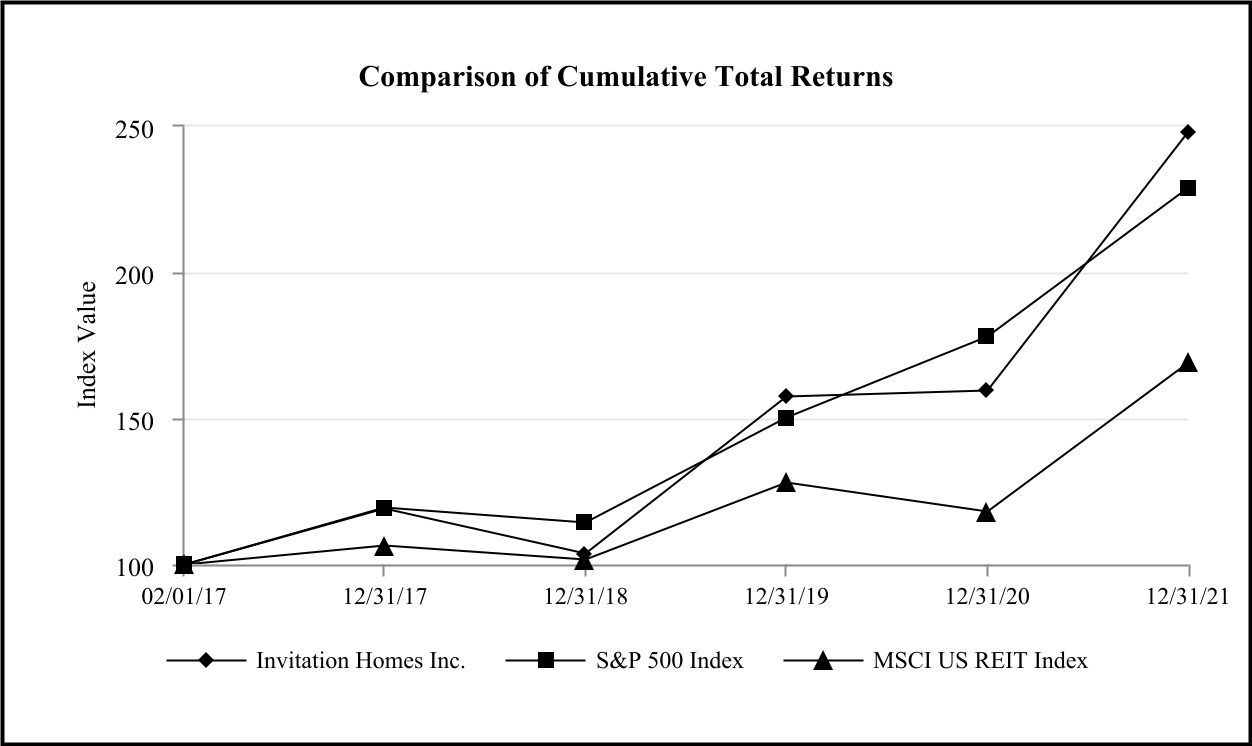
The following graph shows the total stockholder return of an investment of $100 cash on February 1, 2017 (the date our common stock began trading on the NYSE) for (1) our common stock, (2) the S&P 500 Total Return Index, and (3) the MSCI US REIT (RMS) Total Return Index. All values assume reinvestment of the full amount of all dividends. Stockholder returns over the indicated period are based on historical data and are not necessarily indicative of future stockholder returns.
| Cumulative Total Returns as of | ||||||||||||||||||||||||||||||||||||||
| February 1, 2017 | December 31, 2017 | December 31, 2018 | December 31, 2019 | December 31, 2020 | December 31, 2021 | |||||||||||||||||||||||||||||||||
| Invitation Homes Inc. | 100.00 | 119.02 | 103.43 | 157.50 | 159.38 | 247.97 | ||||||||||||||||||||||||||||||||
| S&P 500 Index | 100.00 | 119.50 | 114.26 | 150.24 | 177.88 | 228.94 | ||||||||||||||||||||||||||||||||
| MSCI US REIT Index | 100.00 | 106.43 | 101.56 | 127.80 | 118.12 | 168.99 |
Repurchases of Equity Securities
We made no repurchases of our common stock during the three months ended December 31, 2021.
Item 6. RESERVED
Item 7. MANAGEMENT’S DISCUSSION AND ANALYSIS OF FINANCIAL CONDITION AND RESULTS OF OPERATIONS
The following discussion and analysis of our financial condition and results of operations should be read together with Part I. Item 1. “Business” and the consolidated financial statements, including the notes thereto, that are included elsewhere in this Annual Report on Form 10-K. This discussion and analysis contains forward-looking statements based upon our current expectations that involve risks and uncertainties. Our actual results may differ materially from those anticipated in these forward-looking statements as a result of various factors, including those set forth under Part I. Item 1A. “Risk Factors,” “Forward-Looking Statements,” or in other parts of this report.
For similar operating and financial data and discussion of our year ended December 31, 2020 results compared to our year ended December 31, 2019 results, refer to Part II. Item 7. “Management’s Discussion and Analysis of Financial Condition and Results of Operations” of our Annual Report on Form 10-K which was filed with the SEC on February 19, 2021 (the “2020 10-K”). The sections entitled “Result of Operations — Year Ended December 31, 2020 Compared to Year Ended December 31, 2019” and “Cash Flows — Year Ended December 31, 2020 Compared to Year Ended December 31, 2019” in Part II. Item 7. “Management’s Discussion and Analysis of Financial Condition and Result of Operations” of our 2020 10-K are incorporated herein by reference.
Capitalized terms used without definition have the meaning provided elsewhere in this Annual Report on Form 10-K.
Overview
Invitation Homes is a leading owner and operator of single-family homes for lease, offering residents high-quality homes in sought-after neighborhoods across America. With over 80,000 homes for lease in 16 markets across the country as of December 31, 2021, we are meeting the needs of a growing share of Americans who prefer the ease of leasing over the burden of owning a home. We provide our residents access to updated homes with features they value, as well as close proximity to jobs and access to good schools. The continued demand for our product proves that the choice and flexibility we offer is attractive to many prospective residents.
We operate in markets with strong demand drivers, high barriers to entry, and high rent growth potential, primarily in the Western United States, Florida, and the Southeast United States. Through disciplined market and asset selection, as well as through strategic mergers and acquisitions, we designed our portfolio to capture the operating benefits of local density as well as economies of scale that we believe cannot be readily replicated. Since our founding in 2012, we have built a proven, vertically integrated operating platform that enables us to effectively and efficiently acquire, renovate, lease, maintain, and manage our homes.
Our homes average approximately 1,870 square feet with three bedrooms and two bathrooms, appealing to a resident base that we believe is less transitory than a typical multifamily resident. We invest in the upfront renovation of homes in our portfolio in order to address capital needs, reduce ongoing maintenance costs, and drive resident demand.
At Invitation Homes, we are committed to creating a better way to live and to being a force for positive change, while at the same time advancing efforts that make our company more innovative and our processes more sustainable. ESG initiatives are an important part of our strategic business objectives and are critical to our long-term success.
Our mission statement, “Together with you, we make a house a home,” reflects our commitment to high-touch customer service that continuously enhances residents’ living experiences and provides homes where individuals and families can thrive. Each aspect of our operations — whether in our corporate headquarters or field offices located in our 16 markets — is driven by a resident-centric model. Our associates take our values seriously and work hard every day to honor the trust our residents have placed in us to provide safe and secure homes for them and their loved ones. In turn, we focus on ensuring our associates are fairly compensated and that we provide a diverse, equitable, and inclusive culture where they are appreciated for who they are and what they bring to the business. We also place a strong emphasis on the impact we have in our communities and to the environment in general, and we continue to develop programs that will demonstrate that commitment. In addition, we ensure that we operate under strong, well-defined governance practices and adhere to the highest ethical standards at all times.
COVID-19
The COVID-19 pandemic has spread rapidly, adversely affecting public health, economic activity, financial markets and employment. The continued development and fast-changing nature of the COVID-19 pandemic creates many unknowns that impact our residents, associates, and suppliers. The ultimate impacts remain unknown, but have included and could range from macroeconomic effects (such as continued strain on global and United States economic conditions and disruptions to, and volatility in, the credit and financial markets, consumer spending, supply chains, and the market for acquisition and disposition of single-family homes) to more industry-specific effects (such as depressed collection rates, higher or lower occupancy levels, and restrictions on evictions, collections, rent increases, and late fees), and other unanticipated consequences.
Throughout the COVID-19 pandemic, we have maintained continuity in business operations and have supported our residents and associates by implementing a host of measures and protocols that enable our teams to safely provide outstanding service to residents. These protocols include: (1) implementing a safety training program and providing personal protective equipment for all associates; (2) creating flexible work schedules for our associates in terms of both location and hours of work; (3) adhering to strict safety protocols for maintenance service trips; (4) leveraging self-show and virtual-tour technology; and (5) offering virtual options for resident move-in orientations and pre-move-out visits.
We also believe that we are in material compliance with federal, state, and local restrictions on items such as evictions, collections, rent increases, and late fees as appropriate. Additionally, to act on our core values of "Genuine Care" and "Standout Citizenship," we offer flexible solutions for residents experiencing financial hardship when requested, including payment plans and late fee abatements. We continue to work with residents experiencing financial hardship to find solutions that keep them in their homes. This includes continuing to provide residents with information about rental assistance programs for which they may be eligible, application instructions, necessary documentation, and owner requirements. We have helped thousands of residents apply for rental assistance programs and, as a result, they have received $48.0 million in rental assistance payments during the year ended December 31, 2021, and $50.5 million cumulatively since such programs were put in place.
Neither the aforementioned procedural adjustments nor the overall impact of the COVID-19 pandemic created significant disruptions to our business model during the years ended December 31, 2021 and 2020.
The situation surrounding the ongoing COVID-19 pandemic and its variants remains fluid, and we continue to actively monitor the effects of the pandemic and manage our response in collaboration with our residents and business partners and to assess potential impacts to o
Showing the first 8K of 111K characters. Open the full section
Item 7A. QUANTITATIVE AND QUALITATIVE DISCLOSURES ABOUT MARKET RISK
Our future income, cash flows, and fair values relevant to financial instruments are dependent upon prevalent market interest rates. Market risk refers to the risk of loss from adverse changes in interest rates, seasonality, market prices, commodity prices, and inflation. The primary market risks to which we are exposed are interest rate risk and seasonality. We may in the future use derivative financial instruments to manage, or hedge, interest rate risks related to any borrowings we may have. We may enter into such contracts only with major financial institutions based on their credit ratings and other factors.
Interest Rate Risk
A primary market risk to which we believe we are exposed is interest rate risk, which may result from many factors, including government monetary and tax policies, domestic and international economic and political considerations, and other factors that are beyond our control. We may incur additional variable rate debt in the future, including additional amounts that we may borrow under the Credit Facility. In addition, decreases in interest rates may lead to additional competition for the acquisition of single-family homes, which may lead to future acquisitions being more costly and resulting in lower yields on single-family homes targeted for acquisition. Significant increases in interest rates may also have an adverse impact on our earnings if we are unable to increase rents on expired leases or acquire single-family homes with rental rates high enough to offset the increase in interest rates on our borrowings.
As of December 31, 2021, our outstanding variable-rate debt was comprised of borrowings on our mortgage loans of $2,071.9 million and Term Loan Facility of $2,500.0 million for a combined total of $4,571.9 million. We effectively converted 96.7% of these borrowings to a fixed rate through interest rate swap agreements. Additionally, all borrowings bear interest at LIBOR plus the applicable spread. Assuming no change in the outstanding balance of our existing debt, the projected effect of a 100 bps increase or decrease in LIBOR on our annual interest expense would be an estimated increase of $1.5 million or $20.9 million, respectively. This estimate considers the impact of our interest rate swap agreements, interest rate cap agreements, and any LIBOR floors or minimum interest rates stated in the agreements of the respective borrowings. A 100 bps decrease in LIBOR results in a negative LIBOR rate and additional interest expense for us. Our Credit Facility agreement contains a LIBOR floor, and there is no reciprocal feature in our interest rate swap agreements.
This analysis does not consider the effects of the reduced level of overall economic activity that could exist in such an environment. Further, in the event of a change of such magnitude, we may consider taking actions to further mitigate our exposure to the change. However, because of the uncertainty of the specific actions that would be taken and their possible effects, the sensitivity analysis assumes no changes in our capital structure.
Seasonality
Our business and related operating results have been, and we believe will continue to be, impacted by seasonal factors throughout the year. In particular, we have experienced higher levels of resident move-outs during the summer months, which impacts both our rental revenues and related turnover costs. Further, our property operating costs are seasonally impacted in certain markets by increases in expenses such as HVAC repairs and costs to re-resident during the summer season.
Item 8. FINANCIAL STATEMENTS AND SUPPLEMENTARY DATA
The information required by this Item is included as a separate section in this Annual Report on Form 10-K. See Part IV. Item 15. “Exhibits and Financial Statement Schedules,” which is incorporated herein by reference.
Item 9. CHANGES IN AND DISAGREEMENTS WITH ACCOUNTANTS ON ACCOUNTING AND FINANCIAL DISCLOSURE
None.
Item 9A. CONTROLS AND PROCEDURES
Disclosure Controls and Procedures
We maintain a set of disclosure controls and procedures (as defined in Rules 13a-15(e) and 15d-15(e) under the Exchange Act) designed to ensure that information required to be disclosed in reports we file or submit under the Exchange Act, is recorded, processed, summarized and reported within the time periods specified in SEC rules and forms and that such information is accumulated and communicated to our management, including our Chief Executive Officer and Chief
Financial Officer, as appropriate, to allow timely decisions regarding required disclosures. The design of any disclosure controls and procedures is based in part upon certain assumptions about the likelihood of future events, and there can be no assurance that any design will succeed in achieving its goals under all potential future conditions. Any controls and procedures, no matter how well designed and operated, can provide only reasonable, not absolute, assurance of achieving the desired control objectives. Our management, with the participation of our Chief Executive Officer and Chief Financial Officer, has evaluated the effectiveness of the design and operation of our disclosure controls and procedures as of December 31, 2021. Based upon that evaluation, our Chief Executive Officer and Chief Financial Officer concluded that, as of December 31, 2021, the design and operation of our disclosure controls and procedures were effective to accomplish their objectives at the reasonable assurance level.
Changes in Internal Control
There has been no change in our internal control over financial reporting during our most recent fiscal quarter that has materially affected, or is reasonably likely to materially affect, our internal control over financial reporting.
Management's Annual Report on Internal Control over Financial Reporting
Our management is responsible for establishing and maintaining adequate internal control over financial reporting (as defined in Rules 13a-15(f) and 15d-15(f) under the Exchange Act). Our internal control over financial reporting is designed to provide reasonable assurance regarding the reliability of our financial reporting and the preparation of our consolidated financial statements for external purposes in accordance with United States generally accepted accounting principles. Our internal control over financial reporting includes those policies and procedures that (1) pertain to maintenance of records that, in reasonable detail, accurately and fairly reflect the transactions and dispositions of the Company; (2) provide reasonable assurance that transaction are recorded as necessary to permit preparation of consolidated financial statements in accordance with United States generally accepted accounting principles and that receipts and expenditures of the Company are being made only in accordance with authorizations of the Company’s management and directors; and (3) provide reasonable assurance regarding prevention or timely detection of unauthorized acquisition, use or disposition of assets of the Company that could have a material effect on the consolidated financial statements. Because of its inherent limitations, internal control over financial reporting may not prevent or detect misstatements. Also, projections of any evaluation of effectiveness to future periods are subject to the risk that controls may become inadequate because of changes in conditions, or that the degree of compliance with the policies and procedures may deteriorate.
Our management with the participation of our Chief Executive Officer and Chief Financial Officer conducted an evaluation of the effectiveness of our internal control over financial reporting as of December 31, 2021. This evaluation was based on the framework established in Internal Control — Integrated Framework (2013) issued by the Committee of Sponsoring Organizations of the Treadway Commission. Based on our assessment under the framework in Internal Control — Integrated Framework (2013), our management concluded that our internal control over financial reporting was effective as of December 31, 2021 to accomplish their objectives at the reasonable assurance level.
Deloitte & Touche LLP, the independent registered public accounting firm that has audited the consolidated financial statements included in this Annual Report on Form 10-K, has issued an attestation report on the Company’s internal control over financial reporting as of December 31, 2021. The report is included herein.
REPORT OF INDEPENDENT REGISTERED PUBLIC ACCOUNTING FIRM
To the stockholders and the Board of Directors of Invitation Homes Inc.
Opinion on Internal Control over Financial Reporting
We have audited the internal control over financial reporting of Invitation Homes Inc. and subsidiaries (the “Company”) as of December 31, 2021, based on criteria established in Internal Control—Integrated Framework (2013) issued by the Committee of Sponsoring Organizations of the Treadway Commission (COSO). In our opinion, the Company maintained, in all material respects, effective internal control over financial reporting as of December 31, 2021, based on criteria established in Internal Control—Integrated Framework (2013) issued by COSO.
We have also audited, in accordance with the standards of the Public Company Accounting Oversight Board (United States) (PCAOB), the consolidated financial statements as of and for the year ended December 31, 2021, of the Company and our report dated February 22, 2022, expressed an unqualified opinion on those financial statements.
Basis for Opinion
The Company’s management is responsible for maintaining effective internal control over financial reporting and for its assessment of the effectiveness of internal control over financial reporting, included in the accompanying Management’s Annual Report on Internal Control over Financial Reporting. Our responsibility is to express an opinion on the Company’s internal control over financial reporting based on our audit. We are a public accounting firm registered with the PCAOB and are required to be independent with respect to the Company in accordance with the U.S. federal securities laws and the applicable rules and regulations of the Securities and Exchange Commission and the PCAOB.
We conducted our audit in accordance with the standards of the PCAOB. Those standards require that we plan and perform the audit to obtain reasonable assurance about whether effective internal control over financial reporting was maintained in all material respects. Our audit included obtaining an understanding of internal control over financial reporting, assessing the risk that a material weakness exists, testing and evaluating the design and operating effectiveness of internal control based on the assessed risk, and performing such other procedures as we considered necessary in the circumstances. We believe that our audit provides a reasonable basis for our opinion.
Definition and Limitations of Internal Control over Financial Reporting
A company’s internal control over financial reporting is a process designed to provide reasonable assurance regarding the reliability of financial reporting and the preparation of financial statements for external purposes in accordance with generally accepted accounting principles. A company’s internal control over financial reporting includes those policies and procedures that (1) pertain to the maintenance of records that, in reasonable detail, accurately and fairly reflect the transactions and dispositions of the assets of the company; (2) provide reasonable assurance that transactions are recorded as necessary to permit preparation of financial statements in accordance with generally accepted accounting principles, and that receipts and expenditures of the company are being made only in accordance with authorizations of management and directors of the company; and (3) provide reasonable assurance regarding prevention or timely detection of unauthorized acquisition, use, or disposition of the company’s assets that could have a material effect on the financial statements.
Because of its inherent limitations, internal control over financial reporting may not prevent or detect misstatements. Also, projections of any evaluation of effectiveness to future periods are subject to the risk that controls may become inadequate because of changes in conditions, or that the degree of compliance with the policies or procedures may deteriorate.
/s/ Deloitte & Touche LLP
Dallas, Texas
February 22, 2022
Item 9B. OTHER INFORMATION
None.
Item 9C. DISCLOSURES REGARDING FOREIGN JURISDICTIONS THAT PREVENT INSPECTIONS
Not applicable.
PART III
Item 10. DIRECTORS, EXECUTIVE OFFICERS, AND CORPORATE GOVERNANCE
The information required by this Item is incorporated by reference from the Company’s 2022 Proxy Statement to be filed with the SEC within 120 days of the fiscal year ended December 31, 2021.
Item 11. EXECUTIVE COMPENSATION
The information required by this Item is incorporated by reference from the Company’s 2022 Proxy Statement to be filed with the SEC within 120 days of the fiscal year ended December 31, 2021.
Item 12. SECURITY OWNERSHIP OF CERTAIN BENEFICIAL OWNERS AND MANAGEMENT AND RELATED STOCKHOLDER MATTERS
The information required by this Item is incorporated from reference to the Company’s 2022 Proxy Statement to be filed with the SEC within 120 days of the fiscal year ended December 31, 2021.
Item 13. CERTAIN RELATIONSHIPS AND RELATED TRANSACTIONS, AND DIRECTOR INDEPENDENCE
The information required by this Item is incorporated by reference from the Company’s 2022 Proxy Statement to be filed with the SEC within 120 days of the fiscal year ended December 31, 2021.
Item 14. PRINCIPAL ACCOUNTANT FEES AND SERVICES
The information required by this Item is incorporated by reference from the Company’s 2022 Proxy Statement to be filed with the SEC within 120 days of the fiscal year ended December 31, 2021.
PART IV
Item 15. Exhibits and Financial Statement Schedules.
The following documents are filed as part of this report:
| (a) Financial Statements | |||||
| Invitation Homes Inc. Consolidated Financial Statements as of December 31, 2021 and 2020 and for the three years in the period ended December 31, 2021 | |||||
| Report of Deloitte & Touche LLP, Independent Registered Public Accounting Firm (PCAOB ID No. 34) | F-1 | ||||
| Consolidated Balance Sheets | F-3 | ||||
| Consolidated Statements of Operations | F-4 | ||||
| Consolidated Statements of Comprehensive Income (Loss) | F-5 | ||||
| Consolidated Statements of Equity | F-6 | ||||
| Consolidated Statements of Cash Flows | F-7 | ||||
| Notes to Consolidated Financial Statements | F-9 |
| (b) Financial Statement Schedule | |||||
| Invitation Homes Inc. as of December 31, 2021 and for the three years in the period ended December 31, 2021 | |||||
| Schedule III Real Estate and Accumulated Depreciation | F-45 |
| (c) Exhibits |
EXHIBIT INDEX
| Exhibit number | Description | |||||||||||||
| 32.2 | Certificate of Ernest M. Freedman, Executive Vice President and Chief Financial Officer, pursuant to Section 18 U.S.C. Section 1350, as adopted pursuant to Section 906 of the Sarbanes-Oxley Act of 2002 (furnished herewith). | |||||||||||||
| 101.INS | Inline XBRL Instance Document - the instance document does not appear in the Interactive Data File because its XBRL tags are embedded within the Inline XBRL document. | |||||||||||||
| 101.SCH | Inline XBRL Taxonomy Extension Schema Document. | |||||||||||||
| 101.CAL | Inline XBRL Taxonomy Extension Calculation Linkbase Document. | |||||||||||||
| 101.DEF | Inline XBRL Taxonomy Extension Definition Linkbase Document. | |||||||||||||
| 101.LAB | Inline XBRL Taxonomy Extension Label Linkbase Document. | |||||||||||||
| 101.PRE | Inline XBRL Taxonomy Extension Presentation Linkbase Document. | |||||||||||||
| 104 | Cover page Interactive Data File (formatted as Inline XBRL and contained in Exhibit 101). |
† This document has been identified as a management contract or compensatory plan or arrangement.
Certain agreements and other documents filed as exhibits to this Quarterly Report on Form 10-Q contain representations and warranties that the parties thereto made to each other. These representations and warranties have been made solely for the benefit of the other parties to such agreements and may have been qualified by certain information that has been disclosed to the other parties to such agreements and other documents and that may not be reflected in such agreements and other documents. In addition, these representations and warranties may be intended as a way of allocating risks among parties if the statements contained therein prove to be incorrect, rather than as actual statements of fact. Accordingly, there can be no reliance on any such representations and warranties as characterizations of the actual state of facts. Moreover, information concerning the subject matter of any such representations and warranties may have changed since the date of such agreements or other documents.
Item 16. FORM 10-K SUMMARY
None.
SIGNATURES
Pursuant to the requirements of Section 13 or 15(d) of the Securities Exchange Act of 1934, the Registrant has duly caused this report to be signed on its behalf by the undersigned, thereunto duly authorized, in Dallas, Texas, on the 22nd day of February 2022.
| Invitation Homes Inc. | |||||
| By: | /s/ Dallas B. Tanner | ||||
| Name: Dallas B. Tanner | |||||
| Title: President and Chief Executive Officer |
Pursuant to the requirements of the Securities Act of 1934, this report has been signed by the following persons in the capacities indicated on the 22nd day of February 2022.
| Signature | Title | |||||||
| /s/ Dallas B. Tanner | President, Chief Executive Officer, and Director | |||||||
| Dallas B. Tanner | (Principal Executive Officer) | |||||||
| /s/ Ernest M. Freedman | Executive Vice President and Chief Financial Officer | |||||||
| Ernest M. Freedman | (Principal Financial Officer) | |||||||
| /s/ Kimberly K. Norrell | Executive Vice President and Chief Accounting Officer | |||||||
| Kimberly K. Norrell | (Principal Accounting Officer) | |||||||
| /s/ Michael D. Fascitelli | Chairman and Director | |||||||
| Michael D. Fascitelli | ||||||||
| /s/ Jana C. Barbe | Director | |||||||
| Jana C. Barbe | ||||||||
| /s/ Richard D. Bronson | Director | |||||||
| Richard D. Bronson | ||||||||
| /s/ Jeffrey E. Kelter | Director | |||||||
| Jeffrey E. Kelter | ||||||||
| /s/ Joseph D. Margolis | Director | |||||||
| Joseph D. Margolis |
| Signature | Title | |||||||
| /s/ John B. Rhea | Director | |||||||
| John B. Rhea | ||||||||
| /s/ J. Heidi Roizen | Director | |||||||
| J. Heidi Roizen | ||||||||
| /s/ Janice L. Sears | Director | |||||||
| Janice L. Sears | ||||||||
REPORT OF INDEPENDENT REGISTERED PUBLIC ACCOUNTING FIRM
To the stockholders and the Board of Directors of Invitation Homes Inc.
Opinion on the Financial Statements
We have audited the accompanying consolidated balance sheets of Invitation Homes Inc. and subsidiaries (the “Company”) as of December 31, 2021 and 2020, the related consolidated statements of operations, other comprehensive income (loss), equity, and cash flows, for each of the three years in the period ended December 31, 2021, and the related notes and the schedule listed in the Index at Item 15 (collectively referred to as the “financial statements”). In our opinion, the financial statements present fairly, in all material respects, the financial position of the Company as of December 31, 2021 and 2020, and the results of its operations and its cash flows for each of the three years in the period ended December 31, 2021, in conformity with accounting principles generally accepted in the United States of America.
We have also audited, in accordance with the standards of the Public Company Accounting Oversight Board (United States) (PCAOB), the Company’s internal control over financial reporting as of December 31, 2021, based on criteria established in Internal Control—Integrated Framework (2013) issued by the Committee of Sponsoring Organizations of the Treadway Commission and our report dated February 22, 2022, expressed an unqualified opinion on the Company’s internal control over financial reporting.
Basis for Opinion
These financial statements are the responsibility of the Company’s management. Our responsibility is to express an opinion on the Company’s financial statements based on our audits. We are a public accounting firm registered with the PCAOB and are required to be independent with respect to the Company in accordance with the U.S. federal securities laws and the applicable rules and regulations of the Securities and Exchange Commission and the PCAOB.
We conducted our audits in accordance with the standards of the PCAOB. Those standards require that we plan and perform the audit to obtain reasonable assurance about whether the financial statements are free of material misstatement, whether due to error or fraud. Our audits included performing procedures to assess the risks of material misstatement of the financial statements, whether due to error or fraud, and performing procedures that respond to those risks. Such procedures included examining, on a test basis, evidence regarding the amounts and disclosures in the financial statements. Our audits also included evaluating the accounting principles used and significant estimates made by management, as well as evaluating the overall presentation of the financial statements. We believe that our audits provide a reasonable basis for our opinion.
Critical Audit Matter
The critical audit matter communicated below is a matter arising from the current-period audit of the financial statements that was communicated or required to be communicated to the audit committee and that (1) relates to accounts or disclosures that are material to the financial statements and (2) involved our especially challenging, subjective, or complex judgments. The communication of critical audit matters does not alter in any way our opinion on the financial statements, taken as a whole, and we are not, by communicating the critical audit matter below, providing a separate opinion on the critical audit matter or on the accounts or disclosures to which it relates.
Investments in Single-Family Residential Properties—Refer to Notes 2 and 3 to the financial statements
Critical Audit Matter Description
The Company owned approximately 80,000 individual single-family residential properties with a net book value of $17 billion as of December 31, 2021. The Company capitalizes costs to acquire, stabilize, and prepare single-family residential properties to be leased. The determination of which costs to capitalize requires significant management judgment. Costs capitalized in connection with single-family residential property acquisitions, stabilization activities, and on an ongoing basis are depreciated over their estimated useful lives on a straight-line basis. From time to time, the Company identifies
F-1
single-family residential properties to be sold. At the time such properties are identified, the Company evaluates whether or not such properties should be classified as held for sale.
Given the number of homes and the volume and nature of the different transactions affecting the acquisition, disposition, recognition, and classification of investments in single-family residential properties, performing audit procedures to evaluate the accounting for investments in single-family residential properties was challenging and required an increased extent of audit effort.
*How the Critical Audit Matter Was Addressed in the A
Showing the first 8K of 223K characters. Open the full section