 filings.tools
Item 2. [MANAGEMENT’S DISCUSSION AND ANALYSIS OF FINANCIAL CONDITION AND RESULTS OF OPERATIONS](#ifca02467bcb44cea9104f4b8b546ac0f97)
87K characters. Original on sec.gov · Markdown
Item 2. [MANAGEMENT’S DISCUSSION AND ANALYSIS OF FINANCIAL CONDITION AND RESULTS OF OPERATIONS](#ifca02467bcb44cea9104f4b8b546ac0f97)
The following discussion and analysis of our financial condition and results of operations should be read in conjunction with our condensed consolidated financial statements and related notes included in "Financial Statements and Supplementary Data" of this Quarterly Report on Form 10-Q (this "Form 10-Q") and the Company's Annual Report on Form 10-K for the year ended December 31, 2020 (our "Annual Report"). In addition to historical consolidated financial information, the following discussion contains forward-looking statements that reflect our plans, estimates, and beliefs that involve significant risks and uncertainties. Our actual results could differ materially from those discussed in the forward-looking statements. Factors that could cause or contribute to those differences include those discussed below and in our Annual Report, particularly under "Forward-Looking Statements" of this Form 10-Q and "Risk Factors" and "Forward-Looking Statements" of our Annual Report.
EXECUTIVE SUMMARY
Net earnings (loss) attributable to International Paper common shareholders were $864 million ($2.20 per diluted share) in the third quarter of 2021, compared with $432 million ($1.09 per diluted share) in the second quarter of 2021 and $204 million ($0.52 per diluted share) in the third quarter of 2020. International Paper generated Adjusted operating earnings attributable to International Paper common shareholders (a non-GAAP measure defined below) of $532 million ($1.35 per diluted share) in the third quarter of 2021, compared with $421 million ($1.06 per diluted share) in the second quarter of 2021 and $280 million ($0.71 per diluted share) in the third quarter of 2020.
During the third quarter 2021, International Paper grew revenue, margins and earnings, and generated strong cash from operations. The strong demand environment in the second quarter 2021 continued in the third quarter, with strong demand for corrugated packaging and solid demand for absorbent pulp. Our Industrial Packaging and Global Cellulose Fibers businesses made strong progress on price realization from prior price increases in the third quarter to mitigate the impact of a very challenging supply chain and input cost environment. Input costs affected results much more than anticipated in the third quarter, mostly due to higher fiber and energy costs. The widespread supply chain constraints limited our ability to capture the full opportunity that comes with the strong demand environment. Our mills performed well; however, stretched supply chains constrained volumes in our Industrial Packaging and Global Cellulose Fibers businesses. Additionally, due to labor market constraints, we have had to increase overtime while we try to hire additional permanent employees. This has led to higher labor costs, particularly at our converting facilities. Containerboard inventories in our packaging network improved in the latter part of the third quarter, putting us in a much healthier position as we enter the seasonally stronger fourth quarter. With respect to capital allocation, in the third quarter, we reduced debt by approximately $235 million and returned $411 million to shareholders through dividends of $199 million and share repurchases of $212 million.
Finally, the Printing Papers business delivered strong performance and carried good momentum in the third quarter, ahead of the spin-off of the business, which was completed on October 1, 2021. In consideration for the Printing Papers business spin-off, International Paper received a payment of $1.4 billion from Sylvamo and retained a 19.9% interest in the new company, which we intend to monetize within one year.
Comparing our performance in the third quarter 2021 to the second quarter 2021, price and mix improved, driven by strong realization of prior price increases across the three businesses. Input costs were a significant headwind in the third quarter, increasing by more than two times what we had anticipated, mostly due to higher fiber and energy costs. Volumes decreased sequentially. Supply chain constraints limited our ability to capture the full benefit of a strong demand backdrop. In our Global Cellulose Fibers business, demand for absorbent pulp remains solid; however, shipments were constrained by significant port congestion. Our mills performed well and we also benefited from one-time items in the third quarter, including insurance recovery in the Industrial Packaging business related to the winter storms early in the year and the sale of nitrogen credits in the Global Cellulose Fibers business. These one-time benefits were largely offset by higher unplanned maintenance in Industrial Packaging and higher supply chain costs in Global Cellulose Fibers. We continue to be impacted by a highly stressed supply chain environment that is affecting both inbound materials and outbound shipments. Every mode of transportation is tight, and is expected to remain so for the foreseeable future. Planned maintenance outage costs decreased sequentially as expected. Our Ilim joint venture delivered another strong performance with equity earnings of $95 million.
Looking ahead to the fourth quarter 2021, as compared to the third quarter of 2021, in our Industrial Packaging business, we expect higher price and mix primarily on the realization of our August 2021 price increases in North America, partially offset by mix as we start to recover some export backlogs. Volume is expected to improve sequentially on higher seasonal demand despite three fewer shipping days in the fourth quarter. Operations and costs are expected to improve moderately. Supply chains are expected to remain stretched, however, our North America packaging network will benefit from improved containerboard inventory levels, as planned. Maintenance outage expense is expected to be relatively flat. Input costs are expected to increase, driven primarily by higher average costs for fiber and energy. In our Global Cellulose Fibers business, we expect price and mix to be stable. Volume is expected to decrease modestly, primarily due to persistent port congestion, which is expected to impact absorbent pulp shipments again in the fourth quarter. Operations and costs are expected to be unfavorable due to the non-repeat of the previously mentioned nitrogen credit sales in the third quarter. Maintenance outage expenses are expected increase while
input costs are expected to increase on higher wood fiber and energy costs. Equity earnings from our Ilim joint venture are expected decrease modestly.
Finally, following the completion of the Printing Papers spin-off on October 1, 2021, the historical results of the business will be treated as a discontinued operation with a full recast of previously presented periods to reflect this treatment. Third quarter earnings included $134 million of Business Segment Operating Profit attributed to the Sylvamo spin-off and Kwidzyn mill, which are no longer part of International Paper in the fourth quarter.
On March 11, 2020 the World Health Organization (WHO) declared the novel strain of coronavirus (COVID-19) a global pandemic and recommended containment and mitigation measures worldwide. During the third quarter of 2021, the number of COVID-19 cases and deaths increased in the United States and numerous other countries, and restrictive measures, including mask and vaccine requirements, have been implemented or reinstituted by various governmental authorities and private businesses. Economic recovery in the United States has continued but may be threatened by the resurgence of COVID-19 cases and other factors. Most of our manufacturing and converting facilities have remained open and operational during the pandemic and at the current time our manufacturing and converting facilities are generally operational.
The pandemic has had a mixed impact on demand for our products. Initially, demand for printing papers products was significantly impacted by the pandemic, but has seen a steady increase over the first nine months of 2021. Demand for our pulp, containerboard and corrugated box products has not been negatively impacted and in some cases has been positively impacted by COVID-19 to date. However, all of our operations continue to experience higher supply chain costs and a constrained transportation environment due in part to the impacts of COVID-19.
There continue to be significant uncertainties associated with the COVID-19 pandemic, including with respect to the resurgence of new variants of the virus in many areas globally; the additional actions taken by governmental authorities and private businesses, including mask and vaccine requirements, to attempt to contain the COVID-19 outbreak or to mitigate its impact; the efficacy, acceptance and availability of various vaccines and booster shots, as well as the possibility that strains of the virus may be resistant to current available vaccines; and the impact of COVID-19 on economic conditions, including with respect to labor market conditions, economic activity, consumer behavior, supply chain shortages and disruptions and inflationary pressures. COVID-19 has had a significant adverse effect on portions of our business, and could have a material adverse effect on our financial condition, results of operations and cash flows if public health and/or global economic conditions deteriorate.
Adjusted operating earnings and Adjusted operating earnings per share are non-GAAP measures and are defined as net earnings (loss) attributable to International Paper (a GAAP measure) excluding net special items and non-operating pension expense (income). Net earnings (loss) and Diluted earnings (loss) per share attributable to common shareholders are the most directly comparable GAAP measures. The Company calculates Adjusted operating earnings by excluding the after-tax effect of non-operating pension expense (income) and items considered by management to be unusual (net special items) from the earnings reported under GAAP. Adjusted operating earnings per share is calculated by dividing Adjusted operating earnings by diluted average shares of common stock outstanding. Management uses these measures to focus on on-going operations, and believes that these measures are useful to investors because such measures enable investors to perform meaningful comparisons of past and present consolidated operating results. The Company believes that using this information, along with the most directly comparable GAAP measures, provide for a more complete analysis of the results of operations.
The following are reconciliations of Earnings (loss) attributable to common shareholders to Adjusted operating earnings (loss) attributable to common shareholders on a total and per share basis. Additional detail is provided later in this Form 10-Q regarding the net special items referenced in the charts below.
| Three Months Ended September 30, | Three Months Ended June 30, | ||||||||||||||||
| In millions | 2021 | 2020 | 2021 | ||||||||||||||
| Net Earnings (Loss) Attributable to International Paper Company | $ | 864 | $ | 204 | $ | 432 | |||||||||||
| Add Back - Non-operating pension expense (income) | (51) | (11) | (52) | ||||||||||||||
| Add Back - Net special items expense (income) | (330) | 109 | 23 | ||||||||||||||
| Income tax effect - Non-operating pension and net special items expense | 49 | (22) | 18 | ||||||||||||||
| Adjusted Operating Earnings (Loss) Attributable to International Paper Company | $ | 532 | $ | 280 | $ | 421 |
| Three Months Ended September 30, | Three Months Ended June 30, | ||||||||||||||||
| In millions | 2021 | 2020 | 2021 | ||||||||||||||
| Diluted Earnings (Loss) Per Share Attributable to International Paper Company Common Shareholders | $ | 2.20 | $ | 0.52 | $ | 1.09 | |||||||||||
| Add Back - Non-operating pension expense (income) per share | (0.13) | (0.03) | (0.13) | ||||||||||||||
| Add Back - Net special items expense (income) per share | (0.84) | 0.28 | 0.06 | ||||||||||||||
| Income tax effect per share - Non-operating pension and net special items expense | 0.12 | (0.06) | 0.04 | ||||||||||||||
| Adjusted Operating Earnings (Loss) Per Share Attributable to International Paper Company Common Shareholders | $ | 1.35 | $ | 0.71 | $ | 1.06 |
Cash provided by operations totaled $1.9 billion and $2.3 billion for the first nine months of 2021 and 2020, respectively. The Company generated free cash flow of approximately $1.6 billion in each of the first nine months of 2021 and 2020. Free cash flow is a non-GAAP measure and the most directly comparable GAAP measure is cash provided by operations. Management utilizes this measure in connection with managing our business and believes that free cash flow is useful to investors as a liquidity measure because it measures the amount of cash generated that is available, after reinvesting in the business, to maintain a strong balance sheet, pay dividends, repurchase stock, service debt and make investments for future growth. It should not be inferred that the entire free cash flow amount is available for discretionary expenditures. By adjusting for certain items that are not indicative of the Company's ongoing performance, we believe that free cash flow also enables investors to perform meaningful comparisons between past and present periods.
The following is a reconciliation of cash provided by operations to free cash flow:
| Nine Months Ended September 30, | |||||||||||
| In millions | 2021 | 2020 | |||||||||
| Cash provided by operations | $ | 1,923 | $ | 2,274 | |||||||
| Adjustments: | |||||||||||
| Cash invested in capital projects, net of insurance recoveries | (348) | (657) | |||||||||
| Free Cash Flow | $ | 1,575 | $ | 1,617 |
The non-GAAP financial measures presented in this Form 10-Q as referenced above have limitations as analytical tools and should not be considered in isolation or as a substitute for an analysis of our results calculated in accordance with GAAP. In addition, because not all companies utilize identical calculations, the Company's presentation of non-GAAP measures in this Form 10-Q may not be comparable to similarly titled measures disclosed by other companies, including companies in the same industry as the Company.
For the third quarter of 2021, International Paper reported net sales of $5.7 billion, compared with $5.6 billion in the second quarter of 2021 and $5.1 billion in the third quarter of 2020.
Net earnings (loss) attributable to International Paper totaled $864 million, or $2.20 per diluted share, in the third quarter of 2021. This compared with $432 million, or $1.09 per diluted share, in the second quarter of 2021 and $204 million, or $0.52 per diluted share, in the third quarter of 2020.
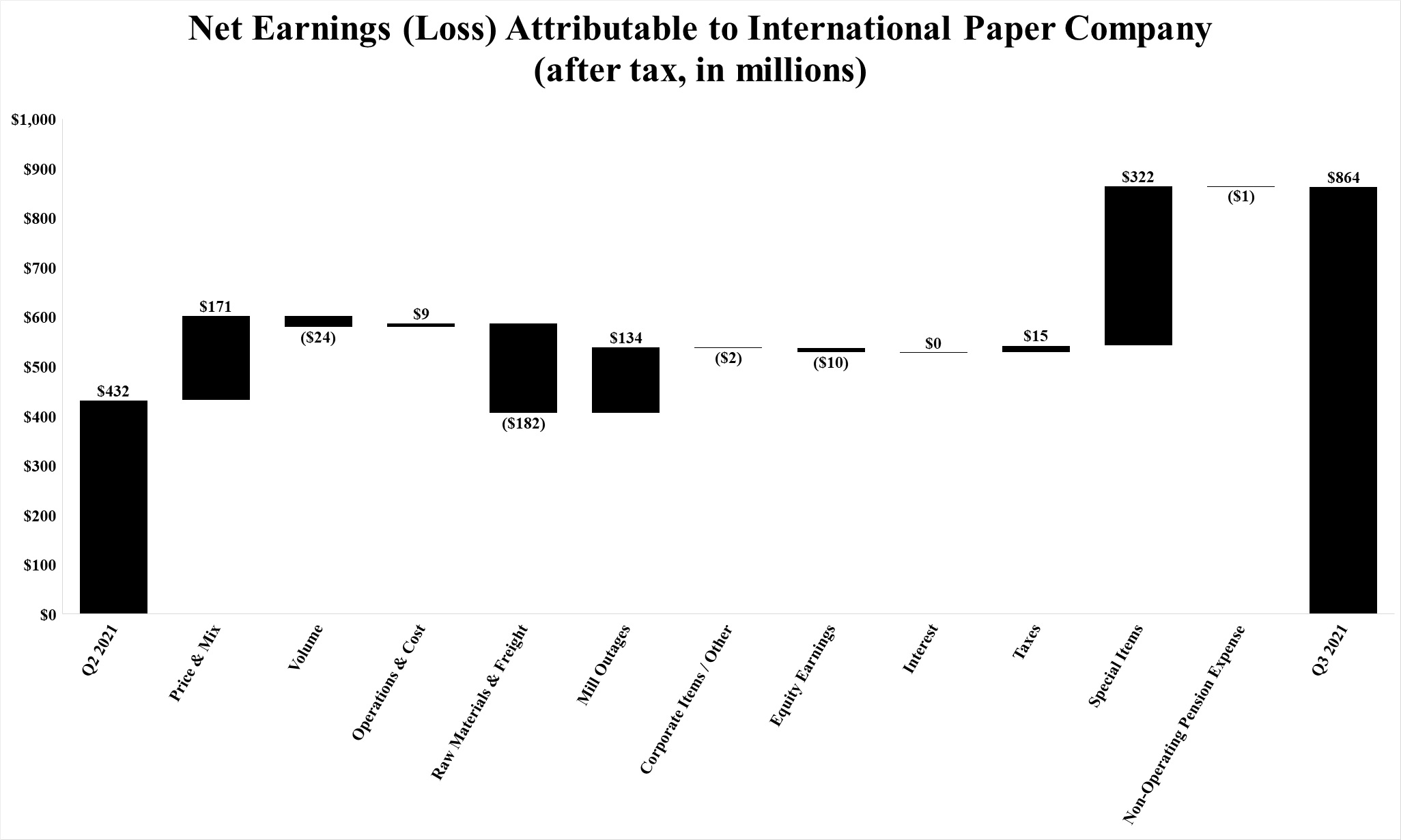
Compared with the second quarter of 2021, earnings benefited from higher average sales prices and a favorable mix ($171 million), lower operating costs ($9 million), lower mill maintenance outage costs ($134 million) and lower tax expense ($15 million). These benefits were offset by lower sales volumes ($24 million), higher raw material and freight costs ($182 million), higher corporate and other items ($2 million) and higher non-operating pension expense ($1 million). Net interest expense was flat. Equity earnings, net of taxes, relating to International Paper’s investments in Ilim S.A., Graphic Packaging International Partners, LLC, and other investments were $10 million lower than in the second quarter of 2021. Net special items in the third quarter of 2021 were a gain of $294 million compared with a loss of $28 million in the second quarter of 2021.
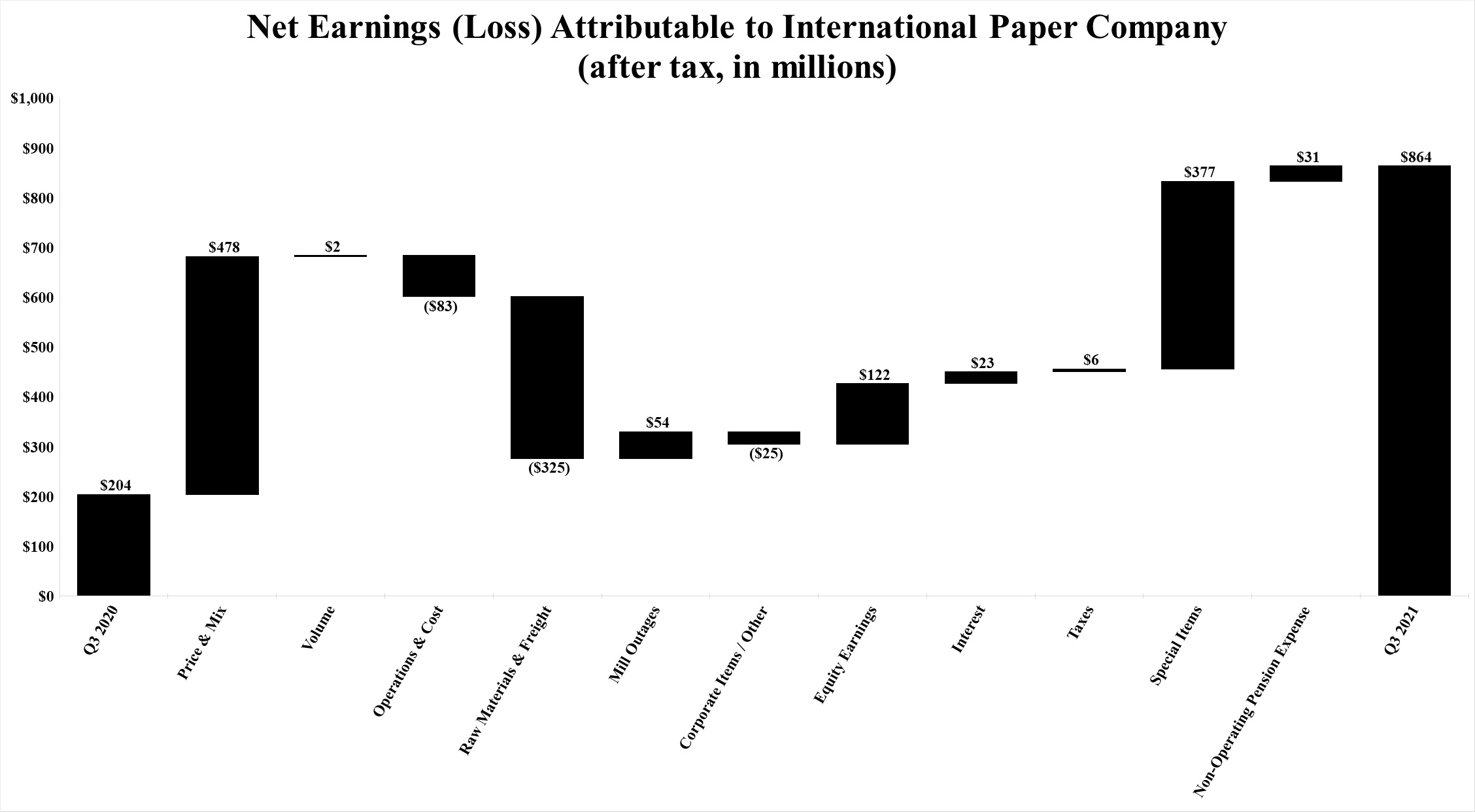
Compared with the third quarter of 2020, the third quarter of 2021 reflects higher average sales prices and a favorable mix ($478 million), higher sales volumes ($2 million), lower mill maintenance outage costs ($54 million), lower net interest expense ($23 million), lower tax expense ($6 million) and lower non-operating pension expense ($31 million). These benefits were offset by higher operating costs ($83 million), higher raw material and freight costs ($325 million) and higher corporate and other costs ($25 million). Equity earnings, net of taxes, relating to International Paper’s investments in Ilim S.A., Graphic Packaging International Partners, LLC, and other investments were $122 million higher in the third quarter of 2021 than in the third quarter of 2020. Net special items in the third quarter of 2021 were a gain of $294 million compared with a loss of $83 million in the third quarter of 2020.
Business segment operating profits are used by International Paper's management to measure the earnings performance of its businesses. Management uses this measure to focus on on-going operations, and believes that it is useful to investors because it enables them to perform meaningful comparisons of past and present operating results. International Paper believes that using this information, along with net earnings, provides a more complete analysis of the results of operations by quarter. Business segment operating profits are defined as earnings (loss) before income taxes and equity earnings, but including the impact of noncontrolling interests, and excluding interest expense, net, corporate expenses, net, corporate net special items, business net special items and non-operating pension expense. Business segment operating profits is a measure reported to our management for purposes of making decisions about allocating resources to our business segments and assessing the performance of our business segments and is presented in our financial statement footnotes in accordance with ASC 280.
In the third quarter, International Paper operated in three segments: Industrial Packaging, Global Cellulose Fibers and Printing Papers. As of October 1, 2021, the Company completed the spin-off of its Printing Papers segment into a standalone, publicly- traded company, Sylvamo Corporation.
The following table presents a reconciliation of Net earnings (loss) attributable to International Paper Company to its Total business segment operating profit:
| Three Months Ended | |||||||||||||||||
| September 30, | June 30, | ||||||||||||||||
| In millions | 2021 | 2020 | 2021 | ||||||||||||||
| Net Earnings (Loss) Attributable to International Paper Company | $ | 864 | $ | 204 | $ | 432 | |||||||||||
| Add back (deduct): | |||||||||||||||||
| Income tax provision (benefit) | 146 | 50 | 102 | ||||||||||||||
| Equity (earnings) loss, net of taxes | (94) | 28 | (104) | ||||||||||||||
| Noncontrolling interests, net of taxes | — | — | 2 | ||||||||||||||
| Earnings (Loss) Before Income Taxes and Equity Earnings | 916 | 282 | 432 | ||||||||||||||
| Interest expense, net | 93 | 112 | 57 | ||||||||||||||
| Noncontrolling interests included in operations | (1) | — | (1) | ||||||||||||||
| Corporate expenses, net | 12 | (20) | 7 | ||||||||||||||
| Corporate net special items | 11 | 108 | 101 | ||||||||||||||
| Business net special items | (349) | 2 | (50) | ||||||||||||||
| Non-operating pension expense (income) | (51) | (11) | (52) | ||||||||||||||
| Adjusted Operating Profit | $ | 631 | $ | 473 | $ | 494 | |||||||||||
| Business Segment Operating Profit (Loss): | |||||||||||||||||
| Industrial Packaging | $ | 429 | $ | 469 | $ | 408 | |||||||||||
| Global Cellulose Fibers | 96 | (59) | 10 | ||||||||||||||
| Printing Papers | 106 | 63 | 76 | ||||||||||||||
| Total Business Segment Operating Profit | $ | 631 | $ | 473 | $ | 494 |
Business Segment Operating Profit
Total business segment operating profits were $631 million in the third quarter of 2021, $494 million in the second quarter of 2021 and $473 million in the third quarter of 2020.

Compared with the second quarter of 2021, operating profits benefited from higher average sales prices and a favorable mix ($216 million), lower operating costs ($12 million) and lower mill outage costs ($170 million). These benefits were offset by lower sales volumes ($30 million) and higher raw material and freight costs ($231 million).
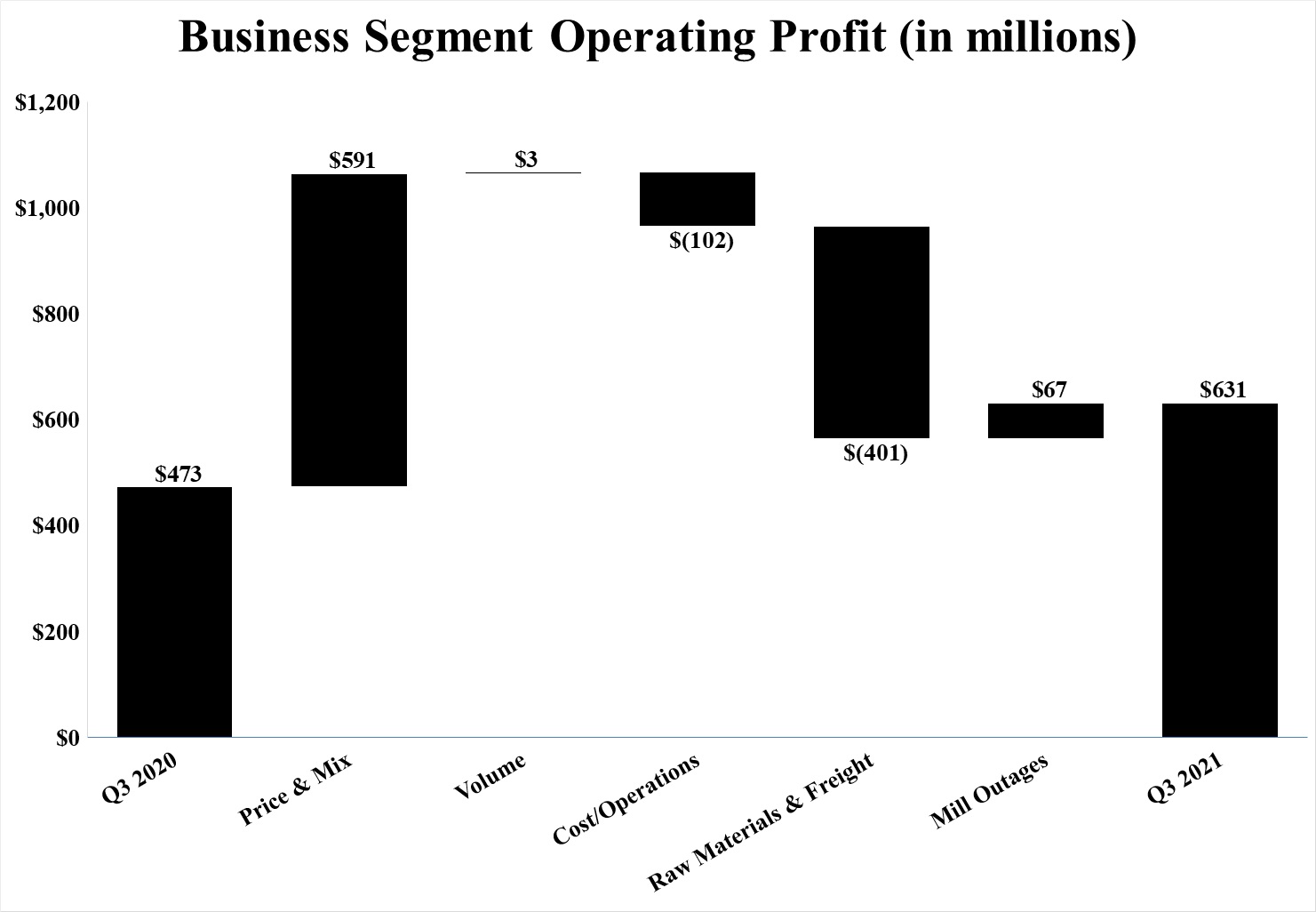
Compared with the third quarter of 2020, operating profits in the current quarter benefited from higher average sales prices and a favorable mix ($591 million) and higher sales volumes ($3 million) and lower mill outage costs ($67 million). These benefits were offset by higher operating costs ($102 million) and higher raw material and freight costs ($401 million).
Sales Volumes by Product (a)
Sales volumes of major products for the three months and nine months ended September 30, 2021 and 2020 were as follows:
| Three Months Ended September 30, | Nine Months Ended September 30, | ||||||||||||||||||||||
| In thousands of short tons (except as noted) | 2021 | 2020 | 2021 | 2020 | |||||||||||||||||||
| Industrial Packaging | |||||||||||||||||||||||
| Corrugated Packaging (b) | 2,689 | 2,705 | 8,106 | 7,900 | |||||||||||||||||||
| Containerboard | 710 | 760 | 2,118 | 2,370 | |||||||||||||||||||
| Recycling | 521 | 541 | 1,647 | 1,630 | |||||||||||||||||||
| Saturated Kraft | 45 | 36 | 140 | 123 | |||||||||||||||||||
| Gypsum/Release Kraft | 56 | 50 | 179 | 154 | |||||||||||||||||||
| Bleached Kraft | 5 | 7 | 18 | 22 | |||||||||||||||||||
| EMEA Packaging (b) | 334 | 374 | 1,179 | 1,190 | |||||||||||||||||||
| Brazilian Packaging (b) | — | 98 | — | 271 | |||||||||||||||||||
| European Coated Paperboard | 56 | 102 | 267 | 308 | |||||||||||||||||||
| Industrial Packaging | 4,416 | 4,673 | 13,654 | 13,968 | |||||||||||||||||||
| Global Cellulose Fibers (in thousands of metric tons) (c) | 856 | 886 | 2,605 | 2,752 | |||||||||||||||||||
| Printing Papers | |||||||||||||||||||||||
| U.S. Uncoated Papers | 379 | 336 | 1,104 | 998 | |||||||||||||||||||
| European and Russian Uncoated Papers | 248 | 298 | 882 | 929 | |||||||||||||||||||
| Brazilian Uncoated Papers | 275 | 208 | 801 | 598 | |||||||||||||||||||
| Printing Papers | 902 | 842 | 2,787 | 2,525 |
(a)Sales volumes include third party and inter-segment sales and exclude sales of equity investees.
(b)Volumes for corrugated box sales reflect consumed tons sold (CTS). Board sales for these businesses reflect invoiced tons.
(c)Includes North American, European and Brazilian volumes and internal sales to mills.
Income Taxes
An income tax provision of $146 million was recorded for the third quarter of 2021 and the reported effective income tax rate was 16%. Excluding expense of $36 million related to the tax effects of net special items and expense of $13 million related to the tax effects of non-operating pension expense, the effective income tax rate was 18% for the quarter.
An income tax provision of $102 million was recorded for the second quarter of 2021 and the reported effective income tax rate was 24%. Excluding expense of $5 million related to the tax effects of net special items and expense of $13 million related to the tax effects of non-operating pension expense, the effective income tax rate was 21% for the quarter.
An income tax provision of $50 million was recorded for the third quarter of 2020 and the reported effective income tax rate was 18%. Excluding a benefit of $26 million related to the tax effects of net special items and expense of $4 million related to the tax effects of non-operating pension expense, the effective income tax rate was 19% for the quarter.
Interest Expense
Net interest expense was $93 million in the third quarter of 2021, compared with $57 million in the second quarter of 2021 and $112 million in the third quarter of 2020. Net interest expense includes interest expense of $8 million, interest income of $28 million and interest income of $1 million for the three months ended September 30, 2021, June 30, 2021 and September 30, 2020, respectively, related to a foreign value-added tax credit accrual.
Effects of Net Special Items and Non-Operating Pension Expense
Details of net special items and non-operating pension expense (income) for the three months ended are as follows:
| Three Months Ended | ||||||||||||||||||||||||||||||||||||||
| September 30, | June 30, | |||||||||||||||||||||||||||||||||||||
| 2021 | 2020 | 2021 | ||||||||||||||||||||||||||||||||||||
| In millions | Before Tax | After Tax | Before Tax | After Tax | Before Tax | After Tax | ||||||||||||||||||||||||||||||||
| Business Segments | ||||||||||||||||||||||||||||||||||||||
| Foreign value-added tax credit accrual | $ | 7 | $ | 5 | (a) | $ | — | $ | — | $ | (42) | $ | (28) | (a) | ||||||||||||||||||||||||
| Printing Papers spin-off | 4 | 4 | (a) | — | — | — | — | |||||||||||||||||||||||||||||||
| Environmental remediation reserve adjustment | — | — | 7 | 6 | (a) | — | — | |||||||||||||||||||||||||||||||
| Gain on sale of Kwidzyn, Poland mill | (360) | (350) | (a) | — | — | — | — | |||||||||||||||||||||||||||||||
| EMEA Packaging impairment - Turkey | — | — | — | — | (8) | (2) | (b) | |||||||||||||||||||||||||||||||
| Brazil Packaging impairment | — | — | (4) | ` | (2) | (b) | — | — | ||||||||||||||||||||||||||||||
| Other | — | — | (1) | (1) | (c) | — | — | |||||||||||||||||||||||||||||||
| Business Segments Total | (349) | (341) | 2 | 3 | (50) | (30) | ||||||||||||||||||||||||||||||||
| Corporate | ||||||||||||||||||||||||||||||||||||||
| Debt extinguishment costs | 35 | 26 | 105 | 79 | 170 | 128 | ||||||||||||||||||||||||||||||||
| Printing Papers spin-off / Building a Better IP | 53 | 47 | — | — | 28 | 23 | ||||||||||||||||||||||||||||||||
| Environmental remediation reserve adjustment | 5 | 4 | — | — | 5 | 3 | ||||||||||||||||||||||||||||||||
| Real estate - office impairment | — | — | — | — | 21 | 16 | ||||||||||||||||||||||||||||||||
| Gain on sale of La Mirada, California distribution center | (86) | (65) | — | — | — | — | ||||||||||||||||||||||||||||||||
| Gain on sale of equity investment in Graphic Packaging | — | — | — | — | (130) | (98) | ||||||||||||||||||||||||||||||||
| Other | 4 | 3 | 3 | 2 | 7 | 5 | ||||||||||||||||||||||||||||||||
| Corporate Total | 11 | 15 | 108 | 81 | 101 | 77 | ||||||||||||||||||||||||||||||||
| Total net special items | (338) | (326) | 110 | 84 | 51 | 47 | ||||||||||||||||||||||||||||||||
| Non-operating pension expense (income) | (51) | (38) | (11) | (7) | (52) | (39) | ||||||||||||||||||||||||||||||||
| Total net special items and non-operating pension expense (income) | $ | (389) | $ | (364) | $ | 99 | $ | 77 | $ | (1) | $ | 8 |
(a) Recorded in the Printing Papers segment.
(b) Recorded in the Industrial Packaging segment.
(c) Includes a charge of $1 million (before and after taxes) recorded in the Industrial Packaging segment and income of $2 million (before and after taxes) recorded in the Printing Papers segment.
Net special items include the following tax expenses (benefits):
| Three Months Ended | ||||||||||||||||||||
| September 30, | June 30, | |||||||||||||||||||
| In millions | 2021 | 2020 | 2021 | |||||||||||||||||
| Foreign and state taxes related to Printing Papers spin-off | $ | 27 | $ | — | $ | — | ||||||||||||||
| Total | $ | 27 | $ | — | $ | — |
Details of net special items and non-operating pension expense for the nine months ended are as follows:
| Nine Months Ended September 30, | ||||||||||||||||||||||||||||||||||||||||||||
| 2021 | 2020 | |||||||||||||||||||||||||||||||||||||||||||
| In millions | Before Tax | After Tax | Before Tax | After Tax | ||||||||||||||||||||||||||||||||||||||||
| Business Segments | ||||||||||||||||||||||||||||||||||||||||||||
| EMEA Packaging business optimization | $ | 12 | $ | 10 | (a) | $ | — | $ | — | |||||||||||||||||||||||||||||||||||
| Printing Papers spin-off | 4 | 4 | (c) | — | — | |||||||||||||||||||||||||||||||||||||||
| Brazil Packaging impairment | — | — | 349 | 342 | (a) | |||||||||||||||||||||||||||||||||||||||
| Abandoned property removal | — | — | 14 | 11 | (b) | |||||||||||||||||||||||||||||||||||||||
| Environmental remediation reserve adjustment | — | — | 7 | 6 | (c) | |||||||||||||||||||||||||||||||||||||||
| Riverdale mill conversion | — | — | 1 | 1 | (c) | |||||||||||||||||||||||||||||||||||||||
| Gain on sale of Kwidzyn, Poland mill | (360) | (350) | (c) | — | — | |||||||||||||||||||||||||||||||||||||||
| Foreign value-added tax credit accrual | (35) | (23) | (c) | (2) | (1) | (a) | ||||||||||||||||||||||||||||||||||||||
| EMEA Packaging impairment - Turkey | (6) | — | (a) | — | — | |||||||||||||||||||||||||||||||||||||||
| Other | — | — | $ | (1) | $ | (1) | (d) | |||||||||||||||||||||||||||||||||||||
| Business Segments Total | (385) | (359) | $ | 368 | $ | 358 | ||||||||||||||||||||||||||||||||||||||
| Corporate | ||||||||||||||||||||||||||||||||||||||||||||
| Debt extinguishment costs | 223 | 168 | 131 | 98 | ||||||||||||||||||||||||||||||||||||||||
| Printing Papers spin-off / Building a Better IP | 106 | 90 | — | — | ||||||||||||||||||||||||||||||||||||||||
| Real estate - office impairment | 21 | 16 | — | — | ||||||||||||||||||||||||||||||||||||||||
| Environmental remediation reserve adjustment | 10 | 7 | 41 | 31 | ||||||||||||||||||||||||||||||||||||||||
| Asbestos litigation reserve adjustment | — | — | 43 | 33 | ||||||||||||||||||||||||||||||||||||||||
| India transaction | — | — | 11 | 11 | ||||||||||||||||||||||||||||||||||||||||
| Gain on sale of equity investment in Graphic Packaging | (204) | (154) | (33) | (25) | ||||||||||||||||||||||||||||||||||||||||
| Gain on sale of La Mirada, California distribution center | (86) | (65) | — | — | ||||||||||||||||||||||||||||||||||||||||
| Other | 11 | 8 | 2 | 1 | ||||||||||||||||||||||||||||||||||||||||
| Corporate Total | 81 | 70 | $ | 195 | $ | 149 | ||||||||||||||||||||||||||||||||||||||
| Total net special items | (304) | (289) | 563 | 507 | ||||||||||||||||||||||||||||||||||||||||
| Non-operating pension expense (income) | (156) | (117) | (31) | (23) | ||||||||||||||||||||||||||||||||||||||||
| Total net special items and non-operating pension expense (income) | $ | (460) | $ | (406) | $ | 532 | $ | 484 |
(a) Recorded in the Industrial Packaging segment.
(b) Includes $9 million ($7 million after taxes) for the nine months ended September 30, 2020 recorded in the Industrial Packaging segment and $5 million ($4 million after taxes) for the nine months ended September 30, 2020 recorded in the Global Cellulose Fibers segment.
(c) Recorded in the Printing Papers segment.
(d) Includes income of $2 million (before and after taxes) recorded in the Printing Papers segment and charges of $1 million (before and after taxes) recorded in the Industrial Packaging segment.
Net special items include the following tax expenses (benefits):
| Nine Months Ended | ||||||||||||||
| September 30, | ||||||||||||||
| In millions | 2021 | 2020 | ||||||||||||
| Foreign and state taxes related to Printing Papers spin-off | $ | 27 | $ | — | ||||||||||
| Total | $ | 27 | $ | — |
BUSINESS SEGMENT OPERATING RESULTS
The following tables present net sales and business segment operating profit (loss) which is the Company's measure of segment profitability.
Industrial Packaging
| Total Industrial Packaging | 2021 | 2020 | |||||||||||||||||||||||||||||||||
| In millions | 3rd Quarter | 2nd Quarter | Nine Months | 3rd Quarter | 2nd Quarter | Nine Months | |||||||||||||||||||||||||||||
| Sales | $ | 4,087 | $ | 4,056 | $ | 12,096 | $ | 3,768 | $ | 3,633 | $ | 11,220 | |||||||||||||||||||||||
| Operating Profit (Loss) | $ | 429 | $ | 408 | $ | 1,284 | $ | 469 | $ | 449 | $ | 1,388 |
Industrial Packaging net sales for the third quarter of 2021 were 1% higher compared with the second quarter of 2021 and 8% higher compared with the third quarter of 2020. Operating profit was 5% higher in the third quarter of 2021 compared with the second quarter of 2021 and 9% lower compared with the third quarter of 2020.
| North American Industrial Packaging | 2021 | 2020 | |||||||||||||||||||||||||||||||||
| In millions | 3rd Quarter | 2nd Quarter | Nine Months | 3rd Quarter | 2nd Quarter | Nine Months | |||||||||||||||||||||||||||||
| Sales (a) | $ | 3,738 | $ | 3,587 | $ | 10,810 | $ | 3,351 | $ | 3,241 | $ | 9,947 | |||||||||||||||||||||||
| Operating Profit (Loss) | $ | 418 | $ | 377 | $ | 1,190 | $ | 455 | $ | 434 | $ | 1,326 |
(a)Includes intra-segment sales of $34 million and $31 million for the three months ended September 30, 2021 and 2020, respectively; $27 million and $31 million for the three months ended June 30, 2021 and 2020, respectively; and $87 million and $94 million for the nine months ended September 30, 2021 and 2020, respectively.
North American Industrial Packaging sales volumes in the third quarter of 2021 were lower compared to the second quarter of 2021, reflecting lower shipments for boxes and domestic containerboard partially offset by higher shipments for export containerboard. Box shipments were impacted by constrained containerboard availability as supply chains remain stretched. Total maintenance and economic downtime was about 202,000 tons lower in the third quarter of 2021 compared with the second quarter of 2021, driven by lower maintenance downtime. Average sales margins were significantly higher reflecting higher average sales prices for boxes and export containerboard. Operating costs were lower, driven by strong mill operations partially offset by higher converting costs. Planned maintenance downtime costs were $123 million lower in the third quarter of 2021 compared with the second quarter of 2021. Input costs were substantially higher, primarily for wood, recovered fiber and energy.
Compared with the third quarter of 2020, sales volumes were lower in the third quarter of 2021 for export containerboard partially offset by higher shipments for domestic containerboard. Sales volumes for boxes were slightly lower reflecting the impact of the challenging supply chain environment. Total maintenance and economic downtime was about 40,000 tons lower in the third quarter of 2021, driven by lower maintenance downtime. Export containerboard and box prices were significantly higher reflecting previous price increases. Operating costs increased, driven by inflation and increased converting and transportation costs. Planned maintenance downtime costs were $17 million lower in the third quarter of 2021 compared with the third quarter of 2020. Input costs were significantly higher driven by recovered fiber, energy, chemicals and wood.
Entering the fourth quarter of 2021, sales volumes for boxes and export containerboard are expected to be higher compared to the third quarter of 2021. Average sales margins are also expected to be higher, reflecting previous price increases. Operating costs are expected to be lower. Planned maintenance downtime costs are expected to be $4 million higher in the fourth quarter of 2021 compared with the third quarter of 2021. Input costs are expected to be higher primarily for recovered fiber, energy and chemicals.
| EMEA Industrial Packaging | 2021 | 2020 | |||||||||||||||||||||||||||||||||
| In millions | 3rd Quarter | 2nd Quarter | Nine Months | 3rd Quarter | 2nd Quarter | Nine Months | |||||||||||||||||||||||||||||
| Sales | $ | 331 | $ | 394 | $ | 1,121 | $ | 306 | $ | 297 | $ | 953 | |||||||||||||||||||||||
| Operating Profit (Loss) | $ | (4) | $ | 12 | $ | 34 | $ | 3 | $ | 5 | $ | 18 |
EMEA Industrial Packaging sales volumes for boxes in the third quarter of 2021 were lower compared with the second quarter of 2021 driven by seasonally lower volumes in Morocco. Average sales margins for boxes were lower reflecting increased containerboard costs, partially offset by higher box prices. Operating costs were lower. Planned maintenance downtime costs were $2 million higher in the third quarter of 2021 compared with the second quarter of 2021. Input costs were higher, primarily for recovered fiber and energy. The company completed the sale of its business in Turkey during the second quarter of 2021.
Compared with the third quarter of 2020, sales volumes in the third quarter of 2021 were higher, reflecting recovery of the impacts of the COVID-19 pandemic. Average sales margins for boxes were lower driven by higher containerboard costs. Average sales margins for containerboard were higher reflecting higher sales prices. Operating costs improved reflecting strong
operations and cost management. Planned maintenance downtime were $1 million lower in the third quarter of 2021 compared with the third quarter of 2020. Input costs were higher, primarily for recovered fiber and energy. Earnings benefited from the recent box plant acquisitions in Spain.
Looking ahead to the fourth quarter of 2021, sales volumes for boxes are expected to be higher. Average sales margins are expected to be lower due to continued rising containerboard pricing. Operating costs are expected to be higher. Planned maintenance downtime costs are expected to be $1 million lower in the fourth quarter of 2021 compared with the third quarter of 2021. Input costs are expected to be higher due to rising energy costs.
| Brazilian Industrial Packaging | 2021 | 2020 | |||||||||||||||||||||||||||||||||
| In millions | 3rd Quarter | 2nd Quarter | Nine Months | 3rd Quarter | 2nd Quarter | Nine Months | |||||||||||||||||||||||||||||
| Sales | $ | — | $ | — | $ | — | $ | 52 | $ | 42 | $ | 148 | |||||||||||||||||||||||
| Operating Profit (Loss) | $ | — | $ | — | $ | — | $ | — | $ | (2) | $ | (3) |
On March 29, 2020 International Paper announced that it had entered into an agreement to sell its Brazilian Industrial Packaging business. The transaction closed October 14, 2020.
| European Coated Paperboard | 2021 | 2020 | |||||||||||||||||||||||||||||||||
| In millions | 3rd Quarter | 2nd Quarter | Nine Months | 3rd Quarter | 2nd Quarter | Nine Months | |||||||||||||||||||||||||||||
| Sales | $ | 52 | $ | 102 | $ | 252 | $ | 90 | $ | 84 | $ | 266 | |||||||||||||||||||||||
| Operating Profit (Loss) | $ | 15 | $ | 19 | $ | 60 | $ | 11 | $ | 12 | $ | 47 |
On August 6, 2021 International Paper completed the sale of our Kwidzyn, Poland mill, which included our coated paperboard business in Europe. The third quarter of 2021 reflects one month of coated paperboard sales and operating profit in Europe. The discussion below focuses on our remaining coated paperboard business in Russia.
European Coated Paperboard sales volumes in the third quarter of 2021 compared with the second quarter of 2021 were higher. Average sales margins were flat reflecting higher average sales prices offset by an unfavorable mix. Operating costs were stable. Planned maintenance downtime costs were $5 million lower in the third quarter of 2021 compared with the second quarter of 2021 in Russia. Input costs were flat.
Compared with the third quarter of 2020, sales volumes were lower. Average sales margins were higher reflecting higher average sales prices and a favorable mix. Operating costs were flat. There were no planned maintenance downtime outages in either the third quarter of 2021 or the third quarter of 2020 in Russia. Input costs were slightly higher primarily for wood and chemicals.
On October 1, 2021, International Paper successfully completed the spin-off of our global papers business, including our remaining coated paperboard business in Russia, into a standalone, publicly traded company named Sylvamo Corporation.
Global Cellulose Fibers
| Total Global Cellulose Fibers | 2021 | 2020 | |||||||||||||||||||||||||||||||||
| In millions | 3rd Quarter | 2nd Quarter | Nine Months | 3rd Quarter | 2nd Quarter | Nine Months | |||||||||||||||||||||||||||||
| Sales | $ | 729 | $ | 671 | $ | 1,981 | $ | 564 | $ | 605 | $ | 1,737 | |||||||||||||||||||||||
| Operating Profit (Loss) | $ | 96 | $ | 10 | $ | 24 | $ | (59) | $ | (10) | $ | (123) |
Global Cellulose Fibers net sales in the third quarter of 2021 were 9% higher compared with the second quarter of 2021 and 29% higher than in the third quarter of 2020. Operating profit in the third quarter of 2021 improved significantly compared to both the second quarter of 2021 and the third quarter of 2020.
On August 6, 2021 International Paper completed the sale of our Kwidzyn, Poland mill, including its cellulose fibers business. The third quarter of 2021 reflects one month of the Kwidzyn, Poland mill sales and operating profit. On October 1, 2021, International Paper successfully completed the spin-off of our global papers business, including our cellulose fibers business in France and Russia, into a standalone, publicly traded company named Sylvamo Corporation.
Sales volumes in the third quarter of 2021 compared with the second quarter of 2021 were flat and continue to be impacted by shipping delays due to significant port congestion in the U.S. Total maintenance and economic downtime was about 28,000 tons lower in the third quarter of 2021 compared with the second quarter of 2021 due to maintenance downtime. Average sales margins improved significantly, reflecting flow through of previous sales price increases and an improved product mix. Operating costs were lower, partially offset by higher distribution costs reflecting the challenging export supply chain
environment. Planned maintenance downtime costs in the third quarter of 2021 were $18 million lower compared with the second quarter of 2021. Input costs were higher, primarily for wood, chemicals and energy.
Compared with the third quarter of 2020, sales volumes in the third quarter of 2021 were higher but were impacted by the shipping delays due to port congestion. Total maintenance and economic downtime was about 80,000 tons lower in the third quarter of 2021, driven by maintenance and economic downtime. Average sales prices were significantly higher for both fluff and market pulp. Operating costs were higher due to inflation. Distribution costs were also higher. Planned maintenance downtime costs in the third quarter of 2021 were $26 million lower compared with the third quarter of 2020. Input costs were higher primarily for wood, chemicals and energy.
Entering the fourth quarter of 2021, sales volumes are expected to be slightly lower. Average sales margins are expected to be stable. Planned maintenance downtime costs in the fourth quarter of 2021 are expected to be $36 million higher compared with the third quarter of 2021. Operating costs are expected to be seasonally higher. Input costs are expected to increase for wood, chemicals and energy.
Printing Papers
| Total Printing Papers | 2021 | 2020 | |||||||||||||||||||||||||||||||||
| In millions | 3rd Quarter | 2nd Quarter | Nine Months | 3rd Quarter | 2nd Quarter | Nine Months | |||||||||||||||||||||||||||||
| Sales | $ | 846 | $ | 846 | $ | 2,473 | $ | 743 | $ | 583 | $ | 2,234 | |||||||||||||||||||||||
| Operating Profit (Loss) | $ | 106 | $ | 76 | $ | 262 | $ | 63 | $ | (11) | $ | 148 |
On October 1, 2021, International Paper successfully completed the spin-off of our global papers business into a standalone, publicly traded company named Sylvamo Corporation.
Printing Papers net sales for the third quarter of 2021 were flat compared with the second quarter of 2021 and 14% higher than in the third quarter of 2020. Operating profit in the third quarter of 2021 was 39% higher compared with the second quarter of 2021 and 68% higher compared with the third quarter of 2020.
| North American Papers | 2021 | 2020 | |||||||||||||||||||||||||||||||||
| In millions | 3rd Quarter | 2nd Quarter | Nine Months | 3rd Quarter | 2nd Quarter | Nine Months | |||||||||||||||||||||||||||||
| Sales | $ | 425 | $ | 410 | $ | 1,201 | $ | 362 | $ | 265 | $ | 1,073 | |||||||||||||||||||||||
| Operating Profit (Loss) | $ | 45 | $ | 18 | $ | 78 | $ | 31 | $ | (23) | $ | 31 |
North American Papers sales volumes in the third quarter of 2021 were flat compared with the second quarter of 2021. Total maintenance and economic downtime was about 9,000 tons lower in the third quarter of 2021 compared with the second quarter of 2021 due to maintenance downtime. Average sales margins improved reflecting higher sales prices. Operating costs were lower reflecting strong mill operations. Planned maintenance downtime costs were $19 million lower in the third quarter of 2021, compared with the second quarter of 2021. Input costs were higher, primarily for wood, energy and chemicals.
Compared with the third quarter of 2020, sales volumes in the third quarter of 2021 were higher reflecting demand recovery from the COVID-19 pandemic. Total maintenance and economic downtime was about 78,000 tons lower in the third quarter of 2021 compared with the third quarter of 2020 primarily due to economic downtime. Average sales margins were higher, driven by higher average sales prices. Operating costs were lower. Planned maintenance downtime costs were $6 million lower in the third quarter of 2021 compared with the third quarter of 2020. Input costs were higher, primarily for wood, energy and chemicals.
| European Papers | 2021 | 2020 | |||||||||||||||||||||||||||||||||
| In millions | 3rd Quarter | 2nd Quarter | Nine Months | 3rd Quarter | 2nd Quarter | Nine Months | |||||||||||||||||||||||||||||
| Sales | $ | 218 | $ | 255 | $ | 723 | $ | 232 | $ | 209 | $ | 728 | |||||||||||||||||||||||
| Operating Profit (Loss) | $ | 16 | $ | 15 | $ | 53 | $ | 17 | $ | 13 | $ | 71 |
On August 6, 2021 International Paper completed the sale of our Kwidzyn, Poland mill. The third quarter of 2021 reflects one month of the Kwidzyn, Poland mill sales and operating profit.
European Papers sales volumes for uncoated freesheet paper in the third quarter of 2021, compared with the second quarter of 2021, were higher in Russia and flat in Europe. Average sales margins for uncoated freesheet paper were higher in Europe reflecting higher average sales prices. In Russia, average sales margins were stable. Operating costs were higher in both regions. Excluding Kwidzyn, planned maintenance downtime costs were $8 million lower in the third quarter of 2021 compared
to the second quarter of 2021. Input costs were higher in both regions, primarily for energy in Europe and packaging in Russia. Earnings benefited from favorable foreign currency impacts, primarily in Russia.
Sales volumes for uncoated freesheet paper in the third quarter of 2021 compared with the third quarter of 2020 were higher in both Europe and Russia, reflecting recovery of the significant decline in demand due to the COVID-19 pandemic. Earnings in both regions were negatively impacted by economic downtime in the third quarter of 2020 driven by the COVID-19 pandemic. Average sales margins for uncoated freesheet paper were lower in Europe reflecting lower average sales prices and an unfavorable mix. In Russia, average sales margins were higher driven by higher average sales prices. Operating costs were higher in both regions. Excluding Kwidzyn, planned maintenance downtime costs were flat compared with the third quarter of 2020. Input costs were higher in both regions, primarily for energy in Europe and packaging in Russia.
| Brazilian Papers | 2021 | 2020 | |||||||||||||||||||||||||||||||||
| In millions | 3rd Quarter | 2nd Quarter | Nine Months | 3rd Quarter | 2nd Quarter | Nine Months | |||||||||||||||||||||||||||||
| Sales (a) | $ | 200 | $ | 189 | $ | 557 | $ | 150 | $ | 108 | $ | 434 | |||||||||||||||||||||||
| Operating Profit (Loss) | $ | 45 | $ | 43 | $ | 131 | $ | 15 | $ | (1) | $ | 46 |
(a)Includes intra-segment sales of $(3) million and $1 million for the three months ended September 30, 2021 and 2020, respectively; $8 million and $(1) million for the three months ended June 30, 2021 and 2020, respectively; and $8 million and $1 for the nine months ended September 30, 2021 and 2020, respectively.
Brazilian Papers sales volumes in the third quarter of 2021, compared with the second quarter of 2021, were higher for both domestic and export shipments of uncoated freesheet paper. Average sales margins improved driven by higher domestic and export sales prices and a favorable geographic mix. Operating costs were slightly higher. Planned maintenance outage downtime costs were $7 million higher in the third quarter of 2021 compared with the second quarter of 2021. Input costs were higher primarily for purchased pulp, chemicals and energy.
Compared with the third quarter of 2020, sales volumes for uncoated freesheet paper in the third quarter of 2021 increased in both domestic and export markets reflecting recovery from the negative demand impact of the COVID-19 pandemic. Average sales margins were higher reflecting higher average domestic and export sales prices and a favorable geographic mix. Operating costs were slightly higher. Planned maintenance outage expenses were $5 million higher in the third quarter of 2021 compared with the third quarter of 2020. Input costs were higher, primarily for purchased pulp, chemicals and energy.
Equity Earnings, Net of Taxes – Ilim
International Paper accounts for its 50% equity interest in Ilim S.A. (Ilim) using the equity method of accounting. Ilim is a separate reportable industry segment whose primary operations are in Russia. The Company recorded equity earnings (loss), net of taxes, of $95 million in the third quarter of 2021, compared with $101 million in the second quarter of 2021 and $(33) million in the third quarter of 2020. In the second and third quarters of 2021, the foreign exchange gains and losses included in equity earnings were not material and Ilim Group had no US dollar-denominated debt outstanding at September 30, 2021.
Compared with the second quarter of 2021, sales volumes in the third quarter of 2021 were 8% lower overall, primarily for sales of softwood pulp in China, other export markets and Russia, and sales of hardwood pulp in China. Containerboard sales in China and Russia were slightly lower, but increased in other export markets. Average sales margins increased for softwood pulp and containerboard in all markets. Average sales margins for hardwood pulp were relatively flat in China, but increased in Russia and other export markets. Input costs for fuel and chemicals were higher. Following maintenance outages at the Ust-Ilimsk, Bratsk and Koryazhma mills in the third quarter of 2021, repair and maintenance expenses increased. Distribution costs were higher primarily due to the global shortage of shipping containers and increased tariffs.
Compared with the third quarter of 2020, sales volumes in the third quarter of 2021 decreased overall by 5%, primarily for sales of softwood pulp and hardwood pulp in China, partially offset by higher sales of softwood pulp and hardwood pulp in Russia. Sales of containerboard in China and other export markets were higher, but declined in Russia. Average sales margins for softwood pulp, hardwood pulp and containerboard increased in all regions. Input costs, primarily for wood, fuel and chemicals were higher. Distribution costs increased. An after-tax foreign exchange net loss of $55 million primarily on the remeasurement of U.S. dollar denominated net debt was recorded in the third quarter of 2020.
Looking forward to the fourth quarter of 2021, sales volumes are expected to increase. Based on pricing to date in the current quarter, average sales margins are projected to decrease compared with the third quarter of 2021. Repair and maintenance costs will decrease as there are no scheduled mill outages in the fourth quarter. Input costs for wood are expected to be moderately higher. Distribution costs are projected to increase.
Equity Earnings – GPIP
There were no Graphic Packaging equity earnings in the third quarter of 2021, compared with $3 million in the second quarter of 2021 and $11 million in the third quarter of 2020. As of June 30, 2021, the Company no longer had an ownership interest in GPIP.
LIQUIDITY AND CAPITAL RESOURCES
Cash provided by operations totaled $1.9 billion for the first nine months of 2021, compared with $2.3 billion for the comparable 2020 nine-month period.
Investments in capital projects, net of insurance recoveries, totaled $348 million in the first nine months of 2021, compared to $657 million in the first nine months of 2020. Full-year 2021 capital spending is currently expected to be approximately $600 million, or 49% of depreciation and amortization.
Financing activities for the first nine months of 2021 included a $379 million net increase in debt versus a $1.1 billion net decrease in debt during the comparable 2020 nine-month period.
Amounts related to early debt extinguishment during the three and nine months ended September 30, 2021 and 2020 were as follows:
| Three Months Ended September 30, | Nine Months Ended September 30, | ||||||||||||||||||||||
| In millions | 2021 | 2020 | 2021 | 2020 | |||||||||||||||||||
| Early debt reductions (a) | $ | 200 | $ | 903 | $ | 1,097 | $ | 1,190 | |||||||||||||||
| Pre-tax early debt extinguishment (gain) loss, net | 35 | 105 | 223 | 131 |
(a)Reductions related to notes with interest rates of 3.55% with original maturities of 2029 and ranging from 3.00% to 7.50% with original maturities from 2021 to 2027 for the three months ended September 30, 2021 and 2020, respectively, and from 3.00% to 5.15% with original maturities from 2027 to 2048 and from 3.00% to 7.50% with original maturities from 2021 to 2048 for the nine months ended September 30, 2021 and 2020, respectively.
At September 30, 2021, contractual obligations for future payments of debt maturities (including finance lease liabilities disclosed in Note 11 - Leases and excluding the timber monetization structures disclosed in Note 16 - Variable Interest Entities) by calendar year were as follows: $113 million in 2021; $224 million in 2022; $409 million in 2023; $200 million in 2024; $257 million in 2025; and $7.3 billion thereafter.
Maintaining an investment-grade credit rating is an important element of International Paper’s financing strategy. At September 30, 2021, the Company held long-term credit ratings of BBB (stable outlook) and Baa2 (stable outlook) by S&P and Moody’s, respectively. In addition, the Company held short-term credit ratings of A2 and P2 by S&P and Moody's, respectively, for borrowings under the Company's commercial paper program.
At September 30, 2021, International Paper’s credit agreements totaled $2.1 billion, which is comprised of the $1.5 billion contractually committed bank credit agreement and up to $550 million under the receivables securitization program. Management believes these credit agreements are adequate to cover expected operating cash flow variability during the current economic cycle. The credit agreements generally provide for interest rates at a floating rate index plus a pre-determined margin dependent upon International Paper’s credit rating. At September 30, 2021, the Company had no borrowings outstanding under the $1.5 billion credit agreement or the $550 million receivables securitization program. The Company’s credit agreements are not subject to any restrictive covenants other than the financial covenants as disclosed in Note 17 - Debt, and the borrowings under the receivables securitization program being limited by eligible receivables. The Company was in compliance with all its debt covenants at September 30, 2021 and was well below the thresholds stipulated under the covenants as defined in the credit agreements. Further the financial covenants do not restrict any borrowings under the credit agreements.
In addition to the $2.1 billion capacity under the Company's credit agreements, International Paper has a commercial paper program with a borrowing capacity of $1.0 billion. Under the terms of the program, individual maturities on borrowings may vary, but not exceed one year from the date of issue. Interest bearing notes may be issued either as fixed or floating rate notes. As of September 30, 2021, the Company had no borrowings outstanding under the program.
On October 28, 2021, the Company launched a debt tender to purchase up to $500 million of the Company's outstanding debt with interest rates ranging from 4.35% to 6.00% and maturity dates ranging from 2035 to 2048.
International Paper expects to be able to meet projected capital expenditures, service existing debt, meet working capital and dividend requirements and make common stock and/or debt repurchases for the next 12 months with current cash balances and
cash from operations, supplemented as required by its existing credit facilities. The Company will continue to rely on debt and capital markets for the majority of any necessary long-term funding not provided by operating cash flows. Funding decisions will be guided by our capital structure planning objectives. The primary goals of the Company’s capital structure planning are to maximize financial flexibility and maintain appropriate levels of liquidity to meet our needs while managing balance sheet debt and interest expense, and we have purchased, and may continue to repurchase, our common stock (under our existing share repurchase program) and debt to the extent consistent with this capital structure planning. The majority of International Paper’s debt is accessed through global public capital markets where we have a wide base of investors. During 2020, management took various actions to further strengthen the Company’s liquidity position in response to the COVID-19 pandemic. This included the Company deferring the payment of our payroll taxes as allowed under CARES Act. The CARES Act allows for the deferral of the payment of the employer portion of Social Security taxes accrued between March 27, 2020, and December 31, 2020. Under the CARES Act 50% of the deferred payroll taxes will be paid by December 31, 2021 and the remainder will be paid by December 31, 2022. We believe that our credit agreements, commercial paper program, and the actions taken in response to COVID-19 provide us with sufficient liquidity to operate in the current environment; however, an extended period of economic disruption could impact our access to additional sources of liquidity.
During the first nine months of 2021, International Paper used 1.8 million shares of treasury stock for various incentive plans. International Paper also acquired 7.7 million shares of treasury stock, including restricted stock tax withholdings. Repurchases of common stock and payments of restricted stock withholding taxes totaled $425 million, including $398 million related to shares repurchased under the Company's repurchase program. In addition, on October 12, 2021, the Company announced that its board of directors authorized the repurchase of $2 billion additional shares of common stock under the Company's repurchase program (in addition to the existing amount available for purchase, which was $1.3 billion as of September 30, 2021).
During the first nine months of 2020, International Paper used approximately 2.0 million shares of treasury stock for various incentive plans. International Paper also acquired 1.0 million shares of treasury stock, including restricted stock tax withholding. Repurchases of common stock and payments of restricted stock withholding taxes totaled $42 million, including $14 million related to shares repurchased under the Company's repurchase program.
Cash dividend payments related to common stock totaled $602 million and $605 million for the first nine months of 2021 and 2020, respectively. Dividends were $1.5375 per share and $1.5375 per share for the first nine months in 2021 and 2020, respectively. The Company announced on October 12, 2021, a decrease in the Company's quarterly dividend from $0.5125 per share to $0.4625 per share for the fourth quarter of 2021, which takes into account the fact that the spin-off completed on October 1, 2021, will result in a decrease in the amount of cash generated by the Company based on the historical performance of the Printing Papers business included in the spin-off.
Our pension plan is currently sufficiently funded and we do not anticipate any required contributions for the next 12 months.
Variable Interest Entities
Information concerning variable interest entities is set forth in Note 15 in the Company's Annual Report on Form 10-K for the year ended December 31, 2020. In connection with the 2006 International Paper installment sale of forestlands, we received $4.8 billion of installment notes. These installment notes were used by variable interest entities as collateral for borrowings from third-party lenders. These variable interest entities were restructured in 2015 when the installment notes and third-party loans were extended. The restructured variable interest entities held installment notes of $4.8 billion and third-party loans of $4.2 billion that both matured in August 2021. We settled the third-party loans at their maturity with the proceeds from the installment notes. This resulted in cash proceeds of approximately $630 million representing our equity in the variable interest entities. Maturity of the installment notes and termination of the monetization structure also resulted in a $72 million tax liability that is expected to be paid in the fourth quarter of 2021. As of September 30, 2021, the Company's remaining deferred tax liability associated with the 2015 Financing Entities was $815 million. The nature and timing of the income tax due related to these transactions is currently under review by the Internal Revenue Service.
Ilim S.A. Shareholders’ Agreement
In October 2007, in connection with the formation of the Ilim S.A. joint venture (Ilim), International Paper entered into a shareholders' agreement that includes provisions relating to the reconciliation of disputes among the partners. This agreement provides that at any time, either the Company or its partners may commence procedures specified under the deadlock agreement. If these or any other deadlock procedures under the shareholders' agreement are commenced, although it is not obligated to do so, the Company may in certain situations choose to purchase its partners' 50% interest in Ilim. Any such transaction would be subject to review and approval by Russian and other relevant anti-trust authorities. Based on the provisions of the agreement, the Company estimates that the current purchase price for its partners' 50% interest would be
approximately $2.1 billion, which could be satisfied by payment of cash or International Paper common stock, or some combination of the two, at the Company's option. The purchase by the Company of its partners’ 50% interest in Ilim would result in the consolidation of Ilim's financial position and results of operations in all subsequent periods. The parties have informed each other that they have no current intention to commence procedures specified under the deadlock provisions of the shareholders' agreement.
CRITICAL ACCOUNTING POLICIES AND SIGNIFICANT ACCOUNTING ESTIMATES
The preparation of financial statements in conformity with accounting principles generally accepted in the United States requires International Paper to establish accounting policies and to make estimates that affect both the amounts and timing of the recording of assets, liabilities, revenues and expenses. Some of these estimates require judgments about matters that are inherently uncertain.
Accounting policies whose application may have a significant effect on the reported results of operations and financial position of International Paper, and that can require judgments by management that affect their application, include accounting for contingencies, impairment or disposal of long-lived assets, goodwill and other intangible assets, pensions and income taxes.
The Company has included in its 2020 Form 10-K a discussion of these critical accounting policies, which are important to the portrayal of the Company’s financial condition and results of operations and require management’s judgments. The Company has not made any changes in these critical accounting policies during the first nine months of 2021.
While we have taken into account certain impacts arising from COVID-19 in connection with the accounting estimates reflected in this Quarterly Report on Form 10-Q, the full impact of COVID-19 is unknown and cannot be reasonably estimated. However, we have made appropriate accounting estimates based on the facts and circumstances available as of the reporting date. To the extent there are differences between these estimates and actual results, our consolidated financial statements may be affected.
FORWARD-LOOKING STATEMENTS
Certain statements in this Quarterly Report on Form 10-Q that are not historical in nature may be considered “forward-looking statements” within the meaning of the Private Securities Litigation Reform Act of 1995. Words such as “expects”, “anticipates”, “believes”, “estimates” and similar expressions identify forward-looking statements. These statements are not guarantees of future performance and reflect management’s current views and are subject to risks and uncertainties that could cause actual results to differ materially from those expressed or implied in these statements. Factors which could cause actual results to differ include but are not limited to: (i) developments related to the COVID-19 pandemic, including the spread of new variants of the virus, the effectiveness, acceptance and availability of vaccines and booster shots, and associated levels of vaccination as well as the possibility that strains of the virus may be resistant to currently available vaccines, impacts of government responses to the pandemic on our operations, including vaccine mandates, impacts of the pandemic on global and domestic economic conditions, including with respect to commercial activity, our customers and business partners, consumer preferences and demand, supply chain shortages and disruptions, inflationary pressures and disruptions in the credit or financial markets; (ii) the level of our indebtedness and changes in interest rates; (iii) industry conditions, including but not limited to changes in the cost or availability of raw materials, energy sources and transportation sources, the availability of labor and competitive labor market conditions, competition we face, cyclicality and changes in consumer preferences, demand and pricing for our products (including any such changes resulting from the COVID-19 pandemic); (iv) domestic and global economic conditions and political changes, changes in currency exchange rates, trade protectionist policies, downgrades in our credit ratings, and/or the credit ratings of banks issuing certain letters of credit, issued by recognized credit rating organizations, (v) the amount of our future pension funding obligations, and pension and health care costs; (vi) unanticipated expenditures or other adverse developments related to the cost of compliance with existing and new environmental, tax, labor and employment, privacy, and other U.S. and non-U.S. governmental laws and regulations (including new legal requirements arising from the COVID-19 pandemic); (vii) any material disruption at any of our manufacturing facilities or other adverse impact on our operations due to severe weather, natural disasters, climate change or other causes; (viii) risks inherent in conducting business through joint ventures; (ix) our ability to achieve the benefits expected from, and other risks associated with, acquisitions, joint ventures, divestitures and other corporate transactions, (x) information technology risks; (xi) loss contingencies and pending, threatened or future litigation, including with respect to environmental related matters; (xii) our ability to realize the anticipated benefits of the spin-off transaction; and (xiii) the impact of the spin-off transaction on the Company and the relationship between the two companies going forward, including the ongoing commercial agreements and arrangements between us and Sylvamo. These and other factors that could cause or contribute to actual results differing materially from such forward-looking statements can be found in our press releases and U.S. Securities and Exchange Commission filings. In addition, other risks and uncertainties not presently known to the Company or that we currently believe to be immaterial could affect the accuracy of any forward-looking statements. The Company undertakes no obligation to publicly update any forward-looking statements, whether as a result of new information, future events or otherwise.
Previous: Item 1. [FINANCIAL STATEMENTS](#ifca02467bcb44cea9104f4b8b546ac0f16) · Next: Item 3. [QUANTITATIVE AND QUALITATIVE DISCLOSURES ABOUT MARKET RISK](#ifca02467bcb44cea9104f4b8b546ac0f109)