 filings.tools
Intuitive Surgical 10-K 2020-12-31
Filed 2021-02-10. 22 sections, 612K characters. Original on sec.gov · Markdown · JSON
Cover and table of contents
UNITED STATES
SECURITIES AND EXCHANGE COMMISSION
WASHINGTON, D.C. 20549
FORM 10-K
(MARK ONE)
| ☒ | ANNUAL REPORT PURSUANT TO SECTION 13 OR 15(d) OF THE SECURITIES EXCHANGE ACT OF 1934 |
For the fiscal year ended December 31, 2020
OR
| ☐ | TRANSITION REPORT PURSUANT TO SECTION 13 OR 15(d) OF THE SECURITIES EXCHANGE ACT OF 1934 |
For the transition period from to
Commission file number 000-30713

Intuitive Surgical, Inc.
(Exact name of Registrant as specified in its Charter)
| Delaware | 77-0416458 | |||||||
| (State or Other Jurisdiction of Incorporation or Organization) | (I.R.S. Employer Identification Number) |
1020 Kifer Road
Sunnyvale, California 94086
(Address of principal executive offices) (Zip Code)
(408) 523-2100
(Registrant’s telephone number, including area code)
Securities registered pursuant to Section 12(b) of the Act:
| Title of each class | Trading Symbol(s) | Name of each exchange on which registered | ||||||
| Common Stock, par value $0.001 per share | ISRG | The Nasdaq Global Select Market |
Securities registered pursuant to Section 12(g) of the Act: None
Indicate by check mark if the registrant is a well-known seasoned issuer, as defined in Rule 405 of the Securities Act. Yes ☒ No ☐
Indicate by check mark if the registrant is not required to file reports pursuant to Section 13 or Section 15(d) of the Act. Yes ☐ No ☒
Indicate by check mark whether the registrant (1) has filed all reports required to be filed by Section 13 or 15(d) of the Securities Exchange Act of 1934 during the preceding 12 months (or for such shorter period that the registrant was required to file such reports), and (2) has been subject to such filing requirements for the past 90 days. Yes ☒ No ☐
Indicate by check mark whether the registrant has submitted electronically every Interactive Data File required to be submitted pursuant to Rule 405 of Regulation S-T (§ 232.405 of this chapter) during the preceding 12 months (or for such shorter period that the registrant was required to submit such files). Yes ☒ No ☐
Indicate by check mark whether the registrant is a large accelerated filer, an accelerated filer, a non-accelerated filer, a smaller reporting company, or emerging growth company. See definition of “large accelerated filer,” “accelerated filer,” “smaller reporting company,” and “emerging growth company” in Rule 12b-2 of the Exchange Act.
| Large accelerated filer | ☒ | Accelerated filer | ☐ | |||||||||||
| Non-accelerated filer | ☐ | Smaller reporting company | ☐ | |||||||||||
| Emerging growth company | ☐ |
If an emerging growth company, indicate by check mark if the registrant has elected not to use the extended transition period for complying with any new or revised financial accounting standards provided pursuant to Section 13(a) of the Exchange Act. ☐
Indicate by check mark whether the registrant has filed a report on and attestation to its management’s assessment of the effectiveness of its internal control over financial reporting under Section 404(b) of the Sarbanes-Oxley Act (15 U.S.C. 7262(b)) by the registered public accounting firm that prepared or issued its audit report. ☒
Indicate by check mark whether the registrant is a shell company (as defined in Rule 12b-2 of the Exchange Act). Yes ☐ No ☒
The aggregate market value of the voting and non-voting common equity held by non-affiliates on June 30, 2020, based upon the closing price of Common Stock on such date as reported on The Nasdaq Global Select Market, was approximately $66.4 billion. Shares of voting stock held by each officer and director have been excluded in that such persons may be deemed to be affiliates. This assumption regarding affiliate status is not necessarily a conclusive determination for other purposes.
The number of outstanding shares of the registrant’s common stock as of January 15, 2021, was 117,718,298.
DOCUMENTS INCORPORATED BY REFERENCE
Part III incorporates information by reference to the definitive proxy statement for the Company’s Annual Meeting of Stockholders to be held on or about April 22, 2021, to be filed within 120 days of the registrant’s fiscal year ended December 31, 2020.
INTUITIVE SURGICAL, INC.
INDEX
FORWARD-LOOKING STATEMENTS
This report contains “forward-looking statements” within the meaning of Section 27A of the Securities Act of 1933, as amended, and Section 21E of the Securities Exchange Act of 1934, as amended (the “Exchange Act”). Forward-looking statements relate to expectations concerning matters that are not historical facts. Words such as “estimates,” “projects,” “believes,” “anticipates,” “plans,” “expects,” “intends,” “may,” “will,” “could,” “should,” “would,” “targeted,” and similar words and expressions are intended to identify forward-looking statements. These forward-looking statements include, but are not limited to, statements related to the expected impacts of the COVID-19 pandemic on our business, financial condition, and results of operations, the potential decline of our procedure volume, our acquisitions, our expected business, our expected new product introductions, the impacts of Extended Use Instruments, procedures and procedure adoption, future results of operations, future financial position, our ability to increase our revenues, the anticipated mix of our revenues between product and service revenues, our financing plans and future capital requirements, anticipated costs of revenue, anticipated expenses, our potential tax assets or liabilities, the effect of recent accounting pronouncements, our investments, anticipated cash flows, our ability to finance operations from cash flows and similar matters, and statements based on current expectations, estimates, forecasts, and projections about the economies and markets in which we operate and our beliefs and assumptions regarding these economies and markets. These forward-looking statements should, therefore, be considered in light of various important factors, including, but not limited to, the following: our ability to obtain accurate procedure volume and mix in the midst of the COVID-19 pandemic; the risk that the COVID-19 pandemic could lead to further material delays and cancellations of, or reduced demand for, procedures; curtailed or delayed capital spending by hospitals; disruption to our supply chain; closures of our facilities; delays in surgeon training; delays in gathering clinical evidence; delays in obtaining new product approvals or clearances from the U.S. Food and Drug Administration due to COVID-19; the evaluation of the risks of robotic-assisted surgery in the presence of infectious diseases; diversion of management and other resources to respond to the COVID-19 outbreak; the impact of global and regional economic and credit market conditions on healthcare spending; the risk that the COVID-19 virus disrupts local economies and causes economies in our key markets to enter prolonged recessions; healthcare reform legislation in the U.S. and its impact on hospital spending, reimbursement, and fees levied on certain medical device revenues; changes in hospital admissions and actions by payers to limit or manage surgical procedures; the timing and success of product development and market acceptance of developed products; the results of any collaborations, in-licensing arrangements, joint ventures, strategic alliances, or partnerships, including the joint venture with Shanghai Fosun Pharmaceutical (Group) Co., Ltd.; our completion of and ability to successfully integrate acquisitions, including Schölly Fiberoptic's robotic endoscope business and Orpheus Medical; procedure counts; regulatory approvals, clearances, and restrictions or any dispute that may occur with any regulatory body; guidelines and recommendations in the healthcare and patient communities; intellectual property positions and litigation; competition in the medical device industry and in the specific markets of surgery in which we operate; risks associated with our operations outside of the United States; unanticipated manufacturing disruptions or the inability to meet demand for products; our reliance on sole and single source suppliers; the results of legal proceedings to which we are or may become a party; product liability and other litigation claims; adverse publicity regarding us and the safety of our products and adequacy of training; our ability to expand into foreign markets; the impact of changes to tax legislation, guidance, and interpretations; changes in tariffs, trade barriers, and regulatory requirements; and other risk factors. Readers are cautioned not to place undue reliance on these forward-looking statements, which are based on current expectations and are subject to risks, uncertainties, and assumptions that are difficult to predict, including those risk factors described throughout this filing and particularly in Part I, “Item 1A. Risk Factors.” Our actual results may differ materially and adversely from those expressed in any forward-looking statement. We undertake no obligation to publicly update or release any revisions to these forward-looking statements, except as required by law.
PART I
Item 1. BUSINESS
In this report, “Intuitive Surgical,” “Intuitive,” the “Company,” “we,” “us,” and “our” refer to Intuitive Surgical, Inc. and its wholly and majority-owned subsidiaries. Intuitive®, Intuitive Surgical*®, da Vinci®, da Vinci S®, da Vinci S HD Surgical System®, da Vinci Si®, da Vinci Si HD Surgical System®, da Vinci X®, da Vinci Xi®, da Vinci SP®,* EndoWrist®, Firefly®, InSite®, Intuitive Surgical EcoSystem®, SureForm®, Ion®, Iris®, and SynchroSeal® are trademarks or registered trademarks of the Company.
Company Background
Intuitive is committed to advancing patient care in surgery and other acute medical interventions. The Company is focused on innovating to enable physicians and healthcare providers to improve the quality of and access to minimally invasive care. Our mission reflects that we believe that minimally invasive care is life-enhancing care. Intuitive brings more than two decades of leadership in robotic-assisted surgical technology and solutions to its offerings. While surgery and acute interventions have improved significantly in the past decades, there remains a significant need for better outcomes and decreased variability of these outcomes across care teams. The current healthcare environment continues to stress critical resources, including the professionals who staff care teams: surgeons, anesthesiologists, nurses, and other staff. At the same time, governments strain to cover the healthcare needs of their populations and demand lower total cost per patient to treat disease. In the face of these challenges, we believe scientific, process, and technological advances in biology, computing, imaging, algorithms, and robotics offer new methods to solve continued and difficult problems.
We address these needs by focusing on the quadruple aim. First, we focus on products and services that can improve outcomes and decrease variability in the hands of care teams. Second, we seek to improve the patient experience by minimizing disruption to lives and creating greater predictability for the treatment experience. Third, we seek to improve care team satisfaction by creating products and services that are dependable, smart, and optimized for the care environment in which they are used. Finally, we seek to lower the total cost to treat per patient episode when compared with existing treatment alternatives, providing a return on investment for hospitals and healthcare systems and value for payers.
By striving to find less invasive ways to enter the body, provide clearer views of anatomy and more precise tissue interactions, and helping hone surgical skills, Intuitive launched its first da Vinci Surgical System in 1999. In 2000, the U.S. Food and Drug Administration (“FDA”) cleared da Vinci for general laparoscopic surgery.
The da Vinci Surgical System is designed to enable complex surgery using a minimally invasive approach. It consists of an ergonomic surgeon console or consoles, a patient-side cart with an interactive arm or arms, a high-performance vision system, and proprietary instruments and accessories. Surgeons using the da Vinci system operate while seated comfortably at a console viewing a three-dimensional, high definition (“3DHD”) image of the surgical field. This immersive visualization connects surgeons to the surgical field and their instruments. While seated at the console, the surgeon manipulates instrument controls in a natural manner, similar to the open surgery approach. Our technology is designed to provide surgeons with a range of motion analogous to the motions of a human wrist, while filtering out the tremors inherent in a surgeon’s hands. In designing our products, we focus on making our technology easy and safe to use.
Our da Vinci Surgical Systems provide the following features and benefits to surgeons:
Immersive 3DHD Visualization. Our vision system includes a 3DHD endoscope with two independent vision channels linked to two separate color monitors through sophisticated image processing electronics. The da Vinci Surgical System provides visualization of the target anatomy with natural depth-of-field and magnification that is intended to facilitate accurate tissue identification and tissue layer differentiation. With our Firefly Fluorescence Imaging technology, surgeons can use our specialized imaging hardware in combination with an injectable fluorescent dye to visualize vasculature, tissue perfusion, or biliary ducts beneath tissue surfaces in real-time.
Precise and Tremor-Free Endoscope Control. Our imaging system also incorporates our proprietary camera control technology that allows the surgeon to easily change, move, zoom, and rotate his or her field of vision. Surgeons can reposition the surgical camera quickly with foot controls or zoom in, out, up, down, left, or right by moving their hands while maintaining a stable image.
Advanced Instruments. We offer a comprehensive suite of stapling, energy, and core instrumentation for our surgical systems. Most of our proprietary instruments feature EndoWrist technology, incorporating “wrist” joints. Inspired by the human hand, our wristed instruments enable surgeons to orient the instruments carefully relative to the tissue and suture with precision, just as they can in open surgery.
Intuitive Instrument Movements. Our technology is designed to transform the surgeon’s natural hand movements outside of the body into corresponding micro-movements inside the patient’s body. For example, with the da Vinci Surgical System, a hand movement to the right outside of the body causes the instrument inside the patient to be moved to the right. In contrast, conventional minimally invasive surgery (“MIS”) instruments are long, rigid levers that rotate around a fulcrum, or pivot point, located at the port created in the body wall. In conventional MIS, the instrument tip moves in the opposite direction from the surgeon’s hand, and surgeons must adjust their hand-eye coordination to compensate for the direction reversal by the pivot.
Scaled, Tremor Filtered Instrument Movement. With our technology, a surgeon can also use “motion scaling,” a feature that translates, for example, a three-millimeter hand movement outside the patient’s body into a one-millimeter instrument movement in the surgical field inside the patient’s body. Motion scaling is designed to allow precision and control for delicate tasks. In addition, our technology filters the tremor inherent in a surgeon’s hands.
Improved Surgeon Ergonomics. The da Vinci Surgical System is designed to allow surgeons to operate while seated, which may be clinically advantageous because of reduced surgeon fatigue. The da Vinci Surgical System’s design provides natural hand-eye alignment at the surgeon’s console. Because the da Vinci Surgical System’s robotic arms hold the camera and instruments steady, there is less surgeon and assistant fatigue.
Multi-Specialty Surgical Platform. The da Vinci Surgical System is designed to enable surgeons to perform a wide range of surgical procedures within our targeted gynecologic, urologic, general surgery, cardiothoracic, and head and neck specialties. To date, surgeons have used the da Vinci Surgical System to perform dozens of different types of surgical procedures. While we do not expect all of these different types of procedures to become widely adopted, they demonstrate the flexibility of the da Vinci Surgical System.
Advanced Training Tools. Training technologies include our Simulation program, which provides for independent da Vinci skills development through interactive Virtual Reality (“VR”) exercises, and our telementoring program, which provides real-time, surgeon-to-surgeon learning and collaboration during robotic-assisted surgery with a da Vinci Surgical System.
Additionally, the FDA cleared Iris, Intuitive’s augmented reality imaging product, for use i
Showing the first 8K of 101K characters. Open the full section
Item 1A. RISK FACTORS
You should consider each of the following risk factors, which could materially affect our business, financial position, or future results of operations. Additional risks and uncertainties not currently known to us or that we currently deem to be immaterial also may materially adversely affect our business, financial position, or future results of operations. In addition, the global economic climate and additional or unforeseen effects from the COVID-19 pandemic amplify many of these risks.
RISK FACTORS SUMMARY
SUMMARY OF RISKS RELATING TO OUR BUSINESS
-
Because our markets are highly competitive, customers may choose to purchase our competitors’ products or services or may not accept da Vinci robotic-assisted surgery, which would result in reduced revenue and loss of market share.
-
If our products do not achieve market acceptance, we will not be able to generate the revenue necessary to support our business.
-
Public health crises or epidemic diseases, or the perception of their effects, have had and could continue to have a material adverse effect on our business and results of operations.
-
If institutions or surgeons are unable to obtain coverage and reimbursement from third-party payors for procedures using our products, or if reimbursement is insufficient to cover the costs of purchasing our products, we may be unable to generate sufficient sales to support our business.
-
If defects occur in our products, we may incur additional unforeseen costs, hospitals may not purchase our products, and our reputation may suffer.
-
We are subject to product liability and negligence claims relating to the use of our products and other legal proceedings that could materially adversely affect our financial condition, divert management’s attention, and harm our business.
-
We are subject to significant, uninsured liabilities.
-
Negative publicity, whether accurate or inaccurate, concerning our products or our company could reduce market acceptance of our products and could result in decreased product demand and a decline in revenues.
-
If we lose key personnel or are unable to attract and retain additional personnel, our ability to compete will be harmed.
-
Our reliance on sole and single source suppliers could harm our ability to meet demand for our products in a timely manner or within budget.
-
We experience long and variable capital sales cycles and seasonality in our business, which may cause fluctuations in our financial results.
-
New product developments and introductions may adversely impact our financial results.
-
We are subject to a variety of risks due to our operations outside of the U.S.
-
Disruption of critical information systems or material breaches in the security of our systems could harm our business, customer relations, and financial condition.
-
Our business is subject to complex and evolving laws and regulations regarding privacy, data protection, and other matters relating to information collection.
-
If we fail to successfully acquire or integrate new businesses, products, and technology, we may not realize expected benefits or our business may be harmed.
-
If we do not successfully manage our collaboration arrangements, licensing arrangements, joint ventures, strategic alliances, or partnerships with third parties, we may not realize the expected benefits from such alliances, which may have a material adverse effect on our business, financial condition, results of operations, or cash flows.
-
Our customers may use unauthorized or unapproved instruments and accessories, which would result in reduced revenue and loss of market share.
-
We expect gross profit margins to vary over time, and changes in our gross profit margins could adversely affect our financial condition or results of operations.
-
We utilize distributors for a portion of our sales, which subjects us to a number of risks that could harm our business.
-
We offer alternative capital acquisition approaches. As a result, we are exposed to the credit risk of some of our customers and the risk of losses of revenue, which could result in material losses.
-
We are exposed to credit risk and fluctuations in the market value of our investments.
-
We may incur losses associated with currency fluctuations and may not be able to effectively hedge our exposure.
-
We may encounter manufacturing problems or delays that could result in lost revenue.
-
Disruptions at the FDA and other government agencies caused by funding shortages or global health concerns could hinder their ability to hire, retain or deploy key leadership and other personnel, or otherwise prevent products from being developed, approved, or commercialized in a timely manner or at all, which may adversely affect our business.
-
Continued consolidation in the healthcare industry could have an adverse effect on our sales and results of operations.
-
Economic conditions could have a material adverse effect on our company.
-
Natural disasters or other events beyond our control could disrupt our business and result in loss of revenue or higher expenses.
-
Changes in our effective tax rate may impact our results of operations.
-
We use estimates, make judgments, and apply certain methods in determining our financial results and in measuring the progress of our business. As these estimates, judgments, and methods change, our results of operations and our assessment of the progress of our business could vary.
SUMMARY OF RISKS RELATING TO OUR REGULATORY ENVIRONMENT
-
Complying with FDA regulations is a complex process, and our failure to comply fully could subject us to significant enforcement actions.
-
Our products are subject to a lengthy and uncertain domestic regulatory review process. If we do not obtain and maintain the necessary domestic regulatory authorizations, we will not be able to sell our products in the U.S.
-
If our manufacturing facilities do not continue to meet federal, state, or other manufacturing standards, we may be required to temporarily cease all of our manufacturing operations, import/export of our products, and/or recall some products, which would result in significant product delivery delays and lost revenue.
-
Our products are subject to international regulatory processes and approval requirements. If we do not obtain and maintain the necessary international regulatory approvals, we will not be able to sell our products in foreign countries.
-
Changes in healthcare legislation and policy may have a material adverse effect on our financial condition and results of operations.
-
We are subject to federal, state, and foreign laws governing our business practices, which, if violated, could result in substantial penalties. Additionally, challenges to, or investigation into, our practices could cause adverse publicity and be costly to respond to and, thus, could harm our business.
-
If hospitals and other surgery facilities do not continue to meet federal, state, or other regulatory standards, they may be required to temporarily cease all or part of their da Vinci utilization.
SUMMARY OF RISKS RELATING TO OUR INTELLECTUAL PROPERTY
-
If we are unable to fully protect and successfully defend our intellectual property from use by third parties, our ability to compete in the market will be harmed.
-
Others may be successful in asserting that our products infringe their intellectual property rights, which may cause us to pay substantial damages and/or enjoin us from commercializing our products.
-
Our products rely on licenses from third parties, which may not be available to us on commercially reasonable terms or at all. If we lose access to these technologies, our revenues could decline.
SUMMARY OF GENERAL RISKS
- Our future operating results may be below securities analysts' or investors' expectations, which could cause our stock price to decl
Showing the first 8K of 142K characters. Open the full section
Item 1B. UNRESOLVED STAFF COMMENTS
None.
Item 2. PROPERTIES
As of December 31, 2020, we own approximately 1.2 million square feet of space on 98 acres of land in Sunnyvale, California, where we house our principal headquarters, research and development, service, and support functions, and certain of our manufacturing operations.
Outside of Sunnyvale, California, we own facilities in other U.S. locations that are used for sales, training, engineering, and administrative functions as well as manufacturing. We also lease approximately 620,000 square feet of space for certain engineering, warehousing, and support functions at various locations in the U.S. Outside of the U.S., we own properties in Mexicali, Mexico, primarily for manufacturing operations, and Aubonne, Switzerland, primarily for our international headquarters. In China, our Joint Venture leases facilities for research and development, manufacturing, and sales operations. In Germany, we own and lease facilities for manufacturing operations, as we integrate and build out operations of our acquisition of certain assets and operations from Schölly Fiberoptic GmbH. In Israel, we lease facilities, including space for the operations of our recent acquisition of Orpheus Medical. In addition, we lease various international facilities for sales and other operations.
Item 3. LEGAL PROCEEDINGS
The information included in Note 8 to the Consolidated Financial Statements included in Part II, Item 8 of this report is incorporated herein by reference.
Item 4. MINE SAFETY DISCLOSURES
Item 5. MARKET FOR REGISTRANT’S COMMON EQUITY, RELATED STOCKHOLDER MATTERS AND ISSUER PURCHASES OF EQUITY SECURITIES
COMMON STOCK
Our common stock is traded on The Nasdaq Global Select Market under the symbol “ISRG.”
As of January 15, 2021, there were 159 stockholders of record of our common stock, although we believe that there are a significantly larger number of beneficial owners of our common stock.
DIVIDENDS
We have never declared or paid any cash dividends on our common stock. We intend to retain earnings for use in the operation and expansion of our business.
SECURITIES AUTHORIZED FOR ISSUANCE UNDER EQUITY COMPENSATION PLANS
The following table contains information as of December 31, 2020, for two categories of equity compensation plans.
| Plan Category | Number of securities to be issued upon exercise of outstanding options, warrants and rights (a) | Weighted- average exercise price of outstanding options (2) | Number of securities remaining available for future issuance under equity compensation plans (excluding securities reflected in column (a)) | ||||||||||||||
| Equity compensation plans approved by security holders | 4,104,159 | $ | 315.57 | 9,139,869 | |||||||||||||
| Equity compensation plans not approved by security holders (1) | 371,711 | $ | 189.00 | — | |||||||||||||
| Total | 4,475,870 | $ | 305.07 | 9,139,869 |
(1)Represents options under the Amended and Restated 2009 Employment Commencement Incentive Plan, adopted by the Board in October 2009 and first used in 2010. Options are granted at an exercise price not less than the fair market value of the stock on the date of grant and have a term not to exceed ten years. This plan expired in October 2019 and, therefore, there are no shares reserved for future issuance. However, awards granted prior to the plan's expiration continue to remain outstanding until their original expiration date.
(2)The weighted-average exercise price is calculated based solely on the exercise prices of the outstanding options and does not reflect the shares that will be issued upon the vesting of outstanding awards of RSUs, which have no exercise price.
Material Features of the Amended and Restated 2009 Employment Commencement Incentive Plan
In October 2009, the Board adopted our Amended and Restated 2009 Employment Commencement Incentive Plan, or the 2009 Plan, pursuant to Rule 5653(c)(4) of the Nasdaq Global Market, which was subsequently amended by the Board in February 2011, July 2011, February 2012, July 2012, January 2013, May 2013, December 2013, and April 2015.
Awards granted under the 2009 Plan were intended to constitute “employment inducement awards” under Nasdaq Listing Rule 5635(c)(4) and, therefore, the 2009 Plan was intended to be exempt from the Nasdaq Listing Rules regarding stockholder approval of stock option and stock purchase plans. A total of 4,365,000 shares of our common stock were reserved for issuance under the 2009 Plan. The 2009 Plan provided for the grant of non-qualified stock options, restricted stock units, restricted stock awards, dividend equivalents, or stock appreciation rights. These awards may have been granted to individuals who were then new employees, or were commencing employment with us or one of our subsidiaries following a bona fide period of non-employment with us, and for whom such awards were granted as a material inducement to commencing employment with us or one of our subsidiaries. This plan expired in October 2019 and, therefore, there are no shares reserved for future issuance. However, awards granted prior to the plan's expiration continue to remain outstanding until their original expiration date.
The 2009 Plan is administered by the Compensation Committee or another committee of the Board. The plan administrator has broad discretion to take action under the 2009 Plan, as well as make adjustments to the terms and conditions of existing awards, in the event of certain transactions and events affecting our common stock, including a change in control, stock dividends, stock splits, mergers, acquisitions, consolidations, and other corporate transactions. In addition, in the event of certain non-reciprocal transactions with our stockholders known as “equity restructurings,” the plan administrator will make equitable adjustments to the 2009 Plan and outstanding awards.
The Board may amend, suspend, or terminate the 2009 Plan at any time, provided that no such action may impair any rights under any outstanding awards without the consent of the participant.
RECENT SALES OF UNREGISTERED SECURITIES
None.
ISSUER PURCHASES OF EQUITY SECURITIES
The table below summarizes our stock repurchase activity for the quarter ended December 31, 2020.
| Fiscal Period | Total Number of Shares Repurchased | Average Price Paid Per Share | Total Number of Shares Purchased As Part of a Publicly Announced Program | Approximate Dollar Amount of Shares That May Yet be Purchased Under the Program (1) | |||||||||||||||||||
| October 1 to October 31, 2020 | — | $ | — | — | $ | 1.6 | billion | ||||||||||||||||
| November 1 to November 30, 2020 | 51,914 | $ | 661.07 | 51,914 | $ | 1.6 | billion | ||||||||||||||||
| December 1 to December 31, 2020 | — | $ | — | — | $ | 1.6 | billion | ||||||||||||||||
| Total during quarter ended December 31, 2020 | 51,914 | $ | 661.07 | 51,914 |
(1) Since March 2009, we have had an active stock repurchase program. As of December 31, 2020, our Board of Directors (the “Board”) had authorized an aggregate amount of up to $7.5 billion for stock repurchases, of which the most recent authorization occurred in January 2019, when the Board increased the authorized amount available under our share repurchase program to $2.0 billion. The remaining $1.6 billion represents the amount available to repurchase shares under the authorized repurchase program as of December 31, 2020. The authorized stock repurchase program does not have an expiration date.
STOCK PERFORMANCE GRAPH
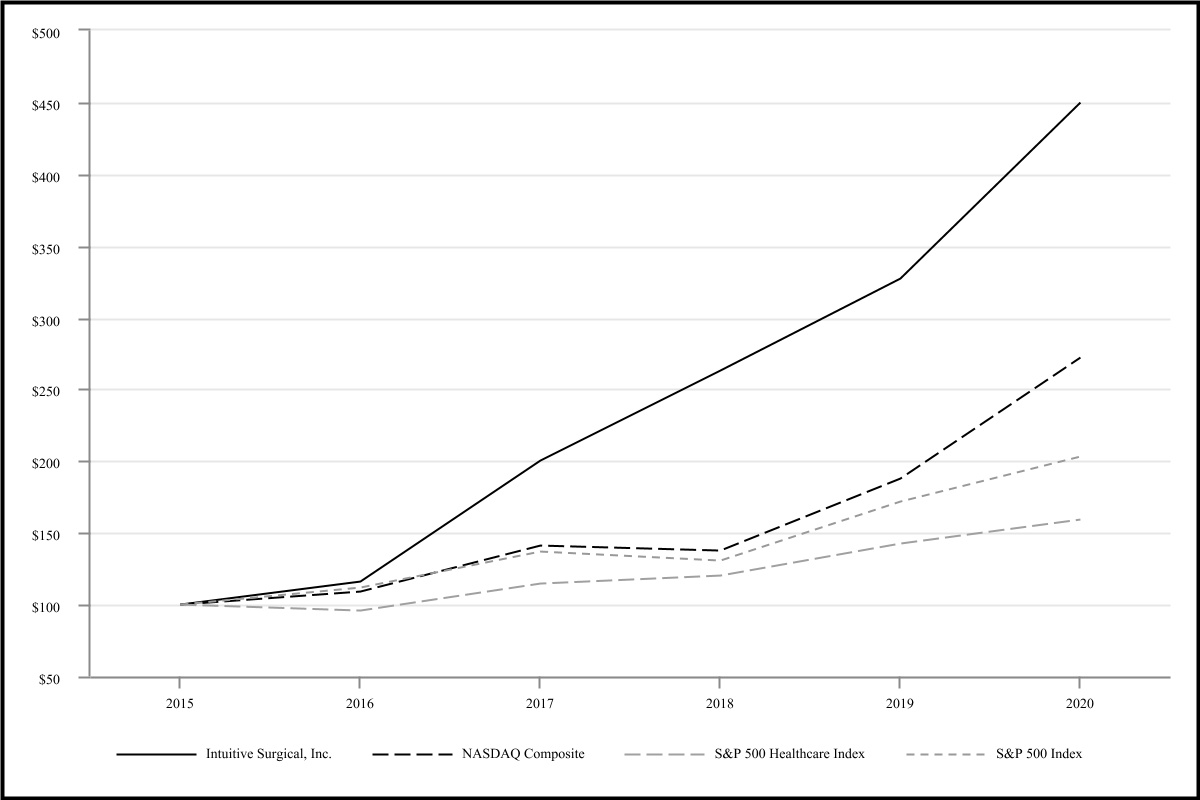
The graph set forth below compares the cumulative total stockholder return on our common stock between December 31, 2015, and December 31, 2020, with the cumulative total return of (i) the Nasdaq Composite Index, (ii) the S&P 500 Healthcare Index, and (iii) the S&P 500 Index over the same period. This graph assumes an investment of $100.00 on December 31, 2015 in our common stock, the Nasdaq Composite Index, the S&P Healthcare Index, and the S&P 500 Index and assumes the re-investment of dividends, if any.
The comparisons shown in the graph below are based upon historical data. We caution that the stock price performance shown in the graph below is not necessarily indicative of, nor is it intended to forecast, the potential future performance of our common stock.
| COMPARISON OF CUMULATIVE TOTAL RETURN AMONG INTUITIVE, NASDAQ COMPOSITE, S&P HEALTHCARE INDEX, AND S&P 500 INDEX |
| December 31, | |||||||||||||||||||||||||||||||||||
| 2015 | 2016 | 2017 | 2018 | 2019 | 2020 | ||||||||||||||||||||||||||||||
| Intuitive Surgical, Inc. | $ | 100.00 | $ | 116.11 | $ | 200.46 | $ | 263.07 | $ | 326.91 | $ | 449.37 | |||||||||||||||||||||||
| Nasdaq Composite | $ | 100.00 | $ | 108.87 | $ | 141.13 | $ | 137.12 | $ | 187.44 | $ | 271.64 | |||||||||||||||||||||||
| S&P 500 Healthcare Index | $ | 100.00 | $ | 95.64 | $ | 114.77 | $ | 120.16 | $ | 142.60 | $ | 158.90 | |||||||||||||||||||||||
| S&P 500 Index | $ | 100.00 | $ | 111.96 | $ | 136.40 | $ | 130.42 | $ | 171.49 | $ | 203.04 |
Item 6. SELECTED FINANCIAL DATA
The following selected consolidated financial data should be read in conjunction with our Consolidated Financial Statements and the accompanying Notes and “Management’s Discussion and Analysis of Financial Condition and Results of Operations” included elsewhere in this report. The selected data in this section is not intended to replace the Consolidated Financial Statements.
| Fiscal Year | |||||||||||||||||||||||||||||
| 2020 | 2019 | 2018 | 2017 (1) | 2016 | |||||||||||||||||||||||||
| (In millions, except per share amounts and headcount) | |||||||||||||||||||||||||||||
| Revenue | $ | 4,358.4 | $ | 4,478.5 | $ | 3,724.2 | $ | 3,138.2 | $ | 2,706.5 | |||||||||||||||||||
| Gross profit | $ | 2,861.2 | $ | 3,110.2 | $ | 2,604.1 | $ | 2,202.0 | $ | 1,892.9 | |||||||||||||||||||
| Net income attributable to Intuitive Surgical, Inc. | $ | 1,060.6 | $ | 1,379.3 | $ | 1,127.9 | $ | 670.9 | $ | 738.3 | |||||||||||||||||||
| Net income per share attributable to Intuitive Surgical, Inc.: | |||||||||||||||||||||||||||||
| Basic | $ | 9.06 | $ | 11.95 | $ | 9.92 | $ | 6.01 | $ | 6.43 | |||||||||||||||||||
| Diluted | $ | 8.82 | $ | 11.54 | $ | 9.49 | $ | 5.77 | $ | 6.26 | |||||||||||||||||||
| Shares used in computing basic and diluted net income per share: | |||||||||||||||||||||||||||||
| Basic | 117.0 | 115.4 | 113.7 | 111.7 | 114.9 | ||||||||||||||||||||||||
| Diluted | 120.3 | 119.5 | 118.8 | 116.3 | 117.9 | ||||||||||||||||||||||||
| Cash, cash equivalents, and investments | $ | 6,869.1 | $ | 5,845.2 | $ | 4,834.4 | $ | 3,846.5 | $ | 4,837.9 | |||||||||||||||||||
| Total assets | $ | 11,168.9 | $ | 9,733.2 | $ | 7,846.7 | $ | 5,776.8 | $ | 6,521.4 | |||||||||||||||||||
| Other long-term liabilities | $ | 444.6 | $ | 418.3 | $ | 338.6 | $ | 333.6 | $ | 112.1 | |||||||||||||||||||
| Stockholders’ equity | $ | 9,759.1 | $ | 8,284.7 | $ | 6,687.5 | $ | 4,780.4 | $ | 5,820.1 | |||||||||||||||||||
| Total headcount | 8,081 | 7,326 | 5,527 | 4,444 | 3,755 |
(1)Reflects amounts recorded for the enactment of the 2017 Tax Act.
Item 7. MANAGEMENT’S DISCUSSION AND ANALYSIS OF FINANCIAL CONDITION AND RESULTS OF OPERATIONS
Overview
Open surgery remains the predominant form of surgery and is used in almost every area of the body. However, the large incisions required for open surgery create trauma to patients, typically resulting in longer hospitalization and recovery times, increased hospitalization costs, and additional pain and suffering relative to minimally invasive surgery (“MIS”), where MIS is available. For over three decades, MIS has reduced trauma to patients by allowing selected surgeries to be performed through small ports rather than large incisions. MIS has been widely adopted for certain surgical procedures.
Da Vinci Surgical Systems enable surgeons to extend the benefits of MIS to many patients who would otherwise undergo a more invasive surgery by using computational, robotic, and imaging technologies to overcome many of the limitations of traditional open surgery or conventional MIS. Surgeons using a da Vinci Surgical System operate while seated comfortably at a console viewing a 3D, high-definition image of the surgical field. This immersive console connects surgeons to the surgical field and their instruments. While seated at the console, the surgeon manipulates instrument controls in a natural manner, similar to open surgical technique. Our technology is designed to provide surgeons with a range of articulation of the surgical instruments used in the surgical field analogous to the motions of a human wrist, while filtering out the tremor inherent in a surgeon’s hand. In designing our products, we focus on making our technology easy and safe to use.
Our da Vinci products fall into five broad categories: da Vinci Surgical Systems, da Vinci instruments and accessories, da Vinci Stapling, da Vinci Energy, and da Vinci Vision, including Firefly Fluorescence imaging systems (“Firefly”) and da Vinci Endoscopes. We also provide a comprehensive suite of services, training, and education programs. Within our integrated ecosystem, our products are designed to decrease variability in surgery by offering dependable, consistent functionality and user experiences for surgeons seeking better outcomes. We take a holistic approach, offering intelligent technology and systems designed to work together to make MIS intervention more available and applicable.
We have commercialized the following da Vinci Surgical Systems: the da Vinci standard Surgical System in 1999, the da Vinci S Surgical System in 2006, the da Vinci Si Surgical System in 2009, and the fourth generation da Vinci Xi Surgical System in 2014. We have extended our fourth generation platform by adding the da Vinci X Surgical System, commercialized in the second quarter of 2017, and the da Vinci SP Surgical System, commercialized in the third quarter of 2018. We are early in the launch of our da Vinci SP Surgical System, and we have an installed base of 69 da Vinci SP Surgical Systems as of December 31, 2020. Our plans for the rollout of the da Vinci SP Surgical System include putting systems in the hands of experienced da Vinci users first while we optimize training pathways and our supply chain. We received FDA clearances for the da Vinci SP Surgical System for urological and certain transoral procedures. We also received clearance in South Korea where the da Vinci SP Surgical System may be used for a broad set of procedures. We plan to seek FDA clearances for additional indications for da Vinci SP over time. The success of the da Vinci SP Surgical System is dependent on positive experiences and improved clinical outcomes for the procedures for which it has been cleared as well as securing additional clinical clearances. All da Vinci systems include a surgeon’s console (or consoles), imaging electronics, a patient-side cart, and computational hardware and software.
We offer approximately 70 different multi-port da Vinci instruments to provide surgeons with flexibility in choosing the types of tools needed to perform a particular surgery. These multi-port instruments are generally robotically controlled and provide end effectors (tips) that are similar to those used in either open or laparoscopic surgery. We offer advanced instrumentation for the da Vinci Xi and da Vinci X platforms, including da Vinci Energy and da Vinci Stapler products, to provide surgeons with sophisticated, computer-aided tools to precisely and efficiently interact with tissue. Da Vinci X and da Vinci Xi Surgical Systems share the same instruments whereas the da Vinci Si Surgical System uses instruments that are not compatible with da Vinci X or da Vinci Xi systems. We currently offer nine core instruments on our da Vinci SP Surgical System. We plan to expand the SP instrument offering over time.
Training technologies include our Intuitive Simulation products, our Intuitive Telepresence remote case observation and telementoring tools, and our dual console for use in surgeon proctoring and collaborative surgery.
During the first quarter of 2019, the FDA cleared our Ion endoluminal system to enable minimally invasive biopsies in the lung. Our Ion system extends our commercial offering beyond surgery into diagnostic procedures with this first application. We are introducing the Ion system in the U.S. in a measured fashion while we optimize training pathways and our supply chain and collect additional clinical data. We are early in the launch and have placed 36 Ion systems for commercial use as of December 31, 2020. Ion systems are not included in our da Vinci Surgical System installed base. We currently have 3 Ion systems placed with hospitals for gathering clinical data in addition to the systems placed for commercial use.
The success of new product introductions depends on a number of factors including, but not limited to, pricing, competition, market and consumer acceptance, the effective forecasting and management of product demand, inventory levels, the management of manufacturing and supply costs, and the risk that new products may have quality or other defects in the early stages of introduction.
COVID-19 Pandemic
Procedures
Prior to the spread of COVID-19 in the first quarter of 2020, we experienced procedure growth trends consistent with those experienced in the fourth quarter of 2019, including strength in general surgery, growth in mature procedures in the U.S., and growth in OUS urology. Beginning in January 2020, we saw a substantial reduction in da Vinci procedures in China and, by early February 2020, procedures per week in China had declined by approximately 90% compared to the weekly procedure rates experienced in early January 2020. As the COVID-19 pandemic subsided in China in March 2020, da Vinci procedure volume began to recover and, by the end of the first quarter of 2020, China procedures per week were approximately 70% of the early January 2020 weekly procedure rate. As the COVID-19 pandemic spread to Western Europe and the U.S., we experienced a significant decline in da Vinci procedures in the last half of March 2020, and procedures per week in the U.S. declined to approximately 65% of the weekly procedure rate experienced earlier in the first quarter of 2020.
In April 2020, procedures per week in the U.S. continued to decline, reaching approximately 30% of pre-COVID-19 levels. In May and June, U.S. procedures began a recovery phase, as COVID-19 cases dropped and elective procedures were permitted, and, by the middle of June, had grown to nearly the same level as that measured in the first two weeks of the first quarter of 2020. However, in the last two weeks of June and into July, with the resurgence of COVID-19 cases, some regions postponed elective procedures, and we experienced a corresponding decline in da Vinci procedures. The impact of COVID-19 in Europe during the second quarter varied by country with procedures in Italy, France, and the UK declining more steeply, while Germany exper
Showing the first 8K of 136K characters. Open the full section
Item 7A. QUANTITATIVE AND QUALITATIVE DISCLOSURES ABOUT MARKET RISK
Interest Rate and Market Risk
The primary objective of our investment activities is to preserve principal while supporting the Company's liquidity requirements. To achieve this objective, we maintain a diversified portfolio of cash equivalents and short- and long-term investments in a variety of high quality securities, including U.S. treasury and U.S. government agency securities, taxable and tax-exempt municipal notes, corporate notes and bonds, commercial paper, non-U.S. government agency securities, cash deposits, and money market funds. The securities are classified as available-for-sale and consequently are recorded at fair value with unrealized gains or losses reported as a separate component of accumulated other comprehensive loss. The weighted average duration of our portfolio as of December 31, 2020, was approximately 0.7 years. If interest rates rise, the market value of our investments may decline, which could result in a realized loss if we are forced to sell an investment before its scheduled maturity. A hypothetical increase in interest rate by 25 basis points would have resulted in a decrease in the fair value of our net investment position of approximately $10.5 million as of December 31, 2020. We do not utilize derivative financial instruments to manage our interest rate risks.
Uncertain financial markets could result in a tightening in the credit markets, a reduced level of liquidity in many financial markets, and extreme volatility in fixed income and credit markets. The credit ratings of the securities we have invested in could deteriorate and may have an adverse impact on the carrying value of these investments.
Foreign Exchange Risk
The majority of our revenue, expense, and capital purchasing activities are transacted in U.S. dollars. However, we generally sell our products and services in local currencies where we have direct distribution channels. We operate in a number of markets on a direct sales basis and incur operating expenses in local currencies. We also purchase certain product components from non-U.S. suppliers in local currency. As a result, because a portion of our operations consist of sales activities outside of the U.S., we have foreign exchange exposures to non-U.S. dollar revenues, operating expenses, accounts receivable, accounts payable, and foreign currency bank balances.
For the year ended December 31, 2020, sales denominated in foreign currencies were approximately 23% of total revenue. The objective of our hedging program is to mitigate the impact of changes in currency exchange rates on our net cash flow from foreign currency denominated sales and expenses. For the year ended December 31, 2020, our revenue would have decreased by approximately $72.6 million if the U.S. dollar exchange rate strengthened by 10%. We also hedge the net recognized non-functional currency balance sheet exposures with foreign exchange forward contracts to reduce the risk that our earnings and cash flows will be adversely affected by changes in exchange rates. A 10% strengthening of the U.S. dollar exchange rate against all currencies to which we have exposure, after considering foreign currency hedges and offsetting positions as of December 31, 2020, would have resulted in an approximately $1.7 million increase in the carrying amounts of those net assets. Actual gains and losses in the future may differ materially from the hypothetical gains and losses discussed above based on changes in the timing and amount of foreign currency exchange rate movements and our actual exposure and hedging transactions. Bank counterparties to foreign exchange forward contracts expose us to credit-related losses in the event of their nonperformance. To mitigate that risk, we only contract with counterparties that meet certain minimum requirements under our counterparty risk assessment process. We monitor credit ratings and potential downgrades on at least a quarterly basis. Based on our ongoing assessment of counterparty risk, we will adjust our exposure to various counterparties.
Although we sell to distributors outside of the U.S. in U.S. dollars, strengthening of the dollar can impact our distributors’ margins and could impact the end customers’ ability to purchase our product if our distributors seek to recover the impact of the change in the dollar by increasing product and service prices. Less than 10% of our revenue is conducted through distributors outside the U.S. Strengthening of the dollar relative to non-U.S. currencies could have an adverse impact on our business.
Our operations outside of the U.S. are subject to risks typical of operations outside of the U.S. including, but not limited to, differing economic conditions, changes in political climate, differing tax structures, other regulations and restrictions, and foreign exchange rate volatility.
Item 8. FINANCIAL STATEMENTS AND SUPPLEMENTARY DATA
Index To Consolidated Financial Statements
All other schedules have been omitted, because they are not applicable or the required information is shown in the Consolidated Financial Statements or the Notes thereto.
REPORT OF INDEPENDENT REGISTERED PUBLIC ACCOUNTING FIRM
To the Board of Directors and Stockholders of Intuitive Surgical, Inc.
Opinions on the Financial Statements and Internal Control over Financial Reporting
We have audited the accompanying consolidated balance sheets of Intuitive Surgical, Inc. and its subsidiaries (the “Company”) as of December 31, 2020 and 2019, and the related consolidated statements of income, of comprehensive income, of stockholders’ equity and of cash flows for each of the three years in the period ended December 31, 2020, including the related notes and financial statement schedule listed in the index appearing under Item 15(a)(2) (collectively referred to as the “consolidated financial statements”). We also have audited the Company’s internal control over financial reporting as of December 31, 2020, based on criteria established in Internal Control - Integrated Framework (2013) issued by the Committee of Sponsoring Organizations of the Treadway Commission (COSO).
In our opinion, the consolidated financial statements referred to above present fairly, in all material respects, the financial position of the Company as of December 31, 2020 and 2019, and the results of its operations and its cash flows for each of the three years in the period ended December 31, 2020 in conformity with accounting principles generally accepted in the United States of America. Also in our opinion, the Company maintained, in all material respects, effective internal control over financial reporting as of December 31, 2020, based on criteria established in Internal Control - Integrated Framework (2013) issued by the COSO.
Change in Accounting Principle
As discussed in Note 2 to the consolidated financial statements, the Company changed the manner in which it accounts for recognition of the income tax consequences of an intra-entity transfer of an asset, other than inventory, in 2018.
Basis for Opinions
The Company’s management is responsible for these consolidated financial statements, for maintaining effective internal control over financial reporting, and for its assessment of the effectiveness of internal control over financial reporting, included in Management’s Report on Internal Control Over Financial Reporting appearing under Item 9A. Our responsibility is to express opinions on the Company’s consolidated financial statements and on the Company’s internal control over financial reporting based on our audits. We are a public accounting firm registered with the Public Company Accounting Oversight Board (United States) (PCAOB) and are required to be independent with respect to the Company in accordance with the U.S. federal securities laws and the applicable rules and regulations of the Securities and Exchange Commission and the PCAOB.
We conducted our audits in accordance with the standards of the PCAOB. Those standards require that we plan and perform the audits to obtain reasonable assurance about whether the consolidated financial statements are free of material misstatement, whether due to error or fraud, and whether effective internal control over financial reporting was maintained in all material respects.
Our audits of the consolidated financial statements included performing procedures to assess the risks of material misstatement of the consolidated financial statements, whether due to error or fraud, and performing procedures that respond to those risks. Such procedures included examining, on a test basis, evidence regarding the amounts and disclosures in the consolidated financial statements. Our audits also included evaluating the accounting principles used and significant estimates made by management, as well as evaluating the overall presentation of the consolidated financial statements. Our audit of internal control over financial reporting included obtaining an understanding of internal control over financial reporting, assessing the risk that a material weakness exists, and testing and evaluating the design and operating effectiveness of internal control based on the assessed risk. Our audits also included performing such other procedures as we considered necessary in the circumstances. We believe that our audits provide a reasonable basis for our opinions.
Definition and Limitations of Internal Control over Financial Reporting
A company’s internal control over financial reporting is a process designed to provide reasonable assurance regarding the reliability of financial reporting and the preparation of financial statements for external purposes in accordance with generally accepted accounting principles. A company’s internal control over financial reporting includes those policies and procedures that (i) pertain to the maintenance of records that, in reasonable detail, accurately and fairly reflect the transactions and dispositions of the assets of the company; (ii) provide reasonable assurance that transactions are recorded as necessary to permit preparation of financial statements in accordance with generally accepted accounting principles, and that receipts and expenditures of the company are being made only in accordance with authorizations of management and directors of the company; and (iii) provide reasonable assurance regarding prevention or timely detection of unauthorized
Showing the first 8K of 178K characters. Open the full section
Item 9. CHANGES IN AND DISAGREEMENTS WITH ACCOUNTANTS ON ACCOUNTING AND FINANCIAL DISCLOSURES
None.
Item 9A. CONTROLS AND PROCEDURES
Conclusion Regarding the Effectiveness of Disclosure Controls and Procedures
We maintain disclosure controls and procedures that are designed to ensure that information required to be disclosed in our Exchange Act reports is recorded, processed, summarized, and reported within the time periods specified in the SEC’s rules and forms and that such information is accumulated and communicated to our management, including our principal executive officer and principal financial officer, as appropriate, to allow for timely decisions regarding required disclosure.
As required by SEC Rule 13a-15(b), we carried out an evaluation, under the supervision and with the participation of our management, including our principal executive officer and principal financial officer, of the effectiveness of the design and operation of our disclosure controls and procedures as of the end of the period covered by this Annual Report on Form 10-K. Based on the foregoing, our principal executive officer and principal financial officer concluded that our disclosure controls and procedures were effective at the reasonable assurance level.
Inherent Limitations Over Internal Controls
Our internal control over financial reporting is designed to provide reasonable assurance regarding the reliability of financial reporting and the preparation of financial statements for external purposes in accordance with U.S. GAAP. Our internal control over financial reporting includes those policies and procedures that:
(i)pertain to the maintenance of records that, in reasonable detail, accurately and fairly reflect the transactions and dispositions of our assets;
(ii)provide reasonable assurance that transactions are recorded as necessary to permit preparation of financial statements in accordance with U.S. GAAP and that our receipts and expenditures are being made only in accordance with authorizations of our management and directors; and
(iii)provide reasonable assurance regarding prevention or timely detection of unauthorized acquisition, use, or disposition of our assets that could have a material effect on the financial statements.
Management, including our principal executive officer and principal financial officer, does not expect that our internal controls will prevent or detect all errors and all fraud. A control system, no matter how well designed and operated, can provide only reasonable, not absolute, assurance that the objectives of the control system are met. Further, the design of a control system must reflect the fact that there are resource constraints, and the benefits of controls must be considered relative to their costs. Because of the inherent limitations in all control systems, no evaluation of internal controls can provide absolute assurance that all control issues and instances of fraud, if any, have been detected. Also, any evaluation of the effectiveness of controls in future periods are subject to the risk that those internal controls may become inadequate because of changes in business conditions or that the degree of compliance with the policies or procedures may deteriorate.
Management’s Report on Internal Control Over Financial Reporting
Our management is responsible for establishing and maintaining adequate internal control over financial reporting, as such term is defined in the Exchange Act Rules 13a-15(f). Under the supervision and with the participation of our management, including our principal executive officer and principal financial officer, we conducted an assessment of the effectiveness of our internal control over financial reporting based on the framework in Internal Control—Integrated Framework (2013) issued by the Committee of Sponsoring Organizations of the Treadway Commission. Based on the results of our assessment under the framework in the Internal Control—Integrated Framework (2013), our management concluded that our internal control over financial reporting was effective as of December 31, 2020.
The effectiveness of our internal control over financial reporting as of December 31, 2020, has been audited by an independent registered public accounting firm, as stated in their report, which is included under “Item 8. Financial Statements and Supplementary Data” of this Annual Report.
Changes in Internal Control Over Financial Reporting
There were no changes in our internal control over financial reporting that occurred during the quarter ended December 31, 2020, that have materially affected, or are reasonably likely to materially affect, our internal control over financial statements.
Item 9B. OTHER INFORMATION
None.
PART III
Certain information required by Part III is omitted from this report on Form 10-K and is incorporated herein by reference to our definitive Proxy Statement for our next Annual Meeting of Stockholders (the “Proxy Statement”), which we intend to file pursuant to Regulation 14A of the Securities Exchange Act of 1934, as amended, within 120 days after December 31, 2020.
Item 10. DIRECTORS, EXECUTIVE OFFICERS AND CORPORATE GOVERNANCE
The information required by this item concerning our directors and corporate governance is incorporated by reference to the information set forth in the section titled “Directors and Corporate Governance” in our Proxy Statement. Information required by this item concerning our executive officers is incorporated by reference to the information set forth in the section entitled “Executive Officers of the Company” in our Proxy Statement. Information regarding our Section 16 reporting compliance and code of business conduct and ethics is incorporated by reference to the information set forth in the section entitled “Security Ownership of Certain Beneficial Owners and Management and Related Stockholder Matters” in our Proxy Statement.
Item 11. EXECUTIVE COMPENSATION
The information required by this item regarding executive compensation is incorporated by reference to the information set forth in the sections titled “Executive Compensation” and “Compensation for Directors” in our Proxy Statement.
Item 12. SECURITY OWNERSHIP OF CERTAIN BENEFICIAL OWNERS AND MANAGEMENT AND RELATED STOCKHOLDER MATTERS
The information required by this item regarding security ownership of certain beneficial owners and management is incorporated by reference to the information set forth in the section titled “Security Ownership of Certain Beneficial Owners and Management and Related Stockholder Matters” in our Proxy Statement.
Item 13. CERTAIN RELATIONSHIPS AND RELATED TRANSACTIONS AND DIRECTOR INDEPENDENCE
The information required by this item regarding certain relationships and related transactions and director independence is incorporated by reference to the information set forth in the sections titled “Certain Relationships and Related Transactions” and “Directors and Corporate Governance” in our Proxy Statement.
Item 14. PRINCIPAL ACCOUNTANT FEES AND SERVICES
The information required by this item regarding principal accountant fees and services is incorporated by reference to the information set forth in the section titled “Principal Accountant Fees and Services” in our Proxy Statement.
PART IV
Item 15. EXHIBITS AND FINANCIAL STATEMENT SCHEDULE
(a)The following documents are filed as part of this Annual Report on Form 10-K.
1)Financial Statements—See Index to Consolidated Financial Statements at Item 8 of this report on Form 10-K.
2)The following financial statement schedule of Intuitive Surgical, Inc. for 2020, 2019, and 2018 is filed as part of this report and should be read in conjunction with the financial statements of Intuitive Surgical, Inc.:
| Page | |||||
| Schedule II - Valuation and Qualifying Accounts | 115 |
All other schedules have been omitted, because they are not applicable, not required under the instructions, or the information requested is set forth in the consolidated financial statements or related notes thereto.
3)Exhibits
The exhibits filed as part of this report are listed under “Exhibits” at subsection (b) of this Item 15.
(b)Exhibits
EXHIBIT INDEX
(1)Incorporated by reference to Exhibit 3.1 filed with the Company’s Quarterly Report on Form 10-Q filed on July 23, 2020 (File No. 000-30713).
(2)Incorporated by reference to Exhibit 3.1 filed with the Company’s Current Report on Form 8-K filed on February 1, 2021 (File No. 000-30713).
(3)Incorporated by reference to Exhibit 4.2 filed with the Company’s Registration Statement Amendment on Form S-1/A filed on May 2, 2000 (File No. 333-33016).
(4)Incorporated by reference to exhibits filed with the Company’s Registration Statement on Form S-1 filed on March 22, 2000 (File No. 333-33016).
(5)Incorporated by reference to Exhibit 10.1 filed with the Company’s Current Report on Form 8-K filed on August 3, 2015 (File No. 000-30713).
(6)Incorporated by reference to Exhibit 4.2 filed with the Company’s Registration Statement on Form S-8 filed on May 1, 2015 (File No. 333-203793).
(7)Incorporated by reference to Exhibit 10.1 filed with the Company’s Current Report on Form 8-K filed on April 26, 2017 (File No. 000-30713).
(8)Incorporated by reference to Exhibit 10.1 filed with the Company’s Current Report on Form 8-K filed on April 28, 2020 (File No. 000-30713).
(9)Incorporated by reference to Exhibit 10.1 filed with the Company’s Current Report on Form 8-K filed on December 2, 2008 (File No. 000-30713).
(10)Incorporated by reference to Exhibit 10.9 filed with the Company’s 2015 Annual Report on Form 10-K filed on February 2, 2016 (File No. 000-30713).
(11)Incorporated by reference to Exhibit 10.10 filed with the Company’s 2015 Annual Report on Form 10-K filed on February 2, 2016 (File No. 000-30713).
(12)Incorporated by reference to Exhibit 10.2 filed with the Company’s Quarterly Report on Form 10-Q filed on July 23, 2020 (File No. 000-30713).
(13)Incorporated by reference to Exhibit 10.3 filed with the Company’s Quarterly Report on Form 10-Q filed on July 23, 2020 (File No. 000-30713).
(14)Incorporated by reference to Exhibit 10.13 filed with the Company’s 2016 Annual Report on Form 10-K filed on February 6, 2017 (File No. 000-30713).
- Management contract or compensatory plan or arrangement.
Item 16. FORM 10-K SUMMARY
None.
SIGNATURES
Pursuant to the requirements of Section 13 or 15(d) of the Securities Exchange Act of 1934, the registrant has duly caused this report to be signed on its behalf by the undersigned thereunto duly authorized.
| INTUITIVE SURGICAL, INC. | ||||||||
| By: | /S/ GARY S. GUTHART | |||||||
| Gary S. Guthart, Ph.D. President and Chief Executive Officer |
Date: February 9, 2021
Power of Attorney
Each person whose individual signature appears below hereby authorizes and appoints Gary Guthart, Ph.D., and Marshall Mohr, and each of them, with full power of substitution and re-substitution and full power to act without the other, as his or her true and lawful attorney-in-fact and agent to act in his or her name, place, and stead and to execute in the name and on behalf of each person, individually and in each capacity stated below, and to file any and all amendments to this annual report on Form 10‑K and to file the same, with all exhibits thereto, and other documents in connection therewith, with the Securities and Exchange Commission, granting unto said attorneys-in-fact and agents, and each of them, full power and authority to do and perform each and every act and thing, ratifying and confirming all that said attorneys-in-fact and agents or any of them or their or his substitute or substitutes may lawfully do or cause to be done by virtue thereof.
Pursuant to the requirements of the Securities Exchange Act of 1934, this report has been signed below by the following persons on behalf of the Registrant and in the capacities and on the dates indicated.
| Signature | Title | Date | ||||||||||||
| /S/ GARY S. GUTHART | President, Chief Executive Officer, and Director (Principal Executive Officer) | February 9, 2021 | ||||||||||||
| Gary S. Guthart, Ph.D. | ||||||||||||||
| /S/ MARSHALL L. MOHR | Executive Vice President and Chief Financial Officer (Principal Financial Officer) | February 9, 2021 | ||||||||||||
| Marshall L. Mohr | ||||||||||||||
| /S/ JAMIE E. SAMATH | Senior Vice President, Finance (Principal Accounting Officer) | February 9, 2021 | ||||||||||||
| Jamie E. Samath | ||||||||||||||
| /S/ CRAIG H. BARRATT | Chairman of the Board of Directors | February 9, 2021 | ||||||||||||
| Craig H. Barratt, Ph.D. | ||||||||||||||
| /S/ JOSEPH C. BEERY | Director | February 9, 2021 | ||||||||||||
| Joseph C. Beery | ||||||||||||||
| /S/ AMAL M. JOHNSON | Director | February 9, 2021 | ||||||||||||
| Amal M. Johnson | ||||||||||||||
| /S/ DON R. KANIA | Director | February 9, 2021 | ||||||||||||
| Don R. Kania, Ph.D. | ||||||||||||||
| /S/ AMY L. LADD | Director | February 9, 2021 | ||||||||||||
| Amy L. Ladd, Ph.D. | ||||||||||||||
| /S/ KEITH R. LEONARD JR. | Director | February 9, 2021 | ||||||||||||
| Keith R. Leonard Jr. | ||||||||||||||
| /S/ ALAN J. LEVY | Director | February 9, 2021 | ||||||||||||
| Alan J. Levy, Ph.D. | ||||||||||||||
| /S/ JAMI DOVER NACHTSHEIM | Director | February 9, 2021 | ||||||||||||
| Jami Dover Nachtsheim | ||||||||||||||
| /S/ MARK J. RUBASH | Director | February 9, 2021 | ||||||||||||
| Mark J. Rubash |