 filings.tools
Illinois Tool Works 10-K 2016-12-31
Filed 2017-02-10. 21 sections, 312K characters. Original on sec.gov · Markdown · JSON
Cover and table of contents
10-K 1 itw-20161231x10k.htm 10-K
UNITED STATES SECURITIES AND EXCHANGE COMMISSION
WASHINGTON, D.C. 20549
FORM 10-K
| x | ANNUAL REPORT PURSUANT TO SECTION 13 OR 15(d) OF THE SECURITIES EXCHANGE ACT OF 1934 |
For the fiscal year ended December 31, 2016
OR
| o | TRANSITION REPORT PURSUANT TO SECTION 13 OR 15(d) OF THE SECURITIES EXCHANGE ACT OF 1934 |
For the transition period from to
Commission file number 1-4797
ILLINOIS TOOL WORKS INC.
(Exact Name of Registrant as Specified in its Charter)
| Delaware | 36-1258310 | |
| (State or Other Jurisdiction of Incorporation or Organization) | (I.R.S. Employer Identification No.) | |
| 155 Harlem Avenue, Glenview, Illinois | 60025 | |
| (Address of Principal Executive Offices) | (Zip Code) |
Registrant’s telephone number, including area code: (847) 724-7500
Securities registered pursuant to Section 12(b) of the Act:
| Title of Each Class | Name of Each Exchange on Which Registered | |
| Common Stock | New York Stock Exchange | |
| 1.75% Euro Notes due 2022 | New York Stock Exchange | |
| 1.25% Euro Notes due 2023 | New York Stock Exchange | |
| 2.125% Euro Notes due 2030 | New York Stock Exchange | |
| 3.00% Euro Notes due 2034 | New York Stock Exchange |
Securities registered pursuant to Section 12(g) of the Act: None
Indicate by check mark if the registrant is a well-known seasoned issuer, as defined in Rule 405 of the Securities Act.
Yes x No o
Indicate by check mark if the registrant is not required to file reports pursuant to Section 13 or Section 15(d) of the Act.
Yes o No x
Indicate by check mark whether the registrant (1) has filed all reports required to be filed by Section 13 or 15(d) of the Securities Exchange Act of 1934 during the preceding 12 months (or for such shorter period that the registrant was required to file such reports), and (2) has been subject to such filing requirements for the past 90 days.
Yes x No o
Indicate by check mark whether the registrant has submitted electronically and posted on its corporate Web site, if any, every Interactive Data File required to be submitted and posted pursuant to Rule 405 of Regulation S-T during the preceding 12 months (or for such shorter period that the registrant was required to submit and post such files).
Yes x No o
Indicate by check mark if disclosure of delinquent filers pursuant to Item 405 of Regulation S-K is not contained herein, and will not be contained, to the best of registrant’s knowledge, in definitive proxy or information statements incorporated by reference in Part III of this Form 10-K or any amendment to this Form 10-K. o
Indicate by check mark whether the registrant is a large accelerated filer, an accelerated filer, a non-accelerated filer or a smaller reporting company. See the definitions of "large accelerated filer," "accelerated filer" and "smaller reporting company" in Rule 12b-2 of the Exchange Act. (Check one):
| Large accelerated filer | x | Accelerated filer | o |
| Non-accelerated filer | o (Do not check if a smaller reporting company) | Smaller reporting company | o |
Indicate by check mark whether the registrant is a shell company (as defined in Rule 12b-2 of the Exchange Act).
Yes o No x
The aggregate market value of the voting stock held by non-affiliates of the registrant as of June 30, 2016 was approximately $30.4 billion based on the New York Stock Exchange closing sales price as of June 30, 2016.
Shares of Common Stock outstanding at January 31, 2017: 346,550,685.
Documents Incorporated by Reference
| Portions of the 2017 Proxy Statement for Annual Meeting of Stockholders to be held on May 5, 2017. | Part III |
PART I
Item 1. Business
General
Illinois Tool Works Inc. (the "Company" or "ITW") was founded in 1912 and incorporated in 1915. The Company's ticker symbol is ITW. The Company is a global manufacturer of a diversified range of industrial products and equipment with 85 divisions in 57 countries. As of December 31, 2016, the Company employed approximately 50,000 persons.
The Company's operations are organized and managed based on similar product offerings and end markets, and are reported to senior management as the following seven segments: Automotive OEM; Food Equipment; Test & Measurement and Electronics; Welding; Polymers & Fluids; Construction Products; and Specialty Products. The following is a description of the Company's seven segments:
Automotive OEM— This segment is a global, niche supplier to top tier OEMs, providing unique innovation to address pain points for sophisticated customers with complex problems. Businesses in this segment produce components and fasteners for automotive-related applications. This segment primarily serves the automotive original equipment manufacturers and tiers market. Products in this segment include:
| • | plastic and metal components, fasteners and assemblies for automobiles, light trucks and other industrial uses. |
Food Equipment— This segment is a highly focused and branded industry-leader in commercial food equipment differentiated by innovation and integrated service offerings. This segment primarily serves the food institutional/restaurant, food service and food retail markets. Products in this segment include:
| • | warewashing equipment; |
| • | cooking equipment, including ovens, ranges and broilers; |
| • | refrigeration equipment, including refrigerators, freezers and prep tables; |
| • | food processing equipment, including slicers, mixers and scales; |
| • | kitchen exhaust, ventilation and pollution control systems; and |
| • | food equipment service, maintenance and repair. |
Test & Measurement and Electronics— This segment is a branded and innovative producer of test and measurement and electronic manufacturing and maintenance, repair, and operations, or "MRO" solutions that improve efficiency and quality for customers in diverse end markets. Businesses in this segment produce equipment, consumables, and related software for testing and measuring physical properties of materials and structures, as well as equipment and consumables used in the production of electronic subassemblies and microelectronics. This segment primarily serves the electronics, general industrial, industrial capital goods, automotive original equipment manufacturers and tiers, and consumer durables markets. Products in this segment include:
| • | equipment, consumables, and related software for testing and measuring of materials, structures, gases and fluids; |
| • | electronic assembly equipment and related consumable solder materials; |
| • | electronic components and component packaging; |
| • | static control equipment and consumables used for contamination control in clean room environments; and |
| • | pressure sensitive adhesives and components for telecommunications, electronics, medical and transportation applications. |
Welding— This segment is a branded value-added equipment and specialty consumable manufacturer with innovative and leading technology. Businesses in this segment produce arc welding equipment, consumables and accessories for a wide array of industrial and commercial applications. This segment primarily serves the general industrial market, which includes fabrication, shipbuilding and other general industrial markets, and energy, construction, MRO, and industrial capital goods markets. Products in this segment include:
| • | arc welding equipment; |
| • | metal arc welding consumables and related accessories; and |
| • | metal jacketing and other insulation products. |
Polymers & Fluids— This segment is a highly branded supplier to niche markets that require value-added, differentiated products. Businesses in this segment produce adhesives, sealants, lubrication and cutting fluids, and fluids and polymers for auto aftermarket maintenance and appearance. This segment primarily serves the automotive aftermarket, MRO, general industrial, and construction markets. Products in this segment include:
| • | adhesives for industrial, construction and consumer purposes; |
| • | chemical fluids which clean or add lubrication to machines; |
| • | epoxy and resin-based coating products for industrial applications; |
| • | hand wipes and cleaners for industrial applications; |
| • | fluids, polymers and other supplies for auto aftermarket maintenance and appearance; |
| • | fillers and putties for auto body repair; and |
| • | polyester coatings and patch and repair products for the marine industry. |
Construction Products— This segment is a branded supplier of innovative engineered fastening systems and solutions. This segment primarily serves the residential/remodel construction and commercial construction markets. Products in this segment include:
| • | fasteners and related fastening tools for wood and metal applications; |
| • | anchors, fasteners and related tools for concrete applications; |
| • | metal plate truss components and related equipment and software; and |
| • | packaged hardware, fasteners, anchors and other products for retail. |
Specialty Products— This segment is focused on diversified niche market opportunities with substantial patent protection producing beverage packaging equipment and consumables, product coding and marking equipment and consumables, and appliance components and fasteners. This segment primarily serves the food and beverage, general industrial, consumer durables, printing and publishing and industrial capital goods markets. Products in this segment include:
| • | line integration, conveyor systems and line automation for the food and beverage industries; |
| • | plastic consumables that multi-pack cans and bottles and related equipment; |
| • | foil, film and related equipment used to decorate consumer products; |
| • | product coding and marking equipment and related consumables; |
| • | plastic and metal fasteners and components for appliances; |
| • | airport ground support equipment; and |
| • | components for medical devices. |
The information set forth below is applicable to all segments of the Company unless otherwise noted.
The ITW Business Model
The powerful and highly differentiated ITW Business Model is the Company’s core source of value creation. This business model is the Company’s competitive advantage and defines how ITW creates value for its shareholders and comprises three unique elements:
| • | ITW’s 80/20 management process is the operating system that is applied in every ITW business. Initially introduced as a manufacturing efficiency tool in the 1980’s, ITW has continually refined, improved and expanded 80/20 into a proprietary, holistic business management process that generates significant value for the Company and its customers. Through the application of data-driven insights generated by 80/20 practice, ITW focuses on its largest and best opportunities (the “80”) and eliminates cost, complexity and distractions associated with the less profitable opportunities (the “20”). 80/20 enables ITW businesses to consistently achieve world-class operational excellence in product availability, quality, and innovation, while generating superior financial performance; |
| • | Customer-back innovation has fueled decades of profitable growth at ITW. The Company’s unique innovation approach is built on insight gathered from the 80/20 management process. Working from the customer back, ITW businesses position themselves as the go-to problem solver for their “80” customers. ITW’s innovation efforts are focused on understanding customer needs, particularly those in “80” markets with solid long-term growth fundamentals, and subsequently creating unique solutions to address those needs. These customer insights and learnings drive innovation at ITW and have contributed to a portfolio of more than 17,000 granted and pending patents; |
| • | ITW’s decentralized, entrepreneurial culture allows ITW businesses to be fast, focused, and responsive. ITW businesses have significant flexibility within the framework of the ITW Business Model to customize their approach in order to best serve their specific customers' needs. ITW colleagues recognize their unique responsibilities to execute the Company's strategy and values. As a result, the Company maintains a focused and simple organizational structure that, combined with outstanding execution, delivers best-in-class services adapted to each business' customers and end markets. |
Enterprise Strategy
In late 2012, ITW began the process of transitioning the Company onto its current strategic path to fully leverage the compelling performance potential of the ITW Business Model. Since then, ITW has made considerable progress, as evidenced by the Company’s strong financial performance over the past four years.
The roots of ITW’s Enterprise Strategy began in late 2011 / early 2012, when the Company undertook a complete review of its performance. Focusing on its businesses delivering consistent above-market growth with best-in-class margins and returns, ITW developed a strategy to replicate that performance across its operations.
Based on this rigorous evaluation, ITW determined that solid and consistent above-market organic growth must be the core growth engine to deliver world-class financial performance and compelling long-term returns for its shareholders. To shift its primary growth engine to organic, the Company began executing a multi-step approach.
| • | The first step was to narrow the focus and improve the quality of ITW’s business portfolio. As part of the Portfolio Management initiative, ITW exited businesses that were operating in commoditized market spaces and prioritized sustainable differentiation as a must-have requirement for all ITW businesses. This process included both divesting entire businesses and exiting commoditized product lines and customers inside otherwise highly differentiated ITW divisions. |
As a result of this work, ITW’s business portfolio now has significantly higher organic growth potential. ITW segments and divisions now possess attractive and differentiated product lines and end markets as they continue to improve operating margins and generate price/cost increases. The Company achieved this through product line simplification, or eliminating the complexity and overhead costs associated with smaller product lines and customers, while supporting and growing the businesses’ largest / most profitable customers and product lines. With the initiative nearly complete and ITW businesses demonstrating notably improved financial performance, the Company believes that the significant product line simplification work is essentially finalized and will return to more normalized levels in 2017 and beyond.
| • | Step two, Business Structure Simplification, was implemented to simplify and scale-up ITW’s operating structure to support increased engineering, marketing, and sales resources, and, at the same time, improve global reach and competitiveness, all of which were critical to driving accelerated organic growth. ITW now has 85 scaled-up divisions with significantly enhanced focus on growth investments, core customers and products, and customer-back innovation. |
| • | The Strategic Sourcing initiative was established as a core capability to better leverage ITW’s scale and improve global competitiveness. Sourcing is now a core strategic and operational capability at ITW. The Company’s 80/20-enabled sourcing organization has delivered an average of one percent reduction in spend each year from 2013 through 2016 and is on track to do the same in 2017 and 2018. |
| • | With the portfolio realignment and scale-up work largely complete, the Company was able to shift its focus to preparing for and accelerating, organic growth. As a preparatory step, ITW is in the process of reapplying 80/20 to optimize its newly scaled-up divisions for growth, first, to build a foundation of operational excellence, and second, to identify the best opportunities to drive organic growth. |
Once the business has achieved operational excellence and identified the right growth opportunities, the final step is to accelerate organic growth. The process of preparing for accelerated organic growth generally takes 18 to 24 months.
Based on the financial performance of the divisions that are further along in this process, the Company believes that its organic growth framework is capable of delivering above-market organic growth across all segments. Divisions
are at various phases in preparation for growth and many are either ready to grow or already growing above their respective markets. ITW management is fully aligned with this plan and very focused on executing it. With the close of 2016, approximately 85 percent of the divisions are ready to grow.
Path to Full Potential
While the Company has made considerable progress and ITW’s performance is nearing best-in-class levels, the Company has significant opportunity for further improvement before it achieves full operating potential. In order to do so, ITW is focused on two key areas of opportunity, including: additional structural margin improvement and sustained above-market organic growth with strong incremental profitability.
Additional Structural Margin Improvement
To deliver on the additional structural margin improvement, the Company is implementing the following two levers: (1) further leveraging the 80/20 management process and (2) strategic sourcing.
| • | The first lever, better leveraging the full power of the ITW Business Model, will be accomplished through a much more consistent and focused approach to 80/20 best practice implementation across the Company. The 80/20 management system has continuously been refined, improved and expanded into a unique holistic business management process of interconnected tools, which improves all aspects of the business and, when applied consistently and executed more effectively, will lead to additional margin improvement. ITW has clearly demonstrated superior 80/20 management, resulting in meaningful incremental improvement in margins and returns as evidenced by the Company’s operating margin and after-tax return on invested capital. These 80/20 initiatives can also result in restructuring initiatives that reduce costs and improve profitability and returns. |
| • | The second lever, strategic sourcing, is a core element of ITW’s ongoing operational strategy and a sustainable enterprise-wide capability. Through the continued execution of this initiative, the Company expects to deliver additional margin improvement with the goal of a one percent reduction in spend in 2017 and 2018. |
Sustained Above-Market Organic Growth with Strong Incremental Profitability
ITW has done extensive work on its portfolio and operating structure to position the Company to deliver sustainable above-market organic growth. The Company has narrowed the focus and significantly improved the growth potential of ITW’s business portfolio. With approximately 85% of its divisions ready to grow as of the end of 2016, ITW is well positioned for accelerated growth in 2017 and beyond. To deliver on this accelerated growth, the divisions have been implementing the organic growth framework, which includes continued investment in customer-back innovation and a strengthened focus on market penetration. ITW continues to focus on growing its share of "80" products with existing customers with whom the Company has a resonant value proposition as well as target potential new customers with similar pain points to existing customers. ITW has made strong progress on the Company’s pivot to organic growth and is well positioned to deliver on sustained above-market organic growth over the long-term.
Divestiture Activity
Divestiture of Majority Interest in Former Decorative Surfaces Segment— On October 31, 2012, the Company divested a 51% majority interest in the Decorative Surfaces segment. Accordingly, the Company ceased consolidating the results of the Decorative Surfaces segment as of October 31, 2012 and now reports its 49% ownership interest using the equity method of accounting. Due to the Company's continuing involvement through its 49% interest, the historical operating results of Decorative Surfaces are presented in continuing operations. Effective November 1, 2012, Decorative Surfaces was no longer a reportable segment of the Company.
Divestiture of the Industrial Packaging Segment— In February 2013, the Company announced that it was initiating a review process to explore strategic alternatives for the Industrial Packaging segment. In September 2013, the Company’s Board of Directors authorized a plan to commence a sale process for the Industrial Packaging segment. The Company classified the Industrial Packaging segment as held for sale beginning in the third quarter of 2013 and no longer presented this segment as part of its continuing operations.
On February 6, 2014, the Company announced that it had signed a definitive agreement to sell the Industrial Packaging business to The Carlyle Group for $3.2 billion. The transaction was completed on May 1, 2014, resulting in a pre-tax gain of $1.7 billion ($1.1 billion after-tax) in the second quarter of 2014 which was included in Income from discontinued operations.
See Note 2. Discontinued Operations in Item 8. Financial Statements and Supplementary Data for further discussion of this transaction.
Current Year Developments
Refer to Item 7. Management's Discussion and Analysis of Financial Condition and Results of Operations.
Financial Information about Segments
Segment information is included in Item 7. Management's Discussion and Analysis of Financial Condition and Results of Operations and Note 14. Segment Information in Item 8. Financial Statements and Supplementary Data.
Distribution Methods
The Company’s businesses primarily distribute their products directly to industrial manufacturers and through independent distributors.
Backlog
Backlog generally is not considered a significant factor in the Company’s businesses as relatively short delivery periods and rapid inventory turnover are characteristic of most of their products. Backlog by segment as of December 31, 2016 and 2015 was as follows:
| In millions | 2016 | 2015 | |||||
| Automotive OEM | $ | 452 | $ | 403 | |||
| Food Equipment | 188 | 203 | |||||
| Test & Measurement and Electronics | 298 | 289 | |||||
| Welding | 67 | 68 | |||||
| Polymers & Fluids | 62 | 53 | |||||
| Construction Products | 29 | 34 | |||||
| Specialty Products | 217 | 237 | |||||
| Total | $ | 1,313 | $ | 1,287 |
Backlog orders scheduled for shipment beyond calendar year 2017 were not material as of December 31, 2016.
Competition
With operations in 57 countries, the Company offers a wide range of products in a myriad of markets, many of which are fragmented, and the Company encounters a variety of competitors that vary by product line, end market and geographic area. The Company's competitors include many regional or specialized companies, as well as large U.S. and non-U.S. companies or divisions of large companies. Each of the Company's segments generally has several main competitors and numerous smaller ones in most of their end markets and geographic areas. In addition to numerous smaller regional competitors, the Welding segment competes globally with Lincoln Electric and ESAB.
In virtually all segments, the Company differentiates its businesses from its competitors based on product innovation, product quality, brand preference and service delivery. Technical capability is also a competitive factor in most segments. The Company believes that each segment's primary competitive advantages derive from the Company's business model and decentralized operating structure, which creates a strong focus on end markets and customers at the local level, enabling its businesses to respond rapidly to market dynamics. This structure enables the Company's businesses to drive operational excellence utilizing the Company's 80/20 management process and leveraging its product innovation capabilities. The Company also believes that its global footprint is a competitive advantage in many of its markets, especially in its Automotive OEM segment.
Raw Materials
The Company uses raw materials of various types, primarily steel, resins and chemicals, that are available from numerous commercial sources. The availability of materials and energy has not resulted in any significant business interruptions or other major problems, and no such problems are currently anticipated.
Research and Development
Developing new and improved products, broadening the application of established products, and continuing efforts to improve and develop new methods, processes and equipment all contribute to the Company's organic growth. Many new products are designed to reduce customers' costs by eliminating steps in their manufacturing processes, reducing the number of parts in an assembly or improving the quality of customers' assembled products. Typically, the development of such products is accomplished by working closely with customers on specific applications. Research and development expenses were $223 million in 2016, $218 million in 2015 and $227 million in 2014.
Intellectual Property
The Company owns approximately 3,500 unexpired U.S. patents and 7,400 foreign patents covering articles, methods and machines. In addition, the Company has approximately 1,500 applications for patents pending in the U.S. Patent Office and 4,800 applications pending in foreign patent offices. There is no assurance that any of these patents will be issued. The Company maintains a patent group for the administration of patents and processing of patent applications.
The Company believes that many of its patents are valuable and important; however, the expiration of any one of the Company's patents would not have a material effect on the Company's results of operations or financial position. The Company also credits its success in the markets it serves to engineering capability; manufacturing techniques; skills and efficiency; marketing and sales promotion; and service and delivery of quality products to its customers.
In addition to patents, many of the Company's products and services are sold under various owned or licensed trademarks, which are important to the Company in the aggregate. Some of the Company's more significant trademarks include ITW, which is also used in conjunction with the trademarks of many of the Company's businesses; Deltar and Shakeproof in the Automotive OEM segment; Hobart in the Food Equipment segment; Instron in the Test & Measurement and Electronics segment; Miller in the Welding segment; Rain-X and Permatex in the Polymers & Fluids segment; Paslode in the Construction Products segment; and Hi-Cone in the Specialty Products segment.
Environmental
The Company believes that its manufacturing plants and equipment are in substantial compliance with all applicable environmental regulations. Additional measures to maintain compliance are not expected to materially affect the Company’s capital expenditures, competitive position, financial position or results of operations.
Various legislative and administrative regulations concerning environmental issues have become effective or are under consideration in many parts of the world relating to manufacturing processes and the sale or use of certain products. To date, such developments have not had a substantial adverse impact on the Company's revenues, earnings or cash flows.
Employees
The Company employed approximately 50,000 persons as of December 31, 2016 and considers its employee relations to be excellent.
International
The Company's international operations include subsidiaries and joint ventures in 56 foreign countries on six continents. These operations serve such end markets as automotive OEM/tiers, automotive aftermarket, general industrial, commercial food equipment, construction, and others on a worldwide basis. The Company's revenues from sales to customers outside the U.S. were approximately 55% of revenues in 2016, 54% of revenues in 2015, and 57% of revenues in 2014.
Refer to Item 7. Management's Discussion and Analysis of Financial Condition and Results of Operations and Note 14. Segment Information in Item 8. Financial Statements and Supplementary Data for additional information on international activities. International operations are subject to certain potential risks inherent in conducting business in foreign countries,
including price controls, exchange controls, limitations on participation in local enterprises, nationalization, expropriation and other governmental action, and fluctuations in currency exchange rates. Additional risks of the Company's international operations are described under Item 1A. Risk Factors.
Executive Officers
Executive Officers of the Company as of February 10, 2017 were as follows:
| Name | Office | Age | |
| E. Scott Santi | Chairman & Chief Executive Officer | 55 | |
| Norman D. Finch Jr. | Senior Vice President, General Counsel & Secretary | 52 | |
| John R. Hartnett | Executive Vice President | 56 | |
| Michael M. Larsen | Senior Vice President & Chief Financial Officer | 48 | |
| Mary K. Lawler | Senior Vice President & Chief Human Resources Officer | 51 | |
| Roland M. Martel | Executive Vice President | 62 | |
| Steven L. Martindale | Executive Vice President | 60 | |
| Sundaram Nagarajan | Executive Vice President | 54 | |
| Christopher O’Herlihy | Vice Chairman | 53 | |
| David C. Parry | Vice Chairman | 63 | |
| Randall J. Scheuneman | Vice President & Chief Accounting Officer | 49 | |
| Lei Schlitz | Executive Vice President | 50 | |
| Juan Valls | Executive Vice President | 55 | |
| Michael R. Zimmerman | Executive Vice President | 56 |
The executive officers of the Company serve at the discretion of the Board of Directors. Set forth below is information regarding the principal occupations and employment and business experience over the past five years for each executive officer. Unless otherwise stated, employment is by the Company.
Mr. Santi is the Chairman of the Board and Chief Executive Officer of the Company. He was elected Chairman of the Board in 2015 after having served as President and Chief Executive Officer, as well as a director, since November 2012. In October 2012, he was elected President and Chief Operating Officer. Mr. Santi served as Vice Chairman from 2008 to October 2012.
Mr. Finch joined the Company in January 2017 and was elected Senior Vice President, General Counsel and Secretary in February 2017. From 2013 to January 2017 he served as Vice President, General Counsel and Secretary of Sealed Air Corporation, a global manufacturer of products related to food safety and security, facility hygiene and product protection. Prior thereto, he served as Vice President, Associate General Counsel and Chief Compliance Officer of Zimmer Holdings, Inc. (now Zimmer Biomet Holdings), a global medical device company.
Mr. Hartnett was elected Executive Vice President in 2012. Prior to that, he held various management positions of increasing responsibility. Most recently, he served as Group President of the automotive aftermarket businesses.
Mr. Larsen joined the Company and was elected Senior Vice President and Chief Financial Officer in September 2013. From October 2010 to August 2013, he served as Vice President and Chief Financial Officer of Gardner Denver, Inc., a global manufacturer of highly engineered compressors, blowers, pumps and other fluid transfer equipment. In addition, he served as interim CEO of Gardner Denver from July 2012 to November 2012, and as President, Chief Executive Officer and a director of that company from November 2012 to July 2013.
Ms. Lawler joined the Company and was elected Senior Vice President and Chief Human Resources Officer in October 2014. From June 2013 to October 2014, she served as Executive Vice President, Human Resources, at GATX Corporation, a rail car leasing company. Prior to that, she served as Senior Vice President, Human Resources, at GATX Corporation, from May 2008 to May 2013.
Mr. Martel has served in his present position since 2006.
Mr. Martindale has served in his present position since 2008.
Mr. Nagarajan has served in his present position since 2010.
Mr. O’Herlihy was elected Vice Chairman in 2015. Prior to that, he served as Executive Vice President from 2010 to 2015.
Mr. Parry has served in his present position since 2010.
Mr. Scheuneman has served in his present position since 2009.
Ms. Schlitz was elected Executive Vice President in 2015. Prior to that, she held various management positions of increasing responsibility. Most recently, she served as Group President of the food equipment businesses since 2011.
Mr. Valls has served in his present position since 2007.
Mr. Zimmerman was elected Executive Vice President in 2015. Prior to that, he held various management positions of increasing responsibility. Most recently, he served as Group President of the welding businesses since 2010.
Available Information
The Company electronically files reports with the Securities and Exchange Commission ("SEC"). The public may read and copy any materials the Company has filed with the SEC at the SEC's Public Reference Room at 100 F Street, N.E., Washington, D.C. 20549. The public may obtain information on the operation of the Public Reference Room by calling the SEC at 1-800-SEC-0330. In addition, the SEC maintains a website (www.sec.gov) that contains reports, proxy and information statements, and other information regarding issuers that file electronically with the SEC. Copies of the Company's Annual Report on Form 10-K, Quarterly Reports on Form 10-Q and Current Reports on Form 8-K and amendments to those reports filed or furnished pursuant to Section 13(a) or 15(d) of the Securities Exchange Act of 1934 are also available free of charge through the Company's website (www.itw.com), as soon as reasonably practicable after electronically filing with or otherwise furnishing such information to the SEC, and are available in print to any shareholder who requests them. The Company will furnish any exhibit not contained herein upon the payment of a fee representing the reasonable cost to the Company of furnishing the exhibit. Requests for exhibits may be sent to Illinois Tool Works Inc., 155 Harlem Avenue, Glenview, IL 60025, Attention: Secretary. Also posted on the Company’s website are the following:
| • | Statement of Principles of Conduct; |
| • | Code of Ethics for CEO and key financial and accounting personnel; |
| • | Charters of the Audit, Corporate Governance and Nominating, and Compensation Committees of the Board of Directors; |
| • | Corporate Governance Guidelines; |
| • | Global Anti-Corruption Policy; |
| • | Corporate Citizenship Statement; |
| • | Conflict Minerals Policy Statement; and |
| • | Government Affairs Information. |
Item 1A. Risk Factors
The Company's business, financial condition, results of operations and cash flows are subject to various risks, including, but not limited to, those set forth below, which could cause actual results to vary materially from recent results or from anticipated future results. These risk factors should be considered together with information included elsewhere in this Annual Report on Form 10-K.
The Company's results are impacted by global economic conditions. Downturns in the markets served by the Company could adversely affect its businesses, results of operations or financial condition.
The Company's businesses are impacted by economic conditions around the globe, including the uncertainty created by the United Kingdom’s June 2016 vote to leave the European Union. Slower economic growth, financial market instability, high unemployment, government deficit reduction, sequestration and other austerity measures impacting the markets the Company serves can adversely affect the Company’s businesses by reducing demand for the Company's products and services, limiting financing available to the Company's customers, increasing order cancellations and the difficulty in collecting accounts
receivable, increasing price competition, or increasing the risk that counterparties to the Company's contractual arrangements will become insolvent or otherwise unable to fulfill their obligations.
The global nature of the Company's operations subjects it to political and economic risks that could adversely affect its business, results of operations or financial condition.
The Company currently operates in 57 countries. The risks inherent in the Company's global operations include:
| • | fluctuation in currency exchange rates; |
| • | limitations on ownership or participation in local enterprises; |
| • | price controls, exchange controls and limitations on repatriation of earnings; |
| • | transportation delays and interruptions; |
| • | political, social and economic instability and disruptions; |
| • | acts of terrorism; |
| • | government embargoes or foreign trade restrictions; |
| • | the imposition of duties and tariffs and other trade barriers; |
| • | import and export controls; |
| • | labor unrest and current and changing regulatory environments; |
| • | the potential for expropriation or nationalization of enterprises; |
| • | difficulties in staffing and managing multi-national operations; |
| • | limitations on its ability to enforce legal rights and remedies; and |
| • | potentially adverse tax consequences. |
The United Kingdom's vote in June 2016 to leave the European Union may increase certain of the risks and uncertainties described above. The United Kingdom represented approximately 5% of the Company's total consolidated operating revenue for the year ended December 31, 2016. If the Company is unable to successfully manage these and other risks associated with managing and expanding its international businesses, the risks could have a material adverse effect on the Company's business, results of operations or financial condition.
The benefits from the Company’s Enterprise Strategy may not be as expected and the Company's financial results could be adversely impacted.
As the Company has substantially completed its Enterprise Strategy initiatives of portfolio management and business structure simplification, its focus has pivoted to organic revenue growth and continued margin improvement. Product line and customer base simplification activities, which are core elements of the Company’s 80/20 management process, continue to be applied to the Company’s scaled up operating divisions and remain active elements of the Enterprise Strategy. Although these activities are expected to improve future operating margins and organic revenue growth, they are also expected to have a negative impact on the Company’s overall organic revenue growth in the short term. If the Company is unable to realize the expected benefits from its Enterprise Strategy initiatives, the Company's financial results could be adversely impacted.
The timing and amount of the Company’s share repurchases are subject to a number of uncertainties.
Share repurchases constitute a significant component of the Company’s capital allocation strategy. The Company funds its share repurchases with free cash flow and short-term borrowings. The amount and timing of share repurchases will be based on a variety of factors. Important factors that could cause the Company to limit, suspend or delay its share repurchases include unfavorable trading market conditions, the price of the Company's common stock, the nature of other investment opportunities presented to us from time to time, the ability to obtain financing at attractive rates and the availability of U.S. cash.
The Company may incur fines or penalties, damage to its reputation or other adverse consequences if its employees, agents or business partners violate anti-bribery, competition, export and import, environmental or other laws.
The Company has a decentralized operating structure under which its individual businesses are allowed significant decision-making autonomy within the Company’s strategic framework and internal financial and compliance controls. The Company cannot ensure that its internal controls will always protect against reckless or criminal acts committed by its employees, agents or business partners that might violate U.S. and/or non-U.S. laws, including anti-bribery, competition, export and import, and environmental laws. Any such improper actions could subject the Company to civil or criminal investigations, could lead to substantial civil or criminal monetary and non-monetary penalties against the Company or its subsidiaries, or could damage its reputation.
A significant fluctuation between the U.S. Dollar and other currencies could adversely impact the Company's operating income.
Although the Company's financial results are reported in U.S. Dollars, a significant portion of its sales and operating costs are realized in other currencies, with the largest concentration of foreign sales occurring in Europe. The Company's profitability is affected by movements of the U.S. Dollar against the Euro and other foreign currencies in which it generates revenues and incurs expenses. Significant long-term fluctuations in relative currency values, and in particular, an increase in the value of the U.S. Dollar against foreign currencies, has had and could have an adverse effect on profitability and financial condition.
If the Company is unable to successfully introduce new products or adequately protect its intellectual property, its future growth may be adversely affected.
The Company's ability to develop new products based on innovation can affect its competitive position and sometimes requires the investment of significant time and resources. Difficulties or delays in research, development, production or commercialization of new products and services may reduce future revenues and adversely affect the Company's competitive position. If the Company is unable to create sustainable product differentiation, its organic growth may be adversely affected.
Protecting the Company's intellectual property is critical to its innovation efforts. The Company owns patents, trade secrets, copyrights, trademarks and/or other intellectual property rights related to many of its products, and also has exclusive and non-exclusive license rights under intellectual property owned by others. The Company's intellectual property rights may be challenged or infringed upon by third parties, particularly in countries where property rights are not highly developed or protected, or the Company may be unable to maintain, renew or enter into new license agreements with third-party owners of intellectual property on reasonable terms. Unauthorized use of the Company's intellectual property rights or inability to preserve existing intellectual property rights could adversely impact the Company's competitive position and results of operations.
The Company's acquisition of businesses could negatively impact its profitability and returns.
Acquisitions, including the Company’s acquisition of the Engineered Fasteners and Components business on July 1, 2016 from ZF TRW, involve a number of risks and financial, accounting, managerial and operational challenges, including the following, any of which could adversely affect the Company's profitability and returns:
| • | The acquired business could under-perform relative to the Company’s expectations and the price paid for it, or not perform in accordance with the Company’s anticipated timetable. |
| • | The acquired business could cause the Company's financial results to differ from expectations in any given fiscal period, or over the long term. |
| • | Acquisition-related earnings charges could adversely impact operating results. |
| • | The acquired business could place unanticipated demands on the Company's management, operational resources and financial and internal control systems. |
| • | The Company may assume unknown liabilities, known contingent liabilities that become realized or known liabilities that prove greater than anticipated, internal control deficiencies or exposure to regulatory sanctions resulting from the acquired business’s activities. The realization of any of these liabilities or deficiencies may increase the Company's expenses, adversely affect its financial position or cause noncompliance with its financial reporting obligations. |
| • | As a result of acquisitions, the Company has in the past recorded significant goodwill and other identifiable intangible assets on its balance sheet. If the Company is not able to realize the value of these assets, it may recognize charges relating to the impairment of these assets. |
Recent divestitures pose the risk of retained liabilities that could adversely affect the Company's financial results.
The Company's divestiture activity increased in 2012, 2013 and 2014 in accordance with its portfolio management initiative. Though the divestiture element of its portfolio management initiative is essentially complete, the Company has retained certain liabilities directly or through indemnifications made to the buyer against known and unknown contingent liabilities such as lawsuits, tax liabilities, product liability claims and environmental matters.
The Company has significant goodwill and other intangible assets, and future impairment of these assets could have a material adverse impact on our financial results.
The Company has recorded significant goodwill and other identifiable intangible assets on its balance sheet as a result of acquisitions. A number of factors may result in impairments to goodwill and other intangible assets, including significant negative industry or economic trends, disruptions to our business, increased competition and significant changes in the use of the assets. Impairment charges could result that adversely affect the Company's financial condition or results of operations in the periods recognized.
Disruptions or volatility in global financial markets or changes in our credit ratings could increase our funding costs or reduce the availability of credit.
Global economic conditions may cause volatility and disruptions in the financial markets. The Company’s continued ability to meet its cash requirements requires substantial liquidity and access to the financial markets. In addition, the Company’s borrowing costs can be affected by short and long-term ratings assigned by independent rating agencies. If conditions in the financial markets decline or the Company’s credit ratings are negatively impacted, its funding costs could be increased or the availability of credit could be diminished.
Raw material price increases and supply shortages could adversely affect results.
The supply of raw materials to the Company and to its component parts suppliers could be interrupted for a variety of reasons, including availability and pricing. Prices for raw materials necessary for production have fluctuated significantly in the past and significant increases could adversely affect the Company's results of operations and profit margins. Due to pricing pressure or other factors, the Company may not be able to pass along increased raw material and components parts prices to its customers in the form of price increases or its ability to do so could be delayed. Consequently, its results of operations and financial condition may be adversely affected.
Unfavorable tax law changes and tax authority rulings may adversely affect results.
The Company is subject to income taxes in the U.S. and in various foreign jurisdictions. Domestic and international tax liabilities are based on the income and expenses in various tax jurisdictions. The Company's effective tax rate could be adversely affected by changes in the mix of earnings among countries with differing statutory tax rates, changes in the valuation allowance of deferred tax assets or changes in tax laws. The amount of income taxes and other taxes are subject to ongoing audits by U.S. federal, state and local tax authorities and by non-U.S. authorities. If these audits result in assessments different from amounts recorded, future financial results may include unfavorable tax adjustments.
The Company's defined benefit pension plans are subject to financial market risks that could adversely affect its results of operations and cash flows.
The performance of financial markets and interest rates impact the Company's funding obligations under its defined benefit pension plans. Significant changes in market interest rates, decreases in the fair value of plan assets and investment losses on plan assets may increase the Company's funding obligations and adversely impact its results of operations and cash flows.
Potential adverse outcomes in legal proceedings may adversely affect results.
The Company's businesses expose it to potential toxic tort and other types of product liability claims that are inherent in the design, manufacture and sale of its products and the products of third-party vendors. The Company currently maintains insurance programs consisting of self-insurance up to certain limits and excess insurance coverage for claims over established limits. There can be no assurance that the Company will be able to obtain insurance on acceptable terms or that its insurance programs will provide adequate protection against actual losses. In addition, the Company is subject to the risk that one or more of its insurers may become insolvent and become unable to pay claims that may be made in the future. Even if it maintains adequate insurance programs, claims could have a material adverse effect on the Company's financial condition, liquidity and results of operations and on its ability to obtain suitable, adequate or cost-effective insurance in the future.
If the Company is unable to protect its information technology infrastructure against service interruptions, data corruption, cyber-based attacks or network security breaches, there could be a negative impact on operating results or the Company may suffer financial or reputational damage.
The Company relies on information technology networks and systems, including the Internet, to process, transmit and store electronic information, and to manage or support a variety of business processes and activities, including procurement, manufacturing, distribution, invoicing and collection. These technology networks and systems may be susceptible to damage, disruptions or shutdowns due to failures during the process of upgrading or replacing software, databases or components; power outages; hardware failures; attacks by computer hackers; computer viruses; employee error or malfeasance. In addition, security breaches could result in unauthorized disclosure of confidential information or personal data belonging to our employees, partners, customers or suppliers. If these information technology systems suffer severe damage, disruption, or shutdown, and business continuity plans do not effectively resolve the issues in a timely manner, there could be a negative impact on operating results or the Company may suffer financial or reputational damage.
Forward-Looking Statements
This Annual Report on Form 10-K contains forward-looking statements within the meaning of the Private Securities Litigation Reform Act of 1995. Forward-looking statements may be identified by the use of words such as "believe," "expect," "plans," "intends," "may," "strategy," "prospects," "estimate," "project," "target," "anticipate," "guidance," "forecast," and other similar words, including, without limitation, statements regarding the expected performance of acquired businesses and impact of divested businesses, economic conditions in various geographic regions, the timing and amount of share repurchases, the timing and amount of benefits from the Company's Enterprise Strategy, the adequacy of internally generated funds and credit facilities to service debt and finance the Company's capital allocation priorities, the sufficiency of U.S. generated cash to fund cash requirements in the U.S., the cost and availability of additional financing, the Company's portion of future benefit payments related to pension and postretirement benefits, the expected impact of a change in the method of calculating the service and interest cost components of net periodic pension and other postretirement benefit costs to a specific spot rate approach, the availability of raw materials and energy, the expiration of any one of the Company's patents, the cost of compliance with environmental regulations, the likelihood of future goodwill or intangible asset impairment charges, the impact of failure of the Company's employees to comply with applicable laws and regulations, the impact of foreign currency fluctuations, the outcome of outstanding legal proceedings, the impact of adopting new accounting pronouncements, and the estimated timing and amount related to the resolution of tax matters. These statements are subject to certain risks, uncertainties, and other factors, which could cause actual results to differ materially from those anticipated. Important risks that may influence future results include those risks described above. These risks are not all inclusive and given these and other possible risks and uncertainties, investors should not place undue reliance on forward-looking statements as a prediction of actual results.
Any forward-looking statements made by ITW speak only as of the date on which they are made. ITW is under no obligation to, and expressly disclaims any obligation to, update or alter its forward-looking statements, whether as a result of new information, subsequent events or otherwise.
ITW practices fair disclosure for all interested parties. Investors should be aware that while ITW regularly communicates with securities analysts and other investment professionals, it is against ITW's policy to disclose to them any material non-public information or other confidential commercial information. Investors should not assume that ITW agrees with any statement or report issued by any analyst irrespective of the content of the statement or report.
Item 1B. Unresolved Staff Comments
None.
Item 2. Properties
Due to the Company’s decentralized operating structure, the Company operates out of a number of facilities worldwide, none of which are individually significant to the Company or its segments. As of December 31, 2016, the Company operated the following plants and office facilities, excluding regional sales offices and warehouse facilities:
| Number Of Properties | |||||||||
| Owned | Leased | Total | |||||||
| Automotive OEM | 59 | 38 | 97 | ||||||
| Food Equipment | 24 | 17 | 41 | ||||||
| Test & Measurement and Electronics | 29 | 63 | 92 | ||||||
| Welding | 26 | 18 | 44 | ||||||
| Polymers & Fluids | 37 | 32 | 69 | ||||||
| Construction Products | 28 | 28 | 56 | ||||||
| Specialty Products | 47 | 42 | 89 | ||||||
| Corporate | 1 | 12 | 13 | ||||||
| Total | 251 | 250 | 501 |
The Company’s properties are highly suitable for the purposes for which they were designed and are maintained in good operating condition. Production capacity, in general, currently exceeds operating levels. Capacity levels are somewhat flexible based on the number of shifts operated and on the number of overtime hours worked. The Company adds production capacity from time to time as required by increased demand. Additions to capacity can be made within a reasonable period of time due to the nature of the Company’s businesses.
The Company operated 307 plants and office facilities outside of the U.S. Principal countries include China, Germany, France and the United Kingdom.
Item 3. Legal Proceedings
None.
Item 4. Mine Safety Disclosures
None.
PART II
Item 5. Market For Registrant’s Common Equity, Related Stockholder Matters and Issuer Purchases of Equity Securities
Common Stock Price and Dividend Data— The Company's common stock is listed on the New York Stock Exchange. Quarterly market price and dividend data for 2016 and 2015 were as shown below:
| Market Price Per Share | Dividends Declared Per Share | ||||||||||
| High | Low | ||||||||||
| 2016: | |||||||||||
| Fourth quarter | $ | 127.99 | $ | 111.50 | $ | 0.65 | |||||
| Third quarter | 123.50 | 103.08 | 0.65 | ||||||||
| Second quarter | 109.54 | 98.32 | 0.55 | ||||||||
| First quarter | 102.98 | 79.15 | 0.55 | ||||||||
| 2015: | |||||||||||
| Fourth quarter | $ | 95.00 | $ | 80.16 | $ | 0.55 | |||||
| Third quarter | 94.33 | 78.79 | 0.55 | ||||||||
| Second quarter | 99.92 | 91.41 | 0.485 | ||||||||
| First quarter | 100.14 | 90.43 | 0.485 |
There were approximately 6,433 holders of record of common stock as of January 31, 2017. This number does not include beneficial owners of the Company's securities held in the name of nominees.
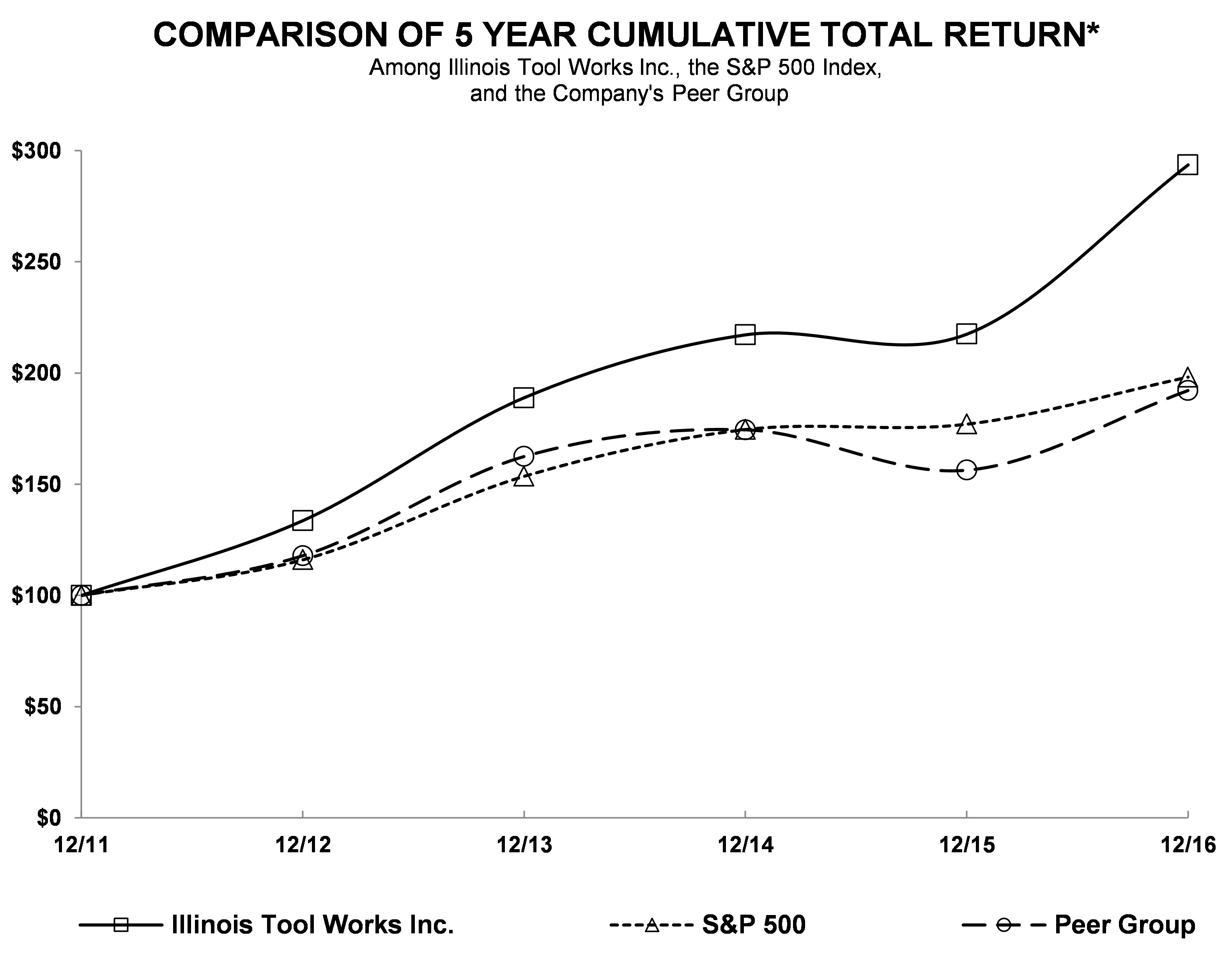
*Assumes $100 invested on 12/31/11 in stock or index, including reinvestment of dividends. Fiscal years ended December 31.
Copyright© 2017 S&P, a division of McGraw Hill Financial. All rights reserved.
The 2016 peer group consists of the following 18 public companies, consistent with the peer group included in the Company's Proxy statement:
| 3M Company | E.I. du Pont de Nemours and Company | Masco Corporation |
| BorgWarner Inc. | Eaton Corporation plc | Parker-Hannifin Corporation |
| Caterpillar Inc. | Emerson Electric Co. | PPG Industries, Inc. |
| Cummins Inc. | Honeywell International Inc. | Pentair plc |
| Deere & Company | Ingersoll-Rand plc | Stanley Black & Decker, Inc. |
| Dover Corporation | Johnson Controls, Inc. | Textron Inc. |
Danaher Corporation was removed from the Company's peer group in 2016 due to the spin-off of Fortive Corporation.
Repurchases of Common Stock— On February 13, 2015, the Company’s Board of Directors authorized a stock repurchase program which provides for the repurchase of up to $6.0 billion of the Company’s common stock over an open-ended period of time (the "2015 Program"). As of December 31, 2016, there were approximately $3.4 billion of authorized repurchases remaining under the 2015 Program. Share repurchase activity under the Company's share repurchase program for the fourth quarter of 2016 was as follows:
| In millions except per share amounts | |||||||||||||
| Period | Total Number of Shares Purchased | Average Price Paid Per Share | Total Number of Shares Purchased as Part of Publicly Announced Program | Maximum Value of Shares That May Yet Be Purchased Under Program | |||||||||
| October 2016 | 2.8 | $ | 114.89 | 2.8 | $ | 3,622 | |||||||
| November 2016 | 1.1 | $ | 120.25 | 1.1 | $ | 3,498 | |||||||
| December 2016 | 0.4 | $ | 126.26 | 0.4 | $ | 3,446 | |||||||
| Total | 4.3 | 4.3 |
Item 6. Selected Financial Data
| In millions except per share amounts | 2016 | 2015 | 2014 | 2013 | 2012 | ||||||||||||||
| Operating revenue | $ | 13,599 | $ | 13,405 | $ | 14,484 | $ | 14,135 | $ | 14,791 | |||||||||
| Income from continuing operations | 2,035 | 1,899 | 1,890 | 1,630 | 2,233 | ||||||||||||||
| Income per share from continuing operations: | |||||||||||||||||||
| Basic | 5.73 | 5.16 | 4.70 | 3.65 | 4.75 | ||||||||||||||
| Diluted | 5.70 | 5.13 | 4.67 | 3.63 | 4.72 | ||||||||||||||
| Total assets at year-end | 15,201 | 15,729 | 17,465 | 19,599 | 19,138 | ||||||||||||||
| Long-term debt at year-end | 7,177 | 6,896 | 5,943 | 2,771 | 4,564 | ||||||||||||||
| Cash dividends declared per common share | 2.40 | 2.07 | 1.81 | 1.60 | 1.48 |
Certain reclassifications of prior year data have been made to conform to current year reporting, including discontinued operations and adoption of new accounting guidance as discussed below.
On October 31, 2012, the Company divested a 51% majority interest in its Decorative Surfaces segment. Accordingly, the Company ceased consolidating the results of the Decorative Surfaces segment as of October 31, 2012 and now reports its 49% ownership interest using the equity method of accounting. Due to the Company's continuing involvement through its 49% interest, the historical operating results of Decorative Surfaces are presented in continuing operations. Effective November 1, 2012, Decorative Surfaces was no longer a reportable segment of the Company.
In April 2014, the Financial Accounting Standards Board ("FASB") issued authoritative guidance to change the criteria for reporting discontinued operations. Under the new guidance, only disposals representing a strategic shift in a company's operations and financial results should be reported as discontinued operations. The Company adopted this new guidance effective January 1, 2015. The new guidance applies prospectively to new disposals and new classifications of disposal groups held for sale after such date. There were no discontinued operations during 2016 or 2015 under this new accounting guidance. For businesses reported as discontinued operations in the statement of income prior to adoption, all related prior period income statement information has been restated. Income from discontinued operations was $1.1 billion, $49 million, and $637 million in the years 2014, 2013, and 2012, respectively. Refer to Note 2. Discontinued Operations in Item 8. Financial Statements and Supplementary Data for discussion of the Company's discontinued operations.
In April 2015, the FASB issued authoritative guidance to simplify the balance sheet presentation of long-term debt issuance costs. Under the new guidance, long-term debt issuance costs are presented as a reduction of the carrying amount of the related long-term debt. The Company early adopted this guidance in the fourth quarter of 2015 and restated $38 million, $22 million, and $26 million of deferred long-term debt issuance costs from Other assets to Long-term debt in the years 2014, 2013, and 2012, respectively.
In November 2015, the FASB issued authoritative guidance to simplify the presentation of deferred taxes. Under the new guidance, all deferred tax assets and liabilities are presented as noncurrent in the statement of financial position. Early adoption of this guidance in the fourth quarter of 2015 decreased total assets by $175 million, $345 million, and $145 million in the years 2014, 2013, and 2012, respectively.
Additional information on the comparability of results is included in Item 7. Management's Discussion and Analysis of Financial Condition and Results of Operations.
Item 7. Management's Discussion and Analysis of Financial Condition and Results of Operations
INTRODUCTION
Illinois Tool Works Inc. (the "Company" or "ITW") is a global manufacturer of a diversified range of industrial products and equipment with 85 divisions in 57 countries. As of December 31, 2016, the Company employed approximately 50,000 persons.
The Company's operations are organized and managed based on similar product offerings and end markets, and are reported to senior management as the following seven segments: Automotive OEM; Food Equipment; Test & Measurement and Electronics; Welding; Polymers & Fluids; Construction Products; and Specialty Products.
Due to the large number of diverse businesses and the Company's decentralized operating structure, the Company does not require its businesses to provide detailed information on operating results. Instead, the Company's corporate management collects data on several key measurements: operating revenue, operating income, operating margin, overhead costs, number of months on hand in inventory, days sales outstanding in accounts receivable, past due receivables and return on invested capital. These key measures are monitored by management and significant changes in operating results versus current trends in end markets and variances from forecasts are discussed with operating unit management.
THE ITW BUSINESS MODEL
The powerful and highly differentiated ITW Business Model is the Company’s core source of value creation. This business model is the Company’s competitive advantage and defines how ITW creates value for its shareholders and comprises three unique elements:
| • | ITW’s 80/20 management process is the operating system that is applied in every ITW business. Initially introduced as a manufacturing efficiency tool in the 1980’s, ITW has continually refined, improved and expanded 80/20 into a proprietary, holistic business management process that generates significant value for the Company and its customers. Through the application of data-driven insights generated by 80/20 practice, ITW focuses on its largest and best opportunities (the “80”) and eliminates cost, complexity and distractions associated with the less profitable opportunities (the “20”). 80/20 enables ITW businesses to consistently achieve world-class operational excellence in product availability, quality, and innovation, while generating superior financial performance; |
| • | Customer-back innovation has fueled decades of profitable growth at ITW. The Company’s unique innovation approach is built on insight gathered from the 80/20 management process. Working from the customer back, ITW businesses position themselves as the go-to problem solver for their “80” customers. ITW’s innovation efforts are focused on understanding customer needs, particularly those in “80” markets with solid long-term growth fundamentals, and subsequently creating unique solutions to address those needs. These customer insights and learnings drive innovation at ITW and have contributed to a portfolio of more than 17,000 granted and pending patents; |
| • | ITW’s decentralized, entrepreneurial culture allows ITW businesses to be fast, focused, and responsive. ITW businesses have significant flexibility within the framework of the ITW Business Model to customize their approach in order to best serve their specific customers' needs. ITW colleagues recognize their unique responsibilities to execute the Company's strategy and values. As a result, the Company maintains a focused and simple organizational structure that, combined with outstanding execution, delivers best-in-class services adapted to each business' customers and end markets. |
ENTERPRISE STRATEGY
In late 2012, ITW began the process of transitioning the Company onto its current strategic path to fully leverage the compelling performance potential of the ITW Business Model. Since then, ITW has made considerable progress, as evidenced by the Company’s strong financial performance over the past four years.
The roots of ITW’s Enterprise Strategy began in late 2011 / early 2012, when the Company undertook a complete review of its performance. Focusing on its businesses delivering consistent above-market growth with best-in-class margins and returns, ITW developed a strategy to replicate that performance across its operations.
Based on this rigorous evaluation, ITW determined that solid and consistent above-market organic growth must be the core growth engine to deliver world-class financial performance and compelling long-term returns for its shareholders. To shift its primary growth engine to organic, the Company began executing a multi-step approach.
| • | The first step was to narrow the focus and improve the quality of ITW’s business portfolio. As part of the Portfolio Management initiative, ITW exited businesses that were operating in commoditized market spaces and prioritized sustainable differentiation as a must-have requirement for all ITW businesses. This process included both divesting entire businesses and exiting commoditized product lines and customers inside otherwise highly differentiated ITW divisions. |
As a result of this work, ITW’s business portfolio now has significantly higher organic growth potential. ITW segments and divisions now possess attractive and differentiated product lines and end markets as they continue to improve operating margins and generate price/cost increases. The Company achieved this through product line simplification, or eliminating the complexity and overhead costs associated with smaller product lines and customers, while supporting and growing the businesses’ largest / most profitable customers and product lines. With the initiative nearly complete and ITW businesses demonstrating notably improved financial performance, the Company believes that the significant product line simplification work is essentially finalized and will return to more normalized levels in 2017 and beyond.
| • | Step two, Business Structure Simplification, was implemented to simplify and scale-up ITW’s operating structure to support increased engineering, marketing, and sales resources, and, at the same time, improve global reach and competitiveness, all of which were critical to driving accelerated organic growth. ITW now has 85 scaled-up divisions with significantly enhanced focus on growth investments, core customers and products, and customer-back innovation. |
| • | The Strategic Sourcing initiative was established as a core capability to better leverage ITW’s scale and improve global competitiveness. Sourcing is now a core strategic and operational capability at ITW. The Company’s 80/20-enabled sourcing organization has delivered an average of one percent reduction in spend each year from 2013 through 2016 and is on track to do the same in 2017 and 2018. |
| • | With the portfolio realignment and scale-up work largely complete, the Company was able to shift its focus to preparing for and accelerating, organic growth. As a preparatory step, ITW is in the process of reapplying 80/20 to optimize its newly scaled-up divisions for growth, first, to build a foundation of operational excellence, and second, to identify the best opportunities to drive organic growth. |
Once the business has achieved operational excellence and identified the right growth opportunities, the final step is to accelerate organic growth. The process of preparing for accelerated organic growth generally takes 18 to 24 months.
Based on the financial performance of the divisions that are further along in this process, the Company believes that its organic growth framework is capable of delivering above-market organic growth across all segments. Divisions are at various phases in preparation for growth and many are either ready to grow or already growing above their respective markets. ITW management is fully aligned with this
Showing the first 8K of 98K characters. Open the full section
Item 7A. Quantitative and Qualitative Disclosures About Market Risk
MARKET RISK
The Company is exposed to certain market risks that exist as part of its ongoing business operations, including fluctuations in currency exchange rates, price volatility for certain commodities and changes in interest rates. The Company does not engage in speculative or leveraged transactions and does not hold or issue financial instruments for trading purposes.
Interest Rate Risk
The Company’s exposure to market risk for changes in interest rates relates primarily to the fair value of the Company’s fixed rate debt. The following table presents the Company’s fixed rate debt for which the fair value is subject to changing market interest rates:
| 0.90% Notes Due | 1.95% Notes Due | 6.25% Notes Due | 4.88% Notes Due thru | 3.375% Notes Due | 1.75% Euro Notes Due | 1.25% Euro Notes Due | 3.50% Notes Due | 2.65% Notes Due | 2.125% Euro Notes Due | 3.00% Euro Notes Due | 4.875% Notes Due | 3.9% Notes Due | |||||||||||||||||||||||||||||||||||||||
| In millions | Feb 25, 2017 | Mar 1, 2019 | Apr 1, 2019 | Dec 31, 2020 | Sep 15, 2021 | May 20, 2022 | May 22, 2023 | Mar 1, 2024 | Nov 15, 2026 | May 22, 2030 | May 19, 2034 | Sep 15, 2041 | Sep 1, 2042 | ||||||||||||||||||||||||||||||||||||||
| As of December 31, 2016: | |||||||||||||||||||||||||||||||||||||||||||||||||||
| Estimated cash outflow by year of principal maturity | |||||||||||||||||||||||||||||||||||||||||||||||||||
| 2017 | $ | 650 | $ | — | $ | — | $ | — | $ | — | $ | — | $ | — | $ | — | $ | — | $ | — | $ | — | $ | — | $ | — | |||||||||||||||||||||||||
| 2018 | — | — | — | — | — | — | — | — | — | — | — | — | — | ||||||||||||||||||||||||||||||||||||||
| 2019 | — | 650 | 700 | — | — | — | — | — | — | — | — | — | — | ||||||||||||||||||||||||||||||||||||||
| 2020 | — | — | — | 4 | — | — | — | — | — | — | — | — | — | ||||||||||||||||||||||||||||||||||||||
| 2021 | — | — | — | — | 350 | — | — | — | — | — | — | — | — | ||||||||||||||||||||||||||||||||||||||
| 2022 and thereafter | — | — | — | — | 526 | 526 | 700 | 1,000 | 526 | 526 | 650 | 1,100 | |||||||||||||||||||||||||||||||||||||||
| Estimated fair value | 650 | 656 | 768 | 4 | 365 | 565 | 549 | 728 | 959 | 565 | 618 | 734 | 1,114 | ||||||||||||||||||||||||||||||||||||||
| Carrying value | 650 | 648 | 698 | 4 | 348 | 520 | 520 | 695 | 991 | 519 | 512 | 636 | 1,080 | ||||||||||||||||||||||||||||||||||||||
| As of December 31, 2015: | |||||||||||||||||||||||||||||||||||||||||||||||||||
| Estimated total cash outflow | $ | 650 | $ | 650 | $ | 700 | $ | 4 | $ | 350 | $ | 543 | $ | 543 | $ | 700 | $ | — | $ | 543 | $ | 543 | $ | 650 | $ | 1,100 | |||||||||||||||||||||||||
| Estimated fair value | 649 | 655 | 790 | 4 | 362 | 564 | 538 | 727 | — | 530 | 569 | 708 | 1,051 | ||||||||||||||||||||||||||||||||||||||
| Carrying value | 649 | 647 | 698 | 4 | 347 | 536 | 536 | 695 | — | 536 | 528 | 635 | 1,080 |
Foreign Currency Risk
The Company operates in the U.S. and 56 foreign countries. The funding for the foreign manufacturing operations is provided primarily through the permanent investment of equity capital. The Company’s products are typically manufactured and sold within the same country. Therefore, the Company's manufacturing operations generally do not have significant assets or liabilities denominated in currencies other than their functional currencies.
The Company designated €1.0 billion of Euro notes issued in May 2014 and €1.0 billion of Euro notes issued in May 2015 as hedges of a portion of its net investment in Euro-denominated foreign operations to reduce foreign currency risk associated with the investment in these operations. Changes in the value of this debt resulting from fluctuations in the Euro to U.S. Dollar exchange rate have been recorded as foreign currency translation adjustments within Accumulated other
comprehensive income (loss). The cumulative unrealized gain recorded in Accumulated other comprehensive income (loss) related to the net investment hedge was $375 million and $308 million as of December 31, 2016 and December 31, 2015, respectively.
Item 8. Financial Statements and Supplementary Data
MANAGEMENT REPORT ON INTERNAL CONTROL OVER FINANCIAL REPORTING
The management of Illinois Tool Works Inc. (the "Company" or "ITW") is responsible for establishing and maintaining adequate internal control over financial reporting, as such term is defined in Exchange Act Rule 13a-15(f). ITW’s internal control system was designed to provide reasonable assurance to the Company’s management and Board of Directors regarding the preparation and fair presentation of published financial statements.
All internal control systems, no matter how well designed, have inherent limitations. Therefore, even those systems determined to be effective can provide only reasonable assurance with respect to financial statement preparation and presentation.
ITW management assessed the effectiveness of the Company’s internal control over financial reporting as of December 31, 2016. In making this assessment, it used the criteria set forth by the Committee of Sponsoring Organizations of the Treadway Commission (COSO) in Internal Control—Integrated Framework (2013). Based on our assessment we believe that, as of December 31, 2016, the Company’s internal control over financial reporting is effective based on those criteria.
The effectiveness of the Company’s internal control over financial reporting as of December 31, 2016 has been audited by Deloitte & Touche LLP, an independent registered public accounting firm, as stated in their report herein.
| /s/ E. Scott Santi E. Scott Santi Chairman & Chief Executive Officer February 10, 2017 | /s/ Michael M. Larsen Michael M. Larsen Senior Vice President & Chief Financial Officer February 10, 2017 |
REPORT OF INDEPENDENT REGISTERED PUBLIC ACCOUNTING FIRM
To the Board of Directors and Stockholders of Illinois Tool Works Inc.
Glenview, Illinois
We have audited the accompanying consolidated statements of financial position of Illinois Tool Works Inc. and subsidiaries (the “Company”) as of December 31, 2016 and 2015, and the related consolidated statements of income, comprehensive income, changes in stockholders’ equity, and cash flows for each of the three years in the period ended December 31, 2016. We also have audited the Company’s internal control over financial reporting as of December 31, 2016, based on criteria established in Internal Control-Integrated Framework (2013) issued by the Committee of Sponsoring Organizations of the Treadway Commission. The Company’s management is responsible for these financial statements, for maintaining effective internal control over financial reporting, and for its assessment of the effectiveness of internal control over financial reporting, included in the accompanying Management Report on Internal Control over Financial Reporting. Our responsibility is to express an opinion on these financial statements and an opinion on the Company’s internal control over financial reporting based on our audits.
We conducted our audits in accordance with the standards of the Public Company Accounting Oversight Board (United States). Those standards require that we plan and perform the audit to obtain reasonable assurance about whether the financial statements are free of material misstatement and whether effective internal control over financial reporting was maintained in all material respects. Our audits of the financial statements included examining, on a test basis, evidence supporting the amounts and disclosures in the financial statements, assessing the accounting principles used and significant estimates made by management, and evaluating the overall financial statement presentation. Our audit of internal control over financial reporting included obtaining an understanding of internal control over financial reporting, assessing the risk that a material weakness exists, and testing and evaluating the design and operating effectiveness of internal control based on the assessed risk. Our audits also included performing such other procedures as we considered necessary in the circumstances. We believe that our audits provide a reasonable basis for our opinions.
A company’s internal control over financial reporting is a process designed by, or under the supervision of, the company’s principal executive and principal financial officers, or persons performing similar functions, and effected by the company’s board of directors, management, and other personnel to provide reasonable assurance regarding the reliability of financial reporting and the preparation of financial statements for external purposes in accordance with generally accepted accounting principles. A company’s internal control over financial reporting includes those policies and procedures that (1) pertain to the maintenance of records that, in reasonable detail, accurately and fairly reflect the transactions and dispositions of the assets of the company; (2) provide reasonable assurance that transactions are recorded as necessary to permit preparation of financial statements in accordance with generally accepted accounting principles, and that receipts and expenditures of the company are being made only in accordance with authorizations of management and directors of the company; and (3) provide reasonable assurance regarding prevention or timely detection of unauthorized acquisition, use, or disposition of the company’s assets that could have a material effect on the financial statements.
Because of the inherent limitations of internal control over financial reporting, including the possibility of collusion or improper management override of controls, material misstatements due to error or fraud may not be prevented or detected on a timely basis. Also, projections of any evaluation of the effectiveness of the internal control over financial reporting to future periods are subject to the risk that the controls may become inadequate because of changes in conditions, or that the degree of compliance with the policies or procedures may deteriorate.
In our opinion, the consolidated financial statements referred to above present fairly, in all material respects, the financial position of Illinois Tool Works Inc. and subsidiaries as of December 31, 2016 and 2015 and the results of their operations and their cash flows for each of the three years in the period ended December 31, 2016, in conformity with accounting principles generally accepted in the United States of America. Also, in our opinion, the Company maintained, in all material respects, effective internal control over financial reporting as of December 31, 2016, based on the criteria established in Internal Control-Integrated Framework (2013) issued by the Committee of Sponsoring Organizations of the Treadway Commission.
/s/ DELOITTE & TOUCHE LLP
Deloitte & Touche LLP
Chicago, Illinois
February 10, 2017
Statement of Income
Illinois Tool Works Inc. and Subsidiaries
| For the Years Ended December 31 | |||||||||||
| In millions except per share amounts | 2016 | 2015 | 2014 | ||||||||
| Operating Revenue | $ | 13,599 | $ | 13,405 | $ | 14,484 | |||||
| Cost of revenue | 7,896 | 7,888 | 8,673 | ||||||||
| Selling, administrative, and research and development expenses | 2,415 | 2,417 | 2,678 | ||||||||
| Amortization and impairment of intangible assets | 224 | 233 | 245 | ||||||||
| Operating Income | 3,064 | 2,867 | 2,888 | ||||||||
| Interest expense | (237 | ) | (226 | ) | (250 | ) | |||||
| Other income (expense) | 81 | 78 | 61 | ||||||||
| Income from Continuing Operations Before Income Taxes | 2,908 | 2,719 | 2,699 | ||||||||
| Income taxes | 873 | 820 | 809 | ||||||||
| Income from Continuing Operations | 2,035 | 1,8 |
Showing the first 8K of 117K characters. Open the full section
Item 9. Changes in and Disagreements With Accountants on Accounting and Financial Disclosure
None.
Item 9A. Controls and Procedures
Controls and Procedures
The Company’s management, with the participation of the Company’s Chairman & Chief Executive Officer and Senior Vice President & Chief Financial Officer, has evaluated the effectiveness of the Company’s disclosure controls and procedures (as defined in Exchange Act Rule 13a-15(e)) as of December 31, 2016. Based on such evaluation, the Company’s Chairman & Chief Executive Officer and Senior Vice President & Chief Financial Officer have concluded that, as of December 31, 2016, the Company’s disclosure controls and procedures were effective.
Management Report on Internal Control over Financial Reporting
The Management Report on Internal Control over Financial Reporting and the Report of Independent Registered Public Accounting Firm are found in Item 8. Financial Statements and Supplementary Data.
In connection with the evaluation by management, including the Company’s Chairman & Chief Executive Officer and Senior Vice President & Chief Financial Officer, no changes in the Company’s internal control over financial reporting (as defined in Exchange Act Rule 13a-15(f)) during the quarter ended December 31, 2016 were identified that have materially affected or are reasonably likely to materially affect the Company’s internal control over financial reporting.
Item 9B. Other Information
None.
PART III
Item 10. Directors, Executive Officers and Corporate Governance
Information regarding the Directors of the Company is incorporated by reference from the information under the captions "Proposal 1 - Election of Directors" in the Company’s Proxy Statement for the 2017 Annual Meeting of Stockholders.
Information regarding the Audit Committee and its Financial Experts is incorporated by reference from the information under the captions "Proposal 1 - Election of Directors - Board of Directors and Its Committees" and "Audit Committee Report" in the Company’s Proxy Statement for the 2017 Annual Meeting of Stockholders.
Information regarding the Executive Officers of the Company can be found in Part I of this Annual Report on Form 10-K under the caption "Executive Officers."
Information regarding compliance with Section 16(a) of the Exchange Act is incorporated by reference from the information under the caption "Proposal 1 - Election of Directors - Section 16(a) Beneficial Ownership Reporting Compliance" in the Company’s Proxy Statement for the 2017 Annual Meeting of Stockholders.
Information regarding the Company’s code of ethics that applies to the Company’s Chairman & Chief Executive Officer, Senior Vice President & Chief Financial Officer, and key financial and accounting personnel is incorporated by reference from the information under the caption "Proposal 1 - Election of Directors - Corporate Governance Policies and Practices" in the Company’s Proxy Statement for the 2017 Annual Meeting of Stockholders.
Item 11. Executive Compensation
This information is incorporated by reference from the information under the captions "NEO Compensation," "Proposal 1 - Election of Directors - Director Compensation," and "Compensation Discussion and Analysis" in the Company’s Proxy Statement for the 2017 Annual Meeting of Stockholders.
Item 12. Security Ownership of Certain Beneficial Owners and Management and Related Stockholder Matters
This information is incorporated by reference from the information under the captions "Proposal 1 - Election of Directors - Ownership of ITW Stock" and "NEO Compensation - Equity Compensation Plan Information" in the Company’s Proxy Statement for the 2017 Annual Meeting of Stockholders.
Item 13. Certain Relationships and Related Transactions, and Director Independence
Information regarding certain relationships and related transactions is incorporated by reference from the information under the captions "Proposal 1 - Election of Directors - Ownership of ITW Stock," "Certain Relationships and Related Party Transactions" and "Proposal 1 - Election of Directors - Corporate Governance Policies and Practices" in the Company’s Proxy Statement for the 2017 Annual Meeting of Stockholders.
Information regarding director independence is incorporated by reference from the information under the captions "Proposal 1 - Election of Directors - Corporate Governance Policies and Practices" and "Appendix A - Categorical Standards for Director Independence" in the Company’s Proxy Statement for the 2017 Annual Meeting of Stockholders.
Item 14. Principal Accounting Fees and Services
This information is incorporated by reference from the information under the caption "Proposal 2 - Ratification of the Appointment of Independent Registered Public Accounting Firm" in the Company’s Proxy Statement for the 2017 Annual Meeting of Stockholders.
PART IV
Item 15. Exhibits and Financial Statement Schedules
(a)(1) Financial Statements
The following information is included as part of Item 8. Financial Statements and Supplementary Data:
Management Report on Internal Control over Financial Reporting
Report of Independent Registered Public Accounting Firm
Statement of Income
Statement of Comprehensive Income
Statement of Financial Position
Statement of Changes in Stockholders' Equity
Statement of Cash Flows
Notes to Financial Statements
(2) Financial Statement Schedules
None.
(3) Exhibits
(i) See the Exhibit Index within this Annual Report on Form 10-K.
(ii) Pursuant to Regulation S-K, Item 601(b)(4)(iii), the Company has not filed with Exhibit 4 any debt instruments for which the total amount of securities authorized thereunder is less than 10% of the total assets of the Company and its subsidiaries on a consolidated basis as of December 31, 2016, with the exception of the Officers' Certificates related to the 0.90% Notes due 2017, the 1.95% Notes due 2019, the 6.25% Notes due 2019, the 3.375% Notes due 2021, the 1.75% Euro Notes due 2022, the 1.25% Euro Notes due 2023, the 3.50% Notes due 2024, the 2.65% Notes due 2026, the 2.125% Euro Notes due 2030, the 3.00% Euro Notes due 2034, the 4.875% Notes due 2041, and the 3.90% Notes due 2042, which are described as Exhibit numbers 4(a) through (i) in the Exhibit Index. The Company agrees to furnish a copy of the agreement related to the debt instruments which have not been filed with Exhibit 4 to the Securities and Exchange Commission upon request.
SIGNATURES
Pursuant to the requirements of Section 13 or 15(d) of the Securities Exchange Act of 1934, the registrant has duly caused this report to be signed on its behalf by the undersigned, thereunto duly authorized on this 10th day of February 2017.
| ILLINOIS TOOL WORKS INC. | ||
| By: | /s/ E. SCOTT SANTI | |
| E. Scott Santi | ||
| Chairman & Chief Executive Officer |
Pursuant to the requirements of the Securities Exchange Act of 1934, this report has been signed by the following persons on behalf of the registrant and in the capacities indicated on this 10th day of February 2017.
| Signatures | Title | |
| /s/ E. SCOTT SANTI | Chairman & Chief Executive Officer, Director | |
| E. Scott Santi | (Principal Executive Officer) | |
| /s/ MICHAEL M. LARSEN | Senior Vice President & Chief Financial Officer | |
| Michael M. Larsen | (Principal Financial Officer) | |
| /s/ RANDALL J. SCHEUNEMAN | Vice President & Chief Accounting Officer | |
| Randall J. Scheuneman | (Principal Accounting Officer) | |
| DANIEL J. BRUTTO | Director | |
| SUSAN CROWN | Director | |
| JAMES W. GRIFFITH | Director | |
| JAY L. HENDERSON | Director | |
| RICHARD H. LENNY | Director | |
| ROBERT S. MORRISON | Director | |
| JAMES A. SKINNER | Director | |
| DAVID B. SMITH, JR. | Director | |
| PAMELA B. STROBEL | Director | |
| KEVIN M. WARREN | Director | |
| ANRÉ D. WILLIAMS | Director | |
| By: /s/ E. SCOTT SANTI | ||
| (E. Scott Santi, as Attorney-in-Fact) |
Original powers of attorney authorizing E. Scott Santi to sign the Company’s Annual Report on Form 10-K and amendments thereto on behalf of the above-named directors of the registrant have been filed with the Securities and Exchange Commission as part of this Annual Report on Form 10-K (Exhibit 24).
Exhibit Index
Annual Report on Form 10-K
2016
| Exhibit Number | Description | |
| 2.1(a) | Investment Agreement, dated as of August 15, 2012, among CD&R Wimbledon Holdings III, L.P., a Cayman Islands limited partnership; Illinois Tool Works Inc.; ITW DS Investments Inc., a Delaware corporation; and Wilsonart International Holdings LLC, a Delaware limited liability company, filed as Exhibit 2.1 to the Company's Current Report on Form 8-K filed on August 17, 2012 (Commission File No. 1-4797) and incorporated herein by reference. (Certain of the schedules and similar attachments have been omitted pursuant to Item 601(b)(2) of Regulation S-K, but the Company undertakes to furnish a copy of the schedules or similar attachments to the Securities and Exchange Committee upon request.) | |
| 2.1(b) | Stock Purchase Agreement, dated as of February 6, 2014, between Illinois Tool Works Inc. and certain of its subsidiaries and Vault Bermuda Holding Co. Ltd., filed as Exhibit 2.1 to the Company’s Current Report on Form 8-K filed on February 12, 2014. (Commission File No. 1-4797) and incorporated herein by reference. (Certain of the schedules and similar attachments have been omitted pursuant to Item 601(b)(2) of Regulation S-K, but the Company undertakes to furnish a copy of the schedules or similar attachments to the Securities and Exchange Commission upon request). | |
| 3(a)(i) | Amended and Restated Certificate of Incorporation of Illinois Tool Works Inc., filed as Exhibit 3.1 to the Company’s Quarterly Report on Form 10-Q for the quarterly period ended June 30, 2014 (Commission File No. 1-4797) and incorporated herein by reference. | |
| 3(a)(ii) | Certificate of Amendment to Amended and Restated Certificate of Incorporation of Illinois Tool Works Inc., filed as Exhibit 3(a)(ii) to the Company’s Form 8-K filed on May 12, 2016 (Commission File No. 1-4797) and incorporated herein by reference. | |
| 3(b) | By-laws of Illinois Tool Works Inc., as amended and restated as of May 6, 2016, filed as Exhibit 3(b)(i) to the Company’s Form 8-K filed on May 12, 2016 (Commission File No. 1-4797) and incorporated herein by reference. | |
| 4(a) | Indenture between Illinois Tool Works Inc. and The First National Bank of Chicago, as Trustee, dated as of November 1, 1986, filed as Exhibit 4.1 to the Company’s Registration Statement on Form S-3 filed on January 15, 1999 (Commission File No. 333-70691) and incorporated herein by reference. | |
| 4(b) | First Supplemental Indenture between Illinois Tool Works Inc. and Harris Trust and Savings Bank, as Trustee, dated as of May 1, 1990, filed as Exhibit 4.2 to the Company’s Registration Statement on Form S-3 filed on January 15, 1999 (Commission File No. 333-70691) and incorporated herein by reference. | |
| 4(c) | Officers’ Certificate dated March 26, 2009 establishing the terms, and setting forth the forms, of the 5.15% Notes due 2014 and the 6.25% Notes due 2019, filed as Exhibit 4.3 to the Company’s Current Report on Form 8-K filed on March 27, 2009 (Commission File No. 1-4797) and incorporated herein by reference. | |
| 4(d) | Officers’ Certificate dated August 31, 2011, establishing the terms, and setting forth the forms, of the 3.375% Notes due 2021 and the 4.875% Notes due 2041, filed as Exhibit 4.3 to the Company’s Form 8-K filed on September 1, 2011 (Commission File No. 001-04797) and incorporated herein by reference. | |
| 4(e) | Officers' Certificate dated August 28, 2012, establishing the terms, and setting forth the forms, of the 3.9% Notes due 2042, filed as Exhibit 4.1 to the Company's Current Report on Form 8-K filed on August 28, 2012 (Commission File No. 001-4797) and incorporated herein by reference. | |
| 4(f) | Officers’ Certificate dated February 25, 2014, establishing the terms, and setting forth the forms, of the 0.9% Notes due 2017, the 1.95% Notes due 2019, and the 3.5% Notes due 2024, filed as Exhibit 4.1 to the Company’s Form 8-K filed on February 26, 2014 (Commission File No. 001-04797) and incorporated herein by reference. | |
| 4(g) | Officers’ Certificate dated May 20, 2014, establishing the terms, and setting forth the forms, of the 1.75% Euro Notes due 2022 and the 3.0% Euro Notes due 2034, filed as Exhibit 4.1 to the Company’s Form 8-K filed on May 22, 2014 (Commission File No. 001-04797) and incorporated herein by reference. | |
| 4(h) | Officers’ Certificate dated May 19, 2015, establishing the terms, and setting forth the forms, of the 1.25% Euro Notes due 2023 and the 2.125% Euro Notes due 2030, filed as Exhibit 4.1 to the Company’s Form 8-K filed on May 22, 2015 (Commission File No. 001-04797) and incorporated herein by reference. | |
| 4(i) | Officer’s Certificate dated November 7, 2016, establishing the terms, and setting forth the forms, of the 2.65% Notes due 2026, filed as Exhibit 4.1 to the Company’s Form 8-K filed on November 1, 2016 (Commission File No. 001-04797) and incorporated herein by reference. | |
| Exhibit Number | Description | |
| 10(a)* | Illinois Tool Works Inc. 2006 Stock Incentive Plan dated February 10, 2006, as amended on May 5, 2006, filed as Exhibit 10(a) to the Company’s Quarterly Report on Form 10-Q for the quarterly period ended March 31, 2006 (Commission File No. 1-4797) and incorporated herein by reference. | |
| 10(b)* | Amendment to Illinois Tool Works Inc. 2006 Stock Incentive Plan dated February 8, 2008, filed as Exhibit 10(q) to the Company’s Annual Report on Form 10-K for the fiscal year ended December 31, 2007 (Commission File No. 1-4797) and incorporated herein by reference. | |
| 10(c)* | Second Amendment to Illinois Tool Works Inc. 2006 Stock Incentive Plan dated February 13, 2009, filed as Exhibit 10(d) to the Company’s Annual Report on Form 10-K for the fiscal year ended December 31, 2008 (Commission File No. 1-4797) and incorporated herein by reference. | |
| 10(d)* | Illinois Tool Works Inc. 2011 Long-Term Incentive Plan, filed as Exhibit 99.2 to the Company’s Current Report on Form 8-K filed on December 16, 2010 (Commission File No. 1-4797) and incorporated herein by reference. | |
| 10(e)* | Illinois Tool Works Inc. 2015 Long-Term Incentive Plan effective May 8, 2015, filed as Exhibit 10.1 to the Company's Quarterly Report on Form 10-Q for the quarterly period ended March 31, 2015 (Commission File No. 1-4797) and incorporated herein by reference. | |
| 10(f)* | Form of stock option terms filed as Exhibit 99.1 to the Company’s Current Report on Form 8-K filed on February 5, 2009 (Commission File No. 1-4797) and incorporated herein by reference. | |
| 10(g)* | Form of stock option terms filed as Exhibit 99.1 to the Company’s Current Report on Form 8-K filed on February 9, 2011 (Commission File No. 1-4797) and incorporated herein by reference. | |
| 10(h)* | Form of stock option terms filed as Exhibit 99.1 to the Company’s Current Report on Form 8-K filed on February 7, 2012 (Commission File No. 1-4797) and incorporated herein by reference. | |
| 10(i)* | Form of stock option terms filed as Exhibit 99.1 to the Company’s Current Report on Form 8-K filed on February 13, 2014 (Commission File No. 1-4797) and incorporated herein by reference. | |
| 10(j)* | Form of restricted stock unit terms filed as Exhibit 99.2 to the Company’s Current Report on Form 8-K filed on February 13, 2014 (Commission File No. 1-4797) and incorporated herein by reference. | |
| 10(k)* | Form of performance restricted stock unit terms filed as Exhibit 99.3 to the Company’s Current Report on Form 8-K filed on February 13, 2014 (Commission File No. 1-4797) and incorporated herein by reference. | |
| 10(l)* | Form of Long-Term Incentive Cash Grant filed as Exhibit 99.4 to the Company’s Current Report on Form 8-K filed on February 13, 2014 (Commission File No. 1-4797) and incorporated herein by reference. | |
| 10(m)* | Form of stock option terms filed as Exhibit 99.1 to the Company's Current Report on Form 8-K filed on February 9, 2016 (Commission File No. 1-4797) and incorporated herein by reference. | |
| 10(n)* | Form of restricted stock unit terms filed as Exhibit 99.2 to the Company's Current Report on Form 8-K filed on February 9, 2016 (Commission File No. 1-4797) and incorporated herein by reference. | |
| 10(o)* | Form of performance restricted stock unit terms filed as Exhibit 99.3 to the Company's Current Report on Form 8-K filed on February 9, 2016 (Commission File No. 1-4797) and incorporated herein by reference. | |
| 10(p)* | Form of Long-Term Incentive Cash Grant filed as Exhibit 99.4 to the Company's Current Report on Form 8-K filed on February 9, 2016 (Commission File No. 1-4797) and incorporated herein by reference. | |
| 10(q)* | Form of stock option terms filed as Exhibit 99.1 to the Company's Current Report on Form 8-K filed on February 9, 2017 (Commission File No. 1-4797) and incorporated herein by reference. | |
| 10(r)* | Form of restricted stock unit terms filed as Exhibit 99.2 to the Company's Current Report on Form 8-K filed on February 9, 2017 (Commission File No. 1-4797) and incorporated herein by reference. | |
| 10(s)* | Form of performance share unit terms filed as Exhibit 99.3 to the Company's Current Report on Form 8-K filed on February 9, 2017 (Commission File No. 1-4797) and incorporated herein by reference. | |
| 10(t)* | Form of Performance Cash Grant filed as Exhibit 99.4 to the Company's Current Report on Form 8-K filed on February 9, 2017 (Commission File No. 1-4797) and incorporated herein by reference. | |
| 10(u)* | Illinois Tool Works Inc. 2011 Executive Incentive Plan, filed as Exhibit 99.1 to the Company’s Current Report on Form 8-K filed on December 16, 2010 (Commission File No. 1-4797) and incorporated herein by reference. | |
| 10(v)* | Illinois Tool Works Inc. Executive Contributory Retirement Income Plan as amended and restated, effective January 1, 2010, filed as exhibit 10 to the Company’s Current Report on Form 8-K filed on November 5, 2009 (Commission File No. 1-4797) and incorporated herein by reference. | |
| Exhibit Number | Description | |
| 10(w)* | Illinois Tool Works Inc. Nonqualified Pension Plan, effective January 1, 2008, as amended and approved by the Board of Directors on December 22, 2008, filed as Exhibit 10(p) to the Company’s Annual Report on Form 10-K for the fiscal year ended December 31, 2008 (Commission File No. 1-4797) and incorporated herein by reference. | |
| 10(x)* | Illinois Tool Works Inc. 2011 Change-in-Control Severance Compensation Policy, filed as Exhibit 99.3 to the Company’s Current Report on Form 8-K filed on December 16, 2010 (Commission File No. 1-4797) and incorporated herein by reference. | |
| 10(y)* | Illinois Tool Works Inc. Amended and Restated Directors’ Deferred Fee Plan effective May 2, 2014, filed as Exhibit 10.1 to the Company’s Quarterly Report on Form 10-Q for the quarterly period ended June 30, 2014 (Commission File No. 1-4797) and incorporated herein by reference. | |
| 10(z)* | Illinois Tool Works Inc. 2011 Cash Incentive Plan, filed as Exhibit 99.1 to the Company’s Form 8-K filed on May 12, 2011 (Commission File No. 1-4797) and incorporated herein by reference. | |
| 10(aa)* | First Amendment to the ITW Contributory Retirement Income Plan dated February 15, 2013, filed as Exhibit 10.2 to the Company’s Current Form 10-Q filed on May 3, 2013 (Commission File No. 1-4797) and incorporated herein by reference. | |
| 10(bb) | Five Year Credit Agreement dated as of May 9, 2016 among Illinois Tool Works Inc., the Lenders, JPMorgan Chase Bank, National Association, as Administrative Agent, and Citibank, N.A., as Syndication Agent filed as Exhibit 10(a) to the Company’s Form 8-K filed on May 12, 2016 (Commission File No. 1-4797) and incorporated herein by reference. | |
| 21 | Subsidiaries and Affiliates of the Company. | |
| 23 | Consent of Independent Registered Public Accounting Firm. | |
| 24 | Powers of Attorney. | |
| 31 | Rule 13a-14(a) Certifications. | |
| 32 | Section 1350 Certification. | |
| 99(a) | A description of the capital stock of Illinois Tool Works Inc. is included under Item 8.01 Other Events in the Company's Report on Form 8-K filed on February 9, 2017 (Commission File No. 1-4797) and incorporated herein by reference. | |
| 101.INS | XBRL Instance Document** | |
| 101.SCH | XBRL Taxonomy Extension Schema** | |
| 101.CAL | XBRL Taxonomy Extension Calculation Linkbase** | |
| 101.DEF | XBRL Taxonomy Extension Definition Linkbase** | |
| 101.LAB | XBRL Taxonomy Extension Label Linkbase** | |
| 101.PRE | XBRL Taxonomy Extension Presentation Linkbase** |
| * | Management contract or compensatory plan or arrangement. |
| ** | The following financial information from Illinois Tool Works Inc.'s Annual Report on Form 10-K for the year ended December 31, 2016, formatted in XBRL (Extensible Business Reporting Language): (i) Statement of Income, (ii) Statement of Comprehensive Income, (iii) Statement of Income Reinvested in the Business (iv) Statement of Financial Position, (v) Statement of Cash Flows and (vi) related Notes to Financial Statements. |