 filings.tools
Jacobs Solutions 10-K 2015-10-02
Filed 2015-11-24. 21 sections, 437K characters. Original on sec.gov · Markdown · JSON
Cover and table of contents
10-K 1 fiscal2015form10-k.htm 10-K
UNITED STATES
SECURITIES AND EXCHANGE COMMISSION
Washington, D.C. 20549
FORM 10-K
ANNUAL REPORT PURSUANT TO
SECTION 13 OR 15(d) OF THE SECURITIES EXCHANGE ACT OF 1934
For the fiscal year ended October 2, 2015 Commission File No. 1-7463
Jacobs Engineering Group Inc.
| Delaware | 95-4081636 | |
| State of incorporation | IRS Employer identification number | |
| 155 North Lake Avenue Pasadena, California 91101 | (626) 578-3500 | |
| Address of principal executive offices | Telephone number (including area code) |
Securities registered pursuant to Section 12(b) of the Act:
| Title of Each Class | Name of Each Exchange on Which Registered | |
| Common Stock, $1 par value | New York Stock Exchange |
Securities registered pursuant to Section 12(g) of the Act: None
Indicate by check-mark if the Registrant is a well-known seasoned issuer, as defined in Rule 405 of the Securities Act: ý Yes ¨ No
Indicate by check-mark if the Registrant is not required to file reports pursuant to Section 13 or 15(d) of the Act. ¨ Yes ý No
Indicate by check-mark whether the Registrant (1) has filed all reports required to be filed by Section 13 or 15(d) of the Securities Exchange Act of 1934 during the preceding 12 months (or for such shorter period that the Registrant was required to file such reports), and (2) has been subject to such filing requirements for the past 90 days. ý Yes ¨ No
Indicate by check-mark whether the Registrant: has submitted electronically and posted on its corporate Web site, if any, every Interactive Data File required to be submitted and posted pursuant to Rule 405 of Regulation S-T (§232.405 of this chapter) during the preceding 12 months (or for such shorter period that the Registrant was required to submit and post such files).
ý Yes - ¨ No
Indicate by check-mark if disclosure of delinquent filers pursuant to Item 405 of Regulation S-K (§229.405 of this chapter) is not contained herein, and will not be contained, to the best of the Registrant’s knowledge, in definitive proxy or information statements incorporated by reference in Part III of this Form 10-K or any amendment to this Form 10-K. ý
Indicate by check-mark whether the Registrant is a large accelerated filer, an accelerated filer, a non-accelerated filer or a smaller reporting company. See the definitions of “large accelerated filer”, “accelerated filer” and “smaller reporting company” in Rule 12b-2 of the Exchange Act.
| Large accelerated filer | ý | Accelerated filer | ¨ | |||
| Non-accelerated filer | ¨ | Smaller reporting company | ¨ |
Indicate by check-mark whether the Registrant is a shell company (as defined in Rule 12b-2 of the Act) ¨ Yes ý No
There were 122,557,955 shares of common stock outstanding as of November 20, 2015. The aggregate market value of the Registrant’s common equity held by non-affiliates was approximately $5.6 billion as of March 27, 2015, based upon the last reported sales price on the New York Stock Exchange on that date.
DOCUMENTS INCORPORATED BY REFERENCE
Portions of the Registrant’s definitive proxy statement to be issued in connection with its 2016 annual meeting of shareholders are incorporated by reference into Part III of this Annual Report on Form 10-K where indicated.
JACOBS ENGINEERING GROUP INC.
Fiscal 2015 Annual Report on Form 10-K
Table of Contents
Page 2
PART I
FORWARD-LOOKING STATEMENTS
In addition to historical information, this Annual Report on Form 10-K contains forward-looking statements within the meaning of the Private Securities Litigation Reform Act of 1995. Forward-looking statements are statements that do not directly relate to any historical or current fact. When used herein, words such as "expects," "anticipates," "believes," "seeks," "estimates," "plans," "intends," “future,” “will,” “would,” “could,” “can,” “may,” and similar words are intended to identify forward-looking statements. You should not place undue reliance on these forward-looking statements. Although such statements are based on management’s current estimates and expectations and/or currently available competitive, financial, and economic data, forward-looking statements are inherently uncertain and involve risks and uncertainties that could cause our actual results to differ materially from what may be inferred from the forward-looking statements. Factors that could cause or contribute to such differences include, but are not limited to, those listed and discussed in Item 1A—Risk Factors below. We undertake no obligation to release publicly any revisions or updates to any forward-looking statements. We encourage you to read carefully the risk factors described herein and in other documents we file from time to time with the United States Securities and Exchange Commission (the "SEC").
Unless the context otherwise requires, all references herein to "Jacobs" or the "Registrant" are to Jacobs Engineering Group Inc. and its predecessors, and references to the "Company", "we", "us" or "our" are to Jacobs Engineering Group Inc. and its consolidated subsidiaries.
Item 1. BUSINESS
General Background Information
We are one of the largest technical professional services firms in the world. We provide a diverse range of technical, professional, and construction services to a large number of industrial, commercial, and governmental clients. We provide four broad categories of services:
| • | Project Services (including engineering, design, architecture, interiors, planning, environmental, and similar services); |
| • | Process, Scientific, and Systems Consulting Services (including services performed in connection with scientific testing, analysis, and consulting activities, as well as information technology and systems engineering and integration activities); |
| • | Construction Services (encompassing traditional field construction services as well as modular construction consulting capabilities, direct hire construction, and construction management services); and |
| • | Operations and Maintenance Services (including services performed in connection with operating large, complex facilities on behalf of clients, as well as services involving process plant and facilities maintenance). |
We focus our services on clients operating in the following industries and markets:
| • | Oil and gas exploration, production, and refining; |
| • | Chemicals and polymers; |
| • | Programs for various national governments, including aerospace, defense, and environmental programs; |
| • | Buildings (including specialized buildings for clients operating in the fields of healthcare, education, and high technology; governmental complexes; other specialized civic and mission critical buildings, installations, and laboratories; and retail and commercial buildings); |
| • | Infrastructure and telecommunications; |
Page 3
| • | Mining and minerals; |
| • | Pharmaceuticals and biotechnology; |
| • | Power; |
| • | Pulp and paper; |
| • | Technology and manufacturing; and, |
| • | Food and consumer products, among others. |
We are headquartered in Pasadena, California, USA, and provide our services through more than 200 offices located around the globe, primarily in North America, South America, Europe, the Middle East, India, Australia, Africa, and Asia.
How We Operate
The relationships we have with our clients drive our business. As a broad-based technical professional services firm, we offer a range of services to help our clients maintain a competitive edge in their respective markets. From feasibility studies to design, to engineering, to construction, to start-up and commissioning, and then to operations and maintenance, we customize our services to meet business and project goals. Our global network of professionals works with a multi-office approach in an effort to provide clients with the best, most economical project or program solutions.
We strive to provide client value through continuous improvement in our performance. We regularly monitor our clients' expectations, our project delivery protocols and system, and our operational performance. Tools such as our Jacobs Value Enhancing Practices, Global Standard Operating Procedures, project reviews, the Jacobs System to Ensure Project Success ("JSTEPS") and Safe Plans of Action ("SPAs") provide added value to our clients' projects. They also allow us to create performance improvement actions during the project execution. Through continuous improvement upon our performance, our tools, and our processes, we believe we can offer our clients superior value when they do business with us.
JacobsValue+SM ("Value Plus") is an internal tool we use to document and quantify the actual value or savings we provide to our clients and their projects. Some of the benefits achieved through the Value Plus program include lower total installed cost, shorter schedule, and reduced life cycle cost. Value Plus is implemented at project initiation: a project goal is created, and cost-saving ideas are entered into the Value Plus database. When the Value Plus cycle is complete, the project team and client identify unique cost and/or schedule reductions for the project.
Our Business Model
Our organizational structure and integrated system for delivering services are key components of our business strategy. Our operating units generally use a matrix organizational structure whereby our project management functions are supported by the various technical planning, design, and construction disciplines that are necessary to effectively execute long-term engineering and construction contracts. We recognize that technical expertise alone cannot grow our business; project management skills and the ability to manage multi-million dollar projects and programs for our clients are critical to our success. Crucial functions, such as project controls and procurement, are embedded within each of our regions and serve operations by providing specialized services required by projects.
Our business is set up to foster cooperation among teams and across our operating units. Historically, we have not operated “profit centers” within the Company, nor do we allow our operating groups to compete against each other for contracts. Our organizational structure and integrated system for delivering services are key components of our business strategy. The following three ideas support our business model:
Multi-Domestic Approach
We work in many countries with locally-staffed offices that share a common set of values, tools, and a single vision, while maintaining one-on-one contact with individual clients. This multi-domestic approach enables us to provide customized service suited to the locale while still taking advantage of the Company’s global network.
Boundaryless Approach
Page 4
Our diversity encompasses our people, geographic reach, expertise, and technical capabilities. On projects around the world, we enhance local expertise with the best talent and the best technology available anywhere throughout the Company. This seamless, boundaryless approach keeps us flexible and enhances our ability to develop the best possible solutions for our clients, regardless of office or project location.
Cost Management Approach
As the global economy expands and companies providing technical, professional, and construction services are required to compete against each other across geographic boundaries, companies that can provide their clients with cost-efficient solutions to their project needs have the advantage. With a strong focus on managing costs, we provide savings to clients and deliver superior technical, professional, and construction services safely, efficiently, and within the cost and time parameters our clients require.
Jacobs’ corporate functions include Project Delivery, Safety, Finance and Administration, Legal, Human Resources, Information Technology, Compliance and, through fiscal 2015, Global Sales and Marketing, which are all integral to our success.
The Company's Culture
Our employees are our most important and valuable asset and, therefore, the prevention of job-related injuries is given top priority. It is the policy of the Company to provide and maintain a safe and healthy working environment and to follow operating practices that safeguard all employees and result in a more efficient operation. BeyondZero® , the name of our program that promotes our culture of caring, moves beyond efforts to have an incident and injury-free safety performance. We implement a culture of caring where concern for employees' health, safety, and welfare extends outside the office walls, beyond the project site fences and into their homes, cars, and all the places where they interact with family, fr
Showing the first 8K of 71K characters. Open the full section
Item 1A. RISK FACTORS
We operate in a changing environment that involves numerous known and unknown risks and uncertainties that could materially adversely affect our business, financial condition, and results of operations. The risks described below highlight some of the factors that have affected and could affect us in the future. We may also be affected by unknown risks or risks that we currently think are immaterial. If any such events actually occur, our business, financial condition, and results of operations could be materially adversely affected.
Construction and maintenance sites are inherently dangerous workplaces. If we fail to maintain safe work sites, we can be exposed to significant financial losses and reputational harm, as well as civil and criminal liabilities.
Construction and maintenance sites often put our employees and others in close proximity with large pieces of mechanized equipment, moving vehicles, chemical and manufacturing processes, and highly regulated materials, in a challenging environment. On many sites we are responsible for safety and, accordingly, must implement safety procedures. If we fail to implement such procedures or if the procedures we implement are ineffective, our employees and others may become injured, disabled or even lose their lives, the completion or commencement of our projects may be delayed, and we may be exposed to litigation or investigations. Unsafe work sites also have the potential to increase employee turnover, increase the cost of a project to our clients, and raise our operating costs. Any of the foregoing could result in financial losses or reputational harm, which could have a material adverse impact on our business, financial condition, and results of operations.
In addition, our projects can involve the handling of hazardous and other highly regulated materials, which, if improperly handled or disposed of, could subject us to civil and/or criminal liabilities. We are also subject to regulations dealing with occupational health and safety. Although we maintain functional groups whose primary purpose is to ensure we implement effective health, safety, and environmental (“HSE”) work procedures throughout our organization, including construction sites and maintenance sites, the failure to comply with such regulations could subject us to liability. In addition, despite the work of our functional groups, we cannot guarantee the safety of our personnel or that there will be no damage to or loss of our work, equipment or supplies.
Our safety record is critical to our reputation. Many of our clients require that we meet certain safety criteria to be eligible to bid for contracts and many contracts provide for automatic termination or forfeiture of some or all of our contract fees or profit in the event we fail to meet certain measures. Accordingly, if we fail to maintain adequate safety standards, we could suffer reduced profitability or the loss of projects or clients, which could have a material adverse impact on our business, financial condition, and results of operations.
Our vulnerability to the cyclical nature of the markets in which our clients operate is exacerbated during economic downturns or time of political uncertainty.
We provide technical, professional, construction, and O&M services to clients operating in a number of markets including oil and gas exploration, production, and refining; programs for various national governments, including the U.S. federal government; chemicals and polymers; mining and minerals; pharmaceuticals and biotechnology; infrastructure; buildings; power; and other, general industrial and consumer businesses and markets (such as technology and manufacturing; pulp and paper; and food and consumer products). These markets and the resulting demand for our services have been, and we expect will continue to be, cyclical and subject to significant fluctuations due to a variety of factors beyond our control, including economic conditions and changes in client spending, particularly during periods of economic or political uncertainty.
Current global economic and political conditions have negatively impacted many of our clients’ ability and willingness to fund their projects, including their ability to raise capital and pay, or timely pay, our invoices. They have also caused our clients to reduce their capital expenditures, alter the mix of services purchased, seek more favorable price and other contract terms, and otherwise slow their spending on our services. For example, in the public sector, declines in state and local tax revenues as well as other economic declines may result in lower state and local government spending. In addition, due to these conditions many of our competitors may be more inclined to take greater or unusual risks or accept terms and conditions in contracts that we might not deem acceptable. These conditions have reduced , and may continue to reduce, the demand for our services, which has had, and may continue to have a significant negative impact on our business, financial condition and results of operations.
Current economic and political conditions also make it extremely difficult for our clients, our vendors, and us to accurately forecast and plan future business activities and could cause businesses to continue to slow spending on our services. We cannot predict the timing, strength or duration of any economic slowdown or subsequent economic recovery worldwide or in our clients’ markets. In addition, our business has traditionally lagged recoveries in the general economy and, therefore, may
Page 20
not recover as quickly as the economy at large. A continuation or worsening of current weak economic conditions or a reduction in government spending could have a material adverse impact on our business, financial condition, and results of operations.
Regardless of economic or market conditions, investment decisions by our customers may vary by location or as a result of other factors like the availability of labor or relative construction cost. Because we are dependent on the timing and funding of new awards, we are therefore vulnerable to changes in our clients’ markets and investment decisions. As a result, our past results have varied and may continue to vary depending upon the demand for future projects in the markets and the locations in which we operate.
Fluctuations in commodity prices may affect our customers’ investment decisions and therefore subject us to risks of cancellation, delays in existing work, or changes in the timing and funding of new awards.
Commodity prices can affect our customers in a number of ways. For example, for those customers that produce commodity products such as oil, gas, copper, or fertilizers, fluctuations in price can have a direct effect on their profitability and cash flow and, therefore, their willingness to continue to invest or make new capital investments. To the extent commodity prices decline or fluctuate and our customers defer new investments or cancel or delay existing projects, the demand for our services decreases, which may have a material adverse impact on our business, financial condition, and results of operations.
Commodity prices can also strongly affect the costs of projects. Rising commodity prices can negatively impact the potential returns on investments that are planned, as well as those in progress, and result in customers deferring new investments or canceling or delaying existing projects. Cancellations and delays have affected our past results and may continue to do so in significant and unpredictable ways and could have a material adverse impact on our business, financial condition, and results of operations.
Our project execution activities may result in liability for faulty engineering services.
If we fail to provide our services in accordance with applicable professional standards, we could be exposed to large damages or even criminal violations. Our engineering practice, f
Showing the first 8K of 74K characters. Open the full section
Item 1B. UNRESOLVED STAFF COMMENTS
None.
Item 2. PROPERTIES
Page 33
Our properties consist primarily of office space within general, commercial office buildings located in major cities primarily in the following countries: United States; Australia; Austria; Belgium; Canada; Chile; China; Finland; France; Germany; Greece; India; Italy; Malaysia; Mexico; Morocco; The Netherlands; Oman; The Philippines; Poland; Puerto Rico; Peru; Republic of Ireland; Saudi Arabia; South Africa; Singapore; Spain; Sweden; United Arab Emirates; and the United Kingdom. Such space is used for operations (providing technical, professional, and other home office services), sales, and administration. Most of our properties are leased. In addition, we own facilities located in Charleston, South Carolina which had served as our principal manufacturing and fabrication site for our modular construction activities. We also have fabrication facilities located in Canada in Pickering, Ontario and Edmonton and Lamont, Alberta. The total amount of space used by us for all of our operations is approximately 8.3 million square feet.
We also lease smaller, project offices located throughout the U.S., the U.K., and in certain other countries. We also rent most of our construction equipment on a short-term basis.
Item 3. LEGAL PROCEEDINGS
The information required by this Item 3 is included in Note 11 — Contractual Guarantees, Litigation, Investigations, and Insurance of Notes to Consolidated Financial Statements beginning on page F-1 of this Annual Report on Form 10-K and is incorporated herein by reference.
Item 4. MINE SAFETY DISCLOSURE
Section 1503 of the Dodd-Frank Wall Street Reform and Consumer Protection Act (the “Dodd-Frank Act”) requires domestic mine operators to disclose violations and orders issued under the Federal Mine Safety and Health Act of 1977 (the “Mine Act”) by the federal Mine Safety and Health Administration. Under the Mine Act, an independent contractor, such as Jacobs, that performs services or construction of a mine is included within the definition of a mining operator. We do not act as the owner of any mines.
Information concerning mine safety violations or other regulatory matters required by Section 1503(a) of the Dodd-Frank Act and Item 104 of Regulation S-K is included in Exhibit 95.
Page 34
PART II
Item 5. MARKET FOR REGISTRANT'S COMMON EQUITY, RELATED STOCKHOLDER MATTERS AND ISSUER PURCHASES OF EQUITY SECURITIES
Market Information
Jacobs’ common stock is listed on the NYSE and trades under the symbol JEC. We provided to the NYSE, without qualification, the required annual certification of our Chief Executive Officer regarding compliance with the NYSE’s corporate governance listing standards. The following table sets forth the low and high sales prices of a share of our common stock during each of the fiscal quarters presented, based on the NYSE Composite Price History:
| Low Sales Price | High Sales Price | |||||||
| Fiscal 2015: | ||||||||
| First quarter | $ | 39.78 | $ | 49.94 | ||||
| Second quarter | 37.87 | 45.49 | ||||||
| Third quarter | 41.68 | 48.25 | ||||||
| Fourth quarter | 36.05 | 44.64 | ||||||
| Fiscal 2014: | ||||||||
| First quarter | $ | 55.80 | $ | 64.27 | ||||
| Second quarter | 58.20 | 66.88 | ||||||
| Third quarter | 52.57 | 65.02 | ||||||
| Fourth quarter | 49.13 | 55.00 |
Shareholders
According to the records of our transfer agent, there were 1,116 shareholders of record as of November 20, 2015.
Share Repurchases
On August 19, 2014, the Board of Directors approved a program to repurchase up to $500 million of the Company's common stock over a three year period. Share repurchases may be executed through various means including, without limitation, open market transactions, privately negotiated transactions or otherwise. The share repurchase program does not oblige the Company to purchase any shares. The authorization for the share repurchase program may be terminated, increased, or decreased by the Company's Board of Directors in its discretion at any time. The timing of our share repurchases may depend upon market conditions, other uses of capital, and other factors. As of October 2, 2015, the Company exhausted the repurchase capacity under the authorization.
A summary of repurchases of our common stock each fiscal month during the fourth quarter of fiscal 2015 is as follows (in thousands, except per-share amounts):
| Period | Total Number of Shares Purchased | Average Price Paid per Share (1) | Total Numbers of Shares Purchased as Part of Publicly Announced Plans or Programs | Approximate Dollar Value of Shares that May Yet Be Purchased Under the Plans or Programs | ||||||
| June 27 through July 24, 2015 | 404 | $ | 40.29 | 404 | $ | 532,362 | ||||
| July 25 through August 21, 2015 | 289 | 42.88 | 289 | 519,974 | ||||||
| August 22 through October 2, 2015 | 536 | 38.63 | 536 | 500,000 | ||||||
| Total | 1,229 | $ | 40.18 | 1,229 | $ | 500,000 |
| (1) | Includes commissions paid. |
On July 23, 2015, the Board of Directors approved a program to purchase up to an additional $500 million of the Company's
Page 35
common stock over the next three years. This approval was in addition to the then available capacity remaining under the Company's August 2014 $500 million share repurchase authorization. The new share repurchase authorization is subject to the same general terms and conditions as the prior share repurchase authorization summarized above.
Dividends
Our policy is to use cash flows from operations to fund future growth, pay down debt, and, subject to market conditions, repurchase common stock under a stock buy-back program approved by our Board of Directors. Accordingly, we have not paid a cash dividend since fiscal 1984. Although our Board of Directors periodically reviews and considers the merits of paying cash dividends, we currently have no plans to pay cash dividends in the foreseeable future.
Unregistered Sales of Equity Securities.
On October 14, 2013, we acquired the assets of Trompeter Enterprises, L.L.C., Motion Mekanix, Inc., Teamm Workforce, Inc., and Sims Software II, Inc. (collectively "Trompeter"); and on December 20, 2013, we acquired the assets of Stobbarts (Nuclear) Limited, for cash and shares of our common stock. In connection with these acquisitions, we issued 33,947 shares of our common stock with an aggregate value of approximately $2.0 million. No underwriters or placement agents were involved with these acquisitions.
The issuance of our common stock in the acquisition was exempt from the registration requirements of the Securities Act of 1933, as amended (the "Securities Act"), pursuant to Rule 506 thereof. The offer and sale of the shares of our common stock: (i) was made as part of a transaction that did not involve more than 35 purchasers, (as defined in Rule 501(e) under the Securities Act) who were either accredited investors or had such knowledge and experience in financial and business matters that such purchaser was capable of evaluating the merits and risks of acquiring shares of our common stock, and (ii) did not involve any general solicitation or general advertising.
Page 36
Performance Graph
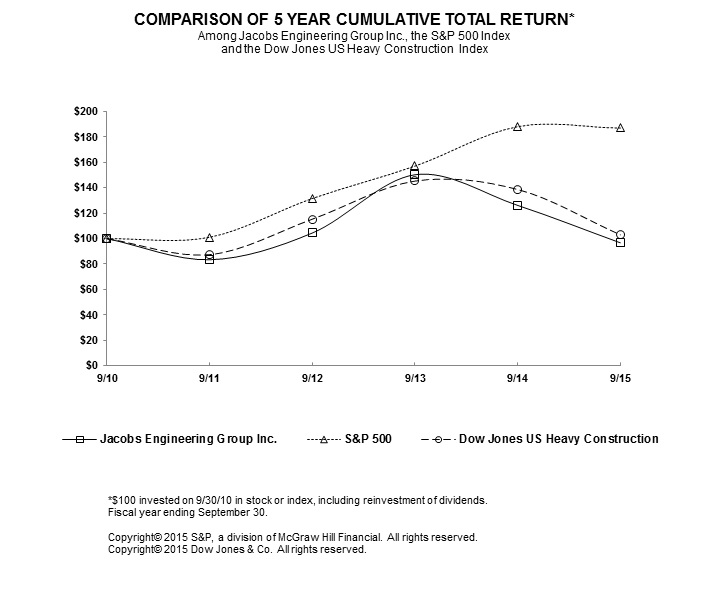
The following graph and table shows the changes over the past five-year period in the value of $100 invested at the end of fiscal 2010 in (1) the common stock of Jacobs Engineering Group Inc., (2) the Standard & Poor’s 500 Index, and (3) the Dow Jones Heavy Construction Group Index. The values of each investment are based on share price appreciation, with reinvestment of all dividends, provided any were paid. The investments are assumed to have occurred at the beginning of the period presented. The stock performance included in this graph is not necessarily indicative of future stock price performance.
| 2010 | 2011 | 2012 | 2013 | 2014 | 2015 | |||||||||||||
| Jacobs Engineering Group Inc. | 100.00 | 83.44 | 104.47 | 150.34 | 126.15 | 96.72 | ||||||||||||
| S&P 500 | 100.00 | 101.14 | 131.69 | 157.17 | 188.18 | 187.02 | ||||||||||||
| Dow Jones US Heavy Construction | 100.00 | 87.48 | 115.38 | 145.34 | 138.73 | 103.03 |
Note: The above information was provided by Research Data Group, Inc.
Page 37
Item 6. SELECTED FINANCIAL DATA
The following table presents selected financial data for each of the last five fiscal years. This selected financial data should be read in conjunction with the Consolidated Financial Statements and related notes beginning on page F-1 of this Annual Report on Form 10-K. Dollar amounts are presented in thousands, except for per share information:
| 2015 (a) | 2014 (b) | 2013 | 2012 (c) | 2011 | ||||||||||||||||
| Results of Operations: | ||||||||||||||||||||
| Revenues | $ | 12,114,832 | $ | 12,695,157 | $ | 11,818,376 | $ | 10,893,778 | $ | 10,381,664 | ||||||||||
| Net earnings attributable to Jacobs | 302,971 | 328,108 | 423,093 | 378,954 | 331,029 | |||||||||||||||
| Financial Position: | ||||||||||||||||||||
| Current ratio | 1.66 to 1 | 1.66 to 1 | 2.14 to 1 | 2.07 to 1 | 1.47 to 1 | |||||||||||||||
| Working capital | $ | 1,301,810 | $ | 1,542,225 | $ | 2,151,939 | $ | 1,865,025 | $ | 1,011,565 | ||||||||||
| Current assets | 3,282,976 | 3,892,071 | 4,039,558 | 3,612,077 | 3,180,091 | |||||||||||||||
| Total assets | 7,785,926 | 8,453,659 | 7,274,144 | 6,839,433 | 6,199,226 | |||||||||||||||
| Cash | 460,859 | 732,647 | 1,256,405 | 1,032,457 | 905,633 | |||||||||||||||
| Long-term debt | 584,434 | 764,075 | 415,086 | 528,260 | 2,042 | |||||||||||||||
| Total Jacobs stockholders’ equity | 4,291,745 | 4,469,255 | 4,213,097 | 3,722,473 | 3,312,988 | |||||||||||||||
| Return on average equity | 6.92 | % | 7.56 | % | 10.66 | % | 10.77 | % | 10.73 | % | ||||||||||
| Backlog: | ||||||||||||||||||||
| Technical professional services | $ | 11,692,404 | $ | 12,607,029 | $ | 11,118,400 | $ | 10,266,500 | $ | 9,100,100 | ||||||||||
| Field services | 7,114,166 | 5,773,005 | 6,099,500 | 5,643,200 | 5,189,700 | |||||||||||||||
| Total | $ | 18,806,570 | $ | 18,380,034 | $ | 17,217,900 | $ | 15,909,700 | $ | 14,289,800 | ||||||||||
| Per Share Information: | ||||||||||||||||||||
| Basic earnings per share | $ | 2.42 | $ | 2.51 | $ | 3.27 | $ | 2.97 | $ | 2.63 | ||||||||||
| Diluted earnings per share | 2.40 | $ | 2.48 | $ | 3.23 | 2.94 | 2.60 | |||||||||||||
| Stockholders’ equity | 34.85 | 33.92 | 32.00 | 28.65 | 25.93 | |||||||||||||||
| Average Number of Shares of Common Stock and Common Stock Equivalents Outstanding (Diluted) | 126,110 | 132,371 | 130,945 | 128,692 | 127,235 | |||||||||||||||
| Common Shares Outstanding at Year End | 123,153 | 131,753 | 131,639 | 129,936 | 127,785 |
| (a) | Includes costs of $107.9 million or $0.86 per diluted share, related to the Company's restructuring initiatives in the second, third and fourth quarters of fiscal 2015. |
| (b) | Includes costs of $109.2 million or $0.82 per diluted share, related to the Company's restructuring initiatives in the third and fourth quarter of fiscal 2014. |
| (c) | Includes a one-time, after-tax gain of $4.0 million, or $0.03 per diluted share, related to the sale of the Company's intellectual property for iron ore pelletizing and certain other related assets. |
Page 38
Item 7. MANAGEMENT'S DISCUSSION AND ANALYSIS OF FINANCIAL CONDITION AND RESULTS OF OPERATIONS
Critical Accounting Policies
In order to understand better the changes that occur to key elements of our financial condition, results of operations, and cash flows, a reader of this Management’s Discussion and Analysis (“MD&A”) should be aware of the critical accounting policies we apply in preparing our consolidated financial statements.
The consolidated financial statements contained in this report were prepared in accordance with U.S. GAAP. The preparation of our consolidated financial statements and the financial statements of any business performing long-term engineering and construction-type contracts requires management to make certain estimates and judgments that affect both the entity’s results of operations and the carrying values of its assets and liabilities. Although our significant accounting policies are described in Note 2 – Significant Accounting Policies of Notes to Consolidated Financial Statements beginning on page F-1 of this Annual Report on Form 10-K, the following discussion is intended to highlight and describe those accounting policies that are especially critical to the preparation of our consolidated financial statements.
Revenue Accounting for Contracts and Use of Joint Ventures—In general, we recognize revenues at the time we provide services. Depending on the commercial terms of the contract, we recognize revenues either when costs are incurred, or using the percentage-of-completion method of accounting by relating contract costs incurred to date to the total estimated costs at completion. This method of revenue recognition requires us to prepare estimates of costs to complete contracts in progress as of the balance sheet dates. In making such estimates, judgments are required to evaluate the possible effects of variances in schedule; the costs of materials and labor; productivity; and the impact of change orders, claims, contract disputes, and achievement of contractual performance standards. Many of our engineering and construction contracts provide for reimbursement of costs plus a fixed or percentage fee. For contracts containing incentive fee arrangements, fees are frequently based on achievement of target completion dates, target costs, and/or other performance criteria. Failure to meet these targets or increases in contract costs can result in unrealized incentive fees or non-recoverable costs, which could exceed revenues recognized from the project.
We provide for contract losses in their entirety in the period they become known without regard to the percentage of completion. For multiple contracts with a single customer we account for each contract separately.
The nature of our business sometimes results in clients, subcontractors or vendors presenting claims to us for recovery of costs they incurred in excess of what they expected to incur, or for which they believe they are not contractually responsible. In those situations where a claim against us may result in additional costs to the contract, we include in the total estimated costs of the contract (and therefore, the estimated amount of margin to be earned under the contract) an estimate, based on all relevant facts and circumstances available, of the additional costs to be incurred. Similarly, and in the normal course of business, we may present claims to our clients for costs we have incurred for which we believe we are not contractually responsible. In those situations where we have presented such claims to our clients, we include in revenues the amount of costs incurred, without profit, to the extent it is probable that the claims will result in additional contract revenue, and the amount of such additional revenue can be reliably estimated. Costs associated with unapproved change orders are included in revenues using substantially the same criteria used for claims.
Certain cost-reimbursable contracts with government customers as well as many commercial clients provide that contract costs are subject to audit and adjustment. In this situation, revenues are recorded at the time services are performed based upon the amounts we expect to realize upon completion of the contracts. In those situations where an audit indicates that we may have billed a client for costs that are not allowable under the terms of the contract, we estimate the amount of such nonbillable costs and adjust our revenues accordingly.
As is common to the industry, we execute certain contracts jointly with third parties through various forms of joint ventures and consortiums. Although the joint ventures own and hold the contracts with the clients, the services required by the contracts are typically performed by us and our joint venture partners, or by other subcontractors under subcontracting agreements with the joint ventures. The assets of our joint ventures, therefore, consist almost entirely of cash and receivables (representing amounts due from clients), and the liabilities of our joint ventures consist almost entirely of amounts due to the joint venture partners (for services provided by the partners to the joint ventures under their individual subcontracts) and other subcontractors. In general, at any given time, the equity of our joint ventures represents the undistributed profits earned on contracts the joint ventures hold with clients. Very few of our joint ventures have employees. None of our joint ventures have
Page 39
third-party debt or credit facilities. Our joint ventures, therefore, are simply mechanisms used to deliver engineering and construction services to clients. Rarely do they, in and of themselves, present any risk of loss to us or to our partners separate from those that we would carry if we were performing the contract on our own. Under U.S. GAAP, our share of losses associated with the contracts held by the joint ventures, if and when they occur, has always been reflected in our Consolidated Financial Statements.
In evaluating the Company's joint ventures (also referred to as "variable interest entities", or "VIEs") for accounting and consolidation purposes, we perform a qualitative analysis to determine whether or not the Company has a “controlling financial interest” in the VIE. The Company is deemed to have a controlling financial interest in a VIE if it has (i) the power to direct the activities of the VIE that most significantly impact the VIE's economic performance; and (ii) the right to receive benefits, or obligation to absorb losses, that could potentially be significant to the VIE. In making our qualitative analysis, the Company assesses each VIE to determine those activities that most significantly impact the VIE's economic performance and whether the Company, another entity, or multiple entities have the power to direct those activities.
If we determine that we have the power to direct those activities of the VIE that most significantly impact its financial performance and have the right or obligation to receive benefits or absorb losses that could potentially be significant to the VIE, then we are the primary beneficiary of the VIE and we consolidate the VIE. If we determine that we do not have the power to direct the most significant activities of the VIE or power is shared by two or more unrelated parties, then we are not the primary beneficiary and we do not consolidate the VIE.
For the Company's unconsolidated joint ventures, we use either the equity method of accounting or proportional consolidation. The Company does not currently participate in any significant VIEs in which it has a controlling financial interest. There were no changes in facts and circumstances in the period that caused the Company to reassess the method of accounting for its VIEs.
Accounting for Stock Issued to Employees and Others— We measure the cost of employee services received in exchange for an award of equity instruments based on the estimated grant-date fair value of the award. We estimate the fair value of stock options granted to employees and di
Showing the first 8K of 68K characters. Open the full section
Item 7A. QUANTITATIVE AND QUALITATIVE DISCLOSURES ABOUT MARKET RISK
We do not enter into derivative financial instruments for trading, speculation or other purposes that would expose the Company to market risk. In the normal course of business, our results of operations are exposed to risks associated with fluctuations in interest rates and currency exchange rates.
Interest Rate Risk
Please refer to the discussion of the 2014 Facility and the 2012 Facility in the liquidity and capital resources discussion in Management's Discussion and Analysis of Financial Condition and Results of Operations in this Annual Report on Form 10-K, and Note 5 - Borrowings in Notes to Consolidated Financial Statements beginning on Page F-1 of this Annual report on Form 10-K.
Foreign Currency Risk
In situations where our operations incur contract costs in currencies other than their functional currency, we attempt to have a portion of the related contract revenues denominated in the same currencies as the costs. In those situations where revenues and costs are transacted in different currencies, we sometimes enter into foreign exchange contracts in order to limit our exposure to fluctuating foreign currencies. We follow the provisions of ASC 815-10 - Derivatives and Hedging in accounting for our derivative contracts. The Company does not currently have exchange rate sensitive instruments that would have a material effect on our consolidated financial statements or results of operations.
Item 8. FINANCIAL STATEMENTS AND SUPPLEMENTARY DATA
The information required by this Item 8 is submitted as a separate section beginning on page F-1of this Annual Report on Form 10-K and is incorporated herein by reference.
Item 9. CHANGES IN AND DISAGREEMENTS WITH ACCOUNTANTS ON ACCOUNTING AND FINANCIAL DISCLOSURE
None.
Item 9A. CONTROLS AND PROCEDURES
Evaluation of Disclosure Controls and Procedures
The Company’s management, with the participation of its Chief Executive Officer and Chief Financial Officer, evaluated the effectiveness of the Company’s disclosure controls and procedures as defined by Rule 13a-15(e) of the Securities Exchange Act of 1934, as amended (the “Exchange Act”) as of October 2, 2015, the end of the period covered by this Annual Report on Form 10-K (the “Evaluation Date”). Based on that evaluation, the Chief Executive Officer and Chief Financial Officer concluded that the Company’s disclosure controls and procedures were effective as of the Evaluation Date.
Management’s Annual Report on Internal Control Over Financial Reporting
Management is responsible for establishing and maintaining adequate internal controls over financial reporting, as defined in Rule 13a-15(f) under the Exchange Act. Management, with the participation of its Chief Executive Officer and Chief Financial Officer, has assessed the effectiveness of the Company’s internal control over financial reporting as of the Evaluation Date based on the framework established in “Internal Control—Integrated Framework”, issued by the Committee of Sponsoring Organizations of the Treadway Commission. Based on this evaluation, management has concluded that the Company’s internal controls over financial reporting as of the Evaluation Date were effective. The Company’s independent registered public accounting firm, Ernst & Young LLP, has issued an attestation report on the Company’s internal control over financial reporting which appears later in this Annual Report on Form 10-K.
Changes in Internal Control
There were no changes in the Company’s internal control over financial reporting during the Company’s fiscal quarter ended October 2, 2015, that have materially affected, or are reasonably likely to materially affect, the Company’s internal control over financial reporting.
Page 54
Limitations on Effectiveness of Controls
The Company’s management, including its Chief Executive Officer and Chief Financial Officer, does not expect that its disclosure controls and procedures or its system of internal control over financial reporting will prevent or detect all errors and all fraud. A control system, no matter how well designed or operated, can provide only reasonable, but not absolute, assurance that the objectives of the system of internal control are met. The design of the Company’s control system reflects the fact that there are resource constraints, and that the benefits of such control system must be considered relative to their costs. Further, because of the inherent limitations in all control systems, no evaluation of controls can provide absolute assurance that all control failures and instances of fraud, if any, within the Company have been detected. These inherent limitations include the realities that judgments in decision-making can be faulty and that breakdowns can occur because of simple error or mistake. Additionally, controls can be circumvented by the intentional acts of individuals, by collusion of two or more people, or by management override of the controls. The design of any system of controls is also based in part on certain assumptions about the likelihood of future events, and there can be no assurance that the design of any particular control will always succeed in achieving its objective under all potential future conditions.
Item 9B. OTHER INFORMATION
On November 19, 2015, the Human Resource and Compensation Committee of the Board of Directors of the Company (the "Compensation Committee") approved a new Management Incentive Plan (the “Management Incentive Plan”). The Management Incentive Plan replaces the Company's Incentive Bonus Plan beginning in fiscal 2016. Specific measures and targets will be assigned to each participant based on their respective role in the organization. Select officers and managers of the Company are eligible to participate in the new Management Incentive Plan, and the Chief Executive Officer automatically participates. Goals under the Management Incentive Plan will be defined at the corporate and business unit level.
Also on November 19, 2015, the Compensation Committee approved a new form of restricted stock unit agreement under the Jacobs Engineering Group Inc. 1999 Stock Incentive Plan, as amended and restated. This new form of award agreement provides for the award of performance-based restricted stock units based on growth in earnings per share from fiscal year to fiscal year (the "Award Agreement"). This metric considers the Company’s net earnings as a factor in the award, and divides such net earnings by the weighted average number of shares of the Company’s common stock outstanding during each fiscal year to reflect the growth in earnings per share from fiscal year to fiscal year.
The foregoing summaries do not purport to be complete and are qualified in their entirety by reference to the terms of the Management Incentive Plan and the Award Agreement, copies of which are filed herewith as Exhibits 10.43 and 10.45, and are incorporated herein by reference.
Page 55
PART III
Item 10. DIRECTORS, EXECUTIVE OFFICERS AND CORPORATE GOVERNANCE
Directors, Executive Officers, Promoters and Control Persons
The information required by Paragraph (a), and Paragraphs (c) through (g) of Item 401 of Regulation S-K (except for information required by Paragraph (e) of that Item to the extent the required information pertains to our executive officers) and Item 405 of Regulation S-K is set forth under the captions “The Board of Directors and its Committees - Nominees,” “The Board of Directors and its Committees - Continuing Directors,” and “Section 16(a) Beneficial Ownership Reporting Compliance” in our definitive proxy statement to be filed with the SEC pursuant to Regulation 14A within 120 days after the close of our fiscal year and is incorporated herein by reference. The information required by Paragraph (b) of Item 401 of Regulation S-K , as well as the information required by Paragraph (e) of that Item to the extent the required information pertains to our executive officers, is set forth in Part I, Item 1 of this Annual Report on Form 10-K under the heading “Executive Officers of the Registrant.”
Code of Ethics
We have adopted a code of ethics for our chief executive, chief financial, and principal accounting officers; a code of business conduct and ethics for members of our Board of Directors; and corporate governance guidelines. The full text of the codes of ethics and corporate governance guidelines is available at our website at www.jacobs.com. In the event we make any amendment to, or grant any waiver from, a provision of the code of ethics that applies to the principal executive officer, principal financial officer or principal accounting officer that requires disclosure under applicable SEC rules, we will disclose such amendment or waiver and the reasons therefor on our website. We will provide any person without charge a copy of any of the aforementioned codes of ethics upon receipt of a written request. Requests should be addressed to: Jacobs Engineering Group Inc., 155 S. North Lake Avenue, Pasadena, California 91101, Attention: Corporate Secretary.
Corporate Governance
The information required by Items 407(d)(4) and (d)(5) of Regulation S-K is set forth under the caption “The Board of Directors and its Committees - Committees of the Board of Directors - Audit Committee” in our definitive proxy statement to be filed with the SEC pursuant to Regulation 14A within 120 days after the close of our fiscal year and is incorporated herein by reference.
Item 11. EXECUTIVE COMPENSATION
The information required by this Item is set forth under the captions “The Board of Directors and its Committees - Compensation of Directors for Fiscal 2015,” “The Board of Directors and its Committees - Committees of the Board of Directors - Compensation Committee Interlocks and Insider Participation,” “Compensation Committee Report,” “Compensation Discussion and Analysis,” and “Executive Compensation” in our definitive proxy statement to be filed with the SEC pursuant to Regulation 14A within 120 days after the close of our fiscal year and is incorporated herein by reference.
Page 56
Item 12. SECURITY OWNERSHIP OF CERTAIN BENEFICIAL OWNERS AND MANAGEMENT AND RELATED STOCKHOLDER MATTERS
Securities Authorized for Issuance Under Equity Compensation Plans
The following table presents certain information about our equity compensation plans as of October 2, 2015:
| Column A | Column B | Column C | ||||||||
| Plan Category | Number of securities to be issued upon exercise of outstanding options, warrants, and rights | Weighted- average exercise price of outstanding options, warrants, and rights | Number of securities remaining available for future issuance under equity compensation plans (excluding securities reflected in Column A) | |||||||
| Equity compensation plans approved by shareholders (a) | 4,072,707 | $ | 46.06 | 7,144,884 | ||||||
| Equity compensation plans not approved by shareholders | — | — | — | |||||||
| Total | 4,072,707 | $ | 46.06 | 7,144,884 |
| (a) | The number in Column A excludes purchase rights accruing under our two, broad-based, shareholder-approved employee stock purchase plans: The Jacobs Engineering Group Inc. 1989 Employee Stock Purchase Plan (the “1989 ESPP”), and the Global Employee Stock Purchase Plan (the “GESPP”). These plans give employees the right to purchase shares at an amount and price that are not determinable until the end of the specified purchase periods, which occur monthly. Our shareholders have authorized a total of 27.8 million shares of common stock to be issued through the 1989 ESPP and the GESPP. From the inception of the 1989 ESPP and the GESPP through October 2, 2015, a total of 26.5 million shares have been issued, leaving 1.3 million shares of common stock available for future issuance at that date. |
The information required by Item 403 of Regulation S-K is set forth under the caption “Security Ownership” in our definitive proxy statement to be filed with the SEC pursuant to Regulation 14A within 120 days after the close of our fiscal year and is incorporated herein by reference.
Item 13. CERTAIN RELATIONSHIPS AND RELATED TRANSACTIONS, AND DIRECTOR INDEPENDENCE
The information required by this Item is set forth under the captions “The Board of Directors and its Committees - Independence of Directors,” “The Board of Directors and its Committees - Committees of the Board of Directors,” and “Certain Relationships and Related Transactions” in our definitive proxy statement to be filed with the SEC pursuant to Regulation 14A within 120 days after the close of our fiscal year and is incorporated herein by reference.
Item 14. PRINCIPAL ACCOUNTING FEES AND SERVICES
The information required by this Item is set forth under the captions “Report of the Audit Committee” and “Audit and Non-Audit Fees” in our definitive proxy statement to be filed with the SEC pursuant to Regulation 14A within 120 days after the close of our fiscal year and is incorporated herein by reference.
Page 57
PART IV
Item 15. EXHIBITS AND FINANCIAL STATEMENT SCHEDULES
(a)Documents filed as part of this report:
| (1) | The Company’s Consolidated Financial Statements at October 2, 2015 and September 26, 2014 and for each of the three years in the period ended October 2, 2015, September 26, 2014 and September 28, 2012 and the notes thereto, together with the report of the independent auditors on those Consolidated Financial Statements are hereby filed as part of this report, beginning on page F-1. |
| (2) | Financial statement schedules – no financial statement schedules are presented as the required information is either not applicable, or is included in the consolidated financial statements or notes thereto. |
| (3) | See Exhibits and Index to Exhibits, below. |
Page 58
(b)Exhibits and Index to Exhibits:
| 2.1 | Merger Implementation Deed between Sinclair Knight Merz Management Pty Limited and Sinclair Knight Merz Holdings Limited and Jacobs Engineering Group Inc. and Jacobs Australia Holdings Company Pty. Ltd, dated as of September 8, 2013. Filed as Exhibit 2.2 to the Registrant’s fiscal 2013 Annual Report on Form 10-K and incorporated herein by reference. | ||
| 2.2 | Sales Agreement between Sinclair Knight Merz Management Pty Limited, Sinclair Knight Merz Holdings Limited, Jacobs Engineering Group Inc. and Jacobs Australia Holdings Company Pty, Ltd., dated as of December 13, 2013. Filed as Exhibit 2.3 to the Registrant’s Quarterly Report on Form 10-Q for the first quarter of fiscal 2014 and incorporated herein by reference. | ||
| 3.1 | Amended and Restated Certificate of Incorporation of the Registrant. Filed as Exhibit 3.1 to the Registrant’s Current Report on Form 8-K on January 28, 2014 and incorporated herein by reference. | ||
| 3.2 | Amended and Restated Bylaws of the Registrant. Filed as Exhibit 3.1 to the Registrant’s Current Report on Form 8-K on July 16, 2015 and incorporated herein by reference. | ||
| 4.1 | See Sections 5 through 18 of Exhibit 3.1. | ||
| 4.2 | See Article II, Section 3.03 of Article III, Article VI and Section 7.04 of Article VII of Exhibit 3.2. | ||
| 10.1# | The Jacobs Engineering Group Inc. Incentive Bonus Plan for Officers and Key Managers as amended and restated on May 22, 2014. Filed as Exhibit 10.1 to the Registrant’s Quarterly Report on Form 10-Q for the second quarter of fiscal 2015 and incorporated herein by reference. | ||
| 10.2# | The Executive Security Program of Jacobs Engineering Group Inc. Filed as Exhibit 10.2 to the Registrant’s fiscal 2014 Annual Report on Form 10-K and incorporated herein by reference. | ||
| 10.3# | Amendment to the Executive Security Program of Jacobs Engineering Group Inc., dated December 23, 2008. Filed as Exhibit 10.3 to the Registrant’s fiscal 2014 Annual Report on Form 10-K and incorporated herein by reference. | ||
| 10.4# | Amendment to the Executive Security Program of Jacobs Engineering Group Inc., dated May 31, 2009. Filed as Exhibit 10.4 to the Registrant’s fiscal 2014 Annual Report on Form 10-K and incorporated herein by reference. | ||
| 10.5# | Jacobs Engineering Group Inc. 1991 Executive Deferral Plan, effective June 1, 1991. Filed as Exhibit 10.5 to the Registrant’s fiscal 2012 Annual Report on Form 10-K and incorporated herein by reference. | ||
| 10.6# | Jacobs Engineering Group Inc. 1993 Executive Deferral Plan, effective December 1, 1993. Filed as Exhibit 10.6 to the Registrant’s fiscal 2012 Annual Report on Form 10-K and incorporated herein by reference. | ||
| 10.7# | Jacobs Engineering Group Inc. 1995 Executive Deferral Plan, effective January 1, 1995. Filed as Exhibit 10.7 to the Registrant’s fiscal 2014 Annual Report on Form 10-K and incorporated herein by reference. | ||
| 10.8# | Jacobs Engineering Group Inc. Amended and Restated Executive Deferral Plan. Filed as Exhibit 10.8 to the Registrant’s fiscal 2012 Annual Report on Form 10-K and incorporated herein by reference. |
Page 59
| 10.9# | The Jacobs Engineering Group Inc. 1989 Employee Stock Purchase Plan, as Amended and Restated-effective January 22, 2009. Filed as Exhibit 10.9 to the Registrant’s fiscal 2014 Annual Report on Form 10-K and incorporated herein by reference. | ||
| 10.10# | The Jacobs Engineering Group Inc. Global Employee Stock Purchase Plan. Filed as Exhibit 10.10 to the Registrant’s fiscal 2011 Annual Report on Form 10-K and incorporated herein by reference. | ||
| 10.11# | Jacobs Engineering Group Inc. 401(k) Plus Savings Plan and Trust, as Amended and Restated April 1, 2003. Filed as Exhibit 10.12 to the Registrant’s fiscal 2012 Annual Report on Form 10-K and incorporated herein by reference. | ||
| 10.12# | Jacobs Engineering Group Inc. 1999 Stock Incentive Plan, as Amended and Restated. Filed as Exhibit 10.1 to the Registrant’s Current Report on Form 8-K (File No. 333-157014) on January 28, 2014 and incorporated herein by reference. | ||
| 10.13# | Form of Indemnification Agreement entered into between the Registrant and certain of its officers and directors. Filed as Exhibit 10.1 to the Registrant's Quarterly Report on Form 10-Q for the third quarter of fiscal 2012 and incorporated herein by reference. | ||
| 10.14# | Form of Jacobs Engineering Group Inc. Non-Qualified Stock Option Agreement. Filed as Exhibit 4.3 to the Registrant’s Registration Statement on Form S-8 filed on January 29, 2009 and incorporated herein by reference. | ||
| 10.15# | Form of Jacobs Engineering Group Inc. Restricted Stock Agreement. Filed as Exhibit 10.3 to the Registrant's Quarterly Report on Form 10-Q for the second quarter of fiscal 2012 and incorporated herein by reference. | ||
| 10.16# | Form of Restricted Stock Unit Award Agreement. Filed as Exhibit 10.2 to the Registrant’s Quarterly Report on Form 10-Q for the second quarter of fiscal 2012 and incorporated herein by reference. | ||
| 10.17# | Form of Restricted Stock Award Agreement. Filed as Exhibit 10.3 to the Registrant’s Current Report on Form 8-K on June 1, 2011 and incorporated herein by reference. | ||
| 10.18# | Jacobs Engineering Group Inc. 1999 Outside Director Stock Plan, as Amended and Restated. Filed as Exhibit 10.21 to the Registrant’s fiscal 2012 Annual Report on Form 10-K and incorporated herein by reference. | ||
| 10.19# | Form of Restricted Stock Unit Award Agreement (Performance Shares - Net Earnings Growth 2013 Award). Filed as Exhibit 10.3 to the Registrant’s Quarterly Report on Form 10-Q for the third quarter of fiscal 2013 and incorporated herein by reference. | ||
| 10.20# | Form of Restricted Stock Unit Award Agreement. (Performance Shares - TSR 2013 Award). Filed as Exhibit 10.4 to the Registrant’s Quarterly Report on Form 10-Q for the third quarter of fiscal 2013 and incorporated herein by reference. | ||
| 10.21 | Credit Agreement dated as of March 29, 2012 among Jacobs Engineering Group Inc. and certain of its subsidiaries as borrowers, and the Bank of America, N.A, (as Administrative Agent); BNP Paribas, and Wells Fargo Bank, N.A. (as Co-Syndication Agents); Union Bank, N.A. (as Documentation Agent); Merrill Lynch, Pierce, Fenner & Smith Incorporated (as Sole Book Manager); and Merrill Lynch, Pierce, Fenner & Smith Incorporated, BNP Paribas Securities Corp, and Wells Fargo Securities, LLC (as Joint Lead Arrangers). Filed as Exhibit 10.1 to the Registrant's Quarterly Report on Form 10-Q for the second quarter of fiscal 2012 and incorporated herein by reference. | ||
Showing the first 8K of 189K characters. Open the full section