 filings.tools
Jacobs Solutions 10-K 2019-09-27
Filed 2019-11-25. 21 sections, 547K characters. Original on sec.gov · Markdown · JSON
Cover and table of contents
UNITED STATES
SECURITIES AND EXCHANGE COMMISSION
Washington, D.C. 20549
_________________________________________________________________
FORM 10-K
ANNUAL REPORT PURSUANT TO
SECTION 13 OR 15(d) OF THE SECURITIES EXCHANGE ACT OF 1934
For the fiscal year ended September 27, 2019 Commission File No. 1-7463
_________________________________________________________________
Jacobs Engineering Group Inc.
| Delaware | 95-4081636 | |||
| (State or other jurisdiction of incorporation or organization) | (IRS Employer identification number) | |||
| 1999 Bryan Street | Suite 1200 | Dallas | Texas | 75201 |
| (Address of principal executive offices) | (Zip Code) |
(214) 583 – 8500
(Registrant’s telephone number, including area code)
Securities registered pursuant to Section 12(b) of the Act:
_________________________________________________________________
| Title of Each Class | Trading Symbol(s) | Name of Each Exchange on Which Registered | |
| Common Stock | $1 par value | JEC | New York Stock Exchange |
Securities registered pursuant to Section 12(g) of the Act: None
_________________________________________________________________
Indicate by check-mark if the Registrant is a well-known seasoned issuer, as defined in Rule 405 of the Securities Act: ☒ Yes ☐ No
Indicate by check-mark if the Registrant is not required to file reports pursuant to Section 13 or 15(d) of the Act. ☐ Yes ☒ No
Indicate by check-mark whether the Registrant (1) has filed all reports required to be filed by Section 13 or 15(d) of the Securities Exchange Act of 1934 during the preceding 12 months (or for such shorter period that the Registrant was required to file such reports), and (2) has been subject to such filing requirements for the past 90 days. ☒ Yes ☐ No
Indicate by check-mark whether the Registrant: has submitted electronically every Interactive Data File required to be submitted pursuant to Rule 405 of Regulation S-T (§232.405 of this chapter) during the preceding 12 months (or for such shorter period that the Registrant was required to submit such files). ☒ Yes ☐ No
Indicate by check-mark if disclosure of delinquent filers pursuant to Item 405 of Regulation S-K (§229.405 of this chapter) is not contained herein, and will not be contained, to the best of the Registrant’s knowledge, in definitive proxy or information statements incorporated by reference in Part III of this Form 10-K or any amendment to this Form 10-K. ☒
Indicate by check-mark whether the Registrant is a large accelerated filer, an accelerated filer, a non-accelerated filer or a smaller reporting company. See the definitions of “large accelerated filer”, “accelerated filer” and “smaller reporting company” in Rule 12b-2 of the Exchange Act.
| Large accelerated filer | ☒ | Accelerated filer | ☐ | |||
| Non-accelerated filer | ☐ | Smaller reporting company | ☐ | |||
| Emerging growth company | ☐ |
If an emerging growth company, indicate by check mark if the registrant has elected not to use the extended transition period for complying with any new or revised financial accounting standards provided pursuant to Section 13(a) of the Exchange Act. ☐
Indicate by check-mark whether the Registrant is a shell company (as defined in Rule 12b-2 of the Act) ☐ Yes ☒ No
There were 132,854,642 shares of common stock outstanding as of November 11, 2019. The aggregate market value of the Registrant’s common equity held by non-affiliates was approximately $10.2 billion as of March 29, 2019, based upon the last reported sales price on the New York Stock Exchange on that date.
DOCUMENTS INCORPORATED BY REFERENCE
Portions of the Registrant’s definitive proxy statement to be issued in connection with its 2020 annual meeting of shareholders are incorporated by reference into Part III of this Annual Report on Form 10-K where indicated.
JACOBS ENGINEERING GROUP INC.
Fiscal 2019 Annual Report on Form 10-K
Table of Contents
Page 2
PART I
FORWARD-LOOKING STATEMENTS
In addition to historical information, this Annual Report on Form 10-K contains forward-looking statements within the meaning of the Private Securities Litigation Reform Act of 1995, including, among other things, statements regarding our future operations, financial condition, and business strategies and future economic and industry conditions. Forward-looking statements are statements that do not directly relate to any historical or current fact. When used herein, words such as "expects," "anticipates," "believes," "seeks," "estimates," "plans," "intends," “future,” “will,” “would,” “could,” “can,” “may,” and similar words are intended to identify forward-looking statements. You should not place undue reliance on these forward-looking statements. Although such statements are based on management’s current estimates and expectations and/or currently available competitive, financial, and economic data, forward-looking statements are inherently uncertain and involve risks and uncertainties that could cause our actual results to differ materially from what may be inferred from the forward-looking statements. Factors that could cause or contribute to such differences include, but are not limited to, those listed and discussed in Item 1A— Risk Factors below. We undertake no obligation to release publicly any revisions or updates to any forward-looking statements. We encourage you to read carefully the risk factors described herein and in other documents we file from time to time with the United States Securities and Exchange Commission (the "SEC").
Unless the context otherwise requires, all references herein to "Jacobs" or the "Registrant" are to Jacobs Engineering Group Inc. and its predecessors, and references to the "Company", "we", "us" or "our" are to Jacobs Engineering Group Inc. and its consolidated subsidiaries.
Page 3
Item 1. BUSINESS
At Jacobs, we’re challenging today to reinvent tomorrow by solving the world’s most critical problems for thriving cities, resilient environments, mission-critical outcomes, operational advancement, scientific discovery and cutting-edge manufacturing, turning abstract ideas into realities that transform the world for good. Leveraging a talent force of approximately 52,000, Jacobs provides a full spectrum of professional services including consulting, technical, scientific and project delivery for the government and private sector.
The Company’s deep global domain knowledge - applied together with the latest advances in technology - are why customers large and small choose to partner with Jacobs. We operate in two lines of business: Critical Mission Solutions (formerly Aerospace, Technology and Nuclear) and People & Places Solutions (formerly Buildings, Infrastructure and Advanced Facilities). These new names better reflect outcome-focused solutions for our customers and the changes have no impact on reported financial statements, line of business leadership or customer relationships.
After spending three years transforming our portfolio and setting the foundation to get us where we are today, we launched a three-year accelerated profitable growth strategy at our Investor Day in February 2019, focused on innovation and continued transformation to build upon our position as the leading solutions provider for our clients. This transformation included the $3.2 billion acquisition of CH2M and the $3.4 billion divestiture of the Company's energy, chemicals and resources business. Our acquisitions of KeyW and Wood Group’s nuclear business further position us as a leader in high-value government services and technology-enabled solutions, enhancing our portfolio by adding intellectual property-driven technology with unique proprietary C5ISR (command, control, communications, computer, combat systems, intelligence, surveillance and reconnaissance) rapid solutions, and amplifying Jacobs’ position as a Tier-1 global nuclear services provider.
We have turned the course of Jacobs’ future and are now focused on broadening our leadership in high growth sectors. As part of our strategy, our new brand was created from an understanding of where we’ve been, what’s true to our culture and our strategy going forward. Central to it is our new tagline: Challenging today. Reinventing tomorrow. Signaling our transition from an engineering and construction company to a global technology-forward solutions company, we have a new look, and we plan to change our name to Jacobs Solutions Inc.
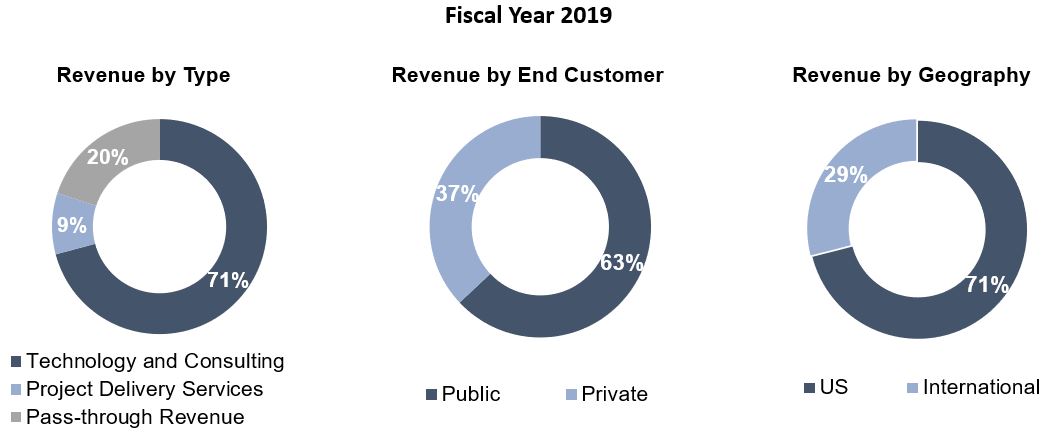
Technology and Consulting includes cybersecurity, data analytics, software application development, enterprise and mission IT, systems integration and other highly technical consulting solutions within Critical Mission Solutions (CMS) and data analytics, artificial intelligence and automation, software development as well as digitally-driven consulting, planning, architecture and program management within People & Places Solutions (PPS).
Project Delivery Services includes construction services for wind-tunnel design-build and construction services for progressive design-build for water and construction management at-risk. We believe these project delivery services are lower risk than typical lump-sum type construction contracting.
Pass-through Revenue includes PPS procurement activities and revenue where we are acting as principal for subcontract labor or third-party materials and equipment, and are consequently reflected in both revenues and costs.
Page 4
Challenging today. Reinventing tomorrow
Our values continue to guide our behaviors, relationships and outcomes - allowing us to act as one company and unify us worldwide when interacting with our clients, employees, communities and shareholders.
| • | We do things right. We always act with integrity - taking responsibility for our work, caring for our people and staying focused on safety and sustainability. We make investments in our clients, people and communities, so we can grow together. |
| • | We challenge the accepted. We know that to create a better future, we must ask the difficult questions. We always stay curious and are not afraid to try new things. |
| • | We aim higher. We do not settle - always looking beyond to raise the bar and deliver with excellence. We are committed to our clients by bringing innovative solutions that lead to profitable growth and shared success. |
| • | We live inclusion. We put people at the heart of our business. We have an unparalleled focus on inclusion, with a diverse team of visionaries, thinkers and doers. We embrace all perspectives, collaborating to make a positive impact. |
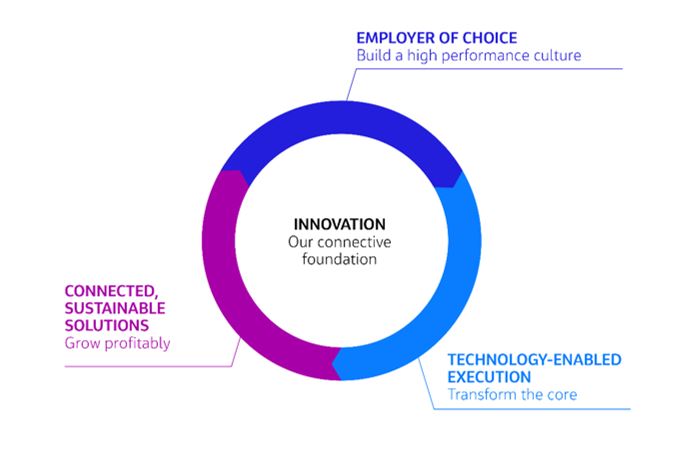
Our three-pillar strategy is based on the foundation of these values, as we drive to become the employer of choice, deliver connected and sustainable solutions, and leverage technology-enabled execution.
Page 5
We do things right
We always act with integrity - taking responsibility for our work, caring for our people and staying focused on safety and sustainability. We make investments in our clients, people and communities, so we can grow together.
From the way we operate our business, to the work we perform with clients and other organizations, we continue to look at ways we can make a positive environmental, societal and economic difference for businesses, governments and communities around the world.
As we face some of the world’s toughest challenges, including clean water, affordable energy, connectivity, resilient environments, climate change, environmental pollution and economic growth, our people are discovering better ways to create an enduring legacy.

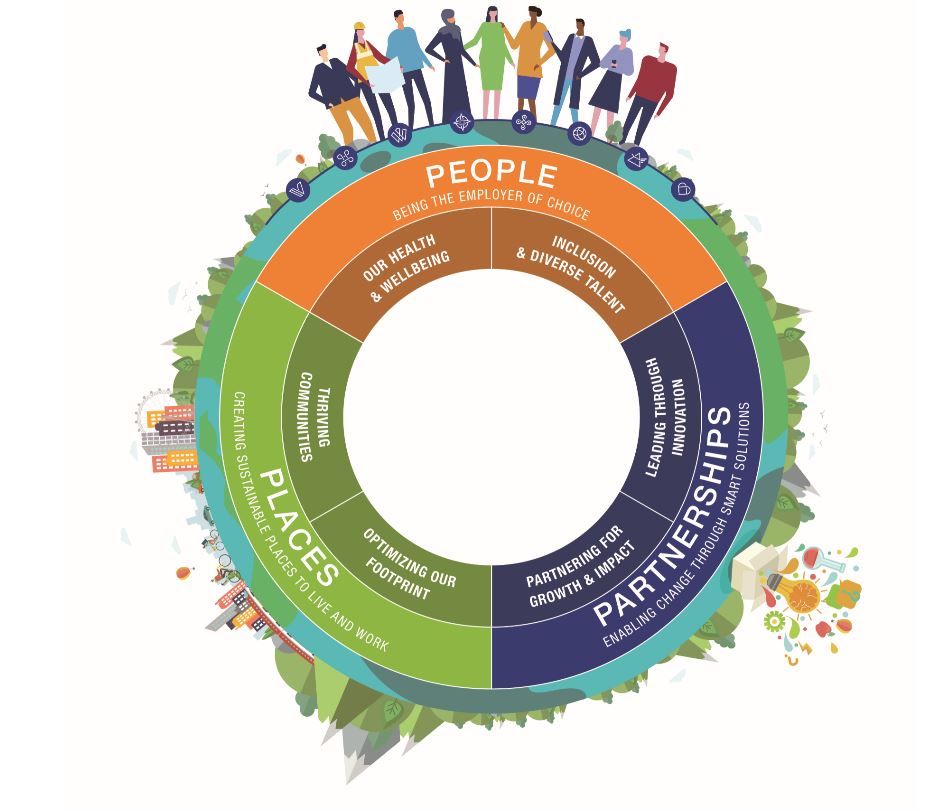
PlanBeyondSM is our approach to sustainability - planning beyond today for a more sustainable future for everyone. For us, this means social and economic progress while protecting our environment and improving resilience.
Conducting our business with integrity
Jacobs' ethics and Code of Conduct are rooted in our values and provide the standards and support to help us successfully navigate issues, make the right decisions and conduct our business with the integrity that reflects our heritage and ethical reputation.
Our culture of caring
Every day, our people step into offices and onto job sites ready for another day's work. Our BeyondZero® culture of caring goes beyond taking health and safety statistics to zero, so that genuine care and respect for all people is fundamental to our culture and reaches beyond our workplace. We work together to create a workplace that values the safety, positive mental health and sense of belonging of all employees.
Through our mental health matters program, we furthered our industry-leading efforts to empower our workforce, so they know they work in an environment where their mental health and well-being is the top priority and where everyone can ‘bring their whole self to work’. We have more than 1,600 Positive Mental Health Champions trained in how to guide staff who have mental health concerns or crises to the appropriate level of help; support fellow employees; and help us encourage positive mental health throughout the workplace.
We live and play in the communities where we work - so we’re personally invested in doing what is right for people in the places and communities we’re connected with. We craft solutions that affect the way people live. Thinking beyond one-dimensional solutions to help improve social, environmental and economic resiliency. We provide infrastructure, technology and intelligence solutions to help communities build resiliency today for a better tomorrow.
We’re also helping to inspire the education and career decisions of future generations. Our global science, technology, engineering and mathematics (STEM) Ambassador network activities help us build partnerships with schools and other educational organizations and form lasting relationships that inspire the next generation and sustain our business.
Page 6
We challenge the accepted
We know that to create a better future, we must ask the difficult questions. We always stay curious and are not afraid to try new things.
What we do is more than a job, we work every day to make the world better for all. To us, everything we do - whether water scarcity, aging infrastructure, access to life-saving therapies or sophisticated cyberattacks - is more than projects outlined in proposals and business plans. They’re our challenges as human beings, too.
Transforming our innovation culture
In the past year, we established five innovation hubs - geospatial science, cybersecurity, automated design, Internet of Things (including 5G and edge computing) and predictive data analytics (including artificial intelligence and machine learning) to fuel more complete, higher-value solutions to address today’s most-pressing issues and the bigger challenges of tomorrow.
But, we’re not stopping there. In the coming year, we’ll continue engaging in emerging technologies like blockchain, additive construction and quantum computing via other means, so that when those technologies mature, Jacobs is positioned to apply them to our projects to redefine what’s possible.
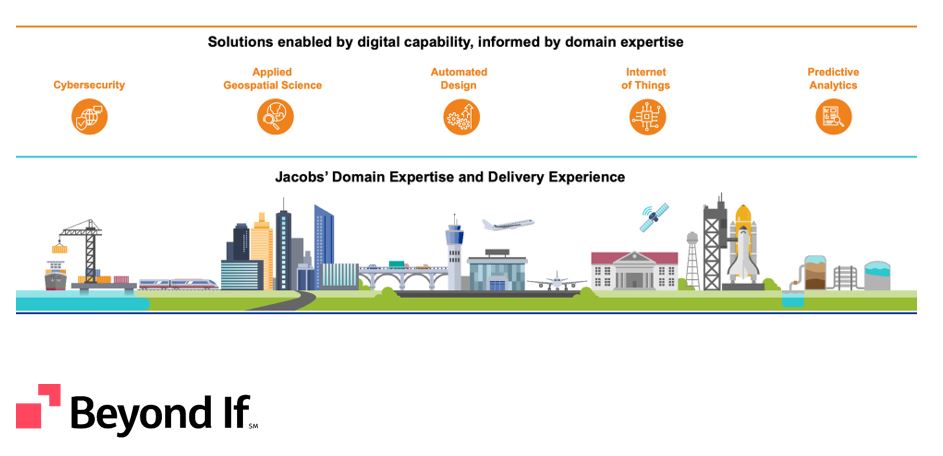
Beyond If is our global innovation program. It represents our creativity and agility to challenge the accepted, with the domain expertise to push beyond our boundaries and deliver for today and into tomorrow.
Page 7
We aim higher
We do not settle - always looking beyond to raise the bar and deliver with excellence. We are committed to our clients by bringing innovative solutions that lead to profitable growth and shared success.
We craft solutions that affect the way people live. From accelerating the next generation of innovators to the world’s first ultra-low emission zone, from helping communities recover to monitoring water quality to protect public health, we solve for better, never losing sight of our responsibility to each other. We work with NASA scientists to leverage remotely-sensed data and images shot from 240 miles overhead on the International Space Station to provide critical disaster response aid, and help communities recover. And, we’re on the ground assisting with critical Federal Emergency Management Agency (FEMA) disaster-related operations throughout the U.S. and its territories.
The table below highlights examples of our key focus areas where we combine our deep domain knowledge with the latest advances in technology to deliver solutions to solve our customer's most complex challenges.
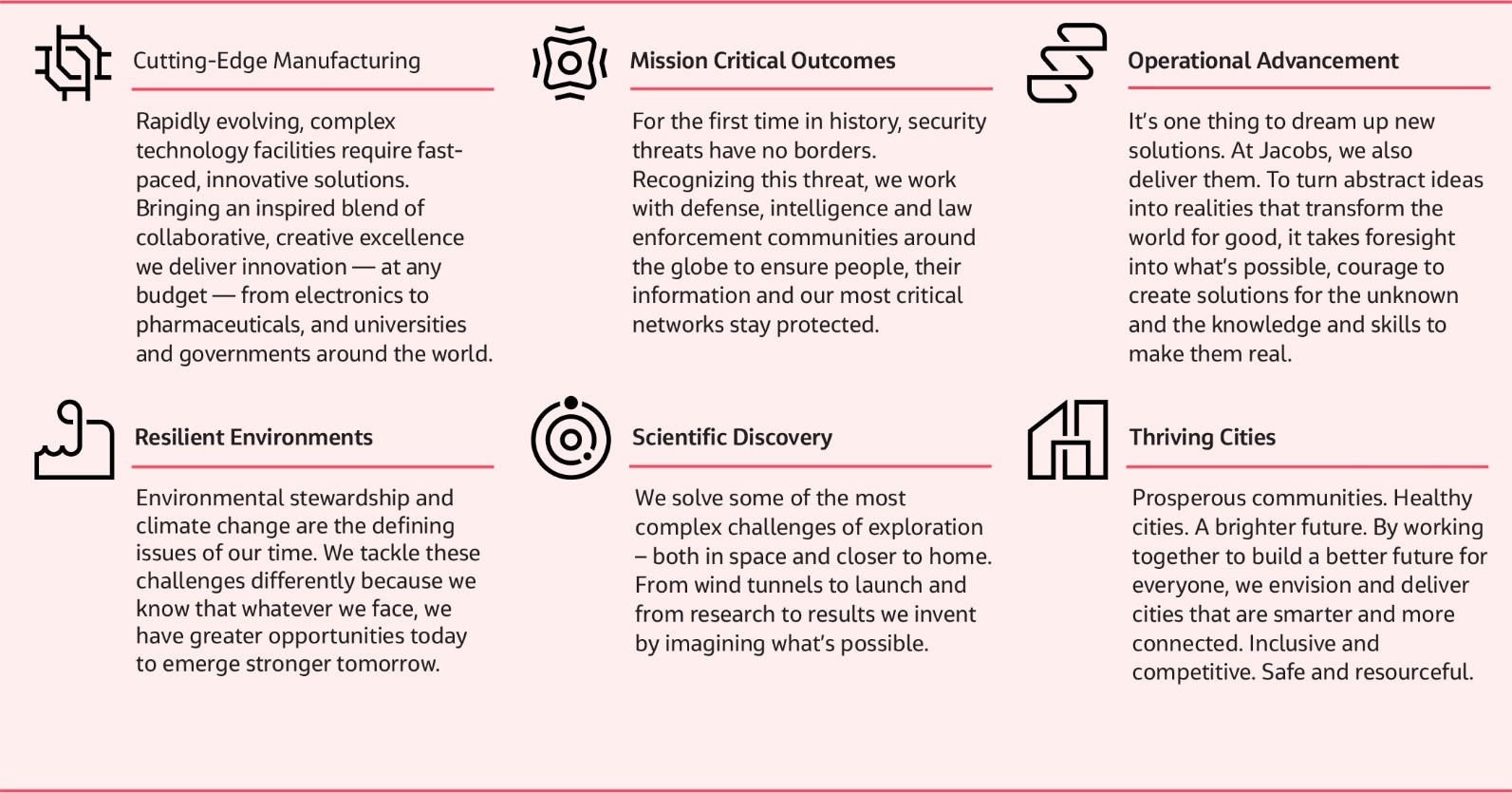

BeyondExcellence is our global program focused on quality, performance excellence and recognizing those who set the new standard through our awards program.
Page 8
We live inclusion
We put people at the heart of our business. We have an unparalleled focus on inclusion, with a diverse team of visionaries, thinkers and doers. We embrace all perspectives, collaborating to make a positive impact.
The aperture of inclusion is broader than lifestyle and culture. Joining, belonging and thriving - these are Jacobs’ key elements in retaining talent and developing a culture where people want to stay - a place where you can bring your whole self to work. Fiscal 2019 brought a lot of change for our people - a talent force of approximately 52,000 - and we doubled down on making sure talent, inclusion and diversity remained at the top of our priorities by focusing on the employee experience during our portfolio transformation.
We put the spotlight on ensuring that Jacobs is an employer of choice in every way: we aspire to be a merit-based organization that is inclusive and diverse; we take on the responsibility to continually recruit and develop the best talent; and we continue to foster leadership and innovation. Jacobs launched Conscious Inclusion training for all employees and trained 74% to date. Additionally, more than 16,500 Jacobs' employees are involved in our eight employee networks as of the end of fiscal 2019.


TogetherBeyond is our approach to living inclusion every day and enabling diversity and equality globally. For us, this means creating a culture of belonging where we all thrive and embracing all perspectives.
Page 9
We maintain agile and disciplined capital deployment
Consistent with our profitable growth strategy, Jacobs pursues acquisitions, divestitures and other transactions to maximize long-term value by continuing to reshape its portfolio to higher value solutions.
On April 26, 2019, Jacobs completed the sale of its Energy, Chemicals and Resources ("ECR") business to Worley Limited, a company incorporated in Australia ("Worley"), for a purchase price of $3.4 billion consisting of (i) $2.8 billion in cash plus (ii) 58.2 million ordinary shares of Worley, subject to adjustments for changes in working capital and certain other items (the “ECR sale”). ECR provided engineering and construction services mainly for energy, chemicals and resources sectors. With the sale of ECR, the Company has exited direct hire construction and fixed price lump sum energy related construction.
The Company has deployed capital to accelerate its profitable growth strategy through the following recent acquisitions:
| • | On June 12, 2019, we acquired The KeyW Holding Corporation (“KeyW”), a U.S. based national security technology solutions provider to the intelligence, cyber, and counterterrorism communities |
| • | On December 15, 2017, we acquired CH2M HILL Companies, Ltd ("CH2M"), a provider of consulting and other services in the water, environmental, transportation and nuclear remediation sectors. |
| • | On August 31, 2017, we acquired Blue Canopy, LLC a provider of data analytics, cybersecurity and application development solutions. |
| • | On January 27, 2017, we acquired Aquenta Consulting Pty Ltd. (“Aquenta”). Aquenta provides integrated consulting services for infrastructure related sectors. |
On August 20, 2019, Jacobs announced the entry into an agreement to acquire John Wood Group's Nuclear consulting, remediation and program management business for an enterprise value of £250 million (approx. $300 million) on a debt-free, cash-free basis. The transaction is expected to close by the end of fiscal 2020 second quarter.
During fiscal 2019 the Company repurchased $853.7 million of shares and paid $106.4 million in dividends to shareholders and noncontrolling interests.
For additional information regarding certain issues related to our acquisition strategy, please refer to Item 1A- Risk Factors below.
Page 10
Lines of Business
The services we provide fall into the following two lines of business (LOB): Critical Mission Solutions (CMS) and People & Places Solutions (PPS) which are also the Company’s reportable segments. For additional information regarding our segments, including information about our financial results by segment and financial results by geography, see Note 19 - Segment Information of Notes to Consolidated Financial Statements beginning on page F-1 of this Annual Report on Form 10-K.
Critical Mission Solutions (CMS)
Our Critical Mission Solutions line of business provides a full spectrum of cybersecurity, data analytics, software application development, enterprise and mission IT, systems integration and other highly technical consulting solutions to government agencies as well as selective aerospace, automotive and telecom customers. Our representative clients include the U.S. Department of Defense (DoD), the U.S. Special Operations Command (USSOCOM), the U.S. Intelligence Community, NASA, the U.S. Department of Energy (DoE), Ministry of Defence in the U.K., the U.K. Nuclear Decommissioning Authority (NDA), and the Australian Department of Defence, as well as private sector customers mainly in the automotive and telecom sectors.
Serving mission-critical end markets
Critical Mission Solutions serves broad sectors, including U.S. government services, cybersecurity, nuclear, commercial, and international sectors.

The U.S. government is the world’s largest buyer of technical services, and in fiscal 2019, approximately 77% of CMS’s revenue was earned from serving the DoD, Intelligence Community and civil governmental entities.
Trends affecting our government clients include electronic and cyber warfare, IT modernization, space exploration and intelligence, defense systems and intelligent asset management, which are driving demand for our highly technical solutions. Attacks by foreign entities and insider threats highlight potential cyber defense vulnerabilities.
Another trend we are witnessing is an increase in the capabilities of unmanned aircraft and hypersonic weapons, which is impacting both offensive and defensive spending priorities among our clients and is a driver for next generation solutions such as C5ISR (command, control, communications, computer, combat systems, intelligence, surveillance and reconnaissance) and advanced aeronautical testing, respectively. We are also seeing an increase in space exploration initiatives both from the U.S. government, such as NASA’s Artemis program to return to the moon in 2024, as well as the commercial sector.
Within the Nuclear sector, our customers have decades-long initiatives to manage, upgrade, decommission and remediate existing nuclear weapons and energy infrastructure.
Page 11
Leveraging our base market of offering valued technical services to U.S. government customers, CMS also serves commercial and international markets. In fiscal 2019, approximately 12% of CMS’s revenue was from various U.S. commercial sectors, including the telecommunications market, which anticipates a large cellular infrastructure build-out from 4G to 5G technology. And like our government facility-based clients, our commercial manufacturing clients are seeking ways to reduce maintenance costs and optimize their facilities with network connected facilities and equipment to optimize operational systems, which we refer to as Intelligent Asset Management.
Our international customers, which accounted for 11% of fiscal 2019 revenue, have also increased demand for our IT and cybersecurity solutions and nuclear projects, and the U.K. Ministry of Defence continues to focus on accelerating its strategic innovative and technology focused initiatives.
Leveraging strong domain expertise to deliver solutions
CMS brings domain-specific capability and cross-market innovations in each of the above sectors by leveraging six core capability groups.
| • | Information Technology Services. Across various business units in CMS, we provide a wide range of software development and enterprise IT solutions. We develop, modify and maintain software solutions and complex systems. This service includes a broad array of lifecycle services, including requirements analysis, design, integration, testing, maintenance, quality assurance and documentation management. Our software activities support all major methodologies, including Agile, DevSecOps and other hybrid methodologies. For our enterprise IT capability, we develop, implement and sustain enterprise information technology systems, with a focus on improving mission performance, increasing security and reducing cost for our customers. Solutions typically include IT service management, data center consolidation, network operations, enterprise architecture, mobile computing, cloud computing and migration, software, infrastructure and platform as a service (SaaS, IaaS and PaaS), and data collection and analytics. |
| • | Cybersecurity and Data Analytics. With our recent acquisition of KeyW, CMS offers a full suite of cyber services for its government and commercial clients, including defensive cyber operations and training, offensive cyber operations, cloud and data analytics, threat intelligence, intelligence analysis, incident response and forensics, software and infrastructure security engineering, computer forensics and exploitation and information technology-operational technology (IT-OT) convergence services. |
| • | C5ISR (Command, Control, Communications, Computers, Combat Systems, Intelligence, Surveillance and Reconnaissance). CMS is a leader in the design, development, analysis, implementation and support of C5ISR systems and technology in any environment, including land, sea, air, space and cyber domains. We provide advanced solutions for collecting, processing, exploiting and disseminating geospatial intelligence for the U.S. and Allied Intelligence Communities and Special Forces organizations. Core capabilities include: imaging systems, radar systems, precision geo-location products, custom packaging and microelectronics and customizable tagging, tracking and locating devices. |
| • | Technical Services. We provide a broad range of technical consulting services to our government and commercial clients, including: systems integration, specialized propulsion, avionics, electrical, materials, aerodynamics, manufacturing processes modeling and simulation, testing and evaluation, scientific research, intelligent asset management, program management and consulting. NASA is one our major government customers in the U.S., where we provide a wide range of technology services. For our telecommunications customers, we provide permitting, site planning and engineering to enable the development of wireline and wireless communications including the development of 5G small cell sites. |
| • | Facility Engineering and Operations. We provide services for advanced technical structures and systems, including flight/launch facilities, R&D facilities, test facilities and military range facilities. Customers also engage us to operate, maintain and provide technical services for these facilities and systems over their lives. We also provide sustainment and technical services for facility-oriented clients including for the automotive industry where we provide highly technical aerodynamic, climatic, altitude and acoustic solutions for our customer research and development operations. |
| • | Nuclear Solutions. We provide support across the nuclear energy life-cycle, including operational site management, program management and research and consulting, mainly to the U.S. Department of Energy (DoE) and the Office for Nuclear Regulation (“ONR”) and NDA with the U.K. government. |
Page 12
Applying internally-developed technology
Across multiple businesses within CMS we license internally developed technology such as:
| • | KeyRadar®: The acquisition of KeyW brought numerous internally developed technologies, including KeyRadar, a scalable, software-defined synthetic aperture radar that can be configured to address a variety of missions, ranging from foliage penetration to long-range maritime domain awareness or long-range moving target detection. |
| • | Ginkgo: Ginkgo is the only virtual learning environment specifically created for cybersecurity training. Designed by experienced cybersecurity instructors at CMS’s Parrot Labs, Ginkgo offers a complete solution for implementing hands-on IT and cybersecurity training for both local and distance learning environments on desktops, tablets, and other mobile devices. |
| • | TITAN****TM: With the exponential growth of information being harvested, deriving meaningful insights from data collecting can be challenging for organizations. TITAN is a suite of solutions (including Graph Database, Elastic Stack, and SocTraq) that leverages open-source technology to filter out noise to find the real needle in the haystack of threats, offering real-time detection and alerting capabilities for high-value asset and mission critical systems. |
| • | SOCTRAQ: SOCTRAQ is a next-generation component of the larger TITAN cyber data platform that aids our federal clients in the automation of cybersecurity found in a security operations center (SOC). The technology is a real-time threat detection and alerting heads-up display run on a client’s computer to provide incident detection, recommended response actions, and case management. Features include alert visualization, depiction of threat-chain, and adaptive machine learning. |
Page 13
People & Places Solutions (PPS)
Jacobs' People & Places Solutions line of business provides end-to-end solutions for our clients’ most complex projects - whether connected mobility, water, smart cities, advanced manufacturing or the environment. In doing so, we employ data analytics, artificial intelligence and automation, and software development to enable technology and digitally-driven consulting, planning, architecture, engineering, and implementation, as well as long-term operation of advanced facilities and infrastructure. Solutions may be delivered as standalone engagements or through comprehensive program management solutions that integrate disparate workstreams to yield additional benefits not attainable through project-by-project implementation.
Our clients include national, state and local government in the U.S., Europe, U.K., Middle East, Australia, New Zealand and Asia, as well as the private sector throughout the world.
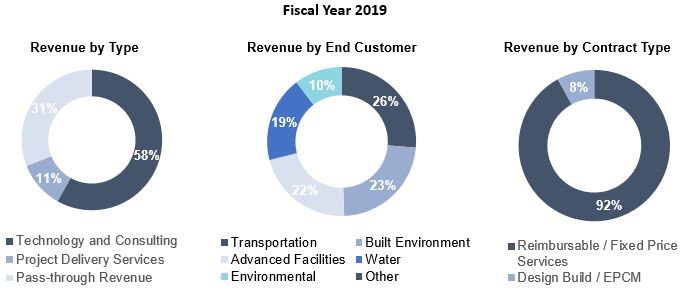
Serving broad industry sectors that support people and places
Environmental resilience, urbanization, digital transformation and the convergence of information and operational technology (IT/OT) are driving new infrastructure requirements and opportunities for our clients. For example, an airport is no longer simply aviation infrastructure but is now a smart city with extensive operational, cybersecurity and autonomous mobility requirements. Master planning for a city now requires advanced analytics to plan for the adaptation of next-generation mobility as well as revenue generating fiber infrastructure. Furthermore, the future of nearly all water infrastructure will be highly technology-enabled, leveraging solutions with digital twins, predictive analytics and smart metering technology.
This increase in technology requirements is a key factor in our organic growth strategy as well as our recent acquisitions and divestitures. Moreover, our business model is evolving to now being a provider of digitally-enabled solutions to our infrastructure clients with less exposure to craft construction services. Our focus on five core sectors of Transportation, Water, Built Environment, Environmental and Advanced Facilities provides us with the unique opportunity to leverage expertise across all sectors to provide end-to-end connected solutions for our client’s most complex projects.
We are executing complex city solutions that pull expertise from all markets, fused with digital expertise, for major developments in places like London, Dubai, Sydney, India and the United States.
Leveraging global platform to deliver integrated solutions to our customers
One of our key differentiators is our global integrated delivery model, which harnesses deep domain expertise from our global technology and solution organization that is leveraged with the benefits of scale when we focus the world’s best talent to deliver differentiated solutions and value to our clients.
| • | Within transportation, we provide sustainable solutions to plan, develop, finance, design and engineer, construct, operate and maintain, next generation mobility across all modes, including highway, bridge, rail and transit, aviation, port and maritime infrastructure. For example, we do this by |
Page 14
assessing the impact of autonomous vehicles on roadways and cities for transportation agencies, engineering and specifying vehicles for mass-transit, consulting services for digital fare payment systems, program management of the largest airport developments, designing cutting edge automated container terminals and ports infrastructure and utilizing digital data to develop cross modal mobility solutions. Our customers include the world’s largest transportation agencies as well as private shipping and logistics companies worldwide, including the multi-modal Port Authority of New York and New Jersey, Transport for London, and Etihad Rail.
| • | Water is one of the most precious resources in the world, and extreme weather events are exacerbating supply and demand issues with drought, desertification and flooding at the same time population growth and industrialization are increasing demands. We provide solutions across water and wastewater treatment, water reuse, and water resources such as the deployment of next generation smart metering, digital twin technology and highly technical consulting, engineering, design-build and operation of complex water systems. We support our customers on some of the world’s largest water infrastructure projects such as California WaterFix, Thames Tideway, Houston Water and Singapore National Water Agency. |
| • | For the built environment, we deliver full-service solutions for cities, places and buildings, including smart-city and resiliency city solutions. This also includes consulting, engineering and design services for transportation hubs in Boston and London, urban developments, corporate, national government, healthcare, education, science facilities for public sector and industrial clients across diverse markets and services. Our solutions include multi-functional infrastructure that addresses economic, social and environmental issues spanning a range of sectors, technology and industries. We also provide consulting around technology-enabled asset management, economic development and scientific advancement that enables our clients to make intelligent data-driven investment decisions. |
| • | In our environmental business we provide all aspects of environmental planning, permitting, regulatory and compliance management, and consulting services related to remediation, revitalization and redevelopment. We also provide critical consulting and technology related services to clients responsible for disaster planning, mitigation and response as well as logistics, planning and implementation support for leading edge scientific and research endeavors. We recently provided a large confidential U.S. customer with data analytics and visualization solutions to deliver actionable intelligence to help them understand and prioritize their approach to polyfluoroalkyl substances (PFAS) remediation. |
| • | In our advanced facilities business, we provide fully integrated solutions for highly specialized facilities in the fields of medical research, sustainable manufacturing, nanoscience, biotechnology, semiconductor and data centers. Our services also include implementation of operational environments and providing cybersecurity assessments, network architecture development and construction management for their operational environments. Our clients include life sciences and pharmaceutical, specialty manufacturing, microelectronics and data intensive industries. |
In addition to each of the industry sectors that we serve, we deploy solutions to the world’s most complex projects and major programs that span across all markets, such as the London 2012 Olympic and Paralympic Games, the Dubai Expo, and LaGuardia Airport Redevelopment.
Applying internally developed technology
A strong foundation of data-rich innovative solutions is woven into every project that we deliver. These solutions employ an array of technical expertise to enable the most efficient, effective and predictable solutions for our customers, such as our proprietary technology software. Examples of these technologies include:
| • | TrackRecord is a workflow automation and compliance management platform for the delivery of major projects. |
| • | AquaDNA is a wastewater asset management platform that lowers operation and maintenance costs and facilitates a move from reactive to proactive maintenance. |
| • | Travel Service Optimisation (TSO) is Jacobs' travel sharing solution for Special Education needs children which centers on the children’s ability to travel together rather than focusing on their disability. |
| • | SafetyWeb is a site hazard management and compliance tool. |
| • | ProjectMapper is a web based geospatial mapping and project visualization software platform. |
Page 15
| • | Flood Modeller provides proactive decision-making to help manage our environment and the challenges associated with flood risk. It is suitable for a wide range of engineering and environmental applications, from calculating simple backwater profiles to modeling entire catchments to mapping potential flood risk for entire countries. |
| • | Replica™ is Jacobs’ digital twin solution software platform and consists of the following capabilities: |
Replica Parametric Design™ (formerly CPES™) provides outputs on construction quantities and costs, life cycle quantities and costs, and estimates of environmental impacts. Rapid process design in Replica Process and the resulting development of the Replica Parametric Designs allows for thorough alternatives analysis and enhanced team communication.
Replica Preview™ is used for early stage visualization of facility designs. This software rapidly creates scaled three-dimensional designs, which can be placed on Google Earth®. Rapid design development in Replica Parametric Design and visualization with Replica Preview allows for informed analysis of many alternatives and sound decision-making.
Replica Systems Analysis™ (formerly Voyage™) is a very flexible platform that can simulate resource systems dynamically, over time. Examples of modeled systems include water resources, energy, solid waste and traffic. The ability to connect complex systems together in a single interface that is visually intuitive leads to informed team collaboration and creative solutions.
Replica Process™ allows Jacobs' world-renowned expertise in water treatment to be simulated both statically and dynamically over time in Replica Process™ software. Much of the process predictive capabilities in Replica Process are founded on the Jacobs' Pro2D2™ and Source™ software. Informed decisions are founded on the ability of Replica Process to provide details on system performance among many alternatives, very quickly.
Replica Hydraulics™ was designed to simulate all pressurized and gravity flow hydraulics of a system, simultaneously. Replica’s hydraulic blocks were built on accepted engineering practice equations and have been successfully verified on hundreds of projects. The Replica Hydraulics library is the foundation for complete, dynamic water system analysis and can be used exclusively for hydraulic analysis of a system or in conjunction with Replica Process, Replica Controls and/or Replica Air.
Replica Controls™ allows for dynamic simulation of system instrumentation such as flow meters, indicator transmitters, limit switches and stream analyzers as well as the logic objects including PID controllers, sequencers, units controller and alarms. The software's controls capabilities and functionality align with industry design standards and its ability to predict full scale performance is unmatched due to the connectivity with Replica Hydraulics.
Replica Air™ simulates all aspects of compressible fluid (e.g. air) supply system including pipes, valves, diffusers and blowers. The ability to couple Replica Air with Replica Controls in a single simulation allows for the development of unique and robust designs that reduce energy use and life cycle costs.
Page 16
Energy, Chemicals and Resources (ECR)
ECR Disposition
On April 26, 2019, Jacobs completed the sale of its Energy, Chemicals and Resources (ECR) business to Worley Limited, a company incorporated in Australia (Worley), for a purchase price of $3.4 billion consisting of (i) $2.8 billion in cash plus (ii) 58.2 million ordinary shares of Worley, subject to adjustments for changes in working capital and certain other items (the ECR sale).
As a result of the ECR sale, substantially all ECR-related assets and liabilities have been sold (the "Disposal Group"). We determined that the disposal group should be reported as discontinued operations in accordance with ASC 210-05, Discontinued Operations because their disposal represents a strategic shift that had a major effect on our operations and financial results. As such, the financial results of the ECR business are reflected in our non-current assets and liabilities of the Disposal Group are reflected as held-for-sale in the Consolidated Balance Sheet as of September 28, 2018. Further, as of the year ended September 27, 2019, a portion of the ECR business remains held by Jacobs as described above and continues to be classified as held for sale for the year ended September 27, 2019 in accordance with U.S. GAAP. For further discussion see Note 7- Sale of Energy, Chemicals and Resources ("ECR") Business to the consolidated financial statements.
Prior to the sale, the ECR business served the energy, chemicals and resources sectors, including upstream, midstream and downstream oil, gas, refining, chemicals and mining and minerals industries. The ECR business provided integrated delivery of complex projects for our Oil and Gas, Refining, and Petrochemicals clients. Bridging the upstream, midstream and downstream industries, ECR's services encompassed consulting, engineering, procurement, construction, maintenance and project management.
Significant Customers
The following table sets forth the percentage of total revenues earned directly or indirectly from agencies of the U.S. federal government for each of the last three fiscal years:
| 2019 | 2018 | 2017 | ||
| 27% | 32% | 30% |
Given the percentage of total revenue derived directly from the U.S. federal government, the loss of U.S. federal government agencies as customers would have a material adverse effect on the Company. In addition, any or all of our government contracts could be terminated, we could be suspended or debarred from all government contract work, or payment of our costs could be disallowed. Approximately 71% of revenue derived directly from the U.S. federal government is in the CMS segment. For more information on risks relating to our government contracts, see Item 1A - Risk Factors.
Financial Information About Geographic Areas
Selected financial information regarding the geographic areas in which we operate is included in Note 19 - Segment Information of Notes to Consolidated Financial Statements beginning on page F-1 of this Annual Report on Form 10-K and is incorporated herein by reference. For fiscal 2019, approximately 29% of our revenues were earned from clients outside the United States. Our international operations are subject to a variety of risks, which are described under Item 1A - Risk Factors below.
Contracts
While there is considerable variation in the pricing provisions of the contracts we undertake, our contracts generally fall into two broad categories: cost-reimbursable and fixed-price. The following table sets forth the percentages of total revenues represented by these types of contracts for each of the last three fiscal years:
| 2019 | 2018 | 2017 | |||
| Cost-reimbursable | 76% | 74% | 76% | ||
| Fixed-price | 24% | 26% | 24% |
Page 17
In accordance with industry practice, most of our contracts (including those with the U.S. federal government) are subject to termination at the discretion of the client, which is discussed in greater detail in Item 1A - Risk Factors. In such situations, our contracts typically provide for reimbursement of costs incurred and payment of fees earned through the date of termination.
Cost-Reimbursable Contracts
Cost-reimbursable contracts generally provide for reimbursement of costs incurred plus an amount of profit. The profit element may be in the form of a simple mark-up applied to the labor costs incurred or it may be in the form of a fee, or a combination of a mark-up and a fee. The fee element can also take several forms. The fee may be a fixed amount; it may be an amount based on a percentage of the costs incurred; or it may be an incentive fee based on targets, milestones, or performance factors defined in the contract.
Fixed-Price Contracts
Fixed-price contracts include both “lump sum bid” contracts and “negotiated fixed-price” contracts. Under lump sum bid contracts, we typically bid against competitors based on client-furnished specifications. This type of pricing presents certain inherent risks, including the possibility of ambiguities in the specifications received, problems with new technologies, and economic and other changes that may occur over the contract period. Additionally, it is not unusual for lump sum bid contracts to lead to an adversarial relationship with clients, which is contrary to our relationship-based business model. Accordingly, lump sum bid contracts are not our preferred form of contract. In contrast, under a negotiated fixed-price contract, we are selected as the contractor first and then we negotiate a price with our client. Negotiated fixed-price contracts frequently exist in single-responsibility arrangements where we perform some portion of the work before negotiating the total price of the project. Thus, although both types of contracts involve a firm price for the client, the lump sum bid contract provides the greater degree of risk to us in our services contracts as well as construction. However, because of economies that may be realized during the contract term, both negotiated fixed-price and lump sum bid contracts may offer greater profit potential than other types of contracts. The Company carefully manages the risk inherent in these types of contracts. In recent years, most of our fixed-price work has been either negotiated fixed-price contracts or lump sum bid contracts for design and/or project services, rather than turnkey construction.
Competition
We compete with a large number of companies across the world including technology consulting, federal IT services, aerospace, defense and engineering firms. Typically, no single company or companies dominate the markets in which we provide services and in many cases we partner with our competitors or other companies to jointly pursue projects. AECOM, Booz Allen, CACI, KBR, Leidos, Parsons, SAIC, General Dynamics and Northrop Grumman are some of our competitors. We compete based on the following factors, among others: technical capabilities, reputation for quality, price of services, safety record, availability of qualified personnel, and ability to timely perform work and contract terms.
Employees
At September 27, 2019, we had approximately 48,000 full-time, staff employees (including contract staff). Additionally, as of September 27, 2019, there were approximately 4,000 persons employed in the field on a project basis. The number of field employees varies in relation to the number and size of the maintenance and construction projects in progress at any particular time.
Executive Officers of the Registrant
The information required by Paragraph (a), and Paragraphs (c) through (g) of Item 401 of Regulation S-K (except for information required by Paragraph (e) of that Item to the extent the required information pertains to our executive officers) and Item 405 of Regulation S-K is set forth under the captions “Members of the Board of Directors” and “Section 16(a) Beneficial Ownership Reporting Compliance” in our definitive proxy statement to be filed with the SEC pursuant to Regulation 14A within 120 days after the close of our fiscal year and is incorporated herein by reference.
The following table presents the information required by Paragraph (b) of Item 401 of Regulation S-K.
Page 18
| Name | Age | Position with the Company | Year Joined the Company | ||||
| Steven J. Demetriou | 61 | Chair and Chief Executive Officer | 2015 | ||||
| Kevin C. Berryman | 60 | Executive Vice President and Chief Financial Officer | 2014 | ||||
| Dawne S. Hickton | 62 | Executive Vice President, Chief Operating Officer and President, Critical Mission Solutions | 2019 | ||||
| Robert V. Pragada | 51 | Executive Vice President, Chief Operating Officer and President, People & Places Solutions | 2016 | ||||
| Joanne E. Caruso | 59 | Executive Vice President, Chief Legal and Administration Officer | 2012 | ||||
| William B. Allen, Jr. | 55 | Senior Vice President and Chief Accounting Officer | 2016 | ||||
| Michael R. Tyler | 63 | Senior Vice President, General Counsel, Corporate Secretary and Chief Compliance Officer | 2013 |
All of the officers listed in the preceding table serve in their respective capacities at the pleasure of the Board of Directors of the Company.
Mr. Demetriou joined the Company in August 2015. Mr. Demetriou served as Chairman and CEO of Aleris Corporation for 14 years, a global downstream aluminum producer based in Cleveland, Ohio. Over the course of his career, he has gained broad experience with companies in a range of industries including metals, specialty chemicals, oil & gas, manufacturing and fertilizers.
Mr. Berryman joined the Company in December 2014. Mr. Berryman served as EVP and CFO for five years at International Flavors and Fragrances Inc., an S&P 500 company and leading global creator of flavors and fragrances used in a wide variety of consumer products. Prior to that, he spent 25 years at Nestlé in a number of finance roles including treasury, mergers & acquisitions, strategic planning and control.
Ms. Hickton joined the Company as Chief Operating Officer and President of Critical Mission Solutions in 2019. Prior to this role, Ms. Hickton served as a member of the Board of Directors of the Company and was previously the Vice Chair and Chief Executive Officer for eight years at RTI International Metals, Inc., a global supplier of advanced titanium products and services in commercial aerospace, defense, propulsion, medical device and energy markets.
Mr. Pragada rejoined the Company in February 2016 after serving as President and Chief Executive Officer of The Brock Group since August 2014. From March 2006 to August 2014 Mr. Pragada served in executive and senior leadership capacities with the Company.
Ms. Caruso joined the Company in 2012. Prior to becoming Chief Legal and Administration Officer, Ms. Caruso was Senior Vice President of Human Resources and previously Senior Vice President, Global Litigation. Prior to joining the Company, Ms. Caruso was a partner in two international law firms, Howrey LLP and Baker & Hostetler LLP.
Mr. Allen joined the Company in October 2016. Mr. Allen served as Vice President, Finance and Principal Accounting Officer at Lyondellbasell Industries, N.V. from 2013 to 2016. Prior to that, he was with Albemarle Corporation, where he served as Vice President, Corporate Controller and Chief Accounting Officer from 2009 to 2013 after serving in CFO roles for their Catalysts and Fine Chemistry businesses from 2005 to 2009.
Mr. Tyler joined the Company in June 2013. He previously served as Executive Vice President, General Counsel and Secretary of Sanmina Corporation, a global electronics manufacturing services provider from April 2007 to June 2013, and Chief Legal and Administrative Officer of Gateway, Inc., a computer hardware company, from January 2004 to April 2007.
Additional Information
Jacobs was founded in 1947 and incorporated as a Delaware corporation in 1987. We are headquartered in Dallas, Texas, USA. You may read and copy any materials we file with the SEC at the SEC’s Public Reference Room located at 100 F Street N.E., Washington, D.C. 20549. In order to obtain information about the operation of the Public Reference Room, a person may call the SEC at 1-800-732-0330. The SEC also maintains a site on the Internet that contains reports, proxy and information statements, and other information regarding issuers that file electronically with
Page 19
the SEC. The SEC’s website is http://www.sec.gov. You may also read and download the various reports we file with, or furnish to, the SEC free of charge from our website at www.jacobs.com.
Item 1A. RISK FACTORS
We operate in a changing global environment that involves numerous known and unknown risks and uncertainties that could materially adversely affect our business, financial condition and results of operations. The risks described below highlight some of the factors that have affected and could affect us in the future. We may also be affected by unknown risks or risks that we currently think are immaterial. If any such events actually occur, our business, financial condition and results of operations could be materially adversely affected.
Project sites are inherently dangerous workplaces. If we, the owner, or others working at the project site fail to maintain safe work sites, we can be exposed to significant financial losses and reputational harm, as well as civil and criminal liabilities.
Project sites often put our employees and others in close proximity with large pieces of mechanized equipment, moving vehicles, chemical and manufacturing processes and highly regulated materials, in a challenging environment and often in geographically remote locations. If we, or others working at such sites, fail to implement such procedures or if the procedures we implement are ineffective, or if others working at the site fail to implement and follow appropriate safety procedures, our employees and others may become injured, disabled or even lose their lives, the completion or commencement of our projects may be delayed and we may be exposed to litigation or investigations. Unsafe work sites also have the potential to increase employee turnover, increase the cost of a project to our clients and raise our operating and insurance costs. Any of the foregoing could result in financial losses or reputational harm, which could have a material adverse impact on our business, financial condition and results of operations.
In addition, our projects can involve the handling of hazardous and other highly regulated materials, which, if improperly handled or disposed of, could subject us to civil and/or criminal liabilities. We are also subject to regulations dealing with occupational health and safety. Although we maintain functional groups whose primary purpose is to ensure we implement effective health, safety and environmental (“HSE”) work procedures throughout our organization, including project sites and maintenance sites, the failure to comply with such regulations could subject us to liability. In addition, despite the work of our functional groups, we cannot guarantee the safety of our personnel or that there will be no damage to or loss of our work, equipment or supplies.
Our safety record is critical to our reputation. Many of our clients require that we meet certain safety criteria to be eligible to bid for contracts and many contracts provide for automatic termination or forfeiture of some or all of our contract fees or profit in the event we fail to meet certain measures. Accordingly, if we fail to maintain adequate safety standards, we could suffer reduced profitability or the loss of projects or clients, which could have a material adverse impact on our business, financial condition and results of operations.
Past and future environmental, health, and safety laws could impose significant additional costs and liabilities.
We are subject to a variety of environmental, health, and safety laws and regulations governing, among other things, discharges to air and water, the handling, storage and disposal of hazardous or waste materials and the remediation of contamination associated with the releases of hazardous substances, and human health and safety. These laws and regulations and the risk of attendant litigation can cause significant delays to a project and add significantly to its cost. Violations of these regulations could subject us and our management to civil and criminal penalties and other liabilities.
Various U.S. federal, state, local and foreign environmental laws and regulations may impose liability for property damage and costs of investigation and cleanup of hazardous or toxic substances on property currently or previously owned by us or arising out of our waste management or environmental remediation activities. These laws may impose responsibility and liability without regard to knowledge of or causation of the presence of contaminants. The liability under these laws may be joint and several. We have potential liabilities associated with our past waste management and other activities and with our current and prior ownership of various properties. The discovery of additional contaminants or the imposition of unforeseen clean-up obligations at these or other sites could have a material adverse impact on our financial condition and results of operations.
Page 20
When we perform our services, our personnel and equipment may be exposed to radioactive and hazardous materials and conditions. We may be subject to liability claims by employees, customers and third parties as a result of such exposures. In addition, we may be subject to fines, penalties or other liabilities arising under environmental or safety laws. A claim, if not covered or only partially covered by insurance, could have a material adverse impact on our results of operations and financial condition.
Health, safety, and environmental laws and regulations and policies are reviewed periodically and any changes thereto could affect us in substantial and unpredictable ways. Such changes could, for example, relax or repeal laws and regulations relating to the environment, which could result in a decline in the demand for our environmental services and, in turn, could negatively impact our revenue. Changes in the environmental laws and regulations, remediation obligations, enforcement actions, stricter interpretations of existing requirements, future discovery of contamination or claims for damages to persons, property, natural resources or the environment could result in material costs and liabilities that we currently do not anticipate. If we fail to comply with any environmental, health, or safety laws or regulations, whether actual or alleged, we could be exposed to fines, penalties or potential litigation liabilities, including costs, settlements and judgments, any of which could adversely affect our business, financial condition and results of operations.
In addition, we and many of our clients operate in highly regulated environments, which may require us or our clients to obtain, and to comply with, federal, state and local government permits and approvals. Any of these permits or approvals may be subject to denial, revocation or modification under various circumstances. Failure to obtain or comply with, or the loss or modification of, the conditions of permits or approvals may subject us to penalties or other liabilities, which could have a material adverse impact on our business, financial condition and result of operations.
Our results of operations depend on the award of new contracts and the timing of the performance of these contracts.
Our revenues are derived from new contract awards. Delays in the timing of the awards or cancellations of such projects as a result of economic conditions, material and equipment pricing and availability or other factors could impact our long-term projected results. It is particularly difficult to predict whether or when we will receive large-scale projects as these contracts frequently involve a lengthy and complex bidding and selection process, which is affected by a number of factors, such as market conditions or governmental and environmental approvals. Since a significant portion of our revenues is generated from such projects, our results of operations and cash flows can fluctuate significantly from quarter to quarter depending on the timing of our contract awards and the commencement or progress of work under awarded contracts. Furthermore, many of these contracts are subject to financing contingencies and, as a
Showing the first 8K of 94K characters. Open the full section
Item 1B. UNRESOLVED STAFF COMMENTS
None.
Item 2. PROPERTIES
Our properties consist primarily of office space within general, commercial office buildings located in major cities primarily in the following countries: United States; Armenia; Australia; Canada; China; Egypt; France; Germany; Greenland; Hong Kong; India; Indonesia; Ireland; Italy; Kazakhstan; Korea (Republic of); Malaysia; The Netherlands; New Zealand; The Philippines; Poland; Qatar; Romania; Saudi Arabia; Singapore; Sweden; Switzerland; Taiwan (Province of China); Thailand; United Arab Emirates; United Kingdom and Vietnam. We also lease smaller offices located in certain other countries. Such space is used for operations (providing technical, professional, and other home office services), sales and administration. The total amount of space used by us for all of our operations is approximately 7.1 million square feet.
Item 3. LEGAL PROCEEDINGS
Page 38
The information required by this Item 3 is included in Note 17 — Contractual Guarantees, Litigation, Investigations and Insurance of Notes to Consolidated Financial Statements beginning on page F-1 of this Annual Report on Form 10-K and is incorporated herein by reference.
Item 4. MINE SAFETY DISCLOSURE
Section 1503 of the Dodd-Frank Wall Street Reform and Consumer Protection Act (the “Dodd-Frank Act”) requires domestic mine operators to disclose violations and orders issued under the Federal Mine Safety and Health Act of 1977 (the “Mine Act”) by the federal Mine Safety and Health Administration. Under the Mine Act, an independent contractor that performs services or construction of a mine is included within the definition of a mining operator. Although Jacobs no longer performs services or construction of mines due to the sale of ECR, during the prior periods presented within, the Company did perform such services from time to time prior to the sale of ECR. We do not act as the owner of any mines.
Information concerning mine safety violations or other regulatory matters required by Section 1503(a) of the Dodd-Frank Act and Item 104 of Regulation S-K is included in Exhibit 95.
Page 39
PART II
Item 5. MARKET FOR REGISTRANT'S COMMON EQUITY, RELATED STOCKHOLDER MATTERS AND ISSUER PURCHASES OF EQUITY SECURITIES
Market Information
Jacobs’ common stock is listed on the NYSE and trades under the symbol JEC. Beginning on December 10, 2019 Jacobs' common stock will trade on the NYSE under the symbol J. We provided to the NYSE, without qualification, the required annual certification of our Chief Executive Officer regarding compliance with the NYSE’s corporate governance listing standards. The following table sets forth the low and high sales prices of a share of our common stock during each of the fiscal quarters presented, based on the NYSE Composite Price History:
| Low Sales Price | High Sales Price | |||||||
| Fiscal 2019: | ||||||||
| First quarter | $ | 55.24 | $ | 80.92 | ||||
| Second quarter | $ | 57.30 | $ | 75.19 | ||||
| Third quarter | $ | 73.87 | $ | 84.39 | ||||
| Fourth quarter | $ | 79.67 | $ | 93.55 | ||||
| Fiscal 2018: | ||||||||
| First quarter | $ | 57.21 | $ | 69.35 | ||||
| Second quarter | $ | 55.42 | $ | 72.18 | ||||
| Third quarter | $ | 55.21 | $ | 66.72 | ||||
| Fourth quarter | $ | 62.79 | $ | 77.91 |
Shareholders
According to the records of our transfer agent, there were 3,437 shareholders of record as of November 11, 2019.
Share Repurchases
On July 23, 2015, the Board of Directors approved a program to repurchase up to $500.0 million of the Company’s common stock, to expire on July 31, 2018. On July 19, 2018, the Company's Board of Directors authorized the continuation of this share repurchase program for an additional three years, to expire on July 31, 2021. As of September 27, 2019, no authorized amounts remain outstanding under this program. The following table summarizes the activity under this program during fiscal 2019:
| Amount Authorized | Average Price Per Share (1) | Shares Repurchased | Total Shares Retired | ||
| $500,000,000 | $61.74 | 4,005,007 | 4,005,007 |
| (1) | Includes commissions paid and calculated at the average price per share. |
On January 17, 2019, the Company’s Board of Directors authorized an additional share repurchase program of up to $1.0 billion of the Company’s common stock, to expire on January 16, 2022. On February 19, 2019, the Company launched accelerated share repurchase programs by advancing $250 million to two financial institutions in privately negotiated transactions (collectively, the "First 2019 ASR Program"). The specific number of shares that the Company repurchased under the First 2019 ASR Program was determined based generally on a discount to the volume-weighted average price per share of the Company's common stock during a calculation period completed on June 5, 2019. The purchase was recorded as a share retirement for purposes of calculating earnings per share.
On August 21, 2019, the Company launched a second accelerated share repurchase program by advancing $250 million to a financial institution in a privately negotiated transaction (the "Second 2019 ASR Program"). The specific number of shares that the Company ultimately will repurchase under the Second 2019 ASR Program will be determined based generally on a discount to the volume-weighted average price per share of the Company's common
Page 40
stock during a calculation period to be completed no later than December 2019. The purchase will be recorded as a share retirement for purposes of calculating earnings per share.
Subsequent to the launch of the First 2019 ASR Program, the Second 2019 ASR Program and other share repurchases, the Company has $393.7 million remaining under its $1.0 billion share repurchase authorization. The following table summarizes the activity under this program during fiscal 2019:
| Amount Authorized | Average Price Per Share (1) | Shares Repurchased | Total Shares Retired | ||
| $1,000,000,000 | $86.43 | 7,014,633 | 7,014,633 |
| (1) | Includes commissions paid and calculated at the average price per share since the repurchase program authorization date. |
Share repurchases may be executed through various means including, without limitation, accelerated share repurchases, open market transactions, privately negotiated transactions, purchases pursuant to a Rule 10b5-1 plan or otherwise. The share repurchase program does not obligate the Company to purchase any shares. The authorization for the share repurchase program may be terminated, increased or decreased by the Company’s Board of Directors in its discretion at any time. The timing and amount of share repurchases may depend upon market conditions and economic circumstances, availability of investment opportunities, the availability and costs of financing, currency fluctuations, the market price of the Company's common stock, other uses of capital and other factors.
Dividends
On September 19, 2019, the Company’s Board of Directors declared a quarterly dividend of $0.17 per share of the Company’s common stock which was paid on November 1, 2019, to shareholders of record on the close of business on October 4, 2019. Future dividend declarations are subject to review and approval by the Company’s Board of Directors. Dividends paid through September 27, 2019 and the preceding fiscal year are as follows:
| Declaration Date | Record Date | Payment Date | Cash Amount (per share) | |||
| July 11, 2019 | July 26, 2019 | August 23, 2019 | $0.17 | |||
| May 2, 2019 | May 17, 2019 | June 14, 2019 | $0.17 | |||
| January 17, 2019 | February 15, 2019 | March 15, 2019 | $0.17 | |||
| September 11, 2018 | September 28, 2018 | October 26, 2018 | $0.15 | |||
| July 19, 2018 | August 3, 2018 | August 31, 2018 | $0.15 | |||
| May 3, 2018 | May 18, 2018 | June 15, 2018 | $0.15 | |||
| January 18, 2018 | February 16, 2018 | March 16, 2018 | $0.15 | |||
| September 27, 2017 | October 13, 2017 | November 10, 2017 | $0.15 |
Unregistered Sales of Equity Securities.
None.
Performance Graph
The following graph and table shows the changes over the five-year period ended September 27, 2019 in the value of $100 as of the close of market on September 30, 2014 in (1) the common stock of Jacobs Engineering Group Inc., (2) the Standard & Poor’s 500 Stock Index, (3) the Dow Jones US Heavy Construction Group Index (the "Dow Construction Index") and (4) the Standard & Poor's 1500 IT Consulting & Other Services Index.
In the Company's Annual Report on Form 10-K for the fiscal year ended September 27, 2018, the Company utilized the Dow Construction Index as the third index for the performance graph included in that Annual Report. As a result of the divestiture of the Company’s ECR business and the Company’s strategic shift toward being a more technology focused solutions company, the Company believes that comparisons to the Standard & Poor's 1500 IT Consulting & Other Services Index are more representative of the performance of the Company’s core business than comparisons to the Dow Construction Index. As required by SEC regulations, the performance graph below also includes the Dow Construction Index, but this index will not be included in future filings.
Page 41
The values of each investment are based on share price appreciation, with reinvestment of all dividends, provided any were paid. The investments are assumed to have occurred at the beginning of the period presented. The stock performance included in this graph is not necessarily indicative of future stock price performance.
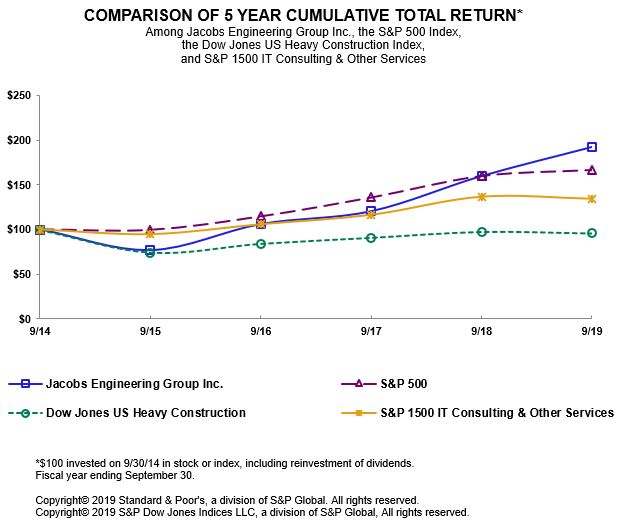
| 2014 | 2015 | 2016 | 2017 | 2018 | 2019 | ||||||||||||
| Jacobs Engineering Group Inc. | 100.00 | 76.67 | 105.94 | 120.35 | 159.82 | 192.44 | |||||||||||
| S&P 500 | 100.00 | 99.39 | 114.72 | 136.07 | 160.44 | 167.27 | |||||||||||
| Dow Jones US Heavy Construction | 100.00 | 74.27 | 84.25 | 91.06 | 97.75 | 96.03 | |||||||||||
| S&P 1500 IT Consulting & Other Services | 100.00 | 94.66 | 105.86 | 116.50 | 136.93 | 134.60 |
Item 6. SELECTED FINANCIAL DATA
The following table presents selected financial data for each of the last five fiscal years. This selected financial data should be read in conjunction with the Consolidated Financial Statements and related notes beginning on page F-1 of this Annual Report on Form 10-K. On April 26, 2019, Jacobs completed the sale of its ECR business to Worley. As a result of the ECR sale, substantially all ECR-related assets and liabilities have been sold (the "Disposal Group"). We determined that the Disposal Group should be reported as discontinued operations in accordance with ASC 210-05, Discontinued Operations because their disposal represents a strategic shift that had a major effect on our operations and financial results. As such, the financial results of the ECR business are reflected in our Consolidated Statements of Earnings as discontinued operations for all periods presented, except for fiscal 2015. The ECR business is not presented as discontinued operations for fiscal 2015 because such information is not available without unreasonable effort or expense on a basis that is consistent with the selected financial information for the years presented. Additionally, current and non-current assets and liabilities of the Disposal Group are reflected as held-for-sale in the Consolidated Balance Sheet as of September 28, 2018. Further, as of the year ended September 27, 2019, a portion of the ECR business remains held by Jacobs and continues to be classified as held for sale as of fiscal year 2019 in accordance with U.S. GAAP. For further discussion see Note 7- Sale of Energy, Chemicals and Resources ("ECR") Business to the consolidated financial statements. Dollar amounts are presented in thousands, except for per share information:
Page 42
| 2019 (a) | 2018 (b) | 2017 (c) | 2016 (d) | 2015 (e) | |||||||||||||||
| Results of Operations: | |||||||||||||||||||
| Revenues | $ | 12,737,868 | $ | 10,579,773 | $ | 6,330,126 | $ | 6,257,478 | $ | 12,114,832 | |||||||||
| Net Earnings (Loss) Attributable to Jacobs from Continuing Operations | $ | 290,960 | $ | (4,185 | ) | $ | 170,167 | $ | 159,998 | $ | 302,971 | ||||||||
| Financial Position: | |||||||||||||||||||
| Current ratio | 1.34 to 1 | 1.45 to 1 | 1.56 to 1 | 1.61 to 1 | 1.58 to 1 | ||||||||||||||
| Working capital | $ | 1,038,062 | $ | 1,410,891 | $ | 1,069,953 | $ | 1,081,784 | $ | 1,141,512 | |||||||||
| Current assets | $ | 4,111,768 | $ | 4,556,584 | $ | 2,996,180 | $ | 2,864,470 | $ | 3,122,678 | |||||||||
| Total assets | $ | 11,462,711 | $ | 12,645,795 | $ | 7,380,859 | $ | 7,360,022 | $ | 7,785,926 | |||||||||
| Cash | $ | 631,068 | $ | 634,870 | $ | 607,821 | $ | 507,169 | $ | 460,859 | |||||||||
| Long-term debt | $ | 1,201,245 | $ | 2,144,167 | $ | 235,000 | $ | 385,330 | $ | 584,434 | |||||||||
| Total Jacobs stockholders’ equity | $ | 5,714,691 | $ | 5,854,345 | $ | 4,428,352 | $ | 4,265,276 | $ | 4,291,745 | |||||||||
| Return on average equity | 5.03 | % | (0.08 | )% | 3.91 | % | 3.74 | % | 6.92 | % | |||||||||
| Backlog: | $ | 22,569 | $ | 19,955 | $ | 13,147 | $ | 11,535 | $ | 18,807 | |||||||||
| Per Share Information: | |||||||||||||||||||
| Basic Net Earnings (Loss) from Continuing Operations Per Share | $ | 2.11 | $ | (0.03 | ) | $ | 1.41 | $ | 1.33 | $ | 2.42 | ||||||||
| Diluted Net Earnings (Loss) from Continuing Operations Per Share | $ | 2.09 | $ | (0.03 | ) | $ | 1.40 | $ | 1.32 | $ | 2.40 | ||||||||
| Stockholders’ equity | $ | 41.05 | $ | 42.21 | $ | 36.78 | $ | 35.26 | $ | 34.85 | |||||||||
| Average Number of Shares of Common Stock and Common Stock Equivalents Outstanding (Diluted) | 139,206 | 137,536 | 120,147 | 121,483 | 126,110 | ||||||||||||||
| Common Shares Outstanding At Year End | 132,879 | 142,218 | 120,386 | 120,951 | 123,153 | ||||||||||||||
| Cash Dividends Declared Per Common Share | $ | 0.68 | $ | 0.60 | $ | 0.60 | $ | — | $ | — |
| (a) | Includes costs of $243.7 million, or $1.75 per diluted share from continuing operations, related to the Company's restructuring and other initiatives during fiscal 2019. Includes after-tax CH2M transaction costs and adjustments of $2.4 million, after-tax transaction costs associated with the acquisition of KeyW of $9.8 million and after-tax transaction costs associated with the acquisition of John Wood Group's Nuclear Business of $3.9 million, for a total of $0.12 per diluted share from continuing operations. Also includes amortization of intangible assets of $59.0 million, or $0.42 per diluted share from continuing operations and $48.1 million or $0.34 per diluted share from continuing operations in fair value adjustments partly offset by dividend income related to our investment in Worley stock and certain foreign currency revaluations relating to ECR sale proceeds |
| (b) | Includes costs of $112.8 million, or $0.81 per diluted share from continuing operations, related to the Company's restructuring and other initiatives during fiscal 2018. Also included in fiscal 2018 are after-tax charges of $60.7 million, or $0.44 per diluted share, in professional fees and related costs associated with the CH2M acquisition and pending ECR sale, $259.2 million, or $1.86 per diluted share from continuing operations, in charges related to tax reform and amortization of intangible assets of $51.5 million, or $0.37 per diluted share from continuing operations |
| (c) | Includes costs of $65.0 million, or $0.54 per diluted share from continuing operations, related to the Company's restructuring and other initiatives during fiscal 2017. Also included in the fourth quarter of fiscal 2017 are after-tax charges of $10.6 million, or $0.09 per diluted share from continuing operations, respectively, in professional fees and related costs associated with the CH2M acquisition. Also includes amortization of intangible assets of $33.5 million, or $0.28 per diluted share from continuing operations |
| (d) | Includes costs of $75.2 million, or $0.62 per diluted share from continuing operations, related to the Company's restructuring initiatives during fiscal 2016. Also included in the fourth quarter of fiscal 2016 are (i) a loss on sale of our French subsidiary of $17.1 million or $0.14 per diluted share from continuing operations; and (ii) a non-cash write-off on an equity investment of $10.4 million or $0.09 per diluted share from continuing operations. Also includes amortization of intangible assets of $47.6 million, or $0.28 per diluted share from continuing operations |
| (e) | Includes costs of $107.9 million, or $0.86 per diluted share, related to the Company's restructuring initiatives during fiscal 2015. Also includes amortization of intangible assets of $49.4 million, or $0.27 per diluted share from continuing operations |
Item 7. MANAGEMENT'S DISCUSSION AND ANALYSIS OF FINANCIAL CONDITION AND RESULTS OF OPERATIONS
Critical Accounting Policies and Estimates
In order to better understand the changes that occur to key elements of our financial condition, results of operations and cash flows, a reader of this Management’s Discussion and Analysis of Financial Condition and Results
Page 43
of Operations (“MD&A”) should be aware of the critical accounting policies we apply in preparing our consolidated financial statements.
The consolidated financial statements contained in this report were prepared in accordance with U.S. GAAP. The preparation of our consolidated financial statements and the financial statements of any business performing long-term professional services, engineering and construction-type contracts requires management to make certain estimates and judgments that affect both the entity’s results of operations and the carrying values of its assets and liabilities. Although our significant accounting policies are described in Note 2 - Significant Accounting Policies of Notes to Consolidated Financial Statements beginning on page F-1 of this Annual Report on Form 10-K, the following discussion is intended to highlight and describe those accounting policies that are especially critical to the preparation of our consolidated financial statements.
Revenue Accounting for Contracts
Engineering, Procurement & Construction Contracts and Service Contracts
On September 29, 2018, the Company adopted ASC Topic 606, Revenue from Contracts with Customers, including the subsequent ASUs that amended and clarified the related guidance. The Company recognizes engineering, procurement, and construction contract revenue over time, as performance obligations are satisfied, due to the continuous transfer of control to the customer. Upon adoption of ASC Topic 606, contracts which include engineering, procurement and construction services are generally accounted for as a single deliverable (a single performance obligation) and are no longer segmented between types of services. In some instances, the Company’s services associated with a construction activity are limited only to specific tasks such as customer support, consulting or supervisory services. In these instances, the services are typically identified as separate performance obligations.
The Company recognizes revenue using the percentage-of-completion method, based primarily on contract costs incurred to date compared to total estimated contract costs. Estimated contract costs include the Company’s latest estimates using judgments with respect to labor hours and costs, materials, and subcontractor costs. The percentage-of-completion method (an input method) is the most representative depiction of the Company’s performance because it directly measures the value of the services transferred to the customer. Subcontractor materials, labor and equipment and, in certain cases, customer-furnished materials and labor and equipment are included in revenue and cost of revenue when management believes that the company is acting as a principal rather than as an agent (e.g., the company integrates the materials, labor and equipment into the deliverables promised to the customer or is otherwise primarily responsible for fulfillment and acceptability of the materials, labor and/or equipment). The Company recognizes revenue, but not profit, on certain uninstalled materials that are not specifically produced, fabricated, or constructed for a project. Revenue on these uninstalled materials is recognized when control is transferred. Changes to total estimated contract cost or losses, if any, are recognized in the period in which they are determined as assessed at the contract level. Pre-contract costs are expensed as incurred unless they are expected to be recovered from the client. Project mobilization costs are generally charged to project costs as incurred when they are an integrated part of the performance obligation being transferred to the client. Under the typical payment terms of our engineering, procurement and construction contracts, amounts are billed as work progresses in accordance with agreed-upon contractual terms at periodic intervals (e.g., biweekly or monthly) and customer payments on are typically due within 30 to 60 days of billing, depending on the contract.
For service contracts, the Company recognizes revenue over time using the cost-to-cost percentage-of-completion method. Service contracts that include multiple performance obligations are segmented between types of services. For contracts with multiple performance obligations, the Company allocates the transaction price to each performance obligation using an estimate of the stand-alone selling price of each distinct service in the contract. In some instances where the Company is standing ready to provide services, the Company recognizes revenue ratably over the service period. Under the typical payment terms of our service contracts, amounts are billed as work progresses in accordance with agreed-upon contractual terms, and customer payments are typically due within 30 to 60 days of billing, depending on the contract.
Direct costs of contracts include all costs incurred in connection with and directly for the benefit of client contracts, including depreciation and amortization relating to assets used in providing the services required by the related projects. The level of direct costs of contracts may fluctuate between reporting periods due to a variety of factors, including the amount of pass-through costs we incur during a period. On those projects where we are acting as principal for subcontract labor or third-party materials and equipment, we reflect the amounts of such items in both revenues and costs (and we refer to such costs as “pass-through costs”).
Page 44
Variable Consideration
The nature of the Company’s contracts gives rise to several types of variable consideration, including claims and unpriced change orders; awards and incentive fees; and liquidated damages and penalties. The Company recognizes revenue for variable consideration when it is probable that a significant reversal in the amount of cumulative revenue recognized will not occur. The Company estimates the amount of revenue to be recognized on variable consideration using the expected value (i.e., the sum of a probability-weighted amount) or the most likely amount method, whichever is expected to better predict the amount. Factors considered in determining whether revenue associated with claims (including change orders in dispute and unapproved change orders in regard to both scope and price) should be recognized include the following: (a) the contract or other evidence provides a legal basis for the claim, (b) additional costs were caused by circumstances that were unforeseen at the contract date and not the result of deficiencies in the company’s performance, (c) claim-related costs are identifiable and considered reasonable in view of the work performed, and (d) evidence supporting the claim is objective and verifiable. If the requirements for recognizing revenue for claims or unapproved change orders are met, revenue is recorded only when the costs associated with the claims or unapproved change orders have been incurred and only up to the amount of cost incurred. Back charges to suppliers or subcontractors are recognized as a reduction of cost when it is determined that recovery of such cost is probable and the amounts can be reliably estimated. Disputed back charges are recognized when the same requirements described above for claims accounting have been satisfied.
The Company generally provides limited warranties for work performed under its engineering and construction contracts. The warranty periods typically extend for a limited duration following substantial completion of the Company’s work on the project. Historically, warranty claims have not resulted in material costs incurred for which the Company was not compensated for by the customer.
*P
Showing the first 8K of 73K characters. Open the full section
Item 7A. QUANTITATIVE AND QUALITATIVE DISCLOSURES ABOUT MARKET RISK
We do not enter into derivative financial instruments for trading, speculation or other purposes that would expose the Company to market risk. In the normal course of business, our results of operations are exposed to risks associated with fluctuations in interest rates and currency exchange rates.
Interest Rate Risk
Please see the Note 10- Borrowings in Notes to Consolidated Financial Statements beginning on Page F-1 of this Annual report on Form 10-K, which is incorporated herein by reference, for a discussion of the New Credit Agreement, Term Loan Facility and Note Purchase Agreement.
Our Term Loan Facility, New Credit Agreement and certain other debt obligations are subject to variable rate interest which could be adversely affected by an increase in interest rates. As of September 27, 2019, we had an aggregate of $703.8 million in outstanding borrowings under our Term Loan Facility and our New Credit Agreement. Interest on amounts borrowed under these agreements is subject to adjustment based on the Company’s Consolidated Leverage Ratio (as defined in the credit agreements governing the Term Loan Facility and New Credit Agreement). Depending on the Company’s Consolidated Leverage Ratio, borrowings under the Term Loan Facility bear interest at a Eurocurrency rate plus a margin of between 1.0% and 1.5% or a base rate plus a margin of between 0% and 0.5% and borrowings under the New Credit Agreement bear interest at a Eurocurrency rate plus a margin of between 0.875% and 1.5% or a base rate plus a margin of between 0% and 0.5%. Additionally, if our consolidated leverage ratio exceeds a certain amount, the interest on the Senior Notes may increase by 75 basis points.
For the year ended September 27, 2019, our weighted average floating rate borrowings were approximately $1.6 billion. If floating interest rates had increased by 1.00%, our interest expense for the year ended September 27, 2019 would have increased by approximately $16.6 million.
Page 61
JACOBS ENGINEERING GROUP INC. AND SUBSIDIARIES
NOTES TO CONSOLIDATED FINANCIAL STATEMENTS
Foreign Currency Risk
In situations where our operations incur contract costs in currencies other than their functional currency, we attempt to have a portion of the related contract revenues denominated in the same currencies as the costs. In those situations, where revenues and costs are transacted in different currencies, we sometimes enter into foreign exchange contracts in order to limit our exposure to fluctuating foreign currencies. We follow the provisions of ASC No. 815, Derivatives and Hedging in accounting for our derivative contracts. The Company does not currently have exchange rate sensitive instruments that would have a material effect on our consolidated financial statements or results of operations.
Item 8. FINANCIAL STATEMENTS AND SUPPLEMENTARY DATA
The information required by this Item 8 is submitted as a separate section beginning on page F-1 of this Annual Report on Form 10-K and is incorporated herein by reference.
Item 9. CHANGES IN AND DISAGREEMENTS WITH ACCOUNTANTS ON ACCOUNTING AND FINANCIAL DISCLOSURE
None.
Item 9A. CONTROLS AND PROCEDURES
Evaluation of Disclosure Controls and Procedures
The Company’s management, with the participation of its Chief Executive Officer and Chief Financial Officer, evaluated the effectiveness of the Company’s disclosure controls and procedures as defined by Rule 13a-15(e) of the Securities Exchange Act of 1934, as amended (the “Exchange Act”) as of September 27, 2019, the end of the period covered by this Annual Report on Form 10-K (the “Evaluation Date”). Based on that evaluation, the Chief Executive Officer and Chief Financial Officer have concluded that the Company’s disclosure controls and procedures (as defined in Rule 13a-15(e) under the Exchange Act) were functioning effectively as of the Evaluation Date to provide reasonable assurance that the information required to be disclosed by the Company in reports filed or submitted under the Exchange Act is recorded, processed, summarized and reported within the time periods specified in the SEC’s rules and forms and that such information is accumulated and communicated to the Company’s management, including the Chief Executive Officer and Chief Financial Officer, as appropriate to allow timely decisions regarding required disclosure.
As permitted by SEC guidance for newly acquired businesses, management’s assessment of the Company’s disclosure controls and procedures did not include an assessment of those disclosure controls and procedures of KeyW that are subsumed by internal control over financial reporting. KeyW accounted for approximately 9% of total assets as of September 27, 2019, and 1% of revenues for the fiscal year ended on September 27, 2019.
Management’s Annual Report on Internal Control Over Financial Reporting
Management is responsible for establishing and maintaining for the Company adequate internal control over financial reporting, as defined in Rule 13a-15(f) under the Exchange Act. Management, with the participation of its Chief Executive Officer and Chief Financial Officer, has assessed the effectiveness of the Company’s internal control over financial reporting as of the Evaluation Date based on the framework established in “Internal Control—Integrated Framework,” issued by the Committee of Sponsoring Organizations of the Treadway Commission (2013 framework). Based on this assessment, management has concluded that the Company’s internal control over financial reporting as of the Evaluation Date was effective. As permitted by SEC guidance for newly acquired businesses, management’s assessment of the Company’s internal control over financial reporting did not include an assessment of internal control over financial reporting of KeyW. KeyW accounted for approximately 9% of total assets as of September 27, 2019, and 1% of revenues for the fiscal year ended on September 27, 2019.
The Company's independent registered public accounting firm, Ernst & Young LLP, that audited the Company's consolidated financial statements included in this Annual Report on Form 10-K, also audited the effectiveness of our internal control over financial reporting as of September 27, 2019, as stated in their report included in this Annual Report on Form 10-K.
Page 62
Remediation of Previously Identified Material Weakness
In the Company's fiscal 2018 Form 10-K, management previously identified the following material weakness as of September 28, 2018: A material weakness related to internal control deficiencies over the accounting for income taxes in connection with a business combination, specifically related to the ineffective design and operating effectiveness of controls over the completeness and accuracy of deferred taxes and the evaluation of the recoverability of deferred taxes associated with the CH2M acquisition. The material weakness did not result in any material misstatements to the Company’s previously issued financial statements, nor in the financial statements included in this Form 10-K.
The Company's management is committed to maintaining a strong internal control environment. In response to the identified material weakness, management, with the oversight of the Audit Committee of the Board of Directors, took comprehensive actions to remediate the material weakness in internal control over financial reporting, including implementing additional specific enhanced control procedures for the review, analysis and reporting of its deferred income tax accounts, including control procedures relating to the recoverability of deferred taxes associated with acquired businesses in a business combination. The Company has successfully completed the remediation efforts with the completion of the KeyW acquisition. The remediation efforts both addressed the identified material weakness and also enhanced our overall financial control environment.
Changes in Internal Control
Other than the changes resulting from the remediation activities described above, there were no changes in the Company’s internal control over financial reporting during the Company’s fiscal quarter ended September 27, 2019 that have materially affected, or are reasonably likely to materially affect, the Company’s internal control over financial reporting.
Limitations on Effectiveness of Controls
The Company’s management, including its Chief Executive Officer and Chief Financial Officer, does not expect that its disclosure controls and procedures or its system of internal control over financial reporting will prevent or detect all errors and all fraud. A control system, no matter how well designed or operated, can provide only reasonable, but not absolute, assurance that the objectives of the system of internal control are met. The design of the Company’s control system reflects the fact that there are resource constraints, and that the benefits of such control systems must be considered relative to their costs. Further, because of the inherent limitations in all control systems, no evaluation of controls can provide absolute assurance that all control failures and instances of fraud, if any, within the Company have been detected. These inherent limitations include the realities that judgments in decision-making can be faulty and that breakdowns can occur because of simple error or mistake. Additionally, controls can be circumvented by the intentional acts of individuals, by collusion of two or more people, or by management override of the controls. The design of any system of controls is also based in part on certain assumptions about the likelihood of future events, and there can be no assurance that the design of any particular control will always succeed in achieving its objective under all potential future conditions.
Item 9B. OTHER INFORMATION
None.
Page 63
PART III
Item 10. DIRECTORS, EXECUTIVE OFFICERS AND CORPORATE GOVERNANCE
Directors, Executive Officers, Promoters and Control Persons
The information required by Paragraph (a), and Paragraphs (c) through (g) of Item 401 of Regulation S-K (except for information required by Paragraph (e) of that Item to the extent the required information pertains to our executive officers) and Item 405 of Regulation S-K is set forth under the captions “Members of the Board of Directors,” “Corporate Governance” and “Section 16(a) Beneficial Ownership Reporting Compliance” in our definitive proxy statement to be filed with the SEC pursuant to Regulation 14A within 120 days after the close of our fiscal year and is incorporated herein by reference. The information required by Paragraph (b) of Item 401 of Regulation S-K, as well as the information required by Paragraph (e) of that Item to the extent the required information pertains to our executive officers, is set forth in Part I, Item 1 of this Annual Report on Form 10-K under the heading “Executive Officers of the Registrant.”
Code of Ethics
We have adopted a code of ethics for our Chief Executive Officer and senior financial officers; a code of business conduct and ethics for members of our Board of Directors and corporate governance guidelines. The full text of these codes of ethics and corporate governance guidelines are available at our website at www.jacobs.com. In the event we make any amendment to, or grant any waiver from, a provision of the code of ethics that applies to the principal executive officer, principal financial officer or principal accounting officer that requires disclosure under applicable SEC rules, we will disclose such amendment or waiver and the reasons therefor on our website. We will provide any person without charge a copy of any of the aforementioned codes of ethics upon receipt of a written request. Requests should be addressed to: Jacobs Engineering Group Inc., 1999 Bryan Street, Suite 1200, Dallas, Texas 75201, Attention: Corporate Secretary.
Corporate Governance
The information required by Items 407(d)(4) and (d)(5) of Regulation S-K is set forth under the caption “Corporate Governance” in our definitive proxy statement to be filed with the SEC pursuant to Regulation 14A within 120 days after the close of our fiscal year and is incorporated herein by reference.
Item 11. EXECUTIVE COMPENSATION
The information required by this Item is set forth under the captions “Corporate Governance,” “Compensation Committee Report,” “Compensation Discussion and Analysis” and “Executive Compensation” in our definitive proxy statement to be filed with the SEC pursuant to Regulation 14A within 120 days after the close of our fiscal year and is incorporated herein by reference.
Item 12. SECURITY OWNERSHIP OF CERTAIN BENEFICIAL OWNERS AND MANAGEMENT AND RELATED STOCKHOLDER MATTERS
The information required by this Item is set forth in our definitive proxy statement to be filed with the SEC pursuant to Regulation 14A within 120 days after the close of our fiscal year and is incorporated herein by reference.
Item 13. CERTAIN RELATIONSHIPS AND RELATED TRANSACTIONS AND DIRECTOR INDEPENDENCE
The information required by this Item is set forth under the captions “Members of The Board of Directors,” “Corporate Governance,” and “Certain Relationships and Related Transactions” in our definitive proxy statement to be filed with the SEC pursuant to Regulation 14A within 120 days after the close of our fiscal year and is incorporated herein by reference.
Item 14. PRINCIPAL ACCOUNTING FEES AND SERVICES
The information required by this Item is set forth under the captions “Report of the Audit Committee” and “Audit and Non-Audit Fees” in our definitive proxy statement to be filed with the SEC pursuant to Regulation 14A within 120 days after the close of our fiscal year and is incorporated herein by reference.
Page 64
PART IV
EXHIBITS AND FINANCIAL STATEMENTS
Item 15. EXHIBITS AND FINANCIAL STATEMENT SCHEDULES
(a) Documents filed as part of this report:
| (1) | The Company’s Consolidated Financial Statements at September 27, 2019 and September 28, 2018 and for each of the three years in the period ended September 27, 2019, and the notes thereto, together with the report of the independent auditors on those Consolidated Financial Statements are hereby filed as part of this report, beginning on page F-1. |
| (2) | Financial statement schedules – no financial statement schedules are presented as the required information is either not applicable, or is included in the consolidated financial statements or notes thereto. |
| (3) | See Exhibit Index below. |
(b) Exhibit Index:
Page 65
Showing the first 8K of 287K characters. Open the full section