 filings.tools
Jacobs Solutions 10-K 2021-10-01
Filed 2021-11-23. 19 sections, 604K characters. Original on sec.gov · Markdown · JSON
Cover and table of contents
UNITED STATES
SECURITIES AND EXCHANGE COMMISSION
Washington, D.C. 20549
_________________________________________________________________
FORM 10-K
(Mark One)
☒ ANNUAL REPORT PURSUANT TO SECTION 13 OR 15(d) OF THE SECURITIES EXCHANGE ACT OF 1934
For the fiscal year ended October 1, 2021
OR
☐ TRANSITION REPORT PURSUANT TO SECTION 13 OR 15(d) OF THE SECURITIES EXCHANGE ACT OF 1934
For the transition period from ____ to ____
Commission File No. 1-7463
_________________________________________________________________
Jacobs Engineering Group Inc.
| Delaware | 95-4081636 | |||||||||||||
| (State or other jurisdiction of incorporation or organization) | (IRS Employer identification number) | |||||||||||||
| 1999 Bryan Street | Suite 1200 | Dallas | Texas | 75201 | ||||||||||
| (Address of principal executive offices) | (Zip Code) |
(214) 583 – 8500
(Registrant’s telephone number, including area code)
Securities registered pursuant to Section 12(b) of the Act:
_________________________________________________________________
| Title of Each Class | Trading Symbol(s) | Name of Each Exchange on Which Registered | |||||||||
| Common Stock | $1 par value | J | New York Stock Exchange |
Securities registered pursuant to Section 12(g) of the Act: None
_________________________________________________________________
Indicate by check-mark if the Registrant is a well-known seasoned issuer, as defined in Rule 405 of the Securities Act: ☒ Yes ☐ No
Indicate by check-mark if the Registrant is not required to file reports pursuant to Section 13 or 15(d) of the Act. ☐ Yes ☒ No
Indicate by check-mark whether the Registrant (1) has filed all reports required to be filed by Section 13 or 15(d) of the Securities Exchange Act of 1934 during the preceding 12 months (or for such shorter period that the Registrant was required to file such reports), and (2) has been subject to such filing requirements for the past 90 days. ☒ Yes ☐ No
Indicate by check-mark whether the Registrant: has submitted electronically every Interactive Data File required to be submitted pursuant to Rule 405 of Regulation S-T (§232.405 of this chapter) during the preceding 12 months (or for such shorter period that the Registrant was required to submit such files). ☒ Yes ☐ No
Indicate by check-mark whether the Registrant is a large accelerated filer, an accelerated filer, a non-accelerated filer or a smaller reporting company. See the definitions of “large accelerated filer”, “accelerated filer” and “smaller reporting company” in Rule 12b-2 of the Exchange Act.
| Large accelerated filer | ☒ | Accelerated filer | ☐ | |||||||||||||||||
| Non-accelerated filer | ☐ | Smaller reporting company | ☐ | |||||||||||||||||
| Emerging growth company | ☐ |
If an emerging growth company, indicate by check mark if the registrant has elected not to use the extended transition period for complying with any new or revised financial accounting standards provided pursuant to Section 13(a) of the Exchange Act. ☐
Indicate by check mark whether the registrant has filed a report on and attestation to its management's assessment of the effectiveness of its internal control over financial reporting under Section 404(b) of the Sarbanes-Oxley Act (15 U.S.C. 7262(b)) by the registered public accounting firm that prepared or issued its audit report. ☒
Indicate by check-mark whether the Registrant is a shell company (as defined in Rule 12b-2 of the Act) ☐ Yes ☒ No
There were 128,948,685 shares of common stock outstanding as of November 12, 2021. The aggregate market value of the Registrant’s common equity held by non-affiliates was approximately $16.9 billion as of April 2, 2021, based upon the last reported sales price on the New York Stock Exchange on that date.
DOCUMENTS INCORPORATED BY REFERENCE
Portions of the Registrant’s definitive proxy statement to be issued in connection with its 2022 annual meeting of shareholders are incorporated by reference into Part III of this Annual Report on Form 10-K where indicated.
JACOBS ENGINEERING GROUP INC.
Fiscal 2021 Annual Report on Form 10-K
Table of Contents
| Item | Page No. | |||||||||||||||||||
| Part I | ||||||||||||||||||||
| Item 1. | Business | Page 3 | ||||||||||||||||||
| Item 1A. | Risk Factors | Page 21 | ||||||||||||||||||
| Item 1B. | Unresolved Staff Comments | Page 46 | ||||||||||||||||||
| Item 2. | Properties | Page 46 | ||||||||||||||||||
| Item 3. | Legal Proceedings | Page 46 | ||||||||||||||||||
| Item 4. | Mine Safety Disclosure | Page 46 | ||||||||||||||||||
| Part II | ||||||||||||||||||||
| Item 5. | Market for Registrant’s Common Equity, Related Stockholder Matters and Issuer Purchases of Equity Securities | Page 47 | ||||||||||||||||||
| Item 6. | Selected Financial Data | Page 48 | ||||||||||||||||||
| Item 7. | Management’s Discussion and Analysis of Financial Condition and Results of Operations | Page 48 | ||||||||||||||||||
| Item 7A. | Quantitative and Qualitative Disclosures About Market Risk | Page 64 | ||||||||||||||||||
| Item 8. | Financial Statements and Supplementary Data | Page 64 | ||||||||||||||||||
| Item 9. | Changes in and Disagreements With Accountants On Accounting and Financial Disclosure | Page [64](#i2 |
Showing the first 8K of 70K characters. Open the full section
Item 1. A. RISK FACTORS
We operate in a changing global environment that involves numerous known and unknown risks and uncertainties that could materially adversely affect our business, financial condition and results of operations. The risks described below highlight some of the factors that have affected and could affect us in the future. We may also be affected by unknown risks or risks that we currently think are immaterial. If any such events actually occur, our business, financial condition and results of operations could be materially adversely affected.
Summary Risk Factors
The following is a summary of some of the risks and uncertainties that could materially adversely affect our business, financial condition and results of operations. You should read this summary together with the more detailed description of each risk factor contained below.
Risks Related to Our Operations
-
The COVID-19 pandemic, including the measures that international, federal, state and local public health and other governmental authorities implement to address it, have adversely affected, and may continue to adversely affect, our business, financial condition and results of operations.
-
Project sites are inherently dangerous workplaces. Failure to maintain safe work sites by us, the owner or others working at the project site can lead to our employees or others becoming injured, disabled or even losing their lives, and exposes us to significant financial losses and reputational harm, as well as civil and criminal liabilities.
-
Our results of operations depend on the award of new contracts and the timing of the performance of these contracts.
-
We engage in a highly competitive business. If we are unable to compete effectively, we could lose market share and our business and results of operations could be negatively impacted.
-
The nature of our contracts, particularly those that are fixed-price, subjects us to risks of cost overruns. We may experience reduced profits or, in some cases, losses if costs increase above budgets or estimates or if the project experiences schedule delays.
-
The contracts in our backlog may be adjusted, canceled or suspended by our clients and, therefore, our backlog is not necessarily indicative of our future revenues or earnings. Additionally, even if fully performed, our backlog is not a good indicator of our future gross margins.
-
Contracts with the U.S. federal government and other governments and their agencies pose additional risks relating to future funding and compliance.
-
Our project execution activities may result in liability for faulty services.
-
The outcome of pending and future claims and litigation could have a material adverse impact on our business, financial condition, and results of operations and damage our reputation.
-
Our use of joint ventures, partnerships and strategic investments in entities exposes us to risks and uncertainties, many of which are outside of our control
-
Employee, agent or partner misconduct, or our overall failure to comply with laws or regulations, could weaken our ability to win contracts, which could result in reduced revenues and profits.
-
Our international operations are exposed to additional risks and uncertainties, including unfavorable political developments and weak foreign economies.
-
Cyber security or privacy breaches, or systems and information technology interruption or failure could adversely impact our ability to operate or expose us to significant financial losses and reputational harm.
-
We are subject to professional standards, duties and statutory obligations on professional reports and opinions we issue, which could subject us to monetary damages.
-
If we do not have adequate indemnification for our nuclear services, it could adversely affect our business, financial condition and results of operations.
-
Our actual results could differ from the estimates and assumptions used to prepare our financial statements.
-
An impairment charge on our goodwill could have a material adverse impact on our financial position and results of operations.
Page 21
-
We may be required to contribute additional cash to meet any underfunded benefit obligations associated with retirement and post-retirement benefit plans we manage or for which we have contribution and/or funding obligations.
-
Demand for our services is cyclical as the sectors and industries in which our clients operate are impacted by economic downturns, reductions in government or private spending and times of political uncertainty.
-
Rising inflation, interest rates, and/or construction costs could reduce the demand for our services as well as decrease our profit on our existing contracts, in particular with respect to our fixed-price contracts.
-
Our global presence could give rise to material fluctuations in our income tax rates.
-
Our businesses could be materially and adversely affected by events outside of our control.
-
Our continued success is dependent upon our ability to hire, retain, and utilize qualified personnel.
-
Our business strategy relies in part on acquisitions and strategic investments to sustain our growth. These transactions present certain risks and uncertainties.
-
Our professional reputation and relationships with U.S. government agencies are critical to our business, and any harm to our reputation or relationships could decrease the amount of business the U.S. government does with us, which could have a material adverse effect on our business, financial condition and results of operations.
-
Our focus on new growth areas for our business entails risks, including those associated with new relationships, clients, talent needs, capabilities, service offerings, and maintaining our collaborative culture and core values.
Risks Related to Regulatory Compliance
-
Past and future environmental, health, and safety laws could impose significant additional costs and liabilities.
-
If we fail to comply with federal, state, local or foreign governmental requirements, our business may be adversely affected.
-
We could be adversely affected by violations of the U.S. Foreign Corrupt Practices Act and similar worldwide anti-bribery laws.
Risks Related to Climate Change
-
Climate change and related environmental issues could have a material adverse impact on our business, financial condition and results of operations.
-
We may be affected by market or regulatory responses to climate change.
-
We may be unable to achieve our climate commitments and targets.
Risks Related to Our Indebtedness
-
We rely on cash provided by operations and liquidity under our credit facilities to fund our business. Negative conditions in the credit and financial markets and delays in receiving client payments could adversely affect our cost of borrowing and our business.
-
Maintaining adequate bonding and letter of credit capacity is necessary for us to successfully bid on and win some contracts.
Risks Related to Our Common Stock
-
Our quarterly results may fluctuate significantly, which could have a material negative effect on the price of our common stock.
-
There can be no assurance that we will pay dividends on our common stock.
-
In the event we issue stock as consideration for certain acquisitions we may make, we could dilute share ownership, and if we receive stock in connection with a divestiture, the value of stock is subject to fluctuation.
Page 22
Risks Related to Our Operations
The COVID-19 pandemic, including the measures that international, federal, state and local public health and other governmental authorities implement to address it, have adversely affected, and may continue to adversely affect, our business, financial condition and results of operations.
Despite the availability of vaccines in some geographies, COVID-19 continues to spread throughout the United States and globally, including in regions where we have significant operations and personnel, and u
Showing the first 8K of 131K characters. Open the full section
Item 1B. UNRESOLVED STAFF COMMENTS
None.
Item 2. PROPERTIES
Our properties consist primarily of office space within general, commercial office buildings located in major cities primarily in the following countries: United States; Armenia; Australia; Azerbaijan; Canada; China; Czech Republic; Denmark; Egypt; France; Germany; Hong Kong; India; Indonesia; Iraq; Ireland; Italy; Kazakhstan; Malaysia; The Netherlands; New Zealand; The Philippines; Poland; Qatar; Romania; Saudi Arabia; Singapore; Slovakia; South Africa; South Korea; Sweden; Switzerland; Taiwan (Province of China); Thailand; Ukraine; United Arab Emirates and United Kingdom. We also lease smaller offices located in certain other countries. Such space is used for operations (providing technical, professional, and other home office services), sales and administration. The total amount of space leased by us for all of our operations is approximately 7.4 million square feet. We continue to evaluate our real estate needs in connection with changes in the Company's use of its leased space as a result of the COVID-19 pandemic, and as part of the integration of our prior acquisitions.
Item 3. LEGAL PROCEEDINGS
The information required by this Item 3 is included in Note 19- Contractual Guarantees, Litigation, Investigations and Insurance of Notes to Consolidated Financial Statements beginning on page F-1 of this Annual Report on Form 10-K and is incorporated herein by reference.
Item 4. MINE SAFETY DISCLOSURE
None.
Page 46
PART II
Item 5. MARKET FOR REGISTRANT'S COMMON EQUITY, RELATED STOCKHOLDER MATTERS AND ISSUER PURCHASES OF EQUITY SECURITIES
Market Information
Our common stock is listed on the New York Stock Exchange under the ticker symbol "J".
Shareholders
According to the records of our transfer agent, there were 2,954 shareholders of record as of November 12, 2021.
Dividend Policy
Our Board of Directors initiated a quarterly cash dividend program in fiscal 2017 under which we have paid, and intend to continue paying, regular quarterly dividends. The declaration, amount and timing of such dividends are subject to capital availability and determinations by our Board of Directors that cash dividends are in the best interest of our stockholders and are in compliance with all respective laws and applicable agreements. Our ability to pay dividends will depend upon, among other factors, our cash balances and potential future capital requirements for strategic transactions, including acquisitions, debt service requirements, results of operations, financial condition and other factors that our Board of Directors may deem relevant.
Share Repurchases
On January 17, 2019, the Company’s Board of Directors authorized a share repurchase program of up to $1.0 billion of the Company’s common stock, to expire on January 16, 2022 (the "2019 Repurchase Authorization"). On January 16, 2020, the Company's Board of Directors authorized an additional share repurchase program of up to $1.0 billion of the Company's common stock, to expire on January 15, 2023 (the "2020 Repurchase Authorization"). In the fourth quarter of fiscal 2021 the Company launched an accelerated share repurchase program by advancing $250 million to a financial institution in a privately negotiated transaction.
The following table summarizes the activity under the 2019 and 2020 Repurchase Authorizations during fiscal 2021:
| Amount Authorized (2019 and 2020 Repurchase Authorizations) | Average Price Per Share (1) | Shares Repurchased | Total Shares Retired | |||||||||||||||||
| $2,000,000,000 | $131.22 | 1,726,472 | 1,726,472 |
(1)Includes commissions paid and calculated at the average price per share
As a precautionary measure in light of the COVID-19 pandemic, the Company temporarily suspended purchases under the share repurchase plan in March 2020, with such suspension remaining in effect through the fiscal third quarter of 2020. During the fourth fiscal quarter of 2020, the Company resumed share repurchases. As of October 1, 2021, the Company has no remaining amounts available under the 2019 Repurchase Authorization and $782.9 million remaining under the 2020 Repurchase Authorization.
Our share repurchase programs do not obligate the Company to purchase any shares. Share repurchases may be executed through various means including, without limitation, accelerated share repurchases, open market transactions, privately negotiated transactions, purchases pursuant to a Rule 10b5-1 plan or otherwise. The authorization for the share repurchase programs may be terminated, increased or decreased by the Company’s Board of Directors in its discretion at any time. The timing, amount and manner of share repurchases may depend upon market conditions and economic circumstances, availability of investment opportunities, the availability and costs of financing, currency fluctuations, the market price of the Company's common stock, other uses of capital and other factors.
Unregistered Sales of Equity Securities
None.
Page 47
Performance Graph
The following graph and table shows the changes over the five-year period ended October 1, 2021 in the value of $100 as of the close of market on September 30, 2016 in (1) the common stock of Jacobs Engineering Group Inc., (2) the Standard & Poor’s 500 Stock Index and (3) the Standard & Poor's 1500 IT Consulting & Other Services Index.
The values of each investment are based on share price appreciation, with reinvestment of all dividends, provided any were paid. The investments are assumed to have occurred at the beginning of the period presented. The stock performance included in this graph is not necessarily indicative of future stock price performance.
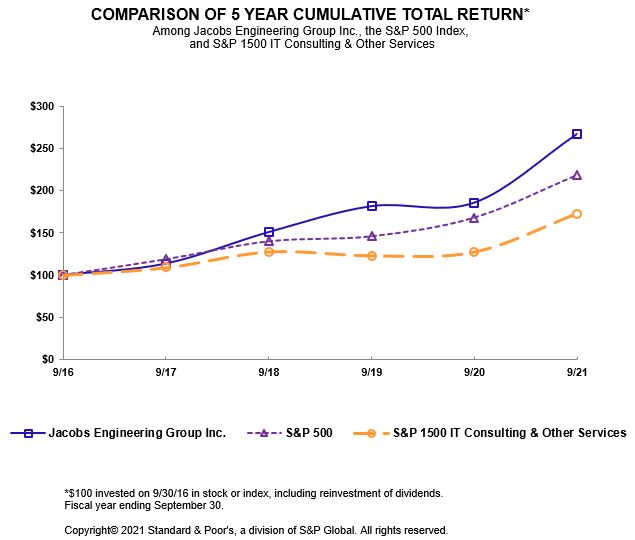
| 2016 | 2017 | 2018 | 2019 | 2020 | 2021 | ||||||||||||||||||||||||||||||
| Jacobs Engineering Group Inc. | 100.00 | 113.60 | 150.86 | 181.65 | 185.79 | 267.25 | |||||||||||||||||||||||||||||
| S&P 500 | 100.00 | 118.61 | 139.85 | 145.80 | 167.89 | 218.27 | |||||||||||||||||||||||||||||
| S&P 1500 IT Consulting & Other Services | 100.00 | 109.04 | 127.58 | 123.12 | 127.55 | 172.79 |
Item 6. SELECTED FINANCIAL DATA
The information required by Item 301 and Item 302 of Regulation S-K has been omitted as we have elected to adopt the changes to Item 301 and Item 302 of Regulation S-K contained in SEC Release No. 33-10890.
Item 7. MANAGEMENT'S DISCUSSION AND ANALYSIS OF FINANCIAL CONDITION AND RESULTS OF OPERATIONS
Critical Accounting Policies and Estimates
Page 48
In order to better understand the changes that occur to key elements of our financial condition, results of operations and cash flows, a reader of this Management’s Discussion and Analysis of Financial Condition and Results of Operations (“MD&A”) should be aware of the critical accounting policies we apply in preparing our consolidated financial statements.
The consolidated financial statements contained in this report were prepared in accordance with U.S. GAAP. The preparation of our consolidated financial statements and the financial statements of any business performing long-term professional services, engineering and construction-type contracts requires management to make certain estimates and judgments that affect both the entity’s results of operations and the carrying values of its assets and liabilities. Although our significant accounting policies are described in Note 2- Significant Accounting Policies of Notes to Consolidated Financial Statements beginning on page F-1 of this Annual Report on Form 10-K, the following discussion is intended to highlight and describe those accounting policies that are especially critical to the preparation of our consolidated financial statements.
Revenue Accounting for Contracts
Engineering, Procurement & Construction Contracts and Service Contracts
On September 29, 2018, the Company adopted ASC Topic 606, Revenue from Contracts with Customers, including the subsequent ASUs that amended and clarified the related guidance. The Company recognizes engineering, procurement, and construction contract revenue over time, as performance obligations are satisfied, due to the continuous transfer of control to the customer. Upon adoption of ASC Topic 606, contracts which include engineering, procurement and construction services are generally accounted for as a single deliverable (a single performance obligation) and are no longer segmented between types of services. In some instances, the Company’s services associated with a construction activity are limited only to specific tasks such as customer support, consulting or supervisory services. In these instances, the services are typically identified as separate performance obligations.
The Company recognizes revenue using the percentage-of-completion method, based primarily on contract costs incurred to date compared to total estimated contract costs. Estimated contract costs include the Company’s latest estimates using judgments with respect to labor hours and costs, materials, and subcontractor costs. The percentage-of-completion method (an input method) is the most representative depiction of the Company’s performance because it directly measures the value of the services transferred to the customer. Subcontractor materials, labor and equipment and, in certain cases, customer-furnished materials and labor and equipment are included in revenue and cost of revenue when management believes that the company is acting as a principal rather than as an agent (e.g., the company integrates the materials, labor and equipment into the deliverables promised to the customer or is otherwise primarily responsible for fulfillment and acceptability of the materials, labor and/or equipment). The Company recognizes revenue, but not profit, on certain uninstalled materials that are not specifically produced, fabricated, or constructed for a project. Under the typical payment terms of our engineering, procurement and construction contracts, amounts are billed as work progresses in accordance with agreed-upon contractual terms at periodic intervals (e.g., biweekly or monthly) and customer payments on are typically due within 30 to 60 days of billing, depending on the contract.
For service contracts, the Company recognizes revenue over time using the cost-to-cost percentage-of-completion method. Service contracts that include multiple performance obligations are segmented between types of services. For contracts with multiple performance obligations, the Company allocates the transaction price to each performance obligation using an estimate of the stand-alone selling price of each distinct service in the contract. In some instances where the Company is standing ready to provide services, the Company recognizes revenue ratably over the service period. Under the typical payment terms of our service contracts, amounts are billed as work progresses in accordance with agreed-upon contractual terms, and customer payments are typically due within 30 to 60 days of billing, depending on the contract.
Direct costs of contracts include all costs incurred in connection with and directly for the benefit of client contracts, including depreciation and amortization relating to assets used in providing the services required by the related projects. The level of direct costs of contracts may fluctuate between reporting periods due to a variety of factors, including the amount of pass-through costs we incur during a period. On those projects where we are acting as principal for subcontract labor or third-party materials and equipment, we reflect the amounts of such items in both revenues and costs (and we refer to such costs as “pass-through costs”).
Variable Consideration
Page 49
The nature of the Company’s contracts gives rise to several types of variable consideration, including claims and unpriced change orders; awards and incentive fees; and liquidated damages and penalties. The Company recognizes revenue for variable consideration when it is probable that a significant reversal in the amount of cumulative revenue recognized will not occur. The Company estimates the amount of revenue to be recognized on variable consideration using the expected value (i.e., the sum of a probability-weighted amount) or the most likely amount method, whichever is expected to better predict the amount. If the requirements for recognizing revenue for claims or unapproved change orders are met, revenue is recorded only when the costs associated with the claims or unapproved change orders have been incurred and only up to the amount of cost incurred.
Practical Expedient
If the Company has a right to consideration from a customer in an amount that corresponds directly with the value of the Company’s performance completed to date (a service contract in which the company bills a fixed amount for each hour of service provided), the Company recognizes revenue in the amount to which it has a right to invoice for services performed.
Joint Ventures and VIEs
As is common to the industry, we execute certain contracts jointly with third parties through various forms of joint ventures. Although the joint ventures own and hold the contracts with the clients, the services required by the contracts are typically performed by us and our joint venture partners, or by other subcontractors under subcontracting agreements with the joint ventures. Many of these joint ventures are formed for a specific project. The assets of our joint ventures generally consist almost entirely of cash and receivables (representing amounts due from clients), and the liabilities of our joint ventures generally consist almost entirely of amounts due to the joint venture partners (for services provided by the partners to the joint ventures under their individual subcontracts) and other subcontractors. In general, at any given time, the equity of our joint ventures represents the undistributed profits earned on contracts the joint ventures hold with clients. Very few of our joint ventures have employees or third-party debt or credit facilities. The debt held by the joint ventures is non-recourse to the general credit of Jacobs.
Our unconsolidated joint ventures (including equity method investments) are reviewed for impairment whenever events or changes in circumstances indicate that the carrying amount of the investment might not be recoverable, and impairment losses are rec
Showing the first 8K of 71K characters. Open the full section
Item 7A. QUANTITATIVE AND QUALITATIVE DISCLOSURES ABOUT MARKET RISK
We do not enter into derivative financial instruments for trading, speculation or other purposes that would expose the Company to market risk. In the normal course of business, our results of operations are exposed to risks associated with fluctuations in interest rates and currency exchange rates.
Interest Rate Risk
Please see the Note 9- Borrowings in Notes to Consolidated Financial Statements beginning on Page F-1 of this Annual Report on Form 10-K, which is incorporated herein by reference, for a discussion of the Revolving Credit Facility, Term Loan Facilities and Note Purchase Agreement.
Our Revolving Credit Facility, Term Loan Facilities and certain other debt obligations are subject to variable rate interest which could be adversely affected by an increase in interest rates. As of October 1, 2021, we had an aggregate of $2.4 billion in outstanding borrowings under our Revolving Credit Facility and Term Loan Facilities. Interest on amounts borrowed under these agreements is subject to adjustment based on the Company’s Consolidated Leverage Ratio (as defined in the credit agreements governing the Revolving Credit Facility and the Term Loan Facilities). Depending on the Company’s Consolidated Leverage Ratio, borrowings under the Revolving Credit Facility and the Term Loan Facilities bear interest at a Eurocurrency rate plus a margin of between 0.875% and 1.625% or a base rate plus a margin of between 0% and 0.625%. Additionally, if our consolidated leverage ratio exceeds a certain amount, the interest on the Senior Notes may increase by 75 basis points. However, as discussed in Note 18- Commitments and Contingencies and Derivative Financial Instruments, we have entered into swap agreements with an aggregate notional value of $923.9 million to convert the variable rate interest based liabilities associated with a corresponding amount of our debt into fixed interest rate liabilities, leaving $1.5 billion in principal amount subject to variable interest rate risk.
For the year ended October 1, 2021, our weighted average floating rate borrowings that are subject to floating rate exposure were approximately $1.4 billion. If floating interest rates had increased by 1.00%, our interest expense for the year ended October 1, 2021 would have increased by approximately $14.3 million.
Foreign Currency Risk
In situations where our operations incur contract costs in currencies other than their functional currency, we sometimes enter into foreign exchange contracts to limit our exposure to fluctuating foreign currencies. We follow the provisions of ASC No. 815, Derivatives and Hedging in accounting for our derivative contracts. The Company has $506.5 million in notional value of exchange rate sensitive instruments at October 1, 2021. See Note 18- Commitments and Contingencies and Derivative Financial Instruments for discussion.
Item 8. FINANCIAL STATEMENTS AND SUPPLEMENTARY DATA
The information required by this Item 8 is submitted as a separate section beginning on page F-1 of this Annual Report on Form 10-K and is incorporated herein by reference.
Item 9. CHANGES IN AND DISAGREEMENTS WITH ACCOUNTANTS ON ACCOUNTING AND FINANCIAL DISCLOSURE
None.
I****tem 9A. CONTROLS AND PROCEDURES
Evaluation of Disclosure Controls and Procedures
Disclosure controls and procedures are those controls and procedures that are designed to ensure that information required to be disclosed in our reports filed or submitted under the Securities Exchange Act of 1934, as amended (the “Exchange Act”) are recorded, processed, summarized and reported within the time periods specified in the SEC’s rules and forms. Disclosure controls and procedures include, without limitation, controls and procedures designed to ensure that information required to be disclosed in our reports filed under the Exchange Act is accumulated and communicated to management, including our Chair and Chief Executive Officer (principal executive officer) and Chief Financial Officer (principal financial officer), to allow timely decisions regarding required disclosure.
Page 64
The Company’s management, with the participation of its Chair and Chief Executive Officer (principal executive officer) and Chief Financial Officer (principal financial officer), evaluated the effectiveness of the Company’s disclosure controls and procedures as defined by Rule 13a-15(e) of the Exchange Act as of October 1, 2021, the end of the period covered by this Annual Report on Form 10-K (the “Evaluation Date”). Based on that evaluation, the Company’s management, with the participation of the Chief Executive Officer (principal executive officer) and Chief Financial Officer (principal financial officer) concluded that the Company’s disclosure controls and procedures as of the Evaluation Date were effective to ensure that information required to be disclosed by the Company in the reports that it files or submits under the Exchange Act is recorded, processed, summarized and reported within the time periods specified in the SEC’s rules and forms and that such information is accumulated and communicated to the Company’s management, including the Company’s Chair and Chief Executive Officer (principal executive officer) and Chief Financial Officer (principal financial officer), as appropriate to allow timely decisions regarding required disclosure.
As permitted by SEC guidance for newly acquired businesses, management's assessment of the Company's disclosure controls and procedures did not include an assessment of those disclosure controls and procedures of PA Consulting that are subsumed by internal control over financial reporting. PA Consulting accounted for approximately 19% of total assets as of the Evaluation Date and approximately 4% of total revenues of the Company for the fiscal year ended on the Evaluation Date.
Management’s Annual Report on Internal Control Over Financial Reporting
Management is responsible for establishing and maintaining for the Company adequate internal control over financial reporting, as defined in Rule 13a-15(f) under the Exchange Act. Management, with the participation of its Chair and Chief Executive Officer (principal executive officer) and Chief Financial Officer (principal financial officer), has assessed the effectiveness of the Company’s internal control over financial reporting as of the Evaluation Date based on the framework established in “Internal Control—Integrated Framework,” issued by the Committee of Sponsoring Organizations of the Treadway Commission (2013 framework). Based on this assessment, management has concluded that the Company’s internal control over financial reporting as of the Evaluation Date was effective. As permitted by SEC guidance for newly acquired businesses, management’s assessment of the Company’s internal control over financial reporting did not include an assessment of internal control over financial reporting of PA Consulting. PA Consulting accounted for approximately 19% of total assets as of the Evaluation Date and approximately 4% of total revenues of the Company for the fiscal year ended on the Evaluation Date.
The Company's independent registered public accounting firm, Ernst & Young LLP, that audited the Company's consolidated financial statements included in this Annual Report on Form 10-K, also audited the effectiveness of our internal control over financial reporting as of October 1, 2021, as stated in their report included in this Annual Report on Form 10-K.
Changes in Internal Control
There were no changes in the Company’s internal control over financial reporting during the Company’s fiscal quarter ended October 1, 2021 that have materially affected, or are reasonably likely to materially affect, the Company’s internal control over financial reporting.
Limitations on Effectiveness of Controls
The Company’s management, including its Chief Executive Officer and Chief Financial Officer, does not expect that its disclosure controls and procedures or its system of internal control over financial reporting will prevent or detect all errors and all fraud. A control system, no matter how well designed or operated, can provide only reasonable, but not absolute, assurance that the objectives of the system of internal control are met. The design of the Company’s control system reflects the fact that there are resource constraints, and that the benefits of such control systems must be considered relative to their costs. Further, because of the inherent limitations in all control systems, no evaluation of controls can provide absolute assurance that all control failures and instances of fraud, if any, within the Company have been detected. These inherent limitations include the realities that judgments in decision-making can be faulty and that breakdowns can occur because of simple error or mistake. Additionally, controls can be circumvented by the intentional acts of individuals, by collusion of two or more people, or by management override of the controls. The design of any system of controls is also based in part on certain assumptions about the likelihood of future events, and there can be no assurance that the design of any particular control will always succeed in achieving its objective under all potential future conditions.
Page 65
Item 9B. OTHER INFORMATION
None.
Page 66
PART III
Item 10. DIRECTORS, EXECUTIVE OFFICERS AND CORPORATE GOVERNANCE
Directors, Executive Officers, Promoters and Control Persons
The information required by Paragraph (a), and Paragraphs (c) through (g) of Item 401 of Regulation S-K (except for information required by Paragraph (e) of that Item to the extent the required information pertains to our executive officers) and Item 405 of Regulation S-K is set forth under the caption “Members of the Board of Directors” and “Corporate Governance” in our definitive proxy statement to be filed with the SEC pursuant to Regulation 14A within 120 days after the close of our fiscal year and is incorporated herein by reference. The information required by Paragraph (b) of Item 401 of Regulation S-K, as well as the information required by Paragraph (e) of that Item to the extent the required information pertains to our executive officers, is set forth in Part I, Item 1 of this Annual Report on Form 10-K under the heading “Information About Our Executive Officers.”
Code of Ethics
We have adopted a code of ethics for our Chief Executive Officer and senior financial officers; a code of business conduct and ethics for members of our Board of Directors and corporate governance guidelines. The full text of these codes of ethics and corporate governance guidelines are available at our website at www.jacobs.com. In the event we make any amendment to, or grant any waiver from, a provision of the code of ethics that applies to the principal executive officer, principal financial officer or principal accounting officer that requires disclosure under applicable SEC rules, we will disclose such amendment or waiver and the reasons therefor on our website. We will provide any person without charge a copy of any of the aforementioned codes of ethics upon receipt of a written request. Requests should be addressed to: Jacobs Engineering Group Inc., 1999 Bryan Street, Suite 1200, Dallas, Texas 75201, Attention: Corporate Secretary.
Corporate Governance
The information required by Items 407(d)(4) and (d)(5) of Regulation S-K is set forth under the caption “Corporate Governance” in our definitive proxy statement to be filed with the SEC pursuant to Regulation 14A within 120 days after the close of our fiscal year and is incorporated herein by reference.
Item 11. EXECUTIVE COMPENSATION
The information required by this Item is set forth under the captions “Corporate Governance,” “Compensation Committee Report,” “Compensation Discussion and Analysis” and “Executive Compensation” in our definitive proxy statement to be filed with the SEC pursuant to Regulation 14A within 120 days after the close of our fiscal year and is incorporated herein by reference.
Item 12. SECURITY OWNERSHIP OF CERTAIN BENEFICIAL OWNERS AND MANAGEMENT AND RELATED STOCKHOLDER MATTERS
The information required by this Item is set forth in our definitive proxy statement to be filed with the SEC pursuant to Regulation 14A within 120 days after the close of our fiscal year and is incorporated herein by reference.
Item 13. CERTAIN RELATIONSHIPS AND RELATED TRANSACTIONS AND DIRECTOR INDEPENDENCE
The information required by this Item is set forth under the captions “Members of The Board of Directors,” “Corporate Governance,” and “Certain Relationships and Related Transactions” in our definitive proxy statement to be filed with the SEC pursuant to Regulation 14A within 120 days after the close of our fiscal year and is incorporated herein by reference.
Item 14. PRINCIPAL ACCOUNTING FEES AND SERVICES
The information required by this Item is set forth under the captions “Report of the Audit Committee” and “Audit and Non-Audit Fees” in our definitive proxy statement to be filed with the SEC pursuant to Regulation 14A within 120 days after the close of our fiscal year and is incorporated herein by reference.
Page 67
PART IV
EXHIBITS AND FINANCIAL STATEMENTS
Item 15. EXHIBITS AND FINANCIAL STATEMENT SCHEDULES
(a) Documents filed as part of this report:
(1)The Company’s Consolidated Financial Statements at October 1, 2021 and October 2, 2020 and for each of the three years in the period ended October 1, 2021, and the notes thereto, together with the report of the independent auditors on those Consolidated Financial Statements are hereby filed as part of this report, beginning on page F-1.
(2)Financial statement schedules – no financial statement schedules are presented as the required information is either not applicable, or is included in the consolidated financial statements or notes thereto.
(3)See Exhibit Index below.
(b) Exhibit Index:
Page 68
| 10.5 | [Credit Agreement, dated as of March 25, 2020, among Jacobs Engineering Group Inc. and Jacobs U.K. Limited, as borrowers, the lenders party thereto, Bank of America, N.A. as administrative agent, Bank of America, N.A., BNP Paribas and Wells Fargo Bank, N.A., as co-syndication agents, The Bank of Nova Scotia, HSBC Bank USA, National Association, USA, PNC Bank, National As |
Showing the first 8K of 312K characters. Open the full section