 filings.tools
Jacobs Solutions 2022 10-K Annual Report
J · CIK 52988 · Form 10-K · Fiscal year ended September 30, 2022 · Filed November 21, 2022
21 sections, 602K characters. Original on sec.gov · Markdown · JSON
Risk FactorsBusinessMD&AFinancial StatementsWhat changed vs 2021
Cover and table of contents
UNITED STATES
SECURITIES AND EXCHANGE COMMISSION
Washington, D.C. 20549
_________________________________________________________________
FORM 10-K
(Mark One)
☒ ANNUAL REPORT PURSUANT TO SECTION 13 OR 15(d) OF THE SECURITIES EXCHANGE ACT OF 1934
For the fiscal year ended September 30, 2022
OR
☐ TRANSITION REPORT PURSUANT TO SECTION 13 OR 15(d) OF THE SECURITIES EXCHANGE ACT OF 1934
For the transition period from ____ to ____
Commission File No. 1-7463
_________________________________________________________________
Jacobs Solutions Inc.
| Delaware | 95-4081636 | |||||||||||||
| (State or other jurisdiction of incorporation or organization) | (IRS Employer identification number) | |||||||||||||
| 1999 Bryan Street | Suite 1200 | Dallas | Texas | 75201 | ||||||||||
| (Address of principal executive offices) | (Zip Code) |
(214) 583 – 8500
(Registrant’s telephone number, including area code)
Securities registered pursuant to Section 12(b) of the Act:
_________________________________________________________________
| Title of Each Class | Trading Symbol(s) | Name of Each Exchange on Which Registered | |||||||||
| Common Stock | $1 par value | J | New York Stock Exchange |
Securities registered pursuant to Section 12(g) of the Act: None
_________________________________________________________________
Indicate by check-mark if the Registrant is a well-known seasoned issuer, as defined in Rule 405 of the Securities Act: ☒ Yes ☐ No
Indicate by check-mark if the Registrant is not required to file reports pursuant to Section 13 or 15(d) of the Act. ☐ Yes ☒ No
Indicate by check-mark whether the Registrant (1) has filed all reports required to be filed by Section 13 or 15(d) of the Securities Exchange Act of 1934 during the preceding 12 months (or for such shorter period that the Registrant was required to file such reports), and (2) has been subject to such filing requirements for the past 90 days. ☒ Yes ☐ No
Indicate by check-mark whether the Registrant: has submitted electronically every Interactive Data File required to be submitted pursuant to Rule 405 of Regulation S-T (§232.405 of this chapter) during the preceding 12 months (or for such shorter period that the Registrant was required to submit such files). ☒ Yes ☐ No
Indicate by check-mark whether the Registrant is a large accelerated filer, an accelerated filer, a non-accelerated filer or a smaller reporting company. See the definitions of “large accelerated filer”, “accelerated filer” and “smaller reporting company” in Rule 12b-2 of the Exchange Act.
| Large accelerated filer | ☒ | Accelerated filer | ☐ | |||||||||||||||||
| Non-accelerated filer | ☐ | Smaller reporting company | ☐ | |||||||||||||||||
| Emerging growth company | ☐ |
If an emerging growth company, indicate by check mark if the registrant has elected not to use the extended transition period for complying with any new or revised financial accounting standards provided pursuant to Section 13(a) of the Exchange Act. ☐
Indicate by check mark whether the registrant has filed a report on and attestation to its management's assessment of the effectiveness of its internal control over financial reporting under Section 404(b) of the Sarbanes-Oxley Act (15 U.S.C. 7262(b)) by the registered public accounting firm that prepared or issued its audit report. ☒
Indicate by check-mark whether the Registrant is a shell company (as defined in Rule 12b-2 of the Act) ☐ Yes ☒ No
There were 126,332,274 shares of common stock outstanding as of November 11, 2022. The aggregate market value of the Registrant’s common equity held by non-affiliates was approximately $17.8 billion as of April 1, 2022, based upon the last reported sales price on the New York Stock Exchange on that date.
DOCUMENTS INCORPORATED BY REFERENCE
Portions of the Registrant’s definitive proxy statement to be issued in connection with its 2023 annual meeting of shareholders are incorporated by reference into Part III of this Annual Report on Form 10-K where indicated.
JACOBS SOLUTIONS INC.
Fiscal 2022 Annual Report on Form 10-K
Table of Contents
Page 2
PART I
FORWARD-LOOKING STATEMENTS
In addition to historical information, this Annual Report on Form 10-K contains forward-looking statements within the meaning of the Private Securities Litigation Reform Act of 1995. Forward-looking statements are statements that do not directly relate to any historical or current fact. When used herein, words such as "expects," "anticipates," "believes," "seeks," "estimates," "plans," "intends," “future,” “will,” “would,” “could,” “can,” “may,” and similar words are intended to identify forward-looking statements. Examples of forward-looking statements include, but are not limited to, statements we make concerning the financial condition and results of operations and our expectations as to our future growth, prospects, financial outlook and business strategy for fiscal 2023 or future fiscal years, our expectations for the percentage of backlog we will realize as revenue in fiscal 2023, and the anticipated benefits of any acquisition or the strategic investment in PA Consulting. You should not place undue reliance on these forward-looking statements. Although such statements are based on management’s current estimates and expectations and/or currently available competitive, financial, and economic data, forward-looking statements are inherently uncertain and you should not place undue reliance on such statements as actual results may differ materially. We caution the reader that there are a variety of risks, uncertainties and other factors that could cause actual results to differ materially from what is contained, projected or implied by our forward-looking statements. Such factors include our ability to execute on our three-year corporate strategy, including our ability to invest in the tools needed to implement our strategy, competition from existing and future competitors in our target markets, our ability to achieve the cost-savings and synergies contemplated by our recent acquisitions within the expected time frames or to achieve them fully and to successfully integrate acquired businesses while retaining key personnel, the impact of the COVID-19 pandemic, and any resulting economic downturn on our results, prospects and opportunities, measures or restrictions imposed by governments and health officials in response to the pandemic, the timing of the award of projects and funding under the Infrastructure Investment and Jobs Act, financial market risks that may affect the Company's funding obligations under defined benefit pension and postretirement plans, as well as general economic conditions, including inflation and the actions taken by monetary authorities in response to inflation, changes in interest rates and foreign currency exchange rates, changes in capital markets, the possibility of a recession and geopolitical events and conflicts, among others. The impact of such matters includes, but is not limited to, the possible reduction in demand for certain of our product solutions and services and the delay or abandonment of ongoing or anticipated projects due to the financial condition of our clients and suppliers or to governmental budget constraints or changes to governmental budgetary priorities; the inability of our clients to meet their payment obligations in a timely manner or at all; potential issues and risks related to a significant portion of our employees working remotely; illness, travel restrictions and other workforce disruptions that have and could continue to negatively affect our supply chain and our ability to timely and satisfactorily complete our clients’ projects; difficulties associated with retaining and hiring additional employees; and the inability of governments in certain of the countries in which we operate to effectively mitigate the financial or other impacts of the COVID-19 pandemic on their economies and workforces and our operations therein. The foregoing factors and potential future developments are inherently uncertain, unpredictable and, in many cases, beyond our control. For a description of these and additional factors that may occur that could cause actual results to differ from our forward-looking statements, see Item 1A— Risk Factors below. We undertake no obligation to release publicly any revisions or updates to any forward-looking statements. We encourage you to read carefully the risk factors described herein and in other documents we file from time to time with the United States Securities and Exchange Commission (the "SEC").
Unless the context otherwise requires, all references herein to "Jacobs" or the "Registrant" are to Jacobs Solutions Inc. and its predecessors, and references to the "Company", "we", "us" or "our" are to Jacobs Solutions Inc. and its consolidated subsidiaries. On August 29, 2022, Jacobs Engineering Group Inc. (JEGI), the predecessor to Jacobs Solutions Inc., implemented a holding company structure, which resulted in Jacobs Solutions Inc. becoming the parent company of, and successor issuer to, JEGI. For purposes of this Annual Report, references to the "Company", "we", "us" or "our" or our management or business at any point prior to August 29, 2022 (the "Holding Company Implementation Date") refer to JEGI and its consolidated subsidiaries as the predecessor to Jacobs Solutions Inc.
Item 1. BUSINESS
At Jacobs, we’re challenging today to reinvent tomorrow by solving the world’s most critical problems for thriving cities, resilient environments, mission-critical outcomes, operational advancement, scientific discovery and cutting-edge
Page 3
manufacturing, turning abstract ideas into realities that transform the world for good. Leveraging a talent force of more than 60,000, Jacobs provides a full spectrum of professional services including consulting, technical, engineering, scientific and project delivery for the government and private sector.
Our previous three-year corporate strategy launched at our Investor Day in February 2019 focused on innovation and continued transformation to build upon our position as the leading solutions provider for our clients. Setting the wheels in motion for our current path, this transformation included acquiring a 65% stake in PA Consulting Group Limited ("PA Consulting") in fiscal year 2021. Acquisitions of John Wood Group’s nuclear business, The Buffalo Group and most recently BlackLynx and StreetLight further position us as a leader in high-value government services and technology-enabled solutions.
We are now focused on broadening our leadership in sustainable, high growth sectors. As part of our strategy, our new brand promise: Challenging today. Reinventing tomorrow. signals our transition to a global technology-forward solutions company. We began trading as “J” on the New York Stock Exchange in December 2019, and in March 2021 our Global Industry Classifications Standard code changed to Research & Consulting Services. Our Focus 2023 Transformation Office is charged with driving further innovation, delivering value-creating solutions for our clients and leveraging an integrated digital and technology strategy to improve our efficiency and effectiveness, ultimately freeing up valuable time and resources for reinvestment in our people.
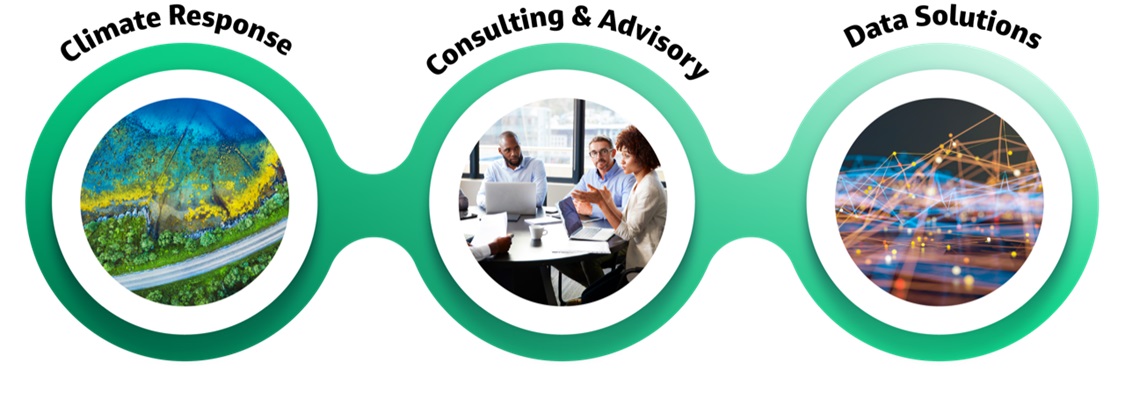
In March 2022, Jacobs launched a new three-year strategy that builds on our success over the past three years and takes advantage of a new lens crafted from the incredible pace of change in the world and in our markets. Our new strategy is driven by our values and reflective of our vision of becoming a company like no other. It is based on an extensive evaluation of global trends, capabilities and markets to understand the largest opportunities, projected spend and growth rates – resulting in the identification of three growth accelerators: Climate Response, Consulting & Advisory and Data Solutions. We know we have a pivotal role to play across the entire Climate Response value chain – helping to mitigate global risks and build long-term resilience to benefit people and the planet. Today our clients are facing the most disruptive period ever. Through our Consulting & Advisory capabilities, we help them conceptualize, shape and realize their future. We also harness our Data Solutions to help our clients operate in a safe environment and capitalize on their data more than ever before – empowering innovation and ingenuity to unlock better outcomes.
These growth accelerators cut across the entire business, open up significant high value growth opportunities with existing and new clients and create our focus on where we intend to deploy capital over the next several years.
Page 4
Our Core Markets
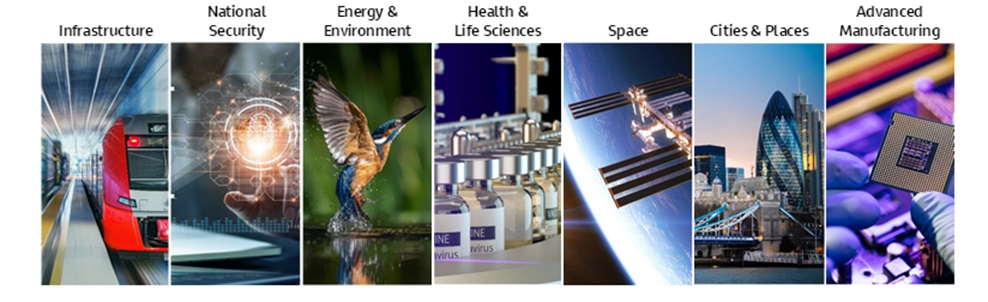
We believe our deep global domain knowledge in our core markets applied together with the latest advances in technology – are why customers large and small choose to partner with Jacobs. In fiscal year 2022, we operated in two lines of business: Critical Mission Solutions and People & Places Solutions, and a third business segment as a result of our majority investment in PA Consulting. As part of our new strategy, we also announced a new business unit that we will report under beginning in fiscal 2023, Divergent Solutions, which serves as the core foundation for developing and delivering innovative, next-generation cloud, cyber, data and digital technologies.
In the fourth quarter of fiscal year 2022, Jacobs Engineering Group Inc. (the predecessor parent company) created a new holding company, Jacobs Solutions Inc., which became the new parent of Jacobs Engineering Group, Inc. Jacobs Solutions Inc. more closely aligns our public identity with a global technology-forward solutions company. As a result of the transaction, the predecessor company’s then-current stockholders automatically became stockholders of Jacobs Solutions Inc., on a one-for-one basis, with the same number of shares and same ownership percentage of the Company’s common stock that they held in the predecessor company immediately prior to the transaction.
Page 5
Challenging today. Reinventing tomorrow
Our values continue to guide our behaviors, relationships and outcomes - allowing us to act as one company and unify us worldwide when interacting with our clients, employees, communities and shareholders.
-
We do things right. We always act with integrity – taking responsibility for our work, caring for our people and staying focused on safety and sustainability. We make investments in our clients, people and communities, so we can grow together.
-
We challenge the accepted. We know that to create a better future, we must ask the difficult questions. We always stay curious and are not afraid to try new things.
-
We aim higher.** We do not settle – always looking beyond to raise the bar and deliver with excellence. We are committed to our clients by bringing innovative solutions that lead to profitable growth and shared success.
-
We live inclusion. We put people at the heart of our business. We embrace all perspectives, collaborating to make a positive impact. Through a strong focus on inclusion, with a diverse team of visionaries, thinkers and doers, we build trust - in each other and across our company.
Page 6
We do things right
From the way we operate our business, to the sustainable solutions we co-create with clients and other organizations, we look at ways to make a positive environmental, societal and economic difference for our people, businesses, governments and communities around the world.

PlanBeyondSM 2.0 is our approach to integrating sustainability throughout our operations and client solutions in alignment with the United Nations' ("UN") Sustainable Development Goals ("SDGs")— planning beyond today for a more sustainable future for everyone. We identified six core SDGs that are material to our business, where we can have the most influence and impact, although we strive to contribute towards all 17 of the UN's SDGs.
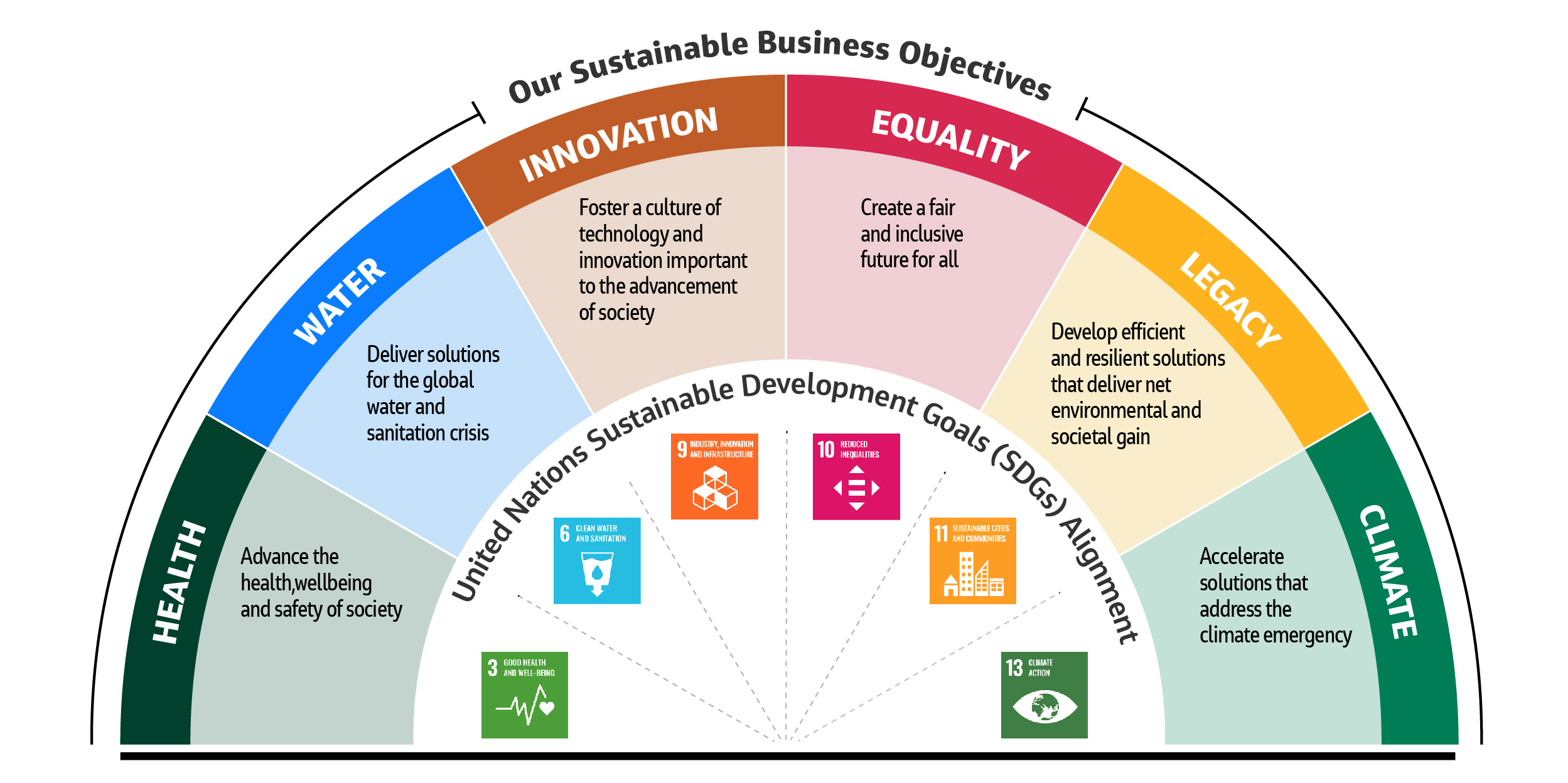
Sustainability at Jacobs means developing long-term business resilience and success, and positively contributing toward the global economy, society and the environment. It is not simply about avoiding harm, but about maximizing impact and stakeholder value, and striving to deliver a positive, fair and inclusive future for all in partnership with our clients.
Leadership on Climate Response and Social Value
Jacobs has elevated Climate Response as one of three core accelerators within our fiscal year 2022 to 2024 Company Strategy – aligning positive societal impact with long-term business growth, while supporting the UN's SDG 13: Climate Action. We also established an Office of Global Climate Response and ESG, designed to deliver on our climate action commitments through innovative solutions for both our clients and stakeholders.
Our new Climate Action Plan lays out our next phase of climate mitigation and
Showing the first 8K of 68K characters. Open the full section
Item 1A. RISK FACTORS
We operate in a changing global environment that involves numerous known and unknown risks and uncertainties that could materially adversely affect our business, financial condition and results of operations. The risks described below highlight some of the factors that have affected and could affect us in the future. We may also be affected by unknown risks or risks that we currently think are immaterial. If any such events actually occur, our business, financial condition and results of operations could be materially adversely affected.
Page 22
Summary Risk Factors
The following is a summary of some of the risks and uncertainties that could materially adversely affect our business, financial condition and results of operations. You should read this summary together with the more detailed description of each risk factor contained below.
Risks Related to Our Operations
-
We engage in a highly competitive business. If we are unable to compete effectively, we could lose market share and our business and results of operations could be negatively impacted.
-
Our results of operations depend on the award of new contracts and the timing of the award of these contracts and economic conditions. Demand for our services may be impacted by rising inflation, interest rates, and/or construction costs.
-
We may be unable to realize the benefits of implementing our three-year corporate strategy.
-
Project sites are inherently dangerous workplaces. Failure to maintain safe work sites exposes us to significant financial losses and reputational harm, as well as civil and criminal liabilities.
-
The nature of our contracts, particularly any fixed-price contracts, subjects us to risks of cost overruns. We may experience losses if costs increase above budgets or estimates or the project experiences delays.
-
Our failure to meet performance requirements or contractual schedules could adversely affect our business, financial condition and results of operations.
-
The contracts in our backlog may be adjusted, canceled or suspended by our clients and, therefore, our backlog is not necessarily indicative of our future revenues or earnings.
-
Contracts with the U.S. federal government and other governments and their agencies pose additional risks compared to contracts with private sector clients.
-
Our services expose us to significant monetary damages or even criminal violations and our insurance policies may not provide adequate coverage.
-
The outcome of pending and future claims and litigation could have a material adverse impact on our business, financial condition, and results of operations and damage our reputation.
-
A reduction in the amount of available governmental funding could materially affect our results of operations.
-
We are dependent on third parties to complete many of our contracts.
-
Employee, agent or partner misconduct, or our overall failure to comply with laws or regulations, could weaken our ability to win contracts, which could result in reduced revenues and profits.
-
Cybersecurity or privacy breaches, or systems and information technology interruption or failure could adversely impact our ability to operate or expose us to significant financial losses and reputational harm.
-
If we do not have adequate indemnification for our nuclear services, it could adversely affect our business, financial condition and results of operations.
-
Our actual results could differ from the estimates and assumptions used to prepare our financial statements.
-
We may have to contribute additional cash to meet any underfunded benefit obligations associated with retirement and post-retirement benefit plans we manage or for which we have contribution or funding obligations.
-
Our businesses could be materially and adversely affected by events outside of our control.
-
We must successfully manage the demand, supply and operational challenges associated with the effects of a disease outbreak, including epidemics, pandemics or similar widespread public health concerns.
-
Our continued success is dependent upon our ability to hire, retain, and utilize qualified personnel while managing the risks associated with sustained remote working arrangements.
-
Our professional reputation and relationships with government agencies are critical to our business, and any harm to our reputation or relationships could decrease the amount of business that government agencies do with us, which could have a material adverse effect on our business, financial condition and results of operations.
Page 23
- Our focus on new growth areas entails risks, including those associated with new relationships, clients, talent needs, capabilities, service offerings, and maintaining our collaborative culture and core values.
Risks Related to International Operations
-
Our international operations are exposed to additional risks and uncertainties, including unfavorable political developments and weak foreign economies.
-
Foreign exchange risks may affect our ability to realize a profit from certain projects.
-
Our global presence could give rise to material fluctuations in our income tax rates.
Risks Related to Acquisitions, Investments, Joint Ventures and Divestitures
-
If we, or our subsidiaries or companies in which we have made strategic investments, lose, or experience a significant reduction in, business from one or a few customers, it could have a material adverse impact on us.
-
Our use of joint ventures, partnerships and strategic investments in entities exposes us to risks and uncertainties, many of which are outside of our control.
-
An impairment charge on our goodwill or intangible assets could have a material adverse impact on our financial position and results of operations.
-
Our business strategy relies in part on acquisitions and strategic investments to sustain our growth. These transactions present certain risks and uncertainties.
-
We may make minority investments that subject us to risks and uncertainties outside of our control.
Risks Related to Regulatory Compliance
-
Past and future environmental, health, and safety laws could impose significant additional costs and liabilities.
-
If we fail to comply with any governmental requirements, our business may be adversely affected.
-
We could be adversely affected by violations of the U.S. Foreign Corrupt Practices Act and similar worldwide anti-bribery laws.
Risks Related to Climate Change
-
Climate change and related environmental issues could have a material adverse impact on our business, financial condition and results of operations.
-
We may be affected by market or regulatory responses to climate change.
-
We may be unable to achieve our climate commitments and targets.
Risks Related to Our Indebtedness and Credit Markets
-
We rely in part on liquidity from our credit facilities to fund our business. Restrictions in our credit facilities could adversely impact our business. Our businesses may be adversely affected by disruptions or lack of liquidity in the credit markets, including reduced access to credit and higher costs of obtaining credit.
-
Maintaining adequate bonding and letter of credit capacity is necessary for us to successfully win some contracts.
Risks Related to Our Common Stock and Corporate Structure
-
Our quarterly results may fluctuate significantly, which could have a material negative effect on the price of our common stock.
-
There can be no assurance that we will pay dividends on our common stock.
-
In the event we issue stock as consideration for certain acquisitions we may make, we could dilute share ownership, and if we receive stock in connection with a divestiture, the value of stock is subject to fluctuation.
-
We are a holding company. Substantially all of our business is conducted through our subsidiaries. We depend on the performance of our subsidiaries and their ability to make distributions to us to fund our operati
Showing the first 8K of 128K characters. Open the full section
Item 1B. UNRESOLVED STAFF COMMENTS
None.
Item 2. PROPERTIES
Our properties consist primarily of office space within general, commercial office buildings located in major cities primarily in the following countries: United States; Armenia; Australia; Canada; China; Czech Republic; Egypt; France; Germany; Hong Kong; India; Indonesia; Iraq; Ireland; Italy; Japan; Kazakhstan; Malaysia; The Netherlands; New Zealand; The Philippines; Poland; Qatar; Romania; Saudi Arabia; Singapore; Slovakia; South Africa; South Korea; Sweden; Switzerland; Taiwan (Province of China); Thailand; Ukraine; United Arab Emirates and United Kingdom. We also lease smaller offices located in certain other countries. Such space is used for operations (providing technical, professional, and other home office services), sales and administration. The total amount of space leased by us for all of our operations is approximately 6.9 million square feet. We continue to evaluate our real estate needs in connection with changes in the Company's use of its leased space as a result of the COVID-19 pandemic, and as part of the integration of our prior acquisitions.
Page 48
Item 3. LEGAL PROCEEDINGS
The information required by this Item 3 is included in Note 19- Contractual Guarantees, Litigation, Investigations and Insurance of Notes to Consolidated Financial Statements beginning on page F-1 of this Annual Report on Form 10-K and is incorporated herein by reference.
Item 4. MINE SAFETY DISCLOSURE
None.
Page 49
PART II
Item 5. MARKET FOR REGISTRANT'S COMMON EQUITY, RELATED STOCKHOLDER MATTERS AND ISSUER PURCHASES OF EQUITY SECURITIES
Market Information
Our common stock is listed on the New York Stock Exchange under the ticker symbol "J".
Shareholders
According to the records of our transfer agent, there were 2,733 shareholders of record as of November 11, 2022.
Dividend Policy
Our Board of Directors initiated a quarterly cash dividend program in fiscal 2017 under which we have paid, and intend to continue paying, regular quarterly dividends. The declaration, amount and timing of such dividends are subject to capital availability and determinations by our Board of Directors that cash dividends are in the best interest of our stockholders and are in compliance with all respective laws and applicable agreements. Our ability to pay dividends will depend upon, among other factors, our cash balances and potential future capital requirements for strategic transactions, including acquisitions, debt service requirements, results of operations, financial condition and other factors that our Board of Directors may deem relevant.
Share Repurchases
On January 16, 2020, the Company's Board of Directors authorized a share repurchase program of up to $1.0 billion of the Company's common stock, to expire on January 15, 2023 (the "2020 Repurchase Authorization"). In the fourth quarter of fiscal 2021 the Company launched an accelerated share repurchase program by advancing $250 million to a financial institution in a privately negotiated transaction, with final non-cash settlement on the program during the first quarter of fiscal 2022 of 342,054 shares.
The following table summarizes the activity under the 2020 Repurchase Authorization during the fourth quarter of fiscal 2022:
| Period | Total Number of Shares Purchased | Average Price Per Share (1) | Total Number of Shares Purchased under the 2020 Repurchase Authorization | Approximate Dollar Value of Shares that May Yet Be Purchased Under the 2020 Repurchase Authorization | ||||||||||||||||||||||
| August 29, 2022 - September 30, 2022 | 276,244 | $113.02 | 276,244 | $500,991,805 |
(1)Includes commissions paid and calculated at the average price per share
As of September 30, 2022, the Company has $501.0 million remaining under the 2020 Repurchase Authorization.
Our share repurchase programs do not obligate the Company to purchase any shares. Share repurchases may be executed through various means including, without limitation, accelerated share repurchases, open market transactions, privately negotiated transactions, purchases pursuant to a Rule 10b5-1 plan or otherwise. The authorization for the share repurchase programs may be terminated, increased or decreased by the Company’s Board of Directors in its discretion at any time. The timing, amount and manner of share repurchases may depend upon market conditions and economic circumstances, availability of investment opportunities, the availability and costs of financing, currency fluctuations, the market price of the Company's common stock, other uses of capital and other factors.
Page 50
Unregistered Sales of Equity Securities
On February 4, 2022, the Company issued 6,620 shares of restricted stock in connection with its acquisition of Streetlight to certain stockholders in exchange for certain of their vested stock awards in StreetLight. These shares are subject to certain lockup restrictions agreed to by the Company and the shareholders. For further discussion of the StreetLight acquisition, see Note 15- Other Business Combinations.
These shares were issued in a transaction exempt from the registration requirements of the Securities Act of 1933, as amended (the “Securities Act”) in reliance upon Section 4(a)(2) of the Securities Act. The recipients of the securities in each of these transactions represented their intentions to acquire the securities for investment only and not with a view to or for sale in connection with any distribution thereof, and appropriate legends were placed upon the share certificates issued in these transactions.
Performance Graph
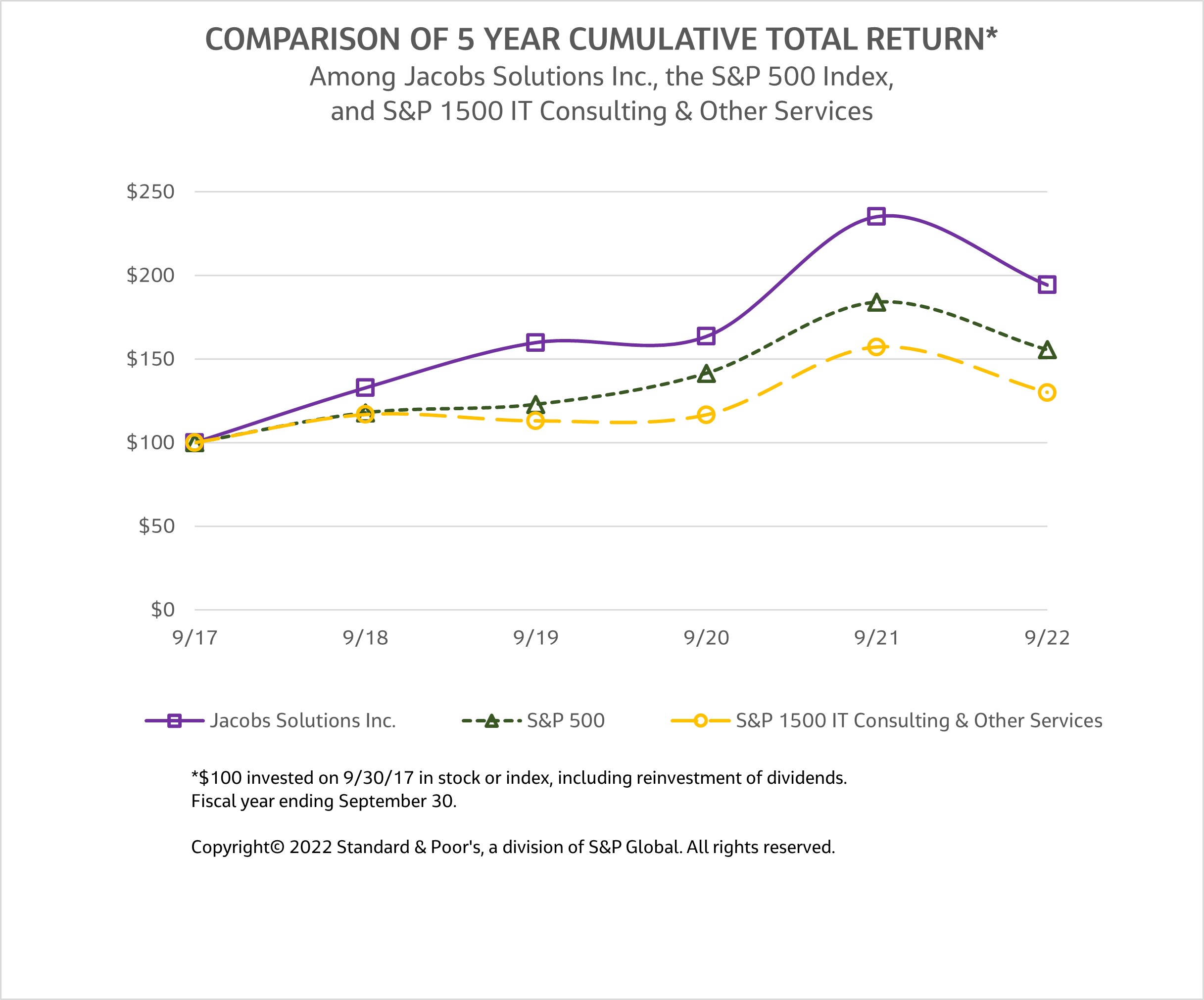
The following graph and table shows the changes over the five-year period ended September 30, 2022 in the value of $100 as of the close of market on September 29, 2017 in (1) the common stock of Jacobs Solutions Inc., (2) the Standard & Poor’s 500 Stock Index and (3) the Standard & Poor's 1500 IT Consulting & Other Services Index.
The values of each investment are based on share price appreciation, with reinvestment of all dividends, provided any were paid. The investments are assumed to have occurred at the beginning of the period presented. The stock performance included in this graph is not necessarily indicative of future stock price performance.
| 2017 | 2018 | 2019 | 2020 | 2021 | 2022 | ||||||||||||||||||||||||||||||
| Jacobs Solutions Inc. | 100.00 | 132.80 | 159.90 | 163.55 | 235.25 | 194.31 | |||||||||||||||||||||||||||||
| S&P 500 | 100.00 | 117.91 | 122.93 | 141.55 | 184.02 | 155.55 | |||||||||||||||||||||||||||||
| S&P 1500 IT Consulting & Other Services | 100.00 | 116.79 | 113.05 | 116.64 | 157.21 | 130.09 |
Page 51
Item 6. [Reserved]
Item 7. MANAGEMENT'S DISCUSSION AND ANALYSIS OF FINANCIAL CONDITION AND RESULTS OF OPERATIONS
Critical Accounting Policies and Estimates
In order to better understand the changes that occur to key elements of our financial condition, results of operations and cash flows, a reader of this Management’s Discussion and Analysis of Financial Condition and Results of Operations (“MD&A”) should be aware of the critical accounting policies we apply in preparing our consolidated financial statements.
The consolidated financial statements contained in this report were prepared in accordance with U.S. GAAP. The preparation of our consolidated financial statements and the financial statements of any business performing long-term professional services, engineering and construction-type contracts requires management to make certain estimates and judgments that affect both the entity’s results of operations and the carrying values of its assets and liabilities. Although our significant accounting policies are described in Note 2- Significant Accounting Policies of Notes to Consolidated Financial Statements beginning on page F-1 of this Annual Report on Form 10-K, the following discussion is intended to highlight and describe those accounting policies that are especially critical to the preparation of our consolidated financial statements.
Revenue Accounting for Contracts
The Company recognizes engineering, procurement, and construction contract revenue over time, as performance obligations are satisfied, due to the continuous transfer of control to the customer in accordance with ASC 606, Revenue from Contracts with Customers. Contracts that include engineering, procurement and construction services are generally accounted for as a single deliverable (a single performance obligation). In some instances, the Company’s services associated with a construction activity are limited only to specific tasks such as customer support, consulting or supervisory services. In these instances, the services are typically identified as separate performance obligations.
The Company recognizes revenue using the percentage-of-completion method, based primarily on contract costs incurred to date compared to total estimated contract costs. Estimated contract costs include the Company’s latest estimates using judgments with respect to labor hours and costs, materials, and subcontractor costs. The percentage-of-completion method (an input method) is the most representative depiction of the Company’s performance because it directly measures the value of the services transferred to the customer. Subcontractor materials, labor and equipment and, in certain cases, customer-furnished materials and labor and equipment are included in revenue and cost of revenue when management believes that the company is acting as a principal rather than as an agent (e.g., the company integrates the materials, labor and equipment into the deliverables promised to the customer or is otherwise primarily responsible for fulfillment and acceptability of the materials, labor and/or equipment). Under the typical payment terms of our engineering, procurement and construction contracts, amounts are billed as work progresses in accordance with agreed-upon contractual terms at periodic intervals (e.g., biweekly or monthly) and customer payments are typically due within 30 to 60 days of billing, depending on the contract.
For service contracts, the Company recognizes revenue over time using the cost-to-cost percentage-of-completion method. In some instances where the Company is standing ready to provide services, the Company recognizes revenue ratably over the service period. Under the typical payment terms of our service contracts, amounts are billed as work progresses in accordance with agreed-upon contractual terms, and customer payments are typically due within 30 to 60 days of billing, depending on the contract.
Direct costs of contracts include all costs incurred in connection with and directly for the benefit of client contracts, including depreciation and amortization relating to assets used in providing the services required by the related projects. The level of direct costs of contracts may fluctuate between reporting periods due to a variety of factors, including the amount of pass through costs we incur during a period. On those projects where we are acting as principal for subcontract labor or third-party materials and equipment, we reflect the amounts of such items in both revenues and costs (and we refer to such costs as “pass through costs”).
Page 52
Accounting for Pension Plans
The accounting for pension plans requires the use of assumptions and estimates in order to calculate periodic pension cost and the value of the plans’ assets and liabilities. These assumptions include discount rates, investment returns and projected salary increases, among others. The actuarial assumptions used in determining the funded statuses of the plans are provided in Note 13- Pension and Other Postretirement Benefit Plans of Notes to Consolidated Financial Statements beginning on page F-1 of this Annual Report on Form 10-K.
The expected rates of return on plan assets ranged from 2% to 7% for fiscal 2022 and range from 3.3% to 7.5% fiscal 2023. We believe the range of rates selected for fiscal 2023 reflects the long-term returns expected on the plans’ assets, considering recent market conditions, projected rates of inflation, the diversification of the plans’ assets, and the expected real rates of market returns. The discount rates used to compute plan liabilities ranged from 2.4% to 7.4% in fiscal 2022 and range from 2.4% to 7.4% in fiscal 2023. These assumptions represent the Company’s best estimate of the rates at which its pension obligations could be effectively settled.
Changes in the actuarial assumptions often have a material effect on the values assigned to plan assets and liabilities, and the associated pension expense. For example, if the discount rate used to value the net pension benefit obligation (“PBO”) at September 30, 2022 was lower or higher by 1.0%, the PBO would have been higher or lower, respectively, at that date by approximately $156.8 million for non-U.S. plans, and by approximately $23.7 million for U.S. plans. If the expected return on plan assets was lower or higher by 1.0%, the net periodic pension cost for fiscal 2022 would be higher or lower, respectively, by approximately $21.2 million for non-U.S. plans, and by approximately $3.4 million for U.S. plans. Differences between actuarial assumptions and actual performance (i.e., actuarial gains and losses) that are not recognized as a component of net periodic pension cost in the period in which such differences arise are recorded to accumulated other comprehensive income (loss) and are recognized as part of net periodic pension cost in future periods in accordance with U.S. GAAP. Management monitors trends in the marketplace within which our pension plans operate in an effort to assure the reasonableness of the actuarial assumptions used.
Redeemable Noncontrolling Interests
In connection with the PA Consulting investment, the Company recorded redeemable noncontrolling interests, representing the interest holders' 35% equity interest in the form of preferred and common shares of PA Consulting. The preferred shares are entitled to a cumulative annual compounding 12% dividend based on the outstanding preferred share subscription price. These interest holders have certain option rights to put the preferred and common share interests back to the Company at a value based on the fair value of PA Consulting (the redemption values). The primary inputs and assumptions impacting the fair value of PA Consulting include projections of revenue and earnings before interest, taxes, depreciation and amortization and discount rates applied thereto. Additionally, the Company has an option to call the interests for certain individual shareholders in certain circumstances. Because the interests are redeemable at the opti
Showing the first 8K of 65K characters. Open the full section
Item 7A. QUANTITATIVE AND QUALITATIVE DISCLOSURES ABOUT MARKET RISK
We do not enter into derivative financial instruments for trading, speculation or other similar purposes that would expose the Company to market risk. In the normal course of business, our results of operations are exposed to risks associated with fluctuations in interest rates and currency exchange rates.
Interest Rate Risk
Please see the Note 9- Borrowings in Notes to Consolidated Financial Statements beginning on Page F-1 of this Annual Report on Form 10-K, which is incorporated herein by reference, for a discussion of the Revolving Credit Facility, Term Loan Facilities and Note Purchase Agreement.
Our Revolving Credit Facility, Term Loan Facilities and certain other debt obligations are subject to variable rate interest which could be adversely affected by an increase in interest rates. As of September 30, 2022, we had an aggregate of $2.9 billion in outstanding borrowings under our Revolving Credit Facility and Term Loan Facilities. Interest on amounts borrowed under these agreements is subject to adjustment based on the Company’s Consolidated Leverage Ratio (as defined in the credit agreements governing the Revolving Credit Facility and the Term Loan Facilities). Depending on the Company’s Consolidated Leverage Ratio, borrowings under the Revolving Credit Facility and the Term Loan Facilities bear interest at a Eurocurrency rate plus a margin of between 0.875% and 1.625% or a base rate plus a margin of between 0% and 0.625%. Additionally, if our consolidated leverage ratio exceeds a certain amount, the interest on the Senior Notes may increase by 75 basis points. However, as discussed in Note 18- Commitments and Contingencies and Derivative Financial Instruments, we have entered into swap agreements with an aggregate notional value of $876.2 million to convert the variable rate interest-based liabilities associated with a corresponding amount of our debt into fixed interest rate liabilities, leaving $2.0 billion in principal amount subject to variable interest rate risk. Additionally, during fiscal 2022, we entered into two treasury lock arrangements with an aggregate notional value of $500.0 million as of September 30, 2022, which is discussed in further detail in Note 18- Commitments and Contingencies and Derivative Financial Instruments.
For the year ended September 30, 2022, our weighted average floating rate borrowings that are subject to floating rate exposure were approximately $2.3 billion. If floating interest rates had increased by 1.00%, our interest expense for the year ended September 30, 2022 would have increased by approximately $22.6 million.
Foreign Currency Risk
In situations where our operations incur contract costs in currencies other than their functional currency, we sometimes enter into foreign exchange contracts to limit our exposure to fluctuating foreign currencies. We follow the provisions of ASC No. 815, Derivatives and Hedging in accounting for our derivative contracts. The Company has $298.2 million in notional value of exchange rate sensitive instruments at September 30, 2022. See Note 18- Commitments and Contingencies and Derivative Financial Instruments for discussion.
Item 8. FINANCIAL STATEMENTS AND SUPPLEMENTARY DATA
The information required by this Item 8 is submitted as a separate section beginning on page F-1 of this Annual Report on Form 10-K and is incorporated herein by reference.
Item 9. CHANGES IN AND DISAGREEMENTS WITH ACCOUNTANTS ON ACCOUNTING AND FINANCIAL DISCLOSURE
None.
Item 9A. CONTROLS AND PROCEDURES
Evaluation of Disclosure Controls and Procedures
Disclosure controls and procedures are those controls and procedures that are designed to ensure that information required to be disclosed in our reports filed or submitted under the Securities Exchange Act of 1934, as amended (the “Exchange Act”) are recorded, processed, summarized and reported within the time periods specified in the SEC’s rules and forms. Disclosure controls and procedures include, without limitation, controls and procedures designed to ensure that information required to be disclosed in our reports filed under the Exchange Act is accumulated and
Page 66
communicated to management, including our Chair and Chief Executive Officer (principal executive officer) and Chief Financial Officer (principal financial officer), to allow timely decisions regarding required disclosure.
The Company’s management, with the participation of its Chair and Chief Executive Officer (principal executive officer) and Chief Financial Officer (principal financial officer), evaluated the effectiveness of the Company’s disclosure controls and procedures as defined by Rule 13a-15(e) of the Exchange Act as of September 30, 2022, the end of the period covered by this Annual Report on Form 10-K (the “Evaluation Date”). Based on that evaluation, the Company’s management, with the participation of the Chair and Chief Executive Officer (principal executive officer) and Chief Financial Officer (principal financial officer) concluded that the Company’s disclosure controls and procedures as of the Evaluation Date were effective to ensure that information required to be disclosed by the Company in the reports that it files or submits under the Exchange Act is recorded, processed, summarized and reported within the time periods specified in the SEC’s rules and forms and that such information is accumulated and communicated to the Company’s management, including the Company’s Chair and Chief Executive Officer (principal executive officer) and Chief Financial Officer (principal financial officer), as appropriate to allow timely decisions regarding required disclosure.
Management’s Annual Report on Internal Control Over Financial Reporting
Management is responsible for establishing and maintaining for the Company adequate internal control over financial reporting, as defined in Rule 13a-15(f) under the Exchange Act. Management, with the participation of its Chair and Chief Executive Officer (principal executive officer) and Chief Financial Officer (principal financial officer), has assessed the effectiveness of the Company’s internal control over financial reporting as of the Evaluation Date based on the framework established in “Internal Control—Integrated Framework,” issued by the Committee of Sponsoring Organizations of the Treadway Commission (2013 framework). Based on this assessment, management has concluded that the Company’s internal control over financial reporting as of the Evaluation Date was effective.
The Company's independent registered public accounting firm, Ernst & Young LLP, that audited the Company's consolidated financial statements included in this Annual Report on Form 10-K, also audited the effectiveness of our internal control over financial reporting as of September 30, 2022, as stated in their report included in this Annual Report on Form 10-K.
Changes in Internal Control
There were no changes in the Company’s internal control over financial reporting during the Company’s fiscal quarter ended September 30, 2022 that have materially affected, or are reasonably likely to materially affect, the Company’s internal control over financial reporting.
Limitations on Effectiveness of Controls
The Company’s management, including its Chair and Chief Executive Officer and Chief Financial Officer, does not expect that its disclosure controls and procedures or its system of internal control over financial reporting will prevent or detect all errors and all fraud. A control system, no matter how well designed or operated, can provide only reasonable, but not absolute, assurance that the objectives of the system of internal control are met. The design of the Company’s control system reflects the fact that there are resource constraints, and that the benefits of such control systems must be considered relative to their costs. Further, because of the inherent limitations in all control systems, no evaluation of controls can provide absolute assurance that all control failures and instances of fraud, if any, within the Company have been detected. These inherent limitations include the realities that judgments in decision-making can be faulty and that breakdowns can occur because of simple error or mistake. Additionally, controls can be circumvented by the intentional acts of individuals, by collusion of two or more people, or by management override of the controls. The design of any system of controls is also based in part on certain assumptions about the likelihood of future events, and there can be no assurance that the design of any particular control will always succeed in achieving its objective under all potential future conditions.
Item 9B. OTHER INFORMATION
None.
Page 67
PART III
Item 10. DIRECTORS, EXECUTIVE OFFICERS AND CORPORATE GOVERNANCE
Directors, Executive Officers, Promoters and Control Persons
The information required by Paragraph (a), and Paragraphs (c) through (g) of Item 401 of Regulation S-K (except for information required by Paragraph (e) of that Item to the extent the required information pertains to our executive officers) and Item 405 of Regulation S-K is set forth under the caption “Members of the Board of Directors” and “Corporate Governance” in our definitive proxy statement to be filed with the SEC pursuant to Regulation 14A within 120 days after the close of our fiscal year and is incorporated herein by reference. The information required by Paragraph (b) of Item 401 of Regulation S-K, as well as the information required by Paragraph (e) of that Item to the extent the required information pertains to our executive officers, is set forth in Part I, Item 1 of this Annual Report on Form 10-K under the heading “Information About Our Executive Officers.”
Code of Ethics
We have adopted a code of ethics for our Chair and Chief Executive Officer and senior financial officers; a code of business conduct and ethics for members of our Board of Directors and corporate governance guidelines. The full text of these codes of ethics and corporate governance guidelines are available at our website at www.jacobs.com. In the event we make any amendment to, or grant any waiver from, a provision of the code of ethics that applies to the principal executive officer, principal financial officer or principal accounting officer that requires disclosure under applicable SEC rules, we will disclose such amendment or waiver and the reasons therefor on our website. We will provide any person without charge a copy of any of the aforementioned codes of ethics upon receipt of a written request. Requests should be addressed to: Jacobs Solutions Inc., 1999 Bryan Street, Suite 1200, Dallas, Texas 75201, Attention: Corporate Secretary.
Corporate Governance
The information required by Items 407(d)(4) and (d)(5) of Regulation S-K is set forth under the caption “Corporate Governance” in our definitive proxy statement to be filed with the SEC pursuant to Regulation 14A within 120 days after the close of our fiscal year and is incorporated herein by reference.
Item 11. EXECUTIVE COMPENSATION
The information required by this Item is set forth under the captions “Corporate Governance,” “Compensation Committee Report,” “Compensation Discussion and Analysis” and “Executive Compensation” in our definitive proxy statement to be filed with the SEC pursuant to Regulation 14A within 120 days after the close of our fiscal year and is incorporated herein by reference.
Item 12. SECURITY OWNERSHIP OF CERTAIN BENEFICIAL OWNERS AND MANAGEMENT AND RELATED STOCKHOLDER MATTERS
The information required by this Item is set forth in our definitive proxy statement to be filed with the SEC pursuant to Regulation 14A within 120 days after the close of our fiscal year and is incorporated herein by reference.
Item 13. CERTAIN RELATIONSHIPS AND RELATED TRANSACTIONS AND DIRECTOR INDEPENDENCE
The information required by this Item is set forth under the captions “Members of The Board of Directors,” “Corporate Governance,” and “Certain Relationships and Related Transactions” in our definitive proxy statement to be filed with the SEC pursuant to Regulation 14A within 120 days after the close of our fiscal year and is incorporated herein by reference.
Item 14. PRINCIPAL ACCOUNTING FEES AND SERVICES
The Company's independent registered public accounting firm is Ernst & Young, LLP, Dallas, TX, Auditor Firm ID: 42.
Page 68
The information required by this Item is set forth under the captions “Report of the Audit Committee” and “Audit and Non-Audit Fees” in our definitive proxy statement to be filed with the SEC pursuant to Regulation 14A within 120 days after the close of our fiscal year and is incorporated herein by reference.
Page 69
PART IV
EXHIBITS AND FINANCIAL STATEMENTS
Item 15. EXHIBITS AND FINANCIAL STATEMENT SCHEDULES
(a) Documents filed as part of this report:
(1)The Company’s Consolidated Financial Statements at September 30, 2022 and October 1, 2021 and for each of the three years in the period ended September 30, 2022, and the notes thereto, together with the report of the independent auditors on those Consolidated Financial Statements are hereby filed as part of this report, beginning on page F-1.
(2)Financial statement schedules – no financial statement schedules are presented as the required information is either not applicable, or is included in the consolidated financial statements or notes thereto.
(3)See Exhibit Index below.
(b) Exhibit Index:
Page 70
| 10.5 | [Note Purchase Agreement, dated March 12, 2018, by and between Jacobs Engineering Group Inc. and the P |
Showing the first 8K of 306K characters. Open the full section