 filings.tools
Johnson Controls International 10-K 2018-09-30
Filed 2018-11-20. 22 sections, 604K characters. Original on sec.gov · Markdown · JSON
Cover and table of contents
10-K 1 jciplc201810-k.htm 10-K
UNITED STATES SECURITIES AND EXCHANGE COMMISSION
WASHINGTON, D.C. 20549
FORM 10–K
| þ | ANNUAL REPORT PURSUANT TO SECTION 13 OR 15(d) OF THE SECURITIES EXCHANGE ACT OF 1934 |
For the Fiscal Year Ended September 30, 2018
OR
| ¨ | TRANSITION REPORT PURSUANT TO SECTION 13 OR 15(d) OF THE SECURITIES EXCHANGE ACT OF 1934 |
For The Transition Period From ________ To
Commission File Number 001-13836
JOHNSON CONTROLS INTERNATIONAL PLC
(Exact name of registrant as specified in its charter)
| Ireland | 98-0390500 | |
| (Jurisdiction of Incorporation) | (I.R.S. Employer Identification No.) | |
| One Albert Quay Cork, Ireland | ||
| (Address of principal executive offices) | ||
| 353-21-423-5000 | ||
| (Registrant's telephone number) |
Securities Registered Pursuant to Section 12(b) of the Exchange Act:
| Title of Each Class | Name of Each Exchange on Which Registered | |
| Ordinary Shares, Par Value $0.01 | New York Stock Exchange |
Securities Registered Pursuant to Section 12(g) of the Exchange Act: None
Indicate by check mark whether the registrant is a well-known seasoned issuer, as defined in Rule 405 of the Securities Act. Yes þ No ¨
Indicate by check mark if the registrant is not required to file reports pursuant to Section 13 or Section 15(d) of the Exchange Act. Yes ¨ No þ
Indicate by check mark whether the registrant (1) has filed all reports required to be filed by Section 13 or 15(d) of the Exchange Act during the preceding 12 months (or for such shorter period that the registrant was required to file such reports), and (2) has been subject to such filing requirements for the past 90 days. Yes þ No ¨
Indicate by check mark whether the registrant has submitted electronically every Interactive Data File required to be submitted pursuant to Rule 405 of Regulation S-T during the preceding 12 months (or for such shorter period that the registrant was required to submit such files). Yes þ No ¨
Indicate by check mark if disclosure of delinquent filers pursuant to Item 405 of Regulation S-K is not contained herein, and will not be contained, to the best of registrant’s knowledge, in definitive proxy or information statements incorporated by reference in Part III of this Form 10-K or any amendment to this Form 10-K. ¨
Indicate by check mark whether the registrant is a large accelerated filer, an accelerated filer, or a non-accelerated filer. See the definitions of "large accelerated filer," "accelerated filer," "smaller reporting company," and "emerging growth company" in Rule 12b-2 of the Exchange Act.
| Large accelerated filer | þ | Accelerated filer | ¨ | |||
| Non-accelerated filer | ¨ | |||||
| Emerging growth company | ¨ | Smaller reporting company | ¨ | |||
If an emerging growth company, indicate by check mark if the registrant has elected not to use the extended transition period for complying with any new or revised financial accounting standards provided pursuant to Section 13(a) of the Exchange Act. ¨
Indicate by check mark whether the registrant is a shell company (as defined in Rule 12b-2 of the Exchange Act). Yes ¨ No þ
As of March 31, 2018, the aggregate market value of Johnson Controls International plc Common Stock held by non-affiliates of the registrant was approximately $32.6 billion based on the closing sales price as reported on the New York Stock Exchange. As of October 31, 2018, 924,058,960 ordinary shares, par value $0.01 per share, were outstanding.
DOCUMENTS INCORPORATED BY REFERENCE
Portions of the definitive Proxy Statement to be delivered to shareholders in connection with the annual general meeting of shareholders to be held on March 6, 2019 are incorporated by reference into Part III.
JOHNSON CONTROLS INTERNATIONAL PLC
Index to Annual Report on Form 10-K
Year Ended September 30, 2018
CAUTIONARY STATEMENTS FOR FORWARD-LOOKING INFORMATION
Unless otherwise indicated, references to "Johnson Controls," the "Company," "we," "our" and "us" in this Annual Report on Form 10-K refer to Johnson Controls International plc and its consolidated subsidiaries.
The Company has made statements in this document that are forward-looking and therefore are subject to risks and uncertainties. All statements in this document other than statements of historical fact are, or could be, "forward-looking statements" within the meaning of the Private Securities Litigation Reform Act of 1995. In this document, statements regarding Johnson Controls' future financial position, sales, costs, earnings, cash flows, other measures of results of operations, synergies and integration opportunities, capital expenditures and debt levels are forward-looking statements. Words such as "may," "will," "expect," "intend," "estimate," "anticipate," "believe," "should," "forecast," "project" or "plan" and terms of similar meaning are also generally intended to identify forward-looking statements. However, the absence of these words does not mean that a statement is not forward-looking. Johnson Controls cautions that these statements are subject to numerous important risks, uncertainties, assumptions and other factors, some of which are beyond Johnson Controls’ control, that could cause Johnson Controls’ actual results to differ materially from those expressed or implied by such forward-looking statements, including, among others, risks related to: any delay or inability of Johnson Controls to realize the expected benefits and synergies of recent portfolio transactions such as the merger with Tyco International plc ("Tyco"), the spin-off of Adient, changes in tax laws (including but not limited to the Tax Cuts and Jobs Act enacted in December 2017), regulations, rates, policies or interpretations, the loss of key senior management, the tax treatment of recent portfolio transactions, significant transaction costs and/or unknown liabilities associated with such transactions, the outcome of actual or potential litigation relating to such transactions, the risk that disruptions from recent transactions will harm Johnson Controls’ business, the strength of the U.S. or other economies, changes to laws or policies governing foreign trade, including increased tariffs or trade restrictions, automotive vehicle production levels, mix and schedules, energy and commodity prices, the availability of raw materials and component products, currency exchange rates, cancellation of or changes to commercial arrangements, and with respect to the divestiture of the Power Solutions business, the expected financial impact and timing of the Power Solutions divestiture, whether and when the required regulatory approvals for the Power Solutions disposal will be obtained, the possibility that closing conditions for the Power Solutions divestiture may not be satisfied or waived, and whether the strategic benefits of the Power Solutions transaction can be achieved. A detailed discussion of risks related to Johnson Controls’ business is included in the section entitled "Risk Factors" (refer to Part I, Item 1A, of this Annual Report on Form 10-K). The forward-looking statements included in this document are made only as of the date of this document, unless otherwise specified, and, except as required by law, Johnson Controls assumes no obligation, and disclaims any obligation, to update such statements to reflect events or circumstances occurring after the date of this document.
PART I
Item 1. BUSINESS
General
Johnson Controls International plc, headquartered in Cork, Ireland, is a global diversified technology and multi industrial leader serving a wide range of customers in more than 150 countries. The Company creates intelligent buildings, efficient energy solutions, integrated infrastructure and next generation transportation systems that work seamlessly together to deliver on the promise of smart cities and communities. The Company is committed to helping our customers win and creating greater value for all of its stakeholders through strategic focus on our buildings and energy growth platforms.
Johnson Controls was originally incorporated in the state of Wisconsin in 1885 as Johnson Electric Service Company to manufacture, install and service automatic temperature regulation systems for buildings. The Company was renamed to Johnson Controls, Inc. in 1974. In 1978, the Company acquired Globe-Union, Inc., a Wisconsin-based manufacturer of automotive batteries for both the replacement and original equipment markets. The Company entered the automotive seating industry in 1985 with the acquisition of Michigan-based Hoover Universal, Inc. In 2005, the Company acquired York International, a global supplier of heating, ventilating, air-conditioning ("HVAC") and refrigeration equipment and services. In 2014, the Company acquired Air Distribution Technologies, Inc. ("ADTi"), one of the largest independent providers of air distribution and ventilation products in North America. On October 1, 2015, the Company formed a joint venture with Hitachi to expand its building related product offerings.
In the fourth quarter of fiscal 2016, Johnson Controls, Inc. ("JCI Inc.") and Tyco completed their combination with JCI Inc. merging with a wholly owned, indirect subsidiary of Tyco (the "Merger"). Following the Merger, Tyco changed its name to “Johnson Controls International plc” and JCI Inc. is a wholly-owned subsidiary of Johnson Controls International plc. The Merger was accounted for as a reverse acquisition using the acquisition method of accounting in accordance with Accounting Standards Codification ("ASC") 805, "Business Combinations." JCI Inc. was the accounting acquirer for financial reporting purposes. Accordingly, the historical consolidated financial statements of JCI Inc. for periods prior to this transaction are considered to be
the historic financial statements of the Company. Refer to Note 2, "Merger Transaction," of the notes to consolidated financial statements for additional information.
The acquisition of Tyco brings together best-in-class product, technology and service capabilities across controls, fire, security, HVAC and power solutions, to serve various end-markets including large institutions, commercial buildings, retail, industrial, small business and residential. The combination of the Tyco and Johnson Controls buildings platforms creates opportunities for near-term growth through cross-selling, complementary branch and channel networks, and expanded global reach for established businesses. The new Company benefits by combining innovation capabilities and pipelines involving new products, advanced solutions for smart buildings and cities, value-added services driven by advanced data and analytics.
On October 31, 2016, the Company completed the spin-off of its Automotive Experience business by way of the transfer of the Automotive Experience Business from Johnson Controls to Adient plc ("Adient") and the issuance of ordinary shares of Adient directly to holders of Johnson Controls ordinary shares on a pro rata basis. Prior to the open of business on October 31, 2016, each of the Company's shareholders received one ordinary share of Adient plc for every 10 ordinary shares of Johnson Controls held as of the close of business on October 19, 2016, the record date for the distribution. Company shareholders received cash in lieu of fractional shares of Adient, if any. Following the separation and distribution, Adient plc is now an independent public company trading on the New York Stock Exchange ("NYSE") under the symbol "ADNT." The Company did not retain any equity interest in Adient plc. Adient's historical financial statements are reflected in the Company's consolidated financial statements as a discontinued operation.
The Building Technologies & Solutions ("Buildings") business is a global market leader in engineering, developing, manufacturing and installing building products and systems around the world, including HVAC equipment, HVAC controls, energy-management systems, security systems, fire detection systems and fire suppression solutions. The Buildings business further serves customers by providing technical services (in the HVAC, security and fire-protection space), energy-management consulting and data-driven solutions via its data-enabled business. Finally, the Company has a strong presence in the North American residential air conditioning and heating systems market and is a global market leader in industrial refrigeration products.
The Power Solutions business is a leading global supplier of lead-acid automotive batteries for virtually every type of passenger car, light truck and utility vehicle. The Company serves both automotive original equipment manufacturers ("OEMs") and the general vehicle battery aftermarket. The Company also supplies advanced battery technologies to power start-stop, hybrid and electric vehicles.
On November 13, 2018, the Company entered into a Stock and Asset Purchase Agreement (“Purchase Agreement”) with BCP Acquisitions LLC (“Purchaser”). The Purchaser is a newly-formed entity controlled by investment funds managed by Brookfield Capital Partners LLC. Pursuant to the Purchase Agreement, on the terms and subject to the conditions therein, the Company has agreed to sell, and Purchaser has agreed to acquire, the Company’s Power Solutions business for a purchase price of $13.2 billion. Net cash proceeds are expected to be $11.4 billion after tax and transaction-related expenses. The transaction is expected to close by June 30, 2019, subject to customary closing conditions and required regulatory approvals. The operating results of the Power Solutions business will be reported as a discontinued operation beginning in the first quarter of fiscal 2019.
Products/Systems and Services
Building Technologies & Solutions
Building Technologies & Solutions sells its integrated control systems, security systems, fire-detection systems, equipment and services primarily through the Company’s extensive global network of sales and service offices, with operations in approximately 70 countries. Significant sales are also generated through global third-party channels, such as distributors of air-conditioning, security, fire-detection and commercial HVAC systems. The Company’s large base of current customers leads to significant repeat business for the retrofit and replacement markets. In addition, the new commercial construction market is also important. Trusted Buildings brands, such as YORK®, Hitachi Air Conditioning, Metasys®, Ansul, Ruskin®, Titus®, Frick®, PENN®, Sabroe®, Simplex® and Grinnell® give the Company the most diverse portfolio in the building technology industry.
In fiscal 2018, approximately 26% of its sales originated from its service offerings. In fiscal 2018, Building Technologies & Solutions accounted for 75% of the Company’s consolidated net sales.
Power Solutions
Power Solutions services both automotive OEMs and the battery aftermarket by providing advanced battery technology, coupled with systems engineering, marketing and service expertise. The Company is the largest producer of lead-acid automotive batteries
in the world, producing and distributing approximately 154 million lead-acid batteries annually in approximately 70 wholly- and majority-owned manufacturing or assembly plants, distribution centers and sales offices in approximately 20 countries worldwide. Investments in new product and process technology have expanded product offerings to absorbent glass mat ("AGM") and enhanced flooded battery ("EFB") technologies that power start-stop vehicles, as well as lithium-ion battery technology for certain hybrid and electric vehicles. The business has also invested to develop sustainable lead and poly recycling operations in the North American and European markets. Approximately 75% of unit sales worldwide in fiscal 2018 were to the automotive replacement market, with the remaining sales to the OEM market.
Power Solutions accounted for 25% of the Company’s fiscal 2018 consolidated net sales. Batteries and key components are manufactured at wholly- and majority-owned plants in North America, South America, Asia and Europe.
Competition
Building Technologies & Solutions
The Building Technologies & Solutions business conducts its operations through thousands of individual contracts that are either negotiated or awarded on a competitive basis. Key factors in the award of contracts include system and service performance, quality, price, design, reputation, technology, application engineering capability and construction or project management expertise. Competitors for HVAC equipment, security, fire-detection, fire suppression and controls in the residential and non-residential marketplace include many regional, national and international providers; larger competitors include Honeywell International, Inc.; Siemens Building Technologies, an operating group of Siemens AG; Schneider Electric SA; Carrier Corporation, a subsidiary of United Technologies Corporation; Trane Incorporated, a subsidiary of Ingersoll-Rand Company Limited; Daikin Industries, Ltd.; Lennox International, Inc.; GC Midea Holding Co, Ltd. and Gree Electric Appliances, Inc. In addition to HVAC equipment, Building Technologies & Solutions competes in a highly fragmented HVAC services market, which is dominated by local providers. The loss of any individual contract would not have a material adverse effect on the Company.
Power Solutions
Power Solutions is the principal supplier of batteries to many of the largest merchants in the battery aftermarket, including Advance Auto Parts, AutoZone, Robert Bosch GmbH, DAISA S.A., Costco, O’Reilly/CSK, Interstate Battery System of America and Wal-Mart stores. Automotive batteries are sold throughout the world under private labels and under the Company’s brand names (Optima®, Varta®, LTH® and Heliar®) to automotive replacement battery retailers and distributors and to automobile manufacturers as original equipment. The Power Solutions business competes with a number of major U.S. and non-U.S. manufacturers and distributors of lead-acid batteries, as well as a large number of smaller, regional competitors. The Power Solutions business primarily competes in the battery market with Exide Technologies, GS Yuasa Corporation, Camel Group Company Limited, East Penn Manufacturing Company and Banner Batteries GB Limited. The North American, European and Asian lead-acid battery markets are highly competitive. The manufacturers in these markets compete on price, quality, technical innovation, service and warranty.
Backlog
The Company’s backlog relating to the Building Technologies & Solutions business is applicable to its sales of systems and services. At September 30, 2018, the backlog was $8.7 billion, of which $8.4 billion is attributable to the field business. The majority of backlog relates to fiscal 2019. At September 30, 2017, the backlog was $8.5 billion, of which $8.2 billion is attributable to the field business. The backlog amount outstanding at any given time is not necessarily indicative of the amount of revenue to be earned in the upcoming fiscal year.
Raw Materials
Raw materials used by the businesses in connection with their operations, including lead, steel, tin, aluminum, urethane chemicals, brass, copper, sulfuric acid, polypropylene and certain flurochemicals used in our fire suppression agents, were readily available during fiscal 2018, and the Company expects such availability to continue. In fiscal 2019, commodity prices could fluctuate throughout the year and could significantly affect the results of operations.
Intellectual Property
Generally, the Company seeks statutory protection for strategic or financially important intellectual property developed in connection with its business. Certain intellectual property, where appropriate, is protected by contracts, licenses, confidentiality or other agreements.
The Company owns numerous U.S. and non-U.S. patents (and their respective counterparts), the more important of which cover those technologies and inventions embodied in current products or which are used in the manufacture of those products. While the Company believes patents are important to its business operations and in the aggregate constitute a valuable asset, no single patent, or group of patents, is critical to the success of the business. The Company, from time to time, grants licenses under its patents and technology and receives licenses under patents and technology of others.
The Company’s trademarks, certain of which are material to its business, are registered or otherwise legally protected in the U.S. and many non-U.S. countries where products and services of the Company are sold. The Company, from time to time, becomes involved in trademark licensing transactions.
Most works of authorship produced for the Company, such as computer programs, catalogs and sales literature, carry appropriate notices indicating the Company’s claim to copyright protection under U.S. law and appropriate international treaties.
Environmental, Health and Safety Matters
Laws addressing the protection of the environment (environmental laws) and workers’ safety and health (worker safety laws) govern the Company’s ongoing global operations. They generally provide for civil and criminal penalties, as well as injunctive and remedial relief, for noncompliance or require remediation of sites where Company-related materials have been released into the environment.
The Company has expended substantial resources globally, both financial and managerial, to comply with environmental laws and worker safety laws and maintains procedures designed to foster and ensure compliance. Certain of the Company’s businesses are, or have been, engaged in the handling or use of substances that may impact workplace health and safety or the environment. The Company is committed to protecting its workers and the environment against the risks associated with these substances.
The Company’s operations and facilities have been, and in the future may become, the subject of formal or informal enforcement actions or proceedings for noncompliance with environmental laws and worker safety laws or for the remediation of Company-related substances released into the environment. Such matters typically are resolved with regulatory authorities through commitments to compliance, abatement or remediation programs and, in some cases, payment of penalties. See Item 3, "Legal Proceedings," of this report for a discussion of the Company’s potential environmental liabilities.
Environmental Capital Expenditures
The Company’s ongoing environmental compliance program often results in capital expenditures. Environmental considerations are a part of all significant capital expenditure decisions; however, expenditures in fiscal 2018 related solely to environmental compliance were not material. It is management’s opinion that the amount of any future capital expenditures related solely to environmental compliance will not have a material adverse effect on the Company’s financial results or competitive position in any one year.
Government Regulation and Supervision
The Company's operations are subject to numerous federal, state and local laws and regulations, both within and outside the U.S., in areas such as: consumer protection, government contracts, international trade, environmental protection, labor and employment, tax, licensing and others. For example, most U.S. states and non-U.S. jurisdictions in which the Company operates have licensing laws directed specifically toward the alarm and fire suppression industries. The Company's security businesses currently rely extensively upon the use of wireline and wireless telephone service to communicate signals. Wireline and wireless telephone companies in the U.S. are regulated by the federal and state governments. In addition, government regulation of fire safety codes can impact the Company's fire businesses. These and other laws and regulations impact the manner in which the Company conducts its business, and changes in legislation or government policies can affect the Company's worldwide operations, both favorably and unfavorably. For a more detailed description of the various laws and regulations that affect the Company's business, see Item 1A. Risk Factors.
Employees
As of September 30, 2018, the Company employed approximately 122,000 people worldwide, of which approximately 48,000 were employed in the United States and approximately 74,000 were outside the United States. Approximately 31,000 employees are covered by collective bargaining agreements or works councils and we believe that our relations with the labor unions are generally good.
Seasonal Factors
Certain of Building Technologies & Solutions sales are seasonal as the demand for residential air conditioning equipment generally increases in the summer months. This seasonality is mitigated by the other products and services provided by the Building Technologies & Solutions business that have no material seasonal effect.
Research and Development Expenditures
Refer to Note 1, "Summary of Significant Accounting Policies," of the notes to consolidated financial statements for research and development expenditures.
Available Information
The Company’s filings with the U.S. Securities and Exchange Commission ("SEC"), including annual reports on Form 10-K, quarterly reports on Form 10-Q, definitive proxy statements on Schedule 14A, current reports on Form 8-K, and any amendments to those reports filed pursuant to Section 13 or 15(d) of the Securities Exchange Act of 1934, are made available free of charge through the Investor Relations section of the Company’s Internet website at http://www.johnsoncontrols.com as soon as reasonably practicable after the Company electronically files such material with, or furnishes it to, the SEC. Copies of any materials the Company files with the SEC can also be obtained free of charge through the SEC’s website at http://www.sec.gov, at the SEC’s Public Reference Room at 100 F Street, N.E., Washington, D.C. 20549, or by calling the SEC’s Office of Investor Education and Advocacy at 1-800-732-0330. The Company also makes available, free of charge, its Ethics Policy, Corporate Governance Guidelines, Board of Directors committee charters and other information related to the Company on the Company’s Internet website or in printed form upon request. The Company is not including the information contained on the Company’s website as a part of, or incorporating it by reference into, this Annual Report on Form 10-K.
Item 1A. RISK FACTORS
Risks Relating to Business Operations
General economic, credit and capital market conditions could adversely affect our financial performance, our ability to grow or sustain our businesses and our ability to access the capital markets.
We compete around the world in various geographic regions and product markets. Global economic conditions affect each of our primary businesses. As we discuss in greater detail in the specific risk factors for each of our businesses that appear below, any future financial distress in the industries and/or markets where we compete could negatively affect our revenues and financial performance in future periods, result in future restructuring charges, and adversely impact our ability to grow or sustain our businesses.
The capital and credit markets provide us with liquidity to operate and grow our businesses beyond the liquidity that operating cash flows provide. A worldwide economic downturn and/or disruption of the credit markets could reduce our access to capital necessary for our operations and executing our strategic plan. If our access to capital were to become significantly constrained, or if costs of capital increased significantly due to lowered credit ratings, prevailing industry conditions, the volatility of the capital markets or other factors; then our financial condition, results of operations and cash flows could be adversely affected.
Some of the industries in which we operate are cyclical and, accordingly, demand for our products and services could be adversely affected by downturns in these industries.
Much of the demand for installation of HVAC, security products, and fire detection and suppression solutions is driven by commercial and residential construction and industrial facility expansion and maintenance projects. Commercial and residential construction projects are heavily dependent on general economic conditions, localized demand for commercial and residential real estate and availability of credit. Commercial and residential real estate markets are prone to significant fluctuations in supply and demand. In addition, most commercial and residential real estate developers rely heavily on project financing in order to initiate and complete projects. Declines in real estate values could lead to significant reductions in the availability of project financing, even in markets where demand may otherwise be sufficient to support new construction. These factors could in turn temper demand for new HVAC, fire detection and suppression and security installations.
Levels of industrial capital expenditures for facility expansions and maintenance turn on general economic conditions, economic conditions within specific industries we serve, expectations of future market behavior and available financing. Additionally,
volatility in commodity prices can negatively affect the level of these activities and can result in postponement of capital spending decisions or the delay or cancellation of existing orders.
The businesses of many of our industrial customers, particularly oil and gas companies, chemical and petrochemical companies, mining and general industrial companies, are to varying degrees cyclical and have experienced periodic downturns. During such economic downturns, customers in these industries historically have tended to delay major capital projects, including greenfield construction, maintenance projects and upgrades. Additionally, demand for our products and services may be affected by volatility in energy and commodity prices and fluctuating demand forecasts, as our customers may be more conservative in their capital planning, which may reduce demand for our products and services. Although our industrial customers tend to be less dependent on project financing than real estate developers, disruptions in financial markets and banking systems could make credit and capital markets difficult for our customers to access, and could significantly raise the cost of new debt for our customers. Any difficulty in accessing these markets and the increased associated costs can have a negative effect on investment in large capital projects, including necessary maintenance and upgrades, even during periods of favorable end-market conditions.
Many of our customers outside of the industrial and commercial sectors, including governmental and institutional customers, have experienced budgetary constraints as sources of revenue have been negatively impacted by adverse economic conditions. These budgetary constraints have in the past and may in the future reduce demand for our products and services among governmental and institutional customers.
Reduced demand for our products and services could result in the delay or cancellation of existing orders or lead to excess capacity, which unfavorably impacts our absorption of fixed costs. This reduced demand may also erode average selling prices in the industries we serve. Any of these results could materially and adversely affect our business, financial condition, results of operations and cash flows.
Decreased demand from our customers in the automotive industry may adversely affect our results of operations.
Our financial performance in the Power Solutions business depends, in part, on conditions in the automotive industry. Sales to OEMs accounted for approximately 25% of the total sales of the Power Solutions business in fiscal 2018. Declines in the North American, European and Asian automotive production levels could reduce our sales and adversely affect our results of operations. In addition, if any OEMs reach a point where they cannot fund their operations, we may incur write-offs of accounts receivable, incur impairment charges or require additional restructuring actions beyond our current restructuring plans, which, if significant, would have a material adverse effect on our business and results of operations.
An inability to successfully respond to competition and pricing pressure from other companies in the Power Solutions business may adversely impact our business.
Our Power Solutions business competes with a number of major U.S. and non-U.S. manufacturers and distributors of lead-acid batteries, as well as a large number of smaller, regional competitors. The North American, European and Asian lead-acid battery markets are highly competitive. The manufacturers in these markets compete on price, quality, technical innovation, service and warranty. If we are unable to remain competitive and maintain market share in the regions and markets we serve, our business, financial condition and results of operations may be adversely affected.
Volatility in commodity prices may adversely affect our results of operations.
Increases in commodity costs can negatively impact the profitability of orders in backlog as prices on such orders are typically fixed; therefore, in the short-term we cannot adjust for changes in certain commodity prices. In these cases, if we are not able to recover commodity cost increases through price increases to our customers on new orders, then such increases will have an adverse effect on our results of operations. In cases where commodity price risk cannot be naturally offset or hedged through supply based fixed price contracts, we use commodity hedge contracts to minimize overall price risk associated with our anticipated commodity purchases. Unfavorability in our hedging programs during a period of declining commodity prices could result in lower margins as we reduce prices to match the market on a fixed commodity cost level. Additionally, to the extent we do not or are unable to hedge certain commodities and the commodity prices substantially increase, such increases will have an adverse effect on our results of operations.
In our Power Solutions business, lead is a major component of lead-acid batteries, and the price of lead may be highly volatile. We attempt to manage the impact of changing lead prices through the recycling
Showing the first 8K of 85K characters. Open the full section
Item 1B. UNRESOLVED STAFF COMMENTS
The Company has no unresolved written comments regarding its periodic or current reports from the staff of the SEC.
Item 2. PROPERTIES
The Company conducts its operations in approximately 70 countries throughout the world, with its world headquarters located in Cork, Ireland and its North American operational headquarters located in Milwaukee, Wisconsin USA. The Company’s wholly- and majority-owned facilities primarily consist of manufacturing, sales and service offices, research and development facilities, monitoring centers, and assembly and/or warehouse centers. At September 30, 2018, these properties totaled approximately 80 million square feet of floor space of which 52 million square feet are owned and 28 million square feet are leased. The Company considers its facilities to be suitable for their current uses and adequate for current needs. The majority of the facilities are operating at normal levels based on capacity. The Company does not anticipate difficulty in renewing existing leases as they expire or in finding alternative facilities.
Building Solutions North America operates through a network of manufacturing facilities, sales and service offices and assembly and/or warehouse centers located in the U.S. and Canada. The business occupies approximately 6 million square feet, of which 5 million square feet are leased and 1 million square feet are owned.
Building Solutions EMEA/LA operates through a network of sales and service offices and assembly and/or warehouse centers located in Europe, the Middle East, Africa and Latin America. The business occupies approximately 4 million square feet, of which 3 million square feet are leased and 1 million square feet are owned.
Building Solutions Asia Pacific operates through a network of sales and service offices and assembly and/or warehouse centers located in the Asia Pacific region. The business occupies approximately 2 million square feet, of which the majority is leased.
Global Products operates through a network of manufacturing facilities, sales offices and assembly and/or warehouse centers located in North America, Latin America, Europe, the Middle East, Africa and Asia Pacific. The business occupies approximately 31 million square feet, of which 15 million square feet are leased and 16 million square feet are owned.
Power Solutions operates through a network of manufacturing facilities, and assembly and/or warehouse centers located in North America, South America, Europe and the Asia Pacific region. The business occupies approximately 35 million square feet, of which 33 million square feet are owned and 2 million square feet are leased.
Corporate offices operate in North America, Europe and the Asia-Pacific region, which occupy approximately 2 million square feet, of which 1 million square feet are leased and 1 million square feet are owned.
Item 3. LEGAL PROCEEDINGS
Laufer v. Johnson Controls, Inc., et al.
On May 20, 2016, a putative class action lawsuit, Laufer v. Johnson Controls, Inc., et al., Docket No. 2016CV003859, was filed in the Circuit Court of Wisconsin, Milwaukee County, naming Johnson Controls, Inc., the individual members of its board of directors, the Company and the Company's merger subsidiary as defendants. The complaint alleged that Johnson Controls Inc.'s directors breached their fiduciary duties in connection with the merger between Johnson Controls Inc. and the Company's merger subsidiary by, among other things, failing to take steps to maximize shareholder value, seeking to benefit themselves improperly and failing to disclose material information in the joint proxy statement/prospectus relating to the merger. The complaint further alleged that the Company aided and abetted Johnson Controls Inc.'s directors in the breach of their fiduciary duties. The complaint sought, among other things, to enjoin the merger. On August 8, 2016, the plaintiffs agreed to settle the action and release all claims that were or could have been brought by plaintiffs or any member of the putative class of Johnson Controls Inc.'s shareholders. The settlement was approved by the court on August 13, 2018.
Gumm v. Molinaroli, et al.
On August 16, 2016, a putative class action lawsuit, Gumm v. Molinaroli, et al., Case No. 16-cv-1093, was filed in the United States District Court for the Eastern District of Wisconsin, naming Johnson Controls, Inc., the individual members of its board of directors at the time of the merger with the Company’s merger subsidiary and certain of its officers, the Company and the Company’s merger subsidiary as defendants. The complaint asserted various causes of action under the federal securities laws, state law and the Taxpayer Bill of Rights, including that the individual defendants allegedly breached their fiduciary duties and unjustly enriched themselves by structuring the merger among the Company, Tyco and the merger subsidiary in a manner that would result in a United States federal income tax realization event for the putative class of certain Johnson Controls, Inc. shareholders and allegedly result in certain benefits to the defendants, as well as related claims regarding alleged misstatements in the proxy statement/prospectus distributed to the Johnson Controls, Inc. shareholders, conversion and breach of contract. The complaint also asserted that Johnson Controls, Inc., the Company and the Company’s merger subsidiary aided and abetted the individual defendants in their breach of fiduciary duties and unjust enrichment. The complaint seeks, among other things, disgorgement of profits and damages. On September 30, 2016, approximately one month after the closing of the merger, plaintiffs filed a preliminary injunction motion seeking, among other items, to compel Johnson Controls, Inc. to make certain intercompany payments that plaintiffs contend will impact the United States federal income tax consequences of the merger to the putative class of certain Johnson Controls, Inc. shareholders and to enjoin Johnson Controls, Inc. from reporting to the Internal Revenue Service the capital gains taxes payable by this putative class as a result of the closing of the merger. The court held a hearing on the preliminary injunction motion on January 4, 2017, and on January 25, 2017, the judge denied the plaintiffs' motion. Plaintiffs filed an amended complaint on February 15, 2017, and the Company filed a motion to dismiss on April 3, 2017. Although the Company believes it has substantial defenses to plaintiffs’ claims, it is not able to predict the outcome of this action.
Refer to Note 22, "Commitments and Contingencies," of the notes to consolidated financial statements for discussion of environmental, asbestos, insurable liabilities and other litigation matters, which is incorporated by reference herein and is considered an integral part of Part I, Item 3, "Legal Proceedings."
Item 4. MINE SAFETY DISCLOSURES
Not applicable.
EXECUTIVE OFFICERS OF THE REGISTRANT
Pursuant to General Instruction G(3) of Form 10-K, the following list of executive officers of the Company as of November 20, 2018 is included as an unnumbered Item in Part I of this report in lieu of being included in the Company’s Proxy Statement relating to the annual general meeting of shareholders to be held on March 6, 2019.
John Donofrio, 56, has served as Executive Vice President and General Counsel of the Company since November 15, 2017. He previously served as Vice President, General Counsel and Secretary of Mars, Incorporated, a global food manufacturer from October 2013 to November 2017. Before joining Mars in October 2013, Mr. Donofrio was Executive Vice President, General Counsel and Secretary for The Shaw Group Inc., a global engineering and construction company, from October 2009 until February 2013. Prior to joining Shaw, Mr. Donofrio was Senior Vice President, General Counsel and Chief Compliance Officer at Visteon Corporation, a global automotive supplier, a position he held from 2005 until October 2009. Mr. Donofrio
has been a Director of FARO Technologies, Inc., a designer, developer, manufacturer and marketer of software driven, 3D measurement, imaging and realization systems, since 2008.
William C. Jackson, 58, was elected Vice President and President, Global Products, Building Technologies and Solutions following the completion of the Merger in September 2016. Prior to the Merger he was elected a Vice President and named President, Building Efficiency of Johnson Controls, Inc. in September 2014. He previously served Johnson Controls, Inc. as Executive Vice President, Corporate Development from 2013 to 2014, as President - Automotive Electronics & Interiors from 2012 to 2014, and as Executive Vice President, Operations and Innovation, from 2011 to 2013. Prior to joining Johnson Controls, Inc., Mr. Jackson was Vice President and President of Automotive at Sears Holdings Corporation, (an integrated retailer) from 2009 to 2010. Mr. Jackson is a Director of Metaldyne Performance Group, Inc. (metal-forming technology manufacturing company), where he serves on the Compensation Committee.
Visal Leng, 48, was elected Vice President and President, Building Solutions, Asia Pacific in September 2018. He previously served as President Asia Pacific of Baker Hughes, the world’s first and only full stream provider of integrated oilfield products, services and digital solutions, from July 2017 to September 2018. Prior to the merger of Baker Hughes with General Electric in 2017, he held a number of roles with increasing responsibility in General Electric from his hire in November 1996, including President of its Asia Pacific oil and gas operations from January 2014 to July 2017; and Asia Pacific Regional General Manager from October 2011 to December 2013.
Lynn Minella, 60, has served as Executive Vice President and Chief Human Resources Officer since June 2017. Prior to joining Johnson Controls, she served as Group Human Resources Director at BAE Systems Plc from June 2012 to June 2017. Prior to BAE Systems, she was with Air Products and Chemicals, Inc. from 2004 until 2012 where she was the Senior Vice President of Human Resources and Communications. Earlier in her career she also held a variety of human resources roles of increasing responsibility at International Business Machines Corporation.
George R. Oliver, 59, has served as Chief Executive Officer and Chairman of the Board since September 2017. Prior thereto he served as President and Chief Operating Officer following the completion of the Merger in September 2016. Prior to the Merger, he was Chief Executive Officer of Tyco from October 2012. He joined Tyco in July 2006, serving as president of Tyco Safety Products, and assumed additional responsibility as president of Tyco Electrical & Metal Products from 2007 through 2010. He was appointed president of Tyco Fire Protection in 2011. Mr. Oliver also serves on the board of Raytheon Company, a company specializing in defense, security and civil markets throughout the world.
Rodney M. Rushing, 52, was elected Vice President and President, Building Solutions, North America in November 2016. From 2015 to November 2016 he served as Global Vice President and General Manager, Global Products - Direct Expansion, overseeing the integration of Johnson Controls, Inc.’s joint venture with Hitachi Air Conditioning. Prior thereto, from 2013 to 2015 he was Vice President and General Manager, Products and Distribution North America and from 2009 to 2013 he was Vice President and General Manager of Unitary Products. Mr. Rushing first joined Johnson Controls, Inc. in 1990, and has held a number of roles of increasing responsibility in its field and product organization.
Brian J. Stief, 62, was elected Executive Vice President and Chief Financial Officer following the completion of the Merger in September 2016. He also serves as the Company’s Principal Financial Officer. Prior to the Merger, he was elected Executive Vice President and Chief Financial Officer of Johnson Controls, Inc. in September 2014. He previously served Johnson Controls, Inc. as Vice President and Corporate Controller from 2010 to 2014. Prior to joining Johnson Controls, Inc. in 2010, Mr. Stief was a partner with PricewaterhouseCoopers LLP (an audit and assurance, tax and consulting services provider), which he joined in 1979 and in which he became partner in 1989.
Robert VanHimbergen, 42, has served as Vice President and Corporate Controller since December 2017. Mr. VanHimbergen joined Johnson Controls in 2007 as the Corporate Director of Global Accounting and has held various Corporate and Power Solutions positions of increasing responsibility. His most recent position was serving as the Chief Financial Officer of Yanfeng Automotive Interiors, an Adient joint venture, formed in 2015. Mr. VanHimbergen began his career at PricewaterhouseCoopers in 1998.
Joseph A. Walicki, 53, was elected Vice President and President, Power Solutions following the completion of the Merger in September 2016. Prior to the Merger, he was elected a Vice President and named President, Power Solutions of Johnson Controls, Inc. in January 2015. He previously served Johnson Controls, Inc. as the Chief Operating Officer, Power Solutions in 2014, as Vice President and General Manager - North America, Systems, Service & Solutions from 2013 to 2014, and as Vice President and General Manager Systems & Channels North America from 2010 to 2013. Mr. Walicki joined Johnson Controls, Inc. in 1988.
Jeff M. Williams, 57, was elected Vice President and President, Building Solutions, Europe, Middle East, Africa and Latin America in March 2017. He previously served as Vice President - Enterprise Operations - Engineering and Supply Chain from January 2015 through the Merger to March 2017. With respect to roles at Johnson Controls, Inc., he served as Vice President, Program Management Office from 2015 to 2016, as Group Vice President and General Manager Global Seating & Supply Chain from 2013 to 2014, and as Group Vice President and General Manager Customer Group Americas from 2010 to 2012. Mr. Williams joined Johnson Controls, Inc. in 1984.
There are no family relationships, as defined by the instructions to this item, among the Company’s executive officers.
PART II
Item 5. MARKET FOR REGISTRANT’S COMMON EQUITY, RELATED STOCKHOLDER MATTERS AND ISSUER PURCHASES OF EQUITY SECURITIES
The shares of the Company’s ordinary shares are traded on the New York Stock Exchange under the symbol "JCI."
| Title of Class | Number of Record Holders as of September 30, 2018 |
| Ordinary Shares, $0.01 par value | 37,836 |
| Dividends | ||||||||
| 2018 | 2017 | |||||||
| First Quarter | $ | 0.26 | $ | 0.25 | ||||
| Second Quarter | 0.26 | 0.25 | ||||||
| Third Quarter | 0.26 | 0.25 | ||||||
| Fourth Quarter | 0.26 | 0.25 | ||||||
| Year | $ | 1.04 | $ | 1.00 |
Following the Tyco Merger, the Company adopted, subject to the ongoing existence of sufficient distributable reserves, the existing Tyco International plc $1 billion share repurchase program in September 2016. In December 2017, the Company's Board of Directors approved a $1 billion increase to its share repurchase authorization. The share repurchase program does not have an expiration date and may be amended or terminated by the Board of Directors at any time without prior notice. During fiscal year 2018, the Company repurchased approximately $300 million of its shares. As of September 30, 2018, approximately $1.0 billion remains available under the share repurchase program. In November 2018, the Company's Board of Directors approved a $1 billion increase to its share repurchase authorization.
The following table presents information regarding the repurchase of the Company’s ordinary shares by the Company as part of the publicly announced program during the three months ended September 30, 2018.
| Period | Total Number of Shares Purchased | Average Price Paid per Share | Total Number of Shares Purchased as Part of the Publicly Announced Program | Approximate Dollar Value of Shares that May Yet be Purchased under the Programs | |||||||||
| 7/1/18 - 7/31/18 | |||||||||||||
| Purchases by Company | 431,907 | $ | 34.99 | 431,907 | $ | 1,078,596,769 | |||||||
| 8/1/18 - 8/31/18 | |||||||||||||
| Purchases by Company | 793,981 | 37.90 | 793,981 | 1,048,504,307 | |||||||||
| 9/1/18 - 9/30/18 | |||||||||||||
| Purchases by Company | — | — | — | 1,048,504,307 |
During the three months ended September 30, 2018, acquisitions of shares by the Company from certain employees in order to satisfy employee tax withholding requirements in connection with the vesting of restricted shares were not material.
The following information in Item 5 is not deemed to be "soliciting material" or to be "filed" with the SEC or subject to Regulation 14A or 14C under the Securities Exchange Act of 1934 ("Exchange Act") or to the liabilities of Section 18 of the Exchange Act, and will not be deemed to be incorporated by reference into any filing under the Securities Act of 1933 or the Exchange Act, except to the extent the Company specifically incorporates it by reference into such a filing.
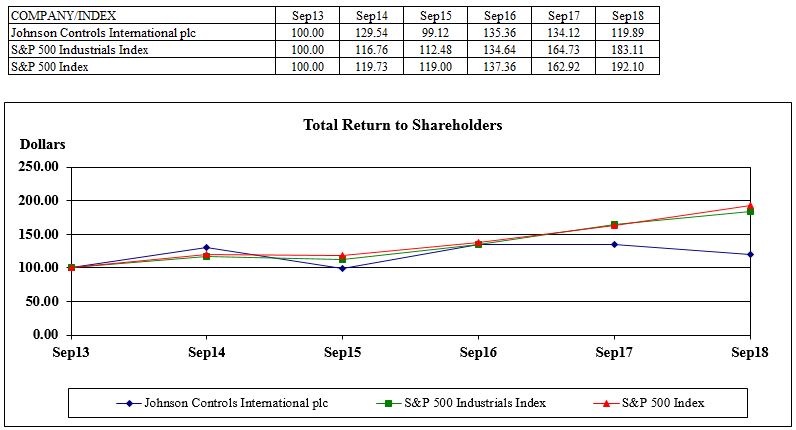
The line graph below compares the cumulative total shareholder return on our ordinary shares with the cumulative total return of companies on the Standard & Poor’s ("S&P’s") 500 Stock Index and the companies on the S&P 500 Industrials Index. This graph assumes the investment of $100 on September 30, 2013 and the reinvestment of all dividends since that date.
The Company’s transfer agent’s contact information is as follows:
EQ Shareowner Services
P.O. Box 64874
St. Paul, MN 55164-0874
(877) 602-7397
Item 6. SELECTED FINANCIAL DATA
The following selected financial data reflects the results of operations, financial position data and ordinary share information for the fiscal years ended September 30, 2014 through September 30, 2018 (dollars in millions, except per share data).
| Year ended September 30, | |||||||||||||||||||
| 2018 | 2017 | 2016 | 2015 | 2014 | |||||||||||||||
| OPERATING RESULTS | |||||||||||||||||||
| Net sales | $ | 31,400 | $ | 30,172 | $ | 20,837 | $ | 17,100 | $ | 16,717 | |||||||||
| Segment EBITA (1) | 4,555 | 4,258 | 2,754 | 2,327 | 2,084 | ||||||||||||||
| Income from continuing operations attributable to Johnson Controls (6) | 2,162 | 1,654 | 732 | 814 | 906 | ||||||||||||||
| Net income (loss) attributable to Johnson Controls | 2,162 | 1,611 | (868 | ) | 1,563 | 1,215 | |||||||||||||
| Earnings per share from continuing operations (6) | |||||||||||||||||||
| Basic | $ | 2.34 | $ | 1.77 | $ | 1.10 | $ | 1.24 | $ | 1.36 | |||||||||
| Diluted | 2.32 | 1.75 | 1.09 | 1.23 | 1.34 | ||||||||||||||
| Return on average shareholders’ equity attributable to Johnson Controls (2) (6) | 10 | % | 7 | % | 4 | % | 8 | % | 8 | % | |||||||||
| Capital expenditures | $ | 1,030 | $ | 1,343 | $ | 1,249 | $ | 1,135 | $ | 1,199 | |||||||||
| Depreciation and amortization | 1,085 | 1,188 | 953 | 860 | 955 | ||||||||||||||
| Number of employees | 122,000 | 121,000 | 209,000 | 139,000 | 168,000 | ||||||||||||||
| FINANCIAL POSITION | |||||||||||||||||||
| Working capital (as defined) (3) | $ | 1,714 | $ | 1,608 | $ | 369 | $ | 550 | $ | 989 | |||||||||
| Total assets | 48,797 | 51,884 | 63,179 | 29,590 | 32,777 | ||||||||||||||
| Long-term debt | 9,654 | 11,964 | 11,053 | 5,367 | 5,887 | ||||||||||||||
| Total debt | 10,995 | 13,572 | 12,759 | 6,208 | 6,100 | ||||||||||||||
| Shareholders' equity attributable to Johnson Controls | 21,164 | 20,447 | 24,118 | 10,335 | 11,270 | ||||||||||||||
| Total debt to capitalization (4) | 34 | % | 40 | % | 35 | % | 38 | % | 35 | % | |||||||||
| Net book value per share (5) | $ | 22.88 | $ | 22.03 | $ | 25.77 | $ | 15.96 | $ | 16.93 | |||||||||
| ORDINARY SHARE INFORMATION | |||||||||||||||||||
| Dividends per share | $ | 1.04 | $ | 1.00 | $ | 1.16 | $ | 1.04 | $ | 0.88 | |||||||||
| Market prices | |||||||||||||||||||
| High | $ | 42.60 | $ | 46.17 | $ | 48.97 | $ | 54.52 | $ | 52.50 | |||||||||
| Low | 32.89 | 36.74 | 30.30 | 38.48 | 39.42 | ||||||||||||||
| Weighted average shares (in millions) | |||||||||||||||||||
| Basic | 925.7 | 935.3 | 667.4 | 655.2 | 666.9 | ||||||||||||||
| Diluted | 931.7 | 944.6 | 672.6 | 661.5 | 674.8 | ||||||||||||||
| Number of shareholders | 37,836 | 40,260 | 41,299 | 35,425 | 36,687 |
| (1) | Segment earnings before interest, taxes and amortization ("EBITA") is calculated as income from continuing operations before income taxes and noncontrolling interests, excluding general corporate expenses, intangible asset amortization, net financing charges, significant restructuring and impairment costs, and net mark-to-market adjustments related to pension and postretirement plans. Refer to Note 19, “Segment Information,” of the notes to consolidated financial statements for a reconciliation of segment EBITA to income from continuing operations before income taxes. |
| (2) | Return on average shareholders’ equity attributable to Johnson Controls represents income from continuing operations attributable to Johnson Controls divided by average shareholders’ equity attributable to Johnson Controls. |
| (3) | Working capital is defined as current assets less current liabilities, excluding cash, short-term debt, the current portion of long-term debt, and the current portions of assets and liabilities held for sale. |
| (4) | Total debt to total capitalization represents total debt divided by the sum of total debt and shareholders’ equity attributable to Johnson Controls. |
| (5) | Net book value per share represents shareholders’ equity attributable to Johnson Controls divided by the number of shares outstanding at the end of the period. |
| (6) | Income from continuing operations attributable to Johnson Controls includes $263 million, $367 million, $288 million, $215 million and $165 million of significant restructuring and impairment costs in fiscal year 2018, 2017, 2016, 2015 and 2014, respectively. It also includes $(10) million, $(420) million, $393 million, $416 million and $187 million of net mark-to-market charges (gains) on pension and postretirement plans in fiscal year 2018, 2017, 2016, 2015 and 2014, respectively. The preceding amounts are stated on a pre-tax basis. |
Item 7. MANAGEMENT’S DISCUSSION AND ANALYSIS OF FINANCIAL CONDITION AND RESULTS OF OPERATIONS
General
The Company operates in two primary businesses: Building Technologies & Solutions and Power Solutions. Building Technologies & Solutions provides facility systems and services including comfort and energy management for the residential and non-residential buildings markets, security products and services, and fire detection and suppression products and services. Power Solutions designs and manufactures automotive batteries for the replacement and original equipment markets.
This discussion summarizes the significant factors affecting the consolidated operating results, financial condition and liquidity of the Company for the three-year period ended September 30, 2018. This discussion should be read in conjunction with Item 8, the consolidated financial statements and the notes to consolidated financial statements.
FISCAL YEAR 2018 COMPARED TO FISCAL YEAR 2017
Net Sales
| Year Ended September 30, | ||||||||||
| (in millions) | 2018 | 2017 | Change | |||||||
| Net sales | $ | 31,400 | $ | 30,172 | 4 | % |
The increase in consolidated net sales was due to higher sales in the Building Technologies & Solutions business ($1,004 million), the favorable impact of foreign currency translation ($512 million) and higher sales in the Power Solutions business ($467 million), partially offset by lower sales due to business divestitures ($755 million). The increased sales in the Building Technologies & Solutions business, net of divestitures, primarily related to higher volumes across all segments. Increased sales in the Power Solutions business primarily resulted from the impact of higher lead costs on pricing as well as favorable pricing and product mix. Excluding the impact of foreign currency translation, impact of lead costs on pricing and business divestitures, consolidated net sales also increased 4% as compared to the prior year. Refer to the segment analysis below within Item 7 for a discussion of net sales by segment.
Cost of Sales / Gross Profit
| Year Ended September 30, | ||||||||||
| (in millions) | 2018 | 2017 | Change | |||||||
| Cost of sales | $ | 22,020 | $ | 20,833 | 6 | % | ||||
| Gross profit | 9,380 | 9,339 | — | % | ||||||
| % of sales | 29.9 | % | 31.0 | % |
Cost of sales increased in fiscal 2018 as compared to fiscal 2017, and gross profit as a percentage of sales decreased by 110 basis points. Gross profit in the Building Technologies & Solutions business increased due to prior year nonrecurring purchase accounting adjustments ($68 million), and higher volumes and favorable mix across all segments, partially offset by business divestitures and higher operating costs. Gross profit in the Power Solutions business was impacted by higher operating costs primarily driven by efforts to satisfy customer demand, partially offset by favorable pricing and product mix. Net mark-to-market adjustments on
pension and postretirement plans had a net unfavorable year-over-year impact on cost of sales of $88 million ($16 million charge in fiscal 2018 compared to a $72 million gain in fiscal 2017) primarily due to a decrease in U.S. investment returns. Foreign currency translation had an unfavorable impact on cost of sales of approximately $383 million. Refer to the segment analysis below within Item 7 for a discussion of segment earnings before interest, taxes and amortization ("EBITA") by segment.
Selling, General and Administrative Expenses
| Year Ended September 30, | ||||||||||
| (in millions) | 2018 | 2017 | Change | |||||||
| Selling, general and administrative expenses | $ | 6,010 | $ | 6,158 | -2 | % | ||||
| % of sales | 19.1 | % | 20.4 | % |
Selling, general and administrative expenses ("SG&A") decreased by $148 million year over year, and SG&A as a percentage of sales decreased by 130 basis points. The decrease in SG&A was primarily due to productivity savings and costs synergies, business divestitures and a gain on sale of the Scott Safety business in the Building Technologies & Solutions Global Products segment ($114 million). The net favorable year-over-year impact on SG&A resulting from transaction and integration costs was $177 million. Foreign currency translation had an unfavorable impact on SG&A of $78 million. The net mark-to-market adjustments on pension and postretirement plans had a net unfavorable year-over-year impact on SG&A of $322 million ($26 million gain in fiscal 2018 compared to a $348 million gain in fiscal 2017) primarily due to a decrease in U.S. investment returns. Refer to the segment analysis below within Item 7 for a discussion of segment EBITA by segment.
Restructuring and Impairment Costs
| Year Ended September 30, | ||||||||||
| (in millions) | 2018 | 2017 | Change | |||||||
| Restructuring and impairment costs | $ | 263 | $ | 367 | -28 | % |
Refer to Note 16, "Significant Restructuring and Impairment Costs," of the notes to consolidated financial statements for further disclosure related to the Company's restructuring plans.
Net Financing Charges
| Year Ended September 30, | ||||||||||
| (in millions) | 2018 | 2017 | Change | |||||||
| Net financing charges | $ | 441 | $ | 496 | -11 | % |
Refer to Note 9, "Debt and Financing Arrangements," of the notes to consolidated financial statements for further disclosure related to the Company's net financing charges.
Equity Income
| Year Ended September 30, | ||||||||||
| (in millions) | 2018 | 2017 | Change | |||||||
| Equity income | $ | 235 | $ | 240 | -2 | % |
The decrease in equity income was primarily due to lower income at partially-owned affiliates in the Power Solutions business, partially offset by higher income at partially-owned affiliates in the Building Technologies & Solutions business. Refer to the segment analysis below within Item 7 for a discussion of segment EBITA by segment.
Income Tax Provision
| Year Ended September 30, | ||||||||||
| (in millions) | 2018 | 2017 | Change | |||||||
| Income tax provision | $ | 518 | $ | 705 | -27 | % | ||||
| Effective tax rate | 18 | % | 28 | % |
The statutory tax rate in Ireland is being used as a comparison since the Company is domiciled in Ireland. The effective rate is above the statutory rate of 12.5% for fiscal 2018 primarily due to the discrete net impacts of U.S. Tax Reform, final income tax effects of the completed divestiture of the Scott Safety business, legal entity restructuring associated with the Power Solutions business, valuation allowance adjustments and tax rate differentials, partially offset by the benefits of continuing global tax planning initiatives, tax audit closures and tax benefits due to changes in entity tax status. The effective rate is above the st
Showing the first 8K of 118K characters. Open the full section
Item 7A. QUANTITATIVE AND QUALITATIVE DISCLOSURES ABOUT MARKET RISK
See "Risk Management" included in Item 7 - Management’s Discussion and Analysis of Financial Condition and Results of Operations.
Item 8. FINANCIAL STATEMENTS AND SUPPLEMENTARY DATA
Index to Consolidated Financial Statements
| Page | |
| Report of Independent Registered Public Accounting Firm | 55 |
| Consolidated Statements of Income for the years ended September 30, 2018, 2017 and 2016 | 57 |
| Consolidated Statements of Comprehensive Income (Loss) for the years ended September 30, 2018, 2017 and 2016 | 58 |
| Consolidated Statements of Financial Position as of September 30, 2018 and 2017 | 59 |
| Consolidated Statements of Cash Flows for the years ended September 30, 2018, 2017 and 2016 | 60 |
| Consolidated Statements of Shareholders' Equity Attributable to Johnson Controls Ordinary Shareholders for the years ended September 30, 2018, 2017 and 2016 | 61 |
| Notes to Consolidated Financial Statements | 62 |
| Schedule II - Valuation and Qualifying Accounts for the years ended September 30, 2018, 2017 and 2016 | 125 |

Report of Independent Registered Public Accounting Firm
To the Board of Directors and Shareholders of Johnson Controls International plc
Opinions on the Financial Statements and Internal Control over Financial Reporting
We have audited the accompanying consolidated statements of financial position of Johnson Controls International plc and its subsidiaries (the “Company”) as of September 30, 2018 and 2017, and the related consolidated statements of income, comprehensive income (loss), shareholders’ equity attributable to Johnson Controls ordinary shareholders, and cash flows for each of the three years in the period ended September 30, 2018, including the related notes and financial statement schedule listed in the accompanying index (collectively referred to as the “consolidated financial statements”). We also have audited the Company's internal control over financial reporting as of September 30, 2018, based on criteria established in Internal Control - Integrated Framework (2013) issued by the Committee of Sponsoring Organizations of the Treadway Commission (COSO).
In our opinion, the consolidated financial statements referred to above present fairly, in all material respects, the financial position of the Company as of September 30, 2018 and 2017, and the results of their operations and their cash flows for each of the three years in the period ended September 30, 2018 in conformity with accounting principles generally accepted in the United States of America. Also in our opinion, the Company maintained, in all material respects, effective internal control over financial reporting as of September 30, 2018, based on criteria established in Internal Control - Integrated Framework (2013) issued by the COSO.
Basis for Opinions
The Company's management is responsible for these consolidated financial statements, for maintaining effective internal control over financial reporting, and for its assessment of the effectiveness of internal control over financial reporting, included in Management’s Report on Internal Control Over Financial Reporting appearing under Item 9A. Our responsibility is to express opinions on the Company’s consolidated financial statements and on the Company's internal control over financial reporting based on our audits. We are a public accounting firm registered with the Public Company Accounting Oversight Board (United States) ("PCAOB") and are required to be independent with respect to the Company in accordance with the U.S. federal securities laws and the applicable rules and regulations of the Securities and Exchange Commission and the PCAOB.
We conducted our audits in accordance with the standards of the PCAOB. Those standards require that we plan and perform the audits to obtain reasonable assurance about whether the consolidated financial statements are free of material misstatement, whether due to error or fraud, and whether effective internal control over financial reporting was maintained in all material respects.
Our audits of the consolidated financial statements included performing procedures to assess the risks of material misstatement of the consolidated financial statements, whether due to error or fraud, and performing procedures that respond to those risks. Such procedures included examining, on a test basis, evidence regarding the amounts and disclosures in the consolidated financial statements. Our audits also included evaluating the accounting principles used and significant estimates made by management, as well as evaluating the overall presentation of the consolidated financial statements. Our audit of internal control over financial reporting included obtaining an understanding of internal control over financial reporting, assessing the risk that a material weakness exists, and testing and evaluating the design and operating effectiveness of internal control based on the assessed risk. Our audits also included performing such other procedures as we considered necessary in the circumstances. We believe that our audits provide a reasonable basis for our opinions.
Definition and Limitations of Internal Control over Financial Reporting
A company’s internal control over financial reporting is a process designed to provide reasonable assurance regarding the reliability of financial reporting and the preparation of financial statements for external purposes in accordance with generally
accepted accounting principles. A company’s internal control over financial reporting includes those policies and procedures that (i) pertain to the maintenance of records that, in reasonable detail, accurately and fairly reflect the transactions and dispositions of the assets of the company; (ii) provide reasonable assurance that transactions are recorded as necessary to permit preparation of financial statements in accordance with generally accepted accounting principles, and that receipts and expenditures of the company are being made only in accordance with authorizations of management and directors of the company; and (iii) provide reasonable assurance regarding prevention or timely detection of unauthorized acquisition, use, or disposition of the company’s assets that could have a material effect on the financial statements.
Because of its inherent limitations, internal control over financial reporting may not prevent or detect misstatements. Also, projections of any evaluation of effectiveness to future periods are subject to the risk that controls may become inadequate because of changes in conditions, or that the degree of compliance with the policies or procedures may deteriorate.
| /s/ PricewaterhouseCoopers LLP |
| PricewaterhouseCoopers LLP |
| Milwaukee, Wisconsin |
| November 20, 2018 |
We have served as the Company’s auditor since 1957.
Johnson Controls International plc
Consolidated Statements of Income
| Year Ended September 30, | |||||||||||
| (in millions, except per share data) | 2018 | 2017 | 2016 | ||||||||
| Net sales | |||||||||||
| Products and systems* | $ | 25,332 | $ | 24,099 | $ | 18,084 | |||||
| Services* | 6,068 | 6,073 | 2,753 | ||||||||
| 31,400 | 30,172 |
Showing the first 8K of 301K characters. Open the full section
Item 9. CHANGES IN AND DISAGREEMENTS WITH ACCOUNTANTS ON ACCOUNTING AND FINANCIAL DISCLOSURE
None.
Item 9A. CONTROLS AND PROCEDURES
Disclosure Controls and Procedures
The Company’s management, with the participation of the Company’s Chief Executive Officer and Chief Financial Officer, has evaluated the effectiveness of the Company’s disclosure controls and procedures (as such term is defined in Rule 13a-15(e) under the Securities Exchange Act of 1934, as amended (the "Exchange Act")) as of the end of the period covered by this report. Based on such evaluations, the Company’s Chief Executive Officer and Chief Financial Officer have concluded that, as of the end of such period, the Company’s disclosure controls and procedures are effective in recording, processing, summarizing, and reporting, on a timely basis, information required to be disclosed by the Company in the reports that it files or submits under the Exchange Act, and that information is accumulated and communicated to the Company’s management, including the Company’s Chief Executive Officer and Chief Financial Officer, as appropriate, to allow timely decisions regarding required disclosure.
Management’s Report on Internal Control Over Financial Reporting
The Company’s management is responsible for establishing and maintaining adequate internal control over financial reporting, as such term is defined in Exchange Act Rule 13a-15(f). The Company’s management, with the participation of the Company’s Chief Executive Officer and Chief Financial Officer, has evaluated the effectiveness of the Company’s internal control over financial reporting based on the framework in Internal Control-Integrated Framework (2013) issued by the Committee of Sponsoring Organizations of the Treadway Commission. Based on this evaluation, the Company’s management has concluded that, as of September 30, 2018, the Company’s internal control over financial reporting was effective.
Because of its inherent limitations, internal control over financial reporting may not prevent or detect misstatements. Also, projections of any evaluation of effectiveness to future periods are subject to risk that controls may become inadequate because of changes in conditions, or that the degree of compliance with the policies or procedures may deteriorate.
PricewaterhouseCoopers LLP, an independent registered public accounting firm, has audited the Company’s consolidated financial statements and the effectiveness of internal control over financial reporting as of September 30, 2018 as stated in its report which is included in Item 8 of this Form 10-K and is incorporated by reference herein.
Changes in Internal Control Over Financial Reporting
There have been no changes in the Company’s internal control over financial reporting during the quarter ended September 30, 2018, that have materially affected, or are reasonably likely to materially affect, the Company’s internal control over financial reporting.
Item 9B. OTHER INFORMATION
None.
PART III
In response to Part III, Items 10, 11, 12, 13 and 14, parts of the Company’s definitive proxy statement (to be filed pursuant to Regulation 14A within 120 days after Registrant’s fiscal year-end of September 30, 2018) for its annual meeting to be held on March 6, 2019, are incorporated by reference in this Form 10-K.
Item 10. DIRECTORS, EXECUTIVE OFFICERS AND CORPORATE GOVERNANCE
The information relating to directors and nominees of Johnson Controls is set forth under the caption “Proposal Number One” in Johnson Controls’ proxy statement for its annual meeting of stockholders to be held on March 6, 2019 (the “Johnson Controls Proxy Statement”) and is incorporated by reference herein. Information about executive officers is included in Part I, Item 4 of this Annual Report on Form 10-K. The information required by Items 405, 407(c)(3), (d)(4) and (d)(5) of Regulation S-K is contained under the captions “Section 16(a) Beneficial Ownership Reporting Compliance,” “Governance of the Company - Nomination of Directors and Board Diversity,” “Governance of the Company - Board Committees”, and “Committees of the Board - Audit Committee” of the Johnson Controls Proxy Statement and such information is incorporated by reference herein.
Code of Ethics
Johnson Controls has adopted a code of ethics for directors, officers (including the Company’s principal executive officer, principal financial officer and principal accounting officer) and employees, known as the Code of Ethics. The Code of Ethics is available in the “Investors - Corporate Governance” section of its website at www.johnsoncontrols.com. The Company posts any amendments to or waivers of its Code of Ethics (to the extent applicable to the Company’s directors or executive officers) at the same location on the Company’s website. In addition, copies of the Code of Ethics may be obtained in print without charge upon written request by any stockholder to the office of the Company at One Albert Quay, Cork, Ireland.
Item 11. EXECUTIVE COMPENSATION
The information required by Item 402 of Regulation S-K is contained under the captions “Compensation Discussion & Analysis” (excluding the information under the caption “Compensation Committee Report on Executive Compensation”), “Executive Compensation Tables” and “Compensation of Non-Employee Directors” of the Johnson Controls Proxy Statement. Such information is incorporated by reference.
The information required by Items 407(e)(4) and (e)(5) of Regulation S-K is contained under the captions “Committees of the Board - Compensation Committee Interlocks and Insider Participation” and “Compensation Discussion & Analysis - Compensation Committee Report on Executive Compensation” of the Johnson Controls Proxy Statement. Such information (other than the Compensation Committee Report on Executive Compensation, which shall not be deemed to be “filed”) is incorporated by reference.
Item 12. SECURITY OWNERSHIP OF CERTAIN BENEFICIAL OWNERS AND MANAGEMENT AND RELATED STOCKHOLDER MATTERS
The information in the Johnson Controls Proxy Statement set forth under the caption "Security Ownership of Certain Beneficial Owners and Management" is incorporated herein by reference.
The following table provides information about the Company's equity compensation plans as of September 30, 2018:
| (a) | (b) | (c) | ||||||||
| Number of Securities to be Issued upon Exercise of Outstanding Options, Warrants and Rights | Weighted-Average Exercise Price of Outstanding Options, Warrants and Rights | Number of Securities Remaining Available for Future Issuance Under Equity Compensation Plans (Excluding Securities Reflected in Column (a)) | ||||||||
| Plan Category | ||||||||||
| Equity compensation plans approved by shareholders | 17,836,062 | $ | 34.24 | 45,026,606 | ||||||
| Equity compensation plans not approved by shareholders | — | — | — | |||||||
| Total | 17,836,062 | $ | 34.24 | 45,026,606 |
Item 13. CERTAIN RELATIONSHIPS AND RELATED TRANSACTIONS, AND DIRECTOR INDEPENDENCE
The information in the Johnson Controls Proxy Statement set forth under the captions “Committees of the Board,” “Governance of the Company - Director Independence,” and “Governance of the Company - Other Directorships, Conflicts and Related Party Transactions,” is incorporated herein by reference.
Item 14. PRINCIPAL ACCOUNTING FEES AND SERVICES
The information in the Johnson Controls Proxy Statement set forth under “Proposal Number Two” related to the appointment of auditors is incorporated herein by reference.
PART IV
Item 15. EXHIBITS, FINANCIAL STATEMENT SCHEDULES
| Page in Form 10-K | ||
| (a) The following documents are filed as part of this Form 10-K: | ||
| (1) Financial Statements | ||
| Report of Independent Registered Public Accounting Firm | 55 | |
| Consolidated Statements of Income for the years ended September 30, 2018, 2017 and 2016 | 57 | |
| Consolidated Statements of Comprehensive Income (Loss) for the years ended September 30, 2018, 2017 and 2016 | 58 | |
| Consolidated Statements of Financial Position at September 30, 2018 and 2017 | 59 | |
| Consolidated Statements of Cash Flows for the years ended September 30, 2018, 2017 and 2016 | 60 | |
| Consolidated Statements of Shareholders’ Equity for the years ended September 30, 2018, 2017 and 2016 | 61 | |
| Notes to Consolidated Financial Statements | 62 | |
| (2) Financial Statement Schedule | ||
| For the years ended September 30, 2018, 2017 and 2016: | ||
| Schedule II - Valuation and Qualifying Accounts | 125 | |
| (3) Exhibits | ||
| Reference is made to the separate exhibit index contained on pages 130 through 135 filed herewith. |
All other schedules are omitted because they are not applicable, or the required information is shown in the financial statements or notes thereto.
Financial statements of 50% or less-owned companies have been omitted because the proportionate share of their profit before income taxes and total assets are individually less than 20% of the respective consolidated amounts, and investments in such companies are less than 20% of consolidated total assets. Refer to Note 20, "Non-Consolidated Partially-Owned Affiliates" of the notes to consolidated financial statements for the summarized financial data for the Company’s nonconsolidated partially-owned affiliates.
Item 16. FORM 10-K SUMMARY
Not applicable.
SIGNATURES
Pursuant to the requirements of Section 13 or 15(d) of the Securities Exchange Act of 1934, the registrant has duly caused this report to be signed on its behalf by the undersigned, thereunto duly authorized.
| JOHNSON CONTROLS INTERNATIONAL PLC | |
| By | /s/ Brian J. Stief |
| Brian J. Stief | |
| Executive Vice President and Chief Financial Officer | |
| Date: | November 20, 2018 |
Pursuant to the requirements of the Securities Exchange Act of 1934, this report has been signed below as of November 20, 2018, by the following persons on behalf of the registrant and in the capacities indicated:
| /s/ George R. Oliver George R. Oliver Chairman and Chief Executive Officer (Principal Executive Officer) | /s/ Brian J. Stief Brian J. Stief Executive Vice President and Chief Financial Officer (Principal Financial Officer) | |
| /s/ Robert M. VanHimbergen Robert M. VanHimbergen Vice President and Corporate Controller (Principal Accounting Officer) | /s/ Jean Blackwell Jean Blackwell Director | |
| /s/ Mike Daniels Mike Daniels Director | /s/ Roy Dunbar Roy Dunbar Director | |
| /s/ Brian Duperreault Brian Duperreault Director | /s/ Gretchen R. Haggerty Gretchen R. Haggerty Director | |
| /s/ Simone Menne Simone Menne Director | /s/ Juan Pablo del Valle Perochena Juan Pablo del Valle Perochena Director | |
| /s/ Jürgen Tinggren Jürgen Tinggren Director | /s/ Mark P. Vergnano Mark P. Vergnano Director | |
| /s/ David Yost David Yost Director | /s/ John D. Young John D. Young Director | |
Johnson Controls International plc
Index to Exhibits
(a) (1) and (2) Financial Statements and Supplementary Data - See Item 8
(b) Exhibit Index:
Johnson Controls International plc
Index to Exhibits
Johnson Controls International plc
Index to Exhibits
Johnson Controls International plc
Index to Exhibits
Johnson Controls International plc
Index to Exhibits
Johnson Controls International plc
Index to Exhibits
| * | These instruments are not being filed as exhibits herewith because none of the long-term debt instruments authorizes the issuance of debt in excess of 10% of the total assets of Johnson Controls International plc and its subsidiaries on a consolidated basis. Johnson Controls International plc agrees to furnish a copy of each agreement to the Securities and Exchange Commission upon request. |
| ** | Management contract or compensatory plan. |