 filings.tools
Jack Henry & Associates 10-K 2024-06-30
Filed 2024-08-26. 24 sections, 279K characters. Original on sec.gov · Markdown · JSON
Cover and table of contents
UNITED STATES
SECURITIES AND EXCHANGE COMMISSION
WASHINGTON, D.C. 20549
FORM 10-K
ANNUAL REPORT
PURSUANT TO SECTION 13 OR 15(d)
OF THE SECURITIES EXCHANGE ACT OF 1934
(Mark One)
| ☒ | ANNUAL REPORT PURSUANT TO SECTION 13 OR 15(d) OF THE SECURITIES EXCHANGE ACT OF 1934 |
For the fiscal year ended June 30, 2024
| OR | |||||
| ☐ | TRANSITION REPORT PURSUANT TO SECTION 13 OR 15(d) OF THE SECURITIES EXCHANGE ACT OF 1934 | ||||
| For the transition period from ______________ to ________________ |
Commission file number 0-14112
JACK HENRY & ASSOCIATES, INC.
(Exact name of registrant as specified in its charter)
| Delaware | 43-1128385 | |||||||
| (State or Other Jurisdiction of Incorporation) | (I.R.S. Employer Identification No.) |
663 Highway 60, P.O. Box 807, Monett, MO 65708
(Address of Principal Executive Offices)
(Zip Code)
417-235-6652
(Registrant’s telephone number, including area code)
Securities registered pursuant to Section 12(b) of the Act:
| Title of each class | Trading Symbol | Name of each exchange on which registered | ||||||
| Common Stock ($0.01 par value) | JKHY | Nasdaq Global Select Market |
Securities registered pursuant to Section 12(g) of the Act: None
Indicate by check mark if the registrant is a well-known seasoned issuer, as defined in Rule 405 of the Securities Act.
Yes ☒ No ☐
Indicate by check mark if the registrant is not required to file reports pursuant to Section 13 or 15(d) of the Act.
Yes ☐ No ☒
Indicate by check mark whether the registrant (1) has filed all reports required to be filed by Section 13 or 15(d) of the Securities Exchange Act of 1934 during the preceding 12 months (or for such shorter period that the registrant was required to file such reports), and (2) has been subject to such filing requirements for the past 90 days.
Yes ☒ No ☐
Indicate by check mark whether the registrant has submitted electronically every Interactive Data File required to be submitted pursuant to Rule 405 of Regulation S-T during the preceding 12 months (or for such shorter period that the registrant was required to submit such files).
Yes ☒ No ☐
Indicate by check mark whether the registrant is a large accelerated filer, an accelerated filer, a non-accelerated filer, smaller reporting company, or an emerging growth company. See the definitions of “large accelerated filer,” ”accelerated filer,” “smaller reporting company,” and "emerging growth company" in Rule 12b-2 of the Exchange Act.
| Large accelerated filer | ☒ | Accelerated filer | ☐ | ||||||||
| Non-accelerated filer | ☐ | Smaller reporting company | ☐ | ||||||||
| Emerging Growth Company | ☐ | ||||||||||
If an emerging growth company, indicate by check mark if the registrant has elected not to use the extended transition period for complying with any new or revised financial accounting standards provided pursuant to Section 13(a) of the Exchange Act. ☐
Indicate by check mark whether the registrant has filed a report on and attestation to its management’s assessment of the effectiveness of its internal control over financial reporting under Section 404(b) of the Sarbanes-Oxley Act (15 U.S.C. 7262(b)) by the registered public accounting firm that prepared or issued its audit report. ☒
If securities are registered pursuant to Section 12(b) of the Act, indicate by check mark whether the financial statements of the registrant included in the filing reflect the correction of an error to previously issued financial statements. ☐
Indicate by check mark whether any of those error corrections are restatements that required a recovery analysis of incentive-based compensation received by any of the registrant’s executive officers during the relevant recovery period pursuant to §240.10D-1(b). ☐
Indicate by check mark whether the registrant is a shell company (as defined in Rule 12b-2 of the Exchange Act)
Yes ☐ No ☒
On December 31, 2023, the aggregate market value of the Common Stock held by persons other than those who may be deemed affiliates of Registrant was $11,835,584,815 (based on the closing stock price on Nasdaq on December 31, 2023).
As of August 15, 2024, the Registrant had 72,908,319 shares of Common Stock outstanding ($0.01 par value).
DOCUMENTS INCORPORATED BY REFERENCE
Portions of the Company's Proxy Statement for its 2024 Annual Meeting of Stockholders (the "Proxy Statement") are incorporated by reference into Part III of this Report to the extent stated herein. Such Proxy Statement will be filed with the Securities and Exchange Commission ("SEC") within 120 days of the Company's fiscal year ended June 30, 2024.
TABLE OF CONTENTS
In this report, all references to "Jack Henry," the “Company," “we," “us," and “our," refer to Jack Henry & Associates, Inc., and its wholly owned subsidiaries. Unless otherwise stated, references to particular years, quarters, months, or periods refer to the Company's fiscal years ended in June and the associated quarters, months, and periods of those fiscal years.
FORWARD LOOKING STATEMENTS
Certain statements in this report, other than purely historical information, including estimates, projections, statements relating to our business plans, objectives and expected operating results, and the assumptions upon which those statements are based, are “forward-looking statements” within the meaning of the Private Securities Litigation Reform Act of 1995, Section 27A of the Securities Act of 1933 and Section 21E of the Securities Exchange Act of 1934 (the "Exchange Act"). Forward-looking statements may appear throughout this report, including without limitation, in Management's Discussion and Analysis of Financial Condition and Results of Operations. Forward-looking statements generally are identified by the words “believe,” “project,” “expect,” “seek,” “anticipate,” “estimate,” “future,” “intend,” “plan,” “strategy,” “predict,” “likely,” “should,” “will,” “would,” “could,” “can,” “may,” and similar expressions. Forward-looking statements are based only on management’s current beliefs, expectations and assumptions regarding the future of the Company, future plans and strategies, projections, anticipated events and trends, the economy and other future conditions. Because forward-looking statements relate to the future, they are subject to inherent risks and uncertainties that could cause actual results to differ materially from those expressed or implied by such statements. Such risks and uncertainties include, but are not limited to, those discussed in this Annual Report on Form 10-K, in particular, those included in Item 1A, “Risk Factors” of this report, and those discussed in other documents we file with the SEC. Any forward-looking statement made in this report speaks only as of the date of this report, and the Company expressly disclaims any obligation to publicly update or revise any forward-looking statement, whether because of new information, future events or otherwise.
PART I
Item 1. BUSINESS
Jack Henry & Associates, Inc.® is a well-rounded financial technology company that strengthens connections between financial institutions and the people and businesses they serve. For more than 48 years, we have provided technology solutions to help banks and credit unions innovate faster, strategically differentiate, and successfully compete while serving the evolving needs of their accountholders. We empower approximately 7,500 financial institutions and diverse corporate entities with people-inspired innovation, personal service, and insight-driven solutions.
Mission Statement
We strengthen the connections between people and their financial institutions through technology and services that reduce the barriers to financial health.
This philosophy has always been part of the foundation on which Jack Henry was built. Our founders, Jack Henry and Jerry Hall, were committed to their community and believed they could help financial institutions better serve the needs of people and businesses using more innovative technology and services.
Since our founding in 1976, much has changed, but our commitment to supporting community and regional financial institutions remains unwavering. We continue to be guided by our founding principles: do the right thing, do whatever it takes, and have fun.
Who We Serve
We provide products and services primarily to community and regional financial institutions (see "Our Industry" below):
-
Core bank integrated data processing systems are provided to over 940 banks. Our banking solutions support both on-premise and private cloud operating environments with functionality for core processing platforms and integrated complementary solutions.
-
Core credit union data processing solutions are provided to credit unions of all sizes, with a client base of approximately 720 credit unions. We offer a flagship core processing platform and integrated complementary solutions that support both on-premise and private cloud operating environments.
-
Non-core highly specialized core-agnostic products and services are also provided to financial institutions. We offer complementary solutions that include highly specialized financial performance, imaging and payments processing, information security and risk management, retail delivery, and online and mobile functionality. These products and services enhance the performance of traditional financial services organizations of all asset sizes and charters, and non-traditional diverse corporate entities. In total, we serve over 1,660 bank and credit union core clients and over 5,870 non-core clients.
Our products and services provide our clients with solutions that can be tailored to support their unique growth, service, operational, and performance goals. Our well-rounded solutions also enable financial institutions to offer the high-demand products and services required by their accountholders to compete more successfully and to capitalize on evolving trends shaping the financial services industry.
We are committed to exceeding our clients’ expectations. We measure and monitor their satisfaction using a variety of surveys, such as an annual survey on the client's anniversary date and randomly-generated online surveys initiated each day by routine support requests to ensure feedback is received throughout the year. The survey results are analyzed and provided to operational areas to ensure our service consistently exceeds our clients’ expectations. We believe this process ensures we understand the Voice of the Customer which contributes to our excellent retention rates.
We are focused on establishing long-term client relationships, continually expanding and strengthening those relationships. We do so with cross sales of additional products and services that support our clients' strategy, earning new financial and non-financial clients, and ensuring our product offerings are highly competitive.
The majority of our support and services revenue is derived from our private and public cloud services for our hosted clients that are typically on a six-year contract, recurring electronic payment solutions that are generally on a contract term of six years, and our on-premise clients that are typically on a one-year contract. Less predictable software license fees, paid by clients implementing our software solutions on-premise, and hardware sales, including all non-software products that we re-market in order to support our software systems, complement our primary revenue sources. Information regarding the classification of our business into four separate segments is set forth in Note 14 to the consolidated financial statements (see Item 8).
We recognize that our associates and their collective contributions are ultimately responsible for Jack Henry's past, present, and future success. Recruiting and retaining high-quality associates is essential to our ongoing growth and financial performance, and we believe we have established an organizational culture that sustains high levels of associate engagement. For further discussion of our human capital considerations, see "Human Capital" below.
Our Industry
Our core banking solutions currently serve commercial banks and savings institutions with up to $50 billion in assets. Our systems are designed to be capable of serving institutions with up to $100 billion in assets, and we complete annual, third-party testing to validate this capability each August. According to the Federal Deposit Insurance Corporation (“FDIC”), there were approximately 4,540 commercial banks and savings institutions in the less than $50 billion asset range as of December 31, 2023, and we currently support over 940 of these banks with one of our three core information processing platforms and a significant number of complementary/payment products and services.
Our core credit union solutions serve credit unions of all asset sizes. According to America's Credit Unions ("ACU") (formerly Credit Union National Association), there were approximately 4,700 domestic credit unions as of December 31, 2023, and we currently support approximately 720 of these credit unions with one flagship core information processing platform and a significant number of complementary/payment products and services.
Our non-core solutions serve financial services organizations of all asset sizes and charters and other diverse corporate entities. We currently support financial institutions with specialized solutions for generating additional revenue and growth, increasing security, mitigating operational risks, and controlling operating costs.
The FDIC reports the number of commercial banks and savings institutions declined 15% from the beginning of calendar year 2018 to the end of calendar year 2023, due mainly to mergers and acquisitions. Although the number of banks continued to decline at a 3% compound annual rate during this period, aggregate assets increased at a compound annual rate of 6% and totaled $23.7 trillion as of December 31, 2023. There were six new bank charters issued in calendar year 2023, compared to 15 in the 2022 calendar year. Comparing calendar years 2023 to 2022, the number of transactions of FDIC-insured banks acquiring or merging with other banks or credit unions decreased 20%.
ACU reports the number of credit unions declined 14% from the beginning of calendar year 2018 to the end of calendar year 2023. Although the number of credit unions declined at a 3% compound annual rate during this period, aggregate assets increased at a compound annual rate of 9% and totaled $2.3 trillion as of December 31, 2023.
Community and regional financial institutions are vitally important to the communities, consumers, and businesses they serve as well as to the local economies where they operate. Bank customers and credit union members rely on these institutions to provide personalized, relationship-based service and competitive financial products and services available through the accountholders' delivery channel of choice. Institutions are recognizing that attracting and retaining customers and members in today’s highly competitive financial industry and realizing near-term and long-term performance goals are often technology dependent. Financial institutions must implement technological solutions that enable them to:
-
Offer e-commerce, mobile, and digital strategies that provide the convenience-driven services required in today’s financial services industry.
-
Maximize performance with accessible, accurate, and timely business intelligence information.
-
Provide the high-demand products and services needed to successfully compete with traditional and non-traditional competitors created by convergence within the financial services industry.
-
Enhance the customer/member experience at multiple points of contact.
-
Expand existing customer/member relationships and strengthen exit barriers by cross selling additional products and services.
-
Capitalize on new revenue, and deposit and loan portfolio growth opportunities.
-
Increase operating efficiencies and reduce operating costs.
-
Protect mission-critical information assets and operational infrastructure.
-
Protect accountholders with various security tools from fraud and related financial losses.
-
Maximize the day-to-day use of technology and return on technology investments.
-
Ensure full regulatory compliance.
Jack Henry’s extensive product and service offerings help diverse financial institutions meet business challenges and capitalize on opportunities. We strive to get to know our clients, understand their strategies and challenges, and provide innovative solutions that help them achieve short- and long-term success.
Business Strategy
Our fundamental business strategy is to generate organic revenue and earnings growth augmented by strategic acquisitions. We execute this strategy by:
-
Providing community and regional financial institutions with core processing systems that provide excellent functionality and support on-premise and private cloud delivery environments with identical functionality.
-
Expanding each core client relationship by cross-selling complementary/payment products and services that enhance the functionality provided by our core processing systems.
-
Delivering non-core highly specialized core-agnostic complementary/payment products and services to financial institutions, including institutions not utilizing one of our core processing systems, and diverse corporate entities.
-
Developing and deploying a long-term technology modernization strategy to provide public cloud-native solutions that provide clients with greater flexibility, optionality, open integration, speed to market, and other benefits.
-
Upholding a company-wide commitment to service that consistently exceeds our clients’ expectations and generates high levels of retention.
-
Building, maintaining, and enhancing a protected environment and tools that help our clients and Jack Henry protect accountholder data, assets, and comply with regulations.
-
Maintaining a disciplined acquisition strategy.
Acquisition Strategy
We have a disciplined approach to acquisitions and have been successful in supplementing our organic growth with 35 strategic acquisitions since the end of fiscal year 1999. We continue to explore acquisitions that have the potential to:
-
Expand our suite of complementary/payment products and services.
-
Provide products and services that can be sold to both existing core and non-core clients as well as outside our core base to new clients.
-
Accelerate our internal development efforts for technology modernization.
-
Provide selective opportunities to sell outside our traditional markets in the financial services industry.
After 48 years in business, we have very few gaps in our product line, so it is increasingly difficult to find proven products or services that would enable our clients and prospects to better optimize their business opportunities or solve specific operational issues. In addition, we see few acquisition opportunities that would expand our market or enable our entry into adjacent markets within the financial services industry that are fairly priced or that we could assimilate into our Company without material distractions.
We have a solid track record of executing acquisitions from both a financial and operational standpoint, and we will continue to pursue acquisition opportunities that support our strategic direction, complement and accelerate our organic growth, and generate long-term profitable growth for our stockholders. While we seek to identify appropriate acquisition opportunities, we will continue to explore alternative ways to leverage our cash position and balance sheet to the benefit of our stockholders, such as continued investment in new products and services for our clients, repurchases of our stock, and continued payment of dividends.
Our most recent acquisition was:
| Fiscal Year | Company or Product Name | Products and Services | ||||||
| 2023 | Payrailz, LLC ("Payrailz") | Provider of cloud-native modern digital payment capabilities leveraging AI and machine learning features for the financial services industry. |
Solutions
- Our core banking solutions support commercial banks with information and transaction processing platforms that provide enterprise-wide automation. We have three functionally distinct core bank processing systems and more than 140 fully integrated complementary/payment solutions, including business intelligence and bank management, retail and business banking, digital and mobile internet banking and electronic payment solutions, fraud and risk management and protection, account origination, and item and document imaging solutions. Our
core banking solutions have state-of-the-art functional capabilities, and we can re-market the hardware required by on-premise use of each software system. Our banking solutions can be delivered on-premise or through our private cloud delivery model and are backed by a company-wide commitment to provide exceptional client support.
-
Our core credit union solutions support credit unions of all sizes with an information and transaction processing platform that provides enterprise-wide automation. Our solution includes one flagship core processing system and more than 100 fully integrated complementary/payment solutions, including business intelligence and credit union management, member and member business services, digital and mobile internet banking and electronic payment solutions, fraud and risk management and protection, account origination, and item and document imaging solutions. Our credit union solution also has state-of-the-art functional capabilities. We also re-market the hardware required by on-premise use of the software system. Our credit union solution can be delivered on-premise, through our private cloud, or through our partner private cloud delivery models. Each is backed by our company-wide commitment to provide exceptional client support.
-
Our non-core solutions for financial institutions and diverse corporate entities are specialized products and services assembled primarily through our focused diversification acquisition strategy. These core-agnostic solutions are compatible with a wide variety of information technology platforms and operating environments and offer more than 100 complementary/payment solutions, including proven solutions for generating additional revenue and growth, increasing security and mitigating operational risks, and/or controlling operating costs. Our non-core products and services enhance the performance of financial services organizations of all asset sizes and charters, and diverse corporate entities. These distinct products and services can be implemented individually or as solution suites to address specific business problems or needs and enable effective responses to dynamic industry trends.
We are committed to developing and maintaining modern and integrated solutions supported by high service levels. We continuously update and improve these solutions through an interactive client enhancement process, ensuring compliance with relevant regulations, and incorporating proven advances in technology. Our goal is to uphold our Company's reputation as a premium solution and service provider.
Core Software Systems
Core software systems primarily consist of the integrated applications required to process deposit, loan, and general ledger transactions, and to maintain centralized customer/member information.
Our core banking solutions consist of three software systems marketed to banks, and our core credit union solution consists of one software system marketed to credit unions. These core systems are available for on-premise installation at client sites, or financial institutions can choose to leverage our private cloud environment for ongoing information processing.
Core banking platforms are:
-
SilverLake System**®****,** a robust system primarily designed for commercial-focused banks that currently serves banks with assets ranging from $1 billion to $50 billion. Some progressive smaller banks and de novo (start-up) banks also select SilverLake. This system is in use by approximately 490 banks, and now serves nearly 11% of the domestic banks with assets less than $50 billion.
-
CIF 20/20**®****,** a parameter-driven, easy-to-use system that now supports approximately 280 banks ranging from de novo institutions to those with assets of $5 billion.
-
Core Director**®****,** a cost-efficient system with point-and-click operation that now supports over 170 banks ranging from de novo institutions to those with assets of over $2 billion.
Core credit union platform is:
- Symitar**®** (formerly known as Episys**®****),** a robust system designed specifically for credit unions. It has been implemented by approximately 720 credit unions with assets ranging from $20 million to $30 billion, and according to National Credit Union Administration ("NCUA") data, is the system implemented by more credit unions with assets exceeding $25 million than any other core system.
Clients electing to install our solutions on-premise license the proprietary software systems. The majority of these clients pay ongoing annual software maintenance fees. We re-market the hardware, hardware maintenance, and peripheral equipment that is required by on-premise use of our software solutions; and we perform software implementation, data conversion, training, ongoing support, and other related services. On-premise clients generally license our core software systems under a standard license agreement that provides a fully paid, nonexclusive, nontransferable right to use the software on a single computer at a single location.
Clients can eliminate the significant up-front capital expenditures required by on-premise installations and the responsibility for operating information and transaction processing infrastructures by leveraging our private cloud environment for those functions. Our core private cloud services are provided through a highly resilient data center configuration across multiple physical locations. We also provide image item processing services from two host/archive sites and several key entry and balancing locations throughout the country. We print and mail customer/member statements for financial institutions from three regional printing and rendering centers. Clients electing to outsource their core processing typically sign contracts for six years that include "per account" fees and minimum guaranteed payments during the contract period.
We are dedicated to meeting the evolving business needs of our core bank and credit union clients by continuously enhancing each core system, introducing new integrated complementary products regularly, integrating practical new technologies, and adhering to regulatory compliance initiatives. Additionally, we serve as a single point of contact for each core client for support and accountability.
Complementary Products and Services
We have more than 140 complementary/payment products and services that are targeted to our core banks and more than 100 targeted to credit unions. Many of these are selectively sold to financial institutions that use other core processing systems.
These complementary/payment solutions enable core bank and credit union clients to respond to evolving customer/member demands, expedite speed-to-market with competitive offerings, increase efficiency, address specific operational needs, and generate new revenue streams. The highly specialized solutions enable diverse financial institutions and corporate entities to generate additional revenue and growth opportunities, increase security, mitigate operational risks, and control operating costs.
We regularly introduce new products and services based on demand for integrated complementary/payment solutions from our existing core clients and based on the growing demand among financial institutions and corporate entities for specialized solutions capable of increasing revenue and growth opportunities, mitigating and controlling operational risks, and/or containing costs. Our Industry Research department solicits client guidance on the business solutions they need, evaluates available solutions and competitive offerings, and manages the introduction of new product offerings. Our new complementary/payment products and services are developed internally, acquired, or provided through strategic alliances.
Implementation and Training
Most of our core bank and credit union clients contract with us for implementation and training services in connection with their systems and additional complementary products.
A complete core system implementation typically includes detailed planning, project management, data conversion, and testing. Our experienced implementation teams travel to client facilities or work remotely with clients to help manage the implementation process and ensure that all data is transferred from the legacy system to the Jack Henry system. Our implementation fees are fixed or hourly based on the core system being installed.
We also provide extensive initial and ongoing education to our clients. We have a comprehensive training program that supports new clients with basic training and longtime clients with continuing education. The training enables financial institutions to maximize the use of our core and complementary solutions, learn about ongoing system enhancements, and understand evolving legislative and regulatory requirements.
Support and Services
We serve our core clients as a single point of contact and support for the complex solutions we provide. Our comprehensive support infrastructure incorporates:
-
High service standards.
-
Trained support staff available up to 24 hours a day, 365 days a year.
-
Assigned account managers.
-
Sophisticated support tools, resources, and technology.
-
Broad experience converting diverse banks and credit unions to our core platforms from competitive platforms.
-
Highly effective change management and control processes.
-
Best practices methodology developed and refined through the company-wide, day-to-day experience.
Most on-premise clients contract for annual software support services, and this represents a significant source of recurring revenue for Jack Henry. These support services are typically priced at approximately 20% of the respective product’s software license fee. The subsequent years' service fees generally increase as client assets
increase and as additional complementary products are purchased. Annual software support fees typically are billed during June and are paid in advance for the entire fiscal year, with proration for new product implementations that occur during the fiscal year. Hardware support fees also are usually paid in advance for entire contract periods which typically range from one to five years. Most support contracts automatically renew unless the client or Jack Henry gives notice of termination at least 30 days prior to contract expiration.
High levels of support are provided to our private cloud clients by the same support infrastructure utilized for on-premise clients. However, these support fees are included as part of monthly private cloud fees.
Hardware Systems
Our software systems operate on a variety of hardware platforms. We have established remarketing agreements with IBM Corporation, and many other hardware providers that allow Jack Henry to purchase hardware and related maintenance services at a discount and resell them directly to our clients. We currently sell IBM Power Systems™; Lenovo®, Dell, Hewlett Packard Enterprise, and Cisco servers and workstations; Canon®, Digital Check, Epson®, and Panini® check scanners; and other devices that complement our software solutions.
Digital Products and Services
Jack Henry Digital represents a category of digital products and services that are being built and integrated together into one unified platform. Our main offering is the Banno Digital Platform™. It is an online and mobile banking platform that helps community and regional financial institutions strategically differentiate their digital offerings from those of megabanks and other financial technology companies. It is a complete, open digital banking platform that gives banks and credit unions attractive, fast, cloud-native applications for their customers and members and cloud-based, core-connected back-office tools for their employees.
Payment Solutions
Electronic payment solutions provide our clients with the tools necessary to be at the forefront of payment innovation with secure payment processing designed to simplify complex payment processing, attract profitable retail and commercial accounts, increase operating efficiencies, comply with regulatory mandates, and proactively mitigate and manage payment-related risk.
-
JHA Card Processing Solutions™ ("CPS")** supports full-service and in-house debit and credit card programs, as well as an Agent credit option, backed by a comprehensive suite of tools for 24/7 fraud mitigation, digital payments, full-service dispute management, plastics manufacturing and personalization, loyalty programs, data analytics, and ATM terminal driving. In addition, advisory services are offered to support a variety of needs including card portfolio growth, start-up program consultation, as well as customized fraud management; all tailored to individual financial institution goals and concerns.
-
Enterprise Payment Solutions ("EPS")** is a comprehensive payments engine, offering an integrated suite of remote deposit capture, Automated Clearing House ("ACH") and card transaction processing solutions, supporting tools for accounts receivable posting, risk management, reporting, and application interfaces ("APIs") for financial institutions, businesses, and fintechs of all sizes. EPS helps clients succeed in today’s competitive market to increase revenue, improve efficiencies, better manage compliance, and enhance customer and member relationships.
-
Payrailz****TM** Payments Platform provides consumers and businesses with money movement options through their financial institutions’ digital platforms. It supports our technology modernization strategy by providing next-generation, cloud-native digital payment capabilities to our payment ecosystem. This money movement payments platform incorporates artificial intelligence ("AI") to make predictive and proactive recommendations, a flexible modern user experience, a layered security model, an automated fraud feature powered by machine learning, and a contemporary, adaptable administrative portal. In addition to bill payment capabilities, we provide a 'pay a loan' feature, an 'open looped' real-time person-to-person ("P2P") solution, and account-to-account ("A2A") transfer features. The array of money movement options maintains consumer and business engagement with the financial institution.
-
JHA PayCenter****TM**, provides financial institutions with a single entry point to both Zelle® and Real Time Payments ("RTP") networks, and the Federal Reserve's FedNow® network. PayCenter manages the certification process and mandatory updates from the networks, simplifies integration with toolkits, and provides fraud monitoring. Financial institutions can send and receive transactions instantly 24 hours a day, 365 days a year, through our core and complementary solutions.
-
Payments as a Service ("PaaS")** ties together and further enhances the complete array of electronic payments functionality with a front-end Payments Developers Experience Portal, APIs, and back-end data analytics.
Research and Development
We invest significant resources in ongoing research and development to build new software solutions and services and enhance existing solutions with additional functionality and features required to ensure regulatory compliance. We enhance our core and complementary systems a minimum of once each year. Product-specific enhancements are largely client-driven with recommended opportunities formally gathered through focus groups, change control boards, strategic initiatives meetings, annual user group meetings, and ongoing client contact. We also continually evaluate and implement process improvements that expedite the delivery of new products and enhancements to our clients and reduce related costs.
Research and development expenses (in thousands) for fiscal 2024, 2023, and 2022 were $148,256, $142,678, and $121,355, respectively. We recorded capitalized software (in thousands) in fiscal 2024, 2023, and 2022 of $167,175, $166,120, and $148,239, respectively.
Sales and Marketing
We serve established, well-defined markets that provide ongoing sales and cross-sell opportunities.
The marketing and sales initiatives within the core business lines are primarily focused on identifying banks and credit unions evaluating alternative core information and transaction processing solutions. Our non-core specialized core-agnostic niche solutions are sold to complement existing technology platforms to financial services organizations of all asset sizes and charters.
Sales executives are responsible for the activities required to earn new clients in assigned territories, and regional account executives are responsible for nurturing client relationships and cross selling additional products and services. Our sales professionals receive base salaries and performance-based commission compensation. Sales support staff provide a variety of services, including product and service demonstrations, responses to prospect-issued requests-for-proposals, and proposal and contract generation. Our marketing department supports sales with lead generation and brand-building activities, including participation in state-specific, regional, and national trade shows; print and online advertising; telemarketing; client newsletters; ongoing promotional campaigns; and media relations. We also host annual national education conferences, which provide opportunities to network with existing clients and demonstrate new products and services.
Jack Henry has sold select products and services outside the United States, primarily in Latin America, the Caribbean and Canada. International sales accounted for less than 1% of Jack Henry’s total revenue in each of fiscal 2024, 2023, and 2022.
Competition
The market for companies providing technology solutions to financial services organizations is competitive, and we expect that competition from both existing competitors and companies entering our existing or future markets will remain strong. Some of our current competitors have longer operating histories, larger client bases, and greater financial resources. The principal competitive factors affecting the market for technology solutions include product/service functionality, price, operating flexibility and ease-of-use, client support, and existing client references. For more than a decade, there has been significant consolidation among providers of products and services designed for financial institutions, and this consolidation is expected to continue in the future.
Our core solutions compete with large vendors that provide information and transaction processing solutions to banks and credit unions, including Fidelity National Information Services, Inc.; Fiserv, Inc.; Corelation, Inc.; and Finastra. Our non-core specialized solutions compete with an array of disparate vendors that provide niche solutions to financial services organizations and corporate entities.
Intellectual Property, Patents, and Trademarks
Although we believe our success depends upon our technical expertise more than our proprietary rights, our future success and ability to compete depend in part upon our proprietary technology. We have registered or filed applications for our primary trademarks. Most of our technology is not patented. Instead, we rely on a combination of contractual rights, copyrights, trademarks, and trade secrets to establish and protect our proprietary technology. We generally enter into confidentiality agreements with our associates, consultants, resellers, clients, and prospects. Access to and distribution of our Company’s source code is restricted, and the disclosure and use of other proprietary information is further limited. Despite our efforts to protect our proprietary rights, unauthorized parties can attempt to copy or otherwise obtain, or use our products or technology.
Regulatory Compliance
Jack Henry maintains a corporate commitment to address compliance issues and implement requirements imposed by federal regulators prior to the effective date of such requirements when adequate prior notice is given. Our compliance program is coordinated by a team of qualified compliance analysts and auditors with extensive regulatory agency and financial institution experience, knowledge and understanding of Federal consumer protection regulations, and a thorough working knowledge of Jack Henry and our solutions. These compliance professionals leverage multiple channels to remain informed about potential and recently enacted regulatory requirements, including regular discussions on emerging topics with the Federal Banking Agencies (“FBA”) examination team and training sessions sponsored by various professional associations.
We have processes in place to inform internal stakeholders of new and revised regulatory requirements. Upcoming regulatory changes also are presented to the Company’s development teams through periodic regulatory compliance meetings and the necessary product changes are included in the ongoing product development cycle. We publish newsletters to keep our clients informed of regulatory changes that could impact their operations. Periodically, client advisory groups are assembled to discuss significant regulatory changes.
Internal audits of our systems, networks, operations, business recovery plans, and applications are conducted and specialized outside firms are periodically engaged to perform testing and validation of our systems, processes, plans, and security. The FBA conducts annual reviews throughout the Company and issues a Report of Examination. The Board of Directors provides oversight of these activities through the Risk and Compliance Committee and the Audit Committee.
Government Regulation
The financial services industry is subject to extensive and complex federal and state regulation. All financial institutions are subject to substantial regulatory oversight and supervision. Our products and services must comply with the extensive and evolving regulatory requirements applicable to our clients, including but not limited to those mandated by federal truth-in-lending and truth-in-savings rules, the Privacy of Consumer Financial Information regulations, usury laws, the Equal Credit Opportunity Act, the Fair Housing Act, the Electronic Funds Transfer Act, the Fair Credit Reporting Act, the Bank Secrecy Act, the USA Patriot Act, the Gramm-Leach-Bliley Act, the Community Reinvestment Act and the Dodd-Frank Wall Street Reform and Consumer Protection Act. The compliance of Jack Henry’s products and services with these requirements depends on a variety of factors, including the parameters set through the interactive design, the classification of clients, and the manner in which the client utilizes the products and services. Our clients are contractually responsible for assessing and determining what is required of them under these regulations and then we provide solutions that assist them in meeting their regulatory needs through our products and services. We cannot predict the impact these regulations, any future amendments to these regulations or any newly implemented regulations will have on our business in the future.
Jack Henry is not chartered by the Office of the Comptroller of Currency ("OCC"), the Board of Governors of the Federal Reserve System, the FDIC, the NCUA or other federal or state agencies that regulate or supervise depository institutions. However, operating as a service provider to financial institutions, Jack Henry’s operations are governed by the same regulatory requirements as those imposed on financial institutions, and subject to periodic reviews by FBA regulators who have broad supervisory authority to remedy any shortcomings identified in such reviews. Jack Henry is also subject to periodic examinations by the Consumer Financial Protection Bureau (“CFPB”), which provides supervision and enforcement related to federal consumer financial laws applicable to some products and services offered by our clients.
We provide private cloud services through JHA OutLink Processing Services™ for banks and EASE Processing Services™ for credit unions. We provide data centers and electronic transaction processing through JHA Card Processing Solutions™, internet banking through NetTeller® and BannoTM online solutions, bill payment through our PayrailzTM Payments Platform, network security monitoring and Hosted Network Solutions ("HNS") through our Gladiator® unit, cloud services through Hosted Partner Services and Enterprise Integration Services, and business recovery services through Centurion Disaster Recovery**®**.
Our private cloud services are subject to examination by FBA regulators under the Bank Service Company Act. These examinations cover a wide variety of subjects, including system development, functionality, reliability, and security, as well as disaster preparedness and business recovery planning. Our private cloud services are also subject to examination by state banking authorities on occasion.
Human Capital
Our Associates
As of June 30, 2024, Jack Henry had approximately 7,170 full-time and part-time associates. Our associates are not covered by a collective bargaining agreement and there have been no labor-related work stoppages.
Talent Attraction and Engagement
Our people and culture strategy focuses on attracting, engaging, and retaining qualified, diverse, and innovative talent at all levels of the Company. We are a committed equal opportunity employer and all qualified candidates receive consideration for employment without regard to race, color, religion, national origin, age, disability, sex, sexual orientation, gender, gender identity, pregnancy, genetic information, or other characteristics protected by applicable law.
Beyond nondiscrimination compliance, we are committed to fostering a respectful and inclusive workplace in which all individuals are treated with respect and dignity. We continue to concentrate efforts on assuring that all our associates feel like they belong at Jack Henry. We seek nontraditional talent streams to help identify candidates from underrepresented groups, including through our internship and apprenticeship programs. Our internship program focuses on attracting college and university students to paid work in Jack Henry departments related to their studies, while our apprenticeship program offers paid training and work for candidates (either students or non-students) with little to no traditional experience in the field, such as learning computer coding. Both our internship and apprenticeship programs can lead to full-time employment.
We are actively collaborating with our Business Innovation Groups ("BIGs") to foster a culture of belonging. Their insights are crucial for sparking innovation and shaping strategies to attract and retain talent, ensuring our associates feel valued and connected. Our BIGs are company-sponsored groups open to all associates. As of June 30, 2024, we had over 1,740 unique associates participating in six active BIGs, with five focused on inclusion for specific communities — women, people of color, LGBTQ+, veterans, and people with disabilities — and one focused on environmental and sustainability topics. While BIGs allow associates to connect and support each other, they also function to assist us in addressing bona fide business problems through input and suggestions. For example, these groups work with executive leadership to actively improve our talent attraction processes for prospective associates. They also provide education, training, and conversation opportunities to all associates to increase belongingness and innovation throughout the Company. A significant portion of the Company’s associates work remotely on either a full-time or hybrid remote/office basis. The Company remains focused on equipping all associates with the tools necessary to effectively communicate, collaborate, and build connections in a remote environment, including ensuring leaders have the skills needed to effectively lead dispersed teams.
We seek to actively listen to our associates throughout the year using a defined and continuous listening strategy designed to gather regular feedback on well-being, engagement, leadership, ethics, culture and values, and other top of mind topics. These surveys allow us to respond to associate concerns, benefit from associate perspectives, and better design and develop processes to support our Company culture. Associates can learn about changes through our jhDaily online news center, regular email communications, monthly Manager Forum events, quarterly associate update videos, or all-associate town hall meetings delivered by senior management.
Training and Development
Our success depends not only on attracting and retaining talented associates, but also in developing our current associates and providing new opportunities for their growth. We offer our associates numerous live and on-demand courses, resources, and training programs to help them build knowledge, improve skills, and develop their career at Jack Henry. Learning opportunities include mandatory courses, such as security awareness, as well as recommended content in areas including leadership development; technical skills; and diversity, equity, inclusion, and belonging. Jack Tracks, an annual, company-wide virtual learning event, offers associates a large selection of curated topics such as technical and operational readiness, technology trends, company solutions, and industry trends.
Recognizing the importance of mentoring in career development, we host an internal mentorship marketplace, which allows prospective mentors and mentees to connect and self-initiate a mentoring relationship. Career mobility and personal development resources are available to all associates through dedicated intranet sites. We continue to strengthen our leadership capacity by providing training on effective coaching practices to leaders of the Company.
We recognize and value the contribution of our associates who develop, improve, and support our technology solutions. Access to on-demand technical training libraries, customized learning plans, certification programs, and classes facilitated by external experts are available to advance their technical expertise. When there is a critical skill
need or where the technology landscape is rapidly changing, we provide unique learning solutions to align associates' development with our strategic initiatives.
Wellness and Safety
We emphasize the safety and well-being of our associates as a top priority. We define wellness holistically and include mental, physical, emotional, financial, psychological, and environmental considerations. Our benefit plan offerings include supportive and dedicated campaigns that communicate directly to associates about financial wellness, mental health, healthful nutrition and exercise, and other wellness topics. Associate well-being is further supported through policies such as remote work, paid parental leave, military service leave, educational assistance, and bereavement leave policies.
Available Information
Jack Henry’s website is easily accessible to the public at jackhenry.com. The “Investor Relations" portion of the website provides key corporate governance documents, the code of conduct, an archive of press releases, and other relevant Company information. Our annual report on Form 10-K, quarterly reports on Form 10-Q, current reports on Form 8-K, and other filings and amendments thereto that are made with the SEC also are available free of charge on our website as soon as reasonably practical after these reports have been filed with or furnished to the SEC. The SEC also maintains a website that contains reports, proxy and information statements, and other information regarding issuers that file electronically with the SEC at https://www.sec.gov.
Item 1A. RISK FACTORS
The Company's business and the results of its operations are affected by numerous factors and uncertainties, some of which are beyond our control. The following is a description of some of the important risks and uncertainties that may cause our actual results of operations in future periods to differ materially from those expected or desired.
Business and Operating Risks
Data security breaches, failures, or other incidents could damage our reputation and business. Our business relies upon receiving, processing, storing, and transmitting sensitive information relating to our operations, associates, and clients. If we fail to maintain a sufficient digital security infrastructure, address security vulnerabilities and new threats, or deploy adequate technologies to secure our systems against attack, we may be subject to security breaches that compromise confidential information, adversely affect our ability to operate our business, damage our reputation and business, adversely affect our results of operations and financial condition, and expose us to liability. We rely on third parties for various business purposes, and these third parties face similar security risks. A security failure by one of these third parties could expose our data or subject our information systems to interruption of operations and security vulnerabilities. Our information systems rely on hardware, software, and other technological elements, whether developed in-house or provided by third parties, that occasionally need to be patched or updated to address existing or potential security vulnerabilities. If these vulnerabilities are not remediated in a timely manner, our systems and data may be at risk of compromise or interruption.
Our services and infrastructure are increasingly reliant on the internet. Computer networks and the internet are vulnerable to disruptive problems such as denial of service attacks or other cyber-attacks carried out by cyber criminals or state-sponsored actors. We anticipate that unauthorized parties will continue to attempt to obtain access to confidential information or to destroy data, often through the introduction of computer viruses, ransomware or malware, cyber-attacks, and other means, which are constantly evolving and at times difficult to detect. Those same parties may also attempt to fraudulently induce associates, clients, vendors, or other users of our systems through phishing schemes or other social engineering methods to disclose sensitive information to gain access to our data or that of our clients or their customer/members. Any such coordinated attacks, if successful, can lead to data loss and exfiltration, disruption to systems and services, and damage to our reputation as a secure financial technology company.
We are also subject to the risk that our associates may intercept and transmit unauthorized confidential or proprietary information or that corporate-owned computers used by associates are stolen, or client data media is lost in shipment. An interception, misuse, or mishandling of personal, confidential, or proprietary information being sent to or received from a client or third party could result in legal liability, remediation costs, regulatory action, and reputational harm, any of which could adversely affect our results of operations and financial condition.
Like other financial institution service providers, we frequently face third-party attempts to discover and exploit system weaknesses or to circumvent our security measures. We anticipate that attempts to attack our systems, services, and infrastructure, and those of our clients, third-party service providers and other vendors, may grow in
frequency and sophistication. We cannot be certain that our security controls and infrastructure will be adequate to continue to protect our systems and data and our efforts may not be sufficient to combat all current and future technological risks and threats. Advances in computer capabilities, new discoveries in the field of cryptography, the use of artificial intelligence, or other events or developments may render our security measures inadequate. Security risks may result in liability to our clients or other third parties, damage to our reputation, and may deter financial institutions from purchasing our products. The significant amount of capital and other resources we currently expend to protect against the threat of security breaches may prove insufficient to prevent a breach. We cannot ensure that any limitation-of-liability provisions in our client and user agreements, contracts with third-party vendors, or other contracts are sufficient to protect us from liabilities or damages with respect to claims relating to a security breach or similar matters. The insurance coverage we maintain to address data security risks may be insufficient to cover all types of claims or losses that may arise, and there is no assurance that such insurance coverage will continue to be available to us on economically reasonable terms, or at all. In the event of a security breach, we may need to spend substantial additional capital and resources alleviating problems caused by such breach. Under state, federal, and foreign laws requiring consumer notification of security breaches, the costs to remediate security breaches can be substantial. Addressing security problems may result in interruptions, delays, or cessation of service to users, any of which could harm our business.
Failure to maintain sufficient technological infrastructure or an operational failure in our outsourcing facilities could expose us to damage claims, increase regulatory scrutiny, and cause us to lose clients. Our products and services require substantial investments in technological infrastructure, and we have experienced significant growth in the number of users, transactions, and data that our technological infrastructure supports. If we fail to adequately invest in and support our technological infrastructure and processing capacity, we may not be able to support our clients’ processing needs and may be more susceptible to interruptions and delays in services. Damage or destruction that interrupts our outsourcing operations could cause delays and failures in processing which could hurt our relationship with clients, damage our reputation, expose us to damage claims, and cause us to incur substantial additional expense to relocate operations and repair or replace damaged equipment. Events that could cause operational failures include, but are not limited to, hardware and software defects, breakdowns or malfunctions, cybersecurity incidents, human error, power losses, disruptions in telecommunications services, computer viruses or other malware, or other events. Our facilities are also subject to physical risks related to natural disasters or severe weather events, such as tornados, flooding, hurricanes, and heat waves. Climate change may increase the likelihood and severity of such events. Our back-up systems and procedures may prove insufficient or otherwise fail to prevent disruption, such as a prolonged interruption of our transaction processing services. If an interruption extends for more than several hours, we may experience data loss or a reduction in revenues by reason of such interruption. Any significant interruption of service could reduce revenue, have a negative impact on our reputation, result in damage claims, lead our present and potential clients to choose other service providers, and lead to increased regulatory scrutiny of the critical services we provide to financial institutions, with resulting increases in compliance burdens and costs. Implementing modifications and upgrades to our technological infrastructure subject us to inherent costs and risks associated with changing systems, policies, procedures, and monitoring tools.
Failures associated with payment transactions could result in financial loss. The volume and dollar amount of payment transactions that we process is significant and continues to grow. We direct the settlement of funds on behalf of financial institutions, other businesses, and consumers, and receive funds from clients, card issuers, payment networks, and consumers on a daily basis for a variety of transaction types. Transactions facilitated by us include debit card, credit card, electronic bill payment transactions, Automated Clearing House (“ACH”) payments, real-time payments through faster payment networks (such as Zelle, RTP, and FedNow), and check clearing that support consumers, financial institutions, and other businesses. If the continuity of operations, integrity of processing, or ability to detect or prevent fraudulent payments were compromised in connection with payments transactions, we could suffer financial as well as reputational loss. In addition, we rely on various third parties to process transactions and provide services in support of the processing of transactions and funds settlement for certain of our products and services that we cannot provide ourselves. If we are unable to obtain such services in the future or if the price of such services becomes unsustainable, our business, financial position, and results of operations could be materially and adversely affected. In addition, we may issue short-term credit to consumers, financial institutions, or other businesses as part of the funds settlement process. A default on this credit by a counterparty could result in a financial loss to us.
Failures of third-party service providers we rely upon could lead to financial loss. We rely on third-party service providers to support key portions of our operations. We also rely on third-party service providers to provide part, or all of, certain services we deliver to clients. As we continue to move more computing, storage, and processing services out of our data centers and facilities and into third-party hosting environments, our reliance on
these providers and their systems will increase. This reliance is further concentrated as we use certain third-party vendors to provide large portions of our hosting needs. While we have selected these third-party vendors carefully, we do not control their actions. A failure of these services by a third party could have a material impact upon our delivery of services to our clients. Such a failure could lead to damage claims, loss of clients, and reputational harm, depending on the duration and severity of the failure. Third parties perform significant operational services on our behalf. These third-party vendors are subject to similar risks as us including, but not limited to, compliance with applicable laws and regulations, hardware and software defects, breakdowns or malfunctions, cybersecurity incidents, human error, failures in internal controls, power losses, disruptions in telecommunications services, computer viruses or other malware, natural disasters or severe weather events, or other events. One or more of our vendors may experience a cybersecurity event or operational disruption and, if any such event does occur, it may not be adequately addressed, either operationally or financially, by the third-party vendor. Certain of our vendors may have limited indemnification obligations or may not have the financial capacity to satisfy their indemnification obligations. If a critical vendor is unable to meet our needs in a timely manner or if the services or products provided by such a vendor are terminated or otherwise delayed and if we are not able to develop alternative sources for these services and products quickly and cost-effectively, our clients could be negatively impacted, and it could have a material adverse effect on our business.
We operate in a competitive business environment and our business will be adversely affected if we fail to compete effectively. We vigorously compete with a variety of software vendors and service providers in all our major product lines. We compete on the basis of product quality, reliability, performance, ease of use, quality of support and services, integration with other products, and pricing. Some of our competitors may have advantages over us due to their size, product lines, greater marketing resources, or exclusive intellectual property rights. New competitors, including smaller start-ups, regularly appear with new products, services, and technology for financial institutions. If competitors offer more favorable pricing, payment or other contractual terms, warranties, or functionality, or otherwise attract our clients or prevent us from capturing new clients, we may need to lower prices or offer other terms that negatively impact our results of operations in order to successfully compete.
Failure to achieve favorable renewals of service contracts could negatively affect our business. Our contracts with our clients for outsourced data processing and electronic payment transaction processing services generally run for a period of six years. We will continue to experience a significant number of these contracts coming up for renewal each year. Renewal time presents our clients with the opportunity to consider other providers or to renegotiate their contracts with us, including reducing the services we provide or negotiating the prices paid for our services. If we are not successful in achieving high renewal rates upon favorable terms, revenues and profit margins will suffer. We may experience increased costs for services from our third-party vendors due to inflation or other cost expansion, but because our client contracts typically have longer terms than our vendor contracts, our ability to pass on those higher costs to clients may be limited. If inflation or costs outpace our contractual ability to adjust pricing during the contractual terms of our client contracts, our revenues and profit margins could be negatively impacted.
If we fail to adapt our products and services to changes in technology and the markets we serve, we could lose existing clients and be unable to attract new business. The markets for our products and services are characterized by changing client and regulatory requirements and rapid technological changes. These factors and new product introductions by our existing competitors or by new market entrants could reduce the demand for our existing products and services, and we may be required to develop or acquire new products and services. Our future success is dependent on our ability to enhance our existing products and services in a timely manner and to develop or acquire new products and services. If we are unable to develop or acquire new products and services to address the needs of our clients, or if we fail to sell the new or enhanced products and services in which we have invested, we may incur unanticipated expenses or fail to achieve anticipated revenues, as well as lose prospective sales.
The use of emerging technologies like artificial intelligence, machine learning, and generative artificial intelligence could lead to unintended consequences and result in reputational harm and increased litigation. We continue to evaluate emerging technologies like artificial intelligence, machine learning, and generative artificial intelligence for incorporation into our business to augment our products and services. Such technologies present unique business opportunities along with ever-changing legal and regulatory risks. Both state and federal regulations relating to these emerging technologies are quickly and constantly evolving and may require significant resources to modify and maintain business practices to comply with U.S. laws, the nature of which cannot be determined at this time. Our failure to accurately identify and address our responsibilities and liabilities in this new environment could negatively affect any solutions we develop incorporating such technology and could subject us to reputational harm, regulatory action, or litigation, which may harm our financial condition and operating results. These same risks apply to our third-party service providers who are implementing these tools into the
products or services they provide to us. Any failures to manage and mitigate these risks by these third-party service providers may negatively affect the products and services we provide our clients.
Software defects or problems with installations and updates may harm our business and reputation and expose us to potential liability. Our software products are complex and may contain undetected defects, especially in connection with newly released products and software updates. Software defects may cause interruptions or delays to our services as we attempt to correct the problem. We may also experience difficulties in installing or integrating our products on systems used by our clients. Defects in our software, installation problems or delays, or other difficulties could result in negative publicity, loss of revenues, loss of competitive position, or claims against us by clients. In addition, we rely on technologies and software supplied by third parties that may also contain undetected errors or defects that could have a negative effect on our business and results of operations. If patches or updates are not properly tested prior to installation, or are not properly installed, our systems and data may be at risk of compromise or interruption as a result of such failures.
Expansion of services to non-traditional clients could expose us to new risks. We have expanded our services to business lines that are marketed outside our traditional, regulated, and litigation-averse base of financial institution clients. These non-regulated clients may entail greater operational, credit, and litigation risks than we have faced before and could result in increases in bad debts and litigation costs.
Regulatory and Compliance Risks
The software and services we provide to our clients are subject to government regulation that could hinder the development of our business, increase costs, or impose constraints on the way we conduct our operations. The financial services industry is subject to extensive and complex federal and state regulation. As a supplier of software and services to financial institutions, portions of our operations are subject to ongoing supervision and examination by the Office of the Comptroller of the Currency, the Federal Reserve Board, the Federal Deposit Insurance Corporation, the Consumer Financial Protection Bureau, and the National Credit Union Association, among other regulatory agencies. These agencies regulate services we provide and the way we operate, and we are required to comply with a broad range of applicable federal and state laws and regulations. We are routinely subject to the examination process with such regulators, which includes the identification of areas where we can improve our practices to better comply with the applicable regulations and guidelines. If regulators identify significant issues, or if we fail to meet supervisory remediation expectations, we could be subject to regulatory actions that could harm our client relationships and reputation. Failure by third parties, with whom we contract or partner, to comply with regulations or guidelines could also harm our relationships and reputation. Such failures could require significant expenditures to correct and could negatively affect our ability to retain clients and obtain new clients.
In addition, existing laws, regulations, and policies could be amended or interpreted differently by regulators in a manner that imposes additional costs and has a negative impact on our existing operations or that limits our future growth or expansion. New regulations could require additional programming or other costly changes in our processes or personnel. Our clients are also regulated entities, and actions by regulatory authorities could influence both the decisions they make concerning the purchase of data processing and other services and the timing and implementation of these decisions. We will be required to apply substantial research and development and other corporate resources to adapt our products to this evolving, complex, and often unpredictable regulatory environment. Our failure to provide compliant solutions could result in significant fines or consumer liability on our clients, for which we may bear ultimate liability.
Compliance with new and existing privacy laws, regulations, and rules may adversely impact our expenses, development, and strategy. We are subject to complex laws, rules, and regulations related to data privacy and cybersecurity. If we fail to comply with such requirements, we could be subject to reputational harm, regulatory enforcement, and litigation. The use, confidentiality, and security of private client information is under increased scrutiny. Regulatory agencies, Congress, state legislatures, and foreign regulatory and governmental bodies are considering numerous regulatory and statutory proposals to protect the interests of consumers and to require compliance with standards and policies that have not been defined. The number of state privacy and cybersecurity laws and regulations has grown tremendously over the past several years, creating an increasingly complex patchwork of data privacy and security requirements. This includes industry-specific rules such as those enacted by the New York Department of Financial Services that require covered financial institutions to have a cybersecurity program along with other compliance requirements as well as comprehensive consumer data privacy rules such as the California Consumer Privacy Act, the Iowa Consumer Data Protection Act, and the Virginia Consumer Data Protection Act. Though several privacy concepts are common across the laws, each state requires compliance with standards and policies that are not cohesive with other laws and are often further amended by regulatory action. The unique data protection regulations issued by multiple agencies have created a fragmented series of
requirements that makes it increasingly complex to comply with all the mandates in an efficient manner and may increase costs to deliver affected products and services as those requirements are established. In addition, compliance with these laws and regulations may require changes to our technology and our internal processes and procedures, including the way that we handle, process, and store data, which could divert company resources and negatively impact growth opportunities. We will also be affected by these regulations as a third-party provider to clients who are subject to such regulations and will seek our assistance in their compliance efforts.
Failure to comply or readily address compliance and regulatory rule changes made by payment card networks could adversely affect our business. We are subject to card association and network compliance rules governing the payment networks we serve, including Visa, MasterCard, Zelle, FedNow, and The Clearing House’s RTP network, and all rules governing the Payment Card Data Security Standards. If we fail to comply with these rules and standards, we could be fined or our certifications could be suspended or terminated, which could limit our ability to service our clients and result in reductions in revenues and increased costs of operations. Changes made by the networks, even when complied with, may result in reduction in revenues and increased costs of operations.
Economic Conditions Risks
Natural disasters, public health crises, wars, acts of terrorism, other armed conflict, and workforce shortages could adversely affect our results of operations. The occurrence of, or threat of, natural disasters, widespread public health crises, political unrest, war, acts of terrorism, other armed conflicts involving the United States or foreign countries, or general workforce shortages can result in significant economic disruptions and uncertainties and could adversely affect our business, results of operation, and financial condition. The conditions caused by such events may affect the rate of spending by our clients and their ability to pay for our products and services, delay prospective clients’ purchasing decisions, interfere with our associates’ ability to support our business function, disrupt the ability of third-party providers we rely upon to deliver services, adversely impact our ability to provide on-site services or installations to our clients, or reduce the number of transactions we process, all of which could adversely affect our results of operation and financial position. We are unable to accurately predict the impact of such events on our business due to a number of uncertainties, including the duration, severity, geographic reach and governmental responses to such events, the impact on our clients’ and vendors' operations, and our ability to continue to provide products and services, including the ability of our associates to work remotely. If we are not able to respond to and manage the impact of such events effectively, our business will be harmed.
Our business may be adversely impacted by general U.S. and global market and economic conditions or specific conditions in the financial services industry. We derive most of our revenue from products and services we provide to the financial services industry. If the general economic environment worsens, including if inflation or interest rates continue to increase or remain at higher than recent historical levels, or if conditions or regulatory requirements within the financial services industry change, such as if financial institutions are required to increase reserve amounts or become subject to new regulatory assessments, clients may be less willing or able to pay the cost of our products and services, and we could face a reduction in demand from current and potential clients for our products and services, which could have a material adverse effect on our business, results of operations, and financial condition. In addition, a growing portion of our revenue is derived from transaction processing fees, which depend heavily on levels of consumer and business spending. Deterioration in general economic conditions could negatively impact consumer confidence and spending, resulting in reduced transaction volumes and our related revenues.
Consolidation and failures of financial institutions will continue to reduce the number of our clients and potential clients. Our primary market consists of approximately 4,540 commercial and savings banks and more than 4,700 credit unions. The number of commercial banks and credit unions in the United States has experienced a steady decrease over recent decades due to mergers and acquisitions and financial failures and we expect this trend to continue as more consolidation occurs. Such events may reduce the number of our current and potential clients, which could negatively impact our results of operations. A client who merges with, or is acquired by, an entity that is not our client, or a client that is closed by regulatory action, can lead to a reduction or loss of services and negatively impact our results of operation.
Acquisition Risks
Our growth may be affected if we are unable to find or complete suitable acquisitions. We have augmented the growth of our business with a number of acquisitions and we plan to continue to acquire appropriate businesses, products, and services. This strategy depends on our ability to identify, negotiate, and finance suitable acquisitions. Merger and acquisition activity in our industry has affected the availability and pricing of such acquisitions. If we are unable to acquire suitable acquisition candidates, we may experience slower growth.
Acquisitions subject us to risks and may be costly and difficult to integrate. Acquisitions are difficult to evaluate, and our due diligence may not identify all potential liabilities or valuation issues. We may also be subject to risks related to cybersecurity incidents or vulnerabilities of the acquired company and the acquired systems. We may not be able to successfully integrate acquired companies. We may encounter problems with the integration of new businesses, including: financial control and computer system compatibility; unanticipated costs and liabilities; unanticipated quality or client problems with acquired products or services; differing regulatory and industry standards; diversion of management's attention; adverse effects on existing business relationships with suppliers and clients; loss of key associates; and significant depreciation and amortization expenses related to acquired assets. To finance future acquisitions, we may have to increase our borrowing or sell equity or debt securities to the public. If we fail to integrate our acquisitions, our business, financial condition, and results of operations could be materially and adversely affected. Failed acquisitions could also produce material and unpredictable impairment charges as we review our acquired assets.
Intellectual Property Risks
If others claim that we have infringed their intellectual property rights, we could be liable for significant damages or could be required to change our processes. We have agreed to indemnify many of our clients against claims that our products and services infringe on the proprietary rights of others. We also use certain open- source software in our products, which may subject us to suits by persons claiming ownership of what we believe to be open-source software. Infringement claims have been and will in the future be asserted with regard to our software solutions and services. Such claims, whether with or without merit, are time-consuming, may result in costly litigation and may not be resolved on terms favorable to us. If our defense of such claims is not successful, we could be forced to pay damages or could be subject to injunctions that would cause us to cease making or selling certain applications or force us to redesign applications.
Our failure to protect our intellectual property and proprietary rights may adversely affect our competitive position. Our success and ability to compete depend in part upon protecting our proprietary systems and technology. Unauthorized parties may attempt to copy or access systems or technology that we consider proprietary. We actively take steps to protect our intellectual property and proprietary rights, including entering into agreements with users of our services for that purpose and maintaining security measures. However, these steps may be inadequate to prevent misappropriation. Policing unauthorized use of our proprietary rights is difficult and misappropriation or litigation relating to such matters could have a material negative effect on our results of operation.
General Risk Factors
A material weakness in our internal controls could have a material adverse effect on us. Effective internal controls are necessary for us to provide reasonable assurance with respect to our financial reports and to mitigate risk of fraud. If material weaknesses in our internal controls are discovered or occur in the future, our consolidated financial statements may contain material misstatements and we could be required to restate our financial results, which could materially and adversely affect our business and results of operations or financial condition, restrict our ability to access the capital markets, require us to expend significant resources to correct the weaknesses or deficiencies, subject us to fines, penalties or judgments, harm our reputation, or otherwise cause a decline in investor confidence.
The loss of key associates and difficulties in hiring and retaining associates could adversely affect our business. We depend on the contributions and abilities of our senior management and other key associates. Our Company has grown significantly in recent years and our management remains concentrated in a small number of highly qualified individuals. If we lose one or more of our key associates, we could suffer a loss of managerial experience, and management resources would have to be diverted from other activities to compensate for this loss. We do not have employment agreements with any of our executive officers. Further, we continue to face a competitive market for hiring and retaining skilled associates. Difficulties in hiring and retaining skilled associates may restrict our ability to adequately support our business needs and/or result in increased personnel costs. There is no assurance that we will be able to attract and retain the personnel necessary to maintain the Company’s strategic direction.
Unfavorable resolution of tax contingencies or unfavorable future tax law changes could adversely affect our tax expense. Our income tax positions result in a significant net deferred income tax liability on our consolidated balance sheet. Unfavorable future tax law changes, including increasing U.S. corporate tax rates, could increase this net liability and negatively impact our provision for income taxes, net income, and cash flow.
The impairment of a significant portion of our goodwill and intangible assets would adversely affect our results of operations. Our balance sheet includes goodwill and intangible assets that represent a significant portion of our total assets as of June 30, 2024. On an annual basis, and whenever circumstances require, we review our goodwill and intangible assets for impairment. If the carrying value of a material asset is determined to be impaired, it will be written down to fair value by a charge to operating earnings. An impairment of a significant portion of our goodwill or intangible assets could have a material negative effect on our operating results.
An increase in interest rates could increase our borrowing costs. Although our debt borrowing levels have historically been low, we may require additional or increased borrowings in the future under existing or new debt facilities to support operations, finance acquisitions, or fund stock repurchases. Our current credit facilities bear interest at variable rates. Increases in interest rates on variable-rate debt would increase our interest expense, which could negatively impact our results of operations.
Item 1B. UNRESOLVED STAFF COMMENTS
None.
Item 1C. CYBERSECURITY
Cyber Risk Management and Strategy
In our increasingly interconnected environment, information is inherently exposed to a growing number of risks, threats, and vulnerabilities. As a provider of products and services to financial institutions, Jack Henry integrates industry-standard frameworks, policies, and procedures to securely process and store sensitive information, prioritizing the protection of our associates, clients, and their private data from the ever-evolving cyber threat environment.
Jack Henry’s information and cybersecurity program is a key component of our overall enterprise risk management and is maintained by a team of diverse, highly skilled cybersecurity professionals, as well as a portfolio of investments in modern technology, including artificial intelligence and machine learning. The program safeguards Jack Henry and client confidentiality and privacy by systematically identifying, assessing, and managing material risks and cybersecurity threats through use of comprehensive cyber defense, threat and vulnerability management, and cyber intelligence. Our cybersecurity program includes continuous enterprise monitoring with well-defined and rehearsed business resilience and incident response procedures. Further, we use third-party vendors and consultants to assist in identifying and assessing cybersecurity risks.
Jack Henry systems and services undergo regular reviews performed by the same regulatory agencies that review financial institutions: Federal Reserve Bank (“FRB”), FDIC, Office of the Comptroller of the Currency (“OCC”), NCUA, and the CFPB, among others. Reviews such as those by the Federal Banking Agencies (comprised of the FDIC, FRB, and the OCC) assess and identify security gaps or flaws in controls. Critical services provided to our clients are subject to annual System and Organization Controls (“SOC”) reviews by independent auditors.
Our associates and contractors play a vital role in the safeguarding of systems and data. Associates and contractors complete mandatory annual security awareness training to ensure they stay abreast of the latest best practices and related cyber threats. Additionally, we conduct routine phishing exercises to help associates and contractors identify and responsibly respond to suspicious emails. Throughout the year, we target supplemental training and education to higher-risk individuals and teams.
Jack Henry relies on third-party service providers to deliver services and products to our clients, and we evaluate and attempt to mitigate the cybersecurity risks associated with the use of these third-party service providers. We conduct evaluations and risk assessments of third-party service providers prior to engagement and on an ongoing periodic basis to ensure our standards for security are maintained. Our strategic risk management committees review and address any identified risks.
In fiscal year 2024, we did not identify any risks from cybersecurity threats, including as a result of any previous cybersecurity incidents, that have materially affected our business strategy, results of operations, or financial condition.
As a large financial technology provider, we continually face risks from cybersecurity threats that, if realized, are reasonably likely to materially affect us and our business strategy, results of operations, or financial condition. Despite our efforts to identify and respond to cybersecurity threats, we cannot ensure that we will not experience material cybersecurity incidents in the future or that we have not experienced an undetected incident. For a full discussion of cybersecurity risks, see the section entitled “Risk Factors” in Item 1A.
Cyber Security Governance and Oversight
Our Board of Directors maintains ultimate oversight over risk functions but has delegated certain oversight responsibilities for enterprise and operational risks, including cybersecurity risk, to the Board’s Risk and Compliance Committee. The Risk and Compliance Committee’s obligations include overseeing Jack Henry’s risk assessment and management programs and reviewing risk preparedness. Our Audit Committee oversees financial risks and would also be informed of a material cybersecurity incident that could potentially have a material impact on our financial statements. The Chief Information Security Officer (“CISO”) reports to the Risk and Compliance Committee and to the full Board of Directors on a quarterly basis on information security matters. Additionally, the CISO meets with the Risk and Compliance Committee at least annually to evaluate our overall security environment and organization.
While the Board of Directors, through the Risk and Compliance Committee, maintains oversight for cybersecurity risks, management is primarily responsible for identifying, assessing, and managing material cybersecurity risks within our broader risk management program. Management has established the Enterprise Risk Management Committee, headed by Company executives, to monitor the governance, risk, and compliance environment for Jack Henry, which includes review of cybersecurity risk. Management has also adopted specific policies and processes to monitor cybersecurity threats and to mitigate such threats as they arise. These policies and procedures include, among other things, an incident response program, which includes professionals with diverse backgrounds and skillsets, led by our CISO. Our incident response team is designed to monitor and assess cyber and information security related incidents. Any cybersecurity incidents that meet or exceed preestablished thresholds are escalated to management to establish the scope of the threat, apply mitigation and remediation efforts, and assess the need for disclosure to clients, third-party service providers, and regulators.
Our CISO, who reports directly to the Chief Risk Officer, has primary responsibility over Jack Henry’s overall information security strategy, policy, security engineering, operations, and cybersecurity threat detection and response. Our CISO has more than 20 years of technology and cybersecurity experience, including previous senior leadership roles at major financial institutions. The information security team, under the direction of the CISO, regularly monitors general cybersecurity trends and institutes preventative efforts and defensive measures to protect against cybersecurity threats.
Item 2. PROPERTIES
We own 154 acres located in Monett, Missouri on which we maintain eight office buildings, plus shipping and receiving, security, and maintenance buildings. We also own buildings in Allen, Texas; Birmingham, Alabama; Lenexa, Kansas; Angola, Indiana; Shawnee Mission, Kansas; and Springfield, Missouri. Our owned facilities represent approximately 795,000 square feet of office space in five states. We have 19 leased office facilities in 15 states, which total approximately 474,000 square feet. Of this total, approximately 54,700 square feet relates to our Elizabethtown, Kentucky leased office facility of which approximately 50,900 square feet is subleased. The remaining owned and leased office facilities are for normal business purposes.
We own five aircraft. Many of our clients are located in communities that do not have an easily accessible commercial airline service. We primarily use our aircraft in connection with implementation, sales of systems and internal requirements for day-to-day operations. Transportation costs for implementation and other client services are billed to our clients. We lease property, including real estate and related facilities, at the Monett, Missouri regional airport.
Item 3. LEGAL PROCEEDINGS
We are subject to various routine legal proceedings and claims arising in the ordinary course of our business. In the opinion of management, any liabilities resulting from current lawsuits are not expected, either individually or in the aggregate, to have a material adverse effect on our consolidated financial statements. In accordance with U.S. generally accepted accounting principles ("U.S. GAAP"), we record a liability when it is both probable that a liability has been incurred and the amount of the loss can be reasonably estimated. These liabilities are reviewed at least quarterly and adjusted to reflect the impacts of negotiations, settlements, rulings, advice of legal counsel, and other information and events pertaining to a particular case or proceeding.
Item 4. MINE SAFETY DISCLOSURES
None.
PART II
Item 5. MARKET FOR REGISTRANT'S COMMON EQUITY, RELATED STOCKHOLDER MATTERS AND ISSUER PURCHASES OF EQUITY SECURITIES
The Company's common stock is quoted on the Nasdaq Global Select Market (“Nasdaq”) under the symbol “JKHY."
The Company established a practice of paying quarterly dividends in fiscal 1991 and has paid dividends with respect to every quarter since that time. The declaration and payment of any future dividends will continue to be at the discretion of our Board of Directors and will depend upon, among other factors, our earnings, capital requirements, contractual restrictions, and operating and financial condition. The Company does not currently foresee any changes in its dividend practices.
On August 15, 2024, there were approximately 344,699 holders of the Company’s common stock, including individual participants in security position listings.
Issuer Purchases of Equity Securities
The following shares of the Company were repurchased during the quarter ended June 30, 2024:
| Total Number of Shares Purchased (1) | Average Price of Share | Total Number of Shares Purchased as Part of Publicly Announced Plans | Maximum Number of Shares that May Yet Be Purchased Under the Plans (1) | ||||||||||||||||||||
| April 1 — April 30, 2024 | — | $ | — | 3,667,497 | |||||||||||||||||||
| May 1 — May 31, 2024 | — | $ | — | 3,667,497 | |||||||||||||||||||
| June 1 — June 30, 2024 | 49,840 | $161.62 | 49,840 | 3,617,657 | |||||||||||||||||||
| Total | 49,840 | $161.62 | 49,840 | 3,617,657 |
(1) Total stock repurchase authorizations approved by the Company's Board of Directors as of May 14, 2021 were for 35.0 million shares. Under these authorizations, the Company has repurchased and not re-issued 31,372,959 shares and has repurchased and re-issued 9,384 shares. The authorizations have no specific dollar or share price targets and no expiration dates.
Performance Graph
The following chart presents a comparison for the five-year period ended June 30, 2024, of the market performance of the Company’s common stock with the Standard & Poor's 500 ("S&P 500") Index and the Standard & Poor's Composite 1500 Software & Services ("S&P 1500 Software & Services") Index. Historic stock price performance is not necessarily indicative of future stock price performance.
COMPARISON OF 5 YEAR CUMULATIVE TOTAL RETURN
Among Jack Henry & Associates, Inc., the S&P 500 Index, and the S&P 1500 Software & Services Index
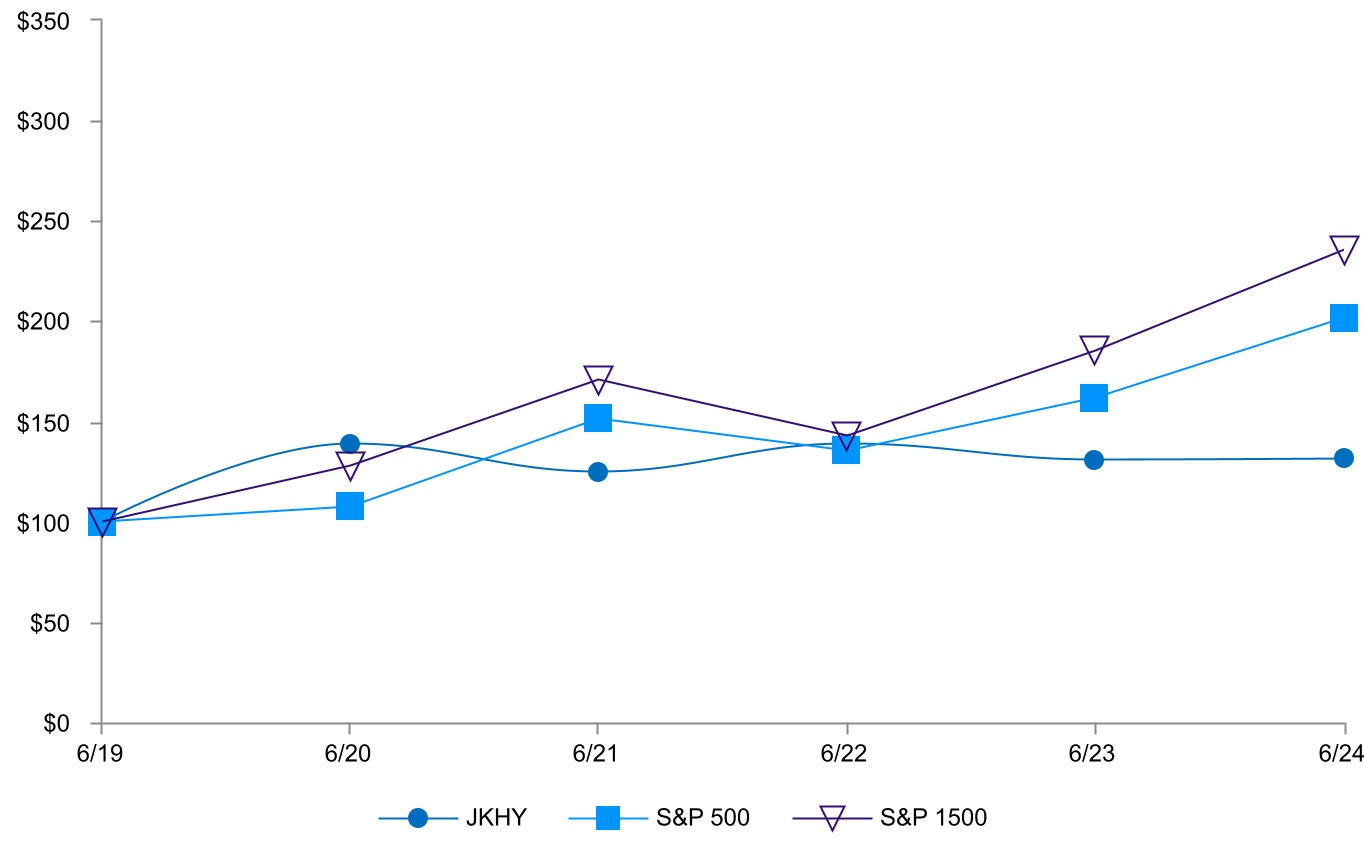
The following information depicts a line graph with the following values:
| 2019 | 2020 | 2021 | 2022 | 2023 | 2024 | |||||||||||||||
| JKHY | 100.00 | 138.88 | 124.80 | 138.92 | 130.65 | 131.34 | ||||||||||||||
| S&P 500 | 100.00 | 107.51 | 151.36 | 135.29 | 161.80 | 201.54 | ||||||||||||||
| S&P Composite 1500 Software & Services | 100.00 | 127.92 | 170.73 | 142.67 | 185.15 | 235.60 | ||||||||||||||
This comparison assumes $100 was invested on June 30, 2019, and assumes reinvestments of dividends.
The stock performance graph shall not be deemed “filed” for purposes of Section 18 of the Exchange Act or incorporated by reference into any filing of the Company under the Securities Act of 1933, as amended, or the Exchange Act, except as shall be expressly set forth by specific reference in such filing.
Item 6. [RESERVED]
Item 7. MANAGEMENT’S DISCUSSION AND ANALYSIS OF FINANCIAL CONDITION AND RESULTS OF OPERATIONS
The following section provides management's view of the Company's financial condition and results of operations and should be read in conjunction with the audited consolidated financial statements, and related notes included elsewhere in this report. All dollar and share amounts, except per share amounts, are in thousands and discussions compare fiscal 2024 to fiscal 2023. Discussions of fiscal 2022 items and comparisons between fiscal 2022 and fiscal 2023 that are not included in this Form 10-K can be found in Part II, Item 7 “Management’s Discussion and Analysis of Financial Condition and Results of Operations” in our Annual Report on Form 10-K for the fiscal year ended June 30, 2023.
OVERVIEW
Jack Henry & Associates, Inc. is a well-rounded financial technology company headquartered in Monett, Missouri, that employs approximately 7,170 full-time and part-time associates nationwide, and is a leading provider of technology solutions and payment processing services primarily to community and regional financial institutions. Our solutions serve approximately 7,500 clients and consist of integrated data processing systems solutions to banks ranging from de novo to multi-billion-dollar institutions with assets up to $50 billion, core data processing solutions for credit unions of all sizes, and non-core highly specialized core-agnostic products and services that enable financial institutions of every asset size and charter, and diverse corporate entities outside the financial services industry, to mitigate and control risks, optimize revenue and growth opportunities, and contain costs. Our integrated solutions are available for on-premise installation and delivery in our private and public cloud.
Each of our solutions shares the fundamental commitment to provide high-quality business systems, service levels that consistently exceed client expectations, and integration of solutions and practical new technologies. The quality of our solutions, our high service standards, and the fundamental way we do business typically foster long-term client relationships, attract prospective clients, and have enabled us to capture substantial market share.
Through internal product development, disciplined acquisitions, and alliances with companies offering niche solutions that complement our proprietary solutions, we regularly introduce new products and services and generate new cross-sales opportunities. We provide compatible computer hardware for our on-premise installations and secure processing environments for our outsourced solutions in our private and public cloud. We perform data conversions, software implementations, initial and ongoing client training, and ongoing client support services.
We believe our primary competitive advantage is client service. Our support infrastructure and strict standards provide service levels that generate high levels of client satisfaction and retention. We consistently measure client satisfaction using a variety of surveys, such as an annual survey on the client's anniversary date and randomly-generated surveys initiated each day by routine support requests. Dedicated surveys are also used to grade specific aspects of our client experience, including product implementation, education, and consulting services.
Our two primary revenue streams are "services and support" and "processing." Services and support includes: "private and public cloud" fees that predominantly have contract terms of six years at inception; "product delivery and services" revenue, which includes revenue from the sales of licenses, implementation services, deconversion fees, consulting, and hardware; and "on-premise support" revenue, composed of maintenance fees which primarily contain annual contract terms. Processing revenue includes: "remittance" revenue from payment processing, remote capture, and ACH transactions; "card" fees, including card transaction processing and monthly fees; and "transaction and digital" revenue, which includes transaction and mobile processing fees. We continually seek opportunities to increase revenue while at the same time containing costs to expand margins.
We have four reportable segments: Core, Payments, Complementary, and Corporate and Other. The respective segments include all related revenues along with the related cost of sales.
A detailed discussion of the major components of the results of operations follows.
RESULTS OF OPERATIONS
FISCAL 2024 COMPARED TO FISCAL 2023
On August 31, 2022, the Company acquired all of the equity interest in Payrailz. Excluded Payrailz related revenue and operating expenses that are mentioned in the discussion below are for the first two months only of fiscal year ended June 30, 2024, since the first two months of fiscal year ended June 30, 2023, do not include Payrailz.
In fiscal 2024, total revenue increased 6.6% or $137,841, compared to fiscal 2023. Reducing total revenue for deconversion revenue of $16,554 in the current fiscal year and $31,775 in the prior fiscal year, and for Payrailz related revenue of $1,945 in the current fiscal year, results in a 7.4% increase, or $151,117. This increase was
primarily driven by growth in data processing and hosting within cloud revenue as new clients were added and volumes expanded, card processing revenue from expanded fraud detection and prevention services and the addition of new/add-on services, digital (including Banno) revenue as active monthly users and volumes increased, payment processing revenue from expanding volumes and new client revenue, and growth in remote capture and ACH revenue.
Operating expenses increased 8.1%, or $129,138, in fiscal 2024 compared to fiscal 2023. Reducing total operating expenses for deconversion costs of $3,408 in the current fiscal year and $4,261 in the prior fiscal year, and for VEDIP related costs of $16,443 and Payrailz related expenses of $4,182, in the current fiscal year, and excluding the impact of the gain on sale of assets, net, of $4,567 in the prior fiscal year, results in a 6.6% increase, or $104,798. The VEDIP program was a Company voluntary separation program offered to certain eligible associates beginning in July 2023. This increase was primarily due to higher personnel costs, increased direct costs consistent with increases in the related revenue, and internal licenses and fees from price increases and higher deployments in the current fiscal year.
We move into fiscal 2025 following strong performance in fiscal 2024. Significant portions of our business continue to provide recurring revenue and our sales pipeline is also encouraging. Our clients continue to face regulatory and operational challenges which our products and services address, and in these times, they have an even greater need for our solutions that directly address institutional profitability, efficiency, and security. We believe our strong balance sheet, access to extensive lines of credit, the strength of our existing product line and an unwavering commitment to superior client service position us well to address current and future opportunities.
A detailed discussion of the major components of the results of operations for the fiscal year ended June 30, 2024 compared to the fiscal year ended June 30, 2023 follows.
REVENUE
| Services and Support Revenue | Year Ended June 30, | % Change | |||||||||||||||
| 2024 | 2023 | ||||||||||||||||
| Services and support | $ | 1,275,954 | $ | 1,214,701 | 5.0% | ||||||||||||
| Percentage of total revenue | 58% | 58% |
Services and support includes: "private and public cloud" fees, which predominantly have contract terms of six years at inception; "product delivery and services" revenue, which includes revenue from the sales of licenses, implementation services, deconversion fees, consulting, and hardware; and "on-premise support" revenue, which is composed primarily of maintenance fees with annual contract terms.
In the fiscal year ended June 30, 2024, services and support revenue increased 5.0% compared to the prior fiscal year. Reducing total services and support revenue by deconversion revenue for each year, which totaled $16,554 in fiscal 2024 and $31,775 in fiscal 2023, and for Payrailz related revenue of $2 from the current fiscal year, services and support revenue grew 6.5%. This increase was primarily driven by higher data processing and hosting within cloud revenue, primarily from organic growth including the addition of new and migrating clients and expanding volumes.
| Processing Revenue | Year Ended June 30, | % Change | |||||||||||||||
| 2024 | 2023 | ||||||||||||||||
| Processing | $ | 939,589 | $ | 863,001 | 8.9% | ||||||||||||
| Percentage of total revenue | 42% | 42% |
Processing revenue includes: "remittance" revenue from payment processing, remote capture, and ACH transactions; "card" fees, including card transaction processing and monthly fees; and "transaction and digital" revenue, which includes transaction and mobile processing fees.
Processing revenue increased 8.9% for the fiscal year ended June 30, 2024, compared to the fiscal year ended June 30, 2023. Reducing total processing revenue by Payrailz related revenue of $1,943 from the current fiscal year, processing revenue grew 8.6%. This increase was driven by growth in card processing primarily from expanded fraud detection and prevention services and growth in the addition of new/add-on services, digital revenue (including Banno) through growth in active monthly users and increased volumes as well as the introduction and ramping up of new add-on products, payment processing revenues as new clients increased and the active user base and transaction volumes expanded, and higher remote capture and ACH revenues.
OPERATING EXPENSES
| Cost of Revenue | Year Ended June 30, | % Change | |||||||||||||||
| 2024 | 2023 | ||||||||||||||||
| Cost of revenue | $ | 1,299,477 | $ | 1,219,062 | 6.6% | ||||||||||||
| Percentage of total revenue | 59% | 59% |
Cost of revenue for fiscal 2024 increased 6.6% compared to fiscal 2023. Reducing total cost of revenue for deconversion costs of $2,231 in the current fiscal year and $2,046 in the prior fiscal year, and for Payrailz related costs of $3,334 in the current fiscal year, results in a 6.3% increase. This increase was driven by higher direct costs consistent with increases in the related revenue, higher internal licenses and fees from price increases and higher deployments in the current fiscal year, and increased personnel costs. Cost of revenue remained consistent as a percentage of total revenue for fiscal 2024 compared to fiscal 2023.
| Research and Development | Year Ended June 30, | % Change | |||||||||||||||
| 2024 | 2023 | ||||||||||||||||
| Research and development | $ | 148,256 | $ | 142,678 | 3.9% | ||||||||||||
| Percentage of total revenue | 7% | 7% |
We devote significant effort and expense to develop new software and service products and continually upgrade and enhance our existing offerings. We believe our research and development efforts are highly efficient because of the extensive experience of our research and development staff and because our product development is highly client driven.
Research and development expenses for fiscal 2024 increased 3.9% compared to fiscal 2023. Reducing total research and development expenses for Payrailz related costs of $656 in the current fiscal year, results in a 3.4% increase. This increase is primarily due to higher cloud consumption, net of capitalization, increased personnel costs, including Payrailz acquisition and Jack Henry Platform costs, net of capitalization. Research and development expense remained consistent as a percentage of total revenue for fiscal 2024 compared to fiscal 2023. The increase in this expense category for the current fiscal year reflects our continuing commitment to the development of strategic products.
| Selling, General, and Administrative | Year Ended June 30, | % Change | |||||||||||||||
| 2024 | 2023 | ||||||||||||||||
| Selling, general, and administrative | $ | 278,419 | $ | 235,274 | 18.3% | ||||||||||||
| Percentage of total revenue | 13% | 11% |
Selling, general, and administrative costs included all expenses related to sales efforts, commissions, finance, legal, and human resources, plus all administrative costs.
Selling, general, and administrative expenses for fiscal 2024 increased 18.3% compared to fiscal 2023. Reducing total selling, general, and administrative expense for deconversion costs from each year, which totaled $1,177 in fiscal 2024 and $2,216 in fiscal 2023, VEDIP program expenses of $16,443 and Payrailz related costs of $192 for the current fiscal year, and excluding the impact of the gain on sale of assets, net, of $4,567 for the prior fiscal year, results in a 9.7% increase. This increase was primarily due to higher personnel costs, including a headcount increase in the trailing twelve months and higher commission expense. Selling, general, and administrative expenses increased 2.0% as a percentage of total revenue for fiscal 2024 compared to fiscal 2023.
| INTEREST INCOME AND EXPENSE | Year Ended June 30, | % Change | |||||||||||||||
| 2024 | 2023 | ||||||||||||||||
| Interest income | $ | 25,012 | $ | 8,959 | 179.2% | ||||||||||||
| Interest expense | $ | (16,384) | $ | (15,073) | 8.7% |
Interest income increased over the prior fiscal year due to increased interest earned on balances fiscal year over fiscal year. Interest expense increased in fiscal 2024 mainly due to the timing and amounts of borrowed balances and increases in interest rates.
| PROVISION FOR INCOME TAXES | Year Ended June 30, | % Change | |||||||||||||||
| 2024 | 2023 | ||||||||||||||||
| Provision for income taxes | $ | 116,203 | $ | 107,928 | 7.7% | ||||||||||||
| Effective rate | 23.3% | 22.7% |
The increase in the Company's effective tax rate in fiscal 2024 compared to fiscal 2023 was the result of changes in uncertain tax positions for periods open under the statute of limitations in the current fiscal year. This increase is partially offset by greater benefits received from research and development tax credits during the current fiscal year.
| NET INCOME | Year Ended June 30, | % Change | |||||||||||||||
| 2024 | 2023 | ||||||||||||||||
| Net income | $ | 381,816 | $ | 366,646 | 4.1% | ||||||||||||
| Diluted earnings per share | $ | 5.23 | $ | 5.02 | 4.2% |
Net income grew 4.1% to $381,816, or $5.23 per diluted share, in fiscal 2024 from $366,646, or $5.02 per diluted share, in fiscal 2023. The diluted earnings per share increase fiscal year over fiscal year was 4.2%. This increase was primarily due to growth in our lines of revenue and a reduction in the number of weighted average shares outstanding partially offset by higher operating expenses in fiscal 2024 compared to fiscal 2023 .
REPORTABLE SEGMENT DISCUSSION
The Company is a well-rounded financial technology company and is a leading provider of technology solutions and payment processing services primarily to community and regional financial institutions. The Company’s operations are classified into four reportable segments: Core, Payments, Complementary, and Corporate and Other. The Core segment provides core information processing platforms to banks and credit unions, which consist of integrated applications required to process deposit, loan, and general ledger transactions, and maintain centralized customer/member information. The Payments segment provides secure payment processing tools and services, including ATM, debit, and credit card processing services, online and mobile bill pay solutions, ACH origination and remote deposit capture processing, and risk management products and services. The Complementary segment provides additional software, hosted processing platforms, and services, including digital/mobile banking, treasury services, online account opening, fraud/anti-money laundering ("AML") and lending/deposit solutions that can be integrated with the Company's Core solutions, and many can be used independently. The Corporate and Other segment includes revenue and costs from hardware and other products not attributed to any of the other three segments, as well as operating expenses not directly attributable to the other three segments.
The Company evaluates the performance of its segments and allocates resources to them based on various factors, including performance against trend, budget, and forecast. Only revenue and costs of revenue are considered in the evaluation for each segment.
Immaterial adjustments between segments were made in fiscal 2024 to reclassify revenue and cost of revenue that was recognized in fiscal 2023. These reclasses were made to be consistent with the current allocation of revenue and cost of revenue by segment. Revenue reclassed for the fiscal year ended June 30, 2023, from Core to Corporate and Other was $7,119, from Payments to Corporate and Other was $30, and from Complementary to Corporate and Other was $307. Cost of revenue reclassed for the fiscal year ended June 30, 2023, from Core to Corporate and Other was $6,713, from Payments to Corporate and Other was $2,594, and from Complementary to Corporate and Other was $1,286.
| Core | |||||||||||||||||
| 2024 | % Change | 2023 | |||||||||||||||
| Revenue | $ | 690,738 | 6.4% | $ | 649,045 | ||||||||||||
| Cost of Revenue | $ | 287,349 | 3.8% | $ | 276,818 |
In fiscal 2024, revenue in the Core segment increased 6.4% compared to fiscal 2023. Reducing total Core revenue by deconversion revenue from both fiscal years, which totaled $7,292 in fiscal 2024 and $10,924 in fiscal 2023, Core segment revenue increased 7.1%. This increase was primarily driven by organic increases in our data processing and hosting within cloud revenue. Cost of revenue in the Core segment increased 3.8% for fiscal 2024 compared to fiscal 2023. This increase was primarily due to increased direct costs associated with the organic growth in cloud revenue. Deconversion and/or acquisition costs did not significantly affect Core cost of revenue fiscal year over fiscal year. Core segment cost of revenue decreased 1% as a percentage of revenue for fiscal 2024 compared to fiscal 2023.
| Payments | |||||||||||||||||
| 2024 | % Change | 2023 | |||||||||||||||
| Revenue | $ | 817,708 | 6.6% | $ | 767,309 | ||||||||||||
| Cost of Revenue | $ | 442,084 | 5.0% | $ | 420,880 |
In fiscal 2024, revenue in the Payments segment increased 6.6% compared to fiscal 2023. Reducing total Payments revenue by deconversion revenue from both fiscal years, which totaled $5,836 in fiscal 2024 and $7,924 in fiscal 2023, and Payrailz related revenue from the current fiscal year of $1,945, Payments segment revenue increased 6.7%. This increase was primarily driven by growth within card revenue and payment processing within remittance revenue. Cost of revenue in the Payments segment increased 5.0% for fiscal 2024 compared to fiscal 2023. Reducing total Payments cost of revenue by deconversion costs from both fiscal years, which totaled $259 in fiscal 2024 and $303 in fiscal 2023 and Payrailz related costs from the current fiscal year of $3,314, Payments cost of revenue increased 4.3%. This increase was primarily due to increased direct costs related to growth in the card and remittance revenue lines, and increased personnel costs, including benefits expenses. Payments segment cost of revenue decreased 1% as a percentage of revenue for fiscal 2024 compared to fiscal 2023.
| Complementary | |||||||||||||||||
| 2024 | % Change | 2023 | |||||||||||||||
| Revenue | $ | 618,211 | 5.9% | $ | 583,586 | ||||||||||||
| Cost of Revenue | $ | 256,007 | 7.7% | $ | 237,758 |
Revenue in the Complementary segment increased 5.9% for fiscal 2024 compared to fiscal 2023. Reducing total Complementary revenue by deconversion revenue from both fiscal years, which totaled $3,217 in fiscal 2024 and $12,649 in fiscal 2023, Complementary segment revenue increased 7.7%. This increase was primarily driven by organic increases in digital revenue (including Banno) and hosting within cloud revenue. Cost of revenue in the Complementary segment increased 7.7% for fiscal 2024 compared to fiscal 2023. This increase was primarily due to higher direct costs related to the organic growth in the digital and hosting within cloud revenue lines, increased amortization of capitalized software, and higher internal licenses and fees. Deconversion and/or acquisition costs did not significantly affect Complementary cost of revenue fiscal year over fiscal year. Complementary segment cost of revenue increased 1% as a percentage of revenue for fiscal 2024 compared to fiscal 2023.
| Corporate and Other | |||||||||||||||||
| 2024 | % Change | 2023 | |||||||||||||||
| Revenue | $ | 88,886 | 14.3% | $ | 77,762 | ||||||||||||
| Cost of Revenue | $ | 314,037 | 10.7% | $ | 283,606 |
Revenue in the Corporate and Other segment increased 14.3% for fiscal 2024 compared to fiscal 2023. Reducing total Corporate and Other revenue by deconversion revenue from both fiscal years, which totaled $209 in fiscal 2024 and $278 in fiscal 2023, Corporate and Other segment revenue increased 14.4%. The increase was mainly due to increased hardware revenue and subscriptions and software usage within support revenues.
Cost of revenue for the Corporate and Other segment includes operating expenses not directly attributable to any of the other three segments and increased 10.7% for fiscal 2024 compared to fiscal 2023. This increase was primarily related to higher internal licenses and fees and personnel costs, including benefits expenses. Deconversion and/or acquisition costs did not significantly affect Corporate and Other cost of revenue fiscal year over fiscal year.
LIQUIDITY AND CAPITAL RESOURCES
The Company's cash and cash equivalents increased to $38,284 at June 30, 2024, from $12,243 at June 30, 2023. The following table summarizes net cash from operating activities in the statement of cash flows:
| Year Ended | |||||||||||
| June 30, | |||||||||||
| 2024 | 2023 | ||||||||||
| Net income | $ | 381,816 | $ | 366,646 | |||||||
| Non-cash expenses | 231,709 | 166,621 | |||||||||
| Change in receivables | 28,219 | (12,067) | |||||||||
| Change in deferred revenue | (10,797) | (10,547) | |||||||||
| Change in other assets and liabilities | (62,906) | (129,094) | |||||||||
| Net cash provided by operating activities | $ | 568,041 | $ | 381,559 |
Cash provided by operating activities for fiscal 2024 increased 48.9% compared to fiscal 2023, primarily due to higher than historical collections in fiscal 2024 of annual maintenance billings related to fiscal year 2025 and to an overpayment of income taxes in fiscal 2023, which led to lower cash taxes paid in fiscal 2024. The Company paid income taxes, net of refunds, of $106,966, $145,862, and $60,553 in fiscal 2024, 2023, and 2022, respectively. Cash from operations is primarily used to repay debt, pay dividends, repurchase stock, and for capital expenditures.
Cash used in investing activities for fiscal 2024 totaled $240,165 and included: $167,175 for the ongoing enhancements and development of existing and new product and service offerings; capital expenditures on facilities and equipment of $58,118, mainly for the purchase of computer equipment; $8,646 for purchase of investments; and $7,130 for the purchase and development of internal use software. These expenditures were partially offset by $904 of proceeds from asset sales.
Cash used in investing activities for fiscal 2023 totaled $409,673 and included: payment for the acquisition of Payrailz of $229,628, $166,120 for the ongoing enhancements and development of existing and new product and service offerings; capital expenditures on facilities and equipment of $39,179, mainly for the purchase of computer equipment; $1,685 for the purchase and development of internal use software; and $1,000 for the purchase of investments. These expenditures were partially offset by $27,939 of proceeds from the sale of assets.
Financing activities used cash of $301,835 for fiscal 2024 and included: $155,877 for dividends paid to stockholders; borrowing and repayments on our credit facilities which netted to repayments of $125,000; and $28,055 for the purchase of treasury shares. These expenditures were partially offset by $7,097 of net cash inflow related to stock-based compensation.
Financing activities used cash in fiscal 2023 of $8,430 and included $147,237 for dividends paid to stockholders and $25,000 for the purchase of treasury shares. These expenditures were partially offset by borrowings and repayments on our revolving credit facility and financing leases which netted to borrowings of $159,940 at June 30, 2023, and $3,867 of net cash inflow related to stock-based compensation.
Capital Requirements and Resources
The Company generally uses existing resources and funds generated from operations to meet its capital requirements. Capital expenditures totaling $58,118 and $39,179 for fiscal years ended June 30, 2024, and June 30, 2023, respectively, were made primarily for additional equipment and the improvement of existing facilities. These additions were funded from cash generated by operations. At June 30, 2024, the Company had $24,694 of significant outstanding purchase commitments related to property and equipment. We assessed our liquidity needs throughout fiscal 2024, and determined we had adequate capital resources and sufficient access to external financing sources to satisfy our current and reasonably anticipated funding needs. We will continue to monitor and assess these needs going forward.
In July 2023, the Company conducted a voluntary separation program for certain eligible associates that included a VEDIP payment for the eligible associates who chose to participate in the program. The Company made payments associated with the VEDIP program in the approximate amount of $16,443 from July 2023 through December 2023, including immaterial payments continuing into calendar 2024.
At June 30, 2024, the Company had contractual obligations of $1,488,248, including operating lease obligations, and $1,421,125 related to off-balance sheet contractual purchase obligations. Contractual obligations exclude $22,429 of liabilities for uncertain tax positions as we are unable to reasonably estimate the ultimate amount or timing of settlement.
The Board of Directors has authorized the Company to repurchase shares of its common stock. Under this authorization, the Company may finance its share repurchases with available cash reserves or short-term borrowings on its existing credit facilities. The share repurchase program does not include specific price targets or
timetables and may be suspended at any time. At June 30, 2024, there were 31,373 shares in treasury stock and the Company had the remaining authority to repurchase up to 3,618 additional shares. The total cost of treasury shares at June 30, 2024 was $1,860,173. During fiscal 2024, the Company repurchased 179 treasury shares for $28,055. At June 30, 2023, there were 31,194 shares in treasury stock and the Company had authority to repurchase up to 3,796 additional shares.
Payrailz
On August 31, 2022, the Company acquired all of the equity interest in Payrailz. The final purchase price, following customary post-closing adjustments to the extent actual closing date working capital, cash, debt, and unpaid seller transaction expenses exceeded or were less than the amounts estimated at closing, was $230,205. Pursuant to the merger agreement for the transaction, $48,500 of the purchase price was placed in an escrow account at the closing, consisting of $2,500 for any final purchase price adjustments owed by the sellers, which amount was released to the sellers on December 15, 2022, in connection with post-closing purchase price adjustments, and $46,000 for indemnification matters under the merger agreement, which amount was released to the sellers on September 20, 2023.
The primary reason for the acquisition was to expand the Company's digital financial management solutions and the purchase was originally funded by our revolving line of credit and cash generated from operations. Payrailz provides cloud-native, API-first, AI-enabled consumer and commercial digital payment solutions and experiences that enable money to be moved in the moment of need.
Credit facilities
On August 31, 2022, the Company entered into a five-year senior, unsecured amended and restated credit agreement that replaced a prior credit facility that was entered into on February 10, 2020. The credit agreement allows for borrowings of up to $600,000, which may be increased to $1,000,000 by the Company at any time until maturity. The credit agreement bears interest at a variable rate equal to (a) a rate based on an adjusted SOFR term rate or (b) an alternate base rate (the highest of (i) 0%, (ii) the Prime Rate for such day, (iii) the sum of the Federal Funds Effective Rate for such day plus 0.50% per annum and (iv) the Adjusted Term SOFR Screen Rate (without giving effect to the Applicable Margin) for a one month Interest Period on such day for Dollars plus 1.0%), plus an applicable percentage in each case determined by the Company's leverage ratio. The credit agreement is guaranteed by certain subsidiaries of the Company and is subject to various financial covenants that require the Company to maintain certain financial ratios as defined in the credit agreement. As of June 30, 2024, the Company was in compliance with all such covenants. The amended and restated credit facility terminates August 31, 2027. There was $60,000 and $95,000 outstanding under the amended and restated credit facility at June 30, 2024, and June 30, 2023, respectively.
Term loan facility
On May 16, 2023, the Company entered into a term loan credit agreement with a syndicate of financial institutions, with an original principal balance of $180,000. Borrowings under the term loan facility bear interest at a variable rate equal to (a) a rate based on an adjusted SOFR term rate or (b) an alternate base rate (the highest of (i) 0%, (ii) the Prime Rate for such day, (iii) the sum of the Federal Funds Effective Rate for such day plus 0.50% per annum and (iv) the Adjusted Term SOFR Screen Rate (without giving effect to the Applicable Margin) for a one month Interest Period on such day for Dollars plus 0.75%), plus an applicable percentage in each case determined by the Company's leverage ratio. The term loan credit agreement is guaranteed by certain subsidiaries of the Company and is subject to various financial covenants that require the Company to maintain certain financial ratios as defined in the term loan credit agreement. As of June 30, 2024, the Company was in compliance with all such covenants. The term loan credit agreement has a maturity date of May 16, 2025. There was $90,000 and $180,000 outstanding under the term loan at June 30, 2024, and June 30, 2023, respectively. We currently anticipate that we will be able to repay the remaining outstanding balance under the term loan prior to its maturity using cash generated by our operations or borrowings under our revolving credit facility.
Other lines of credit
The Company has an unsecured bank credit line which provides for funding of up to $5,000 and bears interest at the prime rate less 1.0%. The credit line was renewed in May 2019 and modified in May 2023 to extend the expiration to April 30, 2025. There was no balance outstanding at June 30, 2024, or 2023.
RECENT ACCOUNTING PRONOUNCEMENTS
Recently Adopted Accounting Guidance
In October 2021, the FASB issued ASU No. 2021-08, Business Combinations (Topic 805): Accounting for Contract Assets and Contract Liabilities from Contracts with Customers, which improves the accounting for acquired revenue contracts with customers in a business combination by addressing diversity in practice and inconsistency related to recognition of an acquired contract liability and payment terms and their effect on subsequent revenue recognized by the acquirer. The ASU is effective for fiscal years beginning after December 15, 2022, and interim periods within those fiscal years. The Company adopted the ASU effective July 1, 2023, and will apply it prospectively to business combinations occurring after that date.
Not Adopted at Fiscal Year End
In November 2023, the FASB issued ASU No. 2023-07, Segment Reporting (Topic 280): Improvements to Reportable Segment Disclosures, which improves the disclosures about a public entity's reportable segments through enhanced disclosures about significant segment expenses that are regularly provided to the chief operating decision maker. The ASU is effective for fiscal years beginning after December 15, 2023, and interim periods within fiscal years beginning after December 15, 2024, and should be applied retrospectively to all prior periods presented in the financial statements. Early adoption is permitted. The Company is currently evaluating the impact of this ASU on its consolidated financial statements and related disclosures.
In December 2023, the FASB issued ASU No. 2023-09, Income Taxes (Topic 740): Improvements to Income Tax Disclosures, which enhances the transparency and decision usefulness of income tax disclosures. The ASU requires additional disclosure related to rate reconciliation, income taxes paid, and other disclosures to improve the effectiveness of income tax disclosures. The ASU is effective for annual periods beginning after December 15, 2024, and applied on a prospective basis. Early adoption and retrospective application is permitted. The Company is currently evaluating the impact of this ASU on its consolidated financial statements and related disclosures.
CRITICAL ACCOUNTING ESTIMATES
We prepare our consolidated financial statements in accordance with U.S. GAAP. The significant accounting policies are discussed in Note 1 to the consolidated financial statements. The preparation of consolidated financial statements in accordance with U.S. GAAP requires us to make estimates and judgments that affect the reported amounts of assets, liabilities, revenue and expenses, as well as disclosure of contingent assets and liabilities. We base our estimates and judgments upon historical experience and other factors believed to be reasonable under the circumstances. Changes in estimates or assumptions could result in a material adjustment to the consolidated financial statements.
We have identified several critical accounting estimates. An accounting estimate is considered critical if both: (a) the nature of the estimates or assumptions is material due to the levels of subjectivity and judgment involved, and (b) the impact of changes in the estimates and assumptions would have a material effect on the consolidated financial statements.
Revenue Recognition
We generate revenue from data processing, transaction processing, software licensing and related services, professional services, and hardware sales.
Identification of performance obligations
We enter into contracts with clients that may include multiple types of goods and services. At contract inception, we assess the solutions and services promised in our contracts with clients and identify a performance obligation for each promise to transfer to the client a solution or service (or bundle of solutions or services) that is distinct — that is, if the solution or service is separately identifiable from other items in the arrangement and if the client can benefit from the solution or service on its own or together with other resources that are readily available. Judgment is used in the identification and accounting for all performance obligations. We recognize revenue when or as we satisfy each performance obligation by transferring control of a solution or service to the client.
Determination of transaction price
The amount of revenue recognized is based on the consideration we expect to receive in exchange for transferring goods and services to the client. Our contracts with our clients frequently contain some component of variable consideration. We estimate variable consideration in our contracts primarily using the expected value method,
based on both historical and current information. Where appropriate, we may constrain the estimated variable consideration included in the transaction price in the event of a high degree of uncertainty as to the final consideration amount. Significant judgment is used in the estimate of variable consideration of client contracts that are long-term and include varying transactional volumes.
Allocation of transaction price
The transaction price, once determined, is allocated between the various performance obligations in the contract based upon their relative standalone selling prices. The standalone selling prices are determined based on the prices at which we separately sell each good or service. For items that are not sold separately, we estimate the standalone selling prices using all information that is reasonably available, including reference to historical pricing data.
Contract costs
We incur incremental costs to obtain a contract as well as costs to fulfill contracts with clients that are expected to be recovered. These costs consist primarily of sales commissions, which are incurred only if a contract is obtained, and client conversion or implementation-related costs.
Capitalized costs are amortized based on the transfer of goods or services to which the asset relates, in line with the percentage of revenue recognized for each performance obligation to which the costs are allocated.
Capitalization of software development costs
We capitalize certain costs incurred for use in our cloud-based services and to develop commercial software products. For internal use software, capitalization begins at the beginning of application development. Costs incurred prior to this are expensed as incurred. Significant estimates and assumptions include determining the appropriate amortization period based on the estimated useful life and assessing the unamortized cost balances for impairment. Amortization begins on the date the software is placed in service and the amortization period is based on estimated useful life
For software that is to be sold, significant areas of judgment include: establishing when technological feasibility has been met and costs should be capitalized, determining the appropriate period over which to amortize the capitalized costs based on the estimated useful lives, estimating the marketability of the commercial software products and related future revenues, and assessing the unamortized cost balances for impairment. Costs incurred prior to establishing technological feasibility are expensed as incurred. Amortization begins on the date of general release and the appropriate amortization period is based on estimates of future revenues from sales of the products. We consider various factors to project marketability and future revenues, including an assessment of alternative solutions or products, current and historical demand for the product, and anticipated changes in technology that may make the product obsolete.
A significant change in an estimate related to one or more software products could result in a material change to our results of operations.
Purchase accounting
We account for our acquisitions using the purchase method of accounting. This method requires estimates to determine the fair values of assets and liabilities acquired, including judgments to determine any acquired intangible assets such as computer software and client-related intangibles. Third-party valuation firms may be used to assist in the appraisal of certain assets and liabilities, but even those determinations would be based on significant estimates provided by us, such as forecast revenues or profits on contract-related intangibles. Numerous factors are typically considered in the purchase accounting assessments, which are conducted by Company professionals from legal, finance, human resources, information systems, program management and other disciplines. Changes in assumptions and estimates of the acquired assets and liabilities would result in changes to the fair values, resulting in an offsetting change to the goodwill balance associated with the business acquired.
Item 7A. QUANTITATIVE AND QUALITATIVE DISCLOSURES ABOUT MARKET RISK
Market risk refers to the risk that a change in the level of one or more market prices, interest rates, indices, volatilities, correlations or other market factors such as liquidity, will result in losses for a certain financial instrument or group of financial instruments. We are currently exposed to credit risk on credit extended to clients and interest rate risk on outstanding debt. We do not currently use any derivative financial instruments. We actively monitor these risks through a variety of controlled procedures involving senior management.
Based on the controls in place and the credit worthiness of the client base, we believe the credit risk associated with the extension of credit to our clients will not have a material adverse effect on our consolidated financial position, results of operations, or cash flows.
We have $150,000 outstanding debt with variable interest rates as of June 30, 2024, and a 1% increase in our borrowing rate would increase our annual interest expense by $1,500.
Item 8. FINANCIAL STATEMENTS AND SUPPLEMENTARY DATA
Index to Financial Statements
| Report of Independent Registered Public Accounting Firm | 34 | |||||||
| Management's Annual Report on Internal Control over Financial Reporting | 36 | |||||||
| Financial Statements | ||||||||
| Consolidated Statements of Income, | ||||||||
| Years Ended June 30, 2024, 2023, and 2022 | 37 | |||||||
| Consolidated Balance Sheets, | ||||||||
| June 30, 2024, and 2023 | 38 | |||||||
| Consolidated Statements of Changes in Stockholders' Equity, | ||||||||
| Years Ended June 30, 2024, 2023, and 2022 | 39 | |||||||
| Consolidated Statements of Cash Flows, | ||||||||
| Years Ended June 30, 2024, 2023, and 2022 | 40 | |||||||
| Notes to Consolidated Financial Statements | 41 |
Financial Statement Schedules
There are no schedules included because they are not applicable, or the required information is shown in the consolidated financial statements or notes thereto.
Report of Independent Registered Public Accounting Firm
To the Board of Directors and Stockholders of Jack Henry & Associates, Inc.
Opinions on the Financial Statements and Internal Control over Financial Reporting
We have audited the accompanying consolidated balance sheets of Jack Henry & Associates, Inc. and its subsidiaries (the "Company") as of June 30, 2024 and 2023, and the related consolidated statements of income, of changes in stockholders’ equity and of cash flows for each of the three years in the period ended June 30, 2024, including the related notes (collectively referred to as the "consolidated financial statements"). We also have audited the Company's internal control over financial reporting as of June 30, 2024, based on criteria established in Internal Control - Integrated Framework (2013) issued by the Committee of Sponsoring Organizations of the Treadway Commission (COSO).
In our opinion, the consolidated financial statements referred to above present fairly, in all material respects, the financial position of the Company as of June 30, 2024 and 2023, and the results of its operations and its cash flows for each of the three years in the period ended June 30, 2024 in conformity with accounting principles generally accepted in the United States of America. Also in our opinion, the Company maintained, in all material respects, effective internal control over financial reporting as of June 30, 2024, based on criteria established in Internal Control - Integrated Framework (2013) issued by the COSO.
Basis for Opinions
The Company's management is responsible for these consolidated financial statements, for maintaining effective internal control over financial reporting, and for its assessment of the effectiveness of internal control over financial reporting, included in the accompanying Management’s Annual Report on Internal Control Over Financial Reporting. Our responsibility is to express opinions on the Company’s consolidated financial statements and on the Company's internal control over financial reporting based on our audits. We are a public accounting firm registered with the Public Company Accounting Oversight Board (United States) (PCAOB) and are required to be independent with respect to the Company in accordance with the U.S. federal securities laws and the applicable rules and regulations of the Securities and Exchange Commission and the PCAOB.
We conducted our audits in accordance with the standards of the PCAOB. Those standards require that we plan and perform the audits to obtain reasonable assurance about whether the consolidated financial statements are free of material misstatement, whether due to error or fraud, and whether effective internal control over financial reporting was maintained in all material respects.
Our audits of the consolidated financial statements included performing procedures to assess the risks of material misstatement of the consolidated financial statements, whether due to error or fraud, and performing procedures that respond to those risks. Such procedures included examining, on a test basis, evidence regarding the amounts and disclosures in the consolidated financial statements. Our audits also included evaluating the accounting principles used and significant estimates made by management, as well as evaluating the overall presentation of the consolidated financial statements. Our audit of internal control over financial reporting included obtaining an understanding of internal control over financial reporting, assessing the risk that a material weakness exists, and testing and evaluating the design and operating effectiveness of internal control based on the assessed risk. Our audits also included performing such other procedures as we considered necessary in the circumstances. We believe that our audits provide a reasonable basis for our opinions.
Definition and Limitations of Internal Control over Financial Reporting
A company’s internal control over financial reporting is a process designed to provide reasonable assurance regarding the reliability of financial reporting and the preparation of financial statements for external purposes in accordance with generally accepted accounting principles. A company’s internal control over financial reporting includes those policies and procedures that (i) pertain to the maintenance of records that, in reasonable detail, accurately and fairly reflect the transactions and dispositions of the assets of the company; (ii) provide reasonable assurance that transactions are recorded as necessary to permit preparation of financial statements in accordance with generally accepted accounting principles, and that receipts and expenditures of the company are being made only in accordance with authorizations of management and directors of the company; and (iii) provide reasonable assurance regarding prevention or timely detection of unauthorized acquisition, use, or disposition of the company’s assets that could have a material effect on the financial statements.
Because of its inherent limitations, internal control over financial reporting may not prevent or detect misstatements. Also, projections of any evaluation of effectiveness to future periods are subject to the risk that controls may become inadequate because of changes in conditions, or that the degree of compliance with the policies or procedures may deteriorate.
Critical Audit Matters
The critical audit matter communicated below is a matter arising from the current period audit of the consolidated financial statements that was communicated or required to be communicated to the audit committee and that (i) relates to accounts or disclosures that are material to the consolidated financial statements and (ii) involved our especially challenging, subjective, or complex judgments. The communication of critical audit matters does not alter in any way our opinion on the consolidated financial statements, taken as a whole, and we are not, by communicating t
Showing the first 8K of 110K characters. Open the full section
Item 9. CHANGES IN AND DISAGREEMENTS WITH ACCOUNTANTS ON ACCOUNTING AND FINANCIAL DISCLOSURES
None.
Item 9A. CONTROLS AND PROCEDURES
Disclosure Controls and Procedures
As of the end of the period covered by this Annual Report on Form 10-K, an evaluation was carried out under the supervision and with the participation of our management, including our Company’s Chief Executive Officer ("CEO") and Chief Financial Officer ("CFO"), of the effectiveness of the design and operation of our disclosure controls and procedures as defined in Exchange Act Rules 13a-15(e) and 15d-15(e). Based upon that evaluation (required in Exchange Act Rules 13a-15(b) and 15d-15(b)), the CEO and CFO concluded that our disclosure controls and procedures are effective to provide reasonable assurance that information we are required to disclose in reports that we file or submit under the Exchange Act is recorded, processed, summarized and reported within the time periods specified in SEC rules and forms. For this purpose, disclosure controls and procedures include controls and procedures designed to ensure that information required to be disclosed under the Exchange Act is accumulated and communicated to the Company’s management, including the CEO and CFO, as appropriate to allow timely decisions regarding required disclosure.
Management’s Annual Report on Internal Control over Financial Reporting
The Management’s Report on Internal Control over Financial Reporting required by this Item 9A is in Item 8, “Financial Statements and Supplementary Data.” The Company's independent registered public accounting firm has audited our internal control over financial reporting as of June 30, 2024; their report is included in Item 8 of this Form 10-K.
Changes in Internal Control over Financial Reporting
During the quarter ended June 30, 2024, there were no changes in the Company’s internal control over financial reporting which were identified in connection with management’s evaluation required by Rules 13a-15(d) and 15d-15(d) under the Exchange Act that have materially affected, or are reasonably likely to materially affect, the Company’s internal control over financial reporting.
Item 9B. OTHER INFORMATION
Rule 10b-5(1) Trading Plans
During the three months ended June 30, 2024, no director or officer of the Company adopted or terminated a “Rule 10b5-1 trading arrangement” or “non-Rule 10b5-1 trading arrangement,” as each term is defined in Item 408(a) of Regulation S-K.
Item 9C. DISCLOSURE REGARDING FOREIGN JURISDICTIONS THAT PREVENT INSPECTIONS.
Not applicable.
PART III
Information required by Items 10, 11, 12, 13 and 14 of Part III is omitted from this report and will be filed within 120 days after the Company's June 30, 2024, fiscal year end in the definitive proxy statement for our 2024 Annual Meeting of Stockholders (the “Proxy Statement”).
Item 10. DIRECTORS, EXECUTIVE OFFICERS AND CORPORATE GOVERNANCE
See the information under the captions “Election of Directors”, “Corporate Governance," “Delinquent Section 16(a) Reports" (if applicable), and “Executive Officers” in the Proxy Statement, which is incorporated herein by reference.
Item 11. EXECUTIVE COMPENSATION
See the information under captions “Corporate Governance," “Human Capital & Compensation Committee Report," “Compensation Discussion and Analysis," "Compensation and Risk," and “Executive Compensation” in the Proxy Statement, which is incorporated herein by reference.
Item 12. SECURITY OWNERSHIP OF CERTAIN BENEFICIAL OWNERS AND MANAGEMENT AND RELATED STOCKHOLDER MATTERS
See the information under the captions “Stock Ownership of Certain Stockholders” and “Equity Compensation Plan Information” in the Proxy Statement, which is incorporated herein by reference.
Item 13. CERTAIN RELATIONSHIPS AND RELATED TRANSACTIONS, AND DIRECTOR INDEPENDENCE
See the information under the captions “Election of Directors - Director Independence” and “Certain Relationships and Related Transactions” in the Proxy Statement, which is incorporated herein by reference.
Item 14. PRINCIPAL ACCOUNTANT FEES AND SERVICES
See the information under the captions ”Audit Committee Report” and “Ratification of Selection of the Company's Independent Registered Public Accounting Firm," PricewaterhouseCoopers LLP (PCAOB ID No. 238), in the Proxy Statement, which is incorporated herein by reference.
PART IV
Item 15. EXHIBITS AND FINANCIAL STATEMENT SCHEDULES
(a) The following documents are filed as part of this Report:
(1) The following consolidated financial statements of the Company and its subsidiaries and the Report of Independent Registered Public Accounting Firm thereon appear under Item 8 of this Report:
- Reports of Independent Registered Public Accounting Firm
- Consolidated Statements of Income for the fiscal years ended June 30, 2024, 2023, and 2022
- Consolidated Balance Sheets as of June 30, 2024, and 2023
- Consolidated Statements of Changes in Stockholders’ Equity for the fiscal years ended June 30, 2024, 2023, and 2022
- Consolidated Statements of Cash Flows for the fiscal years ended June 30, 2024, 2023, and 2022
- Notes to the Consolidated Financial Statements
(2) The following financial statement schedules filed as part of this Report appear under Item 8 of this Report:
There are no schedules included because they are not applicable, or the required information is shown in the consolidated financial statements or notes thereto.
(3) See “Index to Exhibits” set forth below.
All exhibits not attached hereto are incorporated by reference to a prior filing as indicated.
Exhibit No. Description
3.2.9 Restated and Amended Bylaws attached as Exhibit 3.2.9 to the Company’s Current Report on Form 8-K filed July 5, 2024.
4.1** Description of Securities
10.70* Form of Restricted Stock Unit Agreement (Employees) attached as Exhibit 10.70 to the Company's Annual Report on Form 10-K filed August 25, 2021.
10.78* Jack Henry & Associates, Inc. 2006 Employee Stock Purchase Plan, as amended and restated on August 18, 2023, effective January 1, 2024 attached as Exhibit 10.78 to the Company's Annual Report on Form 10-K filed August 24, 2023.
10.79* ** Form of Restricted Stock Unit Agreement (non-employee directors).
19.1** Jack Henry & Associates, Inc. Trading in Company Securities Policy.
21.1** List of the Company’s subsidiaries.
23.1** Consent of Independent Registered Public Accounting Firm- PricewaterhouseCoopers LLP.
31.1** Certification of the Chief Executive Officer.
31.2** Certification of the Chief Financial Officer.
32.1*** Written Statement of the Chief Executive Officer Pursuant to 18 U.S.C. Section 1350.
32.2*** Written Statement of the Chief Financial Officer Pursuant to 18 U.S.C. Section 1350.
97.1** Jack Henry & Associates, Inc. Executive Compensation Clawback Policy.
101.INS**** XBRL Instance Document
101.SCH**** XBRL Taxonomy Extension Schema Document
101.CAL**** XBRL Taxonomy Extension Calculation Linkbase Document
101.DEF**** XBRL Taxonomy Extension Definition Linkbase Document
101.LAB**** XBRL Taxonomy Extension Label Linkbase Document
101.PRE**** XBRL Taxonomy Extension Presentation Linkbase Document
104 Cover Page Interactive Data File (formatted as Inline XBRL and contained in Exhibit (101)), except registrant name, JACK HENRY & ASSOCIATES INC, tagged in non-printing section.
- Indicates management contract or compensatory plan or arrangement.
** Filed with this report on Form 10-K
*** Furnished with this report on Form 10-K.
**** Filed with this report on Form 10-K are the following documents formatted in XBRL ("Extensible Business Reporting Language"): (i) the Consolidated Balance Sheets at June 30, 2024, and June 30, 2023, (ii) the Consolidated Statements of Income for the years ended June 30, 2024, 2023, and 2022, (iii) the Consolidated Statements of Shareholders’ Equity for the years ended June 30, 2024, 2023, and 2022, (iv) the Consolidated Statements of Cash Flows for the years ended June 30, 2024, 2023, and 2022, and (v) Notes to Consolidated Financial Statements.
Item 16. FORM 10-K SUMMARY
None.
SIGNATURES
Pursuant to the requirements of Section 13 or 15(d) of the Securities Exchange Act of 1934, the registrant has duly caused this report to be signed on its behalf by the undersigned, thereunto duly authorized this 26th day of August, 2024.
JACK HENRY & ASSOCIATES, INC., Registrant
By /s/ Gregory R. Adelson
Chief Executive Officer
Pursuant to the requirements of the Securities Exchange Act of 1934, this report has been signed below by the following persons on behalf of the registrant and in the capacities and on the dates indicated:
| Signature | Capacity | Date | ||||||
| /s/ Gregory R. Adelson Gregory R. Adelson | Chief Executive Officer and President (Principal Executive Officer) | August 26, 2024 | ||||||
| /s/ Mimi L. Carsley Mimi L. Carsley | Chief Financial Officer and Treasurer (Principal Financial Officer) | August 26, 2024 | ||||||
| /s/ Renee A. Swearingen Renee A. Swearingen | Senior Vice President and Chief Accounting Officer (Principal Accounting Officer) | August 26, 2024 | ||||||
| /s/ David B. Foss David B. Foss | Executive Board Chair | August 26, 2024 | ||||||
| /s/ Matthew C. Flanigan Matthew C. Flanigan | Vice Chair and Lead Director | August 26, 2024 | ||||||
| /s/ Thomas H. Wilson, Jr Thomas H. Wilson, Jr | Director | August 26, 2024 | ||||||
| /s/ Jacqueline R. Fiegel Jacqueline R. Fiegel | Director | August 26, 2024 | ||||||
| /s/ Thomas A. Wimsett Thomas A. Wimsett | Director | August 26, 2024 | ||||||
| /s/ Shruti S. Miyashiro Shruti S. Miyashiro | Director | August 26, 2024 | ||||||
| /s/ Wesley A. Brown Wesley A. Brown | Director | August 26, 2024 | ||||||
| /s/ Curtis A. Campbell Curtis A. Campbell | Director | August 26, 2024 | ||||||
| /s/ Tammy S. LoCascio Tammy S. LoCascio | Director | August 26, 2024 | ||||||
| /s/ Lisa M. Nelson Lisa M. Nelson | Director | August 26, 2024 |