 filings.tools
Johnson & Johnson 10-K 2024-12-29
Filed 2025-02-13. 24 sections, 577K characters. Original on sec.gov · Markdown · JSON
Cover and table of contents
UNITED STATES
SECURITIES AND EXCHANGE COMMISSION
Washington, D.C. 20549
FORM 10-K
| ☑ | ANNUAL REPORT PURSUANT TO SECTION 13 OF THE SECURITIES EXCHANGE ACT OF 1934 |
For the fiscal year ended December 29, 2024
or
| ☐ | Transition Report Pursuant to Section 13 or 15(d) of the Securities Exchange Act of 1934 for the transition period from to |
Commission file number 1-3215
Johnson & Johnson
(Exact name of registrant as specified in its charter)
| New Jersey | 22-1024240 | |||||||
| (State of incorporation) | (I.R.S. Employer Identification No.) | |||||||
| One Johnson & Johnson Plaza New Brunswick, New Jersey | 08933 | |||||||
| (Address of principal executive offices) | (Zip Code) |
One Johnson & Johnson Plaza
New Brunswick, New Jersey 08933
(Address of principal executive offices)
Registrant’s telephone number, including area code: (732) 524-0400
SECURITIES REGISTERED PURSUANT TO SECTION 12(b) OF THE ACT
| Title of each class | Trading Symbol | Name of each exchange on which registered | ||||||
| Common Stock, Par Value $1.00 | JNJ | New York Stock Exchange | ||||||
| 1.150% Notes Due November 2028 | JNJ28 | New York Stock Exchange | ||||||
| 3.20% Notes Due November 2032 | JNJ32 | New York Stock Exchange | ||||||
| 1.650% Notes Due May 2035 | JNJ35 | New York Stock Exchange | ||||||
| 3.350% Notes Due November 2036 | JNJ36A | New York Stock Exchange | ||||||
| 3.550% Notes Due November 2044 | JNJ44 | New York Stock Exchange | ||||||
Indicate by check mark if the registrant is a well-known seasoned issuer, as defined in Rule 405 of the Securities Act. Yes þ No o
Indicate by check mark if the registrant is not required to file reports pursuant to Section 13 or Section 15(d) of the Exchange Act. Yes o No þ
Indicate by check mark whether the registrant (1) has filed all reports required to be filed by Section 13 or 15(d) of the Exchange Act during the preceding 12 months (or for such shorter period that the registrant was required to file such reports), and (2) has been subject to such filing requirements for the past 90 days. Yes þ No o
Indicate by check mark whether the registrant has submitted electronically every Interactive Data File required to be submitted pursuant to Rule 405 of Regulation S-T during the preceding 12 months (or for such shorter period that the registrant was required to submit such files). Yes þ No o
Indicate by check mark whether the registrant is a large accelerated filer, an accelerated filer, a non-accelerated filer, a smaller reporting company, or emerging growth company. See the definitions of “large accelerated filer,” “accelerated filer”, “smaller reporting company,” and “emerging growth company” in Rule 12b-2 of the Exchange Act.
| Large accelerated filer | ☑ | Accelerated filer | ☐ | ||||||||
| Non-accelerated filer | ☐ | Smaller reporting company | ☐ | ||||||||
| Emerging growth company | ☐ |
If an emerging growth company, indicate by check mark if the registrant has elected not to use the extended transition period for complying with any new or revised financial accounting standards provided pursuant to Section 13(a) of the Exchange Act. o
Indicate by check mark whether the registrant has filed a report on and attestation to its management's assessment of the effectiveness of its internal control over financial reporting under Section 404(b) of the Sarbanes-Oxley Act (15 U.S.C. 7262(b)) by the registered public accounting firm that prepared or issued its audit report. Yes ☑ No o
If securities are registered pursuant to Section 12(b) of the Act, indicate by check mark whether the financial statements of the registrant included in the filing reflect the correction of an error to previously issued financial statements. o
Indicate by check mark whether any of those error corrections are restatements that required a recovery analysis of incentive-based compensation received by any of the registrant’s executive officers during the relevant recovery period pursuant to §240.10D-1(b). o
Indicate by check mark whether the registrant is a shell company (as defined in Rule 12b-2 of the Exchange Act). Yes ☐ No þ
The aggregate market value of the Common Stock held by non-affiliates computed by reference to the price at which the Common Stock was last sold as of the last business day of the registrant’s most recently completed second fiscal quarter was approximately $352 billion.
On February 6, 2025, there were 2,407,616,693 shares of Common Stock outstanding.
DOCUMENTS INCORPORATED BY REFERENCE
| Part III: | Portions of the registrant’s proxy statement for its 2025 annual meeting of shareholders to be filed within 120 days after the close of the registrant’s fiscal year (the “Proxy Statement”), are incorporated by reference to this report on Form 10-K (this “Report”). |
Cautionary note regarding forward-looking statements
This Annual Report on Form 10-K and Johnson & Johnson’s other publicly available documents contain “forward-looking statements” within the meaning of the safe harbor provisions of the United States Private Securities Litigation Reform Act of 1995. Management and representatives of Johnson & Johnson and its subsidiaries (the Company) also may from time to time make forward-looking statements. Forward-looking statements do not relate strictly to historical or current facts and reflect management’s assumptions, views, plans, objectives and projections about the future. Forward-looking statements may be identified by the use of words such as “plans,” “expects,” “will,” “anticipates,” “estimates” and other words of similar meaning in conjunction with, among other things: discussions of future operations; expected operating results and financial performance; impact of planned acquisitions and dispositions; impact and timing of restructuring initiatives, including associated cost savings and other benefits; the Company’s strategy for growth; product development activities; regulatory approvals; market position and expenditures.
Because forward-looking statements are based on current beliefs, expectations and assumptions regarding future events, they are subject to uncertainties, risks and changes that are difficult to predict and many of which are outside of the Company’s control. Investors should realize that if underlying assumptions prove inaccurate, or known or unknown risks or uncertainties materialize, the Company’s actual results and financial condition could vary materially from expectations and projections expressed or implied in its forward-looking statements. Investors are therefore cautioned not to rely on these forward-looking statements. Risks and uncertainties include, but are not limited to:
Risks related to product development, market success and competition
-
Challenges and uncertainties inherent in innovation and development of new and improved products and technologies on which the Company’s continued growth and success depend, including uncertainty of clinical outcomes, additional analysis of existing clinical data, obtaining regulatory approvals, health plan coverage and customer access, and initial and continued commercial success;
-
Challenges to the Company’s ability to secure and maintain adequate patent and other intellectual property rights for new and existing products and technologies in the United States and other important markets;
-
The impact of patent expirations, typically followed by the introduction of competing generic, biosimilar or other products and resulting revenue and market share losses;
-
Increasingly aggressive and frequent challenges to the Company’s patents by competitors and others seeking to launch competing generic, biosimilar or other products and increased receptivity of courts, the United States Patent and Trademark Office and other decision makers to such challenges, potentially resulting in loss of market exclusivity and rapid decline in sales for the relevant product sooner than expected;
-
Competition in research and development of new and improved products, processes and technologies, which can result in product and process obsolescence;
-
Competition to reach agreement with third parties for collaboration, licensing, development and marketing agreements for products and technologies;
-
Competition based on cost-effectiveness, product performance, technological advances and patents attained by competitors; and
-
Allegations that the Company’s products infringe the patents and other intellectual property rights of third parties, which could adversely affect the Company’s ability to sell the products in question and require the payment of money damages and future royalties.
Risks related to product liability, litigation and regulatory activity
-
Product efficacy or safety concerns, whether or not based on scientific evidence, potentially resulting in product withdrawals, recalls, regulatory action on the part of the United States Food and Drug Administration (U.S. FDA) (or international counterparts), declining sales, reputational damage, increased litigation expense and share price impact;
-
The impact, including declining sales and reputational damage, of significant litigation or government action adverse to the Company, including product liability claims and allegations related to pharmaceutical marketing practices and contracting strategies;
-
The impact of an adverse judgment or settlement and the adequacy of reserves related to legal proceedings, including patent litigation, product liability, personal injury claims, securities class actions, government investigations, employment and other legal proceedings;
-
Increased scrutiny of the healthcare industry by government agencies and state attorneys general resulting in investigations and prosecutions, which carry the risk of significant civil and criminal penalties, including, but not limited to, debarment from government business;
-
Failure to meet compliance obligations in compliance agreements with governments or government agencies, which could result in significant sanctions;
-
Potential changes to applicable laws and regulations affecting United States and international operations, including relating to: approval of new products; licensing and patent rights; sales and promotion of healthcare products; access to, and reimbursement and pricing for, healthcare products and services; environmental protection; and sourcing of raw materials;
-
Compliance with local regulations and laws that may restrict the Company’s ability to manufacture or sell its products in relevant markets, including requirements to comply with medical device reporting regulations and other requirements such as the European Union’s Medical Devices Regulation;
-
Changes in domestic and international tax laws and regulations, increasing audit scrutiny by tax authorities around the world may cause exposures to additional tax liabilities potentially in excess of existing reserves; and
-
The issuance of new or revised accounting standards by the Financial Accounting Standards Board and regulations by the Securities and Exchange Commission.
Risks related to the Company’s strategic initiatives and healthcare market trends
-
Pricing pressures resulting from trends toward healthcare cost containment, including the continued consolidation among healthcare providers and other market participants, trends toward managed care, the shift toward governments increasingly becoming the primary payors of healthcare expenses, significant new entrants to the healthcare markets seeking to reduce costs and government pressure on companies to voluntarily reduce costs and price increases;
-
Restricted spending patterns of individual, institutional and governmental purchasers of healthcare products and services due to economic hardship and budgetary constraints;
-
Challenges to the Company’s ability to realize its strategy for growth including through externally sourced innovations, such as development collaborations, strategic acquisitions, licensing and marketing agreements, and the potential heightened costs of any such external arrangements due to competitive pressures;
-
The potential that the expected strategic benefits and opportunities from any planned or completed acquisition or divestiture by the Company, including the divestment of Kenvue Inc., may not be realized or may take longer to realize than expected; and
-
The potential that the expected benefits and opportunities related to past and ongoing restructuring actions may not be realized or may take longer to realize than expected.
Risks related to economic conditions, financial markets and operating internationally
-
The risks associated with global operations on the Company and its customers and suppliers, including foreign governments in countries in which the Company operates;
-
The impact of inflation and fluctuations in interest rates and currency exchange rates and the potential effect of such fluctuations on revenues, expenses and resulting margins;
-
Potential changes in export/import and trade laws, regulations and policies of the United States and other countries, including any increased trade restrictions or tariffs and potential drug reimportation legislation, and the impact of such changes on raw material prices, supply chains market volatility and the pace of product development;
-
The impact on international operations from financial instability in international economies, sovereign risk, possible imposition of governmental controls and restrictive economic policies, and unstable international governments and legal systems;
-
The impact of global public health crises and pandemics;
-
Changes to global climate, extreme weather and natural disasters that could affect demand for the Company’s products and services, cause disruptions in manufacturing and distribution networks, alter the availability of goods and services within the supply chain, and affect the overall design and integrity of the Company’s products and operations;
-
The impact of global or economic changes or events, including global tensions and war; and
-
The impact of armed conflicts and terrorist attacks in the United States and other parts of the world, including social and economic disruptions and instability of financial and other markets.
Risks related to supply chain and operations
-
Difficulties and delays in manufacturing, internally, through third-party providers or otherwise within the supply chain, that may lead to voluntary or involuntary business interruptions or shutdowns, product shortages, withdrawals or suspensions of products from the market, and potential regulatory action;
-
Interruptions and breaches of the Company’s information technology systems or those of the Company’s vendors, which could result in reputational, competitive, operational or other business harm as well as financial costs and regulatory action;
-
Reliance on global supply chains and production and distribution processes that are complex and subject to increasing regulatory requirements that may adversely affect supply, sourcing and pricing of materials used in the Company’s products; and
-
The potential that the expected benefits and opportunities related to restructuring actions may not be realized or may take longer to realize than expected, including due to any required approvals from applicable regulatory authorities.
Investors also should carefully read the risk factors described in Item 1A of this Annual Report on Form 10-K for a description of certain risks that could, among other things, cause the Company’s actual results to differ materially from those expressed in its forward-looking statements. Investors should understand that it is not possible to predict or identify all such factors and should not consider the risks described above and in Item 1A to be a complete statement of all potential risks and uncertainties. The Company does not undertake to publicly update any forward-looking statement that may be made from time to time, whether as a result of new information or future events or developments.
Part I
Item 1. Business
General
Johnson & Johnson and its subsidiaries (the Company) have approximately 138,100 employees worldwide engaged in the research and development, manufacture and sale of a broad range of products in the healthcare field. Johnson & Johnson is a holding company, with operating companies conducting business in virtually all countries of the world. The Company’s primary focus is products related to human health and well-being. Johnson & Johnson was incorporated in the State of New Jersey in 1887.
The Chief Operating Decision Maker (CODM) is the Company's Chief Executive Officer (Principal Executive Officer). The Executive Committee is Johnson & Johnson’s senior leadership team responsible for setting the strategy and priorities of the Company and driving accountability at all levels. Within the strategic parameters provided by the Executive Committee, senior management groups at U.S. and international operating companies are each responsible for their own strategic plans and the day-to-day operations of those companies.
Segments of business
The Company is organized into two business segments: Innovative Medicine and MedTech. Additional information required by this item is incorporated herein by reference to the narrative and tabular descriptions of segments and operating results under: Item 7. Management’s discussion and analysis of results of operations and financial condition of this Report; and Note 17 Segments of business and geographic areas of the notes to consolidated financial statements included in Item 8 of this Report.
Innovative Medicine
The Innovative Medicine segment is focused on the following therapeutic areas: Immunology (e.g., rheumatoid arthritis, psoriatic arthritis, inflammatory bowel disease and psoriasis), Infectious Diseases (e.g., HIV/AIDS), Neuroscience (e.g., mood disorders, neurodegenerative disorders and schizophrenia), Oncology (e.g., prostate cancer, hematologic malignancies, lung cancer and bladder cancer), Cardiovascular and Metabolism (e.g., thrombosis, diabetes and macular degeneration) and Pulmonary Hypertension (e.g., Pulmonary Arterial Hypertension). Medicines in this segment are distributed directly to retailers, wholesalers, distributors, hospitals and healthcare professionals for prescription use. Key products in the Innovative Medicine segment include: REMICADE (infliximab), a treatment for a number of immune-mediated inflammatory diseases; SIMPONI (golimumab), a subcutaneous treatment for adults with moderate to severe rheumatoid arthritis, active psoriatic arthritis, active ankylosing spondylitis and moderately active to severely active ulcerative colitis; SIMPONI ARIA (golimumab), an intravenous treatment for adults with moderate to severe rheumatoid arthritis, active psoriatic arthritis and active ankylosing spondylitis and active polyarticular juvenile idiopathic arthritis (pJIA) in people 2 years of age and older; STELARA (ustekinumab), a treatment for adults and children with moderate to severe plaque psoriasis, for adults with active psoriatic arthritis, for adults with moderately to severely active Crohn's disease and treatment of moderately to severely active ulcerative colitis; TREMFYA (guselkumab), a treatment for adults with moderate to severe plaque psoriasis and active psoriatic arthritis and ulcerative colitis; EDURANT (rilpivirine), PREZISTA (darunavir) and PREZCOBIX/REZOLSTA (darunavir/cobicistat), antiretroviral medicines for the treatment of human immunodeficiency virus (HIV) in combination with other antiretroviral products and SYMTUZA (darunavir/cobicistat/emtricitabine/tenofovir alafenamide), a once-daily single tablet regimen for the treatment of HIV; CONCERTA (methylphenidate HCl) extended-release tablets CII, a treatment for attention deficit hyperactivity disorder; INVEGA SUSTENNA/XEPLION (paliperidone palmitate), for the treatment of schizophrenia and schizoaffective disorder in adults; INVEGA TRINZA/TREVICTA (paliperidone palmitate), for the treatment of schizophrenia in patients after they have been adequately treated with INVEGA SUSTENNA for at least four months; SPRAVATO (Esketamine), a nasal spray, used along with an oral antidepressant, to treat adults with treatment-resistant depression (TRD) and depressive symptoms in adults with major depressive disorder (MDD) with suicidal thoughts or actions; CARVYKTI (ciltacabtagene autoleucel), a chimeric antigen receptor (CAR)-T-cell therapy for the treatment of patients with relapsed/refractory multiple
| 2024 Annual Report | 1 |
myeloma; ZYTIGA (abiraterone acetate), a treatment for patients with prostate cancer; ERLEADA (apalutamide), a next-generation androgen receptor inhibitor for the treatment of patients with prostate cancer; IMBRUVICA (ibrutinib), a treatment for certain B-cell malignancies, or blood cancers and chronic graft versus host disease; DARZALEX (daratumumab), a treatment for multiple myeloma; DARZALEX FASPRO (daratumumab and hyaluronidase-fihj), a treatment for multiple myeloma and light chain (AL) Amyloidosis; TECVAYLI (teclistamab-cqyv), a ready-to-use bispecific antibody for adults with relapsed or refractory multiple myeloma who have received at least four prior lines of therapy; XARELTO (rivaroxaban), an oral anticoagulant for the prevention of deep vein thrombosis (DVT), which may lead to pulmonary embolism (PE) in patients undergoing hip or knee replacement surgery, to reduce the risk of stroke and systemic embolism in patients with nonvalvular atrial fibrillation, and for the treatment and reduction of risk of recurrence of DVT and PE to reduce the risk of major cardiovascular events in patients with coronary artery disease (CAD) and peripheral artery disease (PAD), for the treatment and secondary prevention of thromboembolism in pediatric patients, and for thromboprophylaxis in pediatric patients following the Fontan procedure; OPSUMIT (macitentan) as monotherapy or in combination, indicated for the long-term treatment of pulmonary arterial hypertension (PAH); UPTRAVI (selexipag), the only approved oral and intravenous, selective IP receptor agonist targeting a prostacyclin pathway in PAH. Many of these medicines were developed in collaboration with strategic partners or are licensed from other companies and maintain active lifecycle development programs.
MedTech
The MedTech segment includes a broad portfolio of products used in the cardiovascular, orthopaedics, surgery, and vision categories. The Cardiovascular (previously referred to as Interventional solutions) portfolio includes electrophysiology products to treat heart rhythm disorders, the heart recovery portfolio (Abiomed) which includes technologies to treat severe coronary artery disease requiring high-risk PCI or AMI cardiogenic shock, circulatory restoration products (Shockwave) for the treatment of calcified coronary artery disease (CAD) and peripheral artery disease (PAD), and neurovascular care that treats hemorrhagic and ischemic stroke. The Orthopaedics portfolio includes products and enabling technologies that support hips, knees, trauma, spine, sports, and others. The Surgery portfolios include advanced and general surgery technologies, as well as solutions that focus on breast aesthetics and reconstruction (Mentor). Vision products include ACUVUE brand contact lenses and TECNIS intraocular lenses for cataract surgery. These products are distributed to wholesalers, hospitals, and retailers and are used predominantly in the professional fields by physicians, nurses, hospitals, eye care professionals, and clinics.
Geographic areas
The Company conducts business in virtually all countries of the world with the primary focus on products related to human health and well-being. The products made and sold in the international business include many of those described above under Segments of Business – Innovative Medicine and MedTech. However, the principal markets, products and methods of distribution in the international business vary with the country and the culture. The products sold in the international business include those developed in the U.S. and by subsidiaries abroad.
Investments and activities in some countries outside the U.S. are subject to higher risks than comparable U.S. activities because the investment and commercial climate may be influenced by financial instability in international economies, restrictive economic policies and political and legal system uncertainties.
Raw materials
Raw materials essential to the Company's business are generally readily available from multiple sources. Where there are exceptions, the temporary unavailability of those raw materials would not likely have a material adverse effect on the financial results of the Company.
Patents
The Company's subsidiaries have made a practice of obtaining patent protection on their products and processes where possible. They own, or are licensed under, a significant number of patents in the U.S. and other countries relating to their products, product uses, formulations and manufacturing processes, which in the aggregate are believed to be of material importance to the Company in the operation of its businesses. The Company’s subsidiaries face patent challenges from third parties, including challenges seeking to manufacture and market generic and biosimilar versions of the Company's key pharmaceutical products prior to expiration of the applicable patents covering those products. Significant legal proceedings
| 2 |  |
and claims involving the Company's patent and other intellectual property are described in Note 19 Legal proceedings—Intellectual property of the Notes to Consolidated Financial Statements included in Item 8 of this Report.
Sales of the Company’s largest product, collectively DARZALEX (daratumumab) and DARZALEX FASPRO (daratumumab and hyaluronidase-fihj), accounted for approximately 13.1% of the Company's total revenues for fiscal 2024. Accordingly, the patents related to these products are believed to be material to the Company. Genmab A/S owns two patent families related to DARZALEX, and Janssen Biotech, Inc. has an exclusive license to those patent families. The two patent families both expire in the United States in 2029, and in Europe, compound/use patent protection in select countries extends to 2031/2032. Janssen Biotech, Inc. owns a separate patent portfolio related to DARZALEX FASPRO.
Sales of the Company’s second largest product, STELARA (ustekinumab) accounted for approximately 11.7% of the Company's total revenues for fiscal 2024. According to patent settlement and license agreements, the Company expects continued launches of biosimilar versions of STELARA in Europe and the United States in 2025 which will impact the Company’s sales of STELARA.
Trademarks
The Company’s subsidiaries have made a practice of selling their products under trademarks and of obtaining protection for these trademarks by all available means. These trademarks are protected by registration in the U.S. and other countries where such products are marketed. The Company considers these trademarks in the aggregate to be of material importance in the operation of its businesses.
Seasonality
Worldwide sales do not reflect any significant degree of seasonality; however, spending has typically been heavier in the fourth quarter of each year than in other quarters. This reflects increased spending decisions, principally for advertising and research and development activity.
Competition
In all of their product lines, the Company's subsidiaries compete with companies both locally and globally. Competition exists in all product lines without regard to the number and size of the competing companies involved. Competition in research, both internally and externally sourced, involving the development and the improvement of new and existing products and processes, is particularly significant. The development of new and innovative products, as well as protecting the underlying intellectual property of the Company’s product portfolio, is important to the Company's success in all areas of its business. The competitive environment requires substantial investments in continuing research.
Environment
The Company is subject to a variety of environmental laws and regulations in the United States and other jurisdictions. The Company believes that its operations comply in all material respects with applicable environmental laws and regulations. The Company’s compliance with these requirements is not expected to have a material effect upon its capital expenditures, cash flows, earnings or competitive position.
Regulation
The Company’s businesses are subject to varying degrees of governmental regulation in the countries in which operations are conducted, and the general trend is toward increasingly stringent regulation and enforcement. The Company is subject to costly and complex U.S. and foreign laws and governmental regulations, and any adverse regulatory action may materially adversely affect the Company's financial condition and business operations. In the U.S., the pharmaceutical product and medical technology industries have long been subject to regulation by various federal and state agencies, primarily as to product safety, efficacy, manufacturing, advertising, labeling and safety reporting. The exercise of broad regulatory powers by the U.S. Food and Drug Administration (the U.S. FDA) continues to result in increases in the amounts of testing and documentation required for U.S. FDA approval of new drugs and devices and a corresponding increase in the expense of product introduction. Similar trends are also evident in major markets outside of the U.S.
| 2024 Annual Report | 3 |
The medical device regulatory framework and the evolving privacy, data localization, and emerging cyber security laws and regulations around the world are examples of such increased regulation. Within the U.S., an increasing number of U.S. States have enacted comprehensive privacy laws, and federal regulators (e.g., the U.S. FDA, FTC and HHS) continue to stress the intersection of health and privacy as a compliance and enforcement priority. In the EU, multiple directives and laws (including NIS2, EHDS, the Data Act, the Cyber Resilience Act, and the AI Act) are rapidly changing privacy and cybersecurity compliance requirements while introducing new enforcement risks. In addition, China has introduced broad personal information protection and data security regulations, with more anticipated, thereby increasing China’s scrutiny of company compliance and data transfer practices. With other jurisdictions enacting similar privacy laws, local data protection authorities will force greater accountability on the collection, access and use of personal data in the healthcare industry. These laws can also restrict transfers of data across borders, potentially impacting how data-driven health care solutions are developed and deployed globally in a compliant manner. Moreover, as a result of the broad scale release and availability of Artificial Intelligence (AI) technologies such as generative AI, a global trend towards more comprehensive and nuanced regulation to ensure the ethical use, privacy, and security of AI is underway that includes standards for transparency, accountability, and fairness, which will require compliance developments or enhancements.
The regulatory agencies under whose purview the Company operates have administrative powers that may subject it to actions such as product withdrawals, recalls, seizure of products and other civil and criminal sanctions. In some cases, the Company’s subsidiaries may deem it advisable to initiate product recalls regardless of whether it has been required or directed to.
The U.S. FDA and regulatory agencies around the globe are also increasing their enforcement activities. If the U.S. FDA were to conclude that we are not in compliance with applicable laws or regulations, or that any of our pharmaceutical products or medical technologies are ineffective or pose an unreasonable safety risk, the U.S. FDA could ban such products, detain or seize adulterated or misbranded products, order a recall, repair, replacement, or refund of such products, withdraw approval for such products, refuse to grant pending applications for marketing authorization or require certificates of foreign governments for exports, and/or require us to notify health professionals and others that the products present unreasonable risks of substantial harm to the public health. The U.S. FDA may also assess civil or criminal penalties against us, our officers or employees and impose operating restrictions on a company-wide basis, or enjoin and/or restrain certain conduct resulting in violations of applicable law. The U.S. FDA may also recommend prosecution to the U.S. Department of Justice. Any adverse regulatory action, depending on its magnitude, may restrict us from effectively marketing and selling our products and limit our ability to obtain future clearances, classifications or approvals, and could result in a substantial modification to our business practices and operations. Equivalent enforcement mechanisms exist in different countries in which we conduct business.
The costs of human healthcare have been and continue to be a subject of study, investigation and regulation by governmental agencies and legislative bodies around the world. In the U.S., attention has been focused by states, regulatory agencies and Congress on prices, profits, overutilization and the quality and costs of healthcare generally. Laws and regulations have been enacted to require adherence to strict compliance standards and prevent fraud and abuse in the healthcare industry. There is increased focus on interactions and financial relationships between healthcare companies and healthcare providers. Various state and federal transparency laws and regulations require disclosures of payments and other transfers of value made to certain healthcare practitioners, including physicians, teaching hospitals, and certain non-physician practitioners. Federal and foreign laws governing international business practices require strict compliance with anti-bribery standards and certain prohibitions with respect to payments to any foreign government official. Payors and Pharmacy Benefit Managers (PBMs) are a potent force in the marketplace, and increased attention is being paid to the impact of PBM practices on healthcare cost and access in the U.S.
Our business has been and continues to be affected by federal and state legislation that alters the pricing, coverage, and reimbursement landscape. At the federal level, in August 2022, President Biden signed into law the Inflation Reduction Act (IRA), which includes provisions that effectively authorize the government to establish prices for certain high-spend single-source drugs and biologics reimbursed by the Medicare program, starting in 2026 for Medicare Part D drugs and 2028 for Medicare Part B drugs. On August 29, 2023, the Centers for Medicare & Medicaid Services (“CMS”) published the first “Selected Drug” list, which includes XARELTO and STELARA as well as IMBRUVICA, which is developed in collaboration and co-commercialized in the U.S. with Pharmacyclics LLC, an AbbVie company. The Selected Drug list also included other medicines targeting disease states that are prevalent in the Medicare population. Although CMS published an explanation for how it determined prices for selected drugs in December 2024, uncertainty remains as to the methodology used to determine these prices. The IRA specifies a ceiling price but not a minimum price for selected drugs and does not require CMS to use a specific framework for determining selected drug prices. In any event, we anticipate that the selected products will be subjected to a government-established price for the Medicare population beginning in 2026.
| 4 | |
The IRA also contains provisions that impose rebates if certain prices increase at a rate that outpaces the rate of inflation, beginning October 1, 2022, for Medicare Part D drugs and January 1, 2023, for Medicare Part B drugs. Separate IRA provisions redesign the Medicare Part D benefit in various ways, including by shifting a greater portion of costs to manufacturers within certain coverage phases and replacing the Part D coverage gap discount program with a new manufacturer discounting program. Failure to comply with IRA provisions may subject manufacturers to various penalties, including civil monetary penalties.
In July 2023, Janssen Pharmaceuticals, Inc. (Janssen) filed litigation against the U.S. Department of Health and Human Services as well as the Centers for Medicare and Medicaid Services challenging the constitutionality of the IRA's Medicare Drug Price Negotiation Program. The litigation requests a declaration that the IRA violates Janssen’s rights under the First Amendment and the Fifth Amendment to the Constitution and therefore that Janssen is not subject to the IRA’s mandatory pricing scheme. The impact of the IRA on our business and the broader pharmaceutical industry remains uncertain, as litigation filed by Janssen and other pharmaceutical companies remains ongoing and while CMS has publicly announced the maximum fair price for each of the selected drugs, implementation of the program is still in progress. In April 2024, Janssen appealed the district court’s denial of its summary judgment motion to the Third Circuit.
Additionally, we expect continued scrutiny on drug pricing and government price reporting from Congress, agencies, and other bodies at the federal and state levels, which may result in additional regulations or other mechanisms to increase pricing transparency and controls.
There are a number of additional bills pending in Congress and healthcare reform proposals at the state level that would affect drug pricing, including in the Medicare and Medicaid programs. This changing legal landscape has both positive and negative impacts on the U.S. healthcare industry with much remaining uncertain as to how various provisions of federal and state law, and potential modification or repeal of these laws, will ultimately affect the industry. The IRA and any other federal or state legislative change could affect the pricing and market conditions for our products.
In addition, business practices in the healthcare industry have come under increased scrutiny, particularly in the U.S., by government agencies and state attorneys general, and resulting investigations and prosecutions carry the risk of significant civil and criminal penalties. Of note is the increased enforcement activity by data protection authorities in various jurisdictions, particularly in the European Union, where significant fines have been levied on companies for data breaches, violations of privacy requirements, and unlawful cross-border data transfers. In the U.S., the Federal Trade Commission has stepped up enforcement of data privacy with several significant settlements (including settlements concerning the downstream sharing of personal information and use and disclosure of personal health data) and there have been a material increase in class-action lawsuits linked to the collection and use of biometric data and use of tracking technologies.
Further, the Company relies on global supply chains, and production and distribution processes, that are complex, and subject to increasing regulatory requirements that may affect sourcing, supply and pricing of materials used in the Company's products. These processes also are subject to complex and lengthy regulatory approvals.
| 2024 Annual Report | 5 |
Employees and human capital management
As of December 29, 2024 and December 31, 2023 the number of employees was approximately:
| 2024 | 2023 | |||||||
| Employees(1) | 139,800 | 134,400 | ||||||
| Full-time equivalent (FTE) positions(2) | 138,100 | 131,900 |
(1)“Employee” is defined as an individual working full-time or part-time, excluding fixed term employees, interns and co-op employees. Employee data may not include full population from more recently acquired companies and individuals on long-term disability are excluded. Contingent workers, contractors and subcontractors are also excluded. Shockwave has been included in the fiscal 2024 headcount in the above table.
(2)FTE represents the total number of full-time equivalent positions and does not reflect the total number of individual employees as some work part-time.
Employees by region (in percentages)

Strategy
The Company believes that its employees are critical to its continued success and are an essential element of its long-term strategy. Management is responsible for ensuring that its policies and processes reflect and reinforce the Company's desired corporate culture, including policies and processes related to strategy, risk management, and ethics and compliance. The Company’s human capital management strategy is built on three fundamental focus areas:
-
Attracting and recruiting top talent
-
Developing and retaining top talent
-
Empowering and inspiring talent
Underpinning these focus areas are ongoing efforts to cultivate and foster a culture built on innovation, health, well-being and safety, inclusion and belonging where the Company's employees are encouraged to succeed both professionally and personally while helping the Company achieve its business goals.
Culture and employee engagement
At Johnson & Johnson, employees are guided by Our Credo, which sets forth the Company's responsibilities to patients, consumers, customers, healthcare professionals, employees, communities and shareholders. Employees worldwide must adhere to the Company’s Code of Business Conduct, which sets fundamental requirements and serves as a foundation for the Company policies, procedures and guidelines, all of which provide additional guidance on expected employee behaviors in every market where it operates. The Company conducts global surveys that offer its employees the ability to provide feedback and valuable insight to help address potential human resources risks and identify opportunities to improve. In 2024, 94% of global employees across 73 countries participated in Our Credo Survey which was offered in 36 languages.
| 6 | |
Growth and development
To lead in the changing healthcare landscape, it is crucial that the Company continue to attract and retain top talent. In 2024, the Company's voluntary turnover rate was 6.3%. The Company believes that its employees must be equipped with the right knowledge and skills and be provided with opportunities to grow and develop in their careers. Accordingly, professional development programs and educational resources are available to all employees. The Company's objective is to foster a learning culture that helps shape each person’s unique career path while creating a robust pipeline of talent to deliver on the Company’s long-term strategies. In furtherance of this objective, the Company deploys a global approach to ensure development is for everyone, regardless of where they are on their career journey. To prioritize learning, the Company recently held Johnson & Johnson's second Global Learning Day. Employees were encouraged to set aside a full day to explore skill-building courses on J&J Learn, the new state-of-the-art learning platform.
Our workforce
As stated in Our Credo, we are responsible to our employees who work with us throughout the world. The Company is committed to cultivating, fostering and advancing an inclusive, credo-based work environment for employees that recognizes and rewards based on merit. The Company is dedicated to the values in Our Credo and strives to meet the needs of its employees and stakeholders through compliance with law and the following evidence based strategies:
-
Sustain a global workforce of individuals with many different backgrounds, abilities, cultures and perspectives
-
Maintain a work environment where each person’s dignity is respected and they have an opportunity to advance based on their merit
-
Drive innovation and growth with our business to serve markets around the world
Our approach with respect to our workforce is guided by applicable laws, internal and external insights, global best practices and employee feedback.
Compensation and benefits
As part of the Company's total rewards philosophy, the Company offers competitive compensation and benefits to attract and retain top talent. The Company is committed to fair treatment in its compensation and benefits for employees at all levels. The Company observes legal minimum wage provisions and exceeds them where possible. The Company's total rewards offerings include an array of programs to support its employees' well-being, including annual performance incentive opportunities, pension and retirement savings programs, health and welfare benefits, paid time off, leave programs, flexible work schedules and employee assistance programs.
Health, wellness and safety
The Company’s investment in employee health, well-being and safety is built on its conviction that advancing health for humanity starts with advancing the health of its employees. With the right awareness, focus, practices and tools, the Company works to ensure that all its employees around the world, as well as contingent workers, contractors and visitors to the Company's sites, can work safely. The Company has continuously expanded health and well-being programs throughout the Company and across the globe, incorporating new thinking and technologies to keep its offerings best-in-class and to help employees achieve their personal health goals. The programs and practices the Company provides—physical, mental, emotional and financial—help promote holistic employee health. The Company continues to address our employees needs through J&J Flex, a hybrid model that empowers the Company’s office-based employees to find a balance of in-person and remote work, while preserving the Company's culture and need for face-to-face engagement and leadership.
| 2024 Annual Report | 7 |
Available information
The Company’s main corporate website address is www.jnj.com. The Company makes its SEC filings available on the Company’s website at www.investor.jnj.com/financials/sec-filings, as soon as reasonably practicable after having been electronically filed or furnished to the SEC. The Company's SEC filings are also available at the SEC’s website at www.sec.gov.
Investors and the public should note that the Company also announces information through its press releases and media statements at www.jnj.com/mediacenter, investor.jnj.com and www.factsabouttalc.com. We use these websites to communicate with investors and the public about our products, litigation and other matters. It is possible that the information we post to these websites could be deemed to be material information. Therefore, we encourage investors and others interested in the Company to review the information posted to these websites in conjunction with www.jnj.com, the Company's SEC filings, press releases, public conference calls and webcasts.
In addition, the Restated Certificate of Incorporation, as amended, Amended and Restated By-Laws, the written charters of the Audit Committee, the Compensation & Benefits Committee, the Nominating & Corporate Governance Committee, the Regulatory Compliance & Sustainability Committee, and the Science & Technology Committee of the Board of Directors, and the Company’s Principles of Corporate Governance, Code of Business Conduct (for employees), Code of Business Conduct & Ethics for Members of the Board of Directors and Executive Officers, and other corporate governance materials are available on the Company's website at www.investor.jnj.com/governance/corporate-governance-overview and will be provided without charge to any shareholder submitting a written request, as provided above. The information on www.jnj.com, investor.jnj.com and www.factsabouttalc.com is not, and will not be deemed, a part of this Report or incorporated into any other filings the Company makes with the SEC.
| 8 | |
Item 1A. Risk factors
An investment in the Company’s common stock or debt securities involves risks and uncertainties. The Company seeks to identify, manage and mitigate risks to our business, but uncertainties and risks are difficult to predict and many are outside of the Company’s control and cannot therefore be eliminated. In addition to the other information in this report and the Company’s other filings with the SEC, investors should consider carefully the factors set forth below. Investors should be aware that it is not possible to predict or identify all such factors and that the following is not meant to be a complete discussion of all potential risks or uncertainties. If known or unknown risks or uncertainties materialize, the Company’s business, results of operations or financial condition could be adversely affected, potentially in a material way.
Risks related to our business, industry and operations
The Company’s businesses operate in highly competitive product markets and competitive pressures could adversely affect the Company’s earnings.
The Company faces substantial competition in its two operating segments and in all geographic markets. The Company’s businesses compete with companies of all sizes on the basis of cost-effectiveness, technological innovations, intellectual property rights, product performance, real or perceived product advantages, pricing and availability and rate of reimbursement. The Company also competes with other market participants in securing rights to acquisitions, collaborations and licensing agreements with third parties. Competition for rights to product candidates and technologies may result in significant investment and acquisition costs and onerous agreement terms for the Company. Competitors’ development of more effective or less costly products, and/or their ability to secure patent and other intellectual property rights and successfully market products ahead of the Company, could negatively impact sales of the Company’s existing products as well as its ability to bring new products to market despite significant prior investment in the related product development. The Company may also experience operational and financial risk in connection with acquisitions if we are unable to fully identify potential risks and liabilities associated with acquired businesses or products, successfully integrate operations and employees, and successfully identify and realize synergies with existing businesses while containing acquisition-related strain on our management, operations and financial resources.
For the Company’s Innovative Medicine businesses, loss of patent exclusivity for a product often is followed by a substantial reduction in sales as competitors gain regulatory approval for generic, biosimilar and other competing products and enter the market. For the Company’s MedTech businesses, technological innovation, product quality, reputation and customer service are especially important to competitiveness. Development by other companies of new or improved products, processes and technologies could threaten to make the Company’s products or technologies less desirable, less economical or obsolete. The Company’s business and operations will be negatively impacted if we are unable to introduce new products or technological advances that are safe, more effective, more effectively marketed or otherwise outperform those of our competitors.
Interruptions and delays in manufacturing operations could adversely affect the Company’s business, sales and reputation.
The Company’s manufacturing of products requires the timely delivery of sufficient amounts of complex, high-quality components and materials. The Company’s subsidiaries operate 64 manufacturing facilities as well as sourcing from thousands of suppliers around the world. The Company has in the past, and may in the future, face unanticipated interruptions and delays in manufacturing through its internal or external supply chain. Manufacturing disruptions can occur for many reasons including regulatory action, production quality deviations or safety issues, labor disputes, labor shortages, site-specific incidents (such as fires), natural disasters such as hurricanes and other severe weather events, raw material shortages, lack of available inspectors, political unrest, terrorist attacks and epidemics or pandemics. Such delays and difficulties in manufacturing can result in product shortages, declines in sales and reputational impact as well as significant remediation and related costs associated with addressing the shortage.
The Company relies on third parties to manufacture and supply certain of our products. Any failure by or loss of a third-party manufacturer or supplier could result in delays and increased costs, which may adversely affect our business.
The Company relies on third parties to manufacture and supply certain of our raw materials, component parts and products. We depend on these third-party manufacturers to allocate to us a portion of their manufacturing capacity sufficient to meet our needs, to produce products of acceptable quality and at acceptable manufacturing yields and to deliver those products to us on a timely basis and at acceptable prices. However, we cannot guarantee that these third-party manufacturers will be able to meet our near-term or long-term manufacturing requirements, which could result in lost sales and have an adverse effect on our business.
| 2024 Annual Report | 9 |
Other risks associated with our reliance on third parties to manufacture these products include reliance on the third party for regulatory compliance and quality assurance, misappropriation of the Company’s intellectual property, limited ability to manage our inventory, possible breach of the manufacturing agreement by the third party and the possible termination or nonrenewal of the manufacturing agreement by the third party at a time that is costly or inconvenient for us. Moreover, if any of our third-party manufacturers suffers any damage to facilities, loses benefits under material agreements, experiences power outages, encounters financial difficulties, is unable to secure necessary raw materials from its suppliers or suffers any other reduction in efficiency, the Company may experience significant business disruption. In the event of any such disruption, the Company would need to seek and source other qualified third-party manufacturers, likely resulting in further delays and increased costs which could affect our business adversely.
Counterfeit versions of our products could harm our patients and have a negative impact on our revenues, earnings, reputation and business.
Our industry continues to be challenged by the vulnerability of distribution channels to illegal counterfeiting and the presence of counterfeit products in a growing number of markets and over the Internet. Third parties may illegally distribute and sell counterfeit versions of our products, which do not meet our rigorous manufacturing and testing standards. To distributors and patients, counterfeit products may be visually indistinguishable from the authentic version. Counterfeit medicines pose a risk to patient health and safety because of the conditions under which they are manufactured – often in unregulated, unlicensed, uninspected and unsanitary sites – as well as the lack of regulation of their contents.
The industry’s failure to mitigate the threat of counterfeit medicines could adversely impact our business and reputation by impacting patient confidence in our authentic products, potentially resulting in lost sales, product recalls, and an increased threat of litigation. In addition, diversion of our products from their authorized market into other channels may result in reduced revenues and negatively affect our profitability.
Global health crises, pandemics, epidemics, or other outbreaks could adversely disrupt or impact certain aspects of the Company’s business, results of operations and financial condition.
We are subject to risks associated with global health crises, epidemics, pandemics and other outbreaks (such incident(s), a health crisis or health crises). The spread of health crises have caused and may cause the Company to modify its business practices, and take further actions as may be required by government authorities or as the Company determines are in the best interests of our patients, customers, employees and business partners under such circumstances. Impacts to the Company have included and may include adverse impacts to results of operations and financial condition, including lower sales and reduced customer demand and usage of certain of our products. While the Company has robust business continuity plans in place across our global supply chain network designed to help mitigate the impact of health crises, these efforts may not completely prevent our business from being adversely affected in the event of a health crisis. Health crises could adversely impact the Company’s operations, including, among other things, our manufacturing operations, supply chain, third-party suppliers, sales and marketing, and clinical trial operations. Any of these factors could adversely affect the Company’s business, financial results, and global economic conditions generally.
Risks related to government regulation and legal proceedings
Global sales in the Company’s Innovative Medicine and MedTech segments may be negatively impacted by healthcare reforms and increasing pricing pressures.
Sales of the Company’s Innovative Medicine and MedTech products are significantly affected by reimbursements by third-party payors such as government healthcare programs, private insurance plans and managed care organizations. As part of various efforts to contain healthcare costs, these payors are putting downward pressure on prices at which products will be reimbursed. In the U.S., increased purchasing power of entities that negotiate on behalf of Medicare, Medicaid, and private sector beneficiaries, in part due to continued consolidation among healthcare providers, could result in further pricing pressures. In addition, recent legislation and ongoing political scrutiny on pricing, coverage and reimbursement could result in additional pricing pressures. Specifically, the Inflation Reduction Act of 2022 (IRA) has changed Medicare Part D benefit design and has subjected certain of the Company's products to government-established pricing beginning in 2026 and may subject additional products in the future. Failure to adhere to the government's interpretations of the law pending ongoing litigation may expose the Company to penalties. In addition, change to Medicare Part D could have a negative impact on U.S. Innovative Medicine sales. Further, increased third-party utilization of the 340B Federal Drug Discount Program from expanded interpretations of the statute and program abuse may have a negative impact on the Company's financial performance. Outside the U.S., numerous major markets, including the EU, United Kingdom, Japan and China, have pervasive government involvement in funding healthcare and, in that regard, directly or indirectly impose price controls, limit access to, or reimbursement for, the Company’s products, or reduce the value of its intellectual property protection.
| 10 | |
We are subject to an increasing number of costly and complex governmental regulations in the countries in which operations are conducted which may materially adversely affect the Company’s financial condition and business operations.
As described in Item 1. Business, the Company is subject to an increasing number of extensive government laws and regulations, investigations and legal action by national, state and local government agencies in the U.S. and other countries in which it operates. For example, changes to the U.S. FDA’s timing or requirements for approval or clearance of our products may have a negative impact on our ability to bring new products to market. New and changing laws, regulations, executive orders and other directives may also impose deadlines on the Company, or its third-party suppliers, manufacturers or other partners and providers, for which there may be insufficient time to implement changes to comply with such new regulations and may result in manufacturing delays or other supply chain constraints. If the Company is unable to identify ways to mitigate these delays or constraints, there may be an adverse effect on sales and access to our products.
The Company is subject to significant legal proceedings that can result in significant expenses, fines and reputational damage.
In the ordinary course of business, Johnson & Johnson and its subsidiaries are subject to numerous claims and lawsuits involving various issues such as product liability, patent disputes and claims that their product sales, marketing and pricing practices violate various antitrust, unfair trade practices and/or consumer protection laws. The Company’s more significant legal proceedings are described in Note 19 Legal proceedings under Notes to the Consolidated Financial Statements included in Item 8 of this Report. Litigation, in general, and securities, derivative action, class action and multi-district litigation, in particular, can be expensive and disruptive. Some of these matters may include thousands of plaintiffs, may involve parties seeking large and/or indeterminate amounts, including punitive or exemplary damages, and may remain unresolved for several years. For example, the Company is a defendant in numerous lawsuits arising out of the use of body powders containing talc, primarily JOHNSON’S Baby Powder. While the Company believes it has substantial defenses in these matters, it is not feasible to predict the ultimate outcome of litigation. The Company has been and could in the future be required to pay significant amounts as a result of settlements or judgments in these matters, potentially in excess of accruals, including matters where the Company could be held jointly and severally liable among other defendants. The resolution of, or increase in accruals for, one or more of these matters in any reporting period could have a material adverse effect on the Company’s results of operations and cash flows for that period. The Company does not purchase third-party product liability insurance; however, the Company utilizes a wholly owned captive insurance company subject to certain limits.
Product reliability, safety and effectiveness concerns can have significant negative impacts on sales and results of operations, lead to litigation and cause reputational damage.
Product concerns, whether raised internally or by litigants, regulators or consumer advocates, and whether or not based on scientific evidence, can result in safety alerts, product recalls, governmental investigations, regulatory action on the part of the U.S. FDA (or its counterpart in other countries), private claims and lawsuits, payment of fines and settlements, declining sales and reputational damage. These circumstances can also result in damage to brand image, brand equity and consumer trust in the Company’s products. Product recalls have in the past, and could in the future, prompt government investigations and inspections, the shutdown of manufacturing facilities, continued product shortages and related sales declines, significant remediation costs, reputational damage, possible civil penalties and criminal prosecution.
The Company faces significant regulatory scrutiny, which imposes significant compliance costs and exposes the Company to government investigations, legal actions and penalties.
The rapid increase in new government laws and regulations imposes significant compliance costs to the Company and a failure of the Company to timely implement changes to comply with these new laws may expose the Company to investigations, legal actions or penalties. Regulatory issues regarding compliance with current Good Manufacturing Practices (cGMP) (and comparable quality regulations in foreign countries) by manufacturers of drugs and devices can lead to fines and penalties, product recalls, product shortages, interruptions in production, delays in new product approvals and litigation. In addition, the marketing, pricing and sale of the Company’s products are subject to regulation, investigations and legal actions including under the Federal Food, Drug, and Cosmetic Act, the Medicaid Rebate Program, federal and state false claims acts, state unfair trade practices acts and consumer protection laws. Scrutiny of healthcare industry business practices by government agencies and state attorneys general in the U.S., and any resulting investigations and prosecutions, carry risk of significant civil and criminal penalties including, but not limited to, debarment from participation in government healthcare programs. Any such debarment could have a material adverse effect on the Company’s business and results of operations. The most significant current investigations and litigation brought by government agencies are described in Note 19 Legal proceedings—Government proceedings under Notes to the Consolidated Financial Statements included in Item 8 of this Report.
| 2024 Annual Report | 11 |
Changes in tax laws or exposures to additional tax liabilities could negatively impact the Company’s operating results.
Changes in tax laws or regulations around the world, including in the U.S. and as led by the Organization for Economic Cooperation and Development, such as the enactment by certain EU and non-EU countries, and the anticipated enactment by additional countries, of a global minimum tax, could negatively impact the Company’s effective tax rate and results of operations. A change in statutory tax rate or certain international tax provisions in any country would result in the revaluation of the Company’s deferred tax assets and liabilities related to that particular jurisdiction in the period in which the new tax law is enacted. This change would result in an expense or benefit recorded to the Company’s Consolidated Statement of Earnings. The Company closely monitors these proposals as they arise in the countries where it operates. Changes to tax laws or regulations may occur at any time, and any related expense or benefit recorded may be material to the fiscal quarter and year in which the law change is enacted.
See Note 8 Income taxes under Notes to the Consolidated Financial Statements included in Item 8 of this Report for additional information.
The Company conducts business and files tax returns in numerous countries and is addressing tax audits and disputes with many tax authorities. In connection with various government initiatives, companies are required to disclose more information to tax authorities on operations around the world, which may lead to greater audit scrutiny of profits earned in other countries. The Company regularly assesses the likely outcomes of its tax audits and disputes to determine the appropriateness of its tax reserves. However, any tax authority could take a position on tax treatment that is contrary to the Company’s expectations, which could result in tax liabilities in excess of reserves.
Risks related to our intellectual property
The Company faces increased challenges to intellectual property rights central to its business.
The Company owns or licenses a significant number of patents and other proprietary rights relating to its products and manufacturing processes. These rights are essential to the Company’s businesses and the inability of the Company to secure and maintain these rights may have a detrimental impact on the Company’s financial results. Public policy, both within and outside the U.S., has become increasingly unfavorable toward intellectual property rights. The Company cannot be certain that it will secure and maintain adequate patent protection for new products and technologies in the United States and other important markets.
Competitors routinely challenge the validity or extent of the Company’s owned or licensed patents and proprietary rights through litigation, interferences, oppositions and other proceedings, such as inter partes review (IPR) proceedings before the United States Patent & Trademark Office (USPTO). These proceedings absorb resources and can be protracted as well as unpredictable. In addition, others may claim the Company has infringed their intellectual property rights, including copyrights, patents, or trademarks, and/or has misappropriated their trade secrets, any of which could result in an injunction and/or the need to pay past damages and future royalties and adversely affect the competitive position and sales of our products.
The Company has faced increasing patent challenges from third parties seeking to manufacture and market generic and biosimilar versions of the Company’s key pharmaceutical products prior to expiration of the applicable patents covering those products. In the event the Company is not successful in defending its patents against such challenges, or upon the “at-risk” launch by the generic or biosimilar firm of its product, the Company can lose a major portion of revenues for the referenced product in a very short period of time. Current legal proceedings involving the Company’s patents and other intellectual property rights are described in Note 19 Legal proceedings—Intellectual property under Notes to the Consolidated Financial Statements included in Item 8 of this Report.
| 12 | |
Risks related to product development, regulatory approval and commercialization
Significant challenges or delays in the Company’s innovation, development and implementation of new products, technologies and indications could have an adverse impact on the Company’s long-term success.
The Company’s continued growth and success depends on its ability to innovate and develop new and differentiated products and services that address the evolving healthcare needs of patients, providers and consumers. Development of successful products and technologies is also necessary to offset revenue losses when the Company’s existing products lose market share due to various factors such as competition and loss of patent exclusivity. New products introduced within the past five years accounted for approximately 25% of 2024 sales. The Company cannot be certain when or whether it will be able to develop, license or otherwise acquire companies, products and technologies, whether particular product candidates will be granted regulatory approval, and, if approved, whether the products will be commercially successful.
The Company pursues product development through internal research and development as well as through collaborations, acquisitions, joint ventures and licensing or other arrangements with third parties. In all of these contexts, developing new products, particularly pharmaceutical and biotechnology products and medical devices, requires significant investment of resources over many years. Only a very few biopharmaceutical research and development programs result in commercially viable products. The process depends on many factors including the ability to: discern patients’ and healthcare providers’ future needs; develop promising new compounds, strategies and technologies; achieve successful clinical trial results; secure effective intellectual property protection; obtain regulatory approvals on a timely basis; and, if and when they reach the market, successfully differentiate the Company’s products from competing products and approaches to treatment. Moreover, the development and regulatory approval of new products may be delayed due to limits on federal agency budgets or personnel, including reductions to the U.S. FDA’s budget, employees, and operations, which may lead to slower response times and longer review periods. After approval, new products or enhancements to existing products may not be accepted quickly or significantly in the marketplace due to product and price competition, changes in customer preferences or healthcare purchasing patterns, resistance by healthcare providers or uncertainty over third-party reimbursement. Even following initial regulatory approval, the success of a product can be adversely impacted by safety and efficacy findings in larger real-world patient populations, as well as market entry of competitive products.
The Company leverages the use of data science, machine learning and other forms of AI and emerging technologies across varying parts of its business and operations, and the introduction and incorporation of AI may result in unintended consequences or other new or expanded risks and liabilities. AI technology is continuously evolving, and the AI technologies we develop and adopt may become obsolete earlier than planned. Our investments in these technologies may not result in the benefits we anticipate or enable us to obtain or maintain a competitive advantage. The application of AI in our business is emerging and evolving alongside new laws and regulations that may entail significant costs or ultimately limit our ability to continue the use of these technologies. These technologies also carry inherent risks related to data privacy and security further described below.
Risks related to financial and economic market conditions
The Company faces a variety of financial, economic, legal, social and political risks associated with conducting business internationally.
The Company’s extensive operations and business activity throughout the world are accompanied by certain financial, economic, legal, social and political risks, including those listed below.
Foreign currency exchange: In fiscal 2024, approximately 43% of the Company’s sales occurred outside of the U.S., with approximately 23% in Europe, 5% in the Western Hemisphere, excluding the U.S., and 15% in the Asia-Pacific and Africa region. Changes in non-U.S. currencies relative to the U.S. dollar impact the Company’s revenues and expenses. While the Company uses financial instruments to mitigate the impact of fluctuations in currency exchange rates on its cash flows, unhedged exposures continue to be subject to currency fluctuations. In addition, the weakening or strengthening of the U.S. dollar may result in significant favorable or unfavorable translation effects when the operating results of the Company’s non-U.S. business activity are translated into U.S. dollars.
Inflation and currency devaluation risks: The Company faces challenges in maintaining profitability of operations in economies experiencing high inflation rates. Specifically, the Company has accounted for operations in Argentina, Turkey, Venezuela and Egypt (beginning in the fiscal fourth quarter of 2024) as highly inflationary, as the prior three-year cumulative inflation rate surpassed 100%. While the Company strives to maintain profit margins in these areas through cost reduction programs, productivity improvements and periodic price increases, it might experience operating losses as a result of continued inflation.
| 2024 Annual Report | 13 |
In addition, the impact of currency devaluations in countries experiencing high inflation rates or significant currency exchange fluctuations could negatively impact the Company’s operating results.
Illegal importation of pharmaceutical products: The illegal importation of pharmaceutical products from countries where government price controls or other market dynamics result in lower prices may adversely affect the Company’s sales and profitability in the U.S. and other countries in which the Company operates. With the exception of limited quantities of prescription drugs for personal use, foreign imports of pharmaceutical products are illegal under current U.S. law. However, the volume of illegal imports continues to rise as the ability of patients and other customers to obtain the lower-priced imports has grown significantly.
Anti-bribery and other regulations: The Company is subject to various federal and foreign laws that govern its international business practices with respect to payments to government officials. Those laws include the U.S. Foreign Corrupt Practices Act (FCPA), which prohibits U.S. publicly traded companies from promising, offering, or giving anything of value to foreign officials with the corrupt intent of influencing the foreign official for the purpose of helping the Company obtain or retain business or gain any improper advantage. The Company’s business is heavily regulated and therefore involves significant interaction with foreign officials. Also, in many countries outside the U.S., the healthcare providers who prescribe human pharmaceuticals are employed by the government and the purchasers of human pharmaceuticals are government entities; therefore, the Company’s interactions with these prescribers and purchasers are subject to regulation under the FCPA. In addition to the U.S. application and enforcement of the FCPA, various jurisdictions in which the Company operates have laws and regulations, including the U.K. Bribery Act 2010, aimed at preventing and penalizing corrupt and anticompetitive behavior. Enforcement activities under these laws could subject the Company to additional administrative and legal proceedings and actions, which could include claims for civil penalties, criminal sanctions, and administrative remedies, including exclusion from healthcare programs.
Other financial, economic, legal, social and political risks. Other risks inherent in conducting business globally include:
-
local and regional economic environments and policies in the markets that we serve, including interest rates, monetary policy, inflation, economic growth, recession, commodity prices, and currency controls or other limitations on the ability to expatriate cash;
-
protective economic policies taken by governments, such as trade protection measures, increased antitrust reporting requirements and enforcement activity, and import/export licensing requirements;
-
compliance with local regulations and laws including, in some countries, regulatory requirements restricting the Company’s ability to manufacture or sell its products in the relevant market;
-
diminished protection of intellectual property and contractual rights in certain jurisdictions;
-
potential nationalization or expropriation of the Company’s foreign assets;
-
political or social upheavals, economic instability, repression, or human rights issues; and
-
geopolitical events, including natural disasters, disruptions to markets due to war, armed conflict, terrorism, epidemics or pandemics.
Due to the international nature of the Company's business, geopolitical or economic changes or events, including global tensions and war, could adversely affect our business, results of operations or financial condition.
As described above, the Company has extensive operations and business activity throughout the world. Global tensions, conflict and/or war among any of the countries in which we conduct business or distribute our products may result in foreign currency volatility, decreased demand for our products in affected countries, and challenges to our global supply chain related to increased costs of materials and other inputs for our products and suppliers. Most recently, we have experienced, and expect to continue to experience, impacts to the Company's business resulting from the Russia-Ukraine war, rising conflict in the Middle East as well as increasing tensions between the U.S. and China. In response to heightened conflict, such as the Russia-Ukraine war, governments may impose export controls and broad financial and economic sanctions. Our business and operations may be further impacted by the imposition of tariffs, trade protection measures or other policies adopted by any country that favor domestic companies and technologies over foreign competitors. Additional sanctions or other measures may be imposed by the global community, including but not limited to limitations on our ability to file, prosecute and maintain patents, trademarks and other intellectual property rights. Furthermore, in some countries, such as in Russia, action may be taken that allows companies and individuals to exploit inventions owned by patent holders from the United States and many other countries without consent or compensation and we may not be able to prevent third parties from practicing the Company's inventions in Russia or from selling or importing products in and into Russia. In addition, the U.S. government recently announced tariffs on products manufactured in several jurisdictions, including China, Mexico and Canada, and has
| 14 | |
made announcements regarding the potential imposition of tariffs on other jurisdictions. While certain of the announced tariffs have been delayed, the U.S. government may in the future pause, reimpose or increase tariffs, and countries subject to such tariffs have and in the future may impose reciprocal tariffs or other restrictive trade measures in response. Any of these actions could increase uncertainties and associated risks relating to the Company’s global operations.
Weak financial performance, failure to maintain a satisfactory credit rating or disruptions in the financial markets could adversely affect our liquidity, capital position, borrowing costs and access to capital markets.
We currently maintain investment grade credit ratings with Moody’s Investors Service and Standard & Poor’s Ratings Services. Rating agencies routinely evaluate us, and their ratings of our long-term and short-term debt are based on a number of factors. Any downgrade of our credit ratings by a credit rating agency, whether as a result of our actions or factors which are beyond our control, can increase the cost of borrowing under any indebtedness we may incur, reduce market capacity for our commercial paper or require the posting of additional collateral under our derivative contracts. There can be no assurance that we will be able to maintain our credit ratings, and any additional actual or anticipated changes or downgrades in our credit ratings, including any announcement that our ratings are under review for a downgrade, may have a negative impact on our liquidity, capital position and access to capital markets.
Other risks
Our business depends on our ability to recruit and retain talented and highly skilled employees.
Our continued growth requires us to recruit and retain talented employees representing many different backgrounds, experiences, and skill sets. The market for highly skilled workers and leaders in our industry is extremely competitive and our ability to compete depends on our ability to hire, develop and motivate highly skilled personnel in all areas of our organization. Maintaining our brand and reputation, as well as a credo-based work environment enables us to attract top talent. If we are less successful in our recruiting efforts, or if we cannot retain highly skilled workers and key leaders, our ability to develop and deliver successful products and services may be adversely affected. In addition, effective succession planning is important to our long-term success. Any unsuccessful implementation of our succession plans or failure to ensure effective transfer of knowledge and smooth transitions involving key employees could adversely affect our business, financial condition, or results of operations.
Climate change or legal, regulatory or market measures to address climate change may negatively affect our business and results of operations.
Climate change resulting from increased concentrations of carbon dioxide and other greenhouse gases in the atmosphere could present risks to our operations, including an adverse impact on global temperatures, weather patterns and the frequency and severity of extreme weather and natural disasters. Natural disasters and extreme weather conditions, such as a hurricane, tornado, earthquake, wildfire or flooding, may pose physical risks to our facilities and disrupt the operation of our supply chain. The impacts of the changing climate on water resources may result in water scarcity, limiting our ability to access sufficient high-quality water in certain locations, which may increase operational costs.
Concern over climate change may also result in new or additional legal or regulatory requirements designed to reduce greenhouse gas emissions and/or mitigate the effects of climate change on the environment. If such laws or regulations are more stringent than current legal or regulatory obligations, we may experience disruption in, or an increase in the costs associated with sourcing, manufacturing and distribution of our products, which may adversely affect our business, results of operations or financial condition. Further, the impacts of climate change have an influence on customer preferences, and failure to provide climate-friendly products could potentially result in loss of market share.
An information security incident, including a cybersecurity breach, could have a negative impact on the Company’s business or reputation.
To meet business objectives, the Company relies on both internal information technology (IT) systems and networks, and those of third parties and their vendors, to process and store sensitive data (including confidential research, business plans, financial information, intellectual property, and personal data that may be subject to legal protection) to ensure the continuity of the Company’s supply chain and operations, and as part of many of the products we deliver to customers. The extensive range of information security and cybersecurity threats, which affect companies globally, pose a persistent risk to the security and availability of these systems and networks, including to customer products that are connected to or rely on such systems and networks, and the confidentiality, integrity, and availability of the Company’s sensitive data. The Company assesses these threats, responds to attacks and breaches that it has experienced, and makes investments to increase internal protection, detection, and response capabilities, as well as ensure the Company’s third-party providers have required capabilities and
| 2024 Annual Report | 15 |
controls, to address this risk. Because of the frequently changing attack techniques, along with the increased volume and sophistication of the attacks, there is the potential for the Company to be adversely impacted. This impact could result in reputational, competitive, operational or other business harm as well as financial costs and regulatory action. Also, increasing use of AI could increase these risks. The Company maintains cybersecurity insurance in the event of an information security or cyber incident; however, the coverage may not be sufficient to cover all financial, legal, business or reputational losses.
As a result of increased global tensions, the Company expects there will continue to be, an increased risk of information security or cybersecurity incidents, including cyberattacks perpetrated by adversaries of countries where the Company maintains operations. Given the potential sophistication of these attacks, the Company may not be able to address the threat of information security or cybersecurity incidents proactively or implement adequate preventative measures and we may not be able to detect and address any such disruption or security breach promptly, or at all, which could adversely affect customers that use our products, our business, results of operations or financial condition. Moreover, these threats could also impact our third-party partners resulting in compromise of the Company's IT systems, networks and data which could negatively affect the Company.
A breach of privacy laws or unauthorized access, loss or misuse of personal data could have a negative impact on the Company’s business or reputation.
The Company is subject to privacy and data protection laws and regulations across the globe that impose broad compliance obligations on the collection, possession, use, storage, access, disclosure, transfer, deletion and protection of personal data. Breach of the requirements of these laws and regulations could result in substantial fines, penalties, governmental actions, private right of actions, including class actions, and damage to our reputation and business. New privacy laws are expected globally, together with greater privacy enforcement by governmental authorities globally, particularly on data localization requirements and data transfers including international data flows. The Company has established privacy compliance programs and controls with which our businesses worldwide are required to comply. However, with many technology and data-driven initiatives evolving across the Company, involving multiple vendors and third parties, there are threats that could impact our business operations and research activities, including potential risks of unauthorized access and loss of personal data as well as legislative actions imposing limitations and controls on the use and sharing of personal data as well as on cross border data flows.
| 16 | |
Item 1B. Unresolved staff comments
Not applicable.
Item 1C. Cybersecurity
Risk management and strategy
The Company has documented cybersecurity policies and standards, assesses risks from cybersecurity threats, and monitors information systems for potential cybersecurity issues. To protect the Company’s information systems from cybersecurity threats, the Company uses various security tools supporting protection, detection, and response capabilities. The Company maintains a cybersecurity incident response plan to help ensure a timely, consistent response to actual or attempted cybersecurity incidents impacting the Company.
The Company also identifies and assesses third-party risks within the enterprise, and through the Company's use of third-party service providers, across a range of areas including data security and supply chain through a structured third-party risk management program.
The Company maintains a formal information security training program for all employees that includes training on matters such as phishing and email security best practices. Employees are also required to complete mandatory training on data privacy.
To evaluate and enhance its cybersecurity program, the Company periodically utilizes third-party experts to undertake maturity assessments of the Company’s information security program.
To date, the Company is not aware of any cybersecurity incident that has had or is reasonably likely to have a material impact on the Company’s business or operations; however, because of the frequently changing attack techniques, along with the increased volume and sophistication of the attacks, there is the potential for the Company to be adversely impacted. This impact could result in reputational, competitive, operational or other business harm as well as financial costs and regulatory action. Refer to the risk factor captioned An information security incident, including a cybersecurity breach, could have a negative impact to the Company’s business or reputation in Part I, Item 1A. Risk factors for additional description of cybersecurity risks and potential related impacts on the Company.
Governance - management’s responsibility
The Company takes a risk-based approach to cybersecurity and has implemented cybersecurity controls designed to address cybersecurity threats and risks. The Chief Information Officer (CIO), who is a member of the Company’s Executive Committee, and the Chief Information Security Officer (CISO) are responsible for assessing and managing cybersecurity risks, including security incident detection, response, and recovery.
The Company’s CISO, in coordination with the CIO, is responsible for leading the Company’s cybersecurity program and management of cybersecurity risk. The current CISO has over twenty-five years of experience in information security, and his background includes technical experience, strategy and architecture focused roles, cyber and threat experience, and various leadership roles.
Governance - board oversight
The Company’s Board of Directors oversees the overall risk management process, including cybersecurity risks, directly and through its committees. The Regulatory Compliance & Sustainability Committee (RCSC) of the board is primarily responsible for oversight of risk from cybersecurity threats and oversees compliance with applicable laws, regulations and Company policies related to, among others, privacy and cybersecurity.
RCSC meetings include discussions of specific risk areas throughout the year including, among others, those relating to cybersecurity. The CISO provides quarterly updates each year to RCSC on cybersecurity matters. These reports include an overview of the cybersecurity threat landscape, key cybersecurity initiatives to improve the Company’s risk posture, changes in the legal and regulatory landscape relative to cybersecurity, and overviews of certain cybersecurity incidents that have occurred within the Company and within the industry.
| 2024 Annual Report | 17 |
Item 2. Properties
The Company's subsidiaries operate 64 manufacturing facilities occupying approximately 9.6 million square feet of floor space. The manufacturing facilities are used by the industry segments of the Company’s business approximately as follows:
| Segment | Square Feet (in thousands) | ||||
| Innovative Medicine | 4,696 | ||||
| MedTech | 4,911 | ||||
| Worldwide Total | 9,607 |
Within the U.S., four facilities are used by the Innovative Medicine segment and 19 by the MedTech segment. Outside of the U.S., 14 facilities are used by the Innovative Medicine segment and 27 by the MedTech segment.
The locations of the manufacturing facilities by major geographic areas of the world are as follows:
| Geographic Area | Number of Facilities | Square Feet (in thousands) | |||||||||
| United States | 23 | 2,892 | |||||||||
| Europe | 21 | 4,521 | |||||||||
| Western Hemisphere, excluding U.S. | 7 | 898 | |||||||||
| Africa, Asia and Pacific | 13 | 1,296 | |||||||||
| Worldwide Total | 64 | 9,607 |
In addition to the manufacturing facilities discussed above, the Company maintains numerous office and warehouse facilities throughout the world.
The Company's subsidiaries generally seek to own, rather than lease, their manufacturing facilities, although some, principally in non-U.S. locations, are leased. Office and warehouse facilities are often leased. The Company also engages contract manufacturers.
The Company is committed to maintaining all of its properties in good operating condition.
Segment information on additions to property, plant and equipment is contained in Note 17 Segments of business and geographic areas of the Notes to Consolidated Financial Statements included in Item 8 of this Report.
Item 3. Legal proceedings
The information called for by this item is incorporated herein by reference to the information set forth in Note 19 Legal proceedings of the Notes to Consolidated Financial Statements included in Item 8 of this Report.
Item 4. Mine safety disclosures
Not applicable.
| 18 | |
Executive officers of the registrant
Listed below are the executive officers of the Company. There are no family relationships between any of the executive officers, and there is no arrangement or understanding between any executive officer and any other person pursuant to which the executive officer was selected. At the annual meeting of the Board of Directors, the executive officers are elected by the Board to hold office for one year and until their respective successors are elected and qualified, or until earlier resignation or removal.
 | Vanessa Broadhurst, 56 Member, Executive Committee; Executive Vice President, Global Corporate Affairs Ms. V. Broadhurst was named Executive Vice President, Global Corporate Affairs and appointed to the Executive Committee in 2022. Ms. Broadhurst rejoined the Company in 2017 and was appointed Company Group Chairman, Global Commercial Strategy Organization in 2018. From 2013 to 2017, she held General Manager roles at Amgen in Inflammation & Cardiovascular, and Cardiovascular & Bone. Prior to her roles at Amgen, she served in various leadership roles at the Company from 2005-2013. | ||||
 | Joaquin Duato, 62 Chairman of the Board; Chief Executive Officer Mr. J. Duato became Chairman of the Board of Directors in 2023 subsequent to his appointments as Chief Executive Officer and Director in 2022. Mr. Duato was appointed to the Executive Committee in 2016 when he was named Executive Vice President, Worldwide Chairman, Pharmaceuticals and subsequently served as Vice Chairman of the Executive Committee. Mr. Duato first joined the Company in 1989 with Janssen-Farmaceutica S.A. (Spain), a subsidiary of the Company, and held executive positions of increasing responsibility in all business sectors and across multiple geographies and functions. | ||||
 | Elizabeth Forminard, 54 Member, Executive Committee; Executive Vice President, Chief Legal Officer Ms. E. Forminard was appointed Executive Vice President, Chief Legal Officer and a member of the Executive Committee in 2022. Ms. Forminard joined the Company in 2006, serving in roles of increasing responsibility including General Counsel Medical Devices & Diagnostics, General Counsel Consumer Group & Supply Chain, Worldwide Vice President Corporate Governance, and in her immediate past role as General Counsel Pharmaceuticals. | ||||
 | Kristen Mulholland, 58 Member, Executive Committee; Executive Vice President, Chief Human Resources Officer Ms. K. Mulholland was appointed Executive Vice President, Chief Human Resources Officer and appointed to the Executive Committee in 2024. She joined the company in 2005 and has held HR leadership positions across the full breadth of the company including MedTech, Innovative Medicines, our Corporate Functions and Corporate HR Services including Performance and Development and most recently, Global Total Rewards. | ||||
 | John C. Reed, M.D., Ph.D., 66 Member, Executive Committee; Executive Vice President, Innovative Medicine, R&D Dr. J. C. Reed joined the Company in 2023 as Executive Vice President, Innovative Medicine, R&D and a member of the Executive Committee. Prior to joining the Company, Dr. Reed held executive leadership positions at Sanofi (2018-2022) and Roche (2013-2018), serving on their respective executive committees. He also served as CEO of Sanford-Burnham Medical Research Institute (now Sanford Burnham Prebys) where he established multiple therapeutic area-aligned research centers and platform technology centers. | ||||
| 2024 Annual Report | 19 |
 | Tim Schmid, 55 Member, Executive Committee; Executive Vice President, Worldwide Chairman, MedTech Mr. T. Schmid was appointed Executive Vice President, Worldwide Chairman, MedTech and a member of the Executive Committee in 2023. He joined the Company in 1993 and has served in leadership positions throughout Johnson & Johnson MedTech, including Chief Strategic Customer Officer and President of Ethicon, and most recently served as Company Group Chairman MedTech Asia Pacific from 2018-2023. | ||||
 | James Swanson, 59 Member, Executive Committee; Executive Vice President, Chief Information Officer Mr. J. Swanson was appointed Executive Vice President, Chief Information Officer and a member of the Executive Committee in 2022. He rejoined the Company in 2019 as Chief Information Officer of Johnson & Johnson from Bayer Crop Science, where he served as a member of the Executive Leadership Team and as Chief Information Officer and Head of Digital Transformation. From 1996 to 2005, Mr. Swanson held positions of increasing responsibility at the Company, including Project Manager, Director IT, Sr. Director IT and Vice President, Chief Information Officer. | ||||
 | Jennifer L. Taubert, 61 Member, Executive Committee; Executive Vice President, Worldwide Chairman, Innovative Medicine Ms. J. L. Taubert was appointed Executive Vice President, Worldwide Chairman, Innovative Medicine (formerly Pharmaceuticals) and a member of the Executive Committee in 2018. She joined the Company in 2005 as Worldwide Vice President and held several executive positions of increasing responsibility in the Pharmaceuticals sector, including Company Group Chairman, North America, and Company Group Chairman, The Americas from 2012-2018. | ||||
 | Kathryn E. Wengel, 59 Member, Executive Committee; Executive Vice President, Chief Technical Operations & Risk Officer Ms. K. E. Wengel was appointed Executive Vice President, Chief Technical Operations & Risk Officer in 2023, subsequent to her appointment to the Executive Committee in 2018 when she was named as Executive Vice President, Chief Global Supply Chain Officer. Ms. Wengel first joined the Company in 1988 as Project Engineer and Engineering Supervisor at Janssen, a subsidiary of the Company. During her tenure with the Company, she has held a variety of strategic leadership and executive positions, including in roles within operations, quality, engineering, new products, information technology, and other technical and business functions. | ||||
 | Joseph J. Wolk, 58 Member, Executive Committee; Executive Vice President, Chief Financial Officer Mr. J. J. Wolk was appointed Executive Vice President, Chief Financial Officer and a member of the Executive Committee in 2018. He first joined the Company in 1998 as Finance Manager, Business Development for Ortho-McNeil, a subsidiary of the Company. During his tenure at the Company, he has held a variety of senior leadership roles in several segments and functions across the Company's subsidiaries, including Vice President, Finance and Chief Financial Officer of the Janssen Pharmaceutical Companies, and Vice President, Investor Relations. | ||||
| 20 | |
Part II
Item 5. Market for registrant’s common equity, related stockholder matters and issuer purchases of equity securities
As of February 6, 2025, there were 114,147 record holders of common stock of the Company. Additional information called for by this item is incorporated herein by reference to the following sections of this Report: Note 16 “Common Stock, Stock Option Plans and Stock Compensation Agreements” of the Notes to Consolidated Financial Statements included in Item 8; and Item 12 “Security Ownership of Certain Beneficial Owners and Management and Related Stockholder Matters – Equity Compensation Plan Information.”
Issuer purchases of equity securities
The following table provides information with respect to common stock purchases by the Company during the fiscal fourth quarter of 2024. Common stock purchases on the open market are made as part of a systematic plan to meet the needs of the Company’s compensation programs. The repurchases below also include the stock-for-stock option exercises that settled in the fiscal fourth quarter.
| Fiscal Period | Total Number of Shares Purchased**(1)** | Avg. Price Paid Per Share | Total Number of Shares (or Units) Purchased as Part of Publicly Announced Plans or Programs | Maximum Number (or Approximate Dollar Value) of Shares (or Units) that May Yet Be Purchased Under the Plans or Programs | ||||||||||||||||||||||
| September 30, 2024 through October 27, 2024 | 621,412 | $163.13 | — | — | ||||||||||||||||||||||
| October 28, 2024 through November 24, 2024 | 831,866 | $158.98 | — | — | ||||||||||||||||||||||
| November 25, 2024 through December 29, 2024 | 150,000 | $152.96 | — | — | ||||||||||||||||||||||
| Total | 1,603,278 | — |
(1)During the fiscal fourth quarter of 2024, the Company repurchased an aggregate of 1,603,278 shares of Johnson & Johnson Common Stock in open-market transactions, all of which were purchased as part of a systematic plan to meet the needs of the Company’s compensation programs.
Item 6. Reserved
| 2024 Annual Report | 21 |
Item 7. Management’s discussion and analysis of results of operations and financial condition
Organization and business segments
Description of the company and business segments
Johnson & Johnson and its subsidiaries (the Company) have approximately 138,100 employees worldwide engaged in the research and development, manufacture and sale of a broad range of products in the healthcare field. The Company conducts business in virtually all countries of the world with the primary focus on products related to human health and well-being.
The Company is organized into two business segments: Innovative Medicine and MedTech. The Innovative Medicine segment is focused on the following therapeutic areas: Immunology, Infectious Diseases, Neuroscience, Oncology, Pulmonary Hypertension, and Cardiovascular and Metabolism. Products in this segment are distributed directly to retailers, wholesalers, distributors, hospitals and healthcare professionals for prescription use. The MedTech segment includes a broad portfolio of products used in the Orthopaedic, Surgery, Cardiovascular (previously referred to as Interventional Solutions) and Vision fields. These products are distributed to wholesalers, hospitals and retailers, and used principally in the professional fields by physicians, nurses, hospitals, eye care professionals and clinics.
The Chief Operating Decision Maker (CODM) is the Company's Chief Executive Officer (Principal Executive Officer).The Executive Committee is Johnson & Johnson’s senior leadership team responsible for setting the strategy and priorities of the Company and driving accountability at all levels. Within the strategic parameters provided by the Executive Committee, senior management groups at U.S. and international operating companies are each responsible for their own strategic plans and the day-to-day operations of those companies.
In all of its product lines, the Company competes with other companies both locally and globally, throughout the world. Competition exists in all product lines without regard to the number and size of the competing companies involved. Competition in research, involving the development and the improvement of new and existing products and processes, is particularly significant. The development of new and innovative products, as well as protecting the underlying intellectual property of the Company's product portfolio, is important to the Company’s success in all areas of its business. The competitive environment requires substantial investments in continuing research.
Management’s objectives
With Our Credo as the foundation, the Company believes health is everything. The Company's strength in healthcare innovation empowers us to build a world where complex diseases are prevented, treated, and cured, where treatments are smarter and less invasive, and solutions are personal. Through the Company's expertise in Innovative Medicine and MedTech, the Company is uniquely positioned to innovate across the full spectrum of healthcare solutions today to deliver the breakthroughs of tomorrow, and profoundly impact health for humanity.
New products introduced within the past five years accounted for approximately 25% of 2024 sales. In 2024, $17.2 billion was invested in research and development reflecting management’s commitment to create life-enhancing innovations and to create value through partnerships that will profoundly impact of health for humanity.
Our approximately 138,100 employees are critical drivers of the Company’s success. Employees are empowered and inspired to lead with Our Credo and purpose as guides. This allows every employee to use the Company’s reach and size to advance the Company’s purpose, and to also lead with agility and urgency. Leveraging the extensive resources across the enterprise enables the Company to innovate and execute with excellence. This ensures the Company can remain focused on addressing the unmet needs of society every day and invest for an enduring impact, ultimately delivering value to its patients, consumers and healthcare professionals, employees, communities and shareholders.
| 22 | |
Research & development
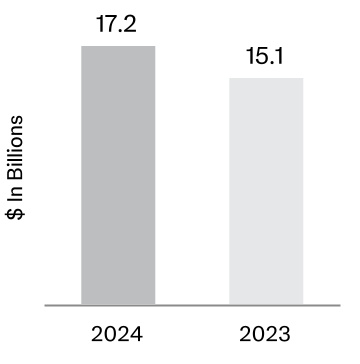
Acquisitions (net of cash acquired)*

Dividends paid per share
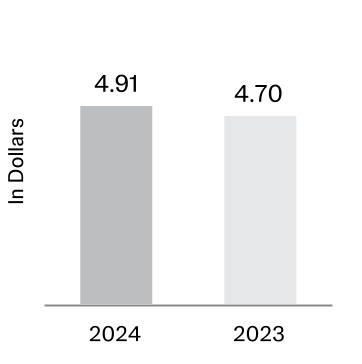
- Includes business combinations and asset acquisitions
Results of operations
Analysis of consolidated sales
For discussion on results of operations and financial condition pertaining to the fiscal years 2023 and 2022 see the Company’s Annual Report on Form 10-K for the fiscal year ended December 31, 2023, Item 7. Management's discussion and analysis of results of operations and financial condition. Prior periods disclosed herein were recast to reflect the continuing operations of the Company.
In 2024, worldwide sales increased 4.3% to $88.8 billion as compared to an increase of 6.5% in 2023. These sales changes consisted of the following:
| Sales increase/(decrease) due to: | 2024 | 2023 | ||||||||||||||||||
| Volume | 5.9 | % | 6.8 | % | ||||||||||||||||
| Price | 0.0 | 0.6 | ||||||||||||||||||
| Currency | (1.6) | (0.9) | ||||||||||||||||||
| Total | 4.3 | % | 6.5 | % |
The net impact of acquisitions and divestitures on the worldwide sales growth was a positive impact of 0.5% in 2024 and a positive impact of 1.5% in 2023.
Sales by U.S. companies were $50.3 billion in 2024 and $46.4 billion in 2023. This represents increases of 8.3% in 2024 and 10.6% in 2023. In the fiscal 2024, acquisitions and divestitures had a net positive impact of 0.7% on the U.S. operational sales growth. Sales by international companies were $38.5 billion in 2024 and $38.7 billion in 2023. This represents a decrease of 0.5% in 2024 and an increase of 1.9% in 2023. In fiscal 2024, acquisitions and divestitures had a net positive impact of 0.2% on the international operational sales growth. In fiscal 2024, the impact of the Covid-19 Vaccine sales decline on the international operational sales was a negative 2.6%.
The five-year compound annual growth rates for worldwide, U.S. and international sales were 5.4%, 6.8% and 3.8%, respectively. The ten-year compound annual growth rates for worldwide, U.S. and international sales were 4.0%, 5.4% and 2.5%, respectively.
| 2024 Annual Report | 23 |
In 2024, sales by companies in Europe experienced a decline of 1.0% as compared to the prior year, which included an operational decline of 0.6% and a negative currency impact of 0.4%. In fiscal 2024, the net impact of the Covid-19 Vaccine on the European regions change in operational sales was a negative 4.7%. Sales by companies in the Western Hemisphere, excluding the U.S., achieved growth of 3.6% as compared to the prior year, which included operational growth of 20.4%, and a negative currency impact of 16.8%. Sales by companies in the Asia-Pacific, Africa region experienced a decline of 1.2% as compared to the prior year, including operational growth of 2.3% offset by a negative currency impact of 3.5%.
In 2024, the Company utilized three wholesalers distributing products for both segments that represented approximately 20.5%, 15.6% and 12.3% of
Showing the first 8K of 88K characters. Open the full section
Item 7A. Quantitative and qualitative disclosures about market risk
The information called for by this item is incorporated herein by reference to Item 7. Management’s discussion and analysis of results of operations and financial condition - Liquidity and capital resources - Financing and market risk of this Report; and Note 1 Summary of significant accounting policies - Financial instruments of the Notes to Consolidated Financial Statements included in Item 8 of this Report.
| 42 | |
Item 8. Financial statements and supplementary data
Index to audited Consolidated Financial Statements
| 2024 Annual Report | 43 |
Johnson & Johnson and subsidiaries consolidated balance sheets****At December 29, 2024 and December 31, 2023 (Dollars in Millions Except Share and Per Share Amounts) (Note 1)
| 2024 | 2023 | |||||||
| Assets | ||||||||
| Current assets | ||||||||
| Cash and cash equivalents (Notes 1 and 2) | $24,105 | 21,859 | ||||||
| Marketable securities (Notes 1 and 2) | 417 | 1,068 | ||||||
| Accounts receivable trade, less allowances $167 (2023, $166) | 14,842 | 14,873 | ||||||
| Inventories (Notes 1 and 3) | 12,444 | 11,181 | ||||||
| Prepaid expenses and other receivables | 4,085 | 4,514 | ||||||
| Total current assets | 55,893 | 53,495 | ||||||
| Property, plant and equipment, net (Notes 1 and 4) | 20,518 | 19,898 | ||||||
| Intangible assets, net (Notes 1 and 5) | 37,618 | 34,175 | ||||||
| Goodwill (Notes 1 and 5) | 44,200 | 36,558 | ||||||
| Deferred taxes on income (Note 8) | 10,461 | 9,279 | ||||||
| Other assets | 11,414 | 14,153 | ||||||
| Total assets | $180,104 | 167,558 | ||||||
| Liabilities and Shareholders’ Equity | ||||||||
| Current liabilities | ||||||||
| Loans and notes payable (Note 7) | $5,983 | 3,451 | ||||||
| Accounts payable | 10,311 | 9,632 | ||||||
| Accrued liabilities | 8,549 | 10,212 | ||||||
| Accrued rebates, returns and promotions | 17,580 | 16,001 | ||||||
| Accrued compensation and employee related obligations | 4,126 | 3,993 | ||||||
| Accrued taxes on income (Note 8) | 3,772 | 2,993 | ||||||
| Total current liabilities | 50,321 | 46,282 | ||||||
| Long-term debt (Note 7) | 30,651 | 25,881 | ||||||
| Deferred taxes on income (Note 8) | 2,448 | 3,193 | ||||||
| Employee related obligations (Notes 9 and 10) | 7,255 | 7,149 | ||||||
| Long-term taxes payable (Note 1) | 390 | 2,881 | ||||||
| Other liabilities | 17,549 | 13,398 | ||||||
| Total liabilities | 108,614 | 98,784 | ||||||
| Commitments and Contingencies (Note 19) | ||||||||
| Shareholders’ equity | ||||||||
| Preferred stock — without par value (authorized and unissued 2,000,000 shares) | — | — | ||||||
| Common stock — par value $1.00 per share (Note 12) (authorized 4,320,000,000 shares; issued 3,119,843,000 shares) | 3,120 | 3,120 | ||||||
| Accumulated other comprehensive income (loss) (Note 13) | (11,741) | (12,527) | ||||||
| Retained earnings and Additional-paid-in-capital | 155,791 | 153,843 | ||||||
| Less: common stock held in treasury, at cost (Note 12) (712,921,000 shares and 712,765,000 shares) | 75,680 | 75,662 | ||||||
| Total shareholders’ equity | 71,490 | 68,774 | ||||||
| Total liabilities and shareholders’ equity | $180,104 | 167,558 |
See Notes to Consolidated Financial Statements
| 44 | |
Johnson & Johnson and subsidiaries consolidated statements of earnings**(Dollars and Shares in Millions Except Per Share Amounts) (Note 1)**
| 2024 | 2023 | 2022 | |||||||||
| Sales to customers | $88,821 | 85,159 | 79,990 | ||||||||
| Cost of products sold | 27,471 | 26,553 | 24,596 | ||||||||
| Gross profit | 61,350 | 58,606 | 55,394 | ||||||||
| Selling, marketing and administrative expenses | 22,869 | 21,512 | 20,246 | ||||||||
| Research and development expense | 17,232 | 15,085 | 14,135 | ||||||||
| In-process research and development impairments | 211 | 313 | 783 | ||||||||
| Interest income | (1,332) | (1,261) | (490) | ||||||||
| Interest expense, net of portion capitalized (Note 4) | 755 | 772 | 276 | ||||||||
| Other (income) expense, net | 4,694 | 6,634 | 810 | ||||||||
| Restructuring (Note 20) | 234 | 489 | 275 | ||||||||
| Earnings before provision for taxes on income | 16,687 | 15,062 | 19,359 | ||||||||
| Provision for taxes on income (Note 8) | 2,621 | 1,736 | 2,989 | ||||||||
| Net earnings from continuing operations | 14,066 | 13,326 | 16,370 | ||||||||
| Net earnings from discontinued operations, net of tax (Note 21) | — | 21,827 | 1,571 | ||||||||
| Net earnings | $14,066 | 35,153 | 17,941 | ||||||||
| Net earnings per share (Notes 1 and 15) | |||||||||||
| Continuing operations - basic | $5.84 | 5.26 | 6.23 | ||||||||
| Discontinued operations - basic | — | 8.62 | 0.60 | ||||||||
| Total net earnings per share - basic | $5.84 | 13.88 | 6.83 | ||||||||
| Continuing operations - diluted | $5.79 | 5.20 | 6.14 | ||||||||
| Discontinued operations - diluted | — | 8.52 | 0.59 | ||||||||
| Total net earnings per share - diluted | $5.79 | 13.72 | 6.73 | ||||||||
| Average shares outstanding (Notes 1 and 15) | |||||||||||
| Basic | 2,407.3 | 2,533.5 | 2,625.2 | ||||||||
| Diluted | 2,429.4 | 2,560.4 | 2,663.9 |
See Notes to Consolidated Financial Statements
| 2024 Annual Report | 45 |
Johnson & Johnson and subsidiaries consolidated statements of comprehensive income**(Dollars in Millions) (
Showing the first 8K of 333K characters. Open the full section
Item 9. Changes in and disagreements with accountants on accounting and financial disclosure
Not applicable.
Item 9A. Controls and procedures
Disclosure controls and procedures. At the end of the period covered by this Report, the Company evaluated the effectiveness of the design and operation of its disclosure controls and procedures. The Company’s disclosure controls and procedures are designed to ensure that information required to be disclosed by the Company in the reports that it files or submits under the Exchange Act is recorded, processed, summarized and reported within the time periods specified in the SEC’s rules and forms. Disclosure controls and procedures include, without limitation, controls and procedures designed to ensure that information required to be disclosed by the Company in the reports that it files or submits under the Exchange Act is accumulated and communicated to the Company’s management, including its principal executive and principal financial officers, or persons performing similar functions, as appropriate to allow timely decisions regarding required disclosure. Joaquin Duato, Chairman and Chief Executive Officer, and Joseph J. Wolk, Executive Vice President, Chief Financial Officer, reviewed and participated in this evaluation. Based on this evaluation, Messrs. Duato and Wolk concluded that, as of the end of the period covered by this Report, the Company’s disclosure controls and procedures were effective.
Reports on internal control over financial reporting. The information called for by this item is incorporated herein by reference to Management’s report on internal control over financial reporting, and the attestation regarding internal controls over financial reporting included in the report of independent registered public accounting firm included in Item 8 of this Report.
Changes in internal control over financial reporting. During the fiscal quarter ended December 29, 2024, there were no changes in the Company’s internal control over financial reporting identified in connection with the evaluation required under Rules 13a-15 and 15d-15 under the Exchange Act that have materially affected, or are reasonably likely to materially affect, the Company’s internal control over financial reporting. The Company continues to monitor and assess the effectiveness of the design and operation of its disclosure controls and procedures.
The Company is implementing a multi-year, enterprise-wide initiative to integrate, simplify and standardize processes and systems for the human resources, information technology, procurement, supply chain and finance functions. These are enhancements to support the growth of the Company’s financial shared service capabilities and standardize financial systems. This initiative is not in response to any identified deficiency or weakness in the Company’s internal control over financial reporting. In response to this initiative, the Company has and will continue to align and streamline the design and operation of its financial control environment.
Item 9B. Other information
Securities trading plans of Directors and Executive Officers. During the fiscal fourth quarter of 2024, none of our directors or officers (as defined in Rule 16a-1(f) of the Exchange Act) informed us of the adoption or termination of a “Rule 10b5-1 trading arrangement” or “non-Rule 10b5-1 trading arrangement,” each as defined in Item 408 of Regulation S-K.
Item 9C. Disclosure regarding foreign jurisdictions that prevent inspections
Not applicable.
| 2024 Annual Report | 113 |
Part III
Item 10. Directors, executive officers and corporate governance
The information called for by this item is incorporated herein by reference to the discussion of the Audit Committee under the caption Item 1. Election of Directors - Board committees; and the material under the captions Item 1. Election of Directors and, if applicable, Delinquent Section 16(a) reporting in the Proxy Statement; and the material under the caption “Executive Officers of the Registrant” in Part I of this Report.
The Company’s Code of Business Conduct, which covers all employees (including the Chief Executive Officer, Chief Financial Officer and Controller), meets the requirements of the SEC rules promulgated under Section 406 of the Sarbanes-Oxley Act of 2002. The Code of Business Conduct is available on the Company’s website at www.jnj.com/code-of-business-conduct, and copies are available to shareholders without charge upon written request to the Secretary at the Company’s principal executive offices. Any substantive amendment to the Code of Business Conduct or any waiver of the Code granted to the Chief Executive Officer, the Chief Financial Officer or the Controller will be posted on the Company’s website at www.jnj.com/code-of-business-conduct within five business days (and retained on the website for at least one year).
In addition, the Company has adopted a Code of Business Conduct & Ethics for Members of the Board of Directors and Executive Officers. The Code of Business Conduct & Ethics for Members of the Board of Directors and Executive Officers is available on the Company’s website at www.investor.jnj.com/governance/corporate-governance-overview/code-of-business-conduct--ethics, and copies are available to shareholders without charge upon written request to the Secretary at the Company’s principal executive offices. Any substantive amendment to the Code or any waiver of the Code granted to any member of the Board of Directors or any executive officer will be posted on the Company’s website at www.investor.jnj.com/governance/corporate-governance-overview/code-of-business-conduct--ethics within five business days (and retained on the website for at least one year).
In addition to the prohibition on insider trading for all employees covered in our Code of Business Conduct, the Company has adopted an insider trading policy governing the purchase, sale and other dispositions of its securities by directors, officers and certain other insiders that is reasonably designed to promote compliance with insider trading laws, rules and regulations and any applicable listing standards. A copy of this policy is filed with this Annual Report on Form 10-K as Exhibit 19.
Item 11. Executive compensation
The information called for by this item is incorporated herein by reference to the material under the captions Item 1. Election of Directors – Director compensation, and Item 2. Compensation Committee report, Compensation discussion and analysis and Executive compensation tables in the Proxy Statement.
The material incorporated herein by reference to the material under the caption Compensation Committee report in the Proxy Statement shall be deemed furnished, and not filed, in this Report and shall not be deemed incorporated by reference into any filing under the Securities Act of 1933, as amended, or the Securities Exchange Act of 1934, as amended, as a result of this furnishing, except to the extent that the Company specifically incorporates it by reference.
Item 12. Security ownership of certain beneficial owners and management and related stockholder matters
The information called for by this item is incorporated herein by reference to the material under the caption Stock ownership in the Proxy Statement; and Note 16 Common stock, stock option plans and stock compensation agreements of the Notes to Consolidated Financial Statements in Item 8 of this Report.
| 114 | |
Equity compensation plan information
The following table provides certain information as of December 29, 2024 concerning the shares of the Company’s Common Stock that may be issued under existing equity compensation plans.
| Plan Category | Number of Securities to be Issued Upon Exercise of Outstanding Options and Rights | Weighted Average Exercise Price of Outstanding Options and Rights | Number of Securities Remaining Available for Future Issuance Under Equity Compensation Plans**(2)(3)** | ||||||||
| Equity Compensation Plans Approved by Security Holders(1) | 127,682,644 | $127.63 | 111,042,139 | ||||||||
| Equity Compensation Plans Not Approved by Security Holders | — | — | — | ||||||||
| Total | 127,682,644 | $127.63 | 111,042,139 |
(1)Included in this category are the following equity compensation plans which have been approved by the Company’s shareholders: 2012 Long-Term Incentive Plan and 2022 Long-Term Incentive Plan.
(2)This column excludes shares reflected under the column “Number of Securities to be Issued Upon Exercise of Outstanding Options and Rights.”
(3)The 2012 Long-Term Incentive Plan expired April 26, 2022. All options and restricted shares granted subsequent to that date were under the 2022 Long-Term Incentive Plan.
Item 13. Certain relationships and related transactions, and director independence
The information called for by this item is incorporated herein by reference to the material under the captions Item 1. Election of Directors - Related person transactions & Director independence in the Proxy Statement.
Item 14. Principal accountant fees and services
The information called for by this item is incorporated herein by reference to the material under the caption Item 3. Ratification of appointment of independent registered public accounting firm in the Proxy Statement.
| 2024 Annual Report | 115 |
Part IV
Item 15. Exhibits and financial statement schedules
The following documents are filed as part of this report:
1.Financial Statements
Consolidated balance sheets at end of fiscal years 2024 and 2023
Consolidated statements of earnings for fiscal years 2024, 2023 and 2022
Consolidated statements of comprehensive income for Fiscal Years 2024, 2023 and 2022
Consolidated statements of equity for fiscal years 2024, 2023 and 2022
Consolidated statements of cash flows for fiscal years 2024, 2023 and 2022
Notes to Consolidated Financial Statements
Report of independent registered public accounting firm
All schedules are omitted because they are not applicable or the required information is included in the financial statements or notes.
2.Exhibits required to be filed by item 60l of regulation S-K
The information called for by this item is incorporated herein by reference to the Exhibit Index in this Report.
Item 16. Form 10-K summary
Registrants may voluntarily include a summary of information required by Form 10-K under this Item 16. The Company has elected not to include such summary information.
| 116 | |
Signatures
Pursuant to the requirements of Section 13 of the Securities Exchange Act of 1934, the registrant has duly caused this Report to be signed on its behalf by the undersigned, thereunto duly authorized.
Date: February 13, 2025
| JOHNSON & JOHNSON | ||
| (Registrant) |
| By | /s/ J. Duato | ||||
| J. Duato, Chairman of the Board and Chief Executive Officer |
Pursuant to the requirements of the Securities Exchange Act of 1934, this report has been signed below by the following persons on behalf of the registrant and in the capacities and on the dates indicated.
| Signature | Title | Date | ||||||
| /s/ J. Duato | Chairman of the Board | February 13, 2025 | ||||||
| J. Duato | Chief Executive Officer (Principal Executive Officer) | |||||||
| /s/ J. J. Wolk | Chief Financial Officer | February 13, 2025 | ||||||
| J. J. Wolk | (Principal Financial Officer) | |||||||
| /s/ R. J. Decker Jr. | Controller and Chief Accounting Officer | February 13, 2025 | ||||||
| R. J. Decker Jr. | (Principal Accounting Officer) | |||||||
| /s/ D. Adamczyk | Director | February 13, 2025 | ||||||
| D. Adamczyk | ||||||||
| /s/ M. C. Beckerle | Director | February 13, 2025 | ||||||
| M. C. Beckerle | ||||||||
| /s/ J. A. Doudna | Director | February 13, 2025 | ||||||
| J. A. Doudna |
| 2024 Annual Report | 117 |
| Signature | Title | Date | ||||||
| /s/ M. A. Hewson | Director | February 13, 2025 | ||||||
| M. A. Hewson | ||||||||
| /s/ P. A. Johnson | Director | February 13, 2025 | ||||||
| P. A. Johnson | ||||||||
| /s/ H. Joly | Director | February 13, 2025 | ||||||
| H. Joly | ||||||||
| /s/ M. B. McClellan | Director | February 13, 2025 | ||||||
| M. B. McClellan | ||||||||
| /s/ A. M. Mulcahy | Director | February 13, 2025 | ||||||
| A. M. Mulcahy | ||||||||
| /s/ M. A. Weinberger | Director | February 13, 2025 | ||||||
| M. A. Weinberger | ||||||||
| /s/ N. Y. West | Director | February 13, 2025 | ||||||
| N. Y. West | ||||||||
| /s/ E. A. Woods | Director | February 13, 2025 | ||||||
| E. A. Woods |
| 118 | |
Exhibit index
| Reg. S-K Exhibit Table Item No. | Description of Exhibit | |||||||
| 2(i) | Agreement and Plan of Merger, dated as of October 31, 2022, by and among Johnson & Johnson, Athos Merger Sub, Inc. and ABIOMED, Inc. – Incorporated herein by reference to Exhibit 2.1 of the Registrant’s Form 8-K Current Report filed November 1, 2022.† | |||||||
| 3(i) | Restated Certificate of Incorporation effective February 19, 2016 — Incorporated herein by reference to Exhibit 3(i) of the Registrant’s Form 10-K Annual Report for the fiscal year ended January 3, 2016. | |||||||
| 3(ii) | Certificate of Amendment to the Certificate of Incorporation of Johnson & Johnson effective April 30, 2020 — Incorporated herein by reference to Exhibit 3.1 of the Registrant's Form 8-K Current Report filed April 29, 2020. | |||||||
| 3(iii) | Amended and Restated By-Laws of the Company, as amended effective April 25, 2024 — Incorporated herein by reference to Exhibit 3.1 of the Registrant’s Form 8-K Current Report filed April 29, 2024. | |||||||
| 4(a) | Upon the request of the Securities and Exchange Commission, the Registrant will furnish a copy of all instruments defining the rights of holders of long-term debt of the Registrant. | |||||||
| 4(b) | Description of Securities Registered Pursuant to Section 12 of the Securities Exchange Act of 1934 — Filed with this document. | |||||||
| 4(c)** | Indenture, dated as of September 15, 1987 – Incorporated herein by reference to Exhibit 4(a) to the Registrant’s Form S-3 Registration Statement filed on October 11, 1994 | |||||||
| 4(d)** | First Supplemental Indenture, dated as of September 1, 1990 – Incorporated herein by reference to Exhibit 4(b) to the Registrant’s Form S-3 Registration Statement filed on October 11, 1994 | |||||||
| 4(e) | Second Supplemental Indenture, dated as of November 9, 2017 – Incorporated herein by reference to Exhibit 4.1 to the Registrant’s Form 8-K Current Report filed on November 13, 2017 | |||||||
| 10(a) | 2012 Long-Term Incentive Plan — Incorporated herein by reference to Appendix A of the Registrant’s Proxy Statement filed on March 15, 2012.* | |||||||
| 10(b) | Form of Stock Option Certificate under the 2012 Long-Term Incentive Plan — Incorporated herein by reference to Exhibit 10.2 of the Registrant’s Form 10-Q Quarterly Report for the quarter ended April 1, 2012.* | |||||||
| 10(c) | Global NonQualified Stock Option Award Agreement under the 2012 Long-Term Incentive Plan — Incorporated herein by reference to Exhibit 10.1 of the Registrant’s Form 10-Q Quarterly Report for the quarter ended April 1, 2018.* | |||||||
| 10(d) | Global Restricted Share Unit Award Agreement under the 2012 Long-Term Incentive Plan — Incorporated herein by reference to Exhibit 10.2 of the Registrant’s Form 10-Q Quarterly Report for the quarter ended April 1, 2018.* | |||||||
| 10(e) | Global Performance Share Unit Award Agreement under the 2012 Long-Term Incentive Plan — Incorporated herein by reference to Exhibit 10.3 of the Registrant’s Form 10-Q Quarterly Report for the quarter ended April 1, 2018.* | |||||||
| 10(f) | Global Restricted Share Unit Award Agreement granted to John Reed on May 1, 2023 under the 2022 Long-Term Incentive Plan — Incorporated herein by reference to Exhibit 10(h) of the Registrant’s Form 10-K Annual Report for the fiscal year ended December 31, 2023* | |||||||
| 10(g) | Domestic Deferred Compensation (Certificate of Extra Compensation) Plan — Incorporated herein by reference to Exhibit 10(g) of the Registrant’s Form 10-K Annual Report for the year ended December 28, 2003.* | |||||||
| 10(h) | Amendments to the Certificate of Extra Compensation Plan effective as of January 1, 2009 — Incorporated herein by reference to Exhibit 10(j) of the Registrant’s Form 10-K Annual Report for the year ended December 28, 2008.* | |||||||
| 10(i) | Amended and Restated Deferred Fee Plan for Directors (Amended as of January 17, 2012) — Incorporated herein by reference to Exhibit 10(k) of the Registrant's Form 10-K Annual Report for the fiscal year ended January 1, 2012.* |
| 2024 Annual Report | 119 |
| Reg. S-K Exhibit Table Item No. | Description of Exhibit | |||||||
| 10(j) | The Johnson & Johnson Executive Income Deferral Plan Amended and Restated Effective January 1, 2010 — Incorporated herein by reference to Exhibit 10.1 of the Registrant’s Form 10-Q Quarterly Report for the quarter ended September 30, 2012.* | |||||||
| 10(k) | The Johnson & Johnson Excess Savings Plan (amended and restated as of January 1, 2022) — Incorporated herein by reference to Exhibit 10(l) of the Registrant’s Form 10-K Annual Report for the fiscal year ended January 1, 2023.* | |||||||
| 10(l) | Excess Benefit Plan of Johnson & Johnson and Affiliated Companies (amended and restated as of January 1, 2020) — incorporated by reference to Exhibit 10(m) of the Registrant’s Form 10-K Annual Report for the fiscal year ended January 3, 2021. | |||||||
| 10(m)** | Executive Life Plan Agreement — Incorporated herein by reference to Exhibit 10(i) of the Registrant’s Form 10-K Annual Report for the fiscal year ended January 3, 1993.* | |||||||
| 10(n) | Executive Life Plan Agreement Closure Letter — Incorporated herein by reference to Exhibit 10.1 of the Registrant’s Form 10-Q Quarterly Report for the quarter ended March 29, 2015.* | |||||||
| 10(o) | 2022 Long-Term Incentive Plan — Incorporated by reference to Appendix A of the Registrant’s Proxy Statement filed on March 16, 2022.* | |||||||
| 10(p) | Severance Pay Plan of Johnson & Johnson and U.S. Affiliated Companies, Amended and Restated as of October 1, 2014 — Incorporated herein by reference to Exhibit 10.1 of the Registrant's Form 10-Q Quarterly Report for the quarter ended September 28, 2014.* | |||||||
| 10(q) | First Amendment to the Severance Pay Plan of Johnson & Johnson and U.S. Affiliated Companies (as amended and restated effective October 1, 2014) — Incorporated herein by reference to Exhibit 10.1 of the Registrant's Form 10-Q Quarterly Report for the quarter ended June 28, 2015.* | |||||||
| 10(r) | Second Amendment to the Severance Pay Plan of Johnson & Johnson and U.S. Affiliated Companies (as amended and restated effective October 1, 2014) — Incorporated herein by reference to Exhibit 10(x) of the Registrant's Form 10-K Annual Report for the fiscal year ended January 3, 2016.* | |||||||
| 10(s) | Contingent Value Rights Agreement, dated as of December 22, 2022, by and between Johnson & Johnson and American Stock Transfer & Trust Company, LLC – Incorporated herein by reference to Exhibit 10.1 of the Registrant’s Form 8-K Current Report filed December 22, 2022.† | |||||||
| 10(t) | Intellectual Property Agreement, dated as of May 3, 2023, by and between Johnson & Johnson and Kenvue Inc. — Incorporated herein by reference to Exhibit 10.4 of the Registrant's Form 8-K Current Report filed May 8, 2023. | |||||||
| 10(u) | Trademark Phase-Out License Agreement, dated as of April 3, 2023, by and between Johnson & Johnson and Johnson & Johnson Consumer Inc. — Incorporated herein by reference to Exhibit 10.5 of the Registrant's Form 8-K Current Report filed May 8, 2023. | |||||||
| 10(v) | Johnson & Johnson Deferred Compensation Plan — Incorporated herein by reference to Exhibit 10.1 of the Registrant's Form 8-K Current Report filed November 27, 2023.* | |||||||
| 10(w) | Global Performance Share Unit Award Agreement under the Johnson & Johnson 2022 Long-Term Incentive Plan — Incorporated herein by reference to Exhibit 10.1 of the Registrant’s Form 10-Q Quarterly Report for the quarter year ended April 2, 2023.* | |||||||
| 10(x) | Global Restricted Share Unit Award Agreement under the Johnson & Johnson 2022 Long-Term Incentive Plan — Incorporated herein by reference to Exhibit 10.2 of the Registrant’s Form 10-Q Quarterly Report for the quarter year ended April 2, 2023.* | |||||||
| 10(y) | Global Nonqualified Stock Option Award Agreement under the Johnson & Johnson 2022 Long-Term Incentive Plan — Incorporated herein by reference to Exhibit 10.3 of the Registrant’s Form 10-Q Quarterly Report for the quarter year ended April 2, 2023.* | |||||||
| 10(z) | Amendment One to the Johnson & Johnson Excess Savings Plan (amended and restated effective as of January 1, 2022) — Incorporated herein by reference to Exhibit 10.1 of the Registrant’s Form 10-Q Quarterly Report for the quarter ended October 1, 2023.* |
| 120 | |
| Reg. S-K Exhibit Table Item No. | Description of Exhibit | |||||||
| 10(aa) | Johnson & Johnson Executive Incentive Plan (Amended as of September 7, 2023) — Incorporated herein by reference to Exhibit 10.2 of the Registrant’s Form 10-Q Quarterly Report for the quarter ended October 1, 2023.* | |||||||
| 10(ab) | Johnson & Johnson Executive Officer Cash Severance Policy — Filed with this document.* | |||||||
| 19 | Johnson & Johnson Stock Trading Policy for Directors, Executive Officers and Insiders (Amended as of April 27, 2023) — Incorporated herein by reference to Exhibit 19 of the Registrant’s Form 10-K Annual Report for the fiscal year ended December 31, 2023. | |||||||
| 21 | Subsidiaries — Filed with this document. | |||||||
| 23 | Consent of Independent Registered Public Accounting Firm — Filed with this document. | |||||||
| 31.1 | Certification of Chief Executive Officer Pursuant to Section 302 of the Sarbanes-Oxley Act — Filed with this document. | |||||||
| 31.2 | Certification of Chief Financial Officer Pursuant to Section 302 of the Sarbanes-Oxley Act — Filed with this document. | |||||||
| 32.1 | Certification of Chief Executive Officer Pursuant to Section 906 of the Sarbanes-Oxley Act — Furnished with this document. | |||||||
| 32.2 | Certification of Chief Financial Officer Pursuant to Section 906 of the Sarbanes-Oxley Act — Furnished with this document. | |||||||
| 97 | Johnson & Johnson Clawback Policy (effective as of August 8, 2023) — Incorporated herein by reference to Exhibit 97 of the Registrant’s Form 10-K Annual Report for the fiscal year ended December 31, 2023. | |||||||
| Exhibit 101: | ||||||||
| EX-101.INS | Instance Document - the instance document does not appear in the Interactive Data File because its XBRL tags are embedded within the Inline XBRL document | |||||||
| EX-101.SCH | Inline XBRL Taxonomy Extension Schema | |||||||
| EX-101.CAL | Inline XBRL Taxonomy Extension Calculation Linkbase | |||||||
| EX-101.LAB | Inline XBRL Taxonomy Extension Label Linkbase | |||||||
| EX-101.PRE | Inline XBRL Taxonomy Extension Presentation Linkbase | |||||||
| EX-101.DEF | Inline XBRL Taxonomy Extension Definition Document | |||||||
| Exhibit 104: | Cover Page Interactive Data File––the cover page interactive data file does not appear in the Interactive Data File because its XBRL tags are embedded within the Inline XBRL document. |
| * | Management contract or compensatory plan. | ||||
| ** | Paper filing. | ||||
| † | Certain exhibits and schedules have been omitted pursuant to Item 601(b)(2)(ii) or 601(b)(10)(iv) of Regulation S-K, as applicable. |
A copy of any of the Exhibits listed above will be provided without charge to any shareholder submitting a written request specifying the desired exhibit(s) to the Secretary at the principal executive offices of the Company. Pursuant to Item 601(b)(4)(iii)(A) of Regulation S-K, the Company has not filed as exhibits to this Form 10-K certain long-term debt instruments, under which the total amount of securities authorized does not exceed 10% of the total assets of the Company and its subsidiaries on a consolidated basis. The Company hereby agrees to furnish a copy of any such instrument to the SEC upon request.
| 2024 Annual Report | 121 |