 filings.tools
KeyCorp 10-K 2022-12-31
Filed 2023-02-22. 23 sections, 921K characters. Original on sec.gov · Markdown · JSON
Cover and table of contents
UNITED STATES SECURITIES AND EXCHANGE COMMISSION
Washington, D.C. 20549
FORM 10-K
ANNUAL REPORT
PURSUANT TO SECTION 13 OR 15(d)
OF THE SECURITIES EXCHANGE ACT OF 1934
For the fiscal year ended
December 31, 2022
Commission file number: 1-11302
KeyCorp

Exact name of registrant as specified in its charter:
| Ohio | 34-6542451 | ||||
| State or other jurisdiction of incorporation or organization: | I.R.S. Employer Identification Number: |
| 127 Public Square, | Cleveland, | Ohio | 44114-1306 | ||||||||
| Address of principal executive offices: | Zip Code: |
(216) 689-3000
Registrant’s telephone number, including area code:
SECURITIES REGISTERED PURSUANT TO SECTION 12(b) OF THE ACT:
| Title of each class | Trading Symbol(s) | Name of each exchange on which registered | ||||||
| Common Shares, $1 par value | KEY | New York Stock Exchange | ||||||
| Depositary Shares (each representing a 1/40th interest in a share of Fixed-to-Floating Rate | KEY PrI | New York Stock Exchange | ||||||
| Perpetual Non-Cumulative Preferred Stock, Series E) | ||||||||
| Depositary Shares (each representing a 1/40th interest in a share of Fixed Rate Perpetual Non- | KEY PrJ | New York Stock Exchange | ||||||
| Cumulative Preferred Stock, Series F) | ||||||||
| Depositary Shares (each representing a 1/40th interest in a share of Fixed Rate Perpetual Non- | KEY PrK | New York Stock Exchange | ||||||
| Cumulative Preferred Stock, Series G) | ||||||||
| Depositary Shares (each representing a 1/40th interest in a share of Fixed Rate Reset Perpetual Non- | KEY PrL | New York Stock Exchange | ||||||
| Cumulative Preferred Stock, Series H) |
SECURITIES REGISTERED PURSUANT TO SECTION 12(g) OF THE ACT: NONE
Indicate by check mark if the registrant is a well-known seasoned issuer, as defined in Rule 405 of the Securities Act. Yes ☒ No ☐
Indicate by check mark if the registrant is not required to file reports pursuant to Section 13 or Section 15(d) of the Act. Yes ☐ No ☒
Indicate by check mark whether the registrant (1) has filed all reports required to be filed by Section 13 or 15(d) of the Securities Exchange Act of 1934 during the preceding 12 months (or for such shorter period that the registrant was required to file such reports), and (2) has been subject to such filing requirements for the past 90 days. Yes ☒ No ☐
Indicate by check mark whether the registrant has submitted electronically every Interactive Data File required to be submitted pursuant to Rule 405 of Regulation S-T (§ 232.405 of this Chapter) during the preceding 12 months (or for such shorter period that the registrant was required to submit such files). Yes ☒ No ☐
Indicate by check mark whether the registrant is a large accelerated filer, an accelerated filer, a non-accelerated filer, a smaller reporting company, or an emerging growth company. See the definitions of “large accelerated filer,” “accelerated filer,” “smaller reporting company,” and “emerging growth company” in Rule 12b-2 of the Exchange Act.
| Large accelerated filer | ☒ | Accelerated filer | ☐ | Non-accelerated filer | ☐ | ||||||||||||
| Smaller reporting company | ☐ | Emerging growth company | ☐ |
If an emerging growth company, indicate by check mark if the registrant has elected not to use the extended transition period for complying with any new or revised financial accounting standards provided pursuant to Section 13(a) of the Exchange Act. ☐
Indicate by check mark whether the registrant has filed a report on and attestation to its management’s assessment of the effectiveness of its internal control over financial reporting under Section 404(b) of the Sarbanes-Oxley Act (15 U.S.C. 7262(b)) by the registered public accounting firm that prepared or issued its audit report. ☒
If securities are registered pursuant to Section 12(b) of the Act, indicate by check mark whether the financial statements of the registrant included in the filing reflect the correction of an error to previous issued financial statements. ☐
Indicate by check mark whether any of those error corrections are restatements that required a recovery analysis of incentive-based compensation received by any of the registrant’s executive officers during the relevant recovery period pursuant to § 240.10D-1(b). ☐
Indicate by check mark whether the registrant is a shell company (as defined in Rule 12b-2 of the Exchange Act). Yes ☐ No ☒
The aggregate market value of voting and non-voting common stock held by nonaffiliates of the Registrant was $16,069,430,913 (based on the June 30, 2022, closing price of KeyCorp Common Shares of $17.23 as reported on the New York Stock Exchange). As of February 20, 2023, there were 931,825,509 Common Shares outstanding.
Certain specifically designated portions of KeyCorp’s definitive Proxy Statement for its 2023 Annual Meeting of Shareholders are incorporated by reference into Part III of this Form 10-K.
Forward-looking Statements
From time to time, we have made or will make forward-looking statements within the meaning of the Private Securities Litigation Reform Act of 1995. These statements do not relate strictly to historical or current facts. Forward-looking statements usually can be identified by the use of words such as “goal,” “objective,” “plan,” “expect,” “assume,” “anticipate,” “intend,” “project,” “believe,” “estimate,” “will,” “would,” “should,” “could,” or other words of similar meaning. Forward-looking statements provide our current expectations or forecasts of future events, circumstances, results or aspirations. Our disclosures in this report contain forward-looking statements. We may also make forward-looking statements in other documents filed with or furnished to the SEC. In addition, we may make forward-looking statements orally to analysts, investors, representatives of the media and others.
Forward-looking statements, by their nature, are subject to assumptions, risks, and uncertainties, many of which are outside of our control. Our actual results may differ materially from those set forth in our forward-looking statements. There is no assurance that any list of risks and uncertainties or risk factors is complete. In addition, no assurance can be given that any plan, initiative, projection, goal, commitment, expectation, or prospect set forth in this report can or will be achieved. Factors that could cause our actual results to differ from those described in forward-looking statements include, but are not limited to:
-
our concentrated credit exposure in commercial and industrial loans;
-
deterioration of commercial real estate market fundamentals;
-
defaults by our loan clients or counterparties;
-
adverse changes in credit quality trends;
-
declining asset prices;
-
deterioration of asset quality and an increase in credit losses;
-
labor shortages and supply chain constraints, as well as the impact of inflation;
-
the extensive regulation of the U.S. financial services industry;
-
changes in accounting policies, standards, and interpretations;
-
operational or risk management failures by us or critical third parties;
-
breaches of security or failures of our technology systems due to technological or other factors and cybersecurity threats;
-
negative outcomes from claims or litigation;
-
failure or circumvention of our controls and procedures;
-
the occurrence of natural disasters, which may be exacerbated by climate change;
-
societal responses to climate change;
-
increased operational risks resulting from remote work;
-
evolving capital and liquidity standards under applicable regulatory rules;
-
disruption of the U.S. financial system, including the impact of inflation and a potential global economic downturn or recession;
-
the impact of any failure by the U.S. government to increase the debt ceiling or any government shutdown;
-
our ability to receive dividends from our subsidiaries, including KeyBank;
-
unanticipated changes in our liquidity position, including but not limited to, changes in our access to or the cost of funding and our ability to secure alternative funding sources;
-
downgrades in our credit ratings or those of KeyBank;
-
a worsening of the U.S. economy due to financial, political or other shocks;
-
our ability to anticipate interest rate changes and manage interest rate risk;
-
uncertainty surrounding the transition from LIBOR to an alternate reference rate;
-
deterioration of economic conditions in the geographic regions where we operate;
-
the soundness of other financial institutions;
-
our ability to manage our reputational risks;
-
our ability to timely and effectively implement our strategic initiatives;
-
increased competitive pressure;
-
our ability to adapt our products and services to industry standards and consumer preferences;
-
our ability to attract and retain talented executives and employees;
-
unanticipated adverse effects of strategic partnerships or acquisitions and dispositions of assets or businesses; and
-
our ability to develop and effectively use the quantitative models we rely upon in our business planning.
Any forward-looking statements made by us or on our behalf speak only as of the date they are made, and we do not undertake any obligation to update any forward-looking statement to reflect the impact of subsequent events or
circumstances, except as required by applicable securities laws. Before making an investment decision, you should carefully consider all risks and uncertainties disclosed in our SEC filings, including this report on Form 10-K and our subsequent reports on Forms 10-Q and 8-K and our registration statements under the Securities Act of 1933, as amended, all of which are or will upon filing be accessible on the SEC’s website at www.sec.gov and on our website at www.key.com/ir.
Terminology
Throughout this discussion, references to “Key,” “we,” “our,” “us,” and similar terms refer to the consolidated entity consisting of KeyCorp and its subsidiaries. “KeyCorp” refers solely to the parent holding company, and “KeyBank” refers solely to KeyCorp’s subsidiary bank, KeyBank National Association. “KeyBank (consolidated)” refers to the consolidated entity consisting of KeyBank and its subsidiaries.
We want to explain some industry-specific terms at the outset so you can better understand the discussion that follows.
-
We use the phrase continuing operations in this document to mean all of our businesses other than our government-guaranteed and private education lending business, which have been accounted for as discontinued operations since 2009.
-
We engage in capital markets activities primarily through business conducted by our Commercial Bank segment*.* These activities encompass a variety of products and services. Among other things, we trade securities as a dealer, enter into derivative contracts (both to accommodate clients’ financing needs and to mitigate certain risks), and conduct transactions in foreign currencies (to accommodate clients’ needs).
-
For regulatory purposes, capital is divided into two classes. Federal regulations currently prescribe that at least one-half of a bank or BHC’s total risk-based capital must qualify as Tier 1 capital. Both total and Tier 1 capital serve as bases for several measures of capital adequacy, which is an important indicator of financial stability and condition. Banking regulators evaluate a component of Tier 1 capital, known as Common Equity Tier 1, under the Regulatory Capital Rules. The “Capital” section of this report under the heading “Capital adequacy” provides more information on total capital, Tier 1 capital, and the Regulatory Capital Rules, including Common Equity Tier 1, and describes how these measures are calculated.
The acronyms and abbreviations identified below are used in the Notes to Consolidated Financial Statements as well as in the Management’s Discussion and Analysis of Financial Condition and Results of Operations. You may find it helpful to refer back to this page as you read this report.
| ABO: Accumulated benefit obligation. ALCO: Asset/Liability Management Committee. ALLL: Allowance for loan and lease losses. A/LM: Asset/liability management. AML: Anti-money laundering. AOCI: Accumulated other comprehensive income (loss). APBO: Accumulated postretirement benefit obligation. AQN Strategies: Arbitria Quum Notitia, LLC. ARRC: Alternative Reference Rates Committee. ASC: Accounting Standards Codification. ASR: Accelerated Stock Repurchase. ASU: Accounting Standards Update. ATMs: Automated teller machines. BSA: Bank Secrecy Act. BHCA: Bank Holding Company Act of 1956, as amended. BHCs: Bank holding companies. Board: KeyCorp Board of Directors. CAPM: Capital Asset Pricing Model. CARES Act: Coronavirus Aid, Relief, and Economic Security Act. CCAR: Comprehensive Capital Analysis and Review. Cain Brothers: Cain Brothers & Company, LLC. CECL: Current Expected Credit Losses. CFPB: Consumer Financial Protection Bureau, also known as the Bureau of Consumer Financial Protection. CFTC: Commodities Futures Trading Commission. CMBS: Commercial mortgage-backed securities. CMO: Collateralized mortgage obligation. Common Shares: KeyCorp common shares, $1 par value. CVA: Credit Valuation Adjustment. DCF: Discounted cash flow. DIF: Deposit Insurance Fund of the FDIC. Dodd-Frank Act: Dodd-Frank Wall Street Reform and Consumer Protection Act of 2010. EAD: Exposure at default. EBITDA: Earnings before interest, taxes, depreciation, and amortization. EPS: Earnings per share. ERISA: Employee Retirement Income Security Act of 1974. ERM: Enterprise risk management. ESG: Environmental, social, and governance EVE: Economic value of equity. FASB: Financial Accounting Standards Board. FDIA: Federal Deposit Insurance Act, as amended. FDIC: Federal Deposit Insurance Corporation. Federal Reserve: Board of Governors of the Federal Reserve System. FHLB: Federal Home Loan Bank of Cincinnati. FHLMC: Federal Home Loan Mortgage Corporation. FICO: Fair Isaac Corporation. FINRA: Financial Industry Regulatory Authority. First Niagara: First Niagara Financial Group, Inc. FNMA: Federal National Mortgage Association. | FSOC: Financial Stability Oversight Council. FVA: Fair value of employee benefit plan assets. GAAP: U.S. generally accepted accounting principles. GNMA: Government National Mortgage Association. HTC: Historic tax credit. IRS: Internal Revenue Service. ISDA: International Swaps and Derivatives Association. KBCM: KeyBanc Capital Markets, Inc. KCC: Key Capital Corporation. KCDC: Key Community Development Corporation. KCIC: Key Community Investment Capital LLC. KEF: Key Equipment Finance. LCR: Liquidity coverage ratio. LGD: Loss given default. LIBOR: London Interbank Offered Rate. LIHTC: Low-income housing tax credit. LTV: Loan-to-value. Moody’s: Moody’s Investor Services, Inc. MRM: Market Risk Management group. MRC: Market Risk Committee. N/A: Not applicable. NAV: Net asset value. NFA: National Futures Association. N/M: Not meaningful. NMTC: New market tax credit. NOW: Negotiable Order of Withdrawal. NPR: Notice of proposed rulemaking. NYSE: New York Stock Exchange. OCC: Office of the Comptroller of the Currency. OCI: Other comprehensive income (loss). OREO: Other real estate owned. PBO: Projected benefit obligation. PCCR: Purchased credit card relationship. PCD: Purchased credit deteriorated. PD: Probability of default. PPP: Paycheck Protection Program. RMBS: Residential mortgage-backed securities. S&P: Standard and Poor’s Ratings Services, a Division of The McGraw-Hill Companies, Inc. SEC: U.S. Securities & Exchange Commission. SIFIs: Systemically important financial institutions, including large, interconnected BHCs and nonbank financial companies designated by FSOC for supervision by the Federal Reserve. SOFR: Secured Overnight Financing Rate. TDR: Troubled debt restructuring. TE: Taxable-equivalent. U.S. Treasury: United States Department of the Treasury. VaR: Value at risk. VEBA: Voluntary Employee Beneficiary Association. VIE: Variable interest entity. |
KEYCORP
2022 FORM 10-K ANNUAL REPORT
TABLE OF CONTENTS
PART I
Item 1. BUSINESS
Overview
KeyCorp, organized in 1958 under the laws of the State of Ohio, is headquartered in Cleveland, Ohio. We are a BHC under the BHCA and one of the nation’s largest bank-based financial services companies, with consolidated total assets of approximately $189.8 billion at December 31, 2022. KeyCorp is the parent holding company for KeyBank National Association, its principal subsidiary, through which most of our banking services are provided. Through KeyBank and certain other subsidiaries, we provide a wide range of retail and commercial banking, commercial leasing, investment management, consumer finance, student loan refinancing, commercial mortgage servicing and special servicing, and investment banking products and services to individual, corporate, and institutional clients through two major business segments: Consumer Bank and Commercial Bank.
As of December 31, 2022, these services were provided across the country through KeyBank’s 972 full-service retail banking branches and a network of 1,265 ATMs in 15 states, as well as additional offices, online and mobile banking capabilities, including our national digital bank, Laurel Road, and a telephone banking call center. Additional information pertaining to our two business segments is included in the “Business Segment Results” section in Item 7. Management’s Discussion and Analysis of Financial Condition and Results of Operations of this report, and in Note 25 (“Business Segment Reporting”) of the Notes to Consolidated Financial Statements presented in Item 8. Financial Statements and Supplementary Data, which are incorporated herein by reference.
In addition to the customary banking services of accepting deposits and making loans, our bank and its trust company subsidiary offer personal and institutional trust custody services, personal financial and planning services, access to mutual funds, treasury services, and international banking services. Through our bank, trust company, and registered investment adviser subsidiaries, we provide investment management services to clients that include large corporate and public retirement plans, foundations and endowments, high-net-worth individuals, and multi-employer trust funds established for providing pension or other benefits to employees.
We provide other financial services — both within and outside of our primary banking markets — through various nonbank subsidiaries. These services include community development financing, securities underwriting, investment banking and capital markets products, and brokerage. We also provide merchant services to businesses.
KeyCorp is a legal entity separate and distinct from its banks and other subsidiaries. Accordingly, the right of KeyCorp, its security holders, and its creditors to participate in any distribution of the assets or earnings of its banks and other subsidiaries is subject to the prior claims of the creditors of such banks and other subsidiaries, except to the extent that KeyCorp’s claims in its capacity as a creditor may be recognized.
We derive the majority of our revenues within the United States from customers domiciled in the United States. Revenue from foreign countries and external customers domiciled in foreign countries was immaterial to our consolidated financial statements.
Demographics
Our management structure and basis of presentation is divided into two business segments, Consumer Bank and Commercial Bank. Note 25 (“Business Segment Reporting”) describes the products and services offered by each of these business segments and provides more detailed financial information pertaining to the segments, including changes in basis of presentation.
The Consumer Bank serves individuals and small businesses throughout our 15-state branch footprint and through our Laurel Road digital lending business by offering a variety of deposit and investment products, personal finance and financial wellness services, lending, student loan refinancing, mortgage and home equity, credit card, treasury services, and business advisory services. In addition, wealth management and investment services are offered to assist non-profit and high-net-worth clients with their banking, trust, portfolio management, charitable giving, and related needs.
The Commercial Bank consists of the Commercial and Institutional operating segments. The Commercial operating segment is a full-service, commercial banking platform that focuses primarily on serving the borrowing, cash
management, and capital markets needs of middle market clients within Key’s 15-state branch footprint. It is also a significant, national, commercial real estate lender and third-party servicer of commercial mortgage loans and special servicer of CMBS. The Institutional operating segment operates nationally in providing lending, equipment financing, and banking products and services to large corporate and institutional clients. The industry coverage and product teams have established expertise in the following sectors: Consumer, Energy, Healthcare, Industrial, Public Sector, Real Estate, and Technology. The operating segment includes the KBCM platform which provides a broad suite of capital markets products and services including syndicated finance, debt and equity capital markets, derivatives, foreign exchange, financial advisory, and public finance. Additionally, KBCM provides fixed income and equity sales and trading services to investor clients.
Additional Information
Our executive offices are located at 127 Public Square, Cleveland, Ohio 44114-1306, and our telephone number is (216) 689-3000. Our website is www.key.com, and the investor relations section of our website may be reached through www.key.com/ir. We make available free of charge, on or through the investor relations section of our website, annual reports on Form 10-K, quarterly reports on Form 10-Q, and current reports on Form 8-K, and amendments to those reports filed or furnished pursuant to Section 13(a) or 15(d) of the Securities Exchange Act of 1934, as amended (the “Exchange Act”), as well as proxy statements, as soon as reasonably practicable after we electronically file such material with, or furnish it to, the SEC. Also posted on our website, and available in print upon request from any shareholder to our Investor Relations Department, are the charters for our Technology Committee, Audit Committee, Compensation and Organization Committee, Executive Committee, Nominating and Corporate Governance Committee, and Risk Committee; our Corporate Governance Guidelines; the Code of Business Conduct and Ethics for our directors, officers, and employees; our Standards for Determining Independence of Directors; our policy for Review of Transactions Between KeyCorp and Its Directors, Executive Officers and Other Related Persons; our Statement of Political Activity; and our Corporate Responsibility Report. Within the time period required by the SEC and the NYSE, we will post on our website any amendment to the Code of Ethics and any waiver applicable to any senior executive officer or director. We also make available a summary of filings made with the SEC of statements of beneficial ownership of our equity securities filed by our directors and officers under Section 16 of the Exchange Act. The “Regulatory Disclosures & Filings” section under the “Financials” tab of the investor relations section of our website includes public disclosures concerning our historic annual and mid-year stress-testing activities under the Dodd-Frank Act and our quarterly regulatory capital disclosures under the third pillar of Basel III.
Information contained on or accessible through, including any reports available on, our website or any other website referenced in this report is not part of this report. References to websites in this report are intended to be inactive textual references
Showing the first 8K of 115K characters. Open the full section
Item 1A. RISK FACTORS
As a financial services organization, we are subject to a number of risks inherent in our transactions and present in the business decisions we make. Described below are the material risks and uncertainties that if realized could have a material and adverse effect on our business, financial condition, results of operations or cash flows, and our access to liquidity. The risks and uncertainties described below are not the only risks we face. Disclosures of risks should not be interpreted to imply that the risks have not already materialized.
Our ERM program incorporates risk management throughout our organization to identify, understand, and manage the risks presented by our business activities. Our ERM program identifies Key’s major risk categories as: credit risk, compliance risk, operational risk, liquidity risk, market risk, reputation risk, strategic risk, and model risk. These risk factors, and other risks we may face, are discussed in more detail in other sections of this report.
I. Credit Risk
We have concentrated credit exposure in commercial and industrial loans, commercial real estate loans, and commercial leases.
As of December 31, 2022, approximately 69% of our loan portfolio consisted of commercial and industrial loans, commercial real estate loans, including commercial mortgage and construction loans, and commercial leases. These types of loans are typically larger than single family residential real estate loans and other types of consumer loans and have a different risk profile. The deterioration of a larger loan or a group of loans in this category could cause an increase in criticized and nonperforming loans, which could result in lower earnings from these loans, additional provision for loan and lease losses, and ultimately an increase in loan losses.
Should the fundamentals of the commercial real estate market deteriorate, our financial condition and results of operations could be adversely affected.
Recent and ongoing Federal Reserve monetary policy, including shrinkage of its balance sheet and incremental increases in target interest rates, have begun to impact the commercial and residential real estate markets. Capitalization rates are rising, and property value appreciation has slowed or ceased altogether. In many markets within Key’s footprint, property values have begun to decrease. Multifamily and industrial properties continue to remain stable, but office, retail, hospitality, and single family detached properties are beginning to show early signs of potential deterioration. Development and construction continue, but at muted levels, and deliveries of additional units into the market have been supported. Oversupply of multifamily housing is a concern in certain urban and gateway markets. However, our exposures in those markets are limited. The most severely impacted commercial real estate segments have been in office and retail. Key’s non-owner occupied office and retail exposures are 12% of our total commercial real estate exposure. Substantial deterioration in property market fundamentals could negatively impact our portfolio, with a large portion of our clients active in real estate but in the comparatively better performing multifamily space. A correction in the real estate markets could impact the ability of borrowers to make debt service payments on loans or to refinance the loans at maturity. A relatively small portion of our commercial real estate loans are construction loans. New construction and value-add or rehabilitation construction projects are
not fully leased at loan origination. These properties typically require additional leasing through the life of the loan to provide cash flow to support debt service payments. If property market fundamentals deteriorate sharply, performance under existing leases could deteriorate and the execution of new leases could slow, compromising the borrower’s ability to cover debt service payments.
We are subject to the risk of defaults by our loan clients and counterparties.
Many of our routine transactions expose us to credit risk, including the risk of default of our counterparty or client. Our credit risk may be exacerbated when the collateral held cannot be realized upon or is liquidated at prices insufficient to recover the full amount of the loan or derivative exposure due to us. In deciding whether to extend credit or enter into other transactions, we rely on information furnished by or on behalf of counterparties and clients, including financial statements, credit reports and other information. We also rely on representations of those counterparties, clients, or other third parties as to the accuracy and completeness of that information. The inaccuracy of that information or those representations affects our ability to accurately evaluate the default risk of a counterparty or client. Given the Dodd-Frank legislative mandate to centrally clear eligible derivative contracts, we rely on central clearing counterparties to remain open and operationally viable at all times. A large member failure or a cybersecurity breach could result in a counterparty or client disruption.
Various factors may cause our allowance for loan and lease losses to increase.
We maintain an ALLL (a reserve established through a provision for loan and lease losses charged to expense) that represents our estimate of losses based on our evaluation of risks within our existing portfolio of loans. The level of the allowance at December 31, 2022 represents management’s estimate of expected credit losses over the contractual life of our existing loan portfolio. The determination of the appropriate level of the ALLL inherently involves a degree of subjectivity and requires that we make significant estimates of current credit risks and current trends and reasonable and supportable forecasts of future economic conditions, all of which may undergo frequent and material changes. Changes in economic conditions affecting borrowers, the softening of certain macroeconomic variables that we are more susceptible to, such as GDP, unemployment, SOFR, producer price index, industrial production, interest rates and real estate values, along with updated information regarding existing loans, identification of additional problem loans and other factors, both within and outside of our control, may indicate the need for an increase in the ALLL.
Declining asset prices could adversely affect us.
During the Great Recession, the volatility and disruption that the capital and credit markets experienced reached extreme levels. This severe market disruption led to the failure of several substantial financial institutions, which caused the credit markets to constrict and caused a widespread liquidation of assets. These asset sales, along with asset sales by other leveraged investors, including some hedge funds, rapidly drove down prices and valuations across a wide variety of traded asset classes. Asset price deterioration has a negative effect on the valuation of certain of the asset categories represented on our balance sheet and reduces our ability to sell assets at prices we deem acceptable.
The most recent recession, resulting from the impact of the COVID-19 pandemic, did not have significant lasting impact on collateral value. However, there are still risks to economic stability that could reverse recent stable trends in asset prices.
These risks include:
-
A correction in equity or housing markets;
-
Additional surges in COVID-19 cases leading to a decrease in economic activity;
-
Further supply chain issues such as closed factories and disrupted port activity as well as the impact of the Russia-Ukraine conflict on transportation and availability of materials;
-
Labor-supply constraints could continue longer than anticipated, leading to slowing job growth and boosting wages along wi
Showing the first 8K of 72K characters. Open the full section
Item 1B. UNRESOLVED STAFF COMMENTS
None.
Item 2. PROPERTIES
The headquarters of KeyCorp and KeyBank are located at 127 Public Square, Cleveland, Ohio 44114-1306 in the Key Center. At December 31, 2022, Key leased approximately 418,812 square feet of the complex, encompassing the first floor branch, the 2nd through 9th office floors, the 12th floor, and the 54th through 56th floors of the 57-story Key Center. In addition, Key owned two buildings in Brooklyn, Ohio, with office space that it operated from and totaling 586,616 square feet at December 31, 2022. Our office space is used by all of our segments. As of the same date, KeyBank owned 428 branches and leased 571 branches. The lease terms for applicable branches are not individually material, with terms ranging from month-to-month to 99 years from inception.
Item 3. LEGAL PROCEEDINGS
The information presented in the Legal Proceedings section of Note 22 (“Commitments, Contingent Liabilities, and Guarantees”) of the Notes to Consolidated Financial Statements is incorporated herein by reference.
On at least a quarterly basis, we assess our liabilities and contingencies in connection with outstanding legal proceedings utilizing the latest information available. Where it is probable that we will incur a loss and the amount of the loss can be reasonably estimated, we record a liability in our consolidated financial statements. These legal reserves may be increased or decreased to reflect any relevant developments on a quarterly basis. Where a loss is not probable or the amount of the loss is not estimable, we have not accrued legal reserves, consistent with applicable accounting guidance. Based on information currently available to us, advice of counsel, and available insurance coverage, we believe that our established reserves are adequate and the liabilities arising from the legal proceedings will not have a material adverse effect on our consolidated financial condition. We note, however, that in light of the inherent uncertainty in legal proceedings there can be no assurance that the ultimate resolution will not exceed established reserves. As a result, the outcome of a particular matter or a combination of matters may be material to our results of operations for a particular period, depending upon the size of the loss or our income for that particular period.
Item 4. MINE SAFETY DISCLOSURES
Item 5. MARKET FOR THE REGISTRANT’S COMMON EQUITY, RELATED STOCKHOLDER MATTERS AND ISSUER PURCHASES OF EQUITY SECURITIES
The following disclosures included in Item 7. Management’s Discussion and Analysis of Financial Condition and Results of Operations are incorporated herein by reference:
| Page(s) | |||||
| Discussion of dividends in the section captioned “Capital — Dividends” | 68 | ||||
| Discussion of our common shares, shareholder information, and repurchase activities in the section captioned “Capital — Common Shares outstanding” | 68 |
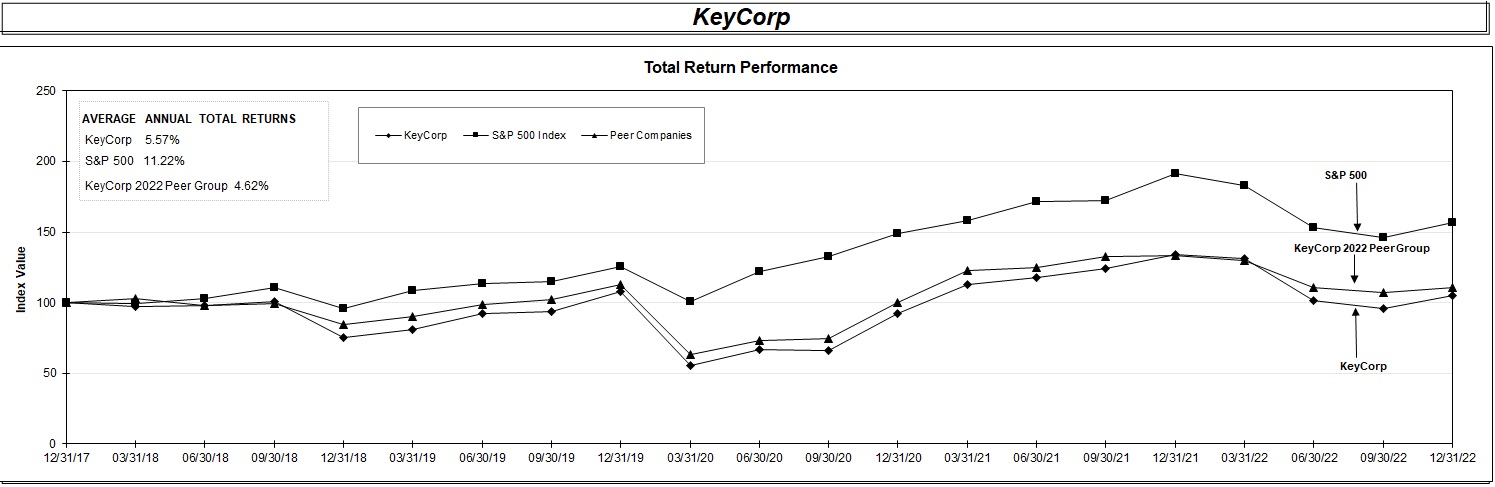
The following graph compares the price performance of our Common Shares (based on an initial investment of $100 on December 31, 2017, and assuming reinvestment of dividends) with that of the S&P 500 Index and a group of other banks that constitute our peer group. The peer group consists of the banks that make up the S&P 500 Regional Bank Index and the banks that make up the Standard & Poor’s 500 Diversified Bank Index. We are included in the S&P 500 Index and the peer group. Share price performance is not necessarily indicative of future price performance.
From time to time, KeyCorp or its principal subsidiary, KeyBank, may seek to retire, repurchase, or exchange outstanding debt of KeyCorp or KeyBank, and capital securities or preferred stock of KeyCorp, through cash purchase, privately negotiated transactions, or otherwise. Such transactions, if any, depend on prevailing market conditions, our liquidity and capital requirements, contractual restrictions, and other factors. The amounts involved may be material.
As part of our previous 2021 capital plan, which was effective through the third quarter of 2022, the Board had authorized the repurchase of up to $1.5 billion of our Common Shares. In September 2022, the Board approved the extension of the previous authorization through the third quarter of 2023.
The following table summarizes our repurchases of our Common Shares for the three months ended December 31, 2022.
| Calendar month | Total number of shares repurchased**(a)** | Average price paid per share | Total number of shares purchased as part of publicly announced plans or programs**(a)** | Dollar value of shares that may yet be purchased as part of publicly announced plans or programs | ||||||||||
| October 1 - 31 | — | $ | — | — | $ | 745,991,117 | ||||||||
| November 1 - 30 | — | — | — | 745,991,117 | ||||||||||
| December 1 - 31 | 2,401 | 17.89 | 2,401 | 745,948,169 | ||||||||||
| Total | 2,401 | $ | 17.89 | 2,401 | ||||||||||
(a)Includes Common Shares deemed surrendered by employees in connection with our stock compensation and benefit plans to satisfy tax obligations.
Item 6. [RESERVED]
Item 7. MANAGEMENT’S DISCUSSION AND ANALYSIS OF FINANCIAL CONDITION AND RESULTS OF OPERATIONS
Introduction
This section reviews the financial condition and results of operations of KeyCorp and its subsidiaries for 2022 and 2021. Some tables may include additional periods to comply with disclosure requirements or to illustrate trends in greater depth. When you read this discussion, you should also refer to the consolidated financial statements and related notes in this report. The page locations of specific sections and notes that we refer to are presented in the Table of Contents. To review our financial condition and results of operations for 2020 and a comparison between the 2020 and 2021 results, see Item 7. Management’s Discussion and Analysis of Financial Condition and Results of Operations of our 2021 Form 10-K filed with the SEC on February 22, 2022, which discussion is incorporated herein by reference.
Long-term financial targets
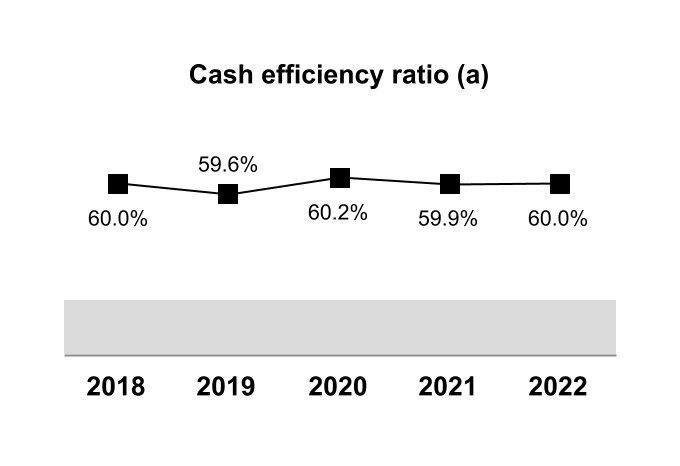
(a)See the section entitled “GAAP to non-GAAP Reconciliations,” which presents the computations of certain financial measures related to “cash efficiency.” The section includes tables that reconcile the GAAP performance measures to the corresponding non-GAAP measures, which provides a basis for period-to-period comparisons.

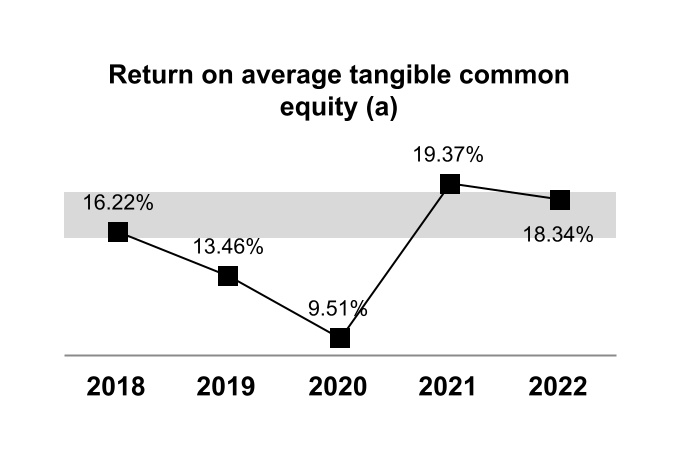
(a)See the section entitled “GAAP to non-GAAP Reconciliations,” which presents the computations of certain financial measures related to “tangible common equity.” The section includes tables that reconcile the GAAP performance measures to the corresponding non-GAAP measures, which provides a basis for period-to-period comparisons.
Positive Operating Leverage
Generate positive operating leverage and a cash e**fficiency ratio in the range of 54.0% to 56.0%.
Positive operating leverage was delivered for the 2022 fiscal year, marking the ninth time in the past ten years this was achieved. We expect to again generate positive operating leverage in 2023.
Moderate Risk Profile
Maintain a moderate risk profile by targeting a net loan charge-offs to average loans ratio in the range of .40% to .60% throug**h a credit cycle.
Our net charge-offs to average loans ratio remains at a historically low level. We believe our strong risk management practices will allow us to continue supporting our clients, while maintainin
Showing the first 8K of 231K characters. Open the full section
Item 7A. QUANTITATIVE AND QUALITATIVE DISCLOSURES ABOUT MARKET RISK
The information included under the caption “Risk Management — Market risk management” in the MD&A beginning on page 74 is incorporated herein by reference.
Item 8. FINANCIAL STATEMENTS AND SUPPLEMENTARY DATA
Management’s Annual Report on Internal Control over Financial Reporting
We are responsible for the preparation, content and integrity of the financial statements and other statistical data and analyses compiled for this annual report. The financial statements and related notes have been prepared in conformity with U.S. generally accepted accounting principles and include amounts which of necessity are based on management’s best estimates and judgments and give due consideration to materiality. We believe the financial statements and notes present fairly our financial position, results of operations and cash flows in all material respects.
We are responsible for establishing and maintaining a system of internal control that is designed to protect our assets and the integrity of our financial reporting as defined in the Securities Exchange Act of 1934, as amended. This corporate-wide system of controls includes policies and procedures that (1) pertain to the maintenance of records that, in reasonable detail, accurately and fairly reflect the transactions and dispositions of the assets of the Corporation; (2) provide reasonable assurance that transactions are recorded as necessary to permit preparation of the consolidated financial statements in conformity with U.S. generally accepted accounting principles, and that receipts and expenditures of the Corporation are made only in accordance with authorizations of management and directors of the Corporation; and (3) provide reasonable assurance regarding prevention or timely detection of unauthorized acquisition, use or disposition of the Corporation’s assets that could have a material effect on the consolidated financial statements. All employees are required to comply with our code of ethics. We conduct an annual certification process to ensure that our employees meet this obligation. Although any system of internal control can be compromised by human error or intentional circumvention of required procedures, we believe our system provides reasonable assurance that financial transactions are recorded and reported properly, providing an adequate basis for reliable financial statements.
During 2022, the Audit Committee of the Board of Directors met regularly with Management, internal audit, and the independent registered public accounting firm, Ernst & Young LLP, to review the scope of their audits and to discuss the evaluation of internal accounting controls and financial reporting
Showing the first 8K of 443K characters. Open the full section
Item 9. CHANGES IN AND DISAGREEMENTS WITH ACCOUNTANTS ON ACCOUNTING AND FINANCIAL DISCLOSURE
None.
Item 9A. CONTROLS AND PROCEDURES
Evaluation of Disclosure Controls and Procedures
As of the end of the period covered by this report, KeyCorp carried out an evaluation, under the supervision and with the participation of KeyCorp’s management, including our Chief Executive Officer and Chief Financial Officer, of the effectiveness of the design and operation of KeyCorp’s disclosure controls and procedures (as defined in Rule 13a-15(e) under the Securities Exchange Act of 1934 (the “Exchange Act”)), to ensure that information required to be disclosed by KeyCorp in reports that it files or submits under the Exchange Act, is recorded, processed, summarized and reported within the time periods specified in the SEC’s rules and forms, and that such information is accumulated and communicated to KeyCorp’s management, including its Chief Executive Officer and Chief Financial Officer, as appropriate, to allow for timely decisions regarding required disclosure. Based upon that evaluation, KeyCorp’s Chief Executive Officer and Chief Financial Officer concluded that the design and operation of these disclosure controls and procedures were effective, in all material respects, as of the end of the period covered by this report. No changes were made to KeyCorp’s internal control over financial reporting (as defined in Rule 13a-15(f) under the Exchange Act) during the last year that materially affected, or are reasonably likely to materially affect, KeyCorp’s internal control over financial reporting.
Reports Regarding Internal Controls
Management’s Annual Report on Internal Control over Financial Reporting, the Report of Independent Registered Public Accounting Firm on Internal Control over Financial Reporting, and the Report of Independent Registered Public Accounting Firm are included in Item 8 on pages 96, 97, and 98, respectively.
Item 9B. OTHER INFORMATION
Not applicable.
Item 9C. DISCLOSURE REGARDING FOREIGN JURISDICTIONS THAT PREVENT INSPECTIONS
Not applicable.
PART III
Item 10. DIRECTORS, EXECUTIVE OFFICERS AND CORPORATE GOVERNANCE
The names of our executive officers, and biographical information for each, is set forth in Item 1. Business of this report.
The other information required by this item will be set forth in the following sections of KeyCorp’s Definitive Proxy Statement for the 2023 Annual Meeting of Shareholders to be held May 11, 2023 (the “2023 Proxy Statement”), and these sections are incorporated herein by reference:
-
“Proposal One: Election of Directors”
-
“Corporate Governance Documents — Code of Business Conduct and Ethics”
-
“The Board of Directors and Its Committees — Board and Committee Responsibilities — Audit Committee”
-
“Additional Information — Other Proposals and Director Nominations for the 2024 Annual Meeting of Shareholders”
KeyCorp expects to file the 2023 Proxy Statement with the SEC on or about March 24, 2023.
Any amendment to, or waiver from a provision of, the Code of Business Conduct and Ethics that applies to KeyCorp’s Chief Executive Officer, Chief Financial Officer, and Chief Accounting Officer, or any other executive officer or director, will be promptly disclosed on KeyCorp’s website (www.key.com/ir) as required by laws, rules and regulations of the SEC.
Item 11. EXECUTIVE COMPENSATION
The information required by this item will be set forth in the following sections of the 2023 Proxy Statement and these sections are incorporated herein by reference:
-
“Compensation Discussion and Analysis”
-
“Compensation of Executive Officers and Directors”
-
“Compensation and Organization Committee Report”
-
“The Board of Directors and Its Committees — Oversight of Compensation Related Risks”
Item 12. SECURITY OWNERSHIP OF CERTAIN BENEFICIAL OWNERS AND MANAGEMENT AND RELATED STOCKHOLDER MATTERS
The information required by this item will be set forth in the section captioned “Ownership of KeyCorp Equity Securities” contained in the 2023 Proxy Statement, and is incorporated herein by reference.
Item 13. CERTAIN RELATIONSHIPS AND RELATED TRANSACTIONS, AND DIRECTOR INDEPENDENCE
The information required by this item will be set forth in the following sections of the 2023 Proxy Statement and these sections are incorporated herein by reference:
-
“The Board of Directors and Its Committees — Director Independence”
-
“The Board of Directors and Its Committees — Related Party Transactions”
Item 14. PRINCIPAL ACCOUNTANT FEES AND SERVICES
The information required by this item will be set forth in the sections captioned “Audit Matters — Ernst & Young’s Fees” and “Audit Matters — Pre-Approval Policies and Procedures” contained in the 2023 Proxy Statement, and is incorporated herein by reference.
PART IV
Item 15. EXHIBITS AND FINANCIAL STATEMENT SCHEDULES
(a) (1) Financial Statements
The following financial statements of KeyCorp and its subsidiaries, and the auditor’s report thereon are filed as part of this report under Item 8. Financial Statements and Supplementary Data:
(a) (2) Financial Statement Schedules
All financial statement schedules for KeyCorp and its subsidiaries have been included in this Form 10-K in the consolidated financial statements or the related footnotes, or they are either inapplicable or not required.
(a) (3) Exhibits*
*Incorporated by reference. Copies of these Exhibits have been filed with
the SEC. Exhibits that are not incorporated by reference are filed with this report. Shareholders may obtain a copy of any exhibit, upon payment of reproduction costs, by writing KeyCorp Investor Relations, 127 Public Square, Mail Code OH-01-27-0737, Cleveland, OH 44114-1306.
KeyCorp hereby agrees to furnish the SEC upon request, copies of instruments, including indentures, which define the rights of long-term debt security holders. All documents listed as Exhibits 10.1 through 10.45 constitute management contracts or compensatory plans or arrangements.
Item 16. FORM 10-K SUMMARY
Not applicable.
SIGNATURES
Pursuant to the requirements of Section 13 or 15(d) of the Securities Exchange Act of 1934, the Registrant has duly caused this report to be signed on its behalf by the undersigned, thereunto duly authorized, on the date indicated.
| KEYCORP | ||
| /s/ Donald R. Kimble | ||
| Donald R. Kimble | ||
| Chief Financial Officer (Principal Financial Officer) | ||
| February 22, 2023 | ||
| /s/ Douglas M. Schosser | ||
| Douglas M. Schosser | ||
| Chief Accounting Officer (Principal Accounting Officer) | ||
| February 22, 2023 |
Pursuant to the requirements of the Securities Exchange Act of 1934, this report has been signed below by the following persons on behalf of the Registrant and in the capacities and on the date indicated.
| Signature | Title | |||||||
| *Christopher M. Gorman | Chairman, Chief Executive Officer and President (Principal Executive Officer), and Director | |||||||
| *Donald R. Kimble | Chief Financial Officer (Principal Financial Officer) | |||||||
| *Douglas M. Schosser | Chief Accounting Officer (Principal Accounting Officer) | |||||||
| *Alexander M. Cutler | Director | |||||||
| *H. James Dallas | Director | |||||||
| *Elizabeth R. Gile | Director | |||||||
| *Ruth Ann M. Gillis | Director | |||||||
| *Robin N. Hayes | Director | |||||||
| *Carlton L. Highsmith | Director | |||||||
| *Richard J. Hipple | Director | |||||||
| *Devina A. Rankin | Director | |||||||
| *Barbara R. Snyder | Director | |||||||
| *Richard J. Tobin | Director | |||||||
| *Todd J. Vasos | Director | |||||||
| *David K. Wilson | Director |
| /s/ James L. Waters | ||
| * By James L. Waters, attorney-in-fact | ||
| February 22, 2023 |