 filings.tools
Keysight Technologies 10-K 2023-10-31
Filed 2023-12-15. 23 sections, 502K characters. Original on sec.gov · Markdown · JSON
Cover and table of contents
UNITED STATES
SECURITIES AND EXCHANGE COMMISSION
Washington, D.C. 20549
Form 10-K
(Mark One)
☒ ANNUAL REPORT PURSUANT TO SECTION 13 OR 15(d) OF THE SECURITIES EXCHANGE ACT OF 1934
For the fiscal year ended October 31, 2023
or
☐ TRANSITION REPORT PURSUANT TO SECTION 13 OR 15(d) OF THE SECURITIES EXCHANGE ACT OF 1934
For the transition period from to
Commission File Number: 001-36334
KEYSIGHT TECHNOLOGIES, INC.
(Exact name of registrant as specified in its charter)
| Delaware | 46-4254555 | |||||||
| State or other jurisdiction of Incorporation or organization | I.R.S. Employer Identification No. |
Address of principal executive offices: 1400 Fountaingrove Parkway, Santa Rosa, CA 95403
Registrant's telephone number, including area code: (800) 829-4444
Securities registered pursuant to Section 12(b) of the Act:
| Title of each class | Trading Symbol | Name of each exchange on which registered | ||||||
| Common Stock par value $0.01 per share | KEYS | New York Stock Exchange |
Securities registered pursuant to Section 12(g) of the Act: None
Indicate by check mark if the registrant is a well-known seasoned issuer, as defined in Rule 405 of the Securities Act. Yes ☒ No ☐
Indicate by check mark if the registrant is not required to file reports pursuant to Section 13 or Section 15(d) of the Act. Yes ☐ No ☒
Indicate by check mark whether the registrant (1) has filed all reports required to be filed by Section 13 or 15(d) of the Securities Exchange Act of 1934 during the preceding 12 months (or for such shorter period that the registrant was required to file such reports), and (2) has been subject to such filing requirements for the past 90 days. Yes ☒ No ☐
Indicate by check mark whether the registrant has submitted electronically every Interactive Data File required to be submitted pursuant to Rule 405 of Regulation S-T (§232.405 of this chapter) during the preceding 12 months (or for such shorter period that the registrant was required to submit and post such files). Yes ☒ No ☐
Indicate by check mark whether the registrant is a large accelerated filer, an accelerated filer, a non-accelerated filer, or a smaller reporting company. See the definitions of "large accelerated filer," "accelerated filer," "smaller reporting company," and "emerging growth company" in Rule 12b-2 of the Exchange Act.
| Large accelerated filer | ☒ | Accelerated filer | ☐ | |||||||||||
| Non-accelerated filer | ☐ | Smaller reporting company | ☐ | |||||||||||
| Emerging growth company | ☐ |
If an emerging growth company, indicate by check mark if the registrant has elected not to use the extended transition period for complying with any new or revised financial accounting standards provided pursuant to Section 13(a) of the Exchange Act. o
Indicate by check mark whether the registrant has filed a report on and attestation to its management’s assessment of the effectiveness of its internal control over financial reporting under Section 404(b) of the Sarbanes-Oxley Act (15 U.S.C. 7262(b)) by the registered public accounting firm that prepared or issued its audit report. ☒
If securities are registered pursuant to Section 12(b) of the Act, indicate by check mark whether the financial statements of the registrant included in the filing reflect the correction of an error to previously issued financial statements. ☐
Indicate by check mark whether any of those error corrections are restatements that required a recovery analysis of incentive-based compensation received by any of the registrant’s executive officers during the relevant recovery period pursuant to §240.10D-1(b). o
Indicate by check mark whether the registrant is a shell company (as defined in Rule 12b-2 of the Exchange Act). Yes ☐ No ☒
The aggregate market value of common equity held by non-affiliates as of April 30, 2023 was approximately $20 billion, based upon the closing price of the Registrant's common stock as quoted on New York Stock Exchange on such date. Shares of stock held by officers, directors
and 5 percent or more stockholders have been excluded in that such persons may be deemed to be affiliates. This determination of affiliate status is not necessarily a conclusive determination for other purposes.
As of December 12, 2023, there were 175,044,604 shares of our common stock outstanding.
DOCUMENTS INCORPORATED BY REFERENCE
| Document Description | 10-K Part | |||||||
| Portions of the Proxy Statement for the Annual Meeting of Stockholders (the "Proxy Statement") to be held on March 21, 2024 and to be filed pursuant to Regulation 14A within 120 days after registrant's fiscal year ended October 31, 2023 are incorporated by reference into Part III of this Report. | III |
TABLE OF CONTENTS
Forward-Looking Statements
This report contains forward-looking statements which include but are not limited to predictions, future guidance, projections, beliefs, and expectations about the company’s trends, seasonality, cyclicality and growth in, and drivers of, the markets we sell into, our strategic direction, earnings from our foreign subsidiaries, new solution and service introductions, the ability of our solutions to meet market needs, changes to our manufacturing processes, the use of contract manufacturers, the impact of government regulations on our ability to conduct operations, our liquidity position, our ability to generate cash from operations, growth in our businesses, our investments, the potential impact of adopting new accounting pronouncements, our financial results, our purchase commitments, our contributions to our pension plans, the selection of discount rates and recognition of any gains or losses for our benefit plans, our cost-control activities, savings and headcount reduction recognized from our restructuring programs and other cost saving initiatives, and other regulatory approvals, the integration of our completed acquisitions and other transactions, and our transition to lower-cost regions. The forward-looking statements involve risks and uncertainties that could cause Keysight’s results to differ materially from management’s current expectations. Such risks and uncertainties include, but are not limited to, the impact of global economic conditions such as inflation or potential recession, slowing demand for products or services, volatility in financial markets, reduced access to credit, increased interest rates, the existence of political or economic instability, impacts of geopolitical tension and conflict, the impacts of increased trade tension and tightening of export control regulations, the impact of compliance with the August 3, 2021 Consent Agreement with the Directorate of Defense Trade Controls, Bureau of Political-Military Affairs, Department of State, the impact of new and ongoing litigation, impacts related to endemic and pandemic conditions, impacts related to net zero emissions commitments, the impact of volatile weather caused by environmental conditions such as climate change, and our ability to successfully integrate key acquisitions. Our actual results could differ materially from the results contemplated by these forward-looking statements due to various factors, including but not limited to those risks and uncertainties discussed in Part 1 Item 1A and elsewhere in this Form 10-K.
PART I
Item 1. Business
Overview
Keysight Technologies, Inc. ("we," "us," "Keysight" or the "company"), incorporated in Delaware on December 6, 2013, is a global innovator in the computing, communications and electronics market, committed to advancing our customers’ business success by helping them solve critical challenges in the development and commercialization of their products and services. Our mission, "accelerating innovation to connect and secure the world," speaks to the value we provide our customers in a world of ever-increasing technological complexity. We deliver this value through a broad range of design and test solutions that address the critical challenges our customers face in bringing their innovations to market faster.
Keysight’s portfolio of hardware, software, and services enables our customers’ engineering workflows as they design, manufacture, deploy, and optimize their products and solutions. Our revenue is derived primarily from solutions addressing research and development ("R&D") applications, and to a lesser degree, applications in manufacturing and operations. The accelerating pace of technological innovation and engineering intensity are long-term secular drivers of demand for Keysight’s solutions and services. We serve a global set of customers in over 100 countries across a wide range of industry segments, including communications, aerospace defense, government, automotive, energy, industrial, general electronics, and semiconductor.
We generated $5.5 billion, $5.4 billion and $4.9 billion of revenue in 2023, 2022, and 2021, respectively. Revenue, income from operations and assets by business segment as of and for the fiscal years ended October 31, 2023, 2022, and 2021, are provided in Note 16, "Segment Information," to our consolidated financial statements.
Keysight Leadership Model
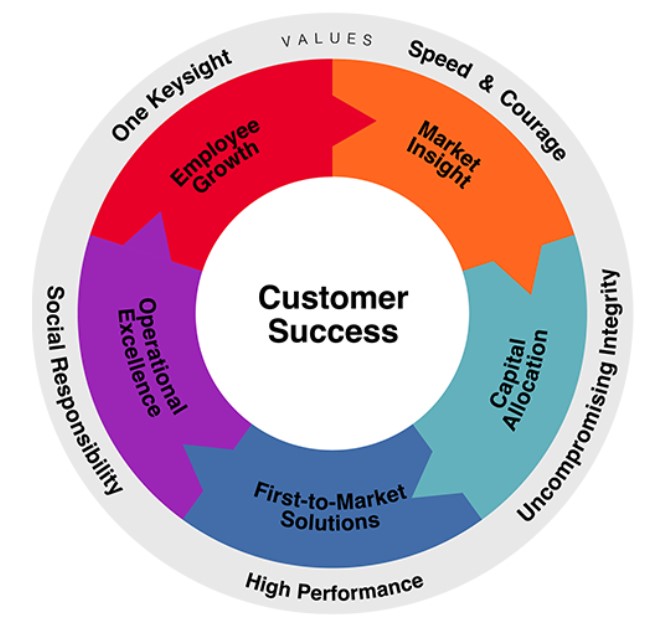
We trace our heritage back over 80 years to the beginning of Silicon Valley. The fundamental elements of our culture are represented in our Keysight Leadership Model ("KLM"), which provides a framework for sustained value creation for customers, shareholders, and employees. The KLM centers on delivering customer success via a continuous activity system and core values that guide and drive our actions as a company and as individuals. The activities are summarized as an ongoing cycle
of market insight that drives capital allocation and yields timely solutions that are optimized via operational excellence. More information on the KLM can be found at https://about.keysight.com/en/companyinfo/leadership.shtml.
Competitive Advantages
Keysight conducts business with global customers, including many Fortune 1000 companies that are developing new electronic technologies, networks, systems, devices, and components. The following advantages enable us to deliver on our commitment of sustained value creation for our stakeholders.
Deep, long-term global customer relationships
Keysight’s history of collaborative innovation is demonstrated by our service to leading companies across the diverse markets that we address. Our customers trust Keysight to deliver the technological expertise, leading-edge capabilities, and broad solutions portfolio that they need to execute on their product development goals. Keysight primarily employs a comprehensive global direct sales channel with experienced management and highly technical sales and application engineers, including a strong local presence in emerging markets. These teams are supported by tight collaboration with the engineering teams who create the solutions used by our customers so that problems can be addressed efficiently, and solutions enhanced quickly, to enable customer success.
Our legacy of over 80 years of contribution in measurement science and the resulting breadth of our products and solutions yields a large, global installed base. This base of customers enables a large and growing services portfolio and offers additional sales opportunities as customers upgrade their products over time.
Unique technology expertise and capabilities
Keysight is a technology-driven company, investing in R&D to align our business with available markets and position the company for growth. As our customers’ trusted test and measurement partner, we innovate at the leading edge of the technologies they seek to utilize in their electronic systems under development. We employ a combination of strategies to lead in this area, including engagement with top standards bodies and industry consortia and close collaboration with top research programs in universities and industry. Our central R&D team, Keysight Labs, focuses on developing breakthrough hardware and software technologies that are deployed in application-specific contexts by our business-specific engineering teams. We develop and incorporate proprietary semiconductor and packaging technology to address the specific needs of our solutions, enabling differentiated performance within our industry.
Differentiated, first-to-market solutions portfolio
Keysight’s industry-focused organizational structure emphasizes our engagement with leading customers across our end markets. We leverage these relationships, together with our technology expertise, to identify market opportunities and seek to maximize the lifecycle value of our design and test contributions beginning in R&D. Our development teams leverage the broad array of Keysight hardware, software, and services, adding new capability as necessary, to create market-leading solutions. Providing leading-edge, application-focused solutions for our customers in line with their project schedules is key to our differentiation and value delivery and facilitates the continuous advancement of electronics technology. With a software-centric
solutions and customer-centered focus, we continue to make strategic investments to expand the R&D mix of our revenue and grow the software and services content of our business, which has the added benefit of increasing recurring revenue.
Durable and resilient business model
Our operating model incorporates cost structure flexibility that has allowed Keysight to deliver profitability across a range of economic and market conditions. We employ variable pay mechanisms across our entire employee population and complement this with the strategic use of contingent staffing. We have a diversified go-to-market approach with indirect sales partners and electronic commerce to complement our direct sales force. This approach provides flexibility with the added benefit of expanding our reach and providing improved transactional purchase capability. We use a centralized order fulfillment organization that supplies solutions to customers worldwide, allowing us to leverage the scale of our business to provide high-quality products while maintaining competitive gross margins. We complement our in-house capabilities with an extensive network of suppliers and subcontractors, which allows us to adapt to changing market conditions. The durability and resilience of our business model has provided strategic flexibility and enabled the company to continue to allocate capital and invest in growth through different market environments.
Innovative culture
Keysight's culture has at its foundation the operating principles and values embodied in the Keysight Leadership Model, with innovation as a key source of our strength. Our employees across the world embrace these principles and deliver industry-leading capabilities across a range of fields that are not only technical in nature but encompass a wide range of contributions to our business, customers, and shareholders. Keysight is increasingly recognized as a great place to work. We strive to enable employee growth in a diverse, inclusive, and respectful work environment that offers challenging assignments, development opportunities, competiti
Showing the first 8K of 63K characters. Open the full section
Item 1A. Risk Factors
Risks, Uncertainties and Other Factors That May Affect Future Results
Risks Related to Our Business
Uncertainty in general economic conditions may adversely affect our operating results and financial condition.
Our business is sensitive to negative changes in general economic conditions, both inside and outside the United States. Global and regional economic uncertainty, inflation, potential recession or depression has and may continue to impact our business, resulting in:
-
increased cost to manufacture products or deliver solutions;
-
reduced customer purchasing power;
-
reduced demand for our solutions and services and reduced or delayed orders;
-
increased risk of excess and obsolete inventory;
-
increased price pressure for our solutions and services; and
-
greater risk of impairment to the value, and a detriment to the liquidity, of our future investment portfolio.
In addition, global and regional macroeconomic developments, such as increased unemployment, decreased income, uncertainty related to future economic activity, volatility in financial markets, reduced access to credit, increased interest rates, volatility in capital markets, decreased liquidity, uncertain or destabilizing national election results in the U.S., Europe, and Asia, and negative changes or volatility in general economic conditions in the U.S., Europe, and Asia could negatively affect our ability to conduct business in those territories. Financial difficulties experienced by our suppliers and customers, including distributors, due to economic volatility or negative changes could result in product delays, reduced purchasing power, delays in payment or inability to pay us, and inventory issues. Economic risks related to accounts receivable could result in delays in collection and greater bad debt expense.
Economic, political, and other risks associated with international sales and operations could adversely affect our results of operations.
Because we operate our businesses and sell our solutions worldwide, our business is subject to risks associated with doing business internationally. We anticipate that revenue from international operations will continue to represent a majority of our total revenue. However, there can be no assurances that our international sales will continue at existing levels or grow in accordance with our effort to increase foreign market penetration. In addition, many of our employees, contract manufacturers, suppliers and manufacturing facilities are located outside the United States. Accordingly, our future results could be harmed by a variety of factors, including, but not limited to:
-
inability to conduct business in certain countries or regions or with certain customers due to U.S. sanctions or trade restrictions;
-
inability to sell certain products, technologies, or services to countries, regions, facilities, or customers due to U.S. sanctions or trade restrictions;
-
changes in a specific country's or region's political, economic or other conditions, including but not limited to changes that favor national interests and economic volatility;
-
negative impact of economic and political measures taken by a country to contain the spread of global pandemic conditions;
-
negative consequences from changes in tax laws;
-
difficulty in protecting intellectual property;
-
injunctions or exclusion orders related to intellectual property disputes;
-
interruptions to transportation flows for delivery of parts to us and finished goods to our customers;
-
changes in foreign currency exchange rates;
-
difficulty in staffing and managing foreign operations;
-
local competition;
-
differing labor regulations;
-
unexpected changes in regulatory requirements;
-
inadequate local infrastructure;
-
potential incidences of corruption and fraudulent business practices; and
-
volatile geopolitical turmoil, including popular uprisings, regional conflicts, terrorism, and war.
We centralize most of our accounting processes at two locations: India and Malaysia. If conditions change in those countries, it may adversely affect operations, including impairing our ability to pay our suppliers. Our results of operations, as well as our liquidity, may be adversely affected and possible delays may occur in reporting financial results.
Further, even if we are able to successfully manage the risks of international operations, our business may be adversely affected if our business partners are not able to successfully manage similar risks.
Economic and political policies favoring national interests could adversely affect our results of operations.
Nationalistic economic policies and political trends such as opposition to globalization and free trade, sanctions or trade restrictions, including those on advanced computing and semiconductor manufacturing, withdrawal from or re-negotiation of global trade agreements, tax policies that favor domestic industries and interests, the distancing or potential exit of countries from the European Union, and other similar actions may result in increased transaction costs, reduced ability to hire employees, reduced access to supplies and materials, reduced demand or access to customers, and inability to conduct our operations as they have been conducted historically. Each of these factors may adversely affect our business.
International trade disputes and increased tariffs between the United States and the United Kingdom, the European Union, Singapore, Malaysia and China, among other countries could substantially change our expectations and ability to operate in such jurisdictions as we have done historically. Many of our suppliers, vendors, customers, partners, and other entities with whom we do business have strong ties to doing business in China. Their ability to supply materials to us, buy products or services from us, or otherwise work with us is affected by their ability to do business in China. If the U.S.’s relationship with China results in additional trade disputes, trade protection measures, retaliatory actions, tariffs and increased barriers, policies that favor domestic industries, or increased import or export licensing requirements or restrictions, then our deployment of resources in jurisdictions affected by such measures could be misaligned and our operations may be adversely affected due to such changes in the economic and political ecosystem in which our suppliers, vendors, customers, partners, and other entities with whom we do business operate.
Volatile geopolitical turmoil, including popular uprisings, regional conflicts, terrorism and war could result in market instability, which could negatively impact our business results.
We are a global company with international operations, and we sell our products and solutions in countries throughout the world. Regional conflicts, including the Russian invasion of Ukraine, which resulted in economic sanctions and the decision to discontinue our operations in Russia, the war between Israel and Hamas, and the risk of increased tensions between China and Taiwan, could limit or prohibit our ability to transfer certain technologies, to sell our products and solutions, and could result in additional closure of facilities in sanctioned countries. In addition, international conflict has resulted in increased pressure on the supply chain and could further result in increased energy costs, which could increase the cost of manufacturing, selling and delivering products and solutions; inflation, which has resulted in increases in the cost of manufacturing products and solutions, reduced customer purchasing power, increased price pressure, and reduced or cancelled orders; increased risk of cybersecurity attacks; and market instability, which could adversely impact our financial results.
**Our operating results and financial condition could be harmed if the markets into which we sell our solutions decline or do not grow as anticipated.
Showing the first 8K of 74K characters. Open the full section
Item 1B. Unresolved Staff Comments
None.
Item 2. Properties
Our executive offices are located in the United States in an owned facility in Santa Rosa, California. We own or lease 134 operating facilities located throughout the world that handle manufacturing, research and development, administration, assembly, sales, quality, assurance testing, distribution, and packaging of our products. These facilities are primarily located in the following countries: United States, Malaysia, Japan, China, Germany, India, United Kingdom, Taiwan, Spain, Korea, Singapore, and Romania.
As of October 31, 2023, we own or lease approximately 5.4 million square feet(a) of space worldwide, a summary of which is provided below:
| Total square feet | ||||||||
| (in millions) | ||||||||
| Owned facilities | 3.5 | |||||||
| Leased facilities | 1.9 | |||||||
| Total | 5.4 | |||||||
| Occupancy of our facilities | ||||||||
| Manufacturing plants, R&D facilities and warehouse and administrative facilities | 5.2 | |||||||
| Sales facilities | 0.2 | |||||||
| Total | 5.4 |
(a) Excludes 0.8 million square feet of vacated space, all of which is leased to third parties or is in restructuring.
All of these facilities are well maintained and suitable for the operations conducted in them.
Item 3. Legal Proceedings
On August 3, 2021, we entered into a Consent Agreement with the Directorate of Defense Trade Controls, Bureau of Political-Military Affairs, Department of State to resolve alleged violations of the Arms Export Control Act and the International Traffic in Arms Regulations ("ITAR"). Pursuant to the Consent Agreement, we were assessed a penalty of $6.6 million to be paid over three years, $2.5 million of which was suspended and designated for remediation activities over three years, including employment of a special compliance officer. To date, we have paid $3.1 million of the penalty. The suspended portion of the penalty has been satisfied by amounts we have spent on qualifying compliance activities to date.
On January 1, 2022, Centripetal Networks filed a lawsuit in Federal District Court in Virginia, alleging that certain Keysight products infringe certain of Centripetal’s patents. In addition, in February 2022, Centripetal filed complaints in Germany alleging infringement of certain of Centripetal’s German patents, and in April 2022, Centripetal filed a complaint with the International Trade Commission (“ITC”) requesting that they investigate whether Keysight should be enjoined from importing certain products that are manufactured outside of the U.S. and which are alleged to infringe Centripetal patents. We deny the allegations and are aggressively defending each case.
Although there are no matters pending that we currently believe are probable and reasonably possible of having a material impact to our business, consolidated financial position, or results of operations or cash flows, the outcome of litigation is inherently uncertain and is difficult to predict. An adverse outcome in any outstanding lawsuit or proceeding could result in significant monetary damages or injunctive relief. If adverse results are above management’s expectations or are unforeseen, management may not have accrued for the liability, which could impact our results in a financial period.
We are also involved in lawsuits, claims, investigations, and other proceedings, including, but not limited to, patent, commercial, and environmental matters, which arise in the ordinary course of business.
Item 4. Mine Safety Disclosures
Not applicable.
PART II
Item 5. Market for the Registrant's Common Equity, Related Stockholder Matters and Issuer Purchases of Equity Securities
Our common stock is listed on the New York Stock Exchange ("NYSE") with the ticker symbol "KEYS.’’ As of December 12, 2023, there were 16,230 shareholders of record.
Stock Price Performance Graph
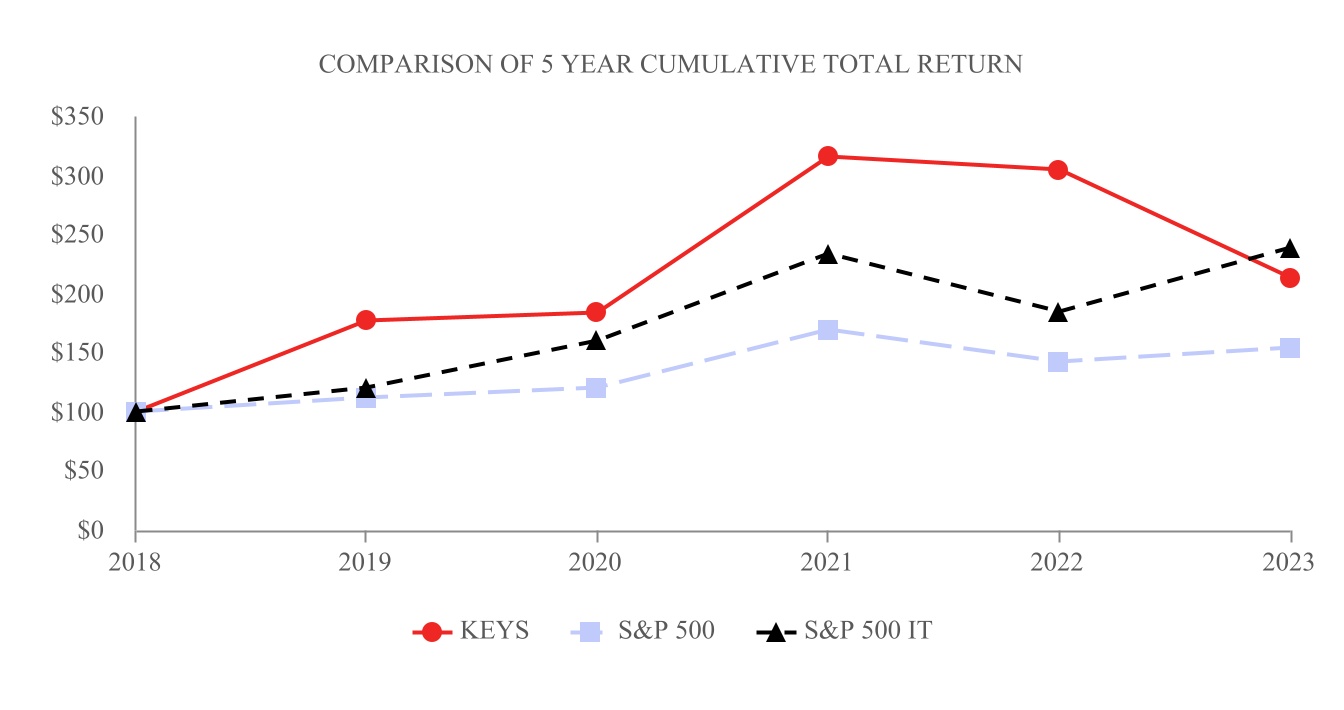
The following graph compares the cumulative 5-year total stockholder return on our common stock relative to the cumulative total return of the S&P 500 Index and the S&P 500 Information Technology Index. The graph assumes that the value of the investment in our common stock and in each index on October 31, 2018 (including reinvestment of dividends) was $100 and tracks it each year thereafter on the last day of our fiscal year through October 31, 2023. The historical performance set forth below is not indicative of future stock price performance.
We have not paid any dividends, and we do not anticipate paying any cash dividends in the foreseeable future. All decisions regarding the declaration and payment of dividends and stock repurchases are at the discretion of our board of directors and will be evaluated regularly in light of our financial condition, earnings, growth prospects, funding requirements, applicable law, and any other factors that our board of directors deems relevant.
The information required by this item with respect to equity compensation plans will be included under the caption "Equity Compensation Plans" in our proxy statement to be filed with the Securities and Exchange Commission pursuant to Regulation 14A, and is incorporated herein by reference.
Issuer Purchases Of Equity Securities
The table below summarizes information about the company’s purchases, based on trade date, of its equity securities registered pursuant to Section 12 of the Exchange Act during the fiscal quarter ended October 31, 2023. The total number of shares of common stock purchased by the company during the fiscal year ended October 31, 2023 was 4,913,548 shares.
| Period | Total Number of Shares of Common Stock Purchased (1) | Weighted Average Price Paid per Share of Common Stock (2) | Total Number of Shares of Common Stock Purchased as Part of Publicly Announced Plans or Programs (1) | Maximum Approximate Dollar Value of Shares of Common Stock that May Yet Be Purchased Under the Program (1) | ||||||||||||||||||||||
| August 1, 2023 through August 31, 2023 | 898,933 | $ | 130.15 | 898,933 | $ | 1,232,832,479 | ||||||||||||||||||||
| September 1, 2023 through September 30, 2023 | 1,388,703 | $ | 132.50 | 1,388,703 | $ | 1,048,835,548 | ||||||||||||||||||||
| October 1, 2023 through October 31, 2023 | 985,676 | $ | 126.82 | 985,676 | $ | 923,835,624 | ||||||||||||||||||||
| Total | 3,273,312 | 3,273,312 |
| (1) | On March 6, 2023, our board of directors approved a new stock repurchase program authorizing the purchase of up to $1,500 million of the company’s common stock, replacing the previously approved November 2021 program authorizing the purchase of up to $1,200 million of the company’s common stock, of which $225 million remained. Under our stock repurchase program, shares may be purchased from time to time, subject to general business and market conditions and other investment opportunities, through open market purchases, privately negotiated transactions, or other means. All such shares and related costs are held as treasury stock and accounted for at trade date using the cost method. | ||||
| (2) | The weighted average price paid per share of common stock does not include the cost of commissions. |
Item 6. [Reserved]
Not applicable.
Item 7. Management's Discussion and Analysis of Financial Condition and Results of Operations
The following discussion should be read in conjunction with the consolidated financial statements and notes thereto included elsewhere in this Annual Report on Form 10-K. This report contains forward-looking statements which include but are not limited to predictions, future guidance, projections, beliefs, and expectations about the company’s trends, seasonality, cyclicality and growth in, and drivers of, the markets we sell into, our strategic direction, earnings from our foreign subsidiaries, new solution and service introductions, the ability of our solutions to meet market needs, changes to our manufacturing processes, the use of contract manufacturers, the impact of government regulations on our ability to conduct operations, our liquidity position, our ability to generate cash from operations, growth in our businesses, our investments, the potential impact of adopting new accounting pronouncements, our financial results, our purchase commitments, our contributions to our pension plans, the selection of discount rates and recognition of any gains or losses for our benefit plans, our cost-control activities, savings and headcount reduction recognized from our restructuring programs and other cost saving initiatives, and other regulatory approvals, the integration of our completed acquisitions and other transactions, and our transition to lower-cost regions. The forward-looking statements involve risks and uncertainties that could cause Keysight’s results to differ materially from management’s current expectations. Such risks and uncertainties include, but are not limited to, the impact of global economic conditions such as inflation or potential recession, slowing demand for products or services, volatility in financial markets, reduced access to credit, increased interest rates, the existence of political or economic instability, impacts of geopolitical tension and conflict, the impacts of increased trade tension and tightening of export control regulations, the impact of compliance with the August 3, 2021 Consent Agreement with the Directorate of Defense Trade Controls, Bureau of Political-Military Affairs, Department of State, the impact of new and ongoing litigation, impacts related to endemic and pandemic conditions, impacts related to net zero emissions commitments, the impact of volatile weather caused by environmental conditions such as climate change, and our ability to successfully integrate key acquisitions. Our actual results could differ materially from the results contemplated by these forward-looking statements due to various factors including, but not limited to, those risks and uncertainties discussed in Part I Item 1A and elsewhere in this Annual Report on Form 10-K.
Overview and Executive Summary
Keysight Technologies, Inc. ("we," "us," "Keysight" or the "company"), incorporated in Delaware on December 6, 2013, is a global innovator in the computing, communications and electronics market, committed to advancing our customers’ business success by helping them solve critical challenges in the development and commercialization of their products and services. Our mission, "accelerating innovation to connect and secure the world," speaks to the value we provide our customers in a world of ever-increasing technological complexity. We deliver this value through a broad range of design and test solutions that address the critical challenges our customers face in bringing their innovations to market faster.
Our fiscal year end is October 31. Unless otherwise stated, all years and dates refer to our fiscal year.
Macroeconomic headwinds and challenging geopolitical environment
Our global operations continue to be affected by many external headwinds, including inflationary pressures, rising interest rates, currency movements, increased geopolitical tensions, and trade restrictions. These headwinds are also negatively impacting our customers' operations and financial performance. As a result, demand has declined year-over-year as our customers are exercising caution in spending to manage financial results and adapt to post-pandemic industry dynamics. As we work through these near-term headwinds, we are exercising our financial playbook and the structural flexibility in our operating model to continue delivering strong financial results. We believe that Keysight’s technology leadership, differentiated first-to-market solutions portfolio, durable and resilient business model driven by the strength of the Keysight Leadership Model, continued customer engagement in new technology innovation spanning diverse applications across global markets, and our culture position us well to weather these macro and industry dynamics and deliver consistent long-term value to our customers.
For discussion of risks related to potential impacts of macroeconomic headwinds and geopolitical challenges on our operations, business results and financial condition, see “Item 1A. Risk Factors.”
Years ended October 31, 2023, 2022 and 2021
Orders of $5,190 million for 2023 decreased 13 percent compared to 2022. Foreign currency movements had an unfavorable impact of 1 percentage point on order change for 2023 compared to 2022. Orders declined across all regions, including double-digit decline in Asia Pacific. Total orders for 2022 were $5,984 million, an increase of 12 percent compared to 2021. Foreign currency movements had an unfavorable impact of 3 percentage points on order growth for 2022 compared to 2021. Orders grew across all regions, including double-digit growth in Asia Pacific.
Revenue of $5,464 million for 2023 increased 1 percent compared to 2022. Foreign currency movements had an unfavorable impact of 2 percentage points on revenue growth for 2023 compared to 2022. A revenue increase in the Electronic Industrial Solutions Group was partially offset by a decline in the Communications Solutions Group. Revenue from the Communications Solutions Group and the Electronic Industrial Solutions Group represented approximately 67 percent and 33 percent, respectively, of total revenue for 2023. Revenue of $5,420 million for 2022 increased 10 percent compared to 2021. Foreign currency movements had an unfavorable impact of 2 percentage points on revenue growth for 2022 compared to 2021. Revenue for both the Communications Solutions Group and the Electronic Industrial Solutions Group grew compared to 2021. Revenue from the Communications Solutions Group and the Electronic Industrial Solutions Group represented approximately 70 percent and 30 percent, respectively, of total revenue for 2022.
Net income was $1,057 million in 2023 compared to net income of $1,124 million and $894 million in 2022 and 2021, respectively. The decrease in net income for 2023 compared to 2022 was primarily driven by higher income tax expense, R&D expense, and selling, general and administrative expense, partially offset by higher interest income, higher revenue, and favorable mix. The increase in net income for 2022 compared to 2021 was primarily driven by higher revenue volume, lower amortization of acquisition-related balances, and lower variable people-related costs, partially offset by higher material costs and higher selling, general and administrative, R&D, and income tax expenses.
In 2023, 2022 and 2021, we generated operating cash flows of $1,408 million, $1,144 million and $1,322 million, respectively.
Outlook
Our first-to-market solutions strategy enables customers to develop new technologies and accelerate innovation and provides a platform for Keysight's long-term growth. Our customers are expected to continue to make R&D investments in certain next-generation technologies, including 5G, early 6G, high-speed data center, satellite networks and Artificial Intelligence-Machine Learning ("AI-ML") network modeling, new automotive mobility technologies, industrial internet of things ("IoT"), and defense modernization. We continue to engage actively with our cust
Showing the first 8K of 82K characters. Open the full section
Item 7A. Quantitative and Qualitative Disclosures About Market Risk
At various times, we use derivative financial instruments to limit exposure to changes in foreign currency exchange rates and interest rates. Because derivative instruments are used solely as hedges and not for speculative trading purposes, fluctuations in the market values of such derivative instruments are generally offset by reciprocal changes in the underlying economic exposures that the instruments are intended to hedge. For further discussion of derivative financial instruments, see Note 9, "Derivatives."
Currency exchange rate risk
We are exposed to foreign currency exchange rate risks inherent in our sales commitments, anticipated sales, expenses, assets and liabilities denominated in currencies other than the functional currency of our subsidiaries. We hedge future cash flows denominated in currencies other than the functional currency using sales and expense forecasts on a rolling period of up to twelve months. Our exposure to exchange rate risks is managed on an enterprise-wide basis. This strategy utilizes derivative financial instruments, primarily forward contracts, to hedge certain foreign currency exposures with the intent of offsetting gains and losses that occur on the underlying exposures with gains and losses on the derivative contracts hedging them. We do not currently and do not intend to utilize derivative financial instruments for speculative trading purposes. To the extent that we are required to pay for all, or portions, of an acquisition price in foreign currencies, we may enter into foreign exchange contracts to reduce the risk that currency movements will impact the cost of the transaction.
Our operations generate non-functional currency cash flows such as revenue, third-party vendor payments, and inter-company payments. In anticipation of these foreign currency cash flows and in view of the volatility of the currency market, we enter into foreign exchange contracts as described above to substantially mitigate our currency risk. In 2023, 2022 and 2021, approximately 75 percent, 77 percent, and 77 percent, respectively, of our revenues were generated in U.S. dollars.
The unfavorable effects of changes in foreign currency exchange rates, principally as a result of the strength of the U.S. dollar, had an immaterial impact on our revenue in the year ended October 31, 2023. We calculate the impact of foreign currency exchange rates movements by applying the actual foreign currency exchange rates in effect during the last month of each fiscal quarter of the current fiscal year to both the applicable current and prior year periods. We also performed a sensitivity analysis assuming a hypothetical 10 percent adverse movement in foreign exchange rates to the hedging contracts and the underlying exposures described above. As of October 31, 2023, and 2022, the analysis indicated that these hypothetical market movements would not have a material effect on our consolidated financial position, results of operations, or cash flows.
Interest rate risk
A change in interest rates on long-term debt impacts the fair value of the company’s fixed-rate long-term debt but not the company’s earnings or cash flow because the interest on such debt is fixed. Generally, the fair market value of fixed-rate debt will increase as interest rates fall and decrease as interest rates rise.
As of October 31, 2023, a hypothetical 10 percent increase in interest rates would have decreased the fair value of the company’s fixed-rate debt by approximately $30 million. However, since the company currently has no plans to repurchase its outstanding fixed-rate instruments before their maturity, nor do the investors in our fixed-rate debt obligations have the right to demand we pay off these obligations prior to maturity, the impact of market interest rate fluctuations on the company’s fixed-rate long-term debt does not affect the company’s results of operations or stockholders’ equity.
Item 8. Financial Statements and Supplementary Data
Report of Independent Registered Public Accounting Firm
To the Board of Directors and Stockholders of Keysight Technologies, Inc.
Opinions on the Financial Statements and Internal Control over Financial Reporting
We have audited the accompanying consolidated balance sheets of Keysight Technologies, Inc. and its subsidiaries (the “Company”) as of October 31, 2023 and 2022, and the related consolidated statements of operations, of comprehensive income, of equity and of cash flows for each of the three years in the period ended October 31, 2023, including the related notes and schedule of valuation and qualifying accounts for each of the three years in the period ended October 31, 2023 appearing under Item 15(a)(2) (collectively referred to as the “consolidated financial statements”). We also have audited the Company's internal control over financial reporting as of October 31, 2023, based on criteria established in Internal Control - Integrated Framework (2013) issued by the Committee of Sponsoring Organizations of the Treadway Commission (COSO).
In our opinion, the consolidated financial statements referred to above present fairly, in all material respects, the financial position of the Company as of October 31, 2023 and 2022, and the results of its operations and its cash flows for each of the three years in the period ended October 31, 2023 in conformity with accounting principles generally accepted in the United States of America. Also in our opinion, the Company maintained, in all material respects, effective internal control over financial reporting as of October 31, 2023, based on criteria established in Internal Control - Integrated Framework (2013) issued by the COSO.
Basis for Opinions
The Company's management is responsible for these consolidated financial statements, for maintaining effective internal control over financial reporting, and for its assessment of the effectiveness of internal control over financial reporting, included in Management’s Report on Internal Control over Financial Reporting appearing under Item 9A. Our responsibility is to express opinions on the Company’s consolidated financial statements and on the Company's internal control over financial reporting based on our audits. We are a public accounting firm registered with the Public Company Accounting Oversight Board (United States) (PCAOB) and are required to be independent with respect to the Company in accordance with the U.S. federal securities laws and the applicable rules and regulations of the Securities and Exchange Commission and the PCAOB.
We conducted our audits in accordance with the standards of the PCAOB. Those standards require that we plan and perform the audits to obtain reasonable assurance about whether the consolidated financial statements are free of material misstatement, whether due to error or fraud, and whether effective internal control over financial reporting was maintained in all material respects.
Our audits of the consolidated financial statements included performing procedures to assess the risks of material misstatement of the consolidated financial statements, whether due to error or fraud, and performing procedures that respond to those risks. Such procedures included examining, on a test basis, evidence regarding the amounts and disclosures in the consolidated financial statements. Our audits also included evaluating the accounting principles used and significant estimates made by management, as well as evaluating the overall presentation of the consolidated financial statements. Our audit of internal control over financial reporting included obtaining an understanding of internal control over financial reporting, assessing the risk that a material weakness exists, and testing and evaluating the design and operating effectiveness of internal control based on the assessed risk. Our audits also included performing such other procedures as we considered necessary in the circumstances. We believe that our audits provide a reasonable basis for our opinions.
Definition and Limitations of Internal Control over Financial Reporting
A company’s internal control over financial reporting is a process designed to provide reasonable assurance regarding the reliability of financial reporting and the preparation of financial statements for external purposes in accordance with generally accepted accounting principles. A company’s internal control over financial reporting includes those policies and procedures that (i) pertain to the maintenance of records that, in reasonable detail, accurately and fairly reflect the transactions and dispositions of the assets of the company; (ii) provide reasonable assurance that transactions are recorded as necessary to permit preparation of financial statements in accordance with generally accepted accounting principles, and that receipts and expenditures of the company are being made only in accordance with authorizations of management and directors of the company; and (iii) provide reasonable assurance regarding prevention or timely detection of unauthorized acquisition, use, or disposition of the company’s assets that could have a material effect on the financial statements.
Because of its inherent limitations, internal control over financial reporting may not prevent or detect misstatements. Also, projections of any evaluation of effectiveness to future periods are subject to the risk that controls may become inadequate because of changes in conditions, or that the degree of compliance with the policies or procedures may deteriorate.
Critical Audit Matters
The critical audit matter communicated below is a matter arising from the current period audit of the consolidated financial statements that was communicated or required to be communicated to the audit committee and that (i) relates to accounts or disclosures that are material to the consolidated financial statements and (ii) involved our especially challenging, subjective, or complex judgments. The communication of critical audit matters does not alter in any way our opinion on the consolidated financial statements, taken as a whole, and we are not, by communicating the critical audit matter below, providing a separate opinion on the critical audit matter or on the accounts or disclosures to which it relates.
Showing the first 8K of 223K characters. Open the full section
Item 9. Changes in and Disagreements with Accountants on Accounting and Financial Disclosure
None.
Item 9A. Controls and Procedures
Evaluation of Disclosure Controls and Procedures
Our management has evaluated, under the supervision and with the participation of our Chief Executive Officer and Chief Financial Officer, the effectiveness of our disclosure controls and procedures as of October 31, 2023, pursuant to and as required by Rule 13a-15(b) under the Securities Exchange Act of 1934 (“Exchange Act”). Based on that evaluation, our Chief Executive Officer and Chief Financial Officer have concluded that, as of October 31, 2023, the company's disclosure controls and procedures, as defined by Rule 13a-15(e) under the Exchange Act, were effective and designed to ensure that (i) information required to be disclosed in the company's reports filed under the Exchange Act is recorded, processed, summarized and reported within the time periods specified in the SEC's rules and forms, and (ii) information is accumulated and communicated to management, including the Chief Executive Officer and Chief Financial Officer, as appropriate to allow timely decisions regarding required disclosures.
Management's Report on Internal Control over Financial Reporting
Our management is responsible for establishing and maintaining adequate internal control over financial reporting, as such term is defined in Exchange Act Rule 13a-15(f). Under the supervision and with the participation of our management, including our Chief Executive Officer and Chief Financial Officer, we conducted an evaluation of the effectiveness of our internal control over financial reporting based on the framework in Internal Control - Integrated Framework (2013) issued by the Committee of Sponsoring Organizations of the Treadway Commission. Based on the results of this evaluation, our management concluded that our internal control over financial reporting was effective as of October 31, 2023.
The effectiveness of our internal control over financial reporting as of October 31, 2023 has been audited by PricewaterhouseCoopers LLP, an independent registered public accounting firm, as stated in their report that appears in Item 8 of this Annual Report on Form 10-K.
Changes in Internal Control Over Financial Reporting
There were no changes in our internal control over financial reporting during the fourth quarter of 2023 that have materially affected, or are reasonably likely to materially affect, our internal control over financial reporting.
Item 9B. Other Information
Rule 10b5-1 Trading plans
During the three months ended October 31, 2023, the following directors or officers (as defined in Rule 16a-1(f) of the Exchange Act) adopted or terminated a “Rule 10b5-1 trading arrangement” or “non-Rule 10b5-1 trading arrangement,” as each term is defined in Item 408(c) of Regulation S-K:
| Plans | ||||||||||||||||||||||||||||||||
| Name & Title | Action | Date | Rule 10b5-1 | Non-Rule 10b5-1 | Aggregate number of securities to be sold**(1)** | Plan expiration date | ||||||||||||||||||||||||||
| Ronald S. Nersesian | Adoption | September 27, 2023 | ☒ | ☐ | 107,299 | September 25, 2024 | ||||||||||||||||||||||||||
| Chairman of the Board | ||||||||||||||||||||||||||||||||
| (1) | The “Aggregate number of securities to be sold” represents the gross number of shares to be received during the duration of the plan, before excluding any shares withheld by the company to satisfy its income tax withholding in connection with the net settlement of the equity awards. Any underlying performance share awards being calculated at target. |
During the three months ended October 31, 2023, there were no terminations of a “Rule 10b5-1 trading arrangement” or “non-Rule 10b5-1 trading arrangement.”
Item 9C. Disclosure Regarding Foreign Jurisdictions that Prevent Inspections
Not applicable.
PART III
Item 10. Directors, Executive Officers and Corporate Governance
The information required under Item 10 regarding our directors will appear under “Proposal No. 1 - Election of Directors” in our Proxy Statement. The information regarding our executive officers required under Item 10 will appear in Item 1 of this Annual Report on Form 10-K under “Executive Officers of the Registrant.” The information required under Item 10 regarding our Audit and Finance Committee and our Audit and Finance Committee's financial expert will appear under “Committees of the Board of Directors-Audit and Finance Committee” and “Audit and Finance Committee Report” in our Proxy Statement. Those portions of the Proxy Statement are incorporated by reference into this Annual Report on Form 10-K.
There were no material changes to the procedures by which security holders may recommend nominees to our board of directors. The information required under Item 10 regarding our code of ethics applicable to our principal executive officer, our principal financial officer, our corporate controller and other senior financial officers is contained in our SBC and appears in Item 1 of this report under “Investor Information.” We will post amendments to or waivers from a provision of the SBC with respect to those persons on our website at www.investor.keysight.com.
Compliance with Section 16(a) of the Exchange Act
With regard to the information required under Item 10 relating to compliance with Section 16(a) of the Exchange Act, we will provide disclosure of delinquent Section 16(a) reports, if any, in Keysight’s Proxy Statement under “Delinquent Section 16(a) Reports,” and such disclosure, if any, is incorporated herein by reference.
Item 11. Executive Compensation
The information relating to the compensation of our named executive officers and directors required under Item 11 will appear under “Executive Compensation” and “Compensation of Non-Employee Directors” in the Proxy Statement. The Compensation and Human Capital Committee Report and the information about Compensation and Human Capital Committee interlocks and insider participation required under Item 11, will appear under “Compensation and Human Capital Committee Report” and “Compensation and Human Capital Committee Interlocks and Insider Participation,” respectively, in the Proxy Statement. Those portions of the Proxy Statement are incorporated by reference into this Annual Report on Form 10-K.
Item 12. Security Ownership of Certain Beneficial Owners and Management and Related Stockholder Matters
The information about the security ownership of certain beneficial owners and management required under Item 12 will appear under "Common Stock Ownership of Certain Beneficial Owners and Management" in the Proxy Statement. That portion of the Proxy Statement is incorporated by reference into this Annual Report on Form 10-K.
EQUITY COMPENSATION PLAN INFORMATION
The following table summarizes information about our equity compensation plans as of October 31, 2023. All outstanding awards relate to our common stock.
| Plan Category | Number of Securities to be Issued upon Exercise of Outstanding Options, Warrants and Rights (a) | Weighted-average Exercise Price of Outstanding Options, Warrants and Right (b) | Number of Securities Remaining Available for Future Issuance under Equity Compensation Plans (Excluding Securities Reflected in Column (a)) (c) | ||||||||||||||
| Equity compensation plans approved by security holders (1)(2)(3) | 2,217,859 | $ | 31 | 22,102,910 | |||||||||||||
| Equity compensation plans not approved by security holders | — | — | — | ||||||||||||||
| Total | 2,217,859 | $ | 31 | 22,102,910 |
(1) The number of securities remaining available for future issuance in column (c) includes 18,382,477 shares of common stock authorized and available for issuance under the Keysight Technologies, Inc. employee stock purchase plan under Section 423(b) of the Internal Revenue Code ("ESPP"). The number of shares authorized for issuance under the ESPP is subject to an automatic annual increase of the lesser of one percent of the outstanding common stock of Keysight or an amount determined by the Compensation and Human Capital Committee of our board of directors. Under the terms of the ESPP, in no event shall the aggregate number of shares issued under the ESPP exceed 75 million shares. The number of
securities remaining available for future issuance in column (c) is before the issuance of shares of common stock to participants in consideration of the aggregate participant contribution under the ESPP totaling $32 million as of October 31, 2023.
(2) We issue securities under our equity compensation plans in forms other than options, warrants or rights. Those are issued under the 2014 Stock Plan, which was originally adopted by our board of directors on July 16, 2014, with an effective date of November 1, 2014. It was subsequently amended and restated by our board of directors on September 29, 2014 and again on January 22, 2015. The 2014 Stock Plan was further amended and restated by our board of directors on November 16, 2017. The 2014 Stock Plan provides for the grant of awards in the form of stock options, stock appreciation rights, restricted stock, restricted stock units ("RSUs"), performance shares and performance units with performance-based conditions to vesting or exercisability, and cash awards. The 2014 Stock Plan has a term of ten years. As of October 31, 2023, 3,720,433 shares were available for future awards under the 2014 Stock Plan.
(3) We issue securities under our equity compensation plans in forms that do not require a payment by the recipient to us at the time of exercise or vesting, including restricted stock, RSUs and performance units. Accordingly, the weighted-average exercise price in column (b) does not take these awards into account.
Item 13. Certain Relationships and Related Transactions, and Director Independence
The information about certain relationships and related transactions required under Item 13 will appear under “Related Person Transactions Policy and Procedures” in the Proxy Statement. Information about director independence required under Item 13 will appear under the heading "Director Independence” in the Proxy Statement. Each of those portions of the Proxy Statement is incorporated by reference into this Annual Report on Form 10-K.
Item 14. Principal Accounting Fees and Services
The information about principal accountant fees and services and related pre-approval policies required under Item 14 will appear under "Fees Paid to PricewaterhouseCoopers LLP" and "Audit and Finance Committee Preapproval Policy" in the Proxy Statement. Those portions of the Proxy Statement are incorporated by reference into this Annual Report on Form 10-K.
PART IV
Item 15. Exhibits and Financial Statement Schedules
(a) The following documents are filed as part of this Annual Report on Form 10-K:
- Financial Statements.
See Index to Consolidated Financial Statements under Item 8 of this Annual Report on Form 10-K.
- Financial Statement Schedule.
The following additional financial statement schedule should be considered in conjunction with our consolidated financial statements. All other schedules have been omitted because the required information is either not applicable or not sufficiently material to require submission of the schedule.
SCHEDULE II
VALUATION AND QUALIFYING ACCOUNTS
| Description | Balance at Beginning of Period | Additions Charged to Expenses or Other Accounts* | Deductions Credited to Expenses or Other Accounts** | Balance at End of Period | ||||||||||||||||||||||
| (in millions) | ||||||||||||||||||||||||||
| 2023 | ||||||||||||||||||||||||||
| Tax valuation allowance | $ | 224 | $ | 4 | $ | (10) | $ | 218 | ||||||||||||||||||
| 2022 | ||||||||||||||||||||||||||
| Tax valuation allowance | $ | 231 | $ | — | $ | (7) | $ | 224 | ||||||||||||||||||
| 2021 | ||||||||||||||||||||||||||
| Tax valuation allowance | $ | 238 | $ | 11 | $ | (18) | $ | 231 |
- Additions include current-year additions charged to expense and current-year build due to increases in net deferred tax assets, return to provision true-ups, other adjustments and Other Comprehensive Income ("OCI") impact to deferred taxes.
** Deductions include current-year releases credited to expense and current-year reductions due to decreases in net deferred tax assets, return to provision true-ups, other adjustments and OCI impact to deferred taxes.
- Exhibits.
Exhibits are incorporated herein by reference or are filed with this Annual Report on Form 10-K as indicated below (numbered in accordance with Item 601 of Regulation S-K):
| 101.SCH | Inline XBRL Schema Document | X | ||||||||||||||||||||||||||||||
| 101.CAL | Inline XBRL Calculation Linkbase Document | X | ||||||||||||||||||||||||||||||
| 101.LAB | Inline XBRL Labels Linkbase Document | X | ||||||||||||||||||||||||||||||
| 101.PRE | Inline XBRL Presentation Linkbase Document | X | ||||||||||||||||||||||||||||||
| 101.DEF | Inline XBRL Definition Linkbase Document | X | ||||||||||||||||||||||||||||||
| 104 | Inline XBRL Cover Page Interactive Data File | X |
- Indicates management contract or compensatory plan, contract or arrangement.
** Certain schedules and exhibits have been omitted pursuant to Item 601(b)(2) of Regulation S-K. Keysight will furnish supplemental copies of any such schedules or exhibits to the U.S. Securities and Exchange Commission upon request.
Item 16. Form 10-K Summary
None.
SIGNATURES
Pursuant to the requirements of Section 13 or 15(d) of the Securities Exchange Act of 1934, the registrant has duly caused this report to be signed on its behalf by the undersigned, thereunto duly authorized.
| KEYSIGHT TECHNOLOGIES, INC. | ||||||||||||||
| By: | /s/ Neil Dougherty | |||||||||||||
| Neil Dougherty | ||||||||||||||
| Executive Vice President and Chief Financial Officer |
Date: December 15, 2023
POWER OF ATTORNEY
KNOW ALL PERSONS BY THESE PRESENTS, that each person whose signature appears below constitutes and appoints Jeffrey K. Li and JoAnn Juskie, or any of them, his or her attorneys-in-fact, for such person in any and all capacities, to sign any amendments to this report and to file the same, with exhibits thereto, and other documents in connection therewith, with the Securities and Exchange Commission, hereby ratifying and confirming all that any of said attorneys-in-fact, or substitute or substitutes, may do or cause to be done by virtue hereof. Pursuant to the requirements of the Securities Exchange Act of 1934, this report has been signed below by the following persons on behalf of the registrant and in the capacities and on the dates indicated.
| Signature | Title | Date | ||||||||||||
| /s/ RONALD S. NERSESIAN | Chairman of the Board | December 15, 2023 | ||||||||||||
| Ronald S. Nersesian | ||||||||||||||
| /s/ SATISH C. DHANASEKARAN | President and Chief Executive Officer | December 15, 2023 | ||||||||||||
| Satish C. Dhanasekaran | (Principal Executive Officer) | |||||||||||||
| /s/ NEIL P. DOUGHERTY | Executive Vice President and Chief Financial Officer | December 15, 2023 | ||||||||||||
| Neil P. Dougherty | (Principal Financial Officer) | |||||||||||||
| /s/ LISA M. POOLE | Vice President and Corporate Controller | December 15, 2023 | ||||||||||||
| Lisa M. Poole | (Principal Accounting Officer) | |||||||||||||
| /s/ JAMES G. CULLEN | Director | December 15, 2023 | ||||||||||||
| James G. Cullen | ||||||||||||||
| /s/ CHARLES J. DOCKENDORFF | Director | December 15, 2023 | ||||||||||||
| Charles J. Dockendorff | ||||||||||||||
| /s/ RICHARD P. HAMADA | Director | December 15, 2023 | ||||||||||||
| Richard P. Hamada | ||||||||||||||
| /s/ MICHELLE J. HOLTHAUS | Director | December 15, 2023 | ||||||||||||
| Michelle J. Holthaus | ||||||||||||||
| /s/ PAUL A. LACOUTURE | Director | December 15, 2023 | ||||||||||||
| Paul A. Lacouture | ||||||||||||||
| /s/ JEAN M. NYE | Director | December 15, 2023 | ||||||||||||
| Jean M. Nye | ||||||||||||||
| /s/ JOANNE B. OLSEN | Director | December 15, 2023 | ||||||||||||
| Joanne B. Olsen | ||||||||||||||
| /s/ ROBERT A. RANGO | Director | December 15, 2023 | ||||||||||||
| Robert A. Rango | ||||||||||||||
| /s/ KEVIN A. STEPHENS | Director | December 15, 2023 | ||||||||||||
| Kevin A. Stephens |