 filings.tools
Kraft Heinz 10-K 2019-12-28
Filed 2020-02-14. 22 sections, 591K characters. Original on sec.gov · Markdown · JSON
Cover and table of contents
UNITED STATES
SECURITIES AND EXCHANGE COMMISSION
WASHINGTON, D.C. 20549
FORM 10-K
(Mark One)
| ☒ | ANNUAL REPORT PURSUANT TO SECTION 13 OR 15(d) OF THE SECURITIES EXCHANGE ACT OF 1934 |
For the fiscal year ended December 28, 2019
or
| ☐ | TRANSITION REPORT PURSUANT TO SECTION 13 OR 15(d) OF THE SECURITIES EXCHANGE ACT OF 1934 |
For the transition period from __________ to __________
Commission File Number 001-37482

The Kraft Heinz Co****mpany
(Exact name of registrant as specified in its charter)
| Delaware | 46-2078182 | |||
| (State or other jurisdiction of incorporation or organization) | (I.R.S. Employer Identification No.) | |||
| One PPG Place, | Pittsburgh, | Pennsylvania | 15222 | |
| (Address of Principal Executive Offices) | (Zip Code) |
Registrant’s telephone number, including area code: (412) 456-5700
Securities registered pursuant to Section 12(b) of the Act:
| Title of each class | Trading Symbol | Name of exchange on which registered |
| Common stock, $0.01 par value | KHC | The Nasdaq Stock Market LLC |
Securities registered pursuant to Section 12(g) of the Act:
None.
Indicate by check mark if the registrant is a well-known seasoned issuer, as defined in Rule 405 of the Securities Act. Yes ☐ No ☒
Indicate by check mark if the registrant is not required to file reports pursuant to Section 13 or Section 15(d) of the Act. Yes ☐ No ☒
Indicate by check mark whether the registrant (1) has filed all reports required to be filed by Section 13 or 15(d) of the Securities Exchange Act of 1934 during the preceding 12 months (or for such shorter period that the registrant was required to file such reports), and (2) has been subject to such filing requirements for the past 90 days. Yes ☒ No ☐
Indicate by check mark whether the registrant has submitted electronically every Interactive Data File required to be submitted pursuant to Rule 405 of Regulation S-T (§ 232.405 of this chapter) during the preceding 12 months (or for such shorter period that the registrant was required to submit such files). Yes ☒ No ☐
Indicate by check mark whether the registrant is a large accelerated filer, an accelerated filer, a non-accelerated filer, a smaller reporting company, or an emerging growth company. See the definitions of “large accelerated filer,” “accelerated filer,” “smaller reporting company,” and “emerging growth company” in Rule 12b-2 of the Exchange Act.
| Large accelerated filer | ☒ | Accelerated filer | ☐ | ||||
| Non-accelerated filer | ☐ | Smaller reporting company | ☐ | Emerging growth company | ☐ |
If an emerging growth company, indicate by check mark if the registrant has elected not to use the extended transition period for complying with any new or revised financial accounting standards provided pursuant to Section 13(a) of the Exchange Act. ☐
Indicate by check mark whether the registrant is a shell company (as defined in Rule 12b-2 of the Exchange Act). Yes ☐ No ☒
The aggregate market value of the shares of common stock held by non-affiliates of the registrant, computed by reference to the closing price of such stock as of the last business day of the registrant’s most recently completed second quarter, was $19 billion. As of February 8, 2020, there were 1,221,399,549 shares of the registrant’s common stock outstanding.
Documents Incorporated by Reference
Portions of the registrant's definitive proxy statement to be filed with the Securities and Exchange Commission in connection with its annual meeting of shareholders expected to be held on May 7, 2020 are incorporated by reference into Part III hereof.
Table of Contents
Unless the context otherwise requires, the terms “we,” “us,” “our,” “Kraft Heinz,” and the “Company” each refer to The Kraft Heinz Company and all of its consolidated subsidiaries.
Forward-Looking Statements
This Annual Report on Form 10-K contains a number of forward-looking statements. Words such as “anticipate,” “reflect,” “invest,” “see,” “make,” “expect,” “give,” “deliver,” “drive,” “believe,” “improve,” “assess,” “reassess,” “remain,” “evaluate,” “grow,” “will,” “plan,” “intend,” and variations of such words and similar future or conditional expressions are intended to identify forward-looking statements. These forward-looking statements include, but are not limited to, statements regarding our plans, impacts of accounting standards and guidance, growth, legal matters, taxes, costs and cost savings, impairments, and dividends. These forward-looking statements are not guarantees of future performance and are subject to a number of risks and uncertainties, many of which are difficult to predict and beyond our control.
Important factors that may affect our business and operations and that may cause actual results to differ materially from those in the forward-looking statements include, but are not limited to, operating in a highly competitive industry; our ability to correctly predict, identify, and interpret changes in consumer preferences and demand, to offer new products to meet those changes, and to respond to competitive innovation; changes in the retail landscape or the loss of key retail customers; changes in our relationships with significant customers, suppliers, and other business relationships; our ability to maintain, extend, and expand our reputation and brand image; our ability to leverage our brand value to compete against private label products; our ability to drive revenue growth in our key product categories, increase our market share, or add products that are in faster-growing and more profitable categories; product recalls or product liability claims; unanticipated business disruptions; our ability to identify, complete, or realize the benefits from strategic acquisitions, alliances, divestitures, joint ventures, or other investments; our ability to realize the anticipated benefits from prior or future streamlining actions to reduce fixed costs, simplify or improve processes, and improve our competitiveness; our ability to successfully execute our strategic initiatives; the impacts of our international operations; economic and political conditions in the United States and in various other nations where we do business; changes in our management team or other key personnel and our ability to hire or retain key personnel or a highly skilled and diverse global workforce; risks associated with information technology and systems, including service interruptions, misappropriation of data, or breaches of security; impacts of natural events in the locations in which we or our customers, suppliers, distributors, or regulators operate; our ownership structure; our indebtedness and ability to pay such indebtedness, as well as our ability to comply with covenants under our debt instruments; additional impairments of the carrying amounts of goodwill or other indefinite-lived intangible assets; foreign exchange rate fluctuations; volatility in commodity, energy, and other input costs; volatility in the market value of all or a portion of the commodity derivatives we use; increased pension, labor and people-related expenses; compliance with laws, regulations, and related interpretations and related legal claims or other regulatory enforcement actions, including additional risks and uncertainties related to any potential actions resulting from the Securities and Exchange Commission’s ongoing investigation, as well as potential additional subpoenas, litigation, and regulatory proceedings; an inability to remediate the material weaknesses in our internal control over financial reporting or additional material weaknesses or other deficiencies in the future or the failure to maintain an effective system of internal controls; our failure to prepare and timely file our periodic reports; the restatement of certain of our previously issued consolidated financial statements, which resulted in unanticipated costs and may affect investor confidence and raise reputational issues; our ability to protect intellectual property rights; tax law changes or interpretations; the impact of future sales of our common stock in the public markets; our ability to continue to pay a regular dividend and the amounts of any such dividends; volatility of capital markets and other macroeconomic factors. For additional information on these and other factors that could affect our forward-looking statements, see Item 1A, Risk Factors. We disclaim and do not undertake any obligation to update or revise any forward-looking statement in this report, except as required by applicable law or regulation.
PART I
Item 1. Business.
General
For 150 years, we have produced some of the world’s most beloved products at The Kraft Heinz Company (Nasdaq: KHC). Our Vision is To Be the Best Food Company, Growing a Better World. We are one of the largest global food and beverage companies, with 2019 net sales of approximately $25 billion. Our portfolio is a diverse mix of iconic and emerging brands. As the guardians of these brands and the creators of innovative new products, we are dedicated to the sustainable health of our people and our planet.
On July 2, 2015, through a series of transactions, we consummated the merger of Kraft Foods Group, Inc. (“Kraft”) with and into a wholly-owned subsidiary of H.J. Heinz Holding Corporation (“Heinz”) (the “2015 Merger”). At the closing of the 2015 Merger, Heinz was renamed The Kraft Heinz Company, and H. J. Heinz Company changed its name to Kraft Heinz Foods Company.
Before the consummation of the 2015 Merger, Heinz was controlled by Berkshire Hathaway Inc. (“Berkshire Hathaway”) and 3G Global Food Holdings, L.P. (“3G Capital”) (together, the “Sponsors”), following their acquisition of H. J. Heinz Company on June 7, 2013.
Reportable Segments
We manage and report our operating results through four segments. We have three reportable segments defined by geographic region: United States, Canada, and Europe, Middle East, and Africa (“EMEA”). Our remaining businesses are combined and disclosed as “Rest of World.” Rest of World comprises two operating segments: Latin America and Asia Pacific (“APAC”).
During the third quarter of 2019, certain organizational changes were announced that will impact our future internal reporting and reportable segments. As a result of these changes, we plan to combine our EMEA, Latin America, and APAC zones to form the International zone. The International zone will be a reportable segment along with the United States and Canada in 2020. We also plan to move our Puerto Rico business from the Latin America zone to the United States zone to consolidate and streamline the management of our product categories and supply chain. These changes will be effective in the first quarter of 2020.
See Note 22, Segment Reporting, in Item 8, Financial Statements and Supplementary Data, for our geographic financial information by segment.
Trademarks and Intellectual Property
Our trademarks are material to our business and are among our most valuable assets. Depending on the country, trademarks generally remain valid for as long as they are in use or their registration status is maintained. Trademark registrations generally are for renewable, fixed terms. Significant trademarks by segment based on net sales in 2019 were:
| Majority Owned and Licensed Trademarks | ||
| United States | Kraft, Oscar Mayer, Heinz, Philadelphia, Lunchables, Velveeta, Planters, Maxwell House, Capri Sun, Kool-Aid, Ore-Ida, Jell-O* | |
| Canada | Kraft, Heinz, Philadelphia, Maxwell House, Classico, McCafe, Tassimo** | |
| EMEA | Heinz, Plasmon, Pudliszki, Honig, HP, Benedicta, Kraft, Karvan Cevitam | |
| Rest of World | Heinz, ABC, Master, Kraft, Quero, Golden Circle, Wattie's |
*Used under license. Additionally, our license to use the McCafe brand expired in Canada in December 2019.
We sell certain products under brands we license from third parties. In 2019, brands used under licenses from third parties included Capri Sun packaged drink pouches for sale in the United States, TGI Fridays frozen snacks and appetizers in the United States and Canada*, McCafe* ground, whole bean, and on-demand single cup coffees in the United States and Canada*,* and Taco Bell Home Originals Mexican-style food products in U.S. grocery stores. In addition, in our agreements with Mondelēz International, Inc. (“Mondelēz International”) following the spin-off of Kraft from Mondelēz International in 2012, we each granted the other party various licenses to use certain of our and their respective intellectual property rights in named jurisdictions for certain periods of time.
We also own numerous patents worldwide. We consider our portfolio of patents, patent applications, patent licenses under patents owned by third parties, proprietary trade secrets, technology, know-how processes, and related intellectual property rights to be material to our operations. Patents, issued or applied for, cover inventions ranging from packaging techniques to processes relating to specific products and to the products themselves. While our patent portfolio is material to our business, the loss of one patent or a group of related patents would not have a material adverse effect on our business.
Our issued patents extend for varying periods according to the date of the patent application filing or grant and the legal term of patents in the various countries where patent protection is obtained. The actual protection afforded by a patent, which can vary from country to country, depends upon the type of patent, the scope of its coverage as determined by the patent office or courts in the country, and the availability of legal remedies in the country.
Research and Development
Our research and development focuses on achieving the following four objectives:
| • | product innovations, renovations, and new technologies to meet changing consumer needs and drive growth; |
| • | world-class and uncompromising food safety, quality, and consistency; |
| • | superior, customer-preferred product and package performance; and |
| • | continuous process improvement and product optimization in pursuit of cost reductions. |
Competition
Our products are sold in highly competitive marketplaces, which have experienced increased concentration and the growing presence of e-commerce retailers, large-format retailers, and discounters. Competitors include large national and international food and beverage companies and numerous local and regional companies. We compete with both branded and private label products sold by retailers, wholesalers, and cooperatives. We compete on the basis of product innovation, price, product quality, nutritional value, service, taste, convenience, brand recognition and loyalty, effectiveness of marketing and distribution, promotional activity, and the ability to identify and satisfy changing consumer preferences. Improving our market position or introducing new products requires substantial advertising and promotional expenditures.
Sales and Customers
Our products are sold through our own sales organizations and through independent brokers, agents, and distributors to chain, wholesale, cooperative and independent grocery accounts, convenience stores, drug stores, value stores, bakeries, pharmacies, mass merchants, club stores, foodservice distributors, and institutions, including hotels, restaurants, hospitals, health care facilities, and certain government agencies. Our products are also sold online through various e-commerce platforms and retailers. Our largest customer, Walmart Inc., represented approximately 21% of our net sales in 2019, 2018, and 2017.
Additionally, we have significant customers in different regions around the world; however, none of these customers are individually material to our consolidated business. In 2019, the five largest customers in our U.S. segment accounted for approximately 48% of U.S. segment net sales, the five largest customers in our Canada segment accounted for approximately 73% of Canada segment net sales, and the five largest customers in our EMEA segment accounted for approximately 26% of our EMEA segment net sales.
Net Sales by Product Category
The product categories that contributed 10% or more to consolidated net sales in any of the periods presented were:
| December 28, 2019 | December 29, 2018 | December 30, 2017 | ||||||
| Condiments and sauces | 26 | % | 26 | % | 25 | % | ||
| Cheese and dairy | 20 | % | 20 | % | 21 | % | ||
| Ambient foods | 10 | % | 10 | % | 10 | % | ||
| Meats and seafood | 10 | % | 10 | % | 10 | % | ||
| Frozen and chilled foods | 9 | % | 10 | % | 10 | % |
Raw Materials and Packaging
We manufacture (and contract for the manufacture of) our products from a wide variety of raw materials. We purchase and use large quantities of commodities, including dairy products, meat products, coffee beans, nuts, tomatoes, potatoes, soybean and vegetable oils, sugar and other sweeteners, corn products, and wheat products, to manufacture our products. In addition, we purchase and use significant quantities of resins, metals, and cardboard to package our products and natural gas to operate our facilities. For commodities that we use across many of our product categories, such as corrugated paper and energy, we coordinate sourcing requirements and centralize procurement to leverage our scale. In addition, some of our product lines and brands separately source raw materials that are specific to their operations. We source these commodities from a variety of providers, including large, international producers and smaller, local, independent sellers. Where appropriate, we seek to establish preferred purchaser status and have developed strategic partnerships with many of our suppliers with the objective of achieving favorable pricing and dependable supply for many of our commodities. The prices of raw materials that we use in our products are affected by external factors, such as global competition for resources, currency fluctuations, severe weather or global climate change, consumer, industrial or investment demand, and changes in governmental regulation and trade, tariffs, alternative energy, and agricultural programs.
Our procurement teams monitor worldwide supply and cost trends so we can obtain ingredients and packaging needed for production at competitive prices. Although the prices of our principal raw materials can be expected to fluctuate, we believe there will be an adequate supply of the raw materials we use and that they are generally available from numerous sources. We use a range of hedging techniques in an effort to limit the impact of price fluctuations on many of our principal raw materials. However, we do not fully hedge against changes in commodity prices, and our hedging strategies may not protect us from increases in specific raw material costs. We actively monitor changes to commodity costs so that we can seek to mitigate the effect through pricing and other operational measures.
Seasonality and Working Capital
Although crops constituting certain of our raw food ingredients are harvested on a seasonal basis, the majority of our products are produced throughout the year.
Seasonal factors inherent in our business change the demand for products, including holidays, changes in seasons, or other annual events. While these factors influence our quarterly net sales, operating income/(loss), and cash flows at the product level, unless the timing of such events shift period-over-period (e.g., a shift in Easter timing), this seasonality does not typically have a significant effect on our consolidated results of operations or segment results.
For information related to our cash flows provided by/(used for) operating activities, including working capital items, see Liquidity and Capital Resources in Item 7, Management’s Discussion and Analysis of Financial Condition and Results of Operations, of this report.
Employees
We had approximately 37,000 employees as of December 28, 2019.
Regulation
The manufacture and sale of consumer food and beverage products is highly regulated. Our business operations, including the production, transportation, storage, distribution, sale, display, advertising, marketing, labeling, quality and safety of our products and their ingredients, and our occupational safety, health, and privacy practices, are subject to various laws and regulations. These laws and regulations are administered by federal, state, and local government agencies in the United States, as well as government entities and agencies outside the United States in markets where our products are manufactured, distributed or sold. In the United States, our activities are subject to regulation by various federal government agencies, including the Food and Drug Administration, U.S. Department of Agriculture, Federal Trade Commission, Department of Labor, Department of Commerce, and Environmental Protection Agency, as well as various state and local agencies. We are also subject to numerous similar and other laws and regulations outside of the United States, including but not limited to laws and regulations governing food safety, health and safety, anti-corruption, and data privacy. In our business dealings, we are also required to comply with the Foreign Corrupt Practices Act (“FCPA”), the U.K. Bribery Act, the Trade Sanctions Reform and Export Enhancement Act, and various other anti-corruption regulations in the regions in which we operate. We rely on legal and operational compliance programs, as well as in-house and outside counsel, to guide our businesses in complying with applicable laws and regulations of the countries in which we do business. In addition, the United Kingdom's withdrawal from the European Union (commonly referred to as “Brexit”) and other regulatory regime changes may add cost and complexity to our compliance efforts.
Environmental Regulation
Our activities throughout the world are highly regulated and subject to government oversight regarding environmental matters. Various laws concerning the handling, storage, and disposal of hazardous materials and the operation of facilities in environmentally sensitive locations may impact aspects of our operations.
In the United States, where a significant portion of our business operates, these laws and regulations include the Clean Air Act, the Clean Water Act, the Resource Conservation and Recovery Act, and the Comprehensive Environmental Response, Compensation, and Liability Act (“CERCLA”). CERCLA imposes joint and several liability on each potentially responsible party. We are involved in a number of active proceedings in the United States under CERCLA (and other similar state actions under similar legislation) related to our current operations and certain closed, inactive, or divested operations for which we retain liability.
As of December 28, 2019, we had accrued an amount we deemed appropriate for environmental remediation. Based on information currently available, we believe that the ultimate resolution of existing environmental remediation actions and our compliance in general with environmental laws and regulations will not have a material effect on our earnings or financial condition. However, it is difficult to predict with certainty the potential impact of future compliance efforts and environmental remedial actions and thus, future costs associated with such matters may exceed current reserves.
Information about our Executive Officers
The following are our executive officers as of February 8, 2020:
| Name | Age | Title | ||
| Miguel Patricio | 53 | Chief Executive Officer | ||
| Paulo Basilio | 45 | Global Chief Financial Officer | ||
| Carlos Abrams-Rivera | 52 | U.S. Zone President | ||
| Nina Barton | 46 | Chief Growth Officer | ||
| Bruno Keller | 38 | Zone President Canada | ||
| Rashida La Lande | 46 | Senior Vice President, Global General Counsel and Head of CSR and Government Affairs; Corporate Secretary | ||
| Rafael Oliveira | 45 | Zone President International | ||
| Flavio Torres | 50 | Head of Global Operations |
Miguel Patricio became Chief Executive Officer in June 2019. Mr. Patricio had previously served as Chief of Special Global Projects-Marketing at Anheuser-Busch Inbev SA/NV (“AB InBev”), a multinational drink and brewing holdings company, from January 2019 to June 2019. Prior to that, he served as the Chief Marketing Officer at AB InBev since 2012. Prior to his role as Chief Marketing Officer, since joining AB InBev in 1998, he also served as Zone President Asia Pacific, Zone President North America, Vice President Marketing of North America, and Vice President Marketing. Mr. Patricio has also held several senior positions across the Americas at The Coca-Cola Company and Johnson & Johnson. Mr. Patricio also invests in the 3G Special Situation Fund III (the “Fund”); his investment represents less than 1% of the Fund’s assets.
Paulo Basilio became Global Chief Financial Officer in September 2019. Prior to that role, Mr. Basilio served as Chief Business Planning and Development Officer from July 2019 to September 2019 and served as President of the U.S. Commercial Business from October 2017 to June 2019. Mr. Basilio previously served as Executive Vice President and Chief Financial Officer upon the closing of the 2015 Merger until October 2017. He had previously served as Chief Financial Officer of Heinz since June 2013. Previously, Mr. Basilio served as Chief Executive Officer of América Latina Logística (“ALL”), a logistics company, from September 2010 to June 2012, after having served in various roles at ALL, including Chief Operating Officer and Chief Financial Officer. Mr. Basilio has also been a partner of 3G Capital since July 2012.
Carlos Abrams-Rivera joined Kraft Heinz as U.S. Zone President on February 3, 2020. Prior to joining Kraft Heinz, Mr. Abrams-Rivera served as Executive Vice President and President, Campbell Snacks of Campbell Soup Company (“Campbell”), a multinational food company, since May 2019. Prior to that role, Mr. Abrams-Rivera served as President, Campbell Snacks from 2018 to May 2019 and President of Campbell’s Pepperidge Farm subsidiary from 2015 to 2018. Prior to joining Campbell, Mr. Abrams-Rivera held various leadership roles at Mondelēz International and Kraft Foods.
Nina Barton became Chief Growth Officer in September 2019. Prior to assuming her current role, Ms. Barton served as Zone President of Canada and President of Digital Growth from January 2019 to August 2019. Prior to that role, Ms. Barton served as President, Global Digital and Online Growth since October 2017, and from July 2015 through October 2017, she served as Senior Vice President of Marketing, Innovation and Research & Development for the U.S. business. From July 2013 through July 2015, she served as Vice President, Marketing at Kraft Foods Group, Inc. and managed the total coffee portfolio including the Maxwell House, Gevalia, and McCafe brands. Ms. Barton joined Kraft Foods in 2011 as Senior Marketing Director responsible for growing the Philadelphia cream cheese brand. Prior to that, Ms. Barton served in a variety of marketing and brand-building roles in the consumer products industry.
Bruno Keller assumed his current role as Zone President of Canada in September 2019. Previously, Mr. Keller had served as Head of Category Development for Canada since June 2018. From April 2017 to June 2018, he served as Managing Director for South Europe, and from June 2015 to April 2017, he served as Managing Director of Italy. Mr. Keller joined Kraft Heinz in 2014 as Director of Trade Marketing and Revenue Management in Italy. Prior to joining Kraft Heinz, Mr. Keller held management roles at AB InBev, Philip Morris, Pepsico, and Unilever.
Rashida La Lande joined Kraft Heinz as Senior Vice President, Global General Counsel and Corporate Secretary in January 2018. In October 2018, Ms. La Lande’s responsibilities expanded to include leadership of our corporate social responsibility and government affairs functions, and she was later appointed Head of Corporate Social Responsibility and Government Affairs in addition to her role as Senior Vice President, Global General Counsel and Corporate Secretary. Prior to joining Kraft Heinz, Ms. La Lande was a partner at the law firm of Gibson, Dunn & Crutcher, where she practiced from October 2000 to January 2018, and where she advised clients with respect to mergers and acquisitions, leveraged buyouts, private equity deals, and joint ventures. Throughout Ms. La Lande’s career, she has advised companies and private equity sponsors in the consumer products, retail, financial services, and technology industries.
Rafael Oliveira assumed his current role as Zone President International in July 2019. Prior to that role, he served as Zone President of EMEA from October 2016 to June 2019 after serving as the Managing Director of Kraft Heinz UK & Ireland. Mr. Oliveira joined Kraft Heinz in July 2014 and served as President of Kraft Heinz Australia, New Zealand, and Papua New Guinea until September 2016. Prior to joining Kraft Heinz, Mr. Oliveira spent 17 years in the financial industry, the final 10 of which he held a variety of leadership positions with Goldman Sachs.
Flavio Torres joined Kraft Heinz as Head of Global Operations in January 2020. Prior to joining Kraft Heinz, Mr. Torres served as Global Operations VP of AB InBev, a multinational drink and brewing holdings company, from 2017 to 2019. Prior to that role, Mr. Torres served as Supply Chain VP at Ambev S.A., a subsidiary of AB InBev, from 2014 to 2016. Mr. Torres joined AB InBev in 1994 and served in positions of increasing responsibility during his tenure.
Available Information
Our website address is www.kraftheinzcompany.com. The information on our website is not, and shall not be deemed to be, a part of this Annual Report on Form 10-K or incorporated into any other filings we make with the Securities and Exchange Commission (the “SEC”). Our Annual Reports on Form 10-K, Quarterly Reports on Form 10-Q, Current Reports on Form 8-K and amendments to those reports filed or furnished pursuant to Section 13(a) or 15(d) of the Securities Exchange Act of 1934, as amended, (the “Exchange Act”) are available free of charge on our website as soon as reasonably practicable after we electronically file them with, or furnish them to, the SEC. In addition, the SEC maintains a website at www.sec.gov that contains reports, proxy and information statements, and other information regarding issuers, including Kraft Heinz, that are electronically filed with the SEC.
Item 1A. Risk Factors.
Industry Risks
We operate in a highly competitive industry.
The food and beverage industry is highly competitive across all of our product offerings. Our principal competitors in these categories are manufacturers, as well as retailers with their own branded and private label products. We compete based on product innovation, price, product quality, nutritional value, service, taste, convenience, brand recognition and loyalty, effectiveness of marketing and distribution, promotional activity, and the ability to identify and satisfy changing consumer preferences.
We may need to reduce our prices in response to competitive and customer pressures, including pressures in relation to private label products that are generally sold at lower prices. These pressures have restricted and may in the future continue to restrict our ability to increase prices in response to commodity and other cost increases. Failure to effectively assess, timely change and set proper pricing, promotions, or trade incentives may negatively impact the achievement of our objectives.
The rapid emergence of new distribution channels, particularly e-commerce, may create consumer price deflation, affecting our retail customer relationships and presenting additional challenges to increasing prices in response to commodity or other cost increases. We may also need to increase or reallocate spending on marketing, retail trade incentives, materials, advertising, and new product or channel innovation to maintain or increase market share. These expenditures are subject to risks, including uncertainties about trade and consumer acceptance of our efforts. If we are unable to compete effectively, our profitability, financial condition, and operating results may decline.
Our success depends on our ability to correctly predict, identify, and interpret changes in consumer preferences and demand, to offer new products to meet those changes, and to respond to competitive innovation.
Consumer preferences for food and beverage products change continually and rapidly. Our success depends on our ability to predict, identify, and interpret the tastes and dietary habits of consumers and to offer products that appeal to consumer preferences, including with respect to health and wellness. If we do not offer products that appeal to consumers, our sales and market share will decrease, which could materially and adversely affect our product sales, financial condition, and operating results.
We must distinguish between short-term trends and long-term changes in consumer preferences. If we do not accurately predict which shifts in consumer preferences will be long-term, or if we fail to introduce new and improved products to satisfy those preferences, our sales could decline. In addition, because of our varied consumer base, we must offer an array of products that satisfy a broad spectrum of consumer preferences. If we fail to expand our product offerings successfully across product categories, or if we do not rapidly develop products in faster-growing or more profitable categories, demand for our products could decrease, which could materially and adversely affect our product sales, financial condition, and operating results.
Prolonged negative perceptions concerning the health implications of certain food and beverage products (including as they relate to obesity or other health concerns) could influence consumer preferences and acceptance of some of our products and marketing programs. We strive to respond to consumer preferences and social expectations, but we may not be successful in our efforts. Continued negative perceptions and failure to satisfy consumer preferences could materially and adversely affect our product sales, financial condition, and operating results.
In addition, achieving growth depends on our successful development, introduction, and marketing of innovative new products and line extensions. There are inherent risks associated with new product or packaging introductions, including uncertainties about trade and consumer acceptance or potential impacts on our existing product offerings. We may be required to increase expenditures for new product development. Successful innovation depends on our ability to correctly anticipate customer and consumer acceptance, to obtain, protect, and maintain necessary intellectual property rights, and to avoid infringing upon the intellectual property rights of others. We must also be able to respond successfully to technological advances by and intellectual property rights of our competitors, and failure to do so could compromise our competitive position and impact our product sales, financial condition, and operating results.
Changes in the retail landscape or the loss of key retail customers could adversely affect our financial performance.
Retail customers, such as supermarkets, warehouse clubs, and food distributors in our major markets, may continue to consolidate, resulting in fewer but larger customers for our business across various channels. Consolidation also produces larger retail customers that may seek to leverage their positions to improve their profitability by demanding improved efficiency, lower pricing, more favorable terms, increased promotional programs, or specifically-tailored product offerings. In addition, larger retailers have scale to develop supply chains that permit them to operate with reduced inventories or to develop and market their own private label products. Retail consolidation and increasing retailer power could materially and adversely affect our product sales, financial condition, and operating results.
Retail consolidation also increases the risk that adverse changes in our customers’ business operations or financial performance may have a corresponding material and adverse effect on us. For example, if our customers cannot access sufficient funds or financing, then they may delay, decrease, or cancel purchases of our products, or delay or fail to pay us for previous purchases, which could materially and adversely affect our product sales, financial condition, and operating results.
In addition, technology-based systems, which give consumers the ability to shop through e-commerce websites and mobile commerce applications, are also significantly altering the retail landscape in many of our markets. If we are unable to adjust to developments in these changing landscapes, we may be disadvantaged in key channels and with certain consumers, which could materially and adversely affect our product sales, financial condition, and operating results.
Changes in our relationships with significant customers, suppliers, or other business relationships could adversely impact us.
We derive significant portions of our sales from certain significant customers (see Sales and Customers within Item 1, Business). There can be no assurance that all of our significant customers will continue to purchase our products in the same mix or quantities or on the same terms as in the past, particularly as increasingly powerful retailers may demand lower pricing and focus on developing their own brands. The loss of a significant customer or a material reduction in sales or a change in the mix of products we sell to a significant customer could materially and adversely affect our product sales, financial condition, and operating results.
Disputes with significant suppliers, including disputes related to pricing or performance, could adversely affect our ability to supply products to our customers and could materially and adversely affect our product sales, financial condition, and operating results. In addition, terminations of relationships with other significant contractual counterparties, including licensors, could adversely affect our portfolio, product sales, financial condition, and operating results.
In addition, the financial condition of such customers, suppliers, and other significant contractual co
Showing the first 8K of 76K characters. Open the full section
Item 1B. Unresolved Staff Comments.
None.
Item 2. Properties.
Our corporate co-headquarters are located in Pittsburgh, Pennsylvania and Chicago, Illinois. Our co-headquarters are leased and house certain executive offices, our U.S. business units, and our administrative, finance, legal, and human resource functions. We maintain additional owned and leased offices throughout the regions in which we operate.
We manufacture our products in our network of manufacturing and processing facilities located throughout the world. As of December 28, 2019, we operated 83 manufacturing and processing facilities. We own 80 and lease three of these facilities. Our manufacturing and processing facilities count by segment as of December 28, 2019 was:
| Owned | Leased | ||
| United States | 40 | 1 | |
| Canada | 1 | 1 | |
| EMEA | 13 | — | |
| Rest of World | 26 | 1 |
We maintain all of our manufacturing and processing facilities in good condition and believe they are suitable and are adequate for our present needs. We also enter into co-manufacturing arrangements with third parties if we determine it is advantageous to outsource the production of any of our products.
In 2019, we divested certain assets and operations, predominantly in Canada and India, including one owned manufacturing facility in Canada and one owned and one leased facility in India. See Note 4, Acquisitions and Divestitures, in Item 8, Financial Statements and Supplementary Data, for additional information on these transactions.
Item 3. Legal Proceedings.
See Note 17, Commitments and Contingencies, in Item 8, Financial Statements and Supplementary Data.
Item 4. Mine Safety Disclosures.
Not applicable.
PART II
Item 5. Market for Registrant's Common Equity, Related Stockholder Matters and Issuer Purchases of Equity Securities.
Our common stock is listed on Nasdaq under the ticker symbol “KHC”. At February 8, 2020, there were approximately 47,000 holders of record of our common stock.
See Equity and Dividends in Item 7, Management’s Discussion and Analysis of Financial Condition and Results of Operations, for a discussion of cash dividends declared on our common stock.
Comparison of Cumulative Total Return
The following graph compares the cumulative total return on our common stock with the cumulative total return of the Standard & Poor's (“S&P”) 500 Index and the S&P Consumer Staples Food and Soft Drink Products, which we consider to be our peer group. Companies included in the S&P Consumer Staples Food and Soft Drink Products index change periodically and are presented on the basis of the index as it is comprised on December 28, 2019. This graph covers the period from July 6, 2015 (the first day our common stock began trading on Nasdaq) through December 27, 2019 (the last trading day of our fiscal year 2019). The graph shows total shareholder return assuming $100 was invested on July 6, 2015 and the dividends were reinvested on a daily basis.
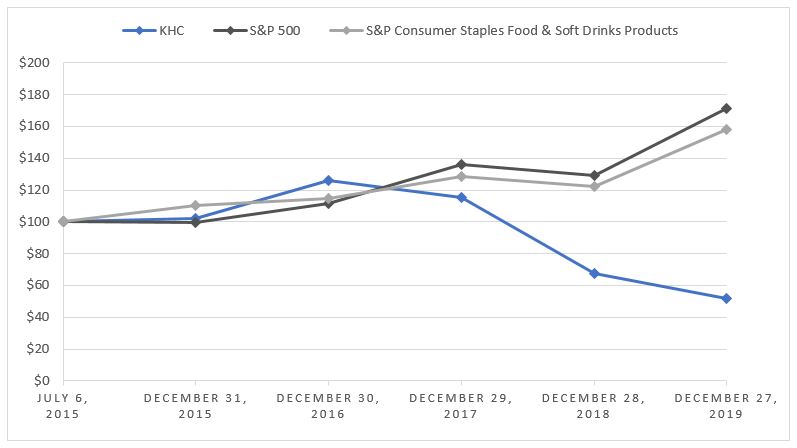
| Kraft Heinz | S&P 500 | S&P Consumer Staples Food and Soft Drink Products | |||||||||
| July 6, 2015 | $ | 100.00 | $ | 100.00 | $ | 100.00 | |||||
| December 31, 2015 | 102.07 | 99.85 | 110.18 | ||||||||
| December 30, 2016 | 125.99 | 111.79 | 114.98 | ||||||||
| December 29, 2017 | 115.44 | 136.20 | 128.53 | ||||||||
| December 28, 2018 | 67.49 | 129.11 | 121.93 | ||||||||
| December 27, 2019 | 51.78 | 171.50 | 157.80 |
The above performance graph shall not be deemed to be “soliciting material” or to be “filed” with the SEC or subject to Regulation 14A or 14C, or to the liabilities of Section 18 of the Exchange Act.
Issuer Purchases of Equity Securities During the Three Months Ended December 28, 2019
Our share repurchase activity in the three months ended December 28, 2019 was:
| Total Number of Shares Purchased**(a)** | Average Price Paid Per Share | Total Number of Shares Purchased as Part of Publicly Announced Plans or Programs**(b)** | Approximate Dollar Value of Shares that May Yet Be Purchased Under the Plans or Programs | |||||||||||
| 9/29/2019 - 11/2/2019 | 15,166 | $ | 27.84 | — | $ | — | ||||||||
| 11/3/2019 - 11/30/2019 | 128,625 | 32.19 | — | — | ||||||||||
| 12/1/2019 - 12/28/2019 | 43,491 | 31.48 | — | — | ||||||||||
| Total | 187,282 | — |
| (a) | Includes the following types of share repurchase activity, when they occur: (1) shares repurchased in connection with the exercise of stock options (including periodic repurchases using option exercise proceeds), (2) shares withheld for tax liabilities associated with the vesting of restricted stock units, and (3) shares repurchased related to employee benefit programs (including our annual bonus swap program) or to offset the dilutive effect of equity issuances. |
| (b) | We do not have any publicly announced share repurchase plans or programs. |
Item 6. Selected Financial Data.
The following table presents selected consolidated financial data for the last five fiscal years. Our fiscal years 2019, 2018, 2017, and 2016 include a full year of Kraft Heinz results. Our fiscal year 2015 includes a full year of Heinz results and post-merger Kraft results.
| (Unaudited) | |||||||||||||||||||
| December 28, 2019 (52 weeks) | December 29, 2018 (52 weeks) | December 30, 2017 (52 weeks) | December 31, 2016 (52 weeks)****(g) | January 3, 2016 (53 weeks) | |||||||||||||||
| (in millions, except per share data) | |||||||||||||||||||
| Period Ended: | |||||||||||||||||||
| Net sales(a) | $ | 24,977 | $ | 26,268 | $ | 26,076 | $ | 26,300 | $ | 18,318 | |||||||||
| Income/(loss)(b)(c)(d) | 1,933 | (10,254 | ) | 10,932 | 3,606 | 614 | |||||||||||||
| Income/(loss) attributable to common shareholders(b)(c)(d) | $ | 1,935 | (10,192 | ) | 10,941 | 3,416 | (299 | ) | |||||||||||
| Income/(loss) per common share: | |||||||||||||||||||
| Basic(b)(c)(d) | $ | 1.59 | (8.36 | ) | 8.98 | 2.81 | (0.38 | ) | |||||||||||
| Diluted(b)(c)(d) | 1.58 | (8.36 | ) | 8.91 | 2.78 | (0.38 | ) | ||||||||||||
| (Unaudited) | |||||||||||||||||||
| December 28, 2019 | December 29, 2018 | December 30, 2017 | December 31, 2016 | January 3, 2016 | |||||||||||||||
| (in millions, except per share data) | |||||||||||||||||||
| As of: | |||||||||||||||||||
| Total assets(c) | 101,450 | 103,461 | 120,092 | 120,617 | 123,110 | ||||||||||||||
| Long-term debt(e) | 28,216 | 30,770 | 28,308 | 29,712 | 25,148 | ||||||||||||||
| Redeemable preferred stock(f) | — | — | — | — | 8,320 | ||||||||||||||
| Cash dividends per common share | 1.60 | 2.50 | 2.45 | 2.35 | 1.70 |
| (a) | The increase in net sales in 2016 compared to the prior year was primarily driven by the 2015 Merger. |
| (b) | The increases in income/(loss), income/(loss) attributable to common shareholders, and basic and diluted income/(loss) per common share in 2017 compared to 2016 were primarily driven by U.S. Tax Reform, which was enacted in December 2017. See Note 10, Income Taxes, in Item 8, Financial Statements and Supplementary Data, for additional information. |
| (c) | The decreases in income/(loss), income/(loss) attributable to common shareholders, and basic and diluted income/(loss) per common share in 2018 compared to 2017, and the decrease in total assets from December 30, 2017 to December 29, 2018, were primarily driven by non-cash impairment losses in 2018. See Note 9, Goodwill and Intangible Assets, in Item 8, Financial Statements and Supplementary Data, for additional information. |
| (d) | The increases in income/(loss), income/(loss) attributable to common shareholders, and basic and diluted income/(loss) per common share in 2019 compared to 2018, were primarily driven by higher non-cash impairment losses in 2018. See Note 9, Goodwill and Intangible Assets, in Item 8, Financial Statements and Supplementary Data, for additional information. |
| (e) | Amounts exclude the current portion of long-term debt. |
| (f) | On June 7, 2016, we redeemed all outstanding shares of our 9.00% cumulative compounding preferred stock, Series A. See Equity and Dividends in Item 7*, Management’s Discussion and Analysis of Financial Condition and Results of Operations,* along with Note 19, Debt, and Note 20, Capital Stock, in Item 8, Financial Statements and Supplementary Data, in our Annual Report on Form 10-K for the year ended December 29, 2018 for additional information. |
| (g) | On December 9, 2016, our Board of Directors approved a change to our fiscal year end from Sunday to Saturday. Effective December 31, 2016, we operate on a 52- or 53-week fiscal year ending on the last Saturday in December in each calendar year. In prior years, we operated on a 52- or 53-week fiscal year ending the Sunday closest to December 31. As a result, we occasionally have a 53rd week in a fiscal year. Our 2015 fiscal year includes a 53rd week of activity. |
Item 7. Management’s Discussion and Analysis of Financial Condition and Results of Operations.
Overview
Description of the Company:
We manufacture and market food and beverage products, including condiments and sauces, cheese and dairy, meals, meats, refreshment beverages, coffee, and other grocery products throughout the world.
We manage and report our operating results through four segments. We have three reportable segments defined by geographic region: United States, Canada, and EMEA. Our remaining businesses are combined and disclosed as “Rest of World.” Rest of World comprises two operating segments: Latin America and APAC.
During the third quarter of 2019, certain organizational changes were announced that will impact our future internal reporting and reportable segments. As a result of these changes, we plan to combine our EMEA, Latin America, and APAC zones to form the International zone. The International zone will be a reportable segment along with the United States and Canada in 2020. We also plan to move our Puerto Rico business from the Latin America zone to the United States zone to consolidate and streamline the management of our product categories and supply chain. These changes will be effective in the first quarter of 2020.
See Note 22, Segment Reporting, in Item 8, Financial Statements and Supplementary Data, to the consolidated financial statements for our financial information by segment.
See below for discussion and analysis of our financial condition and results of operations for 2019 compared to 2018. See Item 7, Management’s Discussions and Analysis of Financial Condition and Results of Operations, in our Annual Report on Form 10-K for the year ended December 29, 2018 for a detailed discussion of our financial condition and results of operations for 2018 compared to 2017.
Items Affecting Comparability of Financial Results
Impairment Losses:
Our 2019 results of operations reflect goodwill impairment losses of $1.2 billion and intangible asset impairment losses of $702 million compared to goodwill impairment losses of $7.0 billion and intangible asset impairment losses of $8.9 billion in 2018. See Note 9, Goodwill and Intangible Assets, in Item 8, Financial Statements and Supplementary Data, for additional information on these impairment losses.
Results of Operations
We disclose in this report certain non-GAAP financial measures. These non-GAAP financial measures assist management in comparing our performance on a consistent basis for purposes of business decision-making by removing the impact of certain items that management believes do not directly reflect our underlying operations. For additional information and reconciliations from our consolidated financial statements see Non-GAAP Financial Measures.
Consolidated Results of Operations
Summary of Results:
| December 28, 2019 | December 29, 2018 | % Change | ||||||||
| (in millions, except per share data) | ||||||||||
| Net sales | $ | 24,977 | $ | 26,268 | (4.9 | )% | ||||
| Operating income/(loss) | 3,070 | (10,205 | ) | 130.1 | % | |||||
| Net income/(loss) attributable to common shareholders | 1,935 | (10,192 | ) | 119.0 | % | |||||
| Diluted EPS | 1.58 | (8.36 | ) | 118.9 | % |
Net Sales:
| December 28, 2019 | December 29, 2018 | % Change | ||||||||
| (in millions) | ||||||||||
| Net sales | $ | 24,977 | $ | 26,268 | (4.9 | )% | ||||
| Organic Net Sales(a) | 24,961 | 25,393 | (1.7 | )% |
| (a) | Organic Net Sales is a non-GAAP financial measure. See the Non-GAAP Financial Measures section at the end of this item. |
Fiscal Year 2019 Compared to Fiscal Year 2018:
Net sales decreased 4.9% to $25.0 billion in 2019 compared to $26.3 billion in 2018 primarily due to the unfavorable impacts of foreign currency (1.9 pp) and acquisitions and divestitures (1.3 pp). Organic Net Sales decreased 1.7% to $25.0 billion in 2019 compared to $25.4 billion in 2018 due to unfavorable volume/mix (1.8 pp), partially offset by higher pricing (0.1 pp). Volume/mix was unfavorable in the United States, Rest of World, and EMEA, which was partially offset by growth in Canada. Higher pricing in the United States and Rest of World was partially offset by lower pricing in Canada, while pricing in EMEA was flat.
Net Income/(Loss):
| December 28, 2019 | December 29, 2018 | % Change | ||||||||
| (in millions) | ||||||||||
| Operating income/(loss) | $ | 3,070 | $ | (10,205 | ) | 130.1 | % | |||
| Net income/(loss) attributable to common shareholders | 1,935 | (10,192 | ) | 119.0 | % | |||||
| Adjusted EBITDA(a) | 6,064 | 7,024 | (13.7 | )% |
| (a) | Adjusted EBITDA is a non-GAAP financial measure. See the Non-GAAP Financial Measures section at the end of this item. |
Fiscal Year 2019 Compared to Fiscal Year 2018:
Operating income/(loss) increased 130.1% to income of $3.1 billion in 2019 compared to a loss of $10.2 billion in 2018. This increase was primarily driven by lower impairment losses in the current year. Impairment losses were $1.9 billion in 2019 compared to $15.9 billion in 2018. Excluding the impact of these impairment losses, operating income/(loss) decreased by $762 million primarily due to lower Organic Net Sales, higher supply chain costs, the unfavorable impact of foreign currency (0.8 pp), higher general corporate expenses, and the unfavorable impact of divestitures, partially offset by lower restructuring expenses in the current period. See Note 9, Goodwill and Intangible Assets, in Item 8, Financial Statements and Supplementary Data, for additional information on our impairment losses.
Net income/(loss) attributable to common shareholders increased 119.0% to income of $1.9 billion in 2019 compared to a loss of $10.2 billion in 2018. This change was driven by the operating income/(loss) factors described above (primarily lower impairment losses in 2019 compared to 2018) and favorable impacts in other expense/(income), partially offset by a higher effective tax rate and higher interest expense, detailed as follows.
| • | Other expense/(income) was $952 million of income in 2019 compared to $168 million of income in 2018. This increase was primarily driven by a $420 million net gain on sales of businesses in 2019 compared to a $15 million loss on sale of our South Africa subsidiary in 2018, a $162 million non-cash settlement charge in the prior year related to the wind-up of our Canadian salaried and Canadian hourly defined benefit pension plans, and a $136 million decrease in nonmonetary currency devaluation losses related to our Venezuelan operations as compared to the prior year period. The $420 million net gain on sales of businesses in 2019 consisted of a $249 million gain on the sale of Heinz India Private Limited (“Heinz India”) (“Heinz India Transaction”), a $242 million gain on the sale of certain assets in our natural cheese business in Canada (“Canada Natural Cheese Transaction”), and a $71 million loss on an anticipated sale of a subsidiary within our Rest of World segment. |
| • | The effective tax rate was 27.4% in 2019 on pre-tax income compared to 9.4% in 2018 on a pre-tax loss. The 2019 effective tax rate was higher primarily driven by lower non-deductible goodwill impairments, partially offset by a more favorable geographic mi |
Showing the first 8K of 87K characters. Open the full section
Item 7A. Quantitative and Qualitative Disclosures About Market Risk.
We are exposed to market risks from adverse changes in commodity prices, foreign exchange rates, and interest rates. We monitor and manage these exposures as part of our overall risk management program. Our risk management program focuses on the unpredictability of financial markets and seeks to reduce the potentially adverse effects that volatility in these markets may have on our operating results. We maintain risk management policies that principally use derivative financial instruments to reduce significant, unanticipated fluctuations in earnings and cash flows that may arise from variations in commodity prices, foreign currency exchange rates, and interest rates. We manage market risk by incorporating parameters within our risk management strategy that limit the types of derivative instruments, the derivative strategies we use, and the degree of market risk that we hedge with derivative instruments. See Note 2, Significant Accounting Policies, and Note 13, Financial Instruments, in Item 8, Financial Statements and Supplementary Data, for details of our market risk management policies and the financial instruments used to hedge those exposures.
When we use financial instruments, we are exposed to credit risk that a counterparty might fail to fulfill its performance obligations under the terms of our agreement. We minimize our credit risk by entering into transactions with counterparties with investment grade credit ratings, limiting the amount of exposure we have with each counterparty, and monitoring the financial condition of our counterparties. We maintain a policy of requiring that all significant, non-exchange traded derivative contracts are governed by an International Swaps and Derivatives Association master agreement. By policy, we do not engage in speculative or leveraged transactions, nor do we hold or issue financial instruments for trading purposes.
Effect of Hypothetical 10% Fluctuation in Market Prices:
The potential gain or loss on the fair value of our outstanding commodity contracts, foreign exchange contracts, and cross-currency swap contracts, assuming a hypothetical 10% fluctuation in commodity prices and foreign currency exchange rates, would have been (in millions):
| December 28, 2019 | December 29, 2018 | ||||||
| Commodity contracts | $ | 43 | $ | 38 | |||
| Foreign currency contracts | 73 | 100 | |||||
| Cross-currency swap contracts | 412 | 402 |
It should be noted that any change in the fair value of our derivative contracts, real or hypothetical, would be significantly offset by an inverse change in the value of the underlying hedged items. In relation to foreign currency contracts, this hypothetical calculation assumes that each exchange rate would change in the same direction relative to the U.S. dollar. Our utilization of financial instruments in managing market risk exposures described above is consistent with the prior year. Changes in our portfolio of financial instruments are a function of our results of operations, debt repayments and debt issuances, market effects on debt and foreign currency, and our acquisition and divestiture activities.
Effect of Hypothetical 1% Fluctuation in LIBOR and CDOR:
Based on our current variable rate debt balance as of December 28, 2019, a hypothetical 1% increase in LIBOR and CDOR would increase our annual interest expense by approximately $12 million. The Financial Conduct Authority in the United Kingdom intends to phase out LIBOR by the end of 2021. Given our current variable rate debt outstanding, we do not anticipate a significant impact to our annual interest expense as a result of the transition.
Item 8. Financial Statements and Supplementary Data.
Report of Independent Registered Public Accounting Firm
To the Board of Directors and Shareholders of The Kraft Heinz Company
Opinions on the Financial Statements and Internal Control over Financial Reporting
We have audited the accompanying consolidated balance sheets of The Kraft Heinz Company and its subsidiaries (the “Company”) as of December 28, 2019 and December 29, 2018, and the related consolidated statements of income, of comprehensive income, of equity and of cash flows for each of the three years in the period ended December 28, 2019, including the related notes and financial statement schedule listed in the index appearing under Item 15(a) (collectively referred to as the “consolidated financial statements”). We also have audited the Company's internal control over financial reporting as of December 28, 2019, based on criteria established in Internal Control - Integrated Framework (2013) issued by the Committee of Sponsoring Organizations of the Treadway Commission (COSO).
In our opinion, the consolidated financial statements referred to above present fairly, in all material respects, the financial position of the Company as of December 28, 2019 and December 29, 2018, and the results of its operations and its cash flows for each of the three years in the period ended December 28, 2019 in conformity with accounting principles generally accepted in the United States of America. Also in our opinion, the Company did not maintain, in all material respects, effective internal control over financial reporting as of December 28, 2019, based on criteria established in Internal Control - Integrated Framework (2013) issued by the COSO because material weaknesses in internal control over financial reporting existed as of that date related to the risk assessment component of internal control, as the Company did not appropriately design controls in response to the risk of material misstatement due to changes in their business environment. The risk assessment material weakness gave rise to an additional material weakness as the Company did not design and maintain effective controls over the accounting for supplier contracts and related arrangements.
A material weakness is a deficiency, or a combination of deficiencies, in internal control over financial reporting, such that there is a reasonable possibility that a material misstatement of the annual or interim financial statements will not be prevented or detected on a timely basis. The material weaknesses referred to above are described in Management’s Report on Internal Control Over Financial Reporting appearing under Item 9A. We considered these material weaknesses in determining the nature, timing, and extent of audit tests applied in our audit of the 2019 consolidated financial statements, and our opinion regarding the effectiveness of the Company’s internal control over financial reporting does not affect our opinion on those consolidated financial statements.
Change in Accounting Principle
As discussed in Note 3 to the consolidated financial statements, the Company changed the manner in which it accounts for leases in 2019.
Basis for Opinions
The Company's management is responsible for these consolidated financial statements, for maintaining effective internal control over financial reporting, and for its assessment of the effectiveness of internal control over financial reporting, included in management's report referred to above. Our responsibility is to express opinions on the Company’s consolidated financial statements and on the Company's internal control over financial reporting based on our audits. We are a public accounting firm registered with the Public Company Accounting Oversight Board (United States) (PCAOB) and are required to be independent with respect to the Company in accordance with the U.S. federal securities laws and the applicable rules and regulations of the Securities and Exchange Commission and the PCAOB.
We conducted our audits in accordance with the standards of the PCAOB. Those standards require that we plan and perform the audits to obtain reasonable assurance about whether the consolidated financial statements are free of material misstatement, whether due to error or fraud, and whether effective internal control over financial reporting was maintained in all material respects.
Our audits of the consolidated financial statements included performing procedures to assess the risks of material misstatement of the consolidated financial statements, whether due to error or fraud, and performing procedures that respond to those risks. Such procedures included examining, on a test basis, evidence regarding the amounts and disclosures in the consolidated financial statements. Our audits also included evaluating the accounting principles used and significant estimates made by
management, as well as evaluating the overall presentation of the consolidated financial statements. Our audit of internal control over financial reporting included obtaining an understanding of internal control over financial reporting, assessing the risk that a material weakness exists, and testing and evaluating the design and operating effectiveness of internal control based on the assessed risk. Our audits also included performing such other procedures as we considered necessary in the circumstances. We believe that our audits provide a reasonable basis for our opinions.
Definition and Limitations of Internal Control over Financial Reporting
A company’s internal control over financial reporting is a process designed to provide reasonable assurance regarding the reliability of financial reporting and the preparation of financial statements for external purposes in accordance with generally accepted accounting principles. A company’s internal control over financial reporting includes those policies and procedures that (i) pertain to the maintenance of records that, in reasonable detail, accurately and fairly reflect the transactions and dispositions of the assets of the company; (ii) provide reasonable assurance that transactions are recorded as necessary to permit preparation of financial statements in accordance with generally accepted accounting principles, and that receipts and expenditures of the company are being made only in accordance with authorizations of management and directors of the company; and (iii) provide reasonable assurance regarding prevention or timely detection of unauthorized acquisition, use, or disposition of the company’s assets that could have a material effect on the financial statements.
Because of its inherent limitations, internal control over financial reporting may not prevent or detect misstatements. Also, projections of any evaluation of effectiveness to future periods are subject to the risk that controls may become inadequate because of changes in conditions, or that the degree of compliance with the policies or procedures may deteriorate.
Critical Audit Matters
The critical audit matters communicated below are matters arising from the current period audit of the consolidated financial statements that were communicated or required to be communicated to the audit committee and that (i) relate to accounts or disclosures that are material to the consolidated financial statements and (ii) involved our especially challenging, subjective, or complex judgments. The communication of critical audit matters does not alter in any way our opinion on the consolidated financial statements, taken as a whole, and we are not, by communicating the critical audit matters below, providing separate opinions on the critical audit matters or on the accounts or disclosures to which they relate.
Goodwill Impairment Assessment
As described in Notes 2 and 9 to the consolidated financial statements, the Company’s consolidated goodwill balance was $35.5 billion as of December 28, 2019. Management tests reporting units for impairment annually as
Showing the first 8K of 316K characters. Open the full section
Item 9. Changes in and Disagreements With Accountants on Accounting and Financial Disclosure.
None.
Item 9A. Controls and Procedures.
Evaluation of Disclosure Controls and Procedures
Our management, with the participation of our Chief Executive Officer and Chief Financial Officer, has evaluated the effectiveness of our disclosure controls and procedures (as defined in Rules 13a-15(e) and 15d-15(e) under the Exchange Act) as of December 28, 2019. Based on that evaluation, our Chief Executive Officer and Chief Financial Officer have concluded that as of December 28, 2019, due to the existence of the material weaknesses in our internal control over financial reporting described below, our disclosure controls and procedures were not effective to provide reasonable assurance that the information required to be disclosed in the reports that we file or submit under the Exchange Act is recorded, processed, summarized, and reported within the time periods specified in the SEC’s rules and forms, and that such information is accumulated and communicated to management as appropriate to allow timely decisions regarding required disclosure.
Management’s Report on Internal Control Over Financial Reporting
Management is responsible for establishing and maintaining adequate internal control over financial reporting as defined in Rule 13a-15(f) under the Exchange Act. Our internal control over financial reporting is a process designed to provide reasonable assurance regarding the reliability of financial reporting and the preparation of financial statements for external purposes in accordance with generally accepted accounting principles. Our internal control over financial reporting includes those written policies and procedures that:
| • | pertain to the maintenance of records that, in reasonable detail, accurately and fairly reflect the transactions and dispositions of assets; |
| • | provide reasonable assurance that transactions are recorded as necessary to permit preparation of financial statements in accordance with generally accepted accounting principles; |
| • | provide reasonable assurance that receipts and expenditures are being made only in accordance with management and director authorization; and |
| • | provide reasonable assurance regarding prevention or timely detection of unauthorized acquisition, use, or disposition of assets that could have a material effect on the consolidated financial statements. |
Because of its inherent limitations, internal control over financial reporting may not prevent or detect misstatements. Also, projections of any evaluation of effectiveness to future periods are subject to the risk that controls may become inadequate because of changes in conditions, or that the degree of compliance with the policies or procedures may deteriorate.
Under the supervision and with the participation of management, including our Chief Executive Officer and Chief Financial Officer, we conducted an evaluation of the effectiveness of our internal control over financial reporting as of December 28, 2019 based on the framework described in Internal Control - Integrated Framework (2013) issued by the Committee of Sponsoring Organizations of the Treadway Commission (COSO). Based on this evaluation, our management concluded that we did not maintain effective internal control over financial reporting as of December 28, 2019 due to the material weaknesses described below.
A material weakness is a deficiency, or combination of deficiencies, in internal control over financial reporting, such that there is a reasonable possibility that a material misstatement of our annual or interim financial statements will not be prevented or detected on a timely basis.
As previously disclosed in our Annual Report on Form 10-K for the year ended December 29, 2018, we identified a material weakness in the risk assessment component of internal control as we did not appropriately design controls in response to the risk of misstatement due to changes in our business environment. This material weakness in risk assessment gave rise to the specific control deficiency described below, which we also determined to be a material weakness, and both material weaknesses have not been remediated as of December 28, 2019:
| • | Supplier Contracts and Related Arrangements: We did not design and maintain effective controls over the accounting for supplier contracts and related arrangements. Specifically, certain employees in our procurement organization engaged in misconduct and circumvented controls that included withholding information or directing others to withhold information related to supplier contracts that affected the accounting for certain supplier rebates, incentives, and pricing arrangements, in an attempt to influence the achievement of internal financial targets that became or were perceived to have become increasingly difficult to attain due to changes in our business environment. Additionally, in certain instances, we did not have a sufficient understanding or maintain sufficient documentation of the transaction to determine the appropriate accounting for certain cost and rebate elements and embedded leases. This material weakness resulted in misstatements that were corrected in the restatement included in our Annual Report on Form 10-K for the year ended December 29, 2018. |
Additionally, the material weaknesses described above could result in a misstatement of substantially all account balances or disclosures that would result in a material misstatement of the annual or interim consolidated financial statements that would not be prevented or detected.
PricewaterhouseCoopers LLP, an independent registered public accounting firm that audited the consolidated financial statements included in this Annual Report on Form 10-K, has also audited the effectiveness of our internal control over financial reporting as of December 28, 2019, as stated in their report which appears herein under Item 8, Financial Statements and Supplementary Data.
Remediation Efforts to Address Material Weaknesses
Our management, with oversight from our Audit Committee, is in the process of executing a plan to remediate the material weaknesses described above. This plan includes the implementation of additional controls and procedures to strengthen our internal controls related to our risk assessment component of internal control over financial reporting and supplier contracts and related arrangements. To date, the following actions have been taken towards our remediation plan:
| • | Personnel Actions—A comprehensive disciplinary plan has been implemented for all employees found to have engaged in misconduct, including termination, written warnings, and appropriate training depending on the severity of the misconduct. |
| • | Organizational Enhancements—We have implemented the following organizational enhancements: (i) augmented our procurement finance teams with additional professionals with the appropriate levels of accounting and controls knowledge, experience, and training in the area of supplier contracts and related arrangements; and (ii) realigned reporting lines whereby procurement finance now report directly to the finance organization. |
| • | Procurement Practices—We evaluated our procurement practices and standardized our contract documentation and analyses around procurement contracts. We also updated our global procurement and relevant accounting policies and provided additional training specific to procurement contracts and the relevant accounting considerations. |
| • | Overall Communications—We have reinforced and will continue to reinforce the importance of adherence to internal controls and company policies and procedures through formal communications, town hall meetings, and other employee trainings and will continue to communicate as appropriate. |
The remaining actions outlined in the remediation plan from what had been previously communicated in the Annual Report on Form 10-K for the period ended December 29, 2018 include the following:
| • | Performance Targets—We have identified and are in the process of implementing several performance-based target enhancements as follows: (i) implementing checkpoints to evaluate significant changes in the environment that could adversely impact the attainability of management goals and targets; (ii) reassessing and adjusting the overall balance of performance measures provided to employees to help drive challenging but attainable targets; (iii) enhancing our training and overall communication specific to the Management by Objective (“MBO”) process, including a focus on the process to request relief from previously established MBOs, to help ensure all eligible employees are aware of and understand the overall MBO waiver and relief process; and (iv) reassessing certain employees’ key performance indicators. |
| • | Procurement Practices—We have evaluated our procurement practices and are in the process of implementing improvements to those practices, including: (i) developing a more comprehensive accounting review process and monitoring controls over supplier contracts and related arrangements to ensure transactions are recorded in accordance with generally accepted accounting principles; and (ii) enhancing required communication protocols among all functions involved in the procurement process (e.g., procurement, legal, accounting, and finance) to ensure all relevant parties are involved in the contract review process. |
| • | Training Practices—We delivered a comprehensive global procurement training program that covered supplier contracts and related arrangements, including potential accounting implications during 2019. We are in the process of finalizing the 2020 training plan, including optimizing and enhancing our existing training for new hires and transferees into the procurement organization. |
| • | Procurement Management Software—We completed our evaluation of potential solutions related to procurement management software in order to enhance the identification, tracking, and monitoring of supplier contracts and related arrangements. We will be implementing a contract management solution during fiscal 2020. However, we have designed and are in the process of implementing manual controls to address the control deficiency until the implementation of the system solution. |
We have begun and expect to continue implementing various changes in our internal control over financial reporting to remediate the material weaknesses described above. We continue to make progress on our remediation and our goal is to implement the remaining control improvements related to these material weaknesses during 2020. We will also continue to review, optimize, and enhance our financial reporting controls and procedures. As we continue to evaluate and work to improve our internal control over financial reporting, we may take additional measures to address control deficiencies or we may modify certain of the remediation measures described above. These material weaknesses will not be considered remediated until the applicable remediated controls operate for a sufficient period of time and management has concluded, through testing, that these controls are operating effectively.
Remediation of Previously Reported Material Weakness
As previously disclosed in our Annual Report on Form 10-K for the period ended December 29, 2018, we did not design and maintain effective controls to reassess the level of precision used to review the impairment assessments related to goodwill and indefinite-lived intangible assets as changes in our business environment occurred. Specifically, we did not design and maintain effective controls to reassess the level of precision used in the review of the allocation of cash flow projections to certain brands used as a basis for performing our fourth quarter 2018 interim impairment assessments in response to the significant reduction in, and in certain instances elimination of, the excess fair value over carrying amount of certain brands that resulted from changes in our business environment.
Due to the actions taken by the Company to implement new controls and procedures, management has concluded that this material weakness has been remediated as of December 28, 2019. The actions we took to remediate this material weakness were as follows:
| • | We have enhanced the level of precision at which our internal controls over financial reporting relating to goodwill and indefinite-lived intangible asset impairment assessments are performed. Specifically, we implemented and executed additional procedures to (i) enhance our analysis of forecasted cash flows used in the impairment assessment and (ii) test the accuracy of forecasted cash flow allocations to specific brands. |
Changes in Internal Control Over Financial Reporting
Our Chief Executive Officer and Chief Financial Officer, with other members of management, evaluated the changes in our internal control over financial reporting during the three months ended December 28, 2019. We determined that there were no changes in our internal control over financial reporting during the three months ended December 28, 2019 that have materially affected, or are reasonably likely to materially affect, our internal control over financial reporting.
Item 9B. Other Information.
Not applicable.
PART III
Item 10. Directors, Executive Officers and Corporate Governance.
Information required by this Item 10 is included under the headings “Company Proposals - Proposal 1. Election of Directors,” “Corporate Governance and Board Matters – Delinquent Section 16(a) Reports,” “Corporate Governance and Board Matters – Governance Guidelines and Codes of Conduct,” “Corporate Governance Materials Available on Our Web Site,” and “Board Committees and Membership – Audit Committee” in our definitive Proxy Statement for our Annual Meeting of Shareholders scheduled to be held on May 7, 2020 (“2020 Proxy Statement”). This information is incorporated by reference into this Annual Report on Form 10-K.
Item 11. Executive Compensation.
Information required by this Item 11 is included under the headings “Pay Ratio Disclosure,” “Board Committees and Membership – Compensation Committee,” “Compensation of Non-Employee Directors,” “Compensation Discussion and Analysis,” and “Executive Compensation Tables,” in our 2020 Proxy Statement. This information is incorporated by reference into this Annual Report on Form 10-K.
Item 12. Security Ownership of Certain Beneficial Owners and Management and Related Stockholder.
The number of shares to be issued upon exercise or vesting of awards issued under, and the number of shares remaining available for future issuance under our equity compensation plans at December 28, 2019 were:
| Number of securities to be issued upon exercise of outstanding options, warrants and rights**(1)** | Weighted average exercise price per share of outstanding options, warrants and rights | Number of securities remaining available for future issuance under equity compensation plans (excluding securities reflected in column (a))****(2) | |||||||
| Plan Category | (a) | (b) | (c) | ||||||
| Equity compensation plans approved by security holders | 33,855,210 | $ | 41.22 | — | |||||
| Equity compensation plans not approved by security holders | — | — | — | ||||||
| Total | 33,855,210 | — |
| (1) | Includes the vesting of RSUs. |
| (2) | Excludes shares that are no longer available to be issued as awards under the Kraft Foods Group 2012 Incentive Performance Plan and the HJ Heinz Holding Corp 2013 Omnibus Incentive Plan. We have not issued new awards from these plans since fiscal year ended December 31, 2016. |
Information related to the security ownership of certain beneficial owners and management is included in our 2020 Proxy Statement under the heading “Ownership of Equity Securities” and is incorporated by reference into this Annual Report on Form 10-K.
Item 13. Certain Relationships and Related Transactions, and Director Independence.
Information required by this Item 13 is included under the heading “Corporate Governance and Board Matters - Independence and Related Person Transactions” in our 2020 Proxy Statement. This information is incorporated by reference into this Annual Report on Form 10-K.
Item 14. Principal Accounting Fees and Services.
Information required by this Item 14 is included under the heading “Board Committees and Membership - Audit Committee” in our 2020 Proxy Statement. This information is incorporated by reference into this Annual Report on Form 10-K.
PART IV
Item 15. Exhibits, Financial Statement Schedules.
(a) Index to Consolidated Financial Statements and Schedules
Schedules other than those listed above have been omitted either because such schedules are not required or are not applicable.
(b) The following exhibits are filed as part of, or incorporated by reference into, this Annual Report:
| 23.1 | Consent of PricewaterhouseCoopers LLP.* | |
| 24.1 | Power of Attorney.* | |
| 31.1 | Certification of Chief Executive Officer pursuant to Rule 13a 14(a)/15d 14(a) of the Securities Exchange Act of 1934.* | |
| 31.2 | Certification of Chief Financial Officer pursuant to Rule 13a 14(a)/15d 14(a) of the Securities Exchange Act of 1934.* | |
| 32.1 | Certification of Chief Executive Officer pursuant to 18 U.S.C. 1350, as adopted pursuant to Section 906 of the Sarbanes-Oxley Act of 2002.* | |
| 32.2 | Certification of Chief Financial Officer pursuant to 18 U.S.C. 1350, as adopted pursuant to Section 906 of the Sarbanes-Oxley Act of 2002.* | |
| 101.1 | The following materials from The Kraft Heinz Company’s Annual Report on Form 10-K for the period ended December 28, 2019 formatted in inline XBRL (eXtensible Business Reporting Language): (i) the Consolidated Statements of Income, (ii) the Consolidated Statements of Comprehensive Income, (iii) the Consolidated Balance Sheets, (iv) the Consolidated Statements of Equity, (v) the Consolidated Statements of Cash Flows, (vi) Notes to Consolidated Financial Statements, and (vii) document and entity information.* | |
| 104.1 | The cover page from The Kraft Heinz Company’s Annual Report on Form 10-K for the period ended December 28, 2019, formatted in inline XBRL.* | |
| + | Indicates a management contract or compensatory plan or arrangement. | |
| * | Filed herewith. |
Item 16. Form 10-K Summary.
None.
SIGNATURES
Pursuant to the requirements of Section 13 or 15(d) of the Securities Exchange Act of 1934, the registrant has duly caused this report to be signed on its behalf by the undersigned, thereunto duly authorized.
| The Kraft Heinz Company | |||
| Date: | February 14, 2020 | ||
| By: | /s/ Paulo Basilio | ||
| Paulo Basilio | |||
| Global Chief Financial Officer | |||
| (Principal Financial Officer) |
Pursuant to the requirements of the Securities Exchange Act of 1934, this report has been signed below by the following persons on behalf of the registrant and in the capacities and on the date indicated:
| Signature | Title | Date | ||
| /s/ Miguel Patricio | Chief Executive Officer | February 14, 2020 | ||
| Miguel Patricio | (Principal Executive Officer) | |||
| /s/ Paulo Basilio | Global Chief Financial Officer | February 14, 2020 | ||
| Paulo Basilio | (Duly Authorized Officer and Principal Financial Officer) | |||
| /s/ Vince Garlati | Vice President, Global Controller | February 14, 2020 | ||
| Vince Garlati | (Principal Accounting Officer) |
| Alexandre Behring* | Chairman of the Board | |
| John T. Cahill* | Vice Chairman of the Board | |
| Gregory E. Abel* | Director | |
| Joao M. Castro-Neves* | Director | |
| Feroz Dewan* | Director | |
| Jeanne P. Jackson* | Director | |
| Timothy Kenesey* | Director | |
| Jorge Paulo Lemann* | Director | |
| John C. Pope* | Director | |
| Alexandre Van Damme* | Director | |
| George Zoghbi* | Director |
| *By: | /s/ Paulo Basilio |
| Paulo Basilio | |
| Attorney-In-Fact | |
| February 14, 2020 |
The Kraft Heinz Company
Valuation and Qualifying Accounts
For the Years Ended December 28, 2019, December 29, 2018 and December 30, 2017
(in millions)
| Additions | Deductions | ||||||||||||||||||
| Description | Balance at Beginning of Period | Charged to Costs and Expenses | Charged to Other Accounts**(a)** | Write-offs and Reclassifications | Balance at End of Period | ||||||||||||||
| Year ended December 28, 2019 | |||||||||||||||||||
| Allowances related to trade accounts receivable | $ | 24 | $ | 11 | $ | — | $ | (2 | ) | $ | 33 | ||||||||
| Allowances related to deferred taxes | 81 | 31 | — | — | 112 | ||||||||||||||
| $ | 105 | $ | 42 | $ | — | $ | (2 | ) | $ | 145 | |||||||||
| Year ended December 29, 2018 | |||||||||||||||||||
| Allowances related to trade accounts receivable | $ | 23 | $ | 8 | $ | — | $ | (7 | ) | $ | 24 | ||||||||
| Allowances related to deferred taxes | 80 | 1 | — | — | 81 | ||||||||||||||
| $ | 103 | $ | 9 | $ | — | $ | (7 | ) | $ | 105 | |||||||||
| Year ended December 30, 2017 | |||||||||||||||||||
| Allowances related to trade accounts receivable | $ | 20 | $ | 8 | $ | 1 | $ | (6 | ) | $ | 23 | ||||||||
| Allowances related to deferred taxes | 89 | (9 | ) | — | — | 80 | |||||||||||||
| $ | 109 | $ | (1 | ) | $ | 1 | $ | (6 | ) | $ | 103 |
| (a) | Primarily relates to acquisitions and currency translation. |
S-1