 filings.tools
Kraft Heinz 10-K 2022-12-31
Filed 2023-02-16. 23 sections, 593K characters. Original on sec.gov · Markdown · JSON
Cover and table of contents
UNITED STATES
SECURITIES AND EXCHANGE COMMISSION
WASHINGTON, D.C. 20549
FORM 10-K
(Mark One)
| ☒ | ANNUAL REPORT PURSUANT TO SECTION 13 OR 15(d) OF THE SECURITIES EXCHANGE ACT OF 1934 |
For the fiscal year ended December 31, 2022
or
| ☐ | TRANSITION REPORT PURSUANT TO SECTION 13 OR 15(d) OF THE SECURITIES EXCHANGE ACT OF 1934 |
For the transition period from __________ to __________
Commission File Number 001-37482

The Kraft Heinz Company
(Exact name of registrant as specified in its charter)
| Delaware | 46-2078182 | |||||||||||||
| (State or other jurisdiction of incorporation or organization) | (I.R.S. Employer Identification No.) | |||||||||||||
| One PPG Place, | Pittsburgh, | Pennsylvania | 15222 | |||||||||||
| (Address of Principal Executive Offices) | (Zip Code) |
Registrant’s telephone number, including area code: (412) 456-5700
Securities registered pursuant to Section 12(b) of the Act:
| Title of each class | Trading Symbol | Name of exchange on which registered | ||||||
| Common stock, $0.01 par value | KHC | The Nasdaq Stock Market LLC |
Securities registered pursuant to Section 12(g) of the Act:
None.
Indicate by check mark if the registrant is a well-known seasoned issuer, as defined in Rule 405 of the Securities Act. Yes ☐ No ☒
Indicate by check mark if the registrant is not required to file reports pursuant to Section 13 or Section 15(d) of the Act. Yes ☐ No ☒
Indicate by check mark whether the registrant (1) has filed all reports required to be filed by Section 13 or 15(d) of the Securities Exchange Act of 1934 during the preceding 12 months (or for such shorter period that the registrant was required to file such reports), and (2) has been subject to such filing requirements for the past 90 days. Yes ☒ No ☐
Indicate by check mark whether the registrant has submitted electronically every Interactive Data File required to be submitted pursuant to Rule 405 of Regulation S-T (§ 232.405 of this chapter) during the preceding 12 months (or for such shorter period that the registrant was required to submit such files). Yes ☒ No ☐
Indicate by check mark whether the registrant is a large accelerated filer, an accelerated filer, a non-accelerated filer, a smaller reporting company, or an emerging growth company. See the definitions of “large accelerated filer,” “accelerated filer,” “smaller reporting company,” and “emerging growth company” in Rule 12b-2 of the Exchange Act.
| Large accelerated filer | ☒ | Accelerated filer | ☐ | ||||||||||||||||||||
| Non-accelerated filer | ☐ | Smaller reporting company | ☐ | Emerging growth company | ☐ |
If an emerging growth company, indicate by check mark if the registrant has elected not to use the extended transition period for complying with any new or revised financial accounting standards provided pursuant to Section 13(a) of the Exchange Act. ☐
Indicate by check mark whether the registrant has filed a report on and attestation to its management’s assessment of the effectiveness of its internal control over financial reporting under Section 404(b) of the Sarbanes-Oxley Act (15 U.S.C. 7262(b)) by the registered public accounting firm that prepared or issued its audit report. ☒
Indicate by check mark whether the registrant is a shell company (as defined in Rule 12b-2 of the Exchange Act). Yes ☐ No ☒
The aggregate market value of the shares of common stock held by non-affiliates of the registrant, computed by reference to the closing price of such stock as of the last business day of the registrant’s most recently completed second quarter, was approximately $34.6 billion. As of February 11, 2023, there were 1,225,003,377 shares of the registrant’s common stock outstanding.
Documents Incorporated by Reference
Portions of the registrant's definitive proxy statement to be filed with the Securities and Exchange Commission in connection with its annual meeting of stockholders expected to be held on May 4, 2023 are incorporated by reference into Part III hereof.
Table of Contents
Unless the context otherwise requires, the terms “we,” “us,” “our,” “Kraft Heinz,” and the “Company” each refer to The Kraft Heinz Company and all of its consolidated subsidiaries.
Forward-Looking Statements
This Annual Report on Form 10-K contains a number of forward-looking statements. Words such as “anticipate,” “reflect,” “invest,” “see,” “make,” “expect,” “give,” “deliver,” “drive,” “believe,” “improve,” “assess,” “reassess,” “remain,” “evaluate,” “grow,” “will,” “plan,” “intend,” and variations of such words and similar future or conditional expressions are intended to identify forward-looking statements. These forward-looking statements include, but are not limited to, statements regarding our plans, impacts of accounting standards and guidance, growth, legal matters, taxes, costs and cost savings, impairments, and dividends. These forward-looking statements reflect management’s current expectations and are not guarantees of future performance and are subject to a number of risks and uncertainties, many of which are difficult to predict and beyond our control.
Important factors that may affect our business and operations and that may cause actual results to differ materially from those in the forward-looking statements include, but are not limited to, operating in a highly competitive industry; our ability to correctly predict, identify, and interpret changes in consumer preferences and demand, to offer new products to meet those changes, and to respond to competitive innovation; changes in the retail landscape or the loss of key retail customers; changes in our relationships with significant customers or suppliers, or in other business relationships; our ability to maintain, extend, and expand our reputation and brand image; our ability to leverage our brand value to compete against private label products; our ability to drive revenue growth in our key product categories or platforms, increase our market share, or add products that are in faster-growing and more profitable categories; product recalls or other product liability claims; climate change and legal or regulatory responses; our ability to identify, complete, or realize the benefits from strategic acquisitions, divestitures, alliances, joint ventures, or investments; our ability to successfully execute our strategic initiatives; the impacts of our international operations; our ability to protect intellectual property rights; our ability to realize the anticipated benefits from prior or future streamlining actions to reduce fixed costs, simplify or improve processes, and improve our competitiveness; the influence of our largest stockholder; our level of indebtedness, as well as our ability to comply with covenants under our debt instruments; additional impairments of the carrying amounts of goodwill or other indefinite-lived intangible assets; foreign exchange rate fluctuations; volatility in commodity, energy, and other input costs; volatility in the market value of all or a portion of the commodity derivatives we use; compliance with laws and regulations and related legal claims or regulatory enforcement actions; failure to maintain an effective system of internal controls; a downgrade in our credit rating; the impact of sales of our common stock in the public market; our ability to continue to pay a regular dividend and the amounts of any such dividends; disruptions in the global economy caused by geopolitical conflicts, including the ongoing conflict between Russia and Ukraine; unanticipated business disruptions and natural events in the locations in which we or our customers, suppliers, distributors, or regulators operate; economic and political conditions in the United States and various other nations where we do business (including inflationary pressures, general economic slowdown, or recession); changes in our management team or other key personnel and our ability to hire or retain key personnel or a highly skilled and diverse global workforce; our dependence on information technology and systems, including service interruptions, misappropriation of data, or breaches of security; increased pension, labor, and people-related expenses; changes in tax laws and interpretations; volatility of capital markets and other macroeconomic factors; and other factors. For additional information on these and other factors that could affect our forward-looking statements, see Item 1A, Risk Factors. We disclaim and do not undertake any obligation to update, revise, or withdraw any forward-looking statement in this report, except as required by applicable law or regulation.
PART I
Item 1. Business.
General
We are driving transformation at The Kraft Heinz Company (Nasdaq: KHC), inspired by our Purpose, Let’s Make Life Delicious. Consumers are at the center of everything we do. With 2022 net sales of approximately $26 billion, we are committed to growing our iconic and emerging food and beverage brands on a global scale. We leverage our scale and agility to unleash the full power of Kraft Heinz across a portfolio of six consumer-driven product platforms. As global citizens, we’re dedicated to making a sustainable, ethical impact while helping to feed the world in healthy, responsible ways.
On July 2, 2015, through a series of transactions, we consummated the merger of Kraft Foods Group, Inc. (“Kraft”) with and into a wholly-owned subsidiary of H.J. Heinz Holding Corporation (“Heinz”) (the “2015 Merger”). At the closing of the 2015 Merger, Heinz was renamed The Kraft Heinz Company, and H. J. Heinz Company changed its name to Kraft Heinz Foods Company.
Before the consummation of the 2015 Merger, Heinz was controlled by Berkshire Hathaway Inc. (“Berkshire Hathaway”) and 3G Global Food Holdings, LP (“3G Global Food Holdings” and, together with its affiliates, “3G Capital”), following their acquisition of H. J. Heinz Company on June 7, 2013 (the “2013 Heinz Acquisition”).
We operate on a 52- or 53-week fiscal year ending on the last Saturday in December in each calendar year. Unless the context requires otherwise, references to years and quarters contained herein pertain to our fiscal years and fiscal quarters. Our 2022 fiscal year was a 53-week period that ended on December 31, 2022, our 2021 fiscal year was a 52-week period that ended on December 25, 2021, and our 2020 fiscal year was a 52-week period that ended on December 26, 2020.
Reportable Segments:
In the second quarter of 2022, our internal reporting and reportable segments changed. We combined our United States and Canada zones to form the North America zone as a result of previously announced organizational changes, which are intended to advance and support our long-term growth plans by streamlining and synergizing our United States and Canada businesses. Subsequently, we manage and report our operating results through two reportable segments defined by geographic region: North America and International. We have reflected this change in all historical periods presented.
See Note 20, Segment Reporting, in Item 8, Financial Statements and Supplementary Data, for our geographic financial information by segment.
Resources
Trademarks and Intellectual Property:
Our trademarks are material to our business and are among our most valuable assets. Depending on the country, trademarks generally remain valid for as long as they are in use or their registration status is maintained. Trademark registrations generally are for renewable, fixed terms. Significant trademarks by segment based on net sales in 2022 were:
| Majority Owned and Licensed Trademarks | ||||||||
| North America | Kraft, Oscar Mayer, Heinz, Philadelphia, Lunchables, Velveeta, Capri Sun, Maxwell House, Ore-Ida, Kool-Aid, Jell-O* | |||||||
| International | Heinz, ABC, Master, Kraft, Quero, Golden Circle, Wattie’s, Plasmon, Pudliszki |
*Used under license.
We sell certain products under brands we license from third parties. In 2022, brands used under licenses from third parties included Capri Sun packaged drink pouches for sale in the United States. We also grant certain licenses to third parties to use our intellectual property rights in select jurisdictions. In 2021, in our agreements with an affiliate of Groupe Lactalis (“Lactalis”), related to the sale of certain assets in our global cheese business, we each granted the other party various licenses to use certain of our and their respective intellectual property rights in perpetuity, including perpetual licenses for the Kraft and Velveeta brands for certain cheese products.
We also own numerous patents worldwide. We consider our portfolio of patents, patent applications, patent licenses under patents owned by third parties, proprietary trade secrets, technology, know-how processes, and related intellectual property rights to be material to our operations. Patents, issued or applied for, cover inventions ranging from packaging techniques to processes relating to specific products and to the products themselves. While our patent portfolio is material to our business, the loss of one patent or a group of related patents would not have a material adverse effect on our business.
Our issued patents extend for varying periods according to the date of the patent application filing or grant and the legal term of patents in the various countries where patent protection is obtained. The actual protection afforded by a patent, which can vary from country to country, depends upon the type of patent, the scope of its coverage as determined by the patent office or courts in the country, and the availability of legal remedies in the country.
Raw Materials and Packaging:
We manufacture (and contract for the manufacture of) our products from a wide variety of raw materials. We purchase and use large quantities of commodities, including dairy products, meat products, soybean and vegetable oils, tomatoes, coffee beans, sugar and other sweeteners, other fruits and vegetables, corn products, wheat products, and potatoes, to manufacture our products. In addition, we purchase and use significant quantities of resins, fiberboard, metals, and cardboard to package our products, and we use electricity, diesel fuel, and natural gas in the manufacturing and distribution of our products. For commodities that we use across many of our product categories, such as corrugated paper and energy, we coordinate sourcing requirements and centralize procurement to leverage our scale. In addition, some of our product lines and brands separately source raw materials that are specific to their operations. We source these commodities from a variety of providers, including large, international producers and smaller, local, independent sellers. Where appropriate, we seek to establish preferred purchaser status and have developed strategic partnerships with many of our suppliers with the objective of achieving favorable pricing and dependable supply for many of our commodities. The prices of raw materials that we use in our products are affected by external factors, such as global competition for resources, currency fluctuations, severe weather or global climate change, pandemics, geopolitical conflicts, consumer, industrial, or investment demand, and changes in governmental regulation and trade, tariffs, alternative energy, and agricultural programs. In 2022, we continued to experience higher commodity costs and supply chain costs, including procurement, logistics, and manufacturing costs, largely due to inflationary pressures. We expect these costs to continue to increase and inflation to remain elevated through 2023.
Our procurement teams monitor worldwide supply and cost trends so we can obtain ingredients and packaging needed for production at competitive prices. Although the prices of our principal raw materials can be expected to fluctuate, we believe there will be an adequate supply of the raw materials we use and that they are generally available from numerous sources. We use a range of hedging techniques in an effort to limit the impact of price fluctuations on many of our principal raw materials. However, we do not fully hedge against changes in commodity prices, and our hedging strategies may not protect us from increases in specific raw material costs. We actively monitor changes to commodity costs so that we can seek to mitigate the effect through pricing and other operational measures.
Research and Development
Our research and development efforts focus on achieving the following four objectives:
-
product innovations, renovations, and new technologies to meet changing consumer needs, support our environmental and sustainability goals, and drive growth;
-
world-class and uncompromising food safety, quality, and consistency;
-
superior, customer-preferred product and package performance; and
-
continuous process, product, and supply chain optimization.
Competition
Our products are sold in highly competitive marketplaces, which continue to experience increased concentration and the growing presence of e-commerce retailers, large-format retailers, and discounters. Our competitors include large national and international food and beverage companies and numerous local and regional companies. We compete with both branded and private label products sold by retailers, wholesalers, and cooperatives. We compete on the basis of product innovation, price, product quality, nutritional value, service, taste, convenience, brand recognition and loyalty, effectiveness of marketing and distribution, promotional activity, and the ability to identify and satisfy changing consumer preferences. Improving our market position or introducing new products requires substantial advertising and promotional expenditures.
Sales
Sales and Customers:
Our products are sold through our own sales organizations and through independent brokers, agents, and distributors to chain, wholesale, cooperative, and independent grocery accounts; convenience, value, and club stores; pharmacies and drug stores; mass merchants; foodservice distributors; and institutions, including hotels, restaurants, bakeries, hospitals, health care facilities, and government agencies. Our products are also sold online through various e-commerce platforms and retailers.
We have key customers in different regions around the world. In 2022, the five largest customers in our North America segment accounted for approximately 46% of North America segment net sales and the five largest customers in our International segment accounted for approximately 14% of International segment net sales. Our largest customer, Walmart Inc., represented approximately 21% of our net sales in 2022 and approximately 22% of our net sales in each of 2021 and 2020. Both of our segments have sales to Walmart Inc.
We manage our sales portfolio through six consumer-driven product platforms. A platform is a lens created for the portfolio based on a grouping of real consumer needs and includes the following for Kraft Heinz: Taste Elevation, Fast Fresh Meals, Easy Meals Made Better, Real Food Snacking, Flavorful Hydration, and Easy Indulgent Desserts. The platforms are modular and configurable by reportable segment and market. Further, each platform is assigned a role within our business to help inform our resource allocation and investment decisions, which are made at the reportable segment level. These roles include: Grow, Energize, and Stabilize. The role of a platform may also vary by reportable segment and market. The platform approach helps us to manage our business efficiently, including the oversight of our various product categories and brands, and transforms the way we plan for our growth.
Net Sales by Platform:
Net sales by platform as a percentage of consolidated net sales for the periods presented were:
| December 31, 2022 | December 25, 2021 | December 26, 2020 | |||||||||||||||
| Taste Elevation | 31 | % | 28 | % | 26 | % | |||||||||||
| Fast Fresh Meals | 23 | % | 25 | % | 26 | % | |||||||||||
| Easy Meals Made Better | 20 | % | 19 | % | 19 | % | |||||||||||
| Real Food Snacking | 5 | % | 7 | % | 9 | % | |||||||||||
| Flavorful Hydration | 8 | % | 7 | % | 6 | % | |||||||||||
| Easy Indulgent Desserts | 4 | % | 4 | % | 4 | % | |||||||||||
| Other | 9 | % | 10 | % | 10 | % |
Net Sales by Product Category:
The product categories that contributed 10% or more to consolidated net sales in any of the periods presented were:
| December 31, 2022 | December 25, 2021 | December 26, 2020 | |||||||||||||||
| Condiments and sauces | 31 | % | 28 | % | 26 | % | |||||||||||
| Cheese and dairy | 15 | % | 19 | % | 20 | % | |||||||||||
| Ambient foods | 12 | % | 11 | % | 11 | % | |||||||||||
| Frozen and chilled foods | 11 | % | 10 | % | 10 | % | |||||||||||
| Meats and seafood | 10 | % | 10 | % | 10 | % |
Seasonality
Although crops constituting certain of our raw food ingredients are harvested on a seasonal basis, the majority of our products are produced throughout the year.
Seasonal factors inherent in our business change the demand for products, including holidays, changes in seasons, or other annual events. While these factors influence our quarterly net sales, operating income/(loss), and cash flows at the product level, unless the timing of such events shift period-over-period (e.g., a shift in Easter timing), this seasonality does not typically have a significant effect on our consolidated results of operations or segment results.
Government Regulation
The manufacture and sale of consumer food and beverage products is highly regulated. Our business operations, including the production, transportation, storage, distribution, sale, display, advertising, marketing, labeling, quality, and safety of our products and their ingredients, and our occupational safety, health, and privacy practices, are subject to various laws and regulations. In the United States, our activities are subject to regulation by various federal government agencies, including the Food and Drug Administration, Department of Agriculture, Federal Trade Commission, Department of Labor, Department of Commerce, and Environmental Protection Agency, as well as various state and local agencies. We are also subject to numerous laws and regulations outside of the United States in markets where our products are manufactured, distributed, or sold, including laws and regulations governing food safety, health and safety, anti-corruption, and data privacy. In our business dealings, we are also required to comply with the U.S. Foreign Corrupt Practices Act (“FCPA”), the U.K. Bribery Act, the U.S. Trade Sanctions Reform and Export Enhancement Act, and various other anti-corruption regulations in the regions in which we operate. We rely on legal and operational compliance programs, as well as in-house and outside counsel, to guide our businesses in complying with applicable laws and regulations. In addition, regulatory regime changes may add cost and complexity to our compliance efforts.
Environmental Regulation:
Our activities throughout the world are highly regulated and subject to government oversight regarding environmental matters. Various laws concerning the handling, storage, and disposal of hazardous materials and the operation of facilities in environmentally sensitive locations may impact aspects of our operations.
In the United States, where a significant portion of our business operates, these laws and regulations include the Clean Air Act, the Clean Water Act, the Resource Conservation and Recovery Act, and the Comprehensive Environmental Response, Compensation, and Liability Act (“CERCLA”). CERCLA imposes joint and several liability on each potentially responsible party. We are involved in a number of active proceedings in the United States under CERCLA (and other state actions under similar legislation) related to certain closed, inactive, or divested operations for which we retain liability.
As of December 31, 2022, we had accrued an amount we deemed appropriate for environmental remediation. Based on information currently available, we believe that the ultimate resolution of existing environmental remediation actions and our general compliance with environmental laws and regulations will not have a material effect on our earnings or financial condition. However, it is difficult to predict with certainty the potential impact of future compliance efforts and environmental remedial actions and, thus, future costs associated with such matters may exceed current reserves.
Human Capital Management
We are driven by our Purpose, our Vision—To sustainably grow by delighting more consumers globally, and our Values—We are consumer obsessed, We dare to do better every day, We champion great people, We demand diversity, We do the right thing, and We own it. We recognize that a strong company culture is vital to our overall success. Our Purpose, Vision, and Values are the foundation upon which our culture is built. They represent the expectations we have for ourselves and the environment we aspire to create for our Company.
Our people are at the heart of who we are at Kraft Heinz. We drive growth through development opportunities, career ownership, and autonomy and recognize and reward outstanding performance at every level, creating a true spirit of meritocracy. We strive to channel our employees’ passion, curiosity, and attitude to make an impact on our future and our legacy by leading as learners, acting as owners, and being change agents. Our Board of Directors (“Board”), through the Human Capital and Compensation Committee, oversees our human resources strategy, key policies, and our 2025 diversity, inclusion, and belonging aspirations.
Engagement and Retention:
We are committed to attracting, developing, and retaining diverse, world-class talent and creating an engaging and inclusive culture that embodies our Purpose, Vision, and Values. As of December 31, 2022, Kraft Heinz had approximately 37,000 employees globally. Driven by our Value We champion great people, we support our employees’ health, safety, and professional development and reward outstanding performance at every level. Our compensation, benefits, recognition, and LiveWell programs are designed to attract and engage highly skilled talent, meet individual and family needs, and inspire, celebrate, and engage our people and teams through active listening channels.
Guided by our Values, we conduct a global engagement survey annually to provide employees with an opportunity to share anonymous feedback with management across a variety of topic areas. The results, and comments are reviewed by the Board, senior leadership, managers, and human resources to help determine where changes are needed to support our people and teams.
Wellbeing and Safety:
Our employees’ health, safety, and wellbeing are a top priority. We establish and administer company-wide policies and processes to protect the health, safety, and security of our employees, subcontractors, and all those who visit our facilities, and to comply with applicable regulations. We review and monitor our performance closely to drive continuous improvement. To help us evaluate how effective our safety efforts are in lowering incidents rates, we use a Total Recordable Incident Rate (“TRIR”). TRIR is a medical incident rate based on the U.S. Occupational Safety and Health Administration (OSHA) record-keeping criteria (injuries per 200,000 hours). Our TRIR globally was 0.53 in 2022 and 0.62 in 2021.
Our global LiveWell program addresses physical, emotional, financial, and social health and wellbeing. We champion the LiveWell program’s holistic approach to wellbeing with enhanced programs, including healthcare benefits, disability, and employee assistance initiatives.
Diversity, Equity, Inclusion, and Belonging:
We live our Value of We demand diversity by focusing on three strategic areas: hiring and growing talent from diverse backgrounds and perspectives, developing inclusive leaders, and tracking and reporting our progress. Our Global Inclusion Council has been established to create strategic accountability for results. It also provides governance and oversight of reporting on diversity efforts and initiatives. The Council is comprised of executive leaders and members of the Board. In 2021, we shared our 2025 diversity, inclusion, and belonging aspirations, which include that 50% of our global management positions be filled by women and 30% of our salaried U.S. employee population identify as people of color. As of December 31, 2022:
-
41% of employees in management positions globally identified as women;
-
28% of salaried employees in the U.S. identified as people of color;
-
40% of our Executive Leadership Team identified as women; and
-
80% of our Executive Leadership Team identified as people of color.
As we work to meet our 2025 aspirations, we are focused on:
-
Hiring and Growing Talent from Diverse Backgrounds and Perspectives through expanded recruiting partnerships with Historically Black Colleges and Universities and training and leveraging artificial intelligence in our hiring process to reduce bias. In addition, our Business Resource Groups (BRGs) offer learning and development opportunities and create a network of support for employees.
-
Developing Inclusive Leaders through an interactive learning experience for managers on interrupting bias in our Organizational People Review process and their role in creating an inclusive environment.
-
Tracking and Reporting Our Progress year over year through oversight by the Kraft Heinz Global Inclusion Council.
Learning and Development:
Through Kraft Heinz Ownerversity, we provide learning and development offerings to employees via live and virtual learning experiences. These offerings enable employees to execute with excellence in their roles, accelerate their learning curves, and grow great careers through continuous learning. With Ownerversity’s targeted platforms, employees can focus on timely and topical development areas including leadership, management excellence, functional capabilities, and diversity, equity, inclusion, and belonging. In 2022, our global women’s accelerator program, The WE Network, won a Brandon Hall Gold Award for Best Advance in Leadership Development for Women.
Rewards and Compensation:
Our Total Rewards strategy is designed to provide an array of meaningful and flexible programs for our diverse workforce. Total Rewards includes compensation elements of salary and wages and incentives, healthcare, savings and insurance plans, wellbeing plans, employee recognition programs, and other voluntary elected benefits. We aim for global consistency while respecting local market practices. The plans are designed to be market competitive and data-driven to promote our high-performance and results-oriented culture and realize our Purpose to Make Life Delicious for employees and their families.
Ethics and Transparency:
The Kraft Heinz Ethics Helpline is available to our partners, suppliers, customers, and consumers to ask questions or report potential violations of various policies and ethical guidelines, including our Code of Conduct, Supplier Guiding Principles, and Global Human Rights Policy.
We report more detailed information regarding our programs and initiatives related to our people and human capital management in our Environmental Social Governance Report (“ESG Report”). Our 2022 ESG Report, which provides our progress through 2021, is available on our website at www.kraftheinzcompany.com/esg. The information on our website, including our ESG Report, is not, and shall not be deemed to be, a part of this Annual Report on Form 10-K or incorporated into any other filings we make with the Securities and Exchange Commission (“SEC”).
Information about our Executive Officers
The following are our executive officers as of February 11, 2023:
| Name and Title | Age | Business Experience in the Past Five Years | ||||||||||||
| Miguel Patricio, Chief Executive Officer and Chair of the Board | 56 | Chief Executive Officer (since June 2019); Chair of the Board (since May 2022); Director (May 2021 to May 2022); and U.S. Zone President (July 2019 to February 2020). Chief of Special Global Projects–Marketing (January 2019 to June 2019) and Chief Marketing Officer (2012 to December 2018) at Anheuser-Busch InBev SA/NV (“AB InBev”), a multinational drink and brewing holdings company. | ||||||||||||
| Andre Maciel, Executive Vice President and Global Chief Financial Officer | 48 | Executive Vice President and Global Chief Financial Officer (since March 2022); Senior Vice President, U.S. Chief Financial Officer, and Head of Digital Transformation (September 2019 to March 2022); Managing Director, Continental Europe (January 2019 to August 2019); Chief Financial Officer, U.S. (2017 to January 2019); and Head of U.S. Commercial Finance (2015 to 2017). | ||||||||||||
| Carlos Abrams-Rivera, Executive Vice President and President, North America | 55 | Executive Vice President and President, North America (since December 2021); and U.S. Zone President (February 2020 to December 2021). Executive Vice President and President, Campbell Snacks (May 2019 to February 2020), President, Campbell Snacks (March 2018 to May 2019), and President, Pepperidge Farm (2015 to March 2018) at Campbell Soup Company, a food and beverage company. | ||||||||||||
| Kathy Krenger, Senior Vice President and Global Chief Communications Officer | 55 | Senior Vice President (since December 2021) and Global Chief Communications Officer (since July 2021). Senior Vice President, Global Communications (2017 to July 2021) at Hyatt Hotels Corporation, a global hospitality company. | ||||||||||||
| Rashida La Lande, Executive Vice President, Global General Counsel, and Chief Sustainability and Corporate Affairs Officer | 49 | Executive Vice President, Global General Counsel, and Chief Sustainability and Corporate Affairs Officer (since December 2021); Corporate Secretary (since January 2018 to May 2022); Head of ESG (formerly CSR) and Government Affairs (October 2018 to December 2021); and Senior Vice President and Global General Counsel (January 2018 to December 2021). Partner (2007 to January 2018) at Gibson, Dunn & Crutcher LLP, a global law firm. | ||||||||||||
| Marcos Eloi Lima, Executive Vice President and Global Chief Procurement Officer | 45 | Executive Vice President (since December 2021) and Chief Procurement Officer (since October 2019); and Advisor in the area of procurement (July 2019 to October 2019). Vice President Procurement & Sustainability Middle Americas Zone (2016 to July 2019) at AB InBev. | ||||||||||||
| Rafael Oliveira, Executive Vice President and President, International Markets | 48 | Executive Vice President and President, International Markets (since December 2021); International Zone President (July 2019 to December 2021); Zone President of EMEA (2016 to June 2019); Managing Director of Kraft Heinz UK & Ireland (2016 to 2016); and President of Kraft Heinz Australia, New Zealand, and Papua New Guinea (2014 to 2016). | ||||||||||||
| Flávio Barros Torres, Executive Vice President and Global Chief Supply Chain Officer | 54 | Executive Vice President and Global Chief Supply Chain Officer (since December 2021); and Head of Global Operations (January 2020 to December 2021). Vice President Supply Global (2017 to 2019) at AB InBev. | ||||||||||||
| Melissa Werneck, Executive Vice President and Global Chief People Officer | 50 | Executive Vice President (since December 2021) and Global Chief People Officer (since 2016); and Head of Global Human Resources, Performance and Information Technology (2015 to 2016). | ||||||||||||
| Yang Xu Senior Vice President, Global Head of Corporate Development; Global Treasurer | 43 | Senior Vice President, Global Head of Corporate Development, and Global Treasurer (since March 2022); Global Head of Treasury and M&A (April 2021 to March 2022); and Senior Vice President, Global Treasurer, and Head of Global Business Excellence (July 2020 to April 2021). Senior Director, Corporate Treasury and Risk Management at Whirlpool Corporation, a major home appliance company (2016 to April 2018). |
Available Information
Our website address is www.kraftheinzcompany.com. The information on our website is not, and shall not be deemed to be, a part of this Annual Report on Form 10-K or incorporated into any other filings we make with the SEC. Our Annual Reports on Form 10-K, Quarterly Reports on Form 10-Q, Current Reports on Form 8-K, and amendments to those reports filed or furnished pursuant to Section 13(a) or 15(d) of the Securities Exchange Act of 1934, as amended, (the “Exchange Act”), are available free of charge on our website as soon as reasonably practicable after we electronically file them with, or furnish them to, the SEC. In addition, the SEC maintains a website at www.sec.gov that contains reports, proxy and information statements, and other information regarding issuers, including Kraft Heinz, that are electronically filed with the SEC.
Item 1A. Risk Factors.
Our business is subject to various risks and uncertainties. In addition to the risks described elsewhere in this Annual Report on Form 10-K, any of the risks and uncertainties described below could materially adversely affect our business, financial condition, and results of operations and should be considered when evaluating Kraft Heinz. Although the risks are organized and described separately, many of the risks are interrelated. While we believe we have identified and discussed the material risks affecting our business below, there may be additional risks and uncertainties that are not presently known or that are not currently believed to be material that may adversely affect our business, performance, or financial condition in the future.
Industry Risks
We operate in a highly competitive industry.
The food and beverage industry is highly competitive across all of our product offerings. Our principal competitors in these categories are manufacturers and retailers with their own branded and private label products. We compete based on product innovation, price, product quality, nutritional value, service, taste, convenience, brand recognition and loyalty, effectiveness of marketing and distribution, promotional activity, and the ability to identify and satisfy changing consumer preferences.
We may need to reduce our prices, or be restricted or delayed in our ability to increase prices, in response to competitive, customer, consumer, regulatory, or macroeconomic pressures, including pressures related to private label products that are generally sold at lower prices. These pressures have restricted, and may in the future continue to restrict, our ability to increase prices in response to commodity and other cost increases, including those related to inflationary pressures. Additionally, we expect that there could be a difference between the timing of when we take pricing actions and the impact of those beneficial actions on our results of operations. Failure to effectively assess, timely change, and properly set pricing, promotions, or trade incentives may negatively impact our ability to achieve our objectives.
The rapid emergence of new distribution channels, particularly e-commerce, may create consumer price deflation, affecting our retail customer relationships and presenting additional challenges to increasing prices in response to commodity or other cost increases, including those related to inflationary pressures. We may also need to increase or reallocate spending on marketing, retail trade incentives, materials, advertising, and new product, platform, or channel innovation to maintain or increase market share. These expenditures are subject to risks, including uncertainties about trade and consumer acceptance of our efforts. If we are unable to compete effectively, our profitability, financial condition, and operating results may decline.
Our success depends on our ability to correctly predict, identify, and interpret changes in consumer preferences and demand, to offer new products to meet those changes, and to respond to competitive innovation.
Consumer preferences for food and beverage products change continually and rapidly. Our success depends on our ability to predict, identify, and interpret the tastes and dietary habits of consumers and to offer products that appeal to consumer preferences, including with respect to health and wellness. If we do not offer products that appeal to consumers, our sales and market share will decrease, which could materially and adversely affect our product sales, financial condition, and operating results.
Moreover, weak economic conditions, recessions, inflation, severe or unusual weather events, global or local pandemics, including COVID-19, as well as other factors, could affect consumer preferences and demand, at times, causing a strain on our supply chain due, in part, to retailers, distributors, or carriers modifying their restocking, fulfillment, or shipping practices. Failure to adequately respond to these changes could adversely affect our product sales, financial condition, and operating results.
We must distinguish between short-term trends and long-term changes in consumer preferences. If we do not accurately predict which shifts in consumer preferences will be long-term, or if we fail to introduce new and improved products to satisfy those preferences, our sales could decline. In addition, because of our varied consumer base, we must offer an array of products that satisfies a broad spectrum of consumer preferences. If we fail to expand our product offerings successfully across product categories or platforms, or if we do not rapidly develop products in faster-growing or more profitable categories, demand for our products could decrease, which could materially and adversely affect our product sales, financial condition, and operating results.
Prolonged negative perceptions concerning the health, environmental, or social implications of certain food and beverage products, ingredients, or packaging materials could influence consumer preferences and acceptance of our products and marketing programs. Our ability to refine the ingredient and nutrition profiles of and packaging for our products as well as to maintain focus on ethical sourcing and supply chain management opportunities to address evolving consumer preferences are important to our growth. We strive to respond to consumer preferences and social expectations, but we may not be successful in our efforts. Continued negative perceptions and failure to satisfy consumer preferences could materially and adversely affect our product sales, financial condition, and operating results.
In addition, our growth depends on our successful development, introduction, and marketing of innovative new products and line extensions. There are inherent risks associated with new product or packaging introductions, including uncertainties about trade and consumer acceptance or potential impacts on our existing product offerings. We may be required to increase expenditures for new product development. Successful innovation depends on our ability to correctly anticipate customer and consumer acceptance, to obtain, protect, and maintain necessary intellectual property rights, and to avoid infringing upon the intellectual property rights of others. We must also be able to respond successfully to technological advances by and intellectual property rights of our competitors, and failure to do so could compromise our competitive position and impact our product sales, financial condition, and operating results.
Changes in the retail landscape or the loss of key retail customers could adversely affect our financial performance.
Retail customers, such as supermarkets, warehouse clubs, and food distributors in our major markets, may continue to consolidate, resulting in fewer but larger customers for our business across various channels. These larger customers may seek to leverage their positions to improve their profitability by demanding improved efficiency, lower pricing, more favorable terms, increased promotional programs, or specifically tailored product offerings. In addition, larger retailers have scale to develop supply chains that permit them to operate with reduced inventories or to develop and market their own private label products. Retail consolidation and increasing retailer power could materially and adversely affect our product sales, financial condition, and operating results.
Retail consolidation also increases the risk that adverse changes in our customers’ business operations or financial performance may have a corresponding adverse effect on us, which could be material. For example, if our customers cannot access sufficient funds or financing, then they may delay, decrease, or cancel purchases of our products, or delay or fail to pay us for previous purchases, which could materially and adversely affect our product sa
Showing the first 8K of 78K characters. Open the full section
Item 1B. Unresolved Staff Comments.
None.
Item 2. Properties.
Our corporate co-headquarters are located in Pittsburgh, Pennsylvania and Chicago, Illinois. Our co-headquarters are leased and house certain executive offices, our U.S. business units, and our administrative, finance, legal, and human resource functions. We maintain additional owned and leased offices throughout the regions in which we operate.
We manufacture our products in our network of manufacturing and processing facilities located throughout the world. As of December 31, 2022, we operated 78 manufacturing and processing facilities. We own 72 and lease six of these facilities. Our manufacturing and processing facilities count by segment as of December 31, 2022 was:
| Owned | Leased | ||||||||||
| North America | 32 | 3 | |||||||||
| International | 40 | 3 |
We maintain all of our manufacturing and processing facilities in good condition and believe they are suitable and are adequate for our present needs. We also enter into co-manufacturing arrangements with third parties if we determine it is advantageous to outsource the production of any of our products.
In 2022, we transferred ownership of our facility in Ontario, Oregon as part of a long-term third-party manufacturing agreement in our North America segment. Additionally, we divested certain assets and operations associated with our business-to-business powdered cheese business in our North America segment, including, among other things, a manufacturing facility in Albany, Minnesota. We also acquired one owned manufacturing facility in our International segment. See Note 4, Acquisitions and Divestitures, in Item 8, Financial Statements and Supplementary Data, for additional information on our acquisitions and divestitures.
Item 3. Legal Proceedings.
See Note 15, Commitments and Contingencies, in Item 8, Financial Statements and Supplementary Data.
Item 4. Mine Safety Disclosures.
Not applicable.
PART II
Item 5. Market for Registrant's Common Equity, Related Stockholder Matters and Issuer Purchases of Equity Securities.
Our common stock is listed on The Nasdaq Stock Market LLC (Nasdaq) under the ticker symbol “KHC.” At February 11, 2023, there were approximately 40,000 holders of record of our common stock.
See Equity and Dividends in Item 7, Management’s Discussion and Analysis of Financial Condition and Results of Operations, for a discussion of cash dividends declared on our common stock.
Comparison of Cumulative Total Return
The following graph compares the cumulative total return on our common stock with the cumulative total return of the S&P 500 Index and the S&P Consumer Staples Food and Soft Drink Products, which we consider to be our peer group. Companies included in the S&P Consumer Staples Food and Soft Drink Products index change periodically and are presented on the basis of the index as it is comprised on December 31, 2022. This graph covers the five-year period from December 29, 2017 (the last trading day of our fiscal year 2017) through December 30, 2022 (the last trading day of our fiscal year 2022). The graph shows total shareholder return assuming $100 was invested on December 29, 2017 and the dividends were reinvested on a daily basis.
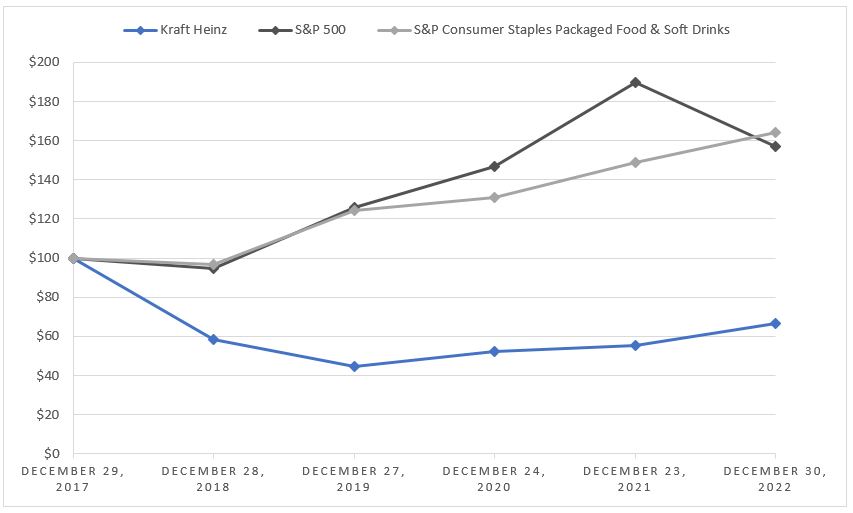
| Kraft Heinz | S&P 500 | S&P Consumer Staples Food and Soft Drink Products | |||||||||||||||
| December 29, 2017 | $ | 100.00 | $ | 100.00 | $ | 100.00 | |||||||||||
| December 28, 2018 | 58.45 | 94.80 | 96.69 | ||||||||||||||
| December 27, 2019 | 44.85 | 126.06 | 124.43 | ||||||||||||||
| December 24, 2020 | 52.49 | 146.73 | 131.03 | ||||||||||||||
| December 23, 2021 | 55.16 | 189.93 | 148.98 | ||||||||||||||
| December 30, 2022 | 66.43 | 156.88 | 164.32 |
The above performance graph shall not be deemed to be “soliciting material” or to be “filed” with the SEC or subject to Regulation 14A or 14C, or to the liabilities of Section 18 of the Exchange Act.
Issuer Purchases of Equity Securities During the Three Months Ended December 31, 2022
Our share repurchase activity in the three months ended December 31, 2022 was:
| Total Number of Shares Purchased**(a)** | Average Price Paid Per Share | Total Number of Shares Purchased as Part of Publicly Announced Plans or Programs**(b)** | Approximate Dollar Value of Shares that May Yet Be Purchased Under the Plans or Programs | |||||||||||||||||||||||
| 9/25/2022 — 10/29/2022 | 2,779,689 | $ | 34.99 | — | $ | — | ||||||||||||||||||||
| 10/30/2022 — 11/26/2022 | 433,574 | 37.73 | — | — | ||||||||||||||||||||||
| 11/27/2022 — 12/31/2022 | 97,208 | 40.23 | — | — | ||||||||||||||||||||||
| Total | 3,310,471 | — |
(a) Includes (1) shares repurchased to offset the dilutive effect of the exercise of stock options using option exercise proceeds and the vesting restricted stock units (“RSUs”) and performance share units (“PSUs”) and (2) shares withheld for tax liabilities associated with the vesting of RSUs and PSUs.
(b) We do not have any publicly-announced share repurchase plans or programs.
Item 6. [Reserved].
Item 7. Management’s Discussion and Analysis of Financial Condition and Results of Operations.
Overview
Objective:
The following discussion provides an analysis of our financial condition and results of operations from management's perspective and should be read in conjunction with the consolidated financial statements and related notes included in Item 8, Financial Statements and Supplementary Data, of this Annual Report on Form 10-K. Our objective is to also provide discussion of material events and uncertainties known to management that are reasonably likely to cause reported financial information not to be indicative of future operating results or of future financial condition and to offer information that provides an understanding of our financial condition, results of operations, and cash flows.
See below for discussion and analysis of our financial condition and results of operations for 2022 compared to 2021. See Item 7, Management’s Discussions and Analysis of Financial Condition and Results of Operations, in our Annual Report on Form 10-K for the year ended December 25, 2021 for a detailed discussion of our financial condition and results of operations for 2021 compared to 2020.
Description of the Company:
We manufacture and market food and beverage products, including condiments and sauces, cheese and dairy, meals, meats, refreshment beverages, coffee, and other grocery products throughout the world.
In the second quarter of 2022, our internal reporting and reportable segments changed. We combined our United States and Canada zones to form the North America zone as a result of previously announced organizational changes, which are intended to advance and support our long-term growth plans by streamlining and synergizing our United States and Canada businesses. Subsequently, we manage and report our operating results through two reportable segments defined by geographic region: North America and International. We have reflected this change in all historical periods presented.
See Note 20, Segment Reporting, in Item 8, Financial Statements and Supplementary Data, for our financial information by segment.
Acquisitions and Divestitures:
In 2022, we completed the acquisition of Companhia Hemmer Indústria e Comércio (the “Hemmer Acquisition”) and Just Spices GmbH (the “Just Spices Acquisition”), both of which are in our International segment. Additionally, in 2022, we completed the sale of our business-to-business powdered cheese business (the “Powdered Cheese Transaction”). The Powdered Cheese Transaction is not considered a strategic shift that will have a major effect on our operations or financial results; therefore, the results of this business are included in continuing operations through the date of sale.
In 2021, we completed the acquisition of Assan Gıda Sanayi ve Ticaret A.Ş. (the “Assan Foods Acquisition”) and BR Spices Indústria e Comércio de Alimentos Ltda (the “BR Spices Acquisition”), both of which are in our International segment. Additionally, in 2021, we completed the sale of certain assets in our global nuts business (the “Nuts Transaction”) as well as the sale of certain assets in our global cheese businesses (the “Cheese Transaction”). The Nuts Transaction and the Cheese Transaction are not, individually or in the aggregate, considered a strategic shift that will have a major effect on our operations or financial results; therefore, the results of these businesses are included in continuing operations through the date of each sale in the prior year period.
See Note 4, Acquisitions and Divestitures, in Item 8, Financial Statements and Supplementary Data, for additional information.
Conflict Between Russia and Ukraine:
For the year ended December 31, 2022, approximately 1% of consolidated net sales, net income/(loss), and Adjusted EBITDA were generated from our business in Russia. For the year ended December 25, 2021, approximately 1% of consolidated net sales were generated from our business in Russia, while net income/(loss) and Adjusted EBITDA were each insignificant. As of December 31, 2022, we had approximately 1,100 employees in Russia. We have no operations or employees in Ukraine and insignificant net sales through distributors. Further, we have experienced cost increases globally for certain commodities, including packaging materials, soybean and vegetable oils, energy, corn products, and wheat products due to overall market demand, inflationary pressures, and, in part, to the negative impact of the conflict between Russia and Ukraine on the global economy. We will continue to monitor the impact that this conflict has on our business; however, through 2022, the conflict between Russia and Ukraine did not have a material impact on our financial condition, results of operations, or cash flows.
Items Affecting Comparability of Financial Results
Impairment Losses:
Our results of operations reflect goodwill impairment losses of $444 million, intangible asset impairment losses of $469 million, and property, plant, and equipment, net asset impairment losses of $86 million in 2022 compared to goodwill impairment losses of $318 million and intangible asset impairment losses of $1.3 billion in 2021. See Note 4, Acquisitions and Divestitures, and Note 8, Goodwill and Intangible Assets, in Item 8, Financial Statements and Supplementary Data, for additional information on these impairment losses.
53rd Week:
We operate on a 52- or 53-week fiscal year ending on the last Saturday in December in each calendar year. Our 2022 fiscal year ended December 31, 2022 includes a 53rd week of activity. Our 2021 fiscal year was a 52-week period that ended on December 25, 2021.
Inflation and Supply Chain Impacts:
During the year ended December 31, 2022, we continued to experience increasing commodity costs and supply chain costs, including procurement, logistics, and manufacturing costs, largely due to inflationary pressures, as compared to the prior year period. We expect these costs to continue to increase and inflation to remain elevated through 2023. While these costs have a negative impact on our results of operations, we are currently taking measures to mitigate, and expect to continue to take measures to mitigate, the impact of this inflation through pricing actions and efficiency gains. However, there has been, and we expect that there could continue to be, a difference between the timing of when these beneficial actions impact our results of operations and when the cost inflation is incurred. Additionally, the pricing actions we take have, in some instances, negatively impacted, and could continue to negatively impact, our market share.
Further, given the current level of demand for our products combined with industry-wide supply chain issues, we have experienced capacity constraints for certain products when demand has exceeded our current manufacturing capacity. As discussed in Liquidity and Capital Resources, we continue to focus on rebuilding inventory and expanding capacity through increased capital investments, which have resulted in an increased ability to meet customer demand. However, these capacity constraints have negatively impacted, and could continue to negatively impact, our market share, financial condition, results of operations, or cash flows, until we return to optimal service levels.
Results of Operations
We disclose in this report certain non-GAAP financial measures. These non-GAAP financial measures assist management in comparing our performance on a consistent basis for purposes of business decision-making by removing the impact of certain items that management believes do not directly reflect our underlying operations. For additional information and reconciliations to the most closely comparable financial measures presented in our consolidated financial statements, which are calculated in accordance with U.S. GAAP see Non-GAAP Financial Measures.
Consolidated Results of Operations
Summary of Results:
| | | |
Showing the first 8K of 93K characters. Open the full section
Item 7A. Quantitative and Qualitative Disclosures About Market Risk.
We are exposed to market risks from adverse changes in commodity prices, foreign exchange rates, and interest rates. We monitor and manage these exposures as part of our overall risk management program. Our risk management program focuses on the unpredictability of financial markets and seeks to reduce the potentially adverse effects that volatility in these markets may have on our operating results. We maintain risk management policies that principally use derivative financial instruments to reduce significant, unanticipated fluctuations in earnings and cash flows that may arise from variations in commodity prices, foreign currency exchange rates, and interest rates. We manage market risk by incorporating parameters within our risk management strategy that limit the types of derivative instruments, the derivative strategies we use, and the degree of market risk that we hedge with derivative instruments. See Note 2, Significant Accounting Policies, and Note 12, Financial Instruments, in Item 8, Financial Statements and Supplementary Data, for details of our market risk management policies and the financial instruments used to hedge those exposures.
When we use financial instruments, we are exposed to credit risk that a counterparty might fail to fulfill its performance obligations under the terms of our agreement. We minimize our credit risk by entering into transactions with counterparties with investment grade credit ratings, limiting the amount of exposure we have with each counterparty, and monitoring the financial condition of our counterparties. We maintain a policy of requiring that all significant, non-exchange traded derivative contracts are governed by an International Swaps and Derivatives Association master agreement. By policy, we do not engage in speculative or leveraged transactions, nor do we hold or issue financial instruments for trading purposes.
Effect of Hypothetical 10% Fluctuation in Market Prices:
The potential gain or loss on the fair value of our outstanding commodity contracts, foreign exchange contracts, and cross-currency swap contracts, assuming a hypothetical 10% fluctuation in commodity prices and foreign currency exchange rates, would have been (in millions):
| December 31, 2022 | December 25, 2021 | ||||||||||
| Commodity contracts | $ | 94 | $ | 56 | |||||||
| Foreign currency contracts | 71 | 130 | |||||||||
| Cross-currency swap contracts | 211 | 318 |
It should be noted that any change in the fair value of our derivative contracts, real or hypothetical, would be significantly offset by an inverse change in the value of the underlying hedged items. In relation to foreign currency contracts, this hypothetical calculation assumes that each exchange rate would change in the same direction relative to the U.S. dollar. Our utilization of financial instruments in managing market risk exposures described above is consistent with the prior year. Changes in our portfolio of financial instruments are a function of our results of operations, debt repayments and debt issuances, market effects on debt and foreign currency, and our acquisition and divestiture activities.
Item 8. Financial Statements and Supplementary Data.
Report of Independent Registered Public Accounting Firm
To the Board of Directors and Stockholders of The Kraft Heinz Company
Opinions on the Financial Statements and Internal Control over Financial Reporting
We have audited the accompanying consolidated balance sheets of The Kraft Heinz Company and its subsidiaries (the “Company”) as of December 31, 2022 and December 25, 2021, and the related consolidated statements of income, of comprehensive income, of equity and of cash flows for each of the three years in the period ended December 31, 2022, including the related notes and financial statement schedule listed in the index appearing under Item 15(a) (collectively referred to as the “consolidated financial statements”). We also have audited the Company's internal control over financial reporting as of December 31, 2022, based on criteria established in Internal Control - Integrated Framework (2013) issued by the Committee of Sponsoring Organizations of the Treadway Commission (COSO).
In our opinion, the consolidated financial statements referred to above present fairly, in all material respects, the financial position of the Company as of December 31, 2022 and December 25, 2021, and the results of its operations and its cash flows for each of the three years in the period ended December 31, 2022 in conformity with accounting principles generally accepted in the United States of America. Also in our opinion, the Company maintained, in all material respects, effective internal control over financial reporting as of December 31, 2022, based on criteria established in Internal Control - Integrated Framework (2013) issued by the COSO.
Basis for Opinions
The Company's management is responsible for these consolidated financial statements, for maintaining effective internal control over financial reporting, and for its assessment of the effectiveness of internal control over financial reporting, included in Management’s Report on Internal Control Over Financial Reporting appearing under Item 9A. Our responsibility is to express opinions on the Company’s consolidated financial statements and on the Company's internal control over financial reporting based on our audits. We are a public accounting firm registered with the Public Company Accounting Oversight Board (United States) (PCAOB) and are required to be independent with respect to the Company in accordance with the U.S. federal securities laws and the applicable rules and regulations of the Securities and Exchange Commission and the PCAOB.
We conducted our audits in accordance with the standards of the PCAOB. Those standards require that we plan and perform the audits to obtain reasonable assurance about whether the consolidated financial statements are free of material misstatement, whether due to error or fraud, and whether effective internal control over financial reporting was maintained in all material respects.
Our audits of the consolidated financial statements included performing procedures to assess the risks of material misstatement of the consolidated financial statements, whether due to error or fraud, and performing procedures that respond to those risks. Such procedures included examining, on a test basis, evidence regarding the amounts and disclosures in the consolidated financial statements. Our audits also included evaluating the accounting principles used and significant estimates made by management, as well as evaluating the overall presentation of the consolidated financial statements. Our audit of internal control over financial reporting included obtaining an understanding of internal control over financial reporting, assessing the risk that a material weakness exists, and testing and evaluating the design and operating effectiveness of internal control based on the assessed risk. Our audits also included performing such other procedures as we considered necessary in the circumstances. We believe that our audits provide a reasonable basis for our opinions.
Definition and Limitations of Internal Control over Financial Reporting
A company’s internal control over financial reporting is a process designed to provide reasonable assurance regarding the reliability of financial reporting and the preparation of financial statements for external purposes in accordance with generally accepted accounting principles. A company’s internal control over financial reporting includes those policies and procedures that (i) pertain to the maintenance of records that, in reasonable detail, accurately and fairly reflect the transactions and dispositions of the assets of the company; (ii) provide reasonable assurance that transactions are recorded as necessary to permit preparation of financial statements in accordance with generally accepted accounting principles, and that receipts and expenditures of the company are being made only in accordance with authorizations of management and directors of the company; and (iii) provide reasonable assurance regarding prevention or timely detection of unauthorized acquisition, use, or disposition of the company’s assets that could have a material effect on the financial statements.
Because of its inherent limitations, internal control over financial reporting may not prevent or detect misstatements. Also, projections of any evaluation of effectiveness to future periods are subject to the risk that controls may become inadequate because of changes in conditions, or that the degree of compliance with the policies or procedures may deteriorate.
Critical Audit Matters
The critical audit matters communicated below are matters arising from the current period audit of the consolidated financial statements that were communicated or required to be communicated to the audit committee and that (i) relate to accounts or disclosures that are material to the consolidated financial statements and (ii) involved our especially challenging, subjective, or complex judgments. The communication of critical audit matters does not alter in any way our opinion on the consolidated financial statements, taken as a whole, and we are not, by communicating the critical audit matters below, providing separate opinions on the critical audit matters or on the accounts or disclosures to which they relate.
Goodwill Impairment Assessments
As described in Notes 2 and 8 to the consolidated financial statements, the Company’s consolidated goodwill balance was $30.8 billion as of December 31, 2022. Historically, management tested reporting units for impairment annually as of the first day of the second quarter, or more frequently if events or circumstances indicate it is more likely than not that the fair value of a reporting unit is less than its carrying amount. Beginning in the third quarter of 2022 and for subsequent annual periods, management voluntarily changed the annual impairment assessment date to the first day of the third quarter. Reporting units are tested for impairment by comparing the estimated fair value of each reporting unit with its carrying amount. If the carrying amount of a reporting unit exceeds its estimated fair value, an impairment loss is recorded based on the difference between the fair value and carrying amount, not to exceed the associated carrying amount of goodwill. Management recognized non-cash goodwill impairment losses of $444 million for the year ended December 31, 2022. Management utilizes the discounted cash flow method under the income approach to estimate the fair value of reporting units. As disclosed by management, management’s cash flow projections included significant assumptions related to net sales, cost of products sold, selling, general, and administrative costs (SG&A), depreciation and amortization, working capital, capital expenditures, income tax rates, discount rates, long-term growth rates, and other market factors.
The principal considerations for our determination that performing procedures relating to
Showing the first 8K of 311K characters. Open the full section
Item 9. Changes in and Disagreements With Accountants on Accounting and Financial Disclosure.
None.
Item 9A. Controls and Procedures.
Evaluation of Disclosure Controls and Procedures
Our management, with the participation of our Chief Executive Officer and Chief Financial Officer, has evaluated the effectiveness of our disclosure controls and procedures (as defined in Rules 13a-15(e) and 15d-15(e) under the Exchange Act) as of December 31, 2022. Based on that evaluation, our Chief Executive Officer and Chief Financial Officer concluded that our disclosure controls and procedures, as of December 31, 2022, were effective and provided reasonable assurance that the information required to be disclosed in the reports that we file or submit under the Exchange Act is recorded, processed, summarized, and reported within the time periods specified in the SEC’s rules and forms, and that such information is accumulated and communicated to management as appropriate to allow timely decisions regarding required disclosure.
Changes in Internal Control Over Financial Reporting
Our Chief Executive Officer and Chief Financial Officer, with other members of management, evaluated the changes in our internal control over financial reporting during the quarter ended December 31, 2022. We determined that there were no changes in our internal control over financial reporting during the quarter ended December 31, 2022 that have materially affected, or are reasonably likely to materially affect, our internal control over financial reporting.
Management’s Report on Internal Control Over Financial Reporting
Management is responsible for establishing and maintaining adequate internal control over financial reporting as defined in Rule 13a-15(f) under the Exchange Act. Our internal control over financial reporting is a process designed to provide reasonable assurance regarding the reliability of financial reporting and the preparation of financial statements for external purposes in accordance with generally accepted accounting principles. Our internal control over financial reporting includes those written policies and procedures that:
-
pertain to the maintenance of records that, in reasonable detail, accurately and fairly reflect the transactions and dispositions of assets;
-
provide reasonable assurance that transactions are recorded as necessary to permit preparation of financial statements in accordance with generally accepted accounting principles;
-
provide reasonable assurance that receipts and expenditures are being made only in accordance with management and director authorization; and
-
provide reasonable assurance regarding prevention or timely detection of unauthorized acquisition, use, or disposition of assets that could have a material effect on the consolidated financial statements.
Because of its inherent limitations, internal control over financial reporting may not prevent or detect misstatements. Also, projections of any evaluation of effectiveness to future periods are subject to the risk that controls may become inadequate because of changes in conditions, or that the degree of compliance with the policies or procedures may deteriorate.
Under the supervision and with the participation of management, including our Chief Executive Officer and Chief Financial Officer, we conducted an evaluation of the effectiveness of our internal control over financial reporting as of December 31, 2022 based on the framework described in Internal Control - Integrated Framework (2013) issued by the Committee of Sponsoring Organizations of the Treadway Commission (COSO). Based on this evaluation, our management concluded that we maintained effective internal control over financial reporting as of December 31, 2022.
PricewaterhouseCoopers LLP, an independent registered public accounting firm that audited the consolidated financial statements included in this Annual Report on Form 10-K, has also audited the effectiveness of our internal control over financial reporting as of December 31, 2022, as stated in their report which appears herein under Item 8, Financial Statements and Supplementary Data.
Item 9B. Other Information.
Not applicable.
Item 9C. Disclosure Regarding Foreign Jurisdictions that Prevent Inspections.
None.
PART III
Item 10. Directors, Executive Officers and Corporate Governance.
Information required by this Item 10 is included under the caption “Information about our Executive Officers” contained in Item 1, Business, of this report and under the headings Proposal 1. Election of Directors, Corporate Governance and Board Matters—Codes of Conduct, Beneficial Ownership of Kraft Heinz Stock—Delinquent Section 16(a) Reports, Board Committees and Membership—Committee Structure and Membership, and Other Information—Stockholder Proposals in our definitive Proxy Statement for our Annual Meeting of Stockholders expected to be held on May 4, 2023 (“2023 Proxy Statement”). This information is incorporated by reference into this Annual Report on Form 10-K.
Item 11. Executive Compensation.
Information required by this Item 11 is included under the headings Board Committees and Membership—Human Capital and Compensation Committee—Compensation Committee Interlocks and Insider Participation, Director Compensation, Compensation Discussion and Analysis, Executive Compensation Tables, and Pay Ratio Disclosure in our 2023 Proxy Statement. This information is incorporated by reference into this Annual Report on Form 10-K.
Item 12. Security Ownership of Certain Beneficial Owners and Management and Related Stockholder Matters.
The number of shares to be issued upon exercise or vesting of awards issued under, and the number of shares remaining available for future issuance under our equity compensation plans at December 31, 2022 were:
| Number of securities to be issued upon exercise of outstanding options, warrants and rights**(1)** | Weighted average exercise price per share of outstanding options, warrants and rights | Number of securities remaining available for future issuance under equity compensation plans (excluding securities reflected in column (a)) | |||||||||||||||
| Plan Category | (a) | (b) | (c) | ||||||||||||||
| Equity compensation plans approved by security holders | 22,911,432 | $ | 46.80 | 22,064,622 | |||||||||||||
| Equity compensation plans not approved by security holders | — | — | — | ||||||||||||||
| Total | 22,911,432 | 22,064,622 |
(1) Includes the vesting of RSUs and PSUs.
Information related to the security ownership of certain beneficial owners and management is included under the heading Beneficial Ownership of Kraft Heinz Stock in our 2023 Proxy Statement. This information is incorporated by reference into this Annual Report on Form 10-K.
Item 13. Certain Relationships and Related Transactions, and Director Independence.
Information required by this Item 13 is included under the headings Corporate Governance and Board Matters—Independence and Corporate Governance and Board Matters—Related Person Transactions in our 2023 Proxy Statement. This information is incorporated by reference into this Annual Report on Form 10-K.
Item 14. Principal Accountant Fees and Services.
Information required by this Item 14 is included under the headings Proposal 3. Ratification of the Selection of Independent Auditors—Independent Auditors’ Fees and Services and Proposal 3. Ratification of the Selection of Independent Auditors—Pre-Approval Policy in our 2023 Proxy Statement. This information is incorporated by reference into this Annual Report on Form 10-K.
PART IV
Item 15. Exhibits, Financial Statement Schedules.
(a) Index to Consolidated Financial Statements and Schedules
Schedules other than those listed above have been omitted either because such schedules are not required or are not applicable.
(b) The following exhibits are filed as part of, or incorporated by reference into, this Annual Report:
Item 16. Form 10-K Summary.
None.
SIGNATURES
Pursuant to the requirements of Section 13 or 15(d) of the Securities Exchange Act of 1934, the registrant has duly caused this report to be signed on its behalf by the undersigned, thereunto duly authorized.
| The Kraft Heinz Company | |||||||||||
| Date: | February 16, 2023 | ||||||||||
| By: | /s/ Andre Maciel | ||||||||||
| Andre Maciel | |||||||||||
| Executive Vice President and Global Chief Financial Officer | |||||||||||
| (Principal Financial Officer) |
Pursuant to the requirements of the Securities Exchange Act of 1934, this report has been signed below by the following persons on behalf of the registrant and in the capacities and on the date indicated:
| Signature | Title | Date | ||||||||||||
| /s/ Miguel Patricio | Chief Executive Officer and Chair of the Board | February 16, 2023 | ||||||||||||
| Miguel Patricio | (Principal Executive Officer) | |||||||||||||
| /s/ Andre Maciel | Executive Vice President and Global Chief Financial Officer | February 16, 2023 | ||||||||||||
| Andre Maciel | (Principal Financial Officer) | |||||||||||||
| /s/ Vince Garlati | Vice President and Global Controller | February 16, 2023 | ||||||||||||
| Vince Garlati | (Principal Accounting Officer) | |||||||||||||
| * | Vice Chair of the Board | February 16, 2023 | ||||||||||||
| John T. Cahill | ||||||||||||||
| * | Lead Director | February 16, 2023 | ||||||||||||
| John C. Pope | ||||||||||||||
| * | Director | February 16, 2023 | ||||||||||||
| Gregory E. Abel | ||||||||||||||
| * | Director | February 16, 2023 | ||||||||||||
| Lori Dickerson Fouché | ||||||||||||||
| * | Director | February 16, 2023 | ||||||||||||
| Diane Gherson | ||||||||||||||
| * | Director | February 16, 2023 | ||||||||||||
| Timothy Kenesey | ||||||||||||||
| * | Director | February 16, 2023 | ||||||||||||
| Alicia Knapp | ||||||||||||||
| * | Director | February 16, 2023 | ||||||||||||
| Elio Leoni Sceti | ||||||||||||||
| * | Director | February 16, 2023 | ||||||||||||
| Susan Mulder | ||||||||||||||
| * | Director | February 16, 2023 | ||||||||||||
| James Park |
| *By: | /s/ Andre Maciel | ||||
| Andre Maciel | |||||
| Attorney-In-Fact | |||||
| February 16, 2023 |
The Kraft Heinz Company
Valuation and Qualifying Accounts
For the Years Ended December 31, 2022, December 25, 2021, and December 26, 2020
(in millions)
| Additions | Deductions | ||||||||||||||||||||||||||||
| Description | Balance at Beginning of Period | Charged to Costs and Expenses | Charged to Other Accounts**(a)** | Write-offs and Reclassifications | Balance at End of Period | ||||||||||||||||||||||||
| Year ended December 31, 2022 | |||||||||||||||||||||||||||||
| Allowances related to trade accounts receivable | $ | 48 | $ | (4) | $ | — | $ | 2 | $ | 46 | |||||||||||||||||||
| Allowances related to deferred taxes | 101 | (5) | — | — | 96 | ||||||||||||||||||||||||
| $ | 149 | $ | (9) | $ | — | $ | 2 | $ | 142 | ||||||||||||||||||||
| Year ended December 25, 2021 | |||||||||||||||||||||||||||||
| Allowances related to trade accounts receivable | $ | 48 | $ | 5 | $ | 1 | $ | (6) | $ | 48 | |||||||||||||||||||
| Allowances related to deferred taxes | 105 | 1 | — | (5) | 101 | ||||||||||||||||||||||||
| $ | 153 | $ | 6 | $ | 1 | $ | (11) | $ | 149 | ||||||||||||||||||||
| Year ended December 26, 2020 | |||||||||||||||||||||||||||||
| Allowances related to trade accounts receivable | $ | 33 | $ | 21 | $ | — | $ | (6) | $ | 48 | |||||||||||||||||||
| Allowances related to deferred taxes | 112 | (3) | — | (4) | 105 | ||||||||||||||||||||||||
| $ | 145 | $ | 18 | $ | — | $ | (10) | $ | 153 |
(a) Primarily relates to acquisitions and currency translation.
S-1