 filings.tools
Item 7. Management's Discussion and Analysis of Financial Condition and Results of Operations
86K characters. Original on sec.gov · Markdown
Item 7. Management's Discussion and Analysis of Financial Condition and Results of Operations
The following discussion should be read in conjunction with the Consolidated Financial Statements and Notes thereto included in this Form 10-K. Historical results and percentage relationships set forth in the Consolidated Statements of Income contained in the Consolidated Financial Statements, including trends, should not be taken as indicative of future operations.
Critical Accounting Policies
The Consolidated Financial Statements of the Company include the accounts of the Company, its wholly-owned subsidiaries and all entities in which the Company has a controlling interest, including where the Company has been determined to be a primary beneficiary of a variable interest entity in accordance with the consolidation guidance of the FASB Accounting Standards Codification. The Company applies these provisions to each of its joint venture investments to determine whether the cost, equity or consolidation method of accounting is appropriate. The Company evaluates performance on a property specific or transactional basis and does not distinguish its principal business or group its operations on a geographical basis for purposes of measuring performance. Accordingly, the Company believes it has a single reportable segment for disclosure purposes in accordance with accounting principles generally accepted in the United States of America ("GAAP"). The preparation of financial statements in conformity with GAAP requires management to make estimates and assumptions in certain circumstances that affect amounts reported in the accompanying Consolidated Financial Statements and related notes. In preparing these financial statements, management has made its best estimates and assumptions that affect the reported amounts of assets and liabilities. These estimates are based on, but not limited to, historical results, industry standards and current economic conditions, giving due consideration to materiality. The most significant assumptions and estimates relate to revenue recognition and the recoverability of trade accounts receivable, depreciable lives, valuation of real estate, including real estate under development, and intangible assets and liabilities, valuation of joint venture investments and other investments, and realizability of deferred tax assets and uncertain tax positions. Application of these assumptions requires the exercise of judgment as to future uncertainties, and, as a result, actual results could materially differ from these estimates.
The Company is required to make subjective assessments as to whether there are impairments in the value of its real estate properties, investments in joint ventures, marketable securities and other investments. The Company’s reported net earnings are directly affected by management’s estimate of impairments.
Revenue Recognition and Recoverability of Trade Accounts Receivable
Revenues from rental properties, net are comprised of minimum base rent, percentage rent, lease termination fee income, amortization of above-market and below-market rent adjustments and straight-line rent adjustments. Upon the adoption of ASU 2016-02, Leases (Topic 842) ("ASU 2016-02"), the Company elected the lessor practical expedient to combine the lease and non-lease components, determined the lease component was the predominant component and as a result, accounted for the combined components under Topic 842. Non-lease components include reimbursements paid to the Company from tenants for common area maintenance costs, and other operating expenses. The combined components are included in Revenues from rental properties, net on the Company’s Consolidated Statements of Income.
Base rental revenues from rental properties are recognized on a straight-line basis over the terms of the related leases. Certain of these leases also provide for percentage rents based upon the level of sales achieved by the lessee. These percentage rents are recognized once the required sales level is achieved. Rental income may also include payments received in connection with lease termination agreements. Lease termination fee income is recognized when the lessee provides consideration in order to terminate an existing lease agreement and has vacated the leased space. If the lessee continues to occupy the leased space for a period of time after the lease termination is agreed upon, the termination fee is accounted for as a lease modification based on the modified lease term. Upon acquisition of real estate operating properties, the Company estimates the fair value of identified intangible assets and liabilities (including above-market and below-market leases, where applicable). The capitalized above-market or below-market intangible asset or liability is amortized to rental income over the estimated remaining term of the respective leases, which includes the expected renewal option period for below-market leases.
Also included in Revenues from rental properties, net are ancillary income and tax increment financing ("TIF") income. Ancillary income is derived through various agreements relating to parking lots, clothing bins, temporary storage, vending machines, ATMs, trash bins and trash collections, seasonal leases, etc. The majority of the revenue derived from these sources is through lease agreements/arrangements and is recognized in accordance with the lease terms described in the lease. The Company has TIF agreements with certain municipalities and receives payments in accordance with the agreements. TIF reimbursement income is recognized on a cash-basis when received.
Trade accounts receivable
The Company reviews its trade accounts receivable, including its straight-line rent receivable, related to base rents, straight-line rent, expense reimbursements and other revenues for collectability. The Company analyzes its accounts receivable, customer credit worthiness and current economic trends when evaluating the adequacy of the collectability of the lessee’s total accounts receivable balance on a lease by lease basis. In addition, tenants in bankruptcy are analyzed and considerations are made in connection with the expected recovery of pre-petition and post-petition bankruptcy claims. Effective January 1, 2019, in accordance with the adoption of Topic 842 the Company includes provision for doubtful accounts in Revenues from rental properties, net. If a lessee’s accounts receivable balance is considered uncollectible, the Company will write-off the receivable balances associated with the lease and will only recognize lease income on a cash basis. If the Company subsequently determines that it is probable it will collect the remaining lessee’s lease payments under the lease term, the Company will then reinstate the straight-line balance and the lease income will then be limited to the lesser of (i) the straight-line rental income or (ii) the lease payments that have been collected from the lessee.
Real Estate
Depreciable Lives
The Company’s investments in real estate properties are stated at cost, less accumulated depreciation and amortization. Expenditures for maintenance and repairs are charged to operations as incurred. Significant renovations and replacements, which improve and extend the life of the asset, are capitalized.
The Company capitalizes acquisition costs related to real estate operating properties, which qualify as asset acquisitions. Also, upon acquisition of real estate operating properties, the Company estimates the fair value of acquired tangible assets (consisting of land, building, building improvements and tenant improvements) and identified intangible assets and liabilities (consisting of above and below-market leases, in-place leases, and tenant relationships, where applicable), assumed debt and redeemable units issued at the date of acquisition, based on evaluation of information and estimates available at that date. Fair value is determined based on a market approach, which contemplates the price that would be received to sell an asset or paid to transfer a liability in an orderly transaction between market participants at the measurement date.
Depreciation and amortization are provided on the straight-line method over the estimated useful lives of the assets, as follows:
| Buildings and building improvements (in years) | 5 to 50 | |
|---|---|---|
| Fixtures, leasehold and tenant improvements (including certain identified intangible assets) | Terms of leases or useful lives, whichever is shorter |
The Company is required to make subjective assessments as to the useful lives of its properties for purposes of determining the amount of depreciation to reflect on an annual basis with respect to those properties. These assessments have a direct impact on the Company’s net earnings.
Valuation of real estate, including real estate under development, and intangible assets and liabilities
On a continuous basis, management assesses whether there are any indicators, including property operating performance, changes in anticipated holding period, general market conditions and delays of development, that the value of the real estate properties (including any related amortizable intangible assets or liabilities) may be impaired. A property value is considered impaired only if management’s estimate of current and projected operating cash flows, net of anticipated construction and leasing costs (undiscounted and unleveraged), of the property over its anticipated hold period is less than the net carrying value of the property. Such cash flow projections consider factors such as expected future costs of materials and labor, operating income, trends and prospects, as well as the effects of demand, competition and other factors. To the extent impairment has occurred, the carrying value of the property would be adjusted to reflect the estimated fair value of the property. The Company’s estimated fair values are primarily based upon estimated sales prices from signed contracts or letters of intent from third parties, discounted cash flow models or third party appraisals. Estimated fair values that are based on discounted cash flow models include all estimated cash inflows and outflows over a specified holding period. Capitalization rates and discount rates utilized in these models are based upon unobservable rates that the Company believes to be within a reasonable range of current market rates.
When a real estate asset is identified by management as held-for-sale, the Company ceases depreciation of the asset and estimates the sales price of such asset net of selling costs. If, in management’s opinion, the net sales price of the asset is less than the net book value of such asset, an adjustment to the carrying value would be recorded to reflect the estimated fair value of the property.
Valuation of Joint Venture Investments and Other Investments
The Company accounts for its investments in unconsolidated joint ventures under the equity method of accounting as the Company exercises significant influence, but does not control, these entities. These investments are recorded initially at cost and are subsequently adjusted for cash contributions and distributions. Earnings for each investment are recognized in accordance with each respective investment agreement and, where applicable, are based upon an allocation of the investment’s net assets at book value as if the investment was hypothetically liquidated at the end of each reporting period.
The Company’s joint ventures and other real estate investments primarily consist of co-investments with institutional and other joint venture partners in open-air shopping center properties, consistent with its core business. These joint ventures typically obtain non-recourse third-party financing on their property investments, thus contractually limiting the Company’s exposure to losses to the amount of its equity investment, and, due to the lender’s exposure to losses, a lender typically will require a minimum level of equity in order to mitigate its risk. From time to time the joint ventures will obtain unsecured debt, which may be guaranteed by the joint venture. The Company’s exposure to losses associated with its unconsolidated joint ventures is primarily limited to its carrying value in these investments.
On a continuous basis, management assesses whether there are any indicators, including property operating performance and general market conditions, that the value of the Company’s investments in unconsolidated joint ventures may be impaired. An investment’s value is impaired only if management’s estimate of the fair value of the investment is less than the carrying value of the investment and such difference is deemed to be other-than-temporary. To the extent impairment has occurred, the loss will be measured as the excess of the carrying amount of the investment over the estimated fair value of the investment. Estimated fair values which are based on discounted cash flow models include all estimated cash inflows and outflows over a specified holding period, capitalization rates and discount rates utilized in these models are based upon unobservable rates that the Company believes to be within a reasonable range of current market rates.
The Company’s estimated fair values are based upon a discounted cash flow model for each joint venture that includes all estimated cash inflows and outflows over a specified holding period and, where applicable, any estimated debt premiums. Capitalization rates, discount rates and credit spreads utilized in these models are based upon rates that the Company believes to be within a reasonable range of current market rates.
Realizability of Deferred Tax Assets and Uncertain Tax Positions
The Company is subject to federal, state and local income taxes on the income from its activities relating to its TRSs and subject to local taxes on certain non-U.S. investments. The Company accounts for income taxes using the asset and liability method, which requires that deferred tax assets and liabilities be recognized based on future tax consequences of temporary differences between the financial statement carrying amounts of existing assets and liabilities and their respective tax basis. Deferred tax assets and liabilities are measured using enacted tax rates expected to apply in the years in which temporary differences are expected to be recovered or settled. The effect on deferred tax assets and liabilities of a change in tax rates is recognized in earnings in the period when the changes are enacted.
A reduction of the carrying amounts of deferred tax assets by a valuation allowance is required if, based on the evidence available, it is more likely than not (a likelihood of more than 50 percent) that some portion or all of the deferred tax assets will not be realized. The valuation allowance, which requires significant judgement from management, should be sufficient to reduce the deferred tax asset to the amount that is more likely than not to be realized. The Company’s reported net earnings are directly affected by management’s judgement in determining a valuation allowance.
The Company recognizes and measures benefits for uncertain tax positions, which requires significant judgment from management. Although the Company believes it has adequately reserved for any uncertain tax positions, no assurance can be given that the final tax outcome of these matters will not be different. The Company adjusts these reserves in light of changing facts and circumstances, such as the closing of a tax audit or the refinement of an estimate. Changes in the recognition or measurement of uncertain tax positions could result in material increases or decreases in the Company’s income tax expense in the period in which a change is made, which could have a material impact on operating results (see Footnote 21 of the Notes to Consolidated Financial Statements included in this Form 10-K).
Executive Overview
Kimco Realty Corporation is one of North America’s largest publicly traded owners and operators of open-air shopping centers. The executive officers are engaged in the day-to-day management and operation of real estate exclusively with the Company, with nearly all operating functions, including leasing, asset management, maintenance, construction, legal, finance and accounting, administered by the Company.
The following highlights the Company’s significant transactions, events and results that occurred during the year ended December 31, 2019:
Financial and Portfolio Information_:_
| ● | Net income available to the Company’s common shareholders was $340.0 million, or $0.80 per diluted share, for the year ended December 31, 2019 as compared to $439.6 million, or $1.02 per diluted share, for the year ended December 31, 2018. |
|---|
| ● | Funds from operations (“FFO”) was $608.4 million or $1.44 per diluted share for the year ended December 31, 2019, as compared to $609.8 million or $1.45 per diluted share for the corresponding period in 2018 (see additional disclosure on FFO beginning on page 33). |
|---|
| ● | FFO as adjusted was $620.1 million or $1.47 per diluted share for the year ended December 31, 2019, as compared to $613.0 million, or $1.45 per diluted share for the corresponding period in 2018 (see additional disclosure on FFO beginning on page 33). |
|---|
| ● | Same property net operating income (“Same property NOI”) increased 3.0% for the year ended December 31, 2019, as compared to the corresponding period in 2018 (see additional disclosure on Same property NOI beginning on page 34). |
|---|
| ● | Executed 907 new leases, renewals and options totaling approximately 6.5 million square feet in the consolidated operating portfolio. |
|---|
| ● | The Company’s consolidated operating portfolio occupancy at December 31, 2019 was 96.4% as compared to 95.8% at December 31, 2018. |
|---|
Acquisition and Disposition Activity (see Footnote__s 3 and 5 of the Notes to Consolidated Financial Statements included in this Form 10-K_)__:_
| ● | Acquired three operating properties located in Sun City, AZ, Truckee, CA and San Diego, CA, in separate transactions, for an aggregate purchase price of $31.3 million. |
|---|
| ● | During 2019, the Company disposed of 20 operating properties and nine out-parcels, in separate transactions, for an aggregate sales price of $344.7 million. Certain of these transactions resulted in aggregate gains of $79.2 million. |
|---|
Development Activity (see Footnote 4 of the Notes to Consolidated Financial Statements included in this Form 10-K):
| ● | Placed into service Mills Station a Signature SeriesTM development project located in Owings Mills, MD. |
|---|
Capital Activity (for additional details see Liquidity and Capital Resources below):
| ● | Generated net proceeds of $200.1 million through the issuance of 9.5 million shares of common stock at a weighted average net price of $21.03 per share under the Company’s ATM program. |
|---|
| ● | Redeemed $175.0 million of 6.000% Class I Preferred Stock, $225.0 million of 5.500% Class J Preferred Stock, and $175.0 million of 5.625% Class K Preferred Stock incurring an aggregate $18.5 million redemption charge as a result of these redemptions in 2019. |
|---|
| ● | Issued $350.0 million of 3.700% notes maturing October 2049, with an effective yield of 3.765%. |
|---|
As a result of the above debt activity, the Company’s consolidated debt maturity profile, including extension options, is as follows:
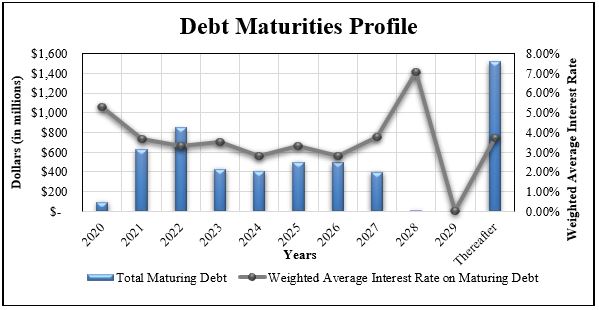
| ● | As of December 31, 2019, the weighted average interest rate was 3.46% and the weighted average maturity profile was 10.6 years related to the Company’s consolidated debt. |
|---|
The Company faces external factors which may influence its future results from operations. The convenience and availability of e-commerce has continued to impact the retail sector, which could affect our ability to increase or maintain rental rates and our ability to renew expiring leases and/or lease available space. To mitigate the effect of e-commerce on its business, the Company’s strategy has been to attract local area customers to its properties by providing a diverse and robust tenant base across a variety of retailers, including grocery stores, off-price retailers, discounters or service-oriented tenants, which offer buy online and pick up in store, off-price merchandise and day-to-day necessities rather than high-priced luxury items.
The Company’s investment strategy is to invest capital into high quality assets focusing on major metropolitan-area U.S. markets, predominantly on the East and West coasts and in the Sunbelt region, which are supported by strong demographics, significant projected population growth, and where the Company perceives significant barriers to entry while disposing of lesser quality assets in less desirable locations. Through this strategy, the Company has transformed its portfolio and will continue these efforts as deemed necessary to maximize the quality and growth of its portfolio. The properties acquired are primarily located in major metropolitan areas allowing tenants to generate higher foot traffic, resulting in higher sales volume. The Company believes that this will enable it to maintain higher occupancy levels, rental rates and rental growth. In addition, the Company, on a selective basis, has developed or redeveloped projects which include residential and mixed-use components.
As part of the Company’s investment strategy, each property is evaluated for its highest and best use, which may include residential and mixed-use components. In addition, the Company may consider other opportunistic investments related to retailer controlled real estate, such as, repositioning underperforming retail locations, retail real estate financing and bankruptcy transaction support. The Company has an active capital recycling program which provides for the disposition of certain properties. If the estimated fair value for any of these assets is less than their net carrying values, the Company would be required to take impairment charges and such amounts could be material. For a further discussion of these and other factors that could impact our future results, performance or transactions, see Item 1A. “Risk Factors.”
Results of Operations
Comparison of Years Ended December 31, 2019 to 201****8
The following table presents the comparative results from the Company’s Consolidated Statements of Income for the year ended December 31, 2019, as compared to the corresponding period in 2018 (in thousands, except per share data):
| Year Ended December 31, | ||||||||||||
|---|---|---|---|---|---|---|---|---|---|---|---|---|
| 2019 | 2018 | $ Change | ||||||||||
| Revenues | ||||||||||||
| Revenues from rental properties, net (1) | $ | 1,142,334 | $ | 1,149,603 | $ | (7,269 | ) | |||||
| Management and other fee income | 16,550 | 15,159 | 1,391 | |||||||||
| Operating expenses | ||||||||||||
| Rent (2) | (11,311 | ) | (10,929 | ) | (382 | ) | ||||||
| Real estate taxes | (153,659 | ) | (153,336 | ) | (323 | ) | ||||||
| Operating and maintenance (3) | (171,981 | ) | (164,294 | ) | (7,687 | ) | ||||||
| General and administrative (4) | (96,942 | ) | (87,797 | ) | (9,145 | ) | ||||||
| Provision for doubtful accounts (5) | - | (6,253 | ) | 6,253 | ||||||||
| Impairment charges | (48,743 | ) | (79,207 | ) | 30,464 | |||||||
| Depreciation and amortization | (277,879 | ) | (310,380 | ) | 32,501 | |||||||
| Gain on sale of properties/change in control of interests | 79,218 | 229,840 | (150,622 | ) | ||||||||
| Other income/(expense) | ||||||||||||
| Other income, net | 11,814 | 13,041 | (1,227 | ) | ||||||||
| Interest expense | (177,395 | ) | (183,339 | ) | 5,944 | |||||||
| Early extinguishment of debt charges | - | (12,762 | ) | 12,762 | ||||||||
| Benefit/(provision) for income taxes, net | 3,317 | (1,600 | ) | 4,917 | ||||||||
| Equity in income of joint ventures, net | 72,162 | 71,617 | 545 | |||||||||
| Equity in income of other real estate investments, net | 26,076 | 29,100 | (3,024 | ) | ||||||||
| Net income attributable to noncontrolling interests | (2,956 | ) | (668 | ) | (2,288 | ) | ||||||
| Preferred stock redemption charges | (18,528 | ) | - | (18,528 | ) | |||||||
| Preferred dividends | (52,089 | ) | (58,191 | ) | 6,102 | |||||||
| Net income available to the Company's common shareholders | $ | 339,988 | $ | 439,604 | $ | (99,616 | ) | |||||
| Net income available to the Company's common shareholders: | ||||||||||||
| Diluted per share | $ | 0.80 | $ | 1.02 | $ | (0.22 | ) |
| (1) | Upon the adoption of Topic 842, the Company reclassified $246.4 million of Reimbursement income and $20.9 million of Other rental property income to Revenues from rental properties, net on the Company’s Consolidated Statements of Income for the year ended December 31, 2018. See Footnote 1 of the Notes to the Consolidated Financial Statements included in this Form 10-K for additional disclosure. |
|---|
| (2) | Rent expense relates to ground lease payments for which the Company is the lessee. |
|---|
| (3) | Operating and maintenance expense consists of property related costs including repairs and maintenance costs, roof repair, landscaping, parking lot repair, snow removal, utilities, property insurance costs, security and various other property related expenses. |
|---|
| (4) | General and administrative expense includes employee-related expenses (including salaries, bonuses, equity awards, benefits, severance costs and payroll taxes), professional fees, office rent, travel expense and other company-specific expenses. |
|---|
| (5) | In accordance with the adoption of Topic 842 the Company, effective January 1, 2019, includes Provision for doubtful accounts amounts in Revenues from rental properties, net. |
|---|
Net income available to the Company’s common shareholders was $340.0 million for the year ended December 31, 2019, as compared to $439.6 million for the comparable period in 2018. On a diluted per share basis, net income available to the Company's common shareholders for the year ended December 31, 2019, was $0.80 as compared to $1.02 for the comparable period in 2018. For additional disclosure, see Footnote 22 of the Notes to Consolidated Financial Statements included in this Form 10-K.
The following describes the changes of certain line items included on the Company’s Consolidated Statements of Income, that the Company believes changed significantly and affected Net income available to the Company's common shareholders during the year ended December 31, 2019, as compared to the corresponding period in 2018:
Revenue from r__ental p__roperties_, net_ –
The decrease in Revenues from rental properties, net of $7.3 million is primarily from (i) an aggregate decrease in revenues of $62.3 million due to properties sold during 2019 and 2018 and (ii) the inclusion of credit losses of $4.6 million during the year ended December 31,2019 (amounts for credit losses for 2018 are included in Provision for doubtful accounts on the Company’s Consolidated Statements of Income), partially offset by (iii) the completion of certain redevelopment and development projects, acquisitions, tenant buyouts and net growth in the current portfolio, which provided incremental revenues for year ended December 31, 2019 of $59.6 million, as compared to the corresponding period in 2018.
Operating and maintenance –
The increase in Operating and maintenance of $7.7 million is primarily from an increase in operating costs of $9.7 million related to the completion of certain redevelopment and development projects, partially offset by properties sold during 2019 and 2018.
General and administrative –
The increase in General and administrative expense of $9.1 million is primarily due to (i) a decrease in the capitalization of internal indirect leasing costs of $12.5 million, primarily due to the adoption of Topic 842, which allows only the initial direct cost of a lease to be capitalized (see Footnote 1 of the Notes to the Consolidated Financial Statements), partially offset by (ii) a reduction in salary and severance expense for the year ended December 31, 2019 of $2.4 million, primarily related to a reduction in personnel.
Impairment c__harges –
During the year ended December 31, 2019 and 2018, the Company recognized impairment charges related to adjustments to property carrying values of $48.7 million and $79.2 million, respectively, for which the Company’s estimated fair values were primarily based upon (i) signed contracts or letters of intent from third party offers or (ii) discounted cash flow models. These adjustments to property carrying values were recognized in connection with the Company’s efforts to market certain properties and management’s assessment as to the likelihood and timing of such potential transactions. Certain of the calculations to determine fair value utilized unobservable inputs and, as such, were classified as Level 3 of the fair value hierarchy. For additional disclosure, see Footnotes 6 and 15 of the Notes to Consolidated Financial Statements included in this Form 10-K.
Depreciation and a__mortization –
The decrease in Depreciation and amortization of $32.5 million is primarily due to (i) a decrease of $17.5 million resulting from property dispositions in 2019 and 2018, (ii) a decrease of $7.7 million related to the acceleration of depreciable lives of assets within the Company’s redevelopment projects during the year ended December 31, 2018 and (iii) a decrease of $10.9 million related to fewer tenant vacates and write-offs of depreciable assets during the year ended December 31, 2019, as compared to the corresponding period in 2018.
Gain on sale of properties/change in control of interests –
During 2019, the Company disposed of 20 operating properties and nine out-parcels, in separate transactions, for an aggregate sales price of $344.7 million. Certain of these transactions resulted in aggregate gains of $79.2 million. During 2018, the Company disposed of 54 operating properties (including the deconsolidation of one property) and seven parcels, in separate transactions, for an aggregate sales price of $1.2 billion. Certain of these transactions resulted in aggregate gains of $229.8 million.
Interest expense –
The decrease in Interest expense of $5.9 million is primarily the result of (i) the repayment of maturing debt during 2019 and 2018 and (ii) lower levels of borrowings during the year ended December 31, 2019, as compared to the corresponding period in 2018.
Early e__xtinguishment of d__ebt c__harges –
During the year ended December 31, 2018, the Company incurred early extinguishment of debt charges of $12.8 million in connection with the optional make-whole provisions of unsecured notes that were repaid prior to maturity.
Benefit/(provision) for income taxes, net –
The change in Benefit/(provision) for income taxes, net of $4.9 million is primarily due to the release of a deferred tax asset valuation allowance relating to Alternative Minimum Tax credits.
Equity in i__ncome from o__ther r__eal e__state i__nvestments, n__et –
The decrease in Equity in income of other real estate investments, net of $3.0 million is primarily due to an increase in impairment charges of $2.8 million primarily resulting from the sale of properties within various preferred equity program investments during 2019, as compared to the corresponding period in 2018,
Preferred s__tock r__edemption charge__s –
During 2019, the Company redeemed all its outstanding Class I Preferred Stock, Class J Preferred Stock and Class K Preferred Stock and, as a result, the Company recorded a redemption charge of $18.5 million. This charge was subtracted from net income attributable to the Company to arrive at net income available to the Company’s common shareholders and used in the calculation of earnings per share for the year ended December 31, 2019.
Preferred dividend__s –
The decrease in Preferred dividends of $6.1 million is primarily due to the redemptions of the Class I Preferred Stock and Class K Preferred Stock during 2019.
Comparison of Years Ended December 31, 201****8 to 201****7
Information pertaining to fiscal year 2017 was included in the Company’s Annual Report on Form 10-K for the year ended December 31, 2018 under Part II, Item 7, “Management's Discussion and Analysis of Financial Condition and Results of Operations,” which was filed with the SEC on February 15, 2019.
Liquidity and Capital Resources
The Company’s capital resources include accessing the public debt and equity capital markets, mortgage and construction loan financing, and immediate access to an unsecured revolving credit facility (the “Credit Facility”) with bank commitments of $2.25 billion which can be increased to $2.75 billion through an accordion feature.
The Company’s cash flow activities are summarized as follows (in thousands):
| Year Ended December 31, | ||||||||
|---|---|---|---|---|---|---|---|---|
| 2019**** | 2018**** | |||||||
| Cash and cash equivalents, beginning of year | $ | 143,581 | $ | 238,513 | ||||
| Net cash flow provided by operating activities | 583,628 | 637,936 | ||||||
| Net cash flow (used for)/provided by investing activities | (120,421 | ) | 253,645 | |||||
| Net cash flow used for financing activities | (482,841 | ) | (986,513 | ) | ||||
| Change in cash and cash equivalents | (19,634 | ) | (94,932 | ) | ||||
| Cash and cash equivalents, end of year | $ | 123,947 | $ | 143,581 |
Operating Activities
The Company anticipates that cash on hand, cash flows from operations, borrowings under its Credit Facility, and the issuance of equity and public debt, as well as other debt and equity alternatives, will provide the necessary capital required by the Company.
Cash flows provided by operating activities for the year ended December 31, 2019, were $583.6 million, as compared to $637.9 million for the comparable period in 2018. The decrease of $54.3 million is primarily attributable to:
| ● | changes in operating assets and liabilities due to timing of receipts and payments; |
|---|
| ● | the disposition of operating properties in 2019 and 2018; and |
|---|
| ● | a decrease in distributions from the Company’s joint venture programs; partially offset by |
|---|
| ● | new leasing, expansion and re-tenanting of core portfolio properties; and |
|---|
| ● | the acquisition of operating properties during 2019. |
|---|
During the years ended December 31, 2019 and 2018, the Company capitalized personnel costs of $2.3 million and $14.8 million, respectively, relating to deferred leasing costs.
Investing Activities
Cash flows (used for)/provided by investing activities were $120.4 million for 2019, as compared to cash flows provided by investing activities of $253.6 million for 2018.
Investing activities during 2019 consisted primarily of:
Cash inflows:
| ● | $324.3 million in proceeds from the sale of 20 consolidated operating properties and nine out-parcels; |
|---|
| ● | $27.7 million in reimbursements of investments in and advances to real estate joint ventures and reimbursements of investments in and advances to other real estate investments, primarily related to the sale of properties within the joint venture portfolio and the Company's Preferred Equity Program; |
|---|
| ● | $10.4 million in collection of mortgage loans receivable; |
|---|
| ● | $4.0 million in proceeds from insurance casualty claims; and |
|---|
| ● | $2.0 million in proceeds from sale/repayments of marketable securities. |
|---|
Cash outflows:
| ● | $443.7 million for improvements to operating real estate primarily related to the Company’s active redevelopment pipeline and improvements to real estate under development; and |
|---|
| ● | $40.5 million for investments in and advances to real estate joint ventures, primarily related to a redevelopment project within the Company’s joint venture portfolio, and investments in other real estate investments, primarily related to repayment of a mortgage within the Company’s Preferred Equity Program. |
|---|
Investing activities during 2018 consisted primarily of:
Cash in__flows:
| ● | $754.7 million in proceeds from the sale of 54 operating properties (including the deconsolidation of one property), seven out-parcels and 10 land parcels; |
|---|
| ● | $34.0 million in reimbursements of investments and advances to real estate joint ventures and reimbursements of investments and advances to other real estate investments, primarily related to disposition of properties and loan refinancing within the joint venture portfolio and the Company’s Preferred Equity Program; |
|---|
| ● | $22.3 million in collection of mortgage loans receivable; and |
|---|
| ● | $16.2 million in proceeds from insurance casualty claims in connection with Hurricane Maria which damaged several of the Company’s properties in Puerto Rico during 2017. |
|---|
Cash out__flows_:_
| ● | $526.9 million for improvements to operating real estate related to the Company’s active redevelopment pipeline and improvements to real estate under development; |
|---|
| ● | $36.1 million for investments in and advances to real estate joint ventures, primarily related to a redevelopment project within the Company’s joint venture portfolio; and |
|---|
| ● | $10.0 million for acquisition of operating real estate and other related net assets, including two land parcels, and the acquisition of a land parcel at one development project. |
|---|
Acquisitions of Operating Real Estate and Other Related Net Assets
During the years ended December 31, 2019 and 2018, the Company expended $2.0 million and $5.4 million, respectively, (net of Internal Revenue Code 26 U.S.C. §1031 proceeds) towards the acquisition of operating real estate properties. The Company anticipates spending approximately $100.0 million to $200.0 million towards the acquisition of operating properties during 2020. The Company intends to fund these acquisitions with cash flow from operating activities, proceeds from property dispositions and availability under its Credit Facility.
Improvements to Operating Real Estate
During the years ended December 31, 2019 and 2018, the Company expended $324.8 million and $290.9 million, respectively, towards improvements to operating real estate. These amounts consist of the following (in thousands):
| Year Ended December 31, | ||||||||
|---|---|---|---|---|---|---|---|---|
| 2019**** | 2018**** | |||||||
| Redevelopment and renovations | $ | 265,954 | $ | 220,829 | ||||
| Tenant improvements and tenant allowances | 58,867 | 67,624 | ||||||
| Other | - | 2,421 | ||||||
| Total (1) | $ | 324,821 | $ | 290,874 |
| (1) | During the year ended December 31, 2019 and 2018, the Company capitalized payroll of $7.9 million and $7.1 million, respectively, and capitalized interest of $6.3 million and $3.6 million, respectively, in connection with the Company’s improvements to operating real estate. |
|---|
The Company has an ongoing program to redevelop and re-tenant its properties to maintain or enhance its competitive position in the marketplace. The Company is actively pursuing redevelopment opportunities within its operating portfolio which it believes will increase the overall value by bringing in new tenants and improving the assets’ value. The Company has identified three categories of redevelopment: (i) large scale redevelopment, which involves demolishing and building new square footage, (ii) value creation redevelopment, which includes the subdivision of large anchor spaces into multiple tenant layouts, and (iii) creation of out-parcels and pads located in the front of the shopping center properties. The Company anticipates its capital commitment toward these redevelopment projects and re-tenanting efforts for 2020 will be approximately $150.0 million to $200.0 million. The funding of these capital requirements will be provided by proceeds from property dispositions, net cash flow provided by operating activities and availability under the Company’s Credit Facility.
Improvements to Real Estate Under Development
The Company is engaged in select real estate development projects, which are expected to be held as long-term investments. As of December 31, 2019, the Company had one active real estate development project. During the years ended December 31, 2019 and 2018, the Company expended $118.8 million and $236.0 million, respectively, towards improvements to real estate under development. The Company capitalized (i) interest of $9.4 million and $13.9 million, (ii) real estate taxes, insurance and legal costs of $1.3 million and $2.6 million and (iii) payroll of $1.2 million and $1.9 million during the years ended December 31, 2019 and 2018, respectively, in connection with its real estate development projects. The Company anticipates the total remaining costs to complete these active projects to be approximately $40.0 million to $60.0 million. The funding of these capital requirements will be provided by proceeds from property dispositions, net cash flow provided by operating activities, construction financing, where applicable, and availability under the Company’s Credit Facility.
Financing Activities
Cash flows used for financing activities were $482.8 million for 2019, as compared to $986.5 million for 2018.
Financing activities during 2019 primarily consisted of the following:
Cash in__flows:
| ● | $350.0 million in proceeds from the issuance of unsecured notes; |
|---|
| ● | $204.0 million in proceeds from the issuance of stock, net, primarily through the Company’s ATM program; |
|---|
| ● | $100.0 million in proceeds from the Company’s unsecured revolving credit facility, net; and |
|---|
| ● | $16.0 million in proceeds from construction loan financing for one development project. |
|---|
Cash out__flows_:_
| ● | $575.0 million for the redemption of the Company’s Class I, Class J and Class K Preferred Stock; |
|---|
| ● | $531.6 million of dividends paid; |
|---|
| ● | $18.8 million for principal payments on debt (related to the repayment of debt on two encumbered properties), including normal amortization on rental property debt; |
|---|
| ● | $15.1 million for the redemption/distribution of noncontrolling interests, primarily related to the redemption of certain partnership interests by consolidated subsidiaries; and |
|---|
| ● | $7.7 million for financing origination cost, primarily related to the issuance of unsecured notes. |
|---|
Financing activities during 2018 primarily consisted of the following:
Cash in__flows:
| ● | $92.3 million in proceeds from the Company’s unsecured revolving credit facility, net; |
|---|
| ● | $51.0 million in proceeds from construction loan financing at one of the Company’s development projects; and |
|---|
| ● | $33.7 million in proceeds primarily from the exercise of the Class M Preferred Stock over-allotment option. |
|---|
Cash out__flows_:_
| ● | $529.8 million of dividends paid; |
|---|
| ● | $315.1 million for the repayment of unsecured notes; |
|---|
| ● | $217.9 million for principal payments on debt (related to the repayment of debt on six encumbered properties), including normal amortization on rental property debt; |
|---|
| ● | $75.1 million for the repurchase of common stock; |
|---|
| ● | $13.3 million for the payment of early extinguishment of debt charges; and |
|---|
| ● | $6.7 million for redemption/distribution of noncontrolling interests, primarily related to the redemption of certain partnership units by consolidated subsidiaries. |
|---|
The Company continually evaluates its debt maturities, and, based on management’s current assessment, believes it has viable financing and refinancing alternatives that will not materially adversely impact its expected financial results. The Company continues to pursue borrowing opportunities with large commercial U.S. and global banks, select life insurance companies and certain regional and local banks. The Company has noticed a continuing trend that, although pricing remains dependent on specific deal terms, generally spreads for non-recourse mortgage financing have stabilized and the unsecured debt markets are functioning well and credit spreads are at manageable levels.
Debt maturities for 2020 consist of: $92.9 million of consolidated debt; $146.3 million of unconsolidated joint venture debt and $61.9 million of debt included in the Company’s Preferred Equity Program, assuming the utilization of extension options where available. The 2020 consolidated debt maturities are anticipated to be repaid with operating cash flows and borrowings from the Company's Credit Facility. The 2020 debt maturities on properties in the Company's unconsolidated joint ventures and Preferred Equity Program are anticipated to be repaid through operating cash flows, debt refinancing, unsecured credit facilities, proceeds from sales and partner capital contributions, as deemed appropriate.
The Company intends to maintain strong debt service coverage and fixed charge coverage ratios as part of its commitment to maintain or obtain an upgrade on its investment-grade senior, unsecured debt ratings. The Company may, from time to time, seek to obtain funds through additional common and preferred equity offerings, unsecured debt financings and/or mortgage/construction loan financings and other capital alternatives.
Since the completion of the Company’s IPO in 1991, the Company has utilized the public debt and equity markets as its principal source of capital for its expansion needs. Since the IPO, the Company has completed additional offerings of its public unsecured debt and equity, raising in the aggregate over $14.1 billion. Proceeds from public capital market activities have been used for the purposes of, among other things, repaying indebtedness, acquiring interests in open-air shopping centers, funding real estate under development projects, expanding and improving properties in the portfolio and other investments.
During February 2018, the Company filed a shelf registration statement on Form S-3, which is effective for a term of three years, for the future unlimited offerings, from time-to-time, of debt securities, preferred stock, depositary shares, common stock and common stock warrants. The Company, pursuant to this shelf registration statement may, from time to time, offer for sale its senior unsecured debt for any general corporate purposes, including (i) funding specific liquidity requirements in its business, including property acquisitions, development and redevelopment costs and (ii) managing the Company’s debt maturities (See Footnotes 12 and 13 of the Notes to Consolidated Financial Statements included in this Form 10-K).
Preferred Stock –
The following Preferred Stock classes were redeemed during the year ended December 31, 2019:
| Class of Preferred Stock | Redemption Date | Dividend Rate | Depositary Shares Redeemed | Redemption Price per Depositary Share | Redemption Amount (in millions) | Redemption Charges (1) (in millions) | ||||||||||||||||
|---|---|---|---|---|---|---|---|---|---|---|---|---|---|---|---|---|---|---|---|---|---|---|
| Class I | 9/14/2019 | 6.00% | 7,000,000 | $ | 25 | $ | 175.0 | $ | 5.5 | |||||||||||||
| Class K | 9/14/2019 | 5.625% | 7,000,000 | $ | 25 | $ | 175.0 | $ | 5.9 | |||||||||||||
| Class J | 12/31/2019 | 5.50% | 9,000,000 | $ | 25 | $ | 225.0 | $ | 7.2 |
| (1) | Redemption charges resulting from the difference between the redemption amount and the carrying amount of the respective preferred stock class on the Company’s Consolidated Balance Sheets are accounted for in accordance with the FASB’s guidance on Distinguishing Liabilities from Equity. These charges were subtracted from net income attributable to the Company to arrive at net income available to the Company’s common shareholders and used in the calculation of earnings per share. |
|---|
At the Market Continuous Offering Program (“ATM program”)
During September 2019, the Company established an ATM program, pursuant to which the Company may offer and sell from time to time shares of its common stock, par value $0.01 per share, with an aggregate gross sales price of up to $500.0 million through a consortium of banks acting as sales agents. Sales of the shares of common stock may be made, as needed, from time to time in “at the market” offerings as defined in Rule 415 of the Securities Act of 1933, including by means of ordinary brokers’ transactions on the New York Stock Exchange or otherwise (i) at market prices prevailing at the time of sale, (ii) at prices related to prevailing market prices or (iii) as otherwise agreed to with the applicable sales agent. During the year ended December 31, 2019, the Company issued 9,514,544 shares and received proceeds of $200.1 million, net of commissions and fees of $1.8 million. As of December 31, 2019, the Company had $298.1 million available under this ATM program.
Share Repurchase Program –
During February 2018, the Company’s Board of Directors authorized a share repurchase program, which is effective for a term of two years, pursuant to which the Company may repurchase shares of its common stock, par value $0.01 per share, with an aggregate gross purchase price of up to $300.0 million. The Company did not repurchase any shares under the share repurchase program during the year ended December 31, 2019. As of December 31, 2019, the Company had $224.9 million available under this common share repurchase program. During February 2020, the Company’s Board of Directors approved an extension of this existing share repurchase program for a term of two years, which is scheduled to expire February 28, 2022.
Senior Notes –
During the year ended December 31, 2019, the Company issued the following senior unsecured notes (dollars in millions):
| Date Issued | Maturity Date | Amount Issued | Interest Rate | |||||||
|---|---|---|---|---|---|---|---|---|---|---|
| Aug-19 | Oct-49 | $ | 350.0 | 3.70% |
The Company’s supplemental indenture governing its senior notes contains the following covenants, all of which the Company is compliant with:
| Covenant | Must Be | As of 12/31/19 | |||
|---|---|---|---|---|---|
| Consolidated Indebtedness to Total Assets | <65% | 41% | |||
| Consolidated Secured Indebtedness to Total Assets | <40% | 4% | |||
| Consolidated Income Available for Debt Service to Maximum Annual Service Charge | >1.50x | 4.8x | |||
| Unencumbered Total Asset Value to Consolidated Unsecured Indebtedness | >1.50x | 2.4x |
For a full description of the various indenture covenants refer to the Indenture dated September 1, 1993; the First Supplemental Indenture dated August 4, 1994; the Second Supplemental Indenture dated April 7, 1995; the Third Supplemental Indenture dated June 2, 2006; the Fourth Supplemental Indenture dated April 26, 2007; the Fifth Supplemental Indenture dated as of September 24, 2009; the Sixth Supplemental Indenture dated as of May 23, 2013; and the Seventh Supplemental Indenture dated as of April 24, 2014, each as filed with the SEC. See the Exhibits Index for specific filing information.
Credit Facility –
The Company has a $2.25 billion unsecured revolving Credit Facility with a group of banks, which is scheduled to expire in March 2021, with two additional six-month options to extend the maturity date, at the Company’s discretion, to March 2022. This Credit Facility, which accrues interest at a rate of LIBOR plus 87.5 basis points (2.64% as of December 31, 2019), can be increased to $2.75 billion through an accordion feature. In addition, the Credit Facility includes a $500.0 million sub-limit which provides the Company the opportunity to borrow in alternative currencies including Canadian Dollars, British Pounds Sterling, Japanese Yen or Euros. Pursuant to the terms of the Credit Facility, the Company, among other things, is subject to covenants requiring the maintenance of (i) maximum leverage ratios on both unsecured and secured debt and (ii) minimum interest and fixed coverage ratios. As of December 31, 2019, the Credit Facility had a balance of $200.0 million outstanding and $0.3 million appropriated for letters of credit.
Pursuant to the terms of the Credit Facility, the Company, is subject to maintenance of various covenants. The Company is currently in compliance with these covenants. The financial covenants for the Credit Facility are as follows:
| Covenant | Must Be | As of 12/31/19 | ||
|---|---|---|---|---|
| Total Indebtedness to Gross Asset Value (“GAV”) | <60% | 42% | ||
| Total Priority Indebtedness to GAV | <35% | 3% | ||
| Unencumbered Asset Net Operating Income to Total Unsecured Interest Expense | >1.75x | 4.0x | ||
| Fixed Charge Total Adjusted EBITDA to Total Debt Service | >1.50x | 3.2x |
For a full description of the Credit Facility’s covenants refer to the Amended and Restated Credit Agreement dated as of February 1, 2017, filed as Exhibit 10.1 to the Company’s Current Report on Form 8-K dated January 30, 2017.
Mortgages and Construction Loan Payable –
During 2019, the Company repaid $6.6 million of mortgage debt that encumbered three operating properties. Additionally, during 2019, the Company disposed of an encumbered property through a deed in lieu transaction. This transaction resulted in a net decrease in mortgage debt of $7.0 million (including a fair market value adjustment of $0.1 million) and a gain on forgiveness of debt of $2.8 million, which is included in Other income, net in the Company’s Consolidated Statements of Income.
In August 2018, the Company closed on a construction loan commitment of $67.0 million relating to one development property. This loan commitment was scheduled to mature in August 2020, with six additional six-month options to extend the maturity date to August 2023, bore interest at a rate of LIBOR plus 180 basis points (3.56% as of December 31, 2019), interest was paid monthly with a principal payment due at maturity. As of December 31, 2019, the construction loan had a balance of $67.0 million outstanding. Subsequent to December 31, 2019, this construction loan was fully repaid.
In addition to the public equity and debt markets as capital sources, the Company may, from time to time, obtain mortgage financing on selected properties and construction loans to partially fund the capital needs of its real estate under development projects. As of December 31, 2019, the Company had over 320 unencumbered property interests in its portfolio.
Dividends –
In connection with its intention to continue to qualify as a REIT for federal income tax purposes, the Company expects to continue paying regular dividends to its stockholders. These dividends will be paid from operating cash flows. The Company’s Board of Directors will continue to evaluate the Company’s dividend policy on a quarterly basis as the Board of Directors monitors sources of capital and evaluates the impact of the economy and capital markets availability on operating fundamentals. Since cash used to pay dividends reduces amounts available for capital investment, the Company generally intends to maintain a dividend payout ratio which reserves such amounts as it considers necessary for the expansion and renovation of shopping centers in its portfolio, debt reduction, the acquisition of interests in new properties and other investments as suitable opportunities arise and such other factors as the Board of Directors considers appropriate. Cash dividends paid were $531.6 million, $529.8 million and $506.2 million in 2019, 2018, and 2017 respectively.
Although the Company receives substantially all of its rental payments on a monthly basis, it generally intends to continue paying dividends quarterly. Amounts accumulated in advance of each quarterly distribution will be invested by the Company in short-term money market or other suitable instruments. On October 21, 2019, the Company’s Board of Directors declared a quarterly cash dividend of $0.28 per common share payable to shareholders of record on January 2, 2020, which was paid on January 15, 2020. Additionally, on January 28, 2020, the Company’s Board of Directors declared a quarterly cash dividend of $0.28 per common share payable to shareholders of record on April 2, 2020, which is scheduled to be paid on April 15, 2020.
The Company’s Board of Directors also declared quarterly dividends with respect to the Company’s classes of cumulative redeemable preferred shares (Classes L and M). All dividends on the preferred shares are scheduled to be paid on April 15, 2020, to shareholders of record on April 1, 2020.
Hurricane Impact –
During September 2017, Hurricane Maria struck Puerto Rico and caused various amounts of damage to the Company’s seven operating properties located throughout the island. The Company expects to collect property insurance proceeds (net of a deductible of $1.2 million) equal to the replacement cost of its damaged property estimated to be approximately $30.3 million. As of December 31, 2019, the Company has collected property insurance proceeds totaling $24.2 million to date, which exceeds the $16.0 million of net book value of the damaged property that was previously written off by $8.2 million. The Company recognized this excess as income in the periods that insurance proceeds were received. As such, the Company recognized $4.0 million and $4.2 million as income which is included in Other income, net on the Company’s Consolidated Statements of Income for the years ended December 31, 2019 and 2018, respectively.
Other –
The Company is subject to taxes on activities in Puerto Rico, Canada and Mexico. In general, under local country law applicable to the structures the Company has in place and applicable treaties, the repatriation of cash to the Company from its subsidiaries and joint ventures in Puerto Rico, Canada and Mexico generally are not subject to withholding tax. The Company is subject to and also includes in its tax provision non-U.S. income taxes on certain investments located in jurisdictions outside the U.S. These investments are held by the Company at the REIT level and not in the Company’s taxable REIT subsidiary. Accordingly, the Company does not expect a U.S. income tax impact associated with the repatriation of undistributed earnings from the Company’s foreign subsidiaries.
Contractual Obligations and Other Commitments
The Company has debt obligations relating to its Credit Facility, unsecured senior notes and mortgages with maturities ranging from five months to 29 years. As of December 31, 2019, the Company’s total debt had a weighted average term to maturity of 10.6 years. In addition, the Company has non-cancelable operating leases pertaining to its shopping center portfolio. As of December 31, 2019, the Company had 34 consolidated shopping center properties that are subject to long-term ground leases where a third party owns and has leased the underlying land to the Company to construct and/or operate a shopping center. The following table summarizes the Company’s debt maturities (excluding extension options, unamortized debt issuance costs of $54.6 million and fair market value of debt adjustments aggregating $7.9 million) and obligations under non-cancelable operating leases as of December 31, 2019:
| Payments due by period (in millions) | ||||||||||||||||||||||||||||
|---|---|---|---|---|---|---|---|---|---|---|---|---|---|---|---|---|---|---|---|---|---|---|---|---|---|---|---|---|
| 2020 | 2021 | 2022 | 2023 | 2024 | Thereafter | Total | ||||||||||||||||||||||
| Long-Term Debt: | ||||||||||||||||||||||||||||
| Principal (1) | $ | 169.3 | $ | 829.7 | $ | 644.5 | $ | 365.1 | $ | 401.7 | $ | 2,952.2 | $ | 5,362.5 | ||||||||||||||
| Interest (2) | $ | 189.5 | $ | 168.1 | $ | 149.3 | $ | 125.8 | $ | 111.9 | $ | 1,480.6 | $ | 2,225.2 | ||||||||||||||
| Non-cancelable operating (3) | $ | 10.7 | $ | 10.5 | $ | 9.9 | $ | 9.9 | $ | 9.0 | $ | 128.6 | $ | 178.6 |
| (1) | Maturities utilized do not reflect extension options, which range from six months to one year. |
|---|
| (2) | For loans which have interest at floating rates, future interest expense was calculated using the rate as of December 31, 2019. |
|---|
| (3) | For leases which have inflationary increases, future ground rent expense was calculated using the rent based upon initial lease payment. |
|---|
The Company has $159.5 million of secured debt scheduled to mature in 2020. Subsequent to December 31, 2019, the Company repaid $66.6 million of this secured debt. The Company anticipates satisfying the remaining future maturities with a combination of operating cash flows and its Credit Facility.
The Company has issued letters of credit in connection with completion and repayment guarantees for loans encumbering certain of the Company’s development and redevelopment projects and guarantee of payment related to the Company’s insurance program. As of December 31, 2019, these letters of credit aggregated $40.8 million.
In connection with the construction of its development/redevelopment projects and related infrastructure, certain public agencies require posting of performance and surety bonds to guarantee that the Company’s obligations are satisfied. These bonds expire upon the completion of the improvements and infrastructure. As of December 31, 2019, the Company had $17.6 million in performance and surety bonds outstanding.
The Company has accrued $2.4 million of non-current uncertain tax positions and related interest under the provisions of the authoritative guidance that addresses accounting for income taxes, which are included in Other liabilities on the Company’s Consolidated Balance Sheets at December 31, 2019. These amounts are not included in the table above because a reasonably reliable estimate regarding the timing of settlements with the relevant tax authorities, if any, cannot be made.
Off-Balance Sheet Arrangements
Unconsolidated Real Estate Joint Ventures
The Company has investments in various unconsolidated real estate joint ventures with varying structures. These joint ventures primarily operate shopping center properties. Such arrangements are generally with third-party institutional investors and individuals. The properties owned by the joint ventures are primarily financed with individual non-recourse mortgage loans, however, the Company, on a selective basis, has obtained unsecured financing for certain joint ventures. As of December 31, 2019, the Company did not guarantee any joint venture unsecured debt. Non-recourse mortgage debt is generally defined as debt whereby the lenders’ sole recourse with respect to borrower defaults is limited to the value of the property collateralized by the mortgage. The lender generally does not have recourse against any other assets owned by the borrower or any of the constituent members of the borrower, except for certain specified exceptions listed in the particular loan documents (see Footnote 7 of the Notes to Consolidated Financial Statements included in this Form 10-K). The table below presents debt balances within the Company’s unconsolidated joint venture investments for which the Company held noncontrolling ownership interests at December 31, 2019 (dollars in millions):
| Joint Venture | Kimco Ownership Interest | Number of Properties | Mortgages and Notes Payable, Net**** (in millions) | Number of Encumbered Properties | Weighted Average Interest Rate | Weighted Average Remaining Term (months)***** | ||||||||||||||||||
|---|---|---|---|---|---|---|---|---|---|---|---|---|---|---|---|---|---|---|---|---|---|---|---|---|
| Prudential Investment Program (1) | 15.0% | 40 | $ | 538.1 | 12 | 3.46 | % | 46.8 | ||||||||||||||||
| Kimco Income Opportunity Portfolio (2) | 48.6% | 37 | 556.0 | 26 | 4.39 | % | 28.4 | |||||||||||||||||
| Canada Pension Plan Investment Board | 55.0% | 4 | 84.8 | 1 | 3.25 | % | 42.0 | |||||||||||||||||
| Other Joint Venture Programs | Various | 17 | 415.2 | 10 | 3.87 | % | 80.9 | |||||||||||||||||
| Total | $ | 1,594.1 |
- Average remaining term includes extensions
| (1) | Includes an unsecured term loan of $200.0 million (excluding deferred financing costs of $0.2 million), which is scheduled to mature in August 2020, with a one-year extension option at the joint venture’s discretion, and bears interest at a rate equal to LIBOR plus 1.50% (3.26% at December 31, 2019). |
|---|
| (2) | Includes an unsecured revolving credit facility which had no outstanding balance at December 31, 2019, which is scheduled to mature in September 2020, with two one-year extension options at the joint venture’s discretion, and bears interest at a rate equal to LIBOR plus 1.75% (3.51% at December 31, 2019). |
|---|
As of December 31, 2019, these loans had scheduled maturities ranging from two months to 12 years and bore interest at rates ranging from 2.91% to 6.55%. Approximately $146.3 million of the aggregate outstanding loan balances matures in 2020. These maturing loans are anticipated to be repaid with operating cash flows, debt refinancing, unsecured credit facilities, proceeds from sales and partner capital contributions, as deemed appropriate (see Footnote 7 of the Notes to Consolidated Financial Statements included in this Form 10-K).
Other Real Estate Investments
The Company previously provided capital to owners and developers of real estate properties through its Preferred Equity Program. As of December 31, 2019, the Company’s net investment under the Preferred Equity Program was $175.3 million relating to 240 properties, including 230 net leased properties. As of December 31, 2019, these preferred equity investment properties had individual non-recourse mortgage loans aggregating $226.8 million (excluding fair market value of debt adjustments aggregating $9.3 million). These loans have scheduled maturities ranging from seven months to five years and bear interest at rates ranging from 4.19% to 10.47%. Due to the Company’s preferred position in these investments, the Company’s share of each investment is subject to fluctuation and is dependent upon property cash flows. The Company’s maximum exposure to losses associated with its preferred equity investments is limited to its invested capital.
Funds From Operations
Funds From Operations (“FFO”) is a supplemental non-GAAP financial measure utilized to evaluate the operating performance of real estate companies. In December 2018, the NAREIT issued “NAREIT Funds From Operations White Paper – 2018 Restatement” (the "FFO 2018 Restatement") which clarifies, where necessary, existing guidance and consolidates alerts and policy bulletins into a single document for ease of use. NAREIT defines FFO as net income/(loss) available to the Company’s common shareholders computed in accordance with GAAP, excluding (i) depreciation and amortization related to real estate, (ii) gains or losses from sales of certain real estate assets, (iii) gains and losses from change in control, (iv) impairment write-downs of certain real estate assets and investments in entities when the impairment is directly attributable to decreases in the value of depreciable real estate held by the entity and (v) after adjustments for unconsolidated partnerships and joint ventures calculated to reflect FFO on the same basis. Included in the FFO 2018 Restatement is an option for the Company to make an election to include or exclude gains and losses on the sale of assets and impairments of assets incidental to its main business in the calculation of FFO. The main business of a REIT is acquiring, owning, operating, developing and redeveloping real estate in conjunction with its rental of real estate. Incidental assets may include, but are not limited to, land peripheral to operating properties, property developed for sale, and securities. The FFO 2018 Restatement is effective for annual periods beginning after December 31, 2018 and interim periods reported within those periods.
As a result of adopting the FFO 2018 Restatement, the Company has elected to exclude gains and losses on the sale of assets and impairments of assets incidental to its main business and to exclude mark-to-market changes in value of its equity securities in calculating FFO. As such, the Company will no longer include gains/impairments on land parcels, gains/losses (realized or unrealized) from marketable securities or gains/impairments on preferred equity participations in NAREIT defined FFO.
The Company presents FFO available to the Company’s common shareholders as it considers it an important supplemental measure of our operating performance and believes it is frequently used by securities analysts, investors and other interested parties in the evaluation of REITs, many of which present FFO available to the Company’s common shareholders when reporting results. Comparison of our presentation of FFO available to the Company’s common shareholders to similarly titled measures for other REITs may not necessarily be meaningful due to possible differences in the application of the NAREIT definition used by such REITs.
The Company also presents FFO available to the Company’s common shareholders as adjusted as an additional supplemental measure, as it believes it is more reflective of its core operating performance and provides investors and analysts an additional measure to compare the Company’s performance across reporting periods on a consistent basis by excluding items that we do not believe are indicative of our core operating performance. FFO available to the Company’s common shareholders as adjusted is generally calculated by the Company as FFO available to the Company’s common shareholders excluding certain transactional income and expenses and non-operating impairments, which management believes are not reflective of the results within the Company’s operating real estate portfolio.
FFO is a supplemental non-GAAP financial measure of real estate companies’ operating performance, which does not represent cash generated from operating activities in accordance with GAAP and therefore should not be considered an alternative for net income or cash flows from operations as a measure of liquidity. Our method of calculating FFO available to the Company’s common shareholders and FFO available to the Company’s common shareholders as adjusted may be different from methods used by other REITs and, accordingly, may not be comparable to such other REITs.
The Company’s reconciliation of net income available to the Company’s common shareholders to FFO available to the Company’s common shareholders and FFO available to the Company’s common shareholders as adjusted, is reflected in the table below (in thousands, except per share data). In conjunction with the adoption of the FFO 2018 Restatement, the Company has reclassified $3.4 million from transactional expense and $10.9 million from transactional income into FFO available to the Company’s common shareholders for the three months and year ended December 31, 2018, respectively, relating to incidental gains and losses on the sale of assets and mark-to-market changes in equity securities. This reclassification had no impact on FFO available to the Company’s common shareholders as adjusted for the three months and year ended December 31, 2018.
| Three Months Ended December 31, | Year Ended December 31, | |||||||||||||||
|---|---|---|---|---|---|---|---|---|---|---|---|---|---|---|---|---|
| 2019**** | 2018**** | 2019**** | 2018**** | |||||||||||||
| Net income available to the Company’s common shareholders | $ | 92,812 | $ | 73,627 | $ | 339,988 | $ | 439,604 | ||||||||
| Gain on sale of properties/change in control of interests | (31,836 | ) | (49,369 | ) | (79,218 | ) | (236,058 | ) | ||||||||
| Gain on sale of joint venture operating properties/change in control of interests | (892 | ) | (12,446 | ) | (16,066 | ) | (18,549 | ) | ||||||||
| Depreciation and amortization - real estate related | 67,864 | 74,086 | 276,097 | 305,079 | ||||||||||||
| Depreciation and amortization - real estate joint ventures | 10,910 | 10,717 | 40,954 | 43,483 | ||||||||||||
| Impairment of depreciable real estate properties | 11,504 | 52,101 | 55,945 | 86,072 | ||||||||||||
| Profit participation from other real estate investments | 1,288 | (129 | ) | (7,300 | ) | (10,595 | ) | |||||||||
| Loss/(gain) on of marketable securities | 546 | 1,444 | (829 | ) | 3,487 | |||||||||||
| Noncontrolling interests (1) | (303 | ) | (421 | ) | (1,193 | ) | (2,755 | ) | ||||||||
| FFO available to the Company’s common shareholders | 151,893 | 149,610 | 608,378 | 609,768 | ||||||||||||
| Transactional (income)/expense: | ||||||||||||||||
| Distribution in excess of basis | - | - | - | (3,550 | ) | |||||||||||
| Gain on forgiveness of debt | (2,790 | ) | - | (2,790 | ) | (4,274 | ) | |||||||||
| Prepayment penalties | - | - | - | 12,762 | ||||||||||||
| Severance costs | - | - | - | 1,185 | ||||||||||||
| Preferred stock redemption charges | 7,159 | - | 18,528 | - | ||||||||||||
| Other income, net | (1,000 | ) | (2,195 | ) | (4,000 | ) | (2,848 | ) | ||||||||
| Total transactional expense/(income), net | 3,369 | (2,195 | ) | 11,738 | 3,275 | |||||||||||
| FFO available to the Company’s common shareholders as adjusted | $ | 155,262 | $ | 147,415 | $ | 620,116 | $ | 613,043 | ||||||||
| Weighted average shares outstanding for FFO calculations: | ||||||||||||||||
| Basic | 422,467 | 419,258 | 420,370 | 420,641 | ||||||||||||
| Units | 777 | 837 | 826 | 835 | ||||||||||||
| Dilutive effect of equity awards | 1,336 | 628 | 1,365 | 629 | ||||||||||||
| Diluted (2) | 424,580 | 420,723 | 422,561 | 422,105 | ||||||||||||
| FFO per common share – basic | $ | 0.36 | $ | 0.36 | $ | 1.45 | $ | 1.45 | ||||||||
| FFO per common share – diluted (2) | $ | 0.36 | $ | 0.36 | $ | 1.44 | $ | 1.45 | ||||||||
| FFO as adjusted per common share – basic | $ | 0.37 | $ | 0.35 | $ | 1.48 | $ | 1.46 | ||||||||
| FFO as adjusted per common share – diluted (2) | $ | 0.37 | $ | 0.35 | $ | 1.47 | $ | 1.45 |
| (1) | Related to gains, impairment and depreciation on properties, where applicable. |
|---|
| (2) | Reflects the potential impact if certain units were converted to common stock at the beginning of the period, which would have a dilutive effect on FFO available to the Company’s common shareholders. FFO available to the Company’s common shareholders would be increased by $199 and $228 for the three months ended December 31, 2019 and 2018, respectively, and $868 and $916 for the years ended December 31, 2019 and 2018, respectively. The effect of other certain convertible units would have an anti-dilutive effect upon the calculation of Net income available to the Company’s common shareholders per share. Accordingly, the impact of such conversion has not been included in the determination of diluted earnings per share calculations. |
|---|
Same Property Net Operating Income (“Same property NOI”)
Same property NOI is a supplemental non-GAAP financial measure of real estate companies’ operating performance and should not be considered an alternative to net income in accordance with GAAP or cash flows from operations as a measure of liquidity. The Company considers Same property NOI as an important operating performance measure because it is frequently used by securities analysts and investors to measure only the net operating income of properties that have been owned by the Company for the entire current and prior year reporting periods. It excludes properties under redevelopment, development and pending stabilization; properties are deemed stabilized at the earlier of (i) reaching 90% leased or (ii) one year following a project’s inclusion in operating real estate. Same property NOI assists in eliminating disparities in net income due to the development, acquisition or disposition of properties during the particular period presented, and thus provides a more consistent performance measure for the comparison of the Company's properties.
Same property NOI is calculated using revenues from rental properties (excluding straight-line rent adjustments, lease termination fees, TIFs and amortization of above/below market rents) less charges for bad debt, operating and maintenance expense, real estate taxes and rent expense plus the Company’s proportionate share of Same property NOI from unconsolidated real estate joint ventures, calculated on the same basis. The Company’s method of calculating Same property NOI available to the Company’s common shareholders may differ from methods used by other REITs and, accordingly, may not be comparable to such other REITs.
The following is a reconciliation of Net income available to the Company’s common shareholders to Same property NOI (in thousands):
| Three Months Ended December 31, | Year Ended December 31, | |||||||||||||||
|---|---|---|---|---|---|---|---|---|---|---|---|---|---|---|---|---|
| 2019**** | 2018**** | 2019**** | 2018**** | |||||||||||||
| Net income available to the Company’s common shareholders | $ | 92,812 | $ | 73,627 | $ | 339,988 | $ | 439,604 | ||||||||
| Adjustments: | ||||||||||||||||
| Management and other fee income | (4,321 | ) | (2,397 | ) | (16,550 | ) | (15,159 | ) | ||||||||
| General and administrative | 24,646 | 20,022 | 96,942 | 87,797 | ||||||||||||
| Impairment charges | 7,508 | 45,352 | 48,743 | 79,207 | ||||||||||||
| Depreciation and amortization | 68,439 | 74,266 | 277,879 | 310,380 | ||||||||||||
| Gain on sale of properties/change in control of interests | (31,836 | ) | (49,379 | ) | (79,218 | ) | (229,840 | ) | ||||||||
| Interest and other expense, net | 42,830 | 44,515 | 165,581 | 183,060 | ||||||||||||
| Provision/(benefit) for income taxes, net | 263 | 2,583 | (3,317 | ) | 1,600 | |||||||||||
| Equity in income of other real estate investments, net | (3,318 | ) | (4,462 | ) | (26,076 | ) | (29,100 | ) | ||||||||
| Net income/(loss) attributable to noncontrolling interests | 624 | (214 | ) | 2,956 | 668 | |||||||||||
| Preferred stock redemption charges | 7,159 | - | 18,528 | - | ||||||||||||
| Preferred dividends | 9,448 | 14,534 | 52,089 | 58,191 | ||||||||||||
| Non same property net operating income | (21,396 | ) | (23,989 | ) | (103,464 | ) | (137,134 | ) | ||||||||
| Non-operational expense from joint ventures, net | 20,464 | 13,219 | 59,992 | 60,417 | ||||||||||||
| Same property NOI | $ | 213,322 | $ | 207,677 | $ | 834,073 | $ | 809,691 |
Same property NOI increased by $5.6 million, or 2.7%, for the three months ended December 31, 2019, as compared to the corresponding period in 2018. This increase is primarily the result of (i) an increase of $6.4 million related to lease-up and rent commencements in the portfolio, partially offset by (ii) a decrease in other property income of $0.8 million.
Same property NOI increased by $24.4 million, or 3.0%, for the year ended December 31, 2019, as compared to the corresponding period in 2018. This increase is primarily the result of (i) an increase of $25.1 million related to lease-up and rent commencements in the portfolio, partially offset by (ii) a decrease in other property income of $0.7 million.
Effects of Inflation
Many of the Company's long-term leases contain provisions designed to mitigate the adverse impact of inflation. Such provisions include clauses enabling the Company to receive payment of additional rent calculated as a percentage of tenants' gross sales above pre-determined thresholds, which generally increase as prices rise, and/or as a result of escalation clauses, which generally increase rental rates during the terms of the leases. Such escalation clauses often include increases based upon changes in the consumer price index or similar inflation indices. In addition, many of the Company's leases are for terms of less than 10 years, which permits the Company to seek to increase rents to market rates upon renewal. Most of the Company's leases include escalation clauses or require the tenant to pay an allocable share of operating expenses, including common area maintenance costs, real estate taxes and insurance, thereby reducing the Company's exposure to increases in costs and operating expenses resulting from inflation.
New Accounting Pronouncements
See Footnote 1 of the Notes to Consolidated Financial Statements included in this Form 10-K.
Previous: Item 6. Selected Financial Data · Next: Item 7A. Quantitative and Qualitative Disclosures About Market Risk