 filings.tools
Item 1. Business
27K characters. Original on sec.gov · Markdown
Item 1. Business
Overview
Kimco Realty Corporation, a Maryland corporation, is one of North America’s largest publicly traded owners and operators of open-air, grocery-anchored shopping centers and mixed-use assets in the U.S. The terms “Kimco,” the “Company,” “we,” “our” and “us” each refer to Kimco Realty Corporation and our subsidiaries, unless the context indicates otherwise. In statements regarding qualification as a real estate investment trust (“REIT”), such terms refer solely to Kimco Realty Corporation. The Company’s mission is to create destinations for everyday living that inspire a sense of community and deliver value to our many stakeholders.
The Company began operations through its predecessor, The Kimco Corporation, which was organized in 1966 upon the contribution of several shopping center properties owned by its principal stockholders. In 1973, these principals formed the Company as a Delaware corporation, and, in 1985, the operations of The Kimco Corporation were merged into the Company. The Company completed its initial public stock offering (the “IPO”) in November 1991, and, commencing with its taxable year which began January 1, 1992, elected to qualify as a REIT in accordance with Sections 856 through 860 of the Internal Revenue Code of 1986, as amended (the “Code”). If, as the Company believes, it is organized and operates in such a manner so as to qualify and remain qualified as a REIT under the Code, the Company generally will not be subject to U.S. federal income tax, provided that distributions to its stockholders equal at least the amount of its REIT taxable income, as defined in the Code. The Company maintains certain subsidiaries that made joint elections with the Company to be treated as taxable REIT subsidiaries (“TRSs”), that permit the Company to engage through such TRSs in certain business activities that the REIT may not conduct directly. A TRS is subject to federal and state taxes on its income, and the Company includes a provision for taxes in its consolidated financial statements. In 1994, the Company reorganized as a Maryland corporation. In March 2006, the Company was added to the S&P 500 Index, an index containing the stock of 500 Large Cap companies, most of which are U.S. corporations. The Company's common stock, Class L Depositary Shares and Class M Depositary Shares are traded on the New York Stock Exchange (“NYSE”) under the trading symbols “KIM”, “KIMprL”, and “KIMprM”, respectively.
The Company is a self-administered REIT and has not engaged, nor does it expect to retain, any REIT advisors in connection with the operation of its properties. The Company’s ownership interests in real estate consist of its consolidated portfolio and portfolios where the Company owns an economic interest, such as properties in the Company’s investment real estate management programs, where the Company partners with institutional investors and also retains management.
The Company began to expand its operations through the development of real estate and the construction of shopping centers but revised its growth strategy to focus on the acquisition and redevelopment of existing shopping centers that include a grocery component. The Company also expanded internationally within Canada, Mexico, Chile, Brazil and Peru, but has since substantially liquidated its investments in Mexico and has completely exited Canada, Chile, Brazil and Peru. More recently the Company, on a selective basis, embarked on several ground-up development and re-development projects which include residential and mixed-use components.
The Company implemented its investment real estate management format through the establishment of various institutional joint venture programs, in which the Company has noncontrolling interests. The Company earns management fees, acquisition fees, disposition fees as well as promoted interests based on achieving certain performance metrics.
In addition, the Company has capitalized on its established expertise in retail real estate by establishing other ventures in which the Company owns a smaller equity interest and provides management, leasing and operational support for those properties. The Company has also provided preferred equity capital in the past to real estate entrepreneurs and, from time to time, provides real estate capital and management services to both healthy and distressed retailers. The Company has also made selective investments in secondary market opportunities where a security or other investment is, in management’s judgment, priced below the value of the underlying assets, however these investments are subject to volatility within the equity and debt markets.
As of December 31, 2020, the Company had interests in 400 shopping center properties (the “Combined Shopping Center Portfolio”), aggregating 70.1 million square feet of gross leasable area (“GLA”), located in 27 states. In addition, the Company had 122 other property interests, primarily through the Company’s preferred equity investments and other real estate investments, totaling 5.4 million square feet of GLA.
COVID-19 Pandemic
In March 2020, COVID-19 was recognized as a pandemic by the World Health Organization (“WHO”) and declared a national emergency throughout the United States. The COVID-19 pandemic has resulted in a widespread health crisis that has adversely affected businesses, economies, and financial markets worldwide and has caused significant volatility in U.S. and international debt and equity markets. The impact of COVID-19 on the retail industry for both landlords and tenants has been wide ranging, including, but not limited to, the temporary closures of many businesses, "shelter in place" orders, social distancing guidelines and other governmental, business and individual actions taken in response to the COVID-19 pandemic. There has also been reduced consumer spending due to job losses, government restrictions in response to COVID-19 and other effects attributable to COVID-19.
The Company is aware of the critical role its shopping centers play in the communities they serve, often providing access to essential goods and services such as groceries, drug stores, and medical care. The Company’s shopping centers have remained open throughout the COVID-19 pandemic to continue to provide access to these essential goods and services, and the Company has taken steps to protect the shoppers and tenants at its sites, following the guidance of the Centers for Disease Control and Prevention (“CDC”) and the WHO.
The COVID-19 pandemic has created significant economic uncertainty and volatility and has considerably impacted the Company’s stakeholders. The COVID-19 pandemic has impacted the Company’s financial condition, results of operations and cash flows since its onset. The extent to which the COVID-19 pandemic will continue to impact the Company’s financial condition, results of operations and cash flows, will depend on future developments, which continue to be highly uncertain and difficult to predict. The Company’s business, operations and financial results will depend on numerous evolving factors that the Company is not able to predict, including the duration and scope of the pandemic, governmental, business and individual actions that have been and continue to be, taken in response to the pandemic, the distribution and effectiveness of vaccines, the impact on economic activity from the pandemic and actions taken in response, the effect on the Company’s tenants and their businesses, the ability of tenants to make their rental payments, additional closures of tenants’ businesses and the impact of opening and reclosing of communities in response to COVID-19. Any of these events could materially adversely impact the Company’s business, financial condition, results of operations or stock price. The Company will continue to monitor the economic, financial, and social conditions resulting from the COVID-19 pandemic and will assess its asset portfolio for any impairment indicators. In addition, the Company will continue to monitor for any material or adverse effects resulting from the COVID-19 pandemic.
Since the outbreak of the COVID-19 pandemic, the Company’s shopping centers have remained open; however, a substantial number of tenants had or continue to have temporarily or permanently closed their businesses. Others had, or continue to have, shortened their operating hours or offered reduced services. The Company has also had a substantial number of tenants that have made late or partial rent payments, requested a deferral of rent payments, forgiveness of rent payments or defaulted on rent payments. Since the COVID-19 pandemic began, the Company has seen an increase in the number of tenants filing for bankruptcy, some of which emerged from bankruptcy prior to December 31, 2020. The Company continues to evaluate the impact bankruptcy filings have or will have on collections, vacancies and future rental income.
Business Objective and Strateg****ies
Over the past several years, the Company has transformed its portfolio, focusing on major metropolitan-area U.S. markets, predominantly on the East and West coasts and in the Sunbelt region, which are supported by strong demographics, significant projected population growth, and where the Company perceives significant barriers to entry. As a result of this transformation, the Company now owns a predominantly grocery-anchored portfolio clustered in the nation’s top markets which has positioned the Company to address many of the challenges brought upon by COVID-19. As of December 31, 2020, the Company derived 84.6% of its annualized base rent from its top major metro markets.
The Company’s focus on high-quality locations has led to significant opportunities for value creation through the reinvestment in its assets to add density, replace outdated shopping center concepts, and better meet changing consumer demands. In order to add density to existing properties, the Company has obtained multi-family entitlements for 4,984 units of which 1,266 units have been constructed as of December 31, 2020. The Company continues to place strategic emphasis on live/work/play environments and in reinvesting in its existing assets, while building shareholder value. This philosophy is exemplified by the Company’s Signature SeriesTM properties Dania Pointe, Grand Parkway Marketplace, Kentlands Market Square, Lincoln Square, Mill Station, Pentagon Centre, Suburban Square and The Boulevard.
The strength and security of the Company’s balance sheet remains central to its strategy. The Company’s strong balance sheet and liquidity position are evidenced by its investment grade unsecured debt ratings (Baa1/BBB+) by two major ratings agencies. The Company maintains one of the longest average debt maturity profiles in the REIT industry, now at 10.9 years. The Company expects to continue to take steps to reduce leverage, unencumber assets and improve its debt coverage metrics as redevelopment and development projects continue to come online and contribute additional cash flow growth.
Business Objective
The Company’s primary business objective is to be the premier owner and operators of open-air, grocery-anchored shopping centers and mixed-use assets in the U.S. The Company believes it can achieve this objective by:
| ● | increasing the value of its existing portfolio of properties and generating higher levels of portfolio growth; |
|---|
| ● | increasing cash flows for reinvestment and/or for distribution to shareholders; |
|---|
| ● | continuing growth in desirable demographic areas with successful retailers; and |
|---|
| ● | increasing capital appreciation. |
|---|
Business S__trateg__ies
The Company’s stronger transformed portfolio, over time, should enable the Company to maintain higher occupancy levels, rental rates and rental growth. With the COVID-19 pandemic affecting much of the retail sector the Company further concentrated its business objectives to three main areas as follows:

** The “PLUS” business encompasses investment opportunities with retailers who have significant real estate holdings. The Company believes it can utilize its Structured Investment Program to take advantage of opportunities resulting from market dislocation in the form of preferred equity investments and/or mezzanine financing for qualified real estate owners in need of capital.
To effectively execute these strategies the Company seeks to:
| ● | significantly increase its leasing efforts over the next several years to offset the impact of the COVID-19 pandemic; |
|---|
| ● | increase rental rates where possible through the leasing of space to new tenants; |
|---|
| ● | attract a diverse and robust tenant base across a variety of retailers at its properties, with a focus on essential tenants such as grocers and home improvement; |
|---|
| ● | renew leases with existing tenants; |
|---|
| ● | decrease vacancy levels and duration of vacancy; |
|---|
| ● | monitor operating costs and overhead; |
|---|
| ● | retail re-tenanting, renovating, expanding and redeveloping existing shopping centers to obtain the highest and best use to maximize the real estate value, which could include acquiring adjacent land parcels; |
|---|
| ● | selectively acquire established income-producing real estate properties and properties requiring significant re-tenanting and redevelopment, primarily in geographic regions in which the Company presently operates; |
|---|
| ● | continue to assess its portfolio and dispose of certain underperforming properties; |
|---|
| ● | provide unmatched tenant services deriving from decades of experience managing retail properties; |
|---|
| ● | assist small shop tenants during the COVID-19 pandemic to enable them to continue to successfully operate; and |
|---|
| ● | provide communities with a "just around the corner" destination for everyday living goods and services. |
|---|
The Company has established certain areas of focus which it believes will advance the execution of its strategies over the coming years:
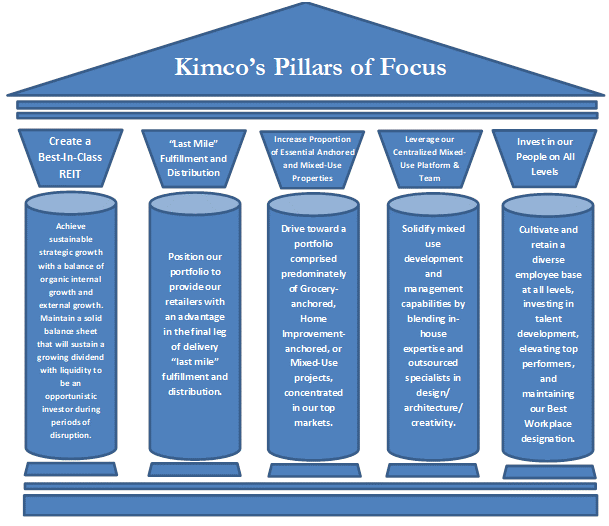
The Company reduces its operating and leasing risks through diversification achieved by the geographic distribution of its properties and a large tenant base. As of December 31, 2020, no single open-air shopping center accounted for more than 2.0% of the Company's annualized base rental revenues, including the proportionate share of base rental revenues from properties in which the Company has less than a 100% economic interest, or more than 2.0% of the Company’s total shopping center GLA. Furthermore, at December 31, 2020, the Company’s single largest tenant represented only 4.0%, and the Company’s five largest tenants aggregated less than 12.6%, of the Company’s annualized base rental revenues, including the proportionate share of base rental revenues from properties in which the Company has less than a 100% economic interest.
As one of the original participants in the growth of the shopping center industry and one of the nation's largest owners and operators of open-air shopping centers, the Company has established close relationships with major national and regional retailers and maintains a broad network of industry contacts. Management is associated with and/or actively participates in many shopping center and REIT industry organizations. Notwithstanding these relationships, there are numerous regional and local commercial developers, real estate companies, financial institutions and other investors who compete with the Company for the acquisition of properties and other investment opportunities and in seeking tenants who will lease space in the Company’s properties.
Human Capital Resources
The Company believes that our employees are one of our strongest resources and that a variety of perspectives and experiences found in a diverse workforce spark innovation and enrich company culture. The Company is committed to diversity and inclusion best practices in all phases of the employee life cycle, including recruitment, training and development and promotion.
The Company has been and will continue to be an equal opportunity employer committed to hiring, developing, and supporting a diverse and inclusive workplace. To ensure full implementation of this equal employment policy, we will take steps to ensure that persons are recruited, hired, assigned and promoted without regard to race, national origin, religion, age, color, sex, sexual orientation, gender identity, disability, or protected veteran status, or any other characteristic protected by local, state, or federal laws, rules, or regulations. All of our employees must adhere to a Code of Business Conduct and Ethics that sets standards for appropriate behavior and includes required internal training on preventing, identifying, reporting and stopping any type of discrimination.
In order to attract and retain high performing individuals, we are committed to partnering with our employees to provide opportunities for their professional development and promote their health and well-being. We also offer our employees a broad range of company-paid benefits, and we believe our compensation package and benefits are competitive with others in our industry. Our benefits programs include a robust offering of medical, dental, vision benefits, life, disability and other ancillary benefits requiring very low employee contributions. In addition, the Company has been recognized as a Great Place to Work® based on surveys and feedback collected from its employees.
The Company’s executive and management team promotes a true “open door” environment in which all feedback and suggestions are welcome. Whether it be through regular all employee calls, department meetings, frequent training sessions, Coffee Connections with the executive team, use of our BRAVO recognition program, awarding of iPads for Ideas, or participation in our flagship LABS (Leaders Advancing Business Strategy) program, associates are encouraged to be inquisitive and share ideas. Those ideas have resulted in a number of programs and benefit enhancements.
The Company promotes physical health, including access to a national gym membership program for associates and their family members as well as host regular wellness and nutrition seminars and health screenings. The Company also feels it is important that our associates are engaged and active in the community. At our headquarters and in each of our regions a Committee of employees host numerous volunteer and social activities that are derived from employee sentiment. Whether we’re participating in walks, runs, meal servings, food drives, toy drives, or St. Jude Ride for a Reason, the Company promotes and supports associate volunteerism with two volunteer days off per year and a company matching program that provide up to $500 per year in support of each associates charitable endeavors. In addition, each year, the Company provides $100,000 in education scholarships for children of our associates, which is managed by an independent third-party.
The Company's executive offices are located at 500 North Broadway, Suite 201, Jericho, NY 11753, a mixed-use property that is wholly owned by the Company, and its telephone number is (516) 869-9000. Nearly all operating functions, including leasing, legal, construction, data processing, maintenance, finance and accounting are administered by the Company from its executive offices in Jericho, New York and supported by the Company’s regional offices. As of December 31, 2020, a total of 484 persons were employed by the Company of which 41.5% were located in our corporate office with the remainder located in 26 offices throughout the United States. The average tenure of our employees was 10 years.
The health and safety of the Company’s employees and their families is a top priority. The Company always takes the necessary steps to protect its employees, especially during the COVID-19 pandemic where employees were empowered to work from home and care for their family members and children, whose lives have also been impacted. The Company will continue to evaluate individual situations as they arise and adjust its approach as appropriate, with the goal of enabling its employees to be as productive as possible while offering them the flexibility they need to care for themselves and their families. The following are steps that were taken by the Company in response to the COVID-19 pandemic:
| ● | Transitioned the entire workforce from full-time office to flexible work from home arrangement, which the Company successfully continued since March 2020. This included immediate and extensive technology training on virtual meetings and remote working as well as safety protocols. |
|---|
| ● | Business travel has been stopped with relatively few business-essential exceptions. |
|---|
| ● | The Company has benefited from recent investments in new technology and software over the last year, as its entire team is equipped with new laptops and cellular capability to enable them to work remotely. |
|---|
| ● | The Company’s human resources and information technology teams are available to all employees to address any needs or concerns they may have. |
|---|
| ● | Associates will be provided paid time off to care for themselves or family members diagnosed with COVID-19. |
|---|
| ● | The Company has increased communications at all levels and has initiated bi-weekly company-wide virtual meetings such that executives are accessible to answer any questions and transparently keep associates informed. |
|---|
Environment, Social and Governance (“ESG”) Programs
The Company is focused on building a thriving and viable business, one that succeeds by delivering long-term value for its stakeholders. The Company’s ESG programs are aligned with its core business strategy of creating destinations for everyday living that inspire a sense of community and deliver value to its many stakeholders.
The Company has established five ESG Program Pillars and the corresponding objectives:
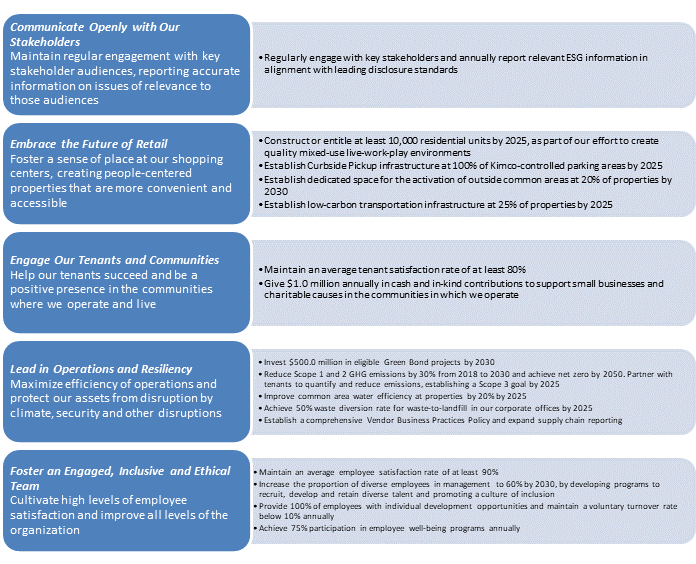
The Company is committed to best-in-class ESG disclosure, and has aligned its annual reporting with standards from the Global Reporting Initiative (“GRI”), Sustainability Accounting Standards Board (“SASB”) and Task Force on Climate-Related Financial Disclosures (“TCFD”). Additional ESG information of relevance to stakeholders can be found on the Company’s website in the Corporate Responsibility Report. This report, which is based on the GRI standard, summarizes the Company's environmental and social performance.
The Company recognizes that climate change is one of the most significant stakeholder issues of our times, threatening the viability of economic and environmental systems globally. As a real estate portfolio owner, the Company monitors physical and transition risks as well as opportunities posed to its business by climate change and quantifies and discloses the climate impacts of its activities. The Company’s science-based emissions reduction goals are aligned with the Paris Climate Accord and put the company on pace to achieve net zero emissions by 2050. During 2020, the Company issued $500.0 million in 2.70% notes due 2030 in its inaugural green bond offering. Net proceeds from this offering are allocated to finance or refinance, in whole or in part, recently completed, existing or future eligible green projects, in alignment with the four core components of the Green Bond Principles, 2018 as administered by the International Capital Market Association. Additionally, the Company’s $2.0 billion Credit Facility (as defined below) is a green credit facility which incorporates rate reductions associated with attainment of Scope 1 and 2 greenhouse gas emissions reductions.
The Company’s industry leading ESG initiatives led to its 2020 listing on the Dow Jones Sustainability World Index (“DJSI World Index”), where it is the only North American retail real estate owner listed. The DJSI World Index is comprised of corporate leaders in global sustainability, with companies listed on the DJSI World Index representing the top 10 percent of the largest 2,500 companies in the S&P Global Broad Market Index based on long-term economic and ESG factors. The Company has been the sole retail real estate owner listed on the Dow Jones Sustainability North America Index for the last six years, and the Company also is a constituent of the FTSE4Good Index Series, designed to measure the performance of companies demonstrating strong ESG practices.
Information About Our Executive Officers
The following table sets forth information with respect to the executive officers of the Company as of December 31, 2020:
| Name | Age | Position | Joined Kimco |
|---|---|---|---|
| Milton Cooper | 91 | Executive Chairman of the Board of Directors | Co-Founder |
| Conor C. Flynn | 40 | Chief Executive Officer | 2003 |
| Ross Cooper | 38 | President and Chief Investment Officer | 2006 |
| Glenn G. Cohen | 56 | Executive Vice President, Chief Financial Officer and Treasurer | 1995 |
| David Jamieson | 40 | Executive Vice President, Chief Operating Officer | 2007 |
Available Information
The Company’s website is located at http://www.kimcorealty.com. The information contained on our website does not constitute part of this Form 10-K. On the Company’s website you can obtain, free of charge, a copy of this Form 10-K, quarterly reports on Form 10-Q, current reports on Form 8-K and amendments to those reports filed or furnished pursuant to Section 13(a) or 15(d) of the Exchange Act of 1934, as amended, as soon as reasonably practicable, after we file such material electronically with, or furnish it to, the SEC. The public may read and obtain a copy of any materials we file electronically with the SEC at http://www.sec.gov.
Previous: Cover and table of contents · Next: Item 1A. Risk Factors