 filings.tools
Cover and table of contents
243K characters. Original on sec.gov · Markdown
Cover and table of contents
UNITED STATES
SECURITIES AND EXCHANGE COMMISSION
Washington, D.C. 20549
FORM 10-K
☑ ANNUAL REPORT PURSUANT TO SECTION 13 OR 15(d) OF THE SECURITIES EXCHANGE ACT OF 1934
For the fiscal year ended December 31, 2022
OR
☐ TRANSITION REPORT PURSUANT TO SECTION 13 OR 15(d) OF THE SECURITIES EXCHANGE ACT OF 1934
For the transition period from __________ to __________
Commission file number 1-10899 (Kimco Realty Corporation)
Commission file number 333-269102-01 (Kimco Realty OP, LLC)
KIMCO REALTY CORPORATION
KIMCO REALTY OP, LLC
(Exact name of registrant as specified in its charter)
| Maryland (Kimco Realty Corporation) Delaware (Kimco Realty OP, LLC) | 13-2744380 92-1489725 | |
|---|---|---|
| (State or other jurisdiction of incorporation or organization) | (I.R.S. Employer Identification No.) |
500 North Broadway, Suite 201, Jericho, NY 11753
(Address of principal executive offices) (Zip Code)
(516) 869-9000
(Registrant’s telephone number, including area code)
Securities registered pursuant to Section 12(b) of the Act:
Kimco Realty Corporation
| Title of each class | Trading Symbol(s) | Name of each exchange on which registered | |
|---|---|---|---|
| Common Stock, par value $.01 per share. | KIM | New York Stock Exchange | |
| Depositary Shares, each representing one-thousandth of a share of 5.125% Class L Cumulative Redeemable, Preferred Stock, $1.00 par value per share. | KIMprL | New York Stock Exchange | |
| Depositary Shares, each representing one-thousandth of a share of 5.250% Class M Cumulative Redeemable Preferred Stock, $1.00 par value per share. | KIMprM | New York Stock Exchange |
Kimco Realty OP, LLC
| Title of each class | Trading Symbol(s) | Name of each exchange on which registered | |
|---|---|---|---|
| None | N/A | N/A |
Securities registered pursuant to section 12(g) of the Act: None
Indicate by check mark if the registrant is a well-known seasoned issuer, as defined in Rule 405 of the Securities Act.
Kimco Realty Corporation Yes ☑ No ☐ Kimco Realty OP, LLC Yes ☑ No ☐
Indicate by check mark if the registrant is not required to file reports pursuant to Section 13 or Section 15(d) of the Act.
Kimco Realty Corporation Yes ☐ No ☑ Kimco Realty OP, LLC Yes ☐ No ☑
Indicate by check mark whether the registrant (1) has filed all reports required to be filed by Section 13 or 15(d) of the Securities Exchange Act of 1934 during the preceding 12 months (or for such shorter period that the registrant was required to file such reports), and (2) has been subject to such filing requirements for the past 90 days.
Kimco Realty Corporation Yes ☑ No ☐ Kimco Realty OP, LLC Yes ☑ No ☐
Indicate by check mark whether the registrant has submitted electronically every Interactive Data File required to be submitted pursuant to Rule 405 of Regulation S-T (§ 232.405 of this chapter) during the preceding 12 months (or for such shorter period that the registrant was required to submit such files).
Kimco Realty Corporation Yes ☑ No ☐ Kimco Realty OP, LLC Yes ☑ No ☐
Indicate by check mark whether the registrant is a large accelerated filer, an accelerated filer, a non-accelerated filer, a smaller reporting company, or an emerging growth company. See the definitions of “large accelerated filer,” “accelerated filer,” “smaller reporting company,” and “emerging growth company” in Rule 12b-2 of the Exchange Act.
Kimco Realty Corporation:
| Large accelerated filer ☑ | Accelerated filer ☐ | Non-accelerated filer ☐ | Smaller reporting company ☐ | Emerging growth company ☐ |
|---|
Kimco Realty OP, LLC:
| Large accelerated filer ☐ | Accelerated filer ☐ | Non-accelerated filer ☑ | Smaller reporting company ☐ | Emerging growth company ☐ |
|---|
If an emerging growth company, indicate by check mark if the registrant has elected not to use the extended transition period for complying with any new or revised financial accounting standards provided pursuant to Section 13(a) of the Exchange Act.
Kimco Realty Corporation ☐ Kimco Realty OP, LLC ☐
Indicate by check mark whether the registrant has filed a report on and attestation to its management’s assessment of the effectiveness of its internal control over financial reporting under Section 404(b) of the Sarbanes-Oxley Act (15 U.S.C. 7262(b)) by the registered public accounting firm that prepared or issued its audit report.
Kimco Realty Corporation ☑ Kimco Realty OP, LLC ☐
Indicate by check mark whether the registrant is a shell company (as defined in Rule 12b-2 of the Act).
Kimco Realty Corporation Yes ☐ No ☑ Kimco Realty OP, LLC Yes ☐ No ☑
The aggregate market value of the voting and non-voting common equity held by non-affiliates of Kimco Realty Corporation was approximately $12.0 billion based upon the closing price on the New York Stock Exchange for such equity on June 30, 2022.
(APPLICABLE ONLY TO CORPORATE REGISTRANTS)
Indicate the number of shares outstanding of each of the registrant's classes of common stock, as of the latest practicable date.
As of February 10, 2023, Kimco Realty Corporation had 618,609,347 shares of common stock outstanding.
DOCUMENTS INCORPORATED BY REFERENCE
Part III incorporates certain information by reference to the Kimco Realty Corporation's definitive proxy statement to be filed with respect to the Annual Meeting of Stockholders expected to be held on April 25, 2023.
Index to Exhibits begins on page 46.
KIMCO REALTY CORPORATION
KIMCO REALTY OP, LLC
ANNUAL REPORT ON FORM 10-K
FISCAL YEAR ENDED DECEMBER 31, 2022
EXPLANATORY NOTE
Prior to January 1, 2023, the business of Kimco Realty Corporation (the “Company”) was conducted through a predecessor entity also known as Kimco Realty Corporation (the “Predecessor”). On December 14, 2022, the Predecessor’s Board of Directors approved the entry into an Agreement and Plan of Merger (the “UPREIT Merger”) with the company formerly known as New KRC Corp., which was a Maryland corporation and wholly owned subsidiary of the Predecessor (the “Parent Company”), and KRC Merger Sub Corp., which was a Maryland corporation and wholly owned subsidiary of the Parent Company (“Merger Sub”), to effect the reorganization (the “Reorganization”) of the Predecessor’s business into an umbrella partnership real estate investment trust, or “UPREIT”.
On January 1, 2023, pursuant to the UPREIT Merger, Merger Sub merged with and into the Predecessor, with the Predecessor continuing as the surviving entity and a wholly-owned subsidiary of the Parent Company, and each outstanding share of capital stock of the Predecessor was converted into one equivalent share of capital stock of the Parent Company (each of which has continued to trade under their respective existing ticker symbol with the same rights, powers and limitations that existed immediately prior to the Reorganization).
In connection with the Reorganization, the Parent Company changed its name to Kimco Realty Corporation, and replaced the Predecessor as the New York Stock Exchange-listed public company. Effective as of January 3, 2023, the Predecessor converted into a limited liability company, organized in the State of Delaware, known as Kimco Realty OP, LLC, the entity we refer to herein as “Kimco OP”.
Following the Reorganization, substantially all of the Company’s assets are held by, and substantially all of the Company’s operations are conducted through, Kimco OP (either directly or through its subsidiaries), as the Company’s operating company, and the Company is the managing member of Kimco OP. The officers and directors of the Company are the same as the officers and directors of the Predecessor immediately prior to the Reorganization.
This Annual Report on Form 10-K (“Form 10-K” or “Annual Report”) pertains to the business and results of operations of the Predecessor for its fiscal year ended December 31, 2022. The Company and Kimco OP have elected to co-file such Annual Report of the Predecessor to ensure continuity of information to investors.
For additional information on our Reorganization, please see our Current Reports on Form 8-K filed with the SEC on January 3, 2023 and January 4, 2023.
Throughout this Annual Report, unless the context requires otherwise:
| ● | the “Company,” “we,” “our,” “us” or refer to: | |
|---|---|---|
| ○ for the period prior to January 1, 2023 (the period preceding the UPREIT Merger), the Predecessor and its business and operations conducted through its directly or indirectly owned subsidiaries; | ||
| ○ for the period on or after January 1, 2023, (the period from and following the UPREIT Merger), the Parent Company and its business and operations conducted through its directly or indirectly owned subsidiaries, including Kimco OP; and | ||
| ○ in statements regarding qualification as a real estate investment trust (“REIT”), such terms refer solely to the Predecessor or Parent Company, as applicable. |
| ● | “Kimco OP” refers to Kimco Realty OP, LLC, our operating company following the UPREIT Merger. |
|---|
| ● | References to “shares” and “shareholders” refer to the shares and stockholders of the Predecessor prior to January 1, 2023 and of the Parent Company on or after January 1, 2023, and not the limited liability company interests of Kimco OP. |
|---|
| Item No. | Form 10-K Report Page |
|---|
FORWARD-LOOKING STATEMENTS
This annual report on Form 10-K (“Form 10-K”), together with other statements and information publicly disseminated by the Company contains certain forward-looking statements within the meaning of Section 27A of the Securities Act of 1933, as amended (the “Securities Act”), and Section 21E of the Securities Exchange Act of 1934, as amended (the “Exchange Act”). The Company intends such forward-looking statements to be covered by the safe harbor provisions for forward-looking statements contained in the Private Securities Litigation Reform Act of 1995 and includes this statement for purposes of complying with the safe harbor provisions. Forward-looking statements, which are based on certain assumptions and describe the Company’s future plans, strategies and expectations, are generally identifiable by use of the words “believe,” “expect,” “intend,” “commit,” “anticipate,” “estimate,” “project,” “will,” “target,” “forecast” or similar expressions. You should not rely on forward-looking statements since they involve known and unknown risks, uncertainties and other factors which, in some cases, are beyond the Company’s control and could materially affect actual results, performances or achievements. Factors which may cause actual results to differ materially from current expectations include, but are not limited to, (i) general adverse economic and local real estate conditions, (ii) the impact of competition, including the availability of acquisition or development opportunities and the costs associated with purchasing and maintaining assets; (iii) the inability of major tenants to continue paying their rent obligations due to bankruptcy, insolvency or a general downturn in their business, (iv) the reduction in the Company’s income in the event of multiple lease terminations by tenants or a failure of multiple tenants to occupy their premises in a shopping center, (v) the potential impact of e-commerce and other changes in consumer buying practices, and changing trends in the retail industry and perceptions by retailers or shoppers, including safety and convenience, (vi) the availability of suitable acquisition, disposition, development and redevelopment opportunities, and risks related to acquisitions not performing in accordance with our expectations, (vii) the Company’s ability to raise capital by selling its assets, (viii) disruptions and increases in operating costs due to inflation and supply chain issues, (ix) risks associated with the development of mixed-use commercial properties, including risks associated with the development and ownership of non-retail real estate, (x) changes in governmental laws and regulations, including, but not limited to, changes in data privacy, environmental (including climate change), safety and health laws, and management’s ability to estimate the impact of such changes, (xi) valuation and risks related to the Company’s joint venture and preferred equity investments and other investments, (xii) valuation of marketable securities and other investments, including the shares of Albertsons Companies, Inc. common stock held by the Company, (xiii) impairment charges, (xiv) criminal cybersecurity attacks disruption, data loss or other security incidents and breaches, (xv) impact of natural disasters and weather and climate-related events, (xvi) pandemics or other health crises, such as coronavirus disease 2019 (“COVID-19”), (xvii) our ability to attract, retain and motivate key personnel, (xviii) financing risks, such as the inability to obtain equity, debt or other sources of financing or refinancing on favorable terms to the Company, (xix) the level and volatility of interest rates and management’s ability to estimate the impact thereof, (xx) changes in the dividend policy for the Company’s common and preferred stock and the Company’s ability to pay dividends at current levels, (xxi) unanticipated changes in the Company’s intention or ability to prepay certain debt prior to maturity and/or hold certain securities until maturity, and (xxii) the Company’s ability to continue to maintain its status as a REIT for federal income tax purposes and potential risks and uncertainties in connection with its UPREIT structure, and (xxiii) the other risks and uncertainties identified under Item 1A, “Risk Factors” and elsewhere in this Form 10-K and in the Company’s other filings with the Securities and Exchange Commission (“SEC”). Accordingly, there is no assurance that the Company’s expectations will be realized. The Company disclaims any intention or obligation to update the forward-looking statements, whether as a result of new information, future events or otherwise. You are advised to refer to any further disclosures the Company makes or related subjects in the Company’s quarterly reports on Form 10-Q and current reports on Form 8-K that the Company files with the SEC.
Overview
The Company is North America’s largest publicly traded owner and operator of open-air, grocery-anchored shopping centers, and a growing portfolio of mixed-use assets. The Company’s mission is to create destinations for everyday living that inspire a sense of community and deliver value to our many stakeholders.
The Company began operations through its predecessor, The Kimco Corporation, which was organized in 1966 upon the contribution of several shopping center properties owned by its principal stockholders. In 1973, these principals formed the Company as a Delaware corporation, and, in 1985, the operations of The Kimco Corporation were merged into the Company. The Company completed its initial public stock offering (the “IPO”) in November 1991, and, commencing with its taxable year which began January 1, 1992, elected to qualify as a REIT in accordance with Sections 856 through 860 of the Internal Revenue Code of 1986, as amended (the “Code”). To qualify as a REIT, the Company must meet several organizational and operational requirements, and is required to annually distribute at least 90% of its net taxable income, determined without regard to the dividends paid deduction and excluding any net capital gain. In addition, the Company will be subject to federal income tax at regular corporate rates to the extent that it distributes less than 100% of its net taxable income, including any net capital gains. In January of 2023, the Company consummated the Reorganization into an UPREIT structure as described in the Explanatory Note at the beginning of this Annual Report. If, as the Company believes, it is organized and operates in such a manner so as to qualify and remain qualified as a REIT under the Code, the Company, generally will not be subject to U.S. federal income tax, provided that distributions to its stockholders equal at least the amount of its REIT taxable income, as defined in the Code. The Company maintains certain subsidiaries that made joint elections with the Company to be treated as taxable REIT subsidiaries (“TRSs”), that permit the Company to engage through such TRSs in certain business activities that the REIT may not conduct directly. A TRS is subject to federal and state taxes on its income, and the Company includes a provision for taxes in its consolidated financial statements. In 1994, the Predecessor reorganized as a Maryland corporation. In March 2006, the Predecessor was added to the S&P 500 Index, an index containing the stock of 500 Large Cap companies, most of which are U.S. corporations. The Company's common stock, Class L Depositary Shares and Class M Depositary Shares are traded on the New York Stock Exchange (“NYSE”) under the trading symbols “KIM”, “KIMprL”, and “KIMprM”, respectively.
The Company is a self-administered REIT and has not engaged, nor does it expect to retain, any REIT advisors in connection with the operation of its properties. The Company’s ownership interests in real estate consist of its consolidated portfolio and portfolios where the Company owns an economic interest, such as properties in the Company’s investment real estate management programs, where the Company partners with institutional investors and also retains management.
The Company began to expand its operations through the development of real estate and the construction of shopping centers but revised its growth strategy to focus on the acquisition and redevelopment of existing shopping centers that include a grocery component. The Company also expanded internationally within Canada, Mexico, Chile, Brazil and Peru, but has since exited all international investments. Additionally, the Company developed various residential and mixed-use operating properties and continues to obtain entitlements to embark on additional projects of this nature through re-development opportunities. In August 2021, the Company expanded through a merger with Weingarten Realty Investors (“Weingarten”), whereby Weingarten merged with and into the Predecessor, with the Predecessor continuing as the surviving public company (the “Merger”), pursuant to the definitive merger agreement (the “Merger Agreement”) between the Predecessor and Weingarten which was entered into on April 15, 2021. The Merger brought together two industry-leading retail real estate platforms with highly complementary portfolios and created the preeminent open-air shopping center and mixed-use real estate owner in the country. The Merger further enhanced the Company’s portfolio in coastal and sun belt regions.
The Company has implemented its investment real estate management format through the establishment of various institutional joint venture programs, in which the Company has noncontrolling interests. The Company earns management fees, acquisition fees, disposition fees as well as promoted interests based on achieving certain performance metrics.
In addition, the Company has capitalized on its established expertise in retail real estate by establishing other ventures in which the Company owns a smaller equity interest and provides management, leasing and operational support for those properties. The Company has also provided preferred equity capital to real estate professionals and, from time to time, provides real estate capital and management services to both healthy and distressed retailers. The Company has also made selective investments in secondary market opportunities where a security or other investment is, in management’s judgment, priced below the value of the underlying assets, however these investments are subject to volatility within the equity and debt markets.
As described in greater detail in the Explanatory Note to this Form 10-K, (i) on January 1, 2023, as a result of the Reorganization, the Parent Company, a Maryland corporation, became the successor issuer to the Predecessor, and (ii) on January 3, 2023 the Predecessor converted into Kimco OP, a limited liability company, organized in the State of Delaware. Parent Company is the managing member of Kimco OP and owns 100% of the limited liability company interests, and exercises exclusive control over Kimco OP.
As of December 31, 2022, the Company had interests in 532 shopping center properties (the “Combined Shopping Center Portfolio”), aggregating 90.8 million square feet of gross leasable area (“GLA”), located in 28 states. In addition, the Company had 23 other property interests, primarily through the Company’s preferred equity investments and other investments, totaling 5.7 million square feet of GLA.
Economic Conditions
The economy continues to face several issues including the lack of qualified employees, inflation risk, supply chain issues and new COVID-19 variants, which could impact the Company and its tenants. In response to the rising rate of inflation the Federal Reserve has steadily increased interest rates, and may continue to increase interest rates, until the rate of inflation begins to decrease. These increases in interest rates could adversely impact the business and financial results of the Company and its tenants. In addition, slower economic growth and the potential for a recession could have an adverse effect on the Company and its tenants. This could negatively affect the overall demand for retail space, including the demand for leasable space in the Company’s properties. As a result, the Company could feel pricing pressure on rents that it is able to charge to new or renewing tenants, such that future rents and rent spreads could be negatively impacted. Any of these events could materially adversely impact the Company’s business, financial condition, results of operations or stock price. The Company continues to monitor economic, financial, and social conditions and will assess its asset portfolio for any impairment indicators. If the Company determines that any of its assets are impaired, the Company would be required to take impairment charges, and such amounts could be material.
Business Objective and Strategies
The Company has developed a strong nationally diversified portfolio of open-air, shopping centers located in drivable first-ring suburbs primarily within 19 major metropolitan sun belt and coastal markets, which are supported by strong demographics, significant projected population growth, and where the Company perceives significant barriers to entry. As of December 31, 2022, the Company derived 85% of its annualized base rent from these top major metro markets. The Company’s shopping centers provide essential, necessity-based goods and services to the local communities and are primarily anchored by grocers, home improvement, and pharmacy.
The Company’s focus on high-quality locations has led to significant opportunities for value creation through the reinvestment in its assets to add density, replace outdated shopping center concepts, and better meet changing consumer demands. In order to add density to existing properties, the Company has obtained multi-family entitlements for 8,818 units of which 2,218 units have been constructed as of December 31, 2022. The Company continues to place strategic emphasis on live/work/play environments and in reinvesting in its existing assets, while building shareholder value. This philosophy is exemplified by the Company’s Signature SeriesTM properties which include key value creation projects in our portfolio that exemplify our transformation and highlight our focus on quality, concentration around core MSAs, and growth through redevelopment and development opportunities. Signature Series properties also include fully entitled, shovel-ready mixed-use projects, and opportunities that we continue to identify and entitle as we seek to achieve the highest and best use of our real estate, enhance our communities, and create value for our stakeholders for years to come.
The strength and security of the Company’s balance sheet remains central to its strategy. The Company’s strong balance sheet and liquidity position are evidenced by its investment grade unsecured debt ratings (Baa1/BBB+) by two major ratings agencies. The Company maintains one of the longest weighted average debt maturity profiles in the REIT industry, now at 9.5 years. The Company expects to continue to take steps to reduce leverage, unencumber assets and improve its debt coverage metrics as mixed-use projects and redevelopments continue to come online and contribute additional cash flow growth.
Business Objective
The Company’s primary business objective is to be the premier owner and operator of open-air, grocery-anchored shopping centers, and a growing portfolio of mixed-use assets, in the U.S. The Company believes it can achieve this objective by:
| ● | increasing the value of its existing portfolio of properties and generating higher levels of portfolio growth; |
|---|
| ● | increasing cash flows for reinvestment and/or for distribution to shareholders while maintaining conservative payout ratios; |
|---|
| ● | improving debt metrics and upgraded unsecured debt ratings |
|---|
| ● | continuing growth in desirable demographic areas with successful retailers, primarily focused on grocery anchors; and |
|---|
| ● | increasing the number of entitlements for residential use. |
|---|
Business Strategies
The Company believes with its strong core portfolio and its recent acquisitions, it will continue to achieve higher occupancy levels, increased rental rates and rental growth in the future. To effectively execute the Company’s strategy and achieve its strategic goals the Company identified the following growth components to focus on:
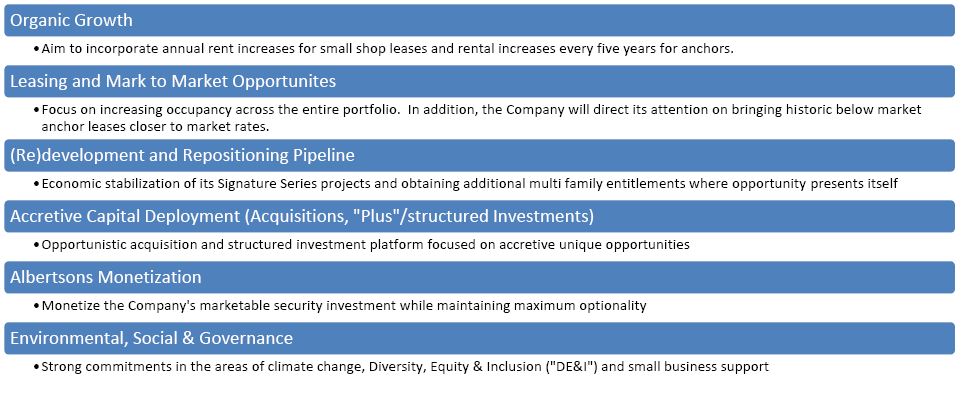
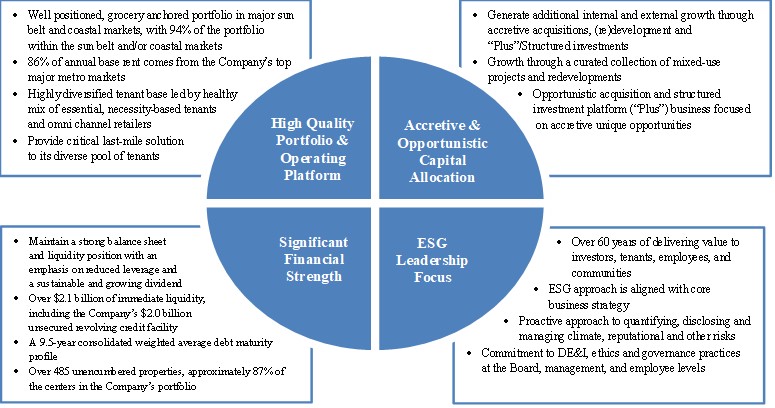
The Company believes it is well positioned for sustainable growth with its high-quality portfolio, accretive and opportunistic capital allocation, financial strength and environmental, social and governance leadership.
The Company has identified the following areas where it is well positioned for sustainable growth in the future.
The Company reduces its operating and leasing risks through diversification achieved by the geographic distribution of its properties and a large tenant base. As of December 31, 2022, no single open-air shopping center accounted for more than 1.3% of the Company's annualized base rental revenues, including the proportionate share of base rental revenues from properties in which the Company has less than a 100% economic interest, or more than 1.4% of the Company’s total shopping center GLA. Furthermore, at December 31, 2022, the Company’s single largest tenant represented only 3.7%, and the Company’s five largest tenants aggregated less than 11.4%, of the Company’s annualized base rental revenues, including the proportionate share of base rental revenues from properties in which the Company has less than a 100% economic interest.
As one of the original participants in the growth of the shopping center industry and the nation's largest owners and operators of open-air shopping centers, the Company has established close relationships with major national and regional retailers and maintains a broad network of industry contacts. Management is associated with and/or actively participates in many shopping center and REIT industry organizations. Notwithstanding these relationships, there are numerous regional and local commercial developers, real estate companies, financial institutions and other investors who compete with the Company for the acquisition of properties and other investment opportunities and in seeking tenants who will lease space in the Company’s properties.
Government Regulation
Compliance with various governmental regulations has an impact on our business, including our capital expenditures, earnings and competitive position, which can be material. We incur costs to monitor and take actions to comply with governmental regulations that are applicable to our business, which include, among others, federal securities laws and regulations, applicable stock exchange requirements, REIT and other tax laws and regulations, environmental and health and safety laws and regulations, local zoning, usage and other regulations relating to real property and the Americans with Disabilities Act of 1990.
In addition, see Item 1A. Risk Factors for a discussion of material risks to us, including, to the extent material, to our competitive position, relating to governmental regulations, and see “Item 7. Management’s Discussion and Analysis of Financial Condition and Results of Operations” together with our audited consolidated financial statements and the related notes thereto for a discussion of material information relevant to an assessment of our financial condition and results of operations, including, to the extent material, the effects that compliance with governmental regulations may have upon our capital expenditures and earnings.
Human Capital Resources
The Company believes that our associates are one of our strongest resources and that a variety of perspectives and experiences found in a diverse workforce spark innovation and enrich company culture. The Company is committed to diversity, equity and inclusion best practices in all phases of the associate life cycle, including recruitment, training and development and promotion. By cultivating high levels of associate satisfaction and improving the diversity of our team, management’s goal is to ensure the Company will remain a significant driving force in commercial real estate well into the future.
The Company has been and will continue to be an equal opportunity employer committed to hiring, developing, and supporting a diverse, equitable, and inclusive workplace. To ensure full implementation of this equal employment policy, we take steps to ensure that persons are recruited, hired, assigned and promoted without regard to race, creed, national origin, ancestry, citizenship status, religion, age, color, sex, gender (including pregnancy, childbirth and related medical conditions), gender identity and expression, sexual orientation, marital status, disability, genetic information, protected veteran status, or any other characteristic protected by local, state, or federal laws, rules, or regulations. All of our employees must adhere to a Code of Business Conduct and Ethics that sets standards for appropriate behavior and includes required, regular internal training on preventing, identifying, reporting and stopping any type of discrimination and/or retaliation.
To attract and retain high performing individuals, we are committed to partnering with our associates to provide opportunities for their professional development and promote their health and well-being. We offer a broad range of benefits, and we believe our compensation package and benefits are competitive with others in our industry. Our benefits programs include a robust offering of medical, dental, vision, life, disability and a number of exciting ancillary benefits, all of which require very low associate contributions or are offered at no cost to associates. The Company also provides a Safe Harbor 401(k) program with both pretax and Roth offering including a robust, fully vested matching contribution.
The Company has been recognized as a Great Place to Work® for five consecutive years as well as a One of the 2022 Best Workplaces in Real Estate™, both of which are based on anonymous third-party surveys and feedback collected from our associates. Additionally, the Company was designated a Best Place to Work for LGBTQ+ Equality and has achieved a perfect score on the Human Rights Campaign Foundation’s 2022 Corporate Equality Index, a nationally recognized benchmarking survey and report measuring corporate policies and practices related to LGBTQ+ workplace equality.
The Company operates under a hybrid work model, which balances associates’ need for valuable face-to-face interactions with individual preferences for ideal work conditions. By continuing to focus on communication, collaboration, and innovation, and by encouraging associates to protect their personal time and be deliberate in where and how they choose to work, management is confident that the model results in a happier, engaged, and more efficient workforce.
The Company’s executive and management team promotes a true “open door” environment in which all feedback and suggestions are welcome. Whether it be through regular all employee calls, department meetings, frequent training sessions, Coffee Connections with the executive team, use of our BRAVO recognition program, awarding of iPads for Ideas, or participation in our LABS (Leaders Advancing Business Strategy) program, associates are encouraged to be inquisitive and share ideas. Those ideas have resulted in a number of programs and benefit enhancements.
The Company promotes physical health, including access to a national gym membership program for associates and their family members as well as host to regular wellness and nutrition seminars and health screenings. The Company also feels it is important that our associates are engaged and active in the community. Across our numerous offices, associates host volunteer and social activities. Whether we’re participating in walks, runs, food or toy drives, the Company promotes and supports associate volunteerism with two volunteer days off per year and a company matching program in support of each associates charitable endeavors. The Company also encourages associates to directly drive strategy around the Company’s environmental, social and governance initiatives through participation in five associate-driven KIMunity Councils focused in the areas of diversity, equity and inclusion, giving, wellness, sustainability, and tenant engagement.
The Company recognizes the importance of advanced education. Each year, the Company funds $100,000 in college scholarships to benefit the children of our associates. In addition, the Company recently announced, in partnership with ICSC, it is providing $100,000 in scholarships to students wishing to pursue careers in real estate, of which no less than 50% will be awarded to students of under-represented groups. Both programs are managed by independent third parties who consider an equal balance of academics and financial need as determining factors.
The Company's executive offices are located at 500 North Broadway, Suite 201, Jericho, NY 11753, a mixed-use property that is wholly owned by the Company, and its telephone number is (516) 869-9000 or 1-800-764-7114. Nearly all corporate functions, including legal, data processing, finance and accounting are administered by the Company from its executive offices in Jericho, New York and supported by the Company’s regional offices. As of December 31, 2022, a total of 639 persons were employed by the Company, of which 31% were located in our corporate office with the remainder located in 28 offices throughout the United States. The average tenure of our employees was 9.0 years.
Cybersecurity
The Company’s Audit Committee receives quarterly briefings from the Company’s Chief Information Officer regarding the emerging cybersecurity threat and risk landscape as well as the Company’s security program and related readiness, resiliency, and response efforts.
The Company has a Cyber Risk Committee (“Cyber Committee”) which reviews and reports on technology-based security issues. The Cyber Committee is comprised of senior management from various business units within the Company and meets quarterly to review the status of the Company’s overall security program as well as controls and procedures and to stay up-to-date of relevant legislative, regulatory and technical developments.
The Company utilizes a variety of administrative, technical and physical safeguards that take into account the nature of our IT environment, information assets and cyber risks posed by both internal and external threats. The Company has incorporated cybersecurity coverage in its insurance policies. The Company’s goal is to keep its data and systems, as well as its employees safe from cybersecurity threats.
The Company conducts employee security awareness training and internal phishing exercises. When security issues arise, the Company conducts a prompt investigation and initiates response protocols and other measures to protect the Company and its valued employees and key stakeholders.
Environmental, Social and Governance (“ESG”) Programs
The Company strives to build a thriving and viable business, one that succeeds by delivering long-term value for its stakeholders. We believe that the Company’s ESG programs are aligned with its core business strategy of creating destinations for everyday living that inspire a sense of community and deliver value to its many stakeholders.
The Company has identified the following five pillars that outline the Company’s current strategic priorities within our ESG program. The Company has defined 16 ESG goals that expand upon the Company’s commitment with clear targets in each pillar:
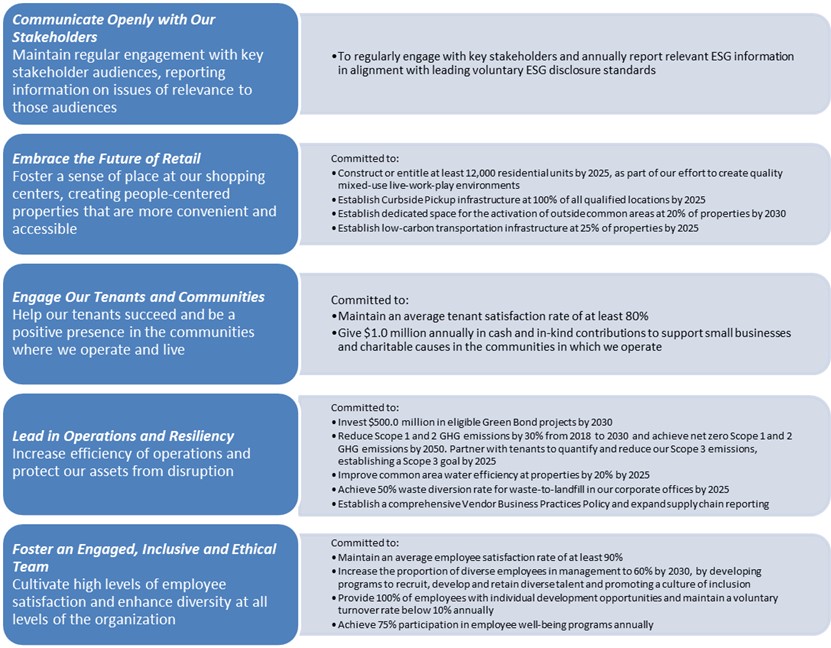
The Company has aligned its annual reporting with standards from the Global Reporting Initiative (“GRI”), Sustainability Accounting Standards Board (“SASB”) and Task Force on Climate-related Financial Disclosures (“TCFD”). The Company also discloses aggregate-level EEO-1 workforce diversity data that can be found on the Company’s website, which data and website contents are not incorporated by reference hereto. Additional ESG information of relevance to stakeholders can be found on the Company’s website, the contents of which are not incorporated by reference and do not form a part of this Form 10-K.
The Company’s Board of Directors sets the Company’s overall ESG program objectives and oversees enterprise risk management. The Nominating and Corporate Governance Committee of the Board of Directors is responsible for overseeing the Company's efforts with regard to the Company's ESG matters.
The Company recognizes that climate change is one of the most significant stakeholder issues of our times, threatening the viability of economic and environmental systems globally. The scientific community has studied climate change and a consensus exists that warming is occurring outside the boundaries of historical planetary trends due in significant part, to human activity. As a real estate portfolio owner, the Company monitors physical and transition risks as well as opportunities posed to its business by climate change and quantifies and discloses the climate impacts of its activities. The Company’s science-based GHG emissions reduction goals are aligned with the Paris Climate Accord and while there can be no guarantees, we believe they could put the Company on pace to achieve Scope 1 and Scope 2 net zero GHG emissions by 2050.
Climate risks and opportunities are generally evaluated at both the corporate and individual asset level. The following table summarizes relevant climate risks identified as a part of the Company’s ongoing risk assessment process. The Company may be subject to other climate risks not included below.
| Climate Risk | Description | |
|---|---|---|
| Physical | ||
| Windstorms | Increased frequency and intensity of windstorms, such as hurricanes, could lead to property damage, loss of property value and interruptions to business operations | |
| Sea Level Rise | Rising sea levels could lead to storm surge and other potential impacts for low-lying coastal properties leading to damage, loss of property value and interruptions to business operations | |
| Flooding | Change in rainfall conditions leading to increased frequency and severity of flooding could lead to property damage, loss of property value and interruptions to business operations | |
| Wildfires | Change in fire potential could lead to permanent loss of property, stress on human health (air quality) and stress on ecosystem services | |
| Heat and Water Stress | Increases in temperature could lead to droughts and decreased available water supply could lead to higher utility usage, supply interruptions and reputational issues in local communities | |
| Transition | ||
| Regulation | Regulations at the federal, state and local levels could impose additional operating and capital costs associated with utilities, energy efficiency, building materials and building design | |
| Reputation | Increased interest among retail tenants in building efficiency, sustainable design criteria and "green leases", which incorporate provisions intended to promote sustainability at the property, could result in decreased demand for outdated space |
The Company’s approach in mitigating these risks include but are not limited to (i) carrying additional insurance coverage relating to flooding and windstorms, (ii) maintaining a geographically diversified portfolio, which limits exposure to event driven risks and (iii) creating a form “green lease” for its tenants which incorporates varied criteria that align landlord and tenant sustainability priorities as well as establishing green construction criteria.
In 2020, the Company issued $500.0 million in 2.70% notes due 2030 in its inaugural green bond offering. The net proceeds from this offering are allocated to finance or refinance, in whole or in part, recently completed, existing or future eligible green projects, with projects are to be aligned with the four core components of the Green Bond Principles, 2018 as administered by the International Capital Market Association. Additionally, the Company’s $2.0 billion Credit Facility (as defined below) is a green credit facility which incorporates rate adjustments associated with attainment (or nonattainment) of Scope 1 and 2 greenhouse gas emissions reductions.
Information About Our Executive Officers
The following table sets forth information with respect to the executive officers of the Company as of December 31, 2022:
| Name | Age | Position | Joined Kimco |
|---|---|---|---|
| Milton Cooper | 93 | Executive Chairman of the Board of Directors | Co-Founder |
| Conor C. Flynn | 42 | Chief Executive Officer | 2003 |
| Ross Cooper | 40 | President and Chief Investment Officer | 2006 |
| Glenn G. Cohen | 58 | Executive Vice President, Chief Financial Officer and Treasurer | 1995 |
| David Jamieson | 42 | Executive Vice President, Chief Operating Officer | 2007 |
Available Information
The Company’s website is located at http://www.kimcorealty.com. The information contained on our website does not constitute part of this Form 10-K. On the Company’s website you can obtain, free of charge, a copy of this Form 10-K, quarterly reports on Form 10-Q, current reports on Form 8-K and amendments to those reports filed or furnished pursuant to Section 13(a) or 15(d) of the Exchange Act, as soon as reasonably practicable, after we file such material electronically with, or furnish it to, the SEC. The public may read and obtain a copy of any materials we file electronically with the SEC at http://www.sec.gov.
We are subject to certain business and legal risks including, but not limited to, the following:
Risks Related to Our Business and Operations
Adverse global market and economic conditions may impede our ability to generate sufficient income and maintain our properties.
Our properties consist primarily of open-air shopping centers, including mixed-use assets, and other retail properties. Our performance, therefore, is generally linked to economic conditions in the market for retail space. The economic performance and value of our properties is subject to all of the risks associated with owning and operating real estate, including but not limited to:
| ● | changes in the national, regional and local economic climate; |
|---|
| ● | local conditions, including an oversupply of, or a reduction in demand for, space in properties like those that we own or operate; |
|---|
| ● | trends toward smaller store sizes as retailers reduce inventory and develop new prototypes; |
|---|
| ● | increasing use by customers of e-commerce and online store sites; |
|---|
| ● | the attractiveness of our properties to tenants; |
|---|
| ● | market disruptions due to global pandemics; |
|---|
| ● | the ability of tenants to pay rent, particularly anchor tenants with leases in multiple locations; |
|---|
| ● | tenants who may declare bankruptcy and/or close stores; |
|---|
| ● | competition from other available properties to attract and retain tenants; |
|---|
| ● | changes in market rental rates; |
|---|
| ● | the need to periodically pay for costs to repair, renovate and re-let space; |
|---|
| ● | ongoing consolidation in the retail sector; |
|---|
| ● | the excess amount of retail space in a number of markets; |
|---|
| ● | changes in operating costs, including costs for maintenance, insurance and real estate taxes; |
|---|
| ● | the expenses of owning and operating properties, which are not necessarily reduced when circumstances such as market factors and competition cause a reduction in income from the properties; |
|---|
| ● | changes in laws and governmental regulations, including those governing usage, zoning, the environment and taxes; |
|---|
| ● | acts of terrorism and war and acts of God, including physical and weather-related damage to our properties; |
|---|
| ● | the continued service and availability of key personnel; and |
|---|
| ● | the risk of functional obsolescence of properties over time. |
|---|
Competition may limit our ability to purchase new properties or generate sufficient income from tenants and may decrease the occupancy and rental rates for our properties.
Numerous commercial developers and real estate companies compete with us in seeking tenants for our existing properties and properties for acquisition. Open-air shopping centers, including mixed-use assets, or other retail shopping centers with more convenient locations or better rents may attract tenants or cause them to seek more favorable lease terms at or prior to renewal. Retailers at our properties may face increasing competition from other retailers, e-commerce, outlet malls, discount shopping clubs, telemarketing or home shopping networks, all of which could (i) reduce rents payable to us; (ii) reduce our ability to attract and retain tenants at our properties; or (iii) lead to increased vacancy rates at our properties. We may fail to anticipate the effects of changes in consumer buying practices, particularly of growing online sales and the resulting retailing practices and space needs of our tenants or a general downturn in our tenants’ businesses, which may cause tenants to close stores or default in payment of rent.
We face competition in the acquisition or development of real property from others engaged in real estate investment that could increase our costs associated with purchasing and maintaining assets. Some of these competitors may have greater financial resources than we do. This could result in competition for the acquisition of properties for tenants who lease or consider leasing space in our existing and subsequently acquired properties and for other investment or development opportunities.
Our performance depends on our ability to collect rent from tenants, including anchor tenants, our tenants’ financial condition and our tenants maintaining leases for our properties.
At any time, our tenants may experience a downturn in their business that may significantly weaken their financial condition. As a result, our tenants may delay a number of lease commencements, decline to extend or renew leases upon expiration, fail to make rental payments when due, close stores or declare bankruptcy. Any of these actions could result in the termination of tenants’ leases and the loss of rental income attributable to these tenants’ leases. In the event of a default by a tenant, we may experience delays and costs in enforcing our rights as landlord under the terms of the leases.
In addition, multiple lease terminations by tenants, including anchor tenants, or a failure by multiple tenants to occupy their premises in a shopping center could result in lease terminations or significant reductions in rent by other tenants in the same shopping centers under the terms of some leases. In that event, we may be unable to re-lease the vacated space at attractive rents or at all, and our rental payments from our continuing tenants could significantly decrease. The occurrence of any of the situations described above, particularly involving a substantial tenant with leases in multiple locations, could have a material adverse effect on our financial condition, results of operations and cash flows.
A tenant that files for bankruptcy protection may not continue to pay us rent. A bankruptcy filing by, or relating to, one of our tenants or a lease guarantor would bar all efforts by us to collect pre-bankruptcy debts from the tenant or the lease guarantor, or their property, unless the bankruptcy court permits us to do so. A tenant bankruptcy could delay our efforts to collect past due balances under the relevant leases and could ultimately preclude collection of these sums. If a lease is rejected by a tenant in bankruptcy, we would have only a general unsecured claim for damages. As a result, it is likely that we would recover substantially less than the full value of any unsecured claims we hold, if at all.
E-commerce and other changes in consumer buying practices present challenges for many of our tenants and may require us to modify our properties, diversify our tenant composition and adapt our leasing practices to remain competitive.
Many of our tenants face increasing competition from e-commerce and other sources that could cause them to reduce their size, limit the number of locations and/or suffer a general downturn in their businesses and ability to pay rent. We may also fail to anticipate the effects of changes in consumer buying practices, particularly of growing online sales and the resulting change in retailing practices and space needs of our tenants, which could have an adverse effect on our results of operations and cash flows. We are focused on anchoring and diversifying our properties with tenants that are more resistant to competition from e-commerce (e.g., groceries, essential retailers, restaurants and service providers), but there can be no assurance that we will be successful in modifying our properties, diversifying our tenant composition and/or adapting our leasing practices.
Our expenses may remain constant or increase, even if income from our Combined Shopping Center Portfolio decreases, which could adversely affect our financial condition, results of operations and cash flows.
Costs associated with our business, such as common area expenses, utilities, insurance, real estate taxes, mortgage payments, and corporate expenses are relatively inflexible and generally do not decrease in the event that a property is not fully occupied, rental rates decrease, a tenant fails to pay rent or other circumstances cause our revenues to decrease. In addition, inflation could result in higher operating costs. If we are unable to lower our operating costs when revenues decline and/or are unable to pass along cost increases to our tenants, our financial condition, results of operations and cash flows could be adversely impacted.
We may be unable to sell our real estate property investments when appropriate or on terms favorable to us.
Real estate property investments are illiquid and generally cannot be disposed of quickly. The capitalization rates at which properties may be sold could be higher than historic rates, thereby reducing our potential proceeds from sale. In addition, the Code includes certain restrictions on a REIT’s ability to dispose of properties that are not applicable to other types of real estate companies. Therefore, we may not be able to vary our portfolio in response to economic or other conditions promptly or on terms favorable to us within a time frame that we would need. All of these factors reduce our ability to respond to changes in the performance of our investments and could adversely affect our business, financial condition and results of operations.
Certain properties we own have a low tax basis, which may result in a taxable gain on sale. We may utilize like-kind exchanges qualifying under Section 1031 of the Code (“1031 Exchanges”) to mitigate taxable income; however, there can be no assurance that we will identify properties that meet our investment objectives for acquisitions. In the event that we do not utilize 1031 Exchanges, we may be required to distribute the gain proceeds to shareholders or pay income tax, which may reduce our cash flow available to fund our commitments.
We may acquire or develop properties or acquire other real estate related companies, and this may create risks.
We may acquire or develop properties or acquire other real estate related companies when we believe that an acquisition or development is consistent with our business strategies. We may not succeed in consummating desired acquisitions or in completing developments on time or within budget. When we do pursue a project or acquisition, we may not succeed in leasing newly developed or acquired properties at rents sufficient to cover the costs of acquisition or development and operations. Difficulties in integrating acquisitions may prove costly or time-consuming and could divert management’s attention from other activities. Acquisitions or developments in new markets or industries where we do not have the same level of market knowledge may result in poorer than anticipated performance. We may also abandon acquisition or development opportunities that management has begun pursuing and consequently fail to recover expenses already incurred and will have devoted management’s time to a matter not consummated. Furthermore, our acquisitions of new properties or companies will expose us to the liabilities of those properties or companies, some of which we may not be aware of at the time of the acquisition. In addition, development of our existing properties presents similar risks.
Newly acquired or re-developed properties may have characteristics or deficiencies currently unknown to us that affect their value or revenue potential. It is also possible that the operating performance of these properties may decline under our management. As we acquire additional properties, we will be subject to risks associated with managing new properties, including lease-up and tenant retention. In addition, our ability to manage our growth effectively will require us to successfully integrate our new acquisitions into our existing management structure. We may not succeed with this integration or effectively manage additional properties, particularly in secondary markets. Also, newly acquired properties may not perform as expected.
We face risks associated with the development of mixed-use commercial properties.
We operate, are currently developing, and may in the future develop, properties either alone or through joint ventures with other persons that are known as “mixed-use” developments. This means that in addition to the development of retail space, the project may also include space for residential, office, hotel or other commercial purposes. We have less experience in developing and managing non-retail real estate than we do with retail real estate. As a result, if a development project includes a non-retail use, we may seek to develop that component ourselves, sell the rights to that component to a third-party developer with experience developing properties for such use or partner with such a developer. If we do not sell the rights or partner with such a developer, or if we choose to develop the other component ourselves, we would be exposed not only to those risks typically associated with the development of commercial real estate generally, but also to specific risks associated with the development and ownership of non-retail real estate. In addition, even if we sell the rights to develop the other component or elect to participate in the development through a joint venture, we may be exposed to the risks associated with the failure of the other party to complete the development as expected. These include the risk that the other party would default on its obligations necessitating that we complete the other component ourselves, including providing any necessary financing. In the case of residential properties, these risks include competition for prospective residents from other operators whose properties may be perceived to offer a better location or better amenities or whose rent may be perceived as a better value given the quality, location and amenities that the resident seeks. We will also compete against condominiums and single-family homes that are for sale or rent. In the case of office properties, the risks also include changes in space utilization by tenants due to technology, economic conditions and business culture, declines in financial condition of these tenants and competition for credit worthy office tenants. In the case of hotel properties, the risks also include increases in inflation and utilities that may not be offset by increases in room rates. We are also dependent on business and commercial travelers and tourism. Because we have less experience with residential, office and hotel properties than with retail properties, we expect to retain third parties to manage our residential and other non-retail components as deemed warranted. If we decide to not sell or participate in a joint venture and instead hire a third-party manager, we would be dependent on them and their key personnel who provide services to us, and we may not find a suitable replacement if the management agreement is terminated, or if key personnel leave or otherwise become unavailable to us.
Construction projects are subject to risks that materially increase the costs of completion.
In the event that we decide to redevelop existing properties, we will be subject to risks and uncertainties associated with construction and development. These risks include, but are not limited to, risks related to obtaining all necessary zoning, land-use, building occupancy and other governmental permits and authorizations, risks related to the environmental concerns of government entities or community groups, risks related to changes in economic and market conditions between development commencement and stabilization, risks related to construction labor disruptions, adverse weather, acts of God or shortages of materials and labor which could cause construction delays and risks related to increases in the cost of labor and materials which could cause construction costs to be greater than projected and adversely impact the amount of our development fees or our financial condition, results of operations and cash flows.
Supply chain disruptions and unexpected construction expenses and delays could impact our ability to timely deliver spaces to tenants and/or our ability to achieve the expected value of a construction project or lease, thereby adversely affecting our profitability.
The construction and building industry, similar to many other industries, are experiencing worldwide supply chain disruptions due to a multitude of factors that are beyond our control. Materials, parts and labor have also increased in cost over the past year or more, sometimes significantly and over a short period of time. We may incur costs for a property renovation or tenant buildout that exceeds our original estimates due to increased costs for materials or labor or other costs that are unexpected. We also may be unable to complete renovation of a property or tenant space on schedule due to supply chain disruptions or labor shortages, which could result in increased debt service expense or construction costs. Additionally, some tenants may have the right to terminate their leases if a renovation project is not completed on time. The time frame required to recoup our renovation and construction costs and to realize a return on such costs can often be significant and materially adversely affect our profitability.
The Americans with Disabilities Act of 1990 could require us to take remedial steps with respect to existing or newly acquired properties.
Our existing properties, as well as properties we may acquire, as commercial facilities, are required to comply with Title III of the Americans with Disabilities Act of 1990 (the “ADA”). Investigation of a property may reveal non-compliance with the ADA. The requirements of the ADA, or of other federal, state or local laws or regulations, also may change in the future and restrict further renovations of our properties with respect to access for disabled persons. Future compliance with the ADA may require expensive changes to the properties.
We do not have exclusive control over our joint venture and preferred equity investments, such that we are unable to ensure that our objectives will be pursued.
We have invested in some properties as a co-venturer or a partner, instead of owning directly. In these investments, we do not have exclusive control over the development, financing, leasing, management and other aspects of these investments. As a result, the co-venturer or partner might have interests or goals that are inconsistent with ours, take action contrary to our interests or otherwise impede our objectives. These investments involve risks and uncertainties. The co-venturer or partner may fail to provide capital or fulfill its obligations, which may result in certain liabilities to us for guarantees and other commitments. Conflicts arising between us and our partners may be difficult to manage and/or resolve and it could be difficult to manage or otherwise monitor the existing business arrangements. The co-venturer or partner also might become insolvent or bankrupt, which may result in significant losses to us.
In addition, joint venture arrangements may decrease our ability to manage risk and implicate additional risks, such as:
| ● | our joint venture partner having potentially inferior financial capacity, diverging business goals and strategies and the need for their continued cooperation; |
|---|
| ● | our inability to take actions with respect to the joint venture activities that we believe are favorable to us if our joint venture partner does not agree; |
|---|
| ● | our inability to control the legal entity that has title to the real estate associated with the joint venture; |
|---|
| ● | our lenders may not be easily able to sell our joint venture assets and investments or may view them less favorably as collateral, which could negatively affect our liquidity and capital resources; |
|---|
| ● | our joint venture partners can take actions that we may not be able to anticipate or prevent, which could result in negative impacts on our debt and equity; and |
|---|
| ● | our joint venture partners’ business decisions or other actions or omissions may result in harm to our reputation or adversely affect the value of our investments. |
|---|
Our joint venture and preferred equity investments generally own real estate properties for which the economic performance and value is subject to all the risks associated with owning and operating real estate as described above.
We may not be able to recover our investments in marketable securities, mortgage receivables or other investments, which may result in significant losses to us.
Our investments in marketable securities are subject to specific risks relating to the particular issuer of the securities, including the financial condition and business outlook of the issuer, which may result in significant losses to us. Marketable securities are generally unsecured and may also be subordinated to other obligations of the issuer. As a result, investments in marketable securities are subject to risks of:
| ● | limited liquidity in the secondary trading market; |
|---|
| ● | substantial market price volatility, resulting from changes in prevailing interest rates; |
|---|
| ● | subordination to the prior claims of banks and other senior lenders to the issuer; |
|---|
| ● | the possibility that earnings of the issuer may be insufficient to meet its debt service and distribution obligations; and |
|---|
| ● | the declining creditworthiness and potential for insolvency of the issuer during periods of rising interest rates and economic downturn. |
|---|
These risks may adversely affect the value of outstanding marketable securities and the ability of the issuers to make distribution payments.
See “Management’s Discussion and Analysis of Financial Condition and Results of Operations” and Footnote 9 of the Notes to the Consolidated Financial Statements included in this Form 10-K for additional discussion regarding the shares held by the Company of Albertsons Companies, Inc. (“ACI”).
Our investments in mortgage receivables are subject to specific risks relating to the borrower and the underlying property. In the event of a default by a borrower, it may be necessary for us to foreclose our mortgage or engage in costly negotiations. Delays in liquidating defaulted mortgage loans and repossessing and selling the underlying properties could reduce our investment returns. Furthermore, in the event of default, the actual value of the property collateralizing the mortgage may decrease. A decline in real estate values will adversely affect the value of our loans and the value of the properties collateralizing our loans.
Our mortgage receivables may be or become subordinated to mechanics' or materialmen's liens or property tax liens. In these instances, we may need to protect a particular investment by making payments to maintain the current status of a prior lien or discharge it entirely. Where that occurs, the total amount we recover may be less than our total investment, resulting in a loss. In the event of a major loan default or several loan defaults resulting in losses, our investments in mortgage receivables would be materially and adversely affected.
The economic performance and value of our other investments, which we do not control and are in retail operations, are subject to risks associated with owning and operating retail businesses, including:
| ● | changes in the national, regional and local economic climate; |
|---|
| ● | the adverse financial condition of some large retailing companies; |
|---|
| ● | increasing use by customers of e-commerce and online store sites; and |
|---|
| ● | ongoing consolidation in the retail sector. |
|---|
A decline in the value of our other investments may require us to recognize an other-than-temporary impairment (“OTTI”) against such assets. When the fair value of an investment is determined to be less than its amortized cost at the balance sheet date, we assess whether the decline is temporary or other-than-temporary. If we intend to sell an impaired asset, or it is more likely than not that we will be required to sell the impaired asset before any anticipated recovery, then we must recognize an OTTI through charges to earnings equal to the entire difference between the asset’s amortized cost and its fair value at the balance sheet date. When an OTTI is recognized through earnings, a new cost basis is established for the asset, and the new cost basis may not be adjusted through earnings for subsequent recoveries in fair value.
Our real estate assets may be subject to impairment charges.
We periodically assess whether there are any indicators that the value of our real estate assets and other investments may be impaired. A property’s value is considered to be impaired only if the estimated aggregate future undiscounted property cash flows are less than the carrying value of the property. In our estimate of cash flows, we consider factors such as trends and prospects and the effects of demand and competition on expected future operating income. If we are evaluating the potential sale of an asset or redevelopment alternatives, the undiscounted future cash flows consider the most likely course of action as of the balance sheet date based on current plans, intended holding periods and available market information. We are required to make subjective assessments as to whether there are impairments in the value of our real estate assets and other investments. Impairment charges have an immediate direct impact on our earnings. There can be no assurance that we will not take additional charges in the future related to the impairment of our assets. Any future impairment could have a material adverse effect on our results of operations in the period in which the charge is taken.
We intend to continue to sell our lesser quality assets and may not be able to recover our investments, which may result in significant losses to us.
There can be no assurance that we will be able to recover the current carrying amount of all of our lesser quality properties and investments and those of our unconsolidated joint ventures in the future. Our failure to do so would require us to recognize impairment charges for the period in which we reached that conclusion, which could materially and adversely affect our financial condition, results of operations and cash flows.
We have completed our efforts to exit Mexico, Chile, Brazil, Peru and Canada, however, we cannot predict the impact of laws and regulations affecting these international operations, including the United States Foreign Corrupt Practices Act, or the potential that we may face regulatory sanctions.
Our international operations have included properties in Mexico, Chile, Brazil, Peru and Canada and are subject to a variety of United States and foreign laws and regulations, including the United States Foreign Corrupt Practices Act and foreign tax laws and regulations. Although we have completed our efforts to exit our investments in Mexico, South America and Canada, we cannot assure you that our past practices will continue to be found to be in compliance with such laws or regulations. In addition, we cannot predict the manner in which such laws or regulations might be administered or interpreted, or when, or the potential that we may face regulatory sanctions or tax audits as a result of our international operations.
We have experienced cybersecurity attacks and could in the future be subject to significant disruption, data loss or other security incidents or breaches.
Our information technology (“IT”) networks and related systems are essential to the operation of our business and our ability to perform day-to-day operations and, in some cases, may be critical to the operations of certain of our tenants. While we maintain some of our own critical IT networks and related systems, we also depend on third parties to provide important software, technologies, tools and a broad array of services and operational functions, including payroll, human resources, electronic communications and finance functions. In the ordinary course of our business, we and our third-party service providers collect, process, transmit and store sensitive information and data, including intellectual property, our proprietary business information and that of our customers, suppliers and business partners, as well as personally identifiable information.
We, and our third-party service providers like all businesses, are subject to cyberattacks and security incidents, which threaten the confidentiality, integrity, and availability of our systems and information resources. Those attacks and incidents may be due to intentional or unintentional acts by employees, customers, contractors or third parties, who seek to gain unauthorized access to our or our service providers’ systems to disrupt operations, corrupt data, or steal confidential or personal information through malware, computer viruses, ransomware, software or hardware vulnerabilities, social engineering (e.g., phishing attachments to e-mails) or other vectors.
The risk of a cybersecurity attack, breach or operational disruption, particularly through a cyber incident, including by computer hackers, foreign governments or cyber terrorists, has generally increased. Although we make efforts to maintain the security and integrity of IT networks and related systems on which we rely, and we have implemented various measures to manage the risk of a cyberattack, security breach or security related disruption, there can be no assurance that our efforts and measures or those of our third-party services providers will be effective or that attempted security breaches or disruptions would not be successful or damaging.
Attack methodologies change frequently or are not recognized until launched, and we may be unable to investigate or remediate incidents because attackers increasingly use techniques and tools designed to circumvent controls, to avoid detection, and to remove or obfuscate forensic evidence.
We have in the past experienced adverse events that have not resulted, and are not expected to result, in a material impact on the Company’s business operations or financial results. For example, in February 2023, the Company experienced a criminal ransomware attack affecting data contained on legacy servers of Weingarten Realty Investors (“WRI”). The Company acquired WRI in August 2021. The affected servers and exfiltrated data were on the WRI network. The WRI network is separate and is not connected to the Company’s network. The Company promptly initiated an investigation and its response protocols, including deploying containment measures such as taking affected systems offline, implementing enhanced monitoring technology and data recovery processes. The Company also notified federal law enforcement, engaged the services of cybersecurity and forensics professionals, and restored affected systems. The WRI network data is historical and stored for archival purposes.
A cyber incident could:
| ● | disrupt the proper functioning of our networks and systems and therefore our operations and/or those of certain of our tenants; |
|---|
| ● | result in misstated financial reports, violations of loan covenants and/or missed reporting deadlines; |
|---|
| ● | result in our inability to properly monitor our compliance with the rules and regulations regarding our qualification as a REIT; |
|---|
| ● | result in the unauthorized access to, and destruction, loss, theft, misappropriation or release of proprietary, confidential, sensitive or otherwise valuable information of ours or others, which others could use to compete against us or for disruptive, destructive or otherwise harmful purposes and outcomes; |
|---|
| ● | result in our inability to maintain the building systems relied upon by our tenants for the efficient use of their leased space; |
|---|
| ● | require significant management attention and resources to remediate systems, fulfill compliance requirements and/or to remedy any damages that result; |
|---|
| ● | subject us to regulatory enforcement, including investigative costs and fines or penalties, as the White House, SEC and other regulators have increased their focus on companies’ cybersecurity vulnerabilities and risks; |
|---|
| ● | subject us to litigation claims for negligence, breach of contract or other agreements or other causes of action, potentially resulting in remedies such as damages, credits, penalties or termination of leases or other agreements; or |
|---|
| ● | damage our reputation among our tenants, investors and associates. |
|---|
The occurrence or perception of a cyberattack or security incident could result in operational interruption, damage to our relationship with our tenants, and confidential data exposure. In addition, federal and state governments and agencies have enacted, and continue to develop, broad data protection legislation, regulations, and guidance that require companies to increasingly implement, monitor and enforce reasonable cybersecurity measures. These governmental entities and agencies are aggressively investigating and enforcing such legislation, regulations and guidance across industry sectors and companies. We may be required to expend significant capital and other resources to address an attack or incident, including those as a result of the February 2023 incident involving the WRI legacy servers, and our insurance may not cover some or all of our losses resulting from an attack or incident. These losses may include payments for investigations, forensic analyses, legal advice, public relations advice, system repair or replacement, or other services, in addition to any remedies or relief that may result from legal proceedings. The incurrence of these losses, costs or business interruptions may adversely affect our reputation as well as our financial condition, results of operations and cash flows.
We may be subject to liability under environmental laws, ordinances and regulations.
Under various federal, state, and local laws, ordinances and regulations, we may be considered an owner or operator of real property and may be responsible for paying for the disposal or treatment of hazardous or toxic substances released on or in our property, as well as certain other potential costs relating to hazardous or toxic substances (including governmental fines and injuries to persons and property). This liability may be imposed whether or not we knew about, or were responsible for, the presence of hazardous or toxic substances. The Company has environmental insurance coverage on certain of its properties, however this coverage may not be sufficient to cover any or all expenses associated with the aforementioned risks.
Natural disasters, severe weather conditions and the effects of climate change could have an adverse impact on our financial condition, results of operations and cash flows.
Our operations are located in areas that are subject to natural disasters and severe weather conditions such as hurricanes, tornados, earthquakes, snowstorms, floods and fires, and the frequency of these natural disasters and severe weather conditions may increase due to climate change. The occurrence of natural disasters, severe weather conditions and the effects of climate change, including extreme temperatures and ambient temperature increases, can delay new development or redevelopment projects, decrease the attractiveness of locations, increase investment costs to repair or replace damaged properties (or make repair or replacement impossible), increase operation costs, including the cost of energy at our properties, increase costs for future property insurance, negatively impact the tenant demand for lease space and cause substantial damages or losses to our properties which could exceed any applicable insurance coverage. The incurrence of any of these losses, costs or business interruptions may adversely affect our financial condition, results of operations and cash flows.
We anticipate the potential effects of climate change will increasingly impact the decisions and analysis we make with respect to our properties, since climate change considerations can impact the relative desirability of locations and the cost of operating and insuring real estate properties. In addition, changes in government legislation and regulation on climate change could result in increased capital expenditures to improve the energy efficiency of our existing properties and could also require us to spend more on our development or redevelopment projects without a corresponding increase in revenues, which may adversely affect our financial condition, results of operations and cash flows. Transition impacts of climate change may subject us to increased regulations, reporting requirements (such as the SEC’s proposed climate change disclosure rule), standards, or expectations regarding the environmental impacts of our or our tenants’ business. Failure to disclose accurate information in a timely manner may also adversely affect our reputation, business, or financial performance.
Pandemics or other health crises may adversely affect our tenants’ financial condition and the profitability of our properties.
Our business and the businesses of our tenants could be materially and adversely affected by the risks, or the public perception of the risks, related to a pandemic or other health crisis, such as the outbreak of novel coronavirus (COVID-19).
Such events could result in the complete or partial closure of one or more of our tenants’ manufacturing facilities or distribution centers, temporary or long-term disruption in our tenants’ supply chains from local and international suppliers, and /or delays in the delivery of our tenants’ inventory.
The profitability of our properties depends, in part, on the willingness of customers to visit our tenants’ businesses. The risk, or public perception of the risk, of a pandemic or media coverage of infectious diseases could cause employees or customers to avoid our properties, which could adversely affect foot traffic to our tenants’ businesses and our tenants’ ability to adequately staff their businesses. Such events could adversely impact tenants’ sales and/or cause the temporary closure of our tenants’ businesses, which could severely disrupt their operations and have a material adverse effect on our business, financial condition and results of operations.
Financial disruption or a prolonged economic downturn could materially and adversely affect the Company’s business.
Worldwide financial markets have recently experienced periods of extraordinary disruption and volatility, resulting in heightened credit risk, reduced valuation of investments and decreased economic activity. Moreover, many companies have experienced reduced liquidity and uncertainty as to their ability to raise capital during such periods of market disruption and volatility. In the event that these conditions recur or result in a prolonged economic downturn, our results of operations, financial position or liquidity could be materially and adversely affected. These market conditions may affect the Company's ability to access debt and equity capital markets. In addition, as a result of recent financial events, we may face increased regulation.
Corporate responsibility, specifically related to ESG factors and commitments, imposes additional costs and expose us to new risks.
Sustainability evaluations is becoming more broadly accepted or expected by investors and shareholders. Certain organizations that provide corporate governance and other corporate risk information to investors and shareholders have developed scores and ratings to evaluate companies and investment funds based upon ESG or “sustainability” metrics. Many investment funds focus on positive ESG business practices and sustainability scores when making investments and may consider a company’s sustainability score as a reputational or other factor in making an investment decision. In addition, investors, particularly institutional investors, use these scores to benchmark companies against their peers and if a company is perceived as lagging, these investors may engage with companies to require improved ESG disclosure or performance. We may face reputational damage or additional costs in the event our corporate responsibility procedures or standards do not meet the standards set by various constituencies. In addition, the criteria by which companies are rated may change, which could cause us to receive lower scores than previous years. A low sustainability score could result in a negative perception of the Company, or exclusion of our common stock from consideration by certain investors who may elect to invest with our competition instead. In addition, as part of our corporate responsibility, we have adopted certain ESG goals, including greenhouse gas emissions reduction targets and other sustainability initiatives. If we cannot not meet these goals fully or on time, we may face reputational damage.
Moreover, while we may create and publish voluntary disclosures regarding ESG matters from time to time, many of the statements in those voluntary disclosures are based on hypothetical expectations and assumptions that may or may not be representative of current or actual risks or events or forecasts of expected risks or events, including the costs associated therewith. Such expectations and assumptions are necessarily uncertain and may be prone to error or subject to misinterpretation given the long timelines involved and the lack of an established single approach to identifying, measuring and reporting on many ESG matters. Such disclosures may also be at least partially reliant on third-party information that we have not independently verified or cannot be independently verified. In addition, we expect there will likely be increasing levels of regulation, disclosure-related and otherwise, with respect to ESG matters, and increased regulation will likely lead to increased compliance costs as well as scrutiny that could heighten all of the risks identified in this risk factor. Such ESG matters may also impact our suppliers or customers, which may adversely impact our business, financial condition, or results of operations.
Our success depends largely on the continued service and availability of key personnel.
We depend on the deep industry knowledge and efforts of key personnel, including our executive officers, to manage our day-to-day operations and strategic business direction. Our ability to attract, retain and motivate key personnel may significantly impact our future performance, and if any of our executive officers or other key personnel depart the Company, for any reason, we may not be able to easily replace such individual. The loss of the services of our executive officers and other key personnel could have a material adverse effect on our financial condition, results of operations and cash flows.
Retail operating conditions may adversely affect our results of operations.
A retail property’s revenues and value may be adversely affected by a number of factors, many of which apply to real estate investment generally, but which also include trends in the retail industry and perceptions by retailers or shoppers of the safety, convenience and attractiveness of the retail property. Our retail properties are public locations, and any incidents of crime or violence, including acts of terrorism, could result in a reduction of business traffic to tenant stores in our properties. Any such incidents may also expose us to civil liability or harm our reputation. In addition, to the extent that the investing public has a negative perception of the retail sector, the value of our retail properties may be negatively impacted.
Our Umbrella Partnership Real Estate Investment Trust (“UPREIT”) structure may result in potential conflicts of interest with members of Kimco OP whose interests may not be aligned with those of our stockholders.
Our directors and officers have duties to our corporation and our stockholders under Maryland law in connection with their management of the corporation. At the same time, we, as managing member of Kimco OP, our operating company, have fiduciary duties under Delaware law to our operating company and to its members in connection with the management of our operating company. If we admit outside members to our operating company, our duties as managing member of our operating company and to its members may come into conflict with the duties of our directors and officers to the corporation and our stockholders. While the operating agreement contains provisions limiting the fiduciary duties of the managing member to the operating company and its members, the provisions of Delaware law that allow for such limitations have not been fully tested in a court of law.
Risks Related to Our Debt and Equity Securities
We may be unable to obtain financing through the debt and equity markets, which would have a material adverse effect on our growth strategy, our financial condition and our results of operations.
We cannot assure you that we will be able to access the credit and/or equity markets to obtain additional debt or equity financing or that we will be able to obtain financing on terms favorable to us. The inability to obtain financing on a timely basis could have negative effects on our business, such as:
| ● | we could have great difficulty acquiring or developing properties, which would materially adversely affect our investment strategy; |
|---|
| ● | our liquidity could be adversely affected; |
|---|
| ● | we may be unable to repay or refinance our indebtedness; |
|---|
| ● | we may need to make higher interest and principal payments or sell some of our assets on terms unfavorable to us to fund our indebtedness; or |
|---|
| ● | we may need to issue additional capital stock, which could further dilute the ownership of our existing stakeholders. |
|---|
Adverse changes in our credit ratings could impair our ability to obtain additional debt and equity financing on terms favorable to us, if at all, and could significantly reduce the market price of our publicly traded securities.
We are subject to financial covenants that may restrict our operating and acquisition activities.
Our Credit Facility and the indentures under which our senior unsecured debt is issued contain certain financial and operating covenants, including, among other things, certain coverage ratios and limitations on our ability to incur debt, make dividend payments, sell all or substantially all of our assets and engage in mergers and consolidations and certain acquisitions. These covenants may restrict our ability to pursue certain business initiatives or certain acquisition transactions that might otherwise be advantageous. In addition, failure to meet any of the financial covenants could cause an event of default under our Credit Facility and the indentures and/or accelerate some or all of our indebtedness, which would have a material adverse effect on us.
We have a substantial amount of indebtedness and may need to incur more in the future.
We have substantial indebtedness. The level of indebtedness could have adverse consequences on our business, such as:
| ● | requiring the Company to use a substantial portion of our cash flow from operations to service our indebtedness, which would reduce the available cash flow to fund working capital, capital expenditures, development projects, and other general corporate purposes and reduce cash for distributions; |
|---|
| ● | limiting our ability to obtain additional financing to fund our working capital needs, acquisitions, capital expenditures, or other debt service requirements or for other purposes; |
|---|
| ● | increasing our costs of incurring additional debt; |
|---|
| ● | subjecting us to floating interest rates; |
|---|
| ● | limiting our ability to compete with other companies that are not as highly leveraged, as we may be less capable of responding to adverse economic and industry conditions; |
|---|
| ● | restricting the Company from making strategic acquisitions, developing properties, or exploiting business opportunities; |
|---|
| ● | restricting the way in which we conduct our business because of financial and operating covenants in the agreements governing our existing and future indebtedness; |
|---|
| ● | exposing the Company to potential events of default (if not cured or waived) under covenants contained in our debt instruments that could have a material adverse effect on our business, financial condition, and operating results; |
|---|
| ● | increasing our vulnerability to a downturn in general economic conditions; and |
|---|
| ● | limiting our ability to react to changing market conditions in its industry. |
|---|
The impact of any of these potential adverse consequences could have a material adverse effect on our results of operations, financial condition, and liquidity.
Changes in market conditions could adversely affect the market price of our publicly traded securities.
The market price of our publicly traded securities depends on various market conditions, which may change from time-to-time. Among the market conditions that may affect the market price of our publicly traded securities are the following:
| ● | the extent of institutional investor interest in us; |
|---|
| ● | the reputation of REITs generally and the reputation of REITs with portfolios similar to ours; |
|---|
| ● | the attractiveness of the securities of REITs in comparison to securities issued by other entities, including securities issued by other real estate companies; |
|---|
| ● | our financial condition and performance; |
|---|
| ● | the market’s perception of our growth potential, potential future cash dividends and risk profile; |
|---|
| ● | an increase in market interest rates, which may lead prospective investors to demand a higher distribution rate in relation to the price paid for our shares; and |
|---|
| ● | general economic and financial market conditions. |
|---|
We may change the dividend policy for our common stock in the future.
The decision to declare and pay dividends on our common stock in the future, as well as the timing, amount and composition of any such future dividends, will be at the sole discretion of our Board of Directors and will depend on our earnings, operating cash flows, liquidity, financial condition, capital requirements, contractual prohibitions or other limitations under our indebtedness including preferred stock, the annual distribution requirements under the REIT provisions of the Code, state law and such other factors as our Board of Directors deems relevant or are requirements under the Code or state or federal laws. Any negative change in our dividend policy could have a material adverse effect on the market price of our common stock.
Our charter and bylaws and Maryland law contain provisions that may delay, defer or prevent a change of control transaction, even if such a change in control may be in our best interest, and as a result may depress the market price of our securities.
Our charter contains certain ownership limits. Our charter contains various provisions that are intended to preserve our qualification as a REIT and, subject to certain exceptions, authorize our directors to take such actions as are necessary or appropriate to preserve our qualification as a REIT**.** For example, our charter prohibits the actual, beneficial or constructive ownership by any person of more than 9.8% in value or number of shares, whichever is more restrictive, of the outstanding shares of our common stock, and more than 9.8% in value of the aggregate outstanding shares of all classes and series of our stock. Our Board of Directors, in its sole and absolute discretion, may exempt a person, prospectively or retroactively, from these ownership limits if certain conditions are satisfied. The restrictions on ownership and transfer of our stock may:
| ● | discourage a tender offer or other transactions or a change in management or of control that might involve a premium price for our common stock or that our stockholders otherwise believe to be in their best interests; or |
|---|
| ● | result in the transfer of shares acquired in excess of the restrictions to a trust for the benefit of a charitable beneficiary and, as a result, the forfeiture by the acquirer of the benefits of owning the additional shares. |
|---|
Risks Related to Our Status as a REIT and Related U.S. Federal Income Tax Matters
Loss of our tax status as a REIT or changes in U.S. federal income tax laws, regulations, administrative interpretations or court decisions relating to REITs could have significant adverse consequences to us and the value of our securities.
We have elected to be taxed as a REIT for U.S. federal income tax purposes under the Code. We believe that we are organized and operate in a manner that has allowed us to qualify and will allow us to remain qualified as a REIT under the Code. However, there can be no assurance that we have qualified or will continue to qualify as a REIT for U.S. federal income tax purposes.
Qualification as a REIT involves the application of highly technical and complex Code provisions, for which there are only limited judicial and administrative interpretations. The determination of various factual matters and circumstances not entirely within our control may affect our ability to qualify as a REIT. The rules dealing with U.S. federal income taxation are constantly under review by persons involved in the legislative process and by the U.S. Internal Revenue Service (the “IRS”) and U.S. Department of the Treasury. We cannot predict how changes in the tax laws might affect our investors or us. New legislation, regulations, administrative interpretations or court decisions could significantly and negatively change the tax laws with respect to qualification as a REIT, the U.S. federal income tax consequences of such qualification or the desirability of an investment in a REIT relative to other investments.
In order to qualify as a REIT, we must satisfy a number of requirements, including requirements regarding the ownership of our stock, the composition of our assets and the sources of our gross income. Also, we must make distributions to stockholders aggregating annually at least 90% of our REIT taxable income, excluding net capital gains. Furthermore, we own a direct or indirect interest in certain subsidiary REITs which have elected to be taxed as REITs for U.S. federal income tax purposes under the Code. Provided that each subsidiary REIT qualifies as a REIT, our interest in such subsidiary REIT will be treated as a qualifying real estate asset for purposes of the REIT asset tests. To qualify as a REIT, the subsidiary REIT must independently satisfy all of the REIT qualification requirements. The failure of a subsidiary REIT to qualify as a REIT could have an adverse effect on our ability to comply with the REIT income and asset tests, and thus our ability to qualify as a REIT.
If we were to lose our REIT status, we would face serious tax consequences that would substantially reduce the funds available to pay distributions to stockholders for each of the years involved because:
| ● | we would not be allowed a deduction for dividends to stockholders in computing our taxable income, and we would be subject to the regular U.S. federal corporate income tax; |
|---|
| ● | we could possibly be subject to a federal alternative minimum tax or increased state and local taxes; |
|---|
| ● | unless we were entitled to relief under statutory provisions, we could not elect to be taxed as a REIT for four taxable years following the year during which we were disqualified; and |
|---|
| ● | we would not be required to make distributions to stockholders. |
|---|
Our failure to qualify as a REIT or new legislation or changes in U.S. federal income tax laws including with respect to qualification as a REIT or the tax consequences of such qualification, could also impair our ability to expand our business or raise capital and have a materially adverse effect on the value of our securities.
To maintain our REIT status, we may be forced to borrow funds during unfavorable market conditions, and the unavailability of such capital on favorable terms at the desired times, or at all, may cause us to curtail our investment activities and/or to dispose of assets at inopportune times, which could adversely affect our financial condition, results of operations, cash flows and per share trading price of our common stock.
To qualify as a REIT, we generally must distribute to our stockholders at least 90% of our REIT taxable income each year, excluding net capital gains, and we will be subject to regular U.S. federal corporate income taxes on the amount we distribute that is less than 100% of our net taxable income each year, including capital gains. In addition, we will be subject to a 4% nondeductible excise tax on the amount, if any, by which distributions paid by us in any calendar year are less than the sum of 85% of our ordinary income, 95% of our capital gain net income and 100% of our undistributed income from prior years. While we have historically satisfied these distribution requirements by making cash distributions to our stockholders, a REIT is permitted to satisfy these requirements by making distributions of cash or other property, including, in limited circumstances, its own stock. Assuming we continue to satisfy these distribution requirements with cash, we may need to borrow funds to meet the REIT distribution requirements and avoid the payment of income and excise taxes even if the then prevailing market conditions are not favorable for these borrowings. These borrowing needs could result from differences in timing between the actual receipt of cash and inclusion of income for U.S. federal income tax purposes, or the effect of non-deductible capital expenditures, the creation of cash reserves or required debt or amortization payments. These sources, however, may not be available on favorable terms or at all. Our access to third-party sources of capital depends on a number of factors, including the market's perception of our growth potential, our current debt levels, the market price of our common stock, and our current and potential future earnings. We cannot assure you that we will have access to such capital on favorable terms at the desired times, or at all, which may cause us to curtail our investment activities and/or to dispose of assets at inopportune times, and could adversely affect our financial condition, results of operations, cash flows and per share trading price of our common stock.
The tax imposed on REITs engaging in “prohibited transactions” may limit our ability to engage in transactions which would be treated as sales for U.S. federal income tax purposes.
A REIT's net income from prohibited transactions is subject to a 100% penalty tax. In general, prohibited transactions are sales or other dispositions of property, other than foreclosure property, held primarily for sale to customers in the ordinary course of business. Although we do not intend to hold any properties that would be characterized as held for sale to customers in the ordinary course of our business, unless a sale or disposition qualifies under certain statutory safe harbors, or is held through a taxable REIT subsidiary, such characterization is a factual determination and no guarantee can be given that the IRS would agree with our characterization of our properties or that we will always be able to make use of the available safe harbors.
Dividends payable by REITs do not qualify for the reduced tax rates available for some dividends.
The maximum tax rate applicable to “qualified dividend income” payable to U.S. stockholders that are individuals, trusts and estates is 20%. Dividends payable by REITs, however, generally are not eligible for these reduced rates. U.S. stockholders that are individuals, trusts and estates generally may deduct up to 20% of the ordinary dividends (i.e., dividends not designated as capital gain dividends or qualified dividend income) received from a REIT for taxable years beginning before January 1, 2026. Although this deduction reduces the effective tax rate applicable to certain dividends paid by REITs (generally to 29.6% assuming the shareholder is subject to the 37% maximum rate), such tax rate is still higher than the tax rate applicable to corporate dividends that constitute qualified dividend income. Accordingly, investors who are individuals, trusts and estates may perceive investments in REITs to be relatively less attractive than investments in the stocks of non-REIT corporations that pay dividends treated as qualified dividend income, which could materially and adversely affect the value of the shares of REITs, including the per share trading price of our common stock.
Item 1B. Unresolved Staff Comments
None.
Real Estate Portfolio.
As of December 31, 2022, the Company had interests in 532 shopping center properties aggregating 90.8 million square feet of GLA located in 28 states. In addition, the Company had 23 other property interests, primarily through the Company’s preferred equity investments and other investments, totaling 5.7 million square feet of GLA. Open-air shopping centers comprise the primary focus of the Company's current portfolio. As of December 31, 2022, the Company’s Combined Shopping Center Portfolio, including noncontrolling interests, was 95.7% leased.
The Company's open-air shopping center properties, which are generally owned and operated through subsidiaries or joint ventures, had an average size of 170,754 square feet as of December 31, 2022. The Company generally retains its shopping centers for long-term investment and consequently pursues a program of regular physical maintenance together with redevelopment, major renovations and refurbishing to preserve and increase the value of its properties. This includes renovating existing facades, installing uniform signage, resurfacing parking lots and enhancing parking lot lighting. During 2022, the Company expended $113.9 million in connection with property redevelopments and $79.8 million related to improvements.
The Company's management believes its experience in the real estate industry and its relationships with numerous national and regional tenants gives it an advantage in an industry where ownership is fragmented among a large number of property owners. The Company's open-air shopping centers are usually "anchored" by a grocery store, home improvement centers, off-price retailer, discounter or service-oriented tenant. As one of the original participants in the growth of the shopping center industry and the nation's largest owner and operator of shopping centers, the Company has established close relationships with a large number of major national and regional retailers. Some of the major national and regional companies that are tenants in the Company's shopping center properties include TJX Companies, The Home Depot, Albertsons Companies, Ross Stores, Amazon/Whole Foods Market, PetSmart, Ahold Delhaize, Kroger, Burlington Stores and Walmart.
The Company reduces its operating and leasing risks through diversification achieved by the geographic distribution of its properties and a large tenant base. As of December 31, 2022, no single open-air shopping center accounted for more than 1.3% of the Company's annualized base rental revenues, including the proportionate share of base rental revenues from properties in which the Company has less than a 100% economic interest, or more than 1.4% of the Company’s total shopping center GLA. At December 31, 2022, the Company’s five largest tenants were TJX Companies, The Home Depot, Ross Stores, Albertsons Companies and Amazon/Whole Foods Market, which represented 3.7%, 2.1%, 1.9%, 1.9% and 1.8%, respectively, of the Company’s annualized base rental revenues, including the proportionate share of base rental revenues from properties in which the Company has less than a 100% economic interest.
A substantial portion of the Company's income consists of rent received under long-term leases. Most of the leases provide for the payment of fixed-base rentals monthly in advance and for the payment by tenants of an allocable share of the real estate taxes, insurance, utilities and common area maintenance expenses incurred in operating the shopping centers (certain of the leases provide for the payment of a fixed-rate reimbursement of these such expenses). Although many of the leases require the Company to make roof and structural repairs as needed, a number of tenant leases place that responsibility on the tenant, and the Company's standard small store lease provides for reimbursements by the tenant as part of common area maintenance. Additionally, many of the leases provide for reimbursements by the tenant of capital expenditures.
Minimum base rental revenues and operating expense reimbursements accounted for 97% and other revenues, including percentage rents, accounted for 3% of the Company's total revenues from rental properties for the year ended December 31, 2022. The Company's management believes that the base rent per leased square foot for many of the Company's existing leases is generally lower than the prevailing market-rate base rents in the geographic regions where the Company operates, reflecting the potential for future growth. Additionally, a majority of the Company’s leases have provisions requiring contractual rent increases. The Company’s leases may also include escalation clauses, which provide for increases based upon changes in the consumer price index or similar inflation indices.
As of December 31, 2022, the Company’s consolidated operating portfolio, comprised of 428 shopping center properties aggregating 70.6 million square feet of GLA, was 95.5% leased. The consolidated operating portfolio consists entirely of properties located in the U.S., inclusive of Puerto Rico. For the period of January 1, 2022 to December 31, 2022, the Company increased the average base rent per leased square foot, which includes the impact of tenant concessions, in its consolidated portfolio of open-air shopping centers from $19.05 to $19.60, an increase of $0.55. This increase primarily consists of (i) a $0.28 increase relating to rent step-ups within the portfolio and new leases signed, net of leases vacated, (ii) a $0.17 increase relating to acquisitions and (iii) a $0.10 increase relating to dispositions.
The Company has a total of 8,292 leases in the consolidated operating portfolio. The following table sets forth the aggregate lease expirations for each of the next ten years, assuming no renewal options are exercised. For purposes of the table, the Total Annual Base Rent Expiring represents annualized rental revenue, excluding the impact of straight-line rent, for each lease that expires during the respective year. Amounts in thousands, except for number of leases data:
| Year Ending December 31, | Number of Leases Expiring | Square Feet Expiring | Total Annual Base Rent Expiring | % of Gross Annual Rent | ||||||||||
|---|---|---|---|---|---|---|---|---|---|---|---|---|---|---|
| (1) | 167 | 469 | $ | 11,527 | 0.9 | % | ||||||||
| 2023 | 867 | 4,771 | $ | 89,735 | 7.2 | % | ||||||||
| 2024 | 1,185 | 7,648 | $ | 146,985 | 11.8 | % | ||||||||
| 2025 | 1,149 | 8,134 | $ | 152,931 | 12.3 | % | ||||||||
| 2026 | 1,071 | 9,563 | $ | 158,673 | 12.7 | % | ||||||||
| 2027 | 1,138 | 9,726 | $ | 175,091 | 14.0 | % | ||||||||
| 2028 | 790 | 7,860 | $ | 141,934 | 11.4 | % | ||||||||
| 2029 | 432 | 3,915 | $ | 73,695 | 5.9 | % | ||||||||
| 2030 | 321 | 2,612 | $ | 58,702 | 4.7 | % | ||||||||
| 2031 | 338 | 2,385 | $ | 54,674 | 4.4 | % | ||||||||
| 2032 | 402 | 2,901 | $ | 56,550 | 4.5 | % |
| (1) | Leases currently under a month-to-month lease or in process of renewal. |
|---|
During 2022, the Company executed 1,696 leases totaling 10.7 million square feet in the Company’s consolidated operating portfolio comprised of 525 new leases and 1,171 renewals and options. The leasing costs associated with these new leases are estimated to aggregate $107.4 million or $39.40 per square foot. These costs include $84.3 million of tenant improvements and $23.1 million of external leasing commissions. The average rent per square foot for (i) new leases was $21.76 and (ii) renewals and options was $18.20. The Company will seek to obtain rents that are higher than amounts within its expiring leases, however, there are many variables and uncertainties which can significantly affect the leasing market at any time; as such, the Company cannot guarantee that future leases will continue to be signed for rents that are equal to or higher than current amounts.
Ground-Leased Properties.
The Company has interests in 40 consolidated shopping center properties that are subject to long-term ground leases where a third party owns and has leased the underlying land to the Company to construct and/or operate a shopping center. The Company pays rent for the use of the land and generally is responsible for all costs and expenses associated with the building and improvements. At the end of these long-term leases, unless extended, the land together with all improvements reverts to the landowner.
More specific information with respect to each of the Company's property interests is set forth in Exhibit 99.1, which is incorporated herein by reference.
The Company is not presently involved in any litigation nor, to its knowledge, is any litigation threatened against the Company or its subsidiaries that, in management's opinion, would result in any material effect on the Company's ownership, management or operation of its properties taken as a whole, or which is not covered by the Company's insurance.
Item 4. Mine Safety Disclosures
Not applicable.
Item 5. Market for the Registrant's Common Equity, Related Stockholder Matters and Issuer Purchases of Equity Securities
Market Information: The Company’s common stock is traded on the NYSE under the trading symbol "KIM".
Holders: The number of holders of record of the Company's common stock, par value $0.01 per share, was 2,767 as of January 31, 2023.
Dividends: Since the IPO, the Company has paid regular quarterly cash dividends to its stockholders. While the Company intends to continue paying regular quarterly cash dividends, future dividend declarations will be paid at the discretion of the Board of Directors and will depend on the actual cash flows of the Company, its financial condition, capital requirements, the annual distribution requirements under the REIT provisions of the Code and such other factors as the Board of Directors deems relevant. The Company’s Board of Directors will continue to evaluate the Company’s dividend policy on a quarterly basis as they monitor sources of capital and evaluate operating fundamentals. The Company is required by the Code to distribute at least 90% of its REIT taxable income determined without regard to the dividends paid deduction and excluding any net capital gain. In addition, the Company will be subject to federal income tax at regular corporate rates to the extent that it distributes less than 100% of its net taxable income, including any net capital gains. The actual cash flow available to pay dividends will be affected by a number of factors, including the revenues received from operating properties, the operating expenses of the Company, the interest expense on its borrowings, the ability of lessees to meet their obligations to the Company, the ability to refinance near-term debt maturities and any unanticipated capital expenditures. The following table reflects the income tax status of distributions per share paid to holders of shares of our common stock:
| Year Ended December 31, | ||||||||
|---|---|---|---|---|---|---|---|---|
| 2022 | 2021 | |||||||
| Dividend paid per share | $ | 0.84 | $ | 0.68 | ||||
| Ordinary income | 81 | % | 77 | % | ||||
| Capital gains | 16 | % | 3 | % | ||||
| Return of capital | 3 | % | 20 | % |
In addition to common stock offerings, the Company has capitalized on the growth in its business through the issuance of unsecured fixed rate medium-term notes, underwritten bonds, unsecured bank debt, mortgage debt and perpetual preferred stock. Borrowings under the Company's unsecured revolving credit facility have also been an interim source of funds to both finance the purchase of properties and other investments and meet any short-term working capital requirements. The various instruments governing the Company's issuance of its unsecured public debt, bank debt, mortgage debt and preferred stock impose certain restrictions on the Company regarding dividends, voting, liquidation and other preferential rights available to the holders of such instruments. See "Management's Discussion and Analysis of Financial Condition and Results of Operations" and Footnotes 13, 14 and 19 of the Notes to Consolidated Financial Statements included in this Form 10-K.
The Company does not believe that the preferential rights available to the holders of its Class L Preferred Stock and Class M Preferred Stock, the financial covenants contained in its public bond indentures, as amended, or the credit agreement for its Credit Facility will have an adverse impact on the Company's ability to pay dividends in the normal course to its common stockholders or to distribute amounts necessary to maintain its qualification as a REIT.
The Company maintains a dividend reinvestment and direct stock purchase plan (the "Plan") pursuant to which common and preferred stockholders and other interested investors may elect to automatically reinvest their dividends to purchase shares of the Company’s common stock or, through optional cash payments, purchase shares of the Company’s common stock. The Company may, from time-to-time, either (i) purchase shares of its common stock in the open market or (ii) issue new shares of its common stock for the purpose of fulfilling its obligations under the Plan.
Recent Sales of Unregistered Securities: None.
Issuer Purchases of Equity Securities:
The Company’s Board of Directors had authorized the repurchase of up to 900,000 depositary shares of Class L preferred stock and 1,058,000 depositary shares of Class M preferred stock through December 31, 2022, which represented up to an aggregate of 1,958 shares of the Company’s preferred stock, par value $1.00 per share. During the year ended December 31, 2022, the Company repurchased 54,508 depositary shares of Class L preferred stock and 90,760 depositary shares of Class M preferred stock for a purchase price of $1.3 million and $2.1 million, respectively.
During February 2018, the Company’s Board of Directors authorized a share repurchase program, which is scheduled to expire February 29, 2024. Under this program, the Company may repurchase shares of its common stock, par value $0.01 per share, with an aggregate gross purchase price of up to $300.0 million. The Company did not repurchase any shares under the share repurchase program during the year ended December 31, 2022. As of December 31, 2022, the Company had $224.9 million available under this common share repurchase program.
During the year ended December 31, 2022, the Company repurchased 567,450 shares of the Company’s common stock for an aggregate purchase price of $13.7 million (weighted average price of $24.11 per share) in connection with common shares surrendered or deemed surrendered to the Company to satisfy statutory minimum tax withholding obligations in connection with equity-based compensation plans.
The following table presents information regarding the shares of common stock repurchased by the Company during the three months ended December 31, 2022.
| Period | Total Number of Shares Purchased | Average Price Paid per Share | Total Number of Shares Purchased as Part of Publicly Announced Plans or Programs | Approximate Dollar Value of Shares that May Yet Be Purchased Under the Plans or Programs (in millions) | ||||||||||||
|---|---|---|---|---|---|---|---|---|---|---|---|---|---|---|---|---|
| October 1, 2022 – October 31, 2022 | 1,791 | $ | 18.63 | - | $ | 224.9 | ||||||||||
| November 1, 2022 – November 30, 2022 | - | - | - | $ | 224.9 | |||||||||||
| December 1, 2022 – December 31, 2022 | 4,472 | 21.49 | - | $ | 224.9 | |||||||||||
| Total | 6,263 | $ | 20.67 | - |
Total Stockholder Return Performance: The following performance chart compares, over the five years ended December 31, 2022, the cumulative total stockholder return on the Company’s common stock with the cumulative total return of the S&P 500 Index and the cumulative total return of the NAREIT Equity REITs Index (the “NAREIT Equity REITs”) prepared and published by the National Association of Real Estate Investment Trusts (“NAREIT”). The NAREIT Equity REITs Index is a free-float adjusted, market capitalization-weighted index of U.S. equity REITs. Constituents of the index include all tax-qualified REITs with more than 50% of total assets in qualifying real estate assets other than mortgages secured by real property.
Stockholder return performance, presented annually for the five years ended December 31, 2022, is not necessarily indicative of future results. All stockholder return performance assumes the reinvestment of dividends. The information in this paragraph and the following performance chart are deemed to be furnished, not filed.
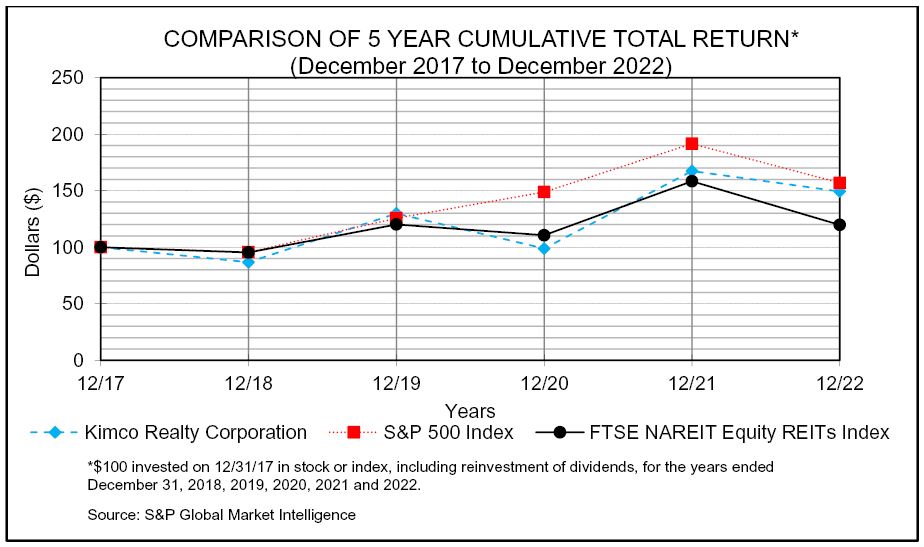
| Comparison of 5 year cumulative total return data points | ||||||||||||||||||||||||
|---|---|---|---|---|---|---|---|---|---|---|---|---|---|---|---|---|---|---|---|---|---|---|---|---|
| Dec-17 | Dec-18 | Dec-19 | Dec-20 | Dec-21 | Dec-22 | |||||||||||||||||||
| Kimco Realty Corporation | $ | 100 | $ | 87 | $ | 130 | $ | 99 | $ | 167 | $ | 149 | ||||||||||||
| S&P 500 | $ | 100 | $ | 96 | $ | 126 | $ | 149 | $ | 192 | $ | 157 | ||||||||||||
| NAREIT Equity REITs | $ | 100 | $ | 95 | $ | 120 | $ | 111 | $ | 158 | $ | 120 |
Item 7. Management's Discussion and Analysis of Financial Condition and Results of Operations
The following discussion should be read in conjunction with the Consolidated Financial Statements and Notes thereto included in this Form 10-K. Historical results and percentage relationships set forth in the Consolidated Statements of Income contained in the Consolidated Financial Statements, including trends, should not be taken as indicative of future operations.
The Consolidated Financial Statements of the Company include the accounts of the Company, its wholly owned subsidiaries and all entities in which the Company has a controlling interest, including where the Company has been determined to be a primary beneficiary of a variable interest entity in accordance with the consolidation guidance of the FASB Accounting Standards Codification. The Company applies these provisions to each of its joint venture investments to determine whether the cost, equity or consolidation method of accounting is appropriate. The Company evaluates performance on a property specific or transactional basis and does not distinguish its principal business or group its operations on a geographical basis for purposes of measuring performance. Accordingly, the Company believes it has a single reportable segment for disclosure purposes in accordance with accounting principles generally accepted in the United States of America (“GAAP”).
Critical Accounting Estimates
The preparation of financial statements in conformity with GAAP requires management to make estimates and assumptions in certain circumstances that affect amounts reported in the accompanying Consolidated Financial Statements and related notes. In preparing these financial statements, management has made its best estimates and assumptions that affect the reported amounts of assets and liabilities. These estimates are based on, but not limited to, historical results, industry standards and current economic conditions, giving due consideration to materiality. The Company’s significant accounting policies are more fully described in Footnote 1 to the Consolidated Financial Statements. The Company is required to make subjective assessments, of which, the most significant assumptions and estimates relate to the recoverability of trade accounts receivable, depreciable lives, valuation of real estate and intangible assets and liabilities, and valuation of joint venture investments and other investments. The Company’s reported net earnings are directly affected by management’s estimate of impairments. Application of these assumptions requires the exercise of judgment as to future uncertainties, and, as a result, actual results could materially differ from these estimates.
Trade Accounts Receivable
The Company reviews its trade accounts receivable, related to base rents, straight-line rent, expense reimbursements and other revenues for collectability. The Company evaluates the probability of the collection of the lessee’s total accounts receivable, including the corresponding straight-line rent receivable balance on a lease-by-lease basis. Determining the probability of collection of substantially all lease payments during a lease term requires significant judgment. The Company’s analysis of its accounts receivable included (i) customer credit worthiness, (ii) assessment of risk associated with the tenant, and (iii) current economic trends. In addition, tenants in bankruptcy are analyzed and considerations are made in connection with the expected recovery of pre-petition and post-petition bankruptcy claims. The Company includes provision for doubtful accounts in Revenues from rental properties, net. If a lessee’s accounts receivable balance is considered uncollectible, the Company will write-off the receivable balances associated with the lease and will only recognize lease income on a cash basis. In addition to the lease-specific collectability assessment, the analysis also recognizes a general reserve, as a reduction to Revenues from rental properties, for its portfolio of operating lease receivables which are not expected to be fully collectible based on the Company’s historical and current collection experience and the potential for settlement of arrears. Although the Company estimates uncollectible receivables and provides for them through charges against Revenues from rental properties, actual results may differ from those estimates. For example, in the event that the Company’s collectability determinations are not accurate, and we are required to write off additional receivables equaling 1% of the outstanding accounts receivable balance at December 31, 2022, the Company’s rental income and net income would decrease by $3.0 million for the year ended December 31, 2022. If the Company subsequently determines that it is probable it will collect the remaining lessee’s lease payments under the lease term, any outstanding lease receivables (including straight-line rent receivables) are reinstated with a corresponding increase to rental income.
Real Estate
Valuation of Real Estate, and Intangible Assets and Liabilities
The Company’s investments in real estate properties are stated at cost, less accumulated depreciation and amortization. Expenditures for maintenance and repairs are charged to operations as incurred. Significant renovations and replacements, which improve and extend the life of the asset, are capitalized.
Transaction costs related to acquisitions that qualify as asset acquisitions are capitalized as part of the cost basis of the acquired assets, while transaction costs for acquisitions that are deemed to be business combinations are expensed as incurred. Also, upon acquisition of real estate operating properties in either an asset acquisition or business combination, the Company estimates the fair value of acquired tangible assets (consisting of land, building, building improvements and tenant improvements) and identified intangible assets and liabilities (consisting of above and below-market leases, in-place leases, and tenant relationships, where applicable), assumed debt and redeemable units issued at the date of acquisition, based on evaluation of information and estimates available at that date. Fair value is determined based on a market approach, which contemplates the price that would be received to sell an asset or paid to transfer a liability in an orderly transaction between market participants at the measurement date.
Depreciation and amortization are provided on the straight-line method over the estimated useful lives of the assets, as follows:
| Buildings and building improvements (in years) | 5 to 50 | |
|---|---|---|
| Fixtures, leasehold and tenant improvements (including certain identified intangible assets) | Terms of leases or useful lives, whichever is shorter |
The Company is required to make subjective assessments as to the useful lives of its properties for purposes of determining the amount of depreciation to reflect on an annual basis with respect to those properties. These assessments have a direct impact on the Company’s net earnings.
During 2022, the Company acquired properties for a total purchase price of $524.9 million. $8.4 million, or less than 1.6% of the total purchase price, was allocated to above-market leases and $24.1 million, or 4.6% was allocated to below-market leases. If the amounts allocated in 2022 to above-market and below-market leases were each reduced by 1% of the total purchase price, the net annual market lease amortization through rental income would decrease by $0.9 million (using the weighted average life of above-market and below-market leases at each respective acquired property).
On a continuous basis, management assesses whether there are any indicators, including property operating performance, changes in anticipated holding period, general market conditions and delays of development, that the value of the real estate properties (including any related amortizable intangible assets or liabilities) may be impaired. A property value is considered impaired only if management’s estimate of current and projected operating cash flows, net of anticipated construction and leasing costs (undiscounted and unleveraged), of the property over its anticipated hold period is less than the net carrying value of the property. Such cash flow projections consider factors such as expected future costs of materials and labor, operating income, trends and prospects, as well as the effects of demand, competition and other factors. To the extent impairment has occurred, the carrying value of the property would be adjusted to reflect the estimated fair value of the property. The Company’s estimated fair values are primarily based upon estimated sales prices from signed contracts or letters of intent from third parties, discounted cash flow models or third-party appraisals. Estimated fair values that are based on discounted cash flow models include all estimated cash inflows and outflows over a specified holding period. Capitalization rates and discount rates utilized in these models are based upon unobservable rates that the Company believes to be within a reasonable range of current market rates.
See Footnote 3, 4 and 6 of the Notes to Consolidated Financial Statements for further discussion.
Valuation of Joint Venture Investments and Other Investments
On a continuous basis, management assesses whether there are any indicators, including property operating performance and general market conditions, that the value of the Company’s investments in unconsolidated joint ventures may be impaired. An investment’s value is impaired only if management’s estimate of the fair value of the investment is less than the carrying value of the investment and such difference is deemed to be other-than-temporary. To the extent impairment has occurred, the loss will be measured as the excess of the carrying amount of the investment over the estimated fair value of the investment. Estimated fair values which are based on discounted cash flow models include all estimated cash inflows and outflows over a specified holding period, capitalization rates and discount rates utilized in these models are based upon unobservable rates that the Company believes to be within a reasonable range of current market rates.
See Footnote 1 of the Notes to Consolidated Financial Statements for further discussion of the Company’s accounting policies and estimates.
Executive Overview
Kimco Realty Corporation is North America’s largest publicly traded owner and operator of open-air, grocery-anchored shopping centers, and a growing portfolio of mixed-use assets. The executive officers are engaged in the day-to-day management and operation of real estate exclusively with the Company, with nearly all operating functions, including leasing, asset management, maintenance, construction, legal, finance and accounting, administered by the Company.
Weingarten Merger
On August 3, 2021, Weingarten merged with and into the Company, with the Company continuing as the surviving public company, pursuant to the Merger Agreement between the Company and Weingarten which was entered into on April 15, 2021. The total purchase price of the Merger was $4.1 billion, which consists primarily of 179.9 million shares of the Company’s common stock issued in exchange for Weingarten common shares, plus $281.1 million of cash consideration. The Merger brought together two industry-leading retail real estate platforms with highly complementary portfolios and created the preeminent open-air shopping center and mixed-use real estate owner in the country. As a result of the Merger, the Company acquired 149 properties, including 30 held through joint venture programs. The increased scale in targeted growth markets, coupled with a broader pipeline of redevelopment opportunities, has positioned the combined company to create significant value for its shareholders. See Footnote 2 of the Notes to the Consolidated Financial Statements for additional discussion regarding the Merger.
Corporate UPREIT Reorganization
In January of 2023, the Company completed the Reorganization into an UPREIT structure as described in the Explanatory Note at the beginning of this Annual Report. Prior to the Reorganization, the Company’s business was conducted through the Predecessor. This Annual Report pertains to the business and results of operations of the Predecessor for its fiscal year ended December 31, 2022. As a result of the Reorganization, the Company became the successor issuer to the Predecessor under the Exchange Act. The Company and Kimco OP have elected to co-file this Annual Report of the Predecessor to ensure continuity of information to investors. For additional information about the Reorganization, please see the Company’s Current Reports on Form 8-K filed with the SEC on January 3, 2023 and January 4, 2023.
Financial Highlights
The following highlights the Company’s significant transactions, events and results that occurred during the year ended December 31, 2022:
Financial and Portfolio Information:
| ● | Net income available to the Company’s common shareholders was $100.8 million, or $0.16 per diluted share, for the year ended December 31, 2022 as compared to $818.6 million, or $1.60 per diluted share, for the year ended December 31, 2021. |
|---|
| ● | FFO available to the Company's common shareholders was $976.4 million, or $1.58 per diluted share, for the year ended December 31, 2022, as compared to $706.8 million, or $1.38 per diluted share, for the corresponding period in 2021 (see additional disclosure on FFO beginning on page 40). |
|---|
| ● | Same property net operating income (“Same property NOI”) was $1.3 billion for the year ended December 31, 2022, as compared to $1.2 billion for the corresponding period in 2021, an increase of 4.4% (see additional disclosure on Same property NOI beginning on page 40). |
|---|
| ● | Executed 1,696 new leases, renewals and options totaling approximately 10.7 million square feet in the consolidated operating portfolio during the year ended December 31, 2022. |
|---|
| ● | Consolidated operating portfolio occupancy at December 31, 2022 was 95.5% as compared to 94.2% at December 31, 2021. |
|---|
Acquisitions, Dispositions and Other Activity (see Footnotes 4, 5 and 9 of the Notes to Consolidated Financial Statements included in this Form 10-K):
| ● | Acquired 10 operating properties and eight parcels, in separate transactions, for $524.9 million |
|---|
| ● | Disposed of nine operating properties and 13 parcels, in separate transactions, for an aggregate sales price of $191.1 million, which resulted in aggregate gains of $15.2 million, before noncontrolling interests and taxes. |
|---|
| ● | Monetized 11.5 million of shares of ACI held by the Company, generating net proceeds of $301.1 million and a book gain of $15.2 million. For tax purposes, the Company recognized a long-term capital gain of $251.5 million. The Company has elected to retain the proceeds from this stock sale for general corporate purposes and pay corporate income tax of $57.2 million on the taxable gain. The Company held 28.3 million shares of ACI as of December 31, 2022. |
|---|
Capital Activity (for additional details see Liquidity and Capital Resources below):
| ● | Issued $650.0 million of 4.60% notes maturing February 2033 and $600.0 million of 3.20% notes maturing in April 2032. |
|---|
| ● | Repaid $1.4 billion of notes bearing interest rates from 3.13% to 3.50% with maturity dates ranging from October 2022 to June 2023. |
|---|
| ● | Assumed $79.4 million of mortgage debt (including fair market value adjustment of $9.4 million) encumbering six operating properties acquired in 2022 and obtained a $19.0 million mortgage relating to a consolidated joint venture operating property. |
|---|
| ● | Repaid $158.4 million of mortgage debt that encumbered 11 operating properties. |
|---|
| ● | As of December 31, 2022, had $2.1 billion in immediate liquidity, including $149.8 million in cash. |
|---|
As a result of the above debt activity, the Company’s consolidated debt maturity profile, including extension options as of December 31, 2022, is as follows:

| ● | As of December 31, 2022, the weighted average interest rate was 3.49% and the weighted average maturity profile was 9.5 years related to the Company’s consolidated debt. |
|---|
The Company faces external factors which may influence its future results from operations. There remains significant uncertainty in the current macro-economic environment, driven by inflationary pressures, as well as ongoing supply chain issues. These factors have impacted, and are expected to continue to impact, consumer discretionary spending and many of our tenants. The convenience and availability of e-commerce has continued to impact the retail sector, which could affect our ability to increase or maintain rental rates and our ability to renew expiring leases and/or lease available space. To better position itself, the Company’s strategy has been to attract local area customers to its properties by providing a diverse and robust tenant base across a variety of retailers, including grocery stores, off-price retailers, discounters and service-oriented tenants, which offer buy online and pick up in store, off-price merchandise and day-to-day necessities rather than high-priced luxury items.
The Company’s portfolio is focused on first ring suburbs around major metropolitan-area U.S. markets, predominantly on the east and west coasts and in the sun belt region, which are supported by strong demographics, significant projected population growth, and where the Company perceives significant barriers to entry. The Company owns a predominantly grocery-anchored portfolio clustered in the nation’s top markets. The Company believes it can continue to increase its occupancy levels, rental rates and overall rental growth. In addition, the Company, on a selective basis, has developed or redeveloped projects which include residential and mixed-use components.
As part of the Company’s investment strategy, each property is evaluated for its highest and best use, which may include residential and mixed-use components. In addition, the Company may consider other opportunistic investments related to retailer controlled real estate, such as, repositioning underperforming retail locations, retail real estate financing and bankruptcy transaction support. The Company may continue to dispose of certain properties. If the estimated fair value for any of these assets is less than their net carrying values, the Company would be required to take impairment charges and such amounts could be material. For a further discussion of these and other factors that could impact our future results, performance or transactions, see Item 1A. Risk Factors.
Results of Operations
Comparison of the years ended December 31, 2022 and 2021
Results from operations for the year ended December 31, 2021 include the combined operations for five months as a result of the Company’s Merger with Weingarten which occurred on August 3, 2021. The following table presents the comparative results from the Company’s Consolidated Statements of Income for the year ended December 31, 2022, as compared to the corresponding period in 2021 (in thousands, except per share data):
| Year Ended December 31, | ||||||||||||
|---|---|---|---|---|---|---|---|---|---|---|---|---|
| 2022 | 2021 | Change | ||||||||||
| Revenues | ||||||||||||
| Revenues from rental properties, net | $ | 1,710,848 | $ | 1,349,702 | $ | 361,146 | ||||||
| Management and other fee income | 16,836 | 14,883 | 1,953 | |||||||||
| Operating expenses | ||||||||||||
| Rent (1) | (15,811 | ) | (13,773 | ) | (2,038 | ) | ||||||
| Real estate taxes | (224,729 | ) | (181,256 | ) | (43,473 | ) | ||||||
| Operating and maintenance (2) | (290,367 | ) | (222,882 | ) | (67,485 | ) | ||||||
| General and administrative (3) | (119,534 | ) | (104,121 | ) | (15,413 | ) | ||||||
| Impairment charges | (21,958 | ) | (3,597 | ) | (18,361 | ) | ||||||
| Merger charges | - | (50,191 | ) | 50,191 | ||||||||
| Depreciation and amortization | (505,000 | ) | (395,320 | ) | (109,680 | ) | ||||||
| Gain on sale of properties | 15,179 | 30,841 | (15,662 | ) | ||||||||
| Other income/(expense) | ||||||||||||
| Other income, net | 28,829 | 19,810 | 9,019 | |||||||||
| (Loss)/gain on marketable securities, net | (315,508 | ) | 505,163 | (820,671 | ) | |||||||
| Interest expense | (226,823 | ) | (204,133 | ) | (22,690 | ) | ||||||
| Early extinguishment of debt charges | (7,658 | ) | - | (7,658 | ) | |||||||
| Provision for income taxes, net | (56,654 | ) | (3,380 | ) | (53,274 | ) | ||||||
| Equity in income of joint ventures, net | 109,481 | 84,778 | 24,703 | |||||||||
| Equity in income of other investments, net | 17,403 | 23,172 | (5,769 | ) | ||||||||
| Net loss/(income) attributable to noncontrolling interests | 11,442 | (5,637 | ) | 17,079 | ||||||||
| Preferred dividends | (25,218 | ) | (25,416 | ) | 198 | |||||||
| Net income available to the Company's common shareholders | $ | 100,758 | $ | 818,643 | $ | (717,885 | ) | |||||
| Net income available to the Company's common shareholders: | ||||||||||||
| Diluted per share | $ | 0.16 | $ | 1.60 | $ | (1.44 | ) |
| (1) | Rent expense relates to ground lease payments for which the Company is the lessee. |
|---|
| (2) | Operating and maintenance expense consists of property related costs including repairs and maintenance costs, roof repair, landscaping, parking lot repair, snow removal, utilities, property insurance costs, security and various other property related expenses. |
|---|
| (3) | General and administrative expense includes employee-related expenses (including salaries, bonuses, equity awards, benefits, severance costs and payroll taxes), professional fees, office rent, travel and entertainment costs and other company-specific expenses. |
|---|
Net income available to the Company’s common shareholders was $100.8 million for the year ended December 31, 2022, as compared to $818.6 million for the comparable period in 2021. On a diluted per share basis, net income available to the Company’s common shareholders for the year ended December 31, 2022, was $0.16 as compared to $1.60 for the comparable period in 2021. For additional disclosure, see Footnote 28 of the Notes to Consolidated Financial Statements included in this Form 10-K.
The following describes the changes of certain line items included on the Company’s Consolidated Statements of Income, that the Company believes changed significantly and affected Net income available to the Company’s common shareholders during the year ended December 31, 2022, as compared to the corresponding period in 2021:
Revenue from rental properties, net –
The increase in Revenues from rental properties, net of $361.1 million is primarily from (i) an increase in revenues of $332.6 million due to properties acquired during 2022 and 2021, including the results of the Merger, and (ii) an increase in revenues from tenants of $53.7 million primarily due to an increase in leasing activity and net growth in the current portfolio, partially offset by (iii) a net decrease of $19.6 million due to changes in credit losses from tenants, (iv) a decrease in revenues of $3.1 million due to dispositions in 2022 and 2021 and (v) a decrease in lease termination fee income of $2.5 million.
Real estate taxes –
The increase in Real estate taxes of $43.5 million is primarily due to properties acquired during 2022 and 2021, including the impact of the Merger.
Operating and maintenance –
The increase in Operating and maintenance expense of $67.5 million is primarily due to (i) properties acquired during 2022 and 2021, including the impact of the Merger, and (ii) increases in repairs and maintenance, utilities and other operating costs throughout the Company’s operating properties.
General and administrative –
The increase in General and administrative expense of $15.4 million is primarily due to (i) an increase in employee-related expenses of $10.5 million resulting from additional employees hired in connection with the Merger and (ii) an increase in professional fees and corporate expenses of $6.6 million, including costs related to the Company’s UPREIT Reorganization, partially offset by (iii) a decrease of $1.7 million primarily due to the fluctuations in value of various directors’ deferred stock.
Impairment charges –
During the years ended December 31, 2022 and 2021, the Company recognized impairment charges of $22.0 million and $3.6 million, respectively, primarily related to adjustments to property carrying values for which the Company’s estimated fair values were primarily based upon signed contracts or letters of intent from third-party offers. These adjustments to property carrying values were recognized in connection with the Company’s efforts to market certain properties and management’s assessment as to the likelihood and timing of such potential transactions. Certain of the calculations to determine fair values utilized unobservable inputs and, as such, were classified as Level 3 of the FASB’s fair value hierarchy. For additional disclosure, see Footnotes 6 and 18 of the Notes to Consolidated Financial Statements included in this Form 10-K.
Merger charges –
During the year ended December 31, 2021, the Company incurred costs of $50.2 million associated with the Merger. These charges are primarily comprised of severance costs and professional and legal fees.
Depreciation and amortization –
The increase in Depreciation and amortization of $109.7 million is primarily due to (i) an increase of $166.7 million resulting from properties acquired during 2022 and 2021, including the impact of the Merger, and (ii) an increase of $1.4 million due to depreciation commencing on certain redevelopment projects that were placed into service during 2022 and 2021, partially offset by (iii) a net decrease of $58.4 million primarily from fully depreciated assets and write-offs due to tenant vacates and dispositions during 2022 and 2021.
Gain on sale of properties –
During 2022, the Company disposed of nine operating properties and 13 parcels, in separate transactions, for an aggregate sales price of $191.1 million, which resulted in aggregate gains of $15.2 million. During 2021, the Company disposed of 13 operating properties and 10 parcels (including the deconsolidation of six operating properties), in separate transactions, for an aggregate sales price of $612.4 million, which resulted in aggregate gains of $30.8 million.
Other income, net –
The increase in Other income, net of $9.0 million is primarily due to (i) a net increase in mortgage and other financing income of $9.4 million, including profit participation of $4.0 million relating to the repayment of a loan, and (ii) an increase in dividend, interest and other income of $3.2 million, partially offset by (iii) a decrease in net periodic benefit income of $3.6 million relating to the Company’s defined benefit plan.
(Loss)/gain on marketable securities, net –
The change in (Loss)/gain on marketable securities, net of $820.7 million is primarily the result of mark-to-market fluctuations of the shares of ACI common stock held by the Company.
Interest expense –
The increase in Interest expense of $22.7 million is primarily due to (i) increased levels of borrowings resulting from the assumption of senior unsecured notes and mortgages in connection with the Merger and public debt offerings, partially offset by (ii) the repayment of senior unsecured notes and mortgages during 2022 and 2021 and (iii) an increase in fair market value amortization, primarily related to the assumption of debt in connection with the Merger and acceleration due to the repayment of senior unsecured notes in 2022.
Early extinguishment of debt charges –
The increase in Early extinguishment of debt charges of $7.7 million is primarily due to the Company’s repayment of its $500.0 million 3.40% senior unsecured notes, which were scheduled to mature in November 2022. As a result, the Company incurred a prepayment charge of $6.5 million and $0.7 million from the write-off of deferred financing costs during 2022.
Provision for income taxes, net –
The increase in Provision for income taxes, net of $53.3 million is primarily due to the sale of 11.5 million of the shares of ACI held by the Company, which generated a taxable long-term capital gain. The Company elected to retain the proceeds from the sale and as a result incurred federal corporate and state income tax aggregating $57.2 million on such gain.
Equity in income of joint ventures, net –
The increase in Equity in income of joint ventures, net of $24.7 million is primarily due to (i) an increase in net gains of $21.9 million resulting from the sale of properties within various joint venture investments during 2022, as compared to 2021, and (ii) an increase in equity in income of $4.5 million from ownership interests acquired in unconsolidated joint ventures in connection with the Merger, partially offset by (iii) an increase in impairment charges of $1.7 million recognized during 2022, as compared to 2021.
Equity in income of other investments, net –
The decrease in Equity in income of other investments, net of $5.8 million is primarily due to the sale of properties within the Company’s Preferred Equity Program during 2022 and 2021.
Net loss/(income) attributable to noncontrolling interests –
The change in Net loss/(income) attributable to noncontrolling interests of $17.1 million is primarily due to (i) impairment charges relating to properties within consolidated joint ventures recognized during 2022, partially offset by (ii) an increase in net income attributable to noncontrolling interests primarily related to consolidated joint ventures acquired in the Merger.
Comparison of the years ended December 31, 2021 and 2020
Information pertaining to fiscal year 2020 was included in the Company’s Annual Report on Form 10-K for the year ended December 31, 2021 under Part II, Item 7, “Management’s Discussion and Analysis of Financial Condition and Results of Operations,” which was filed with the SEC on March 1, 2022.
Liquidity and Capital Resources
The Company’s capital resources include accessing the public debt and equity capital markets, unsecured term loans, mortgages and construction loan financing, marketable securities (including 28.3 million shares of ACI common stock held by the Company, which had a value of $587.7 million at December 31, 2022 and are subject to certain contractual lock-up provisions that expire in May 2023) and immediate access to an unsecured revolving credit facility (the “Credit Facility”) with bank commitments of $2.0 billion which can be increased to $2.75 billion through an accordion feature.
The Company’s cash flow activities are summarized as follows (in thousands):
| Year Ended December 31, | ||||||||
|---|---|---|---|---|---|---|---|---|
| 2022 | 2021 | |||||||
| Cash, cash equivalents and restricted cash, beginning of year | $ | 334,663 | $ | 293,188 | ||||
| Net cash flow provided by operating activities | 861,114 | 618,875 | ||||||
| Net cash flow used for investing activities | (63,217 | ) | (476,259 | ) | ||||
| Net cash flow used for financing activities | (982,731 | ) | (101,141 | ) | ||||
| Net change in cash, cash equivalents and restricted cash | (184,834 | ) | 41,475 | |||||
| Cash, cash equivalents and restricted cash, end of year | $ | 149,829 | $ | 334,663 |
Operating Activities
The Company anticipates that cash on hand, net cash flow provided by operating activities, borrowings under its Credit Facility and the issuance of equity, public debt, as well as other debt and equity alternatives, and the sale of marketable equity securities, will provide the necessary capital required by the Company. The Company will continue to evaluate its capital requirements for both its short-term and long-term liquidity needs, which could be affected by various risks and uncertainties, including, but not limited to, the effects of the current inflationary environment, rising interest rates, and other risks detailed in Part I, Item 1A. Risk Factors
Net cash flows provided by operating activities for the year ended December 31, 2022, was $861.1. million, as compared to $618.9 million for the comparable period in 2021. The increase of $242.2 million is primarily attributable to:
| ● | additional operating cash flow generated by operating properties acquired during 2022 and 2021, including those acquired from the Merger; |
|---|
| ● | new leasing, expansion and re-tenanting of core portfolio properties; |
|---|
| ● | changes in accounts payable and accrued expenses due to timing of receipts and payments; and |
|---|
| ● | nonrecurring costs incurred in connection with the Merger during 2021, partially offset by |
|---|
| ● | changes in operating assets and liabilities due to timing of receipts and payments; |
|---|
| ● | a decrease in distributions from the Company’s joint ventures programs due to the sale of properties within the ventures; and |
|---|
| ● | the disposition of operating properties in 2022 and 2021. |
|---|
Investing Activities
Net cash flows used for investing activities was $63.2 million for 2022, as compared to $476.3 million for 2021.
Investing activities during 2022 consisted primarily of:
Cash inflows:
| ● | $302.5 million in proceeds from the sale of marketable securities, primarily due to the sale of 11.5 million shares of ACI; |
|---|
| ● | $184.3 million in proceeds from the sale of nine consolidated properties and 13 parcels; |
|---|
| ● | $68.4 million in reimbursements of investments in and advances to real estate joint ventures and other investments primarily due to the sale of properties within the investments; |
|---|
| ● | $60.3 million in collection of mortgage and other financing receivables; and | |
|---|---|---|
| ● | $4.0 million for principal payments from securities held to maturity. |
Cash outflows:
| ● | $300.8 million for the acquisition of 10 consolidated operating properties and eight parcels; |
|---|
| ● | $193.7 million for improvements to operating real estate primarily related to the Company’s active redevelopment pipeline; |
|---|
| ● | $104.7 million for investments in and advances to real estate joint ventures, primarily related to partner buyouts and a redevelopment project within the Company’s joint venture portfolio, and investments in other investments, primarily related to funding commitments for certain investments; |
|---|
| ● | $75.1 million for investment in mortgage and other financing receivables; |
|---|
| ● | $4.5 million for investment in cost method investments; and |
|---|
| ● | $4.0 million for investment in marketable securities. |
|---|
Investing activities during 2021 consisted primarily of:
Cash inflows:
| ● | $302.8 million in proceeds from the sale of 13 consolidated properties and 10 parcels (including the deconsolidation of 6 operating properties); |
|---|
| ● | $111.9 million in reimbursements of investments in and advances to real estate joint ventures and other investments primarily due to the sale of properties within the investments; and |
|---|
| ● | $13.8 million in collection of mortgage and other financing receivables. |
|---|
Cash outflows:
| ● | $356.0 million for the acquisition of 11 consolidated operating properties and one parcel; |
|---|
| ● | $264.0 million net cash consideration paid in conjunction with the Merger; |
|---|
| ● | $163.7 million for improvements to operating real estate primarily related to the Company’s active redevelopment pipeline; |
|---|
| ● | $67.1 million for investments in and advances to other investments, primarily related to a preferred equity investment located in San Antonio, TX; |
|---|
| ● | $41.9 million for investment in other financing receivables; and |
|---|
| ● | $12.6 million for investments in and advances to real estate joint ventures, primarily related to a redevelopment project within the Company’s joint venture portfolio. |
|---|
Acquisitions of Operating Real Estate and Other Related Net Assets
During the years ended December 31, 2022 and 2021, the Company expended $300.8 million and $619.9 million, respectively, towards the acquisition of operating real estate properties, including the Merger in 2021. The Company anticipates spending approximately $125.0 million to $250.0 million towards the acquisition of operating properties during 2023. The Company intends to fund these acquisitions with cash on hand, net cash flow provided by operating activities, proceeds from property dispositions, proceeds from the sale of marketable securities and/or availability under its Credit Facility.
Improvements to Operating Real Estate
During the years ended December 31, 2022 and 2021, the Company expended $193.7 million and $163.7 million, respectively, towards improvements to operating real estate. These amounts consist of the following (in thousands):
| Year Ended December 31, | ||||||||
|---|---|---|---|---|---|---|---|---|
| 2022 | 2021 | |||||||
| Redevelopment and renovations | $ | 113,928 | $ | 100,784 | ||||
| Tenant improvements and tenant allowances | 79,782 | 62,915 | ||||||
| Total improvements | $ | 193,710 | $ | 163,699 |
The Company has an ongoing program to redevelop and re-tenant its properties to maintain or enhance its competitive position in the marketplace. The Company is actively pursuing redevelopment opportunities within its operating portfolio which it believes will increase the overall value by bringing in new tenants and improving the assets’ value. The Company anticipates its capital commitment toward these redevelopment projects and re-tenanting efforts for 2023 will be approximately $175.0 million to $225.0 million. The funding of these capital requirements will be provided by cash on hand, proceeds from property dispositions, proceeds from the sale of marketable securities, net cash flow provided by operating activities and/or availability under the Company’s Credit Facility.
Financing Activities
Net cash flows used for financing activities was $982.7 million for 2022, as compared to $101.1 million for 2021.
Financing activities during 2022 primarily consisted of the following:
Cash inflows:
| ● | $1.25 billion in proceeds from issuance of the Company’s $600.0 million 3.20% senior unsecured notes due 2032 and $650.0 million 4.60% senior unsecured notes due 2033; |
|---|
| ● | $19.0 million in proceeds from a mortgage loan financing; |
|---|
| ● | $15.5 million in proceeds from the issuance of common stock; and |
|---|
| ● | $5.3 million from changes in tenants’ security deposits. |
|---|
Cash outflows:
| ● | $1.4 billion for repayment of four separate senior unsecured notes, which had maturity dates ranging from November 2022 to June 2023; |
|---|
| ● | $544.7 million of dividends paid; |
|---|
| ● | $167.7 million in principal payment on debt, including normal amortization of rental property debt; |
|---|
| ● | $67.5 million in redemption/distribution of noncontrolling interests; |
|---|
| ● | $20.3 million in financing origination costs, in connection with the issuance of senior unsecured notes; |
|---|
| ● | $13.7 million in shares repurchased for employee tax withholding on equity awards; |
|---|
| ● | $7.0 million for payment of early extinguishment of debt charges; and |
|---|
| ● | $3.4 million for repurchase of preferred stock. |
|---|
Financing activities during 2021 primarily consisted of the following:
Cash inflows:
| ● | $500.0 million in proceeds from issuance of 2.25% senior unsecured notes due in 2031; and |
|---|
| ● | $83.0 million in proceeds from issuance of common stock, primarily related to the Company’s at-the-market continuous offering program and the exercise of employee stock options. |
|---|
Cash outflows:
| ● | $382.1 million of dividends paid; |
|---|
| ● | $239.9 million in principal payment on debt, including normal amortization of rental property debt; |
|---|
| ● | $34.6 million in redemption/distribution of noncontrolling interests; |
|---|
| ● | $20.8 million in shares repurchased for employee tax withholding on equity awards; and |
|---|
| ● | $8.2 million in financing origination costs, primarily in connection with the Company’s issuance of $500.0 million of senior unsecured notes. |
|---|
The Company continually evaluates its debt maturities, and, based on management’s current assessment, believes it has viable financing and refinancing alternatives that will not materially adversely impact its expected financial results. As of December 31, 2022, the Company had consolidated floating rate debt totaling $18.4 million, excluding deferred financing costs of $0.1 million. The Company continues to pursue borrowing opportunities with large commercial U.S. and global banks, select life insurance companies and certain regional and local banks.
Debt maturities for 2023 consist of: $12.0 million of consolidated debt, $38.1 million of unconsolidated joint venture debt and $32.3 million of debt included in the Company's preferred equity program, assuming the utilization of extension options where available. The 2023 consolidated debt maturities are anticipated to be repaid with operating cash flows or debt refinancing, as deemed appropriate. The 2023 debt maturities on properties in the Company’s unconsolidated joint ventures are anticipated to be repaid through operating cash flows, debt refinancing, unsecured credit facilities, proceeds from sales within the respective entities, and partner capital contributions, as deemed appropriate.
The Company intends to maintain strong debt service coverage and fixed charge coverage ratios as part of its commitment to maintain or improve its unsecured debt ratings. The Company may, from time to time, seek to obtain funds through additional common and preferred equity offerings, unsecured debt financings and/or mortgage/construction loan financings and other capital alternatives.
Since the completion of the Company’s IPO in 1991, the Company has utilized the public debt and equity markets as its principal source of capital for its expansion needs. Since the IPO, the Company has completed additional offerings of its public unsecured debt and equity, raising in the aggregate over $17.4 billion. Proceeds from public capital market activities have been used for the purposes of, among other things, repaying indebtedness, acquiring interests in open-air, grocery anchored shopping centers and mixed-use assets, expanding and improving properties in the portfolio and other investments.
During January 2023, the Company filed a shelf registration statement on Form S-3, which is effective for a term of three years, for future unlimited offerings, from time to time, of debt securities, preferred stock, depositary shares, common stock and common stock warrants. The Company, pursuant to this shelf registration statement may, from time to time, offer for sale its senior unsecured debt securities for any general corporate purposes, including (i) funding specific liquidity requirements in its business, including property acquisitions, development and redevelopment costs and (ii) managing the Company’s debt maturities.
During January 2023, the Company filed a registration statement on Form S-8 for its 2020 Equity Participation Plan (the “2020 Plan”), which was previously approved by the Company’s stockholders and is a successor to the Restated Kimco Realty Corporation 2010 Equity Participation Plan that expired in March 2020. The 2020 Plan provides for a maximum of 10,000,000 shares of the Company’s common stock to be reserved for the issuance of stock options, stock appreciation rights, restricted stock, restricted stock units, performance awards, dividend equivalents, stock payments and deferred stock awards. At December 31, 2022, the Company had 6.9 million shares of common stock available for issuance under the 2020 Plan. (see Footnote 23 of the Notes to Consolidated Financial Statements included in this Form 10-K).
Preferred Stock –
The Company’s Board of Director’s authorized the repurchase of up to 900,000 depositary shares of Class L preferred stock and 1,058,000 depositary shares of Class M preferred stock representing up to 1,958 shares the Company’s preferred stock, par value $1.00 per share through December 31, 2022. During the year ended December 31, 2022, the Company repurchased the following preferred stock:
| Class of Preferred Stock | Depositary Shares Repurchased | Purchase Price (in millions) | ||||||
|---|---|---|---|---|---|---|---|---|
| Class L | 54,508 | $ | 1.3 | |||||
| Class M | 90,760 | $ | 2.1 |
Common Stock –
During August 2021, the Company established an at-the-market continuous offering program (the “ATM program”) pursuant to which the Company may offer and sell from time-to-time shares of its common stock, par value $0.01 per share, with an aggregate gross sales price of up to $500.0 million through a consortium of banks acting as sales agents. Sales of the shares of common stock may be made, as needed, from time to time in “at the market” offerings as defined in Rule 415 of the Securities Act of 1933, including by means of ordinary brokers’ transactions on the New York Stock Exchange or otherwise (i) at market prices prevailing at the time of sale, (ii) at prices related to prevailing market prices or (iii) as otherwise agreed to with the applicable sales agent. In addition, the Company may from time to time enter into separate forward sale agreements with one or more banks. During 2022, the Company issued 450,000 shares and received net proceeds after commissions of $11.3 million. During 2021, the Company issued 3.5 million shares and received net proceeds after commissions of $76.9 million. As of December 31, 2022, the Company had $411.0 million available under this ATM program.
The Company has a share repurchase program, which is scheduled to expire on February 29, 2024. Under this program, the Company may repurchase shares of its common stock, par value $0.01 per share, with an aggregate gross purchase price of up to $300.0 million. The Company did not repurchase any shares under the share repurchase program during 2022 and 2021. As of December 31, 2022, the Company had $224.9 million available under this common share repurchase program.
Senior Notes –
During the year ended December 31, 2022, the Company issued the following senior unsecured notes (dollars in millions):
| Date Issued | Amount Issued | Interest Rate | Maturity Date | |||||||||
|---|---|---|---|---|---|---|---|---|---|---|---|---|
| Aug-22 | $ | 650.0 | 4.600% | Feb-33 | ||||||||
| Feb-22 | $ | 600.0 | 3.200% | Apr-32 |
During the year ended December 31, 2022, the Company fully repaid the following senior unsecured notes (dollars in millions):
| Date Paid | Amount Repaid | Interest Rate | Maturity Date | |||||||||
|---|---|---|---|---|---|---|---|---|---|---|---|---|
| Sep-22 (1) | $ | 299.7 | 3.500% | Apr-23 | ||||||||
| Sep-22 (1) (2) | $ | 350.0 | 3.125% | Jun-23 | ||||||||
| Sep-22 (1) (2) | $ | 299.4 | 3.375% | Oct-22 | ||||||||
| Mar-22 (3) | $ | 500.0 | 3.400% | Nov-22 |
| (1) | There were no prepayment charges associated with this early repayment. |
|---|
| (2) | Includes partial repayments during May and June 2022. |
|---|
| (3) | The Company incurred a prepayment charge of $6.5 million and $0.7 million in write-off of deferred financing costs resulting from this early repayment, which are included in Early extinguishment of debt charges on the Company’s Consolidated Statements of Income. |
|---|
The Company’s supplemental indenture governing its senior notes contains the following covenants, all of which the Company is compliant with:
| Covenant | Must Be | As of December 31, 2022 | ||
|---|---|---|---|---|
| Consolidated Indebtedness to Total Assets | <60% | 37% | ||
| Consolidated Secured Indebtedness to Total Assets | <40% | 2% | ||
| Consolidated Income Available for Debt Service to Maximum Annual Service Charge | >1.50x | 3.9x | ||
| Unencumbered Total Asset Value to Consolidated Unsecured Indebtedness | >1.50x | 2.5x |
For a full description of the various indenture covenants refer to the Indenture dated September 1, 1993; the First Supplemental Indenture dated August 4, 1994; the Second Supplemental Indenture dated April 7, 1995; the Third Supplemental Indenture dated June 2, 2006; the Fourth Supplemental Indenture dated April 26, 2007; the Fifth Supplemental Indenture dated as of September 24, 2009; the Sixth Supplemental Indenture dated as of May 23, 2013; Seventh Supplemental Indenture dated as of April 24, 2014; and the Eighth Supplemental Indenture dated as of January 3, 2023 each as filed with the SEC. See the Index to Exhibits included in this Form 10-K for specific filing information.
In addition, for a full description of the various indenture covenants for senior unsecured notes assumed during the Merger, refer to the Indenture dated May 1, 1995 included as an exhibit to Weingarten’s Registration Statement on Form S-3, filed with the Securities and Exchange Commission on May 1, 1995; First Supplemental Indenture, dated as of August 2, 2006, included as an exhibit to Weingarten’s Current Report on Form 8-K dated August 2, 2006, Second Supplemental Indenture, dated as of October 9, 2012 filed with Weingarten’s Current Report on Form 8-K dated October 9, 2012. See the Exhibits Index in this Form 10-K for specific filing information.
In connection with the Reorganization, Kimco OP became the issuer of the senior notes and the Parent Company has provided a full and unconditional guarantee of Kimco OP’s obligations under each series of senior notes previously issued and outstanding.
Credit Facility –
The Company had a $2.0 billion Credit Facility with a group of banks which was scheduled to expire in March 2024, with two additional six-month options to extend the maturity date, at the Company’s discretion, to March 2025. The Credit Facility was a green credit facility tied to sustainability metric targets, as described in the agreement. In July 2022, the Company amended the Credit Facility to (i) replace LIBOR borrowings with Secured Overnight Financing Rate (“SOFR”) borrowings, (ii) supplement the sustainability grid with an additional one basis point reduction of applicable margin if certain criteria as defined in the Credit Facility are met, (iii) add a leverage metric test which, if met, reduces the applicable margin by five basis points and (iv) obtain pre-approval of a possible organizational conversion to an UPREIT structure. The Company achieved such sustainability metric targets, which effectively reduced the rate on the Credit Facility by two basis points. The Credit Facility, which accrued interest at a rate of Adjusted Term SOFR, as defined in the terms of the Credit Facility, plus 75.5 basis points (5.21% as of December 31, 2022), and can be increased to $2.75 billion through an accordion feature. Pursuant to the terms of the Credit Facility, the Company, among other things, was subject to covenants requiring the maintenance of (i) maximum indebtedness ratios and (ii) minimum interest and fixed charge coverage ratios. As of December 31, 2022, the Credit Facility had no outstanding balance and appropriations for letters of credit of $1.2 million.
In February 2023, the Company closed on a new $2.0 billion unsecured revolving credit facility (the “New Credit Facility”) with a group of banks, which is scheduled to expire in March 2027 with two additional six-month options to extend the maturity date, at the Company’s discretion, to March 2028. The New Credit Facility can be increased to $2.75 billion through an accordion feature. The New Credit Facility is a green credit facility tied to sustainability metric targets, as described in the agreement. The New Credit Facility replaces the Company’s Credit Facility discussed above, that was scheduled to mature in March 2024. The New Credit Facility accrues interest at a rate of Adjusted Term SOFR, as defined in the terms of the New Credit Facility, plus 77.5 basis points and fluctuates in accordance with the Company's credit ratings, which can be further adjusted upward or downward by four basis points based on the sustainability metric targets, as defined in the agreement. The Company achieved certain sustainability metric targets, which effectively reduced the rate on the New Credit Facility by two basis points. Pursuant to the terms of the New Credit Facility, the Company continues to be subject to the same covenants under the Credit Facility.
Pursuant to the terms of the Credit Facility, the Company, among other things, is subject to maintenance of various covenants. The Company is currently in compliance with these covenants. The financial covenants for the Credit Facility are as follows:
| Covenant | Must Be | As of December 31, 2022 | ||
|---|---|---|---|---|
| Total Indebtedness to Gross Asset Value (“GAV”) | <60% | 38% | ||
| Total Priority Indebtedness to GAV | <35% | 2% | ||
| Unencumbered Asset Net Operating Income to Total Unsecured Interest Expense | >1.75x | 4.6x | ||
| Fixed Charge Total Adjusted EBITDA to Total Debt Service | >1.50x | 4.1x |
For a full description of the Credit Facility’s covenants, refer to Amendment No. 2, dated July 12, 2022, to the Amended and Restated Credit Agreement, dated February 27, 2020, filed as Exhibit 10.1 to the Company’s Quarterly Report on Form 10-Q for the quarterly period ended June 30, 2022, file with the SEC on July 29, 2022. See the Index to Exhibits included in this Form 10-K for specific filing information.
Mortgages Payable –
During 2022, the Company (i) assumed $79.4 million of mortgage debt (including fair market value adjustment of $9.4 million) encumbering six operating properties acquired in 2022, (ii) obtained a $19.0 million mortgage relating to a consolidated joint venture operating property and (iii) repaid $158.4 million of mortgage debt (including fair market value adjustment of $0.5 million) that encumbered 11 operating properties.
In addition to the public equity and debt markets as capital sources, the Company may, from time to time, obtain mortgage financing on selected properties to partially fund the capital needs of its real estate re-development and re-tenanting projects. As of December 31, 2022, the Company had over 485 unencumbered property interests in its portfolio.
Albertsons Companies, Inc. –
In October 2022, the Company sold 11.5 million shares of ACI held by the Company, generating net proceeds of $301.1 million. For tax purposes, the Company recognized a long-term capital gain of $251.5 million. The Company elected to retain the proceeds from this stock sale for general corporate purposes and pay corporate income tax of $57.2 million on the taxable gain. This undistributed long-term capital gain is allocated to, and reportable by, each shareholder, and each shareholder is also entitled to claim a federal income tax credit for its allocable share of the federal income tax paid by the Company for 2022. The allocable share of the long-term capital gain and the federal tax credit will be reported to direct holders of Kimco common shares, on Form 2439, and to others in year-end reporting documents issued by brokerage firms if Kimco shares are held in a brokerage account. As of December 31, 2022, the Company holds 28.3 million shares of ACI, which had a value of $587.7 million, which are subject to certain contractual lock-up provisions that expire in May 2023.
On October 13, 2022, The Kroger Co. (“Kroger”) and ACI entered into a definitive merger agreement (“ACI Merger”), with Kroger continuing as the surviving public company. The ACI Merger is subject to numerous regulatory approvals and customary closing conditions. Separate from the ACI Merger, on October 13, 2022, ACI declared a special cash dividend of $6.85 per share to ACI shareholders of record as of the close of business on October 24, 2022 and was scheduled to be paid on November 7, 2022.
On November 3, 2022, the Superior Court of King County in the State of Washington issued an order temporarily restraining the payment of the special dividend in the case State of Washington v. Albertsons Companies, Inc. et al., until a hearing on a motion for a preliminary injunction could be held. On December 9, 2022, the Superior Court denied the motion for a preliminary injunction but extended the temporary restraining order for the Attorney General for the State of Washington to appeal to the Supreme Court of the State of Washington. Due to the contingency resulting from this unresolved litigation at December 31, 2022, the Company did not recognize its share of the special dividend for the year ended December 31, 2022.
On January 17, 2023, the Supreme Court of the State of Washington denied a motion by the Attorney General of the State of Washington to hear an appeal from the Superior Court’s denial to enjoin ACI from paying the special dividend. As a result of the decision by the Supreme Court of the State of Washington, the temporary restraining order preventing payment of the special dividend was lifted. On January 20, 2023, ACI distributed the special dividend to holders of record as of October 24, 2022. The Company received its share of the special dividend payment of $194.1 million during January 2023, and will recognize this income during the three months ending March 31, 2023.
Dividends –
In connection with its intention to continue to qualify as a REIT for U.S. federal income tax purposes, the Company expects to continue paying regular dividends to its stockholders. These dividends will be paid from operating cash flows. The Company’s Board of Directors will continue to evaluate the Company’s dividend policy on a quarterly basis as it monitors sources of capital and evaluates the impact of the economy and capital markets availability on operating fundamentals. Since cash used to pay dividends reduces amounts available for capital investment, the Company generally intends to maintain a dividend payout ratio which reserves such amounts as it considers necessary for the expansion and renovation of shopping centers in its portfolio, debt reduction, the acquisition of interests in new properties and other investments as suitable opportunities arise and such other factors as the Board of Directors considers appropriate. Cash dividends paid were $544.7 million, $382.1 million and $379.9 million in 2022, 2021 and 2020, respectively.
Although the Company receives substantially all of its rental payments on a monthly basis, it generally intends to continue paying dividends quarterly. Amounts accumulated in advance of each quarterly distribution will be invested by the Company in short-term money market or other suitable instruments. The Company’s objective is to establish a dividend level that maintains compliance with the Company’s REIT taxable income distribution requirements. On October 25, 2022, the Company’s Board of Directors declared a quarterly dividend with respect to the Company’s classes of cumulative redeemable preferred shares (Classes L and M) which were paid on January 17, 2023, to shareholders of record on December 30, 2022. In addition, the Company’s Board of Directors declared a quarterly cash dividend of $0.23 per common share, which was paid on December 23, 2022, to shareholders of record on December 9, 2022.
On February 8, 2023, the Company’s Board of Directors declared quarterly dividends with respect to the Company’s classes of cumulative redeemable preferred shares (Classes L and M), which are scheduled to be paid on April 17, 2023, to shareholders of record on April 3, 2023. Additionally, on February 8, 2023, the Company’s Board of Directors declared a quarterly cash dividend of $0.23 per common share payable on March 23, 2023 to shareholders of record on March 9, 2023.
Contractual Obligations and Other Commitments
Contractual Obligations
The Company has debt obligations relating to its Credit Facility (no outstanding balance as of December 31, 2022), unsecured senior notes and mortgages with maturities ranging from four months to 27 years. As of December 31, 2022, the Company’s consolidated total debt had a weighted average term to maturity of 9.5 years. In addition, the Company has non-cancelable leases pertaining to its shopping center portfolio. As of December 31, 2022, the Company had 40 consolidated shopping center properties that are subject to long-term ground leases where a third party owns and has leased the underlying land or a portion of the underlying land to the Company to construct and/or operate a shopping center. Amounts due in 2023 in connection with these leases aggregate $12.4 million. The following table summarizes the Company’s consolidated debt maturities (excluding extension options, unamortized debt issuance costs of $68.1 million and fair market value of debt adjustments aggregating $43.7 million) and obligations under non-cancelable operating leases as of December 31, 2022:
| Payments due by period (in millions) | ||||||||||||||||||||||||||||
|---|---|---|---|---|---|---|---|---|---|---|---|---|---|---|---|---|---|---|---|---|---|---|---|---|---|---|---|---|
| 2023 | 2024 | 2025 | 2026 | 2027 | Thereafter | Total | ||||||||||||||||||||||
| Long-Term Debt: | ||||||||||||||||||||||||||||
| Principal (1) | $ | 23.4 | $ | 667.7 | $ | 813.5 | $ | 780.4 | $ | 472.7 | $ | 4,424.6 | $ | 7,182.3 | ||||||||||||||
| Interest (2) | $ | 250.3 | $ | 229.6 | $ | 204.1 | $ | 191.0 | $ | 161.4 | $ | 1,553.5 | $ | 2,589.9 | ||||||||||||||
| Non-cancelable Leases: | ||||||||||||||||||||||||||||
| Operating leases (3) | $ | 12.4 | $ | 11.6 | $ | 11.1 | $ | 10.4 | $ | 10.1 | $ | 188.9 | $ | 244.5 | ||||||||||||||
| Financing leases | $ | 23.0 | $ | - | $ | - | $ | - | $ | - | $ | - | $ | 23.0 |
| (1) | Maturities utilized do not reflect extension options, which range from two to five years. |
|---|
| (2) | For loans which have interest at floating rates, future interest expense was calculated using the rate as of December 31, 2022. |
|---|
| (3) | For leases which have inflationary increases, future ground and office rent expense was calculated using the rent based upon initial lease payment. |
|---|
The Company has $12.0 million of consolidated secured debt scheduled to mature in 2023. The Company anticipates satisfying the remaining future maturities with operating cash flows or debt refinancing.
Commitments
The Company has issued letters of credit in connection with the completion and repayment guarantees, primarily on certain of the Company’s redevelopment projects and guaranty of payment related to the Company’s insurance program. At December 31, 2022, these letters of credit aggregated $43.3 million.
The Company has investments with funding commitments of $30.4 million, of which $16.5 million has been funded as of December 31, 2022.
In connection with the construction of its development/redevelopment projects and related infrastructure, certain public agencies require posting of performance and surety bonds to guarantee that the Company’s obligations are satisfied. These bonds expire upon the completion of the improvements and infrastructure. As of December 31, 2022, the Company had $18.4 million in performance and surety bonds outstanding.
The Company provides a guaranty for the payment of any debt service shortfalls on Series A bonds issued by the Sheridan Redevelopment Agency which are tax increment revenue bonds issued in connection with a property owned by the Company in Sheridan, Colorado. These tax increment revenue bonds have a balance of $45.5 million outstanding at December 31, 2022. The bonds are to be repaid with incremental sales and property taxes and a public improvement fee ("PIF") to be assessed on current and future retail sales and, to the extent necessary, any amounts we may have to provide under a guaranty. The revenue generated from incremental sales, property taxes and PIF have satisfied the debt service requirements to date. The incremental taxes and PIF are to remain intact until the earlier of the payment of the bond liability in full or 2040.
Off-Balance Sheet Arrangements
Unconsolidated Real Estate Joint Ventures
The Company has investments in various unconsolidated real estate joint ventures with varying structures. These joint ventures primarily operate shopping center properties. The properties owned by the joint ventures are primarily financed with individual non-recourse mortgage loans, however, the Company, on a selective basis, has obtained unsecured financing for certain joint ventures. As of December 31, 2022, the Company did not guarantee any joint venture unsecured debt. Non-recourse mortgage debt is generally defined as debt whereby the lenders’ sole recourse with respect to borrower defaults is limited to the value of the property collateralized by the mortgage. The lender generally does not have recourse against any other assets owned by the borrower or any of the constituent members of the borrower, except for certain specified exceptions listed in the particular loan documents (see Footnote 7 of the Notes to Consolidated Financial Statements included in this Form 10-K).
Debt balances within the Company’s unconsolidated joint venture investments for which the Company held noncontrolling ownership interests at December 31, 2022, aggregated $1.4 billion. As of December 31, 2022, these loans had scheduled maturities ranging from three months to 8.5 years and bore interest at rates ranging from 2.95% to LIBOR plus 200 basis points (6.39% as of December 31, 2022). Approximately $38.1 million of the aggregate outstanding loan balance matures in 2023. These maturing loans are anticipated to be repaid with operating cash flows, debt refinancing, unsecured credit facilities, proceeds from sales of properties within the ventures, and partner capital contributions, as deemed appropriate (see Footnote 7 of the Notes to Consolidated Financial Statements included in this Form 10-K).
Other Investments
The Company has provided capital to owners and developers of real estate properties and loans through its Preferred Equity Program. As of December 31, 2022, the Company’s net investment under the Preferred Equity Program was $69.4 million relating to 12 properties As of December 31, 2022, these preferred equity investment properties had non-recourse mortgage loans aggregating $232.8 million. These loans have scheduled maturities ranging from less than one year to 1.5 years and bear interest at rates ranging from 4.19% to SOFR plus 265 basis points (6.78% as of December 31, 2022). Due to the Company’s preferred position in these investments, the Company’s share of each investment is subject to fluctuation and is dependent upon property cash flows. The Company’s maximum exposure to losses associated with its preferred equity investments is limited to its invested capital.
Effects of Inflation
Many of the Company's long-term leases contain provisions designed to mitigate the adverse impact of inflation. Such provisions include clauses enabling the Company to receive payment of additional rent calculated as a percentage of tenants' gross sales above pre-determined thresholds, which generally increase as prices rise, and/or as a result of escalation clauses, which generally increase rental rates during the terms of the leases. Such escalation clauses often include increases based upon changes in the consumer price index or similar inflation indices. In addition, many of the Company's leases are for terms of less than 10 years, which permits the Company to seek to increase rents to market rates upon renewal. To assist in partially mitigating the Company's exposure to increases in costs and operating expenses, including common area maintenance costs, real estate taxes and insurance, resulting from inflation the Company’s leases include provisions that either (i) require the tenant to pay an allocable share of these operating expenses or (ii) contain fixed contractual amounts, which include escalation clauses, to reimburse these operating expenses.
Funds From Operations
FFO is a supplemental non-GAAP financial measure utilized to evaluate the operating performance of real estate companies. NAREIT defines FFO as net income/(loss) available to the Company’s common shareholders computed in accordance with GAAP, excluding (i) depreciation and amortization related to real estate, (ii) gains or losses from sales of certain real estate assets, (iii) gains and losses from change in control, (iv) impairment write-downs of certain real estate assets and investments in entities when the impairment is directly attributable to decreases in the value of depreciable real estate held by the entity and (v) after adjustments for unconsolidated partnerships and joint ventures calculated to reflect FFO on the same basis. The Company also made an election, per the NAREIT Funds From Operations White Paper-2018 Restatement, to exclude from its calculation of FFO (i) gains and losses on the sale of assets and impairments of assets incidental to its main business and (ii) mark-to-market changes in the value of its equity securities. As such, the Company does not include gains/impairments on land parcels, mark-to-market gains/losses from marketable securities, allowance for credit losses on mortgage receivables or gains/impairments on other investments in NAREIT defined FFO.
The Company presents FFO available to the Company’s common shareholders as it considers it an important supplemental measure of our operating performance and believes it is frequently used by securities analysts, investors and other interested parties in the evaluation of REITs, many of which present FFO available to the Company’s common shareholders when reporting results. Comparison of our presentation of FFO available to the Company’s common shareholders to similarly titled measures for other REITs may not necessarily be meaningful due to possible differences in the application of the NAREIT definition used by such REITs.
FFO is a supplemental non-GAAP financial measure of real estate companies’ operating performances, which does not represent cash generated from operating activities in accordance with GAAP and, therefore, should not be considered an alternative for net income or cash flows from operations as a measure of liquidity.
The Company’s reconciliation of Net (loss)/income available to the Company’s common shareholders to FFO available to the Company’s common shareholders is reflected in the table below (in thousands, except per share data).
| Three Months Ended December 31, | Year Ended December 31, | |||||||||||||||
|---|---|---|---|---|---|---|---|---|---|---|---|---|---|---|---|---|
| 2022 | 2021 | 2022 | 2021 | |||||||||||||
| Net (loss)/income available to the Company’s common shareholders | $ | (56,086 | ) | $ | 75,327 | $ | 100,758 | $ | 818,643 | |||||||
| Gain on sale of properties | (4,221 | ) | - | (15,179 | ) | (30,841 | ) | |||||||||
| Gain on sale of joint venture properties | (643 | ) | (11,596 | ) | (38,825 | ) | (16,879 | ) | ||||||||
| Depreciation and amortization - real estate related | 123,663 | 132,797 | 501,274 | 392,095 | ||||||||||||
| Depreciation and amortization - real estate joint ventures | 16,158 | 15,949 | 66,326 | 51,555 | ||||||||||||
| Impairment charges (including real estate joint ventures) | 1,585 | 3,932 | 27,254 | 7,145 | ||||||||||||
| Profit participation from other investments, net | (4,584 | ) | (9,824 | ) | (15,593 | ) | (8,595 | ) | ||||||||
| Loss/(gain) on marketable securities, net | 100,314 | 37,347 | 315,508 | (505,163 | ) | |||||||||||
| Provision/(benefit) for income taxes (1) | 58,608 | (25 | ) | 58,373 | 2,152 | |||||||||||
| Noncontrolling interests (1) | 63 | (3,835 | ) | (23,540 | ) | (3,285 | ) | |||||||||
| FFO available to the Company’s common shareholders (3) | $ | 234,857 | $ | 240,072 | $ | 976,356 | $ | 706,827 | ||||||||
| Weighted average shares outstanding for FFO calculations: | ||||||||||||||||
| Basic | 615,856 | 614,150 | 615,528 | 506,248 | ||||||||||||
| Units | 2,559 | 3,878 | 2,492 | 2,627 | ||||||||||||
| Dilutive effect of equity awards | 2,114 | 2,410 | 2,283 | 2,422 | ||||||||||||
| Diluted (2) | 620,529 | 620,438 | 620,303 | 511,297 | ||||||||||||
| FFO per common share – basic | $ | 0.38 | $ | 0.39 | $ | 1.59 | $ | 1.40 | ||||||||
| FFO per common share – diluted (2) | $ | 0.38 | $ | 0.39 | $ | 1.58 | $ | 1.38 |
| (1) | Related to gains, impairment, depreciation on properties, and gains/(losses) on sales of marketable securities, where applicable. |
|---|
| (2) | Reflects the potential impact if certain units were converted to common stock at the beginning of the period, which would have a dilutive effect on FFO available to the Company’s common shareholders. FFO available to the Company’s common shareholders would be increased by $584 and $856 for the three months ended December 31, 2022 and 2021, respectively, and $2,041 and $1,053 for the years ended December 31, 2022 and 2021, respectively. The effect of other certain convertible units would have an anti-dilutive effect upon the calculation of FFO available to the Company’s common shareholders per share. Accordingly, the impact of such conversion has not been included in the determination of diluted earnings per share calculations. |
|---|
| (3) | Includes Merger charges of $50.2 million recognized during the year ended December 31, 2021, in connection with the Merger. In addition, the three months and year ended December 31, 2021, includes a pension valuation adjustment of $3.0 million of income included in Other income, net on the Company’s Consolidated Statements of Income. Includes Early extinguishment of debt charges of $7.7 million recognized during the year ended December 31, 2022. |
|---|
Same Property Net Operating Income
Same property NOI is a supplemental non-GAAP financial measure of real estate companies’ operating performance and should not be considered an alternative to net income in accordance with GAAP or cash flows from operations as a measure of liquidity. The Company considers Same property NOI as an important operating performance measure because it is frequently used by securities analysts and investors to measure only the net operating income of properties that have been owned by the Company for the entire current and prior year reporting periods. It excludes properties under redevelopment, development and pending stabilization; properties are deemed stabilized at the earlier of (i) reaching 90% leased or (ii) one year following a project’s inclusion in operating real estate. Same property NOI assists in eliminating disparities in net income due to the development, acquisition or disposition of properties during the particular period presented, and thus provides a more consistent performance measure for the comparison of the Company's properties.
For the three months and years ended December 31, 2022 and 2021, the Company included Same property NOI from the Weingarten properties acquired through the Merger. The amount included in the table below, for "Weingarten Same property NOI", for the year ended December 31, 2021, represents the Same property NOI from Weingarten properties prior to the Merger, which is not included in the Company's Net (loss)/income available to the Company’s common shareholders.
Same property NOI is calculated using revenues from rental properties (excluding straight-line rent adjustments, lease termination fees, TIFs and amortization of above/below-market rents) less charges for credit losses, operating and maintenance expense, real estate taxes and rent expense plus the Company’s proportionate share of Same property NOI from unconsolidated real estate joint ventures, calculated on the same basis. The Company’s method of calculating Same property NOI available to the Company’s common shareholders may differ from methods used by other REITs and, accordingly, may not be comparable to such other REITs.
The following is a reconciliation of Net (loss)/income available to the Company’s common shareholders to Same property NOI (in thousands):
| Three Months Ended December 31, | Year Ended December 31, | |||||||||||||||
|---|---|---|---|---|---|---|---|---|---|---|---|---|---|---|---|---|
| 2022 | 2021 | 2022 | 2021 | |||||||||||||
| Net (loss)/income available to the Company’s common shareholders | $ | (56,086 | ) | $ | 75,327 | $ | 100,758 | $ | 818,643 | |||||||
| Adjustments: | ||||||||||||||||
| Management and other fee income | (3,955 | ) | (4,249 | ) | (16,836 | ) | (14,883 | ) | ||||||||
| General and administrative | 31,928 | 28,985 | 119,534 | 104,121 | ||||||||||||
| Impairment charges | 200 | 2,643 | 21,958 | 3,597 | ||||||||||||
| Merger charges | - | - | - | 50,191 | ||||||||||||
| Depreciation and amortization | 124,676 | 133,633 | 505,000 | 395,320 | ||||||||||||
| Gain on sale of properties | (4,221 | ) | - | (15,179 | ) | (30,841 | ) | |||||||||
| Interest and other expense, net | 50,969 | 49,503 | 205,652 | 184,323 | ||||||||||||
| Loss/(gain) on marketable securities, net | 100,314 | 37,347 | 315,508 | (505,163 | ) | |||||||||||
| Provision for income taxes, net | 57,750 | 483 | 56,654 | 3,380 | ||||||||||||
| Equity in income of other investments, net | (1,912 | ) | (12,807 | ) | (17,403 | ) | (23,172 | ) | ||||||||
| Net income/(loss) attributable to noncontrolling interests | 2,710 | 268 | (11,442 | ) | 5,637 | |||||||||||
| Preferred dividends | 6,307 | 6,354 | 25,218 | 25,416 | ||||||||||||
| Weingarten same property NOI (1) | - | - | - | 252,651 | ||||||||||||
| Non same property net operating income | (14,942 | ) | (15,661 | ) | (80,504 | ) | (113,794 | ) | ||||||||
| Non-operational expense from joint ventures, net | 23,934 | 9,987 | 55,514 | 55,213 | ||||||||||||
| Same property NOI | $ | 317,672 | $ | 311,813 | $ | 1,264,432 | $ | 1,210,639 |
| (1) | Amount for the year ended December 31, 2021, represents the Same property NOI from Weingarten properties, not included in the Company's Net income available to the Company's common shareholders pre-Merger. |
|---|
Same property NOI increased by $5.9 million, or 1.9%, for the three months ended December 31, 2022, as compared to the corresponding period in 2021. This increase is primarily the result of (i) an increase of $15.4 million primarily related to an increase in rental revenue driven by strong leasing activity and a decrease in tenant rent abatements and vacancies as a result of the diminishing effects of the COVID-19 pandemic, partially offset by (ii) a change in credit loss from tenants of $9.5 million.
Same property NOI increased by $53.8 million, or 4.4%, for the year ended December 31, 2022, as compared to the corresponding period in 2021. This increase is primarily the result of (i) an increase of $81.0 million primarily related to an increase in rental revenue driven by strong leasing activity and a decrease in tenant rent abatements and vacancies as a result of the diminishing effects of the COVID-19 pandemic, partially offset by (ii) a change in credit loss from tenants of $27.2 million.
New Accounting Pronouncements
See Footnote 1 of the Notes to Consolidated Financial Statements included in this Form 10-K.
Item 7A. Quantitative and Qualitative Disclosures About Market Risk
The Company’s primary market risk exposure is interest rate risk. The Company periodically evaluates its exposure to short-term interest rates and will, from time-to-time, enter into interest rate protection agreements which mitigate, but do not eliminate, the effect of changes in interest rates on its floating-rate debt. The Company has not entered, and does not plan to enter, into any derivative financial instruments for trading or speculative purposes. The following table presents the Company’s aggregate fixed rate and variable rate debt obligations outstanding, including fair market value adjustments and unamortized deferred financing costs, as of December 31, 2022, with corresponding weighted-average interest rates sorted by maturity date. The table does not include extension options where available (amounts in millions).
| 2023 | 2024 | 2025 | 2026 | 2027 | Thereafter | Total | Fair Value | |||||||||||||||||||||||||
|---|---|---|---|---|---|---|---|---|---|---|---|---|---|---|---|---|---|---|---|---|---|---|---|---|---|---|---|---|---|---|---|---|
| Secured Debt | ||||||||||||||||||||||||||||||||
| Fixed Rate | $ | 12.0 | $ | 14.9 | $ | 53.0 | $ | - | $ | 34.3 | $ | 244.4 | $ | 358.6 | $ | 293.8 | ||||||||||||||||
| Average Interest Rate | 3.23 | % | 4.87 | % | 3.50 | % | - | 4.01 | % | 4.23 | % | 4.10 | % | |||||||||||||||||||
| Variable Rate | $ | - | $ | - | $ | 18.3 | $ | - | $ | - | $ | - | $ | 18.3 | $ | 17.9 | ||||||||||||||||
| Average Interest Rate | - | - | 5.43 | % | - | - | - | 5.43 | % | |||||||||||||||||||||||
| Unsecured Debt | ||||||||||||||||||||||||||||||||
| Fixed Rate | $ | - | $ | 654.3 | $ | 752.9 | $ | 785.4 | $ | 436.8 | $ | 4,151.6 | $ | 6,781.0 | $ | 5,837.4 | ||||||||||||||||
| Average Interest Rate | - | 3.37 | % | 3.48 | % | 3.06 | % | 4.03 | % | 3.47 | % | 3.45 | % |
Based on the Company’s variable-rate debt balances, interest expense would have increased by $0.2 million for the year ended December 31, 2022, if short-term interest rates were 1.0% higher.
Item 8. Financial Statements and Supplementary Data
The response to this Item 8 is included in our audited Consolidated Financial Statements and Notes to Consolidated Financial Statements, which are contained in Part IV, Item 15 of this Form 10-K.
Item 9. Changes in and Disagreements With Accountants on Accounting and Financial Disclosure
None.
Item 9A. Controls and Procedures
Evaluation of Disclosure Controls and Procedures
The Company’s management, with the participation of the Company’s Chief Executive Officer and Chief Financial Officer, has evaluated the effectiveness of the Company’s disclosure controls and procedures (as such term is defined in Rules 13a-15(e) and 15d-15(e) under the Exchange Act) as of the end of the period covered by this report. Based on such evaluation, the Company’s Chief Executive Officer and Chief Financial Officer have concluded that the Company’s disclosure controls and procedures are effective as of December 31, 2022.
Changes in Internal Control Over Financial Reporting
There have not been any changes in the Company’s internal control over financial reporting (as such term is defined in Rules 13a-15(f) and 15d-15(f) under the Exchange Act) during the fourth fiscal quarter ended December 31, 2022, that have materially affected, or are reasonably likely to materially affect, the Company’s internal control over financial reporting.
Management’s Report on Internal Control Over Financial Reporting
Our management is responsible for establishing and maintaining adequate internal control over financial reporting, as such term is defined in Exchange Act Rule 13a-15(f) and 15d-15(f). Under the supervision and with the participation of our management, including our Chief Executive Officer and Chief Financial Officer, we conducted an evaluation of the effectiveness of our internal control over financial reporting based on the framework in the Internal Control - Integrated Framework (2013) issued by the Committee of Sponsoring Organizations of the Treadway Commission. Based on our evaluation under the framework in Internal Control - Integrated Framework (2013), our management concluded that our internal control over financial reporting was effective as of December 31, 2022.
The effectiveness of our internal control over financial reporting as of December 31, 2022 has been audited by PricewaterhouseCoopers LLP, an independent registered public accounting firm, as stated in their report which appears under Item 8.
Director and Officer Indemnification Agreements
On or about February 23, 2023, the Company entered into, or will enter into, new indemnification agreements with each of its directors and executive officers (each, an “Indemnitee”). The indemnification agreements provide that the Company will indemnify the Indemnitee, in each case, against certain expenses and costs arising out of claims to which he or she becomes subject in connection with his or her service to the Company. The indemnification agreements contain customary terms and conditions and establish certain customary procedures and presumptions.
The above description of the indemnification agreements does not purport to be complete and is qualified in its entirety by reference to the Form of Indemnification Agreement filed as Exhibit 10.19 hereto and incorporated herein by reference.
Item 9C. Disclosure Regarding Foreign Jurisdictions that Prevent Inspections
Not applicable.
Item 10. Directors, Executive Officers and Corporate Governance
The information required by this item is incorporated by reference to “Proposal 1—Election of Directors,” “Governance at Kimco,” “Officers,” “Other Matters” and if required, “Delinquent Section 16(a) Reports” in our definitive proxy statement to be filed with respect to the Annual Meeting of Stockholders expected to be held on April 25, 2023 (“Proxy Statement”).
We have adopted a Code of Conduct that applies to all directors, officers and employees, including our principal executive officer, principal financial officer and principal accounting officer. The Code of Conduct is available at the Investors/Governance/Governance Documents section of our website at www.kimcorealty.com. A copy of the Code of Conduct is available in print, free of charge, to stockholders upon request to us at the address set forth in Item 1 of this Form 10-K under the section “Business - Overview.” We intend to satisfy the disclosure requirements under the Exchange Act, as amended, regarding an amendment to or waiver from a provision of our Code of Conduct by posting such information on our website.
Item 11. Executive Compensation
The information required by this item is incorporated by reference to “Compensation Discussion and Analysis,” “Executive Compensation Committee Report,” “ Executive Compensation Tables,” “Governance at Kimco” and “Other Matters” in our Proxy Statement.
Item 12. Security Ownership of Certain Beneficial Owners and Management and Related Stockholder Matters
The information required by this item is incorporated by reference to “Beneficial Ownership” and “Executive Compensation” in our Proxy Statement.
Item 13. Certain Relationships and Related Transactions, and Director Independence
The information required by this item is incorporated by reference to “Certain Relationships and Related Transactions” and “Governance at Kimco” in our Proxy Statement.
Item 14. Principal Accountant Fees and Services
The information required by this item is incorporated by reference to “Proposal 4 Ratification of Independent Accountants” in our Proxy Statement.
Item 15. Exhibits and Financial Statement Schedules
None.
- Filed herewith
** Furnished herewith
SIGNATURES
Pursuant to the requirements of Section 13 or 15(d) of the Securities Exchange Act of 1934, the registrant has duly caused this report to be signed on its behalf by the undersigned, thereunto duly authorized.
| KIMCO REALTY CORPORATION | |||
|---|---|---|---|
| By: | /s/ Conor C. Flynn | ||
| Conor C. Flynn | |||
| Chief Executive Officer |
Dated: February 24, 2023
Pursuant to the requirements of the Securities Exchange Act of 1934, this report has been signed below by the following persons on behalf of the registrant and in the capacities and on the dates indicated.
| Signature | Title | Date | |
|---|---|---|---|
| /s/ Milton Cooper | Executive Chairman of the Board of Directors | February 24, 2023 | |
| Milton Cooper | |||
| /s/ Conor C. Flynn | Chief Executive Officer and Director | February 24, 2023 | |
| Conor C. Flynn | |||
| /s/ Frank Lourenso | Director | February 24, 2023 | |
| Frank Lourenso | |||
| /s/ Richard Saltzman | Director | February 24, 2023 | |
| Richard Saltzman | |||
| /s/ Philip Coviello | Director | February 24, 2023 | |
| Philip Coviello | |||
| /s/ Mary Hogan Preusse | Director | February 24, 2023 | |
| Mary Hogan Preusse | |||
| /s/ Valerie Richardson | Director | February 24, 2023 | |
| Valerie Richardson | |||
| /s/ Henry Moniz | Director | February 24, 2023 | |
| Henry Moniz | |||
| /s/ Glenn G. Cohen | Executive Vice President - | February 24, 2023 | |
| Glenn G. Cohen | Chief Financial Officer and Treasurer | ||
| /s/ Paul Westbrook | Vice President - | February 24, 2023 | |
| Paul Westbrook | Chief Accounting Officer |
SIGNATURES
Pursuant to the requirements of Section 13 or 15(d) of the Securities Exchange Act of 1934, the registrant has duly caused this report to be signed on its behalf by the undersigned, thereunto duly authorized.
| KIMCO REALTY OP, LLC | |||
|---|---|---|---|
| BY: | KIMCO REALTY CORPORATION, managing member | ||
| By: | /s/ Conor C. Flynn | ||
| Conor C. Flynn | |||
| Chief Executive Officer |
Dated: February 24, 2023
Pursuant to the requirements of the Securities Exchange Act of 1934, this report has been signed below by the following directors and officers of Kimco Realty Corporation, the managing member of the registrant, and in the capacities and on the dates indicated.
| Signature | Title | Date | |
|---|---|---|---|
| /s/ Milton Cooper | Executive Chairman of the Board of Directors | February 24, 2023 | |
| Milton Cooper | |||
| /s/ Conor C. Flynn | Chief Executive Officer and Director | February 24, 2023 | |
| Conor C. Flynn | |||
| /s/ Frank Lourenso | Director | February 24, 2023 | |
| Frank Lourenso | |||
| /s/ Richard Saltzman | Director | February 24, 2023 | |
| Richard Saltzman | |||
| /s/ Philip Coviello | Director | February 24, 2023 | |
| Philip Coviello | |||
| /s/ Mary Hogan Preusse | Director | February 24, 2023 | |
| Mary Hogan Preusse | |||
| /s/ Valerie Richardson | Director | February 24, 2023 | |
| Valerie Richardson | |||
| /s/ Henry Moniz | Director | February 24, 2023 | |
| Henry Moniz | |||
| /s/ Glenn G. Cohen | Executive Vice President - | February 24, 2023 | |
| Glenn G. Cohen | Chief Financial Officer and Treasurer | ||
| /s/ Paul Westbrook | Vice President - | February 24, 2023 | |
| Paul Westbrook | Chief Accounting Officer |
ANNUAL REPORT ON FORM 10-K
Next: Item 8. , ITEM 15 (a) (1) and (2)