 filings.tools
Item 1. BUSINESS
145K characters. Original on sec.gov ·
Item 1. BUSINESS
Overview
We are a leading global investment firm that offers alternative asset management and capital markets and insurance solutions. We aim to generate attractive investment returns by following a patient and disciplined investment approach, employing world-class people, and supporting growth in our portfolio companies and communities. We sponsor investment funds that invest in private equity, credit and real assets and have strategic partners that manage hedge funds. Our insurance subsidiaries offer retirement, life and reinsurance products under the management of Global Atlantic.
Our asset management business offers a broad range of investment management services to our fund investors and provides capital markets services to our firm, our portfolio companies and third parties. Throughout our history, we have consistently been a leader in the private equity industry, having completed more than 375 private equity investments in portfolio companies with a total transaction value in excess of $650 billion as of December 31, 2020. We have grown our firm by expanding our geographical presence and building businesses in areas such as leveraged credit, alternative credit, capital markets, infrastructure, energy, real estate, growth equity, core and impact investments. Our balance sheet has provided a significant source of capital in the growth and expansion of our business, and has allowed us to further align our interests with those of our fund investors. Building on these efforts and leveraging our industry expertise and intellectual capital have allowed us to capitalize on a broader range of the opportunities we source. Additionally, we have increased our focus on meeting the needs of our existing fund investors and in developing relationships with new investors in our funds.
We seek to work proactively and collaboratively as one firm across business lines, departments, and geographies, as appropriate, to achieve what we believe are the best results for our funds and the firm. Through our offices around the world, we have a pre-eminent global integrated platform for sourcing transactions, raising capital and carrying out capital markets activities. Our growth has been driven by value that we have created through our operationally focused investment approach, the expansion of our existing businesses, our entry into new lines of business, innovation in the products that we offer investors in our funds, an increased focus on providing tailored solutions to our clients and the integration of capital markets distribution activities.
As a global investment firm, we earn management, monitoring, transaction and incentive fees and carried interest for providing investment management, monitoring and other services to our funds, vehicles, CLOs, managed accounts and portfolio companies, and we generate transaction-specific income from capital markets transactions. We earn additional investment income by investing our own capital alongside that of our fund investors, from other assets on our balance sheet and from the carried interest we receive from our funds and certain of our other investment vehicles. A carried interest entitles the sponsor of a fund to a specified percentage of investment gains that are generated on third-party capital that is invested. Beginning in the first quarter of 2021, we will also earn our share of income generated by Global Atlantic as a result of the Global Atlantic acquisition.
Our investment teams have deep industry knowledge and are supported by a substantial and diversified capital base; an integrated global investment platform; the expertise of operating professionals, senior advisors and other advisors; and a worldwide network of business relationships that provide a significant source of investment opportunities, specialized knowledge during due diligence and substantial resources for creating and realizing value for stakeholders. These teams invest capital, a substantial portion of which is of a long duration and not subject to redemption. As of December 31, 2020, approximately 80% of our capital is not subject to redemption for at least 8 years from inception, providing us with significant flexibility to grow investments and select exit opportunities. We believe that these aspects of our business will help us continue to expand and grow our business and deliver strong investment performance in a variety of economic and financial conditions.
Our insurance business is operated by Global Atlantic, in which we acquired a majority controlling interest on February 1, 2021. Global Atlantic is a leading U.S. annuity and life insurance company that provides a broad suite of protection, legacy and savings products and reinsurance solutions to clients across individual and institutional markets. Global Atlantic primarily offers individuals fixed-rate annuities, fixed-indexed annuities and targeted life products through a network of banks, broker-dealers and independent marketing organizations. Global Atlantic provides its institutional clients customized reinsurance solutions, including block, flow and pension risk transfer reinsurance, as well as funding agreements. Global Atlantic primarily generates income by earning a spread between its investment income and the cost of policyholder benefits. As of December 31, 2020, Global Atlantic served over two million policyholders.
Our Firm
With offices around the world, we have established ourselves as a leading global investment firm. We have multilingual and multicultural investment teams with local market knowledge and significant business, investment and operational experience in the countries in which we invest. We believe that our global capabilities and one-firm philosophy have helped us to raise capital, capture a greater number of investment opportunities, and assist our portfolio companies in their increasing reliance on global markets and sourcing, while enabling us to diversify our operations.
Though our operations span multiple continents and asset classes, our investment professionals are supported by an integrated infrastructure and operate under a common set of principles and business practices that are monitored by a variety of committees. The firm operates with a single culture that rewards investment discipline, creativity, determination and patience and emphasizes the sharing of information, resources, expertise and best practices across offices and asset classes. When appropriate, we staff transactions across multiple offices and businesses in order to take advantage of the industry-specific expertise of our investment professionals, and we hold regular meetings in which investment professionals throughout our offices share their knowledge and experiences. We believe that the ability to draw on the local cultural fluency of our investment professionals while maintaining a centralized and integrated global infrastructure distinguishes us from other investment firms and has been a substantial contributing factor to our ability to raise funds, invest internationally and expand our businesses.
Since our inception, one of our fundamental philosophies has been to align the interests of the firm and our principals with the interests of our fund investors, portfolio companies and other stakeholders. We achieve this by putting our own capital behind our ideas. As of December 31, 2020, we and our employees and other personnel have approximately $20.0 billion invested in or committed to our own funds and portfolio companies, including $10.6 billion funded from our balance sheet, $6.3 billion of additional commitments from our balance sheet to investment funds, $2.4 billion funded from personal investments and $0.7 billion of additional commitments from personal investments.
Our Business
Our Business Lines
We operate our asset management business in four business lines: (1) Private Markets, (2) Public Markets, (3) Capital Markets, and (4) Principal Activities. Information about our business lines below should be read together with "Management's Discussion and Analysis of Financial Condition and Results of Operations" and our consolidated financial statements included elsewhere in this report.
Private Markets
Through our Private Markets business line, we manage and sponsor a group of private equity funds that invest capital for long-term appreciation, either through controlling ownership of a company or strategic minority positions. In addition to our traditional private equity funds, we sponsor investment funds that invest in growth equity, core and impact investments. We also manage and sponsor investment funds that invest capital in real assets, such as infrastructure, energy and real estate. Our Private Markets business line includes separately managed accounts that invest in multiple strategies, which may include our credit strategies as well as our private equity and real assets strategies. These funds and accounts are managed by Kohlberg Kravis Roberts & Co. L.P., an SEC-registered investment adviser. As of December 31, 2020, our Private Markets business line had $148.7 billion of AUM, consisting of $99.1 billion in private equity (including growth equity, core and impact investments), $35.2 billion in real assets (including infrastructure, energy and real estate) and $14.4 billion in other related strategies.
Private Markets
Assets Under Management (1)
($ in billions)
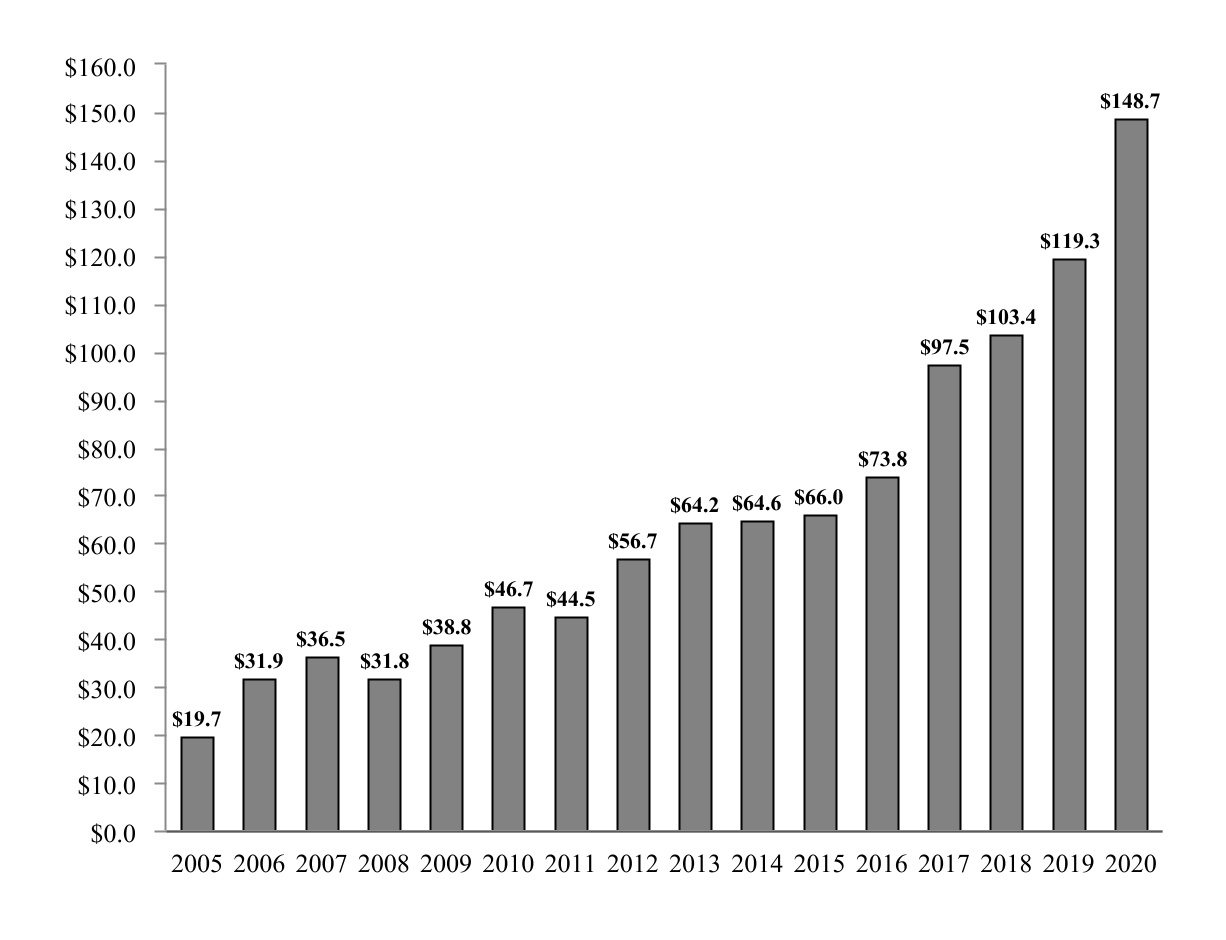
(1) For the years 2006 through 2008, AUM are presented pro forma for the acquisition of the assets and liabilities of KKR & Co. (Guernsey) L.P. (formerly known as KKR Private Equity Investors, L.P.) ("KPE") on October 1, 2009 (the "KPE Transaction"), and therefore exclude the net asset value of KPE and its former commitments to our investment funds. In 2015, our definition of AUM was amended to include capital commitments for which we are eligible to receive fees or carried interest upon deployment of capital and our pro rata portion of the AUM managed by strategic partners in which we hold an ownership interest. AUM for all prior periods have been adjusted to include such changes.
The table below presents information as of December 31, 2020, relating to our current private equity, growth equity, core investment, impact and real asset funds and other investment vehicles in our Private Markets business line for which we have the ability to earn carried interest. This data does not reflect acquisitions or disposals of investments, changes in investment values, or distributions occurring after December 31, 2020.
| Investment Period (1) | Amount ($ in millions) | |||||||||||||||||||||||||||||||
| Start Date | End Date | Commitment (2) | Uncalled Commitments | Percentage Committed by General Partner | Invested | Realized | Remaining Cost (3) | Remaining Fair Value | Gross Accrued Carried Interest | |||||||||||||||||||||||
| Private Equity Funds | ||||||||||||||||||||||||||||||||
| Americas Fund XII | 1/2017 | 1/2023 | $ | 13,500.0 | $ | 5,462.1 | 5.8% | $ | 8,332.5 | $ | 379.6 | $ | 8,221.5 | $ | 13,506.1 | $ | 836.2 | |||||||||||||||
| North America Fund XI | 9/2012 | 1/2017 | 8,718.4 | 429.8 | 2.9% | 9,733.0 | 12,717.1 | 4,499.7 | 8,851.6 | 818.9 | ||||||||||||||||||||||
| 2006 Fund (4) | 9/2006 | 9/2012 | 17,642.2 | 247.4 | 2.1% | 17,309.3 | 32,435.1 | 2,546.3 | 4,794.0 | 461.2 | ||||||||||||||||||||||
| Millennium Fund (4) | 12/2002 | 12/2008 | 6,000.0 | — | 2.5% | 6,000.0 | 14,123.1 | — | 6.1 | 1.3 | ||||||||||||||||||||||
| European Fund V | 3/2019 | 7/2025 | 6,415.0 | 3,810.0 | 1.8% | 2,605.0 | — | 2,605.0 | 3,130.9 | 56.4 | ||||||||||||||||||||||
| European Fund IV | 12/2014 | 3/2019 | 3,511.0 | 59.4 | 5.7% | 3,578.1 | 3,092.2 | 2,351.3 | 3,953.8 | 286.7 | ||||||||||||||||||||||
| European Fund III (4) | 3/2008 | 3/2014 | 5,513.9 | 154.1 | 5.2% | 5,359.8 | 10,524.4 | 336.7 | 300.3 | (14.9) | ||||||||||||||||||||||
| European Fund II (4) | 11/2005 | 10/2008 | 5,750.8 | — | 2.1% | 5,750.8 | 8,507.4 | — | 34.3 | (0.2) | ||||||||||||||||||||||
| Asian Fund IV | 7/2020 | 7/2026 | 13,818.5 | 13,818.5 | 7.2% | — | — | — | — | — | ||||||||||||||||||||||
| Asian Fund III | 4/2017 | 7/2020 | 9,000.0 | 3,168.7 | 5.6% | 6,190.7 | 1,261.1 | 5,795.6 | 8,773.5 | 552.2 | ||||||||||||||||||||||
| Asian Fund II | 4/2013 | 4/2017 | 5,825.0 | — | 1.3% | 6,842.4 | 4,903.4 | 4,023.2 | 5,416.4 | 280.3 | ||||||||||||||||||||||
| Asian Fund (4) | 7/2007 | 4/2013 | 3,983.3 | — | 2.5% | 3,974.3 | 8,723.3 | 17.1 | 25.7 | 3.6 | ||||||||||||||||||||||
| China Growth Fund (4) | 11/2010 | 11/2016 | 1,010.0 | — | 1.0% | 1,010.0 | 867.9 | 466.2 | 409.0 | (7.4) | ||||||||||||||||||||||
| Next Generation Technology Growth Fund II | 12/2019 | 12/2025 | 2,088.3 | 1,225.5 | 7.2% | 863.6 | 0.9 | 859.0 | 1,009.5 | 19.9 | ||||||||||||||||||||||
| Next Generation Technology Growth Fund | 3/2016 | 12/2019 | 658.9 | 2.3 | 22.5% | 663.3 | 326.8 | 527.6 | 1,096.4 | 62.3 | ||||||||||||||||||||||
| Health Care Strategic Growth Fund | 12/2016 | 12/2021 | 1,331.0 | 844.7 | 11.3% | 577.0 | 116.1 | 482.8 | 1,042.0 | 73.2 | ||||||||||||||||||||||
| Global Impact Fund | 2/2019 | 2/2025 | 1,242.2 | 694.6 | 8.1% | 547.6 | — | 547.6 | 645.8 | 12.1 | ||||||||||||||||||||||
| Private Equity Funds | 106,008.5 | 29,917.1 | 79,337.4 | 97,978.4 | 33,279.6 | 52,995.4 | 3,441.8 | |||||||||||||||||||||||||
| Co-Investment Vehicles and Other | Various | Various | 12,069.8 | 4,285.7 | Various | 8,073.6 | 5,683.3 | 5,312.1 | 7,614.1 | 833.1 | ||||||||||||||||||||||
| Total Private Equity Funds | 118,078.3 | 34,202.8 | 87,411.0 | 103,661.7 | 38,591.7 | 60,609.5 | 4,274.9 | |||||||||||||||||||||||||
| Core Investment Vehicles | Various | Various | 10,693.6 | 3,326.3 | 33.0% | 7,367.3 | — | 7,367.3 | 10,481.9 | 131.4 | ||||||||||||||||||||||
| Real Assets | ||||||||||||||||||||||||||||||||
| Energy Income and Growth Fund II | 6/2018 | 6/2021 | 994.2 | 515.0 | 20.1% | 488.9 | 9.6 | 479.7 | 487.7 | — | ||||||||||||||||||||||
| Energy Income and Growth Fund | 9/2013 | 6/2018 | 1,974.2 | — | 12.9% | 1,967.9 | 834.8 | 1,239.4 | 975.9 | — | ||||||||||||||||||||||
| Natural Resources Fund (4) | Various | Various | 887.4 | — | Various | 887.4 | 123.2 | 194.2 | 71.8 | — | ||||||||||||||||||||||
| Global Energy Opportunities | Various | Various | 914.1 | 63.4 | Various | 518.4 | 143.5 | 346.7 | 206.5 | — | ||||||||||||||||||||||
| Global Infrastructure Investors III | 6/2018 | 6/2024 | 7,193.3 | 4,019.1 | 3.8% | 3,390.1 | 216.0 | 3,328.7 | 3,294.9 | — | ||||||||||||||||||||||
| Global Infrastructure Investors II | 10/2014 | 6/2018 | 3,040.8 | 161.3 | 4.1% | 3,119.4 | 2,752.5 | 2,038.4 | 2,650.5 | 66.6 | ||||||||||||||||||||||
| Global Infrastructure Investors | 9/2011 | 10/2014 | 1,040.2 | 25.1 | 4.8% | 1,046.8 | 2,098.4 | 127.5 | 107.6 | 1.3 | ||||||||||||||||||||||
| Asia Pacific Infrastructure Investors | 1/2020 | 1/2026 | 3,791.6 | 3,791.6 | 6.6% | — | — | — | — | — | ||||||||||||||||||||||
| Real Estate Partners Americas II | 5/2017 | 12/2020 | 1,921.2 | 494.4 | 7.8% | 1,662.9 | 519.3 | 1,399.4 | 1,556.5 | 44.1 | ||||||||||||||||||||||
| Real Estate Partners Americas | 5/2013 | 5/2017 | 1,229.1 | 147.8 | 16.3% | 1,011.1 | 1,357.9 | 186.6 | 84.4 | (1.6) | ||||||||||||||||||||||
| Real Estate Partners Europe | 9/2015 | 12/2019 | 713.7 | 190.0 | 9.1% | 599.5 | 172.1 | 510.7 | 656.0 | 21.1 | ||||||||||||||||||||||
| Asia Real Estate Partners | 6/2019 | 6/2023 | 1,682.4 | 1,682.4 | 14.9% | — | — | — | — | — | ||||||||||||||||||||||
| Real Estate Credit Opportunity Partners II | 4/2019 | 6/2022 | 950.0 | 606.6 | 5.3% | 343.4 | 12.0 | 343.4 | 353.9 | — | ||||||||||||||||||||||
| Real Estate Credit Opportunity Partners | 2/2017 | 4/2019 | 1,130.0 | 122.2 | 4.4% | 1,007.8 | 232.2 | 1,007.8 | 942.6 | — | ||||||||||||||||||||||
| Property Partners Americas | 12/2019 | (5) | 2,012.5 | 1,446.7 | 24.8% | 565.8 | 11.5 | 565.8 | 618.1 | 2.3 | ||||||||||||||||||||||
| Co-Investment Vehicles and Other | Various | Various | 7,594.3 | 4,478.8 | Various | 3,115.5 | 923.5 | 3,111.8 | 3,644.3 | 13.2 | ||||||||||||||||||||||
| Real Assets | 37,069.0 | 17,744.4 | 19,724.9 | 9,406.5 | 14,880.1 | 15,650.7 | 147.0 | |||||||||||||||||||||||||
| Other | ||||||||||||||||||||||||||||||||
| Unallocated Commitments (6) | 903.1 | 903.1 | Various | — | — | — | — | — | ||||||||||||||||||||||||
| Private Markets Total | $ | 166,744.0 | $ | 56,176.6 | $ | 114,503.2 | $ | 113,068.2 | $ | 60,839.1 | $ | 86,742.1 | $ | 4,553.3 |
(1)The start date represents the date on which the general partner of the applicable fund commenced investment of the fund's capital or the date of the first closing. The end date represents the earlier of (i) the date on which the general partner of the applicable fund was or will be required by the fund's governing agreement to cease making new investments on behalf of the fund, unless extended by a vote of the fund investors and (ii) the date on which the last new investment was made.
(2)The commitment represents the aggregate capital commitments to the fund, including capital commitments by third-party fund investors and the general partner. Foreign currency commitments have been converted into U.S. dollars based on (i) the foreign exchange rate at the date of purchase for each investment and (ii) the exchange rate that prevailed on December 31, 2020, in the case of uncalled commitments.
(3)The remaining cost represents the initial investment of the general partner and limited partners, reduced for returns of capital, with the limited partners' investment further reduced for any return of capital and realized gains from which the general partner did not receive a carried interest.
(4)The "Invested" and "Realized" columns do not include the amounts of any realized investments that restored the unused capital commitments of the fund investors, if any.
(5)Open-ended fund.
(6)"Unallocated Commitments" represent unallocated commitments from our strategic investor partnerships.
Performance
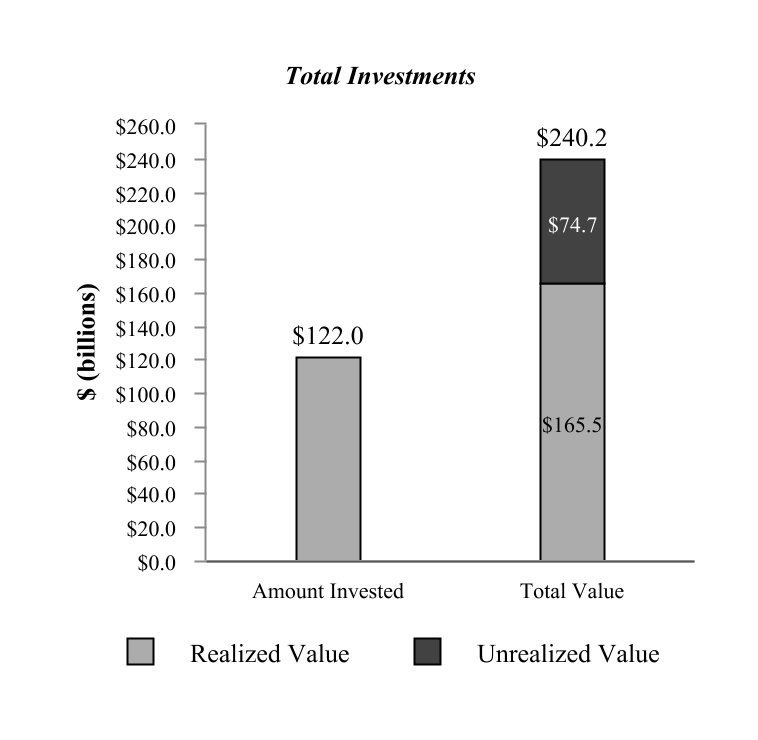
We take a long-term approach to Private Markets investing and measure the success of our investments over a period of years rather than months. Given the duration of these investments, the firm focuses on realized multiples of invested capital and internal rates of return ("IRRs") when deploying capital in these transactions. We have nearly doubled the value of capital that we have invested in our Private Markets investment funds, turning $122.0 billion of capital into $240.2 billion of value from our inception in 1976 to December 31, 2020.
Amount Invested and Total Value for
Private Markets Investment Funds
As of December 31, 2020
From our inception in 1976 through December 31, 2020, our investment funds with at least 24 months of investment activity generated a cumulative gross IRR of 25.6%, compared to the 11.9% and 9.2% gross IRR achieved by the S&P 500 Index and MSCI World Index, respectively, over the same period, despite the cyclical and sometimes challenging environments in which we have operated. The S&P 500 Index and MSCI World Index are unmanaged indices and such returns assume reinvestment of distributions and do not reflect any fees or expenses. Our past performance, however, may not be representative of performance in any period other than the period discussed above and is not a guarantee of future results. For example, as of March 31, 2009, the date of the lowest aggregate valuation of our private equity funds during the 2008 and 2009 market downturn, the investments in certain of our private equity funds at the time were marked down to 67% of original cost. For additional information regarding impact of market conditions on the value and performance of our investments, see "Risk Factors—Risks Related to Our Business—Difficult market and economic conditions can adversely affect our business in many ways, including by reducing the value or performance of the investments that we manage or by reducing the ability of our funds to raise or deploy capital, each of which could negatively impact our net income and cash flow and adversely affect our financial prospects and condition" and "Risk Factors—Risks Related to the Assets We Manage—The historical returns attributable to our funds, including those presented in this report, should not be considered as indicative of the future results of our funds, our insurance subsidiaries or our balance sheet investments, of our future results or the performance of our common stock."
The tables below present information as of December 31, 2020, relating to the historical performance of certain of our Private Markets investment vehicles since inception, which we believe illustrates the benefits of our investment approach. This data does not reflect additional capital raised since December 31, 2020, or acquisitions or disposals of investments, changes in investment values, or distributions occurring after that date. The information presented below is not intended to be representative of any past or future performance for any particular period other than the period presented below. Past performance is no guarantee of future results.
| Amount | Fair Value of Investments | ||||||||||||||||||||||||||||||||||||||||
| Private Markets Investment Funds | Commitment | Invested | Realized (4) | Unrealized | Total Value | Gross IRR (5) | Net IRR (5) | Gross Multiple of Invested Capital (5) | |||||||||||||||||||||||||||||||||
| ($ in millions) | |||||||||||||||||||||||||||||||||||||||||
| Total Investments | |||||||||||||||||||||||||||||||||||||||||
| Legacy Funds (1) | |||||||||||||||||||||||||||||||||||||||||
| 1976 Fund | $ | 31.4 | $ | 31.4 | $ | 537.2 | $ | — | $ | 537.2 | 39.5 | % | 35.5 | % | 17.1 | ||||||||||||||||||||||||||
| 1980 Fund | 356.8 | 356.8 | 1,827.8 | — | 1,827.8 | 29.0 | % | 25.8 | % | 5.1 | |||||||||||||||||||||||||||||||
| 1982 Fund | 327.6 | 327.6 | 1,290.7 | — | 1,290.7 | 48.1 | % | 39.2 | % | 3.9 | |||||||||||||||||||||||||||||||
| 1984 Fund | 1,000.0 | 1,000.0 | 5,963.5 | — | 5,963.5 | 34.5 | % | 28.9 | % | 6.0 | |||||||||||||||||||||||||||||||
| 1986 Fund | 671.8 | 671.8 | 9,080.7 | — | 9,080.7 | 34.4 | % | 28.9 | % | 13.5 | |||||||||||||||||||||||||||||||
| 1987 Fund | 6,129.6 | 6,129.6 | 14,949.2 | — | 14,949.2 | 12.1 | % | 8.9 | % | 2.4 | |||||||||||||||||||||||||||||||
| 1993 Fund | 1,945.7 | 1,945.7 | 4,143.3 | — | 4,143.3 | 23.6 | % | 16.8 | % | 2.1 | |||||||||||||||||||||||||||||||
| 1996 Fund | 6,011.6 | 6,011.6 | 12,476.9 | — | 12,476.9 | 18.0 | % | 13.3 | % | 2.1 | |||||||||||||||||||||||||||||||
| Subtotal - Legacy Funds | 16,474.5 | 16,474.5 | 50,269.3 | — | 50,269.3 | 26.1 | % | 19.9 | % | 3.1 | |||||||||||||||||||||||||||||||
| Included Funds | |||||||||||||||||||||||||||||||||||||||||
| European Fund (1999) (2) | 3,085.4 | 3,085.4 | 8,757.7 | — | 8,757.7 | 26.9 | % | 20.2 | % | 2.8 | |||||||||||||||||||||||||||||||
| Millennium Fund (2002) | 6,000.0 | 6,000.0 | 14,123.1 | 6.1 | 14,129.2 | 22.0 | % | 16.1 | % | 2.4 | |||||||||||||||||||||||||||||||
| European Fund II (2005) (2) | 5,750.8 | 5,750.8 | 8,507.4 | 34.3 | 8,541.7 | 6.1 | % | 4.5 | % | 1.5 | |||||||||||||||||||||||||||||||
| 2006 Fund (2006) | 17,642.2 | 17,309.3 | 32,435.1 | 4,794.0 | 37,229.1 | 12.0 | % | 9.4 | % | 2.2 | |||||||||||||||||||||||||||||||
| Asian Fund (2007) | 3,983.3 | 3,974.3 | 8,723.3 | 25.7 | 8,749.0 | 18.9 | % | 13.7 | % | 2.2 | |||||||||||||||||||||||||||||||
| European Fund III (2008) (2) | 5,513.9 | 5,359.8 | 10,524.4 | 300.3 | 10,824.7 | 16.6 | % | 11.5 | % | 2.0 | |||||||||||||||||||||||||||||||
| E2 Investors (Annex Fund) (2009) (2) | 195.8 | 195.8 | 199.6 | — | 199.6 | 0.6 | % | 0.5 | % | 1.0 | |||||||||||||||||||||||||||||||
| China Growth Fund (2010) | 1,010.0 | 1,010.0 | 867.9 | 409.0 | 1,276.9 | 6.2 | % | 1.9 | % | 1.3 | |||||||||||||||||||||||||||||||
| Natural Resources Fund (2010) | 887.4 | 887.4 | 123.2 | 71.8 | 195.0 | (26.1) | % | (28.1) | % | 0.2 | |||||||||||||||||||||||||||||||
| Global Infrastructure Investors (2011) (2) | 1,040.2 | 1,046.8 | 2,098.4 | 107.6 | 2,206.0 | 17.5 | % | 15.5 | % | 2.1 | |||||||||||||||||||||||||||||||
| North America Fund XI (2012) | 8,718.4 | 9,733.0 | 12,717.1 | 8,851.6 | 21,568.7 | 23.2 | % | 18.5 | % | 2.2 | |||||||||||||||||||||||||||||||
| Asian Fund II (2013) | 5,825.0 | 6,842.4 | 4,903.4 | 5,416.4 | 10,319.8 | 13.1 | % | 9.5 | % | 1.5 | |||||||||||||||||||||||||||||||
| Real Estate Partners Americas (2013) | 1,229.1 | 1,011.1 | 1,357.9 | 84.4 | 1,442.3 | 16.4 | % | 11.6 | % | 1.4 | |||||||||||||||||||||||||||||||
| Energy Income and Growth Fund (2013) | 1,974.2 | 1,967.9 | 834.8 | 975.9 | 1,810.7 | (2.4) | % | (4.9) | % | 0.9 | |||||||||||||||||||||||||||||||
| Global Infrastructure Investors II (2014) (2) | 3,040.8 | 3,119.4 | 2,752.5 | 2,650.5 | 5,403.0 | 19.7 | % | 17.0 | % | 1.7 | |||||||||||||||||||||||||||||||
| European Fund IV (2015) (2) | 3,511.0 | 3,578.1 | 3,092.2 | 3,953.8 | 7,046.0 | 27.0 | % | 21.3 | % | 2.0 | |||||||||||||||||||||||||||||||
| Real Estate Partners Europe (2015) (2) | 713.7 | 599.5 | 172.1 | 656.0 | 828.1 | 15.4 | % | 10.7 | % | 1.4 | |||||||||||||||||||||||||||||||
| Next Generation Technology Growth Fund (2016) | 658.9 | 663.3 | 326.8 | 1,096.4 | 1,423.2 | 34.1 | % | 28.2 | % | 2.1 | |||||||||||||||||||||||||||||||
| Health Care Strategic Growth Fund (2016) | 1,331.0 | 577.0 | 116.1 | 1,042.0 | 1,158.1 | 64.2 | % | 41.2 | % | 2.0 | |||||||||||||||||||||||||||||||
| Americas Fund XII (2017) | 13,500.0 | 8,332.5 | 379.6 | 13,506.1 | 13,885.7 | 31.4 | % | 24.1 | % | 1.7 | |||||||||||||||||||||||||||||||
| Real Estate Credit Opportunity Partners (2017) | 1,130.0 | 1,007.8 | 232.2 | 942.6 | 1,174.8 | 6.6 | % | 5.4 | % | 1.2 | |||||||||||||||||||||||||||||||
| Core Investment Vehicles (2017) | 10,693.6 | 7,367.3 | — | 10,481.9 | 10,481.9 | 21.4 | % | 19.8 | % | 1.4 | |||||||||||||||||||||||||||||||
| Asian Fund III (2017) | 9,000.0 | 6,190.7 | 1,261.1 | 8,773.5 | 10,034.6 | 40.2 | % | 30.1 | % | 1.6 | |||||||||||||||||||||||||||||||
| Real Estate Partners Americas II (2017) | 1,921.2 | 1,662.9 | 519.3 | 1,556.5 | 2,075.8 | 20.8 | % | 15.7 | % | 1.2 | |||||||||||||||||||||||||||||||
| Global Infrastructure Investors III (2018) | 7,193.3 | 3,390.1 | 216.0 | 3,294.9 | 3,510.9 | 3.3 | % | (0.6) | % | 1.0 | |||||||||||||||||||||||||||||||
| European Fund V (2019) (2) (3) | 6,415.0 | 2,605.0 | — | 3,130.9 | 3,130.9 | — | — | — | |||||||||||||||||||||||||||||||||
| Energy Income and Growth Fund II (2019) (3) | 994.2 | 488.9 | 9.6 | 487.7 | 497.3 | — | — | — | |||||||||||||||||||||||||||||||||
| Next Generation Technology Growth Fund II (2019) (3) | 2,088.3 | 863.6 | 0.9 | 1,009.5 | 1,010.4 | — | — | — | |||||||||||||||||||||||||||||||||
| Global Impact Fund (2019) (3) | 1,242.2 | 547.6 | — | 645.8 | 645.8 | — | — | — | |||||||||||||||||||||||||||||||||
| Asia Pacific Infrastructure Investors (2019) (3) | 3,791.6 | — | — | — | — | — | — | — | |||||||||||||||||||||||||||||||||
| Real Estate Credit Opportunity Partners II (2019) (3) | 950.0 | 343.4 | 12.0 | 353.9 | 365.9 | — | — | — | |||||||||||||||||||||||||||||||||
| Asian Fund IV (2020) (3) | 13,818.5 | — | — | — | — | — | — | — | |||||||||||||||||||||||||||||||||
| Asia Real Estate Partners (2020) (3) | 1,682.4 | — | — | — | — | — | — | — | |||||||||||||||||||||||||||||||||
| Subtotal - Included Funds | 146,531.4 | 105,511.1 | 115,263.7 | 74,659.1 | 189,922.8 | 16.1 | % | 12.2 | % | 1.8 | |||||||||||||||||||||||||||||||
| All Funds | $ | 163,005.9 | $ | 121,985.6 | $ | 165,533.0 | $ | 74,659.1 | $ | 240,192.1 | 25.6 | % | 18.8 | % | 2.0 |
(1)These funds were not contributed to KKR as part of the KPE Transaction.
(2)The following table presents information regarding investment funds with euro-denominated commitments. Such amounts have been converted into U.S. dollars based on (i) the foreign exchange rate at the date of purchase for each investment and (ii) the exchange rate prevailing on December 31, 2020, in the case of unfunded commitments.
| Private Markets Investment Funds | Commitment (€ in millions) | |||||||
| European Fund | € | 196.5 | ||||||
| European Fund II | € | 2,597.5 | ||||||
| European Fund III | € | 2,882.8 | ||||||
| E2 Investors (Annex Fund) | € | 55.5 | ||||||
| Global Infrastructure Investors | € | 30.0 | ||||||
| Global Infrastructure Investors II | € | 243.8 | ||||||
| European Fund IV | € | 1,626.1 | ||||||
| Real Estate Partners Europe | € | 276.6 | ||||||
| Global Infrastructure Investors III | € | 987.0 | ||||||
| European Fund V | € | 2,144.2 |
(3)The gross IRR, net IRR and gross multiple of invested capital are calculated for our investment funds that made their first investment at least 24 months prior to December 31, 2020. None of the European Fund V, Energy Income and Growth Fund II, Next Generation Technology Growth Fund II, Global Impact Fund, Asia Pacific Infrastructure Investors, Real Estate Credit Opportunity Partners II, Asian Fund IV, Asia Real Estate Partners or Property Partners Americas has invested for at least 24 months as of December 31, 2020. We therefore have not calculated gross IRRs, net IRRs and gross multiples of invested capital with respect to those funds.
(4)An investment is considered realized when it has been disposed of or has otherwise generated disposition proceeds or current income that has been distributed by the relevant fund. In periods prior to the three months ended September 30, 2015, realized proceeds excluded current income such as dividends and interest.
(5)IRRs measure the aggregate annual compounded returns generated by a fund's investments over a holding period. Net IRRs are calculated after giving effect to the allocation of realized and unrealized carried interest and the payment of any applicable management fees and organizational expenses. Gross IRRs are calculated before giving effect to the allocation of realized and unrealized carried interest and the payment of any applicable management fees and organizational expenses.
The gross multiples of invested capital measure the aggregate value generated by a fund's investments in absolute terms. Each multiple of invested capital is calculated by adding together the total realized and unrealized values of a fund's investments and dividing by the total amount of capital invested by the fund. Such amounts do not give effect to the allocation of realized and unrealized carried interest or the payment of any applicable management fees or organizational expenses.
KKR's Private Markets funds may utilize third-party financing facilities to provide liquidity to such funds. The above net and gross IRRs are calculated from the time capital contributions are due from fund investors to the time fund investors receive a related distribution from the fund, and the use of such financing facilities generally decreases the amount of time that would otherwise be used to calculate IRRs, which tends to increase IRRs when fair value grows over time and decrease IRRs when fair value decreases over time. KKR's Private Markets funds also generally provide in certain circumstances, which vary depending on the relevant fund documents, for a portion of capital returned to investors to be restored to unused commitments as recycled capital. For KKR's Private Markets funds that have a preferred return, we take into account recycled capital in the calculation of IRRs and multiples of invested capital because the calculation of the preferred return includes the effect of recycled capital. For KKR's Private Markets funds that do not have a preferred return, we do not take recycled capital into account in the calculation of IRRs and multiples of invested capital. The inclusion of recycled capital generally causes invested and realized amounts to be higher and IRRs and multiples of invested capital to be lower than had recycled capital not been included. The inclusion of recycled capital would reduce the composite net IRR of all Included Funds by 0.1% and the composite net IRR of all Legacy Funds by 0.5% and would reduce the composite multiple of invested capital of Included Funds by less than 0.1 and the composite multiple of invested capital of Legacy Funds by 0.4.
For more information, see "Risk Factors—Risks Related to the Assets We Manage—The historical returns attributable to our funds, including those presented in this report, should not be considered as indicative of the future results of our funds, our insurance subsidiaries or our balance sheet investments, of our future results or the performance of our common stock."
Private Equity
We are a world leader in private equity, having raised over 25 private equity funds (including growth equity). We invest in industry-leading franchises and attract world-class management teams. Our investment approach leverages our capital base, sourcing advantage, global network and industry knowledge. It also leverages a sizable team of operating professionals, as well as senior advisors and other advisors, many of whom are former chief executive officers and leaders of the business community**.**
Traditional Private Equity**.** Our traditional private equity investment strategy typically seeks to engage primarily in management buyouts, build-ups, or other investments with a view to acquire a controlling or significant influence. We believe that the combination of our industry knowledge, investment experience and operational expertise provides KKR with the ability to identify and create value in investment opportunities. Through our portfolio company board oversight, we work closely and cooperatively with the management of our portfolio companies, which are assisted by having access to the resources of our global platform.
Growth Equity**.** Building upon our four decades of private equity investing experience, we have sourced a number of smaller growth equity investment opportunities, and we expanded our business by launching dedicated growth equity funds in 2016 and 2018 that pursue growth equity investment opportunities in the technology, media and telecommunications (TMT) sector, primarily in the United States, Canada, Europe and Israel. Through this strategy, we focus on emerging, high-growth companies and invest across a variety of sub-segments including software, security, semiconductors, consumer electronics, internet of things (IoT), information services, business services, internet, digital media, content and communications. In 2016, we launched another dedicated growth equity fund to pursue growth equity investment opportunities in the health care sector, primarily in the United States and Europe. Our health care growth strategy targets opportunities across various health care sub-sectors, including biopharmaceuticals, medical devices, diagnostics ⁄ life science tools, providers, healthcare information technology ⁄ informatics and other services.
Core Investments. We have separately managed vehicles in our core investments strategy. This strategy targets investments with a longer holding period and a lower risk profile, which we determined are not suitable for our traditional private equity or real asset strategies. The holding periods in these core investment accounts are generally longer than 15 years.
Global Impact Strategy. We launched our global impact strategy in 2018, which is focused on identifying and investing behind opportunities across the Americas, Europe and Asia where financial performance and societal impact are intrinsically aligned. Our Global Impact Fund aims to generate private equity risk-adjusted returns by investing in small to medium-sized companies that contribute toward one or more of the United Nations Sustainable Development Goals.
Portfolio
The following chart presents information concerning the remaining value of traditional private equity funds by geography through December 31, 2020. We believe that this data illustrates the benefits of our business approach and our ability to source and invest in deals in multiple geographies.
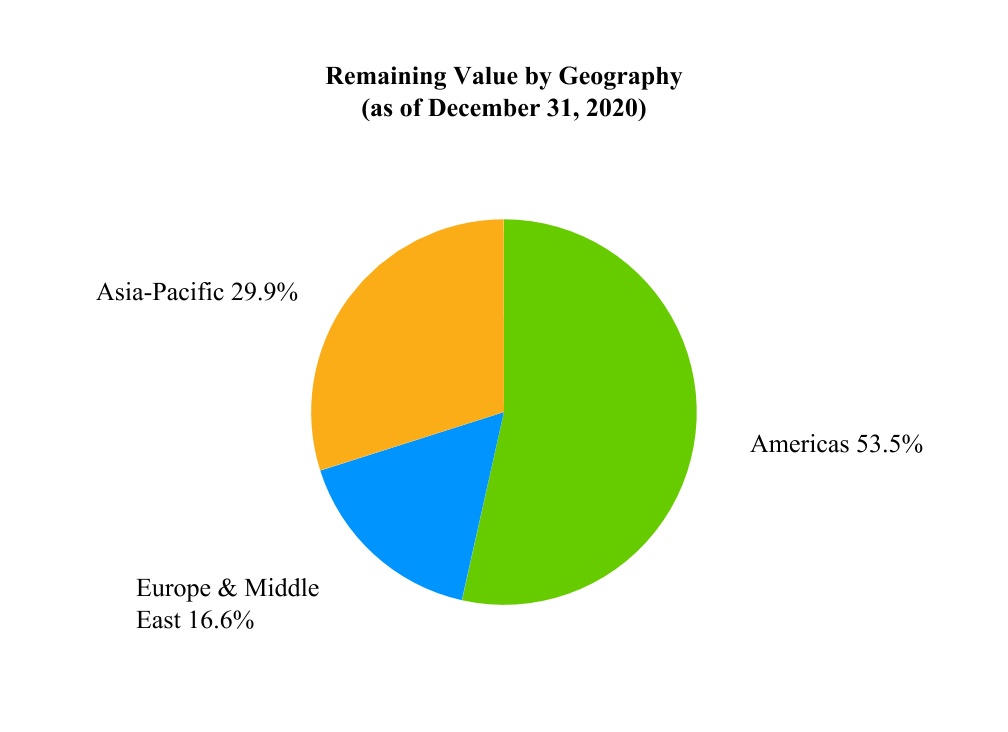
As of December 31, 2020, our traditional private equity portfolio consisted of 107 companies with approximately $238 billion of annual revenues. These companies are headquartered in 20 countries and operate in 20 general industries, which take advantage of our broad and deep industry and operating expertise. Many of these companies are leading franchises with global operations, strong management teams and attractive growth prospects, which we believe will provide benefits through a broad range of business conditions.
Investment Approach
Our approach to making private equity investments focuses on achieving multiples of invested capital and attractive risk-adjusted IRRs by selecting high-quality investments that may be made at attractive prices, applying rigorous standards of due diligence when making investment decisions, implementing strategic and operational changes that drive growth and value creation in acquired businesses, carefully monitoring investments, and making informed decisions when developing investment exit strategies.
We believe that we have achieved a leading position in the private equity industry by applying a disciplined investment approach and by building strong partnerships with highly motivated management teams who put their own capital at risk. When making private equity investments, we seek out strong business franchises, attractive growth prospects, leading market positions and the ability to generate attractive returns. In our private equity funds, we do not effect transactions that are "hostile," meaning a target company's board of directors makes an unfavorable recommendation with respect to the transaction or publicly opposes the consummation of the transaction.
Sourcing and Selecting Investments
We have access to significant opportunities for making private equity investments as a result of our sizable capital base, global platform, and relationships with leading executives from major companies, commercial and investment banks, and other investment and advisory institutions. Members of our global network contact us with new investment opportunities, including a substantial number of exclusive investment opportunities and opportunities that are made available to only a limited number of other firms. We also proactively pursue business development strategies that are designed to generate deals internally based on the depth of our industry knowledge and our reputation as a leading financial sponsor.
Due Diligence and the Investment Decision
When an investment team determines that an investment proposal is worth consideration, the proposal is formally presented to the applicable regional investment committee and the due diligence process commences, if appropriate. The objective of the due diligence process is to identify attractive investment opportunities based on the facts and circumstances surrounding an investment and to prepare a framework that may be used from the date of an acquisition to drive operational improvement and value creation. When conducting due diligence, investment teams evaluate a number of important business, financial, tax, accounting, environmental, social, governance, legal and regulatory issues in order to determine whether an investment is suitable. While the due diligence process differs depending on the type of investment we make, generally, in connection with the private equity due diligence process, investment professionals spend significant amounts of time meeting with a company's management and operating personnel, visiting plants and facilities, and where appropriate, speaking with other stakeholders interested in and impacted by the investment in order to understand the opportunities and risks associated with the proposed investment. Our investment professionals may also use the services of outside accountants, consultants, lawyers, investment banks and industry experts as appropriate to assist them in this process. Investment committees or portfolio managers, as applicable, monitor our due diligence practices and approve an investment before it is made.
Building Successful and Competitive Businesses
Portfolio management committees are responsible for working with our investment professionals from the date on which a private equity investment is made until the time it is exited in order to ensure that strategic and operational objectives are accomplished and that the performance of the investment is closely monitored. When investing in a private equity portfolio company, we partner with management teams to execute on our investment thesis, and we rigorously track performance through regular monitoring of detailed operational and financial metrics as well as appropriate environmental, social and governance issues. We have developed a global network of experienced managers and operating professionals who assist the private equity portfolio companies in making operational improvements and achieving growth. We augment these resources with operational guidance from operating professionals at KKR Capstone, senior advisors, other advisors and investment teams, and with "100-Day Plans" that focus the firm's efforts and drive our strategies. We seek to emphasize efficient capital management, top-line growth, R&D spending, geographical expansion, cost optimization and investment for the long-term.
Realizing Investments
We have developed substantial expertise for realizing private equity investments. From our inception through December 31, 2020, the firm has generated approximately $157.2 billion of cash proceeds from the sale of our private equity portfolio companies in initial public offerings and secondary offerings, dividends, and sales to strategic and financial buyers. When exiting private equity investments, our objective is to structure the exit in a manner that optimizes returns for fund investors and, in the case of publicly traded companies, minimizes the impact that the exit has on the trading price of the company's securities. We believe that our ability to successfully realize investments is attributable in part to the strength and discipline of our portfolio management committees and capital markets business, as well as the firm's longstanding relationships with corporate buyers and members of the investment banking and investing communities.
Private Equity Fund Structures
The private equity funds that we sponsor and manage have finite lives and investment periods. Each fund is organized as one or more partnerships, and each partnership is controlled by a general partner. Private equity fund investors are limited partners who agree to contribute a specified amount of capital to the fund from time to time for use in qualifying investments during the investment period, which generally lasts up to six years depending on how quickly capital is deployed. The investment period for certain funds may be terminated upon supermajority vote (based on capital commitment) of the fund's limited partners or by the fund's advisory committee. The term of our private equity funds generally last for 10 to 12 years and may last up to 15 years from the date of the fund's first or last investment, subject to a limited number of extensions with the consent of the limited partners or the applicable advisory committee. Given the length of the investment periods and terms of
our private equity funds and the limited conditions under which such periods can be terminated and commitments may be withdrawn, the AUM of our private equity funds provide a long-term stable capital base.
Each private equity fund's general partner is generally entitled to a carried interest that allocates to it 20% of the net profits realized by the limited partners from the fund's investments. Our private equity funds since 2012 generally have a performance hurdle which requires that we return 7%, compounded annually, to limited partners in the fund prior to receiving our 20% share of net profits realized by limited partners. Such performance hurdles are subject to a catch-up allocation to the general partner after the hurdle has been reached. Our earlier private equity funds do not include a performance hurdle. The timing of receipt of carried interest in respect of investments of our private equity funds is dictated by the terms of the partnership agreements that govern such funds, and is distributed to the general partner of a private equity fund only after all of the following are met: (i) a realization event has occurred (e.g., sale of a portfolio company, dividend, etc.); (ii) the vehicle has achieved positive overall investment returns since its inception, in excess of performance hurdles where applicable, and is accruing carried interest; and (iii) with respect to investments with a fair value below cost, cost has been returned to fund investors in an amount sufficient to reduce remaining cost to the investments' fair value. For a fund that has a fair value above cost, overall, and is otherwise accruing carried interest, but has one or more investments where fair value is below cost, the shortfall between cost and fair value for such investments is referred to as a "netting hole." See "Management's Discussion and Analysis of Financial Condition and Results of Operations—Liquidity—Sources of Liquidity" for a discussion of netting holes. Net realized profit or loss is not netted between or among funds. In addition, the agreements governing our private equity funds generally include a "clawback" provision that, if triggered, may give rise to a contingent obligation that may require the general partner to return or contribute amounts to the fund for distribution to fund investors at the end of the life of the fund. See "Management's Discussion and Analysis of Financial Condition and Results of Operations—Critical Accounting Policies—Recognition of Carried Interest in the Statement of Operations" and "Risk Factors—The 'clawback' provisions in our governing agreements may give rise to a contingent obligation that may require us to return or contribute amounts to our funds and fund investors."
We enter into management agreements with our private equity funds pursuant to which we receive management fees in exchange for providing the funds with management and other services. Gross management fees for our private equity funds generally range from 1% to 2% of committed capital during the fund's investment period and are generally 0.75% to 1.25% of invested capital after the expiration of the fund's investment period with subsequent reductions over time, which causes the fees to be reduced as investments are liquidated. In addition, in connection with the expiration of the investment period, a private equity fund may establish a reserve on its fund investors' capital commitments on which no fee is paid unless such capital is invested. These management fees are paid by private equity fund investors, who generally contribute capital to the fund in order to allow the fund to pay the fees to us. Our private equity funds generally require that management fees be returned to fund investors before a carried interest may be paid.
We also enter into monitoring agreements with our portfolio companies pursuant to which we receive periodic monitoring fees in exchange for providing them with management, consulting and other services, and we typically receive transaction fees for providing portfolio companies with financial, advisory and other services in connection with specific transactions. Monitoring agreements may provide for a termination payment following an initial public offering or change of control, if certain criteria are satisfied. In some cases, we may be entitled to other fees that are paid by an investment target upon closing a transaction or when a potential investment is not consummated. Since 2014, our private equity fund agreements typically require us to share 100% of any monitoring, transaction and other fees that are allocable to a fund (after reduction for expenses incurred allocable to a fund from unconsummated transactions) with fund investors.
In addition, the agreements governing our private equity funds enable investors in those funds to reduce their capital commitments available for further investments, on an investor-by-investor basis, in the event one or more "key persons" (for example, investment professionals who are named as "key executives" for certain geographically or product focused funds) cease to be actively involved in the management of the fund. While these provisions do not allow investors in our funds to withdraw capital that has been invested or cause a fund to terminate, the occurrence of a "key person" event could cause disruption in our business, reduce the amount of capital that we have available for future investments, and make it more challenging to raise additional capital in the future.
Because private equity fund investors typically are unwilling to invest their capital in a fund unless the fund's manager also invests its own capital in the fund's investments, our private equity fund documents generally require the general partners of the funds to make minimum capital commitments to the funds. The amounts of these commitments, which are negotiated by fund investors, generally range from 2% to 8% of a fund's total capital commitments at final closing, but may be greater for certain funds (i) where we are pursuing newer strategies, (ii) where third party investor demand is limited, and (iii) where a larger commitment is consistent with the asset allocation strategy our balance sheet is pursuing. When investments are made, the general partner contributes capital to the fund based on its fund commitment percentage and acquires a capital interest in the investment that is not subject to a carried interest or management fees.
Real Assets
Infrastructure
Our infrastructure platform seeks to achieve returns including current income through the acquisition and operational improvement of assets important to the functioning of the economy. We believe that the global infrastructure market provides an opportunity for the firm's private investment, operational improvement capabilities and stakeholder engagement. Through this platform we have made investments in power and utilities, midstream, alternative energy, transportation, asset leasing, water and wastewater, and telecommunications infrastructure. Our traditional infrastructure funds pursue infrastructure investment opportunities with an emphasis on investments in existing assets and businesses located in North America, Western Europe and Asia. Our core infrastructure strategy seeks core infrastructure and infrastructure-related investment opportunities with a focus on investments with predominantly contracted or regulated cash flows in existing securities, properties and other assets principally located in North America and Western Europe.
Real Estate
Our real estate equity platform targets real estate investment opportunities globally, across the United States, Western Europe and Asia-Pacific. Our opportunistic equity investments include direct investments in real property, debt, special situations transactions and businesses with significant real estate holdings that can benefit from KKR's involvement and expertise. We seek to partner with real estate owners, lenders, operators, and developers to provide flexible capital to respond to transaction-specific needs, including the outright purchase or financing of existing assets or companies and the funding of future development or acquisition opportunities. Through this strategy, we have made real estate equity investments in residential and commercial assets. In addition, we have a core plus real estate strategy that seeks to pursue real estate primarily in the United States, primarily with the intent of influencing the real estate assets or companies in which it invests. Our strategic real estate partner, Drawbridge Realty ("Drawbridge"), also pursues a U.S. open-ended triple net lease office strategy and makes equity and credit investments in real estate properties.
Our real estate credit platform also provides capital solutions for real estate transactions with a focus on commercial mortgage-backed securities, whole loans and subordinated debt. Our real estate credit strategy includes KKR Real Estate Finance Trust Inc. (NYSE: KREF), a listed real estate investment trust ("REIT"), and our real estate credit funds which focus on the risk retention tranches of CMBS transactions.
Energy
Our energy platform aims to provide fund investors with exposure to commodity prices and optionality associated with producing and selling oil and natural gas reserves and capital appreciation. Our energy platform targets real asset investment opportunities located primarily in the United States across the upstream and midstream segments of the oil and gas industry. We seek to generate value through optimizing production, reducing operating costs, and optimizing commercial and marketing arrangements. We work closely with external teams of technical and operational experts to assist in the selection, evaluation and operation of investments. We invest in these energy strategies primarily through KKR's energy funds and vehicles.
Real Asset Investment Process
Our energy, infrastructure and real estate funds have a similar investment process as that described under "—Private Equity." Investment teams for a particular real asset strategy formally present potential investments to the applicable strategy oriented investment committee or the portfolio manager, as applicable, which monitors our due diligence practices and approves an investment before it is made. Most of our real asset strategies also have a portfolio management team that works with our investment professionals from the date on which an investment is made until the time it is exited in order to ensure that strategic and operational objectives are accomplished and that the performance of the investment is closely monitored. In addition to leveraging the resources of the firm, our energy, infrastructure and real estate investment teams typically partner with technical experts and operators to manage our real asset investments.
Real Asset Fund Structures
Our traditional energy, infrastructure and real estate funds generally have investment periods of up to 6 years and generally have a fund term of up to 13 years. Management fees for such funds generally range from 0.75% to 1.5% on committed capital, invested capital or net asset value during the investment period and on invested capital or net asset value for investments thereafter, subject to certain adjustments. These funds generally have performance hurdles of 8% to 10% subject to a catch-up
allocation to the general partner after the hurdle has been reached. Thereafter the general partners of such funds generally share in 10% to 20% of net profits realized by limited partners.
Our core real estate and infrastructure funds are open-ended and do not have a fixed termination date. They also do not have a specified termination date for making investments. Management fees for such funds generally range from 0.5% to 1.1% of net asset value, subject to certain adjustments. The general partners of such funds are also entitled to incentive fees ranging generally from 5% to 10% of cash flow or net asset value appreciation, subject to performance hurdles.
Public Markets
Through our Public Markets business line, we report our credit and hedge funds platforms on a combined basis. Our credit business invests capital in (i) leveraged credit strategies, including leveraged loans, high-yield bonds, opportunistic credit and revolving credit strategies, and (ii) alternative credit strategies, including special situations and private credit strategies such as direct lending and private opportunistic credit (including mezzanine and asset-based finance) investment strategies. The funds, CLOs, separately managed accounts, investment companies registered under the Investment Company Act and alternative investment funds ("AIFs") in our leveraged credit and alternative credit strategies are managed by KKR Credit Advisors (US) LLC, which is an SEC-registered investment adviser, KKR Credit Advisors (Ireland) Unlimited Company, which is regulated by the Central Bank of Ireland ("CBI"), and KKR Credit Advisors (Singapore) Pte. Ltd., which is regulated by the Monetary Authority of Singapore and also registered with the SEC. Our business development company ("BDC") platform consists of BDCs advised by FS/KKR Advisor, LLC ("FS/KKR Advisor"), which is an investment adviser jointly owned by KKR and Franklin Square Holdings, L.P. ("FS Investments") following the completion of our strategic partnership with FS Investments on April 9, 2018. Our Public Markets business line also includes our hedge funds platform, which consists of strategic partnerships with third-party hedge fund managers in which KKR owns a minority stake (which we refer to as "hedge fund partnerships"). Our hedge fund partnerships offer a variety of investment strategies, including equity hedge funds, hedge fund-of-funds and credit hedge funds.
We intend to continue to grow the Public Markets business line by leveraging our global investment platform, experienced investment professionals and the ability to adapt our investment strategies to different market conditions to capitalize on investment opportunities that may arise at various levels of the capital structure and across market cycles.
The following chart presents the growth in the AUM of our Public Markets business line from the commencement of its operations in August 2004 through December 31, 2020.
Public Markets
Assets Under Management (1) (2)
($ in billions)
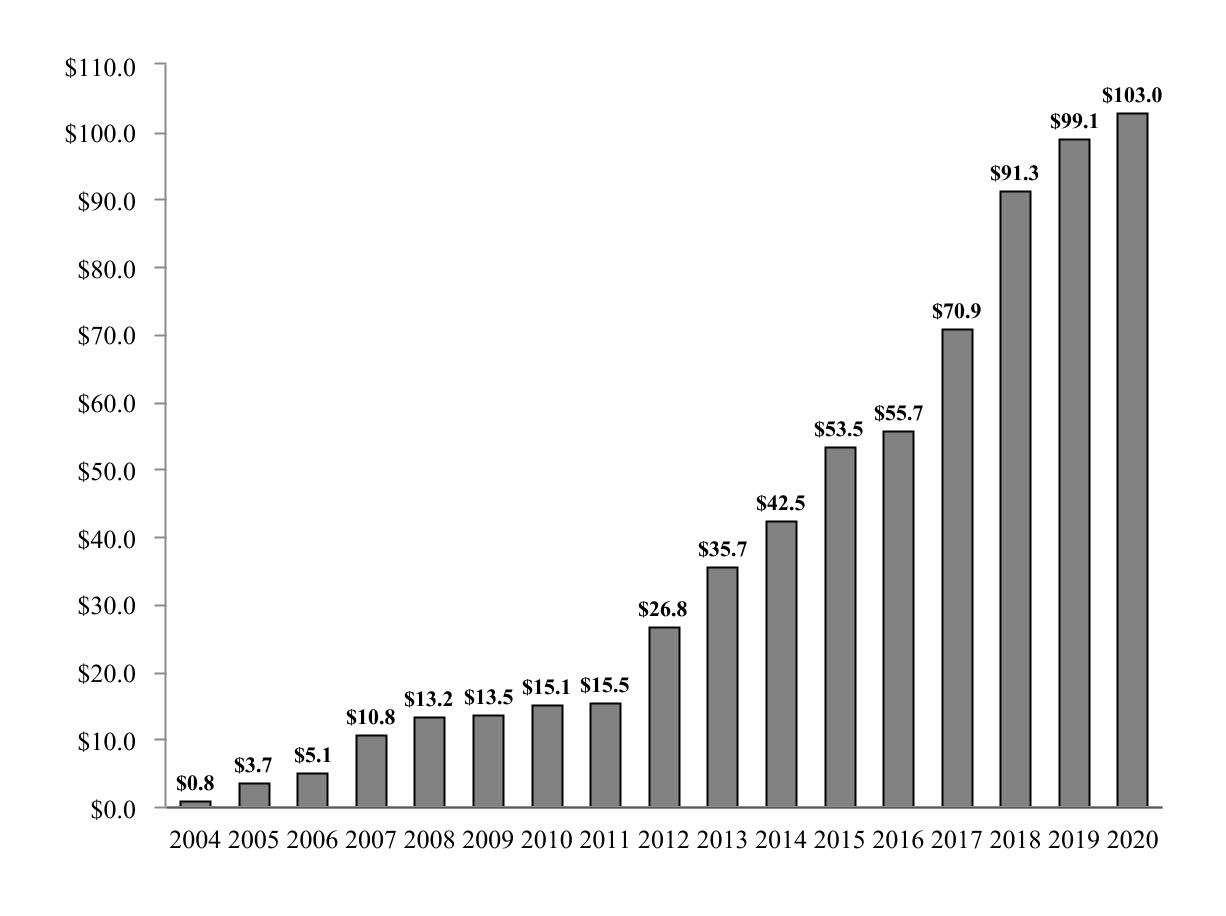
(1) For years 2006 through 2008, AUM are presented pro forma for the KPE Transaction and, therefore, exclude the net asset value of KPE and its former commitments to our investment funds. AUM of acquired businesses and pro rata AUM of hedge fund partnerships in which KKR has made an investment are included in the years on and after the completion of the respective acquisitions or transactions, as applicable.
(2) In 2015 our definition of AUM was amended to include (i) KKR's pro rata portion of AUM managed by third-party hedge fund managers in which KKR holds a minority stake and (ii) capital commitments for which we are eligible to receive fees or carried interest upon deployment of capital. AUM for all prior periods has been adjusted to include such changes.
Credit
Performance
We generally review our performance in our credit business by investment strategy.
Our leveraged credit strategies principally invest through separately managed accounts, BDCs, CLOs and investment funds. In certain cases, these strategies have meaningful track records and may be compared to widely-known indices. The following table presents information regarding larger leveraged credit strategies managed by KKR from inception to December 31, 2020. The information presented below is not intended to be representative of any past or future performance for any particular period other than the period presented below. Past performance is no guarantee of any future result.
Leveraged Credit Strategies: Inception-to-Date Annualized Gross Performance vs. Benchmark by Strategy
| ($ in millions) | Inception Date | Gross Returns | Net Returns | Benchmark (1) | Benchmark Gross Returns | |||||||||||||||||||||||||||||||||
| Bank Loans Plus High Yield | Jul 2008 | 7.57 | % | 6.95 | % | 65% S&P/LSTA Loan Index, 35% BoAML HY Master II Index (2) | 5.98 | % | ||||||||||||||||||||||||||||||
| Opportunistic Credit (3) | May 2008 | 11.60 | % | 9.77 | % | 50% S&P/LSTA Loan Index, 50% BoAML HY Master II Index (3) | 6.28 | % | ||||||||||||||||||||||||||||||
| Bank Loans | Apr 2011 | 5.23 | % | 4.65 | % | S&P/LSTA Loan Index (4) | 4.18 | % | ||||||||||||||||||||||||||||||
| High-Yield | Apr 2011 | 7.21 | % | 6.63 | % | BoAML HY Master II Index (5) | 6.38 | % | ||||||||||||||||||||||||||||||
| Bank Loans Conservative | Apr 2011 | 4.51 | % | 3.93 | % | S&P/LSTA BB-B Loan Index (6) | 4.21 | % | ||||||||||||||||||||||||||||||
| European Leveraged Loans (7) | Sep 2009 | 4.71 | % | 4.19 | % | CS Inst West European Leveraged Loan Index (8) | 3.59 | % | ||||||||||||||||||||||||||||||
| High-Yield Conservative | Apr 2011 | 6.52 | % | 5.94 | % | BoAML HY BB-B Constrained (9) | 6.41 | % | ||||||||||||||||||||||||||||||
| European Credit Opportunities (7) | Sept 2007 | 5.43 | % | 4.49 | % | S&P European Leveraged Loans (All Loans) (10) | 4.09 | % | ||||||||||||||||||||||||||||||
| Revolving Credit (11) | May 2015 | N/A | N/A | N/A | N/A |
(1)The benchmarks referred to herein include the S&P/LSTA Leveraged Loan Index (the "S&P/LSTA Loan Index"), S&P/LSTA U.S. B/BB Ratings Loan Index (the "S&P/LSTA BB-B Loan Index"), the Bank of America Merrill Lynch High Yield Master II Index (the "BoAML HY Master II Index"), the BofA Merrill Lynch BB-B US High Yield Index (the "BoAML HY BB-B Constrained"), the Credit Suisse Institutional Western European Leveraged Loan Index (the "CS Inst West European Leveraged Loan Index"), and S&P European Leveraged Loans (All Loans). The S&P/LSTA Loan Index is a daily tradable index for the U.S. loan market that seeks to mirror the market-weighted performance of the largest institutional loans that meet certain criteria. The S&P/ LSTA BB-B Loan Index is comprised of loans in the S&P/LSTA Loan Index, whose rating is BB+, BB, BB-, B+, B or B-. The BoAML HY Master II Index is an index for high-yield corporate bonds. It is designed to measure the broad high-yield market, including lower-rated securities. The BoAML HY BB-B Constrained is a subset of the BoAML HY Master II Index including all securities rated BB1 through B3, inclusive. The CS Inst West European Leveraged Loan Index contains only institutional loan facilities priced above 90, excluding TL and TLa facilities and loans rated CC, C or are in default. The S&P European Leveraged Loan Index reflects the market-weighted performance of institutional leveraged loan portfolios investing in European credits. While the returns of our leveraged credit strategies reflect the reinvestment of income and dividends, none of the indices presented in the chart above reflect such reinvestment, which has the effect of increasing the reported relative performance of these strategies as compared to the indices. Furthermore, these indices are not subject to management fees, incentive allocations, or expenses.
(2)Performance is based on a blended composite of Bank Loans Plus High Yield strategy accounts. The benchmark used for purposes of comparison for the Bank Loans Plus High Yield strategy is based on 65% S&P/LSTA Loan Index and 35% BoAML HY Master II Index.
(3)The Opportunistic Credit strategy invests in high-yield securities and corporate loans with no preset allocation. The benchmark used for purposes of comparison for the Opportunistic Credit strategy presented herein is based on 50% S&P/LSTA Loan Index and 50% BoAML HY Master II Index. Funds within this strategy may utilize third-party financing facilities to enhance investment returns. In cases where financing facilities are used, the amounts drawn on the facility are deducted from the assets of the fund in the calculation of net asset value, which tends to increase returns when net asset value grows over time and decrease returns when net asset value decreases over time.
(4)Performance is based on a composite of portfolios that primarily invest in leveraged loans. The benchmark used for purposes of comparison for the Bank Loans strategy is based on the S&P/LSTA Loan Index.
(5)Performance is based on a composite of portfolios that primarily invest in high-yield securities. The benchmark used for purposes of comparison for the High Yield strategy is based on the BoAML HY Master II Index.
(6)Performance is based on a composite of portfolios that primarily invest in leveraged loans rated B-/Baa3 or higher. The benchmark used for purposes of comparison for the Bank Loans Conservative strategy is based on the S&P/LSTA BB-B Loan Index.
(7)The returns presented are calculated based on local currency.
(8)Performance is based on a composite of portfolios that primarily invest in higher quality leveraged loans. The benchmark used for purposes of comparison for the European Leveraged Loans strategy is based on the CS Inst West European Leveraged Loan Index.
(9)Performance is based on a composite of portfolios that primarily invest in high-yield securities rated B or higher. The benchmark used for purposes of comparison for the High-Yield Conservative strategy is based on the BoAML HY BB-B Constrained Index.
(10)Performance is based on a composite of portfolios that primarily invest in European institutional leveraged loans. The benchmark used for purposes of comparison for the European Credit Opportunities strategy is based on the S&P European Leveraged Loans (All Loans) Index.
(11)This strategy has not called any capital as of December 31, 2020. As a result, the gross and net return performance measures are not meaningful and are not included above.
Our alternative credit strategies primarily invest in more illiquid instruments through private investment funds, BDCs and separately managed accounts. The following table presents information regarding our Public Markets alternative credit commingled funds where investors are subject to capital commitments from inception to December 31, 2020. Some of these funds have been investing for less than 24 months, and thus their performance is less meaningful and not included below. In addition, the information presented below is not intended to be representative of any past or future performance for any particular period other than the period presented below. Past performance is no guarantee of any future result.
Alternative Credit Strategies: Fund Performance
| Amount | Fair Value of Investments | |||||||||||||||||||||||||||||||||||||||||||||||||||||||||||||
| Public Markets Investment Funds | Inception Date | Commitment | Invested (1) | Realized (1) | Unrealized | Total Value | Gross IRR (2) | Net IRR (2) | Multiple of Invested Capital (3) | Gross Accrued Carried Interest | ||||||||||||||||||||||||||||||||||||||||||||||||||||
| ($ in Millions) | ||||||||||||||||||||||||||||||||||||||||||||||||||||||||||||||
| Dislocation Opportunities Fund | May 2020 | $ | 2,813.9 | $ | 651.6 | $ | 23.8 | $ | 802.9 | $ | 826.7 | N/A | N/A | N/A | $ | 20.6 | ||||||||||||||||||||||||||||||||||||||||||||||
| Special Situations Fund II | Dec 2014 | 3,524.7 | 3,225.2 | 1,054.8 | 2,373.1 | 3,427.9 | 2.4 | % | 0.3 | % | 1.1 | — | ||||||||||||||||||||||||||||||||||||||||||||||||||
| Special Situations Fund | Dec 2012 | 2,274.3 | 2,273.0 | 1,552.4 | 560.7 | 2,113.1 | (1.8) | % | (3.9) | % | 0.9 | — | ||||||||||||||||||||||||||||||||||||||||||||||||||
| Mezzanine Partners | Mar 2010 | 1,022.8 | 989.5 | 1,092.1 | 224.2 | 1,316.3 | 9.9 | % | 6.7 | % | 1.3 | (20.0) | ||||||||||||||||||||||||||||||||||||||||||||||||||
| Private Credit Opportunities Partners II | Dec 2015 | 2,245.1 | 1,442.1 | 178.7 | 1,462.0 | 1,640.7 | 6.1 | % | 4.5 | % | 1.1 | — | ||||||||||||||||||||||||||||||||||||||||||||||||||
| Lending Partners III | Apr 2017 | 1,497.8 | 740.7 | 187.9 | 774.3 | 962.2 | 17.0 | % | 13.9 | % | 1.3 | 16.8 | ||||||||||||||||||||||||||||||||||||||||||||||||||
| Lending Partners II | Jun 2014 | 1,335.9 | 1,179.1 | 1,100.7 | 215.8 | 1,316.5 | 4.4 | % | 3.1 | % | 1.1 | — | ||||||||||||||||||||||||||||||||||||||||||||||||||
| Lending Partners | Dec 2011 | 460.2 | 407.2 | 450.7 | 16.1 | 466.8 | 4.1 | % | 2.4 | % | 1.1 | — | ||||||||||||||||||||||||||||||||||||||||||||||||||
| Lending Partners Europe II | Jun 2019 | 836.6 | 181.4 | 10.1 | 211.0 | 221.1 | N/A | N/A | N/A | 1.0 | ||||||||||||||||||||||||||||||||||||||||||||||||||||
| Lending Partners Europe | Mar 2015 | 847.6 | 635.3 | 240.7 | 378.7 | 619.4 | (1.6) | % | (4.4) | % | 1.0 | — | ||||||||||||||||||||||||||||||||||||||||||||||||||
| Other Alternative Credit Vehicles | Various | 11,144.0 | 6,170.1 | 3,706.7 | 4,206.4 | 7,913.1 | N/A | N/A | N/A | 93.8 | ||||||||||||||||||||||||||||||||||||||||||||||||||||
| Unallocated Commitments (4) | Various | 124.3 | — | — | — | — | N/A | N/A | N/A | — | ||||||||||||||||||||||||||||||||||||||||||||||||||||
| All Funds | $ | 28,127.2 | $ | 17,895.2 | $ | 9,598.6 | $ | 11,225.2 | $ | 20,823.8 | $ | 112.2 |
(1) Recycled capital is excluded from the amounts invested and realized.
(2) These credit funds utilize third-party financing facilities to provide liquidity to such funds, and in such event IRRs are calculated from the time capital contributions are due from fund investors to the time fund investors receive a related distribution from the fund. The use of such financing facilities generally decreases the amount of invested capital that would otherwise be used to calculate IRRs, which tends to increase IRRs when fair value grows over time and decrease IRRs when fair value decreases over time. IRRs measure the aggregate annual compounded returns generated by a fund's investments over a holding period and are calculated taking into account recycled capital. Net IRRs presented are calculated after giving effect to the allocation of realized and unrealized carried interest and the payment of any applicable management fees. Gross IRRs are calculated before giving effect to the allocation of carried interest and the payment of any applicable management fees.
(3) The multiples of invested capital measure the aggregate value generated by a fund's investments in absolute terms. Each multiple of invested capital is calculated by adding together the total realized and unrealized values of a fund's investments and dividing by the total amount of capital invested by the investors. The use of financing facilities generally decreases the amount of invested capital that would otherwise be used to calculate multiples of invested capital, which tends to increase multiples when fair value grows over time and decrease multiples when fair value decreases over time. Such amounts do not give effect to the allocation of any realized and unrealized returns on a fund's investments to the fund's general partner pursuant to a carried interest or the payment of any applicable management fees and are calculated without taking into account recycled capital.
(4)"Unallocated Commitments" represent unallocated commitments from our strategic investor partnerships.
For additional information regarding impact of market conditions on the value and performance of our investments, see "Risk Factors—Risks Related to Our Business—Difficult market and economic conditions can adversely affect our business in many ways, including by reducing the value or performance of the investments that we manage or by reducing the ability of our funds to raise or deploy capital, each of which could negatively impact our net income and cash flow and adversely affect our financial prospects and condition" and "Risk Factors—Risks Related to the Assets We Manage—The historical returns attributable to our funds, including those presented in this report, should not be considered as indicative of the future results of our funds, our insurance subsidiaries or our balance sheet investments, of our future results or the performance of our common stock."
Investment Approach
Our approach to making investments focuses on creating investment portfolios that seek to generate attractive risk-adjusted returns by selecting investments that may be made at attractive prices, subjecting investments to regular monitoring and oversight, and, for more liquid investments, making buy and sell decisions based on relative value parameters. The firm employs both "top-down" and "bottom-up" analyses when making investments. Our top-down analysis involves, as appropriate, a macro analysis of relative asset valuations, long-term industry trends, business cycles, regulatory trends, interest rate
expectations, credit fundamentals and technical factors to target specific industry sectors and asset classes in which to invest. From a bottom-up perspective, our investment decision is predicated on an investment thesis that is developed using our proprietary resources and knowledge and due diligence.
Sourcing and Selecting Investments
We source investment opportunities through a variety of channels, including internal deal generation strategies and the firm's global network of contacts at major companies, corporate executives, commercial and investment banks, financial intermediaries, other private equity sponsors and other investment and advisory institutions. We are also provided with opportunities to invest, in certain strategies where appropriate, in the securities of KKR's private equity portfolio companies, though there are limitations across the platform on the availability and maximum size of such KKR-affiliated investments.
Due Diligence and the Investment Decision
Once a potential investment has been identified, our investment professionals screen the opportunity and make a preliminary determination concerning whether we should proceed with further diligence. When evaluating the suitability of an investment for our funds, we typically employ a relative value framework and subject the investment to due diligence. This review considers many factors including, as appropriate, expected returns, capital structure, credit ratings, historical and projected financial data, the issuer's competitive position, the quality and track record of the issuer's management team, margin stability, and industry and company trends. Investment professionals use the services of outside advisors and industry experts as appropriate to assist them in the due diligence process and, when relevant and permitted, leverage the knowledge and experience of our Private Markets investment professionals. Strategy-specific investment committees monitor our due diligence practices.
Monitoring Investments
We monitor our portfolios of investments using, as applicable, daily, quarterly and annual analyses. Daily analyses include morning market meetings, industry and company pricing runs, industry and company reports and discussions with the firm's Private Markets investment professionals on an as-needed basis. Quarterly analyses include the preparation of quarterly operating results, reconciliations of actual results to projections and updates to financial models (baseline and stress cases). Annual analyses involve conducting internal audits, and testing compliance with monitoring and documentation requirements.
Credit Strategies
Our credit business pursues investments in leveraged credit strategies, such as leveraged loans, high-yield bonds, opportunistic credit and revolving credit strategies, and alternative credit strategies, such as special situations, direct lending and private opportunistic credit (including mezzanine and asset-based finance) strategies. We pursue these investments across a range of vehicles, including investment funds and separately managed accounts, for which we receive a fee and in certain cases an incentive fee or carried interest.
We also manage structured credit vehicles in the form of CLOs that hold leveraged loans, high-yield bonds or a combination of both. CLOs are typically structured as special purpose investment vehicles that acquire, monitor and, to varying degrees, manage a pool of credit assets. CLOs generally serve as long-term financing for leveraged credit investments and as a way to reduce refinancing risk, reduce maturity risk and secure a fixed cost of funds over an underlying market interest rate. We typically receive a fee for managing CLOs.
We also serve as the registered investment adviser to registered investment companies. The management fees we are paid for managing registered investment companies are generally subject to contractual rights that require their board of directors to provide prior notice in order to terminate our investment management services. Our BDCs are advised by FS/KKR Advisor, which is an investment adviser jointly owned by KKR and FS Investments.
Leveraged Credit. Our leveraged credit strategies are principally directed at investing in leveraged loans, high-yield bonds or a combination of both. Our opportunistic credit strategy seeks to deploy capital across investment themes that take advantage of credit market dislocations, spanning asset types and liquidity profiles. Our revolving credit strategy invests in senior secured revolving credit facilities.
Alternative Credit. Our alternative credit strategies consist of special situations and private credit strategies.
*•*Private Credit. Our private credit strategies seek to leverage the knowledge and relationships developed in the leveraged credit business. These strategies include direct lending and private opportunistic credit strategies. Through our direct lending strategy, we seek to make investments in proprietarily sourced primarily senior debt financings for middle-market companies. Through our private opportunistic credit strategy, we seek to make investments in directly sourced third-party mezzanine and mezzanine-like transactions and also seek asset-based credit and structured credit opportunities across financial and hard assets. These investments often consist of mezzanine debt, which generates a current yield, coupled with marginal equity exposure with additional upside potential.
*•*Special Situations. Special situations includes our dislocation strategy, in which we seek to pursue investments in corporate credit and asset-backed/real estate credit where market volatility has created the opportunity to generate outsized returns via high-quality companies and downside-protected securities. We have also made opportunistic investments in stressed or distressed companies through our special situations investment strategy. These investments have included distressed investments (including post-restructuring equity), control-oriented opportunities, rescue financing (debt or equity investments made to address covenant, maturity or liquidity issues), debtor-in-possession or exit financing, and other event-driven investments in debt or equity.
Hedge Funds
Our hedge fund platform consists of strategic partnerships with third-party hedge fund managers in which KKR owns a minority stake. This includes a 39.6% interest in Marshall Wace LLP (together with its affiliates, "Marshall Wace"), a global alternative investment manager specializing in long/short equity products, and a 24.9% interest in BlackGold Capital Management L.P. ("BlackGold"), a credit-oriented investment manager focused on energy and hard asset investments. We also own a 39.9% interest in, and are entitled to receive certain other payments from, PAAMCO Prisma Holdings, LLC ("PAAMCO Prisma"), an investment manager focused on liquid alternative investment solutions, including hedge fund-of-fund portfolios.
Public Markets AUM and Vehicle Structures
As of December 31, 2020, our Public Markets business line had $103.0 billion of AUM, comprised of $45.2 billion of assets managed in our leveraged credit strategies (which include $6.8 billion of assets managed in our opportunistic credit strategy and $2.0 billion of assets managed in our revolving credit strategy), $32.1 billion of assets managed in our alternative credit strategies (which includes $17.1 billion of assets managed in our direct lending strategy and $7.5 billion of assets managed in our private opportunistic credit strategy), $24.5 billion of assets managed through our hedge fund platform, and $1.2 billion of assets managed in other strategies. Our BDC platform has approximately $15.8 billion in assets under management, which are reflected in the AUM of our leveraged credit strategies and alternative credit strategies above. We report all of the assets under management of the BDCs in our BDC platform in our AUM. We report only a pro rata portion of the assets under management of our strategic partnerships with third-party hedge fund managers based on KKR's percentage ownership in them.
The table below presents information as of December 31, 2020, based on the investment funds, vehicles or accounts offered by our Public Markets business line. Our funds, vehicles and accounts have been sorted based upon their primary investment strategies. However, the AUM and FPAUM presented for each line in the table includes certain investments from non-primary investment strategies, which are permitted by their investment mandates, for purposes of presenting the fees and other terms for such funds, vehicles and accounts.
| ($ in millions) | AUM | FPAUM | Typical Management Fee Rate | Incentive Fee / Carried Interest | Preferred Return | Duration of Capital | ||||||||||||||||||||||||||||||||
| Leveraged Credit: | ||||||||||||||||||||||||||||||||||||||
| Leveraged Credit SMAs/Funds | $ | 25,281 | $ | 23,738 | 0.15%-1.10% | Various (1) | Various (1) | Subject to redemptions | ||||||||||||||||||||||||||||||
| CLOs | 18,005 | 18,005 | 0.40%-0.50% | Various (1) | Various (1) | 10-14 Years (2) | ||||||||||||||||||||||||||||||||
| Total Leveraged Credit | 43,286 | 41,743 | ||||||||||||||||||||||||||||||||||||
| Alternative Credit: (3) | ||||||||||||||||||||||||||||||||||||||
| Special Situations | 7,444 | 4,249 | 0.50%-1.75% (4) | 10.00-20.00% | 7.00-12.00% | 7-15 Years (2) | ||||||||||||||||||||||||||||||||
| Private Credit | 11,928 | 7,293 | 0.50%-1.50% | 10.00-20.00% | 5.00-8.00% | 8-15 Years (2) | ||||||||||||||||||||||||||||||||
| Total Alternative Credit | 19,372 | 11,542 | ||||||||||||||||||||||||||||||||||||
| Hedge Funds (5) | 24,504 | 22,908 | 0.50%-2.00% | Various (1) | Various (1) | Subject to redemptions | ||||||||||||||||||||||||||||||||
| BDCs (6) | 15,828 | 15,828 | 0.60% | 8.00% | 7.00% | Indefinite | ||||||||||||||||||||||||||||||||
| Total | $ | 102,990 | $ | 92,021 |
(1)Certain funds and CLOs are subject to a performance fee in which the manager or general partner of the funds share up to 20% of the net profits earned by investors in excess of performance hurdles (generally tied to a benchmark or index) and subject to a provision requiring the funds and vehicles to regain prior losses before any performance fee is earned.
(2)Duration of capital is measured from inception. Inception dates for CLOs were between 2013 and 2020 and for separately managed accounts and funds investing in alternative credit strategies from 2009 through 2020.
(3)Our alternative credit funds generally have investment periods of two to five years and our newer alternative credit funds generally earn fees on invested capital during the investment period.
(4)Lower fees on uninvested capital in certain vehicles.
(5)Hedge Funds represent KKR's pro rata portion of AUM and FPAUM of our hedge fund partnerships.
(6)Consists of our BDC platform advised by FS/KKR Advisor. We report all of the assets under management of the BDCs in our AUM and FPAUM.
Fundraising and Composition of Fund Investors
We have a Client & Partner Group that is responsible for raising capital for us globally across all products, expanding our client relationships across asset classes and across types of fund investors, developing products to meet our fund investors' needs, and servicing existing fund investors and products. We also provide fundraising services to certain third-party fund managers in our hedge fund partnerships. As of December 31, 2020, we had over 100 executives and professionals dedicated to our Client & Partner Group.
As of December 31, 2020, we had approximately 1,175 investors in funds across all our strategies, which reflect the addition of approximately 135 investors during the year. On average, a fund investor is invested in approximately two of our strategies as of December 31, 2020. The following charts detail our investor base by type and geography as of December 31, 2020.
Fund Investor Base by Type (1) Fund Investor Base by Geography (1)
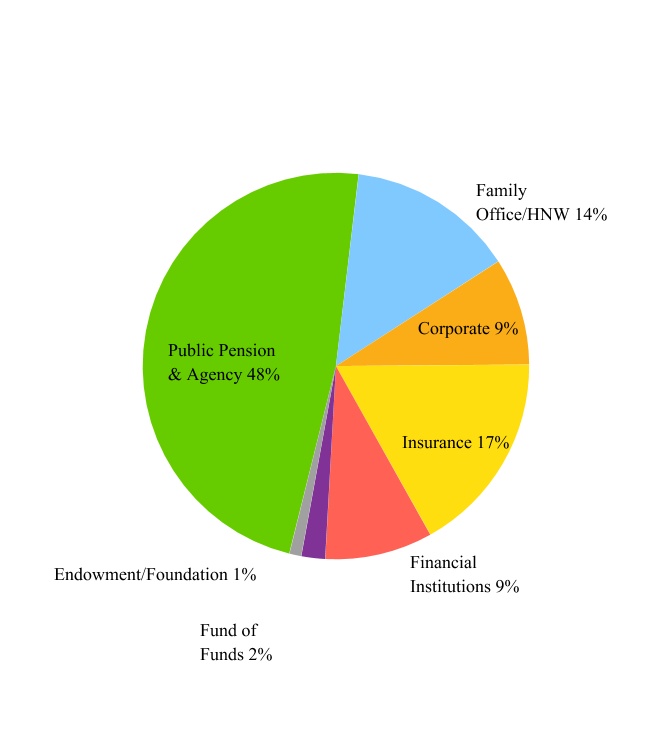
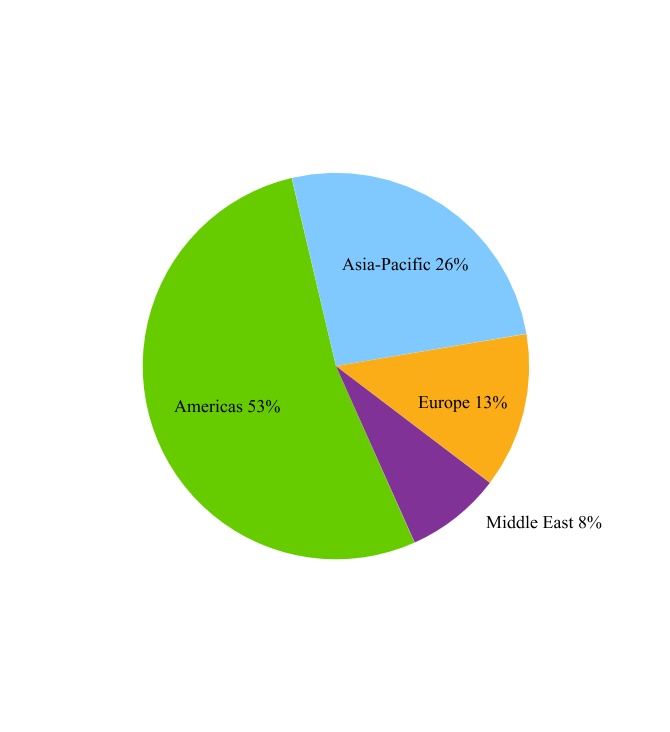
(1) Based on the AUM of our Private Markets investment funds, Private Markets co-investment vehicles, and Public Markets separately managed accounts and Public Markets investment funds. These charts exclude general partner commitments, assets managed through CLOs, and assets managed by other asset managers with which KKR has formed strategic partnerships where KKR does not hold more than a 50% ownership interest. Allocations are assigned to a type or geographic region according to subscriptions received from a limited partner.
Capital Markets
Our Capital Markets business line is comprised of our global capital markets business, which is integrated with KKR’s asset management business lines, and serves our firm, our portfolio companies and third-party clients by developing and implementing both traditional and non-traditional capital solutions for investments or companies seeking financing. These services include arranging debt and equity financing, placing and underwriting securities offerings, and providing other types of capital markets services that result in the firm receiving fees, including underwriting, placement, transaction and syndication fees, commissions, underwriting discounts, interest payments and other compensation, which may be payable in cash or securities, in respect of the activities described above.
Our capital markets business underwrites credit facilities and arranges loan syndications and participations. When we are sole arrangers of a credit facility, we may advance amounts to the borrower on behalf of other lenders, subject to repayment. When we underwrite an offering of securities on a firm commitment basis, we commit to buy and sell an issue of securities and generate revenue by purchasing the securities at a discount or for a fee. When we act in an agency capacity or best efforts basis, we generate revenue for arranging financing or placing securities with capital markets investors. We may also provide issuers with capital markets advice on security selection, access to markets, marketing considerations, securities pricing, and other aspects of capital markets transactions in exchange for a fee. Our capital markets business also provides syndication services in
respect of co-investments in transactions participated in by KKR funds or third-party clients, which may entitle the firm to receive syndication fees, management fees and/or a carried interest.
The capital markets business has a global footprint, with local presence and licenses to carry out certain broker-dealer activities in various countries in North America, Europe, Asia-Pacific and the Middle East. Our flagship capital markets subsidiary is KKR Capital Markets LLC, an SEC-registered broker-dealer and a member of the Financial Industry Regulatory Authority ("FINRA").
Principal Activities
Through our Principal Activities business line, we manage the firm's own assets on our balance sheet and deploy capital to support and grow our Private Markets and Public Markets business lines. Typically, the funds in our Private Markets and Public Markets business lines contractually require us, as general partner of the funds, to make sizable capital commitments from time to time. We believe making general partner commitments assists us in raising new funds from limited partners by demonstrating our conviction in a given fund's strategy. We also use our balance sheet to bridge investment activity during fundraising by seeding investments for new funds and also to acquire investments in order to help establish a track record for fundraising in new strategies. We also use our own capital to bridge capital selectively for our funds' investments or finance strategic acquisitions and partnerships, although the financial results of an acquired business or hedge fund partnership may be reported in our other business lines.
Our Principal Activities business line also provides the required capital to fund the various commitments of our Capital Markets business line when underwriting or syndicating securities, or when providing term loan commitments for transactions involving our portfolio companies and for third parties. Our Principal Activities business line also holds assets that are utilized to satisfy regulatory requirements for our Capital Markets business line and risk retention requirements for our CLOs.
We also make opportunistic investments through our Principal Activities business line, which include co-investments alongside our Private Markets and Public Markets funds as well as Principal Activities investments that do not involve our Private Markets or Public Markets funds.
We endeavor to use our balance sheet strategically and opportunistically to generate an attractive risk-adjusted return on equity in a manner that is consistent with our fiduciary duties, in compliance with applicable laws, and consistent with our one-firm approach.
The chart below presents the holdings of our Principal Activities business line by asset class as of December 31, 2020.
Holdings by Asset Class (1)

(1)General partner commitments in our funds are included in the various asset classes shown above. Assets and revenues of other asset managers with which KKR has formed strategic partnerships where KKR does not hold more than 50% ownership interest are not included in our Principal Activities business line but are reported in the financial results of our other business lines. Private Equity includes KKR private equity funds, co-investments alongside such KKR-sponsored private equity funds, certain core equity investments, and other opportunistic investments. Equity investments in other asset classes, such as real estate, special situations and energy appear in these other asset classes. Other Credit consists of certain leveraged credit and specialty finance strategies.
Global Atlantic
Our insurance business is operated by Global Atlantic, which we acquired on February 1, 2021. KKR owns a 61.1% interest in Global Atlantic as of the closing, which is subject to change based on post-closing purchase price adjustments. The balance of Global Atlantic is owned by third-party investors and Global Atlantic employees. Following the Global Atlantic acquisition, Global Atlantic continues to operate as a separate business with its existing brands and management team. Beginning with the first quarter of 2021, we intend to present Global Atlantic's financial results as a separate reportable segment.
Global Atlantic is a leading U.S. annuity and life insurance company that provides a broad suite of protection, legacy and savings products and reinsurance solutions to clients across individual and institutional markets. Global Atlantic has made the strategic decision to focus on target markets that it believes supports issuing products that have attractive risk and return characteristics. These markets allow Global Atlantic to leverage its strength in distribution and to deploy shareholder capital opportunistically across market conditions.
Global Atlantic primarily offers individuals fixed-rate annuities, fixed-indexed annuities, and targeted life products through a network of banks, broker-dealers, and insurance agencies. Global Atlantic provides its institutional clients customized reinsurance solutions, including block, flow and pension risk transfer, as well as funding agreements. Global Atlantic primarily generates income by earning a spread between its investment income and the cost of policyholder benefits. As of December 31, 2020, Global Atlantic served over two million policyholders.
Global Atlantic focuses exclusively on two businesses in the United States: individual and institutional. Global Atlantic believes these businesses are complementary, providing favorable opportunities to deploy capital across various market environments.
- Individual Markets.** Global Atlantic primarily seeks to reach individuals in the United States who are planning for, or are already in, retirement. Global Atlantic's annuity products are distributed primarily through a network of
distribution partners, including over 210 banks, broker-dealers and independent marketing organizations. Global Atlantic generated $6.7 billion of sales for the year ended December 31, 2020. Global Atlantic believes that focusing on banks and broker-dealers within individual markets provides attractive returns and helps maintain a competitive advantage. Global Atlantic's targeted life products are distributed primarily through 83 independent marketing organizations and approximately 1,300 funeral homes.
- Institutional Markets.** Global Atlantic provides customized reinsurance solutions to assist companies in meeting their strategic, risk management and capital goals. These solutions include capabilities across flow, pension risk transfer and block reinsurance. To generate reinsurance opportunities, Global Atlantic targets over 50 retirement and life insurance companies that it believes may seek to transact in the reinsurance market. Since Global Atlantic's founding in 2004, it has executed 28 reinsurance transactions and three strategic transactions with 21 clients, through which Global Atlantic received a total of $74.3 billion of assets as of February 1, 2021. Global Atlantic also provides flow and pension risk transfer reinsurance to its clients. Global Atlantic offers funding agreements to Federal Home Loan Banks and to an unaffiliated trust that in turn issues funding agreement backed notes to institutional investors in connection with its funding agreement backed notes program launched in January 2021.
Competition
Our asset management business competes with other investment managers for both fund investors and investment opportunities. The firm's competitors consist primarily of sponsors of public and private investment funds, real estate development companies, BDCs, investment banks, commercial finance companies and operating companies acting as strategic buyers. We believe that competition for fund investors is based primarily on investment performance, investor liquidity and willingness to invest, investor perception of investment managers' drive, focus and alignment of interest, business reputation, duration of relationships, quality of services, pricing, fund terms including fees, and the relative attractiveness of the types of investments that have been or are to be made. We believe that competition for investment opportunities is based primarily on the pricing, terms and structure of a proposed investment and certainty of execution. In addition to these traditional competitors within the global investment management industry, we also face competition from local and regional firms, financial institutions and sovereign wealth funds in the various countries in which we invest. In certain emerging markets, local firms may have more established relationships with the companies in which we are attempting to invest. These competitors often fall into one of the aforementioned categories but in some cases may represent new types of fund investors, including high net worth individuals, family offices and state-sponsored entities.
There are numerous funds focused on private equity, real assets, growth equity, credit and hedge fund strategies that compete for investor capital. Fund managers have also increasingly adopted investment strategies outside of their traditional focus. For example, funds focused on credit and equity strategies have become active in taking control positions in companies, while private equity funds have acquired minority equity or debt positions in publicly listed companies. This convergence could heighten competition for investments. Furthermore, as institutional fund investors increasingly consolidate their relationships for multiple investment products with a few investment firms, competition for capital from such institutional fund investors may become more acute. However, such consolidation may also lead institutional fund investors to prefer more established investment firms, which could help us to compete against newer entrants or investment firms that are smaller in size or offer more limited types of investment strategies.
Some of the entities that we compete with as an investment firm may have greater financial, technical, marketing and other resources and more personnel than us and, in the case of some asset classes, longer operating histories, more established relationships or greater experience. Several of our competitors also have raised, or may raise, significant amounts of capital and have investment objectives that are similar to the investment objectives of our funds, which may create additional competition for investment opportunities. Some of these competitors may also have lower costs of capital and access to funding sources that are not available to us, which may create competitive advantages for them. In addition, some of these competitors may have higher risk tolerances, different risk assessments or lower return thresholds, which could allow them to consider a wider range of investments and to bid more aggressively than us for investments. Strategic buyers may also be able to achieve synergistic cost savings or revenue enhancements with respect to a targeted portfolio company, which may provide them with a competitive advantage in bidding for such investments.
Our capital markets business competes primarily with investment banks and independent broker-dealers in North America, Europe, Asia-Pacific and the Middle East. We principally focus our capital markets activities on the firm, our portfolio companies and fund investors, but we also seek to service other third parties. While we generally target customers with whom we have existing relationships, those customers may have similar relationships with the firm's competitors, many of whom will have access to competing securities transactions, greater financial, technical or marketing resources or more established reputations than us.
Global Atlantic operates in highly competitive markets. Within the individual markets business, Global Atlantic faces a variety of large and small industry participants. Large, established insurers often operate with the benefit of well-known brands, entrenched distribution relationships or proprietary distribution. The insurance industry has also seen an influx of smaller new entrants, particularly in the retirement market, who may be able to price new business aggressively, with a higher investment risk tolerance, seeking to gain market share. All of these companies compete for individual markets sales. Global Atlantic's flow reinsurance business may also be impacted by competition among insurers in the individual channel. The competitiveness of Global Atlantic's product offerings will depend on the actions of its competitors and Global Atlantic's ability to actively manage its product offerings. In the institutional markets business, there has been an increase in block reinsurance as many insurers continue to reevaluate their commitment to business lines and seek reinsurance solutions as a way to deemphasize or divest non-core businesses, reduce risk, seek capital relief or improve profitability. The block reinsurance market is also experiencing increased competition due to new entrants, including entrants backed by private equity firms and entrants based outside of the United States. Increased competition may make it more difficult for Global Atlantic to identify transactions with terms that are commercially acceptable based on its risk tolerance and target return objectives.
Competition is also intense for the attraction and retention of qualified employees and consultants. Our ability to continue to compete effectively in our businesses will depend upon our ability to attract new employees and consultants and retain and motivate our existing employees and consultants.
Human Capital
We believe our people are the key to our success and are what sets our firm apart. We strive to create a workplace environment where employees thrive both professionally and personally. At KKR, our philosophy is to ensure we manage our investments in people – our human capital – as rigorously and effectively as we do our financial capital. Our key focuses include driving exceptional performance and enhancing our firm culture.
Our primary goal in human capital management is to develop and retain talent at KKR by providing meaningful and well-understood careers for our people. We therefore focus on employee training and professional development. We offer workshops, mentoring and executive coaching to supplement on-the-job experiences and ongoing feedback and coaching to maximize performances. In addition, fostering a culture of physical, mental, and emotional health and wellness is a priority for KKR, and we offer tools and resources to our employees so they can make informed health care decisions themselves and their families.
We seek to have a well-rounded, inclusive workplace — one that is reflective of our shareholders, fund investors, Global Atlantic's policyholders, the clients and other stakeholders with whom we collaborate, and the communities in which we live and conduct our business. In 2014, KKR established the Inclusion & Diversity Council (the "IDC"), a committee led by senior leaders to seek to ensure that KKR is an entrepreneurial, vibrant, and innovative organization that values diverse teams and varied lifestyles and backgrounds. The IDC’s goal is to attract, develop, and retain the best possible talent, actively work to make KKR a more diverse and inclusive workplace with increased representation among women and underrepresented demographic groups, and improve mentoring programs firm-wide.
Consistent with KKR's global, integrated culture, compensation is based on the performance of the firm as a whole, as well as on an individual's contributions to the firm. We designed this structure to give everyone a direct financial incentive to ensure that the firm uses its resources, knowledge, and relationships around the world toward maximizing risk-adjusted returns for each strategy. KKR believes that this compensation structure promotes teamwork, resource sharing, shared accountability and alignment of interests, all of which reflect and reinforce our core culture and values as a firm.
As of December 31, 2020, we employed 1,583 people worldwide:
| Investment Professionals | 530 | ||||
| Other Professionals | 763 | ||||
| Support Staff | 290 | ||||
| Total Employees**(1)** | 1,583 | ||||
(1) Does not include employees of Global Atlantic. KKR acquired Global Atlantic on February 1, 2021.
Investment Professionals
Our 530 investment professionals come from diverse backgrounds in private equity, real assets, credit and other asset classes and include executives with operations, strategic consulting, risk management, liability management and finance
experience. As a group, these professionals provide us with a strong global team for identifying attractive investment opportunities, creating value and generating superior returns.
Other Professionals
Our 763 other professionals come from diverse backgrounds in capital markets, operational, economics, capital raising, client services, public affairs, finance, tax, legal, compliance, human capital, and information technology. As a group, these professionals provide us with a strong team for overseeing investments and performing capital markets activities, servicing our existing fund investors and creating relationships with new fund investors globally. Additionally, a majority of these other professionals are responsible for supporting the global infrastructure of KKR. Following our acquisition of Global Atlantic, we will also be impacted by Global Atlantic's ability to attract and retain insurance professionals in the United States and Bermuda, including wholesalers, actuaries, risk management professionals, agents and others with insurance expertise.
KKR Capstone
We have developed an institutionalized process for creating value in investments. As part of our effort, we utilize a team of 81 operating professionals at KKR Capstone, who work exclusively with our investment professionals and portfolio company management teams or our designees. With professionals in North America, Europe and the Asia-Pacific, KKR Capstone provides additional expertise for assessing investment opportunities and assisting managers of portfolio companies in defining strategic priorities and implementing operational changes. During the initial phases of an investment, KKR Capstone's work seeks to implement our thesis for value creation. These operating professionals may assist portfolio companies in addressing top-line growth, cost optimization and efficient capital allocation and in developing operating and financial metrics. Over time, this work shifts to identifying challenges and taking advantage of business opportunities that arise during the life of an investment. Following KKR's acquisition of KKR Capstone on January 1, 2020, KKR Capstone's operating professionals became employees of KKR.
Senior Advisors and Other Advisors
To complement the expertise of our investment professionals, we have a team of senior advisors and other advisors. While not KKR employees, they provide us with additional operational and strategic insights. The responsibilities of senior advisors and other advisors include serving on the boards of our portfolio companies, helping us source and evaluate individual investment opportunities and assisting portfolio companies with operational matters. These individuals include current and former chief executive officers, chief financial officers and chairpersons of major corporations and others holding leading positions of public agencies worldwide.
Organizational Structure
The following simplified diagram illustrates our organizational structure as of February 17, 2021, unless otherwise noted. Certain entities depicted below may be held through intervening entities not shown in the diagram.
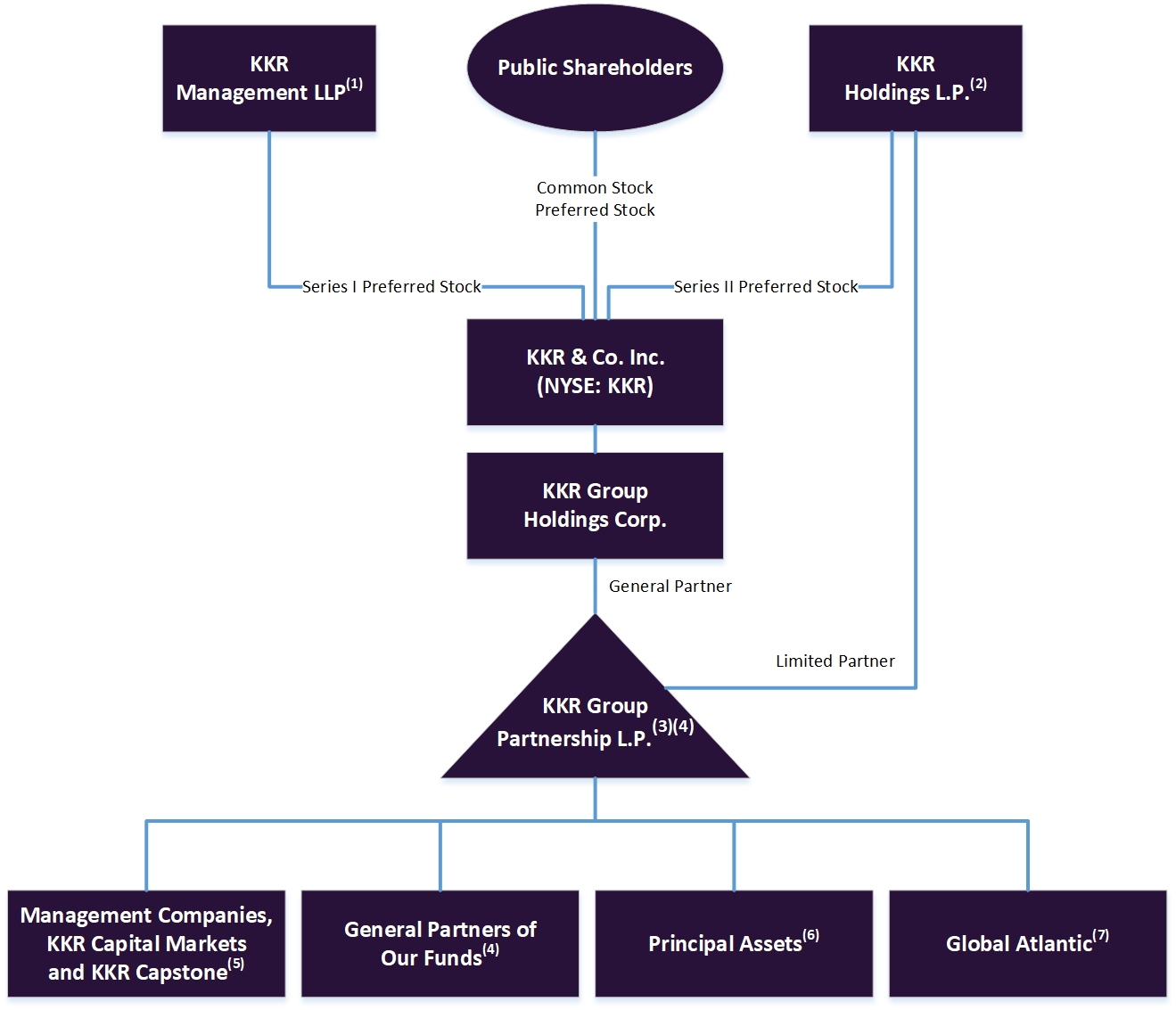
(1) KKR Management LLP is the sole holder of Series I preferred stock of KKR & Co. Inc. KKR Management LLP is owned by senior KKR employees.
(2) KKR Holdings is the holding vehicle through which certain of our current and former employees and other persons indirectly own their interest in KKR. KKR Group Partnership Units that are held by KKR Holdings are exchangeable for shares of our common stock on a one-for-one basis, subject to customary conversion rate adjustments for stock splits, stock dividends and reclassifications and compliance with applicable vesting and transfer restrictions. As limited partner interests, these KKR Group Partnership Units are non-voting and do not entitle KKR Holdings to participate in the management of our business and affairs. As of December 31, 2020, KKR Holdings had approximately a 32.5% interest in our business indirectly through its limited partner interests in KKR Group Partnership. KKR Holdings also holds Series II preferred stock that entitles it to cast a number of votes equal to the number of KKR Group Partnership Units that it holds, with respect to the matters upon which our common stockholders are entitled to vote.
(3) On January 1, 2020, KKR completed the Reorganization, in which KKR Management Holdings L.P. and KKR International Holdings L.P., which were formerly intermediate holding companies for KKR's business, were combined with another intermediate holding company, KKR Fund Holdings L.P., which changed its name to KKR Group Partnership L.P. and became the sole intermediate holding company for KKR's business.
(4) Depending on the fund's vintage, 40% or 43% of the carried interest earned from our investment funds are allocated to a carry pool, from which carried interest is allocable to our current and former employees and other persons associated with KKR. In February 2021, upon receipt of the approval of a committee representing a majority of our independent directors, we amended the percentage of carried interest that is allocable to the carry pool to 65% for recently formed funds and future funds, while for older funds, it remains 40% or 43%, as applicable. See "Management's Discussion and Analysis of Financial Condition and Results of Operations—Key Financial Measures Under GAAP—Expenses—Compensation and Benefits." The carry pool is not reflected in the organizational structure chart.
(5) Includes Kohlberg Kravis Roberts & Co. L.P., the SEC-registered investment adviser, which in turn is the parent company of KKR's other management and capital markets subsidiaries, including KKR Credit Advisors (US) LLC, KKR Credit Advisors (Ireland) Unlimited Company, KKR Credit Advisors (Singapore) Pte. Ltd., KKR Alternative Investment Management Unlimited Company and KKR Capital Markets Holdings L.P., the holding company for KKR Capital Markets LLC. Kohlberg Kravis Roberts & Co. L.P. is also the parent company of KKR Capstone Holdings LLC, the holding company for KKR Capstone entities.
(6) Includes KKR Financial Holdings LLC and KKR Group Finance Co. Holdings Limited, which in turn owns the issuers of KKR's outstanding senior notes.
(7) KKR holds the sole voting rights in and owns a 61.1% economic interest in Global Atlantic, which is subject to change based on post-closing purchase price adjustments.
Regulation
Our operations are subject to regulation and supervision in a number of jurisdictions. The level of regulation and supervision to which we are subject varies from jurisdiction to jurisdiction and is based on the type of business activity involved. We, in conjunction with our outside advisors and counsel, seek to manage our business and operations in compliance with such regulation and supervision. The regulatory and legal requirements that apply to our activities are subject to change from time to time and may become more restrictive, which may make compliance with applicable requirements more difficult or expensive or otherwise restrict our ability to conduct our business activities in the manner in which they are now conducted. Changes in applicable regulatory and legal requirements, including changes in their enforcement, could materially and adversely affect our business and our financial condition and results of operations. As a matter of public policy, the regulatory bodies that regulate our business activities are generally responsible for safeguarding the integrity of the securities and financial markets and protecting fund investors who participate in those markets rather than protecting the interests of our stockholders.
United States
Regulation as an Investment Adviser
We conduct our advisory business through our investment adviser subsidiaries, including Kohlberg Kravis Roberts & Co. L.P. and its wholly-owned subsidiaries KKR Credit Advisors (US) LLC and KKR Registered Advisor LLC, each of which is registered as an investment adviser with the SEC under the Investment Advisers Act of 1940 (the "Investment Advisers Act"). We also own half of FS/KKR Advisor and a majority of Global Atlantic's investment adviser, Global Atlantic Investment Advisors, LLC, each of which is registered with the SEC. The investment advisers are subject to the anti-fraud provisions of the Investment Advisers Act and to fiduciary duties derived from these provisions, which apply to our relationships with our advisory clients globally, including funds that we manage. These provisions and duties impose restrictions and obligations on us with respect to our dealings with our fund investors and our investments, including for example restrictions on agency cross and principal transactions. Our registered investment advisers are subject to periodic SEC examinations and other requirements under the Investment Advisers Act and related regulations primarily intended to benefit advisory clients. These additional requirements relate, among other things, to maintaining an effective and comprehensive compliance program, record-keeping and reporting requirements and disclosure requirements. The Investment Advisers Act generally grants the SEC broad administrative powers, including the power to limit or restrict an investment adviser from conducting advisory activities in the event it fails to comply with federal securities laws. Additional sanctions that may be imposed for failure to comply with applicable requirements include the prohibition of individuals from associating with an investment adviser, the revocation of registrations and other censures and fines.
KKR Credit Advisors (US) LLC and KKR Registered Advisor LLC are also subject to regulation under the Investment Company Act as an investment adviser to a registered investment company. Each of KKR Income Opportunities Fund and KKR Credit Opportunities Portfolio is a closed-end management investment company registered under the Investment Company Act. The closed-end management investment companies, KKR Credit Advisors (US) LLC and KKR Registered Advisor LLC are subject to the Investment Company Act and the rules thereunder, which among other things regulate the relationship between a registered investment company and its investment adviser and prohibit or restrict principal transactions and joint transactions. FS/KKR Advisor serves as investment adviser to FS KKR Capital Corp. and FS KKR Capital Corp. II, which are BDCs subject to the applicable regulations under the Investment Company Act, including portfolio construction requirements and limitations on transactions with affiliates.
Regulation as a Broker-Dealer
KKR Capital Markets LLC, one of our subsidiaries, is registered as a broker-dealer with the SEC under the Exchange Act and in all 50 U.S. States and U.S. territories, and is a member of the FINRA. Global Atlantic's distribution of insurance products that are regulated as securities is conducted by Global Atlantic Distributors, LLC, which is also registered as a broker-dealer with the SEC under the Exchange Act and in all 50 U.S. States and U.S. territories, and is a member of the FINRA. As
registered broker-dealers, KKR Capital Markets LLC and Global Atlantic Distributors, LLC are subject to periodic SEC and FINRA examinations and reviews. A broker-dealer is subject to legal requirements covering all aspects of its securities business, including sales and trading practices, public and private securities offerings, the suitability of investments, use and safekeeping of customers' funds and securities, capital structure, record-keeping and retention and the conduct and qualifications of directors, officers, employees and other associated persons. These requirements include the SEC's "uniform net capital rule," which specifies the minimum level of net capital that a broker-dealer must maintain, requires a significant part of the broker-dealer's assets to be kept in relatively liquid form, imposes certain requirements that may have the effect of prohibiting a broker-dealer from distributing or withdrawing its capital and subjects any distributions or withdrawals of capital by a broker-dealer to notice requirements. These and other requirements also include rules that limit a broker-dealer's ratio of subordinated debt to equity in its regulatory capital composition, constrain a broker-dealer's ability to expand its business under certain circumstances and impose additional requirements when the broker-dealer participates in securities offerings of affiliated entities. Violations of these requirements may result in censures, fines, the issuance of cease-and-desist orders, revocation of licenses or registrations, the suspension or expulsion from the securities industry of the broker-dealer or its officers or employees or other similar consequences by regulatory bodies.
Insurance Regulations
Global Atlantic's U.S. insurance subsidiaries are subject to regulation and supervision under U.S. federal and state laws. Each U.S. state, the District of Columbia and U.S. territories and possessions have insurance laws that apply to companies licensed to carry on an insurance business in the applicable jurisdiction. The primary regulator of an insurance company, however, is located in the insurance company's state of domicile. Both Commonwealth Annuity and Life Insurance Company ("CwA") and First Allmerica Financial Life Insurance Company ("FAFLIC") are organized and domiciled in the Commonwealth of Massachusetts; Accordia Life and Annuity Company ("Accordia") is organized and domiciled in the State of Iowa; and Forethought Life Insurance Company ("FLIC") is organized and domiciled in the State of Indiana (together, these four companies constitute Global Atlantic's "U.S. insurance subsidiaries"). Additionally, Global Atlantic's U.S. insurance subsidiaries are licensed to transact insurance business in, and are subject to regulation and supervision by, all 50 states of the United States and the District of Columbia and the U.S. Virgin Islands.
State insurance authorities have broad administrative powers over each of Global Atlantic's U.S. insurance subsidiaries with respect to all aspects of the insurance business. As part of their routine regulatory oversight process, state insurance departments conduct periodic detailed examinations of the books, records, accounts and operations of insurance companies that are domiciled in their states. Examinations are generally carried out in cooperation with the insurance departments of other, non-domiciliary states under guidelines promulgated by the National Association of Insurance Commissioners (the "NAIC"). State insurance departments also regularly conduct regulatory inquiries of the insurance companies licensed in their states.
Global Atlantic also has special purpose financial captive insurance company subsidiaries domiciled in Vermont and Iowa that provide reinsurance to Accordia in order to facilitate the financing of redundant reserve requirements associated with the application of the NAIC Model Regulation entitled "Valuation of Life Insurance Policies Model Regulation" ("Regulation XXX") and NAIC Actuarial Guideline XXXVIII ("AG38"). The application of both Regulation XXX and AG38 requires Global Atlantic to maintain statutory reserves which may be in excess of reserves required under GAAP.
The rates, policy terms, and conditions of reinsurance agreements generally are not subject to regulation by any regulatory authority. However, the ability of a primary insurer to take credit for the reinsurance purchased from reinsurance companies is a significant component of reinsurance regulation. Typically, a primary insurer will only enter into a reinsurance agreement if it can obtain credit against its reserves on its statutory basis financial statements for the reinsurance ceded to the reinsurer.
Global Atlantic's U.S. insurance subsidiaries are subject to restrictions on the payment of dividends. Any proposed dividend in excess of the amount permitted by law is considered an "extraordinary dividend or distribution" and may not be paid until it has been approved, or a 30-day waiting period has passed during which it has not been disapproved, by the commissioner of the applicable domiciliary state of the U.S. insurance subsidiary. Due to losses incurred during the years before FAFLIC was a part of Global Atlantic, FAFLIC currently has a negative unassigned surplus. While the negative unassigned surplus is outstanding, FAFLIC must obtain written approval from the Massachusetts Division of Insurance prior to the payment of any dividend or distribution. None of Global Atlantic’s special purpose financial captive insurance company subsidiaries may declare or pay dividends or distributions in any form to us other than in accordance with its transaction agreements and governing licensing order.
State insurance holding company laws and regulations generally provide that no person, corporation or other entity may acquire control of an insurance company, or a controlling interest in any parent company of an insurance company, without the prior approval of such insurance company's domiciliary state insurance regulator. Under the laws of each of Global Atlantic's U.S. insurance subsidiaries' domiciliary states, acquiring, directly or indirectly, 10% or more of the voting securities of an insurance company or its parent company is presumptively considered to have acquired control of the insurer, although such presumption may be rebutted by a showing that control does not in fact exist.
Finally, while the United States federal government in most contexts currently does not directly regulate the insurance business, the Federal Insurance Office (the "FIO") established by the Dodd-Frank Wall Street Reform and Consumer Protection Act (the "Dodd-Frank Act") now has an oversight role in respect to insurance regulation.
Ireland
We have a number of subsidiaries which are authorized and regulated by the Central Bank of Ireland, or CBI. The CBI is responsible for, among other things, regulating and supervising firms that provide financial services in Ireland, including broker-dealers and investment firms. The CBI also develops and maintains regulatory policies for Ireland's financial services sector. The CBI has the authority to approve applications from financial services providers in Ireland, monitor compliance with its standards, and take enforcement action for non-compliance. Violation of the CBI's requirements may result in administrative sanctions; investigations; refusal, revocation or cancellation of authorization or registrations; criminal prosecution; and/or reports to other agencies.
KKR Alternative Investment Management Unlimited Company, KKR Credit Advisors (Ireland) Unlimited Company and KKR Capital Markets (Ireland) Limited Company are regulated by the CBI. KKR Alternative Investment Management Unlimited Company is an authorized EU alternative investment manager permitted to conduct portfolio management, risk management and certain administrative activities. KKR Credit Advisors (Ireland) Unlimited Company is authorized to carry out a number of regulated activities including receiving and transmitting orders, portfolio management and providing investment advice. KKR Capital Markets (Ireland) Limited Company is authorized to engage in a number of regulated activities regulated under Markets in Financial Instruments Directive, known as MiFID, including dealing as principal or agent, making arrangements in relation to certain types of specified investments, and arranging the safeguarding and administration of assets. KKR Capital Markets (Ireland) Limited also benefits from a passport under the single market directives to offer services cross border into all countries in the European Economic Area.
United Kingdom
We have several subsidiaries which are authorized and regulated by the United Kingdom Financial Conduct Authority (the "FCA") under the Financial Services and Markets Act 2000 ("FSMA"). FSMA and related rules govern most aspects of investment business, including investment management, sales, research and trading practices, provision of investment advice, corporate finance, use and safekeeping of client funds and securities, regulatory capital, record-keeping, margin practices and procedures, approval standards for individuals, anti-money laundering, periodic reporting and settlement procedures. The FCA is responsible for administering these requirements and our compliance with the FSMA and related rules. Violations of these requirements may result in censures, fines, imposition of additional requirements, injunctions, restitution orders, revocation or modification of permissions or registrations, the suspension or expulsion from certain "controlled functions" within the financial services industry of officers or employees performing such functions or other similar consequences.
KKR Capital Markets Partners LLP has permission to engage in a number of regulated activities regulated under FSMA, including dealing as principal or agent and arranging deals in relation to certain types of specified investments and arranging the safeguarding and administration of assets. Kohlberg Kravis Roberts & Co. Partners LLP has permission to engage in a number of regulated activities including advising on and arranging deals relating to corporate finance business in relation to certain types of specified investments. KKR Credit Advisors (EMEA) LLP has permission to engage in a number of regulated activities including managing, advising on and arranging deals in relation to certain types of specified investments.
Bermuda
Global Atlantic's wholly-owned subsidiaries organized in Bermuda, Global Atlantic Re and Global Atlantic Assurance, are subject to regulation and supervision by the Bermuda Monetary Authority ("BMA") and compliance with all applicable Bermuda laws and Bermuda insurance statutes and regulations, including but not limited to the Bermuda Insurance Act. The Bermuda Insurance Act grants to the BMA powers to supervise, investigate and intervene in the affairs of insurance companies and to approve any change or controllers. The Bermuda Insurance Act imposes solvency and liquidity standards and auditing and reporting requirements on Bermuda insurance companies. The Bermuda Insurance Act prohibits our Bermuda insurance
subsidiaries from declaring or paying any dividends during any financial year unless certain financial conditions are met or prior approval from the BMA is received. A Bermuda licensed insurer is required to maintain a sufficiently staffed principal office in Bermuda.
Other Jurisdictions
Certain other subsidiaries or funds that we advise are registered with, have been licensed by or have obtained authorizations to operate in their respective jurisdictions outside of the United States. These registrations, licenses or authorizations relate to providing investment advice, broker-dealer activities, marketing of securities and other regulated activities. Failure to comply with the laws and regulations governing these subsidiaries and funds that have been registered, licensed or authorized could expose us to liability and/or damage our reputation.
In Canada, KKR Capital Markets LLC is also registered as an international dealer under the Securities Act (Ontario). This registration permits us to trade in non-Canadian equity and debt securities with certain types of investors located in Ontario, Canada.
In Japan, KKR Capital Markets Japan Ltd. is registered as a Type I and Type II Financial Instruments Business Operator (broker-dealer) under the Financial Instruments and Exchange Act of Japan, and a money lender under the Money Lending Business Act of Japan.
In the United Arab Emirates, KKR MENA Limited, a Dubai International Financial Centre company, is licensed to arrange deals in investments, advise on financial products and arrange custody, and is regulated by the Dubai Financial Services Authority.
In Saudi Arabia, KKR Saudi Limited is licensed by the Capital Market Authority of Saudi Arabia and is authorized for the activity of arranging in the securities business.
In Australia, KKR Australia Pty Limited and KKR Australia Investment Management Pty Limited are Australian financial services licensed and are authorized to provide advice on and deal in financial products for wholesale clients, and are regulated by the Australian Securities and Investments Commission.
In Hong Kong, KKR Capital Markets Asia Limited is licensed by the Securities and Futures Commission in Hong Kong to carry on dealing in securities and advising on securities regulated activities.
In Singapore, KKR Singapore Pte. Ltd. and KKR Credit Advisors (Singapore) Pte. Ltd. each holds a capital markets services license to conduct fund management for qualified investors only and is regulated by Monetary Authority of Singapore.
In Mauritius, KKR Holdings Mauritius, Ltd. and KKR Account Adviser (Mauritius), Ltd. are unrestricted investment advisers authorized to manage portfolios of securities and give advice on securities transactions, and are regulated by the Financial Services Commission, Mauritius.
In India, KKR India Financial Services Limited and KKR India Asset Finance Limited are registered with the Reserve Bank of India as non-deposit taking non-banking financial companies and are authorized to undertake lending and financing activities. KKR Capital Markets India Private Limited is registered with the Securities Exchange Board of India ("SEBI") (i) as a merchant bank to execute capital market mandates, underwrite issues, offer investment advisory and other consultancy services in connection with securities, and (ii) as an investment manager and sponsor of alternative investment funds. In addition, certain of our funds are registered with SEBI as a foreign portfolio investor or a foreign venture capital investor to make investments in Indian securities.
From time to time, one or more of our investment funds or their related investment vehicles may be regulated as a mutual fund by the Cayman Islands Monetary Authority, regulated as an investment limited partnership by CBI, listed on the Irish Stock Exchange, notified with the Financial Services Agency of Japan for sale pursuant to certain private placement exemptions and/or for investment pursuant to certain exemption, registered with the Financial Supervisory Service of the Republic of Korea, licensed by or granted in principal approval from SEBI, subject to the regulatory supervision of the Commission de Surveillance du Secteur Financier of Luxembourg, notified with the Netherlands Authority for Financial Markets for sale pursuant to certain private placement exemptions, or registered under the Investment Company Act.
There are a number of legislative and regulatory initiatives in the United States and in Europe that could significantly affect our business. See "Risk Factors—Risks Related to Our Business—Extensive regulation of our businesses affects our activities and creates the potential for significant liabilities and penalties. The possibility of increased regulatory focus or legislative or regulatory changes could materially and adversely affect our business."
Website and Availability of SEC Filings
Our website address is www.kkr.com. Information on our website is not incorporated by reference herein and is not a part of this report. We make available free of charge on our website or provide a link on our website to our Annual Report on Form 10-K, Quarterly Reports on Form 10-Q and Current Reports on Form 8-K, and any amendments to those reports filed or furnished pursuant to Section 13(a) or 15(d) of the Exchange Act, as soon as reasonably practicable after those reports are electronically filed with, or furnished to, the SEC. To access these filings, go to the "Stockholder (KKR & Co. Inc.)" section of our "Investor Center" page on our website, then click on "SEC Filings." In addition, these reports and the other documents we file with the SEC are available at a website maintained by the SEC at www.sec.gov.
From time to time, we may use our website as a channel of distribution of material information. Financial and other material information regarding our company is routinely posted on and accessible at www.kkr.com. Financial and other material information regarding Global Atlantic is routinely posted on and accessible at www.globalatlantic.com. In addition, you may automatically receive e-mail alerts and other information about our company by enrolling your e-mail address by visiting the "Investor Email Alerts" section under the "Stockholder (KKR & Co. Inc.)" section of the "Investor Center" page at www.kkr.com.
Previous: Cover and table of contents · Next: Item 1A. RISK FACTORS