 filings.tools
KLA 10-K 2022-06-30
Filed 2022-08-05. 23 sections, 577K characters. Original on sec.gov · Markdown · JSON
Cover and table of contents
UNITED STATES
SECURITIES AND EXCHANGE COMMISSION
Washington, D.C. 20549
| FORM 10-K |
(Mark One)
| ☒ | ANNUAL REPORT PURSUANT TO SECTION 13 OR 15(d) OF THE SECURITIES EXCHANGE ACT OF 1934 | |||||||
| For the Fiscal Year Ended | June 30, 2022 |
OR
| ☐ | TRANSITION REPORT PURSUANT TO SECTION 13 OR 15(d) OF THE SECURITIES EXCHANGE ACT OF 1934 | ||||
| For the Transition Period from to |
Commission File Number 000-09992
KLA CORPORATION
(Exact name of registrant as specified in its charter)
| Delaware | 04-2564110 | |||||||||||||
| (State or other jurisdiction of incorporation or organization) | (I.R.S. Employer Identification No.) | |||||||||||||
| One Technology Drive, | Milpitas, | California | 95035 | |||||||||||
| (Address of Principal Executive Offices) | (Zip Code) |
Registrant’s Telephone Number, Including Area Code: (408) 875-3000
Securities Registered Pursuant to Section 12(b) of the Act:
| Title of Each Class | Trading Symbol(s) | Name of Each Exchange on Which Registered | ||||||
| Common Stock, $0.001 par value per share | KLAC | The Nasdaq Stock Market, LLC | ||||||
| The NASDAQ Global Select Market |
| Securities Registered Pursuant to Section 12(g) of the Act: | ||||||||
| None | ||||||||
| (Title of Class) |
Indicate by check mark if the registrant is a well-known seasoned issuer, as defined in Rule 405 of the Securities Act. Yes x No o
Indicate by check mark if the registrant is not required to file reports pursuant to Section 13 or Section 15(d) of the Act. Yes o No x
Indicate by check mark whether the registrant (1) has filed all reports required to be filed by Section 13 or 15(d) of the Securities Exchange Act of 1934 during the preceding 12 months (or for such shorter period that the registrant was required to file such reports), and (2) has been subject to such filing requirements for the past 90 days. Yes x No o
Indicate by check mark whether the registrant has submitted electronically every Interactive Data File required to be submitted pursuant to Rule 405 of Regulation S-T (§232.405 of this chapter) during the preceding 12 months (or for such shorter period that the registrant was required to submit such files). Yes x No o
Indicate by check mark whether the registrant is a large accelerated filer, an accelerated filer, a non-accelerated filer, a smaller reporting company or an emerging growth company. See the definitions of “large accelerated filer,” “accelerated filer,” “smaller reporting company,” and “emerging growth company” in Rule 12b-2 of the Exchange Act.
| Large Accelerated Filer x | Accelerated filer o | |||||||||||||
| Non-accelerated filer o | Smaller reporting company ☐ | |||||||||||||
| Emerging growth company ☐ |
If an emerging growth company, indicate by check mark if the registrant has elected not to use the extended transition period for complying with any new or revised financial accounting standards provided pursuant to Section 13(a) of the Exchange Act. ¨
Indicate by check mark whether the registrant has filed a report on and attestation to its management’s assessment of the effectiveness of its internal control over financial reporting under Section 404(b) of the Sarbanes-Oxley Act (15 U.S.C. 7262(b)) by the registered public accounting firm that prepared or issued its audit report. ☒
Indicate by check mark whether the registrant is a shell company (as defined in Rule 12b-2 of the Act). Yes ☐ No x
The aggregate market value of the voting and non-voting common stock held by non-affiliates of the registrant based upon the closing price of the registrant’s stock, as of December 31, 2021, was approximately $64.80 billion.
The registrant had 141,803,776 shares of common stock outstanding as of July 18, 2022.
DOCUMENTS INCORPORATED BY REFERENCE
Portions of the Proxy Statement for the 2022 Annual Meeting of Stockholders (“Proxy Statement”) to be filed pursuant to Regulation 14A within 120 days after the registrant’s fiscal year ended June 30, 2022, are incorporated by reference into Part III of this report.
INDEX
i
SPECIAL NOTE REGARDING FORWARD-LOOKING STATEMENTS
This report contains certain forward-looking statements within the meaning of Section 27A of the Securities Act of 1933 and Section 21E of the Securities Exchange Act of 1934. All statements other than statements of historical fact may be forward-looking statements. You can identify these and other forward-looking statements by the use of words such as “may,” “will,” “could,” “would,” “should,” “expects,” “plans,” “anticipates,” “relies,” “believes,” “estimates,” “predicts,” “intends,” “potential,” “continues,” “thinks,” “seeks,” or the negative of such terms, or other comparable terminology. Forward-looking statements also include the assumptions underlying or relating to any of the foregoing statements. Such forward-looking statements include those regarding, among others: the future impacts of the COVID-19 pandemic; forecasts of the future results of our operations, including profitability; orders for our products and capital equipment generally; sales of semiconductors; the investments by our customers in advanced technologies and new materials; growth of revenue in the semiconductor industry, the semiconductor capital equipment industry and our business; technological trends in the semiconductor industry; future developments or trends in the global capital and financial markets; our future product offerings and product features; the success and market acceptance of new products; timing of shipment of order backlog; our future product shipments and product and service revenues; our future gross margins; our future research and development (“R&D”) expenses and selling, general and administrative (“SG&A”) expenses; international sales and operations; our ability to maintain or improve our existing competitive position; success of our product offerings; creation and funding of programs for R&D; results of our investment in leading edge technologies; the effects of hedging transactions; the effect of the sale of trade receivables and promissory notes from customers; the effect of future compliance with laws and regulations; our future effective income tax rate; our recognition of tax benefits; the effects of any audits or litigation; future payments of dividends to our stockholders; the completion of any acquisitions of third parties, or the technology or assets thereof; benefits received from any acquisitions and development of acquired technologies; sufficiency of our existing cash balance, investments, cash generated from operations and the unfunded portion of our Revolving Credit Facility (as defined below) to meet our operating and working capital requirements, including debt service and payment thereof; future dividends, and stock repurchases; our compliance with the financial covenants under the Credit Agreement (as defined below) for our Revolving Credit Facility; the adoption of new accounting pronouncements; our repayment of our outstanding indebtedness; and our environmental, social and governance (“ESG”) related targets, goals and commitments.
Our actual results may differ significantly from those projected in the forward-looking statements in this report. Factors that might cause or contribute to such differences include, but are not limited to:
• The impact of the COVID-19 pandemic on the global economy and on our business, financial condition and results of operations, including the supply chain constraints we are experiencing as a result of the pandemic;
-
Economic, political and social conditions in the countries in which we, our customers and our suppliers operate, including rising inflation and interest rates, Russia's invasion of Ukraine and global trade policies;
-
Disruption to our manufacturing facilities or other operations, or the operations of our customers, due to natural catastrophic events, health epidemics or terrorism;
-
Ongoing changes in the technology industry, and the semiconductor industry in particular, including future growth rates, pricing trends in end-markets, or changes in customer capital spending patterns;
-
Our ability to timely develop new technologies and products that successfully anticipate or address changes in the semiconductor industry;
-
Our ability to maintain our technology advantage and protect our proprietary rights;
-
Our ability to compete with new products introduced by our competitors;
-
Our ability to attract, onboard and retain key personnel;
-
Cybersecurity threats, cyber incidents affecting our and our customers, suppliers and other service providers’ systems and networks and our and their ability to access critical information systems for daily business operations;
-
Liability to our customers under indemnification provisions if our products fail to operate properly or contain defects or our customers are sued by third parties due to our products;
-
Exposure to a highly concentrated customer base;
-
Availability and cost of the wide range of materials used in the production of our products;
-
Our ability to operate our business in accordance with our business plan;
-
Legal, regulatory and tax environments in which we perform our operations and conduct our business and our ability to comply with relevant laws and regulations;
*•*Increasing attention to ESG matters and the resulting costs, risks and impact on our business;
- Our ability to pay interest and repay the principal of our current indebtedness is dependent upon our ability to manage our business operations, our credit rating and the ongoing interest rate environment, among other factors;
ii
-
Instability in the global credit and financial markets;
-
Our exposure to currency exchange rate fluctuations, or declining economic conditions in those countries where we conduct our business;
-
Changes in our effective tax rate resulting from changes in the tax rates imposed by jurisdictions where our profits are determined to be earned and taxed, expiration of tax holidays in certain jurisdictions, resolution of issues arising from tax audits with various authorities or changes in tax laws or the interpretation of such tax laws;
-
Our ability to identify suitable acquisition targets and successfully integrate and manage acquired businesses; and
*•*Unexpected delays, difficulties and expenses in executing against our environmental, climate, diversity and inclusion or other ESG targets, goals and commitments outlined in this report.
This report contains ESG-related statements based on hypothetical scenarios and assumptions as well as estimates that are subject to a high level of uncertainty, and these statements should not necessarily be viewed as being representative of current or actual risk or performance, or forecasts of expected risk or performance. In addition, historical, current, and forward-looking environmental and social-related statements may be based on standards for measuring progress that are still developing, and internal controls and processes that continue to evolve. Forward-looking and other statements in this report may also address our corporate responsibility and sustainability progress, plans, and goals, and the inclusion of such statements is not an indication that these contents are necessarily material for the purposes of complying with or reporting pursuant to the U.S. federal securities laws and regulations, even if we use the word “material” or “materiality” in this report.
For a more detailed discussion of these and other risk factors, that might cause or contribute to differences from the forward looking statements in this report, see Item 1A, “Risk Factors” in this Annual Report on Form 10-K, as well as in Item 1, “Business” and Item 7, “Management’s Discussion and Analysis of Financial Condition and Results of Operations” in this report. You should carefully review these risks and also review the risks described in other documents we file from time to time with the Securities and Exchange Commission (“SEC”), including the Quarterly Reports on Form 10-Q that we will file in the fiscal year ending June 30, 2023. You are cautioned not to place undue reliance on these forward-looking statements, and we expressly assume no obligation and do not intend to update the forward-looking statements in this report after the date hereof.
iii
PART I
Item 1. BUSINESS
Certain industry and technical terms used in this section are defined in the subsection entitled “Glossary” found at the end of this Item 1.
The Company
KLA Corporation and its majority-owned subsidiaries (“KLA” or the “Company” and also referred to as “we,” “our,” “us,” or similar references) is a supplier of industry-leading equipment and services that enables innovation throughout the electronics industry. We provide advanced process control and process-enabling solutions for manufacturing wafers, reticles, chemicals/materials, integrated circuits (“IC” or “chip”), packaged ICs, printed circuit boards (“PCB”), and flat panel displays (“FPD”), as well as comprehensive support and services across our installed base. Our suite of advanced products, coupled with our unique yield management software and services, allow us to deliver the solutions our customers need to achieve their productivity goals, including improving yields and reducing waste, by significantly reducing their risks and costs and improving their overall profitability and return on investment.
KLA was formed as KLA-Tencor in April 1997 through the merger of KLA Instruments Corporation and Tencor Instruments, two long-time leaders in the semiconductor capital equipment industry that began operations in 1975 and 1976, respectively. On February 20, 2019, KLA completed the acquisition of Orbotech, Ltd. (“Orbotech”), a global supplier of yield-enhancing and process-enabling solutions for the manufacture of electronics products, in order to target growth opportunities in new and expanding end markets. We are organized into four reportable segments: Semiconductor Process Control; Specialty Semiconductor Process; PCB, Display and Component Inspection; and Other.
Within the Semiconductor Process Control segment, our comprehensive portfolio of inspection, metrology and software products, and related services, help IC, wafer, reticle and chemical/materials manufacturers achieve target yields throughout the entire fabrication process, from R&D to final volume production. These products and services are designed to provide comprehensive solutions to help customers accelerate development and production ramp cycles, achieve higher and more stable product yields and improve their overall profitability.
Within the Specialty Semiconductor Process segment, which includes the SPTS business, KLA develops and sells advanced vacuum deposition and etching process tools, which are used by a broad range of specialty semiconductor customers, including manufacturers of microelectromechanical systems (“MEMS”), radio frequency (“RF”) communication semiconductors, and power semiconductors for automotive and industrial applications.
Within the PCB, Display and Component Inspection segment, which includes the PCB, FPD, Frontline and ICOS businesses, KLA enables electronic device manufacturers to inspect, test and measure PCBs, FPDs and packaged ICs to verify their quality, pattern the desired electronic circuitry on the relevant substrate and perform three-dimensional shaping of metalized circuits on multiple surfaces.
Additional information about KLA is available at www.kla.com. The Annual Reports on Form 10-K, Quarterly Reports on Form 10-Q, Current Reports on Form 8-K and amendments to those reports filed or furnished pursuant to Section 13(a) or 15(d) of the Securities Exchange Act of 1934, as amended, are available free of charge on the website as soon as reasonably practicable after they are electronically filed with or furnished to the SEC. Information contained on KLA’s website is not part of this Annual Report on Form 10-K or KLA’s other filings with the SEC. Additionally, these filings may be obtained through the SEC’s website (www.sec.gov), which contains reports, proxy and information statements, and other information regarding issuers that file electronically.
Investors and others should note that KLA announces material financial information to investors using an investor relations website (ir.kla.com), which includes KLA’s SEC filings, press releases, public earnings calls and conference webcasts. The investor relations website is used to communicate with the public about the Company, products, services and other matters.
Industry
KLA’s core focus is enabling technological advances as well as improving manufacturing yields in the semiconductor industry. The semiconductor fabrication process begins with a bare silicon wafer - a round disk that is typically 200 millimeters or 300 millimeters in diameter, about as thick as a credit card and gray in color. The process of manufacturing wafers is highly sophisticated and involves the creation of large ingots of silicon by pulling them out of a vat of molten silicon. The ingots are then sliced into wafers. Prime silicon wafers are then polished to a mirror finish. Other, more specialized wafers, such as epitaxial silicon (“epi”), silicon on insulator (“SOI”), gallium nitride (“GaN”) and silicon carbide (“SiC”) are also common in the semiconductor industry.
The manufacturing cycle of an IC is grouped into three phases: design, fabrication and testing. IC design involves the architectural layout of the circuit, as well as design verification and reticle generation. The fabrication of a semiconductor chip (or “semiconductor”) is accomplished by depositing a series of film layers that act as conductors, semiconductors or insulators on bare wafers. The deposition of these film layers is interspersed with numerous other process steps that create circuit patterns, remove portions of the film layers, and perform other functions such as heat treatment, measurement and inspection. Most advanced chip designs require hundreds of individual steps, many of which are performed multiple times. The majority of chips consist of two main structures: the lower structure, typically consisting of transistors or capacitors which perform the “smart” functions; and the upper “interconnect” structure, typically consisting of circuitry which connects the components in the lower structure. When the layers on the wafer have been fabricated, each chip on the wafer is tested for functionality. The wafer is then cut into individual chips, and the chips that pass functional testing are packaged. Final testing is performed on all packaged chips. Packaged chips are then mounted onto PCBs for connection to the rest of the electronic system. Additionally, FPDs are manufactured using processes similar to ICs (e.g., film deposition, photolithography, etching) except using glass as the starting substrate.
Our business depends upon the capital expenditures of semiconductor, semiconductor-related and electronic device manufacturers, which in turn is driven by the current and anticipated market demand for ICs, products utilizing ICs and other electronic components. We do not consider our business to be seasonal in nature, but it has historically been cyclical with respect to the capital equipment procurement practices of semiconductor, semiconductor-related and electronic device manufacturers, and it is impacted by the investment patterns of such manufacturers in different global markets. Downturns in the semiconductor or other industries in which we operate, or slowdowns in the worldwide economy as well as customer consolidation, could have a material adverse effect on our future business and financial results.
Companies that anticipate future market demands by developing and advancing new technologies and manufacturing processes are better positioned to lead in the semiconductor market. Accelerating the yield ramp and maximizing production yields of high-performance devices are key goals of modern semiconductor manufacturing. Ramping to high-volume production ahead of competitors can dramatically increase the revenue an IC manufacturer realizes for a given product. Leading semiconductor manufacturers are investing in simultaneous production integration of multiple new process t
Showing the first 8K of 62K characters. Open the full section
Item 1A. RISK FACTORS
A description of factors that could materially affect our business, financial condition or operating results is provided below.
Risk Factors Summary
The following summarizes the most material risks that make an investment in our securities risky or speculative. If any of the following risks occur or persist, our business, financial condition and results of operations could be materially harmed and the price of our common stock could significantly decline.
COVID-19 Pandemic Risks
-
Shortages or disruption in the supply chain could affect our ability to timely process components for our products;
-
Travel bans, lockdowns, or quarantine requirements could delay our ability to install or service our products;
-
Governmental orders or employee exposure could cause manufacturing stoppages for us or our customers or suppliers;
-
Continued volatility and uncertainty in customer demand for our products, delivery pushouts or cancellations of orders by our customers;
-
Increased costs or inability to acquire components necessary for the manufacture of our products;
-
Absence of liquidity at customers and suppliers; and
-
Loss of efficiencies and increased cybersecurity risks due to remote working requirements for our employees.
Commercial, Operational, Financial and Regulatory Risks
-
Risks related to our international operations, such as tariffs or similar trade impairments, and longer payment cycles or collection difficulties associated with international sales;
-
Our vulnerability to a weakening in the condition of the financial markets and the global economy;
-
Intellectual property disputes can be expensive and could result in an inability to sell our products in certain jurisdictions;
-
Laws, rules, regulations or other orders that may limit our ability to sell our products or provide service on products previously sold to certain customers;
-
Increasing attention to ESG matters, including any targets or other ESG initiatives, could result in additional costs or risks or adversely impact our business;
-
We may be unable to attract, onboard and retain key personnel;
-
Reliance on third-party service providers could result in disruptions if such third parties cannot perform services for us in a timely manner;
-
Cybersecurity incidents could result in the loss of valuable information or assets or subject us to costly disruption, remediation, regulatory investigations, litigation and reputational damage;
-
We may face disruptions if we cannot access critical information in a timely manner due to system failures;
-
We may not find suitable acquisition candidates or fail to successfully integrate our acquisitions;
-
Natural disasters, such as earthquakes, health epidemics, acts of terrorism or war or other catastrophic events, and the lack of insurance thereof, could significantly disrupt our operations for lengthy periods of time;
-
We are exposed to fluctuations in foreign currency exchange rates, interest rates and the market values of our portfolio investments;
-
We are subject to tax and regulatory compliance audits;
-
Economic, political or other conditions in the jurisdictions where we earn profits can impact the tax laws and taxes we pay in those jurisdictions, subsequently impacting our effective tax rate, cash flows and results of operations;
-
Increased compliance costs with federal securities laws, rules, and regulations, as well as NASDAQ requirements; and
-
Changes in accounting pronouncements and laws could have unforeseen effects.
Industry Risks
-
We may not be able to keep pace with trends and technological changes in the industries in which we operate;
-
We have a highly concentrated customer base; and
-
Prevailing local and global economic conditions may negatively affect the purchasing decisions of our customers.
Business Model and Capital Structure Risks
-
We may not be able to maintain our technology advantage or protect our proprietary rights;
-
We may not be able to compete with new products introduced by our competitors;
-
We may not receive components necessary to build our products in a timely manner;
-
We may fail to operate our business in a manner consistent with our business plan;
-
We may fail to comply with the covenants in our Revolving Credit Facility and Senior Notes (as defined below), which could impair our ability to borrow needed funds, or require us to repay debt sooner than we planned;
-
We may not have sufficient financial resources to repay our indebtedness when it becomes due and our leveraged capital structure may divert resources from operations and other corporate uses;
-
We may not be able to declare cash dividends at all or in any particular amounts;
-
Risks related to our commercial terms and conditions, including our indemnification of third parties, as well as the performance of our products;
-
Our government funding for R&D is subject to termination, audit and any further penalties;
-
We may incur significant restructuring charges or other asset impairment charges or inventory write-offs; and
-
We are subject to risks related to receivables factoring arrangements, and compliance risk of certain settlement agreements with the government.
For a more complete discussion of the material risks facing our business, see below.
Risks Related to the COVID-19 Pandemic
The current COVID-19 pandemic and the potential aftereffects from it could materially harm our business, financial condition and results of operations**.**
The COVID-19 pandemic has caused substantial global disruptions, including in the jurisdictions where we conduct business and may cause additional disruptions in the future, which are impossible to predict. Local, regional and national authorities in numerous jurisdictions have implemented a variety of measures designed to slow the spread of the virus, including social distancing guidelines, quarantines, banning of non-essential travel and requiring the cessation of non-essential activities on the premises of businesses. In 2022, the Chinese government implemented lockdowns in two of its larger economic hubs, Shenzhen and Shanghai. Lockdowns in major economic hubs such as Shenzhen and Shanghai have led to additional supply chain challenges and could cause delays in the delivery of goods in or around impacted areas, which could both harm our ability to obtain components for our products in a timely manner, delay the delivery of our products in and around those areas, delay installation of our products in those areas or affect customer acceptance processes due to resource mobility restrictions. Any delays in delivering or installing our products could adversely impact the timing of our revenue recognition. While all of our global manufacturing sites are currently operational, any local pandemic outbreaks or the advent of new variants could require us to temporarily curtail production levels or temporarily cease operations based on government mandates.
Despite the wide availability of COVID-19 vaccines in the U.S. and in other parts of the world, we are unable to predict how effective they will continue to be in preventing the spread of COVID-19 (including its variant strains). In addition, although there has been improvement in the global economy since the severe effects of the COVID-19 pandemic at its onset, many macroeconomic variables remain dynamic and we continue to experience constraints in our supply chain as discussed below.
Some of the risks associated with the pandemic or a worsening of the pandemic in the future include:
-
Cancellation or reduction of routes available from common carriers, which may cause delays in our ability to deliver or service our products or receive components from suppliers necessary to manufacture or service our products;
-
Shortages or disruption in the supply chain could affect our ability to procure components for our products on a timely basis or at all, or could require us to commit
Showing the first 8K of 109K characters. Open the full section
Item 1B. UNRESOLVED STAFF COMMENTS
None.
Item 2. PROPERTIES
Our headquarters are located in Milpitas, California. As of June 30, 2022, we owned or leased a total of approximately 4 million square feet of space for research, engineering, marketing, service, sales and administration worldwide primarily in U.S., Israel, Singapore, Germany, China and Taiwan. Our operating leases expire at various times through January 4, 2037,
subject to renewal, with some of the leases containing renewal option clauses at the fair market value, for additional periods up to five years. Additional information regarding these leases is incorporated herein by reference to Note 9 “Leases” to our Consolidated Financial Statements. We believe our properties are adequately maintained and suitable for their intended use and that our production facilities have capacity adequate for our current needs.
Information regarding our principal properties as of June 30, 2022 is set forth below:
| (Square Feet) | US | Other Countries | Total | ||||||||||||||
| Owned(1) | 958,066 | 873,619 | 1,831,685 | ||||||||||||||
| Leased | 521,254 | 1,720,022 | 2,241,276 | ||||||||||||||
| Total | 1,479,320 | 2,593,641 | 4,072,961 |
(1)Includes 426,726 square feet of property owned at our location in Serangoon, Singapore, where the land on which this building resides is leased.
Item 3. LEGAL PROCEEDINGS
The information set forth below under Note 15 “Litigation and Other Legal Matters” to our Consolidated Financial Statements is incorporated herein by reference.
Item 4. MINE SAFETY DISCLOSURES
Not applicable.
PART II
Item 5. MARKET FOR REGISTRANT’S COMMON EQUITY, RELATED STOCKHOLDER MATTERS AND ISSUER PURCHASES OF EQUITY SECURITIES
Our common stock is listed and traded on the NASDAQ Global Select Market of The Nasdaq Stock Market LLC under the symbol “KLAC.”
On August 4, 2022, we announced that our Board of Directors had declared a quarterly cash dividend of $1.30 per share to be paid on September 1, 2022 to stockholders of record as of the close of business on August 15, 2022.
As of July 18, 2022, there were 404 holders of record of our common stock.
Equity Repurchase Plans
The following is a summary of stock repurchases for each month during the fourth quarter of the fiscal year ended June 30, 2022.
| Period | Total Number of Shares Purchased**(1)** | Average Price Paid per Share | Approximate Dollar Value that May Yet Be Purchased Under the Plans or Programs**(1)(2)** | ||||||||||||||
| April 1, 2022 to April 30, 2022 | 415,736 | $ | 336.74 | $ | 558,787,517 | ||||||||||||
| May 1, 2022 to May 31, 2022 | 539,257 | $ | 334.90 | $ | 378,192,247 | ||||||||||||
| June 1, 2022 to June 30, 2022: | |||||||||||||||||
| Open market purchases | 430,964 | $ | 337.84 | ||||||||||||||
| Accelerated share repurchase (3) | 6,548,992 | (3) | |||||||||||||||
| Total | 7,934,949 | $ | 3,232,594,651 |
(1)Our Board of Directors has authorized a program that permits us to repurchase our common stock, including a $6.00 billion increase approved by the Board in June 2022. As of June 30, 2022, approximately $3.23 billion remained available for repurchases under our repurchase program. All shares in the table were purchased pursuant to our publicly announced repurchase program.
(2)Our stock repurchase program has no expiration date and may be suspended at any time. Future repurchases of our common stock under our repurchase program may be effected through various different repurchase transaction structures including isolated open market transactions, accelerated share repurchase agreements (“ASR Agreements”) or systematic repurchase plans, subject to market conditions, applicable legal requirements and other factors.
(3)On June 23, 2022, the Company executed ASR Agreements with two financial institutions to repurchase shares of our common stock in exchange for an upfront payment of $3.00 billion. The Company received initial deliveries totaling approximately 6.5 million shares on June 24, 2022, which represented 70% of the prepayment amount at the then prevailing market price of the Company’s shares of stock. The delivery of any remaining shares would occur at the final settlement of the transactions under the ASR Agreements, which is scheduled for the second quarter of fiscal 2023, subject to earlier termination under certain limited circumstances, as set forth in the ASR Agreements. The total number of shares received under the ASR Agreements will be based on the volume-weighted average prices of the Company's stock during the term of the ASR Agreements, less an agreed-upon discount and subject to adjustments pursuant to the terms and conditions of the ASR Agreements.
Stock Performance Graph and Cumulative Total Return
Notwithstanding any statement to the contrary in any of our previous or future filings with the SEC, the following information relating to the price performance of our common stock shall not be deemed “filed” with the Commission under the Securities Exchange Act of 1934 and shall not be incorporated by reference into any such filings.
The following graph compares the cumulative 5-year total return attained by stockholders on our common stock relative to the cumulative total returns of the S&P 500 Index and the Philadelphia Semiconductor Index (“PHLX”). The graph tracks the performance of a $100 investment in our common stock and in each of the indices (with the reinvestment of all dividends) from June 30, 2017 to June 30, 2022.
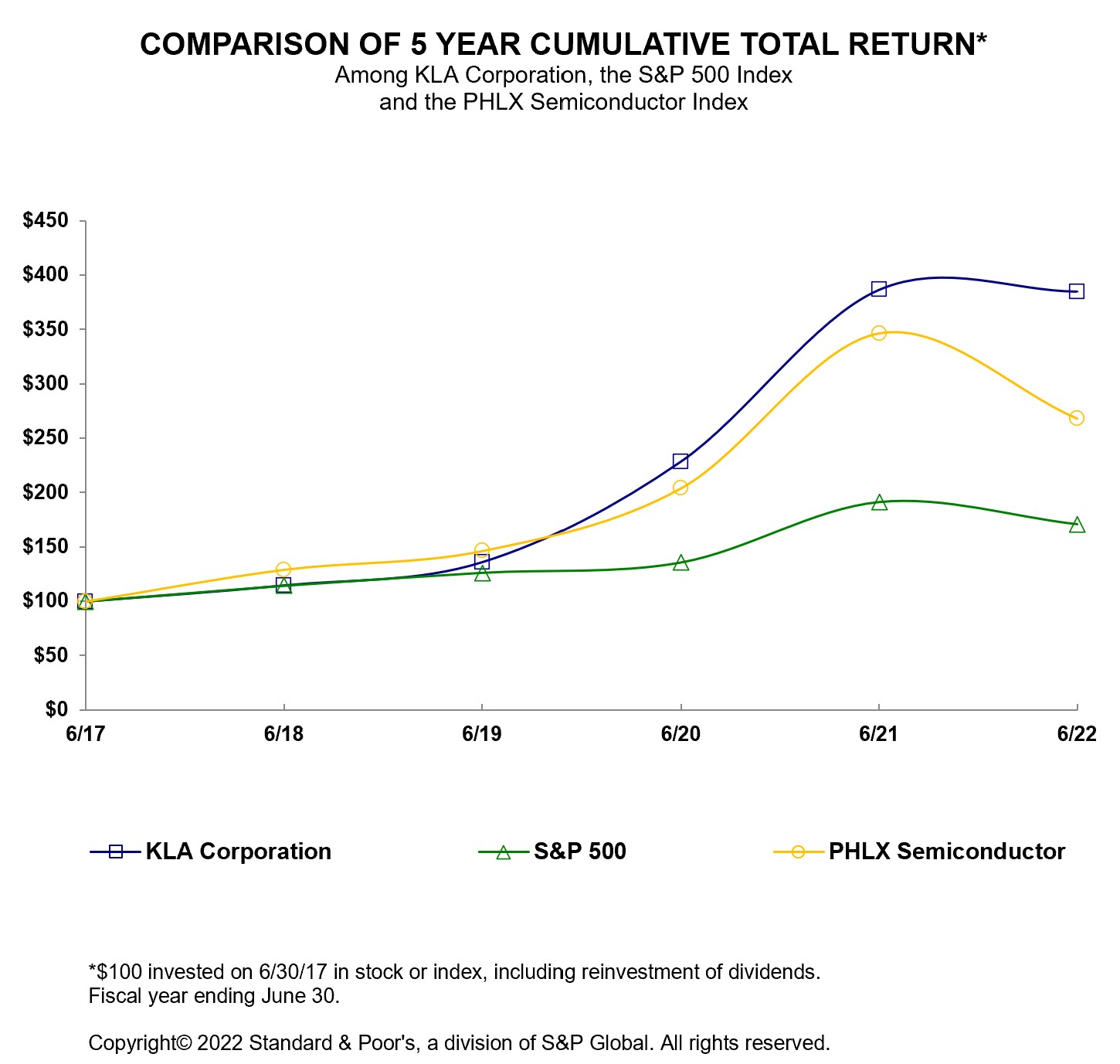
| June 2017 | June 2018 | June 2019 | June 2020 | June 2021 | June 2022 | ||||||||||||||||||||||||||||||
| KLA Corporation | $100.00 | $114.81 | $136.14 | $228.66 | $386.46 | $384.82 | |||||||||||||||||||||||||||||
| S&P 500 | $100.00 | $114.37 | $126.29 | $135.77 | $191.15 | $170.86 | |||||||||||||||||||||||||||||
| PHLX Semiconductor | $100.00 | $129.11 | $146.29 | $203.84 | $346.16 | $267.91 |
Our fiscal year ends June 30. The comparisons in the graph above are based upon historical data and are not necessarily indicative of, nor intended to forecast, future stock price performance.
Item 6. [RESERVED]
Item 7. MANAGEMENT’S DISCUSSION AND ANALYSIS OF FINANCIAL CONDITION AND RESULTS OF OPERATIONS
The following discussion of our financial condition and results of operations should be read in conjunction with our Consolidated Financial Statements and the related notes included in Item 8 “Financial Statements and Supplementary Data” in this Annual Report on Form 10-K. This discussion contains forward-looking statements, which involve risks and uncertainties. Our actual results could differ materially from those anticipated in the forward-looking statements as a result of certain factors,
including but not limited to those discussed in Item 1A “Risk Factors” and elsewhere in this Annual Report on Form 10-K (see “Special Note Regarding Forward-Looking Statements”). Discussions and analysis of fiscal year 2021 as compared against fiscal year 2020 have been omitted and can be found in Item 7 of our Annual Report on Form 10-K for the fiscal year ended June 30, 2021, filed with the SEC.
EXECUTIVE SUMMARY
We are a leading supplier of process control and yield management solutions and services for the semiconductor and related electronics industries. Our broad portfolio of inspection and metrology products, and related service, software and other offerings, support R&D and manufacturing of ICs, wafers and reticles. Our products, services and expertise are used by our customers to measure, detect, analyze and resolve critical and nanometric level product defects, helping them to manage manufacturing process challenges and to obtain higher finish product yields at lower cost. We also offer advanced technology solutions to address various manufacturing needs of PCBs, FPDs, Specialty Semiconductor Devices and other electronic components, including advanced packaging, LED, power devices, compound semiconductor, and data storage industries, as well as general materials research.
Our semiconductor customers generally operate in one or both of the major semiconductor device manufacturing markets: memory and foundry/logic. The pervasive and increasing needs for semiconductors in many consumer and industrial products, the rapid proliferation of new applications for more advanced semiconductor devices, and the increasing complexity associated with leading edge semiconductor manufacturing drives demand for our process control and yield management solutions. Other demand trends include the growth of end-market drivers such as AI, the deployment of 5G telecommunications technology and associated high-end mobile devices, the electrification and digitalization of the automotive industry, the revival of personal computer (“PC”) demand and associated innovations to support remote work, virtual collaboration, remote learning and entertainment, and the growth of the IoT. The favorable end market dynamics are driving our customers to make increased investments in our process control and yield management solutions as part of their overall capital investment plans. These trends also drive demand for our other products such as those used in the PCB, FPD and Specialty Semiconductor manufacturing, where the increase in technology complexity is expected to continue and further accelerate as more devices become interconnected and dependent on other electronic devices. As a result of these factors, we saw a general strengthening of demand for our products throughout fiscal 2021 and fiscal 2022. While demand for our products remains strong, the recent macro-economic uncertainty and resulting impact on consumer demand is a development we are monitoring closely. Some of our customers, particularly in the PC and mobile device end markets, are experiencing market softening in the past few months, and we have seen memory pricing in those markets weaken as well. While our concerns are elevated, we continue to see strong demand from our customers. Any push out or cancellation of deliveries by our customers could cause earnings volatility, due to increases in risk of inventory related charges as well as the timing of revenue recognition.
We are organized into four reportable segments:
-
Semiconductor Process Control: A comprehensive portfolio of inspection, metrology and data analytics products as well as related service offerings that help IC manufacturers achieve target yields throughout the semiconductor fabrication process, from R&D to final volume production.
-
Specialty Semiconductor Process: Advanced vacuum deposition and etching process tools used by a broad range of specialty semiconductor customers.
-
PCB, Display and Component Inspection: a range of inspection, testing and measurement, and direct imaging for patterning products used by manufacturers of PCBs, FPDs, advanced packaging, MEMS, and other electronic components.
-
Other: products that do not fall into the three segments above.
A majority of our revenues are derived from outside the U.S., and include geographic regions such as China, Taiwan, Korea, Japan, Europe and Israel, and Rest of Asia. China is emerging as a major region for manufacturing of logic and memory chips, adding to its role as the world’s largest consumer of ICs. Additionally, a significant portion of global FPD and PCB manufacturing has migrated to China. Government initiatives are propelling China to expand its domestic manufacturing capacity and attracting investment from semiconductor manufacturers from Taiwan, Korea, Japan and the U.S. Although China is currently seen as an important long-term growth region for the semiconductor and electronics capital equipment sector, Commerce has added certain China-based entities to the U.S. Entity List, restricting our ability to provide products and services to such entities without a license. In addition, Commerce has imposed new export licensing requirements on China-based customers engaged in military end uses, as well as requiring our customers to obtain an export license when they use certain semiconductor capital equipment based on U.S. technology to manufacture products connected to Huawei or its affiliates. While these new rules have not significantly impacted our operations to date, such actions by the U.S. government or another country could impact our ability to provide our products and services to existing and potential customers and adversely affect our business.
The following table sets forth some of our key consolidated financial information for each of our last three fiscal years:
| Year Ended June 30, | |||||||||||||||||
| (Dollar amounts in thousands, except diluted net income per share) | 2022 | 2021 | 2020 | ||||||||||||||
| Total revenues | $ | 9,211,883 | $ | 6,918,734 | $ | 5,806,424 | |||||||||||
| Costs of revenues | $ | 3,592,441 | $ | 2,772,165 | $ | 2,449,561 | |||||||||||
| Gross margin | 61 | % | 60 | % | 58 | % | |||||||||||
| Net income attributable to KLA(1) | $ | 3,321,807 | $ | 2,078,292 | $ | 1,216,785 | |||||||||||
| Diluted net income per share attributable to KLA | $ | 21.92 | $ | 13.37 | $ | 7.70 |
(1)Our net income attributable to KLA for the year ended June 30, 2020 includes a pre-tax goodwill impairment charge of $256.6 million and a pre-tax charge of $22.5 million as a result of the extinguishment of debt. For additional details, refer to Note 7 “Goodwill and Purchased Intangible Assets” and Note 8 “Debt” to our Consolidated Financial Statements.
Impact of COVID-19
Events surrounding the ongoing COVID-19 pandemic had resulted in a reduction in economic activity across the globe in calendar year 2020 and early 2021. Vaccinations and pandemic containment measures have now created an environment that is driving economic growth, even as the pace of economic recovery remai
Showing the first 8K of 88K characters. Open the full section
Item 7A. QUANTITATIVE AND QUALITATIVE DISCLOSURES ABOUT MARKET RISK
We are exposed to financial market risks, including changes in interest rates, foreign currency exchange rates and marketable equity security prices. To mitigate these risks, we utilize derivative financial instruments, such as foreign currency hedges. All of the potential changes noted below are based on sensitivity analyses performed on our financial position as of June 30, 2022. Actual results may differ materially.
As of June 30, 2022, we had an investment portfolio of fixed income securities of $1.01 billion. These securities, as with all fixed income instruments, are subject to interest rate risk and will decline in value if market interest rates increase. If market interest rates were to increase immediately and uniformly by 100 bps from levels as of June 30, 2022, the fair value of the portfolio would have declined by $9.4 million.
The fair market value of long-term fixed interest rate notes is subject to interest rate risk. The fair market value of fixed interest rate notes will increase as market interest rates fall and decrease as market interest rates rise. As of June 30, 2022, the fair value and the book value of our Senior Notes due in various fiscal years ranging from 2025 to 2063 were $6.39 billion and $6.45 billion, respectively. Since February 2020, the interest rates on our Senior Notes have not been subject to credit-rating based rate adjustments.
In the fourth quarter of fiscal 2022, we replaced the Prior Credit Agreement and Prior Revolving Credit Facility with a renegotiated Credit Agreement and renegotiated unsecured Revolving Credit Facility. Subject to the terms of Credit Agreement, the Revolving Credit Facility allows us to borrow up to $1.50 billion, has a maturity date of June 8, 2027 with two one-year extension options, and may be increased by an amount up to $250.0 million in the aggregate. As of June 30, 2022, we had an aggregate principal amount of $275.0 million outstanding under the Revolving Credit Facility. Each Term SOFR Loan will bear interest at a rate per annum equal to the applicable Adjusted Term SOFR rate, which is equal to the applicable Term SOFR rate plus 10 bps that shall not be less than zero, plus a spread ranging from 75 bps to 125 bps, as determined by the Company's credit ratings at the time. The fair value of the borrowings under the Revolving Credit Facility is subject to interest rate and credit risk due to the timing of the rate resets and changes in the market's assessment of risk of default, respectively. Pursuant to the terms of the Credit Agreement, we are also obligated to pay an annual commitment fee on the daily undrawn balance of the Revolving Credit Facility at a rate that ranges from 4.5 bps to 12.5 bps, depending upon the Company's then prevailing credit rating. As of June 30, 2022 the annual commitment fee was 9 bps. At June 30, 2022, if our credit ratings were downgraded to be below investment grade, the maximum potential increase to our annual commitment fee for the Revolving Credit Facility, using the highest range of the ranges discussed above, is estimated to be approximately $1 million.
Our equity investment in a publicly traded company is subject to market price risk, which we typically do not attempt to reduce or eliminate through hedging activities. As of June 30, 2022, the fair value of our investment in the marketable equity security, which began publicly trading on the Tokyo Stock Exchange on April 5, 2021, was $11.0 million. Assuming a decline of 50% in market prices, the aggregate value of our investment in the marketable equity security could decrease by approximately $6 million, based on the value as of June 30, 2022.
See Note 5 “Marketable Securities” to our Consolidated Financial Statements in Part II, Item 8; “Liquidity and Capital Resources” in Management’s Discussion and Analysis of Financial Condition and Results of Operations in Part II, Item 7; and Risk Factors in Part I, Item 1A of this Annual Report on Form 10-K for a description of recent market events that may affect the value of the investments in our portfolio that we held as of June 30, 2022.
As of June 30, 2022, we had net forward and option contracts to purchase $58.2 million in foreign currency in order to hedge certain currency exposures (see Note 17 “Derivative Instruments and Hedging Activities” to our Consolidated Financial Statements for additional details). If we had entered into these contracts on June 30, 2022, the U.S. dollar equivalent would have been $64.2 million. A 10% adverse move in all currency exchange rates affecting the contracts would decrease the fair value of the contracts by $94.2 million. However, if this occurred, the fair value of the underlying exposures hedged by the contracts would increase by a similar amount. Accordingly, we believe that, as a result of the hedging of certain of our foreign currency exposure, changes in most relevant foreign currency exchange rates should have no material impact on our results of operations or cash flows.
Item 8. FINANCIAL STATEMENTS AND SUPPLEMENTARY DATA
KLA CORPORATION
Consolidated Balance Sheets
| As of June 30, | |||||||||||
| (In thousands, except par value) | 2022 | 2021 | |||||||||
| ASSETS | |||||||||||
| Current assets: | |||||||||||
| Cash and cash equivalents | $ | 1,584,908 | $ | 1,434,610 | |||||||
| Marketable securities | 1,123,100 | 1,059,912 | |||||||||
| Accounts receivable, net | 1,811,877 | 1,305,479 | |||||||||
| Inventories | 2,146,889 | 1,575,380 | |||||||||
| Other current assets | 502,137 | 320,867 | |||||||||
| Total current assets | 7,168,911 | 5,696,248 | |||||||||
| Land, property and equipment, net | 849,929 | 663,027 | |||||||||
| Goodwill | 2,320,049 | 2,011,172 | |||||||||
| Deferred income taxes | 579,173 | 270,461 | |||||||||
| Purchased intangible assets, net | 1,194,414 | 1,185,311 | |||||||||
| Other non-current assets | 484,612 | 444,905 | |||||||||
| Total assets | $ | 12,597,088 | $ | 10,271,124 | |||||||
| LIABILITIES, NON-CONTROLLING INTEREST AND STOCKHOLDERS’ EQUITY | |||||||||||
| Current liabilities: | |||||||||||
| Accounts payable | $ | 443,338 | $ | 342,083 | |||||||
| Deferred system revenue | 500,969 | 295,192 | |||||||||
| Deferred service revenue | 381,737 | 284,936 | |||||||||
| Short-term debt | — | 20,000 | |||||||||
| Other current liabilities | 1,545,039 | 1,161,016 | |||||||||
| Total current liabilities | 2,871,083 | 2,103,227 | |||||||||
| Long-term debt | 6,660,718 | 3,422,767 | |||||||||
| Deferred tax liabilities | 658,937 | 650,623 | |||||||||
| Deferred service revenue | 124,618 | 87,575 | |||||||||
| Other non-current liabilities | 882,642 | 631,290 | |||||||||
| Total liabilities | 11,197,998 | 6,895,482 | |||||||||
| Commitments and contingencies (Notes 9, 15 and 16) | |||||||||||
| Stockholders’ equity: | |||||||||||
| Preferred stock, $0.001 par value, 1,000 shares authorized, none outstanding | — | — | |||||||||
| Common stock, $0.001 par value, 500,000 shares authorized, 279,210 and 278,435 shares issued, 141,804 and 152,776 shares outstanding, as of June 30, 2022 and June 30, 2021, respectively | 142 | 153 | |||||||||
| Capital in excess of par value | 1,061,798 | 2,175,835 | |||||||||
| Retained earnings | 366,882 | 1,277,123 | |||||||||
| Accumulated other comprehensive loss | (27,471) | (75,557) | |||||||||
| Total KLA stockholders’ equity | 1,401,351 | 3,377,554 | |||||||||
| Non-controlling interest in consolidated subsidiaries | (2,261) | (1,912) | |||||||||
| Total stockholders’ equity | 1,399,090 | 3,375,642 | |||||||||
| Total liabilities and stockholders’ equity | $ | 12,597,088 | $ | 10,271,124 |
See accompanying notes to Consolidated Financial Statements.
KLA CORPORATION
Consolidated Statements of Operations
| Year Ended June 30, | |||||||||||||||||
| (In thousands, except per share amounts) | 2022 | 2021 | 2020 | ||||||||||||||
| Revenues: | |||||||||||||||||
| Product | $ | 7,301,428 | $ | 5,240,316 | $ | 4,328,725 | |||||||||||
| Service | 1,910,455 | 1,678,418 | 1,477,699 | ||||||||||||||
| Total revenues | 9,211,883 | 6,918,734 | 5,806,424 | ||||||||||||||
| Costs and expenses: | |||||||||||||||||
| Costs of revenues | 3,592,441 | 2,772,165 | 2,449,561 | ||||||||||||||
| Research and development | 1,105,254 | 928,487 | 863,864 | ||||||||||||||
| Selling, general and administrative | 860,007 | 729,602 | 734,149 | ||||||||||||||
| Goodwill impairment | — | — | 256,649 | ||||||||||||||
| Interest expense | 160,339 | 157,328 | 160,274 | ||||||||||||||
| Loss on extinguishment of debt | — | — | 22,538 | ||||||||||||||
| Other expense (income), net | 4,605 | (29,302) | 2,678 | ||||||||||||||
| Income before income taxes | 3,489,237 | 2,360,454 | 1,316,711 | ||||||||||||||
| Provision for income taxes | 167,177 | 283,101 | 101,686 | ||||||||||||||
| Net income | 3,322,060 | 2,077,353 | 1,215,025 | ||||||||||||||
| Less: Net income (loss) attributable to non-controlling interest | 253 | (939) | (1,760) | ||||||||||||||
| Net income attributable to KLA | $ | 3,321,807 | $ | 2,078,292 | $ | 1,216,785 | |||||||||||
| Net income per share attributable to KLA | |||||||||||||||||
| Basic | $ | 22.07 | $ | 13.49 | $ | 7.76 | |||||||||||
| Diluted | $ | 21.92 | $ | 13.37 | $ | 7.70 | |||||||||||
| Weighted-average number of shares: | |||||||||||||||||
| Basic | 150,494 | 154,086 | 156,797 | ||||||||||||||
| Diluted | 151,555 | 155,437 | 158,005 |
See accompanying notes to Consolidated Financial Statements.
KLA CORPORATION
**
Showing the first 8K of 256K characters. Open the full section
Item 9. CHANGES IN AND DISAGREEMENTS WITH ACCOUNTANTS ON ACCOUNTING AND FINANCIAL DISCLOSURE
None.
Item 9A. CONTROLS AND PROCEDURES
Evaluation of Disclosure Controls and Procedures
We conducted an evaluation of the effectiveness of the design and operation of our disclosure controls and procedures (as defined in Rules 13a-15(e) and 15d-15(e) under the Securities Exchange Act of 1934, as amended (the “Exchange Act”) (“Disclosure Controls”) as of the end of the period covered by this Annual Report on Form 10-K (this “Report”) required by Exchange Act Rules 13a-15(b) or 15d-15(b). The evaluation of our disclosure controls and procedures was conducted under the supervision and with the participation of our management, including our Chief Executive Officer (“CEO”) and Chief Financial Officer (“CFO”). Based on this evaluation, the CEO and CFO have concluded that as of June 30, 2022, the end of the period covered by this Report, our Disclosure Controls were effective at a reasonable assurance level.
Attached as exhibits to this Report are certifications of the CEO and CFO, which are required in accordance with Rule 13a-14 of the Exchange Act. This Controls and Procedures section includes the information concerning the controls evaluation referred to in the certifications, and it should be read in conjunction with the certifications for a more complete understanding of the topics presented.
Definition of Disclosure Controls
Disclosure Controls are controls and procedures designed to reasonably assure that information required to be disclosed in our reports filed or submitted under the Exchange Act, such as this Report, is recorded, processed, summarized and reported within the time periods specified in the Securities and Exchange Commission’s rules and forms. Disclosure Controls are also designed to reasonably assure that such information is accumulated and communicated to our management, including our CEO and CFO, as appropriate to allow timely decisions regarding required disclosure. Our Disclosure Controls include components of our internal control over financial reporting, which consists of control processes designed to provide reasonable assurance regarding the reliability of our financial reporting and the preparation of financial statements in accordance with generally accepted accounting principles in the United States. To the extent that components of our internal control over financial reporting are included within our Disclosure Controls, they are included in the scope of our annual controls evaluation.
Management’s Report on Internal Control over Financial Reporting
Our management is responsible for establishing and maintaining adequate internal control over financial reporting as defined in Rules 13a-15(f) and 15d-15(f) under the Exchange Act. Under the supervision and with the participation of our management, including our CEO and CFO, we conducted an evaluation of the effectiveness of our internal control over financial reporting based on criteria established in the framework in Internal Control—Integrated Framework (2013) issued by the Committee of Sponsoring Organizations of the Treadway Commission. Based on this evaluation, our management concluded that our internal control over financial reporting was effective as of June 30, 2022.
The effectiveness of our internal control over financial reporting as of June 30, 2022 has been audited by PricewaterhouseCoopers LLP, an independent registered public accounting firm, as stated in their report which appears in Item 8, “Financial Statements and Supplementary Data” in this Annual Report on Form 10-K.
Limitations on the Effectiveness of Controls
Our management, including our CEO and CFO, does not expect that our Disclosure Controls or internal control over financial reporting will prevent all error and all fraud. A control system, no matter how well designed and operated, can provide only reasonable, not absolute, assurance that the control system’s objectives will be met. Further, the design of a control system must reflect the fact that there are resource constraints, and the benefits of controls must be considered relative to their costs. Because of the inherent limitations in all control systems, no evaluation of controls can provide absolute assurance that all control issues and instances of fraud, if any, within the Company have been detected. These inherent limitations include the realities that judgments in decision making can be faulty and that breakdowns can occur because of simple error or mistake. Controls can also be circumvented by the individual acts of some persons, by collusion of two or more people, or by management override of the controls. The design of any system of controls is based in part on certain assumptions about the likelihood of future events, and there can be no assurance that any design will succeed in achieving our stated goals under all potential future conditions. Over time, controls may become inadequate because of changes in conditions or deterioration in the degree of compliance with policies or procedures. Because of the inherent limitations in a cost-effective control system, misstatements due to error or fraud may occur and not be detected.
Changes in Internal Control over Financial Reporting
There were no changes in our internal control over financial reporting identified in connection with the evaluation required by Rule 13a-15(d) and 15d-15(d) of the Exchange Act that occurred during the fourth quarter of the fiscal year ended June 30, 2022 that have materially affected, or is reasonably likely to materially affect, our internal control over financial reporting.
Item 9B. OTHER INFORMATION
None.
Item 9C. DISCLOSURE REGARDING FOREIGN JURISDICTIONS THAT PREVENT INSPECTIONS
Not applicable.
PART III
Item 10. DIRECTORS, EXECUTIVE OFFICERS AND CORPORATE GOVERNANCE
For the information required by this Item, see “Information About the Board of Directors and its Committees,” “Information About Executive Officers,” “Our Corporate Governance Practices - Standards of Business Conduct; Whistleblower Hotline and Website,” “Report of the Audit Committee,” and, if applicable, “Security Ownership of Certain Beneficial Owners and Management - Delinquent Section 16(a) Reports,” in the Proxy Statement, which is incorporated herein by reference.
Item 11. EXECUTIVE COMPENSATION
For the information required by this Item, see “Executive Compensation and Other Matters,” “Information About the Board of Directors and Its Committees - Director Compensation,” “Our Corporate Governance Practices - Compensation and Talent Committee Interlocks and Insider Participation,” “Compensation and Talent Committee Report,” and “Information About the Board of Directors and Its Committees - Compensation and Talent Committee - Risk Considerations in Our Compensation Programs” in the Proxy Statement, which is incorporated herein by reference.
Item 12. SECURITY OWNERSHIP OF CERTAIN BENEFICIAL OWNERS AND MANAGEMENT AND RELATED STOCKHOLDER MATTERS
For the information required by this Item, see “Security Ownership of Certain Beneficial Owners and Management” and “Equity Compensation Plan Information” in the Proxy Statement, which is incorporated herein by reference.
Item 13. CERTAIN RELATIONSHIPS AND RELATED TRANSACTIONS, AND DIRECTOR INDEPENDENCE
For the information required by this Item, see “Certain Relationships and Related Transactions” and “Information About the Board of Directors and Its Committees - The Board of Directors” in the Proxy Statement, which is incorporated herein by reference.
Item 14. PRINCIPAL ACCOUNTANT FEES AND SERVICES
For the information required by this Item, see “Proposal Two: Ratification of Appointment of PricewaterhouseCoopers LLP as Our Independent Registered Public Accounting Firm for the Fiscal Year Ending June 30, 2023” in the Proxy Statement, which is incorporated herein by reference.
PART IV
Item 15. EXHIBITS AND FINANCIAL STATEMENT SCHEDULES
(a) The following documents are filed as part of this Annual Report on Form 10-K:
- Financial Statements:
The following financial statements and schedules of the Registrant are contained in Item 8, “Financial Statements and Supplementary Data” of this Annual Report on Form 10-K:
- Financial Statement Schedule:
The following financial statement schedule of the Registrant is filed as part of this Annual Report on Form 10-K and should be read in conjunction with the financial statements:
| Schedule II—Valuation and Qualifying Accounts for the three years in the period ended June 30, 2022 | 107 |
All other schedules are omitted because they are either not applicable or the required information is shown in the Consolidated Financial Statements or notes thereto.
- Exhibits
The information required by this item is set forth below.
| Exhibit Number | Exhibit Description | Incorporated by Reference | ||||||||||||||||||||||||||||||
| Form | File No. | Exhibit Number | Filing Date | |||||||||||||||||||||||||||||
| 23.1 | Consent of Independent Registered Public Accounting Firm | |||||||||||||||||||||||||||||||
| 31.1 | Certification of Chief Executive Officer under Rule 13a-14(a)/15d - 14(a) of the Securities Exchange Act of 1934 | |||||||||||||||||||||||||||||||
| 31.2 | Certification of Chief Financial Officer under Rule 13a-14(a)/15d - 14(a) of the Securities Exchange Act of 1934 | |||||||||||||||||||||||||||||||
| 32 | Certification of Chief Executive Officer and Chief Financial Officer Pursuant to 18 U.S.C. Section 1350^ | |||||||||||||||||||||||||||||||
| 101.INS | XBRL Instance Document - the instance document does not appear in the Interactive Data File because its XBRL tags are embedded within the Inline XBRL document. | |||||||||||||||||||||||||||||||
| 101.SCH | XBRL Taxonomy Extension Schema Document | |||||||||||||||||||||||||||||||
| 101.CAL | XBRL Taxonomy Extension Calculation Linkbase Document | |||||||||||||||||||||||||||||||
| 101.DEF | XBRL Taxonomy Extension Definition Linkbase Document | |||||||||||||||||||||||||||||||
| 101.LAB | XBRL Taxonomy Extension Label Linkbase Document | |||||||||||||||||||||||||||||||
| 101.PRE | XBRL Taxonomy Extension Presentation Linkbase Document | |||||||||||||||||||||||||||||||
| 104 | Cover Page Interactive Data File (the cover page XBRL tags are embedded within the Inline XBRL document). |
| * | Denotes a management contract, plan or arrangement. | ||||
| + | Certain portions of this document that constitute confidential information have been redacted in accordance with Regulation S-K, Item 601(b)(10). | ||||
| ^ | Furnished herewith |
Item 16. FORM 10-K SUMMARY
None.
SIGNATURES
Pursuant to the requirements of Section 13 or 15(d) of the Securities Exchange Act of 1934, the registrant has duly caused this report to be signed on its behalf by the undersigned, thereunto duly authorized.
| KLA Corporation | ||||||||||||||
| August 4, 2022 | By: | /S/ RICHARD P. WALLACE | ||||||||||||
| (Date) | Richard P. Wallace | |||||||||||||
| President and Chief Executive Officer |
Each person whose signature appears below constitutes and appoints Richard P. Wallace and Bren D. Higgins, and each or any of them, his or her true and lawful attorney-in-fact and agent, each acting alone, with full power of substitution and resubstitution, for him or her and in his or her name, place and stead, in any and all capacities, to sign any or all amendments or supplements (including post-effective amendments) to this Report, and to file the same, with all exhibits thereto, and all documents in connection therewith, with the Securities and Exchange Commission, granting unto said attorney-in-fact and agent, full power and authority to do and perform each and every act and thing requisite and necessary to be done in and about the premises, as fully to all intents and purposes as he or she might or could do in person, hereby ratifying and confirming all that said attorney-in-fact and agent, or his or her substitute or substitutes, may lawfully do or cause to be done by virtue hereof.
Pursuant to the requirements of the Securities Exchange Act of 1934, this report has been signed below by the following persons on behalf of the registrant and in the capacities and on the dates indicated.
| Signature | Title | Date | ||||||||||||
| /s/ RICHARD P. WALLACE | President, Chief Executive Officer and Director (principal executive officer) | August 4, 2022 | ||||||||||||
| Richard P. Wallace | ||||||||||||||
| /s/ BREN D. HIGGINS | Executive Vice President and Chief Financial Officer (principal financial officer) | August 2, 2022 | ||||||||||||
| Bren D. Higgins | ||||||||||||||
| /s/ VIRENDRA A. KIRLOSKAR | Senior Vice President and Chief Accounting Officer (principal accounting officer) | August 3, 2022 | ||||||||||||
| Virendra A. Kirloskar | ||||||||||||||
| /s/ EDWARD W. BARNHOLT | Chairman of the Board and Director | August 2, 2022 | ||||||||||||
| Edward W. Barnholt | ||||||||||||||
| /s/ ROBERT M. CALDERONI | Director | August 2, 2022 | ||||||||||||
| Robert M. Calderoni | ||||||||||||||
| /s/ JENEANNE HANLEY | Director | August 4, 2022 | ||||||||||||
| Jeneanne Hanley | ||||||||||||||
| /s/ EMIKO HIGASHI | Director | August 2, 2022 | ||||||||||||
| Emiko Higashi | ||||||||||||||
| /s/ KEVIN J. KENNEDY | Director | August 2, 2022 | ||||||||||||
| Kevin J. Kennedy | ||||||||||||||
| /s/ GARY B. MOORE | Director | August 2, 2022 | ||||||||||||
| Gary B. Moore | ||||||||||||||
| /s/ MARIE MYERS | Director | August 2, 2022 | ||||||||||||
| Marie Myers | ||||||||||||||
| /s/ KIRAN M. PATEL | Director | August 2, 2022 | ||||||||||||
| Kiran M. Patel | ||||||||||||||
| /s/ VICTOR PENG | Director | August 2, 2022 | ||||||||||||
| Victor Peng |
| /s/ ROBERT A. RANGO | Director | August 2, 2022 | ||||||||||||
| Robert A. Rango |