 filings.tools
Cover and table of contents
110K characters. Original on sec.gov · Markdown
Cover and table of contents
UNITED STATES SECURITIES AND EXCHANGE COMMISSION
Washington, D.C. 20549
Form 10-K
| ☑ | ANNUAL REPORT PURSUANT TO SECTION 13 OR 15(d) OF THE SECURITIES EXCHANGE ACT OF 1934 |
For the fiscal year ended December 31, 2022
or
| ☐ | TRANSITION REPORT PURSUANT TO SECTION 13 OR 15(d) OF THE SECURITIES EXCHANGE ACT OF 1934 |
For the transition period from to
Commission file number: 001-35081

Kinder Morgan, Inc.
(Exact name of registrant as specified in its charter)
| Delaware | 80-0682103 | |||||||
| (State or other jurisdiction of incorporation or organization) | (I.R.S. Employer Identification No.) |
1001 Louisiana Street, Suite 1000, Houston, Texas 77002
(Address of principal executive offices) (zip code)
Registrant’s telephone number, including area code: 713-369-9000
Securities registered pursuant to Section 12(b) of the Act:
| Title of each class | Trading Symbol(s) | Name of each exchange on which registered | ||||||
| Class P Common Stock | KMI | New York Stock Exchange | ||||||
| 2.250% Senior Notes due 2027 | KMI 27 A | New York Stock Exchange |
Securities registered pursuant to Section 12(g) of the Act: None
Indicate by check mark if the registrant is a well-known seasoned issuer, as defined in Rule 405 of the Securities Act. Yes ☑ No ☐
Indicate by check mark if the registrant is not required to file reports pursuant to Section 13 or Section 15(d) of the Act. Yes ☐ No ☑
Indicate by check mark whether the registrant (1) has filed all reports required to be filed by Section 13 or 15(d) of the Securities Exchange Act of 1934 during the preceding 12 months (or for such shorter period that the registrant was required to file such reports), and (2) has been subject to such filing requirements for the past 90 days. Yes ☑ No ☐
Indicate by check mark whether the registrant has submitted electronically every Interactive Data File required to be submitted pursuant to Rule 405 of Regulation S-T (§232.405 of this chapter) during the preceding 12 months (or for such shorter period that the registrant was required to submit such files). Yes ☑ No ☐
Indicate by check mark whether the registrant is a large accelerated filer, an accelerated filer, a non-accelerated filer, a smaller reporting company or an emerging growth company. See the definitions of “large accelerated filer,” “accelerated filer,” “non-accelerated filer,” “smaller reporting company,” and “emerging growth company” in Rule 12b-2 of the Exchange Act.
Large accelerated filer ☑ Accelerated filer ☐ Non-accelerated filer ☐ Smaller reporting company ☐ Emerging growth company ☐
If an emerging growth company, indicate by check mark if the registrant has elected not to use the extended transition period for complying with any new or revised financial accounting standards provided pursuant to Section 13(a) of the Exchange Act. ☐
Indicate by check mark whether the registrant has filed a report on and attestation to its management’s assessment of the effectiveness of its internal control over financial reporting under Section 404(b) of the Sarbanes-Oxley Act (15 U.S.C.7262(b)) by the registered public accounting firm that prepared or issued its audit report. ☑
If securities are registered pursuant to Section 12(b) of the Act, indicate by check mark whether the financial statements of the registrant included in the filing reflect the correction of an error to previously issued financial statements. ☐
Indicate by check mark whether any of those error corrections are restatements that required a recovery analysis of incentive-based compensation received by any of the registrant’s executive officers during the relevant recovery period pursuant to §240.10D-1(b). ☐
Indicate by check mark whether the registrant is a shell company (as defined in Rule 12b-2 of the Securities Exchange Act of 1934). Yes ☐ No ☑
Aggregate market value of the voting and non-voting common equity held by non-affiliates of the registrant, based on closing prices in the daily composite list for transactions on the New York Stock Exchange on June 30, 2022 was approximately $33,112,481,840. As of February 7, 2023, the registrant had 2,248,003,224 shares of Class P common stock outstanding.
DOCUMENTS INCORPORATED BY REFERENCE
Portions of the Registrant’s definitive proxy statement for the 2023 Annual Meeting of Stockholders, which shall be filed no later than April 30, 2023, are incorporated into PART III, as specifically set forth in PART III.
KINDER MORGAN, INC. AND SUBSIDIARIES
GLOSSARY
Company Abbreviations
| Calnev | = | Calnev Pipe Line LLC | KMLT | = | Kinder Morgan Liquid Terminals, LLC | ||||||||||||
| CIG | = | Colorado Interstate Gas Company, L.L.C. | KMP | = | Kinder Morgan Energy Partners, L.P. and its majority-owned and/or controlled subsidiaries | ||||||||||||
| CPGPL | = | Cheyenne Plains Gas Pipeline Company, L.L.C. | |||||||||||||||
| EagleHawk | = | EagleHawk Field Services LLC | KMTP | = | Kinder Morgan Texas Pipeline LLC | ||||||||||||
| Elba Express | = | Elba Express Company, L.L.C. | MEP | = | Midcontinent Express Pipeline LLC | ||||||||||||
| EIG | = | EIG Global Energy Partners | NGPL | = | Natural Gas Pipeline Company of America LLC and certain affiliates | ||||||||||||
| ELC | = | Elba Liquefaction Company, L.L.C. | |||||||||||||||
| EPNG | = | El Paso Natural Gas Company, L.L.C. | PHP | = | Permian Highway Pipeline LLC | ||||||||||||
| FEP | = | Fayetteville Express Pipeline LLC | Ruby | = | Ruby Pipeline Holding Company, L.L.C. | ||||||||||||
| Hiland | = | Hiland Partners, LP | SFPP | = | SFPP, L.P. | ||||||||||||
| KinderHawk | = | KinderHawk Field Services LLC | SLNG | = | Southern LNG Company, L.L.C. | ||||||||||||
| Kinetrex | = | Kinetrex Energy | SNG | = | Southern Natural Gas Company, L.L.C. | ||||||||||||
| KMBT | = | Kinder Morgan Bulk Terminals, Inc. | Stagecoach | = | Stagecoach Gas Services LLC | ||||||||||||
| KMI | = | Kinder Morgan, Inc. and its majority-owned and/or controlled subsidiaries | TGP | = | Tennessee Gas Pipeline Company, L.L.C. | ||||||||||||
| WIC | = | Wyoming Interstate Company, L.L.C. | |||||||||||||||
| KMLP | = | Kinder Morgan Louisiana Pipeline LLC | WYCO | = | WYCO Development L.L.C. | ||||||||||||
| Unless the context otherwise requires, references to “we,” “us,” “our,” or “the Company” are intended to mean Kinder Morgan, Inc. and its majority-owned and/or controlled subsidiaries. | |||||||||||||||||
| Common Industry and Other Terms | |||||||||||||||||
| /d | = | per day | GAAP | = | United States Generally Accepted Accounting Principles | ||||||||||||
| AFUDC | = | allowance for funds used during construction | |||||||||||||||
| Bbl | = | barrels | GTE | = | gas-to-electric | ||||||||||||
| BBtu | = | billion British Thermal Units | LIBOR | = | London Interbank Offered Rate | ||||||||||||
| Bcf | = | billion cubic feet | LLC | = | limited liability company | ||||||||||||
| CERCLA | = | Comprehensive Environmental Response, Compensation and Liability Act | LNG | = | liquefied natural gas | ||||||||||||
| MBbl | = | thousand barrels | |||||||||||||||
| CO2 | = | carbon dioxide or our CO2 business segment | MMBbl | = | million barrels | ||||||||||||
| COVID-19 | = | Coronavirus Disease 2019, a widespread contagious disease, or the related pandemic declared and resulting worldwide economic downturn | MMtons | = | million tons | ||||||||||||
| NGL | = | natural gas liquids | |||||||||||||||
| NYMEX | = | New York Mercantile Exchange | |||||||||||||||
| CPUC | = | California Public Utilities Commission | NYSE | = | New York Stock Exchange | ||||||||||||
| DCF | = | distributable cash flow | OTC | = | over-the-counter | ||||||||||||
| DD&A | = | depreciation, depletion and amortization | PHMSA | = | United States Department of Transportation Pipeline and Hazardous Materials Safety Administration | ||||||||||||
| Dth | = | dekatherms | |||||||||||||||
| EBDA | = | earnings before depreciation, depletion and amortization expenses, including amortization of excess cost of equity investments | ROU | = | Right-of-Use | ||||||||||||
| RNG | = | renewable natural gas | |||||||||||||||
| EBITDA | = | earnings before interest, income taxes, depreciation, depletion and amortization expenses, including amortization of excess cost of equity investments | SEC | = | United States Securities and Exchange Commission | ||||||||||||
| SOFR | = | Secured Overnight Financing Rate | |||||||||||||||
| EPA | = | United States Environmental Protection Agency | U.S. | = | United States of America | ||||||||||||
| FASB | = | Financial Accounting Standards Board | WTI | = | West Texas Intermediate | ||||||||||||
| FERC | = | Federal Energy Regulatory Commission | |||||||||||||||
Information Regarding Forward-Looking Statements
This report includes forward-looking statements. These forward-looking statements are identified as any statement that does not relate strictly to historical or current facts. They use words such as “anticipate,” “believe,” “intend,” “plan,” “projection,” “forecast,” “strategy,” “outlook,” “continue,” “estimate,” “expect,” “may,” “will,” “shall,” or the negative of those terms or other variations of them or comparable terminology. In particular, expressed or implied statements concerning future actions, conditions or events, future operating results or the ability to generate sales, income or cash flow, service debt or pay dividends, are forward-looking statements. Forward-looking statements in this report include, among others, express or implied statements pertaining to: the long-term demand for our assets and services, and our anticipated dividends and capital projects, including expected completion timing and benefits of those projects.
Forward-looking statements are not guarantees of performance. They involve risks, uncertainties and assumptions. Future actions, conditions or events and future results may differ materially from those expressed in our forward-looking statements. Many of the factors that will determine these results are beyond our ability to control or accurately predict. Specific factors that could cause actual results to differ from those in our forward-looking statements include:
-
changes in supply of and demand for natural gas, NGL, refined petroleum products, oil, renewable fuels, CO2, electricity, petroleum coke, steel and other bulk materials and chemicals and certain agricultural products in North America;
-
economic activity, weather, alternative energy sources, conservation and technological advances that may affect price trends and demand;
-
competition from other pipelines, terminals or other forms of transportation, or from emerging technologies such as CO2 capture and sequestration;
-
changes in our tariff rates required by the FERC, the CPUC or another regulatory agency;
-
the timing and success of our business development efforts, including our ability to renew long-term customer contracts at economically attractive rates;
-
our ability to safely operate and maintain our existing assets and to access or construct new assets including pipelines, terminals, gas processing, gas storage and NGL fractionation capacity;
-
our ability to attract and retain key management and operations personnel;
-
difficulties or delays experienced by railroads, barges, trucks, ships or pipelines in delivering products to or from our terminals or pipelines;
-
shut-downs or cutbacks at major refineries, chemical or petrochemical plants, natural gas processing plants, ports, utilities, military bases or other businesses that use our services or provide services or products to us;
-
changes in crude oil and natural gas production (and the NGL content of natural gas production) from exploration and production areas that we serve, such as the Permian Basin area of West Texas, the shale plays in North Dakota, Ohio, Oklahoma, Pennsylvania and Texas, and the U.S. Rocky Mountains;
-
changes in laws or regulations, third-party relations and approvals, and decisions of courts, regulators and governmental bodies that may increase our compliance costs, restrict our ability to provide or reduce demand for our services, or otherwise adversely affect our business;
-
interruptions of operations at our facilities due to natural disasters, damage by third parties, power shortages, strikes, riots, terrorism (including cyber-attacks), war or other causes;
-
compromise of our IT systems, operational systems or sensitive data as a result of errors, malfunctions, hacking events or coordinated cyber-attacks;
-
the uncertainty inherent in estimating future oil, natural gas, and CO2 production or reserves;
-
issues, delays or stoppage associated with new construction or expansion projects;
-
regulatory, environmental, political, grass roots opposition, legal, operational and geological uncertainties that could affect our ability to complete our expansion projects on time and on budget or at all;
-
our ability to acquire new businesses and assets and integrate those operations into our existing operations, and make cost-saving changes in operations, particularly if we undertake multiple acquisitions in a relatively short period of time, as well as our ability to expand our facilities;
-
the ability of our customers and other counterparties to perform under their contracts with us including as a result of our customers’ financial distress or bankruptcy;
-
changes in accounting pronouncements that impact the measurement of our results of operations, the timing of when such measurements are to be made and recorded, and the disclosures surrounding these activities;
-
changes in tax laws;
-
our ability to access external sources of financing in sufficient amounts and on acceptable terms to the extent needed to fund acquisitions of operating businesses and assets and expansions of our facilities;
-
our indebtedness, which could make us vulnerable to general adverse economic and industry conditions, limit our ability to borrow additional funds, place us at a competitive disadvantage compared to our competitors that have less debt, or have other adverse consequences;
-
our ability to obtain insurance coverage without significant levels of self-retention risk;
-
natural disasters, sabotage, terrorism (including cyber-attacks) or other similar acts or accidents causing damage to our properties greater than our insurance coverage limits;
-
possible changes in our and our subsidiaries’ credit ratings;
-
conditions in the capital and credit markets, inflation and higher interest rates;
-
political and economic instability of the oil and natural gas producing nations of the world;
-
national, international, regional and local economic, competitive and regulatory conditions and developments, including the effects of any enactment of import or export duties, tariffs or similar measures;
-
our ability to achieve cost savings and revenue growth;
-
the extent of our success in developing and producing CO2 and oil and gas reserves, including the risks inherent in development drilling, well completion and other development activities;
-
engineering and mechanical or technological difficulties that we may experience with operational equipment, in well completions and work-overs, and in drilling new wells; and
-
unfavorable results of litigation and the outcome of contingencies referred to in Note 18 “Litigation and Environmental” to our consolidated financial statements.
The foregoing list should not be construed to be exhaustive. We believe the forward-looking statements in this report are reasonable. However, there is no assurance that any of the actions, events or results expressed in forward-looking statements will occur, or if any of them do, of their timing or what impact they will have on our results of operations or financial condition. Because of these uncertainties, you should not put undue reliance on any of our forward-looking statements.
Additional discussion of factors that may affect our forward-looking statements appear elsewhere in this report, including in Item 1A. “Risk Factors,” Item 7. “Management’s Discussion and Analysis of Financial Condition and Results of Operations” and Item 7A. “Quantitative and Qualitative Disclosures About Market Risk—Energy Commodity Market Risk.” When considering forward-looking statements, you should keep in mind the factors described in this section and the other sections referenced above. We disclaim any obligation, other than as required by applicable law, to publicly update or revise any of our forward-looking statements to reflect future events or developments.
PART I
Items 1 and 2. Business and Properties.
We are one of the largest energy infrastructure companies in North America. We own an interest in or operate approximately 83,000 miles of pipelines, 140 terminals, 700 Bcf of working natural gas storage capacity and have RNG generation capacity of approximately 2.2 Bcf per year of gross production. Our pipelines transport natural gas, renewable fuels, refined petroleum products, crude oil, condensate, CO2 and other products, and our terminals store and handle various commodities including gasoline, diesel fuel, renewable fuel feedstocks, chemicals, ethanol, metals and petroleum coke.
General Development of Business
Recent Developments
The following is a listing of significant developments and updates related to our major projects and financing transactions. “Capital Scope” is estimated for our share of the described project which may include portions not yet completed.
| Asset or project | Description | Activity | Approx. Capital Scope (KMI Share) | |||||||||||||||||
| Placed in service, acquisitions or divestitures | ||||||||||||||||||||
| ELC | Sold a 25.5% interest in ELC to an undisclosed financial buyer and now own a 25.5% interest. | Completed in September 2022. | n/a | |||||||||||||||||
| Mas Ranger | Acquired three landfill assets with the purchase of Mas Ranger, LLC and its subsidiaries from Mas CanAm, LLC. Assets include an RNG facility in Arlington, Texas and Medium British Thermal Units facilities in Shreveport, Louisiana and Victoria, Texas. | Acquired in July 2022. | $358 million | |||||||||||||||||
| North American Natural Resources | Acquired seven landfill assets with the purchase of North American Natural Resources, Inc. and, its sister companies, North American Biofuels, LLC and North American-Central, LLC (NANR). Assets include GTE facilities in Michigan and Kentucky. A final investment decision was made to convert Autumn Hills, one of the seven landfill assets acquired, to an RNG facility and construction began in January 2023. | Acquired in August 2022. | $132 million | |||||||||||||||||
| Other Announcements | ||||||||||||||||||||
| Natural Gas Pipelines | ||||||||||||||||||||
| TGP and SNG Evangeline Pass | Two-phase 2 Bcf/d project to serve Venture Global’s proposed Plaquemines LNG facility (Plaquemines). First phase, TGP will provide approximately 0.9 Bcf/d natural gas transportation capacity to Plaquemines. Second phase, TGP and SNG will jointly provide volumes up to the remaining 1.1 Bcf/d to Plaquemines. | Expected in-service date for first phase is fourth quarter of 2024 and third quarter of 2025 for the second phase, pending receipt of all required permits. | $678 million | |||||||||||||||||
| Eagleford transport project | Expansion project includes constructing 69 miles of 42-inch pipeline, multiple receipt and delivery meters and upgrades to Kinder Morgan Freer compressor station to transport up to 1.88 Bcf/d of lean Eagleford production to Gulf Coast markets. | Expected in-service date is fourth quarter 2023. | $283 million | |||||||||||||||||
| TGP East 300 Upgrade | Expansion project involves upgrading compression facilities upstream on TGP’s system in order to provide 115,000 Dth/d of capacity to Con Edison’s distribution system in Westchester County, New York. Supported by a long-term contract with Con Edison. | Expected in-service date is November 2023, pending receipt of all required permits. | $263 million | |||||||||||||||||
| PHP expansion | Joint venture project that will expand PHP’s capacity by approximately 550,000 Dth/d, increasing natural gas deliveries from the Permian to U.S. Gulf Coast markets. Supported by long-term contracts. | Expected in-service date is November 2023. | $149 million |
| Asset or project | Description | Activity | Approx. Capital Scope (KMI Share) | |||||||||||||||||
| Greenholly pipeline - North Holly expansion | Joint venture project (our ownership interest of 37.58%) to construct 38 miles of 36-inch pipeline from partner receipt points to KinderHawk wholly owned North Holly gathering system and includes joint venture pipeline receipt interconnects off KinderHawk’s Greenwood system, upgrades to KinderHawk’s North Holly system and 400 gallons per minute treating capacity addition to KinderHawk’s North Holly plant. Supported by long-term contracts. | Expected in-service date is second quarter 2023. | $121 million | |||||||||||||||||
| 3Rivers Offload Phase II | Construct 19 miles of 16-inch pipeline and associated compression allowing delivery of 50,000 Dth/d of incremental gathered production for third-party processing. | Expected in-service date is third quarter 2023. | $96 million | |||||||||||||||||
| CO**2 - Energy Transition Ventures | ||||||||||||||||||||
| RNG facilities | Construction of three additional landfill-based RNG facilities for Kinetrex in order to provide approximately 3.5 Bcf of RNG a year. Supported by a long-term contract. | Expected to be in service throughout 2023. | $150 million | |||||||||||||||||
Financings
During 2022, EPNG issued $300 million and KMI issued $1,500 million of new senior notes to repay maturing debt and for general corporate purposes. On January 17, 2023, we repaid $1,250 million of maturing senior notes using cash on hand and short-term borrowings. On January 31, 2023, we issued $1,500 million of new senior notes to repay short-term borrowings, maturing debt and for general corporate purposes. On January 18, 2023, our board of directors approved an increase in our share repurchase authorization of our share buy-back program from $2 billion to $3 billion. Subsequently, we have approximately $2.1 billion of capacity remaining under this program. During 2022, we repurchased approximately 21.7 million shares of Class P common stock for $368 million at an average price of $16.94 per share.
Narrative Description of Business
Business Strategy
Our business strategy is to:
-
focus on stable, fee-based energy transportation and storage assets that are central to the energy infrastructure and energy transition of growing markets within North America or served by U.S. exports;
-
increase utilization of our existing assets while controlling costs, operating safely, and employing environmentally sound operating practices;
-
exercise discipline in capital allocation and in evaluating expansion projects and acquisition opportunities;
-
leverage economies of scale from asset expansions and acquisitions that fit within our strategy; and
-
maintain a strong financial profile and enhance and return value to our stockholders.
It is our intention to carry out the above business strategy, modified as necessary to reflect changing economic conditions and other circumstances. However, as discussed under Item 1A. “Risk Factors” below and at the beginning of this report in “Information Regarding Forward-Looking Statements,” there are factors that could affect our ability to carry out our strategy or affect its level of success even if carried out.
We regularly consider and enter into discussions regarding potential acquisitions and divestitures, and we are currently contemplating potential transactions. Any such transaction would be subject to negotiation of mutually agreeable terms and conditions, and, as applicable, receipt of fairness opinions, and approval of our board of directors. While there are currently no unannounced purchase or sale agreements for the acquisition or sale of any material business or assets, such transactions can be effected quickly, may occur at any time and may be significant in size relative to our existing assets or operations.
Business Segments
For financial information on our reportable business segments, see Note 16 “Reportable Segments” to our consolidated financial statements.
Natural Gas Pipelines
Our Natural Gas Pipelines business segment includes interstate and intrastate pipelines, underground storage facilities, our LNG liquefaction and terminal facilities and NGL fractionation facilities, and includes both FERC regulated and non-FERC regulated assets.
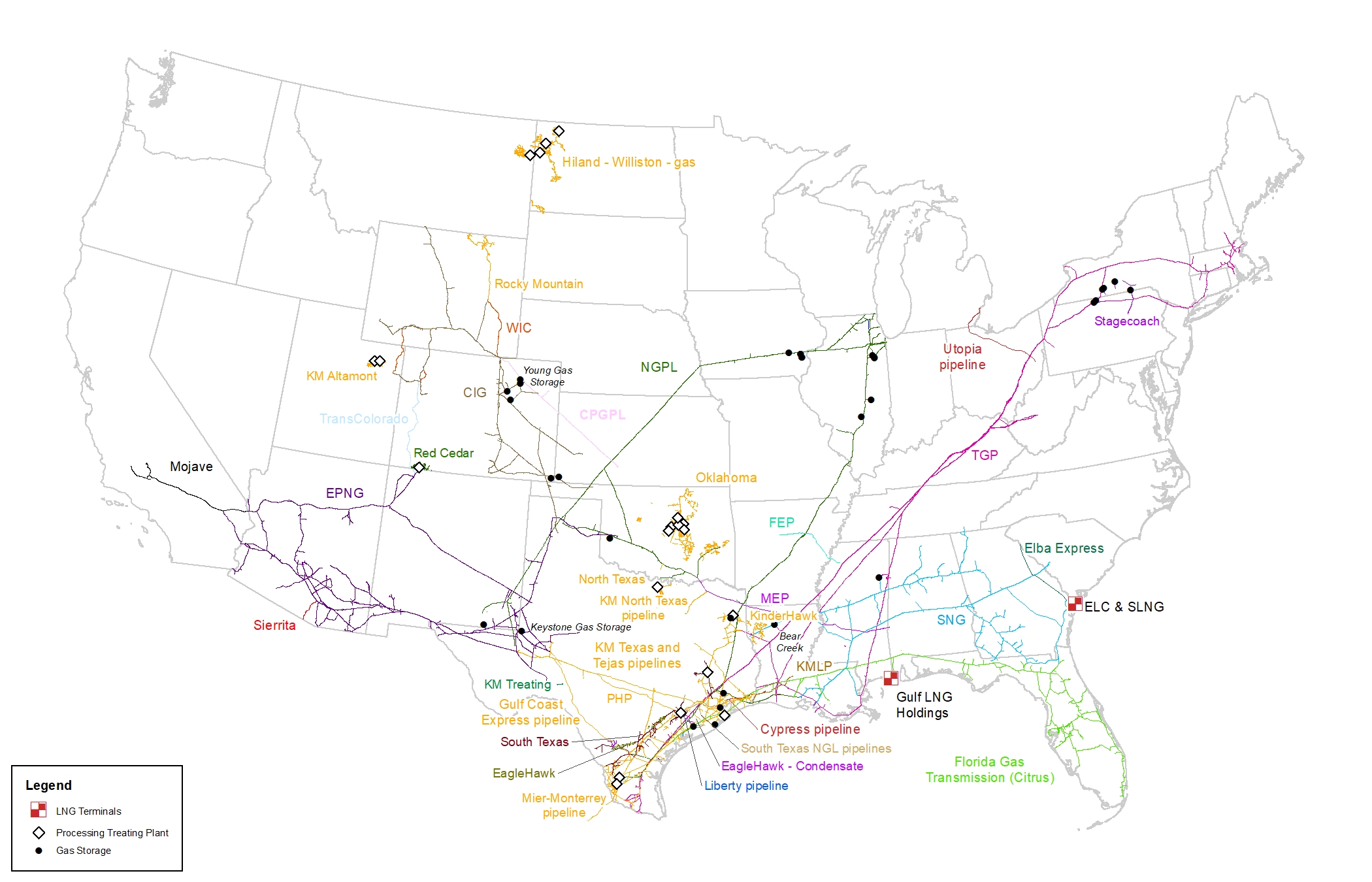
Our primary businesses in this segment consist of natural gas transportation, storage, sales, gathering, processing and treating, and various LNG services. Within this segment are: (i) approximately 45,000 miles of wholly owned natural gas pipelines and (ii) our equity interests in entities that have approximately 27,000 miles of natural gas pipelines, along with associated storage and supply lines for these transportation networks, which are strategically located throughout the North American natural gas pipeline grid. Our transportation network provides access to the major natural gas supply areas and consumers in the western U.S., Rocky Mountain, Midwest, Texas, Louisiana, Southeastern and Northeast regions. Our LNG terminal facilities also serve natural gas market areas in the southeast. The following tables summarize our significant Natural Gas Pipelines business segment assets as of December 31, 2022. The design capacity represents transmission, gathering, regasification or liquefaction capacity, depending on the nature of the asset.
| Asset | Ownership Interest | Miles of Pipeline | Design (Bcf/d) [(MBbl/d)] Capacity | Storage (Bcf) [Processing (Bcf/d)] Capacity | ||||||||||||||||||||||||||||
| East Region | ||||||||||||||||||||||||||||||||
| TGP(a) | 100 | % | 11,755 | 12.23 | 76 | |||||||||||||||||||||||||||
| NGPL | 37.5 | % | 9,105 | 7.84 | 288 | |||||||||||||||||||||||||||
| KMLP | 100 | % | 140 | 3.89 | — | |||||||||||||||||||||||||||
| Stagecoach | 100 | % | 185 | 3.22 | 41 | |||||||||||||||||||||||||||
| SNG(a) | 50 | % | 6,925 | 4.47 | 66 |
| Asset | Ownership Interest | Miles of Pipeline | Design (Bcf/d) [(MBbl/d)] Capacity | Storage (Bcf) [Processing (Bcf/d)] Capacity | ||||||||||||||||||||||||||||
| Florida Gas Transmission (Citrus) | 50 | % | 5,380 | 4.31 | — | |||||||||||||||||||||||||||
| MEP | 50 | % | 515 | 1.81 | — | |||||||||||||||||||||||||||
| Elba Express | 100 | % | 190 | 1.10 | — | |||||||||||||||||||||||||||
| FEP | 50 | % | 185 | 2.00 | — | |||||||||||||||||||||||||||
| Gulf LNG Holdings | 50 | % | 5 | 1.50 | 7 | |||||||||||||||||||||||||||
| SLNG | 100 | % | — | 1.76 | 12 | |||||||||||||||||||||||||||
| ELC | 25.5 | % | — | 0.35 | — | |||||||||||||||||||||||||||
| West Region | ||||||||||||||||||||||||||||||||
| EPNG/Mojave | 100 | % | 10,720 | 6.39 | 44 | |||||||||||||||||||||||||||
| CIG(b) | 100 | % | 4,300 | 6.00 | 38 | |||||||||||||||||||||||||||
| WIC | 100 | % | 850 | 3.61 | — | |||||||||||||||||||||||||||
| Ruby(c) | 50 | % | 685 | 1.53 | — | |||||||||||||||||||||||||||
| CPGPL | 100 | % | 415 | 1.20 | — | |||||||||||||||||||||||||||
| TransColorado | 100 | % | 310 | 0.80 | — | |||||||||||||||||||||||||||
| Sierrita | 35 | % | 60 | 0.52 | — | |||||||||||||||||||||||||||
| Young Gas Storage | 47.5 | % | 15 | — | 6 | |||||||||||||||||||||||||||
| Keystone Gas Storage | 100 | % | 15 | — | 6 | |||||||||||||||||||||||||||
| Midstream | ||||||||||||||||||||||||||||||||
| KM Texas and Tejas pipelines(d) | 100 | % | 5,915 | 8.30 | 136 [0.52] | |||||||||||||||||||||||||||
| Mier-Monterrey pipeline(d) | 100 | % | 90 | 0.65 | — | |||||||||||||||||||||||||||
| KM North Texas pipeline(d) | 100 | % | 80 | 0.33 | — | |||||||||||||||||||||||||||
| Gulf Coast Express pipeline | 34 | % | 530 | 2.00 | — | |||||||||||||||||||||||||||
| PHP | 26.67 | % | 435 | 2.10 | — | |||||||||||||||||||||||||||
| Oklahoma | ||||||||||||||||||||||||||||||||
| Oklahoma system | 100 | % | 3,225 | 0.73 | [0.09] | |||||||||||||||||||||||||||
| Cedar Cove | 70 | % | 120 | 0.03 | — | |||||||||||||||||||||||||||
| South Texas | ||||||||||||||||||||||||||||||||
| South Texas system | 100 | % | 1,155 | 1.93 | [1.02] | |||||||||||||||||||||||||||
| Webb/Duval gas gathering system | 91 | % | 145 | 0.15 | — | |||||||||||||||||||||||||||
| Camino Real | 100 | % | 75 | 0.15 | — | |||||||||||||||||||||||||||
| EagleHawk | 25 | % | 550 | 1.20 | — | |||||||||||||||||||||||||||
| KM Altamont | 100 | % | 1,535 | 0.13 | [0.1] | |||||||||||||||||||||||||||
| Red Cedar | 49 | % | 865 | 0.33 | — | |||||||||||||||||||||||||||
| Rocky Mountain | ||||||||||||||||||||||||||||||||
| Fort Union | 50 | % | 315 | 1.25 | — | |||||||||||||||||||||||||||
| Bighorn | 51 | % | 265 | 0.60 | — | |||||||||||||||||||||||||||
| KinderHawk | 100 | % | 535 | 2.35 | — | |||||||||||||||||||||||||||
| North Texas | 100 | % | 530 | 0.14 | — | |||||||||||||||||||||||||||
| KM Treating | 100 | % | — | — | — | |||||||||||||||||||||||||||
| Hiland - Williston - gas | 100 | % | 2,190 | 0.62 | [0.33] | |||||||||||||||||||||||||||
| Liberty pipeline | 50 | % | 85 | [140] | — | |||||||||||||||||||||||||||
| South Texas NGL pipelines(e) | 100 | % | 340 | [115] | — | |||||||||||||||||||||||||||
| Utopia pipeline | 50 | % | 265 | [50] | — | |||||||||||||||||||||||||||
| Cypress pipeline | 50 | % | 105 | [56] | — | |||||||||||||||||||||||||||
| EagleHawk - Condensate(f) | 25 | % | 410 | [220] | — |
(a)Includes proportionate share of storage capacity from our Bear Creek Storage joint venture.
(b)Includes leased pipeline miles and proportionate share of design and storage capacity from our WYCO joint venture.
(c)As of December 31, 2022, we operated Ruby and owned an effective 50% interest. Ruby is not included on the map above. On January 13, 2023, a bankruptcy court confirmed a plan of reorganization satisfactory to all interested parties regarding Ruby which involved the sale of Ruby, and subsequently we no longer hold an interest in Ruby. For further information regarding Ruby’s bankruptcy filing, see Note 4 “Gains and Losses on Divestitures, Impairments and Other Write-downs*—Ruby Chapter 11 Bankruptcy Filing.*”
(d)Collectively referred to as Texas intrastate natural gas pipeline operations.
(e)Includes proportionate share of design capacity from our Liberty pipeline joint venture.
(f)Asset also has storage capacity of 60 MBbl.
Segment Contracts
Revenues from our interstate natural gas pipelines, related storage facilities and LNG terminals are primarily received under long-term fixed contracts. To the extent practicable and economically feasible in light of our strategic plans and other factors, we generally attempt to mitigate risk of reduced volumes and prices by negotiating contracts with longer terms, with higher per-unit pricing and for a greater percentage of our available capacity. These long-term contracts are typically structured with a fixed fee reserving the right to transport or store natural gas and specify that we receive the majority of our fee for making the capacity available, whether or not the customer actually chooses to utilize that capacity. Similarly, our Texas Intrastate natural gas pipeline operations currently derive approximately 77% of its sales and transport margins from long-term transport and sales contracts. As contracts expire, we have additional exposure to the longer term trends in supply and demand for natural gas. As of December 31, 2022, the remaining weighted average contract life of our natural gas transportation contracts held by assets we own or have equity interests in (including intrastate pipelines’ sales portfolio) was approximately six years. Our LNG regasification and liquefaction and associated storage contracts are subscribed under long-term agreements with a weighted average remaining contract life of approximately 12 years.
Our Midstream assets provide natural gas gathering and processing services. These assets are mostly fee-based, and the revenues and earnings we realize from gathering natural gas, processing natural gas in order to remove NGL from the natural gas stream, and fractionating NGL into its base components, are affected by the volumes of natural gas made available to our systems. Such volumes are impacted by producer rig count and drilling activity. In addition to fee-based arrangements, some of which may include minimum volume commitments, we also provide some services based on percent-of-proceeds, percent-of-index and keep-whole contracts. Our service contracts may rely solely on a single type of arrangement, but more often they combine elements of two or more of the above, which helps us and our counterparties manage the extent to which each shares in the potential risks and benefits of changing commodity prices.
Segment Competition
The market for natural gas infrastructure is highly competitive, and new pipelines, storage facilities, treating facilities, and facilities for related services are currently being built to serve demand for natural gas in the domestic and export markets served by the pipelines in our Natural Gas Pipelines business segment. We compete with interstate and intrastate pipelines for connections to new markets and supplies and for transportation, processing, storage and treating services. We believe the principal elements of competition in our various markets are location, rates, terms of service, flexibility, availability of alternative forms of energy and reliability of service. From time to time, projects are proposed that compete with our existing assets. Whether or when any such projects would be built, or the extent of their impact on our operations or profitability is typically not known.
Shippers on our natural gas pipelines compete with other forms of energy available to their natural gas customers and end users, including oil, coal, nuclear and renewables such as hydro, wind and solar power, along with other evolving forms of renewable energy. Several factors influence the demand for natural gas, including price changes, the availability of supply, other forms of energy, the level of business activity, conservation, legislation and governmental regulations, the ability to convert to alternative fuels and weather.
Products Pipelines
Our Products Pipelines business segment consists of our refined petroleum products, crude oil and condensate pipelines, and associated terminals, our Southeast terminals, our condensate processing facility and our transmix processing facilities.
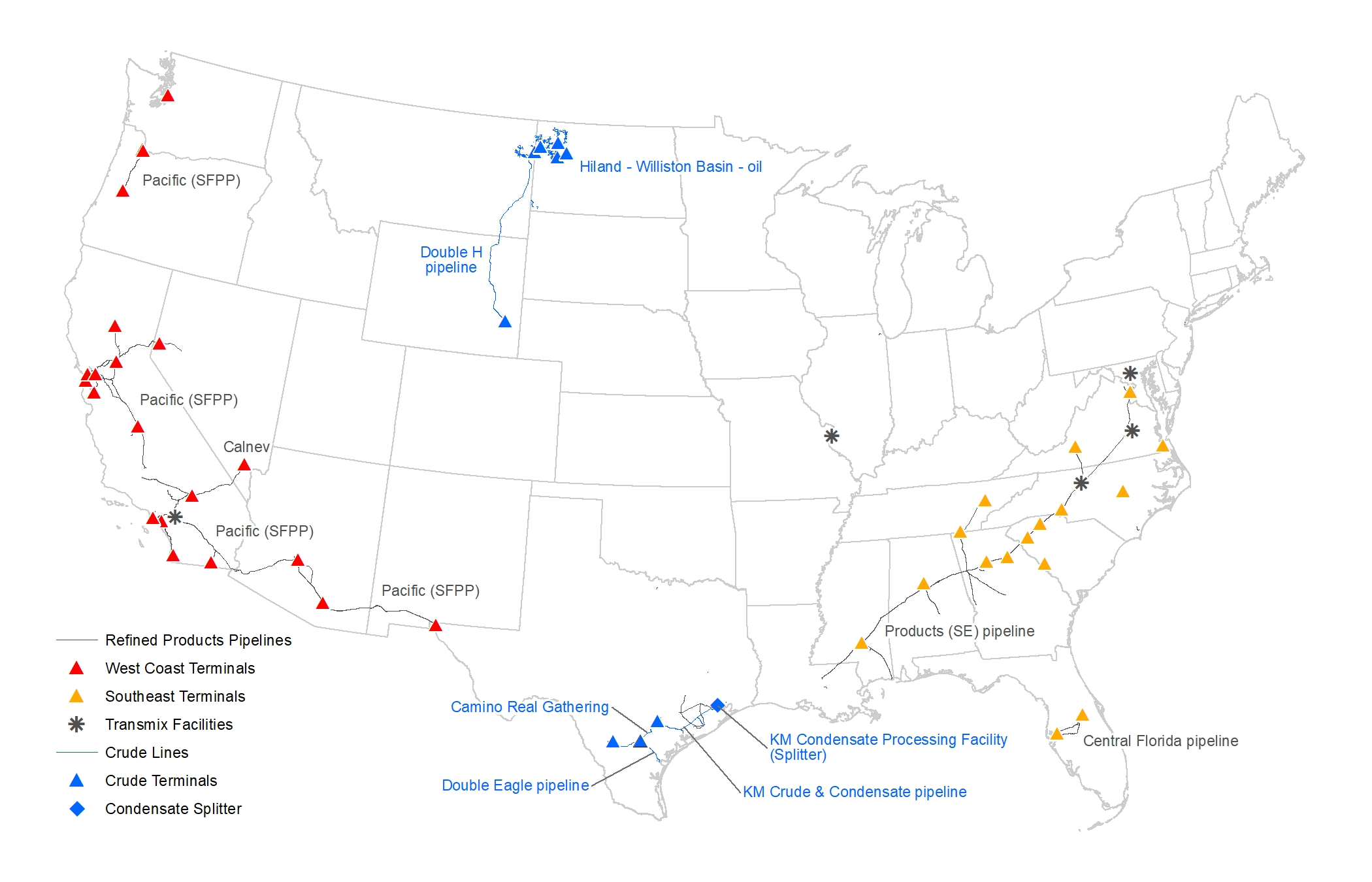
The following summarizes the significant Products Pipelines business segment assets that we own and operate as of December 31, 2022:
| Asset | Ownership Interest | Miles of Pipeline | Number of Terminals (a) or locations | Terminal Capacity (MMBbl) | ||||||||||||||||||||||||||||
| Crude & Condensate | ||||||||||||||||||||||||||||||||
| KM Crude & Condensate pipeline | 100 | % | 266 | 5 | 2.6 | |||||||||||||||||||||||||||
| Camino Real Gathering | 100 | % | 68 | 1 | 0.1 | |||||||||||||||||||||||||||
| Hiland - Williston Basin - oil(b) | 100 | % | 1,617 | 7 | 0.8 | |||||||||||||||||||||||||||
| Double H pipeline(b) | 100 | % | 512 | — | — | |||||||||||||||||||||||||||
| Double Eagle pipeline | 50 | % | 204 | 2 | 0.6 | |||||||||||||||||||||||||||
| KM Condensate Processing Facility (Splitter) | 100 | % | — | 1 | 2.1 | |||||||||||||||||||||||||||
| Southeast Refined Products | ||||||||||||||||||||||||||||||||
| Products (SE) pipeline | 51 | % | 3,186 | — | — | |||||||||||||||||||||||||||
| Central Florida pipeline | 100 | % | 206 | 2 | 2.6 | |||||||||||||||||||||||||||
| Southeast Terminals | 100 | % | — | 25 | 9.3 | |||||||||||||||||||||||||||
| Transmix Operations | 100 | % | — | 5 | 0.7 | |||||||||||||||||||||||||||
| West Coast Refined Products | ||||||||||||||||||||||||||||||||
| Pacific (SFPP) | 99.5 | % | 2,804 | 13 | 15.9 | |||||||||||||||||||||||||||
| Calnev | 100 | % | 566 | 2 | 2.1 | |||||||||||||||||||||||||||
| West Coast Terminals | 100 | % | 44 | 8 | 10.1 |
(a)The terminals provide services including short-term product storage, truck loading, vapor handling, additive injection, dye injection and ethanol blending.
(b)Collectively referred to as Bakken Crude assets.
Segment Contracts
The profitability of our refined petroleum products pipeline transportation business generally is driven by the volume of refined petroleum products that we transport and the prices we receive for our services. We also have 49 liquids terminals in this business segment that store fuels and offer blending services for ethanol and biodiesel. The transportation and storage volume levels are primarily driven by the demand for the refined petroleum products being shipped or stored. Demand for refined petroleum products tends to track in large measure demographic and economic growth, and, with the exception of periods of time with very high product prices or recessionary conditions, demand tends to be relatively stable. Because of that, we seek to own refined petroleum products pipelines and terminals located in, or that transport to, stable or growing markets and population centers. The prices for shipping are generally based on regulated tariffs that are adjusted annually based on changes in the U.S. Producer Price Index and a FERC index rate.
Our crude, condensate and refined petroleum products transportation services are primarily provided pursuant to (i) either FERC or state tariffs (which do not require contractual commitments) or (ii) long-term contracts that normally contain minimum volume commitments. Where we have long-term contracts, our settlement volumes are generally not sensitive to changing market conditions in the shorter term; however, the revenues and earnings we realize from our pipelines and terminals are affected by the volumes of crude oil, refined petroleum products and condensate available to our pipeline systems, which are impacted by the levels of oil and gas drilling activity and product demand in the respective regions that we serve. Our petroleum condensate processing facility splits condensate into its various components, such as light and heavy naphtha, under a long-term fee-based agreement with a major integrated oil company. Our crude oil marketing activities generate revenues from the sale and delivery of crude oil and condensate purchased either directly from producers or from others on the open market. In general, sales prices referenced in underlying purchase and sales contracts are market-based and include pricing differentials for factors such as delivery location or crude oil quality.
Segment Competition
Our Products Pipelines’ pipeline and terminal operations compete against proprietary pipelines and terminals owned and operated by major oil companies, other independent products pipelines and terminals, trucking and marine transportation firms (for short-haul movements of products). Our transmix operations compete with refineries owned by major oil companies and independent transmix facilities.
Terminals
Our Terminals business segment includes the operations of our refined petroleum product, chemical, renewable fuel and other liquid terminal facilities (other than those included in the Products Pipelines business segment) and all of our petroleum coke, metal and ores facilities. Our terminals are located primarily near large U.S. urban centers. We believe the location of our facilities and our ability to provide flexibility to customers help attract new and retain existing customers at our terminals and provide expansion opportunities. We often classify our terminal operations based on the handling of either liquids or dry-bulk material products. In addition, our Terminals’ marine operations include Jones Act-qualified product tankers that provide marine transportation of crude oil, condensate, refined petroleum products and renewable fuel between U.S. ports.
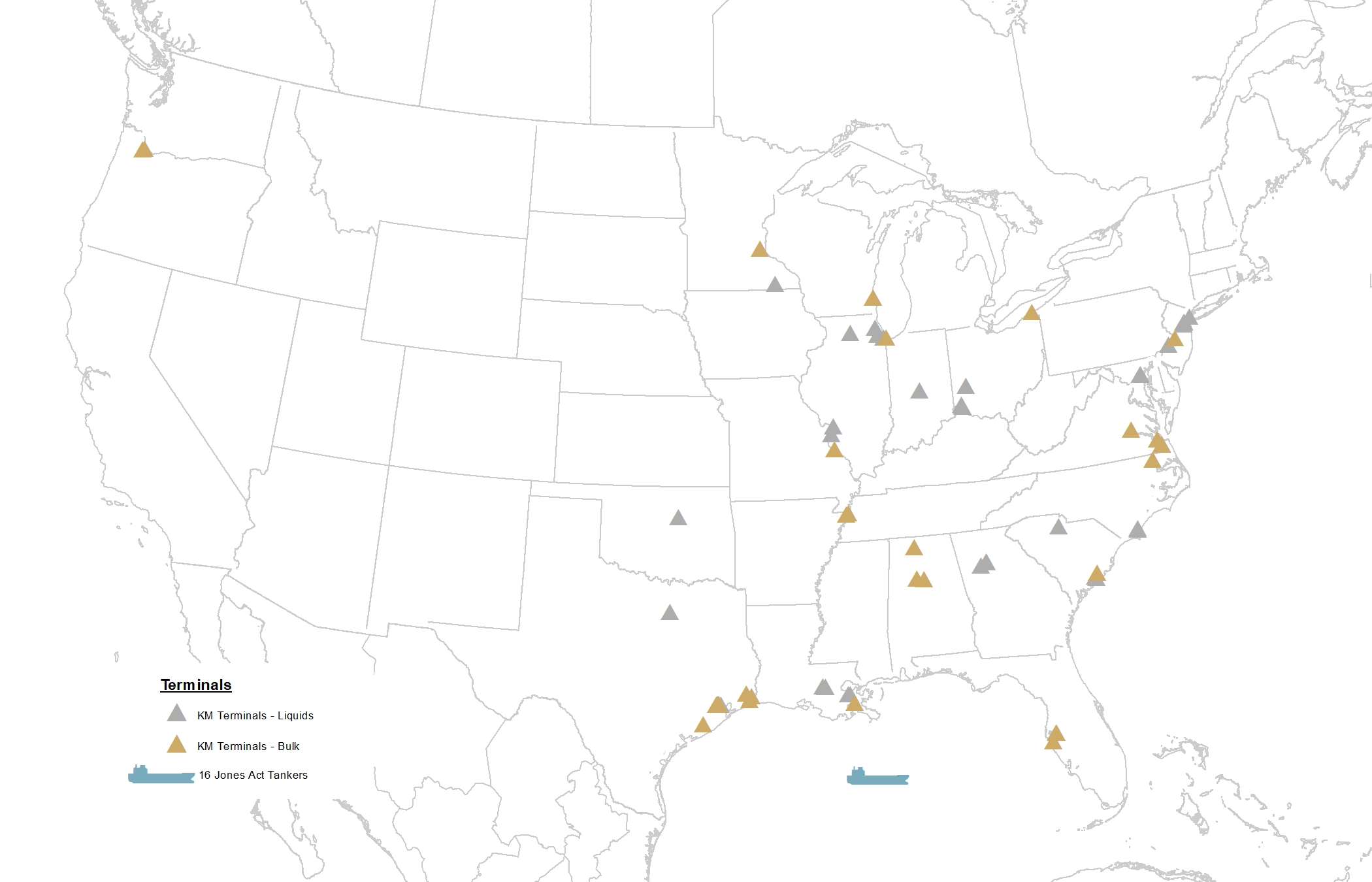
The following summarizes our Terminals business segment assets, as of December 31, 2022:
| Number | Capacity (MMBbl) | ||||||||||
| Liquids terminals | 47 | 77.8 | |||||||||
| Bulk terminals | 28 | — | |||||||||
| Jones Act-qualified tankers | 16 | 5.3 |
Segment Contracts
The factors impacting our Terminals business segment generally differ between liquid and bulk terminals. Our liquids terminals business generally has long-term contracts that require the customer to pay regardless of whether they use the capacity. Thus, similar to our natural gas pipelines business, our liquids terminals business is less sensitive to short-term changes in supply and demand. Therefore, the extent to which changes in these variables affect our terminals business in the near term is a function of the remaining length of the underlying service contracts (which on a weighted average basis is approximately three years), the extent to which revenues under the contracts are a function of the amount of product stored or transported, and the extent to which such contracts expire during any given period of time.
As with our refined petroleum products pipelines transportation business, the revenues from our bulk terminals business are generally driven by the volumes we handle and/or store, as well as the prices we receive for our services, which in turn are driven by the demand for the products being shipped or stored. While we handle and store a large variety of products in our bulk terminals, the primary products are petroleum coke, metals and ores. In addition, the majority of our contracts for this
business contain minimum volume guarantees and/or service exclusivity arrangements under which customers are required to utilize our terminals for all or a specified percentage of their handling and storage needs. The profitability of our minimum volume contracts is generally unaffected by short-term variation in economic conditions; however, to the extent we expect volumes above the minimum and/or have contracts which are volume-based, we can be sensitive to changing market conditions. To the extent practicable and economically feasible in light of our strategic plans and other factors, we generally attempt to mitigate the risk of reduced volumes and pricing by negotiating contracts with longer terms, with higher per-unit pricing and for a greater percentage of our available capacity. In addition, weather-related events, including hurricanes, may impact our facilities and access to them and, thus, the profitability of certain terminals for limited periods of time or, in relatively rare cases of severe damage to facilities, for longer periods.
Our Jones Act-qualified tankers provide marine transportation of crude oil, condensate, refined products and renewable fuel in the U.S. and are primarily operating pursuant to fixed price term charters with major integrated oil companies, major refiners and the U.S. Military Sealift Command.
Segment Competition
We are one of the largest independent operators of liquids terminals in the U.S., based on barrels of liquids terminaling capacity. Our liquids terminals compete with other publicly or privately held independent liquids terminals and terminals owned by oil, chemical, pipeline and refining companies. Our bulk terminals compete with numerous independent terminal operators, terminals owned by producers and distributors of bulk commodities, stevedoring companies and other industrial companies opting not to outsource terminaling services. In some locations, competitors are smaller, independent operators with lower cost structures. Our Jones Act-qualified product tankers compete with other Jones Act-qualified vessel fleets.
CO**2
Our CO2 business segment produces, transports and markets CO2 for use in enhanced oil recovery projects as a flooding medium for recovering crude oil from mature oil fields. We also own and operate oil and gas producing fields, and RNG, LNG and landfill GTE facilities. Our CO2 pipelines and related assets allow us to market a complete package of CO2 supply and transportation services to our customers.
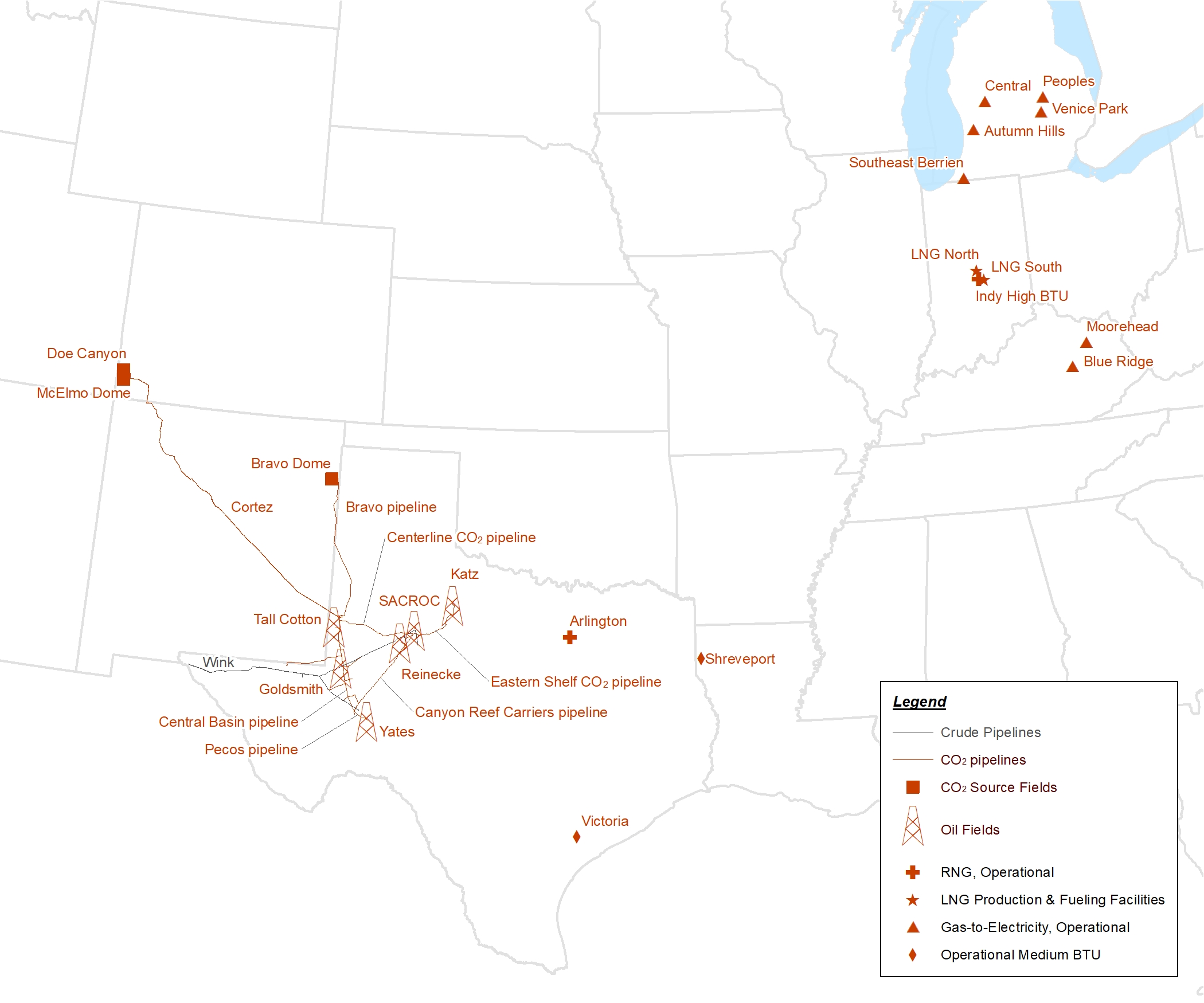
Source and Transportation Activities
CO2 Resource Interests
Our ownership of CO2 resources as of December 31, 2022 includes:
| Ownership Interest | Compression Capacity (Bcf/d) | |||||||||||||||||||
| McElmo Dome unit | 45 | % | 1.5 | |||||||||||||||||
| Doe Canyon Deep unit | 87 | % | 0.2 | |||||||||||||||||
| Bravo Dome unit(a) | 11 | % | 0.3 |
(a)We do not operate this unit.
CO2 and Crude Oil Pipelines
Industry demand for transportation on our CO2 pipelines is expected to remain stable for the foreseeable future.
Our ownership of CO2 and crude oil pipelines as of December 31, 2022 includes:
| Asset | Ownership Interest | Miles of Pipeline | Transport Capacity (Bcf/d) [(MBbl/d)] | |||||||||||||||||||||||
| CO****2 pipelines | ||||||||||||||||||||||||||
| Cortez pipeline | 53 | % | 569 | 1.5 | ||||||||||||||||||||||
| Central Basin pipeline | 100 | % | 337 | 0.7 | ||||||||||||||||||||||
| Bravo pipeline(a) | 13 | % | 218 | 0.4 | ||||||||||||||||||||||
| Canyon Reef Carriers pipeline | 98 | % | 163 | 0.3 | ||||||||||||||||||||||
| Centerline CO2 pipeline | 100 | % | 113 | 0.3 | ||||||||||||||||||||||
| Eastern Shelf CO2 pipeline | 100 | % | 98 | 0.1 | ||||||||||||||||||||||
| Pecos pipeline | 95 | % | 25 | 0.1 | ||||||||||||||||||||||
| Crude oil pipeline | ||||||||||||||||||||||||||
| Wink pipeline | 100 | % | 434 | [145] |
(a)We do not operate Bravo pipeline.
Oil, Gas and RNG Producing Activities
Oil and Gas Producing Interests
Our ownership interests in oil and gas producing fields as of December 31, 2022 include the following:
| Working Interest | KMI Gross Developed Acres | |||||||||||||
| SACROC | 97 | % | 50,316 | |||||||||||
| Yates | 50 | % | 9,576 | |||||||||||
| Goldsmith Landreth San Andres | 99 | % | 6,166 | |||||||||||
| Katz Strawn | 99 | % | 7,194 | |||||||||||
| Reinecke | 70 | % | 3,793 | |||||||||||
| Sharon Ridge(a) | 14 | % | 2,619 | |||||||||||
| Tall Cotton | 100 | % | 641 | |||||||||||
| MidCross(a) | 13 | % | 320 |
(a)We do not operate these fields.
Our oil and gas producing activities are not significant to KMI as a whole; therefore, we do not include the supplemental information on oil and gas producing activities under Accounting Standards Codification Topic 932, Extractive Activities – Oil and Gas.
Gas Plant Interests
Owned and operated gas plants as of December 31, 2022 include:
| Asset | Ownership Interest | Source | ||||||||||||
| Snyder gas plant(a) | 22 | % | The SACROC unit and neighboring CO2 projects, specifically the Sharon Ridge and Cogdell units | |||||||||||
| Diamond M gas plant | 51 | % | Snyder gas plant | |||||||||||
| North Snyder gas plant | 100 | % | Snyder gas plant |
(a)This is a working interest; in addition we have a 28% net profits interest.
RNG, LNG and GTE Facilities
Owned and operated RNG, LNG and GTE facilities as of December 31, 2022 include:
| Asset | Ownership Interest | Storage [Production] Generation Capacity(a) | Product | |||||||||||||||||||||||
| LNG Indy | 100 | % | 2 Bcf | LNG | ||||||||||||||||||||||
| Indy High BTU | 50 | % | [0.8 Bcf] | RNG | ||||||||||||||||||||||
| Southeast Berrien | 100 | % | 4.8 mW/h | GTE | ||||||||||||||||||||||
| Autumn Hills | 100 | % | 4.0 mW/h | GTE | ||||||||||||||||||||||
| Central | 100 | % | 4.0 mW/h | GTE | ||||||||||||||||||||||
| Venice Park | 100 | % | 6.4 mW/h | GTE | ||||||||||||||||||||||
| Peoples | 100 | % | 4.8 mW/h | GTE | ||||||||||||||||||||||
| Morehead | 100 | % | 1.6 mW/h | GTE | ||||||||||||||||||||||
| Blue Ridge | 100 | % | 1.6 mW/h | GTE | ||||||||||||||||||||||
| Arlington RNG | 100 | % | 7.3 mcf/d | RNG | ||||||||||||||||||||||
| Shreveport RNG(b) | — | % | 3.8 mcf/d | Medium BTU | ||||||||||||||||||||||
| Victoria RNG | 100 | % | 1.4 mcf/d | Medium BTU |
(a)GTE generation capacity is measured in megawatts per hour (mW/h). RNG and Medium British Thermal Units (BTU) gas capacities are measured in thousands of cubic feet per day (mcf/d).
(b)We operate Shreveport for a fee and receive royalties on RNG sales.
Segment Contracts
The CO2 source and transportation business primarily has third-party contracts with minimum volume requirements, which as of December 31, 2022 had a remaining average contract life of approximately eight years. CO2 sales contracts vary from customer to customer and have evolved over time as supply and demand conditions have changed. Our current sales contracts have generally provided for a delivered price tied to the price of crude oil, but with a floor price. Beginning in 2022, due to the floor price associated with a significant sales contract no longer being a component of the pricing formula, only a small percentage of our sales contracts will be based on a fixed fee or floor price. Our success in this portion of the CO2 business segment can be impacted by the demand for CO2. In the CO2 business segment’s oil and gas producing activities, we monitor the amount of capital we expend in relation to the amount of production that we expect to add. The revenues we receive from our crude oil and NGL sales are affected by the prices we realize from the sale of these products. Over the long-term, we tend to receive prices that are dictated by the demand and overall market price for these products. In the shorter term, however, market prices are likely not indicative of the revenues we will receive due to our risk management, or hedging, program, in which the prices to be realized for certain of our future sales quantities are fixed or bracketed through the use of financial derivative contracts, particularly for crude oil. See Item 7. “Management’s Discussion and Analysis of Financial Condition and Results of Operations—Results of Operations—Segment Earnings Results” for more information on crude oil sales prices.
Segment Competition
Our primary competitors for the sale of CO2 include suppliers that have an ownership interest in McElmo Dome, Bravo Dome and Sheep Mountain CO2 resources. Our ownership interests in the Central Basin, Cortez and Bravo pipelines are in direct competition with other CO2 pipelines. We compete with other interest owners in the McElmo Dome unit and the Bravo Dome unit for transportation of CO2 to the Denver City, Texas market area.
Major Customers
Our revenue is derived from a wide customer base. For each of the years ended December 31, 2022, 2021 and 2020, no revenues from transactions with a single external customer accounted for 10% or more of our total consolidated revenues. We do not believe that a loss of revenues from any single customer would have a material adverse effect on our business, financial position, results of operations or cash flows.
Industry Regulation
Our business operations are subject to extensive federal, state and local laws and regulations. Please read Item 1A. “Risk Factors—Risks Related to Regulation” for discussions of the risks we face related to regulation. For information related to pending regulatory proceedings, see Note 18 “Litigation and Environmental” to our consolidated financial statements.
Interstate Natural Gas Transportation and Storage Regulation
We operate our interstate natural gas pipeline and storage facilities subject to the jurisdiction of the FERC and the provisions of the Natural Gas Act of 1938 (NGA), the Natural Gas Policy Act of 1978 (NGPA), and the Energy Policy Act of 2005 (the Energy Policy Act). These laws give the FERC authority over the construction and operation of such facilities, including their modification, extension, enlargement and abandonment.
Pursuant to the NGA, the FERC also has authority over the rates charged and terms and conditions of services offered by interstate natural gas pipeline and storage companies. The FERC’s regulatory authority extends to establishing minimum and maximum rates for services and allows operators to discount or negotiate rates on a non-discriminatory basis. The rates, terms and conditions of service are set forth in posted tariffs approved by the FERC for each of our interstate natural gas pipeline and storage companies. Posted tariff rates are deemed just and reasonable and cannot be changed without FERC authorization following an evidentiary hearing or settlement. The FERC can initiate proceedings, on its own initiative or in response to a shipper complaint, that could result in a rate change or confirm existing rates. Negotiated rates provide certainty to the pipeline and the shipper of agreed-upon rates during the term of the transportation agreement, regardless of changes to the posted tariff rates. Negotiated rate agreements must be filed with the FERC or included in summary form in the pipeline’s tariff.
FERC regulations also include a comprehensive framework for market transparency and nondiscrimination, as well as the FERC’s prohibition against market manipulation. Under the Energy Policy Act and related regulations, it is unlawful for any entity, directly or indirectly in connection with the purchase or sale of natural gas subject to the jurisdiction of the FERC, or the purchase or sale of transportation services subject to the jurisdiction of the FERC, to engage in fraudulent conduct. FERC Standards of Conduct regulate, among other things, the manner in which interstate natural gas pipelines may interact with their marketing affiliates. The FERC’s market oversight and transparency regulations require annual reports of purchases or sales of natural gas meeting certain thresholds and criteria and certain public postings of information on scheduled volumes.
The FERC has authority to impose civil penalties of more than $1.3 million per day per violation. Should we fail to comply with all applicable statutes, rules, regulations, and orders administered by the FERC, we could be subject to substantial civil penalties and fines.
In addition to having jurisdiction over interstate natural gas pipelines and storage companies, the FERC also has jurisdiction over the interstate transportation and storage services that are provided by intrastate pipelines and storage companies under Section 311 of the NGPA. We have numerous intrastate pipelines and storage companies that provide interstate services pursuant to Section 311 of the NGPA. Under Section 311, along with the FERC’s implementing regulations, an intrastate pipeline may transport gas “on behalf of” an interstate pipeline company or any local distribution company served by an interstate pipeline, without becoming subject to the FERC’s broader regulatory authority under the NGA. These services must be provided on an open and nondiscriminatory basis, and the rates charged for these services may not exceed a “fair and equitable” level as determined by the FERC in periodic rate proceedings.
Interstate Common Carrier Refined Petroleum Products and Oil Pipeline Rate Regulation
Some of our U.S. refined petroleum products and crude oil gathering and transmission pipelines are interstate common carrier pipelines, subject to regulation by the FERC under the Interstate Commerce Act, or ICA. The ICA requires that we maintain our tariffs on file with the FERC. Those tariffs set forth the rates we charge for providing gathering or transportation services on our interstate common liquids carrier pipelines as well as the rules and regulations governing these services. The ICA requires, among other things, that rates on interstate common liquids carrier pipelines be “just and reasonable” and nondiscriminatory. The ICA permits interested persons to challenge newly proposed or changed rates and authorizes the FERC to suspend the effectiveness of such rates for a period of up to seven months and to investigate such rates. If, upon completion of an investigation, the FERC finds that the new or changed rate is unlawful, it is authorized to require the carrier to refund to shippers the difference between the revenues collected during the pendency of the investigation and the revenues that would have been collected based on the rate the FERC finds to be just and reasonable. The FERC also may investigate, upon complaint or on its own motion, rates that are already in effect and may order a carrier to change its rates prospectively. Upon an appropriate showing, a shipper may obtain reparations for damages sustained during the two years prior to the filing of a complaint.
Petroleum products and crude oil pipelines may change their rates within prescribed ceiling levels that are tied to an inflation index. Shippers may protest rate increases made within the ceiling levels, but such protests must show that the portion of the rate increase resulting from application of the index is substantially in excess of the pipeline’s increase in costs from the previous year. Generally, a petroleum products or crude oil pipeline will utilize the FERC’s indexing methodology to adjust its rates, as indexing serves as the default rate-adjustment mechanism. Cost-of-service based rates, market-based rates and settlement rates are alternatives to the default indexing mechanism and may be used in certain specified circumstances to change rates.
CPUC Rate Regulation
The intrastate common carrier operations of our refined products pipelines in California are subject to regulation by the CPUC under a “depreciated book plant” methodology, which is based on an original cost measure of investment. Intrastate tariffs filed by us with the CPUC have been established on the basis of revenues, expenses and investments allocated as applicable to the California intrastate portion of the refined products operations’ business. Tariff rates with respect to intrastate pipeline service in California are subject to challenge by protest by interested parties or by independent action of the CPUC.
Railroad Commission of Texas (RCT) Rate Regulation
The intrastate operations of our crude oil and liquids pipelines and natural gas pipelines and storage facilities in Texas are subject to regulation with respect to such intrastate transportation by the RCT. The RCT has the authority to regulate our rates, though it generally has not investigated the rates or practices of our intrastate pipelines in the absence of shipper complaints.
Mexico - Energy Regulatory Commission
The Mier-Monterrey Pipeline has a natural gas transportation permit granted by the Energy Regulatory Commission of Mexico (the Commission) that defines the conditions for the pipeline to carry out activity and provide natural gas transportation service. This permit expires in 2026, subject to an additional 15-year renewal term.
This permit establishes certain restrictive conditions, including without limitation: (i) compliance with the general conditions for the provision of natural gas transportation service; (ii) compliance with certain safety measures, contingency plans, maintenance plans and the official standards of Mexico regarding safety; (iii) compliance with the technical and economic specifications of the natural gas transportation system authorized by the Commission; (iv) compliance with certain technical studies established by the Commission; and (v) compliance with a minimum contributed capital not entitled to withdrawal of at least the equivalent of 10% of the investment proposed in the project.
Mexico - National Agency for Industrial and Operational Safety and Environmental Protection (ASEA)
ASEA regulates environmental compliance and industrial and operational safety. The Mier-Monterrey Pipeline must satisfy and maintain ASEA’s requirements, including compliance with certain safety measures, contingency plans, maintenance plans and the official standards of Mexico regarding safety, including a Safety Administration Program. The main environmental authorization for the operation of the pipeline is the Environmental Impact Authorization. The Mier-Monterrey Pipeline authorization expires at the end of March 2023, and is currently in the process of being renewed.
Pipeline Safety Regulation
We are also subject to pipeline safety regulations issued by PHMSA as well as any states that are certified by PHMSA to regulate pipeline safety for intrastate pipes in their respective states. These regulations apply to pipelines and pipeline facilities, including associated underground natural gas storage, terminals, and liquefied natural gas facilities. PHMSA regulations in particular, require us to develop and maintain pipeline integrity management programs to evaluate our pipelines and take additional measures to protect pipeline segments located in what are referred to as High Consequence Areas (HCAs) for both gas and liquid pipelines and Moderate Consequence Areas (MCAs) for gas pipelines, where a leak or rupture could potentially do the most harm.
In the past several years, PHMSA has passed several new rules that impose additional pipeline safety requirements including without limitation: (i) expanding certain integrity management program requirements outside of HCAs (with some exceptions) for both gas and hazardous liquid pipelines; (ii) requiring reconfirmation of the maximum allowable operating pressure (MAOP) by 2035 on certain gas pipelines; (iii) installation of remote control or automatic shut-off valves (or alternative equivalent technology) on certain newly constructed or replaced gas pipelines; (iv) increasing requirements for
corrosion control; and (v) providing additional prescriptive requirements that increase conservatism and specificity on the evaluation of discovered anomalies and their associated repair criteria.
OSHA
We are also subject to the requirements of federal and state agencies, including, where appropriate, the Occupational Safety and Health Administration (OSHA), that address, among other things, employee health and safety.
State and Local Regulation
Certain of our activities are subject to various state and local laws and regulations, as well as orders of regulatory bodies, governing a wide variety of matters, including marketing, production, pricing, pollution, pipeline safety, protection of the environment, and human health and safety.
Marine Operations
The operation of tankers and marine equipment create maritime obligations involving property, personnel and cargo under General Maritime Law. These obligations create a variety of risks including, among other things, the risk of collision, which may result in claims for personal injury, cargo, contract, pollution, third-party claims and property damages to vessels and facilities.
We are subject to the Jones Act and other federal laws that restrict maritime transportation (between U.S. departure and destination points) to vessels built and registered in the U.S. and owned and crewed by U.S. citizens. As a result, we monitor the foreign ownership of our common stock and under certain circumstances consistent with our certificate of incorporation, we have the right to redeem shares of our common stock owned by non-U.S. citizens. If we do not comply with such requirements, we would be prohibited from operating our vessels in U.S. coastwise trade, and under certain circumstances we would be deemed to have undertaken an unapproved foreign transfer, resulting in severe penalties, including permanent loss of U.S. coastwise trading rights for our vessels, fines or forfeiture of the vessels. Furthermore, from time to time, legislation has been introduced unsuccessfully in the U.S. Congress to amend the Jones Act to ease or remove the requirement that vessels operating between U.S. ports be built and registered in the U.S. and owned and crewed by U.S. citizens. If the Jones Act were amended in such fashion, we could face competition from foreign-flagged vessels.
In addition, the U.S. Coast Guard and the American Bureau of Shipping maintain the most stringent regime of vessel inspection in the world, which tends to result in higher regulatory compliance costs for U.S.-flag operators than for owners of vessels registered under foreign flags of convenience. The Jones Act and General Maritime Law also provide damage remedies for crew members injured in the service of the vessel arising from employer negligence or vessel unseaworthiness.
The Merchant Marine Act of 1936 is a federal law that provides the U.S. Secretary of Transportation, upon proclamation by the U.S. President of a national emergency or a threat to the national security, the authority to requisition or purchase any vessel or other watercraft owned by U.S. citizens (including us, provided that we are considered a U.S. citizen for this purpose). If one of our vessels were purchased or requisitioned by the U.S. government under this law, we would be entitled to be paid the fair market value of the vessel in the case of a purchase or, in the case of a requisition, the fair market value of charter hire. However, we would not be entitled to compensation for any consequential damages suffered as a result of such purchase or requisition.
Derivatives Regulation
We use energy commodity derivative contracts as part of our strategy to hedge our exposure to energy commodity market risk and other external risks in the ordinary course of business. The derivative contracts that we use include exchange-traded and OTC commodity financial instruments such as futures and options contracts, fixed price swaps and basis swaps. The Dodd-Frank Act requires the U.S. Commodity Futures Trading Commission (CFTC) and the SEC to promulgate rules and regulations establishing federal oversight and regulation of the OTC derivatives market and entities that participate in that market. In October 2020, the CFTC finalized one of the last remaining new rules pursuant to the Dodd-Frank Act that institutes broad new aggregate position limits for OTC swaps and futures and options traded on regulated exchanges. As finalized, these rules include exemptions for hedging positions.
Environmental Matters
Our business operations are subject to extensive federal, state and local laws and regulations relating to environmental protection and human health and safety. For example, if a leak, release or spill of liquid petroleum products, chemicals or other hazardous substances occurs at or from our pipelines, storage or other facilities, we may experience significant operational disruptions, and we may have to pay a significant amount to clean up the leak, release or spill, pay government penalties, address natural resource damages, compensate for human exposure or property damage, install costly pollution control equipment or a combination of these and other measures. Furthermore, new projects may require permits, approvals and environmental analyses under federal and state laws, including the Clean Water Act, the Clean Air Act, the National Environmental Policy Act and the Endangered Species Act, as well as Executive Orders focused on environmental justice considerations. The resulting costs and liabilities could be material to us, and increasing compliance costs under federal and state environmental laws for both new and existing facilities could require us to make significant capital expenditures. In general, the cost of environmental control at facilities is increasing and limiting the return on capital projects and the number of capital projects that are viable. Please read Item 1A. “Risk Factors—Risks Related to Regulation.”
In accordance with GAAP, we record liabilities for environmental matters when it is probable that obligations have been incurred and the amounts can be reasonably estimated. For information related to pending environmental matters, including our accruals of environmental reserves, see Note 18 “Litigation and Environmental” to our consolidated financial statements.
Hazardous and Non-Hazardous Waste
We generate both hazardous and non-hazardous wastes that are subject to the requirements of the Federal Resource Conservation and Recovery Act (RCRA) and comparable state statutes. RCRA establishes standards for the generation, treatment, storage, transport, and disposal of solid wastes, including hazardous wastes.
Superfund
The CERCLA or the Superfund law, and analogous state laws, impose joint and several liability, without regard to fault or the legality of the original conduct, on certain classes of potentially responsible persons for releases of hazardous substances into the environment. These persons include the owner or operator of a site and companies that disposed or arranged for the disposal of the hazardous substances found at the site. CERCLA authorizes the EPA and, in some cases, third parties to take actions in response to threats to public health or the environment and to seek to recover from the responsible classes of persons the costs they incur, including remediation costs. Additionally, CERCLA allows for the recovery of compensation for natural resource damages, if any. Although petroleum is excluded from CERCLA’s definition of a hazardous substance, in the course of our ordinary operations, we have and will generate materials that may fall within the definition of “hazardous substance.” By operation of law, if we are determined to be a potentially responsible person, we may be responsible under CERCLA for all or part of the costs required to evaluate and remediate sites at which such materials are present, in addition to compensation for natural resource damages, if any.
Clean Air Act
Our operations are subject to the Clean Air Act, its implementing regulations, and analogous state statutes and regulations. The EPA regulations under the Clean Air Act contain requirements for the monitoring, reporting, and control of greenhouse gas (GHG) emissions from stationary sources. For further information, see “—Climate Change” below.
Clean Water Act
Our operations can result in the discharge of pollutants. The Federal Water Pollution Control Act of 1972, as amended, also known as the Clean Water Act, and analogous state laws impose restrictions and controls regarding the discharge of fills and pollutants into waters of the U.S. The discharge of fills and pollutants into regulated waters is prohibited, except in accordance with the terms of a permit issued by applicable federal or state authorities. The Oil Pollution Act was enacted in 1990 and amends provisions of the Clean Water Act pertaining to prevention of and response to oil spills. Spill prevention, control and countermeasure requirements of the Clean Water Act and some state laws require containment and similar structures to help prevent contamination of navigable waters in the event of an overflow or release of oil.
EPA Revisions to Ozone National Ambient Air Quality Standard (NAAQS)
As required by the Clean Air Act, the EPA establishes National Ambient Air Quality Standards (NAAQS) for how much pollution is permissible, and the states then have to adopt rules so their air quality meets the NAAQS. In October 2015, the
EPA published a rule lowering the ground level ozone NAAQS from 75 parts per billion (ppb) to a more stringent 70 ppb standard. This change triggered a process under which the EPA designated the areas of the country in or out of compliance with the 2015 standards. In December 2020, EPA completed a review of the ozone NAAQS and published a rule retaining the 2015 standards. State rules implementing the NAAQS, including those existing or proposed in Colorado and New Mexico, require the installation of more stringent air pollution controls on newly-installed equipment and possibly require the retrofitting of existing KMI facilities with air pollution controls. These rules will have financial impacts to our Natural Gas Business Unit. Future state rules could have financial impacts on multiple business units.
Climate Change
Due to concern over climate change, numerous proposals to monitor and limit emissions of GHGs have been made and are likely to continue to be made at the federal, state and local levels of government. Methane, a primary component of natural gas, and CO2, which is naturally occurring and also a byproduct of burning natural gas, are examples of GHGs. Various laws and regulations exist or are under development to regulate the emission of such GHGs, including the EPA programs to report GHG emissions and state actions to develop statewide or regional programs. The U.S. Congress has in the past considered legislation to reduce emissions of GHGs.
Beginning in 2009, EPA published several findings and rulemakings under the Clean Air Act requiring the permitting and reporting of certain GHGs, including CO2 and methane. Certain of our facilities are subject to these requirements. Operational or physical changes to existing facilities could require those facilities to comply with these requirements. In addition, proposed regulatory changes, if enacted, would require almost all existing oil and natural gas facilities to reduce GHG emissions.
At the state level, more than one-third of the states, either individually or through multi-state regional initiatives, already have begun implementing legal measures to reduce emissions of GHGs, such as through establishment of GHG reduction targets or regional GHG “cap and trade” programs. It is possible that sources such as our gas-fueled compressors and processing plants could become subject to these state GHG reduction regulations. Various states are also proposing or have implemented stricter regulations for reporting, monitoring or reducing GHGs that go beyond the requirements of the EPA. Compliance with state rules could require additional expenditures, above and beyond those spent to comply with the November 2021 proposed EPA GHG rules for new and existing sources.
Because our operations, including the compressor stations and processing plants, emit various types of GHGs, primarily methane and CO2, such new legislation or regulation could increase the costs related to operating and maintaining our facilities. Depending on the particular law, regulation or program, we or our subsidiaries could be required to incur capital expenditures for installing new monitoring equipment or emission controls on the facilities, acquire and surrender allowances for the GHG emissions, pay taxes related to the GHG emissions and administer and manage a more comprehensive GHG emissions program. We are not able at this time to estimate such increased costs; however, as is the case with similarly situated companies in our industry, they could be significant to us. While we may be able to include some or all of such increased costs in the rates charged by our or our subsidiaries’ pipelines, recovery of costs is uncertain in all cases and may depend on events beyond our control, including the outcome of future rate proceedings before the FERC or other regulatory bodies, and the provisions of any final legislation or other regulations. Any of the foregoing could have an adverse effect on our business, financial position, results of operations and prospects.
Because the combustion of natural gas produces lower GHG emissions per unit of energy than competing fossil fuels, cap-and-trade legislation or EPA regulatory initiatives to reduce GHGs could stimulate demand for natural gas by increasing the relative cost of competing fuels such as coal and oil. In addition, we anticipate that GHG regulations will increase demand for carbon sequestration technologies, such as the techniques we have successfully demonstrated in our enhanced oil recovery operations within our CO2 business segment. However, these potential positive effects on our markets may be offset if these same regulations also cause the cost of natural gas to increase relative to competing non-fossil fuels. Although we currently cannot predict the magnitude and direction of these impacts, GHG regulations could have material adverse effects on our business, financial position, results of operations or cash flows.
Department of Homeland Security
The Department of Homeland Security, referred to in this report as the DHS, has regulatory authority over security at certain high-risk chemical facilities. The DHS has promulgated the Chemical Facility Anti-Terrorism Standards and required all high-risk chemical and industrial facilities, including oil and gas facilities, to comply with the regulatory requirements of these standards. This process includes completing security vulnerability assessments, developing site security plans, and implementing protective measures necessary to meet DHS-defined, risk-based performance standards. The DHS has not provided final notice to all facilities that it determines to be high risk and subject to the rule; therefore, neither the extent to
which our facilities may be subject to coverage by the rules nor the associated costs to comply can currently be determined, but it is possible that such costs could be substantial.
Cybersecurity
In response to ongoing cybersecurity threats affecting the pipeline industry, the DHS’s Transportation Safety Administration, or TSA, has issued a series of security directives setting forth specific elements that all pipeline owners and operators must include in their cybersecurity planning and their reporting of any incidents. These security directives require, among other things, that pipeline owners comply with mandatory reporting measures; designate a cybersecurity coordinator; provide vulnerability assessments; ensure compliance with certain cybersecurity requirements; establish and implement a TSA-approved Cybersecurity Implementation Plan; develop and maintain a Cybersecurity Incident Response Plan; and establish a Cybersecurity Assessment Program, and submit an annual plan that describes how owners will assess the effectiveness of cybersecurity measures.
In addition, PHMSA requires reporting of any event that involves a release from or the shutdown of a pipeline, including because of a cyber-attack. The SEC has issued guidance outlining its position on cybersecurity disclosure requirements that apply under federal securities laws, but new binding rules imposing affirmative reporting requirements were proposed in March 2022 and are expected to be finalized in 2023. Also under development is the Cyber Incident Reporting for Critical Infrastructure Act of 2022 (CIRCIA), a law concerning the reporting of cyber incidents and ransomware payments that was signed into law in early 2022 and is expected to take effect in early 2024.
Human Capital
In managing our human capital resources, we use a strategic approach to building a diverse, inclusive, and respectful workplace. Our human resources department provides expertise and tools to attract, develop, and retain diverse talent and support our employees’ career and development goals. Our leadership teams have plans in place to enhance diversity and equality of opportunity in hiring, development, and promotions. We value our employees’ opinions and encourage them to engage with management and ask questions on topics such as our goals, challenges and employee concerns.
We employed 10,525 full-time personnel at December 31, 2022, including approximately 888 full-time hourly personnel at certain terminals and pipelines covered by collective bargaining agreements that expire between 2023 and 2027. We consider relations with our employees to be good.
We value the safety of our workforce and integrate a culture of safety, emergency preparedness and environmental responsibility through our operations management system (OMS). Our OMS conforms to common industry standards and establishes a framework that helps us (i) provide employees and contractors with a safe work environment; (ii) comply with laws, rules, regulations, policies, and procedures; and (iii) identify opportunities to improve. Although our ultimate target is zero incidents, we also have three non-zero employee safety performance targets as follows:
| Non-zero employee safety performance target | 2022 Company-wide TRIR (excluding COVID-19 cases) | |||||||
| Outperform the annual industry average total recordable incident rate (TRIR) | 1.9 (0.8) | |||||||
| Outperform our own three-year TRIR average | ||||||||
| Improve our company-wide employee TRIR from 1.0 in the baseline year 2019 to 0.7 by 2024 |
We seek to constantly improve our contractor TRIR performance through initiatives to address recent incident trends and new best practices.
Our board of directors’ nominating and governance committee is responsible for planning for succession in the senior management ranks of the Company, including the office of chief executive officer. The chief executive officer shall report to the committee, generally at the time of the regularly scheduled third quarter board of directors meeting in each year, regarding the processes in place to identify talent within and outside the Company to succeed to senior management positions and the information developed during the current calendar year pursuant to those processes. As part of our annual succession planning process, we identify minority and female candidates to include in the plan for senior positions. Management reviews its succession plan, including a discussion on development opportunities for potential successors, with the nominating and governance committee of our board of directors annually.
We consider employee diversity an asset and support equal opportunity employment. We take affirmative steps to employ and advance in employment all persons without regard to their race/ethnicity; sex; sexual orientation; gender, including gender identity and expression; veteran status; disability; or other protected categories, and base employment decisions solely on valid job requirements. We are committed to a harassment free workplace, supported with online and face-to-face workplace harassment and discrimination prevention training for our employees. Employees and supervisors review our harassment and discrimination prevention policy every two years as part of our policy renewal training.
Our employees are an integral part of our success, and we value their career development. We encourage and support professional development and learning for our employees by offering workforce training, tuition reimbursement, leadership and other development programs. These programs help improve recruitment, development, and retention. We support our employees’ ongoing career goals and development through several programs. These programs help maximize our employees’ potential and give them the skills they need to further enhance their careers.
Our compensation program is linked to long- and short-term strategic financial and operational objectives, including environmental, safety, and compliance targets. Compensation includes competitive base salaries in the markets in which we operate and competitive benefits, including retirement plans, opportunities for annual bonuses, and, for eligible employees, long-term incentives and an employee stock purchase plan.
Properties and Rights-of-Way
We believe we generally have satisfactory title to the properties we own and use in our businesses, subject to liens for current taxes, liens incident to minor encumbrances, and easements and restrictions, which do not materially detract from the value of such property, the interests in those properties or the use of such properties in our businesses. Our terminals, storage facilities, treating and processing plants, regulator and compressor stations, oil and gas wells, offices and related facilities are located on real property owned or leased by us. In some cases, the real property we lease is on federal, state or local government land.
We generally do not own the land on which our pipelines are constructed. Instead, we obtain and maintain rights to construct and operate the pipelines on other people’s land generally under agreements that are perpetual or provide for renewal rights. Substantially all of our pipelines are constructed on rights-of-way granted by the apparent record owners of such property. In many instances, lands over which rights-of-way have been obtained are subject to prior liens that have not been subordinated to the right-of-way grants. In some cases, not all of the apparent record owners have joined in the right-of-way grants, but in substantially all such cases, signatures of the owners of a majority of the interests have been obtained. Permits have been obtained from public authorities to cross over or under, or to lay facilities in or along, water courses, county roads, municipal streets and state highways, and in some instances, such permits are revocable at the election of the grantor, or, the pipeline may be required to move its facilities at its own expense. Permits also have been obtained from railroad companies to run along or cross over or under lands or rights-of-way, many of which are also revocable at the grantor’s election. Some such permits require annual or other periodic payments. In a few minor cases, property for pipeline purposes was purchased by the Company.
Financial Information about Geographic Areas
For geographic information concerning our assets and operations, see Note 16 “Reportable Segments” to our consolidated financial statements.
Available Information
We make available free of charge on or through our internet website, at www.kindermorgan.com, our annual reports on Form 10-K, quarterly reports on Form 10-Q, current reports on Form 8-K, and amendments to those reports filed or furnished pursuant to Section 13(a) or 15(d) of the Securities Exchange Act of 1934 as soon as reasonably practicable after we electronically file such material with, or furnish it to, the SEC. The SEC maintains an internet site that contains reports, proxy and information statements, and other information regarding issuers that file electronically with the SEC at http://www.sec.gov. The information contained on or connected to our internet website is not incorporated by reference into this Form 10-K and should not be considered part of this or any other report that we file with or furnish to the SEC.