 filings.tools
Coca-Cola 10-K 2018-12-31
Filed 2019-02-21. 22 sections, 814K characters. Original on sec.gov · Markdown · JSON
Cover and table of contents
10-K 1 a2018123110-k.htm 10-K
UNITED STATES
SECURITIES AND EXCHANGE COMMISSION
Washington, D.C. 20549
FORM 10-K
(Mark One)
| ý | ANNUAL REPORT PURSUANT TO SECTION 13 OR 15(d) OF THE SECURITIES EXCHANGE ACT OF 1934 |
For the fiscal year ended December 31, 2018
OR
| o | TRANSITION REPORT PURSUANT TO SECTION 13 OR 15(d) OF THE SECURITIES EXCHANGE ACT OF 1934 |
For the transition period from to
Commission File Number 001-02217

(Exact name of Registrant as specified in its charter)
| Delaware (State or other jurisdiction of incorporation or organization) | 58-0628465 (I.R.S. Employer Identification No.) | |
| One Coca-Cola Plaza, Atlanta, Georgia (Address of principal executive offices) | 30313 (Zip Code) |
Registrant's telephone number, including area code: (404) 676-2121
Securities registered pursuant to Section 12(b) of the Act:
| Title of each class | Name of each exchange on which registered | |
| Common Stock, $0.25 Par Value | New York Stock Exchange | |
| Floating Rate Notes Due 2019 | New York Stock Exchange | |
| Floating Rate Notes Due 2019 | New York Stock Exchange | |
| 0.000% Notes Due 2021 | New York Stock Exchange | |
| 1.125% Notes Due 2022 | New York Stock Exchange | |
| 0.75% Notes Due 2023 | New York Stock Exchange | |
| 0.500% Notes Due 2024 | New York Stock Exchange | |
| 1.875% Notes Due 2026 | New York Stock Exchange | |
| 1.125% Notes Due 2027 | New York Stock Exchange | |
| 1.625% Notes Due 2035 | New York Stock Exchange | |
| 1.100% Notes Due 2036 | New York Stock Exchange |
Securities registered pursuant to Section 12(g) of the Act: None
Indicate by check mark if the Registrant is a well-known seasoned issuer, as defined in Rule 405 of the Securities Act. Yes ý No o
Indicate by check mark if the Registrant is not required to file reports pursuant to Section 13 or Section 15(d) of the Exchange Act. Yes o No ý
Indicate by check mark whether the Registrant (1) has filed all reports required to be filed by Section 13 or 15(d) of the Securities Exchange Act of 1934 during the preceding 12 months and (2) has been subject to such filing requirements for the past 90 days. Yes ý No o
Indicate by check mark whether the Registrant has submitted electronically every Interactive Data File required to be submitted pursuant to Rule 405 of Regulation S-T (§ 232.405 of this chapter) during the preceding 12 months (or for such shorter period that the Registrant was required to submit such files). Yes ý No o
Indicate by check mark if disclosure of delinquent filers pursuant to Item 405 of Regulation S-K (§ 229.405 of this chapter) is not contained herein, and will not be contained, to the best of Registrant's knowledge, in definitive proxy or information statements incorporated by reference in Part III of this Form 10-K or any amendment to this Form 10‑K. o
Indicate by check mark whether the Registrant is a large accelerated filer, an accelerated filer, a non-accelerated filer, a smaller reporting company or an emerging growth company. See the definitions of "large accelerated filer," "accelerated filer," "smaller reporting company" and "emerging growth company" in Rule 12b-2 of the Exchange Act.
| Large accelerated filer ý | Accelerated filer o | Non-accelerated filer o | Smaller reporting company o | Emerging growth company o |
| If an emerging growth company, indicate by check mark if the Registrant has elected not to use the extended transition period for complying with any new or revised financial accounting standards provided pursuant to Section 13(a) of the Exchange Act. o |
Indicate by check mark if the Registrant is a shell company (as defined in Rule 12b-2 of the Exchange Act). Yes o No ý
The aggregate market value of the common equity held by non-affiliates of the Registrant (assuming for these purposes, but without conceding, that all executive officers and Directors are "affiliates" of the Registrant) as of June 29, 2018, the last business day of the Registrant's most recently completed second fiscal quarter, was $184,986,760,847 (based on the closing sale price of the Registrant's Common Stock on that date as reported on the New York Stock Exchange).
The number of shares outstanding of the Registrant's Common Stock as of February 15, 2019, was 4,275,340,031.
DOCUMENTS INCORPORATED BY REFERENCE
Portions of the Company's Proxy Statement for the Annual Meeting of Shareowners to be held on April 24, 2019, are incorporated by reference in Part III.
THE COCA-COLA COMPANY AND SUBSIDIARIES
Table of Contents
FORWARD-LOOKING STATEMENTS
This report contains information that may constitute "forward-looking statements." Generally, the words "believe," "expect," "intend," "estimate," "anticipate," "project," "will" and similar expressions identify forward-looking statements, which generally are not historical in nature. However, the absence of these words or similar expressions does not mean that a statement is not forward-looking. All statements that address operating performance, events or developments that we expect or anticipate will occur in the future — including statements relating to volume growth, share of sales and earnings per share growth, and statements expressing general views about future operating results — are forward-looking statements. Management believes that these forward-looking statements are reasonable as and when made. However, caution should be taken not to place undue reliance on any such forward-looking statements because such statements speak only as of the date when made. Our Company undertakes no obligation to publicly update or revise any forward-looking statements, whether as a result of new information, future events or otherwise, except as required by law. In addition, forward-looking statements are subject to certain risks and uncertainties that could cause our Company's actual results to differ materially from historical experience and our present expectations or projections. These risks and uncertainties include, but are not limited to, those described in Part I, "Item 1A. Risk Factors" and elsewhere in this report and those described from time to time in our future reports filed with the Securities and Exchange Commission.
PART I
Item 1. BUSINESS
In this report, the terms "The Coca-Cola Company," "Company," "we," "us" and "our" mean The Coca-Cola Company and all entities included in our consolidated financial statements.
General
The Coca-Cola Company is the world's largest nonalcoholic beverage company. We own or license and market more than 500 nonalcoholic beverage brands, which we group into the following category clusters: sparkling soft drinks; water, enhanced water and sports drinks; juice, dairy and plant-based beverages; tea and coffee; and energy drinks. We own and market four of the world's top five nonalcoholic sparkling soft drink brands: Coca-Cola, Diet Coke, Fanta and Sprite. Finished beverage products bearing our trademarks, sold in the United States since 1886, are now sold in more than 200 countries and territories.
We make our branded beverage products available to consumers throughout the world through our network of independent bottling partners, distributors, wholesalers and retailers as well as Company-owned or -controlled bottling and distribution operations — the world's largest beverage distribution system. Beverages bearing trademarks owned by or licensed to us account for more than 1.9 billion of the approximately 61 billion servings of all beverages consumed worldwide every day.
We believe our success depends on our ability to connect with consumers by providing them with a wide variety of beverage options to meet their desires, needs and lifestyles. Our success further depends on the ability of our people to execute effectively, every day.
Our objective is to use our Company's assets — our brands, financial strength, unrivaled distribution system, global reach, and the talent and strong commitment of our management and associates — to become more competitive and to accelerate growth in a manner that creates value for our shareowners.
We were incorporated in September 1919 under the laws of the State of Delaware and succeeded to the business of a Georgia corporation with the same name that had been organized in 1892.
Operating Segments
The Company's operating structure is the basis for our internal financial reporting. As of December 31, 2018, our operating structure included the following operating segments, which are sometimes referred to as "operating groups" or "groups":
| • | Europe, Middle East and Africa |
| • | Latin America |
| • | North America |
| • | Asia Pacific |
| • | Bottling Investments |
Our operating structure as of December 31, 2018 also included Corporate, which consists of two components: (1) a center focused on strategic initiatives, policy and governance and (2) an enabling services organization focused on both simplifying and standardizing key transactional processes and providing support to business units through global centers of excellence.
In January 2019, we established a new operating segment, Global Ventures, which includes the results of Costa Limited ("Costa"), which we acquired on January 3, 2019, and the results of our innocent and Doğadan businesses as well as fees earned pursuant to distribution coordination agreements between the Company and Monster Beverage Corporation ("Monster"). Refer to Note 22 of Notes to Consolidated Financial Statements set forth in Part II, "Item 8. Financial Statements and Supplementary Data" of this report for information regarding the Costa acquisition.
Except to the extent that differences among operating segments are material to an understanding of our business taken as a whole, the description of our business in this report is presented on a consolidated basis.
Products and Brands
As used in this report:
| • | "concentrates" means flavoring ingredients and, depending on the product, sweeteners used to prepare syrups or finished beverages and includes powders or minerals for purified water products; |
| • | "syrups" means beverage ingredients produced by combining concentrates and, depending on the product, sweeteners and added water; |
| • | "fountain syrups" means syrups that are sold to fountain retailers, such as restaurants and convenience stores, which use dispensing equipment to mix the syrups with sparkling or still water at the time of purchase to produce finished beverages that are served in cups or glasses for immediate consumption; |
| • | "Company Trademark Beverages" means beverages bearing our trademarks and certain other beverage products bearing trademarks licensed to us by third parties for which we provide marketing support and from the sale of which we derive economic benefit; and |
| • | "Trademark Coca-Cola Beverages" or "Trademark Coca-Cola" means beverages bearing the trademark Coca-Cola or any trademark that includes Coca-Cola or Coke (that is, Coca-Cola, Coca-Cola Life, Diet Coke/Coca-Cola Light and Coca-Cola Zero Sugar and all their variations and any line extensions, including caffeine free Diet Coke, Cherry Coke, etc.). Likewise, when we use the capitalized word "Trademark" together with the name of one of our other beverage products (such as "Trademark Fanta," "Trademark Sprite" or "Trademark Simply"), we mean beverages bearing the indicated trademark (that is, Fanta, Sprite or Simply, respectively) and all its variations and line extensions (such that "Trademark Fanta" includes Fanta Orange, Fanta Zero Orange, Fanta Apple, etc.; "Trademark Sprite" includes Sprite, Diet Sprite, Sprite Zero, Sprite Light, etc.; and "Trademark Simply" includes Simply Orange, Simply Apple, Simply Grapefruit, etc.). |
Our Company markets, manufactures and sells:
| • | beverage concentrates, sometimes referred to as "beverage bases," and syrups, including fountain syrups (we refer to this part of our business as our "concentrate business" or "concentrate operations"); and |
| • | finished sparkling soft drinks and other nonalcoholic beverages (we refer to this part of our business as our "finished product business" or "finished product operations"). |
Generally, finished product operations generate higher net operating revenues but lower gross profit margins than concentrate operations.
In our domestic and international concentrate operations, we typically generate net operating revenues by selling concentrates, syrups and certain finished beverages to authorized bottling operations (to which we typically refer as our "bottlers" or our "bottling partners"). Our bottling partners either combine the concentrates with sweeteners (depending on the product), still water and/or sparkling water, or combine the syrups with sparkling water to produce finished beverages. The finished beverages are packaged in authorized containers, such as cans and refillable and nonrefillable glass and plastic bottles, bearing our trademarks or trademarks licensed to us and are then sold to retailers directly or, in some cases, through wholesalers or other bottlers. In addition, outside the United States, our bottling partners are typically authorized to manufacture fountain syrups, using our concentrate, which they sell to fountain retailers for use in producing beverages for immediate consumption, or to authorized fountain wholesalers who in turn sell and distribute the fountain syrups to fountain retailers. Our concentrate operations are included in our geographic operating segments.
Our finished product operations generate net operating revenues by selling sparkling soft drinks and a variety of other finished nonalcoholic beverages, such as water, enhanced water and sports drinks; juice, dairy and plant-based beverages; tea and coffee; and energy drinks, to retailers or to distributors and wholesalers who distribute them to retailers. These operations consist primarily of Company-owned or -controlled bottling, sales and distribution operations, which are included in our Bottling Investments operating segment. In certain markets, the Company also operates non-bottling finished product operations in which we sell finished beverages to distributors and wholesalers that are generally not one of the Company's bottling partners. These operations are generally included in one of our geographic operating segments. In the United States, we manufacture fountain syrups and sell them to fountain retailers, who use the fountain syrups to produce beverages for immediate consumption, or to authorized fountain wholesalers or bottling partners, who resell the fountain syrups to fountain retailers. These fountain syrup sales are included in our North America operating segment.
For information regarding net operating revenues and unit case volume related to our concentrate operations and finished product operations, refer to the heading "Our Business — General" set forth in Part II, "Item 7. Management's Discussion and Analysis of Financial Condition and Results of Operations" of this report, which is incorporated herein by reference.
For information regarding how we measure the volume of Company beverage products sold by the Company and our bottling partners ("Coca-Cola system"), refer to the heading "Operations Review — Beverage Volume" set forth in Part II, "Item 7. Management's Discussion and Analysis of Financial Condition and Results of Operations" of this report, which is incorporated herein by reference.
We own and market numerous valuable nonalcoholic beverage brands, including the following:
| • | sparkling soft drinks: Coca-Cola, Diet Coke/Coca-Cola Light, Coca-Cola Zero Sugar, Fanta, Schweppes,* Sprite, Thums Up; |
| • | water, enhanced water and sports drinks: Aquarius, Dasani, glacéau smartwater, glacéau vitaminwater, Ice Dew, I LOHAS, Powerade; |
| • | juice, dairy and plant-based beverages: AdeS, Del Valle, innocent, Minute Maid, Minute Maid Pulpy, Simply, ZICO; and |
| • | tea and coffee: Ayataka, Costa, FUZE TEA, Georgia, Gold Peak, HONEST TEA. |
- Schweppes is owned by the Company in certain countries other than the United States.
In addition to the beverage brands we own, we also provide marketing support and otherwise participate in the sales of other nonalcoholic beverage brands through licenses, joint ventures and strategic partnerships, including, but not limited to, the following:
| • | Certain Coca-Cola system bottlers distribute certain brands of Monster, primarily Monster Energy, in designated territories in the United States, Canada and other international territories pursuant to distribution coordination agreements between the Company and Monster and related distribution agreements between Monster and Coca-Cola system bottlers. |
| • | We have a strategic partnership with Aujan Industries Company J.S.C. ("Aujan"), one of the largest independent beverage companies in the Middle East. We own 50 percent of the entity that holds the rights in certain territories to brands produced and distributed by Aujan, including Rani, a juice brand, and Barbican, a flavored malt beverage brand. |
| • | We and certain of our bottling partners distribute products of fairlife, LLC ("fairlife"), our joint venture with Select Milk Producers, Inc., a dairy cooperative, including fairlife ultra-filtered milk and Core Power, a high-protein milk shake, in the United States and Canada. |
Consumer demand determines the optimal menu of Company product offerings. Consumer demand can vary from one market to another and can change over time within a single market. Employing our business strategy, our Company seeks to further build its existing brands and, at the same time, to broaden its portfolio of brands, products and services in order to create and satisfy consumer demand in every market.
Distribution System
We make our branded beverage products available to consumers in more than 200 countries and territories through our network of independent bottling partners, distributors, wholesalers and retailers as well as Company-owned or -controlled bottling and distribution operations — the world's largest beverage distribution system. Consumers enjoy finished beverage products bearing trademarks owned by or licensed to us at a rate of more than 1.9 billion servings each day. We continue to expand our marketing presence in an effort to increase our unit case volume and net operating revenues in developed, developing and emerging markets. Our strong and stable bottling and distribution system helps us to capture growth by manufacturing, distributing and selling existing, enhanced and new innovative products to our consumers throughout the world.
The Coca-Cola system sold 29.6 billion, 29.2 billion and 29.3 billion unit cases of our products in 2018, 2017 and 2016, respectively. Sparkling soft drinks represented 69 percent of our worldwide unit case volume for each of 2018, 2017 and 2016. Trademark Coca-Cola accounted for 45 percent of our worldwide unit case volume for each of 2018, 2017 and 2016.
In 2018, unit case volume in the United States represented 18 percent of the Company's worldwide unit case volume. Of the U.S. unit case volume, 62 percent was attributable to sparkling soft drinks. Trademark Coca-Cola accounted for 43 percent of U.S. unit case volume.
Unit case volume outside the United States represented 82 percent of the Company's worldwide unit case volume for 2018. The countries outside the United States in which our unit case volumes were the largest were Mexico, China, Brazil and Japan, which together accounted for 31 percent of our worldwide unit case volume. Of the non-U.S. unit case volume, 70 percent was attributable to sparkling soft drinks. Trademark Coca-Cola accounted for 46 percent of non-U.S. unit case volume.
Our five largest independent bottling partners based on unit case volume in 2018 were:
| • | Coca-Cola FEMSA, S.A.B. de C.V. ("Coca-Cola FEMSA"), which has bottling and distribution operations in Mexico (a substantial part of central Mexico, including Mexico City, as well as southeast and northeast Mexico), Guatemala (nationwide), Nicaragua (nationwide), Costa Rica (nationwide), Panama (nationwide), Colombia (most of the country), Venezuela (nationwide), Brazil (greater São Paulo, Campiñas, Santos, the state of Mato Grosso do Sul, the |
state of Paraná, the state of Santa Catarina, part of the state of Rio Grande do Sul, part of the state of Goiás, part of the state of Rio de Janeiro and part of the state of Minas Gerais), Argentina (federal capital of Buenos Aires and surrounding areas) and Uruguay (nationwide);
| • | Coca-Cola European Partners plc ("CCEP"), which has bottling and distribution operations in Andorra, Belgium, continental France, Germany, Great Britain, Iceland, Luxembourg, Monaco, the Netherlands, Norway, Portugal, Spain and Sweden; |
| • | Coca-Cola HBC AG ("Coca-Cola Hellenic"), which has bottling and distribution operations in Armenia, Austria, Belarus, Bosnia and Herzegovina, Bulgaria, Croatia, Cyprus, the Czech Republic, Estonia, the Former Yugoslav Republic of Macedonia, Greece, Hungary, Italy, Latvia, Lithuania, Moldova, Montenegro, Nigeria, Northern Ireland, Poland, Republic of Ireland, Romania, the Russian Federation, Serbia, Slovakia, Slovenia, Switzerland and Ukraine; |
| • | Arca Continental, S.A.B. de C.V., which has bottling and distribution operations in northern and western Mexico, northern Argentina, Ecuador, Peru, and the state of Texas and parts of the states of New Mexico, Oklahoma and Arkansas in the United States; and |
| • | Swire Beverages, which has bottling and distribution operations in 11 provinces and the Shanghai Municipality in the eastern and southern areas of mainland China, Hong Kong, Taiwan, and territories in 13 states in the western United States. |
In 2018, these five bottling partners combined represented 40 percent of our total unit case volume.
Being a bottler does not create a legal partnership or joint venture between us and our bottlers. Our bottlers are independent contractors and are not our agents.
Bottler's Agreements
We have separate contracts, to which we generally refer as "bottler's agreements," with our bottling partners regarding the manufacture and sale of Company products. Subject to specified terms and conditions and certain variations, the bottler's agreements generally authorize the bottlers to prepare, package, distribute and sell Company Trademark Beverages in authorized containers in (but, subject to applicable local law, generally only in) an identified territory. The bottler is obligated to purchase its entire requirement of concentrates or syrups for the designated Company Trademark Beverages from the Company or Company-authorized suppliers. We typically agree to refrain from selling or distributing, or from authorizing third parties to sell or distribute, the designated Company Trademark Beverages throughout the identified territory in the particular authorized containers; however, we typically reserve for ourselves or our designee the right (1) to prepare and package such Company Trademark Beverages in such containers in the territory for sale outside the territory; (2) to prepare, package, distribute and sell such Company Trademark Beverages in the territory in any other manner or form (territorial restrictions on bottlers vary in some cases in accordance with local law); and (3) to handle certain key accounts (accounts that cover multiple territories).
While under most of our bottler's agreements we generally have complete flexibility to determine the price and other terms of sale of the concentrates and syrups we sell to our bottlers, as a practical matter, our Company's ability to exercise its contractual flexibility to determine the price and other terms of sale of concentrates and syrups is subject, both outside and within the United States, to competitive market conditions. In addition, in some instances we have agreed or may in the future agree with a bottler with respect to concentrate pricing on a prospective basis for specified time periods. Also, in some markets, in an effort to allow our Company and our bottling partners to grow together through shared value, aligned financial objectives and the flexibility necessary to meet consumers' always changing needs and tastes, we worked with our bottling partners to develop and implement an incidence-based concentrate pricing model. Under this model, the concentrate price we charge is impacted by a number of factors, including, but not limited to, bottler pricing, the channels in which the finished products are sold and package mix.
As further discussed below, our bottler's agreements for territories outside the United States differ in some respects from our bottler's agreements for territories within the United States.
Bottler's Agreements Outside the United States
Bottler's agreements between us and our authorized bottlers outside the United States generally are of stated duration, subject in some cases to possible extensions or renewals. Generally, these bottler's agreements are subject to termination by the Company following the occurrence of certain designated events, including defined events of default and certain changes in ownership or control of the bottlers. Most of the bottler's agreements in force between us and bottlers outside the United States authorize the bottlers to manufacture and distribute fountain syrups, usually on a nonexclusive basis.
In certain parts of the world outside the United States, we have not granted comprehensive beverage production and distribution rights to the bottlers. In such instances, we have authorized certain bottlers to (1) manufacture Company Trademark
Beverages for sale to other bottlers or (2) purchase Company Trademark Beverages from other bottlers for sale and distribution throughout their respective designated territories, often on a nonexclusive basis.
Bottler's Agreements Within the United States
In the United States, most bottlers operate under a "comprehensive beverage agreement" ("CBA") that is of stated duration, subject in most cases to renewal rights of bottlers and in some cases to renewal rights of the Company. Certain bottlers continue to operate under legacy bottler's agreements with no stated expiration date for Trademark Coca-Cola Beverages and other cola-flavored beverages. The bottler's agreements in the United States are subject to termination by the Company for nonperformance or upon the occurrence of certain defined events of default that may vary from contract to contract.
Certain U.S. bottlers, which were granted certain additional exclusive territory rights for the distribution, promotion, marketing and sale of Company-owned and licensed beverage products (as defined by the CBAs) in connection with the refranchising of bottler territories that had previously been managed by Coca-Cola Refreshments ("CCR"), operate under "expanding bottler CBAs," under which the Company generally retained the rights to produce the applicable beverage products for territories not covered by specific manufacturing agreements and such bottlers purchase from the Company (or from Company-authorized manufacturing bottlers) substantially all of the finished beverage products needed in order to service the customers in these territories. The expanding bottler CBA has a term of 10 years and is renewable, in most cases by the bottler, and in some cases by the Company, indefinitely for successive additional terms of 10 years each and includes additional requirements that provide for, among other things, a binding national governance model, mandatory incidence pricing and certain core performance requirements. The Company also entered into manufacturing agreements that authorize certain expanding bottlers that have executed expanding bottler CBAs to manufacture certain beverage products for their own account and for supply to other bottlers. In addition, certain U.S. bottlers that were not granted additional exclusive territory rights converted or agreed to convert their legacy bottler's agreements to a form of CBA to which we sometimes refer as "non-expanding bottler CBA." This form of CBA has a term of 10 years and is renewable by the bottler indefinitely for successive additional terms of 10 years each and is substantially similar in most material respects to the expanding bottler CBA, including with respect to requirements for a binding national governance model and mandatory incidence pricing, but includes core performance requirements that vary in certain respects from those in the expanding bottler CBA.
Those bottlers that have not signed a CBA continue to operate under legacy bottler's agreements that include pricing formulas that generally provide for a baseline price for certain Trademark Coca-Cola Beverages and other cola-flavored Company Trademark Beverages. This baseline price may be adjusted periodically by the Company, up to a maximum indexed ceiling price, and is adjusted quarterly based upon changes in certain sugar or sweetener prices, as applicable. The U.S. unit case volume manufactured, sold and distributed under these legacy bottler's agreements is not material.
Under the terms of the bottler's agreements, bottlers in the United States generally are not authorized to manufacture fountain syrups. Rather, the Company manufactures and sells fountain syrups to authorized fountain wholesalers (including certain authorized bottlers) and some fountain retailers. These wholesalers in turn sell the syrups or deliver them on our behalf to restaurants and other retailers.
Promotions and Marketing Programs
In addition to conducting our own independent advertising and marketing activities, we may provide promotional and marketing support and/or funds to our bottlers. In most cases, we do this on a discretionary basis under the terms of commitment letters or agreements, even though we are not obligated to do so under the terms of the bottler's or distribution agreements between our Company and the bottlers. Also, on a discretionary basis in most cases, our Company may develop and introduce new products, packages and equipment to assist the bottlers. Likewise, in many instances, we provide promotional and marketing services and/or funds and/or dispensing equipment and repair services to fountain and bottle/can retailers, typically pursuant to marketing agreements. The aggregate amount provided by our Company to bottlers, resellers or other customers of our Company's products, principally for participation in promotional and marketing programs, was $4.3 billion in 2018.
Investments in Bottling Operations
Most of our branded beverage products are manufactured, sold and distributed by independent bottling partners. However, from time to time we acquire or take control of bottling operations, often in underperforming markets where we believe we can use our resources and expertise to improve performance. Owning such a controlling interest enables us to compensate for limited local resources; help focus the bottler's sales and marketing programs; assist in the development of the bottler's business and information systems; and establish an appropriate capital structure for the bottler. In line with our long-term bottling strategy, we may periodically consider options for divesting or reducing our ownership interest in a Company-owned or -controlled bottler, typically by selling our interest in a particular bottling operation to an independent bottler to improve Coca-Cola system efficiency. When we sell our interest in a bottling operation to one of our other bottling partners in which we have an equity
method investment, our Company continues to participate in the bottler's results of operations through our share of the equity method investee's earnings or losses.
In addition, from time to time we make equity investments representing noncontrolling interests in selected bottling operations with the intention of maximizing the strength and efficiency of the Coca-Cola system's production, marketing, sales and distribution capabilities around the world by providing expertise and resources to strengthen those businesses. These investments are intended to result in increases in unit case volume, net revenues and profits at the bottler level, which in turn generate increased sales for our Company's concentrate business. When our equity investment provides us with the ability to exercise significant influence over the investee bottler's operating and financial policies, we account for the investment under the equity method, and we sometimes refer to such a bottler as an "equity method investee bottler" or "equity method investee."
Seasonality
Sales of our nonalcoholic ready-to-drink beverages are somewhat seasonal, with the second and third calendar quarters accounting for the highest sales volumes. The volume of sales in the beverage business may be affected by weather conditions.
Competition
The nonalcoholic beverage segment of the commercial beverage industry is highly competitive, consisting of numerous companies ranging from small or emerging to very large and well established. These include companies that, like our Company, compete in multiple geographic areas, as well as businesses that are primarily regional or local in operation. Competitive products include numerous nonalcoholic sparkling soft drinks; various water products, including flavored and enhanced waters; juices and nectars; fruit drinks and dilutables (including syrups and powdered drinks); coffees and teas; energy, sports and other performance-enhancing drinks; milk and other dairy-based drinks; functional beverages, including vitamin-based products and relaxation beverages; and various other nonalcoholic beverages. These competitive beverages are sold to consumers in both ready-to-drink and other than ready-to-drink form. In many of the countries in which we do business, including the United States, PepsiCo, Inc., is one of our primary competitors. Other significant competitors include, but are not limited to, Nestlé S.A., Keurig Dr Pepper Inc., Groupe Danone, Mondelēz International, Inc., The Kraft Heinz Company, Suntory Beverage & Food Limited and Unilever. We also compete against numerous regional and local companies and, increasingly, against smaller companies that are developing micro brands and selling them directly to consumers through e-commerce retailers and other e-commerce platforms. In addition, in some markets, we compete against retailers that have developed their own store or private label beverage brands.
Competitive factors impacting our business include, but are not limited to, pricing, advertising, sales promotion programs, in-store displays and point-of-sale marketing, product and ingredient innovation, increased efficiency in production techniques, the introduction of new packaging, new vending and dispensing equipment, contracting with marketing assets (theaters, sports arenas, universities, etc.) and brand and trademark development and protection.
Our competitive strengths include leading brands with high levels of consumer acceptance; a worldwide network of bottlers and distributors of Company products; sophisticated marketing capabilities; and a talented group of dedicated associates. Our competitive challenges include strong competition in all geographic regions and, in many countries, a concentrated retail sector with powerful buyers able to freely choose among Company products, products of competitive beverage suppliers and individual retailers' own store or private label beverage brands.
Raw Materials
Water is a main ingredient in substantially all of our products. While historically we have not experienced significant water supply difficulties, water is a limited natural resource in many parts of the world, and our Company recognizes water availability, quality and sustainability, for both our operations and also the communities where we operate, as one of the key challenges facing our business.
In addition to water, the principal raw materials used in our business are nutritive and non-nutritive sweeteners. In the United States, the principal nutritive sweetener is high fructose corn syrup ("HFCS"), which is nutritionally equivalent to sugar. HFCS is available from numerous domestic sources and has historically been subject to fluctuations in its market price. The principal nutritive sweetener used by our business outside the United States is sucrose, i.e., table sugar, which is also available from numerous sources and has historically been subject to fluctuations in its market price. Our Company generally has not experienced any difficulties in obtaining its requirements for nutritive sweeteners. In the United States, we purchase HFCS to meet our and our bottlers' requirements with the assistance of Coca-Cola Bottlers' Sales & Services Company LLC ("CCBSS"). CCBSS is a limited liability company that is owned by authorized Coca-Cola bottlers doing business in the United States. Among other things, CCBSS provides procurement services to our Company and to our bottling partners for the purchase of various goods and services in the United States, including HFCS.
The principal non-nutritive sweeteners we use in our business are aspartame, acesulfame potassium, sucralose, saccharin, cyclamate and steviol glycosides. Generally, these raw materials are readily available from numerous sources. We purchase
sucralose, which we consider a critical raw material, from suppliers in the United States and China. Our Company generally has not experienced major difficulties in obtaining its requirements for non-nutritive sweeteners, and we do not anticipate such difficulties in the future.
Juice and juice concentrate from various fruits, particularly orange juice and orange juice concentrate, are the principal raw materials for our juice and juice drink products. We source our orange juice and orange juice concentrate primarily from Florida and the Southern Hemisphere (particularly Brazil). We work closely with Cutrale Citrus Juices U.S.A., Inc., our primary supplier of orange juice from Florida and Brazil, to ensure an adequate supply of orange juice and orange juice concentrate that meets our Company's standards. However, the citrus industry is impacted by greening disease and the variability of weather conditions. In particular, freezing weather or hurricanes in central Florida may result in shortages and higher prices for orange juice and orange juice concentrate throughout the industry. In addition, greening disease is reducing the number of trees and increasing grower costs and prices.
Our Company-owned or consolidated bottling operations and our finished product business also purchase various other raw materials including, but not limited to, polyethylene terephthalate ("PET") resin, preforms and bottles; glass and aluminum bottles; aluminum and steel cans; plastic closures; aseptic fiber packaging; labels; cartons; cases; postmix packaging; and carbon dioxide. We generally purchase these raw materials from multiple suppliers and historically have not experienced significant shortages.
Patents, Copyrights, Trade Secrets and Trademarks
Our Company owns numerous patents, copyrights and trade secrets and other know-how and technology, which we collectively refer to in this report as "technology." This technology generally relates to beverage products and the processes for their production; packages and packaging materials; design and operation of processes and equipment useful for our business; and certain software. Some of the technology is licensed to suppliers and other parties. Trade secrets are an important aspect of our technology, and our sparkling beverage and other beverage formulae are among the important trade secrets of our Company.
We own numerous trademarks that are very important to our business. Depending upon the jurisdiction, trademarks are valid as long as they are in use and/or their registrations are properly maintained. Pursuant to our bottler's agreements, we authorize our bottlers to use applicable Company trademarks in connection with their manufacture, sale and distribution of Company products. In addition, we grant licenses to third parties from time to time to use certain of our trademarks in conjunction with certain merchandise and food products.
Governmental Regulation
Our Company is required to comply, and it is our policy to comply, with all applicable laws in the numerous countries throughout the world in which we do business. In many jurisdictions, compliance with competition laws is of special importance to us, and our operations may come under special scrutiny by competition law authorities due to our competitive position in those jurisdictions.
In the United States, the safety, production, transportation, distribution, advertising, labeling and sale of our Company's products and their ingredients are subject to the Federal Food, Drug, and Cosmetic Act; the Federal Trade Commission Act; the Lanham Act; state consumer protection laws; competition laws; federal, state and local workplace health and safety laws; various federal, state and local environmental protection laws; privacy and personal data protection laws; and various other federal, state and local statutes and regulations. Outside the United States, our business is subject to numerous similar statutes and regulations, as well as other legal and regulatory requirements.
Under a California law known as Proposition 65, if the state has determined that a substance causes cancer or harms human reproduction, a warning must be provided for any product sold in the state that exposes consumers to that substance. The state maintains lists of these substances and periodically adds other substances to these lists. Proposition 65 exposes all food and beverage producers to the possibility of having to provide warnings on their products in California because it does not provide for any generally applicable quantitative threshold below which the presence of a listed substance is exempt from the warning requirement. Consequently, the detection of even a trace amount of a listed substance can subject an affected product to the requirement of a warning label. However, Proposition 65 does not require a warning if the manufacturer of a product can demonstrate that the use of that product exposes consumers to a daily quantity of a listed substance that is:
| • | below a "safe harbor" threshold that may be established; |
| • | naturally occurring; |
| • | the result of necessary cooking; or |
| • | subject to another applicable exemption. |
One or more substances that are currently on the Proposition 65 lists, or that may be added in the future, can be detected in certain Company products at low levels that are safe. With respect to substances that have not yet been listed under Proposition 65, the Company takes the position that listing is not scientifically justified. With respect to substances that are already listed, the Company takes the position that the presence of each such substance in Company products is subject to an applicable exemption from the warning requirement or that the product is otherwise in compliance with Proposition 65. The state of California and other parties, however, have in the past taken a contrary position and may do so in the future.
Bottlers of our beverage products presently offer and use nonrefillable recyclable containers in the United States and various other markets around the world. Some of these bottlers also offer and use refillable containers, which are also recyclable. Legal requirements apply in various jurisdictions in the United States and overseas requiring that deposits or certain ecotaxes or fees be charged in connection with the sale, marketing and use of certain beverage containers. The precise requirements imposed by these measures vary. Other types of statutes and regulations relating to beverage container deposits, recycling, ecotaxes and/or product stewardship also apply in various jurisdictions in the United States and overseas. We anticipate that additional such legal requirements may be proposed or enacted in the future at local, state and federal levels, both in the United States and elsewhere.
All of our Company's facilities and other operations in the United States and elsewhere around the world are subject to various environmental protection statutes and regulations, including those relating to the use of water resources and the discharge of wastewater. Our policy is to comply with all such legal requirements. Compliance with these provisions has not had, and we do not expect such compliance to have, any material adverse effect on our Company's capital expenditures, net income or competitive position.
Employees
As of December 31, 2018 and 2017, our Company had approximately 62,600 and 61,800 employees, respectively, of which approximately 11,400 and 12,400, respectively, were located in the United States. Our Company, through its divisions and subsidiaries, is a party to numerous collective bargaining agreements. As of December 31, 2018, approximately 900 employees in North America were covered by collective bargaining agreements. These agreements have terms of three years to five years. We currently anticipate that we will be able to renegotiate such agreements on satisfactory terms when they expire.
The Company believes that its relations with its employees are generally satisfactory.
Available Information
The Company maintains a website at the following address: www.coca-colacompany.com. The information on the Company's website is not incorporated by reference in this Annual Report on Form 10-K. We make available on or through our website certain reports and amendments to those reports that we file with or furnish to the Securities and Exchange Commission ("SEC") in accordance with the Securities Exchange Act of 1934, as amended ("Exchange Act"). These include our Annual Reports on Form 10-K, our Quarterly Reports on Form 10-Q and our Current Reports on Form 8-K. We make this information available on our website free of charge as soon as reasonably practicable after we electronically file the information with, or furnish it to, the SEC.
The SEC maintains a website that contains reports, proxy and information statements, and other information regarding issuers that file electronically with the SEC at the following address: http://www.sec.gov.
Item 1A. RISK FACTORS
In addition to the other information set forth in this report, you should carefully consider the following factors, which could materially affect our business, financial condition or results of operations in future periods. The risks described below are not the only risks facing our Company. Additional risks not currently known to us or that we currently deem to be immaterial also may materially adversely affect our business, financial condition or results of operations in future periods.
Obesity and other health-related concerns may reduce demand for some of our products.
There is growing concern among consumers, public health professionals and government agencies about the health problems associated with obesity. Increasing public concern about obesity; other health-related public concerns surrounding consumption of sugar-sweetened beverages; possible new or increased taxes on sugar-sweetened beverages by government entities to reduce consumption or to raise revenue; additional governmental regulations concerning the marketing, labeling, packaging or sale of our sugar-sweetened beverages; and negative publicity resulting from actual or threatened legal actions against us or other companies in our industry relating to the marketing, labeling or sale of sugar-sweetened beverages may reduce demand for, or increase the cost of, our sugar-sweetened beverages, which could adversely affect our profitability.
If we do not address evolving consumer product and shopping preferences, our business could suffer.
Consumer product preferences have evolved and continue to evolve as a result of, among other things, health, wellness and nutrition considerations, including concerns regarding caloric intake associated with sugar-sweetened beverages and the perceived undesirability of artificial ingredients; shifting consumer demographics; changes in consumer tastes and needs coupled with a rapid expansion of beverage options; changes in consumer lifestyles; concerns regarding location of origin or source of ingredients and raw materials and the environmental and sustainability impact of the product manufacturing process; consumer emphasis on transparency related to our products and packaging; and competitive product and pricing pressures. In addition, in many of our markets, shopping patterns are being affected by the digital evolution, with consumers rapidly embracing shopping by way of mobile device applications, e-commerce retailers and e-commerce websites or platforms. If we fail to address past changes in consumer product and shopping preferences, or do not successfully anticipate and prepare for future changes in such preferences, our share of sales, revenue growth and overall financial results could be negatively affected.
Increased competition could hurt our business.
We operate in the highly competitive nonalcoholic beverage segment of the commercial beverage industry. For additional information regarding the competitive environment in which we operate, including the names of certain of our significant competitors, refer to the heading "Competition" set forth in Part I, "Item 1. Business" of this report. Our ability to gain or maintain share of sales in the global market or in various local markets may be limited as a result of actions by competitors. Competitive pressures may cause us and our bottling partners to reduce prices we charge customers or may restrict our and our bottlers' ability to increase such prices in response to commodity and other cost increases. Such pressures may also increase marketing costs and in-store placement and slotting fees. In addition, the rapid growth of e‑commerce may create additional consumer price deflation by, among other things, facilitating comparison shopping. If we do not continuously strengthen our capabilities in marketing and innovation to maintain our brand loyalty and market share while we selectively expand into other profitable categories in the nonalcoholic beverage segment of the commercial beverage industry, our business could be negatively affected.
Water scarcity and poor quality could negatively impact the Coca-Cola system's costs and capacity.
Water is a main ingredient in substantially all of our products, is vital to the production of the agricultural ingredients on which our business relies and is needed in our manufacturing process. It also is critical to the prosperity of the communities we serve. Water is a limited resource in many parts of the world, facing unprecedented challenges from overexploitation, increasing demand for food and other consumer and industrial products whose manufacturing processes require water, increasing pollution, poor management, sociopolitical tensions due to lack of public infrastructure in certain areas of the world and the effects of climate change. As the demand for water continues to increase around the world, and as water becomes scarcer and the quality of available water deteriorates, the Coca-Cola system may incur higher costs or face capacity constraints and the possibility of reputational damage, which could adversely affect our profitability or net operating revenues in the long run.
Increased demand for food products and decreased agricultural productivity may negatively affect our business.
We and our bottling partners use in the manufacture of our beverage products a number of key ingredients that are derived from agricultural commodities such as sugarcane, corn, sugar beets, citrus, coffee and tea. Increased demand for food products and decreased agricultural productivity in certain regions of the world as a result of changing weather patterns and other factors may limit the availability or increase the cost of such agricultural commodities and could impact the food security of communities around the world. If we are unable to implement programs focused on economic opportunity and environmental sustainability to address these agricultural challenges and fail to make a strategic impact on food security through joint efforts with bottlers, farmers, communities, suppliers and key partners, as well as through our increased and continued investment in sustainable agriculture, our ability to source raw materials for use in our manufacturing processes and the affordability of our products and ultimately our business and results of operations could be negatively impacted.
Product safety and quality concerns could negatively affect our business.
Our success depends in large part on our ability to maintain consumer confidence in the safety and quality of all of our products. We have rigorous product safety and quality standards, which we expect our operations as well as our bottling partners to meet. However, despite our strong commitment to product safety and quality, we or our bottling partners may not always meet these standards, particularly as we expand our product offerings through innovation or acquisitions into beverage categories, such as value-added dairy and plant-based beverages, that are beyond our traditional range of beverage products. If we or our bottling partners fail to comply with applicable product safety and quality standards, or if our beverage products taken to the market are or become contaminated or adulterated by any means, we may be required to conduct costly product recalls and may become subject to product liability claims and negative publicity, which could cause our business to suffer.
Public debate and concern about perceived negative health consequences of certain ingredients, such as non-nutritive sweeteners and biotechnology-derived substances, and of other substances present in our beverage products or packaging materials, may reduce demand for our beverage products.
Public debate and concern about perceived negative health consequences of certain ingredients in our beverage products, such as non-nutritive sweeteners and biotechnology-derived substances; substances that are present in our beverage products natura
Showing the first 8K of 70K characters. Open the full section
Item 1B. UNRESOLVED STAFF COMMENTS
Not applicable.
Item 2. PROPERTIES
Our worldwide headquarters is located on a 35-acre office complex in Atlanta, Georgia. The complex includes our 621,000 square foot headquarters building and an 870,000 square foot building in which our North America group's main offices are located. The complex also includes several other buildings, including our 264,000 square foot Coca-Cola Plaza building, technical and engineering facilities and a reception center. We also own an office and retail building at 711 Fifth Avenue in New York, New York. These properties, except for the North America group's main offices, are included in Corporate. The North America group's main offices are included in the North America operating segment.
We own or lease additional facilities, real estate and office space throughout the world which we use for administrative, manufacturing, processing, packaging, storage, warehousing, distribution and retail operations. These properties are generally included in the geographic operating segment in which they are located.
The following table summarizes our principal production, distribution and storage facilities by operating segment and Corporate as of December 31, 2018:
| Principal Concentrate and/or Syrup Plants | Principal Beverage Manufacturing/Bottling Plants | Distribution and Storage Warehouses | |||||||||||||||
| Owned | Leased | Owned | Leased | Owned | Leased | ||||||||||||
| Europe, Middle East & Africa | 6 | — | — | — | — | 1 | |||||||||||
| Latin America | 5 | — | — | — | 2 | 6 | |||||||||||
| North America | 11 | — | 9 | 1 | — | 41 | |||||||||||
| Asia Pacific | 6 | — | — | — | 2 | 9 | |||||||||||
| Bottling Investments | — | — | 45 | 5 | 64 | 69 | |||||||||||
| Corporate | 3 | — | — | — | — | 7 | |||||||||||
| Total1 | 31 | — | 54 | 6 | 68 | 133 |
1 Does not include 36 owned and 2 leased principal beverage manufacturing/bottling plants and 23 owned and 30 leased distribution and
storage warehouses related to our discontinued operations.
Management believes that our Company's facilities for the production of our products are suitable and adequate, that they are being appropriately utilized in line with past experience, and that they have sufficient production capacity for their present intended purposes. The extent of utilization of such facilities varies based upon seasonal demand for our products. However, management believes that additional production can be achieved at the existing facilities by adding personnel and capital equipment and, at some facilities, by adding shifts of personnel or expanding the facilities. We continuously review our anticipated requirements for facilities and, on the basis of that review, may from time to time acquire or lease additional facilities and/or dispose of existing facilities.
Item 3. LEGAL PROCEEDINGS
The Company is involved in various legal proceedings, including the proceedings specifically discussed below. Management
believes that, except as disclosed in U.S. Federal Income Tax Dispute below, the total liabilities of the Company that may arise as a result of currently pending legal proceedings will not have a material adverse effect on the Company taken as a whole.
Aqua-Chem Litigation
On December 20, 2002, the Company filed a lawsuit (The Coca-Cola Company v. Aqua-Chem, Inc., Civil Action No. 2002CV631-50) in the Superior Court of Fulton County, Georgia ("Georgia Case"), seeking a declaratory judgment that the Company has no obligation to its former subsidiary, Aqua-Chem, Inc., now known as Cleaver-Brooks, Inc. ("Aqua-Chem"), for any past, present or future liabilities or expenses in connection with any claims or lawsuits against Aqua-Chem. Subsequent to the Company's filing but on the same day, Aqua-Chem filed a lawsuit (Aqua-Chem, Inc. v. The Coca-Cola Company, Civil Action No. 02CV012179) in the Circuit Court, Civil Division of Milwaukee County, Wisconsin ("Wisconsin Case"). In the Wisconsin Case, Aqua-Chem sought a declaratory judgment that the Company is responsible for all liabilities and expenses not covered by insurance in connection with certain of Aqua-Chem's general and product liability claims arising from occurrences prior to the Company's sale of Aqua-Chem in 1981, and a judgment for breach of contract in an amount exceeding $9 million for costs incurred by Aqua-Chem to date in connection with such claims. The Wisconsin Case initially was stayed, pending final resolution of the Georgia Case, and later was voluntarily dismissed without prejudice by Aqua-Chem.
The Company owned Aqua-Chem from 1970 to 1981. During that time, the Company purchased over $400 million of insurance coverage, which also insures Aqua-Chem for some of its prior and future costs for certain product liability and other claims. The Company sold Aqua-Chem to Lyonnaise American Holding, Inc., in 1981 under the terms of a stock sale
agreement. The 1981 agreement, and a subsequent 1983 settlement agreement, outlined the parties' rights and obligations concerning past and future claims and lawsuits involving Aqua-Chem. Cleaver-Brooks, a division of Aqua-Chem, manufactured boilers, some of which contained asbestos gaskets. Aqua-Chem was first named as a defendant in asbestos lawsuits in or around 1985 and currently has approximately 40,000 active claims pending against it.
The parties agreed in 2004 to stay the Georgia Case pending the outcome of insurance coverage litigation filed by certain Aqua-Chem insurers on March 26, 2004. In the coverage action, five plaintiff insurance companies filed suit (Century Indemnity Company, et al. v. Aqua-Chem, Inc., The Coca-Cola Company, et al., Case No. 04CV002852) in the Circuit Court, Civil Division of Milwaukee County, Wisconsin, against the Company, Aqua-Chem and 16 insurance companies. Several of the policies that were the subject of the coverage action had been issued to the Company during the period (1970 to 1981) when the Company owned Aqua-Chem. The complaint sought a determination of the respective rights and obligations under the insurance policies issued with regard to asbestos-related claims against Aqua-Chem. The action also sought a monetary judgment reimbursing any amounts paid by the plaintiffs in excess of their obligations. Two of the insurers, one with a $15 million policy limit and one with a $25 million policy limit, asserted cross-claims against the Company, alleging that the Company and/or its insurers are responsible for Aqua-Chem's asbestos liabilities before any obligation is triggered on the part of the cross-claimant insurers to pay for such costs under their policies.
Aqua-Chem and the Company filed and obtained a partial summary judgment determination in the coverage action that the insurers for Aqua-Chem and the Company were jointly and severally liable for coverage amounts, but reserving judgment on other defenses that might apply. During the course of the Wisconsin insurance coverage litigation, Aqua-Chem and the Company reached settlements with several of the insurers, including plaintiffs, who paid funds into escrow accounts for payment of costs arising from the asbestos claims against Aqua-Chem. On July 24, 2007, the Wisconsin trial court entered a final declaratory judgment regarding the rights and obligations of the parties under the insurance policies issued by the remaining defendant insurers, which judgment was not appealed. The judgment directs, among other things, that each insurer whose policy is triggered is jointly and severally liable for 100 percent of Aqua-Chem's losses up to policy limits. The court's judgment concluded the Wisconsin insurance coverage litigation.
The Company and Aqua-Chem continued to pursue and obtain coverage agreements for the asbestos-related claims against Aqua-Chem with those insurance companies that did not settle in the Wisconsin insurance coverage litigation. The Company anticipated that a final settlement with three of those insurers ("Chartis insurers") would be finalized in May 2011, but the Chartis insurers repudiated their settlement commitments and, as a result, Aqua-Chem and the Company filed suit against them in Wisconsin state court to enforce the coverage-in-place settlement or, in the alternative, to obtain a declaratory judgment validating Aqua-Chem and the Company's interpretation of the court's judgment in the Wisconsin insurance coverage litigation.
In February 2012, the parties filed and argued a number of cross-motions for summary judgment related to the issues of the enforceability of the settlement agreement and the exhaustion of policies underlying those of the Chartis insurers. The court granted defendants' motions for summary judgment that the 2011 Settlement Agreement and 2010 Term Sheet were not binding contracts, but denied their similar motions related to plaintiffs' claims for promissory and/or equitable estoppel. On or about May 15, 2012, the parties entered into a mutually agreeable settlement/stipulation resolving two major issues: exhaustion of underlying coverage and control of defense. On or about January 10, 2013, the parties reached a settlement of the estoppel claims and all of the remaining coverage issues, with the exception of one disputed issue relating to the scope of the Chartis insurers' defense obligations in two policy years. The trial court granted summary judgment in favor of the Company and Aqua-Chem on that one open issue and entered a final appealable judgment to that effect following the parties' settlement. On January 23, 2013, the Chartis insurers filed a notice of appeal of the trial court's summary judgment ruling. On October 29, 2013, the Wisconsin Court of Appeals affirmed the grant of summary judgment in favor of the Company and Aqua-Chem. On November 27, 2013, the Chartis insurers filed a petition for review in the Supreme Court of Wisconsin, and on December 11, 2013, the Company filed its opposition to that petition. On April 16, 2014, the Supreme Court of Wisconsin denied the Chartis insurers' petition for review.
The Georgia Case remains subject to the stay agreed to in 2004.
U.S. Federal Income Tax Dispute
On September 17, 2015, the Company received a Statutory Notice of Deficiency ("Notice") from the IRS for the tax years 2007 through 2009, after a five-year audit. In the Notice, the IRS claimed that the Company's United States taxable income should be increased by an amount that creates a potential additional federal income tax liability of approximately $3.3 billion for the period, plus interest. No penalties were asserted in the Notice. The disputed amounts largely relate to a transfer pricing matter involving the appropriate amount of taxable income the Company should report in the United States in connection with its licensing of intangible property to certain related foreign licensees regarding the manufacturing, distribution, sale, marketing and promotion of products in overseas markets.
During the 2007-2009 audit period, the Company followed the same transfer pricing methodology for these licenses that had consistently been followed since the methodology was agreed with the IRS in a 1996 closing agreement that applied back to
- The closing agreement provided prospective penalty protection conditioned on the Company’s continued adherence to the prescribed methodology absent change in material facts or circumstances and relevant federal tax law. Although the IRS subsequently asserted, without explanation, that material facts and circumstances and relevant federal tax law had changed, it has not asserted penalties. The Company's compliance with the closing agreement was audited and confirmed by the IRS in five successive audit cycles covering the subsequent 11 years through 2006, with the last audit concluding as recently as 2009.
The Notice represents a repudiation of the methodology previously adopted in the 1996 closing agreement. The IRS designated the matter for litigation on October 15, 2015. To the extent the matter remains designated, the Company will be prevented from pursuing any administrative settlement at IRS Appeals or under the IRS Advance Pricing and Mutual Agreement Program.
The Company firmly believes that the IRS' claims are without merit and is pursuing, and will continue to pursue, all available administrative and judicial remedies necessary to vigorously defend its position. To that end, the Company filed a petition in the U.S. Tax Court on December 14, 2015, and the IRS filed its answer on February 12, 2016. On October 4, 2017, the IRS filed an amended answer to the Company's petition in which it increased its transfer pricing adjustment by $385 million resulting in an additional tax adjustment of $135 million.
On June 20, 2017, the Company filed a motion for summary judgment on the portion of the IRS' adjustments related to our licensee in Mexico. On December 14, 2017, the U.S. Tax Court issued a decision on the summary judgment motion in favor of the Company. This decision effectively reduced the IRS' potential tax adjustment by approximately $138 million.
The U.S. Tax Court trial was held from March 8, 2018 through May 11, 2018. The Company and the IRS filed and exchanged final post-trial briefs in February 2019. It is not known how much time will elapse thereafter prior to the issuance of the Court's decision. In the interim, or subsequent to the Tax Court's decision, the IRS may propose similar adjustments for years subsequent to the 2007-2009 litigation period. While the Company continues to strongly disagree with the IRS' position, there is no assurance that the U.S. Tax Court will rule in the Company's favor, and it is possible that all or some portion of the adjustment proposed by the IRS Notice ultimately could be sustained. In that event, the Company will be subject to significant additional liabilities for the years at issue and potentially also for subsequent periods, which could have a material adverse impact on the Company's financial position, results of operations and cash flows. Any such adjustments related to years prior to 2018, either in the litigation period or later, may have an impact on the transition tax payable as part of the Tax Reform Act.
Item 4. MINE SAFETY DISCLOSURES
Not applicable.
ITEM X. EXECUTIVE OFFICERS OF THE COMPANY
The following are the executive officers of our Company as of February 21, 2019:
Manuel Arroyo, 51, is President of the Asia Pacific Group. Mr. Arroyo first joined the Company in 1995 in Madrid in brand management and served in roles of increasing responsibility with the Company until his appointment as General Manager for Spain in 2004, a position which he held until 2006. Mr. Arroyo served as President of the South East and West Asia business unit from 2006 to 2010 and as President of the ASEAN business unit from 2010 to August 2014. Mr. Arroyo served as Senior Vice President and President, Asia Pacific, of S.C. Johnson & Son, Inc., a multinational consumer product manufacturer, from September 2014 to May 2015, and as Chief Executive Officer of Deoleo, S.A., a Spanish multinational olive oil processing company, from May 2015 until September 2016. Mr. Arroyo returned to the Company as General Manager for Iberia in February 2017 and was appointed President of the Mexico business unit in July 2017, a position in which he served until his appointment as President of the Asia Pacific Group effective January 1, 2019.
Francisco Crespo, 53, is Senior Vice President and Chief Growth Officer of the Company. Mr. Crespo first joined the Company in 1989 in Ecuador, where he held a variety of operations roles. In 1992, Mr. Crespo was appointed Marketing Manager for Peru. In June 1995, he became Channel Marketing Manager in Argentina, and then held the role of Operations Manager for Coca-Cola de Argentina S.A. from July 1996 until his secondment to Coca-Cola FEMSA de Buenos Aires S.A. in July 1998, where he served as Commercial Director in Argentina until June 2000. He rejoined the Company as General Manager of Coca‑Cola de Chile S.A. in July 2000 and served in that capacity until July 2003. Mr. Crespo served as Vice President of Operations for the Brazil business unit from August 2003 to November 2005 and as President of the South Latin business unit, where he managed operations in Argentina, Bolivia, Chile, Paraguay, Peru and Uruguay, from December 2005 to December 2012. He was appointed President of the Company's Mexico business unit in January 2013 and served in that capacity until his appointment as Chief Growth Officer and election as Senior Vice President of the Company effective May 1, 2017.
James L. Dinkins, 56, is Senior Vice President of the Company and President, Coca-Cola North America. Mr. Dinkins joined the Company in 1988, serving in various account management, marketing and field sales roles with Coca-Cola USA until July 1999. He rejoined the Company in August 2002 as Managing Director, NCAA Sports, and held positions of increasing responsibility in the Coca-Cola Foodservice and On-Premise business of Coca-Cola North America. From November 2010 to April 2014, he served as President, 7-Eleven Global Customer Team, and from April 2014 to August 2014, he served as Senior Vice President, National Retail Sales for select grocery, club and convenience retail customers. From August 2014 to May 2017, he served as Chief Retail Sales Officer for Coca-Cola North America. From May 2017 to December 2017, he served as President of the Minute Maid business unit and Chief Retail Sales Officer for Coca-Cola North America. Mr. Dinkins was appointed President of Coca-Cola North America and elected Senior Vice President of the Company effective January 1, 2018.
Bernhard Goepelt, 56, is Senior Vice President and General Counsel of the Company. Mr. Goepelt joined the Company in 1992 as Legal Counsel for the German Division. In 1997, he was appointed Legal Counsel for the Middle and Far East Group, and in 1999 was appointed Division Counsel, Southeast and West Asia Division, based in Thailand. In 2003, Mr. Goepelt was appointed Group Counsel for the Central Europe, Eurasia and Middle East Group. In 2005, he assumed the position of General Counsel for Japan and China, and in 2007, Mr. Goepelt was appointed General Counsel, Pacific Group. In April 2010, he was appointed Associate General Counsel, Global Marketing, Commercial Leadership & Strategy, and in September 2010, he took on the additional responsibility of General Counsel for the Pacific Group. In addition to his functional responsibilities, he also managed the administration of the Legal Division. Mr. Goepelt was elected Senior Vice President and General Counsel of the Company in December 2011. Mr. Goepelt's management responsibilities were expanded in January 2016 to include the Company's Strategic Security function.
Muhtar Kent, 66, is Chairman of the Board of Directors of the Company. Mr. Kent joined the Company in 1978 and held a variety of marketing and operations roles throughout his career with the Company. In 1985, he was appointed General Manager of Coca-Cola Turkey and Central Asia. From 1989 to 1995, Mr. Kent served as President of the East Central Europe Division and Senior Vice President of Coca-Cola International. Between 1995 and 1998, he served as Managing Director of Coca-Cola Amatil Limited-Europe, covering bottling operations in 12 countries, and from 1999 until 2005, he served as President and Chief Executive Officer of Efes Beverage Group, a diversified beverage company with Coca-Cola and beer operations across Southeast Europe, Turkey and Central Asia. Mr. Kent rejoined the Company in May 2005 as President and Chief Operating Officer, North Asia, Eurasia and Middle East Group, an organization serving a broad and diverse region that included China, Japan and Russia. He was appointed President, Coca-Cola International in January 2006 and was elected Executive Vice President of the Company in February 2006. He was elected President and Chief Operating Officer of the Company in December 2006 and was elected to the Board of Directors in April 2008. Mr. Kent was elected Chief Executive Officer of the Company in July 2008, and was elected Chairman of the Board of Directors of the Company in April 2009. He served as President of the Company until August 2015 and as Chief Executive Officer of the Company through April 30, 2017. In December 2018, Mr. Kent provided notice to the Company of his intention to not stand for re-election at the Company's 2019
Annual Meeting of Shareowners and to retire from the position of Chairman of the Board of Directors of the Company on the date of such meeting.
Nikos Koumettis, 54, is President of the Europe, Middle East and Africa Group. Mr. Koumettis joined the Company in January 2001 as Southeast Mediterranean Region General Manager for Greece and Cyprus. Mr. Koumettis served as President of the Adriatic and Balkans business unit from January 2003 to June 2008, as President of Coca-Cola Ltd. based in Canada from June 2008 to April 2011, and as President of the Central and Southern Europe business unit from April 2011 to April 2016. In April 2016, Mr. Koumettis was appointed President of the Central and Eastern Europe business unit based in Athens and continued in that position until his appointment as President of the Europe, Middle East and Africa Group effective January 1, 2019.
Robert Long, 61, is Senior Vice President and Chief Innovation Officer of the Company. Mr. Long joined the Company in April 2004 as Vice President, Global Packaging Platforms. In October 2007, he moved to Japan to lead research and development for Japan, a position he held until coming to Coca-Cola North America in August 2010 to lead research and development. In October 2012, he also assumed North America responsibility for Technical Governance (Quality, Environment, Safety and Scientific & Regulatory Affairs). Mr. Long served as Vice President, Research and Development, of the Company from December 2016 until his appointment as Chief Innovation Officer and election as Senior Vice President of the Company effective May 1, 2017.
Jennifer K. Mann, 46, is Senior Vice President, Chief People Officer and President, Global Ventures, of the Company. Ms. Mann joined the Company in 1997 as Manager in the National Customer Support Division of Coca-Cola North America. She served as Vice President and General Manager of Coca-Cola Freestyle from June 2012 until October 2015, when she was appointed Chief of Staff for James Quincey, then President and Chief Operating Officer of the Company. Ms. Mann was appointed Chief People Officer and elected Senior Vice President of the Company effective May 1, 2017 and continued to serve as Chief of Staff for the Chief Executive Officer of the Company until October 2018. Ms. Mann was appointed to the additional position of President, Global Ventures, of the Company effective January 1, 2019.
John Murphy, 57, is Senior Vice President and Deputy Chief Financial Officer of the Company. Mr. Murphy joined the Company in 1988 as an International Internal Auditor. In 1991, he moved to Coca-Cola Japan and served as Executive Assistant to the Chief Financial Officer. Mr. Murphy served in various finance, planning and operations roles with expanded responsibilities at Coca-Cola Japan and subsequently worked for F&N Coca-Cola Ltd., the Coca-Cola bottling partner in Singapore. He rejoined the Company in 1996 as Region Manager in Indonesia. From March 2000 to November 2000, Mr. Murphy served as Vice President of Business Systems in Coca-Cola North America, and from December 2000 to May 2003, he served as Executive Vice President and Chief Financial Officer of Coca-Cola Japan. From June 2003 to May 2005, he served as Deputy President of Coca-Cola Japan, and in June 2005, he was appointed Vice President of Strategic Planning of the Company, a position he held until he became President of the Latin Center business unit in October 2008. Mr. Murphy was appointed President of the South Latin business unit in January 2013 and served in that role until his appointment to the position of President of the Asia Pacific Group in August 2016. Mr. Murphy was elected Senior Vice President and Deputy Chief Financial Officer of the Company effective January 1, 2019. In October 2018, Mr. Murphy was elected Executive Vice President and Chief Financial Officer of the Company with effect on March 16, 2019.
Beatriz Perez, 49, is Senior Vice President and Chief Communications, Public Affairs, Sustainability and Marketing Assets Officer of the Company. Ms. Perez joined the Company in 1996 and has served in various roles of increasing responsibility in brand and marketing management, field operations, sustainability, public affairs and communications. From April 2010 to June 2011, she served as Chief Marketing Officer for Coca-Cola North America. She served as the Company's first Chief Sustainability Officer from July 2011 to April 2017, and as Vice President, Global Partnerships and Licensing, Retail and Attractions from July 2016 to April 2017. Ms. Perez was appointed Chief Public Affairs, Communications and Sustainability Officer of the Company effective May 1, 2017 (Ms. Perez's functional title was subsequently changed to Chief Communications, Public Affairs, Sustainability and Marketing Assets Officer). Ms. Perez was elected Vice President of the Company in July 2011 and served in that capacity until her election as Senior Vice President of the Company effective May 1, 2017.
Nancy Quan, 52, is Senior Vice President and Chief Technical Officer of the Company. Ms. Quan joined the Company in May 2007 as R&D General Manager for the Europe and Eurasia Group. Ms. Quan served as Vice President, Innovation, of the Company from April 2008 to January 2010, as Vice President, R&D, for the Pacific Group from January 2010 to January 2012, and as Global R&D Officer for the Company from January 2012 to July 2016. Ms. Quan was appointed Chief Technical Officer of Coca-Cola North America in July 2016 and continued in that position until her election as Senior Vice President and Chief Technical Officer of the Company effective January 1, 2019.
James Quincey, 54, is Chief Executive Officer and a Director of the Company. Mr. Quincey joined the Company in 1996 as Director, Learning Strategy for the Latin America Group. He went on to serve in a series of operational roles of increasing responsibility in Latin America, leading to his appointment as President of the South Latin Division in December 2003, a position in which he served until his appointment as President of the Mexico Division in December 2005. In October 2008, he
was named President of the Northwest Europe and Nordics business unit and served in that role until he was appointed President of the Europe Group in January 2013. He was elected President and Chief Operating Officer of the Company in August 2015 and President and Chief Executive Officer of the Company effective May 1, 2017. Mr. Quincey served as President until December 2018. Mr. Quincey was first elected to the Board of Directors of the Company in April 2017. In December 2018, the Board of Directors elected Mr. Quincey to serve as Chairman of the Board of Directors of the Company following Mr. Kent's retirement at the Company's 2019 Annual Meeting of Shareowners, contingent on Mr. Quincey's re-election as a Director at the 2019 Annual Meeting of Shareowners.
Alfredo Rivera, 57, is President of the Latin America Group. Mr. Rivera joined the Company in 1997 as a District Manager for Guatemala and El Salvador. In 1999, he was appointed Southeast Region Manager in the Brazil Division, serving in this role until December 2003. From January 2004 to August 2006, he served as General Manager for the Ecuador business. From September 2006 to December 2012, Mr. Rivera served as Sparkling Beverages General Manager for the Mexico business unit. In January 2013, he was appointed President of the Latin Center business unit and served in that role until his appointment to his current position in August 2016.
Barry Simpson, 58, is Senior Vice President and Chief Information and Integrated Services Officer of the Company. In 2008, Mr. Simpson joined the Coca-Cola system, where he served as Chief Information Officer of Coca-Cola Amatil Limited, a Coca-Cola bottler based in Sydney, Australia, until December 2015. He joined the Company in January 2016 as the head of Global Business Unit Information Technology Services. Mr. Simpson was appointed Chief Information Officer in October 2016 and was elected Senior Vice President of the Company in December 2016. Effective January 1, 2019, Mr. Simpson's duties were expanded to include oversight of portions of the Company's Enabling Services organization and his title was changed to Senior Vice President and Chief Information and Integrated Services Officer of the Company.
Brian Smith, 63, is President and Chief Operating Officer of the Company. Mr. Smith joined the Company in 1997 as Latin America Group Manager for Mergers and Acquisitions, a role he held until July 2001. From 2001 to 2002, he worked as Executive Assistant to Brian Dyson, then Chief Operating Officer and Vice Chairman of the Company. Mr. Smith served as President of the Brazil Division from 2002 to 2008 and President of the Mexico business unit from 2008 through December 2012. Mr. Smith served as President of the Latin America Group from January 2013 to August 2016 and as President of the Europe, Middle East and Africa Group from August 2016 until his election as President and Chief Operating Officer of the Company effective January 1, 2019.
Kathy N. Waller, 60, is Executive Vice President and Chief Financial Officer of the Company. Ms. Waller joined the Company in 1987 as a senior accountant in the Accounting Research Department and has served in a number of accounting and finance roles of increasing responsibility. From July 2004 to August 2009, Ms. Waller served as Chief of Internal Audit. In December 2005, she was elected Vice President of the Company, and in August 2009, she was elected Controller. In August 2013, she became Vice President, Finance and Controller, assuming additional responsibilities for corporate treasury, corporate tax and finance capabilities, and served in that position until April 2014, when she was appointed Chief Financial Officer and elected Executive Vice President. Ms. Waller assumed expanded responsibility for the Company's strategic governance areas as President, Enabling Services, on May 1, 2017 and served in that capacity until December 31, 2018. In October 2018, the Company announced that Ms. Waller will retire from the Company on March 15, 2019.
All executive officers serve at the pleasure of the Board of Directors. There is no family relationship between any of the Directors or executive officers of the Company.
PART II
Item 5. MARKET FOR REGISTRANT'S COMMON EQUITY, RELATED STOCKHOLDER MATTERS AND ISSUER PURCHASES OF EQUITY SECURITIES
The principal United States market in which the Company's common stock is listed and traded is the New York Stock Exchange and the corresponding trading symbol is "KO."
While we have historically paid dividends to holders of our common stock on a quarterly basis, the declaration and payment of future dividends will depend on many factors, including, but not limited to, our earnings, financial condition, business development needs and regulatory considerations, and are at the discretion of our Board of Directors.
As of February 15, 2019, there were 206,575 shareowner accounts of record. This figure does not include a substantially greater number of "street name" holders or beneficial holders of our common stock, whose shares are held of record by banks, brokers and other financial institutions.
The information under the subheading "Equity Compensation Plan Information" under the principal heading "Compensation" in the Company's definitive Proxy Statement for the Annual Meeting of Shareowners to be held on April 24, 2019 ("Company's 2019 Proxy Statement"), to be filed with the Securities and Exchange Commission, is incorporated herein by reference.
During the year ended December 31, 2018, no equity securities of the Company were sold by the Company that were not registered under the Securities Act of 1933, as amended.
The following table presents information with respect to purchases of common stock of the Company made during the three months ended December 31, 2018 by the Company or any "affiliated purchaser" of the Company as defined in Rule 10b-18(a)(3) under the Exchange Act.
| Period | Total Number of Shares Purchased1 | Average Price Paid Per Share | Total Number of Shares Purchased as Part of Publicly Announced Plan2 | Maximum Number of Shares That May Yet Be Purchased Under the Publicly Announced Plan | ||||||||
| September 29, 2018 through October 26, 2018 | 2,584,881 | $ | 45.93 | 2,584,800 | 35,604,612 | |||||||
| October 27, 2018 through November 23, 2018 | 4,499,050 | 49.25 | 3,584,201 | 32,020,411 | ||||||||
| November 24, 2018 through December 31, 2018 | 186,525 | 48.48 | — | 32,020,411 | ||||||||
| Total | 7,270,456 | $ | 48.05 | 6,169,001 |
| 1 | The total number of shares purchased includes: (i) shares purchased pursuant to the 2012 Plan described in footnote 2 below and (ii) shares surrendered to the Company to pay the exercise price and/or to satisfy tax withholding obligations in connection with so-called stock swap exercises of employee stock options and/or the vesting of restricted stock issued to employees. |
| 2 | On October 18, 2012, the Company publicly announced that our Board of Directors had authorized a plan ("2012 Plan") for the Company to purchase up to 500 million shares of our Company's common stock. This column discloses the number of shares purchased pursuant to the 2012 Plan during the indicated time periods (including shares purchased pursuant to the terms of preset trading plans meeting the requirements of Rule 10b5-1 under the Exchange Act). |
Performance Graph
Comparison of Five-Year Cumulative Total Return Among
The Coca-Cola Company, the Peer Group Index and the S&P 500 Index
Total Return
Stock Price Plus Reinvested Dividends
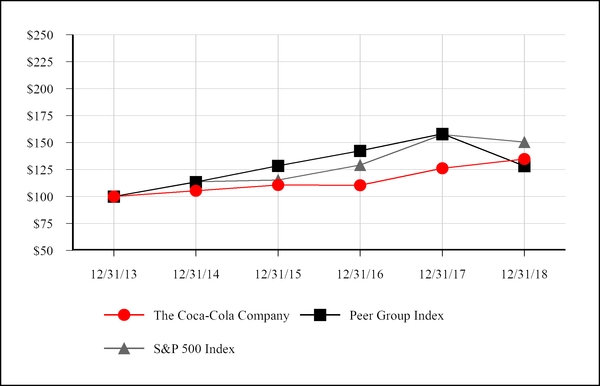
| December 31, | 2013 | 2014 | 2015 | 2016 | 2017 | 2018 | ||||||||||||
| The Coca-Cola Company | $ | 100 | $ | 105 | $ | 111 | $ | 110 | $ | 126 | $ | 135 | ||||||
| Peer Group Index | 100 | 113 | 128 | 142 | 158 | 128 | ||||||||||||
| S&P 500 Index | 100 | 114 | 115 | 129 | 157 | 150 |
The total return assumes that dividends were reinvested daily and is based on a $100 investment on December 31, 2013.
The Peer Group Index is a self-constructed peer group of companies that are included in the Dow Jones Food & Beverage Index and the Dow Jones Tobacco Index, from which the Company has been excluded.
The Peer Group Index consists of the following companies: Altria Group, Inc., Archer Daniels Midland Company, B&G Foods, Inc., Brown-Forman Corporation, Bunge Limited, Campbell Soup Company, Conagra Brands, Inc., Constellation Brands, Inc., Darling Ingredients Inc., Flowers Foods, Inc., General Mills, Inc., The Hain Celestial Group, Inc., Herbalife Nutrition Ltd., The Hershey Company, Hormel Foods Corporation, Ingredion Incorporated, Jefferies Financial Group Inc., Kellogg Company, The Kraft Heinz Company, Keurig Dr Pepper Inc., Lamb Weston Holdings, Inc., Lancaster Colony Corporation, McCormick & Company, Incorporated, Molson Coors Brewing Company, Mondelēz International, Inc., Monster Beverage Corporation, National Beverage Corp., PepsiCo, Inc., Performance Food Group Company, Philip Morris International Inc., Pilgrim's Pride Corporation, Post Holdings, Inc., Seaboard Corporation, The J.M. Smucker Company, TreeHouse Foods, Inc., Tyson Foods, Inc. and US Foods Holding Corp.
Companies included in the Dow Jones Food & Beverage Index and the Dow Jones Tobacco Index change periodically. In 2018, the indices included Jefferies Financial Group Inc., Keurig Dr Pepper Inc., National Beverage Corp., Performance Food Group Company, Pilgrim's Pride Corporation and Seaboard Corporation, which were not included in the indices in 2017. Additionally, the indices do not include Dean Foods Company, Dr Pepper Snapple Group, Inc., Leucadia National Corporation, Pinnacle Foods Inc. and Snyder's-Lance, Inc., which were included in the indices in 2017.
Item 6. SELECTED FINANCIAL DATA
The following selected financial data should be read in conjunction with "Item 7. Management's Discussion and Analysis of Financial Condition and Results of Operations" and our consolidated financial statements and the accompanying notes thereto contained in "Item 8. Financial Statements and Supplementary Data" of this report.
| Year Ended December 31, | 2018 | 2017 | 2016 | 2015 | 2014 | ||||||||||||||
| (In millions except per share data) | |||||||||||||||||||
| SUMMARY OF OPERATIONS | |||||||||||||||||||
| Net operating revenues | $ | 31,856 | $ | 35,410 | $ | 41,863 | $ | 44,294 | $ | 45,998 | |||||||||
| Net income from continuing operations | 6,727 | 1,182 | 6,550 | 7,366 | 7,124 | ||||||||||||||
| Net income attributable to shareowners of The Coca-Cola Company | 6,434 | 1,248 | 6,527 | 7,351 | 7,098 | ||||||||||||||
| PER SHARE DATA | |||||||||||||||||||
| Basic net income from continuing operations1 | $ | 1.58 | $ | 0.28 | $ | 1.51 | $ | 1.69 | $ | 1.62 | |||||||||
| Basic net income | 1.51 | 0.29 | 1.51 | 1.69 | 1.62 | ||||||||||||||
| Diluted net income from continuing operations1 | 1.57 | 0.27 | 1.49 | 1.67 | 1.60 | ||||||||||||||
| Diluted net income | 1.50 | 0.29 | 1.49 | 1.67 | 1.60 | ||||||||||||||
| Cash dividends | 1.56 | 1.48 | 1.40 | 1.32 | 1.22 | ||||||||||||||
| BALANCE SHEET DATA | |||||||||||||||||||
| Total assets | $ | 83,216 | $ | 87,896 | $ | 87,270 | $ | 89,996 | $ | 91,968 | |||||||||
| Long-term debt | 25,364 | 31,182 | 29,684 | 28,311 | 19,010 |
| 1 | Calculated based on net income from continuing operations less net income from continuing operations attributable to noncontrolling interests. |
The Company's results are impacted by acquisitions and divestitures. Refer to "Item 7. Management's Discussion and Analysis of Financial Condition and Results of Operations" for additional information.
Item 7. MANAGEMENT'S DISCUSSION AND ANALYSIS OF FINANCIAL CONDITION AND RESULTS OF OPERATIONS
Overview
The following Management's Discussion and Analysis of Financial Condition and Results of Operations ("MD&A") is intended to help the reader understand The Coca-Cola Company, our operations and our present business environment. MD&A is provided as a supplement to — and should be read in conjunction with — our consolidated financial statements and the accompanying notes thereto contained in "Item 8. Financial Statements and Supplementary Data" of this report. This overview summarizes the MD&A, which includes the following sections:
| • | Our Business — a general description of our business and the nonalcoholic beverage segment of the commercial beverage industry; our objective; our strategic priorities; our core capabilities; and challenges and risks of our business. |
| • | Critical Accounting Policies and Estimates — a discussion of accounting policies that require critical judgments and estimates. |
| • | Operations Review — an analysis of our Company's consolidated results of operations for the three years presented in our consolidated financial statements. Except to the extent that differences among our operating segments are material to an understanding of our business as a whole, we present the discussion on a consolidated basis. |
| • | Liquidity, Capital Resources and Financial Position — an analysis of cash flows; off-balance sheet arrangements and aggregate contractual obligations; foreign exchange; the impact of inflation and changing prices; and an overview of financial position. |
Our Business
General
The Coca-Cola Company is the world's largest nonalcoholic beverage company. We own or license and market more than 500 nonalcoholic beverage brands, which we group into the following category clusters: sparkling soft drinks; water, enhanced water and sports drinks; juice, dairy and plant-based beverages; tea and coffee; and energy drinks. We own and market four of the world's top five nonalcoholic sparkling soft drink brands: Coca-Cola, Diet Coke, Fanta and Sprite. Finished beverage products bearing our trademarks, sold in the United States since 1886, are now sold in more than 200 countries and territories.
We make our branded beverage products available to consumers throughout the world through our independent bottling partners, distributors, wholesalers and retailers as well as Company-owned or -controlled bottling and distribution operations — the world's largest beverage distribution system. Beverages bearing trademarks owned by or licensed to us account for more than 1.9 billion of the approximately 61 billion servings of all beverages consumed worldwide every day.
We believe our success depends on our ability to connect with consumers by providing them with a wide variety of beverage choices to meet their desires, needs and lifestyle choices. Our success further depends on the ability of our people to execute effectively, every day.
Our Company markets, manufactures and sells:
| • | beverage concentrates, sometimes referred to as "beverage bases," and syrups, including fountain syrups (we refer to this part of our business as our "concentrate business" or "concentrate operations"); and |
| • | finished sparkling soft drinks and other nonalcoholic beverages (we refer to this part of our business as our "finished product business" or "finished product operations"). |
Generally, finished product operations generate higher net operating revenues but lower gross profit margins than concentrate operations.
In our domestic and international concentrate operations, we typically generate net operating revenues by selling concentrates, syrups and certain finished beverages to authorized bottling operations (to which we typically refer as our "bottlers" or our "bottling partners"). Our bottling partners either combine the concentrates with sweeteners (depending on the product), still water and/or sparkling water, or combine the syrups with sparkling water to produce finished beverages. The finished beverages are packaged in authorized containers, such as cans and refillable and nonrefillable glass and plastic bottles, bearing our trademarks or trademarks licensed to us and are then sold to retailers directly or, in some cases, through wholesalers or other bottlers. In addition, outside the United States, our bottling partners are typically authorized to manufacture fountain syrups, using our concentrate, which they sell to fountain retailers for use in producing beverages for immediate consumption, or to authorized fountain wholesalers who in turn sell and distribute the fountain syrups to fountain retailers. Our concentrate operations are included in our geographic operating segments.
Our finished product operations generate net operating revenues by selling sparkling soft drinks and a variety of other finished nonalcoholic beverages, such as water, enhanced water and sports drinks; juice, dairy and plant-based beverages; tea and coffee; and energy drinks, to retailers or to distributors and wholesalers who distribute them to retailers. These operations consist primarily of Company-owned or -controlled bottling, sales and distribution operations, which are included in our Bottling Investments operating segment. In certain markets, the Company also operates non-bottling finished product operations in which we sell finished beverages to distributors and wholesalers that are generally not one of the Company's bottling partners. These operations are generally included in one of our geographic operating segments. In the United States, we manufacture fountain syrups and sell them to fountain retailers, who use the fountain syrups to produce beverages for immediate consumption, or to authorized fountain wholesalers or bottling partners who resell the fountain syrups to fountain retailers. These fountain syrup sales are included in our North America operating segment.
The following table sets forth the percentage of total net operating revenues related to concentrate operations and finished product operations:
| Year Ended December 31, | 2018 | 2017 | 2016 | |||
| Concentrate operations | 64 | % | 51 | % | 40 | % |
| Finished product operations | 36 | 49 | 60 | |||
| Total | 100 | % | 100 | % | 100 | % |
The following table sets forth the percentage of total worldwide unit case volume related to concentrate operations and finished product operations:
| Year Ended December 31, | 2018 | 2017 | 2016 | |||
| Concentrate operations | 85 | % | 78 | % | 76 | % |
| Finished product operations | 15 | 22 | 24 | |||
| Total | 100 | % | 100 | % | 100 | % |
The Nonalcoholic Beverage Segment of the Commercial Beverage Industry
We operate in the highly competitive nonalcoholic beverage segment of the commercial beverage industry. We face strong competition from numerous other general and specialty beverage companies. We, along with other beverage companies, are affected by a number of factors, including, but not limited to, cost to manufacture and distribute products, consumer spending, economic conditions, availability and quality of water, consumer preferences, inflation, political climate, local and national laws and regulations, foreign currency fluctuations, fuel prices and weather patterns.
Our Objective
Our objective is to use our formidable assets — our brands, financial strength, unrivaled distribution system, global reach, and the talent and strong commitment of our management and associates — to achieve long-term sustainable growth. To accomplish our objective, we are focused on:
| • | Disciplined growth |
| ◦ | Turning our passion for consumers into |
Showing the first 8K of 196K characters. Open the full section
Item 7A. QUANTITATIVE AND QUALITATIVE DISCLOSURES ABOUT MARKET RISK
Our Company uses derivative financial instruments primarily to reduce our exposure to adverse fluctuations in foreign currency exchange rates, interest rates, commodity prices and other market risks. We do not enter into derivative financial instruments for trading purposes. As a matter of policy, all of our derivative positions are used to reduce risk by hedging an underlying economic exposure. Because of the high correlation between the hedging instrument and the underlying exposure, fluctuations in the value of the instruments are generally offset by reciprocal changes in the value of the underlying exposure. The Company generally hedges anticipated exposures up to 36 months in advance; however, the majority of our derivative instruments expire within 24 months or less. Virtually all of our derivatives are straightforward over-the-counter instruments with liquid markets.
We monitor our exposure to financial market risks using several objective measurement systems, including a sensitivity analysis to measure our exposure to fluctuations in foreign currency exchange rates, interest rates and commodity prices. Refer to Note 6 of Notes to Consolidated Financial Statements for additional information about our hedging transactions and derivative financial instruments.
Foreign Currency Exchange Rates
We manage most of our foreign currency exposures on a consolidated basis, which allows us to net certain exposures and take advantage of any natural offsets. In 2018, we used 72 functional currencies in addition to the U.S. dollar and generated $20,512 million of our net operating revenues from operations outside the United States; therefore, weaknesses in some currencies may be offset by strengths in other currencies over time. We use derivative financial instruments to further reduce our net exposure to foreign currency fluctuations.
Our Company enters into forward exchange contracts and purchases foreign currency options (principally euros, British pounds sterling and Japanese yen) and collars to hedge certain portions of forecasted cash flows denominated in foreign currencies. Additionally, we enter into forward exchange contracts to offset the earnings impact related to foreign currency fluctuations on certain monetary assets and liabilities. We also enter into forward exchange contracts as hedges of net investments in foreign operations.
The total notional values of our foreign currency derivatives were $17,142 million and $13,057 million as of December 31, 2018 and 2017, respectively. These values include derivative instruments that are designated and qualify for hedge accounting as well as economic hedges. The fair value of the contracts that qualify for hedge accounting resulted in a net unrealized gain of $83 million as of December 31, 2018, and we estimate that a 10 percent weakening of the U.S. dollar would have eliminated the net unrealized gain and created a net unrealized loss of $191 million. The fair value of the contracts that do not qualify for hedge accounting resulted in a net unrealized loss of $40 million as of December 31, 2018, and we estimate that a 10 percent weakening of the U.S. dollar would have eliminated the net unrealized loss and created a net unrealized gain of $217 million.
Interest Rates
The Company is subject to interest rate volatility with regard to existing and future issuances of debt. We monitor our mix of fixed-rate and variable-rate debt as well as our mix of short-term debt and long-term debt. From time to time, we enter into interest rate swap agreements to manage our exposure to interest rate fluctuations.
Based on the Company's variable-rate debt and derivative instruments outstanding as of December 31, 2018, we estimate that a 1 percentage point increase in interest rates would have increased interest expense by $251 million in 2018. However, this increase in interest expense would have been partially offset by the increase in interest income related to higher interest rates.
The Company is subject to interest rate risk related to its investments in highly liquid debt securities. These investments are primarily managed by external managers within the guidelines of the Company's investment policy. Our policy requires these investments to be investment grade, with the primary objective of minimizing the potential risk of principal loss. In addition, our policy limits the amount of credit exposure to any one issuer. We estimate that a 1 percentage point increase in interest rates would result in a $100 million decrease in the fair value of our portfolio of highly liquid debt securities.
Commodity Prices
The Company is subject to market risk with respect to commodity price fluctuations, principally related to our purchases of sweeteners, metals, juices, PET and fuels. We manage our exposure to commodity risks primarily through the use of supplier pricing agreements that enable us to establish the purchase prices for certain inputs that are used in our manufacturing and distribution operations. When deemed appropriate, we use derivative financial instruments to manage our exposure to commodity risks. Certain of these derivatives do not qualify for hedge accounting, but they are effective economic hedges that help the Company mitigate the price risk associated with the purchases and transportation of materials used in our manufacturing processes.
Open commodity derivatives that qualify for hedge accounting had notional values of $9 million and $35 million as of December 31, 2018 and 2017, respectively. The fair value of the contracts that qualify for hedge accounting resulted in a net unrealized loss of $1 million as of December 31, 2018, and we estimate that a 10 percent decrease in underlying commodity prices would have increased the net unrealized loss to $2 million.
Open commodity derivatives that do not qualify for hedge accounting had notional values of $373 million and $357 million as of December 31, 2018 and 2017, respectively. The fair value of the contracts that do not qualify for hedge accounting resulted in a net unrealized loss of $44 million as of December 31, 2018, and we estimate that a 10 percent decrease in underlying commodity prices would have increased the net unrealized loss to $69 million.
Item 8. FINANCIAL STATEMENTS AND SUPPLEMENTARY DATA
TABLE OF CONTENTS
THE COCA-COLA COMPANY AND SUBSIDIARIES
CONSOLIDATED STATEMENTS OF INCOME
| Year Ended December 31, | 2018 | 2017 | 2016 | ||||||||
| (In millions except per share data) | |||||||||||
| NET OPERATING REVENUES | $ | 31,856 | $ | 35,410 | $ | 41,863 | |||||
| Cost of goods sold | 11,770 | 13,255 | 16,465 | ||||||||
| GROSS PROFIT | 20,086 | 22,155 | 25,398 | ||||||||
| Selling, general and administrative expenses | 10,307 | 12,654 | 15,370 | ||||||||
| Other operating charges | 1,079 | 1,902 | 1,371 | ||||||||
| OPERATING INCOME | 8,700 | 7,599 | 8,657 | ||||||||
| Interest income | 682 | 677 | 642 | ||||||||
| Interest expense | 919 | 841 | 733 | ||||||||
| Equity income (loss) — net | 1,008 | 1,071 | 835 | ||||||||
| Other income (loss) — net | (1,121 | ) | (1,764 | ) | (1,265 | ) | |||||
| INCOME FROM CONTINUING OPERATIONS BEFORE INCOME TAXES | 8,350 | 6,742 | 8,136 | ||||||||
| Income taxes from continuing operations | 1,623 | 5,560 | 1,586 | ||||||||
| NET INCOME FROM CONTINUING OPERATIONS | 6,727 | 1,182 | 6,550 | ||||||||
| Income (loss) from discontinued operations (net of income taxes of $126, $47 and $0, respectively) | (251 | ) | 101 | — | |||||||
| CONSOLIDATED NET INCOME | 6,476 | 1,283 | 6,550 | ||||||||
| Less: Net income attributable to noncontrolling interests | 42 | 35 | 23 | ||||||||
| NET INCOME ATTRIBUTABLE TO SHAREOWNERS OF THE COCA-COLA COMPANY | $ | 6,434 | $ | 1,248 | $ | 6,527 | |||||
| Basic net income per share from continuing operations1 | $ | 1.58 | $ | 0.28 | $ | 1.51 | |||||
| Basic net income (loss) per share from discontinued operations2 | (0.07 | ) | 0.02 | — | |||||||
| BASIC NET INCOME PER SHARE | $ | 1.51 | $ | 0.29 | 3 | $ | 1.51 | ||||
| Diluted net income per share from continuing operations1 | $ | 1.57 | $ | 0.27 | $ | 1.49 | |||||
| Diluted net income (loss) per share from discontinued operations2 | (0.07 | ) | 0.02 | — | |||||||
| DILUTED NET INCOME PER SHARE | $ | 1.50 | $ | 0.29 | $ | 1.49 | |||||
| AVERAGE SHARES OUTSTANDING — BASIC | 4,259 | 4,272 | 4,317 | ||||||||
| Effect of dilutive securities | 40 | 52 | 50 | ||||||||
| AVERAGE SHARES OUTSTANDING — DILUTED | 4,299 | 4,324 | 4,367 |
| 1 | Calculated based on net income from continuing operations less net income from continuing operations attributable to noncontrolling interests. |
| 2 | Calculated based on net income (loss) from discontinued operations less net income from discontinued operations attributable to noncontrolling interests. |
| 3 | Per share amounts do not add due to rounding. |
Refer to Notes to Consolidated Financial Statements.
THE COCA-COLA COMPANY AND SUBSIDIARIES
CONSOLIDATED STATEMENTS OF COMPREHENSIVE INCOME
| Year Ended December 31, | 2018 | 2017 | 2016 | ||||||||
| (In millions) | |||||||||||
| CONSOLIDATED NET INCOME | $ | 6,476 | $ | 1,283 | $ | 6,550 | |||||
| Other comprehensive income: | |||||||||||
| Net foreign currency translation adjustments | (2,035 | ) | 861 | (626 | ) | ||||||
| Net gains (losses) on derivatives | (7 | ) | (433 | ) | (382 | ) | |||||
| Net unrealized gains (losses) on available-for-sale securities | (34 | ) | 188 | 17 | |||||||
| Net change in pension and other benefit liabilities | 29 | 322 | (53 | ) | |||||||
| TOTAL COMPREHENSIVE INCOME | 4,429 | 2,221 | 5,506 | ||||||||
| Less: Comprehensive income attributable to noncontrolling interests | 95 | 73 | 10 | ||||||||
| TOTAL COMPREHENSIVE INCOME ATTRIBUTABLE TO SHAREOWNERS OF THE COCA-COLA COMPANY | $ | 4,334 | $ | 2,148 | $ | 5,496 |
Refer to Notes to Consolidated Financial Statements.
THE COCA-COLA COMPANY AND SUBSIDIARIES
CONSOLIDATED BALANCE SHEETS
| December 31, | 2018 | 2017 | |||||
| (In millions except par value) | |||||||
| ASSETS | |||||||
| CURRENT ASSETS | |||||||
| Cash and cash equivalents | $ | 8,926 | $ | 6,006 | |||
| Short-term investments | 2,025 | 9,352 | |||||
| TOTAL CASH, CASH EQUIVALENTS AND SHORT-TERM INVESTMENTS | 10,951 | 15,358 | |||||
| Marketable securities | 5,013 | 5,317 | |||||
| Trade accounts receivable, less allowances of $489 and $477, respectively | 3,396 | 3,667 | |||||
| Inventories | 2,766 | 2,655 | |||||
| Prepaid expenses and other assets | 1,962 | 2,000 | |||||
| Assets held for sale | — | 219 | |||||
| Assets held for sale — discontinued operations | 6,546 | 7,329 | |||||
| TOTAL CURRENT ASSETS | 30,634 | 36,545 | |||||
| EQUITY METHOD INVESTMENTS | 19,407 | 20,856 | |||||
| OTHER INVESTMENTS | 867 | 1,096 | |||||
| OTHER ASSETS | 4,139 | 4,230 | |||||
| DEFERRED INCOME TAX ASSETS | 2,667 | 330 | |||||
| PROPERTY, PLANT AND EQUIPMENT — net | 8,232 | 8,203 | |||||
| TRADEMARKS WITH INDEFINITE LIVES | 6,682 | 6,729 | |||||
| BOTTLERS' FRANCHISE RIGHTS WITH INDEFINITE LIVES | 51 | 138 | |||||
| GOODWILL | 10,263 | 9,401 | |||||
| OTHER INTANGIBLE ASSETS | 274 | 368 | |||||
| TOTAL ASSETS | $ | 83,216 | $ | 87,896 | |||
| LIABILITIES AND EQUITY | |||||||
| CURRENT LIABILITIES | |||||||
| Accounts payable and accrued expenses | $ | 8,932 | $ | 8,748 | |||
| Loans and notes payable | 13,194 | 13,205 | |||||
| Current maturities of long-term debt | 4,997 | 3,298 | |||||
| Accrued income taxes | 378 | 410 | |||||
| Liabilities held for sale | — | 37 | |||||
| Liabilities held for sale — discontinued operations | 1,722 | 1,496 | |||||
| TOTAL CURREN |
Showing the first 8K of 369K characters. Open the full section
Item 9. CHANGES IN AND DISAGREEMENTS WITH ACCOUNTANTS ON ACCOUNTING AND FINANCIAL DISCLOSURE
Not applicable.
Item 9A. CONTROLS AND PROCEDURES
Evaluation of Disclosure Controls and Procedures
The Company, under the supervision and with the participation of its management, including the Chief Executive Officer and the Chief Financial Officer, evaluated the effectiveness of the design and operation of the Company's "disclosure controls and procedures" (as defined in Rule 13a-15(e) under the Securities Exchange Act of 1934, as amended ("Exchange Act")) as of the end of the period covered by this report. Based on that evaluation, the Chief Executive Officer and the Chief Financial Officer concluded that the Company's disclosure controls and procedures were effective as of December 31, 2018.
Report of Management on Internal Control Over Financial Reporting and Attestation Report of Independent Registered Public Accounting Firm
The report of management on our internal control over financial reporting as of December 31, 2018 and the attestation report of our independent registered public accounting firm on our internal control over financial reporting are set forth in Part II, "Item 8. Financial Statements and Supplementary Data" in this report.
Changes in Internal Control Over Financial Reporting
There have been no changes in the Company's internal control over financial reporting during the quarter ended December 31, 2018 that have materially affected, or are reasonably likely to materially affect, the Company's internal control over financial reporting.
Item 9B. OTHER INFORMATION
Not applicable.
PART III
Item 10. DIRECTORS, EXECUTIVE OFFICERS AND CORPORATE GOVERNANCE
The information regarding Director Nominations under the subheading "Item 1 — Election of Directors" under the principal heading "Governance," the information regarding the Codes of Business Conduct under the subheading "Additional Governance Matters" under the principal heading "Governance," the information under the subheading "Section 16(a) Beneficial Ownership Reporting Compliance" under the principal heading "Share Ownership" and the information regarding the Audit Committee under the subheading "Board and Committee Governance" under the principal heading "Governance" in the Company's 2019 Proxy Statement is incorporated herein by reference. See Item X in Part I of this report for information regarding executive officers of the Company.
Item 11. EXECUTIVE COMPENSATION
The information under the subheading "Director Compensation" under the principal heading "Governance" and the information under the subheadings "Compensation Discussion and Analysis," "Report of the Compensation Committee," "Compensation Committee Interlocks and Insider Participation," "Compensation Tables," "Payments on Termination or Change in Control" and "Pay Ratio Disclosure" under the principal heading "Compensation" and the information in "Annex B — Summary of Plans" in the Company's 2019 Proxy Statement is incorporated herein by reference.
Item 12. SECURITY OWNERSHIP OF CERTAIN BENEFICIAL OWNERS AND MANAGEMENT AND RELATED STOCKHOLDER MATTERS
The information under the subheading "Equity Compensation Plan Information" under the principal heading "Compensation" and the information under the subheading "Ownership of Equity Securities of the Company" under the principal heading "Share Ownership" in the Company's 2019 Proxy Statement is incorporated herein by reference.
Item 13. CERTAIN RELATIONSHIPS AND RELATED TRANSACTIONS, AND DIRECTOR INDEPENDENCE
The information under the subheading "Director Independence and Related Person Transactions" under the principal heading
"Governance" in the Company's 2019 Proxy Statement is incorporated herein by reference.
Item 14. PRINCIPAL ACCOUNTANT FEES AND SERVICES
The information regarding Audit Fees, Audit-Related Fees, Tax Fees, All Other Fees and Audit Committee Pre-Approval of Audit and Permissible Non-Audit Services of Independent Auditors under the subheading "Item 3 — Ratification of the Appointment of Ernst & Young LLP as Independent Auditors" under the principal heading "Audit Matters" in the Company's 2019 Proxy Statement is incorporated herein by reference.
PART IV
Item 15. EXHIBITS AND FINANCIAL STATEMENT SCHEDULES
| (a) | The following documents are filed as part of this report: |
1.Financial Statements:
Consolidated Statements of Income — Years Ended December 31, 2018, 2017 and 2016.
Consolidated Statements of Comprehensive Income — Years Ended December 31, 2018, 2017 and 2016.
Consolidated Balance Sheets — December 31, 2018 and 2017.
Consolidated Statements of Cash Flows — Years Ended December 31, 2018, 2017 and 2016.
Consolidated Statements of Shareowners' Equity — Years Ended December 31, 2018, 2017 and 2016.
Notes to Consolidated Financial Statements.
Report of Independent Registered Public Accounting Firm.
Report of Independent Registered Public Accounting Firm on Internal Control Over Financial Reporting.
2.Financial Statement Schedules:
The schedules for which provision is made in the applicable accounting regulations of the Securities and Exchange Commission ("SEC") are not required under the related instructions or are inapplicable and, therefore, have been omitted.
3.Exhibits
In reviewing the agreements included as exhibits to this report, please remember they are included to provide you with information regarding their terms and are not intended to provide any other factual or disclosure information about the Company or the other parties to the agreements. The agreements contain representations, warranties, covenants and conditions by or of each of the parties to the applicable agreement. These representations, warranties, covenants and conditions have been made solely for the benefit of the other parties to the applicable agreement and:
| • | should not in all instances be treated as categorical statements of fact, but rather as a way of allocating the risk to one of the parties if those statements prove to be inaccurate; |
| • | may have been qualified by disclosures that were made to the other party in connection with the negotiation of the applicable agreement, which disclosures are not necessarily reflected in the agreement; |
| • | may apply standards of materiality in a way that is different from what may be viewed as material to you or other investors; and |
| • | were made only as of the date of the applicable agreement or such other date or dates as may be specified in the agreement and are subject to more recent developments. |
Accordingly, these representations and warranties may not describe the actual state of affairs as of the date they were made or at any other time. Additional information about the Company may be found elsewhere in this report and the Company's other public filings, which are available without charge through the SEC's website at http://www.sec.gov.
EXHIBIT INDEX
(With regard to applicable cross-references in the list of exhibits below, the Company's Current, Quarterly and Annual Reports are filed with the Securities and Exchange Commission ("SEC") under File No. 001-02217; and Coca-Cola Refreshments USA, Inc.'s (formerly known as Coca-Cola Enterprises Inc.) Current, Quarterly and Annual Reports are filed with the SEC under File No. 001-09300).
Showing the first 8K of 76K characters. Open the full section
Item 16. FORM 10-K SUMMARY
None.
SIGNATURES
Pursuant to the requirements of Section 13 or 15(d) of the Securities Exchange Act of 1934, the Registrant has duly caused this report to be signed on its behalf by the undersigned, thereunto duly authorized.
| THE COCA-COLA COMPANY | |||||
| (Registrant) | |||||
| By: | /s/ JAMES QUINCEY | ||||
| James R. Quincey Chief Executive Officer | |||||
| Date: | February 21, 2019 |
Pursuant to the requirements of the Securities Exchange Act of 1934, this report has been signed below by the following persons on behalf of the Registrant and in the capacities and on the dates indicated.
| /s/ JAMES QUINCEY | /s/ KATHY N. WALLER | |
| James R. Quincey Chief Executive Officer and a Director (Principal Executive Officer) | Kathy N. Waller Executive Vice President and Chief Financial Officer (Principal Financial Officer) | |
| February 21, 2019 | February 21, 2019 | |
| /s/ LARRY M. MARK | /s/ MARK RANDAZZA | |
| Larry M. Mark Vice President and Controller (On behalf of the Registrant) | Mark Randazza Vice President, Assistant Controller and Chief Accounting Officer (Principal Accounting Officer) | |
| February 21, 2019 | February 21, 2019 | |
| * | * | |
| Muhtar Kent Chairman of the Board of Directors and a Director | Ana Botín Director | |
| February 21, 2019 | February 21, 2019 | |
| * | * | |
| Herbert A. Allen Director | Richard M. Daley Director | |
| February 21, 2019 | February 21, 2019 | |
| * | * | |
| Ronald W. Allen Director | Christopher C. Davis Director | |
| February 21, 2019 | February 21, 2019 | |
| * | * | |
| Marc Bolland Director | Barry Diller Director | |
| February 21, 2019 | February 21, 2019 |
| * | * | |
| Helene D. Gayle Director | Sam Nunn Director | |
| February 21, 2019 | February 21, 2019 | |
| * | * | |
| Alexis M. Herman Director | Caroline Tsay Director | |
| February 21, 2019 | February 21, 2019 | |
| * | * | |
| Robert A. Kotick Director | David B. Weinberg Director | |
| February 21, 2019 | February 21, 2019 | |
| * | ||
| Maria Elena Lagomasino Director | ||
| February 21, 2019 | ||
| *By: | /s/ JENNIFER MANNING | |
| Jennifer Manning Attorney-in-fact | ||
| February 21, 2019 |