 filings.tools
Loews 10-K 2023-12-31
Filed 2024-02-06. 24 sections, 860K characters. Original on sec.gov · Markdown · JSON
Cover and table of contents
UNITED STATES
SECURITIES AND EXCHANGE COMMISSION
WASHINGTON, D.C. 20549
FORM 10-K
☒ ANNUAL REPORT PURSUANT TO SECTION 13 OR 15(d) OF
THE SECURITIES EXCHANGE ACT OF 1934
For the Fiscal Year Ended December 31, 2023
OR
☐ TRANSITION REPORT PURSUANT TO SECTION 13 OR 15(d)
OF THE SECURITIES EXCHANGE ACT OF 1934
For the Transition Period From ____________ to _____________
Commission File Number 1-06541
LOEWS CORPORATION
(Exact name of registrant as specified in its charter)
| Delaware | 13-2646102 | ||||
| (State or other jurisdiction of incorporation or organization) | (I.R.S. Employer Identification No.) |
9 West 57****th Street, New York, NY 10019-2714
(Address of principal executive offices) (Zip Code)
(212) 521-2000
(Registrant’s telephone number, including area code)
Securities registered pursuant to Section 12(b) of the Act:
| Title of each class | Trading Symbol(s) | Name of each exchange on which registered | ||||||
| Common stock, par value $0.01 per share | L | New York Stock Exchange |
Securities registered pursuant to Section 12(g) of the Act: None
Indicate by check mark if the registrant is a well-known seasoned issuer, as defined in Rule 405 of the Securities Act.
| Yes | ☒ | No ☐ |
Indicate by check mark if the registrant is not required to file reports pursuant to Section 13 or Section 15(d) of the Act.
| Yes | ☐ | No | ☒ |
Indicate by check mark whether the registrant (1) has filed all reports required to be filed by Section 13 or 15 (d) of the Securities Exchange Act of 1934 during the preceding 12 months (or for such shorter period that the registrant was required to file such reports), and (2) has been subject to such filing requirements for the past 90 days.
| Yes | ☒ | No | ☐ |
Indicate by check mark whether the registrant has submitted electronically every Interactive Data File required to be submitted pursuant to Rule 405 of Regulation S-T during the preceding 12 months (or for such shorter period that the registrant was required to submit such files).
| Yes | ☒ | No | ☐ |
Indicate by check mark whether the registrant is a large accelerated filer, an accelerated filer, a non-accelerated filer, a smaller reporting company, or an emerging growth company. See the definitions of “large accelerated filer,” “accelerated filer,” “smaller reporting company,” and “emerging growth company” in Rule 12b-2 of the Exchange Act.
| Large accelerated filer | ☒ | Accelerated filer | ☐ | Non-accelerated filer | ☐ | Smaller reporting company | ☐ |
| Emerging growth company | ☐ |
If an emerging growth company, indicate by check mark if the registrant has elected not to use the extended transition period for complying with any new or revised financial accounting standards provided pursuant to Section 13(a) of the Exchange Act.
| ☐ |
Indicate by check mark whether the registrant has filed a report on and attestation to its management’s assessment of the effectiveness of its internal control over financial reporting under Section 404(b) of the Sarbanes-Oxley Act (15 U.S.C. 7262(b)) by the registered public accounting firm that prepared or issued its audit report.
| ☒ |
If securities are registered pursuant to Section 12(b) of the Act, indicate by check mark whether the financial statements of the registrant included in the filing reflect the correction of an error to previously issued financial statements.
| ☐ |
Indicate by check mark whether any of those error corrections are restatements that required a recovery analysis of incentive-based compensation received by any of the registrant’s executive officers during the relevant recovery period pursuant to §240.10D-1(b).
| ☐ |
Indicate by check mark whether the registrant is a shell company (as defined in Rule 12b-2 of the Exchange Act).
| Yes | ☐ | No | ☒ |
The aggregate market value of common stock held by non-affiliates of the registrant as of June 30, 2023, the last business day of the registrant’s most recently completed second fiscal quarter, was approximately $10,926,000,000.
As of February 2, 2024, there were 222,201,139 shares of the registrant’s common stock outstanding.
Documents Incorporated by Reference:
Portions of the registrant’s definitive proxy statement for the 2024 annual meeting of shareholders, intended to be filed by the registrant with the Commission not later than 120 days after the close of its fiscal year, are incorporated by reference into Part III of this Report.
| 1 |
LOEWS CORPORATION
INDEX TO ANNUAL REPORT ON
FORM 10-K FILED WITH THE
SECURITIES AND EXCHANGE COMMISSION
For the Year Ended December 31, 2023
| 2 |
FORWARD-LOOKING STATEMENTS
Investors are cautioned that certain statements contained in this Report as well as in other filings with the Securities and Exchange Commission (“SEC”) and periodic press releases made by us and our subsidiaries and certain statements made by us and our subsidiaries and our and their officers during presentations may constitute “forward-looking statements” within the meaning of the Private Securities Litigation Reform Act of 1995 (the “Act”). Forward-looking statements include any statement that does not directly relate to any historical or current fact. Forward-looking statements may project, indicate or imply future results, events, performance or achievements, and such statements may contain the words “expect,” “intend,” “plan,” “anticipate,” “estimate,” “believe,” “will be,” “will continue,” “will likely result,” and similar expressions. In addition, any statement concerning future financial performance (including future revenues, earnings or growth rates), ongoing business strategies or prospects, and possible actions taken by us or our subsidiaries are also forward-looking statements as defined by the Act. Forward-looking statements are based on current expectations and projections about future events and are inherently subject to a variety of risks and uncertainties, many of which are beyond our or our subsidiaries’ control, that could cause actual results to differ materially from those anticipated or projected.
Developments in any of the risks or uncertainties facing us or our subsidiaries, including those summarized under the heading “Risk Factors Summary” below and described more fully under Item 1A, Risk Factors of this Report and in our and our subsidiaries’ other filings with the SEC, could cause our and our subsidiaries’ results to differ materially from results that have been or may be anticipated or projected. Given these risks and uncertainties, investors should not place undue reliance on forward-looking statements. Forward-looking statements speak only as of the date they are made and we and our subsidiaries expressly disclaim any obligation or undertaking to update these statements to reflect any change in expectations or beliefs or any change in events, conditions or circumstances on which any forward-looking statement is based.
Unless the context otherwise requires, the term “Company” as used herein means Loews Corporation including its subsidiaries, the terms “Parent Company,” “we,” “our,” “us” or like terms as used herein mean Loews Corporation excluding its subsidiaries and the term “subsidiaries” means our consolidated subsidiaries.
RISK FACTORS SUMMARY
Our business and the businesses of our subsidiaries face many risks and uncertainties. These risks and uncertainties could lead to events or circumstances that have a material adverse effect on our business, results of operations, cash flows, financial condition or equity and/or the business, results of operations, cash flows, financial condition or equity of one or more of our subsidiaries. You should carefully review and consider the full discussion of our risk factors described under Item 1A, Risk Factors of this Report, before investing in any security issued by us. Principal risks facing us and our subsidiaries include those relating to:
Risks Related to Us and Our Subsidiary, CNA Financial Corporation (“CNA”)
-
CNA may need to increase its insurance reserves if it determines that its recorded reserves are insufficient;
-
CNA’s actual experience could vary from the key assumptions used to determine future policy benefit reserves for its long-term care policies;
-
CNA’s vulnerability to material losses from natural and man-made disasters or other catastrophes;
-
The impact of the coronavirus disease (“COVID-19”), including new or emerging variants, and other potential pandemics on CNA;
-
CNA’s exposure related to asbestos and environmental pollution (“A&EP”) claims;
-
CNA’s exposure to mass tort product liability claims, changes to the social and legal environment, such as those related to abuse reviver statutes, issues related to altered interpretation of coverage and other new and emerging claim theories;
-
Intense competition in CNA’s industry; the cyclical nature of the property and casualty business and the evolving landscape of its distribution network;
-
Risks relating to CNA’s reliance on reinsurance, including risks related to its ability to obtain sufficient reinsurance at a cost or on terms and conditions it deems acceptable, reinsurance counterparty risk and ineffective reinsurance coverage;
-
Technological changes or disruptions in the insurance marketplace;
-
Potential significant realized and unrealized investment losses and volatility in net investment income;
-
CNA’s use of analytical models in key areas such as pricing, reserving catastrophe risks and capital modeling;
-
Any significant interruption in the operation of CNA’s business functions, facilities and systems or its vendors’ facilities and systems could result in a material adverse effect on its operations;
| 3 |
-
Any significant breach in CNA’s data security infrastructure or its vendors’ facilities and systems could disrupt business, cause financial losses and damage its reputation, and insurance coverage may not be available for claims related to a breach;
-
CNA’s potential inability to detect and prevent significant employee or service provider misconduct, inadvertent errors and omissions, or exposure relating to functions performed on CNA’s behalf;
-
Capital adequacy requirements that CNA is subject to;
-
Regulatory limitations on CNA’s insurance subsidiaries ability to pay dividends to CNA;
-
Potential downgrades of CNA’s ratings by rating agencies; and
-
Extensive state, local, federal and foreign governmental regulations to which CNA is subject.
Risks Related to Us and Our Subsidiary, Boardwalk Pipeline Partners, LP (“Boardwalk Pipelines”)
-
Extensive regulation by the Federal Energy Regulatory Commission (“FERC”) of Boardwalk Pipelines’ natural gas transportation and storage operations and ethane transportation services;
-
Boardwalk Pipelines’ and its customers’ operations are subject to a series of risks regarding climate change;
-
Climatic conditions could adversely impact Boardwalk Pipelines’ operations, pipelines and facilities, or those of its customers or suppliers;
-
Reputational risks and risks related to public opinion;
-
Legislative and regulatory initiatives relating to new or more stringent pipeline safety;
-
Actual results from Boardwalk Pipelines’ construction and growth projects not meeting its forecasts;
-
Opposition to the operation of Boardwalk Pipelines’ pipelines and facilities, construction or expansion of facilities and new pipeline projects;
-
Market conditions, including the price differentials between natural gas supplies and market demand and the potentially resulting reduction in the transportation rates that Boardwalk Pipelines can charge on certain of its pipeline systems;
-
Changes in energy commodity prices and their impact on the supply of and demand for those commodities;
-
Boardwalk Pipelines’ exposure to credit risk relating to default or bankruptcy by its customers;
-
Operating and financial covenants in Boardwalk Pipelines’ revolving credit facility;
-
Boardwalk Pipelines’ substantial indebtedness;
-
Limited access to the debt markets and increases in interest rates;
-
The impact of future pandemics or other outbreaks of contagious diseases and efforts to mitigate their spread on Boardwalk Pipelines;
-
Boardwalk Pipelines does not own all of the land on which its pipelines and facilities are located;
-
Boardwalk Pipelines may be unsuccessful in executing its strategy to grow and diversify its business;
-
The impact of market conditions on Boardwalk Pipelines’ ability to replace expiring storage contracts at attractive rates or on a long-term basis and to sell short-term services at attractive rates or at all; and
-
Boardwalk Pipelines’ operations are subject to catastrophic losses, operational hazards and unforeseen interruptions for which it may not be adequately insured.
Risks Related to Us and Our Subsidiary, Loews Hotels Holding Corporation (“Loews Hotels & Co”)
-
Operating risks common to the hospitality industry, many of which are beyond Loews Hotels & Co’s control;
-
Loews Hotels & Co’s exposure to risks resulting from significant investments in owned and leased real estate, including through ownership interests in partnerships and joint ventures;
-
Seasonal and cyclical volatility in the hospitality industry;
-
The high level of competition in the hospitality industry, both for customers and for the acquisition and/or development of new properties;
-
The risk of deterioration in the quality or reputation of Loews Hotels & Co’s brands, including brands used in its joint ventures and those it licenses;
-
The potential for delays or increased costs in connection with developing and renovating properties;
-
Investing in hotel properties through ownership interests in partnerships and joint ventures is subject to inherent risk due to Loews Hotels & Co’s lack of unilateral control over the investment;
-
The geographic concentration of Loews Hotels & Co’s properties;
-
The impact pandemics or other outbreaks of contagious diseases and efforts to mitigate their spread have had and could have on Loews Hotels & Co;
-
The growth and use of third-party reservation channels;
-
The adequacy of Loews Hotels & Co’s insurance coverage;
-
Potential labor shortages; and
-
Portions of Loews Hotels & Co’s labor force are covered by collective bargaining agreements.
| 4 |
Risks Related to Us and Our Unconsolidated Subsidiary, Altium Packaging LLC (“Altium Packaging”)
-
Altium Packaging’s substantial indebtedness;
-
Altium Packaging’s exposure to changes in consumer preferences;
-
Fluctuations in raw material prices and raw material availability; and
-
Self-manufacturing by Altium Packaging’s customers.
Risks Related to Us and Our Subsidiaries Generally
-
Failures or interruptions in or breaches to our or our subsidiaries’ computer systems or those of third party vendors;
-
Litigation to which we and our subsidiaries may be subject from time to time;
-
Acts of terrorism;
-
Compliance with environmental laws;
-
Potential loss of key vendor relationships or issues relating to the transitioning of vendor relationships;
-
Impairment charges related to the carrying value of long-lived assets and goodwill of our subsidiaries;
-
Pandemics or other outbreaks of contagious diseases and efforts to mitigate their spread have had, and could in the future have, widespread impacts on the way we and our subsidiaries operate;
-
We are a holding company and derive substantially all of our income and cash flow from our subsidiaries;
-
Competition for senior executives and qualified specialized talent; and
-
Increasing scrutiny and changing expectations from stakeholders with respect to environmental, social and governance (“ESG”) practices may impose additional costs on us and our subsidiaries or expose us and our subsidiaries to new or additional risks.
PART I
Item 1. Business.
Loews Corporation was incorporated in 1969 and is a holding company. Our subsidiaries are engaged in the following lines of business:
-
commercial property and casualty insurance (CNA Financial Corporation, an approximately 92% owned subsidiary);
-
transportation and storage of natural gas and natural gas liquids (Boardwalk Pipeline Partners, LP, a wholly owned subsidiary); and
-
operation of a chain of hotels (Loews Hotels Holding Corporation, a wholly owned subsidiary).
We also own approximately 53% of Altium Packaging LLC, an unconsolidated subsidiary, which is engaged in the manufacture of rigid plastic packaging solutions.
We have four reportable segments comprised of three individual operating subsidiaries, CNA Financial Corporation, Boardwalk Pipeline Partners, LP and Loews Hotels Holding Corporation; and the Corporate segment. The Corporate segment is primarily comprised of Loews Corporation excluding its subsidiaries and the operations of Altium Packaging LLC (“Altium Packaging”) through March 31, 2021. On April 1, 2021, we sold approximately 47% of Altium Packaging and following the transaction deconsolidated Altium Packaging. Subsequent to deconsolidation, our investment in Altium Packaging is accounted for under the equity method of accounting. Additional financial information on each of our segments is included under Item 7, Management’s Discussion and Analysis of Financial Condition and Results of Operations (“MD&A”). For further information on the deconsolidation of Altium Packaging see Note 2 of the Notes to Consolidated Financial Statements included under Item 8.
CNA FINANCIAL CORPORATION
CNA Financial Corporation (together with its subsidiaries, “CNA”) is an insurance holding company. CNA’s property and casualty and remaining life and group insurance operations are primarily conducted by Continental Casualty Company (“CCC”), The Continental Insurance Company, Western Surety Company, CNA Insurance Company Limited, Hardy Underwriting Bermuda Limited and its subsidiaries (“Hardy”) and CNA Insurance Company (Europe) S.A. CNA accounted for 83.6%, 84.6% and 81.2% of our consolidated total revenue for the years ended December 31, 2023, 2022 and 2021.
| 5 |
CNA’s insurance products primarily include commercial property and casualty coverages, including surety. CNA’s services include warranty, risk management, information services and claims administration. CNA’s products and services are primarily marketed through independent agents, brokers and managing general underwriters to a wide variety of customers, including small, medium and large businesses, insurance companies, associations, professionals and other groups. The property and casualty insurance industry is highly competitive, both as it relates to rate and service. CNA competes with a large number of stock and mutual insurance companies, as well as other entities, for both distributors and customers.
Property & Casualty Operations
CNA’s commercial property and casualty insurance operations (“Property & Casualty Operations”) includes its Specialty, Commercial and International lines of business.
Specialty
Specialty provides management and professional liability and other coverages through property and casualty products and services using a network of brokers, independent agencies and managing general underwriters. Specialty includes the following business groups:
Management & Professional Liability: Management & Professional Liability consists of the following coverages and products:
-
professional liability coverages and risk management services to various professional firms, including architects, real estate agents, accounting firms and law firms;
-
directors and officers (“D&O”), errors and omissions (“E&O”), employment practices, fiduciary, fidelity and cyber coverages. Specific areas of focus include small and mid-size firms, public as well as privately held firms and not-for-profit organizations;
-
insurance products to serve the health care industry, including professional and general liability as well as associated casualty coverages. Key customer groups include aging services, allied medical facilities, dentists, physicians, nurses and other medical practitioners.
Surety: Surety offers small, medium and large contract and commercial surety bonds. Surety provides surety and fidelity bonds in all 50 states.
Warranty and Alternative Risks: Warranty and Alternative Risks provides extended service contracts and insurance products that provide protection from the financial burden associated with mechanical breakdown and other related losses, primarily for vehicles, portable electronic communication devices and other consumer goods. Service contracts are generally distributed by commission-based independent representatives and sold by auto dealerships and retailers in North America to customers in conjunction with the purchase of a new or used vehicle or new consumer goods. Additionally, CNA’s insurance companies may issue contractual liability insurance policies or guaranteed asset protection reimbursement insurance policies to cover the liabilities of these service contracts issued by affiliated entities or third parties.
Commercial
Commercial works with a network of brokers and independent agents to market a broad range of property and casualty insurance products to all types of insureds, targeting small business, construction, middle markets and other commercial customers. Property products include standard and excess property, marine and boiler and machinery coverages. Casualty products include standard casualty insurance products such as workers’ compensation, general and product liability, commercial auto, umbrella, and excess and surplus coverages. Most insurance programs are provided on a guaranteed cost basis; however, CNA also offers specialized loss-sensitive insurance programs and total risk management services relating to claim and information services to the large commercial insurance marketplace.
International
International underwrites property and casualty coverages on a global basis through a branch operation in Canada, a European business consisting of insurance companies based in the United Kingdom and Luxembourg and Hardy, CNA’s Lloyd’s of London (“Lloyd’s”) syndicate.
| 6 |
Property & Casualty Structure
CNA’s commercial property & casualty underwriting operations presence in the United States of America (“U.S.”) consists of field underwriting locations and centralized processing operations which handle policy processing, billing and collection activities and also act as call centers to optimize service. CNA’s claim operations presence in the U.S. consists of primary locations where it handles multiple claim types and key business functions, as well as regional claim offices which are aligned with CNA’s underwriting field structure. CNA also has property & casualty underwriting operations in Canada, the United Kingdom (“U.K.”) and Continental Europe, as well as access to business placed at Lloyd’s through Syndicate 382.
Other Insurance Operations
Other Insurance Operations include CNA’s run-off long-term care business as well as structured settlement obligations not funded by annuities related to certain property and casualty claimants, certain corporate expenses, including interest on CNA corporate debt, and certain property and casualty businesses in run-off, including CNA Re, A&EP, a legacy portfolio of excess workers’ compensation (“EWC”) policies and certain legacy mass tort reserves.
Regulation
Current Regulation: The insurance industry is subject to comprehensive and detailed regulation and supervision. Regulatory oversight by applicable agencies is exercised through review of submitted filings and information, examinations (both financial and market conduct), direct inquiries and interviews. Each domestic and foreign jurisdiction has established supervisory agencies with broad administrative powers relative to licensing insurers and agents, approving policy forms, establishing reserve requirements, prescribing the form and content of statutory financial reports and regulating capital adequacy and the type, quality and amount of investments permitted. Such regulatory powers also extend to premium rate regulations requiring rates not be excessive, inadequate or unfairly discriminatory. In addition to regulation of dividends by insurance subsidiaries, intercompany transfers of assets or payments may be subject to prior notice or approval by insurance regulators, depending on the size of such transfers and payments in relation to the financial position of the insurance subsidiaries making the transfers or payments.
As CNA’s insurance operations are conducted in both domestic and foreign jurisdictions, CNA is subject to a number of regulatory agency requirements applicable to a portion, or all, of CNA’s operations. These include but are not limited to, the State of Illinois Department of Insurance (which is CNA’s global group-wide supervisor), the U.K. Prudential Regulatory Authority and Financial Conduct Authority, the Office of Superintendent of Financial Institutions in Canada, the Luxembourg insurance regulator Commissariat aux Assurances and the Bermuda Monetary Authority.
Domestic insurers are also required by state insurance regulators to provide coverage to certain insureds who would not otherwise be considered eligible by the insurers. Each state dictates the types of insurance and the level of coverage that must be provided to such involuntary risks. CNA’s share of these involuntary risks is mandatory and generally a function of its respective share of the voluntary market by line of insurance in each state.
Further, domestic insurance companies are subject to state guaranty fund and other insurance-related assessments. Guaranty funds are governed by state insurance guaranty associations which levy assessments to meet the funding needs of insolvent insurer estates. Other insurance-related assessments are generally levied by state agencies to fund various organizations including disaster relief funds, rating bureaus, insurance departments, and workers’ compensation second injury funds, and by industry organizations that assist in the statistical analysis and ratemaking process and CNA has the ability to recoup certain of these assessments from policyholders.
Although the U.S. federal government does not currently directly regulate the business of insurance, federal legislative and regulatory initiatives can affect the insurance industry. These initiatives and legislation include proposals relating to terrorism and natural catastrophe exposures, federal financial services reforms and certain tax reforms.
Hardy, a specialized Lloyd’s underwriter, is also supervised by the Council of Lloyd’s, which is the franchisor for all Lloyd’s operations. The Council of Lloyd’s has wide discretionary powers to regulate Lloyd’s underwriting, such as establishing the capital requirements for syndicate participation. In addition, the annual business plan of each syndicate is subject to the review and approval of the Lloyd’s Franchise Board, which is responsible for business planning and monitoring for all syndicates.
Capital adequacy and risk management regulations, referred to as Solvency II, apply to CNA’s European operations and are enacted by the European Commission, the executive body of the European Union (“E.U.”). Additionally, the
| 7 |
International Association of Insurance Supervisors (“IAIS”) continues to develop capital requirements as more fully discussed below.
Regulation Outlook: The IAIS has adopted a Common Framework (“ComFrame”) for the supervision of Internationally Active Insurance Groups (“IAIGs”) which is focused on the group-wide supervision of IAIGs, such as CNA. As part of ComFrame, the IAIS has developed a global capital standard that, if adopted in the U.S., would be applicable to U.S.-based IAIGs. Certain elements of ComFrame were incorporated into regulatory guidelines issued by the National Association of Insurance Commissioners (“NAIC”) for application by regulators beginning in 2023. These additions were adopted for the purpose of streamlining group-wide supervision, further leveraging existing risk and solvency measures and applying them on a group-wide basis.
The NAIC has developed an approach to group capital regulation and solvency-monitoring activities using the Group Capital Calculation (“GCC”). While historically the U.S. regulatory regime was primarily based on legal entity regulation, the GCC quantifies risk across the insurance group. The GCC was adopted by the NAIC along with model legislative language and attendant regulations, which have been adopted in a number of U.S. states where IAIGs are domiciled, including Illinois. Alongside the GCC, the NAIC has also developed the Aggregation Method (“AM”) approach to assessing group capital as an alternative to the Insurance Capital Standard (“ICS”) developed by the IAIS. The AM is influenced by the GCC and calculated in a similar manner. A decision by the IAIS on whether the AM provides comparable outcomes to the ICS is expected in 2024.
In addition, the U.S. and foreign regulatory environment in which CNA operates is continuously evolving, with both existing and prospective regulations that implicate aspects of its corporate governance, risk management practices, public disclosures, ESG related issues, artificial intelligence and cybersecurity.
Properties: CNA’s principal executive offices are based in Chicago, Illinois. CNA’s subsidiaries maintain office space in various cities throughout the United States and various countries. CNA leases all of its office space.
BOARDWALK PIPELINE PARTNERS, LP
Boardwalk Pipeline Partners, LP (together with its subsidiaries, “Boardwalk Pipelines”) is engaged in the business of transportation and storage of natural gas and natural gas liquids and hydrocarbons (herein referred to together as “NGLs”). Boardwalk Pipelines also provides ethane supply and transportation services for industrial customers in Louisiana and Texas. Boardwalk Pipelines accounted for 10.3%, 10.3% and 9.2% of our consolidated total revenue for the years ended December 31, 2023, 2022 and 2021.
A wholly owned subsidiary of ours, Boardwalk Pipelines Holding Corp. (“BPHC”) owns, directly and indirectly, 100% of the general partner and limited partnership interests of Boardwalk Pipelines.
On September 29, 2023, Boardwalk Pipelines acquired 100% of the equity interests of Williams Olefins Pipeline Holdco LLC (“Bayou Ethane”) from Williams Field Services Group, LLC for $355 million in cash. For further information, see the Boardwalk Pipelines portion of the Operating Results section of MD&A in Item 7.
Boardwalk Pipelines owns and operates approximately 13,455 miles of interconnected natural gas pipelines directly serving customers in thirteen states and indirectly serving customers throughout the northeastern and southeastern U.S. through numerous interconnections with unaffiliated pipelines. Boardwalk Pipelines also owns and operates approximately 855 miles of NGL pipelines in Louisiana and Texas. In 2023, its pipeline systems transported approximately 3.7 trillion cubic feet of natural gas and approximately 98.5 million barrels (“MMBbls”) of NGLs. Average daily throughput on Boardwalk Pipelines’ natural gas pipeline systems during 2023 was approximately 10.0 billion cubic feet (“Bcf”). Boardwalk Pipelines’ natural gas storage facilities are comprised of fourteen underground storage fields located in four states with aggregate working gas capacity of approximately 199.5 Bcf and Boardwalk Pipelines’ NGL storage facilities consist of eleven salt dome caverns located in Louisiana with an aggregate storage capacity of approximately 31.2 MMBbls. Boardwalk Pipelines also owns nine salt dome caverns and related brine infrastructure for use in providing brine supply services and to support the NGL storage operations.
Boardwalk Pipelines’ principal pipeline and storage systems are described below:
The Gulf South Pipeline Company, LLC (“Gulf South”) pipeline system runs approximately 7,210 miles along the Gulf Coast in the states of Oklahoma, Texas, Louisiana, Mississippi, Alabama and Florida. The pipeline system has a peak-day delivery capacity of 10.9 Bcf per day and average daily throughput for the year ended December 31, 2023 was 6.5 Bcf per day. Gulf South has ten natural gas storage facilities. The two natural gas storage facilities located in Louisiana and Mississippi have approximately 78.0 Bcf of working gas storage capacity and the eight salt dome natural gas storage
| 8 |
caverns in Mississippi have approximately 46.0 Bcf of total storage capacity, of which approximately 29.6 Bcf is working gas capacity. Gulf South also owns undeveloped land which is suitable for up to five additional storage caverns.
The Texas Gas Transmission, LLC (“Texas Gas”) pipeline system, a bi-directional pipeline, runs approximately 5,970 miles and is located in Louisiana, East Texas, Arkansas, Mississippi, Tennessee, Kentucky, Indiana and Ohio with smaller diameter lines extending into Illinois. The pipeline system has a peak-day delivery capacity of 6.1 Bcf per day and average daily throughput for the year ended December 31, 2023 was 3.3 Bcf per day. Texas Gas owns nine natural gas storage fields with 84.3 Bcf of working gas storage capacity.
Boardwalk Louisiana Midstream, LLC, Boardwalk Petrochemical Pipeline, LLC and Boardwalk Ethane Pipeline Company, LLC (collectively “Louisiana Midstream”) provide transportation and storage services for natural gas, NGLs and ethylene, ethane supply services, fractionation services for NGLs and brine supply services. These assets provide approximately 47.9 MMBbls of salt dome storage capacity, including approximately 7.6 Bcf of working natural gas storage capacity, significant brine supply infrastructure, and approximately 310 miles of pipeline assets. Louisiana Midstream owns and operates the Evangeline Pipeline (“Evangeline”), which is an approximately 180-mile interstate ethylene pipeline that is capable of transporting approximately 4.2 billion pounds of ethylene per year between Texas and Louisiana, with interconnections with its ethylene distribution system. Louisiana Midstream also owns and operates the Bayou Ethane Pipeline, an approximately 380-mile pipeline system originating in Texas, that transports ethane to Southeast Texas and Louisiana. The Bayou Ethane Pipeline provides interstate and intrastate transportation services, with interconnections with its NGL storage facilities. The Bayou Ethane Pipeline has the ability to deliver approximately 55.0 MMBbls of ethane per year. Throughput for Louisiana Midstream was 98.5 MMBbls for the year ended December 31, 2023, including Bayou Ethane Pipeline’s throughput of 9.2 MMBbls from the date of acquisition.
In 2023, Boardwalk Pipelines placed into service approximately $166 million of growth projects which represents approximately 0.3 Bcf per day of firm natural gas transportation capacity and additional capacity on its ethylene pipeline systems. As discussed above, in 2023 Boardwalk Pipelines also acquired Bayou Ethane for $355 million in cash. Boardwalk Pipelines expects to spend approximately $310 million on its growth projects currently under construction through 2025. These projects are expected to add another approximately 0.5 Bcf per day of firm natural gas transportation capacity and additional NGLs capacity. These projects are expected to serve increased natural gas demand from power generation plants and liquids demand from petrochemical facilities. All of Boardwalk Pipelines’ growth projects are secured by long-term firm contracts.
Customers: Boardwalk Pipelines serves a broad mix of customers, including end-use customers, such as electric power generators, local distribution companies, industrial users and exporters of liquefied natural gas (“LNG”). Boardwalk Pipelines also contracts with other customers, including producers and marketers of natural gas and interstate and intrastate pipelines, who, in turn, provide transportation and storage services for end-users. These customers are located throughout the Gulf Coast, Midwest and Northeast regions of the U.S. Boardwalk Pipelines’ delivery market has diversified over time, with increased deliveries to end-use customers, whereas, historically its delivery markets were primarily to other pipelines who then delivered to end-use customers.
Governmental Regulation: The FERC regulates Boardwalk Pipelines’ interstate natural gas transmission operating subsidiaries under the Natural Gas Act of 1938 (“NGA”) and the Natural Gas Policy Act of 1978 (“NGPA”). The FERC regulates, among other things, the rates and charges for the transportation and storage of natural gas in interstate commerce and the construction, extension, enlargement or abandonment of facilities under its jurisdiction. Where required, Boardwalk Pipelines’ natural gas pipeline subsidiaries hold certificates of public convenience and necessity issued by the FERC covering certain of their facilities, activities and services. The maximum applicable rates that Boardwalk Pipelines’ FERC-regulated subsidiaries may charge for all aspects of the natural gas transportation services they provide, are established through the FERC’s cost-based rate-making process; however, the FERC also allows for discounted or negotiated rates as an alternative to cost-based rates. Key determinants in the FERC’s cost-based rate-making process are the costs of providing service, the volumes of gas being transported, the rate design, the allocation of costs between services, the capital structure and the rate of return a pipeline is permitted to earn. The maximum applicable rates that may be charged by Boardwalk Pipelines for storage services on Texas Gas, except for services associated with a portion of the working gas capacity on that system, are also established through the FERC’s cost-based rate-making process. The FERC has authorized Boardwalk Pipelines to charge market-based rates for its firm and interruptible storage services for the majority of its other natural gas storage facilities. None of Boardwalk Pipelines’ FERC-regulated entities currently have an obligation to file a new rate case.
Some of Boardwalk Pipelines’ other subsidiaries transport natural gas in intrastate commerce under the rules and regulations established by the Texas Railroad Commission and in interstate commerce that is subject to FERC jurisdiction under Section 311 of the NGPA. The maximum rates for services are established under Section 311 of the NGPA and are generally subject to review every five years by the FERC. The rates and terms of service on Boardwalk Pipelines’ interstate
| 9 |
ethane transportation pipeline are also subject to regulation by the FERC under, among other statutes, the Interstate Commerce Act (“ICA”) and the Energy Policy Act of 1992.
Over time, the FERC may change, amend or announce that it will undertake a review of its existing policies. There were no major policy changes announced by the FERC during 2023.
The FERC has authority to impose civil penalties for violations of the NGA and NGPA, and the implementing regulations thereunder, up to a maximum amount that is adjusted annually for inflation, which for 2024 is approximately $1.5 million per day per violation. Should Boardwalk Pipelines fail to comply with applicable statutes, rules, regulations and orders administered by the FERC, it could be subject to substantial penalties and fines, in addition to reputational damage.
The Surface Transportation Board (“STB”) regulates the rates Boardwalk Pipelines charges for interstate service on its ethylene pipeline systems. The Louisiana Public Service Commission (“LPSC”) regulates the rates Boardwalk Pipelines charges for intrastate service within the state of Louisiana on its petrochemical and NGL pipelines. The STB and LPSC require that Boardwalk Pipelines’ transportation rates are reasonable and that its practices cannot unreasonably discriminate among its shippers.
Boardwalk Pipelines is also regulated by the U.S. Department of Transportation (“DOT”) through the Pipeline and Hazardous Materials Safety Administration (“PHMSA”) under the Natural Gas Pipeline Safety Act of 1968, as amended (“NGPSA”) and the Hazardous Liquids Pipeline Safety Act of 1979, as amended (“HLPSA”). The NGPSA and HLPSA govern the design, installation, testing, construction, operation, replacement and management of interstate natural gas and NGL pipeline facilities. Boardwalk Pipelines has authority from PHMSA to operate certain natural gas pipeline assets under issued permits with specific conditions that allow it to operate those pipeline assets at higher than normal operating pressures of up to 0.80 of the pipeline’s Specified Minimum Yield Strength (“SMYS”). Operating at these pressures allows these pipelines to transport all the existing natural gas volumes Boardwalk Pipelines has contracted for on those facilities with its customers. PHMSA retains discretion whether to grant or maintain authority for Boardwalk Pipelines to operate its natural gas pipeline assets at higher pressures and, in the event that PHMSA should elect not to allow Boardwalk Pipelines to operate at these higher pressures, it could affect its ability to transport all of its contracted quantities of natural gas on these pipeline assets, and Boardwalk Pipelines could incur significant additional costs to reinstate this authority or to develop alternate ways to meet its contractual obligations. PHMSA’s regulations also require transportation pipeline operators to implement integrity management programs to comprehensively evaluate certain high risk areas, known as high consequence areas (“HCAs”) and moderate consequence areas (“MCAs”), along pipelines and take additional safety measures to protect people and property in these areas. The HCAs for natural gas pipelines are predicated on high-population density areas (which, for natural gas transmission lines, include Class 3 and 4 areas and, depending on the potential impacts of a risk event, may include Class 1 and 2 areas) whereas HCAs along Boardwalk Pipelines’ NGL pipelines are based on high-population density areas, areas near certain drinking water sources and unusually sensitive ecological areas.
Legislation has resulted in more stringent mandates for pipeline safety and has charged PHMSA with developing and adopting regulations that impose increased pipeline safety requirements on pipeline operators. In particular, the NGPSA and HLPSA were amended by the Pipeline Safety, Regulatory Certainty, and Job Creation Act of 2011 (“2011 Act”), the Protecting Our Infrastructure of Pipelines and Enhancing Safety Act of 2016 (“2016 Act”) and, most recently, the Protecting Our Infrastructure of Pipelines and Enhancing Safety Act of 2020 (“2020 Act”). Each of these laws imposed increased pipeline safety obligations on pipeline operators. The 2011 Act increased the penalties for safety violations, established additional safety requirements for newly constructed pipelines and required studies of safety issues that could result in the adoption of new regulatory requirements by PHMSA for existing pipelines. The 2016 Act, among other things, required PHMSA to complete its outstanding mandates under the 2011 Act and develop new safety standards for natural gas storage facilities. The 2020 Act reauthorized PHMSA through fiscal year 2023 and directed the agency to move forward with several regulatory initiatives, including obligating operators of non-rural gas gathering lines and new and existing transmission and distribution pipeline facilities to conduct certain leak detection and repair programs and to require facility inspection and maintenance plans to align with those requirements.
As a result of the 2011 Act, the 2016 Act and the 2020 Act, PHMSA has issued a series of significant rulemakings. In October of 2019, PHMSA published a final rule imposing numerous new requirements on onshore gas transmission pipelines, also known as the Mega Rule, relating to maximum allowable operating pressure (“MAOP”) reconfirmation and exceedance reporting, the integrity assessment of additional pipeline mileage found in MCAs and Class 3 and Class 4 non-HCAs by 2033, and the consideration of seismicity as a risk factor in integrity management. PHMSA published a second final rule in October of 2019 for hazardous liquid transmission and gathering pipelines that significantly extends and expands the reach of certain of its integrity management requirements, and that requires the accommodation of in-line inspection tools by 2039 unless the pipeline cannot be modified to permit such accommodation, increased annual, accident
| 10 |
and safety-related conditional reporting requirements, and expanded use of leak detection systems beyond HCAs. Certain aspects of that rule are currently in court review. PHMSA also published final rules during February and July of 2020 that amended the minimum safety requirements related to natural gas storage facilities, including wells, wellbore tubing and casing, and added applicable reporting requirements. In June 2021, PHMSA issued an Advisory Bulletin advising pipeline and pipeline facility operators of applicable requirements to update their inspection and maintenance plans for the elimination of hazardous leaks and minimization of natural gas released from pipeline facilities. PHMSA and state regulators reportedly began their review of these plans in 2022 and in May 2023, published a proposed rule that would enhance requirements for detecting and repairing leaks on new and existing natural gas distribution, gas transmission and gas gathering pipelines. In August 2022, PHMSA published another final rule expanding the Management of Change process, extending corrosion control requirements for gas transmission pipelines, adding requirements that operators ensure no conditions exist following an extreme weather event that could adversely affect the safe operation of the pipeline, and adopting repair criteria for non-HCAs similar to those applicable to HCAs. In September 2023, PHMSA published a proposed rule that would enhance the safety requirements for gas distribution pipelines and would require updates to distribution integrity management programs, emergency response plans, operations and maintenance manuals, and other safety practices. These new and any future regulations adopted by PHMSA have imposed and may impose more stringent requirements applicable to integrity management programs and other pipeline safety aspects of Boardwalk Pipelines operations, which could cause it to incur increased capital and operating costs and operational delays.
In 2022 and 2023, the Department of Homeland Security’s Transportation Safety Administration (“TSA”) issued a series of security directives applicable to pipeline owners and operators intended to strengthen the industry’s overall cybersecurity posture in light of the evolving threat landscape and its potential impacts to critical U.S. infrastructure. The security directives require, among other things, that pipeline owners and operators designate a cybersecurity coordinator, establish and implement a Cybersecurity Implementation Plan; develop, maintain and test no less than annually through tabletop exercises a Cybersecurity Incident Response Plan; and establish a Cybersecurity Assessment Plan (“CAP”) including a schedule for assessing and auditing the CAP. The directives also contain requirements for reporting cybersecurity incidents and the results of certain assessments and audits. Boardwalk Pipelines has implemented tools, policies and practices designed to comply with the security directives. Other regulators, such as PHMSA and the Securities and Exchange Commission (“SEC”), have also established requirements for reporting cybersecurity incidents.
Boardwalk Pipelines’ operations are also subject to extensive federal, state, and local laws and regulations relating to protection of the environment and occupational health and safety. Such laws and regulations impose, among other things, restrictions, liabilities and obligations in connection with the generation, handling, use, storage, transportation, treatment and disposal of various substances including hazardous substances and waste and in connection with spills, releases, discharges and emissions of various substances into the environment. Environmental regulations also require that Boardwalk Pipelines’ facilities, sites and other properties be operated, maintained, abandoned and reclaimed to the satisfaction of applicable regulatory authorities. Occupational health and safety regulations establish standards protective of workers, both generally and within the pipeline industry.
Many state and local governments where Boardwalk Pipelines operates also have, or are developing, similar environmental or occupational health and safety legal requirements governing many of the same types of activities, and those requirements can be more stringent than those adopted under federal laws and regulations. Failure to comply with these federal, state and local laws and regulations may result in the assessment of administrative, civil and criminal penalties, the imposition of corrective or remedial obligations, the incurrence of capital expenditures, the occurrence of delays, denials or cancellations in permitting or the development or expansion of projects and the issuance of orders enjoining performance of some or all of Boardwalk Pipelines’ operations in the affected areas.
President Biden continues to pursue additional action to bolster environmental regulations, which may impact Boardwalk Pipelines’ operations. For example, the Biden Administration has revised various rules to be more stringent, repealed various rules issued by the Trump Administration, and has announced forthcoming actions or released proposed or final rules regarding restrictions on methane emissions from oil and gas operations, ground level ozone emission standards, and Nationwide Permit (“NWP”) 12. The Biden Administration has also signaled a strong focus on directing agency action to mitigate climate change and further limit greenhouse gas (“GHG”) emissions. In January 2023, the White House’s Council on Environmental Quality (“CEQ”) released guidance to assist federal agencies in assessing the GHG emissions and climate change effects of their proposed actions under the National Environmental Policy Act (“NEPA”). The guidance followed the publication of a final rule in April 2022 revoking some modifications made to the regulations under the Trump Administration and reincorporating consideration of direct, indirect, and cumulative effects of major federal actions. In July 2023, the CEQ announced another proposed rule which revises the implementing regulations of the procedural provisions of NEPA and implements amendments to NEPA included in the Fiscal Responsibility Act of 2023. The final rule is expected in the second quarter of 2024. The CEQ's guidance, effective upon publication, alongside the proposed and final rules, could result in additional challenges to NEPA reviews performed in connection with Boardwalk Pipelines’
| 11 |
projects, which in turn could result in further permitting and approval delays. For more information, see Item 1A. Risk Factors of this Report*.*
Stricter environmental or worker safety laws, regulations or enforcement policies could significantly increase Boardwalk Pipelines’ operational or compliance costs and compliance with new or more stringent environmental legal requirements could delay or prohibit its ability to obtain permits for operations or require Boardwalk Pipelines to install additional pollution control equipment. For instance, the construction or expansion of pipelines often requires authorizations under the Clean Water Act, which authorizations may be subject to challenge. For instance, there is ongoing litigation with respect to the status and use of the U.S. Army Corps of Engineers (the “Corps”) Clean Water Act Section 404 NWP 12, which was vacated in April 2020. In January 2021, the Corps reissued a restructured NWP 12 for oil and natural gas pipeline activities. In March 2022, the Corps announced it was seeking stakeholder input on a formal review of NWP 12, although while this review is ongoing, the Corps has resumed permitting decisions. NWP 12, alongside other NWPs, relies upon the Clean Water Act Section 401 certification process, which is also subject to ongoing litigation. In October 2021, the Northern District of California federal court vacated a 2020 rule revising the Section 401 certification process. The Supreme Court stayed the vacatur of Section 404 of NWP 12 and, in September 2023, the Environmental Protection Agency (“EPA”) finalized its Clean Water Act Section 401 Water Quality Certification Improvement Rule, effective on November 27, 2023. While the full extent and impact of these actions is unclear at this time, any disruption in Boardwalk Pipelines’ ability to obtain coverage under NWP 12 or other permits may result in increased costs and project delays if it is forced to seek individual permits from the Corps. There also continues to be uncertainty with respect to the federal government’s jurisdictional reach under the Clean Water Act over “waters of the United States,” including wetlands, as the EPA and the Corps have pursued multiple rulemakings under different administrations since 2015 in an attempt to determine the scope of such reach. In December 2022, the Biden Administration finalized a new and more expansive definition of “waters of the United States,” which repealed the Trump Administration’s April 2020 rule and largely restored the definition in place prior to 2015, with modifications reflecting Supreme Court decisions issued after 2015. In January 2023, the EPA and the Corps released a final revised definition of “waters of the United States” founded upon the pre-2015 regulations. Judicial developments also add to this uncertainty. The Supreme Court opinion in Sackett v. EPA invalidated certain parts of the January 2023 rule, resulting in a revised rule being issued in September 2023. However, due to injunctions in certain states, the implementation of the September 2023 rule currently varies by state.
Historically, Boardwalk Pipelines’ environmental compliance costs have not had a material adverse effect on its business, but there can be no assurance that future compliance with existing requirements will not materially affect Boardwalk Pipelines, or that the current regulatory standards will not become more onerous in the future, resulting in more significant costs to maintain compliance and increased exposure to significant liabilities.
Climate Change: Climate change continues to attract considerable public, governmental and scientific attention. As a result, numerous proposals have been made and are likely to continue to be made at the international, national, regional, state and local levels of government to monitor and limit emissions of GHGs. These efforts have included consideration of cap-and-trade programs, carbon taxes and GHG reporting and tracking programs, and regulations that directly limit GHG emissions from certain sources. Due to the nature of Boardwalk Pipelines’ business, its operations emit various types of GHGs. Boardwalk Pipelines seeks to carefully monitor its emissions and expects to incur additional costs to mitigate emissions. New legislation or regulations could increase the costs related to operating and maintaining its facilities. Depending on the particular law, regulation or program, Boardwalk Pipelines could be required to incur capital expenditures for installing new monitoring equipment or emission controls on its facilities, acquire and surrender allowances for GHG emissions, pay taxes or fees related to GHG emissions and/or administer and manage a more comprehensive GHG emissions program. While Boardwalk Pipelines may be able to include some or all of the increased costs in the rates charged by its pipelines, recovery of costs is not certain and would require the FERC’s approval of a rate mechanism designed to recover those costs.
Boardwalk Pipelines recognizes that relative to certain other fossil fuels, natural gas has an important role in reducing GHG emissions and may act as a bridge to scaling up renewable energy or other alternative energy sources in the U.S. While Boardwalk Pipelines is seeking to reduce its GHG emissions, it cannot predict all risks that may be associated with climate change or other ESG matters. For more information, see Boardwalk Pipelines’ risk factor titled “Boardwalk Pipelines’ operations, and those of Boardwalk Pipelines’ customers, are subject to a series of risks regarding climate change” under Item 1A.
Properties: Boardwalk Pipelines is headquartered in leased office space located in Houston, Texas. Boardwalk Pipelines also leases office space in Owensboro, Kentucky. Boardwalk Pipelines’ operating subsidiaries own their respective pipeline systems in fee. However, substantial portions of these systems are constructed and maintained on property owned by others pursuant to rights-of-way, easements, permits, licenses or consents.
| 12 |
LOEWS HOTELS HOLDING CORPORATION
Loews Hotels Holding Corporation (together with its subsidiaries, “Loews Hotels & Co”) operates a chain of 25 hotels. Eleven of these hotels are owned by Loews Hotels & Co, twelve are owned by joint ventures in which Loews Hotels & Co has noncontrolling equity interests and two are managed for unaffiliated owners. Loews Hotels & Co’s earnings are derived from the operation of its owned hotels, its share of earnings in joint venture hotels and hotel management fees earned from both joint venture and managed hotels. Loews Hotels & Co accounted for 5.4%, 5.1% and 3.3% of our consolidated total revenue for the years ended December 31, 2023, 2022 and 2021. The hotels are described below.
| Number of | |||||
| Name and Location | Rooms | ||||
| Owned: | |||||
| Live! by Loews, Arlington, Texas* | 300 | ||||
| Loews Chicago Hotel, Chicago, Illinois | 400 | ||||
| Loews Chicago O’Hare Hotel, Chicago, Illinois | 556 | ||||
| Loews Coronado Bay Resort, Coronado, California | 440 | ||||
| Loews Kansas City Hotel, Kansas City, Missouri* | 800 | ||||
| Loews Miami Beach Hotel, Miami Beach, Florida | 790 | ||||
| Loews Minneapolis Hotel, Minneapolis, Minnesota | 251 | ||||
| Loews Philadelphia Hotel, Philadelphia, Pennsylvania | 581 | ||||
| Loews Regency New York Hotel, New York, New York | 379 | ||||
| Loews Vanderbilt Hotel, Nashville, Tennessee | 339 | ||||
| Loews Ventana Canyon Resort, Tucson, Arizona* | 398 | ||||
| Joint Venture: | |||||
| Hard Rock Hotel, at Universal Orlando, Orlando, Florida | 650 | ||||
| Live! by Loews, St. Louis, Missouri | 216 | ||||
| Loews Atlanta Hotel, Atlanta, Georgia | 414 | ||||
| Loews Coral Gables Hotel, Coral Gables, Florida | 242 | ||||
| Loews Hollywood Hotel, Hollywood, California | 628 | ||||
| Loews Portofino Bay Hotel, at Universal Orlando, Orlando, Florida | 750 | ||||
| Loews Royal Pacific Resort, at Universal Orlando, Orlando, Florida | 1,000 | ||||
| Loews Sapphire Falls Resort, at Universal Orlando, Orlando, Florida | 1,000 | ||||
| Universal’s Aventura Hotel, Orlando, Florida | 600 | ||||
| Universal’s Cabana Bay Beach Resort, Orlando, Florida | 2,200 | ||||
| Universal’s Endless Summer Resort – Dockside Inn and Suites, Orlando, Florida | 2,050 | ||||
| Universal’s Endless Summer Resort – Surfside Inn and Suites, Orlando, Florida | 750 | ||||
| Managed: | |||||
| Bisha Hotel and Residences, Toronto, Canada | 96 | ||||
| Loews New Orleans Hotel, New Orleans, Louisiana | 285 |
*Loews Hotels & Co has a controlling majority equity interest in this property.
Note: Four owned hotels and eight joint venture hotels are subject to land leases.
| 13 |
Recent Developments and Growth Projects:
-
In 2023, Loews Santa Monica Beach Hotel’s management agreement ended;
-
In 2023, Loews Hotels & Co acquired a controlling majority equity interest in Live! by Loews, Arlington, Texas, which had previously been a joint venture property;
-
In the first quarter of 2024, Loews Arlington Hotel and Convention Center in Arlington, Texas is expected to open with 888 guestrooms and over 250,000 square feet of function space. Loews Hotels & Co will serve as manager and has a controlling majority equity interest in this property; and
-
In 2025, Universal Stella Nova Resort and Universal Terra Luna Resort at Universal Orlando, each a 750 guestroom hotel, and Universal Helios Grand Hotel, a Loews Hotel, with approximately 500 guestrooms, are expected to open. As with Loews Hotels & Co’s other properties at Universal Orlando, Loews Hotels & Co will serve as manager and have a noncontrolling joint venture equity interest in the hotels.
Properties: Loews Hotels & Co’s principal executive offices are based in New York City, New York and it has a shared service center outside of Nashville, Tennessee. Loews Hotels & Co leases the office space in both of these locations.
ALTIUM PACKAGING LLC
Altium Packaging is a packaging solutions provider and manufacturer in North America. The business specializes in customized mid- and short-run packaging solutions, serving a diverse customer base in the pharmaceutical, dairy, household chemicals, food/nutraceuticals, industrial/specialty chemicals, water and beverage/juice industries. Altium Packaging develops, manufactures and markets a wide range of extrusion blow-molded and injection molded plastic containers. In addition, Altium Packaging manufactures commodity and differentiated plastic resins from recycled plastic materials. Altium Packaging sells its products throughout North America and its customers include a diverse customer base of many nationally recognized branded food, beverage, consumer products and pharmaceutical companies.
HUMAN CAPITAL
Including our subsidiaries, we employed approximately 12,280 persons at December 31, 2023. CNA employed approximately 6,300 persons. Boardwalk Pipelines employed approximately 1,260 persons, approximately 95 of whom were covered under collective bargaining agreements. Loews Hotels & Co employed approximately 4,600 persons, approximately 900 of whom were covered under collective bargaining agreements. We and our subsidiaries believe we have satisfactory labor relations. Separately, unconsolidated entities employ approximately 5,800 persons at properties managed by Loews Hotels & Co and approximately 4,075 persons at Altium Packaging.
We and our subsidiaries understand that seeking to hire qualified people and cultivate an engaging workplace is critical to our businesses’ long-term strategic success. Each of us has programs in place that are designed to help employees build their knowledge, skills and experience, as well as to guide their career development.
Across the Loews enterprise, a cornerstone of our human capital strategy is our commitment to fostering a diverse, inclusive and engaging work environment, where people are respected and encouraged to contribute their ideas. We believe that by employing individuals with different backgrounds and experiences, we can better meet the diverse needs of our stakeholders.
We and our subsidiaries offer compensation and benefits packages that we believe are appropriate to each of our businesses. These packages may include 401k and other retirement plans, healthcare and insurance benefits, health savings and flexible spending accounts, paid time off and family assistance programs, including paid family leave. We and CNA also offer stock-based compensation to certain management and other senior personnel as a way to align their interests with shareholders and attract and retain key talent.
| 14 |
INFORMATION ABOUT OUR EXECUTIVE OFFICERS
| First | |||||||||||
| Became | |||||||||||
| Name | Position and Offices Held | Age | Executive Officer | ||||||||
| Marc A. Alpert | Senior Vice President, General Counsel and Secretary | 61 | 2016 | ||||||||
| Richard W. Scott | Senior Vice President and Chief Investment Officer | 70 | 2009 | ||||||||
| Kenneth I. Siegel | Senior Vice President | 66 | 2009 | ||||||||
| Alexander H. Tisch | Vice President, Loews Corporation; President and Chief Executive Officer, Loews Hotels & Co | 45 | 2023 | ||||||||
| Benjamin J. Tisch | Senior Vice President, Corporate Development and Strategy | 41 | 2022 | ||||||||
| James S. Tisch | Office of the President, President and Chief Executive Officer | 71 | 1981 | ||||||||
| Jonathan M. Tisch | Office of the President and Co-Chairman of the Board; Executive Chairman, Loews Hotels & Co | 70 | 1987 | ||||||||
| Jane J. Wang | Senior Vice President and Chief Financial Officer | 42 | 2022 |
All of our executive officers, except Alexander H. Tisch, Benjamin J. Tisch and Jane J. Wang, have served in their current roles at Loews Corporation for at least the past five years.
Alexander H. Tisch has served as Vice President, Loews Corporation, since 2014. He has also served as an officer of Loews Hotels & Co since June 2017, where he was Executive Vice President, Chief Commercial and Development Officer from June 2017 until September 2020, President from September 2020 until December 2022, and President and Chief Executive Officer since January 2023.
Benjamin J. Tisch and Jane J. Wang each served as a Vice President of Loews Corporation from 2014 until assuming their current roles in May 2022.
James S. Tisch is the father of Benjamin J. Tisch, the brother of Andrew H. Tisch, Co-Chairman of our Board, the cousin of Jonathan M. Tisch and the uncle of Alexander H. Tisch. Alexander H. Tisch is the son of Andrew H. Tisch. Jonathan M. Tisch is also a cousin of Andrew H. Tisch. None of our other executive officers or directors are related to any other.
Officers are elected annually and hold office until their successors are elected and qualified, and are subject to removal by the Board of Directors.
AVAILABLE INFORMATION
Our website address is www.loews.com. We make available, free of charge, through our website our Annual Report on Form 10-K, Quarterly Reports on Form 10-Q, Current Reports on Form 8-K, and amendments to those reports, filed or furnished pursuant to Section 13(a) or 15(d) of the Securities Exchange Act of 1934, as amended, as soon as reasonably practicable after these reports are electronically filed with or furnished to the SEC. Copies of our Code of Business Conduct and Ethics, Corporate Governance Guidelines, Audit Committee charter, Compensation Committee charter and Nominating and Governance Committee charter are also available on our website. Information on or accessible through our website is not incorporated by reference into this Report. This Annual Report on Form 10-K and our other SEC filings are also accessible through the SEC’s website at www.sec.gov.
Item 1A. Risk Factors.
Our business and the businesses of our subsidiaries face many risks and uncertainties. These risks and uncertainties could lead to events or circumstances that have a material adverse effect on our business, results of operations, cash flows, financial condition or equity and/or the business, results of operations, cash flows, financial condition, or equity of one or more of our subsidiaries. We have described below the material risks facing us and our subsidiaries. There may be additional risks that we do not yet know of or that we do not currently perceive to be material that may also materially adversely impact our business or the businesses of one or more of our subsidiaries.
| 15 |
You should carefully consider and evaluate all of the information included in this Report and any subsequent reports we may file with the SEC and the information we make available to the public before investing in any securities issued by us. Our subsidiaries, CNA Financial Corporation and Boardwalk Pipeline Partners, LP, also file reports with the SEC. You are also cautioned to carefully review and consider the information contained in the reports filed by those subsidiaries with the SEC and the information they make available to the public before investing in any of their securities.
Risks Related to Us and Our Subsidiary, CNA
If CNA determines that its recorded insurance reserves are insufficient to cover its estimated ultimate unpaid liability for claim and claim adjustment expenses, CNA may need to increase its insurance reserves which would result in a charge to CNA’s earnings.
CNA maintains insurance reserves to cover its estimated ultimate unpaid liability for claim and claim adjustment expenses, including the estimated cost of the claims adjudication process, for reported and unreported claims. Insurance reserves are not an exact calculation of liability but instead are complex management estimates developed utilizing a variety of actuarial reserve estimation techniques as of a given reporting date. The reserve estimation process involves a high degree of judgment and variability and is subject to a number of factors which are highly uncertain. These factors can be affected by both changes in internal processes and external events. Key variables include frequency of claims, claim severity, mortality, morbidity, discount rates, economic, social and medical inflation, claim handling policies and procedures, case reserving approach, underwriting and pricing policies, changes in the legal and regulatory environment and the lag time between the occurrence of an insured event and the time of its ultimate settlement. Mortality is the relative incidence of death. Morbidity is the frequency and severity of injury, illness, sickness and diseases contracted.
There is generally a higher degree of variability in estimating required reserves for long-tail coverages, such as long-term care, workers’ compensation, general liability and professional liability, as they require a relatively longer period of time for claims to be reported and settled. The impact of changes in economic and social inflation, and medical costs are also more pronounced for long-tail coverages due to the longer settlement period. Certain risks and uncertainties associated with CNA’s insurance reserves are outlined in the Insurance Reserves and Critical Accounting Estimates sections of MD&A in Item 7.
CNA is subject to the uncertain effects of emerging and potential claims and coverage issues that arise as industry practices and legal, judicial, social, economic and other environmental conditions change. Further, the impact of social inflation continues to be significant, and the trajectory of its future impact remains uncertain. In addition, passage of reviver statutes that extend, or eliminate, the statute of limitations for the reporting of claims, including statutes passed in certain states with respect to sexual molestation and sexual abuse, increase the uncertainty of the frequency of claims. These issues have had, and may continue to have, a negative effect on CNA’s business, results of operations and financial condition by either extending coverage beyond the original underwriting intent or by increasing the number or size of claims, resulting in further increases in CNA’s reserves. The effects of unforeseen emerging or potential claim and coverage issues are extremely difficult to predict and may be material.
In light of the many uncertainties associated with establishing the estimates and making the judgments necessary to establish reserve levels, CNA continually reviews and changes its reserve estimates in a regular and ongoing process as experience develops from the actual reporting and settlement of claims and as the legal, regulatory and economic environment evolves. When CNA’s recorded reserves are insufficient for any reason, the required increase in reserves is recorded as a charge against its earnings in the period in which reserves are determined to be insufficient. These charges have been and in the future could be substantial.
CNA’s actual experience could vary from the key assumptions used to determine future policy benefit reserves for long-term care policies.
CNA’s future policy benefit reserves for long-term care policies are based on CNA’s best estimate actuarial assumptions, which are assessed quarterly and updated at least annually. Key actuarial assumptions include morbidity, persistency (inclusive of mortality), anticipated future premium rate increases and expenses. The adequacy of the reserves is contingent upon actual experience and CNA’s future expectations related to these key assumptions. If actual or expected future experience differs from these assumptions, the reserves may not be adequate, requiring CNA to increase reserves. The required increase in reserves is recorded as a charge against its earnings in the period in which reserves are determined to be insufficient. These charges have been and in the future could be substantial. The reserves are discounted using upper-medium grade fixed income instrument yields as of each reporting date. Discount rates are subject to interest rate and market volatility. See the Life & Group Policyholder Reserves portion of the Insurance Reserves section of MD&A in Item 7 for more information.
| 16 |
Morbidity and persistency experience, inclusive of mortality, can be volatile and may be negatively affected by many factors including, but not limited to, policyholder behavior, judicial decisions regarding policy terms, socioeconomic factors, cost of care inflation, changes in health trends and advances in medical care.
A prolonged period during which investment returns remain at low levels could result in shortfalls in investment income on assets supporting CNA’s obligations under long-term care policies. This risk is more significant for CNA’s long-term care products because the long potential duration of the policy obligations exceeds the duration of the supporting investment assets. In addition, CNA may not receive regulatory approval for the level of premium rate increases it requests. Any adverse deviation between the level of future premium rate increases approved and the level included in CNA’s reserving assumptions may require an increase to its reserves.
CNA is vulnerable to material losses from natural and man-made disasters.
Catastrophe losses are an inevitable part of CNA’s business. Various events can cause catastrophe losses. These events can be natural or man-made, and may include hurricanes, tornadoes, windstorms, earthquakes, hail, severe winter w
Showing the first 8K of 143K characters. Open the full section
Item 1B. Unresolved Staff Comments.
None.
Item 1C. Cybersecurity.
Risk Management and Strategy
Identifying, assessing, and managing material cybersecurity risks is an important component of our overall enterprise risk management program. As with the management of risks generally, given our holding company structure, the management of cybersecurity risks involves coordination between the parent company and our subsidiaries.
The parent company and each subsidiary are responsible for developing cybersecurity programs appropriate for their respective entities, including as may be required by applicable law or regulation. These programs have been developed based on the National Institute of Standards and Technology Cybersecurity Framework and seek to protect each entity against cybersecurity risks and foster each entity’s ability to respond to cybersecurity events. Among other things, these programs generally involve maturity evaluations and assessments by third parties, vulnerability scanning, employee testing and training, technical and business team-focused tabletop exercises, incident response plans and data security assessments of third-party service providers as a part of vendor management.
Risks from cybersecurity threats, in the future may, among other things, cause material disruptions to our or our subsidiaries’ operations, which may materially affect our results of operations and/or financial condition. For more information about these risks, see the risk factor titled “Failures or interruptions in or breaches to our or our subsidiaries’ computer systems or information technology or communication infrastructure or those of our third party vendors could materially and adversely affect our or our subsidiaries’ operations” under Item 1A.
Governance
Our Board has assigned oversight of cybersecurity risk management to the Audit Committee. The Audit Committee regularly receives reports from our and our subsidiaries’ management, including our and our subsidiaries’ senior information technology (“IT”) leadership, and third parties on cybersecurity matters. In addition, the Board receives reports addressing cybersecurity as part of our overall enterprise risk management program and to the extent cybersecurity matters are addressed in regular business updates.
Senior IT leadership (generally, chief information officers and/or chief information security officers) at the parent company and each subsidiary are responsible for developing cybersecurity programs appropriate for their respective entities, including as may be required by applicable law or regulation. These individuals’ expertise in IT and cybersecurity generally has been gained from a combination of education, including relevant degrees and/or certifications, and prior work experience. They are informed by their respective cybersecurity teams about, and monitor, the prevention, detection, mitigation and remediation of cybersecurity incidents as part of the cybersecurity programs described above.
Information regarding cybersecurity risks may be elevated from senior IT leadership through a variety of different channels, including discussions between or among subsidiary and parent company management, reports to subsidiary and parent company risk committees and reports to subsidiary and parent company boards and board committees. As noted above, the Audit Committee regularly receives reports on cybersecurity matters from our and our subsidiaries’ senior IT leadership.
Item 2. Properties.
Our corporate headquarters is located in leased office space in New York City. Information relating to our subsidiaries’ properties is contained under Item 1.
Item 3. Legal Proceedings.
Information on our legal proceedings is included in Note 18 of the Notes to Consolidated Financial Statements, included under Item 8.
| 41 |
Item 4. Mine Safety Disclosures.
Not applicable.
PART II
Item 5. Market for the Registrant’s Common Equity, Related Stockholder Matters and Issuer Purchases of Equity Securities.
Our common stock is listed on the New York Stock Exchange under the symbol “L”.
The following graph compares annual total return of our Common Stock, the Standard & Poor’s 500 Composite Stock Index (“S&P 500 Index”) and our peer group set forth below (“Loews Peer Group”) for the five years ended December 31, 2023. The graph assumes that the value of the investment in our Common Stock, the S&P 500 Index and the Loews Peer Group was $100 on December 31, 2018 and that all dividends were reinvested.
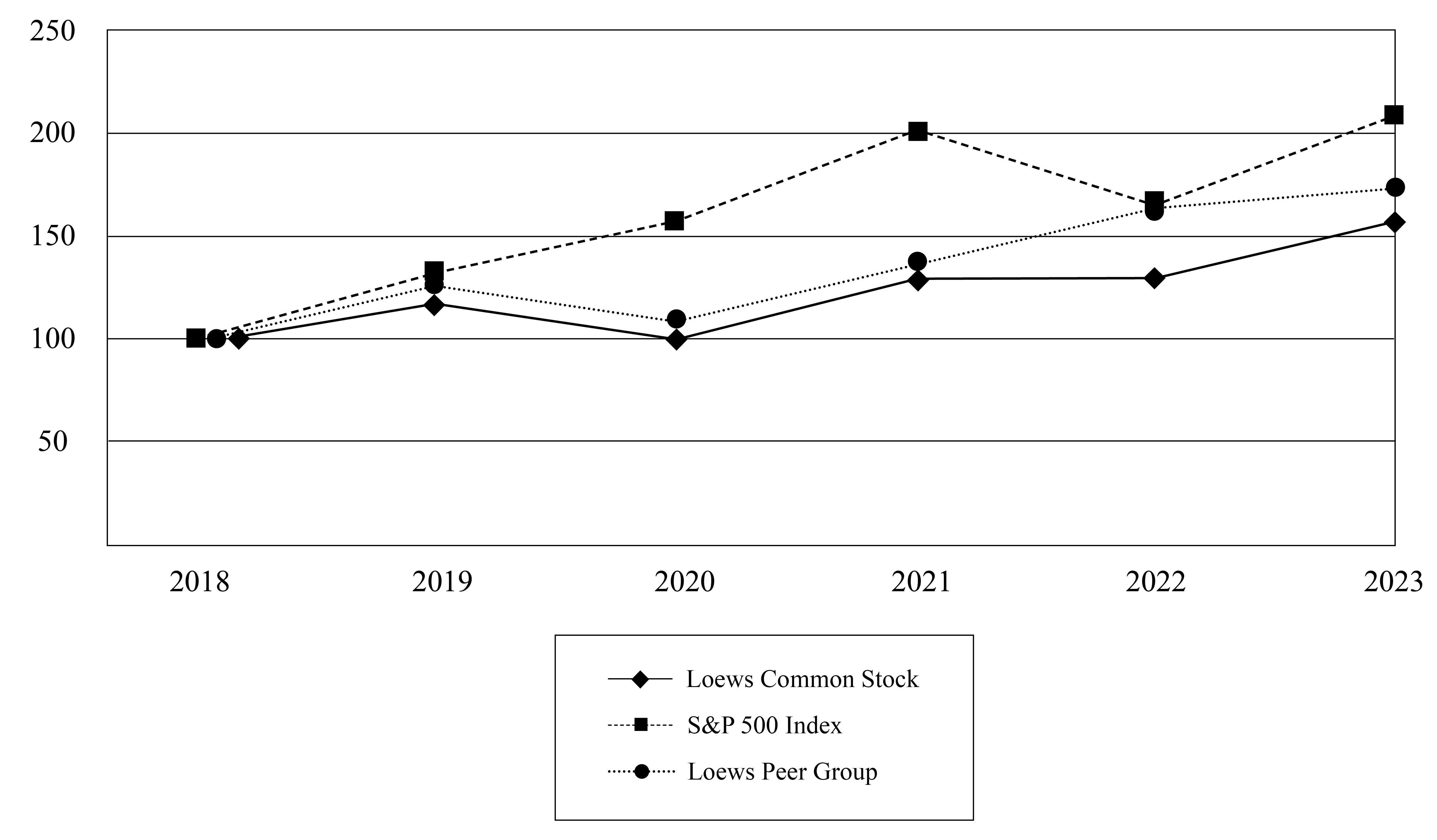
| 2018 | 2019 | 2020 | 2021 | 2022 | 2023 | |||||||||||||||
| Loews Common Stock | 100.0 | 115.89 | 100.03 | 128.92 | 130.74 | 156.60 | ||||||||||||||
| S&P 500 Index | 100.0 | 131.49 | 155.68 | 200.37 | 164.08 | 207.21 | ||||||||||||||
| Loews Peer Group (a) | 100.0 | 125.73 | 108.49 | 138.57 | 164.06 | 173.13 |
(a)The Loews Peer Group consists of the following companies that are industry peers of our principal operating subsidiaries or our investment in Altium Packaging: Berry Global, Inc., Chubb Limited, Diamond Rock Hospitality Company, Enbridge Inc., Energy Transfer LP, Kinder Morgan, Inc., Ryman Hospitality Properties, Inc., Silgan Holdings Inc., Sunstone Hotel Investors, Inc., The Hartford Financial Services Group, Inc., The Travelers Companies, Inc., W.R. Berkley Corporation and Xenia Hotels & Resorts, Inc.
| 42 |
Securities Authorized for Issuance Under Equity Compensation Plans
The following table provides certain information as of December 31, 2023 with respect to our equity compensation plans under which our equity securities are authorized for issuance.
| Plan category | Number of securities to be issued upon exercise of outstanding options, warrants and rights | Weighted average exercise price of outstanding options, warrants and rights | Number of securities remaining available for future issuance under equity compensation plans (excluding securities reflected in the first column) | ||||||||
| Equity compensation plans approved by security holders (a) | 1,065,547 | $ | 40.43 | 5,197,276 | |||||||
| Equity compensation plans not approved by security holders (b) | N/A | N/A | N/A |
(a)Reflects 531,500 outstanding stock appreciation rights awarded under the Loews Corporation 2000 Stock Option Plan, 419,516 outstanding unvested time-based and/or performance-based restricted stock units (“RSUs”) and 114,531 deferred vested RSUs awarded under the Loews Corporation 2016 Incentive Compensation Plan. The weighted average exercise price does not take into account RSUs as they do not have an exercise price.
(b)We do not have equity compensation plans that have not been approved by our shareholders.
Approximate Number of Equity Security Holders
As of February 1, 2024, we had approximately 560 holders of record of our common stock.
Common Stock Repurchases
Our Board of Directors has authorized our management, as it deems appropriate, to purchase, in the open market, through privately negotiated transactions or otherwise, our outstanding common stock.
During the fourth quarter of 2023, we purchased shares of our common stock as follows:
| Period | (a) Total number of shares purchased | (b) Average price paid per share | (c) Total number of shares purchased as part of publicly announced plans or programs | (d) Maximum number of shares (or approximate dollar value) of shares that may yet be purchased under the plans or programs (in millions) | |||||||||||||||||||
| October 1, 2023 - October 31, 2023 | 1,104,316 | $ | 63.40 | N/A | N/A | ||||||||||||||||||
| November 1, 2023 - November 30, 2023 | 252,096 | 64.98 | N/A | N/A | |||||||||||||||||||
| December 1, 2023 - December 31, 2023 | 785,300 | 68.45 | N/A | N/A |
Item 6. [Reserved]
Item 7. Management’s Discussion and Analysis of Financial Condition and Results of Operations.
OVERVIEW
Loews Corporation is a holding company and has four reportable segments comprised of three individual consolidated operating subsidiaries, CNA Financial Corporation (“CNA”), Boardwalk Pipeline Partners, LP (“Boardwalk Pipelines”) and Loews Hotels Holding Corporation (“Loews Hotels & Co”); and the Corporate segment. The Corporate segment is primarily comprised of Loews Corporation, excluding its operating subsidiaries, and the equity method of accounting for Altium Packaging LLC (“Altium Packaging”).
Unless the context otherwise requires, as used herein, the term “Company” means Loews Corporation including its subsidiaries, the terms “Parent Company,” “we,” “our,” “us” or like terms mean Loews Corporation excluding its subsidiaries and the term “Net income (loss) attributable to Loews Corporation” means Net income (loss) attributable to Loews Corporation shareholders.
We rely upon our invested cash balances and distributions from our subsidiaries to generate the funds necessary to meet our obligations and to declare and pay any dividends to our shareholders. The ability of our subsidiaries to pay dividends is subject to, among other things, the availability of sufficient earnings and funds in such subsidiaries, applicable state laws, including in the case of the insurance subsidiaries of CNA, laws and rules governing the payment of dividends by regulated insurance companies (see Note 15 of the Notes to Consolidated Financial Statements included under Item 8) and compliance with covenants in their respective loan agreements. Claims of creditors of our subsidiaries will generally have priority as to the assets of such subsidiaries over our claims and those of our creditors and shareholders. We are not responsible for the liabilities and obligations of our subsidiaries and there are no Parent Company guarantees.
The following discussion should be read in conjunction with Item 1A, Risk Factors, and Item 8, Financial Statements and Supplementary Data of this Form 10-K.
RESULTS OF OPERATIONS
This section of this Form 10-K generally discusses 2023 and 2022 results and year-to-year comparisons between 2023 and 2022. With the exception of the discussions of Consolidated Financial Results, CNA Financial and Other Insurance Operations, as a result of the adoption Accounting Standards Update (“ASU”) 2018-12, “Financial Services – Insurance (Topic 944): Targeted Improvements to the Accounting for Long-Duration Contracts,” (“ASU 2018-12”), a discussion of changes in results of operations comparing the years ended December 31, 2022 and 2021 for Loews Corporation and its subsidiaries may be found in Part II, Item 7, Management’s Discussion and Analysis of Financial Condition and Results of Operations in our Annual Report on Form 10-K for the year ended December 31, 2022, filed with the SEC on February 7, 2023.
As of January 1, 2023, ASU 2018-12 was adopted using the modified retrospective method applied as of the transition date of January 1, 2021, which required changes to the measurement and disclosure of long-duration contracts. Prior period amounts presented in the financial statements have been adjusted to reflect application of the new guidance. For additional information see Notes 1 and 9 of the Notes to Consolidated Financial Statements included under Item 8.
| 44 |
Consolidated Financial Results
The following table summarizes net income (loss) attributable to Loews Corporation by segment and the basic and diluted net income per share attributable to Loews Corporation for the years ended December 31, 2023, 2022 and 2021:
| Year Ended December 31 | 2023 | 2022 (a) | 2021 (a) | ||||||||||||||
| (In millions, except per share data) | |||||||||||||||||
| CNA Financial | $ | 1,094 | $ | 612 | $ | 1,061 | |||||||||||
| Boardwalk Pipelines | 283 | 247 | 235 | ||||||||||||||
| Loews Hotels & Co | 147 | 117 | (14) | ||||||||||||||
| Corporate | (90) | (154) | 280 | ||||||||||||||
| Net income attributable to Loews Corporation | $ | 1,434 | $ | 822 | $ | 1,562 | |||||||||||
| Basic net income per share | $ | 6.30 | $ | 3.39 | $ | 6.02 | |||||||||||
| Diluted net income per share | $ | 6.29 | $ | 3.38 | $ | 6.00 |
| (a) | As of January 1, 2023, ASU 2018-12 was adopted using the modified retrospective method applied as of the transition date of January 1, 2021. Prior period amounts presented in the financial statements have been adjusted to reflect application of the new guidance. For additional information see Notes 1 and 9 of the Notes to Consolidated Financial Statements included under Item 8. | ||||
2023 Compared with 2022
Net income attributable to Loews Corporation for 2023 was $1.4 billion, or $6.29 diluted net income per share, compared to net income attributable to Loews Corporation of $822 million, or $3.38 diluted net income per share, in 2022.
Net income attributable to Loews Corporation for 2023 includes a $37 million after-tax charge for Corporate for the termination of a non-contributory defined benefit pension plan and a $36 million after-tax gain for Loews Hotels & Co related to the acquisition of an additional equity interest in, and the consolidation of, a previously unconsolidated joint venture property.
The increase in net income attributable to Loews Corporation in 2023 compared to 2022 was driven by improved results at CNA due to higher net investment income, improved underwriting income, lower investment losses, and a significantly lower unfavorable impact in 2023 from long-term care annual reserve reviews performed in the third quarter of each year. Additionally the parent company posted higher investment returns on equity securities and short-term investments.
Boardwalk Pipelines also contributed positively to Loews Corporation’s year-over-year results due to higher revenues due to re-contracting at higher rates and recently completed growth projects.
2022 Compared with 2021
Net income attributable to Loews Corporation decreased to $822 million, or $3.38 diluted net income per share, for 2022 as compared to $1.6 billion, or $6.00 diluted net income per share, in 2021.
Net income attributable to Loews Corporation for 2021 includes a net investment gain of $555 million ($438 million after tax) related to the sale of approximately 47% of Altium Packaging. Excluding the gain on sale of Altium Packaging, net income decreased $302 million in 2022 compared to 2021, driven by unfavorable limited partnership and common stock results, and net losses from sales of fixed income securities at CNA, partially offset by improved underwriting results and increased net investment income from fixed income securities for CNA and the significant improvement in results for Loews Hotels & Co due to the rebound in leisure travel. Net income for 2022 also included an increase to long term care reserves for CNA, primarily driven by the unfavorable impact of increased cost of care inflation offset by favorable premium rate assumptions. Boardwalk Pipelines also contributed positively to Loews Co
Showing the first 8K of 141K characters. Open the full section
Item 7A. Quantitative and Qualitative Disclosures about Market Risk.
We are a large diversified holding company. As such, we and our subsidiaries have significant amounts of financial instruments that involve market risk. Our measure of market risk exposure represents an estimate of the change in fair value of our financial instruments. Changes in the trading portfolio are recognized in the Consolidated Statements of Income. Market risk exposure is presented for each class of financial instrument held by us and our subsidiaries at December 31, assuming immediate adverse market movements of the magnitude described below. We believe that the various rates of adverse market movements represent a measure of exposure to loss under hypothetically assumed adverse conditions. The estimated market risk exposure represents the hypothetical loss to future earnings and does not represent the maximum possible loss nor any expected actual loss, even under adverse conditions, because actual adverse fluctuations would likely differ. In addition, since our and our subsidiaries investment portfolios are subject to change based on portfolio management strategy as well as in response to changes in the market, these estimates are not necessarily indicative of the actual results which may occur.
| 74 |
Exposure to market risk is managed and monitored by senior management of the parent company and its subsidiaries. Senior management approves the overall investment strategy and has responsibility to ensure that the investment positions are consistent with that strategy with an acceptable level of risk. Management of risk may include buying or selling instruments or entering into offsetting positions.
Interest Rate Risk – We and our subsidiaries have exposure to interest rate risk arising from changes in the level or volatility of interest rates. We and our subsidiaries attempt to mitigate our exposure to interest rate risk by utilizing instruments such as interest rate swaps, commitments to purchase securities, options, futures and forwards. We and our subsidiaries monitor our sensitivity to interest rate changes by revaluing financial assets and liabilities using a variety of different interest rates. Duration and convexity at the security level are used to estimate the change in fair value that would result from a change in each security’s yield. Duration measures the price sensitivity of an asset to changes in yield. Convexity measures how the duration of the asset changes with interest rates. The duration and convexity analysis takes into account the unique characteristics (e.g., call and put options and prepayment expectations) of each security, in determining the hypothetical change in fair value. The analysis is performed at the security level and is aggregated up to the asset category level.
The evaluation is performed by applying an instantaneous change in the yield rates by varying magnitudes on a static balance sheet to determine the effect such a change in rates would have on the recorded market value of our investments and the resulting effect on shareholders’ equity. The analysis presents the sensitivity of the market value of our financial instruments to selected changes in market rates and prices which we believe are reasonably possible over a one year period.
The sensitivity analysis estimates the change in the fair value of interest sensitive assets and liabilities that were held on December 31, 2023 and 2022 due to an instantaneous change in the yield of the security at the end of the period of 100 basis points, with all other variables held constant.
The interest rates on certain types of assets and liabilities may fluctuate in advance of changes in market interest rates, while interest rates on other types may lag behind changes in market rates. Accordingly, the analysis may not be indicative of, is not intended to provide, and does not provide a precise forecast of the effect of changes of market interest rates on our earnings or shareholders’ equity. Further, the computations do not contemplate any actions that could be undertaken in response to changes in interest rates.
Our and our subsidiaries’ debt is primarily denominated in U.S. dollars and has been primarily issued at fixed rates, therefore, interest expense would not be impacted by interest rate shifts. The impact of a 100 basis point increase in interest rates on fixed rate debt would result in a decrease in market value of $341 million and $344 million at December 31, 2023 and 2022. The impact of a 100 basis point decrease would result in an increase in market value of $363 million and $368 million at December 31, 2023 and 2022. At December 31, 2023 and 2022, the impact of a 100 basis point increase in interest rates on variable rate debt, net of the effects of the swaps, would result in a $2 million increase interest expense.
Equity Price Risk – We and our subsidiaries have exposure to equity price risk as a result of investments in equity securities and equity derivatives. Equity price risk results from changes in the level or volatility of equity prices which affect the value of equity securities or instruments that derive their value from such securities or indexes. Equity price risk was measured assuming an instantaneous 25% decrease in the underlying reference price or index from its level at December 31, 2023 and 2022, with all other variables held constant. For limited partnership holdings, the estimated change in value was largely derived from a beta analysis calculation of historical experience of the portfolio and indices with similar strategies relative to the S&P 500.
Foreign Exchange Rate Risk – Foreign exchange rate risk arises from the possibility that changes in foreign currency exchange rates will impact the value of financial instruments. We and our subsidiaries have foreign exchange rate exposure when we buy or sell foreign currencies or financial instruments denominated in a foreign currency, which is reduced through the use of forward contracts. The sensitivity analysis assumes an instantaneous 20% decrease in the foreign currency exchange rates versus the U.S. dollar from their levels at December 31, 2023 and 2022, with all other variables held constant.
Commodity Price Risk – We and our subsidiaries have exposure to price risk as a result of our investments in commodities. Commodity price risk results from changes in the level or volatility of commodity prices that impact instruments which derive their value from such commodities. Commodity price risk was measured assuming an instantaneous decrease of 20% from their levels at December 31, 2023 and 2022.
We have exposure to price risk as a result of Altium Packaging’s purchases of certain raw materials, such as high-density polyethylene, polycarbonate, polypropylene and polyethylene terephthalate resins in connection with the production of its products. The purchase prices of these raw materials are determined based on prevailing market conditions. Altium
| 75 |
Packaging’s contracts with its customers provide for price adjustments for changes in resin prices on a prospective basis. Due to fluctuations in resin prices, over time resin raw material costs are generally offset by the change in revenues, so that Altium Packaging’s gross margins return to the same level as prior to the change in prices.
Credit Risk – We and our subsidiaries are exposed to credit risk relating to the risk of loss resulting from the nonperformance by a customer of its contractual obligations. Although nearly all customers pay for their services on a timely basis, the Company and its subsidiaries actively monitors the credit exposure to its customers. Certain of our subsidiaries may perform credit reviews of customers and may require customers to provide cash collateral, post a letter of credit, prepay for services or provide other credit enhancements.
The following tables present the estimated effects on the fair value of our and our subsidiaries’ financial instruments as of December 31, 2023 and 2022 due to an increase in yield rates of 100 basis points, a 20% decline in foreign currency exchange rates and a 25% decline in the S&P 500, with all other variables held constant, on the basis of those entered into for trading purposes and other than trading purposes.
Trading portfolio:
| Increase (Decrease) | |||||||||||||||||
| December 31, 2023 | Fair Value Asset (Liability) | Interest Rate Risk | Equity Price Risk | ||||||||||||||
| (In millions) | |||||||||||||||||
| Fixed maturities – long | $ | 201 | $ | (3) | |||||||||||||
| Equity securities – long | 366 | $ | (91) | ||||||||||||||
| – short | (62) | 15 | |||||||||||||||
| Options – purchased | 1 | 35 | |||||||||||||||
| Other invested assets | 8 | ||||||||||||||||
| Short-term investments | 2,109 | (6) |
Other than trading portfolio:
| Increase (Decrease) | |||||||||||||||||||||||
| December 31, 2023 | Fair Value Asset (Liability) | Interest Rate Risk | Foreign Currency Risk | Equity Price Risk | |||||||||||||||||||
| (In millions) | |||||||||||||||||||||||
| Fixed maturities | $ | 40,425 | $ | (2,779) | $ | (638) | |||||||||||||||||
| Equity securities | 683 | (14) | $ | (48) | |||||||||||||||||||
| Limited partnership investments | 2,174 | (1) | (217) | ||||||||||||||||||||
| Other invested assets | 81 | (15) | |||||||||||||||||||||
| Mortgage loans | 997 | (34) | |||||||||||||||||||||
| Short-term investments | 2,287 | (2) | (38) | ||||||||||||||||||||
| Other derivatives | 14 | 4 | 3 | 29 |
| 76 |
Trading portfolio:
| Increase (Decrease) | |||||||||||||||||
| December 31, 2022 | Fair Value Asset (Liability) | Interest Rate Risk | Equity Price Risk | ||||||||||||||
| (In millions) | |||||||||||||||||
| Fixed maturities – long | $ | 70 | |||||||||||||||
| Equity securities – long | 465 | $ | (116) | ||||||||||||||
| – short | (82) | 20 | |||||||||||||||
| Other invested assets | 7 | (3) | |||||||||||||||
| Short-term investments | 2,672 | $ | (6) |
Other than trading portfolio:
| Increase (Decrease) | |||||||||||||||||||||||
| December 31, 2022 | Fair Value Asset (Liability) | Interest Rate Risk | Foreign Currency Risk | Equity Price Risk | |||||||||||||||||||
| (In millions) | |||||||||||||||||||||||
| Fixed maturities | $ | 37,627 | $ | (2,603) | $ | (532) | |||||||||||||||||
| Equity securities | 674 | (18) | $ | (46) | |||||||||||||||||||
| Limited partnership investments | 1,954 | (200) | |||||||||||||||||||||
| Other invested assets | 78 | (14) | |||||||||||||||||||||
| Mortgage loans | 973 | (38) | |||||||||||||||||||||
| Short-term investments | 2,182 | (2) | (41) | ||||||||||||||||||||
| Other derivatives | 21 | 6 | 2 | 42 |
Changes in discount rates used to measure CNA’s liability for future policyholder benefits (“LFPB”) would reduce the impact of the decrease in Fixed maturity securities within Other comprehensive income. The carrying value of the LFPB was $14.0 billion and $13.5 billion as of December 31, 2023 and 2022. The estimated decrease in the carrying value of the LFPB as of December 31, 2023 and 2022 due to an increase in yield rates of 100 basis points was $1.5 billion. The change in the carrying value of the LFPB due to interest rate changes was estimated by discounting the expected future cash flows.
| 77 |
Item 8. Financial Statements and Supplementary Data.
Financial Statements and Supplementary Data are comprised of the following sections:
| 78 |
MANAGEMENT’S REPORT ON INTERNAL CONTROL OVER FINANCIAL REPORTING
Our management is responsible for establishing and maintaining adequate internal control over financial reporting (as defined in Exchange Act Rules 13a-15(f) and 15d-15(f)) for us. Our internal control system was designed to provide reasonable assurance to our management and Board of Directors regarding the preparation and fair presentation of published financial statements.
There are inherent limitations to the effectiveness of any control system, however well designed, including the possibility of human error and the possible circumvention or overriding of controls. Further, the design of a control system must reflect the fact that there are resource constraints, and the benefits of controls must be considered relative to their costs. Management must make judgments with respect to the relative cost and expected benefits of any specific control measure. The design of a control system also is based in part upon assumptions and judgments made by management about the likelihood of future events, and there can be no assurance that a control will be effective under all potential future conditions. As a result, even an effective system of internal control over financial reporting can provide no more than reasonable assurance with respect to the fair presentation of financial statements and the processes under which they were prepared.
Our management assessed the effectiveness of our internal control over financial reporting as of December 31, 2023. In making this assessment, management used the criteria set forth by the Committee of Sponsoring Organizations of the Treadway Commission in Internal Control – Integrated Framework (2013). Based on this assessment, our management believes that, as of December 31, 2023, our internal control over financial reporting was effective.
Our independent registered public accounting firm, Deloitte & Touche LLP, has issued an audit report on the Company’s internal control over financial reporting. The report of Deloitte & Touche LLP follows this Report.
| 79 |
REPORT OF INDEPENDENT REGISTERED PUBLIC ACCOUNTING FIRM
To the shareholders and the Board of Directors of Loews Corporation
Opinion on Internal Control over Financial Reporting
We have audited the internal control over financial reporting of Loews Corporation and subsidiaries (the “Company”) as of December 31, 2023, based on criteria established in Internal Control — Integrated Framework (2013) issued by the Committee of Sponsoring Organizations of the Treadway Commission (COSO). In our opinion, the Company maintained, in all material respects, effective internal control over financial reporting as of December 31, 2023, based on criteria established in Internal Control — Integrated Framework (2013) issued by COSO.
We have also audited, in accordance with the standards of the Public Company Accounting Oversight Board (United States) (PCAOB), the consolidated financial statements as of and for the year ended December 31, 2023, of the Company and our report dated February 6, 2024, expressed an unqualified opinion on those financial statements and included an explanatory paragraph regarding the Company’s change in its method of accounting for measurement and disclosure of long-duration contracts.
Basis for Opinion
The Company’s management is responsible for maintaini
Showing the first 8K of 435K characters. Open the full section
Item 9. Changes in and Disagreements with Accountants on Accounting and Financial Disclosure.
None.
Item 9A. Controls and Procedures.
Disclosure Controls and Procedures
The Company maintains a system of disclosure controls and procedures (as defined in Rules 13a-15(e) and 15d-15(e) under the Securities Exchange Act of 1934, as amended (the “Exchange Act”)), which is designed to ensure that information required to be disclosed by the Company in reports that it files or submits under the Exchange Act, including this Report, is recorded, processed, summarized and reported on a timely basis. These disclosure controls and procedures include controls and procedures designed to ensure that information required to be disclosed by the Company under the Exchange Act is accumulated and communicated to the Company’s management on a timely basis to allow decisions regarding required disclosure.
The Company’s management, including the Company’s principal executive officer (“CEO”) and principal financial officer (“CFO”) conducted an evaluation of the effectiveness of the Company’s disclosure controls and procedures as of the end of the period covered by this Report and, based on that evaluation, the CEO and CFO concluded that the Company’s disclosure controls and procedures were effective as of December 31, 2023.
Internal Control Over Financial Reporting
Pursuant to Section 404 of the Sarbanes-Oxley Act of 2002, and the implementing rules of the Securities and Exchange Commission, the Company included a report of management’s assessment of the design and effectiveness of its internal control over financial reporting as part of this Annual Report on Form 10-K for the year ended December 31, 2023. The independent registered public accounting firm of the Company also reported on the effectiveness of the Company’s internal control over financial reporting as of December 31, 2023. Management’s report and the independent registered public accounting firm’s report are included under Item 8 of this Report under the captions entitled “Management’s Report on Internal Control Over Financial Reporting” and “Report of Independent Registered Public Accounting Firm.”
There were no changes in the Company’s internal control over financial reporting (as defined in Rules 13a-15(f) and 15d-15(f) under the Exchange Act) that occurred during the quarter ended December 31, 2023 that have materially affected or that are reasonably likely to materially affect the Company’s internal control over financial reporting.
Item 9B. Other Information.
None.
Item 9C. Disclosure Regarding Foreign Jurisdictions that Prevent Inspections.
Item 10. Directors, Executive Officers and Corporate Governance.
Information about our executive officers is reported under the caption “Information about our Executive Officers” in Part I of this Report.
We have a Code of Business Conduct and Ethics which applies to all of our directors, officers and employees, including our principal executive officer, principal financial officer and principal accounting officer. This Code can be found on our website at www.loews.com and is available in print to any shareholder who requests a copy by writing to our Corporate Secretary at Loews Corporation, 9 West 57th Street, New York, N.Y. 10019-2714. We intend to post any changes to or waivers of this Code for our directors and executive officers, including our principal executive officer, principal financial officer, principal accounting officer or persons performing similar functions, on our website. Any amendment to this Code and any waiver applicable to our executive officers or senior financial officers will be posted on our website within the time period required by the SEC and New York Stock Exchange.
Additional information required by this Item can be found in our Proxy Statement for our 2024 Annual Meeting of Shareholders to be filed with the SEC within 120 days after December 31, 2023 (the “2024 Proxy Statement”) and is incorporated herein by reference.
Item 11. Executive Compensation.
Information required by this item can be found in our 2024 Proxy Statement and is incorporated herein by reference.
Item 12. Security Ownership of Certain Beneficial Owners and Management and Related Stockholder Matters.
Information about securities authorized for issuance under equity compensation plans can be found under the caption “Securities Authorized for Issuance Under Equity Compensation Plans” under Item 5 of this Report.
Additional information required by this item can be found in our 2024 Proxy Statement and is incorporated herein by reference.
Item 13. Certain Relationships and Related Transactions, and Director Independence.
Information required by this Item can be found in our 2024 Proxy Statement and is incorporated herein by reference.
Item 14. Principal Accounting Fees and Services.
Information required by this Item can be found in our 2024 Proxy Statement and is incorporated herein by reference.
| 163 |
PART IV
Item 15. Exhibits and Financial Statement Schedules.
(a) 1. Financial Statements:
The financial statements appear under Item 8. The following additional financial data should be read in conjunction with those financial statements. Schedules not included with these additional financial data have been omitted because they are not applicable or the required information is shown in the consolidated financial statements or notes to consolidated financial statements.
| Page Number | |||||
| 2.Financial Statement Schedules: | |||||
| Loews Corporation and Subsidiaries: | |||||
| Schedule I–Condensed financial information of Registrant as of December 31, 2023 and 2022 and for the years ended December 31, 2023, 2022 and 2021 | 170 | ||||
| Schedule V–Supplemental information concerning property and casualty insurance operations as of December 31, 2023 and 2022 and for the years ended December 31, 2023, 2022 and 2021 | 172 |
inside
| 164 |
| 165 |
| 166 |
| Description | Exhibit Number | |||||||
| (32) | Section 1350 Certifications | |||||||
| Certification by the Chief Executive Officer of the Company pursuant to 18 U.S.C. Section 1350 (as adopted by Section 906 of the Sarbanes-Oxley Act of 2002) | 32.01* | |||||||
| Certification by the Chief Financial Officer of the Company pursuant to 18 U.S.C. Section 1350 (as adopted by Section 906 of the Sarbanes-Oxley Act of 2002) | 32.02* | |||||||
| (97) | Loews Corporation Executive Incentive Compensation Clawback Policy, adopted May 9, 2023 | 97.01*+ | ||||||
| (101) | XBRL Related Documents | |||||||
| XBRL Instance Document – the instance document does not appear in the Interactive Data File because its XBRL tags are embedded within the Inline XBRL document | 101.INS* | |||||||
| Inline XBRL Taxonomy Extension Schema | 101.SCH* | |||||||
| Inline XBRL Taxonomy Extension Calculation Linkbase | 101.CAL* | |||||||
| Inline XBRL Taxonomy Extension Definition Linkbase | 101.DEF* | |||||||
| Inline XBRL Taxonomy Label Linkbase | 101.LAB* | |||||||
| Inline XBRL Taxonomy Extension Presentation Linkbase | 101.PRE* | |||||||
| (104) | (Cover Page Interactive Data File (formatted as Inline XBRL and contained in Exhibit 101) | 104* |
*Filed herewith.
+Management contract or compensatory plan or arrangement.
Item 16. Form 10-K Summary.
Not included.
| 167 |
SIGNATURES
Pursuant to the requirements of Section 13 or 15(d) of the Securities Exchange Act of 1934, the Registrant has duly caused this Report to be signed on its behalf by the undersigned, thereunto duly authorized.
| LOEWS CORPORATION | |||||||||||
| Dated: | February 6, 2024 | By | /s/ Jane J. Wang | ||||||||
| (Jane J. Wang, Senior Vice President and | |||||||||||
| Chief Financial Officer) | |||||||||||
| Pursuant to the requirements of the Securities Exchange Act of 1934, this Report has been signed below by the following persons on behalf of the Registrant and in the capacities and on the dates indicated. | |||||||||||
| Dated: | February 6, 2024 | By | * | ||||||||
| (James S. Tisch, President, | |||||||||||
| Chief Executive Officer and Director) | |||||||||||
| Dated: | February 6, 2024 | By | * | ||||||||
| (Jane J. Wang, Senior Vice President and | |||||||||||
| Chief Financial Officer) | |||||||||||
| Dated: | February 6, 2024 | By | * | ||||||||
| (Mark S. Schwartz, Vice President, | |||||||||||
| Chief Accounting Officer and Treasurer) | |||||||||||
| Dated: | February 6, 2024 | By | * | ||||||||
| (Ann E. Berman, Director) | |||||||||||
| Dated: | February 6, 2024 | By | * | ||||||||
| (Joseph L. Bower, Director) | |||||||||||
| Dated: | February 6, 2024 | By | * | ||||||||
| (Charles D. Davidson, Director) | |||||||||||
| 168 |
| Dated: | February 6, 2024 | By | * | ||||||||
| (Charles M. Diker, Director) | |||||||||||
| Dated: | February 6, 2024 | By | * | ||||||||
| (Paul J. Fribourg, Director) | |||||||||||
| Dated: | February 6, 2024 | By | * | ||||||||
| (Walter L. Harris, Director) | |||||||||||
| Dated: | February 6, 2024 | By | * | ||||||||
| (Jonathan C. Locker, Director) | |||||||||||
| Dated: | February 6, 2024 | By | * | ||||||||
| (Susan P. Peters, Director) | |||||||||||
| Dated: | February 6, 2024 | By | * | ||||||||
| (Andrew H. Tisch, Director) | |||||||||||
| Dated: | February 6, 2024 | By | * | ||||||||
| (Jonathan M. Tisch, Director) | |||||||||||
| Dated: | February 6, 2024 | By | ***** | ||||||||
| (Anthony Welters, Director) |
| *By: | /s/ Marc A. Alpert | |||||||
| (Marc A. Alpert, Senior Vice President, General | ||||||||
| Counsel and Secretary) | ||||||||
| Attorney-in-Fact |
| 169 |
SCHEDULE I
Condensed Financial Information of Registrant
LOEWS CORPORATION
BALANCE SHEETS
ASSETS
| December 31 | 2023 | 2022 (a) | |||||||||
| (In millions) | |||||||||||
| Current assets, principally investment in short-term instruments | $ | 2,149 | $ | 2,810 | |||||||
| Investments in securities | 568 | 564 | |||||||||
| Investments in capital stocks of subsidiaries, at equity | 14,889 | 13,410 | |||||||||
| Other assets | 76 | 112 | |||||||||
| Total assets | $ | 17,682 | $ | 16,896 | |||||||
| LIABILITIES AND SHAREHOLDERS’ EQUITY | |||||||||||
| Current liabilities | $ | 102 | $ | 626 | |||||||
| Long-term debt | 1,782 | 1,780 | |||||||||
| Deferred income tax and other | 94 | 141 | |||||||||
| Total liabilities | 1,978 | 2,547 | |||||||||
| Shareholders’ equity | 15,704 | 14,349 | |||||||||
| Total liabilities and shareholders’ equity | $ | 17,682 | $ | 16,896 |
STATEMENTS OF OPERATIONS AND COMPREHENSIVE INCOME (LOSS)
| Year Ended December 31 | 2023 | 2022 (a) | 2021 (a) | ||||||||||||||
| (In millions) | |||||||||||||||||
| Revenues: | |||||||||||||||||
| Equity in income of subsidiaries (b) | $ | 1,501 | $ | 963 | $ | 1,639 | |||||||||||
| Net investment income, interest and other | 131 | 1 | 103 | ||||||||||||||
| Investment loss | (15) | ||||||||||||||||
| Total | 1,632 | 964 | 1,727 | ||||||||||||||
| Expenses: | |||||||||||||||||
| Administrative | 119 | 84 | 93 | ||||||||||||||
| Interest | 80 | 89 | 89 | ||||||||||||||
| Total | 199 | 173 | 182 | ||||||||||||||
| Income before income tax | 1,433 | 791 | 1,545 | ||||||||||||||
| Income tax benefit | 1 | 31 | 17 | ||||||||||||||
| Net income | 1,434 | 822 | 1,562 | ||||||||||||||
| Equity in other comprehensive income (loss) of subsidiaries | 884 | (2,000) | 196 | ||||||||||||||
| Total comprehensive income (loss) | $ | 2,318 | $ | (1,178) | $ | 1,758 |
| 170 |
SCHEDULE I
(Continued)
Condensed Financial Information of Registrant
LOEWS CORPORATION
STATEMENTS OF CASH FLOWS
| Year Ended December 31 | 2023 | 2022 (a) | 2021 (a) | ||||||||||||||
| (In millions) | |||||||||||||||||
| Operating Activities: | |||||||||||||||||
| Net income | $ | 1,434 | $ | 822 | $ | 1,562 | |||||||||||
| Adjustments to reconcile net income (loss) to net cash provided (used) by operating activities: | |||||||||||||||||
| Equity method investees | (512) | (3) | (804) | ||||||||||||||
| Investment loss | 15 | ||||||||||||||||
| Provision for deferred income taxes | (4) | (49) | 7 | ||||||||||||||
| Changes in operating assets and liabilities, net: | |||||||||||||||||
| Receivables | 10 | (11) | |||||||||||||||
| Accounts payable and accrued liabilities | (9) | (47) | (48) | ||||||||||||||
| Trading securities | 576 | 153 | (69) | ||||||||||||||
| Other, net | 109 | 39 | 82 | ||||||||||||||
| 1,604 | 904 | 745 | |||||||||||||||
| Investing Activities: | |||||||||||||||||
| Investments in and advances to subsidiaries | (217) | (137) | 385 | ||||||||||||||
| Change in investments, primarily short-term | 29 | 30 | 72 | ||||||||||||||
| Other | (11) | (9) | |||||||||||||||
| (199) | (116) | 457 | |||||||||||||||
| Financing Activities: | |||||||||||||||||
| Dividends paid | (57) | (61) | (65) | ||||||||||||||
| Purchases of treasury shares | (849) | (729) | (1,136) | ||||||||||||||
| Payment of debt | (500) | ||||||||||||||||
| Other | (5) | (7) | (4) | ||||||||||||||
| (1,411) | (797) | (1,205) | |||||||||||||||
| Net change in cash | (6) | (9) | (3) | ||||||||||||||
| Cash, beginning of year | 10 | 19 | 22 | ||||||||||||||
| Cash, end of year | $ | 4 | $ | 10 | $ | 19 |
| (a) | As of January 1, 2023, ASU 2018-12 was adopted using the modified retrospective method applied as of the transition date of January 1, 2021. Prior period amounts presented in the financial statements have been adjusted to reflect application of the new guidance. For additional information see Notes 1 and 9 of the Notes to Consolidated Financial Statements included under Item 8. |
| (b) | Cash dividends paid to the Company by affiliates amounted to $1,006, $978 and $853 for the years ended December 31, 2023, 2022 and 2021. |
| 171 |
SCHEDULE V
LOEWS CORPORATION AND SUBSIDIARIES
Supplemental Information Concerning Property and Casualty Insurance Operations
| Consolidated Property and Casualty Operations | |||||||||||
| December 31 | 2023 | 2022 (a) | |||||||||
| (In millions) | |||||||||||
| Deferred acquisition costs | $ | 896 | $ | 806 | |||||||
| Reserves for unpaid claim and claim adjustment expenses | 23,304 | 22,120 | |||||||||
| Discount deducted from claim and claim adjustment expense reserves above (based on interest rates ranging from 3.5% to 6.4%) | 647 | 683 | |||||||||
| Unearned premiums | 6,933 | 6,374 |
| Year Ended December 31 | 2023 | 2022 (a) | 2021 (a) | ||||||||||||||
| (In millions) | |||||||||||||||||
| Net written premiums | $ | 9,892 | $ | 9,128 | $ | 8,405 | |||||||||||
| Net earned premiums | 9,480 | 8,667 | 8,175 | ||||||||||||||
| Net investment income | 2,163 | 1,751 | 2,111 | ||||||||||||||
| Incurred claim and claim adjustment expenses related to current year | 5,667 | 5,181 | 5,021 | ||||||||||||||
| Incurred claim and claim adjustment expenses related to prior years | 48 | (32) | 15 | ||||||||||||||
| Amortization of deferred acquisition costs | 1,644 | 1,490 | 1,443 | ||||||||||||||
| Paid claim and claim adjustment expenses | 4,601 | 4,302 | 3,949 |
| (a) | As of January 1, 2023, ASU 2018-12 was adopted using the modified retrospective method applied as of the transition date of January 1, 2021. Prior period amounts presented in the financial statements have been adjusted to reflect application of the new guidance. For additional information see Notes 1 and 9 of the Notes to Consolidated Financial Statements included under Item 8. |
| 172 |