 filings.tools
Leidos Holdings 10-K 2020-01-03
Filed 2020-02-18. 22 sections, 460K characters. Original on sec.gov · Markdown · JSON
Cover and table of contents
UNITED STATES
SECURITIES AND EXCHANGE COMMISSION
Washington, D.C. 20549
Form 10-K
(Mark One)
| ☒ | ANNUAL REPORT PURSUANT TO SECTION 13 OR 15(d) OF THE SECURITIES EXCHANGE ACT OF 1934 |
For the fiscal year ended January 3, 2020
or
| ☐ | TRANSITION REPORT PURSUANT TO SECTION 13 OR 15(d) OF THE SECURITIES EXCHANGE ACT OF 1934 |
For the transition period from to
Commission file number 001-33072
| Leidos Holdings, Inc. | ||
| (Exact name of registrant as specified in its charter) |
| Delaware | 20-3562868 | ||||
| (State or other jurisdiction of incorporation or organization) | (I.R.S. Employer Identification No.) | ||||
| 11951 Freedom Drive, | Reston, | Virginia | 20190 | ||
| (Address of principal executive offices) | (Zip Code) |
(571) 526-6000
(Registrant's telephone number, including area code)
Securities registered pursuant to Section 12(b) of the Act:
| Title of each class | Trading symbol(s) | Name of each exchange on which registered | ||
| Common stock, par value $.0001 per share | LDOS | New York Stock Exchange |
Securities registered pursuant to Section 12(g) of the Act:
None
Indicate by check mark if the registrant is a well-known seasoned issuer, as defined in Rule 405 of the Securities Act. Yes x No o
Indicate by check mark if the registrant is not required to file reports pursuant to Section 13 or Section 15(d) of the Act. Yes o No x
Indicate by check mark whether the registrant (1) has filed all reports required to be filed by Section 13 or 15(d) of the Securities Exchange Act of 1934 during the preceding 12 months (or for such shorter period that the registrant was required to file such reports), and (2) has been subject to such filing requirements for the past 90 days. Yes x No o
Indicate by check mark whether the registrant has submitted electronically every Interactive Data File required to be submitted pursuant to Rule 405 of Regulation S-T (§232.405 of this chapter) during the preceding 12 months (or for such shorter period that the registrant was required to submit such files). Yes x No o
Indicate by check mark whether the registrant is a large accelerated filer, an accelerated filer, a non-accelerated filer, a smaller reporting company, or an emerging growth company. See the definitions of “large accelerated filer,” “accelerated filer”, “smaller reporting company”, and "emerging growth company" in Rule 12b-2 of the Exchange Act.
| Large accelerated filer | ☒ | Accelerated filer | ☐ | ||||||
| Non-accelerated filer | ☐ | Smaller reporting company | ☐ | ||||||
| Emerging growth company | ☐ |
If an emerging growth company, indicate by check mark if the registrant has elected not to use the extended transition period for complying with any new or revised financial accounting standards provided pursuant to Section 13(a) of the Exchange Act. o
Indicate by check mark whether the registrant is a shell company (as defined in Rule 12b-2 of the Act). Yes ☐ No x
As of June 28, 2019, which was the last business day of the registrant's most recently completed second fiscal quarter, the aggregate market value of Leidos Holdings, Inc. common stock (based upon the closing price of the stock on the New York Stock Exchange) held by non-affiliates of the registrant was $11,356,349,856.
The number of shares issued and outstanding of the registrant’s class of common stock as of February 10, 2020 was 141,402,269 shares ($.0001 par value per share).
DOCUMENTS INCORPORATED BY REFERENCE
Portions of Leidos Holdings, Inc.'s definitive Proxy Statement for the 2020 Annual Meeting of Stockholders ("2020 Proxy Statement") are incorporated by reference in Part III of this Annual Report on Form 10-K.
LEIDOS HOLDINGS, INC.
FORM 10-K
TABLE OF CONTENTS
PART I
Item 1. Business
Our Company
Leidos Holdings, Inc. ("Leidos"), a Delaware corporation, is a holding company whose direct 100%-owned subsidiary and principal operating company is Leidos, Inc. Leidos was founded in 1969 by physicist Dr. Robert Beyster. Since our founding 51 years ago, we have applied our expertise in science, research and engineering in rapidly evolving technologies and markets to solve complex problems of global concern.
We use the terms "Company," "we," "us" and "our" to refer collectively to Leidos Holdings, Inc. and its consolidated subsidiaries.
Leidos is a FORTUNE 500® science, engineering and information technology company that provides services and solutions in the defense, intelligence, civil and health markets. We bring domain-specific capability and innovations to customers in each of these markets by leveraging seven core capabilities: cyber; digital modernization; integrated systems; mission software systems; mission support; operations and logistics; and sensors, collection and phenomenology. Applying our technically advanced solutions to help solve our customers' most difficult problems has enabled us to build strong relationships with key customers. Our domestic customers include the U.S. Department of Defense ("DoD"), the U.S. Intelligence Community, the U.S. Department of Homeland Security ("DHS"), the Federal Aviation Administration ("FAA"), the Department of Veterans Affairs ("VA") and many other U.S. government civilian agencies, as well as state and local government agencies. With a focus on delivering mission-critical solutions, Leidos generated 87% of fiscal 2019 revenues from U.S. government contracts.
Building on our foundation of offering innovative services and solutions to U.S. government customers, Leidos serves international government and select commercial markets. Our international customers include foreign governments and their agencies, primarily located in Australia and the United Kingdom ("U.K."). By leveraging expertise in multiple disciplines, tailoring our services and solutions to the particular needs of our targeted markets and using advanced analytics, we work to securely deliver services and solutions that not only meet customers' current goals, but also support their future missions.
For additional discussion and analysis related to recent business developments, see "Business Environment and Trends" in "Management's Discussion and Analysis of Financial Condition and Results of Operations" in Part II of this Annual Report on Form 10-K.
Our Business Segments
At January 3, 2020, our business is aligned into three reportable segments (Defense Solutions, Civil and Health). Additionally, we separately present the unallocable costs associated with corporate functions as Corporate. Our operations and reportable segments are organized around the markets we serve. We provide a wide array of scientific, engineering and technical services and solutions across these reportable segments. Less than 10% of our revenues and tangible long-lived assets are generated by or owned by entities located outside of the United States.
Effective the beginning of fiscal 2019, we changed the composition of our Defense Solutions reportable segment to better align the operations within the reportable segment to the customers we serve. This resulted in the identification of new operating segments within Defense Solutions. In addition, certain contracts were reassigned between the Civil and Defense Solutions reportable segments. While this activity did not have a material impact on our reportable segments, fiscal 2018 and 2017 segment results and disclosures have been recast to reflect this change.
Defense Solutions
Defense Solutions is focused on rapidly deploying agile, cost-effective solutions to meet the ever-changing missions of our customers in the areas of intelligence surveillance and reconnaissance ("ISR"), enterprise information technology ("IT"), integrated systems, cybersecurity and global services. We provide a diverse portfolio of national security solutions and systems for air, land, sea, space and cyberspace for the U.S. Intelligence Community, the DoD, military services, government agencies of U.S. allies abroad and other federal and commercial customers in the national security industry. Our solutions deliver innovative technology, large-scale intelligence systems, command and control platforms, data analytics, logistics and cybersecurity solutions, as well as intelligence analysis and operations support to critical missions around the world. Defense Solutions represented 48% of total revenues for fiscal 2019 and 49% of total revenues for fiscal 2018 and 2017.
Leidos Holdings, Inc. Annual Report - 1
PART I
Our Defense Solutions business offers broad technology, development and integration capabilities and is responsible for leading our efforts in surveillance and reconnaissance, integrated systems solutions and global services for the U.S. Intelligence Community, military commands and other government and commercial customers.
| • | Surveillance and Reconnaissance – We offer a wide range of technologies in multiple domains that address the nation's most critical threats and deliver solutions to the U.S. Intelligence Community, DoD and military services. A primary focus is on the DoD's technology organizations, which include the Defense Advanced Research Projects Agency, Army Research Lab, Air Force Research Lab and Office of Naval Research. Our market concentration is on airborne and ground ISR, maritime systems, electronic warfare systems, distributed sensor systems, autonomous systems and command and control. We provide multi-spectral, airborne, ground and maritime ISR collection and processing systems, advanced sensor design, command and control solutions and training systems. |
| • | Digital Transformation and Integrated Systems – We offer extensive software development capabilities for intelligence and information systems and deliver mission and enterprise-level solutions to the U.S. and allied Intelligence Community, DoD, military services and the Australian Department of Defense. Our markets include cybersecurity, data analytics, digital transformation and operations and logistics. Our cybersecurity solutions detect and manage the most sophisticated cyber threats. We offer innovative data analytics capabilities, and we design, develop, integrate, deploy and support information-centric software and enterprise IT systems for complex, data-driven national security challenges. Our operations and logistics offerings include enterprise platforms that speed the supply chain of highly complex systems. |
| • | Global Services – We provide high-end services to the U.S. Intelligence Community and DoD. Operating around the world daily, we provide intelligence analysis, operational support, security, linguistics and training. In addition, we deliver tailored IT services and solutions to our customers across the globe. |
Civil
Our Civil business is focused on seamlessly integrating and protecting physical, digital and data domains. By applying leading science, effective technologies and business acumen, our talented employees help customers maximize their performance and take on the connected world with data-driven insights, improved efficiencies and technological advantages. Civil represented 34% of total revenues for fiscal 2019 and 33% of total revenues for fiscal 2018 and 2017.
| • | Aviation Solutions – Leidos is a trusted systems integrator serving Air Navigation Service Providers including the FAA, the Transportation Security Administration ("TSA") and airport operators. Our work in airport modernization helps stakeholders achieve stated objectives, including increased operational efficiency and safety, a technology enhanced passenger experience, non-aeronautical revenue enablement and state-of-the-art situational awareness and security. Leidos air traffic control systems are used in Air Navigation Service Provider facilities that control a majority of the world's air traffic. We work diligently to support the FAA's NextGen program with government accepted systems including En Route Automation Modernization, Advanced Technology Oceanic Procedures, Time Based Flow Management and Terminal Flight Data Management. For the National Air Traffic Services system in the U.K., we offer the SkyLine Air Traffic Management suite to enhance safety, improve on-time performance and increase fuel efficiency. |
| • | Security Products – Our Vehicle and Cargo Inspection Systems enable the rapid scanning of vehicles and cargo using patented technology that produces a high-quality image using a low radiation dose while using less space and processing higher volumes of cars and trucks than other scanning systems. Our Reveal line of explosive detection systems for checked airline baggage pioneered the "reduced size" segment of this market with small, flexible systems that are installed at airport check-in counters. We also have a line of radiation detection systems, which are used today at ports, border crossings and critical infrastructure facilities around the world – including most ports and border crossings in the United States. |
Leidos Holdings, Inc. Annual Report - 2
PART I
| • | Digital Transformation Services – We deliver secure, user-centric IT solutions in cloud computing, mobility, application modernization, DevOps, data center and network modernization, asset management, help desk operations and digital workplace enablement. We help our customers achieve their missions and business goals by delivering purpose-built solutions, cybersecurity as a standard, efficient project delivery and end-user satisfaction. Leidos is modernizing enterprise IT for CONUS/OCONUS programs in classified and unclassified environments, including programs with the Army Corp of Engineers, National Aeronautics and Space Administration ("NASA") and the Department of Justice. |
| • | Federal Environment and Infrastructure – We are trusted by civilian and defense agencies with substantial environmental and sustainability driven missions. Our pedigree across environmental management, nuclear security, energy efficiency, infrastructure management, mission support and IT modernization provides the applicable expertise needed to transform operations while modernizing aging infrastructure and maintaining environmental stewardship. We support several of the Department of Energy's largest nuclear production, operations and remediation sites. At Hanford, we provide site-wide infrastructure management and operation including oversight of land and logistics, public works, information technology, fleet transportation, environmental sustainability and compliance, first responder services and future project planning. Our environmental engineers and scientists address all aspects of remediation for soil, groundwater, surface water and sediment, including removal, treatment, bioremediation, containment, resource management, land use and institutional controls, air emission control and monitoring and remedy performance monitoring and reviews, including National Emergency Rapid Response. At the National Energy Technology Laboratory, we actively perform and provide support for fundamental and applied research efforts, including providing product and logistical support comprising of strategic business development, technology transfer and agreements and education and outreach support for the effective and efficient conduct of research. |
| • | Logistics – Leidos is a global leader in large-scale, complex operations and logistics. Our programs extend from the bottom of the world on the Antarctic ice to the orbiting outpost that is the International Space Station. Our expertise goes beyond supply sourcing, shipping, warehousing and maintenance as we also provide systems engineering, specialized product support, training and field readiness, base operations, data analytics and software development. We are helping our customers, including the United Kingdom Ministry of Defence ("U.K. MoD"), the National Science Foundation ("NSF") and NASA, streamline logistics through data analytics so more of their budgets can be applied to their mission activities. |
Health
Our Health business is focused on delivering effective and affordable solutions to federal and commercial customers that are responsible for the health and well-being of people worldwide including service members and veterans. Our solutions enable customers to deliver on the health mission of providing high quality, cost effective care, and are accomplished through the integration of information technology, engineering, health and life sciences, clinical insights and health policy. The capabilities we provide are principally encapsulated by four major areas of activity: complex systems integration, managed health services, enterprise IT transformation and life sciences. Health represented 18% of total revenues for fiscal 2019, 2018 and 2017.
| • | Complex Systems Integration – Leidos employs whole-systems thinking in fielding applied technology solutions across the entire continuum of healthcare. We are working as the lead systems integrator deploying the next generation medical records system to DoD hospitals and treatment facilities worldwide, responsible for integrating software from the electronic healthcare record vendor and the dental record vendor, as well as integrating picture archiving and communications software and more. We ensure the integrated system is cyber secure. We provide enterprise information technology solutions to the VA, National Institutes of Health, DoD and other government customers that help them operate mission critical infrastructure reliably and at a reasonable cost. Commercially, we are taking these same Leidos-wide capabilities to manage critical infrastructure to the largest health systems in the United States, launching this service with a major hospital system earlier this year. |
Leidos Holdings, Inc. Annual Report - 3
PART I
| • | Managed Health Services – We deploy a national footprint of health clinics and health providers to support care delivery services, including medical disability examinations for the VA (including behavioral assessments), as well as serving other independent medical exam markets. We have developed unique capabilities in behavioral health management through many decades of experience with a special emphasis on substance abuse services. Our managed health services activities leverage our IT and mission enablement capabilities which underpin solutions we offer to our customers across all of our served markets. |
| • | Digital Transformation – We manage the entire lifecycle of the IT journey for our customers. Our expertise includes IT strategic planning, outsourcing and management of large scale data centers, agile software development and system transformation, cloud migration and application modernization, digitization and advanced analytics. Our customers include the Centers for Medicare & Medicaid Services, Food and Drug Administration, Social Security Administration, VA, Defense Health Agency and commercial customers. Leidos helps transform our customers' IT environments in support of their most critical missions. All of this is accomplished in a highly secure manner by leveraging our cybersecurity capabilities. |
| • | Life Sciences Research & Development– We provide life science research and development support to the National Institutes of Health, Center for Disease Control, Army Medical Research community, commercial biotech companies and the Frederick National Laboratory for Cancer Research, where we employ approximately 2,300 scientists, technicians, administrators and support staff. Our professionals operate a wide range of leading-edge research and development laboratories in the areas of genetics and genomics, proteins and proteomics, advanced biomedical computing and information technology, biopharmaceutical development and manufacturing, nanotechnology characterization and clinical trials management. |
From the biomedical sciences to implementing and optimizing electronic health records to enabling providers to perform care coordination and population health management, Leidos is pioneering the use of systems integration principles, processes and technologies to transform the health industry’s evolution towards better quality, more efficient and effective care.
Corporate
Corporate includes the operations of various corporate activities, certain expense items that are not reimbursed by our U.S. government customers and certain other expense items excluded from a reportable segment's performance.
Acquisitions and Divestitures
During fiscal 2019, we acquired IMX Medical Management Services and its affiliated businesses. In early fiscal 2020, we acquired Dynetics, Inc. and entered into a definitive agreement to acquire L3Harris Technologies' security detection and automation businesses. See "Note 6—Acquisitions" and "Note 27—Subsequent Events" in Part II of this Annual Report on Form 10-K for further information.
Additionally, during fiscal 2019, we divested of our commercial cybersecurity and health staff augmentation businesses. For further information, see "Note 7—Divestitures" in Part II of this Annual Report on Form 10-K.
Key Customers
Substantially all of our revenues are generated in the United States. Our consolidated revenues are largely attributable to prime contracts or to subcontracts with other contractors engaged in work for the U.S. government, with the remaining attributable to international customers, including the U.K. MoD and Australian Department of Defense, and customers across a variety of commercial markets. Within the U.S. government, our revenues are diversified across many agencies, including various intelligence agencies, the U.S. Army, Navy and Air Force, DHS, FAA, TSA, the Defense Health Agency, VA, Department of Health and Human Services, NASA, NSF, the Environmental Protection Agency and research agencies such as the Defense Advanced Research Projects Agency.
Leidos Holdings, Inc. Annual Report - 4
PART I
The percentage of total revenues for the U.S. government, its agencies and other customers comprising more than 10% of consolidated revenues for the periods presented were as follows:
| Year Ended | |||||||||
| January 3, 2020 | December 28, 2018 | December 29, 2017 | |||||||
| U.S. Government | 87 | % | 85 | % | 84 | % | |||
| DoD and U.S. Intelligence Community | 48 | % | 48 | % | 48 | % | |||
| U.S. Army | 11 | % | 13 | % | 13 | % |
These customers have a number of subsidiary agencies that have separate budgets and procurement functions. Our contracts may be with the highest level of these agencies or with the subsidiary agencies of these customers.
Employees
As of January 3, 2020, we employed approximately 34,000 full and part-time employees in more than 29 countries worldwide. The experience and expertise of our employees makes Leidos capable of solving our customers' most challenging technical problems. Approximately 40% of our employees have degrees in science, technology, engineering or mathematics fields, over 1,000 employees have doctoral degrees, approximately 40% of our employees possess security clearances and approximately 22% of our employees are military veterans.
Research and Development
We conduct research and development activities under customer-funded contracts and with company-funded research and development funds. Company-funded research and development includes independent research and development ("IR&D") and commercial research and development. IR&D efforts consist of projects involving basic research, applied research, systems development and other concept formulation studies. IR&D expenses are generally allocated to U.S. government contracts. Commercial research and development efforts consist of projects funded from commercial expenses and profits.
Company-funded research and development expenses are included in selling, general and administrative expenses. Our company-funded research and development expense was $49 million, $46 million and $42 million for fiscal 2019, 2018 and 2017, respectively, which as a percentage of consolidated revenues was 0.4%, 0.5% and 0.4% for fiscal 2019, 2018 and 2017, respectively. We charge expenses for research and development activities performed under customer contracts directly to cost of revenues for those contracts.
Intellectual Property Rights
Our technical services and products are not generally dependent upon patent protection, although we do selectively seek patent protection. We claim a proprietary interest in certain of our products, software programs, methodologies and know-how. This proprietary information is protected in confidence as trade secrets, using non-disclosure agreements, contracts and other definitive agreements. We selectively pursue opportunities to license or transfer our technologies to third parties.
In connection with the performance of services and solutions, the U.S. government has certain rights to inventions, data, software codes and related material that we develop under U.S. government-funded contracts and subcontracts. Generally, the U.S. government may disclose or license such information to third parties, including, in some instances, our competitors. In the case of some subcontracts that we perform, the prime contractor generally obtains rights to use the programs and products that we deliver under the subcontract to perform its prime contract obligations.
Competition
Competition for contracts is significant, and we often compete against a large number of well-established corporations that may have greater name and brand recognition. We also compete against smaller, more specialized companies that concentrate their resources on particular areas, as well as the U.S. government’s own capabilities and federal non-profit contract research centers. As a result of the diverse requirements of the U.S. government and our commercial customers, we frequently collaborate with other companies to compete for large contracts and bid against these same companies in other situations.
Leidos Holdings, Inc. Annual Report - 5
PART I
We believe that our principal competitors currently include the following companies: BAE Systems plc, Booz Allen Hamilton Inc., CACI International Inc., General Dynamics Corporation, L3Harris, Lockheed Martin Corporation, ManTech International Corporation, Northrop Grumman Corporation, Perspecta Inc., Raytheon Company and SAIC. These companies span across sectors that include engineering and technical services divisions of large defense contractors, diversified U.S. and international IT providers and contractors focused solely on technical services, supply chain management, other logistics services and major systems operations and maintenance, homeland security and health solutions.
We compete on various factors, including our technical expertise and qualified professional and/or security-cleared personnel, our ability to deliver innovative cost-effective solutions in a timely manner, successful program execution, our reputation and standing with customers, pricing, the size and geographic presence of our company and past performance credentials.
Contract Procurement
Our business is heavily regulated and we must comply with and are affected by laws and regulations relating to the formation, administration and performance of U.S. government and other contracts. The U.S. government procurement environment has evolved due to statutory and regulatory procurement reform initiatives. Today, U.S. government customers employ several contracting methods to purchase services and products. Budgetary pressures and reforms in the procurement process have caused many U.S. government customers to increasingly purchase services and products using contracting methods that give them the ability to select multiple contract winners or pre-qualify certain contractors to provide services or products on established general terms and conditions rather than through single-award contracts. The predominant contracting methods through which U.S. government agencies procure services and products include the following:
| • | Definitive Award Contracts. U.S. government agencies may procure services and products through single definitive award contracts which specify the scope of services or products purchased and identify the contractor that will provide the specified services or products. When an agency has a requirement, the agency will issue a solicitation or request for proposal to which interested contractors can submit a proposal. The bidding and selection process can take a year or more to complete. For the contractor, this method of contracting may provide greater certainty of the timing and amounts to be received at the time of contract award because it generally results in the customer contracting for a specific scope of services or products from the single definitive successful awardee. |
| • | Indefinite Delivery/Indefinite Quantity ("IDIQ") Contracts. The U.S. government uses IDIQ contracts to obtain commitments from contractors to provide certain services or products on pre-established terms and conditions. The U.S. government then issues task orders under the IDIQ contracts to purchase the specific services or products it needs. IDIQ contracts are awarded to one or more contractors following a competitive procurement process. Under a single-award IDIQ contract, all task orders under that contract are awarded to one pre-established contractor. Under a multiple-award IDIQ contract, task orders can be awarded to any of the pre-established contractors, which can result in further limited competition for the award of task orders. Multiple-award IDIQ contracts that are open for any government agency to use for procurement are commonly referred to as "government-wide acquisition contracts." IDIQ contracts often have multi-year terms and unfunded ceiling amounts, therefore enabling, but not committing, the U.S. government to purchase substantial amounts of services or products from one or more contractors. At the time an IDIQ contract is awarded (prior to the award of any task orders), a contractor may have limited or no visibility as to the ultimate amount of services or products that the U.S. government will purchase under the contract, and in the case of a multiple-award IDIQ, the contractor from which such purchases may be made. |
Leidos Holdings, Inc. Annual Report - 6
PART I
| • | U.S. General Services Administration ("GSA") Schedule Contracts. The GSA maintains listings of approved suppliers of services and products with agreed-upon prices for use throughout the U.S. government. In order for a company to provide services under a GSA Schedule contract, a company must be pre-qualified and awarded a contract by the GSA. When an agency uses a GSA Schedule contract to meet its requirements, the agency, or the GSA on behalf of the agency, conducts the procurement. The user agency, or the GSA on its behalf, evaluates the user agency’s requirements and initiates a competition limited to GSA Schedule qualified contractors. GSA Schedule contracts are designed to provide the user agency with reduced procurement time and lower procurement costs. Similar to IDIQ contracts, at the time a GSA Schedule contract is awarded, a contractor may have limited or no visibility as to the ultimate amount of services or products that the U.S. government will purchase under the contract. |
| • | Other Transaction Authority (“OTA”) agreements. Under certain circumstances, U.S. government agencies can enter into OTA agreements instead of traditional contracts. These agreements are used for two primary purposes: (1) to carry out basic, applied or advanced research projects that typically relate to technology stimulation or research, and (2) to carry out prototype projects that are directly relevant to enhancing the mission effectiveness of military personnel and the supporting platforms, systems, components or materials proposed to be acquired or developed by the DoD, or to improve platforms, systems, components or materials in use by DoD components and agencies. OTA agreements are generally exempt from federal procurement regulations. These exemptions grant the U.S. government the flexibility to include, amend, or exclude contract clauses and requirements that are mandatory in traditional procurements. OTA agreements also grant more flexibility to structure agreements in numerous ways, including joint ventures, partnerships, or multiple agencies joining together to fund an agreement encompassing multiple providers. |
We often partner with other companies, including our competitors, to submit bids for large U.S. government procurements or other opportunities where we believe that the combination of services and products that we can provide as a team will help us win and perform the contract. Our relationships with our partners, including whether we serve as the prime contractor or as a subcontractor, vary with each contract opportunity and typically depend on the program, contract or customer requirements, as well as the relative size, qualifications, capabilities, customer relationships and experience of our company and our partners.
Contracting with the U.S. government also subjects us to substantial regulation and unique risks, including the U.S. government’s ability to cancel any contract at any time through a termination for the convenience of the U.S. government. Most of our contracts have cancellation terms that would permit us to recover all or a portion of our incurred costs and fees for work performed where the U.S. government issues a termination for convenience. These regulations and risks are described in more detail below under "Business–Regulation" and "Risk Factors" in this Annual Report on Form 10-K.
Contract Types
Generally, the type of contract for our services and products is determined by or negotiated with the U.S. government and may depend on certain factors, including the type and complexity of the work to be performed, degree and timing of the responsibility to be assumed by the contractor for the costs of performance, the extent of price competition and the amount and nature of the profit incentive offered to the contractor for achieving or exceeding specified standards or goals. We generate revenues under several types of contracts, including the following:
| • | Cost-reimbursement contracts include cost-plus-fixed-fee, award-fee and incentive-fee contracts. These contracts provide for reimbursement of our direct contract costs and allocable indirect costs, plus a fee. These contracts are generally used when uncertainties involved in contract performance do not permit costs to be estimated with sufficient accuracy to use a fixed-price contract. Cost-reimbursement contracts generally subject us to lower risk but generally require us to use our best efforts to accomplish the scope of the work within a specified time and budget. Award and incentive fees are generally based on performance criteria such as cost, schedule, quality and/or technical performance. Award fees are determined and earned based on customer evaluation of the company's performance against contractual criteria. Incentive fees that are based on cost provide for an initially negotiated fee to be adjusted later, typically using a formula to measure performance against the associated criteria, based on the relationship of total allowable costs to total target costs. |
Leidos Holdings, Inc. Annual Report - 7
PART I
| • | Fixed-price-incentive-fee ("FP-IF") contracts are substantially similar to cost-plus-incentive-fee contracts except they require specified targets for cost and profit, price ceiling (but not a profit ceiling or floor) and profit adjustment formula. Under an FP-IF contract, the allowable costs incurred are eligible for reimbursement but are subject to a cost-share arrangement, which affects profitability. Generally, if our costs exceed the contract target cost or are not allowable under the applicable regulations, we may not be able to obtain reimbursement for all costs and may have our fees reduced or eliminated. |
| • | Time-and-materials ("T&M") contracts typically provide for negotiated fixed hourly rates for specified categories of direct labor plus reimbursement of other direct costs. This type of contract is generally used when there is uncertainty about the extent or duration of the work to be performed by the contractor at the time of contract award or it is not possible to anticipate costs with any reasonable degree of confidence. On T&M contracts, we assume the risk of providing appropriately qualified staff to perform these contracts at the hourly rates set forth in the contracts over the period of performance of the contracts. |
| • | Fixed-price-level-of-effort ("FP-LOE") contracts are substantially similar to T&M contracts except they require a specified level of effort over a stated period of time on work that can be stated only in general terms. This type of contract is generally used when the contractor is required to perform an investigation or study in a specific research and development area and to provide a report showing the results achieved based on the level of effort. Payment is based on the effort expended rather than the results achieved. |
| • | Firm-fixed-price ("FFP") contracts provide for a fixed price for specified products, systems and/or services. This type of contract is generally used when the government acquires products and services on the basis of reasonably definitive specifications and which have a determinable fair and reasonable price. These contracts offer us potential increased profits if we can complete the work at lower costs than planned. While FFP contracts allow us to benefit from cost savings, these contracts also increase our exposure to the risk of cost overruns. |
Our earnings and profitability may vary materially depending on changes in the proportionate amount of revenues derived from each type of contract and the nature of services or products provided, as well as the achievement of performance objectives and the stage of performance at which the right to receive fees, particularly under incentive-fee and award-fee contracts, is finally determined. Cost-reimbursement and T&M contracts generally have lower profitability than FFP contracts.
Backlog
Backlog represents the estimated amount of future revenues to be recognized under negotiated contracts as work is performed. Our backlog consists of funded backlog and negotiated unfunded backlog. Backlog includes priced option periods not yet exercised. We expect to recognize a substantial portion of our funded backlog from U.S. government customers as revenues within the next 12 months. However, the U.S. government may cancel any contract at any time through a termination for the convenience of the U.S. government. In addition, certain contracts with commercial or non-U.S. federal government customers included in funded backlog may include provisions that allow the customer to cancel at any time. Many of our contracts have cancellation terms that would permit us to recover all or a portion of our incurred costs and fees for work performed. For additional discussion and analysis of backlog, see "Results of Operations—Bookings and Backlog" in "Management's Discussion and Analysis of Financial Condition and Results of Operations" in Part II of this Annual Report on Form 10-K.
Seasonality
The U.S. government's fiscal year ends on September 30 of each year. While not certain, it is not uncommon for U.S. government agencies to award extra tasks or complete other contract actions in the timeframe leading up to the end of its fiscal year in order to avoid the loss of unexpended fiscal year funds, which may favorably impact our third fiscal quarter. In addition, our quarterly results may be impacted by the number of working days in a given quarter. We tend to generate less revenue from our labor services during the fourth quarter as a result of the holiday season. For selected quarterly financial data, see "Selected Quarterly Financial Data" in Part II of this Annual Report on Form 10-K.
Leidos Holdings, Inc. Annual Report - 8
PART I
Regulation
We are heavily regulated in most of the fields in which we operate. We provide services and products to numerous U.S. government agencies and entities, including to the DoD, the U.S. Intelligence Community and the DHS. When working with these and other U.S. government agencies and entities, we must comply with various laws and regulations relating to the formation, administration and performance of contracts. U.S. government contracts generally are subject to the Federal Acquisition Regulation ("FAR"), which sets forth policies, procedures and requirements for the acquisition of goods and services by the U.S. government, agency-specific regulations that implement or supplement the FAR, such as the Department of Defense Federal Acquisition Regulation Supplement, and other applicable laws and regulations. These regulations impose a broad range of requirements, many of which are unique to government contracting, including various procurement, import and export, security, contract pricing and cost, contract termination and adjustment and audit requirements. Among other things, these laws and regulations:
| • | require certification and disclosure of all cost and pricing data in connection with certain contract negotiations; |
| • | define allowable and unallowable costs and otherwise govern our right to reimbursement under various cost-type U.S. government contracts; |
| • | require compliance with U.S. government Cost Accounting Standards ("CAS"); |
| • | require reviews by the Defense Contract Audit Agency ("DCAA"), Defense Contract Management Agency ("DCMA") and other U.S. government agencies of compliance with government requirements for a contractor’s business systems; |
| • | restrict the use and dissemination of and require the protection of unclassified contract-related information and information classified for national security purposes and the export of certain products and technical data; and |
| • | require us not to compete for work if an actual or potential organizational conflict of interest, as defined by these laws and regulations, related to such work exists and/or cannot be appropriately mitigated, neutralized or avoided. |
The U.S. government may revise its procurement practices or adopt new contract rules and regulations at any time. In order to help ensure compliance with these complex laws and regulations, all of our employees are required to complete ethics and other compliance trainings relevant to their position.
Some of our operations and service offerings involve access to and use by us of personally identifiable information and/or protected health information. These activities are regulated by extensive federal, state and international privacy and data security laws requiring organizations to provide certain privacy protections and security safeguards for such information.
Environmental Matters
Our operations are subject to various foreign, federal, state and local environmental protection and health and safety laws and regulations. In addition, our operations may become subject to future laws and regulations, including those related to climate change and environmental sustainability. See "Risk Factors" in this Annual Report on Form 10-K for further details. Although we do not currently anticipate that the costs of complying with, or the liabilities associated with, environmental laws will materially and adversely affect us, we cannot ensure that we will not incur material costs or liabilities in the future.
Leidos Holdings, Inc. Annual Report - 9
PART I
Company Website and Information
Our corporate headquarters is located at 11951 Freedom Drive, Reston, VA 20190 and our telephone number is (571) 526-6000. Our website can be accessed at www.leidos.com. The website contains information about our company and operations. Through a link on the Investor Relations section of our website, copies of each of our filings with the U.S. Securities and Exchange Commission ("SEC") on Form 10-K, Form 10-Q and Form 8-K, and all amendments to those reports, can be viewed and downloaded free of charge as soon as reasonably practicable after the reports and amendments are electronically filed with or furnished to the SEC. The SEC also maintains a website (www.sec.gov) that contains reports, proxy and information statements, and other information regarding issuers that file electronically with the SEC, including Leidos. The information on our website is not incorporated by reference into and is not a part of this Annual Report on Form 10-K.
Leidos Holdings, Inc. Annual Report - 10
PART I
Item 1A. Risk Factors
In your evaluation of our company and business, you should carefully consider the risks and uncertainties described below, together with information included elsewhere in this Annual Report on Form 10-K and other documents we file with the SEC. The risks and uncertainties described below are those that we have identified as material but are not the only risks and uncertainties facing us. If any of these risks or uncertainties actually occurs, our business, financial condition or operating results could be materially harmed and the price of our stock could decline. Our business is also subject to general risks and uncertainties that affect many other companies, such as our ability to collect receivables, overall U.S. and global economic and industry conditions, geopolitical events, changes in laws or accounting rules, fluctuations in interest and exchange rates, terrorism, international conflicts, major health concerns, climate change or other disruptions of expected economic and business conditions. Additional risks and uncertainties not currently known to us or that we currently believe are immaterial also may materially harm our business, financial condition or operating results and result in a decline in the price of our stock.
Risks Relating to Our Business
We depend on government agencies as our primary customers and if our reputation or relationships with these agencies were harmed, our future revenues and growth prospects would be adversely affected.
We generated 87%, 85% and 84% of our total revenues during fiscal 2019, 2018 and 2017, respectively, from contracts with the U.S. government (including all branches of the U.S. military), either as a prime contractor or a subcontractor to other contractors engaged in work for the U.S. government. We generated more than 10% of our total revenues during fiscal 2019, 2018 and 2017 from the U.S. Army. We expect to continue to derive most of our revenues from work performed under U.S. government contracts. Our reputation and relationship with the U.S. government, and in particular with the agencies of the DoD and the U.S. Intelligence Community, are key factors in maintaining and growing our revenues. Negative press reports or publicity, which could pertain to employee or subcontractor misconduct; conflicts of interest; poor contract performance; deficiencies in services, reports, products or other deliverables; information security breaches or other aspects of our business, regardless of accuracy, could harm our reputation, particularly with these agencies. If our reputation is negatively affected, or if we are suspended or debarred from contracting with government agencies for any reason, the amount of business with government and other customers would decrease and our future revenues and growth prospects would be adversely affected.
A decline in the U.S. government budget, changes in spending or budgetary priorities or delays in contract awards may significantly and adversely affect our future revenues and limit our growth prospects.
Revenues under contracts with the DoD and U.S. Intelligence Community, either as a prime contractor or subcontractor to other contractors, represented approximately 48% of our total revenues for fiscal 2019, 2018 and 2017. Levels of U.S. government and DoD spending are difficult to predict and subject to significant risk. Our operating results could be adversely affected by spending caps or changes in the budgetary priorities of the U.S. government or the DoD, as well as delays in program starts or the award of contracts or task orders under contracts. Current U.S. government spending levels for defense-related or other programs may not be sustained and future spending and program authorizations may not increase or may decrease or shift to programs in areas in which we do not provide services or are less likely to be awarded contracts. Such changes in spending authorizations and budgetary priorities may occur as a result of uncertainty surrounding the federal budget, increasing political pressure and legislation, shifts in spending priorities from defense-related or other programs as a result of competing demands for federal funds, the number and intensity of military conflicts or other factors.
The U.S. government also conducts periodic reviews of U.S. defense strategies and priorities, which may shift DoD or other budgetary priorities, reduce overall U.S. government spending or delay contract or task order awards for defense-related or other programs, including programs from which we expect to derive a significant portion of our future revenues. In addition, changes to the federal or DoD acquisition system and contracting models could affect whether and how we pursue certain opportunities and the terms under which we are able to do so. A significant decline in overall U.S. government spending, including in the areas of national security, intelligence and homeland security, a significant shift in its spending priorities, the substantial reduction or elimination of particular defense-related programs or significant delays in contract or task order awards for large programs could adversely affect our future revenues and limit our growth prospects.
Leidos Holdings, Inc. Annual Report - 11
PART I
Because we depend on U.S. government contracts, a delay in the completion of the U.S. government's budget and appropriation process could delay procurement of the products, services and solutions we provide and have an adverse effect on our future revenues.
The funding of U.S. government programs is subject to an annual congressional budget authorization and appropriations process. In years when the U.S. government does not complete its appropriations before the beginning of the new fiscal year on October 1, government operations are typically funded pursuant to a "continuing resolution," which allows federal government agencies to operate at spending levels approved in the previous appropriations cycle, but does not authorize new spending initiatives. When the U.S. government operates under a continuing resolution, delays can occur in the procurement of the products, services and solutions that we provide and may result in new initiatives being canceled. We have from time to time experienced a decline in revenues in our fourth quarter as a result of this annual appropriations cycle, and we could experience similar declines in revenues from future delays in the appropriations process. When the U.S. government fails to complete its appropriations process or to provide for a continuing resolution, a full or partial federal government shutdown may result. A federal government shutdown could, in turn, result in our incurrence of substantial labor or other costs without reimbursement under customer contracts, the delay or cancellation of key programs or the delay of contract payments, which could have a negative effect on our cash flows and adversely affect our future results. In addition, when supplemental appropriations are required to operate the U.S. government or fund specific programs and passage of legislation needed to approve any supplemental appropriations bill is delayed, the overall funding environment for our business could be adversely affected.
Our failure to comply with a variety of complex procurement rules and regulations could result in our being liable for penalties, including termination of our U.S. government contracts, disqualification from bidding on future U.S. government contracts and suspension or debarment from U.S. government contracting.
We must comply with laws and regulations relating to the formation, administration and performance of U.S. government contracts, which affect how we do business with our customers and may impose added costs on our business. Some significant statutes and regulations that affect us include:
| • | the FA |
Showing the first 8K of 68K characters. Open the full section
Item 1B. Unresolved Staff Comments
Item 2. Properties
As of January 3, 2020, we conducted our operations in 334 locations in 39 states, the District of Columbia and various foreign countries. We occupy approximately 6.5 million square feet of floor space. Of this amount, we own approximately 0.3 million square feet, and the remaining balance is leased. Our major locations are in the Washington, D.C., metropolitan area, where we occupy a combination of leased and owned floor space of approximately 2.9 million square feet. We also have employees working at customer sites throughout the United States and in other countries.
As of January 3, 2020, we owned the following properties:
| Location | Number of buildings | Square footage | Acreage | ||||||
| Columbia, Maryland | 1 | 95,000 | 7.3 | ||||||
| Orlando, Florida | 1 | 85,000 | 8.5 | ||||||
| Oak Ridge, Tennessee | 1 | 83,000 | 8.4 | ||||||
| Reston, Virginia | 1 | 62,000 | 2.6 |
The nature of our business is such that there is no practicable way to relate occupied space to our reportable segments. See "Note 13—Leases" in Part II of this Annual Report on Form 10-K for information regarding commitments under leases.
Item 3. Legal Proceedings
We have provided information about legal proceedings in which we are involved in "Note 25—Contingencies" of the notes to the consolidated financial statements contained within this Annual Report on Form 10-K.
In addition, we are routinely subject to investigations and reviews relating to compliance with various laws and regulations. Additional information regarding such investigations and reviews is set forth in "Note 25—Contingencies” of the notes to the consolidated financial statements contained within this Annual Report on Form 10-K.
Item 4. Mine Safety Disclosures
Not applicable.
Executive Officers of the Registrant
The following is a list of the names and ages (as of February 18, 2020) of our executive officers, indicating all positions and offices held by each such person and each such person’s business experience during at least the past five years. All such persons have been elected to serve until their successors are elected and qualified or until their earlier resignation or removal.
| Name of officer | Age | Position(s) with the company and prior business experience | ||
| Roger A. Krone | 63 | Mr. Krone is Chairman and Chief Executive Officer of Leidos. He joined the Company as CEO in July 2014. Mr. Krone has held leadership roles at some of the most prominent organizations in aerospace for nearly 40 years, including The Boeing Company, McDonnell Douglas Corp. and General Dynamics. He is a member of the Georgia Tech Foundation Board of Trustees, WETA Public Television and Radio in Washington board, the Greater Washington Urban League chapter board, the Business Roundtable, and the Aircraft Owners and Pilots Association Foundation’s Board of Advisors. He serves as the chair of the Professional Services Council, and is a member of the Executive Committee of the Aerospace Industries Association. |
Leidos Holdings, Inc. Annual Report - 25
PART I
| Name of officer | Age | Position(s) with the company and prior business experience | ||
| James C. Reagan | 61 | Mr. Reagan has served as Executive Vice President and Chief Financial Officer since July 2015. Prior to joining Leidos, from 2012 to 2015, Mr. Reagan served as Senior Vice President and Chief Financial Officer of Vencore, Inc. (formerly The SI Organization, Inc.), a provider of information solutions and engineering and analysis services to the U.S. Intelligence Community, DoD and federal and civilian agencies. From 2011 to 2012, Mr. Reagan was Executive Vice President and Chief Financial Officer of PAE, Inc., a provider of mission support services to the U.S. government. Mr. Reagan is a Certified Public Accountant. | ||
| Christopher R. Cage | 48 | Mr. Cage has served as Senior Vice President, Chief Accounting Officer and Corporate Controller since June 2019. He has served in several capacities throughout his 20-year tenure with the Company, including Chief Financial Officer for the Company's Health Group and, most recently, as Senior Vice President for Financial Planning and Analysis. | ||
| Paul O. Engola | 48 | Mr. Engola has served as Executive Vice President and Chief Human Resources Officer and Head of Business Partnerships since January 2019, and before that, as Chief Administrative Officer and Deputy President, Defense and Intelligence Group. Prior to joining Leidos, Mr. Engola served Lockheed Martin Corporation for more than 10 years, most recently as Vice President, Transportation & Financial Solutions in their former Information Systems & Global Solutions business. | ||
| Gerard A. Fasano | 54 | Mr. Fasano has served as Group President for our Defense Group since October 2018, and before that, as Chief Business Development Strategy Officer. Prior to joining Leidos, Mr. Fasano served Lockheed Martin Corporation for over 30 years in several capacities, most recently as a Vice President and General Manager in their former Information Systems & Global Solutions business. | ||
| Jerald S. Howe, Jr. | 64 | Mr. Howe has served as Executive Vice President and General Counsel since July 2017. Prior to joining Leidos, Mr. Howe was a partner at Fried, Frank, Harris, Shriver & Jacobson LLP, where he served in the firm’s litigation, government contracts, mergers and acquisitions, and aerospace and defense practices. Prior to joining Fried Frank, Mr. Howe held general counsel positions at TASC, a leading aerospace and defense company, and at Veridian Corporation, a publicly traded company that provided advanced technology services and solutions to the intelligence community, military and homeland defense agencies. | ||
| David A. King | 57 | Mr. King has served as Chief Executive Officer of Dynetics, Inc. since 2015. In February 2020, following Leidos' acquisition of Dynetics, Mr. King was elected as a Group President of Leidos with responsibility for the Dynetics business. Mr. King previously served as the Executive Vice President for special programs and President of Dynetics. Prior to joining Dynetics, he spent 25 years with NASA, as Space Shuttle Launch Director and Director of Shuttle Processing, and most recently as the Center Director of NASA Marshall Space Flight Center. | ||
| James R. Moos | 50 | Mr. Moos has served as Group President for our Civil Group since February 2020. He previously served as Senior Vice President and Acting Group President for the Civil Group since October 2019, and before that, as Deputy President and Chief Operations Officer for the Civil Group. Prior to that, Mr. Moos has served Leidos for over 20 years in several capacities, including Senior Vice President and General Manager of the Company's former Engineering Solutions Group. | ||
| Mary V. Schmanske | 57 | Ms. Schmanske has served as Group President for our Intelligence Group since October 2018, and before that, as Chief Administrative Officer and Deputy President and Chief Operations Officer for our Health Group. Prior to joining Leidos, Ms. Schmanske served Lockheed Martin Corporation in several capacities, most recently as Vice President of Operations for programs under strategic review, Civil, Defense & Intelligence Solutions. |
Leidos Holdings, Inc. Annual Report - 26
PART I
| Name of officer | Age | Position(s) with the company and prior business experience | ||
| Jonathan W. Scholl | 58 | Mr. Scholl has served as Group President for our Health Group since August 2016, and before that, as Group President for our former Health and Infrastructure Group. Prior to joining Leidos, Mr. Scholl served for five years as an executive at Texas Health Resources where he was in charge of Strategy, Business Development and Strategic Marketing, and hospital operations for physician joint venture hospitals. Prior to that, he spent 15 years with The Boston Consulting Group and served as head of its North American Healthcare Provider Practice and leader of its Lean Six Sigma initiative for hospitals. He also served as Vice President for Applications Development for the TenFold HealthCare Group in Dallas. Mr. Scholl served five years in the U.S. Navy as a nuclear submarine officer and nuclear power plant instructor. |
Leidos Holdings, Inc. Annual Report - 27
PART II
Item 5. Market for Registrant's Common Equity, Related Stockholder Matters and Issuer Purchases of Equity Securities
Our common stock is listed on the New York Stock Exchange ("NYSE") under the ticker symbol "LDOS."
Holders of Common Stock
As of February 10, 2020, there were approximately 19,934 holders of record of Leidos common stock. The number of stockholders of record of our common stock is not representative of the number of beneficial owners due to the fact that many shares are held by depositories, brokers or nominees.
Dividend Policy
During fiscal 2019 and 2018, we declared and paid quarterly dividends totaling $1.32 and $1.28 per share, respectively, of Leidos common stock. We currently intend to continue paying dividends on a quarterly basis, although the declaration of any future dividends will be determined by our Board of Directors and will depend on many factors, including available cash, estimated cash needs, earnings, financial condition, operating results and capital requirements, as well as limitations in our contractual agreements, applicable law, regulatory constraints, industry practice and other business considerations that the Board of Directors considers relevant. Our ability to declare and pay future dividends on Leidos stock may be restricted by the provisions of Delaware law and covenants in our then-existing indebtedness arrangements.
Stock Performance Graph
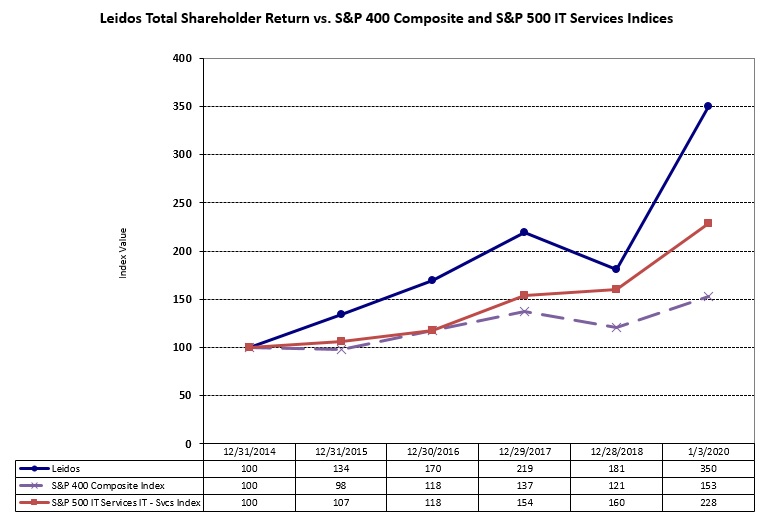
The following graph compares the total cumulative five-year return on Leidos common stock through January 3, 2020 to two indices: (i) the Standard & Poor's 400 Composite index and (ii) the Standard & Poor's 500 IT Services Industry index. The graph assumes an initial investment of $100 on December 31, 2014, and that dividends, if any, have been reinvested.The comparisons in the graph are required by the SEC, based upon historical data and are not intended to forecast or be indicative of possible future performance of Leidos common stock.
Leidos Holdings, Inc. Annual Report - 28
PART II
Purchases of Equity Securities
On February 16, 2018, our Board of Directors authorized a new share repurchase program of up to 20 million shares of Leidos outstanding common stock. The shares may be repurchased from time to time in one or more open market repurchases or privately negotiated transactions, including accelerated share repurchase transactions. The actual timing, number and value of shares repurchased under the program will depend on a number of factors, including the market price of Leidos common stock, general market and economic conditions, applicable legal requirements, compliance with the terms of our outstanding indebtedness and other considerations. There is no assurance as to the number of shares that will be repurchased, and the repurchase program may be suspended or discontinued at any time at our Board of Directors' discretion.
The following table presents repurchases of Leidos common stock during the quarter ended January 3, 2020:
| Period | Total Number of Shares Purchased(1) | Average Price Paid per Share | Total Number of Shares Purchased as Part of Publicly Announced Repurchase Plans or Programs | Maximum Number of Shares that May Yet Be Purchased Under the Plans or Programs | |||||||||
| September 28, 2019 - September 30, 2019 | — | $ | — | — | 7,976,255 | ||||||||
| October 1, 2019 - October 31, 2019 | 1,780 | 85.66 | — | 7,976,255 | |||||||||
| November 1, 2019 - November 30, 2019 | 217,953 | 89.03 | 211,649 | 7,764,606 | |||||||||
| December 1, 2019 - December 31, 2019 | 68,609 | 89.85 | 68,498 | 7,696,108 | |||||||||
| January 1, 2020 - January 3, 2020 | — | — | — | 7,696,108 | |||||||||
| Total | 288,342 | $ | 89.20 | 280,147 |
| (1) | The total number of shares purchased includes shares surrendered to satisfy statutory tax withholdings obligations related to vesting of restricted stock units. |
Leidos Holdings, Inc. Annual Report - 29
PART II
Item 6. Selected Financial Data
The selected financial data for the five-year period set forth below is derived from our consolidated financial statements. This information should be read in conjunction with "Management's Discussion and Analysis of Financial Condition and Results of Operations" in Part II and our consolidated financial statements and the notes thereto contained within this Annual Report on Form 10-K.
| 12 Months Ended(1) | 11 Months Ended(1) | |||||||||||||||||||
| January 3, 2020**(2)** | December 28, 2018(3) | December 29, 2017(4) | December 30, 2016(5) | January 1, 2016(6) | ||||||||||||||||
| (in millions, except for per share amounts) | ||||||||||||||||||||
| Consolidated Statement of Income Data: | ||||||||||||||||||||
| Revenues | $ | 11,094 | $ | 10,194 | $ | 10,170 | $ | 7,043 | $ | 4,712 | ||||||||||
| Operating income | 912 | 749 | 559 | 417 | 320 | |||||||||||||||
| Income from continuing operations | 670 | 582 | 364 | 246 | 243 | |||||||||||||||
| Loss from discontinued operations, net of taxes | — | — | — | — | (1 | ) | ||||||||||||||
| Net income | 670 | 582 | 364 | 246 | 242 | |||||||||||||||
| Less: net income (loss) attributable to non-controlling interest | 3 | 1 | (2 | ) | 2 | — | ||||||||||||||
| Net income attributable to Leidos common stockholders | $ | 667 | $ | 581 | $ | 366 | $ | 244 | $ | 242 | ||||||||||
| Earnings per share: | ||||||||||||||||||||
| Basic: | ||||||||||||||||||||
| Income from continuing operations attributable to Leidos common stockholders | $ | 4.66 | $ | 3.85 | $ | 2.41 | $ | 2.39 | $ | 3.33 | ||||||||||
| Loss from discontinued operations, net of taxes | — | — | — | — | (0.01 | ) | ||||||||||||||
| Net income attributable to Leidos common stockholders | $ | 4.66 | $ | 3.85 | $ | 2.41 | $ | 2.39 | $ | 3.32 | ||||||||||
| Diluted: | ||||||||||||||||||||
| Income from continuing operations attributable to Leidos common stockholders | $ | 4.60 | $ | 3.80 | $ | 2.38 | $ | 2.35 | $ | 3.28 | ||||||||||
| Loss from discontinued operations, net of taxes | — | — | — | — | (0.01 | ) | ||||||||||||||
| Net income attributable to Leidos common stockholders | $ | 4.60 | $ | 3.80 | $ | 2.38 | $ | 2.35 | $ | 3.27 | ||||||||||
| Cash dividend per common share | $ | 1.32 | $ | 1.28 | $ | 1.28 | $ | 14.92 | $ | 1.28 |
| January 3, 2020 | December 28, 2018 | December 29, 2017 | December 30, 2016 | January 1, 2016 | ||||||||||||||||
| (in millions) | ||||||||||||||||||||
| Consolidated Balance Sheet Data: | ||||||||||||||||||||
| Total assets | $ | 9,367 | $ | 8,770 | $ | 8,990 | $ | 9,132 | $ | 3,370 | ||||||||||
| Long-term debt, including current portion | 2,986 | 3,124 | 3,111 | 3,287 | 1,081 | |||||||||||||||
| Other long-term liabilities(7) | 182 | 178 | 129 | 204 | 149 |
| (1) | References to financial data are to the Company's continuing operations, unless otherwise noted. |
| (2) | Fiscal 2019 reflects the effects from our December 29, 2018 adoption of ASC 842. Fiscal 2019 also includes an $88 million gain on sale related to the divestiture of our commercial cybersecurity business, a $52 million net gain recognized upon the receipt of the Greek arbitration |
Leidos Holdings, Inc. Annual Report - 30
PART II
award and bad debt expense of $12 million. For further information, see "Note 7—Divestitures" and "Note 25—Contingencies" of the notes to the consolidated financial statements contained within this Annual Report on Form 10-K.
| (3) | Fiscal 2018 reflects the effects from our December 30, 2017 adoption of ASC 606. Fiscal 2018 also includes acquisition, integration and restructuring costs of $37 million and a tangible asset impairment charge of $7 million. For further information, see "Note 6—Acquisitions," "Note 8—Restructuring Expenses" and "Note 12—Property, Plant and Equipment" of the notes to the consolidated financial statements contained within this Annual Report on Form 10-K. |
| (4) | Fiscal 2017 includes acquisition, integration and restructuring costs of $139 million. For further information, see "Note 6—Acquisitions" and "Note 8—Restructuring Expenses" of the notes to the consolidated financial statements contained within this Annual Report on Form 10-K. |
| (5) | Fiscal 2016 includes acquisition, integration and restructuring costs of $104 million. |
| (6) | Reflects the 11-month period of January 31, 2015, through January 1, 2016, as a result of the change in our fiscal year end. The 11-month period ended January 1, 2016, results include a gain on a real estate sale of $82 million, tangible asset impairment charges of $29 million, intangible asset impairment charges of $4 million and bad debt expense of $8 million. |
| (7) | Beginning in fiscal 2016, the Company has separately disclosed "Deferred tax liabilities," which was previously aggregated within "Other long-term liabilities" within the consolidated balance sheets. Deferred tax liabilities for the 11-month period ended January 1, 2016 were $34 million. |
Item 7. Management’s Discussion and Analysis of Financial Condition and Results of Operations
The following discussion and analysis of Leidos Holdings, Inc.'s ("Leidos") financial condition, results of operations and quantitative and qualitative disclosures about market risk should be read in conjunction with the consolidated financial statements and related notes.
Unless indicated otherwise, references in this report to the “Company,” “we,” “us,” and “our” refer collectively to Leidos and its consolidated subsidiaries.
The following discussion contains forward-looking statements, including statements regarding our intent, belief, or current expectations with respect to, among other things, trends affecting our financial condition or results of operations, backlog, initiatives, our industry and government budgets and spending. Such statements are not guarantees of future performance and involve risks and uncertainties, and actual results may differ materially from those in the forward-looking statements as a result of various factors (see “Risk Factors—Forward-Looking Statement Risks” in Part I of this Annual Report on Form 10-K). Factors that could cause or contribute to these differences include those discussed below and elsewhere in this Annual Report on Form 10-K, particularly in “Risk Factors" and "Business Environment and Trends.” Due to such uncertainties and risks, you are cautioned not to place undue reliance on such forward-looking statements, which speak only as of the date hereof. We do not undertake any obligation to update these factors or to publicly announce the results of any changes to our forward-looking statements due to future events or developments.
Overview
We are a FORTUNE 500® science, engineering and information technology company that provides services and solutions in the defense, intelligence, civil and health markets. We bring domain-specific capability and innovations to customers in each of these markets by leveraging seven core capabilities: cyber; digital modernization; integrated systems; mission software systems; mission support; operations and logistics; and sensors, collection and phenomenology. Our domestic customers include the U.S. Department of Defense ("DoD"), the U.S. Intelligence Community, the U.S. Department of Homeland Security, the Federal Aviation Administration, the Department of Veterans Affairs and many other U.S. government civilian agencies, as well as state and local government agencies. Our international customers include foreign governments and their agencies, primarily located in Australia and the United Kingdom ("U.K."). Less than 10% of our revenues and tangible long-lived assets are generated by or owned by entities located outside of the United States. We operate in three reportable segments: Defense Solutions, Civil and Health. Additionally, we separately present the unallocable costs associated with corporate functions as Corporate.
Effective the beginning of fiscal 2019, we changed the composition of our Defense Solutions reportable segment to better align the operations within the reportable segment to the customers we serve. This resulted in the identification of new operating segments within Defense Solutions. In addition, certain contracts were reassigned between the Civil and Defense Solutions reportable segments. While this activity did not have a material impact on our reportable segments, prior year segment results have been recast to reflect this change.
For additional information regarding our reportable segments, see “Business” in Part I and "Note 24—Business Segments" of the notes to the consolidated financial statements contained within this Annual Report on Form 10-K.
Leidos Holdings, Inc. Annual Report - 31
PART II
Our significant initiatives include the following:
| • | achieving internal, or non-acquisition related, annual revenue growth through internal collaboration and better leveraging of key differentiators across our company and the deployment of resources and investments into higher growth markets; |
| • | increasing headcount and internal direct labor content on our contract portfolio; |
| • | continued improvement in our back office infrastructure and related business processes for greater effectiveness and efficiency across all business functions; and |
| • | disciplined deployment of our cash resources and use of our capital structure to enhance shareholder value while retaining an appropriate amount of financial leverage. |
Sales Trend. For fiscal 2019, revenues increased $900 million, or 9% compared to fiscal 2018, primarily due to program wins and a net increase in program volumes, partially offset by programs ended and the impact of the sale of our commercial cybersecurity and health staff augmentation businesses. For fiscal 2018, revenues were $10.2 billion, consistent with fiscal 2017. See "Results of Operations" below for discussion of our individual segment results.
Operating Expenses and Income Trend. For fiscal 2019, operating expenses increased by $737 million, or 8%, compared to fiscal 2018. Operating margin for fiscal 2019 was 8.2% compared to 7.3% for fiscal 2018. Operating income was $912 million, a $163 million increase compared to fiscal 2018. The increases in operating margin and operating income were primarily attributable to the receipt of the Greek arbitration award, favorable program mix, decreases in acquisition, integration and restructuring costs and lower amortization of intangible assets.
For fiscal 2018, operating expenses decreased by $161 million, or 2%, compared to fiscal 2017. Operating margin for fiscal 2018 was 7.3% compared to 5.5% for fiscal 2017. Operating income was $749 million for fiscal 2018, a $190 million increase compared to fiscal 2017. These changes were primarily attributable to decreases in acquisition, integration and restructuring costs and lower amortization of intangible assets.
From a macroeconomic perspective, our industry is under general competitive pressures associated with spending from our largest customer, the U.S. government, and requires a high level of cost management focus to allow us to remain competitive. Although the current Administration has not indicated a desire to reduce spending in the defense and homeland security sectors, the likelihood, extent and duration of current spending levels in these areas remains unclear. We continue to review our cost structure against our anticipated sales and undertake cost management actions and efficiency initiatives where necessary.
Business Environment and Trends
U.S. Government Markets
In fiscal 2019, we generated approximately 87% of our total revenues from contracts with the U.S. government, either as a prime contractor or a subcontractor to other contractors engaged in work for the U.S. government. Revenues under contracts with the DoD and U.S. Intelligence Community, including subcontracts under which the DoD or the U.S. Intelligence Community is the ultimate purchaser, represented approximately 48% of our total revenues for fiscal 2019. Accordingly, our business performance is affected by the overall level of U.S. government spending, especially national security, homeland security and intelligence spending, and the alignment of our service and product offerings and capabilities with current and future budget priorities of the U.S. government.
From December 21, 2018 until the passage of a new continuing resolution ("CR") on January 25, 2019 there was a partial U.S. government shutdown, which reduced or delayed work on existing contracts and caused delays in other government contracting actions and payments. Prior to the expiration of the January CR, Congress passed appropriations for the seven remaining appropriations bills, thereby completing funding for GFY 2019.
On July 22, 2019, the White House and Congress reached a two-year budget deal to raise spending caps and suspend the debt ceiling until July 2021. Allocations for national defense spending increased to $738 billion in GFY 2020 and $741 billion in GFY 2021. For non-defense programs, spending increased to $632 billion in GFY 2020 and $635 billion in GFY 2021. Overall, the measure increased spending by $323 billion over the limits set under the Bipartisan Budget Act of 2018.
Leidos Holdings, Inc. Annual Report - 32
PART II
On December 20, 2019, Congress passed and the President signed into law two consolidated appropriations bills, thereby funding the federal government through the end of GFY 2020.
On February 10, 2020, the President submitted the GFY 2021 budget proposal to Congress, which included discretionary spending levels for defense and non-defense programs of $741 billion and $590 billion, respectively.
Trends in the U.S. government contracting process, including a shift towards multiple-awards contracts, in which certain contractors are preapproved using indefinite-delivery/indefinite-quantity ("IDIQ") and U.S. General Services Administration ("GSA") contract vehicles, have increased competition for U.S. government contracts, reduced backlogs by shortening periods of performance on contracts and increased pricing pressure. We expect that a majority of the business that we seek in the foreseeable future will be awarded through a competitive bidding process. For more information on these risks and uncertainties, see “Risk Factors” in Part I of this Annual Report on Form 10-K.
International Markets
Sales to customers in international markets represented 8% of total revenues for fiscal 2019. Our international customers include foreign governments and their agencies, primarily located in Australia and the U.K. Our international business increases our exposure to international markets and the associated international regulatory and geopolitical risks.
Recent changes in international trade policies, including higher tariffs on imported goods and materials, may increase our procurement costs of certain IT hardware used both on our contracts and for internal use. However, we expect to recover certain portions of these higher tariffs through our cost-plus contracts. While we are still evaluating the impact of higher tariffs, currently, we do not expect tariffs to have a significant impact to our business.
Key Performance Measures
The primary financial performance measures we use to manage our business and monitor results of operations are revenue, operating income, cash flows from operations and diluted earnings per share. Bookings and backlog are also useful measures for management and investors to evaluate our performance and potential future revenues. In addition, we consider business performance by contract type to be useful to management and investors when evaluating our operating income and margin performance.
Leidos Holdings, Inc. Annual Report - 33
PART II
Results of Operations
Our results of operations for the periods presented were as follows:
| Year Ended | 2019 to 2018 | 2018 to 2017 | ||||||||||||||||||||||||
| January 3, 2020 | December 28, 2018 | December 29, 2017 | Dollar change | Percent change | Dollar change | Percent change | ||||||||||||||||||||
| (dollars in millions) | ||||||||||||||||||||||||||
| Revenues | $ | 11,094 | $ | 10,194 | $ | 10,170 | $ | 900 | 9 | % | $ | 24 | — | % | ||||||||||||
| Cost of revenues(1) | 9,546 | 8,690 | 8,738 | 856 | 10 | % | (48 | ) | (1 | )% | ||||||||||||||||
| Selling, general and administrative expenses: | ||||||||||||||||||||||||||
| General and administrative(1) | 496 | 547 | 573 | (51 | ) | (9 | )% | (26 | ) | (5 | )% | |||||||||||||||
| Bid and proposal | 144 | 136 | 122 | 8 | 6 | % | 14 | 11 | % | |||||||||||||||||
| Company-funded research and development | 49 | 46 | 42 | 3 | 7 | % | 4 | 10 | % | |||||||||||||||||
| Bad debt expense and recoveries | (40 | ) | — | 10 | (40 | ) | (100 | )% | (10 | ) | (100 | )% | ||||||||||||||
| Acquisition, integration and restructuring costs | 5 | 37 | 139 | (32 | ) | (86 | )% | (102 | ) | (73 | )% | |||||||||||||||
| Asset impairment charges | — | 7 | — | (7 | ) | (100 | )% | 7 | 100 | % | ||||||||||||||||
| Equity earnings of non-consolidated subsidiaries | (18 | ) | (18 | ) | (13 | ) | — | — | % | (5 | ) | 38 | % | |||||||||||||
| Operating income | 912 | 749 | 559 | 163 | 22 | % | 190 | 34 | % | |||||||||||||||||
| Non-operating expense, net | (46 | ) | (139 | ) | (166 | ) | 93 | (67 | )% | 27 | (16 | )% | ||||||||||||||
| Income before income taxes | 866 | 610 | 393 | 256 | 42 | % | 217 | 55 | % | |||||||||||||||||
| Income tax expense | (196 | ) | (28 | ) | (29 | ) | (168 | ) | NM | 1 | (3 | )% | ||||||||||||||
| Net income | 670 | 582 | 364 | 88 | 15 | % | 218 | 60 | % | |||||||||||||||||
| Less: net income (loss) attributable to non-controlling interest | 3 | 1 | (2 | ) | 2 | 200 | % | 3 | (150 | )% | ||||||||||||||||
| Net income attributable to Leidos Holdings, Inc. | $ | 667 | $ | 581 | $ | 366 | $ | 86 | 15 | % | $ | 215 | 59 | % | ||||||||||||
| Operating income margin | 8.2 | % | 7.3 | % | 5.5 | % |
NM - Not meaningful
| (1) | Effective the beginning of fiscal 2018, we established a new U.S. government Cost Accounting Standards structure and revised our disclosure statements accordingly to reflect the related cost accounting practice changes. Consequently, $185 million was reclassified from "Cost of revenues" to "Selling, general and administrative expenses" on the consolidated statements of income for fiscal 2017. For more information, see "Note 1—Nature of Operations and Basis of Presentation" of the notes to the consolidated financial statements contained within this Annual Report on Form 10-K. |
Leidos Holdings, Inc. Annual Report - 34
PART II
Segment and Corporate Results
| Year Ended | 2019 to 2018 | 2018 to 2017 | ||||||||||||||||||||||||
| Defense Solutions | January 3, 2020 | December 28, 2018 | December 29, 2017 | Dollar change | Percent change | Dollar change | Percent change | |||||||||||||||||||
| (dollars in millions) | ||||||||||||||||||||||||||
| Revenues | $ | 5,367 | $ | 4,966 | $ | 4,989 | $ | 401 | 8 | % | $ | (23 | ) | — | % | |||||||||||
| Operating income | 407 | 353 | 312 | 54 | 15 | % | 41 | 13 | % | |||||||||||||||||
| Operating income margin | 7.6 | % | 7.1 | % | 6.3 | % |
The increase in revenues for fiscal 2019 as compared to fiscal 2018 was primarily attributable to new awards and a net increase in program volumes, partially offset by the completion of certain contracts and adverse exchange rate movements in the Australian dollar when compared to the U.S. dollar.
The decrease in revenues for fiscal 2018 as compared to fiscal 2017 was primarily attributable to the completion of certain contracts and adverse impact of the foreign exchange rate movements between the U.S. dollar and Australian dollar, partially offset by new awards.
The increase in operating income for fiscal 2019 as compared to fiscal 2018 was primarily attributable to new awards, the release of a contract reserve and favorable program mix.
The increase in operating income for fiscal 2018 as compared to fiscal 2017 was primarily attributable to lower amortization.
| Year Ended | 2019 to 2018 | 2018 to 2017 | ||||||||||||||||||||||||
| Civil | January 3, 2020 | December 28, 2018 | December 29, 2017 | Dollar change | Percent change | Dollar change | Percent change | |||||||||||||||||||
| (dollars in millions) | ||||||||||||||||||||||||||
| Revenues | $ | 3,729 | $ | 3,411 | $ | 3,379 | $ | 318 | 9 | % | $ | 32 | 1 | % | ||||||||||||
| Operating income | 295 | 284 | 221 | 11 | 4 | % | 63 | 29 | % | |||||||||||||||||
| Operating income margin | 7.9 | % | 8.3 | % | 6.5 | % |
The increase in revenues for fiscal 2019 as compared to fiscal 2018 was primarily attributable to new awards and a net increase in program volumes, partially offset by the impact of the sale of our commercial cybersecurity business of $74 million, the completion of certain contracts, lower net profit write-ups in the current year and adverse exchange rate movements in the British pound when compared to the U.S. dollar.
The increase in revenues for fiscal 2018 as compared to fiscal 2017 was primarily attributable to new awards, favorable impact of the foreign exchange rate movements between the U.S. dollar and British pound and a net increase in program volumes, partially offset by the completion of certain contracts.
The increase in operating income for fiscal 2019 as compared to fiscal 2018 was primarily attributable to lower amortization of intangibles of $20 million, a net increase in program volumes, new awards and the impact of the sale of our commercial cybersecurity business of $7 million, partially offset by lower net profit write-ups in the current year and a net increase in bad debt expense on certain international contracts.
The increase in operating income for fiscal 2018 as compared to fiscal 2017 was primarily attributable to lower amortization and indirect expenditures, partially offset by a net decrease in program volumes.
Leidos Holdings, Inc. Annual Report - 35
PART II
| Year Ended | 2019 to 2018 | 2018 to 2017 | ||||||||||||||||||||||||
| Health | January 3, 2020 | December 28, 2018 | December 29, 2017 | Dollar change | Percent change | Dollar change | Percent change | |||||||||||||||||||
| (dollars in millions) | ||||||||||||||||||||||||||
| Revenues | $ | 1,998 | $ | 1,817 | $ | 1,802 | $ | 181 | 10 | % | $ | 15 | 1 | % | ||||||||||||
| Operating income | 242 | 230 | 228 | 12 | 5 | % | 2 | 1 | % | |||||||||||||||||
| Operating income margin | 12.1 | % | 12.7 | % | 12.7 | % |
The increase in revenues for fiscal 2019 as compared to fiscal 2018 was primarily attributable to a net increase in program volumes, new awards and $18 million from our acquisition of IMX Medical Management Services and its affiliated businesses ("IMX"), partially offset by the completion of certain contracts and the impact of the sale of our health staff augmentation business of $78 million.
The increase in revenues for fiscal 2018 as compared to fiscal 2017 was primarily attributable to a net increase in program volumes and new awards, partially offset by the completion of certain contracts and lower net profit write-ups in the current year.
The increase in operating income for fiscal 2019 as compared to fiscal 2018 was primarily attributable to a net increase in program volumes, partially offset by reduced margins on awarded re-compete contracts.
The increase in operating income for fiscal 2018 as compared to fiscal 2017 was primarily due to a net increase in program volumes, partially offset by the completion of certain contracts, higher investment costs and lower net profit write-ups in the current year.
| Year Ended | 2019 to 2018 | 2018 to 2017 | |||||||||||||||||||
| Corporate | January 3, 2020 | December 28, 2018 | December 29, 2017 | Dollar change | Percent change | Dollar change | Percent change | ||||||||||||||
| (dollars in millions) | |||||||||||||||||||||
| Operating loss | (32 | ) | (118 | ) | (202 | ) | 86 | (73 | )% | 84 | (42 | )% |
Corporate operating loss represents corporate costs that are not directly related to the operating performance of the reportable segments.
The decrease in operating loss for fiscal 2019 as compared to fiscal 2018, was primarily attributable to the $52 million net gain recognized upon the receipt of the Greek arbitration award, lower acquisition, integration and restructuring costs of $32 million and an asset impairment charge of $7 million in the prior year.
The decrease in operating loss for fiscal 2018 as compared to fiscal 2017, was primarily attributable to lower acquisition, integration and restructuring costs of $102 million, partially offset by increased legal fees and an asset impairment charge of $7 million.
Equity earnings of non-consolidated subsidiaries
We have certain non-controlling ownership interests in equity method investments. For fiscal 2019, 2018 and 2017, we recorded earnings of $29 million, $28 million and $27 million, respectively, from our equity method investments, partially offset by amortization of $11 million, $10 million and $14 million, respectively.
Non-Operating Expense, Net
Non-operating expense, net decreased $93 million for fiscal 2019 as compared to fiscal 2018, primarily due to the $88 million gain recognized on the sale of our commercial cybersecurity business.
Non-operating expense, net decreased $27 million for fiscal 2018 as compared to fiscal 2017, primarily due to a $33 million promissory note impairment that occurred during fiscal 2017, partially offset by unfavorable fair value changes on investments held in our benefit plans.
Leidos Holdings, Inc. Annual Report - 36
PART II
Provision for Income Taxes
Our effective tax rate was 22.6%, 4.6% and 7.4% in fiscal 2019, 2018 and 2017, respectively. The Company's effective tax rate for fiscal 2019 was favorably impacted primarily by excess tax benefits related to employee stock-based payment transactions and federal research tax credits, partially offset by an increase in valuation allowances arising from foreign withholding tax and an increase in taxes related to the sale of the commercial cybersecurity business.
The effective tax rate for fiscal 2018 was favorably impacted primarily by a decrease in valuation allowances arising from the taxable conversion of a subsidiary and the utilization of capital losses, an increase in deferred tax assets related to the stock basis of a subsidiary held for sale, excess tax benefits related to employee stock-based payment transactions and federal research tax credits.
The effective tax rate for fiscal 2017 was favorably impacted primarily by the Tax Cuts and Jobs Act’s reduction of the federal corporate tax rate from 35% to 21% applied to our fiscal 2017 year-end deferred tax balances and excess tax benefits related to employee stock-based payment transactions, partially offset by the impact of certain capitalized transaction costs.
Non-controlling Interest
We have an 88% controlling interest in Mission Support Alliance, LLC ("MSA"), a joint venture with Centerra Group, LLC, which includes 41% purchased from Jacobs Group, LLC on January 26, 2018. We include the financial results for MSA in our consolidated financial statements. Net income attributable to non-controlling interest for fiscal 2019 and fiscal 2018 was $3 million and $1 million, respectively, compared to net loss attributable to non-controlling interest of $2 million for fiscal 2017.
Bookings and Backlog
We had net bookings of $14.5 billion and $13.7 billion during fiscal 2019 and 2018, respectively. Net bookings represent the estimated amount of revenue to be earned in the future from funded and unfunded contract awards that were received during the year, net of any adjustments to previously awarded backlog amounts. We calculate net bookings as the year’s ending backlog, plus the year’s revenues, less the prior year’s ending backlog and any impacts from foreign currency or acquisitions and divestitures.
Backlog represents the estimated amount of future revenues to be recognized under negotiated contracts. We segregate our backlog into two categories as follows:
| • | Funded Backlog. Funded backlog for contracts with the U.S. government represents the value on contracts for which funding is appropriated less revenues previously recognized on these contracts. Funded backlog for contracts with non-U.S. government entities and commercial customers represents the estimated value on contracts, which may cover multiple future years, under which we are obligated to perform, less revenues previously recognized on the contracts. |
| • | Negotiated Unfunded Backlog. Negotiated unfunded backlog represents estimated amounts of revenue to be earned in the future from contracts for which funding has not been appropriated and unexercised priced contract options. Negotiated unfunded backlog does not include future potential task orders expected to be awarded under IDIQ, GSA Schedule or other master agreement contract vehicles, with the exception of certain IDIQ contracts where task orders are not competitively awarded and separately priced but instead are used as a funding mechanism, and where there is a basis for estimating future revenues and funding on future task orders is anticipated. |
Leidos Holdings, Inc. Annual Report - 37
PART II
The estimated value of our total backlog for the periods presented was as follows:
| January 3, 2020 | December 28, 2018 | |||||||
| (in millions) | ||||||||
| Defense Solutions: | ||||||||
| Funded backlog | $ | 2,417 | $ | 2,821 | ||||
| Negotiated unfunded backlog | 9,150 | 6,925 | ||||||
| Total Defense Solutions backlog | $ | 11,567 | $ | 9,746 | ||||
| Civil: | ||||||||
| Funded backlog | $ | 1,913 | $ | 2,304 | ||||
| Negotiated unfunded backlog | 5,802 | 5,045 | ||||||
| Total Civil backlog | $ | 7,715 | $ | 7,349 | ||||
| Health: | ||||||||
| Funded backlog | $ | 1,083 | $ | 1,254 | ||||
| Negotiated unfunded backlog | 3,725 | 2,483 | ||||||
| Total Health backlog | $ | 4,808 | $ | 3,737 | ||||
| Total: | ||||||||
| Funded backlog | $ | 5,413 | $ | 6,379 | ||||
| Negotiated unfunded backlog | 18,677 | 14,453 | ||||||
| Total backlog | $ | 24,090 | $ | 20,832 |
Total backlog at December 28, 2018 included $165 million within our Civil segment attributable to our held for sale commercial cybersecurity business (see "Note 7—Divestitures" of the notes to the consolidated financial statements contained within this Annual Report on Form 10-K).
Bookings and backlog fluctuate from period to period depending on our success rate in winning contracts and the timing of contract awards, renewals, modifications and cancellations, as well as foreign currency movements. Contract awards may be negatively impacted by ongoing industry-wide delays in procurement decisions and budget cuts by the U.S. government as discussed in “Business Environment and Trends” in this Annual Report on Form 10-K.
We expect to recognize a substantial portion of our funded backlog as revenues within the next 12 months. However, the U.S. government may cancel any contract at any time through a termination for the convenience of the U.S. government. In addition, certain contracts with commercial or non-U.S. government customers may include provisions that allow the customer to cancel at any time. Most of our contracts have cancellation terms that would permit us to recover all or a portion of our incurred costs and fees for work performed.
Contract Types
Our earnings and profitability may vary materially depending on changes in the proportionate amount of revenues derived from each type of contract. For a discussion of the types of contracts under which we generate revenues, see “Business—Contract Types” in Part I of this Annual Report on Form 10-K. Revenues by contract type as a percentage of our total revenues for the periods presented were as follows:
| Year Ended | |||||||||
| January 3, 2020 | December 28, 2018 | December 29, 2017 | |||||||
| Cost-reimbursement and fixed-price-incentive-fee | 54 | % | 54 | % | 56 | % | |||
| Firm-fixed-price | 33 | 31 | 28 | ||||||
| Time-and-materials and fixed-price-level-of-effort | 13 | 15 | 16 | ||||||
| Total | 100 | % | 100 | % | 100 | % |
Leidos Holdings, Inc. Annual Report - 38
PART II
Liquidity and Capital Resources
Overview of Liquidity
As of January 3, 2020, we had $668 million in cash and cash equivalents. In addition, we have a secured revolving credit facility which can provide up to $750 million in secured borrowing capacity, if required. During fiscal 2019 and 2018, there were no borrowings outstanding under the credit facility and we were in compliance with the financial covenants.
At January 3, 2020 and December 28, 2018, we had outstanding debt of $3.0 billion and $3.1 billion, respectively. The notes outstanding as of January 3, 2020, contain financial covenants and customary restrictive covenants. We were in compliance with all covenants as of January 3, 2020. During fiscal 2019, 2018 and 2017, we made $80 million, $59 million, and $209 million of principal payments, respectively, on our long-term debt. This activity included $69 million, $46 million and $76 million of principal payments on our senior secured term loans during fiscal 2019, 2018 and 2017, respectively. In April 2018, we made a required debt prepayment of $10 million on our senior secured term loans. The prepayment was a result of the annual excess cash flow calculation clause in our credit agreements. In addition to the required quarterly payments, we prepaid $130 million on our senior secured term loans during fiscal 2017.
We paid dividends of $198 million for fiscal 2019, 2018 and 2017.
We may from time to time seek to retire or purchase our outstanding debt through cash purchases in the open market, privately negotiated transactions or otherwise. Such repurchases, if any, will depend on prevailing market conditions, our liquidity requirements, contractual restrictions and other factors. The amounts involved may be material.
Stock repurchases of Leidos common stock may be made on the open market or in privately negotiated transactions with third parties including through accelerated share repurchase ("ASR") agreements. Whether repurchases are made and the timing and actual number of shares repurchased depends on a variety of factors including price, corporate capital requirements, other market conditions and regulatory requirements. The repurchase program may be accelerated, suspended, delayed or discontinued at any time.
During fiscal 2019 and 2018, we entered into ASR agreements with a financial institution, whereby we paid an aggregate of $400 million and $250 million, respectively, and received approximately 6 million and 4 million shares, respectively, of Leidos outstanding shares (see "Note 19—Earnings Per Share" of the notes to the consolidated financial statements contained within this Annual Report on Form 10-K). The purchases were recorded to "Additional paid-in capital" in the consolidated balance sheets. All shares delivered were immediately retired.
Additionally, during fiscal 2019 and 2018, we made open market repurchases of our common stock for an aggregate purchase price of $25 million and $167 million, respectively. During fiscal 2017, there were no open market repurchases of our common stock.
For the next 12 months, we anticipate that we will be able to meet our liquidity needs, including servicing our debt, through cash generated from operations, available cash balances and, if needed, borrowings from our revolving credit facility.
On January 17, 2020 (the "Closing Date"), we entered into a Credit Agreement with certain financial institutions, which provides for a senior unsecured term loan A facility in an aggregate principal amount of $1.9 billion (the "Term Loan Facility") and a $750 million senior unsecured revolving facility. We used the proceeds of the Term Loan Facility and cash on hand on the Closing Date to repay in full all indebtedness, and terminate all commitments, under, and discharge and release all guarantees and liens existing in connection with the Credit Agreements entered into in August 2016. Additionally, on January 31, 2020, in connection with the acquisition of Dynetics, Inc. ("Dynetics"), we entered into a Bridge Credit Agreement with certain financial institutions, which provides for a senior unsecured 364-day bridge loan facility in an aggregate principal amount of $1.25 billion (the "Bridge Facility"). We used the proceeds of the Bridge Facility and cash on hand to fund the purchase of Dynetics and repay in full all third party indebtedness of Dynetics, terminate all commitments thereunder and discharge and release all existing guarantees and liens. See "Note 27—Subsequent Events" of the notes to the consolidated financial statements contained within this Annual Report on Form 10-K for further details regarding these transactions.
Leidos Holdings, Inc. Annual Report - 39
PART II
Summary of Cash Flows
The following table summarizes cash flow information for the periods presented:
| Year Ended | ||||||||||||
| January 3, 2020 | December 28, 2018 | December 29, 2017 | ||||||||||
| (in millions) | ||||||||||||
| Net cash provided by operating activities | $ | 992 | $ | 768 | $ | 526 | ||||||
| Net cash provided by (used in) investing activities | 65 | (114 | ) | (71 | ) | |||||||
| Net cash used in financing activities | (709 | ) | (707 | ) | (429 | ) | ||||||
| Net increase (decrease) in cash, cash equivalents and restricted cash | $ | 348 | $ | (53 | ) | $ | 26 |
Net cash provided by operating activities increased $224 million for fiscal 2019 as compared to fiscal 2018. The increase was primarily due to more favorable timing of working capital changes including higher advance payments from customers, $59 million received for the Greek arbitration award and lower payments for integration and restructuring costs. These activities were partially offset by higher tax payments, the timing of interest payments and $60 million of proceeds received from the termination of interest rate swaps in the prior year.
Net cash provided by operating activities increased $242 million for fiscal 2018 as compared to fiscal 2017. The increase was primarily due to lower payments for taxes, integration and restructuring costs and proceeds received from the termination of interest rate swaps. This was partially offset by $24 million of cash paid related to the 2016 acquisition of Lockheed Martin's Information Systems & Global Solutions business ("IS&GS Business").
Net cash provided by investing activities increased $179 million for fiscal 2019 as compared to fiscal 2018. The increase was primarily due to $178 million of proceeds received for the dispositions of our commercial cybersecurity and health staff augmentation businesses, $96 million of proceeds received for the sale of real estate properties and $81 million of cash paid in the prior year related to our 2016 acquisition. These activities were partially offset by $94 million of cash paid related to the acquisition of IMX, higher purchases of property, equipment and software and lower proceeds from promissory notes.
Net cash used in investing activities increased $43 million for fiscal 2018 as compared to fiscal 2017. The increase was primarily due to $81 million of cash paid related to the 2016 acquisition of the IS&GS Business, partially offset by $40 million of proceeds from the settlement of a promissory note.
Net cash used in financing activities increased $2 million for fiscal 2019 as compared to fiscal 2018. The increase was primarily due to the timing of debt payments and higher stock repurchases, partially offset by $23 million of cash paid related to a tax indemnification in the prior year and the timing of issuances of stock.
Net cash used in financing activities increased $278 million for fiscal 2018 as compared to fiscal 2017. The increase was primarily due to $250 million of stock repurchases under the ASR program, $167 million of open market stock repurchases and $23 million of cash paid related to a tax indemnification liability. This was partially offset by $150 million of lower debt payments and $14 million of proceeds received from a real estate financing transaction.
Off-Balance Sheet Arrangements
We have outstanding performance guarantees and cross-indemnity agreements in connection with certain aspects of our business. We also have letters of credit outstanding principally related to performance guarantees on contracts and surety bonds outstanding principally related to performance and subcontractor payment bonds as described in "Note 26—Commitments" of the notes to the consolidated financial statements contained within this Annual Report on Form 10-K. These arrangements have not had, and management does not believe it is likely that they will in the future have, a material effect on our liquidity, capital resources, operations or financial condition.
Leidos Holdings, Inc. Annual Report - 40
PART II
Contractual Obligations
The following table summarizes, as of January 3, 2020, our obligations to make future payments pursuant to certain contracts or arrangements and provides an estimate of the fiscal years in which these obligations are expected to be satisfied:
| Total | 2020 | 2021 | 2022 | 2023 | 2024 | 2025 and thereafter | ||||||||||||||||||||||
| (in millions) | ||||||||||||||||||||||||||||
| Contractual obligations(1): | ||||||||||||||||||||||||||||
| Long-term debt (including current portion)(2) | $ | 3,954 | $ | 627 | $ | 206 | $ | 203 | $ | 709 | $ | 102 | $ | 2,107 | ||||||||||||||
| Operating lease obligations | 516 | 145 | 91 | 74 | 54 | 39 | 113 | |||||||||||||||||||||
| Finance lease obligations | 7 | 5 | 1 | — | — | — | 1 | |||||||||||||||||||||
| Other long-term liabilities(3) | 168 | 9 | 23 | 8 | 9 | 7 | 112 | |||||||||||||||||||||
| Total contractual obligations | $ | 4,645 | $ | 786 | $ | 321 | $ | 285 | $ | 772 | $ | 148 | $ | 2,333 |
| (1) | We have excluded purchase orders for services or products to be delivered pursuant to U.S. government contracts for which we are entitled to full recourse under normal contract termination clauses. |
| (2) | Includes total interest payments on our outstanding debt. Interest payments represent $113 million, $104 million, $101 million, $90 million and $91 million of the balance for fiscal 2020, 2021, 2022, 2023 and 2024, respectively, and $441 million for fiscal 2025 and thereafter. The total interest payments on our outstanding term loan debt are calculated based on the stated variable rates of the notes as of January 3, 2020. The total interest payments on our outstanding senior fixed rate secured and unsecured notes are calculated based on the stated fixed rates and do not reflect the variable interest component due to the interest rate swap agreements. |
| (3) | Other long-term liabilities were allocated by fiscal year as follows: liabilities under deferred compensation arrangements are based upon the average annual payments in prior years upon termination of employment by participants and other liabilities are based on the fiscal year that the liabilities are expected to be realized. The table above does not include income tax liabilities for uncertain tax positions of $1 million and $4 million of other tax liabilities, as we are not able to reasonably estimate the timing of payments in individual years due to uncertainties in the timing of audit outcomes and when settlements will become due. There is no obligation included for our foreign defined benefit pension plan, as the plan is overfunded as of January 3, 2020. For a discussion of potential changes in these pension obligations, see "Note 22—Retirement Plans" of the notes to the consolidated financial statements contained within this Annual Report on Form 10-K. |
Commitments and Contingencies
We are subject to a number of reviews, investigations, claims, lawsuits, other uncertainties and future obligations related to our business. For a discussion of these items, see "Note 13—Leases," "Note 25—Contingencies" and "Note 26—Commitments" of the notes to the consolidated financial statements contained within this Annual Report on Form 10-K.
Critical Accounting Policies
Our discussion and analysis of our financial condition and results of operations are based upon our consolidated financial statements, which are prepared in accordance with accounting principles generally accepted in the United States of America ("GAAP"). The preparation of these financial statements in accordance with GAAP requires management to make estimates and assumptions that affect the reported amounts of assets and liabilities and the disclosure of contingencies at the date of the financial statements, as well as the reported amounts of revenues and expenses during the reporting periods. Management evaluates these estimates and assumptions on an ongoing basis. Our estimates and assumptions have been prepared by management on the basis of the most current and best available information. The results of these estimates form the basis for making judgments about the carrying values of assets and liabilities that are not readily apparent from other sources. Actual results could differ from these estimates under different assumptions and conditions.
We have identified the following accounting policies as critical because they require significant judgments and assumptions about highly complex and inherently uncertain matters and the use of reasonably different estimates and assumptions could have a material impact on our results of operations or financial condition.
| • | Revenue Recognition |
| • | Goodwill and Intangible Assets Impairment |
| • | Income Taxes |
Leidos Holdings, Inc. Annual Report - 41
PART II
Revenue Recognition
Our revenues from contracts with customers are from offerings including cyber; digital modernization; integrated systems; mission software systems; mission support; operations and logistics; and sensors, collection and phenomenology, primarily with the U.S. government and its agencies. We also serve various state and local governments, foreign governments and U.S. commercial customers.
We perform under various types of contracts, which include firm-fixed-price ("FFP"), time-and-materials ("T&M"), fixed-price-level-of-effort ("FP-LOE"), cost-plus-fixed-fee, cost-plus-award-fee, cost-plus-incentive-fee and fixed-price-incentive-fee contracts.
To determine the proper revenue recognition, we first evaluate whether we have a duly approved and enforceable contract with a customer, in which the rights of the parties and payment terms are identified, and collectability is probable. We also evaluate whether two or more contracts should be combined and accounted for as a single contract, including the task orders issued under an IDIQ award. In addition, we assess contract modifications to determine whether changes to existing contracts should be accounted for as part of the original contract or as a separate contract. Contract modifications for us generally relate to changes in contract specifications and requirements and do not add distinct services, and therefore are accounted for as part of the original contract. If contract modifications add distinct goods or services and increase the contract value by an amount that reflects the standalone selling price, those modifications are accounted for as separate contracts.
Most of our contracts are comprised of multiple promises including the design and build of software-based systems, integration of hardware and software solutions, running and maintaining of IT infrastructure and procurement services. In all cases, we assess if the multiple promises should be accounted for as separate performance obligations or combined into a single performance obligation. We generally separate multiple promises in a contract as separate performance obligations if those promises are distinct, both individually and in the context of the contract. If multiple promises in a contract are highly interrelated or require significant integration or customization within a group, they are combined and accounted for as a single performance obligation.
Our contracts with the U.S. government often contain options to renew existing contracts for an additional period of time (generally a year at a time) under the same terms and conditions as the original contract, and generally do not provide the customer any material rights under the contract. We account for renewal options as separate contracts when they include distinct goods or services at standalone selling prices.
Contracts with the U.S. government are subject to the Federal Acquisition Regulation ("FAR") and priced on estimated or actual costs of providing the goods or services. The FAR provides guidance on types of costs that are allowable in establishing prices for goods and services provided to the U.S. government and its agencies. Each contract is competitively priced and bid separately. Pricing for non-U.S. government agencies and commercial customers is based on specific negotiations with each customer. In circumstances where the standalone selling price is not directly observable, we estimate the standalone selling price using the expected cost-plus margin approach. We exclude any taxes collected or imposed when determining the transaction price.
Certain of our cost-plus and fixed-price contracts contain award fees, incentive fees or other provisions that may either increase or decrease the transaction price. These variable amounts generally are awarded upon achievement of certain performance metrics, program milestones or cost targets and can be based upon customer discretion. We estimate variable consideration at the most probable amount that we expect to be entitled to, based on the assessment of the contractual variable fee criteria, complexity of work and related risks, extent of customer discretion, amount of variable consideration received historically and the potential of significant reversal of revenue.
We allocate the transaction price of a contract to its performance obligations in the proportion of its respective standalone selling prices. The standalone selling price of our performance obligations is generally based on an expected cost-plus margin approach, in accordance with the FAR. For certain product sales, we use prices from other standalone sales. Substantially all of our contracts do not contain a significant financing component, which would require an adjustment to the transaction price of the contract.
Leidos Holdings, Inc. Annual Report - 42
PART II
We recognize revenue on our service based contracts primarily over time as there is continuous transfer of control to the customer over the duration of the contract as we perform the promised services. For U.S. government contracts, continuous transfer of control to the customer is evidenced by clauses in the contract that allow the customer to unilaterally terminate the contract for convenience, pay for costs incurred plus a reasonable profit and take control of any work-in-process. Similarly, for non-U.S. government contracts, the customer typically controls the work-in-process as evidenced by rights to payment for work performed to date plus a reasonable profit to deliver products or services that do not have an alternate use to us. Anticipated losses on service based contracts are recognized when known. In certain product sales, where the products have an alternate use, we recognize revenue at a point in time when the customer takes control of the asset usually denoted by possession and legal title.
On FFP contracts requiring system integration and cost-plus contracts with variable consideration, revenue is recognized over time generally using a method that measures the extent of progress towards completion of a performance obligation, principally using a cost-input method (referred to as the cost-to-cost method). Under the cost-to-cost method, revenue is recognized based on the proportion of total costs incurred to estimated total costs-at-completion ("EAC"). A performance obligation's EAC includes all direct costs such as materials, labor, subcontract costs, overhead and a ratable portion of general and administrative costs. In addition, we include in an EAC of a performance obligation future losses estimated to be incurred on onerous contracts, as and when known. On certain other contracts, principally T&M, FP-LOE and cost-plus-fixed-fee, revenue is recognized using the right-to-invoice practical expedient as we are contractually able to invoice the customer based on the control transferred to the customer. Additionally, on maintenance (generally FFP) performance obligations, revenue is recognized over time using a straight-line method as the control of the services is provided to the customer evenly over the period of performance.
For certain performance obligations where we are not primarily responsible for fulfilling the promise to provide the goods or service to the customer, do not have inventory risk and do not have discretion in establishing the price for the goods or service, we recognize revenue on a net basis.
Goodwill and Intangible Assets Impairment
Goodwill represents the excess of the fair value of consideration transferred, plus the fair value of any non-controlling interests in the acquiree, over the fair value of the net assets acquired and liabilities assumed as of the acquisition date. Goodwill and intangible assets, net collectively represent 58% and 63% of our total assets as of fiscal 2019 and 2018, respectively.
Goodwill is not amortized, but instead is tested annually for impairment at the reporting unit level and tested more frequently if events or circumstances indicate that the carrying value may not be recoverable. Our policy is to perform our annual goodwill impairment evaluation as of the first day of the fourth quarter of our fiscal year. During fiscal 2019 and 2018, we had six and five reporting units, respectively, for the purpose of testing goodwill for impairment.
Estimating the fair value of a reporting unit and intangibles requires the exercise of significant judgment and assumptions including judgments about expected future cash flows, weighted-average cost of capital, discount rates and expected long-term growth rates. A significant change to these estimates and assumptions could cause the estimated fair values of our reporting units and intangible assets to decline and increase the risk of an impairment charge to earnings. Intangible assets with finite lives are assessed for impairment whenever events or changes in circumstances indicate that the carrying value may not be recoverable.
Intangible assets with indefinite lives are not amortized but are assessed for impairment at the beginning of the fourth quarter and whenever events or changes in circumstances indicate that the carrying value may not be recoverable.
Leidos Holdings, Inc. Annual Report - 43
PART II
Income Taxes
We account for income taxes under the asset and liability method in accordance with the accounting standard for income taxes. The asset and liability method requires the recognition of deferred tax assets and liabilities for the expected future tax consequences of temporary differences between the carrying amounts and tax bases of assets and liabilities. Under this method, changes in tax rates and laws are recognized in income in the period such changes are enacted.
We record net deferred tax assets to the extent we believe these assets will more likely than not be realized. In making such determination, we consider all available positive and negative evidence, including future reversals of existing taxable temporary differences, projected future taxable income, tax planning strategies and recent results of operations. If we were to determine that we would be able to realize our deferred income tax assets in the future in excess of their net recorded amount or would no longer be able to realize our deferred income tax assets in the future as currently recorded, we would make an adjustment to the valuation allowance which would decrease or increase the provision for income taxes.
The provision for federal, state, foreign and local income taxes is calculated on income before income taxes based on current tax law and includes the cumulative effect of any changes in tax rates from those used previously in determining deferred tax assets and liabilities. Such provision differs from the amounts currently payable because certain items of income and expense are recognized in different reporting periods for financial reporting purposes than for income tax purposes.
We recognize liabilities for uncertain tax positions when it is more likely than not that a tax position will not be sustained upon examination and settlement with various taxing authorities. Liabilities for uncertain tax positions are measured based upon the largest amount of benefit that is greater than 50% likely of being realized upon ultimate settlement. We recognize interest and penalties related to uncertain tax positions in our income tax expense.
Recently Adopted and Issued Accounting Pronouncements
For a discussion of these items, see "Note 2—Accounting Standards" of the notes to the consolidated financial statements contained within this Annual Report on Form 10-K.
Item 7A. Quantitative and Qualitative Disclosures About Market Risk
We are exposed to certain market risks in the normal course of business. Our current market risk exposures are primarily related to interest rates and foreign currency fluctuations. The following information about our market sensitive financial instruments contains forward-looking statements.
Interest Rate Risk
Our exposure to market risk for changes in interest rates relates primarily to long-term debt obligations and derivatives. Our policy authorizes, with Board of Directors' approval, the limited use of derivative instruments to hedge specific interest rate risks.
Debt and derivatives
At January 3, 2020 and December 28, 2018, we had $3.0 billion and $3.1 billion, respectively, of long-term debt, which included $1.9 billion and $2.0 billion, respectively, of senior secured term loans that have variable stated interest rates that are determined based on the LIBOR rate plus a margin. As a result, we may experience fluctuations in interest expense.
We have interest rate swap agreements to hedge the cash flows of a portion of our variable rate senior secured term loans ("Variable Rate Loans"). Under the terms of the interest rate swap agreements, we receive variable interest payments based on the one-month LIBOR rate and pay interest at a fixed rate. During fiscal 2018, we terminated our existing interest rate swaps and entered into new interest rate swap agreements, which mature in August 2025 and have a fixed interest rate of 3.00%, to hedge the cash flows of $1.5 billion of our Variable Rate Loans. The interest rate swap agreements effectively converted a portion of our variable rate borrowings to fixed rate borrowings. As of January 3, 2020, and December 28, 2018, the fair value of our interest rate swap agreements with respect to our variable rate senior secured loans was a liability of $75 million and $32 million, respectively.
Leidos Holdings, Inc. Annual Report - 44
PART II
Additionally, we have interest rate swap agreements with respect to all of the $450 million aggregate principal outstanding on our fixed rate 4.45% notes maturing in December 2020. The interest rate swap agreements effectively converted a portion of our fixed-rate debt to floating-rate debt tied to the changes in the six-month LIBOR benchmark interest rate. As a result, we may experience fluctuations in interest expense. Under the terms of the interest rate swap agreements, we will receive semi-annual interest payments at the coupon rate of 4.45% and will pay variable interest based on the six-month LIBOR rate. As of January 3, 2020, and December 28, 2018, the fair value of our interest rate swaps with respect to our fixed rate debt was a $2 million asset and a $3 million liability, respectively.
The counterparties to these agreements are financial institutions. We do not hold or issue derivative financial instruments for trading or speculative purposes. We cannot predict future market fluctuations in interest rates and their impact on our interest rate swaps. The net hypothetical 10% movement in the six-month and one-month LIBOR rates would not have a significant impact on our annual interest expense. For additional information related to our interest rate swap agreements and debt, see "Note 15—Derivative Instruments" and "Note 16—Debt," respectively, of the notes to the consolidated financial statements contained within this Annual Report on Form 10-K.
Cash and Cash Equivalents
As of January 3, 2020, and December 28, 2018, our cash and cash equivalents included investments in several large institutional money market funds and bank deposits. For fiscal 2019 and fiscal 2018, a hypothetical 10% interest rate movement would not have a significant impact on the value of our holdings or on interest income.
Foreign Currency Risk
Although the majority of our transactions are denominated in U.S. dollars, some of our transactions are denominated in foreign currencies. Our foreign currency exchange rate risk relates to receipts from customers, payments to suppliers and certain intercompany transactions denominated in currencies other than our (or one of our subsidiaries') functional currency. Our foreign operations represented 8% of total revenues for fiscal 2019 and 9% of total revenues for fiscal 2018 and 2017.
Leidos Holdings, Inc. Annual Report - 45
PART II
Item 8. Financial Statements and Supplementary Data
LEIDOS HOLDINGS, INC.
INDEX TO CONSOLIDATED FINANCIAL STATEMENTS
Financial statement schedules are omitted because they are not applicable or the required information is presented in the consolidated financial statements or the notes thereto.
Leidos Holdings, Inc. Annual Report - 46
REPORT OF INDEPENDENT REGISTERED PUBLIC ACCOUNTING FIRM
To the shareholders and the Board of Directors of Leidos Holdings, Inc.
Reston, Virginia
Opinion on the Financial Statements
We have audited the accompanying consolidated balance sheets of Leidos Holdings, Inc. and subsidiaries (the "Company") as of January 3, 2020 and December 28, 2018, the related consolidated statements of income, comprehensive income, equity, and cash flows, for the fiscal years ended January 3, 2020, December 28, 2018, and December 29, 2017, and the related notes (collectively referred to as the "financial statements"). In our opinion, the financial statements present fairly, in all material respects, the financial position of the Company as of January 3, 2020 and December 28, 2018, and the results of its operations and its cash flows for the fiscal years ended January 3, 2020, December 28, 2018, and December 29, 2017, in conformity with accounting principles generally accepted in the United States of America.
We have also audited, in accordance with the standards of the Public Company Accounting Oversight Board (United States) (PCAOB), the Company's internal control over financial reporting as of January 3, 2020, based on criteria established in Internal Control — Integrated Framework (2013) issued by the Committee of Sponsoring Organizations of the Treadway Commission and our report dated February 18, 2020, expressed an unqualified opinion on the Company's internal control over financial reporting.
Basis for Opinion
These financial statements are the responsibility of the Company's management. Our responsibility is to express an opinion on the Company's financial statements based on our audits. We are a public accounting firm registered with the PCAOB and are required to be independent with respect to the Company in accordance with the U.S. federal securities laws and the applicable rules and regulations of the Securities and Exchange Commission and the PCAOB.
We conducted our audits in accordance with the standards of the PCAOB. Those standards require that we plan and perform the audit to obtain reasonable assurance about whether the financial statements are free of material misstatement, whether due to error or fraud. Our audits included performing procedures to assess the risks of material misstatement of the financial statements, whether due to error or fraud, and performing procedures that respond to those risks. Such procedures included examining, on a test basis, evidence regarding the amounts and disclosures in the financial statements. Our audits also included evaluating the accounting principles used and significant estimates made by management, as well as evaluating the overall presentation of the financial statements. We believe that our audits provide a reasonable basis for our opinion.
Critical Audit Matter
The critical audit matter communicated below is a matter arising from the current-period audit of the financial statements that was communicated or required to be communicated to the audit committee and that (1) relates to accounts or disclosures that are material to the financial statements and (2) involved our especially challenging, subjective, or complex judgments. The communication of critical audit matters does not alter in any way our opinion on the financial statements, taken as a whole, and we are not, by communicating the critical audit matter below, providing a separate opinion on the critical audit matter or on the accounts or disclosures to which it relates.
Revenues - Refer to Note 3 and Note 4 to the financial statements
Critical Audit Matter Description
The Company recognizes revenue on service-based contracts primarily over time as there is continuous transfer of control to the customer over the duration of the contract as the Company performs the promised services. The accounting conclusions for contracts involves judgment, particularly as it relates to determining whether multiple promises within a single contract are highly interrelated and represent a single performance obligation and whether or not the Company is acting as a principal in the fulfillment of the identified performance obligations on certain contracts.
Leidos Holdings, Inc. Annual Report - 47
On firm-fixed-price (FFP) contracts requiring system integration, and cost-plus contracts with variable consideration, revenue is recognized over time using a method that measures the extent of progress towards completion of a performance obligation, principally using a cost-input method (referred to as the cost-to-cost method). Under the cost-to-cost method, revenue is recognized based on the proportion of total costs incurred to estimated total costs-at-completion ("EAC"). A performance obligation's EAC includes all direct costs such as materials, labor, subcontract costs, overhead and a ratable portion of general and administrative costs. The accounting for these contracts involves judgment, particularly as it relates to the process of estimating total costs for the performance obligation.
Given the judgments necessary to determine whether multiple promises within a single contract represent a single performance obligation, whether or not the Company is acting as principal in the fulfillment of the identified performance obligations on certain contracts, and estimates of total costs for the performance obligations that recognize revenue using the cost-to-cost method, auditing such accounting conclusions and estimates required extensive audit effort due to the volume and complexity of these contracts and a high degree of auditor judgment when performing audit procedures and evaluating the results of those procedures.
How the Critical Audit Matter Was Addressed in the Audit
Our audit procedures related to management’s conclusions regarding whether multiple promises within a single contract represent a single performance obligation, whether or not the Company is acting as a principal or an agent in fulfilling identified performance obligations on certain contracts, and estimates of total
Showing the first 8K of 214K characters. Open the full section
Item 9. Changes in and Disagreements With Accountants on Accounting and Financial Disclosure
Item 9A. Controls and Procedures
Evaluation of Disclosure Controls and Procedures
Our management, with the participation of our principal executive officer (our Chairman and Chief Executive Officer) and principal financial officer (our Executive Vice President and Chief Financial Officer), has evaluated the effectiveness of our disclosure controls and procedures (as defined in Rules 13a-15(e) or 15d-15(e) under the Securities Exchange Act of 1934) as of January 3, 2020. Based upon that evaluation, our principal executive officer and principal financial officer have concluded that our disclosure controls and procedures are effective to ensure that information required to be disclosed by us in the reports that we file or submit under the Securities Exchange Act of 1934 is recorded, processed, summarized and reported within the time periods specified in the rules and forms of the U.S. Securities Exchange Commission. These disclosure controls and procedures include, without limitation, controls and procedures designed to ensure that information required to be disclosed by us in the reports that we file or submit under the Securities Exchange Act of 1934 is accumulated and communicated to our management, including our principal executive officer and our principal financial officer, as appropriate to allow timely decisions regarding required disclosure.
Changes in Internal Control Over Financial Reporting
There have been no changes in our internal control over financial reporting that occurred in the fourth quarter of the period ended January 3, 2020, covered by this Annual Report that materially affected, or are reasonably likely to materially affect, our internal control over financial reporting.
Management’s Report on Internal Control Over Financial Reporting
Our management is responsible for establishing and maintaining adequate internal control over financial reporting. Internal control over financial reporting is a process designed to provide reasonable assurance regarding the reliability of financial reporting and the preparation of financial statements for external purposes in accordance with accounting principles generally accepted in the United States of America.
Our management, with the participation of our principal executive officer and principal financial officer, has evaluated the effectiveness of our internal control over financial reporting as of January 3, 2020, based on criteria established in Internal Control—Integrated Framework (2013) issued by the Committee of Sponsoring Organizations of the Treadway Commission. Our management has assessed the effectiveness of our internal control over financial reporting as of January 3, 2020, and has concluded that our internal control over financial reporting as of that date was effective.
Deloitte & Touche LLP, an independent registered public accounting firm, audited our consolidated financial statements included in this Annual Report on Form 10-K and our internal control over financial reporting, and that firm’s report on our internal control over financial reporting is set forth below.
February 18, 2020
Leidos Holdings, Inc. Annual Report - 103
REPORT OF INDEPENDENT REGISTERED PUBLIC ACCOUNTING FIRM
To the shareholders and the Board of Directors of Leidos Holdings, Inc.
Reston, Virginia
Opinion on Internal Control over Financial Reporting
We have audited the internal control over financial reporting of Leidos Holdings, Inc. and subsidiaries (the "Company") as of January 3, 2020, based on criteria established in Internal Control — Integrated Framework (2013) issued by the Committee of Sponsoring Organizations of the Treadway Commission (COSO). In our opinion, the Company maintained, in all material respects, effective internal control over financial reporting as of January 3, 2020, based on criteria established in Internal Control — Integrated Framework (2013) issued by COSO.
We have also audited, in accordance with the standards of the Public Company Accounting Oversight Board (United States) (PCAOB), the consolidated financial statements as of and for the year ended January 3, 2020, of the Company and our report dated February 18, 2020, expressed an unqualified opinion on those financial statements.
Basis for Opinion
The Company’s management is responsible for maintaining effective internal control over financial reporting and for its assessment of the effectiveness of internal control over financial reporting, included in the accompanying Management's Report on Internal Control Over Financial Reporting. Our responsibility is to express an opinion on the Company’s internal control over financial reporting based on our audit. We are a public accounting firm registered with the PCAOB and are required to be independent with respect to the Company in accordance with the U.S. federal securities laws and the applicable rules and regulations of the Securities and Exchange Commission and the PCAOB.
We conducted our audit in accordance with the standards of the PCAOB. Those standards require that we plan and perform the audit to obtain reasonable assurance about whether effective internal control over financial reporting was maintained in all material respects. Our audit included obtaining an understanding of internal control over financial reporting, assessing the risk that a material weakness exists, testing and evaluating the design and operating effectiveness of internal control based on the assessed risk, and performing such other procedures as we considered necessary in the circumstances. We believe that our audit provides a reasonable basis for our opinion.
Definition and Limitations of Internal Control over Financial Reporting
A company’s internal control over financial reporting is a process designed to provide reasonable assurance regarding the reliability of financial reporting and the preparation of financial statements for external purposes in accordance with generally accepted accounting principles. A company’s internal control over financial reporting includes those policies and procedures that (1) pertain to the maintenance of records that, in reasonable detail, accurately and fairly reflect the transactions and dispositions of the assets of the company; (2) provide reasonable assurance that transactions are recorded as necessary to permit preparation of financial statements in accordance with generally accepted accounting principles, and that receipts and expenditures of the company are being made only in accordance with authorizations of management and directors of the company; and (3) provide reasonable assurance regarding prevention or timely detection of unauthorized acquisition, use, or disposition of the company’s assets that could have a material effect on the financial statements.
Because of its inherent limitations, internal control over financial reporting may not prevent or detect misstatements. Also, projections of any evaluation of effectiveness to future periods are subject to the risk that controls may become inadequate because of changes in conditions, or that the degree of compliance with the policies or procedures may deteriorate.
/s/ Deloitte & Touche LLP
McLean, Virginia
February 18, 2020
Leidos Holdings, Inc. Annual Report - 104
PART II
Item 9B. Other Information
Item 10. Directors, Executive Officers and Corporate Governance
For certain information required by Item 10 with respect to executive officers, see "Executive Officers of the Registrant" at the end of Part I of this Annual Report on Form 10-K. For additional information required by Item 10 with respect to executive officers and directors, including audit committee and audit committee financial experts, procedures by which stockholders may recommend nominees to the Board of Directors and compliance with Section 16(a) of the Securities Exchange Act of 1934, see the information set forth under the captions "Proposal 1–Election of Directors," "Corporate Governance" and "Other Information" appearing in the 2020 Proxy Statement, which required information is incorporated by reference into this Annual Report on Form 10-K.
We have adopted a code of conduct that applies to our principal executive officer and our senior financial officers. A copy of our code of conduct is available on the Investor Relations section of our website free of charge at www.leidos.com by clicking on the links entitled "Investors" then "Corporate Governance" then "Overview" and then "Code of Conduct." We intend to post on our website any material changes to or waivers from our code of business ethics. The information on our website is not incorporated by reference into and is not a part of this Annual Report on Form 10-K.
Item 11. Executive Compensation
For information required by Item 11 with respect to executive compensation and director compensation, see the information set forth under the captions "Compensation Discussion and Analysis," "Executive Compensation" and "Corporate Governance" in the 2020 Proxy Statement, which is incorporated by reference into this Annual Report on Form 10-K.
For information required by Item 11 with respect to compensation committee interlocks and insider participation, see the information set forth under the caption "Corporate Governance" in the 2020 Proxy Statement, which is incorporated by reference into this Annual Report on Form 10-K.
Item 12. Security Ownership of Certain Beneficial Owners and Management and Related Stockholder Matters
For information required by Item 12 with respect to the security ownership of certain beneficial owners and management, see the information set forth under the caption "Other Information" in the 2020 Proxy Statement, which is incorporated by reference into this Annual Report on Form 10-K.
Information with respect to our equity compensation plans as of January 3, 2020, is set forth below:
| Plan Category | (a) Number of securities to be issued upon exercise of outstanding options, warrants and rights | (b) Weighted-average exercise price of outstanding options, warrants and rights | (c) Number of securities remaining available for future issuance under equity compensation plans (excluding securities reflected in column (a)) | ||||||||
| Equity compensation plans approved by security holders (1) | 4,379,641 | (2) | $ | 46.04 | (3) | 13,154,848 | (4) | ||||
| Equity compensation plans not approved by security holders (5) | — | — | — | (5) | |||||||
| Total | 4,379,641 | (2) | $ | 46.04 | (3) | 13,154,848 |
| (1) | The following equity compensation plans approved by security holders are included in this plan category: the 2017 Omnibus Incentive Plan, the 2006 Equity Incentive Plan, as amended, and the 2006 Employee Stock Purchase Plan, as amended. |
| (2) | Represents (i) 1,988,885 shares of Leidos common stock reserved for future issuance for service-based awards and performance and market-based awards assuming achievement of the target level of performance for unearned performance and market-based awards (does not include an additional 276,901 shares if the maximum level of performance is achieved) and other stock awards under the 2017 Omnibus Incentive Plan and 2006 Equity Incentive Plan, (ii) 6,766 shares of Leidos common stock issuable pursuant to dividend equivalent rights and (iii) 2,383,990 shares of Leidos common stock reserved for future issuance upon the exercise of outstanding options awarded under the 2017 Omnibus Incentive Plan and 2006 Equity Incentive Plan. Does not include shares to be issued pursuant to purchase rights under the 2006 Employee Stock Purchase Plan. |
| (3) | Does not include shares to be issued for performance-based and other stock awards and shares of stock issuable pursuant to dividend equivalent rights. |
Leidos Holdings, Inc. Annual Report - 106
PART III
| (4) | Represents 8,931,304 and 4,223,544 shares of Leidos common stock under the 2017 Omnibus Incentive Plan and 2006 Employee Stock Purchase Plan, respectively. The maximum number of shares initially available for issuance under the 2017 Omnibus Incentive Plan was 7.5 million. The 2006 Equity Incentive Plan was amended in June 2012 to provide that the maximum number of shares available for issuance thereunder is 12.5 million. The 2006 Employee Stock Purchase Plan was amended in September 2016 to provide that the maximum number of shares available for issuance thereunder is 5.0 million. Those shares (i) that are issued under the 2017 Omnibus Incentive Plan and 2006 Equity Incentive Plan that are forfeited or repurchased at the original purchase price or less or that are issuable upon exercise of awards granted under the plan that expire or become unexercisable for any reason after their grant date without having been exercised in full, (ii) that are withheld from an option or stock award pursuant to a Company-approved net exercise provision, or (iii) that are not delivered to or are award shares surrendered by a holder in consideration for applicable tax withholding will continue to be available for issuance under the 2017 Omnibus Incentive Plan. |
| (5) | The Management Stock Compensation Plan has not been approved by security holders and is included in this plan category. This plan does not provide for a maximum number of shares available for future issuance. For further information on this plan, see "Note 20—Stock-Based Compensation" of the notes to the consolidated financial statements contained within Part II of this Annual Report on Form 10-K. |
Item 13. Certain Relationships and Related Transactions, and Director Independence
For information required by Item 13 with respect to certain relationships and related transactions and the independence of directors and nominees, see the information set forth under the caption "Corporate Governance" in the 2020 Proxy Statement, which is incorporated by reference into this Annual Report on Form 10-K.
Item 14. Principal Accounting Fees and Services
For information required by Item 14 with respect to principal accounting fees and services, see the information set forth under the caption "Audit Matters" in the 2020 Proxy Statement, which is incorporated by reference into this Annual Report on Form 10-K.
Leidos Holdings, Inc. Annual Report - 107
PART IV
Item 15. Exhibits, Financial Statement Schedules
(a) Documents filed as part of the report:
- Financial Statements
Consolidated Statements of Income
Consolidated Statements of Comprehensive Income
Consolidated Statements of Equity
Consolidated Statements of Cash Flows
Notes to Consolidated Financial Statements
- Financial Statement Schedules
Financial statement schedules are omitted because they are not applicable or the required information is shown in our consolidated financial statements or the notes thereto.
- Exhibits
Leidos Holdings, Inc. Annual Report - 108
PART IV
Leidos Holdings, Inc. Annual Report - 109
PART IV
Leidos Holdings, Inc. Annual Report - 110
PART IV
Leidos Holdings, Inc. Annual Report - 111
PART IV
| * | Executive Compensation Plans and Arrangements |
** Paper filing
| † | Confidential treatment has been granted with respect to certain portions of these exhibits |
Item 16. Form 10-K Summary
None.
Leidos Holdings, Inc. Annual Report - 112
SIGNATURES
Pursuant to the requirements of Section 13 or 15(d) of the Securities Exchange Act of 1934, the registrant has duly caused this report to be signed on its behalf by the undersigned, thereunto duly authorized.
| Leidos Holdings, Inc. | |
| By | /s/ James C. Reagan |
| James C. Reagan Executive Vice President and Chief Financial Officer |
Dated: February 18, 2020
Pursuant to the requirements of the Securities Exchange Act of 1934, this report has been signed below by the following persons on behalf of Leidos Holdings, Inc., in the capacities and on the dates indicated.
| Signature | Title | Date |
| /s/ Roger A. Krone | Principal Executive Officer | February 18, 2020 |
| Roger A. Krone | ||
| /s/ James C. Reagan | Principal Financial Officer | February 18, 2020 |
| James C. Reagan | ||
| /s/ Christopher R. Cage | Principal Accounting Officer | February 18, 2020 |
| Christopher R. Cage | ||
| /s/ Gregory R. Dahlberg | Director | February 18, 2020 |
| Gregory R. Dahlberg | ||
| /s/ David G. Fubini | Director | February 18, 2020 |
| David G. Fubini | ||
| /s/ Miriam E. John | Director | February 18, 2020 |
| Miriam E. John | ||
| /s/ Frank Kendall III | Director | February 18, 2020 |
| Frank Kendall III | ||
| /s/ Robert C. Kovarik, Jr. | Director | February 18, 2020 |
| Robert C. Kovarik, Jr. | ||
| /s/ Harry M. J. Kraemer, Jr. | Director | February 18, 2020 |
| Harry M. J. Kraemer, Jr. | ||
| /s/ Gary S. May | Director | February 18, 2020 |
| Gary S. May | ||
| /s/ Surya N. Mohapatra | Director | February 18, 2020 |
| Surya N. Mohapatra | ||
| /s/ Lawrence C. Nussdorf | Director | February 18, 2020 |
| Lawrence C. Nussdorf | ||
| /s/ Robert S. Shapard | Director | February 18, 2020 |
| Robert S. Shapard | ||
| /s/ Susan M. Stalnecker | Director | February 18, 2020 |
| Susan M. Stalnecker | ||
| /s/ Noel B. Williams | Director | February 18, 2020 |
| Noel B. Williams |
Leidos Holdings, Inc. Annual Report - 113