 filings.tools
Leidos Holdings 10-K 2022-12-30
Filed 2023-02-14. 22 sections, 528K characters. Original on sec.gov · Markdown · JSON
Cover and table of contents
UNITED STATES
SECURITIES AND EXCHANGE COMMISSION
Washington, D.C. 20549
Form 10-K
| ☒ | ANNUAL REPORT PURSUANT TO SECTION 13 OR 15(d) OF THE SECURITIES EXCHANGE ACT OF 1934 |
For the fiscal year ended December 30, 2022
or
| ☐ | TRANSITION REPORT PURSUANT TO SECTION 13 OR 15(d) OF THE SECURITIES EXCHANGE ACT OF 1934 |
For the transition period from to
Commission file number 001-33072
| Leidos Holdings, Inc. | ||||||||
| (Exact name of registrant as specified in its charter) |
| Delaware | 20-3562868 | ||||||||||||||||
| (State or other jurisdiction of incorporation or organization) | (I.R.S. Employer Identification No.) | ||||||||||||||||
| 1750 Presidents Street, | Reston, | Virginia | 20190 | ||||||||||||||
| (Address of principal executive offices) | (Zip Code) |
(571) 526-6000
(Registrant's telephone number, including area code)
Securities registered pursuant to Section 12(b) of the Act:
| Title of each class | Trading symbol(s) | Name of each exchange on which registered | ||||||||||||
| Common stock, par value $.0001 per share | LDOS | New York Stock Exchange |
Securities registered pursuant to Section 12(g) of the Act: None
Indicate by check mark if the registrant is a well-known seasoned issuer, as defined in Rule 405 of the Securities Act. Yes x No o
Indicate by check mark if the registrant is not required to file reports pursuant to Section 13 or Section 15(d) of the Act. Yes o No x
Indicate by check mark whether the registrant (1) has filed all reports required to be filed by Section 13 or 15(d) of the Securities Exchange Act of 1934 during the preceding 12 months (or for such shorter period that the registrant was required to file such reports), and (2) has been subject to such filing requirements for the past 90 days. Yes x No o
Indicate by check mark whether the registrant has submitted electronically every Interactive Data File required to be submitted pursuant to Rule 405 of Regulation S-T (§232.405 of this chapter) during the preceding 12 months (or for such shorter period that the registrant was required to submit such files). Yes x No o
Indicate by check mark whether the registrant is a large accelerated filer, an accelerated filer, a non-accelerated filer, a smaller reporting company, or an emerging growth company. See the definitions of “large accelerated filer,” “accelerated filer”, “smaller reporting company”, and "emerging growth company" in Rule 12b-2 of the Exchange Act.
| Large accelerated filer | x | Accelerated filer | ☐ | ||||||||||||||||||||||||||
| Non-accelerated filer | ☐ | Smaller reporting company | ☐ | ||||||||||||||||||||||||||
| Emerging growth company | ☐ |
If an emerging growth company, indicate by check mark if the registrant has elected not to use the extended transition period for complying with any new or revised financial accounting standards provided pursuant to Section 13(a) of the Exchange Act. o
Indicate by check mark whether the registrant has filed a report on and attestation to its management’s assessment of the effectiveness of its internal control over financial reporting under Section 404(b) of the Sarbanes-Oxley Act (15 U.S.C. 7262(b)) by the registered public accounting firm that prepared or issued its audit report. x
If securities are registered pursuant to Section 12(b) of the Act, indicate by check mark whether the financial statements of the registrant included in the filing reflect the correction of an error to previously issued financial statements. o
Indicate by check mark whether any of those error corrections are restatements that required a recovery analysis of incentive-based compensation received by any of the registrant’s executive officers during the relevant recovery period pursuant to §240.10D-1(b). o
Indicate by check mark whether the registrant is a shell company (as defined in Rule 12b-2 of the Act). Yes ☐ No x
As of July 1, 2022, which was the last business day of the registrant's most recently completed second fiscal quarter, the aggregate market value of Leidos Holdings, Inc. common stock (based upon the closing price of the stock on the New York Stock Exchange) held by non-affiliates of the registrant was $13,863,703,025.
The number of shares issued and outstanding of the registrant’s class of common stock as of February 7, 2023, was 136,937,673 shares ($.0001 par value per share).
DOCUMENTS INCORPORATED BY REFERENCE
Portions of Leidos Holdings, Inc.'s definitive Proxy Statement for the 2022 Annual Meeting of Stockholders ("2023 Proxy Statement") are incorporated by reference in Part III of this Annual Report on Form 10-K.
LEIDOS HOLDINGS, INC.
FORM 10-K
TABLE OF CONTENTS
LEIDOS HOLDINGS, INC.
FORM 10-K
Forward-Looking Statements
This Annual Report on Form 10-K contains forward-looking statements, within the meaning of the Private Securities Litigation Reform Act of 1995, that are based on our management’s belief and assumptions about the future in light of information currently available to our management. In some cases, you can identify forward-looking statements by words such as "may," "will," "should," "expects," "intends," "plans," "anticipates," "believes," "estimates," "predicts," "potential," "continue," and similar words or phrases or the negative of these words or phrases. These statements relate to future events or our future financial performance, and involve known and unknown risks, uncertainties and other factors that may cause our actual results, levels of activity, performance or achievements to be materially different from any future results, levels of activity, performance or achievements expressed or implied by these forward-looking statements. Although we believe that the expectations reflected in the forward-looking statements are reasonable when made, we cannot guarantee future results, levels of activity, performance or achievements. There are a number of important factors that could cause our actual results to differ materially from those results anticipated by our forward-looking statements, which include, but are not limited to:
-
developments in the U.S. government defense and non-defense budgets, including budget reductions, sequestration, implementation of spending limits or changes in budgetary priorities, delays in the U.S. government budget process or a government shutdown, or the U.S. government’s failure to raise the debt ceiling, which increases the possibility of a default by the U.S. government on its debt obligations, related credit-rating downgrades, or an economic recession;
-
uncertainties in tax due to new tax legislation or other regulatory developments;
-
rising inflationary pressures and fluctuations in interest rates;
-
delays in the U.S. government contract procurement process or the award of contracts and delays or loss of contracts as a result of competitor protests;
-
changes in U.S. government procurement rules, regulations and practices;
-
our compliance with various U.S. government and other government procurement rules and regulations;
-
governmental reviews, audits and investigations of our company;
-
our ability to effectively compete and win contracts with the U.S. government and other customers;
-
our reliance on information technology spending by hospitals/healthcare organizations;
-
our reliance on infrastructure investments by industrial and natural resources organizations;
-
energy efficiency and alternative energy sourcing investments;
-
investments by U.S. government and commercial organizations in environmental impact and remediation projects;
-
the effects of COVID-19 or other health epidemics, pandemics and similar outbreaks may have on our business, financial position, results of operations and/or cash flows;
-
our ability to attract, train and retain skilled employees, including our management team, and to obtain security clearances for our employees;
-
our ability to accurately estimate costs, including cost increases due to inflation, associated with our firm-fixed-price ("FFP") contracts and other contracts;
-
resolution of legal and other disputes with our customers and others or legal or regulatory compliance issues;
-
cybersecurity, data security or other security threats, system failures or other disruptions of our business;
-
our compliance with international, federal, state and local laws and regulations regarding privacy, data security, protection, storage, retention, transfer and disposal, technology protection and personal information;
-
the damage and disruption to our business resulting from natural disasters and the effects of climate change;
Leidos Holdings, Inc. Annual Report - 1
LEIDOS HOLDINGS, INC.
FORM 10-K
-
our ability to effectively acquire businesses and make investments;
-
our ability to maintain relationships with prime contractors, subcontractors and joint venture partners;
-
our ability to manage performance and other risks related to customer contracts;
-
the failure of our inspection or detection systems to detect threats;
-
the adequacy of our insurance programs, customer indemnifications or other liability protections designed to protect us from significant product or other liability claims, including cybersecurity attacks;
-
our ability to manage risks associated with our international business;
-
our ability to comply with the U.S. Foreign Corrupt Practices Act, the U.K. Bribery Act of 2010 and similar worldwide anti-corruption and anti-bribery laws and regulations;
-
our ability to protect our intellectual property and other proprietary rights by third parties of infringement, misappropriation or other violations by us of their intellectual property rights;
-
our ability to prevail in litigation brought by third parties of infringement, misappropriation or other violations by us of their intellectual property rights;
-
our ability to declare or increase future dividends based on our earnings, financial condition, capital requirements and other factors, including compliance with applicable law and our agreements;
-
our ability to grow our commercial health and infrastructure businesses, which could be negatively affected by budgetary constraints faced by hospitals and by developers of energy and infrastructure projects;
-
our ability to successfully integrate acquired businesses; and
-
our ability to execute our business plan and long-term management initiatives effectively and to overcome these and other known and unknown risks that we face.
We do not undertake any obligation to update or revise any of the forward-looking statements to reflect events, circumstances, changes in expectations, or the occurrence of unanticipated events after the date of those statements or to conform these statements to actual results.
Leidos Holdings, Inc. Annual Report - 2
PART I
Item 1. Business
Our Company
Leidos Holdings, Inc. ("Leidos"), a Delaware corporation, is a holding company whose direct 100%-owned subsidiary and principal operating company is Leidos, Inc. Leidos was founded in 1969 by physicist Dr. Robert Beyster. Since our founding 54 years ago, we have applied our expertise in science, research and engineering in rapidly-evolving technologies and markets to solve complex problems of global concern.
We use the terms "we," "us" and "our" to refer collectively to Leidos Holdings, Inc. and its consolidated subsidiaries.
Leidos is a FORTUNE 500® technology, engineering, and science company that provides services and solutions in the defense, intelligence, civil and health markets, both domestically and internationally. We bring domain-specific capabilities and innovations to customers in each of these markets by leveraging five technical core capabilities: digital modernization, cyber operations, mission software systems, integrated systems and mission operations. Applying our technically-advanced solutions to help solve our customers' most difficult problems has enabled us to build strong relationships with key customers. Our customers include the U.S. Department of Defense ("DoD"), the U.S. Intelligence Community, the U.S. Department of Homeland Security ("DHS"), the Federal Aviation Administration ("FAA"), the Department of Veterans Affairs ("VA") and many other U.S. civilian, state and local government agencies, foreign government agencies and commercial businesses. With a focus on delivering mission-critical solutions, Leidos generated 86% of revenues for the fiscal year ended December 30, 2022, ("fiscal 2022") from U.S. government contracts.
By leveraging expertise in multiple disciplines, tailoring our services and solutions to the particular needs of our targeted markets and using advanced analytics, we work to securely deliver services and solutions that not only meet customers' current goals, but also support their future missions.
For additional discussion and analysis related to recent business developments, see "Business Environment and Trends" in "Management's Discussion and Analysis of Financial Condition and Results of Operations" in Part II of this Annual Report on Form 10-K.
Our Business Segments
At December 30, 2022, our business is aligned into three reportable segments (Defense Solutions, Civil and Health). Additionally, we separately present the unallocable costs associated with corporate functions as Corporate. Our operations and reportable segments are organized around the customers and markets we serve. We provide a wide array of scientific, engineering and technical services and solutions across these reportable segments. Approximately 8% of our revenues and tangible long-lived assets are generated by or owned by entities located outside of the United States.
Defense Solutions
Defense Solutions provides leading-edge and technologically advanced services, solutions and products to a broad customer base. Our ever-changing technologies and innovations cover a wide spectrum of markets with primary areas of concentration in digital modernization, mission systems and integration, Command, Control, Computers, Communications, Intelligence, Surveillance and Reconnaissance ("C4ISR") technologies and services, maritime solutions, transformative software, analytics, intelligence analysis, mission support and logistics services, weapons systems and space systems and solutions. We are dedicated to delivering cost-effective solutions backed by innovation-generating research and development to meet the evolving missions of our customers. We provide a diverse portfolio of national security solutions and systems for air, land, sea, space and cyberspace for the U.S. Intelligence Community, the DoD, the Space Development Agency, the National Aeronautics and Space Administration ("NASA"), Defense Information Systems Agency ("DISA"), military services, government agencies of U.S. allies abroad and other federal and commercial customers in the national security industry. We are heavily engaged in the top defense Research Development Test and Evaluation priorities that are driven by critical evolving threat-driven needs. Our solutions deliver innovative technology, large-scale systems, command and control platforms, data analytics, logistics and cybersecurity solutions, as well as intelligence analysis and operations support to critical missions around the world. Defense Solutions represented 57% of total revenues for fiscal 2022, 58% of total revenues for the fiscal year ended December 31, 2021 ("fiscal 2021") and 60% of total revenues for the fiscal year ended January 1, 2021 ("fiscal 2020").
Leidos Holdings, Inc. Annual Report - 3
PART I
-
Digital Modernization – As an industry leader in cyber and enterprise IT, we provide extensive worldwide digital support for our nation's largest and most critical infrastructure. We design, develop, implement and maintain IT environments to provide stability and flexibility to mission needs. Our capabilities support offerings including cybersecurity, data analytics, and operations and logistics. Our cybersecurity solutions help detect and manage the most sophisticated cyber threats.
-
C4ISR Technologies and Services – We offer a wide range of technologies and services in multiple domains that address the nation's most critical threats and deliver solutions to the U.S. Intelligence Community, DoD and military services. Our market concentration is on airborne and ground intelligence, surveillance and reconnaissance ("ISR"), maritime systems, electronic warfare systems, distributed sensor systems, autonomous systems, sensors, Command and Control ("C2"), Joint All-Domain Command and Control ("JADC2") and Multi-Domain Operations. We provide multi-spectral, airborne, ground, maritime and space-based ISR collection, algorithm development and processing systems, advanced sensor design, C2 solutions and training systems. We also provide laser and radio frequency-based communications systems for airborne, ground, naval and space platforms. We link our high-end solutions to other key services demanded by our customers. In the air, we support a fleet of government and Leidos-owned fixed wing, rotary wing and unmanned aircraft. We apply an open architecture approach to digitally connect the joint force across air, land, sea, cyber and space domains in support of the DoD’s JADC2 imperative and support through innovative solutions, essential services and enriched data management tools facilitating critical decision making.
-
Maritime Solutions – On and under the sea, we offer a wide range of capabilities. We continue to enhance our surface and subsurface autonomous and unmanned technologies to help make maritime operations safer and more efficient for government and industry by providing leading sensor systems, signal processing, communications hardware and software to support these vital missions. In space we provide sensor, algorithm development and integrated payload capabilities to identify and track threats and cue defensive systems. We have developed and delivered full integrated small satellite systems. We are among the market leaders in submarine collection technologies and anti-submarine warfare system installation and maintenance and are expanding our capabilities in these areas to meet market demand for this growing threat. We also provide prototyping and research and development support services to a wide variety of DoD customers from concept analysis to classified manufacturing. Our Gibbs & Cox subsidiary is the largest independent naval architecture and marine engineering firm by headcount in the United States. Our naval architecture services span the entire ship’s lifetime, from early-stage concept designs through detailed design, shipyard construction support, full lifecycle and sustainment support, ship alterations, service life extensions, and disposal. Our Marine Engineering involves a wide range of activities, beginning with concept and feasibility design and continues through detailed design, construction support, life-cycle support and into ship-alt design for service-life extensions.
-
Transformative Software, Analytics – We offer extensive software development capabilities for C2, intelligence and information systems and deliver mission and enterprise-level solutions to the U.S. and allied defense and intelligence organizations. We offer innovative data analytics capabilities, and we design, develop, integrate, deploy and support information-centric software and enterprise IT systems for complex, data-driven national security challenges. Our capabilities are enhanced by our advanced software factories, providing the brainpower to deliver the optimum software solutions for our customer base. Across the U.S. Army we perform complex software development projects, develop training simulators for Army vehicles, maintain and conduct soldier training for field C2 equipment, and we are installing our cloud-based Army base access control system throughout the U.S.
-
Intelligence Analysis, Mission Support and Logistics Services – We deliver high-end services to the U.S. Intelligence Community, DoD and allied governments. Operating throughout the world we provide intelligence analysis, operational support, logistics operations, security, linguistics and training. In addition, we deliver tailored IT services and solutions to our customers across the globe. We offer product support and lifecycle sustainment services to our U.S. Army, Navy and Air Force customers including planning and managing the cost and performance across the product’s lifecycle. We deliver turn-key logistics support to U.S. and key allies, and we provide enterprise solutions, including large-scale, end-to-end supply chain optimization and modernization. We offer reverse engineering, classified manufacturing and design, and threat exploitation services to a wide breadth of Intelligence Community customers.
Leidos Holdings, Inc. Annual Report - 4
PART I
-
Weapons Systems – We offer tactical weapons components and systems for surface-launched missiles, cruise missiles, air-to-air, air-to-ground and anti-ship missiles and guided munitions and rockets across the DoD. We also deliver offensive boost-glide, launcher and air-breathing systems, thermal protection systems and hypersonic defense systems. We have capabilities in integrated force protection in both directed energy (such as high-energy lasers and microwave systems) and area defense (such as counter-unmanned aviation systems, radar systems, sensors and kinetic weapon launchers). In addition, we provide cyber-physical systems in the development of offensive and defensive cyber command and control, toolkits and exploits, as well as offensive cyber operations. We also support autonomous systems in the areas of unmanned aerial systems, surface ships, undersea vehicles and ground vehicles as well as autonomy software and hardware for autonomous vehicles and platforms. Our unique autonomy algorithms provide decision support for the heavily-burdened warfighter and support coordinated man-autonomous machine operations.
-
Space Systems and Solutions – We provide integrated design, manufacturing, integration of human-rated and exploration spacecraft for NASA and commercial customers. We have the capability to design and manufacture space systems and key launch vehicle subsystems such as avionics/mission computing, guidance, navigation and control, boosters and structures. We provide expertise in the design, manufacturing, and integration of satellite propulsion, structures, and space-based EO/IR, multi/hyperspectral, EW/SIGINT and communications payloads.
Civil
Our Civil business is focused on modernizing infrastructure, systems and security for government and commercial customers both domestically and internationally. By applying leading science, innovative technologies and business acumen, our talented employees help customers achieve their missions and take on the connected world with data-driven insights, improved efficiencies and technological advantages in the areas of digital modernization, energy infrastructure, integrated missions, transportation applications and security detection. Civil represented 24% of total revenues for fiscal 2022, 23% of total revenues for fiscal 2021 and 24% of total revenues for fiscal 2020.
-
Transportation Solutions – Leidos is a trusted systems developer, service provider and integrator serving Air Navigation Service Providers around the world, including the FAA. We provide air traffic control systems that help manage the world's most complex airspace. We deliver many of the FAA's key automation systems and services, including the En Route Automation Modernization ("ERAM"), Advanced Technologies and Oceanic Procedures ("ATOP"), Time Based Flow Management, Terminal Flight Data Manager, Enterprise-Information Display System, Geo-7 and Future Flight Services. Leidos received 10+ year extensions to the ERAM and ATOP contracts for continued delivery of the evolving National Airspace System needs. In addition, under the Mode S Beacon Replacement Systems contract, Leidos is supporting the replacement of the FAA's Mode S Beacon Systems, which are secondary surveillance radar capable of providing surveillance and specific aircraft information necessary to support Air Traffic Control automation in all traffic environments. We also provide key air traffic control systems around the world, including New Zealand and South Korea.
-
Security Enterprise Solutions ("SES") – Leidos is an industry leader of fully-integrated security detection solutions, making security screening and checkpoints safer for aviation, ports and borders, and critical infrastructure customers around the world. With more than 24,000 products deployed across over 120 countries, the SES business has the most widespread global footprint within the Civil Group portfolio. We are a leader in aviation screening equipment, computed tomography carry-on baggage scanners, people scanners and explosive trace detectors, facilitating secure and efficient passenger movement in airports worldwide. We also have cutting-edge screening technologies for checked baggage and cargo. Leidos is the leading supplier of mobile non-intrusive inspection systems to U.S. Customs and Border Protection ("CBP"). For CBP, and other global customers, we help to safeguard the flow of travel and trade through solutions that effectively detect and mitigate threats across all trade elements, including cargo, vehicles and people. Leidos is also transforming security detection beyond aviation and ports of entry to help government agencies and the private sector secure public venues and critical infrastructures.
Leidos Holdings, Inc. Annual Report - 5
PART I
-
Digital Transformation – We deliver secure, user-centric IT solutions in cloud computing, mobility, application modernization, DevOps, data center and network modernization, asset management, help desk operations and digital workplace enablement. We help our customers achieve their missions and business goals by delivering purpose-built solutions, cybersecurity as a standard, efficient project delivery and end-user satisfaction. We accelerate enterprise transformation using customizable roadmaps and repeatable processes, enabling customers to effectively use their resources and advance their objectives. Using our cyber expertise, we continually enhance our techniques and processes to build systems that operate resiliently in the face of evolving cyber threats. Leidos is modernizing enterprise IT in classified and unclassified environments, including programs with the FAA, NASA, Department of Justice, IRS, U.S. MINT, Department of Commerce, FTC, and HUD.
-
Climate, Energy and Environment – We are trusted by government agencies and commercial customers with substantial environmental and sustainability driven-missions. Our reputation across climate science, environmental management and operations, nuclear security, power grid engineering, energy efficiency, infrastructure management, mission support and IT modernization provides the applicable expertise needed to transform operations while modernizing aging infrastructure and maintaining environmental stewardship. We support the critical missions of the Department of Energy ("DoE"), National Nuclear Security Administration, National Science Foundation, utilities, energy investors and developers, energy efficiency administrators and commercial industrial clients. At the DoE Hanford site, we provide site-wide infrastructure management and operation including oversight of land and logistics, public works, information technology, fleet transportation, environmental sustainability, and compliance, first responder services and future project planning. At the National Energy Technology Laboratory, we actively conduct and support fundamental and applied research efforts, including providing product and logistical support comprising strategic business development, technology transfer and agreements and education and outreach support for the effective and efficient execution of research programs. In addition, we help investor-owned utilities and industrial clients modernize power delivery systems for improved reliability, implement energy management strategies, support vehicle electrification, transform digital infrastructure and gain operational efficiencies to meet evolving energy needs and climate change goals.
Health
Our Health business focuses on delivering effective and affordable solutions to federal and commercial customers that are responsible for the health and well-being of people worldwide, including service members and veterans. Our solutions enable customers to deliver on the health mission of providing high-quality, cost-effective care, and are accomplished through the integration of information technology, engineering, life sciences, health services, clinical insights and health policy. The capabilities we provide predominantly fall in four major areas of activity: health information management services, managed health services, digital modernization and life sciences research and development. Health represented 19% of total revenues for fiscal 2022, 19% of total revenues for fiscal 2021 and 16% of total revenues for 2020.
-
Health Information Management Services – Leidos employs holistic-systems thinking in fielding applied technology solutions across the entire continuum of healthcare. In our work delivering a single, common electronic health record to both DoD and VA hospitals and treatment facilities worldwide, our responsibilities range from integrating software for the electronic healthcare record vendor and dental record vendors to integrating picture archiving and communications software and more. We support cybersecurity across all integrated systems. We also provide enterprise IT solutions to the VA, National Institutes of Health ("NIH"), DoD and other federal health customers to help operate mission critical infrastructure reliably and at a reasonable cost. Commercially, we are leveraging these same Leidos-wide capabilities to manage critical infrastructure to one of the largest health systems in the United States.
-
Managed Health Services – We deploy a national footprint of health clinics and health providers to support care delivery services, including medical disability and behavioral health examinations for the VA, as well as serving other independent medical exam markets. We have developed unique capabilities in behavioral health management through many decades of experience with a special emphasis on substance abuse services. We believe that these capabilities can be expanded into other clinical adjacencies. Our managed health services activities leverage our IT and mission enablement capabilities, which underpin solutions we offer to our customers across all of our served markets.
Leidos Holdings, Inc. Annual Report - 6
PART I
-
Digital Modernization – We manage the entire lifecycle of the IT journey for our customers. Our expertise includes IT strategic planning, outsourcing and management of large-scale data centers, agile software development and system transformation, cloud migration and application modernization, digitization and big data management and advanced analytics. Our customers include the Centers for Medicare & Medicaid Services, Food and Drug Administration, Social Security Administration, VA, Defense Health Agency ("DHA") and commercial customers. Leidos helps transform our customers' IT environments in support of their most critical missions, accomplished in a highly secure manner by leveraging our cybersecurity domain expertise and our Leidos rapid application development software platform.
-
Life Sciences Research & Development – We provide life science research and development support to the NIH, Center for Disease Control, Army Medical Research community and commercial biotech companies. Most notably, on behalf of the U.S. government and the public trust, we operate the Frederick National Laboratory for Cancer Research, where we employ thousands of scientists, technicians, administrators and support staff. Our professionals operate a wide range of leading-edge research and development laboratories in the areas of genetics and genomics, proteins and proteomics, advanced biomedical computing and information technology, biopharmaceutical development and manufacturing, nanotechnology characterization and clinical trials management.
From the biomedical sciences to implementing and optimizing electronic health records and enabling providers to perform care coordination and population health management, Leidos is pioneering the use of the depth and breadth of systems integration principles, processes and technologies to transform the health industry’s evolution towards better quality and more efficient and effective care.
Corporate
Corporate includes the operations of various corporate activities, certain expense items that are not reimbursed by our U.S. government customers and certain other expense items excluded from a reportable segment's performance.
Acquisitions and Divestitures
During fiscal 2022, we completed the acquisition of Cobham Aviation Services Australia’s Special Mission business. During fiscal 2021, we completed the acquisitions of Gibbs & Cox, 1901 Group, LLC, and an immaterial strategic business acquisition. During fiscal 2020, we completed the acquisitions of L3Harris Technologies' ("L3Harris") security detection and automation businesses and Dynetics, Inc. See "Note 5—Acquisitions and Divestitures" in Part II of this Annual Report on Form 10-K for further information.
During fiscal 2022, we completed the disposition of Aviation & Missile Solutions LLC within our Defense Solutions segment. For further information, see "Note 5—Acquisitions and Divestitures" in Part II of this Annual Report on Form 10-K.
Key Customers
The majority of our revenues are generated in the United States. Our consolidated revenues are largely attributable to prime contracts or to subcontracts with other contractors engaged in work for the U.S. government, with the remaining attributable to international customers, including the U.K. Ministry of Defence and Australian Ministry of Defence, and customers across a variety of commercial markets. Within the U.S. government, our revenues are diversified across many agencies, including various intelligence agencies, the U.S. Army, Navy and Air Force, DHS, DISA, FAA, Transportation Security Administration, CBP, DHA, VA, Department of Health and Human Services, NASA, National Science Foundation, DoE, the Environmental Protection Agency and research agencies such as Defense Advanced Research Projects Agency.
These customers have a number of subsidiary agencies that have separate budgets and procurement functions. Our contracts may be with the highest level of these agencies or with the subsidiary agencies of these customers.
Leidos Holdings, Inc. Annual Report - 7
PART I
Human Capital
Employee and Workforce Demographics
As of December 30, 2022, we employed approximately 45,000 full and part-time employees of whom approximately 41,000 are located in the United States and the remainder of which are located in more than 40 countries worldwide. Approximately 35% of our employees have degrees in science, technology, engineering or mathematics fields, approximately 22% of our employees have advanced degrees, 53% of our employees possess U.S. security clearances and approximately 19% of our employees are military veterans.
As of December 30, 2022, our workforce consisted of the following:
| Gender of global employees(1) | ||||||||
| Male | 65 | % | ||||||
| Female | 34 | % | ||||||
| Undisclosed | 1 | % |
(1) Based on employees who self-identify.
| Age of global employees | ||||||||
| Less than 30 years | 15 | % | ||||||
| 30-50 years | 47 | % | ||||||
| Greater than 50 years | 38 | % |
| Ethnicity of U.S. employees(1) | ||||||||
| White | 62 | % | ||||||
| Black | 13 | % | ||||||
| Asian/Indian | 10 | % | ||||||
| Hispanic/Latino | 9 | % | ||||||
| Other | 3 | % | ||||||
| Undisclosed | 3 | % |
(1) Based on employees who self-identify.
Culture and Values
We have six core values that make us who we are as individuals and collectively as a company – integrity, inclusion, innovation, agility, collaboration and commitment. These values provide a roadmap for our behavior and help to guide our decisions in the workplace. They are a key component of our corporate culture and are integrated into all employees' annual performance assessments to reinforce expectations. Our practices are based on our commitment to do the right thing for our customers, our employees and our community. Our values are demonstrated by our employees as they help our customers execute important missions on the front lines of the world’s most complex markets.
Our policies, procedures, training and communications form a comprehensive program that promotes a culture of integrity as a foundation for employee conduct. For the fifth consecutive year, the Ethisphere Institute named Leidos one of the World's Most Ethical Companies in 2022.
Leidos Holdings, Inc. Annual Report - 8
PART I
Inclusion and Diversity
Our inclusion and diversity strategy and approach focuses on extensive education and best practices to enable leader accountability, improve enterprise representation and evolve an inclusive culture. To further incorporate inclusion in all areas of our business processes and practices, all leaders and employees are required to take inclusion training annually to recognize challenges and mitigate barriers to inclusion in the workplace.
Our employees are encouraged to create and join multiple employee resource groups (“ERGs”) where they can continue to develop cultural competence across various categories of diversity, enhance their personal networks, develop leadership skills and actively contribute to workplace culture. We have an Enterprise Inclusion Council ("the Council") to advise on the evolution of our inclusion and diversity strategy and help leverage best practices across the company. The Council is comprised of volunteers from across the business functions, ERG leaders, key stakeholders with oversight and guidance from executive leadership and a Board liaison.
Our Executive Mentoring Program is a year-long cohort designed to engage, develop and retain high-potential employees, most of whom are female and/or ethnically diverse. Our executives are each assigned to mentor at least one employee nominated through the program to support preparation for advancement opportunities.
Diversity in Talent Acquisition
Leidos is committed to promoting equity in our hiring practices, especially when we are seeking to fill senior level positions. Our recruiting strategy includes building a pipeline with diverse representation of candidates. Each year we attend and sponsor national conferences and local career fairs that target our key market segments and talent from historically underrepresented groups.
We leverage college campuses, military veteran resources as well as our ERGs to recruit and expand our outreach. Our college campus outreach engages talent from multiple university sources including the Leidos Strategic University Alliances, Historically Black Colleges and Universities, Hispanic and other minority-serving institutions. Our military veteran outreach program attracts, retains and supports current veterans, transitioning service members and military spouses.
Career Mobility, Development and Growth
We have a strong focus on our employees’ career, flexibility and well-being. We call this Leidos Life. It is about embracing what makes Leidos great and advancing a culture that helps every employee achieve personal and professional success. Leidos Life is our commitment to make Leidos an even better place to work.
Leidos empowers and challenges employees to continuously seek, share and apply new knowledge, skills and behaviors. We recognize the value of a high-performing workforce where every member of the team has an opportunity to feel motivated, valued and fulfilled, and have a purposeful and long career at Leidos. We provide resources, development, and experiential learning to enable employees to grow. We provide leaders with the knowledge, skills and resources needed to coach employees and enable employees' career development.
We value and develop a highly-skilled future-ready workforce. We have a strong technical upskilling and reskilling program to develop and retain talent. We offer formal programs to help employees earn many industry-standard professional and technical certifications. Additionally, we offer tuition assistance to full-time employees at accredited universities.
Our Internal Mobility Program has a dedicated team that proactively focuses on the redeployment of our employees. We teach employees how to use the tools and resources available to them and help them gain visibility across the enterprise. We assist managers and recruiters in identifying internal candidates for their programs.
We conduct formal employee engagement surveys and quarterly pulse surveys to listen to employees and develop customized strategies to drive engagement, inclusion and retention across the organization.
We invest in our current and future leaders in several ways. We provide a variety of leadership development programs, targeted for each level of leader, and numerous resources for leader development. Annually, we host a two-day Leadership Summit for approximately 350 of our most senior leaders aligning business strategy and transformation initiatives, alongside emphasizing the core values of our organization.
Leidos Holdings, Inc. Annual Report - 9
PART I
Through our ongoing talent planning processes, we identify and develop high-potential employees for future roles. We create succession plans for all executive-level positions as well as for other roles throughout the organization considered vital to our success. In addition, we establish development and engagement plans for top talent that may include formal training, mentoring, coaching, sponsorship and experiential learning opportunities.
Health and Workplace Safety
Our primary focus is on the health and safety of our employees. Our multi-functional working group established in fiscal 2020 to respond the COVID-19 pandemic has transitioned to a Pandemic Preparedness working group that continues to monitor and respond to COVID-19 and other issues that pose a health risk to our employees. This group closely follows the recommendations of the World Health Organization and the U.S. Centers for Disease Control and Prevention, as well as national and local authorities in the regions where we perform work for our customers.
We believe we are a leader in the field of occupational health and safety (“OH&S”), and we place a strong emphasis on these activities, both internally and on behalf of our customers. Internally, we emphasize direct management responsibility, corporate policies and procedures, OH&S program implementation, employee training and compliance assessments. Our corporate policies and procedures support compliance with OH&S regulations at work locations. We have a proactive compliance program of employee education, training, auditing and reporting that, through employee awareness and integration into our business operations, supports our commitment to a safe and healthy work environment.
Environmental Matters
Our operations are subject to various foreign, federal, state and local environmental protection and health and safety laws and regulations. In addition, our operations may become subject to future laws and regulations, including those related to climate change and environmental sustainability. See "Risk Factors" in this Annual Report on Form 10-K for further details. Although we do not currently anticipate that the costs of complying with, or the liabilities associated with, environmental laws will materially and adversely affect us, we cannot ensure that we will not incur material costs or liabilities in the future.
Research and Development
We conduct research and development activities under customer-funded contracts and with company-funded research and development funds. Company-funded research and development includes independent research and development ("IR&D") and commercial and international research and development. Company-funded research and development expenses are included in selling, general and administrative expenses. Our company-funded research and development expense was $116 million, $109 million and $73 million for fiscal 2022, 2021 and 2020, respectively, which as a percentage of consolidated revenues was 0.8% for both fiscal 2022 and 2021 and 0.6% for fiscal 2020. We charge expenses for research and development activities performed under customer contracts directly to cost of revenues for those contracts.
Intellectual Property Rights
Our technical services and products are not generally dependent upon patent protection, although we do selectively seek patent protection. We claim a proprietary interest in certain of our products, software programs, methodologies and know-how. This proprietary information is protected in confidence as trade secrets, using non-disclosure and other definitive agreements. We selectively pursue opportunities to license or transfer our technologies to third parties.
In connection with the performance of services and solutions, the U.S. government has certain rights to inventions, data, software codes and related material that we develop under U.S. government-funded contracts and subcontracts. Generally, the U.S. government may disclose or license such information to third parties, including, in some instances, our competitors. In the case of some subcontracts that we perform, the prime contractor generally obtains rights to use the programs and products that we deliver under the subcontract to perform its prime contract obligations.
Leidos Holdings, Inc. Annual Report - 10
PART I
Competition
Competition for contracts is significant, and we often compete against a large number of well-established corporations that may have greater name and brand recognition. We also compete against smaller, more specialized companies that concentrate their resources on particular areas, the U.S. government’s own capabilities and federal non-profit contract research centers. As a result of the diverse requirements of the U.S. government and our commercial customers, we frequently collaborate with other companies to compete for large contracts and bid against these same companies in other situations.
We believe that our principal competitors currently include the following companies: Amentum Services Inc., Booz Allen Hamilton Inc., CACI International Inc., General Dynamics Corporation, Jacobs Engineering Group Inc., KBR Inc., L3Harris, Lockheed Martin Corporation, Northrop Grumman Corporation, Raytheon Technologies Corporation, SAIC and Peraton. These companies span across sectors that include engineering and technical services divisions of large defense contractors, diversified U.S. and international IT providers and contractors focused solely on technical services, supply chain management, other logistics services and major systems operations and maintenance, homeland security and health solutions.
We compete on various factors, including our technical expertise and qualified professional and/or security-cleared personnel, our ability to deliver innovative cost-effective solutions in a timely manner, successful program execution, our reputation and standing with customers, pricing, the size and geographic presence of our company and past performance credentials.
Contract Procurement
Our business is heavily regulated, and we must comply with and are affected by laws and regulations relating to the formation, administration and performance of U.S. government and other contracts. The U.S. government procurement environment has evolved due to statutory and regulatory procurement reform initiatives. Today, U.S. government customers employ several contracting methods to purchase services and products. Budgetary pressures and reforms in the procurement process have caused many U.S. government customers to increasingly purchase services and products using contracting methods that give them the ability to select multiple contract winners or pre-qualify certain contractors to provide services or products on established general terms and conditions rather than through single-award contracts. The predominant contracting methods through which U.S. government agencies procure services and products include the following:
-
Definitive Award Contracts. U.S. government agencies may procure services and products through single definitive award contracts which specify the scope of services or products purchased and identify the contractor that will provide the specified services or products. When an agency has a requirement, the agency will issue a solicitation or request for proposal to which interested contractors can submit a proposal. The bidding and selection process can take a year or more to complete. For the contractor, this method of contracting may provide greater certainty of the timing and amounts to be received at the time of contract award because it generally results in the customer contracting for a specific scope of services or products from the single definitive successful awardee.
-
Indefinite Delivery/Indefinite Quantity ("IDIQ") Contracts. The U.S. government uses IDIQ contracts to obtain commitments from contractors to provide certain services or products on pre-established terms and conditions. The U.S. government then issues task orders under the IDIQ contracts to purchase the specific services or products it needs. IDIQ contracts are awarded to one or more contractors following a competitive procurement process. Under a single-award IDIQ contract, all task orders under that contract are awarded to one pre-established contractor. Under a multiple-award IDIQ contract, task orders can be awarded to any of the pre-established contractors, which can result in further limited competition for the award of task orders. Multiple-award IDIQ contracts that are open for any government agency to use for procurement are commonly referred to as "government-wide acquisition contracts." IDIQ contracts often have multi-year terms and unfunded ceiling amounts, therefore enabling, but not committing, the U.S. government to purchase substantial amounts of services or products from one or more contractors. At the time an IDIQ contract is awarded (prior to the award of any task orders), a contractor may have limited or no visibility as to the ultimate amount of services or products that the U.S. government will purchase under the contract, and in the case of a multiple-award IDIQ, the contractor from which such purchases may be made.
Leidos Holdings, Inc. Annual Report - 11
PART I
-
U.S. General Services Administration ("GSA") Schedule Contracts. The GSA maintains listings of approved suppliers of services and products with agreed-upon prices for use throughout the U.S. government. In order for a company to provide services under a GSA Schedule contract, a company must be pre-qualified and awarded a contract by the GSA. When an agency uses a GSA Schedule contract to meet its requirements, the agency, or the GSA on behalf of the agency, conducts the procurement. The user agency, or the GSA on its behalf, evaluates the user agency’s requirements and initiates a competition limited to GSA Schedule qualified contractors. GSA Schedule contracts are designed to provide the user agency with reduced procurement time and lower procurement costs. Similar to IDIQ contracts, at the time a GSA Schedule contract is awarded, a contractor may have limited or no visibility as to the ultimate amount of services or products that the U.S. government will purchase under the contract.
-
Other Transaction Authority (“OTA”) agreements. Under certain circumstances, U.S. government agencies can enter into OTA agreements instead of traditional contracts. These agreements are used for two primary purposes: (1) to carry out basic, applied or advanced research projects that typically relate to technology stimulation or research, and (2) to carry out prototype projects that are directly relevant to enhancing the mission effectiveness of military personnel and the supporting platforms, systems, components or materials proposed to be acquired or developed by the DoD, or to improve platforms, systems, components or materials in use by DoD components and agencies. OTA agreements are generally exempt from federal procurement regulations. These exemptions grant the U.S. government the flexibility to include, amend or exclude contract clauses and requirements that are mandatory in traditional procurements. OTA agreements also grant more flexibility to structure agreements in numerous ways, including joint ventures, partnerships or multiple agencies joining together to fund an agreement encompassing multiple providers.
We often partner with other companies, including our competitors, to submit bids for large U.S. government procurements or other opportunities where we believe that the combination of services and products that we can provide as a team will help us win and perform the contract. Our relationships with our partners, including whether we serve as the prime contractor or as a subcontractor, vary with each contract opportunity and typically depend on the program, contract or customer requirements, as well as the relative size, qualifications, capabilities, customer relationships and experience of our company and our partners.
Contracting with the U.S. government also subjects us to substantial regulation and unique risks, including the U.S. government’s ability to cancel any contract at any time through a termination for the convenience of the U.S. government. Most of our contracts have cancellation terms that would permit us to recover all or a portion of our incurred costs and fees for work performed where the U.S. government issues a termination for convenience. These regulations and risks are described in more detail below under "Business–Regulation" and "Risk Factors" in this Annual Report on Form 10-K.
Contract Types
Generally, the type of contract for our services and products is determined by or negotiated with the U.S. government and may depend on certain factors, including the type and complexity of the work to be performed, degree and timing of the responsibility to be assumed by the contractor for the costs of performance, the extent of price competition and the amount and nature of the profit incentive offered to the contractor for achieving or exceeding specified standards or goals. We generate revenues under several types of contracts, including the following:
- Cost-reimbursement contracts include cost-plus-fixed-fee, award-fee and incentive-fee contracts. These contracts provide for reimbursement of our direct contract costs and allocable indirect costs, plus a fee. These contracts are typically used when uncertainties involved in contract performance do not permit costs to be estimated with sufficient accuracy to use a fixed-price contract. Cost-reimbursement contracts generally subject us to lower risk but require us to use our best efforts to accomplish the scope of the work within a specified time and budget. Award and incentive fees are generally based on performance criteria such as cost, schedule, quality and/or technical performance. Award fees are determined and earned based on customer evaluation of the company's performance against contractual criteria. Incentive fees that are based on cost provide for an initially negotiated fee to be adjusted later, typically using a formula to measure performance against the associated criteria, based on the relationship of total allowable costs to total target costs.
Leidos Holdings, Inc. Annual Report - 12
PART I
-
Fixed-price-incentive-fee ("FP-IF") contracts are substantially similar to cost-plus-incentive-fee contracts except they require specified targets for cost and profit, price ceiling (but not a profit ceiling or floor) and profit adjustment formula. Under an FP-IF contract, the allowable costs incurred are eligible for reimbursement but are subject to a cost-share arrangement, which affects profitability. Generally, if our costs exceed the contract target cost or are not allowable under the applicable regulations, we may not be able to obtain reimbursement for all costs and may have our fees reduced or eliminated.
-
Time-and-materials ("T&M") contracts typically provide for negotiated fixed hourly rates for specified categories of direct labor plus reimbursement of other direct costs. This type of contract is generally used when there is uncertainty about the extent or duration of the work to be performed by the contractor at the time of contract award or it is not possible to anticipate costs with any reasonable degree of confidence. On T&M contracts, we assume the risk of providing appropriately qualified staff to perform these contracts at the hourly rates set forth in the contracts over the period of performance of the contracts.
-
Fixed-price-level-of-effort ("FP-LOE") contracts are substantially similar to T&M contracts except they require a specified level of effort over a stated period of time on work that can be stated only in general terms. This type of contract is generally used when the contractor is required to perform an investigation or study in a specific research and development area and to provide a report showing the results achieved based on the level of effort. Payment is based on the effort expended rather than the results achieved.
-
Firm-Fixed-Price (“FFP”) contracts provide for a fixed price for specified products, systems and/or services. This type of contract is typically used when the customer acquires products and services on the basis of reasonably definitive specifications that have a determinable fair and reasonable price. These contracts offer us potential increased profits if we can complete the work at lower costs than planned, but FFP contracts increase our exposure to the risk of cost overruns.
Our earnings and profitability may vary materially depending on changes in the proportionate amount of revenues derived from each type of contract and the nature of services or products provided, as well as the achievement of performance objectives and the stage of performance at which the right to receive fees, particularly under incentive-fee and award-fee contracts, is finally determined. Cost-reimbursement and T&M contracts generally have lower profitability than FFP contracts.
Seasonality
The U.S. government's fiscal year ends on September 30 of each year. While not certain, it is not uncommon for U.S. government agencies to award extra tasks or complete other contract actions in the timeframe leading up to the end of its fiscal year in order to avoid the loss of unexpended fiscal year funds, which may favorably impact our third fiscal quarter. In addition, our quarterly results may be impacted by the number of working days in a given quarter. We tend to generate less revenue from our labor services during the fourth quarter as a result of the holiday season.
Regulation
We are heavily regulated in most of the fields in which we operate. We provide services and products to numerous U.S. government agencies and entities, including to the DoD, the U.S. Intelligence Community and the DHS. When working with these and other U.S. government agencies and entities, we must comply with various laws and regulations relating to the formation, administration and performance of contracts. Some significant laws and regulations that affect us include:
-
the Federal Acquisition Regulation ("FAR") and supplements, including the DoD Federal Acquisition Regulation Supplement ("DFARS"), which regulate the formation, administration and performance of U.S. government contracts;
-
the Truth in Negotiations Act, which requires certification and disclosure of cost and pricing data in connection with certain contract negotiations;
-
the Procurement Integrity Act, which regulates access to competitor bid and proposal information and government source selection information and our ability to provide compensation to certain former government officials;
Leidos Holdings, Inc. Annual Report - 13
PART I
-
the Civil False Claims Act, which provides for substantial civil penalties for violations, including for submission of a false or fraudulent claim to the U.S. government for payment or approval;
-
the False Statements Act, which imposes civil and criminal liability for making false statements to the U.S. government; and
-
the U.S. government Cost Accounting Standards ("CAS"), which imposes accounting requirements that govern our right to reimbursement under certain cost-based U.S. government contracts.
These regulations impose a broad range of requirements, many of which are unique to government contracting, including various procurement, import and export, security, contract pricing and cost, contract termination and adjustment and audit requirements. Among other things, these laws and regulations:
-
require certification and disclosure of all cost and pricing data in connection with certain contract negotiations;
-
define allowable and unallowable costs and otherwise govern our right to reimbursement under various cost-type U.S. government contracts;
-
require compliance with U.S. government CAS;
-
require reviews by the Defense Contract Audit Agency ("DCAA"), Defense Contract Management Agency ("DCMA") and other U.S. government agencies of compliance with government requirements for a contractor’s business systems;
-
restrict the use and dissemination of and require the protection of unclassified contract-related information and information classified for national security purposes and the export of certain products and technical data; and
-
require us not to compete for work if an actual or potential organizational conflict of interest, as defined by these laws and regulations, related to such work exists and/or cannot be appropriately mitigated, neutralized or avoided.
The U.S. government may revise its procurement practices or adopt new contract rules and regulations at any time. In order to help ensure compliance with these complex laws and regulations, all of our employees are required to complete ethics and other compliance trainings relevant to their position.
Privacy and Data Security Laws
Some of our operations and service offerings involve access to and use by us of personally identifiable information and/or protected health information. These activities are regulated by extensive federal, state and international privacy and data security laws requiring organizations to provide certain privacy protections and security safeguards for such information. For example:
-
the European Union's ("EU’s") General Data Protection Regulation (“GDPR”), which took effect in May 2018, has created new compliance obligations for companies that process personal data of EU data subjects, which require investment into ongoing data protection activities and documentation requirements, and creates the potential for significantly increased fines for noncompliance;
-
the United Kingdom’s (“UK’s”) General Data Protection Regulation, which took effect on January 1, 2021, creates similar compliance obligations for companies that process personal data of UK data subjects as are imposed by the EU GDPR;
-
the California Consumer Privacy Act of 2018 (“CCPA”), which took effect on January 1, 2020, provides new consumer privacy rights to natural persons residing in California by regulating the processing of personal information of California residents and increasing the obligations on businesses in connection with such activities;
-
the California Privacy Rights Act (“CPRA”), which took effect in most material respects on January 1, 2023. The CPRA modifies the CCPA significantly, including by expanding consumers’ rights with respect to certain sensitive personal information, extending the scope of the CCPA to include employees and job applicants residing in California and creating a new state agency to oversee implementation and enforcement efforts; and
Leidos Holdings, Inc. Annual Report - 14
PART I
- the Health Insurance Portability and Accountability Act, as amended by the Health Information Technology for Economic and Clinical Health Act, establishes privacy and security compliance obligations with respect to the processing of protected health information by covered entities and business associates, which require investment in technical and organizational compliance measures and creates the potential for substantial fines for noncompliance.
Company Website and Information
Our corporate headquarters is located at 1750 Presidents Street, Reston, VA 20190 and our telephone number is (571) 526-6000. Our website can be accessed at www.leidos.com. The website contains information about our company and operations. Through a link on the Investor Relations section of our website, copies of each of our filings with the U.S. Securities and Exchange Commission ("SEC") on Form 10-K, Form 10-Q and Form 8-K, and all amendments to those reports, can be viewed and downloaded free of charge as soon as reasonably practicable after the reports and amendments are electronically filed with or furnished to the SEC. The SEC also maintains a website (www.sec.gov) that contains reports, proxy and information statements, and other information regarding issuers that file electronically with the SEC, including Leidos. The information on our website is not incorporated by reference into and is not a part of this Annual Report on Form 10-K.
Leidos Holdings, Inc. Annual Report - 15
PART I
Item 1A. Risk Factors
In your evaluation of our company and business, you should carefully consider the risks and uncertainties described below, together with information disclosed elsewhere in this Annual Report on Form 10-K, including our consolidated financial statements and the related notes and "Management's Discussion and Analysis of Financial Condition and Results of Operations" in Part II of this Annual Report, and other documents we file with the SEC. The risks and uncertainties described below are those that we have identified as material but are not the only risks and uncertainties facing us. If any of these risks or uncertainties actually occurs, our business, financial condition or operating results could be materially harmed and our stock price could decline. Our business is also subject to general risks and uncertainties that affect many other companies, such as our ability to collect receivables, overall U.S. and global economic and industry conditions, geopolitical events, changes in laws or accounting rules, fluctuations in interest, exchange rates and inflation, terrorism, international conflicts, major health concerns, climate change or other disruptions of expected economic and business conditions. Additional risks and uncertainties not currently known to us or that we currently believe are immaterial also may materially harm our business, financial condition or operating results and result in a decline in our stock price.
Summary of Risk Factors
This risk factor summary contains a high-level summary of risks associated with our business. It does not contain all of the information that may be important to you, and you should read this risk factor summary together with the more detailed discussion of risks and uncertainties set forth following this summary. A summary of our risks includes, but is not limited to, the following:
-
We depend on government agencies as our primary customers and if our reputation or relationships with these agencies were harmed, our future revenues and growth prospects could be adversely affected.
-
A decline in the U.S. government budget, changes in spending or budgetary priorities or delays in contract awards may significantly and adversely affect our future revenues and limit our growth prospects.
-
Because we depend on U.S. government contracts, a delay in the completion of the U.S. government’s budget and appropriations process could delay procurement of the products, services and solutions we provide and adversely affect our future revenues.
-
Due to the competitive process to obtain contracts and the likelihood of bid protests, we may be unable to achieve or sustain revenue growth and profitability.
-
The U.S. government may terminate, cancel, modify or curtail our contracts at any time prior to their completion and, if we do not replace them, this may adversely affect our future revenues and profitability.
-
We face intense competition that can impact our ability to obtain contracts and therefore affect our future revenues and growth prospects.
-
Our failure to comply with various complex procurement rules and regulations could result in our being liable for penalties, including termination of our U.S. government contracts, disqualification from bidding on future U.S. government contracts and suspension or debarment from U.S. government contracting.
-
The U.S. government may adopt new contract rules and regulations or revise its procurement practices in a manner adverse to us at any time.
-
As a U.S. government contractor, our partners and we are subject to reviews, audits and cost adjustments by the U.S. government, which could adversely affect our profitability, cash position or growth prospects if resolved unfavorably to us.
-
Our business is subject to governmental review and investigation, which could adversely affect our financial position, operating results and growth prospects.
-
Investigations, audits, claims, disputes, enforcement actions, litigation, arbitration or other legal proceedings could require us to pay potentially large damage awards and could be costly to defend, which would adversely affect our cash balances and profitability, and could damage our reputation.
Leidos Holdings, Inc. Annual Report - 16
PART I
-
Our business and operations expose us to numerous legal and regulatory requirements, and any violation of these requirements could harm our business.
-
Our business is subject to complex and evolving laws and regulations regarding data privacy and security which could subject us to investigations, claims or monetary penalties against us, require us to change our business practices or otherwise adversely affect our revenues and profitability.
-
The extent to which our business will be adversely affected by COVID-19 or other health epidemics, pandemics and similar outbreaks is highly uncertain and cannot be predicted.
-
Misconduct of employees, subcontractors, agents, suppliers, business partners or joint ventures and others working on our behalf could cause us to lose existing contracts or customers and adversely affect our ability to obtain new contracts and customers and could have a significant adverse impact on our business and reputation.
-
A failure to attract, train, retain and motivate skilled employees, including our management team, would adversely affect our ability to execute our strategy and may disrupt our operations.
-
We may not realize the full amounts reflected in our backlog as revenues, which could adversely affect our expected future revenues and growth prospects.
-
Our earnings and profitability may vary based on the mix of our contracts and may be adversely affected by our failure to estimate and manage costs, time and resources accurately.
-
We use estimates in recognizing revenues, and if we make changes to estimates used in recognizing revenues, our profitability may be adversely affected.
-
Cybersecurity breaches and other information security incidents could negatively impact our business and financial results, impair our ability to effectively provide our services to our clients and cause harm to our reputation or competitive position.
-
Internal system or service failures, or failures in the systems or services of third parties on which we rely, could disrupt our business and impair our ability to effectively provide our services and products to our customers, which could damage our reputation and adversely affect our revenues and profitability.
-
Our business is subject to disruption caused by physical or transition risks that could adversely affect our operations, profitability and overall financial position.
-
Customer systems failures could damage our reputation and adversely affect our revenues and profitability.
-
Our success depends, in part, on our ability to work with complex and rapidly changing technologies to meet the needs of our customers.
-
We have classified contracts with the U.S. government, which may limit investor insight into portions of our business.
-
We have made and continue to make acquisitions, investments, joint ventures and divestitures that involve numerous risks and uncertainties.
-
Goodwill and other intangible assets represent significant assets on our balance sheet and any impairment of these assets could negatively impact our results of operations.
-
We depend on our teaming arrangements and relationships with other contractors and subcontractors. If we are not able to maintain these relationships, or if these parties fail to satisfy their obligations to us or the customer, our revenues, profitability and growth prospects could be adversely affected.
-
Our services and operations sometimes involve using, handling or disposing of hazardous substances, which could expose us to potentially significant liabilities.
Leidos Holdings, Inc. Annual Report - 17
**PART
Showing the first 8K of 108K characters. Open the full section
Item 1B. Unresolved Staff Comments
None.
Item 2. Properties
As of December 30, 2022, we conducted our operations in 416 locations in 42 states, the District of Columbia and various foreign countries. We occupy approximately 8.6 million square feet of floor space. Of this amount, we own approximately 1.1 million square feet, and the remaining balance is leased. Our major locations are in the Washington, D.C., metropolitan area, where we occupy a combination of leased and owned floor space of approximately 2.2 million square feet. We also have employees working at customer sites throughout the United States and in other countries.
As of December 30, 2022, we owned the following properties:
| Location | Number of buildings | Square footage | Acreage | |||||||||||||||||
| Huntsville, Alabama | 7 | 801,000 | 90.7 | |||||||||||||||||
| Columbia, Maryland | 1 | 95,000 | 7.3 | |||||||||||||||||
| Orlando, Florida | 1 | 85,000 | 8.5 | |||||||||||||||||
| Oak Ridge, Tennessee | 1 | 83,000 | 8.4 | |||||||||||||||||
| Decatur, Alabama | 1 | 50,000 | 5.0 |
The nature of our business is such that there is no practicable way to relate occupied space to our reportable segments.
Item 3. Legal Proceedings
We have provided information about legal proceedings in which we are involved in "Note 21—Commitments and Contingencies" of the notes to the consolidated financial statements contained within this Annual Report on Form 10-K.
In addition, we are routinely subject to investigations and reviews relating to compliance with various laws and regulations. Additional information regarding such investigations and reviews is set forth in "Note 21—Commitments and Contingencies” of the notes to the consolidated financial statements contained within this Annual Report on Form 10-K.
Item 4. Mine Safety Disclosures
Not applicable.
Executive Officers of the Registrant
The following is a list of the names and ages (as of February 14, 2023) of our executive officers, indicating all positions and offices held by each such person and each such person’s business experience during at least the past five years. All such persons have been elected to serve until their successors are elected and qualified or until their earlier resignation or removal.
| Name of officer | Age | Position(s) with the company and prior business experience | ||||||||||||
| Roger A. Krone | 66 | Mr. Krone is Chairman and Chief Executive Officer of Leidos. He joined Leidos as CEO in July 2014. Mr. Krone has held leadership roles at The Boeing Company, McDonnell Douglas Corp. and General Dynamics. He is a member of the Georgia Tech Foundation Board of Trustees, WETA Public Television and Radio in Washington board, National Air and Space Museum board, Lear Corporation board, the National Academy of Engineering, the Business Roundtable and the Executive Committee of the Aerospace Industries Association. | ||||||||||||
| Christopher R. Cage | 51 | Mr. Cage has served as Executive Vice President and Chief Financial Officer since July 2021. He has served in several capacities throughout his 24-year tenure with Leidos, including Senior Vice President, Chief Accounting Officer and Corporate Controller, Senior Vice President for Financial Planning and Analysis and Chief Financial Officer for the Health Group. |
Leidos Holdings, Inc. Annual Report - 39
PART I
| Name of officer | Age | Position(s) with the company and prior business experience | ||||||||||||
| Carly E. Kimball | 47 | Ms. Kimball has served as Senior Vice President, Chief Accounting Officer and Corporate Controller since July 2021. Previously, she served as the Company’s Assistant Corporate Controller. Ms. Kimball brings over 20 years of experience leading large teams and has extensive proficiency in accounting, auditing, financial reporting, acquisitions and integrations, as well as business operations. Prior to joining Leidos, she served as Chief Financial Officer of CACI Products Company Inc. and senior manager in Ernst & Young’s Aerospace and Defense audit practice. | ||||||||||||
| Gerard A. Fasano | 57 | Mr. Fasano has served as President for our Defense Group since October 2018, and before that, as Chief of Business Development and Strategy Officer. Mr. Fasano led the separation from Lockheed Martin and the integration of the Information Systems & Global Solutions Business into Leidos. Prior to joining Leidos, Mr. Fasano served Lockheed Martin Corporation for over 30 years. | ||||||||||||
| Jerald S. Howe, Jr. | 67 | Mr. Howe has served as Executive Vice President and General Counsel since July 2017. Prior to joining Leidos, Mr. Howe was a partner at Fried, Frank, Harris, Shriver & Jacobson LLP, where he served in the firm’s litigation, government contracts, mergers and acquisitions and aerospace and defense practices. Prior to joining Fried Frank, Mr. Howe held general counsel positions at TASC, a leading aerospace and defense company, and at Veridian Corporation, a publicly traded company that provided advanced technology services and solutions to the intelligence community, military and homeland defense agencies. | ||||||||||||
| Steve Cook | 55 | Mr. Cook has served as President of the Dynetics Group since April 2022. He previously served as Deputy Group President and Operations Manager of the Leidos Innovations Center from February 2020 to March 2022. He joined Dynetics in 2009 as the director of space technologies before leading the Dynetics Space Division and then later overseeing Dynetics’ corporate development efforts. Prior to joining Dynetics, Mr. Cook enjoyed a long and successful career at NASA, serving in such roles as the deputy manager of NASA’s Marshall Space Transportation Programs and Projects Office as well as the manager of the Ares Projects Office at the Marshall Space Flight Center in Huntsville. | ||||||||||||
| James R. Moos | 53 | Mr. Moos has served as President for our Civil Group since February 2020. He previously served as Senior Vice President and Acting Group President for the Civil Group since October 2019, and before that, as Deputy President and Chief Operations Officer for the Civil Group. Prior to that, Mr. Moos has served Leidos for over 20 years in several capacities, including Senior Vice President and General Manager of Leidos' former Engineering Solutions Group. | ||||||||||||
| Elizabeth A. Porter | 52 | Ms. Porter has served as President for our Health Group since August 2020 and, before that, as Acting Group President for the Health Group since March 2020. She previously served as Senior Vice President and Operation Manager for Leidos’ Federal Energy and Environment business. Prior to that role, Ms. Porter served as the Department of Defense Information Networks & Mission Partner Program Director. Prior to joining Leidos, Ms. Porter served Lockheed Martin Corporation for over 20 years in several capacities, most recently as Director of Energy Initiatives, Corporate Engineering & Technology*.* | ||||||||||||
| Roy Stevens | 54 | Mr. Stevens has served as President for our Intelligence Group since July 2021, and before that, as Chief of Business Development and Strategy. Prior to joining Leidos, Mr. Stevens served Lockheed Martin Corporation in a variety of executive level positions for over 20 years, most recently as Vice President of Global Solutions under the Information Systems & Global Solutions business, and has also been integral to the merger and acquisition of several companies during his career. He serves on the Board of Directors for Cornerstones. |
Leidos Holdings, Inc. Annual Report - 40
PART I
| Name of officer | Age | Position(s) with the company and prior business experience | ||||||||||||
| Debbie Opiekun | 60 | Ms. Opiekun has served as Chief Business Development Officer since August 2021, and before that, as Senior Vice President and Operations Manager of Leidos’ Military and Veterans Health Solutions business. She previously served as Leidos Deputy Health Group President and Senior Vice President Capture Operations and Excellence. Prior to joining Leidos, Ms. Opiekun served Lockheed Martin Corporation in a variety of positions for over 30 years, most recently as Director Capture Operations and Excellence. | ||||||||||||
| Thomas C. Sanglier | 62 | Mr. Sanglier has served as Senior Vice President and Chief Audit Executive since July 2022. Prior to joining Leidos, Mr. Sanglier served as Senior Director, Internal Audit with Raytheon Technologies from November 2016 to June 2022 and as a Partner with Ernst & Young’s Advisory practice serving private and public organizations in the technology, manufacturing and professional services industries during June 2008 to December 2010. He currently serves as Chair of the North American Board and a member of the Global Board of the Institute of Internal Auditors ("IIA"). He has been involved as a volunteer leader with the IIA since becoming a member in 2011. Mr. Sanglier has also served as a member of The IIA’s Audit Committee, Guidance Development Committee, North American Publications Advisory Committee and multiple task forces. | ||||||||||||
| Maureen Waterston | 58 | Ms. Waterston has served as Chief Human Resources Officer for Leidos since March 2022. Ms. Waterston brings over 25 years of experience overseeing talent, recruitment, and development; employee and labor relations; compensation and benefits; and diversity and inclusion across a global workforce. Prior to joining Leidos, Ms. Waterston served as Chief Human Resources Officer for Pratt & Whitney from November 2015 to March 2022, Chief Human Resources Officer for United Technologies Building & Industrial Systems and Global Chief Human Resources Officer for Otis Elevator Company. | ||||||||||||
| James F. Carlini | 57 | Mr. Carlini has served as Chief Technology Officer of Leidos since June 2019. Prior to joining Leidos, Mr. Carlini founded and operated a national security consultancy from May 2006 to October 2018. Previously, Mr. Carlini served at Northrop Grumman Electronic Systems as Vice President of Advanced Development Programs between July 2002 to May 2006. He also served at the Defense Advanced Research Projects Agency (DARPA) for six years, with his last position being Director of the Special Projects Office. Mr. Carlini is a former member of the United States Army Science Board and the United States Air Force Scientific Advisory Board. He is currently a member of the Department of Defense’s Defense Science Board. | ||||||||||||
| M. Victoria Schmanske | 60 | Ms. Schmanske has served as the Executive Vice President of Leidos Corporate Operations since July 2021, and before that, as President for the Intelligence Group. Ms. Schmanske has also served as the Leidos Chief Administrative Officer and Deputy President and Chief Operations Officer for the Health Group. Prior to joining Leidos, Ms. Schmanske served Lockheed Martin Corporation for over 30 years, most recently as Vice President for Operations IS&GS. She serves on multiple outside boards to include Intelligence and National Security Alliance, U.S. Geospatial Intelligence Foundation and The Women’s Center. |
Leidos Holdings, Inc. Annual Report - 41
PART II
Item 5. Market for Registrant's Common Equity, Related Stockholder Matters and Issuer Purchases of Equity Securities
Our common stock is listed on the New York Stock Exchange ("NYSE") under the ticker symbol "LDOS."
Holders of Common Stock
As of February 7, 2023, there were approximately 19,798 holders of record of Leidos common stock. The number of stockholders of record of our common stock is not representative of the number of beneficial owners due to the fact that many shares are held by depositories, brokers or nominees.
Dividend Policy
During fiscal 2022 and 2021, we declared and paid quarterly dividends totaling $1.44 and $1.40 per share, respectively, of Leidos common stock. We currently intend to continue paying dividends on a quarterly basis, although the declaration of any future dividends will be determined by our Board of Directors and will depend on many factors, including available cash, estimated cash needs, earnings, financial condition, operating results and capital requirements, as well as limitations in our contractual agreements, applicable law, regulatory constraints, industry practice and other business considerations that the Board of Directors considers relevant. Our ability to declare and pay future dividends on Leidos stock may be restricted by the provisions of Delaware law and covenants in our then-existing indebtedness arrangements.
Stock Performance Graph
The following graph compares the total cumulative five-year return on Leidos common stock through December 30, 2022 to two indices: (i) the Standard & Poor's 500 Composite index and (ii) the Standard & Poor's 500 IT Services Industry index. The graph assumes an initial investment of $100 on December 29, 2017, and that dividends, if any, have been reinvested. The comparisons in the graph are required by the SEC, based upon historical data and are not intended to forecast or be indicative of possible future performance of Leidos common stock.
Comparison of Cumulative Total Return
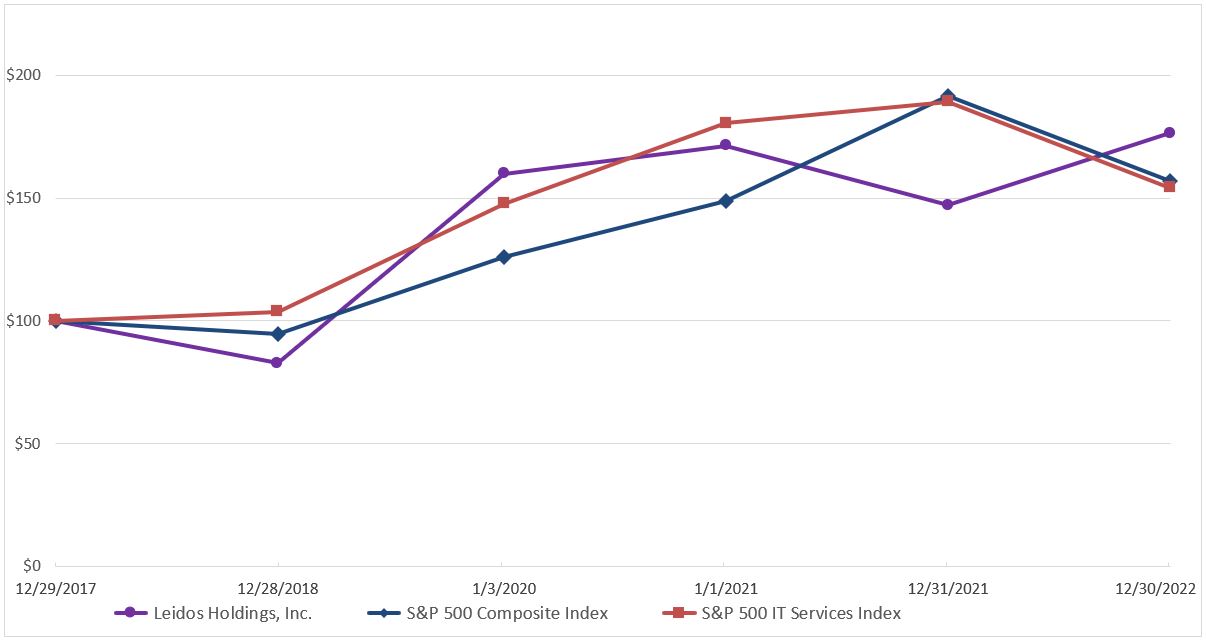
Leidos Holdings, Inc. Annual Report - 42
PART II
| Company/Market/Peer Group | 12/29/2017 | 12/28/2018 | 1/3/2020 | 1/1/2021 | 12/31/2021 | 12/30/2022 | ||||||||||||||||||||||||||||||||
| Leidos Inc. | $ | 100.00 | $ | 82.79 | $ | 159.84 | $ | 171.33 | $ | 147.03 | $ | 176.50 | ||||||||||||||||||||||||||
| S&P 500 Composite Index | $ | 100.00 | $ | 94.80 | $ | 125.91 | $ | 148.85 | $ | 191.58 | $ | 156.88 | ||||||||||||||||||||||||||
| S&P 500 IT Services Index | $ | 100.00 | $ | 103.70 | $ | 147.74 | $ | 180.40 | $ | 189.20 | $ | 154.13 |
Purchases of Equity Securities
In February 2022, our Board of Directors authorized a share repurchase program of up to 20 million shares of our outstanding common stock. The shares may be repurchased from time to time in one or more open market repurchases or privately negotiated transactions, including accelerated share repurchase transactions. The actual timing, number and value of shares repurchased under the program will depend on a number of factors, including the market price of Leidos common stock, general market and economic conditions, applicable legal requirements, compliance with the terms of our outstanding indebtedness and other considerations. There is no assurance as to the number of shares that will be repurchased, and the repurchase program may be suspended or discontinued at any time at our Board of Directors' discretion. This share repurchase authorization replaces the previous share repurchase authorization announced in February 2018. As of December 30, 2022, the maximum number of shares that may yet be repurchased under the program was 15,203,974.
For the three months ended December 30, 2022, there were no repurchases of our common stock.
Item 6. [Reserved]
Item 7. Management’s Discussion and Analysis of Financial Condition and Results of Operations
The following discussion and analysis of Leidos Holdings, Inc.'s ("Leidos") financial condition, results of operations and quantitative and qualitative disclosures about business environment and trends and market risk should be read in conjunction with the consolidated financial statements and related notes included elsewhere in this Annual Report on Form 10-K. Some of the information contained in this discussion and analysis or set forth elsewhere in this Annual Report on Form 10-K, including information with respect to our plans and strategy for our business, includes forward-looking statements that involve risks and uncertainties, including those described under the heading “Forward-Looking Statements.” You should also review the disclosure under Part I, Item 1A, “Risk Factors” in this Annual Report on Form 10-K for a discussion of important factors that could cause actual results to differ materially from the results described in or implied by the forward-looking statements contained in the following discussion and analysis.
Unless indicated otherwise, references in this report to “we,” “us” and “our” refer collectively to Leidos and its consolidated subsidiaries.
In this section, we discuss our financial condition, changes in financial condition and results of our operations for the year ended December 30, 2022, compared to the year ended December 31, 2021. For a discussion and analysis comparing our results for the year ended December 31, 2021, to the year ended January 1, 2021, see our Annual Report on Form 10-K for the year ended December 31, 2021, filed with the SEC on February 15, 2022, under Part II, Item 7 “Management’s Discussion and Analysis of Financial Condition and Results of Operations.”
Overview
We are a FORTUNE 500® technology, engineering, and science company that provides services and solutions in the defense, intelligence, civil and health markets, both domestically and internationally. We bring domain-specific capabilities and innovations to customers in each of these markets by leveraging five technical core capabilities: digital modernization, cyber operations, mission software systems, integrated systems and mission operations. Our customers include the U.S. Department of Defense ("DoD"), the U.S. Intelligence Community, the U.S. Department of Homeland Security, the Federal Aviation Administration, the Department of Veterans Affairs and many other U.S. civilian, state and local government agencies, foreign government agencies and commercial businesses. Approximately 8% of our revenues and tangible long-lived assets are generated by or owned by entities located outside of the United States. We operate in three reportable segments: Defense Solutions, Civil and Health. Additionally, we separately present the unallocable costs associated with corporate functions as Corporate.
Effective July 3, 2021, certain contracts were reassigned from the Defense Solutions reportable segment to the Civil reportable segment. Impact on the first half of fiscal 2021 segment results were determined to be immaterial and have not been recast to reflect this change.
For additional information regarding our reportable segments, see “Business” in Part I and "Note 20—Business Segments" of the notes to the consolidated financial statements contained within this Annual Report on Form 10-K.
Our significant initiatives include the following:
-
achieving annual revenue growth through internal collaboration and better leveraging of key differentiators across our company and the deployment of resources and investments into higher growth markets;
-
increasing headcount and internal direct labor content on our contract portfolio;
-
continued improvement in our back-office infrastructure and related business processes for greater effectiveness and efficiency across all business functions; and
-
disciplined deployment of our cash resources and use of our capital structure to enhance shareholder value while retaining an appropriate amount of financial leverage.
Sales Trend. For fiscal 2022, revenues increased $0.7 billion, or 5%, compared to fiscal 2021, primarily due to a net increase in volumes on certain programs, program wins and a net increase in revenues related to our business acquisitions. We also received $28 million in recoveries related to stop work orders on certain programs as a result of COVID-19. The increase was partially offset by the completion of certain contracts and unfavorable exchange rate movements.
Leidos Holdings, Inc. Annual Report - 44
PART II
Operating Expenses and Income Trend. For fiscal 2022, operating expenses increased by $0.7 billion, or 6%, compared to fiscal 2021. Operating margin for fiscal 2022 was 7.6% compared to 8.4% for fiscal 2021. Operating income was $1,088 million, a $64 million decrease compared to fiscal 2021. The decrease in operating income was primarily attributable to the completion of certain contracts, increase in legal fees and settlement costs and impairment charges of $37 million related to our ongoing facility rationalization efforts. The decrease in operating income was partially offset by program wins and $28 million in recoveries related to stop work orders on certain programs as a result of COVID-19.
From a macroeconomic perspective, our industry is under general competitive pressures associated with spending from our largest customer, the U.S. government, and requires a high level of cost management focus to allow us to remain competitive. Although the U.S. Presidential Administration has not indicated a desire to reduce spending in the defense and homeland security sectors, the likelihood, extent and duration of current spending levels in these areas remains unclear. We continue to review our cost structure against our anticipated sales and undertake cost management actions and efficiency initiatives where necessary.
COVID-19
For fiscal 2022, the COVID-19 pandemic did not have a material impact to revenues and operating income, other than the receipt of $28 million in recoveries, within our Health segment related to stop work orders on certain programs. The volume of global passenger air travel remains below pre-pandemic levels, which continues to impact the operations of our Security Enterprise Solutions reporting unit. The full extent of the impact of the COVID-19 pandemic on our operational and financial performance, including our ability to execute on programs in the expected timeframe, will depend on future developments, including the duration and spread of the pandemic and the distribution of vaccines, all of which are uncertain and cannot be predicted.
Business Environment and Trends
U.S. Government Markets
In fiscal 2022, we generated approximately 86% of our total revenues from contracts with the U.S. government, either as a prime contractor or a subcontractor to other contractors engaged in work for the U.S. government. Revenues under contracts with the DoD and U.S. Intelligence Community, including subcontracts under which the DoD or the U.S. Intelligence Community is the ultimate purchaser, represented approximately 44% of our total revenues for fiscal 2022. Accordingly, our business performance is affected by the overall level of U.S. government spending, especially national security, homeland security and intelligence spending, and the alignment of our service and product offerings and capabilities with current and future budget priorities of the U.S. government.
President Biden signed the $1.7 trillion GFY 2023 omnibus spending bill into law on December 29, 2022. The omnibus spending bill funds the federal government through September 30, 2023. The bill includes $772.5 billion in non-defense spending and $858.4 billion in defense spending. The bill also includes $85 billion in emergency spending not included in the discretionary amount. The new 118th Congress will begin to work on the GFY 2024 appropriations bills in the spring of 2023.
Trends in the U.S. government contracting process, including a shift towards multiple-awards contracts, in which certain contractors are preapproved using IDIQ and U.S. General Services Administration ("GSA") contract vehicles, have increased competition for U.S. government contracts, reduced backlogs by shortening periods of performance on contracts and increased pricing pressure. We expect that a majority of the business that we seek in the foreseeable future will be awarded through a competitive bidding process. For more information on these risks and uncertainties, see “Risk Factors” in Part I of this Annual Report on Form 10-K.
International Markets
Sales to customers in international markets represented approximately 8% of total revenues for fiscal 2022. Our international customers include foreign governments and their agencies. Our international business increases our exposure to international markets and the associated international regulatory, foreign currency exchange rate and geopolitical risks.
Changes in international trade policies, including higher tariffs on imported goods and materials, may increase our procurement costs of certain IT hardware used both on our contracts and for internal use. However, we expect to recover certain portions of these higher tariffs through our cost-plus contracts. While we evaluate the impact of higher tariffs, currently, we do not expect tariffs to have a significant impact to our business.
Leidos Holdings, Inc. Annual Report - 45
PART II
Key Performance Measures
The primary financial performance measures we use to manage our business and monitor results of operations are revenue, operating income, cash flows from operations and diluted earnings per share. Bookings and backlog are also useful measures for management and investors to evaluate our performance and potential future revenues. In addition, we consider business performance by contract type to be useful to management and investors when evaluating our operating income and margin performance.
Results of Operations
Our results of operations for the periods presented were as follows:
| Year Ended | 2022 to 2021 | |||||||||||||||||||||||||
| December 30, 2022 | December 31, 2021 | Dollar change | Percent change | |||||||||||||||||||||||
| (dollars in millions) | ||||||||||||||||||||||||||
| Revenues | $ | 14,396 | $ | 13,737 | $ | 659 | 5 | % | ||||||||||||||||||
| Cost of revenues | 12,312 | 11,723 | 589 | 5 | % | |||||||||||||||||||||
| Selling, general and administrative expenses | 950 | 860 | 90 | 10 | % | |||||||||||||||||||||
| Credit losses (recoveries), net | 1 | (9) | 10 | (111) | % | |||||||||||||||||||||
| Acquisition, integration and restructuring costs | 17 | 27 | (10) | (37) | % | |||||||||||||||||||||
| Asset impairment charges | 40 | 4 | 36 | NM | ||||||||||||||||||||||
| Equity earnings of non-consolidated subsidiaries | (12) | (20) | 8 | (40) | % | |||||||||||||||||||||
| Operating income | 1,088 | 1,152 | (64) | (6) | % | |||||||||||||||||||||
| Non-operating expense, net | (202) | (185) | (17) | 9 | % | |||||||||||||||||||||
| Income before income taxes | 886 | 967 | (81) | (8) | % | |||||||||||||||||||||
| Income tax expense | (193) | (208) | 15 | (7) | % | |||||||||||||||||||||
| Net income | 693 | 759 | (66) | (9) | % | |||||||||||||||||||||
| Less: net income attributable to non-controlling interest | 8 | 6 | 2 | 33 | % | |||||||||||||||||||||
| Net income attributable to Leidos common stockholders | $ | 685 | $ | 753 | $ | (68) | (9) | % | ||||||||||||||||||
| Operating income margin | 7.6 | % | 8.4 | % |
NM - Not meaningful
Segment and Corporate Results
| Year Ended | 2022 to 2021 | |||||||||||||||||||||||||
| Defense Solutions | December 30, 2022 | December 31, 2021 | Dollar change | Percent change | ||||||||||||||||||||||
| (dollars in millions) | ||||||||||||||||||||||||||
| Revenues | $ | 8,244 | $ | 8,032 | $ | 212 | 3 | % | ||||||||||||||||||
| Operating income | 541 | 569 | (28) | (5) | % | |||||||||||||||||||||
| Operating income margin | 6.6 | % | 7.1 | % |
The increase in revenues for fiscal 2022 as compared to fiscal 2021 was primarily attributable to program wins, a net increase in volumes on certain programs and a $63 million net increase in revenues related to our acquisitions made in the second and third quarters from the prior year and the Cobham Special Mission acquisition made in the current year. The increase was partially offset by the completion of certain contracts, contracts that were reassigned from Defense Solutions reportable segment to the Civil reportable segment during the third quarter of fiscal 2021 and $95 million related to unfavorable exchange rate movements.
The decrease in operating income for fiscal 2022 as compared to fiscal 2021 was primarily attributable to the completion of certain contracts, net write-downs on certain contracts, increased amortization expense of $8 million and $6 million related to unfavorable exchange rate movements. Fiscal 2022 also included impairment charges of $12 million related to our ongoing facility rationalization efforts (see "Note 10—Leases"). The decrease was partially offset by program wins and a net increase in volumes on certain programs.
Leidos Holdings, Inc. Annual Report - 46
PART II
| Year Ended | 2022 to 2021 | |||||||||||||||||||||||||
| Civil | December 30, 2022 | December 31, 2021 | Dollar change | Percent change | ||||||||||||||||||||||
| (dollars in millions) | ||||||||||||||||||||||||||
| Revenues | $ | 3,464 | $ | 3,157 | $ | 307 | 10 | % | ||||||||||||||||||
| Operating income | 234 | 248 | (14) | (6) | % | |||||||||||||||||||||
| Operating income margin | 6.8 | % | 7.9 | % |
The increase in revenues for fiscal 2022 as compared to fiscal 2021 was primarily attributable to program wins, a net increase in program volumes and contracts that were reassigned from Defense Solutions reportable segment to the Civil reportable segment during the third quarter of fiscal 2021. The increase was partially offset by the completion of certain contracts and $12 million of unfavorable exchange rate movements.
The decrease in operating income for fiscal 2022 as compared to fiscal 2021 was primarily attributable to a $19 million increase in legal fees and settlement costs resulting from an adverse arbitration ruling related to the 2016 acquisition of the Information Systems & Global Solutions business (“IS&GS Business”) from Lockheed Martin and impairment charges of $14 million related to our ongoing facility rationalization efforts (see "Note 10—Leases"). The decreases were partially offset by a net increase in program volumes. Operating income for fiscal 2021 included a $26 million benefit from a legal reserve adjustment related to the Mission Support Alliance joint venture (see "Note 1—Nature of Operations and Basis of Presentation").
| Year Ended | 2022 to 2021 | |||||||||||||||||||||||||
| Health | December 30, 2022 | December 31, 2021 | Dollar change | Percent change | ||||||||||||||||||||||
| (dollars in millions) | ||||||||||||||||||||||||||
| Revenues | $ | 2,688 | $ | 2,548 | $ | 140 | 5 | % | ||||||||||||||||||
| Operating income | 421 | 442 | (21) | (5) | % | |||||||||||||||||||||
| Operating income margin | 15.7 | % | 17.3 | % |
The increase in revenues for fiscal 2022 as compared to fiscal 2021 was primarily attributable to a net increase in program volumes, program wins and $28 million in recoveries related to stop work orders on certain programs as a result of COVID-19. The increase was partially offset by the completion of certain contracts.
The decrease in operating income for fiscal 2022 as compared to fiscal 2021 was primarily attributable to a net decrease in volumes on higher margin programs and the completion of certain contracts. The decrease was partially offset by $28 million in recoveries related to stop work orders on certain programs as a result of COVID-19 and program wins.
| Year Ended | 2022 to 2021 | |||||||||||||||||||||||||
| Corporate | December 30, 2022 | December 31, 2021 | Dollar change | Percent change | ||||||||||||||||||||||
| (dollars in millions) | ||||||||||||||||||||||||||
| Operating loss | $ | (108) | $ | (107) | $ | (1) | 1 | % |
The increase in operating loss for fiscal 2022 as compared to fiscal 2021 was primarily attributable to an increase in legal costs partially offset by lower acquisition and integration costs.
Equity earnings of non-consolidated subsidiaries
We have certain non-controlling ownership interests in equity method investments. For fiscal 2022 and fiscal 2021 we recorded earnings of $12 million and $20 million, respectively, from our equity method investments.
Leidos Holdings, Inc. Annual Report - 47
PART II
Non-Operating Expense, Net
Non-operating expense, net increased $17 million for fiscal 2022 as compared to fiscal 2021, primarily due to higher interest expense driven by increased interest rates.
Provision for Income Taxes
Our effective tax rate was 21.8%, and 21.5% in fiscal 2022 and 2021, respectively. The effective tax rate for fiscal 2022 and 2021 were both favorably impacted primarily by federal research tax credits and excess tax benefits related to employee stock-based payment transactions.
Beginning in 2022, the Tax Cuts and Jobs Act of 2017 ("TCJA") eliminated the option to currently deduct certain research and development costs for tax purposes and requires taxpayers to capitalize and amortize research costs over five years. Based upon our interpretation of the law as enacted, we recorded the estimated fiscal 2022 impact, resulting in increases of $130 million to both our income taxes payable and net deferred tax assets, and our fiscal 2022 unrecognized tax benefits increased by $91 million with a corresponding increase to net deferred tax assets. We expect this TCJA provision to have a similar impact to income taxes payable, unrecognized tax benefits and net deferred tax assets during fiscal 2023. The actual impact will depend on the amount of research and development costs the Company will incur, whether Congress modifies or repeals this provision and whether new guidance and interpretive rules are issued by the U.S. Treasury, among other factors.
Bookings and Backlog
We had net bookings of $15.4 billion and $15.5 billion during fiscal 2022 and 2021, respectively. Net bookings represent the estimated amount of revenue to be earned in the future from funded and unfunded contract awards that were received during the year, net of any adjustments to previously awarded backlog amounts. We calculate net bookings as the year’s ending backlog, plus the year’s revenues, less the prior year’s ending backlog and any impacts from foreign currency or acquisitions and divestitures.
Backlog represents the estimated amount of future revenues to be recognized under negotiated contracts. We segregate our backlog into two categories as follows:
- Funded Backlog. Funded backlog for contracts with the U.S. government represents the value on contracts for which funding is appropriated less revenues previously recognized on these contracts. Funded backlog for contracts with non-U.S. government entities and commercial customers represents the estimated value on contracts, which may cover multiple future years, under which we are obligated to perform, less revenues previously recognized on the contracts.
*•*Negotiated Unfunded Backlog. Negotiated unfunded backlog represents estimated amounts of revenue to be earned in the future from contracts for which funding has not been appropriated and unexercised priced contract options. Negotiated unfunded backlog does not include unexercised option periods and future potential task orders expected to be awarded under IDIQ, GSA Schedule or other master agreement contract vehicles, with the exception of certain IDIQ contracts where task orders are not competitively awarded and separately priced but instead are used as a funding mechanism, and where there is a basis for estimating future revenues and funding on future anticipated task orders.
The estimated value of our total backlog for the periods presented was as follows:
| Year ended | ||||||||||||||||||||||||||||||||||||||
| December 30, 2022 | December 31, 2021 | |||||||||||||||||||||||||||||||||||||
| Segment | Funded | Unfunded | Total | Funded | Unfunded | Total | ||||||||||||||||||||||||||||||||
| (in millions) | ||||||||||||||||||||||||||||||||||||||
| Defense Solutions | $ | 4,442 | $ | 14,155 | $ | 18,597 | $ | 4,393 | $ | 15,274 | $ | 19,667 | ||||||||||||||||||||||||||
| Civil | 1,876 | 8,790 | 10,666 | 1,628 | 7,903 | 9,531 | ||||||||||||||||||||||||||||||||
| Health | 2,064 | 4,455 | 6,519 | 1,428 | 3,829 | 5,257 | ||||||||||||||||||||||||||||||||
| Total | $ | 8,382 | $ | 27,400 | $ | 35,782 | $ | 7,449 | $ | 27,006 | $ | 34,455 |
Leidos Holdings, Inc. Annual Report - 48
PART II
Total backlog at December 30, 2022, and December 31, 2021, included $610 million and $800 million, respectively, of backlog acquired during the year through business combinations in our Defense Solutions reportable segment.
The increase in backlog as of December 30, 2022, as compared to December 31, 2021, included an unfavorable impact of $233 million due to the movements in the British pound and Australian dollar when compared to the U.S. dollar.
Bookings and backlog fluctuate from period to period depending on our success rate in winning contracts and the timing of contract awards, renewals, modifications and cancellations, as well as foreign currency movements. Contract awards may be negatively impacted by ongoing industry-wide delays in procurement decisions and budget cuts by the U.S. government as discussed in “Business Environment and Trends” in this Annual Report on Form 10-K.
We expect to recognize a substantial portion of our funded backlog as revenues within the next 12 months. However, the U.S. government may cancel any contract at any time through a termination for the convenience of the U.S. government. In addition, certain contracts with commercial or non-U.S. government customers may include provisions that allow the customer to cancel at any time. Most of our contracts have cancellation terms that would permit us to recover all or a portion of our incurred costs and fees for work performed.
Contract Types
Our earnings and profitability may vary materially depending on changes in the proportionate amount of revenues derived from each type of contract. For a discussion of the types of contracts under which we generate revenues, see “Business—Contract Types” in Part I of this Annual Report on Form 10-K. Revenues by contract type as a percentage of our total revenues for the periods presented were as follows:
| Year Ended | ||||||||||||||||||||
| December 30, 2022 | December 31, 2021 | January 1, 2021 | ||||||||||||||||||
| Cost-reimbursement and fixed-price-incentive-fee | 50 | % | 50 | % | 51 | % | ||||||||||||||
| Firm-fixed-price | 38 | % | 37 | % | 36 | % | ||||||||||||||
| Time-and-materials and fixed-price-level-of-effort | 12 | % | 13 | % | 13 | % | ||||||||||||||
| Total | 100 | % | 100 | % | 100 | % |
Liquidity and Capital Resources
Overview of Liquidity
As of December 30, 2022, we had $516 million in cash and cash equivalents. Additionally, we have an unsecured revolving credit facility which can provide up to $750 million in additional borrowing, if required. During fiscal 2022 and 2021, there were no borrowings outstanding under the credit facilities.
At December 30, 2022 and December 31, 2021, we had outstanding debt of $4.9 billion and $5.1 billion, respectively. On May 6, 2022, we entered into a Term Loan Agreement which provided for a senior unsecured term loan facility in an aggregate principal amount of $380 million.
We have a commercial paper program in which we may issue short-term unsecured commercial paper notes not to
exceed $750 million and have maturities of up to 397 days from the date of issuance (see "Note 13—Debt"). As of December 30, 2022, we did not have any commercial paper notes outstanding.
We made principal payments on our debt of $545 million, $106 million and $731 million during fiscal 2022, 2021 and 2020, respectively. This activity included required principal payments on our term loans of $476 million, $96 million and $72 million during fiscal 2022, 2021 and 2020, respectively. During fiscal 2020, we made $4,925 million of principal repayments for outstanding debt and retired the $450 million senior notes. The notes outstanding as of December 30, 2022, contain financial covenants and customary restrictive covenants. We were in compliance with all covenants as of December 30, 2022.
Leidos Holdings, Inc. Annual Report - 49
PART II
Interest on our Credit Facilities is calculated based on the London Interbank Offered Rate (“LIBOR”). On July 27, 2017, the U.K.’s Financial Conduct Authority announced that LIBOR would be discontinued or become unavailable as a reference rate by the end of 2021 and LIBOR will be fully discontinued or become unavailable as a benchmark rate by June 2023. In December 2022, the FASB issued guidance which provides relief for entities with such LIBOR denominated credit instruments so that entities may continue to account for contract modifications as a continuation of the existing contract and the continuation of the hedge accounting arrangement through December 31, 2024.
Although our Credit Facilities include mechanics to facilitate the adoption by us and our lenders of an alternative benchmark rate for use in place of LIBOR, no assurance can be made that such alternative benchmark rate will perform in a manner similar to LIBOR or result in interest rates that are at least as favorable to us as those that would have resulted had LIBOR remained in effect, which could result in an increase in our interest expense and other debt service obligations. In addition, the overall credit market may be disrupted as a result of the replacement of LIBOR or in the anticipation thereof, which could have an adverse impact on our ability to refinance, reprice, or amend our existing indebtedness or incur additional indebtedness on favorable terms.
We paid dividends of $199 million, $199 million and $196 million for fiscal 2022, 2021 and 2020, respectively.
During fiscal 2022, we sold $209 million of accounts receivable under accounts receivable purchase agreements and received proceeds of $209 million (see "Note 6—Receivables"). There were no sales of accounts receivable in the second half of fiscal 2022.
We may from time to time seek to retire or purchase our outstanding debt through cash purchases in the open market, privately negotiated transactions or otherwise. Such repurchases, if any, will depend on prevailing market conditions, our liquidity requirements, contractual restrictions and other factors. The amounts involved may be material.
Stock repurchases of Leidos common stock may be made on the open market or in privately negotiated transactions with third parties including through accelerated share repurchase ("ASR") agreements. Whether repurchases are made and the timing and actual number of shares repurchased depends on a variety of factors including price, corporate capital requirements, other market conditions and regulatory requirements. The repurchase program may be accelerated, suspended, delayed or discontinued at any time.
During fiscal 2021 and 2020, we made open market repurchases of our common stock for an aggregate purchase price of $237 million and $67 million, respectively. There were no open market share repurchases in fiscal 2022.
In fiscal 2022, we entered into an ASR with a financial institution to repurchase shares of our outstanding common stock. We paid $500 million to the financial institution and received 4.8 million shares (see "Note 16—Earnings Per Share" of the notes to the consolidated financial statements contained within this Annual Report on Form 10-K). All shares delivered were immediately retired.
During fiscal 2022, we made a $25 million payment in connection with the adverse arbitration ruling related to the 2016 acquisition of the IS&GS Business from Lockheed Martin.
Beginning in 2022, a provision in the TCJA which eliminated the option to currently deduct research and development costs for tax purposes and requires taxpayers to capitalize and amortize the costs over five years became effective. We anticipate our tax cash payments to increase by $300 million in 2023 primarily to cover both the 2022 and 2023 tax obligations related to this provision. The actual impact will depend on the amount of research and development costs the Company will incur during fiscal 2023 and whether new guidance and interpretive rules are issued by the U.S. Treasury, among other factors. We will continue to assess our liquidity needs as the tax legislation and pandemic evolve.
For the next 12 months, we anticipate that we will be able to meet our liquidity needs, including servicing our debt, through cash generated from operations, available cash balances, sales of accounts receivable and, if needed, borrowings from our revolving credit facility and commercial paper program.
Leidos Holdings, Inc. Annual Report - 50
PART II
Summary of Cash Flows
The following table summarizes cash flow information for the periods presented:
| Year Ended | ||||||||||||||||||||
| December 30, 2022 | December 31, 2021 | |||||||||||||||||||
| (in millions) | ||||||||||||||||||||
| Net cash provided by operating activities | $ | 986 | $ | 1,031 | ||||||||||||||||
| Net cash used in investing activities | (313) | (730) | ||||||||||||||||||
| Net cash used in financing activities | (865) | (113) | ||||||||||||||||||
| Net (decrease) increase in cash, cash equivalents and restricted cash | $ | (192) | $ | 188 |
Net cash provided by operating activities decreased $45 million for fiscal 2022 as compared to fiscal 2021. The decrease was primarily due to a $25 million payment in connection with the adverse arbitration ruling related to the 2016 acquisition of the IS&GS Business from Lockheed Martin and $23 million of payments for other legal and tax settlements occurred during the current year, partially offset by favorable working capital changes.
Net cash used in investing activities decreased $417 million for fiscal 2022 as compared to fiscal 2021. The decrease was primarily due to $430 million of less cash paid related to our business acquisitions in current year as compared to prior year and $15 million of proceeds received from the sale of Aviation & Missile Solutions LLC in the current year. The decrease was partially offset by $25 million of higher capital expenditures in the current year.
Net cash used in financing activities increased $752 million for fiscal 2022 as compared to fiscal 2021. The increase was primarily due to $439 million increase in principal payments of our debt, an increase of $272 million in stock repurchases primarily attributable to the accelerated share repurchase agreement and a $45 million decrease in net capital contributions received from our non-controlling interest.
Off-Balance Sheet Arrangements
We have outstanding performance guarantees and cross-indemnity agreements in connection with certain aspects of our business. We have letters of credit outstanding principally related to performance guarantees on contracts and surety bonds outstanding principally related to performance and subcontractor payment bonds. We also have future lease commitments for the use of certain aircraft as described in "Note 21—Commitments and Contingencies" of the notes to the consolidated financial statements contained within this Annual Report on Form 10-K. These arrangements have not had, and management does not believe it is likely that they will in the future have, a material effect on our liquidity, capital resources, operations or financial condition.
Contractual Obligations
Our future contractual obligations are related to debt, finance and operating leases, long-term liabilities under deferred compensation arrangements, purchase obligations for long-term purchases and service agreements and other liabilities. For more information, see "Note 10—Leases", "Note 13—Debt", “Note 19—Retirement Plans” and "Note 21—Commitments and Contingencies" of the notes to the consolidated financial statements contained within this Annual Report on Form 10-K.
We have interest payments related to our outstanding debt and finance leases. As of December 30, 2022, future scheduled interest payments on our outstanding debt and finance leases were $195 million, expected to be paid in fiscal 2023 and $946 million expected to be paid thereafter.
As of December 30, 2022, future payments on our deferred compensation arrangements and purchase obligations for long-term purchases and service agreements were $36 million, expected to be paid in fiscal 2023, and $120 million expected to be paid thereafter. Our future payments do not include $92 million of income tax liabilities as a result of uncertain tax positions arising from certain provisions of the TCJA becoming effective in 2022, and the timing of such payments, if any, cannot be reasonably estimated. For additional information, see "Note 18—Income Taxes" of the notes to the consolidated financial statements contained within this Annual Report on Form 10-K.
Leidos Holdings, Inc. Annual Report - 51
PART II
Guarantors and Issuers of Guaranteed Securities
Leidos Holdings, Inc. (“Guarantor”) has fully and unconditionally guaranteed the debt securities of its subsidiary, Leidos, Inc. (“Issuer”), that were issued pursuant to transactions that were registered under the Securities Act of 1933, as amended (collectively, the “Registered Notes”). The following is a list of the Registered Notes guaranteed by Leidos Holdings, Inc.
| Senior unsecured Registered Notes: | ||
| $500 million 2.950% notes, due May 2023 | ||
| $500 million 3.625% notes, due May 2025 | ||
| $750 million 4.375% notes, due May 2030 | ||
| $1,000 million 2.300% notes, due February 2031 |
Leidos Holdings, Inc. has also fully and unconditionally guaranteed debt securities of Leidos, Inc. that were issued pursuant to transactions that were not registered under the Securities Act of 1933, as amended. The following is a list of unregistered debt securities guaranteed by Leidos Holdings, Inc.
| Senior unsecured unregistered debt securities issued by Leidos, Inc.: | ||
| $250 million 7.125% notes, due July 2032 | ||
| $300 million 5.500% notes, due July 2033 |
Additionally, Leidos, Inc. has fully and unconditionally guaranteed debt securities of Leidos Holding, Inc. that were issued pursuant to transactions that were not registered under the Securities Act of 1933, as amended. The following is a list of unregistered debt securities guaranteed by Leidos, Inc.
| Senior unsecured unregistered debt securities issued by Leidos Holdings, Inc.: | ||
| $300 million 5.950% notes, due December 2040 |
The following summarized financial information includes the assets, liabilities and results of operations for the Guarantor and Issuer of the Registered Notes described above. Intercompany balances and transactions between the Issuer and Guarantor have been eliminated from the financial information below. Investments in the consolidated subsidiaries of the Issuer and Guarantor that do not guarantee the senior unsecured notes have been excluded from the financial information. Intercompany payables represent amounts due to non-guarantor subsidiaries of the Issuer.
Balance Sheet Information for the Guarantor and Issuer of Registered Notes
| December 30, 2022 | ||||||||
| (in millions) | ||||||||
| Total current assets | $ | 2,115 | ||||||
| Goodwill | 5,810 | |||||||
| Other long-term assets | 1,188 | |||||||
| Total assets | $ | 9,113 | ||||||
| Total current liabilities | $ | 2,922 | ||||||
| Long-term debt, net of current portion | 3,925 | |||||||
| Intercompany payables | 1,695 | |||||||
| Other long-term liabilities | 699 | |||||||
| Total liabilities | $ | 9,241 |
Leidos Holdings, Inc. Annual Report - 52
PART II
Statement of Income Information for the Guarantor and Issuer of Registered Notes
| December 30, 2022 | ||||||||
| (in millions) | ||||||||
| Revenues, net | $ | 9,808 | ||||||
| Operating income | 698 | |||||||
| Net income | 250 |
Commitments and Contingencies
We are subject to a number of reviews, investigations, claims, lawsuits, other uncertainties and future obligations related to our business. For a discussion of these items, see "Note 10—Leases" and "Note 21—Commitments and Contingencies" of the notes to the consolidated financial statements contained within this Annual Report on Form 10-K.
Critical Accounting Estimates
Our discussion and analysis of our financial condition and results of operations are based upon our consolidated financial statements, which are prepared in accordance with accounting principles generally accepted in the United States of America ("GAAP"). The preparation of these financial statements in accordance with GAAP requires management to make estimates and assumptions that affect the reported amounts of assets and liabilities and the disclosure of contingencies at the date of the financial statements, as well as the reported amounts of revenues and expenses during the reporting periods. Management evaluates these estimates and assumptions on an ongoing basis. Our estimates and assumptions have been prepared by management on the basis of the most current and best available information. The results of these estimates form the basis for making judgments about the carrying values of assets and liabilities that are not readily apparent from other sources. Actual results could differ from these estimates under different assumptions and conditions.
We have identified the following accounting policies as critical because they require significant judgments and assumptions about highly complex and inherently uncertain matters and the use of reasonably different estimates and assumptions could have a material impact on our results of operations or financial condition.
-
Revenue Recognition
-
Goodwill and Intangible Assets
Revenue Recognition
We perform work under various types of contracts, which include firm-fixed-price ("FFP"), time-and-materials ("T&M"), fixed-price-level-of-effort ("FP-LOE"), cost-plus-fixed-fee ("CPFF"), cost-plus-award-fee, cost-plus-incentive-fee and fixed-price-incentive-fee contracts. Some of these contracts require us to use estimates of the revenue and cost associated with the design, manufacture and delivery of our products and services for the purposes of recognizing revenue.
We also evaluate whether two or more contracts should be combined and accounted for as a single contract, including the task orders issued under an IDIQ award. In addition, we assess contract modifications to determine whether changes to existing contracts should be accounted for as part of the original contract or as a separate contract. Some of our cost-plus and fixed-price contracts contain award fees, incentive fees or other provisions that may either increase or decrease the transaction price. These variable amounts generally are awarded upon achievement of certain performance metrics, program milestones or cost targets and can be based upon customer discretion. We estimate variable consideration at the most probable amount that we expect to be entitled to, based on the assessment of the contractual variable fee criteria, complexity of work and related risks, extent of customer discretion, amount of variable consideration received historically and the potential of significant reversal of revenue.
Leidos Holdings, Inc. Annual Report - 53
PART II
On FFP contracts requiring system integration and cost-plus contracts with variable consideration, revenue is recognized over time generally using a method that measures the extent of progress towards completion of a performance obligation, principally using a cost-input method (referred to as the cost-to-cost method). Under the cost-to-cost method, revenue is recognized based on the proportion of total costs incurred to estimated total costs-at-completion ("EAC"). A performance obligation's EAC includes all direct costs such as materials, labor, subcontract costs, overhead and a ratable portion of general and administrative costs. In addition, an EAC of a performance obligation includes future losses estimated to be incurred on onerous contracts, as and when known.
For the impacts of changes in estimates on our contracts, (see "Note 3—Summary of Significant Accounting Policies").
Goodwill and Intangible Assets
Goodwill represents the excess of the fair value of consideration transferred, plus the fair value of any non-controlling interests in the acquiree, over the fair value of the net assets acquired and liabilities assumed as of the acquisition date. We recognize purchased intangible assets in connection with our business acquisitions at fair value on the acquisition date.
Goodwill is not amortized, but instead is tested annually, at the beginning of the fourth quarter, for impairment at the reporting unit level and may be tested more frequently if events or circumstances indicate that the carrying value may not be recoverable. Intangible assets with indefinite lives are not amortized but are assessed for impairment at the beginning of the fourth quarter and whenever events or changes in circumstances indicate that the carrying value may not be recoverable.
Goodwill and intangible assets, net, collectively represent 59% and 60% of our total assets as of December 30, 2022 and December 31, 2021, respectively.
We may perform qualitative or quantitative analysis to test for impairment. Qualitative factors may include macroeconomic, industry and market considerations, overall financial performance, industry, legal and other relevant events and factors affecting the reporting unit.
For quantitative analysis, we use discounted cash flow models and market multiple analyses in order to estimate reporting unit fair values. Discounted cash flow analyses rely on significant judgement and assumptions about expected future cash flows, weighted-average cost of capital, discount rates, expected long-term growth rates and operating margins. These assumptions are based on estimates of future sales and earnings after considering such factors as general market conditions, customer budgets, existing firm and future orders, changes in working capital, long term business plans and recent operating performance. Market multiple analyses incorporate significant judgments and assumptions related to the selection of guideline public companies, our forecast earnings before interest, taxes, depreciation and amortization (“EBITDA”), forecast EBITDA of guideline public companies and control premium estimates.
We performed our annual test for impairment as of October 1, 2022, which resulted in no impairments being identified. However, through this analysis we determined that our Security Enterprise Solutions reporting unit within the Civil reportable segment, which holds goodwill in the amount of $899 million as of December 30, 2022, was at risk of future impairment. The estimated fair value of the Security Enterprise Solutions reporting unit exceeded the carrying value by approximately 13%. Operations of the reporting unit rely heavily on the sales and servicing of security and detection products, which have been negatively impacted by COVID-19. The forecasts utilized to estimate the fair value of the Security Enterprise Solutions reporting unit assume continued global operations in all of our existing markets and a gradual improvement in the global aviation security product and related service sales, reaching pre-COVID-19 levels by fiscal 2025. The fair value of the reporting unit is also negatively impacted by rising interest rate factored into cost of capital. In the event that there are significant unfavorable changes to the forecasted cash flows of the reporting unit (including if the impact of COVID-19 on passenger travel levels is more prolonged or severe than what is incorporated into our forecast), terminal growth rates or the cost of capital used in the fair value estimates, we may be required to record a material impairment of goodwill or intangible assets at a future date.
Recently Adopted and Issued Accounting Pronouncements
For a discussion of these items, see "Note 2—Accounting Standards" of the notes to the consolidated financial statements contained within this Annual Report on Form 10-K.
Leidos Holdings, Inc. Annual Report - 54
PART II
Item 7A. Quantitative and Qualitative Disclosures About Market Risk
We are exposed to certain market risks in the normal course of business. Our current market risk exposures are primarily related to interest rates and foreign currency fluctuations. The following information about our market sensitive financial instruments contains forward-looking statements.
Interest Rate Risk
Our exposure to market risk for changes in interest rates relates primarily to long-term debt obligations and derivatives. Our policy authorizes, with Board of Directors' approval, the limited use of derivative instruments to hedge specific interest rate risks.
Debt and derivatives
At December 30, 2022 and December 31, 2021, we had $4.9 billion and $5.1 billion, respectively, of debt, which included $1.5 billion and $1.7 billion, respectively, related to our senior unsecured term loans that have a variable stated interest rate that is determined based on either the London Interbank Offered Rate ("LIBOR") or the Stated Overnight Financing Date ("SOFR") rate plus a margin. As a result, we may experience fluctuations in interest expense.
As of December 30, 2022, we hold $500 million of unsecured notes due May 2023. We anticipate refinancing this obligation during fiscal 2023, at which time we will be subject to current market rates which may vary significantly from the existing rates on our debt.
We have interest rate swap agreements to hedge the cash flows of a portion of our variable rate senior unsecured term loan ("Variable Rate Loan"). Under the terms of the interest rate swap agreements, we receive variable interest payments based on the one-month LIBOR rate and pay interest at a fixed rate. As of December 30, 2022, the notional value of the interest rate swap agreements was $1.0 billion. The interest rate swap agreements effectively converted a portion of our variable rate borrowing to a fixed rate borrowing. The fair value of our interest rate swap agreements with respect to our Variable Rate Loan was an asset of $20 million, as of December 30, 2022, and a liability of $53 million, as of December 31, 2021.
The counterparties to these agreements are financial institutions. We do not hold or issue derivative financial instruments for trading or speculative purposes. We cannot predict future market fluctuations in interest rates and their impact on our interest rate swaps. The net hypothetical 10% movement in the one-month LIBOR or SOFR rate would not have a significant impact on our annual interest expense. For additional information related to our interest rate swap agreements and debt, see "Note 12—Derivative Instruments" and "Note 13—Debt," respectively, of the notes to the consolidated financial statements contained within this Annual Report on Form 10-K.
Cash and Cash Equivalents
As of December 30, 2022 and December 31, 2021, our cash and cash equivalents included investments in several large institutional money market accounts. For fiscal 2022 and fiscal 2021, a hypothetical 10% interest rate movement would not have a significant impact on the value of our holdings or on interest income.
Foreign Currency Risk
Although the majority of our transactions are denominated in U.S. dollars, some of our transactions are denominated in foreign currencies. Our foreign currency exchange rate risk relates to receipts from customers, payments to suppliers and certain intercompany transactions denominated in currencies other than our (or one of our subsidiaries') functional currency. Our foreign operations represented 8% of total revenues for fiscal 2022, 2021 and 2020.
Leidos Holdings, Inc. Annual Report - 55
PART II
Item 8. Financial Statements and Supplementary Data
LEIDOS HOLDINGS, INC.
INDEX TO CONSOLIDATED FINANCIAL STATEMENTS
Financial statement schedules are omitted because they are not applicable or the required information is presented in the consolidated financial statements or the notes thereto.
Leidos Holdings, Inc. Annual Report - 56
REPORT OF INDEPENDENT REGISTERED PUBLIC ACCOUNTING FIRM
To the shareholders and the Board of Directors of Leidos Holdings, Inc.
Reston, Virginia
Opinion on the Financial Statements
We have audited the accompanying consolidated balance sheets of Leidos Holdings, Inc. and subsidiaries (the "Company") as of December 30, 2022 and December 31, 2021, the related consolidated statements of income, comprehensive income, equity, and cash flows, for the fiscal years ended December 30, 2022, December 31, 2021, and January 1, 2021, and the related notes (collectively referred to as the "financial statements"). In our opinion, the financial statements present fairly, in all material respects, the financial position of the Company as of December 30, 2022 and December 31, 2021, and the results of its operations and its cash flows for the fiscal years ended December 30, 2022, December 31, 2021, and January 1, 2021, in conformity with accounting principles generally accepted in the United States of America.
We have also audited, in accordance with the standards of the Public Company Accounting Oversight Board (United States) (PCAOB), the Company's internal control over financial reporting as of December 30, 2022, based on criteria established in Internal Control — Integrated Framework (2013) issued by the Committee of Sponsoring Organizations of the Treadway Commission and our report dated February 14, 2023, expressed an unqualified opinion on the Company's internal control over financial reporting.
Basis for Opinion
These financial statements are the responsibility of the Company's management. Our responsibility is to express an opinion on the Company's financial statements based on our audits. We are a public accounting firm registered with the PCAOB and are required to be independent with respect to the Company in accordance with the U.S. federal securities laws and the applicable rules and regulations of the Securities and Exchange Commission and the PCAOB.
We conducted our audits in accordance with the standards of the PCAOB. Those standards require that we plan and perform the audit to obtain reasonable assurance about whether the financial statements are free of material misstatement, whether due to error or fraud. Our audits included performing procedures to assess the risks of material misstatement of the financial statements, whether due to error or fraud, and performing procedures that respond to those risks. Such procedures included examining, on a test basis, evidence regarding the amounts and disclosures in the financial statements. Our audits also included evaluating the accounting principles used and significant estimates made by management, as well as evaluating the overall presentation of the financial statements. We believe that our audits provide a reasonable basis for our opinion.
Critical Audit Matters
The critical audit matters communicated below are matters arising from the current-period audit of the financial statements that were communicated or required to be communicated to the audit committee and that (1) relate to accounts or disclosures that are material to the financial statements and (2) involved especially challenging, subjective, or complex judgments. The communication of critical audit matters does not alter in any way our opinion on the financial statements, taken as a whole, and we are not, by communicating the critical audit matters below, providing a separate opinion on the critical audit matters or on the accounts or disclosures to which they relate.
Leidos Holdings, Inc. Annual Report - 57
Goodwill Valuation – Security Enterprise Solutions Reporting Unit - Refer to Note 3 and Note 8 to the financial statements
Critical Audit Matter Description
The Company performed a quantitative impairment evaluation of the goodwill for the Security Enterprise Solutions reporting unit by comparing the estimated fair value of the reporting unit to its carrying value. Estimating the fair value of a reporting unit requires the exercise of significant judgment and assumptions including judgments about expected future cash flows, weighted-average cost of capital, discount rates and expected long-term growth rates. Changes in these assumptions could have a significant impact on the fair value of the reporting unit, the amount of any goodwill impairment charge, or both. The goodwill balance was $6,696 million as of December 30, 2022 of which $899 million related to the Security Enterprise Solutions reporting unit. The Company’s accounting policy is to test for impairment on the first day of the fourth quarter of each year and more frequently if events or circumstances indicate that the carrying value may not be recoverable. As a result of the quantitative assessment, the Company concluded that the fair value of the reporting unit exceeded the carrying value by $174 million, or 13%, which resulted in no impairment for the year ended December 30, 2022.
We identified goodwill for the Security Enterprise So
Showing the first 8K of 215K characters. Open the full section
Item 9. Changes in and Disagreements with Accountants on Accounting and Financial Disclosure
None.
Item 9A. Controls and Procedures
Evaluation of Disclosure Controls and Procedures
Our management, with the participation of our principal executive officer (our Chairman and Chief Executive Officer) and principal financial officer (our Executive Vice President and Chief Financial Officer), has evaluated the effectiveness of our disclosure controls and procedures (as defined in Rules 13a-15(e) or 15d-15(e) under the Securities Exchange Act of 1934) as of December 30, 2022. Based upon that evaluation, our principal executive officer and principal financial officer have concluded that our disclosure controls and procedures are effective to ensure that information required to be disclosed by us in the reports that we file or submit under the Securities Exchange Act of 1934 is recorded, processed, summarized and reported within the time periods specified in the rules and forms of the U.S. Securities and Exchange Commission ("SEC"). These disclosure controls and procedures include, without limitation, controls and procedures designed to ensure that information required to be disclosed by us in the reports that we file or submit under the Securities Exchange Act of 1934 is accumulated and communicated to our management, including our principal executive officer and our principal financial officer, as appropriate to allow timely decisions regarding required disclosure.
Changes in Internal Control Over Financial Reporting
During the fourth quarter of fiscal 2022, we completed our acquisition of Cobham Special Mission. As part of the ongoing integration of Cobham Special Mission, we are in the process of incorporating the controls and related procedures of these businesses. Other than incorporating controls for Cobham Special Mission, there have been no other changes in our internal control over financial reporting that occurred in the fourth quarter of the period ended December 30, 2022, covered by this Annual Report that materially affected, or are reasonably likely to materially affect, our internal control over financial reporting.
Management’s Report on Internal Control Over Financial Reporting
Our management is responsible for establishing and maintaining adequate internal control over financial reporting. Internal control over financial reporting is a process designed to provide reasonable assurance regarding the reliability of financial reporting and the preparation of financial statements for external purposes in accordance with accounting principles generally accepted in the United States of America.
As permitted by the SEC rules, management's assessment and conclusion on the effectiveness of our internal control over financial reporting as of December 30, 2022, excludes an assessment of the internal control over financial reporting of Cobham Special Mission, acquired on October 30, 2022. Cobham Special Mission represents approximately 1.55% of our consolidated total assets, excluding the preliminary value of goodwill and intangible assets related to Cobham Special Mission, at December 30, 2022, and 0.15% and 0.28% of our consolidated revenues and operating income, respectively, for the fiscal year ended December 30, 2022.
Our management, with the participation of our principal executive officer and principal financial officer, has evaluated the effectiveness of our internal control over financial reporting as of December 30, 2022, based on criteria established in Internal Control—Integrated Framework (2013) issued by the Committee of Sponsoring Organizations of the Treadway Commission. Our management has assessed the effectiveness of our internal control over financial reporting as of December 30, 2022, and has concluded that our internal control over financial reporting as of that date was effective.
Deloitte & Touche LLP, an independent registered public accounting firm, audited our consolidated financial statements included in this Annual Report on Form 10-K and our internal control over financial reporting, and that firm’s report on our internal control over financial reporting is set forth below.
February 14, 2023
Leidos Holdings, Inc. Annual Report - 110
REPORT OF INDEPENDENT REGISTERED PUBLIC ACCOUNTING FIRM
To the shareholders and the Board of Directors of Leidos Holdings, Inc.
Reston, Virginia
Opinion on Internal Control over Financial Reporting
We have audited the internal control over financial reporting of Leidos Holdings, Inc. and subsidiaries (the “Company”) as of December 30, 2022, based on criteria established in Internal Control — Integrated Framework (2013) issued by the Committee of Sponsoring Organizations of the Treadway Commission (COSO). In our opinion, the Company maintained, in all material respects, effective internal control over financial reporting as of December 30, 2022, based on criteria established in Internal Control — Integrated Framework (2013) issued by COSO.
We have also audited, in accordance with the standards of the Public Company Accounting Oversight Board (United States) (PCAOB), the consolidated financial statements as of and for the fiscal year ended December 30, 2022, of the Company and our report dated February 14, 2023, expressed an unqualified opinion on those financial statements.
As described in Management’s Report on Internal Control Over Financial Reporting, management excluded from its assessment the internal control over financial reporting at Cobham Special Mission, which was acquired on October 30, 2022, and whose financial statements constitute total assets of 1.55%, excluding the preliminary value of goodwill and intangible assets, 0.15% of revenues, and 0.28% of operating income of the consolidated financial statement amounts as of and for the fiscal year ended December 30, 2022. Accordingly, our audit did not include the internal control over financial reporting at Cobham Special Mission.
Basis for Opinion
The Company’s management is responsible for maintaining effective internal control over financial reporting and for its assessment of the effectiveness of internal control over financial reporting, included in the accompanying Management’s Report on Internal Control Over Financial Reporting. Our responsibility is to express an opinion on the Company’s internal control over financial reporting based on our audit. We are a public accounting firm registered with the PCAOB and are required to be independent with respect to the Company in accordance with the U.S. federal securities laws and the applicable rules and regulations of the Securities and Exchange Commission and the PCAOB.
We conducted our audit in accordance with the standards of the PCAOB. Those standards require that we plan and perform the audit to obtain reasonable assurance about whether effective internal control over financial reporting was maintained in all material respects. Our audit included obtaining an understanding of internal control over financial reporting, assessing the risk that a material weakness exists, testing and evaluating the design and operating effectiveness of internal control based on the assessed risk, and performing such other procedures as we considered necessary in the circumstances. We believe that our audit provides a reasonable basis for our opinion.
Definition and Limitations of Internal Control over Financial Reporting
A company’s internal control over financial reporting is a process designed to provide reasonable assurance regarding the reliability of financial reporting and the preparation of financial statements for external purposes in accordance with generally accepted accounting principles. A company’s internal control over financial reporting includes those policies and procedures that (1) pertain to the maintenance of records that, in reasonable detail, accurately and fairly reflect the transactions and dispositions of the assets of the company; (2) provide reasonable assurance that transactions are recorded as necessary to permit preparation of financial statements in accordance with generally accepted accounting principles, and that receipts and expenditures of the company are being made only in accordance with authorizations of management and directors of the company; and (3) provide reasonable assurance regarding prevention or timely detection of unauthorized acquisition, use, or disposition of the company’s assets that could have a material effect on the financial statements.
Because of its inherent limitations, internal control over financial reporting may not prevent or detect misstatements. Also, projections of any evaluation of effectiveness to future periods are subject to the risk that controls may become inadequate because of changes in conditions, or that the degree of compliance with the policies or procedures may deteriorate.
/s/ Deloitte & Touche LLP
McLean, Virginia
February 14, 2023
Leidos Holdings, Inc. Annual Report - 111
PART II
Item 9B. Other Information
On February 10, 2023, the Board of Directors amended our Amended and Restated Bylaws (as amended, "Bylaws"), effective immediately. The amendments update various Bylaws provisions to make technical changes reflecting Rule 14a-19 promulgated under the Securities Exchange Act of 1934, and the DGCL, including recent DGCL amendments. The amendments also update the Bylaws to use gender-neutral terms and include various immaterial modifications that provide clarification and consistency.
The foregoing description of the amendments is qualified in its entirety by reference to the Bylaws, a copy of which is filed as Exhibit 3.2 to this Annual Report on Form 10-K and incorporated by reference herein.
Item 10. Directors, Executive Officers and Corporate Governance
For certain information required by Item 10 with respect to executive officers, see "Executive Officers of the Registrant" at the end of Part I of this Annual Report on Form 10-K. For additional information required by Item 10 with respect to executive officers and directors, including audit committee and audit committee financial experts, procedures by which stockholders may recommend nominees to the Board of Directors and compliance with Section 16(a) of the Securities Exchange Act of 1934, see the information set forth under the captions "Proposal 1–Election of Directors," "Corporate Governance" and "Other Information" appearing in the 2023 Proxy Statement, which required information is incorporated by reference into this Annual Report on Form 10-K.
We have a code of conduct that applies to our principal executive officer and our senior financial officers. A copy of our code of conduct is available on the Investor Relations section of our website free of charge at www.leidos.com by clicking on the links entitled "Investors" then "Corporate Governance" then "Overview" and then "Code of Conduct." Documents available under “Corporate Governance” in the Investor Relations section of our website also include our Certificate of Incorporation, Bylaws, Corporate Governance Guidelines, and charters for the Audit and Finance Committee, Human Resources and Compensation Committee, Corporate Governance and Ethics Committee, and Technology and Information Security Committee of the Board of Directors.
We intend to post on our website any material changes to or waivers from our code of business ethics. The information on our website is not incorporated by reference into and is not a part of this Annual Report on Form 10-K.
Item 11. Executive Compensation
For information required by Item 11 with respect to executive compensation and director compensation, see the information set forth under the captions "Compensation Discussion and Analysis," "Executive Compensation" and "Corporate Governance" in the 2023 Proxy Statement, which is incorporated by reference into this Annual Report on Form 10-K.
For information required by Item 11 with respect to compensation committee interlocks and insider participation, see the information set forth under the caption "Corporate Governance" in the 2023 Proxy Statement, which is incorporated by reference into this Annual Report on Form 10-K.
Leidos Holdings, Inc. Annual Report - 112
PART III
Item 12. Security Ownership of Certain Beneficial Owners and Management and Related Stockholder Matters
For information required by Item 12 with respect to the security ownership of certain beneficial owners and management, see the information set forth under the caption "Other Information" in the 2023 Proxy Statement, which is incorporated by reference into this Annual Report on Form 10-K.
Information with respect to our equity compensation plans as of December 30, 2022, is set forth below:
| Plan Category | (a) Number of securities to be issued upon exercise of outstanding options, warrants and rights | (b) Weighted-average exercise price of outstanding options, warrants and rights | (c) Number of securities remaining available for future issuance under equity compensation plans (excluding securities reflected in column (a)) | ||||||||||||||||||||
| Equity compensation plans approved by security holders (1) | 3,541,752 | (2) | $ | 81.45 | (3) | 10,584,324 | (4) | ||||||||||||||||
| Equity compensation plans not approved by security holders (5) | — | — | — | (5) | |||||||||||||||||||
| Total | 3,541,752 | (2) | $ | 81.45 | (3) | 10,584,324 |
(1)The following equity compensation plans approved by security holders are included in this plan category: the 2017 Omnibus Incentive Plan, the 2006 Equity Incentive Plan, as amended, and the 2006 Employee Stock Purchase Plan, as amended.
(2)Represents (i) 1,785,729 shares of Leidos common stock reserved for future issuance for service-based awards and performance and market-based awards assuming achievement of the target level of performance for unearned performance and market-based awards (does not include an additional 239,934 shares if the maximum level of performance is achieved) and other stock awards under the 2017 Omnibus Incentive Plan and 2006 Equity Incentive Plan, (ii) 7,423 shares of Leidos common stock issuable pursuant to dividend equivalent rights and (iii) 1,748,600 shares of Leidos common stock reserved for future issuance upon the exercise of outstanding options awarded under the 2017 Omnibus Incentive Plan and 2006 Equity Incentive Plan. Does not include shares to be issued pursuant to purchase rights under the 2006 Employee Stock Purchase Plan.
(3)Does not include shares to be issued for performance-based and other stock awards and shares of stock issuable pursuant to dividend equivalent rights.
(4)Represents 7,687,280 and 2,897,044 shares of Leidos common stock under the 2017 Omnibus Incentive Plan and 2006 Employee Stock Purchase Plan, respectively. The maximum number of shares initially available for issuance under the 2017 Omnibus Incentive Plan was 7.5 million. The 2006 Equity Incentive Plan was amended in June 2012 to provide that the maximum number of shares available for issuance thereunder is 12.5 million. The 2006 Employee Stock Purchase Plan was amended in September 2016 to provide that the maximum number of shares available for issuance thereunder is 5.0 million. Those shares (i) that are issued under the 2017 Omnibus Incentive Plan and 2006 Equity Incentive Plan that are forfeited or repurchased at the original purchase price or less or that are issuable upon exercise of awards granted under the plan that expire or become unexercisable for any reason after their grant date without having been exercised in full, (ii) that are withheld from an option or stock award pursuant to a Company-approved net exercise provision, or (iii) that are not delivered to or are award shares surrendered by a holder in consideration for applicable tax withholding will continue to be available for issuance under the 2017 Omnibus Incentive Plan.
(5)The Management Stock Compensation Plan has not been approved by security holders and is included in this plan category. This plan does not provide for a maximum number of shares available for future issuance. For further information on this plan, see "Note 17—Stock-Based Compensation" of the notes to the consolidated financial statements contained within Part II of this Annual Report on Form 10-K.
Item 13. Certain Relationships and Related Transactions, and Director Independence
For information required by Item 13 with respect to certain relationships and related transactions and the independence of directors and nominees, see the information set forth under the caption "Corporate Governance" in the 2023 Proxy Statement, which is incorporated by reference into this Annual Report on Form 10-K.
Item 14. Principal Accounting Fees and Services
For information required by Item 14 with respect to principal accounting fees and services, see the information set forth under the caption "Audit Matters" in the 2023 Proxy Statement, which is incorporated by reference into this Annual Report on Form 10-K.
Leidos Holdings, Inc. Annual Report - 113
PART IV
Item 15. Exhibits, Financial Statement Schedules
(a) Documents filed as part of the report:
- Financial Statements
Consolidated Statements of Income
Consolidated Statements of Comprehensive Income
Consolidated Statements of Equity
Consolidated Statements of Cash Flows
Notes to Consolidated Financial Statements
- Financial Statement Schedules
Financial statement schedules are omitted because they are not applicable or the required information is shown in our consolidated financial statements or the notes thereto.
- Exhibits
Leidos Holdings, Inc. Annual Report - 114
PART IV
Leidos Holdings, Inc. Annual Report - 115
PART IV
Leidos Holdings, Inc. Annual Report - 116
PART IV
Leidos Holdings, Inc. Annual Report - 117
PART IV
Leidos Holdings, Inc. Annual Report - 118
PART IV
| Exhibit Number | Description of Exhibit | |||||||
| 99.7† | Professional Services Contract effective September 7, 1999, between Leidos, Inc. and In-Q-Tel, Inc. (f/k/a In-Q-It, Inc.). Incorporated by reference to Exhibit 99.4 to our Annual Report on Form 10-K filed with the SEC on April 1, 2010. | |||||||
| 101 | Interactive Data File. | |||||||
| 104 | Cover Page Interactive Data File. The cover page interactive data file does not appear in the Interactive Data File because its XBRL tags are embedded within the Inline XBRL document. |
- Executive Compensation Plans and Arrangements
** Paper filing
† Confidential treatment has been granted with respect to certain portions of these exhibits
Item 16. Form 10-K Summary
None.
Leidos Holdings, Inc. Annual Report - 119
SIGNATURES
Pursuant to the requirements of Section 13 or 15(d) of the Securities Exchange Act of 1934, the registrant has duly caused this report to be signed on its behalf by the undersigned, thereunto duly authorized.
| Leidos Holdings, Inc. | |||||
| By | /s/ Christopher R. Cage | ||||
| Christopher R. Cage Executive Vice President and Chief Financial Officer |
Dated: February 14, 2023
Pursuant to the requirements of the Securities Exchange Act of 1934, this report has been signed below by the following persons on behalf of Leidos Holdings, Inc., in the capacities and on the dates indicated.
| Signature | Title | Date | ||||||
| /s/ Roger A. Krone | Principal Executive Officer | February 14, 2023 | ||||||
| Roger A. Krone | ||||||||
| /s/ Christopher R. Cage | Principal Financial Officer | February 14, 2023 | ||||||
| Christopher R. Cage | ||||||||
| /s/ Carly E. Kimball | Principal Accounting Officer | February 14, 2023 | ||||||
| Carly E. Kimball | ||||||||
| /s/ Gregory R. Dahlberg | Director | February 14, 2023 | ||||||
| Gregory R. Dahlberg | ||||||||
| /s/ David G. Fubini | Director | February 14, 2023 | ||||||
| David G. Fubini | ||||||||
| /s/ Noel B. Geer | Director | February 14, 2023 | ||||||
| Noel B. Geer | ||||||||
| /s/ Miriam E. John | Director | February 14, 2023 | ||||||
| Miriam E. John | ||||||||
| /s/ Robert C. Kovarik, Jr. | Director | February 14, 2023 | ||||||
| Robert C. Kovarik, Jr. | ||||||||
| /s/ Harry M. J. Kraemer, Jr. | Director | February 14, 2023 | ||||||
| Harry M. J. Kraemer, Jr. | ||||||||
| /s/ Gary S. May | Director | February 14, 2023 | ||||||
| Gary S. May | ||||||||
| /s/ Surya N. Mohapatra | Director | February 14, 2023 | ||||||
| Surya N. Mohapatra | ||||||||
| /s/ Patrick M. Shanahan | Director | February 14, 2023 | ||||||
| Patrick M. Shanahan | ||||||||
| /s/ Robert S. Shapard | Director | February 14, 2023 | ||||||
| Robert S. Shapard | ||||||||
| /s/ Susan M. Stalnecker | Director | February 14, 2023 | ||||||
| Susan M. Stalnecker |
Leidos Holdings, Inc. Annual Report - 120