 filings.tools
Lennar 2015 10-K Annual Report
LEN · CIK 920760 · Form 10-K · Fiscal year ended November 30, 2015 · Filed January 22, 2016
21 sections, 659K characters. Original on sec.gov · Markdown · JSON
Cover and table of contents
10-K 1 len-20151130x10k.htm 10-K
UNITED STATES
SECURITIES AND EXCHANGE COMMISSION
Washington, D.C. 20549
FORM 10-K
ANNUAL REPORT PURSUANT TO SECTION 13 OR 15(d) OF
THE SECURITIES EXCHANGE ACT OF 1934
For the fiscal year ended November 30, 2015
Commission file number 1-11749

Lennar Corporation
(Exact name of registrant as specified in its charter)
| Delaware | 95-4337490 | |
| (State or other jurisdiction of incorporation or organization) | (I.R.S. Employer Identification No.) |
700 Northwest 107th Avenue, Miami, Florida 33172
(Address of principal executive offices) (Zip Code)
Registrant’s telephone number, including area code (305) 559-4000
Securities registered pursuant to Section 12(b) of the Act:
| Title of each class | Name of each exchange on which registered | |
| Class A Common Stock, par value 10¢ | New York Stock Exchange | |
| Class B Common Stock, par value 10¢ | New York Stock Exchange |
Securities registered pursuant to Section 12(g) of the Act:
NONE
Indicate by check mark if the registrant is a well-known seasoned issuer, as defined in Rule 405 of the Securities Act. YES ý NO ¨
Indicate by check mark if the registrant is not required to file reports pursuant to Section 13 or Section 15(d) of the Act. YES ¨ NO ý
Indicate by check mark whether the registrant (1) has filed all reports required to be filed by Section 13 or 15(d) of the Securities Exchange Act of 1934 during the preceding 12 months (or for such shorter period that the registrant was required to file such reports), and (2) has been subject to such filing requirements for the past 90 days. YES ý NO ¨
Indicate by check mark whether the registrant has submitted electronically and posted on its corporate Website, if any, every Interactive Data File required to be submitted and posted pursuant to Rule 405 of Regulation S-T during the preceding 12 months (or for such shorter period that the registrant was required to submit and post such files). YES ý NO ¨
Indicate by check mark if disclosure of delinquent filers pursuant to Item 405 of Regulation S-K is not contained herein, and will not be contained, to the best of registrant’s knowledge, in definitive proxy or information statements incorporated by reference in Part III of this Form 10-K or any amendment to this Form 10-K. ý
Indicate by check mark whether the registrant is a large accelerated filer, an accelerated filer, a non-accelerated filer, or a smaller reporting company. See definition of “large accelerated filer,” “accelerated filer” and “smaller reporting company” in Rule 12b-2 of the Exchange Act.
| Large accelerated filer ý | Accelerated filer ¨ | Non-accelerated filer ¨ | Smaller reporting company ¨ |
| (Do not check if a smaller reporting company) |
Indicate by check mark whether the registrant is a shell company (as defined in Rule 12b-2 of the Act). YES ¨ NO ý
The aggregate market value of the registrant’s Class A and Class B common stock held by non-affiliates of the registrant (169,491,884 shares of Class A common stock and 9,727,576 shares of Class B common stock) as of May 31, 2015, based on the closing sale price per share as reported by the New York Stock Exchange on such date, was $8,278,307,330.
As of December 31, 2015, the registrant had outstanding 180,111,931 shares of Class A common stock and 31,303,195 shares of Class B common stock.
DOCUMENTS INCORPORATED BY REFERENCE:
| Related Section | Documents |
| III | Definitive Proxy Statement to be filed pursuant to Regulation 14A on or before March 29, 2016. |
PART I
Item 1. Business
Overview of Lennar Corporation
We are one of the nation’s largest homebuilders, a provider of real estate related financial services, a commercial real estate, investment management and finance company through our Rialto segment and a developer of multifamily rental properties in select U.S. markets primarily through unconsolidated entities.
Our homebuilding operations are the most substantial part of our business, comprising $8.5 billion in revenues, or approximately 89% of consolidated revenues in fiscal 2015. As of November 30, 2015, we had grouped our homebuilding activities into five reportable segments, which we refer to as Homebuilding East, Homebuilding Central, Homebuilding West, Homebuilding Southeast Florida and Homebuilding Houston, based primarily upon similar economic characteristics, geography and product type. Information about homebuilding activities in states in which our homebuilding activities are not economically similar to those in other states in the same geographic area is grouped under “Homebuilding Other.” As of November 30, 2015, our reportable homebuilding segments and Homebuilding Other have operations located in:
East: Florida(1), Georgia, Maryland, New Jersey, North Carolina, South Carolina and Virginia
Central: Arizona, Colorado and Texas(2)
West: California and Nevada
Southeast Florida: Southeast Florida
Houston: Houston, Texas
Other: Illinois, Minnesota, Tennessee, Oregon and Washington
| (1) | Florida in the East reportable segment excludes Southeast Florida, which is its own reportable segment. |
| (2) | Texas in the Central reportable segment excludes Houston, Texas, which is its own reportable segment. |
Our other reportable segments are Lennar Financial Services, Rialto and Lennar Multifamily. For financial information about our Homebuilding, Lennar Financial Services, Rialto and Lennar Multifamily operations, you should review Management’s Discussion and Analysis of Financial Condition and Results of Operations, which is Item 7 of this Report, and our consolidated financial statements and the notes to our consolidated financial statements, which are included in Item 8 of this Report.
Strategy
In addition to focusing on growing our core operating platforms, Lennar Homebuilding and Lennar Financial Services, we have also been focusing on maximizing the value of our other businesses. In July 2015, the Lennar Multifamily segment completed the initial closing of the Lennar Multifamily Venture (the "Venture") for the development, construction and property management of class-A multifamily assets.
On July 2, 2015, we, through our wholly-owned subsidiaries, entered into a Contribution Agreement, as amended on December 17, 2015, pursuant to which the entities that own the Newhall Ranch, Great Park Neighborhoods, and The San Francisco Shipyard and Candlestick Point (the “Shipyard Venture”) master planned mixed-used developments in California will be combined under a single holding company, together with the existing FivePoint Communities management company. A portion of the assets in the Shipyard Venture will be retained by us and our Shipyard Venture partner. The transactions under the Contribution Agreement are conditioned upon the holding company completing an initial public offering.
Further, in 2015, our Rialto business completed the first closing of over $510 million in commitments from investors in its third real estate investment fund ("Fund III") including $100 million committed by Rialto.
A Brief History of Our Company
We are a national homebuilder that operates in various states with deliveries of 24,292 new homes in 2015. Our company was founded as a local Miami homebuilder in 1954. We completed our initial public offering in 1971 and listed our common stock on the New York Stock Exchange in 1972. During the 1980s and 1990s, we entered and expanded operations in a number of homebuilding markets, including California, Florida and Texas, through both organic growth and acquisitions, such as Pacific Greystone Corporation in 1997. In 1997, we completed the spin-off of our then commercial real estate business, LNR Property Corporation. In 2000, we acquired U.S. Home Corporation, which expanded our operations into New Jersey, Maryland, Virginia, Minnesota and Colorado and strengthened our position in other states. From 2002 through 2005, we acquired several regional homebuilders, which brought us into new markets and strengthened our position in several existing markets. From 2010 through 2013, we started and expanded our homebuilding operations in the Atlanta, Oregon, Seattle and Nashville markets. We have been strengthening and expanding our competitive position through strategic purchases of land at favorable prices since 2009. We have implemented a soft pivot strategy, which focuses on a lighter land model and moderate growth while maintaining strong operating margins. In addition, during the last few years we have also focused on developing and expanding our ancillary and complementary platforms, including Rialto, Lennar Multifamily and FivePoint Communities, a consolidated joint venture that was formed to manage master planned mixed use developments.
Homebuilding Operations
Overview
Our homebuilding operations include the construction and sale of single-family attached and detached homes, as well as the purchase, development and sale of residential land directly and through unconsolidated entities in which we have investments. We primarily sell single-family attached and detached homes in communities targeted to first-time, move-up and active adult homebuyers. We operate primarily under the Lennar brand name. Our homebuilding mission is focused on the profitable development of these residential communities. Key elements of our strategy include:
| • | Strong Operating Margins - We believe our operating leverage combined with our attractive land purchases position us for strong operating margins. |
| • | Everything’s Included® Approach - We are focused on distinguishing our products, including through our Everything’s Included® approach, which maximizes our purchasing power to include luxury features as standard items in our homes. |
| • | Innovative Homebuilding - We are constantly innovating the homes we build to create products that meet our customers' needs. Our latest innovation, NextGen homes, or a home within a home, provides a unique new home solution for multi-generational households as homebuyers often need to accommodate children and parents to share the cost of their mortgage and other living expenses. |
| • | Flexible Operating Structure - Our local operating structure gives us the flexibility to make operating decisions based on local homebuilding conditions and customer preferences, while our centralized management structure provides oversight for our homebuilding operations. |
Diversified Program of Property Acquisition
We generally acquire land for development and for the construction of homes that we sell to homebuyers. Land purchases are subject to specified underwriting criteria and are made through our diversified program of property acquisition, which may consist of the following:
| • | Acquiring land directly from individual land owners/developers or homebuilders; |
| • | Acquiring local or regional homebuilders that own, or have options to purchase, land in strategic markets; |
| • | Acquiring land through option contracts, which generally enables us to control portions of properties owned by third parties (including land funds) and unconsolidated entities in which we have investments until we have determined whether to exercise the options; |
| • | Acquiring parcels of land through joint ventures, which among other benefits, limits the amount of our capital invested in land while increasing our access to potential future homesites and allowing us to participate in strategic ventures; |
| • | Acquiring land in conjunction with Lennar Multifamily; and |
| • | Acquiring distressed assets from banks and opportunity funds, often through relationships established by our Rialto segment. |
At November 30, 2015, we owned 125,914 homesites and had access through option contracts to an additional 39,949 homesites, of which 33,491 homesites were through option contracts with third parties and 6,458 homesites were through option contracts with unconsolidated entities in which we have investments. At November 30, 2014, we owned 132,679
homesites and had access through option contracts to an additional 31,890 homesites, of which 24,855 homesites were through option contracts with third parties and 7,035 homesites were through option contracts with unconsolidated entities in which we have investments.
Construction and Development
Through our own efforts and those of unconsolidated entities in which Lennar Homebuilding has investments, we are involved in all phases of planning and building in our residential communities, including land acquisition, site planning, preparation and improvement of land and design, construction and marketing of homes. We use independent subcontractors for most aspects of home construction. At November 30, 2015, we were actively building and marketing homes in 665 communities, including 3 communities being constructed by unconsolidated entities.
We generally supervise and control the development of land and the design and building of our residential communities with a relatively small labor force. We hire subcontractors for site improvements and virtually all of the work involved in the construction of homes. Arrangements with our subcontractors generally provide that our subcontractors will complete specified work in accordance with price schedules and in compliance with applicable building codes and laws. The price schedules may be subject to change to meet changes in labor and material costs or for other reasons. We believe that the sources and availability of raw materials to our subcontractors are adequate for our current and planned levels of operation. We generally do not own heavy construction equipment. We finance construction and land development activities primarily with cash generated from operations and debt issuances.
For additional information about our investments in and relationships with unconsolidated entities, see Management’s Discussion and Analysis of Financial Condition and Results of Operations in Item 7 of this Report.
Marketing
We offer a diversified line of homes for first-time, move-up, active adult and multi-generational homebuyers in a variety of locations ranging from urban infill communities to suburban golf course communities. Our Everything’s Included® marketing program simplifies the home buying experience by including the most desirable features as standard items. This marketing program enables us to differentiate our homes from those of our competitors by creating value through standard features and competitive pricing, while reducing construction and overhead costs through a simplified construction process, product standardization and volume purchasing. In addition, our advances in including solar powered technology and home automation in certain of the homes we sell, enhance our brand and improves our ability to generate traffic and sales.
We sell our homes primarily from models that we have designed and constructed. We employ new home consultants who are paid salaries, commissions or both to conduct on-site sales of our homes. We also sell homes through independent realtors.
Our marketing strategy is primarily focused on advertising through various digital channels including paid search, display advertising, social media and e-mail marketing all of which drive traffic to our website, www.lennar.com, which has allowed us to attract more qualified and knowledgeable homebuyers. However, we also continue to advertise through more traditional media, including newspapers, radio advertisements and other local and regional publications and on billboards where appropriate. We tailor our marketing strategy and message based on the community being advertised and the customer being targeted, such as advertising our active adult communities in areas where prospective active adult homebuyers live or will potentially want to purchase.
Quality Service
We continually strive to improve homeowner customer satisfaction throughout the pre-sale, sale, construction, closing and post-closing periods. We strive to create a quality home buying experience for our customers through the participation of sales associates, on-site construction supervisors and customer care associates, all working in a team effort, which we believe leads to enhanced customer retention and referrals. The quality of our homes is substantially affected by the efforts of on-site management and others engaged in the construction process, by the materials we use in particular homes and by other similar factors.
We warrant our new homes against defective materials and workmanship for a minimum period of one year after the date of closing. Although we subcontract virtually all segments of construction to others and our contracts call for the subcontractors to repair or replace any deficient items related to their trades, we are primarily responsible to the homebuyers for the correction of any deficiencies.
Local Operating Structure and Centralized Management
We balance a local operating structure with centralized corporate level management. Our local operating structure consists of homebuilding divisions across the country, which are generally managed by a division president, a controller and personnel focused on land entitlement, acquisition and development, sales, construction, customer service and purchasing. This local operating structure gives our division presidents and their teams, who generally have significant experience in the homebuilding industry, and in most instances, in their particular markets, the flexibility to make local operating decisions, including land identification, entitlement and development, the management of inventory levels for our current sales volume, community development, home design, construction and marketing of our homes. We centralize at the corporate level decisions related to our overall strategy, acquisitions of land and businesses, risk management, financing, cash management and information systems.
Deliveries
We primarily sell single-family attached and detached homes in communities targeted to first-time, move-up and active adult homebuyers. The average sales price of a Lennar home was $344,000 in fiscal 2015, compared to $326,000 in fiscal 2014 and $290,000 in fiscal 2013.
The table below indicates the number of deliveries for each of our current reportable homebuilding segments and Homebuilding Other during our last three fiscal years:
| Years Ended November 30, | ||||||||
| 2015 | 2014 | 2013 | ||||||
| East | 9,251 | 7,824 | 6,941 | |||||
| Central | 3,719 | 3,156 | 2,814 | |||||
| West | 5,245 | 4,141 | 3,323 | |||||
| Southeast Florida | 2,264 | 2,086 | 1,741 | |||||
| Houston | 2,452 | 2,482 | 2,266 | |||||
| Other | 1,361 | 1,314 | 1,205 | |||||
| Total | 24,292 | 21,003 | 18,290 |
Of the total home deliveries listed above, 83, 32 and 56 represent deliveries from unconsolidated entities for the years ended November 30, 2015, 2014 and 2013, respectively.
Backlog
Backlog represents the number of homes under sales contracts. Homes are sold using sales contracts, which are generally accompanied by deposits. In some instances, purchasers are permitted to cancel sales contracts if they fail to qualify for financing or under certain other circumstances. We experienced a cancellation rate of 16% in 2015, compared to 17% and 16% in 2014 and 2013, respectively. The cancellation rate for the year ended November 30, 2015 was within a range that is consistent with historical cancellation rates. We expect that substantially all homes currently in backlog will be delivered in fiscal year 2016. We do not recognize revenue on homes under sales contracts until the sales are closed and title passes to the new homeowners.
The table below indicates the backlog dollar value for each of our current reportable homebuilding segments and Homebuilding Other as of the end of each of our last three fiscal years:
| November 30, | |||||||||
| (In thousands) | 2015 | 2014 | 2013 | ||||||
| East | $ | 741,528 | 672,204 | 600,257 | |||||
| Central | 477,674 | 310,726 | 195,762 | ||||||
| West | 671,524 | 437,492 | 257,498 | ||||||
| Southeast Florida | 186,570 | 214,606 | 215,988 | ||||||
| Houston | 208,076 | 225,737 | 180,665 | ||||||
| Other | 192,379 | 113,563 | 169,431 | ||||||
| Total | $ | 2,477,751 | 1,974,328 | 1,619,601 |
Of the total dollar value of homes in backlog listed above, $62.4 million, $39.8 million and $2.5 million represent the dollar value of homes in backlog from unconsolidated entities at November 30, 2015, 2014 and 2013, respectively.
Lennar Homebuilding Investments in Unconsolidated Entities
We create and participate in joint ventures that acquire and develop land for our homebuilding operations, for sale to third parties or for use in their own homebuilding operations. Through these joint ventures, we reduce the amount we invest in order to assure access to potential future homesites, thereby mitigating certain risks associated with land acquisitions, and, in some instances, we obtain access to land to which we could not otherwise have obtained access or could not have obtained access on as favorable terms. As of November 30, 2015 and 2014, we had 34 and 35 Lennar Homebuilding unconsolidated joint ventures, respectively, in which we were participating, and our maximum recourse debt exposure related to Lennar Homebuilding unconsolidated joint ventures was $11.0 million and $24.5 million, respectively.
Ancillary Businesses
We have ancillary business activities that are related to our homebuilding business, but are not components of our core homebuilding operations.
FivePoint Communities - In 2011, we transferred the management of several large properties in California to FivePoint Communities Management, Inc., a consolidated joint venture. FivePoint Communities is currently undertaking six master planned mixed-use developments, three in Southern California and three in or near San Francisco. These developments are planned for a total of 50,000 homesites and 20 million square feet of commercial space, as well as parks and sports and entertainment venues. On July 2, 2015, we, through our wholly-owned subsidiaries, entered into a Contribution Agreement, as amended on December 17, 2015, pursuant to which the entities that own the Newhall Ranch, Great Park Neighborhoods, and The San Francisco Shipyard and Candlestick Point (the “Shipyard Venture”) master planned mixed-used developments in California will be combined under a single holding company, together with the existing FivePoint Communities management company. A portion of the assets in the Shipyard Venture will be retained by us and our Shipyard Venture partner. The transactions under the Contribution Agreement are conditioned upon the holding company completing an initial public offering.
Sunstreet - Lennar’s solar business is currently focused on providing homeowners in California, Colorado, Maryland, Nevada and Texas through its solar purchase or lease programs, a high-efficiency solar system that generates much of a home's annual expected energy needs.
Lennar Financial Services Operations
Mortgage Financing
We primarily offer conforming conventional, FHA-insured and VA-guaranteed residential mortgage loan products and other products to buyers of our homes and others through our financial services subsidiary, Universal American Mortgage Company, LLC, which includes Universal American Mortgage Company, LLC, d/b/a Eagle Home Mortgage, from locations in most of the states in which we have homebuilding operations, as well as some other states. In 2015, our financial services subsidiaries provided loans to 82% of our homebuyers who obtained mortgage financing in areas where we offered services. Because of the availability of mortgage loans from our financial services subsidiaries, as well as from independent mortgage lenders, we believe almost all creditworthy purchasers of our homes have access to financing.
During 2015, we originated approximately 32,600 residential mortgage loans totaling $8.9 billion, compared to 23,300 residential mortgage loans totaling $6.0 billion during 2014. Substantially all of the residential mortgage loans we originate are sold within a short period in the secondary mortgage market, the majority of which are sold on a servicing released, non-recourse basis. After the loans are sold, we retain potential liability for possible claims by purchasers that we breached certain limited industry-standard representations and warranties in the loan sale agreements.
We finance our mortgage loan activities with borrowings under our financial services warehouse facilities or from our operating funds. At November 30, 2015, our Lennar Financial Services warehouse facilities had a maximum aggregate commitment of $1.4 billion including an uncommitted amount of $250 million. The facilities have various maturity dates and we expect the facilities to be renewed or replaced with other facilities when they mature. We have a corporate risk management policy under which we hedge our interest rate risk on rate-locked loan commitments and loans held-for-sale to mitigate exposure to interest rate fluctuations.
Title and Other Insurance and Closing Services
We provide title insurance and closing services to our homebuyers and others. During 2015, we provided title and closing services for approximately 108,600 real estate transactions, and issued approximately 263,500 title insurance policies through our underwriter, North American Title Insurance Company, compared to 90,700 real estate transactions and 220,400 title insurance policies during 2014. Title and closing services by agency subsidiaries are provided in Arizona, California, Colorado, Delaware, District of Columbia, Georgia, Florida, Illinois, Indiana, Iowa, Kansas, Louisiana, Maryland, Michigan,
Minnesota, Mississippi, Missouri, Nevada, New Jersey, New York, North Carolina, Pennsylvania, Tennessee, Texas, Utah, Virginia, West Virginia and Wisconsin. Title insurance services are provided in 40 states.
We also provide our homebuyers and others with personal lines, property and casualty insurance products through our insurance agency subsidiary, North American Advantage Insurance Services, LLC, which operates in the same states as our homebuilding divisions, as well as other states. During 2015, we issued, as agent, approximately 10,700 new homeowner policies and renewed approximately 17,200 homeowner policies.
Rialto Operations
The Rialto segment is a commercial real estate, investment management, and finance company. Rialto’s primary focus is to manage third-party capital and to originate commercial mortgage loans which it sells into securitizations. It also has invested its own capital in mortgage loans, properties and real estate related securities.
Rialto is the sponsor of and an investor in private equity vehicles, listed in the table below, that invest in and manage real estate related assets and other related investments:
| Private Equity Vehicle | Inception Year | Purpose | Commitment |
| Rialto Real Estate Fund, LP | 2010 | Invest in distressed real estate assets and other related investments | $700 million (including $75 million by us) |
| Rialto Real Estate Fund II, LP | 2012 | Invest in distressed real estate assets and other related investments | $1.3 billion (including $100 million by us) |
| Rialto Mezzanine Partners Fund, LP | 2013 | Invest in performing mezzanine commercial loans that have expected durations of one to two years and are secured by equity interests in the borrowing entity owning the real estate assets | $300 million (including $34 million by us) |
| Rialto Capital CMBS Fund, LP | 2014 | Invest in commercial mortgage-backed securities B-pieces ("CMBS") with some portion of the collateral being originated by our loan and securitization business. | $71 million (including $24 million by us) |
| Rialto Real Estate Fund III | 2015 | Invest in commercial real estate related debt and preferred equity opportunities of all types, as well as value add real estate acquisitions and real estate property requiring repositioning | $510 million (including $100 million by us) |
Rialto also earns fees for its role as a manager of these vehicles and for providing asset management and other services to those vehicles and other third parties. In addition, Rialto owns general partner interests in each of the funds, which entitle it to a share of the sums distributed by the funds after investors have recovered their investments and received specified internal rates of return on those investments. For Funds I, II and III, in order to protect investors in the Funds, we agreed that while the Funds were seeking investments (which no longer is the case with regard to Fund I and Fund II) we would not make investments that are suitable for the applicable Fund, except to the extent an Advisory Committee of the Fund decides that the Fund should not make particular investments, with an exception enabling us to purchase properties for use in connection with our homebuilding operations.
Rialto Mortgage Finance ("RMF") originates and sells into securitizations five, seven and ten year commercial first mortgage loans, generally with principal amounts between $2 million and $75 million, which are secured by income producing properties. As of November 30, 2015, RMF has secured four warehouse repurchase financing agreements maturing between 2016 and 2018 with commitments totaling $1.0 billion to help finance the loans it makes. This business has become a significant contributor to Rialto segment's revenues.
As manager of real estate funds, our Rialto segment is entitled to receive additional revenue through carried interests if they meet certain performance thresholds. During the year ended November 30, 2015 and 2014, the Company received $20.0 million and $34.7 million, respectively, of advance distributions with regard to Rialto's carried interests in the Rialto real estate funds in order to cover income tax obligations resulting from allocations of taxable income to Rialto's carried interests in the funds. These advance distributions are not subject to clawbacks but will reduce future carried interest payments to which Rialto becomes entitled from the applicable funds.
In 2010, our Rialto segment acquired distressed residential and commercial real estate loans and real estate owned ("REO") properties from three financial institutions (“Bank Portfolios”). We paid $310 million for the Bank Portfolios, of which $124 million was financed through a 5-year senior unsecured note provided by one of the selling institutions for which the maturity was subsequently extended to December 2016.
In 2010, our Rialto segment also acquired indirectly 40% managing member equity interests in two limited liability companies (“LLCs”), in partnership with the Federal Deposit Insurance Corporation (“FDIC”), which retained 60% equity interest in the LLCs, for approximately $243 million (net of transaction costs and a $22 million working capital reserve). The LLCs held performing and non-performing distressed residential and commercial real estate loans (“FDIC Portfolios”). If the LLCs exceed expectations and meet certain internal rate of return and distribution thresholds, our equity interest in the LLCs could be reduced from 40% down to 30%, with a corresponding increase to the FDIC’s equity interest from 60% up to 70%. As these thresholds have not been met, distributions continue being shared 60% / 40% with the FDIC.
Lennar Multifamily Operations
We have been actively involved, primarily through unconsolidated entities, in the development, construction and property management of multifamily rental properties. Our Lennar Multifamily segment focuses on developing a geographically diversified portfolio of institutional quality multifamily rental properties in select U.S. markets. Currently, we primarily use third-party management companies to rent the apartments though we anticipate renting the apartments through our own entities in the future.
Our net investment in the Lennar Multifamily segment as of November 30, 2015 and 2014 was $348.4 million and $203.7 million, respectively. During each of the years ended November 30, 2015 and 2014, our Lennar Multifamily segment sold two operating properties through unconsolidated entities resulting in the segment's $22.2 million and $14.7 million share of gains, respectively, which are included in Lennar Multifamily equity in earnings (loss) from unconsolidated entities.
Our Lennar Multifamily segment had equity investments in 29 unconsolidated entities (including the Venture) and 26 unconsolidated entities as of November 30, 2015 and 2014, respectively. As of November 30, 2015, our Lennar Multifamily segment had interests in 46 communities with development costs of approximately $4.0 billion, of which five communities were completed and operating, four communities were partially completed and leasing, 23 communities were under construction and the remaining communities were either owned or under contract. As of November 30, 2015, our Lennar Multifamily segment had a pipeline of future projects totaling $2.5 billion in assets across a number of states that will be developed primarily by unconsolidated entities.
In July 2015, the Lennar Multifamily segment completed the first closing of the Venture for the development, construction and property management of class-A multifamily assets. The Venture has approximately $1.1 billion of equity commitments, including a $504 million co-investment commitment by Lennar comprised of cash, undeveloped land and preacquisition costs. It will be seeded with 22 undeveloped multifamily assets that were previously purchased or under contract by the Lennar Multifamily segment totaling approximately 7,100 apartments with projected project costs of $2.4 billion as of November 30, 2015. During the year ended November 30, 2015, $275.5 million of the $1.1 billion in equity commitments were called, of which the Company contributed its portion of $125.7 million, resulting in a remaining equity commitment of $378.3 million.
For additional information about our investments in and relationships with unconsolidated entities, see Management’s Discussion and Analysis of Financial Condition and Results of Operations in Item 7 of this Report.
Seasonality
We historically have experienced, and expect to continue to experience, variability in quarterly results. Our homebuilding business is seasonal in nature and generally reflects higher levels of new home order activity in our second fiscal quarter and increased deliveries in the second half of our fiscal year. However, periods of economic downturn in the industry can alter seasonal patterns.
Competition
The residential homebuilding industry is highly competitive. We compete for homebuyers in each of the market regions where we operate with numerous national, regional and local homebuilders, as well as with resales of existing homes and with the rental housing market. We compete for homebuyers on the basis of a number of interrelated factors including location, price, reputation, amenities, design, quality and financing. In addition to competition for homebuyers, we also compete with other homebuilders for desirable properties, raw materials and access to reliable, skilled labor. We compete for land buyers with third parties in our efforts to sell land to homebuilders and others. We believe we are competitive in the market regions where we operate primarily due to our:
| • | Everything’s Included® marketing program, which simplifies the home buying experience by including most desirable features as standard items; |
| • | Innovative home designs, such as our NextGen® homes that provide both privacy and togetherness for the multi-generational families; |
| • | Financial position, where we continue to focus on inventory management and liquidity; |
| • | Access to land, particularly in land-constrained markets; |
| • | Access to distressed assets, primarily through relationships established by our Rialto segment; |
| • | Pricing to current market conditions through sales incentives offered to homebuyers; |
| • | Cost efficiencies realized through our national purchasing programs and production of value-engineered homes; and |
| • | Quality construction and home warranty programs, which are supported by a responsive customer care team. |
Our financial services operations compete with other mortgage lenders, including national, regional and local mortgage bankers and brokers, banks, savings and loan associations and other financial institutions, in the origination and sale of residential mortgage loans. Principal competitive factors include interest rates and other features of mortgage loan products available to the consumer. We compete with other title insurance agencies and underwriters for closing services and title insurance. Principal competitive factors include service and price.
The business of Rialto, and the funds it manages, of purchasing distressed real estate related assets is highly competitive and fragmented. A number of entities and funds have been formed in recent years for the purpose of acquiring real estate related assets at discounted prices and it is likely that additional entities and funds will be formed for this purpose during the next several years. We compete with these and other purchasers of distressed assets. We compete in the marketplace for distressed real estate related asset portfolios based on many factors, including purchase price, representations, warranties and indemnities, timeliness of purchase decisions and reputation. We believe that the major factor distinguishing us from the competition is that our team is made up of managers who are already in place working out loans and dealing with similar borrowers. Additionally, because of the high number of loans made to developers, we believe having our homebuilding team participating in the underwriting process provides us with a distinct advantage in our evaluation of these assets. We believe that these factors, together with our ownership of a mortgage services firm, puts us ahead of many of our competitors. In marketing the real estate investment funds it sponsors, Rialto competes with a large variety of asset managers, including investment banks and other financial institutions and real estate investment firms.
Rialto’s RMF business competes with other commercial mortgage lenders in a competitive market and its profitability depends on our ability to originate commercial real estate loans and sell them into securitizations at attractive prices. Some of our competitors may have a lower cost of funds than we do and access to funding sources that may not be available to us. In addition, some of our competitors may have higher risk tolerances or make different risk assessments, than we do, which could allow them to consider a wider variety of investments and establish more relationships than us. We believe that our major distinction from many of our competitors is that our team is made up of highly seasoned managers who have been originating and securitizing loans for over 25 years with long-standing relationships and can leverage Rialto’s/Lennar’s infrastructure facilities for a rapid market entrance as well as Rialto’s current underwriting platform.
Our multifamily operations compete with other multifamily apartment developers and operators, including REITs, across the United States. In addition, our multifamily operations compete in securing capital, partners and equity, and in securing tenants within the large supply of already existing rental apartments. Principal competitive factors include location, rental price and quality, and management of the apartment buildings.
Regulation
The residential communities and multifamily apartment developments that we build are subject to a large variety of local, state and federal statutes, ordinances, rules and regulations relating to, among other things, zoning, construction permits or entitlements, construction materials, density, building design and property elevation, building codes and handling of waste. These include laws requiring the use of construction materials that reduce the need for energy-consuming heating and cooling systems. These laws and regulations are subject to frequent change and often increase construction costs. In some instances, we must comply with laws that require commitments from us to provide roads and other offsite infrastructure, and may require them to be in place prior to the commencement of new construction. These laws and regulations are usually administered by counties and municipalities and may result in fees and assessments or building moratoriums. In addition, certain new development projects are subject to assessments for schools, parks, streets and highways and other public improvements, the costs of which can be substantial. Also, some states are attempting to make homebuilders responsible for violations of wage and other labor laws by their subcontractors. Recent National Labor Relations Board decisions may give support to these efforts if they are upheld on appeal.
Residential homebuilding and apartment development are also subject to a variety of local, state and federal statutes, ordinances, rules and regulations concerning the protection of health and the environment. These environmental laws include such areas as storm water and surface water management, soil, groundwater and wetlands protection, subsurface conditions and air quality protection and enhancement. Environmental laws and existing conditions may result in delays, may cause us to incur substantial compliance and other costs and may prohibit or severely restrict homebuilding activity in environmentally sensitive
regions or areas. A recent decision of the California Supreme Court will delay the start of one of the master planned mixed-use developments in California being undertaken by FivePoint Communities management company.
In recent years, several cities and counties in which we have developments have submitted to voters “slow growth” initiatives and other ballot measures that could impact the affordability and availability of land suitable for residential development within those localities. Although many of these initiatives have been defeated, we believe that if similar initiatives were approved, residential construction by us and others within certain cities or counties could be seriously impacted.
In order to make it possible for some of our homebuyers to obtain FHA-insured or VA-guaranteed mortgages, we must construct the homes they buy in compliance with regulations promulgated by those agencies. Various states have statutory disclosure requirements relating to the marketing and sale of new homes. These disclosure requirements vary widely from state-to-state. In addition, some states require that each new home be registered with the state at or before the time title is transferred to a buyer (e.g., the Texas Residential Construction Commission Act). In some states, we are required to be registered as a licensed contractor and comply with applicable rules and regulations. In various states, our new home consultants are required to be registered as licensed real estate agents and to adhere to the laws governing the practices of real estate agents.
Our mortgage and title subsidiaries must comply with applicable real estate, lending and insurance laws and regulations. The subsidiaries are licensed in the states in which they do business and must comply with laws and regulations in those states. These laws and regulations include provisions regarding capitalization, operating procedures, investments, lending and privacy disclosures, forms of policies and premiums. The Dodd-Frank Wall Street Reform and Consumer Protection Act contains a number of new requirements relating to mortgage lending and securitizations. These include, among others, minimum standards for lender practices, limitations on certain fees and a requirement that the originator of loans that are securitized retain a portion of the risk, either directly or by holding interests in the securitizations.
Several federal, state and local laws, rules, regulations and ordinances, including, but not limited to, the Federal Fair Debt Collection Practices Act (“FDCPA”) and the Federal Trade Commission Act and comparable state statutes, regulate consumer debt collection activity. Although, for a variety of reasons, we may not be specifically subject to the FDCPA or certain state statutes that govern debt collectors, it is our policy to comply with applicable laws in our collection activities. To the extent that some or all of these laws apply to our collection activities, our failure to comply with such laws could have a material adverse effect on us. We are also subject to regulations promulgated by the Federal Consumer Financial Protection Bureau regarding residential mortgage loans.
Because Rialto manages real estate asset investments, mezzanine loan and CMBS funds and two entities partly owned by the FDIC, one of Rialto's entities is registered as an investment adviser under the Investment Advisers Act of 1940. This Act has requirements related to dealings between investment advisers and the entities they advise and imposes record keeping and disclosure obligations on investment advisers. Our RMF subsidiary must comply with laws and regulations applicable to commercial mortgage lending. Rialto or its subsidiaries must be licensed in states in which they make loans and must comply with laws and regulations in those states.
Associates
At November 30, 2015, we employed 7,749 individuals of whom 4,138 were involved in the Lennar Homebuilding operations, 2,914 were involved in the Lennar Financial Services operations, 392 were involved in the Rialto operations and 305 were involved in the Lennar Multifamily operations, compared to November 30, 2014, when we employed 6,825 individuals of whom 3,578 were involved in the Lennar Homebuilding operations, 2,707 were involved in the Lennar Financial Services operations, 383 were involved in the Rialto operations and 157 were involved in the Lennar Multifamily operations. We do not have collective bargaining agreements relating to any of our associates. However, we subcontract many phases of our homebuilding operations and some of the subcontractors we use have employees who are represented by labor unions.
NYSE Certification
On April 15, 2015, we submitted our Annual CEO Certification to the New York Stock Exchange ("NYSE") in accordance with NYSE's listing standards. The certification was not qualified in any respect.
Available Information
Our corporate website is www.lennar.com. We make available on our website, free of charge, our Annual Report on Form 10-K, quarterly reports on Form 10-Q, current reports on Form 8-K and any amendments to these reports filed or furnished pursuant to section 13(a) or 15(d) of the Securities Exchange Act of 1934, as amended, as soon as reasonably practicable after we electronically file these documents with, or furnish them to, the Securities and Exchange Commission. Information on our website is not part of this document.
Our website also includes printable versions of our Corporate Governance Guidelines, our Code of Business Conduct and Ethics and the charters for each of the Audit, Compensation and Nominating and Corporate Governance Committees of our Board of Directors. Each of these documents is also available in print to any stockholder who requests a copy by addressing a request to:
Lennar Corporation
Attention: Office of the General Counsel
700 Northwest 107th Avenue
Miami, Florida 33172
Item 1A. Risk Factors.
The following are what we believe to be the principal risks that could materially affect us and our businesses.
Market and Economic Risks
The homebuilding recovery has continued its progression at a slow and steady pace; however, a downturn in the recovery or decline in economic conditions could adversely affect our operations.
In fiscal 2015, we experienced a steadily improving housing market, and in our business we saw an increase in new sales contracts signed and home deliveries compared with the prior year. However, demand for new homes is sensitive to changes in economic conditions such as the level of employment, consumer confidence, consumer income, the availability of financing and interest rate levels. The prior economic downturn severely affected both the numbers of homes we could sell and the prices for which we could sell them. We cannot predict whether the recovery in the housing market will continue. If the recovery were to slow or stop, or economic conditions were to worsen, the resulting decline in demand for new homes would negatively impact our business, results of operations and financial condition.
During the prior economic downturn, we had to take significant write-downs on the carrying values of land we owned and of option values. A future decline in land values could result in similar write-downs.
Inventory risks are substantial for our homebuilding business. There are risks inherent in controlling, owning and developing land and if housing demand declines, we may own land or lots at a cost we will not be able to recover fully, or on which we cannot build and sell homes profitably. This is particularly true when entitled land becomes increasingly scarce, as it has recently, and the cost of purchasing such land may be relatively high. Also, there can be significant fluctuations in the value of our owned undeveloped land, building lots and housing inventories related to changes in market conditions. As a result, our deposits for building lots controlled under option or similar contracts may be put at risk, we may have to sell homes or land for lower than anticipated profit margins or we may have to record inventory impairment charges with regard to our developed and undeveloped land and lots. When demand for homes fell during the recent recession, we were required to take significant write-downs of the carrying value of our land inventory and we elected not to exercise many options to purchase land, even though that required us to forfeit deposits and write-off pre-acquisition costs. Although we have reduced our exposure to costs of that type, a certain amount of exposure is inherent in our homebuilding business. If market conditions were to deteriorate significantly in the future, we could again be required to make significant write downs with regard to our land inventory, which would decrease the asset values reflected on our balance sheet and adversely affect our earnings and our stockholders' equity.
Inflation may adversely affect us by increasing costs beyond what we can recover through price increases.
Inflation can adversely affect us by increasing costs of land, materials and labor. In addition, significant inflation is often accompanied by higher interest rates, which have a negative impact on demand for our homes. In an inflationary environment, depending on homebuilding industry and other economic conditions, we may be precluded from raising home prices enough to keep up with the rate of inflation, which would reduce our profit margins. Although the rate of inflation has been low for the last several years, we have recently been experiencing increases in the prices of labor and materials above the general inflation rate.
Homebuilding, mortgage lending, distressed asset investing and multifamily rentals are very competitive industries, and competitive conditions could adversely affect our business or financial results.
Homebuilding. The homebuilding industry is highly competitive. Homebuilders compete not only for homebuyers, but also for desirable land, financing, raw materials, skilled management and labor resources. We compete in each of our markets with numerous national, regional and local homebuilders. We also compete with sellers of existing homes, including foreclosed homes, and with rental housing. These competitive conditions can reduce the number of homes we deliver, negatively impact our selling prices, reduce our profit margins, and cause impairments in the value of our inventory or other assets. Competition can also affect our ability to acquire suitable land, raw materials and skilled labor at acceptable prices or other terms.
Lennar Financial Services. Our Lennar Financial Services business competes with other mortgage lenders, including national, regional and local banks and other financial institutions, many of which are far larger, and some of which are subject to fewer government regulations, than our financial services subsidiaries. Mortgage lenders who are subject to fewer regulations than we are or have greater access to low cost funds or different lending criteria than we do may be able to offer more attractive financing to potential customers than we can.
Lennar Multifamily. Our multifamily rental business competes with other multifamily apartment developers and operators at locations across the United States where we have investments in rental properties. We also compete in securing capital, partners and equity, and we compete in securing tenants with the large supply of already existing rental apartments. These competitive conditions could negatively impact the ability of the ventures in which we are participating to find renters for the apartments they are building or the prices for which those apartments can be rented.
Rialto. There are many firms and investment funds that compete with Rialto in trying to acquire distressed mortgage debt, foreclosed properties and other real estate related assets that have been adversely affected by the recent recession or otherwise. At least some of the firms with which Rialto competes, or will compete, for investment opportunities have, or will have, a cost of funds or targeted investment return that is lower than that of Rialto or the funds it manages, and therefore those firms may be able to pay more for investment opportunities than would be prudent for Rialto or the funds it manages. Our RMF business competes with national and regional banks as well as smaller community banks within the various markets in which we operate and non-bank lenders, many of which are far larger than RMF or have access to lower cost funds than we do.
Operational Risks
We may be subject to significant potential liabilities as a result of warranty and liability claims made against us.
As a homebuilder, we are subject in the ordinary course of our business to warranty and construction defect claims. We are also subject to claims for injuries that occur in the course of construction activities. We record warranty and other reserves for the homes we sell based on historical experience in our markets and our judgment of the qualitative risks associated with the types of homes we build. We have, and many of our subcontractors have, general liability, property, workers compensation and other business insurance. These insurance policies are intended to protect us against a portion of our risk of loss from claims, subject to certain self-insured retentions, deductibles and other coverage limits. However, it is possible that this insurance will not be adequate to address all warranty, construction defect and liability claims to which we are subject. Additionally, the coverage offered and the availability of general liability insurance for construction defects are currently limited and policies that can be obtained are costly and often include exclusions based upon past losses those insurers suffered as a result of use of defective products in homes we and many other homebuilders built. As a result, an increasing number of our subcontractors are unable to obtain insurance, and we have in many cases had to waive our customary insurance requirements, which increases our and our insurers’ exposure to claims and increases the possibility that our insurance will not be adequate to protect us for all the costs we incur.
Products supplied to us and work done by subcontractors can expose us to risks that could adversely affect our business.
We rely on subcontractors to perform the actual construction of our homes, and in many cases, to select and obtain building materials. Despite our detailed specifications and quality control procedures, in some cases, subcontractors may use improper construction processes or defective materials. Defective products widely used by the homebuilding industry can result in the need to perform extensive repairs to large numbers of homes. The cost of complying with our warranty obligations may be significant if we are unable to recover the cost of repairs from subcontractors, materials suppliers and insurers.
We also can suffer damage to our reputation, and may be exposed to possible liability, if subcontractors fail to comply with applicable laws, including laws involving things that are not within our control. When we learn about possibly improper practices by subcontractors, we try to cause the subcontractors to discontinue them. However, we are not always able to do that, and even when we can, it may not avoid claims against us relating to what the subcontractors already did.
Supply shortages and risks related to the demand for skilled labor and building materials could increase costs and delay deliveries.
Increased costs or shortages of skilled labor and/or lumber, framing, concrete, steel and other building materials could cause increases in construction costs and construction delays. During 2015, we experienced increases in the prices of some building materials and shortages of skilled labor in some areas. We generally are unable to pass on increases in construction costs to customers who have already entered into purchase contracts, as those contracts generally fix the price of the homes at the time the contracts are signed, which may be well in advance of the construction of the homes. Sustained increases in construction costs may, over time, erode our margins, particularly if pricing competition restricts our ability to pass additional costs of materials and labor on to homebuyers.
Reduced numbers of home sales extend the time it takes us to recover land purchase and property development costs.
We incur many costs even before we begin to build homes in a community. Depending on the stage of development a land parcel is in when we acquire it, these may include costs of preparing land, finishing and entitling lots, installing roads, sewers, water systems and other utilities, taxes and other costs related to ownership of the land on which we plan to build homes. If the rate at which we sell and deliver homes slows, or if we delay the opening of new home communities, we may incur additional pre-construction costs and it may take longer for us to recover our costs.
Increased demand for homes could require us to increase our corporate credit line, and our inability to do that could limit our ability to take full advantage of market opportunities.
Our business requires that we be able to finance the development of our residential communities. One of the ways we do this is with bank borrowings. At November 30, 2015, we had a $1.6 billion revolving credit facility ("Credit Facility"), which includes a $163 million accordion feature, subject in part to additional commitments. If market conditions strengthen to the point that we need additional funding but we are not able to increase our Credit Facility or obtain funds from other types of financings, that could prevent us from taking full advantage of the enhanced market opportunities.
Failure to comply with the covenants and conditions imposed by our credit facilities could restrict future borrowing or cause our debt to become immediately due and payable.
We have a Credit Facility that is available for us to use to help finance our homebuilding operations, acquisitions and other activities. The agreement governing our Credit Facility (the “Credit Agreement”) makes it a default for us if we fail to pay principal or interest when it is due (subject in some instances to grace periods) or to comply with covenants, including covenants regarding various financial ratios. In addition, our Lennar Financial Services segment has warehouse facilities to finance its lending activities and our Rialto segment has warehouse facilities to finance its mortgage origination activities. If we default under the Credit Agreement or our warehouse facilities, the lenders will have the right to terminate their commitments to lend and to require immediate repayment of all outstanding borrowings. This could reduce our available funds at a time when we are having difficulty generating all the funds we need from our operations, in capital markets or otherwise, and restrict our ability to obtain financing in the future. Further, Rialto's 7.00% Senior Notes due 2018 contain restrictive covenants imposing operational and financial restrictions on our Rialto segment, including restrictions that may limit Rialto’s ability to sell assets, pay dividends or make other distributions, enter into transactions with affiliates or incur additional indebtedness. In addition, if we default under the Credit Agreement or our warehouse facilities, it could cause the amounts outstanding under our senior notes and convertible senior notes to become immediately due and payable, which would have a material adverse impact on our consolidated financial condition.
We have a substantial level of indebtedness which may have an adverse effect on our business or limit our ability to take advantage of business, strategic or financing opportunities.
As of November 30, 2015, our consolidated debt, net of debt issuance costs, and excluding amounts outstanding under our credit facilities, was $5.4 billion. The indentures governing our senior notes and convertible senior notes do not restrict the incurrence of future secured or unsecured debt by us, and the agreement governing our Credit Facility allows us to incur a substantial amount of future unsecured debt. Our substantial level of indebtedness increases the possibility that we may be unable to generate cash sufficient to pay the principal, interest or other amounts due on our indebtedness. Our reliance on debt to help support our operations exposes us to a number of risks, including:
| • | we may be more vulnerable to general adverse economic and homebuilding industry conditions; |
| • | we may have to pay higher interest rates upon refinancing indebtedness if interest rates rise, thereby reducing our earnings and cash flows; |
| • | we may find it difficult to, or may be unable to, obtain additional financing to fund future working capital, capital expenditures and other general corporate requirements that would be in our best long-term interests; |
| • | we may be required to dedicate a substantial portion of our cash flow from operations to the payment of principal and interest on our debt, reducing the cash flow available to fund operations and investments; |
| • | we may have reduced flexibility in planning for, or reacting to, changes in our businesses or the industries in which they are conducted; |
| • | we may have a competitive disadvantage relative to other companies in our industry that are less leveraged; and |
| • | we may be required to sell debt or equity securities or sell some of our core assets, possibly on unfavorable terms, in order to meet payment obligations. |
We are required to obtain performance bonds, the unavailability of which could adversely affect our results of operations and cash flows.
We often are required to provide surety bonds to secure our performance or obligations under construction contracts, development agreements and other arrangements. At November 30, 2015, we had outstanding performance and surety bonds related to site improvements at various projects (including certain projects of our joint ventures) of $1.3 billion, which includes $223.4 million related to pending litigation. Although significant development and construction activities have been completed related to these site improvements, these bonds are generally not released until all development and construction activities are completed. Our ability to obtain surety bonds primarily depends upon our credit rating, financial condition, past performance and other factors, including the capacity of the surety market and the underwriting practices of surety bond issuers. The ability to obtain surety bonds also can be impacted by the willingness of insurance companies to issue performance bonds for construction and development activities. If we are unable to obtain surety bonds when required, our results of operations and cash flows could be adversely affected.
Our Lennar Financial Services segment and RMF have warehouse facilities that mature between 2016 and 2018, and if we cannot renew or replace these facilities, we may have to reduce our mortgage lending activities.
Our Lennar Financial Services segment has an aggregate committed and uncommitted amount under three warehouse repurchase credit facilities that totaled $1.4 billion as of November 30, 2015, all of which will mature during 2016. Our Lennar Financial Services segment uses these facilities to finance its mortgage lending activities until the mortgage loans it originates are sold to investors. In addition, RMF, the commercial mortgage lender in our Rialto segment, has an aggregate committed amount under four warehouse repurchase credit facilities that totaled $1.0 billion as of November 30, 2015, all of which will mature between 2016 and 2018. RMF uses these facilities to finance its mortgage origination activities. We expect these facilities to be renewed or replaced with other facilities when they mature. If we were unable to renew or replace these facilities on favorable terms or at all when they mature, that could seriously impede the activities of our Lennar Financial Services segment and RMF, as applicable, which would have a material adverse impact on our financial results.
We conduct some of our operations through joint ventures with independent third parties and we can be adversely impacted by our joint venture partners' failures to fulfill their obligations or decisions to act contrary to our wishes.
In our Homebuilding and Lennar Multifamily segments, we participate in joint ventures in order to acquire attractive land positions, to manage our risk profile and to leverage our capital base. In certain circumstances, the joint venture participants, including ourselves, are required to provide guarantees of obligations relating to the joint ventures, such as completion and environmental guarantees. If a joint venture partner does not perform its obligations, we may be required to bear more than our proportional share of the cost of fulfilling them. For example, as part of our Lennar Multifamily business, and its joint ventures, we and the other venturers have assumed certain obligations to complete construction of multifamily residential buildings at agreed upon costs, which could make us and the other venture participants responsible for cost overruns. Although all the participants in a venture are normally responsible for sharing the costs of fulfilling obligations of that type, if some of the venture participants are unable or unwilling to meet their share of the obligations, we may be held responsible for some or all of the defaulted payments. In addition, because we do not have a controlling interest in most of the joint ventures in which we participate, we may not be able to sell assets, return invested capital or take other actions without the consent of at least one of our joint venture partners when such action may be in our best interest.
Several of the joint ventures in which we participate may in the relatively near future be required to repay, refinance, renegotiate or extend their borrowings. If any of those joint ventures are unable to do this, we could be required to provide at least a portion of the funds the joint ventures need to be able to repay the borrowings and to conduct the activities for which they were formed, which could adversely affect our financial position.
The loss of the services of members of our senior management or a significant number of our employees could negatively affect our business.
Our success depends to a significant extent upon the performance and active participation of our senior management, many of whom have been with the Company for a significant number of years. If we were to lose members of our senior management, we might not be able to find appropriate replacements on a timely basis and our operations could be negatively affected. Also, the loss of a significant number of operating employees and our inability to hire qualified replacements could have a material adverse effect on our business.
Our access to capital and our ability to obtain additional financing could be affected by any downgrade of our credit ratings.
Our corporate credit rating and ratings of our senior notes and convertible senior notes affect, among other things, our ability to access new capital, especially debt. A substantial portion of our access to capital is through the issuance of senior notes and convertible senior notes, of which we have $4.7 billion outstanding, net of debt issuance costs and excluding Rialto's 7.00% senior notes due 2018, as of November 30, 2015. Among other things, we rely on proceeds of debt issuances to pay the principal of existing senior notes when they mature. Negative changes in the ratings of our senior notes could make it difficult for us to sell senior notes in the future and could result in more stringent covenants and higher interest rates with regard to new senior notes we issue.
Natural disasters and severe weather conditions could delay deliveries and increase costs of new homes in affected areas, which could harm our sales and results of operations.
Many of our homebuilding operations are conducted in areas that are subject to natural disasters, including hurricanes, earthquakes, droughts, floods, wildfires and severe weather. The occurrence of natural disasters or severe weather conditions can delay new home deliveries, increase costs by damaging inventories and lead to shortages of labor and materials in areas affected by the disasters, and can negatively impact the demand for new homes in affected areas. If our insurance does not fully cover business interruptions or losses resulting from these events, our results of operations could be adversely affected.
If our homebuyers are not able to obtain suitable financing, that would reduce demand for our homes and our home sales revenues.
Most purchasers of our homes obtain mortgage loans to finance a substantial portion of the purchase price of the homes they purchase. The uncertainties in the mortgage markets, including the recent tightening of credit standards and increased government regulation, could adversely affect the ability of potential homebuyers to obtain financing for home purchases, thus preventing them from purchasing our homes. Changes made by Fannie Mae, Freddie Mac and FHA/VA to sponsored mortgage programs, as well as changes made by private mortgage insurance companies, have reduced the ability of many potential homebuyers to qualify for mortgages. Principal among these have been tighter lending standards such as higher income requirements, larger required down payments, increased reserves and higher required credit scores. In addition, there continues to be uncertainty regarding the future of Fannie Mae and Freddie Mac, including proposals that they reduce or terminate their role as the principal sources of liquidity in the secondary market for mortgage loans. It is not clear how, if Fannie Mae and Freddie Mac were to curtail their secondary market mortgage loan purchases, the liquidity they provide would be replaced. There is a substantial possibility that substituting an alternate source of liquidity would increase mortgage interest rates, which would increase the buyer's effective cost of the homes we sell, and therefore could reduce demand for our homes and adversely affect our results of operations.
Our Lennar Financial Services segment can be adversely affected by reduced demand for our homes or by a slowdown in mortgage refinancings.
Approximately 50% of the mortgage loans made by our Lennar Financial Services segment in 2015 were made to buyers of homes we built. Therefore, a decrease in the demand for our homes would adversely affect the revenues of this segment of our business. In addition, the revenues of our Lennar Financial Services segment would be adversely affected by a decrease in refinance transactions, such as the decrease that we experienced during the first half of fiscal 2014 and probably would experience again if mortgage interest rates rise.
If our ability to sell mortgages into the secondary market is impaired, that could significantly reduce our ability to sell homes unless we are willing to become a long-term investor in loans we originate.
Substantially all of the residential mortgage loans we originate are sold within a short period in the secondary mortgage market on a servicing released, non-recourse basis. If we became unable to sell loans into the secondary mortgage market or directly to Fannie Mae and Freddie Mac, we would have to either curtail our origination of mortgage loans, which among other things, could significantly reduce our ability to sell homes, or commit our own funds to long term investments in mortgage loans, which, in addition to requiring us to deploy substantial amounts of our own funds, could delay the time when we recognize revenues from home sales on our statements of operations.
We may be liable for certain limited representations and warranties we make in connection with sale of loans.
While substantially all of the residential mortgage loans we originate are sold within a short period in the secondary mortgage market on a servicing released, non-recourse basis, we remain responsible for certain limited representations and warranties we make in connection with such sales. Mortgage investors could seek to have us buy back mortgage loans or compensate them for losses incurred on mortgage loans that we have sold based on claims that we breached our limited representations or warranties. In addition, when we sell loans to securitization trusts or other purchasers in our Rialto segment, we give limited industry standard representations and warranties about the loans, which, if incorrect, may require us to repurchase the loans, replace them with substitute loans or indemnify persons for losses or expenses incurred as a result of
breaches of representations and warranties. If we have significant liabilities with respect to such claims, it could have an adverse effect on our results of operations, and possibly our financial condition.
New mortgage products that we may offer may expose us to liability.
Through our Lennar Financial Services segment, we offer non-Qualified Mortgage loan products which, unlike Qualified Mortgages, do not benefit from a presumption that when the loan is made the borrower has the ability to repay the loan. While we have taken substantial steps to try to mitigate exposure to bad credits and to insure that as to each loan we have made a reasonable determination that the borrower will have the ability to repay the loan, this type of product has increased risk and exposure to litigation and claims of borrowers. If we were to make a loan as to which we did not satisfy the regulatory standards for ascertaining the borrower's ability to repay the loan, the consequences could include giving the borrower a defense to repayment of the loan, which may prevent us from collecting interest and principal on that loan. If we have sold the loan or the servicing of the loan, this may violate the representations and warranties we made in such a sale and impose upon us an obligation to repurchase the loan.
If real estate Rialto acquires through foreclosures is not properly valued when it is acquired, we could be required to take valuation charge-offs, which would reduce our earnings.
When a loan is foreclosed upon and we take title to the property, we obtain a valuation of the property and base its book value on that valuation. The book value of the foreclosed property is periodically compared to its updated market value (or its updated market value less estimated selling costs if the foreclosed property is classified as held-for-sale), and a charge-off is recorded for any excess of the property's book value over its fair value. If the revised valuation we establish for a property proves to be too high, we may have to record additional charge-offs in subsequent periods. Material charge-offs could have an adverse effect on our results of operations, and possibly even on our financial condition.
Regulatory Risks
We may be adversely impacted by legal and regulatory changes.
We are subject with regard to almost all of our activities to a variety of federal, state and local laws and regulations. Laws and regulations, and policies under or interpretations of existing laws and regulations, change frequently. Our businesses could be adversely affected by changes in laws, regulations, policies or interpretations or by our inability to comply with them without making significant changes in our businesses.
We may be adversely impacted by laws and regulations directed at the financial industry.
New or modified regulations and related regulatory guidance focused on the financial industry may have adverse effects on aspects of our businesses. For example, in October 2014, final rules were promulgated under the Dodd-Frank Wall Street Reform Act that require mortgage lenders or third-party B-piece buyers to retain a portion of the credit risk related to securitized loans. We have determined that these rules do not affect our residential mortgage lending operations at this time; however, the new rules may adversely impact our RMF subsidiary's commercial mortgage lending operations. While we are still assessing the impact of the new rules on the market, we believe that the rules may reduce the price of commercial mortgage-backed securities ("CMBS") and limit the overall volume of CMBS related loan purchases, which could impact the financial results of our RMF business. In addition, if our residential mortgage lending operations became subject to these rules in the future, that would substantially increase the amount we would have to invest in our mortgage lending operations and increase our risks with regard to loans we originate and sell in the secondary mortgage market.
Governmental regulations regarding land use and environmental matters could increase the cost and limit the availability of our development and homebuilding projects and adversely affect our business or financial results.
We are subject to extensive and complex laws and regulations that affect the land development, homebuilding and apartment development process, including laws and regulations related to zoning, permitted land uses, levels of density, building design, elevation of properties, water and waste disposal and use of open spaces. These regulations often provide broad discretion to the administering governmental authorities as to the conditions we must meet prior to development or construction being approved, if they are approved at all. We are also subject to determinations by governmental authorities as to the adequacy of water or sewage facilities, roads and other local services with regard to particular residential communities. New housing developments may also be subject to various assessments for schools, parks, streets and other public improvements. In addition, in many markets government authorities have implemented no growth or growth control initiatives. Any of these can limit, delay, or increase the costs of land development or home construction.
We are also subject to a variety of local, state and federal laws and regulations concerning protection of the environment. In some of the markets where we operate, we are required by law to pay environmental impact fees, use energy-saving construction materials and give commitments to municipalities to provide infrastructure such as roads and sewage systems. We generally are required to obtain permits, entitlements and approvals from local authorities to commence and carry
out residential development or home construction. These permits, entitlements and approvals may, from time-to-time, be opposed or challenged by local governments, environmental advocacy groups, neighboring property owners or other possibly interested parties, adding delays, costs and risks of non-approval to the process. Violations of environmental laws and regulations can result in injunctions, civil penalties, remediation expenses, and other costs. In addition, some environmental laws impose strict liability, which means that we may be held liable for unlawful environmental conditions on property we own which we did not create.
We are also subject to laws and regulations related to workers' health and safety, and there are efforts to subject us to other labor related laws or rules, some of which may make us responsible for things done by our subcontractors over which we have little or no control. In addition, our residential mortgage subsidiary is subject to various state and federal statutes, rules and regulations, including those that relate to lending operations and other areas of mortgage origination and loan servicing. The impact of those statutes, rules and regulations can increase our homebuyers’ costs of financing, and our cost of doing business, as well as restricting our homebuyers’ access to some types of loans.
Our obligation to comply with the laws and regulations under which we operate, and our need to ensure that our associates, subcontractors and other agents comply with these laws and regulations, could result in delays in construction and land development, cause us to incur substantial costs and prohibit or restrict land development and homebuilding activity in certain areas in which we operate. Budget reductions by state and local governmental agencies may increase the time it takes to obtain required approvals and therefore may aggravate the delays we could encounter. Government agencies also routinely initiate audits, reviews or investigations of our business practices to ensure compliance with applicable laws and regulations, which can cause us to incur costs or create other disruptions in our businesses that can be significant.
We can be injured by improper acts of persons over whom we do not have control.
Although we expect all of our associates (i.e., employees), officers and directors to comply at all times with all applicable laws, rules and regulations, there may be instances in which subcontractors or others through whom we do business engage in practices that do not comply with applicable laws, regulations or governmental guidelines. When we learn of practices that do not comply with applicable laws or regulations, including practices relating to homes, buildings or multifamily rental properties we build or finance, we move actively to stop the non-complying practices as soon as possible and we have taken disciplinary action with regard to associates of ours who were aware of non-complying practices and did not take steps to address them, including in some instances terminating their employment. However, regardless of the steps we take after we learn of practices that do not comply with applicable laws or regulations, we can in some instances be subject to fines or other governmental penalties, and our reputation can be injured, due to the practices' having taken place.
We could be hurt by efforts to impose joint employer liability on persons with regard to labor law violations by other persons whose employees perform contracted services.
The homes we sell are built by employees of subcontractors and other contract parties. We do not have the ability to control what these contract parties pay their employees or the work rules they impose on their employees. However, various governmental agencies are trying to hold contract parties like us responsible for violations of wage and hour laws and other work related laws by firms whose employees are performing contracted for services. The National Labor Relations Board recently ruled that a firm could be held responsible for labor violations by its contractors. If that ruling is upheld on appeal, it could make us responsible for labor violations by our subcontractors. Governmental rulings that make us responsible for labor practices by our subcontractors could create substantial exposures for us under our subcontractor relationships.
Our ability to collect upon mortgage loans may be limited by the application of state laws.
Our mortgage loans typically permit us to accelerate the debt upon default by the borrower. The courts of all states will enforce acceleration clauses in the event of a material payment default, subject in some cases to a right of the court to revoke the acceleration and reinstate the mortgage loan if a payment default is cured. The equity courts of a state, however, may refuse to allow the foreclosure of a mortgage or to permit the acceleration of the indebtedness in instances in which they decide that the exercise of those remedies would be inequitable or unjust or the circumstances would render an acceleration unconscionable.
Further, the ability to collect upon mortgage loans may be limited by the application of state and federal laws. For example, Nevada has enacted a law providing that if the amount an assignee of a mortgage note paid to acquire the note is less than the face amount of the note, the creditor cannot recover more through a deficiency action than the amount it paid for the note. If the Nevada law is upheld, or similar laws are enacted in other jurisdictions, it could materially and adversely affect our ability and the ability of funds we manage to profit from purchases of distressed debt.
Other Risks
Our results of operations could be adversely affected if legal claims are brought against us and are not resolved in our favor.
In the ordinary course of our business, we are subject to legal claims by homebuyers, borrowers against whom we have instituted foreclosure proceedings, persons with whom we have land purchase contracts and a variety of other persons. We establish reserves against legal claims and we believe that, in general, they will not have a material adverse effect on our business or financial condition. However, if the amounts we are required to pay as a result of claims against us substantially exceed the sums anticipated by our reserves, the need to pay those amounts could have a material adverse effect on our results of operations for the periods when we are required to make the payments. We have a substantial judgment against us in a contract suit, which we have bonded and are appealing as disclosed in Item 3. Legal Proceedings.
Information technology failures and data security breaches could harm our business.
We rely extensively on information technology ("IT") systems, including Internet sites, data hosting facilities and other hardware and platforms, some of which are hosted by third parties, to assist in conducting our businesses. Our IT systems, like those of most companies, may be vulnerable to a variety of interruptions, including, but not limited to, natural disasters, telecommunications failures, hackers, and other security issues. Moreover, our computer systems, like those of most companies, are subjected to computer viruses or other malicious codes, and to cyber or phishing-attacks. Although we have implemented administrative and technical controls and taken other actions to minimize the risk of cyber incidents and protect our information technology, computer intrusion efforts are becoming increasingly sophisticated, and even the enhanced controls we have installed might be breached. If our IT systems cease to function properly, we could suffer interruptions in our operations. If our cyber-security is breached, unauthorized persons may gain access to proprietary or confidential information, including information about purchasers of our homes or borrowers from our mortgage lending subsidiaries. This could damage our reputation and require us to incur significant costs to repair or restore the security of our computer systems.
Increases in the rate of cancellations of home sale agreements could have an adverse effect on our business.
Our backlog reflects agreements of sale with our homebuyers for homes that have not yet been delivered. We have received a deposit from our home buyer for each home reflected in our backlog, and generally we have the right to retain the deposit if the home buyer does not complete the purchase. In some cases, however, a home buyer may cancel the agreement of sale and receive a complete or partial refund of the deposit for reasons such as state and local laws, the home buyer’s inability to obtain mortgage financing, his or her inability to sell his or her current home or our inability to complete and deliver the home within the specified time. If there is a downturn in the housing market, or if mortgage financing becomes even less available than it currently is, more homebuyers may cancel their agreements of sale with us, which would have an adverse effect on our business and results of operations.
Our success depends on our ability to acquire land suitable for residential homebuilding at reasonable prices, in accordance with our land investment criteria.
There is strong competition among homebuilders for land that is suitable for residential development. The future availability of finished and partially finished developed lots and undeveloped land that meet our internal criteria depends on a number of factors outside our control, including land availability in general, competition with other homebuilders and land buyers for desirable property, inflation in land prices, zoning, allowable housing density, and other regulatory requirements. Should suitable lots or land become less available, the number of homes we could build and sell could be reduced, and the cost of land could be increased, perhaps substantially, which could adversely impact our results of operations.
Expansion of our services and investments into international markets through our Rialto segment subjects us to risks inherent in international operations.
Fund II, of which our Rialto segment owns an interest and for which it performs asset management services, owns an interest in a joint venture which holds real estate assets in Spain. Expansion of our services and investments in Spain and any expansion into other international markets in the future, could result in operational problems not typically experienced in the United States. Our activities outside the United States are subject to risks associated with doing business internationally, including fluctuations in currency exchange rates, the implementation of currency controls, material changes in a specific country’s or region’s political or economic conditions, differences in the legal and regulatory systems, reputational risks and cultural differences which may lead to competitive disadvantages due to our need to comply with U.S. securities and anti-bribery laws. There also are tax consequences of doing business outside the U.S., both under U.S. tax laws and under the tax laws of the countries in which we do business.
We could suffer adverse tax and other financial consequences if we are unable to utilize our net operating loss ("NOL") carryforwards.
At November 30, 2015, we had state tax net operating loss (“NOL”) carryforwards totaling $120.7 million that will expire between 2016 and 2035. As of November 30, 2015, state tax NOL carryforwards totaling $0.1 million will expire over the next twelve months, if sufficient taxable income is not generated in the applicable states to utilize the net operating losses. At November 30, 2015, we had a valuation allowance of $5.9 million, primarily related to state tax NOL carryforwards that are not more likely than not to be utilized due to an inability to carry back these losses in most states and short carryforward periods that exist in certain states. If we are unable to use our NOLs, we may have to record charges or reduce our deferred tax assets, which could have an adverse effect on our results of operations.
We experience variability in our operating results on a quarterly basis and, as a result, our historical performance may not be a meaningful indicator of future results.
We historically have experienced, and expect to continue to experience, variability in quarterly results. As a result of such variability, our short-term performance may not be a meaningful indicator of future results. Our homebuilding business is seasonal in nature and generally reflects higher levels of new home order activity in our second fiscal quarter and increased deliveries in the second half of our fiscal year. Our quarterly results of operations may continue to fluctuate in the future as a result of a variety of factors, including, among others, seasonal home buying patterns, the timing of home closings and land sales and weather-related problems.
We have a stockholder who can exercise significant influence over matters that are brought to a vote of our stockholders.
Stuart A. Miller, our Chief Executive Officer and a Director, has voting control, through personal holdings and holdings by family-owned entities, of Class B, and to a lesser extent Class A, common stock that enables Mr. Miller to cast approximately 44% of the votes that can be cast by the holders of all our outstanding Class A and Class B common stock combined. That effectively gives Mr. Miller the power to control the election of our directors and the approval of matters that are presented to our stockholders. Mr. Miller's voting power might discourage someone from seeking to acquire us or from making a significant equity investment in us, even if we needed the investment to meet our obligations or to operate our business. Also, because of his voting power, Mr. Miller could be able to cause our stockholders to approve actions that are contrary to our other stockholders' desires.
The trading price of our Class B common stock normally is lower than that of our Class A common stock.
The only difference between our Class A common stock and our Class B common stock is that the Class B common stock entitles the holders to 10 votes per share, while the Class A common stock entitles holders to only one vote per share. However, the trading price of the Class B common stock on the New York Stock Exchange ("NYSE") normally is substantially lower than the NYSE trading price of our Class A common stock. We believe this is because only a relatively small number of shares of Class B common stock are available for trading, which reduces the liquidity of the market for our Class B common stock to a point where many investors are reluctant to invest in it. The limited liquidity could make it difficult for a holder of even a relatively small number of shares of our Class B common stock to dispose of the stock without materially reducing the trading price of the Class B common stock.
Changes in global or regional environmental conditions and governmental actions in response to such changes may adversely affect us by increasing the costs of or restricting our planned or future growth activities.
There is growing concern from many members of the scientific community and the general public that an increase in global average temperatures due to emissions of greenhouse gases and other human activities have caused, or will cause, significant changes in weather patterns and increase the frequency and severity of natural disasters. Government mandates, standards or regulations intended to reduce greenhouse gas emissions or projected climate change impacts have resulted, and are likely to continue to result, in restrictions on land development in certain areas and increased energy, transportation and raw material costs, or cause us to incur compliance expenses that we will be unable fully to recover, which could reduce our housing gross profit margins and adversely affect our results of operations.
Item 1B. Unresolved Staff Comments.
Not applicable.
Executive Officers of Lennar Corporation
The following individuals are our executive officers as of January 22, 2016:
| Name | Position | Age |
| Stuart A. Miller | Chief Executive Officer | 58 |
| Richard Beckwitt | President | 56 |
| Jonathan M. Jaffe | Vice President and Chief Operating Officer | 56 |
| Bruce E. Gross | Vice President and Chief Financial Officer | 57 |
| Diane J. Bessette | Vice President and Treasurer | 55 |
| Mark Sustana | Secretary and General Counsel | 54 |
| David M. Collins | Controller | 46 |
Mr. Miller is one of our Directors and has served as our Chief Executive Officer since 1997. Mr. Miller served as our President from 1997 to April 2011. Before 1997, Mr. Miller held various executive positions with us.
Mr. Beckwitt served as our Executive Vice President from March 2006 to 2011. Since April 2011, Mr. Beckwitt has served as our President. Mr. Beckwitt also serves on the Board of Directors of Eagle Materials Inc., and previously served on the Board of Directors of D.R. Horton, Inc. from 1993 to November 2003. From 1993 to March 2000, he held various executive officer positions at D.R. Horton, including President of the company.
Mr. Jaffe has served as Vice President since 1994 and has served as our Chief Operating Officer since December 2004. Before that time, Mr. Jaffe served as a Regional President in our Homebuilding operations. Additionally, prior to his appointment as Chief Operating Officer, Mr. Jaffe was one of our Directors from 1997 through June 2004.
Mr. Gross has served as Vice President and our Chief Financial Officer since 1997. Before that, Mr. Gross was Senior Vice President, Controller and Treasurer of Pacific Greystone Corporation, which we acquired in 1997.
Ms. Bessette joined us in 1995 and served as our Controller from 1997 to 2008. Since February 2008, she has served as our Treasurer. She was appointed a Vice President in 2000.
Mr. Sustana has served as our Secretary and General Counsel since 2005.
Mr. Collins joined us in 1998 and has served as our Controller since February 2008. Before becoming Controller, Mr. Collins served as our Executive Director of Financial Reporting.
Item 2. Properties.
We lease and maintain our executive offices in an office complex in Miami, Florida. Our homebuilding, financial services, Rialto and multifamily offices are located in the markets where we conduct business, primarily in leased space. We believe that our existing facilities are adequate for our current and planned levels of operation.
Because of the nature of our homebuilding operations, significant amounts of property are held as inventory in the ordinary course of our homebuilding business. We discuss these properties in the discussion of our homebuilding operations in Item 1 of this Report.
Item 3. Legal Proceedings.
We are party to various claims and lawsuits which arise in the ordinary course of business, but we do not consider the volume of our claims and lawsuits unusual given the number of homes we deliver and the fact that the lawsuits often relate to homes delivered several years before the lawsuits are commenced. Although the specific allegations in the lawsuits differ, they most commonly involve claims that we failed to construct homes in particular communities in accordance with plans and specifications or applicable construction codes and seek reimbursement for sums allegedly needed to remedy the alleged deficiencies, assert contract issues or relate to personal injuries. Lawsuits of these types are common within the homebuilding industry. We are a plaintiff in many cases in which we seek contribution from our subcontractors for home repair costs. The costs incurred by us in construction defect lawsuits may be offset by warranty reserves, our third-party insurers, subcontractor insurers and indemnity contributions from subcontractors. We are also a party to various lawsuits involving purchases and sales of real property. These lawsuits include claims regarding representations and warranties made in connection with the transfer of the property and disputes regarding the obligation to purchase or sell the property. We do not believe that the ultimate resolution of these claims or lawsuits will have a material adverse effect on our business or financial position. However, the financial effect of litigation concerning purchases and sales of property may depend upon the value of the subject property, which may have changed from the time the agreement for purchase or sale was entered into. From time-to-time, we also receive notices from environmental agencies or other regulators regarding alleged violations of environmental or other laws. We typically settle these matters before they reach litigation for amounts that are not material to us.
We have been engaged in litigation since 2008 in the United States District Court for the District of Maryland (U.S. Home Corporation v. Settlers Crossing, LLC, et al., Civil Action No. DKC 08-1863) regarding whether we are required by a contract we entered into in 2005 to purchase a property in Maryland. After entering into the contract, we later renegotiated the purchase price, reducing it from $200 million to $134 million, $20 million of which has been paid and subsequently written off, leaving a balance of $114 million. In January 2015, the District Court rendered a decision ordering us to purchase the property for the $114 million balance of the contract price, to pay interest at the rate of 12% per annum from May 27, 2008, and to reimburse the seller for real estate taxes and attorneys’ fees. We believe the decision is contrary to applicable law and have appealed the decision. We do not believe it is probable that a loss has occurred and, therefore, no liability has been recorded with respect to this case.
On June 29, 2015, the court ruled that interest will be calculated as simple interest at the rate of 12% per annum from May 27, 2008 until the date we purchase the property. Simple interest on $114 million at 12% per annum will accrue at the rate of $13.7 million per year, totaling approximately $103 million as of November 30, 2015. In addition, if we are required to purchase the property, we will be obligated to reimburse the seller for real estate taxes, which currently total $1.6 million. We have not engaged in discovery regarding the amount of the plaintiffs’ attorneys’ fees. If the District Court decision was totally reversed on appeal, we would not have to purchase the property or pay interest, real estate taxes or attorneys’ fees.
In its June 29, 2015 ruling, the District Court determined that we will be permitted to stay the judgment during appeal by posting a bond in the amount of $223.4 million related to pending litigation. The District Court calculated this amount by adding 12% per annum simple interest to the $114 million purchase price for the period beginning May 27, 2008 through May 26, 2016, the date the District Court estimates the appeal of the case will be concluded.
We do not believe that the ultimate resolution of these claims or lawsuits will have a material adverse effect on our business or financial position. However, the financial effect of litigation concerning purchases and sales of property may depend upon the value of the subject property, which may have changed from the time the agreement for purchase or sale was entered into.
Item 4. Mine Safety Disclosures.
Not applicable.
PART II
Item 5. Market for Registrant’s Common Equity, Related Stockholder Matters and Issuer Purchases of Equity Securities.
Our Class A and Class B common stock are listed on the New York Stock Exchange under the symbols “LEN” and “LEN.B,” respectively. The following table shows the high and low sales prices for our Class A and Class B common stock for the periods indicated, as reported by the New York Stock Exchange, and cash dividends declared per share:
| Class A Common Stock High/Low Prices | Cash Dividends Per Class A Share | ||||||
| Fiscal Quarter | 2015 | 2014 | 2015 | 2014 | |||
| First | $51.51 - 41.25 | $44.40 - 34.09 | 4¢ | 4¢ | |||
| Second | $53.67 - 44.76 | $44.30 - 37.32 | 4¢ | 4¢ | |||
| Third | $56.04 - 45.78 | $42.67 - 35.74 | 4¢ | 4¢ | |||
| Fourth | $54.23 - 46.23 | $48.00 - 37.50 | 4¢ | 4¢ |
| Class B Common Stock High/Low Prices | Cash Dividends Per Class B Share | ||||||
| Fiscal Quarter | 2015 | 2014 | 2015 | 2014 | |||
| First | $41.21 - 32.75 | $36.56 - 28.65 | 4¢ | 4¢ | |||
| Second | $42.59 - 36.14 | $36.31 - 31.63 | 4¢ | 4¢ | |||
| Third | $46.55 - 37.61 | $35.98 - 30.06 | 4¢ | 4¢ | |||
| Fourth | $45.69 - 38.23 | $38.58 - 30.96 | 4¢ | 4¢ |
As of December 31, 2015, the last reported sale price of our Class A common stock was $48.91 and the last reported sale price of our Class B common stock was $40.18. As of December 31, 2015, there were approximately 751 and 540 holders of record of our Class A and Class B common stock, respectively.
On January 13, 2016, our Board of Directors declared a quarterly cash dividend of $0.04 per share for both our Class A and Class B common stock, which is payable on February 11, 2016, to holders of record at the close of business on January 28, 2016. Our Board of Directors evaluates each quarter the decision whether to declare a dividend and the amount of the dividend.
The following table provides information about our repurchases of common stock during the three months ended November 30, 2015:
| Period: | Total Number of Shares Purchased (1) | Average Price Paid Per Share | Total Number of Shares Purchased as Part of Publicly Announced Plans or Programs (2) | Maximum Number of Shares that may yet be Purchased under the Plans or Programs (2) | ||||||||
| September 1 to September 30, 2015 | — | $ | — | — | 6,218,968 | |||||||
| October 1 to October 31, 2015 | 1,130 | $ | 48.89 | — | 6,218,968 | |||||||
| November 1 to November 30, 2015 | — | $ | — | — | 6,218,968 |
| (1) | Represents shares of Class A common stock withheld by us to cover withholding taxes due, at the election of certain holders of nonvested shares, with market value approximating the amount of withholding taxes due. |
| (2) | In June 2001, our Board of Directors authorized a stock repurchase program under which we were authorized to purchase up to 20 million shares of our outstanding Class A common stock or Class B common stock. This repurchase authorization has no expiration date. |
The information required by Item 201(d) of Regulation S-K is provided in Item 12 of this Report.
Performance Graph
The following graph compares the five-year cumulative total return of our Class A common stock with the Dow Jones U.S. Home Construction Index and the Dow Jones U.S. Total Market Index. The graph assumes $100 invested on November 30, 2010 in our Class A common stock, the Dow Jones U.S. Home Construction Index and the Dow Jones U.S. Total Market Index, and the reinvestment of all dividends.
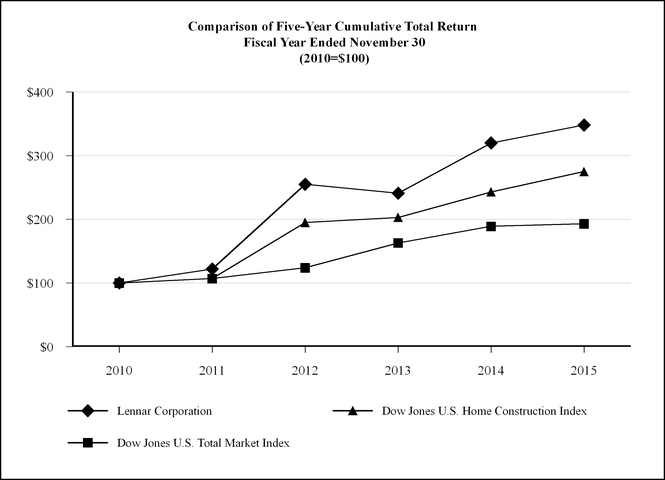
| 2010 | 2011 | 2012 | 2013 | 2014 | 2015 | |||||||||||||
| Lennar Corporation | $ | 100 | 122 | 255 | 241 | 320 | 348 | |||||||||||
| Dow Jones U.S. Home Construction Index | $ | 100 | 107 | 195 | 203 | 243 | 275 | |||||||||||
| Dow Jones U.S. Total Market Index | $ | 100 | 107 | 124 | 163 | 189 | 193 |
Item 6. Selected Financial Data.
The following table sets forth our selected consolidated financial and operating information as of or for each of the years ended November 30, 2011 through 2015. The information presented below is based upon our historical financial statements.
| At or for the Years Ended November 30, | |||||||||||||||
| (Dollars in thousands, except per share amounts) | 2015 | 2014 | 2013 | 2012 | 2011 | ||||||||||
| Results of Operations: | |||||||||||||||
| Revenues: | |||||||||||||||
| Lennar Homebuilding | $ | 8,466,945 | 7,025,130 | 5,354,947 | 3,581,232 | 2,675,124 | |||||||||
| Lennar Financial Services | $ | 620,527 | 454,381 | 427,342 | 384,618 | 255,518 | |||||||||
| Rialto | $ | 221,923 | 230,521 | 138,060 | 138,856 | 164,743 | |||||||||
| Lennar Multifamily | $ | 164,613 | 69,780 | 14,746 | 426 | — | |||||||||
| Total revenues | $ | 9,474,008 | 7,779,812 | 5,935,095 | 4,105,132 | 3,095,385 | |||||||||
| Operating earnings (loss): | |||||||||||||||
| Lennar Homebuilding (1) | $ | 1,271,641 | 1,033,721 | 733,075 | 258,985 | 109,505 | |||||||||
| Lennar Financial Services | $ | 127,795 | 80,138 | 85,786 | 84,782 | 20,729 | |||||||||
| Rialto | $ | 33,595 | 44,079 | 26,128 | 11,569 | 63,457 | |||||||||
| Lennar Multifamily | $ | (7,171 | ) | (10,993 | ) | (16,988 | ) | (5,884 | ) | (461 | ) | ||||
| Corporate general and administrative expenses | $ | 216,244 | 177,161 | 146,060 | 127,338 | 95,256 | |||||||||
| Earnings before income taxes | $ | 1,209,616 | 969,784 | 681,941 | 222,114 | 97,974 | |||||||||
| Net earnings attributable to Lennar (2) | $ | 802,894 | 638,916 | 479,674 | 679,124 | 92,199 | |||||||||
| Diluted earnings per share | $ | 3.46 | 2.80 | 2.15 | 3.11 | 0.48 | |||||||||
| Cash dividends declared per each - Class A and Class B common stock | $ | 0.16 | 0.16 | 0.16 | 0.16 | 0.16 | |||||||||
| Financial Position: | |||||||||||||||
| Total assets | $ | 14,419,509 | 12,923,151 | 11,239,885 | 10,323,177 | 9,114,802 | |||||||||
| Debt: | |||||||||||||||
| Lennar Homebuilding | $ | 5,025,130 | 4,661,266 | 4,165,792 | 3,971,348 | 3,332,781 | |||||||||
| Rialto | $ | 771,728 | 617,077 | 437,161 | 569,154 | 755,650 | |||||||||
| Lennar Financial Services | $ | 858,300 | 704,143 | 374,166 | 457,994 | 410,134 | |||||||||
| Lennar Multifamily | $ | — | — | 13,858 | — | — | |||||||||
| Stockholders’ equity | $ | 5,648,944 | 4,827,020 | 4,168,901 | 3,414,764 | 2,696,468 | |||||||||
| Total equity | $ | 5,950,072 | 5,251,302 | 4,627,470 | 4,001,208 | 3,303,525 | |||||||||
| Shares outstanding (000s) | 211,146 | 205,039 | 204,412 | 191,548 | 188,403 | ||||||||||
| Stockholders’ equity per share | $ | 26.75 | 23.54 | 20.39 | 17.83 | 14.31 | |||||||||
| Lennar Homebuilding Data (including unconsolidated entities): | |||||||||||||||
| Number of homes delivered | 24,292 | 21,003 | 18,290 | 13,802 | 10,845 | ||||||||||
| New orders | 25,106 | 22,029 | 19,043 | 15,684 | 11,412 | ||||||||||
| Backlog of home sales contracts | 6,646 | 5,832 | 4,806 | 4,053 | 2,171 | ||||||||||
| Backlog dollar value | $ | 2,477,751 | 1,974,328 | 1,619,601 | 1,160,385 | 560,659 |
| (1) | Lennar Homebuilding operating earnings include $30.1 million, $9.9 million, $7.5 million, $15.6 million and $38.0 million of inventory valuation adjustments for the years ended November 30, 2015, 2014, 2013, 2012 and 2011, respectively. In addition, operating earnings include $1.6 million, $4.6 million, $12.1 million and $8.9 million of our share of valuation adjustments related to assets of unconsolidated entities in which we have investments for the years ended November 30, 2015, 2014, 2012 and 2011, respectively, and $10.5 million of valuation adjustments to our investments in unconsolidated entities for the year ended November 30, 2011. |
| (2) | Net earnings attributable to Lennar for the year ended November 30, 2015 includes $390.4 million tax provision for income taxes, compared to $341.1 million tax provision for income taxes in the year ended November 30, 2014. Net earnings attributable to Lennar for the year ended November 30, 2013 includes $177.0 million net tax provision, which included a tax benefit of $67.1 million for a valuation allowance reversal. Net earnings attributable to Lennar for the year ended November 30, 2012 includes $435.2 million of benefit for income taxes, which includes a reversal of the majority of our deferred tax asset valuation allowance of $491.5 million, partially offset by a tax provision for fiscal year 2012 pre-tax earnings. Net earnings attributable to Lennar for the years ended November 30, 2011 includes $14.6 million of benefit for income taxes, primarily due to settlements with various taxing authorities. |
Item 7. Management’s Discussion and Analysis of Financial Condition and Results of Operations.
The following discussion and analysis of our financial condition and results of operations should be read in conjunction with “Selected Financial Data” and our audited consolidated financial statements and accompanying notes included elsewhere in this Report.
Special Note Regarding Forward-Looking Statements
This annual report on Form 10-K contains “forward-looking statements” within the meaning of the Private Securities Litigation Reform Act of 1995. These statements concern expectations, beliefs, projections, plans and strategies, anticipated events or trends and similar expressions concerning matters that are not historical facts. The forward-looking statements in this annual report include statements regarding: our belief that the housing market will continue its steady and slow recovery, and our belief regarding the drivers of such recovery; our belief that we will continue to see lower margins in 2016 compared to 2015; our belief that we are currently positioned to deliver between 26,500 and 27,000 homes in fiscal 2016; our expectation that we will continue to identify and invest in unique and enticing land opportunities that we expect will drive our future growth and profitability; our expectation that our ancillary business will provide opportunities to enhance shareholder value; our belief that our main driver of earnings will continue to be our homebuilding and Financial Services operations; our belief that Lennar Multifamily's revenues will continue to grow in the future and our expectation that the Multifamily business will be profitable in 2016; our belief that we are on track to achieve another year of substantial profitability in fiscal 2016; our intent to settle the face value of the 2.75% convertible senior notes due 2020 in cash; our expectation regarding our variability in our quarterly results; our expectations regarding the renewal or replacement of our warehouse facilities; our belief regarding draws upon our bonds or letters of credit, and our belief regarding the impact to the Company if there were such a draw; our expectation that substantially all homes currently in backlog will be delivered in fiscal year 2016; our belief that our operations and borrowing resources will provide for our current and long-term capital requirements at our anticipated levels of activity; our belief regarding legal proceedings in which we are involved, and, in particular, our belief that the Court’s decision in the Settlers Crossing case is contrary to applicable law; and our estimates regarding certain tax and accounting matters, including our expectations regarding the result of anticipated settlements with various taxing authorities.
These forward-looking statements reflect our current views about future events and are subject to risks, uncertainties and assumptions. We wish to caution readers that certain important factors may have affected and could in the future affect our actual results and could cause actual results to differ significantly from those expressed in any forward-looking statement. The most important factors that could prevent us from achieving our goals, and cause the assumptions underlying forward-looking statements and the actual results to differ materially from those expressed in or implied by those forward-looking statements include, but are not limited to, the following: our ability to acquire land and pursue real estate opportunities at anticipated prices; increases in operating costs, including costs related to real estate taxes, construction materials, labor and insurance, and our ability to manage our cost structure, both in our Homebuilding and Lennar Multifamily businesses; unfavorable outcomes in legal proceedings that substantially exceed our expectations, including an unfavorable outcome in the Settlers Crossing case; a slowdown in the recovery of real estate markets across the nation, or any downturn in such markets; changes in general economic and financial conditions, and demographic trends, in the U.S. leading to decreased demand for our services and homes, lower profit margins and reduced access to credit; the possibility that we will incur nonrecurring costs that may not have a material adverse effect on our business or financial condition, but may have a material adverse effect on our condensed financial statements for a particular reporting period; decreased demand for our Lennar Multifamily rental properties, and our ability to successfully sell our rental properties once rents and occupancies have stabilized; the ability of our Financial Services segment to maintain or increase its capture rate and benefit from Lennar home deliveries; increased competition for home sales from other sellers of new and resale homes; conditions in the capital, credit and financial markets, including mortgage lending standards, the availability of mortgage financing and mortgage foreclosure rates; changes in interest and unemployment rates, and inflation; a decline in the value of the land and home inventories we maintain or possible future write-downs of the carrying value of our real estate assets; our ability to successfully develop multifamily assets in the Multifamily Venture; our inability to maintain anticipated pricing levels and our inability to predict the effect of interest rates on demand; the ability and willingness of the participants in various joint ventures to honor their commitments; our ability to successfully and timely obtain land-use entitlements and construction financing, and address issues that arise in connection with the use and development of our land; natural disasters and other unforeseen damage for which our insurance may not provide adequate coverage; our inability to successfully grow our ancillary businesses; potential liability under environmental or construction laws, or other laws or regulations affecting our business; regulatory changes that adversely affect the profitability of our businesses; our ability to comply with the terms of our debt instruments, our ability to refinance our debt on terms that are acceptable to us; and our ability to successfully estimate the impact of certain regulatory, accounting and tax matters.
Please see “Item 1A-Risk Factors” of this Annual Report for a further discussion of these and other risks and uncertainties which could affect our future results. We undertake no obligation to revise any forward-looking statements to reflect events or circumstances after the date of those statements or to reflect the occurrence of anticipated or unanticipated events, except to the extent we are legally required to disclose certain matters in SEC filings or otherwise.
Outlook
We believe that the housing market will continue its slow and steady recovery driven by lower unemployment, sustained wage growth and growing consumer confidence, despite the first increase in interest rates in nine years announced by the Federal Reserve, which stated that the increase was a sign of confidence in the economy.
Fiscal 2015 was another excellent year for Lennar, with revenues and net earnings attributable to Lennar increasing 22% and 26%, respectively, from 2014. Our core homebuilding business continued to produce strong operating results as gross margins and operating margins were 24.0% and 14.1%, respectively. During 2015, we were able to meet our delivery schedule, amid a tight labor market and despite the impact of the TILA-RESPA Integrated Disclosure regulations. Our home deliveries and new orders increased 16% and 14% compared to fiscal 2014. Our efficient Everything’s Included® manufacturing model helped mitigate the impact of a tight labor market and our focus on digital marketing helped to improve our S,G&A leverage. In addition, we ended the year with a strong sales backlog, up 14% in homes and 25% in dollar value, which gives us a strong start for fiscal 2016.
Complementing our homebuilding business, we also had strong performances from our other businesses d
Showing the first 8K of 233K characters. Open the full section
Item 7A. Quantitative and Qualitative Disclosures About Market Risk.
We are exposed to a number of market risks in the ordinary course of business. Our primary market risk exposure relates to fluctuations in interest rates on our investments, loans held-for-sale, loans held-for-investment and outstanding variable rate debt.
For fixed rate debt, such as our senior notes, changes in interest rates generally affect the fair value of the debt instrument, but not our earnings or cash flows. For variable debt such as our amended revolving credit facility and Lennar Financial Services’ and Rialto’s warehouse repurchase facilities, changes in interest rates generally do not affect the fair value of the outstanding borrowings on the debt facilities, but do affect our earnings and cash flows.
In our Lennar Financial Services operations, we utilize mortgage backed securities forward commitments, option contracts and investor commitments to protect the value of fixed rate-locked commitments and loans held-for-sale from fluctuations in mortgage-related interest rates.
To mitigate interest risk associated with Rialto’s loans held-for-sale, we use derivative financial instruments to hedge our exposure to risk from the time a borrower locks a loan until the time the loan is securitized. We hedge our interest rate exposure through entering into interest rate swap futures. We also manage a portion of our credit exposure by buying protection within the CMBX and CDX markets.
We do not enter into or hold derivatives for trading or speculative purposes.
The table below provides information at November 30, 2015 about our significant instruments that are sensitive to changes in interest rates. For loans held-for-investment, net and investments held-to-maturity, senior notes and other debts payable and notes and other debts payable, the table presents principal cash flows and related weighted average effective interest rates by expected maturity dates and estimated fair values at November 30, 2015. Weighted average variable interest rates are based on the variable interest rates at November 30, 2015.
Rialto loans receivable, net are not included in the table below because these loans were acquired having deteriorated credit quality, thus, we believe they are not sensitive to changes in interest rates. See Management’s Discussion and Analysis of Financial Condition and Results of Operations in Item 7 and Notes 1 and 14 of the notes to consolidated financial statements in Item 8 for a further discussion of these items and our strategy of mitigating our interest rate risk.
Information Regarding Interest Rate Sensitivity
Principal (Notional) Amount by
Expected Maturity and Average Interest Rate
November 30, 2015
| Years Ending November 30, | Fair Value at November 30, | |||||||||||||||||||||||
| (Dollars in millions) | 2016 | 2017 | 2018 | 2019 | 2020 | Thereafter | Total | 2015 | ||||||||||||||||
| ASSETS | ||||||||||||||||||||||||
| Rialto: | ||||||||||||||||||||||||
| Investments held-to-maturity: | ||||||||||||||||||||||||
| Fixed rate | $ | — | — | — | — | — | 25.6 | 25.6 | 25.2 | |||||||||||||||
| Average interest rate | — | — | — | — | — | 3.8 | % | 3.8 | % | — | ||||||||||||||
| Lennar Financial Services: | ||||||||||||||||||||||||
| Loans held-for-investment, net and investments held-to-maturity: | ||||||||||||||||||||||||
| Fixed rate | $ | 17.3 | 20.2 | 2.3 | 2.2 | 2.0 | 23.9 | 67.9 | 66.7 | |||||||||||||||
| Average interest rate | 1.2 | % | 2.0 | % | 4.4 | % | 3.8 | % | 3.4 | % | 4.8 | % | 3.0 | % | — | |||||||||
| Variable rate | $ | 0.1 | 0.1 | 0.1 | 0.1 | 0.1 | 2.8 | 3.3 | 3.3 | |||||||||||||||
| Average interest rate | 3.7 | % | 3.7 | % | 3.7 | % | 3.7 | % | 3.7 | % | 3.7 | % | 3.7 | % | — | |||||||||
| LIABILITIES | ||||||||||||||||||||||||
| Lennar Homebuilding: | ||||||||||||||||||||||||
| Senior notes and other debts payable: | ||||||||||||||||||||||||
| Fixed rate | $ | 307.0 | 412.1 | 655.8 | 1,377.8 | 2.9 | 2,161.0 | 4,916.6 | 5,813.4 | |||||||||||||||
| Average interest rate | 5.9 | % | 12.0 | % | 5.6 | % | 4.4 | % | 3.7 | % | 4.3 | % | 5.2 | % | — | |||||||||
| Variable rate | $ | 67.7 | 77.2 | — | — | — | — | 144.9 | 149.3 | |||||||||||||||
| Average interest rate | 3.2 | % | 2.9 | % | — | — | — | — | 3.0 | % | — | |||||||||||||
| Rialto: | ||||||||||||||||||||||||
| Notes and other debts payable: | ||||||||||||||||||||||||
| Fixed rate | $ | 37.9 | 1.1 | 1.2 | 351.5 | — | — | 391.7 | 423.1 | |||||||||||||||
| Average interest rate | 4.6 | % | 5.9 | % | 5.9 | % | 7.0 | % | — | — | 6.7 | % | — | |||||||||||
| Variable rate | $ | 353.4 | 30.3 | — | — | — | — | 383.7 | 383.6 | |||||||||||||||
| Average interest rate | 2.5 | % | 4.5 | % | — | — | — | — | 2.7 | % | — | |||||||||||||
| Lennar Financial Services: | ||||||||||||||||||||||||
| Notes and other debts payable: | ||||||||||||||||||||||||
| Variable rate | $ | 858.3 | — | — | — | — | — | 858.3 | 858.3 | |||||||||||||||
| Average interest rate | 2.5 | % | — | — | — | — | — | 2.5 | % | — |
Item 8. Financial Statements and Supplementary Data.
REPORT OF INDEPENDENT REGISTERED PUBLIC ACCOUNTING FIRM
To the Board of Directors and Stockholders of Lennar Corporation
We have audited the accompanying consolidated balance sheets of Lennar Corporation and subsidiaries (the “Company”) as of November 30, 2015 and 2014, and the related consolidated statements of operations and comprehensive income (loss), equity, and cash flows for each of the three years in the period ended November 30, 2015. These financial statements are the responsibility of the Company’s management. Our responsibility is to express an opinion on these financial statements based on our audits.
We conducted our audits in accordance with the standards of the Public Company Accounting Oversight Board (United States). Those standards require that we plan and perform the audit to obtain reasonable assurance about whether the financial statements are free of material misstatement. An audit includes examining, on a test basis, evidence supporting the amounts and disclosures in the financial statements. An audit also includes assessing the accounting principles used and significant estimates made by management, as well as evaluating the overall financial statement presentation. We believe that our audits provide a reasonable basis for our opinion.
In our opinion, such consolidated financial statements present fairly, in all material respects, the financial position of Lennar Corporation and subsidiaries as of November 30, 2015 and 2014, and the results of their operations and their cash flows for each of the three years in the period ended November 30, 2015, in conformity with accounting principles generally accepted in the United States of America.
We have also audited, in accordance with the standards of the Public Company Accounting Oversight Board (United States), the Company’s internal control over financial reporting as of November 30, 2015, based on the criteria established in Internal Control — Integrated Framework (2013) issued by the Committee of Sponsoring Organizations of the Treadway Commission and our report dated January 22, 2016 expressed an unqualified opinion on the Company’s internal control over financial reporting.
/s/ DELOITTE & TOUCHE LLP
Certified Public Accountants
Miami, Florida
January 22, 2016
LENNAR CORPORATION AND SUBSIDIARIES
CONSOLIDATED BALANCE SHEETS
November 30, 2015 and 2014
| 2015 (1) | 2014 (1) | |||||
| (Dollars in thousands, except shares and per share amounts) | ||||||
| ASSETS | ||||||
| Lennar Homebuilding: | ||||||
| Cash and cash equivalents | $ | 893,408 | 885,729 | |||
| Restricted cash | 13,505 | 9,849 | ||||
| Receivables, net | 74,538 | 93,444 | ||||
| Inventories: | ||||||
| Finished homes and construction in progress | 3,957,167 | 3,082,345 | ||||
| Land and land under development | 4,724,578 | 4,601,802 | ||||
| Consolidated inventory not owned | 58,851 | 52,453 | ||||
| Total inventories | 8,740,596 | 7,736,600 | ||||
| Investments in unconsolidated entities | 741,551 | 656,837 | ||||
| Other assets | 609,222 | 643,642 | ||||
| 11,072,820 | 10,026,101 | |||||
| Rialto | 1,505,500 | 1,451,983 | ||||
| Lennar Financial Services | 1,425,837 | 1,177,053 | ||||
| Lennar Multifamily | 415,352 | 268,014 | ||||
| Total assets | $ | 14,419,509 | 12,923,151 |
| (1) | Under certain provisions of Accounting Standards Codification (“ASC”) Topic 810, Consolidations, (“ASC 810”) the Company is required to separately disclose on its consolidated balance sheets the assets of consolidated variable interest entities (“VIEs”) that are owned by the consolidated VIEs and liabilities of consolidated VIEs as to which there is no recourse against the Company. |
As of November 30, 2015, total assets include $652.3 million related to consolidated VIEs of which $9.6 million is included in Lennar Homebuilding cash and cash equivalents, $0.5 million in Lennar Homebuilding receivables, net, $3.9 million in Lennar Homebuilding finished homes and construction in progress, $154.2 million in Lennar Homebuilding land and land under development, $58.9 million in Lennar Homebuilding consolidated inventory not owned, $35.8 million in Lennar Homebuilding investments in unconsolidated entities, $22.7 million in Lennar Homebuilding other assets, $355.2 million in Rialto assets and $11.5 million in Lennar Multifamily assets.
As of November 30, 2014, total assets include $929.1 million related to consolidated VIEs of which $11.7 million is included in Lennar Homebuilding cash and cash equivalents, $0.3 million in restricted cash, $0.2 million in Lennar Homebuilding receivables, net, $0.2 million in Lennar Homebuilding finished homes and construction in progress, $208.2 million in Lennar Homebuilding land and land under development, $52.5 million in Lennar Homebuilding consolidated inventory not owned, $23.9 million in Lennar Homebuilding investments in unconsolidated entities, $104.6 million in Lennar Homebuilding other assets, $508.4 million in Rialto assets and $19.2 million in Lennar Multifamily assets.
See accompanying notes to consolidated financial statements.
LENNAR CORPORATION AND SUBSIDIARIES
CONSOLIDATED BALANCE SHEETS
November 30, 2015 and 2014
| 2015 (2) | 2014 (2) | |||||
| (Dollars in thousands, except shares and per share amounts) | ||||||
| LIABILITIES AND EQUITY | ||||||
| Lennar Homebuilding: | ||||||
| Accounts payable | $ | 475,909 | 412,558 | |||
| Liabilities related to consolidated inventory not owned | 51,431 | 45,028 | ||||
| Senior notes and other debts payable | 5,025,130 | 4,661,266 | ||||
| Other liabilities | 899,815 | 863,236 | ||||
| 6,452,285 | 5,982,088 | |||||
| Rialto | 866,224 | 740,875 | ||||
| Lennar Financial Services | 1,083,978 | 896,643 | ||||
| Lennar Multifamily | 66,950 | 52,243 | ||||
| Total liabilities | 8,469,437 | 7,671,849 | ||||
| Stockholders’ equity: | ||||||
| Preferred stock | — | — | ||||
| Class A common stock of $0.10 par value per share; Authorized: 2015 and 2014 - 300,000,000 shares; Issued: 2015 - 180,658,550 shares; 2014 - 174,241,570 shares | 18,066 | 17,424 | ||||
| Class B common stock of $0.10 par value per share; Authorized: 2015 and 2014 - 90,000,000 shares, Issued: 2015 - 32,982,815 shares; 2014 - 32,982,815 shares | 3,298 | 3,298 | ||||
| Additional paid-in capital | 2,305,560 | 2,239,574 | ||||
| Retained earnings | 3,429,736 | 2,660,034 | ||||
| Treasury stock, at cost; 2015 - 815,959 shares of Class A common stock and 1,679,620 shares of Class B common stock; 2014 - 505,420 shares of Class A common stock and 1,679,620 shares of Class B common stock | (107,755 | ) | (93,440 | ) | ||
| Accumulated other comprehensive income | 39 | 130 | ||||
| Total stockholders’ equity | 5,648,944 | 4,827,020 | ||||
| Noncontrolling interests | 301,128 | 424,282 | ||||
| Total equity | 5,950,072 | 5,251,302 | ||||
| Total liabilities and equity | $ | 14,419,509 | 12,923,151 |
| (2) | As of November 30, 2015, total liabilities include $84.4 million related to consolidated VIEs as to which there was no recourse against the Company, of which $2.0 million is included in Lennar Homebuilding accounts payable, $51.4 million in Lennar Homebuilding liabilities related to consolidated inventory not owned, $15.6 million in Lennar Homebuilding other liabilities, $11.3 million in Rialto liabilities and $4.0 million in Lennar Multifamily liabilities. |
As of November 30, 2014, total liabilities include $
Showing the first 8K of 273K characters. Open the full section
Item 9. Changes in and Disagreements With Accountants on Accounting and Financial Disclosure.
Not applicable.
Item 9A. Controls and Procedures.
Evaluation of Disclosure Controls and Procedures
Our Chief Executive Officer and Chief Financial Officer participated in an evaluation by our management of the effectiveness of our disclosure controls and procedures as of the end of the period covered by this report. Based on their participation in that evaluation, our CEO and CFO concluded that our disclosure controls and procedures were effective as of November 30, 2015 to ensure that information required to be disclosed in our reports filed or submitted under the Securities Exchange Act of 1934, as amended, is recorded, processed, summarized and reported within the time periods specified in the Securities and Exchange Commission’s rules and forms, and to ensure that information required to be disclosed in our reports filed or furnished under the Securities Exchange Act of 1934, as amended, is accumulated and communicated to our management, including our CEO and CFO, as appropriate to allow timely decisions regarding required disclosures.
Our CEO and CFO also participated in an evaluation by our management of any changes in our internal control over financial reporting that occurred during the quarter ended November 30, 2015. That evaluation did not identify any changes that have materially affected, or are reasonably likely to materially affect, our internal control over financial reporting.
Management’s Annual Report on Internal Control Over Financial Reporting and the Report of Independent Registered Public Accounting Firm obtained from Deloitte & Touche LLP relating to the effectiveness of Lennar Corporation’s internal control over financial reporting are included elsewhere in this document.
Management’s Annual Report on Internal Control Over Financial Reporting
Our management is responsible for establishing and maintaining adequate internal control over financial reporting, as such term is defined in Exchange Act Rule 13a-15(f). Under the supervision and with the participation of our management, including our CEO and CFO, we conducted an evaluation of the effectiveness of our internal control over financial reporting based on the framework in Internal Control—Integrated Framework (2013) issued by the Committee of Sponsoring Organizations of the Treadway Commission. Based on our evaluation under the framework in Internal Control—Integrated Framework (2013), our management concluded that our internal control over financial reporting was effective as of November 30, 2015. The effectiveness of our internal control over financial reporting as of November 30, 2015 has been audited by Deloitte & Touche LLP, an independent registered public accounting firm, as stated in their attestation report which is included herein.
REPORT OF INDEPENDENT REGISTERED PUBLIC ACCOUNTING FIRM
To the Board of Directors and Stockholders of Lennar Corporation
We have audited the internal control over financial reporting of Lennar Corporation and subsidiaries (the “Company”) as of November 30, 2015, based on the criteria established in Internal Control — Integrated Framework (2013) issued by the Committee of Sponsoring Organizations of the Treadway Commission. The Company’s management is responsible for maintaining effective internal control over financial reporting and for its assessment of the effectiveness of internal control over financial reporting, included in the accompanying Management’s Annual Report on Internal Control Over Financial Reporting. Our responsibility is to express an opinion on the Company’s internal control over financial reporting based on our audit.
We conducted our audit in accordance with the standards of the Public Company Accounting Oversight Board (United States). Those standards require that we plan and perform the audit to obtain reasonable assurance about whether effective internal control over financial reporting was maintained in all material respects. Our audit included obtaining an understanding of internal control over financial reporting, assessing the risk that a material weakness exists, testing and evaluating the design and operating effectiveness of internal control based on the assessed risk, and performing such other procedures as we considered necessary in the circumstances. We believe that our audit provides a reasonable basis for our opinion.
A company’s internal control over financial reporting is a process designed by, or under the supervision of, the company’s principal executive and principal financial officers, or persons performing similar functions, and effected by the company’s board of directors, management, and other personnel to provide reasonable assurance regarding the reliability of financial reporting and the preparation of financial statements for external purposes in accordance with generally accepted accounting principles. A company’s internal control over financial reporting includes those policies and procedures that (1) pertain to the maintenance of records that, in reasonable detail, accurately and fairly reflect the transactions and dispositions of the assets of the company; (2) provide reasonable assurance that transactions are recorded as necessary to permit preparation of financial statements in accordance with generally accepted accounting principles, and that receipts and expenditures of the company are being made only in accordance with authorizations of management and directors of the company; and (3) provide reasonable assurance regarding prevention or timely detection of unauthorized acquisition, use, or disposition of the company’s assets that could have a material effect on the financial statements.
Because of the inherent limitations of internal control over financial reporting, including the possibility of collusion or improper management override of controls, material misstatements due to error or fraud may not be prevented or detected on a timely basis. Also, projections of any evaluation of the effectiveness of the internal control over financial reporting to future periods are subject to the risk that the controls may become inadequate because of changes in conditions, or that the degree of compliance with the policies or procedures may deteriorate.
In our opinion, the Company maintained, in all material respects, effective internal control over financial reporting as of November 30, 2015, based on the criteria established in Internal Control — Integrated Framework (2013) issued by the Committee of Sponsoring Organizations of the Treadway Commission.
We have also audited, in accordance with the standards of the Public Company Accounting Oversight Board (United States), the consolidated financial statements as of and for the year ended November 30, 2015 of the Company and our report dated January 22, 2016 expressed an unqualified opinion on those financial statements.
| /s/ DELOITTE & TOUCHE LLP |
| Certified Public Accountants |
| Miami, Florida |
| January 22, 2016 |
Item 9B. Other Information.
Not applicable.
PART III
Item 10. Directors, Executive Officers and Corporate Governance.
The information required by this item for executive officers is set forth under the heading “Executive Officers of Lennar Corporation” in Part I. We have adopted a Code of Business Conduct and Ethics that applies to our Chief Executive Officer, Chief Financial Officer and Chief Accounting Officer. The Code of Business Conduct and Ethics is located on our internet web site at www.lennar.com under “Investor Relations – Corporate Governance.” We intend to provide disclosure of any amendments or waivers of our Code of Business Conduct and Ethics on our website within four business days following the date of the amendment or waiver. The other information called for by this item is incorporated by reference to our definitive proxy statement, which will be filed with the Securities and Exchange Commission not later than March 29, 2016 (120 days after the end of our fiscal year).
Item 11. Executive Compensation.
The information required by this item is incorporated by reference to our definitive proxy statement, which will be filed with the Securities and Exchange Commission not later than March 29, 2016 (120 days after the end of our fiscal year).
Item 12. Security Ownership of Certain Beneficial Owners and Management and Related Stockholder Matters.
The information required by this item is incorporated by reference to our definitive proxy statement, which will be filed with the Securities and Exchange Commission not later than March 29, 2016 (120 days after the end of our fiscal year), except for the information required by Item 201(d) of Regulation S-K, which is provided below.
The following table summarizes our equity compensation plans as of November 30, 2015:
| Plan category | Number of shares to be issued upon exercise of outstanding options, warrants and rights (a) | Weighted-average exercise price of outstanding options, warrants and rights (b) | Number of shares remaining available for future issuance under equity compensation plans (excluding shares reflected in column (a)) c(1) | ||||||
| Equity compensation plans approved by stockholders | 55,575 | $ | 43.64 | 8,387,337 | |||||
| Equity compensation plans not approved by stockholders | — | — | — | ||||||
| Total | 55,575 | $ | 43.64 | 8,387,337 |
| (1) | Both shares of Class A and Class B common stock may be issued. |
Item 13. Certain Relationships and Related Transactions, and Director Independence.
The information required by this item is incorporated by reference to our definitive proxy statement, which will be filed with the Securities and Exchange Commission not later than March 29, 2016 (120 days after the end of our fiscal year).
Item 14. Principal Accounting Fees and Services.
The information required by this item is incorporated by reference to our definitive proxy statement, which will be filed with the Securities and Exchange Commission not later than March 29, 2016 (120 days after the end of our fiscal year).
PART IV
Item 15. Exhibits, Financial Statement Schedules.
| (a) | Documents filed as part of this Report. |
| 1. | The following financial statements are contained in Item 8: |
| 2. | The following financial statement schedule is included in this Report: |
| Financial Statement Schedule | Page in this Report |
| Report of Independent Registered Public Accounting Firm | 145 |
| Schedule II—Valuation and Qualifying Accounts | 146 |
Information required by other schedules has either been incorporated in the consolidated financial statements and accompanying notes or is not applicable to us.
| 3. | The following exhibits are filed with this Report or incorporated by reference: |
| 2.1 | Contribution and Sale Agreement, dated as of July 2, 2015, by and among Five Point Holdings, Inc., Newhall Holding Company, LLC, Newhall Intermediary Holding Company, LLC, Newhall Land Development, LLC, The Shipyard Communities, LLC, UST Lennar HW Scala SF Joint Venture, HPSCP Opportunities, L.P., Heritage Fields LLC, Lennar Heritage Fields, LLC, MSD Heritage Fields, LLC, FPC-HF Venture I, LLC, Heritage Fields Capital Co-Investor Member LLC, LNR HF II, LLC, FivePoint Communities Management, Inc., Five Point Communities, LP, Lennar Homes of California, Inc. and Emile Haddad - Incorporated by reference to Exhibit 2.1 of the Company’s Current Report on Form 8-K, dated July 7, 2015. |
| 2.2 | Amended and Restated Contribution and Sale Agreement, dated as of July 2, 2015, as amended and restated as of December 17, 2015, by and among Five Point Holdings, Inc., Newhall Holding Company, LLC, Newhall Intermediary Holding Company, LLC, Newhall Land Development, LLC, The Shipyard Communities, LLC, UST Lennar HW Scala SF Joint Venture, HPSCP Opportunities, L.P., Heritage Fields LLC, Lennar Heritage Fields, LLC, MSD Heritage Fields, LLC, FPC HF Venture I, LLC, Heritage Fields Capital Co Investor Member LLC, LNR HF II, LLC, Five Point Communities Management, Inc., Five Point Communities, LP, Lennar Homes Of California, Inc., and Emile Haddad - Incorporated by reference to Exhibit 2.2 of the Company’s Current Report on Form 8-K, dated December 21, 2015. |
| 3.1 | Restated Certificate of Incorporation of the Company, dated January 14, 2015-Incorporated by reference to Exhibit 3.1 of the Company’s Annual Report on Form 10-K for the fiscal year ended November 30, 2014. |
| 3.2 | Bylaws of the Company, as amended effective October 3, 2013-Incorporated by reference to Exhibit 3.6 of the Company’s Current Report on Form 8-K, dated October 4, 2013. |
| 4.1 | Indenture, dated as of December 31, 1997, between Lennar Corporation and Bank One Trust Company, N.A., as trustee-Incorporated by reference to Exhibit 4 of the Company’s Registration Statement on Form S-3, Registration No. 333-45527, filed with the Commission on February 3, 1998. |
| 4.2 | Indenture, dated April 26, 2006, between Lennar and J.P. Morgan Trust Company, N.A., as trustee (relating to Lennar’s 6.50% Senior Notes due 2016)-Incorporated by reference to Exhibit 10.2 of the Company’s Current Report on Form 8-K, dated April 26, 2006. |
| 4.3 | Indenture, dated April 30, 2009, between Lennar and The Bank of New York Mellon, as trustee (relating to Lennar’s 12.25% Senior Notes due 2017)-Incorporated by reference to Exhibit 99.1 of the Company’s Current Report on Form 8-K, dated April 30, 2009. |
| 4.4 | Indenture, dated May 4, 2010, between Lennar and The Bank of New York Mellon, as trustee (relating to Lennar’s 6.95% Senior Notes due 2018)- Incorporated by reference to Exhibit 4.1 of the Company’s Registration Statement on Form S-4, Registration No. 333-167622, filed with the Commission on June 18, 2010. |
| 4.5 | Indenture, dated November 10, 2010, between Lennar and The Bank of New York Mellon, as trustee (relating to Lennar’s 2.75% Convertible Senior Notes due 2020)-Incorporated by reference to Exhibit 4.10 of the Company’s Annual Report on Form 10-K for the fiscal year ended November 30, 2010. |
| 4.6 | Indenture, dated November 23, 2011, between Lennar and The Bank of New York Mellon, as trustee (relating to Lennar’s 3.25% Convertible Senior Notes due 2021)-Incorporated by reference to Exhibit 4.1 of the Company's Current Report on Form 8-K, dated February 1, 2012. |
| 4.7 | Indenture, dated July 20, 2012, between Lennar and The Bank of New York Mellon Trust Company, N.A., as trustee (relating to Lennar’s 4.75% Senior Notes due 2017)-Incorporated by reference to Exhibit 4.1 of the Company's Registration Statement on Form S-4, Registration No. 333-183755, filed with the Commission on September 6, 2012. |
| 4.8 | Indenture, dated October 23, 2012, between Lennar and The Bank of New York Mellon Trust Company, N.A., as trustee (relating to Lennar’s 4.750% Senior Notes due 2022)-Incorporated by reference to Exhibit 4.12 of the Company's Annual Report on Form 10-K, for the fiscal year ended November 30, 2012. |
| 4.9 | Indenture, dated February 4, 2013, between Lennar and The Bank of New York Mellon Trust Company, N.A., as trustee (relating to Lennar’s 4.125% Senior Notes due 2018)-Incorporated by reference to Exhibit 10.1 of the Company's Current Report on Form 10-Q for the quarter ended February 28, 2013. |
| 4.10 | Eighth Supplemental Indenture, dated as of February 12, 2014, among Lennar Corporation, each of the guarantors identified therein and The Bank of New York Mellon, as trustee, including the form of 4.50% Senior Notes due 2019-Incorporated by reference to Exhibit 4.12 of the Company’s Current Report on Form 8-K, dated February 13, 2014. |
| 4.11 | Ninth Supplemental Indenture, dated as of November 25, 2014, among Lennar Corporation, each of the guarantors identified therein and The Bank of New York Mellon, as trustee, including the form of 4.500% Senior Notes due 2019-Incorporated by reference to Exhibit 4.13 of the Company’s Current Report on Form 8-K, dated November 25, 2014. |
| 4.12 | Tenth Supplemental Indenture, dated as of April 28, 2015, among Lennar Corporation, each of the guarantors identified therein and The Bank of New York Mellon, as trustee, including the form of 4.750% Senior Notes due 2025 - Incorporated by reference to Exhibit 4.14 of the Company’s Current Report on Form 8-K, dated April 29, 2015. |
| 4.13 | Eleventh Supplemental Indenture, dated as of November 5, 2015, among Lennar Corporation, each of the guarantors identified therein and The Bank of New York Mellon, as trustee, including the form of 4.875% Senior Notes due 2023 - Incorporated by reference to Exhibit 4.15 of the Company’s Current Report on Form 8-K, dated November 6, 2015. |
| 10.1* | Lennar Corporation 2007 Equity Incentive Plan, as amended effective January 12, 2012-Incorporated by reference to Exhibit 1 of the Company’s Proxy Statement on Schedule 14A dated March 2, 2012. |
| 10.2* | Lennar Corporation 2012 Incentive Compensation Plan-Incorporated by reference to Exhibit 2 of the Company’s Proxy Statement on Schedule 14A dated March 2, 2012. |
| 10.3* | Lennar Corporation Nonqualified Deferred Compensation Plan-Incorporated by reference to Exhibit 10 of the Company’s Quarterly Report on Form 10-Q for the quarter ended August 31, 2002. |
| 10.4* | Aircraft Time-Sharing Agreement, dated August 17, 2005, between U.S. Home Corporation and Stuart Miller-Incorporated by reference to Exhibit 10.1 of the Company’s Current Report on Form 8-K, dated August 17, 2005. |
| 10.5* | Amendment No. 1 to Aircraft Time-Sharing Agreement, dated September 1, 2005, between U.S. Home Corporation and Stuart Miller-Incorporated by reference to Exhibit 10.16 of the Company’s Annual Report on Form 10-K for the fiscal year ended November 30, 2005. |
| 10.6 | Amended and Restated Aircraft Dry Lease Agreement, dated December 1, 2008, between U.S. Home Corporation and Stuart Miller-Incorporated by reference to Exhibit 10.1 of the Company’s Current Report on Form 8-K, dated February 18, 2009. |
| 10.7* | Aircraft Time-Sharing Agreement, dated January 26, 2011, between U.S. Home Corporation and Richard Beckwitt -Incorporated by reference to Exhibit 10.22 of the Company’s Annual Report on Form 10-K for the fiscal year ended November 30, 2010. |
| 10.8 | Membership Interest Purchase Agreement, dated as of November 30, 2007, by and among Lennar, Lennar Homes of California, Inc., the Sellers named in the agreement and MS Rialto Residential Holdings, LLC.-Incorporated by reference to Exhibit 10.23 of the Company’s Annual Report on Form 10-K for the fiscal year ended November 30, 2007. |
| 10.9 | Second Amended and Restated Credit Agreement, dated as of June 25, 2014, among Lennar Corporation, as borrower, JPMorgan Chase Bank, N.A., as swingline lender, issuing lender, and administrative agent, the several lenders from time to time parties thereto, and the other parties and agents thereto-Incorporated by reference to Exhibit 10.21 of the Company’s Current Report on Form 8-K, dated June, 30, 2014. |
| 10.10 | Second Amended and Restated Guarantee Agreement, dated as of June 25, 2014, among certain of Lennar Corporation’s subsidiaries in favor of guaranteed parties referred to therein-Incorporated by reference to Exhibit 10.22 of the Company’s Current Report on Form 8-K, dated June, 30, 2014. |
| 10.11 | Third Amended and Restated Credit Agreement, dated as of April 17, 2015, among Lennar Corporation, as borrower, JPMorgan Chase Bank, N.A., as swingline lender, issuing lender, and administrative agent, the several lenders from time to time parties thereto, and the other parties and agents therein-Incorporated by reference to Exhibit 10.21 of the Company’s Current Report on Form 8-K, dated April 20, 2015. |
| 10.12 | Third Amended and Restated Guarantee Agreement, dated as of April 17, 2015, among certain of Lennar Corporation’s subsidiaries in favor of guaranteed parties referred to therein-Incorporated by reference to Exhibit 10.22 of the Company’s Current Report on Form 8-K, dated April 20, 2015. |
| 10.13 | Indenture, dated November 14, 2013, among Rialto Holdings, LLC, Rialto Corporation, the Guarantors named therein and Wells Fargo Bank, National Association, as trustee, including the form of 7.000% Senior Notes due 2018-Incorporated by reference to Exhibit 10.20 of the Company’s Current Report on Form 8-K, dated November 14, 2013. |
| 10.14* | 2014 Award Agreements for Stuart Miller, Rick Beckwitt, Jonathan Jaffe, Bruce Gross and Mark Sustana -Incorporated by reference to Exhibit 10.20 of the Company’s Annual Report on Form 10-K for the fiscal year ended November 30, 2013. |
| 10.15* | 2015 Award Agreements for Stuart Miller, Rick Beckwitt, Jonathan Jaffe, Bruce Gross and Mark Sustana - Incorporated by reference to Exhibit 10.18 of the Company’s Annual Report on Form 10-K for the fiscal year ended November 30, 2014. |
| 10.16* | 2016 Award Agreements for Stuart Miller, Rick Beckwitt, Jonathan Jaffe, Bruce Gross and Mark Sustana.** |
| 10.17 | Form of Aircraft Time Sharing Agreement, dated February 12, 2015, between U.S. Home Corporation and Lessee -Incorporated by reference to Exhibit 10.19 of the Company’s Current Report on Form 8-K, dated February 19, 2015. |
| 10.18 | Amendment, dated February 12, 2015, to Amended and Restated Aircraft Dry Lease Agreement, dated December 1, 2008, among Lennar Aircraft I, LLC, U.S. Home Corporation and Stuart Miller - Incorporated by reference to Exhibit 10.20 of the Company’s Current Report on Form 8-K, dated February 19, 2015. |
| 21 | List of subsidiaries.** |
| 23 | Consent of Independent Registered Public Accounting Firm.** |
| 31.1 | Rule 13a-14a/15d-14(a) Certification of Stuart A. Miller.** |
| 31.2 | Rule 13a-14a/15d-14(a) Certification of Bruce E. Gross.** |
| 32 | Section 1350 Certifications of Stuart A. Miller and Bruce E. Gross.** |
| 101 | The following financial statements from Lennar Corporation Annual Report on Form 10-K for the year ended November 30, 2015, filed on January 22, 2016, formatted in XBRL (Extensible Business Reporting Language); (i) Consolidated Balance Sheets, (ii) Consolidated Statements of Operations and Comprehensive Income (Loss), (iii) Consolidated Statements of Cash Flows (iv) Consolidated Statements of Equity and (v) the Notes to Consolidated Financial Statements (1). |
- Management contract or compensatory plan or arrangement.
** Filed herewith.
| (1) | In accordance with Rule 406T of Regulation S-T, the XBRL related to information in Exhibit 101 to this Annual Report on Form 10-K shall not be deemed to be “filed” for purposes of Section 18 of Exchange Act, or otherwise subject to the liability of that section, and shall not be part of any registration or other document filed under the Securities Act or the Exchange Act, except as shall be expressly set forth by specific reference in such filing. |
SIGNATURES
Pursuant to the requirements of Section 13 or 15(d) of the Securities Exchange Act of 1934, the registrant has duly caused this Report to be signed on its behalf by the undersigned, thereunto duly authorized.
| LENNAR CORPORATION | ||
| /S/ STUART A. MILLER | ||
| Stuart A. Miller | ||
| Chief Executive Officer and Director | ||
| Date: | January 22, 2016 |
Pursuant to the requirements of the Securities Exchange Act of 1934, this Report has been signed below by the following persons on behalf of the registrant and in the capacities and on the dates indicated:
| Principal Executive Officer: | ||
| Stuart A. Miller | /S/ STUART A. MILLER | |
| Chief Executive Officer and Director | Date: | January 22, 2016 |
| Principal Financial Officer: | ||
| Bruce E. Gross | /S/ BRUCE E. GROSS | |
| Vice President and Chief Financial Officer | Date: | January 22, 2016 |
| Principal Accounting Officer: | ||
| David M. Collins | /S/ DAVID M. COLLINS | |
| Controller | Date: | January 22, 2016 |
| Directors: | ||
| Irving Bolotin | /S/ IRVING BOLOTIN | |
| Date: | January 22, 2016 | |
| Steven L. Gerard | /S/ STEVEN L. GERARD | |
| Date: | January 22, 2016 | |
| Theron I. (“Tig”) Gilliam, Jr. | /s/ THERON I. (“TIG”) GILLIAM, JR. | |
| Date: | January 22, 2016 | |
| Sherrill W. Hudson | /S/ SHERRILL W. HUDSON | |
| Date: | January 22, 2016 | |
| Sidney Lapidus | /S/ SIDNEY LAPIDUS | |
| Date: | January 22, 2016 | |
| Teri McClure | /S/ TERI MCCLURE | |
| Date: | January 22, 2016 | |
| Armando Olivera | /S/ ARMANDO OLIVERA | |
| Date: | January 22, 2016 | |
| Jeffrey Sonnenfeld | /S/ JEFFREY SONNENFELD | |
| Date: | January 22, 2016 |
REPORT OF INDEPENDENT REGISTERED PUBLIC ACCOUNTING FIRM
To the Board of Directors and Stockholders of Lennar Corporation
We have audited the consolidated financial statements of Lennar Corporation and subsidiaries (the “Company”) as of November 30, 2015 and 2014, and for each of the three years in the period ended November 30, 2015, and the Company’s internal control over financial reporting as of November 30, 2015, and have issued our reports thereon dated January 22, 2016; such consolidated financial statements and reports are included elsewhere in this Form 10-K. Our audits also included the consolidated financial statement schedule of the Company listed in Item 15. This consolidated financial statement schedule is the responsibility of the Company’s management. Our responsibility is to express an opinion based on our audits. In our opinion, such consolidated financial statement schedule, when considered in relation to the basic consolidated financial statements taken as a whole, presents fairly, in all material respects, the information set forth therein.
| /s/ DELOITTE & TOUCHE LLP |
| Certified Public Accountants |
| Miami, Florida |
| January 22, 2016 |
LENNAR CORPORATION AND SUBSIDIARIES
Schedule II—Valuation and Qualifying Accounts
Years Ended November 30, 2015, 2014 and 2013
| Additions | |||||||||||||||
| (In thousands) | Beginning balance | Charged to costs and expenses | Charged (credited) to other accounts | Deductions | Ending balance | ||||||||||
| Year ended November 30, 2015 | |||||||||||||||
| Allowances deducted from assets to which they apply: | |||||||||||||||
| Allowances for doubtful accounts and notes and other receivables | $ | 3,257 | 370 | (2,528 | ) | (331 | ) | 768 | |||||||
| Allowance for loan losses and loans receivable | $ | 62,104 | 11,465 | — | (34,083 | ) | 39,486 | ||||||||
| Allowance against net deferred tax assets | $ | 8,029 | — | — | (2,084 | ) | 5,945 | ||||||||
| Year ended November 30, 2014 | |||||||||||||||
| Allowances deducted from assets to which they apply: | |||||||||||||||
| Allowances for doubtful accounts and notes and other receivables | $ | 3,067 | 207 | 323 | (340 | ) | 3,257 | ||||||||
| Allowance for loan losses and loans receivable | $ | 24,687 | 57,207 | — | (19,790 | ) | 62,104 | ||||||||
| Allowance against net deferred tax assets | $ | 12,706 | — | — | (4,677 | ) | 8,029 | ||||||||
| Year ended November 30, 2013 | |||||||||||||||
| Allowances deducted from assets to which they apply: | |||||||||||||||
| Allowances for doubtful accounts and notes and other receivables | $ | 3,183 | 605 | 407 | (1,128 | ) | 3,067 | ||||||||
| Allowance for loan losses and loans receivable | $ | 21,353 | 16,744 | (167 | ) | (13,243 | ) | 24,687 | |||||||
| Allowance against net deferred tax assets | $ | 88,794 | — | — | (76,088 | ) | 12,706 |