 filings.tools
Labcorp Holdings 10-K 2021-12-31
Filed 2022-02-25. 23 sections, 599K characters. Original on sec.gov · Markdown · JSON
Cover and table of contents
UNITED STATES
SECURITIES AND EXCHANGE COMMISSION
Washington, D.C. 20549
FORM 10-K
[☒] Annual Report Pursuant to Section 13 or 15(d) of the Securities Exchange Act of 1934
For the fiscal year ended December 31, 2021
or
[☐] Transition report pursuant to Section 13 or 15(d) of the Securities Exchange Act of 1934
For the transition period from ______ to ______
Commission file number - 1-11353
LABORATORY CORPORATION OF AMERICA HOLDINGS
(Exact name of registrant as specified in its charter)
| Delaware | 13-3757370 | |||||||
| (State or other jurisdiction of incorporation or organization) | (I.R.S. Employer Identification No.) |
| 358 South Main Street | |||||||||||
| Burlington, | North Carolina | 27215 | |||||||||
| (Address of principal executive offices) | (Zip Code) |
(Registrant's telephone number, including area code) 336-229-1127
Securities registered pursuant to Section 12(b) of the Act:
| Title of each class | Trading Symbol | Name of exchange on which registered | ||||||
| Common Stock, $0.10 par value | LH | New York Stock Exchange |
Securities registered pursuant to Section 12(g) of the Act: None
Indicate by check mark if the registrant is a well-known seasoned issuer, as defined in Rule 405 of the Securities Act. Yes [X] No [ ].
Indicate by check mark if the registrant is not required to file reports pursuant to Section 13 or 15(d) of the Act. Yes [ ] No [X].
Indicate by check mark whether the registrant (1) has filed all reports required to be filed by Section 13 or 15(d) of the Securities Exchange Act of 1934 during the preceding 12 months (or for such shorter period that the registrant was required to file such reports), and (2) has been subject to such filing requirements for the past 90 days. Yes [X] No [ ].
Indicate by check mark whether the registrant has submitted electronically every Interactive Data File required to be submitted pursuant to Rule 405 of Regulation S-T (§ 232.405 of this chapter) during the preceding 12 months (or for such shorter period that the registrant was required to submit such files). Yes [X] No [ ].
Indicate by check mark whether the registrant is a large accelerated filer, an accelerated filer, a non-accelerated filer, a smaller reporting company, or an emerging growth company. See the definitions of “large accelerated filer,” “accelerated filer,” “smaller reporting company”, and “emerging growth company” in Rule 12b-2 of the Exchange Act.
| Large accelerated filer | ☒ | Accelerated filer | ☐ | ||||||||
| Non-accelerated filer | ☐ | Smaller reporting company | ☐ | ||||||||
| Emerging growth company | ☐ |
If emerging growth company, indicate by check mark if the registrant has elected not to use the extended transition period for complying with any new or revised financial accounting standards provided pursuant to Section 13(a) of the Exchange Act. [ ]
Indicate by check mark whether the registrant has filed a report on and attestation to its management's assessment of the effectiveness of its internal control over financial reporting under Section 404(b) of the Sarbanes-Oxley Act (15 U.S.C. 7262(b)) by the registered public accounting firm that prepared or issued its audit report. Yes ☒ No [ ].
Indicate by check mark whether the registrant is a shell company (as defined in Rule 12b-2 of the Act). Yes [☐] No [X].
As of June 30, 2021, the aggregate market value of the common stock held by non-affiliates of the registrant was approximately $24.8 billion, based on the closing price on such date of the registrant’s common stock on the New York Stock Exchange.
Indicate the number of shares outstanding of each of the registrant's classes of common stock, as of the latest practicable date: 93.4 million shares as of February 24, 2022.
DOCUMENTS INCORPORATED BY REFERENCE
List hereunder the following documents if incorporated by reference and the Part of the Form 10-K into which the document is incorporated:
Portions of the Registrant’s Notice of Annual Meeting and Proxy Statement to be filed no later than 120 days following December 31, 2021, are incorporated by reference into Part III.
Index
Showing the first 8K of 172K characters. Open the full section
Item 1A. Risk Factors
Investors should carefully consider all of the information set forth in this Annual Report, including the following risk factors, before deciding to invest in any of the Company’s securities. The risks below are not the only ones that the Company faces. Additional risks not presently known to the Company, or that it presently deems immaterial, may also negatively impact the Company. The Company’s business, consolidated financial condition, revenues, results of operations, profitability, reputation or cash flows could be materially impacted by any of these factors.
Risks Related to the COVID-19 Pandemic
The effects of the outbreak of the COVID-19 pandemic could have material adverse impacts on the Company’s business, results of operations, cash flows, and financial position.
The Company is closely monitoring the impact of the COVID-19 pandemic on all aspects of its business. Fluctuations in the number of COVID-19 cases typically result in corresponding fluctuations in the Company's COVID-19 PCR and antibody testing (COVID-19 Testing) volumes and its Base Business (operations except for COVID-19 Testing), and may have a negative effect on the Company's business and financial performance. Given the continued unpredictability pertaining to the COVID-19 pandemic, the impact on the Company's business continues to be uncertain and depends on a number of evolving factors that the Company may not be able to predict or effectively respond to.
A further spread of COVID-19, including the rise of variants, and the Company’s initiatives to help limit the spread of the illness, continue to impact the Company’s ability to carry out its business as usual, which could materially adversely impact its business and financial condition. The Company has incurred additional costs in order to provide for the safety of its employees and the continuity of its operations, including increased frequency of deep cleaning and sanitation at each of its physical locations, additional safety training and processes, enhanced hygiene practices and materials, flexible and remote working where possible, and allowing for greater social distancing for the Company’s employees who must work on-site. Additionally, the Company has made a number of changes at the Company’s patient service centers (PSCs) for the comfort and safety of the patients, many of which have also increased costs for the Company. For example, the Company set aside the first business hour of every day for vulnerable patients, launched a mobile check-in process that allows patients to wait for their appointment from within their car or other nearby location, and increased sanitation and disinfection in check-in areas, waiting rooms, bathrooms, and hallways with CDC-approved disinfectants.
The Company faces increased cybersecurity risks due to the number of employees that are working remotely in regions impacted by stay-at-home orders. Increased levels of remote access create additional opportunities for cybercriminals to exploit vulnerabilities, and employees may be more susceptible to phishing and social engineering attempts. The Company may also be subject to increased cyber-attacks, such as phishing attacks by threat actors using the attention placed on the pandemic as a method for targeting the Company's personnel. In addition, technological resources may be strained due to the number of remote users.
Adverse changes in government and third-party payer regulations, reimbursement, or coverage policies (or in the interpretation of current regulations) relating to COVID-19 testing could materially impact the Company's results of operations, cash flows and financial position.
The Company expects to continue to incur additional costs, which may be significant, as it continues to implement operational changes in response to this pandemic. Further, the COVID-19 pandemic has disrupted and could continue to disrupt the Company’s supply chain, including by impacting its ability to secure test collection supplies, equipment and testing supplies for its facilities, personal protective equipment for its employees in its testing locations, PSCs, and drug development clinics. For similar reasons, the COVID-19 pandemic has also adversely impacted, and may continue to adversely impact, third parties that are critical to the Company’s business, including vendors, suppliers, and business partners. These developments, and others that are difficult or impossible to predict, could materially impact the Company’s business, financial results, cash flows, and financial position.
During 2020 and 2021, the Company diverted resources to developing and enhancing the accessibility of COVID-19 testing, while at the same time taking certain steps with respect to its business strategy in order to increase cash flexibility. For example, in 2020 the Company temporarily suspended its share repurchase program, applied a heightened threshold to acquisition
activity, and delayed some of its non-COVID-19 related capital expenditures. These measures, and any other measures the Company has taken and will continue to take to mitigate COVID-19, may be insufficient to ensure the financial stability of the Company, or may have other adverse impacts on the Company’s business, results of operations, cash flows, and financial position. Additionally, if the pandemic continues for an extended period of time, the Company may be forced to prioritize its application of resources to the continued mitigation of COVID-19, at the expense of other potentially profitable opportunities or initiatives, such as through the development of new products or selected business acquisitions.
If the Company does not respond appropriately to the ongoing COVID-19 pandemic, or if the Company’s customers do not perceive its response to be adequate, the Company could suffer damage to its reputation, which could adversely affect its business.
On March 11, 2020, the outbreak of COVID-19 was declared a global pandemic and containment and mitigation measures were recommended; six days prior to this characterization, the Company announced the availability of its Labcorp 2019 Novel Coronavirus (COVID-19) PCR test, which detects the presence of the underlying virus that causes COVID-19, for use with patients who meet current guidance for evaluation of infection with COVID-19. Through 2020 and 2021, the Company launched multiple options to expand access to COVID-19 PCR and antibody testing, and introduced a series of innovations to increase test capacity, throughput, and efficiency to maximize the use of supplies. The Company performed approximately 30 million PCR tests and 4 million antibody tests in 2021, and has maintained the capacity to perform 275,000 PCR tests and 300,000 antibody tests per day. The Company's testing capacity remains dependent on access to multiple testing platforms and the availability of equipment and testing supplies and key personnel. The Company's central laboratory business has also seen a significant increase in demand for sample collection supplies and kits and for clinical trials testing, which has put some pressure on the Company's supply chain and caused some delays in delivery of kit orders and clinical trial testing result delivery. Despite the Company's efforts to obtain adequate clinical trial kit and testing supplies and expand its capacity to make clinical trials collection kits and perform clinical trials testing, the Company may not be successful in meeting the increased demand, and the Company’s customers and other stakeholders may perceive the Company’s responses to the pandemic as insufficient, inadequate or not equivalent to or better than competitors, including with respect to the availability of testing, collection kits, and the amount of time it takes for delivery of test results or fulfillment of kit orders. Factors that may be out of the Company’s control, such as the availability
Showing the first 8K of 88K characters. Open the full section
Item 1B. UNRESOLVED STAFF COMMENTS
None.
Item 2. PROPERTIES
The Company's corporate headquarters are located in Burlington, North Carolina, and include facilities that are both owned and leased.
Labcorp Diagnostics (Dx) operates through a network of patient service centers, branches, rapid response laboratories, primary laboratories, and specialty laboratories. The table below summarizes certain information as to Dx's principal operating and administrative facilities as of December 31, 2021.
| Location | Nature of Occupancy | ||||
| Primary Facilities: | |||||
| Birmingham, Alabama | Leased | ||||
| Phoenix, Arizona | Owned | ||||
| Los Angeles, California | Leased | ||||
| Monrovia, California | Leased | ||||
| San Diego, California | Leased | ||||
| San Francisco, California | Leased | ||||
| Shelton, Connecticut | Leased | ||||
| Tampa, Florida | Leased | ||||
| South Bend, Indiana | Leased | ||||
| Westborough, Massachusetts | Leased | ||||
| St. Paul, Minnesota | Owned | ||||
| Raritan, New Jersey | Owned | ||||
| Burlington, North Carolina (5) | Owned/Leased | ||||
| Research Triangle Park, North Carolina (3) | Leased | ||||
| Dublin, Ohio | Owned | ||||
| Brentwood, Tennessee | Leased | ||||
| Dallas, Texas | Leased | ||||
| Houston, Texas | Leased | ||||
| Herndon, Virginia | Leased | ||||
| Seattle, Washington | Leased | ||||
| Spokane, Washington (3) | Leased |
Labcorp Drug Development (DD) operates on a global scale. The table below summarizes certain information as to DD's principal operating and administrative facilities as of December 31, 2021.
| Location | Nature of Occupancy | ||||
| Primary Facilities: | |||||
| Mechelen, Belgium | Leased | ||||
| Beijing, China | Leased | ||||
| Shanghai, China (2) | Owned/Leased | ||||
| Muenster, Germany | Owned | ||||
| Pune, India | Leased | ||||
| Bangalore, India | Leased | ||||
| Singapore | Leased | ||||
| Geneva, Switzerland | Owned | ||||
| Eye, United Kingdom | Owned | ||||
| Harrogate, United Kingdom | Owned | ||||
| Huntingdon, United Kingdom | Owned | ||||
| Leeds, United Kingdom | Owned | ||||
| Maidenhead, United Kingdom | Leased | ||||
| Shardlow, United Kingdom | Owned | ||||
| York, United Kingdom | Leased | ||||
| San Francisco, California | Leased | ||||
| Daytona Beach, Florida | Leased | ||||
| Greenfield, Indiana | Owned | ||||
| Indianapolis, Indiana | Leased | ||||
| Bedford, Massachusetts | Owned | ||||
| Ann Arbor, Michigan | Leased | ||||
| Minneapolis, Minnesota | Leased | ||||
| Princeton, New Jersey | Leased | ||||
| Somerset, New Jersey | Owned | ||||
| Dallas, Texas | Leased | ||||
| Chantilly, Virginia | Leased | ||||
| Madison, Wisconsin | Owned |
All of the Company’s primary laboratory and drug development facilities have been built or improved for the purpose of providing commercial laboratory testing or drug development services. The Company believes that these existing facilities and plans for expansion are suitable and adequate and will provide sufficient production capacity for the Company's currently foreseeable level of operations. The Company believes that if it were unable to renew a lease or if a lease were to be terminated on any of the facilities it presently leases, it could find alternate space at competitive market rates and readily relocate its operations to such new locations without material disruption to its operations.
Item 3. LEGAL PROCEEDINGS
See Note 14 Commitments and Contingencies to the Consolidated Financial Statements.
Item 4. MINE SAFETY DISCLOSURES
Item 5. MARKET FOR REGISTRANT'S COMMON EQUITY, RELATED STOCKHOLDER MATTERS, AND ISSUER PURCHASES OF EQUITY SECURITIES
Market Information
The Company's common stock, par value $0.10 per share, or Common Stock, trades on the New York Stock Exchange or NYSE under the symbol “LH.”
Holders
On February 24, 2022, there were approximately 1,322 holders of record of the Common Stock.
Transfer Agent
The transfer agent for the Company's Common Stock is American Stock Transfer & Trust Company, Shareholder Services, 6201 Fifteenth Avenue, Brooklyn, NY 11219, telephone: 800-937-5449, website: www.amstock.com.
Dividends
The Company has not historically paid dividends on its Common Stock. In December 2021, the Company announced that it plans to initiate a quarterly dividend beginning in the second quarter of 2022.
Common Stock Performance
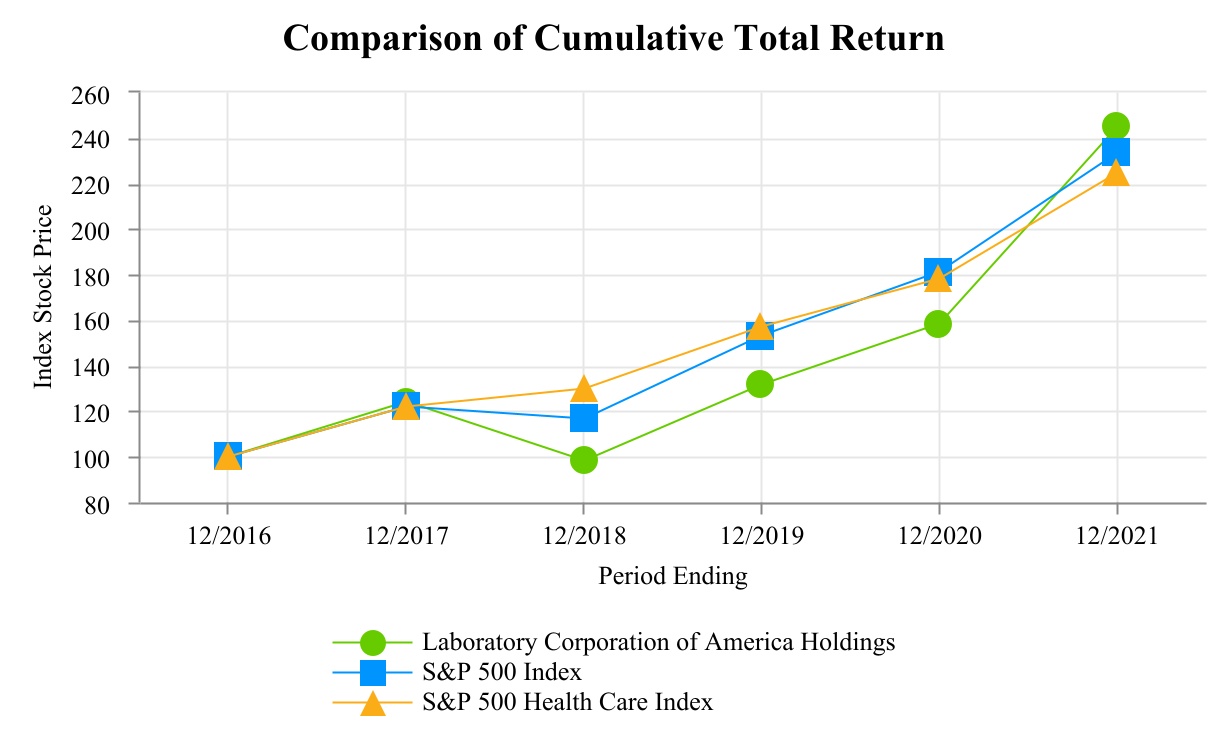
The graph below shows the cumulative total return assuming an investment of $100 on December 31, 2016, in each of the Company’s Common Stock, the Standard & Poor’s, or S&P Composite-500 Stock Index and the S&P 500 Health Care Index, or Peer Group, and assuming that all dividends were reinvested.
Comparison of Cumulative Total Return
| 12/2016 | 12/2017 | 12/2018 | 12/2019 | 12/2020 | 12/2021 | ||||||||||||||||||||||||||||||
| Laboratory Corporation of America Holdings | $ | 100.00 | $ | 124.25 | $ | 98.43 | $ | 131.77 | $ | 158.55 | $ | 244.75 | |||||||||||||||||||||||
| S&P 500 Index | $ | 100.00 | $ | 121.83 | $ | 116.49 | $ | 153.17 | $ | 181.35 | $ | 233.41 | |||||||||||||||||||||||
| S&P 500 Health Care Index | $ | 100.00 | $ | 122.08 | $ | 129.97 | $ | 157.04 | $ | 178.15 | $ | 224.71 |
Issuer Purchases of Equity Securities (all amounts in millions, except per share amounts)
The following table sets forth information with respect to purchases of shares of the Company’s Common Stock made during the quarter ended December 31, 2021, by or on behalf of the Company, inclusive of amounts paid in respect of the accelerated share repurchase agreements (collectively, the ASR Agreements) for which the Company received 80% of the shares calculated at the price at the inception of the Agreements:
| Total Number of Shares Repurchased | Average Price Paid Per Share | Total Number of Shares Repurchased as Part of Publicly Announced Program | Maximum Dollar Value of Shares that May Yet Be Repurchased Under the Program | ||||||||||||||||||||
| October 1 - October 31 | — | $ | — | — | $ | 131.5 | |||||||||||||||||
| November 1 - November 30 | — | — | — | 131.5 | |||||||||||||||||||
| December 1 - December 31 | 2.7 | 307.16 | 2.7 | 1,631.5 | |||||||||||||||||||
| 2.7 | $ | 307.16 | 2.7 |
At the end of 2020, the Company had outstanding authorization from the board of directors (Board) to purchase $800.0 of Company common stock. On December 8, 2021, the Board adopted a new share repurchase plan authorizing repurchase of up to $2,500.0 of the Company's shares in addition to the remaining amount outstanding under the previous plan. On December 13, 2021, the Company entered into the ASR Agreements with Goldman Sachs & Co. LLC and Barclays Bank PLC (collectively, the Financial Institutions) to repurchase approximately $1,000.0 in the aggregate of the Company’s common stock (Common Stock), as part of the Company’s Common Stock repurchase program. The repurchase authorization has no expiration date.
During the first 11 months of 2021, the Company purchased 2.5 shares of its common stock at an average price of $270.55 for a total cost of $668.5. Under the ASR Agreements in December 2021, $1,000.0 was paid to the banks and the Company received 80% of the shares calculated at the price at the inception of the Agreements, approximately 2.7 shares. When the forward contract is settled during the first half of 2022, and the Company receives the remaining shares, an additional adjustment to Common Stock and additional paid-in-capital / retained earnings will be recorded. The specific number of shares that the Company ultimately will repurchase under the ASR Agreements will be based generally on the average of the daily volume-weighted average price per share of the Common Stock during a repurchase period, less a discount and subject to adjustments pursuant to the terms and conditions of the ASR Agreements. The ASR Agreements contain provisions customary for agreements of this type, including provisions for adjustments to the transaction terms, the circumstances generally under which the ASR Agreements may be accelerated, extended or terminated early by the Financial Institutions and various acknowledgments, representations and warranties made by the parties to one another. The initial shares received under the ASR have been removed from the outstanding share count and the final settlement is expected to be completed by the end of April 2022.
When the Company repurchases shares, the amount paid to repurchase the shares in excess of the par or stated value is allocated to additional paid-in-capital unless subject to limitation or the balance in additional paid-in-capital is exhausted. Remaining amounts are recognized as a reduction in retained earnings. At the end of 2021, the Company had outstanding authorization from the Board to purchase up to $1,631.5 of the Company's common stock.
Item 6. SELECTED FINANCIAL DATA
Not applicable.
Item 7. MANAGEMENT'S DISCUSSION AND ANALYSIS OF FINANCIAL CONDITION AND RESULTS OF OPERATIONS (in millions)
General
During the year ended December 31, 2021, the Company's revenues grew by 15.3%, due to organic growth of 13.8%, acquisitions of 0.7% and favorable foreign currency translation of 0.9%, partially offset by the disposition of a business of 0.1%. The 13.8% increase in organic revenues includes a 14.0% contribution from Company's organic Base Business and a 0.2% decrease in COVID-19 Testing. Base Business includes the Company's business operations except for COVID-19 Testing.
The Company defines organic growth as the increase in revenue excluding the year over year impact of acquisitions, divestitures, and currency. Acquisition and divestiture impact is considered for a twelve month period following the close of each transaction.
Strategic Review of Company Structure and Capital Allocation Strategy
In March 2021, the Company announced the undertaking of a comprehensive review by its Board and management team of Labcorp's structure and capital allocation strategy. The review reflected the Board's and management team's view that the
Company's value was not appropriately reflected in its stock price. As a part of this review, the Board and management worked with outside advisors, held extensive discussions with third parties, and considered a wide range of options, including significant acquisitions, divestitures, spinning off businesses, as well as spinning and merging those businesses with strategic partners. Ultimately, the Board unanimously concluded that the Company's existing structure is in the best interest of all stakeholders at this time and represents compelling opportunities to grow and create significant shareholder value. In December 2021, the Company announced the Board's conclusion, as well as actions that the management team and the Board are taking to enhance shareholder returns. These actions include:
-
initiating a dividend in the second quarter of 2022, with a target dividend payout ratio of between 15% to 20% of adjusted earnings;
-
authorizing a $2,500.0 share repurchase program. As part of this program, $1,000.0 is being repurchased under an accelerated share repurchase plan that is expected to be complete by the end of April 2022. On December 13, 2021, the Company entered into the ASR Agreements with the Financial Institutions to repurchase approximately $1,000.0 in the aggregate of the Common Stock, as part of the Company’s Common Stock repurchase program;
-
implementing a new LaunchPad business process improvement initiative, targeting savings of $350.0 over the next three years;
-
providing a longer-term outlook in connection with the announcement of the Company's 2021 year-end results in addition to the Company's annual guidance;
-
providing additional business insights through enhanced disclosures beginning with Labcorp's results for the first quarter of 2022; and
-
continuing a commitment to profitable growth through investments in science, innovation, and new technologies.
Management and the Board are committed to continuing to evaluate all avenues for enhancing shareholder value.
The updated capital allocation plan enables the Company to continue investment in key growth areas, including oncology, Alzheimer's disease, autoimmune disorders, and women's health. This plan is designed to fuel growth through innovation by using Labcorp's unparalleled data and insights to bring scientific advancements—both Labcorp-developed and those of other scientists—to market at scale. It reflects the Board's confidence in the Company's strong balance sheet and cash flow generation profile, as well as the Board's commitment to deploying capital to enhance value for shareholders, patients, providers, and pharmaceutical customers worldwide.
Results of Operations
The following tables present the financial measures that management considers to be the most significant indicators of the Company's performance. For discussion of 2020 results and comparison with 2019 results refer to “Management's Discussion and Analysis of Financial Conditions and Results of Operations” in the Company's Annual Report on Form 10-K for the fiscal year ended December 31, 2020.
Years ended December 31, 2021 and 2020
Revenues
| Years Ended December 31, | |||||||||||||||||
| 2021 | 2020 | Change | |||||||||||||||
| Dx | $ | 10,363.6 | $ | 9,253.4 | 12.0 | % | |||||||||||
| DD | 5,845.5 | 4,877.7 | 19.8 | % | |||||||||||||
| Intercompany eliminations | (88.2) | (152.6) | (42.2) | % | |||||||||||||
| Total | $ | 16,120.9 | $ | 13,978.5 | 15.3 | % |
The 15.3% increase in revenues for the year ended December 31, 2021, as compared with the corresponding period in 2020 was primarily due to organic growth of 13.8%, acquisitions of 0.7% and favorable foreign currency translation of 0.9%, partially offset by the disposition of a business of 0.1%. The 13.8% increase in organic revenues includes a 14.0% contribution from the Company's organic Base Business and a 0.2% decrease in COVID-19 Testing.
Dx revenues for the year ended December 31, 2021, were $10,363.6, an increase of 12.0% over revenues of $9,253.4 in the corresponding period in 2020. The increase in revenues was due to organic growth of 10.9%, acquisitions of 0.7%, and foreign currency translation of 0.4%. The 10.9% increase in organic revenue was due to a 11.2% contribution from organic Base Business, partially offset by a 0.3% decline in COVID-19 Testing.
Dx total volume, measured by requisitions, increased by 10.9% as organic volume increased by 10.5% and acquisition volume contributed growth of 0.5%. The organic volume growth is due to demand for organic Base Business of 10.5%, partially offset by a 0.1% reduction of COVID-19 Testing. Price/mix increased by 1.1% due to organic Base Business of 0.6%,
acquisitions of 0.3%, and favorable foreign currency translation of 0.4%, partially offset by a 0.2% decline from COVID-19 Testing.
DD revenues for the year ended December 31, 2021, were $5,845.5, an increase of 19.8% over revenues of $4,877.7 in the corresponding period in 2020. The increase in revenues was due to organic Base Business growth of 19.2%, the benefit of acquisitions of 0.7%, favorable foreign currency translation of 1.8%, partially offset by lower COVID-19 Testing performed through its Central Laboratories business of 1.6% and a business disposition of 0.2%.
Cost of Revenues
| Years Ended December 31, | |||||||||||||||||
| 2021 | 2020 | Change | |||||||||||||||
| Cost of revenues | $ | 10,496.6 | $ | 9,025.7 | 16.3 | % | |||||||||||
| Cost of revenues as a % of revenues | 65.1 | % | 64.6 | % |
Cost of revenues increased 16.3% in 2021 as compared with 2020 and increased as a percentage of revenues to 65.1% in 2021 as compared to 64.6% in 2020. This increase was primarily due to COVID-19 Testing partially offset by Base Business recovery.
Selling, General and Administrative Expenses
| Years Ended December 31, | |||||||||||||||||
| 2021 | 2020 | Change | |||||||||||||||
| Selling, general and administrative expenses | $ | 1,952.1 | $ | 1,729.3 | 12.9 | % | |||||||||||
| SG&A as a % of revenues | 12.1 | % | 12.4 | % |
Selling, general and administrative expenses as a percentage of revenues decreased to 12.1% in 2021 compared to 12.4% in 2020. The decrease in selling, general and administrative expenses as a percentage of revenues is primarily due to the leveraging of the organic revenue growth and the impact of LaunchPad savings.
During 2021, the Company incurred special charges of $25.1 of acquisition and divestiture related costs, $13.3 in COVID-related costs, $6.3 in management transition costs, $18.2 in retention bonuses, $8.6 of non-capitalized costs associated with the implementation of a major system as part of its LaunchPad business process improvement initiative, and $24.3 related to miscellaneous other items. These items increased selling, general and administrative expenses by $95.8. Excluding these charges, selling, general and administrative expenses as a percentage of revenues were 11.5% for the year ended December 31, 2021. The decrease in selling, general and administrative expenses, excluding the above items, as a percentage of revenues is primarily due to leveraging the Company's infrastructure on higher revenue.
During 2020, the Company incurred special charges of $28.3 of acquisition and divestiture related costs, $10.4 in COVID-related costs, $14.6 in management transition costs, and $1.3 of non-capitalized costs associated with the implementation of a major system as part of its LaunchPad business process improvement initiative, partially offset by $2.7 in other miscellaneous items. These items increased selling, general and administrative expenses by $51.9. Excluding these charges, selling, general and administrative expenses as a percentage of revenues were 12.0% for the year ended December 31, 2020.
Goodwill and Other Asset Impairments
| Years Ended December 31, | |||||||||||||||||
| 2021 | 2020 | Change | |||||||||||||||
| Goodwill and other asset impairments | $ | — | $ | 462.1 | N/A |
During 2020, the Company recorded goodwill and other asset impairment charges of $462.1, $450.5 within DD and $11.6 within Dx. The Company concluded that the fair value was less than carrying value for two of its reporting units and recorded goodwill impairment of $418.7 and $3.7 for DD and Dx, respectively. Additional impairment of identifiable intangible and tangible assets of $31.8 and $7.9 was recorded for DD and Dx, respectively, for impairment of a tradename, software, customer relationships, technology assets and a note receivable. There were no goodwill and other asset impairments for the year ended December 31, 2021.
Amortization Expense
| Years Ended December 31, | |||||||||||||||||
| 2021 | 2020 | Change | |||||||||||||||
| Dx | $ | 117.1 | $ | 104.9 | 11.7 | % | |||||||||||
| DD | 252.5 | 170.5 | 48.0 | % | |||||||||||||
| Amortization of intangibles and other assets | $ | 369.6 | $ | 275.4 | 34.2 | % |
The increase in amortization of intangibles and other assets from 2020 through 2021 primarily reflects the impact of acquisitions partially offset by impairment of intangible assets recorded in fiscal 2020. In addition, amortization acceleration of certain intangible assets related to trade names as a result of the Company's rebranding initiative of $88.4 and $27.5 were recognized for the years ended December 31, 2021 and 2020, respectively.
Restructuring and Other Charges
| Years Ended December 31, | ||||||||||||||||||||
| 2021 | 2020 | Change | ||||||||||||||||||
| Restructuring and other charges | $ | 43.1 | $ | 40.6 | 6.1 | % |
During 2021, the Company recorded net restructuring charges of $43.1; $18.6 within Dx and $24.5 within DD. The charges were comprised of $16.3 in severance and other personnel costs and $28.0 in facility closures, lease terminations, and general integration activities. The charges were offset by the reversal of previously established liability of $0.4 and $0.8 in unused severance costs and facility-related costs, respectively.
During 2020, the Company recorded net restructuring charges of $40.6; $15.3 within Dx and $25.3 within DD. The charges were comprised of $14.1 in severance and other personnel costs and $17.4 for facility, operating lease right-of-use and equipment impairments, and $18.9 in facility closures and general integration activities. The charges were offset by the reversal of previously established liability of $0.6 and $9.2 in unused severance costs and facility-related costs, respectively.
Interest Expense
| Years Ended December 31, | |||||||||||||||||
| 2021 | 2020 | Change | |||||||||||||||
| Interest expense | $ | 212.1 | $ | 207.4 | 2.3 | % |
The increase in interest expense for 2021 as compared with the corresponding period in 2020 is primarily due to the costs of redeeming the 3.20% and 3.75% notes and issuing the new senior notes, partially offset by lower debt and lower cost of debt.
Equity Method Income, Net
| Years Ended December 31, | |||||||||||||||||
| 2021 | 2020 | Change | |||||||||||||||
| Equity method income, net | $ | 26.5 | $ | 2.9 | 812.6 | % |
Equity method income, net represents the Company's ownership share in joint venture partnerships along with equity investments in other companies in the health care industry. The increase in income for 2021 as compared with the corresponding period in 2020 was primarily due to the write off or write down of certain of the Company's investments in 2020, which was primarily due to the negative impact of the COVID19 global pandemic, and increased profitability of the Company's joint ventures in 2021.
Other, Net
| Years Ended December 31, | |||||||||||||||||
| 2021 | 2020 | Change | |||||||||||||||
| Other, net | $ | 42.5 | $ | (32.1) | 231.8 | % |
The change in Other, net for the year ended December 31, 2021, as compared to the year ended December 31, 2020, was primarily due to investment activity. During the year ended December 31, 2021, the Company recorded investment gains of $61.8 which were partially offset by a loss on a sale of a business of $6.2. During the year ended December 31, 2020, the Company adjusted certain investments due to the negative impact of the COVID-19 global pandemic. In addition, foreign currency transaction losses of $4.4 and $10.1 were recognized for the years ended December 31, 2021 and 2020, respectively.
Income Tax Expense
| Years Ended December 31, | |||||||||||
| 2021 | 2020 | ||||||||||
| Income tax expense | $ | 747.1 | $ | 662.1 | |||||||
| Income tax expense as a % of income before tax | 23.9 | % | 29.8 | % |
In 2021, the Company's effective tax rate of 23.9% was favorable as compared to the 2020 tax rate of 29.8%. This was primarily related to impairment charges recorded during 2020 that were not deductible, finalization of tax audits, and the geographic mix of earnings.
Operating Results by Segment
| Years Ended December 31, | |||||||||||||||||
| 2021 | 2020 | Change | |||||||||||||||
| Dx operating income | $ | 2,988.5 | $ | 2,634.9 | 13.4 | % | |||||||||||
| Dx operating margin | 28.8 | % | 28.5 | % | 0.3 | % | |||||||||||
| DD operating income | $ | 547.7 | $ | 37.3 | 1,371.0 | % | |||||||||||
| DD operating margin | 9.4 | % | 0.8 | % | 8.6 | % | |||||||||||
| General corporate expenses | $ | (276.7) | $ | (226.8) | 22.0 | % | |||||||||||
| Total operating income | $ | 3,259.5 | $ | 2,445.4 | 33.3 | % |
Dx operating income was $2,988.5 for the year ended December 31, 2021, an increase of 13.4% over operating income of $2,634.9 in the corresponding period of 2020 and an increase of 270 basis points in operating margin year-over-year. The increase in operating income and margin were primarily due to a recovery in the Base Business, partially offset by a decrease in COVID-19 Testing and higher personnel costs. The Company achieved its goal to deliver approximately $200 million of net savings from its three-year Diagnostics LaunchPad initiative by the end of 2021.
DD operating income was $547.7 for the year ended December 31, 2021, an increase of 1,371.0% from operating income of $37.3 in the corresponding period of 2020. The increase was primarily due to goodwill and other asset impairments in 2020, and organic Base Business growth and LaunchPad savings, partially offset by lower COVID-19 Testing and higher personnel costs in 2021. The Company continues to develop and execute new LaunchPad programs to support profitable growth in DD.
General corporate expenses are comprised primarily of administrative services such as executive management, human resources, legal, finance, corporate affairs, and information technology. Corporate expenses were $276.7 for the year ended December 31, 2021, an increase of 22.0% over corporate expenses of $226.8 in the corresponding period of 2020. The increase in corporate expenses in 2021 is primarily due to higher incentive based compensation resulting from the financial performance of the Company.
Liquidity, Capital Resources and Financial Position
The Company's strong cash-generating capability and financial condition typically have provided ready access to capital markets. The Company's principal source of liquidity is operating cash flow, supplemented by proceeds from debt offerings. The Company's senior unsecured revolving credit facility is further discussed in Note 10 Debt to the Company's Consolidated Financial Statements.
Management’s discussion and analysis of cash flows for the year ended December 31, 2020 compared to the year ended December 31, 2019 may be found in the “Management’s Discussion and Analysis of Financial Condition and Results of Operations, Liquidity, Capital Resources and Financial Position” section of the Company's Annual Report on Form 10-K for the fiscal year ended December 31, 2020.
In summary the Company's cash flows were as follows:
| For the Year Ended December 31, | ||||||||||||||||||||
| 2021 | 2020 | 2019 | ||||||||||||||||||
| Net cash provided by operating activities | $ | 3,109.6 | $ | 2,135.3 | $ | 1,444.7 | ||||||||||||||
| Net cash used for investing activities | (884.6) | (643.2) | (1,283.1) | |||||||||||||||||
| Net cash used for financing activities | (2,065.8) | (517.4) | (252.7) | |||||||||||||||||
| Effect of exchange rate on changes in cash and cash equivalents | (7.3) | 8.6 | 1.8 | |||||||||||||||||
| Net change in cash and cash equivalents | $ | 151.9 | $ | 983.3 | $ | (89.3) |
Cash and Cash Equivalents
Cash and cash equivalents at December 31, 2021 and 2020 totaled $1,472.7 and $1,320.8, respectively. Cash and cash equivalents consist of highly liquid instruments, such as time deposits and other money market investments, which have original maturities of three months or less.
Cash Flows from Operating Activities
During the year ended December 31, 2021, the Company's operations provided $3,109.6 of cash as compared to $2,135.3 in 2020. The $974.3 increase in cash provided from operations in 2021 as compared with the corresponding 2020 period was primarily due to higher earnings and favorable working capital.
Cash Flows from Investing Activities
Net cash used by investing activities for the year ended December 31, 2021 was $884.6 as compared to net cash used by investing activities of $643.2 for the year ended December 31, 2020. The $241.4 increase in net cash used by investing activities for the year ended December 31, 2021, was primarily due to a year over year increase of $229.3 in cash paid for acquisitions. The Company had proceeds of 42.1 from the sale of assets and disposition of businesses during 2020 in comparison to $87.3 during 2021. Capital expenditures were $460.4 and $381.7 for the years ended December 31, 2021 and 2020, respectively. Capital expenditures in 2021 were 2.9% of revenues, primarily in connection with projects to support growth in the Company's core businesses. The Company intends to continue to pursue acquisitions to drive growth, to make important investments in its business, including in information technology, and to improve efficiency and enable the execution of the Company's mission. Such expenditures are expected to be funded by cash flow from operations or, as needed, through borrowings under debt facilities, including the Company's revolving credit facility or any successor facility. The Company expects capital expenditures in 2022 to be approximately 4.0% of revenues, primarily in connection with projects to support growth in the Company's core businesses, facility updates, projects related to LaunchPad, and further acquisition integration initiatives.
Cash Flows from Financing Activities
Net cash used in financing activities for the year ended December 31, 2021 was $2,065.8 compared to cash used in financing activities of $517.4 for the year ended December 31, 2020. This movement in cash within financing activities for 2021, as compared to 2020, was primarily a result of $1,668.5 in share repurchases in 2021 compared to $100.0 in 2020.
On May 26, 2021, the Company issued new senior notes representing $1,000.0 in debt securities and consisting of $500.0 aggregate principal amount of 1.55% senior notes due 2026 and $500.0 aggregate principal amount of 2.70% senior notes due 2031. Interest on these notes is payable semi-annually in arrears on June 1 and December 1 of each year, commencing on December 1, 2021. Net proceeds from the offering of these notes were $989.4 after deducting underwriting discounts and other expenses of the offering. The net proceeds were used to redeem, prior to maturity, the Company's outstanding 3.20% senior notes due February 1, 2022 and 3.75% senior notes due August 23, 2022.
During the second quarter of 2021, the Company entered into fixed-to-variable interest rate swap agreements for its 2.70% senior notes due 2031 with an aggregate notional amount of $500.0 and variable interest rates based on three-month LIBOR plus 1.0706%. These instruments are designated as hedges against changes in the fair value of a portion of the Company's long-term debt. The aggregate fair value of $2.9 at December 31, 2021, was included as a component of other long-term assets and added to the reported value of the senior notes.
On April 30, 2021, the Company amended and restated its revolving credit facility. It consists of a five-year revolving facility in the principal amount of up to $1,000.0, with the option of increasing the facility by up to an additional $500.0, subject to the agreement of one or more new or existing lenders to provide such additional amounts and certain other customary conditions. The Company is required to pay a facility fee on the aggregate commitments under the revolving credit facility, at a per annum rate ranging from 0.100% to 0.225%, depending on the Company’s debt ratings. Borrowings under the revolving credit facility will accrue interest at a per annum rate equal to, at the Company’s election, either (x) a LIBOR rate plus a margin ranging from 0.775% to 1.275% or (y) a base rate plus a margin ranging from 0% to 0.275%, in each case, depending on the Company’s debt ratings.
On August 17, 2020, the Company redeemed the remaining $412.2 of its 4.625% Senior Notes due November 15, 2020, using available cash on hand. The Company exited the remaining fixed-to-variable interest rate swap agreement in August 2020, in connection with this redemption and recorded a gain of $1.6 on the extinguishment. The gain was included in Other, net on the Consolidated Statement of Operations.
The Company continues to evaluate its outstanding debt portfolio to take advantage of market conditions that would allow the Company to reduce its interest rate or financing risk and provide a lower long-term borrowing cost.
Under the Company's revolving credit facility, the Company is subject to negative covenants limiting subsidiary indebtedness and certain other covenants typical for investment grade-rated borrowers and the Company is required to maintain certain leverage ratios. The Company was in compliance with all covenants under the revolving credit facility at December 31, 2021, and expects that it will remain in compliance with its existing debt covenants for the next twelve months.
During 2021, the Company repurchased 5.2 shares of its Common Stock at an average price of $282.05 for a total cost of $1,668.5, which included $1,000.0 paid in respect of an ASR for which the Company received 80% of the shares calculated at the price at the inception of the Agreements. At the end of 2021, the Company had outstanding authorization from the Board to purchase $1,631.5 of Company common stock. The repurchase authorization has no expiration date.
Credit Ratings
The Company’s investment grade debt ratings from Moody’s and Standard & Poor's (S&P) contribute to its ability to access capital markets.
| Contractual Cash Obligations | |||||||||||||||||||||||||||||
| Payments Due by Period | |||||||||||||||||||||||||||||
| Total | Short-term | Long-term | |||||||||||||||||||||||||||
| Operating lease obligations | $ | 829.5 | $ | 187.0 | $ | 642.5 | |||||||||||||||||||||||
| Contingent future licensing and royalty payments (a) | 41.8 | 6.2 | 35.6 | ||||||||||||||||||||||||||
| Purchase obligations | 45.2 | 27.4 | 17.8 | ||||||||||||||||||||||||||
| Finance lease obligations | 95.1 | 10.5 | 84.6 | ||||||||||||||||||||||||||
| Scheduled interest payments on Senior Notes | 1,662.8 | 181.0 | 1,481.8 | ||||||||||||||||||||||||||
| Long-term debt (b) | 5,418.0 | 1.5 | 5,416.5 | ||||||||||||||||||||||||||
| Total contractual cash obligations (c) (d) (e) (f) | $ | 8,092.4 | $ | 413.6 | $ | 7,678.8 |
(a)Contingent future licensing payments will be made if certain events take place, such as the launch of a specific test, the transfer of certain technology, and the achievement of specified revenue milestones.
(b)The table does not include obligations under the Company’s pension and postretirement benefit plans, which are included in Note 15 Pension and Postretirement Plans to Consolidated Financial Statements. Benefits under the Company's postretirement medical plan are paid when claims are submitted for payment, the timing of which is not practicable to estimate.
(c)The table does not include the Company’s reserve for unrecognized tax benefits. The Company had a $58.9 reserve for unrecognized tax benefits, including interest and penalties, at December 31, 2021, which is included in Note 12 Income Taxes to Consolidated Financial Statements.
(d)Excludes amount of debt issuance costs included in the long-term debt balance.
(e)The table does not include obligations related to the Company's ASR Agreements which are discussed in Note 11 Preferred Stock and Common Shareholder's Equity to the Consolidated Financial Statements.
(f)This table does not include obligations for venture fund commitments which totaled $13.2 at December 31, 2021, and are subject to calls from the individual venture funds
Off-Balance Sheet Arrangements
The Company does not have transactions or relationships with “special purpose” entities, and the Company does not have any off-balance sheet financing other than normal operating leases and letters of credit.
Other Commercial Commitments
As of December 31, 2021, the Company provided letters of credit aggregating approximately $79.8, primarily in connection with certain insurance programs which are renewed annually.
The contractual value of the noncontrolling interest put in the Company's Ontario subsidiary totaled $16.3 and $16.2 at December 31, 2021, and 2020, respectively, and has been classified as mezzanine equity in the Company's consolidated balance sheet.
Based on current and projected levels of cash flows from operations, coupled with availability under its revolving credit facility, the Company believes it has sufficient liquidity to meet both its anticipated short-term and long-term cash needs; however, the Company continually reassesses its liquidity position in light of market conditions and other relevant factors.
Critical Accounting Estimates
The preparation of financial statements in conformity with generally accepted accounting principles requires management to make estimates and assumptions that affect the reported amounts of assets and liabilities and disclosure of contingent assets and liabilities at the date of the financial statements and the reported amounts of revenues and expenses during the reported periods. While the Company believes these estimates are reasonable and consistent, they are by their very nature estimates of amounts that will depend on future events. Accordingly, actual results could differ from these estimates. The Company’s Audit Committee periodically reviews the Company’s significant accounting policies. The Company’s critical accounting policies arise in conjunction with the following:
-
Revenue recognition;
-
Business combinations;
-
Income taxes; and
-
Goodwill and indefinite-lived assets.
Revenue Recognition
Dx
Within the Dx segment, a revenue transaction is initiated when Dx receives a requisition order to perform a diagnostic test. The information provided on the requisition form is used to determine the party that will be billed for the testing performed and the expected reimbursement. Dx recognizes revenue and satisfies its performance obligation for services rendered when the testing process is complete and the associated results are reported. Revenues are distributed among four payer portfolios - clients, patients, Medicare and Medicaid and third party. Dx considers negotiated discounts and anticipated adjustments, including historical collection experience for the payer portfolio, when revenues are recorded.
The following are descriptions of the Dx payer portfolios:
Clients
Client payers represent the portion of Dx’s revenue related to physicians, hospitals, health systems, accountable care organizations (ACOs), employers and other entities where payment is received exclusively from the entity ordering the testing service. Generally, client revenues are recorded on a fee-for-service basis at Dx’s client list price, less any negotiated discount. A portion of client billing is for laboratory management services, collection kits and other non-testing services or products. In these cases, revenue is recognized when services are rendered or delivered.
Patients
This portfolio includes revenue from uninsured patients and member cost-share for insured patients (e.g., coinsurance, deductibles and non-covered services). Uninsured patients are billed based upon Dx’s patient fee schedules, net of any discounts negotiated with physicians on behalf of their patients. Dx bills insured patients as directed by their health plan and after consideration of the fees and terms associated with an established health plan contract.
Medicare and Medicaid
This portfolio relates to fee-for-service revenue from traditional Medicare and Medicaid programs. Net revenue from these programs is based on the fee schedule established by the related government authority. In addition to contractual discounts, other adjustments including anticipated payer denials are considered when determining net revenue. Any remaining adjustments to revenue are recorded at the time of final collection and settlement. These adjustments are not material to Dx’s results of operations in any period presented.
Third Party
Third party includes revenue related to MCOs. The majority of Dx's third-party revenue is reimbursed on a fee-for-service basis. These payers are billed at Dx's established list price and revenue is recorded net of contractual discounts. The majority of Dx’s MCO revenues are recorded based upon contractually negotiated fee schedules with revenues for non-contracted MCOs recorded based on historical reimbursement experience.
Third-party reimbursement is also received through capitation agreements with MCOs and independent physician associations (IPAs). Under capitated agreements, revenue is recognized based on a negotiated per-member, per-month payment for an agreed upon menu of tests, or based upon the proportionate share earned by Dx from a capitation pool. When the agreed upon reimbursement is based solely on an established rate per member, revenue is not impacted by the volume of testing performed. Under a capitation pool arrangement, the aggregate value of an established rate per member is distributed based on
the volume and complexity of the procedures performed by laboratories participating in the agreement. Dx recognizes revenue monthly, based upon the established capitation rate or anticipated distribution from a capitated pool.
Dx has a formal process to estimate implicit price concessions for uncollectable accounts. The majority of Dx's collection risk is related to accounts receivable from both insured and uninsured patients who are unwilling or unable to pay. Anticipated write-offs are recorded as adjustments to revenue at an amount considered necessary to record the segment's revenue at its net realizable value. In addition to contractual discounts, other adjustments including anticipated payer denials and other external factors that could affect the collectability of its receivables are considered when determining revenue and the net receivable amount. Any remaining adjustments to revenue are recorded at the time of final collection and settlement. These adjustments are not material to Dx's results of operations in any period presented.
DD
The nature of DD’s obligations includes agreements to provide preclinical services, to manage a full clinical trial, provide services for a specific phase of a trial, or provide research products to the customer. DD provides these services predominantly to pharmaceutical, biotechnology and medical device companies worldwide. A majority of DD’s revenues are earned under contracts that range in duration from a few months to many years. These contracts generally take the form of fee-for-service or fixed-price arrangements subject to pricing adjustments based on changes in scope. The total contract value is estimated at the beginning of the contract, and is equal to the amount expected to be billed to the customer. Other payments and billing adjustments may also factor into the calculation of total contract value, such as the reimbursement of out-of-pocket costs and volume-based rebates.
The majority of DD's contracts contain a single performance obligation. For contracts that include multiple performance obligations, DD allocates the contract value to the goods and services based on a customer price list, if available. If a price list is not available, DD will estimate the transaction price using either market prices or an “expected cost plus margin” approach.
Fee-for-service contracts are typically priced based on transaction volume or time and materials. For volume based contracts the contract value is entirely variable and revenue is recognized as the specific product or service is completed. For services billed based on time and materials, revenue is recognized using the right to invoice practical expedient.
Fixed-price contracts are typically recognized as revenue over time based on a proportional-performance basis, using either input or output methods that are specific to the service provided. In an output method, revenue is determined by dividing the actual units of output achieved by the total units of output required under the contract and multiplying that percentage by the total contract value. When using an input method, revenue is recognized by dividing the actual units of input incurred by the total units of input budgeted in the contract, and multiplying that percentage by the total contract value. The estimate of total units of input at completion requires significant judgment and estimates are based on various assumptions of events that often span several years. These estimates are reviewed periodically and any adjustments are recognized on a cumulative catch-up basis in the period they become known.
Contracts are often modified to account for changes in contract specifications and requirements. Generally, when contract modifications create new performance obligations, the modification is considered to be a separate contract and revenue is recognized prospectively. When contract modifications change existing performance obligations, the impact on the existing transaction price and measure of progress for the performance obligation to which it relates is generally recognized as an adjustment to revenue (either as an increase in or a reduction of revenue) on a cumulative catch-up basis.
Most contracts are terminable with or without cause by the customer, either immediately or upon notice. These contracts often require payment to DD of expenses to wind-down the study or project, fees earned to date and, in some cases, a termination fee or a payment to DD of some portion of the fees or profits that could have been earned by DD under the contract if it had not been terminated early. Termination fees are included in revenues when services are performed and realization is assured.
Business Combinations
The Company accounts for business combination transactions under the acquisition method of accounting and reported the results of operations of the acquired entities from its respective date of acquisition. Assets acquired were recorded at their estimated fair values as of the acquisition date. Estimated fair values were based on various valuation methodologies, including an income approach using primarily discounted cash flow techniques for the customer relationships intangible assets. The aforementioned income methods utilize management's estimates of future operating results and cash flows discounted using a weighted-average cost of capital that reflects market participant assumptions. The excess of the fair value of the consideration conveyed over the fair value of the assets acquired was recorded as goodwill. The goodwill reflects management's expectations of the ability to gain access to and penetrate the acquired entities' historical patient base and the benefits of being able to leverage operational efficiencies with favorable growth opportunities based on positive demographic trends in the market.
Income Taxes
The Company accounts for income taxes utilizing the asset and liability method. Under this method, deferred tax assets and liabilities are recognized for the future tax consequences attributable to differences between the financial statement carrying amounts of existing assets and liabilities and their respective tax bases and for tax loss carryforwards. Deferred tax assets and liabilities are measured using enacted tax rates expected to apply to taxable income in the years in which those temporary differences are expected to be recovered or settled. The effect on deferred tax assets and liabilities of a change in tax rates is recognized in income in the period that includes the enactment date. The Company does not recognize a tax benefit, unless the Company concludes that it is more likely than not that the benefit will be sustained on audit by the taxing authority based solely on the technical merits of the associated tax position. If the recognition threshold is met, the Company recognizes a tax benefit measured at the largest amount of the tax benefit that the Company believes is greater than 50% likely to be realized. The Company records interest and penalties in income tax expense.
Goodwill and Indefinite-Lived Assets
The Company assesses goodwill and indefinite-lived intangibles for impairment at least annually or whenever events or changes in circumstances indicate that the carrying amount of such assets may not be recoverable. The annual impairment test for goodwill includes an option to perform a qualitative assessment of whether it is more likely than not that a reporting unit's fair value is less than its carrying value. Reporting units are businesses with discrete financial information that is available and reviewed by management. If the Company determines that it is more likely than not that the fair value of a reporting unit is less than its carrying value, then the Company performs the quantitative goodwill impairment test. The Company may also choose to bypass the qualitative assessment for any reporting unit in its goodwill assessment and proceed directly to performing the quantitative assessment. The Company recognizes an impairment charge for the amount by which the reporting unit's carrying amount exceeds its fair value.
In the qualitative assessment, the Company considers relevant events and circumstances for each reporting unit, including (i) current year results, (ii) financial performance versus management’s annual and five-year strategic plans, (iii) changes in the reporting unit carrying value since prior year, (iv) industry and market conditions in which the reporting unit operates, (v) macroeconomic conditions, including discount rate changes, and (vi) changes in products or services offered by the reporting unit. If applicable, performance in recent years is compared to forecasts included in prior quantitative valuations. Based on the results of the qualitative assessment, if the Company concludes that it is not more likely than not that the fair value of the reporting unit is less than its carrying values of the reporting unit, then no quantitative assessment is performed.
The quantitative assessment includes the estimation of the fair value of each reporting unit as compared to the carrying value of the reporting unit. The Company estimates the fair value of a reporting unit using both income-based and market-based valuation methods. The income-based approach is based on the reporting unit's forecasted future cash flows that are discounted to the present value using the reporting unit's weighted average cost of capital. For the market-based approach, the Company utilizes a number of factors such as publicly available information regarding the market capitalization of the Company as well as operating results, business plans, market multiples, and present value techniques. Based upon the range of estimated values developed from the income and market-based methods, the Company determines the estimated fair value for the reporting unit. If the estimated fair value of the reporting unit exceeds the carrying value, the goodwill is not impaired and no further review is required.
The income-based fair value methodology requires management's assumptions and judgments regarding economic conditions in the markets in which the Company operates and conditions in the capital markets, many of which are outside of management's control. At the reporting unit level, fair value estimation requires management's assumptions and judgments regarding the effects of overall economic conditions on the specific reporting unit, along with assessment of the reporting unit's strategies and forecasts of future cash flows. Forecasts of individual reporting unit cash flows involve management's estimates and assumptions regarding:
-
Annual cash flows, on a debt-free basis, arising from future revenues and profitability, changes in working capital, capital spending and income taxes for at least a five-year forecast period.
-
A terminal growth rate for years beyond the forecast period. The terminal growth rate is selected based on consideration of growth rates used in the forecast period, historical performance of the reporting unit and economic conditions.
-
A discount rate that reflects the risks inherent in realizing the forecasted cash flows. A discount rate considers the risk-free rate of return on long-term treasury securities, the risk premium associated with investing in equity securities of comparable companies, the beta obtained from the comparable companies and the cost of debt for investment grade issuers. In addition, the discount rate may consider any company-specific risk in achieving the prospective financial information.
Under the market-based fair value methodology, judgment is required in evaluating market multiples and recent transactions. Management believes that the assumptions used for its impairment tests are representative of those that would be used by market participants performing similar valuations of the reporting units.
Based upon the revised forecasted revenues and operating income following the declaration of the COVID-19 global pandemic, management concluded there was a triggering event and updated its annual 2019 goodwill impairment testing as of March 31, 2020, for certain of its DD reporting units and Dx reporting units. Based on the quantitative impairment assessment performed in the same manner as its annual quantitative assessment, the Company concluded that the fair value was less than carrying value for two of its reporting unit and recorded a goodwill impairment of $418.7 for DD and $3.7 for Dx.
Management performed its annual goodwill and intangible asset impairment testing as of the beginning of the fourth quarter of 2021. The Company elected to perform the qualitative assessment for goodwill and intangible assets for the domestic Dx reporting units and all of the DD reporting units and a quantitative assessment for the Canadian reporting unit and its indefinite-lived assets consisting of acquired Canadian licenses. Based upon the results of the qualitative and quantitative assessments, the Company concluded that the fair values of each of its reporting units, as of October 1, 2021, were greater than the carrying values.
Although the Company believes that the current assumptions and estimates used in its goodwill analysis are reasonable, supportable, and appropriate, continued efforts to maintain or improve the performance of these businesses could be impacted by unfavorable or unforeseen changes which could impact the existing assumptions used in the impairment analysis. Various factors could reasonably be expected to unfavorably impact existing assumptions: primarily delays in new customer bookings and the related delay in revenue from new customers, increases in customer termination activity or increases in operating costs. In addition, given the ongoing and rapidly changing nature of the COVID-19 pandemic, there is significant uncertainty regarding the duration and severity of the pandemic as well as any future government restrictions, which may unfavorably impact existing assumptions. Accordingly, there can be no assurance that the estimates and assumptions made for the purposes of the goodwill impairment analysis will prove to be accurate predictions of future performance.
Item 7A. QUANTITATIVE AND QUALITATIVE DISCLOSURE ABOUT MARKET RISK (in millions)
Market risk is the potential loss arising from adverse changes in market rates and prices, such as foreign currency exchange rates, interest rates and other relevant market rate or price changes. In the ordinary course of business, the Company is exposed to various market risks, including changes in foreign currency exchange and interest rates, and the Company regularly evaluates the exposure to such changes. The Company addresses its exposure to market risks, principally the market risks associated with changes in foreign currency exchange rates and interest rates, through a controlled program of risk management that includes, from time to time, the use of derivative financial instruments such as foreign currency forward contracts, cross currency swaps and interest rate swap agreements. The Company does not hold or issue derivative financial instruments for trading purposes.
Foreign Currency Exchange Rates
Approximately 15.3% and 10.7% of the Company's revenues for the year ended December 31, 2021 and 2020, respectively, were denominated in currencies other than the U.S. dollar (USD). The Company's financial statements are reported in USD and, accordingly, fluctuations in exchange rates will affect the translation of revenues and expenses denominated in foreign currencies into USD for purposes of reporting the Company's consolidated financial results. In both 2021 and 2020, the most significant currency exchange rate exposures were to the Canadian dollar, Swiss franc, euro and British pound. Excluding the impacts from any outstanding or future hedging transactions, a hypothetical change of 10% in average exchange rates used to translate all foreign currencies to USD would have impacted income before income taxes for 2021 by approximately $31.0. Gross accumulated currency translation adjustments recorded as a separate component of shareholders’ equity were $(104.6) and $264.1 at December 31, 2021, and 2020, respectively. The Company does not have significant operations in countries in which the economy is considered to be highly inflationary.
The Company earns revenue from service contracts over a period of several months and, in some cases, over a period of several years. Accordingly, exchange rate fluctuations during this period may affect the Company's profitability with respect to such contracts. The Company is also subject to foreign currency transaction risk for fluctuations in exchange rates during the period of time between the consummation and cash settlement of transactions. The Company limits its foreign currency transaction risk through exchange rate fluctuation provisions stated in some of its contracts with customers, or it may hedge transaction risk with foreign currency forward contracts. At December 31, 2021, the Company had 28 open foreign exchange forward contracts with various amounts maturing monthly through January 2021 with a notional value totaling approximately $600.7. At December 31, 2020, the Company had 31 open foreign exchange forward contracts with various amounts maturing monthly through January 2021 with a notional value totaling approximately $601.2.
The Company is party to USD to Swiss Franc cross-currency swap agreements with a notional amount of $600.0, maturing in 2022 and 2025, as a hedge against the impact of foreign exchange movements on its net investment in its Swiss Franc functional currency subsidiary.
Interest Rates
Some of the Company's debt is subject to interest at variable rates. As a result, fluctuations in interest rates affect the Company's financial results. The Company attempts to manage interest rate risk and overall borrowing costs through an appropriate mix of fixed and variable rate debt including the utilization of derivative financial instruments, primarily interest rate swaps.
Borrowings under the Company's term loan credit facilities and revolving credit facility are subject to variable interest rates, unless fixed through interest rate swaps or other agreements.
In May, 2021, to hedge against changes in the fair value portion of the Company's long-term debt, the Company entered into fixed-to-variable interest rate swap agreements for the 2.70% senior notes due 2031 with an aggregate notional value of $500.0 and variable interest rates based on three-month LIBOR plus 1.0706%.
Item 8. FINANCIAL STATEMENTS AND SUPPLEMENTARY DATA
The consolidated financial statements of the Company required in this item are set forth beginning on page F-1 of this Annual Report on Form 10-K.
Item 9. CHANGES IN AND DISAGREEMENTS WITH ACCOUNTANTS ON ACCOUNTING AND FINANCIAL DISCLOSURE
None.
Item 9A. CONTROLS AND PROCEDURES
Disclosure Controls and Procedures
As of the end of the period covered by this Annual Report, the Company carried out under the supervision and with the participation of the Company’s management, including the Company’s principal executive officer and principal financial officer, an evaluation of the effectiveness of the Company's disclosure controls and procedures (as defined in Rules 13a-15(e) and 15d-15(e) under the Securities Exchange Act of 1934, as amended). Based upon this evaluation, the Company’s principal executive officer and principal financial officer concluded that the Company’s disclosure controls and procedures were effective as of the end of the period covered by this Annual Report.
Changes in Internal Control over Financial Reporting
There have been no changes in the Company’s internal control over financial reporting (as defined in Exchange Act Rules 13a-15(f) and 15d-15(f)) during the quarter ended December 31, 2021, that have materially affected, or are reasonably likely to materially affect, the Company’s internal control over financial reporting.
Report of Management on Internal Control over Financial Reporting
The Company's management is responsible for establishing and maintaining adequate internal control over financial reporting (as defined in Rules 13a-15(f) and 15d-15(f) under the Securities Exchange Act of 1934).
The internal control over financial reporting at the Company was designed to provide reasonable assurance regarding the reliability of financial reporting and the preparation of financial statements for external purposes in accordance with accounting principles generally accepted in the U.S. Internal control over financial reporting includes those policies and procedures that:
-
pertain to the maintenance of records that, in reasonable detail, accurately and fairly reflect the transactions and dispositions of the assets of the Company;
-
provide reasonable assurance that transactions are recorded as necessary to permit preparation of financial statements in accordance with accounting principles generally accepted in the U.S.;
-
provide reasonable assurance that receipts and expenditures of the Company are being made only in accordance with authorization of management and directors of the Company; and
-
provide reasonable assurance regarding prevention or timely detection of unauthorized acquisition, use or disposition of assets that could have a material effect on the consolidated financial statements.
Because of its inherent limitations, internal control over financial reporting may not prevent or detect misstatements.
The Company's management assessed the effectiveness of the Company’s internal control over financial reporting as of December 31, 2021. Management based this assessment on criteria for effective internal control over financial reporting described in “Internal Control - Integrated Framework 2013” issued by the Committee of Sponsoring Organizations of the Treadway Commission (COSO). Based on this assessment, the Company's management determined that, as of December 31, 2021, the Company maintained effective internal control over financial reporting. Management reviewed the results of its assessment with the Audit Committee of the Company’s Board.
Deloitte and Touche LLP, an independent registered public accounting firm, who audited and reported on the consolidated financial statements of the Company included in this Annual Report, also audited the effectiveness of the Company’s internal control over financial reporting as of December 31, 2021, as stated in its report, which is included herein immediately preceding the Company’s audited financial statements.
Item 9B. OTHER INFORMATION
None.
Item 9C. DISCLOSURE REGARDING FOREIGN JURISDICTIONS THAT PREVENT INSPECTIONS
Item 10. DIRECTORS, EXECUTIVE OFFICERS AND CORPORATE GOVERNANCE
The information required by the item regarding directors is incorporated by reference to the Company’s Definitive Proxy Statement to be filed with the Securities and Exchange Commission in connection with the Annual Meeting of Stockholders to be held in 2022 (the 2022 Proxy Statement) under the caption Election of Directors. Information regarding executive officers is incorporated by reference to the Company’s 2022 Proxy Statement under the caption Executive Officers. Information concerning the Company’s Audit Committee, including the designation of audit committee financial experts and information regarding compliance with Section 16(a) of the Exchange Act responsive to this item is incorporated by reference to the Company’s 2022 Proxy Statement under the captions Corporate Governance and Delinquent Section 16(a) Reports, respectively. Information concerning the Company's code of ethics is incorporated by reference to the Company's 2022 Proxy Statement under the caption Corporate Governance Policies and Procedures.
Item 11. EXECUTIVE COMPENSATION
The information required by this item is incorporated by reference to information in the 2022 Proxy Statement under the captions “Executive Compensation” and “Director Compensation.”
Item 12. SECURITY OWNERSHIP OF CERTAIN BENEFICIAL OWNERS AND MANAGEMENT AND RELATED STOCKHOLDER MATTERS
See Note 13 Stock Compensation Plans to the Consolidated Financial Statements for a discussion of the Company’s Stock Compensation Plans. Except for the above referenced footnote, the information called for by this item is incorporated by reference to information in the 2022 Proxy Statement under the captions “Security Ownership of Certain Beneficial Holders and Management,” “Compensation Discussion & Analysis” and “Executive Compensation.”
Item 13. CERTAIN RELATIONSHIPS AND RELATED TRANSACTIONS, AND DIRECTOR INDEPENDENCE
The information required by this item is incorporated by reference to information in the 2022 Proxy Statement under the captions “Board Independence” and “Related Party Transactions.”
Item 14. PRINCIPAL ACCOUNTANT FEES AND SERVICES
The information required by this item is incorporated by reference to information in the 2022 Proxy Statement under the caption “Fees to Independent Registered Public Accounting Firm.”
PART IV
Item 15. EXHIBITS AND FINANCIAL STATEMENT SCHEDULES
(a) List of documents filed as part of this Annual Report:
| (1) | Consolidated Financial Statements and Report of Independent Registered Public Accounting Firm included herein: | ||||
| See Index on page F-1 | |||||
| (2) | Financial Statement Schedules: | ||||
| All schedules are omitted as they are inapplicable or the required information is furnished in the Consolidated Financial Statements or notes thereto. | |||||
| (3) | Index to and List of Exhibits | ||||
Item 16. FORM 10-K SUMMARY
None.
SIGNATURES
Pursuant to the requirements of Section 13 or 15(d) of the Securities Exchange Act of 1934, the registrant has duly caused this Annual Report to be signed on its behalf by the undersigned, thereunto duly authorized.
LABORATORY CORPORATION OF AMERICA HOLDINGS
Registrant
| By: | /s/ ADAM H. SCHECHTER | ||||||||||
| Adam H. Schechter | |||||||||||
| President and Chief Executive Officer | |||||||||||
| Dated: | February 25, 2022 |
Pursuant to the requirements of the Securities Exchange Act of 1934, this Annual Report has been signed below by the following persons on behalf of the registrant on February 25, 2022 in the capacities indicated.
| Signature | Title | |||||||
| /s/ ADAM H. SCHECHTER | President and Chief Executive Officer | |||||||
| Adam H. Schechter | (Principal Executive Officer) | |||||||
| /s/ GLENN A. EISENBERG | Executive Vice President, Chief Financial Officer | |||||||
| Glenn A. Eisenberg | (Principal Financial Officer) | |||||||
| /s/ PETER J. WILKINSON | Senior Vice President and Chief Accounting Officer | |||||||
| Peter J. Wilkinson | (Principal Accounting Officer) | |||||||
| * | Director | |||||||
| Kerrii B. Anderson | ||||||||
| * | Director | |||||||
| Jean-Luc Bélingard | ||||||||
| * | Director | |||||||
| Jeffrey A. Davis | ||||||||
| * | Director | |||||||
| D. Gary Gilliland, M.D., Ph.D. | ||||||||
| * | Director | |||||||
| Garheng Kong, M.D., Ph.D. | ||||||||
| * | Director | |||||||
| Peter M. Neupert | ||||||||
| * | Director | |||||||
| Richelle Parham | ||||||||
| * | Director | |||||||
| Kathryn E. Wengel | ||||||||
| * | Director | |||||||
| R. Sanders Williams, M.D. | ||||||||
- Sandra van der Vaart, by her signing her name hereto, does hereby sign this Annual Report on behalf of the directors of the Registrant after whose typed names asterisks appear, pursuant to powers of attorney duly executed by such directors and filed with the Securities and Exchange Commission.
| By: | /s/ Sandra van der Vaart | |||||||
| Sandra van der Vaart | ||||||||
| Attorney-in-fact |
LABORATORY CORPORATION OF AMERICA HOLDINGS AND SUBSIDIARIES
INDEX TO CONSOLIDATED FINANCIAL STATEMENTS
F-1
Report of Independent Registered Public Accounting Firm
To the shareholders and Board of Directors of Laboratory Corporation of America Holdings
Opinion on the Financial Statements
We have audited the accompanying consolidated balance sheet of Laboratory Corporation of America Holdings and subsidiaries (the “Company”) as of December 31, 2021, the related consolidated statements of operations, comprehensive earnings, changes in shareholders’ equity, and cash flows for the year ended December 31, 2021, and the related notes (collectively referred to as the “financial statements”). In our opinion, the financial statements present fairly, in all material respects, the financial position of the Company as of December 31, 2021, and the results of its operations and its cash flows for the year ended December 31, 2021, in conformity with accounting principles generally accepted in the United States of America.
We have also audited, in accordance with the standards of the Public Company Accounting Oversight Board (United States) (PCAOB), the Company’s internal control over financial reporting as of December 31, 2021, based on criteria established in Internal Control – Integrated Framework (2013) issued by the Committee of Sponsoring Organizations of the Treadway Commission and our report dated February 25, 2022, expressed an unqualified opinion on the Company’s internal control over financial reporting.
Basis for Opinion
These financial statements are the responsibility of the Company’s management. Our responsibility is to express an opinion on the Company’s financial statements based on our audit. We are a public accounting firm registered with the PCAOB and are required to be independent with respect to the Company in accordance with the U.S. federal securities laws and the applicable rules and regulations of the Securities and Exchange Commission and the PCAOB.
We conducted our audit in accordance with the standards of the PCAOB. Those standards require that we plan and perform the audit to obtain reasonable assurance about whether the financial statements are free of material misstatement, whether due to error or fraud. Our audit included performing procedures to assess the risks of material misstatement of the financial statements, whether due to error or fraud, and performing procedures that respond to those risks. Such procedures included examining, on a test basis, evidence regarding the amounts and disclosures in the financial statements. Our audit also included evaluating the accounting principles used and significant estimates made by management, as well as evaluating the overall presentation of the financial statements. We believe that our audit provides a reasonable basis for our opinion.
Critical Audit Matters
The critical audit matters communicated below are matters arising from the current-period audit of the financial statements that were communicated or required to be communicated to the audit committee and that (1) relate to accounts or disclosures that are material to the financial statements and (2) involved our especially challenging, subjective, or complex judgments. The communication of critical audit matters does not alter in any way our opinion on the financial statements, taken as a whole, and we are not, by communicating the critical audit matters below, providing separate opinions on the critical audit matters or on the accounts or disclosures to which they relate.
Revenue Recognition for Full-Service Clinical Trial Contracts— Refer to Note 2 to the financial statements
Critical Audit Matter Description
Within the Drug Development segment, the Company provides clinical development and commercialization services through the performance of clinical trial services for which revenue is recognized as services are performed. Most of the contracts associated with these services are long term in nature and constitute a single performance obligation (e.g., management of a clinical trial), as the Company provides a significant service of integrating all promises in the contract and the promises are highly interdependent and interrelated with one another. Revenue recognition is measured on a proportional-performance basis using costs as the input measure of progress, meaning revenue is recognized based on the proportion of actual costs incurred to total costs expected to complete the contract. The Company reviews and revises estimated total costs to satisfy the performance obligation throughout the life of the contract, with adjustments to revenue resulting from such revisions being recorded in the period in which the change in estimate is determined.
F-2
Given the judgments necessary to estimate total expected contract costs for purposes of revenue recognition for full-service clinical trial contracts which use the cost-to-cost method, auditing such estimates required extensive audit effort due to the complexity of these contracts and a high degree of auditor judgment when performing audit procedures and evaluating the results of those procedures.
How the Critical Audit Matter Was Addressed in the Audit
Our audit procedures related to management’s estimates of total contract costs for purposes of revenue recognition for full-service clinical trial contracts which use the proportional-performance method included the following, among others:
-
We tested the effectiveness of controls over long-term contract revenue, including those over the estimates of total contract costs related to the performance obligation.
-
We selected a sample of long-term contracts and performed the following:
◦Evaluated whether the contracts were properly included in management’s calculation of long-term contract revenue based on the terms and conditions of each contract, including whether continuous transfer of control to the customer occurred as progress was made toward fulfilling the performance obligation.
◦Compared the transaction prices to the consideration expected to be received based on current rights and obligations under the contracts and any contract modifications that were agreed upon with the customers.
◦Evaluated management’s identification of distinct performance obligations by assessing whether the underlying services were highly interdependent and interrelated.
◦Tested the accuracy and completeness of the total contract costs incurred to date for the performance obligation.
◦Evaluated the estimates of total contract cost for the performance obligation by:
–Comparing costs incurred to date to the costs management estimated to be incurred to date.
–Assessing management’s ability to achieve the estimates of total contract cost by performing corroborating inquiries with the Company’s project managers and project financial analysts and comparing the estimates to management’s work plans and cost estimates.
–Comparing management’s estimates for the selected contracts to historical experience and original budgets, when applicable.
◦Tested the mathematical accuracy of management’s calculation of revenue for the performance obligation.
- We evaluated management’s ability to accurately estimate total contract costs and revenue by comparing actual costs to management’s historical estimates for performance obligations that have been fulfilled.
Valuation of Labcorp Diagnostics Segment (Dx) Net Accounts Receivable— Refer to Note 2 to the financial statements
Critical Audit Matter Description
The Company recognizes Dx revenue and accounts receivable net of negotiated discounts and anticipated adjustments, including historical collection experience for each of its four payer portfolios (clients, patients, Medicare & Medicaid, and third party). Management has a formal process to estimate implicit price concessions for uncollectable accounts. Anticipated write-offs are recorded as adjustments to revenue at an amount considered necessary to record revenue at its net realizable value. In addition to negotiated contractual discounts, other adjustments including anticipated payer denials and other external factors that could affect the collectability of its receivables are considered when determining revenue and the net receivable amount.
Given the significant judgment and estimates necessary to determine the net realizable value of accounts receivable related to the Dx segment, auditing such estimates required extensive audit effort and a high degree of auditor judgment when performing audit procedures and evaluating the results of those procedures.
How the Critical Audit Matter Was Addressed in the Audit
Our audit procedures related to Dx Net Accounts Receivable included the following, among others:
-
We tested the effectiveness of controls over the valuation of net accounts receivable.
-
We evaluated management’s methodology for recording Dx net accounts receivable by performing a retrospective comparison of actual cash collected to the prior year estimate of net accounts receivable.
-
We developed an independent estimate of net accounts receivable by taking into consideration historical collections, write-offs, and other relevant internal and external factors.
-
We tested the completeness and accuracy of underlying historical data used as an input to management’s methodology and our independent estimate.
F-3
/s/DELOITTE & TOUCHE LLP
Raleigh, North Carolina
February 25, 2022
We have served as the Company’s auditor since 2021.
F-4
REPORT OF INDEPENDENT REGISTERED PUBLIC ACCOUNTING FIRM
To the shareholders and the Board of Directors of Laboratory Corporation of America Holdings
Opinion on Internal Control over Financial Reporting
We have audited the internal control over financial reporting of Laboratory Corporation of America Holdings and subsidiaries (the “Company”) as of December 31, 2021, based on criteria established in Internal Control — Integrated Framework (2013) issued by the Committee of Sponsoring Organizations of the Treadway Commission (COSO). In our opinion, the Company maintained, in all material respects, effective internal control over financial reporting as of December 31, 2021, based on criteria established in Internal Control – Integrated Framework (2013) issued by COSO.
We have also audited, in accordance with the standards of the Public Company Accounting Oversight Board (United States) (PCAOB), the consolidated financial statements as of and for the year ended December 31, 2021, of the Company and our report dated February 25, 2022, expressed an unqualified opinion on those financial statements.
Basis for Opinion
The Company's management is responsible for maintaining effective internal control over financial reporting and for its assessment of the effectiveness of internal control over financial reporting, included in the accompanying Report of Management on Internal Control over Financial Reporting. Our responsibility is to express an opinion on the Company's internal control over financial reporting based on our audit. We are a public accounting firm registered with the PCAOB and are required to be independent with respect to the Company in accordance with the U.S. federal securities laws and the applicable rules and regulations of the Securities and Exchange Commission and the PCAOB.
We conducted our audit in accordance with the standards of the PCAOB. Those standards require that we plan and perform the audit to obtain reasonable assurance about whether effective internal control over financial reporting was maintained in all material respects. Our audit included obtaining an understanding of internal control over financial reporting, assessing the risk that a material weakness exists, testing and evaluating the design and operating effectiveness of internal control based on the assessed risk, and performing such other procedures as we considered necessary in the circumstances. We believe that our audit provides a reasonable basis for our opinion.
Definition and Limitations of Internal Control over Financial Reporting
A company's internal control over financial reporting is a process designed to provide reasonable assurance regarding the reliability of financial reporting and the preparation of financial statements for external purposes in accordance with generally accepted accounting principles. A company’s internal control over financial reporting includes those policies and procedures that (1) pertain to the maintenance of records that, in reasonable detail, accurately and fairly reflect the transactions and dispositions of the assets of the company; (2) provide reasonable assurance that transactions are recorded as necessary to permit preparation of financial statements in accordance with generally accepted accounting principles, and that receipts and expenditures of the company are being made only in accordance with authorizations of management and directors of the company; and (3) provide reasonable assurance regarding prevention or timely detection of unauthorized acquisition, use, or disposition of the company's assets that could have a material effect on the financial statements.
Because of its inherent limitations, internal control over financial reporting may not prevent or detect misstatements. Also, projections of any evaluation of effectiveness to future periods are subject to the risk that controls may become inadequate because of changes in conditions, or that the degree of compliance with the policies or procedures may deteriorate.
/s/ DELOITTE & TOUCHE LLP
Raleigh, North Carolina
February 25, 2022
F-5
Report of Independent Registered Public Accounting Firm
To the Board of Directors and Shareholders of Laboratory Corporation of America Holdings
Opinion on the Financial Statements
We have audited the consolidated balance sheet of Laboratory Corporation of America Holdings and its subsidiaries (the “Company”) as of December 31, 2020, and the related consolidated statements of operations, comprehensive earnings, changes in shareholders' equity and cash flows for each of the two years in the period ended December 31, 2020, including the related notes (collectively referred to as the “consolidated financial statements”). In our opinion, the consolidated financial statements present fairly, in all material respects, the financial position of the Company as of December 31, 2020, and the results of its operations and its cash flows for each of the two years in the period ended December 31, 2020 in conformity with accounting principles generally accepted in the United States of America.
Basis for Opinion
These consolidated financial statements are the responsibility of the Company's management. Our responsibility is to express an opinion on the Company’s consolidated financial statements based on our audits. We are a public accounting firm registered with the Public Company Accounting Oversight Board (United States) (PCAOB) and are required to be independent with respect to the Company in accordance with the U.S. federal securities laws and the applicable rules and regulations of the Securities and Exchange Commission and the PCAOB.
We conducted our audits of these consolidated financial statements in accordance with the standards of the PCAOB. Those standards require that we plan and perform the audit to obtain reasonable assurance about whether the consolidated financial statements are free of material misstatement, whether due to error or fraud.
Our audits included performing procedures to assess the risks of material misstatement of the consolidated financial statements, whether due to error or fraud, and performing procedures that respond to those risks. Such procedures included examining, on a test basis, evidence regarding the amounts and disclosures in the consolidated financial statements. Our audits also included evaluating the accounting principles used and significant estimates made by management, as well as evaluating the overall presentation of the consolidated financial statements. We believe that our audits provide a reasonable basis for our opinion.
/s/ PricewaterhouseCoopers LLP
Raleigh, North Carolina
February 25, 2021, except for the effects of the revision discussed in Note 1 to the consolidated financial statements, as to which the date is February 25, 2022
We served as the Company's auditor from 1997 to 2021.
F-6
PART I – FINANCIAL INFORMATION
Item 1. Financial Information
LABORATORY CORPORATION OF AMERICA HOLDINGS AND SUBSIDIARIES
CONSOLIDATED BALANCE SHEETS
(In Millions)
| December 31, 2021 | December 31, 2020 | ||||||||||
| ASSETS | |||||||||||
| Current assets: | |||||||||||
| Cash and cash equivalents | $ | 1,472.7 | $ | 1,320.8 | |||||||
| Accounts receivable, net | 2,261.5 | 2,479.8 | |||||||||
| Unbilled services | 716.8 | 536.8 | |||||||||
| Supplies inventory | 401.4 | 423.2 | |||||||||
| Prepaid expenses and other | 478.1 | 364.8 | |||||||||
| Total current assets | 5,330.5 | 5,125.4 | |||||||||
| Property, plant and equipment, net | 2,815.4 | 2,729.6 | |||||||||
| Goodwill, net | 7,958.9 | 7,751.5 | |||||||||
| Intangible assets, net | 3,735.5 | 3,961.1 | |||||||||
| Joint venture partnerships and equity method investments | 60.9 | 73.5 | |||||||||
| Deferred income taxes | 21.6 | 20.6 | |||||||||
| Other assets, net | 462.6 | 410.0 | |||||||||
| Total assets | $ | 20,385.4 | $ | 20,071.7 | |||||||
| LIABILITIES AND SHAREHOLDERS’ EQUITY | |||||||||||
| Current liabilities: | |||||||||||
| Accounts payable | $ | 621.3 | $ | 638.9 | |||||||
| Accrued expenses and other | 1,404.1 | 1,357.7 | |||||||||
| Unearned revenue | 558.5 | 506.5 | |||||||||
| Short-term operating lease liabilities | 187.0 | 192.0 | |||||||||
| Short-term finance lease liabilities | 10.5 | 6.7 | |||||||||
| Short-term borrowings and current portion of long-term debt | 1.5 | 376.7 | |||||||||
| Total current liabilities | 2,782.9 | 3,078.5 | |||||||||
| Long-term debt, less current portion | 5,416.5 | 5,419.0 | |||||||||
| Operating lease liabilities | 642.5 | 677.6 | |||||||||
| Financing lease liabilities | 84.6 | 84.4 | |||||||||
| Deferred income taxes and other tax liabilities | 762.9 | 828.5 | |||||||||
| Other liabilities | 402.0 | 526.4 | |||||||||
| Total liabilities | 10,091.4 | 10,614.4 | |||||||||
| Commitments and contingent liabilities | |||||||||||
| Noncontrolling interest | 20.6 | 20.7 | |||||||||
| Shareholders’ equity | |||||||||||
| Common stock, 93.1 and 97.5 shares outstanding at December 31, 2021 and 2020, respectively | 8.5 | 9.0 | |||||||||
| Additional paid-in capital | — | 110.3 | |||||||||
| Retained earnings | 10,456.8 | 9,479.2 | |||||||||
| Accumulated other comprehensive loss | (191.9) | (161.9) | |||||||||
| Total shareholders’ equity | 10,273.4 | 9,436.6 | |||||||||
| Total liabilities and shareholders’ equity | $ | 20,385.4 | $ | 20,071.7 |
The accompanying notes are an integral part of these consolidated financial statements.
F-7
LABORATORY CORPORATION OF AMERICA HOLDINGS AND SUBSIDIARIES
CONSOLIDATED STATEMENTS OF OPERATIONS
(In Millions, Except Per Share Data)
| Years Ended December 31, | |||||||||||||||||
| 2021 | 2020 | 2019 | |||||||||||||||
| Revenues | $ | 16,120.9 | $ | 13,978.5 | $ | 11,554.8 | |||||||||||
| Cost of revenues | 10,496.6 | 9,025.7 | 8,302.3 | ||||||||||||||
| Gross profit | 5,624.3 | 4,952.8 | 3,252.5 | ||||||||||||||
| Selling, general and administrative expenses | 1,952.1 | 1,729.3 | 1,624.5 | ||||||||||||||
| Amortization of intangibles and other assets | 369.6 | 275.4 | 243.2 | ||||||||||||||
| Goodwill and other asset impairments | — | 462.1 | — | ||||||||||||||
| Restructuring and other charges | 43.1 | 40.6 | 54.6 | ||||||||||||||
| Operating income | 3,259.5 | 2,445.4 | 1,330.2 | ||||||||||||||
| Other income (expense): | |||||||||||||||||
| Interest expense | (212.1) | (207.4) | (240.7) | ||||||||||||||
| Equity method income, net | 26.5 | 2.9 | 9.8 | ||||||||||||||
| Investment income | 10.2 | 10.3 | 8.8 | ||||||||||||||
| Other, net | 42.5 | (32.1) | (3.2) | ||||||||||||||
| Earnings before income taxes | 3,126.6 | 2,219.1 | 1,104.9 | ||||||||||||||
| Provision for income taxes | 747.1 | 662.1 | 280.0 | ||||||||||||||
| Net earnings | 2,379.5 | 1,557.0 | 824.9 | ||||||||||||||
| Less: Net earnings attributable to the noncontrolling interest | (2.2) | (0.9) | (1.1) | ||||||||||||||
| Net earnings attributable to Laboratory Corporation of America Holdings | $ | 2,377.3 | $ | 1,556.1 | $ | 823.8 | |||||||||||
| Basic earnings per common share | $ | 24.60 | $ | 15.99 | $ | 8.42 | |||||||||||
| Diluted earnings per common share | $ | 24.39 | $ | 15.88 | $ | 8.35 |
The accompanying notes are an integral part of these consolidated financial statements.
F-8
LABORATORY CORPORATION OF AMERICA HOLDINGS AND SUBSIDIARIES
CONSOLIDATED STATEMENTS OF COMPREHENSIVE EARNINGS
(In Millions, Except Per Share Data)
| Years Ended December 31, | |||||||||||||||||
| 2021 | 2020 | 2019 | |||||||||||||||
| Net earnings | $ | 2,379.5 | $ | 1,557.0 | $ | 824.9 | |||||||||||
| Foreign currency translation adjustments | (104.6) | 264.1 | 104.4 | ||||||||||||||
| Net benefit plan adjustments | 91.7 | (65.7) | (17.4) | ||||||||||||||
| Other comprehensive earnings (loss) before tax | (12.9) | 198.4 | 87.0 | ||||||||||||||
| Provision (benefit) for income tax related to items of comprehensive earnings | (17.1) | 12.1 | 3.7 | ||||||||||||||
| Other comprehensive earnings (loss), net of tax | (30.0) | 210.5 | 90.7 | ||||||||||||||
| Comprehensive earnings | 2,349.5 | 1,767.5 | 915.6 | ||||||||||||||
| Less: Net earnings attributable to the noncontrolling interest | (2.2) | (0.9) | (1.1) | ||||||||||||||
| Comprehensive earnings attributable to Laboratory Corporation of America Holdings | $ | 2,347.3 | $ | 1,766.6 | $ | 914.5 |
The accompanying notes are an integral part of these consolidated financial statements.
F-9
[Index](#ic
Showing the first 8K of 222K characters. Open the full section