 filings.tools
Labcorp Holdings 10-K 2022-12-31
Filed 2023-02-28. 23 sections, 600K characters. Original on sec.gov · Markdown · JSON
Cover and table of contents
UNITED STATES
SECURITIES AND EXCHANGE COMMISSION
Washington, D.C. 20549
FORM 10-K
[☒] Annual Report Pursuant to Section 13 or 15(d) of the Securities Exchange Act of 1934
For the fiscal year ended December 31, 2022
or
[☐] Transition report pursuant to Section 13 or 15(d) of the Securities Exchange Act of 1934
For the transition period from ______ to ______
Commission file number - 1-11353
LABORATORY CORPORATION OF AMERICA HOLDINGS
(Exact name of registrant as specified in its charter)
| Delaware | 13-3757370 | |||||||
| (State or other jurisdiction of incorporation or organization) | (I.R.S. Employer Identification No.) |
| 358 South Main Street | |||||||||||
| Burlington, | North Carolina | 27215 | |||||||||
| (Address of principal executive offices) | (Zip Code) |
(Registrant's telephone number, including area code) 336-229-1127
Securities registered pursuant to Section 12(b) of the Act:
| Title of each class | Trading Symbol | Name of exchange on which registered | ||||||
| Common Stock, $0.10 par value | LH | New York Stock Exchange |
Securities registered pursuant to Section 12(g) of the Act: None
Indicate by check mark if the registrant is a well-known seasoned issuer, as defined in Rule 405 of the Securities Act. Yes [X] No [ ].
Indicate by check mark if the registrant is not required to file reports pursuant to Section 13 or 15(d) of the Act. Yes [ ] No [X].
Indicate by check mark whether the registrant (1) has filed all reports required to be filed by Section 13 or 15(d) of the Securities Exchange Act of 1934 during the preceding 12 months (or for such shorter period that the registrant was required to file such reports), and (2) has been subject to such filing requirements for the past 90 days. Yes [X] No [ ].
Indicate by check mark whether the registrant has submitted electronically every Interactive Data File required to be submitted pursuant to Rule 405 of Regulation S-T (§ 232.405 of this chapter) during the preceding 12 months (or for such shorter period that the registrant was required to submit such files). Yes [X] No [ ].
Indicate by check mark whether the registrant is a large accelerated filer, an accelerated filer, a non-accelerated filer, a smaller reporting company, or an emerging growth company. See the definitions of “large accelerated filer,” “accelerated filer,” “smaller reporting company”, and “emerging growth company” in Rule 12b-2 of the Exchange Act.
| Large accelerated filer | ☒ | Accelerated filer | ☐ | ||||||||
| Non-accelerated filer | ☐ | Smaller reporting company | ☐ | ||||||||
| Emerging growth company | ☐ |
If emerging growth company, indicate by check mark if the registrant has elected not to use the extended transition period for complying with any new or revised financial accounting standards provided pursuant to Section 13(a) of the Exchange Act. [ ]
Indicate by check mark whether the registrant has filed a report on and attestation to its management's assessment of the effectiveness of its internal control over financial reporting under Section 404(b) of the Sarbanes-Oxley Act (15 U.S.C. 7262(b)) by the registered public accounting firm that prepared or issued its audit report. Yes ☒ No [ ].
Indicate by check mark whether the registrant is a shell company (as defined in Rule 12b-2 of the Act). Yes [☐] No [X].
As of June 30, 2022, the aggregate market value of the common stock held by non-affiliates of the registrant was approximately $20.2 billion, based on the closing price on such date of the registrant’s common stock on the New York Stock Exchange.
Indicate the number of shares outstanding of each of the registrant's classes of common stock, as of the latest practicable date: 88.5 million shares as of February 27, 2023.
DOCUMENTS INCORPORATED BY REFERENCE
List hereunder the following documents if incorporated by reference and the Part of the Form 10-K into which the document is incorporated:
Portions of the Registrant’s Notice of Annual Meeting and Proxy Statement to be filed no later than 120 days following December 31, 2022, are incorporated by reference into Part III.
Index
Showing the first 8K of 176K characters. Open the full section
Item 1A. Risk Factors
Investors should carefully consider all of the information set forth in this Annual Report, including the following risk factors, before deciding to invest in any of the Company’s securities. The risks below are not the only ones that the Company faces. Additional risks not presently known to the Company, or that it presently deems immaterial, may also negatively impact the Company. The Company’s business, consolidated financial condition, revenues, results of operations, profitability, reputation or cash flows could be materially impacted by any of these factors.
Risks Related to the Company's Business Including Global Economic and Sociopolitical Factors
General or macro-economic factors in the U.S. and globally may have a material adverse effect upon the Company, and significant fluctuations in the economy, recession, inflation and an increase in the costs of goods and services could negatively impact testing volumes, drug development services, cash collections, profitability and the availability and cost of credit.
The Company’s operations are dependent upon ongoing demand for diagnostic testing and drug development services by patients, physicians, hospitals, MCOs, pharmaceutical, biotechnology and medical device companies and others. Fluctuations in the global economy, including inflation and the risk of short- or long-term recession, inflation and an increase in the costs of goods and services have impacted and in the future could have continued or greater negative impact on the demand for diagnostic testing and drug development services, the ability of customers to pay for services rendered, and the Company’s profitability. In addition, uncertainty in the credit markets and fluctuations in interest rates could reduce the availability and increase the cost of credit and impact the Company’s ability to meet its financing needs in the future.
Operations may be disrupted and adversely impacted by the effects of adverse weather, natural disasters, geopolitical events, public health crises, hostilities or acts of terrorism, acts of vandalism, disruption to supply chains, access to natural resources, and other events outside of the Company's control.
Natural disasters, such as adverse weather, fires, earthquakes, power shortages and outages, geopolitical events, such as terrorism, war, political instability, or other conflict, public health crises and disease epidemics and pandemics, criminal activities, disruptions to supply chains, access to natural resources, and other disruptions or events outside of the Company’s control could negatively affect the Company’s operations. Any of these events may result in a temporary decline of volumes in both segments. In addition, such events may temporarily interrupt the Company’s ability to transport specimens, efficiently commence studies, utilize information technology systems, utilize certain laboratories, and/or ability to receive material from its suppliers. Such events can also affect customer operations and thereby impact testing volume. Long-term disruptions in the infrastructure and operations caused by such events (particularly involving locations in which the Company has operations), could harm the Company's operating results.
An inability to attract and retain experienced and qualified personnel, including key management personnel, and increased personnel costs, could adversely affect the Company’s business.
The loss of key management personnel or the inability to attract and retain experienced and qualified employees, at the Company’s clinical laboratories, drug development, and diagnostic facilities, and increased costs related to such personnel and employees, could adversely affect the business. The success of the Company is dependent in part on the efforts of key members of its management team. Success in maintaining the Company’s leadership position in genomic and other advanced testing and diagnostic technologies will depend in part on the Company’s ability to attract and retain skilled research professionals. In addition, the success of the Company’s early discovery, clinical, and commercial laboratories also depend on employing and retaining qualified and experienced professionals, including specialists, who perform laboratory research activities and testing services. The same is true for patient-facing staff with specialized training required to perform activities related to specimen collection or clinical research activities. In the future, if competition for the services of these professionals increases, the Company may not be able to continue to attract and retain individuals in its markets. Changes in key management, or the ability to attract and retain qualified personnel, as a result of increased competition for talent, wage growth, or other market factors, could lead to strategic and operational challenges and uncertainties, distractions of management from other key initiatives, and inefficiencies and increased costs, any of which could adversely affect the Company’s business, financial condition, results of operations, and cash flows.
Continued changes in healthcare reimbursement models and products (e.g., health insurance exchanges), changes in government payment and reimbursement systems, or changes in payer mix, including an increase in third-party benefits management and value-based payment models, could have a material adverse effect on the Company's revenues, profitability and cash flow.
Dx's testing services are billed to MCOs, Medicare, Medicaid, physicians and physician groups, hospitals, patients and employer groups. Most testing services are billed to a party other than the physician or other authorized person who ordered the test. Increases in the percentage of services billed to government and MCOs could have an adverse effect on the Company’s revenues.
The Company serves many MCOs. These organizations have different contracting philosophies, which are influenced by the design of their products. Some MCOs contract with a limited number of clinical laboratories and engage in direct negotiation of rates. Other MCOs adopt broader networks with generally uniform fee structures for participating clinical laboratories. In some cases, those fee structures are specific to independent clinical laboratories, while the fees paid to hospital-based and physician-office laboratories may be different, and are typically higher. MCOs may also offer Managed Medicare or Managed Medicaid plans. In addition, an increasing number of MCOs are implementing, directly or through third parties, various types of laboratory benefit management programs that may include laboratory networks, utilization management tools (such as prior authorization and/or prior notification), and claims edits, which may impact coverage or reimbursement for commercial laboratory tests. Some of these programs address commercial laboratory testing broadly, while others are focused on certain types of testing such as molecular, genetic and toxicology testing. An increase in the use of such programs could lead to increased denial of claims, extended appeals, and reduced revenue.
Some MCOs use capitation rates to fix the cost of laboratory testing services for their enrollees. Under a capitated reimbursement arrangement, the clinical laboratory receives a per-member, per-month payment for an agreed upon menu of laboratory tests provided to MCO members during the month, regardless of the number of tests performed. Capitation shifts the risk of increased test utilization (and the underlying mix of testing services) to the commercial laboratory provider. The
Company makes significant efforts to obtain adequate compensation for its services in its capitated arrangements. For the year ended December 31, 2022, such capitated contracts accounted for approximately $332.3 million, or 3.2%, of Dx's revenues
Showing the first 8K of 87K characters. Open the full section
Item 1B. UNRESOLVED STAFF COMMENTS
None.
Item 2. PROPERTIES
The Company's corporate headquarters are located in Burlington, North Carolina, and include facilities that are both owned and leased.
Labcorp Diagnostics (Dx) operates through a network of patient service centers, branches, rapid response laboratories, primary laboratories, and specialty laboratories. The table below summarizes certain information as to Dx's principal operating and administrative facilities as of December 31, 2022.
| Location | Nature of Occupancy | ||||
| Primary Facilities: | |||||
| Birmingham, Alabama | Leased | ||||
| Phoenix, Arizona | Owned | ||||
| Los Angeles, California | Leased | ||||
| Monrovia, California | Leased | ||||
| San Diego, California | Leased | ||||
| San Francisco, California | Leased | ||||
| Shelton, Connecticut | Leased | ||||
| Tampa, Florida | Leased | ||||
| South Bend, Indiana | Leased | ||||
| Wichita, Kansas | Leased | ||||
| Westborough, Massachusetts | Leased | ||||
| Troy, Michigan | Leased | ||||
| St. Paul, Minnesota | Owned | ||||
| Raritan, New Jersey | Owned | ||||
| Burlington, North Carolina (5) | Owned/Leased | ||||
| Research Triangle Park, North Carolina (3) | Leased | ||||
| Dublin, Ohio | Owned | ||||
| Tulsa, Oklahoma | Leased | ||||
| Brentwood, Tennessee | Leased | ||||
| Dallas, Texas | Leased | ||||
| Houston, Texas | Leased | ||||
| Herndon, Virginia | Leased | ||||
| Seattle, Washington | Leased | ||||
| Spokane, Washington (2) | Leased | ||||
| Oak Creek, Wisconsin | Leased |
Labcorp Drug Development (DD) operates on a global scale. The table below summarizes certain information as to DD's principal operating and administrative facilities as of December 31, 2022.
| Location | Nature of Occupancy | ||||
| Primary Facilities: | |||||
| Mechelen, Belgium | Leased | ||||
| Beijing, China | Leased | ||||
| Shanghai, China (2) | Owned/Leased | ||||
| Muenster, Germany | Owned | ||||
| Pune, India | Leased | ||||
| Bangalore, India | Leased | ||||
| Singapore | Leased | ||||
| Geneva, Switzerland | Owned | ||||
| Eye, United Kingdom | Owned | ||||
| Harrogate, United Kingdom | Owned | ||||
| Huntingdon, United Kingdom | Owned | ||||
| Leeds, United Kingdom | Owned | ||||
| Maidenhead, United Kingdom | Leased | ||||
| Shardlow, United Kingdom | Owned | ||||
| York, United Kingdom | Leased | ||||
| San Francisco, California | Leased | ||||
| Daytona Beach, Florida | Leased | ||||
| Greenfield, Indiana | Owned | ||||
| Indianapolis, Indiana | Leased | ||||
| Bedford, Massachusetts | Owned | ||||
| Ann Arbor, Michigan | Leased | ||||
| Minneapolis, Minnesota | Leased | ||||
| Princeton, New Jersey | Leased | ||||
| Somerset, New Jersey | Owned | ||||
| Dallas, Texas | Leased | ||||
| Chantilly, Virginia | Leased | ||||
| Madison, Wisconsin | Owned |
All of the Company’s primary laboratory and drug development facilities have been built or improved for the purpose of providing commercial laboratory testing or drug development services. The Company believes that these existing facilities and plans for expansion are suitable and adequate and will provide sufficient production capacity for the Company's currently foreseeable level of operations. The Company believes that if it were unable to renew a lease or if a lease were to be terminated on any of the facilities it presently leases, it could find alternate space at competitive market rates and readily relocate its operations to such new locations without material disruption to its operations.
Item 3. LEGAL PROCEEDINGS
See Note 14 Commitments and Contingencies to the Consolidated Financial Statements.
Item 4. MINE SAFETY DISCLOSURES
Item 5. MARKET FOR REGISTRANT'S COMMON EQUITY, RELATED STOCKHOLDER MATTERS, AND ISSUER PURCHASES OF EQUITY SECURITIES
Market Information
The Company's common stock, par value $0.10 per share, or Common Stock, trades on the New York Stock Exchange or NYSE under the symbol “LH.”
Holders
On February 27, 2023, there were approximately 1,249 holders of record of the Common Stock.
Transfer Agent
The transfer agent for the Company's Common Stock is American Stock Transfer & Trust Company, Shareholder Services, 6201 Fifteenth Avenue, Brooklyn, NY 11219, telephone: 800-937-5449, website: www.amstock.com.
Dividends
The Company initiated a quarterly dividend beginning in the second quarter of 2022. The Company’s ability to pay dividends is primarily dependent on earnings from operations, the adequacy of capital and the availability of liquid assets for distribution.
For the year ended December 31, 2022, the Company paid $195.2 in common stock dividends. The Company expects common dividend declarations, if made, to occur in January, April, July, and October with payment dates in March, June, September and December, and are subject to Board approval. There can be no assurance that the Company will continue to pay quarterly cash dividends at the current rate or at all.
Common Stock Performance
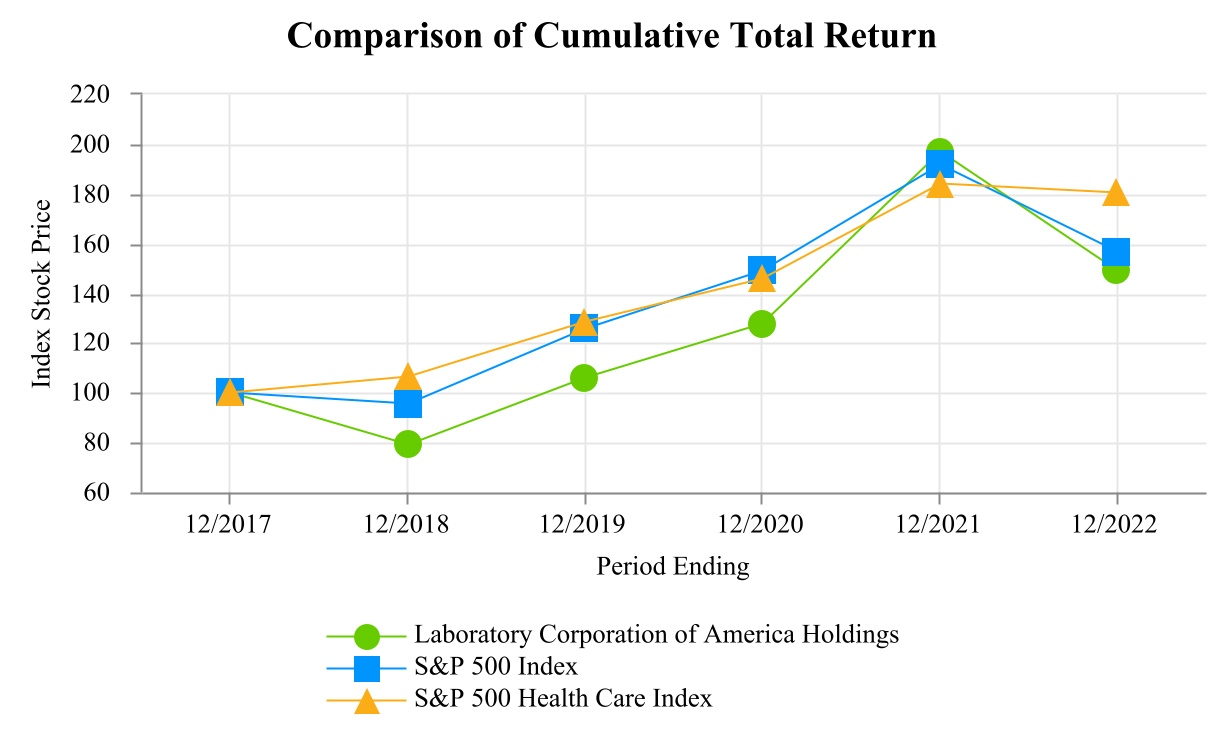
The graph below shows the cumulative total return assuming an investment of $100 on December 31, 2017, in each of the Company’s Common Stock, the Standard & Poor’s, or S&P Composite-500 Stock Index and the S&P 500 Health Care Index, or Peer Group, and assuming that all dividends were reinvested.
Comparison of Cumulative Total Return
| 12/2017 | 12/2018 | 12/2019 | 12/2020 | 12/2021 | 12/2022 | ||||||||||||||||||||||||||||||
| Laboratory Corporation of America Holdings | $ | 100.00 | $ | 79.22 | $ | 106.06 | $ | 127.61 | $ | 196.98 | $ | 148.91 | |||||||||||||||||||||||
| S&P 500 Index | $ | 100.00 | $ | 95.62 | $ | 125.72 | $ | 148.85 | $ | 191.58 | $ | 156.88 | |||||||||||||||||||||||
| S&P 500 Health Care Index | $ | 100.00 | $ | 106.47 | $ | 128.64 | $ | 145.93 | $ | 184.07 | $ | 180.47 |
Issuer Purchases of Equity Securities (all amounts in millions, except per share amounts)
The following table sets forth information with respect to purchases of shares of the Company’s common stock made during the quarter ended December 31, 2022, by or on behalf of the Company:
| Total Number of Shares Repurchased | Average Price Paid Per Share | Total Number of Shares Repurchased as Part of Publicly Announced Program | Maximum Dollar Value of Shares that May Yet Be Repurchased Under the Program | ||||||||||||||||||||
| October 1 - October 31 | 0.9 | $ | 211.91 | 0.9 | $ | 635.5 | |||||||||||||||||
| November 1 - November 30 | 0.5 | 225.65 | 0.5 | 531.5 | |||||||||||||||||||
| December 1 - December 31 | — | — | — | — | |||||||||||||||||||
| 1.4 | $ | 216.48 | 1.4 | $ | 531.5 |
During the fourth quarter of 2021, the Board adopted a new share repurchase plan authorizing repurchase of up to $2,500.0 of the Company's shares in addition to the remaining amount outstanding under the previous plan. On December 13, 2021, the Company entered into ASR Agreements with Goldman Sachs & Co. LLC and Barclays Bank PLC to repurchase the Company’s common stock (Common Stock), as part of the Company’s common stock repurchase program. Under the ASR Agreements, $1,000.0 was paid to the banks in December 2021 and the Company received 80% of the shares calculated at the price at the inception of the Agreements, approximately 2.7 shares. When the forward contract was settled during 2022, the Company received 0.9 shares, which were retired in 2022. At the end of 2021, the Company had outstanding authorization from the Board to purchase $1,631.5 of Company common stock.
During the year ended December 31, 2022, the Company purchased 4.7 shares of its common stock at an average price of $233.48 for a total cost of $1,100.0. When the Company repurchases shares, the amount paid to repurchase the shares in excess of the par or stated value is allocated to additional paid-in-capital unless subject to limitation or the balance in additional paid-in-capital is exhausted. Remaining amounts are recognized as a reduction in retained earnings. At the end of 2022, the Company had outstanding authorization from the Board to purchase up to $531.5 of the Company's common stock. The repurchase authorization has no expiration date.
On February 7, 2023, the board of directors adopted a new share repurchase plan authorizing up to $1,000.0 of the Company's shares in addition to the remaining amount outstanding under the previous plan. The repurchase authorization has no expiration.
Item 6. SELECTED FINANCIAL DATA
Not applicable.
Item 7. MANAGEMENT'S DISCUSSION AND ANALYSIS OF FINANCIAL CONDITION AND RESULTS OF OPERATIONS (in millions)
General
During the year ended December 31, 2022, the Company's revenues were $14.9 billion, a decrease of 7.7% from $16.1 billion in 2021. The decrease was due to lower organic revenue of 7.5% and foreign currency translation of 1.0%, partially offset by acquisitions net of divestitures of 0.8%. The 7.5% decrease in organic revenue was due to a 10.0% decrease in COVID-19 Testing, partially offset by a 2.5% increase in the Company's organic Base Business.
The Company defines organic growth as the increase in revenue excluding the year over year impact of acquisitions, divestitures, and currency. Acquisition and divestiture impact is considered for a twelve-month period following the close of each transaction. Base Business includes the Company's business operations except for COVID-19 Testing.
Strategic Review of Company Structure and Capital Allocation Strategy
In March 2021, the Company announced the undertaking of a comprehensive review by its board of directors (the Board) and management team of the Company's structure and capital allocation strategy. In December 2021, the Company announced the Board's conclusion, as well as actions that the management team and the Board would take to enhance shareholder returns. These actions have included:
-
initiating a dividend in the second quarter of 2022, as well as subsequent dividends paid in the third and fourth quarters of 2022, with total dividend payments for 2022 in the amount of $195.2 million;
-
authorizing a $2.50 billion share repurchase program. As part of this program, $1.0 billion was repurchased under an accelerated share repurchase plan in 2021, and a total of $1.1 billion of stock was repurchased in 2022, representing approximately 4.7 million shares;
-
implementing a new LaunchPad business process improvement initiative, targeting savings of $350.0 million through 2025;
-
providing a longer-term outlook in connection with the announcement of the Company's 2021 year-end results in addition to the Company's annual guidance;
-
providing additional business insights through enhanced disclosures beginning with the Company's results for the first quarter of 2022; and
-
continuing a commitment to profitable growth through investments in science, innovation, and new technologies; and
On July 28, 2022, the Company announced that it would pursue a planned spin-off of its Clinical Development and Commercialization Services (CDCS) business, as further discussed below.
Management and the Board are committed to continuing to evaluate all avenues for enhancing shareholder value.
The updated capital allocation plan is designed to enable the Company to continue investment in key growth areas. This plan is expected to fuel growth through innovation by using the Company's unique data and insights to bring scientific advancements—both those developed internally and those developed by outside companies and scientists—to market at scale. It reflects the Board's confidence in the Company's strong balance sheet and cash flow generation profile, as well as the Board's commitment to deploying capital to enhance value for shareholders, patients, providers, and pharmaceutical customers worldwide.
Spin-Off of the Company's CDCS Business
On July 28, 2022, the Company announced that the Board authorized the Company to pursue a spin-off of the Company’s wholly owned CDCS business to its shareholders through a tax-free transaction. The planned spin-off will result in two independent companies, each poised for strong, sustainable growth. On January 9, 2023, Thomas (Tom) Pike joined the Company as president and chief executive officer of its DD Clinical Development business unit, and when the planned spin-off is complete, Mr. Pike will become the chief executive officer and chairman of the board of directors of the independent, publicly listed company. On February 9, 2023, the Company announced that the name of the CDCS business will become Fortrea in connection with the planned spin-off.
The Company is targeting completion of the planned spin-off in mid-2023. The planned spin-off will be subject to the satisfaction of certain customary conditions, including, among others, the receipt of final approval by the Company's Board, the receipt of appropriate assurances regarding the tax-free nature of the separation and effectiveness of any required filings with the U.S. Securities and Exchange Commission (SEC). There can be no assurances regarding the ultimate timing of the transaction or that the spin-off will be completed.
When the transaction is complete, the resulting companies will be Labcorp, comprising the Company’s routine and esoteric labs, central labs and early development research labs, and Fortrea, a global contract research organization (CRO) providing Phase I-IV clinical trial management, market access and technology solutions to pharmaceutical and biotechnology organizations.
The planned spin-off is expected to provide each company with:
-
strengthened strategic flexibility and operational focus to pursue specific market opportunities and better meet customer needs;
-
focused capital structures and capital allocation strategies to drive innovation and growth;
-
a more targeted investment opportunity for different investor bases; and
-
the ability to align its particular incentive compensation with its financial performance.
Following the planned spin-off, the Company believes that Labcorp will be positioned to:
-
invest in R&D and innovation to develop and launch diagnostic advancements globally in key clinical areas including oncology, Alzheimer's, and autoimmune and liver disease through organic and inorganic opportunities;
-
bring together its global health and patient data and provide insights to enable customers to innovate;
-
utilize its worldwide laboratory network to serve a broad, growing and global customer base including pharmaceutical and biotechnology companies, physicians, health systems, consumers, and other start-ups and laboratories that require lab services or diagnostic testing; and
-
launch innovative tests globally, providing patients, physicians, health systems and pharmaceutical companies with access to its advanced science, technology and diagnostic capabilities.
Following the planned spin-off, the Company believes that Fortrea will be positioned to:
-
capitalize on growth opportunities across Phases I-IV clinical trials and extend its leadership in oncology, cell and gene therapy, rare disease, and other emerging therapeutic areas;
-
increase agility with large pharmaceutical and biotechnology clients to better serve customers and advance life-saving therapies;
-
access to unique data sets and insights through an arrangement with the Company for a defined period of time which will enable Fortrea to provide enhanced trial execution and a differentiated value proposition;
-
invest in capabilities, technologies, diverse talent and innovation to enhance trial execution and better serve all of its customers; and
-
implement a capital structure that is tailored to support its growth strategy and enhance stakeholder value.
The planned spin-off is intended to qualify as a tax-free transaction for U.S. federal income tax purposes. See “Risk Factors - Risks Related to the Planned Spin-off of the Company’s Clinical Development and Commercialization Services Business.”
Unless otherwise indicated, the disclosure in this Annual Report assumes that Clinical Development and Commercialization Services business will be with the Company for the full year.
COVID-19 Outlook
While the Company anticipates that COVID-19 will continue impacting its business in 2023 and potentially beyond, the Company expects a continued decline in demand for COVID-19 Testing, with the potential for increases in demand at different times and across different geographies. As a result, COVID-19 Testing demand in 2023 is not predicted to match 2022 levels.
Results of Operations
The following tables present the financial measures that management considers to be the most significant indicators of the Company's performance. For discussion of 2021 results and comparison with 2020 results refer to “Management's Discussion and Analysis of Financial Conditions and Results of Operations” in the Company's Annual Report on Form 10-K for the fiscal year ended December 31, 2021.
Years ended December 31, 2022 and 2021
Revenues
| Years Ended December 31, | |||||||||||||||||
| 2022 | 2021 | Change | |||||||||||||||
| Dx | $ | 9,203.5 | $ | 10,363.6 | (11.2) | % | |||||||||||
| DD | 5,710.2 | 5,845.5 | (2.3) | % | |||||||||||||
| Intercompany eliminations | (36.9) | (88.2) | 58.2 | % | |||||||||||||
| Total | $ | 14,876.8 | $ | 16,120.9 | (7.7) | % |
The 7.7% decrease in revenues for the year ended December 31, 2022, as compared to the corresponding period in 2021 was due to lower organic revenue of 7.5% and unfavorable foreign currency translation of 1.0%, partially offset by acquisitions net of divestitures of 0.8%. The 7.5% decrease in organic revenue was due to a 10.0% decrease in COVID-19 Testing, partially offset by a 2.5% increase in the Company's organic Base Business.
Dx revenues for the year ended December 31, 2022, were $9,203.5, a decrease of 11.2% compared to revenues of $10,363.6 in the corresponding period in 2021. The decrease was primarily due to lower organic revenue of 12.1% and unfavorable foreign currency translation of 0.1%, partially offset by acquisitions of 1.1%. The 12.1% decrease in organic revenue was due to a 15.6% decrease in COVID-19 Testing, partially offset by a 3.4% contribution from organic Base Business.
Total volume, measured by requisitions, decreased by 7.5% as organic volume decreased by 8.4% and acquisition volume contributed growth of 0.8%. Organic volume was impacted by a 10.4% decrease in COVID-19 Testing, partially offset by a 2.0% increase in Base Business. Price/mix decreased by 3.7% due to lower COVID-19 Testing of 5.2% and unfavorable foreign currency translation of 0.1%, partially offset by higher Base Business of 1.4% and acquisitions of 0.2%.
DD revenues for the year ended December 31, 2022, were $5,710.2, a decrease of 2.3% over revenues of $5,845.5 in the corresponding period in 2021. The decrease in revenues was primarily due to unfavorable foreign currency translation of 2.6% and lower COVID-19 Testing of 0.6%, partially offset by organic base business growth of 0.5%, and acquisitions net of divestitures of 0.3%.
Cost of Revenues
| Years Ended December 31, | |||||||||||||||||
| 2022 | 2021 | Change | |||||||||||||||
| Cost of revenues | $ | 10,491.7 | $ | 10,496.6 | — | % | |||||||||||
| Cost of revenues as a % of revenues | 70.5 | % | 65.1 | % |
Cost of revenues were flat in 2022 as compared with 2021 and increased as a percentage of revenues to 70.5% in 2022 as compared to 65.1% in 2021. This increase in cost of revenues as a percentage of revenues was primarily due to a reduction in
higher margin COVID-19 Testing, higher personnel expenses, and other inflationary costs, partially offset by organic Base Business growth and LaunchPad savings.
Selling, General and Administrative Expenses
| Years Ended December 31, | |||||||||||||||||
| 2022 | 2021 | Change | |||||||||||||||
| Selling, general and administrative expenses | $ | 1,996.6 | $ | 1,952.1 | 2.3 | % | |||||||||||
| SG&A as a % of revenues | 13.4 | % | 12.1 | % |
Selling, general and administrative expenses as a percentage of revenues increased to 13.4% in 2022 compared to 12.1% in 2021. The increase in selling, general and administrative expenses as a percentage of revenues is primarily due to a decrease in higher margin COVID-19 Testing and higher personnel costs, partially offset by LaunchPad savings.
Goodwill and Other Asset Impairments
| Years Ended December 31, | |||||||||||||||||
| 2022 | 2021 | Change | |||||||||||||||
| Goodwill and other asset impairments | $ | 271.5 | $ | — | 100.0% |
The 2022 impairment charges were primarily comprised of $260.0 of goodwill impairment for the early development reporting unit, which is part of the DD segment, and the impairment of a technology intangible asset. There were no goodwill and other asset impairments for the year ended December 31, 2021.
Amortization of Intangibles and Other Assets
| Years Ended December 31, | |||||||||||||||||
| 2022 | 2021 | Change | |||||||||||||||
| Amortization of intangibles and other assets | $ | 259.3 | $ | 369.6 | (29.8) | % |
The decrease in amortization of intangibles and other assets for the year ended December 31, 2022 is primarily due to $88.4 in amortization acceleration of certain intangible assets related to trade names as a result of the Company's rebranding initiative recognized during 2021, partially offset by the impact of acquisitions.
Restructuring and Other Charges
| Years Ended December 31, | ||||||||||||||||||||
| 2022 | 2021 | Change | ||||||||||||||||||
| Restructuring and other charges | $ | 83.8 | $ | 43.1 | 94.5 | % |
During 2022, the Company recorded net restructuring charges of $83.8. The charges were comprised of $39.3 in severance and other personnel costs, $45.7 in facility-related costs primarily associated with general integration activities. The charges were offset by the reversal of previously established liability of $0.3 in unused severance and $0.9 in unused facility-related costs.
During 2021, the Company recorded net restructuring charges of $43.1. The charges were comprised of $16.3 in severance and other personnel costs and $28.0 in facility closures, lease terminations, and general integration activities. The charges were offset by the reversal of previously established liability of $0.4 and $0.8 in unused severance costs and facility-related costs, respectively.
Interest Expense
| Years Ended December 31, | |||||||||||||||||
| 2022 | 2021 | Change | |||||||||||||||
| Interest expense | $ | 180.3 | $ | 212.1 | (15.0) | % |
The decrease in interest expense for 2022 as compared with the corresponding period in 2021 is primarily due to the costs of redeeming the outstanding 3.20% senior notes due February 1, 2022 and the 3.75% notes due August 23, 2022 and issuing the new senior notes in 2021 and lower outstanding debt partially offset by a higher average cost of debt in 2022.
Equity Method Income, Net
| Years Ended December 31, | |||||||||||||||||
| 2022 | 2021 | Change | |||||||||||||||
| Equity method income, net | $ | 5.4 | $ | 26.5 | (79.7) | % |
Equity method income, net represents the Company's ownership share in joint venture partnerships along with equity investments in other companies in the health care industry. The decrease in income for 2022 as compared with the corresponding period in 2021 was primarily due to the decreased profitability of the Company's joint ventures in 2022.
Other, Net
| Years Ended December 31, | |||||||||||||||||
| 2022 | 2021 | Change | |||||||||||||||
| Other, net | $ | (25.3) | $ | 42.5 | 159.8 | % |
The change in Other, net for the year ended December 31, 2022, as compared to the year ended December 31, 2021, was primarily due to investment losses of $19.6 compared to $61.8 of investment gains in the corresponding period of 2021. In addition, foreign currency transaction losses of $5.0 and $4.4 were recognized for the years ended December 31, 2022 and 2021, respectively.
Income Tax Expense
| Years Ended December 31, | |||||||||||
| 2022 | 2021 | ||||||||||
| Income tax expense | $ | 302.0 | $ | 747.1 | |||||||
| Income tax expense as a % of income before tax | 19.1 | % | 23.9 | % |
The current year effective tax rate was favorably impacted by the Company's research and development tax credits, changes in effective state income tax rates, and deferred tax adjustments. During the third quarter, the Company completed a detailed domestic research and development tax credit analysis for the 2019, 2020, and 2021 tax years that resulted in an incremental income tax benefit. The prior year effective tax rate was favorably impacted by stock-based compensation arrangements that was offset by the deferred revaluation related to the U.K. rate change.
Operating Results by Segment
During the fourth quarter of 2022, the Company modified the segment performance measure to exclude the amortization of intangibles and other assets, restructuring and other charges, goodwill and other asset impairments, and certain corporate charges for items such as transaction costs, COVID-19 costs, and other special items. These changes align with how the CODM now evaluates segment performance and allocates resources. Prior periods have been conformed for comparability.
| Years Ended December 31, | |||||||||||||||||
| 2022 | 2021 | Change | |||||||||||||||
| Dx segment operating income | $ | 2,025.5 | $ | 3,205.6 | (36.8) | % | |||||||||||
| Dx segment operating margin | 22.0 | % | 30.9 | % | (8.9) | % | |||||||||||
| DD segment operating income | 801.1 | 887.1 | (9.7) | % | |||||||||||||
| DD segment operating margin | 14.0 | % | 15.2 | % | (1.1) | % | |||||||||||
| Segment operating income | 2,826.6 | 4,092.7 | (30.9) | % | |||||||||||||
| General corporate and unallocated expenses | (438.1) | (420.5) | 4.2 | % | |||||||||||||
| Amortization of intangibles and other assets | (259.3) | (369.6) | (29.8) | % | |||||||||||||
| Restructuring and other charges | (83.8) | (43.1) | 94.4 | % | |||||||||||||
| Goodwill and other asset impairments | (271.5) | — | 100.0 | % | |||||||||||||
| Total operating income | $ | 1,773.9 | $ | 3,259.5 | (45.6) | % |
Dx operating income was $2,025.5 for the year ended December 31, 2022, a decrease of 36.8% over operating income of $3,205.6 in the corresponding period of 2021, and Dx operating margin decreased 890 basis points in operating margin year-over-year. The decrease in operating income and margin were primarily due to a reduction in COVID-19 Testing, higher personnel expense, the mix impact from Ascension, partially offset by organic Base Business growth.
DD operating income was $801.1 for the year ended December 31, 2022, a decrease of 9.7% from operating income of $887.1 in the corresponding period of 2021. The decrease was primarily due to a reduction in COVID-19 Testing, a reduction in COVID-19 related work, the interruption of some clinical trial activity due to the Ukraine/Russia crisis, and other inflationary costs. These impacts were partially offset by Base Business growth and LaunchPad savings.
General corporate expenses are comprised primarily of administrative services such as executive management, human resources, legal, finance, corporate affairs, and information technology. Corporate expenses were $438.1 for the year ended December 31, 2022, an increase of 4.2% over corporate expenses of $420.5 in the corresponding period of 2021, primarily due to higher personnel costs, bonus allocation, research and development costs, and other costs.
Liquidity, Capital Resources and Financial Position
The Company's strong cash-generating capability and financial condition typically have provided ready access to capital markets. The Company's principal source of liquidity is operating cash flow, supplemented by proceeds from debt offerings. The Company's senior unsecured revolving credit facility is further discussed in Note 10 Debt to the Company's Consolidated Financial Statements.
In summary the Company's cash flows were as follows:
| For the Year Ended December 31, | |||||||||||||||||
| 2022 | 2021 | ||||||||||||||||
| Net cash provided by operating activities | $ | 1,955.9 | $ | 3,109.6 | |||||||||||||
| Net cash used for investing activities | (1,652.2) | (884.6) | |||||||||||||||
| Net cash used for financing activities | (1,322.2) | (2,065.8) | |||||||||||||||
| Effect of exchange rate on changes in cash and cash equivalents | (24.2) | (7.3) | |||||||||||||||
| Net change in cash and cash equivalents | $ | (1,042.7) | $ | 151.9 |
Cash and Cash Equivalents
Cash and cash equivalents at December 31, 2022 and 2021 totaled $430.0 and $1,472.7, respectively. Cash and cash equivalents consist of highly liquid instruments, such as time deposits and other money market investments, which have original maturities of three months or less.
Cash Flows from Operating Activities
During the year ended December 31, 2022, the Company's operations provided $1,955.9 of cash as compared to $3,109.6 in 2021. The $1,153.7 decrease in cash provided from operations in 2022 as compared with the corresponding 2021 period was primarily due to lower cash earnings as COVID-19 revenues decreased significantly.
Cash Flows from Investing Activities
Net cash used by investing activities for the year ended December 31, 2022 was $1,652.2 as compared to net cash used by investing activities of $884.6 for the year ended December 31, 2021. The $767.6 increase in net cash used by investing activities for the year ended December 31, 2022, was primarily due to a year over year increase of $667.1 in cash paid for acquisitions. The Company had proceeds of $87.3 from the sale of assets and disposition of businesses during 2021 in comparison to $1.4 during 2022. Capital expenditures were $481.9 and $460.4 for the years ended December 31, 2022 and 2021, respectively. Capital expenditures in 2022 were 3.2% of revenues, primarily in connection with projects to support growth in the Company's core businesses. The Company intends to continue to pursue acquisitions to drive growth, to make important investments in its business, including in information technology, and to improve efficiency and enable the execution of the Company's mission. Such expenditures are expected to be funded by cash flow from operations or, as needed, through borrowings under debt facilities, including the Company's revolving credit facility or any successor facility. The Company expects capital expenditures in 2023 to be approximately 3.5% of revenues, primarily in connection with projects to support growth in the Company's core businesses, facility updates, projects related to LaunchPad, and further acquisition integration initiatives.
Cash Flows from Financing Activities
Net cash used in financing activities for the year ended December 31, 2022 was $1,322.2 compared to cash used in financing activities of $2,065.8 for the year ended December 31, 2021. This movement in cash within financing activities for 2022, as compared to 2021, was primarily a result of $1,100.0 in share repurchases in 2022 compared to $1,668.5 in 2021 and the commencement of quarterly dividend payments in the second quarter of 2022.
On May 26, 2021, the Company issued new senior notes representing $1,000.0 in debt securities and consisting of $500.0 aggregate principal amount of 1.55% senior notes due 2026 and $500.0 aggregate principal amount of 2.70% senior notes due 2031. Interest on these notes is payable semi-annually in arrears on June 1 and December 1 of each year, commencing on
December 1, 2021. Net proceeds from the offering of these notes were $989.4 after deducting underwriting discounts and other expenses of the offering. The net proceeds were used to redeem, prior to maturity, the Company's outstanding 3.20% senior notes due February 1, 2022 and 3.75% senior notes due August 23, 2022.
During the second quarter of 2021, the Company entered into fixed-to-variable interest rate swap agreements for its 2.70% senior notes due 2031 with an aggregate notional amount of $500.0 and variable interest rates based on three-month LIBOR plus 1.0706%. These instruments are designated as hedges against changes in the fair value of a portion of the Company's long-term debt. The aggregate fair value of $79.7 at December 31, 2022, was included as a component of other long-term liabilities and deducted from the reported value of the senior notes.
On April 30, 2021, the Company amended and restated its revolving credit facility. It consists of a five-year revolving facility in the principal amount of up to $1,000.0, with the option of increasing the facility by up to an additional $500.0, subject to the agreement of one or more new or existing lenders to provide such additional amounts and certain other customary conditions. The Company is required to pay a facility fee on the aggregate commitments under the revolving credit facility, at a per annum rate ranging from 0.100% to 0.225%, depending on the Company’s debt ratings. Borrowings under the revolving credit facility will accrue interest at a per annum rate equal to, at the Company’s election, either (x) a LIBOR rate plus a margin ranging from 0.775% to 1.275% or (y) a base rate plus a margin ranging from 0% to 0.275%, in each case, depending on the Company’s debt ratings.
The Company continues to evaluate its outstanding debt portfolio to take advantage of market conditions that would allow the Company to reduce its interest rate or financing risk and provide a lower long-term borrowing cost.
Under the Company's revolving credit facility, the Company is subject to negative covenants limiting subsidiary indebtedness and certain other covenants typical for investment grade-rated borrowers and the Company is required to maintain certain leverage ratios. The Company was in compliance with all covenants under the revolving credit facility at December 31, 2022, and expects that it will remain in compliance with its existing debt covenants for the next twelve months.
During 2022, the Company repurchased 5.6 shares of its common stock at an average price of $233.48 for a total cost of $1,100.0. This included 0.9 shares which were repurchased in 2022 but were part of the $1,000.0 ASR Program paid for in 2021. At the end of 2022, the Company had outstanding authorization from the Board to purchase $531.5 of Company common stock. The repurchase authorization has no expiration date. On February 7, 2023, the board of directors adopted a new share repurchase plan authorizing up to $1,000.0 of the Company's shares in addition to the remaining amount outstanding under the previous plan. The repurchase authorization has no expiration date.
For the year ended December 31, 2022, the Company paid $195.2 in common stock dividends. On January 12, 2023, the Company announced a cash dividend of $0.72 per share of common stock for the first quarter, or approximately $64.8 in the aggregate. The dividend will be payable on March 13, 2023, to stockholders of record of all issued and outstanding shares of common stock as of the close of business on February 23, 2023. The declaration and payment of any future dividends will be at the discretion of the Company's board of directors.
Credit Ratings
The Company’s investment grade debt ratings from Moody’s and Standard & Poor's (S&P) contribute to its ability to access capital markets.
Off-Balance Sheet Arrangements
The Company does not have transactions or relationships with “special purpose” entities, and the Company does not have any off-balance sheet financing other than normal operating leases and letters of credit.
Other Commercial Commitments
As of December 31, 2022, the Company provided letters of credit aggregating approximately $84.5, primarily in connection with certain insurance programs which are renewed annually.
The contractual value of the noncontrolling interest put in the Company's Ontario subsidiary totaled $15.0 and $16.3 at December 31, 2022, and 2021, respectively, and has been classified as mezzanine equity in the Company's consolidated balance sheet.
Based on current and projected levels of cash flows from operations, coupled with availability under its revolving credit facility, the Company believes it has sufficient liquidity to meet both its anticipated short-term and long-term cash needs for the next 12 months and the reasonably foreseeable future; however, the Company continually reassesses its liquidity position in light of market conditions and other relevant factors.
Critical Accounting Estimates
The preparation of financial statements in conformity with generally accepted accounting principles requires management to make estimates and assumptions that affect the reported amounts of assets and liabilities and disclosure of contingent assets and liabilities at the date of the financial statements and the reported amounts of revenues and expenses during the reported periods. While the Company believes these estimates are reasonable and consistent, they are by their very nature estimates of amounts that will depend on future events. Accordingly, actual results could differ from these estimates. The Company’s Audit Committee periodically reviews the Company’s significant accounting policies. The Company’s critical accounting policies arise in conjunction with the following:
-
Revenue recognition;
-
Business combinations;
-
Income taxes;
-
Goodwill and indefinite-lived assets; and
-
Legal contingencies.
Revenue Recognition
Dx
Within the Dx segment, a revenue transaction is initiated when Dx receives a requisition order to perform a diagnostic test. The information provided on the requisition form is used to determine the party that will be billed for the testing performed and the expected reimbursement. Dx recognizes revenue and satisfies its performance obligation for services rendered when the testing process is complete and the associated results are reported. Revenues are distributed among four payer portfolios - clients, patients, Medicare and Medicaid and third party. Dx considers negotiated discounts and anticipated adjustments, including historical collection experience for the payer portfolio, when revenues are recorded.
The following are descriptions of the Dx payer portfolios:
Clients
Client payers represent the portion of Dx’s revenue related to physicians, hospitals, health systems, accountable care organizations (ACOs), employers and other entities where payment is received exclusively from the entity ordering the testing service. Generally, client revenues are recorded on a fee-for-service basis at Dx’s client list price, less any negotiated discount. A portion of client billing is for laboratory management services, collection kits and other non-testing services or products. In these cases, revenue is recognized when services are rendered or delivered.
Patients
This portfolio includes revenue from uninsured patients and member cost-share for insured patients (e.g., coinsurance, deductibles and non-covered services). Uninsured patients are billed based upon Dx’s patient fee schedules, net of any discounts negotiated with physicians on behalf of their patients. Dx bills insured patients as directed by their health plan and after consideration of the fees and terms associated with an established health plan contract.
Medicare and Medicaid
This portfolio relates to fee-for-service revenue from traditional Medicare and Medicaid programs. Net revenue from these programs is based on the fee schedule established by the related government authority. In addition to contractual discounts, other adjustments including anticipated payer denials are considered when determining net revenue. Any remaining adjustments to revenue are recorded at the time of final collection and settlement. These adjustments are not material to Dx’s results of operations in any period presented.
Third Party
Third party includes revenue related to MCOs. The majority of Dx's third-party revenue is reimbursed on a fee-for-service basis. These payers are billed at Dx's established list price and revenue is recorded net of contractual discounts. The majority of Dx’s MCO revenues are recorded based upon contractually negotiated fee schedules with revenues for non-contracted MCOs recorded based on historical reimbursement experience.
Third-party reimbursement is also received through capitation agreements with MCOs and independent physician associations (IPAs). Under capitated agreements, revenue is recognized based on a negotiated per-member, per-month payment for an agreed upon menu of tests, or based upon the proportionate share earned by Dx from a capitation pool. When the agreed upon reimbursement is based solely on an established rate per member, revenue is not impacted by the volume of testing performed. Under a capitation pool arrangement, the aggregate value of an established rate per member is distributed based on
the volume and complexity of the procedures performed by laboratories participating in the agreement. Dx recognizes revenue monthly, based upon the established capitation rate or anticipated distribution from a capitated pool.
Dx has a formal process to estimate implicit price concessions for uncollectable accounts. The majority of Dx's collection risk is related to accounts receivable from both insured and uninsured patients who are unwilling or unable to pay. Anticipated write-offs are recorded as adjustments to revenue at an amount considered necessary to record the segment's revenue at its net realizable value. In addition to contractual discounts, other adjustments including anticipated payer denials and other external factors that could affect the collectability of its receivables are considered when determining revenue and the net receivable amount. Any remaining adjustments to revenue are recorded at the time of final collection and settlement. These adjustments are not material to Dx's results of operations in any period presented.
DD
A majority of DD’s revenues are earned under contracts that are long term in nature, ranging in duration from a few months to many years. The majority of DD's contracts contain a single performance obligation, as DD provides a significant service of integrating all promises in the contract and the promises are highly interdependent and interrelated with one another. For contracts that include multiple performance obligations, DD allocates the contract value to the goods and services based on a customer price list, if available. If a price list is not available, DD will estimate the transaction price using either market prices or an “expected cost plus margin” approach. The total contract value is estimated at the beginning of the contract, and is equal to the amount expected to be billed to the customer. Other payments and billing adjustments may also factor into the calculation of total contract value, such as the reimbursement of out-of-pocket costs and volume-based rebates. These contracts generally take the form of fixed-price or fee-for-service arrangements subject to pricing adjustments based on changes in scope.
Fixed-price contracts are typically recognized as revenue over time based on a proportional-performance basis, using either input or output methods that are specific to the service provided. In an output method, revenue is determined by dividing the actual units of output achieved by the total units of output required under the contract and multiplying that percentage by the total contract value. When using an input method, revenue is recognized by dividing the actual costs incurred by the total estimated cost expected to complete the contract, and multiplying that percentage by the total contract value. Contract costs principally include direct labor and reimbursable out-of-pocket costs. The estimate of total costs expected to complete the contract requires significant judgment and estimates are based on various assumptions of events that often span several years. These estimates are reviewed periodically and any adjustments are recognized on a cumulative catch-up basis in the period they become known.
Fee-for-service contracts are typically priced based on transaction volume or time and materials. For volume based contracts the contract value is entirely variable and revenue is recognized as the specific product or service is completed. For services billed based on time and materials, revenue is recognized using the right to invoice practical expedient.
Contracts are often modified to account for changes in contract specifications and requirements. Generally, when contract modifications create new performance obligations, the modification is considered to be a separate contract and revenue is recognized prospectively. When contract modifications change existing performance obligations, the impact on the existing transaction price and measure of progress for the performance obligation to which it relates is generally recognized as an adjustment to revenue (either as an increase in or a reduction of revenue) on a cumulative catch-up basis.
Most contracts are terminable with or without cause by the customer, either immediately or upon notice. These contracts often require payment to DD of expenses to wind-down the study or project, fees earned to date and, in some cases, a termination fee or a payment to DD of some portion of the fees or profits that could have been earned by DD under the contract if it had not been terminated early. Termination fees are included in revenues when services are performed and realization is assured.
Business Combinations
The Company accounts for business combination transactions under the acquisition method of accounting and reported the results of operations of the acquired entities from its respective date of acquisition. Assets acquired were recorded at their estimated fair values as of the acquisition date. Estimated fair values were based on various valuation methodologies, including an income approach using primarily discounted cash flow techniques for the customer relationships intangible assets. The aforementioned income methods utilize management's estimates of future operating results and cash flows discounted using a weighted-average cost of capital that reflects market participant assumptions. The excess of the fair value of the consideration conveyed over the fair value of the assets acquired was recorded as goodwill. The goodwill reflects management's expectations of the ability to gain access to and penetrate the acquired entities' historical patient base and the benefits of being able to leverage operational efficiencies with favorable growth opportunities based on positive demographic trends in the market.
Income Taxes
The Company accounts for income taxes utilizing the asset and liability method. Under this method, deferred tax assets and liabilities are recognized for the future tax consequences attributable to differences between the financial statement carrying amounts of existing assets and liabilities and their respective tax bases and for tax loss carryforwards. Deferred tax assets and liabilities are measured using enacted tax rates expected to apply to taxable income in the years in which those temporary differences are expected to be recovered or settled. The effect on deferred tax assets and liabilities of a change in tax rates is recognized in income in the period that includes the enactment date. The Company does not recognize a tax benefit, unless the Company concludes that it is more likely than not that the benefit will be sustained on audit by the taxing authority based solely on the technical merits of the associated tax position. If the recognition threshold is met, the Company recognizes a tax benefit measured at the largest amount of the tax benefit that the Company believes is greater than 50% likely to be realized. The Company records interest and penalties in income tax expense.
Goodwill and Indefinite-Lived Assets
The Company assesses goodwill and indefinite-lived intangibles for impairment at least annually or whenever events or changes in circumstances indicate that the carrying amount of such assets may not be recoverable. The annual impairment test for goodwill includes an option to perform a qualitative assessment of whether it is more likely than not that a reporting unit's fair value is less than its carrying value. Reporting units are businesses with discrete financial information that is available and reviewed by management. If the Company determines that it is more likely than not that the fair value of a reporting unit is less than its carrying value, then the Company performs the quantitative goodwill impairment test. The Company may also choose to bypass the qualitative assessment for any reporting unit in its goodwill assessment and proceed directly to performing the quantitative assessment. The Company recognizes an impairment charge for the amount by which the reporting unit's carrying amount exceeds its fair value.
In the qualitative assessment, the Company considers relevant events and circumstances for each reporting unit, including (i) current year results, (ii) financial performance versus management’s annual and five-year strategic plans, (iii) changes in the reporting unit carrying value since prior year, (iv) industry and market conditions in which the reporting unit operates, (v) macroeconomic conditions, including discount rate changes, and (vi) changes in products or services offered by the reporting unit. If applicable, performance in recent years is compared to forecasts included in prior quantitative valuations. Based on the results of the qualitative assessment, if the Company concludes that it is not more likely than not that the fair value of the reporting unit is less than its carrying values of the reporting unit, then no quantitative assessment is performed.
The quantitative assessment includes the estimation of the fair value of each reporting unit as compared to the carrying value of the reporting unit. The Company estimates the fair value of a reporting unit using both income-based and market-based valuation methods. The income-based approach is based on the reporting unit's forecasted future cash flows that are discounted to the present value using the reporting unit's weighted average cost of capital. For the market-based approach, the Company utilizes a number of factors such as publicly available information regarding the market capitalization of the Company as well as operating results, business plans, market multiples, and present value techniques. Based upon the range of estimated values developed from the income and market-based methods, the Company determines the estimated fair value for the reporting unit. If the estimated fair value of the reporting unit exceeds the carrying value, the goodwill is not impaired and no further review is required.
The income-based fair value methodology requires management's assumptions and judgments regarding economic conditions in the markets in which the Company operates and conditions in the capital markets, many of which are outside of management's control. At the reporting unit level, fair value estimation requires management's assumptions and judgments regarding the effects of overall economic conditions on the specific reporting unit, along with assessment of the reporting unit's strategies and forecasts of future cash flows. Forecasts of individual reporting unit cash flows involve management's estimates and assumptions regarding:
-
Annual cash flows, on a debt-free basis, arising from future revenues and profitability, changes in working capital, capital spending and income taxes for at least a five-year forecast period.
-
A terminal growth rate for years beyond the forecast period. The terminal growth rate is selected based on consideration of growth rates used in the forecast period, historical performance of the reporting unit and economic conditions.
-
A discount rate that reflects the risks inherent in realizing the forecasted cash flows. A discount rate considers the risk-free rate of return on long-term treasury securities, the risk premium associated with investing in equity securities of comparable companies, the beta obtained from the comparable companies and the cost of debt for investment grade issuers. In addition, the discount rate may consider any company-specific risk in achieving the prospective financial information.
Under the market-based fair value methodology, judgment is required in evaluating market multiples and recent transactions. Management believes that the assumptions used for its impairment tests are representative of those that would be used by market participants performing similar valuations of the reporting units.
Management performed its annual goodwill and intangible asset impairment testing as of the beginning of the fourth quarter of 2022. The Company elected to perform the qualitative assessment for goodwill and intangible assets for the domestic Dx reporting units and a quantitative assessment for all of the DD reporting units and the Canadian reporting unit which includes indefinite-lived assets consisting of acquired Canadian licenses. Based upon the results of the qualitative and quantitative assessments, the Company concluded that the fair values of each of its reporting units, as of October 1, 2022, were greater than the carrying values. For the early development reporting unit, which is part of the DD segment, the fair value of the business exceeded the book value by approximately 10%.
In December 2022, a significant supplier of our early development reporting unit was no longer able to provide critical testing supplies resulting in an expectation of lower near term revenue and profitability and potential higher future costs. Based on this information, management prepared a new forecast and updated its impairment testing valuations as of December 31, 2022. Based on the quantitative impairment assessment performed in the same manner as the Company's annual quantitative assessment, the Company concluded that the fair value was less than carrying value for the early development reporting unit and recorded a goodwill impairment of $260.0 in the DD segment.
Although the Company believes that the current assumptions and estimates used in its goodwill analysis are reasonable, supportable, and appropriate, continued efforts to maintain or improve the performance of these businesses could be impacted by unfavorable or unforeseen changes which could impact the existing assumptions used in the impairment analysis. Various factors could reasonably be expected to unfavorably impact existing assumptions: primarily delays in new customer bookings and the related delay in revenue from new customers, increases in customer termination activity or increases in operating costs. Accordingly, there can be no assurance that the estimates and assumptions made for the purposes of the goodwill impairment analysis will prove to be accurate predictions of future performance. It is possible that the Company's conclusions regarding impairment or recoverability of goodwill or intangible assets in any reporting unit could change in future periods. There can be no assurance that the estimates and assumptions used in the Company's goodwill and intangible asset impairment testing performed as of the beginning of the fourth quarter of 2022 or at the end of the year will prove to be accurate predictions of the future, if, for example, (i) the businesses do not perform as projected, (ii) overall economic conditions in 2022 or future years vary from current assumptions (including changes in discount rates), (iii) business conditions or strategies for a specific reporting unit change from current assumptions, including loss of major customers, (iv) investors require higher rates of return on equity investments in the marketplace or (v) enterprise values of comparable publicly traded companies, or actual sales transactions of comparable companies, were to decline, resulting in lower multiples of revenues and EBITDA.
Legal Contingencies
The Company is involved from time to time in various claims and legal actions, including arbitrations, class actions, and other litigation (including those described in more detail below), arising in the ordinary course of business. These matters include, but are not limited to, intellectual property disputes, commercial and contract disputes, professional liability claims, employee-related matters, transaction related disputes, securities and corporate law matters, and inquiries, including subpoenas and other civil investigative demands, from governmental agencies, Medicare or Medicaid payers and MCOs reviewing billing practices or requesting comment on allegations of billing irregularities that are brought to their attention through billing audits or third parties.
The Company also is named from time to time in suits brought under the qui tam provisions of the False Claims Act and comparable state laws. These suits typically allege that the Company has made false statements and/or certifications in connection with claims for payment from U.S. federal or state healthcare programs. The suits may remain under seal (hence, unknown to the Company) for some time while the government decides whether to intervene on behalf of the qui tam plaintiff. Such claims are an inevitable part of doing business in the healthcare field today.
The Company believes that it is in compliance in all material respects with all statutes, regulations, and other requirements applicable to its commercial laboratory operations and drug development support services. The healthcare diagnostics and drug development industries are, however, subject to extensive regulation, and the courts have not interpreted many of the applicable statutes and regulations. Therefore, the applicable statutes and regulations could be interpreted or applied by a prosecutorial, regulatory, or judicial authority in a manner that would adversely affect the Company. Potential sanctions for violation of these statutes and regulations include significant civil and criminal penalties, fines, the loss of various licenses, certificates and authorizations, additional liabilities from third-party claims, and/or exclusion from participation in government programs.
The Company records an aggregate legal reserve, which is determined using calculations based on historical loss rates and assessment of trends experienced in settlements and defense costs. In accordance with FASB Accounting Standards
Codification Topic 450 “Contingencies,” the Company establishes reserves for judicial, regulatory, and arbitration matters outside the aggregate legal reserve if and when those matters present loss contingencies that are both probable and estimable and would exceed the aggregate legal reserve. If the reasonable estimate of a known or probable loss is a range, and no amount within the range is a better estimate than any other, the minimum amount of the range is accrued. If a loss is reasonably possible but not known or probable, and may be reasonably estimated, the estimated loss or range of loss is disclosed. For more information about legal contingencies, see Note 14 Commitments and Contingencies to the Consolidated Financial Statements.
Item 7A. QUANTITATIVE AND QUALITATIVE DISCLOSURE ABOUT MARKET RISK (in millions)
Market risk is the potential loss arising from adverse changes in market rates and prices, such as foreign currency exchange rates, interest rates and other relevant market rate or price changes. In the ordinary course of business, the Company is exposed to various market risks, including changes in foreign currency exchange and interest rates, and the Company regularly evaluates the exposure to such changes. The Company addresses its exposure to market risks, principally the market risks associated with changes in foreign currency exchange rates and interest rates, through a controlled program of risk management that includes, from time to time, the use of derivative financial instruments such as foreign currency forward contracts, cross currency swaps and interest rate swap agreements. The Company does not hold or issue derivative financial instruments for trading purposes.
Foreign Currency Exchange Rates
Approximately 14.7% and 15.3% of the Company's revenues for the year ended December 31, 2022 and 2021, respectively, were denominated in currencies other than the U.S. dollar (USD). The Company's financial statements are reported in USD and, accordingly, fluctuations in exchange rates will affect the translation of revenues and expenses denominated in foreign currencies into USD for purposes of reporting the Company's consolidated financial results. In both 2022 and 2021, the most significant currency exchange rate exposures were to the Canadian dollar, Swiss franc, euro and British pound. Excluding the impacts from any outstanding or future hedging transactions, a hypothetical change of 10% in average exchange rates used to translate all foreign currencies to USD would have impacted income before income taxes for 2022 by approximately $26.9. Gross accumulated currency translation adjustments recorded as a separate component of shareholders’ equity were $(336.4) and $(104.6) at December 31, 2022, and 2021, respectively. The Company does not have significant operations in countries in which the economy is considered to be highly inflationary.
The Company earns revenue from service contracts over a period of several months and, in some cases, over a period of several years. Accordingly, exchange rate fluctuations during this period may affect the Company's profitability with respect to such contracts. The Company is also subject to foreign currency transaction risk for fluctuations in exchange rates during the period of time between the consummation and cash settlement of transactions. The Company limits its foreign currency transaction risk through exchange rate fluctuation provisions stated in some of its contracts with customers, or it may hedge transaction risk with foreign currency forward contracts. At December 31, 2022, the Company had 27 open foreign exchange forward contracts with various amounts maturing monthly through January 2023 with a notional value totaling approximately $629.5. At December 31, 2021, the Company had 28 open foreign exchange forward contracts with various amounts maturing monthly through January 2022 with a notional value totaling approximately $600.7.
The Company is party to USD to Swiss Franc cross-currency swap agreements with a notional amount of $600.0, maturing in 2024 and 2025, as a hedge against the impact of foreign exchange movements on its net investment in its Swiss Franc functional currency subsidiary.
Interest Rates
Some of the Company's debt is subject to interest at variable rates. As a result, fluctuations in interest rates affect the Company's financial results. The Company attempts to manage interest rate risk and overall borrowing costs through an appropriate mix of fixed and variable rate debt including the utilization of derivative financial instruments, primarily interest rate swaps.
Borrowings under the Company's term loan credit facilities and revolving credit facility are subject to variable interest rates, unless fixed through interest rate swaps or other agreements.
In May, 2021, to hedge against changes in the fair value portion of the Company's long-term debt, the Company entered into fixed-to-variable interest rate swap agreements for the 2.70% senior notes due 2031 with an aggregate notional value of $500.0 and variable interest rates based on three-month LIBOR plus 1.0706%.
Item 8. FINANCIAL STATEMENTS AND SUPPLEMENTARY DATA
The consolidated financial statements of the Company required in this item are set forth beginning on page F-1 of this Annual Report on Form 10-K.
Item 9. CHANGES IN AND DISAGREEMENTS WITH ACCOUNTANTS ON ACCOUNTING AND FINANCIAL DISCLOSURE
None.
Item 9A. CONTROLS AND PROCEDURES
Disclosure Controls and Procedures
As of the end of the period covered by this Annual Report, the Company carried out under the supervision and with the participation of the Company’s management, including the Company’s principal executive officer and principal financial officer, an evaluation of the effectiveness of the Company's disclosure controls and procedures (as defined in Rules 13a-15(e) and 15d-15(e) under the Securities Exchange Act of 1934, as amended). Based upon this evaluation, the Company’s principal executive officer and principal financial officer concluded that the Company’s disclosure controls and procedures were effective as of the end of the period covered by this Annual Report.
Changes in Internal Control over Financial Reporting
There have been no changes in the Company’s internal control over financial reporting (as defined in Exchange Act Rules 13a-15(f) and 15d-15(f)) during the quarter ended December 31, 2022, that have materially affected, or are reasonably likely to materially affect, the Company’s internal control over financial reporting.
Report of Management on Internal Control over Financial Reporting
The Company's management is responsible for establishing and maintaining adequate internal control over financial reporting (as defined in Rules 13a-15(f) and 15d-15(f) under the Securities Exchange Act of 1934).
The internal control over financial reporting at the Company was designed to provide reasonable assurance regarding the reliability of financial reporting and the preparation of financial statements for external purposes in accordance with accounting principles generally accepted in the U.S. Internal control over financial reporting includes those policies and procedures that:
-
pertain to the maintenance of records that, in reasonable detail, accurately and fairly reflect the transactions and dispositions of the assets of the Company;
-
provide reasonable assurance that transactions are recorded as necessary to permit preparation of financial statements in accordance with accounting principles generally accepted in the U.S.;
-
provide reasonable assurance that receipts and expenditures of the Company are being made only in accordance with authorization of management and directors of the Company; and
-
provide reasonable assurance regarding prevention or timely detection of unauthorized acquisition, use or disposition of assets that could have a material effect on the consolidated financial statements.
Because of its inherent limitations, internal control over financial reporting may not prevent or detect misstatements.
The Company's management assessed the effectiveness of the Company’s internal control over financial reporting as of December 31, 2022. Management based this assessment on criteria for effective internal control over financial reporting described in “Internal Control - Integrated Framework 2013” issued by the Committee of Sponsoring Organizations of the Treadway Commission (COSO). Based on this assessment, the Company's management determined that, as of December 31, 2022, the Company maintained effective internal control over financial reporting. Management reviewed the results of its assessment with the Audit Committee of the Company’s Board.
Deloitte and Touche LLP, an independent registered public accounting firm, who audited and reported on the consolidated financial statements of the Company included in this Annual Report, also audited the effectiveness of the Company’s internal control over financial reporting as of December 31, 2022, as stated in its report, which is included herein immediately preceding the Company’s audited financial statements.
Item 9B. OTHER INFORMATION
None.
Item 9C. DISCLOSURE REGARDING FOREIGN JURISDICTIONS THAT PREVENT INSPECTIONS
Item 10. DIRECTORS, EXECUTIVE OFFICERS AND CORPORATE GOVERNANCE
The information required by the item regarding directors is incorporated by reference to the Company’s Definitive Proxy Statement to be filed with the Securities and Exchange Commission in connection with the Annual Meeting of Stockholders to be held in 2023 (the 2023 Proxy Statement) under the caption Election of Directors. Information regarding executive officers is incorporated by reference to the Company’s 2023 Proxy Statement under the caption Executive Officers. Information concerning the Company’s Audit Committee, including the designation of audit committee financial experts is incorporated by reference to the Company’s 2023 Proxy Statement under the captions Corporate Governance and Delinquent Section 16(a) Reports, respectively. Information concerning the Company's code of ethics is incorporated by reference to the Company's 2023 Proxy Statement under the caption Corporate Governance Policies and Procedures.
Item 11. EXECUTIVE COMPENSATION
The information required by this item is incorporated by reference to information in the 2023 Proxy Statement under the captions “Executive Compensation” and “Director Compensation.”
Item 12. SECURITY OWNERSHIP OF CERTAIN BENEFICIAL OWNERS AND MANAGEMENT AND RELATED STOCKHOLDER MATTERS
See Note 13 Stock Compensation Plans to the Consolidated Financial Statements for a discussion of the Company’s Stock Compensation Plans. Except for the above referenced footnote, the information called for by this item is incorporated by reference to information in the 2023 Proxy Statement under the captions “Security Ownership of Certain Beneficial Holders and Management,” “Compensation Discussion & Analysis” and “Executive Compensation.”
Item 13. CERTAIN RELATIONSHIPS AND RELATED TRANSACTIONS, AND DIRECTOR INDEPENDENCE
The information required by this item is incorporated by reference to information in the 2023 Proxy Statement under the captions “Board Independence” and “Related Party Transactions.”
Item 14. PRINCIPAL ACCOUNTANT FEES AND SERVICES
The information required by this item is incorporated by reference to information in the 2023 Proxy Statement under the caption “Fees to Independent Registered Public Accounting Firm.”
PART IV
Item 15. EXHIBITS AND FINANCIAL STATEMENT SCHEDULES
(a) List of documents filed as part of this Annual Report:
| (1) | Consolidated Financial Statements and Report of Independent Registered Public Accounting Firm included herein: | ||||
| See Index on page F-1 | |||||
| (2) | Financial Statement Schedules: | ||||
| All schedules are omitted as they are inapplicable or the required information is furnished in the Consolidated Financial Statements or notes thereto. | |||||
| (3) | Index to and List of Exhibits | ||||
Item 16. FORM 10-K SUMMARY
None.
SIGNATURES
Pursuant to the requirements of Section 13 or 15(d) of the Securities Exchange Act of 1934, the registrant has duly caused this Annual Report to be signed on its behalf by the undersigned, thereunto duly authorized.
LABORATORY CORPORATION OF AMERICA HOLDINGS
Registrant
| By: | /s/ ADAM H. SCHECHTER | ||||||||||
| Adam H. Schechter | |||||||||||
| President and Chief Executive Officer | |||||||||||
| Dated: | February 28, 2023 |
Pursuant to the requirements of the Securities Exchange Act of 1934, this Annual Report has been signed below by the following persons on behalf of the registrant on February 28, 2023 in the capacities indicated.
| Signature | Title | |||||||
| /s/ ADAM H. SCHECHTER | President and Chief Executive Officer | |||||||
| Adam H. Schechter | (Principal Executive Officer) | |||||||
| /s/ GLENN A. EISENBERG | Executive Vice President, Chief Financial Officer | |||||||
| Glenn A. Eisenberg | (Principal Financial Officer) | |||||||
| /s/ PETER J. WILKINSON | Senior Vice President and Chief Accounting Officer | |||||||
| Peter J. Wilkinson | (Principal Accounting Officer) | |||||||
| * | Director | |||||||
| Kerrii B. Anderson | ||||||||
| * | Director | |||||||
| Jean-Luc Bélingard | ||||||||
| * | Director | |||||||
| Jeffrey A. Davis | ||||||||
| * | Director | |||||||
| D. Gary Gilliland, M.D., Ph.D. | ||||||||
| * | Director | |||||||
| Kirsten M. Kliphouse | ||||||||
| * | Director | |||||||
| Garheng Kong, M.D., Ph.D. | ||||||||
| * | Director | |||||||
| Peter M. Neupert | ||||||||
| * | Director | |||||||
| Richelle Parham | ||||||||
| * | Director | |||||||
| Kathryn E. Wengel | ||||||||
| * | Director | |||||||
| R. Sanders Williams, M.D. | ||||||||
- Sandra van der Vaart, by her signing her name hereto, does hereby sign this Annual Report on behalf of the directors of the Registrant after whose typed names asterisks appear, pursuant to powers of attorney duly executed by such directors and filed with the Securities and Exchange Commission.
| By: | /s/ Sandra van der Vaart | |||||||
| Sandra van der Vaart | ||||||||
| Attorney-in-fact |
LABORATORY CORPORATION OF AMERICA HOLDINGS AND SUBSIDIARIES
INDEX TO CONSOLIDATED FINANCIAL STATEMENTS
F-1
REPORT OF INDEPENDENT REGISTERED PUBLIC ACCOUNTING FIRM
To the shareholders and Board of Directors of Laboratory Corporation of America Holdings
Opinion on the Financial Statements
We have audited the accompanying consolidated balance sheet of Laboratory Corporation of America Holdings and subsidiaries (the “Company”) as of December 31, 2022 and 2021, the related consolidated statements of operations, comprehensive earnings, changes in shareholders’ equity, and cash flows for each of the two years in the period ended December 31, 2022, and the related notes (collectively referred to as the “financial statements”). In our opinion, the financial statements present fairly, in all material respects, the financial position of the Company as of December 31, 2022 and 2021, and the results of its operations and its cash flows for each of the two years in the period ended December 31, 2022, in conformity with accounting principles generally accepted in the United States of America.
We have also audited, in accordance with the standards of the Public Company Accounting Oversight Board (United States) (PCAOB), the Company’s internal control over financial reporting as of December 31, 2022, based on criteria established in Internal Control – Integrated Framework (2013) issued by the Committee of Sponsoring Organizations of the Treadway Commission and our report dated February 28, 2023, expressed an unqualified opinion on the Company’s internal control over financial reporting.
Basis for Opinion
These financial statements are the responsibility of the Company’s management. Our responsibility is to express an opinion on the Company’s financial statements based on our audits. We are a public accounting firm registered with the PCAOB and are required to be independent with respect to the Company in accordance with the U.S. federal securities laws and the applicable rules and regulations of the Securities and Exchange Commission and the PCAOB.
We conducted our audits in accordance with the standards of the PCAOB. Those standards require that we plan and perform the audit to obtain reasonable assurance about whether the financial statements are free of material misstatement, whether due to error or fraud. Our audits included performing procedures to assess the risks of material misstatement of the financial statements, whether due to error or fraud, and performing procedures that respond to those risks. Such procedures included examining, on a test basis, evidence regarding the amounts and disclosures in the financial statements. Our audits also included evaluating the accounting principles used and significant estimates made by management, as well as evaluating the overall presentation of the financial statements. We believe that our audits provide a reasonable basis for our opinion.
Critical Audit Matters
The critical audit matters communicated below are matters arising from the current-period audit of the financial statements that were communicated or required to be communicated to the audit committee and that (1) relate to accounts or disclosures that are material to the financial statements and (2) involved our especially challenging, subjective, or complex judgments. The communication of critical audit matters does not alter in any way our opinion on the financial statements, taken as a whole, and we are not, by communicating the critical audit matters below, providing separate opinions on the critical audit matters or on the accounts or disclosures to which they relate.
Revenue Recognition for Full-Service Clinical Trial Contracts— Refer to Note 2 to the financial statements
Critical Audit Matter Description
Within the Drug Development (DD) segment, the Company provides Phase I through Phase IV clinical development services to pharmaceutical, biotechnology, and medical device companies worldwide. A majority of the Company’s revenues are earned under contracts that are long term in nature, ranging in duration from a few months to many years. The majority of the Company's contracts contain a single performance obligation, as the Company provides a significant service of integrating all promises in the contract and the promises are highly interdependent and interrelated with one another.
Fixed-price contracts are typically recognized as revenue over time based on a proportional-performance basis, using either input or output methods that are specific to the service provided. When using an input method, revenue is recognized by dividing the actual costs incurred by the total estimated contract costs expected to complete the contract and multiplying that percentage by the total contract value. Contract costs principally include direct labor and reimbursable out-of-pocket costs. The estimate of total costs expected to complete the contract requires significant judgment and estimates are based on various
F-2
assumptions of events that often span several years. These estimates are reviewed periodically, and any adjustments are recognized on a cumulative catch-up basis in the period they become known.
Given the judgments necessary to recognize revenue for fixed-price contracts that use an input method based on estimated total costs, auditing such estimates required extensive audit effort due to the complexity of these contracts and a high degree of auditor judgment when performing audit procedures and evaluating the results of those procedures.
How the Critical Audit Matter Was Addressed in the Audit
Our audit procedures related to management’s estimates of costs for purposes of revenue recognition for full-service contracts which use an input method based on estimated total contract costs and included the following, among others:
-
We tested the effectiveness of controls over fixed-price contract revenue, including those over the estimates of total contract costs related to the performance obligation.
-
We selected a sample of long-term contracts and performed the following:
◦Evaluated whether the contracts were properly accounted for by management based on the terms and conditions of each contract, including whether over time revenue recognition was appropriate.
◦Compared the transaction prices to the consideration expected to be received based on current rights and obligations under the contracts and any contract modifications that were agreed upon with the customers.
◦Evaluated management’s identification of distinct performance obligations by assessing whether the underlying services were highly interdependent or highly interrelated.
◦Tested the accuracy and completeness of the total contract costs incurred to date for the performance obligation.
◦Evaluated the estimates of total contract cost for the performance obligation by:
–Comparing costs incurred to date to the costs management estimated to be incurred to date.
–Assessing management’s ability to achieve the estimates of total contract cost by performing corroborating inquiries with the Company’s project managers and project financial analysts and comparing the estimates to management’s work plans and cost estimates.
–Comparing management’s estimates for the selected contracts to historical experience and original budgets, when applicable.
◦Tested the mathematical accuracy of management’s calculation of revenue for the performance obligation.
- We evaluated management’s ability to accurately estimate total contract costs and revenue by comparing actual costs to management’s historical estimates for performance obligations that have been fulfilled.
Valuation of Labcorp Diagnostics Segment (Dx) Net Accounts Receivable— Refer to Note 2 to the financial statements
Critical Audit Matter Description
The Company recognizes Dx revenue and accounts receivable net of negotiated discounts and anticipated adjustments, including historical collection experience for each of its four payer portfolios (clients, patients, Medicare & Medicaid, and third party). Management has a formal process to estimate implicit price concessions for uncollectable accounts. Anticipated write-offs are recorded as adjustments to revenue at an amount considered necessary to record revenue at its net realizable value. In addition to negotiated contractual discounts, other adjustments including anticipated payer denials and other external factors that could affect the collectability of its receivables are considered when determining revenue and the net receivable amount.
Given the significant judgment and estimates necessary to determine the net realizable value of accounts receivable related to the Dx segment, auditing such estimates required extensive audit effort and a high degree of auditor judgment when performing audit procedures and evaluating the results of those procedures.
How the Critical Audit Matter Was Addressed in the Audit
Our audit procedures related to Dx Net Accounts Receivable included the following, among others:
-
We tested the effectiveness of controls over the valuation of net accounts receivable.
-
We evaluated management’s methodology for recording Dx net accounts receivable by performing a retrospective comparison of actual cash collected to the prior year estimate of net accounts receivable.
-
We developed an independent estimate of net accounts receivable by taking into consideration historical collections, write-offs, and other relevant internal and external factors.
F-3
- We tested the completeness and accuracy of underlying historical data used as an input to management’s methodology and our independent estimate.
Goodwill- Reporting Unit within the DD Segment – Refer to Notes 1 and 7 to the consolidated financial statements
Critical Audit Matter Description
The Company assesses goodwill for impairment at least annually or whenever events or changes in circumstances indicate that the carrying amount of such assets may not be recoverable. The Company recognizes an impairment charge for the amount by which a reporting unit's carrying amount exceeds its fair value. Fair value of a reporting unit is estimated using both market-based valuation and income-based valuation approaches. Management’s impairment assessments utilize significant judgments and assumptions related to the market multiples selected for the market-based valuation approach and the related estimates of cash flows arising from future revenues and profitability, terminal growth rates, and the discount rate used in the income-based valuation approach.
The Company performed an interim impairment assessment as of December 31, 2022, based on the loss in December 2022 of a supplier of critical testing supplies for the early development reporting unit in the Company’s DD segment. Based on the results of the interim impairment assessment, the Company concluded that fair value was less than carrying value for this reporting unit and recorded a goodwill impairment charge of $260 million for the DD segment.
We identified goodwill for the early development reporting unit as a critical audit matter due to the significant estimates and assumptions by management to estimate the fair value of the reporting unit. Performing audit procedures to evaluate management's estimate of fair value of the reporting unit required a high degree of auditor judgment and an increased extent of effort, including the need to involve our fair value specialists.
How the Critical Audit Matter Was Addressed in the Audit
Our audit procedures related to the market multiples selected by management for the market-based valuation approach and management’s estimates related to the cash flows arising from future revenues and profitability, terminal growth rates, and the discount rate used in the income-based valuation approach included the following, among others:
-
We tested the effectiveness of controls over management's goodwill impairment evaluation, including those over the determination of the fair value of the reporting unit, such as controls related to management's selection of market multiples, cash flows arising from future revenues and profitability, the terminal growth rate, and the discount rate.
-
We evaluated the reasonableness of management’s forecasts by comparing the forecasts to (1) historical forecasts and the associated actual results, (2) internal communications to management, and (3) forecasted information included in analyst and industry reports for the Company and certain of its peer companies.
-
With the assistance of our fair value specialists, we evaluated the reasonableness of the (1) valuation methodology, (2) the discount rate, and (3) market activity by:
◦Testing the source information underlying the determination of the discount rate and market multiples, including the mathematical accuracy of the calculations.
◦Developing a range of independent estimates and comparing those to the discount rate and market multiples selected by management.
/s/Deloitte & Touche LLP
Raleigh, North Carolina
February 28, 2023
We have served as the Company’s auditor since 2021.
F-4
REPORT OF INDEPENDENT REGISTERED PUBLIC ACCOUNTING FIRM
To the shareholders and the Board of Directors of Laboratory Corporation of America Holdings
Opinion on Internal Control over Financial Reporting
We have audited the internal control over financial reporting of Laboratory Corporation of America Holdings and subsidiaries (the “Company”) as of December 31, 2022, based on criteria established in Internal Control — Integrated Framework (2013) issued by the Committee of Sponsoring Organizations of the Treadway Commission (COSO). In our opinion, the Company maintained, in all material respects, effective internal control over financial reporting as of December 31, 2022, based on criteria established in Internal Control – Integrated Framework (2013) issued by COSO.
We have also audited, in accordance with the standards of the Public Company Accounting Oversight Board (United States) (PCAOB), the consolidated financial statements as of and for the year ended December 31, 2022, of the Company and our report dated February 28, 2023, expressed an unqualified opinion on those financial statements.
Basis for Opinion
The Company's management is responsible for maintaining effective internal control over financial reporting and for its assessment of the effectiveness of internal control over financial reporting, included in the accompanying Report of Management on Internal Control over Financial Reporting. Our responsibility is to express an opinion on the Company's internal control over financial reporting based on our audit. We are a public accounting firm registered with the PCAOB and are required to be independent with respect to the Company in accordance with the U.S. federal securities laws and the applicable rules and regulations of the Securities and Exchange Commission and the PCAOB.
We conducted our audit in accordance with the standards of the PCAOB. Those standards require that we plan and perform the audit to obtain reasonable assurance about whether effective internal control over financial reporting was maintained in all material respects. Our audit included obtaining an understanding of internal control over financial reporting, assessing the risk that a material weakness exists, testing and evaluating the design and operating effectiveness of internal control based on the assessed risk, and performing such other procedures as we considered necessary in the circumstances. We believe that our audit provides a reasonable basis for our opinion.
Definition and Limitations of Internal Control over Financial Reporting
A company's internal control over financial reporting is a process designed to provide reasonable assurance regarding the reliability of financial reporting and the preparation of financial statements for external purposes in accordance with generally accepted accounting principles. A company’s internal control over financial reporting includes those policies and procedures that (1) pertain to the maintenance of records that, in reasonable detail, accurately and fairly reflect the transactions and dispositions of the assets of the company; (2) provide reasonable assurance that transactions are recorded as necessary to permit preparation of financial statements in accordance with generally accepted accounting principles, and that receipts and expenditures of the company are being made only in accordance with authorizations of management and directors of the company; and (3) provide reasonable assurance regarding prevention or timely detection of unauthorized acquisition, use, or disposition of the company's assets that could have a material effect on the financial statements.
Because of its inherent limitations, internal control over financial reporting may not prevent or detect misstatements. Also, projections of any evaluation of effectiveness to future periods are subject to the risk that controls may become inadequate because of changes in conditions, or that the degree of compliance with the policies or procedures may deteriorate.
/s/ Deloitte & Touche LLP
Raleigh, North Carolina
February 28, 2023
F-5
Report of Independent Registered Public Accounting Firm
To the Board of Directors and Shareholders of Laboratory Corporation of America Holdings
Opinion on the Financial Statements
We have audited the consolidated statements of operations, comprehensive earnings, changes in shareholders' equity and cash flows of Laboratory Corporation of America Holdings and its subsidiaries (the “Company”) for the year ended December 31, 2020, including the related notes (collectively referred to as the “consolidated financial statements”). In our opinion, the consolidated financial statements present fairly, in all material respects, the results of operations and cash flows of the Company for the year ended December 31, 2020 in conformity with accounting principles generally accepted in the United States of America.
Basis for Opinion
These consolidated financial statements are the responsibility of the Company's management. Our responsibility is to express an opinion on the Company’s consolidated financial statements based on our audit. We are a public accounting firm registered with the Public Company Accounting Oversight Board (United States) (PCAOB) and are required to be independent with respect to the Company in accordance with the U.S. federal securities laws and the applicable rules and regulations of the Securities and Exchange Commission and the PCAOB.
We conducted our audit of these consolidated financial statements in accordance with the standards of the PCAOB. Those standards require that we plan and perform the audit to obtain reasonable assurance about whether the consolidated financial statements are free of material misstatement, whether due to error or fraud.
Our audit included performing procedures to assess the risks of material misstatement of the consolidated financial statements, whether due to error or fraud, and performing procedures that respond to those risks. Such procedures included examining, on a test basis, evidence regarding the amounts and disclosures in the consolidated financial statements. Our audit also included evaluating the accounting principles used and significant estimates made by management, as well as evaluating the overall presentation of the consolidated financial statements. We believe that our audit provides a reasonable basis for our opinion.
/s/ PricewaterhouseCoopers LLP
Raleigh, North Carolina
February 25, 2021, except for the effects of the revision discussed in Note 1 (not presented herein) to the consolidated financial statements appearing under Item 8 of the Company’s 2021 annual report on Form 10-K, as to which the date is February 25, 2022, and except for the effects of the change in the segment performance measure discussed in Note 19, as to which the date is February 28, 2023
We served as the Company's auditor from 1997 to 2021.
F-6
PART I – FINANCIAL INFORMATION
Item 1. Financial Information
LABORATORY CORPORATION OF AMERICA HOLDINGS AND SUBSIDIARIES
CONSOLIDATED BALANCE SHEETS
(In Millions)
| December 31, 2022 | December 31, 2021 | ||||||||||
| ASSETS | |||||||||||
| Current assets: | |||||||||||
| Cash and cash equivalents | $ | 430.0 | $ | 1,472.7 | |||||||
| Accounts receivable, net | 2,222.0 | 2,261.5 | |||||||||
| Unbilled services | 795.4 | 716.8 | |||||||||
| Supplies inventory | 470.6 | 401.4 | |||||||||
| Prepaid expenses and other | 707.0 | 478.1 | |||||||||
| Total current assets | 4,625.0 | 5,330.5 | |||||||||
| Property, plant and equipment, net | 2,956.2 | 2,815.4 | |||||||||
| Goodwill, net | 8,121.0 | 7,958.9 | |||||||||
| Intangible assets, net | 3,946.9 | 3,735.5 | |||||||||
| Joint venture partnerships and equity method investments | 65.7 | 60.9 | |||||||||
| Deferred income taxes | 7.6 | 21.6 | |||||||||
| Other assets, net | 432.7 | 462.6 | |||||||||
| Total assets | $ | 20,155.1 | $ | 20,385.4 | |||||||
| LIABILITIES AND SHAREHOLDERS’ EQUITY | |||||||||||
| Current liabilities: | |||||||||||
| Accounts payable | $ | 934.8 | $ | 621.3 | |||||||
| Accrued expenses and other | 1,068.8 | 1,404.1 | |||||||||
| Unearned revenue | 582.1 | 558.5 | |||||||||
| Short-term operating lease liabilities | 185.5 | 187.0 | |||||||||
| Short-term finance lease liabilities | 6.0 | 10.5 | |||||||||
| Short-term borrowings and current portion of long-term debt | 301.3 | 1.5 | |||||||||
| Total current liabilities | 3,078.5 | 2,782.9 | |||||||||
| Long-term debt, less current portion | 5,038.8 | 5,416.5 | |||||||||
| Operating lease liabilities | 679.7 | 642.5 | |||||||||
| Financing lease liabilities | 83.6 | 84.6 | |||||||||
| Deferred income taxes and other tax liabilities | 736.2 | 762.9 | |||||||||
| Other liabilities | 422.8 | 402.0 | |||||||||
| Total liabilities | 10,039.6 | 10,091.4 | |||||||||
| Commitments and contingent liabilities | |||||||||||
| Noncontrolling interest | 18.9 | 20.6 | |||||||||
| Shareholders’ equity | |||||||||||
| Common stock, 88.2 and 93.1 shares outstanding at December 31, 2022 and 2021, respectively | 8.1 | 8.5 | |||||||||
| Retained earnings | 10,581.7 | 10,456.8 | |||||||||
| Accumulated other comprehensive loss | (493.2) | (191.9) | |||||||||
| Total shareholders’ equity | 10,096.6 | 10,273.4 | |||||||||
| Total liabilities and shareholders’ equity | $ | 20,155.1 | $ | 20,385.4 |
The accompanying notes are an integral part of these consolidated financial statements.
F-7
LABORATORY CORPORATION OF AMERICA HOLDINGS AND SUBSIDIARIES
CONSOLIDATED STATEMENTS OF OPERATIONS
(In Millions, Except Per Share Data)
| Years Ended December 31, | |||||||||||||||||
| 2022 | 2021 | 2020 | |||||||||||||||
| Revenues | $ | 14,876.8 | $ | 16,120.9 | $ | 13,978.5 | |||||||||||
| Cost of revenues | 10,491.7 | 10,496.6 | 9,025.7 | ||||||||||||||
| Gross profit | 4,385.1 | 5,624.3 | 4,952.8 | ||||||||||||||
| Selling, general and administrative expenses | 1,996.6 | 1,952.1 | 1,729.3 | ||||||||||||||
| Amortization of intangibles and other assets | 259.3 | 369.6 | 275.4 | ||||||||||||||
| Goodwill and other asset impairments | 271.5 | — | 462.1 | ||||||||||||||
| Restructuring and other charges | 83.8 | 43.1 | 40.6 | ||||||||||||||
| Operating income | 1,773.9 | 3,259.5 | 2,445.4 | ||||||||||||||
| Other income (expense): | |||||||||||||||||
| Interest expense | (180.3) | (212.1) | (207.4) | ||||||||||||||
| Equity method income, net | 5.4 | 26.5 | 2.9 | ||||||||||||||
| Investment income | 8.9 | 10.2 | 10.3 | ||||||||||||||
| Other, net | (25.3) | 42.5 | (32.1) | ||||||||||||||
| Earnings before income taxes | 1,582.6 | 3,126.6 | 2,219.1 | ||||||||||||||
| Provision for income taxes | 302.0 | 747.1 | 662.1 | ||||||||||||||
| Net earnings | 1,280.6 | 2,379.5 | 1,557.0 | ||||||||||||||
| Less: Net earnings attributable to the noncontrolling interest | (1.5) | (2.2) | (0.9) | ||||||||||||||
| Net earnings attributable to Laboratory Corporation of America Holdings | $ | 1,279.1 | $ | 2,377.3 | $ | 1,556.1 | |||||||||||
| Basic earnings per common share | $ | 14.05 | $ | 24.60 | $ | 15.99 | |||||||||||
| Diluted earnings per common share | $ | 13.97 | $ | 24.39 | $ | 15.88 |
The accompanying notes are an integral part of these consolidated financial statements.
F-8
LABORATORY CORPORATION OF AMERICA HOLDINGS AND SUBSIDIARIES
CONSOLIDATED STATEMENTS OF COMPREHENSIVE EARNINGS
(In Millions, Except Per Share Data)
| Years Ended December 31, | |||||||||||||||||
| 2022 | 2021 | 2020 | |||||||||||||||
| Net earnings | $ | 1,280.6 | $ | 2,379.5 | $ | 1,557.0 | |||||||||||
| Foreign currency translation adjustments | (336.4) | (104.6) | 264.1 | ||||||||||||||
| Net benefit plan adjustments | 44.8 | 91.7 | (65.7) | ||||||||||||||
| Other comprehensive earnings (loss) before tax | (291.6) | (12.9) | 198.4 | ||||||||||||||
| (Provision) benefit for income tax related to items of comprehensive earnings | (9.7) | (17.1) | 12.1 | ||||||||||||||
| Other comprehensive earnings (loss), net of tax | (301.3) | (30.0) | 210.5 | ||||||||||||||
| Comprehensive earnings | 979.3 | 2,349.5 | 1,767.5 | ||||||||||||||
| Less: Net earnings attributable to the noncontrolling interest | (1.5) | (2.2) | (0.9) | ||||||||||||||
| Comprehensive earnings attributable to Laboratory Corporation of America Holdings | $ | 977.8 | $ | 2,347.3 | $ | 1,766.6 |
The accompanying notes are an integral part of these consolidated financial statements.
F-9
[Index](#i9affef4b263d
Showing the first 8K of 219K characters. Open the full section