 filings.tools
L3Harris Technologies 10-K 2018-06-29
Filed 2018-08-27. 22 sections, 576K characters. Original on sec.gov · Markdown · JSON
Cover and table of contents
10-K 1 hrs629201810-k.htm 10-K
UNITED STATES
SECURITIES AND EXCHANGE COMMISSION
WASHINGTON, D.C. 20549
FORM 10-K
(Mark One)
| þ | ANNUAL REPORT PURSUANT TO SECTION 13 OR 15(d) OF THE SECURITIES EXCHANGE ACT OF 1934 |
For the fiscal year ended June 29, 2018
OR
| ¨ | TRANSITION REPORT PURSUANT TO SECTION 13 OR 15(d) OF THE SECURITIES EXCHANGE ACT OF 1934 |
| For the transition period from to |
Commission File Number 1-3863

HARRIS CORPORATION
(Exact name of registrant as specified in its charter)
| Delaware (State or other jurisdiction of incorporation or organization) | 34-0276860 (I.R.S. Employer Identification No.) | |
| 1025 West NASA Boulevard Melbourne, Florida | 32919 | |
| (Address of principal executive offices) | (Zip Code) |
Registrant’s telephone number, including area code: (321) 727-9100
Securities Registered Pursuant to Section 12(b) of the Act:
| Title of each class Common Stock, par value $1.00 per share | Name of each exchange on which registered New York Stock Exchange |
Securities Registered Pursuant to Section 12(g) of the Act: None
Indicate by check mark if the registrant is a well-known seasoned issuer, as defined in Rule 405 of the Securities Act. Yes þ No ¨
Indicate by check mark if the registrant is not required to file reports pursuant to Section 13 or Section 15(d) of the Act. Yes ¨ No þ
Indicate by check mark whether the registrant (1) has filed all reports required to be filed by Section 13 or 15(d) of the Securities Exchange Act of 1934 during the preceding 12 months (or for such shorter period that the registrant was required to file such reports), and (2) has been subject to such filing requirements for the past 90 days. Yes þ No ¨
Indicate by check mark whether the registrant has submitted electronically and posted on its corporate Website, if any, every Interactive Data File required to be submitted and posted pursuant to Rule 405 of Regulation S-T during the preceding 12 months (or for such shorter period that the registrant was required to submit and post such files). Yes þ No ¨
Indicate by check mark if disclosure of delinquent filers pursuant to Item 405 of Regulation S-K is not contained herein, and will not be contained, to the best of registrant’s knowledge, in definitive proxy or information statements incorporated by reference in Part III of this Form 10-K or any amendment to this Form 10-K. þ
Indicate by check mark whether the registrant is a large accelerated filer, an accelerated filer, a non-accelerated filer, a smaller reporting company or an emerging growth company. See the definitions of “large accelerated filer,” “accelerated filer,” “smaller reporting company” and “emerging growth company” in Rule 12b-2 of the Exchange Act.
| Large accelerated filer | þ | Accelerated filer | ¨ | |||
| Non-accelerated filer | ¨ (Do not check if a smaller reporting company) | Smaller reporting company | ¨ | |||
| Emerging growth company | ¨ |
If an emerging growth company, indicate by check mark if the registrant has elected not to use the extended transition period for complying with any new or revised financial accounting standards provided pursuant to Section 13(a) of the Exchange Act. ¨
Indicate by check mark whether the registrant is a shell company (as defined in Rule 12b-2 of the Exchange Act). Yes ¨ No þ
The aggregate market value of the voting common equity held by non-affiliates of the registrant was $16,750,877,977 (based on the quoted closing sale price per share of the stock on the New York Stock Exchange) on the last business day of the registrant’s most recently completed second fiscal quarter (December 29, 2017). For purposes of this calculation, the registrant has assumed that its directors and executive officers as of December 29, 2017 are affiliates.
The number of shares outstanding of the registrant’s common stock as of August 24, 2018 was 117,322,936.
Documents Incorporated by Reference:
Portions of the registrant’s definitive Proxy Statement for the 2018 Annual Meeting of Shareholders scheduled to be held on October 26, 2018, which will be filed with the Securities and Exchange Commission within 120 days after the end of the registrant’s fiscal year ended June 29, 2018, are incorporated by reference into Part III of this Annual Report on Form 10-K to the extent described therein.
HARRIS CORPORATION
ANNUAL REPORT ON FORM 10-K FOR THE FISCAL YEAR ENDED JUNE 29, 2018
TABLE OF CONTENTS
Exhibits
This Annual Report on Form 10-K contains trademarks, service marks and registered marks of Harris Corporation and its subsidiaries. Bluetooth® is a registered trademark of Bluetooth SIG, Inc. All other trademarks are the property of their respective owners.
Cautionary Statement Regarding Forward-Looking Statements
This Annual Report on Form 10-K (this “Report”), including “Item 7. Management’s Discussion and Analysis of Financial Condition and Results of Operations,” contains forward-looking statements that involve risks and uncertainties, as well as assumptions that may not materialize or prove correct, which could cause our results to differ materially from those expressed in or implied by such forward-looking statements. All statements other than statements of historical fact are statements that could be deemed forward-looking statements, including, but not limited to, statements concerning: our plans, strategies and objectives for future operations; new products, systems, technologies, services or developments; future economic conditions, performance or outlook; future political conditions; the outcome of contingencies; the potential level of share repurchases, dividends or pension contributions; potential acquisitions or divestitures; the value of contract awards and programs; expected cash flows or capital expenditures; our beliefs or expectations; activities, events or developments that we intend, expect, project, believe or anticipate will or may occur in the future; and assumptions underlying any of the foregoing. Forward-looking statements may be identified by their use of forward-looking terminology, such as “believes,” “expects,” “may,” “could,” “should,” “would,” “will,” “intends,” “plans,” “estimates,” “anticipates,” “projects” and similar words or expressions. You should not place undue reliance on these forward-looking statements, which reflect our management’s opinions only as of the date of filing of this Report and are not guarantees of future performance or actual results. Factors that might cause our results to differ materially from those expressed in or implied by these forward-looking statements, from our current expectations or projections or from our historical results include, but are not limited to, those discussed in “Item 1A. Risk Factors” of this Report. All forward-looking statements are qualified by, and should be read in conjunction with, those risk factors. Forward-looking statements are made in reliance on the safe harbor provisions of Section 27A of the Securities Act of 1933, as amended (the “Securities Act”), and Section 21E of the Securities Exchange Act of 1934, as amended (the “Exchange Act”), and are made as of the date of filing of this Report, and we disclaim any intention or obligation, other than imposed by law, to update or revise any forward-looking statements, whether as a result of new information, future events or developments or otherwise, after the date of filing of this Report or, in the case of any document incorporated by reference, the date of that document.
Amounts contained in this Report may not always add to totals due to rounding.
PART I
Item 1. BUSINESS.
HARRIS
Harris Corporation, together with its subsidiaries, is a leading technology innovator, solving customers’ toughest mission-critical challenges by providing solutions that connect, inform and protect. We support government and commercial customers in more than 100 countries, with our largest customers being various departments and agencies of the U.S. Government and their prime contractors. Our products, systems and services have defense and civil government applications, as well as commercial applications. As of the end of fiscal 2018, we had approximately 17,500 employees, including approximately 7,900 engineers and scientists.
Harris Corporation was incorporated in Delaware in 1926 as the successor to three companies founded in the 1890s. Our principal executive offices are located at 1025 West NASA Boulevard, Melbourne, Florida 32919, and our telephone number is (321) 727-9100. Our common stock is listed on the New York Stock Exchange (“NYSE”) under the symbol “HRS.” Unless the context otherwise requires, the terms “we,” “our,” “us,” “Company” and “Harris” as used in this Report refer to Harris Corporation and its subsidiaries.
General
We structure our operations primarily around the products, systems and services we sell and the markets we serve, and we report the financial results of our continuing operations in the following three reportable segments, which are also referred to as our business segments:
| • | Communication Systems, serving markets in tactical communications and defense products, including tactical ground and airborne radio communications solutions and night vision technology, and in public safety networks; |
| • | Electronic Systems, providing electronic warfare, avionics, and command, control, communications, computers, intelligence, surveillance and reconnaissance (“C4ISR”) solutions for defense and classified customers and mission-critical communication systems for civil and military aviation and other customers; and |
| • | Space and Intelligence Systems, providing intelligence, space protection, geospatial, complete Earth observation, universe exploration, positioning, navigation and timing (“PNT”), and environmental solutions for national security, defense, civil and commercial customers, using advanced sensors, antennas and payloads, as well as ground processing and information analytics. |
Financial Information About Our Business Segments
Financial information with respect to our business segments, including revenue, operating income and total assets, and with respect to our operations outside the United States, is contained in Note 22: Business Segments in the Notes to Consolidated Financial Statements in this Report (the “Notes”) and is incorporated herein by reference.
Recent Divestitures
The following paragraphs summarize recent divestitures. For additional information related to divestitures, some of which were reported as discontinued operations, see Note 3: Discontinued Operations and Divestitures in the Notes. Our historical financial results for all periods presented in this Report have been restated to account for businesses reported as discontinued operations in this Report. Except for disclosures related to our cash flows, or unless otherwise specified, disclosures in this Report relate solely to our continuing operations.
Divestiture of Government IT Services Business. On April 28, 2017, we completed the divestiture to an affiliate of Veritas Capital Management, L.L.C. (“Veritas”) of our government information technology (“IT”) services business (“IT Services”), which primarily provided IT and engineering managed services to U.S. Government customers, for net cash proceeds of $646 million, after transaction expenses and purchase price adjustments in respect of net cash and working capital as set forth in the definitive sale agreement. The decision to divest IT Services was part of our strategy to simplify our operating model to focus on technology-differentiated, high-margin businesses. IT Services was part of our former Critical Networks segment and is reported as discontinued operations in this Report. In connection with entering into the definitive agreement to sell IT Services, as described above, our other remaining operations that had been part of our former Critical Networks segment, including our air traffic management business, primarily serving the Federal Aviation Administration (“FAA”), and our Pacific Missile Range Facility (“PMRF”) program, were integrated with our Electronic Systems segment effective for the third quarter of fiscal 2017, and our Critical Networks segment was eliminated.
Divestiture of Harris CapRock Communications Commercial Business. On January 1, 2017, we completed the divestiture to SpeedCast International Ltd. (“SpeedCast”) of our Harris CapRock Communications commercial business (“CapRock”), which provided wireless, terrestrial and satellite communications services to energy and maritime customers, for net cash proceeds of $368 million, after transaction expenses and purchase price adjustments in respect of net cash and working capital as set forth in the definitive sale agreement. The decision to divest CapRock was part of our strategy to simplify our operating model to focus on technology-differentiated, high-margin businesses. CapRock was part of our former Critical Networks segment and is reported as discontinued operations in this Report.
Divestiture of Composite Aerostructures Business. On April 8, 2016, we completed the divestiture of our composite aerostructures business (“Aerostructures”), which designed and manufactured technically advanced, lightweight composite aerospace assembly structures, sub-assemblies and components for defense and commercial industries. Aerostructures was not strategic to our business and was part of our Company as a result of our acquisition of publicly-held Exelis, Inc. (collectively with its subsidiaries, “Exelis”) in May 2015. The operating results of Aerostructures through the date of divestiture are reported as part of our Electronic Systems segment.
Divestiture of Broadcast Communications Business. In the fourth quarter of fiscal 2012, our Board of Directors approved a plan to divest our broadcast communications business (“Broadcast Communications”), which provided digital media management solutions in support of broadcast customers, pursuant to which Broadcast Communications was reported as discontinued operations. In the third quarter of fiscal 2013, we completed the sale of Broadcast Communications to an affiliate of The Gores Group, LLC (“Gores”). In the third quarter of fiscal 2016, a nationally recognized accounting firm previously appointed by us and Gores rendered its final determination as to a dispute between us and Gores over the amount of the post-closing working capital adjustment to the purchase price, and consequently, we recorded the related activity in discontinued operations for fiscal 2016.
Description of Business by Segment
Communication Systems
Communication Systems serves markets in tactical communications and defense products, including tactical ground and airborne radio communications solutions and night vision technology, and in public safety networks.
Tactical Communications: We are a leading global supplier of secure radio communications, tactical communication networks and embedded high-grade encryption solutions for a diverse portfolio of U.S. military and allied international forces and commercial customers. We design, develop and manufacture a comprehensive line of current and next-generation secure and protected radio communications products and systems, with capabilities to operate across numerous radio frequency bands and using an extensive range of waveforms. Our radio systems are highly flexible, interoperable and capable of supporting diverse mission requirements. Our tactical radios are built on soft
Showing the first 8K of 68K characters. Open the full section
Item 1A. RISK FACTORS.
We have described many of the trends and other factors that we believe could impact our business and future results in “Item 7. Management’s Discussion and Analysis of Financial Condition and Results of Operations” of this Report. In addition, our business, financial condition, results of operations and cash flows are subject to, and could be materially adversely affected by, various risks and uncertainties, including, without limitation, those set forth below, any one of which could cause our actual results to vary materially from recent results or our anticipated future results.
We depend on U.S. Government customers for a significant portion of our revenue, and the loss of these relationships, a reduction in U.S. Government funding or a change in U.S. Government spending priorities could have an adverse impact on our business, financial condition, results of operations and cash flows.
We are highly dependent on sales to U.S. Government customers. The percentage of our revenue that was derived from sales to U.S. Government customers, including foreign military sales funded through the U.S. Government, whether directly or through prime contractors, in fiscal 2018, 2017 and 2016 was approximately 75 percent, 74 percent and 77 percent, respectively. Therefore, any significant disruption or deterioration of our relationship with the U.S. Government would significantly reduce our revenue.
Our competitors continuously engage in efforts to expand their business relationships with the U.S. Government and will continue these efforts in the future, and the U.S. Government may choose to use other contractors. We expect that a majority of the business that we seek will be awarded through competitive bidding. The U.S. Government has increasingly relied on certain types of contracts that are subject to multiple competitive bidding processes, including multi-vendor IDIQ, GWAC, General Services Administration Schedule and other multi-award contracts, which has resulted in greater competition and increased pricing pressure. We operate in highly competitive markets. Many of our competitors have greater financial resources than we do and may have more extensive or more specialized engineering, manufacturing and marketing capabilities than we do in some areas. We may not be able to continue to win competitively awarded contracts or to obtain task orders under multi-award contracts. Further, the competitive bidding process involves significant cost and managerial time to prepare bids and proposals for contracts that may not be awarded to us or may be split among competitors, as well as the risk that we may fail to accurately estimate the resources and costs required to fulfill any contract awarded to us. The current competitive environment has resulted in unsuccessful bidders more frequently initiating bid protests. Following any contract award, we may experience significant expense or delay, contract modification or contract rescission as a result of our competitors protesting or challenging contracts awarded to us in competitive bidding.
Our U.S. Government programs must compete with programs managed by other government contractors and with other policy imperatives for consideration for limited resources and for uncertain levels of funding during the budget and appropriations process. Budget and appropriations decisions made by the U.S. Government are outside of our control and have long-term consequences for our business. U.S. Government spending priorities and levels remain uncertain and difficult to predict and are affected by numerous factors, including sequestration (automatic, across-the-board U.S. Government budgetary spending cuts) and potential alternative funding arrangements. A change in U.S. Government spending priorities or an increase in non-procurement spending at the expense of our programs, or a reduction in total U.S. Government spending, could have material adverse consequences on our current or future business. Any inability of the U.S. Government to complete its budget process for any government fiscal year and consequently having to operate on funding levels equivalent to its prior fiscal year pursuant to a “continuing resolution” or shut down, also could have material adverse consequences on our current or future business. For more information regarding sequestration, see “Item 7. Management’s Discussion and Analysis of Financial Condition and Results of Operations — Business Considerations — Industry-Wide Opportunities, Challenges and Risks” of this Report.
We depend significantly on U.S. Government contracts, which often are only partially funded, subject to immediate termination, and heavily regulated and audited. The termination or failure to fund, or negative audit findings for, one or more of these contracts could have an adverse impact on our business, financial condition, results of operations and cash flows.
Over its lifetime, a U.S. Government program may be implemented by the award of many different individual contracts and subcontracts. The funding of U.S. Government programs is subject to Congressional appropriations. Although multi-year contracts may be authorized and appropriated in connection with major procurements, Congress generally appropriates funds on a government fiscal year basis. Procurement funds are typically made available for obligation over the course of one to three years. Consequently, programs often receive only partial funding initially, and additional funds are obligated only as Congress
authorizes further appropriations. The termination of funding for a U.S. Government program would result in a loss of anticipated future revenue attributable to that program, which could have an adverse impact on our operations. In addition, the termination of a program or the failure to commit additional funds to a program that already has been started could result in lost revenue and increase our overall costs of doing business.
Generally, U.S. Government contracts are subject to oversight audits by U.S. Government representatives. Such audits could result in adjustments to our contract costs. Any costs found to be improperly allocated to a specific contract will not be reimbursed, and such costs already reimbursed must be refunded. We have recorded contract revenue based on costs we expect to realize upon final audit. However, we do not know the outcome of any future audits and adjustments, and we may be required to materially reduce our revenue or profits upon completion and final negotiation of audits. Negative audit findings could also result in termination of a contract, forfeiture of profits, suspension of payments, fines and suspension or debarment from U.S. Government contracting or subcontracting for a period of time.
In addition, U.S. Government contracts generally contain provisions permitting termination, in whole or in part, without prior notice at the U.S. Government’s convenience upon payment only for work done and commitments made at the time of termination. We can give no assurance that one or more of our U.S. Government contracts will not be terminated under these circumstances. Also, we can give no assurance that we would be able to procure new contracts to offset the revenue or backlog lost as a result of any termination of our U.S. Government contracts. Because a significant portion of our revenue is dependent on our performance and payment under our U.S. Government contracts, the loss of one or more large contracts could have a material adverse impact on our business, financial condition, results of operations and cash flows.
Our government business also is subject to specific procurement regulations and a variety of socioeconomic and other requirements. These requirements, although customary in U.S. Government contracts, increase our performance and compliance costs. These costs might increase in the future, thereby reducing our margins, which could have an adverse effect on our business, financial condition, results of operations and cash flows. Failure to comply with these regulations and requirements could lead to fines, penalties, repayments, or compensatory or treble damages, or suspension or debarment from U.S. Government contracting or subcontracting for a period of time. Among the causes for debarment are violations of various laws, including those related to procurement integrity, export control, U.S. Government security regulations, employment practices, protection of the environment, accuracy of records, proper recording of costs and foreign corruption. The termination of a U.S. Government contract or relationship as a result of any of these acts would have an adverse impact on our operations and could have an adverse effect on our standing and eligibility for future U.S. Government contracts.
We could be negatively impacted by a security breach, through cyber attack, cyber intrusion, insider threats or otherwise, or other significant disruption of our IT networks and related systems or of those we operate for certain of our customers.
We face the risk, as does any company, of a security breach, whether through cyber attack, cyber intrusion or insider threat via the Internet, malware, computer viruses, attachments to e-mails, persons inside our organization or with access to systems inside our organization, or other significant disruption of our IT networks and related systems or those of our suppliers or subcontractors. We face an added risk of a security breach or other significant disruption of the IT networks and related systems that we develop, install, operate and maintain for certain of our customers, which may involve managing and protecting information relating to national security and other sensitive government functions or personally identifiable or protected health information. The risk of a security breach or disruption, particularly through cyber attack or cyber intrusion, including by computer hackers, foreign governments and cyber terrorists, is persistent and substantial as the volume, intensity and sophistication of attempted attacks, intrusions and threats from around the world remain elevated and unlikely to diminish. As an advanced technology-based solutions provider, and particularly as a government contractor, we face a heightened risk of a security breach or disruption from threats to gain unauthorized access to our and our customers’ proprietary or classified information on our IT networks and related systems and to the IT networks and related systems that we operate and maintain for certain of our customers. These types of information and IT networks and related systems are critical to the operation of our business and essential to our ability to perform day-to-day operations, and, in some cases, are critical to the operations of certain of our customers. We make significant efforts to maintain the security and integrity of these types of information and IT networks and related systems and have implemented various measures to manage the risk of a security breach or disruption. Our efforts and measures have not been entirely effective in the case of every cyber security incident, but no incident has had a material negative impact on us to date. Even the most well protected information, networks, systems and facilities remain potentially vulnerable because attempted security breaches, particularly cyber attacks and cyber intrusions, or disruptions will occur in the future, and because the techniques used in such attempts are constantly evolving and generally are not recognized until launched against a target, and in some cases are designed not to be detected and, in fact, may not be detected. In some cases, the resources of foreign governments may be behind such attacks due to the nature of our business and the industries in which we operate. Accordingly, we may be unable to anticipate these techniques or to implement adequate security barriers or other preventative measures. Thus, it is impossible for us to entirely mitigate this risk, and there can be no assurance that future cyber security incidents will not have a material negative impact on us. A security breach or other significant disruption involving these types of information and IT networks and related systems could:
| • | Disrupt the proper functioning of these networks and systems and, therefore, our operations and/or those of certain of our customers; |
| • | Result in the unauthorized access to, and destruction, loss, theft, misappropriation or release of, proprietary, confidential, sensitive or otherwise valuable information of ours, our customers or our employees, including trade secrets, which could be used to compete against us or for disruptive, destructive or otherwise harmful purposes and outcomes; |
| • | Compromise national security and other sensitive government functions; |
| • | Require significant management attention and resources to remedy the damages that result; |
| • | Subject us to claims for contract breach, damages, credits, penalties or termination; and |
| • | Damage our reputation with our customers (particularly agencies of the U.S. Government) and the general public. |
Any or all of the foregoing could have a negative impact on our business, financial condition, results of operations and cash flows.
The U.S. Government’s budget deficit, the national debt and sequestration, as well as any inability of the U.S. Government to complete its budget process for any government fiscal year and consequently having to operate on funding levels equivalent to its prior fiscal year pursuant to a “continuing resolution” or shut down, could have an adverse impact on our business, financial condition, results of operations and cash flows.
The U.S. Government’s budget deficit, the national debt and sequestration could have an adverse impact on our business, financial condition, results of operations and cash flows in a number of ways, including the following:
| • | The U.S. Government could reduce or delay its spending on, or reprioritize its spending away from, the government programs in which we participate; |
| • | The U.S. Government may be unable to complete its budget process for an upcoming government fiscal year prior to the year’s October 1 commencement and consequently would be required either to shut down or be funded pursuant to a “continuing resolution” that authorizes agencies of the U.S. Government to continue operations but does not authorize new spending initiatives, either of which could result in reduced or delayed orders or payments for products and services we provide, which may decrease our revenue, profitability or cash flows or otherwise have a material adverse effect on our business, financial condition and results of operations; |
| • | U.S. Government spending could be impacted by sequestration or alternate arrangements, which increases the uncertainty as to, and the difficulty in predicting, U.S. Government spending priorities and levels; and |
| • | We may experience declines in revenue, profitability and cash flows as a result of reduced or delayed orders or payments or other factors caused by economic difficulties of our customers and prospective customers, including U.S. Federal, state and local governments. |
The level of returns on defined benefit plan assets, changes in interest rates and other factors could affect our financial condition, results of operations and cash flows in future periods.
A substantial portion of our current and retired employee population is covered by defined benefit pension and other postretirement defined benefit plans (collectively, “defined benefit plans”), as a result of our acquisition of Exelis in fiscal 2015. We may experience significant fluctuations in costs related to defined benefit plans as a result of macro-economic factors, such as interest rates, that are beyond our control. The cost of our defined benefit plans is incurred over long periods of time and involves various factors and uncertainties during those periods that can be volatile and unpredictable, including the rates of return on defined benefit plan assets, discount rates used to calculate liabilities and expenses, mortality of plan participants and trends for future medical costs. We develop our assumptions using relevant plan experience and expectations in conjunction with market-related data. Our financial condition and results of operations could be materially affected by significant changes in key economic indicators, financial market volatility, future legislation and other governmental regulatory actions.
We will make contributions to fund our defined benefit plans when considered necessary or advantageous to do so. The macro-economic factors discussed above, including the rates of return on defined benefit plan assets and the minimum funding requirements established by government funding or taxing authorities, or established by other agreement, may influence future funding requirements. A significant decline in the fair value of our plan assets, or other adverse changes to our overall defined benefit plans, could require us to make significant funding contributions and affect cash flows in future periods.
U.S. Government Cost Accounting Standards (“CAS”) govern the extent to which postretirement costs and plan contributions are allocable to and recoverable under contracts with the U.S. Government. As a result, we expect to continue to seek reimbursement from the U.S. Government for a portion of our postretirement costs and plan contributions.
On December 27, 2011, the U.S. Government’s Cost Accounting Standards Board published a final rule that harmonizes CAS pension cost reimbursement rules with the Pension Protection Act of 2006 (“PPA”) funding requirements. The rule is expected to eventually mitigate the mismatch between CAS costs and PPA-amended Employee Retirement Income Security Act of 1974 (“ERISA”) minimum funding requirements and result in an acceleration of allowable CAS pension costs as compared
to the prior rules. The final rule applied to Exelis’ contracts starting in 2013, including a five-year phase in. The full phase-in was achieved in 2017. We anticipate that government contractors will be entitled to an equitable adjustment for any additional CAS contract costs resulting from the final rule, although we can give no assurances in this regard.
We enter into fixed-price contracts that could subject us to losses in the event of cost overruns or a significant increase in inflation.
We have a number of fixed-price contracts, which allow us to benefit from cost savings, but subject us to the risk of potential cost overruns, particularly for firm fixed-price contracts because we assume all of the cost burden. If our initial estimates are incorrect, we can lose money on these contracts. U.S. Government contracts can expose us to potentially large losses because the U.S. Government can hold us responsible for completing a project or, in certain circumstances, paying the entire cost of its replacement by another provider regardless of the size or foreseeability of any cost overruns that occur over the life of the contract. Because many of these contracts involve new technologies and applications and can last for years, unforeseen events, such as technological difficulties, fluctuations in the price of raw materials, a significant increase in inflation in the U.S. or other countries, problems with our suppliers and cost overruns, can result in the contractual price becoming less favorable or even unprofitable to us over time. Furthermore, if we do not meet contract deadlines or specifications, we may need to renegotiate contracts on less favorable terms, be forced to pay penalties or liquidated damages or suffer major losses if the customer exercises its right to terminate. In addition, some of our contracts have provisions relating to cost controls and audit rights, and if we fail to meet the terms specified in those contracts, we may not realize their full benefits. Our results of operations are dependent on our ability to maximize our earnings from our contracts. Cost overruns could have an adverse impact on our financial results. The potential impact of such risk on our financial results would increase if the mix of our contracts and programs shifted toward a greater percentage of fixed-price contracts, particularly firm fixed-price contracts.
We use estimates in accounting for many of our programs, and changes in our estimates could adversely affect our future financial results.
Accounting for our contracts requires judgment relative to assessing risks, including risks associated with customer directed delays and reductions in scheduled deliveries, unfavorable resolutions of claims and contractual matters, judgments associated with estimating contract revenue and costs, and assumptions for schedule and technical issues. Due to the size and nature of many of our contracts, the estimation of total revenue and cost at completion is complicated and subject to many variables. For example, we must make assumptions regarding: (i) the length of time to complete the contract because costs also include expected increases in wages and prices for materials; (ii) whether the intent of entering into multiple contracts was effectively to enter into a single project in order to determine whether such contracts should be combined or segmented; (iii) incentives or penalties related to performance on contracts in estimating revenue and profit rates, and record them when there is sufficient information for us to assess anticipated performance; and (iv) estimates of award fees in estimating revenue and profit rates based on actual and anticipated awards. Because of the significance of the judgments and estimation processes involved in accounting for our contracts, materially different amounts could be recorded if we used different assumptions or if the underlying circumstances were to change. Changes in underlying assumptions, circumstances or estimates may adversely affect our future results of operations and financial condition.
We derive a significant portion of our revenue from international operations and are subject to the risks of doing business internationally, including fluctuations in currency exchange rates.
We are dependent on sales to customers outside the U.S. The percentage of our total revenue represented by revenue from products and services exported from the U.S., including foreign military sales, or manufactured or rendered abroad in fiscal 2018, 2017 and 2016 was 21 percent, 22 percent and 20 percent, respectively. Approximately 24 percent of our international business in fiscal 2018 was transacted in local currency. Losses resulting from currency rate fluctuations can adversely affect our results. We expect that international revenue will continue to account for a significant portion of our total revenue. Also, a significant portion of our international revenue is from, and a significant portion of our business activity is being conducted with or in, less-developed countries and sometimes countries with unstable governments, or in areas of military conflict or at military installations. Other risks of doing business internationally include:
| • | Currency exchange controls, fluctuations of currency and currency revaluations; |
| • | The laws, regulations and policies of foreign governments relating to investments and operations, as well as U.S. laws affecting the activities of U.S. companies abroad, including the Foreign Corrupt Practices Act (“FCPA”); |
| • | Import and export licensing requirements and regulations, as well as unforeseen changes in export controls and other trade regulations; |
| • | Changes in regulatory requirements, including business or operating license requirements, imposition of tariffs or embargoes; |
| • | Uncertainties and restrictions concerning the availability of funding, credit or guarantees; |
| • | Risk of non-payment or delayed payment by foreign governments; |
| • | Contractual obligations to non-U.S. customers may include specific in-country purchases, investments, manufacturing agreements or financial or other support arrangements or obligations, known as offset obligations, that may extend over several years, may require teaming with local companies and may result in significant penalties if not satisfied; |
| • | The complexity and necessity of using, and disruptions involving our, international dealers, distributors, sales representatives and consultants; |
| • | The difficulties of managing a geographically dispersed organization and culturally diverse workforces, including compliance with local laws and practices; |
| • | Difficulties associated with repatriating cash generated or held abroad in a tax-efficient manner and changes in tax laws; |
| • | Uncertainties as to local laws and enforcement of contract and intellectual property rights and occasional requirements for onerous contract terms; |
| • | Rapid changes in government, economic and political policies, political or civil unrest, acts of terrorism or the threat of international boycotts or U.S. anti-boycott legislation; and |
| • | Increased risk of an incident resulting in damage or destruction to our facilities or products or resulting in injury or loss of life to our employees, subcontractors or other third parties. |
Our reputation and ability to do business may be impacted by the improper conduct of our employees, agents or business partners.
We have implemented compliance controls, policies and procedures designed to prevent reckless or criminal acts from being committed by our employees, agents or business partners that would violate the laws of the jurisdictions in which we operate, including laws governing payments to government officials, such as the FCPA, and to detect any such reckless or criminal acts committed. We cannot ensure, however, that our controls, policies and procedures will prevent or detect all such reckless or criminal acts, and we have been adversely impacted by such acts in the past. If not prevented, such reckless or criminal acts could subject us to civil or criminal investigations, monetary and non-monetary penalties and suspension and debarment by the U.S. Government and could have a material adverse effect on our ability to conduct business, our results of operations and our reputation. In addition, misconduct involving data security lapses resulting in the compromise of personal information or the improper use of our customer’s sensitive or classified information could result in remediation costs, regulatory sanctions against us and serious harm to our reputation and could adversely impact our ability to continue to contract with the U.S. Government.
We may not be successful in obtaining the necessary export licenses to conduct certain operations abroad, and Congress may prevent proposed sales to certain foreign governments.
We must first obtain export and other licenses and authorizations from various U.S. Government agencies before we are permitted to sell certain products and technologies outside of the U.S. For example, the U.S. Department of State must notify Congress at least 15 to 60 days, depending on the size and location of the proposed sale, prior to authorizing certain sales of defense equipment and services to foreign governments. During that time, Congress may take action to block the proposed sale. We can give no assurance that we will continue to be successful in obtaining the necessary licenses or authorizations or that Congress will not prevent or delay certain sales. Any significant impairment of our ability to sell products or technologies outside of the U.S. could negatively impact our business, financial condition, results of operations and cash flows.
Our future success will depend on our ability to develop new products, systems, services and technologies that achieve market acceptance in our current and future markets.
Our businesses are characterized by rapidly changing technologies and evolving industry standards. Accordingly, our performance depends on a number of factors, including our ability to:
| • | Identify emerging technological trends in our current and target markets; |
| • | Develop and maintain competitive products, systems, services and technologies; |
| • | Enhance our offerings by adding innovative hardware, software or other features that differentiate our products, systems, services and technologies from those of our competitors; and |
| • | Develop, manufacture and bring to market cost-effective offerings quickly. |
We believe that, in order to remain competitive in the future, we will need to continue to develop new products, systems, services and technologies, which will require the investment of significant financial resources. The need to make these expenditures could divert our attention and resources from other projects, and we cannot be sure that these expenditures ultimately will lead to the timely development of new products, systems, services or technologies. Due to the design complexity of some of our products, systems, services and technologies, we may experience delays in completing development and introducing new products, systems, services or technologies in the future. Any delays could result in increased costs of development or redirect resources from other projects. In addition, we cannot provide assurances that the markets for our products, systems, services or technologies will develop as we currently anticipate. The failure of our products, systems,
services or technologies to gain market acceptance could significantly reduce our revenue and harm our business. Furthermore, we cannot be sure that our competitors will not develop competing products, systems, services or technologies that gain market acceptance in advance of our products, systems, services or technologies, or that our competitors will not develop new products, systems, services or technologies that cause our existing products, systems, services or technologies to become non-competitive or obsolete, which could adversely affect our results of operations. The future direction of the domestic and global economies, including its impact on customer demand, also will have a significant impact on our overall performance.
We participate in markets that are often subject to uncertain economic conditions, which makes it difficult to estimate growth in our markets and, as a result, future income and expenditures.
We participate in U.S. and international markets that are subject to uncertain economic conditions. In particular, U.S. Government spending priorities and levels remain uncertain and difficult to predict and are affected by numerous factors, including sequestration and potential alternative funding arrangements. In addition, certain of our non-U.S. customers, including in the Middle East and other oil or natural-gas producing countries, could be adversely affected by weakness or volatility in oil or natural gas prices, or negative expectations about future prices or volatility, which could adversely affect demand for our tactical communications, electronic systems or other products, systems or services. As a result, it is difficult to estimate the level of growth in the markets in which we participate. Because all components of our budgeting and forecasting are dependent on estimates of growth in the markets we serve, the uncertainty renders estimates of or guidance relating to future revenue, income and expenditures even more difficult. As a result, we may make significant investments and expenditures but never realize the anticipated benefits.
We cannot predict the consequences of future geo-political events, but they may adversely affect the markets in which we operate, our ability to insure against risks, our operations or our profitability.
Ongoing instability and current conflicts in global markets, including in the Middle East and Asia, and the potential for other conflicts and future terrorist activities and other recent geo-political events throughout the world, including new or increased tariffs and potential trade wars and the pending voluntary exit of the United Kingdom from the European Union (commonly referred to as “Brexit”), have created economic and political uncertainties and impacts that could have a material adverse effect on our business, operations and profitability. These matters cause uncertainty in the world’s financial and insurance markets and may significantly increase the political, economic and social instability in the geographic areas in which we operate. These matters may cause us to incur increased costs or experience difficulty with future borrowings under our commercial paper program or credit facilities or in the debt markets, or otherwise with financing our operating, investing (including any future acquisitions) or financing activities. These matters also may cause our insurance coverages and performance bonds to increase in cost, or in some cases, to be unavailable altogether.
Strategic transactions, including acquisitions and divestitures, involve significant risks and uncertainties that could adversely affect our business, financial condition, results of operations and cash flows.
Strategic acquisitions and divestitures we have made in the past and may make in the future, as well as spin-offs in which Exelis was involved, present significant risks and uncertainties that could adversely affect our business, financial condition, results of operations and cash flows , which include:
| • | Difficulty in identifying and evaluating potential acquisitions, including the risk that our due diligence does not identify or fully assess valuation issues, potential liabilities or other acquisition risks; |
| • | Difficulty and expense in integrating newly acquired businesses and operations, including combining product and service offerings, and in entering into new markets in which we are not experienced, in an efficient and cost-effective manner while maintaining adequate standards, controls and procedures, and the risk that we encounter significant unanticipated costs or other problems associated with integration; |
| • | Difficulty and expense in consolidating and rationalizing IT infrastructure, which may include multiple legacy systems from various acquisitions and integrating software code; |
| • | Challenges in achieving strategic objectives, cost savings and other benefits expected from acquisitions; |
| • | Risk that our markets do not evolve as anticipated and that the strategic acquisitions and divestitures do not prove to be those needed to be successful in those markets; |
| • | Risk that we assume or retain, or that companies we have acquired have assumed or retained or otherwise become subject to, significant liabilities that exceed the limitations of any applicable indemnification provisions or the financial resources of any indemnifying parties; |
| • | Risk that indemnification related to businesses divested or spun off that we may be required to provide or otherwise bear may be significant and could negatively impact our business; |
| • | Risk of exposure to potential liabilities arising out of applicable state and Federal fraudulent conveyance laws and legal distribution requirements from spin-offs in which Exelis was involved, particularly Exelis’ spin-off of Vectrus, Inc. (“Vectrus”) on September 27, 2014; |
| • | Risk that we may be responsible for U.S. Federal income tax liabilities related to Exelis’ spin-off of Vectrus if the transaction were determined to be taxable or if, in certain circumstances, subsequent significant acquisitions |
of Exelis or Vectrus stock were deemed to be part of a plan or series of related transactions that include the Vectrus spin-off;
| • | Risk that we are not able to complete strategic divestitures on satisfactory terms and conditions, including non-competition arrangements applicable to certain of our business lines, or within expected timeframes; |
| • | Potential loss of key employees or customers of the businesses acquired or to be divested; and |
| • | Risk of diverting the attention of senior management from our existing operations. |
Disputes with our subcontractors or the inability of our subcontractors to perform, or our key suppliers to timely deliver our components, parts or services, could cause our products, systems or services to be produced or delivered in an untimely or unsatisfactory manner.
We engage subcontractors on many of our contracts. We may have disputes with our subcontractors, including regarding the quality and timeliness of work performed by the subcontractor, customer concerns about the subcontract or subcontractor, our failure to extend existing task orders or issue new task orders under a subcontract, our hiring of the personnel of a subcontractor or vice versa or the subcontractor’s failure to comply with applicable law. In addition, there are certain parts, components and services for many of our products, systems and services that we source from other manufacturers or vendors. Some of our suppliers, from time to time, experience financial and operational difficulties, which may impact their ability to supply the materials, components, subsystems and services that we require. Our supply chain could also be disrupted by external events, such as natural disasters or other significant disruptions (including extreme weather conditions, medical epidemics, acts of terrorism, cyber attacks and labor disputes), governmental actions and legislative or regulatory changes, including product certification or stewardship requirements, sourcing restrictions, product authenticity and climate change or greenhouse gas emission standards, or availability constraints from increased demand from customers. Any inability to develop alternative sources of supply on a cost-effective and timely basis could materially impair our ability to manufacture and deliver products, systems and services to our customers. We can give no assurances that we will be free from disputes with our subcontractors; material supply constraints or problems; or component, subsystems or services problems in the future. Also, our subcontractors and other suppliers may not be able to acquire or maintain the quality of the materials, components, subsystems and services they supply, which might result in greater product returns, service problems and warranty claims and could harm our business, financial condition, results of operations and cash flows. In addition, in connection with our government contracts, we are required to procure certain materials, components and parts from supply sources approved by the U.S. Government and we rely on our subcontractors and suppliers to comply with applicable laws, regulations and other requirements regarding procurement of counterfeit, unauthorized or otherwise non-compliant parts or materials, including parts or materials they supply to us, and in some circumstances, we rely on their certifications as to their compliance. From time to time, there are components for which there may be only one supplier, which may be unable to meet our needs. Each of these subcontractor and supplier risks could have a material adverse effect on our business, financial condition, results of operations and cash flows.
Third parties have claimed in the past and may claim in the future that we are infringing directly or indirectly upon their intellectual property rights, and third parties may infringe upon our intellectual property rights.
Many of the markets we serve are characterized by vigorous protection and pursuit of intellectual property rights, which often has resulted in protracted and expensive litigation. Third parties have claimed in the past and may claim in the future that we are infringing directly or indirectly upon their intellectual property rights, and we may be found to be infringing or to have infringed directly or indirectly upon those intellectual property rights. Claims of intellectual property infringement might also require us to enter into costly royalty or license agreements. Moreover, we may not be able to obtain royalty or license agreements on terms acceptable to us, or at all. We also may be subject to significant damages or injunctions against development and sale of certain of our products, services and solutions. Our success depends in large part on our proprietary technology. We rely on a combination of patents, copyrights, trademarks, trade secrets, know-how, confidentiality provisions and licensing arrangements to establish and protect our intellectual property rights. If we fail to successfully protect and enforce these rights, our competitive position could suffer. Our pending patent and trademark registration applications may not be allowed, or competitors may challenge the validity or scope of our patents or trademark registrations. In addition, our patents may not provide us a significant competitive advantage. We may be required to spend significant resources to monitor and enforce our intellectual property rights. We may not be able to detect infringement and our competitive position may be harmed before we do so. In addition, competitors may design around our technology or develop competing technologies.
The outcome of litigation or arbitration in which we are involved from time to time is unpredictable, and an adverse decision in any such matter could have a material adverse effect on our financial condition, results of operations and cash flows.
From time to time, we are defendants in a number of litigation matters and are involved in a number of arbitrations. These actions may divert financial and management resources that would otherwise be used to benefit our operations. No assurances can be given that the results of these or new matters will be favorable to us. An adverse resolution of lawsuits or arbitrations could have a material adverse effect on our financial condition, results of operations and cash flows.
We face certain significant risk exposures and potential liabilities that may not be covered adequately by insurance or indemnity.
We are exposed to liabilities that are unique to the products and services we provide. A significant portion of our business relates to designing, developing and manufacturing advanced defense, technology and communications systems and products. New technologies associated with these systems and products may be untested or unproven. Components of certain of the defense systems and products we develop are inherently dangerous. Failures of satellites, missile systems, air traffic control systems, electronic warfare systems, space superiority systems, C4ISR systems, homeland security applications and aircraft have the potential to cause loss of life and extensive property damage. Other examples of unforeseen problems that could result, either directly or indirectly, in the loss of life or property or otherwise negatively affect revenue and profitability include loss on launch of spacecraft, premature failure of products that cannot be accessed for repair or replacement, problems with quality and workmanship, country of origin, delivery of subcontractor components or services and unplanned degradation of product performance. In addition, problems and delays in development or delivery as a result of issues with respect to design, technology, licensing and patent rights, labor, learning curve assumptions or materials and components could prevent us from achieving contractual requirements. In many circumstances, we may receive indemnification from the U.S. Government. We generally do not receive indemnification from foreign governments. Although we maintain insurance for certain risks, the amount of our insurance coverage may not be adequate to cover all claims or liabilities, and we may be forced to bear substantial costs from an accident or incident. It also is not possible for us to obtain insurance to protect against all operational risks and liabilities. Substantial claims resulting from an incident in excess of U.S. Government indemnity and our insurance coverage would harm our financial condition, results of operations and cash flows. Other factors that may affect revenue and profits include loss of follow-on work, and, in the case of certain contracts, liquidated damages, penalties and repayment to the customer of contract cost and fee payments we previously received. Moreover, any accident or incident for which we are liable, even if fully insured, could negatively affect our standing with our customers and the public, thereby making it more difficult for us to compete effectively, and could significantly impact the cost and availability of adequate insurance in the future.
Changes in our effective tax rate may have an adverse effect on our results of operations.
Our future effective tax rate may be adversely affected by a number of factors including:
| • | The jurisdictions in which profits are determined to be earned and taxed; |
| • | Adjustments to estimated taxes upon finalization of various tax returns; |
| • | Increases in expenses not fully deductible for tax purposes, including write-offs of acquired in-process R&D and impairment of goodwill or other long-term assets in connection with acquisitions; |
| • | Changes in available tax credits; |
| • | Changes in share-based compensation expense; |
| • | Changes in the valuation of our deferred tax assets and liabilities; |
| • | Changes in domestic or international tax laws or the interpretation of such tax laws; and |
| • | The resolution of issues arising from tax audits with various tax authorities. |
Any significant increase in our future effective tax rates could adversely impact our results of operations for future periods.
Our level of indebtedness and our ability to make payments on or service our indebtedness and our unfunded defined benefit plans liability may adversely affect our financial and operating activities or our ability to incur additional debt.
At the end of fiscal 2018, we had $3.7 billion in aggregate principal amount of outstanding debt and approximately $0.7 billion of unfunded defined benefit plans liability. In the future we may increase our borrowings; however, our ability to do so will be subject to limitations imposed on us by our debt agreements. Our ability to make payments on and to refinance our indebtedness as well as any future debt that we may incur and our ability to make contributions to our unfunded defined benefit plans liability, will depend on our ability to generate cash in the future from operations, financings or asset sales. Our ability to generate cash is subject to general economic, financial, competitive, legislative, regulatory and other factors that are beyond our control. If we are not able to repay or refinance our debt as it becomes due or make contributions to our unfunded defined benefit plans liability, we may be forced to sell assets or take other disadvantageous actions, including reducing financing in the future for working capital, capital expenditures and general corporate purposes; reducing our cash dividend rate and/or share repurchases; or dedicating an unsustainable level of our cash flow from operations to the payment of principal and interest on our indebtedness. In addition, our ability to withstand competitive pressures and to react to changes in the defense technology industry could be impaired. The lenders who hold such debt could also accelerate amounts due, which could potentially trigger a default or acceleration of any of our other debt.
A downgrade in our credit ratings could materially adversely affect our business.
The credit ratings assigned to our debt securities could change based on, among other things, our results of operations, financial condition, mergers, acquisitions or dispositions. These ratings are subject to ongoing evaluation by credit rating agencies, and there can be no assurance that any rating will not be changed or withdrawn by a rating agency in the future.
Moreover, these credit ratings are not recommendations to buy, sell or hold any of our debt securities. Actual or anticipated changes or downgrades in our credit ratings, including any announcement that our ratings are under review for a downgrade or have been assigned a negative outlook, would likely increase our borrowing costs and affect our ability to incur new indebtedness or refinance our existing indebtedness, which in turn could have a material adverse effect on our financial condition, results of operations and cash flows and the market value of our common stock and outstanding debt securities.
Unforeseen environmental issues could have a material adverse effect on our business, financial condition, results of operations and cash flows.
Our operations are subject to and affected by many Federal, state, local and foreign environmental laws and regulations. In addition, we could be affected by future environmental laws or regulations, including, for example, new restrictions on materials used in our operations. Compliance with current and future environmental laws and regulations may require significant operating and capital costs. Environmental laws and regulations may authorize substantial fines and criminal sanctions as well as facility shutdowns to address violations, and may require the installation of costly pollution control equipment or operational changes to limit emissions or discharges. We also incur, and expect to continue to incur, costs to comply with current environmental laws and regulations related to remediation of conditions in the environment. In addition, if violations of environmental laws result in us, or in one or more of our operations, being identified as an excluded party in the U.S. Government’s System for Award Management, then we or one or more of our operations would become ineligible to receive certain contracts, subcontracts and other benefits from the Federal government or to perform work under a government contract or subcontract. Generally, such ineligibility would continue until the basis for the listing has been appropriately addressed. Developments such as the adoption of new environmental laws and regulations, stricter enforcement of existing laws and regulations, violations by us of such laws and regulations, discovery of previously unknown or more extensive contamination, litigation involving environmental impacts, our inability to recover costs associated with any such developments under previously priced contracts, or financial insolvency of other responsible parties could have a material adverse effect on our business, financial condition, results of operations and cash flows.
We have significant operations in locations that could be materially and adversely impacted in the event of a natural disaster or other significant disruption.
Our corporate headquarters and significant business operations are located in Florida, which is subject to the risk of major hurricanes. Our worldwide operations and operations of our suppliers could be subject to natural disasters or other significant disruptions, including hurricanes, typhoons, tsunamis, floods, earthquakes, fires, water shortages, other extreme weather conditions, medical epidemics, acts of terrorism, power shortages and blackouts, telecommunications failures, cyber attacks and other natural and manmade disasters or disruptions. In the event of such a natural disaster or other disruption, we could experience disruptions or interruptions to our operations or the operations of our suppliers, subcontractors, distributors, resellers or customers; destruction of facilities; and/or loss of life, all of which could materially increase our costs and expenses and have a material adverse effect on our business, financial condition, results of operations and cash flows.
Changes in future business or other market conditions could cause business investments and/or recorded goodwill or other long-term assets to become impaired, resulting in substantial losses and write-downs that would adversely affect our results of operations.
From time to time, we acquire a minority or majority interest in a business. These investments are made upon careful analysis and due diligence procedures designed to achieve a desired return or strategic objective. These procedures often involve certain assumptions and judgment in determining acquisition price. After acquisition, such assumptions and judgment may prove to have been inaccurate and unforeseen issues could arise, which could adversely affect the anticipated returns or which are otherwise not recoverable as an adjustment to the purchase price. Even after careful integration efforts, actual operating results may vary significantly from initial estimates. Goodwill accounted for approximately 55 percent of our recorded total assets as of June 29, 2018. We evaluate the recoverability of recorded goodwill annually, as well as when we change reporting units and when events or circumstances indicate there may be an impairment. The impairment test is based on several factors requiring judgment. Principally, a decrease in expected reporting unit cash flows or changes in market conditions may indicate potential impairment of recorded goodwill. Because of the significance of our goodwill and other intangible assets, any future impairment of these assets could have a material adverse effect on our results of operations and financial condition. For additional information on accounting policies we have in place for impairment of goodwill, see our discussion under “Critical Accounting Policies and Estimates” in “Item 7. Management’s Discussion and Analysis of Financial Condition and Results of Operations” of this Report and Note 1: Significant Accounting Policies and Note 8: Goodwill in the Notes.
Some of our workforce is represented by labor unions, so our business could be harmed in the event of a prolonged work stoppage.
Approximately 600 of our U.S. employees are unionized, which represented approximately 3 percent of our employee-base at the end of fiscal 2018. As a result, we may experience work stoppages that could adversely affect our business. We cannot predict how stable our union relationships will be or whether we will be able to successfully negotiate successor
collective bargaining agreements without impacting our financial condition. In addition, the presence of unions may limit our flexibility in dealing with our workforce. Work stoppages could negatively impact our ability to manufacture our products on a timely basis, which could negatively impact our business, financial condition, results of operations and cash flows.
We must attract and retain key employees, and any failure to do so could seriously harm us.
Our business has a continuing need to attract and retain significant numbers of skilled personnel, including personnel holding security clearances, to support our growth and to replace individuals whose employment has terminated due to retirement or other reasons. To the extent that the demand for qualified personnel exceeds supply, as has been the case from time to time in recent years, we could experience higher labor, recruiting or training costs in order to attract and retain such employees, or could experience difficulties in performing under our contracts if our needs for such employees were unmet.
Item 1B. UNRESOLVED STAFF COMMENTS.
We have no unresolved comments from the SEC.
Item 2. PROPERTIES.
Our principal executive offices are located at owned facilities in Melbourne, Florida. As of June 29, 2018, we operated approximately 160 locations in the U.S., Canada, Europe, the Middle East, Asia, Australia and South America, consisting of approximately 10 million square feet of manufacturing, administrative, R&D, warehousing, engineering and office space, of which we owned approximately 7 million square feet and leased approximately 3 million square feet. There are no material encumbrances on any of our owned facilities. Our leased facilities are, for the most part, occupied under leases for remaining terms ranging from one month to 10 years, a majority of which can be terminated or renewed at no longer than 5-year intervals at our option. As of June 29, 2018, we had major operations at the following locations:
Communication Systems — Rochester, New York; Lynchburg and Roanoke, Virginia; Hamilton and Pinkenba, Australia; and Basingstoke, United Kingdom.
Electronic Systems — Palm Bay, Panama City, Malabar and Melbourne, Florida; Clifton, New Jersey; Van Nuys, California; Herndon, Virginia; Salt Lake City, Utah; and Amityville, New York.
Space and Intelligence Systems — Palm Bay and Melbourne, Florida; Rochester, New York; Colorado Springs, Colorado; and Fort Wayne, Indiana.
Corporate — Melbourne, Florida.
The following is a summary of the approximate floor space of our offices and facilities in productive use, by segment, at June 29, 2018:
| Segment | Approximate Total Sq. Ft. Owned | Approximate Total Sq. Ft. Leased | Approximate Total Sq. Ft. | |||||
| (In millions) | ||||||||
| Communication Systems | 1.5 | 0.4 | 1.9 | |||||
| Electronic Systems | 2.1 | 1.6 | 3.7 | |||||
| Space and Intelligence Systems | 2.5 | 0.9 | 3.4 | |||||
| Corporate | 0.4 | 0.1 | 0.5 | |||||
| Total | 6.5 | 3.0 | 9.5 |
In our opinion, our facilities, whether owned or leased, are suitable and adequate for their intended purposes and have capacities adequate for current and projected needs. We frequently review our anticipated requirements for facilities and will, from time to time, acquire additional facilities, expand existing facilities and dispose of existing facilities or parts thereof, as management deems necessary. For more information about our lease obligations, see Note 17: Lease Commitments in the Notes. Our facilities and other properties are generally maintained in good operating condition.
Item 3. LEGAL PROCEEDINGS.
General. From time to time, as a normal incident of the nature and kind of businesses in which we are or were engaged, various claims or charges are asserted and litigation or arbitration is commenced by or against us arising from or related to matters, including, but not limited to: product liability; personal injury; patents, trademarks, trade secrets or other intellectual property; labor and employee disputes; commercial or contractual disputes; strategic acquisitions or divestitures; the prior sale
or use of former products allegedly containing asbestos or other restricted materials; breach of warranty; or environmental matters. Claimed amounts against us may be substantial, but may not bear any reasonable relationship to the merits of the claim or the extent of any real risk of court or arbitral awards. We record accruals for losses related to those matters against us that we consider to be probable and that can be reasonably estimated. Gain contingencies, if any, are recognized when they are realized and legal costs generally are expensed when incurred. At June 29, 2018, our accrual for the potential resolution of lawsuits, claims or proceedings that we consider probable of being decided unfavorably to us was not material. Although it is not feasible to predict the outcome of these matters with certainty, it is reasonably possible that some lawsuits, claims or proceedings may be disposed of or decided unfavorably to us and in excess of the amounts currently accrued. Based on available information, in the opinion of management, settlements, arbitration awards and final judgments, if any, which are considered probable of being rendered against us in litigation or arbitration in existence at June 29, 2018 are reserved against or would not have a material adverse effect on our financial condition, results of operations or cash flows.
Tax Audits. Our tax filings are subject to audit by taxing authorities in jurisdictions where we conduct or conducted business. These audits may result in assessments of additional taxes that are subsequently resolved with the authorities or ultimately through legal proceedings. We believe we have adequately accrued for any ultimate amounts that are likely to result from these audits; however, final assessments, if any, could be different from the amounts recorded in our Consolidated Financial Statements. See Note 21: Income Taxes in the Notes for additional information regarding audits and examinations by taxing authorities of our tax filings.
U.S. Government Business. We are engaged in supplying goods and services to various departments and agencies of the U.S. Government. We are therefore dependent on Congressional appropriations and administrative allotment of funds and may be affected by changes in U.S. Government policies. U.S. Government development and production contracts typically involve long lead times for design and development, are subject to significant changes in contract scheduling and may be unilaterally modified or canceled by the U.S. Government. Often these contracts call for successful design and production of complex and technologically advanced products or systems. We may participate in supplying goods and services to the U.S. Government as either a prime contractor or as a subcontractor to a prime contractor. Disputes may arise between the prime contractor and the U.S. Government or between the prime contractor and its subcontractors and may result in litigation or arbitration between the contracting parties.
Generally, U.S. Government contracts are subject to procurement laws and regulations, including the Federal Acquisition Regulation (“FAR”), which outline uniform policies and procedures for acquiring goods and services by the U.S. Government, and specific agency acquisition regulations that implement or supplement the FAR, such as the Defense Federal Acquisition Regulation Supplement. As a U.S. Government contractor, our contract costs are audited and reviewed on a continuing basis by the Defense Contract Audit Agency (“DCAA”). The DCAA also reviews the adequacy of, and a U.S. Government contractor’s compliance with, the contractor’s business systems and policies, including the contractor’s property, estimating, compensation and management information systems. In addition to these routine audits, from time to time, we may, either individually or in conjunction with other U.S. Government contractors, be the subject of audits and investigations by other agencies of the U.S. Government. These audits and investigations are conducted to determine if our performance and administration of our U.S. Government contracts are compliant with applicable contractual requirements and procurement and other applicable Federal laws and regulations. These investigations may be conducted without our knowledge. We are unable to predict the outcome of such investigations or to estimate the amounts of resulting claims or other actions that could be instituted against us or our officers or employees. Under present U.S. Government procurement laws and regulations, if indicted or adjudged in violation of procurement or other Federal laws, a contractor, such as us, or one or more of our operating divisions or subdivisions, could be subject to fines, penalties, repayments, or compensatory or treble damages. U.S. Government regulations also provide that certain findings against a contractor may lead to suspension or debarment from eligibility for awards of new U.S. Government contracts for a period of time to be determined by the U.S. Government. Suspension or debarment would have a material adverse effect on us because of our reliance on U.S. Government contracts. In addition, our export privileges could be suspended or revoked, which also would have a material adverse effect on us. For further discussion of risks relating to U.S. Government contracts, see “Item 1A. Risk Factors” of this Report.
International. As an international company, we are, from time to time, the subject of investigations relating to our international operations, including under U.S. export control laws, the FCPA and other similar U.S. and international laws.
Environmental Matters. We are subject to numerous U.S. Federal, state, local and international environmental laws and regulatory requirements and are involved from time to time in investigations or litigation of various potential environmental issues. We or companies we have acquired are responsible, or alleged to be responsible, for environmental investigation and/or remediation of multiple sites. These sites are in various stages of investigation and/or remediation and in some cases our liability is considered de minimis. Notices from the U.S. Environmental Protection Agency (“EPA”) or equivalent state or international environmental agencies allege that a number of sites formerly or currently owned and/or operated by us or companies we have acquired, and other properties or water supplies that may be or have been impacted from those operations, contain disposed or recycled materials or wastes and require environmental investigation and/or remediation. These sites
include instances of being identified as a potentially responsible party under the Comprehensive Environmental Response, Compensation and Liability Act (commonly known as the “Superfund Act”) and/or equivalent state and international laws. For example, in June 2014, the U.S. Department of Justice (“DOJ”), Environment and Natural Resources Division, notified several potentially responsible parties, including Exelis, of potential responsibility for contribution to the environmental investigation and remediation of multiple locations in Alaska. In addition, in March 2016, the EPA notified over 100 potentially responsible parties, including Exelis, of potential liability for the cost of remediation for the lower 8.3-mile stretch of the Lower Passaic River, estimated by the EPA to be $1.38 billion, but the parties’ respective allocations have not been determined. Although it is not feasible to predict the outcome of environmental claims made against us, based on available information, in the opinion of our management, any payments we may be required to make as a result of environmental claims made against us in existence at June 29, 2018 are reserved against, covered by insurance or would not have a material adverse effect on our financial condition, results of operations or cash flows.
Item 4. MINE SAFETY DISCLOSURES.
Not Applicable.
EXECUTIVE OFFICERS OF THE REGISTRANT
The name, age, position held with us, and principal occupation and employment during at least the past five years for each of our executive officers as of August 25, 2018, were as follows:
| Name and Age | Position Currently Held and Past Business Experience | |
| William M. Brown, 55 | Chairman, President and Chief Executive Officer since April 2014. President and Chief Executive Officer from November 2011 to April 2014. Formerly with United Technologies Corporation (“UTC”), as Senior Vice President, Corporate Strategy and Development from April 2011 to October 2011; as President of UTC’s Fire & Security division from 2006 to 2011; and in U.S. and international roles at UTC’s Carrier Corporation from 2000 to 2006, including President of the Carrier Asia Pacific Operations; and as Director, Corporate Strategy and Business Development from 1997 to 2000. Before joining UTC in 1997, Mr. Brown worked for McKinsey & Company as a senior engagement manager, and prior to that, at Air Products and Chemicals, Inc. as a project engineer. Mr. Brown joined Harris in 2011. | |
| Robert L. Duffy, 51 | Senior Vice President, Human Resources and Administration since July 2012. Formerly with UTC, as Vice President, Human Resources for UTC’s Sikorsky aircraft operation from 2010 to 2011; and in similar roles within UTC’s Fire & Security, Carrier, Hamilton Sundstrand and Pratt & Whitney operations from 1998 to 2009. Before joining UTC in 1998, Mr. Duffy held human resource management positions with Royal Dutch Shell and James River Corporation. Mr. Duffy joined Harris in 2012. | |
| Sheldon J. Fox, 59 | Senior Vice President, Operations and Information Technology since August 2017. Senior Vice President, Integration and Engineering from July 2015 to August 2017. Group President, Government Communications Systems from June 2010 to July 2015. President, National Intelligence Programs, Government Communications Systems from December 2007 to May 2010. President, Defense Programs, Government Communications Systems from May 2007 to December 2007. Vice President and General Manager, Department of Defense Programs, Government Communications Systems Division from July 2006 to April 2007. Vice President of Programs, Department of Defense Communications Systems, Government Communications Systems Division from July 2005 to June 2006. Mr. Fox joined Harris in 1984. | |
| William H. Gattle, 57 | President, Space and Intelligence Systems since July 2015. Vice President and General Manager, National Intelligence Programs, Government Communications Systems from June 2013 to July 2015. Vice President, Aerospace Systems, Government Communications Systems from June 2012 to June 2013. Vice President, Space Communication Systems, Government Communications Systems from January 2009 to June 2012. Mr. Gattle joined Harris in 1987. | |
| Rahul Ghai, 46 | Senior Vice President and Chief Financial Officer since February 2016. Vice President, Finance-Integration from March 2015 to February 2016. Formerly with Aetna Inc., as Vice President, Financial Planning and Integration from August 2013 to February 2015; and Chief Financial Officer for Aetna International from May 2012 to August 2013. Before joining Aetna, Mr. Ghai held positions at UTC from 2000 to 2012, including as Vice President-Financial Planning and Analysis and Treasury for UTC’s Hamilton Sundstrand division (January 2012 to May 2012); Vice President-Financial Planning and Analysis and Operations Finance for UTC’s Fire & Security division (2009-2011); Chief Financial Officer, Americas, Fire & Security Services (2007-2009); and Director, Global Operations Finance, Fire & Security (2005-2007). Mr. Ghai joined Harris in 2015. | |
| Dana A. Mehnert, 56 | Senior Vice President, Chief Global Business Development Officer since July 2015. Group President, RF Communications from May 2009 to July 2015. President, RF Communications from July 2006 to May 2009. Vice President and General Manager — Government Products Business, RF Communications from July 2005 to July 2006. Vice President and General Manager — Business Development and Operations, RF Communications from January 2005 to July 2005. Vice President — Defense Operations, RF Communications from January 2004 to January 2005. Vice President — International Operations, RF Communications from November 2001 to January 2004. Vice President/Managing Director — International Government Sales Operations for Harris’ regional sales organization from September 1999 to November 2001. Vice President — Marketing and International Sales, RF Communications from August 1997 to September 1999. Vice President — Worldwide Marketing, RF Communications from July 1996 to July 1997. Vice President — International Sales, RF Communications from November 1995 to June 1996. Mr. Mehnert joined Harris in 1984. |
| Name and Age | Position Currently Held and Past Business Experience | |
| Scott T. Mikuen, 56 | Senior Vice President, General Counsel and Secretary since February 2013. Vice President, General Counsel and Secretary from October 2010 to February 2013. Vice President, Associate General Counsel and Secretary from October 2004 to October 2010. Vice President — Counsel, Corporate and Commercial Operations and Assistant Secretary from November 2000 to October 2004. Mr. Mikuen joined Harris in 1996 as Finance Counsel. | |
| Todd A. Taylor, 45 | Vice President, Principal Accounting Officer since May 2015. Vice President from April 2015 to May 2015. Formerly with Molex, Inc., as Vice President, Chief Accounting Officer and Corporate Controller from September 2012 to April 2015, Director of Finance and Corporate Controller from September 2010 to September 2012 and Director of Accounting from June 2008 to September 2010; with PricewaterhouseCoopers, as Internal Audit Advisory Director from March 2003 to June 2008; and with Wells Fargo, as Internal Controls Manager from September 1999 to February 2003. Mr. Taylor began his career in public accounting with RSM McGladrey in 1996. Mr. Taylor joined Harris in 2015. | |
| Christopher D. Young, 58 | President, Communication Systems since July 2015. Previously with Exelis (formerly known as ITT Defense and Information Solutions) as President, Geospatial Systems and Executive Vice President, Exelis from October 2011 to July 2015 and President and General Manager of ITT Space Systems Division from April 2006 to October 2011. Mr. Young first joined ITT Defense and Information Solutions in 1982 where he assumed positions of increasing responsibility. | |
| Edward J. Zoiss, 53 | President, Electronic Systems since July 2015. Vice President and General Manager, Defense Programs, Government Communications Systems from June 2013 to July 2015. Vice President, C4ISR Electronics, Government Communications Systems from June 2012 to June 2013; Vice President, Advanced Programs and Technology, Government Communications Systems from July 2010 to June 2012. Mr. Zoiss joined Harris in 1995. |
There is no family relationship between any of our executive officers or directors. There are no arrangements or understandings between any of our executive officers or directors and any other person pursuant to which any of them was appointed or elected as an officer or director, other than arrangements or understandings with our directors or officers acting solely in their capacities as such. All of our executive officers are elected annually and serve at the pleasure of our Board of Directors.
PART II
Item 5. MARKET FOR REGISTRANT’S COMMON EQUITY, RELATED STOCKHOLDER MATTERS AND ISSUER PURCHASES OF EQUITY SECURITIES.
Market Information and Price Range of Common Stock
Our common stock, par value $1.00 per share, is listed and traded on the NYSE, under the ticker symbol “HRS.” According to the records of our transfer agent, as of August 24, 2018, there were approximately 12,209 holders of record of our common stock. The high and low sales prices of our common stock as reported in the NYSE consolidated transaction reporting system and the cash dividends paid on our common stock for each quarterly period in our last two fiscal years are reported below:
| High | Low | Cash Dividends | High | Low | Cash Dividends | |||||||||||||||||||
| Fiscal 2018 | Fiscal 2017 | |||||||||||||||||||||||
| First Quarter | $ | 132.00 | $ | 109.08 | $ | 0.57 | First Quarter | $ | 94.09 | $ | 80.78 | $ | 0.53 | |||||||||||
| Second Quarter | $ | 144.94 | $ | 131.52 | 0.57 | Second Quarter | $ | 107.54 | $ | 88.89 | 0.53 | |||||||||||||
| Third Quarter | $ | 164.58 | $ | 140.84 | 0.57 | Third Quarter | $ | 113.00 | $ | 99.13 | 0.53 | |||||||||||||
| Fourth Quarter | $ | 170.54 | $ | 142.50 | 0.57 | Fourth Quarter | $ | 114.32 | $ | 106.18 | 0.53 | |||||||||||||
| $ | 2.28 | $ | 2.12 |
On August 24, 2018, the last sale price of our common stock as reported in the NYSE consolidated transaction reporting system was $163.23 per share.
Dividends
The cash dividends paid on our common stock for each quarterly period in our last two fiscal years are set forth in the tables above. On August 25, 2018, our Board of Directors increased the quarterly cash dividend rate on our common stock from $.57 per share to $.685 per share, for an annualized cash dividend rate of $2.74 per share, which was our seventeenth consecutive annual increase in our quarterly cash dividend rate. Our annualized cash dividend rate in fiscal 2018, 2017 and 2016 was $2.28 per share, $2.12 per share and $2.00 per share, respectively. Quarterly cash dividends are typically paid in March, June, September and December. We currently expect that quarterly cash dividends will continue to be paid in the near future, but we can give no assurances concerning payment of future dividends. The declaration of quarterly cash dividends and the amount thereof will depend on a number of factors, including our financial condition, capital requirements, cash flows, results of operations, future business prospects and other factors that our Board of Directors may deem relevant.
Harris Stock Performance Graph
The following performance graph and table do not constitute soliciting material and the performance graph and table should not be deemed filed or incorporated by reference into any other previous or future filings by us under the Securities Act or the Exchange Act, except to the extent that we specifically incorporate the performance graph and table by reference therein.
The performance graph and table below compare the 5-year cumulative total shareholder return of our common stock with the comparable 5-year cumulative total returns of the Standard & Poor’s 500 Composite Stock Index (“S&P 500”) and the Standard & Poor’s 500 Aerospace & Defense Index (“S&P 500 Aerospace & Defense”). The figures in the performance graph and table below assume an initial investment of $100 at the close of business on June 28, 2013 in Harris common stock, the S&P 500 and the S&P 500 Aerospace & Defense and the reinvestment of all dividends.
COMPARISON OF FIVE-YEAR CUMULATIVE TOTAL RETURN AMONG
HARRIS, S&P 500 AND S&P 500 AEROSPACE & DEFENSE
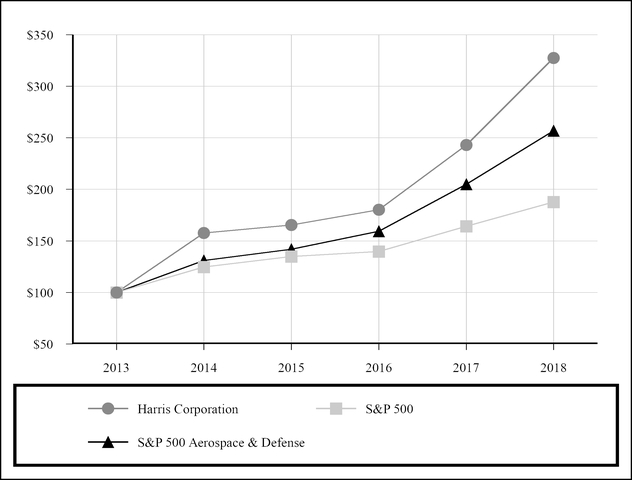
| HARRIS FISCAL YEAR END | 2013 | 2014 | 2015 | 2016 | 2017 | 2018 | ||||||||||||
| Harris | $ | 100 | $ | 158 | $ | 166 | $ | 180 | $ | 243 | $ | 327 | ||||||
| S&P 500 | $ | 100 | $ | 125 | $ | 135 | $ | 140 | $ | 164 | $ | 188 | ||||||
| S&P 500 Aerospace & Defense | $ | 100 | $ | 131 | $ | 142 | $ | 159 | $ | 205 | $ | 257 |
Sales of Unregistered Securities
During fiscal 2018, we did not issue or sell any unregistered securities.
Issuer Purchases of Equity Securities
During fiscal 2018, we repurchased 1,959,435 shares of our common stock under our current repurchase program for $272 million at an average share price of $138.87, excluding commissions of $.02 per share. During fiscal 2017, we repurchased 6,637,239 shares of our common stock under our current and prior repurchase programs for $710 million, including $600 million pursuant to fixed-dollar accelerated share repurchase (“ASR”) agreements (including 296,952 shares of our common stock received in the first quarter of fiscal 2018 pursuant to an ASR agreement). The level of our repurchases depends on a number of factors, including our financial condition, capital requirements, cash flows, results of operations, future business prospects and other factors our Board of Directors may deem relevant. The timing, volume and nature of repurchases are subject to market conditions, applicable securities laws and other factors and are at our discretion and may be suspended or discontinued at any time. Shares repurchased by us are cancelled and retired. The following table sets forth information with respect to repurchases by us of our common stock during the fiscal quarter ended June 29, 2018:
| Period* | Total number of shares purchased | Average price paid per share | Total number of shares purchased as part of publicly announced plans or programs(1) | Maximum approximate dollar value of shares that may yet be purchased under the plans or programs(1) | |||||||||
| Month No. 1 | |||||||||||||
| (March 31, 2018-April 27, 2018) | |||||||||||||
| Repurchase program(1) | — | — | — | $776,343,512 | |||||||||
| Employee transactions(2) | 2,273 | $ | 160.77 | — | — | ||||||||
| Month No. 2 | |||||||||||||
| (April 28, 2018-May 25, 2018) | |||||||||||||
| Repurchase program(1) | 115,000 | $ | 152.60 | 115,000 | $758,794,323 | ||||||||
| Employee transactions(2) | 21,425 | $ | 150.02 | — | — | ||||||||
| Month No. 3 | |||||||||||||
| (May 26, 2018-June 29, 2018) | |||||||||||||
| Repurchase program(1) | 377,722 | $ | 152.25 | 377,722 | $701,284,313 | ||||||||
| Employee transactions(2) | 28,373 | $ | 151.29 | — | — | ||||||||
| Total | 544,793 | 492,722 | $701,284,313 |
- Periods represent our fiscal months.
| (1) | On February 2, 2017, we announced that on January 26, 2017, our Board of Directors approved a share repurchase program authorizing us to repurchase up to $1 billion in shares of our common stock through open-market purchases, private transactions, transactions structured through investment banking institutions or any combination thereof. As of June 29, 2018, $701,284,313 (as reflected in the table above) was the approximate dollar amount of our common stock that may yet be purchased under our repurchase program, which does not have a stated expiration date. |
| (2) | Represents a combination of (a) shares of our common stock delivered to us in satisfaction of the tax withholding obligation of holders of performance units, restricted units or restricted shares that vested during the quarter and (b) performance units, restricted units or restricted shares returned to us upon retirement or employment termination of employees. Our equity incentive plans provide that the value of shares delivered to us to pay the exercise price of options or to cover tax withholding obligations shall be the closing price of our common stock on the date the relevant transaction occurs. |
The information required by this Item with respect to securities authorized for issuance under our equity compensation plans is included in “Item 12. Security Ownership of Certain Beneficial Owners and Management and Related Stockholder Matters” of this Report. See Note 14: Stock Options and Other Share-Based Compensation in the Notes for a general description of our share-based incentive plans.
Item 6. SELECTED FINANCIAL DATA.
The following table summarizes our selected historical financial information for each of the last five fiscal years. Amounts pertaining to our results of operations are presented on a continuing operations basis. See Note 3: Discontinued Operations and Divestitures in the Notes for information regarding discontinued operations. The selected financial information shown below has been derived from our audited Consolidated Financial Statements, which for data presented for fiscal 2018 and 2017 are included elsewhere in this Report. This table should be read in conjunction with our other financial information, including “Item 7. Management’s Discussion and Analysis of Financial Condition and Results of Operations” and the Consolidated Financial Statements and accompanying Notes, included elsewhere in this Report.
| Fiscal Years Ended | |||||||||||||||||||
| 2018(1) | 2017(2) | 2016(3) | 2015(4) | 2014 | |||||||||||||||
| (In millions, except per share amounts) | |||||||||||||||||||
| Results of Operations: | |||||||||||||||||||
| Revenue from product sales and services | $ | 6,182 | $ | 5,900 | $ | 5,992 | $ | 3,885 | $ | 3,622 | |||||||||
| Cost of product sales and services(5) | 3,931 | 3,734 | 3,832 | 2,304 | 2,118 | ||||||||||||||
| Interest expense | 170 | 172 | 183 | 130 | 94 | ||||||||||||||
| Income from continuing operations before income taxes | 926 | 905 | 884 | 396 | 642 | ||||||||||||||
| Income taxes | 205 | 267 | 273 | 109 | 202 | ||||||||||||||
| Income from continuing operations | 721 | 638 | 611 | 287 | 440 | ||||||||||||||
| Discontinued operations, net of income taxes | (3 | ) | (85 | ) | (287 | ) | 47 | 94 | |||||||||||
| Net income | 718 | 553 | 324 | 334 | 534 | ||||||||||||||
| Noncontrolling interests, net of income taxes | — | — | — | — | 1 | ||||||||||||||
| Net income attributable to Harris Corporation | 718 | 553 | 324 | 334 | 535 | ||||||||||||||
| Average shares outstanding (diluted) | 121.1 | 124.3 | 125.0 | 106.8 | 107.3 | ||||||||||||||
| Per Share Data (Diluted): | |||||||||||||||||||
| Income from continuing operations | $ | 5.94 | $ | 5.12 | $ | 4.87 | $ | 2.67 | $ | 4.08 | |||||||||
| Income (loss) from discontinued operations, net of income taxes | (0.02 | ) | (0.68 | ) | (2.28 | ) | 0.44 | 0.87 | |||||||||||
| Net income | 5.92 | 4.44 | 2.59 | 3.11 | 4.95 | ||||||||||||||
| Cash dividends | 2.28 | 2.12 | 2.00 | 1.88 | 1.68 | ||||||||||||||
| Financial Position at Fiscal Year-End: | |||||||||||||||||||
| Net working capital(6) | $ | 435 | $ | 147 | $ | 643 | $ | 909 | $ | 877 | |||||||||
| Net property, plant and equipment | 900 | 904 | 924 | 1,031 | 576 | ||||||||||||||
| Long-term debt, net | 3,408 | 3,396 | 4,120 | 5,053 | 1,564 | ||||||||||||||
| Total assets | 9,839 | 10,090 | 12,009 | 13,127 | 4,919 | ||||||||||||||
| Equity | 3,322 | 2,928 | 3,057 | 3,402 | 1,825 | ||||||||||||||
| Book value per share | 28.09 | 24.48 | 24.53 | 27.51 | 17.30 |
| (1) | Results for fiscal 2018 included: (i) $47 million of charges related to our decision to transition and exit a commercial air-to-ground LTE radio communications line of business and other items; (ii) $27 million of losses and other costs related to debt refinancing; (iii) $14 million of charges related to non-cash adjustments for deferred compensation and the impact of tax reform; and (iv) a $5 million charge related to consolidation of certain Exelis facilities initiated in fiscal 2017. The net after-tax impact from these fiscal 2018 items was $68 million or $.56 per diluted common share. |
| (2) | Results for fiscal 2017 included a $51 million after-tax ($.41 per diluted common share) charge for Exelis acquisition-related and other items. |
| (3) | Results for fiscal 2016 included: (i) $121 million for integration and other costs associated with our acquisition of Exelis in the fourth quarter of fiscal 2015, including $11 million for amortization of a step-up in inventory; (ii) a net liability reduction of $101 million for certain post-employment benefit plans; (iii) $33 million of charges for restructuring and other items; and (iv) a $10 million net gain on the sale of Aerostructures. The net after-tax impact from these fiscal 2016 items was $34 million or $.27 per diluted common share. |
| (4) | Results for fiscal 2015 included results of Exelis following the close of the acquisition on May 29, 2015 and a $205 million after-tax ($1.91 per diluted share) charge for transaction, financing, integration, restructuring and other costs, primarily related to our acquisition of Exelis. |
| (5) | “Cost of products sales and services” from prior years have been adjusted to conform to current-year classifications. Reclassifications include certain human resources, information technology (“IT”), direct selling and bid and proposal costs that were previously included as “Cost of product sales and services” line items and are now reflected in the “Engineering, selling and administrative expenses” line item in our Consolidated Statement of Income |
| (6) | Net working capital decreased in fiscal 2017 compared with fiscal 2016 primarily due to a $172 million increase in current portion of long-term debt and a $161 million decrease associated with net working capital of discontinued operations. |
Item 7. MANAGEMENT’S DISCUSSION AND ANALYSIS OF FINANCIAL CONDITION AND RESULTS OF OPERATIONS.
OVERVIEW
The following Management’s Discussion and Analysis (“MD&A”) is intended to assist in an understanding of our financial condition and results of operations. This MD&A is provided as a supplement to, should be read in conjunction with, and is qualified in its entirety by reference to, our Consolidated Financial Statements and accompanying Notes appearing elsewhere in this Report. Except for the historical information contained herein, the discussions in this MD&A contain forward-looking statements that involve risks and uncertainties. Our future results could differ materially from those discussed herein. Factors that could cause or contribute to such differences include, but are not limited to, those discussed below in this MD&A under “Forward-Looking Statements and Factors that May Affect Future Results.”
The following is a list of the sections of this MD&A, together with our perspective on their contents, which we hope will assist in reading these pages:
| • | Business Considerations — a general description of our business; the value drivers of our business; fiscal 2018 results of operations and liquidity and capital resources key indicators; and industry-wide opportunities, challenges and risks that are relevant to us in defense, government and commercial markets. |
| • | Operations Review — an analysis of our consolidated results of operations and of the results in each of our business segments, to the extent the segment operating results are helpful to an understanding of our business as a whole, for the three years presented in our financial statements. |
| • | Liquidity, Capital Resources and Financial Strategies — an analysis of cash flows, funding of pension plans, common stock repurchases, dividends, capital structure and resources, contractual obligations, off-balance sheet arrangements, commercial commitments, financial risk management, impact of foreign exchange and impact of inflation. |
| • | Critical Accounting Policies and Estimates — a discussion of accounting policies and estimates that require the most judgment and a discussion of accounting pronouncements that have been issued but not yet implemented by us and their potential impact on our financial condition, results of operations and cash flows. |
| • | Forward-Looking Statements and Factors that May Affect Future Results — cautionary information about forward-looking statements and a description of certain risks and uncertainties that could cause our actual results to differ materially from our historical results or our current expectations or projections. |
BUSINESS CONSIDERATIONS
General
We generate revenue, income and cash flows by developing, manufacturing or providing, and selling advanced, technology-based solutions that solve government and commercial customers’ mission-critical challenges. We support government and commercial customers in more than 100 countries, with our largest customers being various departments and agencies of the U.S. Government and their prime contractors. Our products, systems and services have defense and civil government applications, as well as commercial applications. As of the end of fiscal 2018, we had approximately 17,500 employees, including approximately 7,900 engineers and scientists. We generally sell directly to our customers, and we utilize agents and intermediaries to sell and market some products and services, especially in international markets.
We structure our operations primarily around the products, systems and services we sell and the markets we serve, and we report the financial results of our continuing operations in the following three reportable segments, which are also referred to as our business segments:
| • | Communication Systems, serving markets in tactical communications and defense products, including tactical ground and airborne radio communications solutions and night vision technology, and in public safety networks; |
| • | Electronic Systems, providing electronic warfare, avionics, and C4ISR solutions for defense and classified customers and mission-critical communication systems for civil and military aviation and other customers; and |
| • | Space and Intelligence Systems, providing intelligence, space protection, geospatial, complete Earth observation, universe exploration, PNT, and environmental solutions for national security, defense, civil and commercial customers, using advanced sensors, antennas and payloads, as well as ground processing and information analytics. |
As described above and in more detail in Note 1: Significant Accounting Policies under “Principles of Consolidation” and in Note 3: Discontinued Operations and Divestitures in the Notes, we completed the divestiture of CapRock in the third quarter of fiscal 2017 and the divestiture of IT Services in the fourth quarter of fiscal 2017. CapRock and IT Services were part of our former Critical Networks segment and are reported as discontinued operations in this Report. Our historical financial results
have been restated for all periods presented in this Report to account for businesses reported as discontinued operations in this Report. Except for disclosures related to our cash flows, or unless otherwise specified, disclosures in this Report relate solely to our continuing operations.
In connection with entering into the definitive agreement to sell IT Services, our other remaining operations that had been part of our former Critical Networks segment, including our ATM business and our PMRF program, were integrated with our Electronic Systems segment effective for the third quarter of fiscal 2017, and our Critical Networks segment was eliminated. The historical results, discussion and presentation of our business segments as set forth in this Report reflect the impact of these changes for all periods presented in order to present all segment information on a comparable basis. There is no impact on our previously reported consolidated statements of income, balance sheets or statements of cash flows resulting from these segment changes.
Value Drivers of Our Business
In recent years, we have reshaped our portfolio of businesses to focus on high-growth, high-margin businesses, successfully integrated Exelis and made investments that led to several new product launches and strategic program awards. Fiscal 2018 marked an inflection point as we returned to growth across all three business segments, maintained strong margins through our focus on operational excellence and recorded significantly higher orders that drove a 26 percent increase in backlog for fiscal 2018 compared with fiscal 2017. In addition to dividends and share repurchases, we made debt repayments and voluntary pension plan contributions that expanded our future financial flexibility. We plan to build on our strong fiscal 2018 performance, and together with a well-funded U.S. Government budget and a continued focus on operational excellence and innovation, we believe we are well positioned to achieve our fiscal 2019 strategic priorities, which include the following:
| • | Accelerating revenue growth across all three business segments; |
| • | Driving flawless execution while expanding margins through operational excellence; and |
| • | Sustaining cash flow with shareholder friendly capital deployment. |
We expect a more favorable budget environment, especially in strategic areas, our solid fiscal 2018 backlog growth and strong customer relationships to serve as the basis for accelerating revenue growth across our business segments in fiscal 2019. The Government Fiscal Year (“GFY”) 2018 Omnibus Appropriations Bill reflected that our programs continue to remain a priority for U.S. Government customers, and Presiden
Showing the first 8K of 119K characters. Open the full section
Item 7A. QUANTITATIVE AND QUALITATIVE DISCLOSURES ABOUT MARKET RISK.
In the normal course of business, we are exposed to the risks associated with foreign currency exchange rates and changes in interest rates. We employ established policies and procedures governing the use of financial instruments to manage our exposure to such risks. For a discussion of such policies and procedures and the related risks, see “Financial Risk Management” in “Item 7. Management’s Discussion and Analysis of Financial Condition and Results of Operations” of this Report, which is incorporated by reference into this Item 7A.
In addition, we are exposed to market return fluctuations on our defined benefit plans. A material adverse decline in the value of these assets and/or the discount rate for projected benefit obligations would result in a decrease in the funded status of the defined benefit plans, an increase in net periodic benefit cost and an increase in required funding. To protect against declines in the discount rate (i.e., interest rates), we will continue to monitor the performance of these assets and market conditions as we evaluate the amount of future contributions. For further information, see Note 13: Pension and Other Postretirement Benefits in the Notes, which information is incorporated by reference into this Item 7A.
Item 8. FINANCIAL STATEMENTS AND SUPPLEMENTARY DATA.
INDEX TO FINANCIAL STATEMENTS AND SUPPLEMENTARY DATA
| Page | |
| Management’s Report on Internal Control Over Financial Reporting | 55 |
| Report of Independent Registered Public Accounting Firm on the Consolidated Financial Statements | 56 |
| Report of Independent Registered Public Accounting Firm on the Effectiveness of Internal Control Over Financial Reporting | 57 |
| Consolidated Statement of Income — Fiscal Years ended June 29, 2018; June 30, 2017; and July 1, 2016 | 58 |
| Consolidated Statement of Comprehensive Income (Loss) — Fiscal Years ended June 29, 2018; June 30, 2017; and July 1, 2016 | 59 |
| Consolidated Balance Sheet — June 29, 2018 and June 30, 2017 | 60 |
| Consolidated Statement of Cash Flows — Fiscal Years ended June 29, 2018; June 30, 2017; and July 1, 2016 | 61 |
| Consolidated Statement of Equity — Fiscal Years ended June 29, 2018; June 30, 2017; and July 1, 2016 | 62 |
| Notes to Consolidated Financial Statements | 63 |
| Supplementary Financial Information | 101 |
| Schedule II — Valuation and Qualifying Accounts — Fiscal Years ended June 29, 2018; June 30, 2017; and July 1, 2016 | 113 |
MANAGEMENT’S REPORT ON INTERNAL CONTROL
OVER FINANCIAL REPORTING
The management of Harris Corporation (the “Company”) is responsible for establishing and maintaining adequate internal control over financial reporting as such term is defined in Rules 13a-15(f) and 15d-15(f) under the Securities Exchange Act of 1934, as amended. The Company’s internal control over financial reporting is designed to provide reasonable assurance, based on an appropriate cost-benefit analysis, regarding the reliability of financial reporting and the preparation of financial statements for external purposes in accordance with U.S. generally accepted accounting principles. The Company’s internal control over financial reporting includes those policies and procedures that: (i) pertain to the maintenance of records that, in reasonable detail, accurately and fairly reflect the transactions and dispositions of the assets of the Company; (ii) provide reasonable assurance that transactions are recorded as necessary to permit preparation of financial statements in accordance with U.S. generally accepted accounting principles, and that receipts and expenditures of the Company are being made only in accordance with authorizations of management and directors of the Company; and (iii) provide reasonable assurance regarding prevention or timely detection of unauthorized acquisition, use or disposition of the Company’s assets that could have a material effect on the financial statements.
Because of its inherent limitations, internal control over financial reporting may not prevent or detect misstatements. Therefore, even those systems determined to be effective can provide only reasonable assurance with respect to financial statement preparation and presentation. Also, projections of any evaluation of effectiveness to future periods are subject to the risk that controls may become inadequate because of changes in conditions, or that the degree of compliance with the policies or procedures may deteriorate.
Management, with the participation of our Chief Executive Officer and Chief Financial Officer, assessed the effectiveness of the Company’s internal control over financial reporting as of June 29, 2018. In making this assessment, management used the criteria set forth by the Committee of Sponsoring Organizations of the Treadway Commission (COSO) in Internal Control-Integrated Framework (2013 framework). Based on management’s assessment and those criteria, management concluded that the Company maintained effective internal control over financial reporting as of June 29, 2018.
The Company’s independent registered public accounting firm, Ernst & Young LLP, has issued a report on the effectiveness of the Company’s internal control over financial reporting. This report appears on page 57 of this Annual Report on Form 10-K.
REPORT OF INDEPENDENT REGISTERED PUBLIC ACCOUNTING FIRM
To the Shareholders and the Board of Directors of Harris Corporation
Opinion on the Financial Statements
We have audited the accompanying consolidated balance sheets of Harris Corporation (the Company) as of June 29, 2018 and June 30, 2017, the related consolidated statements of income, comprehensive income (loss), cash flows and equity for each of the three years in the period ended June 29, 2018, and the related notes and financial statement schedule listed in the Index at Item 15(2), collectively referred to as the “consolidated financial statements.” In our opinion, the consolidated financial statements present fairly, in all material respects, the financial position of the Company at June 29, 2018 and June 30, 2017, and the results of its operations and its cash flows for each of the three years in the period ended June 29, 2018, in conformity with U.S. generally accepted accounting principles.
We also have audited, in accordance with the standards of the Public Company Accounting Oversight Board (United States) (PCAOB), the Company's internal control over financial reporting as of June 29, 2018, based on criteria established in Internal Control-Integrated Framework issued by the Committee of Sponsoring Organizations of the Treadway Commission (2013 framework) and our report dated August 27, 2018 expressed an unqualified opinion thereon.
Basis for Opinion
These financial statements are the responsibility of the Company's management. Our responsibility is to express an opinion on the Company’s financial statements based on our audits. We are a public accounting firm registered with the PCAOB and are required to be independent with respect to the Company in accordance with the U.S. federal securities laws and the applicable rules and regulations of the Securities and Exchange Commission and the PCAOB.
We conducted our audits in accordance with the standards of the PCAOB. Those standards require that we plan and perform the audit to obtain reasonable assurance about whether the financial statements are free of material misstatement, whether due to error or fraud. Our audits included performing procedures to assess the risks of material misstatement of the financial statements, whether due to error or fraud, and performing procedures that respond to those risks. Such procedures included examining, on a test basis, evidence regarding the amounts and disclosures in the financial statements. Our audits also included evaluating the accounting principles used and significant estimates made by management, as well as evaluating the overall presentation of the financial statements. We believe that our audits provide a reasonable basis for our opinion.
/s/ Ernst & Young LLP
We have served as the Company’s auditor since at least 1932, but we are unable to determine the specific year.
Orlando, Florida
August 27, 2018
REPORT OF INDEPENDENT REGISTERED PUBLIC ACCOUNTING FIRM
To the Shareholders and the Board of Directors of Harris Corporation
Opinion on Internal Control over Financial Reporting
We have audited Harris Corporation’s internal control over financial reporting as of Jun
Showing the first 8K of 218K characters. Open the full section
Item 9. CHANGES IN AND DISAGREEMENTS WITH ACCOUNTANTS ON ACCOUNTING AND FINANCIAL DISCLOSURE.
Not applicable.
Item 9A. CONTROLS AND PROCEDURES.
(a) Evaluation of Disclosure Controls and Procedures: We maintain disclosure controls and procedures that are designed to ensure that information required to be disclosed in our reports filed or submitted under the Exchange Act is recorded, processed, summarized and reported within the time periods specified in SEC rules and forms. Our disclosure controls and procedures include, without limitation, controls and procedures designed to ensure that information required to be disclosed in our reports filed or submitted under the Exchange Act is accumulated and communicated to management, including our Chief Executive Officer and Chief Financial Officer, as appropriate to allow timely decisions regarding required disclosures. There are inherent limitations to the effectiveness of any system of disclosure controls and procedures, including the possibility of human error and the circumvention or overriding of the controls and procedures. Accordingly, even effective disclosure controls and procedures can provide only reasonable assurance of achieving their control objectives, and management necessarily is required to use its judgment in evaluating the cost-benefit relationship of possible controls and procedures. As required by Rule 13a-15 under the Exchange Act, as of the end of fiscal 2018, we carried out an evaluation of the effectiveness of the design and operation of our disclosure controls and procedures. This evaluation was carried out under the supervision and with the participation of our management, including our Chief Executive Officer and our Chief Financial Officer. Based on this work and other evaluation procedures, our management, including our Chief Executive Officer and our Chief Financial Officer, has concluded that as of the end of fiscal 2018 our disclosure controls and procedures were effective.
(b) Changes in Internal Control: We periodically review our internal control over financial reporting as part of our efforts to ensure compliance with the requirements of Section 404 of the Sarbanes-Oxley Act of 2002. In addition, we routinely review our system of internal control over financial reporting to identify potential changes to our processes and systems that may improve controls and increase efficiency, while ensuring that we maintain an effective internal control environment. Changes may include such activities as implementing new, more efficient systems, consolidating the activities of business units, migrating certain processes to our shared services organizations, formalizing policies and procedures, improving segregation of duties and increasing monitoring controls. In addition, when we acquire new businesses, we incorporate our controls and procedures into the acquired business as part of our integration activities. We are continuing our implementation of a new income tax provision software designed to enhance process stability and further facilitate the computation and recording of tax provisions for our U.S. and international entities. We are also continuing the multi-year, phased implementation targeted for completion in fiscal 2020 of a new core enterprise resource planning (“ERP”) system in certain business units, which we expect to reduce the number of ERP systems across the Company and enhance our system of internal control over financial reporting. We expect the initial implementation of the new core ERP system in each affected business unit to involve changes to related processes that are part of our system of internal control over financial reporting and to require testing for effectiveness and potential further changes as implementation progresses. During the first quarter of fiscal 2018, we successfully completed the initial implementation of the new core ERP system in 2 business units. There have been no changes in our internal control over financial reporting that occurred during the fourth quarter of fiscal 2018 that have materially affected, or are reasonably likely to materially affect, our internal control over financial reporting.
(c) Evaluation of Internal Control over Financial Reporting: Our management is responsible for establishing and maintaining adequate internal control over financial reporting. Our management, with the participation of our Chief Executive Officer and our Chief Financial Officer, assessed the effectiveness of our internal control over financial reporting as of the end of fiscal 2018. In making this assessment, our management used the criteria set forth by the Committee of Sponsoring Organizations of the Treadway Commission (COSO) in Internal Control-Integrated Framework (2013 framework). Based on our management’s assessment and those criteria, our management concluded that our internal control over financial reporting was effective as of the end of fiscal 2018. “Management’s Report on Internal Control Over Financial Reporting” is included within “Item 8. Financial Statements and Supplementary Data” of this Report. The effectiveness of our internal control over financial reporting was audited by Ernst & Young LLP, our independent registered public accounting firm, whose unqualified report is included within “Item 8. Financial Statements and Supplementary Data” of this Report.
Item 9B. OTHER INFORMATION.
Not applicable.
PART III
Item 10. DIRECTORS, EXECUTIVE OFFICERS AND CORPORATE GOVERNANCE.
(a) Identification of Directors: The information required by this Item with respect to our directors is incorporated herein by reference to the discussion under the headings Proposal 1: Election of Directors and Nominees for Election in our Proxy Statement for our 2018 Annual Meeting of Shareholders scheduled to be held on October 26, 2018 (our “2018 Proxy Statement”), which is expected to be filed within 120 days after the end of our fiscal 2018.
(b) Identification of Executive Officers: Certain information regarding our executive officers is included in Part I of this Report under the heading “Executive Officers of the Registrant” in accordance with General Instruction G(3) of Form 10-K.
(c) Audit Committee Information; Financial Expert: The information required by this Item with respect to the Audit Committee of our Board of Directors and “audit committee financial experts” is incorporated herein by reference to the discussions under the headings Summary Information Regarding Each of the Nominees and Board Committees and Committee Charters, Audit Committee in our 2018 Proxy Statement, which is expected to be filed within 120 days after the end of our fiscal 2018.
(d) Section 16(a) Beneficial Ownership Reporting Compliance: Information related to compliance with Section 16(a) of the Exchange Act is incorporated herein by reference to the discussion under the heading Section 16(a) Beneficial Ownership Reporting Compliance in our 2018 Proxy Statement, which is expected to be filed within 120 days after the end of our fiscal 2018.
(e) Code of Ethics: All of our directors and employees, including our Chief Executive Officer, Chief Financial Officer, Principal Accounting Officer and other senior accounting and financial officers, are required to abide by our Code of Conduct. Our Code of Conduct is posted on our website at https://www.harris.com/content/code-of-conduct and is also available free of charge by written request to our Director of Ethics and Compliance, Harris Corporation, 1025 West NASA Boulevard, Melbourne, Florida 32919. We intend to disclose on the Code of Conduct section of our website at https://www.harris.com/content/code-of-conduct any amendment to, or waiver from, our Code of Conduct that is required to be disclosed to shareholders, within four business days following such amendment or waiver. The information required by this Item with respect to codes of ethics is incorporated herein by reference to the discussion under the heading Code of conduct in our 2018 Proxy Statement, which is expected to be filed within 120 days after the end of our fiscal 2018.
(f) Policy for Nominees: The information required under Item 407(c)(3) of Regulation S-K is incorporated herein by reference to the discussion concerning procedures by which shareholders may recommend nominees to our Board of Directors, submit nominees for inclusion in our proxy materials pursuant to our new “proxy access” provision of our By-Laws or directly propose nominees for consideration pursuant to our By-Laws but not pursuant to the proxy access provision contained under the heading Director Nomination Process and Criteria, and Board Diversity in our 2018 Proxy Statement, which is expected to be filed within 120 days after the end of our fiscal 2018. Except as described in the following paragraph, no material changes to those procedures have occurred since the disclosure regarding those procedures in our Proxy Statement for our 2017 Annual Meeting of Shareholders.
On May 30, 2018, we amended our By-Laws to implement “proxy access” and to make certain other changes, effective immediately. The proxy access provisions allow an individual eligible shareholder, or group of no more than 20 eligible shareholders, to nominate and include in our proxy materials candidates for election to our Board of Directors, as long as such shareholder or the shareholder group, as applicable, continuously owns 3% or more of the outstanding shares of our common stock for at least three years. The maximum number of proxy access nominees permitted is the greater of two or 20% of our Board of Directors (rounded down to the nearest whole number), provided that the shareholder(s) and the nominee(s) satisfy the eligibility and procedural requirements set forth in our By-Laws. The additional eligibility and procedural requirements include a requirement that a proxy access nomination notice must be delivered to us no earlier than 150 calendar days and no later than 120 calendar days before the first anniversary of the release date of our proxy materials for our prior year’s annual meeting of shareholders, as well as requirements that all nominees for directors and nominating stockholder(s) provide certain information, representations and agreements to us in order to be eligible for election.
Additional information concerning requirements and procedures for shareholders directly nominating directors is contained under the heading Shareholder Nominees for Director and Other Shareholder Proposals for 2019 Annual Meeting of Shareholders in our 2018 Proxy Statement, which is expected to be filed within 120 days after the end of our fiscal 2018.
Item 11. EXECUTIVE COMPENSATION.
The information required by this Item with respect to compensation of our directors and executive officers is incorporated herein by reference to the discussions under the headings Director Compensation and Benefits, Compensation Discussion and Analysis and Management Development and Compensation Committee Report in our 2018 Proxy Statement, which is expected to be filed within 120 days after the end of our fiscal 2018.
Item 12. SECURITY OWNERSHIP OF CERTAIN BENEFICIAL OWNERS AND MANAGEMENT AND RELATED STOCKHOLDER MATTERS.
The following table provides information as of June 29, 2018 about our common stock that may be issued, whether upon the exercise of options, warrants and rights or otherwise, under our existing equity compensation plans.
| Plan Category | Number of securities to be issued upon exercise of outstanding options, warrants and rights (a)(2) | Weighted-average exercise price of outstanding options, warrants and rights (b)(2) | Number of securities remaining available for future issuance under equity compensation plans (excluding securities reflected in column (a)) (c) | ||||
| Equity compensation plans approved by shareholders(1) | 5,712,451 | $74.50 | 26,913,981 | ||||
| Equity compensation plans not approved by shareholders | — | — | — | ||||
| Total | 5,712,451 | $74.50 | 26,913,981 |
| (1) | Consists of the Harris Corporation 2005 Equity Incentive Plan (As Amended and Restated Effective August 27, 2010) (the “2005 Equity Incentive Plan”) and the Harris Corporation 2015 Equity Incentive Plan. No additional awards may be granted under the 2005 Equity Incentive Plan. |
| (2) | Under the 2005 Equity Incentive Plan and the Harris Corporation 2015 Equity Incentive Plan, in addition to options, we have granted share-based compensation awards in the form of performance shares, shares of restricted stock, performance share units, restricted stock units, shares of immediately vested common stock and other similar types of share-based awards. As of June 29, 2018, there were awards outstanding under those plans with respect to 1,039,983 shares, consisting of (i) awards of 25,902 shares of restricted stock, for which all 25,902 shares were issued and outstanding; and (ii) awards of 1,014,081 performance share units and restricted stock units, for which all 1,014,081 were payable in shares but for which no shares were yet issued and outstanding. The 5,712,451 shares to be issued upon exercise of outstanding options, warrants and rights as listed in column (a) consisted of shares to be issued in respect of the exercise of 4,698,370 outstanding options and in respect of awards of 1,014,081 performance share units and restricted stock units payable in shares. Because there is no exercise price associated with awards of shares of restricted stock, performance share units or restricted stock units, all of which are granted to employees at no cost, such awards are not included in the weighted-average exercise price calculation in column (b). |
See Note 14: Stock Options and Other Share-Based Compensation in the Notes for a general description of our share-based incentive plans.
The other information required by this Item with respect to security ownership of certain of our beneficial owners and management is incorporated herein by reference to the discussions under the headings Principal Shareholders and Share Ownership by our Directors, Nominees and Executive Officers in our 2018 Proxy Statement, which is expected to be filed within 120 days after the end of our fiscal 2018.
Item 13. CERTAIN RELATIONSHIPS AND RELATED TRANSACTIONS, AND DIRECTOR INDEPENDENCE.
The information required by this Item is incorporated herein by reference to the discussions under the headings Director Independence and Related person transaction policy in our 2018 Proxy Statement, which is expected to be filed within 120 days after the end of our fiscal 2018.
Item 14. PRINCIPAL ACCOUNTING FEES AND SERVICES.
The information required by this Item is incorporated herein by reference to the discussion under the heading Proposal 3: Ratification of the Appointment of Independent Registered Public Accounting Firm in our 2018 Proxy Statement, which is expected to be filed within 120 days after the end of our fiscal 2018.
PART IV
Item 15. EXHIBITS, FINANCIAL STATEMENT SCHEDULES.
The following documents are filed as a part of this Report:
All other schedules are omitted because they are not applicable, the amounts are not significant or the required information is shown in the Consolidated Financial Statements or the Notes thereto.
(3) Exhibits:
The following exhibits are filed herewith or are incorporated herein by reference to exhibits previously filed with the SEC:
**(4)(c)(i) Indenture, dated as of October 1, 1990, between Harris Corporation and U.S. Bank National Association (as successor to National City Bank), as Trustee, relating to unlimited amounts of debt securities which may be issued from time to time by the Company when and as authorized by the Company’s Board of Directors or a Committee of the Board, incorporated herein by reference to Exhibit 4 to the Company’s Registration Statement on Form S-3, Registration Statement No. 33-35315, filed with the SEC on June 8, 1990.
(4)(n) Pursuant to Regulation S-K, Item 601(b)(4)(iii)(A), the Company by this filing agrees, upon request, to furnish to the SEC a copy of other instruments defining the rights of holders of long-term debt of Harris Corporation.
(12) Computation of Ratio of Earnings to Fixed Charges.
(21) Subsidiaries of the Registrant.
(23) Consent of Ernst & Young LLP, Independent Registered Public Accounting Firm.
(31.1) Rule 13a-14(a)/15d-14(a) Certification of Chief Executive Officer.
(31.2) Rule 13a-14(a)/15d-14(a) Certification of Chief Financial Officer.
(32.1) Section 1350 Certification of Chief Executive Officer.
(32.2) Section 1350 Certification of Chief Financial Officer.
(101.INS) XBRL Instance Document.
(101.SCH) XBRL Taxonomy Extension Schema Document.
(101.CAL) XBRL Taxonomy Extension Calculation Linkbase Document.
(101.DEF) XBRL Taxonomy Extension Definition Linkbase Document.
(101.LAB) XBRL Taxonomy Extension Label Linkbase Document.
(101.PRE) XBRL Taxonomy Extension Presentation Linkbase Document.
- Management contract or compensatory plan or arrangement.
** Paper filing.
Item 16. FORM 10-K SUMMARY.
None.
SIGNATURES
Pursuant to the requirements of Section 13 or 15(d) of the Securities Exchange Act of 1934, the registrant has duly caused this report to be signed on its behalf by the undersigned, thereunto duly authorized.
| HARRIS CORPORATION | ||||
| (Registrant) | ||||
| Date: August 27, 2018 | By: | /S/ WILLIAM M. BROWN | ||
| William M. Brown | ||||
| Chairman, President and Chief Executive Officer |
Pursuant to the requirements of the Securities Exchange Act of 1934, this report has been signed below by the following persons on behalf of the registrant and in the capacities and on the dates indicated.
| Signature | Title | Date | ||||
| /s/ WILLIAM M. BROWN | Chairman, President and Chief Executive Officer (Principal Executive Officer) | August 27, 2018 | ||||
| William M. Brown | ||||||
| /s/ RAHUL GHAI | Senior Vice President and Chief Financial Officer (Principal Financial Officer) | August 27, 2018 | ||||
| Rahul Ghai | ||||||
| /s/ TODD A. TAYLOR | Vice President, Principal Accounting Officer (Principal Accounting Officer) | August 27, 2018 | ||||
| Todd A. Taylor | ||||||
| /s/ JAMES F. ALBAUGH | Director | August 27, 2018 | ||||
| James F. Albaugh | ||||||
| /s/ SALLIE B. BAILEY | Director | August 27, 2018 | ||||
| Sallie B. Bailey | ||||||
| /s/ PETER W. CHIARELLI | Director | August 27, 2018 | ||||
| Peter W. Chiarelli | ||||||
| /s/ THOMAS A. DATTILO | Director | August 27, 2018 | ||||
| Thomas A. Dattilo | ||||||
| /s/ ROGER B. FRADIN | Director | August 27, 2018 | ||||
| Roger B. Fradin | ||||||
| /s/ TERRY D. GROWCOCK | Director | August 27, 2018 | ||||
| Terry D. Growcock | ||||||
| /s/ LEWIS HAY III | Director | August 27, 2018 | ||||
| Lewis Hay III | ||||||
| /s/ VYOMESH I. JOSHI | Director | August 27, 2018 | ||||
| Vyomesh I. Joshi | ||||||
| /s/ LESLIE F. KENNE | Director | August 27, 2018 | ||||
| Leslie F. Kenne | ||||||
| /s/ JAMES C. STOFFEL | Director | August 27, 2018 | ||||
| James C. Stoffel | ||||||
| /s/ GREGORY T. SWIENTON | Director | August 27, 2018 | ||||
| Gregory T. Swienton | ||||||
| /s/ HANSEL E. TOOKES II | Director | August 27, 2018 | ||||
| Hansel E. Tookes II | ||||||
SCHEDULE II — VALUATION AND QUALIFYING ACCOUNTS
HARRIS CORPORATION AND SUBSIDIARIES
(In thousands)
| Col. A | Col. B | Col. C | Col. D | Col. E | ||||||||||||||||||
| Additions | ||||||||||||||||||||||
| Description | Balance at Beginning of Period | Charged to Costs and Expenses | Charged to Other Accounts — Describe | Deductions — Describe | Balance at End of Period | |||||||||||||||||
| Year ended June 29, 2018 | ||||||||||||||||||||||
| Amounts Deducted From | ||||||||||||||||||||||
| Respective Asset Accounts: | ||||||||||||||||||||||
| $ | 8 | (A) | ||||||||||||||||||||
| 435 | (B) | |||||||||||||||||||||
| 707 | (C) | |||||||||||||||||||||
| Allowances for collection losses | $ | 2,815 | $ | 654 | $ | — | $ | 1,150 | $ | 2,319 | ||||||||||||
| $ | (48 | ) | (E) | $ | (425 | ) | (A) | |||||||||||||||
| Allowances for deferred tax assets | $ | 183,476 | $ | (2,848 | ) | $ | (48 | ) | $ | (425 | ) | $ | 181,005 | |||||||||
| Year ended June 30, 2017 | ||||||||||||||||||||||
| Amounts Deducted From | ||||||||||||||||||||||
| Respective Asset Accounts: | ||||||||||||||||||||||
| $ | 7 | (A) | ||||||||||||||||||||
| 551 | (B) | |||||||||||||||||||||
| 3,329 | (C) | |||||||||||||||||||||
| 3,247 | (D) | |||||||||||||||||||||
| Allowances for collection losses | $ | 9,949 | $ | — | $ | — | $ | 7,134 | $ | 2,815 | ||||||||||||
| $ | 1,865 | (A) | ||||||||||||||||||||
| 103,371 | (D) | |||||||||||||||||||||
| 354 | (E) | 175 | (F) | |||||||||||||||||||
| Allowances for deferred tax assets | $ | 300,159 | $ | (11,626 | ) | $ | 354 | $ | 105,411 | $ | 183,476 | |||||||||||
| Year ended July 1, 2016 | ||||||||||||||||||||||
| Amounts Deducted From | ||||||||||||||||||||||
| Respective Asset Accounts: | ||||||||||||||||||||||
| $ | 960 | (A) | ||||||||||||||||||||
| 5,188 | (C) | |||||||||||||||||||||
| Allowances for collection losses | $ | 12,169 | $ | 3,928 | $ | — | $ | 6,148 | $ | 9,949 | ||||||||||||
| $ | 2,092 | (D) | $ | 4,648 | (A) | |||||||||||||||||
| 389 | (E) | 946 | (F) | |||||||||||||||||||
| Allowances for deferred tax assets | $ | 71,866 | $ | 231,406 | $ | 2,481 | $ | 5,594 | $ | 300,159 |
Note A — Foreign currency translation gains and losses
Note B — Disposals
Note C — Uncollectible accounts charged off, less recoveries on accounts previously charged off
Note D — Acquisitions and divestitures
Note E — Uncertain income tax positions
Note F — Accumulated other comprehensive income