 filings.tools
L3Harris Technologies 10-K 2025-01-03
Filed 2025-02-14. 24 sections, 445K characters. Original on sec.gov · Markdown · JSON
Cover and table of contents
UNITED STATES
SECURITIES AND EXCHANGE COMMISSION
WASHINGTON, D.C. 20549
FORM 10-K
(Mark One)
| ☑ | ANNUAL REPORT PURSUANT TO SECTION 13 OR 15(d) OF THE SECURITIES EXCHANGE ACT OF 1934 |
For the fiscal year ended January 3, 2025
OR
| ☐ | TRANSITION REPORT PURSUANT TO SECTION 13 OR 15(d) OF THE SECURITIES EXCHANGE ACT OF 1934 |
| For the transition period from _______________ to ______________ |
Commission File Number 1-3863
L3HARRIS TECHNOLOGIES, INC.
(Exact name of registrant as specified in its charter)
| Delaware | 34-0276860 | ||
| (State or other jurisdiction of incorporation or organization) | (I.R.S. Employer Identification No.) |
| 1025 West NASA Boulevard | ||||
| Melbourne, | Florida | 32919 | ||
| (Address of principal executive offices) | (Zip Code) |
Registrant’s telephone number, including area code: (321) 727-9100
| Securities registered pursuant to Section 12(b) of the Act: | ||||
| Title of each class | Trading Symbol(s) | Name of each exchange on which registered | ||
| Common Stock, par value $1.00 per share | LHX | New York Stock Exchange |
Securities Registered Pursuant to Section 12(g) of the Act: None
Indicate by check mark if the registrant is a well-known seasoned issuer, as defined in Rule 405 of the Securities Act. Yes ☑ No ☐
Indicate by check mark if the registrant is not required to file reports pursuant to Section 13 or Section 15(d) of the Act. Yes ☐ No ☑
Indicate by check mark whether the registrant (1) has filed all reports required to be filed by Section 13 or 15(d) of the Securities Exchange
Act of 1934 during the preceding 12 months (or for such shorter period that the registrant was required to file such reports), and (2) has been
subject to such filing requirements for the past 90 days. Yes ☑ No ☐
Indicate by check mark whether the registrant has submitted electronically every Interactive Data File required to be submitted pursuant to
Rule 405 of Regulation S-T during the preceding 12 months (or for such shorter period that the registrant was required to submit such
files). Yes ☑ No ☐
Indicate by check mark whether the registrant is a large accelerated filer, an accelerated filer, a non-accelerated filer, a smaller reporting
company or an emerging growth company. See the definitions of “large accelerated filer,” “accelerated filer,” “smaller reporting company” and
“emerging growth company” in Rule 12b-2 of the Exchange Act.
| Large accelerated filer | ☑ | Accelerated filer | ☐ | |||
| Non-accelerated filer | ☐ | Smaller reporting company | ☐ | |||
| Emerging growth company | ☐ |
If an emerging growth company, indicate by check mark if the registrant has elected not to use the extended transition period for complying
with any new or revised financial accounting standards provided pursuant to Section 13(a) of the Exchange Act. ☐
Indicate by check mark whether the registrant has filed a report on and attestation to its management’s assessment of the effectiveness of its
internal control over financial reporting under Section 404(b) of the Sarbanes-Oxley Act (15 U.S.C. 7262(b)) by the registered public accounting
firm that prepared or issued its audit report. ☑
If securities are registered pursuant to Section 12(b) of the Act, indicate by check mark whether the financial statements of the registrant
included in the filing reflect the correction of an error to previously issued financial statements.☐
Indicate by check mark whether any of those error corrections are restatements that required a recovery analysis of incentive-based
compensation received by any of the registrant’s executive officers during the relevant recovery period pursuant to §240.10D-1(b).☐
Indicate by check mark whether the registrant is a shell company (as defined in Rule 12b-2 of the Exchange Act). Yes ☐ No ☑
The aggregate market value of the voting common equity held by non-affiliates of the registrant at June 28, 2024 was $42,471,412,123
(based on the quoted closing sale price per share of the stock on the New York Stock Exchange). For purposes of this calculation, the registrant
has assumed that its directors and executive officers as of June 28, 2024 are affiliates.
The number of shares outstanding of the registrant’s common stock as of February 7, 2025 was 188,313,839.
Documents Incorporated by Reference:
Portions of the registrant’s definitive Proxy Statement for the 2025 Annual Meeting of Shareholders scheduled to be held on April 18,
2025, which will be filed with the Securities and Exchange Commission within 120 days after the end of the registrant’s fiscal year ended
January 3, 2025, are incorporated by reference into Part III of this Annual Report on Form 10-K to the extent described therein.
L3HARRIS TECHNOLOGIES, INC.
ANNUAL REPORT ON FORM 10-K FOR THE FISCAL YEAR ENDED JANUARY 3, 2025
TABLE OF CONTENTS
| Page No. | ||
| Part I: | ||
| ITEM 1. Business ................................................................................................................................. | 1 | |
| ITEM 1A. Risk Factors ............................................................................................................................ | 5 | |
| ITEM 1B. Unresolved Staff Comments ............................................................................................... | 15 | |
| ITEM 1C. Cybersecurity ......................................................................................................................... | 15 | |
| ITEM 2. Properties ............................................................................................................................... | 17 | |
| ITEM 3. Legal Proceedings ................................................................................................................. | 17 | |
| ITEM 4. Mine Safety Disclosures ....................................................................................................... | 17 | |
| Information about our Executive Officers .............................................................................................. | 18 | |
| Part II: | ||
| ITEM 5. Market for Registrant’s Common Equity, Related Stockholder Matters and Issuer Purchases of Equity Securities ........................................................................................... | 18 | |
| ITEM 6. [Reserved] ............................................................................................................................... | 20 | |
| ITEM 7. Management’s Discussion and Analysis of Financial Condition and Results of Operations ............................................................................................................................. | 20 | |
| ITEM 7A. Quantitative and Qualitative Disclosures About Market Risk ........................................ | 35 | |
| ITEM 8. Financial Statements and Supplementary Data .............................................................. | 36 | |
| ITEM 9. Changes in and Disagreements with Accountants on Accounting and Financial Disclosure .............................................................................................................................. | 88 | |
| ITEM 9A. Controls and Procedures ..................................................................................................... | 88 | |
| ITEM 9B. Other Information ................................................................................................................. | 91 | |
| ITEM 9C. Disclosure Regarding Foreign Jurisdictions That Prevent Inspections ....................... | 91 | |
| Part III : | ||
| ITEM 10. Directors, Executive Officers and Corporate Governance ............................................. | 91 | |
| ITEM 11. Executive Compensation ..................................................................................................... | 92 | |
| ITEM 12. Security Ownership of Certain Beneficial Owners and Management and Related Stockholder Matters ............................................................................................................. | 92 | |
| ITEM 13. Certain Relationships and Related Transactions, and Director Independence ......... | 92 | |
| ITEM 14. Principal Accounting Fees and Services ........................................................................... | 92 | |
| Part IV: | ||
| ITEM 15. Exhibits, Financial Statement Schedules ......................................................................... | 93 | |
| ITEM 16. Form 10-K Summary ........................................................................................................... | 98 | |
| Signatures ..................................................................................................................................................................... | 99 |
_____________________________________________________________________
PART I
Item 1. BUSINESS.
General
L3Harris Technologies, Inc. is the Trusted Disruptor for the defense industry. With customers’ mission-critical
needs in mind, we deliver end-to-end technology solutions connecting the space, air, land, sea and cyber domains in
the interest of global security. We support government customers in more than 100 countries, with our largest
customers being various departments and agencies of the U.S. Government, their prime contractors and
international allies. Our products and services have defense and civil government applications, as well as
commercial applications.
Our fiscal year ends on the Friday nearest December 31. The fiscal year ended January 3, 2025 (“fiscal 2024”)
included 53 weeks and fiscal years ended December 29, 2023 (“fiscal 2023”) and December 30, 2022 (“fiscal
2022”) included 52 weeks. Unless the context otherwise requires, the terms “we,” “our,” “us,” “Company” and
“L3Harris” as used in this Report mean L3Harris Technologies, Inc. and its subsidiaries.
Description of Business Segments
We structure our operations primarily around the products, systems and services we sell and the markets we
serve, and we report our financial results in four operating segments, which are also our reportable segments or
business segments. From time to time, we acquire or divest businesses and strategically realign businesses within
and across our business segments to optimize existing capabilities and enhance the efficiency with which we
develop and deliver our products and services. Our business segments provide a wide-range of products, systems
and services to various customers and are described below. For financial information with respect to our business
segments, see Note 14: Business Segments in the Notes.
Space & Airborne Systems (“SAS”). Supplies full mission solutions as a prime and subsystem integrator in the
space, airborne and cyber domains. We provide top-tier capabilities in the design, development, integration,
production and sustainment of weapons systems for national security, civil government and international customers
in the following business sectors:
Space Systems: Intelligence, surveillance and reconnaissance (“ISR”); position, navigation and timing; weather
and climate monitoring; missile defense and ground-based space surveillance networks.
Intel & Cyber: Situational awareness, optical networks and advanced wireless solutions for classified intelligence
and defense customers.
Mission Networks: Communications and networking solutions for air traffic management.
Airborne Combat Systems*:* Sensors, processors, hardened electronics, unmanned aircraft systems, precision
weapons, infrared search and tracking, distributed aperture systems and precision pointing, weapons release
systems; antennas for aircraft platforms; and threat warning and countermeasures for airborne, ground and
maritime platforms.
Integrated Mission Systems (“IMS”). Delivers differentiated mission capabilities and prime systems integration
to support intelligence, reconnaissance and surveillance (ISR), passive sensing and targeting, electronic attack,
autonomy, power and communications, networks and sensors. IMS specializes in system design, development,
integration, production, modernization and sustainment for national security and international customers in the
following business sectors:
ISR: Airborne passive sensing and targeting, mission systems development, integration and life-cycle
management for strategic reconnaissance, national command and control, tactical surveillance, electronic attack,
agile strike, mobility, and classified platforms.
Maritime: Power, electrical, imaging, communication and sensor systems for naval platforms; integrated
autonomous vessels for surface and undersea operations; fleet management; in-service support; missionization
prototyping; and naval integration.
Global Optical Systems: Multi-domain, multi-spectral electro-optical and infrared (EO/IR) sensor systems
supporting ISR and target acquisition missions; manufacturing of specialty laser and filter glass materials, laser
range finders, target designators and transmitters; and highly scalable autonomous solutions. On January 4, 2025,
we realigned our software solutions business from the ISR sector into Global Optical Solutions and renamed the
sector Targeting & Sensor Systems.
_____________________________________________________________________
Defense Electronics*:* Space communications and space flight avionics; 360-degree visible/midwave IR passive
surveillance; fuzing, navigation and range-testing solutions; and precision electronic components.
Commercial Aviation Solutions*:* Integrated aircraft avionics, pilot training and data analytics services for the
commercial aviation industry. At January 3, 2025, Commercial Aviation Solutions (“CAS disposal group”) was
classified as held for sale in our Consolidated Balance Sheet. See Note 13: Acquisitions and Divestitures in the Notes
for further information.
Communication Systems (“CS”). Enables warfighters across all domains with solutions critical to mission
success even in the most contested environments. We are a leading provider of resilient communication solutions
for the U.S. Department of Defense (“DoD”), international, federal, and state agency customers in the following
business sectors:
Tactical Communications: Design, manufacture and sustainment of resilient and interoperable secure
communication solutions that include tactical radios, software, waveforms, satellite terminals and end-to-end
battlefield systems.
Broadband Communications: Design, manufacture and sustainment of resilient and secure communication
solutions that include ISR and tactical data links, software and integrated broadband networks.
Integrated Vision Solutions: Design, manufacture and sustainment of a full suite of helmet-mounted integrated
night vision goggles with leading-edge image intensifier tubes and weapon-mounted sights, aiming lasers, and range
finders.
Public Safety and Professional Communications: State-of-the-art communication equipment, systems and
applications for federal agencies, state and local government first responders, utilities and transit agencies.
Aerojet Rocketdyne (“AR”)**. Provides propulsion, power and armament products and systems to U.S.
Government, including the DoD, National Aeronautics and Space Administration ("NASA") and major aerospace and
defense prime contractors in the following business sectors:
Missile Solutions: Propulsion technologies and armament systems for strategic defense, missile defense,
hypersonic and tactical systems.
Space Propulsion and Power Systems: Premier propulsion and power systems for national security, space and
exploration missions.
International Business
In fiscal 2024, revenue from products and services where the end consumer is located outside the U.S.,
including foreign military sales funded through the U.S. Government, whether directly or through prime contractors,
was $4.4 billion (21% of our revenue) and came from a large number of countries with no single foreign country
accounting for more than 5% of our total revenue. For financial information regarding our domestic and international
operations, including long-lived assets, see Note 14: Business Segments in the Notes.
The majority of our international marketing activities are conducted through subsidiaries that operate in the
Europe, Middle East and Africa (“EMEA”) and Asia-Pacific (“APAC”) regions and Canada. We also have established
international marketing organizations and several regional sales offices.
Competitive Conditions and Trends in Market Demand
We operate in highly-competitive markets that are sensitive to technological advances. Some of our competitors
in each of our markets are larger than we are and can maintain higher levels of expenditures for research and
development (“R&D”). We concentrate on the opportunities that we believe are compatible with our resources,
overall technological capabilities and objectives. We also collaborate with innovative partners, such as our strategic
partnerships with Palantir Technologies and Shield Capital to develop new capabilities to meet the demands of our
customers. Such collaboration is required by modern market dynamics where competing in our markets requires the
ability to fuse hardware, software and artificial intelligence (“AI”). Principal competitive factors are product and
system quality and reliability; technological capabilities; service; past performance; ability to develop and
implement complex, integrated solutions; ability to meet delivery schedules; and cost-effectiveness. We frequently
“partner” or are involved in subcontracting and teaming relationships with companies that are, from time to time,
competitors on other programs. We compete domestically and internationally against large defense companies;
principally BAE Systems, Boeing, General Dynamics, Lockheed Martin, Northrop Grumman, RTX, Thales and non-
traditional defense contractors. For further discussion of trends in market demand, see “Item 7. Management’s
Discussion and Analysis of Financial Condition and Results of Operations” of this Report.
_____________________________________________________________________
Backlog
Company-wide total backlog was $34.2 billion and $32.7 billion at January 3, 2025 and December 29, 2023,
respectively. We expect to recognize approximately 45% of the revenue associated with Company-wide total
backlog by the end of fiscal 2025 and approximately 75% of the revenue associated with Company-wide total
backlog by the end of fiscal 2026, with the remainder to be recognized thereafter. See Note 1: Significant Accounting
Policies in the Notes for additional information regarding Company-wide total backlog.
R&D
We conduct R&D activities using our own funds (company-funded R&D) and under contractual arrangements
(customer-funded R&D). See Note 1: Significant Accounting Policies in the Notes for further information on company-
funded R&D.
Intellectual Property
We own a large portfolio of patents, trade secrets, know-how, confidential information, trademarks, copyrights
and other intellectual property and we routinely apply for new patents, trademarks and copyrights. We also license
intellectual property to and from third parties. With regard to certain patents, the U.S. Government has an
irrevocable, non-exclusive, royalty-free license, pursuant to which the U.S. Government may use or authorize others
to use the inventions covered by such patents. Pursuant to similar arrangements, the U.S. Government may consent
to our use of inventions covered by patents owned by other persons. Numerous trademarks used on or in connection
with our products are also considered to be valuable assets.
Government Regulations
Our company is subject to various federal, state, local and international laws and regulations relating to the
development, manufacture, sale and distribution of our products and services, and it is our policy to comply with the
applicable laws in each jurisdiction in which we conduct business. Regulations include, but are not limited to, those
related to import and export controls, corruption, bribery, the protection of the environment, government
procurement, competition, product safety, workplace health and safety, employment, labor and data privacy. The
following describes significant regulations that may impact our businesses. For further discussion of risks relating to
government regulations, see “Item 1A. Risk Factors” of this Report.
Government Contracts. In fiscal 2024, the percentage of our revenue that was derived from sales to
U.S. Government customers, including foreign military sales funded through the U.S. Government, whether directly
or through prime contractors, was 76% and no other customer accounted for more than 5% of our revenue.
Additional information regarding customers for each of our segments is provided under “Item 1. Business —
Description of Business Segments” of this Report.
Cost-type contracts. Our U.S. Government cost-reimbursable contracts provide for the reimbursement of
allowable costs plus payment of a fee and fall into three basic types: (i) cost-plus fixed-fee contracts, which provide
for payment of a fixed fee irrespective of the final cost of performance; (ii) cost-plus incentive-fee contracts, which
provide for payment of a fee that may increase or decrease, within specified limits, based on actual results
compared with contractual targets relating to factors such as cost, performance and delivery schedule; and (iii) cost-
plus award-fee contracts, which provide for payment of an award fee determined at the customer’s discretion based
on our performance against pre-established performance criteria. Under our U.S. Government cost-reimbursable
contracts, we are reimbursed periodically for allowable costs and are paid a portion of the fee based on contract
progress. Some costs are partially or wholly unallowable for reimbursement by statute or regulation. Examples
include certain merger and acquisition costs, lobbying costs, charitable contributions, interest expense, financing
costs and certain litigation defense costs.
Fixed-price contracts. Our U.S. Government fixed-price contracts are either firm fixed-price contracts or fixed-
price incentive contracts. Under our U.S. Government firm fixed-price contracts, we agree to perform a specific
scope of work or sell a specific product for a fixed price and, as a result, benefit from cost savings or carry the
burden of cost overruns. Under our U.S. Government fixed-price incentive contracts, we share with the
U.S. Government both savings accrued for performance at less than target cost as well as costs incurred in excess of
target cost up to a negotiated ceiling price, which is higher than the target cost, but carry the entire burden of costs
exceeding the negotiated ceiling price. Under such incentive contracts, profit may also be adjusted up or down
depending on whether specified performance objectives are met. Under our U.S. Government firm fixed-price and
fixed-price incentive contracts, we generally receive either milestone payments totaling 100% of the contract price
or monthly progress payments in amounts equaling 80% of costs incurred under the contract. The remaining
amounts, including profits or incentive fees, are billed upon delivery and final acceptance of end items and
deliverables under the contract.
_____________________________________________________________________
Our production contracts are mainly fixed-price contracts and development contracts are generally cost-
reimbursable contracts, although we have some fixed-price development contracts. Time-and-material contracts
are considered fixed-price contracts as they specify a fixed hourly rate for each labor hour charged.
For further discussion of risks relating to U.S. Government contracts, see “Item 1A. Risk Factors,” “Item 3.
Legal Proceedings” and “Item 7. Management’s Discussion and Analysis of Financial Condition and Results of
Operations” of this Report.
Environmental. Our operations are subject to and affected by U.S. federal, state, local and foreign laws and
regulations relating to the protection of the environment. We have incurred and, based on currently available
information, we expect to continue to incur capital and operating costs to comply with existing and pending
environmental laws and regulations. See “Item 1A. Risk Factors” and “Item 3. Legal Proceedings” of this Report and
Note 1: Significant Accounting Policies and Note 15: Legal Proceedings, Commitments and Contingencies in the Notes.
Materials, Suppliers and Seasonality
Because of the diversity of our products and services, as well as the wide geographic dispersion of our facilities,
we use numerous sources for the wide array of materials, such as electronic components, printed circuit boards,
metals and plastics needed for our operations and products. We depend on suppliers and subcontractors for a large
number of components and subsystems. We also rely on a limited number of certified microelectronics component
suppliers for our products. We have experienced component shortages from vendors as a result of the global
pandemic, natural disasters, or the shifting regulatory landscape. These events or regulations may cause a spike in
demand for certain electronic components resulting in industry-wide supply chain disruptions. For further
discussion of risks relating to subcontractors and suppliers, see “Item 1A. Risk Factors” of this Report.
We do not consider any material portion of our business to be seasonal. Various factors can affect the
distribution of our revenue between accounting periods, including the timing of contract awards and the timing and
availability of U.S. Government funding, as well as the timing of product deliveries and customer acceptance.
Human Capital and Sustainability
Our success depends on our skilled workforce. Attracting, developing, motivating and retaining highly-skilled
people, particularly those with technical, engineering and science backgrounds, and in many cases, security
clearances, is critical to our ability to execute our strategic priorities. We use human capital measures to set goals
and monitor performance in several areas, including health and safety and talent.
Additional information regarding our human capital strategy and sustainability goals are available in our 2024
Sustainability Report which we expect to be published in fiscal 2025 on our company website. Information on our
website, including our 2024 Sustainability Report, is not incorporated by reference into this Report.
Workforce Demographics. We had approximately 47,000 employees at January 3, 2025, including
approximately 18,000 engineers and scientists. Of our total employees, 89% were located in the U.S. As of
January 3, 2025, approximately 2,600, or 6%, of our U.S. employees were covered by various collective bargaining
agreements, which we expect will be renegotiated as they expire, as we historically have done without significant
disruption to operating activities.
Health and Safety. We prioritize the safety of our employees through maintaining a proactive safety culture and
implementing programs designed to eliminate workplace incidents, risks and hazards. Throughout the year, we
review and monitor our performance closely to reduce Occupational Safety and Health Administration reportable
incidents.
Talent Strategy. We are focused on ensuring we maintain a balanced talent portfolio. Attracting new
perspectives, ideas and capabilities, recognizing and rewarding performance, offering professional development and
career growth opportunities, and providing an engaging employee experience that retains talent are strategic
priorities. We strive to attract employees in all stages of their careers.
We hired approximately 4,500 new employees in fiscal 2024. We offer competitive salaries and comprehensive
benefit packages, including health care, retirement planning and employer retirement contributions, educational
assistance, child and elder back-up care, paid parental leave, and a discretionary paid time off program.
Sustainability*.* During fiscal 2024, we updated our environmental sustainability goals: by 2030 we plan to
reduce our Scope 1 and Scope 2 greenhouse gas (“GHG”) emissions by 60%, water usage by 20%, solid waste by
10% from 2021 levels and source 40% of our electricity from renewable sources.
_____________________________________________________________________
Available Information
Our principal executive offices are located at 1025 West NASA Boulevard, Melbourne, Florida 32919. Our
website address is https://www.l3harris.com.
Our annual reports on Form 10-K, quarterly reports on Form 10-Q, proxy statements, current reports on Form 8-
K and amendments to such reports are available free of charge on our website https://www.l3harris.com/investors,
as soon as reasonably practicable after these reports are electronically filed with or furnished to the U.S. Securities
and Exchange Commission (“SEC”). We also will provide the reports in electronic or paper form, free of charge, upon
written request. Our website and the information posted thereon are not incorporated into this Report or any current
or other periodic report that we file with or furnish to the SEC.
Cautionary Statement Regarding Forward-Looking Statements
This Report, including “Item 7. Management’s Discussion and Analysis of Financial Condition and Results of
Operations,” contains forward-looking statements that involve risks and uncertainties, as well as assumptions that
may not materialize or prove correct, which could cause our results to differ materially from those expressed in or
implied by such forward-looking statements. All statements other than statements of historical fact are statements
that could be deemed forward-looking statements, including, but not limited to, statements concerning: our plans,
strategies and objectives for future operations; new products, systems, technologies, services or developments;
future economic conditions, performance or outlook; future political conditions; the outcome of contingencies or
litigation; environmental remediation cost estimates; the potential level of share repurchases, dividends or pension
contributions; potential acquisitions or divestitures; the integration of our acquisitions; the value of contract awards
and programs; expected revenue; expected cash flows or capital expenditures; our beliefs or expectations;
activities, events or developments that we intend, expect, project, believe or anticipate will or may occur in the
future; and assumptions underlying any of the foregoing. Forward-looking statements may be identified by their use
of forward-looking terminology, such as “believes,” “expects,” “may,” “could,” “should,” “would,” “will,” “intends,”
“plans,” “estimates,” “anticipates,” “projects” and similar words or expressions. You should not place undue
reliance on these forward-looking statements, which reflect our management’s opinions only as of the date of filing
of this Report and are not guarantees of future performance or actual results. Factors that might cause our results to
differ materially from those expressed in or implied by these forward-looking statements, from our current
expectations or projections or from our historical results include, but are not limited to, those discussed in “Item 7.
Management’s Discussion and Analysis of Financial Condition and Results of Operations,” most notably those listed
in the following section of this Report. All forward-looking statements are qualified by, and should be read in
conjunction with, those risk factors. Forward-looking statements are made in reliance on the safe harbor provisions
of Section 27A of the Securities Act of 1933, as amended (the “Securities Act”), and Section 21E of the Securities
Exchange Act of 1934, as amended (the “Exchange Act”), and are made as of the date of filing of this Report, and we
disclaim any intention or obligation, other than imposed by law, to update or revise any forward-looking statements,
whether as a result of new information, future events or developments or otherwise, after the date of filing of this
Report or, in the case of any document incorporated by reference, the date of that document.
Item 1A. RISK FACTORS.
Our business, financial condition, results of operations, cash flows and equity are subject to, and could be
materially adversely affected by, various risks and uncertainties, including, without limitation, those set forth below,
any one of which could cause our actual results to vary materially from recent results or our anticipated future
results.
Macroeconomic, Industry and Governmental Risks
We depend on winning business in competitive markets from U.S. Government customers for a significant
portion of our revenue. We are highly dependent on revenue from U.S. Government customers, primarily defense-
related programs with the DoD and other government agencies.
The market for sales to U.S. Government customers is highly competitive and the U.S. Government may choose
to use other contractors as part of competitive bidding processes or otherwise. The U.S. Government has
increasingly relied on certain types of contracts that are subject to multiple competitive bidding processes, including
multi-vendor indefinite-delivery, indefinite-quantity (“IDIQ”), government-wide acquisition contracts, General
Services Administration Schedules and other multi-award contracts, which has resulted in greater competition and
increased pricing pressure. Some of our competitors have greater financial resources than we do and may have
more extensive or more specialized engineering, manufacturing and marketing capabilities than we do in some
areas. We may not be able to continue to win competitively awarded contracts or to obtain task orders under multi-
award contracts. Further, competitive bidding processes involve significant cost and managerial time to prepare bids
_____________________________________________________________________
and proposals for contracts and the risk that we may fail to accurately estimate the resources and costs required to
fulfill any contract awarded to us. We may choose not to bid in certain competitive bidding processes, which would
result in the potential loss of opportunities. Additionally, bid protests from unsuccessful bidders can result in
significant expense or delay, contract modification or contract rescission as a result of our competitors protesting or
challenging contracts awarded to us.
A reduction in U.S. Government funding or a change in U.S. Government spending priorities could have an
adverse impact on our business, financial condition, results of operations, cash flows and equity. We expect
changes in policy positions and spending priorities from the new Administration. Our U.S. Government programs
must compete with programs managed by other government contractors and with other policy imperatives for
consideration for limited resources and for uncertain levels of funding during the budget and appropriations process.
Although multi-year contracts may be authorized and appropriated in connection with major procurements,
Congress generally appropriates funds on a U.S. Government fiscal year (“GFY”) basis. Procurement funds are
typically disbursed over the course of one to three years. Consequently, programs often initially receive only partial
funding, and additional funds are obligated only as Congress authorizes further appropriations.
We cannot predict the extent to which total funding and/or funding for individual programs will be changed as
part of the annual appropriations process ultimately approved by Congress and the President or in separate
supplemental appropriations or continuing resolutions, as applicable. Budget and appropriations decisions made by
the U.S. Government are outside of our control and may have long-term consequences for our business. U.S.
Government spending priorities and levels remain uncertain and difficult to predict, especially with a new
administration, and are affected by numerous factors, including the U.S. Government’s budget deficit and the
national debt. A change in U.S. Government spending priorities or an increase in non-procurement spending at the
expense of our programs, or a reduction in total U.S. Government spending on an absolute or inflation-adjusted
basis, could have material adverse consequences on our current or future business.
If Congress does not enact a full-year GFY 2025 appropriations bill, the U.S. Government may not be able to
fulfill its funding obligations, and there could be significant disruption to all discretionary programs and
corresponding impacts on the entire defense industry, which could adversely affect our business, results of
operations, financial condition and cash flow. Any inability of the U.S. Government to complete its budget process
for any GFY and resulting operation on funding levels equivalent to its prior fiscal year pursuant to a Continuing
Resolution (“CR”) or shut down, also could have material adverse consequences on our current or future business.
For more information see “Item 7. Management’s Discussion and Analysis of Financial Condition and Results of
Operations - U.S. and International Budget Environment” of this Report.
Our results of operations and cash flows are substantially affected by our mix of fixed-price, cost-type and
time-and-material type contracts. Fixed-price contracts, particularly for development programs, could subject us to
losses from cost overruns or inflation*.* In fiscal 2024, 73% of our revenue was derived from fixed-price contracts
that allow us to benefit from cost savings, but subject us to the risk of potential cost overruns, including due to
greater than anticipated or a sustained period of increased inflation or unexpected delays because we assume all of
the cost burden. If our initial estimates are incorrect, we can lose money (or make more or less money than
estimated) on these contracts. Fixed-price U.S. Government contracts can expose us to potentially large losses
because the U.S. Government can hold us responsible for completing a project or, in limited circumstances, paying
the entire cost of its replacement by another provider.
Contracts for development programs include complex design and technical requirements and are generally
contracted on a cost-reimbursable basis, however, some existing development programs are contracted on a fixed-
price basis or include cost-type contracting for the development phase with fixed-price production options. Because
many of these contracts involve new technologies and applications and can last for years, unforeseen events, such
as technological difficulties, increases in the price of materials, a significant increase in or a sustained period of
increased inflation, problems with our suppliers, labor market conditions and cost overruns, can result in less
favorable economics or even losses over-time (which, especially in the case of sharp and significant sustained
inflation, could happen quickly and have long lasting impacts). Furthermore, if we do not meet contract deadlines or
specifications, we may need to renegotiate contracts on less favorable terms, be forced to pay penalties or
liquidated damages or suffer losses if the customer exercises its right to terminate. Some of our contracts have
provisions relating to cost controls and audit rights, and if we fail to meet the terms specified in those contracts, we
may not realize their full benefits. Cost overruns would adversely impact our results of operations, which are
dependent on our ability to maximize our earnings from our contracts, and the potential risk would be greater if our
contracts shifted toward a greater percentage of fixed-price contracts, particularly firm fixed-price contracts, as
opposed to cost-type and time-and-material contracts.
_____________________________________________________________________
To the extent feasible, we have consistently followed the practice of contractually adjusting our prices to reflect
the impact of inflation on salaries and fringe benefits for employees and the cost of purchased materials and
services and in some cases seeking the inclusion of adjustment clauses to incorporate certain cost adjustments in
fixed-price contracts for unexpected inflation. However, our fixed-price contracts could subject us to losses in the
event of cost overruns or a significant increase in or a sustained period of increased inflation if these measures are
not effective.
Any or all of the foregoing could have a negative impact on our business, financial condition, results of
operations, cash flows and equity.
The application or impact of regulations, unilateral government action, termination or negative audit findings
for one or more of our contracts could have an adverse impact on our business, financial condition, results of
operations, cash flows and equity. U.S. Government contracts are generally subject to U.S. Government oversight
audits, which could result in adjustments to our contract costs. Any costs found to be improperly allocated to a
specific contract will not be reimbursed, and such costs already reimbursed must be refunded. We have recorded
contract revenue based on costs we expect to realize upon final audit. However, we do not know the outcome of any
future audits and adjustments, and we may be required to materially reduce our revenue or profits upon completion
and final negotiation of audits. Negative audit findings could also result in termination of a contract, forfeiture of
profits, suspension of payments, fines or suspension or debarment from U.S. Government contracting or
subcontracting for a period of time.
In addition, U.S. Government contracts generally contain provisions permitting termination, in whole or in part,
without prior notice at the U.S. Government’s convenience upon payment only for work done and commitments
made at the time of termination. For some contracts, we are a subcontractor and the U.S. Government could
terminate the prime contractor for convenience without regard for our performance as a subcontractor. We may be
unable to secure new contracts to offset revenue or backlog lost as a result of any termination of our
U.S. Government contracts. Because a significant portion of our revenue is dependent on our performance and
payment under our U.S. Government contracts, the loss of one or more large contracts could have an adverse impact
on our business, financial condition, results of operations, cash flows and equity.
From time to time, we may begin performance of a U.S. Government contract under an undefinitized contract
action with a not-to-exceed price before the terms, specifications or price are agreed to between the parties. In
these arrangements, the U.S. Government has the ability to unilaterally definitize the contract if a mutual agreement
regarding terms, specifications and price cannot be reached. These uncertainties or loss of negotiating leverage
associated with long delays could have a material adverse impact on our business, financial condition, results of
operations, cash flows and equity.
Our U.S. Government business also is subject to specific procurement regulations and a variety of
socioeconomic and other requirements that, although customary in U.S. Government contracts, increase our
performance and compliance costs. These costs might increase in the future, thereby reducing our margins, which
could have an adverse effect on our business, financial condition, results of operations, cash flows and equity. In
addition, the U.S. Government has and may continue to implement initiatives focused on efficiencies, affordability
and cost growth and other changes to its procurement practices. These initiatives and changes to procurement
practices may change the way U.S. Government contracts are solicited, negotiated and managed, which may affect
whether and how we pursue opportunities to provide our products and services to the U.S. Government, including
the terms and conditions under which we do so, which may have an adverse impact on our business, financial
condition, results of operations, cash flows and equity.
Failure to comply with applicable regulations and requirements could lead to fines, penalties, repayments or
compensatory or treble damages, or suspension or debarment from U.S. Government contracting or subcontracting
for a period of time. The termination of a U.S. Government contract or relationship as a result of any of these acts
would have an adverse impact on our operations and could have an adverse effect on our standing and eligibility for
future U.S. Government contracts.
We participate in markets that are often subject to uncertain economic conditions, which makes it difficult to
estimate growth in our markets and, as a result, future income and expenditures. We participate in U.S. and
international markets that are subject to uncertain economic conditions. In particular, U.S. federal, state and local
government spending priorities and levels remain uncertain and difficult to predict and are affected by numerous
factors. In addition, certain of our non-U.S. customers, including in the Middle East and other oil or natural gas-
producing countries, could be impacted by weakness or volatility in oil or natural gas prices, or negative
expectations about future prices or volatility, which could adversely affect demand for our products, systems,
services or technologies. As a result of that uncertainty, it is difficult to develop accurate estimates of the level of
_____________________________________________________________________
growth in the markets we serve. Because those estimates underpin all components of our budgeting and
forecasting, our estimates or guidance for future revenue, income and expenditures may be inaccurate, and we may
make significant investments and expenditures but never realize the anticipated benefits.
We cannot predict the consequences of future geo-political events, but they may adversely affect the markets in
which we operate, our ability to insure against risks, our operations or our profitability. Ongoing instability and
current conflicts in global markets, including in the Ukraine and Eastern Europe, the Middle East and Asia, and the
potential for other conflicts and future terrorist activities and geo-political events throughout the world, including
new or increased economic and trade sanctions, including tariffs, have created and may continue to create economic
and political uncertainties and impacts that could have a material adverse effect on our business, operations and
profitability. These types of matters cause uncertainty in financial and insurance markets and may significantly
increase the political, economic and social instability in the geographic areas in which we operate.
Unfavorable credit conditions in financial markets outside of the U.S. could adversely affect the ability of our
international customers and suppliers to obtain financing and could result in a decrease in or cancellation of orders
for our products and services or impact the ability of our customers to make payments. These matters also may
cause us to experience increased costs, such as for insurance coverage and performance bonds (or for them to be
unavailable altogether), as well as difficulty with financing our operating, investing or financing (or refinancing)
activities.
We are subject to government investigations, which could have a material adverse effect on our business,
financial condition, results of operations, cash flows and equity. U.S. Government contractors are subject to
extensive legal and regulatory requirements, including International Traffic in Arms Regulations (“ITAR”) and U.S.
Foreign Corrupt Practices Act (“FCPA”), and from time to time agencies of the U.S. Government investigate whether
we have been and are operating in accordance with these requirements. Under U.S. Government regulations, an
indictment of L3Harris by a federal grand jury, or an administrative finding against us as to our present responsibility
to be a U.S. Government contractor or subcontractor, could result in us being suspended for a period of time from
eligibility for awards of new government contracts or task orders or in a loss of export privileges, which could have a
material adverse effect on our business, financial condition, results of operations, cash flows and equity. A
conviction, or an administrative finding against us that satisfies the requisite level of seriousness, could result in
debarment from contracting with the U.S. Government for a specific term, which could have a material adverse
effect on our business, financial condition, results of operations, cash flows and equity.
We derive a significant portion of our revenue from international operations and are subject to the risks of doing
business internationally. We are dependent on sales to customers outside the U.S. We expect that international
revenue will continue to account for a significant portion of our total revenue. Also, a portion of our international
revenue is from, and a portion of our business activity is being conducted with or in, less-developed countries and
sometimes countries with unstable governments, or in areas of military conflict or at military installations. Other
risks of doing business internationally include:
-
Laws, regulations and policies of foreign governments relating to investments and operations;
-
Unforeseen changes in export controls and other trade regulations;
-
Changes in regulatory requirements, including business or operating license requirements, currency
exchange controls or embargoes;
-
Uncertainties and restrictions concerning the availability of funding, credit or guarantees;
-
Risk of non-payment or delayed payment by non-U.S. customers;
-
Contractual obligations to non-U.S. customers that may include specific in-country purchases, investments,
manufacturing agreements or financial or other support obligations, known as offset obligations, that may
extend for years, require teaming with local companies and result in significant penalties if not satisfied;
-
Issues related to involving international dealers, distributors, sales representatives and consultants;
-
Difficulties of managing a geographically dispersed organization and culturally diverse workforces, including
compliance with local laws and practices;
- Fluctuations of currency, currency revaluations, difficulties with repatriating cash generated or held abroad
in a tax-efficient manner and changes in tax laws;
- Uncertainties as to local laws and enforcement of contract and intellectual property rights and occasional
requirements for onerous contract terms;
- Changes in government, economic and political policies, political or civil unrest, acts of terrorism, threats of
international boycotts, U.S. anti-boycott legislation or sanctions against U.S. defense companies; and
- Increased risk of an incident resulting in damage or destruction to our facilities or products or resulting in
injury or loss of life to our employees, subcontractors or other third parties.
_____________________________________________________________________
Business and Operational Risks
We depend on our subcontractors and suppliers, and failures in or disruptions to our supply chain could cause
our products and or services to be produced or delivered in an untimely or unsatisfactory manner. Our ability to
manufacture and deliver products and services to our customers requires our U.S. and non-U.S. subcontractors and
suppliers to provide a variety of materials, components, subsystems and services. In some instances, we depend
upon a single supplier for components, which adds risk because that supplier may at times be unable to meet our
needs and because we may have little negotiating leverage with sole-source suppliers. Identifying and qualifying
dual and second-source suppliers can be difficult, time consuming and may result in increased costs. Any inability to
timely develop cost-effective alternative sources of supply could materially impact our ability to manufacture and
deliver products and services to our customers.
In addition, we are required to procure certain materials and components, including certain microelectronic
components, from U.S. Government-approved supply sources. Certain heightened regulatory requirements that may
apply to these sources can further limit the subcontractors and suppliers we may utilize. Legislation, regulatory
changes or other governmental actions, including product certification or stewardship requirements, sourcing
restrictions, tariffs, embargoes, product authenticity, cybersecurity regulation, and environmental standards (e.g.,
greenhouse gas emission limitations) may all impact our subcontractors and suppliers, and there continues to be
uncertainty about actions that may be implemented by the new Administration.
From time to time, our subcontractors and suppliers experience financial and operational difficulties outside of
our direct control, which may impact their ability to deliver the materials, components, subsystems and services we
need.
In recent years, global supply chains, including ours, have experienced significant disruption from material
availability and supplier performance, as well as extended lead times, pricing volatility, inflationary pressures and
labor issues. We and our subcontractors and suppliers have also experienced difficulties in the timely procurement
of necessary materials and components, including microelectronics. Current geopolitical conditions, including
sanctions and other trade restrictive activities and strained inter-country relations, have contributed to issues
procuring necessary materials and components. For example, some materials and components in our supply chain
have previously been sourced from areas now under sanctions or other trade restrictions, such as specialty metals
from Russia and certain equipment from China, or are currently sourced from areas which are at risk of sanctions or
other trade restrictive actions, not just by the United States but by other nations or groups, such as the European
Union.
While we continuously work to implement supply chain resiliency initiatives, we cannot guarantee the success of
any of these efforts. Material supply disruptions may still occur in the future, leading to untimely delivery or
unsatisfactory quality of products and services, and potentially adversely affecting our business, operational results,
financial condition and cash flow.
We must attract and retain key employees, and any failure to do so could harm us. Our future success depends
to a significant degree upon the continued contributions of our management and our ability to attract and retain
highly-qualified management and technical personnel, including engineers and employees who have U.S.
Government security clearances, particularly clearances of top secret and above. To the extent that the demand for
qualified personnel exceeds supply in certain areas, we could experience higher labor, recruiting or training costs in
order to attract and retain such employees. Failure to attract and retain such personnel would damage our future
prospects and could adversely affect our ability to succeed in our human capital goals and priorities, as well as
negatively impact our business and operating results.
We could be negatively impacted by a security breach of our Information Technology (“IT”) networks and
related systems*.* We face the risk of a security breach, whether through cyber-attack on our IT infrastructure, insider
threat, or threats to the physical security of our facilities and employees or other significant disruption of our IT
networks and related systems or those of our suppliers or subcontractors. The risk of a security breach or disruption,
particularly through cyber-attack or cyber intrusion, including by computer hackers, foreign governments and cyber
terrorists, is persistent. The volume, intensity and sophistication of threats from around the world remains elevated.
These risks may increase as AI capabilities improve.
As a government contractor with access to national security or other sensitive government information, we face
a heightened risk of a security breach or disruption from threats to gain unauthorized access to our and our
customers’ proprietary information on our IT networks and related systems, our classified networks, and to the IT
networks and related systems that we operate, maintain and secure for certain of our customers. We have
implemented various measures to manage the risk of a security breach or disruption. See “Item 1C. Cybersecurity"
in this Report for further discussion of our risk management and strategy related to cybersecurity threats.
_____________________________________________________________________
Our efforts and measures have not been entirely effective in the case of every cyber security incident, but no
incident has had a material negative impact on us to date. Even the most well-protected information, networks,
systems and facilities remain potentially vulnerable because attempted security breaches, particularly cyber-
attacks and cyber intrusions, or disruptions will occur in the future, and because the techniques used in such
attempts are constantly evolving and generally are not recognized until launched against a target, and in some cases
are designed not to be detected and, in fact, may not be detected. In some cases, the resources of foreign
governments may be behind such attacks due to the nature of our business and the industries in which we operate.
Accordingly, we may be unable to anticipate these techniques or to implement adequate security controls or other
preventative measures and future cyber security incidents may have a material negative impact on us. A security
breach or other significant disruption involving these types of information and IT networks and related systems
could:
- Disrupt proper functioning of these networks and systems and, therefore, our operations and/or those of
certain of our customers;
- Result in unauthorized access to, and destruction, loss, theft, misappropriation or release of, proprietary,
confidential, sensitive or otherwise valuable information of ours, our customers or our employees, including
trade secrets, which could be used to compete against us or for disruptive, destructive or otherwise harmful
purposes and outcomes;
-
Compromise national security and other sensitive government functions;
-
Require significant management attention and resources to remedy damages that result;
-
Result in costs which exceed our insurance coverage and/or indemnification arrangements;
-
Subject us to claims for contract breach, damages, credits, penalties or termination; and
-
Damage our reputation with our customers and the general public.
We must also rely on the safeguards of varying levels put in place by customers, suppliers, vendors,
subcontractors or other third parties to minimize the impact of cyber threats, other security threats or business
disruptions. These third parties may have varying levels of cybersecurity expertise and safeguards. Our commercial
arrangements with these third parties include processes designed to require that the third parties and their
employees and agents agree to maintain certain standards for the storage, protection and transfer of confidential,
personal and proprietary information. However, we remain at risk of a data breach due to the intentional or
unintentional non-compliance by a third party’s employee or agent, the breakdown of a third party’s data protection
processes, which may not be as sophisticated as ours, or a cyber-attack on a third party’s information network and
systems.
Any or all of the foregoing could have a negative impact on our business, financial condition, results of
operations, cash flows and equity, reputation, ability to protect data, assets, and intellectual property, maintenance
of customer and vendor relationships, competitive posture, and could lead to litigation or regulatory investigations
or actions.
Our future success will depend on our ability to develop new products and services that achieve market
acceptance in our current and future markets. Our businesses are characterized by rapidly changing technologies
and evolving industry standards. To remain competitive, we need to continue to design, develop, manufacture,
assemble, test, market and support new products and services, which will require the investment of significant
financial resources in new technologies such as AI.
We have allocated funds for such investments through customer-funded and internal R&D, strategic alliances
and other teaming arrangements, but we may not be able to successfully identify new opportunities and may not
have the necessary resources to develop new products and services in a timely or cost-effective manner.
Furthermore, we cannot be sure that these expenditures ultimately will lead to the timely development of new
products and services. Due to the design complexity of some of our products and services, we may experience
delays in completing development and introducing new products and services or incorporating new technologies
into our existing products and services in the future. Any delays could result in increased costs of development or
divert resources from other projects.
In addition, the markets for our products and services may not develop as we currently anticipate, we may not
be as successful in newly identified markets as anticipated, and joint ventures, partnerships, strategic alliances or
other teaming arrangements we may enter into to pursue developing new products and services may not be
successful. Our competitors may incorporate AI technologies into their products or services more quickly or more
successfully than us, which could impair our ability to compete. Furthermore, competitors may develop competing
products and services or incorporate new technologies into our existing products and services that either gain
market acceptance in advance of our products and services or cause our existing products and services or
_____________________________________________________________________
technologies to become non-competitive or obsolete, which could adversely affect our results of operations and
harm our business.
We have significant operations in locations that could be materially and adversely impacted in the event of a
natural disaster or other significant disruption. Our corporate headquarters and significant business operations are
located in Florida, which is subject to the risk of major hurricanes. Our worldwide operations and operations of our
suppliers and customers could be subject to natural disasters (including those as a result of climate change) or other
significant disruptions, including hurricanes, typhoons, tsunamis, floods, earthquakes, fires, water shortages, other
extreme weather conditions, epidemics, pandemics, acts of terrorism, power shortages and blackouts,
telecommunications failures and other natural and man-made disasters or disruptions. In the event of such a natural
disaster or other disruption, we could experience disruptions or interruptions to our operations or the operations of
our suppliers, subcontractors, distributors, resellers or customers, including inability of employees to work;
destruction of facilities; and/or loss of life, all of which could materially increase our costs and expenses, delay or
decrease orders and revenue from our customers and have a material adverse effect on the continuity of our
business and our business, financial condition, results of operations, cash flows and equity.
Risk of the release, unplanned ignition, explosion, or improper handling of dangerous materials used in our
business could disrupt our operations and adversely affect our financial results*.* Our business operations are
subject to risk in connection with the handling, production, and disposition of potentially explosive and ignitable
energetic materials and other dangerous chemicals, including motors and other materials used in rocket propulsion.
The handling, production, transport, and disposition of hazardous materials could result in incidents that temporarily
shut down or otherwise disrupt our manufacturing operations and could cause production delays. A release of these
chemicals or an unplanned ignition or explosion could result in death or significant injuries to employees and others.
Material property damage to us or third parties could also occur.
The use of these products in applications by our customers could also result in liability if an explosion,
unplanned ignition or fire were to occur. Extensive regulations apply to the handling of explosive and energetic
materials, including but not limited to, regulations governing hazardous substances and hazardous waste. The
failure to properly store and ultimately dispose of such materials could create significant liability and/or result in
regulatory sanctions. Any release, unplanned ignition or explosion could expose us to adverse publicity or liability for
damages or cause production delays, any of which could have a material adverse effect on our business, financial
condition, results of operations, cash flows and equity.
Failure to achieve the expected results of LHX NeXt could adversely affect our future financial condition and
results of operations. In fiscal 2023, we announced LHX NeXt, a targeted three-year program designed to enhance
organizational agility and performance by leveraging our scale and relationships across segments to drive
operational efficiency and competitiveness for the enterprise. We have seen significant progress on LHX NeXt in
fiscal 2024, however, there can be no assurances that such progress will continue in fiscal 2025, that the initiatives
that are part of LHX NeXt will achieve their desired results or that costs savings achieved as a result of LHX NeXt will
impact our results of operations on the time frame or in the manner we currently expect.
Financial Risks
Changes in estimates we use in accounting for many of our programs could adversely affect our future financial
condition and results of operations. Accounting for our contracts requires judgment relative to assessing risks,
including estimating contract revenue and costs and assumptions for schedule and technical issues. Due to the size
and nature of many of our contracts, the estimation of total revenue and cost at completion is complicated and
subject to many variables. For example, we must make assumptions regarding: (i) the nature and complexity of the
work to be performed; (ii) subcontractors’ and suppliers’ expected performance; (iii) availability and costs of labor,
materials, components subsystems and services (including expected increases in wages and prices); (iv) the length
of time to complete the contract; (v) the allocation of transaction price to one or more performance obligations
based on the products and services promised to the customer; (vi) incentives or penalties related to performance on
contracts in estimating revenue and profit rates, and recording them when there is sufficient information for us to
assess anticipated performance; and (vii) estimates of award fees in estimating revenue and profit rates based on
actual and anticipated awards.
Our profitability can be adversely affected when estimated contract costs increase from our initial estimates,
especially without comparable increases in revenue. There are many reasons estimated contract costs can increase,
including: (i) supply chain disruptions, inflation and labor issues; (ii) design or other development challenges; and (iii)
program execution challenges (including from technical or quality issues and other performance concerns).
However, because of the significance of the judgments and the difficulties inherent in estimating future costs, we
cannot guarantee that estimated revenues and contract costs will not change in the future. Any cost growth or
_____________________________________________________________________
changes in estimated contract revenues and costs may adversely affect results of operations and financial condition.
For additional information regarding our critical accounting estimates applicable to our accounting for our contracts,
see “Item 7. Management’s Discussion and Analysis of Financial Conditions and Results of Operations - Critical
Accounting Estimates” of this Report.
Our level of indebtedness and our ability to make payments on or service our indebtedness and our unfunded
defined benefit plans liability may materially adversely affect our financial and operating activities or our ability to
incur additional debt. A substantial portion of our retired employee population and a portion of our current
employee population are covered by defined benefit pension and other postretirement defined benefit plans
(collectively, “defined benefit plans”). At January 3, 2025, we had $11.8 billion in aggregate principal amount of
outstanding fixed-rate debt, which reflects our total long-term debt, including current portion but excluding finance
leases, and $205 million of unfunded defined benefit plan liabilities. Our ability to make payments on and to
refinance our current or future indebtedness, and our ability to make contributions to our unfunded defined benefit
plans liability, will depend on our ability to generate cash from operations, financings and investments, which may
be subject to general economic, financial, competitive, legislative, regulatory and other factors that are beyond our
control.
While our outstanding long-term debt is all fixed rate and our repayment schedule is known, the costs and
returns related to our defined benefit plans are variable. Accordingly, our defined benefit plan liabilities could
increase, which could require us to make significant funding contributions to our defined benefit plans and affect
cash flows in future periods.
If we are not able to repay or refinance our debt as it becomes due or make contributions to our unfunded
defined benefit plans liability, we may be forced to divest businesses, sell assets or take other disadvantageous
actions, including reducing financing for working capital, capital expenditures and general corporate purposes;
reducing our cash dividend rate and/or share repurchases; or dedicating an unsustainable level of our cash flow
from operations to the payment of principal and interest on our indebtedness. In addition, our ability to withstand
competitive pressures and to react to changes in the defense technology industry could be impaired. The lenders
who hold such debt could also accelerate amounts due, which could potentially trigger a default or acceleration of
any of our other debt.
Legal, Tax and Regulatory Risks
Changes in our effective tax rate or additional tax exposures may have an adverse effect on our results of
operations and cash flows. We are subject to income taxes in the U.S. and numerous international jurisdictions.
There are transactions and calculations in the ordinary course of business where the application of tax law may be
uncertain, require significant judgment or be subject to differing interpretations. Our worldwide income tax provision
may be adversely affected by a number of factors, which include:
-
Changes in domestic or international tax laws or the interpretation of such tax laws;
-
The jurisdictions in which profits are determined to be earned and taxed;
-
Adjustments to estimated taxes upon finalization of various tax returns;
-
Increases in expenses not fully deductible for tax purposes, including impairment of goodwill or other long-
term assets acquired in connection with mergers or acquisitions;
-
Changes in available tax credits;
-
Changes in share-based compensation expense;
-
Changes in the valuation of our deferred tax assets and liabilities; and
-
The resolution of issues arising from tax audits with various tax authorities.
Any significant increase in our future effective tax rates, or timing of deductions, credits, or payments, could
adversely impact our results of operations and cash flow for future periods.
We may not be successful in obtaining the necessary export licenses and Congress may prevent proposed sales
to certain foreign governments. We must first obtain export and other licenses and authorizations from various
U.S. Government agencies before we are permitted to sell certain products and technologies outside of the U.S. For
example, the U.S. Department of State must notify Congress at least 15 to 60 days, depending on the size and
location of the proposed sale, prior to authorizing certain sales of defense equipment and services to foreign
governments. During that time, Congress may take action to block the proposed sale. We may be unsuccessful in
obtaining necessary licenses or authorizations or Congress may prevent or delay certain sales.
Our ability to obtain necessary licenses and authorizations timely or at all is subject to risks and uncertainties,
including changing U.S. Government policies or laws or delays in Congressional action due to geopolitical and other
factors. If we are not successful in obtaining or maintaining the necessary licenses or authorizations in a timely
_____________________________________________________________________
manner, our sales relating to those approvals may be reversed, prevented or delayed, and any significant
impairment of our ability to sell products or technologies outside of the U.S. could negatively impact our business,
financial condition, results of operations, cash flows and equity.
Environmental issues could have a material adverse effect on our business, financial condition, results of
operations, cash flows and equity. Our operations are subject to various U.S. federal, state and local, as well as
certain foreign, environmental laws and regulations within the countries in which we operate relating to the
discharge, storage, treatment, handling, disposal and remediation of certain materials, substances and wastes used
in our operations. Our real estate assets in particular are subject to various risks, including that our reserves for
estimated future environmental obligations may prove to be insufficient, we may be unable to complete
environmental remediation or, we may be unable to have state and federal environmental restrictions lifted.
Compliance with current and future environmental laws and regulations may require significant operating and
capital costs. Environmental laws and regulations may institute substantial fines and criminal sanctions as well as
facility shutdowns to address violations and may require the installation of costly pollution control equipment or
operational changes to limit emissions or discharges. Our suppliers may face similar business interruptions and
incur additional costs that may increase the price of materials needed for manufacturing. We also incur, and expect
to continue to incur, costs to comply with current environmental laws and regulations related to remediation of
conditions in the environment. In addition, if violations of environmental laws result in us, or in one or more of our
operations, being identified as an excluded party in the U.S. Government’s System for Award Management, then we
or one or more of our operations would become ineligible to receive certain contracts, subcontracts and other
benefits from the federal government or to perform work under a government contract or subcontract. Generally,
such ineligibility would continue until the basis for the listing has been appropriately addressed.
If our responses to new or evolving legal and regulatory requirements or other sustainability concerns are
unsuccessful or perceived as inadequate for the U.S. or our international markets, we also may suffer damage to our
reputation, which could adversely affect our business. Developments such as the adoption of new environmental
laws and regulations, stricter enforcement of existing laws and regulations, violations by us of such laws and
regulations, discovery of previously unknown or more extensive contamination, litigation involving environmental
impacts, our inability to recover costs associated with any such developments under previously priced contracts or
financial insolvency of other responsible parties could have a material adverse effect on our business, financial
condition, results of operations, cash flows and equity.
Our reputation and ability to do business may be impacted by the improper conduct of our employees, agents or
business partners. We have implemented compliance controls, training, policies and procedures designed to
prevent and detect reckless or criminal acts from being committed by our employees, agents or business partners
that would violate the laws of the jurisdictions in which we operate, including laws governing payments to
government officials, such as the FCPA, the protection of export-controlled or classified information, such as ITAR,
false claims, procurement integrity, cost accounting and billing, competition, information security and data privacy
and the terms of our contracts.
We cannot ensure, however, that our controls, training, policies and procedures will prevent or detect all such
reckless or criminal acts, and we have been adversely impacted by such acts in the past. If not prevented, such acts
could subject us to civil or criminal investigations, monetary and non-monetary penalties and suspension and
debarment by the U.S. Government and could have a material adverse effect on our business, results of operations
and reputation. In addition, misconduct involving data security lapses resulting in the compromise of personal
information or the improper use of our customers’ sensitive or classified information could result in remediation
costs, regulatory sanctions against us and serious harm to our reputation and could adversely impact our ability to
continue to contract with the U.S. Government.
The outcome of litigation or arbitration in which we are involved from time to time is unpredictable, and an
adverse decision in any such matter could have a material adverse effect on our financial condition, results of
operations, cash flows and equity*.* The size, nature and complexity of our business make us susceptible to
investigations, claims, disputes, enforcement actions, litigation and other legal proceedings, particularly those
involving governments. From time to time, we are defendants in a number of litigation matters and are involved in a
number of arbitration matters. These actions may divert financial and management resources that would otherwise
be used to benefit our operations. The results of these or new matters may be unfavorable to us. Although we
maintain insurance policies, they may not be adequate to protect us from all material judgments and expenses
related to current or future claims and may not cover the conduct that is the subject of the litigation or arbitration.
Desired levels of insurance may not be available in the future at economical prices or at all. In addition, the results of
litigation or arbitration can be difficult to predict, including litigation involving jury trials. Accordingly, our current
_____________________________________________________________________
judgment as to the likelihood of our loss (or our current estimate as to the potential range of loss, if applicable) with
respect to any particular litigation or arbitration matter may be wrong. A significant judgment or arbitration award
against us arising out of any of our current or future litigation or arbitration matters could have a material adverse
effect on our business, financial condition, results of operations, cash flows and equity.
We may become subject to intellectual property infringement claims, and third parties may infringe upon our
intellectual property rights. Many of the markets we serve are characterized by vigorous protection and pursuit of
intellectual property rights, which often has resulted in protracted and expensive litigation. Our competitive position
in the market depends in part on our ability to ensure that our intellectual property is protected, that our intellectual
property rights are not diluted or subject to misuse, and that we are able to license certain third-party intellectual
property on reasonable terms. Third parties have claimed in the past, and may claim in the future, that we are
infringing directly or indirectly upon their intellectual property rights, and we may be found to be infringing or to have
infringed directly or indirectly upon those intellectual property rights. Claims of infringement might also require us to
enter into costly royalty or license agreements. Our patents and other intellectual property may be challenged,
invalidated, misappropriated or circumvented by third parties. Moreover, we may not be able to obtain royalty or
license agreements on terms acceptable to us, or at all.
We also may be subject to significant damages or injunctions against development and sale of certain of our
products, services and solutions. Our success depends in large part on our proprietary technology. We rely on a
combination of patents, copyrights, trademarks, trade secrets, know-how, confidentiality provisions and licensing
arrangements to establish and protect our intellectual property rights. In addition, the laws concerning intellectual
property vary among nations and the protection provided to our intellectual property by the laws and courts of
foreign nations may differ from those of the U.S. If we fail to successfully protect and enforce these rights, our
competitive position could suffer. Our pending patent and trademark registration applications may not be allowed,
or competitors may challenge the validity or scope of our patents or trademark registrations. We may be required to
spend significant resources to monitor and enforce our intellectual property rights. Litigation to determine the scope
of intellectual property rights, even if ultimately successful, could be costly and could divert management’s
attention away from other aspects of our business. We may not be able to detect infringement, and our competitive
position may be harmed before we do so. In addition, competitors may design around our technology or develop
competing technologies.
We face certain significant risk exposures and potential liabilities that may not be covered adequately by
insurance or indemnity. We are exposed to liabilities that are unique to the products and services we provide. A
significant portion of our business relates to designing, developing and manufacturing advanced defense, technology
and communications systems and products. New technologies associated with these systems and products may be
untested or unproven. Components of certain defense systems and products we develop are inherently dangerous.
Failures of satellites, missile systems, air traffic control systems, electronic warfare systems, space superiority
systems, command, control, computers, communications, cyber, ISR, homeland security applications and aircraft
have the potential to cause loss of life and extensive property damage. Other examples of unforeseen problems that
could result, either directly or indirectly, in the loss of life or property or otherwise negatively affect revenue and
profitability include loss on launch of spacecraft, premature failure of products that cannot be accessed for repair or
replacement, problems with quality and workmanship, country of origin, delivery of subcontractor components or
services and unplanned degradation of product performance. In addition, problems and delays in development or
delivery as a result of issues with respect to design, technology, licensing and patent rights, labor, learning curve
assumptions or materials and components could prevent us from achieving contractual requirements. In many
circumstances, we may receive indemnification from the U.S. Government. We generally do not receive
indemnification from foreign governments. Although we maintain insurance for certain risks, including certain
cybersecurity exposures, the amount of our insurance coverage may not be adequate to cover all claims or liabilities,
and we may be forced to bear substantial costs from an accident or incident. It also is not possible for us to obtain
insurance to protect against all operational risks and liabilities. Substantial claims resulting from an incident in
excess of U.S. Government indemnity and our insurance coverage would harm our financial condition, results of
operations, cash flows and equity. Other factors that may affect revenue and profits include loss of follow-on work,
and, in the case of certain contracts, liquidated damages, penalties and repayment to the customer of contract cost
and fee payments we previously received. Moreover, any accident or incident for which we are liable, even if fully
insured, could negatively affect our standing with our customers and the public, thereby making it more difficult for
us to compete effectively, and could significantly impact the cost and availability of adequate insurance in the future.
Strategic Transactions and Investments Risks
Strategic transactions, including mergers, acquisitions and divestitures, involve significant risks and
uncertainties that could adversely affect our business, financial condition, results of operations, cash flows and
_____________________________________________________________________
equity. Strategic mergers, acquisitions and divestitures we have made in the past and may make in the future
present significant risks and uncertainties that could adversely affect our business, financial condition, results of
operations, cash flows and equity, which include:
- Difficulty in identifying and evaluating potential mergers and acquisitions, including the risk that our due
diligence does not identify or fully assess valuation issues, potential liabilities or other merger or acquisition
risks;
- Difficulty, delays and expense in integrating newly merged or acquired businesses and operations, including
combining product and service offerings, and in entering into new markets in which we are not experienced,
in an efficient and cost-effective manner while maintaining adequate standards, controls and procedures,
and the risk that we encounter significant unanticipated costs or other problems associated with integration;
- Differences in business backgrounds, corporate cultures and management philosophies that may delay
successful integration;
- Difficulty, delays and expense in consolidating and rationalizing IT infrastructure, which may include
multiple legacy systems from various mergers and acquisitions and integrating software code;
-
Challenges in achieving strategic objectives, cost savings and other expected benefits;
-
Risk that our markets do not evolve as anticipated and that the strategic mergers, acquisitions and
divestitures do not prove to be those needed to be successful in those markets;
- Risk that we assume or retain, or that companies we have merged with or acquired have assumed or
retained or otherwise become subject to, significant liabilities that exceed the limitations of any applicable
indemnification provisions or the financial resources of any indemnifying parties;
- Risk that indemnification related to businesses divested or spun off that we may be required to provide or
otherwise bear may be significant and could negatively impact our business;
- Risk that mergers, acquisitions, divestitures, spin offs and other strategic transactions fail to qualify for the
intended tax treatment for U.S. federal income tax purposes and the possibility that the full tax benefits
anticipated to result from such transactions may not be realized;
- Risk that we are not able to complete strategic divestitures on satisfactory terms and conditions, including
non-competition arrangements applicable to certain of our business lines, or within expected timeframes;
-
Potential loss of key employees or customers of the businesses acquired or to be divested; and
-
Risk of diverting the attention of senior management from our existing operations.
Changes in future business or other market conditions could cause business investments and/or recorded
goodwill or other intangible assets to become impaired, resulting in substantial losses and write-downs that would
materially adversely affect our results of operations and financial condition. A significant portion of our assets
consist of goodwill and other intangible assets, primarily recorded as the result of acquisitions. Assumptions and
judgments in determining initial acquisition price may subsequently prove to have been inaccurate and unforeseen
issues could arise, which could adversely affect the anticipated returns or which are otherwise not recoverable as an
adjustment to the purchase price. We evaluate the recoverability of recorded goodwill annually, as well as when we
change reporting units (either as a result of a reorganization or as the result of divestiture activity) and when events
or circumstances indicate there may be an impairment. If an impairment exists, we record the charge in the period
of determination. Because of the significance of our goodwill and other intangible assets, any future impairment of
these assets could have a material adverse effect on our results of operations and financial condition. For additional
information on our accounting policies related to impairment of goodwill, see our discussion under “Critical
Accounting Estimates” in “Item 7. Management’s Discussion and Analysis of Financial Condition and Results of
Operations” of this Report and Note 1: Significant Accounting Policies and Note 6: Goodwill and Intangible Assets in
the Notes.
Item 1B. UNRESOLVED STAFF COMMENTS.
Not applicable.
Item 1C. CYBERSECURITY.
Risk Management and Strategy
We assess and identify material risks from cybersecurity threats primarily through the work of our Information
Security organization, which is fully integrated in our enterprise risk management (“ERM”) process in close
partnership with other functions such as Engineering, Industrial Security, Internal Audit, and Legal. The ERM
process, administered by management with input from each business segment and function, continuously monitors
material risks facing L3Harris, including cybersecurity threats. Our Information Security organization, is led by our
Chief Information Officer (“CIO”), who has extensive experience leading information technology for global
_____________________________________________________________________
organizations across aerospace, defense and industrials, and works directly with our Chief Executive Officer (“CEO”)
and other members of senior management to assess cybersecurity threats as part of the ERM process. The CIO
oversees the internal cybersecurity organization of more than 100 full-time employees headed by our Chief
Information Security Officer (our “Cybersecurity Team”).
Risks related to cybersecurity threats are reflected in an enterprise risk “heat map,” along with other material
risks identified through the ERM process, and any mitigation plans developed to manage such risks are reported to
our Board of Directors (“Board”). The “heat map” includes risks related to cybersecurity threats to L3Harris and our
customers, suppliers, vendors, subcontractors or other third parties, and the possibility of a data breach of our
confidential, personal and proprietary information through a cybersecurity incident impacting L3Harris or any third
party.
To actively manage cybersecurity risks identified as part of the ERM process or otherwise and to manage
emerging cybersecurity threats in real time, management has implemented an ISO 27001 certified Information
Security Management System. Our Cybersecurity Team operates a Security Operations Center that continuously
monitors activity, frequently scans applications and systems for vulnerabilities to risk from cybersecurity threats and
creates action plans to address and track identified cybersecurity threats until they have been remediated. Activities
and cybersecurity incidents are reported to our CIO, who briefs senior management, including our CEO, as well as
the Innovation and Cyber Committee and the Audit Committee of our Board (respectively, the “Innovation and Cyber
Committee” and the “Audit Committee”), as appropriate. Our Cybersecurity Team also routinely engages with third
parties, including government agencies focused on cyber resiliency, to manage risks from cybersecurity threats. For
example, we are members of the DoD Defense Industrial Base Collaborative Information Sharing Environment, the
National Defense Information Sharing and Analysis Center, and the National Security Agency Enduring Security
Framework. These organizations share real-time cybersecurity threat information and best practices in protecting,
detecting and recovering from cybersecurity threats.
We are committed to safeguarding against both internal and external security threats through a robust
counterintelligence and insider threat program that utilizes cutting-edge data analytics and machine learning. As a
defense contractor, we are subject to the Department of Defense's cybersecurity regulations, including the Defense
Federal Acquisition Regulation Supplement, ensuring the protection of Controlled Unclassified Information and
prompt reporting of cybersecurity incidents. Our practices have been rigorously assessed by the Defense Contract
Management Agency to meet the Level 2 Cybersecurity Maturity Model Certification requirements, reflecting our
dedication to maintaining stringent security controls.
To mitigate cybersecurity risks introduced from our supply chain, we have a dedicated Cybersecurity - Supply
Chain Risk Management team. This team assesses new suppliers against best cybersecurity practices, ensures
cybersecurity regulations are contractually flowed down and coordinates mitigation actions across the company if a
supplier is impacted by a cybersecurity incident. The Supply Chain Risk Management team utilizes industry
monitoring services to identify potential supply chain incidents and works closely with our Cybersecurity Team to
understand the latest threats affecting our industry.
Additionally, as part of our processes to manage risks related to a breach in our information systems,
management requires employees to take annual cybersecurity training and shares regular awareness updates
regarding cybersecurity threats. Our Cybersecurity Team regularly tests employees throughout the year to assess
the effectiveness of the cybersecurity training. We also periodically conduct penetration testing of our network, hold
tabletop exercises of cyber incidents, and undertake cybersecurity assessments led by Internal Audit to improve our
risk mitigation and assist in the determination of a potential material impact caused by a cybersecurity incident.
While we have implemented robust practices to mitigate cybersecurity risks, and prior cybersecurity threats
have not materially affected our business strategy, results of operations or financial condition, we could be
negatively impacted by a cybersecurity breach, through cyber-attack, cyber intrusion, insider threats, supply chain
incidents, or otherwise, or other significant disruption of our IT networks and related systems or of those we operate
for certain of our customers. See “Item 1A. Risk Factors” in this Report for further discussion of specific risks related
to cybersecurity threats.
_____________________________________________________________________
Governance
The Audit Committee provides regular oversight and review of our ERM process and other guidelines and
policies governing the processes by which our CEO and senior management assess our exposure to risk, including
risk from cybersecurity threats. The Innovation and Cyber Committee receives regular briefings from our CIO, Chief
Information Security Officer and other members of senior management on cybersecurity threats and related matters
and assists the Audit Committee in its oversight and review of our ERM process.
The Innovation and Cyber Committee reviews our cybersecurity risk across the enterprise at least annually,
including IT, supply chain and products and our cybersecurity strategy framework and operational posture. The
Innovation and Cyber Committee also reviews our IT, data security and other systems, processes, policies,
procedures and controls at least annually to (a) identify, assess, monitor and mitigate cybersecurity risks; (b) identify
measures to protect and safeguard against cybersecurity threats and breaches of confidential information and data
and IT infrastructure and our other assets or assets of our customers or other third parties in our possession or
custody; (c) support the response and management of cybersecurity threats and data breach incidents; and (d) aid in
compliance with legal and regulatory requirements governing cybersecurity or data security reporting requirements.
The Innovation and Cyber Committee reports its activities to the full Board on a regular basis and makes such
recommendations to the Board and management with respect to risks from cybersecurity threats and other matters
as it deems necessary or appropriate.
Item 2. PROPERTIES.
As of January 3, 2025, we operated approximately 250 locations in the U.S., Canada, EMEA, and APAC,
consisting of approximately 27 million square feet of manufacturing, administrative, R&D, warehousing, engineering
and office space, of which we owned approximately 12 million square feet and leased approximately 15 million
square feet. As of January 3, 2025, we had major operations at the following locations:
SAS — Palm Bay, Melbourne and Malabar, Florida; Rochester and Amityville, New York; Clifton, New Jersey; Van
Nuys and San Diego California; Colorado Springs, Colorado; Fort Wayne, Indiana; Herndon, Virginia; Wilmington,
Massachusetts; and Alpharetta, Georgia.
IMS — Greenville, Waco, Rockwall and Plano, Texas; Mirabel and Waterdown, Canada; Camden, New Jersey;
Anaheim, California; Mason and Cincinnati, Ohio; Tulsa, Oklahoma; Salt Lake City, Utah; Philadelphia, Pennsylvania;
Crawley, United Kingdom; and Grand Rapids, Michigan.
CS — Rochester, New York; Salt Lake City, Utah; Londonderry, New Hampshire; Lynchburg, Virginia; Tempe,
Arizona; Carlsbad, California; Farnborough, United Kingdom; Brisbane, Australia; Melbourne, Sunrise, Florida; and
Abu Dhabi, United Arab Emirates.
AR — Camden, Arkansas; Chatsworth, California; Huntsville, Alabama; West Palm Beach, Florida; Orange,
Virginia; Redmond, Washington; Orlando, Florida; and Hancock County, Mississippi.
Corporate — Melbourne, Florida; and Arlington, VA.
Our facilities are suitable and adequate for their intended purposes, are well-maintained, are generally in regular
use and have capacities adequate for current and projected needs. We will, from time to time, acquire additional
facilities, expand existing facilities and dispose of existing facilities or parts thereof, as management deems
necessary. See Note 5: Property, Plant and Equipment, Net and Note 11: Leases in the Notes for more information on
our owned properties and our lease obligations, respectively.
Item 3. LEGAL PROCEEDINGS.
See Note 15: Legal Proceedings, Commitments and Contingencies included in our Notes for information relating
to our legal proceedings.
Item 4. MINE SAFETY DISCLOSURES.
Not applicable.
_____________________________________________________________________
INFORMATION ABOUT OUR EXECUTIVE OFFICERS.
Our executive officers as of February 14, 2025, are listed below, along with their ages on that date, position held
with us and principal occupation and business experience during at least the past five years.
| Name | Age | Position | Held Since | Recent Business Experience |
| Kenneth L. Bedingfield | 52 | Chief Financial Officer (“CFO”) and President, AR(1) | December 2023 | CEO, Epirus, Inc. (“Epirus”) (2022-2023); President and Chief Operating Officer, Epirus (2022); CFO, Epirus (2020-2022); CFO, Northrop Grumman Corporation (“Northrop Grumman”) (2015-2020), Aerospace Sector CFO, Northrop Grumman (2013-2015) |
| John P. Cantillon | 58 | Vice President (“VP”), Principal Accounting Officer | May 2024 | VP, Assistant Controller (2023-2024); VP of Finance Manufacturing Operations, Pratt & Whitney (2023); VP and Controller, Pratt & Whitney (2020-2023) |
| Christoph T. Feddersen | 53 | VP, General Counsel & Secretary | August 2024 | VP, General Counsel of L3Harris SAS (2024); VP and General Counsel, Collins Aerospace Systems (2018-2023) |
| Christopher E. Kubasik | 63 | Chair and CEO | June 2022 | Vice Chair and CEO (2021); Vice Chair, President and Chief Operating Officer (2019-2021); Chairman, CEO and President, L3 Technologies, Inc. (“L3”) (2018-2019) |
| Samir B. Mehta | 52 | President, CS | January 2023 | President of Advanced Structures, Collins Aerospace (2018-2022); President, Aftermarket (2017-2018) |
| Melanie Rakita | 47 | VP and Chief Human Resources Officer | April 2023 | VP, Human Resources for L3Harris IMS (2023), SAS (2019-2023), and Legacy Harris Corporation Electronic Systems (2018-2019) |
| Jonathan P. Rambeau | 52 | President, IMS | October 2022 | VP and General Manager, Integrated Warfare Systems and Sensors of the Rotary and Mission Systems business, Lockheed Martin (2020-2022); VP and General Manager, C6ISR, Rotary and Mission Systems, Lockheed Martin (2016-2020) |
| Edward J. Zoiss | 60 | President, SAS | June 2019 | President, Legacy Harris Corporation Electronic Systems (2015-2019) |
(1) Following the retirement of Ross Niebergall on February 3, 2025, Kenneth Bedingfield assumed the additional role of President, AR.
There is no family relationship between any of our executive officers or directors. All of our executive officers are
elected annually and serve at the pleasure of our Board.
PART II
Item 5. MARKET FOR REGISTRANT’S COMMON EQUITY, RELATED STOCKHOLDER MATTERS AND ISSUER PURCHASES OF EQUITY SECURITIES.
Market Information
Our common stock, par value $1.00 per share, is listed and traded on the New York Stock Exchange (“NYSE”),
under the ticker symbol “LHX.” According to the records of our transfer agent, as of February 7, 2025, there were
9,165 holders of record of our common stock.
_____________________________________________________________________
Dividends
During fiscal 2024, 2023 and 2022, we paid quarterly per share cash dividends on our common stock of $1.16,
$1.14 and $1.12, respectively. We currently expect to continue paying cash dividends in the near future, but we can
give no assurances concerning payment of future dividends or future dividend increases. The declaration of
dividends by our Board and the amount thereof will depend on a number of factors, including our financial condition,
capital requirements, cash flows, results of operations, future business prospects and other factors our Board may
deem relevant.
Stock Performance Graph
The following graph provides a five year comparison of cumulative total shareholder return (“TSR”), assuming
reinvestment of all dividends and an initial investment of $100 at the close of business on January 3, 2020, in
L3Harris common stock, the Standard & Poor’s 500 Composite Stock Index (“S&P 500”) and the Standard & Poor’s
500 Aerospace & Defense Index (“S&P 500 Aerospace & Defense”):
FIVE YEAR COMPARISON OF CUMULATIVE TSR(1)
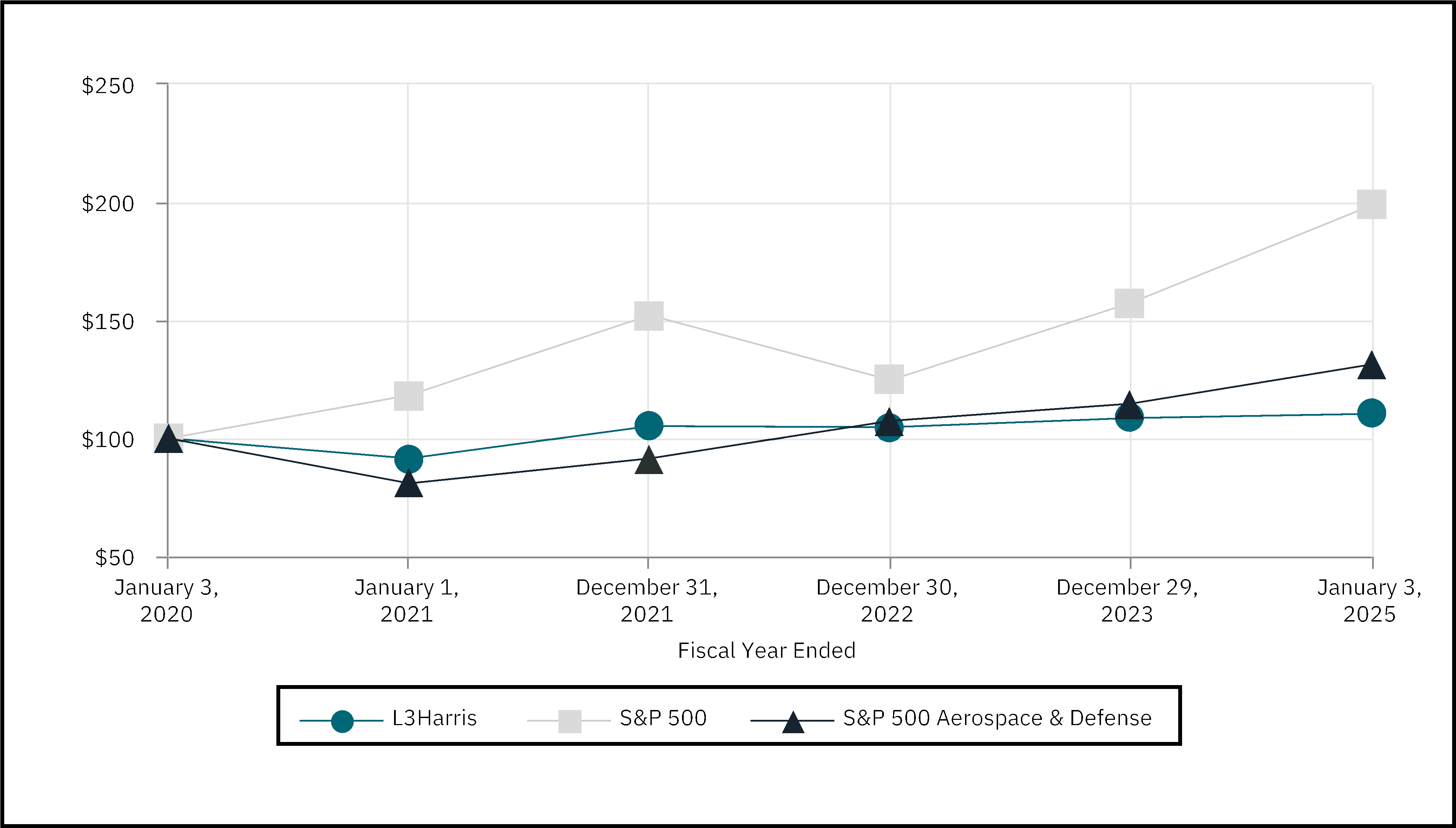
(1) This performance graph is not deemed to be filed with the SEC or subject to the liabilities of Section 18 of the Exchange Act, and should not be
deemed to be incorporated by reference into any other previous or future filings by us under the Securities Act or the Exchange Act.
Recent Sales of Unregistered Securities
During fiscal 2024, we did not issue or sell any unregistered securities.
_____________________________________________________________________
Issuer Purchases of Equity Securities
The following table sets forth information with respect to repurchases by us of our common stock during the
fiscal quarter ended January 3, 2025:
| Period* | Total number of shares purchased | Average price paid per share | Total number of shares purchased as part of publicly announced plans or programs**(1)** | Maximum approximate dollar value of shares that may yet be purchased under the plans or programs**(1)** ($ in millions) | |||
| Month No. 1 | |||||||
| (September 28, 2024 - November 1, 2024) | |||||||
| Repurchase program(1) | — | $— | — | $3,422 | |||
| Employee transactions(2) | 2,042 | $243.33 | — | — | |||
| Month No. 2 | |||||||
| (November 2, 2024 - November 29, 2024) | |||||||
| Repurchase program(1) | 60,000 | $227.72 | 60,000 | $3,407 | |||
| Employee transactions(2) | 5,294 | $245.69 | — | — | |||
| Month No. 3 | |||||||
| (November 30, 2024 - January 3, 2025) | |||||||
| Repurchase program(1) | 115,000 | $225.10 | 115,000 | $3,381 | |||
| Employee transactions(2) | 1,412 | $239.47 | — | — | |||
| Total | 183,748 | 175,000 | $3,381 |
*Periods represent our fiscal months.
(1)On January 28, 2021 and October 21, 2022, we announced that our Board approved share repurchase authorizations under our repurchase
program of $6.0 billion and $3.0 billion, respectively. Our repurchase program does not have an expiration date and authorizes us to
repurchase shares of our common stock through open market purchases, private transactions, transactions structured through investment
banking institutions or any combination thereof.
(2)Represents shares of our common stock delivered to us in satisfaction of the tax withholding obligation of holders of restricted stock units
(“RSUs”) and performance share units (“PSUs”) that vested during the quarter. Our equity incentive plans provide that the value of shares
delivered to us to pay the exercise price of stock options or to cover tax withholding obligations shall be the closing price of our common
stock on the date the relevant transaction occurs.
Item 6. [RESERVED.]
| | |
Item 7. MANAGEMENT’S DISCUSSION AND ANALYSIS OF FINANCIAL CONDITION AND RESULTS OF OPERATIONS.
The following Management’s Discussion and Analysis (“MD&A”) is intended to assist in an understanding of our
financial condition and results of operations for fiscal 2024 compared with fiscal 2023. A discussion of fiscal 2023
compared to fiscal 2022 can be found in Part II. Item 7. Management's Discussion and Analysis of Financial
Condition and Results of Operations included in our Annual Report on Form 10-K for the fiscal year ended
December 29, 2023 (our “Fiscal 2023 Form 10-K”). This MD&A is provided as a supplement to, should be read in
conjunction with and is qualified in its entirety by reference to, our Consolidated Financial Statements and
accompanying Notes appearing elsewhere in this Report. Except for the historical information contained herein, the
discussions in this MD&A contain forward-looking statements that involve risks and uncertainties. Our future results
could differ materially from those discussed herein. Factors that could cause or contribute to such differences
include, but are not limited to, those discussed in Part I. Item 1A. Risk Factors of this Report. For additional
information, see Part I. Item 1. Business - Cautionary Statement Regarding Forward-Looking Statements of this
Report.
OVERVIEW
We are the Trusted Disruptor in the defense industry. With customers’ mission-critical needs in mind, we deliver
end-to-end technology solutions connecting the space, air, land, sea and cyber domains in the interest of global
security. We support government customers in more than 100 countries, with our largest customers being various
departments and agencies of the U.S. Government, their prime contractors and international allies. Our products and
_____________________________________________________________________
services have defense and civil government applications, as well as commercial applications. As of January 3, 2025,
we had approximately 47,000 employees, including approximately 18,000 engineers and scientists.
We structure our operations primarily around the products, systems and services we sell and the markets we
serve, and we report our financial results in four business segments: SAS, IMS, CS and AR. See Note 14: Business
Segments in the Notes for further information regarding our business segments.
U.S. and International Budget Environment
The percentage of our revenue that was derived from sales to U.S. Government customers, including foreign
military sales funded through the U.S. Government, whether directly or through prime contractors, was 76%, 76%
and 74%, in fiscal 2024, 2023 and 2022, respectively.
On March 9, 2024, the President signed the first tranche of GFY 2024 appropriations funding bills into law,
which funded six government agencies, including the National Aeronautics and Space Administration, the National
Oceanic and Atmospheric Administration, and the Federal Aviation Administration, through the remainder of GFY
2024 which ended on September 30, 2024. A second funding bill, signed into law on March 23, 2024, funded all
remaining agencies, including the DoD, through the remainder of GFY 2024. The bill provided approximately
$844 billion in funding for DoD. This was in line with our expectations for 3% growth for defense over GFY 2023
levels and in line with the first year of the Fiscal Responsibility Act of 2023 (“FRA”) caps.
On March 11, 2024, the President’s Budget Request for GFY 2025 was released. The DoD requested
$850 billion, a 1% topline increase consistent with the FRA caps.
On April 24, 2024, the President signed into law a supplemental GFY 2024 appropriations package that included
$67 billion in funding for key DoD programs, bringing the DoD funding for GFY 2024 to $911 billion.
Congress has not yet reached a final agreement on GFY 2025 funding. A short-term CR was enacted on
December 21, 2024 that will fund the U.S. Government until March 14, 2025. While operating under a CR,
government agencies are allocated a portion of GFY 2024 enacted funds, and DoD is prohibited from starting new
programs. If Congress does not enact all 12 GFY 2025 appropriations bills by April 30, 2025, a 1% automatic
sequestration cut will go into effect as mandated by the FRA.
Further complicating the budget outlook is the need to raise the debt ceiling in 2025. Congressional inaction
may lead to a default and potentially create economic instability.
The overall defense spending environment, both in the U.S. and internationally, reflects the continued impacts of
global conflicts and geopolitical tensions, and changes to U.S. Government or international spending priorities have
and could in the future impact our business.
For a discussion of U.S. Government funding risks and international business risks see “Item 1. Business -
International Business,” “Item 1A. Risk Factors” and “Item 3. Legal Proceedings” of this Report.
Economic Environment
The macroeconomic environment continues to present challenges, which have impacted our business and may
continue to impact our future results. The ongoing uncertainty relates to the impacts of inflation, interest rates and
ongoing federal deficits, which could raise the cost of borrowing for the federal government impacting U.S.
Government spending priorities and the demand for our products. For a discussion of inflation-related risks, see
“Item 1A. Risk Factors” of this Report.
Operating Environment, Strategic Priorities and Key Performance Measures
As a proven alternative to traditional primes and new entrants, our flexible business model allows us to operate
as either a prime, merchant supplier, or subcontractor, offering both commercial pricing and traditional government
acquisition approaches. Our products are used across many customer platforms and this platform-agnostic
approach gives us a unique advantage in rapidly adapting to the changing threat environment while effectively
partnering with new entrants and non-traditional contractors. Customer demand for our solutions remains robust,
and we ended fiscal 2024 with backlog of $34.2 billion, a 5% increase over the prior year. Also in fiscal 2024, we
invested $515 million (2% of total revenue) in company-funded R&D focused on technologies that expand our
capabilities across our domains.
In fiscal 2024, we made considerable progress with our LHX NeXt initiative, our targeted three-year program
designed to enhance organizational agility and performance by leveraging our scale and relationships across
segments, driving operational efficiency and competitiveness for the enterprise. With this program we are investing
in enterprise tools and optimized, revamped processes to unlock further opportunities for margin expansion and
create additional value for our shareholders.
_____________________________________________________________________
Our strategic priorities continue to be performance, growth and innovation. We plan to continue to invest,
consistent with profitable growth opportunities, and sustain our culture of innovation, while delivering on our
commitments to investors, our customers and on every contract we are awarded. We intend to accomplish this by:
-
Building upon our solid foundation and operational rigor to execute for our customers;
-
Focusing on profitable growth while securing strategic positions as a prime or subcontractor; and
-
Leveraging innovation as a competitive advantage to develop rapid solutions.
We use the following key financial performance measures to manage our business, which are discussed in detail
below in the “Operations Review” and “Liquidity and Capital Resources” sections of this MD&A:
-
Revenue;
-
Operating income and margin; and
-
Net cash provided by operating activities.
We use these measures, along with other performance measures that are not defined by U.S. Generally
Accepted Accounting Principles (“GAAP”), to assess the success of our business and ou
Showing the first 8K of 67K characters. Open the full section
Item 7A. QUANTITATIVE AND QUALITATIVE DISCLOSURES ABOUT MARKET RISK.
Foreign Currency Risk
We are exposed to foreign currency risks that arise in normal course of our business operations. These risks
include the translation of local currency balances of foreign subsidiaries into U.S. dollars and transactions
denominated in currencies other than a subsidiary’s functional currency. Assets and liabilities of international
subsidiaries that use local currency as the functional currency, are translated at current rates of exchange and
income and expense items are translated at the weighted average exchange rate for the year. In fiscal 2024,
approximately 10% of our business was transacted in local currency environments. At January 3, 2025, the
cumulative impact of translating the assets and liabilities of these operations to U.S. Dollars was a $265 million loss,
which is included as a component of shareholders’ equity.
Our U.S. and foreign businesses enter into contracts with customers, subcontractors or vendors that are
denominated in currencies other than the functional currencies of such businesses. To manage our exposure to
currency risk and market fluctuation risk associated with anticipated cash flows that are probable of occurring in the
future, we implement foreign currency forward contracts to hedge both balance sheet and off-balance sheet future
foreign currency commitments. At January 3, 2025, we had open foreign currency forward contracts with an
aggregate notional amount of $201 million, hedging certain forecasted transactions denominated in U.S. Dollars,
Canadian Dollars and Australian Dollars. Notional amounts are used to measure the volume of foreign currency
forward contracts and do not represent exposure to foreign currency losses. Factors that could impact the
effectiveness of our hedging programs for foreign currency include accuracy of sales estimates, volatility of currency
markets and the cost and availability of hedging instruments.
At January 3, 2025, a hypothetical 10% change in currency exchange rates for our foreign currency derivatives
held would not have had a material impact on the fair value of such instruments or our results of operations or cash
flows. This quantification of exposure to the market risk associated with foreign currency financial instruments does
not take into account the offsetting impact of changes in the fair value of our foreign denominated assets, liabilities
and firm commitments.
Interest Rate Risk
We have exposure to interest rate risk associated with our financing activities, primarily our long-term debt and
short-term debt borrowings. At January 3, 2025, our long-term debt consisted exclusively of fixed-rate debt with a
carrying value and estimated fair value of $11,530 million and $11,179 million, respectively. The terms of our fixed-
rate debt obligations are not puttable to us (i.e., not required to be redeemed by us prior to maturity) and we
currently have no plans to refinance or repurchase outstanding fixed-rate debt prior to maturity. As such, fluctuation
in market interest rates impact the fair value of our long-term debt but do not impact our statement of operations or
cash flow. At January 3, 2025, a hypothetical 10% change in interest rates on our long-term fixed-rate debt
obligations would not have had a material impact on the fair value of these obligations.
Additionally, at January 3, 2025, we had short-term variable-rate debt outstanding under our CP Program of
$515 million. Due to its short-term nature, the fair value of our short-term debt approximates the carrying value.
Outstanding notes under our CP Program bear interest that is variable based on certain short-term indices, thus
exposing us to interest-rate risk. At January 3, 2025, a hypothetical 10% change in interest rates on our short-term
debt obligations would not have had a material impact on our results of operations or cash flows.
We can give no assurances, however, that interest rates will not change significantly or have a material effect on
the fair value of our debt obligations or our results of operations or cash flows over the next twelve months. See Note
8: Debt and Credit Arrangements in the Notes for information regarding the maturities of our fixed-rate debt
obligations and our CP program.
_____________________________________________________________________
Item 8. FINANCIAL STATEMENTS AND SUPPLEMENTARY DATA.
Report of Independent Registered Public Accounting Firm
To the Shareholders and the Board of Directors of L3Harris Technologies, Inc.
Opinion on the Financial Statements
We have audited the accompanying consolidated balance sheets of L3Harris Technologies, Inc. (the Company) as of
January 3, 2025 and December 29, 2023, the related consolidated statements of operations, comprehensive
income, cash flows and equity for each of the three years in the period ended January 3, 2025, and the related notes
(collectively referred to as the “consolidated financial statements”). In our opinion, the consolidated financial
statements present fairly, in all material respects, the financial position of the Company at January 3, 2025 and
December 29, 2023, and the results of its operations and its cash flows for each of the three years in the period
ended January 3, 2025, in conformity with U.S. generally accepted accounting principles.
We also have audited, in accordance with the standards of the Public Company Accounting Oversight Board (United
States) (PCAOB), the Company's internal control over financial reporting as of January 3, 2025, based on criteria
established in Internal Control-Integrated Framework issued by the Committee of Sponsoring Organizations of the
Treadway Commission (2013 framework), and our report dated February 14, 2025 expressed an unqualified opinion
thereon.
Basis for Opinion
These financial statements are the responsibility of the Company's management. Our responsibility is to express an
opinion on the Company’s financial statements based on our audits. We are a public accounting firm registered with
the PCAOB and are required to be independent with respect to the Company in accordance with the U.S. federal
securities laws and the applicable rules and regulations of the Securities and Exchange Commission and the PCAOB.
We conducted our audits in accordance with the standards of the PCAOB. Those standards require that we plan and
perform the audit to obtain reasonable assurance about whether the financial statements are free of material
misstatement, whether due to error or fraud. Our audits included performing procedures to assess the risks of
material misstatement of the financial statements, whether due to error or fraud, and performing procedures that
respond to those risks. Such procedures included examining, on a test basis, evidence regarding the amounts and
disclosures in the financial statements. Our audits also included evaluating the accounting principles used and
significant estimates made by management, as well as evaluating the overall presentation of the financial
statements. We believe that our audits provide a reasonable basis for our opinion.
Critical Audit Matters
The critical audit matters communicated below are matters arising from the current period audit of the financial
statements that were communicated or required to be communicated to the audit committee and that: (1) relate to
accounts or disclosures that are material to the financial statements and (2) involved our especially challenging,
subjective or complex judgments. The communication of critical audit matters does not alter in any way our opinion
on the consolidated financial statements, taken as a whole, and we are not, by communicating the critical audit
matters below, providing separate opinions on the critical audit matters or on the accounts or disclosures to which
they relate.
_____________________________________________________________________
| Cost estimation for revenue recognition on development and production contracts | |
| Description of the Matter | As described in the consolidated financial statements, the Company recognized revenue for certain of its development and production contracts over time, typically using a percentage of completion cost-to-cost method, which required estimates of costs at completion for each contract. At the outset of each contract, the Company gauges its complexity and perceived risks and establishes an estimated total cost at completion with these expectations. After establishing the estimated total cost at completion, the Company reviews the progress and performance on its ongoing contracts at least quarterly and updates the estimated total cost at completion. Such estimates are subject to change during the performance of the contract and significant changes in estimates could have a material effect on the Company’s results of operations. Auditing the cost estimation for revenue recognition on development and production contracts where revenue is recognized over time using the percentage of completion cost- to-cost method involved subjective auditor judgment because the Company’s development of the estimated total cost at completion requires estimates of the cost of the work to be completed based on the Company’s underlying assumptions around achieving the technical, schedule and cost aspects of its contracts. In determining the estimates of the cost of the work to be completed, the Company considered the nature and complexity of the work to be performed, subcontractor performance and the risk and impact of delayed performance. Estimates of total cost at completion are also affected by management’s assessment of the current status of the contract and expectation for performance on the contract, as well as historical experience. |
| How We Addressed the Matter in Our Audit | We obtained an understanding, evaluated the design and tested the operating effectiveness of certain internal controls over the Company’s accounting for cost estimation for development and production contracts. For example, we tested certain controls over management’s review of the estimate at completion analyses and the significant assumptions underlying the estimated total costs at completion. We also tested certain of management’s controls to validate that the data used in the estimate at completion analyses was complete and accurate. To test the cost estimation for development and production contracts, our audit procedures included, among others, obtaining an understanding of the contract, meeting with program management to confirm our understanding of the risks associated with the arrangement and the current contract performance, review of customer correspondence and contractual milestones and comparing cost estimates to historical cost experience with similar contracts, when applicable. Additionally, we obtained an understanding of the Company’s past performance of estimating total costs at completion by reviewing changes in the cost estimates from previous periods and reviewing the overall accuracy of management’s cost to completion estimations through lookback analyses. |
_____________________________________________________________________
| Valuation of Goodwill | |
| Description of the Matter | At January 3, 2025, the Company’s goodwill was $20.3 billion. As more fully described in the consolidated financial statements, the Company tests goodwill for impairment annually (or under certain circumstances, more frequently) at the reporting unit level using either a qualitative or quantitative assessment. Under the quantitative assessment to test for goodwill impairment, the Company compares the fair value of a reporting unit to its carrying amount, including goodwill. The Company estimates the fair value of its reporting units using a combination of a discounted cash flows analysis and market-based valuation methodologies. Auditing the Company’s quantitative goodwill impairment tests involved subjective auditor judgment due to the significant estimation required in management’s determination of the fair value of the reporting units. The significant estimation is primarily due to the sensitivity of the respective fair values to underlying assumptions, particularly at the Aerojet Rocketdyne (AR) reporting unit, in |
Showing the first 8K of 194K characters. Open the full section
Item 9. CHANGES IN AND DISAGREEMENTS WITH ACCOUNTANTS ON ACCOUNTING AND FINANCIAL DISCLOSURE.
Not applicable.
Item 9A. CONTROLS AND PROCEDURES.
Evaluation of Disclosure Controls and Procedures
Pursuant to Rule 13a-15 under the Exchange Act, management, with the participation of our principal executive
officer (CEO) and principal financial officer (CFO), carried out an evaluation of the Company’s disclosure controls and
procedures as of January 3, 2025. Based on this evaluation, the CEO and CFO concluded that as of January 3, 2025,
our disclosure controls and procedures were designed at a reasonable assurance level and were effective to provide
reasonable assurance that information required to be disclosed in our reports filed or submitted under the Exchange
Act is recorded, processed, summarized and reported within the time periods specified in SEC rules and forms, and
that such information is accumulated and communicated to management, including our CEO and CFO, as
appropriate, to allow timely decisions regarding required disclosures.
Management’s Report on Internal Control Over Financial Reporting
The Company’s management is responsible for establishing and maintaining adequate internal control over
financial reporting as such term is defined in Rules 13a-15(f) and 15d-15(f) under the Securities Exchange Act of
1934, as amended. The Company’s internal control over financial reporting is designed to provide reasonable
assurance regarding the reliability of financial reporting and the preparation of financial statements for external
purposes in accordance with U.S. generally accepted accounting principles.
Because of its inherent limitations, internal control over financial reporting may not prevent or detect
misstatements. Also, projections of any evaluation of effectiveness to future periods are subject to the risk that
controls may become inadequate because of changes in conditions, or that the degree of compliance with the
policies or procedures may deteriorate.
_____________________________________________________________________
Our management, with the participation of our CEO and CFO, assessed the effectiveness of the Company’s
internal control over financial reporting as of January 3, 2025. In making this assessment, management used the
criteria set forth by the Committee of Sponsoring Organizations of the Treadway Commission (COSO) in Internal
Control-Integrated Framework (2013 framework). Based on this assessment, management concluded that the
Company’s internal control over financial reporting was effective as of January 3, 2025.
The Company’s independent registered public accounting firm, Ernst & Young LLP, has issued a report on the
effectiveness of the Company’s internal control over financial reporting. This report appears on the following page of
this Report.
Changes in Internal Control Over Financial Reporting
Other than changes related to incorporating our controls and procedures with respect to AJRD operations, there
have been no changes in our internal control over financial reporting that occurred during the quarter ended
January 3, 2025 that have materially affected, or are reasonably likely to materially affect, our internal control over
financial reporting.
_____________________________________________________________________
Report of Independent Registered Public Accounting Firm
To the Shareholders and the Board of Directors of L3Harris Technologies, Inc.
Opinion on Internal Control Over Financial Reporting
We have audited L3Harris Technologies, Inc.’s internal control over financial reporting as of January 3, 2025, based
on criteria established in Internal Control—Integrated Framework issued by the Committee of Sponsoring
Organizations of the Treadway Commission (2013 framework) (the COSO criteria). In our opinion, L3Harris
Technologies, Inc. (the Company) maintained, in all material respects, effective internal control over financial
reporting as of January 3, 2025, based on the COSO criteria.
We also have audited, in accordance with the standards of the Public Company Accounting Oversight Board (United
States) (PCAOB), the consolidated balance sheets of the Company as of January 3, 2025 and December 29, 2023,
the related consolidated statements of operations, comprehensive income, cash flows and equity for each of the
three years in the period ended January 3, 2025, and the related notes and our report dated February 14, 2025
expressed an unqualified opinion thereon.
Basis for Opinion
The Company’s management is responsible for maintaining effective internal control over financial reporting and for
its assessment of the effectiveness of internal control over financial reporting included in the accompanying
Management’s Report on Internal Control Over Financial Reporting. Our responsibility is to express an opinion on
the Company’s internal control over financial reporting based on our audit. We are a public accounting firm
registered with the PCAOB and are required to be independent with respect to the Company in accordance with the
U.S. federal securities laws and the applicable rules and regulations of the Securities and Exchange Commission and
the PCAOB.
We conducted our audit in accordance with the standards of the PCAOB. Those standards require that we plan and
perform the audit to obtain reasonable assurance about whether effective internal control over financial reporting
was maintained in all material respects.
Our audit included obtaining an understanding of internal control over financial reporting, assessing the risk that a
material weakness exists, testing and evaluating the design and operating effectiveness of internal control based on
the assessed risk, and performing such other procedures as we considered necessary in the circumstances. We
believe that our audit provides a reasonable basis for our opinion.
Definition and Limitations of Internal Control Over Financial Reporting
A company’s internal control over financial reporting is a process designed to provide reasonable assurance
regarding the reliability of financial reporting and the preparation of financial statements for external purposes in
accordance with generally accepted accounting principles. A company’s internal control over financial reporting
includes those policies and procedures that (1) pertain to the maintenance of records that, in reasonable detail,
accurately and fairly reflect the transactions and dispositions of the assets of the company; (2) provide reasonable
assurance that transactions are recorded as necessary to permit preparation of financial statements in accordance
with generally accepted accounting principles, and that receipts and expenditures of the company are being made
only in accordance with authorizations of management and directors of the company; and (3) provide reasonable
assurance regarding prevention or timely detection of unauthorized acquisition, use, or disposition of the company’s
assets that could have a material effect on the financial statements.
Because of its inherent limitations, internal control over financial reporting may not prevent or detect
misstatements. Also, projections of any evaluation of effectiveness to future periods are subject to the risk that
controls may become inadequate because of changes in conditions, or that the degree of compliance with the
policies or procedures may deteriorate.
/s/ Ernst & Young LLP
Orlando, Florida
February 14, 2025
_____________________________________________________________________
Item 9B. OTHER INFORMATION.
Securities Trading Plans of Directors and Executive Officers
We require all executive officers and directors to effect purchase and sale transactions in L3Harris securities
pursuant to a trading plan (each, a “10b5-1 Plan”) intended to satisfy the requirements of Rule 10b5-1 under the
Exchange Act (“Rule 10b5-1”). We limit executive officers to a single 10b5-1 Plan in effect at any time, subject to
limited exceptions in accordance with Rule 10b5-1.
The following table includes the material terms (other than with respect to the price) of each 10b5-1 Plan
adopted or terminated by our executive officers and directors during the quarter ended January 3, 2025:
| Name and title | Date of adoption of 10b5-1 Plan**(1)** | Scheduled expiration date of 10b5-1 Plan**(2)** | Aggregate number of shares of common stock to be purchased or sold**(3)** | |||
| Christopher E. Kubasik Chair and CEO | November 26, 2024 | March 25, 2025 | Up to 112,138 shares underlying options expiring in 2027 | |||
| Jonathan P. Rambeau President, IMS | December 3, 2024 | March 14, 2025 | Up to 3,178 shares | |||
| Edward J. Zoiss President, SAS | December 6, 2024 | June 6, 2025 | Up to 20,579 shares including 9,012 shares of underlying options expiring in 2028 |
(1) Transactions under each Rule 10b5-1 Plan commence no earlier than 90 days after adoption, or such later date as required by Rule 10b5-1.
(2) Each Rule 10b5-1 Plan may expire on such earlier date as all transactions are completed.
(3) Each Rule 10b5-1 Plan provides for shares to be sold on multiple predetermined dates.
Item 9C. DISCLOSURE REGARDING FOREIGN JURISDICTIONS THAT PREVENT INSPECTIONS.
Not applicable.
PART III
Item 10. DIRECTORS, EXECUTIVE OFFICERS AND CORPORATE GOVERNANCE.
Information regarding our directors, executive officers and corporate governance is included in our Proxy
Statement for our 2025 Annual Meeting of Shareholders scheduled to be held on April 18, 2025 (our “2025 Proxy
Statement”), which is expected to be filed within 120 days after the end of our fiscal 2024.
Directors. The information required by this Item with respect to our directors and corporate governance is
incorporated herein by reference to the discussion under the headings Proposal 1: Election of Directors and
Corporate Governance in our 2025 Proxy Statement.
Identification of Executive Officers. Certain information regarding our executive officers is included in Part I of
this Report under the heading “Information about our Executive Officers” in accordance with General
Instruction G(3) of Form 10-K.
Code of Ethics. All of our directors and employees, including our Chief Executive Officer, Chief Financial Officer,
Principal Accounting Officer and other senior accounting and financial officers, are required to abide by our Code of
Conduct. Our Code of Conduct is posted on our website at https://www.l3harris.com/resources/other/l3harris-code-
conduct and is also available free of charge by written request to our Director of Ethics and Compliance, L3Harris
Technologies, Inc., 1025 West NASA Boulevard, Melbourne, Florida 32919. We intend to disclose on the Code of
Conduct section of our website at https://www.l3harris.com/resources/other/l3harris-code-conduct any amendment
to, or waiver from, our Code of Conduct that is required to be disclosed to shareholders, within four business days
following such amendment or waiver. The information required by this Item with respect to codes of ethics is
incorporated herein by reference to the discussion under the heading Code of Conduct in our 2025 Proxy Statement.
Insider Trading Policies. We have adopted an Insider Trading Policy, which governs the purchase, sale, and/or
other dispositions of our securities by directors, officers and employees and other covered persons and is designed
to promote compliance with insider trading laws, rules and regulations, and listing standards applicable to us. A
copy of our Insider Trading Policy is filed as Exhibit 19 to this Report.
_____________________________________________________________________
Item 11. EXECUTIVE COMPENSATION.
The information required by this Item with respect to compensation of our directors and executive officers is
incorporated herein by reference to the discussions under the headings Director Compensation and Benefits,
Compensation Discussion and Analysis, Compensation Committee Report, Compensation Tables, CEO Pay Ratio and
Pay Versus Performance in our 2025 Proxy Statement.
Item 12. SECURITY OWNERSHIP OF CERTAIN BENEFICIAL OWNERS AND MANAGEMENT AND RELATED STOCKHOLDER MATTERS.
The following table provides information about our common stock that may be issued, whether upon the
exercise of options, warrants and rights or otherwise, under our existing equity compensation plans, as of January 3,
2025:
| Plan Category | Number of securities to be issued upon exercise of outstanding options, warrants and rights (a)****(2) | Weighted- average exercise price of outstanding options, warrants and rights (b)****(2) | Number of securities remaining available for future issuance under equity compensation plans (excluding securities reflected in column (a)) (c) | |||
| Equity compensation plans approved by shareholders(1) | 3,544,971 | $191.09 | 21,172,833 | |||
| Equity compensation plans not approved by shareholders | — | — | — | |||
| Total | 3,544,971 | 191.09 | 21,172,833 |
(1) Consists of awards under the L3Harris SIPs.
(2) Under the L3Harris SIPs, in addition to stock options, we have granted share-based compensation awards in the form of PSUs, RSUs and
other similar types of share-based awards. As of January 3, 2025, there were awards outstanding under those plans with respect to
1,008,116 shares, consisting of awards of (i) 582,326 RSUs and (ii) 425,790 PSUs, for which all 1,008,116 were payable in shares but for
which no shares were yet issued and outstanding. The 3,544,971 shares to be issued upon exercise of outstanding options, warrants and
rights as listed in column (a) consisted of shares to be issued in respect of the exercise of 2,536,855 outstanding stock options and awards
of 1,008,116 PSUs and RSUs payable in shares. Because there is no exercise price associated with awards of PSUs or RSUs, all of which are
granted to employees at no cost, such awards are not included in the weighted-average exercise price calculation in column (b).
See Note 10: Share-Based Compensation in the Notes for a general description of our share-based incentive
plans.
The other information required by this Item with respect to security ownership of certain of our beneficial
owners and management is incorporated herein by reference to the discussions under the headings Principal
Shareholders and Shares Owned By Directors, Nominees and Executive Officers in our 2025 Proxy Statement.
Item 13. CERTAIN RELATIONSHIPS AND RELATED TRANSACTIONS, AND DIRECTOR INDEPENDENCE.
The information required by this Item is incorporated herein by reference to the discussions under the headings
Director Independence Standards and Related Person Transactions in our 2025 Proxy Statement.
Item 14. PRINCIPAL ACCOUNTING FEES AND SERVICES.
The information required by this Item is incorporated herein by reference to the discussion under the heading
Proposal 4: Ratification of Appointment of Independent Registered Public Accounting Firm in our 2025 Proxy
Statement.
_____________________________________________________________________
PART IV
Item 15. EXHIBITS, FINANCIAL STATEMENT SCHEDULES.
The following documents are filed as a part of this Report:
| Page | |
| Financial Statements | |
| The following consolidated financial statements of L3Harris Technologies, Inc. are included in Item 8 of this Report at the page numbers referenced below: | |
| Consolidated Statement of Operations — Fiscal Years Ended January 3, 2025, December 29, 2023 and December 30, 2022 .................................................................................................................................... | 39 |
| Consolidated Statement of Comprehensive Income — Fiscal Years Ended January 3, 2025, December 29, 2023 and December 30, 2022 .............................................................................................. | 40 |
| Consolidated Balance Sheet — January 3, 2025 and December 29, 2023 ................................................... | 41 |
| Consolidated Statement of Cash Flows — Fiscal Years Ended January 3, 2025, December 29, 2023 and December 30, 2022 ................................................................................................................................... | 42 |
| Consolidated Statement of Equity — Fiscal Years Ended January 3, 2025, December 29, 2023 and December 30, 2022 ........................................................................................................................................... | 43 |
| Notes to Consolidated Financial Statements ...................................................................................................... | 44 |
| The following report of L3Harris Technologies, Inc.’s independent registered public accounting firm with respect to the above referenced consolidated financial statements and their report on internal controls over financial reporting are included in Item 8 and Item 9A of this Report at the page numbers referenced below: | |
| Report of Independent Registered Public Accounting Firm (PCAOB ID: 42) on the Consolidated Financial Statements .......................................................................................................................................... | 36 |
| Report of Independent Registered Public Accounting Firm on the Effectiveness of Internal Control Over Financial Reporting .................................................................................................................................... | 90 |
| Financial Statement Schedules | |
| All schedules are omitted because they are not applicable, the amounts are not significant or the required information is shown in the Consolidated Financial Statements or the Notes thereto. |
Exhibits
The following exhibits are filed herewith or are incorporated herein by reference to exhibits previously filed with
the SEC:
S-8, Registration No. 333-279040 filed with the SEC on May 1, 2024.
(3)(b) By-Laws of L3Harris Technologies, Inc., as amended and restated effective December 8, 2022,
Form 8-K filed with the SEC on December 13, 2022. (Commission File Number 1-3863)
(4)(a) (i) Indenture, dated as of May 1, 1996, between L3Harris Technologies, Inc. (formerly known as Harris
Corporation) and The Bank of New York, as Trustee, relating to unlimited amounts of debt securities
which may be issued from time to time by L3Harris Technologies, Inc. (formerly known as Harris
Corporation) when and as authorized by L3Harris Technologies, Inc.’s (formerly known as Harris
4 to L3Harris Technologies, Inc.’s (formerly known as Harris Corporation) Registration Statement on
Form S-3, Registration Statement No. 333-03111, filed with the SEC on May 3, 1996.
(ii) Instrument of Resignation from Trustee and Appointment and Acceptance of Successor Trustee,
dated as of November 1, 2002 (effective November 15, 2002), among L3Harris Technologies, Inc.
(formerly known as Harris Corporation), JP Morgan Chase Bank, as Resigning Trustee, and The Bank of
New York, as Successor Trustee, incorporated herein by reference to Exhibit 99.4 to L3Harris
quarter ended September 27, 2002. (Commission File Number 1-3863)
_____________________________________________________________________
(iii) Supplemental Indenture, dated June 2, 2015, among L3Harris Technologies, Inc. (formerly known
the Indenture dated as of May 1, 1996 between L3Harris Technologies, Inc. (formerly known as Harris
Corporation) and The Bank of New York (as successor to Chemical Bank), incorporated herein by
Report on Form 8-K filed with the SEC on June 2, 2015. (Commission File Number 1-3863)
**(4)(b) (i) Indenture, dated as of October 1, 1990, between L3Harris Technologies, Inc. (formerly known as
Harris Corporation) and U.S. Bank National Association (as successor to National City Bank), as Trustee,
relating to unlimited amounts of debt securities which may be issued from time to time by L3Harris
Technologies, Inc. (formerly known as Harris Corporation) when and as authorized by L3Harris
Technologies, Inc.’s (formerly known as Harris Corporation) Board of Directors or a Committee of the
Board, incorporated herein by reference to Exhibit 4 to L3Harris Technologies, Inc. (formerly known as
Harris Corporation) Registration Statement on Form S-3, Registration Statement No. 33-35315, filed
with the SEC on June 8, 1990.
to the Indenture dated as of October 1, 1990 between L3Harris Technologies, Inc. (formerly known as
Harris Corporation) and U.S. National Association (as successor to National City Bank), incorporated
herein by reference to Exhibit 4.1 to L3Harris Technologies, Inc.’s (formerly known as Harris
Corporation) Current Report on Form 8-K filed with the SEC on June 2, 2015. (Commission File Number
(4)(c) (i) Indenture, dated as of September 3, 2003, between L3Harris Technologies, Inc. (formerly known as
Harris Corporation) and The Bank of New York Mellon Trust Company, N.A., as successor to The Bank of
time by L3Harris Technologies, Inc. (formerly known as Harris Corporation) when and as authorized by
known as Harris Corporation) Registration Statement on Form S-3, Registration Statement No.
333-108486, filed with the SEC on September 3, 2003
(ii) Instrument of Resignation of Trustee, Appointment and Acceptance of Successor Trustee, dated as
New York Mellon (formerly known as The Bank of New York) and The Bank of New York Mellon Trust
Company, N.A., as to Indenture dated as of September 3, 2003, incorporated herein by reference to
Exhibit 4(m) to L3Harris Technologies, Inc.'s (formerly known as Harris Corporation) Registration
Statement on Form S-3, Registration Statement No. 333-159688, filed with the SEC on June 3, 2009
(iii) Supplemental Indenture, dated June 2, 2015, among L3Harris Technologies, Inc. (formerly known
to The Bank of New York), to the Indenture dated as of September 3, 2003 between L3Harris
Technologies, Inc. (formerly known as Harris Corporation) and The Bank of New York Mellon Trust
with the SEC on June 2, 2015. (Commission File Number 1-3863)
(4)(d) (i) Subordinated Indenture, dated as of September 3, 2003, between L3Harris Technologies, Inc.
(formerly known as Harris Corporation) and The Bank of New York Mellon Trust Company, N.A., as
when and as authorized by the L3Harris Technologies, Inc.'s (formerly known as Harris Corporation)
L3Harris Technologies, Inc.'s (formerly known as Harris Corporation) Registration Statement on Form
S-3, Registration Statement No. 333-108486, filed with the SEC on September 3, 2003
(ii) Instrument of Resignation of Trustee, Appointment and Acceptance of Successor Trustee, dated as
New York Mellon (formerly known as The Bank of New York) and The Bank of New York Mellon Trust
Company, N.A., as to Subordinated Indenture dated as of September 3, 2003, incorporated herein by
reference to Exhibit 4(n) to L3Harris Technologies, Inc.'s (formerly known as Harris Corporation)
_____________________________________________________________________
Registration Statement on Form S-3, Registration Statement No. 333-159688, filed with the SEC on
(4)(e) Pursuant to Regulation S-K, Item 601(b)(4)(iii)(A), L3Harris Technologies, Inc. by this filing agrees, upon
request, to furnish to the SEC a copy of other instruments defining the rights of holders of long-term
debt of L3Harris Technologies, Inc.
(4)(f) Description of L3Harris Technologies, Inc.’s Securities, incorporated herein by reference to Exhibit 4(x)
to the L3Harris Technologies, Inc's Annual Report on Form 10-K filed for the fiscal year ended
December 30, 2022 (Commission File Number 1-3863)
with the SEC on July 1, 2019. (Commission File Number 1-3863)
*(10)(b) L3Harris Technologies, Inc. Executive Change in Control Severance Plan, effective as of July 21, 2023,
8-K filed with the SEC on July 24, 2023. (Commission File Number 1-3863)
*(10)(c) L3Harris Technologies, Inc. Severance Pay Plan, effective as of March 1, 2020, incorporated herein by
on March 4, 2020. (Commission File Number 1-3863)
*(10)(d) L3Harris Technologies, Inc. Annual Incentive Plan (Amended and Restated Effective as of August 28,
on Form 8-K filed with the SEC on September 1, 2020. (Commission File Number 1-3863)
*(10)(e) (i) 2015 Equity Incentive Plan, incorporated herein by reference to Exhibit 10.1 to L3Harris
SEC on October 28, 2015. (Commission File Number 1-3863)
(ii) Non-Employee Director Share Unit Agreement Terms and Conditions (as of June 29, 2019),
Form 10-KT for the fiscal year ended January 3, 2020. (Commission File Number 1-3863)
Report on Form 10-Q for the fiscal quarter ended April 3, 2020. (Commission File Number 1-3863)
(iv) L3Harris Technologies, Inc. Performance Unit Award Agreement Terms and Conditions (as of
Quarterly Report on Form 10-Q for the fiscal quarter ended April 3, 2020. (Commission File Number
2020), incorporated herein by reference to Exhibit 10.5 to L3Harris Technologies, Inc.’s Quarterly
Report on Form 10-Q for the fiscal quarter ended April 3, 2020. (Commission File Number 1-3863)
*(10)(f) (i) L3Harris Technologies, Inc. 2015 Equity Incentive Plan (Amended and Restated Effective as of August
28, 2020), incorporated herein by reference to Exhibit 10.2 to L3Harris Technologies, Inc.’s Current
Report on Form 8-K filed with the SEC on September 1, 2020. (Commission File Number 1-3863)
Report on Form 10-Q for the fiscal quarter ended March 31, 2023. (Commission File Number 1-3863)
(iii) L3Harris Technologies, Inc. Performance Unit Award Agreement Terms and Conditions (as of
Quarterly Report on Form 10-Q for the fiscal quarter ended March 31, 2023. (Commission File Number
(iv) L3Harris Technologies, Inc. Stock Option Award Agreement Terms and Conditions (as of February
Report on Form 10-Q for the fiscal quarter ended March 31, 2023. (Commission File Number 1-3863)
_____________________________________________________________________
*10(g) (i) L3Harris Technologies, Inc. 2024 Equity Incentive Plan, incorporated herein by reference to Exhibit
filed with the SEC on May 1, 2024. (Commission File Number 1-3863)
(ii) L3Harris Technologies, Inc. 2024 Performance Unit Award Agreement Terms and Conditions
July 26, 2024. (Commission File Number 1-3863)
April 19, 2024), incorporated herein by reference to Exhibit 10.3 to L3Harris Technologies, Inc.
26, 2024. (Commission File Number 1-3863)
(iv) L3Harris Technologies, Inc. 2024 Stock Option Award Agreement Terms and Conditions (Effective
April 19, 2024), incorporated herein by reference to Exhibit 10.4 to L3Harris Technologies, Inc.
26, 2024. (Commission File Number 1-3863)
*10(h) (i) L3Harris Retirement Savings Plan (Amended and Restated Effective January 1, 2025).
(ii) Amendment Number One to the L3Harris Retirement Savings Plan (Amended and Restated Effective
January 1, 2025), dated February 12, 2025.
*(10)(i) (i) L3Harris Excess Retirement Savings Plan, as amended and restated effective June 1, 2024,
Form 10-Q for the fiscal quarter ended June 28, 2024, filed with the SEC on July 26, 2024.
(Commission File Number 1-3863)
(ii) Amendment Number One to the L3Harris Excess Retirement Savings Plan (Amended and Restated
to L3Harris Technologies, Inc.'s Quarterly Report on Form 10-Q for the fiscal quarter ended April 2,
2021. (Commission File Number 1-3863)
*(10)(k) L3Harris Technologies, Inc. 2019 Non-Employee Director Deferred Compensation Plan, incorporated
the fiscal year ended January 3, 2020. (Commission File Number 1-3863)
*(10)(l) (i) Amended and Restated Master Trust Agreement and Declaration of Trust, made as of December 2,
2003, by and between L3Harris Technologies, Inc. (formerly known as Harris Corporation) and The
Northern Trust Company, incorporated herein by reference to Exhibit 10(c) to L3Harris Technologies,
Inc.'s (formerly known as Harris Corporation) Quarterly Report on Form 10-Q for the fiscal quarter
ended January 2, 2004. (Commission File Number 1-3863)
dated May 21, 2009, incorporated herein by reference to Exhibit 10(m)(ii) to L3Harris Technologies,
3, 2009. (Commission File Number 1-3863)
dated December 8, 2009 and effective December 31, 2009, incorporated herein by reference to Exhibit
on Form S-8, Registration Statement No. 333-163647, filed with the SEC on December 10, 2009
dated and effective May 3, 2010, incorporated herein by reference to Exhibit 4(e)(iv) to L3Harris
Technologies, Inc.'s (formerly known as Harris Corporation) Registration Statement on Form S-8,
Registration Statement No. 333-222821, filed with the SEC on February 1, 2018
*(10)(m) (i) Master Rabbi Trust Agreement, amended and restated as of December 2, 2003, by and between
L3Harris Technologies, Inc. (formerly known as Harris Corporation) and The Northern Trust Company,
Harris Corporation) Quarterly Report on Form 10-Q for the fiscal quarter ended January 2, 2004.
(Commission File Number 1-3863)
_____________________________________________________________________
the fiscal quarter ended October 1, 2004. (Commission File Number 1-3863)
(iii) Second Amendment to the L3Harris Technologies, Inc. (formerly known as Harris Corporation)
Master Rabbi Trust Agreement, dated as of December 8, 2004, incorporated herein by reference to
Form 8-K filed with the SEC on December 8, 2004. (Commission File Number 1-3863)
Rabbi Trust Agreement, dated January 15, 2009 and effective January 1, 2009, incorporated herein by
reference to Exhibit 10(i) to L3Harris Technologies, Inc.'s (formerly known as Harris Corporation)
Quarterly Report on Form 10-Q for the fiscal quarter ended January 2, 2009. (Commission File Number
Rabbi Trust Agreement, dated October 27, 2010 and effective as of August 28, 2010, incorporated
herein by reference to Exhibit 10(n) to L3Harris Technologies, Inc.'s (formerly known as Harris
Corporation) Quarterly Report on Form 10-Q for the fiscal quarter ended October 1, 2010. (Commission
Rabbi Trust Agreement, dated and effective as of February 28, 2019, incorporated herein by reference
on Form 10-Q for the fiscal quarter ended March 29, 2019. (Commission File Number 1-3863)
*10(n) Summary of Annual Compensation of L3Harris Technologies, Inc., Non-Employee Directors effective as
Current Report on Form 8-K filed with the SEC on July 24, 2023. (Commission File Number 1-3863)
**10(o) Revolving Credit Agreement, dated as of July 29, 2022, by and among L3Harris Technologies, Inc. and
Inc.’s Current Report on Form 8-K filed with the SEC on August 4, 2022. (Commission File Number
*10(p) Offer Letter, dated August 12, 2022, between L3Harris Technologies, Inc. and Jon Rambeau
Form 10-K for fiscal year-ended December 30, 2022. (Commission File Number 1-3863)
***10(q) 364-Day Credit Agreement, dated January 26, 2024, by and among L3Harris Technologies, Inc. and the
Quarterly Report on Form 10-Q filed with the SEC on April 26, 2024 (Commission File Number 1-3863)
***10(r) Form of Commercial Paper Dealer Agreement, dated March 14, 2023, between L3Harris Technologies,
Inc. and the Dealer party thereto, incorporated herein by reference to Exhibit 10.2 to L3Harris
*10(s) Offer Letter, dated November 30, 2023, between L3Harris Technologies, Inc. and Kenneth L.
Report of Form 10-K for the fiscal year ended December 29, 2023. (Commission File Number 1-3863)
*10(t) Offer Letter, November 4, 2022, between L3Harris Technologies, Inc. and Samir B. Mehta, incorporated
for the fiscal year ended December 29, 2023. (Commission File Number 1-3863)
*10(u) Letter Agreement, dated February 23, 2024, between L3Harris Technologies, Inc. and Christopher E.
Kubasik, incorporated herein by reference to Exhibit 10.1 to L3Harris Technologies, Inc.’s Current
Report on Form 8-K filed with the SEC on February 23, 2024. (Commission File Number 1-3863)
(21) Subsidiaries of the Registrant.
(23) Consent of Ernst & Young LLP, Independent Registered Public Accounting Firm.
_____________________________________________________________________
(31.1) Rule 13a-14(a)/15d-14(a) Certification of Chief Executive Officer.
(31.2) Rule 13a-14(a)/15d-14(a) Certification of Chief Financial Officer.
(32) Section 1350 Certifications.
(97) Incentive-Based Compensation Recovery Policy, incorporated herein by reference to Exhibit 97 to
L3Harris Technologies, Inc’s Annual Report on Form 10-K for the fiscal year ended December 29, 2023.
(Commission File Number 1-3863).
(101) The financial information from L3Harris Technologies, Inc.’s Annual Report on Form 10-K for the period
from December 31, 2022 to December 29, 2023 formatted in Inline XBRL (Extensible Business
Reporting Language) includes: (i) the Consolidated Balance Sheet, (ii) the Consolidated Statement of
Operations, (iii) the Consolidated Statement of Comprehensive Income, (iv) the Consolidated Statement
of Changes in Stockholders Equity, (v) the Consolidated Statement of Cash Flows and (vi) the Notes to
the Consolidated Financial Statements.
(104) Cover Page Interactive Data File formatted in Inline XBRL and contained in Exhibit 101.
- Management contract or compensatory plan or arrangement.
** Paper filing.
*** Schedules have been omitted pursuant to Item 601(a)(5) of Regulation S-K. L3Harris Technologies, Inc. hereby undertakes to furnish
supplementally copies of any of the omitted schedules upon request by the SEC.
Item 16. FORM 10-K SUMMARY.
None.
_____________________________________________________________________
SIGNATURES
Pursuant to the requirements of Section 13 or 15(d) of the Securities Exchange Act of 1934, the registrant has duly
caused this report to be signed on its behalf by the undersigned, thereunto duly authorized.
| L3HARRIS TECHNOLOGIES, INC. | ||||
| (Registrant) | ||||
| Date: February 14, 2025 | By: | /s/ Christopher E. Kubasik | ||
| Christopher E. Kubasik | ||||
| Chair and Chief Executive Officer |
Pursuant to the requirements of the Securities Exchange Act of 1934, this report has been signed below by the
following persons on behalf of the registrant and in the capacities and on the dates indicated.
| Signature | Title | Date | ||||
| /s/ CHRISTOPHER E. KUBASIK | Chair and Chief Executive Officer (Principal Executive Officer) | February 14, 2025 | ||||
| Christopher E. Kubasik | ||||||
| /s/ KENNETH L. BEDINGFIELD | Senior Vice President, Chief Financial Officer and President, Aerojet Rocketdyne (Principal Financial Officer) | February 14, 2025 | ||||
| Kenneth L. Bedingfield | ||||||
| /s/ JOHN P. CANTILLON | Vice President, Principal Accounting Officer (Principal Accounting Officer) | February 14, 2025 | ||||
| John P. Cantillon | ||||||
| * | Director | February 14, 2025 | ||||
| Sallie B. Bailey | ||||||
| * | Director | February 14, 2025 | ||||
| Thomas A. Dattilo | ||||||
| * | Director | February 14, 2025 | ||||
| Roger B. Fradin | ||||||
| * | Director | February 14, 2025 | ||||
| Joanna L. Geraghty | ||||||
| * | Director | February 14, 2025 | ||||
| Kirk S. Hachigian | ||||||
| * | Director | February 14, 2025 | ||||
| Harry B. Harris, Jr. | ||||||
| * | Director | February 14, 2025 | ||||
| Lewis Hay III | ||||||
| * | Director | February 14, 2025 | ||||
| Rita S. Lane | ||||||
| * | Director | February 14, 2025 | ||||
| Robert B. Millard | ||||||
| * | Director | February 14, 2025 | ||||
| David S. Regnery | ||||||
| * | Director | February 14, 2025 | ||||
| Edward A. Rice, Jr. | ||||||
| * | Director | February 14, 2025 | ||||
| William H. Swanson | ||||||
| * | Director | February 14, 2025 | ||||
| Christina L. Zamarro |
- By Christoph T. Feddersen pursuant to a Power of Attorney executed by the Directors listed above, which has been
filed with this Annual Report on Form 10-K.
Date: February 14, 2025By: /s/ Christoph T. Feddersen
Christoph T. Feddersen, Attorney-in-Fact