 filings.tools
Linde 10-K 2018-12-31
Filed 2019-03-18. 19 sections, 531K characters. Original on sec.gov · Markdown · JSON
Cover and table of contents
10-K 1 plc201810-k.htm 10-K
UNITED STATES
SECURITIES AND EXCHANGE COMMISSION
WASHINGTON, D.C. 20549
FORM 10-K
| þ | ANNUAL REPORT PURSUANT TO SECTION 13 OR 15(d) OF THE SECURITIES EXCHANGE ACT OF 1934 |
For the fiscal year ended December 31, 2018
OR
| ¨ | TRANSITION REPORT PURSUANT TO SECTION 13 OR 15(d) OF THE SECURITIES EXCHANGE ACT OF 1934 |
For the transition period from to
Commission file number 001-38730
LINDE PLC
(Exact name of registrant as specified in its charter)
| Ireland | 98-1448883 | |
| State or other jurisdiction of incorporation or organization | (I.R.S. Employer Identification No.) | |
| The Priestley Centre, 10 Priestley Road, Surrey Research Park, Guildford, Surrey GU2 7XY United Kingdom | +44 1483 242200 | |
| (Address of principal executive offices) | Registrant’s Telephone Number, Including Area Code |
Securities registered pursuant to Section 12(b) of the Act:
| Title of each class: | Name of each exchange on which registered: | |
| Ordinary shares (€0.001 nominal value per share) | New York Stock Exchange |
Securities registered pursuant to Section 12(g) of the Act: None
Indicate by check mark if the registrant is a well-known seasoned issuer, as defined in Rule 405 of the Securities Act. Yes þ No ¨
Indicate by check mark if the registrant is not required to file reports pursuant to Section 13 or Section 15(d) of the Act. Yes ¨ No þ
Indicate by check mark whether the registrant (1) has filed all reports required to be filed by Section 13 or 15(d) of the Securities Exchange Act of 1934 during the preceding 12 months (or for such shorter period that the registrant was required to file such reports), and (2) has been subject to such filing requirements for the past 90 days. Yes þ No ¨
Indicate by check mark whether the registrant has submitted electronically every Interactive Data File required to be submitted and posted pursuant to Rule 405 of Regulation S-T (§232.405 of this chapter) during the preceding 12 months (or for such shorter period that the registrant was required to submit such files). Yes þ No ¨
Indicate by check mark if disclosure of delinquent filers pursuant to Item 405 of Regulation S-K (§229.405 of this chapter) is not contained herein, and will not be contained, to the best of registrant’s knowledge, in definitive proxy or information statements incorporated by reference in Part III of this Form 10-K or any amendment to this Form 10-K. þ
Indicate by check mark whether the registrant is a large accelerated filer, an accelerated filer, a non-accelerated filer, a smaller reporting company, or emerging growth company. See the definitions of "large accelerated filer," "accelerated filer," " smaller reporting company, " and "emerging growth company" in Rule 12b-2 of the Exchange Act.
Large accelerated filer þ Accelerated filer ¨ Non- accelerated filer ¨ Smaller reporting company ¨ Emerging growth company ¨
If an emerging growth company, indicate by check mark if the registrant has elected not to use the extended transition period for complying with any new or revised financial accounting standards provided pursuant to Section 13(a) of the Exchange Act. ¨
Indicate by check mark whether the registrant is a shell company (as defined in Rule 12b-2 of the Act). Yes ¨ No þ
The aggregate market value of the voting and non-voting common stock held by non-affiliates as of June 30, 2018, was approximately $45 billion (based on the closing sale price of the stock of the registrant's predecessor Praxair, Inc. on that date as reported on the New York Stock Exchange).
At February 28, 2019, 544,910,125 ordinary shares of €0.001 nominal value per share of the Registrant were outstanding.
Documents incorporated by reference:
Portions of the Proxy Statement of Linde plc for its 2019 Annual General Meeting of Shareholders, are incorporated in Part III of this report.
LINDE PLC
ANNUAL REPORT ON FORM 10-K
For the fiscal year ended December 31, 2018
TABLE OF CONTENTS
FORWARD-LOOKING STATEMENTS
This document contains “forward-looking statements” within the meaning of the Private Securities Litigation Reform Act of 1995. These forward-looking statements are identified by terms and phrases such as: anticipate, believe, intend, estimate, expect, continue, should, could, may, plan, project, predict, will, potential, forecast, and similar expressions. They are based on management’s reasonable expectations and assumptions as of the date the statements are made but involve risks and uncertainties. These risks and uncertainties include, without limitation: the ability to successfully integrate the Praxair and Linde AG businesses; regulatory or other requirements imposed as a result of the business combination of Praxair and Linde AG that could reduce anticipated benefits of the transaction; the risk that Linde plc may be unable to achieve expected synergies or that it may take longer or be more costly than expected to achieve those synergies; the performance of stock markets generally; developments in worldwide and national economies and other international events and circumstances, including trade conflicts and tariffs; changes in foreign currencies and in interest rates; the cost and availability of electric power, natural gas and other raw materials; the ability to achieve price increases to offset cost increases; catastrophic events including natural disasters, epidemics and acts of war and terrorism; the ability to attract, hire, and retain qualified personnel; the impact of changes in financial accounting standards; the impact of changes in pension plan liabilities; the impact of tax, environmental, healthcare and other legislation and government regulation in jurisdictions in which the company operates, including the impact of the U.S. Tax Cuts and Jobs Act of 2017; the cost and outcomes of investigations, litigation and regulatory proceedings; the impact of potential unusual or non-recurring items; continued timely development and market acceptance of new products and applications; the impact of competitive products and pricing; future financial and operating performance of major customers and industries served; the impact of information technology system failures, network disruptions and breaches in data security; and the effectiveness and speed of integrating new acquisitions into the business. These risks and uncertainties may cause actual future results or circumstances to differ materially from accounting principles generally accepted in the United States of America, International Financial Reporting Standards or adjusted projections, estimates or other forward-looking statements.
Linde plc assumes no obligation to update or provide revisions to any forward-looking statement in response to changing circumstances. The above listed risks and uncertainties are further described in Item 1A (Risk Factors) in this report, which should be reviewed carefully. Please consider Linde plc’s forward-looking statements in light of those risks.
Linde plc and Subsidiaries
PART I
Item 1. BUSINESS
General
Linde plc is a public limited company formed under the laws of Ireland with its principal offices in the United Kingdom. Linde plc was formed in 2017 in accordance with the requirements of the business combination agreement, dated June 1, 2017, as amended, between Linde plc, Praxair, Inc. ("Praxair") and Linde Aktiengesellschaft ("Linde AG"). Effective October 31, 2018, the business combination was completed and Linde plc is comprised of the businesses of Praxair and Linde AG (hereinafter the combined group will be referred to as "the company" or "Linde").
The business combination brought together two leading companies in the global industrial gases industry, leveraging the proven strengths of each. Linde believes the merger will combine Linde AG’s long-held expertise in technology with Praxair’s efficient operating model, thus creating a global leader. The company is expected to enjoy strong positions in key geographies and end markets and will create a more diverse and balanced global portfolio.
Linde is the largest industrial gas company worldwide. It continues to be a major technological innovator in the industrial gases industry. Its primary products in its industrial gases business are atmospheric gases (oxygen, nitrogen, argon, and rare gases) and process gases (carbon dioxide, helium, hydrogen, electronic gases, specialty gases, and acetylene). The company also designs, engineers, and builds equipment that produces industrial gases primarily for internal use and offers its customers a wide range of gas production and processing services such as olefin plants, natural gas plants, air separation plants, hydrogen and synthesis gas plants and other types of plants. The surface technologies segment supplies wear-resistant and high-temperature corrosion-resistant metallic and ceramic coatings and powders.
Linde serves a diverse group of industries including healthcare, petroleum refining, manufacturing, food, beverage carbonation, fiber-optics, steel making, aerospace, chemicals and water treatment.
In 2018, the company, Praxair and Linde AG entered into various agreements with regulatory authorities to satisfy antitrust requirements to secure approval to consummate the business combination. These agreements required the sale of the majority of Praxair's European industrial gases business (completed on December 3, 2018), the majority of Linde AG's Americas industrial gases business (completed on March 1, 2019), as well as certain divestitures of other Praxair and Linde AG businesses in Asia that are expected to be sold in 2019. As of December 31, 2018 and until the completion of the majority of such divestitures, Linde AG and Praxair were obligated to operate their businesses globally as separate and independent companies, and not coordinate any of their commercial operations. The U.S. Federal Trade Commission's (the “FTC”) hold separate order (“HSO”) restrictions were lifted March 1, 2019, concurrent with the sale of the required merger-related divestitures in the United States. See Notes 4 and 23 to the consolidated financial statements for additional information relating to divestitures.
Praxair was determined to be the accounting acquirer in the business combination. Accordingly, the historical financial statements of Praxair for the periods prior to the business combination are considered to be the historical financial statements of the company. The results of Linde AG are included in Linde's consolidated results from the date of the completion of the business combination forward. Also, during 2018 the company reported its continuing operations in six reporting segments under which it managed its operations, assessed performance, and reported earnings: North America, South America, Asia, Europe, Surface Technologies and Linde AG. Linde AG became the sixth reportable segment effective with the merger on October 31, 2018.
Linde’s sales were $14,900 million, $11,437 million, and $10,534 million for 2018, 2017, and 2016, respectively. Refer to Item 7, Management's Discussion and Analysis, for a discussion of consolidated sales and Note 20 to the consolidated financial statements for additional information related to Linde’s reportable segments.
Industrial Gases Products and Manufacturing Processes
Atmospheric gases are the highest volume products produced by Linde. Using air as its raw material, Linde produces oxygen, nitrogen and argon through several air separation processes of which cryogenic air separation is the most prevalent. Rare gases, such as krypton, neon and xenon, are also produced through cryogenic air separation. As a pioneer in the industrial gases industry, Linde is a leader in developing a wide range of proprietary and patented applications and supply systems technology. Linde also led the development and commercialization of non-cryogenic air separation technologies for the production of industrial gases. These technologies open important new markets and optimize production capacity for the company by lowering the cost of supplying industrial gases. These technologies include
proprietary vacuum pressure swing adsorption (“VPSA”) and membrane separation to produce gaseous oxygen and nitrogen, respectively.
Process gases, including carbon dioxide, hydrogen, carbon monoxide, helium, specialty gases and acetylene are produced by methods other than air separation. Most carbon dioxide is purchased from by-product sources, including chemical plants, refineries and industrial processes or is recovered from carbon dioxide wells. Carbon dioxide is processed in Linde’s plants to produce commercial and food-grade carbon dioxide. Hydrogen and carbon monoxide can be produced by either steam methane reforming or auto-thermal reforming of natural gas or other feed streams such as naphtha. Hydrogen is also produced by purifying by-product sources obtained from the chemical and petrochemical industries. Most of the helium sold by Linde is sourced from certain helium-rich natural gas streams in the United States, with additional supplies being acquired from outside the United States. Acetylene is primarily sourced as a chemical by-product, but may also be produced from calcium carbide and water.
Industrial Gases Distribution
There are three basic distribution methods for industrial gases: (i) on-site or tonnage; (ii) merchant or bulk liquid; and (iii) packaged or cylinder gases. These distribution methods are often integrated, with products from all three supply modes coming from the same plant. The method of supply is generally determined by the lowest cost means of meeting the customer’s needs, depending upon factors such as volume requirements, purity, pattern of usage, and the form in which the product is used (as a gas or as a cryogenic liquid).
On-site. Customers that require the largest volumes of product (typically oxygen, nitrogen and hydrogen) and that have a relatively constant demand pattern are supplied by cryogenic and process gas on-site plants. Linde constructs plants on or adjacent to these customers’ sites and supplies the product directly to customers by pipeline. On-site product supply contracts generally are total requirement contracts with terms typically ranging from 10-20 years and containing minimum purchase requirements and price escalation provisions. Many of the cryogenic on-site plants also produce liquid products for the merchant market. Therefore, plants are typically not dedicated to a single customer. Advanced air separation processes allow on-site delivery to customers with smaller volume requirements. Customers using these systems usually enter into requirement contracts with terms typically ranging from 10-20 years.
Merchant. The merchant business is generally associated with distributable liquid oxygen, nitrogen, argon, carbon dioxide, hydrogen and helium. The deliveries generally are made from Linde’s plants by tanker trucks to storage containers at the customer's site which are owned and maintained by Linde and leased to the customer. Due to distribution cost, merchant oxygen and nitrogen generally have a relatively small distribution radius from the plants at which they are produced. Merchant argon, hydrogen and helium can be shipped much longer distances. The customer agreements used in the merchant business are usually three-to seven-year requirement contracts.
Packaged Gases. Customers requiring small volumes are supplied products in metal containers called cylinders, under medium to high pressure. Packaged gases include atmospheric gases, carbon dioxide, hydrogen, helium, acetylene and related products. Linde also produces and distributes in cylinders a wide range of specialty gases and mixtures. Cylinders may be delivered to the customer’s site or picked up by the customer at a packaging facility or retail store. Packaged gases are generally sold under one to three-year supply contracts and through purchase orders.
A substantial amount of the cylinder gases sold in the United States is distributed by independent distributors that buy merchant gases in liquid form and repackage the products in their facilities. Packaged gas distributors, including Linde, also distribute hardgoods and welding equipment purchased from independent manufacturers. Over time, Linde has acquired a number of independent industrial gases and welding products distributors at various locations in the United States and continues to sell merchant gases to other independent distributors. Between its own distribution business, joint ventures and sales to independent distributors, Linde is represented in 48 states, the District of Columbia and Puerto Rico.
Engineering
Linde’s Engineering Division has a global presence, with its focus on market segments such as olefin, natural gas, air separation, hydrogen and synthesis gas plants. The company utilizes its own extensive process engineering know-how in the planning, project development and construction of turnkey industrial plants and associated services. Linde plants are used in a wide variety of fields: in the petrochemical and chemical industries, in refineries and fertilizer plants, to recover air gases, to produce hydrogen and synthesis gases, to treat natural gas and to produce noble gases. The Engineering Division either supplies plant components and services directly to the customer or to the industrial gas business of Linde, which operates the plants on behalf of the customer under a long-term gases supply contract.
Surface Technologies
Surface Technologies is a leading worldwide supplier of coating services and thermal spray consumables to customers in the aircraft, energy, printing, primary metals, petrochemical, textile, and other industries. Its coatings are used to provide wear resistance, corrosion protection, thermal insulation, and many other surface-enhancing functions which serve to extend component life, enable optimal performance, and reduce operating costs. It also manufactures a complete line of electric arc, plasma and wire spray, and high-velocity oxy-fuel ("HVOF") equipment.
Inventories – Linde carries inventories of merchant and cylinder gases, hardgoods and coatings materials to supply products to its customers on a reasonable delivery schedule. On-site plants and pipeline complexes have limited inventory. Inventory obsolescence is not material to Linde’s business.
Customers – Linde is not dependent upon a single customer or a few customers.
International – Linde is a global enterprise with approximately 60% of its 2018 sales outside of the United States. The company also has majority or wholly owned subsidiaries that operate in approximately 45 European, Middle Eastern and African countries (including Germany, France, Sweden, the Republic of South Africa, and the United Kingdom ); approximately 20 Asian and South Pacific countries (including China, Taiwan, India and Australia); and approximately 20 Americas countries (including Canada, Mexico and Brazil).
The company also has equity method investments operating in Europe, Asia, Africa, the Middle East, and North America (with the largest located in Germany, China, India, Malaysia, and the United States).
Linde’s international business is subject to risks customarily encountered in foreign operations, including fluctuations in foreign currency exchange rates, import and export controls, and other economic, political and regulatory policies of local governments. Also, see Item 1A. “Risk Factors” and Item 7A. “Quantitative and Qualitative Disclosures About Market Risk.”
Seasonality – Linde’s business is generally not subject to seasonal fluctuations to any significant extent.
Research and Development – Linde’s research and development is directed toward developing new and improved methods for the production and distribution of industrial gases and the development of new markets and applications for these gases. This results in the development of new advanced air separation and hydrogen process technologies and the frequent introduction of new industrial gas applications. Research and development for industrial gases is principally conducted at Pullach, Germany; Tonawanda, New York and Burr Ridge, Illinois.
Linde conducts research and development for its surface technologies to improve the quality and durability of coatings and the use of specialty powders for new applications and industries. Surface Technologies research is conducted at Indianapolis, Indiana.
Patents and Trademarks – Linde owns or licenses a large number of patents that relate to a wide variety of products and processes. Linde’s patents expire at various times over the next 20 years. While these patents and licenses are considered important to its individual businesses, Linde does not consider its business as a whole to be materially dependent upon any one particular patent, or patent license, or family of patents. Linde also owns a large number of trademarks, of which the "Linde" trademark is the most significant.
Raw Materials and Energy Costs – Energy is the single largest cost item in the production and distribution of industrial gases. Most of Linde’s energy requirements are in the form of electricity, natural gas and diesel fuel for distribution. The company mitigates electricity, natural gas, and hydrocarbon price fluctuations contractually through pricing formulas, surcharges, and cost pass–through and tolling arrangements.
The supply of energy has not been a significant issue in the geographic areas where the company conducts business. However, energy availability and price is unpredictable and may pose unforeseen future risks.
For carbon dioxide, carbon monoxide, helium, hydrogen, specialty gases and surface technologies, raw materials are largely purchased from outside sources. Linde has contracts or commitments for, or readily available sources of, most of these raw materials; however, their long-term availability and prices are subject to market conditions.
Competition – Linde participates in highly competitive markets in the industrial gases, engineering and healthcare businesses, which are characterized by a mixture of local, regional and global players, all of which exert competitive pressure on the parties. In locations where Linde has pipeline networks, which enable the company to provide reliable and economic supply of products to larger customers, Linde derives a competitive advantage.
Competitors in the industrial and medical gases industry include global and regional companies such as L’Air Liquide S.A., Air Products and Chemicals, Inc., Messer Group GmbH, Mitsubishi Chemical Holdings Corporation (through Taiyo
Nippon Sanso Corporation) as well as an extensive number of small to medium size independent industrial gas companies which compete locally as producers or distributors. In addition, a significant portion of the international gases market relates to customer-owned plants.
Employees and Labor Relations – As of December 31, 2018, Linde had 80,820 employees worldwide. Linde has collective bargaining agreements with unions at numerous locations throughout the world, which expire at various dates. Linde considers relations with its employees to be good.
Environment – Information required by this item is incorporated herein by reference to the section captioned “Management’s Discussion and Analysis – Environmental Matters” in Item 7 of this 10-K.
Available Information – The company makes its periodic and current reports available, free of charge, on or through its website, www.linde.com, as soon as practicable after such material is electronically filed with, or furnished to, the Securities and Exchange Commission ("SEC"). Investors may also access from the company website other investor information such as press releases and presentations. Information on the company’s website is not incorporated by reference herein. In addition, the public may read and copy any materials filed with the SEC free of charge at the SEC’s website, www.sec.gov, that contains reports, proxy information statements and other information regarding issuers that file electronically.
Executive Officers – The following Executive Officers have been elected by the Board of Directors and serve at the pleasure of the Board. It is expected that the Board will elect officers annually following each annual meeting of shareholders.
Stephen F. Angel, 63, is Chief Executive Officer of Linde. Prior to that, Mr. Angel was Chairman, President and CEO of Praxair, Inc. since 2007. Angel joined Praxair in 2001 as an executive vice president and was named president and chief operating officer in February 2006. Prior to joining Praxair, Angel spent 22 years in a variety of management positions with General Electric. Angel serves on the board of directors of PPG Industries and the U.S.-China Business Council and is a member of The Business Council. Angel received a bachelor of science degree in civil engineering from North Carolina State University and an MBA from Loyola College in Baltimore.
Dr. Christian Bruch, age 49, became an executive officer and a member of the Management Committee of Linde in connection with the business combination in October 2018. He is also the Head of Engineering for Linde and is a member of the Executive Board of Linde AG. Dr. Bruch joined The Linde Group's Gases Division in 2004 as a Business Development Manager for Airgases. In 2006 he became the Head of Tonnage Business Development for air separation projects in Europe, the Middle East and Africa. In 2009 he transferred to the Engineering Division, where he was responsible for the product line Air Separation Plants. In 2013 he was appointed a member of the Board of Directors at the Engineering Division, a position he held until becoming a member of the Executive Board of Linde AG at the beginning of 2015 responsible for the Linde Engineering Division and the Corporate & Support Function Technology & Innovation. Prior to joining The Linde Group, Dr. Bruch worked for the Swiss Institute of Technology in Zürich and for the RWE Group in Essen, Germany.
Bernd Eulitz age 53, became an executive officer and a member of the Management Committee of Linde in connection with the business combination in October 2018. He is also the Head of the Americas. Prior to this, he was appointed a Member of the Executive Board of Linde AG in January 2015, responsible for the Gases Division of Europe, Middle East and Africa. He also led the global functions Centre of Excellence and Procurement. Mr. Eulitz joined Linde AG in 2004 as head of the Sales Region East in Germany. In 2008 he was appointed CEO of PanGas AG in Switzerland and 2011 he moved to Singapore to head the Business Unit South & East Asia covering eleven countries from India to South Korea. Prior to joining Linde AG, Mr. Eulitz worked for Air Liquide and A.T. Kearney in various roles.
Kelcey E. Hoyt, age 50, became the Chief Accounting Officer of Linde in connection with the business combination in October 2018. Prior to this, she served as Vice President and Controller of Praxair, Inc. effective August 1, 2016. Prior to becoming Controller, she served as Praxair’s Director of Investor Relations since 2010. She joined Praxair in 2002 and served as Director of Corporate Accounting and SEC Reporting through 2008, and later served as Controller for various divisions within Praxair’s North American Industrial Gas business. Previously, she had five years of experience in audit at KPMG, LLP. She is a certified public accountant.
Sanjiv Lamba age 54, became an executive officer and a member of the Management Committee of Linde in connection with the business combination in October 2018. He is the Head of APAC. Mr. Lamba was appointed a Member of the Executive Board of Linde AG in 2011, responsible for the Asia, Pacific segment of the Gases Division, for Global Gases Businesses Helium & Rare Gases, Electronics as well as Asia Joint Venture Management. Mr. Lamba started his career 1989 with BOC India in Finance where he progressed to become Director of Finance. He was appointed Managing
Director for BOC’s India’s business in 2001. Throughout his 29 years with BOC/Linde, he has worked in a number of geographies including Germany, the UK, Singapore and India where he has held numerous roles across the organization.
Eduardo F. Menezes, age 55, became an executive officer a member of the Management Committee of Linde in connection with the business combination in October 2018. He is also the Head of EMEA. Mr. Menezes previously served as Executive Vice President of Praxair, Inc. since 2012, responsible for Praxair Europe, Praxair Mexico, Praxair South America and Praxair Asia. From 2010 to March 2011, he was a Vice President of Praxair with responsibility for the North American Industrial Gases business and was named senior vice president in 2011. From 2007 to 2010, he was President of Praxair Europe. He served as Managing Director of Praxair’s business in Mexico from 2004 to 2007, as Vice President and General Manager for Praxair Distribution, Inc. from 2003 to 2004 and as Vice President, U.S. West Region, for North American Industrial Gases, from 2000 to 2003.
Anne K. Roby, age 54, became an executive officer and a member of the Management Committee of Linde in connection with the business combination in October 2018. She is the Head of Global Functions. Prior to this, Dr. Roby served as Senior Vice President of Praxair, Inc. since January 1, 2014, responsible for Global Supply Systems, R&D, Global Market Development, Global Operations Excellence, Global Strategic Sales, Global Procurement, Sustainability and Safety, Health and Environment. From 2011to 2013, she served as President of Praxair Asia, responsible for Praxair’s industrial gases business in China, India, South Korea and Thailand as well as the electronics market globally. In 2010, Dr. Roby became President of Praxair Electronics, after having served as Vice President, Global Sales, for Praxair from 2009 to 2010. Prior to this, she was Vice President of the Praxair U.S. South Region from 2006 to 2009. Dr. Roby joined Praxair in 1991 as a development associate in the Company’s R&D organization and was promoted to other positions of increasing responsibility.
Matt J. White, age 46, became an executive officer and a member of the Management Committee of Linde in connection with the business combination in October 2018. He is the Chief Financial Officer for Linde. He previously served as the Senior Vice President and Chief Financial Officer of Praxair, Inc. since January 1, 2014. Prior to this, Mr. White was President of Praxair Canada from 2011-2014. He joined Praxair in 2004 as finance director for the company’s largest business unit, North American Industrial Gases. In 2008, he became Vice President and Controller of Praxair, Inc., then was named Vice President and Treasurer in 2010. Before joining Praxair, White was vice president, finance, at Fisher Scientific and before that he held various financial positions, including group controller, at GenTek, a manufacturing and performance chemicals company.
Item 1A. RISK FACTORS
Due to the size and geographic reach of the company’s operations, a wide range of factors, many of which are outside of the company’s control, could materially affect the company’s future operations and financial performance. Management believes the following risks may significantly impact the company:
The company may fail to realize the anticipated strategic and financial benefits sought from the business combination.
The company may not realize all of the anticipated benefits of the business combination between Praxair, Inc. and Linde AG, which was completed on October 31, 2018. The success of the business combination will depend on, among other things, the company’s ability to combine Praxair, Inc.’s and Linde AG’s businesses in a manner that facilitates growth and realizes the anticipated annual synergies and cost reductions without adversely affecting current revenues and investments in future growth. The actual integration will continue to involve complex operational, technological and personnel-related challenges. Difficulties in the integration of the businesses, which may result in significant costs and delays, include:
| • | managing a significantly larger combined group; |
| • | aligning and executing the strategy of the company; |
| • | integrating and unifying the offerings and services available to customers and coordinating distribution and marketing efforts in geographically separate organizations; |
| • | coordinating corporate and administrative infrastructures and aligning insurance coverage; |
| • | coordinating accounting, reporting, information technology, communications, administration and other systems; |
| • | addressing possible differences in corporate cultures and management philosophies; |
| • | the company being subject to Irish laws and regulations and legal action in Ireland; |
| • | coordinating the compliance program and uniform financial reporting, information technology and other standards, controls, procedures and policies; |
| • | the implementation, ultimate impact and outcome of post-completion reorganization transactions, such as the squeeze-out with respect to remaining minority Linde AG shareholders, which may be delayed; |
| • | unforeseen and unexpected liabilities related to the business combination or the combined businesses; |
| • | managing tax costs or inefficiencies associated with integrating operations; |
| • | identifying and eliminating redundant and underperforming functions and assets; and |
| • | effecting actions that may be required in connection with obtaining regulatory approvals. |
These and other factors could result in increased costs and diversion of management’s time and energy, as well as decreases in the amount of expected revenue and earnings. The integration process and other disruptions resulting from the business combination may also adversely affect the company’s relationships with employees, suppliers, customers, distributors, licensors and others with whom Praxair, Inc. and Linde AG have business or other dealings, and difficulties in integrating the businesses could harm the reputation of the company.
If the company is not able to successfully integrate the businesses of Praxair, Inc. and Linde AG in an efficient, cost-effective and timely manner, the anticipated benefits and cost savings of the business combination may not be realized fully, or at all, or may take longer to realize than expected.
Weakening economic conditions in markets in which Linde does business may adversely impact its financial results and/or cash flows.
Linde serves a diverse group of industries across more than 100 countries, which generally leads to financial stability through various business cycles. However, a broad decline in general economic or business conditions in the industries served by its customers could adversely affect the demand for Linde’s products and impair the ability of its customers to satisfy their obligations to Linde, resulting in uncollected receivables and/or unanticipated contract terminations or project delays. For example, global political and economic uncertainty could reduce investment activities of Linde’s customers, which could adversely affect Linde’s engineering project business.
In addition, many of Linde’s customers are in businesses that are cyclical in nature, such as the chemicals, electronics, metals and energy industries. Downturns in these industries may adversely impact Linde during these cycles. Additionally, such conditions could impact the utilization of Linde’s manufacturing capacity which may require it to
recognize impairment losses on tangible assets such as property, plant and equipment, as well as intangible assets such as goodwill, customer relationships or intellectual property.
Increases in the cost of energy and raw materials and/or disruption in the supply of these materials could result in lost sales or reduced profitability.
Energy is the single largest cost item in the production and distribution of industrial gases. Most of Linde’s energy requirements are in the form of electricity, natural gas and diesel fuel for distribution. Linde attempts to minimize the financial impact of variability in these costs through the management of customer contracts and reducing demand through operational productivity and energy efficiency. Large customer contracts typically have escalation and pass-through clauses to recover energy and feedstock costs. Such attempts may not successfully mitigate cost variability, which could negatively impact Linde’s financial condition or results of operations. The supply of energy has not been a significant issue in the geographic areas where Linde conducts business. However, regional energy conditions are unpredictable and may pose future risk.
For carbon dioxide, carbon monoxide, helium, hydrogen, specialty gases and surface technologies, raw materials are largely purchased from outside sources. Where feasible, Linde sources several of these raw materials, including carbon dioxide, hydrogen and calcium carbide, as chemical or industrial byproducts. In addition, Linde has contracts or commitments for, or readily available sources of, most of these raw materials; however, their long-term availability and prices are subject to market conditions. A disruption in supply of such raw materials could impact Linde’s ability to meet contractual supply commitments.
Linde’s international operations are subject to the risks of doing business abroad and international events and circumstances may adversely impact its business, financial condition or results of operations.
Linde has substantial international operations which are subject to risks including devaluations in currency exchange rates, transportation delays and interruptions, political and economic instability and disruptions, restrictions on the transfer of funds, trade conflicts and the imposition of duties and tariffs, import and export controls, changes in governmental policies, labor unrest, possible nationalization and/or expropriation of assets, domestic and international tax laws and compliance with governmental regulations. These events could have an adverse effect on the international operations of Linde in the future by reducing the demand for its products, decreasing the prices at which it can sell its products, reducing the revenue from international operations or otherwise having an adverse effect on its business. For example, Linde has a meaningful presence in the U.K. and the U.K.’s ongoing exit process from the EU has continued to cause, and may in the future cause, political and economic uncertainty, which could have an adverse impact on the markets which Linde supplies.
Currency exchange rate fluctuations and other related risks may adversely affect Linde's results.
Because a significant portion of Linde's revenue is denominated in currencies other than its reporting currency, the U.S. dollar, changes in exchange rates will produce fluctuations in revenue, costs and earnings and may also affect the book value of assets and liabilities and related equity. Although the company from time to time utilizes foreign exchange forward contracts to hedge these exposures, its efforts to minimize currency exposure through such hedging transactions may not be successful depending on market and business conditions. As a result, fluctuations in foreign currency exchange rates could adversely affect Linde’s financial condition, results of operations or cash flows.
Macroeconomic factors may impact Linde’s ability to obtain financing or increase the cost of obtaining financing which may adversely impact Linde’s financial results and/or cash flows.
Volatility and disruption in the U.S., European and global credit and equity markets, from time to time, could make it more difficult for Linde to obtain financing for its operations and/or could increase the cost of obtaining financing. In addition, Linde’s borrowing costs can be affected by short- and long-term debt ratings assigned by independent rating agencies which are based, in significant part, on its performance as measured by certain criteria such as interest coverage and leverage ratios. A decrease in these debt ratings could increase the cost of borrowing or make it more difficult to obtain financing.
An impairment of goodwill or intangible assets could negatively impact the company's financial results.
As of December 31, 2018, the net carrying value of goodwill and other indefinite-lived intangible assets was $27 billion and $2 billion, respectively, primarily as a result of the business combination and the related acquisition method of accounting applied to Linde AG. In accordance with generally accepted accounting principles, the company periodically assesses these assets to determine if they are impaired. Significant negative industry or economic trends, disruptions to business, unexpected significant changes or planned changes in use of the assets, divestitures and sustained market capitalization declines may result in recognition of impairments to goodwill or other indefinite-lived assets. Any charges relating to such impairments could have a material adverse impact on Linde's results of operations in the periods recognized.
Catastrophic events could disrupt the operations of Linde and/or its customers and suppliers and may have a significant adverse impact on the results of operations.
The occurrence of catastrophic events or natural disasters such as extreme weather, including hurricanes and floods; health epidemics; and acts of war or terrorism, could disrupt or delay Linde’s ability to produce and distribute its products to customers and could potentially expose Linde to third-party liability claims. In addition, such events could impact Linde’s customers and suppliers resulting in temporary or long-term outages and/or the limitation of supply of energy and other raw materials used in normal business operations. Linde evaluates the direct and indirect business risks, consults with vendors, insurance providers and industry experts, makes investments in suitably resilient design and technology, and conducts regular reviews of the business risks with management. Despite these steps, however, these situations are outside Linde’s control and may have a significant adverse impact on its financial results.
The inability to attract and retain qualified personnel may adversely impact Linde’s business.
If Linde fails to attract, hire and retain qualified personnel, it may not be able to develop, market or sell its products or successfully manage its business. Linde is dependent upon a highly skilled, experienced and efficient workforce to be successful. Much of Linde’s competitive advantage is based on the expertise and experience of key personnel regarding marketing, technology, manufacturing and distribution infrastructure, systems and products. The inability to attract and hire qualified individuals or the loss of key employees in very skilled areas could have a negative effect on Linde’s financial results.
If Linde fails to keep pace with technological advances in the industry or if new technology initiatives do not become commercially accepted, customers may not continue to buy Linde’s products and results of operations could be adversely affected.
Linde’s research and development is directed toward developing new and improved methods for the production and distribution of industrial gases as well as for the design and construction of plants and toward developing new markets and applications for the use of industrial gases. This results in the introduction of new industrial gas applications and the development of new advanced air separation process technologies. As a result of these efforts, Linde develops new and proprietary technologies and employs necessary measures to protect such technologies within the global geographies in which Linde operates. These technologies help Linde to create a competitive advantage and to provide a platform to grow its business. If Linde’s research and development activities do not keep pace with competitors or if Linde does not create new technologies that benefit customers, future results of operations could be adversely affected.
Risks related to pension benefit plans may adversely impact Linde’s results of operations and cash flows.
Pension benefits represent significant financial obligations that will be ultimately settled in the future with employees who meet eligibility requirements. Because of the uncertainties involved in estimating the timing and amount of future payments and asset returns, significant estimates are required to calculate pension expense and liabilities related to Linde’s plans. Linde utilizes the services of independent actuaries, whose models are used to facilitate these calculations. Several key assumptions are used in the actuarial models to calculate pension expense and liability amounts recorded in the consolidated financial statements. In particular, significant changes in actual investment returns on pension assets, discount rates, or legislative or regulatory changes could impact future results of operations and required pension contributions.
Operational risks may adversely impact Linde’s business or results of operations.
Linde’s operating results are dependent on the continued operation of its production facilities and its ability to meet customer contract requirements and other needs. Insufficient or excess capacity threatens Linde’s ability to generate competitive profit margins and may expose Linde to liabilities related to contract commitments. Operating results are also dependent on Linde’s ability to complete new construction projects on time, on budget and in accordance with performance requirements. Failure to do so may expose Linde’s business to loss of revenue, potential litigation and loss of business reputation.
Also inherent in the management of Linde’s production facilities and delivery systems, including storage, vehicle transportation and pipelines, are operational risks that require continuous training, oversight and control. Material operating failures at production, storage facilities or pipelines, including fire, toxic release and explosions, or the occurrence of vehicle transportation accidents could result in loss of life, damage to the environment, loss of production and/or extensive property damage, all of which may negatively impact Linde’s financial results.
Linde may be subject to information technology system failures, network disruptions and breaches in data security.
Linde relies on information technology systems and networks for business and operational activities, and also stores and processes sensitive business and proprietary information in these systems and networks. These systems are susceptible to outages due to fire, flood, power loss, telecommunications failures, viruses, break-ins and similar events, or breaches of security.
Linde has taken steps to address these risks and concerns by implementing advanced security technologies, internal controls, network and data center resiliency and recovery process. Despite these steps, however, operational failures and breaches of security from increasingly sophisticated cyber threats could lead to the loss or disclosure of confidential information, result in business interruption or malfunction or regulatory actions and have a material adverse impact on Linde’s operations, reputation and financial results.
The inability to effectively integrate acquisitions or collaborate with joint venture partners could adversely impact Linde’s financial position and results of operations.
In addition to the business combination, Linde has evaluated and expects to continue to evaluate, a wide array of potential strategic acquisitions and joint ventures. Many of these transactions, if consummated, could be material to its financial condition and results of operations. In addition, the process of integrating an acquired company, business or group of assets may create unforeseen operating difficulties and expenditures. Although historically Linde has been successful with its acquisition strategy and execution, the areas where Linde may face risks include:
| • | the need to implement or remediate controls, procedures and policies appropriate for a larger public company at companies that prior to the acquisition lacked these controls, procedures and policies; |
| • | diversion of management time and focus from operating existing business to acquisition integration challenges; |
| • | cultural challenges associated with integrating employees from the acquired company into the existing organization; |
| • | the need to integrate each company’s accounting, management information, human resources and other administrative systems to permit effective management; |
| • | difficulty with the assimilation of acquired operations and products; |
| • | failure to achieve targeted synergies and cost reductions; and |
| • | inability to retain key employees and business relationships of acquired companies. |
Foreign acquisitions and joint ventures involve unique risks in addition to those mentioned herein, including those related to integration of operations across different cultures and languages, currency risks and the particular economic, political and regulatory risks associated with specific countries.
Also, the anticipated benefit of potential future acquisitions may not materialize. Future acquisitions or dispositions could result in the incurrence of debt, contingent liabilities or amortization expenses, or impairments of goodwill, any of which could adversely impact Linde’s financial results.
Linde is subject to a variety of international laws and government regulations and changes in, or failure to comply with, these laws or regulations could have an adverse impact on the company’s business, financial position and results of operations.
Linde is subject to regulations in the following areas, among others:
| • | environmental protection, including climate change and energy efficiency laws and policies; |
| • | domestic and international tax laws and currency controls; |
| • | safety; |
| • | securities laws applicable in the United States, the European Union, Germany, Ireland, and other jurisdictions; |
| • | trade and import/export restrictions, as well as economic sanctions laws; |
| • | antitrust matters; |
| • | data protection; |
| • | global anti-bribery laws, including the U.S. Foreign Corrupt Practices Act; and |
| • | healthcare regulations. |
Changes in these or other regulatory areas, such as evolving environmental legislation in China, may impact Linde’s profitability and may give rise to new or increased compliance risks: it may become more complex and costly to ensure compliance, and the level of sanctions in the event of non-compliance may rise. Such changes may also restrict Linde’s ability to compete effectively in the marketplace. Noncompliance with such laws and regulations could result in penalties or sanctions, cancellation of marketing rights or restrictions on participation in, or even exclusion from, public tender proceedings, all of which could have a material adverse impact on Linde’s financial results and/or reputation.
Doing business globally requires Linde to comply with anti-corruption, trade, compliance and economic sanctions and similar laws, and to implement policies and procedures designed to ensure that its employees and other intermediaries comply with the applicable restrictions. These restrictions include prohibitions on the sale or supply of certain products, services and any other economic resources to embargoed or sanctioned countries, governments, persons and entities. Compliance with these restrictions requires, among other things, screening of business partners. Despite its commitment to legal compliance and corporate ethics, the company cannot ensure that its policies and procedures will always protect it from intentional, reckless or negligent acts committed by employees or agents under the applicable laws. If Linde fails to comply with laws governing the conduct of international operations, Linde may be subject to criminal and civil penalties and other remedial measures, which could materially adversely affect its reputation, business and results of operations.
The outcome of litigation or governmental investigations may adversely impact the company’s business or results of operations.
Linde’s subsidiaries are party to various lawsuits and governmental investigations arising in the ordinary course of business. Adverse outcomes in some or all of the claims pending may result in significant monetary damages or injunctive relief that could adversely affect Linde’s ability to conduct business. Linde and its subsidiaries may in the future become subject to further claims and litigation, which is impossible to predict. The litigation and other claims Linde faces are subject to inherent uncertainties. Legal or regulatory judgments or agreed settlements might give rise to expenses which are not covered, or are not fully covered, by insurance benefits and may also lead to negative publicity and reputational damage. An unfavorable outcome or determination could cause a material adverse impact on the company’s results of operations.
Potential product defects or inadequate customer care may adversely impact Linde’s business or results of operations.
Risks associated with products and services may result in potential liability claims, the loss of customers or damage to Linde’s reputation. Principal possible causes of risks associated with products and services are product defects or an inadequate level of customer care when Linde is providing services.
Linde is exposed to legal risks relating to product liability in the countries where it operates, including countries such as the United States, where legal risks (in particular through class actions) have historically been more significant than in other countries. The outcome of any pending or future products and services proceedings or investigations cannot be predicted and legal or regulatory judgments or agreed settlements may give rise to significant losses, costs and expenses.
The manufacturing and sale of products as well as the construction of plants by Linde may give rise to risks associated with the production, filling, storage, handling and transport of raw materials, goods or waste. Industrial gases are
potentially hazardous substances and medical gases and the related healthcare services must comply with the relevant specifications in order to not adversely affect the health of patients treated with them.
Linde’s products and services, if defective or not handled or performed appropriately, may lead to personal injuries, business interruptions, environmental damages or other significant damages, which may result, among other consequences, in liability, losses, monetary penalties or compensation payments, environmental clean-up costs or other costs and expenses, exclusion from certain market sectors deemed important for future development of the business and loss of reputation. All these consequences could have a material adverse effect on Linde’s business and results of operations.
U.S. civil liabilities may not be enforceable against Linde.
Linde is organized under the laws of Ireland and substantial portions of its assets will be located outside of the United States. In addition, certain directors and officers of Linde and its subsidiaries reside outside the United States. As a result, it may be difficult for investors to effect service of process within the United States upon Linde or such persons, or to enforce outside the United States judgments obtained against such persons in U.S. courts in any action, including actions predicated upon the civil liability provisions of the U.S. federal securities laws. In addition, it may be difficult for investors to enforce, in original actions brought in courts in jurisdictions located outside the United States, rights predicated upon the U.S. federal securities laws.
A judgment for the payment of money rendered by a court in the United States based on civil liability would not be automatically enforceable in Ireland. There is no treaty between Ireland and the United States providing for the reciprocal enforcement of foreign judgments. The following requirements must be met before the foreign judgment will be deemed to be enforceable in Ireland (i) the judgment must be for a definite sum, (ii) the judgment must be final and conclusive; and (iii) the judgment must be provided by a court of competent jurisdiction.
An Irish court will also exercise its right to refuse judgment if the foreign judgment (i) was obtained by fraud; (ii) violated Irish public policy; (iii) is in breach of natural justice; or (iv) if the judgment is irreconcilable with an earlier foreign judgment.
In addition, there is doubt as to whether an Irish court would accept jurisdiction and impose civil liability on Linde or such persons in an original action predicated solely upon the U.S. federal securities laws brought in a court of competent jurisdiction in Ireland against Linde or such member, officer or expert, respectively.
Changes in tax laws or policy could adversely impact the company’s financial position or results of operations.
Linde and its subsidiaries are subject to the tax rules and regulations in the U.S., Germany, Ireland, the U.K. and other countries in which they operate. Those tax rules and regulations are subject to change on a prospective or retroactive basis. Under current economic and political conditions, including the U.K.’s ongoing exit process from the EU, tax rates and policies in any jurisdiction, including the U.S., the U.K. and the EU, are subject to significant change. In particular,since Linde is expected to be treated as U.K. tax resident, any potential changes in the tax rules applying to U.K. tax-resident companies would directly affect Linde.
A change in Linde’s tax residency could have a negative effect on the company’s future profitability, and may trigger taxes on dividends or exit charges. If Linde ceases to be resident in the United Kingdom and becomes resident in another jurisdiction, it may be subject to United Kingdom exit charges, and/or could become liable for additional tax charges in the other jurisdiction. If Linde were to be treated as resident in more than one jurisdiction, it could be subject to duplicative taxation. Furthermore, although Linde is incorporated in Ireland and is not expected to be treated as a domestic corporation for U.S. federal income tax purposes, it is possible that the IRS could disagree with this result or that changes in U.S. federal income tax law could alter this result. If the IRS successfully asserted such a position or the law were to change, significant adverse tax consequences may result for Linde, the company and Linde’s shareholders.
When tax rules change, this may result in a higher tax expense and the need to make higher tax payments. In addition, changes in tax legislation may have a significant impact on Linde’s and its subsidiaries’ tax receivables and tax liabilities as well as on their deferred tax assets and deferred tax liabilities and uncertainty about the tax environment in some regions may restrict their opportunities to enforce their respective rights under the law. Linde will also operate in countries with complex tax regulations which could be interpreted in different ways. Interpretations of these regulations or changes in the tax system might have an adverse impact on the tax liabilities, profitability and business operations of
Linde. Linde and its subsidiaries are subject to periodic audits by the tax authorities in various jurisdictions or other review actions by the relevant financial or tax authorities. The ultimate tax outcome may differ from the amounts recorded in Linde’s or its subsidiaries’ financial statements and may materially affect their respective financial results for the period when such determination is made.
Item 1B. UNRESOLVED STAFF COMMENTS
Linde has received no written SEC staff comments regarding any of its Exchange Act reports which remain unresolved.
Item 2. PROPERTIES
Linde plc's principal executive offices are located in owned office space in Guildford, United Kingdom. Linde also owns principal administrative office space in Danbury, Connecticut and Tonawanda, New York, United States; Pullach and Dresden, Germany; and Schiedam, Netherlands. Other principal administrative offices are leased in Munich, Germany; Rio de Janeiro, Brazil; Hangzhou and Shanghai, China; Lidingö, Sweden; Basingstoke, United Kingdom; Bridgewater, New Jersey, Houston, Texas and Tulsa, Oklahoma, United States; North Ryde, Australia; Samara, Russia; Vadodara, India; and Singapore.
Due to the nature of Linde’s industrial gas products, it is generally uneconomical to transport them distances greater than a few hundred miles from the production facility. As a result, Linde operates a significant number of production facilities spread globally throughout a number of geographic regions.
The following is a description of production facilities for Linde by segment. No significant portion of these assets was leased at December 31, 2018. Generally, these facilities are fully utilized and are sufficient to meet the Company's manufacturing needs.
North America
The North America segment operates production facilities in the U.S., Canada and Mexico, approximately 260 of which are cryogenic air separation plants, hydrogen plants and carbon dioxide plants. There are five major pipeline complexes in North America located in northern Indiana, Houston, along the Gulf Coast of Texas, Detroit and Louisiana. Also located throughout North America are noncryogenic air separation plants, packaged gas facilities, specialty gas plants, helium plants and other smaller plant facilities.
Europe
On December 3, 2018 Praxair completed the sale of the majority of its European industrial gas business as required for the merger (see Note 4 to the consolidated financial statements). Until the divestiture, the Europe segment had production facilities primarily in Italy, Spain, Germany, the Benelux region, the United Kingdom, Scandinavia and Russia which include approximately 70 cryogenic air separation plants and carbon dioxide plants. There were three major pipeline complexes in Europe located in Northern Spain and the Rhine and Saar regions of Germany. These pipeline complexes were primarily supplied by cryogenic air separation plants. Also located throughout Europe were noncryogenic air separation plants, packaged gas facilities and other smaller plant facilities.
South America
The South America segment operates more than 60 cryogenic air separation plants and carbon dioxide plants, primarily located in Brazil. Many of these plants support a major pipeline complex in Southern Brazil. Also located throughout South America are packaged gas facilities and other smaller plant facilities.
Asia
The Asia segment has production facilities located primarily in China, Korea, India and Thailand, approximately 70 of which are cryogenic air separation plants and carbon dioxide plants. Also located throughout Asia are noncryogenic air separation plants, hydrogen, packaged gas and other production facilities.
Surface Technologies
The Surface Technologies segment provides coating services and manufactures coating equipment at approximately 45 sites. The majority of these sites are located in the United States and Europe, with smaller operations in Asia and Brazil.
Linde AG
Linde AG conducts its operations in approximately 100 countries worldwide. Its gases facilities in Europe Middle East and Africa include approximately 230 plants, of which approximately 150 are cryogenic air separation plants, approximately 50 are hydrogen plants and approximately 30 are carbon dioxide plants. Its current facilities in the Americas include approximately 120 plants, of which approximately 60 are cryogenic air separation plants, approximately 30 are hydrogen plants and approximately 30 are carbon dioxide plants. Its facilities in the Asia/Pacific include approximately 170 plants, of which approximately 110 are cryogenic air separation plants, approximately 40 are hydrogen plants and
approximately 20 are carbon dioxide plants. Smaller compact plants for air gases are not included in these figures. Additional plants are operated in cooperation with joint-venture partners.
On March 1, 2019 Linde AG completed the sale of a majority of its North American industrial gases business and certain of its South American business activities as required by the merger (see Note 4 to the consolidated financial statements).
The Linde Engineering Division designs and constructs turnkey process plants for third-party customers as well as for the Linde Gases Division in many locations worldwide, such as olefin plants, natural gas plants, air separation plants, hydrogen and synthesis gas plants. Plant components are produced in owned factories in Pullach and Tacherting, Germany; Hesinque, France; Tulsa, Oklahoma, United States; and Dalian, China.
Item 3. LEGAL PROCEEDINGS
Information required by this item is incorporated herein by reference to the section captioned “Notes to Consolidated Financial Statements – 19. Commitments and Contingencies” in Item 8 of this 10-K.
Item 4. MINE SAFETY DISCLOSURES
Not Applicable
PART II
| ITEM 5. | MARKET FOR REGISTRANT’S COMMON EQUITY, RELATED STOCKHOLDER MATTERS AND ISSUER PURCHASES OF EQUITY SECURITIES |
Linde plc shares trade on the New York Stock Exchange (“NYSE”) and the Frankfurt Stock Exchange (“FSE”) under the ticker symbol “LIN”. At December 31, 2018 there were 10,439 shareholders of record.
Purchases of Equity Securities – Certain information regarding purchases made by or on behalf of the company or any affiliated purchaser (as defined in Rule 10b-18(a)(3) under the Securities Exchange Act of 1934, as amended) of its ordinary shares during the three months ended December 31, 2018 is provided below:
| Period | Total Number of Shares Purchased (Thousands) | Average Price Paid Per Share | Total Number of Shares Purchased as Part of Publicly Announced Program (1) (Thousands) | Approximate Dollar Value of Shares that May Yet be Purchased Under the Program (2) (Millions) | |||||||||
| October 2018 | — | $ | — | — | $ | — | |||||||
| November 2018 | — | $ | — | — | $ | — | |||||||
| December 2018 | 4,069 | $ | 154.48 | 4,069 | $ | 371 | |||||||
| Fourth Quarter 2018 | 4,069 | $ | 154.48 | 4,069 | $ | 371 |
| (1) | On December 10, 2018 the company’s board of directors approved the repurchase of $1.0 billion of its ordinary shares ("2018 program") which could take place from time to time on the open market (which could include the use of 10b5-1 trading plans), subject to market and business conditions. The 2018 program has a maximum repurchase amount of 5% of outstanding shares and a stated expiration date of April 30, 2019. |
| (2) | As of December 31, 2018, the company had purchased $629 million of its ordinary shares pursuant to the 2018 program, leaving an additional $371 million remaining authorized under the 2018 program. |
On January 22, 2019 the company’s board of directors approved the repurchase of $6.0 billion of its ordinary shares ("2019 program") which could take place from time to time on the open market (which could include the use of 10b5-1 trading plans), subject to market and business conditions. The 2019 program has a maximum repurchase amount of 15% of outstanding shares and a stated expiration date of February 1, 2021.
Peer Performance Table – The graph below compares the most recent five-year cumulative returns of the common stock of Praxair, the company's predecessor, through October 31, 2018 and Linde's ordinary shares from October 31, 2018 through December 31, 2018 with those of the Standard & Poor’s 500 Index ("SPX") and the S5 Materials Index ("S5MATR") which covers 30 companies, including Linde. The figures assume an initial investment of $100 on December 31, 2013 and that all dividends have been reinvested. 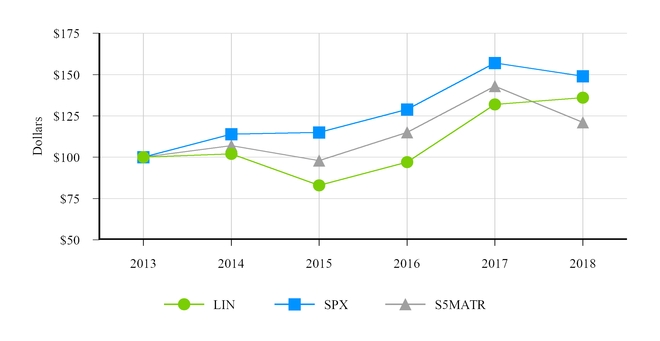
| 2013 | 2014 | 2015 | 2016 | 2017 | 2018 | |
| LIN | $100 | $102 | $83 | $97 | $132 | $136 |
| SPX | $100 | $114 | $115 | $129 | $157 | $149 |
| S5MATR | $100 | $107 | $98 | $115 | $143 | $121 |
Item 6. SELECTED FINANCIAL DATA
FIVE-YEAR FINANCIAL SUMMARY
(Dollar amounts in millions, except per share data)
The year ended December 31, 2018 reflects the results of Praxair for the entire year and the results of Linde AG for the period beginning after October 31, 2018 (the merger date), including the impacts of purchase accounting (See Notes 1, 3 and 4 to the consolidated financial statements). The historical periods prior to 2018 reflect the results of Praxair.
| Year Ended December 31, | 2018(a) | 2017(a) | 2016(a) | 2015(a) | 2014(a) | ||||||||||||||
| From the Consolidated Statements of Income | |||||||||||||||||||
| Sales | $ | 14,900 | $ | 11,437 | $ | 10,534 | $ | 10,776 | $ | 12,273 | |||||||||
| Cost of sales, exclusive of depreciation and amortization | 9,084 | 6,461 | 5,855 | 5,918 | 6,933 | ||||||||||||||
| Selling, general and administrative | 1,629 | 1,207 | 1,145 | 1,152 | 1,308 | ||||||||||||||
| Depreciation and amortization | 1,830 | 1,184 | 1,122 | 1,106 | 1,170 | ||||||||||||||
| Research and development | 113 | 93 | 92 | 93 | 96 | ||||||||||||||
| Transaction costs and other charges | 309 | 52 | 96 | 165 | 131 | ||||||||||||||
| Net gain on sale of business | 3,294 | — | — | — | — | ||||||||||||||
| Other income (expenses) – net | 18 | 4 | 23 | 28 | 9 | ||||||||||||||
| Operating profit | 5,247 | 2,444 | 2,247 | 2,370 | 2,644 | ||||||||||||||
| Interest expense – net | 202 | 161 | 190 | 161 | 213 | ||||||||||||||
| Net pension and OPEB cost (benefit), excluding service cost | (4 | ) | (4 | ) | 9 | 49 | 36 | ||||||||||||
| Income from continuing operations before income taxes and equity investments | 5,049 | 2,287 | 2,048 | 2,160 | 2,395 | ||||||||||||||
| Income taxes on continuing operations | 817 | 1,026 | 551 | 612 | 691 | ||||||||||||||
| Income from continuing operations before equity investments | 4,232 | 1,261 | 1,497 | 1,548 | 1,704 | ||||||||||||||
| Income from equity investments | 56 | 47 | 41 | 43 | 42 | ||||||||||||||
| Income from continuing operations (including noncontrolling interests) | 4,288 | 1,308 | 1,538 | 1,591 | 1,746 | ||||||||||||||
| Noncontrolling interests from continuing operations | (15 | ) | (61 | ) | (38 | ) | (44 | ) | (52 | ) | |||||||||
| Income from continuing operations | $ | 4,273 | $ | 1,247 | $ | 1,500 | $ | 1,547 | $ | 1,694 | |||||||||
| Per Share Data – Linde plc Shareholders | |||||||||||||||||||
| Basic earnings per share from continuing operations | $ | 12.93 | $ | 4.36 | $ | 5.25 | $ | 5.39 | $ | 5.79 | |||||||||
| Diluted earnings per share from continuing operations | $ | 12.79 | $ | 4.32 | $ | 5.21 | $ | 5.35 | $ | 5.73 | |||||||||
| Cash dividends per share | $ | 3.30 | $ | 3.15 | $ | 3.00 | $ | 2.86 | $ | 2.60 | |||||||||
| Weighted Average Shares Outstanding (000’s) (b) | |||||||||||||||||||
| Basic shares outstanding | 330,401 | 286,261 | 285,677 | 287,005 | 292,494 | ||||||||||||||
| Diluted shares outstanding | 334,127 | 289,114 | 287,757 | 289,055 | 295,608 | ||||||||||||||
| Other Information and Ratios | |||||||||||||||||||
| Total assets | $ | 93,386 | $ | 20,436 | $ | 19,332 | $ | 18,319 | $ | 19,769 | |||||||||
| Total debt | $ | 15,296 | $ | 9,000 | $ | 9,515 | $ | 9,231 | $ | 9,225 | |||||||||
| Net debt (c) | $ | 10,830 | $ | 8,383 | $ | 8,991 | $ | 9,084 | $ | 9,099 | |||||||||
| Cash flow from operations | $ | 3,654 | $ | 3,041 | $ | 2,789 | $ | 2,695 | $ | 2,923 | |||||||||
| Net cash provided by (used for) investing activities | $ | 5,363 | $ | (1,314 | ) | $ | (1,770 | ) | $ | (1,303 | ) | $ | (1,803 | ) | |||||
| Net cash used for financing activities | $ | (4,998 | ) | $ | (1,656 | ) | $ | (659 | ) | $ | (1,310 | ) | $ | (1,063 | ) | ||||
| EBITDA (c) | $ | 7,133 | $ | 3,675 | $ | 3,410 | $ | 3,519 | $ | 3,856 | |||||||||
| Adjusted EBITDA (c) | $ | 4,516 | $ | 3,727 | $ | 3,506 | $ | 3,684 | $ | 3,987 | |||||||||
| Capital expenditures | $ | 1,883 | $ | 1,311 | $ | 1,465 | $ | 1,541 | $ | 1,689 | |||||||||
| Shares outstanding (000’s) | 547,242 | 286,777 | 284,901 | 284,879 | 289,262 | ||||||||||||||
| Number of employees | 80,820 | 26,461 | 26,498 | 26,657 | 27,780 |
| (a) | Amounts for 2018 include: (i) charges of $309 million ($306 million after-tax, or $0.92 per diluted share) for transaction costs and other charges primarily related to the merger, (ii) pension settlement charges of $14 million ($11 million after-tax, or $0.03 per diluted share) related to lump sum benefit payments made from pension plans, (iii) income tax benefit, net of $17 million |
($0.05 per diluted share) due to U.S. Tax Cuts and Jobs Act and other tax charges, (iv) a net gain on sale of businesses of $3,294 million ($2,923 million after-tax, or $8.75 per diluted share), (v) bond redemption costs of $26 million ($20 million after-tax, or $0.06 per diluted share), and (vi) the purchase accounting impacts of the merger of $714 million ($451 million after-tax and non-controlling interests, or $1.35 per diluted share).
Amounts for 2017 include: (i) charges of $52 million ($48 million after-tax, or $0.17 per diluted share) for transaction costs related to the merger, (ii) a pension settlement charge of $2 million ($1 million after-tax) related to lump sum benefit payments made from an international pension plan, and (iii) income tax charges, net of $394 million ($1.36 per diluted share) due to U.S. Tax Cuts and Jobs Act.
Amounts for 2016 include: (i) a $16 million charge to interest expense ($10 million after–tax, or $0.04 per diluted share) related to the redemption of the $325 million 5.20% notes due 2017, (ii) a pre–tax pension settlement charge of $4 million ($3 million after–tax, or $0.01 per diluted share) related to lump sum benefit payments made from the U.S. supplemental pension plan, and (iii) pre–tax charges of $96 million ($63 million after–tax and non–controlling interests, or $0.22 per diluted share) primarily related to cost reduction actions.
Amounts for 2015 include: (i) a pre-tax charge of $165 million ($125 million after-tax, or $0.43 per diluted share) related to the cost reduction program and other charges; and (ii) a pre-tax charge of $7 million ($5 million after-tax, or $0.02 per diluted share) related to a pension settlement.
Amounts for 2014 include: (i) a pre-tax charge of $131 million ($131 million after-tax, or $0.45 per diluted share) related to the Venezuela currency devaluation, (ii) a pre-tax charge of $7 million ($5 million after-tax, or $0.02 per diluted share) related to pension settlements; and (iii) a pre-tax charge of $36 million ($22 million after-tax, or $0.07 per diluted share) related to a bond redemption.
See Notes 1, 3, 4, 5, 7, 13 and 18 to the consolidated financial statements.
(b) As a result of the merger, share amounts for the year ended December
Showing the first 8K of 144K characters. Open the full section
Item 7A. QUANTITATIVE AND QUALITATIVE DISCLOSURES ABOUT MARKET RISK
Linde is exposed to market risks relating to fluctuations in interest rates and currency exchange rates. The objective of financial risk management at Linde is to minimize the negative impact of interest rate and foreign exchange rate fluctuations on the company’s earnings, cash flows and equity.
To manage these risks, Linde uses various derivative financial instruments, including interest-rate swaps, treasury rate locks, currency swaps, forward contracts, and commodity contracts. Linde only uses commonly traded and non-leveraged instruments. These contracts are entered into primarily with major banking institutions thereby minimizing the risk of credit loss. Also, see Notes 2 and 14 to the consolidated financial statements for a more complete description of Linde’s accounting policies and use of such instruments.
The following discussion presents the sensitivity of the market value, earnings and cash flows of Linde’s financial instruments to hypothetical changes in interest and exchange rates assuming these changes occurred at December 31, 2018. The range of changes chosen for these discussions reflects Linde’s view of changes which are reasonably possible over a one-year period. Market values represent the present values of projected future cash flows based on interest rate and exchange rate assumptions.
Interest Rate Risk
At December 31, 2018, Linde had debt totaling $15,296 million ($9,000 million at December 31, 2017). For fixed-rate instruments, interest rate changes affect the fair market value but do not impact earnings or cash flows. Conversely, for floating-rate instruments, interest rate changes generally do not affect the fair market value of the instrument but impact future earnings and cash flows, assuming that other factors are held constant. At December 31, 2018, including the impact of derivatives Linde had fixed-rate debt of $12,565 million and floating-rate debt of $2,731 million, representing 82% and 18%, respectively, of total debt. At December 31, 2017, Linde had fixed-rate debt of $8,253 million and floating-rate debt of $747 million, representing 92% and 8%, respectively, of total debt.
Fixed Rate Debt
In order to mitigate interest rate risk, when considered appropriate interest-rate swaps are entered into as hedges of underlying financial instruments to effectively change the characteristics of the interest rate without actually changing the underlying financial instrument. At December 31, 2018, Linde had fixed-to-floating interest rate swaps outstanding that were designated as hedging instruments of the underlying debt issuances - refer to Note 14 to the consolidated financial statements for additional information. This sensitivity analysis assumes that, holding all other variables constant (such as foreign exchange rates, swaps and debt levels), a one-percentage-point increase in interest rates would decrease the unrealized fair market value of the fixed-rate debt portfolio by approximately $594 million ($450 million in 2017). A 100 basis point increase in interest rates would result in an approximate $92 million increase to derivative assets recorded.
Variable Rate Debt
At December 31, 2018, the after-tax earnings and cash flows impact of a one-percentage point increase in interest rates, including the offsetting impact of derivatives, on the variable-rate debt portfolio would be approximately $24 million. At December 31, 2017 the impact of a one-percentage point increase was $6 million, holding all other variables constant.
Foreign Currency Risk
Linde’s exchange-rate exposures result primarily from its investments and ongoing operations in South America (primarily Brazil, Argentina, Chile and Colombia), Europe (primarily Germany, Scandinavia, and the United Kingdom), Canada, Mexico, Asia Pacific (primarily Australia, China, India, and Korea) and other business transactions such as the procurement of equipment from foreign sources. Linde frequently utilizes currency contracts to hedge these exposures. At December 31, 2018, Linde had a notional amount outstanding of $9,412 million ($2,693 million at December 31, 2017) related to foreign exchange contracts. The majority of these were to hedge recorded balance sheet exposures, primarily intercompany loans denominated in non-functional currencies. See Note 14 to the consolidated financial statements.
Holding all other variables constant, if there were a 10% adverse change in foreign-currency exchange rates for the portfolio, the fair market value of foreign-currency contracts outstanding at December 31, 2018 and 2017 would decrease by approximately $307 million and $174 million, respectively, which would be largely offset by an offsetting gain on the foreign-currency fluctuation of the underlying exposure being hedged.
Item 8. FINANCIAL STATEMENTS AND SUPPLEMENTARY DATA
INDEX TO CONSOLIDATED FINANCIAL STATEMENTS
MANAGEMENT’S STATEMENT OF RESPONSIBILITY FOR FINANCIAL STATEMENTS
Linde’s consolidated financial statements are prepared by management, which is responsible for their fairness, integrity and objectivity. The accompanying financial statements have been prepared in conformity with accounting principles generally accepted in the United States of America applied on a consistent basis, except for accounting changes as disclosed, and include amounts that are estimates and judgments. All historical financial information in this annual report is consistent with the accompanying financial statements.
Linde maintains accounting systems, including internal accounting controls, monitored by a staff of internal auditors, that are designed to provide reasonable assurance of the reliability of financial records and the protection of assets. The concept of reasonable assurance is based on recognition that the cost of a system should not exceed the related benefits. The effectiveness of those systems depends primarily upon the careful selection of financial and other managers, clear delegation of authority and assignment of accountability, inculcation of high business ethics and conflict-of-interest standards, policies and procedures for coordinating the management of corporate resources, and the leadership and commitment of top management. In compliance with Section 404 of the Sarbanes-Oxley Act of 2002, Linde assessed its internal control over financial reporting and issued a report (see below).
PricewaterhouseCoopers LLP, an independent registered public accounting firm, has completed an audit of Linde’s 2018, 2017 and 2016 consolidated financial statements and of its internal control over financial reporting as of December 31, 2018 in accordance with the standards of the Public Company Accounting Oversight Board (United States) as stated in their report.
The Audit Committee of the Board of Directors, which consists solely of non-employee directors, is responsible for overseeing the functioning of the accounting system and related controls and the preparation of annual financial statements. The Audit Committee periodically meets with management, internal auditors and the independent accountants to review and evaluate their accounting, auditing and financial reporting activities and responsibilities, including management’s assessment of internal control over financial reporting. The independent registered public accounting firm and internal auditors have full and free access to the Audit Committee and meet with the committee, with and without management present.
MANAGEMENT’S REPORT ON INTERNAL CONTROL OVER FINANCIAL REPORTING
Linde’s management is responsible for establishing and maintaining adequate internal control over financial reporting, as such term is defined in Exchange Act Rule 13a-15(f). Under the supervision and with the participation of management, including the company’s principal executive officer and principal financial officer, the company conducted an evaluation of the effectiveness of its internal control over financial reporting based on the framework in Internal Control – Integrated Framework (2013) issued by the Committee of Sponsoring Organizations of the Treadway Commission (often referred to as COSO). Based on this evaluation, management concluded that the company’s internal control over financial reporting was effective as of December 31, 2018.
Linde’s evaluation of internal control over financial reporting as of December 31, 2018 did not include the internal control over financial reporting related to Linde AG because the business was acquired in a merger accounted for as a business
Showing the first 8K of 272K characters. Open the full section
Item 9A. CONTROLS AND PROCEDURES
Conclusion Regarding the Effectiveness of Disclosure Controls and Procedures
Based on an evaluation of the effectiveness of Linde’s disclosure controls and procedures, which was made under the supervision and with the participation of management, including Linde’s principal executive officer and principal financial officer, the principal executive officer and principal financial officer have each concluded that, as of the end of the annual period covered by this report, such disclosure controls and procedures are effective in ensuring that information required to be disclosed by Linde in reports that it files or submits under the Exchange Act of 1934 is recorded, processed, summarized and reported within the time periods specified in the Securities and Exchange Commission’s rules and forms, and accumulated and communicated to management including Linde’s principal executive officer and principal financial officer, to allow timely decisions regarding required disclosure.
Management’s Report on Internal Control Over Financial Reporting
Refer to Item 8 for Management’s Report on Internal Control Over Financial Reporting as of December 31, 2018.
Changes in Internal Control over Financial Reporting
There were no changes in Linde’s internal control over financial reporting that occurred during the quarter ended December 31, 2018 that have materially affected, or are reasonably likely to materially affect, Linde’s internal control over financial reporting.
Item 9B. OTHER INFORMATION
None.
PART III
Item 10. DIRECTORS, EXECUTIVE OFFICERS AND CORPORATE GOVERNANCE
Certain information required by this item is incorporated herein by reference to the sections captioned “Corporate Governance and Board Matters - Director Nominees" and “Corporate Governance And Board Matters - Section 16(a) Beneficial Ownership Reporting Compliance” in Linde’s Proxy Statement to be filed by April 30, 2019 for the Annual General Meeting.
Identification of the Audit Committee
Linde has a separately-designated standing Audit Committee established in accordance with Section 3(a)(58)(A) of the Securities Exchange Act of 1934 as amended (the “Exchange Act”). The members of that audit committee are Prof. Dr. Clemens Börsig (chairman), Dr. Nance K. Dicciani, Dr. Thomas Enders, Edward G. Galante, Larry D. McVay and Dr. Victoria Ossadnik, and each member is independent within the meaning of the independence standards adopted by the Board of Directors and those of the New York Stock Exchange.
Audit Committee Financial Expert
The Linde Board of Directors has determined that Prof. Dr. Clemens Börsig is an “audit committee financial expert” as defined by Item 407(d)(5)(ii) of Regulation S-K of the Exchange Act and is independent within the meaning of the independence standards adopted by the Board of Directors and those of the New York Stock Exchange.
Code of Ethics
Linde has adopted a code of ethics that applies to the company’s directors and all employees, including its Chief Executive Officer, Chief Financial Officer, and Controller. This code of ethics, including specific standards for implementing certain provisions of the code, has been approved by the Linde Board of Directors and is named the “Code of Business Integrity”. This document is posted on the company’s public website, www.linde.com but is not incorporated herein.
Item 11. EXECUTIVE COMPENSATION
Information required by this item is incorporated herein by reference to the sections captioned “Executive Compensation Matters” and “Corporate Governance and Board Matters - Director Compensation” in Linde’s Proxy Statement to be filed by April 30, 2019 for the Annual General Meeting.
Item 12. SECURITY OWNERSHIP OF CERTAIN BENEFICIAL OWNERS AND MANAGEMENT AND RELATED STOCKHOLDER MATTERS
Equity Compensation Plans Information - The table below provides information as of December 31, 2018 about company shares that may be issued upon the exercise of options, warrants and rights granted to employees or members of Linde’s Board of Directors under equity compensation plans that were assumed by Linde upon the completion of the business combination on October 31, 2018.
EQUITY COMPENSATION PLANS TABLE
| Plan Category | Number of securities to be issued upon exercise of outstanding options, warrants and rights (a) | Weighted-average exercise price of outstanding options, warrants and rights (b) | Number of securities remaining available for future issuance under equity compensation plans (excluding securities reflected in column (a)) (c) | |||||||
| Equity compensation plans approved by shareholders | 11,694,110 | (1) | $ | 117.65 | 8,482,731 | (2) | ||||
| Equity compensation plans not approved by shareholders | — | — | — | |||||||
| Total | 11,694,110 | $ | 117.65 | 8,482,731 |
| (1) | This amount includes 1,070,423 restricted shares. |
| (2) | This amount includes 8,009,603 shares available for future issuance pursuant to the Amended and Restated 2009 Praxair, Inc. Long Term Incentive Plan assumed by Linde, and 473,128 shares available for future issuance pursuant to the Linde plc Long Term Incentive Plan 2018. |
Certain information required by this item regarding the beneficial ownership of the company’s ordinary shares is incorporated herein by reference to the section captioned “Information on Share Ownership” in Linde’s Proxy Statement to be filed by April 30, 2019 for the Annual General Meeting.
Item 13. CERTAIN RELATIONSHIPS AND RELATED TRANSACTIONS AND DIRECTOR INDEPENDENCE
Information required by this item is incorporated herein by reference to the sections captioned “Corporate Governance And Board Matters – Review, Approval or Ratification of Transactions with Related Persons,” “Corporate Governance And Board Matters – Certain Relationships and Transactions,” and “Corporate Governance And Board Matters – Director Independence” in Linde’s Proxy Statement to be filed by April 30, 2019 for the Annual General Meeting.
Item 14. PRINCIPAL ACCOUNTING FEES AND SERVICES
Information required by this item is incorporated herein by reference to the section captioned “Audit Matters” in Linde’s Proxy Statement to be filed by April 30, 2019 for the Annual General Meeting.
PART IV
Item 15. EXHIBITS, FINANCIAL STATEMENT SCHEDULES
| (a) | The following documents are filed as part of this report: |
| (1) | The company’s 2018 Consolidated Financial Statements and the Report of the Independent Registered Public Accounting Firm are included in Part II, Item 8. Financial Statements and Supplementary Data. |
| (2) | Financial Statement Schedules – All financial statement schedules have been omitted because they are not applicable or the required information is shown in the financial statements or notes thereto. |
| (3) | Exhibits – The exhibits filed as part of this Annual Report on Form 10-K are listed in the accompanying index. |
INDEX TO EXHIBITS
Linde plc and Subsidiaries
| 21.01 | Subsidiaries of Linde plc | |
| 23.01 | Consent of Independent Registered Public Accounting Firm. | |
| 31.01 | Rule 13a-14(a) Certification | |
| 31.02 | Rule 13a-14(a) Certification | |
| 32.01 | Section 1350 Certification (such certifications are furnished for the information of the Commission and shall not be deemed incorporated by reference into any filing under the Securities Act or the Exchange Act). | |
| 32.02 | Section 1350 Certification (such certifications are furnished for the information of the Commission and shall not be deemed incorporated by reference into any filing under the Securities Act or the Exchange Act). | |
| 101.INS | XBRL Instance Document | |
| 101.SCH | XBRL Taxonomy Extension Schema | |
| 101.CAL | XBRL Taxonomy Extension Calculation Linkbase | |
| 101.LAB | XBRL Taxonomy Extension Label Linkbase | |
| 101.PRE | XBRL Taxonomy Extension Presentation Linkbase | |
| 101.DEF | XBRL Taxonomy Extension Definition Linkbase |
Copies of exhibits incorporated by reference can be obtained from the SEC and are located in SEC File No. 1-11037.
| * | Indicates a management contract or compensatory plan or arrangement. |
| ** | Certain schedules or similar attachments have been omitted pursuant to Item 601(b)(2) of Regulation S-K. The Registrant agrees to furnish supplemental copies of any of the omitted schedules or attachments upon request by the SEC. |
Item 16. FORM 10-K SUMMARY
None.
SIGNATURES
Linde plc and Subsidiaries
Pursuant to the requirements of the Securities Exchange Act of 1934, the registrant has duly caused this report to be signed on its behalf by the undersigned thereunto duly authorized.
| Linde plc | ||||||
| (Registrant) | ||||||
| Date: March 18, 2019 | By: | /s/ KELCEY E. HOYT | ||||
| Kelcey E. Hoyt Chief Accounting Officer |
Pursuant to the requirements of the Securities Exchange Act of 1934, this report has been signed below by the following persons on behalf of the Registrant and in the capacities indicated on March 18, 2019.
| /s/ PROF. DR. WOLFGANG REITZLE | /s/ STEPHEN F. ANGEL | /s/ MATTHEW J. WHITE | ||
| Wolfgang Reitzle Chairman | Stephen F. Angel Chief Executive Officer and Director | Matthew J. White Chief Financial Officer | ||
| /s/ PROF. DDR. ANN-KRISTIN ACHLIETNER | /s/ DR. CLEMENS BÖRSIG | /s/ DR. NANCE K. DICCIANI | ||
| Ann-Kristin Achleitner Director | Clemens Börsig Director | Nance K. Dicciani Director | ||
| /s/ DR. THOMAS ENDERS | /s/ FRANZ FEHRENBACH | /s/ EDWARD G. GALANTE | ||
| Thomas Enders Director | Franz Fehrenbach Director | Edward G. Galante Director | ||
| /s/ LARRY D. MCVAY | /s/ DR. VICTORIA OSSADNIK | /s/ PROF. DR. MARTIN H. RICHENHAGEN | ||
| Larry D. McVay Director | Victoria Ossadnik Director | Martin Richenhagen Director | ||
| /s/ ROBERT L. WOOD | ||||
| Robert L. Wood Director |