 filings.tools
Lumentum Holdings 10-K 2021-07-03
Filed 2021-08-31. 23 sections, 587K characters. Original on sec.gov · Markdown · JSON
Cover and table of contents
UNITED STATES
SECURITIES AND EXCHANGE COMMISSION
Washington, D.C. 20549
Form 10-K
(Mark One)
☒ ANNUAL REPORT PURSUANT TO SECTION 13 OR 15 (d) OF THE SECURITIES EXCHANGE ACT OF 1934
For the fiscal year ended July 3, 2021
OR
☐ TRANSITION REPORT PURSUANT TO SECTION 13 OR 15(d) OF THE SECURITIES EXCHANGE ACT OF 1934
For the transition period from
to
Commission File Number 001-36861
Lumentum Holdings Inc.
(Exact name of Registrant as specified in its charter)
| Delaware | 47-3108385 | |||||||
| (State or other jurisdiction of incorporation or organization) | (I.R.S. Employer Identification Number) |
1001 Ridder Park Drive, San Jose, California 95131
(Address of principal executive offices including Zip code)
(408) 546-5483
(Registrant’s telephone number, including area code)
Securities registered pursuant to Section 12(b) of the Act:
| Title of each class | Trading Symbol(s) | Name of exchange on which registered | ||||||||||||
| Common Stock, par value of $0.001 per share | LITE | Nasdaq Global Select Market |
Securities registered pursuant to Section 12(g) of the Act:
None
Indicate by check mark if the registrant is a well-known seasoned issuer, as defined in Rule 405 of the Securities Act.
Yes x No o
Indicate by check mark if the registrant is not required to file reports pursuant to Section 13 or 15(d) of the Act. Yes o No x
Indicate by check mark whether the Registrant (1) has filed all reports required to be filed by Section 13 or 15(d) of the Securities Exchange Act of 1934 during the preceding 12 months (or for such shorter period that the Registrant was required to file such reports), and (2) has been subject to such filing requirements for the past 90 days. Yes x No o
Indicate by check mark whether the registrant has submitted electronically every Interactive Data File required to be submitted pursuant to Rule 405 of Regulation S-T (§ 232.405 of this chapter) during the preceding 12 months (or for such shorter period that the registrant was required to submit such files). Yes x No o
Indicate by check mark whether the registrant is a large accelerated filer, an accelerated filer, a non-accelerated filer, a smaller reporting company, or an emerging growth company. See definition of “large accelerated filer,” “accelerated filer,” “smaller reporting company,” and “emerging growth company” in Rule 12b-2 of the Exchange Act.
| Large accelerated filer | x | Accelerated filer | o | Non-accelerated filer | o | Smaller reporting company | ☐ | ||||||||||||||||
| Emerging Growth company | ☐ |
If an emerging growth company, indicate by check mark if the registrant has elected not to use the extended transition period for complying with any new or revised financial accounting standards provided pursuant to Section 13(a) of the Exchange Act. o
Indicate by check mark whether the registrant has filed a report on and attestation to its management’s assessment of the effectiveness of its internal control over financial reporting under Section 404(b) of the Sarbanes-Oxley Act (15 U.S.C. 7262(b)) by the registered public accounting firm that prepared or issued its audit report. ☒
Indicate by check mark whether the registrant is a shell company (as defined in Rule 12b-2 of the Exchange Act). Yes ☐ No x
As of December 26, 2020, the aggregate market value of the voting and non-voting common equity held by non-affiliates of the registrant was approximately $5,246 million based on the closing sales price of the registrant’s common stock as reported on the NASDAQ Stock Market on December 24, 2020 of $98.30 per share. Shares of common stock held by officers, directors and holders of more than five percent of the outstanding common stock have been excluded from this calculation because such persons may be deemed to be affiliates.
As of August 23, 2021, the Registrant had 72.7 million shares of common stock outstanding.
DOCUMENTS INCORPORATED BY REFERENCE
Portions of the information called for by Part III of this Annual Report on Form 10-K is hereby incorporated by reference from the definitive proxy statement for the Registrant’s annual meeting of stockholders, which will be filed with the Securities and Exchange Commission not later than 120 days after the Registrant’s fiscal year ended July 3, 2021.
FORWARD-LOOKING STATEMENTS
This Annual Report on Form 10-K (this “Annual Report”) contains forward-looking statements within the meaning of Section 27A of the Securities Act of 1933, as amended, and Section 21E of the Securities Exchange Act of 1934, as amended, (the “Exchange Act”). These statements relate to, among other things, our markets and industry, products and strategy, the impact of export regulation changes, the impact of the COVID-19 pandemic and related responses of business and governments to the pandemic on our business and results of operations, sales, gross margins, operating expenses, capital expenditures and requirements, liquidity, product development and R&D efforts, manufacturing plans, litigation, effective tax rates and tax reserves, our corporate and financial reporting structure, our plans for growth and innovation, , our expectations regarding US-China relations, market and regulatory conditions, and trends and uncertainties in our business and financial results, markets and industry are often identified by the use of words such as, but not limited to, “anticipate,” “believe,” “can,” “continue,” “could,” “estimate,” “expect,” “intend,” “may,” “might,” “plan,” “project,” “seek,” “should,” “target,” “will,” “would,” “contemplate,” “believe,” “predict,” “potential” and similar expressions or variations intended to identify forward-looking statements. These statements are based on the beliefs and assumptions of our management, which are in turn based on information currently available to management. Such forward-looking statements are subject to risks, uncertainties and other important factors that could cause actual results and the timing of certain events to differ materially from future results expressed or implied by such forward-looking statements. Factors that could cause or contribute to such differences include, but are not limited to, those discussed in the section entitled “Risk Factors” included under Part I, Item 1A below. Furthermore, such forward-looking statements speak only as of the date of this report. Except as required by law, we undertake no obligation to update any forward-looking statements to reflect events or circumstances after the date of such statements.
PART I
Item 1. BUSINESS
General
Overview
Lumentum Holdings Inc. (“we,” “us,” “our”, “Lumentum” or the “Company”) is an industry-leading provider of optical and photonic products defined by revenue and market share addressing a range of end market applications including Optical Communications (“OpComms”) and Commercial Lasers (“Lasers”) for manufacturing, inspection and life-science applications. We seek to use our core optical and photonic technology, and our volume manufacturing capability, to expand into attractive emerging markets that benefit from advantages that optical or photonics-based solutions provide, including 3D sensing for consumer electronics and diode light sources for a variety of consumer and industrial applications. The majority of our customers tend to be original equipment manufacturers (“OEMs”) that incorporate our products into their products which then address end-market applications. For example, we sell fiber optic components that network equipment manufacturers (“NEMs”) assemble into communications networking systems, which they sell to network service providers, operators or enterprises with their own networks. Similarly, many of our customers for our Lasers products incorporate our products into tools they produce, which are used for manufacturing processes by their customers. For 3D sensing, we sell diode lasers to manufacturers of consumer electronics products for mobile, personal computing, gaming, and to manufacturers of emerging automotive and industrial applications who then integrate our devices within their products.
We believe the global markets in which Lumentum participates have fundamentally robust, long-term trends that increase the need for our photonics products and technologies. We believe the world is becoming more reliant on ever-increasing amounts of data flowing through optical networks and data centers. Lumentum’s products and technology enable the scaling of these optical networks and data centers to higher capacities. We expect the accelerating shift to digital and virtual approaches to all aspects of work and life that is driving staggering amounts of data in the world’s networks and cloud datacenters will continue into the future. Virtual meetings, video calls, and hybrid in-person and virtual environments for work and other aspects of life will continue to drive strong needs for bandwidth growth and present dynamic new technology challenges that our technology addresses. As manufacturers demand higher levels of precision, new materials, and factory and energy efficiency, suppliers of manufacturing tools globally are turning to laser-based approaches, including the types of lasers Lumentum supplies. Laser-based 3D sensing and LiDAR for security, industrial and automotive applications are rapidly developing markets. The technology enables computer vision applications that enhance security, safety, and new functionality in the electronic devices that people rely on every day. The use of LiDAR and in-cabin 3D sensing in automobile and delivery vehicles over time significantly adds to our long-term market opportunity. Frictionless and contactless biometric security and access control is of increasing focus globally given the world’s experience with the COVID-19 pandemic. Additionally, we expect 3D-enabled machine vision solutions to expand significantly in industrial applications in the coming years.
We operate in two reportable segments: OpComms and Lasers.
We have a global marketing and sales footprint that enables us to address global market opportunities for our products. We have manufacturing capabilities and facilities in North America, Asia-Pacific, and Europe, with employees engaged in research and development (“R&D”), administration, manufacturing, support and sales and marketing activities. Our headquarters are located in San Jose, California, and we employed approximately 5,618 full-time employees around the world as of July 3, 2021.
Lumentum was incorporated in Delaware as a wholly owned subsidiary of JDS Uniphase Corporation (“JDSU”) on February 10, 2015. In August 2015, we were spun-off from JDSU (the “Separation”) and became an independent publicly-traded company through the distribution of our common stock by JDSU to its stockholders (the “Separation”). In 2015, JDSU was renamed Viavi Solutions Inc. (“Viavi”). Our business traces its origins to Uniphase Corporation, which was formed in 1979, and became publicly traded in 1992. Uniphase was originally a supplier of commercial lasers, and later, a leading supplier of optical transmission products. In 1999, JDS Fitel Inc., a pioneer in products for fiber optic networking which was formed in 1981, merged with Uniphase to become JDSU, a global leader in optical networking. Subsequent acquisitions by JDSU broadened the depth and breadth of the OpComms and Lasers businesses, as well as the intellectual property, technology and product offerings, of what is now Lumentum. Notable amongst these acquisitions in the OpComms business were Agility Communications, Inc. in 2005 and Picolight, Inc. in 2007 which respectively brought widely tunable, long wavelength laser technology for metro and long haul networking applications and short wavelength vertical-cavity surface-emitting lasers (“VCSELs”) for enterprise, datacenter networking, and 3D sensing applications. The fundamental laser component technologies which we acquired through these acquisitions, form the basis of optical networks today, and we believe will continue to do so for the foreseeable future. These technologies will enable us to develop highly integrated products to satisfy our communications customers’ ever-increasing needs for smaller, lower power and lower cost optical products. Notable acquisitions in the Lasers business were Lightwave Electronics Corporation in 2005 and Time-Bandwidth Products Inc. (“Time-Bandwidth”) in 2014. Both of these Lasers acquisitions brought high power pulsed solid-state laser products and technology to our business, which address the micro laser machining market and expanded our addressable market. In December 2018, we completed the acquisition of (“Oclaro”), a provider of optical components and modules for the long-haul, metro and data center markets. Oclaro’s products provide differentiated solutions for optical networks and high-speed interconnects driving the next wave of streaming video, cloud computing, application virtualization and other bandwidth-intensive and high-speed applications. This acquisition strengthened our product portfolio, by adding Oclaro’s indium phosphide laser and photonic integrated circuit and coherent component and module capabilities which broadened our revenue mix; and positions us strongly to meet the future needs of our customers.
Industry Trends and Business Risks
Our business is driven by end-market applications which benefit from the performance advantages of optical and photonics solutions.
The OpComms markets we serve are experiencing continually increasing needs for higher data transmission speeds, fiber optic network capacity and network agility. This is driven by rapid growth in both the number of higher bandwidth broadband applications such as high-definition video, online gaming, cloud computing and the number and scale of datacenters that require fiber optic links to enable the higher speeds and increased scale necessary to deliver high bandwidth video and other services. Our technology, which was originally developed for communications applications is also finding use in other emerging market opportunities including 3D sensing applications that employ our laser technology in mobile devices, computers, augmented and virtual reality and other consumer electronics devices. Additionally, our products are being designed into emerging automotive, industrial, security, safety and surveillance applications.
In the Lasers markets, customer demand is driven by the need to enable faster, higher precision volume manufacturing techniques with lower power consumption, more environmentally friendly, reduced manufacturing footprint and increased productivity. These capabilities are critical as industries develop products that are smaller and lighter, increasing productivity and yield and lowering their energy consumption. Our optical and laser solutions, developed in close collaboration with OEM partners, are well-positioned to meet demand resulting from these trends. We do, however, expect to continue to encounter a number of industry and market risks and uncertainties. These risks and uncertainties may limit our visibility, and consequently, our ability to predict future revenue, profitability and general financial performance, and could create quarter over quarter variability in our financial measures. For example, the demand environment coupled with changing export regulations with China have fluctuated significantly in recent years, and has created volatility and uncertainty in our future demand. We cannot predict when or to what extent these uncertainties will be resolved. Our revenues, profitability and general financial performance may also be affected by: (i) pricing pressures, particularly within our OpComms markets, due to, among other things, a highly concentrated customer base, increasing competition, particularly from Asia-Pacific-based competitors, and a general commoditization trend for certain products; (ii) high product mix variability which affects revenue and gross margin; (iii) fluctuations in customer buying patterns, which cause volatility in demand, revenue and profitability; (iv) the current trend of communication industry consolidation and vertical integration, which is expected to continue, that directly affects our customer base and adds additional risk and uncertainty to our financial and business projections; (v) China’s on-going transition to a more localized supply chain; and (vi) ongoing risks related to the economic impact of the COVID-19 pandemic, including component shortages that may impact our ability to supply products.
Impact of COVID-19 to our Business
The COVID-19 pandemic has caused public health officials to recommend, and governments to enact, precautions to mitigate the spread of the virus, including travel restrictions and bans, extensive social distancing guidelines, closure or restrictions on business and quarantine or other types of “shelter-in-place” orders in many regions of the world. The pandemic and these related responses have caused, and may continue to cause a global slowdown of economic activity (including a decrease in demand for a broad variety of goods and services), disruptions in global supply chains and significant volatility and potential disruption of financial markets. We have adopted several measures in response to the COVID-19 outbreak including complying with local, state or federal orders that require employees to work from home, instructing employees to work from home in certain jurisdictions, limiting the number of employees onsite which slowed our manufacturing operations in certain countries, enhanced use of personal protective equipment and restricting non-critical business travel by our employees.
In the geographies we have operations, we have, in general, been deemed an essential business and been permitted to continue manufacturing and new product development operations in a more limited capacity during the pandemic. This stems from our critical role in global supply chains for the world’s communications and health-care systems. Given the continually evolving situation, it is difficult to predict the magnitude and duration of the impact of the COVID-19 pandemic to our markets or precisely when our ability to supply our products will return to full capacity. We are continuing to actively monitor the situation and may take further actions altering our business operations that we determine are in the best interests of our employees, customers, communities, business partners, suppliers, and stockholders, or as required by federal, state, or local authorities. It is not clear what the potential effects any such alterations or modifications may have on our business, including the effects on our customers, employees, and prospects, or on our financial results going forward.
We are actively monitoring the evolving impact of the pandemic. The extent to which our operations will continue to be impacted by the outbreak will depend largely on future developments, which are highly uncertain and cannot be accurately predicted, including new information which may emerge concerning the severity of the outbreak and additional variants, the speed, efficacy, and acceptance of vaccine distributions, variant strains of the virus, actions by government authorities and private businesses to contain the severity of the outbreak and emerging variants in various geographies and the speed and trajectory of any recovery from the impact of the pandemic, among other things.
COVID-19 has also created dynamics in the semiconductor component supply chains that have led to shortages of the types of components we and our customers require in our products. These shortages are expected to impact our ability to generate revenue from certain products in early fiscal 2022 and, if our ability to procure needed semiconductor components does not improve, this will impact our ability to supply our products to our customers and may reduce our revenue and profit margin. In addition, if our customers are unable to procure needed semiconductor components, this could reduce their demand for our products and reduce our revenue. The impact of semiconductor component shortages may increase in the near term as supplier and customer buffer inventories and safety stocks are exhausted.
Our primary strategic focus for several years has been technology and product leadership combined with close customer relationships in long-term healthy and growing markets. We believe this strategy is even more apt, and our long-term opportunity is not diminished, with COVID-19. We believe there are be long-term opportunities, as the world’s experience with COVID-19 is driving an increasingly digital and virtual world touching all aspects of life and work that increasingly emphasizes communications systems, cloud services, augmented and virtual reality, and enhanced security. Additionally, ever-advancing electronic devices are needed to consume, produce, and communicate digital and virtual content. All these trends could drive the need for higher volumes of higher performing optical devices that we could supply. As such, we expect to continue to invest strongly in new products, technology, and customer programs.
Termination of Coherent Merger Agreement
On January 18, 2021, Lumentum and Coherent, Inc. (“Coherent”) entered into a merger agreement (the “merger agreement”), under which Lumentum would acquire all outstanding shares of Coherent common stock. As of the date of the merger agreement, the total transaction consideration was approximately $5.7 billion. In March 2021, Coherent terminated the merger agreement and paid Lumentum a termination fee of $217.6 million in accordance with the merger agreement. This gain was offset by $10.1 million of acquisition related expenses and the net amount is presented as “merger termination fee and related costs, net” in our Consolidated Statement of Operations for the year ended July 3, 2021.
Reportable Segments
We have two operating segments, OpComms and Lasers. The two operating segments were primarily determined based on how our Chief Operating Decision Maker (“CODM”) views and evaluates our operations. Operating results are regularly reviewed by our CODM to make decisions about resources to be allocated to the segments and to assess their performance. Other factors, including market separation and customer specific applications, go-to-market channels, products and manufacturing, are considered in determining the formation of these operating segments. We do not track our property, plant, and equipment by operating segments. For the geographic identification of these assets and for further information regarding our operating segments, refer to “Note 20. Operating Segments and Geographic Information”.
OpComms
Markets
Our OpComms products address the following markets: telecommunications (“Telecom”), data communications (“Datacom”) and consumer and industrial (“Consumer and Industrial”).
Our OpComms products include a wide range of components, modules and subsystems to support customers including carrier networks for access (local), metro (intracity), long-haul (city-to-city and worldwide) and submarine (undersea) applications. Additionally, our products address enterprise, cloud, and data center applications, including storage-access networks (“SANs”), local-area networks (“LANs”) and wide-area networks (“WANs”). These products enable the transmission and transport of video, audio and data over high-capacity fiber-optic cables. We maintain leading positions in these fast growing OpComms markets through our extensive product portfolio, including reconfigurable optical add/drop multiplexers (“ROADMs”), coherent dense wavelength division multiplexing (“DWDM”) pluggable transceivers, and tunable small form-factor pluggable transceivers. We also sell laser chips for use in manufacturing of high-speed Datacom transceivers.
In the Consumer and Industrial market, our OpComms diode laser products include vertical cavity surface emitting lasers (“VCSELs”) and edge emitting lasers. In the Consumer end-market, our laser light sources are integrated into 3D sensing cameras which are used in applications in mobile devices, gaming, payment kiosks, computers, and other consumer electronics devices. Applications include biometric identification, computational photography, virtual and augmented reality, and natural user interfaces. Emerging applications for our lasers include automotive safety systems, LiDAR for advanced driver assistance systems in automobiles and autonomous vehicles, self-navigating robotics and drones in industrial applications, and 3D capture of objects coupled with 3D imaging or printing. In the industrial end-market, our diode lasers are used primarily as pump sources for pulsed and kilowatt class fiber lasers.
Following the acquisition of Oclaro, during our fiscal 2019, we made several strategic changes to our OpComms business to better position it for growth and profitability. These changes included attaining acquisition cost synergies related to redundant capabilities and divestiture of Telecom lithium niobate modulators and Datacom transceiver modules because of their muted growth and profitability trends. These changes were substantially completed in fiscal 2020. Our strategy of focusing on the development and sale of Datacom chips has enabled us to participate in the growth of the Datacom and 5G wireless markets.
Customers
Our OpComms customers include Alphabet, Apple, Ciena, Cisco Systems (which acquired Acacia Communications on March 1, 2021, another customer of ours), Huawei Technologies (including HiSilicon), Infinera, Innolight, NEC, Nokia Networks (including Alcatel-Lucent International), and ZTE. During fiscal 2021, 2020, and 2019, net revenue generated from a single customer which represented 10% or more of our total net revenue of the applicable fiscal year is summarized in the table below:
| Years Ended | |||||||||||||||||
| July 3, 2021 | June 27, 2020 | June 29, 2019 | |||||||||||||||
| Apple | 30.2 | % | 26.0 | % | 21.0 | % | |||||||||||
| Huawei | 10.8 | % | 13.2 | % | 15.2 | % | |||||||||||
| Ciena | 10.1 | % | * | 13.7 | % | ||||||||||||
| *Represents less than 10% of total net revenue. |
Trends
We believe the optical communications market has started to expand beyond a small number of very large service providers, and is transitioning to a variety of open and captive networks created for in-house use by large video services, search engines and companies offering a variety of cloud computing services. We believe that the trend towards an increase in demand for optical solutions, which increase network capacity, is in response to growing bandwidth demand driven by increased transmission of video, voice and data over optical communications networks. Additionally, service providers also seek to decrease the total cost of ownership of their networks. To remain competitive, network operators worldwide must offer broader suites of digital services at competitive prices. To do this, they are migrating to Internet-protocol (“IP”) networks and expanding long-haul, metro regional and metro access networks, which effectively deliver broadband services, while lowering capital and operating costs of dense-wavelength-division multiplexing networks.
The growing demand for capacity encourages the adoption of OpComms products across the Datacom and Telecom markets. Demand for capacity in the Datacom market is driven by the growing needs of LANs and WANs. Growth in Datacom is also driven by web and cloud services companies that are expanding data center infrastructure, increasing the need for network capacity within and between these data centers.
Demand in the Telecom market is driven by new bandwidth-intensive applications that can result in sudden and severe changes in demand almost anywhere on the network. Increasing agility in optical networks by employing ROADMs, wavelength selective switches, wavelength tunable transmission products and other agile optical products provides an effective way to respond to unpredictable bandwidth demands and to manage expenses. With more agile optical networks, a network operator can add capacity by using remote management applications rather than dispatching technicians to perform manual operations in the field.
In addition, the high-end routers, switches and cross-connect equipment that must handle legacy and internet-protocol traffic are becoming increasingly complex in order to meet higher bandwidth, scalability, speed and reliability needs. Products must provide higher levels of functionality and performance in compact designs that must also meet requirements for quality, reliability, and cost.
We believe increasing speeds at the edge of the network, including the significant increase in speed in 5G mobile networks, combined with increasing demand for high bandwidth applications and services, including streaming video, will result in increasing demand for additional capacity in datacenter interconnect, metro regional and long-haul networks. The dynamically reconfigurable nature of today’s networks enables lower operating costs and other competitive advantages, allowing communications service providers to use and scale network capacity more flexibly, streamline service provisioning, accelerate rerouting around points of failure and modify network topology through simple point-and-click network management systems.
Our optical products are well-positioned to meet these demands. Our innovations, particularly in the area of photonic integration, have resulted in products that have more functionality, are significantly smaller in size, require less power, and are more cost-effective than our historical products. Higher levels of integration have also led to development of our Super Transport Blade, which delivers all transport functions (wavelength switching, pre-amplification, post-amplification, optical supervisory channel and monitoring) in a single, integrated platform, essentially replacing three blades with one.
Offerings
In addition to a full selection of active and passive components, we offer increasing levels of functionality and integration in modules, circuit packs and subsystems for transmission, amplification, wavelength management and more.
In the Telecom market, we provide transmission and transport solutions for optical networks that make up the backbone of the wireline Telecom infrastructure, thereby enabling the internet, connections between cloud datacenters, and backhaul of data from wireless mobile networks. Transmission products, such as our tunable transponder, transceiver and transmitter modules, transmit and receive high-speed data signals at the ingress/egress points of networks. These products use dense wavelength division multiplexing technology to maximize the fiber transmission capacity while lowering the cost per bit to meet the needs of increasing internet and cloud demand. We also offer components including tunable lasers, receivers and modulators to address the higher end of these same network applications.
Our transport products, such as ROADMs, amplifiers and optical channel monitors provide switching, routing and the conditioning of signals. We also make components for transport, including 980nm, multi-mode and Raman pumps for optical amplifiers, and passive components. Passive components include switches, attenuators, photodetectors, gain flattening filters, isolators, wavelength-division multiplexing (“WDM”) filters, arrayed waveguide gratings (“AWGs”), multiplex/de-multiplexers and integrated passive modules.
Our innovation led to the Super Transport Blade, which integrates all major optical transport functions into a single-slot blade. This all-in-one solution reduces the size, cost and power requirements of optical components, incorporates nano wavelength selective switch technology and enables greater chassis density and a smaller footprint.
In the Datacom market, optical transceivers are used to connect servers, switches, routers and other information technology infrastructure critical for today’s internet applications, web services, video streaming, enterprise networks and service provider solutions. The cloud data center market is one of the fastest growing segments in optical communications both in terms of network equipment investments and increasing volumes of higher speed optical transceivers. Additionally, the increased bandwidth needs of 5G wireless applications will drive growth in the volumes of high speed optical transceivers. Historically, we have supplied optical transceivers, but we have shifted our strategy to supplying the underlying optical components, high-speed source lasers and receiver photo diodes used in optical transceivers to address these market segments.
For the 100G and higher data rates, we offer several source laser technologies to balance technical and commercial requirements. For high volume, short distance applications we developed our VCSELs. VCSELs are ideal for short reach applications because they enable low power, low cost optical solutions that are highly scalable. For high-performance, longer distance applications we have our directly modulated laser (“DML”) and electro-absorption modulated laser (“EML”) dies supporting module applications with speeds from 10Gb/s through 800Gb/s. Our individual lasers and compact laser arrays offer an innovative solution for the LANs, SANs, broadband Internet, 5G Wireless and metro-area network as well as hyperscale datacenter applications.
Our 3D sensing technology enables real time depth information to any photo or video image. This represents a fundamental transition for image capture akin to the transition from monochrome to color and gives devices the ability to see the world around them in three dimensions. The immediate applications include full body imaging for gaming, 3D scanning for space mapping, computational photography and facial recognition for security. Emerging applications for this technology include various mobile device applications, autonomous vehicles, self-navigating robotics and drones in industrial applications and 3D capture of objects coupled with 3D printing. 3D sensing can be applied to any device with a camera. The technologies to achieve accurate and stable 3D sensing are converging to laser based solutions. We are a leading supplier of the critical laser illumination sources for 3D sensing systems being used in applications for gaming, computing, mobile devices, and home entertainment.
Strategy
In our OpComms segment, we are focused on technology leadership through innovation with our customers, cost leadership and functional integration. We endeavor to align the latest technologies with industry leading, scalable manufacturing and operations to drive the next phase of optical communications technologies and products for Telecom and Datacom applications that are faster, more energy efficient, more agile and more reliable, making us a valuable business and technology partner for NEMs, consumer electronic companies, cloud service providers and data center operators.
Competition
We compete against various companies in the markets we serve, including II-VI, Acacia Communications (which was acquired by Cisco in March 2021), Accelink, ams AG, Broadcom Inc., Furukawa Electric, Mitsubishi Electric, Neophotonics, and Sumitomo Electric Industries, as well as, private companies and subsidiaries of public companies providing optical communications components such as Fujitsu Optical Components - a subsidiary of Fujitsu, Nistica - a subsidiary of Molex, and O-Net.
Lasers
Markets
Our Lasers products serve our customers in markets and applications such as sheet metal processing, general manufacturing, biotechnology, graphics and imaging, remote sensing, and precision machining such as drilling in printed circuit boards, wafer singulation, glass cutting and solar cell scribing.
Our Lasers products are used in a variety of OEM applications including diode-pumped solid-state, fiber, diode, direct-diode and gas lasers such as argon-ion and helium-neon lasers. Fiber lasers provide kW-class output powers combined with excellent beam quality and are used in sheet metal processing and metal welding applications. Diode-pumped solid-state lasers provide excellent beam quality, low noise and exceptional reliability and are used in biotechnology, graphics and imaging, remote sensing, materials processing and precision machining applications. Diode and direct-diode lasers address a wide variety of applications, including laser pumping, thermal exposure, illumination, ophthalmology, image recording, printing, plastic welding and selective soldering. Gas lasers such as argon-ion and helium-neon lasers provide a stable, low-cost and reliable solution over a wide range of operating conditions, making them well-suited for complex, high-resolution OEM applications such as flow cytometry, DNA sequencing, graphics and imaging and semiconductor inspection.
We also provide high-powered and ultrafast lasers for the industrial and scientific markets. Manufacturers use high-power, ultrafast lasers to create micro parts for consumer electronics and to process semiconductor, LED, and other types of chips. Use of ultrafast lasers for micromachining applications is being driven primarily by the increasing use of consumer electronics and connected devices globally.
Our portfolio of Lasers products includes components and subsystems used in a variety of OEM applications that range in output power from milliwatts to kilowatts and include ultraviolet, visible and infrared wavelengths. We support customer applications in the biotechnology, graphics and imaging, remote sensing, materials processing and other precision machining areas.
Customers
Our Lasers customers include Amada, ASML Holding, Beckman Coulter, DISCO, Electro Scientific Industries (acquired by MKS Instruments in February 2019), Han’s Laser Technology, KLA-Tencor, Lasertec, Life Technologies, and NR Electric. During fiscal 2021, 2020, and 2019, we did not have any single customer attributable to our Lasers segment that generated net revenue of 10% or more of our total net revenue for the applicable fiscal year.
Trends
As technology advances, industries such as consumer electronics manufacturing increasingly turn to lasers when they need more precision, higher productivity and energy efficient, or “green,” alternatives for problems that cannot be solved by mechanical, electronic or other means. For example, these industries are using lasers to develop products that are smaller and lighter to increase productivity and yield and to lower their energy consumption. Lasers have been used for years to help achieve the scale and precision needed in semiconductor processing. In biotech applications, lasers have been instrumental for advances (and new standard procedures) in cytology, hematology, genome sequencing and crime scene investigations, among others. We believe the long-term trends in these industries will likely lead to increased demand for lasers.
Sheet metal processing and metal welding applications are increasingly using kW-class fiber lasers instead of kW-class CO2 lasers. Fiber lasers generate higher productivity at lower cost in such applications because they exhibit lower power consumption, better quality and generally lower user maintenance costs.
In addition, demand continues for electronic products, as well as products and components in other industries, with greater functionality while becoming smaller, lighter and less expensive. Innovative next generation product designs require precise micromachining and materials processing, such as micro bending, soldering and welding. At the scale and processing speed needed, lasers are replacing mature mechanical tools such as drills for minute holes, or “vias,” in printed circuit boards and saws and scribes for singulation of silicon wafers, resulting in greater precision and productivity. As these trends continue, we
believe that manufacturers and other industries will increase their reliance on lasers in order to maintain or increase their competitiveness.
We believe we are well-positioned with key OEM providers of laser solutions to these industries. We continue to develop our laser portfolio to offer smaller, more energy efficient and more cost-effective products designed specifically for the performance, integration, reliability and support needs of our OEM customers.
Offerings
Our broad range of Lasers products includes diode-pumped solid-state, fiber, diode, direct-diode and gas lasers such as argon-ion and helium-neon lasers. Diode-pumped solid-state and fiber lasers that provide excellent beam quality, low noise and exceptional reliability are used in biotechnology, graphics and imaging, remote sensing, materials processing and precision machining applications. Diode and direct-diode lasers address a wide variety of applications, including laser pumping, thermal exposure, illumination, ophthalmology, image recording, printing, plastic welding and selective soldering. Gas lasers such as argon-ion and helium-neon lasers provide a stable, low-cost and reliable solution over a wide range of operating conditions, making them well suited for complex, high-resolution OEM applications such as flow cytometry, DNA sequencing, graphics and imaging and semiconductor inspection.
Strategy
In our Lasers segment, we leverage our long-term relationships with OEM customers to drive commercial laser innovation. Using established manufacturing, engineering, lasers and photonics expertise, we deliver products that meet cost-of-ownership and reliability needs while delivering on volume production demands.
Competition
We compete against various public and private companies in the commercial laser markets we serve including Coherent (which has entered into a merger agreement with II-VI), IPG Photonics, MKS Instruments, and TRUMPF Group.
Acquisitions
We evaluate strategic opportunities regularly and, where appropriate, may acquire additional businesses, products, or technologies that are complementary to, or broaden the markets for our products. We believe we have strengthened our business model by expanding our addressable markets, customer base and expertise, diversifying our product portfolio and fortifying our core businesses from acquisitions as well as through organic initiatives.
On December 10, 2018, we completed our merger with Oclaro, a provider of optical components and modules for the long-haul, metro and data center markets. Oclaro’s products provide differentiated solutions for optical networks and high-speed interconnects driving the next wave of streaming video, cloud computing, application virtualization and other bandwidth-intensive and high-speed applications. This acquisition strengthened our product portfolio, including gaining Oclaro’s indium phosphide laser and photonic integrated circuit and coherent component and module capabilities; broadens our revenue mix; and positions us strongly to meet the future needs of our customers. Refer to “Note 4. Business Combinations” for further discussion of the merger.
Research and Development
We devote substantial resources to research and development (“R&D”) for the development of new and enhanced products to serve our markets. Once the design of a product is complete, our engineering efforts shift to enhancing both product performance and our ability to manufacture it in greater volume and at lower cost.
In our OpComms segment, we are maintaining our capability to provide products throughout the network, while focusing on several important sub-segments. We continue to maintain strong investments in Telecom components and modules such as ROADMs and tunable devices needed for long-haul and metro markets, as well as high performance DML, EML, and VCSEL chips for Datacom transceivers. We are also responding to our customers’ requests for higher levels of integration, including the integration of optics, electronics and software in our modules, subsystems and circuit packs. We are providing optical technology for 3D sensing systems that simplify the way that people interact with technology. These solutions are initially being used in computing, mobile, and industrial applications, including automotive applications.
In our Lasers segment, we continue to develop new product offerings in both solid-state and fiber lasers that take advantage of technologies and components we develop. These products are targeted at serving customers engaging in biotechnology, graphics and imaging, remote sensing, and materials processing and precision micromachining markets.
Manufacturing
We use a combination of contract manufacturers and our own manufacturing facilities. Our significant manufacturing facilities are located in the United States, Thailand, China, the United Kingdom, Slovenia, and Japan.
In fiscal 2021, we transitioned manufacturing of our backend wafer and test products from San Jose, California to our other manufacturing operations. We also ceased manufacturing certain of our specialty products in San Jose, transferring the raw materials back to the customer.
In fiscal 2020, as part of our plan to discontinue development and manufacturing of Lithium Niobate modulators, we sold the assets associated with certain Lithium Niobate product lines manufactured by our San Donato, Italy site. In fiscal 2021, development and manufacturing were discontinued in our San Jose, California manufacturing locations.
In fiscal 2020, we discontinued the development and manufacturing of future Datacom transceiver modules which impacted the California and China based Datacom module teams. This affected manufacturing in our Thailand factory as well. While we expect strong growth in Datacom volumes in the future, the market at the transceiver level is gross margin challenged due to extreme competition. Following the Oclaro acquisition, we have a differentiated leadership position across a range of photonic chips on which the Datacom, wireless, and access markets critically rely.
In our fiscal fourth quarter of 2019, we moved into our Slovenia factory, which is now fully operational.
Our significant contract manufacturing partners are located primarily in Thailand, Taiwan and Malaysia. We rely on the capabilities of our contract manufacturers to procure components and manage the inventory in these locations.
Sources and Availability of Raw Materials
We use various suppliers and contract manufacturers to supply parts and components for manufacturing and support of multiple product lines. Although our intention is to establish at least two sources of supply for materials whenever possible, for certain components we have sole or limited source supply arrangements. We may not be able to procure these components from alternative sources at acceptable prices and quality within a reasonable time, such as the current shortages in semiconductor components, or at all; therefore, the risk of loss or interruption of such arrangements could impact our ability to deliver certain products on a timely basis.
Intellectual Property
Intellectual property rights that apply to our various products include patents, trade secrets and trademarks. We do not intend to broadly license our intellectual property rights unless we can obtain adequate consideration or enter into acceptable patent cross-license agreements. As of July 3, 2021, we owned approximately 950 U.S. patents and 865 foreign patents with expiration dates ranging from July 2021 through December 2040, and had approximately 580 patent applications pending throughout the world.
Seasonality
Our revenue may be influenced on a quarter to quarter basis by customer demand patterns and new product introductions. Some of our products may be incorporated into consumer electronic products, which are subject to seasonality and fluctuations in demand.
Backlog
Backlog consists of purchase orders for products for which we have assigned shipment dates.
As of July 3, 2021 and June 27, 2020, our backlog was $521.1 million and $557.8 million, respectively. Due to possible changes in product delivery schedules and cancellation of product orders, and because our sales often reflect orders shipped in the same quarter in which they are received, our backlog at any particular date is not necessarily indicative of actual revenue or the level of orders for any succeeding period. A portion of our revenue arises from vendor-managed inventory arrangements where the timing and volume of customer utilization is difficult to predict.
Human Capital Resources
As of July 3, 2021, we employed approximately 5,618 full-time employees, including approximately 4,011 employees in manufacturing, 891 employees in R&D and 716 employees in SG&A.
We believe that the future performance of our Company relies upon the strength of our employees, and our ability to recruit and retain the services of executive, engineering, sales and marketing, and support personnel is critical to our success. We believe that our employee relations are good.
Diversity, Inclusion & Belonging
As a global and multicultural company driven by innovation, Lumentum is building a diverse and inclusive culture where differences are valued, and employees feel they belong. Lumentum’s focus on diversity, inclusion, and belonging is felt across the entire organization. We are committed to creating a diverse and welcoming workplace that includes employees with diverse backgrounds and experiences. Lumentum believes that employee and thought diversity delivers more innovation and ultimately better business results.
As part of our efforts to ensure Lumentum’s practices support a culture of diversity, we are committed to ensuring pay equity as a standard global practice, increasing the representation of underrepresented populations, increasing the percentage of women in senior leadership positions, and developing a pipeline of future leaders through our early hire initiatives for new employees. Our work is driven by a Diversity, Inclusion and Belonging Council represented by all business units and functions and employee resource groups supporting women, early career hires, Black, Asian American and Pacific Islander (AAPI), and our Latinx employees.
Material Government Regulations
Our business activities are international and subject us to various federal, state, local and foreign laws in the countries in which we operate, and our products and services are subject to laws and regulations affecting the sale of our products.
Environment
Our R&D, manufacturing and distribution operations involve the use of hazardous substances and are regulated under international, federal, state and local laws governing health and safety and the environment. We apply strict standards for protection of the environment and occupational health and safety to sites inside and outside the United States, even if not subject to regulation imposed by foreign governments. We believe that our properties and operations at our facilities comply in all material respects with applicable environmental laws and occupational health and safety laws. However, the risk of environmental liabilities cannot be completely eliminated and there can be no assurance that the application of environmental and health and safety laws will not require us to incur significant expenditures. We are also regulated under a number of international, federal, state and local laws regarding recycling, product packaging and product content requirements. The environmental, product content/disposal and recycling laws are gradually becoming more stringent and may cause us to incur significant expenditures in the future.
In connection with our separation from JDSU and trading as an independent public company, we agreed to indemnify Viavi for any liability associated with contamination from past operations at all properties transferred to us from Viavi, to the extent the resulting issues primarily related to our business. We have not been presented with any claims to date.
Global Trade
As our business operates in many global jurisdictions, the import and export of our products and services are subject to laws and regulations including international treaties, U.S. export controls and sanctions laws, customs regulations, and local trade rules around the world which vary widely across different countries and may change from time to time. Such laws, rules and regulations may delay the introduction of some of our products or impact our competitiveness through restricting our ability to do business in certain places or with certain entities and individuals, or by requiring us to comply laws concerning transfer and disclosure of sensitive or controlled technology. In particular, the U.S. and other governments have imposed restrictions on the import and export of, among other things, certain telecommunications products and components. The consequences of any failure to comply with domestic and foreign trade regulations could limit our ability to conduct business in certain areas or with certain customers.
For additional information concerning regulatory compliance and a discussion of the risks associated with governmental regulations that may materially impact us, please see the section entitled “Risk Factors” in Item 1A of Part I of this Report.
International Operations
During fiscal 2021, 2020 and 2019, net revenue from customers outside the United States based on the geographic region and country where our product is initially shipped, represented 92.3%, 91.1% and 93.6% of net revenue, respectively. In certain circumstances customers may request shipment of our products to a contract manufacturer in one country, which may differ
from the location of their end customers. Our net revenue is primarily denominated in U.S. dollars, including our net revenue from customers outside the United States based on customer shipment locations as presented above.
Please refer to “Note 20. Operating Segments and Geographic Information” in the Notes to Consolidated Financial Statements. For information regarding risks associated with our international operations, see “Item 1A. Risk Factors.”
Available Information
Our website is located at www.lumentum.com, and our investor relations website is located at www.investor.lumentum.com. Copies of our Annual Reports on Form 10-K, Quarterly Reports on Form 10-Q, Current Reports on Form 8-K and amendments to these reports filed or furnished pursuant to Section 13(a) or 15(d) of the Exchange Act, as amended, are available free of charge on our investor relations website as soon as reasonably practicable after we file such material electronically with or furnish it to the Securities and Exchange Commission (the “SEC”). The SEC also maintains a website that contains our SEC filings at www.sec.gov.
Investors and others should note that we routinely use the Investors section of our website to announce material information to investors and the marketplace. While not all of the information that the Company posts on its corporate website is of a material nature, some information could be deemed to be material. Accordingly, the Company encourages investors, the media and others interested in the Company to review the information that it shares on www.lumentum.com. Information in, or that can be accessed through, our website is not incorporated into this Form 10-K.
Item 1A. RISK FACTORS
Investing in our common stock involves a high degree of risk. You should carefully consider the risks and uncertainties described below, together with all of the other information in this Annual Report on Form 10-K, including the section titled “Management’s Discussion and Analysis of Financial Condition and Results of Operations” and our consolidated financial statements and related notes, before making a decision to invest in our common stock. Our business, financial condition, results of operations or prospects could also be harmed by risks and uncertainties not currently known to us or that we currently do not believe are material. If any of the risks actually occur, our business, financial condition, results of operations and prospects could be adversely affected. In that event, the market price of our common stock could decline, and you could lose part or all of your investment.
Risk Factor Summary
Our business operations are subject to numerous risks, factors and uncertainties, including those outside of our control, that could cause our actual results to be harmed, including risks regarding the following:
General economic factors
- the impact of the COVID-19 pandemic and responsive measures;
Operational factors
-
changes in technology and intense competition;
-
our reliance on a limited number of customers;
-
our ability to sell to a significant customer;
-
our reliance on a limited number of suppliers;
-
our ability to manufacture our products;
-
our leverage in negotiations with large customers;
-
order cancellations, reductions or delays in delivery schedules by our customers or distributors;
-
any delay in collecting or failure to collect accounts receivable;
-
defects in our products;
-
our international operations;
-
our strategic transactions;
-
our implementation strategy for our acquisitions;
-
changes in demand and customer requirements for our products;
-
our international tax structure;
-
fluctuations in foreign currency;
-
our ability to hire and retain key personnel;
-
the effects of immigration policy on our ability to hire and retain employees;
-
our ability to protect our product and proprietary rights;
-
our reliance on licensed third-party technology;
-
the unpredictability of our results of operations;
-
actual or perceived security or privacy breaches, as well as defects, errors or vulnerabilities in our technology and that of third-party providers;
-
factors relating to our intellectual property rights as well as the intellectual property rights of others;
Regulatory and Legal factors
-
our ability to obtain government authorization to export our products;
-
the threat of tariffs;
-
changes in tax laws;
-
litigation risks;
-
changes in laws and the adoption and interpretation of administrative rules and regulations, including U.S. and international customs and export regulations;
-
intellectual property litigation;
-
our ability to maintain an effective system of disclosure controls and internal control over financial reporting;
Financing and Transactional Risks
-
our future capital requirements;
-
our ability to service our current and future debt;
Governance Risks and Risks related to Ownership of our Capital Stock
-
dilution related to our 2024 Notes and 2026 Notes;
-
provisions of Delaware law and our certificate of incorporation and bylaws that may make a merger, tender offer or proxy contest difficult;
-
exclusive forum provisions in our bylaws;
-
the volatility of the trading price of our common stock; and
-
our intention not to pay dividends for the foreseeable future.
Risks Related to Our Business
Our business operations, financial performance, results of operations, financial position and the achievement of our strategic objectives has been affected, and may be materially and adversely affected by the ongoing COVID-19 pandemic.
Our business, results of operations and financial performance have been negatively impacted by the COVID-19 pandemic and related public health responses, such as shelter-in-place orders, social distancing protocols, and travel restrictions in many of the countries and regions in which we have operations or manufacturing partners.
As a result of the COVID-19 outbreak around the world, beginning in early February 2020, Lumentum implemented certain travel restrictions, temporarily closed or limited the number of employees permitted onsite in our offices and manufacturing sites in several heavily impacted locations, and implemented work-from-home rules at most of our facilities. These measures as well as others taken by us and others have caused, and may continue to cause, disruption and delays in our ability to operate and manufacture, test and assemble products in our internal facilities, particularly in the United States, China, Thailand and the United Kingdom. Our ability to continue certain research and development activities has also been limited, which could materially and adversely affect our ability to develop new products and technologies on the timelines we previously anticipated.
In addition, we have experienced disruption and delays with our manufacturing partners, for example in Malaysia, limitations were imposed at certain times on which businesses could operate and the amount of the workforce permitted to perform manufacturing operations. These and other limitations have, in some instances, been reinstated, and could be reinstated again, if the number of COVID-19 cases in particular regions increases and there is considerable uncertainty regarding the duration of such limitations and potential future restrictions, and complexity in ensuring compliance. Our supply chain has also been affected by measures implemented in response to the pandemic and in certain cases, our suppliers have not had the materials, capacity or capability to supply us with the components necessary for continuing our manufacturing operations or development efforts at our normal levels, such as the impacts we are experiencing from the shortages in semiconductor components. There are also restrictions and delays on logistics, such as air cargo carriers, as well as increased logistics costs due to limited capacity and high demands for freight forwarders. Similarly, our customers have also experienced, and could continue to experience, disruptions in their operations, which may result in reduced, delayed, or canceled orders, and has increased collection risks,
which may adversely affect our results of operations. These disruptions, delays and restrictions have adversely affected our revenue and results of operations and could be extended or further restrictions could be put in place in other regions, which would materially and adversely impact our revenue, results of operations and financial condition.
The ultimate impact of the COVID-19 pandemic on our operations and financial performance depends on many factors that are not within our control, including, but not limited, to: governmental, business and individuals’ actions that have been and continue to be taken in response to the pandemic (including restrictions on travel and transport and workforce pressures); the impact of the pandemic and actions taken in response on global and regional economies, travel, and economic activity; the availability of federal, state, local or non-U.S. funding programs; general economic uncertainty in key global markets and financial market volatility; global economic conditions and levels of economic growth; and the pace of recovery when the COVID-19 pandemic subsides (including the availability of treatments and vaccines and the impact of new variants on recovery). In addition, the global economic volatility has significantly impacted the foreign exchange markets, and the currencies of various countries in which we operate and in which we have significant volume of local-currency denominated expenses have seen significant volatility. The magnitude
Showing the first 8K of 107K characters. Open the full section
Item 1B. UNRESOLVED STAFF COMMENTS
None.
Item 2. PROPERTIES
We own and lease various properties in the United States and eleven other countries around the world. We use the properties for executive and administrative offices, data centers, product development offices, customer service offices and manufacturing facilities. Our current corporate headquarters is approximately 238,000 square feet and located in San Jose, California which we own. As of July 3, 2021, our leased and owned properties in total are approximately 1,800,000 square feet, of which we own approximately 825,000 square feet, including the 560,000 square feet manufacturing site in Thailand, the 238,000 square feet on the San Jose campus, and the 25,000 square feet manufacturing in Slovenia. Larger leased sites include properties located in Canada, China, Japan, Italy, the United Kingdom and the United States. We believe our existing properties, including both owned and leased sites, are in good condition and suitable for the conduct of our business.
From time to time we consider various alternatives related to our long-term facilities’ needs. While we believe our existing facilities are adequate to meet our immediate needs, it may become necessary to lease, acquire, or sell additional or alternative space to accommodate future business needs.
Item 3. LEGAL PROCEEDINGS
We are subject to a variety of claims and suits that arise from time to time in the ordinary course of our business. While management currently believes that resolving claims against us, individually or in the aggregate, will not have a material adverse impact on our financial position, results of operations or cash flows, these matters are subject to inherent uncertainties and management’s view of these matters may change in the future. Should we experience an unfavorable final outcome, there exists the possibility of a material adverse impact on our financial position, results of operations or cash flows for the period in which the effect becomes reasonably estimable.
Merger Litigation
In connection with our acquisition of Oclaro, seven lawsuits were filed by purported stockholders of Oclaro challenging the proposed merger (the “Merger”). Two of the seven suits were putative class actions filed against Oclaro, its directors, Lumentum, Prota Merger Sub, Inc. and Prota Merger, LLC: Nicholas Neinast v. Oclaro, Inc., et al., No. 3:18-cv-03112-VC, in the United States District Court for the Northern District of California (filed May 24, 2018) (the “Neinast Lawsuit”); and Adam Franchi v. Oclaro, Inc., et al., No. 1:18-cv-00817-GMS, in the United States District Court for the District of Delaware (filed June 9, 2018) (the “Franchi Lawsuit”). Both the Neinstat Lawsuit and the Franchi Lawsuit were voluntarily dismissed with prejudice.
The other five suits, styled as Gerald F. Wordehoff v. Oclaro, Inc., et al., No. 5:18-cv-03148-NC (the “Wordehoff Lawsuit”), Walter Ryan v. Oclaro, Inc., et al., No. 3:18-cv-03174-VC (the “Ryan Lawsuit”), Jayme Walker v. Oclaro, Inc., et al., No. 5:18-cv-03203-EJD (the “Walker Lawsuit”), Kevin Garcia v. Oclaro, Inc., et al., No. 5:18-cv-03262-VKD (the “Garcia Lawsuit”), and SaiSravan B. Karri v. Oclaro, Inc., et al., No. 3:18-cv-03435-JD (the “Karri Lawsuit” and, together with the other six lawsuits, the “Lawsuits”), were filed in the United States District Court for the Northern District of California on May 25, 2018, May 29, 2018, May 30, 2018, May 31, 2018, and June 9, 2018, respectively. These five Lawsuits named Oclaro and its directors as defendants only and did not name Lumentum. The Wordehoff, Ryan, Walker, and Garcia Lawsuits have been voluntarily dismissed, and the Wordehoff, Ryan, and Walker dismissals were with prejudice. The Karri Lawsuit has not yet been dismissed. The Ryan Lawsuit was, and the Karri Lawsuit is, a putative class action.
The Lawsuits generally alleged, among other things, that Oclaro and its directors violated Section 14(a) of the Securities Exchange Act of 1934, as amended (the “Exchange Act”), and Rule 14a-9 promulgated thereunder by disseminating an incomplete and misleading Form S-4, including proxy statement/prospectus. The Lawsuits further alleged that Oclaro’s directors violated Section 20(a) of the Exchange Act by failing to exercise proper control over the person(s) who violated Section 14(a) of the Exchange Act.
The remaining Lawsuit (the Karri Lawsuit) currently purports to seek, among other things, damages to be awarded to the plaintiff and any class, if a class is certified, and litigation costs, including attorneys’ fees. A lead plaintiff and counsel has been selected, and an amended complaint was filed on April 15, 2019, which also names Lumentum as a defendant. A motion to dismiss the amended complaint was granted in part and denied in part by the court on October 8, 2020. On December 1, 2020, defendants answered the amended complaint. On December 23, 2020, defendants filed a motion for leave to file a motion for reconsideration of the Court’s October 8 order on the motion to dismiss, which was denied on January 29, 2021. The Karri Lawsuit remains pending with the parties currently in discovery. Defendants intend to defend the Karri Lawsuit vigorously.
Item 4. MINE SAFETY DISCLOSURES
None.
PART II
Item 5. MARKET FOR REGISTRANT’S COMMON EQUITY, RELATED STOCKHOLDER MATTERS AND ISSUER PURCHASES OF EQUITY SECURITIES
Our common stock trades on the NASDAQ Stock Market under the symbol “LITE”. According to records of our transfer agent, we had 2,519 stockholders of record as of August 23, 2021 and we believe there is a substantially greater number of beneficial holders.
We do not expect to pay cash dividends on our common stock in the foreseeable future.
Stock Performance Graph
This performance graph shall not be deemed “filed” for purposes of Section 18 of the Securities Exchange Act of 1934, as amended (the Exchange Act), or incorporated by reference into any filing of Lumentum Holdings Inc. under the Securities Act of 1933, as amended, or the Exchange Act, except as shall be expressly set forth by specific reference in such filing.
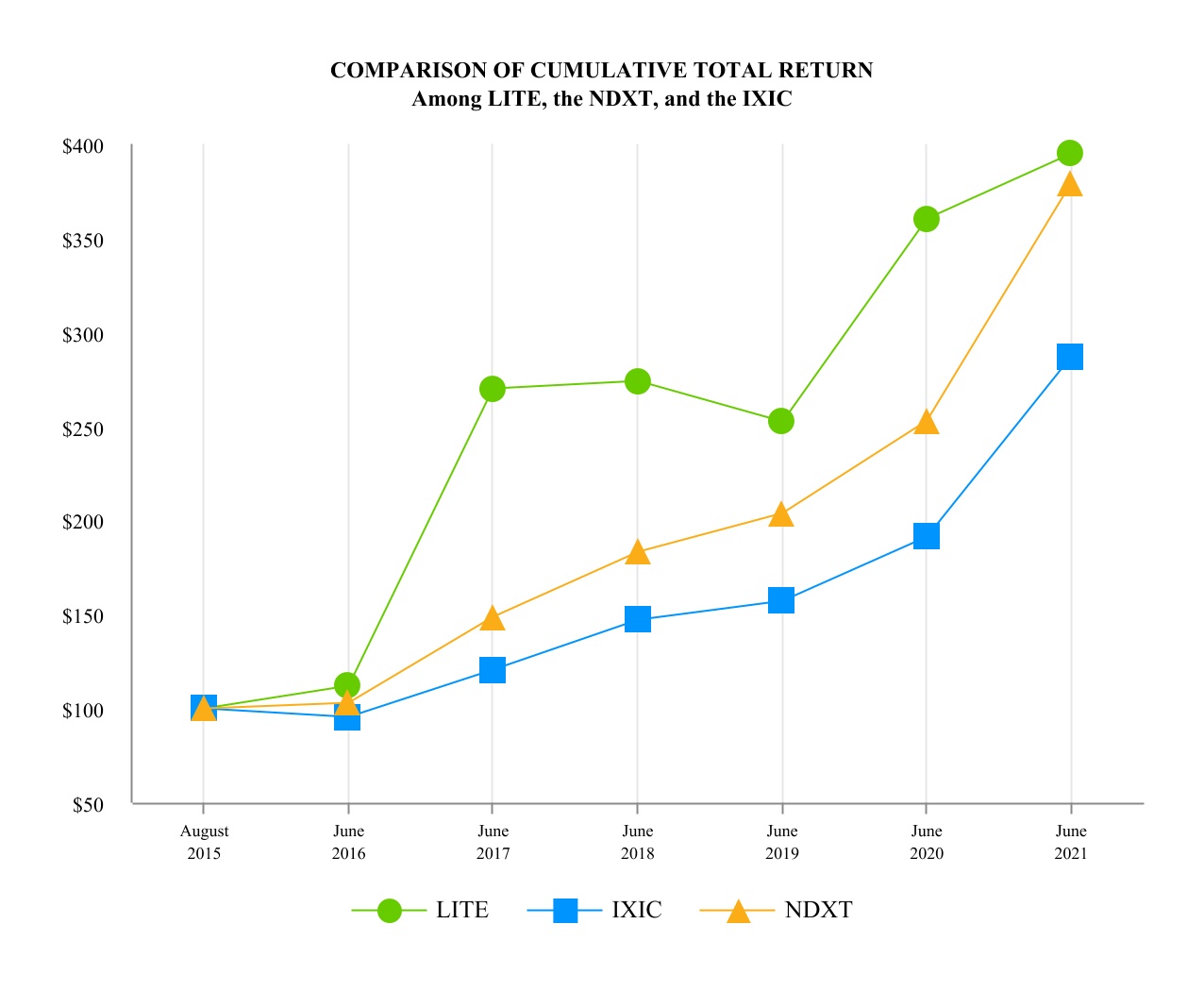
The following graph compares the cumulative total return of our common stock with the total return for the NASDAQ Composite Index (the “IXIC”) and the NASDAQ 100 Technology Sector Index (the “NDXT”) from August 4, 2015 through July 3, 2021. The stock price performance on the following graph is not necessarily indicative of future stock price performance.
Recent Sale of Unregistered Equity Securities
None.
Issuer Purchases of Equity Securities
In December 2019, we purchased approximately $200.0 million or 2.9 million shares of our common stock concurrently with the pricing of the 2026 Notes in privately negotiated transactions effected through the initial purchaser of the 2026 Notes or its affiliates as its agent.
On May 7, 2021, our board of directors approved the 2021 share buyback program, which authorizes us to use up to $700.0 million to purchase our own shares of common stock in open market or in privately negotiated transactions. The buyback program is authorized for 2 years but may be suspended or terminated by the board of directors at any time. The following table sets forth the repurchase activity for the 2021 share buyback program (in millions, except share and per share amounts):
| Period | Total number of shares purchased | Average price paid per share | Total number of shares purchased as part of publicly announced plans or programs | Maximum number (or approximate dollar value) of shares that may yet be purchased under the plans or programs | ||||||||||
| May 7, 2021 to May 29, 2021 | 2,104,427 | $76.01 | 2,104,427 | $540.0 | ||||||||||
| May 30, 2021 to July 3, 2021 | 992,000 | $81.72 | 992,000 | $459.0 |
Item 6. SELECTED FINANCIAL DATA
This table sets forth selected financial data of Lumentum (in millions, except share and per share amounts) for the periods indicated. This data should be read in conjunction with the discussion in “Management’s Discussion and Analysis of Financial Condition and Results of Operations” included in Item 7 of this Annual Report and our audited consolidated financial statements included in Item 8 of this Annual Report. The selected data in this section are not intended to replace the Consolidated Financial Statements included in this Annual Report.
| Years Ended | ||||||||||||||||||||||||||||||||
| July 3, 2021 (1) | June 27, 2020 (2) | June 29, 2019 (3) | June 30, 2018 (4) | July 1, 2017 (5) | ||||||||||||||||||||||||||||
| Consolidated Statements of Operations Data: | ||||||||||||||||||||||||||||||||
| Net revenue | $ | 1,742.8 | $ | 1,678.6 | $ | 1,565.3 | $ | 1,247.7 | $ | 1,001.6 | ||||||||||||||||||||||
| Gross profit | 783.1 | 650.2 | 425.9 | 432.1 | 318.1 | |||||||||||||||||||||||||||
| Income (loss) from operations | 527.0 | 204.1 | (21.6) | 139.9 | 47.6 | |||||||||||||||||||||||||||
| Net income (loss) | 397.3 | 135.5 | (36.4) | 248.1 | (102.5) | |||||||||||||||||||||||||||
| Cumulative dividends on Series A Preferred Stock | — | — | (0.3) | (0.9) | (0.9) | |||||||||||||||||||||||||||
| Earnings allocated to Series A Preferred Stock | — | — | (1.2) | (5.7) | — | |||||||||||||||||||||||||||
| Net income (loss) attributable to common stockholders | $ | 397.3 | $ | 135.5 | $ | (37.9) | $ | 241.5 | $ | (103.4) | ||||||||||||||||||||||
| Net income (loss) per share attributable to common stockholders: | ||||||||||||||||||||||||||||||||
| Basic | $ | 5.27 | $ | 1.79 | $ | (0.54) | $ | 3.88 | $ | (1.71) | ||||||||||||||||||||||
| Diluted | $ | 5.07 | $ | 1.75 | $ | (0.54) | $ | 3.82 | $ | (1.71) | ||||||||||||||||||||||
| Shares used to compute net income (loss) per share attributable to common stockholders: | ||||||||||||||||||||||||||||||||
| Basic | 75.4 | 75.9 | 70.7 | 62.3 | 60.6 | |||||||||||||||||||||||||||
| Diluted | 78.4 | 77.6 | 70.7 | 63.3 | 60.6 |
| Balance as of | |||||||||||||||||||||||||||||||||||||||||||||||
| July 3, 2021 (1) | June 27, 2020 (2) | June 29, 2019 (3) | June 30, 2018 (4) | July 1, 2017 (5) | |||||||||||||||||||||||||||||||||||||||||||
| Consolidated Balance Sheet Data: | |||||||||||||||||||||||||||||||||||||||||||||||
| Cash and cash equivalents | $ | 774.3 | $ | 298.0 | $ | 432.6 | $ | 397.3 | $ | 272.9 | |||||||||||||||||||||||||||||||||||||
| Short-term investments | 1,171.7 | 1,255.8 | 335.9 | 314.2 | 282.4 | ||||||||||||||||||||||||||||||||||||||||||
| Total assets | 3,551.6 | 3,292.6 | 2,716.6 | 1,581.5 | 1,232.9 | ||||||||||||||||||||||||||||||||||||||||||
| Convertible notes | 1,180.5 | 1,120.3 | 351.9 | 334.2 | 317.5 | ||||||||||||||||||||||||||||||||||||||||||
| Term loan, non-current | — | — | 484.0 | — | — | ||||||||||||||||||||||||||||||||||||||||||
| Derivative liability | — | — | — | 52.4 | 51.6 | ||||||||||||||||||||||||||||||||||||||||||
| Other non-current liabilities | 40.9 | 36.0 | 33.7 | 19.0 | 25.0 | ||||||||||||||||||||||||||||||||||||||||||
| Total redeemable convertible preferred stock | — | — | — | 35.8 | 35.8 | ||||||||||||||||||||||||||||||||||||||||||
| Total stockholders’ equity | 1,972.8 | 1,749.2 | 1,497.1 | 926.1 | 618.8 |
(1)On January 18, 2021, we entered into a merger agreement with Coherent, under which we would acquire all outstanding shares of Coherent common stock. In March 2021, Coherent terminated the merger agreement and paid us a termination fee of $217.6 million in accordance with the merger agreement. This gain was offset by $10.1 million of acquisition related expenses and the net amount is presented as “Merger termination fee and related costs, net” in our Consolidated Statement of Operations for the year ended July 3, 2021.
On May 7, 2021, our board of directors approved the 2021 share buyback program, which authorizes us to use up to $700.0 million to purchase our own shares of common stock. The buyback program is authorized for 2 years but may be suspended or terminated by the board of directors at any time. In the fiscal fourth quarter of 2021, we repurchased 3.1 million shares of our common stock at an average price of $77.84 per share for an aggregate purchase price of $241.0 million. These shares were retired immediately.
(2)In fiscal 2020, we repaid, in full, all amounts outstanding under our Term Loan Facility. In December 2019, we issued $1,050.0 million of the 2026 Notes in a private offering. We used approximately $196 million of the net proceeds of the offering to repay in full all amounts outstanding under our term loan facility, and a portion of the net proceeds of the offering to purchase approximately $200 million of our common stock concurrently with the pricing of the offering in privately negotiated transactions.
(3)On December 10, 2018, we completed the acquisition of Oclaro, a provider of optical components and modules for the long-haul, metro and data center markets, for $1.4 billion, which was funded through the issuance of Lumentum common stock, new debt, and cash balances of the combined company. Refer to “Note 4. Business Combinations” in the notes to consolidated financial statements for further discussion of the merger. Results of operations and financial position of the business acquired have been included in our consolidated financial statements subsequent to the date of acquisition.
(4)During the second quarter of fiscal 2018, we had a credit of $207.0 million primarily related to a release of a U.S. valuation allowance, which was offset by a write-down of deferred tax assets in the amount of $83.0 million due to the lower corporate tax rate enacted under the 2017 “Tax Cuts and Jobs Act” reform.
(5)During the third quarter of fiscal 2017, we completed the acquisition of a privately held company. Results of operations and financial position of the business acquired have been included in our consolidated financial statements subsequent to the date of acquisition.
Item 7. MANAGEMENT’S DISCUSSION AND ANALYSIS OF FINANCIAL CONDITION AND RESULTS OF OPERATIONS
You should read the following discussion in conjunction with the audited consolidated financial statements and the corresponding notes included elsewhere in this Annual Report. This Management’s Discussion and Analysis of Financial Condition and Results of Operations contains forward-looking statements. The matters discussed in these forward-looking statements are subject to risk, uncertainties and other factors that could cause actual results to differ materially from those made, projected or implied in the forward-looking statements. Please see “Risk Factors” and “Forward-Looking Statements” for a discussion of the uncertainties, risks and assumptions associated with these statements.
Overview
We are an industry-leading provider of optical and photonic products, defined by revenue and market share, addressing a range of end-market applications including Optical Communications, which we refer to as OpComms, and Lasers for manufacturing, inspection and life-science applications. We have two operating segments, OpComms and Lasers. The two operating segments were primarily determined based on how the Chief Operating Decision Maker (“CODM”) views and evaluates our operations. Operating results are regularly reviewed by the CODM to make decisions about resources to be allocated to the segments and to assess their performance. Other factors, including market separation and customer specific applications, go-to-market channels, products and manufacturing, are considered in determining the formation of these operating segments.
We believe the global markets in which Lumentum participates have fundamentally robust, long-term trends that increase the need for our photonics products and technologies. We believe the world is becoming more reliant on ever-increasing amounts of data flowing through optical networks and data centers. Lumentum’s products and technology enable the scaling of these optical networks and data centers to higher capacities. We expect the accelerating shift to digital and virtual approaches to all aspects of work and life that is driving staggering amounts of data in the world’s networks and cloud datacenters will continue into the future. Virtual meetings, video calls, and hybrid in-person and virtual environments for work and other aspects of life will continue to drive strong needs for bandwidth growth and present dynamic new technology challenges that our technology addresses. As manufacturers demand higher levels of precision, new materials, and factory and energy efficiency, suppliers of manufacturing tools globally are turning to laser-based approaches, including the types of lasers Lumentum supplies. Laser-based 3D sensing and LiDAR for security, industrial and automotive applications are rapidly developing markets. The technology enables computer vision applications that enhance security, safety, and new functionality in the electronic devices that people rely on every day. The use of LiDAR and in-cabin 3D sensing in automobile and delivery vehicles over time significantly adds to our long-term market opportunity. Frictionless and contactless biometric security and access control is of increasing focus globally given the world’s experience with the COVID-19 pandemic. Additionally, we expect 3D-enabled machine vision solutions to expand significantly in industrial applications in the coming years.
On December 10, 2018, we completed the acquisition of Oclaro, a provider of optical components and modules for the long-haul, metro and data center markets. Refer to “Note 4. Business Combinations” in the notes to consolidated financial statements for further discussion of the merger.
To maintain and grow our market and technology leadership positions, we are continually investing in new and differentiated products and technologies and customer programs that address both nearer-term and longer-term growth opportunities, as well as continually improving and optimizing our operations. Over many years, we have developed close relationships with market leading customers. We seek to use our core optical and photonic technology and our volume manufacturing capability to expand into attractive emerging markets that benefit from advantages that optical or photonics-based solutions provide.
OpComms
Our OpComms products address the following markets: Telecom, Datacom and Consumer and Industrial.
Our OpComms products include a wide range of components, modules and subsystems to support customers including carrier networks for access (local), metro (intracity), long-haul (city-to-city and worldwide) and submarine (undersea) applications. Additionally, our products address enterprise, cloud, and data center applications, including storage-access networks (“SANs”), local-area networks (“LANs”) and wide-area networks (“WANs”). These products enable the transmission and transport of video, audio and data over high-capacity fiber-optic cables. We maintain leading positions in these fast growing OpComms markets through our extensive product portfolio, including reconfigurable optical add/drop multiplexers (“ROADMs”), coherent dense wavelength division multiplexing (“DWDM”) pluggable transceivers, and tunable small form-factor pluggable transceivers. We also sell laser chips for use in manufacturing of high-speed Datacom transceivers.In the Consumer and Industrial market, our OpComms products include laser light sources, which are integrated into 3D sensing
platforms being used in applications for mobile devices, gaming, computers, and other consumer electronics devices. New emerging applications include virtual and augmented reality, as well as automotive and industrial segments. Our products include vertical cavity surface emitting lasers (“VCSELs”) and edge emitting lasers which are used in 3D sensing depth imaging systems. These systems simplify the way people interact with technology by enabling the use of natural user interfaces. Systems are used for biometric identification, surveillance, and process efficiency, among numerous other application spaces. Emerging applications for this technology include various mobile device applications, autonomous vehicles, self-navigating robotics and drones in industrial applications and 3D capture of objects coupled with 3D printing. In addition, our industrial diode lasers are used primarily as pump sources for pulsed and kilowatt class fiber lasers.
Our OpComms customers include Alphabet, Apple, Ciena, Cisco Systems (which acquired Acacia Communications on March 1, 2021, another customer of ours), Huawei Technologies (including HiSilicon), Infinera, Innolight, NEC, Nokia Networks (including Alcatel-Lucent International), and ZTE.
Following the acquisition of Oclaro, during our fiscal 2019, we made several strategic changes to our OpComms business to better position it for growth and profitability. These changes included attaining acquisition cost synergies related to redundant capabilities and divestiture of Telecom lithium niobate modulators and Datacom transceiver modules because of their muted growth and profitability trends. These changes were substantially completed in fiscal 2020. Our strategy of focusing on the development and sale of Datacom chips has enabled us to participate in the growth of the Datacom and 5G wireless markets.
Related to the strategic changes in our OpComms business, we entered into two strategic transactions to sell some of the discontinued product lines. In the second quarter of fiscal year 2020, we entered into an agreement with Advanced Fiber Resources (Zhuhai) Ltd. (“AFR”), a leading provider of passive optical components, to sell the assets associated with certain Lithium Niobate product lines manufactured by our San Donato site for $17.0 million. The transaction was closed in the third quarter of fiscal year 2020. On April 18, 2019, we closed a transaction selling many of our Datacom transceiver module product lines to Cambridge Industries Group (“CIG”). Fo
Showing the first 8K of 88K characters. Open the full section
Item 7A. QUANTITATIVE AND QUALITATIVE DISCLOSURES ABOUT MARKET RISK
COVID-19 Risk
There are a number of market risk factors related to the COVID-19 pandemic and associated global economic impacts. We continue to actively evaluate these risks, and have taken reserves and financial positions as of July 3, 2021 that we believe are reasonable based on the information currently available. However, the COVID-19 pandemic and related regional shelter-in-place orders are unprecedented events that are continually evolving, and there could be significant changes and/or charges resulting in the future. These market risks include, for example:
-
Accounts receivable collectability - there could be significant bad debt expenses incurred if our customers experience financial difficulties.
-
Accounts receivable collections timing - our working capital and cash flows could be impacted if we start to agree to longer payment terms for our customers. Although we have not done so, a broader market move to longer payment terms could delay our collection timing as well.
-
Inventory (excess and obsolete) - our customers may not be able to purchase inventory that we have built for them, or their demand may slow down to a point where inventory becomes aged.
-
Short-term investment values - as seen in past economic slowdowns, there may be credit losses and defaults or a withdrawal of government support programs which cause losses and/or liquidity issues in our investment portfolio.
-
Long-term assets such as fixed assets, goodwill, and intangibles - a market slowdown could impair the value of these assets.
-
Tax valuation - we have significant NOL’s (Net Operating losses) in the United States which have associated deferred tax assets on our balance sheet, and these could be deemed unrecoverable in the future.
In addition, all of the below market risks are heightened in light of the current market situation. Foreign exchange markets could be impacted and cause significant fluctuations in our future expenses. The price of our common stock has fluctuated significantly in the past and global equity markets are experiencing significant volatility following the COVID-19 outbreak. Interest rates have already reduced dramatically since the onset of the outbreak, and our future income from these investments likely will be negatively impacted in the future.
Foreign Exchange Risk
We conduct our business and sell our products to customers primarily in Asia, Europe, and North America. Due to the impact of changes in foreign currency exchange rates between the U.S. Dollar and foreign currencies, for the fiscal years ended July 3, 2021, June 27, 2020, and June 29, 2019, we recorded foreign exchange losses, net of $4.4 million, $1.4 million, and $0.6 million, respectively, in the other income (expense), net in the Consolidated Statements of Operations.
Although we sell primarily in the U.S. Dollar, we have foreign currency exchange risks related to our expenses denominated in currencies other than the U.S. Dollar, principally the Chinese Yuan, Canadian Dollar, Thai Baht, Japanese Yen, UK Pound, Swiss Franc and Euro. The volatility of exchange rates depends on many factors that we cannot forecast with reliable accuracy. In the event our foreign currency denominated assets, liabilities, sales or expenses increase, our operating results may be more greatly affected by fluctuations in the exchange rates of the currencies in which we do business.
Equity Price Risk
We are exposed to equity price risk related to the conversion options embedded in our 2026 Notes and 2024 Notes.
We issued the 2026 Notes in December 2019 and the 2024 Notes in March 2017 with an aggregate principal amount of $1,050 million and $450 million, respectively. Both the 2026 Notes and the 2024 Notes are carried at face value less amortized discount on the Consolidated Balance Sheet. The 2026 Notes and the 2024 Notes bear interest at a rate of 0.50% and 0.25% per year, respectively. Since the Notes bear interest at fixed rates, we have no financial statement risk associated with changes in market interest rates. However, the potential value of the shares to be distributed to the holders of our Notes changes when the market price of our stock fluctuates. The 2026 Notes will mature on December 15, 2026, unless earlier repurchased by us or converted pursuant to their terms, at a conversion price of approximately $99.29 per share. The 2024 Notes will mature on March 15, 2024, unless earlier repurchased by us or converted pursuant to their terms, at a conversion price of approximately $60.62 per share.
Since the closing price of our stock exceeded $78.80 per share for 20 of the last 30 trading days of the fourth quarter of fiscal 2021, the 2024 Notes have become convertible at the option of the holders. If the closing price of our stock exceeds $129.08 per share for 20 of the last 30 trading days of any future quarter, our 2026 Notes would also become convertible at the option of the holders.
Interest Rate Fluctuation Risk
As of July 3, 2021, we had cash, cash equivalents, and short-term investments of $1,946.0 million. Cash equivalents and short-term investments are primarily comprised of money market funds, treasuries, agencies, high quality investment grade fixed income securities, certificates of deposit, and commercial paper. Our investment policy and strategy is focused on the preservation of capital and supporting our liquidity requirements. We do not enter into investments for trading or speculative purposes. As of July 3, 2021, the weighted-average life of our investment portfolio was approximately eight months.
Our fixed-income portfolio is subject to fluctuations in interest rates, which could affect our results of operations. Based on our investment portfolio balance as of July 3, 2021, a hypothetical increase or decrease in interest rates of 1% (100 basis points) would have resulted in a decrease or an increase in the fair value of our portfolio of approximately $9.6 million, and a hypothetical increase or decrease of 0.50% (50 basis points) would have resulted in a decrease or an increase in the fair value of our portfolio of approximately $4.8 million.
Bank Liquidity Risk
As of July 3, 2021, we had approximately $128.3 million of unrestricted cash (excluding cash equivalents) in operating accounts that are held with domestic and international financial institutions. These cash balances could be lost or become inaccessible if the underlying financial institutions fail or if they are unable to meet the liquidity requirements of their depositors and if they are not supported by the national government of the country in which such financial institution is located. Notwithstanding, we have not incurred any losses to date and have had full access to our operating accounts. We believe any failures of domestic and international financial institutions could impact our ability to fund our operations in the short term.
Item 8. FINANCIAL STATEMENTS AND SUMMARY DATA
REPORT OF INDEPENDENT REGISTERED PUBLIC ACCOUNTING FIRM
To the Stockholders and the Board of Directors of Lumentum Holdings Inc.
Opinion on the Financial Statements
We have audited the accompanying consolidated balance sheets of Lumentum Holdings Inc. and subsidiaries (the “Company”) as of July 3, 2021 and June 27, 2020, the related consolidated statements of operations, comprehensive income (loss), cash flows, and redeemable convertible preferred stock and stockholders’ equity for each of the three years in the period ended July 3, 2021, and the related notes and the schedule listed in the Index at Item 15 (collectively referred to as the “financial statements”). In our opinion, the financial statements present fairly, in all material respects, the financial position of the Company as of July 3, 2021 and June 27, 2020, and the results of its operations and its cash flows for each of the three years in the period ended July 3, 2021, in conformity with accounting principles generally accepted in the United States of America.
We have also audited, in accordance with the standards of the Public Company Accounting Oversight Board (United States) (PCAOB), the Company's internal control over financial reporting as of July 3, 2021, based on criteria established in Internal Control - Integrated Framework (2013) issued by the Committee of Sponsoring Organizations of the Treadway Commission and our report dated August 30, 2021, expressed an unqualified opinion on the Company's internal control over financial reporting.
Change in Accounting Principle
As discussed in Notes 1 and 9 to the financial statements, the Company has changed its method of accounting for leases in the year ended June 27, 2020 due to the adoption of Accounting Standards Update No. 2016-02, Leases (Topic 842).
Basis for Opinion
These financial statements are the responsibility of the Company's management. Our responsibility is to express an opinion on the Company's financial statements based on our audits. We are a public accounting firm registered with the PCAOB and are required to be independent with respect to the Company in accordance with the U.S. federal securities laws and the applicable rules and regulations of the Securities and Exchange Commission and the PCAOB.
We conducted our audits in accordance with the standards of the PCAOB. Those standards require that we plan and perform the audit to obtain reasonable assurance about whether the financial statements are free of material misstatement, whether due to error or fraud. Our audits included performing procedures to assess the risks of material misstatement of the financial statements, whether due to error or fraud, and performing procedures that respond to those risks. Such procedures included examining, on a test basis, evidence regarding the amounts and disclosures in the financial statements. Our audits also included evaluating the accounting principles used and significant estimates made by management, as well as evaluating the overall presentation of the financial statements. We believe that our audits provide a reasonable basis for our opinion.
Critical Audit Matter
The critical audit matter communicated below is a matter arising from the current-period audit of the financial statements that was communicated or required to be communicated to the audit committee and that (1) relates to accounts or disclosures that are material to the financial statements and (2) involved our especially challenging, subjective, or complex judgments. The communication of critical audit matters does not alter in any way our opinion on the financial statements, taken as a whole, and we are not, by communicating the critical audit matter below, providing a separate opinion on the critical audit matter or on the accounts or disclosures to which it relates.
Inventories, Valuation of Inventory - Refer to Notes 1 and 8 to the Financial Statements
Critical Audit Matter Description
The Company assesses the value of inventory and writes down those inventories which are obsolete or in excess of forecasted demand to the lower of their cost or estimated net realizable value. The Company’s estimates of forecasted demand are based upon analysis and assumptions including, but not limited to, expected product lifecycles, product development plans and historical usage by product.
We identified the valuation of inventory as a critical audit matter because of the significant assumptions management makes with regards to estimating the excess and obsolete write downs. This required a high degree of auditor judgment and an increased extent of effort when performing audit procedures to evaluate the reasonableness of management’s estimates of forecasted demand.
How the Critical Audit Matter Was Addressed in the Audit
Our audit procedures related to management’s estimates of forecasted demand used in the valuation of inventory excess and obsolete write downs included the following, among others:
-
We tested the effectiveness of controls over the review and approval of the valuation of inventory for excess and obsolete write downs, including controls designed to review and approve forecasted demand and the underlying assumptions regarding expected product lifecycles, product development plans and historical usage by product.
-
To understand the assumptions behind the inventory excess and obsolete write downs, including the related forecasted demand, we made inquiries of business unit managers as well as executives, sales, and operations personnel about the expected product lifecycles and product development plans and historical usage by product.
-
We selected a sample of inventory products and tested the forecasted demand by comparing internal and external information (e.g. historical usage, contracts, communications with customers, expected product lifecycles, product development plans, and macroeconomic conditions) with the Company’s forecasted demand.
-
We selected a sample of inventory products and evaluated management's ability to accurately estimate forecasted demand by comparing usage by product in the current year to estimates made in prior years.
-
We considered the existence of contradictory evidence based on reading of internal communications to management and the board of directors, Company press releases, and analysts' reports, as well as our observations and inquires as to changes within the business.
/s/ DELOITTE & TOUCHE LLP
San Jose, California
August 30, 2021
We have served as the Company's auditor since 2017.
LUMENTUM HOLDINGS INC.
CONSOLIDATED STATEMENTS OF OPERATIONS
(in millions, except per share data)
| Years Ended | |||||||||||||||||||||||||||||
| July 3, 2021 | June 27, 2020 | June 29, 2019 | |||||||||||||||||||||||||||
| Net revenue | $ | 1,742.8 | $ | 1,678.6 | $ | 1,565.3 | |||||||||||||||||||||||
| Cost of sales | 898.0 | 974.6 | 1,092.9 | ||||||||||||||||||||||||||
| Amortization of acquired developed intangibles | 61.7 | 53.8 | 46.5 | ||||||||||||||||||||||||||
| Gross profit | 783.1 | 650.2 | 425.9 | ||||||||||||||||||||||||||
| Operating expenses: | |||||||||||||||||||||||||||||
| Research and development | 214.5 | 198.6 | 184.6 | ||||||||||||||||||||||||||
| Selling, gener |
Showing the first 8K of 272K characters. Open the full section
Item 9. CHANGES IN AND DISAGREEMENTS WITH ACCOUNTANTS ON ACCOUNTING AND FINANCIAL DISCLOSURE
None.
Item 9A. CONTROLS AND PROCEDURES
(a) Evaluation of Disclosure Controls and Procedures
Our management is responsible for establishing and maintaining adequate internal control over financial reporting. Management, with the participation of our chief executive officer and our chief financial officer, evaluated the effectiveness of our disclosure controls and procedures as of July 3, 2021. The term “disclosure controls and procedures,” as defined in Rules 13a-15 and 15d-15 under the Exchange Act, means controls and other procedures of a company that are designed to ensure that information required to be disclosed by a company in the reports that it files or submits under the Exchange Act is recorded, processed, summarized and reported within the time periods specified in the SEC’s rules and forms. Disclosure controls and procedures include, without limitation, controls and procedures designed to ensure that information required to be disclosed by a company in the reports that it files or submits under the Exchange Act is accumulated and communicated to the company’s management, including its principal executive and principal financial officers, as appropriate to allow timely decisions regarding required disclosure. Management recognizes that any controls and procedures, no matter how well designed and operated, can provide only reasonable assurance of achieving their objectives, and management necessarily applies its judgment in evaluating the cost-benefit relationship of possible controls and procedures. Based on the evaluation of our disclosure controls and procedures as of July 3, 2021, our chief executive officer and chief financial officer concluded that our disclosure controls and procedures were effective at a reasonable assurance level.
(b) Management’s Report on Internal Control Over Financial Reporting
Our management is responsible for establishing and maintaining adequate internal control over financial reporting (as defined in Rule 13a-15(f) under the Exchange Act). Management conducted an assessment of the effectiveness of our internal control over financial reporting based on the criteria set forth in Internal Control-Integrated Framework issued by the Committee of Sponsoring Organizations of the Treadway Commission (2013 framework). Based on the assessment, management has concluded that its internal control over financial reporting was effective as of July 3, 2021 to provide reasonable assurance regarding the reliability of financial reporting and the preparation of financial statements in accordance with U.S. GAAP.
Deloitte & Touche LLP, the independent registered public accounting firm that audited the consolidated financial statements included in this Form 10-K, has issued a report, included herein, on the effectiveness of the Company’s internal control over financial reporting as of July 3, 2021.
(c) Changes in Internal Control over Financial Reporting
There were no changes in our internal control over financial reporting as defined in Exchange Act Rules 13a-15(f) and 15d-15(f), identified in connection with the evaluation required by Exchange Act Rules 13a-15(d) or 15d-15(d) that occurred during our most recently completed fiscal quarter that have materially affected, or are reasonably likely to materially affect, our internal control over financial reporting. While the COVID-19 pandemic has resulted in many of our employees working remotely, our internal controls over financial reporting is not impacted.
(d) Inherent Limitations on Effectiveness of Controls
Our management, including the CEO and CFO, recognizes that our disclosure controls and procedures or our internal control over financial reporting cannot prevent or detect all possible instances of errors and all fraud. A control system, no matter how well designed and operated, can provide only reasonable, not absolute, assurance that the control system's objectives will be met. The design of a control system must reflect the fact that there are resource constraints, and the benefits of controls must be considered relative to their costs.
REPORT OF INDEPENDENT REGISTERED PUBLIC ACCOUNTING FIRM
To the Stockholders and the Board of Directors of Lumentum Holdings Inc.
Opinion on Internal Control over Financial Reporting
We have audited the internal control over financial reporting of Lumentum Holdings Inc. and subsidiaries (the “Company”) as of July 3, 2021, based on criteria established in Internal Control - Integrated Framework (2013) issued by the Committee of Sponsoring Organizations of the Treadway Commission (COSO). In our opinion, the Company maintained, in all material respects, effective internal control over financial reporting as of July 3, 2021, based on criteria established in Internal Control - Integrated Framework (2013) issued by COSO.
We have also audited, in accordance with the standards of the Public Company Accounting Oversight Board (United States) (PCAOB), the consolidated financial statements as of and for the year ended July 3, 2021, of the Company and our report dated August 30, 2021, expressed an unqualified opinion on those financial statements and included an explanatory paragraph relating to the Company’s adoption of Accounting Standards Update No. 2016-02, Leases (Topic 842).
Basis for Opinion
The Company’s management is responsible for maintaining effective internal control over financial reporting and for its assessment of the effectiveness of internal control over financial reporting, included in the accompanying Management’s Report on Internal Control Over Financial Reporting. Our responsibility is to express an opinion on the Company’s internal control over financial reporting based on our audit. We are a public accounting firm registered with the PCAOB and are required to be independent with respect to the Company in accordance with the U.S. federal securities laws and the applicable rules and regulations of the Securities and Exchange Commission and the PCAOB.
We conducted our audit in accordance with the standards of the PCAOB. Those standards require that we plan and perform the audit to obtain reasonable assurance about whether effective internal control over financial reporting was maintained in all material respects. Our audit included obtaining an understanding of internal control over financial reporting, assessing the risk that a material weakness exists, testing and evaluating the design and operating effectiveness of internal control based on the assessed risk, and performing such other procedures as we considered necessary in the circumstances. We believe that our audit provides a reasonable basis for our opinion.
Definition and Limitations of Internal Control over Financial Reporting
A company’s internal control over financial reporting is a process designed to provide reasonable assurance regarding the reliability of financial reporting and the preparation of financial statements for external purposes in accordance with generally accepted accounting principles. A company’s internal control over financial reporting includes those policies and procedures that (1) pertain to the maintenance of records that, in reasonable detail, accurately and fairly reflect the transactions and dispositions of the assets of the company; (2) provide reasonable assurance that transactions are recorded as necessary to permit preparation of financial statements in accordance with generally accepted accounting principles, and that receipts and expenditures of the company are being made only in accordance with authorizations of management and directors of the company; and (3) provide reasonable assurance regarding prevention or timely detection of unauthorized acquisition, use, or disposition of the company’s assets that could have a material effect on the financial statements.
Because of its inherent limitations, internal control over financial reporting may not prevent or detect misstatements. Also, projections of any evaluation of effectiveness to future periods are subject to the risk that controls may become inadequate because of changes in conditions, or that the degree of compliance with the policies or procedures may deteriorate.
/s/ DELOITTE & TOUCHE LLP
San Jose, California
August 30, 2021
Item 9B. OTHER INFORMATION
None.
Item 9C. DISCLOSURE REGARDING FOREIGN JURISDICTIONS THAT PREVENT INSPECTIONS
Not applicable.
PART III
The SEC allows us to include information required in this report by referring to other documents or reports we have already filed or will soon be filing. This is called “incorporation by reference.” We intend to file our definitive proxy statement for our 2021 annual meeting of stockholders (the “Proxy Statement”) pursuant to Regulation 14A not later than 120 days after the end of the fiscal year covered by this report, and certain information to be contained therein is incorporated in this report by reference.
Item 10. DIRECTORS, EXECUTIVE OFFICERS AND CORPORATE GOVERNANCE
The information required for this Item is set forth in the Proxy Statement and incorporated herein by reference.
Item 11. EXECUTIVE COMPENSATION
The information required for this Item is set forth in the Proxy Statement and incorporated herein by reference.
Item 12. SECURITY OWNERSHIP OF CERTAIN BENEFICIAL OWNERS AND MANAGEMENT AND RELATED STOCKHOLDER MATTERS
The information required for this Item is set forth in the Proxy Statement and incorporated herein by reference.
Item 13. CERTAIN RELATIONSHIPS AND RELATED TRANSACTIONS, AND DIRECTOR INDEPENDENCE
The information required for this Item is set forth in the Proxy Statement and incorporated herein by reference.
Item 14. PRINCIPAL ACCOUNTING FEES AND SERVICES
The information required for this Item is set forth in the Proxy Statement and incorporated herein by reference.
PART IV
Item 15. EXHIBITS, FINANCIAL STATEMENTS SCHEDULES
1. Financial Statements
The financial statements filed as part of this report are listed in the “Index to Financial Statements” under Part II, Item 8 of this report.
2. Financial Statement Schedules
The following additional financial statement schedules should be considered in conjunction with our consolidated financial statements. All other financial statement schedules have been omitted because the required information is not present in amounts sufficient to require submission of the schedule, not applicable, or because the required information is included in the Consolidated Financial Statements or Notes thereto.
LUMENTUM HOLDINGS INC.
FINANCIAL STATEMENT SCHEDULES
SCHEDULE II - VALUATION AND QUALIFYING ACCOUNTS
| (in millions) | |||||||||||||||||||||||||||||||||||
| Balance at Beginning of Period | Assumed in Oclaro Acquisition | Increase (decrease) in Consolidated Statements of Operations | Write Offs and Other Adjustments | Balance at End of Period | |||||||||||||||||||||||||||||||
| Allowance for credit losses: | |||||||||||||||||||||||||||||||||||
| Fiscal year ended July 3, 2021 | $ | 1.8 | $ | — | $ | 0.2 | $ | (1.6) | $ | 0.4 | |||||||||||||||||||||||||
| Fiscal year ended June 27, 2020 | $ | 4.5 | $ | — | $ | 0.1 | $ | (2.8) | $ | 1.8 | |||||||||||||||||||||||||
| Fiscal year ended June 29, 2019 | $ | 2.6 | $ | 3.3 | $ | (0.2) | $ | (1.2) | $ | 4.5 | |||||||||||||||||||||||||
| (in millions) | ||||||||||||||||||||||||||
| Balance at Beginning of Period | Additions Charged to Costs/Expenses 1 | Deductions Credited to Costs/Expenses 2 | Balance at End of Period | |||||||||||||||||||||||
| Deferred tax valuation allowance: | ||||||||||||||||||||||||||
| Fiscal year ended July 3, 2021 | $ | 200.8 | $ | 68.7 | $ | — | $ | 269.5 | ||||||||||||||||||
| Fiscal year ended June 27, 2020 3 | $ | 190.3 | $ | 12.7 | $ | (2.2) | $ | 200.8 | ||||||||||||||||||
| Fiscal year ended June 29, 2019 3 | $ | 99.4 | $ | 93.5 | $ | (2.6) | $ | 190.3 | ||||||||||||||||||
(1) Additions include current year additions charged to expenses and current year build due to increases in net deferred tax assets, return to provision true-ups, other adjustments to deferred taxes.
(2) Net deductions include current year releases credited to expenses and current year reductions due to decreases in net deferred tax assets, return to provision true-ups, other adjustments to deferred taxes.
(3) Certain prior period amounts have been reclassified to conform to current year presentation on a jurisdiction by jurisdiction basis.
3. Exhibits
The following exhibits are filed herewith or are incorporated by reference to exhibits previously filed with the Securities and Exchange Commission.
| Incorporated by Reference | Filed | |||||||||||||||||||||||||||||||
| Exhibit No. | Exhibit Description | Form | Exhibit | Filing Date | Herewith | |||||||||||||||||||||||||||
| 2.1 | Contribution Agreement | 8-K | 2.1 | 8/6/2015 | ||||||||||||||||||||||||||||
| 2.1 | Agreement and Plan of Merger, dated as of March 11, 2018, by and among Lumentum Holdings Inc., Oclaro, Inc., Prota Merger Sub, Inc. and Prota Merger, LLC | 8-K | 2.1 | 3/12/2018 | ||||||||||||||||||||||||||||
| 2.2 | Agreement and Plan of Merger, dated as of January 18, 2021, by and among Lumentum Holdings Inc., Coherent, Inc., Cheetah Acquisition Sub, Inc. and Cheetah Acquisition Sub LLC. | 8-K | 2.1 | 1/19/2021 | ||||||||||||||||||||||||||||
| 2.3 | Amended and Restated Agreement and Plan of Merger, dated as of March 9, 2021, by and among Lumentum Holdings Inc., Coherent, Inc., Cheetah Acquisition Sub, Inc. and Cheetah Acquisition Sub LLC. | 8-K | 2.2 | 3/10/2021 | ||||||||||||||||||||||||||||
| 2.4 | Separation and Distribution Agreement | 8-K | 2.2 | 8/6/2015 | ||||||||||||||||||||||||||||
| 3.1 | Amended and Restated Certificate of Incorporation | 8-K | 3.1 | 8/6/2015 | ||||||||||||||||||||||||||||
| 3.2 | Amended and Restated Bylaws | 8-K | 3.2 | 8/6/2015 |
| 101 | The following financial information from Lumentum Holdings Inc.’s Annual Report on Form 10-K for the fiscal year ended July 3, 2021 formatted in Inline XBRL (eXtensible Business Reporting Language): (i) Consolidated Statements of Operations for the fiscal years ended July 3, 2021, June 27, 2020 and June 29, 2019; (ii) Consolidated Statements of Comprehensive Income for the fiscal years ended July 3, 2021, June 27, 2020 and June 29, 2019; (iii) Consolidated Balance Sheets as of July 3, 2021 and June 27, 2020; (iv) Consolidated Statements of Cash Flows for the fiscal years ended July 3, 2021, June 27, 2020 and June 29, 2019; (v) Consolidated Statements of Redeemable Convertible Preferred Stock and Stockholders’ Equity for the fiscal years ended July 3, 2021, June 27, 2020 and June 29, 2019; and (vi) Notes to the Consolidated Financial Statements | X | ||||||||||||||||||||||||||||||
| 104 | The cover page from Lumentum Holdings Inc.’s Annual Report on Form 10-K for the fiscal year ended July 3, 2021, formatted in Inline XBRL (included as Exhibit 101). | X |
- Indicates management contract or compensatory plan or arrangement.
† The certifications furnished in Exhibits 32.1 and 32.2 that accompany this Annual Report on Form 10-K, are not deemed filed with the Securities and Exchange Commission and are not to be incorporated by reference into any filing of the Registrant under the Securities Act of 1933, as amended, or the Securities Exchange Act of 1934, as amended, whether made before or after the date of this Annual Report on Form 10-K, irrespective of any general incorporation language contained in such filing.
Item 16. FORM 10-K SUMMARY.
None.
SIGNATURES
Pursuant to the requirements of Section 13 or 15(d) of the Securities Exchange Act of 1934, the Registrant has duly caused this Annual Report on Form 10-K to be signed on its behalf by the undersigned, thereunto duly authorized.
| Date: | August 30, 2021 | LUMENTUM HOLDINGS INC. | |||||||||
| By: /s/ WAJID ALI | |||||||||||
| By: Wajid Ali | |||||||||||
| Executive Vice President and Chief Financial Officer | |||||||||||
| (Principal Financial Officer) |
POWER OF ATTORNEY
KNOW ALL PERSONS BY THESE PRESENTS, that each person whose signature appears below hereby constitutes and appoints Wajid Ali and Judy Hamel, and each of them individually, as his or her attorney-in-fact, each with full power of substitution, for him or her in any and all capacities to sign any and all amendments to this Annual Report on Form 10-K, and to file the same, with exhibits thereto and other documents in connection therewith, with the Securities and Exchange Commission, hereby ratifying and confirming all that said attorney-in-fact, or his or her substitute, may do or cause to be done by virtue hereof.
Pursuant to the requirements of the Securities Exchange Act of 1934, this Annual Report on Form 10-K has been signed below by the following persons on behalf of the Registrant and in the capacities and on the dates indicated.
| Signature | Title | Date | ||||||||||||
| /s/ ALAN LOWE | President, Chief Executive Officer and Director (principal executive officer) | August 30, 2021 | ||||||||||||
| Alan Lowe | ||||||||||||||
| /s/ WAJID ALI | Executive Vice President, Chief Financial Officer (principal financial officer) | August 30, 2021 | ||||||||||||
| Wajid Ali | ||||||||||||||
| /s/ MATTHEW SEPE | Chief Accounting Officer (principal accounting officer) | August 30, 2021 | ||||||||||||
| Matthew Sepe | ||||||||||||||
| /s/ HAROLD COVERT | Director | August 30, 2021 | ||||||||||||
| Harold Covert | ||||||||||||||
| /s/ JULIE JOHNSON | Director | August 30, 2021 | ||||||||||||
| Julie Johnson | ||||||||||||||
| /s/ PENELOPE HERSCHER | Director | August 30, 2021 | ||||||||||||
| Penelope Herscher | ||||||||||||||
| /s/ BRIAN LILLIE | Director | August 30, 2021 | ||||||||||||
| Brian Lillie | ||||||||||||||
| /s/ IAN SMALL | Director | August 30, 2021 | ||||||||||||
| Ian Small | ||||||||||||||
| /s/ JANET WONG | Director | August 30, 2021 | ||||||||||||
| Janet Wong | ||||||||||||||
| /s/ ISAAC HARRIS | Director | August 30, 2021 | ||||||||||||
| Isaac Harris |